EP3495376A1 - Procédé chromatographique améliorée pour la récolte de cultures cellulaires - Google Patents
Procédé chromatographique améliorée pour la récolte de cultures cellulaires Download PDFInfo
- Publication number
- EP3495376A1 EP3495376A1 EP17205408.2A EP17205408A EP3495376A1 EP 3495376 A1 EP3495376 A1 EP 3495376A1 EP 17205408 A EP17205408 A EP 17205408A EP 3495376 A1 EP3495376 A1 EP 3495376A1
- Authority
- EP
- European Patent Office
- Prior art keywords
- adsorber
- interconnected
- cell culture
- affinity chromatography
- section
- Prior art date
- Legal status (The legal status is an assumption and is not a legal conclusion. Google has not performed a legal analysis and makes no representation as to the accuracy of the status listed.)
- Withdrawn
Links
- 238000000034 method Methods 0.000 title claims abstract description 78
- 238000003306 harvesting Methods 0.000 title claims abstract description 60
- 238000004113 cell culture Methods 0.000 title claims abstract description 58
- 108090000623 proteins and genes Proteins 0.000 claims abstract description 63
- 102000004169 proteins and genes Human genes 0.000 claims abstract description 63
- 238000001042 affinity chromatography Methods 0.000 claims abstract description 52
- 238000002203 pretreatment Methods 0.000 claims abstract description 52
- 239000012535 impurity Substances 0.000 claims abstract description 50
- 150000001875 compounds Chemical class 0.000 claims abstract description 33
- 125000000129 anionic group Chemical group 0.000 claims abstract description 21
- 238000000926 separation method Methods 0.000 claims abstract description 21
- 238000000746 purification Methods 0.000 claims abstract description 11
- 239000012528 membrane Substances 0.000 claims description 48
- 238000005349 anion exchange Methods 0.000 claims description 42
- 239000003463 adsorbent Substances 0.000 claims description 22
- 239000002245 particle Substances 0.000 claims description 22
- 239000000872 buffer Substances 0.000 claims description 15
- 238000001914 filtration Methods 0.000 claims description 13
- 239000000463 material Substances 0.000 claims description 13
- 238000011118 depth filtration Methods 0.000 claims description 11
- 239000000203 mixture Substances 0.000 claims description 10
- 238000011144 upstream manufacturing Methods 0.000 claims description 10
- 238000004587 chromatography analysis Methods 0.000 claims description 8
- 239000003446 ligand Substances 0.000 claims description 8
- 239000002594 sorbent Substances 0.000 claims description 8
- 239000002699 waste material Substances 0.000 claims description 8
- 238000011101 absolute filtration Methods 0.000 claims description 7
- 238000005119 centrifugation Methods 0.000 claims description 6
- 238000005189 flocculation Methods 0.000 claims description 6
- 230000016615 flocculation Effects 0.000 claims description 6
- 238000001556 precipitation Methods 0.000 claims description 6
- 238000000108 ultra-filtration Methods 0.000 claims description 6
- 230000005526 G1 to G0 transition Effects 0.000 claims description 5
- 239000000835 fiber Substances 0.000 claims description 5
- 150000002484 inorganic compounds Chemical class 0.000 claims description 5
- 229910010272 inorganic material Inorganic materials 0.000 claims description 5
- 239000006096 absorbing agent Substances 0.000 claims description 4
- -1 monoliths Substances 0.000 claims description 4
- 239000011534 wash buffer Substances 0.000 claims description 4
- 101710120037 Toxin CcdB Proteins 0.000 claims description 3
- 125000004122 cyclic group Chemical group 0.000 claims description 3
- 108010026228 mRNA guanylyltransferase Proteins 0.000 claims description 3
- 239000002904 solvent Substances 0.000 claims description 3
- HTTJABKRGRZYRN-UHFFFAOYSA-N Heparin Chemical compound OC1C(NC(=O)C)C(O)OC(COS(O)(=O)=O)C1OC1C(OS(O)(=O)=O)C(O)C(OC2C(C(OS(O)(=O)=O)C(OC3C(C(O)C(O)C(O3)C(O)=O)OS(O)(=O)=O)C(CO)O2)NS(O)(=O)=O)C(C(O)=O)O1 HTTJABKRGRZYRN-UHFFFAOYSA-N 0.000 claims description 2
- 102000008394 Immunoglobulin Fragments Human genes 0.000 claims description 2
- 108010021625 Immunoglobulin Fragments Proteins 0.000 claims description 2
- 241000700605 Viruses Species 0.000 claims description 2
- 229910052587 fluorapatite Inorganic materials 0.000 claims description 2
- 108020001507 fusion proteins Proteins 0.000 claims description 2
- 102000037865 fusion proteins Human genes 0.000 claims description 2
- 229960002897 heparin Drugs 0.000 claims description 2
- 229920000669 heparin Polymers 0.000 claims description 2
- 229910052588 hydroxylapatite Inorganic materials 0.000 claims description 2
- 230000002779 inactivation Effects 0.000 claims description 2
- 229910021645 metal ion Inorganic materials 0.000 claims description 2
- 239000013110 organic ligand Substances 0.000 claims description 2
- XYJRXVWERLGGKC-UHFFFAOYSA-D pentacalcium;hydroxide;triphosphate Chemical compound [OH-].[Ca+2].[Ca+2].[Ca+2].[Ca+2].[Ca+2].[O-]P([O-])([O-])=O.[O-]P([O-])([O-])=O.[O-]P([O-])([O-])=O XYJRXVWERLGGKC-UHFFFAOYSA-D 0.000 claims description 2
- 230000008929 regeneration Effects 0.000 claims description 2
- 238000011069 regeneration method Methods 0.000 claims description 2
- 238000005406 washing Methods 0.000 claims description 2
- FAPWRFPIFSIZLT-UHFFFAOYSA-M Sodium chloride Chemical compound [Na+].[Cl-] FAPWRFPIFSIZLT-UHFFFAOYSA-M 0.000 description 38
- 229910019142 PO4 Inorganic materials 0.000 description 23
- NBIIXXVUZAFLBC-UHFFFAOYSA-K phosphate Chemical compound [O-]P([O-])([O-])=O NBIIXXVUZAFLBC-UHFFFAOYSA-K 0.000 description 23
- 239000010452 phosphate Substances 0.000 description 23
- 239000012071 phase Substances 0.000 description 21
- 210000004978 chinese hamster ovary cell Anatomy 0.000 description 19
- 238000011068 loading method Methods 0.000 description 19
- 239000011780 sodium chloride Substances 0.000 description 19
- HEMHJVSKTPXQMS-UHFFFAOYSA-M Sodium hydroxide Chemical compound [OH-].[Na+] HEMHJVSKTPXQMS-UHFFFAOYSA-M 0.000 description 15
- 238000005341 cation exchange Methods 0.000 description 15
- 239000000047 product Substances 0.000 description 12
- 229920005989 resin Polymers 0.000 description 10
- 239000011347 resin Substances 0.000 description 10
- KRKNYBCHXYNGOX-UHFFFAOYSA-K Citrate Chemical compound [O-]C(=O)CC(O)(CC([O-])=O)C([O-])=O KRKNYBCHXYNGOX-UHFFFAOYSA-K 0.000 description 9
- 230000002829 reductive effect Effects 0.000 description 7
- 230000003993 interaction Effects 0.000 description 6
- 230000000737 periodic effect Effects 0.000 description 6
- 238000003998 size exclusion chromatography high performance liquid chromatography Methods 0.000 description 6
- 239000002033 PVDF binder Substances 0.000 description 5
- 229920002981 polyvinylidene fluoride Polymers 0.000 description 5
- 239000006228 supernatant Substances 0.000 description 5
- 239000003795 chemical substances by application Substances 0.000 description 4
- 238000011067 equilibration Methods 0.000 description 4
- 241000270276 Natrix Species 0.000 description 3
- 210000004027 cell Anatomy 0.000 description 3
- 238000005352 clarification Methods 0.000 description 3
- 230000000694 effects Effects 0.000 description 3
- NDDAHWYSQHTHNT-UHFFFAOYSA-N indapamide Chemical compound CC1CC2=CC=CC=C2N1NC(=O)C1=CC=C(Cl)C(S(N)(=O)=O)=C1 NDDAHWYSQHTHNT-UHFFFAOYSA-N 0.000 description 3
- 239000007788 liquid Substances 0.000 description 3
- 230000002441 reversible effect Effects 0.000 description 3
- 108090000790 Enzymes Proteins 0.000 description 2
- 102000004190 Enzymes Human genes 0.000 description 2
- 238000011097 chromatography purification Methods 0.000 description 2
- 239000006185 dispersion Substances 0.000 description 2
- 238000010828 elution Methods 0.000 description 2
- 238000002474 experimental method Methods 0.000 description 2
- 230000000670 limiting effect Effects 0.000 description 2
- 238000006386 neutralization reaction Methods 0.000 description 2
- 150000003839 salts Chemical class 0.000 description 2
- 102000004506 Blood Proteins Human genes 0.000 description 1
- 108010017384 Blood Proteins Proteins 0.000 description 1
- 101710167800 Capsid assembly scaffolding protein Proteins 0.000 description 1
- 108091006020 Fc-tagged proteins Proteins 0.000 description 1
- 101710130420 Probable capsid assembly scaffolding protein Proteins 0.000 description 1
- 101710204410 Scaffold protein Proteins 0.000 description 1
- 239000000427 antigen Substances 0.000 description 1
- 102000036639 antigens Human genes 0.000 description 1
- 108091007433 antigens Proteins 0.000 description 1
- 229960000074 biopharmaceutical Drugs 0.000 description 1
- 125000002091 cationic group Chemical group 0.000 description 1
- 238000011210 chromatographic step Methods 0.000 description 1
- 238000004140 cleaning Methods 0.000 description 1
- 230000002860 competitive effect Effects 0.000 description 1
- 239000000356 contaminant Substances 0.000 description 1
- 230000003247 decreasing effect Effects 0.000 description 1
- 230000001419 dependent effect Effects 0.000 description 1
- 230000001627 detrimental effect Effects 0.000 description 1
- 238000009792 diffusion process Methods 0.000 description 1
- 238000011143 downstream manufacturing Methods 0.000 description 1
- 230000007717 exclusion Effects 0.000 description 1
- 239000002657 fibrous material Substances 0.000 description 1
- 238000004128 high performance liquid chromatography Methods 0.000 description 1
- 229910052739 hydrogen Inorganic materials 0.000 description 1
- 239000001257 hydrogen Substances 0.000 description 1
- 230000002209 hydrophobic effect Effects 0.000 description 1
- 229940027941 immunoglobulin g Drugs 0.000 description 1
- 238000005342 ion exchange Methods 0.000 description 1
- 239000007791 liquid phase Substances 0.000 description 1
- 229920002521 macromolecule Polymers 0.000 description 1
- 230000014759 maintenance of location Effects 0.000 description 1
- 238000004519 manufacturing process Methods 0.000 description 1
- 238000002156 mixing Methods 0.000 description 1
- 238000011107 packed bed chromatography Methods 0.000 description 1
- 239000011236 particulate material Substances 0.000 description 1
- 239000011148 porous material Substances 0.000 description 1
- 108020001580 protein domains Proteins 0.000 description 1
- 230000003252 repetitive effect Effects 0.000 description 1
- 241000894007 species Species 0.000 description 1
- 239000000758 substrate Substances 0.000 description 1
- 230000001225 therapeutic effect Effects 0.000 description 1
Images


Classifications
-
- C—CHEMISTRY; METALLURGY
- C07—ORGANIC CHEMISTRY
- C07K—PEPTIDES
- C07K1/00—General methods for the preparation of peptides, i.e. processes for the organic chemical preparation of peptides or proteins of any length
- C07K1/14—Extraction; Separation; Purification
- C07K1/16—Extraction; Separation; Purification by chromatography
- C07K1/18—Ion-exchange chromatography
-
- C—CHEMISTRY; METALLURGY
- C07—ORGANIC CHEMISTRY
- C07K—PEPTIDES
- C07K1/00—General methods for the preparation of peptides, i.e. processes for the organic chemical preparation of peptides or proteins of any length
- C07K1/14—Extraction; Separation; Purification
- C07K1/34—Extraction; Separation; Purification by filtration, ultrafiltration or reverse osmosis
-
- C—CHEMISTRY; METALLURGY
- C07—ORGANIC CHEMISTRY
- C07K—PEPTIDES
- C07K1/00—General methods for the preparation of peptides, i.e. processes for the organic chemical preparation of peptides or proteins of any length
- C07K1/14—Extraction; Separation; Purification
- C07K1/16—Extraction; Separation; Purification by chromatography
- C07K1/165—Extraction; Separation; Purification by chromatography mixed-mode chromatography
Definitions
- the present invention relates to an improved chromatographic process in particular for the purification of protein compounds from cell culture harvest.
- the present invention in particular relates to a method involving pre-treatment and subsequent chromatographic purification as well as to uses of the pretreatment.
- Affinity chromatography is a well-established technique in the manufacturing of biopharmaceuticals. It is used for primary capture of therapeutic proteins following cell culture harvest and removal of insoluble impurities in many downstream processes. It is also used for purification of plasma proteins. Affinity chromatography is highly selective for the target compounds and therefore generally provides excellent impurity clearance. In the processing of proteins containing Fc domains such as IgGs and Fc fusion proteins, Protein A affinity chromatography is used in the majority of cases today.
- affinity chromatography materials are expensive and less stable than simpler ligands, e.g. ligands for cation exchange (CEX) or anion exchange (AEX) chromatography.
- the feed streams containing the product compounds of interest are generally pretreated for initial removal of particulate material such as cell debris originating from the cell culture process and insoluble aggregates to avoid clogging of the subsequent chromatography steps.
- This step for removal of insoluble impurities is also referred to as “clarification” and the treated material is referred to as “clarified harvest”.
- the pre-treatment normally involves filtration steps, centrifugation steps, flocculation steps, acoustic separation steps or precipitation steps, and combinations of the aforementioned techniques.
- Filtration techniques include depth filtration, absolute filtration and ultrafiltration. Frequently depth filtration steps with two different cut-offs such as 0.45 ⁇ m and 0.22 ⁇ m cut-off are combined.
- filtration pre-treatment also contributes to removal of soluble process-related impurities such as host cell proteins (HCPs) to some extent.
- HCPs host cell proteins
- affinity materials are expensive. It is therefore of high interest in chromatography processes to operate at a high affinity material capacity utilization, i.e. a high load of target compound per affinity material volume. At the same time it is of high interest to operate at high throughput, i.e. high productivity.
- PCC periodic counter-current
- a second adsorber connected in series with a first adsorber during the loading phase of a capture step.
- the first adsorber can be overloaded such that its capacity is fully utilized and the target compound breaking through is captured on the second adsorber.
- the loading is performed at the maximum possible flow rate. This way high capacity utilization and increased productivity can be achieved simultaneously.
- a flow rate limitation persists if particle-based adsorbers (packed bed columns) are used.
- Alternative adsorber formats have been suggested, allowing operation at significantly higher flow rates than traditional packed bed chromatography. These formats include membrane or fiber-based adsorbers.
- membrane adsorbers contain polymeric layers with porous structures which are arranged in a housing to maximize binding and throughput.
- Membranes allow a much faster mass transfer due to convective flow as opposed to particle based adsorbers where the main mass transfer contribution is by diffusion through a porous structure which is far more branched and tortuous than that of a membrane.
- particle-based resins are capable of providing much larger internal surface areas than membrane-based adsorbers.
- particle-based resins have remained the standard due to their higher capacities for product binding.
- the invention more specifically relates to a pre-treatment method for a process using affinity-based capture materials.
- Affinity chromatography is a method of separating biochemical mixtures based on a highly specific interaction between antigen and antibody, enzyme and substrate, or receptor and ligand. It is used for purifying biological molecules within a mixture by exploiting molecular properties.
- Biological macromolecules such as enzymes and other proteins, interact with other molecules with high specificity through several different types of bonds and interactions. Such interactions including hydrogen bonding, ionic interaction, disulfide bridges, hydrophobic interaction, and more.
- the high selectivity of affinity chromatography is caused by allowing the desired molecule transported in the liquid phase in a mixture with undesired impurities to interact with the stationary phase, carrying immobilized ligands for the desired molecule, and be bound within the column in order to be separated from the undesired material which will not interact and elute first.
- the impurity molecules no longer needed are first washed away with a buffer while the desired target proteins are let go in the presence of the eluting solvent (of higher salt concentration or the like, different from the buffer). The process creates a competitive interaction between the desired protein and the immobilized stationary molecules, which eventually lets the now highly purified proteins be released.
- Affinity chromatography capture materials thus allow highly selective purification process with essentially no overlapping fractions, retention of the target molecules on the stationary phase being almost completely selective under a first set of liquid conditions, namely under conditions of the feed (the feed being the mixture of the target molecules and the impurities) and under conditions of a correspondingly adapted buffer, while under a second set of liquid conditions, using a so-called eluting liquid, typically having a different salt concentration, a different pH or the like and being different from the conditions during the feed and the buffer, the target molecules are released from the stationary phase.
- Step a) may include filtration, centrifugation, acoustic separation, flocculation or precipitation steps, and combinations of these aforementioned techniques.
- Filtration techniques include depth filtration, absolute filtration and ultrafiltration.
- Steps a) and b) may be combined within one step and one device by using filters with anion exchange functionality.
- the present invention proposes a method for purification of at least one protein target compound from a cell culture harvest comprising said at least one protein target compound as well as impurities, said method comprising the following steps in given order:
- the pre-treatment step b) typically leads to a reduction of the specific backpressure increase ( ⁇ Ps, how the specific backpressure increase of the chromatographic adsorbers, can be derived for a particular setup is defined further below) in the subsequent affinity step c) by at least 50%, preferably by at least 60%, or by at least 70%, most preferably by at least 80%, in each case relative to the specific backpressure increase without such pre-treatment step b).
- the pre-treatment step b) typically leads to a reduction of the specific backpressure increase ( ⁇ Ps) in the subsequent affinity step c) by at least 0.02 bar*(mL adsorbent)/(mL feed), preferably by at least 0.03 bar*(mL adsorbent)/(mL feed), most preferably by least 0.04 bar*(mL adsorbent)/(mL feed).
- said affinity chromatography separation step c) works with at least two affinity chromatography adsorbers and comprises at least two different phases (IC, B), at least one interconnected phase (IC), in which two affinity chromatography adsorbers are interconnected in that the outlet of an upstream adsorber is fluidly connected to the inlet of a downstream adsorber, and at least one batch phase (B), in which at least one affinity chromatography adsorber is not fluidly connected to the others and in which the at least one protein target compounds are recovered in purified form from a disconnected adsorber.
- IC interconnected phase
- the step a) for removal of insoluble impurities from the initial cell culture harvest, or at least one module of a corresponding pre-treatment device may include filtration, centrifugation, flocculation steps, acoustic separation, or precipitation steps, or a combination of these aforementioned techniques and the filtration techniques include depth filtration, absolute filtration or ultrafiltration.
- the steps a) for removal of insoluble impurities from the initial cell culture harvest, as well as the step b) for removal of anionic soluble impurities, can also be carried out by the same medium, preferably in one step, in that the method or at least one module of a corresponding pre-treatment device, includes filtration, centrifugation, flocculation steps, acoustic separation, or precipitation steps, or a combination of these aforementioned techniques and wherein the filtration techniques include depth filtration, absolute filtration or ultrafiltration, and wherein the corresponding method involves at the same time removal of anionic soluble impurities from the cell culture harvest.
- the method in which the steps a) and b) are carried out concomitantly involves a filter carrying positive stationary charges.
- step b) is performed using a chromatographic sorbent for removal of anionic soluble impurities and preferably the sorbent is based on membranes, packed beds of particles, inorganic compounds, monoliths, fibers or combinations thereof.
- step b) uses an anion exchange functionality, or is based on hydroxyapatite or fluoroapatite.
- the further pre-treatment step b. may include particle or membrane-based adsorbers, whereby the use of membrane-based adsorbers is preferred due to their high flow rate capabilities, reducing the time required for the treatment.
- anion exchange adsorbers for step b. may be run in the same chromatography equipment as the adsorbers used for affinity capture in step c.
- the affinity capture step c. may include a cyclic single adsorber capture process or a multi-adsorber process.
- the multi-adsorber process may be operated with at least one phase during which two adsorbers are interconnected and the upstream adsorbers is loaded such that the product breaking through form the upstream adsorber is captured in the second adsorber.
- Step c) can be performed using an affinity chromatography sorbent based on membranes, packed beds of particles, monoliths, fibers, inorganic compounds, or combinations thereof. Step c) can furthermore be performed using an affinity chromatography sorbent for protein A, protein G, protein L, metal ion affinity chromatography, organic ligands, heparin, or affinity chromatography using other proteinaceous or peptidic ligands.
- affinity chromatography step c) it is possible to use at least two affinity chromatography adsorbers, preferably of the same type, preferably exactly two affinity chromatography absorbers.
- the affinity chromatography step c) comprises at least two cycles wherein each cycle includes at least one interconnected phase (IC) wherein the outlet of an upstream adsorber is connected to the inlet of a downstream adsorber, as well as at least one batch phase (B) in which the adsorbers are not fluidly connected, and wherein preferably the affinity chromatography step c) is operated over at least two cycles.
- IC interconnected phase
- B batch phase
- a method is used as described in WO 2014/166799 the disclosure of which as concerns step c) is expressly included into this disclosure.
- the method is preferably carried out using at least two affinity chromatography adsorbers, and comprises at least four different steps (IC1, B1, IC2, B2) in given order, within one cycle to be carried out at least once, preferably a plurality of times, preferably using only two affinity chromatography adsorbers:
- the protein target compound is preferably a monoclonal antibody, bispecific antibody, antibody fragment, multispecific antibody framework, antibody scaffold, or fusion protein.
- affinity material utilized preferably uses proteinaceous or peptidic ligands such as protein A, protein G, protein L.
- Step b) may include a regeneration step and the device can be operated in a cyclic manner
- step c) is followed by a virus inactivation step and by a method using at least two chromatographic non-affinity adsorbers as chromatographic stationary phase, grouped into only one first adsorber section and one second adsorber section, wherein if an adsorber section comprises more than one chromatographic adsorber these are permanently connected in series, wherein the first adsorber section has a first adsorber section inlet and a first adsorber section outlet, and the second adsorber section has a second adsorber section inlet and a second adsorber section outlet, the method comprising the following steps in order:
- the present invention relates to the use of a pre-treatment for removal of anionic soluble impurities from a cell culture harvest for reducing the back pressure in a subsequent affinity step capture separation.
- Example 1 A breakthrough curve was generated for two Protein A membrane-based capture devices (GORE Inc., DE, USA) with 1 mL and 3.5 mL adsorbent volume, respectively.
- the 1 mL Protein A membrane-based device had a 1.1 cm inner diameter and 0.5 cm length.
- the 3.5 mL Protein A membrane-based device had a 3 cm inner diameter and 0.5 cm length.
- Table 1 & Table 2 shows the operating conditions used to generate the curves for the 1 mL and 3.5 mL devices respectively.
- the feed used to generate the breakthrough curves was a CHO cell culture harvest clarified by depth filtration and the concentration of IgG in the feed was 5.0 g/L. Prior to the run, all feed and buffers were filtered using a Millipore, Durapore 0.45 ⁇ m PVDF membrane to prevent backpressure increases due to fouling of the Protein A membrane-based adsorbers with particulates.
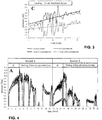
- FIG. 2 The backpressure during the feed step of the batch run for each membrane device is shown in Figure 2 .
- Figure 2A shows results for the 1 mL device and
- Figure 2B shows the results for the 3.5 mL device.
- the membrane-based capture devices of both dimensions demonstrated increased backpressure as loading proceeded, so this observation is independent of device scale.
- ⁇ Ps The specific backpressure increase of the chromatographic adsorbers, ⁇ Ps, can be derived through the following procedure:
- ⁇ Ps ⁇ P/L s with the units [bar] x [mL adsorbent]/[mL feed].
- the values ⁇ P and t feed can be determined from the linear fits of the pressure curves where ⁇ P is the pressure increase within a certain feeding period t feed .
- the adsorbent volume V ads and the flow rate Q feed are fixed parameters.
- FIG. 2C shows the result for a particle-based protein A adsorber (Eshmuno A column, Merck-Millipore, column 0.8 cm inner diameter x 10 cm bed height).
- Protein A capture steps were carried out using a Contichrom CUBE Combined 30 system (ChromaCon AG, Switzerland).
- Table 1 Batch mode operating parameters for the 1mL membrane-based device Phase step Q buffer t [-] [-] [mL/min] [-] [min] 1mL Batch equilibrate 3 25 mM Phosphate, 150 mM NaCl pH 7.0 3.33 feed 3 CHO cell supernatant - mAb (5g/L) 5.33 wash 3 25 mM Phosphate, 150 mM NaCl pH 7.0 3.33 line wash 3 100 mM Citrate, pH 3.5 0.66 elute 3 100 mM Citrate, pH 3.5 3.33 neutralization 3 25 mM Phosphate, 150 mM NaCl pH 7.0 0.66 strip 1 100 mM NaOH 5 re-equilibration 3 25 mM Phosphate, 150 mM NaCl pH 7.0 2.66 Table 2: Batch mode operating parameters for the 3.5mL membrane-based device Phase step Q buffer t [-] [-] [mL/min] [-] [min] Batch
- Example 2 Additional breakthrough curves were generated with CHO cell culture harvest clarified by depth filtration and further pre-treated to remove impurities potentially responsible for the increased backpressure.
- the clarified CHO cell culture harvest was again filtered using a Millipore, Durapore 0.45 ⁇ m PVDF filter and then pre-treated by running it through a Natrix Recon NatriFlo HD-Q anion exchange adsorber (AEX) at 10 mL/min to remove impurities.
- AEX Natrix Recon NatriFlo HD-Q anion exchange adsorber
- a maximum of 40 mL of feed was processed before the AEX cartridge was stripped and regenerated.
- the AEX pre-treated feed was then used to generate new breakthrough curves for both the 1 mL and the 3.5 mL Protein A adsorbers using the same operating parameter used in Example 1.
- Figure 3 A & C show the overlays from the feeding step of two identical batch runs with and without the AEX pre-treatment.
- Figure 3A shows the results obtained with the 1 mL device and
- Figure 3C shows the results for the 3.5 mL device.
- the AEX pre-treatment resulted in a reduced backpressure increase over time and a lower final pressure value for both the devices demonstrating that the membrane volume did not influence the effectiveness of pre-treatment.
- the specific backpressure increase is reduced by almost 70% by using pre-treatment.
- the specific backpressure increase is reduced more than 50% by use of the pre-treatment.
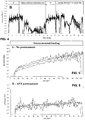
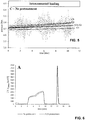
- Example 3 A twin-adsorber periodic countercurrent process was carried out using two membrane-based 3.5 mL Protein A devices (GORE Inc., DE, USA) with the operating parameters detailed in Table 4 (no AEX pre-treatment) and the Table 5 (with AEX pre-treatment).
- the clarified CHO cell culture harvest and buffers were filtered using a Millipore, Durapore 0.45 ⁇ m PVDF membrane and half the supernatant was then pre-treated with a Natrix Recon NatriFlo HD-Q anion exchange adsorber (AEX) at 10 mL/min to remove impurities.
- AEX Natrix Recon NatriFlo HD-Q anion exchange adsorber
- Figure 4C shows an example of a PCC process using particle-based packed-bed adsorbers (Eshmuno A, 0.8 cm inner diameter x 10 cm bed height) showing the backpressure increases from cycle to cycle.
- resin based processes may also benefit from this type of pre-treatment.
- All AEX pre-treatment and Protein A capture steps were carried out using a Contichrom CUBE Combined 30 system (ChromaCon AG, Switzerland).
- Table 4 Periodic counter-current process operating parameters for the 3.5 mL membrane-based device run with clarified feed without further pre-treatment.
- Table 5 Periodic counter-current process operating parameters for the 3.5 mL
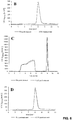
- Example 4 Figure 6A shows the batch chromatogram overlay (UV A280 nm) comparing the breakthrough and elution profile with and without the AEX pre-treatment. Operating conditions were those described in Example 1 - Table 2. Here it is evident that, while the elution peaks are of the same height (non-normalized), there is clearly a reduction in the impurities peak that corresponds to the AEX treatment (dashed line).
- Figure 6B shows a size exclusion HPLC (SE-HPLC) chromatogram of the feed material with and without AEX pre-treatment and again the major peak corresponding to the mAb is the same size (non-normalized). However, there is a reduction in molecular weight species both above and below the mAb product after AEX treatment. Both results confirm that the AEX treatment removes impurity species while the amount of IgG in the product is not affected by the pre-treatment.
- SE-HPLC size exclusion HPLC
- the equivalent batch chromatogram overlay comparison for CEX treatment in Figure 6C (UV A280 nm) also shows some removal of impurities, but to a lesser degree.
- the SE-HPLC chromatogram in Figure 6D shows that, compared to AEX treatment, there are many impurities still present. Moreover the results show that a fraction of the IgG is removed through the CEX treatment, which is not detrimental to the overall process yield. All AEX / CEX pre-treatment and Protein A capture steps were carried out using a Contichrom CUBE Combined 30 system (ChromaCon AG, Switzerland).
Landscapes
- Chemical & Material Sciences (AREA)
- Organic Chemistry (AREA)
- General Health & Medical Sciences (AREA)
- Genetics & Genomics (AREA)
- Health & Medical Sciences (AREA)
- Life Sciences & Earth Sciences (AREA)
- Biochemistry (AREA)
- Biophysics (AREA)
- Proteomics, Peptides & Aminoacids (AREA)
- Analytical Chemistry (AREA)
- Medicinal Chemistry (AREA)
- Molecular Biology (AREA)
- Engineering & Computer Science (AREA)
- Water Supply & Treatment (AREA)
- Peptides Or Proteins (AREA)
- Treatment Of Liquids With Adsorbents In General (AREA)
Priority Applications (1)
| Application Number | Priority Date | Filing Date | Title |
|---|---|---|---|
| EP17205408.2A EP3495376A1 (fr) | 2017-12-05 | 2017-12-05 | Procédé chromatographique améliorée pour la récolte de cultures cellulaires |
Applications Claiming Priority (1)
| Application Number | Priority Date | Filing Date | Title |
|---|---|---|---|
| EP17205408.2A EP3495376A1 (fr) | 2017-12-05 | 2017-12-05 | Procédé chromatographique améliorée pour la récolte de cultures cellulaires |
Publications (1)
| Publication Number | Publication Date |
|---|---|
| EP3495376A1 true EP3495376A1 (fr) | 2019-06-12 |
Family
ID=60673457
Family Applications (1)
| Application Number | Title | Priority Date | Filing Date |
|---|---|---|---|
| EP17205408.2A Withdrawn EP3495376A1 (fr) | 2017-12-05 | 2017-12-05 | Procédé chromatographique améliorée pour la récolte de cultures cellulaires |
Country Status (1)
| Country | Link |
|---|---|
| EP (1) | EP3495376A1 (fr) |
Cited By (6)
| Publication number | Priority date | Publication date | Assignee | Title |
|---|---|---|---|---|
| US10704021B2 (en) | 2012-03-15 | 2020-07-07 | Flodesign Sonics, Inc. | Acoustic perfusion devices |
| US10975368B2 (en) | 2014-01-08 | 2021-04-13 | Flodesign Sonics, Inc. | Acoustophoresis device with dual acoustophoretic chamber |
| US11214789B2 (en) | 2016-05-03 | 2022-01-04 | Flodesign Sonics, Inc. | Concentration and washing of particles with acoustics |
| US11377651B2 (en) | 2016-10-19 | 2022-07-05 | Flodesign Sonics, Inc. | Cell therapy processes utilizing acoustophoresis |
| CN115746086A (zh) * | 2022-11-25 | 2023-03-07 | 无锡药明生物技术股份有限公司 | 一种处理高固含量细胞液的澄清收获工艺 |
| US11708572B2 (en) | 2015-04-29 | 2023-07-25 | Flodesign Sonics, Inc. | Acoustic cell separation techniques and processes |
Citations (3)
| Publication number | Priority date | Publication date | Assignee | Title |
|---|---|---|---|---|
| EP2719705A1 (fr) * | 2007-10-26 | 2014-04-16 | Asahi Kasei Chemicals Corporation | Méthode de purification de protèines |
| WO2014166799A1 (fr) | 2013-04-08 | 2014-10-16 | Chromacon Ag | Procédé de purification chromatographique |
| WO2017046391A2 (fr) * | 2015-09-17 | 2017-03-23 | Annexin Pharmaceuticals Ab | Procédé de fabrication |
-
2017
- 2017-12-05 EP EP17205408.2A patent/EP3495376A1/fr not_active Withdrawn
Patent Citations (3)
| Publication number | Priority date | Publication date | Assignee | Title |
|---|---|---|---|---|
| EP2719705A1 (fr) * | 2007-10-26 | 2014-04-16 | Asahi Kasei Chemicals Corporation | Méthode de purification de protèines |
| WO2014166799A1 (fr) | 2013-04-08 | 2014-10-16 | Chromacon Ag | Procédé de purification chromatographique |
| WO2017046391A2 (fr) * | 2015-09-17 | 2017-03-23 | Annexin Pharmaceuticals Ab | Procédé de fabrication |
Cited By (6)
| Publication number | Priority date | Publication date | Assignee | Title |
|---|---|---|---|---|
| US10704021B2 (en) | 2012-03-15 | 2020-07-07 | Flodesign Sonics, Inc. | Acoustic perfusion devices |
| US10975368B2 (en) | 2014-01-08 | 2021-04-13 | Flodesign Sonics, Inc. | Acoustophoresis device with dual acoustophoretic chamber |
| US11708572B2 (en) | 2015-04-29 | 2023-07-25 | Flodesign Sonics, Inc. | Acoustic cell separation techniques and processes |
| US11214789B2 (en) | 2016-05-03 | 2022-01-04 | Flodesign Sonics, Inc. | Concentration and washing of particles with acoustics |
| US11377651B2 (en) | 2016-10-19 | 2022-07-05 | Flodesign Sonics, Inc. | Cell therapy processes utilizing acoustophoresis |
| CN115746086A (zh) * | 2022-11-25 | 2023-03-07 | 无锡药明生物技术股份有限公司 | 一种处理高固含量细胞液的澄清收获工艺 |
Similar Documents
| Publication | Publication Date | Title |
|---|---|---|
| AU2011256727B2 (en) | Apparatus and process of purification of proteins | |
| CN102762585B (zh) | 单一单元抗体纯化 | |
| US6022477A (en) | Method and apparatus for isolation purification of biomolecules | |
| EP2160227B1 (fr) | Procédé de chromatographie | |
| EP3484599B1 (fr) | Procédé de purification et ses utilisations | |
| EP1885488B1 (fr) | Regeneration d'une matrice de chromatographie | |
| CN103189390A (zh) | 单一单元离子交换色谱抗体纯化 | |
| US20150361129A1 (en) | Methods for increasing the capacity of flow-through processes | |
| JP7511921B2 (ja) | 連続向流スパイラルクロマトグラフィー | |
| Feins et al. | Novel internally staged ultrafiltration for protein purification | |
| US6986847B2 (en) | Method and apparatus for isolation and purification of biomolecules | |
| JP6203557B2 (ja) | 分離装置及び分離方法 | |
| WO2023181655A1 (fr) | Procédé de séparation chromatographique à lit mobile simulé et système de séparation chromatographique à lit mobile simulé | |
| JP2024538610A (ja) | 精製方法及びその使用 | |
| JP6230853B2 (ja) | タンパク質の精製方法及び精製装置 | |
| HK1185893A (en) | Single unit ion exchange chromatography antibody purification | |
| Kanani et al. | Salt-tolerant cation exchange HD-Sb hydrogel membrane: mAb purification performance in flowthrough mode | |
| Kroner | Cross-Flow Application of Affinity Membranes | |
| AU2015255316A1 (en) | Apparatus and process of purification of proteins | |
| HK1183890A (en) | Apparatus and process of purification of proteins | |
| HK1178174A (en) | Single unit antibody purification |
Legal Events
| Date | Code | Title | Description |
|---|---|---|---|
| PUAI | Public reference made under article 153(3) epc to a published international application that has entered the european phase |
Free format text: ORIGINAL CODE: 0009012 |
|
| AK | Designated contracting states |
Kind code of ref document: A1 Designated state(s): AL AT BE BG CH CY CZ DE DK EE ES FI FR GB GR HR HU IE IS IT LI LT LU LV MC MK MT NL NO PL PT RO RS SE SI SK SM TR |
|
| AX | Request for extension of the european patent |
Extension state: BA ME |
|
| STAA | Information on the status of an ep patent application or granted ep patent |
Free format text: STATUS: THE APPLICATION IS DEEMED TO BE WITHDRAWN |
|
| 18D | Application deemed to be withdrawn |
Effective date: 20191214 |