EP3495476A1 - Verfahren zur hydrolytischen spaltung von zearalenon und/oder zearalenon-derivaten mittels eines polypeptids sowie verwendung - Google Patents
Verfahren zur hydrolytischen spaltung von zearalenon und/oder zearalenon-derivaten mittels eines polypeptids sowie verwendung Download PDFInfo
- Publication number
- EP3495476A1 EP3495476A1 EP19152484.2A EP19152484A EP3495476A1 EP 3495476 A1 EP3495476 A1 EP 3495476A1 EP 19152484 A EP19152484 A EP 19152484A EP 3495476 A1 EP3495476 A1 EP 3495476A1
- Authority
- EP
- European Patent Office
- Prior art keywords
- polypeptide
- zen
- zearalenone
- sequence
- amino acid
- Prior art date
- Legal status (The legal status is an assumption and is not a legal conclusion. Google has not performed a legal analysis and makes no representation as to the accuracy of the status listed.)
- Granted
Links
Images


Classifications
-
- A—HUMAN NECESSITIES
- A23—FOODS OR FOODSTUFFS; TREATMENT THEREOF, NOT COVERED BY OTHER CLASSES
- A23K—FODDER
- A23K10/00—Animal feeding-stuffs
- A23K10/10—Animal feeding-stuffs obtained by microbiological or biochemical processes
- A23K10/14—Pretreatment of feeding-stuffs with enzymes
-
- C—CHEMISTRY; METALLURGY
- C12—BIOCHEMISTRY; BEER; SPIRITS; WINE; VINEGAR; MICROBIOLOGY; ENZYMOLOGY; MUTATION OR GENETIC ENGINEERING
- C12N—MICROORGANISMS OR ENZYMES; COMPOSITIONS THEREOF; PROPAGATING, PRESERVING, OR MAINTAINING MICROORGANISMS; MUTATION OR GENETIC ENGINEERING; CULTURE MEDIA
- C12N9/00—Enzymes; Proenzymes; Compositions thereof; Processes for preparing, activating, inhibiting, separating or purifying enzymes
- C12N9/14—Hydrolases (3)
- C12N9/16—Hydrolases (3) acting on ester bonds (3.1)
- C12N9/18—Carboxylic ester hydrolases (3.1.1)
-
- A—HUMAN NECESSITIES
- A23—FOODS OR FOODSTUFFS; TREATMENT THEREOF, NOT COVERED BY OTHER CLASSES
- A23B—PRESERVATION OF FOODS, FOODSTUFFS OR NON-ALCOHOLIC BEVERAGES; CHEMICAL RIPENING OF FRUIT OR VEGETABLES
- A23B2/00—Preservation of foods or foodstuffs, in general
- A23B2/70—Preservation of foods or foodstuffs, in general by treatment with chemicals
- A23B2/725—Preservation of foods or foodstuffs, in general by treatment with chemicals in the form of liquids or solids
- A23B2/729—Organic compounds; Microorganisms; Enzymes
- A23B2/783—Microorganisms; Enzymes
-
- A—HUMAN NECESSITIES
- A23—FOODS OR FOODSTUFFS; TREATMENT THEREOF, NOT COVERED BY OTHER CLASSES
- A23K—FODDER
- A23K50/00—Feeding-stuffs specially adapted for particular animals
- A23K50/30—Feeding-stuffs specially adapted for particular animals for swines
-
- A—HUMAN NECESSITIES
- A23—FOODS OR FOODSTUFFS; TREATMENT THEREOF, NOT COVERED BY OTHER CLASSES
- A23K—FODDER
- A23K50/00—Feeding-stuffs specially adapted for particular animals
- A23K50/70—Feeding-stuffs specially adapted for particular animals for birds
- A23K50/75—Feeding-stuffs specially adapted for particular animals for birds for poultry
-
- A—HUMAN NECESSITIES
- A23—FOODS OR FOODSTUFFS; TREATMENT THEREOF, NOT COVERED BY OTHER CLASSES
- A23K—FODDER
- A23K50/00—Feeding-stuffs specially adapted for particular animals
- A23K50/80—Feeding-stuffs specially adapted for particular animals for aquatic animals, e.g. fish, crustaceans or molluscs
-
- C—CHEMISTRY; METALLURGY
- C07—ORGANIC CHEMISTRY
- C07K—PEPTIDES
- C07K14/00—Peptides having more than 20 amino acids; Gastrins; Somatostatins; Melanotropins; Derivatives thereof
- C07K14/195—Peptides having more than 20 amino acids; Gastrins; Somatostatins; Melanotropins; Derivatives thereof from bacteria
-
- C—CHEMISTRY; METALLURGY
- C12—BIOCHEMISTRY; BEER; SPIRITS; WINE; VINEGAR; MICROBIOLOGY; ENZYMOLOGY; MUTATION OR GENETIC ENGINEERING
- C12N—MICROORGANISMS OR ENZYMES; COMPOSITIONS THEREOF; PROPAGATING, PRESERVING, OR MAINTAINING MICROORGANISMS; MUTATION OR GENETIC ENGINEERING; CULTURE MEDIA
- C12N9/00—Enzymes; Proenzymes; Compositions thereof; Processes for preparing, activating, inhibiting, separating or purifying enzymes
- C12N9/14—Hydrolases (3)
-
- C—CHEMISTRY; METALLURGY
- C12—BIOCHEMISTRY; BEER; SPIRITS; WINE; VINEGAR; MICROBIOLOGY; ENZYMOLOGY; MUTATION OR GENETIC ENGINEERING
- C12Y—ENZYMES
- C12Y301/00—Hydrolases acting on ester bonds (3.1)
- C12Y301/01—Carboxylic ester hydrolases (3.1.1)
-
- A—HUMAN NECESSITIES
- A23—FOODS OR FOODSTUFFS; TREATMENT THEREOF, NOT COVERED BY OTHER CLASSES
- A23V—INDEXING SCHEME RELATING TO FOODS, FOODSTUFFS OR NON-ALCOHOLIC BEVERAGES AND LACTIC OR PROPIONIC ACID BACTERIA USED IN FOODSTUFFS OR FOOD PREPARATION
- A23V2002/00—Food compositions, function of food ingredients or processes for food or foodstuffs
-
- Y—GENERAL TAGGING OF NEW TECHNOLOGICAL DEVELOPMENTS; GENERAL TAGGING OF CROSS-SECTIONAL TECHNOLOGIES SPANNING OVER SEVERAL SECTIONS OF THE IPC; TECHNICAL SUBJECTS COVERED BY FORMER USPC CROSS-REFERENCE ART COLLECTIONS [XRACs] AND DIGESTS
- Y02—TECHNOLOGIES OR APPLICATIONS FOR MITIGATION OR ADAPTATION AGAINST CLIMATE CHANGE
- Y02A—TECHNOLOGIES FOR ADAPTATION TO CLIMATE CHANGE
- Y02A40/00—Adaptation technologies in agriculture, forestry, livestock or agroalimentary production
- Y02A40/80—Adaptation technologies in agriculture, forestry, livestock or agroalimentary production in fisheries management
- Y02A40/81—Aquaculture, e.g. of fish
- Y02A40/818—Alternative feeds for fish, e.g. in aquacultures
Definitions
- the present invention relates to a process for the hydrolytic cleavage of zearalenone and / or of at least one zearalenone derivative with a polypeptide, and to an additive containing such a polypeptide as well as to a use of such a polypeptide.
- Mycotoxins are secondary metabolites produced by filamentous fungi.
- ZEN world-wide zearalenone
- F-2 toxin Fusarium fungi.
- These fungi infect, among other crops, such as various cereals, which usually occurs before the harvest of the fungus, wherein the fungal growth or mycotoxin production before or inappropriate storage can also be done after harvesting.
- the FAO estimates that 25% of agrarian products worldwide are contaminated with mycotoxins, leading to significant economic losses.
- a total of 23,781 samples were analyzed from January 2009 to December 2011, with 81% tested positive for at least one mycotoxin and 45% positive for ZEN.
- ZEN has been found in all regions of the world as well as in all tested cereal and feed categories, such as corn, soybean meal, wheat, wheat bran, DDGS (dry-mash), and ready-to-feed mixes at a frequency of up to 100%.
- ZEN is a non-steroidal, estrogenic, macrocyclic lactone synthesized via the polyketide pathway with the structural formula: and the IUPAC nomenclature name (2E, 11S) -15,17-dihydroxy-11-methyl-12-oxabicyclo [12.4.0] octadeca-1 (18), 2,14,16-tetraene-7,13-dione.
- ZEN derivatives which are formed by enzymatic or chemical modifications of ZEN.
- examples of these are glycosidic or sulphate-containing ZEN conjugates, which are formed by fungi, plants or mammalian metabolism, and ZEN metabolites, which are formed, inter alia, in the human or animal organism.
- ZEN derivatives are considered to be naturally occurring or produced by chemical or biochemical synthesis ZEN conjugates or ZEN metabolites, but especially ⁇ -zearalenol ( ⁇ -ZEL; (2E, 7R, 11S) -7.15, 17-trihydroxy-11-methyl-12-oxabicyclo [12.4.0] octadeca-1 (18), 2, 14, 16-tetraen-13-one), ⁇ -zearalenol ( ⁇ -ZEL; (2E, 7S, 11S ) -7,15,17-trihydroxy-11-methyl-12-oxabicyclo [12.4.0] octadeca-1 (18), 2,14,16-tetraen-13-one), ⁇ -zearalanol ( ⁇ -ZAL; (7R, 11S) -7,15,17-trihydroxy-11-methyl-12-oxabicyclo [l2.4.0] octadeca1 (18), 14,16-trien-13-one), ⁇ -zearalanol ( ⁇ -ZAL; (7S
- ZEN as well as ZEN derivatives, especially ⁇ -ZEL, ⁇ -ZEL, Z14S, ⁇ -ZAL, ⁇ -ZAL, Z14G and ZAN can also be used in processed food or feed such as e.g. Bread or beer can be detected.
- ZEN binds to the estrogen receptor and can cause hormonal imbalances, being absorbed immediately after ingestion and converted by mammals into the two stereoisomeric metabolites ⁇ -ZEL and ⁇ -ZEL, respectively.
- ⁇ -ZEL but also ⁇ -ZAL and ZAN have a much stronger estrogenic effect than ZEN.
- Conjugated ZEN derivatives may have lower estrogenicity than ZEN, but ZEN may be released from these ZEN derivatives in the digestive tract.
- ZEN has relatively low acute toxicity and an oral LD50 of up to 20,000 mg / kg body weight, prolonged use may cause subacute and / or subchronic toxic effects, such as teratogenic, carcinogenic, estrogenic and immunosuppressive effects in animals or humans occur.
- ZEN Contaminated feed causes developmental disorders in mammals, with pigs, and particularly young animals, being extremely sensitive to ZEN.
- ZEN concentrations in the feed above 0.5 ppm lead to developmental disorders, with concentrations above 1.5 ppm, for example, leading to hyperestrogenicity in pigs and concentrations of 12 ppm ZEN responsible for miscarriage in cattle.
- the primary strategy to reduce ZEN contamination of food or feed is to limit fungal growth, for example by complying with "good agricultural practice”. This includes, among other things, that seed is free of pests and fungal infestation, or that agricultural waste products are removed from the field in time. Furthermore, the use of fungicides can reduce fungal growth on the field. After harvesting, the crop should be stored at a residual moisture level below 15% and low temperature to prevent fungal growth. Likewise, contaminated material should be removed before further processing by fungal infestation. Despite this list of measures, I. Rodriges and K. Naehrer (2012) reported that even in regions with the highest agricultural standards, such as the US and Central Europe, between 2009 and 2011, 29% and 39% of the tested maize samples were contaminated with ZEN were.
- the detoxification of ZEN by physical and chemical treatments is limited.
- thermal treatment ZEN can not be effectively deactivated, however, the ZEN content can be reduced by extrusion and treatment with oxidizing agents, e.g. be reduced by 83.9% for 16 h at 80 ° C with 10% hydrogen peroxide solution.
- oxidizing agents e.g. be reduced by 83.9% for 16 h at 80 ° C with 10% hydrogen peroxide solution.
- the use of extrusion processes and oxidizing agents such as ozone or hydrogen peroxide in feed and food production is limited due to high cost, quality loss, low efficiency and low specificity.
- the WO 02/076205 discloses the ZEN-degrading action of enzymes isolated from Gliocladium roseum , including the ⁇ / ⁇ -hydrolase, zearalenone hydrolase 1 (ZHD1), which catalyzes the degradation of ZEN by means of a catalytic triad.
- ZHD1 zearalenone hydrolase 1
- Polypeptides or enzymes capable of hydrolyzing ZEN and / or at least one ZEN derivative may also be referred to as zonases.
- polynucleotide refers to any type of genetic material of all lengths and sequences, such as e.g. Single-stranded and double-stranded DNA and RNA molecules, including regulatory elements, structural elements, groups of genes, plasmids, entire genomes, and fragments thereof.
- polypeptide includes proteins such as enzymes, antibodies, as well as polypeptides of up to 500 amino acids, such as peptide inhibitors, domains of proteins, but also short polypeptides of small sequence lengths, e.g.
- composition in a polynucleotide or polypeptide refers to a single, specific base or amino acid in the sequence of the polynucleotide or polypeptide.
- the present invention now aims to provide a method which enables rapid and reliable hydrolytic cleavage of ZEN and / or of at least one ZEN derivative.
- the present invention is essentially characterized in that zearalenone and / or at least one zearalenone derivative by the polypeptide containing a hydrolase having an amino acid sequence of the sequence ID no. 12 or a functional variant thereof is hydrolyzed, wherein a sequence identity between the functional variant and the amino acid sequence is at least 70%.
- sequence identity refers to a percent sequence identity. For amino acid sequences and nucleotide sequences, sequence identity can be determined visually, but preferably calculated with a computer program. The sequence comparison is also performed within sequence sections, which section is to be understood as a continuous sequence of the reference sequence and preferably comprises a conserved region of the sequence.
- sequence identity was determined using the program NCBI BLAST (Basic Local Alignment Search Tool), in particular with BLASTP for polypeptides and BLASTN for polynucleotides, which are available on the homepage of the National Center for Biotechnology Information "(NCBI; http://www.ncbi.nlm.nih.gov/) .
- NCBI National Center for Biotechnology Information
- This makes it possible to use two or more sequences together according to the algorithm of Altschul et al., 1997 (Nucleic Acids Res., 25: 3389-3402 ) to compare.
- the programs were used in the version of May 15, 2013.
- polypeptide variant refers, on the one hand, to “allelic variants” of the polypeptide and to “functional fragments” of the polypeptide, and, on the other hand, to "modification” of the polypeptide, wherein the enzymatic function is substantially unchanged.
- allelic variant refers to a polypeptide produced by naturally occurring mutation (s) of the nucleotide sequence which causes a change in the amino acid sequence, the enzymatic function of which is unaffected.
- Modifications may be, for example, C- or N-terminal fusions to polypeptides or mutated polypeptides, mutations being obtained by substitution, insertion or deletion of at least one amino acid, in particular by site-directed mutagenesis, recombination and / or any other protein engineering method can be.
- substitution, insertion and deletion are used in the usual way in genetic engineering and the skilled person meaning.
- the term "functional fragment” refers to a portion or a partial sequence of a polypeptide or a portion or a partial sequence of a functional variant thereof, wherein the enzymatic function is substantially retained. An enzymatic function is then substantially retained if the enzymatic reaction mechanism remains unchanged, i. the mycotoxin is hydrolyzed at the same site and the specific residual activity "functional variant” is at least 5%, preferably at least 10%, in particular at least 50%, based on the original polypeptide.
- the hydrolytic cleavage is performed with a polypeptide containing at least one conserved amino acid sequence portion or a functional variant thereof, wherein the functional variant of the amino acid sequence portion has a sequence identity of at least 70%, preferably at least 84%, more preferably at least 92%, and most preferably at least 98%, and the at least one conserved amino acid sequence portion from the group of amino acid sequences +89 to +145, +223 to +228, +257 to +261, +272 to +279, the sequence having the sequence ID no. 1 is selected.
- the functional variant has at least one amino acid modification selected from the group substitution, deletion and insertion of one or more amino acids.
- the polypeptide has a specific activity of at least 0.01 U / mg, preferably at least 0.1 U / mg, in particular at least 1 U / mg; and / or a K M value of the hydrolytic cleavage of ZEN of at most 50 ⁇ M, preferably at most 3.5 ⁇ M, in particular at most 0.5 ⁇ M; and / or a k cat value of the hydrolytic cleavage of ZEN of at least 0.05 s -1 , preferably at least 0.6 s -1 , in particular at least 5 s -1 ; and / or has a v max value of hydrolytic cleavage of ZEN of at least 0.00001 ⁇ M -1 s -1 , preferably at least 0.0001 ⁇ M -1 s -1 , in particular at least 0.001 ⁇ M -1 s -1 , ZEN and / or ZEN derivatives particularly rapidly and completely hydrolyzed, in particular detoxified.
- the polypeptide may be selected to be an ⁇ / ⁇ -hydrolase suitable for oxygen-independent and cofactor-free hydrolytic cleavage of the ester moiety of zearalenone and / or the ZEN derivatives which comprises a hydrolytic cleavage amino acid triad consisting of serine, a acidic amino acid selected from glutamic acid and aspartic acid, in particular aspartic acid and histidine, and the catalytic triad z, B. S128, D264 and H303, wherein the positioning relative to the sequence ID no. 1 is shown.
- hydrolysis of ZEN to non-toxic hydrolyzed zearalenone (HZEN) or hydrolyzed ZEN derivatives is effected by the polypeptides according to the invention, in particular the ⁇ / ⁇ -hydrolases.
- the further decarboxylation of HZEN to decarboxylated, hydrolyzed ZEN (DHZEN) or decarboxylated, hydrolyzed ZEN derivatives is usually spontaneous.
- a polypeptide consisting of one of 3 amino acids before and 3 amino acids after the serine of the above-mentioned catalytic triad at least one polar amino acid selected from Y, Q, N, T, K , R, E, D and at least one non-polar amino acid selected from F, M, L, I, V, A, G, P contains consistently good results and moreover to improve at least one enzyme kinetic parameter.
- the method is carried out with a polypeptide having at least one mutation of the amino acid sequence with respect to the sequence ID no. 1 at at least one of the following positions 22, 23, 25, 26, 27, 29, 31, 32, 35, 37, 42, 43, 46, 51, 53, 54, 57, 60, 69, 72, 73, 78 , 80, 84, 88, 95, 97, 99, 114, 118, 119, 123, 132, 141, 146, 148, 149, 154, 163, 164, 165, 169, 170, 172, 176, 180, 182 , 183, 190, 191, 194, 196, 197, 198, 201, 204, 205, 206, 207, 208, 209, 210, 212, 213, 214, 216, 217, 220, 221, 222, 229, 231 , 233, 238, 240, 244, 245, 246, 248, 249, 251, 254,
- the method is carried out with a polypeptide which has at least one mutation selected from the group: D22A, S23Q, S23L, N25D, I26V, F27Y, F27H, S29P, R31A, F32Y, R35K, R35Q, V37A, V42I, V43T, F46Y, S51E, S51D, D53G, N54M, N54R, L57V, L60I, S69G, P72E, V73A, A78S, N80H, F84Y, I88L, T95S, T97A, R99K, I114M, I118V, K119R, V123I, L132V, A141S, I146V, I146L, A148G, A149V, A154P, P163T, A164T, Y165C, Y165H, V169I, L170R, A172G, A176M, A176V, Y180F, D182T
- ZEN can be completely hydrolyzed, in particular detoxified, within a short time, the specific activity of the polypeptide being at least 6.00 U / mg, preferably at least 7.00 U / mg, in particular at least 8.00 U / mg ,
- the unit “U” or “Unit” is a measure of the absolute catalytic activity and is defined by the hydrolysis of 1 ⁇ mol ZEN per minute at 32 ° C in 50 mM Tris-HCl buffer (pH 8.2), wherein “catalytic activity” is understood to mean the enzymatic conversion of a substrate under defined reaction conditions, and "specific activity” means the ratio of the catalytic activity and the polypeptide mass concentration (mass per volume unit).
- polypeptide is designed such that the polypeptide comprises at least one of the following amino acid motifs selected from the group of the sequence ID Nos. 32 to 69, it is possible to provide polypeptides having a specific activity of at least 7.00 U / mg, preferably at least 8.00 U / mg.
- the polypeptide may contain at least one conservative amino acid substitution at at least one position, wherein the conservative amino acid substitution is selected from substitutions of G to A; or A to G, S; or V to I, L, A, T, S; or I too V, L, M; or L to I, M, V; or M to L, I, V; or P to A, S, N; or F to Y, W, H; or Y to F, W, H; or W to Y, F, H; or R to K, E, D; or K to R, E, D; or H to Q, N, S; or D to N, E, K, R, Q; or E to Q, D, K, R, N; or S to T, A; or T to S, V, A; or C to S, T, A; or N to D, Q, H, S; or Q to E, N, H, K, R.
- conservative amino acid substitution refers to the substitution of amino acids by other amino acids which are considered conservative by those skilled in the art, that is, having similar specific properties. Such specific properties are, for example, the size, polarity, hydrophobicity, charge or pKs of the amino acid.
- a conservative mutation is meant, for example, a substitution of one acidic amino acid for another acidic amino acid, one basic amino acid for another basic amino acid, or one polar for another polar amino acid.
- the biochemical conversion of ZEN and / or of at least one ZEN derivative to hydrolyzed ZEN and / or hydrolyzed ZEN derivative can also be used, for example, for the stereoselective hydrolysis of ZEN and / or ZEN derivatives in industrial processes.
- the method is developed so that the excipients from at least one inert carrier, and optionally other ingredients such as vitamins and / or minerals and / or enzymes and / or wieteren components are selected for the detoxification of mycotoxins.
- the excipients from at least one inert carrier, and optionally other ingredients such as vitamins and / or minerals and / or enzymes and / or wieteren components are selected for the detoxification of mycotoxins.
- a polypeptide may also be present in an enzyme preparation which, in addition to at least one polypeptide, additionally contains at least one enzyme which is present, for example, on the Involved in the metabolism of starch or fiber or fat or glycogen, such as amylase, cellulase or glucanase, and for example hydrolases, lipolytic enzymes, mannosidases, oxidases, oxidoreductases, phytases, xylanases and / or combinations thereof.
- enzyme preparation which, in addition to at least one polypeptide, additionally contains at least one enzyme which is present, for example, on the Involved in the metabolism of starch or fiber or fat or glycogen, such as amylase, cellulase or glucanase, and for example hydrolases, lipolytic enzymes, mannosidases, oxidases, oxidoreductases, phytases, xylanases and / or combinations thereof.
- enzyme preparations which contain, in addition to at least one polypeptide, at least one component for detoxifying mycotoxins, such as a mycotoxin-degrading enzyme such as alfatoxin oxidase, ergotamine hydrolases, ergotamine amidases, zearalenone esterases, zearalenone lactonases, ochratoxin amidases, fumonisin carboxylesterases, Fumonisin aminotransferases, aminopolyol amine oxidases, deoxynivalenol epoxide hydrolases; and / or at least one mycotoxin-degrading microorganism, such as Bacillus subtilis; and / or at least one mycotoxin-binding component, for example microbial cell walls or inorganic materials, such as bentonites.
- a mycotoxin-degrading enzyme such as alfatoxin oxidase, ergotamine hydrolases, ergotamine amidases,
- the process is conducted in such a way that at least one polypeptide is present in the additive in a concentration of at most 10,000 U / g, preferably at most 1,000 U / g, more preferably at most 100 U / g and most preferably at most 10 U / g, which enables ZEN and / or ZEN derivatives to be rapidly, and in particular even before their absorption by the body, of a contaminated feed or food consuming subject, in particular of a mammal, into non-toxic or less toxic metabolites, in particular HZEN and DHZEN, to transform.
- the additive is present in encapsulated or coated form, wherein for the encapsulation or Coaten standard methods, such as in the WO 92/12645 described, can be used.
- encapsulating or coating it is possible to transport the polypeptide without change, in particular without degradation and damage to its place of use, so that only after dissolution of the protective cover, for example in the digestive tract of animals, the polypeptide begins to act, creating an even more targeted, rapid and complete degradation of ZEN and / or ZEN derivatives can also be achieved in the acidic, protease-rich and anaerobic environment.
- the encapsulation or coating also makes it possible to increase the temperature stability of the polypeptides in the additive.
- the process is conducted by adding to the polypeptide or additive a feed or food contaminated with zearalenone and / or with at least one zearalenone derivative such that the contaminated feed or foodstuffs are contacted with moisture and that the polypeptide or additive hydrolyzes the zearalenone contained in the contaminated feed or food and / or at least one zearalenone derivative.
- moist feed or food such as mash or porridge
- the hydrolysis of the zearalenone and / or the at least one zearalenone derivative will take place prior to ingestion in moist feed or food.
- moisture is understood as meaning the presence of water or water-containing liquids, including, for example, Saliva or other fluids present in the digestive tract fall.
- a digestive tract the oral cavity, the pharynx (pharynx), the esophagus and the gastrointestinal tract or equivalents thereof are defined, whereby different names may occur in animals or individual components may not be present in the digestive tract of animals.
- the inventive method may also be conducted so that the feed or food is pelleted prior to oral ingestion.
- the method is performed so that at least 70%, preferably at least 80%, in particular at least 90% of the zearalenone and / or at least one zearalenone derivative are hydrolyzed.
- This may prevent subacute and / or subchronic toxic effects, such as teratogenic, carcinogenic, estrogenic and immunosuppressive effects in animals or humans.
- Example 1 Modification, cloning and expression of polynucleotides encoding polypeptides which can hydrolytically cleave ZEN and / or at least one ZEN derivative.
- nucleotide sequences were synthesized by PCR using the "Quick-change Site-directed Mutagenesis Kit" (Stratagene) as directed. Alternatively, complete nucleotide sequences were also obtained (GeneArt).
- the nucleotide sequences generated by PCR mutagenesis or by GeneArt optionally additionally contained a C- or N-terminal 6xHis tag at the amino acid level and were converted by standard methods into expression vectors for expression in E. coli or P. pastoris integrated, in E. coli or P. pastoris , as well as in E. coli or P.
- expression vector refers to a DNA construct capable of expressing a gene in vivo or in vitro .
- DNA constructs which are suitable for transferring the polypeptide-encoding nucleotide sequence into the host cell in order to integrate there into the genome or to exist freely in the extra-chromosomal space and to intracellularly express the nucleotide sequence coding for the polypeptide and optionally the polypeptide from the Take out the cell.
- host cell refers to all cells which either contain a nucleotide sequence to be expressed or an expression vector and are capable of producing a polypeptide of the invention.
- these are understood to mean prokaryotic and / or eukaryotic cells, preferably P. pastoris, E. coli, Bacillus subtilis, Streptomyces, Hansenula, Trichoderma, Lactobacillus, Aspergillus, plant cells and / or spores of Bacillus, Trichoderma or Aspergillus.
- the soluble cell lysate in the case of E. coli or the culture supernatant in the case of P. pastoris were used to determine the catalytic properties of the polypeptides.
- the polypeptides were selectively enriched by standard methods by chromatography on nickel Sepharoseäulen.
- the determination of the protein concentration was carried out by standard methods, either with the BCA method (Pierce BCA Protein Assay KitProd # 23225), but preferably photometrically with the specific extinction coefficients for the respective proteins using the program "ProtParam", available online at http: // web.expasy.org/protparam ( Gasteiger E. et al .; Protein Identification and Analysis Tools on the ExPASy Server; (ln) John M. Walker (ed): The Proteomics Protocols Handbook, Humana Press, 2005, p. 571-607 ) were calculated.
- the polypeptides with the sequence ID Nos. 1 to 6, which have a sequence identity of at least 70% to one another were determined with the aid of the COBALT ( JS Papadopoulos and R. Agarwala, 2007, COBALT: constraint-based alignment tool for multiple protein sequences, Bioinformatics 23: 1073-79 using the default parameters, in particular the parameters ("gap penalties”: -11, -1; “end-gap penalties”: -5, -1; “use RPS BLAST”: on; “blast E-value”: 0.003; “Find conserveed columns and Recomputes”: on; “use query clusters”: on; “word size”: 4; “may cluster distance”: 0.8; "Alphabet”: regular; "Homology conversation setting”: 3 bits).
- COBALT JS Papadopoulos and R. Agarwala, 2007, COBALT: constraint-based alignment tool for multiple protein sequences, Bioinformatics 23: 1073-79 using the
- the polypeptide with the sequence ID no. 1 encoded by the nucleotide sequence having the sequence ID-No. 17, as such, and with a C- or N-terminal 6xHis tag in E. coli as described in Example 1.
- 100 ml of an E. coli culture with an optical density (OD600 nm) of 2.0-2.5 were harvested by centrifugation at 4 ° C.
- Brunner mineral medium DSMZ microorganisms medium number 462, 2012
- the cell suspensions were lysed by treatment 3 times with a Frensh Press at 20,000 psi.
- the cell lysates thus obtained were used in a 1:10, a 1: 100 or a 1: 1000 dilution prepared in Brunner mineral medium including 0.1 mg / ml BSA (bovine serum albumin).
- Brunner mineral medium including 0.1 mg / ml BSA (bovine serum albumin).
- 9.9 ml of Brunner mineral medium including 0.1 mg / ml BSA, 0.1 ml of diluted cell lysate and 31 ⁇ l of ZEN substrate stock solution were used for the ZEN degradation experiments.
- the cell lysates were thus diluted 1: 1000, 1: 10,000 and 1: 100,000, respectively.
- the ZEN substrate stock solution used was a 2.08 mM ZEN solution (40% by volume ACN + 60% by volume H 2 O). To prepare this solution, ZEN was weighed and dissolved in crystalline form (Biopure Standard from Romer Labs, Art. No. 001109, purity at least 98%). Each digestion batch was carried out in 25 ml glass vials and incubated at 25 ° C. with shaking at 100 rpm for a total of 120 hours.
- the eluent used was an acetonitrile / water mixture with a formic acid concentration of 1 ml / l.
- the UV signal at 270 nm was recorded.
- the ionization source used was electrospray ionization (ESI).
- ZEN, HZEN and DHZEN were quantified using QTrap / LC / MS / MS (triple quadrupole, Applied Biosystems) in "enhanced mode". After 24 hours at the latest, no significant amounts of ZEN could be detected in any of the batches. The majority, over 80%, of ZEN has been converted into HZEN or DHZEN.
- the degradation of ZEN and the increase in HZEN and DHZEN are exemplary of a 1: 10,000 diluted cell lysate solution for non-tagged ( Fig. 1A ) as well as for C-terminal 6xHis tagged ( Fig. 1B ) and N-terminal 6xHis tagged ( Fig. 1C ) Polypeptide with SEQ ID NO. 1 to see. From this it is clear that 1. the conversion of ZEN is immediate and complete, since already in the first sample (0 h), which were drawn immediately after the start of the experiment, almost no ZEN could be detected and 2. by the addition one day, C- or N-terminal, no significant loss of activity occurred.
- polypeptides besides ZEN also to transform ZEN derivatives into non or less toxic metabolites the polypeptides having the sequence ID Nos. 1 and 12, prepared as described in Example 3 with C-terminal His-tag and as cell lysates in the degradation, the respective synthetic nucleotide sequences with the sequences with the sequence ID no. 17 and 28 used.
- the cell lysates were used at a total dilution of 1: 10,000.
- As substrate stock solution instead of a 2.08 mM ZEN solution (40% by volume ACN + 60% by volume H 2 O), equimolar, ie 2.08 mM, solutions of the ZEN derivatives were used.
- ⁇ -ZEL, ⁇ -ZEL, ⁇ -ZAL, ⁇ -ZAL and ZAN were purchased from Sigma and used as standards for analysis.
- Z14G and Z14S were with a purity of at least 90%, following the procedures as in Krenn et al., 2007 (Mycotoxin Research, 23, 4, 180-184 ) and M. Sulyok et al., 2007 (Anal., Biochem. Chem., 289, 1505-1523 ) and prepared as standards for analysis. Another difference to Example 3 is that only one sample, namely after 24 h, was taken. The reduction in the concentration of ZEN derivatives during the degradation experiment was quantified by LC / MS / MS. ⁇ -ZEL, ⁇ -ZEL, Z14G and Z14S were prepared by the method of M. Sulyok et al.
- Example 5 Specific activity and enzyme kinetic parameters of the polypeptides and variants thereof
- the determination of the specific activity of the polypeptides and of variants thereof was carried out photometrically, with all the polypeptides used having a C-terminal 6xHis tag.
- the preparation, enrichment and purification of the polypeptides or of variants thereof were carried out as described in Example 1.
- the degradation of ZEN to HZEN was measured by the decrease in adsorption at the wavelength of 315 nm.
- the molar extinction coefficients [ ⁇ ] of ZEN and HZEN were determined experimentally and are 0.0078895 L ⁇ mol -1 cm -1 and 0.0030857 L ⁇ mol -1 cm -1 .
- the extinction coefficients are highly pH-dependent and therefore the activity measurement must always be performed at exactly the same pH and preferably also in the same matrix.
- the rate of absorption for each substrate concentration was calculated by the slope of the absorption over time.
- K M value or "Michaelis-Menten constant” refer to a parameter describing the enzymatic affinity which has the units [ ⁇ M] or [mM] and using the linear Hanes plot H. Bisswang (2002, Enzymes Kinetics, ISBN 3-527-30343-X, page 19 ), whereby the function "enzyme kinetics, single substrate” of the SigmaPlot 12.0 program is preferably used for this purpose.
- Enzyme activity catalytic constant or "k cat value” refer to a parameter for describing the turnover rate of a polypeptide or enzyme indicated in [s] -1 , preferably using the function "enzyme kinetics, single Substrate “of the program SigmaPlot 12.0 is calculated.
- the “maximum enzyme rate” or the “v max value” is given in the units [ ⁇ M / s] or [mM / s] and determined analogously to the K M value using the linear Hanes plot, the function " Enzyme Kinetics, Single Substrate “of the SigmaPlot 12.0 program is used.
- sequence ID no. 1 8.25 U / mg, for sequence ID no. 12 2.78 U / mg.
- Example 6 Degradation of ZEN and ZEN derivatives in contaminated maize
- the content of ZEN and ZEN derivatives in this maize was 238 ppb for ZEN, 15 ppb for ⁇ -ZEL, 23 ppb for ⁇ -ZEL, 32 ppb for Z14G and 81 ppb for Z14S.
- Table 5 shows the percentage decrease in the content of ZEN and ZEN derivatives in the degradation experiment.
- Table 5 Reduction of ZEN and ZEN derivatives in percent relative to the starting content of the degradation assay of different polypeptides and polypeptide amounts.
- polypeptide Lot in the approach ZEN ⁇ -ZEL ⁇ -ZEL Z14G Z14S SEQ ID NO: 1 0.1 mU 83% ⁇ 80% 70% 78% 80% 1 mU 96% ⁇ 80% 76% ⁇ 80% 92% 10 mU 97% ⁇ 80% ⁇ 85% ⁇ 80% 94% SEQ ID NO: 2 0.1 mU 87% ⁇ 80% 73% ⁇ 80% 84% 1 mU 97% ⁇ 80% 78% ⁇ 80% 90% 10 mU 99% ⁇ 80% ⁇ 85% ⁇ 80% 96% SEQ ID NO: 3 0.1 mU 79% 79% 67% 73% 75% 1 mU 85% ⁇ 80% 72% 79% 82% 10 mU 92% ⁇ 80% 78% ⁇ 80% 88% SEQ ID NO: 4 0.1 mU 82% 78% 65% 76% 80% 1 mU 89% ⁇ 80% 73% ⁇ 80% 86% 10 mU 93% ⁇ 80% 82%
- Example 7 Polypeptide-containing additives for the hydrolytic cleavage of ZEN and / or ZEN derivatives
- Z1, Z2, Z6 and Z13 were further treated with bentonite with an average grain size of about 1 micron, in a ratio of 1 wt .-% additive Z1, Z2, Z6 and Z13 and 99 wt .-% bentonite in an overhead shaker , mixed.
- the additives thus contained are referred to as additive Z1.B, Z2.B, Z6.B and Z13.B.
- additive Z1.BVS, Z2.BVS, Z6.BVS and Z13.BVS 100 g of the additives Z1.BVS, Z2.BVS, Z6.BVS and Z13.BVS contained 200 mg of iron sulfate, 50 mg of copper sulfate, 130 mg of tin oxide, 130 mg of manganese oxide, 2.55 mg of calcium carbonate, 160 mg of vitamin E, 6.5 mg vitamin K3, 6.5 mg vitamin B1, 14 mg vitamin B2, 15 mg vitamin B6, 0.15 mg vitamin B12, 150 mg nicotinic acid, 30 mg pantothenic acid and 5.3 mg folic acid.
- Example 5 the zearalenone degrading effect of these solutions was determined as described in Example 5.
- the corresponding activities were for Z1 8,230 U / g, for Z2 9,310 U / g, for Z6 9,214 U / g, for Z1.B 83 U / g, for Z2.B 92 U / g, for Z2.C 90 U / g, for Z13.B 57 U / g, for Z1.BVS 8 U / g, for Z2.BVS 9 U / g, for Z6.BVS 9 U / g and for Z13.BVS 6 U / g.
- the ability to degrade the ZEN derivatives ⁇ -ZEL, ⁇ -ZEL, ⁇ -ZAL, ⁇ -ZAL, Z14G, Z14S and ZAN by the additives Z1, Z2, Z6, Z13, Z1.B, Z2B, Z6. B, Z13.B, Z1.BVS, Z2.BVS, Z6.BVS and Z13.BVS was performed as described in Example 4, but instead of 100 ⁇ l of a cell lysate, 100 ⁇ l of a polypeptide solution with a polypeptide concentration of ca. used ng / ml. After 6 hours of incubation, only a maximum of 15% of the initial amount was present as unhydrolyzed ZEN derivative.
- the quantification of the metabolites was carried out with the inclusion of standard series.
- the temperature optima was determined by the ascertained slopes of the degradation curves, the temperature at which the slope was greatest being defined as the temperature optimum.
- the temperature optima are shown in Table 6.
- Table 6 Temperature Optima of the polypeptides SEQ ID NO. 1 SEQ ID NO. 12 38 ° C 26 ° C
- Example 2 For determining the temperature stability of the polypeptides having SEQ ID Nos. 1 and 12 were cloned with a C-terminal 6xHis tag as described in Example 1, expressed in E. coli and purified. These were incubated in the PCR cycler with gradient function at the respective temperature optimum +/- 10 ° C. After 0 min, 15 min, 30 min and 60 min, a sample was drawn per batch and per temperature. These pre-incubated samples were subsequently used in a degradation test in Teorell-St. Buffers at the respective pH optimum with 0.1 mg / ml BSA and 5 ppm ZEN in the batch.
- the concentration was determined for each polypeptide at the under the experimental conditions (Teorell Stenhagen buffer, pH 7.5, with 0.1 mg / ml BSA at 30 ° C) after a test period of 3 h complete conversion of ZEN could be guaranteed.
- the respectively determined enzyme concentration was used in the batches. The digestions were incubated at 30 ° C. Sampling took place after 0 h, 0.5 h, 1 h, 2 h and 3 h incubation time. Subsequently, the poly-peptides were heat inactivated at 99 ° C for 10 min and the samples stored at -20 ° C. After thawing, the samples were transferred to HPLC vials and analyzed by HPLC-DAD as described in Example 8.
- Temperature stability is defined as the temperature at which the polypeptides have a 50% residual activity after 15 minutes of preincubation compared to the temperature optimum. As a measure of the activity of the slope of the degradation curves is used. The temperature stabilities are shown in Table 7. Table 7: Temperature stabilities of the polypeptides (50% residual activity after 15 minutes preincubation) SEQ ID NO. 1 SEQ ID NO: 12 38 ° C 40 ° C
- Degradation approaches were performed in Teorell-Steven buffer at pH's of 3.0, 4.0, 5.0, 5.5, 6.0, 6.5, 7.0, 7.5, 8.0, 8 , 5, 9.0, 9.5, 10, 0, 11.0 and 12.0.
- the digestion mixtures with 0.1 mg / ml BSA and 5 ppm ZEN were incubated at 30 ° C.
- Batches in Teorell-Stenhagen buffer at pH 3.0, pH 7.0 and pH 12.0 with 0.1 mg / ml BSA and 5 ppm ZEN served as negative controls. Sampling took place after 0 h, 0.5 h, 1 h, 2 h and 3 h incubation time.
- the polypeptides were heat inactivated at 99 ° C for 10 min and the samples stored at -20 ° C. After thawing, the samples were transferred to HPLC vials and analyzed by HPLC-DAD as described in Example 8. The determination of the pH optima took place via the ascertained slopes of the degradation curves, the pH value at which the slope was greatest being defined as the pH optimum.
- the pH optima are shown in Table 8. Table 8: pH Optima of the polypeptides SEQ ID NO: 1 SEQ ID NO. 12 8.2 7.0-7.5
- Example 11 pH stability at pH 5.0
- the polypeptides from Example 10 were incubated in Teorell-Staufen buffer at pH 5.0 and the respective optimum pH for 1 h at 25 ° C. These preincubated samples were placed in a degradation assay in the same concentrations of the respective polypeptide as were used to determine the pH optimum in 100 mM Tris-HCl buffer at the respective pH optimum with 0.1 mg / ml BSA and 5 ppm ZEN im Approach used. The batches were incubated at the respective temperature optimum. Sampling took place after 0 h, 0.5 h, 1 h, 2 h and 3 h incubation time.
- the polypeptides were heat inactivated at 99 ° C for 10 min and the samples stored at -20 ° C. After thawing, the samples were transferred to HPLC vials and analyzed by means of HPLC-DAD as described in Example 8 analyzed.
- the pH stability is defined as the percent residual activity of the polypeptides at pH 5.0 relative to the activity at the respective pH optimum.
- the pH stabilities for pH 5.0 are shown in Table 9. Table 9: pH stability of the polypeptides at pH 5.0 SEQ ID NO: 1 SEQ ID NO. 12 3% 98%
- the degradation of ZEN to HZEN and DHZEN has been exemplified by the polypeptides having Sequence ID Nos. 1, and 12 performed.
- the digestions were performed in Teorell Stenhagen buffer, pH 7.5, with 0.1 mg / ml BSA and 5 ppm ZEN.
- the digestions were incubated at 30 ° C. Sampling took place after 0 h, 0.5 h, 1 h, 2 h and 3 h incubation time.
- the polypeptides were heat inactivated at 99 ° C for 10 min and the samples stored at -20 ° C. After thawing, the samples were transferred to HPLC vials and analyzed by HPLC-DAD as described in Example 8.
- the polypeptide concentration was chosen so that complete degradation was achieved after about 3 hours.
- the degradation kinetics are in Fig. 3 with the y-axis showing the concentration of ZEN, HZEN and DHZEN in micromoles per liter ( ⁇ mol / l) and the x-axis the incubation time in hours (h).
- ⁇ M means micromolar and corresponds to the unit ⁇ mol / l
Landscapes
- Life Sciences & Earth Sciences (AREA)
- Chemical & Material Sciences (AREA)
- Engineering & Computer Science (AREA)
- Zoology (AREA)
- Health & Medical Sciences (AREA)
- Polymers & Plastics (AREA)
- Organic Chemistry (AREA)
- Wood Science & Technology (AREA)
- Genetics & Genomics (AREA)
- Bioinformatics & Cheminformatics (AREA)
- Food Science & Technology (AREA)
- Microbiology (AREA)
- Biochemistry (AREA)
- Birds (AREA)
- Animal Husbandry (AREA)
- Molecular Biology (AREA)
- Biomedical Technology (AREA)
- Biotechnology (AREA)
- General Health & Medical Sciences (AREA)
- General Engineering & Computer Science (AREA)
- Medicinal Chemistry (AREA)
- Marine Sciences & Fisheries (AREA)
- Insects & Arthropods (AREA)
- Physiology (AREA)
- Gastroenterology & Hepatology (AREA)
- Biophysics (AREA)
- Proteomics, Peptides & Aminoacids (AREA)
- Enzymes And Modification Thereof (AREA)
- Preparation Of Compounds By Using Micro-Organisms (AREA)
- Peptides Or Proteins (AREA)
- Fodder In General (AREA)
- Micro-Organisms Or Cultivation Processes Thereof (AREA)
- General Preparation And Processing Of Foods (AREA)
- Food Preservation Except Freezing, Refrigeration, And Drying (AREA)
- Medicines That Contain Protein Lipid Enzymes And Other Medicines (AREA)
Abstract
Description
- Die vorliegende Erfindung bezieht sich auf ein Verfahren zur hydrolytischen Spaltung von Zearalenon und/oder von wenigstens einem Zearalenon-Derivat mit einem Polypeptid, sowie einen Zusatzstoff enthaltend ein derartiges Polypeptid als auch auf eine Verwendung eines derartigen Polypeptids.
- Mykotoxine sind von filamentösen Pilzen produzierte Sekundärmetabolite. Ein wichtiger Vertreter derselben ist das weltweit verbreitete Zearalenon (ZEN), früher bekannt als F-2 Toxin, das durch eine Vielzahl von Fusarien-Pilzen produziert wird. Diese Pilze befallen unter Anderem Kulturpflanzen, wie verschiedene Getreidearten, wobei in der Regel der Pilzbefall vor der Ernte auftritt, wobei das Pilzwachstum bzw. die Mykotoxinproduktion vor oder bei nicht sachgemäßer Lagerung auch nach der Ernte erfolgen kann. Die FAO schätzt, dass weltweit 25 % der agrarischen Produkte mit Mykotoxinen kontaminiert sind, was zu erheblichen wirtschaftlichen Einbußen führt. In einer kürzlich weltweit durchgeführten Studie wurden von Jänner 2009 bis Dezember 2011 insgesamt 23.781 Proben analysiert, wobei 81 % positiv auf mindestens ein Mykotoxin und 45 % positiv auf ZEN getestet wurden. ZEN konnte in allen Regionen der Welt ebenso wie in allen getesteten Getreide- und Futtermittelklassen, wie beispielsweise Mais, Sojamehl, Weizen, Weizenkleie, DDGS (Trockenschlempe) sowie in Fertigfuttermischungen mit einer Häufigkeit von bis zu 100 % gefunden werden.
- ZEN ist ein nicht steroides, östrogenes, makrozyklisches, über den Polyketid-Stoffwechselweg synthetisiertes Lacton mit der Strukturformel:

- In der Natur kommen jedoch auch eine Vielzahl von ZEN-Derivaten vor, die durch enzymatische oder chemische Modifikationen von ZEN entstehen. Beispiele hierfür sind glykosidische oder sulfathältige ZEN-Konjugate, die durch Pilze, Pflanzen oder dem Säugetiermetabolismus gebildet werden, sowie ZEN-Metabolite, die unter anderem im menschlichen oder tierischen Organismus gebildet werden. Im Folgenden werden unter ZEN-Derivaten als in der Natur vorkommende oder durch chemische oder biochemische Synthese hergestellte ZEN-Konjugate oder ZEN-Metabolite, aber im speziellen α-Zearalenol (a-ZEL; (2E,7R,11S)-7,15,17-trihydroxy-11-methyl-12-oxabicyclo [12.4.0] octadeca-1(18),2, 14,16-tetraen-13-on), β-Zearalenol (β-ZEL; (2E,7S,11S)-7,15,17-trihydroxy-11-methyl-12-oxabicyclo[12.4.0]octadeca-1(18),2,14,16-tetraen-13-on), α-Zearalanol (α-ZAL; (7R, 11S)-7,15,17-trihydroxy-11-methyl-12-oxabicyclo[l2.4.0]octadeca1(18), 14,16-trien-13-on), β-Zearalanol (β-ZAL; (7S,11S)-7,15,17-trihydroxy-11-methyl-12-oxabicyclo [12.4.0] octadeca-1(14),15,17-trien-13-on), Zearalenon-14-Sulfat (Z14S; [(2E,11S)-15-hydroxy-11-methyl-7,13-dioxo-12-oxabicyclo[12.4.0]octadeca-1(18),2,14,16-tetraen-17-yl] hydrogensulfat), Zearalenon-14-glycosid (Z14G; (2E,11S)-15-hydroxy-11-methyl-17-[(3R,4S,5S, 6R)-3,4,5-trihydroxy-6-(hydroxymethyl)tetrahydropyran-2-yl]oxy-12-oxabicyclo[12.4.0]-octadeca-1(18)2,14,16-tetraene-7, 13-dion), sowie Zearalanon (ZAN; (11S)-15,17-dihydroxy-11-methyl-12-oxa-bicyclo [12.4.0] octadeca-1(18),14,16-triene-7,13-dion) verstanden.
- ZEN ebenso wie auch ZEN-Derivate, vor allem α-ZEL, β-ZEL, Z14S, α-ZAL, β-ZAL, Z14G und ZAN können aufgrund ihrer hohen chemischen und physikalischen Stabilität auch in verarbeiteten Lebens- oder Futtermitteln, wie z.B. Brot oder Bier nachgewiesen werden.
- ZEN bindet an den Östrogenrezeptor und kann hormonelle Störungen verursachen, wobei es unmittelbar nach der oralen Aufnahme absorbiert und von Säugetieren in die zwei stereoisomeren Metaboliten α-ZEL bzw. β-ZEL umgewandelt wird. Hierbei weisen z.B. α-ZEL, aber auch α-ZAL bzw. ZAN eine weitaus stärkere östrogene Wirkung auf als ZEN. Konjugierte ZEN-Derivate weisen mitunter eine geringere Östrogenität als ZEN auf, jedoch kann gegebenenfalls aus diesen ZEN-Derivaten im Verdauungstrakt wieder ZEN freigesetzt werden.
- Obwohl ZEN eine relativ geringe akute Toxizität aufweist und einen oralen LD50-Wert von bis zu 20.000 mg/kg Körpergewicht besitzt, können bei längerer Einnahme subakute und/oder subchronische toxische Wirkungen, wie beispielsweise teratogene, karzinogene, östrogene und immunsupressive Wirkungen bei Tieren oder Menschen auftreten. Mit ZEN kontaminiertes Futtermittel führt zu Entwicklungsstörungen bei Säugetieren, wobei Schweine, und im speziellen Jungtiere äußerst sensitiv gegenüber ZEN sind. ZEN-Konzentrationen im Futtermittel von über 0,5 ppm führen zu Entwicklungsstörungen, wobei z.B. Konzentrationen von über 1,5 ppm zu Hyperöstrogenität bei Schweinen führen können und Konzentrationen von 12 ppm ZEN für Fehlgeburten bei Rindern verantwortlich gemacht wurden. Da Zearalenon schnell über die Schleimhäute, insbesondere über die Magen- aber auch über die Mundschleimhaut aufgenommen wird, ist eine unverzügliche und vor allem quantitative Deaktivierung notwendig. Bereits 30 Minuten nach oraler Gabe von ZEN kann dieses im Blut nachgewiesen werden. Hierbei weist der Einsatz isolierter Enzyme gegenüber Mikroorganismen Vorteile, wie eine höhere spezifische Aktivität oder eine schnellere Wirkung auf. Aufgrund der schädlichen Wirkung von ZEN gibt es in der Europäischen Union verbindliche ZEN-Obergrenzen in Lebensmitteln sowie Empfehlungen für ZEN-Obergrenzen in Futtermitteln (EC NO: 1881/2006).
- Die primäre Strategie, um die ZEN-Kontamination von Lebensmitteln oder Futtermitteln zu reduzieren, ist die Einschränkung des Pilzwachstums, beispielsweise durch Einhaltung der "guten landwirtschaftlichen Praxis". Dazu zählt unter anderem, dass Saatgut frei von Schädlingen und Pilzbefall ist, oder dass landwirtschaftliche Abfallprodukte rechtzeitig vom Feld entfernt werden. Des Weiteren kann durch den Einsatz von Fungiziden das Pilzwachstum auf dem Feld reduziert werden. Nach der Ernte sollte das Erntegut bei einer Restfeuchtigkeit von unter 15 % und geringer Temperatur gelagert werden, um das Pilzwachstum zu verhindern. Ebenso sollte vor der Weiterverarbeitung durch Pilzbefall kontaminiertes Gut entfernt werden. Trotz dieser Liste von Maßnahmen berichteten I. Rodriges und K. Naehrer (2012), dass selbst in Regionen mit den höchsten landwirtschaftlichen Standards, wie den USA und Zentraleuropa in den Jahren 2009 bis 2011 29 % bzw. 39 % der getesteten Maisproben mit ZEN kontaminiert waren.
- Weitere Möglichkeiten zur Entfernung von ZEN aus Futter- oder Lebensmitteln sind die Adsorption bzw. die Transformation des Mykotoxins. Hierfür ist es erforderlich, dass die Bindung des Mykotoxins zum Adsorbens stark und spezifisch über einen weiten pH-Bereich ist und während des gesamten Verdauungsprozesses im gastrointestinalen Bereich stabil bleibt. Obwohl einige nicht-biologische Adsorptionsmittel, wie z.B. Aktivkohle, Silikate oder synthetische Polymere, wie Cholestryamin, für Aflatoxine effizient eingesetzt werden können, ist ihr Einsatz für andere Mykotoxine beschränkt. Der wesentliche Nachteil der Adsorptionsmittel ist die nicht-spezifische Bindung von anderen Molekülen, die teilweise essentiell für die Ernährung sind. Biologische Adsorptionsmittel, wie z.B. Hefe oder Hefeextrakte sind in der Literatur ebenfalls beschrieben, haben jedoch eine ähnliche Limitierung wie nicht-biologische Adsorptionsmittel.
- Auch die Detoxifikation von ZEN durch physikalische und chemische Behandlungen ist limitiert. Durch thermische Behandlung kann ZEN nicht effektiv deaktiviert werden, allerdings kann der ZEN-Gehalt durch Extrusion und Behandlung mit Oxidationsmitteln, z.B. für 16 h bei 80 °C mit 10 %iger Wasserstoffperoxidlösung um 83,9 % reduziert werden. Der Einsatz von Extrusionsverfahren und Oxidationsmitteln, wie Ozon oder Wasserstoffperoxid in der Futter- und Lebensmittelherstellung ist auf Grund der hohen Kosten, dem Qualitätsverlust, der teilweise geringen Effizienz und der geringen Spezifität begrenzt.
- Auch die Biotransformation von ZEN mittels Mikroorganismen, wie z.B. Trichosporon mycotoxinivorans, Gliocladium roseum oder Bacillus subtilis Stämmen bzw. daraus isolierten Enzymen wie Hydrolasen oder Peroxidasen sind z.B. in E. Vekiru et al., in Appl. and Environ. Microb., 2010, 76, 7, 2353-2359 beschrieben worden.
- Aus der
EP 0 938 575 B1 sind ZEN abbauende Eigenschaften von Bakterien der Gattung Rhodococcus und Nocardia, insbesondere R. globerulus, R. erythropolis und N. globerula bekannt geworden. - Der
WO 02/076205 - Aus der
WO 2012/113827 sind rekombinante Zonasen, nämlich ZEN abbauende Enzyme zu entnehmen, die im Magen-Darm-Trakt stabil bleiben, insbesondere sind darin Mikroorganismen, wie Thermobifidia fusca, Streptomyces exfoliatus, Acidovorans delafieldii und Streptomyces sp. beschrieben. - Der DATABASE UniProt 16. November 2011, "SubName: Full=Alpha/beta hydrolase fold containing protein {ECO:0000313|EMBL:AEM80235.1}", gefunden im EBI accession no. UNIPROT:G2P9U4 ist eine α/β-Hydrolase Proteinsequenz zu entnehmen, über deren Einsatzmöglichkeiten bzw. Eigenschaften jedoch keine Aussage getroffen ist.
- Polypeptide oder Enzyme, die in der Lage sind ZEN und/oder wenigstens ein ZEN Derivat zu hydrolysieren, können auch als Zonasen bezeichnet werden.
- Die im Nachfolgenden verwendeten Ausdrücke sind der Fachsprache entnommen und werden jeweils, außer es ist etwas anderes angeführt, in den herkömmlichen Bedeutungen verwendet. So bezieht sich der Ausdruck "Polynukleotid" auf jegliche Arten von genetischem Material aller Längen und Sequenzen, wie z.B. Einzelstrang und Doppelstrang DNS- und RNS- Moleküle, inklusive regulatorischer Elemente, Strukturelemente, Gruppen von Genen, Plasmiden, gesamte Genome und Fragmente davon. Die Bezeichnung "Polypeptid" umfasst Proteine, wie beispielsweise Enzyme, Antikörper sowie Polypeptide mit bis zu 500 Aminosäuren, wie beispielsweise Peptidinhibitoren, Domänen von Proteinen aber auch kurze Polypeptide mit geringen Sequenzlängen, z.B. weniger als 10 Aminosäuren, wie Rezeptoren, Liganden, Peptidhormone, Tags und dgl. Die Bezeichnung "Position" in einem Polynukleotid oder Polypeptid bezieht sich auf eine einzelne, spezifische Base oder Aminosäure in der Sequenz des Polynukleotids oder des Polypeptids.
- Die vorliegende Erfindung zielt nun darauf ab, ein Verfahren zur Verfügung zu stellen, mit dem eine schnelle und zuverlässige hydrolytische Spaltung von ZEN und/oder von wenigstens einem ZEN-Derivat ermöglicht wird.
- Zur Lösung dieser Aufgabe ist die vorliegende Erfindung im Wesentlichen dadurch gekennzeichnet, dass Zearalenon und/oder wenigstens ein Zearalenon-Derivat durch das Polypeptid das eine Hydrolase mit einer Aminosäuresequenz der Sequenz ID-Nr. 12 oder eine funktionelle Variante davon ist, hydrolysiert wird, wobei eine Sequenzidentität zwischen der funktionellen Variante und der Aminosäuresequenz wenigstens 70 % beträgt.
- Die Bezeichnung "Sequenzidentität" entsprechend der vorliegenden Erfindung bezieht sich auf eine prozentuale Sequenzidentität. Für Aminosäuresequenzen und Nukleotidsequenzen kann die Sequenzidentität visuell bestimmt werden, bevorzugt aber mit einem Computerprogramm errechnet werden. Der Sequenzvergleich wird auch innerhalb von Sequenzabschnitten durchgeführt, wobei als Abschnitt eine durchgängige Sequenz der Referenzsequenz zu verstehen ist und bevorzugt eine konservierte Region der Sequenz umfasst.
- Im vorliegenden Fall wurde die Sequenzidentität mit Hilfe des Programms NCBI BLAST (Basic Local Alignment Search Tool), insbesondere mit BLASTP für Polypeptide und BLASTN für Polynukleotide, welche auf der Homepage des "National Center for Biotechnology Information" (NCBI; http://www.ncbi.nlm.nih.gov/) zur Verfügung gestellt werden, durchgeführt. Damit ist es möglich zwei oder mehrere Sequenzen miteinander nach dem Algorithmus von Altschul et al., 1997 (Nucleic Acids Res., 25:3389-3402) zu vergleichen. Für den Zweck dieser Erfindung wurden die Programme in der Version vom 15. Mai 2013 verwendet. Als Programmeinstellungen wurden die Basiseinstellungen herangezogen, insbesondere aber für den Aminosäuresequenzvergleich: "max target sequence" = 100; "expected treshold" = 10; "word size" = 3; "matrix" = BLOSOM62; "gap costs" = "Existence: 11; Extention: 1"; "computational adjustment" = "Conditional compositional score matrix adjustment "; sowie für den Nukleotidsequenzvergleich Word Size: 11; Expect value: 10; Gap costs: Existence = 5 , Extension = 2; Filter = low complexity activated; Match/Mismatch Scores: 2,-3; Filter String: L; m.
- Die Ausdrücke "funktionelle Polypeptidvariante" oder "funktionelle Variante" beziehen sich zum einen auf "allelische Varianten" des Polypeptids und auf "funktionelle Fragmente" des Polypeptids, zum anderen auf "Modifikation" des Polypeptids, wobei die enzymatische Funktion im Wesentlichen unverändert ist. Die Bezeichnung "allelische Variante" bezieht sich auf ein Polypeptid, das durch in der Natur zufällig vorkommende Mutation(en) der Nukleotidsequenz entstanden ist und eine Veränderung der Aminosäuresequenz bewirkt, wobei die enzymatische Funktion davon nicht beeinflusst ist. "Modifikationen" können beispielhaft C- oder N-terminale Fusionen mit Polypeptiden oder mutierte Polypeptide sein, wobei Mutationen durch Substitution, Insertion oder Deletion von wenigstens einer Aminosäure, insbesondere durch ortsspezifische Mutagenese bzw. zufällige Mutagenese, Rekombination und/oder irgendeiner anderen proteinengineering Methode erhalten werden können. Die Ausdrücke Substitution, Insertion und Deletion sind in der in der Gentechnik üblichen und dem Fachmann geläufigen Bedeutung verwendet. Der Ausdruck "funktionelles Fragment" bezieht sich auf einen Teil bzw. eine Teilsequenz eines Polypeptids oder einen Teil bzw. eine Teilsequenz einer funktionellen Variante davon, wobei die enzymatische Funktion im Wesentlichen beibehalten wird. Eine enzymatische Funktion ist dann im Wesentlichen beibehalten, wenn der enzymatische Reaktionsmechanismus unverändert bleibt, d.h. das Mykotoxin an derselben Stelle hydrolysiert wird und die spezifische Restaktivität "funktionelle Variante" wenigstens 5 %, bevorzugt wenigstens 10 %, insbesondere wenigstens 50 %, bezogen auf das ursprüngliche Polypeptid, beträgt.
- Durch die Wahl einer derartigen Aminosäuresequenz, oder einer funktionellen Variante davon wurde eine überraschend schnelle und vollständige Hydrolyse von ZEN und/oder von wenigstens einem ZEN-Derivat festgestellt.
- Wie es einer bevorzugten Weiterentwicklung der Erfindung entspricht, wird die hydrolytische Spaltung mit einem Polypeptid durchgeführt, das wenigstens einen konservierten Aminosäuresequenzabschnitt oder eine funktionelle Variante davon enthält, wobei die funktionelle Variante des Aminosäuresequenzabschnitts eine Sequenzidentität von wenigstens 70 %, bevorzugt wenigstens 84 %, noch bevorzugter wenigstens 92 % und am bevorzugtesten wenigstens 98 % aufweist und der wenigstens eine konservierte Aminosäuresequenzabschnitt aus der Gruppe der Aminosäuresequenzen +89 bis +145, +223 bis +228, +257 bis +261, +272 bis +279, der Sequenz mit der Sequenz ID-Nr. 1 gewählt ist. Durch das Vorhandensein wenigstens eines derartigen konservierten Aminosäuresequenzabschnittes gelingt es ein Polypeptid zur Verfügung zu stellen das neben der schnellen und vollständigen Hydrolyse von ZEN und/oder von wenigstens einem ZEN Derivat auch einen besonders hohen Aktivitätswert im Vergleich zu bis dato bekannten ZEN abbauenden Polypeptiden aufweist.
- Gleichbleibend gute Ergebnisse konnten erzielt werden, wenn die funktionelle Variante wenigstens eine Aminosäuremodifikation gewählt aus der Gruppe Substitution, Deletion und Insertion von einer oder mehreren Aminosäuren aufweist.
- Indem das Polypeptid eine spezifische Aktivität von wenigstens 0,01 U/mg, bevorzugt wenigstens 0,1 U/mg, insbesondere wenigstens 1 U/mg aufweist; und/oder einen KM-Wert der hydrolytischen Spaltung von ZEN von höchstens 50 µM, bevorzugt höchstens 3,5 µM, insbesondere höchstens 0,5 µM aufweist; und/oder einen kcat-Wert der hydrolytischen Spaltung von ZEN von wenigstens 0,05 s-1, bevorzugt wenigstens 0,6 s-1, insbesondere wenigstens 5 s-1 besitzt; und/oder einen vmax-Wert der hydrolytischen Spaltung von ZEN von wenigstens 0,00001 µM-1 s-1, bevorzugt wenigstens 0,0001 µM-1 s-1, insbesondere wenigstens 0,001 µM-1 s-1 besitzt, können ZEN und/oder ZEN-Derivate besonders rasch und vollständig hydrolysiert, insbesondere detoxifiziert werden.
- Das Polypeptid kann so ausgewählt sein, dass es eine zur sauerstoffunabhängigen und cofaktorfreien hydrolytischen Spaltung der Estergruppierung des Zearalenons und/oder der ZEN-Derivate geeignete α/β-Hydrolase ist, welches eine die hydrolytische Spaltung katalysierende Aminosäuren-Triade, bestehend aus Serin, einer sauren Aminosäure, gewählt aus Glutaminsäure und Asparaginsäure, insbesondere Asparaginsäure sowie Histidin aufweist und die katalytische Triade z,B. S128, D264 und H303 ist, wobei die Positionierung relativ zur Sequenz ID-Nr. 1 dargestellt ist.
- Die Hydrolyse von ZEN und von ZEN-Derivaten gelingt mit jedem der Polypeptide der Sequenz ID Nrn. 1 bis 15 an der Estergruppe des Zearalenons oder seiner Derivate nach dem folgenden Reaktionsmechanismus:

- Die Hydrolyse von ZEN zu ungiftigem hydrolysiertem Zearalenon (HZEN) bzw. hydrolysierten ZEN-Derivaten erfolgt durch die erfindungsgemäßen Polypeptide, insbesondere die α/β-Hydrolasen. Die weitere Decarboxylierung von HZEN zu decarboxyliertem, hydrolysiertem ZEN (DHZEN) bzw. decarboxylierten, hydrolysierten ZEN-Derivaten erfolgt in der Regel spontan.
- Insbesondere gelingt es mittels der oben genannten katalytischen Triade ZEN und ZEN-Derivate vollständig zu hydrolysieren, wobei die Abbaureaktion eine gute pH-Stabilität, insbesondere bei pH-Werten im sauren Bereich aufweist.
- Weiterhin hat sich herausgestellt, dass es gelingt, mit einem Polypeptid, das in einem aus 3 Aminosäuren vor und 3 Aminosäuren nach dem Serin der oben genannten katalytischen Triade bestehenden Sequenzabschnitt, wenigstens eine polare Aminosäure, gewählt aus Y, Q, N, T, K, R, E, D und wenigstens eine nicht polare Aminosäure, gewählt aus F, M, L, I, V, A, G, P enthält, gleichbleibend gute Ergebnisse zu erzielen und überdies wenigstens einen enzymkinetischen Parameter zu verbessern.
- In einer bevorzugten Weiterbildung der Erfindung wird das Verfahren mit einem Polypeptid durchgeführt, das wenigstens eine Mutation der Aminosäuresequenz in Bezug auf die Sequenz ID-Nr. 1 an wenigstens einer der folgenden Positionen 22, 23, 25, 26, 27, 29, 31, 32, 35, 37, 42, 43, 46, 51, 53, 54, 57, 60, 69, 72, 73, 78, 80, 84, 88, 95, 97, 99, 114, 118, 119, 123, 132, 141, 146, 148, 149, 154, 163, 164, 165, 169, 170, 172, 176, 180, 182, 183, 190, 191, 194, 196, 197, 198, 201, 204, 205, 206, 207, 208, 209, 210, 212, 213, 214, 216, 217, 220, 221, 222, 229, 231, 233, 238, 240, 244, 245, 246, 248, 249, 251, 254, 256, 260, 262, 263, 266, 269, 271, 277, 280, 281, 282, 283, 284, 285, 286, 287, 292, 296, 298, 302, 307, 308, 309, 311, 314, 317, 319, 321, 323, 325 und 326 aufweist
- Gemäß einer Weiterbildung der Erfindung wird das Verfahren mit einem Polypeptid durchgeführt, das wenigstens eine Mutation gewählt aus der Gruppe: D22A, S23Q, S23L, N25D, I26V, F27Y, F27H, S29P, R31A, F32Y, R35K, R35Q, V37A, V42I, V43T, F46Y, S51E, S51D, D53G, N54M, N54R, L57V, L60I, S69G, P72E, V73A, A78S, N80H, F84Y, I88L, T95S, T97A, R99K, I114M, I118V, K119R, V123I, L132V, A141S, I146V, I146L, A148G, A149V, A154P, P163T, A164T, Y165C, Y165H, V169I, L170R, A172G, A176M, A176V, Y180F, D182T, F183Y, I190V, G191S, K194T, K194E, F196Y, V197C, V197R, E198R, E198S, K201D, K201G, P204S, P204A, A205S, K206P, A207M, M208A, Q209R, L210A, L210S, ΔP212, T213V, P214A, E216T, E216G, A217I, N220H, L221M, K222R, K222Q, G229A, A231V, F233W, F233Y, F233H, A238G, H240N, H240S, D244E, R245Q, M246L, S248T, S248N, S248G, Q249R, K251N, I254V, I256L, A260M, T262D, T262G, I263T, E266D, E269H, E269N, L271V, L277E, E280A, E280L, H281R, H281Q, A282V, Q283R, D284L, D284R, I285L, I286M, R287E, R287D, R292K, R292T, Q296A, Q296E, H298V, L302S, L307Q, F308S, D309A, A311P, A314V, L317F, S319Q, S319P, S319R, S321A, S321T, T323A, P325A, A326P in der Aminosäuresequenz in Bezug auf Sequenz ID-Nr. 1 aufweist. Mit einem derartigen Polypeptid gelingt es ZEN innerhalb kurzer Zeit vollständig zu hydrolysieren, insbesondere zu detoxifizieren, wobei die spezifische Aktivität des Polypeptides wenigstens 6,00 U/mg, bevorzugt wenigstens 7,00 U/mg, insbesondere wenigstens 8,00 U/mg beträgt. Die Einheit "U" oder auch "Unit" ist ein Maß für die absolute katalytische Aktivität und wird definiert durch die Hydrolyse von 1 µMol ZEN pro Minute bei 32 °C in 50 mM Tris-HCl Puffer (pH 8,2), wobei - als "katalytische Aktivität" die enzymatische Umsetzung eines Substrats unter definierten Reaktionsbedingungen verstanden wird und unter "spezifischer Aktivität" das Verhältnis der katalytischen Aktivität und der Polypeptid-Massenkonzentration (Masse pro Volumseinheit) verstanden wird.
- Indem das Polypeptid so ausgebildet ist, dass das Polypeptid wenigstens eines der folgenden Aminosäuremotive gewählt aus der Gruppe der Sequenz ID-Nrn. 32 bis 69 enthält, gelingt es Polypeptide zur Verfügung zu stellen, die eine spezifische Aktivität von wenigstens 7,00 U/mg, bevorzugt wenigstens 8,00 U/mg aufweisen.
- Schließlich kann das Polypeptid wenigstens eine konservative Aminosäuresubstitution an wenigstens einer Position enthalten, wobei die konservative Aminosäuresubstitution gewählt ist aus Substitutionen von G zu A; oder A zu G, S; oder V zu I, L, A, T, S; oder I zu V, L, M; oder L zu I, M, V; oder M zu L, I, V; oder P zu A, S, N; oder F zu Y, W, H; oder Y zu F, W, H; oder W zu Y, F, H; oder R zu K, E, D; oder K zu R, E, D; oder H zu Q, N, S; oder D zu N, E, K, R, Q; oder E zu Q, D, K, R, N; oder S zu T, A; oder T zu S, V, A; oder C zu S, T, A; oder N zu D, Q, H, S; oder Q zu E, N, H, K, R. Wobei sich die Bezeichnung konservative Aminosäuresubstitution auf die Substitution von Aminosäuren durch andere Aminosäuren, die vom Fachmann als konservativ angesehen werden, das heißt die ähnliche spezifische Eigenschaften besitzen, bezieht. Solche spezifische Eigenschaften sind beispielsweise die Größe, Polarität, Hydrophobizität, Ladung oder der pKs-Wert der Aminosäure. Unter einer konservativen Mutation wird z.B. eine Substitution einer sauren Aminosäure gegen eine andere saure Aminosäure, eine basische Aminosäure gegen eine andere basische Aminosäure oder eine polare gegen eine andere polare Aminosäure verstanden.
- Mit derartigen konservativen Aminosäuresubstitutionen gelingt es funktionelle Polypeptidvarianten herzustellen, deren spezifische Aktivität im Vergleich zum parentalen Polypeptid in etwa gleich stark ist, bevorzugt jedoch um wenigstens 0,1 U/mg gesteigert ist.
- Indem das Verfahren so geführt wird, dass das Polypeptid in einem Zearalenon und/oder wenigstens ein Zearalenon Derivat spaltendem, Hilfsstoffe enthaltenden, Zusatzstoff zu Futtermitteln für Schweine, Geflügel und Aquakultur, in Nahrungsmittel oder in Trockenschlempe eingesetzt wird, gelingt die biochemische Umwandlung von ZEN und/oder von wenigstens einem ZEN-Derivat zu hydrolysiertem ZEN und/oder zu hydrolysiertem ZEN-Derivat. Das Verfahren kann beispielsweise auch für die stereoselektive Hydrolyse von ZEN und/oder von ZEN-Derivaten in industriellen Prozessen herangezogen werden.
- In einer bevorzugten Weiterbildung der Erfindung ist das Verfahren so weitergebildet, dass die Hilfsstoffe aus wenigstens einem inerten Träger, sowie gegebenenfalls weiteren Bestandteilen, wie Vitaminen und/oder Mineralstoffen und/oder Enzymen und/oder wieteren Komponenten zur Detoxifizierung von Mykotoxinen gewählt werden. Dadurch kann beispielsweise in Futter- oder Lebensmitteln sichergestellt werden, dass die gegebenenfalls enthaltenen Mengen an ZEN und/oder an ZEN-Derivaten mit Sicherheit soweit hydrolysiert, insbesondere detoxifiziert werden, dass eine schädliche Wirkung auf den Organismus des dieses Futter- oder Lebensmittel aufnehmenden Subjekts ausbleibt.
- Hierbei kann ein Polypeptid auch in einer Enzympräparation vorliegen, die neben wenigstens einem Polypeptid zusätzlich wenigstens ein Enzym enthält, das beispielsweise am Abbau von Proteinen beteiligt ist, wie z.B. Proteasen, oder das beim Metabolismus von Stärke oder Faser oder Fett oder Glycogen beteiligt ist, wie z.B. Amylase, Cellulase oder Glucanase ist, sowie beispielsweise Hydrolasen, lipolytische Enzyme, Mannosidasen, Oxidasen, Oxidoreductasen, Phytasen, Xylanasen und/oder Kombinationen davon.
- Weitere Einsatzbereiche sind Enzympräparationen, die neben wenigstens einem Polypeptid zusätzlich wenigstens eine Komponente zur Detoxifizierung von Mykotoxinen enthalten, wie ein Mykotoxin-abbauendes Enzym, wie z.B. Alfatoxin Oxidase, Ergotamin Hydrolasen, Ergotamin Amidasen, Zearalenon Esterasen, Zearalenon Lactonasen, Ochratoxin Amidasen, Fumonisin Carboxylesterasen, Fumonisin Aminotransferasen, Aminopolyol Aminoxidasen, Deoxynivalenol Epoxidhydrolasen; und/oder wenigstens einen Mykotoxin-abbauenden Mikroorganismus, wie Bacillus subtilis; und/oder wenigstens eine Mykotoxin-bindende Komponente, beispielweise mikrobielle Zellwände oder anorganische Materialien, wie Bentonite enthalten.
- Gemäß einer besonders bevorzugten Weiterbildung der Erfindung wird das Verfahren so geführt, dass wenigstens ein Polypeptid in dem Zusatzstoff in einer Konzentration von höchstens 10.000 U/g, bevorzugt höchstens 1.000 U/g, bevorzugter höchstens 100 U/g und am bevorzugtesten höchstens 10 U/g eingesetzt wird, wodurch es gelingt, ZEN und/oder ZEN-Derivate schnell und insbesondere bereits vor deren Resorption durch den Körper, eines, ein kontaminiertes Futter- oder Lebensmittel verzehrenden Subjekts, insbesondere eines Säugern, in nicht bzw. weniger toxische Metabolite, insbesondere HZEN und DHZEN, umzuwandeln.
- Gemäß einer Weiterbildung der Erfindung liegt der Zusatzstoff in verkapselter oder gecoateter Form vor, wobei für das Verkapseln oder Coaten Standardmethoden, wie z.B. in der
WO 92/12645 - Gemäß einer bevorzugten Weiterentwicklung ist das Verfahren so geführt, dass darin das Polypeptid oder der Zusatzstoff mit einem mit Zearalenon und/oder mit wenigstens einem Zearalenon-Derivat kontaminierten Futter- oder Nahrungsmittel versetzt wird, dass das kontaminierte Futter- oder Nahrungsmittel mit Feuchtigkeit in Kontakt gebracht wird, und dass das Polypeptid oder der Zusatzstoff das im kontaminierten Futter- oder Nahrungsmittel enthaltende Zearalenon und/oder wenigstens ein Zearalenon-Derivat hydrolysiert. Bei feuchten Futter- oder Nahrungsmitteln, wie Maische oder Breien, wird die Hydrolyse des Zearalenons und/oder des wenigstens einen Zearalenon-Derivats vor der oralen Aufnahme im feuchten Futter- oder Nahrungsmittel stattfinden. Durch dieses Verfahren kann sichergestellt werden, dass die schädigenden Wirkungen von Zearalenon und von Zearalenon-Derivaten auf Mensch und Tier weitestgehend eliminiert werden. Als Feuchtigkeit wird hierbei die Anwesenheit von Wasser oder wasserhaltigen Flüssigkeiten verstanden, wobei darunter auch z.B. Speichel oder andere im Verdauungstrakt vorhandenen Flüssigkeiten fallen. Als Verdauungstrakt wird die Mundhöhle, der Pharynx (Rachen), die Speiseröhre und der Magen-Darm-Trakt oder Äquivalente davon definiert, wobei unterschiedliche Bezeichnungen bei Tieren vorkommen können bzw. einzelne Bestandteile nicht im Verdauungstrakt von Tieren vorhanden sein können.
- Das erfinderische Verfahren kann auch so geführt werden, dass das Futter- oder Nahrungsmittel vor der oralen Aufnahme pelletiert wird.
- Gemäß einer Weiterbildung der Erfindung ist das Verfahren so geführt, dass wenigstens 70 %, bevorzugt wenigstens 80 %, insbesondere wenigstens 90 % des Zearalenons und/oder wenigstens eines Zearalenon Derivats hydrolysiert werden. Dadurch können subakute und/oder subchronische toxische Wirkungen, wie beispielsweise teratogene, karzinogene, östrogene und immunsupressive Wirkungen bei Tieren oder Menschen, vorgebeugt werden.
- Die Erfindung wird nachfolgend anhand von Ausführungsbeispielen sowie Zeichnungen näher erläutert. In diesen zeigt:
-
Fig. 1 , die nicht Teil der Erfindung ist, den zeitlichen Abbau von ZEN und die Zunahme der Metabolite HZEN und DHZEN durch das Polypeptid mit der Sequenz ID-Nr. 1, wobei inFig. 1A das Polypeptid nicht getagt ist, inFig. 1B das Polypeptid einen C-terminalen 6xHis Tag und inFig. 1C einen N-terminalen 6xHis Tag besitzt, -
Fig. 2 , die nicht Teil der Erfindung ist, die Michaelis-Menten Kinetik des Polypeptids mit der Sequenz ID-Nr. 1, -
Fig. 3 den zeitlichen Abbau von ZEN und die Zunahme der Metabolite HZEN und DHZEN durch die aufgereinigten Polypeptide mit den Sequenz ID-Nrn. 1 (Fig. 3A und 12 (Fig. 3H ), wobei alle Sequenzen einen C-terminalen 6xHis Tag besitzen. - Aminosäuresubstitutionen, -insertionen oder -deletionen wurden durch Mutation der Nukleotidsequenzen mittels PCR unter Verwendung des "Quick-change Site-directed Mutagenesis Kits" (Stratagene) laut Anleitung durchgeführt. Alternativ dazu wurden auch komplette Nukleotidsequenzen bezogen (GeneArt). Die mittels PCR-Mutagenese generierten bzw. von GeneArt bezogenen Nukleotidsequenzen enthielten auf Aminosäureebene optional zusätzlich einen C- oder N-terminalen 6xHis-Tag und wurden mittels Standardmethoden in Expressionsvektoren zur Expression in E. coli oder P. pastoris integriert, in E. coli oder P. pastoris transformiert, sowie in E. coli oder P. pastoris exprimiert (J.M. Cregg, Pichia Protocols, second Edition, ISBN-10: 1588294293, 2007; J. Sambrook et al. 2012, Molecular Cloning, A Laboratory Manual 4th Edition, Cold Spring Harbor), wobei für diese Aufgabe auch jede andere geeignete Wirtszelle herangezogen werden kann.
- Die Bezeichnung "Expressionsvektor" bezieht sich auf ein DNS Konstrukt das in der Lage ist in vivo oder in vitro ein Gen zu exprimieren. Im Besonderen werden darunter DNS Konstrukte verstanden, die geeignet sind, die das Polypeptid codierende Nukleotidsequenz in die Wirtszelle zu transferieren, um dort ins Genom zu integrieren oder frei im extrachromosomalen Raum vorzuliegen und die das Polypeptid codierende Nukleotidsequenz intrazellulär zu exprimieren und gegebenenfalls das Polypeptid aus der Zelle auszuschleusen.
- Die Bezeichnung "Wirtszelle" bezieht sich auf alle Zellen, die entweder eine zu exprimierende Nukleotidsequenz oder einen Expressionsvektor enthalten und in der Lage sind, ein erfindungsgemäßes Polypeptid herzustellen. Im Besonderen werden darunter prokaryotische und/oder eukaryotische Zellen verstanden, bevorzugt P. pastoris, E. coli, Bacillus subtilis, Streptomyces, Hansenula, Trichoderma, Lactobacillus, Aspergillus, Pflanzenzellen und/oder Sporen von Bacillus, Trichoderma oder Aspergillus.
- Das lösliche Zelllysat im Falle von E. coli beziehungsweise der Kulturüberstand im Falle von P. pastoris wurden zur Bestimmung der katalytischen Eigenschaften der Polypeptide herangezogen. Zur Bestimmung des KM-Werts, von vmax, kcat und der spezifischen Aktivität wurden die Polypeptide mittels Standardmethoden chromatographisch über Nickel-Sepharosesäulen selektiv angereichert. Die Bestimmung der Proteinkonzentration erfolgte mittels Standardmethoden, entweder mit der BCA Methode (Pierce BCA Protein Assay KitProd # 23225), bevorzugt jedoch photometrisch mit den spezifischen Extinktionskoeffizienten für die jeweiligen Proteine, die mit dem Programm "ProtParam", online verfügbar auf http://web.expasy.org/protparam (Gasteiger E. et al.; Protein Identification and Analysis Tools on the ExPASy Server; (ln) John M. Walker (ed): The Proteomics Protocols Handbook, Humana Press, 2005, pp. 571-607) berechnet wurden.
- Die Bestimmung der prozentualen Sequenzidentität über die gesamte Polypeptidlänge der Polypeptide mit den Aminosäuresequenzen mit den Sequenz ID-Nrn. 1 bis 15 relativ zueinander (Tabelle 1) wurde mit Hilfe des Programms BLAST (Basic Local Alignment Search Tool), insbesondere mit BLASTP, welches auf der Homepage des "National Center for Biotechnology Information" (NCBI; http://www.ncbi.nlm.nih.gov/) benutzt werden kann, durchgeführt. Damit ist es möglich zwei oder mehrere Sequenzen miteinander nach dem Algorithmus von Altschul et al., 1997 (Nucleic Acids Res. (1997) 25:3389-3402) zu vergleichen. Als Programmeinstellungen wurden die Basiseinstellungen herangezogen, insbesondere aber: "max target sequence" = 100; "expected treshold" = 10; "word size" = 3; "matrix" = BLOSOM62; "gap costs" = "Existence: 11; Extention: 1"; "computational adjustment" = "Conditional compositional score matrix adjustment ".
- Zur Bestimmung der konservierten Aminosäuresequenzabschnitte wurden die Polypeptide mit den Sequenz ID Nrn. 1 bis 6, die eine Sequenzidentität von wenigstens 70 % zueinander besitzen, mit Hilfe der Software COBALT (J.S. Papadopoulos und R. Agarwala, 2007, COBALT: constraint-based alignment tool for multiple protein sequences, Bioinformatics 23:1073-79.) unter Heranziehung der Standardparameter, insbesondere der Parameter ("Gap penalties": -11, -1; "End-Gap Penalties": -5, -1; "Use RPS BLAST": on; "Blast E-value": 0,003; "Find Conserved columns and Recompute": on; "use query clusters": on; "word size": 4; "may cluster distance": 0,8; "Alphabet": regular; "Homology conversation setting": 3 bits) abgeglichen. Das Resultat dieser Analyse stellt die konservierten Aminosäuren dar. Als konservierte Aminosäuresequenzabschnitte wurden die folgenden Bereiche von wenigstens 5 aufeinanderfolgenden konservierten Aminosäuren definiert, nämlich in Bezug auf die Sequenz mit der Sequenz ID-Nr. 1 die Abschnitte A von Position +24 bis Position +50, B von Position +52 bis Position +77, C von Position +79 bis Position +87, D von Position +89 bis Position +145, E von Position +150 bis Position +171, F von Position +177 bis Position +193, G von Position +223 bis Position +228, H von Position +230 bis Position +237, I von Position +239 bis Position +247, J von Position +249 bis Position +255, K von Position +257 bis Position +261, L von Position +263 bis Position +270, M von Position +272 bis Position +279, N von Position +297 bis Position +301 und O von Position +303 bis Position +313.
- Die Bestimmungen der prozentualen Sequenzidentität der Polypeptide zueinander sowie der konservierten Aminosäuresequenzabschnitte der einzelnen Polypeptide relativ zu den konservierten Aminosäuresequenzabschnitten der Sequenz mit der Sequenz ID-Nr. 1 wurden, wie oben beschrieben, beispielhaft durchgeführt. Die Ergebnisse sind in Tabellen 1 und 2 dargestellt.

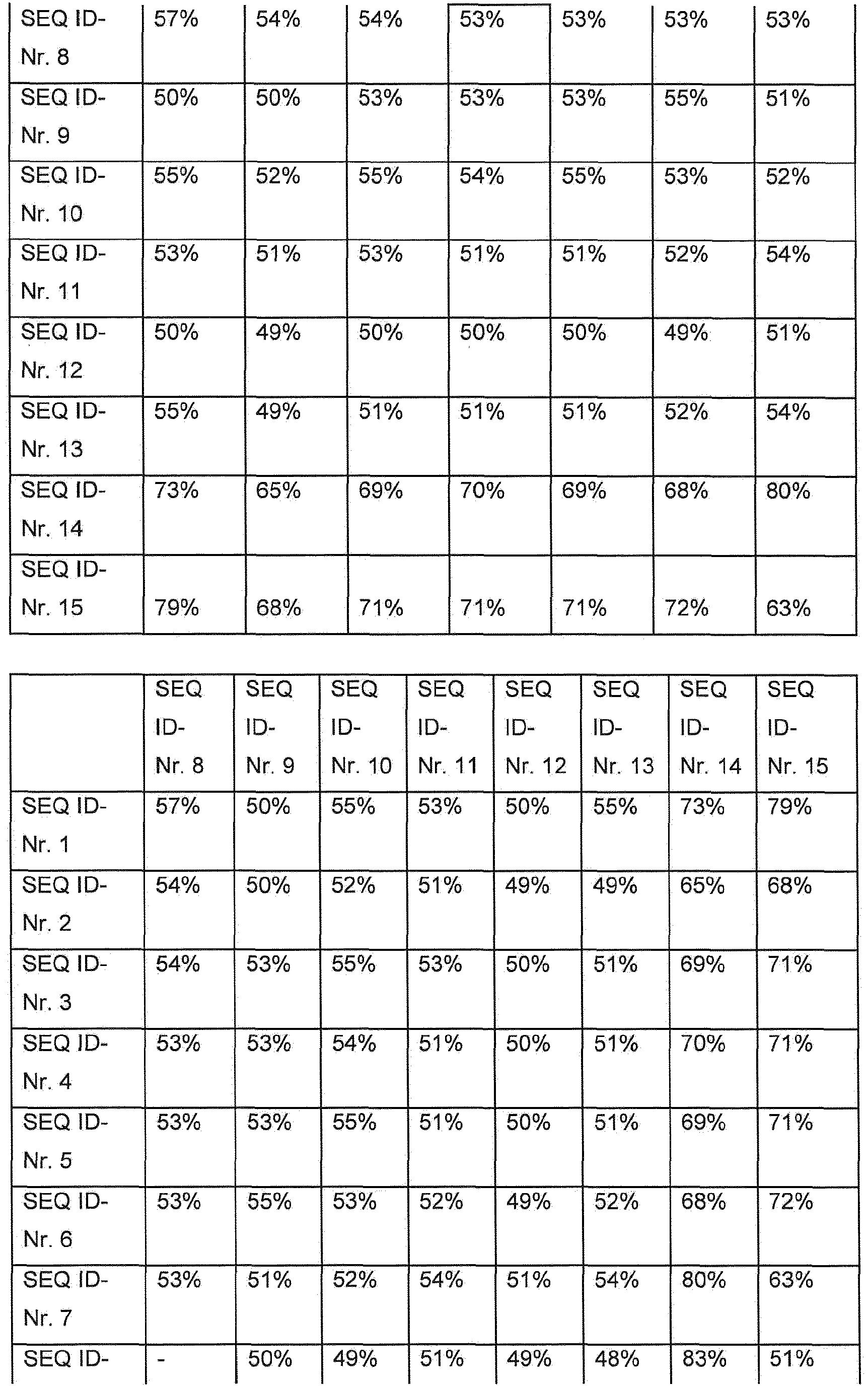


- Zur Bestimmung ihrer Fähigkeit, ZEN in die nicht bzw. weniger toxischen Metabolite HZEN und DHZEN abzubauen, wurde das Polypeptid mit der Sequenz ID-Nr. 1, codiert durch die Nukleotidsequenz mit der Sequenz ID-Nr. 17, als solcher und mit einem C- bzw. N-terminalen 6xHis Tag in E. coli, wie in Beispiel 1 beschrieben, hergestellt. Das Polypeptide mit der Aminosäuresequenz mit der Sequenz ID-Nr. 12, welche durch die Nukleotidsequenz mit der Sequenz ID-Nr. 28 codiert wurde, wurde ausschließlich am C-terminalen Ende 6xHis markiert. Jeweils 100 ml einer E. coli Kultur mit einer optischen Dichte (OD600 nm) von 2,0 - 2,5 wurden durch Zentrifugation bei 4 °C geerntet und in 20 ml Brunner Mineralmedium (DSMZ microorganisms medium number 462, 2012) resuspendiert. Die Zellsuspensionen wurden durch 3-malige Behandlung mit einer Frensh Press bei 20.000 psi lysiert. Die so erhaltenen Zelllysate wurden in einer 1:10, einer 1:100 oder einer 1:1.000 Verdünnung, die in Brunner Mineralmedium inklusive 0,1 mg/ml BSA (Rinderserum Albumin) hergestellt wurde, eingesetzt. Für die ZEN-Abbauversuche wurden 9,9 ml Brunner Mineralmedium inklusive 0,1 mg/ml BSA, 0,1 ml verdünntes Zelllysat und 31 µl ZEN-Substratstammlösung eingesetzt. In Summe wurden die Zelllysate somit 1:1.000, 1:10.000 bzw. 1:100.000 verdünnt. Als ZEN-Substratstammlösung diente eine 2,08 mM ZEN-Lösung (40 Vol.-% ACN + 60 Vol.-% H2O). Zur Herstellung dieser Lösung wurde ZEN in kristalliner Form (Biopure Standard von Romer Labs, Art. Nr. 001109, Reinheit mind. 98 %) entsprechend eingewogen und aufgelöst. Jeder Abbauansatz wurde in 25 ml Glasfläschchen durchgeführt und bei 25 °C unter Schütteln mit 100 Upm für insgesamt 120 h inkubiert. Zu den Zeitpunkten 0; 0,5; 1; 2; 5; 24; 47; 72 und 120 h wurden jeweils eine Probe von 1 ml entnommen, die Polypeptide wurden für 10 min bei 99 °C hitzeinaktiviert und bei -20 °C gelagert. Nach dem Auftauen der Proben wurden die nicht löslichen Bestandteile durch Zentrifugation abgetrennt. ZEN, HZEN und DHZEN wurden mittels LC/MS/MS analysiert. Dazu wurden die Metabolite mittels einer Phenomenex Luna C18(2) Säule mit den Dimensionen 250 mm x 3 mm und einer Partikelgröße von 5 µm chromatographisch getrennt. Als Laufmittel diente ein Acetonitril-Wassergemisch mit einer Ameisensäurekonzentration von 1 ml/l. Das UV-Signal bei 270 nm wurde aufgezeichnet. Als lonisierungsquelle diente Elektrospray Ionisation (ESI). ZEN, HZEN und DHZEN wurden mittels QTrap/LC/MS/MS (triple quadrupole, Applied Biosystems) im "enhanced Modus" quantifiziert. Nach spätestens 24 Stunden konnten in keinem der Ansätze mehr wesentliche Mengen von ZEN nachgewiesen werden. Der Großteil, über 80 %, von ZEN wurde in HZEN oder DHZEN umgewandelt.
- In
Fig. 1 ,_die nicht Teil der Erfindung ist, ist der zeitliche Abbau von ZEN und die Zunahme von HZEN sowie DHZEN beispielhaft für eine 1:10.000 verdünnte Zelllysatlösung für nicht getaggtes (Fig. 1A ) als auch für C-terminal 6xHis getaggtes (Fig. 1B ) und N-terminal 6xHis getaggtes (Fig. 1C ) Polypeptid mit der SEQ ID-Nr. 1 zu sehen. Daraus ist klar ersichtlich, dass 1. die Umsetzung von ZEN unmittelbar und vollständig erfolgt, da bereits in der ersten Probe (0 h), die unmittelbar nach dem Versuchsstart gezogen wurden, nahezu kein ZEN mehr detektiert werden konnte und es 2. durch das Anfügen eines Tags, C- oder N- terminal, zu keinen nennenswerten Aktivitätsverlusten kam. - Zur Bestimmung der Fähigkeit der Polypeptide neben ZEN auch ZEN-Derivate in nicht bzw. weniger toxische Metabolite zu transformieren, wurden die Polypeptide mit den Sequenz ID-Nrn. 1 und 12, wie in Beispiel 3 beschrieben mit C-terminalem His-Tag hergestellt und als Zelllysate im Abbau wurden die jeweiligen synthetischen Nukleotidsequenzen mit den Sequenzen mit der Sequenz ID-Nr. 17 und 28 herangezogen.
- Die Abbauversuche wurden wie in Beispiel 3 beschrieben durchgeführt, wobei jedes Polypeptid mit jedem ZEN-Derivat gewählt aus der Gruppe α-ZEL, β-ZEL, α-ZAL, β-ZAL, Z14G, Z14S und ZAN, getestet wurde. Die Zelllysate wurden in einer Gesamtverdünnung von 1:10.000 eingesetzt. Als Substratstammlösung wurde anstatt einer 2,08 mM ZEN-Lösung (40 Vol.-% ACN + 60 Vol-.% H2O), äquimolare, d.h. 2,08 mM Lösungen der ZEN-Derivate eingesetzt. α-ZEL, β-ZEL, α-ZAL, β-ZAL und ZAN wurden von Sigma bezogen und als Standards für die Analyse eingesetzt. Z14G und Z14S wurden mit einer Reinheit von wenigstens 90 %, nach den Verfahren wie in P. Krenn et al., 2007 (Mykotoxin Research, 23, 4, 180-184) und M. Sulyok et al., 2007(Anal. Bioanal. Chem., 289, 1505-1523) beschrieben, hergestellt und als Standards für die Analyse eingesetzt. Ein weiterer Unterschied zu Beispiel 3 ist, dass lediglich eine Probe, nämlich nach 24 h, genommen wurde. Die Reduktion der Konzentration der ZEN Derivate während des Abbauversuches wurde mittels LC/MS/MS quantifiziert. α-ZEL, β-ZEL, Z14G und Z14S wurden nach der Methode von M. Sulyok et al. (2010, Food Chemistry, 119, 408-416); α-ZAL, β-ZAL und ZAN wurden nach der Methode von P. Songsermaskul et al. (2011, J. of Animal Physiol. and Animal Nutr., 97, 155-161) gemessen. Überraschenderweise hat sich herausgestellt, dass in allen Abbauversuchen nach 24 h Inkubation, nur noch 0 bis maximal 13 % der Ausgangsmengen der ZEN Derivate vorhanden waren.
- Die Bestimmung der spezifischen Aktivität der Polypeptide sowie von Varianten davon erfolgte photometrisch, wobei alle eingesetzten Polypeptide einen C-terminalen 6xHis Tag aufwiesen. Die Herstellung, Anreicherung und Reinigung der Polypeptide bzw. von Varianten davon erfolgte wie in Beispiel 1 beschrieben. Der Abbau von ZEN zu HZEN wurde über die Abnahme der Adsorption bei der Wellenlänge von 315 nm gemessen. Die molaren Extinktionskoeffizienten [ε] von ZEN und HZEN wurden experimentell bestimmt und betragen 0,0078895 L µmol-1 cm-1 und 0,0030857 L µmol-1 cm-1. Die Extinktionskoeffizienten sind stark pH-abhängig und daher muss die Aktivitätsmessung immer bei exakt demselben pH-Wert und vorzugsweise auch in derselben Matrix durchgeführt werden. Die Messungen wurden in einer 50 mM Tris-HCl pH = 8,2 Pufferlösung in Quarzküvetten in einem Wellenlängenbereich von 200 bis 2500 nm in einem UV-VIS Photometer (Hitachi U-2001) bei 32 °C durchgeführt.
- Als ZEN-Substratstammlösung diente eine 2,08 mM ZEN-Lösung (40 vol-% ACN + 60 vol-% H2O). Zur Herstellung dieser Lösung wurde ZEN in kristalliner Form (Biopure Standard von Romer Labs, Art. Nr. 001109, Reinheit mind. 98 %) entsprechend eingewogen und aufgelöst. Die ZEN-Substratverdünnungen (0,79 µM, 1,57 µM, 2,36 µM, 3,14 µM, 4,71 µM, 6,28 µM, 7,85 µM, 9,42 µM, 10,99 µM, 12,56 µM, 14,13 µM, 15,71 µM, 17,28 µM, 18,85 µM) wurden mit 50 mM Tris-HCl pH = 8,2 hergestellt. Die Polypeptidlösungen wurden mit 50 mM Tris-HCl Puffer pH = 8,2 auf eine Endkonzentration von ca. 70 ng/ml verdünnt. Die ZEN-Substratverdünnungen wurden im Wasserbad auf 32 °C vorgewärmt.
- 100 µl der jeweiligen ZEN-Substratverdünnung wurden mit 0,2 µl Polypeptidlösung versetzt und die Absorption wurde für 5 min gemessen, wobei jede Kombination aus Polypeptidlösung - ZEN-Substratverdünnung mindestens zweifach gemessen wurde.
- Unter Berücksichtigung der Extinktionskoeffizienten von ZEN und HZEN wurde über die Steigung der Absorption im zeitlichen Verlauf die Reaktionsgeschwindigkeit für jede Substratkonzentration errechnet.
- Die Bezeichnungen "KM - Wert" oder "Michaelis-Menten Konstante" beziehen sich auf einen Parameter zu Beschreibung der enzymatischen Affinität, der die Einheiten [µM] oder [mM] besitzt und mit Hilfe des linearen Hanes Plots nach H. Bisswang (2002, Enzyme Kinetics, ISBN 3-527-30343-X, Seite 19) berechnet wird, wobei hierfür bevorzugt die Funktion "Enzymkinetik, Single Substrat" des Programms SigmaPlot 12.0 verwendet wird. Die Bezeichnungen "katalytische Konstante der Enzymreaktion" oder der "kcat-Wert" beziehen sich auf einen Parameter zur Beschreibung der Umsatzrate eines Polypeptids bzw. Enzyms, der in [s]-1 angegeben ist und bevorzugt mit Hilfe der Funktion "Enzymkinetik, Single Substrat" des Programms SigmaPlot 12.0 berechnet wird. Die "maximale Enzymgeschwindigkeit" oder der "vmax-Wert" wird in den Einheiten [µM/s] oder [mM/s] angegeben und analog zum KM-Wert mit Hilfe des linearen Hanes Plot ermittelt, wobei hierfür bevorzugt die Funktion "Enzymkinetik, Single Substrat" des Programms SigmaPlot 12.0 verwendet wird.
- Mittels vmax und der eingesetzten Enzymkonzentration wurde die spezifische Aktivität gemäß der Formel

- Nachfolgend sind die Rohdaten für die Bestimmung der Enzymparameter KM, vmax, kcat sowie der spezifischen Aktivität beispielhaft für das Polypeptid mit der Sequenz ID-Nr: 1 angeführt. Tabelle 3 zeigt die Reaktionsgeschwindigkeiten bei den jeweiligen ZEN-Substratkonzentrationen,
Fig. 2 die zugehörigen Michaelis-Menton Graphiken und in Tabelle 4 sind die entsprechenden enzymkinetischen Parameter angegeben. Die eingesetzte Enzymlösung hatte eine Konzentration von 68 ng/l.Tabelle 3: Reaktionsgeschwindigkeiten des Polypeptids mit der SEQ ID-Nr: 1 bei unterschiedlichen ZEN-Konzentrationen. ZEN-Substratverdünnung [µM] Messung 1 Reaktionsgeschwindigkeit [µM/s] Messung 2 Reaktionsgeschwindigkeit [µM/s] 0,79 0,0073 0,0071 1,57 0,0087 0,0082 2,36 0,0095 0,0080 3,14 0,0101 0,0073 4,71 0,0103 0,0087 6,28 0,0096 0,0088 7,85 0,0084 0,0088 9,42 0,0111 0,0087 10,99 0,0093 0,0081 12,56 0,0100 0,0086 14,13 0,0089 0,0101 15,71 0,0089 0,0090 17,28 0,0100 0,0074 18,85 0,0100 0,0085 Tabelle 4: Enzymkinetische Parameter des Polypeptids mit der Sequenz ID-Nr. 1. Vmax [µM / s] KM [µM] kcat [s-1] sp. Aktivität [U/mg] Messung 1 2 1 2 1 2 1 2 Wert 0,00993 0,008756 0,2172 0,1898 5,44 4,79 8,76 7,73 Mittelwert 0,009343 0,2035 5,12 8,25 - Die spezifische Aktivitäten der untersuchten Polypeptide beträgt für Sequenz ID-Nr. 1 8,25 U/mg, für Sequenz ID-Nr. 12 2,78 U/mg.
- Zur Bestimmung der Fähigkeit der Polypeptide natürlich vorkommendes ZEN und ZEN-Derivate in einer komplexen Matrix und bei niedrigem pH-Wert abzubauen, wurde kontaminierter Mais beispielhaft mit unterschiedlichen Konzentrationen von jeweils einem der Polypeptide mit der Sequenz ID-Nr. 1 bis 6 versetzt und der Abbau von ZEN und ZEN - Derivaten verfolgt.
- Der kontaminierte Mais wurde gemahlen und im Abbauversuch eingesetzt, wobei ein Ansatz aus 1 g gemahlenem, kontaminiertem Mais, 8,9 ml 100 mM Acetatpuffer pH = 4,0 und 0,1 ml Polypeptidlösung bestand. Es wurden angereicherte und gereinigte Polypeptidlösungen, wie in Beispiel 5 beschrieben, hergestellt, wobei diese auf eine Konzentration von 10 mU/ml, 100 mU/ml bzw. 1.000 mU/ml verdünnt wurden. Im Ansatz wurden somit absolut 1 mU (= 1 mU pro Gramm Mais), 10 mU (= 10 mU pro Gramm Mais) bzw. 100 mU (= 100 mU pro Gramm Mais) eingesetzt. Jeder Abbauansatz wurde in 25 ml durchgeführt und bei 37 °C unter Schütteln mit 100 Upm inkubiert. Vor der Enzymzugabe bzw. nach 1 stündiger Inkubation wurde jeweils eine Probe von 1 ml entnommen, das Polypeptid für 10 min bei 99 °C hitzeinaktiviert und die Probe bei -20 °C gelagert. Nach dem Auftauen der Probe wurden die nicht löslichen Bestandteile durch Zentrifugieren abgetrennt. Konzentrationen an ZEN sowie an ZEN-Derivaten wurden mittels LC/MS/MS, wie in M. Sulyok et al. (2007, Anal. Bioanal. Chem., 289, 1505-1523) beschrieben, gemessen. Der Gehalt an ZEN und ZEN-Derivaten in diesem Mais betrug für ZEN 238 ppb, für α-ZEL 15 ppb, für β-ZEL 23 ppb, für Z14G 32 ppb und für Z14S 81 ppb. In Tabelle 5 ist die prozentuale Abnahme des Gehalts an ZEN und an ZEN-Derivaten im Abbauversuch dargestellt.
Tabelle 5: Reduktion an ZEN und ZEN-Derivaten in Prozent bezogen auf den Startgehalt des Abbauversuches von unterschiedlichen Polypeptiden und Polypeptidmengen. Polypeptid Menge im Ansatz ZEN α-ZEL β-ZEL Z14G Z14S SEQ ID Nr: 1 0,1 mU 83 % ≥ 80 % 70 % 78 % 80 % 1 mU 96 % ≥ 80 % 76 % ≥ 80 % 92 % 10 mU 97 % ≥ 80 % ≥ 85 % ≥ 80 % 94 % SEQ ID Nr. 2 0,1 mU 87 % ≥ 80 % 73 % ≥ 80 % 84 % 1 mU 97 % ≥ 80 % 78 % ≥ 80 % 90 % 10 mU 99 % ≥ 80 % ≥ 85 % ≥ 80 % 96 % SEQ ID Nr. 3 0,1 mU 79 % 79 % 67 % 73 % 75 % 1 mU 85 % ≥ 80 % 72 % 79 % 82 % 10 mU 92 % ≥ 80 % 78 % ≥ 80 % 88 % SEQ ID Nr. 4 0,1 mU 82 % 78 % 65 % 76 % 80 % 1 mU 89 % ≥ 80 % 73 % ≥ 80 % 86 % 10 mU 93 % ≥ 80 % 82 % ≥ 80 % 91 % SEQ ID Nr. 5 0,1 mU 79 % 76 % 66 % 78 % 80 % 1 mU 83 % ≥ 80 % 73 % ≥ 80 % 81 % 10 mU 91 % ≥ 80 % 79 % ≥ 80 % 86 % SEQ ID Nr. 6 0,1 mU 93 % ≥ 80 % 75 % ≥ 80 % 90 % 1 mU 95 % ≥ 80 % 82 % ≥ 80 % 92 % 10 mU 98 % ≥ 80 % ≥ 85 % ≥ 80% 96 % - Zur Herstellung von Zusatzstoffen zur hydrolytischen Spaltung von ZEN wurden beispielhaft Fermentationsüberstände von mittels P. pastoris exprimierten Polypeptiden mit den Sequenz ID Nrn. 1, 2 6 und 13 mittels Mikrofiltration und Ultrafiltration (Ausschlussgrenze: 10 kDa) unter Standardbedingungen gereinigt und bis zu einer Trockensubstanzkonzentration von etwa 9 Gew.-% konzentriert. Im Anschluss wurden diese polypeptidhältigen Lösungen mit einem Sprühtrockner, (Mini B290 von Büchi) ebenfalls unter Standardbedingungen zu trockenen Pulvern weiterverarbeitet. Diese vier Pulver werden in weiterer Folge als Z1, Z2, Z6 und Z13 bezeichnet. Z1, Z2, Z6 bzw. Z13 wurden des Weiteren mit Bentonit mit einer durchschnittlichen Korngröße ca. 1 µm, in einem Verhältnis von 1 Gew.-% Zusatzstoff Z1, Z2, Z6 bzw. Z13 und 99 Gew.-% Bentonit in einem Überkopfschüttler, gemischt. Die so enthaltenen Zusatzstoffe werden als Zusatzstoff Z1.B, Z2.B, Z6.B und Z13.B bezeichnet. Des Weiteren wurden Z1, Z2, Z6 und Z13 mit Bentonit und einem Vitamin-Spurenelemente Konzentrat in einem Verhältnis von 0,1 Gew.-% Zusatzstoff Z1, Z2, Z6 bzw. Z13, 0,9 Gew.-% Vitamin-Spurenelemente Konzentrat und 99 Gew.-% Bentonit in einem Überkopfschüttler, gemischt. Die so enthaltenen Zusatzstoffe werden als Zusatzstoff Z1.BVS, Z2.BVS, Z6.BVS und Z13.BVS bezeichnet. 100 g der Zusatzstoffe Z1.BVS, Z2.BVS, Z6.BVS und Z13.BVS enthielten 200 mg Eisensulfat, 50 mg Kupfersulfat, 130 mg Zinnoxid, 130 mg Manganoxid, 2,55 mg Kalzimcarbonat, 160 mg Vitamin E, 6,5 mg Vitamin K3, 6,5 mg Vitamin B1, 14 mg Vitamin B2, 15 mg Vitamin B6, 0,15 mg Vitamin B12, 150 mg Nicotinsäure, 30 mg Pantothensäure und 5,3 mg Folsäure.
- Die Zusatzstoffe wurden in einem 50 mMTris-HCl Puffer pH = 8,2 für 30 Minuten extrahiert und im selben Puffer so weiterverdünnt, dass die Endkonzentration an Polypeptid bei ca. 70 ng/ml lag.
- Im Anschluss wurde die Zearalenon abbauende Wirkung dieser Lösungen, wie in Beispiel 5 beschrieben, bestimmt. Die entsprechenden Aktivitäten waren für Z1 8.230 U/g, für Z2 9.310 U/g, für Z6 9.214 U/g, für Z1.B 83 U/g, für Z2.B 92 U/g, für Z2.C 90 U/g, für Z13.B 57 U/g, für Z1.BVS 8 U/g, für Z2.BVS 9 U/g, für Z6.BVS 9 U/g und für Z13.BVS 6 U/g.
- Die Fähigkeit zum Abbau der ZEN-Derivate α-ZEL, β-ZEL, α-ZAL, β-ZAL, Z14G, Z14S und ZAN durch die Zusatzstoffe Z1, Z2, Z6, Z13, Z1.B, Z2.B, Z6.B, Z13.B, Z1.BVS, Z2.BVS, Z6.BVS und Z13.BVS, wurde, wie in Beispiel 4 beschrieben, durchgeführt, jedoch wurden anstatt 100 µl eines Zelllysats 100 µl einer Polypeptidlösung mit einer Polypeptidkonzentration von ca. 70 ng/ml eingesetzt. Nach 6 stündiger Inkubation lagen nur noch maximal 15 % der Ausgangsmenge als nicht hydrolysiertes ZEN-Derivat vor.
- Zur Bestimmung des Temperaturoptimums der Polypeptide mit den SEQ ID-Nrn. 1 und_12 wurden diese mit einem C-terminalen 6xHis-Tag wie in Beispiel 1 beschriebenen kloniert, in E. coli exprimiert und aufgereinigt. In Vorversuchen wurde für jedes Polypeptid jene Konzentration ermittelt bei der unter den Versuchsbedingungen (Teorell Stenhagen Puffer (Teorell und Stenhagen, Ein Universalpuffer für den pH-Bereich 2.0 bis 12.0. Biochem Ztschrft, 1938, 299: S. 416-419), pH 7.5, mit 0.1 mg/ml BSA bei 30°C) nach einer Versuchsdauer von 3 h eine vollständige Umsetzung von ZEN gewährleistet werden konnte. Die Präparationen wurden in den ermittelten Konzentrationen in die Abbauansätze zur Bestimmung des Temperaturoptimums eingesetzt. Die Versuche durchgeführt wurden in einem PCR Cycler (Eppendorf) unter Verwendung der Temperaturgradienten-Funktion bei 20°C +/- 10°C, bei 40°C +/- 10°C und falls erforderlich bei 60°C +/- 10°C (10 Temperaturen im jeweiligen Bereich; Temperaturen vom PCR Cycler vordefiniert). Für die Ansätze wurde Teorell-Stenhagen Puffer beim jeweiligen pH Optimum mit der entsprechenden Enzymkonzentration sowie 0,1 mg/ml BSA und 5 ppm ZEN versetzt. Als Negativkontrollen dienten Ansätze mit 0,1 mg/ml BSA und 5 ppm ZEN ohne Enzymzugabe. Nach 0 h, 0,5 h, 1 h, 2 h und 3 h Inkubationszeit wurde jeweils eine Probe pro Inkubationstemperatur gezogen, für 10 min bei 99°C hitzeinaktiviert und bei -20°C gelagert. Nach dem Auftauen wurden die Proben in HPLC-Vials überführt. ZEN, HZEN und DHZEN wurden mittels HPLC-DAD analysiert. Dazu wurden die Metabolite mittels einer Zorbax SB-Aq C18 Säule mit den Dimensionen 4.6 mm x 150 mm und einer Partikelgröße von 5 µm chromatographisch getrennt. Als Laufmittel diente ein Methanol-Wassergemisch mit 5 mM Ammoniumacetat. Das UV-Signal bei 274 nm wurde aufgezeichnet. Die Quan-tifizierung der Metabolite erfolgte unter Einbeziehung mitgeführter Standardreihen. Die Ermittlung der Temperaturoptima erfolgte über die ermittelten Steigungen der Abbaukurven, wobei die Temperatur, bei der die Steigung am größten war als das Temperaturoptimum definiert wurde. Die Temperaturoptima sind in Tabelle 6 gezeigt.
Tabelle 6: Temperaturoptima der Polypeptide SEQ ID-Nr. 1 SEQ ID-Nr. 12 38°C 26°C - Zur Bestimmung der Temperaturstabilität der Polypeptide mit den SEQ ID-Nrn. 1 und 12 wurden diese mit einem C-terminalen 6xHis-Tag wie in Beispiel 1 beschriebenen kloniert, in E. coli exprimiert und aufgereinigt. Diese wurden im PCR Cycler mit Gradientenfunktion beim jeweiligen Temperaturoptimum +/- 10°C inkubiert. Nach 0 min, 15 min, 30 min und 60 min wurde pro Ansatz und pro Temperatur eine Probe gezogen. Diese vorinkubierten Proben wurden im Anschluss in einem Abbauversuch in Teorell-Stenhagen Puffer beim jeweiligen pH-Optimum mit 0,1 mg/ml BSA und 5 ppm ZEN im Ansatz eingesetzt. In Vorversuchen wurde für jedes Polypeptid jene Konzentration ermittelt bei der unter den Versuchsbedingungen (Teorell Stenhagen Puffer, pH 7.5, mit 0.1 mg/ml BSA bei 30°C) nach einer Versuchsdauer von 3 h eine vollständigen Umsetzung von ZEN gewährleistet werden konnte. Die jeweils ermittelte Enzymkonzentration wurde in den Ansätzen eingesetzt. Die Abbauansätze wurden bei 30 °C inkubiert. Probenahmen erfolgten nach 0 h, 0,5 h, 1 h, 2 h und 3 h Inkubationszeit. Im Anschluss wurden die Poly-peptide bei 99°C für 10 min hitzeinaktiviert und die Proben bei -20°C gelagert. Nach dem Auftauen wurden die Proben in HPLC-Vials überführt und mittels HPLC-DAD wie in Beispiel 8 beschrieben analysiert.
- Die Temperaturstabilität ist definiert als die Temperatur, bei der die Polypeptide nach 15-minütiger Vorinkubation eine 50 %ige Restaktivität verglichen mit dem Temperaturoptimum besitzen. Als Maß für die Aktivität wird die Steigung der Abbaukurven herangezogen. Die Temperaturstabilitäten sind in Tabelle 7 gezeigt.
Tabelle 7: Temperaturstabilitäten der Polypeptide (50% Restaktivität nach 15- minütiger Vorinkubation) SEQ ID-Nr. 1 SEQ ID- Nr. 12 38°C 40°C - Zur Bestimmung des pH-Optimums der Polypeptide mit den SEQ ID-Nrn. 1 und 12 wurden diese mit einem C-terminalen 6xHis-Tag wie in Beispiel 1 beschriebenen kloniert, in E. coli exprimiert und aufgereinigt. In Vorversuchen wurde für jedes Polypeptid jene Konzentration ermittelt bei der unter den Versuchsbedingungen (Teorell Stenhagen Puffer, pH 7.5, mit 0.1 mg/ml BSA bei 30°C) nach einer Versuchsdauer von 3 h eine vollständigen Umsetzung von ZEN gewährleistet werden konnte. Die jeweils Enzymkonzentration wurde in den Ansätzen eingesetzt. Die Abbauansätze wurden in Teorell-Stenhagen Puffer bei pH-Werten von 3,0, 4,0, 5,0, 5,5, 6,0, 6,5, 7,0, 7,5, 8,0, 8,5, 9,0, 9,5, 10, 0, 11,0 und 12,0 durchgeführt. Für die Die Abbauansätze mit 0,1 mg/ml BSA und 5 ppm ZEN wurden bei 30°C inkubiert. Als Negativkontrollen dienten Ansätze in Teorell-Stenhagen Puffer bei pH 3,0, pH 7,0 und pH 12,0 mit 0,1 mg/ml BSA und 5 ppm ZEN. Probenahmen erfolgten nach 0 h, 0,5 h, 1 h, 2 h und 3 h Inkubationszeit. Im Anschluss wurden die Polypeptide bei 99°C für 10 min hitzeinaktiviert und die Proben bei -20°C gelagert. Nach dem Auftauen wurden die Proben in HPLC-Vials überführt und mittels HPLC-DAD wie in Beispiel 8 beschrieben analysiert. Die Ermittlung der pH-Optima erfolgte über die ermittelten Steigungen der Abbaukurven, wobei der pH-Wert, bei dem die Steigung am größten war als pH-Optimum definiert wurde. Die pH-Optima sind in Tabelle 8 gezeigt.
Tabelle 8: pH Optima der Polypeptide SEQ ID- Nr. 1 SEQ ID-Nr. 12 8,2 7,0-7,5 - Zur Bestimmung der pH-Stabilität wurden die Polypeptide aus Beispiel 10 in Teorell-Stenhagen Puffer bei pH 5,0 und dem jeweiligen pH-Optimum für 1 h bei 25°C inkubiert. Diese vorinkubierten Proben wurden in einen Abbauversuch in den gleichen Konzentrationen des jeweiligen Polypeptides wie sie zur Bestimmung des pH-Optimums verwendet wurden in 100 mM Tris-HCl-Puffer beim jeweiligen pH-Optimum mit 0,1 mg/ml BSA und 5 ppm ZEN im Ansatz eingesetzt. Die Ansätze wurden beim jeweiligen Temperaturoptimum inkubiert. Probenahmen erfolgten nach 0 h, 0,5 h, 1 h, 2 h und 3 h Inkubationszeit. Im Anschluss wurden die Polypeptide bei 99°C für 10 min hitzeinaktiviert und die Proben bei -20°C gelagert. Nach dem Auftauen wurden die Proben in HPLC-Vials überführt und mittels HPLC-DAD wie in Beispiel 8 beschrieben analysiert. Die pH Stabilität ist definiert als die prozentuale Restaktivität der Polypeptide bei pH 5,0 relativ zu der Aktivität beim jeweiligen pH Optimum. Die pH Stabilitäten für pH 5,0 sind in Tabelle 9 gezeigt.
Tabelle 9: pH Stabilität der Polypeptide bei pH 5,0 SEQ ID- Nr. 1 SEQ ID-Nr. 12 3 % 98 % - Der Abbau von ZEN zu HZEN und DHZEN wurde beispielhaft für die Polypeptide mit den Sequenz ID-Nrn. 1, und 12 durchgeführt. Die Abbauansätze wurden in Teorell Stenhagen Puffer, pH 7.5, mit 0.1 mg/ml BSA und 5 ppm ZEN durchgeführt. Die Abbauansätze wurden bei 30 °C inkubiert. Probenahmen erfolgten nach 0 h, 0,5 h, 1 h, 2 h und 3 h Inkubationszeit. Im Anschluss wurden die Polypeptide bei 99°C für 10 min hitzeinaktiviert und die Proben bei -20°C gelagert. Nach dem Auftauen wurden die Proben in HPLC-Vials überführt und mittels HPLC-DAD wie in Beispiel 8 beschrieben analysiert. Die Polypeptidkonzentration wurde so gewählt, dass ein vollständiger Abbau nach ca. 3 Stunden erreicht wurde. Die Abbaukinetiken sind in
Fig. 3 dargestellt, wobei die y-Achse die Konzentration von ZEN, HZEN und DHZEN in Mikromol pro Liter (µmol/l) und die x-Achse die Inkubationszeit in Stunden (h) zeigt.
* µM bedeutet mikromolar und entspricht der Einheit µMol/l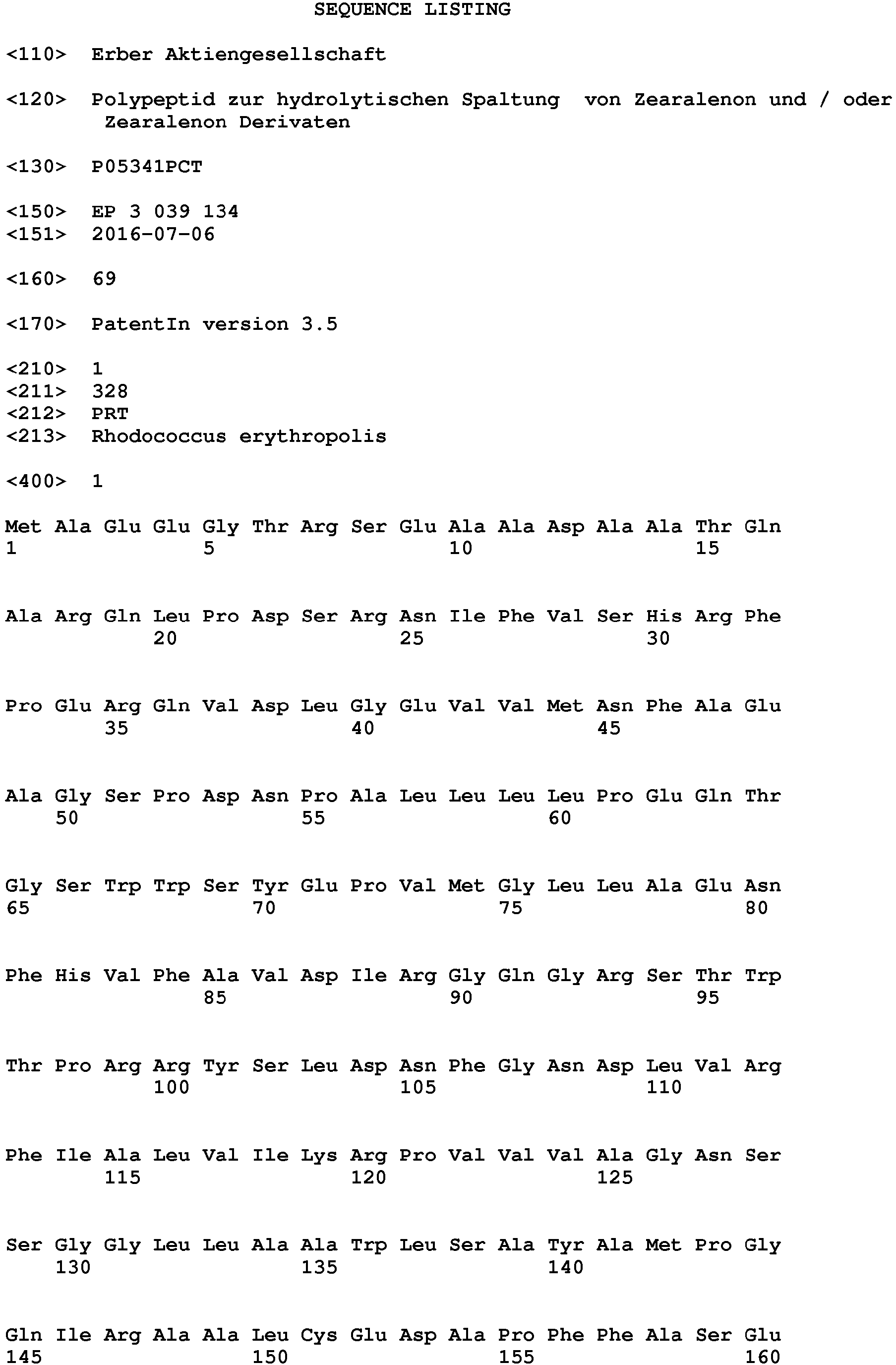


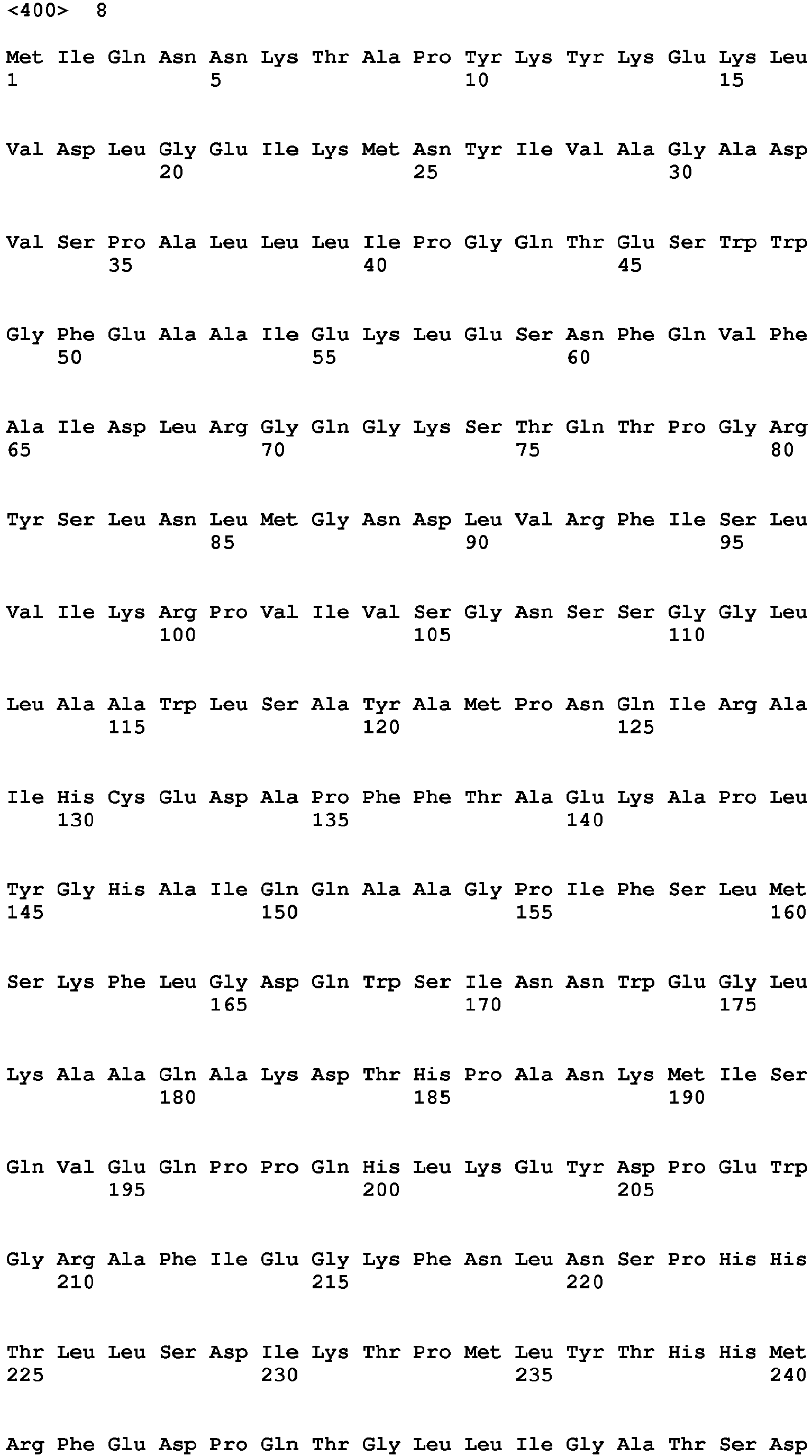


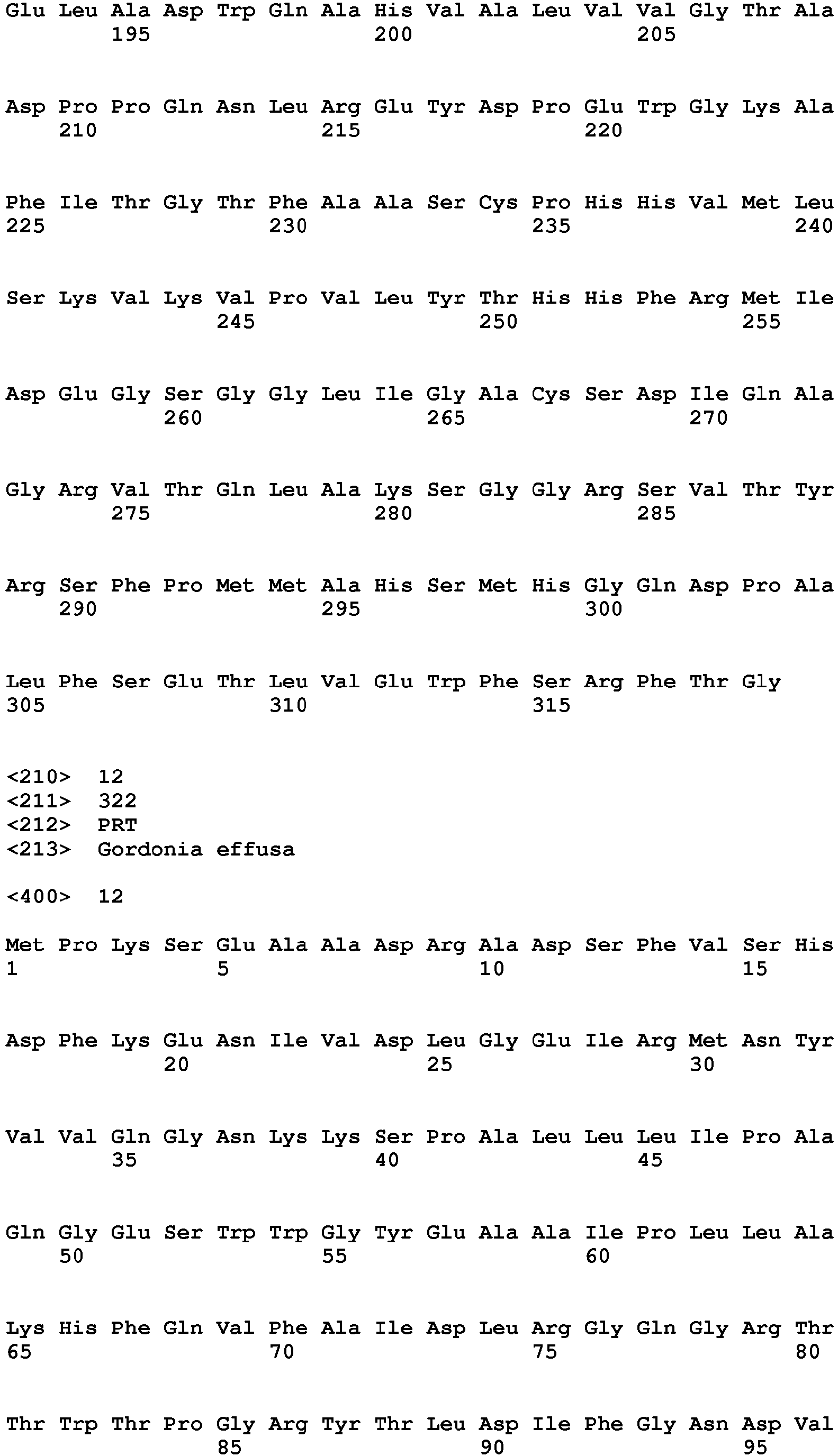


Claims (12)
- Verfahren zur hydrolytischen Spaltung von Zearalenon und/oder wenigstens einem Zearalenon Derivat mittels eines hydrolytisch spaltenden Polypeptids, dadurch gekennzeichnet, dass Zearalenon und/oder wenigstens ein Zearalenon Derivat durch das Polypeptid, das eine Hydrolase mit einer Aminosäuresequenz der Sequenz ID-Nr. 12 oder eine funktionelle Variante davon ist, hydrolysiert wird, wobei eine Sequenzidentität zwischen der funktionellen Variante und der Aminosäuresequenz wenigstens 70 % beträgt.
- Verfahren_nach Anspruch 1, dadurch gekennzeichnet, dass das Polypeptid wenigstens einen konservierten Aminosäuresequenzabschnitt oder eine funktionelle Variante davon enthält, wobei die funktionelle Variante des Aminosäuresequenzabschnitts eine Sequenzidentität von wenigstens 70 %, bevorzugt wenigstens 84 %, noch bevorzugter wenigstens 92 % und am bevorzugtesten wenigstens 98 % aufweist und der wenigstens eine konservierte Aminosäuresequenzabschnitt aus der Gruppe der Aminosäuresequenzen +89 bis +145, +223 bis +228, +257 bis +261 der Sequenz mit der Sequenz ID-Nr. 1 gewählt wird.
- Verfahren nach Anspruch 1 oder 2, dadurch gekennzeichnet, dass das Polypeptid wenigstens eine Mutation der Aminosäuresequenz in Bezug auf Sequenz ID-Nr. 1 an wenigstens einer der folgenden Positionen gewählt aus der Gruppe: 22, 23, 25, 26, 27, 29, 31, 32, 35, 37, 42, 43, 46, 51, 53, 54, 57, 60, 69, 72, 73, 78, 80, 84, 88, 95, 97, 99, 114, 118, 119, 123, 132, 141, 146, 148, 149, 154, 163, 164, 165, 169, 170, 172, 176, 180, 182, 183, 190, 191, 194, 196, 197, 198, 201, 204, 205, 206, 207, 208, 209, 210, 212, 213, 214, 216, 217, 220, 221, 222, 229, 231, 233, 238, 240, 244, 245, 246, 248, 249, 251, 254, 256, 260, 262, 263, 266, 269, 271, 277, 280, 281, 282, 283, 284, 285, 286, 287, 292, 296, 298, 302, 307, 308, 309, 311, 314, 317, 319, 321, 323, 325 und 326 aufweist.
- Verfahren nach einem der Ansprüche 1, 2 oder 3, dadurch gekennzeichnet, dass das Polypeptid wenigstens eine Mutation der Aminosäuresequenz in Bezug auf Sequenz ID-Nr. 1 gewählt aus der Gruppe D22A, S23Q, S23L, N25D, I26V, F27Y, F27H, S29P, R31A, F32Y, R35K, R35Q, V37A, V42I, V43T, F46Y, S51E, S51D, D53G, N54M, N54R, L57V, L60I, S69G, P72E, V73A, A78S, N80H, F84Y, I88L, T95S, T97A, R99K, I114M, 1118V, K119R, V123I, L132V, A141S, I146V, I146L, A148G, A149V, A154P, P163T, A164T, Y165C, Y165H, V169I, L170R, A172G, A176M, A176V, Y180F, D182T, F183Y, I190V, G191S, K194T, K194E, F196Y, V197C, V197R, E198R, E198S, K201D, K201G, P204S, P204A, A205S, K206P, A207M, M208A, Q209R, L210A, L210S, ΔP212, T213V, P214A, E216T, E216G, A217I, N220H, L221M, K222R, K222Q, G229A, A231V, F233W, F233Y, F233H, A238G, H240N, H240S, D244E, R245Q, M246L, S248T, S248N, S248G, Q249R, K251N, I254V, I256L, A260M, T262D, T262G, I263T, E266D, E269H, E269N, L271V, L277E, E280A, E280L, H281R, H281Q, A282V, Q283R, D284L, D284R, I285L, I286M, R287E, R287D, R292K, R292T, Q296A, Q296E, H298V, L302S, L307Q, F308S, D309A, A311P, A314V, L317F, S319Q, S319P, S319R, S321A, S321T, T323A, P325A, A326P aufweist.
- Verfahren nach einem der Ansprüche 1 bis 4, dadurch gekennzeichnet, dass das Polypeptid wenigstens eines der folgenden Aminosäuremotive gewählt aus der Gruppe der Sequenz ID-Nrn. 32 bis 69 enthält.
- Verfahren nach einem der Ansprüche 1 bis 4, dadurch gekennzeichnet, dass das Polypeptid in einem Zearalenon und/oder wenigstens ein Zearalenon Derivat spaltendem, Hilfsstoffe enthaltenden, Zusatzstoff zu Futtermitteln für Schweine, Geflügel und Aquakultur, in Nahrungsmittel oder in Trockenschlempe eingesetzt wird.
- Verfahren nach Anspruch 6, dadurch gekennzeichnet, dass die in dem Zusatzstoff enthaltenen Hilfsstoffe aus wenigstens einem inerten Träger, sowie gegebenenfalls weiteren Bestandteilen, wie Vitamine und/oder Mineralstoffe und/oder Enzyme und/oder weitere Komponenten zur Detoxifizierung von Mykotoxinen gewählt werden.
- Verfahren nach Anspruch 6 oder 7, dadurch gekennzeichnet, dass das Polypeptid in dem Zusatzstoff in einer Konzentration von höchstens 10.000 U/g, bevorzugt höchstens 1.000 U/g, noch bevorzugter höchstens 100 U/g und am bevorzugtesten höchstens 10 U/g eingesetzt wird.
- Verfahren nach Anspruch 6, 7 oder 8, dadurch gekennzeichnet, dass der Zusatzstoff in verkapselter oder gecoateter Form eingesetzt wird.
- Verfahren nach einem der Ansprüche 1 bis 9, dadurch gekennzeichnet, dass das Polypeptid oder der Zusatzstoff mit einem mit Zearalenon und/oder mit wenigstens einem Zearalenon-Derivat kontaminierten Futter- oder Nahrungsmittel versetzt wird, dass das kontaminierte Futter- oder Nahrungsmittel mit Feuchtigkeit in Kontakt gebracht wird und dass das Polypeptid oder der Zusatzstoff das im kontaminierten Futter- oder Nahrungsmittel enthaltene Zearalenon und/oder wenigstens ein Zearalenon-Derivat hydrolysiert.
- Verfahren nach einem der Ansprüche 1 bis 10, dadurch gekennzeichnet, dass wenigstens 70 %, bevorzugt wenigstens 80 %, insbesondere wenigstens 90 % des Zearalenons und/oder wenigstens eines Zearalenon Derivats hydrolysiert werden.
- Verwendung eines wenigstens ein Polypeptid mit einer Aminosäuresequenz der Sequenz ID-Nr. 12 oder einer funktionellen Variante davon, wobei eine Sequenzidentität zwischen der funktionellen Variante und der Aminosäuresequenz wenigstens 70% beträgt, enthaltenden Zusatzstoffs zur hydrolytischen Spaltung von Zearalenon und/oder wenigsten einem Zearalenon-Derivat in Futtermitteln, insbesondere für Schweine, Geflügel und Aquakultur, in Nahrungsmittel oder in Trockenschlempe.
Applications Claiming Priority (3)
| Application Number | Priority Date | Filing Date | Title |
|---|---|---|---|
| ATA667/2013A AT514775B1 (de) | 2013-08-28 | 2013-08-28 | Polypeptid zur hydrolytischen Spaltung von Zearalenon und/oder Zearalenon Derivaten, isoliertes Polynukleotid davon sowie Zusatzstoff enthaltend das Polypeptid |
| EP14781432.1A EP3039134B1 (de) | 2013-08-28 | 2014-08-27 | Polypeptid zur hydrolytischen spaltung von zearalenon und/oder zearalenon-derivaten, isoliertes polynukleotid davon sowie einen zusatzstoff enthaltendes polypeptid, verwendung desselben sowie verfahren |
| PCT/AT2014/000164 WO2015027258A2 (de) | 2013-08-28 | 2014-08-27 | Polypeptid zur hydrolytischen spaltung von zearalenon und/oder zearalenon-derivaten, isoliertes polynukleotid davon sowie einen zusatzstoff enthaltendes polypeptid, verwendung desselben sowie verfahren |
Related Parent Applications (2)
| Application Number | Title | Priority Date | Filing Date |
|---|---|---|---|
| EP14781432.1A Division-Into EP3039134B1 (de) | 2013-08-28 | 2014-08-27 | Polypeptid zur hydrolytischen spaltung von zearalenon und/oder zearalenon-derivaten, isoliertes polynukleotid davon sowie einen zusatzstoff enthaltendes polypeptid, verwendung desselben sowie verfahren |
| EP14781432.1A Division EP3039134B1 (de) | 2013-08-28 | 2014-08-27 | Polypeptid zur hydrolytischen spaltung von zearalenon und/oder zearalenon-derivaten, isoliertes polynukleotid davon sowie einen zusatzstoff enthaltendes polypeptid, verwendung desselben sowie verfahren |
Publications (2)
| Publication Number | Publication Date |
|---|---|
| EP3495476A1 true EP3495476A1 (de) | 2019-06-12 |
| EP3495476B1 EP3495476B1 (de) | 2020-10-14 |
Family
ID=51662974
Family Applications (8)
| Application Number | Title | Priority Date | Filing Date |
|---|---|---|---|
| EP14781432.1A Not-in-force EP3039134B1 (de) | 2013-08-28 | 2014-08-27 | Polypeptid zur hydrolytischen spaltung von zearalenon und/oder zearalenon-derivaten, isoliertes polynukleotid davon sowie einen zusatzstoff enthaltendes polypeptid, verwendung desselben sowie verfahren |
| EP14783532.6A Active EP3039135B1 (de) | 2013-08-28 | 2014-08-27 | Polypeptid zur hydrolytischen spaltung von zearalenon und/oder zearalenon-derivaten, isoliertes polynukleotid davon sowie einen zusatzstoff enthaltendes polypeptid, verwendung desselben sowie verfahren |
| EP19152160.8A Active EP3495474B1 (de) | 2013-08-28 | 2014-08-27 | Verfahren zur hydrolytischen spaltung von zearalenon und/oder zearalenon-derivaten mittels eines polypeptids sowie verwendung |
| EP19152573.2A Active EP3495477B1 (de) | 2013-08-28 | 2014-08-27 | Verfahren zur hydrolytischen spaltung von zearalenon und/oder zearalenon-derivaten mittels eines polypeptids sowie verwendung |
| EP19152484.2A Active EP3495476B1 (de) | 2013-08-28 | 2014-08-27 | Verfahren zur hydrolytischen spaltung von zearalenon und/oder zearalenon-derivaten mittels eines polypeptids sowie verwendung |
| EP19152381.0A Active EP3498830B1 (de) | 2013-08-28 | 2014-08-27 | Verfahren zur hydrolytischen spaltung von zearalenon und/oder zearalenon-derivaten mittels eines polypeptids sowie verwendung |
| EP19152082.4A Active EP3495473B1 (de) | 2013-08-28 | 2014-08-27 | Verfahren zur hydrolytischen spaltung von zearalenon und/oder zearalenon-derivaten mittels eines polypeptids, sowie verwendung davon |
| EP19152332.3A Active EP3495475B1 (de) | 2013-08-28 | 2014-08-27 | Verfahren zur hydrolytischen spaltung von zearalenon und/oder zearalenon-derivaten mittels eines polypeptids sowie verwendung |
Family Applications Before (4)
| Application Number | Title | Priority Date | Filing Date |
|---|---|---|---|
| EP14781432.1A Not-in-force EP3039134B1 (de) | 2013-08-28 | 2014-08-27 | Polypeptid zur hydrolytischen spaltung von zearalenon und/oder zearalenon-derivaten, isoliertes polynukleotid davon sowie einen zusatzstoff enthaltendes polypeptid, verwendung desselben sowie verfahren |
| EP14783532.6A Active EP3039135B1 (de) | 2013-08-28 | 2014-08-27 | Polypeptid zur hydrolytischen spaltung von zearalenon und/oder zearalenon-derivaten, isoliertes polynukleotid davon sowie einen zusatzstoff enthaltendes polypeptid, verwendung desselben sowie verfahren |
| EP19152160.8A Active EP3495474B1 (de) | 2013-08-28 | 2014-08-27 | Verfahren zur hydrolytischen spaltung von zearalenon und/oder zearalenon-derivaten mittels eines polypeptids sowie verwendung |
| EP19152573.2A Active EP3495477B1 (de) | 2013-08-28 | 2014-08-27 | Verfahren zur hydrolytischen spaltung von zearalenon und/oder zearalenon-derivaten mittels eines polypeptids sowie verwendung |
Family Applications After (3)
| Application Number | Title | Priority Date | Filing Date |
|---|---|---|---|
| EP19152381.0A Active EP3498830B1 (de) | 2013-08-28 | 2014-08-27 | Verfahren zur hydrolytischen spaltung von zearalenon und/oder zearalenon-derivaten mittels eines polypeptids sowie verwendung |
| EP19152082.4A Active EP3495473B1 (de) | 2013-08-28 | 2014-08-27 | Verfahren zur hydrolytischen spaltung von zearalenon und/oder zearalenon-derivaten mittels eines polypeptids, sowie verwendung davon |
| EP19152332.3A Active EP3495475B1 (de) | 2013-08-28 | 2014-08-27 | Verfahren zur hydrolytischen spaltung von zearalenon und/oder zearalenon-derivaten mittels eines polypeptids sowie verwendung |
Country Status (29)
| Country | Link |
|---|---|
| US (7) | US10149489B2 (de) |
| EP (8) | EP3039134B1 (de) |
| JP (3) | JP6526671B2 (de) |
| KR (2) | KR102075752B1 (de) |
| CN (8) | CN110499304A (de) |
| AT (1) | AT514775B1 (de) |
| AU (2) | AU2014311244B2 (de) |
| BR (2) | BR122020001707B1 (de) |
| CA (1) | CA2922178C (de) |
| CL (2) | CL2016000464A1 (de) |
| CR (2) | CR20160128A (de) |
| DK (7) | DK3495475T3 (de) |
| DO (1) | DOP2016000051A (de) |
| EA (2) | EA037776B1 (de) |
| EC (1) | ECSP16012693A (de) |
| ES (7) | ES2843204T3 (de) |
| HK (1) | HK1226101A1 (de) |
| HU (2) | HUE052623T2 (de) |
| IL (1) | IL244144B (de) |
| MX (1) | MX371487B (de) |
| MY (1) | MY171604A (de) |
| NI (1) | NI201600028A (de) |
| PE (2) | PE20220389A1 (de) |
| PH (1) | PH12016500377B1 (de) |
| PL (2) | PL3039135T3 (de) |
| PT (2) | PT3495473T (de) |
| SG (2) | SG10201900355RA (de) |
| UA (1) | UA118681C2 (de) |
| WO (2) | WO2015027259A2 (de) |
Families Citing this family (28)
| Publication number | Priority date | Publication date | Assignee | Title |
|---|---|---|---|---|
| AT514775B1 (de) * | 2013-08-28 | 2017-11-15 | Erber Ag | Polypeptid zur hydrolytischen Spaltung von Zearalenon und/oder Zearalenon Derivaten, isoliertes Polynukleotid davon sowie Zusatzstoff enthaltend das Polypeptid |
| AT516457B1 (de) * | 2014-11-07 | 2017-03-15 | Erber Ag | Polypeptid zur enzymatischen Detoxifizierung von Zearalenon, sowie isoliertes Polynukleotid, sowie Zusatzstoff, Verwendung und Verfahren desselben |
| CN104804070B (zh) * | 2015-04-13 | 2018-03-02 | 南昌大学 | 可特异性结合玉米赤霉烯酮的多肽分子及其应用 |
| CN104788543B (zh) * | 2015-04-13 | 2018-03-02 | 南昌大学 | 一种基于多肽的玉米赤霉烯酮抗体模拟物及其应用 |
| DK3331997T5 (da) | 2015-08-03 | 2024-10-07 | Monsanto Technology Llc | Fremgangsmåder og sammensætninger til herbicidtolerans i planter |
| US10378023B2 (en) | 2015-09-01 | 2019-08-13 | Monsanto Technology Llc | Methods and compositions for herbicide tolerance in plants |
| PE20190838A1 (es) | 2016-07-29 | 2019-06-17 | Monsanto Technology Llc | Metodos y composiciones para la expresion genica en plantas |
| CN108251399B (zh) * | 2016-12-29 | 2020-08-21 | 中粮营养健康研究院有限公司 | 伏马毒素降解酶、编码基因、重组载体、细胞、添加剂及其应用 |
| EP3662071A1 (de) | 2017-07-31 | 2020-06-10 | POET Research, Inc. | Sanierung von toxinen in bioraffinerieprozessströmen |
| CN109825484B (zh) * | 2017-11-23 | 2022-06-28 | 吉林中粮生化有限公司 | 玉米赤霉烯酮水解酶zhd101突变体及利用该突变体水解玉米赤霉烯酮的方法 |
| CN110777128B (zh) * | 2018-07-31 | 2025-01-28 | 奥地利商艾尔柏有限公司 | 用于裂解玉米赤霉烯酮的手段和方法 |
| BR112021001310A2 (pt) * | 2018-07-31 | 2021-04-27 | Erber Aktiengesellschaft | meios e métodos para clivagem de zearalenona |
| LU100899B1 (en) * | 2018-07-31 | 2020-02-03 | Erber Ag | Means and methods for cleavage of zearalenone |
| CN110029095B (zh) * | 2019-04-15 | 2022-06-07 | 南京工业大学 | 一种玉米赤霉烯酮降解酶及其应用 |
| CN110592046B (zh) * | 2019-09-30 | 2022-03-15 | 湖北大学 | 玉米赤霉烯酮降解酶在水解玉米赤霉烯酮及其衍生物中的应用 |
| CN110819608B (zh) * | 2019-10-29 | 2022-03-15 | 湖北大学 | 一种玉米赤霉烯酮及其衍生物的水解方法 |
| US20210403841A1 (en) | 2020-03-12 | 2021-12-30 | Poet Research, Inc. | Enzymatic degradation of mycotoxins during grain processing |
| EP4225901A1 (de) * | 2020-10-08 | 2023-08-16 | DSM Austria GmbH | Tetramere alpha/beta hydrolasevarianten mit erhöhter temperaturstabilität und verfahren zur verwendung und herstellung davon |
| CN112760300B (zh) * | 2021-01-29 | 2022-08-30 | 潍坊康地恩生物科技有限公司 | 一种黄曲霉毒素降解酶突变体及其生产菌株 |
| CN114957377B (zh) * | 2021-02-26 | 2025-12-19 | 重庆誉颜制药有限公司 | 一种制备多肽的系统及其应用 |
| CN114774386B (zh) * | 2022-03-11 | 2024-02-02 | 暨南大学 | 一种对胃蛋白酶抗性提高的玉米赤霉烯酮水解酶 |
| CN114774385B (zh) * | 2022-03-11 | 2024-02-02 | 暨南大学 | 一种对胰蛋白酶和胃蛋白酶抗性提高的玉米赤霉烯酮水解酶 |
| CN115975982B (zh) * | 2023-02-24 | 2025-09-23 | 河南农业大学 | GhZH蛋白在高效水解玉米赤霉烯酮及其代谢衍生物中的应用 |
| CN117796489A (zh) * | 2023-05-31 | 2024-04-02 | 苏州酶浩生合生物科技有限公司 | 一种酶在降解玉米赤霉烯酮中的应用 |
| KR102893594B1 (ko) * | 2023-07-18 | 2025-12-02 | 씨제이제일제당 주식회사 | 신규한 제아랄레논 분해 효소 및 그의 용도 |
| CN121773200A (zh) * | 2023-09-04 | 2026-03-31 | Cj第一制糖株式会社 | 具有don降解活性的新型多肽 |
| CN117625576A (zh) * | 2023-11-30 | 2024-03-01 | 昆明爱科特生物科技有限公司 | 一种玉米赤霉烯酮降解酶及其制备和应用 |
| KR20250130485A (ko) * | 2024-02-23 | 2025-09-02 | 씨제이제일제당 (주) | 제아랄레논 분해 활성을 갖는 신규 폴리펩티드 |
Citations (1)
| Publication number | Priority date | Publication date | Assignee | Title |
|---|---|---|---|---|
| WO2012113827A1 (en) * | 2011-02-24 | 2012-08-30 | Eucodis Bioscience Gmbh | Feed processing enzymes |
Family Cites Families (12)
| Publication number | Priority date | Publication date | Assignee | Title |
|---|---|---|---|---|
| DK13491D0 (da) | 1991-01-25 | 1991-01-25 | Novo Nordisk As | Anvendelse af et enzymholdigt granulat og fremgangsmaade til fremstilling af et forderstof i tabletform |
| US5846812A (en) * | 1996-11-22 | 1998-12-08 | Pioneer Hi-Bred International, Inc. | Zearalenone detoxification compositions and methods |
| BR0004713A (pt) * | 1999-02-10 | 2000-12-19 | Dsm Nv | Granulados contendo enzimas de alimentação |
| AR028977A1 (es) * | 2000-07-13 | 2003-05-28 | Syngenta Participations Ag | Genes de lipoxigenasa, promotores, peptidos de transito y proteinas de los mismos |
| US6812380B2 (en) * | 2001-03-27 | 2004-11-02 | Pioneer Hi-Bred International, Inc. | Compositions and methods of zearalenone detoxification |
| WO2002099142A2 (de) * | 2001-06-01 | 2002-12-12 | Wilhelm Holzapfel | Actinomyceten zum abbau von aflatoxin b1, ochratoxin a und/oder zearalenon |
| AT413540B (de) * | 2001-12-20 | 2006-03-15 | Erber Ag | Mikroorganismus, welcher ochratoxine sowie ochratoxine und zearalenone entgiftet, sowie verfahren und verwendung hiefür |
| JP2004000130A (ja) * | 2002-03-25 | 2004-01-08 | Inst Of Physical & Chemical Res | ゼアラレノン解毒酵素遺伝子及び該遺伝子を導入した形質転換体 |
| US20060008888A1 (en) * | 2004-07-07 | 2006-01-12 | Kragh Karsten M | Polypeptide |
| KR101280811B1 (ko) * | 2010-11-15 | 2013-07-02 | (주)진바이오텍 | 제아라레논 분해 활성을 갖는 미생물, 이를 이용한 제아라레논 분해 방법 및 사료첨가제 |
| CN102199581B (zh) * | 2011-03-31 | 2013-02-06 | 国家粮食局科学研究院 | 一种玉米赤霉烯酮毒素降解酶及其编码基因与应用 |
| AT514775B1 (de) * | 2013-08-28 | 2017-11-15 | Erber Ag | Polypeptid zur hydrolytischen Spaltung von Zearalenon und/oder Zearalenon Derivaten, isoliertes Polynukleotid davon sowie Zusatzstoff enthaltend das Polypeptid |
-
2013
- 2013-08-28 AT ATA667/2013A patent/AT514775B1/de active
-
2014
- 2014-08-27 PL PL14783532T patent/PL3039135T3/pl unknown
- 2014-08-27 DK DK19152332.3T patent/DK3495475T3/da active
- 2014-08-27 EP EP14781432.1A patent/EP3039134B1/de not_active Not-in-force
- 2014-08-27 DK DK19152381.0T patent/DK3498830T3/da active
- 2014-08-27 ES ES19152573T patent/ES2843204T3/es active Active
- 2014-08-27 CN CN201910861359.0A patent/CN110499304A/zh active Pending
- 2014-08-27 ES ES19152160T patent/ES2837422T3/es active Active
- 2014-08-27 WO PCT/AT2014/000165 patent/WO2015027259A2/de not_active Ceased
- 2014-08-27 MY MYPI2016700612A patent/MY171604A/en unknown
- 2014-08-27 HU HUE19152082A patent/HUE052623T2/hu unknown
- 2014-08-27 CR CR20160128A patent/CR20160128A/es unknown
- 2014-08-27 CN CN201910861349.7A patent/CN110527675A/zh active Pending
- 2014-08-27 EP EP14783532.6A patent/EP3039135B1/de active Active
- 2014-08-27 EA EA201891967A patent/EA037776B1/ru not_active IP Right Cessation
- 2014-08-27 ES ES19152082T patent/ES2840303T3/es active Active
- 2014-08-27 ES ES19152332T patent/ES2840305T3/es active Active
- 2014-08-27 EP EP19152160.8A patent/EP3495474B1/de active Active
- 2014-08-27 WO PCT/AT2014/000164 patent/WO2015027258A2/de not_active Ceased
- 2014-08-27 PE PE2020001602A patent/PE20220389A1/es unknown
- 2014-08-27 EP EP19152573.2A patent/EP3495477B1/de active Active
- 2014-08-27 MX MX2016002636A patent/MX371487B/es active IP Right Grant
- 2014-08-27 BR BR122020001707-4A patent/BR122020001707B1/pt active IP Right Grant
- 2014-08-27 CR CR20200234A patent/CR20200234A/es unknown
- 2014-08-27 EP EP19152484.2A patent/EP3495476B1/de active Active
- 2014-08-27 EA EA201690471A patent/EA032685B1/ru not_active IP Right Cessation
- 2014-08-27 EP EP19152381.0A patent/EP3498830B1/de active Active
- 2014-08-27 DK DK19152484.2T patent/DK3495476T3/da active
- 2014-08-27 KR KR1020167008042A patent/KR102075752B1/ko active Active
- 2014-08-27 PL PL19152082T patent/PL3495473T3/pl unknown
- 2014-08-27 CN CN201610373145.5A patent/CN106085983B/zh active Active
- 2014-08-27 JP JP2016537048A patent/JP6526671B2/ja active Active
- 2014-08-27 ES ES19152381T patent/ES2840306T3/es active Active
- 2014-08-27 ES ES19152484T patent/ES2843788T3/es active Active
- 2014-08-27 CN CN202510559561.3A patent/CN120366265A/zh active Pending
- 2014-08-27 UA UAA201603121A patent/UA118681C2/uk unknown
- 2014-08-27 DK DK14783532.6T patent/DK3039135T3/en active
- 2014-08-27 DK DK19152082.4T patent/DK3495473T3/da active
- 2014-08-27 PT PT191520824T patent/PT3495473T/pt unknown
- 2014-08-27 ES ES14783532.6T patent/ES2675026T3/es active Active
- 2014-08-27 CN CN201910861330.2A patent/CN110527674A/zh active Pending
- 2014-08-27 SG SG10201900355RA patent/SG10201900355RA/en unknown
- 2014-08-27 US US14/914,671 patent/US10149489B2/en active Active
- 2014-08-27 PH PH1/2016/500377A patent/PH12016500377B1/en unknown
- 2014-08-27 DK DK19152573.2T patent/DK3495477T3/da active
- 2014-08-27 EP EP19152082.4A patent/EP3495473B1/de active Active
- 2014-08-27 PT PT147835326T patent/PT3039135T/pt unknown
- 2014-08-27 KR KR1020207003360A patent/KR102215533B1/ko active Active
- 2014-08-27 HU HUE14783532A patent/HUE038188T2/hu unknown
- 2014-08-27 EP EP19152332.3A patent/EP3495475B1/de active Active
- 2014-08-27 CN CN201910861336.XA patent/CN110499303A/zh active Pending
- 2014-08-27 DK DK19152160.8T patent/DK3495474T3/da active
- 2014-08-27 CN CN201480055221.7A patent/CN105705637A/zh active Pending
- 2014-08-27 BR BR112016004340-5A patent/BR112016004340B1/pt active IP Right Grant
- 2014-08-27 HK HK16114603.2A patent/HK1226101A1/zh unknown
- 2014-08-27 AU AU2014311244A patent/AU2014311244B2/en active Active
- 2014-08-27 SG SG11201601355XA patent/SG11201601355XA/en unknown
- 2014-08-27 CN CN201910861350.XA patent/CN110527676A/zh active Pending
- 2014-08-27 CA CA2922178A patent/CA2922178C/en active Active
- 2014-08-28 PE PE2016000319A patent/PE20160243A1/es unknown
-
2016
- 2016-02-16 IL IL244144A patent/IL244144B/en active IP Right Grant
- 2016-02-18 DO DO2016000051A patent/DOP2016000051A/es unknown
- 2016-02-19 NI NI201600028A patent/NI201600028A/es unknown
- 2016-02-26 US US15/054,232 patent/US10076125B2/en active Active
- 2016-02-29 CL CL2016000464A patent/CL2016000464A1/es unknown
- 2016-03-28 EC ECIEPI201612693A patent/ECSP16012693A/es unknown
-
2018
- 2018-10-16 US US16/161,266 patent/US10779556B2/en active Active
- 2018-12-27 JP JP2018244394A patent/JP2019088287A/ja active Pending
-
2019
- 2019-05-20 CL CL2019001365A patent/CL2019001365A1/es unknown
-
2020
- 2020-04-13 JP JP2020071453A patent/JP7138674B2/ja active Active
- 2020-06-12 AU AU2020203904A patent/AU2020203904B2/en active Active
- 2020-07-21 US US16/934,179 patent/US11324235B2/en active Active
-
2021
- 2021-12-20 US US17/555,731 patent/US11910807B2/en active Active
-
2022
- 2022-06-01 US US17/829,416 patent/US11998027B2/en active Active
- 2022-06-01 US US17/829,431 patent/US11998028B2/en active Active
Patent Citations (1)
| Publication number | Priority date | Publication date | Assignee | Title |
|---|---|---|---|---|
| WO2012113827A1 (en) * | 2011-02-24 | 2012-08-30 | Eucodis Bioscience Gmbh | Feed processing enzymes |
Non-Patent Citations (2)
| Title |
|---|
| DATABASE UniProt [online] 22 February 2012 (2012-02-22), "SubName: Full=Putative uncharacterized protein {ECO:0000313|EMBL:GAB16523.1};", XP002790252, retrieved from EBI accession no. UNIPROT:H0QUM2 Database accession no. H0QUM2 * |
| YUANSHAN YU ET AL: "Oxidation of zearalenone by extracellular enzymes fromSM04 into smaller estrogenic products", WORLD JOURNAL OF MICROBIOLOGY AND BIOTECHNOLOGY, KLUWER ACADEMIC PUBLISHERS, DO, vol. 27, no. 11, 26 April 2011 (2011-04-26), pages 2675 - 2681, XP019959940, ISSN: 1573-0972, DOI: 10.1007/S11274-011-0741-3 * |
Also Published As
Similar Documents
| Publication | Publication Date | Title |
|---|---|---|
| EP3495476B1 (de) | Verfahren zur hydrolytischen spaltung von zearalenon und/oder zearalenon-derivaten mittels eines polypeptids sowie verwendung | |
| EP3262163B1 (de) | Fusariumtoxine spaltende polypeptidvarianten, zusatzstoff enthaltend dieselben und verwendung derselben sowie verfahren zur spaltung von fusariumtoxinen | |
| EP3273802A1 (de) | Verwendung einer trichothecene transformierenden alkoholdehydrogenase, verfahren zur transformation von trichothecenen sowie trichothecene transformierender zusatzstoff | |
| WO2014056007A2 (de) | Enzympräparation zur transformation von ergopeptinen verfahren hierfür und futtermittel sowie futtermittelzusatzstoff oder silagezusatz enthaltend dieselbe | |
| EP2906709B1 (de) | Enzyme zur transformation von ergopeptinen sowie verfahren hierfür | |
| NZ717021B2 (en) | Polypeptide for hydrolytic cleavage of zearalenone and/or zearalenone derivatives, isolated polynucleotide thereof as well as a polypeptide containing an additive, use of same as well as a process |
Legal Events
| Date | Code | Title | Description |
|---|---|---|---|
| PUAI | Public reference made under article 153(3) epc to a published international application that has entered the european phase |
Free format text: ORIGINAL CODE: 0009012 |
|
| STAA | Information on the status of an ep patent application or granted ep patent |
Free format text: STATUS: REQUEST FOR EXAMINATION WAS MADE |
|
| 17P | Request for examination filed |
Effective date: 20190121 |
|
| AC | Divisional application: reference to earlier application |
Ref document number: 3039134 Country of ref document: EP Kind code of ref document: P |
|
| AK | Designated contracting states |
Kind code of ref document: A1 Designated state(s): AL AT BE BG CH CY CZ DE DK EE ES FI FR GB GR HR HU IE IS IT LI LT LU LV MC MK MT NL NO PL PT RO RS SE SI SK SM TR |
|
| GRAP | Despatch of communication of intention to grant a patent |
Free format text: ORIGINAL CODE: EPIDOSNIGR1 |
|
| STAA | Information on the status of an ep patent application or granted ep patent |
Free format text: STATUS: GRANT OF PATENT IS INTENDED |
|
| INTG | Intention to grant announced |
Effective date: 20200504 |
|
| GRAS | Grant fee paid |
Free format text: ORIGINAL CODE: EPIDOSNIGR3 |
|
| GRAA | (expected) grant |
Free format text: ORIGINAL CODE: 0009210 |
|
| STAA | Information on the status of an ep patent application or granted ep patent |
Free format text: STATUS: THE PATENT HAS BEEN GRANTED |
|
| AC | Divisional application: reference to earlier application |
Ref document number: 3039134 Country of ref document: EP Kind code of ref document: P |
|
| AK | Designated contracting states |
Kind code of ref document: B1 Designated state(s): AL AT BE BG CH CY CZ DE DK EE ES FI FR GB GR HR HU IE IS IT LI LT LU LV MC MK MT NL NO PL PT RO RS SE SI SK SM TR |
|
| REG | Reference to a national code |
Ref country code: GB Ref legal event code: FG4D Free format text: NOT ENGLISH |
|
| REG | Reference to a national code |
Ref country code: AT Ref legal event code: REF Ref document number: 1323578 Country of ref document: AT Kind code of ref document: T Effective date: 20201015 Ref country code: CH Ref legal event code: EP |
|
| REG | Reference to a national code |
Ref country code: DE Ref legal event code: R096 Ref document number: 502014014902 Country of ref document: DE |
|
| REG | Reference to a national code |
Ref country code: IE Ref legal event code: FG4D Free format text: LANGUAGE OF EP DOCUMENT: GERMAN |
|
| REG | Reference to a national code |
Ref country code: NL Ref legal event code: FP |
|
| REG | Reference to a national code |
Ref country code: CH Ref legal event code: NV Representative=s name: ING. MARCO ZARDI C/O M. ZARDI AND CO. S.A., CH |
|
| REG | Reference to a national code |
Ref country code: DK Ref legal event code: T3 Effective date: 20210113 |
|
| PG25 | Lapsed in a contracting state [announced via postgrant information from national office to epo] |
Ref country code: GR Free format text: LAPSE BECAUSE OF FAILURE TO SUBMIT A TRANSLATION OF THE DESCRIPTION OR TO PAY THE FEE WITHIN THE PRESCRIBED TIME-LIMIT Effective date: 20210115 Ref country code: NO Free format text: LAPSE BECAUSE OF FAILURE TO SUBMIT A TRANSLATION OF THE DESCRIPTION OR TO PAY THE FEE WITHIN THE PRESCRIBED TIME-LIMIT Effective date: 20210114 Ref country code: PT Free format text: LAPSE BECAUSE OF FAILURE TO SUBMIT A TRANSLATION OF THE DESCRIPTION OR TO PAY THE FEE WITHIN THE PRESCRIBED TIME-LIMIT Effective date: 20210215 Ref country code: RS Free format text: LAPSE BECAUSE OF FAILURE TO SUBMIT A TRANSLATION OF THE DESCRIPTION OR TO PAY THE FEE WITHIN THE PRESCRIBED TIME-LIMIT Effective date: 20201014 Ref country code: FI Free format text: LAPSE BECAUSE OF FAILURE TO SUBMIT A TRANSLATION OF THE DESCRIPTION OR TO PAY THE FEE WITHIN THE PRESCRIBED TIME-LIMIT Effective date: 20201014 |
|
| REG | Reference to a national code |
Ref country code: LT Ref legal event code: MG4D |
|
| PG25 | Lapsed in a contracting state [announced via postgrant information from national office to epo] |
Ref country code: SE Free format text: LAPSE BECAUSE OF FAILURE TO SUBMIT A TRANSLATION OF THE DESCRIPTION OR TO PAY THE FEE WITHIN THE PRESCRIBED TIME-LIMIT Effective date: 20201014 Ref country code: LV Free format text: LAPSE BECAUSE OF FAILURE TO SUBMIT A TRANSLATION OF THE DESCRIPTION OR TO PAY THE FEE WITHIN THE PRESCRIBED TIME-LIMIT Effective date: 20201014 Ref country code: IS Free format text: LAPSE BECAUSE OF FAILURE TO SUBMIT A TRANSLATION OF THE DESCRIPTION OR TO PAY THE FEE WITHIN THE PRESCRIBED TIME-LIMIT Effective date: 20210214 Ref country code: PL Free format text: LAPSE BECAUSE OF FAILURE TO SUBMIT A TRANSLATION OF THE DESCRIPTION OR TO PAY THE FEE WITHIN THE PRESCRIBED TIME-LIMIT Effective date: 20201014 Ref country code: BG Free format text: LAPSE BECAUSE OF FAILURE TO SUBMIT A TRANSLATION OF THE DESCRIPTION OR TO PAY THE FEE WITHIN THE PRESCRIBED TIME-LIMIT Effective date: 20210114 |
|
| PG25 | Lapsed in a contracting state [announced via postgrant information from national office to epo] |
Ref country code: HR Free format text: LAPSE BECAUSE OF FAILURE TO SUBMIT A TRANSLATION OF THE DESCRIPTION OR TO PAY THE FEE WITHIN THE PRESCRIBED TIME-LIMIT Effective date: 20201014 |
|
| REG | Reference to a national code |
Ref country code: DE Ref legal event code: R097 Ref document number: 502014014902 Country of ref document: DE |
|
| REG | Reference to a national code |
Ref country code: ES Ref legal event code: FG2A Ref document number: 2843788 Country of ref document: ES Kind code of ref document: T3 Effective date: 20210720 |
|
| PG25 | Lapsed in a contracting state [announced via postgrant information from national office to epo] |
Ref country code: SK Free format text: LAPSE BECAUSE OF FAILURE TO SUBMIT A TRANSLATION OF THE DESCRIPTION OR TO PAY THE FEE WITHIN THE PRESCRIBED TIME-LIMIT Effective date: 20201014 Ref country code: SM Free format text: LAPSE BECAUSE OF FAILURE TO SUBMIT A TRANSLATION OF THE DESCRIPTION OR TO PAY THE FEE WITHIN THE PRESCRIBED TIME-LIMIT Effective date: 20201014 Ref country code: CZ Free format text: LAPSE BECAUSE OF FAILURE TO SUBMIT A TRANSLATION OF THE DESCRIPTION OR TO PAY THE FEE WITHIN THE PRESCRIBED TIME-LIMIT Effective date: 20201014 Ref country code: EE Free format text: LAPSE BECAUSE OF FAILURE TO SUBMIT A TRANSLATION OF THE DESCRIPTION OR TO PAY THE FEE WITHIN THE PRESCRIBED TIME-LIMIT Effective date: 20201014 Ref country code: RO Free format text: LAPSE BECAUSE OF FAILURE TO SUBMIT A TRANSLATION OF THE DESCRIPTION OR TO PAY THE FEE WITHIN THE PRESCRIBED TIME-LIMIT Effective date: 20201014 Ref country code: LT Free format text: LAPSE BECAUSE OF FAILURE TO SUBMIT A TRANSLATION OF THE DESCRIPTION OR TO PAY THE FEE WITHIN THE PRESCRIBED TIME-LIMIT Effective date: 20201014 |
|
| PLBE | No opposition filed within time limit |
Free format text: ORIGINAL CODE: 0009261 |
|
| STAA | Information on the status of an ep patent application or granted ep patent |
Free format text: STATUS: NO OPPOSITION FILED WITHIN TIME LIMIT |
|
| 26N | No opposition filed |
Effective date: 20210715 |
|
| PG25 | Lapsed in a contracting state [announced via postgrant information from national office to epo] |
Ref country code: AL Free format text: LAPSE BECAUSE OF FAILURE TO SUBMIT A TRANSLATION OF THE DESCRIPTION OR TO PAY THE FEE WITHIN THE PRESCRIBED TIME-LIMIT Effective date: 20201014 Ref country code: IT Free format text: LAPSE BECAUSE OF FAILURE TO SUBMIT A TRANSLATION OF THE DESCRIPTION OR TO PAY THE FEE WITHIN THE PRESCRIBED TIME-LIMIT Effective date: 20201014 |
|
| PG25 | Lapsed in a contracting state [announced via postgrant information from national office to epo] |
Ref country code: SI Free format text: LAPSE BECAUSE OF FAILURE TO SUBMIT A TRANSLATION OF THE DESCRIPTION OR TO PAY THE FEE WITHIN THE PRESCRIBED TIME-LIMIT Effective date: 20201014 |
|
| PG25 | Lapsed in a contracting state [announced via postgrant information from national office to epo] |
Ref country code: MC Free format text: LAPSE BECAUSE OF FAILURE TO SUBMIT A TRANSLATION OF THE DESCRIPTION OR TO PAY THE FEE WITHIN THE PRESCRIBED TIME-LIMIT Effective date: 20201014 |
|
| PG25 | Lapsed in a contracting state [announced via postgrant information from national office to epo] |
Ref country code: IS Free format text: LAPSE BECAUSE OF FAILURE TO SUBMIT A TRANSLATION OF THE DESCRIPTION OR TO PAY THE FEE WITHIN THE PRESCRIBED TIME-LIMIT Effective date: 20210214 Ref country code: LU Free format text: LAPSE BECAUSE OF NON-PAYMENT OF DUE FEES Effective date: 20210827 |
|
| PG25 | Lapsed in a contracting state [announced via postgrant information from national office to epo] |
Ref country code: IE Free format text: LAPSE BECAUSE OF NON-PAYMENT OF DUE FEES Effective date: 20210827 |
|
| P01 | Opt-out of the competence of the unified patent court (upc) registered |
Effective date: 20230520 |
|
| PG25 | Lapsed in a contracting state [announced via postgrant information from national office to epo] |
Ref country code: CY Free format text: LAPSE BECAUSE OF FAILURE TO SUBMIT A TRANSLATION OF THE DESCRIPTION OR TO PAY THE FEE WITHIN THE PRESCRIBED TIME-LIMIT Effective date: 20201014 |
|
| PG25 | Lapsed in a contracting state [announced via postgrant information from national office to epo] |
Ref country code: HU Free format text: LAPSE BECAUSE OF FAILURE TO SUBMIT A TRANSLATION OF THE DESCRIPTION OR TO PAY THE FEE WITHIN THE PRESCRIBED TIME-LIMIT; INVALID AB INITIO Effective date: 20140827 |
|
| PG25 | Lapsed in a contracting state [announced via postgrant information from national office to epo] |
Ref country code: MK Free format text: LAPSE BECAUSE OF FAILURE TO SUBMIT A TRANSLATION OF THE DESCRIPTION OR TO PAY THE FEE WITHIN THE PRESCRIBED TIME-LIMIT Effective date: 20201014 |
|
| PG25 | Lapsed in a contracting state [announced via postgrant information from national office to epo] |
Ref country code: TR Free format text: LAPSE BECAUSE OF FAILURE TO SUBMIT A TRANSLATION OF THE DESCRIPTION OR TO PAY THE FEE WITHIN THE PRESCRIBED TIME-LIMIT Effective date: 20201014 |
|
| PG25 | Lapsed in a contracting state [announced via postgrant information from national office to epo] |
Ref country code: MT Free format text: LAPSE BECAUSE OF FAILURE TO SUBMIT A TRANSLATION OF THE DESCRIPTION OR TO PAY THE FEE WITHIN THE PRESCRIBED TIME-LIMIT Effective date: 20201014 |
|
| PGFP | Annual fee paid to national office [announced via postgrant information from national office to epo] |
Ref country code: NL Payment date: 20250704 Year of fee payment: 12 |
|
| PGFP | Annual fee paid to national office [announced via postgrant information from national office to epo] |
Ref country code: ES Payment date: 20250905 Year of fee payment: 12 |
|
| PGFP | Annual fee paid to national office [announced via postgrant information from national office to epo] |
Ref country code: DE Payment date: 20250813 Year of fee payment: 12 Ref country code: DK Payment date: 20250814 Year of fee payment: 12 |
|
| PGFP | Annual fee paid to national office [announced via postgrant information from national office to epo] |
Ref country code: BE Payment date: 20250703 Year of fee payment: 12 Ref country code: GB Payment date: 20250807 Year of fee payment: 12 |
|
| PGFP | Annual fee paid to national office [announced via postgrant information from national office to epo] |
Ref country code: AT Payment date: 20250725 Year of fee payment: 12 Ref country code: FR Payment date: 20250808 Year of fee payment: 12 |
|
| PGFP | Annual fee paid to national office [announced via postgrant information from national office to epo] |
Ref country code: CH Payment date: 20250901 Year of fee payment: 12 |