EP3497055B1 - Préparation de particules precomposites de si/c - Google Patents
Préparation de particules precomposites de si/c Download PDFInfo
- Publication number
- EP3497055B1 EP3497055B1 EP16758101.6A EP16758101A EP3497055B1 EP 3497055 B1 EP3497055 B1 EP 3497055B1 EP 16758101 A EP16758101 A EP 16758101A EP 3497055 B1 EP3497055 B1 EP 3497055B1
- Authority
- EP
- European Patent Office
- Prior art keywords
- particles
- polyacrylonitrile
- carbon
- precomposite
- silicon
- Prior art date
- Legal status (The legal status is an assumption and is not a legal conclusion. Google has not performed a legal analysis and makes no representation as to the accuracy of the status listed.)
- Not-in-force
Links
Images

Classifications
-
- C—CHEMISTRY; METALLURGY
- C01—INORGANIC CHEMISTRY
- C01B—NON-METALLIC ELEMENTS; COMPOUNDS THEREOF; METALLOIDS OR COMPOUNDS THEREOF NOT COVERED BY SUBCLASS C01C
- C01B32/00—Carbon; Compounds thereof
- C01B32/90—Carbides
- C01B32/914—Carbides of single elements
- C01B32/956—Silicon carbide
-
- C—CHEMISTRY; METALLURGY
- C01—INORGANIC CHEMISTRY
- C01B—NON-METALLIC ELEMENTS; COMPOUNDS THEREOF; METALLOIDS OR COMPOUNDS THEREOF NOT COVERED BY SUBCLASS C01C
- C01B32/00—Carbon; Compounds thereof
-
- C—CHEMISTRY; METALLURGY
- C01—INORGANIC CHEMISTRY
- C01B—NON-METALLIC ELEMENTS; COMPOUNDS THEREOF; METALLOIDS OR COMPOUNDS THEREOF NOT COVERED BY SUBCLASS C01C
- C01B32/00—Carbon; Compounds thereof
- C01B32/05—Preparation or purification of carbon not covered by groups C01B32/15, C01B32/20, C01B32/25, C01B32/30
-
- C—CHEMISTRY; METALLURGY
- C01—INORGANIC CHEMISTRY
- C01B—NON-METALLIC ELEMENTS; COMPOUNDS THEREOF; METALLOIDS OR COMPOUNDS THEREOF NOT COVERED BY SUBCLASS C01C
- C01B33/00—Silicon; Compounds thereof
- C01B33/02—Silicon
-
- H—ELECTRICITY
- H01—ELECTRIC ELEMENTS
- H01M—PROCESSES OR MEANS, e.g. BATTERIES, FOR THE DIRECT CONVERSION OF CHEMICAL ENERGY INTO ELECTRICAL ENERGY
- H01M4/00—Electrodes
- H01M4/02—Electrodes composed of, or comprising, active material
- H01M4/04—Processes of manufacture in general
- H01M4/0471—Processes of manufacture in general involving thermal treatment, e.g. firing, sintering, backing particulate active material, thermal decomposition, pyrolysis
-
- H—ELECTRICITY
- H01—ELECTRIC ELEMENTS
- H01M—PROCESSES OR MEANS, e.g. BATTERIES, FOR THE DIRECT CONVERSION OF CHEMICAL ENERGY INTO ELECTRICAL ENERGY
- H01M4/00—Electrodes
- H01M4/02—Electrodes composed of, or comprising, active material
- H01M4/13—Electrodes for accumulators with non-aqueous electrolyte, e.g. for lithium-accumulators; Processes of manufacture thereof
- H01M4/134—Electrodes based on metals, Si or alloys
-
- H—ELECTRICITY
- H01—ELECTRIC ELEMENTS
- H01M—PROCESSES OR MEANS, e.g. BATTERIES, FOR THE DIRECT CONVERSION OF CHEMICAL ENERGY INTO ELECTRICAL ENERGY
- H01M4/00—Electrodes
- H01M4/02—Electrodes composed of, or comprising, active material
- H01M4/36—Selection of substances as active materials, active masses, active liquids
- H01M4/362—Composites
-
- H—ELECTRICITY
- H01—ELECTRIC ELEMENTS
- H01M—PROCESSES OR MEANS, e.g. BATTERIES, FOR THE DIRECT CONVERSION OF CHEMICAL ENERGY INTO ELECTRICAL ENERGY
- H01M4/00—Electrodes
- H01M4/02—Electrodes composed of, or comprising, active material
- H01M4/36—Selection of substances as active materials, active masses, active liquids
- H01M4/362—Composites
- H01M4/364—Composites as mixtures
-
- H—ELECTRICITY
- H01—ELECTRIC ELEMENTS
- H01M—PROCESSES OR MEANS, e.g. BATTERIES, FOR THE DIRECT CONVERSION OF CHEMICAL ENERGY INTO ELECTRICAL ENERGY
- H01M4/00—Electrodes
- H01M4/02—Electrodes composed of, or comprising, active material
- H01M4/36—Selection of substances as active materials, active masses, active liquids
- H01M4/38—Selection of substances as active materials, active masses, active liquids of elements or alloys
- H01M4/386—Silicon or alloys based on silicon
-
- H—ELECTRICITY
- H01—ELECTRIC ELEMENTS
- H01M—PROCESSES OR MEANS, e.g. BATTERIES, FOR THE DIRECT CONVERSION OF CHEMICAL ENERGY INTO ELECTRICAL ENERGY
- H01M4/00—Electrodes
- H01M4/02—Electrodes composed of, or comprising, active material
- H01M4/36—Selection of substances as active materials, active masses, active liquids
- H01M4/58—Selection of substances as active materials, active masses, active liquids of inorganic compounds other than oxides or hydroxides, e.g. sulfides, selenides, tellurides, halogenides or LiCoFy; of polyanionic structures, e.g. phosphates, silicates or borates
- H01M4/583—Carbonaceous material, e.g. graphite-intercalation compounds or CFx
- H01M4/587—Carbonaceous material, e.g. graphite-intercalation compounds or CFx for inserting or intercalating light metals
-
- H—ELECTRICITY
- H01—ELECTRIC ELEMENTS
- H01M—PROCESSES OR MEANS, e.g. BATTERIES, FOR THE DIRECT CONVERSION OF CHEMICAL ENERGY INTO ELECTRICAL ENERGY
- H01M4/00—Electrodes
- H01M4/02—Electrodes composed of, or comprising, active material
- H01M4/62—Selection of inactive substances as ingredients for active masses, e.g. binders, fillers
- H01M4/624—Electric conductive fillers
- H01M4/625—Carbon or graphite
-
- C—CHEMISTRY; METALLURGY
- C01—INORGANIC CHEMISTRY
- C01P—INDEXING SCHEME RELATING TO STRUCTURAL AND PHYSICAL ASPECTS OF SOLID INORGANIC COMPOUNDS
- C01P2004/00—Particle morphology
- C01P2004/01—Particle morphology depicted by an image
- C01P2004/03—Particle morphology depicted by an image obtained by SEM
-
- C—CHEMISTRY; METALLURGY
- C01—INORGANIC CHEMISTRY
- C01P—INDEXING SCHEME RELATING TO STRUCTURAL AND PHYSICAL ASPECTS OF SOLID INORGANIC COMPOUNDS
- C01P2004/00—Particle morphology
- C01P2004/30—Particle morphology extending in three dimensions
- C01P2004/32—Spheres
-
- C—CHEMISTRY; METALLURGY
- C01—INORGANIC CHEMISTRY
- C01P—INDEXING SCHEME RELATING TO STRUCTURAL AND PHYSICAL ASPECTS OF SOLID INORGANIC COMPOUNDS
- C01P2004/00—Particle morphology
- C01P2004/60—Particles characterised by their size
- C01P2004/64—Nanometer sized, i.e. from 1-100 nanometer
-
- H—ELECTRICITY
- H01—ELECTRIC ELEMENTS
- H01M—PROCESSES OR MEANS, e.g. BATTERIES, FOR THE DIRECT CONVERSION OF CHEMICAL ENERGY INTO ELECTRICAL ENERGY
- H01M10/00—Secondary cells; Manufacture thereof
- H01M10/05—Accumulators with non-aqueous electrolyte
- H01M10/052—Li-accumulators
-
- Y—GENERAL TAGGING OF NEW TECHNOLOGICAL DEVELOPMENTS; GENERAL TAGGING OF CROSS-SECTIONAL TECHNOLOGIES SPANNING OVER SEVERAL SECTIONS OF THE IPC; TECHNICAL SUBJECTS COVERED BY FORMER USPC CROSS-REFERENCE ART COLLECTIONS [XRACs] AND DIGESTS
- Y02—TECHNOLOGIES OR APPLICATIONS FOR MITIGATION OR ADAPTATION AGAINST CLIMATE CHANGE
- Y02E—REDUCTION OF GREENHOUSE GAS [GHG] EMISSIONS, RELATED TO ENERGY GENERATION, TRANSMISSION OR DISTRIBUTION
- Y02E60/00—Enabling technologies; Technologies with a potential or indirect contribution to GHG emissions mitigation
- Y02E60/10—Energy storage using batteries
Definitions
- the invention relates to methods for producing precomposite particles based on silicon particles, polyacrylonitrile and carbon additives.
- Rechargeable lithium-ion batteries are currently the commercially available electrochemical energy storage devices with the highest energy densities of up to 250 Wh/kg. They are mainly used in the field of portable electronics, for tools and also for means of transport such as bicycles or automobiles. For use in automobiles in particular, however, it is necessary to significantly increase the energy density of the batteries in order to achieve longer vehicle ranges.
- graphitic carbon is currently used as the negative electrode material ("anode”).
- Graphitic carbon is characterized by its stable cycling properties and relatively high handling safety compared to lithium metal used in primary lithium cells. Thus, graphitic carbon undergoes only small changes in volume during the intercalation and deintercalation of lithium, for example in the range of 10% for the limit stoichiometry of LiC 6 .
- a disadvantage is its relatively low electrochemical capacity of theoretically 372 mAh/g, which corresponds to only about a tenth of the electrochemical capacity that can theoretically be achieved with lithium metal.
- silicon has the highest known storage capacity for lithium ions at 4199 mAh/g.
- electrode active materials containing silicon suffer from extreme changes in volume of up to approx.
- Si-containing electrode active materials In order to solve the problems associated with the strong volume expansion of the active material and the SEI formation in Si-containing anodes, various approaches to the electrochemical stabilization of Si-containing electrode active materials have been pursued in recent years, as described, for example, by AJ Appleby in J. Power Sources 2007, 163, pages 1003 to 1039 .
- Active material containing silicon is often used in combination with carbon.
- the Si-containing active material is used in the electrode coating in the form of a physical mixture with graphite, as in EP 1730800 B1 taught.
- the two elements silicon and carbon are structurally combined into a composite material, as reviewed by M. Rossi in J. Power Sources 2014, 246, pages 167 to 177 summarized.
- the particle structure and particle size are of crucial importance for the processing and the electrochemical performance of such particles.
- Spherical microparticles based on silicon and conductive carbon are desired because, due to their spherical structure, they can buffer the isotropic volume expansion of silicon in all spatial directions more evenly than non-spherical particles.
- spherical, microscale Si/C composite particles takes place in an established manner using a spray drying step.
- dispersions of silicon particles, carbon precursors (such as sugar or pitch) and optionally further carbon-containing additives are sprayed into droplets which retain their droplet shape and droplet size during drying and in this way form spherical precomposite particles.
- Subsequent carbonization of the carbon precursors converts the precomposite particles into Si/C composite particles.
- a corresponding method is, for example, in US2011165468 described.
- B. Li's spray-drying process leads to composite particles that contain a porous network of carbon and Si nanoparticles ( electrochem. Comm. 2014, 49, 98 ).
- pages 1043-1052 produce Si/C composite particles by first mixing silicon particles, polyacrylonitrile and graphite in the solvent N-methylpyrrolidone (NMP), subsequently converting the product obtained in this way into ground powder and finally thermally treating it at 1073 K.
- NMP N-methylpyrrolidone
- spray drying processes require the use of considerable amounts of solvents, often organic solvents, which are energy-intensive to evaporate during the spraying process and are condensed again after the product has been separated off. Solvent and spray gas then have to be separated and recycled again, which is a laborious process.
- inert spray gases such as nitrogen or argon, are required for the atomization of dispersions containing organic solvents, which is a further cost factor.
- the CN101339987 describes a process for the production of core-shell particles, in which first silicon powder and graphite are mixed by grinding them together to produce the core particle and then bitumen or polymers such as pitch, tar, polyvinyl alcohol or epoxy resin as a carbon precursor for the shell are added. Finally, the carbon precursors are carbonized and the products are ground and sieved.
- US2009208844 describes, for example, particles produced by carbonizing mixtures comprising active materials such as silicon and expanded graphite and other carbon precursor material such as pitch or organic polymers, for example polyaromatics, polyvinyl alcohol, phenolic resin or starch. Oversize and aggregates are separated in a separate screening step.
- the EP2018677 describes core-shell composite particles having a core of metals such as silicon and Metal oxides and an amorphous carbon coating and a crystalline carbon coating as a shell.
- the amorphous carbon coating is applied using the CVD method or by coating the core with organic carbon precursors such as pitch, phenolic resins, polyvinyl chloride or polyvinyl alcohol and subsequent thermal carbonization.
- the WO13155397 describes composite particles based on silicon particles, carbon material such as conductive carbon black, and organic polymers.
- silicon particles are ground in the presence of buffering particles, for example oxides or carbides of silicon, aluminum, titanium or boron.
- the task was to develop processes for the production of precomposite particles and Si/C composite particles that do not require the addition of solvents and lead to non-aggregated or as little aggregated precomposite particles as possible, which are non-aggregated by thermal treatment or carbonization or result in as few aggregated Si/C composite particles as possible. Time-consuming separation of oversize and undersize should be avoided as far as possible.
- the precomposite particles should be accessible in a one-step process that is as technologically simple as possible.
- a precomposite particle is generally an agglomerate based on silicon particles, carbon additives and polyacrylonitrile and optionally organic pore formers and optionally inorganic additives. Agglomerates can break down into their individual components under mechanical influence.
- Polyacrylonitrile can generally be homopolymers of acrylonitrile or copolymers of acrylonitrile and one or more ethylenically unsaturated comonomers.
- comonomers are styrene, butadiene, acrylates and methacrylates.
- Polyacrylonitrile is preferably at least 80% by weight, more preferably at least 85% by weight, even more preferably at least 95% by weight and most preferably at least 98% by weight based on acrylonitrile.
- Copolymers of methacrylate and at least 90% by weight of acrylonitrile and copolymers with at least 98% by weight of acrylonitrile, in particular homopolymers of acrylonitrile, are preferred.
- Polyacrylonitrile can generally be converted into conductive carbon structures by thermal treatment.
- the precomposite particles are preferably based to an extent of ⁇ 60% by weight, more preferably ⁇ 50% by weight and most preferably ⁇ 45% by weight of polyacrylonitrile.
- the precomposite particles are preferably based to an extent of ⁇ 5% by weight, more preferably ⁇ 7% by weight and most preferably ⁇ 10% by weight of polyacrylonitrile.
- the above figures in % by weight relate in each case to the total weight of the precomposite particles.
- the weight ratio of the silicon particles to polyacrylonitrile is preferably ⁇ 10, particularly preferably ⁇ 5 and most preferably ⁇ 3.
- the weight ratio of the silicon particles to C additive is preferably ⁇ 0.01, particularly preferably ⁇ 0.05 and most preferably ⁇ 0. 1.
- Crystalline, partially crystalline or, preferably, non-crystalline (amorphous) carbon compounds can be used as C additives.
- Examples of crystalline or partially crystalline C additives are graphite, expanded graphite and fullerene.
- Non-crystalline (amorphous) C additives are generally understood to mean carbon fibers, glassy carbon, graphene, activated carbon, carbon blacks, carbon nanotubes, carbon nanofoams and aerographite
- Preferred C additives are selected from the group consisting of graphite, (conductive) carbon black, activated carbon, carbon nanotubes (CNTs), fullerenes and graphene.
- Particularly preferred C additives are graphite, conductive carbon black and activated carbon.
- no crystalline or partially crystalline carbon compounds are used as C additives.
- Most preferred C additives are conductive carbon black and activated carbon.
- the precomposite particles are preferably based to an extent of ⁇ 90% by weight, more preferably ⁇ 85% by weight and most preferably ⁇ 80% by weight on C additives.
- the precomposite particles are preferably based to an extent of ⁇ 3% by weight, more preferably ⁇ 5% by weight and most preferably ⁇ 10% by weight of C additives.
- the above figures in % by weight relate in each case to the total weight of the precomposite particles.
- the weight ratio of polyacrylonitrile and C additive is preferably ⁇ 0.1, preferably ⁇ 0.4, particularly preferably ⁇ 0.7.
- the weight ratio of polyacrylonitrile and C additive is preferably ⁇ 20, more preferably ⁇ 15 and most preferably ⁇ 10.
- Silicon particles can consist of elementary silicon, a silicon oxide or a binary, ternary or multinary silicon/metal alloy (with, for example, Li, Na, K, Sn, Ca, Co, Ni, Cu, Cr, Ti, Al, Fe). Elemental silicon is preferably used, in particular since this has an advantageously high storage capacity for lithium ions.
- Elemental silicon generally includes high-purity polysilicon, with a low proportion of impurities (such as B, P, As), silicon specifically doped with impurities (such as B, P, As), but also silicon from metallurgical processing that contains elemental impurities (such as Fe, Al, Ca, Cu, Zr, C) may have to understand.
- impurities such as B, P, As
- silicon specifically doped with impurities such as B, P, As
- elemental impurities such as Fe, Al, Ca, Cu, Zr, C
- the stoichiometry of the oxide SiO x is preferably in the range 0 ⁇ x ⁇ 1.3. If the silicon particles contain a silicon oxide with a higher stoichiometry, then its layer thickness on the surface is preferably less than 10 nm.
- the stoichiometry of the alloy M y Si is preferably in the range 0 ⁇ y ⁇ 5.
- the silicon particles can optionally be prelithiated.
- the stoichiometry of the alloy Li z Si is preferably in the range 0 ⁇ z ⁇ 2.2.
- silicon particles which contain ⁇ 80 mol % of silicon and/or ⁇ 20 mol % of foreign atoms, very particularly preferably ⁇ 10 mol % of foreign atoms.
- the surface of the silicon particles can optionally be covered by an oxide layer or by other inorganic and organic groups to be covered.
- Particularly preferred silicon particles carry Si—OH or Si—H groups or covalently bonded organic groups, such as alcohols or alkenes, on the surface.
- the silicon particles used to produce the precomposite particles have volume-weighted particle size distributions with median values for the diameter d50 of preferably 50 nm to 50 ⁇ m, particularly preferably 100 nm to 30 ⁇ m and most preferably 150 nm to 10 ⁇ m.
- the volume-weighted particle size distribution can be determined by static laser scattering using the Fraunhofer or Mie model with the Horiba LA 950 measuring device with ethanol or isopropanol as the dispersing medium for the silicon particles.
- the silicon particles are preferably not agglomerated, in particular not aggregated.
- Aggregated means that spherical or largely spherical primary particles, such as those initially formed in gas-phase processes during the production of the silicon particles, grow together to form aggregates as the reaction progresses in the gas-phase process. These aggregates can form agglomerates as the reaction progresses. Agglomerates are a loose aggregation of aggregates. Agglomerates can easily be split back into aggregates using kneading and dispersing processes that are typically used. Aggregates cannot be broken down into the primary particles, or only partially, with these methods. Due to their formation, aggregates and agglomerates inevitably have completely different sphericities and grain shapes than the silicon particles according to the invention.
- silicon particles in the form of aggregates or agglomerates can be made visible, for example, using conventional scanning electron microscopy (SEM). Static light scattering methods can be used to determine the particle size distributions or particle diameters of silicon particles however, do not differentiate between aggregates or agglomerates.
- SEM scanning electron microscopy
- the silicon particles have a sphericity of preferably 0.3 ⁇ 1, more preferably 0.4 ⁇ 1 and most preferably 0.5 ⁇ 1.
- the sphericity ⁇ is the ratio of the surface area of a sphere of the same volume to actual surface of a body (definition by Wadell). For example, sphericities can be determined from conventional SEM recordings.
- the silicon particles preferably have specific bulk material properties.
- Bulk material properties are described, for example, in the international standard FEM 2.581 of the "Federation Europeenne de la Manutention".
- the FEM 2.582 standard defines the general and specific bulk material properties with regard to classification. Parameters that describe the consistency and condition of the goods are, for example, grain shape and grain size distribution (FEM 2.581 / FEM 2.582: General characteristics of bulk products with regard to their classification and their symbolization).
- the silicon particles preferably have grain shapes I to VI, more preferably I, II, III or IV and particularly preferably I or IV according to DIN ISO 3435.
- the precomposite particles are preferably based to an extent of ⁇ 70% by weight, more preferably ⁇ 65% by weight and most preferably ⁇ 60% by weight on silicon particles.
- the precomposite particles are preferably based to an extent of ⁇ 5% by weight, more preferably ⁇ 10% by weight and most preferably ⁇ 15% by weight on silicon particles.
- the above figures in % by weight relate in each case to the total weight of the precomposite particles.
- the weight ratio of the silicon particles to the C additive is preferably ⁇ 4, particularly preferably ⁇ 3 and most preferably ⁇ 2.5.
- the weight ratio of silicon particles to C additive is preferably ⁇ 0.1, particularly preferably ⁇ 0.2 and most preferably ⁇ 0.3.
- the silicon particles can be produced, for example, by means of gas phase deposition or, preferably, by milling processes.
- Jet mills such as opposed jet mills, or impact mills, planetary ball mills or agitator ball mills are preferably used here.
- the jet mills preferably have an integrated air classifier, which can be static or dynamic, or they are operated in a circuit with an external air classifier.
- wet milling generally takes place in a suspension with organic or inorganic dispersing media.
- Preferred dispersing media are the dispersing liquids described above.
- grinding media whose mean diameter is 10 to 1000 times greater than the 90% percentile value d 90 of the diameter of the grinding stock used, based on the particle size volume distribution. Grinding bodies are particularly preferred whose average diameter is from 20 to 200 times greater than the d 90 value of the initial distribution of the ground material.
- Preferred inorganic additives are halides of the alkali and alkaline earth metals, carbonates of the alkali metals, zinc oxide, magnesium carbonate and nickel sulfide.
- the inorganic additives can serve, for example, as pore formers. Porogens can be released from the particles in a conventional manner to form particles with greater porosity.
- the precomposite particles are preferably based on 0 to 25% by weight and particularly preferably 2 to 20% by weight of inorganic additives, based on the total weight of the precomposite particles. Most preferably, the precomposite particles contain no inorganic additives and/or no other inorganic components.
- one or more organic pore formers can be used. At a temperature selected from the range from 25 to 1000° C., typical organic pore formers have a mass loss of ⁇ 50% by weight, preferably ⁇ 80% by weight and particularly preferably ⁇ 90% by weight.
- organic pore formers are homo- or copolymers of ethylenically unsaturated monomers, for example polyethylene, polypropylene, polystyrene, polybutadiene, poly-tert-butoxystyrene, polyvinyl chloride, polyvinyl acetate, polymethyl methacrylate, polyacrylic acid, polymethacrylate, polyvinyl stearate, polyvinyl laurate or their copolymers; polyvinyl alcohol; alkylene glycols such as ethylene glycol, butylene glycol, diethylene glycol, triethylene glycol; Polyalkylene oxides such as polyethylene oxides, polypropylene oxides or their copolymers; Lignin, polysaccharides, phenolic resins, melamine resins, resorcinol resins or polyurethanes.
- ethylenically unsaturated monomers for example polyethylene, polypropylene, polystyrene, polybutadiene,
- Preferred pore formers are selected from the group consisting of polyethylene, polystyrene, polymethyl methacrylate, and alkylene glycols and polyalkylene oxides such as polyethylene oxide, polypropylene oxide and polyethylene oxide-polypropylene oxide copolymers, polyvinyl acetate, styrene-butadiene copolymer.
- the precomposite particles are preferably based on 0 to 60% by weight, more preferably 5 to 55% by weight and most preferably 10 to 50% by weight of organic pore formers, based on the total weight of the precomposite particles.
- Precomposite particles containing pore formers lead to Si/C composite particles, which when used in anode active materials of lithium-ion batteries increase the Coulomb efficiency or the electrochemical stability.
- the mixtures can also contain one or more additives, such as leveling agents, dopants or substances that improve the electrochemical stability of the electrode in the battery.
- the precomposite particles are preferably based on additives to an extent of 0 to 50% by weight, more preferably 1 to 40% by weight and most preferably 2 to 30% by weight, based on the total weight of the precomposite particles.
- the precomposite particles contain no additives.
- the precomposite particles are preferably in the form of isolated particles or loose agglomerates of precomposite particles, but generally not in the form of aggregates of precomposite particles.
- Agglomerates are accumulations of several precomposite particles.
- Aggregates are assemblies of precomposite particles. Agglomerates can be separated into the individual precomposite particles, for example using kneading or dispersing processes. Aggregates cannot be separated into individual particles in this way without destroying precomposite particles.
- the precomposite particles are preferably in the form of core-shell particles.
- Polyacrylonitrile preferably forms the core.
- the shell is preferably formed by silicon particles and/or C additive.
- the core-shell particles can be deagglomerated back into their starting materials by the action of ultrasound.
- the precomposite particles are preferably spherical, but can also have a splinter shape.
- the precomposite particles have a sphericity of preferably 0.3 ⁇ 1, more preferably 0.5 ⁇ 1 and most preferably 0.8 ⁇ 1.
- the sphericity ⁇ is the ratio of the surface area of a sphere of equal volume to actual surface of a body (definition by Wadell). For example, sphericities can be determined from conventional SEM recordings.
- the silicon particles, polyacrylonitrile, the C additives and the optional organic pore formers, inorganic additives and additives are generally used in the form of powders.
- Powders are generally understood to mean small, particulate, dry solids. Powders can take various forms, such as powder, granule, or other particle forms.
- the silicon particles, polyacrylonitrile, the C additives, the organic pore formers, the inorganic additives, the additives and/or the precomposites preferably contain ⁇ 2% by weight, particularly preferably ⁇ 1% by weight and most preferably ⁇ 0.5% by weight. % solvent.
- solvents are inorganic solvents such as water, or organic solvents, especially hydrocarbons, ethers, esters, nitrogen-functional solvents, Sulfur functional solvents or alcohols preferably having 1 to 12 carbon atoms and more preferably 1 to 8 carbon atoms.
- solvents are water, ethanol and 2-propanol, dimethylformamide, N-methyl-2-pyrrolidone, N-ethyl-2-pyrrolidone and dimethyl sulfoxide.
- the silicon particles, polyacrylonitrile and the C additives as well as the optional organic pore formers, inorganic additives and additives are also collectively referred to below as starting materials.
- the different starting materials are mixed or ground.
- Some or preferably all of the silicon particles, polyacrylonitrile and the C additives and, if appropriate, the other starting materials can be initially taken before mixing or grinding.
- Polyacrylonitrile is preferably partially and particularly preferably completely initially introduced before mixing or grinding.
- the silicon particles, the C additives and polyacrylonitrile are preferably initially taken at ⁇ 10% by weight, particularly preferably ⁇ 20% by weight and most preferably ⁇ 30% by weight, based on the total weight of the starting materials.
- Polyacrylonitrile is preferably ⁇ 40% by weight, particularly preferably ⁇ 60% by weight and most preferably ⁇ 70% by weight, based on the total weight of all of the polyacrylonitrile used.
- polyacrylonitrile and in particular the silicon particles, the C additives and any other starting materials used can be metered in completely or in part during the mixing or grinding.
- the total amount of silicon particles and/or C additives used or a proportion thereof is preferably added simultaneously with the polyacrylonitrile metered in and/or metered in after the complete addition of polyacrylonitrile.
- preferably 0 to 50% by weight and particularly preferably 0.1 to 30% by weight of silicon particles and/or C additives are metered in after the end of the metering of polyacrylonitrile, based on the Total weight of the total amount of silicon particles and C additives used.
- the individual starting materials can be introduced into the mixing device in any order, ie spatially separated or spatially together, sequentially or simultaneously, before or during the mixing. All the starting materials are preferably introduced into the mixing device spatially separately, before or during the mixing, optionally simultaneously.
- premix can also be produced from one or more different starting materials, which are then mixed with the remaining starting materials.
- a masterbatch preferably contains one or more C-additives and one or more organic pore builders.
- all of the starting materials are subjected to mixing at the same time.
- mixers in particular industrial mixers
- mixers are free-fall mixers, such as container mixers, cone mixers, drum mixers, drum mixers, tumble mixers, or thrust and throw mixers, such as drum mixers and screw mixers.
- suitable mixers are given in " Mixing of Solids" by R. Weinekötter and H. Gericke, Springer 1995 listed.
- you can do this common mills can also be used, such as planetary ball mills, agitator ball mills or drum mills. Screw mixers, drum mixers or drum mills are preferably used.
- Mixing preferably takes place at temperatures from 0 to 50°C and more preferably from 15 to 35°C. In any case, the mixing takes place at temperatures of preferably ⁇ 300°C, more preferably ⁇ 200°C and particularly preferably ⁇ 100°C.
- the mixing time is preferably 0.5 to 20 hours, more preferably 1 to 15 hours and most preferably 1.5 to 10 hours.
- the thermal treatment converts the precomposite particles into Si/C composite particles. This generally involves carbonization of polyacrylonitrile. Polyacrylonitrile is preferably converted into inorganic carbon. The carbon yield when carbonizing polyacrylonitrile is preferably ⁇ 15%, more preferably ⁇ 20% and most preferably ⁇ 25% based on the total weight of polyacrylonitrile.
- the carbon in the Si/C composite particles can be crystalline or amorphous and can contain mixtures of crystalline and amorphous components.
- the silicon particles and the C additives are generally completely or partially embedded in carbon.
- the surface of the Si/C composite particles preferably consists entirely or partly, particularly preferably essentially, of carbon.
- the Si/C composite particles preferably fall in the form of isolated particles or loose agglomerates of Si/C composite particles but generally not in the form of aggregates of Si/C composite particles. Any agglomerates of Si/C composite particles can be separated into the individual Si/C composite particles, for example by kneading or dispersing processes. In contrast, aggregates of Si/C composite particles cannot be separated into the individual particles in this way without destroying Si/C composite particles.
- the Si/C composite particles typically have BET surface areas of preferably 1 to 200 m 2 /g, particularly preferably 2 to 150 m 2 /g and most preferably 5 to 100 m 2 /g (determined according to DIN ISO 9277:2003 -05).
- the Si/C composite particles are preferably spherical, but can also have a splinter shape.
- the Si/C composite particles have a sphericity of preferably 0.3 ⁇ 1, more preferably 0.5 ⁇ 1 and most preferably 0.8 ⁇ 1.
- the sphericity ⁇ is the ratio of the surface area of a Sphere of equal volume to the actual surface area of a body (Definition by Wadell). For example, sphericities can be determined from conventional SEM recordings.
- the Si/C composite particles have volume-weighted particle size distributions with diameter percentiles d 50 of preferably ⁇ 0.5 ⁇ m, particularly preferably ⁇ 1 ⁇ m and most preferably ⁇ 2 ⁇ m.
- the Si/C composite particles have d 50 values of preferably ⁇ 100 ⁇ m, more preferably ⁇ 50 ⁇ m, particularly preferably ⁇ 36 ⁇ m and most preferably ⁇ 20 ⁇ m.
- the particle size distribution of the Si/C composite particles can be bimodal or polymodal and is preferably monomodal, particularly preferably narrow.
- the volume-weighted particle size distribution of the Si/C composite particles has a width (d 90 -d 10 )/d 50 of preferably ⁇ 3, more preferably ⁇ 2.5, particularly preferably ⁇ 2 and most preferably ⁇ 1.5.
- the volume-weighted particle size distribution of the Si/C composite particles was determined by static laser scattering using the Mie model with the Horiba LA 950 measuring device with ethanol as the dispersing medium for the Si/C composite particles.
- the Si/C composite particles have a degree of aggregation of preferably ⁇ 20%, particularly preferably ⁇ 15% and most preferably ⁇ 10%.
- the degree of aggregation is determined by a sieve analysis.
- the degree of aggregation corresponds to the percentage of particles which, after dispersion in ethanol and simultaneous ultrasonic treatment, do not pass through a sieve with a mesh size of 20 ⁇ m.
- the Si/C composite particles are preferably porous.
- the Si / C composite particles contain pores with diameters of preferably ⁇ 60 nm, more preferably ⁇ 100 nm and most preferably ⁇ 200 nm.
- the pores have diameters of preferably ⁇ 1400 nm, more preferably ⁇ 700 nm and most preferably ⁇ 400 nm (determination method: scanning electron microscopy (SEM)).
- Silicon particles are particularly preferably located in pores.
- the proportion of silicon particles that are in pores is preferably ⁇ 5%, more preferably ⁇ 20% and most preferably ⁇ 50%, based on the total number of silicon particles in the Si/C composite particles (determination method: scanning electron Microscopy (SEM)).
- the Si/C composite particles are based on silicon to an extent of preferably 5 to 50% by weight, particularly preferably 10 to 40% by weight, most preferably 20 to 40% by weight; preferably 50 to 95 wt%, more preferably 60 to 85 wt%, most preferably 60 to 80 wt% carbon.
- oxygen contents of, for example, ⁇ 20% by weight, preferably ⁇ 10% by weight and particularly preferably ⁇ 5% by weight, can be present, for example in the form of a native SiO 2 layer on the silicon particles.
- nitrogen in the Si/C composite particles are advantageous and are, for example, 0.5 to 10% by weight and particularly preferably between 2 to 5% by weight nitrogen is here preferably chemically bound in the form of heterocycles, for example as pyridine or pyrrole units (N).
- other chemical elements can also be included in the form of a specific additive or accidental impurity: such as Li, Fe, Al, Cu, Ca, K, Na, S, Cl, Zr, Ti, Pt, Ni, Cr, Sn, Mg, Ag, Co, Zn, B, P, Sb, Pb, Ge, Bi, rare earths; their contents are preferably ⁇ 1% by weight and particularly preferably ⁇ 100 ppm.
- the above figures in % by weight relate in each case to the total weight of the Si/C composite particles.
- the percentages by weight relate in each case to the total weight of the Si/C composite particles.
- the precomposite particles are thermally treated at temperatures of preferably 400 to 1400.degree. C., particularly preferably 700 to 1200.degree. C. and most preferably 900 to 1100.degree.
- the thermal treatment can take place, for example, in a tube furnace, annealing furnace, rotary tube furnace or a fluidized bed reactor.
- the carbonization can be carried out statically or with constant mixing of the reaction medium.
- the thermal treatment can take place under aerobic or anaerobic conditions.
- a first thermal treatment can be carried out at temperatures of up to 300° C. in an oxygen-containing atmosphere and a second thermal treatment at temperatures >300° C. in an inert gas atmosphere.
- the thermal treatment is preferably carried out in an inert gas atmosphere, such as a nitrogen atmosphere or, preferably, an argon atmosphere. If appropriate, the inert gas atmosphere can additionally contain proportions of a reducing gas, such as hydrogen.
- the thermal treatment is preferably carried out anaerobically.
- the inert gas atmosphere can be static over the reaction medium or flow over the reaction mixture in the form of a gas flow.
- the flow rates here are preferably up to 1 liter per minute, particularly preferably 100 to 600 mL/min and most preferably 200 to 250 mL/min. in particular in the case of the carbonization of 2 to 150 g of precomposite particles or a reactor volume of 7000 to 11000 cm 3 .
- the heating rates when heating the reaction mixture are preferably 1 to 20° C. per minute, more preferably 1 to 15° C./min, particularly preferably 1 to 10° C./min and most preferably 3 to 5° C./min.
- a stepwise process with different intermediate temperatures and heating rates is also possible.
- the reaction mixture is usually heated at the temperature for a certain time or then immediately cooled. Holding times of, for example, 30 minutes to 24 hours, preferably 1 to 10 hours and particularly preferably 2 to 3 hours, are advantageous.
- the cooling can be carried out actively or passively, uniformly or in stages.
- the Si/C composite particles obtained in this way can be used directly for further processing, for example for the production of electrode materials, or alternatively first treated mechanically, for example by grinding or sieving, or freed from oversize or undersize by classification techniques (sieving, classifying). Mechanical post-treatments or classification are preferably omitted, in particular grinding, sieving or sifting.
- the surface of the Si/C composite particles can also be modified, for example by applying one or more coatings, in particular a carbon coating.
- the Si/C composite particles can first be coated with one or more carbon precursors and then carbonization can be carried out.
- Carbon precursors are, for example, tars or pitches, in particular high-melting pitches, hard carbon (cannot be graphitized at temperatures of 2500 to 3000° C.), soft carbon (can be graphitized at temperatures of 2500 to 3000° C.).
- the carbonization can take place, for example, like the thermal treatment described above for carbonizing the precomposite particles.
- the Si/C composite particles can be deposited using conventional CVD methods (chemical vapor deposition) with hydrocarbons having 1 to 20 carbon atoms be coated as carbon precursors. In this way, carbon-coated Si/C composite particles are obtained.
- the carbon coating of the Si/C composite particles obtained in this way preferably has a porosity of ⁇ 2% and particularly preferably ⁇ 1% (method of determining the total porosity: 1 minus [ratio of bulk density (determined by xylene pycnometry according to DIN 51901) and skeletal density (determined by means of He pycnometry according to DIN 66137-2)]).
- the carbon coating of the Si/C composite particles is generally impermeable to liquid media, such as aqueous or organic solvents or solutions, in particular aqueous or organic electrolytes, acids or bases.
- the Si/C composite particles are suitable, for example, as silicon-based active materials for anode active materials for lithium-ion batteries.
- the Si/C composite particles can be used as a silicon component for electrode materials of lithium-ion batteries.
- Corresponding lithium-ion batteries can be produced, for example, as in FIG WO 2015/117838 described.
- the precomposite particles can be obtained by the process according to the invention, starting from starting materials available on the market, in a one-step process without the use of solvents.
- the usual step of spray drying in other processes for the production of precomposite particles with the associated use of solvents and effort for the cleaning of spray gases can thus be omitted.
- Si/C composite particles By carbonizing the precomposite particles, Si/C composite particles can be obtained in which the silicon particles and the carbon additive are embedded in an amorphous carbon matrix.
- the solvent-free process according to the invention makes it possible to obtain precomposite particles which are similar to the corresponding spray-dried products in terms of particle size.
- the different components are homogeneously distributed in the particles.
- sticking or sintering and thus aggregation of different particles did not occur.
- polyacrylonitrile also has binder properties. It was therefore to be feared that the individual components would stick together and that products would be obtained which are completely unusable for anode active materials.
- this fear did not arise when the components according to the invention were used according to the invention for producing the precomposite particles and the Si/C composite particles.
- the individual precomposite particles occur as loose agglomerates, which can be separated again into their individual components by means of ultrasonic treatment, for example, but after carbonization result in Si/C composite particles that have the desired mechanical stability and from which the individual components can no longer be isolated.
- the Si/C composite particles produced have the properties required for anode active materials in lithium-ion batteries, such as particle sizes and particle size distributions. Elaborate grinding and sieving can be omitted.
- Inorganic analytics / elemental analysis The C contents given in the examples were determined using a Leco CS 230 analyzer, and a Leco TCH-600 analyzer was used to determine O and, where appropriate, N or H contents.
- the qualitative and quantitative determination of other specified elements in the Si/C composite particles was determined by means of ICP (inductively coupled plasma) emission spectrometry (Optima 7300 DV, from Perkin Elmer).
- ICP inductively coupled plasma
- Optima 7300 DV from Perkin Elmer
- the samples were acidically digested (HF/HNO 3 ) in a microwave (Microwave 3000, Anton Paar).
- the ICP-OES determination is based on ISO 11885 "Water quality - Determination of selected elements by inductively coupled plasma atomic emission spectrometry (ICP-OES) (ISO 11885:2007); German version EN ISO 11885:2009", which Analysis of acidic, aqueous solutions is used.
- Particle size determination The particle size distribution was determined within the scope of this invention according to ISO 13320 by means of static laser scattering with a Horiba LA 950.
- special care must be taken to disperse the particles in the measurement solution so that the size of agglomerates does not increase instead of individual particles measure up.
- the Si/C composite particles were dispersed in ethanol and the dispersion was treated with 250 W ultrasound for 4 min in a Hielscher ultrasonic laboratory device model UIS250v with sonotrode LS24d5 before the measurement.
- the Si/C composite particles obtained after the carbonization were freed from oversized particles >20 ⁇ m by wet screening using an AS 200 basic screening machine (Retsch GmbH) with water on stainless steel screens.
- the composite powder was dispersed in ethanol (20% solids content) by means of ultrasound (Hielscher UIS250V; amplitude 80%, cycle: 0.75; duration: 30 min) and applied to the sieve tower with a sieve (20 ⁇ m).
- the sieving was carried out with an infinite time preselection and an amplitude of 50-70% with a continuous water stream.
- the composite-containing suspension emerging below was filtered through a 200 nm nylon membrane, and the filter residue was dried in a vacuum drying cabinet at 100° C. and 50-80 mbar to constant mass.
- conductive carbon black Super P, Imerys/Timcal
- graphite K6L, Imerys
- pitch high-melting; softening point 235° C.
- PVC polyvinyl chloride
- PVC Polyvinyl chloride
- Polyvinyl acetate dispersion Vinnapas EAF380; from Wacker Chemie AG).
- Polyacrylonitrile-based Si/C composite with conductive carbon black as C additive 5.4 g polyacrylonitrile powder (PAN), 5.4 g conductive carbon black and 6.0 g dry silicon nanopowder (D50: 200 nm) were placed in a polypropylene beaker (125 ml) together with 3 zirconium oxide balls (20 mm diameter). was added, and the contents of the beaker were mixed on a laboratory roller mixer (type SRT6D, Stuart) at 125 rpm within 14 h.
- PAN polyacrylonitrile powder
- D50 dry silicon nanopowder
- a Si/conductive carbon black/PAN powder mixture in the form of agglomerates was obtained.
- the agglomerate can be separated again by the action of ultrasound and the bimodal particle size distribution that can be assigned to the starting components is obtained.
- Polyacrylonitrile-based Si/C composite with graphite as C additive 3.2 g polyacrylonitrile powder (PAN), 3.2 g graphite and 3.6 g dry silicon nanopowder (D50: 200 nm) were placed in a polypropylene beaker (125 ml) together with 3 zirconium oxide balls (20 mm diameter). was added, and the contents of the beaker were mixed on a laboratory roller mixer (type SRT6D, Stuart) at 125 rpm within 14 hours.
- PAN polyacrylonitrile powder
- D50 dry silicon nanopowder
- a black powder After cooling, 7.2 g of a black powder were obtained (80% yield based on the initial weight), of which 6.9 g were freed from oversize particles >20 ⁇ m by sieving. 6.3 g of a black powder ⁇ 20 ⁇ m (degree of aggregation 9%) were obtained which, according to REM analysis, consisted of non-aggregated, microscale Si/C composite particles containing graphite and nano-Si particles on the inside contained.
- Polyacrylonitrile-based Si/C composite with activated carbon as C additive 5.4 g polyacrylonitrile powder (PAN), 5.4 g activated carbon and 6.0 g dry silicon nanopowder (D50: 200 nm) were placed in a polypropylene beaker (125 ml) together with 3 zirconium oxide balls (20 mm diameter). was added, and the contents of the beaker were mixed on a laboratory roller mixer (type SRT6D, Stuart) at 125 rpm within 14 hours.
- PAN polyacrylonitrile powder
- D50 dry silicon nanopowder
- Pitch-based Si/C composite with conductive carbon black as C additive 3.2 g of pitch, 3.2 g of conductive carbon black and 3.6 g of dry silicon nanopowder (D50: 200 nm) were placed in a polypropylene beaker (125 ml) together with 3 zirconia balls (20 mm in diameter), and the contents of the beaker was mixed on a laboratory roller mixer (type SRT6D, Stuart) at 125 rpm within 14 hours.
- Polyvinyl chloride-based Si/C composite with conductive carbon black as C additive 3.2 g polyvinyl chloride (PVC), 3.2 g conductive carbon black and 3.6 g dry silicon nanopowder (D50: 200 nm) were placed in a polypropylene beaker (125 ml) together with 3 zirconium oxide balls (20 mm diameter), and the contents of the beaker were mixed on a laboratory roller mixer (type SRT6D, Stuart) at 125 rpm within 14 hours.
- PVC polyvinyl chloride
- D50 dry silicon nanopowder
- Porous, polyacrylonitrile-based Si/C composite with conductive carbon black as C additive 5 g conductive carbon black and 20 g polyvinyl acetate dispersion (PVAc) (51% in water) were dispersed at room temperature in 800 ml of an ethanol-water mixture (1:1) using ultrasound (Hielscher UIS250V; amplitude 80%, cycle: 0, 9; duration: 30 min). The resulting dispersion was sprayed and dried (nozzle tip 0.7 mm; nozzle cap 1.4 mm; nozzle temperature 100° C.) using a laboratory spray dryer of type B-290 (BUCHI GmbH) with Inertloop B-295 and dehumidifier B-296 (BUCHI GmbH). ; N 2 gas flow: 30; aspirator 100%; pump 20%).
- PVAc polyvinyl acetate dispersion
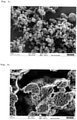
- 7.5 g of a black powder were obtained which, according to SEM analysis ( 3 ) consisted of PVAc/conductive carbon black microspheres.
Landscapes
- Chemical & Material Sciences (AREA)
- General Chemical & Material Sciences (AREA)
- Chemical Kinetics & Catalysis (AREA)
- Electrochemistry (AREA)
- Organic Chemistry (AREA)
- Inorganic Chemistry (AREA)
- Composite Materials (AREA)
- Engineering & Computer Science (AREA)
- Materials Engineering (AREA)
- Manufacturing & Machinery (AREA)
- Battery Electrode And Active Subsutance (AREA)
- Silicon Compounds (AREA)
- Carbon And Carbon Compounds (AREA)
Claims (10)
- Procédé pour la préparation de particules pré-composites, dans lequel des particules de silicium, un polyacrylonitrile et un ou plusieurs additifs de carbone choisis dans le groupe comprenant un graphite, un fullerène, des fibres de carbone, du carbone vitreux, un graphène, un charbon actif, des suies, des nanotubes de carbone, des nanomousses de carbone et un aérographite, éventuellement un ou plusieurs agents porogènes organiques et éventuellement un ou plusieurs adjuvants inorganiques, chacun sous la forme d'une poudre, sont mélangés, aucun solvant n'étant ajouté avant et pendant le mélange, etles adjuvants inorganiques étant choisis dans le groupe comprenant des halogénures de métaux alcalins et de métaux alcalino-terreux, des carbonates de métaux alcalins, l'oxyde de zinc, le carbonate de magnésium et le sulfure de nickel,le polyacrylonitrile, les particules de silicium et/ou les additifs de carbone étant chargés totalement ou partiellement avant le mélange ou étant ajoutés totalement ou partiellement pendant le mélange,à la condition que, sans polyacrylonitrile dans la charge, les particules de silicium et/ou les additifs de carbone sont ajouté(e)s au moins partiellement ensemble avec le polyacrylonitrile ou après l'ajout du polyacrylonitrile.
- Procédé pour la préparation de particules pré-composites selon la revendication 1, caractérisé en ce que des particules pré-composites sont présentes sous forme d'agglomérats à base de particules de silicium, d'additifs de carbone et de polyacrylonitrile ainsi qu'éventuellement d'agents porogènes organiques et éventuellement d'adjuvants inorganiques.
- Procédé pour la préparation de particules pré-composites selon la revendication 1 ou 2, caractérisé en ce que les particules pré-composites sont composées de ≥ 5 % en poids et ≤ 60 % en poids de polyacrylonitrile, par rapport au poids total des particules pré-composites.
- Procédé pour la préparation de particules pré-composites selon les revendications 1 à 3, caractérisé en ce qu'un ou plusieurs additifs de carbone sont choisis dans le groupe comprenant un graphite, une suie, un charbon actif, des nanotubes de carbone, des fullerènes et un graphène.
- Procédé pour la préparation de particules pré-composites selon les revendications 1 à 4, caractérisé en ce que le rapport en poids de polyacrylonitrile et d'additifs de carbone est ≥ 0,1 et ≤ 20.
- Procédé pour la préparation de particules pré-composites selon les revendications 1 à 5, caractérisé en ce que le rapport en poids de particules de silicium et d'additifs de carbone est ≥ 0,1 et ≤ 4.
- Procédé pour la préparation de particules pré-composites selon les revendications 1 à 6, caractérisé en ce que le polyacrylonitrile est chargé partiellement ou totalement avant le mélange.
- Procédé pour la préparation de particules pré-composites selon les revendications 1 à 7, caractérisé en ce que ≥ 40 % en poids de polyacrylonitrile est chargé, par rapport au poids total du polyacrylonitrile utilisé au total.
- Procédé pour la préparation de particules pré-composites selon les revendications 1 à 6, caractérisé en ce que le polyacrylonitrile est ajouté partiellement ou totalement, à la condition que la quantité totale utilisée de particules de silicium et/ou d'additifs de carbone ou une partie de celle-ci soit ajoutée simultanément avec le polyacrylonitrile ou ajoutée après l'ajout complet du polyacrylonitrile.
- Procédé pour la préparation de particules pré-composites selon les revendications 1 à 6, caractérisé en ce qu'après l'ajout complet des particules de silicium et des additifs de carbone, aucun polyacrylonitrile n'est plus ajouté.
Applications Claiming Priority (1)
| Application Number | Priority Date | Filing Date | Title |
|---|---|---|---|
| PCT/EP2016/069147 WO2018028790A1 (fr) | 2016-08-11 | 2016-08-11 | Préparation de particules composites de si/c |
Publications (2)
| Publication Number | Publication Date |
|---|---|
| EP3497055A1 EP3497055A1 (fr) | 2019-06-19 |
| EP3497055B1 true EP3497055B1 (fr) | 2022-03-16 |
Family
ID=56851544
Family Applications (1)
| Application Number | Title | Priority Date | Filing Date |
|---|---|---|---|
| EP16758101.6A Not-in-force EP3497055B1 (fr) | 2016-08-11 | 2016-08-11 | Préparation de particules precomposites de si/c |
Country Status (6)
| Country | Link |
|---|---|
| US (1) | US10968106B2 (fr) |
| EP (1) | EP3497055B1 (fr) |
| JP (1) | JP6724242B2 (fr) |
| KR (1) | KR102171131B1 (fr) |
| CN (1) | CN109562949B (fr) |
| WO (1) | WO2018028790A1 (fr) |
Families Citing this family (18)
| Publication number | Priority date | Publication date | Assignee | Title |
|---|---|---|---|---|
| KR102256534B1 (ko) * | 2017-11-08 | 2021-05-25 | 삼성에스디아이 주식회사 | 리튬 이차 전지용 음극 활물질 및 이를 포함하는 리튬 이차 전지 |
| KR102285980B1 (ko) * | 2017-11-09 | 2021-08-04 | 주식회사 엘지에너지솔루션 | 음극 활물질, 상기 음극 활물질을 포함하는 음극, 및 상기 음극을 포함하는 이차 전지 |
| CN108767195B (zh) * | 2018-04-27 | 2021-01-26 | 国联汽车动力电池研究院有限责任公司 | 一种孔隙结构可调的硅基电极及其制备方法 |
| US11545656B2 (en) * | 2019-11-07 | 2023-01-03 | Enevate Corporation | Method and system for battery electrode lamination using overlapped irregular shaped active material and adhesive |
| DE102018221839A1 (de) * | 2018-12-14 | 2020-06-18 | Sgl Carbon Se | Kohlenstoff-Silicium-Kompositmaterial |
| CN110098377B (zh) * | 2019-04-25 | 2022-04-05 | 浙江锋锂新能源科技有限公司 | 高容量保持率的锂离子电池及其制备方法和充放电方式 |
| US11605817B2 (en) | 2019-09-24 | 2023-03-14 | William Marsh Rice University | Sulfurized carbon cathodes |
| US11502295B2 (en) * | 2020-01-02 | 2022-11-15 | StoreDot Ltd. | Silver and/or tin coated silicon active material and anode slurries formed therefrom |
| US20230101574A1 (en) * | 2020-03-18 | 2023-03-30 | Wacker Chemie Ag | Method for producing carbon-coated silicon particles |
| EP4128395A4 (fr) | 2020-03-26 | 2024-11-06 | Zeta Energy Corp. | Cathode à base de carbone sulfuré avec cadre de carbone conducteur |
| CN112142047A (zh) * | 2020-09-23 | 2020-12-29 | 山东奥淼科技发展有限公司 | 一种利用生物半焦制备碳分子筛的方法 |
| KR102244194B1 (ko) | 2020-10-23 | 2021-04-26 | 주식회사 그랩실 | 그래핀-실리콘 복합체를 포함하는 음극 활물질, 이의 제조방법 및 이를 포함하는 리튬 이차전지 |
| CN112397712A (zh) * | 2020-11-02 | 2021-02-23 | 江西南鹰电源科技有限公司 | 一种高性能驻车用蓄电池正极铅膏配方 |
| CN114914408B (zh) * | 2021-02-10 | 2024-06-11 | 中国石油化工股份有限公司 | 硅碳复合材料及其制备方法和应用 |
| CN113998702B (zh) * | 2021-10-13 | 2023-10-13 | 昆明理工大学 | 一种以微硅粉为原料制备Si/C负极材料的方法 |
| WO2024053111A1 (fr) * | 2022-09-09 | 2024-03-14 | 株式会社レゾナック | Matériau d'électrode, électrode pour dispositifs de stockage d'énergie et dispositif de stockage d'énergie |
| CN116190592A (zh) * | 2022-12-14 | 2023-05-30 | 贝特瑞新材料集团股份有限公司 | 负极材料及锂离子电池 |
| CN120189554B (zh) * | 2025-05-26 | 2025-07-29 | 湖南工程学院 | 一种纳米硅-石墨烯协同增强的锌基骨植入物及其制备方法 |
Family Cites Families (17)
| Publication number | Priority date | Publication date | Assignee | Title |
|---|---|---|---|---|
| US6075084A (en) * | 1996-04-01 | 2000-06-13 | Cabot Corporation | Elastomer composite blends and methods - II |
| JP4140222B2 (ja) * | 2001-04-09 | 2008-08-27 | ソニー株式会社 | 負極、非水電解質二次電池及び負極の製造方法 |
| DE102004016766A1 (de) | 2004-04-01 | 2005-10-20 | Degussa | Nanoskalige Siliziumpartikel in negativen Elektrodenmaterialien für Lithium-Ionen-Batterien |
| JP4208034B2 (ja) * | 2006-02-17 | 2009-01-14 | パナソニック株式会社 | 導電性複合粒子の製造方法 |
| KR20070109634A (ko) | 2006-05-12 | 2007-11-15 | 주식회사 엘지화학 | 고용량 전극활물질 |
| KR100830612B1 (ko) | 2006-05-23 | 2008-05-21 | 강원대학교산학협력단 | 리튬 이차 전지용 음극 활물질, 그의 제조 방법 및 그를포함하는 리튬 이차 전지 |
| CN1913200B (zh) * | 2006-08-22 | 2010-05-26 | 深圳市贝特瑞电子材料有限公司 | 锂离子电池硅碳复合负极材料及其制备方法 |
| CN101494286A (zh) | 2007-12-04 | 2009-07-29 | 法拉赛斯能源公司 | 二次电池材料及其制备方法 |
| CN101339987A (zh) | 2008-07-21 | 2009-01-07 | 长沙市海容电子材料有限公司 | 一种锂离子电池硅碳复合负极材料及其制备方法 |
| FR2936102B1 (fr) | 2008-09-12 | 2010-10-29 | Commissariat Energie Atomique | Procede de preparation d'un materiau composite silicium/ carbone, materiau ainsi prepare et electrode notamment electrode negative, comprenant ce materiau. |
| FR2980191B1 (fr) * | 2011-09-20 | 2014-10-24 | Commissariat Energie Atomique | Procede de fabrication d'un materiau composite silicium/carbone et utilisation d'un tel materiau |
| US20130295454A1 (en) | 2012-04-12 | 2013-11-07 | Actacell Energy Systems, Inc. | Low crystallinity silicon composite anode material for lithium ion battery |
| DE102013204799A1 (de) | 2013-03-19 | 2014-09-25 | Wacker Chemie Ag | Si/C-Komposite als Anodenmaterialien für Lithium-Ionen-Batterien |
| JP6508870B2 (ja) * | 2013-08-14 | 2019-05-08 | 東ソー株式会社 | リチウム二次電池用複合活物質およびその製造方法 |
| DE102014202156A1 (de) | 2014-02-06 | 2015-08-06 | Wacker Chemie Ag | Si/G/C-Komposite für Lithium-Ionen-Batterien |
| US20160197352A1 (en) * | 2015-01-07 | 2016-07-07 | Ford Global Technologies, Llc. | Physiochemical Pretreatment for Battery Current Collector |
| CN104617276B (zh) * | 2015-02-10 | 2018-03-30 | 南开大学 | 锂离子二次电池多孔硅/碳复合负极材料及其制备方法 |
-
2016
- 2016-08-11 JP JP2019507197A patent/JP6724242B2/ja not_active Expired - Fee Related
- 2016-08-11 KR KR1020197003978A patent/KR102171131B1/ko active Active
- 2016-08-11 CN CN201680088282.2A patent/CN109562949B/zh active Active
- 2016-08-11 WO PCT/EP2016/069147 patent/WO2018028790A1/fr not_active Ceased
- 2016-08-11 EP EP16758101.6A patent/EP3497055B1/fr not_active Not-in-force
- 2016-08-11 US US16/324,323 patent/US10968106B2/en active Active
Also Published As
| Publication number | Publication date |
|---|---|
| JP6724242B2 (ja) | 2020-07-15 |
| WO2018028790A1 (fr) | 2018-02-15 |
| US20190177171A1 (en) | 2019-06-13 |
| US10968106B2 (en) | 2021-04-06 |
| JP2019528227A (ja) | 2019-10-10 |
| EP3497055A1 (fr) | 2019-06-19 |
| KR102171131B1 (ko) | 2020-10-29 |
| KR20190027883A (ko) | 2019-03-15 |
| CN109562949A (zh) | 2019-04-02 |
| CN109562949B (zh) | 2022-09-20 |
Similar Documents
| Publication | Publication Date | Title |
|---|---|---|
| EP3497055B1 (fr) | Préparation de particules precomposites de si/c | |
| EP3424098B1 (fr) | Fabrication de particules composites si/c | |
| EP3545572B1 (fr) | Particules composites coeur-écorce pour matériaux d'anode de batteries lithium-ion | |
| EP3580797B1 (fr) | Particules à coeur/coquille pour matériau d'anode d'une batterie lithium-ion | |
| EP3535793B1 (fr) | Particules de silicium recouvertes de carbone pour des batteries lithium-ion | |
| EP3417499B1 (fr) | Procédé de fabrication de particules composites si-c | |
| EP3417500B1 (fr) | Particules composites de type core-shell | |
| EP3580798B1 (fr) | Particules de composite de shell de base pour les batteries d'ion de lithium | |
| EP3580796B1 (fr) | Matériaux d'anode à base de si pour des batteries au lithium-ion | |
| EP2349931B1 (fr) | Spinelle de titane lithié revêtu de carbone | |
| WO2021185435A1 (fr) | Procédé de fabrication de particules de silicium recouvertes de carbone | |
| EP4176472B1 (fr) | Procédé de production de particules de silicium revêtues de carbone pour batteries au lithium-ion |
Legal Events
| Date | Code | Title | Description |
|---|---|---|---|
| STAA | Information on the status of an ep patent application or granted ep patent |
Free format text: STATUS: THE INTERNATIONAL PUBLICATION HAS BEEN MADE |
|
| PUAI | Public reference made under article 153(3) epc to a published international application that has entered the european phase |
Free format text: ORIGINAL CODE: 0009012 |
|
| STAA | Information on the status of an ep patent application or granted ep patent |
Free format text: STATUS: REQUEST FOR EXAMINATION WAS MADE |
|
| 17P | Request for examination filed |
Effective date: 20190204 |
|
| AK | Designated contracting states |
Kind code of ref document: A1 Designated state(s): AL AT BE BG CH CY CZ DE DK EE ES FI FR GB GR HR HU IE IS IT LI LT LU LV MC MK MT NL NO PL PT RO RS SE SI SK SM TR |
|
| AX | Request for extension of the european patent |
Extension state: BA ME |
|
| DAV | Request for validation of the european patent (deleted) | ||
| DAX | Request for extension of the european patent (deleted) | ||
| STAA | Information on the status of an ep patent application or granted ep patent |
Free format text: STATUS: EXAMINATION IS IN PROGRESS |
|
| 17Q | First examination report despatched |
Effective date: 20200424 |
|
| GRAP | Despatch of communication of intention to grant a patent |
Free format text: ORIGINAL CODE: EPIDOSNIGR1 |
|
| STAA | Information on the status of an ep patent application or granted ep patent |
Free format text: STATUS: GRANT OF PATENT IS INTENDED |
|
| RIC1 | Information provided on ipc code assigned before grant |
Ipc: H01M 4/62 20060101ALI20211006BHEP Ipc: H01M 4/04 20060101ALI20211006BHEP Ipc: H01M 4/38 20060101ALI20211006BHEP Ipc: H01M 4/36 20060101ALI20211006BHEP Ipc: H01M 4/134 20100101ALI20211006BHEP Ipc: C01B 32/00 20170101ALI20211006BHEP Ipc: C01B 33/02 20060101AFI20211006BHEP |
|
| INTG | Intention to grant announced |
Effective date: 20211103 |
|
| GRAS | Grant fee paid |
Free format text: ORIGINAL CODE: EPIDOSNIGR3 |
|
| GRAA | (expected) grant |
Free format text: ORIGINAL CODE: 0009210 |
|
| STAA | Information on the status of an ep patent application or granted ep patent |
Free format text: STATUS: THE PATENT HAS BEEN GRANTED |
|
| AK | Designated contracting states |
Kind code of ref document: B1 Designated state(s): AL AT BE BG CH CY CZ DE DK EE ES FI FR GB GR HR HU IE IS IT LI LT LU LV MC MK MT NL NO PL PT RO RS SE SI SK SM TR |
|
| REG | Reference to a national code |
Ref country code: GB Ref legal event code: FG4D Free format text: NOT ENGLISH |
|
| REG | Reference to a national code |
Ref country code: CH Ref legal event code: EP Ref country code: DE Ref legal event code: R096 Ref document number: 502016014648 Country of ref document: DE |
|
| REG | Reference to a national code |
Ref country code: IE Ref legal event code: FG4D Free format text: LANGUAGE OF EP DOCUMENT: GERMAN |
|
| REG | Reference to a national code |
Ref country code: AT Ref legal event code: REF Ref document number: 1475756 Country of ref document: AT Kind code of ref document: T Effective date: 20220415 |
|
| REG | Reference to a national code |
Ref country code: LT Ref legal event code: MG9D |
|
| REG | Reference to a national code |
Ref country code: NL Ref legal event code: MP Effective date: 20220316 |
|
| PG25 | Lapsed in a contracting state [announced via postgrant information from national office to epo] |
Ref country code: SE Free format text: LAPSE BECAUSE OF FAILURE TO SUBMIT A TRANSLATION OF THE DESCRIPTION OR TO PAY THE FEE WITHIN THE PRESCRIBED TIME-LIMIT Effective date: 20220316 Ref country code: RS Free format text: LAPSE BECAUSE OF FAILURE TO SUBMIT A TRANSLATION OF THE DESCRIPTION OR TO PAY THE FEE WITHIN THE PRESCRIBED TIME-LIMIT Effective date: 20220316 Ref country code: NO Free format text: LAPSE BECAUSE OF FAILURE TO SUBMIT A TRANSLATION OF THE DESCRIPTION OR TO PAY THE FEE WITHIN THE PRESCRIBED TIME-LIMIT Effective date: 20220616 Ref country code: LT Free format text: LAPSE BECAUSE OF FAILURE TO SUBMIT A TRANSLATION OF THE DESCRIPTION OR TO PAY THE FEE WITHIN THE PRESCRIBED TIME-LIMIT Effective date: 20220316 Ref country code: HR Free format text: LAPSE BECAUSE OF FAILURE TO SUBMIT A TRANSLATION OF THE DESCRIPTION OR TO PAY THE FEE WITHIN THE PRESCRIBED TIME-LIMIT Effective date: 20220316 Ref country code: BG Free format text: LAPSE BECAUSE OF FAILURE TO SUBMIT A TRANSLATION OF THE DESCRIPTION OR TO PAY THE FEE WITHIN THE PRESCRIBED TIME-LIMIT Effective date: 20220616 |
|
| PG25 | Lapsed in a contracting state [announced via postgrant information from national office to epo] |
Ref country code: LV Free format text: LAPSE BECAUSE OF FAILURE TO SUBMIT A TRANSLATION OF THE DESCRIPTION OR TO PAY THE FEE WITHIN THE PRESCRIBED TIME-LIMIT Effective date: 20220316 Ref country code: GR Free format text: LAPSE BECAUSE OF FAILURE TO SUBMIT A TRANSLATION OF THE DESCRIPTION OR TO PAY THE FEE WITHIN THE PRESCRIBED TIME-LIMIT Effective date: 20220617 Ref country code: FI Free format text: LAPSE BECAUSE OF FAILURE TO SUBMIT A TRANSLATION OF THE DESCRIPTION OR TO PAY THE FEE WITHIN THE PRESCRIBED TIME-LIMIT Effective date: 20220316 |
|
| PG25 | Lapsed in a contracting state [announced via postgrant information from national office to epo] |
Ref country code: NL Free format text: LAPSE BECAUSE OF FAILURE TO SUBMIT A TRANSLATION OF THE DESCRIPTION OR TO PAY THE FEE WITHIN THE PRESCRIBED TIME-LIMIT Effective date: 20220316 |
|
| PG25 | Lapsed in a contracting state [announced via postgrant information from national office to epo] |
Ref country code: SM Free format text: LAPSE BECAUSE OF FAILURE TO SUBMIT A TRANSLATION OF THE DESCRIPTION OR TO PAY THE FEE WITHIN THE PRESCRIBED TIME-LIMIT Effective date: 20220316 Ref country code: SK Free format text: LAPSE BECAUSE OF FAILURE TO SUBMIT A TRANSLATION OF THE DESCRIPTION OR TO PAY THE FEE WITHIN THE PRESCRIBED TIME-LIMIT Effective date: 20220316 Ref country code: RO Free format text: LAPSE BECAUSE OF FAILURE TO SUBMIT A TRANSLATION OF THE DESCRIPTION OR TO PAY THE FEE WITHIN THE PRESCRIBED TIME-LIMIT Effective date: 20220316 Ref country code: PT Free format text: LAPSE BECAUSE OF FAILURE TO SUBMIT A TRANSLATION OF THE DESCRIPTION OR TO PAY THE FEE WITHIN THE PRESCRIBED TIME-LIMIT Effective date: 20220718 Ref country code: ES Free format text: LAPSE BECAUSE OF FAILURE TO SUBMIT A TRANSLATION OF THE DESCRIPTION OR TO PAY THE FEE WITHIN THE PRESCRIBED TIME-LIMIT Effective date: 20220316 Ref country code: EE Free format text: LAPSE BECAUSE OF FAILURE TO SUBMIT A TRANSLATION OF THE DESCRIPTION OR TO PAY THE FEE WITHIN THE PRESCRIBED TIME-LIMIT Effective date: 20220316 Ref country code: CZ Free format text: LAPSE BECAUSE OF FAILURE TO SUBMIT A TRANSLATION OF THE DESCRIPTION OR TO PAY THE FEE WITHIN THE PRESCRIBED TIME-LIMIT Effective date: 20220316 |
|
| PG25 | Lapsed in a contracting state [announced via postgrant information from national office to epo] |
Ref country code: PL Free format text: LAPSE BECAUSE OF FAILURE TO SUBMIT A TRANSLATION OF THE DESCRIPTION OR TO PAY THE FEE WITHIN THE PRESCRIBED TIME-LIMIT Effective date: 20220316 Ref country code: IS Free format text: LAPSE BECAUSE OF FAILURE TO SUBMIT A TRANSLATION OF THE DESCRIPTION OR TO PAY THE FEE WITHIN THE PRESCRIBED TIME-LIMIT Effective date: 20220716 Ref country code: AL Free format text: LAPSE BECAUSE OF FAILURE TO SUBMIT A TRANSLATION OF THE DESCRIPTION OR TO PAY THE FEE WITHIN THE PRESCRIBED TIME-LIMIT Effective date: 20220316 |
|
| REG | Reference to a national code |
Ref country code: DE Ref legal event code: R097 Ref document number: 502016014648 Country of ref document: DE |
|
| PLBE | No opposition filed within time limit |
Free format text: ORIGINAL CODE: 0009261 |
|
| STAA | Information on the status of an ep patent application or granted ep patent |
Free format text: STATUS: NO OPPOSITION FILED WITHIN TIME LIMIT |
|
| PG25 | Lapsed in a contracting state [announced via postgrant information from national office to epo] |
Ref country code: DK Free format text: LAPSE BECAUSE OF FAILURE TO SUBMIT A TRANSLATION OF THE DESCRIPTION OR TO PAY THE FEE WITHIN THE PRESCRIBED TIME-LIMIT Effective date: 20220316 |
|
| 26N | No opposition filed |
Effective date: 20221219 |
|
| PG25 | Lapsed in a contracting state [announced via postgrant information from national office to epo] |
Ref country code: SI Free format text: LAPSE BECAUSE OF FAILURE TO SUBMIT A TRANSLATION OF THE DESCRIPTION OR TO PAY THE FEE WITHIN THE PRESCRIBED TIME-LIMIT Effective date: 20220316 |
|
| PG25 | Lapsed in a contracting state [announced via postgrant information from national office to epo] |
Ref country code: MC Free format text: LAPSE BECAUSE OF FAILURE TO SUBMIT A TRANSLATION OF THE DESCRIPTION OR TO PAY THE FEE WITHIN THE PRESCRIBED TIME-LIMIT Effective date: 20220316 |
|
| REG | Reference to a national code |
Ref country code: CH Ref legal event code: PL |
|
| GBPC | Gb: european patent ceased through non-payment of renewal fee |
Effective date: 20220811 |
|
| PG25 | Lapsed in a contracting state [announced via postgrant information from national office to epo] |
Ref country code: LU Free format text: LAPSE BECAUSE OF NON-PAYMENT OF DUE FEES Effective date: 20220811 Ref country code: LI Free format text: LAPSE BECAUSE OF NON-PAYMENT OF DUE FEES Effective date: 20220831 Ref country code: CH Free format text: LAPSE BECAUSE OF NON-PAYMENT OF DUE FEES Effective date: 20220831 |
|
| REG | Reference to a national code |
Ref country code: BE Ref legal event code: MM Effective date: 20220831 |
|
| PG25 | Lapsed in a contracting state [announced via postgrant information from national office to epo] |
Ref country code: IT Free format text: LAPSE BECAUSE OF FAILURE TO SUBMIT A TRANSLATION OF THE DESCRIPTION OR TO PAY THE FEE WITHIN THE PRESCRIBED TIME-LIMIT Effective date: 20220316 Ref country code: IE Free format text: LAPSE BECAUSE OF NON-PAYMENT OF DUE FEES Effective date: 20220811 Ref country code: FR Free format text: LAPSE BECAUSE OF NON-PAYMENT OF DUE FEES Effective date: 20220831 |
|
| PG25 | Lapsed in a contracting state [announced via postgrant information from national office to epo] |
Ref country code: BE Free format text: LAPSE BECAUSE OF NON-PAYMENT OF DUE FEES Effective date: 20220831 |
|
| REG | Reference to a national code |
Ref country code: AT Ref legal event code: MM01 Ref document number: 1475756 Country of ref document: AT Kind code of ref document: T Effective date: 20220811 |
|
| PG25 | Lapsed in a contracting state [announced via postgrant information from national office to epo] |
Ref country code: GB Free format text: LAPSE BECAUSE OF NON-PAYMENT OF DUE FEES Effective date: 20220811 Ref country code: AT Free format text: LAPSE BECAUSE OF NON-PAYMENT OF DUE FEES Effective date: 20220811 |
|
| PG25 | Lapsed in a contracting state [announced via postgrant information from national office to epo] |
Ref country code: HU Free format text: LAPSE BECAUSE OF FAILURE TO SUBMIT A TRANSLATION OF THE DESCRIPTION OR TO PAY THE FEE WITHIN THE PRESCRIBED TIME-LIMIT; INVALID AB INITIO Effective date: 20160811 |
|
| PG25 | Lapsed in a contracting state [announced via postgrant information from national office to epo] |
Ref country code: CY Free format text: LAPSE BECAUSE OF FAILURE TO SUBMIT A TRANSLATION OF THE DESCRIPTION OR TO PAY THE FEE WITHIN THE PRESCRIBED TIME-LIMIT Effective date: 20220316 |
|
| PG25 | Lapsed in a contracting state [announced via postgrant information from national office to epo] |
Ref country code: MK Free format text: LAPSE BECAUSE OF FAILURE TO SUBMIT A TRANSLATION OF THE DESCRIPTION OR TO PAY THE FEE WITHIN THE PRESCRIBED TIME-LIMIT Effective date: 20220316 |
|
| REG | Reference to a national code |
Ref country code: DE Ref legal event code: R081 Ref document number: 502016014648 Country of ref document: DE Owner name: WACKER CHEMIE AG, DE Free format text: FORMER OWNER: WACKER CHEMIE AG, 81737 MUENCHEN, DE |
|
| PG25 | Lapsed in a contracting state [announced via postgrant information from national office to epo] |
Ref country code: MT Free format text: LAPSE BECAUSE OF FAILURE TO SUBMIT A TRANSLATION OF THE DESCRIPTION OR TO PAY THE FEE WITHIN THE PRESCRIBED TIME-LIMIT Effective date: 20220316 |
|
| PGFP | Annual fee paid to national office [announced via postgrant information from national office to epo] |
Ref country code: DE Payment date: 20240821 Year of fee payment: 9 |
|
| P01 | Opt-out of the competence of the unified patent court (upc) registered |
Free format text: CASE NUMBER: UPC_APP_119080/2023 Effective date: 20230510 |
|
| PG25 | Lapsed in a contracting state [announced via postgrant information from national office to epo] |
Ref country code: TR Free format text: LAPSE BECAUSE OF FAILURE TO SUBMIT A TRANSLATION OF THE DESCRIPTION OR TO PAY THE FEE WITHIN THE PRESCRIBED TIME-LIMIT Effective date: 20220316 |
|
| REG | Reference to a national code |
Ref country code: DE Ref legal event code: R119 Ref document number: 502016014648 Country of ref document: DE |