EP3497144B1 - Verfahren zur synthese von silylierten polyurethanen und silylierte polyurethanzusammensetzung - Google Patents
Verfahren zur synthese von silylierten polyurethanen und silylierte polyurethanzusammensetzung Download PDFInfo
- Publication number
- EP3497144B1 EP3497144B1 EP17757807.7A EP17757807A EP3497144B1 EP 3497144 B1 EP3497144 B1 EP 3497144B1 EP 17757807 A EP17757807 A EP 17757807A EP 3497144 B1 EP3497144 B1 EP 3497144B1
- Authority
- EP
- European Patent Office
- Prior art keywords
- composition
- radical
- mol
- carbon atoms
- functional groups
- Prior art date
- Legal status (The legal status is an assumption and is not a legal conclusion. Google has not performed a legal analysis and makes no representation as to the accuracy of the status listed.)
- Active
Links
Classifications
-
- C—CHEMISTRY; METALLURGY
- C08—ORGANIC MACROMOLECULAR COMPOUNDS; THEIR PREPARATION OR CHEMICAL WORKING-UP; COMPOSITIONS BASED THEREON
- C08G—MACROMOLECULAR COMPOUNDS OBTAINED OTHERWISE THAN BY REACTIONS ONLY INVOLVING UNSATURATED CARBON-TO-CARBON BONDS
- C08G18/00—Polymeric products of isocyanates or isothiocyanates
- C08G18/06—Polymeric products of isocyanates or isothiocyanates with compounds having active hydrogen
- C08G18/28—Polymeric products of isocyanates or isothiocyanates with compounds having active hydrogen characterised by the compounds used containing active hydrogen
- C08G18/30—Low-molecular-weight compounds
- C08G18/38—Low-molecular-weight compounds having heteroatoms other than oxygen
- C08G18/3893—Low-molecular-weight compounds having heteroatoms other than oxygen containing silicon
-
- C—CHEMISTRY; METALLURGY
- C08—ORGANIC MACROMOLECULAR COMPOUNDS; THEIR PREPARATION OR CHEMICAL WORKING-UP; COMPOSITIONS BASED THEREON
- C08G—MACROMOLECULAR COMPOUNDS OBTAINED OTHERWISE THAN BY REACTIONS ONLY INVOLVING UNSATURATED CARBON-TO-CARBON BONDS
- C08G18/00—Polymeric products of isocyanates or isothiocyanates
- C08G18/06—Polymeric products of isocyanates or isothiocyanates with compounds having active hydrogen
- C08G18/08—Processes
- C08G18/10—Prepolymer processes involving reaction of isocyanates or isothiocyanates with compounds having active hydrogen in a first reaction step
-
- C—CHEMISTRY; METALLURGY
- C08—ORGANIC MACROMOLECULAR COMPOUNDS; THEIR PREPARATION OR CHEMICAL WORKING-UP; COMPOSITIONS BASED THEREON
- C08G—MACROMOLECULAR COMPOUNDS OBTAINED OTHERWISE THAN BY REACTIONS ONLY INVOLVING UNSATURATED CARBON-TO-CARBON BONDS
- C08G18/00—Polymeric products of isocyanates or isothiocyanates
- C08G18/06—Polymeric products of isocyanates or isothiocyanates with compounds having active hydrogen
- C08G18/08—Processes
- C08G18/16—Catalysts
- C08G18/22—Catalysts containing metal compounds
- C08G18/222—Catalysts containing metal compounds metal compounds not provided for in groups C08G18/225 - C08G18/26
-
- C—CHEMISTRY; METALLURGY
- C08—ORGANIC MACROMOLECULAR COMPOUNDS; THEIR PREPARATION OR CHEMICAL WORKING-UP; COMPOSITIONS BASED THEREON
- C08G—MACROMOLECULAR COMPOUNDS OBTAINED OTHERWISE THAN BY REACTIONS ONLY INVOLVING UNSATURATED CARBON-TO-CARBON BONDS
- C08G18/00—Polymeric products of isocyanates or isothiocyanates
- C08G18/06—Polymeric products of isocyanates or isothiocyanates with compounds having active hydrogen
- C08G18/08—Processes
- C08G18/16—Catalysts
- C08G18/22—Catalysts containing metal compounds
- C08G18/227—Catalysts containing metal compounds of antimony, bismuth or arsenic
-
- C—CHEMISTRY; METALLURGY
- C08—ORGANIC MACROMOLECULAR COMPOUNDS; THEIR PREPARATION OR CHEMICAL WORKING-UP; COMPOSITIONS BASED THEREON
- C08G—MACROMOLECULAR COMPOUNDS OBTAINED OTHERWISE THAN BY REACTIONS ONLY INVOLVING UNSATURATED CARBON-TO-CARBON BONDS
- C08G18/00—Polymeric products of isocyanates or isothiocyanates
- C08G18/06—Polymeric products of isocyanates or isothiocyanates with compounds having active hydrogen
- C08G18/28—Polymeric products of isocyanates or isothiocyanates with compounds having active hydrogen characterised by the compounds used containing active hydrogen
- C08G18/40—High-molecular-weight compounds
- C08G18/48—Polyethers
- C08G18/4804—Two or more polyethers of different physical or chemical nature
- C08G18/4812—Mixtures of polyetherdiols with polyetherpolyols having at least three hydroxy groups
-
- C—CHEMISTRY; METALLURGY
- C08—ORGANIC MACROMOLECULAR COMPOUNDS; THEIR PREPARATION OR CHEMICAL WORKING-UP; COMPOSITIONS BASED THEREON
- C08G—MACROMOLECULAR COMPOUNDS OBTAINED OTHERWISE THAN BY REACTIONS ONLY INVOLVING UNSATURATED CARBON-TO-CARBON BONDS
- C08G18/00—Polymeric products of isocyanates or isothiocyanates
- C08G18/06—Polymeric products of isocyanates or isothiocyanates with compounds having active hydrogen
- C08G18/28—Polymeric products of isocyanates or isothiocyanates with compounds having active hydrogen characterised by the compounds used containing active hydrogen
- C08G18/40—High-molecular-weight compounds
- C08G18/48—Polyethers
- C08G18/4825—Polyethers containing two hydroxy groups
-
- C—CHEMISTRY; METALLURGY
- C08—ORGANIC MACROMOLECULAR COMPOUNDS; THEIR PREPARATION OR CHEMICAL WORKING-UP; COMPOSITIONS BASED THEREON
- C08G—MACROMOLECULAR COMPOUNDS OBTAINED OTHERWISE THAN BY REACTIONS ONLY INVOLVING UNSATURATED CARBON-TO-CARBON BONDS
- C08G18/00—Polymeric products of isocyanates or isothiocyanates
- C08G18/06—Polymeric products of isocyanates or isothiocyanates with compounds having active hydrogen
- C08G18/28—Polymeric products of isocyanates or isothiocyanates with compounds having active hydrogen characterised by the compounds used containing active hydrogen
- C08G18/40—High-molecular-weight compounds
- C08G18/48—Polyethers
- C08G18/4829—Polyethers containing at least three hydroxy groups
-
- C—CHEMISTRY; METALLURGY
- C08—ORGANIC MACROMOLECULAR COMPOUNDS; THEIR PREPARATION OR CHEMICAL WORKING-UP; COMPOSITIONS BASED THEREON
- C08G—MACROMOLECULAR COMPOUNDS OBTAINED OTHERWISE THAN BY REACTIONS ONLY INVOLVING UNSATURATED CARBON-TO-CARBON BONDS
- C08G18/00—Polymeric products of isocyanates or isothiocyanates
- C08G18/06—Polymeric products of isocyanates or isothiocyanates with compounds having active hydrogen
- C08G18/28—Polymeric products of isocyanates or isothiocyanates with compounds having active hydrogen characterised by the compounds used containing active hydrogen
- C08G18/65—Low-molecular-weight compounds having active hydrogen with high-molecular-weight compounds having active hydrogen
- C08G18/66—Compounds of groups C08G18/42, C08G18/48, or C08G18/52
- C08G18/6666—Compounds of group C08G18/48 or C08G18/52
- C08G18/667—Compounds of group C08G18/48 or C08G18/52 with compounds of group C08G18/32 or polyamines of C08G18/38
- C08G18/6681—Compounds of group C08G18/48 or C08G18/52 with compounds of group C08G18/32 or polyamines of C08G18/38 with compounds of group C08G18/32 or C08G18/3271 and/or polyamines of C08G18/38
- C08G18/6685—Compounds of group C08G18/48 or C08G18/52 with compounds of group C08G18/32 or polyamines of C08G18/38 with compounds of group C08G18/32 or C08G18/3271 and/or polyamines of C08G18/38 with compounds of group C08G18/3225 or polyamines of C08G18/38
-
- C—CHEMISTRY; METALLURGY
- C08—ORGANIC MACROMOLECULAR COMPOUNDS; THEIR PREPARATION OR CHEMICAL WORKING-UP; COMPOSITIONS BASED THEREON
- C08G—MACROMOLECULAR COMPOUNDS OBTAINED OTHERWISE THAN BY REACTIONS ONLY INVOLVING UNSATURATED CARBON-TO-CARBON BONDS
- C08G18/00—Polymeric products of isocyanates or isothiocyanates
- C08G18/06—Polymeric products of isocyanates or isothiocyanates with compounds having active hydrogen
- C08G18/70—Polymeric products of isocyanates or isothiocyanates with compounds having active hydrogen characterised by the isocyanates or isothiocyanates used
- C08G18/72—Polyisocyanates or polyisothiocyanates
- C08G18/74—Polyisocyanates or polyisothiocyanates cyclic
- C08G18/75—Polyisocyanates or polyisothiocyanates cyclic cycloaliphatic
- C08G18/751—Polyisocyanates or polyisothiocyanates cyclic cycloaliphatic containing only one cycloaliphatic ring
- C08G18/752—Polyisocyanates or polyisothiocyanates cyclic cycloaliphatic containing only one cycloaliphatic ring containing at least one isocyanate or isothiocyanate group linked to the cycloaliphatic ring by means of an aliphatic group
- C08G18/753—Polyisocyanates or polyisothiocyanates cyclic cycloaliphatic containing only one cycloaliphatic ring containing at least one isocyanate or isothiocyanate group linked to the cycloaliphatic ring by means of an aliphatic group containing one isocyanate or isothiocyanate group linked to the cycloaliphatic ring by means of an aliphatic group having a primary carbon atom next to the isocyanate or isothiocyanate group
- C08G18/755—Polyisocyanates or polyisothiocyanates cyclic cycloaliphatic containing only one cycloaliphatic ring containing at least one isocyanate or isothiocyanate group linked to the cycloaliphatic ring by means of an aliphatic group containing one isocyanate or isothiocyanate group linked to the cycloaliphatic ring by means of an aliphatic group having a primary carbon atom next to the isocyanate or isothiocyanate group and at least one isocyanate or isothiocyanate group linked to a secondary carbon atom of the cycloaliphatic ring, e.g. isophorone diisocyanate
-
- C—CHEMISTRY; METALLURGY
- C08—ORGANIC MACROMOLECULAR COMPOUNDS; THEIR PREPARATION OR CHEMICAL WORKING-UP; COMPOSITIONS BASED THEREON
- C08G—MACROMOLECULAR COMPOUNDS OBTAINED OTHERWISE THAN BY REACTIONS ONLY INVOLVING UNSATURATED CARBON-TO-CARBON BONDS
- C08G18/00—Polymeric products of isocyanates or isothiocyanates
- C08G18/06—Polymeric products of isocyanates or isothiocyanates with compounds having active hydrogen
- C08G18/70—Polymeric products of isocyanates or isothiocyanates with compounds having active hydrogen characterised by the isocyanates or isothiocyanates used
- C08G18/72—Polyisocyanates or polyisothiocyanates
- C08G18/74—Polyisocyanates or polyisothiocyanates cyclic
- C08G18/76—Polyisocyanates or polyisothiocyanates cyclic aromatic
- C08G18/7614—Polyisocyanates or polyisothiocyanates cyclic aromatic containing only one aromatic ring
- C08G18/7621—Polyisocyanates or polyisothiocyanates cyclic aromatic containing only one aromatic ring being toluene diisocyanate including isomer mixtures
-
- C—CHEMISTRY; METALLURGY
- C09—DYES; PAINTS; POLISHES; NATURAL RESINS; ADHESIVES; COMPOSITIONS NOT OTHERWISE PROVIDED FOR; APPLICATIONS OF MATERIALS NOT OTHERWISE PROVIDED FOR
- C09J—ADHESIVES; NON-MECHANICAL ASPECTS OF ADHESIVE PROCESSES IN GENERAL; ADHESIVE PROCESSES NOT PROVIDED FOR ELSEWHERE; USE OF MATERIALS AS ADHESIVES
- C09J11/00—Features of adhesives not provided for in group C09J9/00, e.g. additives
- C09J11/08—Macromolecular additives
-
- C—CHEMISTRY; METALLURGY
- C09—DYES; PAINTS; POLISHES; NATURAL RESINS; ADHESIVES; COMPOSITIONS NOT OTHERWISE PROVIDED FOR; APPLICATIONS OF MATERIALS NOT OTHERWISE PROVIDED FOR
- C09J—ADHESIVES; NON-MECHANICAL ASPECTS OF ADHESIVE PROCESSES IN GENERAL; ADHESIVE PROCESSES NOT PROVIDED FOR ELSEWHERE; USE OF MATERIALS AS ADHESIVES
- C09J175/00—Adhesives based on polyureas or polyurethanes; Adhesives based on derivatives of such polymers
- C09J175/04—Polyurethanes
-
- C—CHEMISTRY; METALLURGY
- C09—DYES; PAINTS; POLISHES; NATURAL RESINS; ADHESIVES; COMPOSITIONS NOT OTHERWISE PROVIDED FOR; APPLICATIONS OF MATERIALS NOT OTHERWISE PROVIDED FOR
- C09J—ADHESIVES; NON-MECHANICAL ASPECTS OF ADHESIVE PROCESSES IN GENERAL; ADHESIVE PROCESSES NOT PROVIDED FOR ELSEWHERE; USE OF MATERIALS AS ADHESIVES
- C09J7/00—Adhesives in the form of films or foils
- C09J7/30—Adhesives in the form of films or foils characterised by the adhesive composition
- C09J7/38—Pressure-sensitive adhesives [PSA]
-
- C—CHEMISTRY; METALLURGY
- C08—ORGANIC MACROMOLECULAR COMPOUNDS; THEIR PREPARATION OR CHEMICAL WORKING-UP; COMPOSITIONS BASED THEREON
- C08L—COMPOSITIONS OF MACROMOLECULAR COMPOUNDS
- C08L75/00—Compositions of polyureas or polyurethanes; Compositions of derivatives of such polymers
- C08L75/04—Polyurethanes
-
- C—CHEMISTRY; METALLURGY
- C09—DYES; PAINTS; POLISHES; NATURAL RESINS; ADHESIVES; COMPOSITIONS NOT OTHERWISE PROVIDED FOR; APPLICATIONS OF MATERIALS NOT OTHERWISE PROVIDED FOR
- C09J—ADHESIVES; NON-MECHANICAL ASPECTS OF ADHESIVE PROCESSES IN GENERAL; ADHESIVE PROCESSES NOT PROVIDED FOR ELSEWHERE; USE OF MATERIALS AS ADHESIVES
- C09J2203/00—Applications of adhesives in processes or use of adhesives in the form of films or foils
- C09J2203/334—Applications of adhesives in processes or use of adhesives in the form of films or foils as a label
-
- C—CHEMISTRY; METALLURGY
- C09—DYES; PAINTS; POLISHES; NATURAL RESINS; ADHESIVES; COMPOSITIONS NOT OTHERWISE PROVIDED FOR; APPLICATIONS OF MATERIALS NOT OTHERWISE PROVIDED FOR
- C09J—ADHESIVES; NON-MECHANICAL ASPECTS OF ADHESIVE PROCESSES IN GENERAL; ADHESIVE PROCESSES NOT PROVIDED FOR ELSEWHERE; USE OF MATERIALS AS ADHESIVES
- C09J2301/00—Additional features of adhesives in the form of films or foils
- C09J2301/40—Additional features of adhesives in the form of films or foils characterized by the presence of essential components
- C09J2301/408—Additional features of adhesives in the form of films or foils characterized by the presence of essential components additives as essential feature of the adhesive layer
-
- C—CHEMISTRY; METALLURGY
- C09—DYES; PAINTS; POLISHES; NATURAL RESINS; ADHESIVES; COMPOSITIONS NOT OTHERWISE PROVIDED FOR; APPLICATIONS OF MATERIALS NOT OTHERWISE PROVIDED FOR
- C09J—ADHESIVES; NON-MECHANICAL ASPECTS OF ADHESIVE PROCESSES IN GENERAL; ADHESIVE PROCESSES NOT PROVIDED FOR ELSEWHERE; USE OF MATERIALS AS ADHESIVES
- C09J2467/00—Presence of polyester
- C09J2467/006—Presence of polyester in the substrate
-
- C—CHEMISTRY; METALLURGY
- C09—DYES; PAINTS; POLISHES; NATURAL RESINS; ADHESIVES; COMPOSITIONS NOT OTHERWISE PROVIDED FOR; APPLICATIONS OF MATERIALS NOT OTHERWISE PROVIDED FOR
- C09J—ADHESIVES; NON-MECHANICAL ASPECTS OF ADHESIVE PROCESSES IN GENERAL; ADHESIVE PROCESSES NOT PROVIDED FOR ELSEWHERE; USE OF MATERIALS AS ADHESIVES
- C09J2475/00—Presence of polyurethane
Definitions
- the present invention relates to a process for the synthesis of silylated polyurethanes.
- the present invention also relates to a composition of silylated polyurethanes comprising at least two silylated polyurethanes of different number average molecular mass.
- the present invention also relates to the use of the silylated polyurethanes according to the invention for the manufacture of an adhesive composition, a surface coating composition or mastic.
- the present invention also relates to a self-adhesive article comprising an adhesive layer obtained by crosslinking an adhesive composition according to the invention comprising said silylated polyurethanes.
- the silylated polyurethanes can be used for the formulation of self-adhesive articles of the PSA type.
- Pressure-sensitive adhesives are substances which give the support layer, also called the substrate, which is coated therewith an immediate stickiness, or tackiness. at room temperature (often referred to as "tack"), which allows its instantaneous adhesion to a substrate under the effect of light and brief pressure.
- PSAs are widely used for the manufacture of self-adhesive labels or films which are attached to articles for the purpose of displaying information (such as barcode, denomination, price) and/or for decorative purposes, whether either during permanent or temporary bonding. PSAs are also used for the manufacture of self-adhesive tapes for various uses.
- PSAs are often applied by continuous coating processes over the entire surface of a support layer (printable where appropriate) of large dimensions, at the rate of a quantity (generally expressed in g/m 2 ) hereinafter designated by the term “grammage”.
- the support layer consists of paper or a polymeric material (eg in the form of sheet, film or plate) with one or more layers.
- the adhesive layer which covers the support layer may itself be covered with a protective non-stick layer (often referred to by the English name "release liner"), for example consisting of a silicone plastic film or sheet of silicone paper.
- release liner for example consisting of a silicone plastic film or sheet of silicone paper.
- the multilayer system obtained is generally packaged by winding in the form of large reels, typically up to 2 m wide and 1 m in diameter, which can be stored and transported.
- the silylated polymers can also be used in sealant compositions, adhesives or surface coating compositions.
- the document EP 2 889 348 describes the preparation of silylated polyurethanes.
- the document EP 2 583 988 describes a process for the preparation of a silylated polyurethane comprising the formation of an NCO-terminated polyurethane prepolymer followed by the reaction of said NCO-terminated polyurethane prepolymer with an aminosilane where each of the NCO functions reacts with an amine function of the aminosilane.
- Such a process, in which 100% of the NCO functions are reacted requires large quantities of aminosilanes, expensive raw materials. It has therefore been sought to provide a process for the preparation of silylated polyurethane that is more economical.
- the document WO 02/06367 discloses a process for the preparation of a silylated polyurethane or mixture of silylated polyurethanes comprising the formation of an NCO-terminated polyurethane prepolymer followed by the reaction of said NCO-terminated polyurethane prepolymer with an aminosilane or a mercaptosilane where the amount of NCO functions can be greater than or equal to the amount of amine or thiol functions.
- the quantity of NCO functions is greater than the quantity of amine or thiol functions
- this document discloses the possibility of adding a monol to the mixture of polymers obtained in order to neutralize the free NCO functions by reacting with them.
- the crosslinking time of the mixture of silylated polymers obtained at the end of the manufacturing process described in the document WO 02/06367 is high.
- the crosslinking time, in particular of the silylated polymer(s) not be too high in order to accelerate the setting time for the mastic or surface coating compositions or the manufacturing time of self-adhesive articles for adhesive compositions intended for the manufacture of PSA.
- the document WO 2007/037833 discloses a crosslinkable composition comprising a silylated polymer, a catalyst and at least one polyol.
- the polyol is used as a plasticizer and is added to the composition once the latter no longer comprises free NCO functions.
- the polyol does not react with free NCO functions.
- the viscosity of the composition described in this document is not stable over time, in particular the viscosity tends to increase over time.
- the object of the present invention is to provide a process for the manufacture of a more economical silylated polyurethane composition, said polyurethane composition exhibiting good performance, and in particular a high crosslinking rate and/or good stability.
- composition of silylated polyurethanes according to the invention can be used in various compositions, in particular adhesive compositions having in particular self-adhesive properties (adhesive compositions of the PSA type), such as those intended for the manufacture of self-adhesive articles, or alternatively surface coating or mastic compositions.
- Another object of the present invention relates to an adhesive composition
- an adhesive composition comprising at least one composition of silylated polyurethanes (A) according to the present invention and at least one additional component chosen from catalysts, fillers, tackifying resins, adhesion promoters, plasticizers or thinners, rheological agents, drying agents, UV and/or thermal stabilizers (UV filters and antioxidants), and solvents.
- the present invention relates to a pressure-sensitive adhesive composition comprising at least one composition of silylated polyurethanes (A) according to the present invention, at least one tackifying resin and at least one crosslinking catalyst.
- Another object of the present invention relates to a self-adhesive article comprising a support layer coated with an adhesive layer, said adhesive layer being obtained by crosslinking the pressure-sensitive adhesive composition according to the invention.
- the manufacturing process according to the present invention makes it possible to provide a composition of silylated polyurethanes exhibiting a high rate of crosslinking.
- the manufacturing process according to the invention makes it possible to provide a composition of silylated polyurethanes whose viscosity is stable over time.
- the manufacturing process according to the invention is more economical because it requires the use of a smaller quantity of expensive raw materials such as silanes.
- composition of silylated polyurethanes according to the invention does not comprise residual free diisocyanate monomers, so that the products comprising said composition of silylated polyurethanes are not subject to regulatory labeling due to the presence of residual diisocyanate monomers considered as potentially toxic.
- the ratio (r1) can s write as follows: NCO/(OH+NH+NH 2 ), the NH and NH 2 type amine functions possibly coming from chain extender(s) possibly present in the polyol composition (B) . In the absence of such chain extender(s), the ratio (r1) can be written NCO/OH.
- difunctional chain extender is meant a chain extender having two functions chosen independently of each other, for example from hydroxyl functions, primary amines, secondary amines, each of the functions being capable of reacting with an NCO group of a diisocyanate.
- the polyol (B) is implemented in the form of a composition further comprising at least one difunctional chain extender
- the latter is preferably chosen from diols and polyamines with a molecular weight of between 60 and 500 g /mol.
- diols chain extender
- polyamines chain extender
- ethylene diamine diphenyl methane diamine, isophorone diamine, hexamethylene diamine, diethyltoluene diamine and polyether amines.
- the chain extender is different from the compounds (G) defined in the present application.
- the polyol (B) can be implemented in step (i), alone or in the form of a polyol composition (B) as defined above.
- the polyol (B) used in step (i) can be aliphatic or aromatic.
- the polyol (B) can be chosen from polyether polyols, polyester polyols, polytetrahydrofurans and polyacrylate polyols.
- the molecular mass of the polyol(s) (B) ranges from 100 to 30,000 g/mol or from 250 to 12,000 g/mol or even from 400 to 8,000 g/mol, and their hydroxyl functionality preferably ranges from 2 to 4 , more preferably from 2 to 3.
- the hydroxyl functionality is the average number of hydroxyl functions per mole of polyol.
- the indicated molecular mass is a number-average molecular mass (generally denoted Mn) which can be determined for example from the hydroxyl index (IOH) and the functionality of the polyol.
- the polyol (B) is a polyether diol or a mixture of polyether diols, and in particular a polypropylene glycol.
- the polyol (B) is chosen from polypropylene glycols (or PPG) with a hydroxyl functionality equal to 2 and a molecular mass of approximately 4000 g/mol.
- PPG polypropylene glycols
- VORANOL® EP1900 available from Dow Chemical.
- the heteroatom(s) may be present in the main hydrocarbon chain or else in branches of the main hydrocarbon chain.
- R 2 can represent the following divalent radical: -[CH(CH 3 )-CH 2 -O-] q CH 2 -CH(CH 3 )- where q represents an integer which varies according to the number average molecular mass of the polypropylene glycol.
- the diisocyanate (C) which is reacted during step (i) corresponds to the formula (IV): OCN- R1 -NCO(IV) in which: R 1 represents a divalent hydrocarbon radical comprising from 5 to 15 carbon atoms which may be aromatic or aliphatic, linear, branched or cyclic.
- Such diisocyanates are commonly available commercially.
- a diisocyanate (C) of formula (IV) in which R 1 is an aromatic radical can be used preferentially, and is particularly advantageous the diisocyanate of formula (IV) in which R 1 is the divalent radical c) derived from the diisocyanate of toluene (TDI).
- the polyol(s) (B) are reacted with an excess, in terms of equivalent functional group, of the diisocyanate(s) (C) , in order to obtain a ratio (r1) strictly greater than 1.
- the quantities of the 2 reagents used in step (i) correspond to an excess of the total equivalent number of -NCO groups (present in the quantity of isocyanate) relative to the total equivalent number of -OH groups (present in the quantity of polyol(s) (B)) increased, where appropriate, by the equivalent number of -OH, -NH 2 , and/or - NH- present in the difunctional chain extender(s) cited above.
- these quantities correspond to an NCO/OH or NCO/(OH+NH+NH 2 ) equivalent ratio ranging from 1.1 to 4, preferably from 1.5 to 3, preferably from 1.5 to 2.5 , advantageously from 1.7 to 2, for example 1.9.
- Said ratio is defined as being equal to the total equivalent number of -NCO functions divided by the total equivalent number of -OH, -NH 2 , and/or -NH- functions with regard to the functional groups carried by the corresponding quantities of the two reagents , namely the diisocyanate(s) on the one hand and on the other hand the composition consisting of at least one polyol (B) and, where appropriate, at least one difunctional chain extender.
- the quantities by weight of the reactants to be loaded into the reactor are determined on the basis of this ratio, as well as, with regard to the polyol(s), on (their) its hydroxyl number (IOH), and if acting on the diamine(s) possibly present, on the basis of its (their) total alkalinity.
- the hydroxyl index (IOH) is the number of hydroxyl functions per gram of polyol determined by chemical assay, said number being expressed, in particular in the present text, in the form of the equivalent number of milligrams of KOH per gram of polyol used in said assay.
- the total alkalinity is the number of primary and/or secondary amine functions per gram of polyamine determined by potentiometric assay, said value being expressed, in particular in the present text, in the form of milliequivalents of HCl per gram of polyamine used in said dosage.
- the number of NCO functions, the number of OH functions as well as the number of -NH 2 and/or -NH- functions are data that are well known and accessible to a person skilled in the art.
- the catalyst optionally used in step (i) can be any catalyst known to accelerate the rate of reaction of a polyisocyanate on a polyol. Such a catalyst will be designated by reaction catalyst.
- step (i) is preferably carried out in the presence of a reaction catalyst chosen, for example, from organometallic salts such as salts or organometallic complexes of lead, cobalt, iron, nickel, titanium, bismuth, zinc and tin, such as for example dibutyl tin dilaurate (or DBTL), titanium tetraisopropoxide or the carboxylates of bismuth/zinc.
- a reaction catalyst chosen, for example, from organometallic salts such as salts or organometallic complexes of lead, cobalt, iron, nickel, titanium, bismuth, zinc and tin, such as for example dibutyl tin dilaurate (or DBTL), titanium tetraisopropoxide or the carboxylates of bismuth/zinc.
- step (i) is preferably carried out at a temperature ranging from 50°C to 100°C.
- composition obtained at the end of the polyaddition reaction of step (i) no longer comprises entities bearing -OH, -NH 2 or -NH- functions.
- the polyaddition reaction of step (i) makes it possible to obtain a mass percentage of NCO functions ranging from 0.5 to 3% by weight, preferably ranging from 1 to 2.5% by weight, preferably from 1% to 2%, advantageously from 1.5 to 2%, relative to the total weight of the composition obtained at the end of step (i).
- the progress of the polyaddition reaction of step (i) can be monitored by potentiometric titration according to methods well known to those skilled in the art.
- composition obtained at the end of step (i) (also designated by product of step (i) or product resulting from the reaction of step (i)) comprises at least one polyurethane (D) having at at least two NCO functions, and preferably having a number-average molecular mass ranging from 450 Dalton to 100,000 Dalton.
- a silane (E) is added to the composition resulting from step (i) comprising at least one polyurethane (D) having at least two NCO functions.
- the silane (E) used in step (ii) is chosen from aminosilanes (El) and mercaptosilanes (E2).
- the aminosilanes (El) can be primary aminosilanes, i.e. comprising at least one primary amine function (-NH2) or secondary aminosilanes, i.e. comprising at least one secondary amine function (-NH-).
- the mercaptosilanes (E2) preferably have at least one —SH function.
- the silane (E) comprises an alkoxysilane group, such as a group of the -Si(R 4 ) p (OR 5 ) 3-p type where R 4 and R 5 , which are identical or different, each represent an alkyl radical linear or branched comprising from 1 to 4 carbon atoms, two -OR 5 groups possibly being engaged in the same cycle, and where p represents an integer equal to 0, 1 or 2, preferably p being equal to 0 or 1 .
- R 4 and R 5 which are identical or different, each represent an alkyl radical linear or branched comprising from 1 to 4 carbon atoms, two -OR 5 groups possibly being engaged in the same cycle, and where p represents an integer equal to 0, 1 or 2, preferably p being equal to 0 or 1 .
- the ratio (r2) of the number of NCO functions to the number of -NH 2 , -NH- and/or -SH functions is strictly greater than 1, preferably said ratio (r2 ) ranges from 1.1 to 5, in particular from 1.1 to 2.5, preferably from 1.1 to 2, advantageously from 1.1 to 1.5, for example from 1.3 to 1.5.
- the ratio (r2) is strictly greater than 1.1, in particular strictly greater than 1.1 and less than 5, preferably (r2) is strictly greater than 1.2 and less than 5, for example (r2) ranges from 1.3 to 5, advantageously from 1.3 to 2.5.
- the ratio (r2) goes preferably from 1.1 to 5, in particular from 1.1 to 2.5, preferentially from 1.1 to 2, advantageously from 1.1 to 1.5, for example from 1.3 to 1.5; and when compound (G) used in step (iii) is trifunctional (ie comprises only three functions chosen from alcohol, amine primary, secondary amine and thiol) or comprises more than three functions chosen from alcohol, primary amine, secondary amine and thiol functions, then the ratio (r2) preferably ranges from 1.1 to 2.5, preferably from 1.3 at 2.5.
- the silane (E) is an aminosilane (El) and when X' represents SH then the silane (E) is a mercaptosilane (E2).
- the silane (E) is an aminosilane (El) and more preferably a secondary aminosilane, that is to say an aminosilane with a secondary amine function.
- the product of step (i) may comprise, in addition to the NCO-terminated polyurethane (D), a residual quantity of unreacted diisocyanate monomer (C), ranging for example up to 1% by weight of the weight of said product.
- the silane (E) is introduced in an amount such that the amount of -NH 2 , -NH- and -SH functions is less than the amount of NCO functions in the product of step (i).
- the amount of NCO functions in the product of step (i) can come from the polyurethane (D) comprising at least two NCO functions, but also from the unreacted diisocyanate (C).
- the composition obtained at the end of stage (ii) (also designated by product of stage (ii) or product resulting from the reaction of stage (ii) ) comprises a mixture of silylated polyurethanes, said mixture comprising at least one polyurethane (F) having at least one silylated function and at least one NCO function and at least one polyurethane (F') having at least two silylated functions and free of NCO functions .
- the polyurethane (F′) corresponds to an NCO-terminated polyurethane (D) resulting from step (i) all the NCO functions of which have reacted with the silane (E) introduced.
- the polyurethane (F) having at least one silylated function and at least one NCO function preferably has a number-average molecular mass ranging from 600 Dalton to 100,000 Dalton.
- step (ii) is preferably carried out at a temperature ranging from 50°C to 100°C.
- Step (iii) consists in reacting the composition obtained at the end of step (ii) with a compound (G) comprising at least two functions chosen from alcohol, primary amine, secondary amine and thiol functions.
- Compound (G) is preferably liquid at ambient temperature (approximately 23° C.).
- the amount of compound (G) added to the composition resulting from step (ii) is such that the ratio (r3) of the number of NCO functions to the number of alcohol, primary amine, secondary amine and thiol functions is less than or equal to 1.
- this ratio (r3) is also greater than or equal to 0.6. More preferably, this ratio (r3) ranges from 0.7 to 1, even more preferably from 0.8 to 1, and better still from 0.9 to 1.
- composition resulting from step (iii) no longer comprises free NCO functions, in fact, all the NCO functions, originating either from the unreacted diisocyanate monomer (C) or from a polyurethane comprising at least one NCO function, have reacted with the alcohol, amine and/or thiol functions of compound (G).
- Compound (G) comprises at least two functions, identical or different, preferably identical, chosen from alcohol (OH), primary amine (-NH2), secondary amine (-NH-) and thiol (-SH) functions.
- compound (G) comprises at least three functions, which are identical or different, preferably identical, chosen from alcohol, primary amine, secondary amine and thiol functions. More preferably, compound (G) is chosen from polyols and polyamines possessing at least two or at least three amine functions chosen from primary amine functions and secondary amine functions.
- the secondary amine function may have the formula -NHR 8 where R 8 represents a linear branched or cyclic alkyl radical comprising from 1 to 18 atoms carbon, preferably 1 to 12 carbon atoms, more preferably 1 to 6 carbon atoms.
- the compound (G) used during step (iii) is a polyol
- the latter may be identical to or different from the polyol (B) used during step (i).
- it can preferably be chosen from polyether polyols, polyester polyols, polycarbonate polyols, polyisoprene polyols, polyacrylate polyols, polysiloxane polyols, and polybutadienes polyols, alone or mixtures thereof.
- compound (G) is chosen from polyamines as defined above, it can preferably be chosen from polyether polyamines and the corresponding polysiloxane polyamines, alone or mixtures thereof.
- Compound (G) preferably has a number-average molecular mass ranging from 100 g/mol to 80,000 g/mol, or from 250 g/mol to 50,000 g/mol, or from 400 to 25,000 g/mol, or from 600 to 20,000 g/mol, or else from 1,100 to 12,000 g/mol, or even from 1,500 to 10,000 g/mol.
- compound (G) is chosen from diols, triols, tetrols, primary diamines (preferably comprising two -NH2 functions), primary triamines (preferably comprising three -NH2 functions), secondary diamines (preferably comprising two -NH- functions), secondary triamines (i.e. comprising three -NH- functions), dithiols and trithiols. More preferably, compound (G) is chosen from diols and triols, and better still from diols.
- the diols and triols (G) preferably have a number-average molecular weight ranging from 100 g/mol to 80,000 g/mol, preferably from 250 g/mol to 50,000 g/mol, preferably from 400 to 25,000 g/mol , more preferably from 600 to 20,000 g/mol or even from 1,100 to 12,000 g/mol or even from 1,500 to 10,000 g/mol.
- R 6 is such that compound (G) has a number-average molecular mass ranging from 100 to 80,000 g/mol, preferably from 250 to 50,000 g/mol, more preferably from 400 to 25,000 g/mol, or even from 600 to 20,000 g/mol or from 1,100 to 12,000 g/mol or even from 1,500 to 10,000 g/mol.
- heteroatom(s) and carbonyl function(s) mentioned in the formulas defined above may be present in the main hydrocarbon-based chain or else in branches of the main hydrocarbon-based chain.
- R 6 can represent the following divalent radical: -[CH(CH 3 )-CH 2 -O-] q CH 2 -CH(CH 3 )-where: q represents an integer which varies according to the number average molecular weight of said polypropylene glycol.
- Compound (G) can be used alone or in the form of a mixture of several compounds (G) chosen from those defined above.
- the composition of silylated polyurethanes obtained at the end of step (iii) comprises at least two silylated polyurethanes of different number-average molecular weight, including a first silylated polyurethane of number-average molecular weight Mn′ 1 ranging from 800 Dalton to 100,000 Dalton and a second silylated polyurethane of number-average molecular mass Mn′ 2 such that the Mn′ 2 /Mn′ 1 ratio is greater or equal to 2.0, preferably Mn′ 2 being less than or equal to 200,000 Dalton, and more preferably Mn′ 2 ranging from 1600 to 200000 Dalton.
- compound (G) when compound (G) is chosen from difunctional compounds, preferably from diols, the Mn′ 2 /Mn′ 1 ratio is greater than or equal to 2.0.
- compound (G) when compound (G) is chosen from trifunctional compounds, preferably from triols, the Mn′ 2 /Mn′ 1 ratio is greater than or equal to 3.0.
- the composition resulting from step (iii) has a viscosity at 23° C., ranging from 20,000 to 2000,000 mPa.s, said viscosity preferably being measured one day after manufacture of said composition.
- step (iii) is preferably carried out at a temperature ranging from 50°C to 100°C.
- step (iii) can be followed by infrared analysis by detecting the disappearance of the band corresponding to the NCO functions (2300 cm ⁇ 1 ).
- the method according to the invention may also comprise a step of introducing one or more of the following additional compounds: a plasticizer or diluent, a moisture absorber, a U.V. stabilizer and/or antioxidant.
- this (these) additional compound(s) can take place before, after or during any one of the stages (i), (ii) or (iii) of the preparation process according to invention.
- the addition of this (these) additional compound(s) takes place at the end of the synthesis of the composition of silylated polyurethanes.
- composition resulting from step (ii) may optionally also comprise the polyurethane (D) of formula (V) which would not have reacted, in particular if the ratio (r2) is high, for example if the ratio (r2 ) ranges from 2.5 to 5.
- each R i can be identical or different.
- the disilylated polyurethane (A1) free of NCO functions and corresponding to formula (I) obtained at the end of step (iii) has a number-average molecular mass Mn(1) ranging from 800 to 100,000 Dalton , preferably ranging from 1500 to 80000 Dalton, more preferably ranging from 2500 to 50000 Dalton.
- the number-average molecular mass Mn(2) ranges from 1600 Dalton to 200000 Dalton, preferably from 3000 Dalton to 160000 Dalton, more preferably from 5000 to 100000 Dalton.
- the polymer (A2) free of NCO functions corresponds to the formula (IIa) obtained at the end of step (iii)
- the latter has a number-average molecular mass Mn(2) such that the Mn(2)/Mn(1) ratio is greater than or equal to 2.0.
- the polymer (A2) free of NCO functions corresponds to the formula (IIb) or (IIc) obtained at the end of step (iii)
- the latter has a number-average molecular mass Mn(2 ) such that the Mn(2)/Mn(1) ratio is greater than or equal to 3.0.
- the composition obtained at the end of step (iii) has a viscosity at 23° C. ranging from 20,000 to 2,000,000 mPa.s, said viscosity preferably being measured one day after the preparation of said composition.
- composition of silylated polyurethanes obtained at the end of the process according to the invention has specific properties, in particular thanks to silylated polyurethanes having a particular number-average molecular mass distribution, which advantageously makes it possible to obtain high crosslinking speeds and / or good stability, in particular good viscosity stability.
- a subject of the present invention is also a composition of silylated polyurethanes (A) comprising a first type of silylated polyurethane (A1) of formula (I) as defined above and of number-average molecular mass Mn(1) ranging from 800 to 100,000 Daltons and a second type of silylated polyurethane (A2) of formula (IIa), (IIb) or (IIc) as defined above and of number-average molecular mass Mn(2) such that the ratio Mn(2)/Mn(1) is greater than or equal to 2.0, preferably Mn(2) being less than or equal to 200,000 Dalton, and more preferably Mn(2) ranging from 1,600 to 200,000 Dalton.
- the number-average molecular mass Mn(1) ranges from 1500 to 80000 Dalton, preferably from 2500 to 50000 Dalton.
- the number-average molecular mass Mn(2) preferably ranges from 3,000 to 160,000 Dalton, more preferably from 5,000 to 100,000 Dalton.
- the silylated polymer (A2) free of NCO functions corresponds to the formula (IIa) obtained at the end of step (iii)
- the latter has a number-average molecular mass Mn(2) such that the Mn(2)/Mn(1) ratio is greater than or equal to 2.0.
- the silylated polymer (A2) free of NCO functions corresponds to the formula (IIb) or (IIc) obtained at the end of step (iii)
- the latter has a number-average molecular mass Mn( 2) such that the Mn(2)/Mn(1) ratio is greater than or equal to 3.0.
- the composition of silylated polyurethanes has a viscosity at 23° C. ranging from 20,000 to 2,000,000 mPa.s, said viscosity preferably being measured one day after the preparation of said composition.
- composition of silylated polyurethanes according to the invention is capable of being obtained by the process according to the invention.
- composition of silylated polyurethanes according to the invention can be obtained by the process according to the invention, in particular according to the steps described above by reacting a diisocyanate (C) of formula OCN-R 1 -NCO and a polyol (B ) of formula HO - R 2 - OH during step (i), then by introducing a silane (E) of formula X' - R 3 - Si(R 4 ) p (OR 5 ) 3-p during the step (ii) followed by the addition, during step (iii), of a compound (G) of formulas (VIIIa), (VIIIb) or (VIIIc) as defined above.
- composition of silylated polyurethanes according to the invention can be used in various compositions, in particular in adhesive compositions having in particular self-adhesive properties (self-adhesive compositions or adhesive compositions of the PSA type), such as those intended for the manufacture of self-adhesive articles, or in surface coating or mastic compositions.
- composition (P) comprising the composition of silylated polyurethanes according to the invention and at the least one additional component chosen from catalysts, fillers, tackifying resins, adhesion promoters, plasticizers, rheological agents, drying agents, UV and/or thermal stabilizers (UV filters and antioxidants), and solvents.
- composition (P) comprises at least one additional component chosen from catalysts, fillers and tackifying resins.
- composition (P) The additional component or components are chosen according to the use of the composition (P).
- composition (P) when the composition (P) is intended to be used as a self-adhesive composition, the latter preferably comprises at least one additional component chosen from catalysts, fillers and tackifying resins.
- composition of silylated polyurethanes can represent from 5 to 85% by weight of the adhesive composition, preferably from 10 to 70% by weight, more preferably from 15 to 60% by weight, advantageously from 20 to 50% by weight of the weight composition total (P).
- the composition of silylated polyurethanes preferably represents from 17 to 85% by weight of the weight of the composition (P), in particular when the composition (P) is intended to be used as an adhesive composition, and in particularly as a pressure-sensitive adhesive composition.
- the composition of silylated polyurethanes preferably represents from 10 to 85% by weight of the weight of the composition (P), in particular when the composition (P) is intended to be used as a coating composition for surface or putty.
- Composition (P) may or may not include at least one catalyst. When a catalyst is present, this may represent from 0.01 to 5% by weight, preferably from 0.1 to 3% by weight, more preferably from 0.5 to 2% by weight of the total weight of composition (P).
- the catalyst used in composition (P) according to the invention can be any catalyst known to those skilled in the art for the condensation of silanol. Such a catalyst will be referred to as crosslinking catalyst. Mention may be made, as examples of such catalysts, of organic derivatives of titanium such as titanium acetyl acetonate (commercially available under the name TYZOR ® AA75 from the company DuPont), aluminum such as aluminum chelate (commercially available under the name K- KAT® 5218 from the company King Industries), amines such as 1,8-diazobicyclo (5.4.0) undecene-7 or DBU.
- titanium acetyl acetonate commercially available under the name TYZOR ® AA75 from the company DuPont
- aluminum such as aluminum chelate
- K- KAT® 5218 commercially available under the name K- KAT® 5218 from the company King Industries
- amines such as 1,8-diazobicyclo (5.4.0) undecene-7 or
- Composition (P) may or may not include at least one tackifying resin.
- the tackifying resin or resins may represent from 1 to 80% by weight, more preferably from 5 to 50% by weight, and better still from 10 to 30% by weight of the total weight of the composition (P).
- the tackifying resin or resins preferably represent from 12 to 80% by weight of the weight of the composition (P), in particular when the composition (P) is intended to be used as an adhesive composition, and in particularly as a pressure-sensitive adhesive composition.
- the tackifying resin or resins preferably represent from 1 to 30% by weight of the weight of the composition (P), and are preferably chosen from tackifying resins that are liquid at room temperature, in particular when the composition ( P) is intended for use as a surface coating or mastic composition.
- a tackifying resin that is liquid at room temperature will be chosen, such as Sylvatac® RE 12, for example, which is a resin of rosin ester type, available from Arizona Chemical.
- the tackifying resin has a number-average molecular weight ranging from 100 Da to 5000 Da, preferably from 500 Da to 4000 Da.
- composition (P) according to the invention may or may not comprise fillers, said fillers possibly being inorganic fillers, organic fillers or a mixture of inorganic and organic fillers.
- the inorganic fillers can be chosen from calcium carbonates, calcium polycarbonates, aluminum hydroxide, talcs, kaolins, carbon black, silicas and silica fume, quartz, glass beads.
- the organic fillers can be chosen from polyvinyl chloride, polyethylene, polyamide, styrene-butadiene resins, or any other organic polymer in powder form.
- the fillers have a particle size ranging from 0.010 to 20 ⁇ m, preferably ranging from 0.020 to 15 ⁇ m, more preferably ranging from 0.030 to 5 ⁇ m, measurable for example by laser granulometry.
- the fillers can perform different functions within the composition (P), for example a rheological agent function.
- the fillers can represent up to 80% by weight, preferably from 20 to 70% by weight, more preferably from 30 to 60% by weight, of the total weight of the composition (P).
- Additives can be provided to adjust the rheology of the composition (P) according to the application constraints (rheological agents). For example, a rheological agent increasing the yield point can be added in order to prevent runs during the application of the composition (P), in particular when the surface receiving the layer of composition (P) is not horizontal.
- the rheological agent(s) can represent from 0.01 to 8% by weight, preferably from 0.05 to 6% by weight, and more preferably from 0.1 to 5% by weight, of the total weight of the composition (P ).
- the composition (P) according to the invention may or may not comprise at least one plasticizer.
- the plasticizer can for example be chosen from esters of benzoic acid, phthalic acid, trimellitic acid, pyromellitic acid, adipic acid, sebacic acid, fumaric acid, maleic acid, itaconic acid or citric acid or among derivatives of polyester, polyether, mineral oil of hydrocarbons.
- phthalates such as dibutyl phthalate, dioctyl phthalate, dicyclohexyl phthalate, diisooctyl phthalate, diisodecyl phthalate, dibenzyl phthalate or butylbenzyl.
- plasticizer it is preferably chosen from phthalates, sebacates, adipates and benzoates.
- the plasticizer must be compatible with the composition of silylated polyurethanes according to the invention and not demix in the composition (P).
- the plasticizer makes it possible to increase the plasticity (elongation) of the composition (P) and to reduce its viscosity.
- the content of plasticizer(s) is preferably less than or equal to 30% by weight, and more preferably less than or equal to 15% by weight, relative to the total weight of the composition (P). In particular, when at least one plasticizer is present, this may represent from 0.1 to 30% by weight, and preferably from 0.5 to 15% by weight, of the total weight of the composition (P).
- composition (P) according to the invention may or may not comprise at least one desiccant.
- at least one desiccant it may be chosen from vinyltrimethoxysilane (VTMO) such as Silquest ® A171 available from MOMENTIVE, vinyltriethoxysilane (VTEO) such as GENIOSIL ® GF 56 available from WACKER or alkoxyarylsilanes such as GENIOSIL® XL 70 available from WACKER.
- VTMO vinyltrimethoxysilane
- VTEO vinyltriethoxysilane
- GENIOSIL ® GF 56 available from WACKER
- alkoxyarylsilanes such as GENIOSIL® XL 70 available from WACKER.
- the content of desiccant(s) is preferably less than or equal to 3% by weight, and more preferably less than or equal to 2% by weight, relative to the total weight of the composition (P). In particular, when at least one desiccant is present, this may represent from 0.5 to 3% by weight, and preferably from 1 to 2% by weight, of the total weight of the composition (P).
- UV and/or thermal stabilizers can be added to the composition (P) in order to prevent (slow down or prevent) degradation of the silylated polymers and lead to better resistance to UV or to thermal shock.
- UV and antioxidant filters such as TINUVIN® 123, TINUVIN® 326 or IRGANOX® 245 available from BASF.
- composition (P) according to the invention may or may not comprise at least one adhesion promoter.
- adhesion promoter that can be used in the composition (P) according to the invention, mention may be made of aminosilanes.
- composition (P) is substantially solvent-free.
- composition (P) does not comprise a solvent.
- the composition (P) according to the invention can be prepared by mixing the composition of silylated polyurethanes according to the invention with the additional component(s) at a temperature ranging from 10°C to 90°C.
- the catalyst(s) are preferably added in a second step, after mixing the silylated polyurethane(s) and the fillers.
- the other additional component(s) possibly present are introduced in accordance with usual practice.
- composition (P) is not crosslinked before its use, for example by application to a support.
- the composition (P) according to the invention is applied under conditions allowing its crosslinking.
- the crosslinking of composition (P) has the effect of creating, between the polymer chains of the silylated polyurethanes used according to the invention, under the controlled or uncontrolled action of humidity and temperature, siloxane-type bonds which lead to the formation of a three-dimensional polymeric network.
- composition (P) according to the invention when the composition (P) according to the invention is a putty composition or a surface coating composition, it is stored in a pot preferably in a sealed cartridge sheltered from the air and in particular from atmospheric humidity.
- a method for implementing such a composition comprises the application of the composition (P) according to the invention to a surface followed by the crosslinking of the said composition (P).
- the crosslinking of the composition (P) according to the invention is favored by humidity, in particular by atmospheric humidity.
- composition (P) according to the invention can thus be applied to all types of surface, such as concrete, tiles, plaster, wood, plastics which may be in the form of films, metals of various kinds, etc.
- Another object of the present application relates to an article comprising at least one support layer and at least one layer obtained by crosslinking the composition (P) according to the invention.
- the support layer may be a permanent support layer or else a temporary support layer also called an anti-adherent protective layer (“release liner”).
- release liner an anti-adherent protective layer
- the article according to the invention is a self-adhesive article comprising at least one support layer and at least one adhesive layer obtained by crosslinking a pressure-sensitive adhesive composition (P) according to invention comprising at least one polymer composition according to the invention, at least one tackifying resin and at least one crosslinking catalyst.
- P pressure-sensitive adhesive composition
- the tackifying resin and the crosslinking catalyst can be as described above.
- the support layer can be paper or a film of a single or multi-layered polymeric material.
- the support layer according to the invention can also be treated with all types of surface treatment, such as a corona treatment, making it possible in particular to increase the wettability.
- the support layer may be a permanent support layer or else a temporary support layer also called an anti-adherent protective layer (“release liner”).
- release liner an anti-adherent protective layer
- the temporary support layer is intended to be removed before use (bonding) of the self-adhesive article.
- the support layer can be covered on one of its two faces with a non-stick protective layer, for example with a sheet of silicone-coated paper or a silicone-coated plastic film.
- the backing layer can be covered on the rear face which is not coated with the adhesive layer by an anti-adherent protective layer. In this way, the self-adhesive article can be rolled up on itself and then unrolled without problem thanks to the absence of adhesion of the adhesive layer on the silicone face.
- bearing surface within the meaning of the present invention, it is necessary to understand either a conveyor belt covered with an anti-adherent layer or a support layer.
- the process for obtaining the self-adhesive article according to the invention comprises step (d) transferring the crosslinked adhesive layer onto a backing layer.
- PSA pressure-sensitive adhesive composition
- the process for obtaining the self-adhesive article according to the invention may comprise step (d) laminating the adhesive layer to an anti-adherent protective layer.
- the process for manufacturing the self-adhesive article according to the invention further comprises a step (e) of coating of a second layer of adhesive composition on the support layer followed by a step (f) of crosslinking the adhesive composition coated in step (e) by heating to a temperature ranging from 20 to 200° C. in a humid atmosphere .
- a double-sided self-adhesive article is obtained.
- the coating step (b) can be carried out by means of known coating devices, such as for example a lip nozzle or of the curtain type, or alternatively with a roller. It can implement a weight of adhesive composition in the crosslinked state ranging from 3 to 2000 g/m 2 , preferably from 5 to 500 g/m 2 , more preferably from 10 to 250 g/m 2 .
- the coating is carried out uniformly on the support layer or on the release protective layer, but the coating can also be adapted to the desired shape of the final (self-adhesive) article.
- the coating with composition (P) is carried out on at least part of the two faces of the support layer. If both sides of the support layer are coated, the composition (P) may be identical or different on the two sides, and the grammage may be identical or different on the two sides.
- the coated composition (P) is also subjected, during step (c), to a treatment in a humid atmosphere characterized by its level of humidity.
- a humid atmosphere characterized by its level of humidity.
- the humid atmosphere is an atmosphere in which from 2 to 100% of the molecules are water molecules, preferably from 4 to 50%, more preferably from 5 to 10% of the molecules are water molecules .
- Moisture content is expressed as the percentage of water per unit volume, which is the number of water molecules divided by the total number of molecules in a unit volume. Thanks to the linear nature of this scale, the humidity level is easily measured and controlled using, for example, P.I.D (Proportional-Integral-Derivative) type monitors. The percentage by weight can be calculated by multiplying the percentage of the number of water molecules compared to the total number of molecules by a factor of 0.622. General information on the humidity level in various environments is described by W. Wagner et al., in "International Steam Tables - Properties of Water and Steam based on the Industrial Formulation IAPWS-IF97".
- the time required for the crosslinking of step (c) can vary within wide limits, for example between 1 second and 30 minutes, depending on the weight of adhesive composition deposited on the carrier surface, the heating temperature, and the humidity.
- This thermal crosslinking step has the effect of creating - between the polymer chains of the polymer composition according to the invention and under the action of humidity - siloxane-type bonds which lead to the formation of a three-dimensional polymer network .
- composition (P) is a PSA composition
- the thus crosslinked composition (P) is a pressure-sensitive adhesive which gives the support layer which is coated with it the desired adhesive power and tack.
- the self-adhesive article preferably comprises an adhesive layer on at least part of one face or both faces of the support layer, said adhesive layer(s) optionally being coated with a non-stick protective layer.
- the self-adhesive article comprises two release protective layers on each of the two adhesive layers.
- the two protective layers may be of identical or different materials and/or they may have an identical or different thickness.
- This polymer is prepared by the process described below in which the ratio (r2) NCO/NH 2 during the step of adding a silane, of the aminosilane type, is equal to 1, so that 100% of NCO functions react with the amine functions of the aminosilane during step (ii). At the end of step (ii), the product no longer comprises NCO functions.
- the viscosity at 23° C. of the composition obtained at the end of the synthesis process comprising a silylated polyurethane is 324 Pa.s.
- This composition of silylated polyurethanes is prepared by the process described below in which during step (iii), a monol (monoalcohol) is added.
- the viscosity at 23° C. of the composition obtained at the end of the synthesis process comprising a mixture of silylated polyurethanes is 124 Pa.s.
- Table 1 indicates the nature and quantity of the ingredients for the 2 comparative examples Ref.1 and Ref.2.
- the quantity of the ingredients is expressed as a percentage by weight relative to the total weight of the composition of silylated polyurethane(s) obtained at the end of the synthesis process.
- %NCO denotes the percentage by weight of NCO functions relative to the total weight of the composition resulting from step (i).
- Table 1 Ref.1 and Ref.2 comparisons Ref.1 Ref.2 step (i) Voranol® EP1900 85.71 82.81 IPDI - 8.77 Scuranate® TX 7.02 - Irganox® 245 0.50 0.50 Borchi KAT ® 0761 - 0.10 Borchi KAT® VP0244 0.03 - molar ratio (r1) NCO/OH 1.9 1.9 %NCO 1.7 1.7 step (ii) Silquest® A1110 6.74 5.42 molar ratio (r2) NCO/NH 2 1.0 1.3 step (iii) GPP 400 - 2.40 molar ratio (r3) NCO/OH - 1.0
- a composition of C1 silylated polyurethanes according to the invention is prepared according to the following protocol: 73.05 g (36.46 mmol) of polyether polyol Voranol® EP1900 are introduced into a closed 250 ml reactor, equipped with stirring, heating means, a thermometer and connected to a vacuum pump. and 0.5 g of Irganox® 245 antioxidant. The whole is heated to 85° C. and maintained at a reduced pressure of 20 mbar for 1 hour to allow dehydration.
- the last step consists in aiming for a ratio (r3) NCO/OH equal to 1 by grafting the 25 molar % of residual NCO functions by the OH functions of the polyether polyol by adding 16.10 g (8.036 mmoles) of polyether polyol Voranol ® EP1900 .
- the reactor is then maintained at a reduced pressure of 20 mbar at 85°C for 1 hour until the reaction is complete (complete consumption of the NCO functions by the OH functions detected by the disappearance of the -NCO band at 2300cm -1 in infrared ).
- the viscosity at 23° C. of the composition obtained at the end of the synthesis process comprising a mixture of silylated polyurethanes is 290 Pa.s.
- Silylated polyurethane compositions C2 to C10 according to the invention were prepared according to a protocol similar to that of composition C1.
- compositions C1 to C10 are given in Table 2 below.
- the quantity of the ingredients is expressed as a percentage by weight relative to the total weight of the composition of silylated polyurethanes obtained at the end of the synthesis process.
- the %NCO denotes the percentage by weight of NCO functions relative to the total weight of the composition resulting from step (i).
- Table 2 Compositions C1 to C10 according to the invention (in mass percentage) C1 C2 C3 C4 C5 C6 C7 C8 C9 C10 step (i) Voranol® EP1900 73.05 85.46 60.51 72.16 67.32 58.08 78.29 75.51 74.09 77.97 Scuranate® TX 5.98 7.00 5.00 5.91 5.51 4.76 6.42 6.18 - 6.38 IPDI - - - - - - - - 7.85 - Irganox® 245 0.50 0.50 0.50 0.50 0.50 0.50 0.50 0.50 0.50 0.45 0.50 Borchi KAT ® 0761 - - - - 0761 - - - 0.09 - Borchi KAT® VP0244 0.03 0.03 0.03 0.03 0.03 0.03 0.03 0.03 0.
- the skin formation time on the surface of a film at 120°C in an air-conditioned room at 23°C and 50% +/ - 5% relative humidity is measured using the following method.
- average skin formation time of the sample expressed in minutes or seconds: average skinning time ST ⁇ 3 x ⁇ , where ⁇ represents the standard deviation (which corresponds to a confidence interval of 99.9%) .
- the viscosity was determined at 23° C. one day after the manufacture of the silylated polyurethane composition (D+1) and the viscosity was determined at 23° C. after ageing, that is to say after storage of the composition of silylated polyurethanes at 60° C. for 48 hours.
- the measurement of the viscosity after aging makes it possible to evaluate the stability of the viscosity.
- Measurement of stress at break and elongation at break by tensile test The principle of the measurement consists in stretching in a tensile machine, the mobile jaw of which moves at a constant speed equal to 100 mm/minute, a standard specimen made up of the crosslinked composition and in recording, at the moment when the rupture occurs. of the specimen, the tensile stress applied (in MPa), as well as the elongation of the specimen (in %).
- the standard specimen is in the shape of a dumbbell, as illustrated in the international standard ISO 37.
- the narrow part of the dumbbell used has a length of 20 mm, a width of 4 mm and a thickness of 300 ⁇ m.
- the composition of silylated polyurethane(s) is applied in the liquid state to an A4 sheet of silicone paper with a Mayer bar to obtain an adhesive layer having a thickness of 300 ⁇ m which is left for 2 weeks at 23°C and 50% relative humidity for crosslinking.
- the dumbbell is then obtained by simple cutting in the crosslinked adhesive layer.
- Table 3 Evaluation of the compositions of silylated polyurethane(s) Viscosity at 23°C at D+1 (Pa.s) Viscosity at 23°C after 2 days of aging at 60°C (Pa.s) Curing time at 120°C (s) Elongation at break (%) Breaking stress (MPa) Ref.1 324 340 159 82 1.20 Ref.2 124 129 195 221 1.05 C1 290 300 85 113 0.72 C2 144 138 93 145 1.25 C3 594 625 68 200 0.32 C4 78.8 88 70 237 0.90 C5 63.8 104 70 113 0.43 C6 173 348 155 140 0.43 C7 33.3 42 68 182 0.76 C8 44 72 70 158 0.67 C9 122 154 155 146 0.70 C10 74 78 105 220 0.81
- compositions C1 to C10 according to the invention have shorter crosslinking times and therefore higher crosslinking speeds than the comparative compositions Ref.1 and Ref.2.
- composition Ref.2 obtained according to a process where during the third step a monol is added (and not a diol as required by the present invention), has a lower crosslinking rate than the compositions C1 to C10 according to the 'invention.
- silylated polyurethane compositions of the invention This improvement in the speed of crosslinking of the silylated polyurethane compositions of the invention has been demonstrated on a wide panel of compositions, exhibiting various mechanical performances.
- the silylated polyurethane compositions according to the invention can advantageously be used in a large number of applications as mentioned in the present application.
- the amount of polyol (G) added in step (iii) has an influence on the stability of the viscosity.
- the viscosity will be all the more stable the ratio (r3) is close to 1.
- the compositions C1-C4, C7, C9-C10 for which the ratio (r3) is equal to 1 are the most thermally stable.
- Each PSA-type adhesive composition comprises 51.2% by weight of a composition of silylated polyurethane(s) (Ref.1, C1, C4, C8 or C9), 46% by weight of a tackifying resin ( Dertophene ® H150), 0.8% by weight of hindered phenol type antioxidant (Irganox ® 1010, available from BASF) and 2% by weight of a crosslinking catalyst (K-KAT ® 5218), by relative to the weight of the adhesive composition.
- silylated polyurethane(s) Ref.1, C1, C4, C8 or C9
- a tackifying resin Dertophene ® H150
- Irganox ® 1010 hindered phenol type antioxidant
- K-KAT ® 5218 crosslinking catalyst
- the PSA-type adhesive composition is prepared by first introducing the Dertophene® H150 tackifying resin into a glass reactor under vacuum and heated to about 160°C. Then, once the resin has melted, the composition of silylated polyurethane(s) and the antioxidant are added.
- the mixture is stirred under vacuum for 15 minutes, then cooled to 70°C.
- the catalyst K-KAT ® 5218
- the mixture is maintained under vacuum and with stirring for an additional 10 minutes.
- the self-adhesive articles are then prepared from the adhesive composition of the PSA type and from a PET backing layer according to the protocol described below, with a basis weight of the order of 50 g/m 2 .
- PET polyethylene terephthalate
- the PSA-type adhesive composition obtained in paragraph 4.1 is preheated to a temperature close to 100° C. and introduced into a cartridge from which a bead is extruded which is deposited near the edge of the support layer parallel to its lenght.
- composition contained in this bead is then distributed over the entire surface of the support layer, so as to obtain a uniform layer of substantially constant thickness.
- a film puller also called a filmograph
- a layer of composition corresponding to a basis weight of 50 g/m 2 is thus deposited, which represents a thickness of the order of about 50 ⁇ m.
- the PET support layer thus coated is then placed in an oven at 120° C. and approximately 5% relative humidity for 5 minutes to allow the composition to crosslink, then laminated onto a protective anti-adherent layer, rectangular and of the same dimensions.
- the PET support layer thus obtained is subjected to the tests described below.
- the adhesive power is evaluated by the 180° peel test on a stainless steel plate as described in FINAT method No. 1, published in the FINAT Technical Manual 6th edition, 2001.
- FINAT is the international federation manufacturers and converters of self-adhesive labels. The principle of this test is as follows.
- a test specimen in the form of a rectangular strip (25 mm ⁇ 175 mm) is cut from the PET support layer coated with the crosslinked adhesive composition obtained previously. This specimen is fixed over 2/3 of its length (after removal of the portion of the corresponding protective non-stick layer), on a substrate consisting of a stainless steel plate. The assembly obtained is left for 20 minutes at room temperature. It is then placed in a pulling device capable, from the free end of the rectangular strip, of carrying out the peeling or detachment of the strip at an angle of 180° and with a separation speed of 300 mm per minute. The device measures the force required to peel the tape under these conditions.
- the immediate stickiness or tack is evaluated by the so-called loop instant adhesion test, described in FINAT method No. 9, the principle of which is as follows.
- a test specimen in the form of a rectangular strip (25 mm ⁇ 175 mm) is cut from the PET support layer coated with the crosslinked adhesive composition obtained above. After removing all of the protective non-stick layer, the 2 ends of this strip are joined so as to form a loop whose adhesive layer is oriented outwards.
- the 2 joined ends are placed in the mobile jaw of a traction device capable of imposing a speed of movement of 300 mm/minute along a vertical axis with the possibility of going and returning.
- the lower part of the loop placed in a vertical position is first brought into contact with a horizontal glass plate 25 mm by 30 mm over a square area of approximately 25 mm on a side. From this contact, the sense of jaw movement is reversed.
- the immediate tackiness is the maximum value of the force necessary for the loop to completely detach from the plate.
- the self-adhesive articles based on a composition of C1, C4, C8 or C9 silylated polyurethanes according to the invention generally exhibit very good performance. In particular, they have a comparable or even greater peel strength (up to approximately 2 times greater) than that measured on the article obtained from the reference composition. In addition, the self-adhesive articles according to the invention have better instantaneous adhesion (the immediate tackiness being up to approximately 4 times greater than the value measured on the article obtained from the reference composition).
Landscapes
- Chemical & Material Sciences (AREA)
- Organic Chemistry (AREA)
- Health & Medical Sciences (AREA)
- Chemical Kinetics & Catalysis (AREA)
- Medicinal Chemistry (AREA)
- Polymers & Plastics (AREA)
- Polyurethanes Or Polyureas (AREA)
- Adhesives Or Adhesive Processes (AREA)
Claims (15)
- Verfahren zur Synthese einer Zusammensetzung von silylierten Polyurethanen (A), wobei das Verfahren die folgenden aufeinanderfolgenden Schritte umfasst:(i) die Polyaddition mindestens eines Polyols (B) mit mindestens einem Diisocyanat (C), wobei das Verhältnis (r1) der Zahl von NCO-Funktionen zur Gesamtzahl von OH-Funktionen und gegebenenfalls vorhandenen NH- und NH2-Funktionen streng größer als 1 ist, das Verhältnis (r1) bevorzugt von 1,1 bis 4, bevorzugt von 1,5 bis 3, vorzugsweise von 1,5 bis 2,5, vorteilhafterweise von 1,7 bis 2, beträgt, (r1) beispielsweise 1,9 beträgt;(ii) die Reaktion der in Schritt (i) erhaltenen Zusammensetzung mit mindestens einem Silan (E), das aus Aminosilanen (E1) und Mercaptosilanen (E2) ausgewählt ist, wobei das Verhältnis (r2) der Zahl von NCO-Funktionen zur Zahl der Amin- und/oder Thiolfunktionen streng größer als 1 ist, das Verhältnis (r2) bevorzugt von 1,1 bis 5, insbesondere von 1,1 bis 2,5, vorzugsweise von 1,1 bis 2, vorteilhafterweise von 1,1 bis 1,5, beispielsweise von 1,3 bis 1,5, beträgt;(iii) die Reaktion der Zusammensetzung aus Schritt (ii) mit mindestens einer Zusammensetzung (G), die mindestens zwei identische oder verschiedene Funktionen umfasst, die aus Alkohol-, primären Amin-, sekundären Amin- und Thiolfunktionen ausgewählt sind, wobei das Verhältnis (r3) der Zahl von NCO-Funktionen zur Zahl von Alkohol-, primären Amin-, sekundären Aminund Thiolfunktionen kleiner als oder gleich 1 ist.
- Syntheseverfahren nach Anspruch 1, wobei in Schritt (ii) das Verhältnis (r2) der Zahl von NCO-Funktionen zur Zahl von Amin- und/oder Thiolfunktionen von 1,1 bis 5, insbesondere von 1,1 bis 2,5, vorzugsweise von 1,1 bis 2, vorteilhafterweise von 1,1 bis 1,5, beispielsweise von 1,3 bis 1,5, beträgt, wenn die Verbindung (G) ausschließlich zwei Funktionen umfasst, die aus Alkohol-, primären Amin-, sekundären Amin- und Thiolfunktionen ausgewählt sind, und wobei in Schritt (ii) das Verhältnis (r2) der Zahl von NCO-Funktionen zur Zahl der Amin- und/oder Thiolfunktionen von 1,1 bis 2,5, bevorzugt von 1,3 bis 2,5, beträgt, wenn die Verbindung (G) mindestens drei Funktionen umfasst, die aus den Alkohol-, primären Amin-, sekundären Amin- und Thiofunktionen ausgewählt sind.
- Syntheseverfahren nach Anspruch 1 oder 2, wobei in Schritt (iii) das Verhältnis (r3) der Zahl von NCO-Funktionen zur Zahl von Alkohol-, primären Amin-, sekundären Amin- und Thiolfunktionen größer als oder gleich 0,6 ist, bevorzugt von 0,7 bis 1 beträgt, noch mehr bevorzugt von 0,8 bis 1, vorteilhafterweise von 0,9 bis 1, beträgt.
- Syntheseverfahren nach einem der Ansprüche 1 bis 3, wobei das Silan (E) die folgende Struktur:
X' - R3 - Si(R4)p(OR5)3-p
aufweist, wobei:X' für eine NH2-, NHR7- und/oder SH-Gruppe steht,R7 für einen verzweigten oder cyclischen linearen Alkylrest mit 1 bis 12 Kohlenstoffatomen oder einen Alkenylrest mit 2 bis 12 Kohlenstoffatomen oder einen Arylrest mit 6 bis 12 Kohlenstoffatomen steht,R3 für einen 1 bis 6 Kohlenstoffatomen umfassenden unverzweigten oder verzweigten zweiwertigen Alkylenrest steht,R4 und R5, die identisch oder verschieden sein können, jeweils für einen 1 bis 4 Kohlenstoffatome umfassenden unverzweigten oder verzweigten Alkylrest stehen, wobei sich gegebenenfalls zwei -OR5-Gruppen im gleichen Ring befinden können,p für eine ganze Zahl gleich 0, 1 oder 2 steht. - Syntheseverfahren nach einem der Ansprüche 1 bis 4, wobei die Verbindung (G) ein Zahlenmittel der Molmasse von 100 g/mol bis 80.000 g/mol oder von 250 g/mol bis 50.000 g/mol oder von 400 bis 25.000 g/mol oder von 600 bis 20.000 g/mol oder noch von 1100 bis 12.000 g/mol oder sogar von 1500 bis 10.000 g/mol aufweist.
- Syntheseverfahren nach einem der Ansprüche 1 bis 5, wobei die Verbindung (G) aus Polyolen, bevorzugt aus Diolen und Triolen, ausgewählt ist.
- Syntheseverfahren nach einem der Ansprüche 1 bis 6, wobei es sich bei der aus Schritt (iii) erhaltenen Zusammensetzung um eine Zusammensetzung von silylierten Polyurethanen (A) handelt, die einen ersten Typ eines silylierten Polyurethans (A1) der Formel (I) und einen zweiten Typ eines silylierten Polyurethans (A2) der Formel (IIa), (IIb) oder (IIc) umfasst:
(R5O)3-p(R4)pSi-R3-X- Jg- [Lg]n - Mg - X - R3 - Si(R4)p(OR5)3-p (I)
(R5O)3-p(R4)pSi-R3-X- Jg - [Lg]m - Mg - A - R6- A' - Md - [Ld]m - Jd - X - R3 - Si(R4)p(OR5)3-p (IIa)

 Jg für eine Gruppe des Typs:
 Lg für eine Gruppe des Typs:
 Mg für eine Gruppe des Typs:
 Jd für eine Gruppe des Typs:
 Ld für eine Gruppe des Typs:
 Md für eine Gruppe des Typs:
 R1 für einen 5 bis 15 Kohlenstoffatome umfassenden zweiwertigen Kohlenwasserstoffrest steht, der aromatisch oder aliphatisch, unverzweigt, verzweigt oder cyclisch sein kann,R3 für einen 1 bis 6 Kohlenstoffatomen umfassenden unverzweigten oder verzweigten zweiwertigen Alkylenrest steht,R2 für einen zweiwertigen Kohlenwasserstoffrest steht, der gegebenenfalls ein oder mehrere Heteroatome umfasst, die bevorzugt ein Zahlenmittel der Molmasse von 100 g/mol bis 30.000 g/mol aufweisen,R4 und R5, die identisch oder verschieden sein können, jeweils für einen 1 bis 4 Kohlenstoffatome umfassenden unverzweigten oder verzweigten Alkylrest stehen, wobei sich gegebenenfalls zwei -OR5-Gruppen im gleichen Ring befinden können,X für einen zweiwertigen Rest steht, der aus -NH-, -NR7-oder -S- ausgewählt ist,R7 für einen unverzweigten, verzweigten oder cyclischen Alkylrest mit 1 bis 12 Kohlenstoffatomen oder einen Alkenylrest mit 2 bis 12 Kohlenstoffatomen oder einen Arylrest mit 6 bis 12 Kohlenstoffatomen steht,R6 für einen zweiwertigen, dreiwertigen oder vierwertigen Rest steht, der aus Polysiloxanresten und aus Kohlenwasserstoffresten ausgewählt ist, die gegebenenfalls eine oder mehrere Carbonyl- (C=O-) Funktionen und gegebenenfalls ein oder mehrere Heteroatome umfassen, wobei der Rest R6 bevorzugt ein Zahlenmittel der Molmasse von 100 g/mol bis 80.000 g/mol aufweist,A, A′, A" und A‴ unabhängig voneinander für ein Sauerstoffatom, ein Schwefelatom, einen zweiwertigen -NH--Rest oder einen zweiwertigen -NR8-Rest stehen, wobei A, A′, Aʺ und A‴ in den Formeln (IIa), (IIb) oder (IIc) bevorzugt jeweils für ein Sauerstoffatom stehen,R8 für einen unverzweigten, verzweigten oder cyclischen Alkylrest steht, der 1 bis 18 Kohlenstoffatome, bevorzugt 1 bis 12 Kohlenstoffatome, noch mehr bevorzugt 1 bis 6 Kohlenstoffatome umfasst,n eine ganze Zahl größer als oder gleich 1 derart ist, dass das Polyurethan (A1) ein Zahlenmittel Mn(1) der Molmasse von 800 bis 100.000 Dalton aufweist,m eine ganze Zahl größer als oder gleich 1 derart ist, dass das Polyurethan (A2) ein Zahlenmittel Mn(2) der Molmasse derart aufweist, dass das Verhältnis Mn(2)/Mn(1) größer als oder gleich 2,0 ist, bevorzugt von 1600 bis 200.000 Dalton beträgt,p eine ganze Zahl gleich 0, 1 oder 2 ist.
 - Zusammensetzung von silylierten Polyurethanen (A), die einen ersten Typ eines silylierten Polyurethans (A1) der Formel (I) und einen zweiten Typ eines silylierten Polyurethans (A2) der Formel (IIa), (IIb) oder (IIc) umfasst:
(R5O)3-p(R4)pSi-R3-X- Jg- [Lg]n - Mg - X - R3 - Si(R4)p(OR5)3-p (I)
(R5O)3-p(R4)pSi-R3-X- Jg - [Lg]m - Mg - A - R6 - A' - Md - [Ld]m - Jd - X - R3 - Si(R4)p(OR5)3-p (IIa)

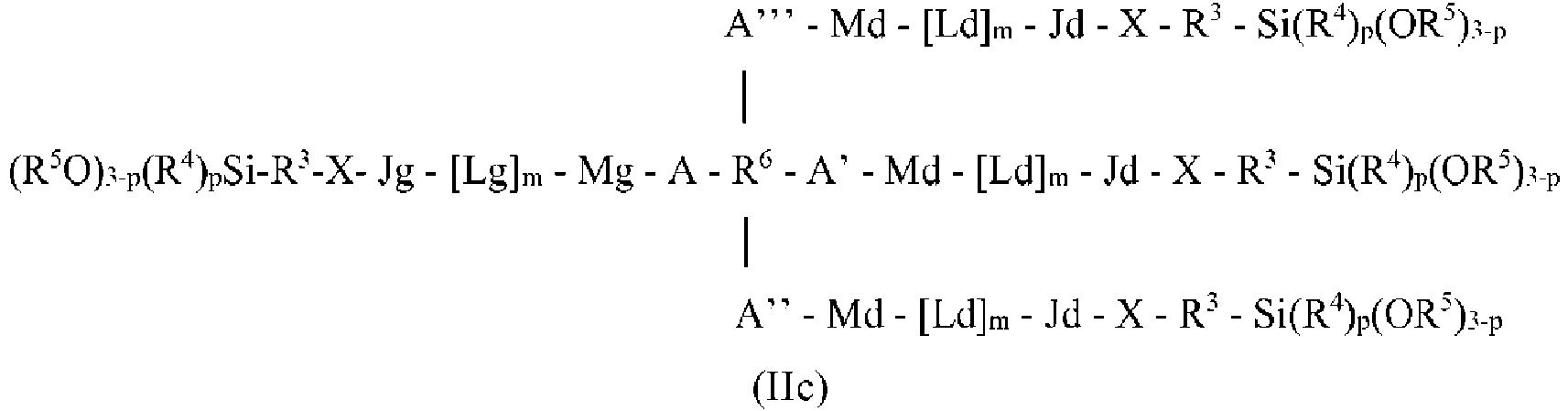 Jg für eine Gruppe des Typs:
 Lg für eine Gruppe des Typs:
 Mg für eine Gruppe des Typs: steht,
 Jd für eine Gruppe des Typs:
 Ld für eine Gruppe des Typs:
 Md für eine Gruppe des Typs:
 R1 für einen 5 bis 15 Kohlenstoffatome umfassenden zweiwertigen Kohlenwasserstoffrest steht, der aromatisch oder aliphatisch, unverzweigt, verzweigt oder cyclisch sein kann,R3 für einen 1 bis 6 Kohlenstoffatomen umfassenden unverzweigten oder verzweigten zweiwertigen Alkylenrest steht,R2 für einen zweiwertigen Kohlenwasserstoffrest steht, der gegebenenfalls ein oder mehrere Heteroatome umfasst, die bevorzugt ein Zahlenmittel der Molmasse von 100 g/mol bis 30.000 g/mol aufweisen,R4 und R5, die identisch oder verschieden sein können, jeweils für einen 1 bis 4 Kohlenstoffatome umfassenden unverzweigten oder verzweigten Alkylrest stehen, wobei sich gegebenenfalls zwei -OR5-Gruppen im gleichen Ring befinden können,X für einen zweiwertigen Rest steht, der aus -NH-, -NR7- oder -S- ausgewählt ist,R7 für einen unverzweigten, verzweigten oder cyclischen Alkylrest mit 1 bis 12 Kohlenstoffatomen oder einen Alkenylrest mit 2 bis 12 Kohlenstoffatomen oder einen Arylrest mit 6 bis 12 Kohlenstoffatomen steht,R6 für einen zweiwertigen, dreiwertigen oder vierwertigen Rest steht, der aus Polysiloxanresten und aus Kohlenwasserstoffresten ausgewählt ist, die gegebenenfalls eine oder mehrere Carbonyl- (C=O-) Funktionen und gegebenenfalls ein oder mehrere Heteroatome umfassen, wobei der Rest R6 bevorzugt ein Zahlenmittel der Molmasse von 100 g/mol bis 80.000 g/mol aufweist,A, A′, Aʺ und A‴ unabhängig voneinander für ein Sauerstoffatom, ein Schwefelatom, einen zweiwertigen - NH--Rest oder einen zweiwertigen -NR8--Rest stehen, wobei A, A′, Aʺ und A‴ in den Formeln (IIa), (IIb) oder (IIc) bevorzugt jeweils für ein Sauerstoffatom stehen,R8 für einen unverzweigten, verzweigten oder cyclischen Alkylrest steht, der 1 bis 18 Kohlenstoffatome, bevorzugt 1 bis 12 Kohlenstoffatome, noch mehr bevorzugt 1 bis 6 Kohlenstoffatome umfasst,n eine ganze Zahl größer als oder gleich 1 derart ist, dass das Polyurethan (A1) ein Zahlenmittel Mn(1) der Molmasse von 800 bis 100.000 Dalton aufweist,m eine ganze Zahl größer als oder gleich 1 derart ist, dass das Polyurethan (A2) ein Zahlenmittel Mn(2) der Molmasse derart aufweist, dass das Verhältnis Mn(2)/Mn(1) größer als oder gleich 2,0 ist, bevorzugt von 1600 bis 200.000 Dalton beträgt,p eine ganze Zahl gleich 0, 1 oder 2 ist.
 - Zusammensetzung von silylierten Polyurethanen nach Anspruch 8, wobei Mn(2) von 1600 bis 200.000 g/mol, bevorzugt von 3000 bis 160.000 g/mol, noch mehr bevorzugt von 5000 bis 100.000 g/mol, beträgt.
- Zusammensetzung von silylierten Polyurethanen nach Anspruch 8 oder 9, wobei das silylierte Polyurethan (A2) die Formel (IIb) oder (IIc) aufweist und das Verhältnis Mn(2)/Mn(1) größer als oder gleich 3 ist.
- Zusammensetzung von silylierten Polyurethanen nach einem der Ansprüche 8 bis 10, die eine Viskosität bei 23 °C von 20.000 bis 2.000.000 mPa.s aufweist, wobei die Viskosität mittels eines Brookfield-Viskosimeters RTV mit einer Drehzahl von 20 U./min und einer Nadel 7 gemessen wird.
- Zusammensetzung, die mindestens eine Zusammensetzung von silylierten Polyurethanen nach einem der Ansprüche 8 bis 11 und mindestens eine zusätzliche Komponente aufweist, die aus Katalysatoren, Füllstoffen, klebrigmachenden Harzen, Haftungsvermittlern, Weichmachern oder Verdünnungsmitteln, rheologischen Mitteln, Trocknungsmitteln, UV- und/oder Wärmestabilisatoren und Lösungsmitteln ausgewählt ist.
- Zusammensetzung nach Anspruch 12, die mindestens die Verbindung von silylierten Polyurethanen, mindestens ein klebrigmachendes Harz und mindestens einen Vernetzungskatalysator umfasst.
- Zusammensetzung nach Anspruch 13, die Folgendes umfasst:- 17 bis 85 Gew.-%, bevorzugt 27 bis 75 Gew.-%, noch mehr bevorzugt 37 bis 65 Gew.% einer Zusammensetzung von silylierten Polyurethanen wie denjenigen, die nach dem Verfahren hergestellt sind, das in einem der Ansprüche 1 bis 7 definiert ist, oder denjenigen, die in einem der Ansprüche 8 bis 11 definiert sind,- 12 Gew.-% bis 80 Gew.-%, bevorzugt 22 bis 70 Gew.-%, bevorzugt 32 bis 60 Gew.-% eines klebrigmachenden Harzes (klebrigmachende Harze) und- 0,01 bis 5 Gew.-% eines Vernetzungskatalysators (Vernetzungskatalysatoren),bezogen auf das Gesamtgewicht der Zusammensetzung.
- Selbstklebender Artikel, der eine Trägerschicht umfasst, die mit einer Schicht der Zusammensetzung gemäß der Definition in Anspruch 13 oder 14 beschichtet ist, wobei die Schicht durch Vernetzen der Zusammensetzung erhalten wird.
Applications Claiming Priority (2)
| Application Number | Priority Date | Filing Date | Title |
|---|---|---|---|
| FR1657643A FR3054837B1 (fr) | 2016-08-08 | 2016-08-08 | Procede de synthese de polyurethanes silyles et composition de polyurethanes silyles |
| PCT/FR2017/052162 WO2018029420A1 (fr) | 2016-08-08 | 2017-08-01 | Procede de synthese de polyurethanes silyles et composition de polyurethanes silyles |
Publications (2)
| Publication Number | Publication Date |
|---|---|
| EP3497144A1 EP3497144A1 (de) | 2019-06-19 |
| EP3497144B1 true EP3497144B1 (de) | 2022-10-26 |
Family
ID=57121386
Family Applications (1)
| Application Number | Title | Priority Date | Filing Date |
|---|---|---|---|
| EP17757807.7A Active EP3497144B1 (de) | 2016-08-08 | 2017-08-01 | Verfahren zur synthese von silylierten polyurethanen und silylierte polyurethanzusammensetzung |
Country Status (6)
| Country | Link |
|---|---|
| US (1) | US11780952B2 (de) |
| EP (1) | EP3497144B1 (de) |
| CN (1) | CN109843954B (de) |
| ES (1) | ES2935118T3 (de) |
| FR (1) | FR3054837B1 (de) |
| WO (1) | WO2018029420A1 (de) |
Families Citing this family (2)
| Publication number | Priority date | Publication date | Assignee | Title |
|---|---|---|---|---|
| MX2020004825A (es) * | 2017-11-07 | 2020-08-13 | Henkel IP & Holding GmbH | Polimeros de silano modificados y uso de los mismos en composiciones adhesivas. |
| FR3102481B1 (fr) * | 2019-10-24 | 2021-10-01 | Bostik Sa | Copolyurethane silyle ionique et composition de mastic le comprenant |
Family Cites Families (15)
| Publication number | Priority date | Publication date | Assignee | Title |
|---|---|---|---|---|
| US3627722A (en) * | 1970-05-28 | 1971-12-14 | Minnesota Mining & Mfg | Polyurethane sealant containing trialkyloxysilane end groups |
| US4147679A (en) * | 1976-06-02 | 1979-04-03 | Ppg Industries, Inc. | Water-reduced urethane coating compositions |
| US4567228A (en) * | 1984-05-21 | 1986-01-28 | Ppg Industries, Inc. | Aqueous dispersion, internally silylated and dispersed polyurethane resins, and surfaces containing same |
| US5539045A (en) * | 1995-10-27 | 1996-07-23 | Morton International, Inc. | Aliphatic silylated polyurethane mixtures having reduced viscosites |
| US6498210B1 (en) * | 2000-07-13 | 2002-12-24 | Adco Products, Inc. | Silylated polyurethanes for adhesives and sealants with improved mechanical properties |
| DE10103027A1 (de) | 2001-01-24 | 2002-07-25 | Bayer Ag | Zweikomponenten-Polyurethan-Bindemittel als Haftvermittler |
| US7700082B2 (en) | 2001-01-26 | 2010-04-20 | 3M Innovative Properties Company | Silylated polyurethane-urea compositions for use in cosmetic applications |
| EP1502927A1 (de) | 2003-07-31 | 2005-02-02 | Sika Technology AG | Isocyanatfreie Primerzusammensetzung für Glas und Glaskeramiken |
| US6989429B2 (en) * | 2003-10-02 | 2006-01-24 | Tremco Incorporated | Prepolymer compositions and sealants made therefrom |
| US7365145B2 (en) * | 2005-09-14 | 2008-04-29 | Momentive Performance Materials Inc. | Moisture curable silylated polymer containing free polyols for coating, adhesive and sealant application |
| JP4784715B2 (ja) * | 2009-12-10 | 2011-10-05 | Dic株式会社 | ウレタン樹脂組成物、コーティング剤及び接着剤、ならびにそれを用いて得られる硬化物及び硬化物の製造方法 |
| FR2981657B1 (fr) | 2011-10-21 | 2013-12-27 | Bostik Sa | Composition adhesive de polyurethanne pour la fabrication d'agglomeres |
| US9040622B2 (en) * | 2012-05-03 | 2015-05-26 | Ppg Industries Ohio, Inc. | Solvent-based primer solution based on silylated polyurethane (SPUR) chemistry for polycarbonate substrates |
| WO2014037265A1 (de) | 2012-09-04 | 2014-03-13 | Bayer Materialscience Ag | Silanfunktionelle bindemittel mit thiourethanstruktur |
| FR3015984B1 (fr) * | 2013-12-30 | 2016-02-05 | Bostik Sa | Article auto-adhesif supporte sur mousse |
-
2016
- 2016-08-08 FR FR1657643A patent/FR3054837B1/fr not_active Expired - Fee Related
-
2017
- 2017-08-01 ES ES17757807T patent/ES2935118T3/es active Active
- 2017-08-01 CN CN201780062187.XA patent/CN109843954B/zh active Active
- 2017-08-01 EP EP17757807.7A patent/EP3497144B1/de active Active
- 2017-08-01 US US16/323,612 patent/US11780952B2/en active Active
- 2017-08-01 WO PCT/FR2017/052162 patent/WO2018029420A1/fr not_active Ceased
Also Published As
| Publication number | Publication date |
|---|---|
| ES2935118T3 (es) | 2023-03-01 |
| US11780952B2 (en) | 2023-10-10 |
| FR3054837B1 (fr) | 2020-06-19 |
| CN109843954B (zh) | 2022-08-12 |
| WO2018029420A1 (fr) | 2018-02-15 |
| US20190169352A1 (en) | 2019-06-06 |
| FR3054837A1 (fr) | 2018-02-09 |
| EP3497144A1 (de) | 2019-06-19 |
| CN109843954A (zh) | 2019-06-04 |
Similar Documents
| Publication | Publication Date | Title |
|---|---|---|
| EP2235133B1 (de) | Druckempfindliche klebstoffe, die über eine temperaturbeständige klebekraft verfügen | |
| EP2468783B1 (de) | Polyurethan mit Polyether- und Polyesterblocks, und Alkoxysilan-Endgruppe | |
| JP6106860B2 (ja) | 熱硬化性接着剤組成物 | |
| EP3898748B1 (de) | Neuartige hitzehärtbaren zusammensetzungen und haftklebartikel davon | |
| EP2886571B1 (de) | Feuchtigkeits- und wärmehärtende Klebezusammensetzung auf Polyurethanbasis, die einen geringen Gehalt an monomeren Isocyanaten aufweist | |
| EP3532108B1 (de) | Selbstklebende zusammensetzung zum verbinden von substraten mit geringer oberflächenenergie | |
| EP3532109B1 (de) | Selbstklebende zusammensetzung zur zusammenfügung von substraten mit niedriger oberflächenenergie | |
| EP3497144B1 (de) | Verfahren zur synthese von silylierten polyurethanen und silylierte polyurethanzusammensetzung | |
| WO2019115952A1 (fr) | Composition adhesive multicomposante et ses utilisations | |
| FR3039154B1 (fr) | Poly(uree-urethane) a blocs polyurethane-polyether et polyurethane-polyester et groupe terminal alkoxysilane | |
| FR3130822A1 (fr) | Composition adhesive reticulable par chauffage formant un joint adhesif stable en temperature | |
| EP3658604B1 (de) | Wärmevernetzbare klebstoffzusammensetzung | |
| EP4367194B1 (de) | Neue vernetzbare zusammensetzung mit silylterminiertem polymer und zugehöriger selbstklebender artikel | |
| FR3102481A1 (fr) | Copolyurethane silyle ionique et composition de mastic le comprenant |
Legal Events
| Date | Code | Title | Description |
|---|---|---|---|
| STAA | Information on the status of an ep patent application or granted ep patent |
Free format text: STATUS: UNKNOWN |
|
| STAA | Information on the status of an ep patent application or granted ep patent |
Free format text: STATUS: THE INTERNATIONAL PUBLICATION HAS BEEN MADE |
|
| PUAI | Public reference made under article 153(3) epc to a published international application that has entered the european phase |
Free format text: ORIGINAL CODE: 0009012 |
|
| STAA | Information on the status of an ep patent application or granted ep patent |
Free format text: STATUS: REQUEST FOR EXAMINATION WAS MADE |
|
| 17P | Request for examination filed |
Effective date: 20190121 |
|
| AK | Designated contracting states |
Kind code of ref document: A1 Designated state(s): AL AT BE BG CH CY CZ DE DK EE ES FI FR GB GR HR HU IE IS IT LI LT LU LV MC MK MT NL NO PL PT RO RS SE SI SK SM TR |
|
| AX | Request for extension of the european patent |
Extension state: BA ME |
|
| DAV | Request for validation of the european patent (deleted) | ||
| DAX | Request for extension of the european patent (deleted) | ||
| GRAP | Despatch of communication of intention to grant a patent |
Free format text: ORIGINAL CODE: EPIDOSNIGR1 |
|
| STAA | Information on the status of an ep patent application or granted ep patent |
Free format text: STATUS: GRANT OF PATENT IS INTENDED |
|
| GRAS | Grant fee paid |
Free format text: ORIGINAL CODE: EPIDOSNIGR3 |
|
| GRAA | (expected) grant |
Free format text: ORIGINAL CODE: 0009210 |
|
| STAA | Information on the status of an ep patent application or granted ep patent |
Free format text: STATUS: THE PATENT HAS BEEN GRANTED |
|
| INTG | Intention to grant announced |
Effective date: 20220829 |
|
| AK | Designated contracting states |
Kind code of ref document: B1 Designated state(s): AL AT BE BG CH CY CZ DE DK EE ES FI FR GB GR HR HU IE IS IT LI LT LU LV MC MK MT NL NO PL PT RO RS SE SI SK SM TR |
|
| RAP3 | Party data changed (applicant data changed or rights of an application transferred) |
Owner name: BOSTIK SA |
|
| REG | Reference to a national code |
Ref country code: GB Ref legal event code: FG4D Free format text: NOT ENGLISH |
|
| REG | Reference to a national code |
Ref country code: CH Ref legal event code: EP |
|
| REG | Reference to a national code |
Ref country code: DE Ref legal event code: R096 Ref document number: 602017063030 Country of ref document: DE |
|
| REG | Reference to a national code |
Ref country code: AT Ref legal event code: REF Ref document number: 1527002 Country of ref document: AT Kind code of ref document: T Effective date: 20221115 |
|
| REG | Reference to a national code |
Ref country code: IE Ref legal event code: FG4D Free format text: LANGUAGE OF EP DOCUMENT: FRENCH |
|
| REG | Reference to a national code |
Ref country code: NL Ref legal event code: FP |
|
| REG | Reference to a national code |
Ref country code: LT Ref legal event code: MG9D |
|
| REG | Reference to a national code |
Ref country code: ES Ref legal event code: FG2A Ref document number: 2935118 Country of ref document: ES Kind code of ref document: T3 Effective date: 20230301 |
|
| REG | Reference to a national code |
Ref country code: AT Ref legal event code: MK05 Ref document number: 1527002 Country of ref document: AT Kind code of ref document: T Effective date: 20221026 |
|
| PG25 | Lapsed in a contracting state [announced via postgrant information from national office to epo] |
Ref country code: SE Free format text: LAPSE BECAUSE OF FAILURE TO SUBMIT A TRANSLATION OF THE DESCRIPTION OR TO PAY THE FEE WITHIN THE PRESCRIBED TIME-LIMIT Effective date: 20221026 Ref country code: PT Free format text: LAPSE BECAUSE OF FAILURE TO SUBMIT A TRANSLATION OF THE DESCRIPTION OR TO PAY THE FEE WITHIN THE PRESCRIBED TIME-LIMIT Effective date: 20230227 Ref country code: NO Free format text: LAPSE BECAUSE OF FAILURE TO SUBMIT A TRANSLATION OF THE DESCRIPTION OR TO PAY THE FEE WITHIN THE PRESCRIBED TIME-LIMIT Effective date: 20230126 Ref country code: LT Free format text: LAPSE BECAUSE OF FAILURE TO SUBMIT A TRANSLATION OF THE DESCRIPTION OR TO PAY THE FEE WITHIN THE PRESCRIBED TIME-LIMIT Effective date: 20221026 Ref country code: FI Free format text: LAPSE BECAUSE OF FAILURE TO SUBMIT A TRANSLATION OF THE DESCRIPTION OR TO PAY THE FEE WITHIN THE PRESCRIBED TIME-LIMIT Effective date: 20221026 Ref country code: AT Free format text: LAPSE BECAUSE OF FAILURE TO SUBMIT A TRANSLATION OF THE DESCRIPTION OR TO PAY THE FEE WITHIN THE PRESCRIBED TIME-LIMIT Effective date: 20221026 |
|
| PG25 | Lapsed in a contracting state [announced via postgrant information from national office to epo] |
Ref country code: RS Free format text: LAPSE BECAUSE OF FAILURE TO SUBMIT A TRANSLATION OF THE DESCRIPTION OR TO PAY THE FEE WITHIN THE PRESCRIBED TIME-LIMIT Effective date: 20221026 Ref country code: PL Free format text: LAPSE BECAUSE OF FAILURE TO SUBMIT A TRANSLATION OF THE DESCRIPTION OR TO PAY THE FEE WITHIN THE PRESCRIBED TIME-LIMIT Effective date: 20221026 Ref country code: LV Free format text: LAPSE BECAUSE OF FAILURE TO SUBMIT A TRANSLATION OF THE DESCRIPTION OR TO PAY THE FEE WITHIN THE PRESCRIBED TIME-LIMIT Effective date: 20221026 Ref country code: IS Free format text: LAPSE BECAUSE OF FAILURE TO SUBMIT A TRANSLATION OF THE DESCRIPTION OR TO PAY THE FEE WITHIN THE PRESCRIBED TIME-LIMIT Effective date: 20230226 Ref country code: HR Free format text: LAPSE BECAUSE OF FAILURE TO SUBMIT A TRANSLATION OF THE DESCRIPTION OR TO PAY THE FEE WITHIN THE PRESCRIBED TIME-LIMIT Effective date: 20221026 Ref country code: GR Free format text: LAPSE BECAUSE OF FAILURE TO SUBMIT A TRANSLATION OF THE DESCRIPTION OR TO PAY THE FEE WITHIN THE PRESCRIBED TIME-LIMIT Effective date: 20230127 |
|
| P01 | Opt-out of the competence of the unified patent court (upc) registered |
Effective date: 20230526 |
|
| REG | Reference to a national code |
Ref country code: DE Ref legal event code: R097 Ref document number: 602017063030 Country of ref document: DE |
|
| PG25 | Lapsed in a contracting state [announced via postgrant information from national office to epo] |
Ref country code: SM Free format text: LAPSE BECAUSE OF FAILURE TO SUBMIT A TRANSLATION OF THE DESCRIPTION OR TO PAY THE FEE WITHIN THE PRESCRIBED TIME-LIMIT Effective date: 20221026 Ref country code: RO Free format text: LAPSE BECAUSE OF FAILURE TO SUBMIT A TRANSLATION OF THE DESCRIPTION OR TO PAY THE FEE WITHIN THE PRESCRIBED TIME-LIMIT Effective date: 20221026 Ref country code: EE Free format text: LAPSE BECAUSE OF FAILURE TO SUBMIT A TRANSLATION OF THE DESCRIPTION OR TO PAY THE FEE WITHIN THE PRESCRIBED TIME-LIMIT Effective date: 20221026 Ref country code: DK Free format text: LAPSE BECAUSE OF FAILURE TO SUBMIT A TRANSLATION OF THE DESCRIPTION OR TO PAY THE FEE WITHIN THE PRESCRIBED TIME-LIMIT Effective date: 20221026 Ref country code: CZ Free format text: LAPSE BECAUSE OF FAILURE TO SUBMIT A TRANSLATION OF THE DESCRIPTION OR TO PAY THE FEE WITHIN THE PRESCRIBED TIME-LIMIT Effective date: 20221026 |
|
| PG25 | Lapsed in a contracting state [announced via postgrant information from national office to epo] |
Ref country code: SK Free format text: LAPSE BECAUSE OF FAILURE TO SUBMIT A TRANSLATION OF THE DESCRIPTION OR TO PAY THE FEE WITHIN THE PRESCRIBED TIME-LIMIT Effective date: 20221026 Ref country code: AL Free format text: LAPSE BECAUSE OF FAILURE TO SUBMIT A TRANSLATION OF THE DESCRIPTION OR TO PAY THE FEE WITHIN THE PRESCRIBED TIME-LIMIT Effective date: 20221026 |
|
| PLBE | No opposition filed within time limit |
Free format text: ORIGINAL CODE: 0009261 |
|
| STAA | Information on the status of an ep patent application or granted ep patent |
Free format text: STATUS: NO OPPOSITION FILED WITHIN TIME LIMIT |
|
| 26N | No opposition filed |
Effective date: 20230727 |
|
| PG25 | Lapsed in a contracting state [announced via postgrant information from national office to epo] |
Ref country code: SI Free format text: LAPSE BECAUSE OF FAILURE TO SUBMIT A TRANSLATION OF THE DESCRIPTION OR TO PAY THE FEE WITHIN THE PRESCRIBED TIME-LIMIT Effective date: 20221026 |
|
| PG25 | Lapsed in a contracting state [announced via postgrant information from national office to epo] |
Ref country code: MC Free format text: LAPSE BECAUSE OF FAILURE TO SUBMIT A TRANSLATION OF THE DESCRIPTION OR TO PAY THE FEE WITHIN THE PRESCRIBED TIME-LIMIT Effective date: 20221026 |
|
| REG | Reference to a national code |
Ref country code: CH Ref legal event code: PL |
|
| PG25 | Lapsed in a contracting state [announced via postgrant information from national office to epo] |
Ref country code: MC Free format text: LAPSE BECAUSE OF FAILURE TO SUBMIT A TRANSLATION OF THE DESCRIPTION OR TO PAY THE FEE WITHIN THE PRESCRIBED TIME-LIMIT Effective date: 20221026 |
|
| PG25 | Lapsed in a contracting state [announced via postgrant information from national office to epo] |
Ref country code: LU Free format text: LAPSE BECAUSE OF NON-PAYMENT OF DUE FEES Effective date: 20230801 |
|
| PG25 | Lapsed in a contracting state [announced via postgrant information from national office to epo] |
Ref country code: LU Free format text: LAPSE BECAUSE OF NON-PAYMENT OF DUE FEES Effective date: 20230801 Ref country code: CH Free format text: LAPSE BECAUSE OF NON-PAYMENT OF DUE FEES Effective date: 20230831 |
|
| REG | Reference to a national code |
Ref country code: IE Ref legal event code: MM4A |
|
| PG25 | Lapsed in a contracting state [announced via postgrant information from national office to epo] |
Ref country code: IE Free format text: LAPSE BECAUSE OF NON-PAYMENT OF DUE FEES Effective date: 20230801 |
|
| PG25 | Lapsed in a contracting state [announced via postgrant information from national office to epo] |
Ref country code: IE Free format text: LAPSE BECAUSE OF NON-PAYMENT OF DUE FEES Effective date: 20230801 |
|
| PG25 | Lapsed in a contracting state [announced via postgrant information from national office to epo] |
Ref country code: BG Free format text: LAPSE BECAUSE OF FAILURE TO SUBMIT A TRANSLATION OF THE DESCRIPTION OR TO PAY THE FEE WITHIN THE PRESCRIBED TIME-LIMIT Effective date: 20221026 |
|
| PG25 | Lapsed in a contracting state [announced via postgrant information from national office to epo] |
Ref country code: BG Free format text: LAPSE BECAUSE OF FAILURE TO SUBMIT A TRANSLATION OF THE DESCRIPTION OR TO PAY THE FEE WITHIN THE PRESCRIBED TIME-LIMIT Effective date: 20221026 |
|
| REG | Reference to a national code |
Ref country code: DE Ref legal event code: R081 Ref document number: 602017063030 Country of ref document: DE Owner name: BOSTIK SA, FR Free format text: FORMER OWNER: BOSTIK SA, COLOMBES, FR |
|
| PG25 | Lapsed in a contracting state [announced via postgrant information from national office to epo] |
Ref country code: CY Free format text: LAPSE BECAUSE OF FAILURE TO SUBMIT A TRANSLATION OF THE DESCRIPTION OR TO PAY THE FEE WITHIN THE PRESCRIBED TIME-LIMIT; INVALID AB INITIO Effective date: 20170801 |
|
| PG25 | Lapsed in a contracting state [announced via postgrant information from national office to epo] |
Ref country code: HU Free format text: LAPSE BECAUSE OF FAILURE TO SUBMIT A TRANSLATION OF THE DESCRIPTION OR TO PAY THE FEE WITHIN THE PRESCRIBED TIME-LIMIT; INVALID AB INITIO Effective date: 20170801 |
|
| PGFP | Annual fee paid to national office [announced via postgrant information from national office to epo] |
Ref country code: NL Payment date: 20250704 Year of fee payment: 9 |
|
| REG | Reference to a national code |
Ref country code: BE Ref legal event code: PD Owner name: BOSTIK SA; FR Free format text: DETAILS ASSIGNMENT: CHANGE OF OWNER(S), OTHER; FORMER OWNER NAME: BOSTIK SA Effective date: 20250626 |
|
| PGFP | Annual fee paid to national office [announced via postgrant information from national office to epo] |
Ref country code: ES Payment date: 20250905 Year of fee payment: 9 |
|
| PGFP | Annual fee paid to national office [announced via postgrant information from national office to epo] |
Ref country code: DE Payment date: 20250702 Year of fee payment: 9 |
|
| PGFP | Annual fee paid to national office [announced via postgrant information from national office to epo] |
Ref country code: IT Payment date: 20250722 Year of fee payment: 9 |
|
| PGFP | Annual fee paid to national office [announced via postgrant information from national office to epo] |
Ref country code: BE Payment date: 20250703 Year of fee payment: 9 Ref country code: GB Payment date: 20250703 Year of fee payment: 9 |
|
| PGFP | Annual fee paid to national office [announced via postgrant information from national office to epo] |
Ref country code: FR Payment date: 20250703 Year of fee payment: 9 |
|
| PG25 | Lapsed in a contracting state [announced via postgrant information from national office to epo] |
Ref country code: TR Free format text: LAPSE BECAUSE OF FAILURE TO SUBMIT A TRANSLATION OF THE DESCRIPTION OR TO PAY THE FEE WITHIN THE PRESCRIBED TIME-LIMIT Effective date: 20221026 |