EP3499768A1 - Procédé, dispositif et noeud de traitement de données - Google Patents
Procédé, dispositif et noeud de traitement de données Download PDFInfo
- Publication number
- EP3499768A1 EP3499768A1 EP17838752.8A EP17838752A EP3499768A1 EP 3499768 A1 EP3499768 A1 EP 3499768A1 EP 17838752 A EP17838752 A EP 17838752A EP 3499768 A1 EP3499768 A1 EP 3499768A1
- Authority
- EP
- European Patent Office
- Prior art keywords
- data
- erasure
- resource
- node
- resources
- Prior art date
- Legal status (The legal status is an assumption and is not a legal conclusion. Google has not performed a legal analysis and makes no representation as to the accuracy of the status listed.)
- Withdrawn
Links
Images




Classifications
-
- H—ELECTRICITY
- H04—ELECTRIC COMMUNICATION TECHNIQUE
- H04L—TRANSMISSION OF DIGITAL INFORMATION, e.g. TELEGRAPHIC COMMUNICATION
- H04L1/00—Arrangements for detecting or preventing errors in the information received
- H04L1/12—Arrangements for detecting or preventing errors in the information received by using return channel
- H04L1/16—Arrangements for detecting or preventing errors in the information received by using return channel in which the return channel carries supervisory signals, e.g. repetition request signals
- H04L1/1607—Details of the supervisory signal
-
- H—ELECTRICITY
- H04—ELECTRIC COMMUNICATION TECHNIQUE
- H04L—TRANSMISSION OF DIGITAL INFORMATION, e.g. TELEGRAPHIC COMMUNICATION
- H04L1/00—Arrangements for detecting or preventing errors in the information received
- H04L1/20—Arrangements for detecting or preventing errors in the information received using signal quality detector
- H04L1/201—Frame classification, e.g. bad, good or erased
-
- H—ELECTRICITY
- H04—ELECTRIC COMMUNICATION TECHNIQUE
- H04B—TRANSMISSION
- H04B17/00—Monitoring; Testing
- H04B17/30—Monitoring; Testing of propagation channels
- H04B17/309—Measuring or estimating channel quality parameters
- H04B17/336—Signal-to-interference ratio [SIR] or carrier-to-interference ratio [CIR]
-
- H—ELECTRICITY
- H04—ELECTRIC COMMUNICATION TECHNIQUE
- H04L—TRANSMISSION OF DIGITAL INFORMATION, e.g. TELEGRAPHIC COMMUNICATION
- H04L1/00—Arrangements for detecting or preventing errors in the information received
- H04L1/12—Arrangements for detecting or preventing errors in the information received by using return channel
- H04L1/16—Arrangements for detecting or preventing errors in the information received by using return channel in which the return channel carries supervisory signals, e.g. repetition request signals
- H04L1/18—Automatic repetition systems, e.g. Van Duuren systems
- H04L1/1812—Hybrid protocols; Hybrid automatic repeat request [HARQ]
- H04L1/1819—Hybrid protocols; Hybrid automatic repeat request [HARQ] with retransmission of additional or different redundancy
-
- H—ELECTRICITY
- H04—ELECTRIC COMMUNICATION TECHNIQUE
- H04L—TRANSMISSION OF DIGITAL INFORMATION, e.g. TELEGRAPHIC COMMUNICATION
- H04L1/00—Arrangements for detecting or preventing errors in the information received
- H04L1/12—Arrangements for detecting or preventing errors in the information received by using return channel
- H04L1/16—Arrangements for detecting or preventing errors in the information received by using return channel in which the return channel carries supervisory signals, e.g. repetition request signals
- H04L1/18—Automatic repetition systems, e.g. Van Duuren systems
- H04L1/1829—Arrangements specially adapted for the receiver end
- H04L1/1835—Buffer management
- H04L1/1845—Combining techniques, e.g. code combining
Definitions
- the present disclosure relates to the field of communications and, in particular, to a data processing method, device and node.
- FEC forward-error-control
- ARQ auto-repeat-request
- the FEC uses an error correction code, which cannot guarantee that a transport block can always be decoded correctly, so it is difficult to obtain high system reliability.
- the ARQ uses a code with strong error detection capability. When a receiving end detects a data error, the receiving end notifies a sending end of the data error via feedback signaling, and the sending end resends the transport block until the transport block is correctly received.
- the ARQ provides high system reliability at the expense of certain transmission delay, signaling overhead, and error detection redundancy.
- a combination of the FEC and the ARQ technologies is a Hybrid-ARQ (HARQ) technology.
- HARQ Hybrid-ARQ
- the HARQ technology is adopted in the long term evolution (LTE) system.
- the receiving end first performs decoding on the error correction code of the transport block, and detects the decoding result. If the detection result is correct, the acknowledgement (ACK) message is fed back; otherwise, the negative acknowledgement (NACK) message is fed back.
- ACK acknowledgement
- NACK negative acknowledgement
- the sending side receives the NACK information
- the corresponding transport block data is retransmitted until the transport block is correctly received; and when the sending side receives the ACK information, the transmission of the transport block ends.
- eMBB enhanced mobile broadband
- a transport block may include many smaller code blocks.
- Long transport blocks are to be transmitted on larger time and frequency resources. Due to small-scale fading of the channel or other burst interference, different code blocks of a certain transport block or data on different time-frequency resources will experience quite different channel conditions. When the channel conditions are very poor, the corresponding data has little effect on decoding, or is even erased, which increases the possibility of decoding errors.
- the existing HARQ technology when a decoding error occurs, the entire transport block will be retransmitted, which will bring a great waste of resources in the eMBB scenario, and also increase the decoding complexity and the transmission delay.
- Embodiments of the present disclosure provide a data processing method, device, and node, to at least solve the problem, in the related art, that when a decoding error occurs in a transport block, the entire transport block is retransmitted, which causes a waste of radio resources, and increases decoding complexity as well as transmission delay.
- An embodiment of the present disclosure provides a data processing method.
- the method includes: determining, by a second node, that first data sent from a first node emerges data erasure; sending, by the second node, feedback information to the first node, where the feedback information includes one of: an erasure rate, and the erasure rate and an erasure position, the erasure rate is a proportion of resources that emerge data erasure in resources corresponding to the first data, and the erasure position is a position of the resources that emerge data erasure in the resources corresponding to the first data; receiving, by the second node, second data determined according to the feedback information by the first node; and performing, by the second node, decoding according to the first data and the second data.
- the second node determines that the first data sent from the first node emerges the data erasure when at least one of following is checked by the second: an equivalent received signal to interference plus noise ratio (SINR) of a signal on the resources corresponding to the first data being less than a first predetermined threshold T1; a sum of interference and noise power on the resources corresponding to the first data being greater than a second predetermined threshold T2; and a signal power on the resources corresponding to the first data being lower than a third predetermined threshold T3.
- SINR equivalent received signal to interference plus noise ratio
- the resources corresponding to the first data and resources corresponding to the second data include one of: a time-frequency domain resource, a transport layer, an antenna port, and a carrier, where the time-frequency domain resource is defined by a time-domain resource having a length of N1 and a frequency-domain resource having a length of N2, and N1 and N2 are positive integers.
- a length of the time-domain resources includes: a length of one of an orthogonal frequency division multiplexing (OFDM) symbol, a time slot, a sub frame and a radio frame occupied in time-domain; and the length of the frequency-domain resources includes a length of one of a subcarrier, a resource block (RB) and a subband occupied in the frequency-domain resource.
- OFDM orthogonal frequency division multiplexing
- the time-frequency domain resource includes one of: a resource unit (RU), a resource block (RB), and a subband.
- RU resource unit
- RB resource block
- subband subband
- the resources corresponding to the first data are divided into Mj mutually exclusive resource index sets according to the jth resource granularity, one of the Mj mutually exclusive resource index sets is an erasure position, Mj erasure positions form an erasure position set j, j is a positive integer and j ⁇ J, J is the number of erasure position sets corresponding to preset J types of resource granularity, and J is a positive integer.
- the resource indices are continuous.
- the second data is one of N redundancy versions of data, where the redundancy versions are determined according to one of: a preset erasure rate, and a combination of the preset erasure rate and a preset erasure position, and N is a positive integer.
- the method includes: receiving, by a first node, feedback information sent from a second node, where the feedback information includes one of: an erasure rate, and the erasure rate and an erasure position, the erasure rate is a proportion of resources that emerge data erasure in resources corresponding to first data, and the erasure position is a position of the resources that emerge data erasure in the resources corresponding to the first data; and determining, by the first node, second data according to the feedback information, and sending the second data to the second node, where the second data is configured for performing decoding together with the first data sent from the first node.
- the resources corresponding to the first data and resources corresponding to the second data include one of: a time-frequency domain resource, a transport layer, an antenna port, and a carrier, where the time-frequency domain resource is defined by time-domain resources h, and N1 and N2 are positive integers.
- a length of the time-domain resources includes: a length of one of an orthogonal frequency division multiplexing (OFDM) symbol, a time slot, a sub frame and a radio frame occupied in the time-domain resource; and the length of frequency-domain resources includes a length of one of a subcarrier, a resource block (RB), and a subband occupied in the frequency-domain resource.
- OFDM orthogonal frequency division multiplexing
- the time-frequency domain resource includes one of: a resource unit (RU), a resource block (RB), and a subband.
- RU resource unit
- RB resource block
- subband subband
- the resources corresponding to the first data are divided into Mj mutually exclusive resource index sets according to the jth resource granularity, one of the Mj mutually exclusive resource index sets is an erasure position, Mj erasure positions form an erasure position set j, j is a positive integer and j ⁇ J, J is the number of erasure position sets corresponding to preset J types of resource granularity, and J is a positive integer.
- the resource indices are continuous.
- the second data is one of N redundancy versions of data, where the redundancy versions are determined according to one of: a preset erasure rate, and a combination of the preset erasure rate and a preset erasure position, and N is a positive integer.
- the device includes: a first determining module, which is configured to determine that first data sent from a first node emerges data erasure; a feedback module, which is configured to send feedback information to the first node, where the feedback information includes one of: an erasure rate, and the erasure rate and an erasure position, the erasure rate is a proportion of resources that emerge data erasure in resources corresponding to the first data, and the erasure position is a position of the resources that emerge data erasure in the resources corresponding to the first data; a first receiving module, which is configured to receive second data determined according to the feedback information by the first node; and a decoding module, which is configured to perform decoding according to the first data and the second data.
- a first determining module which is configured to determine that first data sent from a first node emerges data erasure
- a feedback module which is configured to send feedback information to the first node, where the feedback information includes one of: an erasure rate, and the erasure rate and an era
- the first determining module includes: a first determining unit, which is configured to determine that the resources corresponding to the first data sent from the first node emerge the data erasure in a case where an equivalent received signal to interference plus noise ratio (SINR) of a signal on the resources corresponding to the first data is checked to be less than a first predetermined threshold T1; a second determining unit, which is configured to determine that the resources corresponding to the first data sent from the first node emerge the data erasure in a case where a sum of interference and noise power on the resources corresponding to the first data is checked to be greater than a second predetermined threshold T2; and a third determining unit, which is configured to determine that the resources corresponding to the first data sent from the first node emerge the data erasure in a case where a signal power on the resources corresponding to the first data is checked to be lower than a third predetermined threshold T3.
- T1, T2, and T3 are real numbers.
- the resources corresponding to the first data and resources corresponding to the second data include one of: a time-frequency domain resource, a transport layer, an antenna port, and a carrier, where the time-frequency domain resource is defined by a time-domain resource having a length of N1 and a frequency-domain resource having a length of N2, and N1 and N2 are positive integers.
- a length of the time-domain resources includes: a length of one of an orthogonal frequency division multiplexing (OFDM) symbol, a time slot, a sub frame and a radio frame occupied in the time-domain resource; and the length of the frequency-domain resources includes a length of one of a subcarrier, a resource block (RB) and a subband occupied in the frequency-domain resource.
- OFDM orthogonal frequency division multiplexing
- the time-frequency domain resource includes one of: a resource unit (RU), a resource block (RB), and a subband.
- RU resource unit
- RB resource block
- subband subband
- the resources corresponding to the first data are divided into Mj mutually exclusive resource index sets according to the jth resource granularity, one of the Mj mutually exclusive resource index sets is an erasure position, Mj erasure positions form an erasure position set j, j is a positive integer and j ⁇ J, J is the number of erasure position sets corresponding to preset J types of resource granularity, and J is a positive integer.
- the resource indices are continuous.
- the second data is one of N redundancy versions of data, where the redundancy versions are determined according to one of: a preset erasure rate, and a combination of the preset erasure rate and a preset erasure position, and N is a positive integer.
- Another embodiment of the present disclosure provides a node, including the device of any one of the embodiments described above.
- the second receiving module is configured to receive feedback information sent from a second node.
- the feedback information includes one of: an erasure rate, and the erasure rate and an erasure position.
- the erasure rate is a proportion of resources that emerge data erasure in resources corresponding to first data
- the erasure position is a position of the resources that emerge data erasure in the resources corresponding to the first data.
- the second determining module is configured to determine second data according to the feedback information, and send the second data to the second node, where the second data is used for performing decoding together with the first data sent from the first node.
- the resources corresponding to the first data and resources corresponding to the second data include one of: a time-frequency domain resource, a transport layer, an antenna port, and a carrier, where the time-frequency domain resource is defined by a time-domain resource having a length of N1 and a frequency-domain resource having a length of N2, and N1 and N2 are positive integers.
- the lengths of time-domain resources include time-domain lengths occupied by one of time-domain resources including: a length of the time-domain resources includes: a length of one of an orthogonal frequency division multiplexing (OFDM) symbol, a time slot, a subframe and a radio frame occupied in the time-domain resource; and the length of frequency-domain resources includes a length of one of a subcarrier, a resource block (RB), and a subband occupied in the frequency-domain resource.
- OFDM orthogonal frequency division multiplexing
- the time-frequency domain resource includes one of: a resource unit (RU), a resource block (RB), and a subband.
- RU resource unit
- RB resource block
- subband subband
- the resources corresponding to the first data are divided into Mj mutually exclusive resource index sets according to the jth resource granularity, one of the Mj mutually exclusive resource index sets is an erasure position, Mj erasure positions form an erasure position set j, j is a positive integer and j ⁇ J, J is the number of erasure position sets corresponding to preset J types of resource granularity, and J is a positive integer.
- the resource indices are continuous.
- the second data is one of N redundancy versions of data, where the redundancy versions are determined according to one of: a preset erasure rate, and a combination of the preset erasure rate and a preset erasure position, and N is a positive integer.
- Another embodiment of the present disclosure provides a node, including the device of any one of the embodiments described above.
- a second node determines that first data sent from a first node emerges data erasure; the second node sends feedback information to the first node, where the feedback information includes one of: an erasure rate, and the erasure rate and an erasure position, the erasure rate is a proportion of resources that emerge data erasure in resources corresponding to the first data, and the erasure position is a position of the resources that emerge data erasure in the resources corresponding to the first data; the second node receives second data determined according to the feedback information by the first node; and the second node performs decoding according to the first data and the second data.
- the storage medium is further configured to store program codes for performing the steps described below.
- the second node determines that the first data sent from the first node emerges the data erasure when at least one of following is checked by the second node: an equivalent received signal to interference plus noise ratio (SINR) of a signal on the resources corresponding to the first data being less than a first predetermined threshold T1; a sum of interference and noise power on the resources corresponding to the first data being greater than a second predetermined threshold T2; and a signal power on the resources corresponding to the first data being lower than a third predetermined threshold T3.
- T1, T2, and T3 are real numbers.
- the storage medium is further configured to store program codes for performing the steps described below.
- the resources corresponding to the first data and resources corresponding to the second data include one of: a time-frequency domain resource, a transport layer, an antenna port, and a carrier, where the time-frequency domain resource is defined by a time-domain resource having a length of N1 and a frequency-domain resource having a length of N2, and N1 and N2 are positive integers.
- a length of the time-domain resources includes: a length of one of an orthogonal frequency division multiplexing (OFDM) symbol, a time slot, a sub frame and a radio frame occupied in the time-domain resource; and the length of frequency-domain resources includes a length of one of a subcarrier, a resource block (RB), and a subband occupied in the frequency-domain resource.
- OFDM orthogonal frequency division multiplexing
- the storage medium is further configured to store program codes for performing the steps described below.
- the time-frequency domain resource includes one of: a resource unit (RU), a resource block (RB), and a subband.
- the storage medium is further configured to store program codes for performing the steps described below.
- the resources corresponding to the first data are divided into Mj mutually exclusive resource index sets according to the jth resource granularity, one of the Mj mutually exclusive resource index sets is an erasure position, Mj erasure positions form an erasure position set j, j is a positive integer and j ⁇ J, J is the number of erasure position sets corresponding to preset J types of resource granularity, and J is a positive integer.
- the storage medium is further configured to store program codes for performing the steps described below.
- the number of resource indices in the erasure position is greater than 1, the resource indices are continuous.
- the storage medium is further configured to store program codes for performing the steps described below.
- the second data is one of N redundancy versions of data, where the redundancy versions are determined according to one of: a preset erasure rate, and a combination of the preset erasure rate and a preset erasure position, and N is a positive integer.
- Another embodiment of the present disclosure further provides a storage medium.
- the storage medium is configured to store program codes for performing the steps described below.
- a first node receives feedback information sent from a second node, where the feedback information includes one of: an erasure rate, and the erasure rate and an erasure position, the erasure rate is a proportion of resources that emerge data erasure in resources corresponding to first data, and the erasure position is a position of the resources that emerge data erasure in the resources corresponding to the first data; and the first node determines second data according to the feedback information, and sends the second data to the second node, where the second data is used for performing decoding together with the first data sent from the first node.
- the storage medium is further configured to store program codes for performing the steps described below.
- the resources corresponding to the first data and resources corresponding to the second data include one of: a time-frequency domain resource, a transport layer, an antenna port, and a carrier, where the time-frequency domain resource is defined by a time-domain resource having a length of N1 and a frequency-domain resource having a length of N2, and N1 and N2 are positive integers.
- a length of the time-domain resources includes: a length of one of an orthogonal frequency division multiplexing (OFDM) symbol, a time slot, a sub frame and a radio frame occupied in the time-domain resource; and the length of frequency-domain resources includes a length of one of a subcarrier, a resource block (RB), and a subband occupied in the frequency-domain resource.
- OFDM orthogonal frequency division multiplexing
- the storage medium is further configured to store program codes for performing the steps described below.
- the time-frequency domain resource includes one of: a resource unit (RU), a resource block (RB), and a subband.
- the storage medium is further configured to store program codes for performing the steps described below.
- the resources corresponding to the first data are divided into Mj mutually exclusive resource index sets according to the jth resource granularity, one of the Mj mutually exclusive resource index sets is an erasure position, Mj erasure positions form an erasure position set j, j is a positive integer and j ⁇ J, J is the number of erasure position sets corresponding to preset J types of resource granularity, and J is a positive integer.
- the storage medium is further configured to store program codes for performing the steps described below.
- the resource indices are continuous.
- the storage medium is further configured to store program codes for performing the steps described below.
- the second data is one of N redundancy versions of data, where the redundancy versions are determined according to one of: a preset erasure rate, and a combination of the preset erasure rate and a preset erasure position, and N is a positive integer.
- a second node determines that first data sent from a first node emerges data erasure.
- the second node sends feedback information to the first node.
- the feedback information includes one of: an erasure rate, and the erasure rate and an erasure position.
- the erasure rate is a proportion of resources that emerge data erasure in the first data
- the erasure position is a position of the resources that emerge data erasure in the first data.
- the second node receives second data determined according to the feedback information by the first node, and the second data includes the resources that emerge the data erasure in the first data.
- the second node performs decoding according to the first data and the second data.
- FIG. 1 is a structural block diagram of hardware of a terminal executing a decoding processing method according to the embodiment of the present disclosure.
- a terminal 10 may include one or more (merely one is shown in FIG. 1 ) processors 102 (the processor 102 may include, but is not limited to, a microprocessor such as a microcontroller unit (MCU) or a programmable logic device such as a field programmable gate array (FPGA)), a memory 104 configured to store data, and a transmission device 106 configured to implement a communication function.
- MCU microcontroller unit
- FPGA field programmable gate array
- the structure shown in FIG. 1 is merely illustrative and not intended to limit the structure of the electronic device described above.
- the terminal 10 may further include more or less components than the components shown in FIG. 1 , or has a configuration different from the configuration shown in FIG. 1 .
- the memory 104 may be configured to store software programs and modules of application software, such as program instructions/modules corresponding to the decoding processing method in the embodiments of the present disclosure.
- the processor 102 executes the software programs and modules stored in the memory 104 to perform various function applications and data processing, that is, to implement the method described above.
- the memory 104 may include a high-speed random access memory, and may further include a nonvolatile memory, such as one or more magnetic storage devices, flash memories or other nonvolatile solid-state memories.
- the memory 104 may further include memories that are remotely disposed with respect to the processors 102. These remote memories may be connected to the terminal 10 via a network. Examples of the network described above include, but are not limited to, the Internet, an intranet, a local area network, a mobile communication network and a combination thereof.
- the transmission device 106 is configured to receive or send data via a network.
- a network may include a wireless network provided by a communication provider of the terminal 10.
- the transmission device 106 includes a network interface controller (NIC), which may be connected to other network devices via a base station and thus be capable of communicating with the Internet.
- the transmission 106 may be a radio frequency (RF) module, which is configured to communicate with the Internet in a wireless way.
- NIC network interface controller
- RF radio frequency
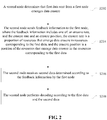
- FIG. 2 is a flowchart 1 of the decoding processing method according to the embodiment of the present disclosure. As shown in FIG. 2 , the process includes the steps described below.
- a second node determines that first data sent from a first node emerges data erasure.
- the second node sends feedback information to the first node.
- the feedback information includes one of: an erasure rate, and the erasure rate and an erasure position.
- the erasure rate is a proportion of resources that emerge data erasure in the first data
- the erasure position is a position of the resources that emerge data erasure in the first data.
- the second node receives second data determined according to the feedback information by the first node.
- the second data includes the resources that emerge the data erasure in the first data.
- the second node performs decoding according to the first data and the second data.
- retransmission is performed on second data determined according to the erasure rate or according to the erasure rate and the erasure position is retransmitted, not on the entire first data, which solves the problem, in the related art, that when a decoding error occurs in a transport block, the entire transport block is retransmitted, which causes a waste of radio resources, and increases decoding complexity as well as transmission delay.
- the feedback information may include at least one of: erasure rate indication information, and the erasure rate indication information and erasure position indication information.
- the erasure rate indication information is represented by M1 bits, and at least one value of the M1 bits is used to indicate the erasure rate.
- the erasure position indication information is represented by M2 bits, and at least one value of the M2 bits is used to indicate the erasure position. M1 and M2 are positive integers.
- the erasure rate may further be obtained according to the erasure location indication information.
- the second node determines that the first data sent from the first node emerges the data erasure when at least one of following is checked by the second node: an equivalent received signal to interference plus noise ratio (SINR) of a signal on the first data being less than a first predetermined threshold T1; a sum of interference and noise power on the first data being greater than a second predetermined threshold T2; and a signal power on the first data being lower than a third predetermined threshold T3.
- SINR equivalent received signal to interference plus noise ratio
- the resources corresponding to the first data and resources corresponding to the second data include one of: a time-frequency domain resource, a transport layer, an antenna port, and a carrier.
- the time-frequency domain resource is defined by a time-domain resource having a length of N1 and a frequency-domain resource having a length of N2, and N1 and N2 are positive integers.
- a length of time-domain resources includes: a length of the time-domain resources includes: a length of one of an orthogonal frequency division multiplexing (OFDM) symbol, a time slot, a subframe and a radio frame occupied in the time-domain resource; the length of the frequency-domain resources includes a length of one of a subcarrier, a resource block (RB) and a subband occupied in the frequency-domain resource, and the time-frequency domain resource includes one of: a resource unit (RU), a resource block (RB), and a subband.
- OFDM orthogonal frequency division multiplexing
- the resources corresponding to the first data are divided into Mj mutually exclusive resource index sets according to the jth resource granularity, one of the Mj mutually exclusive resource index sets is an erasure position, Mj erasure positions form an erasure position set j, j is a positive integer and j ⁇ J, J is the number of erasure position sets corresponding to preset J types of resource granularity, and J is a positive integer.
- the larger the resource granularity the greater the number of resource indices of the erasure position in the corresponding erasure position set, and the smaller the number of erasure positions in the erasure position set.
- the resource indices are continuous.
- a first erasure position set includes 1 erasure position which includes all RBs indexed from 0 to 199.
- a second erasure position set includes 2 erasure positions, a resource index set of RBs corresponding to a first (the first here is with respect to the second erasure position set, and this first in the second erasure position set is a second in all erasure positions) erasure position is ⁇ 0, 1, ..., 99 ⁇ , and a resource index set of RBs corresponding to a second erasure position is ⁇ 100, 101, ..., 199 ⁇ .
- a third erasure position set includes 4 erasure positions, a resource index set of RBs corresponding to a first erasure position is ⁇ 0 , 1, ..., 49 ⁇ , a resource index set of RBs corresponding to a second erasure position is ⁇ 50, 51, ..., 99 ⁇ ; a resource index set of RBs corresponding to a third erasure position is ⁇ 100, 101, ... 149 ⁇ , a resource index set of RBs corresponding to a fourth erasure position is ⁇ 150, 151, ..., 199 ⁇ , and so on, and a sixth erasure position set includes 32 erasure positions.
- the number of RB indices of each of the 32 erasure positions is 6 or 7.
- 8 erasure positions each include 7 RBs
- 24 resource positions each include 6 RBs.
- the larger the resource granularity the smaller the number of erasure positions in the erasure position set, and correspondingly, the greater the number of resource indices of RBs in one erasure position.
- RBs included in each resource position may also not be continuous.
- the embodiment of the present disclosure takes the eMBB scenario as an example, uses resources corresponding to the first data and resources corresponding to the second data as the resource blocks (RB), and uses the erasure rate as the feedback information for description.
- the first node performs sending side processing such as coding and modulation on the transport block.
- the data is mapped onto the resource blocks (RB) numbered 0 to 199 and is sent to the second node.
- a transmit signal is received by the receiving side through the fading channel.
- the enhancement and attenuation effects of the channel on the signal are different, so that the equivalent received signal to interference plus noise ratios (SINR) of the receive signal on the 200 RBs are different.
- SINR equivalent received signal to interference plus noise ratios
- the second node performs receiving side processing such as demodulation and decoding on the transport block as the receiving side.
- 11 RBs numbered 9 to 19 are severely affected by burst interference, so the equivalent received signal to interference plus noise ratios (SINR) is lower than a specified threshold, so that the corresponding code blocks cannot be correctly decoded.
- the receiving side feeds back the erasure rate through the channel.
- the sending side After the sending side obtains the transmission erasure rate sent from the receiving side, the sending side resends a certain proportion of encoded data to the receiving side.
- data of the R ⁇ 200 RBs is obtained by coding data of 200 RBs previously sent.
- the coding form may be diverse, including that an exclusive-or operation is performed on the first transmitted data with a specified resource granularity, to obtain retransmitted packet coding data.
- the R ⁇ 200 RB data is a fountain code data or other rateless coding data of a transport block.
- the receiving side After the receiving side receives the retransmitted data, the receiving side performs decoding according to the data received twice, and obtains a correctly decoded transport block.
- the sending side when the receiving side cannot correctly decode the transport block, the sending side does not resend the original entire transport block, but sends a certain proportion of data according to the erasure rate fed back by the receiving side, and the data is obtained by coding all the original RBs, or is part of the coding data of the transport block.
- the receiving side can perform decoding correctly. Therefore, wireless time-frequency resources required for retransmission are saved, the transmission delay and the decoding delay are saved, and the decoding complexity is reduced. The spectral efficiency and throughput of the system are improved.
- the embodiment of the present disclosure takes the eMBB scenario as an example, uses resources corresponding to the first data and resources corresponding to the second data as the subbands, and uses the erasure rate as the feedback information for further description.
- the main difference between this embodiment and the previous embodiment is the definitions of the erasure rate and the retransmission data.
- the erasure rate is not defined according to the RB, but is defined according to the subband.
- the index of the subband is obtained according to the criterion of the frequency domain before the time domain.
- the data is mapped onto the subbands numbered 0 to 16 and is sent to the second node.
- the equivalent SINR is lower than a specified threshold due to severe fading, which causes corresponding code blocks cannot be correctly decoded.
- the sending side After the sending side obtains the transmission erasure rate sent from the receiving side, the sending side resends a certain proportion of encoded data to the receiving side.
- Data of the R ⁇ 200 subbands is obtained by coding data of 17 subbands previously sent.
- the time-frequency domain resource corresponding to the data sent from the first node to the second node varies with the scenario. For example, in a low delay scenario, data is mapped onto one or more OFDM symbols for transmission. In scenarios where the amount of data is very large, data may be mapped to multiple subframes, multiple time slots, and a different number of subcarriers. Different definitions of the erasure rate and the retransmission data may be applied to different application scenarios to implement HARQ retransmission. Wireless time-frequency resources required for retransmission are saved, the transmission delay and the decoding delay are saved, and the decoding complexity is reduced.
- the erasure rate may also be defined according to the code block and the transport block, that is, defined as a proportion of code blocks or transport blocks that emerge error decoding in multiple code blocks or multiple transport blocks.
- the first node codes the multiple code blocks or transport blocks to obtain the corresponding numbers of retransmission code blocks or transport blocks.
- the erasure rate may also be defined according to an antenna port, a carrier, and a transport layer, that is, defined as a proportion of antenna ports, carriers, and transport layers that emerge error decoding in multiple antenna ports, multiple carriers, and multiple transport layers, respectively. Then the first node codes the multiple antenna ports, carriers, and transport layers to obtain the corresponding numbers of retransmission code blocks or transport blocks.
- the embodiment of the present disclosure takes the eMBB scenario as an example, uses resources corresponding to the first data and resources corresponding to the second data as the resource blocks (RB), and uses the erasure rate and the erasure position as the feedback information for further description.
- the erasure position is carried by erasure position indication information
- the erasure position indication information indicates the position of 11 RBs in 200 RBs.
- RBs indexed 9 to 19 are located at the erasure position 8, and of course also at the erasure position 4, while the erasure position including the smallest number of RBs needs to be selected. Therefore, the erasure position indication information indicates the erasure position 8.
- the sending side After the sending side obtains the transmission erasure rate sent from the receiving side, the sending side resends a certain proportion of encoded data to the receiving side.
- Data of the R ⁇ 200 RB is obtained by coding data at the erasure position 8 instead of by coding data of 200 RBs.
- the erasure position information is fed back, and then the coding complexity of the retransmission data is favorably reduced, and the decoding complexity for the receiving side is also favorably reduced.
- the erasure position is sent, and then the sending side may also directly resend the RBs corresponding to the erasure position, that is, the data of 25 RBs.
- the second data is one of N redundancy versions of data, where the redundancy versions are determined according to one of: a preset erasure rate, and a combination of the preset erasure rate and a preset erasure position, and N is a positive integer.
- the first node codes the RB data corresponding to each of the erasure locations, and determines the corresponding number of retransmitted RBs according to the erasure rate, and thus the transmission redundancy version may be obtained.
- 63 erasure positions are provided in an embodiment 3, and in consideration of the number of erasure rates Nr, a total of 63 ⁇ Nr redundancy versions may be obtained.
- the first node transmits the redundancy version corresponding to the erasure rate and the erasure position fed back by the second node.
- the RB data at one erasure position may also be directly defined as a redundancy version, and a total of 63 redundancy versions are obtained.
- the redundancy version corresponding to the erasure position is transmitted during retransmission.
- FIG. 4 is a flowchart 2 of the decoding processing method according to the embodiment of the present disclosure. As shown in FIG. 4 , the process includes the steps described below.
- a first node receives feedback information sent from a second node.
- the feedback information includes one of: an erasure rate, and the erasure rate and an erasure position.
- the erasure rate is a proportion of resources that emerge data erasure in resources corresponding to first data
- the erasure position is a position of the resources that emerge data erasure in the resources corresponding to the first data.
- the first node determines second data according to the feedback information, and sends the second data to the second node.
- the second data is configured for performing decoding together with the first data sent from the first node.
- the resources corresponding to the first data and resources corresponding to the second data include one of: a time-frequency domain resource, a transport layer, an antenna port, and a carrier, where the time-frequency domain resource is defined by a time-domain resource having a length of N1 and a frequency-domain resource having a length of N2, and N1 and N2 are positive integers.
- a length of the time-domain resources includes a length of one of an orthogonal frequency division multiplexing (OFDM) symbol, a time slot, a sub frame and a radio frame occupied in the time-domain resource; and the length of frequency-domain resources includes a length of one of a subcarrier, a resource block (RB), and a subband occupied in the frequency-domain resource.
- OFDM orthogonal frequency division multiplexing
- the time-frequency domain resource includes one of: a resource unit (RU), a resource block (RB), and a subband.
- RU resource unit
- RB resource block
- subband subband
- the resources corresponding to the first data are divided into Mj mutually exclusive resource index sets according to the jth resource granularity, one of the Mj mutually exclusive resource index sets is an erasure position, Mj erasure positions form an erasure position set j, j is a positive integer and j ⁇ J, J is the number of erasure position sets corresponding to preset J types of resource granularity, and J is a positive integer.
- the larger the resource granularity the greater the number of resource indices of the erasure position in the corresponding erasure position set, and the smaller the number of erasure positions in the erasure position set.
- the resource indices are continuous.
- the second data is one of N redundancy versions of data, where the redundancy versions are determined according to one of: a preset erasure rate, and a combination of the preset erasure rate and a preset erasure position, and N is a positive integer.
- the correct transmission of super-large transport blocks is achieved at the expense of limited signaling.
- the wireless time-frequency resource is saved.
- the transmission delay, the decoding delay and the decoding complexity are reduced. It is beneficial for improving the spectral efficiency and improving the system throughput to meet the needs of the new generation wireless communication.
- the computer software product is stored in a storage medium (such as a read-only memory (ROM)/random access memory (RAM), a magnetic disk or an optical disk) and includes several instructions for enabling a terminal device (which may be a mobile phone, a computer, a server, a network device, or the like) to execute the method according to each embodiment of the present disclosure.
- a storage medium such as a read-only memory (ROM)/random access memory (RAM), a magnetic disk or an optical disk
- a terminal device which may be a mobile phone, a computer, a server, a network device, or the like
- the embodiment of the present disclosure further provides a decoding processing device and node.
- the device is configured for implementing the above-mentioned embodiments and preferred embodiments. What has been described will not be repeated.
- the term "module” may be software, hardware or a combination thereof capable of implementing predetermined functions.
- the device in the embodiments described below is preferably implemented by software, but implementation by hardware or by a combination of software and hardware is also possible and conceived.
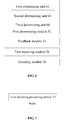
- FIG. 5 is a structural block diagram 1 of a decoding processing device according to the embodiment of the present disclosure. As shown in FIG. 5 , the device includes: a first determining module 52, a feedback module 54, a first receiving module 56, and a decoding module 58.
- the first determining module 52 is configured to determine that first data sent from a first node emerges data erasure.
- the feedback module 54 is connected to the determining module 52, and is configured to send feedback information to the first node.
- the feedback information includes one of: an erasure rate, and the erasure rate and an erasure position.
- the erasure rate is a proportion of resources that emerge data erasure in the first data
- the erasure position is a position of the resources that emerge data erasure in the first data.
- the first receiving module 56 is connected to the feedback module 54, and is configured to receive second data determined according to the feedback information by the first node.
- the second data includes the resources that emerge the data erasure in the first data.
- the decoding module 58 is connected to the receiving module 56, and is configured to perform decoding according to the first data and the second data.
- FIG. 6 is a structural block diagram of the first determining module 52 in the decoding processing device according to the embodiment of the present disclosure.
- the first determining module 52 includes: a first determining unit 62, a second determining unit 64, and a third determining unit 66, which are described below respectively.
- the first determining unit 62 is configured to determine that the first data sent from the first node emerges the data erasure in a case where an equivalent received signal to interference plus noise ratio (SINR) of a signal on the first data is checked to be less than a first predetermined threshold T1.
- SINR equivalent received signal to interference plus noise ratio
- the second determining unit 64 is configured to determine that the first data sent from the first node emerges the data erasure in a case where a sum of interference and noise power on the first data is checked to be greater than a second predetermined threshold T2.
- the third determining unit 66 is configured to determine that the first data sent from the first node emerges the data erasure in a case where a signal power on the first data is detected to be lower than a third predetermined threshold T3.
- T1, T2, and T3 are real numbers.
- the resources corresponding to the first data and resources corresponding to the second data include one of: a time-frequency domain resource, a transport layer, an antenna port, and a carrier, where the time-frequency domain resource is defined by a time-domain resource having a length of N1 and a frequency-domain resource having a length of N2, and N1 and N2 are positive integers.
- a length of the time-domain resources includes: a length of one of an orthogonal frequency division multiplexing (OFDM) symbol, a time slot, a sub frame and a radio frame occupied in the time-domain resource; and the length of the frequency-domain resources includes a length of one of a subcarrier, a resource block (RB) and a subband occupied in the frequency-domain resource.
- OFDM orthogonal frequency division multiplexing
- the time-frequency domain resource includes one of: a resource unit (RU), a resource block (RB), and a subband.
- RU resource unit
- RB resource block
- subband subband
- the resources corresponding to the first data are divided into Mj mutually exclusive resource index sets according to the jth resource granularity, one of the Mj mutually exclusive resource index sets is an erasure position, Mj erasure positions form an erasure position set j, j is a positive integer and j ⁇ J, J is the number of erasure position sets corresponding to preset J types of resource granularity, and J is a positive integer.
- the resource indices are continuous.
- the second data is one of N redundancy versions of data, where the redundancy versions are determined according to one of: a preset erasure rate, and a combination of the preset erasure rate and a preset erasure position, and N is a positive integer.
- FIG. 7 is a structural block diagram 1 of the node according to the embodiment of the present disclosure.
- the node includes a first decoding processing device 72.
- the decoding processing device includes the device of any one of the embodiments described above.
- FIG. 8 is a structural block diagram 2 of a decoding processing device according to the embodiment of the present disclosure. As shown in FIG. 8 , the device includes: a second receiving module 82 and a second determining module 84.
- the second receiving module 82 is configured to receive feedback information sent from a second node.
- the feedback information includes one of: an erasure rate, and the erasure rate and an erasure position.
- the erasure rate is a proportion of resources that emerge data erasure in resources corresponding to first data
- the erasure position is a position of the resources that emerge data erasure in the resources corresponding to the first data.
- the second determining module 84 is connected to the second receiving module 82, and is configured to determine second data according to the feedback information, and send the second data to the second node.
- the second data is used for performing decoding together with the first data sent from the first node.
- the resources corresponding to the first data and resources corresponding to the second data include one of: a time-frequency domain resource, a transport layer, an antenna port, and a carrier, where the time-frequency domain resource is defined by a time-domain resource having a length of N1 and a frequency-domain resource having a length of N2, and N1 and N2 are positive integers.
- a length of the time-domain resources includes: a length of one of an orthogonal frequency division multiplexing (OFDM) symbol, a time slot, a sub frame and a radio frame occupied in the time-domain resource; and the length of frequency-domain resources includes a length of one of a subcarrier, a resource block (RB), and a subband occupied in the frequency-domain resource.
- OFDM orthogonal frequency division multiplexing
- the time-frequency domain resource includes one of: a resource unit (RU), a resource block (RB), and a subband.
- RU resource unit
- RB resource block
- subband subband
- the resources corresponding to the first data are divided into Mj mutually exclusive resource index sets according to the jth resource granularity, one of the Mj mutually exclusive resource index sets is an erasure position, Mj erasure positions form an erasure position set j, j is a positive integer and j ⁇ J, J is the number of erasure position sets corresponding to preset J types of resource granularity, and J is a positive integer.
- the resource indices are continuous.
- the second data is one of N redundancy versions of data, where the redundancy versions are determined according to one of: a preset erasure rate, and a combination of the preset erasure rate and a preset erasure position, and N is a positive integer.
- FIG. 9 is a structural block diagram 2 of a node according to the embodiment of the present disclosure. As shown in FIG. 9 , the node includes a second decoding processing device 92.
- the decoding processing device includes the device of any one of the embodiments described above.
- the various modules described above may be implemented by software or hardware. Implementation by hardware may, but may not necessarily, be performed in the following manner: the various modules described above are located in a same processor, or the various modules described above are located in their respective processors in any combination form.
- the embodiment of the present disclosure further provides a storage medium.
- the storage medium described above may be configured to store program codes for executing the steps described below.
- a second node determines that first data sent from a first node emerges data erasure.
- the second node sends feedback information to the first node.
- the feedback information includes one of: an erasure rate, and the erasure rate and an erasure position.
- the erasure rate is a proportion of resources that emerge data erasure in resources corresponding to first data
- the erasure position is a position of the resources that emerge data erasure in the resources corresponding to the first data.
- the second node receives second data determined according to the feedback information by the first node.
- the second node performs decoding according to the first data and the second data.
- the storage medium is further configured to store program codes for performing the steps described below.
- the second node determines that the first data sent from the first node emerges the data erasure when a case of at least one of: S1, S2, and S3 is checked by the second node.
- the second node checks that an equivalent received signal to interference plus noise ratio (SINR) of a signal on the resources corresponding to the first data is less than a first predetermined threshold T1.
- SINR equivalent received signal to interference plus noise ratio
- the second node checks that a sum of interference and noise power on the resources corresponding to the first data is greater than a second predetermined threshold T2.
- the second node checks that a signal power on the resources corresponding to the first data is lower than a third predetermined threshold T3.
- T1, T2, and T3 are real numbers.
- the storage medium is further configured to store program codes for executing the step described below.
- the resources corresponding to the first data and resources corresponding to the second data include one of: a time-frequency domain resource, a transport layer, an antenna port, and a carrier, where the time-frequency domain resource is defined by a time-domain resource having a length of N1 and a frequency-domain resource having a length of N2, and N1 and N2 are positive integers.
- the storage medium is further configured to store program codes for executing the steps described below.
- a length of the time-domain resources includes: a length of one of an orthogonal frequency division multiplexing (OFDM) symbol, a time slot, a sub frame and a radio frame occupied in the time-domain resource.
- OFDM orthogonal frequency division multiplexing
- the length of the frequency-domain resources includes a length of one of a subcarrier, a resource block (RB) and a subband occupied in the frequency-domain resource.
- the storage medium is further configured to store program codes for executing the step described below.
- the time-frequency domain resource includes one of: a resource unit (RU), a resource block (RB), and a subband.
- the storage medium is further configured to store program codes for executing the step described below.
- the resources corresponding to the first data are divided into Mj mutually exclusive resource index sets according to the jth resource granularity.
- One of the Mj mutually exclusive resource index sets is an erasure position.
- Mj erasure positions form an erasure position set j.
- j is a positive integer
- J is the number of erasure position sets corresponding to preset J types of resource granularity
- J is a positive integer.
- the storage medium is further configured to store program codes for executing the step described below.
- the storage medium is further configured to store program codes for executing the step described below.
- the second data is one of N redundancy versions of data, where the redundancy versions are determined according to one of: a preset erasure rate, and a combination of the preset erasure rate and a preset erasure position, and N is a positive integer.
- the embodiment of the present disclosure further provides a storage medium.
- the storage medium described above may be configured to store program codes for executing the steps described below.
- a first node receives feedback information sent from a second node.
- the feedback information includes one of: an erasure rate, and the erasure rate and an erasure position.
- the erasure rate is a proportion of resources that emerge data erasure in resources corresponding to first data
- the erasure position is a position of the resources that emerge data erasure in the resources corresponding to the first data.
- the first node determines second data according to the feedback information, and sends the second data to the second node.
- the second data is used for performing decoding together with the first data sent from the first node.
- the storage medium is further configured to store program codes for executing the step described below.
- the resources corresponding to the first data and resources corresponding to the second data include one of: a time-frequency domain resource, a transport layer, an antenna port, and a carrier.
- the time-frequency domain resource is defined by a time-domain resource having a length of N1 and a frequency-domain resource having a length of N2, and N1 and N2 are positive integers.
- the storage medium is further configured to store program codes for executing the steps described below.
- a length of time-domain resources includes: a length of one of an orthogonal frequency division multiplexing (OFDM) symbol, a time slot, a sub frame and a radio frame occupied in the time-domain resource.
- OFDM orthogonal frequency division multiplexing
- the length of frequency-domain resources includes a length of one of a subcarrier, a resource block (RB), and a subband occupied in the frequency-domain resource.
- the storage medium is further configured to store program codes for executing the step described below.
- the time-frequency domain resource includes one of: a resource unit (RU), a resource block (RB), and a subband.
- the storage medium is further configured to store program codes for executing the step described below.
- the resources corresponding to the first data are divided into Mj mutually exclusive resource index sets according to the jth resource granularity.
- One of the Mj mutually exclusive resource index sets is an erasure position.
- Mj erasure positions form an erasure position set j.
- j is a positive integer
- J is the number of erasure position sets corresponding to preset J types of resource granularity
- J is a positive integer.
- the storage medium is further configured to store program codes for executing the step described below.
- the storage medium is further configured to store program codes for executing the step described below.
- the second data is one of N redundancy versions of data, where the redundancy versions are determined according to one of: a preset erasure rate, and a combination of the preset erasure rate and a preset erasure position, and N is a positive integer.
- the storage medium described above may include, but is not limited to, a USB flash drive, a read-only memory (ROM), a random access memory (RAM), a mobile hard disk, a magnetic disk, an optical disk or another medium capable of storing the program codes.
- a processor performs the steps described below according to the program codes stored in the storage medium.
- a second node determines that first data sent from a first node emerges data erasure; the second node sends feedback information to the first node, where the feedback information includes one of: an erasure rate, and the erasure rate and an erasure position, the erasure rate is a proportion of resources that emerge data erasure in resources corresponding to the first data, and the erasure position is a position of the resources that emerge data erasure in the resources corresponding to the first data; the second node receives second data determined according to the feedback information by the first node; and the second node performs decoding according to the first data and the second data.
- the processor performs the steps described below according to the program codes stored in the storage medium.
- the second node determines that the first data sent from the first node emerges the data erasure when at least one of following is checked by the second node: an equivalent received signal to interference plus noise ratio (SINR) of a signal on the resources corresponding to the first data being less than a first predetermined threshold T1; a sum of interference and noise power on the resources corresponding to the first data being greater than a second predetermined threshold T2; and a signal power on the resources corresponding to the first data being lower than a third predetermined threshold T3.
- SINR equivalent received signal to interference plus noise ratio
- the processor performs the steps described below according to the program codes stored in the storage medium.
- the resources corresponding to the first data and resources corresponding to the second data include one of: a time-frequency domain resource, a transport layer, an antenna port, and a carrier, where the time-frequency domain resource is defined by a time-domain resource having a length of N1 and a frequency-domain resource having a length of N2, and N1 and N2 are positive integers.
- a length of the time-domain resources includes: a length of one of an orthogonal frequency division multiplexing (OFDM) symbol, a time slot, a subframe and a radio frame occupied in the time-domain resource; and the length of frequency-domain resources includes a length of one of a subcarrier, a resource block (RB), and a subband occupied in the frequency-domain resource.
- OFDM orthogonal frequency division multiplexing
- the processor performs the step described below according to the program codes stored in the storage medium.
- the time-frequency domain resource includes one of: a resource unit (RU), a resource block (RB), and a subband.
- the processor performs the steps described below according to the program codes stored in the storage medium.
- the resources corresponding to the first data are divided into Mj mutually exclusive resource index sets according to the jth resource granularity.
- One of the Mj mutually exclusive resource index sets is an erasure position.
- Mj erasure positions form an erasure position set j.
- j is a positive integer
- J is the number of erasure position sets corresponding to preset J types of resource granularity
- J is a positive integer.
- the processor performs the step described below according to the program codes stored in the storage medium.
- the resource indices are continuous.
- the processor performs the steps described below according to the program codes stored in the storage medium.
- the first data and the second data each are one of N redundancy versions of data, where the redundancy versions are determined according to one of: a preset erasure rate, and a combination of the preset erasure rate and a preset erasure position, and N is a positive integer.
- a first node receives feedback information sent from a second node, where the feedback information includes one of: an erasure rate, and the erasure rate and an erasure position, the erasure rate is a proportion of resources that emerge data erasure in resources corresponding to first data, and the erasure position is a position of the resources that emerge data erasure in the resources corresponding to the first data; and the first node determines second data according to the feedback information, and sends the second data to the second node, where the second data is configured for performing decoding together with the first data sent from the first node.
- the processor performs the steps described below according to the program codes stored in the storage medium.
- the resources corresponding to the first data and resources corresponding to the second data include one of: a time-frequency domain resource, a transport layer, an antenna port, and a carrier, where the time-frequency domain resource is defined by a time-domain resource having a length of N1 and a frequency-domain resource having a length of N2, and N1 and N2 are positive integers.
- a length of the time-domain resources includes: a length of one of an orthogonal frequency division multiplexing (OFDM) symbol, a time slot, a subframe and a radio frame occupied in the time-domain resource; and the length of the frequency-domain resources includes a length of one of a subcarrier, a resource block (RB) and a subband occupied in the frequency-domain resource.
- OFDM orthogonal frequency division multiplexing
- the processor performs the step described below according to the program codes stored in the storage medium.
- the time-frequency domain resource includes one of: a resource unit (RU), a resource block (RB), and a subband.
- the processor performs the steps described below according to the program codes stored in the storage medium.
- the resources corresponding to the first data are divided into Mj mutually exclusive resource index sets according to the jth resource granularity.
- One of the Mj mutually exclusive resource index sets is an erasure position.
- Mj erasure positions form an erasure position set j, j is a positive integer and j ⁇ J.
- J is the number of erasure position sets corresponding to preset J types of resource granularity, and J is a positive integer.
- the processor performs the step described below according to the program codes stored in the storage medium.
- the resource indices are continuous.
- the processor performs the steps described below according to the program codes stored in the storage medium.
- the second data is one of N redundancy versions of data, where the redundancy versions are determined according to one of: a preset erasure rate, and a combination of the preset erasure rate and a preset erasure position, and N is a positive integer.
- each of the above-mentioned modules or steps of the present disclosure may be implemented by a general-purpose computing device, the modules or steps may be concentrated on a single computing device or distributed on a network composed of multiple computing devices, and alternatively, the modules or steps may be implemented by program codes executable by the computing devices, so that the modules or steps may be stored in a storage device and executed by the computing devices.
- the illustrated or described steps may be executed in sequences different from those described herein, or the modules or steps may be made into various integrated circuit modules separately, or multiple modules or steps therein may be made into a single integrated circuit module for implementation. In this way, the present disclosure is not limited to any specific combination of hardware and software.
- the embodiments of the present disclosure provide a data processing method, device, and node, having the following beneficial effects: the embodiments solve the problem, in the existing art, that when a decoding error occurs in a transport block, the entire transport block is retransmitted, which causes a waste of radio resources, and increases decoding complexity as well as transmission delay.
Landscapes
- Engineering & Computer Science (AREA)
- Computer Networks & Wireless Communication (AREA)
- Signal Processing (AREA)
- Quality & Reliability (AREA)
- Physics & Mathematics (AREA)
- Electromagnetism (AREA)
- Mobile Radio Communication Systems (AREA)
Applications Claiming Priority (2)
| Application Number | Priority Date | Filing Date | Title |
|---|---|---|---|
| CN201610654195.0A CN107733573B (zh) | 2016-08-10 | 2016-08-10 | 数据处理方法、装置及节点 |
| PCT/CN2017/096760 WO2018028622A1 (fr) | 2016-08-10 | 2017-08-10 | Procédé, dispositif et nœud de traitement de données |
Publications (2)
| Publication Number | Publication Date |
|---|---|
| EP3499768A1 true EP3499768A1 (fr) | 2019-06-19 |
| EP3499768A4 EP3499768A4 (fr) | 2019-09-25 |
Family
ID=61162787
Family Applications (1)
| Application Number | Title | Priority Date | Filing Date |
|---|---|---|---|
| EP17838752.8A Withdrawn EP3499768A4 (fr) | 2016-08-10 | 2017-08-10 | Procédé, dispositif et noeud de traitement de données |
Country Status (4)
| Country | Link |
|---|---|
| US (1) | US10992426B2 (fr) |
| EP (1) | EP3499768A4 (fr) |
| CN (1) | CN107733573B (fr) |
| WO (1) | WO2018028622A1 (fr) |
Families Citing this family (4)
| Publication number | Priority date | Publication date | Assignee | Title |
|---|---|---|---|---|
| CN118301708A (zh) | 2018-04-04 | 2024-07-05 | 华为技术有限公司 | 系统消息冗余版本确定方法及装置 |
| CA3066439A1 (fr) * | 2019-01-03 | 2020-07-03 | Comcast Cable Communications, Llc | Protocoles d`acces des communications sans fil |
| US11468122B2 (en) * | 2019-06-11 | 2022-10-11 | Microsoft Technology Licensing, Llc | Shared memory space management for conversational artificial intelligence system |
| CN115567135B (zh) * | 2021-06-30 | 2025-03-14 | 深圳富联富桂精密工业有限公司 | 数据处理方法、网关装置、电子设备及计算机存储介质 |
Family Cites Families (14)
| Publication number | Priority date | Publication date | Assignee | Title |
|---|---|---|---|---|
| US6772390B2 (en) * | 2000-11-30 | 2004-08-03 | Quantum Corporation | Erasure correction for ECC entities |
| US6744766B2 (en) * | 2002-06-05 | 2004-06-01 | Meshnetworks, Inc. | Hybrid ARQ for a wireless Ad-Hoc network and a method for using the same |
| CN100355231C (zh) | 2003-12-19 | 2007-12-12 | 上海贝尔阿尔卡特股份有限公司 | 多载波系统中具有混合自动重传请求的数据传输方法 |
| US7296205B2 (en) | 2004-02-18 | 2007-11-13 | Nokia Corporation | Data repair |
| WO2007078219A1 (fr) * | 2005-12-30 | 2007-07-12 | Telefonaktiebolaget Lm Ericsson (Publ) | Procede et agencement destines au procede harq dans des systemes sans fil a porteuses multiples |
| CN101026440A (zh) * | 2006-02-24 | 2007-08-29 | 松下电器产业株式会社 | 通信系统中的数据重传方法 |
| US7669103B2 (en) * | 2006-05-03 | 2010-02-23 | Alcatel-Lucent Usa Inc. | Encoded transmission |
| CN101286825A (zh) * | 2007-04-11 | 2008-10-15 | 松下电器产业株式会社 | 实现基于可靠性的混合自动重传的方法、发送端和系统 |
| US8599777B2 (en) * | 2009-11-17 | 2013-12-03 | Qualcomm Incorporated | Channel quality indicator design for multiple-user multiple-input and multiple-output in high-speed packet access systems |
| CN103116451B (zh) * | 2013-01-25 | 2018-10-26 | 腾讯科技(深圳)有限公司 | 一种智能终端的虚拟角色交互方法、装置和系统 |
| US9337873B2 (en) * | 2013-05-24 | 2016-05-10 | SK Hynix Inc. | Miscorrection detection for error correcting codes using bit reliabilities |
| CN105515733B (zh) * | 2014-09-24 | 2019-03-12 | 中兴通讯股份有限公司 | 一种反馈方法及装置 |
| US10568103B2 (en) * | 2015-06-11 | 2020-02-18 | Lg Electronics Inc. | Method and apparatus for communicating with a network on cellular internet-of-things carriers |
| WO2017108113A1 (fr) * | 2015-12-22 | 2017-06-29 | Sony Mobile Communications Inc. | Amélioration de couverture dynamique |
-
2016
- 2016-08-10 CN CN201610654195.0A patent/CN107733573B/zh active Active
-
2017
- 2017-08-10 EP EP17838752.8A patent/EP3499768A4/fr not_active Withdrawn
- 2017-08-10 WO PCT/CN2017/096760 patent/WO2018028622A1/fr not_active Ceased
- 2017-08-10 US US16/322,745 patent/US10992426B2/en active Active
Also Published As
| Publication number | Publication date |
|---|---|
| US10992426B2 (en) | 2021-04-27 |
| WO2018028622A1 (fr) | 2018-02-15 |
| CN107733573B (zh) | 2022-03-01 |
| US20190386792A1 (en) | 2019-12-19 |
| EP3499768A4 (fr) | 2019-09-25 |
| CN107733573A (zh) | 2018-02-23 |
Similar Documents
| Publication | Publication Date | Title |
|---|---|---|
| US8787384B2 (en) | Pre-emptive acknowledgement for data transmission in a communication system | |
| RU2473174C2 (ru) | Способ и устройство в системе связи | |
| EP3496313B1 (fr) | Demandes de correction d'erreurs de niveau de bloc de code et de répétition automatique hybride de niveau contrôle d'accès au support (mac) pour atténuer la perforation sporadique et l'interférence dans un système sans fil de protocole multicouches | |
| EP3550752B1 (fr) | Procédé, dispositif, et système de rétroaction | |
| RU2353062C2 (ru) | Эффективные способы и устройства автоматического запроса повторения | |
| US10812215B2 (en) | Data transmission method, apparatus, and device | |
| US10700819B2 (en) | Method and device for processing HARQ feedback, method and device for transmitting HARQ feedback | |
| US9253785B2 (en) | Multi-cell incremental redundancy | |
| CN110198204A (zh) | 一种低时延重传方法及装置 | |
| CN112640335B (zh) | 极化编码系统的增量冗余混合自动重传请求传输 | |
| US20120084618A1 (en) | Jointly encoding a scheduling request indicator and acknowledgments/negative acknowledgments | |
| US12520319B2 (en) | Joint coding and multiplexing of HARQ-ACK with different priorities on PUCCH format 2, PUCCH format 3 or PUCCH format 4 | |
| US20160323068A1 (en) | Hybrid Automatic Repeat Request Method and Related Apparatus | |
| EP3681069B1 (fr) | Rétroaction de données, procédé et dispositif d'envoi et de réception, équipement de réception et équipement d'envoi | |
| US10992426B2 (en) | Data processing method, device and node | |
| CN111092699A (zh) | 一种信息传输方法、装置、终端设备和存储介质 | |
| CN108023675A (zh) | 数据传输方法及通信设备 | |
| JP6955576B2 (ja) | 第2のサービスの送信における第1のサービスのためのデータのパンクチャバンドリング | |
| CN106341209B (zh) | 一种用于无线通信系统中的重传方法和装置 | |
| CN108809529B (zh) | 一种数据传输方法、终端以及基站 | |
| US9515774B2 (en) | Energy-efficient wireless communications via feedback | |
| EP3499769B1 (fr) | Procédé et dispositif pour transmettre et recevoir des informations de demande de retransmission automatique hybride | |
| EP4690579A1 (fr) | Amélioration du débit de pdsch par réduction de nack2ack |
Legal Events
| Date | Code | Title | Description |
|---|---|---|---|
| PUAI | Public reference made under article 153(3) epc to a published international application that has entered the european phase |
Free format text: ORIGINAL CODE: 0009012 |
|
| 17P | Request for examination filed |
Effective date: 20190308 |
|
| AK | Designated contracting states |
Kind code of ref document: A1 Designated state(s): AL AT BE BG CH CY CZ DE DK EE ES FI FR GB GR HR HU IE IS IT LI LT LU LV MC MK MT NL NO PL PT RO RS SE SI SK SM TR |
|
| AX | Request for extension of the european patent |
Extension state: BA ME |
|
| A4 | Supplementary search report drawn up and despatched |
Effective date: 20190822 |
|
| RIC1 | Information provided on ipc code assigned before grant |
Ipc: H04L 1/20 20060101ALI20190816BHEP Ipc: H04L 1/18 20060101AFI20190816BHEP |
|
| DAV | Request for validation of the european patent (deleted) | ||
| DAX | Request for extension of the european patent (deleted) | ||
| STAA | Information on the status of an ep patent application or granted ep patent |
Free format text: STATUS: THE APPLICATION HAS BEEN WITHDRAWN |
|
| 18W | Application withdrawn |
Effective date: 20191112 |