EP3500111B1 - Rohkornanreicherungsverfahren - Google Patents
Rohkornanreicherungsverfahren Download PDFInfo
- Publication number
- EP3500111B1 EP3500111B1 EP16763961.6A EP16763961A EP3500111B1 EP 3500111 B1 EP3500111 B1 EP 3500111B1 EP 16763961 A EP16763961 A EP 16763961A EP 3500111 B1 EP3500111 B1 EP 3500111B1
- Authority
- EP
- European Patent Office
- Prior art keywords
- fortification
- solution
- grain
- reactor
- homogenized
- Prior art date
- Legal status (The legal status is an assumption and is not a legal conclusion. Google has not performed a legal analysis and makes no representation as to the accuracy of the status listed.)
- Not-in-force
Links
Images



Classifications
-
- B—PERFORMING OPERATIONS; TRANSPORTING
- B02—CRUSHING, PULVERISING, OR DISINTEGRATING; PREPARATORY TREATMENT OF GRAIN FOR MILLING
- B02B—PREPARING GRAIN FOR MILLING; REFINING GRANULAR FRUIT TO COMMERCIAL PRODUCTS BY WORKING THE SURFACE
- B02B1/00—Preparing grain for milling or like processes
- B02B1/04—Wet treatment, e.g. washing, wetting, softening
-
- A—HUMAN NECESSITIES
- A23—FOODS OR FOODSTUFFS; TREATMENT THEREOF, NOT COVERED BY OTHER CLASSES
- A23L—FOODS, FOODSTUFFS OR NON-ALCOHOLIC BEVERAGES, NOT OTHERWISE PROVIDED FOR; PREPARATION OR TREATMENT THEREOF
- A23L7/00—Cereal-derived products; Malt products; Preparation or treatment thereof
- A23L7/10—Cereal-derived products
- A23L7/101—Addition of antibiotics, vitamins, amino-acids, or minerals
-
- A—HUMAN NECESSITIES
- A23—FOODS OR FOODSTUFFS; TREATMENT THEREOF, NOT COVERED BY OTHER CLASSES
- A23L—FOODS, FOODSTUFFS OR NON-ALCOHOLIC BEVERAGES, NOT OTHERWISE PROVIDED FOR; PREPARATION OR TREATMENT THEREOF
- A23L5/00—Preparation or treatment of foods or foodstuffs, in general; Food or foodstuffs obtained thereby; Materials therefor
- A23L5/10—General methods of cooking foods, e.g. by roasting or frying
- A23L5/13—General methods of cooking foods, e.g. by roasting or frying using water or steam
-
- A—HUMAN NECESSITIES
- A23—FOODS OR FOODSTUFFS; TREATMENT THEREOF, NOT COVERED BY OTHER CLASSES
- A23L—FOODS, FOODSTUFFS OR NON-ALCOHOLIC BEVERAGES, NOT OTHERWISE PROVIDED FOR; PREPARATION OR TREATMENT THEREOF
- A23L5/00—Preparation or treatment of foods or foodstuffs, in general; Food or foodstuffs obtained thereby; Materials therefor
- A23L5/10—General methods of cooking foods, e.g. by roasting or frying
- A23L5/17—General methods of cooking foods, e.g. by roasting or frying in a gaseous atmosphere with forced air or gas circulation, in vacuum or under pressure
-
- A—HUMAN NECESSITIES
- A23—FOODS OR FOODSTUFFS; TREATMENT THEREOF, NOT COVERED BY OTHER CLASSES
- A23L—FOODS, FOODSTUFFS OR NON-ALCOHOLIC BEVERAGES, NOT OTHERWISE PROVIDED FOR; PREPARATION OR TREATMENT THEREOF
- A23L7/00—Cereal-derived products; Malt products; Preparation or treatment thereof
- A23L7/10—Cereal-derived products
- A23L7/196—Products in which the original granular shape is maintained, e.g. parboiled rice
- A23L7/1965—Cooked; Precooked; Fried or pre-fried in a non-aqueous liquid frying medium, e.g. oil
-
- A—HUMAN NECESSITIES
- A23—FOODS OR FOODSTUFFS; TREATMENT THEREOF, NOT COVERED BY OTHER CLASSES
- A23P—SHAPING OR WORKING OF FOODSTUFFS, NOT FULLY COVERED BY A SINGLE OTHER SUBCLASS
- A23P30/00—Shaping or working of foodstuffs characterised by the process or apparatus
-
- A—HUMAN NECESSITIES
- A23—FOODS OR FOODSTUFFS; TREATMENT THEREOF, NOT COVERED BY OTHER CLASSES
- A23V—INDEXING SCHEME RELATING TO FOODS, FOODSTUFFS OR NON-ALCOHOLIC BEVERAGES AND LACTIC OR PROPIONIC ACID BACTERIA USED IN FOODSTUFFS OR FOOD PREPARATION
- A23V2002/00—Food compositions, function of food ingredients or processes for food or foodstuffs
-
- A—HUMAN NECESSITIES
- A23—FOODS OR FOODSTUFFS; TREATMENT THEREOF, NOT COVERED BY OTHER CLASSES
- A23V—INDEXING SCHEME RELATING TO FOODS, FOODSTUFFS OR NON-ALCOHOLIC BEVERAGES AND LACTIC OR PROPIONIC ACID BACTERIA USED IN FOODSTUFFS OR FOOD PREPARATION
- A23V2300/00—Processes
- A23V2300/02—Adsorption
-
- A—HUMAN NECESSITIES
- A23—FOODS OR FOODSTUFFS; TREATMENT THEREOF, NOT COVERED BY OTHER CLASSES
- A23V—INDEXING SCHEME RELATING TO FOODS, FOODSTUFFS OR NON-ALCOHOLIC BEVERAGES AND LACTIC OR PROPIONIC ACID BACTERIA USED IN FOODSTUFFS OR FOOD PREPARATION
- A23V2300/00—Processes
- A23V2300/10—Drying, dehydrating
-
- A—HUMAN NECESSITIES
- A23—FOODS OR FOODSTUFFS; TREATMENT THEREOF, NOT COVERED BY OTHER CLASSES
- A23V—INDEXING SCHEME RELATING TO FOODS, FOODSTUFFS OR NON-ALCOHOLIC BEVERAGES AND LACTIC OR PROPIONIC ACID BACTERIA USED IN FOODSTUFFS OR FOOD PREPARATION
- A23V2300/00—Processes
- A23V2300/14—Extraction
-
- A—HUMAN NECESSITIES
- A23—FOODS OR FOODSTUFFS; TREATMENT THEREOF, NOT COVERED BY OTHER CLASSES
- A23V—INDEXING SCHEME RELATING TO FOODS, FOODSTUFFS OR NON-ALCOHOLIC BEVERAGES AND LACTIC OR PROPIONIC ACID BACTERIA USED IN FOODSTUFFS OR FOOD PREPARATION
- A23V2300/00—Processes
- A23V2300/24—Heat, thermal treatment
-
- A—HUMAN NECESSITIES
- A23—FOODS OR FOODSTUFFS; TREATMENT THEREOF, NOT COVERED BY OTHER CLASSES
- A23V—INDEXING SCHEME RELATING TO FOODS, FOODSTUFFS OR NON-ALCOHOLIC BEVERAGES AND LACTIC OR PROPIONIC ACID BACTERIA USED IN FOODSTUFFS OR FOOD PREPARATION
- A23V2300/00—Processes
- A23V2300/26—Homogenisation
Definitions
- the invention relates to a grain fortification process. More specifically, the present invention discloses a novel fortification technique along with various controlled ambient environment conditions that help in fortification of raw food grains.
- a number of nutritional deficiencies are reported to be critical amongst many segments of people, especially in developing countries around the globe.
- One such critical condition is the micro nutrients deficiency of essential vitamins and minerals such as iron, zinc, selenium, folic acid, vitamins, amino acids etc., which has been named as the "hidden hunger".
- the most prevalent micronutrients among them are iron, zinc, iodine and vitamin A. Therefore, the best way of eliminating these deficiencies is to improve the nutritional quality of foods which are frequently consumed. To address this need food fortification has been practiced for quite some time.
- Hot extrusion, cold extrusion, coating and dusting are the currently practiced fortification methods for rice, but they have several drawbacks, and they are not very popular among people around the world. Due to washing rice before cooking, at the time of consumption, the fortificant is not available as expected. This is one of the reasons for not using any of these methods on a large scale. Also upon fortification, there is a discoloration problem with them which leads consumer unacceptability. Besides, unnecessary cost has to be spent on the binding chemicals, like waxes and gums, used in conventional fortification processes, which raise up the production cost too.
- fortified extruded pellets (rice kernels) is one of the preferred technologies, it has shown to be unstable during storage, have a higher cost and lower consumer acceptability.
- the most unsatisfactory feature of fortification by this method is the inability to guarantee equal distribution of fortificants amongst natural grains when mixed in ratios such as 1 in 100 or 1 in 200 etc, as the case maybe. Further, it is expensive as it needs extruders, steamers and dryers of which the capital cost and also the running cost of production is high.
- aspects of the invention are thus directed to a grain fortification process that provides a fortification method of raw food grains, especially paddy.
- the said process is both cost effective and overcomes the existing problems by providing high quality fortified grain.
- a grain fortification system is also described.
- the said system has a plurality of fortification tanks each containing at least one fortifying solution.
- the system has a homogenizer adapted to receive fortifying solution from the plurality of fortification tanks to produce homogenized fortification solution.
- the produced homogenized fortification solution is transferred to a fortification reactor in a predetermined quantity, wherein the said predetermined quantity is dependent on the type of raw food grain to be fortified.
- the fortification reactor is operated under preset degassing conditions followed by predefined controlled ambient adsorption conditions to produce fortified grains.
- the reactor is adapted to receive a predetermined quantity of the said homogenized fortification solution from the homogenizer, and receive a predetermined quantity of a raw food grains, and cause the said homogenized fortification solution and the said food grains to produce fortified grains by physicochemical reaction.
- the fortification is done by degassing the raw food grains at a preset degassing condition, to facilitate accelerated movements of fortificants inside the grain structure, and adsorbing the said homogenized fortification solution on the degassed raw food grains to produce the fortified grains under a controlled ambient environment conditions.
- the degassing at the predefined controlled ambient degassing condition is carried out by heating the loaded raw food grain to a temperature of 40-50 °C for about 10 to 20 minutes. In another embodiment, the degassing is carried out a temperature below 55 °C. In an embodiment, the degassing is carried out in vacuum conditions, particularly, a vacuum of 0.1 bar abs to 0.99 bar abs is created inside the said fortification reactor.
- the said adsorbing of the said homogenized fortification solution on the degassed raw food grains in predefined controlled ambient adsorption conditions which includes preheated fortifying solution is added in the said fortification reactor at about 55°C to 66°C, while maintaining the reactor temperature between room temperature to just less than gelatinization temperature of the grain, and soaking the raw food grains inside the fortification reactor for a time period in the range any time upto 360 minutes.
- the raw food grains are fortified with homogenized fortification solution of molecular size less than 2 nanometers (nm) in diameter. More specifically, the homogenized fortification solution of molecular size less than 2 nm in diameter fill the micro pores of the raw food grains. The homogenized fortification solution of molecular size 2 - 5 nm in diameter fill the meso pores of the raw food grains.
- the fortification reactor is loaded with raw food grains is first fed homogenized fortification solution of molecular size less than 2 nm followed by homogenized fortification solution of molecular size 2 - 5 nm in diameter, thus ensuring maximum loading of the grain with fortificants.
- the food grains so fortified are then extracted and dried, and leftover fortification solution, if any, in the fortification reactor is transferred to fortification solution collection tank.
- the fortification solution collection tank supplies this leftover fortification solution back to the homogenizer for reuse. This improves the efficiency of the system.
- a grain fortification process starts with feeding raw food grains in a fortification reactor. Further, the grain fortification process comprises degassing raw food grains by subjecting the said fortification reactor to a preset degassing condition. In one aspect, degassing at the predefined controlled ambient degassing condition is carried out by heating the loaded raw food grain to a temperature of 40-50°C for about 10 to 20 minutes. In an embodiment, the degassing is carried out in vacuum conditions, particularly, a vacuum of 0.1 bar abs to 0.99 bar abs is created inside the said fortification reactor.
- the process then is followed by adding of homogenized fortification solution in the fortification reactor, so that the fortificants could be adsorbed by the degassed grains.
- the process of adsorbing of the said homogenized fortification solution on the degassed raw food grains in predefined controlled ambient adsorption conditions comprises adding preheated fortifying solution in the said fortification reactor at about 55°C to 66°C, while maintaining the reactor temperature between room temperature to just less than gelatinization temperature of the grain.
- the process further comprises soaking the paddy inside the fortification reactor for about any time upto 360 minutes.
- the grain fortification method during adsorption fills the micro pores of the grains with homogenized fortification solution of molecular size less than 2 nm in diameter followed by filling of meso pores of the grains with homogenized fortification solution of molecular size 2 - 5 nm in diameter, thus ensuring maximum loading of the grain with fortificants.
- the homogenized fortification solution to be added in the fortification reactor is dependent on the type of raw food grain to be fortified.
- the present invention provides a grain fortification process that has a lower production cost of the fortified grain.
- fortified grain that has adsorbed fortificants, and is sealed with an outer gelatinized layer, when producing parboiled rice.
- grain refers here to seeds with or without attached hulls, including but not limited to, paddy, wheat, rye, legumes, maize, rice, oats, cornmeal, barley etc. or other cereal grains.
- paddy wheat, rye, legumes, maize, rice, oats, cornmeal, barley etc. or other cereal grains.
- production solution refers to solution comprising at least one of the essential nutrients, vitamins, minerals, and the like.
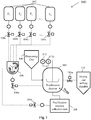
- Fig. 1 illustrates an exemplary block diagram representing a grain fortification system 100.
- the system 100 includes a plurality of fortification tanks 102 each containing at least one fortifying solution.
- the fortifying solution from the plurality of fortification tanks 102 is allowed to flow into a homogenizer 106 to produce a homogenized fortification solution.
- the said homogenized fortification solution is then fed into a fortification reactor 110 in a predetermined quantity.
- the homogenized fortification solution is dependent on the type of raw food grain to be fortified.
- the ratio of raw food grain to homogenized fortification solution is in the range of 1:1 to 1:2.
- the said fortification reactor 110 is adapted to receive raw food grains from a grain dispensing unit 108.
- the said fortification reactor works under predetermined degassing and predefined controlled ambient absorption conditions to produce fortified grains. The process will be explained in details later on in the specification.
- the system 100 further includes a fortification solution collection tank 114 to collect leftover fortification solution from the fortification reactor after the fortified rice is produced.
- the fortification solution collection tank 114 is adapted to transport this leftover fortification solution to the homogenizer 106 for reuse. This enables the system 100 to achieve high degrees of efficiencies.
- the fortifying solution is selected from the group consisting of a vitamin fortifying solution, a micronutrient fortifying solution, a macronutrient fortifying solution, a bio active functional compound solution, any other relevant molecules with aesthetic aspects (color, flavor and aroma), a protein fortifying solution, and/ or a phytochemical fortifying solution.
- the fortification tanks 102 each contain more than one fortifying solutions in different concentrations.
- the F 1 and F 2 contain only “Iron” and “Vitamin B” but F 3 contains both "Iron” as well as “Vitamin B” in different concentrations.
- valves 104a, 104b, 104c....104n connected to the respective fortification tanks 102 are adapted to control the flow of the fortifying solution present therein.
- the concentration of the fortifying solution is controlled by the valves 104a, 104b, 104c....104n based on the grain type.
- paddy grain is provided with only fortifying solution present in F 1 which is iron, or the paddy grain is provided with fortifying solution present in F 2 which is both iron and vitamin B. So the valves connected to respective tanks release the fortifying solution depending on the type of grain.
- the fortification reactor 110 receives grains from the grain dispensing unit 108.
- the grain dispensing unit 108 stores grains that are to be fortified.
- cleaned paddy is stored in the grain dispensing unit 108.
- the grain, such as paddy is pre cleaned using conventional cleaning methods.
- the moisture of the paddy may be critically tested to ensure the moisture level to be below a certain limit, for example, moisture range between 13-15 % on wet basis. If the moisture level is above this value, the paddy may be dried by conventional engineering methods, such as blow drying etc.
- the grains from the grain dispensing unit are fed in the fortification reactor 110 and then degassed.
- the process of degassing creates enough pore space within the food grain for which the fortificants are required to be admixed.
- the pressure pump 112 is used to create a negative pressure inside the grain fed fortification reactor 110.
- degassing at the predefined controlled ambient degassing condition is carried out by heating the loaded raw food grain (paddy) to a temperature of 40-50°C for about 10 to 20 minutes while maintaining the pressure to about 0.1 bar abs to 0.99 bar abs inside the said fortification reactor.
- the fortification reactor 110 is heated to accelerate the degassing process.
- the temperature heating and/ or cooling
- temperature controller 112a such as PID controller.
- the homogenized fortification solution formed in the homogenizer 106 is fed into the fortification reactor 110 containing degassed grains.
- the ratio of raw food grain to homogenized fortification solution is in the range of 1:1 to 1:2.
- the solution may be preheated separately before being introduced into the reactor 110.
- a steam supply is also turned on.
- the flow of steam supply is controlled with the help of feedback from temperature and pressure sensors (not shown) present within the fortification reactor 110.
- the temperature sensors located within the fortification reactor 110 ensure that steam supply is regulated not to exceed the preset maximum temperature for the selected grain and the fortificant.
- the system 100 will also ensure that the temperature differential between the sensors is maintained at preset levels depending on the grain.
- the pressure sensors connected inside the fortification reactor 110 will control the steam flow so as to ensure that the pressure within the fortification reactor 110 will be maintained at the selected set point within the range of 1.0 to 3.0 bar Abs by controlling the steam flow into the fortification reactor 110.
- the mixture of degassed grains and homogenized fortification solution is kept under a temperature less than the gelatinisation temperature of the grain for anytime up to 360 minutes in the reactor core. This may lead to adsorption of the fortification solution on the surface of the grains. More specifically, the degassed paddy is kept with the homogenized fortification solution at a temperature between 55°C to 65°C for any time period upto 360 minutes depending on the type of fortificant used.
- the fortification reactor 110 produces the fortified grains. In an implementation, along with fortified grains a leftover fortification solution is also produced.
- the produced fortified grain is extracted from the fortification reactor 110 and transferred to a drying and milling chamber 116.
- the said drying and milling chamber 116 includes a drying unit 116a and a milling unit 116b separately placed.
- the said drying unit 116a is adapted to evaporate any remains of water content from the said fortified grains, and thus leaving the solid fortificants within the raw food grains. Thereafter, the said fortified and dried raw food grains are passed through the milling unit 116b and finally a nutrient rich fortified food grain is obtained.
- the leftover fortification solution is collected in the fortification solution collection tank 114.
- the fortification solution collection tank 114 is adapted to collect, store and/ or recirculate homogenized fortification solution from and back to the homogenizer 106.
- the fortification solution collection tank 114 stores the leftover fortification solution until the homogenizer 106 is required to produce homogenized fortification solution with the same required quality as that of the leftover fortification solution. This recirculation increases the overall efficiency of the process and system 100.
- the said food grains may be steam cooked at about 90-100°C for about 3 to 20 minutes.
- the separated raw food grains may be dried for 6-18 hours and then may be milled and polished according to known in the art procedures.
- an exemplary grain fortification process 200 starts with step 210.
- raw food grains are fed into a fortification reactor.
- paddy is fed in the fortification reactor during the step 210.
- the paddy may be pre-treated before dumping the fortification reactor.
- the next step 220 involves degassing of raw food grains under predetermined degassing condition.
- the said degassing condition includes applying a negative pressure in the range of 0.1 to 0.99 bar abs to be created inside the fortification reactor to degas the paddy, and a temperature upto 50°C for upto 60 minutes.
- the said controlled ambient degassing conditions further includes a temperature of not more than 55°C (for paddy) to be created inside the fortification reactor to speed up the process of degassing.
- the process includes feeding the fortifying solution in the homogenizer to produce homogenized fortification solution.
- the fortifying solution may be preheated, if required.
- the process involves feeding the produced homogenized fortification solution in the fortification reactor in a predetermined quantity based on the type of food grains which are required to be fortified.
- step 250 wherein the degassed grains in the fortification reactor adsorbs the homogenized fortification solution fed from the homogenizer on the food grains to form fortified grain.
- the fortification reactor is treated under controlled ambient absorption conditions to carry out a controlled absorption mechanism.
- adsorbing the said homogenized fortification solution on the degassed raw food grains in predefined controlled ambient adsorption conditions comprises creating a vacuum of 0.1 to 0.99 bar abs inside the said fortification reactor, and adding preheated fortifying solution in the said fortification reactor at a temperature less than the gelatinization temperature of the grain for anytime up to 360 minutes,.
- a steam supply is also turned on.
- the flow of steam supply is controlled with the help of feedback from temperature and pressure sensors present within the fortification reactor.
- the steam is used to maintain the temperature of the reactor.
- the temperature sensors located within the fortification reactor ensure that steam supply is regulated not to exceed the preset maximum temperature for the selected grain and the fortificant.
- the system will also ensure that the temperature differential between the sensors is maintained at preset levels depending on the grain.
- the pressure sensors connected inside the fortification reactor will control the steam flow so as to ensure that the pressure within the fortification reactor will be maintained at the selected set point within the range of 1.0 to 3.0 bar Abs by controlling the steam flow into the fortification reactor.
- the controlled ambient adsorption mechanism of step 250 includes that firstly the micro pores of the grains adsorb the homogenized fortification solution of molecule size less than 2 nm in diameter. Further, the said controlled ambient absorption mechanism includes that the meso pores of the grains adsorb the homogenized fortification solution of molecule size 2 - 5 nm in diameter.
- the homogenized fortification solution of molecular size less than 2 nm in diameter are adsorbed by the grains followed by the homogenized fortification solution of molecular size 2 - 5 nm in diameter.
- the method 200 ensures that the micro pores of the grains are filled before the meso pores since absorption of the homogenized fortification solution of molecular size 2 -5 nm in diameter could block the way for the homogenized fortification solution of molecular size less than 2 nm in diameter.
- the degassed paddy is treated with mineral fortifying solution containing iron and zinc, later the paddy is treated with vitamins such as vitamin A, B 1, B3, B6, B12, folate etc.
- the paddy treated initially with minerals and vitamins is treated with phytochemicals such as cinnamon, rosemary etc. to add flavour.
- the fortified grain from previous step is extracted in step 270 and dried.
- the method 200 ends thereafter.
- the said food grains may be steam cooked at about 90-100°C for a period upto 20 minutes.
- the separated raw food grains may be dried upto 24 hours and then may be milled and polished according to known in the art procedures.
- the fortification reactor produces fortified grain along with a leftover fortification solution.
- the leftover fortification solution is extracted from the fortification reactor and fed back into the homogenizer for reuse.
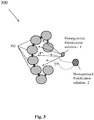
- Fig. 3 illustrates an exemplary diagram of pores of grain 300 and fortification thereto, adsorption process under controlled ambient absorption.
- the grain 300 has micro pores (less than 2 nm in diameter) and meso pores (2 - 5 nm in diameter).
- the molecular 302 structure of the grain 300 as illustrated in Fig. 3 depicts the pores therein.
- the homogenized fortification solution - 1 has molecular size less than 2 nm in diameter.
- the homogenized fortification solution - 1 includes, but not limited to, a mineral fortifying solution including, but not limited to, iron, zinc, chloride, calcium, phosphorous, magnesium, manganese, molybdenum, fluoride, iodine, selenium, copper and the like.
- the homogenized fortification solution - 1 is adsorbed by micro pores of the grain 300.
- the homogenized fortification solution - 2 has molecular size 2 - 5 nm in diameter.
- the homogenized fortification solution - 2 includes, but not limited to, a vitamin fortifying solution including, but not limiting to, Vitamin A, B1, B2, B3, B5, B6, B 12, D, E, K, Choline, folate and the like.
- the homogenized fortification solution - 2 is adsorbed by meso pores of the grain 300.
- the homogenized fortification solution - 1 is adsorbed before the homogenized fortification solution - 2. This prevents the larger molecular sized homogenized fortification solution - 2 from blocking the way of smaller molecular sized homogenized fortification solution - 1.
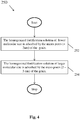
- Fig. 4 illustrates an exemplary process 250 of absorption of homogenized fortification solution under controlled ambient absorption conditions by filling of micro and meso pores of the grains.
- This process 250 is an exemplary elaboration of the step 250 of Fig. 2 .
- the grain has micro as well as meso pores in its molecular structure. Therefore, more effective way to fortify a grain is to fortify it with homogenized fortification solution that can fill up the micro as well as meso pores of the grain.
- the homogenized fortification solution of lower molecular size is adsorbed by the micro pores ( ⁇ 2nm) of the grain.
- the homogenized fortification solution of lower molecular size includes, but not limited to, a mineral fortifying solution such as iron, zinc, chloride, calcium, phosphorous, magnesium, manganese, molybdenum, fluoride, iodine, selenium, copper and the like.
- the homogenized fortification solution of larger molecular size is adsorbed by the meso pores (2 - 5 nm) of the grain.
- the homogenized fortification solution of larger molecular size includes, but not limited to, a vitamin fortifying solution such as Vitamin A, B1, B2, B3, B5, B6, B12, D, E, K, Choline, folate and the like.
- the homogenized fortification solution of smaller molecular size is adsorbed before the homogenized fortification solution of larger molecular size.
- the homogenized fortification solution of lower molecular size is fed in the fortification reactor before the homogenized fortification solution of larger molecular size.
- phytochemical fortifying solution is fed in the fortification reactor with the grains to add flavour.
- the phytochemical fortifying solution includes elements including, but not limited to, Indoles, Lycopene, Sylimarin, Ellagic acid, Flavonoids, Phthalides, Sulfaforaphane, Glucosinolates, Isothiocyanates, Thiocyanates, Thiols, Glycyrrhizin, Polyacetylenes, Gingerols, Flavonoids, Monoterpenes, Carotenoids, Monoterpenes, Allylil sulphides, Curcumin, Cinnamaldehide, Catechins, Rosmarinic acid, Coumestans, Resveratrol, Lignans, Phytic acid, Saponins, and the like.
- the system and grain fortification process is disclosed with respect to paddy as the raw food grain.
- Many existing fortification processes disclose methods of rice fortification. While the existing processes achieve their objective of fortification, what is imperative is that fact that the rice grain losses valuable material into the surroundings due to dissolution or breakdown of particles. Therefore, the treatment of paddy would result in a fortified grain without harming the kernel of the grain (i.e. rice).
- Fig. 5 there is shown an exemplary list of fortificants for fortifying the food grains.
- Fig. 5a shows concentration of various fortificants in a sample fortifying solution used in the inventive process of the present invention.
- Fig. 5b illustrates the World Food Program (WFP) recommended micronutrient levels in fortified rice for human consumption. This is the target composition to be achieved by the inventive process of the present invention.
- WFP World Food Program
- Fig. 6 shows the concentration of Fe and Zn content of the fortified rice produced by the present invention before and after washing. This shows that the fortified paddy produced does not lose the fortificants after washing.
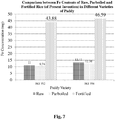
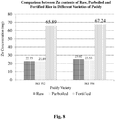
- Figs. 7 and 8 show a comparison of Fe and Zn content in raw rice (2 varieties) and parboiled rice as compared to the fortified rice produced by the inventive process disclosed. This clearly establishes that the rice so produced is higher in fortificants (minerals and vitamins) than the raw rice and paraboiled rice.
- the present invention is a grain fortification process that is feasible, sustainable, effective and efficient. As compared to existing processes such as dusting and coating used to fortify rice, the present invention is more practical since washing is a common preliminary practice in rice cooking and high potion of fortificants are washed away with dusted and coated fortified rice products. Moreover, the present invention has the ability to guarantee equal distribution of fortificants amongst natural grains when mixed in different ratios.
- the present invention produces fortified grains without any issues of decolouration.
- a well-known technology like extrusion wherein the fortificants are not washed away is also the most expensive method in grain fortification.
- the present invention understands and takes the advantage different pores of the grain.
- the fortificants/ nutrients are infused into the garin endosperm by present system and method, the washing/ abrasion losses are very low, which is a major problem with existing technologies involving dusted and coated grains.
- the present invention does not involve an alien layer around kernel like that is in existing fortification processes such as dusting and coating.
Landscapes
- Life Sciences & Earth Sciences (AREA)
- Chemical & Material Sciences (AREA)
- Engineering & Computer Science (AREA)
- Food Science & Technology (AREA)
- Polymers & Plastics (AREA)
- Health & Medical Sciences (AREA)
- Nutrition Science (AREA)
- Cereal-Derived Products (AREA)
- Coloring Foods And Improving Nutritive Qualities (AREA)
Claims (6)
- Kornanreicherungsverfahren, umfassend die Schritte:Einspeisen von rohen Nahrungsmittelkörnern (300) in einen Anreicherungsreaktor (110);Entgasen des rohen Nahrungsmittelkorns (300), indem der Anreicherungsreaktor (110) einem voreingestellten Entgasungszustand unterworfen wird;Zugeben einer homogenisierten Anreicherungslösung in den Anreicherungsreaktor (110) über einen Homogenisator (106) ;Unterziehen der entgasten rohen Nahrungsmittelkörner (300) einem Adsorptionsverfahren, um ein angereichertes Nahrungsmittelkorn herzustellen, wobei das Adsorptionsverfahren die Adsorption der homogenisierten Anreicherungslösung durch das entgaste rohe Nahrungsmittelkorn innerhalb des Anreicherungsreaktors (110) unter vordefinierten kontrollierten Umgebungsadsorptionsbedingungen umfasst; undExtrahieren des angereicherten Nahrungsmittelkorns aus dem Anreicherungsreaktor (110),dadurch gekennzeichnet, dass das Adsorptionsverfahren das Füllen von Mikroporen der rohen Nahrungsmittelkörner (300) mit einer homogenisierten Anreicherungslösung aufweisend eine Molekülgröße von weniger als 2 Nanometer (nm) im Durchmesser, wobei die Mikroporen einen Durchmesser von weniger als 2 nm aufweisen, und danach das Füllen der Mesa-Poren der rohen Nahrungsmittelkörner (300) durch eine homogenisierte Anreicherungslösung aufweisend eine Molekülgröße von 2 bis 5 nm im Durchmesser, wobei die Mesa-Poren einen Durchmesser von 2 bis 5 nm aufweisen, umfasst.
- Verfahren nach Anspruch 1, dadurch gekennzeichnet, dass die Entgasung im Vakuum oder bei einem Druck zwischen 0,1 bis 0,99 bar abs durchgeführt wird.
- Verfahren nach Anspruch 2, wobei das Entgasen bei den vordefinierten kontrollierten Umgebungsentgasungsbedingungen durch Erhitzen des beladenen rohen Nahrungsmittelkorns auf eine Temperatur von weniger als 55 °C für bis zu 20 Minuten durchgeführt wird.
- Verfahren nach Anspruch 1, wobei das Adsorbieren der homogenisierten Anreicherungslösung an den entgasten rohen Nahrungsmittelkörnern unter vordefinierten kontrollierten Umgebungsadsorptionsbedingungen die Zugabe von vorgewärmter Anreicherungslösung in den Anreicherungsreaktor (110) bei etwa einer Temperatur von weniger als der Gelatinierungstemperatur des Korns für eine beliebige Zeit bis zu 360 Minuten umfasst.
- Verfahren nach Anspruch 4, wobei das eingeweichte Nahrungsmittelkorn bei einer Temperatur zwischen 90 °C und 100 °C bis zu etwa 20 Minuten lang dampfgetrocknet wird.
- Verfahren nach Anspruch 1, wobei die mindestens eine Anreicherungslösung aus der Gruppe bestehend aus einer Vitamin-Anreicherungslösung, einer Mikronährstoff-Anreicherungslösung, einer Makronährstoff-Anreicherungslösung, einer Lösung einer bioaktiven funktionellen Verbindung, einer Protein-Anreicherungslösung und/oder einer phytochemischen Anreicherungslösung ausgewählt ist.
Applications Claiming Priority (1)
| Application Number | Priority Date | Filing Date | Title |
|---|---|---|---|
| PCT/IB2016/054917 WO2018033774A1 (en) | 2016-08-17 | 2016-08-17 | Raw grain fortification system and process |
Publications (2)
| Publication Number | Publication Date |
|---|---|
| EP3500111A1 EP3500111A1 (de) | 2019-06-26 |
| EP3500111B1 true EP3500111B1 (de) | 2021-09-29 |
Family
ID=56920886
Family Applications (1)
| Application Number | Title | Priority Date | Filing Date |
|---|---|---|---|
| EP16763961.6A Not-in-force EP3500111B1 (de) | 2016-08-17 | 2016-08-17 | Rohkornanreicherungsverfahren |
Country Status (9)
| Country | Link |
|---|---|
| US (1) | US20190193082A1 (de) |
| EP (1) | EP3500111B1 (de) |
| JP (1) | JP6974657B2 (de) |
| KR (1) | KR20190040260A (de) |
| AU (1) | AU2016419993B2 (de) |
| BR (1) | BR112019003074B1 (de) |
| MY (1) | MY194052A (de) |
| PH (1) | PH12019500320A1 (de) |
| WO (1) | WO2018033774A1 (de) |
Families Citing this family (2)
| Publication number | Priority date | Publication date | Assignee | Title |
|---|---|---|---|---|
| WO2023275600A1 (en) * | 2021-07-02 | 2023-01-05 | Fortigrains Private Limited | Process for fortifying ready to eat rice grains |
| US20230371548A1 (en) * | 2022-05-23 | 2023-11-23 | Double Down Deer Feed LLC | Animal feed and methods of manufacture |
Family Cites Families (7)
| Publication number | Priority date | Publication date | Assignee | Title |
|---|---|---|---|---|
| US2358250A (en) * | 1940-01-22 | 1944-09-12 | Rogers Francis Heron | Treatment of cereals prior to flour milling |
| US2555235A (en) * | 1944-06-09 | 1951-05-29 | Mars And Huzenlaub | Process for treatment of cereals |
| GB831258A (en) * | 1956-11-16 | 1960-03-23 | Agronomique Inst Nat Rech | Improvements in vitaminised products |
| DE1913359A1 (de) * | 1968-03-18 | 1969-10-02 | Kyowa Hakko Kogyo Kk | Anreicherung von Koernerfruechten |
| SE441491B (sv) * | 1974-07-17 | 1985-10-14 | Victor M Dr Lewis | Forfarande for inforlivande av en eller flera tillsatser i etliga fron eller korn |
| US7416752B2 (en) * | 2004-01-06 | 2008-08-26 | Sharp Ingrained Functional Foods, Inc. | Method of fortifying seeds with an essential fatty acid, fortified seed and food product |
| JP2010110240A (ja) * | 2008-11-05 | 2010-05-20 | Satake Corp | 被覆剤及びその製造方法並びに装置 |
-
2016
- 2016-08-17 KR KR1020197007611A patent/KR20190040260A/ko not_active Ceased
- 2016-08-17 BR BR112019003074-3A patent/BR112019003074B1/pt not_active IP Right Cessation
- 2016-08-17 WO PCT/IB2016/054917 patent/WO2018033774A1/en not_active Ceased
- 2016-08-17 JP JP2019530240A patent/JP6974657B2/ja not_active Expired - Fee Related
- 2016-08-17 MY MYPI2019000824A patent/MY194052A/en unknown
- 2016-08-17 US US16/325,514 patent/US20190193082A1/en not_active Abandoned
- 2016-08-17 AU AU2016419993A patent/AU2016419993B2/en not_active Ceased
- 2016-08-17 EP EP16763961.6A patent/EP3500111B1/de not_active Not-in-force
-
2019
- 2019-02-15 PH PH12019500320A patent/PH12019500320A1/en unknown
Also Published As
| Publication number | Publication date |
|---|---|
| WO2018033774A1 (en) | 2018-02-22 |
| AU2016419993A1 (en) | 2019-04-11 |
| MY194052A (en) | 2022-11-09 |
| KR20190040260A (ko) | 2019-04-17 |
| JP2019524161A (ja) | 2019-09-05 |
| US20190193082A1 (en) | 2019-06-27 |
| PH12019500320A1 (en) | 2019-05-20 |
| BR112019003074A2 (pt) | 2019-05-21 |
| AU2016419993B2 (en) | 2021-10-28 |
| BR112019003074B1 (pt) | 2022-05-10 |
| JP6974657B2 (ja) | 2021-12-01 |
| EP3500111A1 (de) | 2019-06-26 |
Similar Documents
| Publication | Publication Date | Title |
|---|---|---|
| Thomas et al. | Composition of amino Acids, fatty acids, minerals and dietary fiber in some of the local and import rice varieties of Malaysia. | |
| Rocha‐Villarreal et al. | Effects of parboiling and other hydrothermal treatments on the physical, functional, and nutritional properties of rice and other cereals | |
| Rumruaytum et al. | Effect of drying involving fluidisation in superheated steam on physicochemical and antioxidant properties of Thai native rice cultivars | |
| Nachaisin et al. | Application of combined far‐infrared radiation and air convection for drying of instant germinated brown rice | |
| Oghbaei et al. | Bioaccessible nutrients and bioactive components from fortified products prepared using finger millet (Eleusine coracana) | |
| Moreno et al. | The effect of different nixtamalisation processes on some physicochemical properties, nutritional composition and glycemic index | |
| Balbinoti et al. | Parboiled rice and parboiling process | |
| Devi et al. | Effect of popping on physicochemical, technological, antioxidant, and microstructural properties of makhana seed | |
| Stone et al. | Processing and quality aspects of bulgur from Triticum durum | |
| EP3500111B1 (de) | Rohkornanreicherungsverfahren | |
| Balakrishna et al. | Enrichment of rice with natural thiamine using high-pressure processing (HPP) | |
| Wahengbam et al. | Effect of iron and folic acid fortification on in vitro bioavailability and starch hydrolysis in ready-to-eat parboiled rice | |
| Kumar et al. | Combinatorial effect of heat processing and phytic acid on mineral bioavailability in rice grain | |
| Zhang et al. | Superheated steam technology: Recent developments and applications in food industries | |
| Balakrishna et al. | Effect of high pressure impregnation on micronutrient transfer in rice | |
| de Mejia et al. | Industrial processing of condiments and seasonings and its implications for micronutrient fortification | |
| Sirisoontaralak et al. | Effects of soaking and acidification on physicochemical properties of calcium‐fortified rice | |
| Jafari et al. | Drying technology in food processing: unit operations and processing equipment in the food industry | |
| Montanuci et al. | Influence of roasting temperature of barley on the powder characteristics and preparation of tea | |
| CN103416659A (zh) | 一种营养米及其制作方法 | |
| EP2219471A1 (de) | Ballaststoffangereicherte, proteinbeschichtete getreideprodukte | |
| Wahengbam et al. | Characterization of a novel folic acid‐fortified ready‐to‐eat parboiled rice | |
| Knockaert et al. | Changes in β-carotene during processing of carrots | |
| Seneviratne et al. | Development of a Diffusion Based Fortification System and Process to Improve the Iron and Zinc Content in Rice | |
| WO2023275600A1 (en) | Process for fortifying ready to eat rice grains |
Legal Events
| Date | Code | Title | Description |
|---|---|---|---|
| STAA | Information on the status of an ep patent application or granted ep patent |
Free format text: STATUS: THE INTERNATIONAL PUBLICATION HAS BEEN MADE |
|
| PUAI | Public reference made under article 153(3) epc to a published international application that has entered the european phase |
Free format text: ORIGINAL CODE: 0009012 |
|
| STAA | Information on the status of an ep patent application or granted ep patent |
Free format text: STATUS: REQUEST FOR EXAMINATION WAS MADE |
|
| 17P | Request for examination filed |
Effective date: 20190315 |
|
| AK | Designated contracting states |
Kind code of ref document: A1 Designated state(s): AL AT BE BG CH CY CZ DE DK EE ES FI FR GB GR HR HU IE IS IT LI LT LU LV MC MK MT NL NO PL PT RO RS SE SI SK SM TR |
|
| AX | Request for extension of the european patent |
Extension state: BA ME |
|
| DAV | Request for validation of the european patent (deleted) | ||
| DAX | Request for extension of the european patent (deleted) | ||
| STAA | Information on the status of an ep patent application or granted ep patent |
Free format text: STATUS: EXAMINATION IS IN PROGRESS |
|
| 17Q | First examination report despatched |
Effective date: 20200515 |
|
| GRAP | Despatch of communication of intention to grant a patent |
Free format text: ORIGINAL CODE: EPIDOSNIGR1 |
|
| STAA | Information on the status of an ep patent application or granted ep patent |
Free format text: STATUS: GRANT OF PATENT IS INTENDED |
|
| RIC1 | Information provided on ipc code assigned before grant |
Ipc: A23L 7/10 20160101AFI20210304BHEP Ipc: B02B 1/00 20060101ALI20210304BHEP Ipc: A23P 30/00 20160101ALI20210304BHEP Ipc: A23L 7/196 20160101ALI20210304BHEP |
|
| INTG | Intention to grant announced |
Effective date: 20210331 |
|
| GRAS | Grant fee paid |
Free format text: ORIGINAL CODE: EPIDOSNIGR3 |
|
| GRAA | (expected) grant |
Free format text: ORIGINAL CODE: 0009210 |
|
| STAA | Information on the status of an ep patent application or granted ep patent |
Free format text: STATUS: THE PATENT HAS BEEN GRANTED |
|
| RAP1 | Party data changed (applicant data changed or rights of an application transferred) |
Owner name: FORTIGRAINS PVT. LTD. |
|
| RIN1 | Information on inventor provided before grant (corrected) |
Inventor name: HETTIARACHCHY, ARIYAWANSA Inventor name: SENEVIRATNE, R. A. C. HAILY Inventor name: GUNAWARDANA, MANJU S. |
|
| AK | Designated contracting states |
Kind code of ref document: B1 Designated state(s): AL AT BE BG CH CY CZ DE DK EE ES FI FR GB GR HR HU IE IS IT LI LT LU LV MC MK MT NL NO PL PT RO RS SE SI SK SM TR |
|
| REG | Reference to a national code |
Ref country code: GB Ref legal event code: FG4D |
|
| REG | Reference to a national code |
Ref country code: CH Ref legal event code: EP Ref country code: AT Ref legal event code: REF Ref document number: 1433447 Country of ref document: AT Kind code of ref document: T Effective date: 20211015 |
|
| REG | Reference to a national code |
Ref country code: DE Ref legal event code: R096 Ref document number: 602016064347 Country of ref document: DE |
|
| REG | Reference to a national code |
Ref country code: IE Ref legal event code: FG4D |
|
| REG | Reference to a national code |
Ref country code: LT Ref legal event code: MG9D |
|
| PG25 | Lapsed in a contracting state [announced via postgrant information from national office to epo] |
Ref country code: SE Free format text: LAPSE BECAUSE OF FAILURE TO SUBMIT A TRANSLATION OF THE DESCRIPTION OR TO PAY THE FEE WITHIN THE PRESCRIBED TIME-LIMIT Effective date: 20210929 Ref country code: RS Free format text: LAPSE BECAUSE OF FAILURE TO SUBMIT A TRANSLATION OF THE DESCRIPTION OR TO PAY THE FEE WITHIN THE PRESCRIBED TIME-LIMIT Effective date: 20210929 Ref country code: BG Free format text: LAPSE BECAUSE OF FAILURE TO SUBMIT A TRANSLATION OF THE DESCRIPTION OR TO PAY THE FEE WITHIN THE PRESCRIBED TIME-LIMIT Effective date: 20211229 Ref country code: LT Free format text: LAPSE BECAUSE OF FAILURE TO SUBMIT A TRANSLATION OF THE DESCRIPTION OR TO PAY THE FEE WITHIN THE PRESCRIBED TIME-LIMIT Effective date: 20210929 Ref country code: NO Free format text: LAPSE BECAUSE OF FAILURE TO SUBMIT A TRANSLATION OF THE DESCRIPTION OR TO PAY THE FEE WITHIN THE PRESCRIBED TIME-LIMIT Effective date: 20211229 Ref country code: HR Free format text: LAPSE BECAUSE OF FAILURE TO SUBMIT A TRANSLATION OF THE DESCRIPTION OR TO PAY THE FEE WITHIN THE PRESCRIBED TIME-LIMIT Effective date: 20210929 Ref country code: FI Free format text: LAPSE BECAUSE OF FAILURE TO SUBMIT A TRANSLATION OF THE DESCRIPTION OR TO PAY THE FEE WITHIN THE PRESCRIBED TIME-LIMIT Effective date: 20210929 |
|
| REG | Reference to a national code |
Ref country code: NL Ref legal event code: MP Effective date: 20210929 |
|
| REG | Reference to a national code |
Ref country code: AT Ref legal event code: MK05 Ref document number: 1433447 Country of ref document: AT Kind code of ref document: T Effective date: 20210929 |
|
| PG25 | Lapsed in a contracting state [announced via postgrant information from national office to epo] |
Ref country code: LV Free format text: LAPSE BECAUSE OF FAILURE TO SUBMIT A TRANSLATION OF THE DESCRIPTION OR TO PAY THE FEE WITHIN THE PRESCRIBED TIME-LIMIT Effective date: 20210929 Ref country code: GR Free format text: LAPSE BECAUSE OF FAILURE TO SUBMIT A TRANSLATION OF THE DESCRIPTION OR TO PAY THE FEE WITHIN THE PRESCRIBED TIME-LIMIT Effective date: 20211230 |
|
| PG25 | Lapsed in a contracting state [announced via postgrant information from national office to epo] |
Ref country code: AT Free format text: LAPSE BECAUSE OF FAILURE TO SUBMIT A TRANSLATION OF THE DESCRIPTION OR TO PAY THE FEE WITHIN THE PRESCRIBED TIME-LIMIT Effective date: 20210929 |
|
| PG25 | Lapsed in a contracting state [announced via postgrant information from national office to epo] |
Ref country code: IS Free format text: LAPSE BECAUSE OF FAILURE TO SUBMIT A TRANSLATION OF THE DESCRIPTION OR TO PAY THE FEE WITHIN THE PRESCRIBED TIME-LIMIT Effective date: 20220129 Ref country code: SK Free format text: LAPSE BECAUSE OF FAILURE TO SUBMIT A TRANSLATION OF THE DESCRIPTION OR TO PAY THE FEE WITHIN THE PRESCRIBED TIME-LIMIT Effective date: 20210929 Ref country code: RO Free format text: LAPSE BECAUSE OF FAILURE TO SUBMIT A TRANSLATION OF THE DESCRIPTION OR TO PAY THE FEE WITHIN THE PRESCRIBED TIME-LIMIT Effective date: 20210929 Ref country code: PT Free format text: LAPSE BECAUSE OF FAILURE TO SUBMIT A TRANSLATION OF THE DESCRIPTION OR TO PAY THE FEE WITHIN THE PRESCRIBED TIME-LIMIT Effective date: 20220131 Ref country code: PL Free format text: LAPSE BECAUSE OF FAILURE TO SUBMIT A TRANSLATION OF THE DESCRIPTION OR TO PAY THE FEE WITHIN THE PRESCRIBED TIME-LIMIT Effective date: 20210929 Ref country code: NL Free format text: LAPSE BECAUSE OF FAILURE TO SUBMIT A TRANSLATION OF THE DESCRIPTION OR TO PAY THE FEE WITHIN THE PRESCRIBED TIME-LIMIT Effective date: 20210929 Ref country code: ES Free format text: LAPSE BECAUSE OF FAILURE TO SUBMIT A TRANSLATION OF THE DESCRIPTION OR TO PAY THE FEE WITHIN THE PRESCRIBED TIME-LIMIT Effective date: 20210929 Ref country code: EE Free format text: LAPSE BECAUSE OF FAILURE TO SUBMIT A TRANSLATION OF THE DESCRIPTION OR TO PAY THE FEE WITHIN THE PRESCRIBED TIME-LIMIT Effective date: 20210929 Ref country code: CZ Free format text: LAPSE BECAUSE OF FAILURE TO SUBMIT A TRANSLATION OF THE DESCRIPTION OR TO PAY THE FEE WITHIN THE PRESCRIBED TIME-LIMIT Effective date: 20210929 Ref country code: AL Free format text: LAPSE BECAUSE OF FAILURE TO SUBMIT A TRANSLATION OF THE DESCRIPTION OR TO PAY THE FEE WITHIN THE PRESCRIBED TIME-LIMIT Effective date: 20210929 |
|
| REG | Reference to a national code |
Ref country code: DE Ref legal event code: R097 Ref document number: 602016064347 Country of ref document: DE |
|
| PG25 | Lapsed in a contracting state [announced via postgrant information from national office to epo] |
Ref country code: DK Free format text: LAPSE BECAUSE OF FAILURE TO SUBMIT A TRANSLATION OF THE DESCRIPTION OR TO PAY THE FEE WITHIN THE PRESCRIBED TIME-LIMIT Effective date: 20210929 |
|
| PLBE | No opposition filed within time limit |
Free format text: ORIGINAL CODE: 0009261 |
|
| STAA | Information on the status of an ep patent application or granted ep patent |
Free format text: STATUS: NO OPPOSITION FILED WITHIN TIME LIMIT |
|
| 26N | No opposition filed |
Effective date: 20220630 |
|
| PG25 | Lapsed in a contracting state [announced via postgrant information from national office to epo] |
Ref country code: SI Free format text: LAPSE BECAUSE OF FAILURE TO SUBMIT A TRANSLATION OF THE DESCRIPTION OR TO PAY THE FEE WITHIN THE PRESCRIBED TIME-LIMIT Effective date: 20210929 |
|
| PG25 | Lapsed in a contracting state [announced via postgrant information from national office to epo] |
Ref country code: IT Free format text: LAPSE BECAUSE OF FAILURE TO SUBMIT A TRANSLATION OF THE DESCRIPTION OR TO PAY THE FEE WITHIN THE PRESCRIBED TIME-LIMIT Effective date: 20210929 |
|
| REG | Reference to a national code |
Ref country code: DE Ref legal event code: R119 Ref document number: 602016064347 Country of ref document: DE |
|
| PG25 | Lapsed in a contracting state [announced via postgrant information from national office to epo] |
Ref country code: MC Free format text: LAPSE BECAUSE OF FAILURE TO SUBMIT A TRANSLATION OF THE DESCRIPTION OR TO PAY THE FEE WITHIN THE PRESCRIBED TIME-LIMIT Effective date: 20210929 |
|
| REG | Reference to a national code |
Ref country code: CH Ref legal event code: PL |
|
| GBPC | Gb: european patent ceased through non-payment of renewal fee |
Effective date: 20220817 |
|
| PG25 | Lapsed in a contracting state [announced via postgrant information from national office to epo] |
Ref country code: LU Free format text: LAPSE BECAUSE OF NON-PAYMENT OF DUE FEES Effective date: 20220817 Ref country code: LI Free format text: LAPSE BECAUSE OF NON-PAYMENT OF DUE FEES Effective date: 20220831 Ref country code: CH Free format text: LAPSE BECAUSE OF NON-PAYMENT OF DUE FEES Effective date: 20220831 |
|
| REG | Reference to a national code |
Ref country code: BE Ref legal event code: MM Effective date: 20220831 |
|
| PG25 | Lapsed in a contracting state [announced via postgrant information from national office to epo] |
Ref country code: IE Free format text: LAPSE BECAUSE OF NON-PAYMENT OF DUE FEES Effective date: 20220817 Ref country code: FR Free format text: LAPSE BECAUSE OF NON-PAYMENT OF DUE FEES Effective date: 20220831 Ref country code: DE Free format text: LAPSE BECAUSE OF NON-PAYMENT OF DUE FEES Effective date: 20230301 |
|
| PG25 | Lapsed in a contracting state [announced via postgrant information from national office to epo] |
Ref country code: BE Free format text: LAPSE BECAUSE OF NON-PAYMENT OF DUE FEES Effective date: 20220831 |
|
| PG25 | Lapsed in a contracting state [announced via postgrant information from national office to epo] |
Ref country code: GB Free format text: LAPSE BECAUSE OF NON-PAYMENT OF DUE FEES Effective date: 20220817 |
|
| PG25 | Lapsed in a contracting state [announced via postgrant information from national office to epo] |
Ref country code: HU Free format text: LAPSE BECAUSE OF FAILURE TO SUBMIT A TRANSLATION OF THE DESCRIPTION OR TO PAY THE FEE WITHIN THE PRESCRIBED TIME-LIMIT; INVALID AB INITIO Effective date: 20160817 |
|
| PG25 | Lapsed in a contracting state [announced via postgrant information from national office to epo] |
Ref country code: SM Free format text: LAPSE BECAUSE OF FAILURE TO SUBMIT A TRANSLATION OF THE DESCRIPTION OR TO PAY THE FEE WITHIN THE PRESCRIBED TIME-LIMIT Effective date: 20210929 Ref country code: CY Free format text: LAPSE BECAUSE OF FAILURE TO SUBMIT A TRANSLATION OF THE DESCRIPTION OR TO PAY THE FEE WITHIN THE PRESCRIBED TIME-LIMIT Effective date: 20210929 |
|
| PG25 | Lapsed in a contracting state [announced via postgrant information from national office to epo] |
Ref country code: MK Free format text: LAPSE BECAUSE OF FAILURE TO SUBMIT A TRANSLATION OF THE DESCRIPTION OR TO PAY THE FEE WITHIN THE PRESCRIBED TIME-LIMIT Effective date: 20210929 |
|
| PG25 | Lapsed in a contracting state [announced via postgrant information from national office to epo] |
Ref country code: MT Free format text: LAPSE BECAUSE OF FAILURE TO SUBMIT A TRANSLATION OF THE DESCRIPTION OR TO PAY THE FEE WITHIN THE PRESCRIBED TIME-LIMIT Effective date: 20210929 |
|
| PG25 | Lapsed in a contracting state [announced via postgrant information from national office to epo] |
Ref country code: TR Free format text: LAPSE BECAUSE OF FAILURE TO SUBMIT A TRANSLATION OF THE DESCRIPTION OR TO PAY THE FEE WITHIN THE PRESCRIBED TIME-LIMIT Effective date: 20210929 |