EP3500925B1 - Système et procédé pour sécuriser un réseau sans fil - Google Patents
Système et procédé pour sécuriser un réseau sans fil Download PDFInfo
- Publication number
- EP3500925B1 EP3500925B1 EP17841980.0A EP17841980A EP3500925B1 EP 3500925 B1 EP3500925 B1 EP 3500925B1 EP 17841980 A EP17841980 A EP 17841980A EP 3500925 B1 EP3500925 B1 EP 3500925B1
- Authority
- EP
- European Patent Office
- Prior art keywords
- mobile device
- application
- client
- server
- wireless network
- Prior art date
- Legal status (The legal status is an assumption and is not a legal conclusion. Google has not performed a legal analysis and makes no representation as to the accuracy of the status listed.)
- Active
Links
Images






Classifications
-
- H—ELECTRICITY
- H04—ELECTRIC COMMUNICATION TECHNIQUE
- H04W—WIRELESS COMMUNICATION NETWORKS
- H04W12/00—Security arrangements; Authentication; Protecting privacy or anonymity
- H04W12/08—Access security
-
- G—PHYSICS
- G06—COMPUTING OR CALCULATING; COUNTING
- G06F—ELECTRIC DIGITAL DATA PROCESSING
- G06F11/00—Error detection; Error correction; Monitoring
- G06F11/30—Monitoring
- G06F11/3003—Monitoring arrangements specially adapted to the computing system or computing system component being monitored
- G06F11/302—Monitoring arrangements specially adapted to the computing system or computing system component being monitored where the computing system component is a software system
-
- H—ELECTRICITY
- H04—ELECTRIC COMMUNICATION TECHNIQUE
- H04L—TRANSMISSION OF DIGITAL INFORMATION, e.g. TELEGRAPHIC COMMUNICATION
- H04L63/00—Network architectures or network communication protocols for network security
- H04L63/02—Network architectures or network communication protocols for network security for separating internal from external traffic, e.g. firewalls
- H04L63/0272—Virtual private networks
-
- H—ELECTRICITY
- H04—ELECTRIC COMMUNICATION TECHNIQUE
- H04L—TRANSMISSION OF DIGITAL INFORMATION, e.g. TELEGRAPHIC COMMUNICATION
- H04L63/00—Network architectures or network communication protocols for network security
- H04L63/10—Network architectures or network communication protocols for network security for controlling access to devices or network resources
- H04L63/101—Access control lists [ACL]
-
- H—ELECTRICITY
- H04—ELECTRIC COMMUNICATION TECHNIQUE
- H04L—TRANSMISSION OF DIGITAL INFORMATION, e.g. TELEGRAPHIC COMMUNICATION
- H04L63/00—Network architectures or network communication protocols for network security
- H04L63/14—Network architectures or network communication protocols for network security for detecting or protecting against malicious traffic
- H04L63/1441—Countermeasures against malicious traffic
-
- H—ELECTRICITY
- H04—ELECTRIC COMMUNICATION TECHNIQUE
- H04L—TRANSMISSION OF DIGITAL INFORMATION, e.g. TELEGRAPHIC COMMUNICATION
- H04L67/00—Network arrangements or protocols for supporting network services or applications
- H04L67/14—Session management
- H04L67/141—Setup of application sessions
-
- H—ELECTRICITY
- H04—ELECTRIC COMMUNICATION TECHNIQUE
- H04W—WIRELESS COMMUNICATION NETWORKS
- H04W12/00—Security arrangements; Authentication; Protecting privacy or anonymity
- H04W12/08—Access security
- H04W12/084—Access security using delegated authorisation, e.g. open authorisation [OAuth] protocol
-
- H—ELECTRICITY
- H04—ELECTRIC COMMUNICATION TECHNIQUE
- H04W—WIRELESS COMMUNICATION NETWORKS
- H04W12/00—Security arrangements; Authentication; Protecting privacy or anonymity
- H04W12/12—Detection or prevention of fraud
- H04W12/121—Wireless intrusion detection systems [WIDS]; Wireless intrusion prevention systems [WIPS]
- H04W12/122—Counter-measures against attacks; Protection against rogue devices
-
- H—ELECTRICITY
- H04—ELECTRIC COMMUNICATION TECHNIQUE
- H04W—WIRELESS COMMUNICATION NETWORKS
- H04W84/00—Network topologies
- H04W84/02—Hierarchically pre-organised networks, e.g. paging networks, cellular networks, WLAN [Wireless Local Area Network] or WLL [Wireless Local Loop]
- H04W84/10—Small scale networks; Flat hierarchical networks
- H04W84/12—WLAN [Wireless Local Area Networks]
Definitions
- the present application generally relates to network security technology and more particularly, to security systems and methods for wireless network security.
- a mobile device such as a smart phone or a tablet or a laptop computer connects to a public Wireless-Fidelity (Wi-Fi) network at a public place (e.g., a mall, restaurant, movie theater, KTV, bar, airport, hotel, subway, etc.)
- Wi-Fi Wireless-Fidelity
- a large number of users unknown to each other transmit data traffic over the shared Wi-Fi network.
- a legitimate user connects to the public Wi-Fi network via his or her mobile device and decides to perform a security sensitive transaction such as making a payment on the mobile device.
- the payment transaction is vulnerable for being eavesdropped or snooped by a malicious user who is also connected to the public Wi-Fi, resulting in the sensitive information such as the legitimate user's password, account number, or the like being stolen by the malicious user. Therefore, there exists a need for wireless network security over an insecure wireless network such as a public Wi-Fi network.
- WO 2015188718 describes a mobile terminal-based payment method and apparatus, and mobile terminal.
- the mobile terminal-based payment method comprises: determining a mobile terminal has entered a payment scenario; detecting the network connection type of the mobile terminal; on the basis of the network connection type, establishing a secure network transmission channel from the mobile terminal to a payment server; and using the secure network transmission channel to transmit payment data until the payment is complete.
- Using a VPN or other tunnelling transmission technology to implement a secure network transmission channel for implementing mobile payment fulfils the secure switching requirements of different network service and secure payment applications, ensuring that during the process of a payment operation, the mobile terminal only connects to a dedicated mobile secure payment data network, eliminating the security risks of mobile payment caused by the transmission channel.
- the present invention is defined in the independent claims. Preferred embodiments are defined in the dependent claims.
- the invention can be implemented in numerous ways, including as a process; an apparatus; a system; a composition of matter; a computer program product embodied on a computer readable storage medium; and/or a processor, such as a processor configured to execute instructions stored on and/or provided by a memory coupled to the processor.
- these implementations, or any other form that the invention may take, may be referred to as techniques.
- the order of the steps of disclosed processes may be altered within the scope of the invention.
- a component such as a processor or a memory described as being configured to perform a task may be implemented as a general component that is temporarily configured to perform the task at a given time or a specific component that is manufactured to perform the task.
- the term 'processor' refers to one or more devices, circuits, and/or processing cores configured to process data, such as computer program instructions.
- first means "first,” “second,” “third,” and so on to describe various information
- this information shall not be limited by these terms. These terms merely serve to differentiate pieces of information of the same category. For example, so long as they remain within the scope of the present application, a first piece of information could be called a second piece of information. Similarly, a second piece of information could be called a first piece of information.
- the term “if” that is used herein may be interpreted as "when” or "upon being confirmed,” depending on the context.
- client refers to a program that interacts with its corresponding server in order to provide a service to a user of the client.
- app refers to an application installed on a mobile device such as a smart phone, a tablet, a wearable device, or the like.
- VPN virtual private network
- public network connections e.g., wired or wireless connections
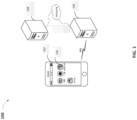
- FIG. 1 illustrates a block diagram of an example wireless network security system in accordance with an embodiment of the present disclosure.
- system 100 comprises a mobile device 102, a first server 106, and a second server 108.
- a client 104 is installed on mobile device 102, and capable of establishing a secure communication channel with first server 106.
- Second server 108 is configured to service one or more applications (apps) running on mobile device 102.
- Second server 108 is also in communication with first server 106.
- apps include, for example, security sensitive apps that a user of mobile device 102 operates.
- FIG. 1 illustrates a block diagram of an example wireless network security system in accordance with an embodiment of the present disclosure.
- system 100 comprises a mobile device 102, a first server 106, and a second server 108.
- a client 104 is installed on mobile device 102, and capable of establishing a secure communication channel with first server 106.
- Second server 108 is configured to service one or more applications (apps) running on mobile
- Mobile device 102 can be a computing device, such as a smart phone, tablet computer, personal computer, laptop, personal digital assistant (PDA), wearable device, or the like with one or more wired, wireless, or any other suitable communication connections to first server 106.
- a computing device such as a smart phone, tablet computer, personal computer, laptop, personal digital assistant (PDA), wearable device, or the like with one or more wired, wireless, or any other suitable communication connections to first server 106.
- PDA personal digital assistant
- mobile device 102 is configured to directly access an IP Network through a Wi-Fi (802.11) connection. Once connected to the IP Network, mobile device 102 connects and communicates with one or more entities, e.g., first server 106 and second server 108, which are also in communication with the IP network. For example, the user of mobile device 102 can connect with an e-commerce service hosted at second server 108 to conduct on-line shopping, or with a video service hosted at second server 108 to stream movie-clips.
- entities e.g., first server 106 and second server 108
- the user of mobile device 102 can connect with an e-commerce service hosted at second server 108 to conduct on-line shopping, or with a video service hosted at second server 108 to stream movie-clips.
- mobile device 102 is configured to, via a variety of apps, interact with entities for security sensitive operations or transactions such as managing accounts, making payments, or a variety of other tasks that involve accessing, updating, and transmitting user sensitive information.
- entities for security sensitive operations or transactions such as managing accounts, making payments, or a variety of other tasks that involve accessing, updating, and transmitting user sensitive information.
- the user may make a payment online with a merchant and share credit card information with the merchant.
- the user may manage their online credit card accounts with the credit card issuer.
- the user may also connect to a financial institution through their mobile device 102, for managing bank accounts.
- User sensitive information includes, for example, personal information (e.g., birth dates, social security numbers, etc.) and personal account information (e.g., credit card numbers, account numbers, passwords, etc.), for secure transactions such as accessing bank accounts or making payments.
- Mobile apps making use of such user sensitive information are referred to herein as security sensitive apps.
- Alipay TM is the security sensitive app.
- client 104 After mobile device 102 is connected to a wireless network, client 104 is configured to determine whether the network type of the existing wireless network is an insecure type or a secure type. When client 104 detects the existing wireless network as, for example, a public Wi-Fi, a password free Wi-Fi, a free-of-charge Wi-Fi, a Wi-Fi unknown to mobile device 102, a Wi-Fi not frequently accessed by mobile device 102, or the like, client 104 determines that mobile device 102 is connected to an insecure type of network. On the other hand, if client 104 detects the existing wireless network as a password protected Wi-Fi or a Wi-Fi frequently accessed by mobile device 102, client 104 determines that mobile device 102 is on a secure type of network.
- client 104 Upon determining that the existing wireless network mobile device 102 is connected to an insecure type of network, client 104 causes mobile device 102 to enter into a secure mode. In this secure mode, client 104 monitors to detect whether a security sensitive app, e.g., a financial transaction app, is to be activated or launched on mobile device 102 by the user. When client 104 detects that a security sensitive app is to be activated, client 104 causes mobile device 102 to establish a secure communication channel with first server 106. In this example, the secure communication channel is a VPN connection and client 104 causes mobile device 102 to establish a VPN connection by launching a VPN application.
- a security sensitive app e.g., a financial transaction app
- client 104 is configured to monitor the operations or transactions of the security sensitive app, and to cause messages generated by the security sensitive app to be transmitted to first server 106 using the secure communication channel.
- First server 106 is configured to receive via the secure communication channel messages generated by the security sensitive app and to forward the messages to second server 108 for processing.
- the message generated by the security sensitive app e.g., Alipay TM
- client 104 is further configured to detect whether the current display interface of mobile device 102 is displaying the user interface of the security sensitive app. The detection can be performed by invoking an operating system call such as registering a listener to be notified once the system display's visibility changes for one or more particular user interface components.
- client 104 causes mobile device 102 to disconnect from the secured communication channel but to maintain a connection with first server 106 via the existing insecure wireless network.
- client 104 when it is determined that the type of the current wireless connection, e.g., a Wi-Fi connection, is insecure, client 104 enters into a secure mode.
- a security sensitive app e.g., Alipay TM
- client 104 When a security sensitive app, e.g., Alipay TM , is activated on mobile device 102 with client 104 in the secure mode, client 104 establishes a secure communication channel, e.g., a VPN connection, with first server 106.
- client 104 is the Ali Money Shield TM app and client 104 can be configured upon installation to allow a user to select mobile apps for Ali Money Shield TM to provide for security. With user configured inter-app communication permissions, client 104 can be authorized to access transactions and statuses of the apps selected.
- client 104 starts monitoring the operations of Alipay TM and forwarding messages generated by the operations of Alipay TM via the secure communication channel to first server 106.
- This prevents a malicious user from stealing sensitive information such as a legitimate user's password to Alipay TM when the legitimate user operates Alipay TM to transmit sensitive information on a public network. Therefore, secure transactions on mobile device 102 are ensured even though the user accesses a risky network, e.g., a public Wi-Fi network, on mobile device 102.
- the secure communication channel e.g., VPN
- the secure communication channel is established only when the security sensitive app is activated so that client 104 would not generate excessive system loads on first server 106 by maintaining a long-term connection.
- secured communication transmitted to and from first server 106 can also be reduced to preserve system resources.
- FIG. 2A is a flowchart of an example process for secure wireless network connections in accordance with an embodiment of the present disclosure.
- FIG. 2B is a schematic illustration of a screen shot of an example scenario of process 200 of FIG. 2A in operation in accordance with an embodiment of the present disclosure.
- Process 200 can be implemented by, for example but is not limited to, client 104 on mobile device 102 of FIG. 1 .
- process 200 starts at 201, where the type of wireless network a mobile device is connected to is acquired.
- a mobile device is currently connected to a Wi-Fi network.
- the types of a Wi-Fi network include, for example, a free-of-charge Wi-Fi network, a password-free Wi-Fi network, a Wi-Fi network not frequently visited by the mobile device, a Wi-Fi network unknown to the mobile device, or the like.
- the above-described types of Wi-Fi are considered insecure types of Wi-Fi connections.
- a password-protected Wi-Fi or a Wi-Fi frequently accessed by the user of the mobile device is considered a secure type of Wi-Fi.
- Types of the wireless network can be configured according to various usages or demands of networks without limitations.
- process 200 starts to monitor an app for secure transactions.
- the application is a pre-configured security sensitive app, such as the payment app of Alipay TM .
- any types of apps can be monitored by process 200, or pre-configured for secure transaction and to be monitored by process 200.
- the monitored aspects of an app include, for example, whether the app is to be activated, whether the app has exited from operation, operations or transactions performed by the user using the app, etc.
- the client can be implemented to query a list of active processes of the mobile device and to determine whether the app is a foreground process.
- the client can be implemented to register for a listener on the event of the app being launched.
- the app can be configured to notify the client upon being launched into activation.
- the mobile device is caused to establish a connection with a first server via a secure communication channel such as a virtual private network (VPN).
- a secure communication channel such as a virtual private network (VPN).
- VPN virtual private network
- the VPN connection is a network designated for connecting the mobile device and the first server. Messages generated and output by the pre-configured app on the mobile device are transmitted over the VPN connection to the first server, which in turn forwards these messages to a second server for processing.
- the client is Ali Money Shield TM , an official software for online shopping security on cellular devices.
- the first server is configured to service Ali Money Shield TM .
- the mobile device connects to a wireless local area network via a public Wi-Fi provided by a public place, e.g., a mall.
- a public Wi-Fi provided by a public place, e.g., a mall.
- Ali Money Shield TM determines that the type of the current Wi-Fi connection is a free-of-charge Wi-Fi and therefore the mobile device is currently on an insecure network
- Ali Money Shield TM enters into the secure mode.
- Ali Money Shield TM monitors one or more apps pre-configured for secure transaction.
- Ali Money Shield TM monitors to detect whether a financial transaction app, such as Alipay TM , is to be activated on the mobile device by the user.
- mobile device 11 has Alipay TM activated and is currently displaying the user interface of Alipay TM .
- Ali Money Shield TM has determined that Alipay TM is activated and causes mobile device 11 to display an indication that Ali Money Shield TM is in secure mode.
- the indication can be displayed in any suitable manner at any suitable location on the current display interface of mobile device 11, for example, in status bar 112 where other information such as the time, cellular carrier, network status, battery level, etc. are usually displayed.
- Ali Money Shield TM causes mobile device 11 to establish a secure communication channel (e.g., a VPN) with the first server so that messages generated by Alipay TM are encrypted by the secure communication channel and transmitted over the secure communication channel to the first server.
- a secure communication channel e.g., a VPN
- the first server decrypts the messages and forwards them to the second server to be processed.
- the client can be configured to monitor any aspects or operations of an app for secure transaction on the mobile device in order to ensure the security of information transmitted by the app over certain types of wireless networks (e.g., insecure wireless networks). Since the secure communication channel is established only when a app is to be activated, the mobile device does not require long-term connections and incurs less system load on the first server. In this manner, traffic to and from the first server over the secure communication channel is also reduced.
- wireless networks e.g., insecure wireless networks
- FIG. 3A is a flowchart of an example process for secure wireless network connections in accordance with an embodiment of the present disclosure.
- FIG. 3B illustrates a screen shot of an example scenario of process 300 of FIG. 3A in operation in accordance with an embodiment of the present disclosure.
- Process 300 can be implemented by, for example, client 104 on mobile device 102 of FIG. 1 , after process 200 of FIG. 2A causes mobile device 102 to establish a connection with first server 106 using a secure communication channel.
- process 300 starts at 301, where, during the above described monitoring of the app, the mobile device displays content at a pre-configured location on the current display interface of the mobile device to indicate that the client is in the secure mode.
- status bar 112 of the mobile device is configured to display indications of the mode and statuses of the client.
- the app is an app pre-configured to be monitored.
- process 300 it is detected whether the current display interface of the mobile device is showing the user interface of the app under monitoring.
- process proceeds to 303.
- process 300 goes back to 301 and continues to monitor the pre-configured app.
- the client determines whether the current display interface of the mobile device is displaying the Alipay TM user interface by querying the operating system of the mobile device using certain pre-defined function calls supported by the operating system (e.g., by invoking a getVisibility function call or the like).
- the current display interface of mobile device 11 displays the home screen of the operating system instead of the user interface of Alipay TM .
- process 300 causes the mobile device to disconnect from the secure communication channel (e.g., the VPN), and to maintain the connection with the first server via the existing wireless connection, e.g., the Wi-Fi connection.
- the secure communication channel e.g., the VPN
- Alipay TM when Alipay TM is no longer displayed on the current display interface of the mobile device, the absence of the display indicates that the client no longer needs to be in the secure mode. Or, it indicates that the client, if still in the secure mode, no longer needs to monitor the activities or operations of Alipay TM .
- the client disconnects from the secure communication channel (e.g., by invoking a CloseVPNConnection function call or the like) but continues to maintain the connection with the first server via the existing Wi-Fi connection. In this manner, it is ensured that the user can access other apps of lower security risks, such as video apps or game apps, through the existing (free) Wi-Fi connection to conserve the amount of network bandwidth used.
- process 300 causes the mobile device not to display the indication previously displayed on the display interface of the mobile device.
- client 111 e.g., Ali Money Shield TM
- status bar 112 no longer displays the information previously displayed with regard to the mode and statuses of client 111.
- status bar 112 now displays the usual information of the signal status bar, the time, and the battery level.
- the mobile device determines whether the current display interface shows an interface of the pre-configured app under the monitoring of the client.
- the mobile device is caused to disconnect from the communication channel. In this way, the system load incurred by the client via the communication channel connection on the first server can be reduced.
- the mobile device no longer displays the client related messages and also helps to promptly inform the user of the current status of the client.
- FIG. 4A is a flowchart of an example process for secure wireless network connections in accordance with an embodiment of the present disclosure.
- FIG. 4B illustrates a screen shot of an example scenario of process 400 of FIG. 4A in operation in accordance with an embodiment of the present disclosure.
- FIG. 4C illustrates a screen shot of another example scenario of process 400 of FIG. 4A in operation in accordance with an embodiment of the present disclosure.
- Process 400 can be implemented by, for example, client 104 on mobile device 102 of FIG. 1 .
- process 400 starts at 401, where in the secure mode, it is determined whether the client has exited (closed) from its display interface. When the client has exited from its display interface, process 400 proceeds to 402. When the client has not exited from its display interface, process 400 goes back to 401 to remain in the secure mode and to continue to monitor the apps.
- a corresponding icon is displayed in the current display interface of the mobile device to indicate that the app is being monitored.
- indicator 110 corresponding to client 111 is displayed in the current display interface of mobile device 11.
- the indicator can be any suitable interface components such as an icon, an animation, a toast, a bubble, a balloon, or the like.
- the indicator is an icon having a shape similar or identical to that of the icon of client 111 on the user interface.
- indicator 110 is a smaller version of the same design (tilted shield) of the Ali Money Shield TM icon.
- indicator 113 is an icon, as shown in FIG. 4C , which indicates the pre-configured app is being monitored.
- indicator 110 of FIG. 4B and indicator 113 of FIG. 4C are floating icons.
- indicator 110 or indicator 113 may be moved to any location on the current display interface by the user using finger movements. Further, by interacting with indicators 110 or 113, the user can obtain the status information of client 111 with respect to its secure mode and statuses. For example, the user can rotate indicator 110 or indicator 113 to display a textual popup indicating that "Ali Money Shield TM in secure mode" for two seconds to obtain more detailed information about the application being monitored.
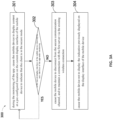
- FIG. 5A is a flowchart of an example process for secure wireless network connections in accordance with an embodiment of the present disclosure.
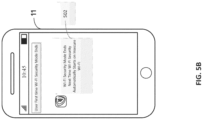
- FIG. 5B illustrates a screen shot of an example scenario of process 500 of FIG. 5A in operation in accordance with an embodiment of the present disclosure.
- FIG. 5C illustrates a screen shot of another example scenario of process 500 of FIG. 5A in operation in accordance with an embodiment of the present disclosure.
- Process 500 can be implemented by, for example, client 104 on mobile device 102 of FIG. 1 and in connection with process 200 of FIG. 2A .
- process 500 starts at 501 where it is determined whether the mobile device has disconnected from the existing Wi-Fi connection. When the mobile device has disconnected from the existing Wi-Fi connection, process 500 proceeds to 502. When the mobile device remains connected over the existing Wi-Fi connection, process 500 continues to execute process 200 of FIG. 2A .
- the client determines whether the mobile device connects to a Wi-Fi network by querying the network interface of the electronic device.
- process 500 follows the YES path to proceed to 503.
- process 500 follows the NO path to proceed to 504.
- an interface component is used to indicate that the monitoring process has ended.
- Process 500 concludes at 503.
- the interface component can be any suitable interface component. For example, it can be a toast, a pop up message window, or the like.
- a toast 502 is displayed on the display interface of the mobile device.
- the toast is a window that appears on the display for a limited amount of time (e.g., a few seconds) then automatically disappears.
- the toast indicates to the user that the secure mode has ended.
- the operating system of mobile device 11 grants the client permission to open a toast
- a toast is displayed.
- a popup message e.g., a window that requires the user to manually close
- process 500 proceeds to 505. If no, process 500 concludes at 504.
- an interface component is used to indicate that the pre-configured operations of the app have been secured by the client.
- the interface component can be any suitable interface component. For example, it can be a toast or a popup message window, or the like.
- Process 500 concludes at 506.
- the client has not entered the secure mode for the first time (e.g., the client has entered the security mode for a second time)
- mobile device 11 needs to leave the existing Wi-Fi connection
- a toast 504 is displayed to indicate that Ali Money Shield TM has protected five account transfers by Alipay TM and blocked three phishing websites.
- a toast is displayed if the operating system of mobile device 11 grants the client permission to open a toast. If the operating system of mobile device 11 does not grant the client permission to open a toast, a popup message is displayed.
- notification messages are displayed to the user according to whether the client has entered the secure mode before. Such messages help the user learn about the statuses and results the client has provided for the app.
- FIG. 6 is a flowchart of a process for secure wireless network connections in accordance with an embodiment of the present disclosure.
- Process 600 can be implemented by, for example, client 104 on mobile device 102 of FIG. 1 .
- process 600 starts at 601 where a website URL is obtained during the secure mode.
- the client obtains the website Uniform Resource Locator (URL) from the browser launched by the user on the mobile device.
- URL Uniform Resource Locator
- the website URL is compared with the URLs specified in a pre-configured list, which records the phishing website URLs.
- the mobile device is blocked from accessing the website URL.
- the pre-configured list is obtained from the first server, which compiles and maintains a collection of the URLs of the phishing websites.
- the first server also updates the pre-configured list periodically or in real time.
- the first server further transmits the pre-configured list to the mobile device so that the client can use the most updated pre-configured list to block phishing websites.
- the client transmits the website URL obtained at 601 to the first server (e.g., first server 106 of FIG. 1 ).
- the first server determines whether the website URL is included in the pre-configured list. If so, the first server generates a comparison result and transmits the comparison result back to the mobile device.
- the client determines that the comparison result indicates that the website URL is included in the pre-configured list, the mobile device is blocked from accessing the website URL.
- the Wi-Fi connection is also protected against phishing websites automatically on the mobile device. This prevents the user of the mobile device from falling victim to a phishing website.
- FIG. 7 is a functional diagram illustrating an embodiment of a programmed computer system for secure wireless network connections, in accordance with an embodiment of the present disclosure.
- Computing system 700 can be used to implement the mobile device, the first server, and the second server (shown in FIG. 1 ) as appropriate.
- other computer system architectures and configurations can be used to implement the systems and methods for wireless network security.
- Computing system 700 includes a processor 702, a bus 704, a network interface 706, a memory 708, and a non-volatile memory 710.
- Processor 702 reads the corresponding computer program from the non-volatile memory 710 to the memory 708 for execution.
- the present disclosure does not exclude other implementations in addition to a software implementation, e.g., a logic device or a combination of software and hardware.
- the entity that executes the process is not be limited to the various logical units. It may also be hardware or a logic device.
- Processor 702 is used for acquiring the type of wireless network accessed by the mobile device.
- the mobile device is controlled by process 702 so that it establishes a connection with a first server via a virtual private network (VPN) using network interface 706.
- VPN virtual private network
Landscapes
- Engineering & Computer Science (AREA)
- Computer Security & Cryptography (AREA)
- Computer Networks & Wireless Communication (AREA)
- Signal Processing (AREA)
- Computing Systems (AREA)
- General Engineering & Computer Science (AREA)
- Computer Hardware Design (AREA)
- Theoretical Computer Science (AREA)
- Physics & Mathematics (AREA)
- Mathematical Physics (AREA)
- General Physics & Mathematics (AREA)
- Quality & Reliability (AREA)
- Mobile Radio Communication Systems (AREA)
- Telephone Function (AREA)
- Telephonic Communication Services (AREA)
- Alarm Systems (AREA)
Claims (12)
- Procédé (200 ; 300) permettant des connexions sécurisées à un réseau sans fil, le procédé étant exécuté par un client (104) installé sur un dispositif mobile (102), et le procédé comprenant les étapes consistant à :acquérir (201) un type de réseau sans fil auquel un dispositif mobile est connecté ;déterminer que le type de réseau sans fil n'est pas sécurisé sur la base, au moins en partie, de la fréquence d'accès du dispositif mobile au réseau sans fil ; eten réponse à une détermination du fait que le type de réseau n'est pas sécurisé, surveiller (202) pour déterminer si une application doit être activée,la surveillance pour déterminer si l'application doit être activée comprenant l'étape consistant à :
interroger un système d'exploitation du dispositif mobile au moyen de certains appels de fonction prédéfinis pris en charge par le système d'exploitation pour déterminer que l'application correspond à une interface d'affichage actuelle du dispositif mobile et que l'application est installée sur le dispositif mobile ;déterminer (203) que l'application doit être activée sur la base, au moins en partie, d'une détection du fait que l'interface d'affichage actuelle du dispositif mobile affiche l'application ; eten réponse à la détermination du fait que l'application doit être activée, établir (204) un canal de communication sécurisé entre le dispositif mobile et un premier serveur (106) ;déterminer (302) qu'un affichage de l'interface pour l'application n'est plus affiché par le dispositif mobile sur la base, au moins en partie, de l'interrogation du système d'exploitation du dispositif mobile au moyen de certains appels de fonction prédéfinis pris en charge par le système d'exploitation pour déterminer que l'application n'est plus affichée sur l'interface d'affichage actuelle du dispositif mobile ; eten réponse à la détermination du fait que l'application n'est plus affichée sur l'interface d'affichage actuelle du dispositif mobile, déconnecter (303), par le dispositif mobile, le canal de communication sécurisé et maintenir une connexion avec le premier serveur par l'intermédiaire du réseau sans fil pour qu'une ou plusieurs autres applications communiquent par l'intermédiaire d'un canal non sécurisé. - Procédé (200 ; 300) selon la revendication 1, dans lequel le canal de communication sécurisé est une connexion par réseau privé virtuel (VPN).
- Procédé (200 ; 300) selon la revendication 1, comprenant en outre les étapes consistant à :afficher, par le client, pendant la surveillance de l'application, un contenu indiquant que le client est en train de surveiller dans l'interface d'affichage actuelle ; etannuler, par le client, l'affichage du contenu lorsque le dispositif mobile (102) se déconnecte du canal de communication sécurisé.
- Procédé (200 ; 300 ; 600) selon la revendication 1, comprenant en outre les étapes consistant à :obtenir (601), par le premier serveur (106), un localisateur uniforme de ressources (URL) de site Web auquel l'application doit accéder ;comparer (602), par le premier serveur, l'URL de site Web à une liste préconfigurée d'URL, la liste préconfigurée d'URL étant stockée sur le premier serveur auquel le dispositif mobile (102) se connecte par l'intermédiaire du canal de communication sécurisé, et la liste préconfigurée d'URL enregistrant des URL de sites Web d'hameçonnage ; etbloquer (603), par le premier serveur, lorsque l'URL de site Web correspond à une URL de la liste préconfigurée d'URL, la connexion du dispositif mobile (102) à l'URL de site Web.
- Procédé (200 ; 300) selon la revendication 1, comprenant en outre les étapes consistant à :obtenir un localisateur uniforme de ressources (URL) de site Web auquel l'application doit accéder ;transmettre l'URL de site Web au premier serveur (106) pour le comparer à une liste préconfigurée d'URL de sites Web d'hameçonnage et générer un résultat de comparaison ;recevoir le résultat de comparaison en provenance du premier serveur ; eten réponse au fait que le résultat de comparaison indique que l'URL de site Web correspond à une URL de site Web dans la liste préconfigurée d'URL, bloquer la connexion du dispositif mobile (102) à l'URL de site Web.
- Procédé selon la revendication 1, comprenant en outre les étapes consistant à :déterminer, par le client, un nombre de transactions de l'application sécurisées par le client ; etafficher, par le client, une indication du nombre de transactions sécurisées par le client.
- Système de sécurité sans fil, comprenant :
un ou plusieurs processeurs (702) configurés pour :acquérir, par un client (104) installé sur un dispositif mobile (102), un type de réseau sans fil auquel un dispositif mobile est connecté ;déterminer, par le client, que le type de réseau sans fil n'est pas sécurisé sur la base, au moins en partie, de la fréquence d'accès du dispositif mobile au réseau sans fil ; eten réponse à une détermination du fait que le type de réseau n'est pas sécurisé, surveiller, par le client, pour déterminer si une application doit être activée,la surveillance pour déterminer si l'application doit être activée comprenant l'étape consistant à :
interroger un système d'exploitation du dispositif mobile au moyen de certains appels de fonction prédéfinis pris en charge par le système d'exploitation pour déterminer que l'application correspond à une interface d'affichage actuelle du dispositif mobile et que l'application est installée sur le dispositif mobile ;déterminer, par le client, que l'application doit être activée sur la base, au moins en partie, d'une détection du fait que l'interface d'affichage actuelle du dispositif mobile affiche l'application ;en réponse à la détermination du fait que l'application doit être activée, établir, par le client, un canal de communication sécurisé entre le dispositif mobile et un premier serveur (106) ;déterminer, par le client, qu'un affichage de l'interface pour l'application n'est plus affiché par le dispositif mobile sur la base, au moins en partie, de l'interrogation du système d'exploitation du dispositif mobile au moyen de certains appels de fonction prédéfinis pris en charge par le système d'exploitation pour déterminer que l'application n'est plus affichée sur l'interface d'affichage actuelle du dispositif mobile ; eten réponse à la détermination du fait que l'application n'est plus affichée sur l'interface d'affichage actuelle du dispositif mobile, déconnecter, par le dispositif mobile, le canal de communication sécurisé et maintenir une connexion avec le premier serveur par l'intermédiaire du réseau sans fil pour qu'une ou plusieurs autres applications communiquent par l'intermédiaire d'un canal non sécurisé ; etune ou plusieurs mémoires (708, 710) couplées au ou aux processeurs, et configurées pour fournir des instructions au ou aux processeurs. - Système selon la revendication 7, comprenant en outre un second serveur (108) configuré pour traiter des messages transférés par le premier serveur (106), les messages étant générés et transmis par le dispositif mobile (102) au premier serveur au moyen du canal de communication sécurisé ;ou éventuellement,dans lequel le canal de communication sécurisé est une connexion par réseau privé virtuel (VPN).
- Système selon la revendication 7, dans lequel le ou les processeurs (702) sont en outre configurés pour :afficher, pendant la surveillance de l'application, un contenu indiquant que le système est en train de surveiller dans l'interface d'affichage actuelle ; etannuler l'affichage du contenu lorsque le dispositif mobile se déconnecte du canal de communication sécurisé.
- Système selon la revendication 7, dans lequel le ou les processeurs (702) sont en outre configurés pour :obtenir, par le premier serveur (106), un localisateur uniforme de ressources (URL) de site Web auquel l'application doit accéder ;comparer, par le premier serveur, l'URL de site Web à une liste préconfigurée d'URL, la liste préconfigurée d'URL étant stockée sur le premier serveur auquel le dispositif mobile (102) se connecte par l'intermédiaire du canal de communication sécurisé, et la liste préconfigurée d'URL enregistrant des URL de sites Web d'hameçonnage ; etbloquer, par le premier serveur, lorsque l'URL de site Web correspond à une URL de la liste préconfigurée d'URL, la connexion du dispositif mobile à l'URL de site Web.
- Système selon la revendication 7, dans lequel le ou les processeurs (702) sont en outre configurés pour :obtenir, par le client (104), un localisateur uniforme de ressources (URL) de site Web auquel l'application doit accéder ;transmettre, par le client, l'URL de site Web au premier serveur (106) pour le comparer à une liste préconfigurée d'URL de sites Web d'hameçonnage et générer un résultat de comparaison ;recevoir, par le dispositif mobile, le résultat de comparaison en provenance du premier serveur ; eten réponse au fait que le résultat de comparaison indique que l'URL de site Web correspond à une URL de site Web dans la liste préconfigurée d'URL, bloquer, par le client, la connexion du dispositif mobile (102) à l'URL de site Web.
- Produit-programme informatique de défense contre des attaques de réseau, le produit-programme informatique étant intégré dans un support de stockage tangible lisible par ordinateur et comprenant des instructions informatiques configurées pour :acquérir, par un client (104) installé sur un dispositif mobile (102), un type de réseau sans fil auquel le dispositif mobile est connecté ;déterminer, par le client, que le type de réseau sans fil n'est pas sécurisé sur la base, au moins en partie, de la fréquence d'accès du dispositif mobile au réseau sans fil ; eten réponse à une détermination du fait que le type de réseau n'est pas sécurisé, surveiller, par le client, pour déterminer si une application doit être activée,la surveillance pour déterminer si l'application doit être activée comprenant l'étape consistant à :
interroger un système d'exploitation du dispositif mobile au moyen de certains appels de fonction prédéfinis pris en charge par le système d'exploitation pour déterminer que l'application correspond à une interface d'affichage actuelle du dispositif mobile et que l'application est installée sur le dispositif mobile ;déterminer, par le client, que l'application doit être activée sur la base, au moins en partie, d'une détection du fait que l'interface d'affichage actuelle du dispositif mobile affiche l'application ;en réponse à la détermination du fait que l'application doit être activée, établir, par le client, un canal de communication sécurisé entre le dispositif mobile et un premier serveur (106) ;déterminer, par le client, qu'un affichage de l'interface pour l'application n'est plus affiché par le dispositif mobile sur la base, au moins en partie, de l'interrogation du système d'exploitation du dispositif mobile au moyen de certains appels de fonction prédéfinis pris en charge par le système d'exploitation pour déterminer que l'application n'est plus affichée sur l'interface d'affichage actuelle du dispositif mobile ; eten réponse à la détermination du fait que l'application n'est plus affichée sur l'interface d'affichage actuelle du dispositif mobile, déconnecter, par le dispositif mobile, le canal de communication sécurisé et maintenir une connexion avec le premier serveur par l'intermédiaire du réseau sans fil pour qu'une ou plusieurs autres applications communiquent par l'intermédiaire d'un canal non sécurisé.
Applications Claiming Priority (3)
| Application Number | Priority Date | Filing Date | Title |
|---|---|---|---|
| CN201610688098.3A CN107770776A (zh) | 2016-08-18 | 2016-08-18 | Wifi安全防护系统、无线网络防护方法、装置及电子设备 |
| US15/676,811 US10951587B2 (en) | 2016-08-18 | 2017-08-14 | System and method for wireless network security |
| PCT/US2017/046911 WO2018035104A1 (fr) | 2016-08-18 | 2017-08-15 | Système et procédé pour sécuriser un réseau sans fil |
Publications (3)
| Publication Number | Publication Date |
|---|---|
| EP3500925A1 EP3500925A1 (fr) | 2019-06-26 |
| EP3500925A4 EP3500925A4 (fr) | 2020-01-22 |
| EP3500925B1 true EP3500925B1 (fr) | 2024-10-09 |
Family
ID=61192537
Family Applications (1)
| Application Number | Title | Priority Date | Filing Date |
|---|---|---|---|
| EP17841980.0A Active EP3500925B1 (fr) | 2016-08-18 | 2017-08-15 | Système et procédé pour sécuriser un réseau sans fil |
Country Status (6)
| Country | Link |
|---|---|
| US (1) | US10951587B2 (fr) |
| EP (1) | EP3500925B1 (fr) |
| JP (1) | JP6915040B2 (fr) |
| CN (1) | CN107770776A (fr) |
| TW (1) | TWI789350B (fr) |
| WO (1) | WO2018035104A1 (fr) |
Families Citing this family (6)
| Publication number | Priority date | Publication date | Assignee | Title |
|---|---|---|---|---|
| CN111225378B (zh) * | 2018-11-27 | 2023-07-04 | 奇酷互联网络科技(深圳)有限公司 | 智能筛选wifi方法、移动终端及终端可读储存介质 |
| US12348378B2 (en) * | 2019-02-25 | 2025-07-01 | Zscaler, Inc. | Real user monitoring statistics from end users |
| US11381597B2 (en) * | 2019-07-19 | 2022-07-05 | Mcafee, Llc | Expedition of web phishing detection for suspicious sites |
| US11411992B2 (en) | 2019-11-07 | 2022-08-09 | Mcafee, Llc | Visual detection of phishing websites via headless browser |
| CN113365277A (zh) * | 2020-07-06 | 2021-09-07 | 中央广播电视总台 | 无线网络安全防护系统 |
| CN117097585A (zh) * | 2022-05-12 | 2023-11-21 | 成都全景智能科技有限公司 | 上网管控方法、装置、存储介质及电子设备 |
Citations (1)
| Publication number | Priority date | Publication date | Assignee | Title |
|---|---|---|---|---|
| CN104506561A (zh) * | 2015-01-13 | 2015-04-08 | 深圳市中兴移动通信有限公司 | 终端资料访问控制方法及装置 |
Family Cites Families (19)
| Publication number | Priority date | Publication date | Assignee | Title |
|---|---|---|---|---|
| US7327258B2 (en) | 2004-02-04 | 2008-02-05 | Guardian Mobile Monitoring Systems | System for, and method of, monitoring the movements of mobile items |
| US7801058B2 (en) | 2006-07-27 | 2010-09-21 | Mobitrum Corporation | Method and system for dynamic information exchange on mesh network devices |
| US8272046B2 (en) * | 2007-11-13 | 2012-09-18 | Cisco Technology, Inc. | Network mobility over a multi-path virtual private network |
| US9338597B2 (en) | 2007-12-06 | 2016-05-10 | Suhayya Abu-Hakima | Alert broadcasting to unconfigured communications devices |
| US8707389B2 (en) * | 2008-12-04 | 2014-04-22 | Pravala Inc. | Multi-transport mode devices having improved data throughput |
| US8893260B2 (en) | 2008-12-17 | 2014-11-18 | Rockstar Consortium Us Lp | Secure remote access public communication environment |
| WO2014074239A2 (fr) | 2012-09-25 | 2014-05-15 | Openpeak Inc. | Procédé et système pour partager des connexions vpn entre des applications |
| US20140150083A1 (en) * | 2012-11-27 | 2014-05-29 | Francis Dinha | Virtual private network socket |
| US9253160B2 (en) * | 2012-12-31 | 2016-02-02 | Kent Lawson | Methods, systems, and media for secure connection management and automatic compression over metered data connections |
| KR102095912B1 (ko) * | 2013-05-15 | 2020-04-02 | 삼성전자 주식회사 | 보안 기능 운용 방법 및 이를 지원하는 전자 장치 |
| CN103368958A (zh) | 2013-07-05 | 2013-10-23 | 腾讯科技(深圳)有限公司 | 一种网页检测方法、装置和系统 |
| US9305163B2 (en) * | 2013-08-15 | 2016-04-05 | Mocana Corporation | User, device, and app authentication implemented between a client device and VPN gateway |
| EP3033861A4 (fr) * | 2013-08-15 | 2017-04-12 | Mocana Corporation | Dispositif passerelle pour mettre fin à un grand volume de connexions de vpn |
| US9686302B2 (en) | 2013-12-30 | 2017-06-20 | Anchorfree, Inc. | System and method for security and quality assessment of wireless access points |
| WO2015103338A1 (fr) * | 2013-12-31 | 2015-07-09 | Lookout, Inc. | Sécurité de réseau basée sur des nuages |
| EP3114865B1 (fr) * | 2014-03-06 | 2022-07-20 | Vodafone GmbH | Utilisation de services d'un réseau central de communications par paquets entre terminaux mobiles |
| WO2015188718A1 (fr) * | 2014-06-10 | 2015-12-17 | 北京奇虎科技有限公司 | Procédé et appareil de paiement sur base d'un terminal mobile, et terminal mobile |
| US9521116B2 (en) | 2014-06-11 | 2016-12-13 | Verizon Patent And Licensing Inc. | Apparatus, method, and system for securing a public wireless network |
| CN105338524A (zh) * | 2014-07-28 | 2016-02-17 | 阿里巴巴集团控股有限公司 | 一种信息传输方法及装置 |
-
2016
- 2016-08-18 CN CN201610688098.3A patent/CN107770776A/zh active Pending
-
2017
- 2017-05-11 TW TW106115669A patent/TWI789350B/zh active
- 2017-08-14 US US15/676,811 patent/US10951587B2/en active Active
- 2017-08-15 JP JP2019502786A patent/JP6915040B2/ja active Active
- 2017-08-15 WO PCT/US2017/046911 patent/WO2018035104A1/fr not_active Ceased
- 2017-08-15 EP EP17841980.0A patent/EP3500925B1/fr active Active
Patent Citations (1)
| Publication number | Priority date | Publication date | Assignee | Title |
|---|---|---|---|---|
| CN104506561A (zh) * | 2015-01-13 | 2015-04-08 | 深圳市中兴移动通信有限公司 | 终端资料访问控制方法及装置 |
Also Published As
| Publication number | Publication date |
|---|---|
| US20180054737A1 (en) | 2018-02-22 |
| CN107770776A (zh) | 2018-03-06 |
| WO2018035104A1 (fr) | 2018-02-22 |
| JP6915040B2 (ja) | 2021-08-04 |
| JP2019528596A (ja) | 2019-10-10 |
| US10951587B2 (en) | 2021-03-16 |
| TWI789350B (zh) | 2023-01-11 |
| TW201808029A (zh) | 2018-03-01 |
| EP3500925A4 (fr) | 2020-01-22 |
| EP3500925A1 (fr) | 2019-06-26 |
Similar Documents
| Publication | Publication Date | Title |
|---|---|---|
| EP3500925B1 (fr) | Système et procédé pour sécuriser un réseau sans fil | |
| US12309151B2 (en) | Credential storage manager for protecting credential security during delegated account use | |
| US11775661B2 (en) | Limiting device functionality based on data detection and processing | |
| US11562336B2 (en) | Payment authorization system | |
| US8887245B1 (en) | Browser-based prevention of unsecure online transmission of sensitive information | |
| Shahriar et al. | Mobile phishing attacks and mitigation techniques | |
| EP2756441B1 (fr) | Appareils et procédés destinés à prévenir l'altération de pages web de paiement | |
| US11811770B2 (en) | Systems and methods for data access notification alerts | |
| CN111711617A (zh) | 网络爬虫的检测方法、装置、电子设备及存储介质 | |
| Marforio et al. | Evaluation of personalized security indicators as an anti-phishing mechanism for smartphone applications | |
| US10904287B2 (en) | Protecting against notification based phishing attacks | |
| US9984217B2 (en) | Electronic authentication of an account in an unsecure environment | |
| US10771504B2 (en) | Systems and methods for identifying data breaches | |
| US20190081975A1 (en) | Increasing privacy and security level after potential attack | |
| US12299092B1 (en) | Compromised endpoint credentials interceptor | |
| KR101206153B1 (ko) | 발신 번호의 인증을 이용한 피싱 방지 시스템 및 그 방법 | |
| KR101206086B1 (ko) | 발신 번호의 인증을 이용한 피싱 방지 시스템 및 그 방법 | |
| US20180268129A1 (en) | Detecting suspicious application overlays on a device | |
| US20250190557A1 (en) | System and Method for Providing Emergency Operations |
Legal Events
| Date | Code | Title | Description |
|---|---|---|---|
| STAA | Information on the status of an ep patent application or granted ep patent |
Free format text: STATUS: THE INTERNATIONAL PUBLICATION HAS BEEN MADE |
|
| PUAI | Public reference made under article 153(3) epc to a published international application that has entered the european phase |
Free format text: ORIGINAL CODE: 0009012 |
|
| STAA | Information on the status of an ep patent application or granted ep patent |
Free format text: STATUS: REQUEST FOR EXAMINATION WAS MADE |
|
| 17P | Request for examination filed |
Effective date: 20181218 |
|
| AK | Designated contracting states |
Kind code of ref document: A1 Designated state(s): AL AT BE BG CH CY CZ DE DK EE ES FI FR GB GR HR HU IE IS IT LI LT LU LV MC MK MT NL NO PL PT RO RS SE SI SK SM TR |
|
| AX | Request for extension of the european patent |
Extension state: BA ME |
|
| DAV | Request for validation of the european patent (deleted) | ||
| DAX | Request for extension of the european patent (deleted) | ||
| A4 | Supplementary search report drawn up and despatched |
Effective date: 20200103 |
|
| RIC1 | Information provided on ipc code assigned before grant |
Ipc: H04L 29/08 20060101ALI20191216BHEP Ipc: G06F 9/00 20060101AFI20191216BHEP Ipc: H04W 12/08 20090101ALI20191216BHEP Ipc: H04L 29/06 20060101ALI20191216BHEP Ipc: H04W 12/12 20090101ALI20191216BHEP |
|
| STAA | Information on the status of an ep patent application or granted ep patent |
Free format text: STATUS: EXAMINATION IS IN PROGRESS |
|
| 17Q | First examination report despatched |
Effective date: 20210115 |
|
| P01 | Opt-out of the competence of the unified patent court (upc) registered |
Effective date: 20230418 |
|
| REG | Reference to a national code |
Ref legal event code: R079 Ipc: H04L0009400000 Ref country code: DE Ref legal event code: R079 Ref document number: 602017085420 Country of ref document: DE Free format text: PREVIOUS MAIN CLASS: G06F0009000000 Ipc: H04L0009400000 |
|
| GRAP | Despatch of communication of intention to grant a patent |
Free format text: ORIGINAL CODE: EPIDOSNIGR1 |
|
| STAA | Information on the status of an ep patent application or granted ep patent |
Free format text: STATUS: GRANT OF PATENT IS INTENDED |
|
| RIC1 | Information provided on ipc code assigned before grant |
Ipc: G06F 9/00 20060101ALI20240417BHEP Ipc: H04L 67/141 20220101ALI20240417BHEP Ipc: H04W 12/122 20210101ALI20240417BHEP Ipc: H04W 12/084 20210101ALI20240417BHEP Ipc: H04L 9/40 20220101AFI20240417BHEP |
|
| INTG | Intention to grant announced |
Effective date: 20240506 |
|
| GRAS | Grant fee paid |
Free format text: ORIGINAL CODE: EPIDOSNIGR3 |
|
| GRAA | (expected) grant |
Free format text: ORIGINAL CODE: 0009210 |
|
| STAA | Information on the status of an ep patent application or granted ep patent |
Free format text: STATUS: THE PATENT HAS BEEN GRANTED |
|
| AK | Designated contracting states |
Kind code of ref document: B1 Designated state(s): AL AT BE BG CH CY CZ DE DK EE ES FI FR GB GR HR HU IE IS IT LI LT LU LV MC MK MT NL NO PL PT RO RS SE SI SK SM TR |
|
| REG | Reference to a national code |
Ref country code: CH Ref legal event code: EP |
|
| REG | Reference to a national code |
Ref country code: DE Ref legal event code: R096 Ref document number: 602017085420 Country of ref document: DE |
|
| REG | Reference to a national code |
Ref country code: IE Ref legal event code: FG4D |
|
| REG | Reference to a national code |
Ref country code: LT Ref legal event code: MG9D |
|
| REG | Reference to a national code |
Ref country code: NL Ref legal event code: MP Effective date: 20241009 |
|
| REG | Reference to a national code |
Ref country code: AT Ref legal event code: MK05 Ref document number: 1731787 Country of ref document: AT Kind code of ref document: T Effective date: 20241009 |
|
| PG25 | Lapsed in a contracting state [announced via postgrant information from national office to epo] |
Ref country code: NL Free format text: LAPSE BECAUSE OF FAILURE TO SUBMIT A TRANSLATION OF THE DESCRIPTION OR TO PAY THE FEE WITHIN THE PRESCRIBED TIME-LIMIT Effective date: 20241009 |
|
| PG25 | Lapsed in a contracting state [announced via postgrant information from national office to epo] |
Ref country code: NL Free format text: LAPSE BECAUSE OF FAILURE TO SUBMIT A TRANSLATION OF THE DESCRIPTION OR TO PAY THE FEE WITHIN THE PRESCRIBED TIME-LIMIT Effective date: 20241009 |
|
| PG25 | Lapsed in a contracting state [announced via postgrant information from national office to epo] |
Ref country code: HR Free format text: LAPSE BECAUSE OF FAILURE TO SUBMIT A TRANSLATION OF THE DESCRIPTION OR TO PAY THE FEE WITHIN THE PRESCRIBED TIME-LIMIT Effective date: 20241009 Ref country code: PT Free format text: LAPSE BECAUSE OF FAILURE TO SUBMIT A TRANSLATION OF THE DESCRIPTION OR TO PAY THE FEE WITHIN THE PRESCRIBED TIME-LIMIT Effective date: 20250210 Ref country code: IS Free format text: LAPSE BECAUSE OF FAILURE TO SUBMIT A TRANSLATION OF THE DESCRIPTION OR TO PAY THE FEE WITHIN THE PRESCRIBED TIME-LIMIT Effective date: 20250209 |
|
| PG25 | Lapsed in a contracting state [announced via postgrant information from national office to epo] |
Ref country code: FI Free format text: LAPSE BECAUSE OF FAILURE TO SUBMIT A TRANSLATION OF THE DESCRIPTION OR TO PAY THE FEE WITHIN THE PRESCRIBED TIME-LIMIT Effective date: 20241009 |
|
| PG25 | Lapsed in a contracting state [announced via postgrant information from national office to epo] |
Ref country code: BG Free format text: LAPSE BECAUSE OF FAILURE TO SUBMIT A TRANSLATION OF THE DESCRIPTION OR TO PAY THE FEE WITHIN THE PRESCRIBED TIME-LIMIT Effective date: 20241009 |
|
| PG25 | Lapsed in a contracting state [announced via postgrant information from national office to epo] |
Ref country code: ES Free format text: LAPSE BECAUSE OF FAILURE TO SUBMIT A TRANSLATION OF THE DESCRIPTION OR TO PAY THE FEE WITHIN THE PRESCRIBED TIME-LIMIT Effective date: 20241009 |
|
| PG25 | Lapsed in a contracting state [announced via postgrant information from national office to epo] |
Ref country code: NO Free format text: LAPSE BECAUSE OF FAILURE TO SUBMIT A TRANSLATION OF THE DESCRIPTION OR TO PAY THE FEE WITHIN THE PRESCRIBED TIME-LIMIT Effective date: 20250109 |
|
| PG25 | Lapsed in a contracting state [announced via postgrant information from national office to epo] |
Ref country code: LV Free format text: LAPSE BECAUSE OF FAILURE TO SUBMIT A TRANSLATION OF THE DESCRIPTION OR TO PAY THE FEE WITHIN THE PRESCRIBED TIME-LIMIT Effective date: 20241009 Ref country code: GR Free format text: LAPSE BECAUSE OF FAILURE TO SUBMIT A TRANSLATION OF THE DESCRIPTION OR TO PAY THE FEE WITHIN THE PRESCRIBED TIME-LIMIT Effective date: 20250110 Ref country code: AT Free format text: LAPSE BECAUSE OF FAILURE TO SUBMIT A TRANSLATION OF THE DESCRIPTION OR TO PAY THE FEE WITHIN THE PRESCRIBED TIME-LIMIT Effective date: 20241009 |
|
| PG25 | Lapsed in a contracting state [announced via postgrant information from national office to epo] |
Ref country code: PL Free format text: LAPSE BECAUSE OF FAILURE TO SUBMIT A TRANSLATION OF THE DESCRIPTION OR TO PAY THE FEE WITHIN THE PRESCRIBED TIME-LIMIT Effective date: 20241009 |
|
| PG25 | Lapsed in a contracting state [announced via postgrant information from national office to epo] |
Ref country code: RS Free format text: LAPSE BECAUSE OF FAILURE TO SUBMIT A TRANSLATION OF THE DESCRIPTION OR TO PAY THE FEE WITHIN THE PRESCRIBED TIME-LIMIT Effective date: 20250109 |
|
| PG25 | Lapsed in a contracting state [announced via postgrant information from national office to epo] |
Ref country code: SM Free format text: LAPSE BECAUSE OF FAILURE TO SUBMIT A TRANSLATION OF THE DESCRIPTION OR TO PAY THE FEE WITHIN THE PRESCRIBED TIME-LIMIT Effective date: 20241009 |
|
| PG25 | Lapsed in a contracting state [announced via postgrant information from national office to epo] |
Ref country code: DK Free format text: LAPSE BECAUSE OF FAILURE TO SUBMIT A TRANSLATION OF THE DESCRIPTION OR TO PAY THE FEE WITHIN THE PRESCRIBED TIME-LIMIT Effective date: 20241009 |
|
| REG | Reference to a national code |
Ref country code: DE Ref legal event code: R097 Ref document number: 602017085420 Country of ref document: DE |
|
| PG25 | Lapsed in a contracting state [announced via postgrant information from national office to epo] |
Ref country code: EE Free format text: LAPSE BECAUSE OF FAILURE TO SUBMIT A TRANSLATION OF THE DESCRIPTION OR TO PAY THE FEE WITHIN THE PRESCRIBED TIME-LIMIT Effective date: 20241009 |
|
| PG25 | Lapsed in a contracting state [announced via postgrant information from national office to epo] |
Ref country code: RO Free format text: LAPSE BECAUSE OF FAILURE TO SUBMIT A TRANSLATION OF THE DESCRIPTION OR TO PAY THE FEE WITHIN THE PRESCRIBED TIME-LIMIT Effective date: 20241009 |
|
| PG25 | Lapsed in a contracting state [announced via postgrant information from national office to epo] |
Ref country code: SK Free format text: LAPSE BECAUSE OF FAILURE TO SUBMIT A TRANSLATION OF THE DESCRIPTION OR TO PAY THE FEE WITHIN THE PRESCRIBED TIME-LIMIT Effective date: 20241009 |
|
| PG25 | Lapsed in a contracting state [announced via postgrant information from national office to epo] |
Ref country code: CZ Free format text: LAPSE BECAUSE OF FAILURE TO SUBMIT A TRANSLATION OF THE DESCRIPTION OR TO PAY THE FEE WITHIN THE PRESCRIBED TIME-LIMIT Effective date: 20241009 |
|
| PG25 | Lapsed in a contracting state [announced via postgrant information from national office to epo] |
Ref country code: IT Free format text: LAPSE BECAUSE OF FAILURE TO SUBMIT A TRANSLATION OF THE DESCRIPTION OR TO PAY THE FEE WITHIN THE PRESCRIBED TIME-LIMIT Effective date: 20241009 |
|
| PLBE | No opposition filed within time limit |
Free format text: ORIGINAL CODE: 0009261 |
|
| STAA | Information on the status of an ep patent application or granted ep patent |
Free format text: STATUS: NO OPPOSITION FILED WITHIN TIME LIMIT |
|
| PG25 | Lapsed in a contracting state [announced via postgrant information from national office to epo] |
Ref country code: SE Free format text: LAPSE BECAUSE OF FAILURE TO SUBMIT A TRANSLATION OF THE DESCRIPTION OR TO PAY THE FEE WITHIN THE PRESCRIBED TIME-LIMIT Effective date: 20241009 |
|
| 26N | No opposition filed |
Effective date: 20250710 |
|
| PGFP | Annual fee paid to national office [announced via postgrant information from national office to epo] |
Ref country code: DE Payment date: 20250827 Year of fee payment: 9 |
|
| PGFP | Annual fee paid to national office [announced via postgrant information from national office to epo] |
Ref country code: GB Payment date: 20250826 Year of fee payment: 9 |
|
| PGFP | Annual fee paid to national office [announced via postgrant information from national office to epo] |
Ref country code: FR Payment date: 20250826 Year of fee payment: 9 |
|
| REG | Reference to a national code |
Ref country code: CH Ref legal event code: H13 Free format text: ST27 STATUS EVENT CODE: U-0-0-H10-H13 (AS PROVIDED BY THE NATIONAL OFFICE) Effective date: 20260324 |
|
| PG25 | Lapsed in a contracting state [announced via postgrant information from national office to epo] |
Ref country code: MC Free format text: LAPSE BECAUSE OF FAILURE TO SUBMIT A TRANSLATION OF THE DESCRIPTION OR TO PAY THE FEE WITHIN THE PRESCRIBED TIME-LIMIT Effective date: 20241009 |
|
| PG25 | Lapsed in a contracting state [announced via postgrant information from national office to epo] |
Ref country code: LU Free format text: LAPSE BECAUSE OF NON-PAYMENT OF DUE FEES Effective date: 20250815 |
|
| PG25 | Lapsed in a contracting state [announced via postgrant information from national office to epo] |
Ref country code: CH Free format text: LAPSE BECAUSE OF NON-PAYMENT OF DUE FEES Effective date: 20250831 |