EP3501150B1 - Émetteur-récepteur de communication sans fil et procédé de communication sans fil - Google Patents
Émetteur-récepteur de communication sans fil et procédé de communication sans fil Download PDFInfo
- Publication number
- EP3501150B1 EP3501150B1 EP17752150.7A EP17752150A EP3501150B1 EP 3501150 B1 EP3501150 B1 EP 3501150B1 EP 17752150 A EP17752150 A EP 17752150A EP 3501150 B1 EP3501150 B1 EP 3501150B1
- Authority
- EP
- European Patent Office
- Prior art keywords
- nuc
- indicator
- pattern
- wireless communication
- uniform constellation
- Prior art date
- Legal status (The legal status is an assumption and is not a legal conclusion. Google has not performed a legal analysis and makes no representation as to the accuracy of the status listed.)
- Active
Links
Images



Classifications
-
- H—ELECTRICITY
- H04—ELECTRIC COMMUNICATION TECHNIQUE
- H04L—TRANSMISSION OF DIGITAL INFORMATION, e.g. TELEGRAPHIC COMMUNICATION
- H04L27/00—Modulated-carrier systems
- H04L27/32—Carrier systems characterised by combinations of two or more of the types covered by groups H04L27/02, H04L27/10, H04L27/18 or H04L27/26
- H04L27/34—Amplitude- and phase-modulated carrier systems, e.g. quadrature-amplitude modulated carrier systems
- H04L27/3405—Modifications of the signal space to increase the efficiency of transmission, e.g. reduction of the bit error rate, bandwidth, or average power
-
- H—ELECTRICITY
- H04—ELECTRIC COMMUNICATION TECHNIQUE
- H04L—TRANSMISSION OF DIGITAL INFORMATION, e.g. TELEGRAPHIC COMMUNICATION
- H04L1/00—Arrangements for detecting or preventing errors in the information received
- H04L1/12—Arrangements for detecting or preventing errors in the information received by using return channel
- H04L1/16—Arrangements for detecting or preventing errors in the information received by using return channel in which the return channel carries supervisory signals, e.g. repetition request signals
- H04L1/18—Automatic repetition systems, e.g. Van Duuren systems
- H04L1/1812—Hybrid protocols; Hybrid automatic repeat request [HARQ]
-
- H—ELECTRICITY
- H04—ELECTRIC COMMUNICATION TECHNIQUE
- H04W—WIRELESS COMMUNICATION NETWORKS
- H04W72/00—Local resource management
- H04W72/04—Wireless resource allocation
- H04W72/044—Wireless resource allocation based on the type of the allocated resource
-
- H—ELECTRICITY
- H04—ELECTRIC COMMUNICATION TECHNIQUE
- H04W—WIRELESS COMMUNICATION NETWORKS
- H04W76/00—Connection management
- H04W76/20—Manipulation of established connections
- H04W76/27—Transitions between radio resource control [RRC] states
Definitions
- the present disclosure generally pertains to the field of wireless communication transceivers and to wireless communication methods.
- 3G Third generation
- 4G fourth generation
- IMT-Advanced Standard International Mobile Telecommunications-Advanced Standard
- 5G fifth generation
- LTE Long Term Evolution
- US 2015/0236884 A1 discloses an apparatus of transmitting broadcast signals.
- the apparatus includes, an encoder for encoding service data, a bit interleaver for bit interleaving the encoded service data, a mapper for mapping the bit interleaved service data into a plurality of OFDM (Orthogonal Frequency Division Multiplex) symbols to build at least one signal frame, an OFDM modulator for modulating data in the built at least one signal frame by an OFDM scheme and a transmitter for transmitting the broadcast signals having the modulated data.
- OFDM Orthogonal Frequency Division Multiplex
- EP 2234308 discloses a method for determining a retransmission mode of a retransmission protocol for data transmissions provided to a communication terminal.
- Ep 2073419 discloses a network following method of switching a radio tuner between different frequencies over which a same program is broadcast.
- LTE Long Term Evolution
- LTE-A LTE advance
- LTE-B LTE-B
- a wireless communication transceiver comprising circuitry configured to send or receive, via a wireless link, an indicator indicating a Non-Uniform Constellation (NUC) pattern out of a plurality of NUC patterns.
- NUC Non-Uniform Constellation
- the wireless communication transceiver may be, for example, a transceiver, such as a user equipment (UE) or a base station like an eNodeB, in a Radio Access Network (RAN).
- the RAN may be, for example, an LTE network or a New Radio (NR) network.
- NR New Radio
- the wireless communication transceiver may be, for example, a first wireless communication transceiver in the RAN, and the wireless link may be a connection in the RAN between the first wireless communication transceiver and a second wireless communication transceiver.
- the wireless communication transceiver may be, for example, a user equipment (UE) such as a mobile phone, a smartphone, a computer, tablet, tablet personal computer, or the like, including a mobile communication interface, or any other device which is able to perform a mobile telecommunication via, for example, LTE, such as a hot spot device with a mobile communication interface, etc.
- UE user equipment
- LTE Long Term Evolution
- the NUC pattern indicated by the indicator may be, for example, a NUC pattern that is used by the first or the second wireless communication transceiver for modulating information that is exchanged via the wireless link, or that the first or the second wireless communication transceiver requests to use for modulating information that is exchanged via the wireless link.
- the information modulated by the NUC pattern may for example be a scheduled data packet, for example transmitted via a Physical Downlink Shared Channel (PDSCH) or via a Physical Uplink Shared Channel (PUSCH).
- PDSCH Physical Downlink Shared Channel
- PUSCH Physical Uplink Shared Channel
- the indicator may be transmitted using explicit or implicit signaling, and may be used for all wireless links, for example for uplink, for downlink, for backhaul, or for sidelink connections.
- the circuitry may further be configured to exchange, via the wireless link, information being modulated using the NUC pattern indicated by the indicator.
- the first wireless communication transceiver may exchange the information modulated using the NUC pattern indicated by the indicator with the second wireless communication transceiver.
- the indicator is contained in a Downlink Control Information (DCI).
- the DCI may be the DCI specified in LTE.
- the DCI may be, for example, sent by a base station and received by a user equipment.
- the indicator is an index to an entry of a reference lookup table, the reference lookup table providing Non-Uniform Constellation (NUC) patterns for respective indices.
- the indicator may be an explicit indicator, which is specifically introduced to indicate a NUC pattern, or it may be an implicit indicator, e.g. an indicator that is already transmitted for other purposes and that is used to also indicate a NUC pattern.
- an implicit indicator may be an indicator that has already been specified in a mobile wireless standard for a purpose different than indicating a NUC pattern, and that is reused to also indicate a NUC pattern in a second mobile wireless standard.
- the reference lookup table may be stored in a memory that is comprised by the wireless communication transceiver, and the wireless communication transceiver may read, upon receiving the indicator, the entry of the reference lookup table indicated by the index.
- the entry of the reference lookup table indicated by the index may contain information about a modulation order or about a NUC pattern to be used in a scheduled data packet transmitted, for example, via the PDSCH or the PUSCH.
- the reference lookup table (form and content) may be, for example, defined in a specification of a mobile wireless standard, such as, for example, an improvement of LTE.
- the indicator is an explicit NUC pattern indicator in a new field in the DCI. This may give full flexibility to the network to manage a NUC pattern to be used. For example, a retransmission of a data packet may use another NUC pattern than a previous transmission of the data packet.
- the wireless communication transceiver may be configured by a network to use one out of the plurality of reference lookup tables.
- the wireless communication transceiver is a UE
- the network or an eNodeB may configure the UE, for instance by a Radio Resource Control (RRC) configuration, to use one out of the plurality of reference lookup tables.
- RRC Radio Resource Control
- the index is a Modulation and Coding Scheme (MCS) index.
- MCS index may be an MCS index defined in a specification of a mobile wireless standard, for example of LTE.
- the MCS index may be contained in a DCI, and may be used to indicate an MCS of a scheduled data packet, for example a scheduled data packet that is transmitted via a PDSCH or via a PUSCH.
- the MCS index may be an index of an MCS table, which is a reference lookup table and may provide a NUC indicator for each MCS index.
- the reference lookup table provides a first set of NUC patterns for a New Data Indicator (NDI) being set and a second set of NUC patterns for the NDI being not set.
- the NDI may be, for example, an NDI bit signaled in a DCI, and may inform a wireless communication transceiver such as a UE whether a scheduled data packet is a new data packet or a retransmission.
- the NDI bit may be used for implicitly indicating a NUC pattern. For example, a new data packet may be modulated using a first NUC pattern associated with an MCS index, and a subsequent retransmission of the data packet may be modulated using a second NUC pattern associated with the same MCS index.
- the first and the second NUC pattern may for example be defined in an MCS table similar to the above MCS table, with an additional column providing a second NUC indicator for retransmissions.
- the indicator is an indicator indicating a redundancy version for a Hybrid Automatic Repeat Request (HARQ) retransmission.
- the redundancy version may for example be indicated in a DCI for each HARQ retransmission, and may implicitly point to a NUC pattern.
- a relationship between the redundancy version, an MCS, and the NUC pattern may be specified in a specification of a mobile wireless standard, for example in the form of a reference lookup table.
- the circuitry may further be configured to send or receive, via the wireless link, information indicating a transceiver's capability of encoding and decoding NUC patterns.
- a UE may indicate to a base station, such as an eNodeB, its NUC capability, that is whether it can decode, for a downlink transmission, or encode, for an uplink transmission, information modulated using a NUC.
- the UE may, in some embodiments, also indicate its level of NUC capabilities for decoding and for encoding.
- a network or an eNodeB may configure the UE to use one out of a plurality of reference lookup tables, such as, for example, MCS tables, that provide a set of NUC patterns according to the NUC capabilities of the UE. There may also be one out of the plurality of reference lookup tables that contains only uniform constellation patterns, for example for the case of a UE that cannot perform decoding or encoding of NUC patterns at all.
- a 1-dimensional NUC may be less complex to decode than a 2-dimensional NUC, but still provide gain over a uniform constellation, although the gain may be not as great as for a 2-dimensional NUC. Additionally, a complexity of decoding a NUC increases as a modulation order increases.
- the information indicating a capability of encoding and decoding NUC patterns may include information indicating which types of NUC the UE can decode.
- a UE may have a finite amount of processing capability, for example for the case of a UE where baseband processing is performed on a general purpose processor or Digital Signal Processor (DSP).
- processing resources may be assigned to different functions dynamically, for example an amount of processing resources applied to channel estimation may be adapted based on a complexity of a channel being decoded, and unused resources may be assigned to different receiver functions, such as demodulation.
- a capability of a UE for decoding modulation symbols such as a capability of decoding uniform constellations or 1-dimensional or 2-dimensional NUCs, may thus vary dynamically.
- a UE may signal its capability to decode different modulation patterns, for example different NUCs, and different modulation orders, such as 16QAM, 64QAM, or 256QAM, within uplink feedback signaling, such as a Channel State Information (CSI).
- different modulation patterns for example different NUCs, and different modulation orders, such as 16QAM, 64QAM, or 256QAM
- uplink feedback signaling such as a Channel State Information (CSI).
- CSI Channel State Information
- capabilities of a base station such as, for example, an eNodeB, of decoding and encoding NUC patterns may also be limited.
- a base station may be able to encode NUCs in downlink direction, but may not be able to decode NUCs in uplink direction.
- a base station may signal in System Information Block (SIB) signaling or unicast RRC signaling, for instance at connection setup, which NUCs it uses in uplink and downlink directions.
- SIB System Information Block
- a base station does not support NUCs, a default set of uniform constellations may be used, allowing DCI and Uplink Control Information (UCI) signaling and processing to be simplified.
- UCI Uplink Control Information
- the circuitry may further be configured to send or receive the information indicating a capability of encoding and decoding NUC patterns during an RRC connection.
- the information indicating a capability of encoding and decoding NUC patterns may also be contained in a SIB.
- the indicator is contained in Uplink Control Information (UCI).
- UCI Uplink Control Information
- the UCI may be transmitted by a UE to a network or to a base station. This may be used in a case where the UE can decide on an uplink data packet format, such as MCS and TBS.
- An example usage of this embodiment may be an autonomous or unscheduled transmission in the uplink direction.
- Another usage may be where a network configures, for example via RRC configuration, a plurality of NUC patterns for use in the uplink direction and a UE selects one out of the plurality of NUC patterns based on its TBS and uplink radio conditions.
- Uplink radio conditions may be signaled by a network or determined by a UE in a Time-Division Duplex (TDD) system via channel reciprocity.
- TDD Time-Division Duplex
- a UCI may be embedded in a data channel, like PUSCH, or transmitted as a separate control channel such as a Physical Uplink Control Channel (PUCCH).
- PUSCH Physical Uplink Control Channel
- the indicator is an indicator indicating a group of Resource Blocks (RBs) used for exchanging the information, and a NUC pattern may be assigned to a respective group of RBs.
- RBs Resource Blocks
- each group of RBs used to carry downlink or uplink data may use a different NUC pattern, and may form a NUC RB.
- a size of a NUC RB may be predefined in a specification of a mobile wireless standard or configured by a network.
- a DCI or UCI may indicate a NUC pattern used for a NUC RB.
- Different RBs in a selective channel may experience different Signal-to-Noise Ratios (SNRs) and hence may benefit from a different NUC pattern.
- SNRs Signal-to-Noise Ratios
- a base station may determine a NUC pattern to be used in each NUC RB based on either channel reciprocity, for instance for a TDD system or any system where a downlink channel and an uplink channel are similar, or on a CSI, whereby a UE may report downlink channel conditions to a base station in an uplink.
- the CSI may indicate a preferred NUC pattern for each NUC RB, or for at least one NUC RB.
- the indicator may be included in a Channel State Information (CSI).
- CSI Channel State Information
- a base station may use a preferred NUC pattern signaled in a last CSI received from a UE. Then, a NUC pattern used may be known implicitly between the UE and the base station.
- a wireless communication method comprising signaling, via a wireless link, from a first transceiver of the wireless link to a second transceiver of the wireless link, an indicator indicating a NUC pattern out of a plurality of NUC patterns.
- the wireless communication method may comprise some or all of the features described above with respect to communication transceivers.
- LTE uses quadrature amplitude modulation (QAM) to achieve high spectral efficiency.
- QAM quadrature amplitude modulation
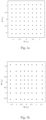
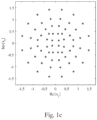
- Different types of quadrature amplitude modulation (QAM) patterns are illustrated in Figs. 1a, 1b , and 1c , as shown in the standard document R1-164653.
- a uniform constellation pattern is shown.
- the constellation points are uniformly distributed.
- a uniform QAM constellation comprising four constellation points is called Quadrature Phase-Shift Keying (QPSK).
- QPSK Quadrature Phase-Shift Keying
- QAM constellations of higher modulation orders are named according to their number of constellation points, for example 16QAM, 64QAM, or 256QAM.
- the QAM constellation shown in Fig. 1a is a 64QAM. Higher spectral efficiency is expected in NR, and hence, higher modulation orders are likely to be used, such as 1024QAM or higher.
- NUCs for high order modulation. Constellation points in a NUC are not arranged in a uniform manner.
- Fig. 1b gives an example for a 64QAM NUC pattern, where some constellation points are closer together than others.
- NUC enables a targeted error rate to be achieved at a lower SNR compared to a uniform constellation.
- NUC is shown to provide up to 1.85dB gain over a uniform constellation for 1024QAM.
- a NUC pattern is typically optimized for a specific operating SNR or range of SNR. For example, if a signal is received at 13dB, a NUC pattern optimized for SNR 12dB to 15dB may perform better than another NUC pattern that is optimized for 15dB to 18dB SNR.
- a plurality of NUC patterns for a specific modulation order may be used in a data transmission.
- Fig. 1c shows another NUC pattern. While the NUC pattern in Fig. 1b is a 1-dimensional 64QAM NUC pattern, the NUC pattern in Fig. 1c is a 2-dimensional 64QAM NUC pattern, characterized by a broadly circular shape. A performance of a 1-dimensional NUC is slightly inferior to that of a 2-dimensional NUC, but a 1-dimensional NUC is simpler to decode than a 2-dimensional NUC.
- Fig. 2a illustrates an embodiment in which an indicator indicating a Non-Uniform Constellation (NUC) pattern out of a plurality of NUC patterns is contained in Downlink Control Information (DCI).
- the example DCI 10 comprises several fields, each field containing information about a downlink connection.
- the information contained in the fields comprises a resource allocation header 11, a resource assignment 12, an MCS index 13, a HARQ process number 14, a new data indicator 15, a redundancy version 16, an uplink power control command 17, and a downlink assignment index 18.
- the DCI 10 comprises a field 19 containing a NUC indicator explicitly indicating a NUC pattern.
- the precise content of the DCI 10 may vary depending on the mobile wireless standard. What fields are comprised by a DCI 10 and how the fields are interpreted may be defined in a mobile wireless standard.
- Fig. 2b illustrates an embodiment of a reference lookup table providing NUC patterns for respective indices.
- the lookup table provides examples of possible NUC pattern indicators that may be specified by the NUC field in DCI and the respective NUC patterns that are associated with the indices. Since in some cases, a uniform constellation pattern may perform better than a NUC, or a transceiver may not have the capability of encoding or decoding NUC patterns, the lookup table provides uniform constellation patterns for some values of the NUC pattern indicator.
- a NUC pattern indicator "0" indicates Quadrature Phase-Shift Keying (QPSK), which is identical to a 4QAM uniform constellation pattern
- a NUC pattern indicator "1" indicates a 16QAM uniform constellation pattern
- a NUC pattern indicator "2” indicates a 16QAM NUC pattern of a first type
- a NUC pattern indicator "3" indicates a 16QAM NUC pattern of a second type
- a NUC pattern indicator "4" indicates a 64QAM uniform constellation pattern
- a NUC pattern indicator "5" indicates a 64QAM NUC pattern of a first type
- a NUC pattern indicator "6” indicates a 64QAM NUC pattern of a second type
- a NUC pattern indicator "7” indicates a 64QAM NUC pattern of a third type
- a NUC pattern indicator "8” indicates a 256QAM NUC pattern of a first type
- a NUC pattern indicator "9” indicates a 256QAM NUC pattern of a second type
- NUC patterns There are different types of NUC patterns defined for some modulation orders because each NUC pattern may be optimized only for a specific Signal-to-Noise Ratio (SNR). This is only an example.
- SNR Signal-to-Noise Ratio
- the content and structure of the NUC indicator field 19 may be defined in a mobile wireless standard.
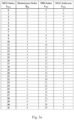
- Fig. 3a illustrates an embodiment in which an indicator indicating a Non-Uniform Constellation (NUC) pattern out of a plurality of NUC patterns is a Modulation and Coding Scheme (MCS) index.
- MCS Modulation and Coding Scheme
- the figure shows an MCS table that relates each MCS index with a respective NUC indicator I NUC .
- the MCS table may be defined in a specification of a mobile wireless standard.
- the MCS table may provide for each MCS index I MCS a modulation order Q m , a TBS index I TBS indicating a TBS for a scheduled number of Resource Blocks (RBs), and a NUC indicator I NUC .
- the MCS index which is foreseen to indicate the modulation order Q m is also foreseen to implicitly indicate a NUC pattern.
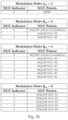
- NUC indicator refers to a lookup table such as one of the lookup tables shown in the embodiment of Fig. 3b .
- Fig. 3b shows lookup tables for a NUC indicator provided by an MCS table, such as the MCS table from Fig. 3a .
- MCS table such as the MCS table from Fig. 3a .
- NUC indicator lookup table for a modulation order of two, a NUC indicator "0" indicates Quadrature Phase-Shift Keying (QPSK), which is a 4QAM uniform constellation pattern.
- QPSK Quadrature Phase-Shift Keying
- a NUC indicator "0" indicates a 16QAM uniform constellation pattern
- a NUC indicator "1” indicates a 16QAM NUC pattern of a first type
- a NUC indicator "2" indicates a 16QAM NUC pattern of a second type.
- a NUC indicator "0" indicates a 64QAM uniform constellation pattern
- a NUC indicator "1” indicates a 64QAM NUC pattern of a first type
- a NUC indicator "2” indicates a 64QAM NUC pattern of a second type
- a NUC indicator "3” indicates a 64QAM NUC pattern of a third type
- a NUC indicator "4" indicates a 64QAM NUC pattern of a fourth type
- a NUC indicator "5" indicates a 64QAM NUC pattern of a fifth type
- a NUC indicator "6” indicates a 64QAM NUC pattern of a sixth type.
- a NUC indicator "1" indicates a 256QAM NUC pattern of a first type
- a NUC indicator "2" indicates a 256QAM NUC pattern of a second type
- a NUC indicator "3" indicates a 256QAM NUC pattern of a third type
- a NUC indicator "4" indicates a 256QAM NUC pattern of a fourth type
- a NUC indicator "5" indicates a 256QAM NUC pattern of a fifth type.
- NUC patterns may be not effective at low modulation orders, whereas for higher modulation orders, NUC patterns may be more effective than uniform constellation patterns.
- SNR Signal-to-Noise Ratio
- a NUC pattern may depend on an expected operating point given the modulation order and a Transport Block Size (TBS) of an entry of an MCS table.
- the operating point may imply a Forward Error Correction (FEC) code rate and modulation order, which in turn may imply an expected operating SNR for a Block Error Ratio (BLER) of, for example, 10%.
- FEC Forward Error Correction
- BLER Block Error Ratio
- the expected operating SNR may be used to optimize a NUC pattern suited for a particular MCS index of an MCS table. Therefore, in the MCS table of Fig. 3a , the NUC index is chosen so that for higher modulation orders, such as 16QAM, 64QAM, or 256QAM, NUCs are used preferably, whereas for lower modulation orders, also uniform constellations are used.
- lookup tables of Fig. 3b are only an example, which may be defined in a mobile wireless standard. There may be, for instance, one lookup table with the three fields: modulation order, NUC indicator, and NUC pattern.
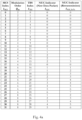
- Fig. 4a shows an example reference lookup table that provides a first set of Non-Uniform Constellation (NUC) patterns for a new data packet (New Data Indicator set) and a second set of NUC patterns for a retransmission (New Data Indicator not set).
- the reference lookup table provides for an MCS index I MCS , in addition to a modulation order Q m and a TBS index I TBS , a first NUC indicator I NUC for a new data packet and a second NUC indicator I NUC_ReTx for a retransmission.
- the first NUC indicator I NUC is used for new data packets, when a New Data Indicator (NDI) bit is set, and the second NUC indicator I NUC_ReTx is used for retransmissions, when the NDI bit is not set.
- the NDI may be signaled in a respective field 15 of a DCI 10, as shown in Fig. 2a .
- a UE may use the first or the second NUC indicator, depending on whether the NDI bit is set or not, respectively.
- a transmission failure of a data packet may be due to an SNR radio condition at which the NUC pattern is not targeted, and another NUC pattern may be used for retransmission of the data packet, for example a NUC pattern that targets a lower SNR or a higher SNR.
- Fig. 4b shows lookup tables for a NUC indicator provided by an MCS table, such as the first NUC indicator and the second NUC indicator provided by the MCS table of Fig. 4a .
- a NUC indicator provided by an MCS table
- the lookup tables of Fig. 4b are similar to the lookup tables of Fig. 3b , but provide NUC patterns for more NUC indicators in order to satisfy the requirements of the second NUC indicator of Fig. 4a .
- a NUC indicator "0" indicates Quadrature Phase-Shift Keying (QPSK), which is a 4QAM uniform constellation pattern.
- QPSK Quadrature Phase-Shift Keying
- a NUC indicator "0" indicates a 16QAM uniform constellation pattern
- a NUC indicator "1” indicates a 16QAM NUC pattern of a first type
- a NUC indicator "2” indicates a 16QAM NUC pattern of a second type
- a NUC indicator "3" indicates a 16QAM NUC pattern of a third type.
- a NUC indicator "0" indicates a 64QAM uniform constellation pattern
- a NUC indicator "1” indicates a 64QAM NUC pattern of a first type
- a NUC indicator "2” indicates a 64QAM NUC pattern of a second type
- a NUC indicator "3" indicates a 64QAM NUC pattern of a third type
- a NUC indicator "4" indicates a 64QAM NUC pattern of a fourth type
- a NUC indicator "5" indicates a 64QAM NUC pattern of a fifth type
- a NUC indicator "6” indicates a 64QAM NUC pattern of a sixth type
- a NUC indicator "7” indicates a 64QAM NUC pattern of a seventh type.
- a NUC indicator "1" indicates a 256QAM NUC pattern of a first type
- a NUC indicator "2" indicates a 256QAM NUC pattern of a second type
- a NUC indicator "3" indicates a 256QAM NUC pattern of a third type
- a NUC indicator "4" indicates a 256QAM NUC pattern of a fourth type
- a NUC indicator "5" indicates a 256QAM NUC pattern of a fifth type
- a NUC indicator "6” indicates a 256QAM NUC pattern of a sixth type.
- a DCI signaling indicates a restricted subset out of a plurality of NUCs that information data is encoded with and a UE then blind decodes within the restricted subset to determine a NUC actually used.
- the eNodeB may signal with a single bit of DCI signaling that the NUC used is either from the set of ⁇ uniform, NUC#1, NUC#2, or NUC#3 ⁇ or from the set of ⁇ NUC#4, NUC#5, or NUC#6 ⁇ . If the single bit indicates a NUC from the set of ⁇ NUC#4, NUC#5, or NUC#6 ⁇ , the UE may try to decode the data packet (e.g. PDSCH) with firstly NUC#4, then with NUC#5 and then with NUC#6. Any of these blind decodes that passes a Cyclic Redundancy Check (CRC) may then be considered by the UE to have used one of the particular NUCs.
- CRC Cyclic Redundancy Check
- Fig. 5 illustrates an embodiment of information indicating a transceiver's capability of encoding and decoding Non-Uniform Constellation (NUC) patterns.
- a wireless communication transceiver for example a UE or a base station, may only be capable of encoding or decoding certain types of NUC patterns.
- a 1-dimensional NUC may be less complex to decode than a 2-dimensional NUC, but still provide gain over a uniform constellation, although the gain may be not as great as for a 2-dimensional NUC.
- a complexity of decoding a NUC increases as a modulation order increases. For example, a 256QAM NUC may be more complex to decode than a 64QAM NUC.
- a UE may have sufficient computational resources to decode a 2-dimensional 64QAM NUC, but may only have sufficient computational resources to decode a 256QAM NUC that is 1-dimensional. Accordingly, a UE may signal its capability to decode different modulation patterns (the NUC constellation) and orders (16QAM, 64QAM, 256QAM, etc.) within higher layer messages such as RRC Connection Setup Complete or uplink feedback signaling, such as channel state information (CSI).
- modulation patterns the NUC constellation
- uplink feedback signaling such as channel state information (CSI).
- CSI channel state information
- the signaling information in Fig. 5 indicates that the wireless communication transceiver, here a UE, that transmits this information, is capable of decoding any type of uniform constellation, including 16QAM, 64QAM, 256QAM, and 1024QAM, but is only capable of decoding 1-dimensional 16QAM, 64QAM, and 256QAM NUCs, and is even only capable of decoding 2-dimensional 16QAM and 64QAM NUCs.
- a base station that receives this information from the UE may adapt its modulation scheme in accordance with this information.
- the information indicating a transceiver's capability of encoding and decoding NUC patterns may, for example, be signaled using RRC messages.
- Fig. 6 shows an example System Information Block (SIB) 20 providing a NUC capability information.
- SIB 20 comprises various fields, the fields containing a cell access information 21, a cell selection information 22, an information about a maximum power 23, a frequency band indicator 24, a scheduling information list 25, a system information window list 26, a system information value tag 27, and a NUC capability information 28.
- the fields comprised by the SIB 20 may for example be defined in a specification of a mobile wireless communication standard.
- a base station may use the field containing the NUC capability information 28 to indicate to a UE which NUCs it can use in a transmission.
- the capability information 28 may for example have a form identical or similar to that displayed in the embodiment of Fig. 5 .
- Fig. 7 shows an embodiment in which a Non-Uniform Constellation (NUC) pattern is assigned to a respective group of Resource Blocks (RBs).
- NUC Non-Uniform Constellation
- RBs Resource Blocks
- an indicator indicating a group of RBs used for exchanging the information is used to also indicate a NUC pattern.
- Fig. 7 shows a case where a UE is scheduled with 6 (frequency) RBs RB1 to RB6, and where a NUC RB comprises two RBs, thereby giving three NUC RBs RB NUC 1 to RB NUC 3.
- a NUC indicator I NUC is determined, the NUC indicator indicating a NUC for the respective NUC RB.
- a size of a NUC RB may be predefined in a specification of a mobile wireless standard or configured by a network.
- a DCI or UCI may indicate a NUC pattern used for a NUC RB.
- the NUC indicator may be one bit to indicate the one of two NUCs to be used.
- the NUC RBs RB NUC 1, RB NUC 2, and RB NUC 3 use the NUC pattern 0, 1, and 0, respectively.
- SNRs Signal-to-Noise Ratios
- Fig. 8 illustrates a wireless communication method.
- a UE signals capability information to base station.
- the base station receives the capability information from the UE.
- the base station choses a modulation scheme including a NUC indicator based on the capability information received from the UE.
- the base station sends the NUC indicator to the UE.
- the UE receives the NUC indicator from the base station.
- the signaling of Fig. 8 may, for example, be performed by Radio Resource Control (RRC) signaling.
- RRC Radio Resource Control
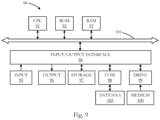
- Fig. 9 shows an embodiment of a transceiver 90.
- the transceiver 90 can be implemented such that it can basically function as any type (anchor, slave, control plane, user plane, etc.) of base station, virtual/slave cell or user equipment as described herein.
- the transceiver has components 91 to 102, which can form a circuitry, such as anyone of the circuitries of the base station, virtual cell, slave cell, and user equipment, as described herein.
- the transceiver 90 has a CPU 91 (Central Processing Unit), which can execute various types of procedures and methods as described herein, for example, in accordance with programs stored in a read-only memory (ROM) 92, stored in a storage 97 and loaded into a random access memory (RAM) 93, stored on a medium 100 which can be inserted in a respective drive 99, etc.
- ROM read-only memory
- RAM random access memory
- the CPU 91, the ROM 92 and the RAM 93 are connected with a bus 101, which in turn is connected to an input/output interface 94.
- the number of CPUs, memories and storages is only exemplary, and the skilled person will appreciate that the transceiver 90 can be adapted and configured accordingly for meeting specific requirements which arise, when it functions as a base station, virtual cell and user equipment.
- an input 95 an output 96, the storage 97, a communication interface 98 and the drive 99 into which a medium 100 (compact disc, digital video disc, compact flash memory, or the like) can be inserted.
- a medium 100 compact disc, digital video disc, compact flash memory, or the like
- the input 95 can be a pointer device (mouse, graphic table, or the like), a keyboard, a microphone, a camera, a touchscreen, etc.
- the output 96 can have a display (liquid crystal display, cathode ray tube display, light emittance diode display, etc.), loudspeakers, etc.
- a display liquid crystal display, cathode ray tube display, light emittance diode display, etc.
- loudspeakers etc.
- the storage 97 can have a hard disk, a solid state drive and the like.
- the communication interface 98 can be adapted to communicate, for example, via a local area network (LAN), wireless local area network (WLAN), mobile telecommunications system (GSM, UMTS, LTE, etc.), Bluetooth, infrared, etc.
- LAN local area network
- WLAN wireless local area network
- GSM mobile telecommunications system
- Bluetooth infrared
- the communication interface 98 uses an antenna 102 for communicating via radio networks such as WLAN, a mobile telecommunications system, Bluetooth, etc.
- transceiver 90 may be implemented with additional or other sensors, storage devices, interfaces or the like.
- the communication interface 98 may support other radio access technologies than the mentioned UMTS and LTE.
- the communication interface 98 can further have a corresponding air interface (providing e.g. E-UTRA protocols OFDMA (downlink) and SC-FDMA (uplink)) and network interfaces (implementing for example protocols such as S1-AP, GTP-U, S1-MME, X2-AP, or the like).
- E-UTRA protocols OFDMA (downlink) and SC-FDMA (uplink) and network interfaces (implementing for example protocols such as S1-AP, GTP-U, S1-MME, X2-AP, or the like).
- OFDMA downlink
- SC-FDMA uplink
- network interfaces implementing for example protocols such as S1-AP, GTP-U, S1-MME, X2-AP, or the like.
- Embodiments which use software, firmware, programs or the like for performing the methods as described herein can be installed on transceiver 90, which is then configured to be suitable for the concrete embodiment.
- the methods as described herein are also implemented in some embodiments as a computer program causing a computer and/or a processor to perform the method when being carried out on the computer and/or processor.
- a non-transitory computer-readable recording medium is provided that stores therein a computer program product which, when executed by a processor, such as the processor described above, causes the methods described herein to be performed.
Landscapes
- Engineering & Computer Science (AREA)
- Computer Networks & Wireless Communication (AREA)
- Signal Processing (AREA)
- Mobile Radio Communication Systems (AREA)
Claims (10)
- Emetteur-récepteur de communication sans fil (90) comprenant des circuits configurés pour envoyer ou recevoir, sur une liaison sans fil (102), un indicateur indiquant un diagramme de constellation non uniforme NUC, parmi une pluralité de diagrammes de constellation non uniforme, dans lequel l'indicateur est contenu dans des informations de commande de liaison descendante (10), ou dans lequel l'indicateur est contenu dans des informations de commande de liaison montante, ou dans lequel l'indicateur est inclus dans des informations d'état de canal et dans lequel l'indicateur est un indice d'une entrée d'une table de consultation de référence, la table de consultation de référence fournissant des diagrammes de constellation non uniforme pour des indices respectifs, et caractérisé en ce que,
la table de consultation de référence fournit un premier ensemble de diagrammes de constellation non uniforme pour un indicateur de nouvelles données défini et un second ensemble de diagrammes de constellation non uniforme pour un indicateur de nouvelles données non défini. - Emetteur-récepteur de communication sans fil (90) selon la revendication 1, dans lequel l'indice est un indice de plan de modulation et codage.
- Emetteur-récepteur de communication sans fil (90) selon la revendication 1, dans lequel l'indicateur est un indicateur indiquant une version de redondance pour une retransmission de demande de répétition automatique hybride.
- Emetteur-récepteur de communication sans fil (90) selon la revendication 1, dans lequel les circuits sont configurés en outre pour échanger, sur la liaison sans fil, des informations modulées en utilisant le diagramme de constellation non uniforme indiqué par l'indicateur.
- Emetteur-récepteur de communication sans fil (90) selon la revendication 1, dans lequel les circuits sont configurés en outre pour envoyer ou recevoir, sur la liaison sans fil, des informations indiquant une capacité de codage et de décodage de diagrammes de constellation non uniformes.
- Emetteur-récepteur de communication sans fil (90) selon la revendication 5, dans lequel les circuits sont configurés en outre pour envoyer ou recevoir les informations indiquant une capacité de codage et de décodage de diagrammes de constellation non uniforme à l'aide d'une signalisation de commande de ressources radio.
- Emetteur-récepteur de communication sans fil (90) selon la revendication 5, dans lequel les informations indiquant une capacité de codage et de décodage de diagrammes de constellation non uniforme sont contenues dans un bloc d'informations système.
- Emetteur-récepteur de communication sans fil (90) selon la revendication 1, dans lequel l'indicateur est un indicateur indiquant un groupe de blocs de ressources utilisés pour l'échange des informations, et dans lequel un diagramme de constellation non uniforme est attribué à un groupe respectif de blocs de ressources.
- Emetteur-récepteur de communication sans fil (90) selon la revendication 1, l'émetteur-récepteur de communication sans fil étant une station de base ou un équipement utilisateur.
- Procédé de communication sans fil comprenant la signalisation, sur une liaison sans fil (102), à partir d'un premier émetteur-récepteur de la liaison sans fil vers un second émetteur-récepteur de la liaison sans fil, d'un indicateur indiquant un diagramme de constellation non uniforme parmi une pluralité de diagrammes de constellation non uniformes, dans lequel l'indicateur est contenu dans des informations de commande de liaison descendante (10), ou dans lequel l'indicateur est contenu dans des informations de liaison montante, ou dans lequel l'indicateur est inclus dans des informations d'état de canal, et dans lequel l'indicateur est un indice d'une entrée d'une table de consultation de référence, la table de consultation de référence fournissant des diagrammes de constellation non uniforme pour des indices respectifs, et caractérisé en ce que
la table de consultation de référence fournit un premier ensemble de diagrammes de constellation non uniforme pour un indicateur de nouvelles données défini et un second ensemble de diagrammes de constellation non uniforme pour un indicateur de nouvelles données non défini.
Applications Claiming Priority (2)
| Application Number | Priority Date | Filing Date | Title |
|---|---|---|---|
| EP16185036 | 2016-08-19 | ||
| PCT/EP2017/070978 WO2018033641A1 (fr) | 2016-08-19 | 2017-08-18 | Émetteur-récepteur de communication sans fil et procédé de communication sans fil |
Publications (2)
| Publication Number | Publication Date |
|---|---|
| EP3501150A1 EP3501150A1 (fr) | 2019-06-26 |
| EP3501150B1 true EP3501150B1 (fr) | 2023-05-31 |
Family
ID=56787322
Family Applications (1)
| Application Number | Title | Priority Date | Filing Date |
|---|---|---|---|
| EP17752150.7A Active EP3501150B1 (fr) | 2016-08-19 | 2017-08-18 | Émetteur-récepteur de communication sans fil et procédé de communication sans fil |
Country Status (4)
| Country | Link |
|---|---|
| US (2) | US10785081B2 (fr) |
| EP (1) | EP3501150B1 (fr) |
| CN (1) | CN109644177A (fr) |
| WO (1) | WO2018033641A1 (fr) |
Families Citing this family (13)
| Publication number | Priority date | Publication date | Assignee | Title |
|---|---|---|---|---|
| US10938504B2 (en) * | 2017-05-05 | 2021-03-02 | Qualcomm Incorporated | Enhancements to modulation order determination |
| US10939471B2 (en) | 2019-06-13 | 2021-03-02 | David E. Newman | Managed transmission of wireless DAT messages |
| US11888674B2 (en) * | 2020-02-14 | 2024-01-30 | Qualcomm Incorporated | 16-quadrature amplitude modulation (16-QAM) downlink configuration |
| JP2022042893A (ja) * | 2020-09-03 | 2022-03-15 | 日本放送協会 | 送信装置、受信装置、及びプログラム |
| US11153780B1 (en) | 2020-11-13 | 2021-10-19 | Ultralogic 5G, Llc | Selecting a modulation table to mitigate 5G message faults |
| US20220183068A1 (en) | 2020-12-04 | 2022-06-09 | David E. Newman | Rapid Uplink Access by Parallel Signaling on a 5G Random-Access Channel |
| EP4275311A1 (fr) * | 2021-01-08 | 2023-11-15 | Nokia Technologies Oy | Support de diverses constellations |
| BR112023017640A2 (pt) | 2021-03-09 | 2024-01-23 | Qualcomm Inc | Configuração de versão de redundância para um esquema de modelagem de constelação probabilística |
| US11996972B2 (en) * | 2022-02-11 | 2024-05-28 | Qualcomm Incorporated | Adaptive non-uniform constellation operation |
| US12381769B2 (en) * | 2022-10-19 | 2025-08-05 | Samsung Electronics Co., Ltd. | AI/ML empowered high order modulation |
| US12445939B2 (en) * | 2022-11-03 | 2025-10-14 | Qualcomm Incorporated | Structure of minimum SI |
| CN118784430A (zh) * | 2023-04-07 | 2024-10-15 | 中兴通讯股份有限公司 | 一种通信方法、装置及计算机可读存储介质 |
| WO2025256858A1 (fr) * | 2024-06-10 | 2025-12-18 | Nokia Technologies Oy | Adaptation de liaison pour optimiser des constellations |
Citations (2)
| Publication number | Priority date | Publication date | Assignee | Title |
|---|---|---|---|---|
| EP2073419A1 (fr) * | 2007-12-20 | 2009-06-24 | Panasonic Corporation | Signalisation de canal de contrôle utilisant un champ de signalisation commun pour le format de transport et la version de redondance |
| EP2234308A1 (fr) * | 2009-03-23 | 2010-09-29 | Panasonic Corporation | Signalisation de mode de retransmission dans un système de communication sans fil |
Family Cites Families (18)
| Publication number | Priority date | Publication date | Assignee | Title |
|---|---|---|---|---|
| CN100336330C (zh) * | 2003-01-27 | 2007-09-05 | 西南交通大学 | 基于均匀与非均匀调制星座图的混合自动重传请求方法 |
| US20070054624A1 (en) * | 2005-09-07 | 2007-03-08 | Sharp Kabushiki Kaisha | Broadcasting base station device, mobile terminal device, hierarchical modulation setup method, broadcast system, and hierarchical modulation setup computer program |
| CN1863182B (zh) * | 2005-09-30 | 2010-12-08 | 华为技术有限公司 | 移动通信系统中提高信号传输速率的方法 |
| CN102316072B (zh) * | 2010-06-30 | 2013-10-02 | 清华大学 | 编码调制方法及解调解码方法 |
| CN104429033B (zh) * | 2012-07-09 | 2018-06-29 | 索尼公司 | 使用非均匀星座的编码和调制装置 |
| KR102133853B1 (ko) * | 2013-04-21 | 2020-07-14 | 엘지전자 주식회사 | 방송 신호 송신 장치, 방송 신호 수신 장치, 방송 신호 송신 방법 및 방송 신호 수신 방법 |
| KR20150005853A (ko) * | 2013-07-05 | 2015-01-15 | 삼성전자주식회사 | 송신 장치 및 그의 신호 처리 방법 |
| JP6420333B2 (ja) * | 2013-07-05 | 2018-11-07 | ソニー株式会社 | 不均一コンステレーションを利用した符号化変調装置 |
| GB201312243D0 (en) * | 2013-07-08 | 2013-08-21 | Samsung Electronics Co Ltd | Non-Uniform Constellations |
| US9596116B2 (en) | 2014-02-20 | 2017-03-14 | Lg Electronics Inc. | Apparatus for transmitting broadcast signals, apparatus for receiving broadcast signals, method for transmitting broadcast signals and method for receiving broadcast signals |
| CN105515719B (zh) * | 2014-09-24 | 2019-04-26 | 中兴通讯股份有限公司 | 一种数据传输方法及装置 |
| CN105656833B (zh) * | 2014-11-14 | 2018-09-25 | 中国科学院上海高等研究院 | Ngb-w系统中的非均匀调制方法 |
| EP3244619B1 (fr) * | 2015-01-05 | 2019-09-04 | LG Electronics Inc. -1- | Appareil de transmission de signaux de diffusion, appareil de réception de signaux de diffusion, procédé de transmission de signaux de diffusion, et procédé de réception de signaux de diffusion |
| US20160316513A1 (en) * | 2015-04-23 | 2016-10-27 | Samsung Electronics Co., Ltd. | Communication device and method for controlling the same |
| US10212020B2 (en) * | 2015-06-09 | 2019-02-19 | Samsung Electronics Co., Ltd | Apparatus and method for superposition transmissions |
| WO2017164595A1 (fr) * | 2016-03-21 | 2017-09-28 | 엘지전자(주) | Dispositif et procédé d'émission/réception de signal de diffusion |
| US10201006B2 (en) * | 2016-04-01 | 2019-02-05 | Qualcomm Incorporated | Downlink control information for multi-layer transmissions |
| US10708728B2 (en) * | 2016-09-23 | 2020-07-07 | Qualcomm Incorporated | Adaptive modulation order for multi-user superposition transmissions with non-aligned resources |
-
2017
- 2017-08-18 US US16/323,526 patent/US10785081B2/en active Active
- 2017-08-18 WO PCT/EP2017/070978 patent/WO2018033641A1/fr not_active Ceased
- 2017-08-18 CN CN201780050707.5A patent/CN109644177A/zh active Pending
- 2017-08-18 EP EP17752150.7A patent/EP3501150B1/fr active Active
-
2020
- 2020-08-17 US US16/994,676 patent/US11316725B2/en active Active
Patent Citations (2)
| Publication number | Priority date | Publication date | Assignee | Title |
|---|---|---|---|---|
| EP2073419A1 (fr) * | 2007-12-20 | 2009-06-24 | Panasonic Corporation | Signalisation de canal de contrôle utilisant un champ de signalisation commun pour le format de transport et la version de redondance |
| EP2234308A1 (fr) * | 2009-03-23 | 2010-09-29 | Panasonic Corporation | Signalisation de mode de retransmission dans un système de communication sans fil |
Also Published As
| Publication number | Publication date |
|---|---|
| US20190173726A1 (en) | 2019-06-06 |
| WO2018033641A1 (fr) | 2018-02-22 |
| EP3501150A1 (fr) | 2019-06-26 |
| CN109644177A (zh) | 2019-04-16 |
| US11316725B2 (en) | 2022-04-26 |
| US10785081B2 (en) | 2020-09-22 |
| US20200396115A1 (en) | 2020-12-17 |
Similar Documents
| Publication | Publication Date | Title |
|---|---|---|
| US11316725B2 (en) | Wireless communication transceiver and wireless communication method | |
| US11108529B2 (en) | Method and apparatus for detecting signals of a downlink control channel in a wireless communication system | |
| CN110035531B (zh) | 上行控制信息传输方法及装置 | |
| KR101643634B1 (ko) | 기지국과 사용자 장비 사이의 송신을 위한 변조 및 코딩 방식 제어 | |
| KR102542993B1 (ko) | 무선 셀룰라 통신 시스템에서 제어 정보 송수신 방법 및 장치 | |
| CN104904305B (zh) | 用于设备到设备通信的方法 | |
| JP6339211B2 (ja) | セルラ通信ネットワークにおいて256qamのための効率的なtbsテーブル設計を利用するシステムおよび方法 | |
| KR20230069091A (ko) | 제어 오버헤드가 감소된 다중 셀 스케줄링 | |
| US20130034073A1 (en) | Communication method and system for physical uplink control channel resource assignment, and base station, user equipment and integrated circuit therein | |
| KR20150034808A (ko) | Mcs 지시 정보 전송 방법 및 장치 | |
| KR102907784B1 (ko) | 무선 통신 시스템에서 상향링크 채널들의 전송 방법 및 장치 | |
| KR20150134908A (ko) | 무선통신 시스템에서 저비용(low-cost)단말의 송수신 방법 및 장치 | |
| WO2017024559A1 (fr) | Procédé de transmission de données, équipement de terminal, station de base, et système de communication | |
| CN113692771B (zh) | 用于在无线通信系统中确定信道接入过程的方法和装置 | |
| JP2021513275A (ja) | 通信方法及び装置 | |
| JP2025114593A (ja) | 基地局、通信方法及び集積回路 | |
| KR20230109998A (ko) | 통신 시스템에서 제어 정보 및 데이터를 송수신하기 위한 장치 및 방법 | |
| KR20230046757A (ko) | 통신 시스템에서 제어 정보 및 데이터를 송수신하기 위한 장치 및 방법 | |
| CN115334629A (zh) | 上行传输的方法和装置 | |
| KR20230132317A (ko) | 무선 통신 시스템에서 네트워크 제어 리피터 동작 방법 및 장치 | |
| WO2022215299A1 (fr) | Station de base, terminal et procédé de communication | |
| EP4454176A1 (fr) | Appareils et procédés de télécommunication sans fil | |
| CN103959880A (zh) | 调度无线资源的方法、网络设备和用户设备 | |
| WO2016182039A1 (fr) | Terminal, station de base et procédé de communication | |
| US11108527B2 (en) | CQI codepoint reinterpretation |
Legal Events
| Date | Code | Title | Description |
|---|---|---|---|
| STAA | Information on the status of an ep patent application or granted ep patent |
Free format text: STATUS: UNKNOWN |
|
| STAA | Information on the status of an ep patent application or granted ep patent |
Free format text: STATUS: THE INTERNATIONAL PUBLICATION HAS BEEN MADE |
|
| PUAI | Public reference made under article 153(3) epc to a published international application that has entered the european phase |
Free format text: ORIGINAL CODE: 0009012 |
|
| STAA | Information on the status of an ep patent application or granted ep patent |
Free format text: STATUS: REQUEST FOR EXAMINATION WAS MADE |
|
| 17P | Request for examination filed |
Effective date: 20190312 |
|
| AK | Designated contracting states |
Kind code of ref document: A1 Designated state(s): AL AT BE BG CH CY CZ DE DK EE ES FI FR GB GR HR HU IE IS IT LI LT LU LV MC MK MT NL NO PL PT RO RS SE SI SK SM TR |
|
| AX | Request for extension of the european patent |
Extension state: BA ME |
|
| DAV | Request for validation of the european patent (deleted) | ||
| DAX | Request for extension of the european patent (deleted) | ||
| STAA | Information on the status of an ep patent application or granted ep patent |
Free format text: STATUS: EXAMINATION IS IN PROGRESS |
|
| 17Q | First examination report despatched |
Effective date: 20210224 |
|
| RAP3 | Party data changed (applicant data changed or rights of an application transferred) |
Owner name: SONY GROUP CORPORATION Owner name: SONY EUROPE LIMITED |
|
| GRAP | Despatch of communication of intention to grant a patent |
Free format text: ORIGINAL CODE: EPIDOSNIGR1 |
|
| STAA | Information on the status of an ep patent application or granted ep patent |
Free format text: STATUS: GRANT OF PATENT IS INTENDED |
|
| INTG | Intention to grant announced |
Effective date: 20221223 |
|
| GRAS | Grant fee paid |
Free format text: ORIGINAL CODE: EPIDOSNIGR3 |
|
| GRAA | (expected) grant |
Free format text: ORIGINAL CODE: 0009210 |
|
| STAA | Information on the status of an ep patent application or granted ep patent |
Free format text: STATUS: THE PATENT HAS BEEN GRANTED |
|
| AK | Designated contracting states |
Kind code of ref document: B1 Designated state(s): AL AT BE BG CH CY CZ DE DK EE ES FI FR GB GR HR HU IE IS IT LI LT LU LV MC MK MT NL NO PL PT RO RS SE SI SK SM TR |
|
| REG | Reference to a national code |
Ref country code: GB Ref legal event code: FG4D Ref country code: CH Ref legal event code: EP |
|
| REG | Reference to a national code |
Ref country code: DE Ref legal event code: R096 Ref document number: 602017069217 Country of ref document: DE |
|
| REG | Reference to a national code |
Ref country code: AT Ref legal event code: REF Ref document number: 1571653 Country of ref document: AT Kind code of ref document: T Effective date: 20230615 |
|
| REG | Reference to a national code |
Ref country code: IE Ref legal event code: FG4D |
|
| REG | Reference to a national code |
Ref country code: LT Ref legal event code: MG9D |
|
| REG | Reference to a national code |
Ref country code: NL Ref legal event code: MP Effective date: 20230531 |
|
| REG | Reference to a national code |
Ref country code: AT Ref legal event code: MK05 Ref document number: 1571653 Country of ref document: AT Kind code of ref document: T Effective date: 20230531 |
|
| PG25 | Lapsed in a contracting state [announced via postgrant information from national office to epo] |
Ref country code: SE Free format text: LAPSE BECAUSE OF FAILURE TO SUBMIT A TRANSLATION OF THE DESCRIPTION OR TO PAY THE FEE WITHIN THE PRESCRIBED TIME-LIMIT Effective date: 20230531 Ref country code: NO Free format text: LAPSE BECAUSE OF FAILURE TO SUBMIT A TRANSLATION OF THE DESCRIPTION OR TO PAY THE FEE WITHIN THE PRESCRIBED TIME-LIMIT Effective date: 20230831 Ref country code: ES Free format text: LAPSE BECAUSE OF FAILURE TO SUBMIT A TRANSLATION OF THE DESCRIPTION OR TO PAY THE FEE WITHIN THE PRESCRIBED TIME-LIMIT Effective date: 20230531 Ref country code: AT Free format text: LAPSE BECAUSE OF FAILURE TO SUBMIT A TRANSLATION OF THE DESCRIPTION OR TO PAY THE FEE WITHIN THE PRESCRIBED TIME-LIMIT Effective date: 20230531 |
|
| PG25 | Lapsed in a contracting state [announced via postgrant information from national office to epo] |
Ref country code: RS Free format text: LAPSE BECAUSE OF FAILURE TO SUBMIT A TRANSLATION OF THE DESCRIPTION OR TO PAY THE FEE WITHIN THE PRESCRIBED TIME-LIMIT Effective date: 20230531 Ref country code: PL Free format text: LAPSE BECAUSE OF FAILURE TO SUBMIT A TRANSLATION OF THE DESCRIPTION OR TO PAY THE FEE WITHIN THE PRESCRIBED TIME-LIMIT Effective date: 20230531 Ref country code: NL Free format text: LAPSE BECAUSE OF FAILURE TO SUBMIT A TRANSLATION OF THE DESCRIPTION OR TO PAY THE FEE WITHIN THE PRESCRIBED TIME-LIMIT Effective date: 20230531 Ref country code: LV Free format text: LAPSE BECAUSE OF FAILURE TO SUBMIT A TRANSLATION OF THE DESCRIPTION OR TO PAY THE FEE WITHIN THE PRESCRIBED TIME-LIMIT Effective date: 20230531 Ref country code: LT Free format text: LAPSE BECAUSE OF FAILURE TO SUBMIT A TRANSLATION OF THE DESCRIPTION OR TO PAY THE FEE WITHIN THE PRESCRIBED TIME-LIMIT Effective date: 20230531 Ref country code: IS Free format text: LAPSE BECAUSE OF FAILURE TO SUBMIT A TRANSLATION OF THE DESCRIPTION OR TO PAY THE FEE WITHIN THE PRESCRIBED TIME-LIMIT Effective date: 20230930 Ref country code: HR Free format text: LAPSE BECAUSE OF FAILURE TO SUBMIT A TRANSLATION OF THE DESCRIPTION OR TO PAY THE FEE WITHIN THE PRESCRIBED TIME-LIMIT Effective date: 20230531 Ref country code: GR Free format text: LAPSE BECAUSE OF FAILURE TO SUBMIT A TRANSLATION OF THE DESCRIPTION OR TO PAY THE FEE WITHIN THE PRESCRIBED TIME-LIMIT Effective date: 20230901 |
|
| PG25 | Lapsed in a contracting state [announced via postgrant information from national office to epo] |
Ref country code: FI Free format text: LAPSE BECAUSE OF FAILURE TO SUBMIT A TRANSLATION OF THE DESCRIPTION OR TO PAY THE FEE WITHIN THE PRESCRIBED TIME-LIMIT Effective date: 20230531 |
|
| PG25 | Lapsed in a contracting state [announced via postgrant information from national office to epo] |
Ref country code: SK Free format text: LAPSE BECAUSE OF FAILURE TO SUBMIT A TRANSLATION OF THE DESCRIPTION OR TO PAY THE FEE WITHIN THE PRESCRIBED TIME-LIMIT Effective date: 20230531 |
|
| PG25 | Lapsed in a contracting state [announced via postgrant information from national office to epo] |
Ref country code: SM Free format text: LAPSE BECAUSE OF FAILURE TO SUBMIT A TRANSLATION OF THE DESCRIPTION OR TO PAY THE FEE WITHIN THE PRESCRIBED TIME-LIMIT Effective date: 20230531 Ref country code: SK Free format text: LAPSE BECAUSE OF FAILURE TO SUBMIT A TRANSLATION OF THE DESCRIPTION OR TO PAY THE FEE WITHIN THE PRESCRIBED TIME-LIMIT Effective date: 20230531 Ref country code: RO Free format text: LAPSE BECAUSE OF FAILURE TO SUBMIT A TRANSLATION OF THE DESCRIPTION OR TO PAY THE FEE WITHIN THE PRESCRIBED TIME-LIMIT Effective date: 20230531 Ref country code: PT Free format text: LAPSE BECAUSE OF FAILURE TO SUBMIT A TRANSLATION OF THE DESCRIPTION OR TO PAY THE FEE WITHIN THE PRESCRIBED TIME-LIMIT Effective date: 20231002 Ref country code: EE Free format text: LAPSE BECAUSE OF FAILURE TO SUBMIT A TRANSLATION OF THE DESCRIPTION OR TO PAY THE FEE WITHIN THE PRESCRIBED TIME-LIMIT Effective date: 20230531 Ref country code: DK Free format text: LAPSE BECAUSE OF FAILURE TO SUBMIT A TRANSLATION OF THE DESCRIPTION OR TO PAY THE FEE WITHIN THE PRESCRIBED TIME-LIMIT Effective date: 20230531 Ref country code: CZ Free format text: LAPSE BECAUSE OF FAILURE TO SUBMIT A TRANSLATION OF THE DESCRIPTION OR TO PAY THE FEE WITHIN THE PRESCRIBED TIME-LIMIT Effective date: 20230531 |
|
| REG | Reference to a national code |
Ref country code: DE Ref legal event code: R097 Ref document number: 602017069217 Country of ref document: DE |
|
| PG25 | Lapsed in a contracting state [announced via postgrant information from national office to epo] |
Ref country code: MC Free format text: LAPSE BECAUSE OF FAILURE TO SUBMIT A TRANSLATION OF THE DESCRIPTION OR TO PAY THE FEE WITHIN THE PRESCRIBED TIME-LIMIT Effective date: 20230531 |
|
| REG | Reference to a national code |
Ref country code: CH Ref legal event code: PL |
|
| PG25 | Lapsed in a contracting state [announced via postgrant information from national office to epo] |
Ref country code: MC Free format text: LAPSE BECAUSE OF FAILURE TO SUBMIT A TRANSLATION OF THE DESCRIPTION OR TO PAY THE FEE WITHIN THE PRESCRIBED TIME-LIMIT Effective date: 20230531 |
|
| PLBE | No opposition filed within time limit |
Free format text: ORIGINAL CODE: 0009261 |
|
| STAA | Information on the status of an ep patent application or granted ep patent |
Free format text: STATUS: NO OPPOSITION FILED WITHIN TIME LIMIT |
|
| PG25 | Lapsed in a contracting state [announced via postgrant information from national office to epo] |
Ref country code: LU Free format text: LAPSE BECAUSE OF NON-PAYMENT OF DUE FEES Effective date: 20230818 |
|
| PG25 | Lapsed in a contracting state [announced via postgrant information from national office to epo] |
Ref country code: LU Free format text: LAPSE BECAUSE OF NON-PAYMENT OF DUE FEES Effective date: 20230818 Ref country code: CH Free format text: LAPSE BECAUSE OF NON-PAYMENT OF DUE FEES Effective date: 20230831 |
|
| PG25 | Lapsed in a contracting state [announced via postgrant information from national office to epo] |
Ref country code: SI Free format text: LAPSE BECAUSE OF FAILURE TO SUBMIT A TRANSLATION OF THE DESCRIPTION OR TO PAY THE FEE WITHIN THE PRESCRIBED TIME-LIMIT Effective date: 20230531 |
|
| REG | Reference to a national code |
Ref country code: BE Ref legal event code: MM Effective date: 20230831 |
|
| 26N | No opposition filed |
Effective date: 20240301 |
|
| REG | Reference to a national code |
Ref country code: IE Ref legal event code: MM4A |
|
| PG25 | Lapsed in a contracting state [announced via postgrant information from national office to epo] |
Ref country code: SI Free format text: LAPSE BECAUSE OF FAILURE TO SUBMIT A TRANSLATION OF THE DESCRIPTION OR TO PAY THE FEE WITHIN THE PRESCRIBED TIME-LIMIT Effective date: 20230531 Ref country code: IT Free format text: LAPSE BECAUSE OF FAILURE TO SUBMIT A TRANSLATION OF THE DESCRIPTION OR TO PAY THE FEE WITHIN THE PRESCRIBED TIME-LIMIT Effective date: 20230531 |
|
| PG25 | Lapsed in a contracting state [announced via postgrant information from national office to epo] |
Ref country code: IE Free format text: LAPSE BECAUSE OF NON-PAYMENT OF DUE FEES Effective date: 20230818 |
|
| PG25 | Lapsed in a contracting state [announced via postgrant information from national office to epo] |
Ref country code: IE Free format text: LAPSE BECAUSE OF NON-PAYMENT OF DUE FEES Effective date: 20230818 |
|
| PG25 | Lapsed in a contracting state [announced via postgrant information from national office to epo] |
Ref country code: BE Free format text: LAPSE BECAUSE OF NON-PAYMENT OF DUE FEES Effective date: 20230831 |
|
| PGFP | Annual fee paid to national office [announced via postgrant information from national office to epo] |
Ref country code: DE Payment date: 20240723 Year of fee payment: 8 |
|
| PGFP | Annual fee paid to national office [announced via postgrant information from national office to epo] |
Ref country code: GB Payment date: 20240723 Year of fee payment: 8 |
|
| PGFP | Annual fee paid to national office [announced via postgrant information from national office to epo] |
Ref country code: FR Payment date: 20240723 Year of fee payment: 8 |
|
| PG25 | Lapsed in a contracting state [announced via postgrant information from national office to epo] |
Ref country code: BG Free format text: LAPSE BECAUSE OF FAILURE TO SUBMIT A TRANSLATION OF THE DESCRIPTION OR TO PAY THE FEE WITHIN THE PRESCRIBED TIME-LIMIT Effective date: 20230531 |
|
| PG25 | Lapsed in a contracting state [announced via postgrant information from national office to epo] |
Ref country code: BG Free format text: LAPSE BECAUSE OF FAILURE TO SUBMIT A TRANSLATION OF THE DESCRIPTION OR TO PAY THE FEE WITHIN THE PRESCRIBED TIME-LIMIT Effective date: 20230531 |
|
| PG25 | Lapsed in a contracting state [announced via postgrant information from national office to epo] |
Ref country code: CY Free format text: LAPSE BECAUSE OF FAILURE TO SUBMIT A TRANSLATION OF THE DESCRIPTION OR TO PAY THE FEE WITHIN THE PRESCRIBED TIME-LIMIT; INVALID AB INITIO Effective date: 20170818 |
|
| PG25 | Lapsed in a contracting state [announced via postgrant information from national office to epo] |
Ref country code: HU Free format text: LAPSE BECAUSE OF FAILURE TO SUBMIT A TRANSLATION OF THE DESCRIPTION OR TO PAY THE FEE WITHIN THE PRESCRIBED TIME-LIMIT; INVALID AB INITIO Effective date: 20170818 |
|
| PG25 | Lapsed in a contracting state [announced via postgrant information from national office to epo] |
Ref country code: TR Free format text: LAPSE BECAUSE OF FAILURE TO SUBMIT A TRANSLATION OF THE DESCRIPTION OR TO PAY THE FEE WITHIN THE PRESCRIBED TIME-LIMIT Effective date: 20230531 |
|
| REG | Reference to a national code |
Ref country code: DE Ref legal event code: R119 Ref document number: 602017069217 Country of ref document: DE |