EP3501236B1 - Procédés et systèmes de liaison bluetooth® améliorée - Google Patents
Procédés et systèmes de liaison bluetooth® améliorée Download PDFInfo
- Publication number
- EP3501236B1 EP3501236B1 EP17842056.8A EP17842056A EP3501236B1 EP 3501236 B1 EP3501236 B1 EP 3501236B1 EP 17842056 A EP17842056 A EP 17842056A EP 3501236 B1 EP3501236 B1 EP 3501236B1
- Authority
- EP
- European Patent Office
- Prior art keywords
- identifier
- computing device
- device identifier
- bluetooth
- pseudo
- Prior art date
- Legal status (The legal status is an assumption and is not a legal conclusion. Google has not performed a legal analysis and makes no representation as to the accuracy of the status listed.)
- Active
Links
Images



Classifications
-
- G—PHYSICS
- G06—COMPUTING OR CALCULATING; COUNTING
- G06Q—INFORMATION AND COMMUNICATION TECHNOLOGY [ICT] SPECIALLY ADAPTED FOR ADMINISTRATIVE, COMMERCIAL, FINANCIAL, MANAGERIAL OR SUPERVISORY PURPOSES; SYSTEMS OR METHODS SPECIALLY ADAPTED FOR ADMINISTRATIVE, COMMERCIAL, FINANCIAL, MANAGERIAL OR SUPERVISORY PURPOSES, NOT OTHERWISE PROVIDED FOR
- G06Q20/00—Payment architectures, schemes or protocols
- G06Q20/30—Payment architectures, schemes or protocols characterised by the use of specific devices or networks
- G06Q20/32—Payment architectures, schemes or protocols characterised by the use of specific devices or networks using wireless devices
- G06Q20/327—Short range or proximity payments by means of M-devices
- G06Q20/3278—RFID or NFC payments by means of M-devices
-
- H—ELECTRICITY
- H04—ELECTRIC COMMUNICATION TECHNIQUE
- H04W—WIRELESS COMMUNICATION NETWORKS
- H04W12/00—Security arrangements; Authentication; Protecting privacy or anonymity
- H04W12/06—Authentication
-
- H—ELECTRICITY
- H04—ELECTRIC COMMUNICATION TECHNIQUE
- H04W—WIRELESS COMMUNICATION NETWORKS
- H04W12/00—Security arrangements; Authentication; Protecting privacy or anonymity
- H04W12/50—Secure pairing of devices
-
- H—ELECTRICITY
- H04—ELECTRIC COMMUNICATION TECHNIQUE
- H04W—WIRELESS COMMUNICATION NETWORKS
- H04W12/00—Security arrangements; Authentication; Protecting privacy or anonymity
- H04W12/60—Context-dependent security
- H04W12/69—Identity-dependent
- H04W12/75—Temporary identity
-
- H—ELECTRICITY
- H04—ELECTRIC COMMUNICATION TECHNIQUE
- H04W—WIRELESS COMMUNICATION NETWORKS
- H04W4/00—Services specially adapted for wireless communication networks; Facilities therefor
- H04W4/80—Services using short range communication, e.g. near-field communication [NFC], radio-frequency identification [RFID] or low energy communication
-
- H—ELECTRICITY
- H04—ELECTRIC COMMUNICATION TECHNIQUE
- H04W—WIRELESS COMMUNICATION NETWORKS
- H04W40/00—Communication routing or communication path finding
- H04W40/02—Communication route or path selection, e.g. power-based or shortest path routing
-
- H—ELECTRICITY
- H04—ELECTRIC COMMUNICATION TECHNIQUE
- H04W—WIRELESS COMMUNICATION NETWORKS
- H04W40/00—Communication routing or communication path finding
- H04W40/24—Connectivity information management, e.g. connectivity discovery or connectivity update
- H04W40/246—Connectivity information discovery
-
- H—ELECTRICITY
- H04—ELECTRIC COMMUNICATION TECHNIQUE
- H04W—WIRELESS COMMUNICATION NETWORKS
- H04W76/00—Connection management
- H04W76/10—Connection setup
- H04W76/11—Allocation or use of connection identifiers
-
- H—ELECTRICITY
- H04—ELECTRIC COMMUNICATION TECHNIQUE
- H04W—WIRELESS COMMUNICATION NETWORKS
- H04W76/00—Connection management
- H04W76/10—Connection setup
- H04W76/14—Direct-mode setup
-
- H—ELECTRICITY
- H04—ELECTRIC COMMUNICATION TECHNIQUE
- H04W—WIRELESS COMMUNICATION NETWORKS
- H04W8/00—Network data management
- H04W8/005—Discovery of network devices, e.g. terminals
-
- H—ELECTRICITY
- H04—ELECTRIC COMMUNICATION TECHNIQUE
- H04W—WIRELESS COMMUNICATION NETWORKS
- H04W8/00—Network data management
- H04W8/26—Network addressing or numbering for mobility support
-
- H—ELECTRICITY
- H04—ELECTRIC COMMUNICATION TECHNIQUE
- H04W—WIRELESS COMMUNICATION NETWORKS
- H04W92/00—Interfaces specially adapted for wireless communication networks
- H04W92/16—Interfaces between hierarchically similar devices
- H04W92/18—Interfaces between hierarchically similar devices between terminal devices
-
- Y—GENERAL TAGGING OF NEW TECHNOLOGICAL DEVELOPMENTS; GENERAL TAGGING OF CROSS-SECTIONAL TECHNOLOGIES SPANNING OVER SEVERAL SECTIONS OF THE IPC; TECHNICAL SUBJECTS COVERED BY FORMER USPC CROSS-REFERENCE ART COLLECTIONS [XRACs] AND DIGESTS
- Y02—TECHNOLOGIES OR APPLICATIONS FOR MITIGATION OR ADAPTATION AGAINST CLIMATE CHANGE
- Y02D—CLIMATE CHANGE MITIGATION TECHNOLOGIES IN INFORMATION AND COMMUNICATION TECHNOLOGIES [ICT], I.E. INFORMATION AND COMMUNICATION TECHNOLOGIES AIMING AT THE REDUCTION OF THEIR OWN ENERGY USE
- Y02D30/00—Reducing energy consumption in communication networks
- Y02D30/70—Reducing energy consumption in communication networks in wireless communication networks
Definitions
- the present invention relates generally to the art of BLUETOOTH ® enabled computing systems, and more specifically to a method of using a "pseudo" device address in BLUETOOTH ® pairing to reduce interference during the pairing process.
- BLUETOOTH ® wireless technology (BWT) is used to establish wireless connectivity between computing devices.
- BWT BLUETOOTH ® wireless technology
- BLUETOOTH ® enables such devices to connect and communicate with one another efficiently.
- BWT utilizes the free and globally available 2.4 GHz radio band. This band is also known as the industrial, scientific, and medical (ISM) radio band. Operation in the ISM band allows BWT to utilize low levels of power while allowing BLUETOOTH ® enabled devices within an acceptable range to share data. Each BLUETOOTH ® enabled device may simultaneously communicate with many other devices in a variety of topologies supported by the BLUETOOTH ® protocol. BWT is used with a variety of products including mobile computing devices, stationary computing devices, computing peripheral devices, smart phones, wearable computing devices, medical computing devices, and vehicular computing devices.
- ISM industrial, scientific, and medical
- WO 02/43325 A2 discloses a system and method for anonymous Bluetooth devices.
- US 2002/0174364 A1 discloses a method for protecting privacy when using a Bluetooth device.
- the devices In order for two BLUETOOTH ® enabled devices to communicate with one another, the devices must be “paired” to one another. Such pairing is crucial to BLUETOOTH ® communication because it helps to assure that BLUETOOTH ® enabled devices only communicate with known or approved BLUETOOTH ® enabled devices. During pairing, the two devices may also 'bond' by storing security keys which allows the devices to reconnect at a later point in time and securely exchange data without unnecessary further user intervention after an initial pairing.
- BLUETOOTH ® bonding involves causing a given pair of BLUETOOTH ® enabled devices to become a trusted pair to one another.
- BLUETOOTH ® enabled devices complete a specific device discovery and authentication process. Upon completing the pairing and bonding process, each device can automatically transmit and accept communication between them.
- each BLUETOOTH ® enabled device searches for and locates nearby BLUETOOTH ® enabled devices to communicate with. Only BLUETOOTH ® enabled devices that are in a "discoverable” mode may be located or “discovered.”
- a BLUETOOTH ® enabled device that is scanning for BLUETOOTH ® enabled devices is said to be in the device discovery state.
- a BLUETOOTH ® enabled device that is discoverable is said to be in discoverable mode.
- the BLUETOOTH ® enabled devices may reveal their advertised names and other relevant information before a connection is established between the devices.
- the list of the discovered devices is presented to the user.
- the user would then be required to select the desired device to be paired with and confirm that the pairing should take place.
- the user may instruct the discovering device to pair and bond the devices.
- the devices establish a relationship by creating a link key that constitutes a "shared secret".
- the link key is subsequently used to govern communication between the paired devices unless and until the devices are unpaired. Either device may cause an unpairing by deleting its respective link key.
- the devices Once the devices are paired and bonded, they may communicate with one another. Even when the devices lose connectivity (e.g., by moving out of range from one another or losing BLUETOOTH@ communications access), they may restore communication without re-pairing unless one or both devices lose their respective link information.
- connectivity e.g., by moving out of range from one another or losing BLUETOOTH@ communications access
- a new BLUETOOTH ® enabled device may seek to pair with a BLUETOOTH@ enabled device (a second device) that previously paired with another BLUETOOTH@ enabled device (a third device).
- a BLUETOOTH@ enabled device a second device
- another BLUETOOTH@ enabled device a third device
- BLUETOOTH ® is designed to enable efficient re-connection of previously paired devices. Therefore, the second device and the third device will reconnect when they are in range of one another. At this point, the third device may be able to transmit data to and request data from the second device. While this data exchange occurs, the second and third devices may principally be engaged in data communications that may inhibit further pairing with other devices until such communication ceases.
- the first device may be delayed in establishing a pairing with the second device or even completely prevented from establishing a pairing with the second device.
- the methods, system, and device use a unique "pseudo" device identifier to prevent undesired device interference during BLUETOOTH ® pairing while also reducing undesired pairing attempts.
- the methods, system, and device enable the pairing of two BLUETOOTH ® enabled devices without the interference of any previously paired BLUETOOTH ® enabled device and with a reduction in the use of a pairing device's advertising channel and a reduced risk of message collisions.
- a first BLUETOOTH ® enabled device may pair with and connect to a second BLUETOOTH ® enabled device (Device B) using a first device address.
- Device A may pair using a first address for Device A.
- BLUETOOTH@ protocols such devices utilize a 48-bit address. This 48-bit address is represented as a 12-digit hexadecimal value.
- the first 24 bits of the address i.e., the first six hexadecimal digits
- UAI Organizationally Unique Identifier
- the second 24 bits i.e., the last six hexadecimal digits
- Device A pairs with Device B using a first Device A address.
- the first Device A address may be 123456:23:45:67 such that the OUI in this pairing is "123456" and the second part of the address is "23:45:67". (Note that colons are purely syntactical and do not indicate, separately, values of the address.)
- Device B "knows" Device A based on the device identifier 123456:23:45:67 in this example.
- Device B detects a device with the device identifier 123456:23:45:67, Device B will immediately form a connection to Device A provided that Device A is available for communication and in an acceptable range of communication. At this point, Device B may engage in data communications with Device A.
- Device C attempts to pair with Device A
- the presence of Device B may inhibit such pairing because Device B may enter into a data communications mode with Device A. This may slow or inhibit pairing between Device A and Device C.
- attempts for pairing by undesired devices may consume the advertising channel of Device A and create competition for pairing with Device A. Further, such undesired device communication may result in the risk of message collision. The risk of such consumption, competition, and message collision generally increases as the number of undesired devices in communication proximity to Device A increase.
- the present disclosure addresses this problem through the use of a "pseudo" (or false) device address.
- Device A reenters "pairing" mode and broadcasts its availability using connectible advertising packets and a new Device A address.
- Device A may choose to set or not set the Discoverable Mode bits in the advertising Flags field.
- Device A generates a false, "pseudo" device address to prevent other devices (e.g., Device B in the above example) from detecting that they were previously paired to Device A and reconnecting.
- the use of the "pseudo" device address prevents such previously paired devices from entering a data communications mode, thereby stopping the resulting interference.
- a pairing device advertising its device identifier using the methods described herein is configured to generate a false, pseudo device address specific to a particular paired device (e.g., Device B in the above example) and use this unique pseudo device address for all communications with that device.
- Device A may later pair with another device (e.g., Device C) and utilize a second, unique pseudo device address specific to that device (i.e., Device C in this example).
- Device A may allow a user or application to selectively choose (or target) a particular paired device to enable a selective communication channel with a targeted paired device.
- Device A may, after pairing initially with Devices B and C at least once, selectively switch between the first and second unique pseudo device address.
- the targeted device will recognize Device A and reconnect at the exclusion of any other previously paired device.
- this method prevents the untargeted devices from consuming the advertising channel of the pairing device (e.g., Device A) with undesired communications and further prevents associated message collisions.
- the "pseudo" device address may be created in any suitable manner.
- Two example embodiments of “pseudo” device addresses are given below:
- the OUI may be substituted out with a "pseudo" OUI.
- the "pseudo" OUI may be stored at a memory located within or in communication with the pairing device (e.g., Device A).
- the pairing device e.g., Device A
- BLUETOOTH@ BLUETOOTH@ standards require that the false OUI still be registered to the correct organization.
- Device A used the first method of "pseudo" addressing, its manufacturer would need to register at least two OUIs - one for the proper OUI and one for the "pseudo" OUI.
- the second component of the device address may be substituted out for the particular Device A.
- the characters "23:45:67" in the example listed above may be substituted for a temporary device specific identifier of "13:57:91".
- the "pseudo" device address is generated at least partially based upon the "real" device address of Device A such that either the first or second portion of the "pseudo" device address corresponds to its counterpart in the real device address.
- the "pseudo" address may be wholly distinct from the real device address.
- a unique "pseudo" device address may be created in any suitable manner.
- the advertising device e.g., Device A
- a targeted device e.g., Device B
- the devices described upon generating a pseudo device address, the devices described are configured to check the record to validate that the generated pseudo device address has not been previously used.
- the algorithm used to generate the unique pseudo device identifier may preliminarily exclude all other unique pseudo device identifiers in use and generate from the remaining available options.
- the advertising device may utilize multiple distinct pseudo OUIs and select from those possible pseudo OUIs.
- the advertising device may generate each new unique pseudo identifier based upon an exclusion of all variations of the second component of the device address that are currently in use. The advertising device may then select a unique pseudo device address from the unutilized options for the second component in order to generate the unique pseudo identifier.
- Device B When Device A re-advertises using a "pseudo" address, Device B will fail to detect that it has previously connected to Device A. Therefore, Device B will not seek automatic reconnection with Device A. As a result, communication between Device B and Device A will not inhibit or interfere with pairing attempts between Device A and other devices such as Device C.
- Device A can then pair (using the "pseudo" device address) with new device Device C without any interference from the data communication between Devices B and A.
- Device A can correct or update its device address.
- Device A may pass the "real" device address to Device C (or any other paired device) via BLUETOOTH ® pairing messaging.
- Device A may pass a third device address to Device C. Accordingly, the updated device address substitutes out the "pseudo" device address.
- the updated device address may be provided using Identity Address Information provided by the Security Manager Protocol.
- the disclosed methods, systems, and devices will ensure that "new” devices can connect to BLUETOOTH@ devices that have been previously paired to “old” devices while in the presence of such "old” devices.
- the disclosed approach will also enable "old" devices that lost pairing information to behave as "new" devices and repair the broken pairings.
- Devices may have such broken pairings when their shared information (e.g., their link key) becomes asymmetrical or otherwise stale.
- Device A and Device B may previously pair to one another with the understanding that Device A has an address of 123456:23:45:67 and that Device B has a device address of 234567:01:23:45. If Device B deletes or otherwise fails to maintain the link key for Device A, the use of a "pseudo" device identifier by Device A will cause Device B to attempt to pair again because Device B believes it sees a "new" device. If Device A accepts this pairing attempt, the devices can efficiently refresh their relationship.
- a technical effect of the systems, methods, and computing devices described herein is to enable efficient BLUETOOTH ® device pairing between two BLUETOOTH@ enabled computing devices when the devices are in the presence of any BLUETOOTH@ enabled computing device that has previously paired to one or both of the devices.
- the described invention accordingly improves the technical field of BLUETOOTH ® networking and wireless networking generally by providing such pairing capabilities without undesired device interference.
- a technical effect of the systems and methods described herein is achieved by performing at least one of the following steps: (a) retrieving, at a first computing device, a first BLUETOOTH ® device identifier used for identifying the first computing device; (b) converting the first BLUETOOTH ® device identifier into a second unique BLUETOOTH ® device identifier specific to a connection between the first computing device and a second computing device; (c) advertising availability of the first computing device using the second BLUETOOTH ® device identifier, wherein the second BLUETOOTH ® device identifier is available for use in connection to the second computing device; (d) receiving a pairing request from a second computing device; (e) establishing a BLUETOOTH ® communications path between the first computing device and the second computing device, wherein the BLUETOOTH ® communications path is created based at least partially on the second BLUETOOTH ® device identifier; ; (f) partitioning the first BLUETOOTH ®
- processor refers to central processing units, microprocessors, microcontrollers, reduced instruction set circuits (RISC), application specific integrated circuits (ASIC), logic circuits, and any other circuit or processor capable of executing the functions described herein.
- RISC reduced instruction set circuits
- ASIC application specific integrated circuits
- a method that includes receiving BLUETOOTH ® address data, altering the BLUETOOTH ® address data to a "pseudo" address, and further manipulating the BLUETOOTH ® address data.
- Such variations of the BLUETOOTH ® address data may be stored in any format on any storage device in or in communication with the BLUETOOTH ® enabled computing devices described herein.
- the computing devices can convert the BLUETOOTH ® address data to a format suitable for storage in reserved memory of a communication device, to form converted BLUETOOTH ® address data.
- the reserved memory may exist in the form of the pre-defined element of the device's Electrically-Erasable Programmable Read-Only Memory (EEPROM).
- EEPROM Electrically-Erasable Programmable Read-Only Memory
- embodiments of the disclosure described herein may be comprised of one or more conventional processors and unique stored program instructions that control the one or more processors to implement, in conjunction with certain non-processor circuits, some, most, or all of the functions of preparing a mobile communications device for pairing with a BLUETOOTH@ device described herein.
- the non-processor circuits may include, but are not limited to, a radio receiver, a radio transmitter, signal drivers, clock circuits, power source circuits, and user input devices. As such, these functions may be interpreted as steps of a method to perform preparing a BLUETOOTH@ enabled computing device for pairing with another BLUETOOTH@ enabled device.
- Fig. 1 illustrates an exemplary configuration 100 of a BLUETOOTH ® enabled computing device.
- Fig. 1 illustrates an exemplary configuration 100 of a BLUETOOTH ® enabled computing device 110 operated by a user 111 in accordance with one embodiment of the present invention.
- BLUETOOTH ® enabled computing device 110 may include, but is not limited to, mobile computing devices, stationary computing devices, computing peripheral devices, smart phones, wearable computing devices, medical computing devices, and vehicular computing devices.
- BLUETOOTH ® enabled computing device 110 may be any computing device capable of BLUETOOTH ® pairing described herein.
- the characteristics of the described components may be more or less advanced, primitive, or non-functional.
- BLUETOOTH ® enabled computing device 110 includes a processor 120 for executing instructions.
- executable instructions are stored in a memory area 130.
- Processor 120 may include one or more processing units, for example, a multi-core configuration.
- Memory area 130 is any device allowing information such as executable instructions and/or written works to be stored and retrieved.
- Memory area 130 may include one or more computer readable media.
- BLUETOOTH ® enabled computing device 110 also includes at least one input/output component 140 for receiving information from and providing information to user 111.
- input/output component 140 may be of limited functionality or non-functional as in the case of some wearable computing devices.
- input/output component 140 is any component capable of conveying information to or receiving information from user 111.
- input/output component 140 includes an output adapter such as a video adapter and/or an audio adapter.
- Input/output component 140 may alternatively include an output device such as a display device, a liquid crystal display (LCD), organic light emitting diode (OLED) display, or "electronic ink" display, or an audio output device, a speaker or headphones.
- LCD liquid crystal display
- OLED organic light emitting diode
- audio output device a speaker or headphones.
- Input/output component 140 may also include any devices, modules, or structures for receiving input from user 111.
- Input/output component 140 may therefore include, for example, a keyboard, a pointing device, a mouse, a stylus, a touch sensitive panel, a touch pad, a touch screen, a gyroscope, an accelerometer, a position detector, or an audio input device.
- a single component such as a touch screen may function as both an output and input device of input/output component 140.
- Input/output component 140 may further include multiple subcomponents for carrying out input and output functions.
- BLUETOOTH ® enabled computing device 110 may also include a communications interface 150, which may be communicatively coupleable to a remote device such as a remote computing device, a remote server, or any other suitable system.
- Communication interface 150 may include, for example, a wired or wireless network adapter or a wireless data transceiver for use with a mobile phone network, Global System for Mobile communications (GSM), 3G, 4G, or other mobile data network or Worldwide Interoperability for Microwave Access (WIMAX).
- GSM Global System for Mobile communications
- 3G, 4G or other mobile data network or Worldwide Interoperability for Microwave Access
- Communications interface 150 further includes a BLUETOOTH ® transceiver, or BLUETOOTH ® interface 160.
- BLUETOOTH ® interface 160 is capable of completing the pairing, bonding, synchronization, and un-pairing steps described herein as well as transmitting communications with other devices.
- BLUETOOTH ® interface 160 may accordingly be used to allow BLUETOOTH ® enabled computing device 110 to communicate with any other BLUETOOTH ® devices 170.
- BLUETOOTH ® -enabled devices establish connection and communications in the following manner.
- a first device (“an advertising device") is placed into pairing mode and advertises its availability via an advertising packet (or a broadcast query).
- the advertising packet contains a device identifier.
- Other devices (“scanning devices”) may also be placed into pairing mode and scan for available devices. Scanning devices scan by submitting scan requests. In this example, scan requests detect advertised messages sent via broadcast queries such as the advertising packet sent by the advertising device. (Optionally, the scanning devices may send scan requests directly to advertising devices with which they seek to pair.
- the advertising devices may respond to the scanning device with a scan response, indicating willingness to pair.)
- the scanning device then sends a connection request to the advertising device.
- Advertising devices may accept connection request and create a connection with scanning device. Once a connection is established, a communication channel is opened between the advertising and scanning devices. The scanning device sends a pairing request to the advertising device which responds with a pairing response. The pairing response includes a specific device address. Finally, the scanning device completes pairing using the specific device address. At this point, the scanning device and advertising device have established a pairing that may be used for reconnection. They may continue communications or disconnect with the possibility of later reconnection.
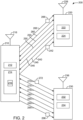
- Fig. 2 illustrates exemplary BLUETOOTH@ pairing mechanisms, components, and interfaces for pairing BLUETOOTH ® enabled devices such as BLUETOOTH ® enabled computing device 110 shown in Fig. 1 .
- Fig. 2 illustrates an exemplary communication system 200 employing BLUETOOTH ® technology providing a communications path between BLUETOOTH ® enabled computing devices 210, 220, and 230.
- BLUETOOTH ® enabled computing devices 210, 220, and 230 may be described by computing device 110.
- each BLUETOOTH ® enabled computing device 210, 220, and 230 has an associated processor 212, 222, and 232 respectively, an associated memory 214, 224, and 234 respectively, and a BLUETOOTH ® interface 216, 226, 236 respectively.
- BLUETOOTH ® protocol employs a pairing process to establish a new relationship between two BLUETOOTH ® enabled devices before they can exchange data.
- pairing refers to a mechanism where the two devices are exchanging protected link keys and resultantly form a bond. Pairing may be described in terms of a discovery and authentication mechanism. Once paired, all data and information transmitted over the resulting pathway BLUETOOTH ® link may be encrypted and only devices authorized during the pairing process will be able to receive and decipher this encrypted transmission.
- computing device 210 In system 200, in order to establish a pairing between any of BLUETOOTH ® enabled computing device 210 and computing devices 220 or 230, computing device 210 advertises its availability using a pseudo device identifier and may be discovered by devices such as computing devices 220 and 230. Computing device 210 may therefore be referred to as the "advertising device" (i.e., functioning in the role of Device A in the examples above) as it advertises its availability for pairing in this example. (Nevertheless, computing device 210 may serve as a scanning device in other examples.) For clarity, in this example, we may assume that computing device 220 first pairs with computing device 210 before computing device 230 pairs with computing device 210.
- computing device 210 is placed into pairing mode and advertises its availability via an advertising packet 240.
- Advertising packet 240 contains device identifier 242.
- device identifier 242 reflects a first pseudo device identifier formed based on a specific device address 215 specified in memory 214.
- device identifier is a 48-bit address represented as a 12-digit hexadecimal value.
- the first 24 bits of the address i.e., the first six hexadecimal digits
- the second 24 bits i.e., the last six hexadecimal digits
- an exemplary specific device address 215 may be given as shown in the table below (Table 1): TABLE 1 Organizationally Unique Identifier Device Specific Identifier 13579A 23:45:67
- the unmodified standard device identifier includes a first component associated with the organizationally unique identifier (OUI) and a second component associated with a device specific identifier.
- UUI organizationally unique identifier
- the systems described herein illustrate two methods for converting the unmodified standard device identifier to a pseudo device identifier.
- computing device 210 substitutes the Organizationally Unique Identifier "13579A" from the first component with another Organizationally Unique Identifier.
- the substituted Organizationally Unique Identifier is also registered with the BLUETOOTH ® Registration authorities.
- one exemplary "pseudo" device identifier generated in this manner may be given as shown in the table below (Table 2): TABLE 2 Organizationally Unique Identifier Device Specific Identifier 2468BD 23:45:67
- the substitute Organizationally Unique Identifier may be obtained from a data store that is in communication with computing device 210.
- the substitute Organizationally Unique Identifier may be stored in memory 214 or on any external data store that is in communication with computing device 210.
- computing device 210 substitutes the Device Specific Identifier from the second component shown in Table 1 with another Device Specific Identifier.
- the substitute Device Specific Identifier may be generated using any suitable method including a random number generator, a conversion algorithm that processes the "real" Device Specific Identifier into the substitute Device Specific Identifier in an algorithmic manner.
- computing device 210 may retrieve the substitute Device Specific Identifier from an internal or external data store that is in communication with computing device 210.
- a second exemplary "pseudo" device identifier generated in this manner may be given as shown in the table below (Table 3): TABLE 3 Organizationally Unique Identifier Device Specific Identifier 13579A 0A:BC:DE
- Scanning device 220 is also placed into pairing mode and scans for available devices. Scanning device 220 scans by submitting a scan request 245.
- scanning device 220 is in discovery mode and detects advertised messages sent via broadcast queries such as the advertising packet 240 sent by the advertising device 210.
- the scanning device 220 may send scan a scan request 245 directly to advertising device 210 with which it seeks to pair.
- Advertising device 210 may respond to the scanning device 220 with a scan response 246, indicating willingness to pair.
- Scanning device 220 sends a connection request 250 to advertising device 210.
- Advertising device 210 accepts connection request 250 and creates a connection with scanning device 220. Once a connection is established, a communication channel is opened between the advertising 210 and scanning 220 devices. Scanning device 220 sends pairing request 255 to advertising device 210 which responds with pairing response 260..
- devices 210 and 220 may exchange an Identity Address information string.
- advertising device 210 may provide an Identity Address information string 265 including a device address 266.
- Scanning device 220 may complete pairing using device address 266.
- advertising device 210 provides its "real" identity to scanning device 220.
- device address 266 is the same as device identifier 242 and both device identifier 242 and device address 266 are unique "pseudo" device identifiers for advertising device 210. As described herein, the use of such a unique "pseudo" device identifier allows for selective advertising, reduced competition for connection to advertising device 210, and reduced chances of message collisions.
- scanning device 220 and advertising device 210 have established a pairing that may be used for reconnection. They may continue communications or disconnect with the possibility of later reconnection.
- computing devices 210 and 220 may disconnect.
- Device identifier 242 used in pairing computing devices 210 and 220 may reflect a pseudo device identifier generated according to one of the methods described above.
- Computing device 210 may be configured to verify that device identifier 242 is unique and does not match any other device identifiers used by computing device 210 to communicate with any other computing devices.
- computing device 210 may seek to advertise selectively in order to pair with other devices (i.e., devices other than computing device 220). To do so, computing device 210 must disguise itself so that computing device 220 will not reconnect when it recognizes device identifier 242. As such, in the unique addressing embodiment computing device 210 generates a pseudo device identifier 272 distinct from device identifier 242 (and distinct from device address 266). If computing device 230 is in discovery mode, computing device 230 sees the pseudo device identifier 272 and believes that computing device 210 is a new device available for pairing.
- computing device 220 is not in pairing mode, but is rather seeking to re-connect with previously paired devices. Thus, computing device 220 may see a device indicated by pseudo device identifier 272 but will not recognize this identifier as being associated with computing device 210. Thus, while computing device 220 may send scan requests 245, it will not see computing device 210 as a device with which it has previously connected and will therefore ignore it for the purposes of reconnection.
- Computing device 230 is in discovery mode and will seek to pair with new devices. Upon seeing advertising packet 270 containing pseudo device identifier 272, computing device 230 recognizes a new device and sends a scan request 275 to computing device 210. Similarly to the manner previously discussed, computing device 210 may send scan response 276 indicating a willingness to pair.
- Scanning device 230 sends a connection request 280 to advertising device 210.
- Advertising device 210 accepts connection request 280 and creates a connection with scanning device 230. Once a connection is established, a communication channel is opened between the advertising 210 and scanning 230 devices.
- Scanning device 230 sends pairing request 285 to advertising device 210 which responds with pairing response 290. Subsequently, in further pairing messaging, devices may exchange an Identity Address information string. In this step, advertising device 210 may provide an Identity Address information string 295 including a device address 296.
- Scanning device 230 may complete pairing using device address 296.
- advertising device 210 provides its "real" identity to scanning device 230.
- device address 296 may also be the same as device identifier 272 and both device identifier 272 and device address 296 are unique "pseudo" device identifiers for advertising device 210. As described herein, the use of such a unique "pseudo" device identifier allows for selective advertising, reduced competition for connection to advertising device 210, and reduced chances of message collisions.
- scanning device 230 and advertising device 210 have established a pairing that may be used for reconnection. They may continue communications or disconnect with the possibility of later reconnection.
- BLUETOOTH ® enabled computing devices 210, 220, and 230 have pairing relationships such that computing devices 210 and 220 are paired and computing devices 210 and 230 are paired. As such, any time reconnecting computing devices 210, 220, and 230 detect a paired device in a communicable range, the paired devices will seek to connect and may begin transmission of information.
- advertising device 210 may initially advertise its identity to a scanning device 220 or 230 with a pseudo identifier 242 or 272 and later replace this identifier with a device address 266 or 296 that is the specific device address 215 for advertising device 210. In such examples, if advertising device 210 later advertises its identity with its specific device address 215, both scanning device 220 and 230 may seek to reconnect.
- advertising device 210 maintains distinct unique pseudo device identifiers 242 and 272 that persist as pseudo device addresses 266 and 296.
- advertising device 210 may selectively choose a particular pseudo device address to allow reconnection for only a particular scanning device. For example, if advertising device 210 advertises that it has pseudo device address 266, only scanning device 220 will seek to reconnect while scanning device 230 will believe that it has not previously paired with that device. Alternatively, if advertising device 210 advertises that it has pseudo device address 296, only scanning device 230 will seek to reconnect while scanning device 220 will believe that it has not previously paired with that device.
- first BLUETOOTH ® enabled computing device 210 retrieves 310 BLUETOOTH ® device identifier from memory 214 or any suitable data store that it is in communication with.
- the BLUETOOTH@ device identifier may be represented as specific device address 215.
- First BLUETOOTH@ enabled computing device 210 converts 320 the retrieved BLUETOOTH ® device identifier to a second (or "pseudo") device identifier 242.
- first BLUETOOTH@ enabled computing device 210 may partition BLUETOOTH ® device identifier (as given by specific device address 215) into a first portion and a second portion such that the first portion represents the Organizationally Unique Identifier and the second portion represents the Device Specific Identifier.
- first BLUETOOTH ® enabled computing device 210 may then identify a "pseudo" organizationally unique identifier from a data store that is in communication with first BLUETOOTH ® enabled computing device 210.
- first BLUETOOTH ® enabled computing device 210 may generate a substitute Device Specific Identifier using any suitable method including a random number generator, a conversion algorithm, and retrieval of the substitute Device Specific Identifier from an internal or external data store.
- first BLUETOOTHO enabled computing device 210 replaces either the first portion of first BLUETOOTH ® device identifier (as given by specific device address 215) with the "pseudo" organizationally unique identifier or the second portion of first BLUETOOTH@ device identifier (as given by specific device address 215) with the "pseudo" device specific identifier.
- first BLUETOOTH ® enabled computing device 210 may convert first BLUETOOTH ® device identifier (as given by specific device address 215) to second BLUETOOTH ® device identifier 242 using any other suitable means.
- First BLUETOOTH ® enabled computing device 210 further advertises 330 the availability of first computing device 210 for pairing using second BLUETOOTH ® device identifier 242. Specifically, first BLUETOOTH ® enabled computing device 210 sends communications including advertising packet 240 that contain second (or "pseudo") device identifier 242.
- First BLUETOOTH ® enabled computing device 210 additionally receives 340 a pairing request from a second computing device (in this example, BLUETOOTH ® enabled computing device 220 or 230). First BLUETOOTH ® enabled computing device 210 may accordingly receive an inquiry response containing a device identifier for the second computing device.
- a second computing device in this example, BLUETOOTH ® enabled computing device 220 or 230.
- First BLUETOOTH ® enabled computing device 210 further establishes 350 a BLUETOOTH ® communications path between first computing device 210 and second computing device 220 or 230.
- the BLUETOOTH ® communications path is created based at least partially on the second (or "pseudo") device identifier 242.
- the "pseudo" device identifier 242 is a temporary identifier that is subsequently replaced with a more permanent device identifier.
- second device identifier 242 may be replaced with device identifier as given by specific device address 215.
- first BLUETOOTH ® enabled computing device 210 retrieves or provides 360 first BLUETOOTH ® device identifier (as given by specific device address 215) as a substitute for second BLUETOOTH ® device identifier 242.
- First BLUETOOTH ® enabled computing device 210 further updates 370 the BLUETOOTH ® communications path between first computing device 210 and second computing device 220 or 230 based on the first BLUETOOTH ® device identifier (as given by specific device address 215).
- first BLUETOOTH ® enabled computing device 210 replaces second device identifier 242 with a new device identifier.
- BLUETOOTH ® enabled computing devices 210 and 230 further communicate data using the updated BLUETOOTH ® communications path based on first BLUETOOTH ® device identifier (as given by specific device address 215).
- the systems and methods described may also allow devices such as first and second BLUETOOTH ® enabled computing devices 210 and 220 to "re-pair" after a break in their pairing. For example, If first BLUETOOTH ® enabled computing device 210 deletes or otherwise fails to maintain the link key for second BLUETOOTH ® enabled computing device 220, the broadcast of "pseudo" device identifier 242 by first BLUETOOTH ® enabled computing device 210 will cause second BLUETOOTH ® enabled computing device 220 to attempt to pair again because second BLUETOOTH ® enabled computing device 220 believes it sees a "new" device. If first BLUETOOTH ® enabled computing device 210 accepts this pairing attempt, the devices can efficiently refresh their relationship.
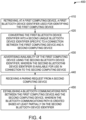
- first BLUETOOTH ® enabled computing device 210 retrieves 410 BLUETOOTH ® device identifier from memory 214 or any suitable data store that it is in communication with.
- the BLUETOOTH ® device identifier may be represented as specific device address 215.
- First BLUETOOTH ® enabled computing device 210 converts 420 the retrieved BLUETOOTH ® device identifier to a second (or "pseudo") device identifier 242 that is specific to a connection between first computing device 210 and a second computing device (e.g., computing device 220). In some examples, this conversion may be accomplished using the techniques described above. Specifically, first BLUETOOTH ® enabled computing device 210 may retrieve all pseudo device identifiers used for any connections to other computing devices to ensure that pseudo device identifier 242 is unique and specific to a connection between first computing device 210 and a second computing device 220.
- first computing device 210 may partition BLUETOOTH ® device identifier (as given by specific device address 215) into a first portion and a second portion such that the first portion represents the Organizationally Unique Identifier and the second portion represents the Device Specific Identifier.
- first BLUETOOTH ® enabled computing device 210 may then identify a "pseudo" organizationally unique identifier from a data store that is in communication with first BLUETOOTH ® enabled computing device 210.
- first BLUETOOTH ® enabled computing device 210 may generate a substitute Device Specific Identifier using any suitable method including a random number generator, a conversion algorithm, and retrieval of the substitute Device Specific Identifier from an internal or external data store.
- first BLUETOOTH ® enabled computing device 210 replaces either the first portion of first BLUETOOTH ® device identifier (as given by specific device address 215) with the "pseudo" organizationally unique identifier or the second portion of first BLUETOOTH ® device identifier (as given by specific device address 215) with the "pseudo" device specific identifier.
- first BLUETOOTH ® enabled computing device 210 may convert first BLUETOOTH ® device identifier (as given by specific device address 215) to second BLUETOOTH ® device identifier 242 using any other suitable means.
- computing device 210 may validate that second BLUETOOTH ® device identifier 242 is uniquely specific to a connection between first computing device 210 and a second computing device 220. In examples where second BLUETOOTH ® device identifier 242 is determined to not be unique, first computing device 210 may create an alternative second BLUETOOTH ® device identifier 242 until a unique identifier is achieved.
- First BLUETOOTH ® enabled computing device 210 further advertises 430 the availability of first computing device 210 for pairing using second BLUETOOTH ® device identifier 242. Specifically, first BLUETOOTH ® enabled computing device 210 sends communications including advertising packet 240 that contain second (or "pseudo") device identifier 242.
- First BLUETOOTH ® enabled computing device 210 additionally receives 440 a pairing request from a second computing device (in this example, BLUETOOTH ® enabled computing device 220 or 230). First BLUETOOTH ® enabled computing device 210 may accordingly receive an inquiry response containing a device identifier for the second computing device.
- a second computing device in this example, BLUETOOTH ® enabled computing device 220 or 230.
- First BLUETOOTH ® enabled computing device 210 further establishes 450 a BLUETOOTH ® communications path between first computing device 210 and second computing device 220 or 230.
- the BLUETOOTH ® communications path is created based at least partially on the second (or "pseudo") device identifier 242.
- Fig. 5 is a diagram 500 of components of one or more example computing devices that may be used in the system 200 shown in Fig. 2 .
- computing device 510 is similar to BLUETOOTH ® enabled computing device 110.
- Data store 520 may be stored at memory 130 (shown in Fig. 1 ) or any other suitable location. Data store 520 may be coupled with several separate components 511, 512, 513, 514, 515, 516, and 517 within computing device 410, which perform specific tasks.
- data store 520 includes device identifier information 521, pseudo Organizationally Unique Identifier information 522, pseudo Device Specific Identifier information 523, conversion algorithms 524, and BLUETOOTH ® communications algorithms 525.
- Computing device 510 may include data store 520, as well as data storage devices (not shown).
- Computing device 510 also includes a retrieving component 511 for retrieving a first BLUETOOTH ® device identifier used for identifying the first computing device, a converting component 512 for converting the first BLUETOOTH ® device identifier into a second BLUETOOTH ® device identifier, an advertising component 513 for advertising availability of the first computing device using the second BLUETOOTH ® device identifier, a receiving component 514 for receiving a pairing request from a second computing device, an establishing component 515 for establishing a BLUETOOTH ® communications path between the first computing device and the second computing device, a providing component 516 for providing the first BLUETOOTH ® device identifier as a substitute for the second BLUETOOTH ® device identifier, and an updating component 517 for updating the BLUETOOTH ® communications path between the first computing device and the second computing device based on the first BLUETOOTH ® device identifier.
- a retrieving component 511 for retrieving
- Example computer-readable media may be, but are not limited to, a flash memory drive, digital versatile disc (DVD), compact disc (CD), fixed (hard) drive, diskette, optical disk, magnetic tape, semiconductor memory such as read-only memory (ROM), and/or any transmitting/receiving medium such as the Internet or other communication network or link.
- Computer-readable media comprise computer-readable storage media and communication media.
- Computer-readable storage media are tangible and non-transitory and store information such as computer-readable instructions, data structures, program modules, and other data.
- Communication media typically embody computer-readable instructions, data structures, program modules, or other data in a transitory modulated signal such as a carrier wave or other transport mechanism and include any information delivery media. Combinations of any of the above are also included in the scope of computer-readable media.
- the article of manufacture containing the computer code may be made and/or used by executing the code directly from one medium, by copying the code from one medium to another medium, or by transmitting the code over a network.
Landscapes
- Engineering & Computer Science (AREA)
- Computer Networks & Wireless Communication (AREA)
- Signal Processing (AREA)
- Computer Security & Cryptography (AREA)
- Business, Economics & Management (AREA)
- Databases & Information Systems (AREA)
- Accounting & Taxation (AREA)
- Strategic Management (AREA)
- Physics & Mathematics (AREA)
- General Business, Economics & Management (AREA)
- General Physics & Mathematics (AREA)
- Theoretical Computer Science (AREA)
- Mobile Radio Communication Systems (AREA)
Claims (15)
- Procédé de couplage de dispositifs compatibles BLUETOOTH réalisé par un premier dispositif de calcul (100), le procédé comprenant :a) la récupération, au niveau d'un premier dispositif de calcul, d'un premier identifiant de dispositif utilisé pour identifier le premier dispositif de calcul ;b) la conversion du premier identifiant de dispositif en un deuxième identifiant de dispositif ;c) l'annonce de la disponibilité du premier dispositif de calcul en utilisant le deuxième identifiant de dispositif ;d) la réception d'une demande de couplage d'un deuxième dispositif de calcul (170) ;e) l'établissement d'un trajet de communications entre le premier dispositif de calcul et le deuxième dispositif de calcul après la réception de la demande de couplage, dans lequel le trajet de communications est créé en se basant au moins partiellement sur le deuxième identifiant de dispositif ;f) la fourniture, par le premier dispositif de calcul, du premier identifiant de dispositif au deuxième dispositif de calcul, le premier identifiant de dispositif étant un substitut du deuxième identifiant de dispositif ; caractérisé en ce que le procédé comprend en outre :g) la mise à jour du trajet de communications entre le premier dispositif de calcul et le deuxième dispositif de calcul par substitution par le premier identifiant de dispositif du deuxième identifiant de dispositif après la fourniture du premier identifiant de dispositif au deuxième dispositif de calcul, de telle sorte que le trajet de communications mis à jour se base sur le premier identifiant de dispositif tel que fourni au deuxième dispositif de calcul ; eth) la communication de données avec le deuxième dispositif de calcul en utilisant le trajet de communications mis à jour.
- Procédé selon la revendication 1, dans lequel la conversion du premier identifiant de dispositif en un deuxième identifiant de dispositif comprend :le partitionnement du premier identifiant de dispositif en une première partie et une seconde partie ;l'identification d'un « pseudo » identifiant organisationnellement unique ; etle remplacement de la première partie du premier identifiant de dispositif par le « pseudo » identifiant organisationnellement unique.
- Procédé selon la revendication 2, dans lequel le « pseudo » identifiant organisationnellement unique est obtenu à partir d'un magasin de données en communication avec le premier dispositif de calcul.
- Procédé selon la revendication 1, dans lequel la conversion du premier identifiant de dispositif en un deuxième identifiant de dispositif comprend :le partitionnement du premier identifiant de dispositif en une première partie et une seconde partie ;l'identification d'un « pseudo » identifiant spécifique d'un dispositif ; etle remplacement de la seconde partie du premier identifiant de dispositif par le « pseudo » identifiant spécifique d'un dispositif ;dans lequel éventuellement le « pseudo » identifiant spécifique d'un dispositif est identifié par l'utilisation d'au moins un parmi un générateur de nombres aléatoires, un algorithme de conversion et un magasin de données en communication avec le premier dispositif de calcul.
- Procédé selon la revendication 1, comprenant en outre :a) la récupération, au niveau du premier dispositif de calcul, du premier identifiant de dispositif utilisé pour identifier le premier dispositif de calcul ;b) la conversion du premier identifiant de dispositif en un troisième identifiant de dispositif, dans lequel le troisième identifiant de dispositif est distinct du deuxième identifiant de dispositif et du premier identifiant de dispositif ;c) l'annonce de la disponibilité du premier dispositif de calcul en utilisant le troisième identifiant de dispositif ;d) la réception d'une demande de couplage d'un troisième dispositif de calcul (170) ;e) l'établissement d'un trajet de communications entre le premier dispositif de calcul et le troisième dispositif de calcul après la réception de la demande de couplage, dans lequel le trajet de communications est créé en se basant au moins partiellement sur le troisième identifiant de dispositif ;f) la fourniture, par le premier dispositif de calcul, du premier identifiant de dispositif au troisième dispositif de calcul, le premier identifiant de dispositif étant un substitut du troisième identifiant de dispositif ; etg) la mise à jour du trajet de communications entre le premier dispositif de calcul et le troisième dispositif de calcul en se basant sur le premier identifiant de dispositif après la fourniture du premier identifiant de dispositif au troisième dispositif de calcul.
- Système de couplage amélioré de dispositifs compatibles BLUETOOTH (210, 220, 230), le système comprenant :un premier dispositif de calcul compatible BLUETOOTH (210) comprenant un premier processeur (212),une première mémoire (214) et un premier émetteur-récepteur (216) ; etun deuxième dispositif de calcul compatible BLUETOOTH (220) comprenant un deuxième processeur (222), une deuxième mémoire (224) et un deuxième émetteur-récepteur (226),dans lequel ledit premier processeur est configuré pour :a) récupérer un premier identifiant de dispositif utilisé pour identifié ledit premier dispositif de calcul ;b) convertir le premier identifiant de dispositif en un deuxième identifiant de dispositif ;c) annoncer la disponibilité dudit premier dispositif de calcul en utilisant le deuxième identifiant de dispositif ;d) recevoir une demande de couplage dudit deuxième dispositif de calcul ;e) établir un trajet de communications entre ledit premier dispositif de calcul et ledit deuxième dispositif de calcul après la réception de la demande de couplage, dans lequel ledit trajet de communications est créé en se basant au moins partiellement sur le deuxième identifiant de dispositif ;f) fournir le premier identifiant de dispositif au deuxième dispositif de calcul en utilisant le trajet de communications, le premier identifiant de dispositif étant un substitut du deuxième identifiant de dispositif ; caractérisé en ce que ledit premier processeur est en outre configuré pour :g) mettre à jour ledit trajet de communications entre ledit premier dispositif de calcul et ledit deuxième dispositif de calcul par substitution par ledit premier identifiant de dispositif du deuxième identifiant de dispositif ; de telle sorte que le trajet de communications mis à jour se base sur le premier identifiant de dispositif tel que fourni au deuxième dispositif de calcul ;
eth) communiquer des données avec ledit deuxième dispositif de calcul en utilisant ledit trajet de communications mis à jour. - Système selon la revendication 6, dans lequel ledit premier processeur est en outre configuré pour :séparer le premier identifiant de dispositif en une première partie et une seconde partie ;identifier un « pseudo » identifiant organisationnellement unique ; etremplacer la première partie du premier identifiant de dispositif par le « pseudo » identifiant organisationnellement unique ;
- Système selon la revendication 7, dans lequel ledit premier processeur est en outre configuré pour identifier le « pseudo » identifiant organisationnellement unique à partir d'un magasin de données en communication avec ledit premier dispositif de calcul.
- Système selon la revendication 6, dans lequel ledit premier processeur est en outre configuré pour :séparer le premier identifiant de dispositif en une première partie et une seconde partie ;identifier un « pseudo » identifiant spécifique d'un dispositif ; etremplacer la seconde partie du premier identifiant de dispositif par le « pseudo » identifiant spécifique d'un dispositif ;dans lequel éventuellement ledit premier processeur est en outre configuré pour identifier le « pseudo » identifiant spécifique d'un dispositif par l'utilisation d'au moins un parmi un générateur de nombres aléatoires, un algorithme de conversion et un magasin de données en communication avec ledit premier dispositif de calcul.
- Système selon la revendication 6, dans lequel ledit premier processeur est en outre configuré pour :a) récupérer le premier identifiant de dispositif utilisé pour identifier ledit premier dispositif de calcul ;b) convertir le premier identifiant de dispositif en un troisième identifiant de dispositif, dans lequel le troisième identifiant de dispositif est distinct du deuxième identifiant de dispositif et du premier identifiant de dispositif ;c) annoncer la disponibilité dudit premier dispositif de calcul en utilisant le troisième identifiant de dispositif ;d) recevoir une demande de couplage d'un troisième dispositif de calcul (220, 230) ;e) établir un trajet de communications entre ledit premier dispositif de calcul et ledit troisième dispositif de calcul après la réception de la demande de couplage, dans lequel ledit trajet de communications est créé en se basant au moins partiellement sur le troisième identifiant de dispositif ;f) fournir le premier identifiant de dispositif au troisième dispositif de calcul en utilisant le trajet de communications, le premier identifiant de dispositif étant un substitut du troisième identifiant de dispositif ; etg) mettre à jour ledit trajet de communications entre ledit premier dispositif de calcul et ledit troisième dispositif de calcul en se basant sur le premier identifiant de dispositif après avoir fourni le premier identifiant de dispositif au troisième dispositif de calcul.
- Dispositif de calcul compatible BLUETOOTH (100) pour un couplage BLUETOOTH amélioré, ledit dispositif de calcul comprenant :
un processeur (120), une mémoire (130) et un émetteur-récepteur (160), ledit processeur étant configuré pour :a) récupérer un premier identifiant de dispositif utilisé pour identifier ledit dispositif de calcul ;b) convertir le premier identifiant de dispositif en un deuxième identifiant de dispositif ;c) annoncer la disponibilité dudit dispositif de calcul en utilisant le deuxième identifiant de dispositif ;d) recevoir une demande de couplage d'un deuxième dispositif de calcul (170) ;e) établir un trajet de communications entre ledit dispositif de calcul et ledit deuxième dispositif de calcul après la réception de la demande de couplage, dans lequel ledit trajet de communications est créé en se basant au moins partiellement sur le deuxième identifiant de dispositif ;f) fournir le premier identifiant de dispositif au deuxième dispositif de calcul en utilisant le trajet de communications, le premier identifiant de dispositif étant un substitut du deuxième identifiant de dispositif ; caractérisé en ce que ledit processeur est en outre configuré pour :g) mettre à jour ledit trajet de communications entre ledit dispositif de calcul et ledit deuxième dispositif de calcul par substitution par ledit premier identifiant de dispositif du deuxième identifiant de dispositif après avoir fourni le premier identifiant de dispositif au deuxième dispositif de calcul de telle sorte que le trajet de communications mis à jour se base sur le premier identifiant de dispositif tel que fourni au deuxième dispositif de calcul ; eth) communiquer des données avec ledit deuxième dispositif de calcul en utilisant ledit trajet de communications mis à jour. - Dispositif de calcul selon la revendication 11, dans lequel ledit processeur est en outre configuré pour :séparer le premier identifiant de dispositif en une première partie et une seconde partie ;identifier un « pseudo » identifiant organisationnellement unique ; etremplacer la première partie du premier identifiant de dispositif par le « pseudo » identifiant organisationnellement unique ;
- Dispositif de calcul selon la revendication 12, dans lequel ledit processeur est en outre configuré pour identifier le « pseudo » identifiant organisationnellement unique à partir d'un magasin de données en communication avec ledit dispositif de calcul.
- Dispositif de calcul selon la revendication 11, dans lequel ledit processeur est en outre configuré pour :séparer le premier identifiant de dispositif en une première partie et une seconde partie ;identifier un « pseudo » identifiant spécifique d'un dispositif ; etremplacer la seconde partie du premier identifiant de dispositif par le « pseudo » identifiant spécifique d'un dispositif ;dans lequel éventuellement ledit processeur est en outre configuré pour identifier le « pseudo » identifiant spécifique d'un dispositif par l'utilisation d'au moins un parmi un générateur de nombres aléatoires, un algorithme de conversion et un magasin de données en communication avec ledit premier dispositif de calcul.
- Dispositif de calcul selon la revendication 11, dans lequel ledit processeur est en outre configuré pour :a) récupérer le premier identifiant de dispositif utilisé pour identifier ledit dispositif de calcul ;b) convertir le premier identifiant de dispositif en un troisième identifiant de dispositif, dans lequel le troisième identifiant de dispositif est distinct du deuxième identifiant de dispositif et du premier identifiant de dispositif ;c) annoncer la disponibilité dudit dispositif de calcul en utilisant le troisième identifiant de dispositif ;d) recevoir une demande de couplage d'un troisième dispositif de calcul (170) ;e) établir un trajet de communications entre ledit dispositif de calcul et ledit troisième dispositif de calcul après la réception de la demande de couplage, dans lequel ledit trajet de communications est créé en se basant au moins partiellement sur le troisième identifiant de dispositif ;f) fournir le premier identifiant de dispositif au troisième dispositif de calcul en utilisant le trajet de communications, le premier identifiant de dispositif étant un substitut du troisième identifiant de dispositif ; etg) mettre à jour ledit trajet de communications entre ledit dispositif de calcul et ledit troisième dispositif de calcul en se basant sur le premier identifiant de dispositif après avoir fourni le premier identifiant de dispositif au troisième dispositif de calcul.
Applications Claiming Priority (2)
| Application Number | Priority Date | Filing Date | Title |
|---|---|---|---|
| US201662377066P | 2016-08-19 | 2016-08-19 | |
| PCT/US2017/047143 WO2018035223A1 (fr) | 2016-08-19 | 2017-08-16 | Procédés et systèmes de liaison bluetooth® améliorée |
Publications (4)
| Publication Number | Publication Date |
|---|---|
| EP3501236A1 EP3501236A1 (fr) | 2019-06-26 |
| EP3501236A4 EP3501236A4 (fr) | 2020-02-19 |
| EP3501236C0 EP3501236C0 (fr) | 2024-03-27 |
| EP3501236B1 true EP3501236B1 (fr) | 2024-03-27 |
Family
ID=61197439
Family Applications (1)
| Application Number | Title | Priority Date | Filing Date |
|---|---|---|---|
| EP17842056.8A Active EP3501236B1 (fr) | 2016-08-19 | 2017-08-16 | Procédés et systèmes de liaison bluetooth® améliorée |
Country Status (7)
| Country | Link |
|---|---|
| US (1) | US10885512B2 (fr) |
| EP (1) | EP3501236B1 (fr) |
| CN (1) | CN109691148B (fr) |
| CA (1) | CA3030432C (fr) |
| ES (1) | ES2987587T3 (fr) |
| TW (1) | TWI757321B (fr) |
| WO (1) | WO2018035223A1 (fr) |
Families Citing this family (6)
| Publication number | Priority date | Publication date | Assignee | Title |
|---|---|---|---|---|
| CN115802326B (zh) * | 2021-09-13 | 2025-10-24 | 华为技术有限公司 | 一种蓝牙连接方法及电子设备 |
| EP4494311B1 (fr) | 2022-03-16 | 2026-05-06 | Dexcom, Inc. | Appariement de proximité et sécurité d'un système de capteur d'analyte continu |
| US12389469B2 (en) * | 2022-06-30 | 2025-08-12 | Toyota Motor North America, Inc. | Automatic device and vehicle pairing |
| CN115002936B (zh) * | 2022-07-11 | 2024-11-05 | 珠海蓝图运动科技股份有限公司 | 一种自行车电子变速器通信方法、装置及自行车 |
| CN115278624B (zh) * | 2022-07-21 | 2025-01-07 | Oppo广东移动通信有限公司 | 信息更新方法及装置、音频共享方法及系统、电子设备 |
| US12593216B2 (en) * | 2023-06-19 | 2026-03-31 | Dell Products L.P. | Managed automatic pairing |
Family Cites Families (19)
| Publication number | Priority date | Publication date | Assignee | Title |
|---|---|---|---|---|
| US7245602B2 (en) * | 2000-11-22 | 2007-07-17 | Telefonaktiebolaget Lm Ericsson (Publ) | System and method for anonymous Bluetooth devices |
| US7194760B2 (en) * | 2001-05-21 | 2007-03-20 | Nokia Corporation | Method for protecting privacy when using a Bluetooth device |
| US7809361B2 (en) * | 2006-06-19 | 2010-10-05 | Nokia Corporation | Address privacy in short-range wireless communication |
| GB2439610A (en) | 2006-06-29 | 2008-01-02 | Symbian Software Ltd | Storing Bluetooth (RTM) contact details in a mobile device |
| US8301195B2 (en) * | 2006-07-05 | 2012-10-30 | Agere Systems Inc. | Systems and methods for mobile data storage and acquisition |
| US8626152B2 (en) * | 2008-01-31 | 2014-01-07 | Agero Connected Sevices, Inc. | Flexible telematics system and method for providing telematics to a vehicle |
| US8208891B2 (en) * | 2009-05-01 | 2012-06-26 | At&T Intellectual Property I, L.P. | Methods and systems for relaying out of range emergency information |
| US8995908B2 (en) * | 2012-01-25 | 2015-03-31 | Blackberry Limited | Mobile communications system providing enhanced out of band (OOB) bluetooth pairing and related methods |
| US20140133656A1 (en) * | 2012-02-22 | 2014-05-15 | Qualcomm Incorporated | Preserving Security by Synchronizing a Nonce or Counter Between Systems |
| CN104509143B (zh) * | 2012-06-20 | 2018-09-07 | 策安保安有限公司 | 蓝牙配对系统、方法和设备 |
| US20150189426A1 (en) * | 2013-01-01 | 2015-07-02 | Aliphcom | Mobile device speaker control |
| US9286511B2 (en) * | 2013-01-22 | 2016-03-15 | Amerasia International Technology, Inc. | Event registration and management system and method employing geo-tagging and biometrics |
| US9261371B2 (en) * | 2014-05-16 | 2016-02-16 | Honeywell International Inc. | System and method of voice based personalized interactive evacuation guidance |
| US9424417B2 (en) * | 2014-06-04 | 2016-08-23 | Qualcomm Incorporated | Secure current movement indicator |
| KR102239090B1 (ko) * | 2014-06-05 | 2021-04-13 | 삼성전자 주식회사 | 위치 정보를 제공하기 위한 방법 및 장치 |
| US9668126B2 (en) * | 2014-08-12 | 2017-05-30 | Lenovo (Singapore) Pte. Ltd. | Preventing location tracking via smartphone MAC address |
| TWI513214B (zh) * | 2014-09-04 | 2015-12-11 | Quanta Comp Inc | 建立藍芽連線之方法和系統 |
| US9357576B2 (en) * | 2014-09-27 | 2016-05-31 | Intel Corporation | Automatic pairing for portable computing devices |
| US10425285B2 (en) * | 2015-05-21 | 2019-09-24 | Centurylink Intellectual Property Llc | Automatic noise profile generation |
-
2017
- 2017-08-16 CN CN201780050741.2A patent/CN109691148B/zh active Active
- 2017-08-16 CA CA3030432A patent/CA3030432C/fr active Active
- 2017-08-16 US US16/324,150 patent/US10885512B2/en active Active
- 2017-08-16 EP EP17842056.8A patent/EP3501236B1/fr active Active
- 2017-08-16 ES ES17842056T patent/ES2987587T3/es active Active
- 2017-08-16 WO PCT/US2017/047143 patent/WO2018035223A1/fr not_active Ceased
- 2017-08-17 TW TW106127869A patent/TWI757321B/zh active
Also Published As
| Publication number | Publication date |
|---|---|
| TW201820798A (zh) | 2018-06-01 |
| US10885512B2 (en) | 2021-01-05 |
| ES2987587T3 (es) | 2024-11-15 |
| CN109691148B (zh) | 2022-12-27 |
| TWI757321B (zh) | 2022-03-11 |
| EP3501236A4 (fr) | 2020-02-19 |
| CN109691148A (zh) | 2019-04-26 |
| CA3030432C (fr) | 2021-03-30 |
| EP3501236C0 (fr) | 2024-03-27 |
| WO2018035223A1 (fr) | 2018-02-22 |
| CA3030432A1 (fr) | 2018-02-22 |
| US20190182662A1 (en) | 2019-06-13 |
| EP3501236A1 (fr) | 2019-06-26 |
Similar Documents
| Publication | Publication Date | Title |
|---|---|---|
| EP3501236B1 (fr) | Procédés et systèmes de liaison bluetooth® améliorée | |
| US20190182885A1 (en) | Methods and systems for enhanced bluetooth® bonding | |
| EP3958533B1 (fr) | Procédé d'accès au réseau local sans fil et terminal | |
| EP3556172B1 (fr) | Procédés et systèmes d'affirmation d'un appariement bluetooth® | |
| US9414217B2 (en) | Method and technical equipment for short range data transmission | |
| EP3679693B1 (fr) | Mise en service dans des réseaux à plusieurs bonds au moyen d'une connexion à un seul bond | |
| US8528051B2 (en) | Mobile terminal, server, and method for providing content information | |
| US20240121840A1 (en) | Network connection method, related apparatus, and system | |
| CA3097535C (fr) | Procedes et systemes d'authentification mutuelle de dispositifs | |
| HK40007153A (en) | Methods and systems for enhanced bluetooth® bonding | |
| HK40007923A (en) | Methods and systems for enhanced bluetooth bonding | |
| HK40007923B (en) | Methods and systems for enhanced bluetooth bonding | |
| KR20110056083A (ko) | 애드혹 무선 인스턴트 메신저 시스템 및 서비스 보안 방법 | |
| HK40011989A (en) | Methods and systems for affirmation of a pairing | |
| HK40011989B (en) | Methods and systems for affirmation of a pairing | |
| CN117615428A (zh) | 数据处理方法、数据获取方法、装置、终端及存储介质 | |
| HK40043208A (en) | Methods and systems for bidirectional device authentication |
Legal Events
| Date | Code | Title | Description |
|---|---|---|---|
| STAA | Information on the status of an ep patent application or granted ep patent |
Free format text: STATUS: THE INTERNATIONAL PUBLICATION HAS BEEN MADE |
|
| PUAI | Public reference made under article 153(3) epc to a published international application that has entered the european phase |
Free format text: ORIGINAL CODE: 0009012 |
|
| STAA | Information on the status of an ep patent application or granted ep patent |
Free format text: STATUS: REQUEST FOR EXAMINATION WAS MADE |
|
| 17P | Request for examination filed |
Effective date: 20190206 |
|
| AK | Designated contracting states |
Kind code of ref document: A1 Designated state(s): AL AT BE BG CH CY CZ DE DK EE ES FI FR GB GR HR HU IE IS IT LI LT LU LV MC MK MT NL NO PL PT RO RS SE SI SK SM TR |
|
| AX | Request for extension of the european patent |
Extension state: BA ME |
|
| DAV | Request for validation of the european patent (deleted) | ||
| DAX | Request for extension of the european patent (deleted) | ||
| REG | Reference to a national code |
Ref country code: DE Ref legal event code: R079 Free format text: PREVIOUS MAIN CLASS: H04W0076100000 Ipc: H04W0012000000 Ref document number: 602017080440 Country of ref document: DE |
|
| A4 | Supplementary search report drawn up and despatched |
Effective date: 20200122 |
|
| RIC1 | Information provided on ipc code assigned before grant |
Ipc: G06Q 20/32 20120101ALI20200116BHEP Ipc: H04W 12/02 20090101ALI20200116BHEP Ipc: H04W 12/00 20090101AFI20200116BHEP Ipc: H04W 4/80 20180101ALI20200116BHEP Ipc: H04W 12/06 20090101ALI20200116BHEP Ipc: H04W 76/10 20180101ALI20200116BHEP |
|
| STAA | Information on the status of an ep patent application or granted ep patent |
Free format text: STATUS: EXAMINATION IS IN PROGRESS |
|
| 17Q | First examination report despatched |
Effective date: 20201215 |
|
| GRAP | Despatch of communication of intention to grant a patent |
Free format text: ORIGINAL CODE: EPIDOSNIGR1 |
|
| STAA | Information on the status of an ep patent application or granted ep patent |
Free format text: STATUS: GRANT OF PATENT IS INTENDED |
|
| INTG | Intention to grant announced |
Effective date: 20231108 |
|
| GRAS | Grant fee paid |
Free format text: ORIGINAL CODE: EPIDOSNIGR3 |
|
| GRAA | (expected) grant |
Free format text: ORIGINAL CODE: 0009210 |
|
| STAA | Information on the status of an ep patent application or granted ep patent |
Free format text: STATUS: THE PATENT HAS BEEN GRANTED |
|
| RAP3 | Party data changed (applicant data changed or rights of an application transferred) |
Owner name: ROCHE DIABETES CARE GMBH Owner name: F. HOFFMANN-LA ROCHE AG |
|
| AK | Designated contracting states |
Kind code of ref document: B1 Designated state(s): AL AT BE BG CH CY CZ DE DK EE ES FI FR GB GR HR HU IE IS IT LI LT LU LV MC MK MT NL NO PL PT RO RS SE SI SK SM TR |
|
| REG | Reference to a national code |
Ref country code: GB Ref legal event code: FG4D |
|
| REG | Reference to a national code |
Ref country code: CH Ref legal event code: EP |
|
| REG | Reference to a national code |
Ref country code: DE Ref legal event code: R096 Ref document number: 602017080440 Country of ref document: DE |
|
| REG | Reference to a national code |
Ref country code: IE Ref legal event code: FG4D |
|
| U01 | Request for unitary effect filed |
Effective date: 20240403 |
|
| U07 | Unitary effect registered |
Designated state(s): AT BE BG DE DK EE FI FR IT LT LU LV MT NL PT SE SI Effective date: 20240411 |
|
| PG25 | Lapsed in a contracting state [announced via postgrant information from national office to epo] |
Ref country code: HR Free format text: LAPSE BECAUSE OF FAILURE TO SUBMIT A TRANSLATION OF THE DESCRIPTION OR TO PAY THE FEE WITHIN THE PRESCRIBED TIME-LIMIT Effective date: 20240327 Ref country code: RS Free format text: LAPSE BECAUSE OF FAILURE TO SUBMIT A TRANSLATION OF THE DESCRIPTION OR TO PAY THE FEE WITHIN THE PRESCRIBED TIME-LIMIT Effective date: 20240627 |
|
| PG25 | Lapsed in a contracting state [announced via postgrant information from national office to epo] |
Ref country code: RS Free format text: LAPSE BECAUSE OF FAILURE TO SUBMIT A TRANSLATION OF THE DESCRIPTION OR TO PAY THE FEE WITHIN THE PRESCRIBED TIME-LIMIT Effective date: 20240627 Ref country code: NO Free format text: LAPSE BECAUSE OF FAILURE TO SUBMIT A TRANSLATION OF THE DESCRIPTION OR TO PAY THE FEE WITHIN THE PRESCRIBED TIME-LIMIT Effective date: 20240627 Ref country code: HR Free format text: LAPSE BECAUSE OF FAILURE TO SUBMIT A TRANSLATION OF THE DESCRIPTION OR TO PAY THE FEE WITHIN THE PRESCRIBED TIME-LIMIT Effective date: 20240327 |
|
| U20 | Renewal fee for the european patent with unitary effect paid |
Year of fee payment: 8 Effective date: 20240723 |
|
| PG25 | Lapsed in a contracting state [announced via postgrant information from national office to epo] |
Ref country code: IS Free format text: LAPSE BECAUSE OF FAILURE TO SUBMIT A TRANSLATION OF THE DESCRIPTION OR TO PAY THE FEE WITHIN THE PRESCRIBED TIME-LIMIT Effective date: 20240727 |
|
| PG25 | Lapsed in a contracting state [announced via postgrant information from national office to epo] |
Ref country code: SM Free format text: LAPSE BECAUSE OF FAILURE TO SUBMIT A TRANSLATION OF THE DESCRIPTION OR TO PAY THE FEE WITHIN THE PRESCRIBED TIME-LIMIT Effective date: 20240327 |
|
| PG25 | Lapsed in a contracting state [announced via postgrant information from national office to epo] |
Ref country code: CZ Free format text: LAPSE BECAUSE OF FAILURE TO SUBMIT A TRANSLATION OF THE DESCRIPTION OR TO PAY THE FEE WITHIN THE PRESCRIBED TIME-LIMIT Effective date: 20240327 |
|
| PG25 | Lapsed in a contracting state [announced via postgrant information from national office to epo] |
Ref country code: PL Free format text: LAPSE BECAUSE OF FAILURE TO SUBMIT A TRANSLATION OF THE DESCRIPTION OR TO PAY THE FEE WITHIN THE PRESCRIBED TIME-LIMIT Effective date: 20240327 |
|
| PG25 | Lapsed in a contracting state [announced via postgrant information from national office to epo] |
Ref country code: SK Free format text: LAPSE BECAUSE OF FAILURE TO SUBMIT A TRANSLATION OF THE DESCRIPTION OR TO PAY THE FEE WITHIN THE PRESCRIBED TIME-LIMIT Effective date: 20240327 |
|
| PG25 | Lapsed in a contracting state [announced via postgrant information from national office to epo] |
Ref country code: SM Free format text: LAPSE BECAUSE OF FAILURE TO SUBMIT A TRANSLATION OF THE DESCRIPTION OR TO PAY THE FEE WITHIN THE PRESCRIBED TIME-LIMIT Effective date: 20240327 Ref country code: SK Free format text: LAPSE BECAUSE OF FAILURE TO SUBMIT A TRANSLATION OF THE DESCRIPTION OR TO PAY THE FEE WITHIN THE PRESCRIBED TIME-LIMIT Effective date: 20240327 Ref country code: RO Free format text: LAPSE BECAUSE OF FAILURE TO SUBMIT A TRANSLATION OF THE DESCRIPTION OR TO PAY THE FEE WITHIN THE PRESCRIBED TIME-LIMIT Effective date: 20240327 Ref country code: PL Free format text: LAPSE BECAUSE OF FAILURE TO SUBMIT A TRANSLATION OF THE DESCRIPTION OR TO PAY THE FEE WITHIN THE PRESCRIBED TIME-LIMIT Effective date: 20240327 Ref country code: IS Free format text: LAPSE BECAUSE OF FAILURE TO SUBMIT A TRANSLATION OF THE DESCRIPTION OR TO PAY THE FEE WITHIN THE PRESCRIBED TIME-LIMIT Effective date: 20240727 Ref country code: CZ Free format text: LAPSE BECAUSE OF FAILURE TO SUBMIT A TRANSLATION OF THE DESCRIPTION OR TO PAY THE FEE WITHIN THE PRESCRIBED TIME-LIMIT Effective date: 20240327 |
|
| REG | Reference to a national code |
Ref country code: ES Ref legal event code: FG2A Ref document number: 2987587 Country of ref document: ES Kind code of ref document: T3 Effective date: 20241115 |
|
| REG | Reference to a national code |
Ref country code: DE Ref legal event code: R097 Ref document number: 602017080440 Country of ref document: DE |
|
| PLBE | No opposition filed within time limit |
Free format text: ORIGINAL CODE: 0009261 |
|
| STAA | Information on the status of an ep patent application or granted ep patent |
Free format text: STATUS: NO OPPOSITION FILED WITHIN TIME LIMIT |
|
| 26N | No opposition filed |
Effective date: 20250103 |
|
| PG25 | Lapsed in a contracting state [announced via postgrant information from national office to epo] |
Ref country code: MC Free format text: LAPSE BECAUSE OF FAILURE TO SUBMIT A TRANSLATION OF THE DESCRIPTION OR TO PAY THE FEE WITHIN THE PRESCRIBED TIME-LIMIT Effective date: 20240327 |
|
| PG25 | Lapsed in a contracting state [announced via postgrant information from national office to epo] |
Ref country code: IE Free format text: LAPSE BECAUSE OF NON-PAYMENT OF DUE FEES Effective date: 20240816 |
|
| U20 | Renewal fee for the european patent with unitary effect paid |
Year of fee payment: 9 Effective date: 20250723 |
|
| PGFP | Annual fee paid to national office [announced via postgrant information from national office to epo] |
Ref country code: ES Payment date: 20250901 Year of fee payment: 9 |
|
| PGFP | Annual fee paid to national office [announced via postgrant information from national office to epo] |
Ref country code: GB Payment date: 20250724 Year of fee payment: 9 |
|
| PGFP | Annual fee paid to national office [announced via postgrant information from national office to epo] |
Ref country code: CH Payment date: 20250901 Year of fee payment: 9 |
|
| PG25 | Lapsed in a contracting state [announced via postgrant information from national office to epo] |
Ref country code: CY Free format text: LAPSE BECAUSE OF FAILURE TO SUBMIT A TRANSLATION OF THE DESCRIPTION OR TO PAY THE FEE WITHIN THE PRESCRIBED TIME-LIMIT; INVALID AB INITIO Effective date: 20170816 |
|
| PG25 | Lapsed in a contracting state [announced via postgrant information from national office to epo] |
Ref country code: HU Free format text: LAPSE BECAUSE OF FAILURE TO SUBMIT A TRANSLATION OF THE DESCRIPTION OR TO PAY THE FEE WITHIN THE PRESCRIBED TIME-LIMIT; INVALID AB INITIO Effective date: 20170816 |