EP3501643A1 - Composite photocatalytique à base de kassite et de perovskite et produits cimentaires le contenant - Google Patents
Composite photocatalytique à base de kassite et de perovskite et produits cimentaires le contenant Download PDFInfo
- Publication number
- EP3501643A1 EP3501643A1 EP18211970.1A EP18211970A EP3501643A1 EP 3501643 A1 EP3501643 A1 EP 3501643A1 EP 18211970 A EP18211970 A EP 18211970A EP 3501643 A1 EP3501643 A1 EP 3501643A1
- Authority
- EP
- European Patent Office
- Prior art keywords
- composite
- perovskite
- kassite
- photocatalytic
- composites
- Prior art date
- Legal status (The legal status is an assumption and is not a legal conclusion. Google has not performed a legal analysis and makes no representation as to the accuracy of the status listed.)
- Withdrawn
Links
Images


Classifications
-
- B—PERFORMING OPERATIONS; TRANSPORTING
- B01—PHYSICAL OR CHEMICAL PROCESSES OR APPARATUS IN GENERAL
- B01J—CHEMICAL OR PHYSICAL PROCESSES, e.g. CATALYSIS OR COLLOID CHEMISTRY; THEIR RELEVANT APPARATUS
- B01J35/00—Catalysts, in general, characterised by their form or physical properties
- B01J35/30—Catalysts, in general, characterised by their form or physical properties characterised by their physical properties
- B01J35/39—Photocatalytic properties
-
- B—PERFORMING OPERATIONS; TRANSPORTING
- B01—PHYSICAL OR CHEMICAL PROCESSES OR APPARATUS IN GENERAL
- B01J—CHEMICAL OR PHYSICAL PROCESSES, e.g. CATALYSIS OR COLLOID CHEMISTRY; THEIR RELEVANT APPARATUS
- B01J35/00—Catalysts, in general, characterised by their form or physical properties
- B01J35/70—Catalysts, in general, characterised by their form or physical properties characterised by their crystalline properties, e.g. semi-crystalline
- B01J35/733—Perovskite-type
-
- B—PERFORMING OPERATIONS; TRANSPORTING
- B01—PHYSICAL OR CHEMICAL PROCESSES OR APPARATUS IN GENERAL
- B01D—SEPARATION
- B01D53/00—Separation of gases or vapours; Recovering vapours of volatile solvents from gases; Chemical or biological purification of waste gases, e.g. engine exhaust gases, smoke, fumes, flue gases, aerosols
- B01D53/34—Chemical or biological purification of waste gases
- B01D53/74—General processes for purification of waste gases; Apparatus or devices specially adapted therefor
- B01D53/86—Catalytic processes
- B01D53/8621—Removing nitrogen compounds
- B01D53/8625—Nitrogen oxides
- B01D53/8628—Processes characterised by a specific catalyst
-
- B—PERFORMING OPERATIONS; TRANSPORTING
- B01—PHYSICAL OR CHEMICAL PROCESSES OR APPARATUS IN GENERAL
- B01J—CHEMICAL OR PHYSICAL PROCESSES, e.g. CATALYSIS OR COLLOID CHEMISTRY; THEIR RELEVANT APPARATUS
- B01J21/00—Catalysts comprising the elements, oxides, or hydroxides of magnesium, boron, aluminium, carbon, silicon, titanium, zirconium, or hafnium
- B01J21/06—Silicon, titanium, zirconium or hafnium; Oxides or hydroxides thereof
- B01J21/063—Titanium; Oxides or hydroxides thereof
-
- B—PERFORMING OPERATIONS; TRANSPORTING
- B01—PHYSICAL OR CHEMICAL PROCESSES OR APPARATUS IN GENERAL
- B01J—CHEMICAL OR PHYSICAL PROCESSES, e.g. CATALYSIS OR COLLOID CHEMISTRY; THEIR RELEVANT APPARATUS
- B01J23/00—Catalysts comprising metals or metal oxides or hydroxides, not provided for in group B01J21/00
- B01J23/002—Mixed oxides other than spinels, e.g. perovskite
-
- B—PERFORMING OPERATIONS; TRANSPORTING
- B01—PHYSICAL OR CHEMICAL PROCESSES OR APPARATUS IN GENERAL
- B01J—CHEMICAL OR PHYSICAL PROCESSES, e.g. CATALYSIS OR COLLOID CHEMISTRY; THEIR RELEVANT APPARATUS
- B01J23/00—Catalysts comprising metals or metal oxides or hydroxides, not provided for in group B01J21/00
- B01J23/02—Catalysts comprising metals or metal oxides or hydroxides, not provided for in group B01J21/00 of the alkali- or alkaline earth metals or beryllium
-
- B—PERFORMING OPERATIONS; TRANSPORTING
- B01—PHYSICAL OR CHEMICAL PROCESSES OR APPARATUS IN GENERAL
- B01J—CHEMICAL OR PHYSICAL PROCESSES, e.g. CATALYSIS OR COLLOID CHEMISTRY; THEIR RELEVANT APPARATUS
- B01J35/00—Catalysts, in general, characterised by their form or physical properties
- B01J35/40—Catalysts, in general, characterised by their form or physical properties characterised by dimensions, e.g. grain size
-
- B—PERFORMING OPERATIONS; TRANSPORTING
- B01—PHYSICAL OR CHEMICAL PROCESSES OR APPARATUS IN GENERAL
- B01J—CHEMICAL OR PHYSICAL PROCESSES, e.g. CATALYSIS OR COLLOID CHEMISTRY; THEIR RELEVANT APPARATUS
- B01J35/00—Catalysts, in general, characterised by their form or physical properties
- B01J35/60—Catalysts, in general, characterised by their form or physical properties characterised by their surface properties or porosity
- B01J35/61—Surface area
- B01J35/612—Surface area less than 10 m2/g
-
- B—PERFORMING OPERATIONS; TRANSPORTING
- B01—PHYSICAL OR CHEMICAL PROCESSES OR APPARATUS IN GENERAL
- B01J—CHEMICAL OR PHYSICAL PROCESSES, e.g. CATALYSIS OR COLLOID CHEMISTRY; THEIR RELEVANT APPARATUS
- B01J35/00—Catalysts, in general, characterised by their form or physical properties
- B01J35/60—Catalysts, in general, characterised by their form or physical properties characterised by their surface properties or porosity
- B01J35/61—Surface area
- B01J35/613—10-100 m2/g
-
- B—PERFORMING OPERATIONS; TRANSPORTING
- B01—PHYSICAL OR CHEMICAL PROCESSES OR APPARATUS IN GENERAL
- B01J—CHEMICAL OR PHYSICAL PROCESSES, e.g. CATALYSIS OR COLLOID CHEMISTRY; THEIR RELEVANT APPARATUS
- B01J35/00—Catalysts, in general, characterised by their form or physical properties
- B01J35/70—Catalysts, in general, characterised by their form or physical properties characterised by their crystalline properties, e.g. semi-crystalline
- B01J35/77—Compounds characterised by their crystallite size
-
- B—PERFORMING OPERATIONS; TRANSPORTING
- B01—PHYSICAL OR CHEMICAL PROCESSES OR APPARATUS IN GENERAL
- B01J—CHEMICAL OR PHYSICAL PROCESSES, e.g. CATALYSIS OR COLLOID CHEMISTRY; THEIR RELEVANT APPARATUS
- B01J37/00—Processes, in general, for preparing catalysts; Processes, in general, for activation of catalysts
- B01J37/02—Impregnation, coating or precipitation
- B01J37/03—Precipitation; Co-precipitation
- B01J37/036—Precipitation; Co-precipitation to form a gel or a cogel
-
- B—PERFORMING OPERATIONS; TRANSPORTING
- B01—PHYSICAL OR CHEMICAL PROCESSES OR APPARATUS IN GENERAL
- B01J—CHEMICAL OR PHYSICAL PROCESSES, e.g. CATALYSIS OR COLLOID CHEMISTRY; THEIR RELEVANT APPARATUS
- B01J37/00—Processes, in general, for preparing catalysts; Processes, in general, for activation of catalysts
- B01J37/08—Heat treatment
- B01J37/10—Heat treatment in the presence of water, e.g. steam
-
- C—CHEMISTRY; METALLURGY
- C01—INORGANIC CHEMISTRY
- C01G—COMPOUNDS CONTAINING METALS NOT COVERED BY SUBCLASSES C01D OR C01F
- C01G23/00—Compounds of titanium
- C01G23/003—Titanates
- C01G23/006—Alkaline earth titanates
-
- C—CHEMISTRY; METALLURGY
- C04—CEMENTS; CONCRETE; ARTIFICIAL STONE; CERAMICS; REFRACTORIES
- C04B—LIME, MAGNESIA; SLAG; CEMENTS; COMPOSITIONS THEREOF, e.g. MORTARS, CONCRETE OR LIKE BUILDING MATERIALS; ARTIFICIAL STONE; CERAMICS; REFRACTORIES; TREATMENT OF NATURAL STONE
- C04B14/00—Use of inorganic materials as fillers, e.g. pigments, for mortars, concrete or artificial stone; Treatment of inorganic materials specially adapted to enhance their filling properties in mortars, concrete or artificial stone
- C04B14/02—Granular materials, e.g. microballoons
- C04B14/30—Oxides other than silica
- C04B14/305—Titanium oxide, e.g. titanates
-
- C—CHEMISTRY; METALLURGY
- C04—CEMENTS; CONCRETE; ARTIFICIAL STONE; CERAMICS; REFRACTORIES
- C04B—LIME, MAGNESIA; SLAG; CEMENTS; COMPOSITIONS THEREOF, e.g. MORTARS, CONCRETE OR LIKE BUILDING MATERIALS; ARTIFICIAL STONE; CERAMICS; REFRACTORIES; TREATMENT OF NATURAL STONE
- C04B28/00—Compositions of mortars, concrete or artificial stone, containing inorganic binders or the reaction product of an inorganic and an organic binder, e.g. polycarboxylate cements
- C04B28/02—Compositions of mortars, concrete or artificial stone, containing inorganic binders or the reaction product of an inorganic and an organic binder, e.g. polycarboxylate cements containing hydraulic cements other than calcium sulfates
- C04B28/10—Lime cements or magnesium oxide cements
-
- B—PERFORMING OPERATIONS; TRANSPORTING
- B01—PHYSICAL OR CHEMICAL PROCESSES OR APPARATUS IN GENERAL
- B01J—CHEMICAL OR PHYSICAL PROCESSES, e.g. CATALYSIS OR COLLOID CHEMISTRY; THEIR RELEVANT APPARATUS
- B01J21/00—Catalysts comprising the elements, oxides, or hydroxides of magnesium, boron, aluminium, carbon, silicon, titanium, zirconium, or hafnium
- B01J21/16—Clays or other mineral silicates
-
- B—PERFORMING OPERATIONS; TRANSPORTING
- B01—PHYSICAL OR CHEMICAL PROCESSES OR APPARATUS IN GENERAL
- B01J—CHEMICAL OR PHYSICAL PROCESSES, e.g. CATALYSIS OR COLLOID CHEMISTRY; THEIR RELEVANT APPARATUS
- B01J2235/00—Indexing scheme associated with group B01J35/00, related to the analysis techniques used to determine the catalysts form or properties
-
- B—PERFORMING OPERATIONS; TRANSPORTING
- B01—PHYSICAL OR CHEMICAL PROCESSES OR APPARATUS IN GENERAL
- B01J—CHEMICAL OR PHYSICAL PROCESSES, e.g. CATALYSIS OR COLLOID CHEMISTRY; THEIR RELEVANT APPARATUS
- B01J2235/00—Indexing scheme associated with group B01J35/00, related to the analysis techniques used to determine the catalysts form or properties
- B01J2235/15—X-ray diffraction
-
- B—PERFORMING OPERATIONS; TRANSPORTING
- B01—PHYSICAL OR CHEMICAL PROCESSES OR APPARATUS IN GENERAL
- B01J—CHEMICAL OR PHYSICAL PROCESSES, e.g. CATALYSIS OR COLLOID CHEMISTRY; THEIR RELEVANT APPARATUS
- B01J2235/00—Indexing scheme associated with group B01J35/00, related to the analysis techniques used to determine the catalysts form or properties
- B01J2235/30—Scanning electron microscopy; Transmission electron microscopy
-
- B—PERFORMING OPERATIONS; TRANSPORTING
- B01—PHYSICAL OR CHEMICAL PROCESSES OR APPARATUS IN GENERAL
- B01J—CHEMICAL OR PHYSICAL PROCESSES, e.g. CATALYSIS OR COLLOID CHEMISTRY; THEIR RELEVANT APPARATUS
- B01J2523/00—Constitutive chemical elements of heterogeneous catalysts
-
- B—PERFORMING OPERATIONS; TRANSPORTING
- B01—PHYSICAL OR CHEMICAL PROCESSES OR APPARATUS IN GENERAL
- B01J—CHEMICAL OR PHYSICAL PROCESSES, e.g. CATALYSIS OR COLLOID CHEMISTRY; THEIR RELEVANT APPARATUS
- B01J37/00—Processes, in general, for preparing catalysts; Processes, in general, for activation of catalysts
- B01J37/0009—Use of binding agents; Moulding; Pressing; Powdering; Granulating; Addition of materials ameliorating the mechanical properties of the product catalyst
-
- B—PERFORMING OPERATIONS; TRANSPORTING
- B01—PHYSICAL OR CHEMICAL PROCESSES OR APPARATUS IN GENERAL
- B01J—CHEMICAL OR PHYSICAL PROCESSES, e.g. CATALYSIS OR COLLOID CHEMISTRY; THEIR RELEVANT APPARATUS
- B01J37/00—Processes, in general, for preparing catalysts; Processes, in general, for activation of catalysts
- B01J37/06—Washing
-
- C—CHEMISTRY; METALLURGY
- C01—INORGANIC CHEMISTRY
- C01P—INDEXING SCHEME RELATING TO STRUCTURAL AND PHYSICAL ASPECTS OF SOLID INORGANIC COMPOUNDS
- C01P2002/00—Crystal-structural characteristics
- C01P2002/30—Three-dimensional structures
-
- C—CHEMISTRY; METALLURGY
- C01—INORGANIC CHEMISTRY
- C01P—INDEXING SCHEME RELATING TO STRUCTURAL AND PHYSICAL ASPECTS OF SOLID INORGANIC COMPOUNDS
- C01P2002/00—Crystal-structural characteristics
- C01P2002/30—Three-dimensional structures
- C01P2002/34—Three-dimensional structures perovskite-type (ABO3)
-
- C—CHEMISTRY; METALLURGY
- C01—INORGANIC CHEMISTRY
- C01P—INDEXING SCHEME RELATING TO STRUCTURAL AND PHYSICAL ASPECTS OF SOLID INORGANIC COMPOUNDS
- C01P2002/00—Crystal-structural characteristics
- C01P2002/70—Crystal-structural characteristics defined by measured X-ray, neutron or electron diffraction data
- C01P2002/72—Crystal-structural characteristics defined by measured X-ray, neutron or electron diffraction data by d-values or two theta-values, e.g. as X-ray diagram
-
- C—CHEMISTRY; METALLURGY
- C01—INORGANIC CHEMISTRY
- C01P—INDEXING SCHEME RELATING TO STRUCTURAL AND PHYSICAL ASPECTS OF SOLID INORGANIC COMPOUNDS
- C01P2004/00—Particle morphology
- C01P2004/01—Particle morphology depicted by an image
- C01P2004/04—Particle morphology depicted by an image obtained by TEM, STEM, STM or AFM
-
- C—CHEMISTRY; METALLURGY
- C01—INORGANIC CHEMISTRY
- C01P—INDEXING SCHEME RELATING TO STRUCTURAL AND PHYSICAL ASPECTS OF SOLID INORGANIC COMPOUNDS
- C01P2004/00—Particle morphology
- C01P2004/80—Particles consisting of a mixture of two or more inorganic phases
-
- C—CHEMISTRY; METALLURGY
- C01—INORGANIC CHEMISTRY
- C01P—INDEXING SCHEME RELATING TO STRUCTURAL AND PHYSICAL ASPECTS OF SOLID INORGANIC COMPOUNDS
- C01P2004/00—Particle morphology
- C01P2004/80—Particles consisting of a mixture of two or more inorganic phases
- C01P2004/82—Particles consisting of a mixture of two or more inorganic phases two phases having the same anion, e.g. both oxidic phases
-
- C—CHEMISTRY; METALLURGY
- C01—INORGANIC CHEMISTRY
- C01P—INDEXING SCHEME RELATING TO STRUCTURAL AND PHYSICAL ASPECTS OF SOLID INORGANIC COMPOUNDS
- C01P2006/00—Physical properties of inorganic compounds
- C01P2006/12—Surface area
-
- C—CHEMISTRY; METALLURGY
- C04—CEMENTS; CONCRETE; ARTIFICIAL STONE; CERAMICS; REFRACTORIES
- C04B—LIME, MAGNESIA; SLAG; CEMENTS; COMPOSITIONS THEREOF, e.g. MORTARS, CONCRETE OR LIKE BUILDING MATERIALS; ARTIFICIAL STONE; CERAMICS; REFRACTORIES; TREATMENT OF NATURAL STONE
- C04B2111/00—Mortars, concrete or artificial stone or mixtures to prepare them, characterised by specific function, property or use
- C04B2111/20—Resistance against chemical, physical or biological attack
- C04B2111/2038—Resistance against physical degradation
- C04B2111/2061—Materials containing photocatalysts, e.g. TiO2, for avoiding staining by air pollutants or the like
Definitions
- the present research is in the field of photocatalytic materials, useful for the decontamination from environmental pollutants and obtained by hydrothermal synthesis.
- TiO 2 titanium dioxide
- NOx nitrogen oxides
- ethanol is added dropwise to a butyl titanate (TBOT) solution, which is subsequently added to a calcium chloride (CaCl 2 *2H 2 O) solution, forming a colloidal suspension; said suspension is put under agitation for several minutes while adding sodium hydroxide (NaOH) to control pH.
- TBOT butyl titanate
- NaOH sodium hydroxide
- the measurement of photocatalytic activity is carried out by quantifying the bleaching of an aqueous solution of methyl orange (MO) irradiated by UV light wherein Kassite in the form of powder is put in agitation.
- MO methyl orange
- the compound described in the above-mentioned paper has nano size, which are typical of the commercial photocatalytic compounds.
- perovskite structures is also used more widely to identify semiconductors of general formula MTiO 3 , wherein M represents elements as Ca, Sr, Ba and Pb; such structures are occasionally associated to photocatalytic effects; for example, in the paper " Garden-like perovskite superstructures with enhanced photocatalytic activity” (Meidan Ye, Mengye Wang, Dajiang Zheng, Nanoscale, 2014, 6, 3576 ), data of photocatalytic activity of perovskite structures are shown which were obtained evaluating methylene blue (MB) degradation in particular irradiation conditions; the data highlight that, in such particular operative conditions, the degradation rate of MB follows the following order: SrTiO 3 > PbTiO 3 > CaTiO 3 .
- MB methylene blue
- the Applicant has long been involved in researches aimed to identify new photocatalysts incorporated in support materials, with the aim to obtain materials with different and/or ameliorative effects compared to known products.
- the reaction between titanium oxysulphate and limestone obtained by a particular process of hydrothermal synthesis described herein, results in new composite materials having a strong photocatalytic activity, thanks to an intense and unexpected synergistic interaction between Kassite and Perovskite contained therein.
- Such composites showed a high photocatalytic activity which makes them commercially competitive toward the products existing on the market.
- a set of new photocatalytic composites has been obtained, said composites having microcrystalline structure, being free of titanium dioxide and limestone and containing calcium titanate in the two phases of Perovskite and Kassite, in weight ratios variable between 15:85 and 85:15: such composites showed an unexpected synergistic activity, i.e. higher than the sum of the contributions provided by the respective pure phases. It was also noticed that the incorporation of the two phases in the form of composite according to the invention was unexpectedly critical.
- the present composites provide photocatalysis levels typical of nanometric materials, even if they have micrometric size and smaller surface area; the less strong miniaturization allows to reduce the time/energy consumption of the production process for the benefit of a lower cost of the finished composite.
- micrometric granulometry further involves, in comparison to finer granulometries, a better packing of the powder and a reduced absorption of humidity, to the benefit of a better fluidity: these characteristics are of particular interest when the composite is used as an ingredient of compositions, e.g. cementitious compositions, which contain it: the higher fluidity of the powder allows its simpler handling throughout the different phases of the process.
- the present photocatalytic composite comprises calcium titanate in the phases of Kassite and Perovskite.
- Kassite is meant a crystalline chemical compound containing calcium and titanium, which are present in a molar ratio 1:2, the compound having empirical formula CaTi 2 O 4 (OH) 2 .
- the crystalline structure was described by Grey et al. American Mineralogist 2003 88 1331-1335 .
- the characteristic X ray diffraction peaks were indexed with monoclinic space group P21/a and cell parameters a 5.270 b 9.014 c 9.56 beta 90.37.
- Perovskite is meant a crystalline chemical compound containing calcium and titanium, which are present in a molar ratio 1:1, the compound having empirical formula CaTiO 3 .
- the crystalline structure was described by Beran et. al, Canadian Mineralogist, 1996, 34, 803-809 .
- the characteristic peaks were indexed with orthorhombic space group Pbnm and cell parameters a 5.411 b 5.493 c 7.673.
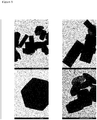
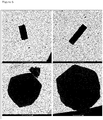
- the microstructural characteristics of the pure phases of Kassite and Perovskite and of the composites of the invention which contain them are widely explained in the experimental part.
- the weight ratio between Kassite and Perovskite is variable between 15:85 and 85:15, e.g. between 40:60 and 60:40, or between 45:55 and 55:45.
- K:P ratio is variable between 15:85 and 85:15, e.g. between 40:60 and 60:40, or between 45:55 and 55:45.
- specific, particularly preferred composites have a K:P ratio of 53:47 and 81:19.
- the term "composite” defines a product wherein Kassite and Perovskite crystals are not totally free, as it is the case of a physical dried mixture of the corresponding powders; the difference of photocatalytic activity of the present composites compared to the physical mixtures of the respective components is highlighted in the experimental part.
- the particles constituting the different phases are present in forms variably aggregated with each other, as a consequence of the fact that the product derives from a hydrothermal reaction with total consumption of the precursors and recovery and drying of only one material aggregated in solid form.
- the term “composite” indicates an aggregation between the particles of the components "at a statistical level", without excluding that some isolated particles of one or another of its constituents may still be recognized.
- the present composites did not show the characteristic peaks of other forms of calcium titanate, such as the phases with empirical formula CaTi 5 O 11 (CT5) and CaTi 2 O 5 (CT2) characteristic of the composite described in WO2010/012489 .
- the composite of the invention can be further characterized as free from additional forms of calcium titanate, especially the phases with empirical formula CaTi 5 O 11 (CT5) and CaTi 2 O 5 (CT2): in fact the XRPD spectra of the present composites ( Figures 1-2 ) show a peak pattern which is totally different from the one known for the composites described in WO2010/012489 : this confirms not only the absence of the above-mentioned phases CT2 and CT5, but also the formation of a totally different crystalline lattice.
- CT5 phase with empirical formula CaTi 5 O 11
- CT2 CaTi 2 O 5
- the synthesized composites have microcrystalline structure, i.e. crystalline grain size generally between about 0,5 and 20 ⁇ m, preferably between 0,5 and 10 ⁇ m or between 1 and 8 ⁇ m; it is understood that, as we deal with a complex composite material, the size distribution of the particles can be relatively wide; therefore the above-mentioned ranges of crystalline grain sizes are not to be understood in an exclusive way, as it cannot be excluded in advance the formation of small amounts of crystals whose sizes lie beyond the above mentioned ranges, being substantially irrelevant on the total photocatalytic activity of the composite.
- BET surface area An indirect, but statistically more effective, evaluation of the size distribution of the particles constituting the composite is provided by the values of BET surface area, which inversely correlate with the mean size of the particles.
- BET surface areas of the subject composites range generally between 1 e 100 m 2 /g, with preferred values between 3 and 30 m 2 /g, for example between 4 and 15 m 2 /g.
- the preference for the lower ranges is based on the observation that for the present composites, contrary to what would be commonly expected, the photocatalytic activity tends to increase as the specific surface decreases.
- a further object of the invention is a process for preparing the composites as defined above. It comprises the following steps:
- step ii) is carried out in a closed reactor such as e.g. an autoclave.
- the present process in particular distinguishes for a relatively low heating temperature; moreover, heating in autoclave allows to work at a higher pressure than the atmospheric pressure, generally between 2 and 10 bar, preferably between 3 and 7 bar, e.g. 5 bar.
- the present process is characterized by the use of particular ratios and concentrations of the reagents; specifically in the reaction mixture upon completion of step i):
- cementitious compositions and articles of manufacture with photocatalytic activity comprising the photocatalytic composite described above.
- the composite can be present as uniformly dispersed in the mass of the article of manufacture and/or can be stratified on one or more of its surfaces.
- the typical synthesis procedure envisages the introduction of an adequate calcium carbonate amount (see Table 1) into a container A255AC in PTFE (Parr Instrument Company), followed by a NaOH solution at known concentration. The mixture is subjected to vigorous agitation and a titanium oxysulphate solution is then added dropwise (see Table 1). The suspension obtained is then let under agitation for some minutes and is then sealed in a stainless-steel autoclave (General Purpose Acid-Digestion Bomb, 4745, Parr Instrument Company). The autoclave is then heated in an oven at 150°C for 24 hours.
- the product obtained after washing is further treated with 25 ml HCl (1M solution) under vigorous agitation for 80 minutes until no further gas development can be detected.
- the resulting product was then centrifuged and washed with deionized water two further times until the decanted water has reached neutral pH again.
- the isolated compound was then dried as described above.
- the product CaTi001 obtained in Example 1, subjected to diffractometric analysis and shown in Figure 1 was found to be a polyphasic composite composed of Kassite and Perovskite with ratios of about 50:50 in m/m.
- the product CaTi002 obtained in Example 1, subjected to diffractometric analysis in the same conditions and depicted in Figure 2 was found to be a polyphasic composite composed of Kassite and Perovskite with ratios of about 80:20 in m/m (excess of Kassite).
- the reference product CaTi003 obtained in Example 1, subjected to diffractometric analysis in the same conditions and depicted in Figure 3 was found to be a substantially pure Kassite phase (Kassite and Perovskite in ratios of about 99:1 in m/m).
- the reference product CaTi004 obtained in Example 1, subjected to diffractometric analysis in the same conditions and depicted in Figure 4 was found to be a substantially pure Perovskite phase (Kassite and Perovskite in ratios of about 1:99 in m/m).
- EXAMPLE 4 Photocatalytic activity on powder. Measurements of NOx abatement
- the photocatalytic activity of the samples obtained by the hydrothermal process was experimentally ascertained in tests of abatement of nitrogen oxides NOx performed according to the indications of UNI 11247 standard (specific for cementitious materials and not for powders).
- the samples in the form of powder whose photocatalytic characterizations are reported in the example, were placed inside a (3 liters volume) reaction chamber which can be irradiated by a UV lamp which has, at the level of the sample, an irradiance spectrum in UV band ( ⁇ 400 nm) consisting primarily of the line at 365 nm of mercury (irradiance integrated at ⁇ 350 nm has to be 10% lower than the irradiance integrated between 350 nm and 400 nm).
- the irradiation system should allow a mean irradiance (in UV-A band) equal to 20 ⁇ 1 W/m 2 on the surface of the sample (of 64 cm 2 ) during test execution.
- the concentration of NOx present in the gas which pass through the reactor is measured in the dark during the first step of the test (C B ) and by irradiating the sample with UV light during the second step (C L ).
- the samples in the form of powder synthesized for performing the photocatalytic tests were prepared by previously mixing the photocatalysts with a non-reactive solvent (e.g. 2-Propanol); the suspensions obtained were poured in Petri dishes which were subsequently subjected to a drying process, allowing to obtain stable films of the photocatalysts, suitable for testing.
- a non-reactive solvent e.g. 2-Propanol
- the photocatalytic activity of the composites of the invention is definitely higher than the contribution of the respective pure phases, or of the simple physical mixtures thereof; this clearly highlights the synergistic action of Kassite and Perovskite only when combined in the composites of the invention.
- the composites of the invention showed an extraordinary high photocatalytic activity (about 3 times higher). Said increase of activity is even more surprising considering that the specific surface of the composites CaTi0001 and CaTi0002 of the invention is much lower in comparison to the reference CaTi0003 (consisting for 99% of photocatalytically active Kassite, see Table 2).
Landscapes
- Chemical & Material Sciences (AREA)
- Engineering & Computer Science (AREA)
- Organic Chemistry (AREA)
- Materials Engineering (AREA)
- Chemical Kinetics & Catalysis (AREA)
- Ceramic Engineering (AREA)
- Environmental & Geological Engineering (AREA)
- Inorganic Chemistry (AREA)
- Structural Engineering (AREA)
- General Life Sciences & Earth Sciences (AREA)
- Life Sciences & Earth Sciences (AREA)
- Geology (AREA)
- Civil Engineering (AREA)
- Physics & Mathematics (AREA)
- Thermal Sciences (AREA)
- Dispersion Chemistry (AREA)
- Health & Medical Sciences (AREA)
- Biomedical Technology (AREA)
- Analytical Chemistry (AREA)
- General Chemical & Material Sciences (AREA)
- Oil, Petroleum & Natural Gas (AREA)
- Catalysts (AREA)
Applications Claiming Priority (1)
| Application Number | Priority Date | Filing Date | Title |
|---|---|---|---|
| IT201700145181 | 2017-12-15 |
Publications (1)
| Publication Number | Publication Date |
|---|---|
| EP3501643A1 true EP3501643A1 (fr) | 2019-06-26 |
Family
ID=61800604
Family Applications (1)
| Application Number | Title | Priority Date | Filing Date |
|---|---|---|---|
| EP18211970.1A Withdrawn EP3501643A1 (fr) | 2017-12-15 | 2018-12-12 | Composite photocatalytique à base de kassite et de perovskite et produits cimentaires le contenant |
Country Status (1)
| Country | Link |
|---|---|
| EP (1) | EP3501643A1 (fr) |
Cited By (3)
| Publication number | Priority date | Publication date | Assignee | Title |
|---|---|---|---|---|
| CN113908869A (zh) * | 2021-10-15 | 2022-01-11 | 安徽医科大学 | 一种光催化复合微驱动器的制备方法 |
| CN114486858A (zh) * | 2022-01-12 | 2022-05-13 | 东北大学 | 一种测定高炉型熔渣中TiO2活度的方法 |
| CN117142807A (zh) * | 2023-09-01 | 2023-12-01 | 山东京韵泰博负碳科技有限公司 | 一种光催化碳化板材及其制备工艺 |
Citations (4)
| Publication number | Priority date | Publication date | Assignee | Title |
|---|---|---|---|---|
| WO2009080647A1 (fr) | 2007-12-19 | 2009-07-02 | Italcementi S.P.A. | Composites photocatalytiques à base de dioxyde de titane et produits dérivés sur un support de métakaolin |
| WO2010012489A1 (fr) | 2008-08-01 | 2010-02-04 | Italcementi S.P.A. | Composites catalytiques contenant du titane et du calcaire exempt de dioxyde de titane |
| WO2010012488A1 (fr) | 2008-08-01 | 2010-02-04 | Italcementi S.P.A. | Composites catalytiques contenant du titane et du calcaire |
| US20120000395A1 (en) * | 2008-12-17 | 2012-01-05 | Holcim Technology Ltd. | Method for producing photocatalytically active clinker |
-
2018
- 2018-12-12 EP EP18211970.1A patent/EP3501643A1/fr not_active Withdrawn
Patent Citations (4)
| Publication number | Priority date | Publication date | Assignee | Title |
|---|---|---|---|---|
| WO2009080647A1 (fr) | 2007-12-19 | 2009-07-02 | Italcementi S.P.A. | Composites photocatalytiques à base de dioxyde de titane et produits dérivés sur un support de métakaolin |
| WO2010012489A1 (fr) | 2008-08-01 | 2010-02-04 | Italcementi S.P.A. | Composites catalytiques contenant du titane et du calcaire exempt de dioxyde de titane |
| WO2010012488A1 (fr) | 2008-08-01 | 2010-02-04 | Italcementi S.P.A. | Composites catalytiques contenant du titane et du calcaire |
| US20120000395A1 (en) * | 2008-12-17 | 2012-01-05 | Holcim Technology Ltd. | Method for producing photocatalytically active clinker |
Non-Patent Citations (6)
| Title |
|---|
| BERAN, CANADIAN MINERALOGIST, vol. 34, 1996, pages 803 - 809 |
| GREY ET AL., AMERICAN MINERALOGIST, vol. 88, 2003, pages 1331 - 1335 |
| MEIDAN YE; MENGYE WANG; DAJIANG ZHENG: "Garden-like perovskite superstructures with enhanced photocatalytic activity", NANOSCALE, vol. 6, 2014, pages 3576, XP055501335, DOI: doi:10.1039/c3nr05564g |
| WEIXIA DONG ET AL: "Solvothermal Preparation of CaTiO3 Prism and CaTi2O4(OH)2 Nanosheet by a Facile Surfactant-Free Method", MEDZIAGOTYRA - MATERIALS SCIENCE, vol. 21, no. 4, 30 November 2015 (2015-11-30), LT, XP055501609, ISSN: 1392-1320, DOI: 10.5755/j01.ms.21.4.9697 * |
| WEIXIA DONG; BIN SONG; GAOLING ZHAO, CERAMICS INTERNATIONAL, vol. 39, 2013, pages 6795 - 6803 |
| YI-JEN HUANG ET AL: "Artificial Synthesis of Platelet-Like Kassite and Its Transformation to CaTiO3", CRYSTAL GROWTH & DESIGN., vol. 10, no. 3, 5 February 2010 (2010-02-05), US, pages 1221 - 1225, XP055501380, ISSN: 1528-7483, DOI: 10.1021/cg901204x * |
Cited By (5)
| Publication number | Priority date | Publication date | Assignee | Title |
|---|---|---|---|---|
| CN113908869A (zh) * | 2021-10-15 | 2022-01-11 | 安徽医科大学 | 一种光催化复合微驱动器的制备方法 |
| CN113908869B (zh) * | 2021-10-15 | 2023-05-26 | 安徽医科大学 | 一种光催化复合微驱动器的制备方法 |
| CN114486858A (zh) * | 2022-01-12 | 2022-05-13 | 东北大学 | 一种测定高炉型熔渣中TiO2活度的方法 |
| CN114486858B (zh) * | 2022-01-12 | 2024-04-19 | 东北大学 | 一种测定高炉型熔渣中TiO2活度的方法 |
| CN117142807A (zh) * | 2023-09-01 | 2023-12-01 | 山东京韵泰博负碳科技有限公司 | 一种光催化碳化板材及其制备工艺 |
Similar Documents
| Publication | Publication Date | Title |
|---|---|---|
| Bellardita et al. | Absolute crystallinity and photocatalytic activity of brookite TiO2 samples | |
| Surendar et al. | Influence of La-doping on phase transformation and photocatalytic properties of ZnTiO 3 nanoparticles synthesized via modified sol–gel method | |
| Hernandez-Uresti et al. | Characterization and photocatalytic properties of hexagonal and monoclinic WO3 prepared via microwave-assisted hydrothermal synthesis | |
| Junior et al. | A relationship between structural and electronic order–disorder effects and optical properties in crystalline TiO 2 nanomaterials | |
| Al-Salim et al. | Characterisation and activity of sol–gel-prepared TiO2 photocatalysts modified with Ca, Sr or Ba ion additives | |
| Meksi et al. | The role of lanthanum in the enhancement of photocatalytic properties of TiO2 nanomaterials obtained by calcination of hydrogenotitanate nanotubes | |
| RU2375396C2 (ru) | Композиция для покрытия | |
| Sun et al. | Modification of TiO2 nanotubes by WO3 species for improving their photocatalytic activity | |
| EP3501643A1 (fr) | Composite photocatalytique à base de kassite et de perovskite et produits cimentaires le contenant | |
| Pulsipher et al. | Controlled nitrogen doping and film colorimetrics in porous TiO2 materials using plasma processing | |
| Rambabu et al. | Effect of annealing temperature on the phase transition, structural stability and photo-electrochemical performance of TiO2 multi-leg nanotubes | |
| Jana et al. | Mixed NaNb x Ta 1− x O 3 perovskites as photocatalysts for H 2 production | |
| Seo et al. | Solvothermal synthesis of SnNb2O6 nanoplates and enhanced photocatalytic H2 evolution under visible light | |
| Liu et al. | From NH 4 TiOF 3 nanoparticles to NH 4 TiOF 3 mesocrystals: steric hindrance versus hydrophobic attraction of F127 molecules | |
| Pliekhov et al. | Enhanced photocatalytic activity of carbon and zirconium modified TiO2 | |
| Viviani et al. | Low-temperature aqueous synthesis (LTAS) of BaTiO3: a statistical design of experiment approach | |
| Liu et al. | Promoted phase transition of titania nanoparticles prepared by a photo-assisted sol-gel method | |
| Allen et al. | Characterisation and photocatalytic assessment of TiO2 nano-polymorphs: Influence of crystallite size and influence of thermal treatment on paint coatings and dye fading kinetics | |
| EP2826559B1 (fr) | Procédé pour la synthèse de photocatalyseurs de titane dopé réagissant à la lumière visible | |
| FI117754B (fi) | Titaanidioksidituote, sen valmistusmenetelmä ja käyttö fotokatalyyttinä | |
| Lannoy et al. | Block copolymer–cyclodextrin supramolecular assemblies as soft templates for the synthesis of titania materials with controlled crystallinity, porosity and photocatalytic activity | |
| Kőrösi et al. | Hydrothermal synthesis, structure and photocatalytic activity of PF-co-doped TiO2 | |
| Ha et al. | N-doped mesoporous inverse opal structures for visible-light photocatalysts | |
| Wang et al. | Quasi-spherical brookite TiO2 nanostructures synthesized using solvothermal method in the presence of oxalic acid | |
| Ono et al. | Low-temperature synthesis of cerium oxide nanorods and their suppressive effect on photocatalysis of titanium dioxide |
Legal Events
| Date | Code | Title | Description |
|---|---|---|---|
| PUAI | Public reference made under article 153(3) epc to a published international application that has entered the european phase |
Free format text: ORIGINAL CODE: 0009012 |
|
| AK | Designated contracting states |
Kind code of ref document: A1 Designated state(s): AL AT BE BG CH CY CZ DE DK EE ES FI FR GB GR HR HU IE IS IT LI LT LU LV MC MK MT NL NO PL PT RO RS SE SI SK SM TR |
|
| AX | Request for extension of the european patent |
Extension state: BA ME |
|
| STAA | Information on the status of an ep patent application or granted ep patent |
Free format text: STATUS: THE APPLICATION IS DEEMED TO BE WITHDRAWN |
|
| 18D | Application deemed to be withdrawn |
Effective date: 20200103 |