EP3501801A1 - Procédé de fabrication d'un composant de véhicule à partir d'une matière plastique renforcée par des fibres - Google Patents
Procédé de fabrication d'un composant de véhicule à partir d'une matière plastique renforcée par des fibres Download PDFInfo
- Publication number
- EP3501801A1 EP3501801A1 EP18208138.0A EP18208138A EP3501801A1 EP 3501801 A1 EP3501801 A1 EP 3501801A1 EP 18208138 A EP18208138 A EP 18208138A EP 3501801 A1 EP3501801 A1 EP 3501801A1
- Authority
- EP
- European Patent Office
- Prior art keywords
- skin panel
- component
- stiffening
- cooling
- conductive layer
- Prior art date
- Legal status (The legal status is an assumption and is not a legal conclusion. Google has not performed a legal analysis and makes no representation as to the accuracy of the status listed.)
- Granted
Links
Images


Classifications
-
- B—PERFORMING OPERATIONS; TRANSPORTING
- B29—WORKING OF PLASTICS; WORKING OF SUBSTANCES IN A PLASTIC STATE IN GENERAL
- B29C—SHAPING OR JOINING OF PLASTICS; SHAPING OF MATERIAL IN A PLASTIC STATE, NOT OTHERWISE PROVIDED FOR; AFTER-TREATMENT OF THE SHAPED PRODUCTS, e.g. REPAIRING
- B29C65/00—Joining or sealing of preformed parts, e.g. welding of plastics materials; Apparatus therefor
- B29C65/02—Joining or sealing of preformed parts, e.g. welding of plastics materials; Apparatus therefor by heating, with or without pressure
- B29C65/18—Joining or sealing of preformed parts, e.g. welding of plastics materials; Apparatus therefor by heating, with or without pressure using heated tools
-
- B—PERFORMING OPERATIONS; TRANSPORTING
- B29—WORKING OF PLASTICS; WORKING OF SUBSTANCES IN A PLASTIC STATE IN GENERAL
- B29C—SHAPING OR JOINING OF PLASTICS; SHAPING OF MATERIAL IN A PLASTIC STATE, NOT OTHERWISE PROVIDED FOR; AFTER-TREATMENT OF THE SHAPED PRODUCTS, e.g. REPAIRING
- B29C66/00—General aspects of processes or apparatus for joining preformed parts
- B29C66/70—General aspects of processes or apparatus for joining preformed parts characterised by the composition, physical properties or the structure of the material of the parts to be joined; Joining with non-plastics material
- B29C66/72—General aspects of processes or apparatus for joining preformed parts characterised by the composition, physical properties or the structure of the material of the parts to be joined; Joining with non-plastics material characterised by the structure of the material of the parts to be joined
- B29C66/721—Fibre-reinforced materials
-
- B—PERFORMING OPERATIONS; TRANSPORTING
- B29—WORKING OF PLASTICS; WORKING OF SUBSTANCES IN A PLASTIC STATE IN GENERAL
- B29C—SHAPING OR JOINING OF PLASTICS; SHAPING OF MATERIAL IN A PLASTIC STATE, NOT OTHERWISE PROVIDED FOR; AFTER-TREATMENT OF THE SHAPED PRODUCTS, e.g. REPAIRING
- B29C65/00—Joining or sealing of preformed parts, e.g. welding of plastics materials; Apparatus therefor
- B29C65/02—Joining or sealing of preformed parts, e.g. welding of plastics materials; Apparatus therefor by heating, with or without pressure
- B29C65/08—Joining or sealing of preformed parts, e.g. welding of plastics materials; Apparatus therefor by heating, with or without pressure using ultrasonic vibrations
-
- B—PERFORMING OPERATIONS; TRANSPORTING
- B29—WORKING OF PLASTICS; WORKING OF SUBSTANCES IN A PLASTIC STATE IN GENERAL
- B29C—SHAPING OR JOINING OF PLASTICS; SHAPING OF MATERIAL IN A PLASTIC STATE, NOT OTHERWISE PROVIDED FOR; AFTER-TREATMENT OF THE SHAPED PRODUCTS, e.g. REPAIRING
- B29C65/00—Joining or sealing of preformed parts, e.g. welding of plastics materials; Apparatus therefor
- B29C65/02—Joining or sealing of preformed parts, e.g. welding of plastics materials; Apparatus therefor by heating, with or without pressure
- B29C65/18—Joining or sealing of preformed parts, e.g. welding of plastics materials; Apparatus therefor by heating, with or without pressure using heated tools
- B29C65/22—Heated wire resistive ribbon, resistive band or resistive strip
- B29C65/221—Heated wire resistive ribbon, resistive band or resistive strip characterised by the type of heated wire, resistive ribbon, band or strip
-
- B—PERFORMING OPERATIONS; TRANSPORTING
- B29—WORKING OF PLASTICS; WORKING OF SUBSTANCES IN A PLASTIC STATE IN GENERAL
- B29C—SHAPING OR JOINING OF PLASTICS; SHAPING OF MATERIAL IN A PLASTIC STATE, NOT OTHERWISE PROVIDED FOR; AFTER-TREATMENT OF THE SHAPED PRODUCTS, e.g. REPAIRING
- B29C65/00—Joining or sealing of preformed parts, e.g. welding of plastics materials; Apparatus therefor
- B29C65/02—Joining or sealing of preformed parts, e.g. welding of plastics materials; Apparatus therefor by heating, with or without pressure
- B29C65/34—Joining or sealing of preformed parts, e.g. welding of plastics materials; Apparatus therefor by heating, with or without pressure using heated elements which remain in the joint, e.g. "verlorenes Schweisselement"
- B29C65/3404—Joining or sealing of preformed parts, e.g. welding of plastics materials; Apparatus therefor by heating, with or without pressure using heated elements which remain in the joint, e.g. "verlorenes Schweisselement" characterised by the type of heated elements which remain in the joint
- B29C65/344—Joining or sealing of preformed parts, e.g. welding of plastics materials; Apparatus therefor by heating, with or without pressure using heated elements which remain in the joint, e.g. "verlorenes Schweisselement" characterised by the type of heated elements which remain in the joint being a woven or non-woven fabric or being a mesh
-
- B—PERFORMING OPERATIONS; TRANSPORTING
- B29—WORKING OF PLASTICS; WORKING OF SUBSTANCES IN A PLASTIC STATE IN GENERAL
- B29C—SHAPING OR JOINING OF PLASTICS; SHAPING OF MATERIAL IN A PLASTIC STATE, NOT OTHERWISE PROVIDED FOR; AFTER-TREATMENT OF THE SHAPED PRODUCTS, e.g. REPAIRING
- B29C65/00—Joining or sealing of preformed parts, e.g. welding of plastics materials; Apparatus therefor
- B29C65/82—Testing the joint
-
- B—PERFORMING OPERATIONS; TRANSPORTING
- B29—WORKING OF PLASTICS; WORKING OF SUBSTANCES IN A PLASTIC STATE IN GENERAL
- B29C—SHAPING OR JOINING OF PLASTICS; SHAPING OF MATERIAL IN A PLASTIC STATE, NOT OTHERWISE PROVIDED FOR; AFTER-TREATMENT OF THE SHAPED PRODUCTS, e.g. REPAIRING
- B29C66/00—General aspects of processes or apparatus for joining preformed parts
- B29C66/01—General aspects dealing with the joint area or with the area to be joined
- B29C66/03—After-treatments in the joint area
- B29C66/032—Mechanical after-treatments
- B29C66/0324—Reforming or reshaping the joint, e.g. folding over
-
- B—PERFORMING OPERATIONS; TRANSPORTING
- B29—WORKING OF PLASTICS; WORKING OF SUBSTANCES IN A PLASTIC STATE IN GENERAL
- B29C—SHAPING OR JOINING OF PLASTICS; SHAPING OF MATERIAL IN A PLASTIC STATE, NOT OTHERWISE PROVIDED FOR; AFTER-TREATMENT OF THE SHAPED PRODUCTS, e.g. REPAIRING
- B29C66/00—General aspects of processes or apparatus for joining preformed parts
- B29C66/01—General aspects dealing with the joint area or with the area to be joined
- B29C66/03—After-treatments in the joint area
- B29C66/034—Thermal after-treatments
-
- B—PERFORMING OPERATIONS; TRANSPORTING
- B29—WORKING OF PLASTICS; WORKING OF SUBSTANCES IN A PLASTIC STATE IN GENERAL
- B29C—SHAPING OR JOINING OF PLASTICS; SHAPING OF MATERIAL IN A PLASTIC STATE, NOT OTHERWISE PROVIDED FOR; AFTER-TREATMENT OF THE SHAPED PRODUCTS, e.g. REPAIRING
- B29C66/00—General aspects of processes or apparatus for joining preformed parts
- B29C66/01—General aspects dealing with the joint area or with the area to be joined
- B29C66/03—After-treatments in the joint area
- B29C66/034—Thermal after-treatments
- B29C66/0342—Cooling, e.g. transporting through welding and cooling zone
-
- B—PERFORMING OPERATIONS; TRANSPORTING
- B29—WORKING OF PLASTICS; WORKING OF SUBSTANCES IN A PLASTIC STATE IN GENERAL
- B29C—SHAPING OR JOINING OF PLASTICS; SHAPING OF MATERIAL IN A PLASTIC STATE, NOT OTHERWISE PROVIDED FOR; AFTER-TREATMENT OF THE SHAPED PRODUCTS, e.g. REPAIRING
- B29C66/00—General aspects of processes or apparatus for joining preformed parts
- B29C66/01—General aspects dealing with the joint area or with the area to be joined
- B29C66/05—Particular design of joint configurations
- B29C66/10—Particular design of joint configurations particular design of the joint cross-sections
- B29C66/11—Joint cross-sections comprising a single joint-segment, i.e. one of the parts to be joined comprising a single joint-segment in the joint cross-section
- B29C66/112—Single lapped joints
-
- B—PERFORMING OPERATIONS; TRANSPORTING
- B29—WORKING OF PLASTICS; WORKING OF SUBSTANCES IN A PLASTIC STATE IN GENERAL
- B29C—SHAPING OR JOINING OF PLASTICS; SHAPING OF MATERIAL IN A PLASTIC STATE, NOT OTHERWISE PROVIDED FOR; AFTER-TREATMENT OF THE SHAPED PRODUCTS, e.g. REPAIRING
- B29C66/00—General aspects of processes or apparatus for joining preformed parts
- B29C66/01—General aspects dealing with the joint area or with the area to be joined
- B29C66/05—Particular design of joint configurations
- B29C66/10—Particular design of joint configurations particular design of the joint cross-sections
- B29C66/11—Joint cross-sections comprising a single joint-segment, i.e. one of the parts to be joined comprising a single joint-segment in the joint cross-section
- B29C66/112—Single lapped joints
- B29C66/1122—Single lap to lap joints, i.e. overlap joints
-
- B—PERFORMING OPERATIONS; TRANSPORTING
- B29—WORKING OF PLASTICS; WORKING OF SUBSTANCES IN A PLASTIC STATE IN GENERAL
- B29C—SHAPING OR JOINING OF PLASTICS; SHAPING OF MATERIAL IN A PLASTIC STATE, NOT OTHERWISE PROVIDED FOR; AFTER-TREATMENT OF THE SHAPED PRODUCTS, e.g. REPAIRING
- B29C66/00—General aspects of processes or apparatus for joining preformed parts
- B29C66/01—General aspects dealing with the joint area or with the area to be joined
- B29C66/05—Particular design of joint configurations
- B29C66/10—Particular design of joint configurations particular design of the joint cross-sections
- B29C66/13—Single flanged joints; Fin-type joints; Single hem joints; Edge joints; Interpenetrating fingered joints; Other specific particular designs of joint cross-sections not provided for in groups B29C66/11 - B29C66/12
- B29C66/131—Single flanged joints, i.e. one of the parts to be joined being rigid and flanged in the joint area
-
- B—PERFORMING OPERATIONS; TRANSPORTING
- B29—WORKING OF PLASTICS; WORKING OF SUBSTANCES IN A PLASTIC STATE IN GENERAL
- B29C—SHAPING OR JOINING OF PLASTICS; SHAPING OF MATERIAL IN A PLASTIC STATE, NOT OTHERWISE PROVIDED FOR; AFTER-TREATMENT OF THE SHAPED PRODUCTS, e.g. REPAIRING
- B29C66/00—General aspects of processes or apparatus for joining preformed parts
- B29C66/40—General aspects of joining substantially flat articles, e.g. plates, sheets or web-like materials; Making flat seams in tubular or hollow articles; Joining single elements to substantially flat surfaces
- B29C66/47—Joining single elements to sheets, plates or other substantially flat surfaces
- B29C66/472—Joining single elements to sheets, plates or other substantially flat surfaces said single elements being substantially flat
- B29C66/4722—Fixing strips to surfaces other than edge faces
-
- B—PERFORMING OPERATIONS; TRANSPORTING
- B29—WORKING OF PLASTICS; WORKING OF SUBSTANCES IN A PLASTIC STATE IN GENERAL
- B29C—SHAPING OR JOINING OF PLASTICS; SHAPING OF MATERIAL IN A PLASTIC STATE, NOT OTHERWISE PROVIDED FOR; AFTER-TREATMENT OF THE SHAPED PRODUCTS, e.g. REPAIRING
- B29C66/00—General aspects of processes or apparatus for joining preformed parts
- B29C66/50—General aspects of joining tubular articles; General aspects of joining long products, i.e. bars or profiled elements; General aspects of joining single elements to tubular articles, hollow articles or bars; General aspects of joining several hollow-preforms to form hollow or tubular articles
- B29C66/51—Joining tubular articles, profiled elements or bars; Joining single elements to tubular articles, hollow articles or bars; Joining several hollow-preforms to form hollow or tubular articles
- B29C66/53—Joining single elements to tubular articles, hollow articles or bars
- B29C66/532—Joining single elements to the wall of tubular articles, hollow articles or bars
-
- B—PERFORMING OPERATIONS; TRANSPORTING
- B29—WORKING OF PLASTICS; WORKING OF SUBSTANCES IN A PLASTIC STATE IN GENERAL
- B29C—SHAPING OR JOINING OF PLASTICS; SHAPING OF MATERIAL IN A PLASTIC STATE, NOT OTHERWISE PROVIDED FOR; AFTER-TREATMENT OF THE SHAPED PRODUCTS, e.g. REPAIRING
- B29C66/00—General aspects of processes or apparatus for joining preformed parts
- B29C66/50—General aspects of joining tubular articles; General aspects of joining long products, i.e. bars or profiled elements; General aspects of joining single elements to tubular articles, hollow articles or bars; General aspects of joining several hollow-preforms to form hollow or tubular articles
- B29C66/61—Joining from or joining on the inside
-
- B—PERFORMING OPERATIONS; TRANSPORTING
- B29—WORKING OF PLASTICS; WORKING OF SUBSTANCES IN A PLASTIC STATE IN GENERAL
- B29C—SHAPING OR JOINING OF PLASTICS; SHAPING OF MATERIAL IN A PLASTIC STATE, NOT OTHERWISE PROVIDED FOR; AFTER-TREATMENT OF THE SHAPED PRODUCTS, e.g. REPAIRING
- B29C66/00—General aspects of processes or apparatus for joining preformed parts
- B29C66/70—General aspects of processes or apparatus for joining preformed parts characterised by the composition, physical properties or the structure of the material of the parts to be joined; Joining with non-plastics material
- B29C66/72—General aspects of processes or apparatus for joining preformed parts characterised by the composition, physical properties or the structure of the material of the parts to be joined; Joining with non-plastics material characterised by the structure of the material of the parts to be joined
- B29C66/721—Fibre-reinforced materials
- B29C66/7214—Fibre-reinforced materials characterised by the length of the fibres
- B29C66/72141—Fibres of continuous length
-
- B—PERFORMING OPERATIONS; TRANSPORTING
- B29—WORKING OF PLASTICS; WORKING OF SUBSTANCES IN A PLASTIC STATE IN GENERAL
- B29C—SHAPING OR JOINING OF PLASTICS; SHAPING OF MATERIAL IN A PLASTIC STATE, NOT OTHERWISE PROVIDED FOR; AFTER-TREATMENT OF THE SHAPED PRODUCTS, e.g. REPAIRING
- B29C66/00—General aspects of processes or apparatus for joining preformed parts
- B29C66/70—General aspects of processes or apparatus for joining preformed parts characterised by the composition, physical properties or the structure of the material of the parts to be joined; Joining with non-plastics material
- B29C66/73—General aspects of processes or apparatus for joining preformed parts characterised by the composition, physical properties or the structure of the material of the parts to be joined; Joining with non-plastics material characterised by the intensive physical properties of the material of the parts to be joined, by the optical properties of the material of the parts to be joined, by the extensive physical properties of the parts to be joined, by the state of the material of the parts to be joined or by the material of the parts to be joined being a thermoplastic or a thermoset
- B29C66/739—General aspects of processes or apparatus for joining preformed parts characterised by the composition, physical properties or the structure of the material of the parts to be joined; Joining with non-plastics material characterised by the intensive physical properties of the material of the parts to be joined, by the optical properties of the material of the parts to be joined, by the extensive physical properties of the parts to be joined, by the state of the material of the parts to be joined or by the material of the parts to be joined being a thermoplastic or a thermoset characterised by the material of the parts to be joined being a thermoplastic or a thermoset
- B29C66/7392—General aspects of processes or apparatus for joining preformed parts characterised by the composition, physical properties or the structure of the material of the parts to be joined; Joining with non-plastics material characterised by the intensive physical properties of the material of the parts to be joined, by the optical properties of the material of the parts to be joined, by the extensive physical properties of the parts to be joined, by the state of the material of the parts to be joined or by the material of the parts to be joined being a thermoplastic or a thermoset characterised by the material of the parts to be joined being a thermoplastic or a thermoset characterised by the material of at least one of the parts being a thermoplastic
- B29C66/73921—General aspects of processes or apparatus for joining preformed parts characterised by the composition, physical properties or the structure of the material of the parts to be joined; Joining with non-plastics material characterised by the intensive physical properties of the material of the parts to be joined, by the optical properties of the material of the parts to be joined, by the extensive physical properties of the parts to be joined, by the state of the material of the parts to be joined or by the material of the parts to be joined being a thermoplastic or a thermoset characterised by the material of the parts to be joined being a thermoplastic or a thermoset characterised by the material of at least one of the parts being a thermoplastic characterised by the materials of both parts being thermoplastics
-
- B—PERFORMING OPERATIONS; TRANSPORTING
- B29—WORKING OF PLASTICS; WORKING OF SUBSTANCES IN A PLASTIC STATE IN GENERAL
- B29C—SHAPING OR JOINING OF PLASTICS; SHAPING OF MATERIAL IN A PLASTIC STATE, NOT OTHERWISE PROVIDED FOR; AFTER-TREATMENT OF THE SHAPED PRODUCTS, e.g. REPAIRING
- B29C66/00—General aspects of processes or apparatus for joining preformed parts
- B29C66/90—Measuring or controlling the joining process
- B29C66/91—Measuring or controlling the joining process by measuring or controlling the temperature, the heat or the thermal flux
- B29C66/914—Measuring or controlling the joining process by measuring or controlling the temperature, the heat or the thermal flux by controlling or regulating the temperature, the heat or the thermal flux
- B29C66/9141—Measuring or controlling the joining process by measuring or controlling the temperature, the heat or the thermal flux by controlling or regulating the temperature, the heat or the thermal flux by controlling or regulating the temperature
- B29C66/91411—Measuring or controlling the joining process by measuring or controlling the temperature, the heat or the thermal flux by controlling or regulating the temperature, the heat or the thermal flux by controlling or regulating the temperature of the parts to be joined, e.g. the joining process taking the temperature of the parts to be joined into account
-
- B—PERFORMING OPERATIONS; TRANSPORTING
- B29—WORKING OF PLASTICS; WORKING OF SUBSTANCES IN A PLASTIC STATE IN GENERAL
- B29C—SHAPING OR JOINING OF PLASTICS; SHAPING OF MATERIAL IN A PLASTIC STATE, NOT OTHERWISE PROVIDED FOR; AFTER-TREATMENT OF THE SHAPED PRODUCTS, e.g. REPAIRING
- B29C66/00—General aspects of processes or apparatus for joining preformed parts
- B29C66/90—Measuring or controlling the joining process
- B29C66/91—Measuring or controlling the joining process by measuring or controlling the temperature, the heat or the thermal flux
- B29C66/914—Measuring or controlling the joining process by measuring or controlling the temperature, the heat or the thermal flux by controlling or regulating the temperature, the heat or the thermal flux
- B29C66/9141—Measuring or controlling the joining process by measuring or controlling the temperature, the heat or the thermal flux by controlling or regulating the temperature, the heat or the thermal flux by controlling or regulating the temperature
- B29C66/91441—Measuring or controlling the joining process by measuring or controlling the temperature, the heat or the thermal flux by controlling or regulating the temperature, the heat or the thermal flux by controlling or regulating the temperature the temperature being non-constant over time
-
- B—PERFORMING OPERATIONS; TRANSPORTING
- B29—WORKING OF PLASTICS; WORKING OF SUBSTANCES IN A PLASTIC STATE IN GENERAL
- B29C—SHAPING OR JOINING OF PLASTICS; SHAPING OF MATERIAL IN A PLASTIC STATE, NOT OTHERWISE PROVIDED FOR; AFTER-TREATMENT OF THE SHAPED PRODUCTS, e.g. REPAIRING
- B29C69/00—Combinations of shaping techniques not provided for in a single one of main groups B29C39/00 - B29C67/00, e.g. associations of moulding and joining techniques; Apparatus therefore
-
- B—PERFORMING OPERATIONS; TRANSPORTING
- B29—WORKING OF PLASTICS; WORKING OF SUBSTANCES IN A PLASTIC STATE IN GENERAL
- B29D—PRODUCING PARTICULAR ARTICLES FROM PLASTICS OR FROM SUBSTANCES IN A PLASTIC STATE
- B29D99/00—Subject matter not provided for in other groups of this subclass
- B29D99/001—Producing wall or panel-like structures, e.g. for hulls, fuselages, or buildings
- B29D99/0014—Producing wall or panel-like structures, e.g. for hulls, fuselages, or buildings provided with ridges or ribs, e.g. joined ribs
-
- B—PERFORMING OPERATIONS; TRANSPORTING
- B64—AIRCRAFT; AVIATION; COSMONAUTICS
- B64C—AEROPLANES; HELICOPTERS
- B64C1/00—Fuselages; Constructional features common to fuselages, wings, stabilising surfaces or the like
-
- B—PERFORMING OPERATIONS; TRANSPORTING
- B64—AIRCRAFT; AVIATION; COSMONAUTICS
- B64F—GROUND OR AIRCRAFT-CARRIER-DECK INSTALLATIONS SPECIALLY ADAPTED FOR USE IN CONNECTION WITH AIRCRAFT; DESIGNING, MANUFACTURING, ASSEMBLING, CLEANING, MAINTAINING OR REPAIRING AIRCRAFT, NOT OTHERWISE PROVIDED FOR; HANDLING, TRANSPORTING, TESTING OR INSPECTING AIRCRAFT COMPONENTS, NOT OTHERWISE PROVIDED FOR
- B64F5/00—Designing, manufacturing, assembling, cleaning, maintaining or repairing aircraft, not otherwise provided for; Handling, transporting, testing or inspecting aircraft components, not otherwise provided for
- B64F5/10—Manufacturing or assembling aircraft, e.g. jigs therefor
-
- F—MECHANICAL ENGINEERING; LIGHTING; HEATING; WEAPONS; BLASTING
- F28—HEAT EXCHANGE IN GENERAL
- F28F—DETAILS OF HEAT-EXCHANGE AND HEAT-TRANSFER APPARATUS, OF GENERAL APPLICATION
- F28F21/00—Constructions of heat-exchange apparatus characterised by the selection of particular materials
- F28F21/02—Constructions of heat-exchange apparatus characterised by the selection of particular materials of carbon, e.g. graphite
-
- B—PERFORMING OPERATIONS; TRANSPORTING
- B29—WORKING OF PLASTICS; WORKING OF SUBSTANCES IN A PLASTIC STATE IN GENERAL
- B29C—SHAPING OR JOINING OF PLASTICS; SHAPING OF MATERIAL IN A PLASTIC STATE, NOT OTHERWISE PROVIDED FOR; AFTER-TREATMENT OF THE SHAPED PRODUCTS, e.g. REPAIRING
- B29C65/00—Joining or sealing of preformed parts, e.g. welding of plastics materials; Apparatus therefor
- B29C65/02—Joining or sealing of preformed parts, e.g. welding of plastics materials; Apparatus therefor by heating, with or without pressure
- B29C65/34—Joining or sealing of preformed parts, e.g. welding of plastics materials; Apparatus therefor by heating, with or without pressure using heated elements which remain in the joint, e.g. "verlorenes Schweisselement"
- B29C65/3472—Joining or sealing of preformed parts, e.g. welding of plastics materials; Apparatus therefor by heating, with or without pressure using heated elements which remain in the joint, e.g. "verlorenes Schweisselement" characterised by the composition of the heated elements which remain in the joint
- B29C65/3476—Joining or sealing of preformed parts, e.g. welding of plastics materials; Apparatus therefor by heating, with or without pressure using heated elements which remain in the joint, e.g. "verlorenes Schweisselement" characterised by the composition of the heated elements which remain in the joint being metallic
- B29C65/348—Joining or sealing of preformed parts, e.g. welding of plastics materials; Apparatus therefor by heating, with or without pressure using heated elements which remain in the joint, e.g. "verlorenes Schweisselement" characterised by the composition of the heated elements which remain in the joint being metallic with a polymer coating
-
- B—PERFORMING OPERATIONS; TRANSPORTING
- B29—WORKING OF PLASTICS; WORKING OF SUBSTANCES IN A PLASTIC STATE IN GENERAL
- B29C—SHAPING OR JOINING OF PLASTICS; SHAPING OF MATERIAL IN A PLASTIC STATE, NOT OTHERWISE PROVIDED FOR; AFTER-TREATMENT OF THE SHAPED PRODUCTS, e.g. REPAIRING
- B29C65/00—Joining or sealing of preformed parts, e.g. welding of plastics materials; Apparatus therefor
- B29C65/02—Joining or sealing of preformed parts, e.g. welding of plastics materials; Apparatus therefor by heating, with or without pressure
- B29C65/34—Joining or sealing of preformed parts, e.g. welding of plastics materials; Apparatus therefor by heating, with or without pressure using heated elements which remain in the joint, e.g. "verlorenes Schweisselement"
- B29C65/3472—Joining or sealing of preformed parts, e.g. welding of plastics materials; Apparatus therefor by heating, with or without pressure using heated elements which remain in the joint, e.g. "verlorenes Schweisselement" characterised by the composition of the heated elements which remain in the joint
- B29C65/3484—Joining or sealing of preformed parts, e.g. welding of plastics materials; Apparatus therefor by heating, with or without pressure using heated elements which remain in the joint, e.g. "verlorenes Schweisselement" characterised by the composition of the heated elements which remain in the joint being non-metallic
- B29C65/3492—Joining or sealing of preformed parts, e.g. welding of plastics materials; Apparatus therefor by heating, with or without pressure using heated elements which remain in the joint, e.g. "verlorenes Schweisselement" characterised by the composition of the heated elements which remain in the joint being non-metallic being carbon
-
- B—PERFORMING OPERATIONS; TRANSPORTING
- B29—WORKING OF PLASTICS; WORKING OF SUBSTANCES IN A PLASTIC STATE IN GENERAL
- B29C—SHAPING OR JOINING OF PLASTICS; SHAPING OF MATERIAL IN A PLASTIC STATE, NOT OTHERWISE PROVIDED FOR; AFTER-TREATMENT OF THE SHAPED PRODUCTS, e.g. REPAIRING
- B29C66/00—General aspects of processes or apparatus for joining preformed parts
- B29C66/70—General aspects of processes or apparatus for joining preformed parts characterised by the composition, physical properties or the structure of the material of the parts to be joined; Joining with non-plastics material
- B29C66/71—General aspects of processes or apparatus for joining preformed parts characterised by the composition, physical properties or the structure of the material of the parts to be joined; Joining with non-plastics material characterised by the composition of the plastics material of the parts to be joined
-
- B—PERFORMING OPERATIONS; TRANSPORTING
- B29—WORKING OF PLASTICS; WORKING OF SUBSTANCES IN A PLASTIC STATE IN GENERAL
- B29C—SHAPING OR JOINING OF PLASTICS; SHAPING OF MATERIAL IN A PLASTIC STATE, NOT OTHERWISE PROVIDED FOR; AFTER-TREATMENT OF THE SHAPED PRODUCTS, e.g. REPAIRING
- B29C66/00—General aspects of processes or apparatus for joining preformed parts
- B29C66/70—General aspects of processes or apparatus for joining preformed parts characterised by the composition, physical properties or the structure of the material of the parts to be joined; Joining with non-plastics material
- B29C66/72—General aspects of processes or apparatus for joining preformed parts characterised by the composition, physical properties or the structure of the material of the parts to be joined; Joining with non-plastics material characterised by the structure of the material of the parts to be joined
- B29C66/721—Fibre-reinforced materials
- B29C66/7212—Fibre-reinforced materials characterised by the composition of the fibres
-
- B—PERFORMING OPERATIONS; TRANSPORTING
- B29—WORKING OF PLASTICS; WORKING OF SUBSTANCES IN A PLASTIC STATE IN GENERAL
- B29K—INDEXING SCHEME ASSOCIATED WITH SUBCLASSES B29B, B29C OR B29D, RELATING TO MOULDING MATERIALS OR TO MATERIALS FOR MOULDS, REINFORCEMENTS, FILLERS OR PREFORMED PARTS, e.g. INSERTS
- B29K2307/00—Use of elements other than metals as reinforcement
- B29K2307/04—Carbon
-
- B—PERFORMING OPERATIONS; TRANSPORTING
- B29—WORKING OF PLASTICS; WORKING OF SUBSTANCES IN A PLASTIC STATE IN GENERAL
- B29K—INDEXING SCHEME ASSOCIATED WITH SUBCLASSES B29B, B29C OR B29D, RELATING TO MOULDING MATERIALS OR TO MATERIALS FOR MOULDS, REINFORCEMENTS, FILLERS OR PREFORMED PARTS, e.g. INSERTS
- B29K2671/00—Use of polyethers, e.g. PEEK, i.e. polyether-etherketone or PEK, i.e. polyetherketone, or derivatives thereof, for preformed parts, e.g. for inserts
-
- B—PERFORMING OPERATIONS; TRANSPORTING
- B29—WORKING OF PLASTICS; WORKING OF SUBSTANCES IN A PLASTIC STATE IN GENERAL
- B29L—INDEXING SCHEME ASSOCIATED WITH SUBCLASS B29C, RELATING TO PARTICULAR ARTICLES
- B29L2031/00—Other particular articles
- B29L2031/30—Vehicles, e.g. ships or aircraft, or body parts thereof
- B29L2031/3076—Aircrafts
-
- B—PERFORMING OPERATIONS; TRANSPORTING
- B29—WORKING OF PLASTICS; WORKING OF SUBSTANCES IN A PLASTIC STATE IN GENERAL
- B29L—INDEXING SCHEME ASSOCIATED WITH SUBCLASS B29C, RELATING TO PARTICULAR ARTICLES
- B29L2031/00—Other particular articles
- B29L2031/30—Vehicles, e.g. ships or aircraft, or body parts thereof
- B29L2031/3076—Aircrafts
- B29L2031/3085—Wings
-
- B—PERFORMING OPERATIONS; TRANSPORTING
- B64—AIRCRAFT; AVIATION; COSMONAUTICS
- B64C—AEROPLANES; HELICOPTERS
- B64C1/00—Fuselages; Constructional features common to fuselages, wings, stabilising surfaces or the like
- B64C2001/0054—Fuselage structures substantially made from particular materials
- B64C2001/0072—Fuselage structures substantially made from particular materials from composite materials
Definitions
- the invention relates to a method for producing a vehicle component from a fiber-reinforced plastic, as well as a vehicle component or a vehicle with such a vehicle component.
- fibers that are embedded in the matrix may be partially overlaid or not aligned entirely straight. This results in a relatively fine, but noticeable ripple.
- a method for producing a vehicle component from a fiber-reinforced plastic comprises the steps of providing at least one skin panel having an inside, an outside, and a receiving portion disposed on the inside, wherein the skin panel is made of a fiber reinforced thermoplastic material, providing at least one stiffening member having a bonding surface, wherein the stiffening member is made of a fiber reinforced , thermoplastic material consists of contacting the at least one stiffening component and the at least one skin panel, so that the connection surface lies on the receiving portion, the surface heating of a joining zone, in which the connecting surface of the stiffening member and the receiving portion lie, so that the at least one stiffening component and the at least one skin panel are welded together, the cooling of the joint zone, the comparison of a determined geometry of the combination of stiffening member and skin panel with a vorgebb aren geometry, and reheating the joining zone, deformation of the stiffening member and the skin panel and cooling to achieve the predetermined geometry, if the determined geometry deviates from the
- the method differs from known methods in that, instead of a fiber-reinforced, thermoset-based material, a thermoplastic material with reinforcing fibers is used.
- the suitable thermoplastic materials for realizing the matrix may include PPS (polyphenylene sulfide), PEEK (polyether ether ketone), PEKK (polyether ketone ketone) or others.
- the Reinforcing fibers may also be selected depending on the application and may include, by way of example, carbon fibers, glass fibers, aramid fibers, Kevlar fibers, and the like.
- reinforcing fibers can be embedded in a liquid or pasty component consisting of a resin system. After curing of the resin there can be made no more form corrections. The process of curing is irreversible and certain precautions must be taken to achieve or maintain the desired shape as the resin cures.
- thermoplastic material for embedding reinforcing fibers
- a subsequent correction of the geometry is possible. If, in the above-mentioned example, a stiffening component with an inner side of a skin panel is used, theoretically even when using a thermoplastic, fiber-reinforced plastic during curing, a certain shape deviation may arise. However, this is inventively remedied by the fact that after finding a deviation from a desired geometry, a renewed, local heating can be performed to mechanically change the composite of stiffening member and skin panel in the desired desired geometry. The process of hardening is completely reversible in a thermoplastic material.
- the proposed method also has the particular advantage that can be dispensed with rivet virtually completely. Due to the reversible hardening of the material, it is also possible for the material to be melted locally, so that the melted areas of two components to be brought into contact with one another prevail, so that practically a monolithic component results. For making a connection need Consequently, no riveting be prepared by drilling, deburring, cleaning, sealing, insertion of the rivet body and deformation of the rivet body. There is sufficient local heating, through which the two joining partners concerned - in particular under additional action of a contact force - can form a material connection.
- connection region between the components to be connected can limit the total heating of the composite of skin panel and stiffening component to a very small area, that is to say a rather small volume.
- per se significantly lower expansion effects due to temperature gradients in the component.
- the heating should be limited to a very thin layer to take advantage of this advantage.
- the connection region can be heated by inductive methods, the use of heating resistors or by transmission, the integration of a heating layer on one of the components to be connected to one another being preferred.
- this receiving portion may be a defined surface area in which the connecting surface of the at least one stiffening component is placed.
- the connecting surface of the at least one stiffening component in the simplest case is merely a surface whose course corresponds to the receiving portion. The connection surface serves only to produce a flush surface contact between the at least one stiffening component and the at least one skin panel in order subsequently to cause welding by local heating.
- the provision of the at least one skin panel comprises the parallel spreading of reinforcing fibers and the embedding of the reinforcing fibers in a thermoplastic matrix material.
- a fiber bundle can be worked up by mechanical combing or a similar process to a flat layer arrangement with mutually parallel reinforcing fibers.
- they can be embedded in the matrix material, in particular at predetermined intervals and with a precisely set orientation and a predetermined layer thickness.
- a flat layer arrangement may be provided with parallel fibers in a thermoplastic resin as thin narrow nonwoven ribbons or fabric layers. These can then be stored to a larger skin field on a corresponding mold with desired fiber directions and connected to each other. Thereby, the overlapping of different amounts of reinforcing fibers can be suppressed, which can eliminate the fine waviness of the manufactured component.
- the step of laying a conductive layer on the connection surface and / or the receiving section is furthermore carried out, wherein the planar heating includes the application of a voltage across the conductive layer.
- the conductive layer serves in particular as a resistance heating layer. It can be designed as a foil or a fabric.
- the material of this layer should be sufficiently conductive and can in particular consist of a metallic material and / or contain a larger proportion of carbon. It is useful to define connection lines, connection points or the like, which are connected to the conductive layer and protrude out of the connection area, so that the electrically conductive layer can be contacted with an external voltage source.
- the layer is intended to initiate a current flow through the layer by applying a voltage, which leads to its heating due to the electrical resistance of the layer.
- a voltage which leads to its heating due to the electrical resistance of the layer.
- the layer should in this case be made as fine as possible, so that a subsequent remaining in the manufactured component only leads to a negligible increase in weight.
- the layer should also be dimensioned such that a sufficient heat output can be realized. In general, care may be taken in this embodiment that the voltage and / or the resulting current during heating of the conductive layer is monitored or limited, so that damage to the conductive layer can be prevented.
- the conductive layer may be made in the form of a network of line-shaped elements of carbon-containing material.
- carbon fibers or carbon nanotubes could be considered.
- With the linear elements square, rectangular or otherwise regularly shaped mesh could be formed.
- a meshing of a heating of the connection area can be performed.
- the enclosed area need not be filled with material for heating purposes only.
- the conductive layer consists of a network of carbon nanotubes, which have a particularly high tensile strength and sufficient for the purposes of heating electrical conductivity.
- the integration of such a network leads to significant weight advantages, because the additionally introduced weight due to these carbon nanotubes is practically not measurable.
- the heating may also be performed by locally introducing ultrasonic waves.
- ultrasonic welding heat is generated by the conversion of ultrasonic vibrations into mechanical vibrations. Via an interface in the form of a sonotrode, the vibrations are fed to one or both joining partners. This leads to interfacial and molecular friction leading to local heating.
- the cooling comprises the step of maintaining a moderate heating of the bonding area upon cooling.
- the cooling of the connection area in which the components have been welded together, is thus influenced by a sustained heat input.
- a sustained heat input This could be done by connecting the conductive layer to a control unit connected to a voltage source.
- a control unit can apply a specific voltage to the electrically conductive layer or set a specific current intensity to carry out a heating that is sufficient for welding.
- a maximum heat output is achieved.
- this heating power can be reduced at least at one time and over at least one period of time.
- the heating power is preferably reduced in such a way that the heat loss from the connection region to the outside exceeds the then still supplied heating power.
- control unit is adapted to perform several heating power reductions during cooling.
- the meaningful number of such steps and their respective duration depends on the nature and condition of the joining partners.
- control unit could be configured to determine the number of Schutulsreduktions Kunststoffe and their durations based on theoretically or experimentally determined cooling curves.
- the application of an electrically conductive layer includes the integration of a sensor wire which can be connected to a control unit, the control unit cooling by supplying a heat output by supplying an electrical power to the electrically conductive layer on the basis of a sensed by means of the sensor wire Temperature controls.
- the sensor wire may be provided of the same material or similar material nature as the electrically conductive layer. Such a sensor wire may extend over a certain part of the electrically conductive layer and may be electrically connected to the control unit from the outside.
- the sensor wire is designed to change its electrical resistance as a function of the temperature.
- the control unit can determine the temperature in the connection area on the basis of the measured resistance. On the basis of the temperature determined in the connection area, the heating power can be adjusted for controlled cooling. As a result, an experimental or theoretical determination of cooling curves can essentially be dispensed with and the cooling takes place directly on the basis of an instantaneous temperature in the connection region.
- the additional step of heating and deforming can be exemplified by attaching a molding tool to an inner surface of the skin panel and applying a deforming force to the outside, that is, in the direction of Outside of the skin panel, include.
- the molding tool can be adapted, for example, to the at least one stiffening component and allows a slight shape correction after reheating.
- the reheating can extend over a larger area than just the connection area.
- thermal stresses can also be dissipated in adjacent regions, so that the specifiable geometry is achieved.
- This reheating can be done in particular by a heater which is arranged on the mold.
- the invention further relates to a vehicle component which has at least one skin panel and at least one stiffening component arranged on an inner side of the skin panel, wherein the vehicle component is produced by a method mentioned above.
- the invention relates to a vehicle having at least one such vehicle component.
- the vehicle may be an aircraft and preferably a commercial aircraft.
- the invention may relate to a system which is set up for producing a vehicle component from a fiber-reinforced plastic.
- the system may include a controller, a mold, a heater, and a meter.
- the control unit could also be connected to a heating device.
- the control unit could be set up to control the heating device for heating a connection region between the aforementioned skin component and the at least one stiffening component and to detect by means of the measuring device whether, after cooling, a geometry determined by the measuring device deviates from a predeterminable geometry. If this is the case, the control device can control the molding tool and the heating device in such a way that rewarming takes place and the mold performs a deformation.
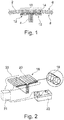
- Fig. 1 shows a skin panel 2 and a stiffening member 4 in a schematic representation.
- the skin panel 2 has an outer side 6, an inner side 8 and a receiving section 10 provided there.
- the stiffening component 4 is configured by way of example as a longitudinal stiffening element (stringer) for a skin shell of an aircraft.
- the stiffening component 4 merely has two legs 12 as an example, which provide a divided connection surface 14.
- the connecting surface 14 is in surface contact with the receiving portion 10 on the inner side 8 of the skin panel second
- Both the skin panel 2 and the stiffening element 4 is made of a fiber-reinforced thermoplastic. This may be, for example, a PEEK or PEKK with embedded carbon fibers as reinforcing fibers.
- the reinforcing fibers are only indicated in this illustration.
- both components 2 and 4 can be welded together.
- a thermoplastic matrix material is partially melted, so that locally in the joint area, a thorough mixing of the material of the two components 2 and 4 takes place. After cooling, therefore, there is a virtually monolithic composite.
- Local heating can be carried out in particular by arranging an electrically conductive layer 16. This will be in Fig. 2 from a network of carbon nanotubes 18 having a plurality of meshes 20. By connecting the electrically conductive layer 16 with a voltage source 22 heats up the Layer 16, so that only in the joint area, a heating is performed.
- the heating may be controlled by an optional control unit 21.
- the control unit 21 and corresponding connection lines are shown in dashed lines. Furthermore, a slight warming can be maintained during cooling of the connection region, so that the cooling takes place more gently. This can be realized in particular by the control unit 21 by reducing the power supply.
- a sensor wire 23 may be provided, with the help of the control unit 21, the temperature can be monitored in the interior of the connection area. Based on this monitoring, a control of the cooling can take place.
- a particularly advantageous surface quality is achieved when the fibers of the components 2 and 4 are aligned parallel to each other and have no particular waviness.
- perfectly parallel fibers and juxtaposed fibers 26 are provided, which can be incorporated into a thermoplastic matrix material 28. It is conceivable to produce several layers of a fiber-reinforced material from the thermoplastic material and with combed fibers and to put them together in the form of a web or band.
- Fig. 4 shows a variant of a stiffening member 30 having a plurality of sections 32 or segments of a bonding surface, which are provided with the network of carbon nanotubes shown above.
- the stiffening component 30 may further comprise by way of example a cutout 34, through which a stiffening component 4 according to FIG Fig. 1 can run.
- the stiffening component 30 could therefore be part of a hull frame, while the stiffening component 4 could be a part of a longitudinal stiffening element (Stringer).
- Fig. 4 The elements off Fig. 4 are in Fig. 5 shown in a composite form with a skin panel 2 which may form part of a trunk skin.
- the area indicated by a solid dark line can be interpreted as the connection area 36 in which the welding is performed.
- Fig. 6 is schematically shown in the form of a block diagram, the inventive method.
- the method comprises the steps of providing 38 at least one skin panel 2 having an inner side 8, an outer side 6 and a receiving section 10 arranged on the inner side 8, providing 40 at least one stiffening component with a connection surface 14, contacting 42 the at least one stiffening component and at least one a skin panel, such that the bonding surface is on the receiving portion, surface heating 44 a joining zone in which the connecting surface of the stiffening member and the receiving portion lie so that the at least one stiffening member and the at least one skin panel are welded together, the cooling 46 of the joint zone comparing 48 a determined geometry of the combination of stiffening component and skin panel with a predeterminable geometry, and reheating 50 the joining zone, as well as the deformation 52 of the stiffening component and the skin panel and the cooling 54 for reaching the predeterminable geometry, if the determined geometry deviates from the predeterminable geometry.
- the method may further include placing 56 a conductive layer on the bond
- FIG. 7 a commercial aircraft 60 which has at least one component 62 produced by the method according to the invention. This is merely exemplified with a dashed line. They are all other components can also be produced with a method according to the invention.
Landscapes
- Engineering & Computer Science (AREA)
- Mechanical Engineering (AREA)
- Thermal Sciences (AREA)
- Physics & Mathematics (AREA)
- Aviation & Aerospace Engineering (AREA)
- Manufacturing & Machinery (AREA)
- Textile Engineering (AREA)
- Architecture (AREA)
- Civil Engineering (AREA)
- Structural Engineering (AREA)
- General Engineering & Computer Science (AREA)
- Transportation (AREA)
- Lining Or Joining Of Plastics Or The Like (AREA)
- Moulding By Coating Moulds (AREA)
- Laminated Bodies (AREA)
Applications Claiming Priority (1)
| Application Number | Priority Date | Filing Date | Title |
|---|---|---|---|
| DE102017130927.6A DE102017130927A1 (de) | 2017-12-21 | 2017-12-21 | Verfahren zum Herstellen eines Fahrzeugbauteils aus einem faserverstärkten Kunststoff |
Publications (2)
| Publication Number | Publication Date |
|---|---|
| EP3501801A1 true EP3501801A1 (fr) | 2019-06-26 |
| EP3501801B1 EP3501801B1 (fr) | 2021-03-17 |
Family
ID=64456893
Family Applications (1)
| Application Number | Title | Priority Date | Filing Date |
|---|---|---|---|
| EP18208138.0A Active EP3501801B1 (fr) | 2017-12-21 | 2018-11-23 | Procédé de fabrication d'un composant de véhicule à partir d'une matière plastique renforcée par des fibres |
Country Status (4)
| Country | Link |
|---|---|
| US (1) | US10987877B2 (fr) |
| EP (1) | EP3501801B1 (fr) |
| CN (1) | CN110014660B (fr) |
| DE (1) | DE102017130927A1 (fr) |
Cited By (1)
| Publication number | Priority date | Publication date | Assignee | Title |
|---|---|---|---|---|
| EP3575066A1 (fr) * | 2018-05-28 | 2019-12-04 | Airbus Operations GmbH | Procédé de fabrication d'un composant d'un matériau composite fibreux |
Families Citing this family (2)
| Publication number | Priority date | Publication date | Assignee | Title |
|---|---|---|---|---|
| CN110722802A (zh) * | 2019-09-26 | 2020-01-24 | 沈阳航空航天大学 | 基于超声辅助的轻质合金与热塑性复合材料的连接方法 |
| CN120096794B (zh) * | 2025-05-09 | 2025-07-18 | 哈尔滨工业大学(威海) | 一种飞机蒙皮结构及其制造方法 |
Citations (2)
| Publication number | Priority date | Publication date | Assignee | Title |
|---|---|---|---|---|
| US20160136879A1 (en) * | 2014-11-18 | 2016-05-19 | The Boeing Company | Susceptor Welding Tape |
| US20170355152A1 (en) * | 2016-06-08 | 2017-12-14 | Airbus Operations Gmbh | Method for integrating a backing-structure assembly in a structure of an aircraft or spacecraft |
Family Cites Families (16)
| Publication number | Priority date | Publication date | Assignee | Title |
|---|---|---|---|---|
| US4309905A (en) * | 1979-12-26 | 1982-01-12 | Maizenberg Mikhail I | Method for detecting non-uniformities of magnetic materials and device for effecting same |
| JP3545523B2 (ja) * | 1995-12-04 | 2004-07-21 | 三菱レイヨン株式会社 | 医療用支持材の成形方法 |
| JP2001225184A (ja) * | 2000-02-16 | 2001-08-21 | Mitsubishi Heavy Ind Ltd | 溶接歪高速修正装置 |
| JP3951805B2 (ja) * | 2002-05-28 | 2007-08-01 | 松下電工株式会社 | ケースの残留応力・残留歪の除去方法及びその装置 |
| JP2005131798A (ja) * | 2003-10-28 | 2005-05-26 | Matsushita Electric Works Ltd | 樹脂成形体の製造方法 |
| JP2005178029A (ja) * | 2003-12-16 | 2005-07-07 | Toyota Motor Corp | 樹脂製パネル成形部材の変形矯正方法および樹脂製パネル成形部材 |
| US8213849B2 (en) * | 2009-07-20 | 2012-07-03 | Xerox Corporation | Inductively heated carbon nanotube fuser |
| DE102011051071A1 (de) * | 2011-06-15 | 2012-12-20 | Synview Gmbh | Verfahren zur Herstellung faserverstärkter Formteile |
| US9545782B2 (en) * | 2014-05-13 | 2017-01-17 | The Boeing Company | Method and apparatus for repairing composite materials |
| DE102015109483B4 (de) * | 2015-06-15 | 2020-10-01 | Lisa Dräxlmaier GmbH | Faserverbundbauteil |
| DE102015114786A1 (de) * | 2015-09-03 | 2017-03-09 | Dieffenbacher GmbH Maschinen- und Anlagenbau | Verfahren und Vorrichtung zur Herstellung von faserverstärkten Kunststoffteilen |
| EP3178635B1 (fr) * | 2015-12-11 | 2019-10-30 | Airbus Operations GmbH | Procédé permettant de souder un premier objet et un second objet ensemble |
| DE102016210086B4 (de) * | 2016-06-08 | 2025-11-13 | Airbus Operations Gmbh | Verfahren zum Herstellen eines Strukturbauteils für ein Luft- oder Raumfahrzeug, sowie Anordnung |
| US20170355150A1 (en) * | 2016-06-14 | 2017-12-14 | GM Global Technology Operations LLC | Ultrasonic weld-bonding of thermoplastic composites |
| CN106799828A (zh) * | 2016-11-23 | 2017-06-06 | 江苏恒神股份有限公司 | 一种纤维增强树脂基复合材料矩形管矫正方法 |
| DE102017217294A1 (de) * | 2017-09-28 | 2019-03-28 | Airbus Operations Gmbh | Verfahren zum Widerstandsschweißen von Faserverbundbauteilen zu einer Faserverbundstruktur, Faserverbundstruktur und Faserverbundbauteil |
-
2017
- 2017-12-21 DE DE102017130927.6A patent/DE102017130927A1/de not_active Withdrawn
-
2018
- 2018-11-23 EP EP18208138.0A patent/EP3501801B1/fr active Active
- 2018-12-18 US US16/223,338 patent/US10987877B2/en active Active
- 2018-12-19 CN CN201811556176.XA patent/CN110014660B/zh active Active
Patent Citations (2)
| Publication number | Priority date | Publication date | Assignee | Title |
|---|---|---|---|---|
| US20160136879A1 (en) * | 2014-11-18 | 2016-05-19 | The Boeing Company | Susceptor Welding Tape |
| US20170355152A1 (en) * | 2016-06-08 | 2017-12-14 | Airbus Operations Gmbh | Method for integrating a backing-structure assembly in a structure of an aircraft or spacecraft |
Non-Patent Citations (1)
| Title |
|---|
| CAMPBELL F C ED - CAMPBELL FLAKE C: "Manufacturing processes for advanced composites, Chapter 10 (Thermoplastic Composites: An Unfulfilled Promise)", 1 January 2004, MANUFACTURING PROCESSES FOR ADVANCED COMPOSITES, ELSEVIER ADVANCED TECHNOLOGY, OXFORD, GB, PAGE(S) 1 - 41, ISBN: 978-1-85617-415-2, XP002615944 * |
Cited By (1)
| Publication number | Priority date | Publication date | Assignee | Title |
|---|---|---|---|---|
| EP3575066A1 (fr) * | 2018-05-28 | 2019-12-04 | Airbus Operations GmbH | Procédé de fabrication d'un composant d'un matériau composite fibreux |
Also Published As
| Publication number | Publication date |
|---|---|
| CN110014660A (zh) | 2019-07-16 |
| EP3501801B1 (fr) | 2021-03-17 |
| DE102017130927A1 (de) | 2019-06-27 |
| US20190202141A1 (en) | 2019-07-04 |
| CN110014660B (zh) | 2025-03-28 |
| US10987877B2 (en) | 2021-04-27 |
Similar Documents
| Publication | Publication Date | Title |
|---|---|---|
| EP2242682B1 (fr) | Procédé pour relier deux sections de fuselage par la création d'un joint transversal ainsi que d'une liaison de joint transversal | |
| DE69101908T2 (de) | Verbindungsverfahren von wärmehärtbaren Verbundstrukturen. | |
| EP2859987B1 (fr) | Composé d'éléments de construction | |
| EP2821198A1 (fr) | Tête d'amenée de semi-produit à base de fibres | |
| DE69304689T2 (de) | Verbinden von thermoplastischen und wärmehärtenden verbundstrukturen mit metallischen strukturen | |
| DE102009056580A1 (de) | Verfahren und Vorrichtung zum Verbinden von thermoplastischen Faserverbundbauteilen mittels stiftförmiger Funktionselemente | |
| WO2009046932A2 (fr) | Élément en matériau composite, et procédé de réparation et de fabrication d'éléments de construction en matériaux composites | |
| EP3867044B1 (fr) | Procédé et système d'insertion servant à souder des composants thermoplastiques | |
| EP3501801B1 (fr) | Procédé de fabrication d'un composant de véhicule à partir d'une matière plastique renforcée par des fibres | |
| DE102008008200B4 (de) | Verbundstruktur sowie Verfahren zu ihrer Herstellung | |
| DE102015005407A1 (de) | Rührreibschweißen von Thermoplasten | |
| DE69308208T2 (de) | Heizvorrichtung zum thermoplastischen schweissen | |
| DE102017119491A1 (de) | Verfahren und Vorrichtung zum Verschweißen von einem Duromer-Objekt mit einem weiteren Objekt über thermoplastische äußere Schichten | |
| DE102010040933B4 (de) | Verfahren zum thermischen Fügen von zwei Bauteilen | |
| DE102018106709A1 (de) | Verfahren zur herstellung einer verbundstruktur | |
| DE102014006681A1 (de) | Verfahren und Einrichtung zum Fügen flächiger Körper | |
| DE102013021672A1 (de) | Verfahren zur Herstellung eines Hybridbauteils | |
| DE202012007340U1 (de) | Kernelement sowie Kernschicht für ein Sandwichverbundbauteil, Sandwichverbundbauteil | |
| WO2016096008A1 (fr) | Tête d'amenée de demi-produit à base de fibres | |
| DE202014003925U1 (de) | Thermoplastischer flächiger Körperverbund und Einrichtung zum Fügen flächiger Körper | |
| EP3575066A1 (fr) | Procédé de fabrication d'un composant d'un matériau composite fibreux | |
| DE102019104635A1 (de) | Verfahren zum Herstellen eines mehrschichtigen elektrischen Widerstandsschweißelements, Widerstandsschweißelement, Kunststoffbauteil und Kunststoffbauteilgruppe | |
| DE102013114574A1 (de) | Trennfolie sowie Verfahren | |
| DE102013107106B4 (de) | Faserhalbzeug-Fördervorrichtung und Verfahren zum Fördern von Faserhalbzeugen in eine Förderrichtung | |
| EP4003702B1 (fr) | Procédé de liaison de deux composants en matériau thermoplastique |
Legal Events
| Date | Code | Title | Description |
|---|---|---|---|
| PUAI | Public reference made under article 153(3) epc to a published international application that has entered the european phase |
Free format text: ORIGINAL CODE: 0009012 |
|
| STAA | Information on the status of an ep patent application or granted ep patent |
Free format text: STATUS: THE APPLICATION HAS BEEN PUBLISHED |
|
| AK | Designated contracting states |
Kind code of ref document: A1 Designated state(s): AL AT BE BG CH CY CZ DE DK EE ES FI FR GB GR HR HU IE IS IT LI LT LU LV MC MK MT NL NO PL PT RO RS SE SI SK SM TR |
|
| AX | Request for extension of the european patent |
Extension state: BA ME |
|
| STAA | Information on the status of an ep patent application or granted ep patent |
Free format text: STATUS: REQUEST FOR EXAMINATION WAS MADE |
|
| 17P | Request for examination filed |
Effective date: 20200102 |
|
| RBV | Designated contracting states (corrected) |
Designated state(s): AL AT BE BG CH CY CZ DE DK EE ES FI FR GB GR HR HU IE IS IT LI LT LU LV MC MK MT NL NO PL PT RO RS SE SI SK SM TR |
|
| RIC1 | Information provided on ipc code assigned before grant |
Ipc: B29C 65/00 20060101ALI20201202BHEP Ipc: B29C 65/82 20060101ALI20201202BHEP Ipc: B29L 31/30 20060101ALN20201202BHEP Ipc: B29C 65/08 20060101ALI20201202BHEP Ipc: B29C 65/34 20060101ALI20201202BHEP Ipc: B29C 65/02 20060101AFI20201202BHEP Ipc: B29C 69/00 20060101ALI20201202BHEP Ipc: B29C 70/00 20060101ALI20201202BHEP |
|
| GRAP | Despatch of communication of intention to grant a patent |
Free format text: ORIGINAL CODE: EPIDOSNIGR1 |
|
| STAA | Information on the status of an ep patent application or granted ep patent |
Free format text: STATUS: GRANT OF PATENT IS INTENDED |
|
| RIC1 | Information provided on ipc code assigned before grant |
Ipc: B29C 65/82 20060101ALI20201217BHEP Ipc: B29C 69/00 20060101ALI20201217BHEP Ipc: B29C 65/02 20060101AFI20201217BHEP Ipc: B29C 70/00 20060101ALI20201217BHEP Ipc: B29C 65/00 20060101ALI20201217BHEP Ipc: B29C 65/08 20060101ALI20201217BHEP Ipc: B29C 65/34 20060101ALI20201217BHEP Ipc: B29L 31/30 20060101ALN20201217BHEP |
|
| GRAS | Grant fee paid |
Free format text: ORIGINAL CODE: EPIDOSNIGR3 |
|
| GRAA | (expected) grant |
Free format text: ORIGINAL CODE: 0009210 |
|
| STAA | Information on the status of an ep patent application or granted ep patent |
Free format text: STATUS: THE PATENT HAS BEEN GRANTED |
|
| INTG | Intention to grant announced |
Effective date: 20210120 |
|
| AK | Designated contracting states |
Kind code of ref document: B1 Designated state(s): AL AT BE BG CH CY CZ DE DK EE ES FI FR GB GR HR HU IE IS IT LI LT LU LV MC MK MT NL NO PL PT RO RS SE SI SK SM TR |
|
| REG | Reference to a national code |
Ref country code: GB Ref legal event code: FG4D Free format text: NOT ENGLISH |
|
| REG | Reference to a national code |
Ref country code: CH Ref legal event code: EP |
|
| REG | Reference to a national code |
Ref country code: DE Ref legal event code: R096 Ref document number: 502018004346 Country of ref document: DE |
|
| REG | Reference to a national code |
Ref country code: IE Ref legal event code: FG4D Free format text: LANGUAGE OF EP DOCUMENT: GERMAN |
|
| REG | Reference to a national code |
Ref country code: AT Ref legal event code: REF Ref document number: 1371844 Country of ref document: AT Kind code of ref document: T Effective date: 20210415 |
|
| REG | Reference to a national code |
Ref country code: LT Ref legal event code: MG9D |
|
| PG25 | Lapsed in a contracting state [announced via postgrant information from national office to epo] |
Ref country code: BG Free format text: LAPSE BECAUSE OF FAILURE TO SUBMIT A TRANSLATION OF THE DESCRIPTION OR TO PAY THE FEE WITHIN THE PRESCRIBED TIME-LIMIT Effective date: 20210617 Ref country code: HR Free format text: LAPSE BECAUSE OF FAILURE TO SUBMIT A TRANSLATION OF THE DESCRIPTION OR TO PAY THE FEE WITHIN THE PRESCRIBED TIME-LIMIT Effective date: 20210317 Ref country code: GR Free format text: LAPSE BECAUSE OF FAILURE TO SUBMIT A TRANSLATION OF THE DESCRIPTION OR TO PAY THE FEE WITHIN THE PRESCRIBED TIME-LIMIT Effective date: 20210618 Ref country code: FI Free format text: LAPSE BECAUSE OF FAILURE TO SUBMIT A TRANSLATION OF THE DESCRIPTION OR TO PAY THE FEE WITHIN THE PRESCRIBED TIME-LIMIT Effective date: 20210317 Ref country code: NO Free format text: LAPSE BECAUSE OF FAILURE TO SUBMIT A TRANSLATION OF THE DESCRIPTION OR TO PAY THE FEE WITHIN THE PRESCRIBED TIME-LIMIT Effective date: 20210617 |
|
| REG | Reference to a national code |
Ref country code: NL Ref legal event code: MP Effective date: 20210317 |
|
| PG25 | Lapsed in a contracting state [announced via postgrant information from national office to epo] |
Ref country code: SE Free format text: LAPSE BECAUSE OF FAILURE TO SUBMIT A TRANSLATION OF THE DESCRIPTION OR TO PAY THE FEE WITHIN THE PRESCRIBED TIME-LIMIT Effective date: 20210317 Ref country code: RS Free format text: LAPSE BECAUSE OF FAILURE TO SUBMIT A TRANSLATION OF THE DESCRIPTION OR TO PAY THE FEE WITHIN THE PRESCRIBED TIME-LIMIT Effective date: 20210317 Ref country code: LV Free format text: LAPSE BECAUSE OF FAILURE TO SUBMIT A TRANSLATION OF THE DESCRIPTION OR TO PAY THE FEE WITHIN THE PRESCRIBED TIME-LIMIT Effective date: 20210317 |
|
| PG25 | Lapsed in a contracting state [announced via postgrant information from national office to epo] |
Ref country code: NL Free format text: LAPSE BECAUSE OF FAILURE TO SUBMIT A TRANSLATION OF THE DESCRIPTION OR TO PAY THE FEE WITHIN THE PRESCRIBED TIME-LIMIT Effective date: 20210317 |
|
| PG25 | Lapsed in a contracting state [announced via postgrant information from national office to epo] |
Ref country code: SM Free format text: LAPSE BECAUSE OF FAILURE TO SUBMIT A TRANSLATION OF THE DESCRIPTION OR TO PAY THE FEE WITHIN THE PRESCRIBED TIME-LIMIT Effective date: 20210317 Ref country code: LT Free format text: LAPSE BECAUSE OF FAILURE TO SUBMIT A TRANSLATION OF THE DESCRIPTION OR TO PAY THE FEE WITHIN THE PRESCRIBED TIME-LIMIT Effective date: 20210317 Ref country code: EE Free format text: LAPSE BECAUSE OF FAILURE TO SUBMIT A TRANSLATION OF THE DESCRIPTION OR TO PAY THE FEE WITHIN THE PRESCRIBED TIME-LIMIT Effective date: 20210317 Ref country code: CZ Free format text: LAPSE BECAUSE OF FAILURE TO SUBMIT A TRANSLATION OF THE DESCRIPTION OR TO PAY THE FEE WITHIN THE PRESCRIBED TIME-LIMIT Effective date: 20210317 |
|
| PG25 | Lapsed in a contracting state [announced via postgrant information from national office to epo] |
Ref country code: SK Free format text: LAPSE BECAUSE OF FAILURE TO SUBMIT A TRANSLATION OF THE DESCRIPTION OR TO PAY THE FEE WITHIN THE PRESCRIBED TIME-LIMIT Effective date: 20210317 Ref country code: RO Free format text: LAPSE BECAUSE OF FAILURE TO SUBMIT A TRANSLATION OF THE DESCRIPTION OR TO PAY THE FEE WITHIN THE PRESCRIBED TIME-LIMIT Effective date: 20210317 Ref country code: PT Free format text: LAPSE BECAUSE OF FAILURE TO SUBMIT A TRANSLATION OF THE DESCRIPTION OR TO PAY THE FEE WITHIN THE PRESCRIBED TIME-LIMIT Effective date: 20210719 Ref country code: PL Free format text: LAPSE BECAUSE OF FAILURE TO SUBMIT A TRANSLATION OF THE DESCRIPTION OR TO PAY THE FEE WITHIN THE PRESCRIBED TIME-LIMIT Effective date: 20210317 Ref country code: IS Free format text: LAPSE BECAUSE OF FAILURE TO SUBMIT A TRANSLATION OF THE DESCRIPTION OR TO PAY THE FEE WITHIN THE PRESCRIBED TIME-LIMIT Effective date: 20210717 |
|
| REG | Reference to a national code |
Ref country code: DE Ref legal event code: R097 Ref document number: 502018004346 Country of ref document: DE |
|
| PLBE | No opposition filed within time limit |
Free format text: ORIGINAL CODE: 0009261 |
|
| STAA | Information on the status of an ep patent application or granted ep patent |
Free format text: STATUS: NO OPPOSITION FILED WITHIN TIME LIMIT |
|
| PG25 | Lapsed in a contracting state [announced via postgrant information from national office to epo] |
Ref country code: ES Free format text: LAPSE BECAUSE OF FAILURE TO SUBMIT A TRANSLATION OF THE DESCRIPTION OR TO PAY THE FEE WITHIN THE PRESCRIBED TIME-LIMIT Effective date: 20210317 Ref country code: DK Free format text: LAPSE BECAUSE OF FAILURE TO SUBMIT A TRANSLATION OF THE DESCRIPTION OR TO PAY THE FEE WITHIN THE PRESCRIBED TIME-LIMIT Effective date: 20210317 Ref country code: AL Free format text: LAPSE BECAUSE OF FAILURE TO SUBMIT A TRANSLATION OF THE DESCRIPTION OR TO PAY THE FEE WITHIN THE PRESCRIBED TIME-LIMIT Effective date: 20210317 |
|
| 26N | No opposition filed |
Effective date: 20211220 |
|
| PG25 | Lapsed in a contracting state [announced via postgrant information from national office to epo] |
Ref country code: SI Free format text: LAPSE BECAUSE OF FAILURE TO SUBMIT A TRANSLATION OF THE DESCRIPTION OR TO PAY THE FEE WITHIN THE PRESCRIBED TIME-LIMIT Effective date: 20210317 |
|
| PG25 | Lapsed in a contracting state [announced via postgrant information from national office to epo] |
Ref country code: IT Free format text: LAPSE BECAUSE OF FAILURE TO SUBMIT A TRANSLATION OF THE DESCRIPTION OR TO PAY THE FEE WITHIN THE PRESCRIBED TIME-LIMIT Effective date: 20210317 |
|
| PG25 | Lapsed in a contracting state [announced via postgrant information from national office to epo] |
Ref country code: IS Free format text: LAPSE BECAUSE OF FAILURE TO SUBMIT A TRANSLATION OF THE DESCRIPTION OR TO PAY THE FEE WITHIN THE PRESCRIBED TIME-LIMIT Effective date: 20210717 |
|
| PG25 | Lapsed in a contracting state [announced via postgrant information from national office to epo] |
Ref country code: MC Free format text: LAPSE BECAUSE OF FAILURE TO SUBMIT A TRANSLATION OF THE DESCRIPTION OR TO PAY THE FEE WITHIN THE PRESCRIBED TIME-LIMIT Effective date: 20210317 |
|
| REG | Reference to a national code |
Ref country code: CH Ref legal event code: PL |
|
| PG25 | Lapsed in a contracting state [announced via postgrant information from national office to epo] |
Ref country code: LU Free format text: LAPSE BECAUSE OF NON-PAYMENT OF DUE FEES Effective date: 20211123 Ref country code: BE Free format text: LAPSE BECAUSE OF NON-PAYMENT OF DUE FEES Effective date: 20211130 |
|
| REG | Reference to a national code |
Ref country code: BE Ref legal event code: MM Effective date: 20211130 |
|
| PG25 | Lapsed in a contracting state [announced via postgrant information from national office to epo] |
Ref country code: LI Free format text: LAPSE BECAUSE OF NON-PAYMENT OF DUE FEES Effective date: 20211130 Ref country code: CH Free format text: LAPSE BECAUSE OF NON-PAYMENT OF DUE FEES Effective date: 20211130 |
|
| PG25 | Lapsed in a contracting state [announced via postgrant information from national office to epo] |
Ref country code: IE Free format text: LAPSE BECAUSE OF NON-PAYMENT OF DUE FEES Effective date: 20211123 |
|
| PG25 | Lapsed in a contracting state [announced via postgrant information from national office to epo] |
Ref country code: CY Free format text: LAPSE BECAUSE OF FAILURE TO SUBMIT A TRANSLATION OF THE DESCRIPTION OR TO PAY THE FEE WITHIN THE PRESCRIBED TIME-LIMIT Effective date: 20210317 |
|
| GBPC | Gb: european patent ceased through non-payment of renewal fee |
Effective date: 20221123 |
|
| PG25 | Lapsed in a contracting state [announced via postgrant information from national office to epo] |
Ref country code: HU Free format text: LAPSE BECAUSE OF FAILURE TO SUBMIT A TRANSLATION OF THE DESCRIPTION OR TO PAY THE FEE WITHIN THE PRESCRIBED TIME-LIMIT; INVALID AB INITIO Effective date: 20181123 |
|
| PG25 | Lapsed in a contracting state [announced via postgrant information from national office to epo] |
Ref country code: GB Free format text: LAPSE BECAUSE OF NON-PAYMENT OF DUE FEES Effective date: 20221123 |
|
| PG25 | Lapsed in a contracting state [announced via postgrant information from national office to epo] |
Ref country code: MK Free format text: LAPSE BECAUSE OF FAILURE TO SUBMIT A TRANSLATION OF THE DESCRIPTION OR TO PAY THE FEE WITHIN THE PRESCRIBED TIME-LIMIT Effective date: 20210317 |
|
| PG25 | Lapsed in a contracting state [announced via postgrant information from national office to epo] |
Ref country code: MT Free format text: LAPSE BECAUSE OF FAILURE TO SUBMIT A TRANSLATION OF THE DESCRIPTION OR TO PAY THE FEE WITHIN THE PRESCRIBED TIME-LIMIT Effective date: 20210317 |
|
| REG | Reference to a national code |
Ref country code: AT Ref legal event code: MM01 Ref document number: 1371844 Country of ref document: AT Kind code of ref document: T Effective date: 20231123 |
|
| PGFP | Annual fee paid to national office [announced via postgrant information from national office to epo] |
Ref country code: FR Payment date: 20241128 Year of fee payment: 7 |
|
| PG25 | Lapsed in a contracting state [announced via postgrant information from national office to epo] |
Ref country code: AT Free format text: LAPSE BECAUSE OF NON-PAYMENT OF DUE FEES Effective date: 20231123 |
|
| PG25 | Lapsed in a contracting state [announced via postgrant information from national office to epo] |
Ref country code: AT Free format text: LAPSE BECAUSE OF NON-PAYMENT OF DUE FEES Effective date: 20231123 |
|
| PG25 | Lapsed in a contracting state [announced via postgrant information from national office to epo] |
Ref country code: TR Free format text: LAPSE BECAUSE OF FAILURE TO SUBMIT A TRANSLATION OF THE DESCRIPTION OR TO PAY THE FEE WITHIN THE PRESCRIBED TIME-LIMIT Effective date: 20210317 |
|
| PGFP | Annual fee paid to national office [announced via postgrant information from national office to epo] |
Ref country code: DE Payment date: 20251119 Year of fee payment: 8 |
|
| PGFP | Annual fee paid to national office [announced via postgrant information from national office to epo] |
Ref country code: AT Payment date: 20260410 Year of fee payment: 5 |