EP3502196B1 - Wässrige dispersion von polymerpartikeln, mikrokugeln und polyethylenwachs - Google Patents
Wässrige dispersion von polymerpartikeln, mikrokugeln und polyethylenwachs Download PDFInfo
- Publication number
- EP3502196B1 EP3502196B1 EP18212820.7A EP18212820A EP3502196B1 EP 3502196 B1 EP3502196 B1 EP 3502196B1 EP 18212820 A EP18212820 A EP 18212820A EP 3502196 B1 EP3502196 B1 EP 3502196B1
- Authority
- EP
- European Patent Office
- Prior art keywords
- microspheres
- weight percent
- range
- polymeric organic
- weight
- Prior art date
- Legal status (The legal status is an assumption and is not a legal conclusion. Google has not performed a legal analysis and makes no representation as to the accuracy of the status listed.)
- Active
Links
- RWGFKTVRMDUZSP-UHFFFAOYSA-N CC(C)c1ccccc1 Chemical compound CC(C)c1ccccc1 RWGFKTVRMDUZSP-UHFFFAOYSA-N 0.000 description 1
Classifications
-
- C—CHEMISTRY; METALLURGY
- C09—DYES; PAINTS; POLISHES; NATURAL RESINS; ADHESIVES; COMPOSITIONS NOT OTHERWISE PROVIDED FOR; APPLICATIONS OF MATERIALS NOT OTHERWISE PROVIDED FOR
- C09D—COATING COMPOSITIONS, e.g. PAINTS, VARNISHES OR LACQUERS; FILLING PASTES; CHEMICAL PAINT OR INK REMOVERS; INKS; CORRECTING FLUIDS; WOODSTAINS; PASTES OR SOLIDS FOR COLOURING OR PRINTING; USE OF MATERIALS THEREFOR
- C09D7/00—Features of coating compositions, not provided for in group C09D5/00; Processes for incorporating ingredients in coating compositions
- C09D7/40—Additives
- C09D7/65—Additives macromolecular
-
- C—CHEMISTRY; METALLURGY
- C08—ORGANIC MACROMOLECULAR COMPOUNDS; THEIR PREPARATION OR CHEMICAL WORKING-UP; COMPOSITIONS BASED THEREON
- C08J—WORKING-UP; GENERAL PROCESSES OF COMPOUNDING; AFTER-TREATMENT NOT COVERED BY SUBCLASSES C08B, C08C, C08F, C08G or C08H
- C08J3/00—Processes of treating or compounding macromolecular substances
- C08J3/24—Crosslinking, e.g. vulcanising, of macromolecules
-
- C—CHEMISTRY; METALLURGY
- C08—ORGANIC MACROMOLECULAR COMPOUNDS; THEIR PREPARATION OR CHEMICAL WORKING-UP; COMPOSITIONS BASED THEREON
- C08L—COMPOSITIONS OF MACROMOLECULAR COMPOUNDS
- C08L33/00—Compositions of homopolymers or copolymers of compounds having one or more unsaturated aliphatic radicals, each having only one carbon-to-carbon double bond, and only one being terminated by only one carboxyl radical, or of salts, anhydrides, esters, amides, imides or nitriles thereof; Compositions of derivatives of such polymers
- C08L33/04—Homopolymers or copolymers of esters
- C08L33/06—Homopolymers or copolymers of esters of esters containing only carbon, hydrogen and oxygen, which oxygen atoms are present only as part of the carboxyl radical
- C08L33/08—Homopolymers or copolymers of acrylic acid esters
-
- C—CHEMISTRY; METALLURGY
- C09—DYES; PAINTS; POLISHES; NATURAL RESINS; ADHESIVES; COMPOSITIONS NOT OTHERWISE PROVIDED FOR; APPLICATIONS OF MATERIALS NOT OTHERWISE PROVIDED FOR
- C09D—COATING COMPOSITIONS, e.g. PAINTS, VARNISHES OR LACQUERS; FILLING PASTES; CHEMICAL PAINT OR INK REMOVERS; INKS; CORRECTING FLUIDS; WOODSTAINS; PASTES OR SOLIDS FOR COLOURING OR PRINTING; USE OF MATERIALS THEREFOR
- C09D133/00—Coating compositions based on homopolymers or copolymers of compounds having one or more unsaturated aliphatic radicals, each having only one carbon-to-carbon double bond, and at least one being terminated by only one carboxyl radical, or of salts, anhydrides, esters, amides, imides, or nitriles thereof; Coating compositions based on derivatives of such polymers
- C09D133/04—Homopolymers or copolymers of esters
-
- C—CHEMISTRY; METALLURGY
- C09—DYES; PAINTS; POLISHES; NATURAL RESINS; ADHESIVES; COMPOSITIONS NOT OTHERWISE PROVIDED FOR; APPLICATIONS OF MATERIALS NOT OTHERWISE PROVIDED FOR
- C09D—COATING COMPOSITIONS, e.g. PAINTS, VARNISHES OR LACQUERS; FILLING PASTES; CHEMICAL PAINT OR INK REMOVERS; INKS; CORRECTING FLUIDS; WOODSTAINS; PASTES OR SOLIDS FOR COLOURING OR PRINTING; USE OF MATERIALS THEREFOR
- C09D5/00—Coating compositions, e.g. paints, varnishes or lacquers, characterised by their physical nature or the effects produced; Filling pastes
- C09D5/006—Anti-reflective coatings
-
- C—CHEMISTRY; METALLURGY
- C09—DYES; PAINTS; POLISHES; NATURAL RESINS; ADHESIVES; COMPOSITIONS NOT OTHERWISE PROVIDED FOR; APPLICATIONS OF MATERIALS NOT OTHERWISE PROVIDED FOR
- C09D—COATING COMPOSITIONS, e.g. PAINTS, VARNISHES OR LACQUERS; FILLING PASTES; CHEMICAL PAINT OR INK REMOVERS; INKS; CORRECTING FLUIDS; WOODSTAINS; PASTES OR SOLIDS FOR COLOURING OR PRINTING; USE OF MATERIALS THEREFOR
- C09D5/00—Coating compositions, e.g. paints, varnishes or lacquers, characterised by their physical nature or the effects produced; Filling pastes
- C09D5/02—Emulsion paints including aerosols
- C09D5/022—Emulsions, e.g. oil in water
-
- C—CHEMISTRY; METALLURGY
- C09—DYES; PAINTS; POLISHES; NATURAL RESINS; ADHESIVES; COMPOSITIONS NOT OTHERWISE PROVIDED FOR; APPLICATIONS OF MATERIALS NOT OTHERWISE PROVIDED FOR
- C09D—COATING COMPOSITIONS, e.g. PAINTS, VARNISHES OR LACQUERS; FILLING PASTES; CHEMICAL PAINT OR INK REMOVERS; INKS; CORRECTING FLUIDS; WOODSTAINS; PASTES OR SOLIDS FOR COLOURING OR PRINTING; USE OF MATERIALS THEREFOR
- C09D7/00—Features of coating compositions, not provided for in group C09D5/00; Processes for incorporating ingredients in coating compositions
- C09D7/40—Additives
- C09D7/42—Gloss-reducing agents
-
- C—CHEMISTRY; METALLURGY
- C09—DYES; PAINTS; POLISHES; NATURAL RESINS; ADHESIVES; COMPOSITIONS NOT OTHERWISE PROVIDED FOR; APPLICATIONS OF MATERIALS NOT OTHERWISE PROVIDED FOR
- C09D—COATING COMPOSITIONS, e.g. PAINTS, VARNISHES OR LACQUERS; FILLING PASTES; CHEMICAL PAINT OR INK REMOVERS; INKS; CORRECTING FLUIDS; WOODSTAINS; PASTES OR SOLIDS FOR COLOURING OR PRINTING; USE OF MATERIALS THEREFOR
- C09D7/00—Features of coating compositions, not provided for in group C09D5/00; Processes for incorporating ingredients in coating compositions
- C09D7/40—Additives
- C09D7/43—Thickening agents
-
- C—CHEMISTRY; METALLURGY
- C09—DYES; PAINTS; POLISHES; NATURAL RESINS; ADHESIVES; COMPOSITIONS NOT OTHERWISE PROVIDED FOR; APPLICATIONS OF MATERIALS NOT OTHERWISE PROVIDED FOR
- C09D—COATING COMPOSITIONS, e.g. PAINTS, VARNISHES OR LACQUERS; FILLING PASTES; CHEMICAL PAINT OR INK REMOVERS; INKS; CORRECTING FLUIDS; WOODSTAINS; PASTES OR SOLIDS FOR COLOURING OR PRINTING; USE OF MATERIALS THEREFOR
- C09D7/00—Features of coating compositions, not provided for in group C09D5/00; Processes for incorporating ingredients in coating compositions
- C09D7/40—Additives
- C09D7/66—Additives characterised by particle size
- C09D7/67—Particle size smaller than 100 nm
-
- C—CHEMISTRY; METALLURGY
- C09—DYES; PAINTS; POLISHES; NATURAL RESINS; ADHESIVES; COMPOSITIONS NOT OTHERWISE PROVIDED FOR; APPLICATIONS OF MATERIALS NOT OTHERWISE PROVIDED FOR
- C09D—COATING COMPOSITIONS, e.g. PAINTS, VARNISHES OR LACQUERS; FILLING PASTES; CHEMICAL PAINT OR INK REMOVERS; INKS; CORRECTING FLUIDS; WOODSTAINS; PASTES OR SOLIDS FOR COLOURING OR PRINTING; USE OF MATERIALS THEREFOR
- C09D7/00—Features of coating compositions, not provided for in group C09D5/00; Processes for incorporating ingredients in coating compositions
- C09D7/40—Additives
- C09D7/66—Additives characterised by particle size
- C09D7/68—Particle size between 100-1000 nm
-
- C—CHEMISTRY; METALLURGY
- C09—DYES; PAINTS; POLISHES; NATURAL RESINS; ADHESIVES; COMPOSITIONS NOT OTHERWISE PROVIDED FOR; APPLICATIONS OF MATERIALS NOT OTHERWISE PROVIDED FOR
- C09D—COATING COMPOSITIONS, e.g. PAINTS, VARNISHES OR LACQUERS; FILLING PASTES; CHEMICAL PAINT OR INK REMOVERS; INKS; CORRECTING FLUIDS; WOODSTAINS; PASTES OR SOLIDS FOR COLOURING OR PRINTING; USE OF MATERIALS THEREFOR
- C09D7/00—Features of coating compositions, not provided for in group C09D5/00; Processes for incorporating ingredients in coating compositions
- C09D7/40—Additives
- C09D7/66—Additives characterised by particle size
- C09D7/69—Particle size larger than 1000 nm
-
- C—CHEMISTRY; METALLURGY
- C09—DYES; PAINTS; POLISHES; NATURAL RESINS; ADHESIVES; COMPOSITIONS NOT OTHERWISE PROVIDED FOR; APPLICATIONS OF MATERIALS NOT OTHERWISE PROVIDED FOR
- C09D—COATING COMPOSITIONS, e.g. PAINTS, VARNISHES OR LACQUERS; FILLING PASTES; CHEMICAL PAINT OR INK REMOVERS; INKS; CORRECTING FLUIDS; WOODSTAINS; PASTES OR SOLIDS FOR COLOURING OR PRINTING; USE OF MATERIALS THEREFOR
- C09D7/00—Features of coating compositions, not provided for in group C09D5/00; Processes for incorporating ingredients in coating compositions
- C09D7/40—Additives
- C09D7/70—Additives characterised by shape, e.g. fibres, flakes or microspheres
Definitions
- the present invention relates to an aqueous dispersion of polymer particles (a latex), microspheres, and polyethylene wax, which is useful for preparing pigmented and non-pigmented coating compositions that give coatings with improved burnish resistance.
- EP 1 834 995 and EP 1 944 342 relate to aqueous matte coating compositions
- aqueous matte coating compositions comprising a binder component B) and a polymeric duller component A) composed of particles of one or more multi-stage copolymer or single stage crosslinked (co)polymer, e.g. crosslinked t-butyl (meth)acrylate, the duller component particles A) having an average diameter of 1-20 ⁇ m.
- Components A) and B) are compatible.
- the duller component A) is acrylic; more preferably, components A) and B) are acrylic.
- the aqueous compositions provide matte coatings having haptic or feel (soft touch) properties, film and appearance properties, including burnish resistance and low color loss.
- Matte coatings are desirable for their ability to obscure surface imperfections in a substrate.
- the control of gloss which is critical in the design of these low sheen decorative paints, is accomplished with matting agents (also known as extenders or dulling agents), which are inorganic particles of calcium carbonate, silica, clay, talc, and the like.
- Matting agents lower the sheen by increasing the surface roughness of the film; unfortunately, traditional matting agents compromise the durability and performance of the resulting film. Therefore, matte coatings are not used in high traffic areas due to poor burnish resistance properties (unwanted increase of sheen/gloss arising from rubbing or abrasion). Accordingly, it would be advantageous to design a matte coating composition that forms a coating with improved burnish resistance.
- the present invention addresses a need in the art by providing a matte coating composition
- a matte coating composition comprising an aqueous dispersion of a) polymer particles having an average particle size in the range of from 80 nm to 500 nm as measured using a Brookhaven BI90 particle analyzer; b) polymeric organic crosslinked microspheres having a median weight average particle size D 50 in the range of from 1 ⁇ m to 20 ⁇ m as measured using Disc Centrifuge Photosedimentometer; c) polyethylene wax particles having an average particle size in the range of from 0.3 ⁇ m to 30 ⁇ m as measured by Malvern Zetasizer Nano-S-90 Particle Size Analyzer; and d) a rheology modifier;
- the concentration of polymer particles is in the range of from 4 to 40 weight percent; the concentration of the polymeric organic multistage crosslinked microspheres is in the range of from 4 to 35 weight percent; the concentration of polyethylene wax particles is in the range from 0.05 to 5 weight percent; and the concentration of the rheology modifier is in the range of from 0.1 to 5 weight percent.
- the present invention addresses a need in the art by providing a composition that gives a matte finish with the burnish resistance of a semi-gloss painted substrate.
- the present invention is a matte coating composition
- a matte coating composition comprising an aqueous dispersion of a) polymer particles having an average particle size in the range of from 80 nm to 500 nm as measured using a Brookhaven BI90 particle analyzer; b) polymeric organic crosslinked microspheres having a median weight average particle size D 50 in the range of from 1 ⁇ m to 20 ⁇ m as measured using Disc Centrifuge Photosedimentometer; c) polyethylene wax particles having an average particle size in the range of from 0.3 ⁇ m to 30 ⁇ m as measured by Malvern Zetasizer Nano-S-90 Particle Size Analyzer; and d) a rheology modifier; wherein the concentration of polymer particles, based on the weight of the composition, is in the range of from 4 to 40 weight percent; the concentration of the crosslinked polymeric organic microspheres is in the range of from 4 to 35 weight percent; the concentration of polyethylene wax particles is in the range from 0.05 to 5 weight percent; and the concentration
- the polymer particles are preferably acrylic based, meaning these polymer particles comprise at least 30 weight percent, based on the weight of the polymer particles, of structural units of one or more methacrylate monomers such as methyl methacrylate and ethyl methacrylate, and/or one or more acrylate monomers such as ethyl acrylate, butyl acrylate, 2-propylheptyl acrylate, and 2-ethylhexyl acrylate.
- methacrylate monomers such as methyl methacrylate and ethyl methacrylate
- acrylate monomers such as ethyl acrylate, butyl acrylate, 2-propylheptyl acrylate, and 2-ethylhexyl acrylate.
- the acrylic-based polymers may also include structural units of ethylenically unsaturated acid monomers such as methacrylic acid, acrylic acid, and itaconic acid, or salts thereof, as well as other non-acrylate or methacrylate monomers such as styrene and vinyl acetate.
- ethylenically unsaturated acid monomers such as methacrylic acid, acrylic acid, and itaconic acid, or salts thereof, as well as other non-acrylate or methacrylate monomers such as styrene and vinyl acetate.
- the polymer particles further comprise from 0.05 to 12 weight percent structural units of a monomer with keto functionality, including acetoacetoxyethyl methacrylate (AAEM) or diacetone acrylamide (DAAM), preferably at a concentration in the range of from 0.5 to 5 weight percent, based on the weight of the polymer particles and the polymeric organic microspheres.
- AAEM acetoacetoxyethyl methacrylate
- DAAM diacetone acrylamide
- the composition advantageously includes from 0.1, preferably from 0.2, and more preferably from 0.5 weight percent, to 10, and preferably to 5 weight percent, based on the weight of the polymer particles and microspheres, of a dihydrazide or polyamine crosslinking agent.
- polyamine crosslinking agents examples include diamines such as 3,3'-(ethane-1,2-diylbis(oxy))bis(propan-1 -amine); 4,9-dioxadodecane-1,12-diamine; 4,9-dioxadodecane-1,12-diamine; 4,7-dioxadodecane-1,10-diamine; and 4,7,10-trioxatridecane-1,13-diamine.
- diamines such as 3,3'-(ethane-1,2-diylbis(oxy))bis(propan-1 -amine); 4,9-dioxadodecane-1,12-diamine; 4,9-dioxadodecane-1,12-diamine; 4,7-dioxadodecane-1,10-diamine; and 4,7,10-trioxatridecane-1,13-diamine.
- polyamines such as JEFFAMINE D-230, JEFFAMINE D-400, JEFFAMINE D-2000, JEFFAMINE M-600, JEFFAMINE M-1000, JEFFAMINE ED-600, JEFFAMINE ED-900, T-403, and JEFFAMINE T-3000 polyetheramines.
- the composition preferably includes a dihydrazide crosslinking agent, such as adipic acid dihydrazide (ADH), carbodihydrazide (CDH), sebacic acid dihydrazide (SDH), valine dihydrazide (VDH), isophthalic dihydrazide (ISODH), and icosanedioic hydrazide ICODH).
- a dihydrazide crosslinking agent such as adipic acid dihydrazide (ADH), carbodihydrazide (CDH), sebacic acid dihydrazide (SDH), valine dihydrazide (VDH), isophthalic dihydrazide (ISODH), and icosanedioic hydrazide ICODH.
- ADH adipic acid dihydrazide
- CDH carbodihydrazide
- SDH sebacic acid dihydrazide
- VDH valine dihydrazide
- ISODH iso
- structural unit is used herein to describe the remnant of the recited monomer after polymerization.
- a structural unit of methyl methacrylate is as illustrated: where the dotted lines represent the points of attachment of the structural unit to the polymer backbone.
- the concentration of the polymer particles is preferably in the range of from 10, more preferably from 15 weight percent, to 35, more preferably to 30, and most preferably to 25 weight percent, based on the weight of the composition.
- the average particle size of the polymer particles is in the range of from 100 nm to 300 nm, more preferably to 250 nm as measured using a Brookhaven BI90 particle analyzer.
- the polymeric organic microspheres are preferably multistage and crosslinked, preferably with a first stage comprising a low T g ( ⁇ 20 °C, preferably ⁇ 10 °C, and more preferably ⁇ 0 °C, as calculated by the Fox equation) homo- or copolymer that is crosslinked to provide resiliency and no diffusion to the substrate; and a high T g second stage ( ⁇ 30 °C, preferably greater than 50 °C, as calculated by the Fox equation) to provide microspheres that are not film-forming at room temperature.
- a first stage comprising a low T g ( ⁇ 20 °C, preferably ⁇ 10 °C, and more preferably ⁇ 0 °C, as calculated by the Fox equation) homo- or copolymer that is crosslinked to provide resiliency and no diffusion to the substrate
- a high T g second stage ⁇ 30 °C, preferably greater than 50 °C, as calculated by the Fox equation
- At least 50, more preferably at least 70, and most preferably at least 90 weight percent of the crosslinked first stage comprises structural units of I) butyl acrylate or ethyl acrylate or a combination thereof; and II) a multiethylenically unsaturated nonionic monomer, exemplified hereinbelow, at a 1:11 w/w ratio in the range of from 99.5:0.5 to 90:10; preferably, methyl methacrylate homopolymer comprises at least 60, more preferably at least 80, and most preferably 100 weight percent of the second stage.
- the polymeric organic multistage crosslinked microspheres preferably having an average particle size (technically, a median weight average particle size, D 50 ) in the range of from 2 ⁇ m, more preferably from 4 ⁇ m, to preferably 15 ⁇ m, more preferably to 13 ⁇ m, and most preferably to 10 ⁇ m, as measured using Disc Centrifuge Photosedimentometer as described hereinbelow.
- the concentration of the polymeric organic microspheres is preferably in the range of from 5, and more preferably from 8 weight percent to preferably 30, more preferably to 25, most preferably 20 weight percent, based on the weight of the composition.
- Aqueous dispersions of multistage crosslinked microspheres can be prepared in a variety of ways, including those described in US Pat. Pub. 2013/0052454 ; US 4,403,003 ; 7,768,602 ; and 7,829,626 .
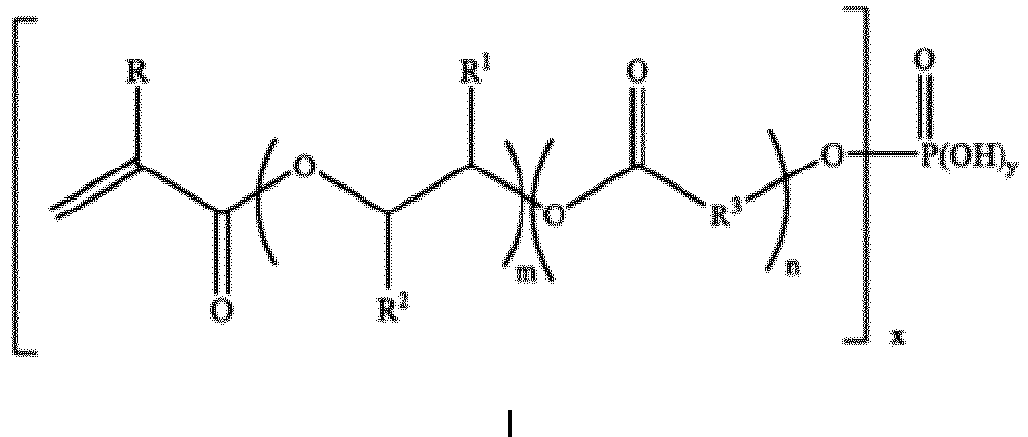
- an aqueous dispersion of first microspheres comprising structural units of a first monoethylenically unsaturated nonionic monomer is contacted under polymerization conditions with first stage monomers comprising, based on the weight of the first stage monomers, from a) 0.05 to 5 weight percent of a polymerizable organic phosphate or a salt thereof; and b) from 70 to 99.95 weight percent of a second monoethylenically unsaturated nonionic monomer, to grow out the first microspheres to form an aqueous dispersion of organic phosphate functionalized second microspheres, wherein the first microspheres have a particle size in the range of from 1 ⁇ m to 15 ⁇ m and the second microspheres have a particle size in the range of from 1.1 ⁇ m and 25 ⁇ m; and wherein the polymerizable organic phosphate is represented by the structure
- one of R 1 and R 2 is H, and the other of R 1 and R 2 is CH 3 ; more preferably, each R 2 is H and each R 1 is CH 3 ; m is preferably from 3, and more preferably from 4; to preferably to 8, and more preferably to 7.
- Sipomer PAM-100, Sipomer PAM-200 and Sipomer PAM-600 phosphate esters are examples of commercially available compounds within the scope of the compound of Formula II.
- a commercially available compound within the scope of Formula III is Kayamer PM-21 phosphate ester.
- the first microspheres preferably comprise from 90 to 99.9 weight percent structural units of a monoethylenically unsaturated nonionic monomer, examples of which include acrylates such as ethyl acrylate, butyl acrylate, and 2-ethylhexyl acrylate; methacrylates such as methyl methacrylate, n -butyl methacrylate, t -butyl methacrylate, hydroxyethyl methacrylate, hydroxypropyl methacrylate, acetoacetoxyethyl methacrylate, and ureido methacrylate; acrylonitrile; acrylamides such as acrylamide and diacetone acrylamide; styrene; and vinyl esters such as vinyl acetate.
- acrylates such as ethyl acrylate, butyl acrylate, and 2-ethylhexyl acrylate
- methacrylates such as methyl methacrylate, n
- the first microspheres may include structural units of carboxylic acid monomers such as methacrylic acid or acrylic acid, it is preferred that the first microspheres comprise less than 5, more preferably less than 3, and most preferably less than 1 weight percent structural units of a carboxylic acid monomer, based on the weight of the microspheres.
- the first microspheres more preferably comprise structural units of acrylates or methacrylates or combinations of acrylates and methacrylates.
- the first microspheres are advantageously prepared from an aqueous dispersion of an oligomeric seed having a weight average molecular weight (M w ) in the range of from 800, preferably from 1000 g/mol to 20,000, preferably to 10,000 and most preferably to 5000 g/mol as determined by size exclusion chromatography using polystyrene standards as described herein.
- the oligomeric seed has an average diameter in the range of from 200 nm, more preferably from 400 nm, and most preferably from 600 nm, to 8000 nm, preferably to 5000 nm, more preferably to 1500 nm, and most preferably to 1000 nm, as determined by disc centrifuge DCP, as described herein.
- the oligomeric seed contains a structural of a chain transfer agent such as an alkyl mercaptan, examples of which include n -dodecyl mercaptan, 1-hexanethiol, 1-octane thiol, and 2-butyl mercaptan.
- a chain transfer agent such as an alkyl mercaptan, examples of which include n -dodecyl mercaptan, 1-hexanethiol, 1-octane thiol, and 2-butyl mercaptan.
- oligomeric seed is advantageously contacted with a monomer in the presence of a hydrophobic initiator, in any order, to transport the initiator into the seed, or seed swollen with monomer.
- a hydrophobic initiator refers to an initiator having a water solubility in the range of from 5 ppm, preferably from 10 ppm, to 10,000, preferably to 1000, and more preferably to 100 ppm.
- the extent of swelling (seed growth) can be controlled by the ratio of the monomer to the seed.
- Suitable monoethylenically unsaturated nonionic monomers include acrylates such as ethyl acrylate, butyl acrylate, and 2-ethylhexyl acrylate; methacrylates such as methyl methacrylate, n -butyl methacrylate, t -butyl methacrylate, hydroxyethyl methacrylate, hydroxypropyl methacrylate, acetoacetoxyethyl methacrylate, and ureido methacrylate; acrylonitrile; acrylamides such as acrylamide and diacetone acrylamide; styrene; and vinyl esters such as vinyl acetate.
- acrylates such as ethyl acrylate, butyl acrylate, and 2-ethylhexyl acrylate
- methacrylates such as methyl methacrylate, n -butyl methacrylate, t -butyl methacrylate,
- Forming microspheres from oligomeric seed provides an effective way of controlling the particle size distribution of the microspheres.
- the coefficient of variation of the first and the second microspheres, as determined by DCP is less than 25%, more preferably less than 20%, more preferably less than 15%, and most preferably less than 10%.
- the concentration of gel formed in the process of preparing the aqueous dispersion of second microspheres is preferably less than 0.5, more preferably less than 0.2, more preferably less than 0.1, and most preferably less 0.05 weight percent, based on the weight of the aqueous dispersion. Dispersions of microspheres with low coefficients of variation ultimately result in coatings with reliable and reproducible properties in end-use applications. In contrast, microspheres with coefficients of variation greater than 30% give coatings with unreliable and unpredictable properties.
- the particle size of the first microspheres is in the range of from 2.5 ⁇ m, more preferably from 3.0 ⁇ m, preferably to 12 ⁇ m, more preferably to 10 ⁇ m, and most preferably to 8.5 ⁇ m.
- the aqueous dispersion of first microspheres is contacted under polymerization conditions and in the presence of an emulsifying surfactant, such as a phosphate or an alkyl benzene sulfonate or sulfate, with first stage monomers comprising, based on the weight of the first stage monomers, from 0.05, preferably from 0.1, and more preferably from 0.2 weight percent, to 5, preferably to 3, more preferably to 2, and most preferably to 1 weight percent of the polymerizable organic phosphate of Structure I or a salt thereof; and from 70, more preferably from 80, and most preferably from 90 weight percent, to 99.95, preferably to 99.8 weight percent of a second monoethylenically unsaturated nonionic monomer.
- an emulsifying surfactant such as a phosphate or an alkyl benzene sulfonate or sulfate
- the first microspheres increase in volume (grow out) to form an aqueous dispersion of organic phosphate functionalized second microspheres having a particle size in the range of from 1.1 ⁇ m, and preferably from 2.5 ⁇ m, preferably from 3.5 ⁇ m, to 25 ⁇ m, more preferably to 20 ⁇ m, and most preferably to 15 ⁇ m.
- the first stage monomer preferably further comprises a multiethylenically unsaturated nonionic monomer, preferably at a concentration in the range of from 0.1, more preferably from 1, and most preferably from 2 weight percent, to 15, more preferably to 10, and most preferably to 8 weight percent, based the weight of first stage monomers.
- suitable multiethylenically unsaturated nonionic monomers include allyl methacrylate, allyl acrylate, divinyl benzene, trimethylolpropane trimethacrylate, trimethylolpropane triacrylate, butylene glycol (1,3) dimethacrylate, butylene glycol (1,3) diacrylate, ethylene glycol dimethacrylate, and ethylene glycol diacrylate.
- the inclusion of these multiethylenically unsaturated nonionic monomers is particularly preferred where further staging of the organic phosphate functionalized second microspheres is desired.
- the first stage monomer as well as the second microspheres preferably comprises a substantial absence of structural units of a carboxylic acid monomer.
- a substantial absence of structural units of a carboxylic acid monomer means less than 5, preferably less than 3, more preferably less than 1, and most preferably less than 0.2 weight percent structural units of a carboxylic acid monomer such as methacrylic acid or acrylic acid, based on the weight of the microspheres.
- the second microspheres preferably comprise from 90 to 98 weight percent structural units of a second monoethylenically unsaturated nonionic monomer, which may be the same as or different from the first monoethylenically unsaturated nonionic monomer. It is further preferred that a keto-functionalized monomer be included among the second monoethylenically unsaturated monomer in the same concentration range as described for the phosphorus acid functionalized polymer particles. It is understood that "monomer” refers to one or more monomers.
- the aqueous dispersion of first microspheres is contacted under polymerization conditions with an excess of the polymerizable organic phosphate (or salt thereof) so that the resultant dispersion of organic phosphate functionalized second microspheres comprises unreacted organic phosphate.
- the presence of unreacted (carryover) polymerizable organic phosphate or salt thereof is especially advantageous if further staging of the second microspheres is desired.
- second stage ethylenically unsaturated nonionic monomer which may be the same as of different from the first stage monoethylenically unsaturated nonionic monomer, to yield a dispersion of organic phosphate functionalized third microspheres with a domain having a T g of less than 25 °C, and a domain with a T g of greater than 50 °C.
- the polymerization step to prepare the aqueous dispersion of third microspheres is carried out at a pH of from at least 3, more preferably from at least 4, more preferably from at least 5, and most preferably from at least 6, to preferably 12, more preferably to 10 and most preferably to 8.
- the polymerizable organic phosphate used to make the aqueous dispersion of third microspheres preferably is predominantly present in the salt form, preferably as the lithium, sodium, potassium, trialkylammonium, or ammonium salt.
- Additional polymerizable organic phosphate may be added in the further staging of the second microspheres, preferably in the desired pH range where initiator/coupler is used. It is especially preferred to prepare the microspheres using the salt of Formula II where each R 2 is H and each R 1 is CH 3 , or each R 2 is CH 3 and each R 1 is H; or Formula III.
- the aqueous dispersion of polymeric microspheres resulting from Preferred Method A comprise crosslinked microspheres functionalized with from 0.05 to 5 weight percent, based on the weight of the microspheres, of structural units of Formula I.
- the aqueous dispersion of first microspheres (prepared as described in Preferred Method A) are contacted with the first stage monomer comprising from 70 to 100 weight percent of the second monoethylenically unsaturated nonionic monomer to grow out the first microspheres to form an aqueous dispersion of second microspheres, as described hereinabove, except that the polymerization is carried out in the presence of a nonionic polyalkylene oxide of a distyryl or tristyryl phenol or an anionic polyalkylene oxide salt of a distyryl or tristyryl phenol.
- R 1 is 1-phenethyl-(R) n ;
- R 2 is preferably H, CH 3 , or allyl;
- m is preferably 0, 1, or 2;
- n is from 10 to 20;
- p is 0; and
- O-X is a sulfate or a phosphate.
- a more preferred polyethylene oxide salt of tristyryl phenol is represented by the compound of Formula V: where X is -SO 3 H, -SO 3 Y, -H 2 PO 3 , -HPO 3 Y, or -PO 3 Y 2 , where Y is Li + , Na + , K + , or NH 4 + .
- An example of a commercially available compound of Formula II is Solvay Soprophor 4D/384 ammonium salt of polyarylphenyl ether sulfate.
- Another preferred ethylene oxide salt of distyryl phenol or tristyryl phenol, where m is non-zero, is represented by the compound of Formula VI. where n is preferably 12 to 18.
- a commercial example of the compound of Formula VI is E-Sperse RS-1684 reactive surfactant.
- polyethylene oxide salt of a distyryl phenol is represented by the compound of Formula VII:
- a commercial example of the compound of Formula IV is Hitenol AR-1025 reactive surfactant.
- an alkylene oxide ethylene oxide, 1,2-propylene oxide, or 1,2-butylene oxide
- a base such as an alkali metal or alkaline earth metal hydroxide, carbonate, or bicarbonate, or an alkali metal hydride
- a compound of Formula VI can be prepared in the same manner except that the distyryl or tristyryl phenol is first reacted with an epihalohydrin such as epichlorohydrin in the presence of a base to form the corresponding monoglycidyl ether of the distyryl or tristyryl phenol prior to reaction with the alkylene oxide.
- an epihalohydrin such as epichlorohydrin
- the aqueous dispersion of first microspheres is contacted under polymerization conditions with the salt of the compound of Formula V or an excess of the salt of the compound of Formula VI or Formula VII, so that the resultant dispersion of second microspheres preferably comprises the salt of the compound of Formula V or the salt of unreacted compound of Formula VI of Formula VII.
- the presence of the salt of the compound of Formula V, VI, or VII is especially advantageous if further staging of the second microspheres.
- second stage monoethylenically unsaturated nonionic monomer which may be the same as of different from first stage monoethylenically unsaturated nonionic monomer, under polymerization conditions to yield a dispersion of third microspheres with a domain having a T g of less than 25 °C, and a domain with a T g of greater than 50 °C.
- the polymerization step to prepare the aqueous dispersion of third microspheres is carried out at a pH of from at least 3, more preferably from at least 4, more preferably from at least 5, and most preferably from at least 6, to preferably 12, more preferably to 10 and most preferably to 8.
- Additional compound of Formula IV may be added in the further staging of the second microspheres, preferably in the desired pH range where initiator/coupler is used.
- the particle size and particle size distribution of the microspheres formed by Preferred Method B is similar to the distribution achieved for Preferred Method A. It has been found that formulations containing microspheres with low gel and narrow particle size distribution (low coefficient of variation) are especially effective for controlling haptics of the subsequent coating.
- compositions with distinctly sized microspheres each with a low coefficient of variation can arise, for example, from the blending of an aqueous dispersion of microspheres having a particle size of 8 ⁇ m, and an aqueous dispersion of microspheres having a particle size of 12 ⁇ m, each dispersion having a coefficient of variation of ⁇ 20%, to form a bimodal dispersion microspheres with controlled particle size in both modes.
- the aqueous dispersion of polymeric microspheres resulting from Preferred Method B comprises crosslinked microspheres functionalized with from 0.01 to 5 weight percent, based on the weight of the microspheres, of structural units of the compound of formula VI; in another preferred aspect, the composition further comprises from 0.01, preferably from 0.05, more preferably from 0.1, and most preferably from 0.2 weight percent, to 5, preferably to 3, more preferably to 2, and most preferably to 1 weight percent, based on the weight of the microspheres, of the compound of Structure V.
- polymeric organic microspheres functionalized with structural units of the compound of Formula I, Formula VI, or Formula VII, as well as compositions further comprising the compound of Formula V comprise a substantial absence of phosphoethyl methacrylate (PEM), that is, less than 0.09, more preferably less than 0.05, more preferably less than 0.01, and most preferably 0 weight percent structural units of PEM, based on the weight of the polymeric organic microspheres.
- PEM phosphoethyl methacrylate
- Polyethylene wax refers to the following formula: -(CH 2 CH 2 )n- where n is from 72 to 360.
- the PE wax can be a low density PE wax, a linear low density PE wax, or a high density PE wax.
- concentration of the polyethylene wax is in the range of from 0.1 to 3 weight percent, based on the weight of the composition.
- the average particle size as measured by Malvern Zetasizer Nano-S-90 Particle Size Analyzer is in the range of from 0.3 ⁇ m, preferably from 0.8 ⁇ m, to 20 ⁇ m, more preferably to 15 ⁇ m, and most preferably to 10 ⁇ m.
- the rheology modifier can be any thickener that is capable of controlling the viscosity of the formulation to the desired levels.
- concentration of the rheology modifier is in the range of from 0.2, more preferably from 0.5 weight percent, to preferably 3, more preferably to 2 weight percent.
- suitable rheology modifiers include hydrophobically modified ethylene oxide urethane polymers (HEURs), hydroxyethyl cellulose (HEC), and hydrophobically modified alkali swellable polymers (HASEs).
- the composition may further comprise up to 32 weight percent, based on the weight of the composition, of TiO 2 particles, which preferably have a particle size in the range of from 200 nm, more preferably from 250 nm, to 400 nm, more preferably to 350 nm, and most preferably to 300 nm as measured using a Brookhaven BI90 particle analyzer.
- the composition of the present invention preferably comprises a substantial absence of inorganic extenders having a refractive index in the range of 1.0 to 1.9, which tend to have an adverse effect on the scrub and stain resistance of the consequent coating.
- substantial absence refers to less than 10, preferably less than 5, more preferably less than 1, and most preferably 0 pigment volume concentration (PVC) of any extender having a refractive index in the prescribed range.
- extenders substantially absent from the composition include silica, silicates and aluminosilicates such as talc, clay, mica, and sericite; CaCO 3 ; nepheline syenite; feldspar; wollastonite; kaolinite; dicalcium phosphate; and diatomaceous earth.
- extender PVC Vol Solids Extender Total Vol Solids ⁇ 100 where "total solids” includes TiO 2 (if present), extender, polymer particles, and microspheres, as well as other solids (e.g., opaque polymers) that constitute the volume of the final dried coating.
- composition of the present invention is conveniently prepared by mixing together an aqueous dispersion of the polymer particles (that is, a latex), with an aqueous dispersion of the polymeric organic multistage crosslinked microspheres, an aqueous dispersion of the polyethylene wax, and the rheology modifier.
- Other additives such as coalescents, surfactants, dispersants, biocides, pigments such as TiO 2 , colorants, and neutralizing agents may also be included in the composition.
- composition of the present invention provides a way to make matte finish coatings with the burnish resistance of a semi-gloss paint.
- the dispersion of acrylic oligomer seed (0.1 g) were dissolved in tetrahydrofuran (THF, 8 g, HPLC grade) then filtered through 0.45 ⁇ m PTFE filters. Size Exclusion Chromatography (SEC) separations were carried out on a liquid chromatograph equipped with an Agilent 1100 Model isocratic pump, a vacuum degasser, a variable injection size autosampler, and an Agilent 1100 HPLC G1362A Refractive Index detector. The data was processed with Agilent ChemStation, version B.04.03 and Agilent GPC-Addon version B.01.01.
- GPC separations were carried out using THF as an eluent at a flow rate of 1 mL/min using a GPC column set composed of two PLgel Mixed D columns (300 x 7.5 mm ID, 5 ⁇ m) and a guard column (50 x 7.5 mm ID, 5 ⁇ m).
- Ten polystyrene standards were fitted with a 1st order fit calibration curve.
- the weight average molecular weights (M w ) of the standards were as follows: 630; 1,370; 2,930; 4,900; 10,190; 22,210; 50,550; 111,400; 214,700; and 363,600. Data was collected using a refractive index (RI) detector.
- RI refractive index
- Disc Centrifuge Photosedimentometer (DCP, CPS Instruments, Inc., Prairieville, LA) that separates modes by centrifugation and sedimentation through a sucrose gradient.
- the samples were prepared by adding 1 to 2 drops of the oligomer seed dispersion or the microsphere dispersion into 10 mL of deionized (DI) water containing 0.1% sodium lauryl sulfate, followed by injection of 0.1 mL of the sample into a spinning disc filled with 15 g/mL of sucrose gradient.
- DI deionized
- a spinning disc filled with 15 g/mL of sucrose gradient.
- a 596-nm polystyrene calibration standard was injected prior to injection of the sample.
- microspheres For the microspheres, a 2-8% sucrose gradient disc spinning at 3,000 rpm was used, and 9- ⁇ m polystyrene calibration standard was injected prior to injection of the sample. Median weight average (D 50 ) particle size and coefficient of variation (CV) were calculated using instrument's algorithm.
- An aqueous dispersion of acrylic oligomer seed (33% solids, 67 butyl acrylate/18 n -dodecyl mercaptan/14.8 methyl methacrylate/ 0.2 methacrylic acid) with a weight average median particle size (D 50 ) of 885 nm and a coefficient of variation of 5%, as determined by DCP, and a weight average molecular weight of 2532 g/mole was prepared substantially as described in US 8,686,096 , Examples 1 and 5 (col. 19 and 20).
- Shot ME was prepared in a separate flask by combining deionized water (468 g), Rhodacal DS-4 branched alkylbenzene sulfonate (DS-4, 18.6 g, 22.5% solution), 4-hydroxy 2,2,6,6-tetramethylpiperidine (4-hydroxy TEMPO, 0.9 g, 5% aq. solution), n -butyl acrylate (BA, 1131.8 g), and allyl methacrylate (ALMA, 47.3 g).
- Deionized water (7380 g) was added to a reactor and heated to 70 °C, after which time the acrylic oligomer seed (18.9 g, 33% solids) was added to the reactor followed by addition of shot ME over 15 min. After a 30-min hold, initiator emulsion - prepared in a separate vial by combining deionized water (27 g),
- DS-4 (1 g, 22.5% aq. solution), 4-hydroxy TEMPO (1.0 g, 5% aq. solution), t -butyl peroxy-2-ethylhexanoate (TBPEH, 25 g, 98% active), emulsified for 5 min with a homogenizer at 5,000 rpm - was shot added to the reactor, which started polymerization and exotherm caused the reactor temperature to rise to 80 °C.
- TPEH t -butyl peroxy-2-ethylhexanoate
- a first monomer emulsion (ME1) prepared by combining deionized water (1402.5 g), DS-4 (55.7 g, 22.5% aq. solution), 4-hydroxy TEMPO (2.7 g, 5% aq. solution), BA (3395.3 g), and ALMA (141.8 g) was then fed into the reactor over 47 min. After a 20-min hold, the reactor temperature was cooled to and maintained at 75 °C, after which time FeSO 4 ⁇ 7H 2 O (0.07 g) and isoascorbic acid (IAA, 0.5 g) mixed in 85 g water and added to the reactor.
- ME1 monomer emulsion
- ME2 monomer emulsion
- DM-4 methyl methacrylate
- EA ethyl acrylate
- ME2 t -butyl hydroperoxide solution ( t -BHP, 6.49 g (70% aq.) in 324 g water) and IAA (4.2 g in 200 g water) was fed into the reactor over 45 min.
- the residual monomers were then chased by feeding t -BHP solution (11.4g (70% aq.) in 89 g water) and IAA (5.7 g in 107 g water) into the reactor over 20 min.
- the consequent dispersion was filtered through a 45- ⁇ m screen; gel that remained on the screen was collected and dried (0.5%).
- the filtrate was analyzed for percent solids (31.9%), particle size (7.2 ⁇ m, as measured by DCP).
- An aqueous dispersion of acrylic oligomer seed (33% solids, 67 butyl acrylate/18 n -dodecyl mercaptan/14.8 methyl methacrylate/ 0.2 methacrylic acid) with a weight average median particle size (D 50 ) of 885 nm and a coefficient of variation of 5%, as determined by DCP, and a weight average molecular weight of 2532 g/mole was prepared substantially as described in US 8,686,096 , Examples 1 and 5 (col. 19 and 20). This seed was used to prepare the microspheres of all the Examples and Comparative Examples described herein.
- Initiator emulsion was prepared by combining in a separate vial deionized water (4.9 g), Rhodacal DS-4 branched alkylbenzene sulfonate (DS-4, 0.21 g, 22.5% aq. solution), 4-hydroxy 2,2,6,6-tetramethylpiperidine (4-hydroxy TEMPO, 0.4 g, 5% aq. solution), t -amyl peroxy-2-ethylhexanoate (TAPEH, 5.42 g, 98% active), then emulsified for 10 min with a homogenizer at 15,000 rpm.
- DS-4 Rhodacal DS-4 branched alkylbenzene sulfonate
- 4-hydroxy 2,2,6,6-tetramethylpiperidine (4-hydroxy TEMPO, 0.4 g, 5% aq. solution
- TAPEH t -amyl peroxy-2-ethylhexanoate
- a shot monomer emulsion was prepared in a separate flask by combining deionized water (109.5 g), Solvay Sipomer PAM-600 phosphate esters of PPG monomethacrylate (PAM-600, 2.18 g, 60% active), DS-4 (4.13 g, 22.5% solution), 4-hydroxy TEMPO (0.2 g), n -butyl acrylate (BA, 234.8 g) and allyl methacrylate (ALMA, 15.1 g).
- Deionized water (1575 g) was added to a 5-L round bottom flask (reactor) fitted with a stirrer, condenser, and a temperature probe. The reactor was heated to 70 °C, after which time the initiator and oligomer seed mixture was added to the reactor, and Shot ME was fed into the reactor over 15 min. After an induction period of 30 min, the resultant exotherm caused the reactor temperature to rise to 80 °C.
- a first monomer emulsion (ME1, prepared by combining deionized water (328.5 g), PAM-600 (6.5 g), DS-4 (12.4 g, 22.5% solution), 4-hydroxy TEMPO (0.6 g of), BA (738.7 g) and ALMA (47.2 g) was then fed into the reactor over 55 min. After a 20-min hold, NH 4 OH (0.8 g, 28% aq.) was fed into the reactor over 3 min.
- the reactor temperature was cooled to and maintained at 75 °C, after which time FeSO 4 ⁇ 7H 2 O (11 g, 0.15% aq.) and EDTA tetrasodium salt (2 g, 1% aqueous solution) were mixed and added to reactor.
- a second monomer emulsion (ME2) was prepared in a separate flask by combining deionized water (90 g), DS-4 (3.2 g, 22.5% solution), PAM-600 (2.20 g), methyl methacrylate (MMA, 250.0 g) and ethyl acrylate (EA, 10.5 g).
- t -butyl hydroperoxide solution ( t -BHP, 1.44 g (70% aq.) in 100 g water) and isoascorbic acid (IAA, 1.05 g in 100 g water) was fed into the reactor over 45 min.
- the residual monomers were then chased by feeding t -BHP solution (2.54 g (70% aq.) in 40 g water) and IAA (1.28 g in 40 g water) into the reactor over 20 min.
- the consequent dispersion was filtered through a 45- ⁇ m screen; gel that remained on the screen was collected and dried (655 ppm). The filtrate was analyzed for percent solids (32.8%), coefficient of variation ( ⁇ 20 %), and particle size (8.7 ⁇ m, as measured by DCP).
- Comparative Example 1 Method for Preparing Paint without PE Wax Particles RHOPLEXTM VSR-1049LOE Acrylic Emulsion (A Trademark of The Dow Chemical Company or Its affiliates, 192.64 g, 50 wt.% solids) and the polymer microspheres of Intermediate Example 1 (159.90 g, 32.4 wt.% solids) were mixed together in a vessel and stirred for 2 min using an overhead stirrer. Ti Pure R-746 TiO 2 slurry (132.65 g, 76.5 wt.%) was added slowly to the mixture and stirring speed was adjusted to ensure adequate mixing.
- a Flack Tek Speed Mixer was used to disperse the micronized additives (see Table 1). During paint preparation Ti Pure R-746 TiO 2 slurry, micronized additives, and TAMOLTM 731A Dispersant (731A, A Trademark of The Dow Chemical Company or its affiliates, 2.8 g) were dispersed in water using Flack Tek Speed Mixer for 2 min at 2000 rpm. Otherwise the paint preparation procedure was carried out substantially as described for Comparative Example 1.
- Comparative Example 5 Method for Preparing Paint without PE Wax Particles
- RHOPLEX VSR-1049LOE Acrylic Emulsion (183.63 g, 50 wt.% solids) and the polymer microspheres of Intermediate Example 2 (166.94 g, 33 wt.% solids) were mixed together in a vessel and stirred for 2 min using an overhead stirrer.
- Ti Pure R-746 TiO 2 slurry (131.33 g, 76.5 wt.%) was added slowly to the mixture and the stirring speed was adjusted to ensure adequate mixing.
- Michem Guard 7140 Polyethylene Wax (0.73 g, 40 wt.% solids) was post-added with stirring to a portion of the formulation of Comparative Example 5 (100 g) to form the Example 3 formulation.
- Michem Guard 1350 Polyethylene Wax (0.58 g, 50 wt.% solids) was post-added with stirring to a portion of the formulation of Comparative Example 5 (100 g) to form the Example 4 formulation.
- PS Particle Size
- Wt.% is reported based on the total weight of the composition.
- Table 1 illustrates that formulations containing PE wax particles over a large particle size range show superior burnish resistance as compared with formulations with no additive or ones using commercial non-PE wax particles claimed as being useful for improving burnish resistance.
Landscapes
- Chemical & Material Sciences (AREA)
- Engineering & Computer Science (AREA)
- Organic Chemistry (AREA)
- Wood Science & Technology (AREA)
- Life Sciences & Earth Sciences (AREA)
- Materials Engineering (AREA)
- Nanotechnology (AREA)
- Dispersion Chemistry (AREA)
- Oil, Petroleum & Natural Gas (AREA)
- Health & Medical Sciences (AREA)
- Chemical Kinetics & Catalysis (AREA)
- Medicinal Chemistry (AREA)
- Polymers & Plastics (AREA)
- Paints Or Removers (AREA)
- Addition Polymer Or Copolymer, Post-Treatments, Or Chemical Modifications (AREA)
Claims (10)
- Eine matte Beschichtungszusammensetzung, die eine wässrige Dispersion von Folgendem beinhaltet:a) Polymerpartikel mit einer Partikelgröße in dem Bereich von 80 nm bis 500 nm wie gemessen unter Verwendung eines Brookhaven-Bl90-Partikelanalysators;b) polymere organische vernetzte Mikrokügelchen mit einer gewichtsmittleren Partikelgröße D50 in dem Bereich von 1 µm bis 20 µm wie gemessen unter Verwendung eines Scheibenzentrifugen-Fotosedimentometers;c) Polyethylenwachspartikel mit einer durchschnittlichen Partikelgröße wie gemessen durch einen Malvern-Zetasizer-Nano-S-90-Partikelgrößenanalysator in dem Bereich von 0,3 µm bis 30 µm; undd) einen Rheologiemodifikator;wobei, bezogen auf das Gewicht der Zusammensetzung, die Konzentration der Polymerpartikel in dem Bereich von 4 bis 40 Gewichtsprozent liegt; die Konzentration der polymeren, organischen, vernetzten Mikrokügelchen in dem Bereich von 4 bis 35 Gewichtsprozent liegt; die Konzentration der Polyethylenwachspartikel in dem Bereich von 0,05 bis 5 Gewichtsprozent liegt; und die Konzentration des Rheologiemodifikators in dem Bereich von 0,1 bis 5 Gewichtsprozent liegt.
- Matte Beschichtungszusammensetzung gemäß Anspruch 1, wobei, bezogen auf das Gewicht der Zusammensetzung, die Konzentration der Polymerpartikel in dem Bereich von 10 bis 30 Gewichtsprozent liegt; die Konzentration der polymeren organischen vernetzten Mikrokügelchen in dem Bereich von 8 bis 25 Gewichtsprozent liegt; und die Konzentration der Polyethylenwachspartikel in dem Bereich von 0,1 bis 3 Gewichtsprozent liegt; wobei die Zusammensetzung ferner TiO2 bei einer Konzentration von bis zu 32 Gewichtsprozent beinhaltet, bezogen auf das Gewicht der Zusammensetzung.
- Matte Beschichtungszusammensetzung gemäß entweder Anspruch 1 oder 2, wobei die polymeren organischen vernetzten Mikrokügelchen mehrstufig sind und Folgendes aufweisen: a) eine vernetzte erste Stufe, die ein Polymer mit Tg ≤ 20 °C beinhaltet; und b) eine zweite Stufe mit einem Tg ≥ 30 °C.
- Matte Beschichtungszusammensetzung gemäß Anspruch 3, wobei mindestens 50 Gewichtsprozent der vernetzten ersten Stufe der polymeren organischen mehrstufigen vernetzten Mikrokügelchen Struktureinheiten von I) Butylacrylat oder Ethylacrylat oder eine Kombination davon; und II) ein multiethylenisch ungesättigtes nichtionisches Monomer, bei einem I : II-Gew./Gew.-Verhältnis in dem Bereich von 99,5 : 0,5 bis 90 : 10, beinhaltet.
- Matte Beschichtungszusammensetzung gemäß Anspruch 3, wobei die vernetzte erste Stufe der polymeren organischen mehrstufigen vernetzten Mikrokügelchen eine Tg von < 10 °C aufweist, wobei mindestens 90 Gewichtsprozent der vernetzten ersten Stufe Struktureinheiten von I) Butylacrylat und Allylmethylacrylat beinhaltet; und wobei die zweite Stufe der polymeren organischen mehrstufigen vernetzten Mikrokügelchen eine Tg > 50 °C aufweist und zu mindestens 80 Gewichtsprozent Methylmethacrylat beinhaltet.
- Matte Beschichtungszusammensetzung gemäß einem der Ansprüche 1 bis 5, wobei die polymeren organischen vernetzten Mikrokügelchen eine durchschnittliche Partikelgröße von 2 µm bis 15 µm aufweisen, wobei die polymeren organischen Mikrokügelchen mit 0,05 bis 5 Gewichtsprozent, bezogen auf das Gewicht der Mikrokügelchen, von Struktureinheiten der Verbindung von Formel I:
- Matte Beschichtungszusammensetzung gemäß einem der Ansprüche 1 bis 5, wobeia) die polymeren organischen mehrstufigen vernetzten Mikrokügelchen zu 0,1 bis 3 Gewichtsprozent, bezogen auf das Gewicht der polymeren organischen Mikrokügelchen, mit Struktureinheiten der Verbindung der Formel IV:
 b) die Zusammensetzung ferner zu 0,1 bis 3 Gewichtsprozent, bezogen auf das Gewicht der polymeren organischen Mikrokügelchen, die Verbindung der Formel IV beinhaltet.
 - Matte Beschichtungszusammensetzung gemäß einem der Ansprüche 1 bis 7, wobei die Polymerpartikel oder die polymeren organischen mehrstufigen vernetzten Mikrokügelchen oder beide ferner zu 0,05 bis 12 Gewichtsprozent Struktureinheiten eines Monomers mit Ketofunktionalität, bezogen auf das Gewicht der Polymerpartikel und der polymeren organischen mehrstufigen vernetzten Mikrokügelchen, beinhalten.
- Matte Beschichtungszusammensetzung gemäß Anspruch 8, wobei die Polymerpartikel und die polymeren organischen mehrstufigen vernetzten Mikrokügelchen zu 0,5 bis 5 Gewichtsprozent Struktureinheiten des Monomers mit Ketofunktionalität beinhalten, wobei das Monomer Acetoacetoxyethylmethacrylat.
- Matte Beschichtungszusammensetzung gemäß einem der Ansprüche 1 bis 9, die eine wesentliche Abwesenheit von anorganischen Streckmitteln mit einem Brechungsindex in dem Bereich von 1,0 bis 1,9 beinhaltet.
Applications Claiming Priority (2)
| Application Number | Priority Date | Filing Date | Title |
|---|---|---|---|
| US201762607651P | 2017-12-19 | 2017-12-19 | |
| US201862638995P | 2018-03-06 | 2018-03-06 |
Publications (2)
| Publication Number | Publication Date |
|---|---|
| EP3502196A1 EP3502196A1 (de) | 2019-06-26 |
| EP3502196B1 true EP3502196B1 (de) | 2021-05-12 |
Family
ID=64665744
Family Applications (1)
| Application Number | Title | Priority Date | Filing Date |
|---|---|---|---|
| EP18212820.7A Active EP3502196B1 (de) | 2017-12-19 | 2018-12-14 | Wässrige dispersion von polymerpartikeln, mikrokugeln und polyethylenwachs |
Country Status (7)
| Country | Link |
|---|---|
| US (1) | US10913867B2 (de) |
| EP (1) | EP3502196B1 (de) |
| KR (1) | KR102655581B1 (de) |
| CN (1) | CN109929358A (de) |
| AU (1) | AU2018274908B2 (de) |
| BR (1) | BR102018076312B1 (de) |
| CA (1) | CA3027763A1 (de) |
Families Citing this family (20)
| Publication number | Priority date | Publication date | Assignee | Title |
|---|---|---|---|---|
| EP3623429A1 (de) * | 2018-09-12 | 2020-03-18 | Jotun A/S | Zusammensetzung |
| US11795332B2 (en) * | 2019-05-17 | 2023-10-24 | Honeywell International Inc. | Coatings containing micronized polymers as matting agents |
| JP2020199757A (ja) * | 2019-06-06 | 2020-12-17 | キヤノン株式会社 | 膜を有する物品、光学機器、塗料、および物品の製造方法 |
| AU2020369865B2 (en) * | 2019-10-21 | 2026-03-05 | Rohm And Haas Company | Aqueous composition of organic polymeric microspheres, binder particles, and ion exchange resin |
| AU2021256380A1 (en) | 2020-04-14 | 2022-11-10 | Rohm And Haas Company | Aqueous dispersion of multistage acrylic microspheres |
| WO2021247341A1 (en) | 2020-06-04 | 2021-12-09 | Rohm And Haas Company | Aqueous dispersion of single phase crosslinked microspheres and film-forming polyurethane particles |
| WO2021247342A1 (en) | 2020-06-04 | 2021-12-09 | Rohm And Haas Company | Coated leather article |
| AU2021297165A1 (en) * | 2020-06-22 | 2023-02-02 | Rohm And Haas Company | Method for tuning gloss in paint formulations |
| US20230250205A1 (en) | 2020-07-21 | 2023-08-10 | Rohm And Haas Company | Aqueous dispersion of polymer particles and microspheres |
| CN116710525A (zh) * | 2020-07-31 | 2023-09-05 | 陶氏环球技术有限责任公司 | 聚合物颗粒、微球和胶态二氧化硅颗粒的水性分散体 |
| WO2022093573A1 (en) | 2020-10-29 | 2022-05-05 | Rohm And Haas Company | Low sheen deep base coating composition |
| AU2021377133A1 (en) | 2020-11-16 | 2023-06-22 | Rohm And Haas Company | Method for tuning gloss or color in paint formulations |
| KR20230120132A (ko) * | 2020-12-14 | 2023-08-16 | 다우 글로벌 테크놀로지스 엘엘씨 | 액체 적용된 음향 감쇠 조성물 |
| CN116964159A (zh) * | 2021-03-22 | 2023-10-27 | 陶氏环球技术有限责任公司 | 涂料组合物 |
| US11795333B2 (en) * | 2021-05-11 | 2023-10-24 | Xerox Corporation | Crosslinked organic additive for waterborne coating compositions |
| US11952448B2 (en) | 2021-07-27 | 2024-04-09 | Xerox Corporation | Organic additives and compositions containing the same |
| US12338367B2 (en) | 2023-06-02 | 2025-06-24 | Swimc Llc | Water-based coating compositions for scuff and scratch resistance |
| EP4720198A2 (de) | 2023-06-02 | 2026-04-08 | Swimc LLC | Kratzfeste und kratzfeste beschichtungszusammensetzungen |
| CN117327474B (zh) * | 2023-09-27 | 2024-04-23 | 大庆永铸石油技术开发有限公司 | 一种抗高温双纳米镶嵌防塌钻井液 |
| WO2025160736A1 (en) * | 2024-01-30 | 2025-08-07 | Dow Global Technologies Llc | Heat-sealable matte coating composition |
Family Cites Families (34)
| Publication number | Priority date | Publication date | Assignee | Title |
|---|---|---|---|---|
| DE3166673D1 (en) | 1980-04-14 | 1984-11-22 | Ici Plc | Multi-layer coating process involving use of aqueous basecoat composition containing crosslinked polymer microparticles and having a pseudoplastic or thixotropic character |
| EP0404954B1 (de) * | 1988-07-28 | 2002-10-02 | Idemitsu Petrochemical Co., Ltd. | Mit kautschuk modifizierte styrolharzzusammensetzung |
| US5747553A (en) * | 1995-04-26 | 1998-05-05 | Reinforced Polymer Inc. | Low pressure acrylic molding composition with fiber reinforcement |
| GB0124280D0 (en) * | 2001-10-10 | 2001-11-28 | Avecia Bv | Aqueous Coating Compositions |
| EP2295473B1 (de) | 2005-09-16 | 2016-12-28 | Rohm and Haas Company | Quellfähige Teilchen |
| US7829626B2 (en) * | 2006-03-15 | 2010-11-09 | Rohm And Haas Company | Aqueous compositions comprising polymeric duller particle |
| EP1944342B1 (de) * | 2006-03-15 | 2011-02-23 | Rohm and Haas Company | Wässrige Zusammensetzungen mit mattierenden Polymerpartikeln |
| US7768602B2 (en) | 2007-10-16 | 2010-08-03 | Rohm And Haas Company | Light diffusing article with GRIN lenses |
| CN102108232B (zh) | 2009-12-25 | 2014-03-12 | 罗门哈斯公司 | 不含二氧化钛的多层涂料体系 |
| EP2431422A3 (de) | 2010-09-21 | 2013-07-10 | Rohm and Haas Company | IR-reflektierende Zusammensetzungen |
| EP2431423A3 (de) | 2010-09-21 | 2013-07-10 | Rohm and Haas Company | Antireflexionsbeschichtungen |
| EP2625227A4 (de) * | 2010-10-06 | 2017-12-27 | 3M Innovative Properties Company | Beschichtungszusammensetzung sowie verfahren zu ihrer herstellung und verwendung |
| US9026047B2 (en) | 2011-06-29 | 2015-05-05 | Broadcom Corporation | Systems and methods for providing NFC secure application support in battery-off mode when no nonvolatile memory write access is available |
| US9156976B2 (en) * | 2011-08-23 | 2015-10-13 | Rohm And Haas Company | Multi-stage polymer composition and films and polarizer plates made therefrom |
| AU2012207027B2 (en) | 2011-08-25 | 2013-04-18 | Rohm And Haas Company | Clear matte coating |
| CN102952462B (zh) | 2011-08-25 | 2016-06-29 | 罗门哈斯公司 | 底涂层/透明涂层涂料 |
| EP2586835B1 (de) | 2011-08-25 | 2019-08-21 | Rohm and Haas Company | Verdickte wässrige Dispersionen und beschichtetes Substrat daraus |
| US8957174B2 (en) * | 2011-09-28 | 2015-02-17 | Basf Se | Process for preparing an aqueous polymer dispersion |
| US9169380B2 (en) * | 2011-12-15 | 2015-10-27 | Basf Se | Use of aqueous polymer dispersions for improving resistance to chemical influences |
| EP2794671B1 (de) * | 2011-12-22 | 2021-04-21 | Celanese Sales Germany GmbH | Polymerdispersionen, ihre herstellung und ihre verwendung |
| TWI513996B (zh) | 2012-09-18 | 2015-12-21 | Rohm & Haas | 水性塗層組成物及由其製造之抗眩光塗層 |
| TWI487754B (zh) | 2012-09-18 | 2015-06-11 | Rohm & Haas | 水性塗層組成物及由其製造之具特殊光澤槪況之塗層 |
| EP2712898B1 (de) | 2012-09-28 | 2014-11-26 | Rohm and Haas Company | Hydrophob modifizierte alkalilösliche Emulsionszusammensetzung mit Polymerkugeln |
| WO2014166391A1 (zh) * | 2013-04-09 | 2014-10-16 | 北京康得新复合材料股份有限公司 | 抗划伤亚光预涂膜及其制备方法 |
| CN105308131B (zh) | 2013-06-21 | 2018-04-13 | 陶氏环球技术有限责任公司 | 水性涂料组合物 |
| TWI562891B (en) | 2013-09-27 | 2016-12-21 | Rohm & Haas | Optical effect coating |
| US10190019B2 (en) * | 2013-12-13 | 2019-01-29 | Basf Se | Multistage polymers and compositions thereof |
| CN106661368B (zh) | 2014-07-30 | 2019-10-01 | 陶氏环球技术有限责任公司 | 超临界pvc涂料组合物中的乙酸乙烯酯粘合剂 |
| CA2912292C (en) | 2014-12-05 | 2022-10-18 | Dow Global Technologies Llc | Large particle organic extender |
| TW201700506A (zh) | 2015-06-19 | 2017-01-01 | 羅門哈斯公司 | 磷酸官能化塗料組合物 |
| CN116925291A (zh) | 2015-07-31 | 2023-10-24 | 罗门哈斯公司 | 用于合成单峰丙烯酸珠粒的寡聚物晶种 |
| TWI705114B (zh) | 2015-08-31 | 2020-09-21 | 美商羅門哈斯公司 | 用於皮革面塗層的水性多段共聚物組合物 |
| US11505715B2 (en) * | 2016-10-14 | 2022-11-22 | Dow Global Technologies Llc | Aqueous matte coating compositions |
| AU2018203084B2 (en) | 2017-05-10 | 2023-09-21 | Rohm And Haas Company | Process for preparing an aqueous dispersion of polymeric microspheres |
-
2018
- 2018-12-05 AU AU2018274908A patent/AU2018274908B2/en active Active
- 2018-12-10 US US16/214,916 patent/US10913867B2/en active Active
- 2018-12-11 CN CN201811507033.XA patent/CN109929358A/zh active Pending
- 2018-12-14 EP EP18212820.7A patent/EP3502196B1/de active Active
- 2018-12-17 CA CA3027763A patent/CA3027763A1/en active Pending
- 2018-12-17 BR BR102018076312-1A patent/BR102018076312B1/pt active IP Right Grant
- 2018-12-18 KR KR1020180163913A patent/KR102655581B1/ko active Active
Non-Patent Citations (1)
| Title |
|---|
| None * |
Also Published As
| Publication number | Publication date |
|---|---|
| AU2018274908B2 (en) | 2024-02-08 |
| US20190185687A1 (en) | 2019-06-20 |
| KR102655581B1 (ko) | 2024-04-08 |
| CA3027763A1 (en) | 2019-06-19 |
| EP3502196A1 (de) | 2019-06-26 |
| KR20190074238A (ko) | 2019-06-27 |
| AU2018274908A1 (en) | 2019-07-04 |
| CN109929358A (zh) | 2019-06-25 |
| BR102018076312B1 (pt) | 2023-12-05 |
| BR102018076312A2 (pt) | 2019-07-09 |
| US10913867B2 (en) | 2021-02-09 |
Similar Documents
| Publication | Publication Date | Title |
|---|---|---|
| AU2018274908B2 (en) | Aqueous dispersion of polymer particles, microspheres, and polyethylene wax | |
| EP3498785B1 (de) | Wässrige dispersion von mikrosphären-p-säure-funktionalisierten polymerpartikeln | |
| EP3870617B1 (de) | Wässrige dispersion von polymerpartikeln, mikrokugeln und polysiloxanpartikeln | |
| US6646058B1 (en) | Water-borne paint composition having improved hiding and scrub-resistance | |
| EP4048742B1 (de) | Wässrige zusammensetzung aus organischen polymeren mikrosphären, bindemittelteilchen und ionenaustauscherharz | |
| CN111655759A (zh) | 水性粘合剂组合物 | |
| EP3918016B1 (de) | Wässrige beschichtungszusammensetzung | |
| KR20010015684A (ko) | 스크러브 저항성 라텍스 | |
| KR20190137871A (ko) | 수성 중합체 분산액 | |
| EP3507332B1 (de) | Beschichtungszusammensetzung mit hoher hydrophober beständigkeit und und hoher hydrophiler beständigkeit | |
| CA2989142A1 (en) | Latex functionalized with structural units of an arginine functionalized monomer |
Legal Events
| Date | Code | Title | Description |
|---|---|---|---|
| PUAI | Public reference made under article 153(3) epc to a published international application that has entered the european phase |
Free format text: ORIGINAL CODE: 0009012 |
|
| STAA | Information on the status of an ep patent application or granted ep patent |
Free format text: STATUS: THE APPLICATION HAS BEEN PUBLISHED |
|
| AK | Designated contracting states |
Kind code of ref document: A1 Designated state(s): AL AT BE BG CH CY CZ DE DK EE ES FI FR GB GR HR HU IE IS IT LI LT LU LV MC MK MT NL NO PL PT RO RS SE SI SK SM TR |
|
| AX | Request for extension of the european patent |
Extension state: BA ME |
|
| STAA | Information on the status of an ep patent application or granted ep patent |
Free format text: STATUS: REQUEST FOR EXAMINATION WAS MADE |
|
| 17P | Request for examination filed |
Effective date: 20191209 |
|
| RBV | Designated contracting states (corrected) |
Designated state(s): AL AT BE BG CH CY CZ DE DK EE ES FI FR GB GR HR HU IE IS IT LI LT LU LV MC MK MT NL NO PL PT RO RS SE SI SK SM TR |
|
| STAA | Information on the status of an ep patent application or granted ep patent |
Free format text: STATUS: EXAMINATION IS IN PROGRESS |
|
| 17Q | First examination report despatched |
Effective date: 20200428 |
|
| GRAP | Despatch of communication of intention to grant a patent |
Free format text: ORIGINAL CODE: EPIDOSNIGR1 |
|
| STAA | Information on the status of an ep patent application or granted ep patent |
Free format text: STATUS: GRANT OF PATENT IS INTENDED |
|
| INTG | Intention to grant announced |
Effective date: 20201126 |
|
| GRAS | Grant fee paid |
Free format text: ORIGINAL CODE: EPIDOSNIGR3 |
|
| GRAA | (expected) grant |
Free format text: ORIGINAL CODE: 0009210 |
|
| STAA | Information on the status of an ep patent application or granted ep patent |
Free format text: STATUS: THE PATENT HAS BEEN GRANTED |
|
| AK | Designated contracting states |
Kind code of ref document: B1 Designated state(s): AL AT BE BG CH CY CZ DE DK EE ES FI FR GB GR HR HU IE IS IT LI LT LU LV MC MK MT NL NO PL PT RO RS SE SI SK SM TR |
|
| REG | Reference to a national code |
Ref country code: GB Ref legal event code: FG4D |
|
| REG | Reference to a national code |
Ref country code: CH Ref legal event code: EP |
|
| REG | Reference to a national code |
Ref country code: DE Ref legal event code: R096 Ref document number: 602018016996 Country of ref document: DE |
|
| REG | Reference to a national code |
Ref country code: IE Ref legal event code: FG4D |
|
| REG | Reference to a national code |
Ref country code: AT Ref legal event code: REF Ref document number: 1392172 Country of ref document: AT Kind code of ref document: T Effective date: 20210615 |
|
| REG | Reference to a national code |
Ref country code: LT Ref legal event code: MG9D |
|
| REG | Reference to a national code |
Ref country code: AT Ref legal event code: MK05 Ref document number: 1392172 Country of ref document: AT Kind code of ref document: T Effective date: 20210512 |
|
| REG | Reference to a national code |
Ref country code: NL Ref legal event code: MP Effective date: 20210512 |
|
| PG25 | Lapsed in a contracting state [announced via postgrant information from national office to epo] |
Ref country code: BG Free format text: LAPSE BECAUSE OF FAILURE TO SUBMIT A TRANSLATION OF THE DESCRIPTION OR TO PAY THE FEE WITHIN THE PRESCRIBED TIME-LIMIT Effective date: 20210812 Ref country code: AT Free format text: LAPSE BECAUSE OF FAILURE TO SUBMIT A TRANSLATION OF THE DESCRIPTION OR TO PAY THE FEE WITHIN THE PRESCRIBED TIME-LIMIT Effective date: 20210512 Ref country code: HR Free format text: LAPSE BECAUSE OF FAILURE TO SUBMIT A TRANSLATION OF THE DESCRIPTION OR TO PAY THE FEE WITHIN THE PRESCRIBED TIME-LIMIT Effective date: 20210512 Ref country code: LT Free format text: LAPSE BECAUSE OF FAILURE TO SUBMIT A TRANSLATION OF THE DESCRIPTION OR TO PAY THE FEE WITHIN THE PRESCRIBED TIME-LIMIT Effective date: 20210512 Ref country code: FI Free format text: LAPSE BECAUSE OF FAILURE TO SUBMIT A TRANSLATION OF THE DESCRIPTION OR TO PAY THE FEE WITHIN THE PRESCRIBED TIME-LIMIT Effective date: 20210512 |
|
| PG25 | Lapsed in a contracting state [announced via postgrant information from national office to epo] |
Ref country code: RS Free format text: LAPSE BECAUSE OF FAILURE TO SUBMIT A TRANSLATION OF THE DESCRIPTION OR TO PAY THE FEE WITHIN THE PRESCRIBED TIME-LIMIT Effective date: 20210512 Ref country code: SE Free format text: LAPSE BECAUSE OF FAILURE TO SUBMIT A TRANSLATION OF THE DESCRIPTION OR TO PAY THE FEE WITHIN THE PRESCRIBED TIME-LIMIT Effective date: 20210512 Ref country code: NO Free format text: LAPSE BECAUSE OF FAILURE TO SUBMIT A TRANSLATION OF THE DESCRIPTION OR TO PAY THE FEE WITHIN THE PRESCRIBED TIME-LIMIT Effective date: 20210812 Ref country code: LV Free format text: LAPSE BECAUSE OF FAILURE TO SUBMIT A TRANSLATION OF THE DESCRIPTION OR TO PAY THE FEE WITHIN THE PRESCRIBED TIME-LIMIT Effective date: 20210512 Ref country code: PT Free format text: LAPSE BECAUSE OF FAILURE TO SUBMIT A TRANSLATION OF THE DESCRIPTION OR TO PAY THE FEE WITHIN THE PRESCRIBED TIME-LIMIT Effective date: 20210913 Ref country code: PL Free format text: LAPSE BECAUSE OF FAILURE TO SUBMIT A TRANSLATION OF THE DESCRIPTION OR TO PAY THE FEE WITHIN THE PRESCRIBED TIME-LIMIT Effective date: 20210512 Ref country code: IS Free format text: LAPSE BECAUSE OF FAILURE TO SUBMIT A TRANSLATION OF THE DESCRIPTION OR TO PAY THE FEE WITHIN THE PRESCRIBED TIME-LIMIT Effective date: 20210912 Ref country code: GR Free format text: LAPSE BECAUSE OF FAILURE TO SUBMIT A TRANSLATION OF THE DESCRIPTION OR TO PAY THE FEE WITHIN THE PRESCRIBED TIME-LIMIT Effective date: 20210813 |
|
| PG25 | Lapsed in a contracting state [announced via postgrant information from national office to epo] |
Ref country code: NL Free format text: LAPSE BECAUSE OF FAILURE TO SUBMIT A TRANSLATION OF THE DESCRIPTION OR TO PAY THE FEE WITHIN THE PRESCRIBED TIME-LIMIT Effective date: 20210512 |
|
| PG25 | Lapsed in a contracting state [announced via postgrant information from national office to epo] |
Ref country code: EE Free format text: LAPSE BECAUSE OF FAILURE TO SUBMIT A TRANSLATION OF THE DESCRIPTION OR TO PAY THE FEE WITHIN THE PRESCRIBED TIME-LIMIT Effective date: 20210512 Ref country code: ES Free format text: LAPSE BECAUSE OF FAILURE TO SUBMIT A TRANSLATION OF THE DESCRIPTION OR TO PAY THE FEE WITHIN THE PRESCRIBED TIME-LIMIT Effective date: 20210512 Ref country code: SM Free format text: LAPSE BECAUSE OF FAILURE TO SUBMIT A TRANSLATION OF THE DESCRIPTION OR TO PAY THE FEE WITHIN THE PRESCRIBED TIME-LIMIT Effective date: 20210512 Ref country code: SK Free format text: LAPSE BECAUSE OF FAILURE TO SUBMIT A TRANSLATION OF THE DESCRIPTION OR TO PAY THE FEE WITHIN THE PRESCRIBED TIME-LIMIT Effective date: 20210512 Ref country code: CZ Free format text: LAPSE BECAUSE OF FAILURE TO SUBMIT A TRANSLATION OF THE DESCRIPTION OR TO PAY THE FEE WITHIN THE PRESCRIBED TIME-LIMIT Effective date: 20210512 Ref country code: DK Free format text: LAPSE BECAUSE OF FAILURE TO SUBMIT A TRANSLATION OF THE DESCRIPTION OR TO PAY THE FEE WITHIN THE PRESCRIBED TIME-LIMIT Effective date: 20210512 Ref country code: RO Free format text: LAPSE BECAUSE OF FAILURE TO SUBMIT A TRANSLATION OF THE DESCRIPTION OR TO PAY THE FEE WITHIN THE PRESCRIBED TIME-LIMIT Effective date: 20210512 |
|
| REG | Reference to a national code |
Ref country code: DE Ref legal event code: R097 Ref document number: 602018016996 Country of ref document: DE |
|
| PLBE | No opposition filed within time limit |
Free format text: ORIGINAL CODE: 0009261 |
|
| STAA | Information on the status of an ep patent application or granted ep patent |
Free format text: STATUS: NO OPPOSITION FILED WITHIN TIME LIMIT |
|
| 26N | No opposition filed |
Effective date: 20220215 |
|
| PG25 | Lapsed in a contracting state [announced via postgrant information from national office to epo] |
Ref country code: IS Free format text: LAPSE BECAUSE OF FAILURE TO SUBMIT A TRANSLATION OF THE DESCRIPTION OR TO PAY THE FEE WITHIN THE PRESCRIBED TIME-LIMIT Effective date: 20210912 Ref country code: AL Free format text: LAPSE BECAUSE OF FAILURE TO SUBMIT A TRANSLATION OF THE DESCRIPTION OR TO PAY THE FEE WITHIN THE PRESCRIBED TIME-LIMIT Effective date: 20210512 |
|
| PG25 | Lapsed in a contracting state [announced via postgrant information from national office to epo] |
Ref country code: MC Free format text: LAPSE BECAUSE OF FAILURE TO SUBMIT A TRANSLATION OF THE DESCRIPTION OR TO PAY THE FEE WITHIN THE PRESCRIBED TIME-LIMIT Effective date: 20210512 |
|
| REG | Reference to a national code |
Ref country code: CH Ref legal event code: PL |
|
| REG | Reference to a national code |
Ref country code: BE Ref legal event code: MM Effective date: 20211231 |
|
| PG25 | Lapsed in a contracting state [announced via postgrant information from national office to epo] |
Ref country code: LU Free format text: LAPSE BECAUSE OF NON-PAYMENT OF DUE FEES Effective date: 20211214 Ref country code: IE Free format text: LAPSE BECAUSE OF NON-PAYMENT OF DUE FEES Effective date: 20211214 |
|
| PG25 | Lapsed in a contracting state [announced via postgrant information from national office to epo] |
Ref country code: BE Free format text: LAPSE BECAUSE OF NON-PAYMENT OF DUE FEES Effective date: 20211231 |
|
| PG25 | Lapsed in a contracting state [announced via postgrant information from national office to epo] |
Ref country code: LI Free format text: LAPSE BECAUSE OF NON-PAYMENT OF DUE FEES Effective date: 20211231 Ref country code: CH Free format text: LAPSE BECAUSE OF NON-PAYMENT OF DUE FEES Effective date: 20211231 |
|
| PG25 | Lapsed in a contracting state [announced via postgrant information from national office to epo] |
Ref country code: CY Free format text: LAPSE BECAUSE OF FAILURE TO SUBMIT A TRANSLATION OF THE DESCRIPTION OR TO PAY THE FEE WITHIN THE PRESCRIBED TIME-LIMIT Effective date: 20210512 |
|
| P01 | Opt-out of the competence of the unified patent court (upc) registered |
Effective date: 20230526 |
|
| PG25 | Lapsed in a contracting state [announced via postgrant information from national office to epo] |
Ref country code: HU Free format text: LAPSE BECAUSE OF FAILURE TO SUBMIT A TRANSLATION OF THE DESCRIPTION OR TO PAY THE FEE WITHIN THE PRESCRIBED TIME-LIMIT; INVALID AB INITIO Effective date: 20181214 |
|
| PG25 | Lapsed in a contracting state [announced via postgrant information from national office to epo] |
Ref country code: MK Free format text: LAPSE BECAUSE OF FAILURE TO SUBMIT A TRANSLATION OF THE DESCRIPTION OR TO PAY THE FEE WITHIN THE PRESCRIBED TIME-LIMIT Effective date: 20210512 |
|
| PG25 | Lapsed in a contracting state [announced via postgrant information from national office to epo] |
Ref country code: MT Free format text: LAPSE BECAUSE OF FAILURE TO SUBMIT A TRANSLATION OF THE DESCRIPTION OR TO PAY THE FEE WITHIN THE PRESCRIBED TIME-LIMIT Effective date: 20210512 |
|
| PG25 | Lapsed in a contracting state [announced via postgrant information from national office to epo] |
Ref country code: TR Free format text: LAPSE BECAUSE OF FAILURE TO SUBMIT A TRANSLATION OF THE DESCRIPTION OR TO PAY THE FEE WITHIN THE PRESCRIBED TIME-LIMIT Effective date: 20210512 |
|
| PGFP | Annual fee paid to national office [announced via postgrant information from national office to epo] |
Ref country code: DE Payment date: 20250930 Year of fee payment: 8 |
|
| PGFP | Annual fee paid to national office [announced via postgrant information from national office to epo] |
Ref country code: GB Payment date: 20251001 Year of fee payment: 8 |
|
| PGFP | Annual fee paid to national office [announced via postgrant information from national office to epo] |
Ref country code: IT Payment date: 20251121 Year of fee payment: 8 |
|
| PGFP | Annual fee paid to national office [announced via postgrant information from national office to epo] |
Ref country code: FR Payment date: 20251008 Year of fee payment: 8 |