EP3502955A1 - Procédé et système d'analyse de caractéristiques faciales et de fourniture de conseils personnalisés - Google Patents
Procédé et système d'analyse de caractéristiques faciales et de fourniture de conseils personnalisés Download PDFInfo
- Publication number
- EP3502955A1 EP3502955A1 EP17306842.0A EP17306842A EP3502955A1 EP 3502955 A1 EP3502955 A1 EP 3502955A1 EP 17306842 A EP17306842 A EP 17306842A EP 3502955 A1 EP3502955 A1 EP 3502955A1
- Authority
- EP
- European Patent Office
- Prior art keywords
- person
- face
- zone
- contrast
- contrast values
- Prior art date
- Legal status (The legal status is an assumption and is not a legal conclusion. Google has not performed a legal analysis and makes no representation as to the accuracy of the status listed.)
- Withdrawn
Links
Images

Classifications
-
- G—PHYSICS
- G06—COMPUTING OR CALCULATING; COUNTING
- G06Q—INFORMATION AND COMMUNICATION TECHNOLOGY [ICT] SPECIALLY ADAPTED FOR ADMINISTRATIVE, COMMERCIAL, FINANCIAL, MANAGERIAL OR SUPERVISORY PURPOSES; SYSTEMS OR METHODS SPECIALLY ADAPTED FOR ADMINISTRATIVE, COMMERCIAL, FINANCIAL, MANAGERIAL OR SUPERVISORY PURPOSES, NOT OTHERWISE PROVIDED FOR
- G06Q30/00—Commerce
- G06Q30/06—Buying, selling or leasing transactions
- G06Q30/0601—Electronic shopping [e-shopping]
- G06Q30/0631—Recommending goods or services
-
- G—PHYSICS
- G06—COMPUTING OR CALCULATING; COUNTING
- G06V—IMAGE OR VIDEO RECOGNITION OR UNDERSTANDING
- G06V40/00—Recognition of biometric, human-related or animal-related patterns in image or video data
- G06V40/10—Human or animal bodies, e.g. vehicle occupants or pedestrians; Body parts, e.g. hands
- G06V40/16—Human faces, e.g. facial parts, sketches or expressions
- G06V40/168—Feature extraction; Face representation
- G06V40/171—Local features and components; Facial parts ; Occluding parts, e.g. glasses; Geometrical relationships
-
- A—HUMAN NECESSITIES
- A45—HAND OR TRAVELLING ARTICLES
- A45D—HAIRDRESSING OR SHAVING EQUIPMENT; EQUIPMENT FOR COSMETICS OR COSMETIC TREATMENTS, e.g. FOR MANICURING OR PEDICURING
- A45D44/00—Other cosmetic or toiletry articles, e.g. for hairdressers' rooms
- A45D44/005—Other cosmetic or toiletry articles, e.g. for hairdressers' rooms for selecting or displaying personal cosmetic colours or hairstyle
-
- G—PHYSICS
- G06—COMPUTING OR CALCULATING; COUNTING
- G06Q—INFORMATION AND COMMUNICATION TECHNOLOGY [ICT] SPECIALLY ADAPTED FOR ADMINISTRATIVE, COMMERCIAL, FINANCIAL, MANAGERIAL OR SUPERVISORY PURPOSES; SYSTEMS OR METHODS SPECIALLY ADAPTED FOR ADMINISTRATIVE, COMMERCIAL, FINANCIAL, MANAGERIAL OR SUPERVISORY PURPOSES, NOT OTHERWISE PROVIDED FOR
- G06Q30/00—Commerce
- G06Q30/06—Buying, selling or leasing transactions
- G06Q30/0601—Electronic shopping [e-shopping]
- G06Q30/0621—Electronic shopping [e-shopping] by configuring or customising goods or services
-
- G—PHYSICS
- G06—COMPUTING OR CALCULATING; COUNTING
- G06Q—INFORMATION AND COMMUNICATION TECHNOLOGY [ICT] SPECIALLY ADAPTED FOR ADMINISTRATIVE, COMMERCIAL, FINANCIAL, MANAGERIAL OR SUPERVISORY PURPOSES; SYSTEMS OR METHODS SPECIALLY ADAPTED FOR ADMINISTRATIVE, COMMERCIAL, FINANCIAL, MANAGERIAL OR SUPERVISORY PURPOSES, NOT OTHERWISE PROVIDED FOR
- G06Q50/00—Information and communication technology [ICT] specially adapted for implementation of business processes of specific business sectors, e.g. utilities or tourism
- G06Q50/10—Services
-
- G—PHYSICS
- G06—COMPUTING OR CALCULATING; COUNTING
- G06V—IMAGE OR VIDEO RECOGNITION OR UNDERSTANDING
- G06V10/00—Arrangements for image or video recognition or understanding
- G06V10/40—Extraction of image or video features
- G06V10/56—Extraction of image or video features relating to colour
-
- G—PHYSICS
- G06—COMPUTING OR CALCULATING; COUNTING
- G06V—IMAGE OR VIDEO RECOGNITION OR UNDERSTANDING
- G06V40/00—Recognition of biometric, human-related or animal-related patterns in image or video data
- G06V40/10—Human or animal bodies, e.g. vehicle occupants or pedestrians; Body parts, e.g. hands
- G06V40/16—Human faces, e.g. facial parts, sketches or expressions
-
- G—PHYSICS
- G06—COMPUTING OR CALCULATING; COUNTING
- G06V—IMAGE OR VIDEO RECOGNITION OR UNDERSTANDING
- G06V40/00—Recognition of biometric, human-related or animal-related patterns in image or video data
- G06V40/10—Human or animal bodies, e.g. vehicle occupants or pedestrians; Body parts, e.g. hands
- G06V40/16—Human faces, e.g. facial parts, sketches or expressions
- G06V40/161—Detection; Localisation; Normalisation
- G06V40/165—Detection; Localisation; Normalisation using facial parts and geometric relationships
-
- A—HUMAN NECESSITIES
- A45—HAND OR TRAVELLING ARTICLES
- A45D—HAIRDRESSING OR SHAVING EQUIPMENT; EQUIPMENT FOR COSMETICS OR COSMETIC TREATMENTS, e.g. FOR MANICURING OR PEDICURING
- A45D44/00—Other cosmetic or toiletry articles, e.g. for hairdressers' rooms
- A45D2044/007—Devices for determining the condition of hair or skin or for selecting the appropriate cosmetic or hair treatment
Definitions
- the invention relates to a method for analyzing facial features of a person, and a system configured for implementing said method.
- the invention also relates to the furniture of personalized information regarding make up and skin care.
- facial contrast is meant the contrast between some characteristic features of the face such as the mouth, the eyes or eyebrows, and the neighboring skin.
- the article " Cosmetics alter biologically-based factors of beauty: evidence from facial contrast” by Alex L. Jones, Richard Russel and Robert Ward, in Evolutionary Psychology, Vol. 13, Issue 1, 01/01/2015 discloses that the luminance contrast pattern of the eyes and eyebrows is sexually dimorphic, with females possessing lower eyebrow contrasts and higher eye contrast than males.
- Cosmetic products are commonly used to change the appearance of facial features (such as skin, lips, eyebrows or eyelashes) in order to improve their aspect and render them more appealing. For instance the use of mascara can intensify the look of the consumer.
- make-up products and/or skin care products that are available to consumers can render quite complex the optimal choice of a specific product for a consumer, who does not necessarily knows which product would be more adapted to improve his appearance and meet his needs.
- one aim of the invention is to allow analysis of the facial features of a consumer to determine its needs.
- Another aim of the invention is to allow providing a consumer with personalized advices according to its facial features.
- a method for analyzing facial features of a person comprising the steps of:
- each zone of a face of a person comprises a characteristic feature of a face chosen among the following group: mouth, eye, eyebrow, and hair, and each zone comprises at least one portion comprising said characteristic feature, and another portion comprising skin neighboring said characteristic feature.
- the determination of contrast values of a zone of the face of a person then comprises measuring average contrast values, in the CIE L*a*b* color space, between the portion of the zone comprising the characteristic element and the portion of the zone comprising the skin neighboring said characteristic element.
- determination of contrast values of a zone of the face of a person may comprise determining an average contrast value, in each of the L, a and b coordinates of the CIE L*a*b* color space, between the portion of the zone comprising the characteristic element and the portion of the zone comprising the skin neighboring said characteristic element.
- the pre-established clusters are elaborated by:
- the processing step is performed by applying principal components analysis on the set of contrast values.
- the step of determining a cluster to which the person pertains may comprise:
- the step of delimiting at least two zones of the face of the person comprises delimiting between two and four zones of the face, each zone comprising one characteristic element of a face among the following group: mouth, eye, eyebrow and hair.
- the personalized information provided to the person may comprise any of the following:
- the plurality of pre-established clusters may be elaborated based on a set of contrast values determined for three zones, each comprising one of the following features: eye, mouth and eyebrow.
- the plurality of pre-established clusters may consist in three clusters.
- the provided personalized information consists in recommending a modification of the contrast values according to any of the following rules:
- a computer program product comprising instructions for executing steps of:
- a system for analyzing facial features of a person comprising:
- the picture input device may comprise a camera and/or an interface for connecting the calculator with an external storage device.
- the system further comprises a display device adapted for displaying the personalized information.
- the picture input device is a camera
- the system comprises a photo studio comprising said camera, a screen or background of neutral color and a light
- the display device and the photo studio are installed in an shop or beauty salon.
- the method according to the invention allows analyzing the facial contrasts of a person and determining, from these contrasts, a cluster among a plurality of pre-established clusters, to which the person belongs.
- the comparison of facial contrasts of a person to a plurality of pre-established clusters gives information on which of the facial features of the person can be improved with make up in order to achieve desired results.
- this reference population can be distributed between a plurality of clusters which are elaborated solely based on facial contrasts. Therefore the belonging of a person to a specific cluster indicates that this person exhibits facial contrasts which can be more or less pronounced relative to the other clusters, and thus create a specific facial contrast pattern.
- the invention thus provides for personalized information of a consumer according to its facial contrasts.
- the invention allows analyzing facial features of a person, and in particular facial contrasts of the person, to determine a cluster to which the person belongs.
- the cluster is selected among a plurality of pre-established clusters, which are elaborated based on analysis of facial contrasts of a reference population.
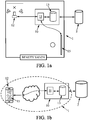
- a system 1 for analyzing facial features of a person is schematically shown.
- This system comprises a processing unit 10 comprising a calculator 11 which is preferably a processor, a microprocessor, or can also be a microcontroller.
- the calculator 11 is adapted to execute code instructions to process pictures and data extracted from pictures, according to the method disclosed hereinafter.
- the system also comprises a picture input device 12.
- the picture input device 12 may comprise a camera such as a digital camera, and an interface of the processing unit 10 for its connection to the camera.
- the interface can be a wired connector or a wireless interface if the processing unit 10 is located at a distance from the camera.
- the camera is colorimetrically calibrated.
- the picture input device may also be an interface of the processing unit 10 for connecting an external storage device, in which pictures are stored.
- the processing unit 10 may comprise a USB port forming said picture input device 12.
- the system 1 further comprises a memory 13.
- the memory preferably stores software instructions which, when executed by the calculator 11, allows the calculator 11 to perform the method detailed below.
- the memory 13 can be part of the processing unit 10. In an alternative embodiment, the memory can be separate from the processing unit 10 and located at a distance thereof. The memory can in that case be accessed by the processing unit by wireless connection. In that case, the processing unit 10 preferably comprises a communication interface for remote connection to the memory 13 through a telecommunication network such as the internet.
- the processing unit 10 is preferably connected to a database 2 comprising information about make-up and skincare products.
- Information about make-up and skincare products may comprise:
- the system 1 also preferably comprises a display 15 which can be a screen, and in some embodiments a tactile screen.
- the system may at least in part installed in a shop, a beauty salon, or any equivalent.
- the picture input device 12 and display 15 can be located in the shop or beauty salon.
- the picture input device 12 is preferably a camera installed in a photo studio installed in the shop or beauty salon, and configured for taking pictures in controlled conditions.
- the photo studio may comprise a screen or background of neutral color (white, grey), at least one lamp such as a softbox, and the camera at a fixed location relative to the screen or background.
- the camera may be hidden behind a reflective glass such as a one-way mirror for a better integration in the shop or beauty salon.
- the camera may be a video camera able to acquire a video, from which one or several pictures can be extracted.
- the video or pictures taken with the camera or extracted from a video are transferred to the processing unit 10, which can be a computer located in the shop or beauty salon, or a remote server, for processing the pictures.
- the processing unit 10 can be a computer located in the shop or beauty salon, or a remote server, for processing the pictures.
- the display 15 is a screen located in the shop or beauty salon for displaying personalized information to a user according to the processing of the pictures sent to the processing unit.
- the camera of the system is a digital camera of a mobile phone, tablet or smartphone, with which a user can take a picture of himself/herself. The picture is then transferred to the processing unit 10 for further processing.
- the processing unit 10 may be implemented in the mobile phone - in that case the calculator 11 is the processor of the phone, and the memory 13 may be a memory of the phone, and the memory stores an application software comprising code instructions for performing the method detailed below.
- the processing unit 10 may be a remote server, to which the phone sends the picture.
- the display screen 15 of the mobile phone is then used to display personalized information to the user according to the result of the processing of the picture.
- This method is based on analysis of facial contrasts of a person, said analysis being performed on a picture or a video of the face of the person.
- the method thus comprises a first step 100 of acquiring a picture or a video of the face of a person.
- This step is preferably performed by acquiring the picture or the video with a camera 12 at the time of implementing the method, and transferring said picture to the processing unit 10.
- it can also be performed by the processing unit 10 loading a picture that has been previously captured and then stored on a dedicated storage device.
- the picture that is acquired at step 100 is acquired according to determined acquisition conditions, in order to ensure good reproducibility of the processing that is then performed on the picture.
- the lighting of the face should prevent any shadow on the face, for instance the face should be lit frontally.
- the height of the lights should be fixed and the height of the chair on which the person sits for taking the picture should be adjusted in order for the head of the person to be at a determined height.
- the height of the camera was adjusted to the height of the face, and the face is illuminated by three flashes: one in front of the face (diffuse light), the height of this flash being adjusted to the height of the face, and two flashes illuminating the face from a 45° angle (direct light), the height of these flashes being also adjusted to the height of the face.
- the person should also ensure that his/her hair does not hide some characteristic features of his/her face such as the mouth, the eyes and the eyebrows, for instance by wearing a headband, and ensuring that he/she wears no make-up or adornment
- the person is asked to keep its eyes open, keep a neutral expression and gaze directly into the camera.
- the picture is preferably colorimetrically calibrated.
- the camera 12 may be colorimetrically calibrated.
- a color chart may be used to calibrate the picture.
- the picture should be taken so as to include both the face of the person and the color chart.
- a color chart comprising a number of color patches may be used.
- some of the patches may be designed to be similar to a range of skin tones in order to increase the precision of the calibration.
- the analysis of the colors of the patches that appear on the picture can be compared with the actual color of the patches on the chart and a correction can be inferred from this comparison.
- the colorimetric calibration may comprise a preliminary step 80 performed on a number of calibration pictures.
- a number of calibration pictures for instance 10 or 20
- each picture including a color chart including various color patches, and preferably a number of patches designed to be similar to a range of skin tones.
- the L*a*b* parameters are then measured in the CIE L*a*b* color space defined in more details below, for each color patch in each image, and for each L*a*b* parameter of each of the color patches, the median value for the set of images is computed.
- contrast values may be determined in any other color space, such as LCH, RGB, CMYK, and the like.
- step 100 the picture is taken so as to include both the face of the person and the same color chart as used in the calibration step.
- the picture is then registered to the reference image by minimizing the differences between the image color chart and the reference image color chart.
- the color chart is then cropped to keep only the part of the picture that shows the face of the person.
- the step 100 of acquiring the picture may comprise a substep of checking that the picture satisfies the desired acquisition conditions.
- This step may comprise for instance checking that there is no shadow or hidden characteristic feature of the face on the picture. If the picture is determined not to fulfill the desired conditions, then the person can be asked to acquire or load another picture.
- This substep may be performed by a visual check from an operator or may be implemented automatically by the calculator 11 running appropriate software.
- the method then comprises a step 200 of delimiting at least two zones of the picture of the face, each zone comprising a characteristic feature of the face such as the mouth, an eye, a eyebrow, or part of the hair appearing on the picture.
- the number of zones delimited on the picture is preferably comprised between two and six.In any case, two zones cannot be delimited around the same characteristic features, but two zones can be delimited around two characteristic features of the same nature (two eyes or two eyebrows) to determine an average value for said feature.
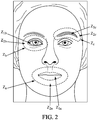
- Each zone Z is delimited to comprise a first portion Z 1 which comprises said characteristic feature, and a second portion Z 2 which comprises skin neighboring said characteristic feature.
- zones Z a,b,c comprising a first zone Z a delimited around the mouth, a second zone Z b delimited around an eye, and a third zone Z c delimited around the eyebrow.
- a first zone Z a delimited around the mouth a second zone Z b delimited around an eye
- a third zone Z c delimited around the eyebrow One can see for each zone the portion Z 1a,b,c comprising the characteristic feature and the portion Z 2a,b,c comprising the neighboring skin.
- zones may be delimited manually by an operator using appropriate software executed by the calculator 11 such as, for example MatlabTM.
- these zones may be delimited automatically, by detection of the characteristic features and delimitation of a zone around each characteristic feature, thanks to appropriate facial elements detection software.
- the area of the portion Z 1 of the zone comprising only the characteristic feature is comprised between 5 and 40% of the total area of the zone, and preferably between 10 and 35% of the total area of the zone, for example between 18 and 25 % of the total area of the zone.
- the area of the portion Z 2 comprising the neighboring skin is thus comprised between 60 and 95% of the total area of the zone, preferably between 65 and 90% of the total area of the zone, for example between 75 and 82% of the total area of the zone.
- the method then comprises a step 300 of processing the picture to determine facial contrast values of the person. More particularly, the processing step is performed on the delimited zones to determine contrast values of said zones.
- each portion Z 1 , Z 2 of each zone is measured during a substep 310, in the CIE L*a*b* color space, in which the L* coordinate corresponds to a luminance degree, varying on a 1-100 scale between black and white, the a* coordinate varies along an axis between red and green, on a 0-255 (or alternatively -100;+100 or -127;+127) scale from green (0) to red (255), and the b* coordinate varies along an axis between blue and yellow, on a 0-255 (or alternatively -100;+100 or -127;+127) scale from blue (0) to yellow (255).
- all pixel values in all three L*, a*, and b* coordinates are measured for each portion Z1, Z2 of each zone, and the values are then averaged over the whole portion.
- luminance values of all pixels within a portion Z1 of a zone corresponding to an eye of the person are averaged, and luminance values of all pixels within a portion Z2 of the corresponding zone are also averaged. The same is carried out for the other coordinates a* and b* for the same zone.
- a contrast value is then calculated during a substep 320 for each feature (i.e. each delimited zone of the picture) and for each coordinate in the CIE L*a*b* color space.
- L(skin) is a Luminance value of at least one pixel of the portion Z 2 comprising the skin neighboring the feature
- L(feature) is a Luminance value of at least one pixel of the portion Z 1 comprising the feature
- C f,L is the contrast value for Luminance of the feature.
- L(skin) is the averaged luminance value of all the pixels of the portion Z2
- L(feature) is the averaged luminance value of all the pixels of the portion Z1.
- a(skin) is a value according to the a* coordinate of at least one pixel of the portion Z2 comprising the skin neighboring the feature, and preferably is an average a* value of all the pixels in said portion
- a(feature) is the value according to the a* coordinate of at least one pixel of the portion Z1 comprising the feature, and preferably is the average a* value of all the pixels of said portion.
- b(skin) is a value according to the b* coordinate of at least one pixel of the portion Z2 comprising the skin neighboring the feature, and preferably is an average b* value of all the pixels in said portion
- b(feature) is the value according to the b* coordinate of at least one pixel of the portion Z1 comprising the feature, and preferably is the average b* value of all the pixels of said portion.
- At least six, and at most eighteen contrast values are thus determined (three coordinates for two to six zones of the picture corresponding to two to six respective characteristic features of the face).
- the average value of contrast is chosen for each coordinate. In this case, the average value is calculated by adding both values and then dividing by two.
- the method then comprises a step 400 of determining, from the measured contrast values and a plurality of pre-established clusters, a cluster to which the person pertains.
- Clusters are elaborated based on contrast values of faces of a reference population. To this end, pictures of faces of a reference population are acquired, preferably in the same conditions that have already been detailed regarding step 100 of the method.
- the reference population can comprise person of various ethnicities, ages, health conditions, male or female, etc. However, for a more precise clustering a reference population can comprise only people of the same sex and/or people of one country or from one ethnicity, or people from a determined age group.
- N be the number of pictures of the reference population that are processed for establishing the clusters
- the numbers of contrast values is comprised between 6N and 18N. If two zones of the same nature have been delimited in step 200 (two eyes or two eyebrows), the average contrast values are calculated to have one value per feature. These data are then processed by statistical analysis to identify the correlations between them.
- the processing comprises performing a principal component analysis on the set of contrast values, in order to reduce the number of dimensions of the data by identifying axes of higher correlation between values.
- the number of dimensions is reduced to two dimensions.
- the set of data is projected into a bidimensionnal space, because it allows an easy visualization of the correlations between data points.
- the set of projected data is then used for defining a plurality of clusters.
- a classification method (or clustering method) is applied on the set of projected data.
- the classification method is hierarchical cluster analysis or HCA, and more preferably is Ward's method.
- clusters can be defined through implementation of the k-means method, k-medoid method or Density-based spatial clustering of applications with noise (DBSCAN) method.
- the definition of the clusters is stored in the memory 13.
- the memory may store a representation of the clusters' borders on a graph, or a mathematical definition of the clusters' borders.
- each cluster is associated to one or a plurality of rules establishing, for each cluster, which contrasts have to be amended, and in what way, according to various objectives to be achieved, and/or requirements to respect.
- the objectives to be achieved can be for instance: making the person look younger, healthier, more attractive, or more feminine.
- the notion of americanity, age, health or attraction can be different from one culture to another, which may greatly impact how to interpret the resulting look. Therefore, resulting rules may vary according to local specificities.
- the requirements can relate to a specific type of makeup to be applied, such as nude makeup, day or night makeup, application of a specific trend, etc.
- the definition of the rules according to the clusters can be performed as follows. A person belonging to a determined cluster is madeup by a professional according to a specific objective and defined makeup requirements. The contrasts of the face of the person are measured before and after makeup to infer a rule about which contrasts need to be changed, and in what way.
- the rules associated to each clusters are also stored in the memory 13.
- clusters have been defined on a reference population composed 600 women of various ethnicities including 289 Caucasian, 175 Latin American, and 136 Asian, and of ages ranging between 20 and 70.
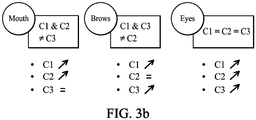
- the clusters correspond to categories of contrast values in the CIE L*a*b* coordinates space of more or less importance.
- the clusters have been defined as shown in table 1: Table 1 - definition of clusters according to contrast values
- Cluster 1 Cluster 2
- Cluster 3 Relatively higher contrast value (than other clusters) a* eye, b* mouth L* eye, L* eyebrow, a* eye, a* eyebrow, b* eye, b* eyebrow L* mouth, a* mouth (absolute value of the contrast)
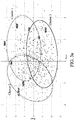
- the various shapes of the dots correspond to the various ethnicities of the women composing the reference population, and the clusters are delimited by the ellipses.
- the indications such as "Leye” or “Lmouth” correspond to areas of the graph of higher values for the respective contrasts.
- the contrast values that have been determined from the picture of the face of the person are processed during a substep 410 to calculate the coordinates in the reduced dimensions of the reference population - for instance in the reduced dimensions of the PCA performed on the contrast values of the reference population, and then be positioned on a graph representing the clusters.
- the coordinates are calculating using the linear combination of eigenvectors resulting from the PCA on the new contrasts values.
- the method then comprises a substep 420 of inferring, from the values of reduced dimensions and the definition of the clusters, the cluster to which the person belongs. For instance, according to the position of the point in the graph, one can infer the cluster to which the person belongs by calculating the distances to the clusters' barycenters and affect the person to the closest one.
- the memory 13 not only stores the definition of the clusters but also all the data of reduced dimension of the reference population, and the method comprises an additional step 500 of adding to this set the data of reduced dimension corresponding to the person from which a picture has been taken.
- This step then also comprises running another time the clustering algorithm to update the definition of the clusters.
- this step 500 may only be performed periodically in order to add at the same time the sets of data obtained from a plurality of persons.
- This iterative update of the clusters definition allows the clusters to be more precise, as the quantity of data used for their definition increases.
- the calculator 11 is also configured to implement the clustering algorithm, through execution of appropriate software.
- the processing unit 10 is preferably a dedicated remote server that is adapted to receive data from a plurality of stores, beauty salons, or individual users.
- the definition of the clusters may change, the definition of the associated rules may also be updated accordingly.
- the cluster to which the person belongs one can therefore determine which contrast values of the person are relatively low or high, and thus which contrast values can be selectively changed by application of appropriate makeup.
- the identification of the cluster to which the person belongs allows determining the corresponding rule to be applied for making up the person. For instance, if the person wishes a day makeup that makes her more feminine, the corresponding rule adapted to her cluster can be selected.
- the method thus comprises a step 600 or providing the person with personalized information.
- the information is preferably provided on the display 15.
- the provided information can comprise the cluster to which the person belongs, and/or the indication of which contrast values of the person are relatively low or high.
- information can also comprise, according to a result the person wishes to obtain (for example looking more feminine or younger) and the cluster to which it belongs, the corresponding makeup rule, which can be translated into advice regarding personalized modification of the contrast value of at least one zone of the face of the person.
- This advice can refer to a specific zone of the face to make-up, or examples of shades that the person can use to make-up a zone.
- the person belongs to a cluster corresponding to relatively low luminance contrast value for the mouth, and high contrast values of the eyes and eyebrows, and if the person wishes to look more feminine, she can be advised to make up preferably her mouth to increase its luminance contrast value.
- information may also comprise a list or selection of make-up products or skin care products (for instance skin whitening product) which allow achieving the personalized modification of the contrast values that is recommended to the person.
- make-up products or skin care products for instance skin whitening product
- the shades of a selection of make-up products can be determined according to L*, a* and b* contrast values of the person.
- the selection of products may comprise a list of lipstick of various shades which all allow increasing the luminance contrast value.
- the recommended make-up or skin care product may also be a personalized product, having composition and/or shade designed specifically according to the recommendations given to the person to achieve the personalized modification of the contrast values, and manufactured upon order by the person.
- the products can be selected by the processing unit 10 in the database 2 of cosmetic products according to the information available on each product and the results of the analysis of facial features of the person. For instance, the processing unit may infer from the result of the analysis a type and shade of make-up which is desirable for the person and query in the database the products corresponding to this type and shade.
- Last, information may also comprise a simulation of the appearance of the face of the person with at least one contrast value of at least one zone of the face of the person changed compared with the picture of the person.
- the person can be shown a simulation of the appearance of its face which contrast values have been changed according to a rule corresponding to the cluster to which the person belongs.
- Application of one make-up product selected from a personalized selection of products may also be simulated.
- the simulation may be performed by the calculator 11 and displayed on the display 15.
Landscapes
- Engineering & Computer Science (AREA)
- Business, Economics & Management (AREA)
- Physics & Mathematics (AREA)
- Health & Medical Sciences (AREA)
- General Physics & Mathematics (AREA)
- Theoretical Computer Science (AREA)
- Oral & Maxillofacial Surgery (AREA)
- General Health & Medical Sciences (AREA)
- Multimedia (AREA)
- Accounting & Taxation (AREA)
- Finance (AREA)
- Human Computer Interaction (AREA)
- Strategic Management (AREA)
- General Business, Economics & Management (AREA)
- Marketing (AREA)
- Economics (AREA)
- Tourism & Hospitality (AREA)
- Development Economics (AREA)
- Computer Vision & Pattern Recognition (AREA)
- Primary Health Care (AREA)
- Human Resources & Organizations (AREA)
- Geometry (AREA)
- Image Processing (AREA)
- Image Analysis (AREA)
Priority Applications (4)
| Application Number | Priority Date | Filing Date | Title |
|---|---|---|---|
| EP17306842.0A EP3502955A1 (fr) | 2017-12-20 | 2017-12-20 | Procédé et système d'analyse de caractéristiques faciales et de fourniture de conseils personnalisés |
| US16/194,742 US10943093B2 (en) | 2017-12-20 | 2018-11-19 | Method and system for facial features analysis and delivery of personalized advice |
| KR1020180144216A KR102110053B1 (ko) | 2017-12-20 | 2018-11-21 | 얼굴 특징 분석 및 개인화된 조언을 제공하는 방법 및 시스템 |
| JP2018236860A JP6740329B2 (ja) | 2017-12-20 | 2018-12-19 | 顔特徴分析および個人向けアドバイスの送達のための方法およびシステム |
Applications Claiming Priority (1)
| Application Number | Priority Date | Filing Date | Title |
|---|---|---|---|
| EP17306842.0A EP3502955A1 (fr) | 2017-12-20 | 2017-12-20 | Procédé et système d'analyse de caractéristiques faciales et de fourniture de conseils personnalisés |
Publications (1)
| Publication Number | Publication Date |
|---|---|
| EP3502955A1 true EP3502955A1 (fr) | 2019-06-26 |
Family
ID=60954830
Family Applications (1)
| Application Number | Title | Priority Date | Filing Date |
|---|---|---|---|
| EP17306842.0A Withdrawn EP3502955A1 (fr) | 2017-12-20 | 2017-12-20 | Procédé et système d'analyse de caractéristiques faciales et de fourniture de conseils personnalisés |
Country Status (4)
| Country | Link |
|---|---|
| US (1) | US10943093B2 (fr) |
| EP (1) | EP3502955A1 (fr) |
| JP (1) | JP6740329B2 (fr) |
| KR (1) | KR102110053B1 (fr) |
Families Citing this family (4)
| Publication number | Priority date | Publication date | Assignee | Title |
|---|---|---|---|---|
| KR102402454B1 (ko) * | 2020-07-08 | 2022-05-26 | (주)세르마 | 퍼스널 색상추천시스템 및 그것을 이용한 퍼스널 색상추천방법 |
| JP7633018B2 (ja) * | 2020-12-02 | 2025-02-19 | ポーラ化成工業株式会社 | 肌色の表現方法、肌色チャート、及び肌色の表示装置 |
| CN113095148B (zh) * | 2021-03-16 | 2022-09-06 | 深圳市雄帝科技股份有限公司 | 眉毛区域被遮挡的检测方法、系统、拍照设备和存储介质 |
| CN113378764B (zh) * | 2021-06-25 | 2022-11-29 | 深圳万兴软件有限公司 | 基于聚类算法的视频人脸采集方法、装置、设备及介质 |
Citations (2)
| Publication number | Priority date | Publication date | Assignee | Title |
|---|---|---|---|---|
| WO2008045521A2 (fr) * | 2006-10-11 | 2008-04-17 | Hewlett-Packard Development Company, L.P. | Regroupement d'images basé sur les visages |
| EP2962597A1 (fr) * | 2013-02-28 | 2016-01-06 | Panasonic Intellectual Property Management Co., Ltd. | Dispositif d'aide au maquillage, procédé d'aide au maquillage et programme d'aide au maquillage |
Family Cites Families (4)
| Publication number | Priority date | Publication date | Assignee | Title |
|---|---|---|---|---|
| JP5261586B2 (ja) | 2007-08-10 | 2013-08-14 | 株式会社 資生堂 | メイクアップシミュレーションシステム、メイクアップシミュレーション装置、メイクアップシミュレーション方法およびメイクアップシミュレーションプログラム |
| JP2010073222A (ja) | 2010-01-07 | 2010-04-02 | Kao Corp | メイクアップシミュレーション方法 |
| US9411037B2 (en) | 2010-08-18 | 2016-08-09 | RetailNext, Inc. | Calibration of Wi-Fi localization from video localization |
| JP6015267B2 (ja) * | 2012-09-13 | 2016-10-26 | オムロン株式会社 | 画像処理装置、画像処理プログラム、これを記録したコンピュータ読み取り可能な記録媒体、および、画像処理方法 |
-
2017
- 2017-12-20 EP EP17306842.0A patent/EP3502955A1/fr not_active Withdrawn
-
2018
- 2018-11-19 US US16/194,742 patent/US10943093B2/en active Active
- 2018-11-21 KR KR1020180144216A patent/KR102110053B1/ko not_active Expired - Fee Related
- 2018-12-19 JP JP2018236860A patent/JP6740329B2/ja active Active
Patent Citations (2)
| Publication number | Priority date | Publication date | Assignee | Title |
|---|---|---|---|---|
| WO2008045521A2 (fr) * | 2006-10-11 | 2008-04-17 | Hewlett-Packard Development Company, L.P. | Regroupement d'images basé sur les visages |
| EP2962597A1 (fr) * | 2013-02-28 | 2016-01-06 | Panasonic Intellectual Property Management Co., Ltd. | Dispositif d'aide au maquillage, procédé d'aide au maquillage et programme d'aide au maquillage |
Non-Patent Citations (4)
| Title |
|---|
| ALEX L. JONES; RICHARD RUSSEL; ROBERT WARD: "Cosmetics alter biologically-based factors of beauty: evidence from facial contrast", EVOLUTIONARY PSYCHOLOGY, vol. 13, no. 1, 1 January 2015 (2015-01-01) |
| AURÉLIE PORCHERON ET AL: "Aspects of Facial Contrast Decrease with Age and Are Cues for Age Perception", PLOS ONE, vol. 8, no. 3, 6 March 2013 (2013-03-06), pages e57985, XP055479045, DOI: 10.1371/journal.pone.0057985 * |
| DIBEKLIOGLU HAMDI ET AL: "The Role of Color and Contrast in Facial Age Estimation", 12 September 2014, SAT 2015 18TH INTERNATIONAL CONFERENCE, AUSTIN, TX, USA, SEPTEMBER 24-27, 2015; [LECTURE NOTES IN COMPUTER SCIENCE; LECT.NOTES COMPUTER], SPRINGER, BERLIN, HEIDELBERG, PAGE(S) 52 - 61, ISBN: 978-3-540-74549-5, XP047298378 * |
| PORCHERON A; MAUGER E; RUSSEL R: "Aspects of facial contrast decrease with age and are cues for age perception", PLOS ONE, vol. 8, no. 3, 2013, pages e57985 |
Also Published As
| Publication number | Publication date |
|---|---|
| KR102110053B1 (ko) | 2020-05-12 |
| JP6740329B2 (ja) | 2020-08-12 |
| JP2019114251A (ja) | 2019-07-11 |
| US10943093B2 (en) | 2021-03-09 |
| KR20190074955A (ko) | 2019-06-28 |
| US20190188457A1 (en) | 2019-06-20 |
Similar Documents
| Publication | Publication Date | Title |
|---|---|---|
| US11605243B2 (en) | Apparatus and method for determining cosmetic skin attributes | |
| JP7235895B2 (ja) | 美容的皮膚特性を視覚化するための装置及び方法 | |
| US10943093B2 (en) | Method and system for facial features analysis and delivery of personalized advice | |
| KR101140533B1 (ko) | 이미지로부터 추정된 피부색에 기초해서 제품을 추천하는 컴퓨터 구현된 방법 | |
| US11010894B1 (en) | Deriving a skin profile from an image | |
| KR100801115B1 (ko) | 포인트 메이크업 화장료의 선택 방법 | |
| CN105263399B (zh) | 透明感评价装置、透明感评价方法 | |
| Mayer et al. | BMI and WHR are reflected in female facial shape and texture: a geometric morphometric image analysis | |
| KR102429863B1 (ko) | 퍼스널 스타일링 서비스 방법 | |
| JP5250956B2 (ja) | ハリ感評価方法 | |
| Lu et al. | Investigation of effect of skin tone to facial attractiveness | |
| JP7827509B2 (ja) | 口唇評価方法 | |
| JP2022033021A (ja) | 顔あるいは顔周辺に装用する装飾品又は日用品、もしくは化粧又は髪型のユーザーの顔に対する適合度合いを評価する方法、同適合度合いを評価するシステム、推奨システム及び眼鏡の設計システム | |
| JP5516772B2 (ja) | 表示物 | |
| US20240398097A1 (en) | Method and system for determining cosmetic skin attributes based on disorder value | |
| Oh et al. | A quantitative and qualitative study on virtual makeup of instant beautifying application-Focus on color and shape | |
| US11341685B2 (en) | Color-matching body part to lip product | |
| CN112884895B (zh) | 一种基于人体外貌形态的穿搭匹配系统 | |
| JP7565182B2 (ja) | 肌状態評価方法 | |
| WO2024249716A1 (fr) | Procédé et système de visualisation de gradient de couleur de visage humain ou d'attributs de peau cosmétiques basés sur ce gradient de couleur | |
| Tatsuzawa et al. | A relationship between the use of UV protection and melanin pigmentation identified from changes in individual facial images over 12 years | |
| HK40128411A (zh) | 用於将人脸面部的色彩梯度可视化或基於这种色彩梯度来将美容皮肤属性可视化的方法和系统 | |
| JP2023098551A (ja) | 口唇評価方法 | |
| HK1141614A1 (en) | Makeup simulation system and makeup simulation method | |
| HK1141614B (en) | Makeup simulation system and makeup simulation method |
Legal Events
| Date | Code | Title | Description |
|---|---|---|---|
| PUAI | Public reference made under article 153(3) epc to a published international application that has entered the european phase |
Free format text: ORIGINAL CODE: 0009012 |
|
| STAA | Information on the status of an ep patent application or granted ep patent |
Free format text: STATUS: THE APPLICATION HAS BEEN PUBLISHED |
|
| AK | Designated contracting states |
Kind code of ref document: A1 Designated state(s): AL AT BE BG CH CY CZ DE DK EE ES FI FR GB GR HR HU IE IS IT LI LT LU LV MC MK MT NL NO PL PT RO RS SE SI SK SM TR |
|
| AX | Request for extension of the european patent |
Extension state: BA ME |
|
| STAA | Information on the status of an ep patent application or granted ep patent |
Free format text: STATUS: REQUEST FOR EXAMINATION WAS MADE |
|
| 17P | Request for examination filed |
Effective date: 20191211 |
|
| RBV | Designated contracting states (corrected) |
Designated state(s): AL AT BE BG CH CY CZ DE DK EE ES FI FR GB GR HR HU IE IS IT LI LT LU LV MC MK MT NL NO PL PT RO RS SE SI SK SM TR |
|
| STAA | Information on the status of an ep patent application or granted ep patent |
Free format text: STATUS: EXAMINATION IS IN PROGRESS |
|
| 17Q | First examination report despatched |
Effective date: 20210316 |
|
| STAA | Information on the status of an ep patent application or granted ep patent |
Free format text: STATUS: THE APPLICATION IS DEEMED TO BE WITHDRAWN |
|
| 18D | Application deemed to be withdrawn |
Effective date: 20230117 |