EP3504334B1 - Facteurs de transcription pour améliorer la résistance au stress environnemental chez les plantes - Google Patents
Facteurs de transcription pour améliorer la résistance au stress environnemental chez les plantes Download PDFInfo
- Publication number
- EP3504334B1 EP3504334B1 EP17761766.9A EP17761766A EP3504334B1 EP 3504334 B1 EP3504334 B1 EP 3504334B1 EP 17761766 A EP17761766 A EP 17761766A EP 3504334 B1 EP3504334 B1 EP 3504334B1
- Authority
- EP
- European Patent Office
- Prior art keywords
- protein
- plant
- jaz
- seq
- myc
- Prior art date
- Legal status (The legal status is an assumption and is not a legal conclusion. Google has not performed a legal analysis and makes no representation as to the accuracy of the status listed.)
- Active
Links
Images








Classifications
-
- C—CHEMISTRY; METALLURGY
- C12—BIOCHEMISTRY; BEER; SPIRITS; WINE; VINEGAR; MICROBIOLOGY; ENZYMOLOGY; MUTATION OR GENETIC ENGINEERING
- C12N—MICROORGANISMS OR ENZYMES; COMPOSITIONS THEREOF; PROPAGATING, PRESERVING, OR MAINTAINING MICROORGANISMS; MUTATION OR GENETIC ENGINEERING; CULTURE MEDIA
- C12N15/00—Mutation or genetic engineering; DNA or RNA concerning genetic engineering, vectors, e.g. plasmids, or their isolation, preparation or purification; Use of hosts therefor
- C12N15/09—Recombinant DNA-technology
- C12N15/63—Introduction of foreign genetic material using vectors; Vectors; Use of hosts therefor; Regulation of expression
- C12N15/79—Vectors or expression systems specially adapted for eukaryotic hosts
- C12N15/82—Vectors or expression systems specially adapted for eukaryotic hosts for plant cells, e.g. plant artificial chromosomes (PACs)
- C12N15/8241—Phenotypically and genetically modified plants via recombinant DNA technology
- C12N15/8261—Phenotypically and genetically modified plants via recombinant DNA technology with agronomic (input) traits, e.g. crop yield
- C12N15/8271—Phenotypically and genetically modified plants via recombinant DNA technology with agronomic (input) traits, e.g. crop yield for stress resistance, e.g. heavy metal resistance
- C12N15/8279—Phenotypically and genetically modified plants via recombinant DNA technology with agronomic (input) traits, e.g. crop yield for stress resistance, e.g. heavy metal resistance for biotic stress resistance, pathogen resistance, disease resistance
- C12N15/8286—Phenotypically and genetically modified plants via recombinant DNA technology with agronomic (input) traits, e.g. crop yield for stress resistance, e.g. heavy metal resistance for biotic stress resistance, pathogen resistance, disease resistance for insect resistance
-
- Y—GENERAL TAGGING OF NEW TECHNOLOGICAL DEVELOPMENTS; GENERAL TAGGING OF CROSS-SECTIONAL TECHNOLOGIES SPANNING OVER SEVERAL SECTIONS OF THE IPC; TECHNICAL SUBJECTS COVERED BY FORMER USPC CROSS-REFERENCE ART COLLECTIONS [XRACs] AND DIGESTS
- Y02—TECHNOLOGIES OR APPLICATIONS FOR MITIGATION OR ADAPTATION AGAINST CLIMATE CHANGE
- Y02A—TECHNOLOGIES FOR ADAPTATION TO CLIMATE CHANGE
- Y02A40/00—Adaptation technologies in agriculture, forestry, livestock or agroalimentary production
- Y02A40/10—Adaptation technologies in agriculture, forestry, livestock or agroalimentary production in agriculture
- Y02A40/146—Genetically Modified [GMO] plants, e.g. transgenic plants
Definitions
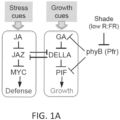
- Plants integrate developmental and environmental cues to prioritize the allocation of photosynthetic products to growth, defense and other physiological processes. Investments in defense often suppress growth, whereas rapid growth, such as that triggered by competition for light, attenuates defense.
- Described herein are plants, plant cells, and plant seeds that have a PhyB loss-of-function mutation, and (a) a modified MYC nucleic acid encoding a mutant MYC protein comprising at least one mutation within or outside of a JAZ-interacting domain (JID) polypeptide region, (b) a loss-of-function mutation in at least one gene encoding a transcriptional repressor of jasmonic acid response (JAZ) protein; or (c) a combination of (a) and (b) wherein the plant or a plant obtained from the plant cell or seed exhibits robust growth and resistance to environmental stress as defined in claim 1.
- JID JAZ-interacting domain
- JAZ jasmonic acid response
- Also described here are methods of making such plants, plant cells, and seeds as defined in claim 12 including (a) providing one or more plant cell that has a PhyB loss-of-function mutation; (b) introducing into at least one of the one or more plant cells at least one transgene or expression cassette encoding a mutant MYC nucleic acid segment that encodes a mutant MYC protein to generate one or more transformed plant cells, wherein the mutation reduces binding by the mutant MYC protein with more than one jasmonic acid response (JAZ) protein; and (c) generating a plant from the one or more transformed plant cell(s).
- the mutant MYC nucleic acid can, for example, have a dominant MYC mutation.
- Such a mutant MYC protein has reduced binding to a JAZ protein selected from a JAZ1 protein, JAZ2 protein, JAZ3 protein, JAZ4 protein, JAZ5 protein, JAZ6 protein, JAZ7 protein, JAZ8 protein, JAZ9 protein, JAZ 10 protein, JAZ11 protein, JAZ12 protein, JAZ 13 protein, or a combination thereof, where for example the binding is reduced by at least 20% compared to a corresponding wild type MYC protein that does not have the MYC mutation(s).
- a JAZ protein selected from a JAZ1 protein, JAZ2 protein, JAZ3 protein, JAZ4 protein, JAZ5 protein, JAZ6 protein, JAZ7 protein, JAZ8 protein, JAZ9 protein, JAZ 10 protein, JAZ11 protein, JAZ12 protein, JAZ 13 protein, or a combination thereof, where for example the binding is reduced by at least 20% compared to a corresponding wild type MYC protein that does not have the MYC mutation(s).
- Another method as defined in claim 15 includes (a) providing one or more plant cells with a loss-of-function mutation in at least one gene encoding a transcriptional repressor of j asmonic acid response (JAZ) protein; (b) introducing into the one or more plant cells a PhyB loss-of-function mutation to generate one or more modified plant cells; and (c) generating a plant from the one or more modified plant cell(s).
- the method can involve providing one or more plant cells with a loss-of-function mutation in jaz1, jaz3, jaz4-1, jaz9, and jaz10 genes.
- Such methods can provide plants that exhibit resistance to environmental stress compared to a wild type plant of the same species under the same environmental conditions.
- the modified plants and plants grown from the modified seeds described herein can have 5% less, or 10% less, or 20% less, or 30% less, or 40% less, or 50% less, or 60% less, or 70% less, or 80% less, or 90% less, or 100% less leaf damage from insect feeding than a wild type plant (without the mutations described herein) of the same species grown under the same conditions.
- the modified plants and plants grown from the modified seeds described herein can have at least about 10%, or at least about 20%, or at least about 30%, or at least about 40%, or at least about 50%, or at least about 60%, or at least about 70%, or at least about 80%, or at least about 90% fewer insects or insect larvae than a wild type plant of the same species grown under the same conditions.
- the modified plants and plants grown from the modified seeds described herein grow as well as or better than wild type plants.
- the rosette dry weight of the modified plants and plants grown from the modified seeds described herein is about the same as the rosette dry weight of wild type plants (without the genetic modifications described herein) grown for the same time and under the same conditions.
- the rosette dry weight of the modified plants, and plants grown from the modified seeds, described herein is about 80% to about 120%, or about 90% to about 110% of the rosette dry weight of wild type plants grown for the same time and under the same conditions.
- the average primary root length of the modified plants and plants grown from the modified seeds described herein can be 1.5-fold longer, of 2-fold longer, or 2.3-fold longer, or 2.5-fold longer, or 2.7-fold longer, or 3-fold longer than the average primary root length of wild type plants grown for the same time and under the same conditions.
- Plants and methods of making such plants as claimed herein grow well and are resistant to environmental stresses such as drought and insects.
- the plants have mutations that reduce or eliminate the expression or function of proteins that modulate jasmonic acid responses (e.g., JAZ genes/proteins). Plants with such mutations are referred to herein as jaz mutants or jaz plants.
- jaz mutants or jaz plants Such reduction/elimination of j asmonic acid regulatory protein expression and/or function improves the insect resistance (compared to wild type plants) of jaz mutant plants.
- the additional mutation that reduces or eliminates the function of the PHYB gene improves the growth of jaz mutant plants.
- the combination of jaz and phyB loss-of-function mutations provides robustly growing plant lines that are also resistant to insects. Seeds of such jaz and phyB loss-of-function mutants, and methods of making and using such seeds and plants are also described herein.
- Plants described herein can have one or more mutations that reduce or eliminate the interaction of MYC transcription factors with the JAZ proteins.
- MYC2 mediates stress responses through the action of plant stress hormones such as jasmonate (JA).
- JA jasmonate
- MYC transcription factors bind to the promoter region of JA-response genes to promote their transcriptional activation.
- simple overexpression of MYC2 is insufficient to constitutively activate defense responses. This is because MYC transcription factors are strongly repressed by direct binding of members of the JAZ family of repressor proteins.
- This application describes mutated MYC transcription factors that do not bind JAZ repressor proteins. Such mutations can be dominant MYC mutations.
- mutant MYC proteins are capable of strongly activated defense responses in the presence of JAZ proteins. Such strong defense responses can reduce plant growth.
- mutant MYC proteins in a mutant phyB loss-of-function background the plants exhibit strong defenses against environmental stress and also grow well.
- JAZ proteins typically inhibit the activation of defense responses that are controlled by jasmonic acid, and reduce the resistance of plants to environmental stresses such as drought, insects, and other environmental stresses. Reduction or elimination of JAZ functions tends to increase jasmonic acid expression and/or function, increase the activity of MYC transcription factors, and thereby improve drought and insect resistance (compared to wild type plants). Plants that produce mutated MYC proteins unable to bind JAZ proteins are phenotypically similar (increased resistance and reduced growth) to plants in which JAZ function is reduced or eliminated.
- Plants and seeds have one or more genomic deletions, insertions, or substitutions in at least part of the MYC. JAZ, and PHYB genes.
- Such deletions, insertions, or substitutions can be generated by site-specific recombination-mediated methods.
- the mutations can range in size from one or two nucleotides to thousands of nucleotides (or any value therebetween).
- Deletions, insertions, and/or substitutions are created at a desired location in the genome. For example, borders (end points) of the deletions, insertions, or substitutions can be at defined locations to control the size of the deletions, insertions, or substitutions.
- the mutation(s) can reduce or eliminate expression of endogenous JAZ and/or PhyB genes within plant cells, plants, and seeds.
- the mutations can eliminate transcription and/or translation of from JAZ and PHYB genes encoding JAZ1, JAZ3, JAZ4, JAZ9, JAZ10, PHYB, and combinations thereof.
- the mutations can also eliminate transcription and/or translation of from genes related to the JAZ and PHYB genes encoding JAZ1, JAZ3, JAZ4, JAZ9, JAZ10, PHYB, and combinations thereof.
- transcription and/or translation can be reduced by at least 20%, or at least 30%, or at least 40%, or at least 50%, or at least 60%, or at least 70%, or at least 80%, or at least 90%, or at least 95%, or at least 97%, or at least 99% compared to wild type plant cells, plants, and seeds of the same species (that do not have the JAZ and/or PhyB mutation(s)).
- the mutation(s) can reduce or eliminate MYC protein interaction with one or more JAZ protein.
- the mutation(s) can reduce or eliminate MYC protein interaction with JAZ1 protein, JAZ2 protein, JAZ3 protein, JAZ4 protein, JAZ5 protein, JAZ6 protein, JAZ7 protein, JAZ8 protein, JAZ9 protein, JAZ10 protein, JAZ11 protein, JAZ12 protein, JAZ13 protein, and combinations thereof.
- interaction between a MYC protein and a JAZ protein, or binding between such mutant MYC protein and any of such JAZ proteins can be reduced by at least 20%, or at least 30%, or at least 40%, or at least 50%, or at least 60%, or at least 70%, or at least 80%, or at least 90%, or at least 95%, or at least 97%, or at least 99% compared to wild type plant cells, plants, and seeds of the same species (that do not have the MYC mutation(s)).
- Non-limiting examples of methods of introducing a modification into the genome of a plant cell can include microinjection, viral delivery, recombinase technologies, homologous recombination, TALENS, CRISPR, and/or ZFN, see, e.g. Clark and Whitelaw Nature Reviews Genetics 4:825-833 (2003 ); which is incorporated by reference herein in its entirety.
- nucleases such as zinc finger nucleases (ZFNs), transcription activator like effector nucleases (TALENs), and/or meganucleases can be employed with guide nucleic acid that allows the nuclease to target the genomic MYC, JAZ and PHYB site(s).
- ZFNs zinc finger nucleases
- TALENs transcription activator like effector nucleases
- meganucleases can be employed with guide nucleic acid that allows the nuclease to target the genomic MYC, JAZ and PHYB site(s).
- a targeting vector can be used to introduce a deletion or modification of the genomic MYC, JAZ and PHYB chromosomal sites.
- a "targeting vector” is a vector generally has a 5' flanking region and a 3' flanking region homologous to segments of the gene of interest.
- the 5' flanking region and a 3' flanking region can surround a DNA sequence comprising a modification and/or a foreign DNA sequence to be inserted into the gene.
- the genomic MYC, JAZ and PHYB site(s) can be disrupted by insertion of T-DNA.
- the foreign DNA to be inserted may encode a selectable marker, such as an antibiotics resistance gene.
- selectable markers examples include chloramphenicol resistance, gentamycin resistance, kanamycin resistance, spectinomycin resistance ( SpecR ), neomycin resistance gene (NEO) and hygromycin ⁇ -phosphotransferase markers (genes).
- the 5' flanking region and the 3' flanking region can be homologous to regions within the gene, or such flanking regions can flank the coding region of gene to be deleted, mutated, or replaced with the unrelated DNA sequence.
- the targeting vector does not comprise a selectable marker.
- DNA comprising the targeting vector and the native gene of interest are contacted under conditions that favor homologous recombination (e.g., by transforming plant cell(s) with the targeting vector).
- a typical targeting vector contains nucleic acid fragments of not less than about 0.1 kb nor more than about 10.0 kb from both the 5' and the 3' ends of the genomic locus which encodes the gene to be modified (e.g. the genomic MYC , JAZ and/or PHYB site(s)). These two fragments can be separated by an intervening fragment of nucleic acid that includes the modification to be introduced . When the resulting construct recombines homologously with the chromosome at this locus, it results in the introduction of the modification, e.g. an insertion, substitution, or a deletion of a portion of the genomic MYC, JAZ and/or PHYB site(s).
- the modification e.g. an insertion, substitution, or a deletion of a portion of the genomic MYC, JAZ and/or PHYB site(s).
- a Cas9/ CRISPR system can be used to create a modification in genomic MYC, JAZ and/or PHYB site(s).
- Clustered regularly interspaced short palindromic repeats (CRISPR)/CRISPR-associated (Cas) systems are useful for, e.g. RNA-programmable genome editing (see e.g., Marraffini and Sontheimer. Nature Reviews Genetics 11: 181-190 (2010 ); Sorek et al. Nature Reviews Microbiology 2008 6: 181-6 ; Karginov and Hannon. Mol Cell 2010 1 :7-19 ; Hale et al. Mol Cell 2010:45:292-302 ; Jinek et al.
- a CRISPR guide RNA can be used that can target a Cas enzyme to the desired location in the genome, where it generates a double strand break. This technique is available in the art and described, e.g. at Mali et al. Science 2013 339:823-6 ; which is incorporated by reference herein in its entirety and kits for the design and use of CRISPR-mediated genome editing are commercially available, e.g. the PRECISION X CAS9 SMART NUCLEASE TM System (Cat No. CAS900A-1) from System Biosciences, Mountain View, CA.
- cre-lox recombination system of bacteriophage P1, described by Abremski et al. 1983. Cell 32:1301 (1983 ), Sternberg et al., Cold Spring Harbor Symposia on Quantitative Biology, Vol. XLV 297 (1981 ) and others, can be used to promote recombination and alteration of the genomic MYC, JAZ and/or PHYB site(s).
- the cre-lox system utilizes the cre recombinase isolated from bacteriophage P1 in conjunction with the DNA sequences (termed lox sites) it recognizes. This recombination system has been effective for achieving recombination in plant cells ( U.S. Pat. No.
- the plant cells, plants, and plant seeds can have genomic mutations that alter one or more amino acids in the encoded MYC, JAZ and/or PHYB proteins.
- plant cells, plants, and seeds can be modified so that at least one amino acid of a MYC, JAZ and/or PHYB polypeptide is deleted or mutated to reduce the function of MYC, JAZ and/or PHYB proteins.
- a conserved amino acid or a conserved domain of the MYC, JAZ and/or PHYB polypeptide is modified.
- a conserved amino acid or several amino acids in a conserved domain of the MYC, JAZ and/or PHYB polypeptide can be modified to change the physical and/or chemical properties of the conserved amino acid(s).
- the amino acid(s) can be deleted or replaced by amino acid(s) of another class, where the classes are identified in the following Table 1.
- modified MYC proteins can have any naturally occurring amino acid within the protein replaced with any of the amino acids listed in Tables 1 or 2. Positions within MYC protein that can have such replacements include, for example, amino acid positions 94, 97, 102, 105, 107, 125, 128, 129, 148, 152, 155, 163, 165, 169, and/or 172.
- myc, jaz and/or phyB mutations are introduced by insertion of foreign DNA into the gene of interest.
- this can involve the use of either transposable elements (see, e.g., Parinov et al., Plant Cell 11, 2263--2270 (1999 )) or T-DNA.
- the foreign DNA not only disrupts the expression of the gene into which it is inserted but also acts as a marker for subsequent identification of the mutation. Because some plant introns are small, and because there can be very little intergenic material in plant chromosomes, the insertion of a piece of T-DNA on the order of 5 to 25 kb in length generally produces a dramatic disruption of gene function. If a large enough population of T-DNA-transformed lines is available, one has a very good chance of finding a plant carrying a T-DNA insert within any gene of interest.
- Mutations that are homozygous lethal can be maintained in the population in the form of heterozygous plants.
- the bHLH-type transcription factor (TF) MYC2 together with related members of this family (e.g., MYC3 and MYC4 in Arabidopsis ), promote myriad plant responses to biotic and abiotic stress (Kazan & Manners, 2013). MYC2 executes biotic and abiotic stress responses primarily through the stress hormones jasmonate and abscisic acid (ABA). For example, in some cases the MYC transcription factors can promote jasmonate-triggered defense responses against pathogen and insect pests. In plant cells containing high levels of jasmonate, MYC transcription factors bind to the promoter region of JA-response genes to promote their transcriptional activation.
- ABA abscisic acid
- MYC2 is insufficient to constitutively activate defense responses in tomato/potato and Arabidopsis (Boter et al., 2004; Lorenzo et al., 2004).
- MYC transcription factors are strongly repressed via direct binding by members of the JAZ family of repressor proteins (of which there are thirteen in Arabidopsis, JAZ1 - JAZ13).
- JAZ-interacting domain JID
- MYC2D105N MYC2D105N
- MYC3 e.g. MYC3D94N
- MYC transcription factors may still be subject to repression by JAZ1 and JAZ10 because these two JAZ proteins harbor a cryptic MYC-interaction domain (CMID).
- CMID MYC-interaction domain
- MYC transcription factors are generated that escape repression by all JAZ proteins.
- Such MYC transcription factors therefore are highly potent in their capacity to promote the expression of JA-response genes (i.e., MYC transcription factors that avoid repression by all JAZs).
- This technology is useful not only for design of crops with increased resistance to pests, but also for enhancing the production of plant-derived medicinal compounds.
- One example is the anti-cancer drug taxol, whose production in taxus cells is promoted by the JA pathway via MYC transcription factors.
- Engineering of mutant (e.g., dominant mutant) MYC transcription factors into taxus cells could significantly increase taxol production.
- This same approach can be used to increase the production of any plant compound whose synthesis is controlled by MYC transcription factors (this includes many if not most plant secondary metabolites).
- MYC protein sequences are provided herein that have one or more amino acid mutations, substitutions, replacements, insertions, or deletions within their JAZ-interacting domains (JIDs).
- JIDs JAZ-interacting domains
- any of the MYC or MYC-related proteins described herein have at least one amino acid, or at least two amino acids, or at least three amino acids, or at least four amino acids, or at least five amino acid mutations, substitutions, replacements, insertions, or deletions in their JAZ-interacting domains (JIDs) on in regions that interact with cryptic MYC-interaction domains (CMIDs), or in both JID and CMID-interacting domains of a MYC protein.
- JIDs JAZ-interacting domains
- CMIDs cryptic MYC-interaction domains
- MYC2 regions that interact with JAZ cryptic MYC-interaction domains (CMIDs) and/or MYC2 JAZ-interacting domains (JID) of a modified MYC protein can have less than 100%, or at less than 99.5%, or at less than 99%, or less than 98%, or at less than 97%, or less than 96%, or less than 95%, or less than 94%, or less than 93%, or less than 92%, or less than 91%, or less than 90% sequence identity with any of the CMID-interacting domains, JID, MYC or MYC related sequences described herein.
- the modified MYC protein have at least 40%, or at least 50%, or at least 60%, or at least 70%, or at least 80%, or at least 90%, or at least 95%, or at least 97%, or at least 99% sequence identity compared to the MYC or MYC-related sequences described herein.
- an Arabidopsis thaliana MYC2 sequence is shown below as SEQ ID NO: 1, where the JAZ-interacting domain (JID) is shown in bold and with underlining.
- JAZ-interacting domain of the SEQ ID NO: 1 Arabidopsis thaliana MYC2 protein is shown below as SEQ ID NO:2.
- the MYC2 protein with SEQ ID NO: 1 can have one or more mutations within the JID, and/or one or more mutations outside of the JID region.
- modified MYC proteins described herein have less than 100% sequence identity to SEQ ID NO: 1 and/or to SEQ ID NO:2.
- MYC2 proteins can be modified, including for example, positions 94, 97, 102, 105, 107, 125, 128, 129, 148, 152, 155, 163, 165, 169, 172, or combinations thereof.
- MYC2 from different plant species can have variations in sequence.
- MYC2 from species other than Arabidopsis thaliana can have modifications at positions corresponding to positions 94, 97, 102, 105, 107, 125, 128, 129, 148, 152, 155, 163, 165, 169, and/or 172 from Arabidopsis thaliana.
- position 165 of the SEQ ID NO:1 MYC2 sequence can be a lysine rather than a glutamic acid (i.e., an E165K mutation).
- E165K mutation is a gain-of-function allele of MYC2.
- the E165K mutation is in the transcriptional activation domain (TAD) of MYC2, which lies outside the JAZ-interacting domain, as described by Gasperini et al. PLOS Genetics 11(6): e1005300 (2015 ).
- MYC2 mutations include MYC2 D105N. MYC2 D105N + E165K; MYC2 M172A; MYC2 E165A + M172; and MYC2 L169A mutations.
- JAZ-interacting domain JID
- JAZ-interacting domain of the SEQ ID NO:3 Arabidopsis thaliana MYC3 protein is shown below as SEQ ID NO:4.
- the MYC3 protein with SEQ ID NO:3 can have one or more mutations within the JID, and/or one or more mutations outside of the JID region.
- modified MYC proteins described herein have less than 100% sequence identity to SEQ ID NO:3 and/or to SEQ ID NO:4.
- MYC3 proteins can be modified, including for example, positions 94, 97, 102, 105, 107, 125, 128, 129, 148, 152, 155, 163, 165, 169, 172, or combinations thereof.
- MYC3 from different plant species can have variations in sequence.
- MYC3 from species other than Arabidopsis thaliana can have modifications at positions corresponding to positions 94, 97, 102, 105, 107, 125, 128, 129, 148, 152, 155, 163, 165, 169, and/or 172 from Arabidopsis thaliana.
- the glutamic acid at position 148 of the MYC3 protein with SEQ ID NO:3 corresponds to the glutamic acid at position 165 of the MYC2 protein, and can be lysine rather than glutamic acid (E148K) or an alanine rather than glutamic acid (E148A).
- the aspartic acid at position 94 of the MYC3 protein with SEQ ID NO:3 or SEQ ID NO:4 can be an asparagine (D94N).
- Modified MYC3 proteins can also have a combination of E148K and D94N mutations.
- MYC3 modifications can include an MYC3 M155A mutation, an MYC3 L152A mutation, and combinations thereof.
- the MYC3 M155A mutation, and/or MYC3 L152A mutation can be combined with E148K, E148A, and/or D94N mutation.
- An Arabidopsis thaliana MYC4 sequence is shown below as SEQ ID NO:5, where the JAZ-interacting domain (JID) is shown in bold and with underlining.
- JAZ-interacting domain of the SEQ ID NO:5 Arabidopsis thaliana MYC4 protein is shown below as SEQ ID NO:6.
- the Arabidopsis thaliana MYC4 protein with SEQ ID NO:5 can have one or more mutations within the JID, and/or one or more mutations outside of the JID region.
- modified MYC4 proteins described herein have less than 100% sequence identity to SEQ ID NO:5 and/or to SEQ ID NO:6.
- MYC4 from different plant species can have variations in sequence.
- MYC4 from species other than Arabidopsis thaliana can have modifications at positions corresponding to positions 94, 97, 102, 105, 107, 125, 128, 129, 148, 152, 155, 163, 165, 167, 169, 170, and/or 172 from the Arabidopsis thaliana MYC2 protein (highlighted in bold and with underlining in the comparison above).
- the amino acid positions in the MYC4 protein can vary from those in the corresponding Arabidopsis thaliana MYC2 protein by 1-10 positions.
- modified MYC4 proteins can have D107N mutations, E163K mutations, M170A mutations, L167A mutations, or combinations thereof.
- Other MYC proteins can have the same types of mutations but the location can vary.
- the aspartic acid (D) that is at position 107 of the MYC4 protein with SEQ ID NO:5 at be at different positions in other MYC proteins.
- such an aspartic acid can be at ⁇ 5 positions from position 107.
- an aspartic acid is readily identified by sequence comparisons such as those illustrated herein because a selected amino acid at a particular position can be aligned via its adjoining sequence with the sequence of a related protein, and even if there are sequence variations between the two proteins the skilled person can find the selected amino acid in the related protein.
- a selected amino acid at a particular position such an aspartic acid at position 107 in one protein can readily be identified in another protein as being at position 102 because that aspartic acid it is typically found within a sequence that is conserved between the two proteins.
- an aspartic acid at position 102 or 107 in different proteins can readily be identified because it is at the end of a conserved GWG D (SEQ ID NO:110) sequence.
- conserved segments of MYC protein sequences are illustrated in the sequence comparisons shown herein, including for example, the DFSG (SEQ ID NO: 111) sequence, the RELNSLISGGV (SEQ ID NO:112) sequence, the DTEWFFLVSM (SEQ ID NO:113) sequence, the VVNDLMIQQATVKMG (SEQ ID NO: 114) sequence, and/or the KRGRKPANGREEPLNHVEAERQRREKLNQRFY (SEQ ID NO:115) sequence.
- Such segments of conserved sequences facilitate alignment of related amino acid sequences so that corresponding amino acids can be identified despite position and some sequence variation.
- MYC-related proteins can also be modified and expressed in a variety of plants, for example, instead of or in addition to a native MYC protein.
- An example of a MYC-related protein is a rice ( Oryza sativa ) MYC7E protein, which has at least 47% sequence identity to the MYC2 sequence with SEQ ID NO: 1. This rice MY C7 E protein sequence is shown below as SEQ ID NO:7, where the JAZ-interacting domain (JID) is shown in bold and with underlining.
- JAZ-interacting domain (JID) of the rice MYC7E protein sequence having SEQ ID NO:7 is shown below as SEQ ID NO:8.
- the MYC7E protein with SEQ ID NO:7 can have one or more mutations within the JID, and/or one or more mutations outside of the JID region.
- modified MYC proteins described herein have less than 100% sequence identity to SEQ ID NO:7 and/or to SEQ ID NO:8.
- MYC7E from Oryza sativa can have modifications at positions corresponding to positions 94, 97, 102, 105, 107, 125, 128, 129, 148, 152, 155, 163, 165, 167, 169, 170, and/or 172 from the Arabidopsis thahana MYC2 protein (highlighted in bold and with underlining in the comparison above).
- the amino acid positions in the endogenous Oryza sativa MYC protein can vary from those in the corresponding Arabidopsis thaliana MYC2 protein by 1-10 positions.
- MYC protein is a maize ( Zea mays ) MYC4 protein, which has at least 47% sequence identity to the Arabidopsis MYC2 sequence with SEQ ID NO:1.
- This maize MYC4 protein sequence is shown below as SEQ ID NO:9, where the JAZ-interacting domain (JID) is shown in bold and with underlining.
- JAZ-interacting domain of the maize MYC4 protein sequence having SEQ ID NO:9 is shown below as SEQ ID NO: 10.
- the maize MYC4 protein with SEQ ID NO:9 can have one or more mutations within the JID, and/or one or more mutations outside of the JID region.
- modified MYC proteins described herein have less than 100% sequence identity to SEQ ID NO:9 and/or to SEQ ID NO:10.
- such a MYC4 from Zea mays can have modifications at positions corresponding to positions 94, 97, 102, 105, 107, 125, 128, 129, 148, 152, 155, 163, 165, 167, 169, 170, and/or 172 from the Arabidopsis thahana MYC2 protein (highlighted in bold and with underlining in the comparison above).
- the amino acid positions in the endogenous Zea mays MYC4 protein can vary from those in the corresponding Arabidopsis thaliana MYC2 protein by 1-10 positions.
- MYC-related protein is a maize ( Zea mays ) MYC4-like protein, shown below as SEQ ID NO: 11, where the JAZ-interacting domain (JID) is shown in bold and with underlining.
- JID JAZ-interacting domain
- JAZ-interacting domain of the maize MYC4-like protein sequence having SEQ ID NO:11 is shown below as SEQ ID NO: 12.
- the MYC4-like protein with SEQ ID NO: 11 can have one or more mutations within the JID, and/or one or more mutations outside of the JID region.
- modified MYC proteins described herein have less than 100% sequence identity to SEQ ID NO: 11 and/or to SEQ ID NO: 12.
- such a Zea mays MYC4-like protein can have modifications at positions corresponding to positions 94, 97, 102, 105, 107, 125, 128, 129, 148, 152, 155, 163, 165, 167, 169, 170, and/or 172 from the Arabidopsis thaliana MYC2 protein (highlighted in bold and with underlining in the comparison above).
- the amino acid positions in the endogenous Zea mays MYC4 protein can vary from those in the corresponding Arabidopsis thaliana MYC2 protein by 1-10 positions.
- MYC-related protein is a Brachypodium distachyon MYC4-like protein, shown below as SEQ ID NO: 13, where the JAZ-interacting domain (JID) is shown in bold and with underlining.
- JID JAZ-interacting domain
- JAZ-interacting domain (JID) of the Brachypodium distachyon MYC4-like protein sequence having SEQ ID NO:13 is shown below as SEQ ID NO: 14.
- the Brachypodium distachyon MYC4-like protein with SEQ ID NO:13 can have one or more mutations within the JID, and/or one or more mutations outside of the JID region.
- modified MYC proteins described herein have less than 100% sequence identity to SEQ ID NO:13 and/or to SEQ ID NO: 14.
- such a MYC4-like from Brachypodium distachyon can have modifications at positions corresponding to positions 94, 97, 102, 105, 107, 125, 128, 129, 148, 152, 155, 163, 165, 167, 169, 170, and/or 172 from Arabidopsis thaliana.
- MYC-related protein is a Sorghum bicolor MYC-like protein, shown below as SEQ ID NO: 15, where the JAZ-interacting domain (JID) is shown in bold and with underlining.
- JID JAZ-interacting domain
- JAZ-interacting domain (JID) of the Sorghum bicolor MYC-like protein sequence having SEQ ID NO:15 is shown below as SEQ ID NO: 16.
- the Sorghum bicolor MYC-like protein with SEQ ID NO: 15 can have one or more mutations within the JID, and/or one or more mutations outside of the JID region.
- modified MYC proteins described herein have less than 100% sequence identity to SEQ ID NO: 15 and/or to SEQ ID NO:16.
- any of the amino acids in the SEQ ID NO: 15 or 16 protein be modified, modification of the amino acids in the JAZ-interacting domain (JID), and/or modification of the serine at position 136 of the SEQ ID NO: 15 or at the corresponding position of SEQ ID NO:16 can be useful to reduce interaction of the MYC-related protein with one or more JAZ proteins.
- such a Sorghum bicolor MYC-like protein can have modifications at positions corresponding to positions 94, 97, 102, 105, 107, 125, 128, 129, 148, 152, 155, 163, 165, 167, 169, 170, and/or 172 from Arabidopsis thaliana.
- MYC-related protein is a Camelina sativa MYC2-like protein, shown below as SEQ ID NO:17, where the JAZ-interacting domain (JID) is shown in bold and with underlining.
- JID JAZ-interacting domain
- JAZ-interacting domain (JID) of the Camelina sativa MYC2-like protein sequence having SEQ ID NO: 17 is shown below as SEQ ID NO: 18.
- the Camelina sativa MYC2-like protein with SEQ ID NO:17 can have one or more mutations within the JID, and/or one or more mutations outside of the JID region.
- modified MYC proteins described herein have less than 100% sequence identity to SEQ ID NO:17 and/or to SEQ ID NO:18.
- Camelina sativa MYC2-like protein can have modifications at positions corresponding to positions 94, 97, 102, 105, 107, 125, 128, 129, 148, 152, 155, 163, 165, 167, 169, 170, and/or 172 from Arabidopsis thaliana.
- MYC-related protein is a Solanum lycopersicum MYC2-like protein, shown below as SEQ ID NO: 19, where the JAZ-interacting domain (JID) is shown in bold and with underlining.
- JID JAZ-interacting domain
- JAZ-interacting domain (JID) of the Solanum lycopersicum MYC2-like protein sequence having SEQ ID NO: 19 is shown below as SEQ ID NO:20.
- the Solanum lycopersicum MYC2-like protein with SEQ ID NO: 19 can have one or more mutations within the JID, and/or one or more mutations outside of the JID region.
- Solanum lycopersicum MYC2-like proteins can have mutations at positions 132, 190, 194, 197, or combinations thereof.
- the positions of mutations can be at one position on either side of positions 132, 190, 194, or 197.
- Examples of mutations in Solanum lycopersicum MYC2-like proteins include mutations such as D132N, E190K, M197A, L194A, and combinations thereof.
- modified MYC proteins described herein have less than 100% sequence identity to SEQ ID NO:19 and/or to SEQ ID NO:20.
- such a Solanum lycopersicum MYC2-like protein can have modifications at positions corresponding to positions 94, 97, 102, 105, 107, 125, 128, 129, 132, 148, 152, 155, 163, 165, 167, 169, 170, and/or 172 from Arabidopsis thaliana MYC2 protein (highlighted in bold and with underlining in the comparison above).
- the amino acid positions in the endogenous Zea mays MYC4 protein can vary from those in the corresponding Arabidopsis thaliana MYC2 protein by 1-10 positions.
- MYC-related protein is a Solarium lycopersicum protein, shown below as SEQ ID NO:21, where the JAZ-interacting domain (JID) is shown in bold and with underlining.
- JID JAZ-interacting domain
- JAZ-interacting domain (JID) of the Solanum lycopersicum MYC-related protein sequence having SEQ ID NO:21 is shown below as SEQ ID NO:22.
- the Solanum lycopersicum MYC-related protein with SEQ ID NO:21 can have one or more mutations within the JID, and/or one or more mutations outside of the JID region.
- such Solanum lycopersicum MYC-related proteins can have mutations at positions 98, 161, 165, 168, or combinations thereof.
- the positions of mutations can be at one position on either side of positions 98, 161, 165, or 168.
- Examples of mutations in Solanum lycopersicum MYC2-like proteins include mutations such as D98N, E161K, M168A, L165A, and combinations thereof.
- modified MYC proteins described herein have less than 100% sequence identity to SEQ ID NO:21 and/or to SEQ ID NO:22.
- MYC-related protein is a Solanum tuberosum MYC protein, shown below as SEQ ID NO:23, where the JAZ-interacting domain (JID) is shown in bold and with underlining.
- JID JAZ-interacting domain
- JAZ-interacting domain (JID) of the Solanum tuberosum MYC protein sequence having SEQ ID NO:23 is shown below as SEQ ID NO:24.
- the Solarium tuberosum MYC protein with SEQ ID NO:23 can have one or more mutations within the JID, and/or one or more mutations outside of the JID region.
- modified MYC proteins described herein have less than 100% sequence identity to SEQ ID NO:23 and/or to SEQ ID NO:24.
- such a Solarium tuberosum MYC protein with SEQ ID NO:23 can have modifications at positions corresponding to positions 94, 97, 102, 105, 107, 125, 128, 129, 132, 148, 152, 155, 163, 165, 167, 169, 170, and/or 172 from Arabidopsis thaliana MYC2 protein (highlighted in bold and with underlining in the comparison above).
- the amino acid positions in the endogenous Solarium tuberosum MYC protein can vary from those in the corresponding Arabidopsis thaliana MYC2 protein by 1-10 positions.
- MYC-related protein is a Solanum tuberosum MYC protein, shown below as SEQ ID NO:25, where the JAZ-interacting domain (JID) is shown in bold and with underlining.
- JID JAZ-interacting domain
- JAZ-interacting domain (JID) of the Solarium tuberosum MYC protein sequence having SEQ ID NO:25 is shown below as SEQ ID NO:26.
- the Solarium tuberosum MYC protein with SEQ ID NO:25 can have one or more mutations within the JID, and/or one or more mutations outside of the JID region.
- modified MYC proteins described herein have less than 100% sequence identity to SEQ ID NO:25 and/or to SEQ ID NO:26.
- MYC-related protein is a Catharanthus roseus MYC2 protein, shown below as SEQ ID NO:27, where the JAZ-interacting domain (JID) is shown in bold and with underlining.
- JID JAZ-interacting domain
- JAZ-interacting domain (JID) of the Catharanthus roseus MYC2 protein sequence having SEQ ID NO:27 is shown below as SEQ ID NO:28.
- the Catharanthus roseus MYC protein with SEQ ID NO:27 can have one or more mutations within the JID, and/or one or more mutations outside of the JID region.
- modified MYC proteins described herein have less than 100% sequence identity to SEQ ID NO:27 and/or to SEQ ID NO:28.
- such a Catharanthus roseus MYC protein with SEQ ID NO:27 can have modifications at positions corresponding to positions 94, 97, 102, 105, 107, 125, 128, 129, 132, 148, 152, 155, 163, 165, 167, 169, 170, and/or 172 from Arabidopsis thaliana MYC2 protein (highlighted in bold and with underlining in the comparison above).
- the amino acid positions in the endogenous Catharanthus roseus MYC protein can vary from those in the corresponding Arabidopsis thaliana MYC2 protein by 1-10 positions.
- jasmonate and MYC transcription factors are potent activators of defense responses
- the jasmonate hormone is also a potent inhibitor of plant growth.
- Plants cells in which the jasmonate pathway and MYC transcription factors are activated exhibit slow growth and low yield.
- treatment of taxus cells with exogenous jasmonate is currently used to boost taxol production, but the downside of such treatment is that such cells stop dividing and growing.
- plants having the dominant atr2D mutant of MYC3 (a D94N missense mutation in the JAZ-interacting domain (JID)) grow very slowly.
- JID JAZ-interacting domain
- the PhyB gene encodes a regulatory photoreceptor protein (Phytochrome B (PHYB)) that exists in two forms.
- the two forms are reversibly interconvertible by light, where a Pr form absorbs maximally in the red region of the spectrum and where a Pfr form absorbs maximally in the far-red region.
- phyB gene mutations improve plant growth, for example, in myc mutant plants that have increased resistance to environmental challenges such as insects. Plant cells, plants, and seeds from selected plant species can be modified to have loss-of-function phyB mutations to improve cell growth.
- PHYB Arabidopsis thaliana phytochrome B protein sequence
- SEQ ID N():30 The codon encoding the arginine (R) at position 322 that is highlighted (in bold and with underlining) is replaced by a termination signal (TGA) in some of the mutant phyB plant lines described herein that have improved plant growth.
- TGA termination signal
- This genetic mutation in such a mutant phyB is a C ⁇ T substitution, causing the arginine codon (CGA) to become a termination codon (TGA).
- mutant phyB plant lines with phyB loss of function mutations exhibit improved plant growth, for example, when present in a mutant jaz genetic background.
- a chromosomal DNA sequence for the Arabidopsis thaliana phytochrome B (PHYB) protein with SEQ ID NO:30 is shown below as SEQ ID NO:31.
- Chromosomal sequences that encode phytochrome B and/or phytochrome B-related polypeptides from many plant types and species can be modified to reduce or eliminate the expression and/or function of the encoded polypeptide.
- chromosomal sequences encoding phytochrome B and/or phytochrome B-related polypeptides from agriculturally important plants such as alfalfa (e.g., forage legume alfalfa), algae, avocado, barley, broccoli, Brussels sprouts, cabbage, canola, cassava, cauliflower, cole vegetables, collards, corn, crucifers, grain legumes, grasses (e.g., forage grasses), jatropa, kale, kohlrabi, maize, miscanthus, mustards, nut sedge, oats, oil firewood trees, oilseeds, potato, radish, rape, rapeseed, rice, rutabaga, sorghum, soybean, sugar beets, sugarcane, sunflower
- more than one gene or chromosomal segment encoding a phytochrome B and/or phytochrome B-related polypeptide can be modified to reduce or eliminate the expression and/or function of the encoded protein(s).
- LOC100383702 NCBI accession no. NP_001169810.1 (GI:293335473) has significant sequence identity to the Arabidopsis thaliana PHYB protein with SEQ ID NO:30, as illustrated by the sequence comparison shown below. Domains of sequence homology are identified by asterisks below the sequence comparisons.
- This PHYB-related Zea mays protein referred to as LOC100383702 (NCBI accession no. NP_001169810.1 (GI:293335473) has the following sequence (SEQ ID NO:32).
- a codon encoding the arginine at position 320 of the SEQ ID NO:32 protein is equivalent to the codon encoding the arginine at position 322 of the SEQ ID NO:30 protein
- a mutant phyB with a sequence encoding the first 319 amino acids of SEQ ID NO:32 can have a C ⁇ T substitution, causing the arginine codon (CGA) at position 320 to become a termination codon (TGA).
- a cDNA encoding the SEQ ID NO:32 protein is available as NCBI accession number NM_001176339.1 (GI:293335472), and a chromosomal segment encoding the SEQ ID NO:32 protein is on Zea mays chromosome 1 at NC_024459.1 (50023180..50034310), sequence available as NCBI accession number NC_024459.1 (GI:662250330).
- a Zea mays protein referred to as phytochromeB1 (NCBI accession no. DAA45039.1 (GI:414866482) has significant sequence identity to the Arabidopsis thaliana PHYB protein with SEQ ID NO:30, as illustrated by the sequence comparison shown below. Domains of sequence homology are identified by asterisks below the sequence comparison.
- phytochromeB1 (NCBI accession no. DAA45039.1 (GI:414866482) has the following sequence (SEQ ID NO: 3 3).
- a codon encoding the arginine at position 320 of the SEQ ID NO:33 protein is equivalent to the codon encoding the arginine at position 322 of the SEQ ID NO:30 protein.
- a codon encoding the arginine at position 320 of the SEQ ID NO:33 protein can be changed to a termination codon.
- the PHYB-related Zea mays protein referred to as phytochrome B1 NCBI accession no. DAA45039.1 (GI:414866482) with sequence SEQ ID NO:33
- phytochrome B1 NCBI accession no. DAA45039.1 (GI:414866482) with sequence SEQ ID NO:33
- a chromosomal segment encoding the SEQ ID NO:33 protein is on Zea mays chromosome 1 at NC_024459.1 (50023180..50034310), sequence available as NCBI accession number NC_024459.1 (GI:662250330).
- a Zea mays protein referred to as phytochromeB2 (NCBI accession no. NP_001168077.1 (GI:293336623) has significant sequence identity to the Arabidopsis thaliana PHYB protein with SEQ ID NO:30, as illustrated by the sequence comparison shown below. Domains of sequence homology are identified with asterisks below the sequence comparison.
- This PHYB-related Zea mays protein referred to as phytochromeB2 (NCBI accession no. NP_001168077.1 (GI:293336623) has the following sequence (SEQ ID NO:34).
- a codon encoding the arginine at position 322 of the SEQ ID NO:34 protein is equivalent to the codon encoding the arginine at position 322 of the SEQ ID NO:30 protein.
- a codon encoding the arginine at position 322 of the SEQ ID NO:34 protein can be changed to a termination codon.
- the PHYB-related Zea mays protein referred to as phytochromeB2 NCBI accession no. NP_001168077.1 (GI:293336623) with sequence SEQ ID NO:34
- a cDNA encoding the SEQ ID NO:34 protein is available as NCBI accession number NM_001174606.1 (GI:293336622), and a chromosomal segment encoding the SEQ ID NO:32 protein is on Zea mays chromosome 9 at NC_024467.1 (135245613..135251739, complement), sequence available as NCBI accession number NC_024467.1 (GI:662248440).
- a Glycine max protein referred to as phytochrome B (NCBI accession no. NP_001240097 XP_003533157; NP_001240097.1 (GI:358248221)) has significant sequence identity to the Arabidopsis thaliana PHYB protein with SEQ ID NO:30, as illustrated by the sequence comparison shown below. Domains of sequence homology are identified with asterisks below the sequence comparison.
- This PHYB-related Glycine max protein referred to as phytochrome B (NCBI accession no. NP_001240097 XP_003533157; NP_001240097.1 (GI:358248221)) has the following sequence (SEQ ID NO:35).
- a codon encoding the arginine at position 306 of the SEQ ID NO:35 protein is equivalent to the codon encoding the arginine at position 322 of the SEQ ID NO:30 protein.
- a codon encoding the arginine at position 306 of the SEQ ID NO:35 protein can be changed to a termination codon.
- the PHYB-related Glycine max protein referred to as phytochrome B NCBI accession no. NP_001240097 XP_003533157; NP_001240097.1 (GI:358248221)
- sequence SEQ ID NO:35 can be inactivated in a manner similar to the PhyB loci described above.
- a cDNA encoding the SEQ ID NO:35 protein is available as NCBI accession number NM_001253168.1 (GI:358248220), and a chromosomal segment encoding the SEQ ID NO:35 protein is on Glycine max chromosome 9 at NC_016096.2 (2960478..2966704, complement), sequence available as NCBI accession number NC_016096.2 (GI:952545307).
- phytochrome B Another Glycine max protein referred to as phytochrome B (NCBI accession no. ACJ61499.1 (GI:214011498)) also has significant sequence identity to the Arabidopsis thaliana PHYB protein with SEQ ID NO:30, as illustrated by the sequence comparison shown below. Domains of sequence homology are identified with asterisks below the sequence comparison.
- phytochrome B (NCBI accession no. ACJ61499.1 (GI:214011498)) has the following sequence (SEQ ID NO:36).
- a codon encoding the arginine at position 269 of the SEQ ID NO:36 protein is equivalent to the codon encoding the arginine at position 322 of the SEQ ID NO:30 protein.
- a codon encoding the arginine at position 269 of the SEQ ID NO:36 protein can be changed to a termination codon.
- the PHYB-related Glycine max protein referred to as phytochrome B NCBI accession no. ACJ61499.1 (GI:214011498) with sequence SEQ ID NO:36
- phytochrome B NCBI accession no. ACJ61499.1 (GI:214011498) with sequence SEQ ID NO:36
- a chromosomal segment encoding the SEQ ID NO:36 protein is on Glycine max chromosome 9, and also at NC_016096.2 (2960478..2966704, complement), with a sequence available as NCBI accession number NC_016096.2 (GI:952545307).
- phytochrome B (NCBI accession no. AFK31004.1 (GI:388458276)) has significant sequence identity to the Arabidopsis thaliana PHYB protein with SEQ ID NO:30, as illustrated by the sequence comparison shown below. Domains of sequence homology are identified with asterisks below the sequence comparison.
- This PHYB-related Oryza sativa protein referred to as phytochrome B (NCBI accession no. AFK31004.1 (GI:388458276)) has the following sequence (SEQ ID NO:37).
- a codon encoding the arginine at position 329 of the SEQ ID NO:37 protein is equivalent to the codon encoding the arginine at position 322 of the SEQ ID NO:30 protein.
- a codon encoding the arginine at position 329 of the SEQ ID NO:37 protein can be changed to a termination codon.
- PHYB-related Oryza sativa protein referred to as phytochrome B NCBI accession no. AFK31004.1 (GI:388458276) with sequence SEQ ID NO:37
- phytochrome B NCBI accession no. AFK31004.1 (GI:388458276) with sequence SEQ ID NO:37
- a chromosomal segment encoding the SEQ ID NO:37 protein is on Oryza sativa chromosome 3 at NC_029258.1 (11020017..11028186), sequence available as NCBI accession number NC_029258.1 (GI:996703430).
- Chromosomal sites encoding any of the conserved amino acids and conserved domains illustrated by the sequence comparisons shown above can be deleted or mutated to reduce the activity of the proteins described herein.
- a wild type plant can express PHYB polypeptides or PHYB-related polypeptides with at least 70%, or at least 75%, or at least 80%, or at least 85%, or at least 90%, or at least 95%, or at least 97%, or at least 98%, or at least 99% sequence identity to any of SEQ ID NOs:30, 32, 33, 34, 35, 36, or 37.
- mutant phyB plant cells, plants, and/or seeds with reduced PHYB function and improved plant growth can have mutations that delete at least a portion of the phyB loci or that delete at least a portion of - phyB- related loci (so that PHYB function is reduced or lost altogether).
- Mutant phyB plant cells, plants, and/or seeds with reduced PHYB function and improved plant growth can express mutant phyB and/or mutant phyB -related polypeptides that have reduced activity.
- Such PHYB and/or PHYB-related polypeptides that have reduced PHYB activity can have less than 99%, or less than 98%, or less than 95%, or less than 90%, or less than 85%, or less than 75%, or less than 60%, or less than 50%, or less than 40%, or less than 30%, or less than 20% sequence identity to any of SEQ ID NOs:30, 32, 33, 34, 35, 36, or 37.
- mutations can delete or modify chromosomal PhyB or PhyB- related chromosomal sites so that a truncated polypeptide, a highly mutated polypeptide, or no polypeptide is expressed.
- the mutant PHYB and/or PHYB-related can, for example, have mutations in at least one conserved amino acid position, or at least two conserved amino acid positions, or at least three conserved amino acid positions, or at least five conserved amino acid positions, or at least seven conserved amino acid positions, or at least eight conserved amino acid positions, or at least ten conserved amino acid positions, or at least fifteen amino acid positions, or at least twenty conserved amino acid positions, or at least twenty-five amino acid positions.
- an entire conserved PhyB and/or PhyB-related domain or the entire endogenous PHYB and/or PHTB -related gene, loci, or chromosomal segment is deleted or mutated.
- the conserved amino acids and/or domains are in some cases mutated by deletion or replacement with amino acids that have dissimilar physical and/or chemical properties. Examples of amino acids with different physical and/or chemical properties that can be used are shown in Tables 1 and 2.
- mutant plants described herein can also express PTF4, for example, by transformation of plants having a myc, myc-related, phyB, and/or phyB-related mutant genomic background with an expression cassette or expression vector that encodes PIF4.
- Arabidopsis thaliana PIF4 protein sequence is shown below as SEQ ID NO:38.
- a cDNA that encodes the SEQ ID NO:38 PIF4 protein can have nucleotide sequence SEQ ID NO:39, shown below.
- Nucleic acids from a variety of plant types that encode PIF4 and/or PIF4-related polypeptides can be transformed into plants as transgenes.
- such nucleic acids that encode PIF4 and/or PIF4-related polypeptides can be incorporated into expression cassettes or expression vectors that are introduced into selected plant cells, for example, plant cells with a mutant myc, JAZ, and;or phyB genetic background. Plant lines can be generated from the plant cells.
- a PIF4-related protein from Zea mays referred as a putative HLH DNA-binding domain superfamily protein (NCBI accession no. NP_001146660.1 (GI:226502090)) has substantial homology to the Arabidopsis thaliana PIF4 SEQ ID NO:38 protein sequence, as illustrated below. Domains of sequence homology are identified with asterisks below the sequence comparison.
- the Zea mays protein referred as a putative HLH DNA-binding domain superfamily protein (NCBI accession no. NP_001146660.1 (GI:226502090)) has the following sequence (SEQ ID NO:40).
- a cDNA encoding the Zea mays protein referred as a putative HLH DNA-binding domain superfamily protein (NCBI accession no. NP_001146660.1 (GI:226502090); SEQ ID NO:38) has the following nucleotide sequence (SEQ ID NO:41).
- a PIF4-related protein from Glycine max referred as a transcription factor PIF4 (NCBI accession no. XP_006575634.1 (GI:571442111)) has substantial homology to the Arabidopsis thaliana PIF4 SEQ ID NO:38 protein sequence, as illustrated below. Domains of sequence homology are identified with asterisks below the sequence comparison.
- the PIF4-related protein from Glycine max referred as a transcription factor PIF4 (NCBI accession no. XP_006575634.1 (GI:571442111)) has the following sequence (SEQ ID NO:42).
- a cDNA encoding the PIF4-related protein from Glycine max referred as a transcription factor PIF4 (NCBI accession no. XP_006575634.1 (GI:571442111); SEQ ID NO:42) is shown below as SEQ ID NO: 43.
- a PIF4-related protein from Oryza saliva referred as a transcription factor PIF4 isoform X3 has substantial homology to the Arabidopsis thaliana PIF4 SEQ ID NO:38 protein sequence, as illustrated below. Domains of sequence homology are identified with asterisks below the sequence comparison.
- This PIF4-related protein from Oryza sativa referred as a transcription factor PIF4 isoform X3 (NCBI accession no. XP_01561 8080.1 (GI: 1002309425)) has the following sequence (SEQ ID NO:44).
- a cDNA encoding the PIF4-related protein from Oryza sativa referred as a transcription factor PIF4 isoform X3 (NCBI accession no. XP_015618080.1 (GI:1002309425); SEQ ID NO:44) has the following sequence (SEQ ID NO:45).
- Expression cassettes and expression vectors can include a nucleic acid segment encoding a PIF4 protein where the nucleic acid segment is operably linked to a promoter.
- the nucleic acid segment can encode a PIF4 protein with at least 70% sequence identity, or at least 80% sequence identity, or at least 85% sequence identity, or at least 90%) sequence identity, or at least 95% sequence identity, or at least 97% sequence identity, or at least 98% sequence identity, or at least 99% sequence identity to any of amino acid sequences identified as SEQ ID NO:38, 40, 42, or 44.
- the Pif4 nucleic acid segment can have at least 70%) sequence identity, or at least 80% sequence identity, or at least 85% sequence identity, or at least 90% sequence identity, or at least 95% sequence identity, or at least 97% sequence identity, or at least 98% sequence identity, or at least 99% sequence identity to any of nucleic acid sequences identified as SEQ ID NO: 38, 40, 42, or 44.
- expression cassettes and expression vectors can include a nucleic acid segment encoding a PIF4 protein where the nucleic acid segment is operably linked to a promoter.
- Promoters provide for expression of mRNA from the PIF4 nucleic acids.
- the promoter can be heterologous to the PIF4 nucleic acid segment. In other words, such a heterologous promoter is not naturally linked to such a PIF4 nucleic acid segment.
- some expression cassettes and expression vectors have been recombinantly engineered to include a PIF4 nucleic acid segment operably linked to a heterologous promoter.
- a PIF4 nucleic acid is operably linked to the promoter, for example, when it is located downstream from the promoter.
- promoters can be included in the expression cassettes and/or expression vectors. Promoter regions are typically found in the flanking DNA upstream from the coding sequence in both prokaryotic and eukaryotic cells.
- a promoter sequence provides for regulation of transcription of the downstream gene sequence and typically includes from about 50 to about 2,000 nucleotide base pairs. Promoter sequences can also contain regulatory sequences such as enhancer sequences that can influence the level of gene expression. Some isolated promoter sequences can provide for gene expression of heterologous DNAs, that is a DNA different from the native or homologous DNA.
- Promoters can be strong or weak, or inducible.
- a strong promoter provides for a high level of gene expression, whereas a weak promoter provides for a very low level of gene expression.
- An inducible promoter is a promoter that provides for the turning on and off of gene expression in response to an exogenously added agent, or to an environmental or developmental stimulus.
- a bacterial promoter such as the P tac promoter can be induced to vary levels of gene expression depending on the level of isothiopropylgalactoside added to the transformed cells.
- Promoters can also provide for tissue specific or developmental regulation.
- a strong promoter for heterologous DNAs can be advantageous because it provides for a sufficient level of gene expression for easy detection and selection of transformed cells and provides for a high level of gene expression when desired.
- the promoter within such expression cassettes / vectors can be functional during plant development or growth.
- Expression cassettes / vectors can include, but are not limited to, a plant promoter such as the CaMV 35S promoter ( Odell et al., Nature. 313:810-812 (1985 )), or others such as CaMV 19S ( Lawton et al., Plant Molecular Biology. 9:315-324 (1987 )), nos ( Ebert et al., Proc. Natl. Acad. Sci. USA. 84:5745-5749 (1987 )), Adh1 ( Walker et al., Proc. Natl. Acad. Sci. USA. 84:6624-6628 (1987 )), sucrose synthase ( Yang et al., Proc. Natl. Acad. Sci. USA.
- promoters include the poplar xylem-specific secondary cell wall specific cellulose synthase 8 promoter, cauliflower mosaic virus promoter, the Z10 promoter from a gene encoding a 10 kD zein protein, a Z27 promoter from a gene encoding a 27 kD zein protein, inducible promoters, such as the light inducible promoter derived from the pea rbcS gene ( Coruzzi et al., EMBO J. 3: 1671 (1971 )) and the actin promoter from rice ( McElroy et al., The Plant Cell. 2:163-171 (1990 )).
- inducible promoters such as the light inducible promoter derived from the pea rbcS gene ( Coruzzi et al., EMBO J. 3: 1671 (1971 )) and the actin promoter from rice ( McElroy et al., The Plant Cell. 2:163-171 (1990 )).
- Seed specific promoters such as the phaseolin promoter from beans, may also be used ( Sengupta-Gopalan, Proc. Natl. Acad. Sci. USA. 83:3320-3324 (1985 ). Other promoters useful in the practice of the invention are available to those of skill in the art.
- novel tissue specific promoter sequences may be employed in the practice of the present invention.
- cDNA clones from a particular tissue are isolated and those clones which are expressed specifically in that tissue are identified, for example, using Northern blotting.
- the gene isolated is not present in a high copy number, but is relatively abundant in specific tissues.
- the promoter and control elements of corresponding genomic clones can then be localized using techniques well known to those of skill in the art.
- a PIF4 nucleic acid can be combined with the promoter by standard methods to yield an expression cassette, for example, as described in Sambrook et al. (MOLECULAR CLONING: A LABORATORY MANUAL. Second Edition (Cold Spring Harbor, NY: Cold Spring Harbor Press (1989 ); MOLECULAR CLONING: A LABORATORY MANUAL. Third Edition (Cold Spring Harbor, NY: Cold Spring Harbor Press (2000 )).
- a plasmid containing a promoter such as the 35S CaMV promoter can be constructed as described in Jefferson ( Plant Molecular Biology Reporter 5:387-405 (1987 )) or obtained from Clontech Lab in Palo Alto, California (e.g., pBI121 or pBI221).
- these plasmids are constructed to have multiple cloning sites having specificity for different restriction enzymes downstream from the promoter.
- the PIF4 nucleic acids can be subcloned downstream from the promoter using restriction enzymes and positioned to ensure that the DNA is inserted in proper orientation with respect to the promoter so that the DNA can be expressed as sense or antisense RNA.
- the expression cassette so formed can be subcloned into a plasmid or other vector (e.g., an expression vector).
- a cDNA clone encoding a PIF4 protein is isolated or obtained from a selected plant type.
- cDNA clones from other species are isolated from selected plant tissues.
- the nucleic acid encoding a PIF4 protein can be any nucleic acid with a coding region that hybridizes to SEQ ID NO:39 and that has PIF4 activity.
- the P1F4 nucleic acid can encode a PIF4 protein with at least 90% sequence identity to SEQ ID NO:38. Using restriction endonucleases, the entire coding sequence for the PIF4 nucleic acid is subcloned downstream of the promoter in a 5' to 3' sense orientation.
- a quintet of JAZ transcriptional repressor genes can be modified to improve insect resistance in plants.
- the quintet of JAZ transcriptional repressor genes can encode JAZ1, JAZ3, JAZ4, JAZ9, JAZ10, and/or related proteins. Reduction or deletion of genes that encode JAZ1, JAZ3, JAZ4, JAZ9, JAZ10, and/or related proteins can provide insect resistance to plants.
- JAZ1 proteins are repressors of the jasmonic acid signaling pathway.
- JAZ1 Arabidopsis thaliana jasmonate-zim-domain protein 1
- JAZ1 Arabidopsis thaliana jasmonate-zim-domain protein 1
- JAZ3 is also a repressor of jasmonate responses, and it is targeted by the SCF(COI1) complex for proteasome degradation in response to jasmonate.
- SCF(COI1) the SCF(COI1) complex for proteasome degradation in response to jasmonate.
- JAZ3 Arabidopsis thaliana jasmonate-zim-domain protein 3 (JAZ3) protein sequence is shown below (SEQ ID NO:50).
- JAZ3 Arabidopsis thaliana jasmonate-zim-domain protein 3
- JAZ4 is also a repressor of jasmonate responses.
- JAZ4 Arabidopsis thaliana jasmonate-zim-domain protein 4 (JAZ4) protein sequence is shown below (SEQ ID NO:52).
- JAZ4 Arabidopsis thaliana jasmonate-zim-domain protein 4
- JAZ9 is also a repressor of jasmonate responses.
- JAZ9 Arabidopsis thaliana jasmonate-zim-domain protein 9 (JAZ9) protein sequence is shown below (SEQ ID NO:54).
- JAZ9 Arabidopsis thaliana jasmonate-zim-domain protein 9
- JAZ10 is also a repressor of jasmonate responses.
- JAZ10 Arabidopsis thaliana jasmonate-zim-domain protein 10 (JAZ10) protein sequence is shown below (SEQ ID NO:56).
- a chromosomal DNA sequence for the Arabidopsis thaliana jasmonate-zim-domain protein 10 (JAZ 10) protein with SEQ ID NO:56 is shown below as SEQ ID NO:57.
- Chromosomal sequences that encode repressors of jasmonic acid responses from many plant types and species can be modified to reduce or eliminate the expression and/or function of the encoded protein.
- chromosomal sequences encoding jasmonic acid repressor genes from agriculturally important plants such as alfalfa (e.g., forage legume alfalfa), algae, avocado, barley, broccoli, Brussels sprouts, cabbage, canola, cassava, cauliflower, cole vegetables, collards, corn, crucifers, grain legumes, grasses (e.g., forage grasses), jatropa, kale, kohlrabi, maize, miscanthus, mustards, nut sedge, oats, oil firewood trees, oilseeds, potato, radish, rape, rapeseed, rice, rutabaga, sorghum, soybean, sugar beets, sugarcane, sunflower, switchgrass, tobacco, tomato, turnips, and/or
- more than one gene or chromosomal segment encoding a jasmonic acid regulatory protein can be modified to reduce or eliminate the expression and/or function of the encoded protein(s).
- more than two genes or chromosomal segments encoding jasmonic acid regulatory proteins can be modified to reduce or eliminate the expression and/or function of the encoded proteins.
- more than three genes or chromosomal segments encoding jasmonic acid regulatory proteins can be modified to reduce or eliminate the expression and/or function of the encoded proteins.
- more than four genes or chromosomal segments encoding jasmonic acid regulatory proteins can be modified to reduce or eliminate the expression and/or function of the encoded proteins.
- JAZ-related proteins and nucleic acids that can be modified to reduce or eliminate the expression and/or function thereof, and thereby generate plants with improved resistance to insects.
- TIFY 10A-like (NCBI accession no. XP_0091 17562. 1; GI:685367109) has significant sequence identity to the Arabidopsis thaliana JAZ1 protein with SEQ ID NO:48, as illustrated by the sequence comparison shown below. Domains of sequence homology are identified by asterisks below the sequence comparison.
- This JAZ-related Brassica rapa protein called TIFY 10A-like (NCBI accession no. XP_009117562.1: GI:685367109), has the following sequence (SEQ ID NO:58).
- a cDNA encoding the SEQ ID NO:58 protein is available as NCBI accession number XM_009119314.1 (GI:6853671(8), and a chromosomal segment encoding the SEQ ID NO:58 protein is available as NCBI accession number AENI01008623.1 (GI:339949964).
- Brassica oleracea protein also referred to as protein TIFY 10A-like (NCBI accession no. XP_013583936.1; GI:922487335), has significant sequence identity to the Arabidopsis thaliana JAZ1 protein with SEQ ID NO:48, as illustrated by the sequence comparison shown below. Domains of sequence homology are identified by asterisks below the sequence comparison.
- This JAZ-related Brassica oleracea protein referred to as protein TIFY 10A-like (NCBI accession no. XP_013583936.1; GI:922487335) has the following sequence (SEQ ID NO:59).
- a cDNA encoding the SEQ ID NO:59 protein is available as NCBI accession number XM_013728482.1 (GI:922487334), and a chromosomal segment encoding the SEQ ID NO:59 protein is available as NCBI accession number NC_027752.1 (GI:919506312).
- LOC100276383 NCBI accession no. NP 001308779.1 (GI:1013071036) has significant sequence identity to the Arabidopsis thaliana JAZ1 protein with SEQ ID NO:48, as illustrated by the sequence comparison shown below. Domains of sequence homology are identified by asterisks below the sequence comparison.
- This JAZ-related uncharacterized Zea mays protein referred to as LOC100276383 (NCBI accession no. NP_001308779.1 (GI:1013071036) has the following sequence (SEQ ID NO:60).
- a cDNA encoding the SEQ ID NO:60 protein is available as NCBI accession number NM_001321850.1 (GI:1013071035), and a chromosomal segment encoding the SEQ ID NO:60 protein is on Zea mays chromosome 7 at NC_024465.1 (165496371..165497455), sequence available as NCBI accession number NC_024465.1 (GI:662248746).
- a Glycine max protein referred to as protein TIFY 10A-like (NCBI accession no. NP_001276307.1 (GI:574584782)) has significant sequence identity to the Arabidopsis thaliana JAZ1 protein with SEQ ID NO:48, as illustrated by the sequence comparison shown below. Domains of sequence homology are identified by asterisks below the sequence comparison.
- This JAZ-related Glycine max protein referred to as protein TIFY 10A-like (NCBI accession no. NP_001276307.1 (GI:574584782) has the following sequence (SEQ ID NO:61).
- a cDNA encoding the SEQ ID NO:61 protein is available as NCBI accession number NM_001289378.1 (GI:574584781), and a chromosomal segment encoding the SEQ ID NO:61 protein is on Glycine max chromosome 13 at NC_016100.2 (22541885..22544240), sequence available as NCBI accession number NC_016100.2 (GI:952545303).
- protein TIFY 10b Japonica Group; NCBI accession no. XP_015647536.1 (GI:1002286463) has significant sequence identity to the Arabidopsis thaliana JAZ1 protein with SEQ ID NO:48, as illustrated by the sequence comparison shown below. Domains of sequence homology are identified by asterisks below the sequence comparison.
- This JAZ-related Oryza saliva protein referred to as protein TIFY 10b (Japonica Group; NCBI accession no. XP_015647536.1 (Gl:1002286463) has the following sequence (SEQ ID NO:62).
- a cDNA encoding the SEQ ID NO:62 protein is available as NCBI accession number XM 015792050.1 (GI:1002286462), and a chromosomal segment encoding the SEQ ID NO:62 protein is on Oryza saliva chromosome 7 at NC_029262.1 (25347990..25350243), sequence available as NCBI accession number NC_029262.1 (GI:996703426).
- a Zea mays protein referred to as protein TIFY 6A-like (NCBI accession no. NP_001288506.1 (GI:673921704) has significant sequence identity to the Arabidopsis thaliana JAZ3 protein with SEQ ID NO:50, as illustrated by the sequence comparison shown below. Domains of sequence homology are identified by asterisks below the sequence comparison.
- This JAZ-related Zea mays protein referred to as protein TIFY 6A-like (NCBI accession no. NP_001288506.1 (GI: 673921704) has the following sequence (SEQ ID NO:63).
- a cDNA encoding the SEQ ID NO:63 protein is available as NCBI accession number NM 001301577.1 (GI:673921703), and a chromosomal segment encoding the SEQ ID NO:63 protein is on Zea mays chromosome 2 at NC 024460.1 (180086924..180089758, complement), sequence available as NCBI accession number NC_024460. 1 (GI:662249846).
- a Glycine max protein referred to as protein TIFY 6B-like isoform X1 (NCBI accession no. XP_003534135.1 (GI:356531138) has significant sequence identity to the Arabidopsis thaliana JAZ3 protein with SEQ ID NO:50, as illustrated by the sequence comparison shown below. Domains of sequence homology are identified by asterisks below the sequence comparison.
- This JAZ-related Glycine max protein referred to as protein TIFY 6B-like isoform X1 (NCBI accession no. XP_0035341 35. 1 (GI:356531138) has the following sequence (SEQ ID NO:64).
- a cDNA encoding the SEQ ID NO:64 protein is available as NCBI accession number XM_003534087.3 (GI:955341633), and a chromosomal segment encoding the SEQ ID NO:64 protein is on Glycine max chromosome 9 at NC_016096.2 (39883473..39889992), sequence available as NCBI accession number NC_016096.2 (GI:952545307).
- protein TIFY 6b (NCBI accession no. XP 015612402.1 (GI:1002297967) has significant sequence identity to the Arabidopsis thaliana JAZ3 protein with SEQ ID NO:50, as illustrated by the sequence comparison shown below. Domains of sequence homology are identified by asterisks below the sequence comparison.
- This JAZ-related Oryza saliva protein referred to as protein TIFY 6b (NCBI accession no. XP_01561 2402. 1 (GI:1002297967), has the following sequence (SEQ ID NO:65).
- a cDNA encoding the SEQ ID NO:65 protein is available as NCBI accession number XM 015756916.1 (GI:1002297966), and a chromosomal segment encoding the SEQ ID NO: 65 protein is on Oryza saliva chromosome 9 at NC_029264.1 (14056084..14060320, complement), sequence available as NCBI accession number NC_029264.1 (GI:996703424).
- LOC100273108 NCBI accession no. NP_001141029.1 (GI:226500626) has significant sequence identity to the Arabidopsis thaliana JAZ4 protein with SEQ ID NO:52, as illustrated by the sequence comparison shown below. Domains of sequence homology are identified by asterisks below the sequence comparison.
- This JAZ-related uncharacterized Zea mays protein referred to as LOC100273108 (NCBI accession no. NP_001141029.1 (GI:226500626), has the following sequence (SEQ ID NO:66).
- a cDNA encoding the SEQ ID NO:66 protein is available as NCBI accession number NM 001147557.1 (GI:226500625), and a chromosomal segment encoding the SEQ ID NO: 66 protein is on Zea mays chromosome 7 at NC_024465.1 (108871356..108874213, complement), sequence available as NCBI accession number NC_024465.1 (GI:662248746).
- a Glycine max protein referred to as protein TIFY 6B isoform X5 (NCBI accession number XP_006580448.1 (GI:571456655), has significant sequence identity to the Arabidopsis thaliana JAZ4 protein with SEQ ID NO:52, as illustrated by the sequence comparison shown below. Domains of sequence homology are identified with asterisks below the sequence comparison.
- This JAZ-related Glycine max protein referred to as protein TIFY 6B isoform X5 (NCBI accession number XP_0065804-48.1 (GI:571456655), has the following sequence (SEQ ID NO:67).
- a cDNA encoding the SEQ ID NO:67 protein is available as NCBI accession number XM_006580385.2 (GI:955322108), and a chromosomal segment encoding the SEQ ID NO:67 protein is on Glycine max chromosome 5 at NC_016092.2 (41222014..41225906), sequence available as NCBI accession number NC_016092.2 (GI:952545311).
- protein TIFY 6a isoform X2 (NCBI accession number XP_015651050.1 (GI:1002293416), has significant sequence identity to the Arabidopsis thaliana JAZ4 protein with SEQ ID NO:52, as illustrated by the sequence comparison shown below. Domains of sequence homology are identified by asterisks below each sequence comparison.
- protein TIFY 6a isoform X2 (NCBI accession number XP_015651050.1 (GI: 1002293416), has the following sequence (SEQ ID NO:68).
- a cDNA encoding the SEQ ID NO:68 protein is available as NCBI accession number XM_015795564.1 (GI:1002293415), and a chromosomal segment encoding the SEQ ID NO:68 protein is on Oryza sativa chromosome 8 at NC_029263.1 (20624989..20627964, complement), sequence available as NCBI accession number NC_029263.1 (GI:996703425).
- a Zea mays protein referred to as putative tify domain/CCT motif transcription factor family protein (NCBI accession no. DAA40037.1 (GE414589466)) has significant sequence identity to the Arabidopsis thaliana JAZ9 protein with SEQ ID NO:54, as illustrated by the sequence comparison shown below. Domains of sequence homology are identified by asterisks below each sequence comparison.
- This JAZ-related uncharacterized Zea mays protein referred to as putative tify domain/CCT motif transcription factor family protein (NCBI accession no. DAA40037.1 (GI:414589466)
- NCBI accession no. DAA40037.1 GI:414589466
- SEQ ID NO:69 A chromosomal segment encoding the SEQ ID NO:69 protein is on Zea mays chromosome 2 at NC_024460.1 (1180086924..180089758, complement), sequence available as NCBI accession number NC_024460.1 (GI:662249846).
- a Glycine max protein referred to as protein TIFY 6A isoform X6 (NCBI accession no XP_006580449.1 (Gl:571456657) has significant sequence identity to the Arabidopsis thaliana JAZ9 protein with SEQ ID NO:54, as illustrated by the sequence comparison shown below. Domains of sequence homology are identified by asterisks below each sequence comparison.
- This JAZ-related Glycine max protein referred to as protein TIFY 6A isoform X6 (NCBI accession no. XP_006580449.1 (GI:571456657)) has the following sequence (SEQ ID NO:70).
- a cDNA encoding the SEQ ID NO:70 protein is available as NCBI accession number XM 006580386.2 (GI:955322109), and a chromosomal segment encoding the SEQ ID NO:70 protein is on Glycine max chromosome 5 at NC_016092.2 (41222014..41225906), sequence available as NCBI accession number NC_016092.2 (GI:952545311).
- An unknown Oryza sativa protein with NCBI accession no. BAD28520.1 (GI:50251455) has significant sequence identity to the Arabidopsis thaliana JAZ9 protein with SEQ ID NO:54, as illustrated by the sequence comparison shown below. Domains of sequence homology are identified by asterisks below each sequence comparison.
- This JAZ-related Oryza sativa protein with NCBI accession no. BAD28520.1 (GI:50251455) has the following sequence (SEQ ID NO:71).
- a chromosomal segment encoding the SEQ ID NO:71 protein is on Oryza sativa chromosome 9 at NC_029264.1 (14056084..14060320, complement), sequence available as NCBI accession number NC_029264.1 (GI:996703424).
- LOC100384222 NCBI accession no. NP_001182812.1 (GI:308044557)
- NP_001182812.1 GI:308044557
- SEQ ID NO:56 SEQ ID NO:56
- Domains of sequence homology are identified by asterisks below each sequence comparison.
- This JAZ-related uncharacterized Zea mays protein referred to as LOC100384222 (NCBI accession no. NP 001182812.1 (GI:308044557)) has the following sequence (SEQ ID NO:72).
- a cDNA encoding the SEQ ID NO:72 protein is available as NCBI accession number NM_001195883.1 (GI:308044556), and a chromosomal segment encoding the SEQ ID NO:72 protein is on Zea mays chromosome 7 at NC_024465.1 (121257106..121259180, complement), sequence available as NCBI accession number NC_024465.1 (GI:662248746).
- LOC100306524 NCBI accession number NP_001236269.1 (GI:351723837) has significant sequence identity to the Arabidopsis thaliana JAZ10 protein with SEQ ID NO:56, as illustrated by the sequence comparison shown below. Domains of sequence homology are identified by asterisks below each sequence comparison.
- Th is JAZ-related uncharacterized Glycine max protein referred to as LOC100306524 (NCBI accession number NP_001236269.1 (GI:351723837) has the following sequence (SEQ ID NO:73).
- a cDNA encoding the SEQ ID NO:73 protein is available as NCBI accession number NM _ 001249340.2 (GI:402766138), and a chromosomal segment encoding the SEQ ID NO:73 protein is on Glycine max chromosome 15 at NC_016102.2 (18552881..18556339), sequence available as NCBI accession number NC_016102.2 (GI:952545301).
- An Oryza sativa protein referred to as protein TIFY 9 with NCBI accession no. XP_015634258.1 (GI: 1002259863) has significant sequence identity to the Arabidopsis thaliana JAZ10 protein with SEQ ID NO:56, as illustrated by the sequence comparison shown below. Domains of sequence homology are identified by asterisks below each sequence comparison.
- This JAZ-related Oryza sativa protein referred to as protein TIFY 9 with NCBI accession no. XP_015634258.1 (GI:1002259863) has the following sequence (SEQ ID NO:74).
- a cDNA encoding the SEQ ID 1 ⁇ U: ; 4 protein is available as NCBI accession number XM_015778772.1 (GI:1002259862), and a chromosomal segment encoding the SEQ ID NO:74 protein is on Oryza sativa chromosome 4 at NC_029259.1 (19492605..19497181), sequence available as NCBI accession number NC 029259.1 (GI:996703429).
- Chromosomal sites encoding any of the conserved amino acids and conserved domains illustrated by the sequence comparisons shown above can be deleted or mutated to reduce the activity of the proteins described herein.
- a wild type plant can express JAZ polypeptides or JAZ-related polypeptides with at least 70%, or at least 75%, or at least 80%, or at least 85%, or at least 90%, or at least 95%, or at least 97%, or at least 98%, or at least 99% sequence identity to any of SEQ ID NOs:48, 50, 52, 54, 56, 58-73, or 74.
- mutant jazQ plant cells, plants, and/or seeds with increased jasmonic acid responses and improved insect resistance can express mutant JAZ and/or JAZ-related polypeptides that have reduced activity.
- Such JAZ and/or JAZ-related polypeptides that have reduced JAZ activity can have less than 99%, or less than 98%, or less than 95%, or less than 90%, or less than 85%, or less than 75%, or less than 60%, or less than 50%, or less than 40%, or less than 30%, or less than 20% sequence identity to any of SEQ ID NOs:48, 50, 52, 54, 56, 58-73, or 74.
- the mutant JAZ and/or JAZ-related polypeptides can, for example, have mutations in at least one conserved amino acid position, or at least two conserved amino acid positions, or at least three conserved amino acid positions, or at least five conserved amino acid positions, or at least seven conserved amino acid positions, or at least eight conserved amino acid positions, or at least ten conserved amino acid positions, or at least fifteen amino acid positions, or at least twenty conserved amino acid positions, or at least twenty-five amino acid positions.
- an entire conserved JAZ and/or JAZ-related domain or the entire endogenous JAZ and/or JAZ- related gene or chromosomal segment is deleted or mutated.
- the conserved amino acids and/or domains are in some cases mutated by deletion or replacement with amino acids that have dissimilar physical and/or chemical properties. Examples of amino acids with different physical and/or chemical properties that can be employed are shown in Tables 1 and 2.
- Mutations can be introduced into any of the MYC, MYC-related, JAZ, JAZ-related, PHYB or PHYB-related plant genomes by introducing targeting vectors, T-DNA, transposons, nucleic acids encoding TALENS, CRISPR, or ZFN nucleases, and combinations thereof into a recipient plant cell to create a transformed cell.
- plant cells can be transformed to include a PIF4 transgene, for example, by transformation of the plant cells with a PIF4 expression cassette or expression vector.
- the frequency of occurrence of cells taking up exogenous (foreign) DNA can sometimes be low.
- certain cells from virtually any dicot or monocot species can be stably transformed, and these cells can be regenerated into transgenic plants, through the application of the techniques disclosed herein.
- the plant cells, plants, and seeds can therefore be monocotyledons or dicotyledons.
- the cell(s) that undergo transformation may be in a suspension cell culture or may be in an intact plant part, such as an immature embryo, or in a specialized plant tissue, such as callus, such as Type I or Type II callus.
- Transformation of the cells of the plant tissue source can be conducted by any one of a number of methods available to those of skill in the art. Examples include: Transformation by direct DNA transfer into plant cells by electroporation ( U.S. Patent No. 5,384,253 and U.S. Patent No. 5,472,869 , Dekeyser et al., The Plant Cell. 2:591 602 (1990 )); direct DNA transfer to plant cells by PEG precipitation ( Hayashimoto et al., Plant Physiol. 93:857 863 (1990 )); direct DNA transfer to plant cells by microprojectile bombardment ( McCabe et al., Bio/Technology. 6:923 926 (1988 ); Gordon Kamm et al., The Plant Cell.
- One method for dicot transformation involves infection of plant cells with Agrobacterium tumefaciens using the leaf disk protocol ( Horsch et al., Science 227:1229 1231 (1985 ).
- Monocots such as Zea mays can be transformed via microprojectile bombardment of embryogenic callus tissue or immature embryos, or by electroporation following partial enzymatic degradation of the cell wall with a pectinase containing enzyme ( U.S. Patent No. 5,384,253 ; and U.S. Patent No. 5,472,869 ).
- embryogenic cell lines derived from immature Zea mays embryos can be transformed by accelerated particle treatment as described by Gordon Kamm et al. (The Plant Cell.
- Excised immature embryos can also be used as the target for transformation prior to tissue culture induction, selection and regeneration as described in U.S. application Serial No. 08/112,245 and PCT publication WO 95/06128 .
- methods for transformation of monocotyledonous plants utilizing Agrobacterium tumefaciens have been described by Hiei et al. (European Patent 0 604 662, 1994 ) and Saito et al. (European Patent 0 672 752, 1995 ).
- Methods such as microprojectile bombardment or electroporation can be carried out with "naked" DNA where the expression cassette may be simply carried, for example, on any E . coli derived plasmid cloning vector.
- the system retain replication functions, but lack functions for disease induction.
- tissue source for transformation will depend on the nature of the host plant and the transformation protocol.
- Useful tissue sources include callus, suspension culture cells, protoplasts, leaf segments, stem segments, tassels, pollen, embryos, hypocotyls, tuber segments, meristematic regions, and the like.
- the tissue source is selected and transformed so that it retains the ability to regenerate whole, fertile plants following transformation, i.e., contains totipotent cells.
- Type I or Type II embryonic maize callus and immature embryos are exemplary Zea mays tissue sources. Selection of tissue sources for transformation of monocots is described in detail in U.S. Application Serial No. 08/112,245 and PCT publication WO 95/06128 .
- the transformation is carried out under conditions directed to the plant tissue of choice.
- the plant cells or tissue are exposed to the DNA or RNA carrying the targeting vector and/or other nucleic acids for an effective period of time. This may range from a less than one second pulse of electricity for electroporation to a 2-3 day co cultivation in the presence of plasmid bearing Agrobacterium cells. Buffers and media used will also vary with the plant tissue source and transformation protocol. Many transformation protocols employ a feeder layer of suspended culture cells (tobacco or Black Mexican Sweet corn, for example) on the surface of solid media plates, separated by a sterile filter paper disk from the plant cells or tissues being transformed.
- suspended culture cells tobacco or Black Mexican Sweet corn, for example
- Krzyzek et al. U.S. Patent No. 5,384,253
- certain cell wall degrading enzymes such as pectin degrading enzymes, are employed to render the target recipient cells more susceptible to transformation by electroporation than untreated cells.
- recipient cells can be made more susceptible to transformation, by mechanical wounding.
- friable tissues such as a suspension cell cultures, or embryogenic callus, or alternatively, one may transform immature embryos or other organized tissues directly.
- the cell walls of the preselected cells or organs can be partially degraded by exposing them to pectin degrading enzymes (pectinases or pectolyases) or mechanically wounding them in a controlled manner.
- pectinases or pectolyases pectinases or pectolyases
- Such cells would then be receptive to DNA uptake by electroporation, which may be carried out at this stage, and transformed cells then identified by a suitable selection or screening protocol dependent on the nature of the newly incorporated DNA.
- microparticles may be coated with DNA and delivered into cells by a propelling force.
- Exemplary particles include those comprised of tungsten, gold, platinum, and the like.
- DNA precipitation onto metal particles would not be necessary for DNA delivery to a recipient cell using microprojectile bombardment.
- non-embryogenic cells were bombarded with intact cells of the bacteria E. coli or Agrobacterium tumefaciens containing plasmids with either the ⁇ -glucouronidase or bar gene engineered for expression in maize. Bacteria were inactivated by ethanol dehydration prior to bombardment. A low level of transient expression of the ⁇ -glucouronidase gene was observed 24-48 hours following DNA delivery.
- stable transformants containing the bar gene can be recovered following bombardment with either E. coli or Agrobacterium tumefaciens cells. It is contemplated that particles may contain DNA rather than be coated with DNA. Hence it is proposed that particles may increase the level of DNA delivery but are not in and of themselves, necessary to introduce DNA into plant cells.
- An advantage of microprojectile bombardment in addition to being an effective means of reproducibly stably transforming monocots, is that the isolation of protoplasts ( Christou et al., PNAS. 84:3962 3966 (1987 )), the formation of partially degraded cells, or the susceptibility to Agrobacterium infection is not required.
- An illustrative embodiment of a method for delivering DNA into maize cells by acceleration is a Biolistics Particle Delivery System, which can be used to propel particles coated with DNA or cells through a screen, such as a stainless steel or Nytex screen, onto a filter surface covered with maize cells cultured in suspension ( Gordon Kamm et al., The Plant Cell. 2:603 618 (1990 )).
- the screen disperses the particles so that they are not delivered to the recipient cells in large aggregates. It is believed that a screen intervening between the projectile apparatus and the cells to be bombarded reduces the size of projectile aggregate and may contribute to a higher frequency of transformation, by reducing damage inflicted on the recipient cells by an aggregated projectile.
- cells in suspension are preferably concentrated on filters or solid culture medium.
- immature embryos or other target cells may be arranged on solid culture medium.
- the cells to be bombarded are positioned at an appropriate distance below the macroprojectile stopping plate.
- one or more screens are also positioned between the acceleration device and the cells to be bombarded. Through the use of techniques set forth here in one may obtain up to 1000 or more foci of cells transiently expressing a marker gene.
- the number of cells in a focus which express the exogenous gene product 48 hours post bombardment often range from about 1 to 10 and average about 1 to 3.
- bombardment transformation one may optimize the prebombardment culturing conditions and the bombardment parameters to yield the maximum numbers of stable transformants. Both the physical and biological parameters for bombardment can influence transformation frequency. Physical factors are those that involve manipulating the DNA/microprojectile precipitate or those that affect the path and velocity of either the macroprojectiles or microprojectiles. Biological factors include all steps involved in manipulation of cells before and immediately after bombardment, the osmotic adjustment of target cells to help alleviate the trauma associated with bombardment, and also the nature of the transforming DNA, such as linearized DNA or intact supercoiled plasmid DNA.
- TRFs trauma reduction factors
- plants and/or plant cells that can be modified as described herein include alfalfa (e.g., forage legume alfalfa), algae, avocado, barley, broccoli, Brussels sprouts, cabbage, canola, cassava, cauliflower, cole vegetables, collards, corn, crucifers, grain legumes, grasses (e.g., forage grasses), jatropa, kale, kohlrabi, maize, miscanthus, mustards, nut sedge, oats, oil firewood trees, oilseeds, potato, radish, rape, rapeseed, rice, rutabaga, sorghum, soybean, sugar beets, sugarcane, sunflower, switchgrass, tobacco, tomato, turnips, and wheat.
- alfalfa e.g., forage legume alfalfa
- algae e.g., forage legume alfalfa
- avocado e.g., broccoli, Brussels sprouts, cabbage, canola
- the plant is a Brassicaceae or other Solanaceae species.
- the plant or cell can be a maize plant or cell.
- the plant is not a species of Arabidopsis, for example, in some embodiments, the plant is not Arabidopsis thaliana.
- An exemplary embodiment of methods for identifying transformed cells involves exposing the bombarded cultures to a selective agent, such as a metabolic inhibitor, an antibiotic, herbicide or the like.
- a selective agent such as a metabolic inhibitor, an antibiotic, herbicide or the like.
- Cells which have been transformed and have stably integrated a marker gene conferring resistance to the selective agent used will grow and divide in culture. Sensitive cells will not be amenable to further culturing.
- bombarded tissue is cultured for about 0-28 days on nonselective medium and subsequently transferred to medium containing from about 1-3 mg/l bialaphos or about 1-3 mM glyphosate, as appropriate. While ranges of about 1-3 mg/l bialaphos or about 1-3 mM glyphosate can be employed, it is proposed that ranges of at least about 0.1-50 mg/l bialaphos or at least about 0.1-50 mM glyphosate will find utility in the practice of the invention. Tissue can be placed on any porous, inert, solid or semisolid support for bombardment, including but not limited to filters and solid culture medium. Bialaphos and glyphosate are provided as examples of agents suitable for selection of transformants, but the technique of this invention is not limited to them.
- An example of a screenable marker trait is the red pigment produced under the control of the R-locus in maize. This pigment may be detected by culturing cells on a solid support containing nutrient media capable of supporting growth at this stage and selecting cells from colonies (visible aggregates of cells) that are pigmented. These cells may be cultured further, either in suspension or on solid media.
- the R-locus is useful for selection of transformants from bombarded immature embryos.
- the introduction of the C1 and B genes will result in pigmented cells and/or tissues.
- the enzyme luciferase is also useful as a screenable marker in the context of the present invention.
- cells expressing luciferase emit light which can be detected on photographic or X-ray film, in a luminometer (or liquid scintillation counter), by devices that enhance night vision, or by a highly light sensitive video camera, such as a photon counting camera. All of these assays are nondestructive and transformed cells may be cultured further following identification.
- the photon counting camera is especially valuable as it allows one to identify specific cells or groups of cells which are expressing luciferase and manipulate those in real time.
- combinations of screenable and selectable markers may be useful for identification of transformed cells.
- selection with a growth inhibiting compound, such as bialaphos or glyphosate at concentrations below those that cause 100% inhibition followed by screening of growing tissue for expression of a screenable marker gene such as luciferase would allow one to recover transformants from cell or tissue types that are not amenable to selection alone.
- embryogenic Type II callus of Zea mays L. can be selected with sub-lethal levels of bialaphos. Slowly growing tissue was subsequently screened for expression of the luciferase gene and transformants can be identified.
- Cells that survive the exposure to the selective agent, or cells that have been scored positive in a screening assay, are cultured in media that supports regeneration of plants.
- a growth regulator that can be used for such purposes is dicamba or 2,4-D.
- other growth regulators may be employed, including NAA, NAA + 2,4-D or perhaps even picloram.
- Media improvement in these and like ways can facilitate the growth of cells at specific developmental stages. Tissue can be maintained on a basic media with growth regulators until sufficient tissue is available to begin plant regeneration efforts, or following repeated rounds of manual selection, until the morphology of the tissue is suitable for regeneration, at least two weeks, then transferred to media conducive to maturation of embryoids. Cultures are typically transferred every two weeks on this medium. Shoot development signals the time to transfer to medium lacking growth regulators.
- the transformed cells identified by selection or screening and cultured in an appropriate medium that supports regeneration, can then be allowed to mature into plants.
- Developing plantlets are transferred to soilless plant growth mix, and hardened, e.g., in an environmentally controlled chamber at about 85% relative humidity, about 600 ppm CO 2 , and at about 25-250 microeinsteins/sec ⁇ m 2 of light.
- Plants can be matured either in a growth chamber or greenhouse. Plants are regenerated from about 6 weeks to 10 months after a transformant is identified, depending on the initial tissue.
- cells are grown on solid media in tissue culture vessels. Illustrative embodiments of such vessels are petri dishes and Plant Con TM .
- Regenerating plants can be grown at about 19 °C to 28 °C. After the regenerating plants have reached the stage of shoot and root development, they may be transferred to a greenhouse for further growth and testing.
- Mature plants are then obtained from cell lines that are known to have the mutations.
- the regenerated plants are self-pollinated.
- pollen obtained from the regenerated plants can be crossed to seed grown plants of agronomically important inbred lines.
- pollen from plants of these inbred lines is used to pollinate regenerated plants.
- the trait is genetically characterized by evaluating the segregation of the trait in first and later generation progeny. The heritability and expression in plants of traits selected in tissue culture are of particular importance if the traits are to be commercially useful.
- Regenerated plants can be repeatedly crossed to inbred plants in order to introgress the mutations into the genome of the inbred plants. This process is referred to as backcross conversion.
- backcross conversion When a sufficient number of crosses to the recurrent inbred parent have been completed in order to produce a product of the backcross conversion process that is substantially isogenic with the recurrent inbred parent except for the presence of the introduced myc, JAZ, or phyB mutations or PIF4 expression cassette, the plant is self-pollinated at least once in order to produce a homozygous backcross converted inbred containing the mutations. Progeny of these plants are true breeding.
- seed from transformed mutant plant lines regenerated from transformed tissue cultures is grown in the field and self-pollinated to generate true breeding plants.
- Seed from the fertile transgenic plants can then be evaluated for the presence of the desired MYC, JAZ, or PhyB mutation, the desired PIF4 expression cassette, and/or the expression of the desired mutant protein.
- Transgenic plant and/or seed tissue can be analyzed using standard methods such as SDS polyacrylamide gel electrophoresis, liquid chromatography (e.g., HPLC) or other means of detecting a mutation.
- transgenic plant with a mutant sequence and having improved growth and insect resistance seeds from such plants can be used to develop true breeding plants.
- the true breeding plants are used to develop a line of plants with an increase insect resistance relative to wild type, and acceptable growth characteristics while still maintaining other desirable functional agronomic traits. Adding the mutation to other plants can be accomplished by back-crossing with this trait and with plants that do not exhibit this trait and studying the pattern of inheritance in segregating generations. Those plants expressing the target trait (insect resistance, good growth) in a dominant fashion are preferably selected.
- Back-crossing is carried out by crossing the original fertile transgenic plants with a plant from an inbred line exhibiting desirable functional agronomic characteristics while not necessarily expressing the trait of an increased insect resistance and good plant growth.
- the resulting progeny are then crossed back to the parent that expresses the increased insect resistance and good plant growth.
- the progeny from this cross will also segregate so that some of the progeny carry the trait and some do not.
- This back-crossing is repeated until an inbred line with the desirable functional agronomic traits, and with expression of the trait involving an increase in insect resistance and good plant growth. Such insect resistance and good plant growth can be expressed in a dominant fashion.
- the new transgenic plants can also be evaluated for a battery of functional agronomic characteristics such as growth, lodging, kernel hardness, yield, resistance to disease and insect pests, drought resistance, and/or herbicide resistance.
- Plants that may be improved by these methods include but are not limited to agricultural plants of all types, oil and/or starch plants (canola, potatoes, lupins, sunflower and cottonseed), forage plants (alfalfa, clover and fescue), grains (maize, wheat, barley, oats, rice, sorghum, millet and rye), grasses (switchgrass, prairie grass, wheat grass, sudangrass, sorghum, straw-producing plants), softwood, hardwood and other woody plants (e.g., those used for paper production such as poplar species, pine species, and eucalyptus).
- the plant is a gymnosperm.
- plants useful for pulp and paper production include most pine species such as loblolly pine, Jack pine, Southern pine, Radiata pine, spruce, Douglas fir and others. Hardwoods that can be modified as described herein include aspen, poplar, eucalyptus, and others. Plants useful for making biofuels and ethanol include corn, grasses (e.g., miscanthus, switchgrass, and the like), as well as trees such as poplar, aspen, willow, and the like. Plants useful for generating dairy forage include legumes such as alfalfa, as well as forage grasses such as bi-omegrass, and bluestem.
- assays include, for example, molecular biological assays available to those of skill in the art, such as Southern and Northern blotting and PCR; biochemical assays, such as detecting the presence of a protein product, e.g., by immunological means (ELISAs and Western blots) or by enzymatic function; plant part assays, such as leaf, seed or root assays; and also, by analyzing the phenotype of the whole regenerated plant.
- molecular biological assays available to those of skill in the art, such as Southern and Northern blotting and PCR
- biochemical assays such as detecting the presence of a protein product, e.g., by immunological means (ELISAs and Western blots) or by enzymatic function
- plant part assays such as leaf, seed or root assays
- analyzing the phenotype of the whole regenerated plant include, for example, molecular biological assays available to those of skill in the art, such as Southern and Northern
- RNA may only be expressed in particular cells or tissue types and so RNA for analysis can be obtained from those tissues.
- PCR techniques may also be used for detection and quantification of RNA produced from introduced MYC, JAZ, or PhyB mutations or of RNA expressed from an introduced PIF4 expression cassette.
- PCR also be used to reverse transcribe RNA into DNA, using enzymes such as reverse transcriptase, and then this DNA can be amplified through the use of conventional PCR techniques.
- RNA product may be obtained by Northern blotting. This technique will demonstrate the presence of an RNA species and give information about the integrity of that RNA. The presence of some mutations can be detected by Northern blotting. The presence or absence of an RNA species (e.g., PIF4 RNA) can also be determined using dot or slot blot Northern hybridizations. These techniques are modifications of Northern blotting and also demonstrate the presence or absence of an RNA species.
- RNA species e.g., PIF4 RNA
- Southern blotting and PCR may be used to detect the presence of MYC, JAZ, and/or PHYB mutations or the presence of a PIF4 expression cassette, they do not provide information as to whether the preselected DNA segment is being expressed. Expression may be evaluated by specifically identifying the protein products of the introduced PIF4 expression cassette or the introduced mutations, by detecting that no PHYB proteins are expressed, or evaluating the phenotypic changes brought about by such mutation.
- Assays for the production and identification of specific proteins may make use of physical-chemical, structural, functional, or other properties of the proteins.
- Unique physical-chemical or structural properties allow the proteins to be separated and identified by electrophoretic procedures, such as native or denaturing gel electrophoresis or isoelectric focusing, or by chromatographic techniques such as ion exchange, liquid chromatography or gel exclusion chromatography.
- electrophoretic procedures such as native or denaturing gel electrophoresis or isoelectric focusing
- chromatographic techniques such as ion exchange, liquid chromatography or gel exclusion chromatography.
- the unique structures of individual proteins offer opportunities for use of specific antibodies to detect their presence in formats such as an ELISA assay. Combinations of approaches may be employed with even greater specificity such as Western blotting in which antibodies are used to locate individual gene products, or the absence thereof, that have been separated by electrophoretic techniques.
- Additional techniques may be employed to absolutely confirm the identity of a mutation such as evaluation by screening for reduced transcription (or no transcription) of MYC, JAZ, and/or PHYB mRNAs, by screening for PIF4 expression, or by amino acid sequencing following purification.
- the Examples of this application also provide assay procedures for detecting and quantifying insect resistance and plant growth. Other procedures may be additionally used.
- the expression of a gene product can also be determined by evaluating the phenotypic results of its expression. These assays also may take many forms including but not limited to analyzing changes in the insect resistance, growth characteristics, or other physiological properties of the plant. Expression of selected DNA segments encoding different amino acids or having different sequences and may be detected by amino acid analysis or sequencing.
- Arabidopsis thaliana Columbia ecotype (Col-0) was used as a wild-type (WT) parent for all experiments. Soil-grown plants were maintained at 20 °C ( ⁇ 1 °C) with 16 h light at a light intensity of 12.0 ⁇ E m -2 s -1 and 8 h dark unless otherwise noted. For the first 10 days after seed sowing, trays containing potted plants were covered with a transparent plastic dome to increase humidity.
- seeds were surface sterilized for 15 min in a solution containing 50% (v/v) bleach and 0.1% (v/v) Triton X-100, washed 10 times with sterile water and then stratified in dark at 4°C for 2 days. Seeds were then sown on 0.7% (w/v) agar media containing half-strength Murashige and Skoog (MS; Caisson Labs) salts supplemented with 0.8% (w/v) sucrose.
- T-DNA insertion mutants used for construction of jazQ were obtained from the Arabidopsis Biological Research Center (ABRC; The Ohio State University) and named as follows: jaz1 - SM ( jaz1, JIC-SM.22668), jaz3-GK ( jaz3, GK-097F09), jaz4-1 ( jaz4, SALK_141628), jaz9-GK ( jaz9, GK-265H05) and jaz10-1 ( jaz10, SAIL_92_D08). See FIG. 1G .
- the jaz3-GK and jaz9 - CK lines were backcrossed to Col-0 to remove unlinked T-DNA insertions.
- the jaz10-1 was backcrossed to Col-0 to remove a qrt1-2 mutation present in the SAIL lines ( McElver et al., Genetics 159, 1751-1763 (2001 )).
- the jaz4-1 and jaz10-1 mutants are described by Jiang et al. (Plant Cell 26, 230-245 (2014 )), and Sehr et al. (Plant J 63, 811-822 (2010 )).
- the jazQ phyB sextuple mutant was obtained from a genetic cross between mutant jazQ and the mutant phyB reference allele phyB-9 ( Reed et al., Plant Cell 5, 147-157 (1993 )).
- the higher-order pifq ( pif1-1 / pif3-3 / pf4-2 / pif5-3 ) and dellaQ ( gai-t6 / rgat2 / rgl1-1 / rgl2-1 / rgl3-1 ) mutants are discussed by Feng et al. (Nature 451, 475-479 (2008 )) and Leivar et al., (Curr Biol 18, 1815-1823 (2008 )).
- PCR-based genotyping of jazQ and lower-order mutants relied on primer sets flanking T-DNA insertion sites, together with a third primer recognizing the border of the inserted T-DNA.
- the forward, reverse, and border primers used were the following:
- RT-PCR Reverse transcription-PCR
- WT wild type
- mutant jazQ plants RNA was extracted from eight-day-old seedlings grown on MS plates containing 20 ⁇ M MeJA. Frozen tissue was homogenized with a mortar and pestle and RNA was extracted using an RNeasy kit (Qiagen) with on-column DNase (Qiagen) treatment. cDNA was reverse transcribed from one ⁇ g total RNA with a High Capacity cDNA Reverse Transcription kit (Applied Biosystems, ABI). RT-PCR was performed using primer sets designed to amplify the five JAZ genes and the internal control ACTIN1 (At2g37620). The forward and reverse primer sets used were as follows:
- RT-PCR reactions were performed with the following conditions: 94 °C for 5 min, followed by 30 cycles of denaturation (45 sec at 94 °C), annealing (30 sec at 52 °C), and elongation (1.5 min at 72 °C). Final elongation step was performed at 72°C for 10 min and completed reactions were maintained at 12 °C. Forty elongation cycles were used to detect the JAZ4 transcripts, which accumulate at low levels in WT plants ( Chung et al., Plant Physiol 146, 952-964 (2008 )).
- Root growth assays The effect of exogenous JA on seedling root growth inhibition has been described by Shyu et al. (Plant Cell 24, 536-550 (2012 )). Seedlings were grown on square Petri plates (Fisher) containing MS medium supplemented with the indicated concentration of methyl-jasmonic acid (MeJA; Sigma-Aldrich). Plates were incubated vertically in a growth chamber maintained at 21 °C under continuous light for 8 days. Primary root length was measured using the ImageJ software (see website at imagej.nih.gov/ij/). WT and mutant lines were grown on the same plate to control for plate-to-plate variation.
- Anthocyanins were quantified as described by Kang et al. (Plant Physiol 164 (2014 )), with minor modifications. Petioles were excised from 4-week-old plants and extracted in 1 ml methanol (MeOH) containing 1% (v/v) HCl. Samples were incubated overnight at 4°C with constant agitation. Anthocyanin pigments in the resulting extract were measured spectrophotometrically and calculated as A 530 - 0.25(A 657 ) g -1 fresh weight. Glucosinolates were quantified as described by Earth & Jander (Plant J 46, 549-562 (2006 )) with minor modifications.
- Glucosinolates were released from the columns as destilfoglucosinolates with a solution containing 30 ⁇ L of aryl sulfatase (3.0 mg ml -1 ; Sigma) and 70 ⁇ L water (HPLC-grade). Following an overnight incubation in the dark at 23 °C, samples were eluted from the columns with 200 ⁇ L 80% MeOH and 200 ⁇ L water. Samples were then lyophilized to complete dryness and re-dissolved in 100 ⁇ L water.
- FIG. 1C Compound abbreviations in FIG. 1C correspond to the following: 3MSP, 3-methylsulfinylpropylglucosinolate; 4MSB, 4-methylsulfinylbutylglucosinolate; 5MSP, 5-methylsulfinylpentylyglucosinolate: 4OHI3M, 4-hydroxyindol-3-ylmethylglucosinolate; 7MSH, 7-methylsulfinylheptyl-glucosinolate; 4MTB, 4-methylthiobutylglucosinolate; GMSO, 8-methylsulfinyloctyl-glucosinolate; I3M, indol-3-ylmethylglucosinolate; 4MI3M, 4-methoxyindol-3-ylmethylglu
- Insect feeding assays were performed with soil-grown plants maintained in a growth chamber at 19 °C and a photoperiod of 8 h light (120 ⁇ E m -2 s -1 ) and 16 h dark.
- Neonate Trichoplusia ni larvae (Benzon Research) were transferred to the center of fully expanded rosette leaves of 6-week-old plants, as previously described by Herde et al. (Methods Mol Biol 1011, 51-61 (2013 )). Four larvae were reared on each of 12 plants per genotype. Plants were then covered with a transparent dome and returned to the chamber for 10 d, after which larval weights were measured.
- Approximately 50,000 jazQ mutant seeds were further mutagenized by immersion in a solution of 0.1% or 0.2% (v/v) ethyl methanesulfonate (EMS, Sigma-Aldrich) for 16 hours at room temperature, with constant agitation. Seeds (M 1 generation) were thoroughly washed with water, stratified in the dark at 4°C for two days and then immediately sown on soil.
- M 2 seed was collected from 16 pools of self-pollinated M 1 plants (approximately 1,000 M 1 plants/pool). Soil-grown M 2 plants ( ⁇ 2000 plants/pool) were visually screened for individuals having a larger rosette size than jazQ mutant seedlings.
- Putative sjq ( suppressors of the jazQ ) mutants were rescreened in the M 3 generation to confirm heritability of phenotypes.
- Insight into the causal mutation in sjq11 came from the observation that sjq11 seedlings grown on MS medium in continuous white light for 3 days have elongated hypocotyls.
- Subsequent hypocotyl growth assays in monochromatic red light Wamasooriya & Montgomery, Plant Physiol 149, 424-433 (2009 )) confirmed a defect in red light signaling.
- sjq11 (M 3 generation) and control seeds were plated on MS medium lacking sucrose and stratified at 4 °C in the dark for two days.
- Mutant and control lines were grown on the same plate to control for plate-to-plate variation. A 3 hours a pulse of white light was then administered to improve synchronous seed germination. Plates were then returned to darkness for one day at 21 °C and then transferred to a monochromatic LED chamber outfitted to emit red light (670 ⁇ 20 nm; 25 ⁇ E ⁇ E m -2 s -1 ). As a control, a set of plates containing each genotype was maintained in darkness. Following three days of growth, seedling hypocotyls were measured by ImageJ software analysis of scanned images. Allelism tests performed with Fi seedlings (obtained from the cross between sjq11 and phyB-9 ) revealed a lack of genetic complementation.
- RNA-seq mRNA sequencing
- RNA samples were sequenced per genotype. Total RNA was isolated as described above and RNA integrity was assessed with a 2100 Bioanalyzer (Agilent Technologies). All samples utilized had an integrity score of at least 7.0. Single-end (50 bp) sequencing was performed at the Michigan State University Research Technologies Service Facility (see website at rtsf.natsci.msu.edu). Barcoded sequencing libraries were constructed using the Illumina RNAseq kit according to the manufacturer's instructions and were multiplexed in six libraries per lane. The average number of sequencing reads was 18.4 ⁇ 4.3 million per sample.
- Raw sequencing reads were assessed with Illumina quality control tools filters and FASTX toolkit (see website at hannonlab.cshl.edu /fastx_toolkit/). Reads were mapped to gene models in TAIR10 with the program RSEM (version 1.2.11) set for default parameters (Li & Dewey, BMC Bioinformatics 12, 323, (2011)). Data was expressed as transcripts per million (TPM), and the average TPM ⁇ standard error for Arabidopsis genes.
- TPM transcripts per million
- DESeq (version 1.18.0; see Anders & Huber, Genome Biol 11, R106 (2010)) was used to normalize expected counts from RSEM and to assess differential gene expression by comparing normalized counts in WT to those in a particular mutant.
- Gene ontology (GO) analysis of enriched functional categories was performed using BiNGO (version 2.44; Maere et al., Bioinformatics 21, 3448-3449 (2005 )).
- the hypergeometric test with Benjamini & Hochberg's FDR correction was used to calculate over-represented and under-represented GO categories among differentially expressed genes, using a P value ⁇ 0.05.
- RNA quality was assessed by A 260 / A 280 ratios using a ND-1000 UV Nanodrop spectrophotometer (Thermo Scientific).
- cDNA was reverse transcribed using a High-Capacity cDNA Reverse Transcription kit (Applied Biosystems, ABI), as per the manufacturer's instructions, and cDNA was diluted to 0.5 ng/ ⁇ L with nuclease-free water.
- qRT-PCR was performed as described by Attaran et al. (Plant Physiol 165, 1302-1314 (2014 )), with minor modifications.
- reactions were performed on an ABI 7500 Fast qPCR instrument, and consisted of 5 ⁇ L of 2x Power SYBR Green (ABI) master mix, 2 uL diluted cDNA template (1 ng total), 1 ⁇ L 5 uM forward and reverse primers, and nuclease-free water for 10 ⁇ L total reaction volume.
- the forward and reverse primers used were the following:
- Reactions were run with the following conditions: 95°C for 10 min, then 40 cycles of 15 s at 95°C for denaturation and 60 s at 60°C for annealing and polymerization.
- a dissociation curve was performed at the end of each reaction to confirm primer specificity using default parameters (15 s at 95°C, 60 s at 60°C-95°C in 1°C increments, and 15 s at 95°C).
- Target gene expression was normalized to the expression of FP2a , which is stable under JA-inducing conditions.
- the normalization incorporated primer efficiencies determined for each primer pair using LinRegPCR v2012.0 46 from the log-linear phase of each amplification plot.
- Leaf thickness measurements Leaf cross sections obtained from the 5 th leaf of 22-day old rosette leaves were examined under an Olympus FluoView FV1000, Confocal Laser Scanning Microscope (Olympus, NJ, USA) in the Center for Advanced Microscopy, Michigan State University. Leaf thickness was measured as the distance between the abaxial and adaxial surfaces of the leaf as described by Weraduwage et al. (Front Plant Sci 6, 167 (2015 )).
- Total protein was extracted from 54-d old Arabidopsis rosette leaves using a Plant Total Protein Extraction Kit (Sigma-Aldrich, MO, USA).
- a modified Lowry Assay was performed to measure the total protein concentration in the extract and the purity and quality of the extracted protein were determined by denaturing polyacrylamide gel electrophoresis. Equal amounts of total protein were loaded onto an automated capillary-based size western blotting system (ProteinSimple Wes System, San Jose CA, USA). All procedures were performed with manufacturer's reagents according to their user manual. Protein separation and immunodetection were performed automatically on the individual capillaries using the default settings.
- Antibodies raised against the large subunit of Rubisco were used to detect Rubisco in each protein sample. For quantification, all subsequent data generated was analyzed with the 'Compass Software' provided by manufacturer (ProteinSimple, San Jose CA). Peak heights of the fluorescence signals were used to calculate relative differences of Rubisco concentration between samples. Rubisco concentration per unit leaf area was calculated based on the total protein concentration and measurements of leaf area per unit mass.
- a genetic screen was performed to identify mutants of Arabidopsis that display enhanced jasmonate (JA)-regulated defense against insect herbivory without an associated reduction in leaf growth. This screen leveraged a signaling model predicting that removal of JAZ repressor proteins would constitutively activate defense and inhibit growth ( FIG. 1A ).
- a mutant plant line jaz quintuple or jazQ ) was developed with T-DNA insertion mutations in five ( JAZ1 / 3 / 4 / 9 / 10 ) of the 13 Arabidopsis JAZ genes ( FIG. 1G ).
- JAZs were selected on the basis of their phylogenetic relationship, their demonstrated role in inhibiting MYC transcription factors, and their capacity to interact with DELLA proteins that antagonistically link JA signaling to gibberellic acid (GA)-mediated growth responses ( FIG. 1A ).
- Root growth assays showed that mutant jazQ seedlings have both an increased sensitivity to exogenous JA and a constitutive short-root phenotype ( FIG. 1B and 1I ).
- the short root phenotype is consistent with recent genetic analysis of JA signaling in roots ( Gasperini et al., PLoS Genet 11, e1005300 (2015 )).
- Glucosinolates and anthocyanins whose biosynthesis in Arabidopsis is positively regulated by jasmonic acid, accumulated to higher levels in jazQ mutant seedlings than in wild type (WT) seedlings ( FIG. 1C-1D ).
- Soil-grown jazQ mutant plants had remarkably heightened resistance to attack by the generalist herbivore Trichoplusia ni ( FIG. 1E ).
- leaf area, petiole length, and rosette dry weight were all reduced in jazQ mutants relative to WT ( FIG. 1F ).
- the jazQ mutations also delayed the time to bolting but did not affect the number of leaves at the time of bolting.
- Example 3 Screen for Mutants with Enhanced Jasmonate (JA)-Regulated Defense against Insects without Reduced Leaf Growth
- EMS ethyl methanesulfonate
- Characterization of sjq11 plants revealed phenotypes similar to those described for phytochrome B ( phyB ) photoreceptor mutants, including early flowering time, as well as elongated hypocotyls and petioles under continuous white light. Genetic allelism tests and DNA sequencing confirmed that siq11 harbors a null mutation in the PHYB gene ( FIG. 2G ). To eliminate the possibility that additional EMS mutations contribute to the sjq11 phenotype, further studies were performed with a jazQ phyB sextuple mutant obtained by crossing the reference phyB-9 null allele into the jazQ mutant background.
- jazQ and phyB mutant plants showed that the jazQ and phyB "single" mutant phenotypes were largely additive and often tissue specific. Mutant jazQ phyB seedlings, for example, retained the JA-hypersensitive root growth inhibition and red-light insensitive hypocotyl elongation phenotypes of jazQ and phyB , respectively.
- Adult jazQ phyB mutant plants grown in soil resembled phyB in having elongated petioles, flat rosette leaves, and early flowering time ( FIG. 2 ). The phyB mutation is thus epistatic to jazQ for these traits.
- the rosette diameter, projected leaf area, and dry mass of jazQ phyB rosette leaves exceeded that of the jazQ and phyB parents, indicating that the combination of jazQ and phyB has transgressive effects on leaf growth ( FIG. 2D ).
- jazQ phyB mutant plants maintained the heightened anti-insect defense and anthocyanin content of jazQ ( FIG. 2E-2F ).
- the effect of combining jazQ and phyB mutations on resistance to T . ni feeding was particularly striking because phyB mutations alone cause high susceptibility to this herbivore.
- the jazQ phenotype is therefore epistatic to phyB with respect to leaf defense traits.
- the JA and PHYB signaling pathways interact to mediate growth-defense balance during the shade avoidatice response.
- GA stimulates cell extension growth by promoting the degradation of DELLA proteins that repress PIF transcription factors ( FIG. 1A ; see also de Lucas et al. Nature 451, 480-484 (2008 )).
- Reciprocal antagonism between the JA and GA pathways involves JAZ-DELLA interactions that prevent these repressors from inhibiting their cognate transcription factors ( Hou et al., Dev Cell 19, 884-894 (2010 ); Yang et al., Proc Natl Acad Set USA 109, 1192-1200 (2012 )).
- JA-GA crosstalk is integrated with the shade avoidance response through PHYB-mediated perception of changes in the ratio of red to far red (R:FR) light.
- Low R:FR ratios indicative of leaf shading reduce PHYB activity to relieve repression on PIFs, thereby promoting rapid growth through the concerted action of auxin and brassinosteroids ( FIG. 1A ).
- inactivation of PHYB by low R:FR (or phyB mutation) also leads to depletion of DELLA proteins, increased JAZ stability, accelerated turnover of MYCs, and suppression of JA-triggered immune responses.
- Example 5 Expression Patterns of Wild Type, jazQ , phyB , and jazQ phyB Seedlings
- This Example describes transcript profiles obtained by mRNA sequencing of WT, mutant jazQ , mutant phyB , and mutant jazQ phyB seedling tissues to ascertain how the combination of phyB and jazQ mutations affects gene expression.
- jazQ phyB plants maintained increased expression of the majority (68%) of genes that are upregulated in jazQ ( FIG. 3 ).
- analysis of growth-related genes revealed that the set of 235 genes upregulated in both phyB and jazQ phyB genetic backgrounds is enriched for functional classes involved in responses to auxin, shade avoidance, cell wall organization, and light stimulus ( FIG. 3 ).
- This Example describes investigations of whether jazQ and phyB mutations interact to modulate leaf photosynthetic efficiency.
- a pif1 / 3 / 4 / 5 quadruple mutant showed increased ⁇ II under fluctuating light conditions, whereas loss of DELL As in the della quintuple mutant ( dellaQ ) reduced ⁇ II . That ⁇ II was lower in phyB leaves than in dellaQ leaves suggests that phyB has a predominate role in repressing PIF activity in leaves under these growth conditions.
- transcriptional repressors that coordinate growth and immune responses provides an approach to combine desirable traits in new ways, and increase the productivity of densely planted crops with less dependence on pesticides.
- the phyB-Jasmonic acid crosstalk led the inventors to test the hypothesis that the combination of jazQ and phyB mutations causes concomitant de-repression of the MYC and PIF transcriptional programs to drive growth and defense simultaneously ( FIG. 1A ). The inventors then tested what effect overexpression of PIF4 would have in the jazQ mutant background.
- JAZ proteins contain two distinct structural motifs that bind to the JAZ-interacting domain (JID) of MYC ( FIG. 7A-7B ). All JAZ proteins contain a C-terminal Jas motif that, in die absence of jasmonic acid, forms an extended ⁇ -helix that binds JID (Zhang et al. 2015; Katsir et al. 2008; Melotto et al. 2008).
- JAZ10 and JAZ1 contain a cryptic MYC-interaction domain (CMID) near the N-terminus that also binds the JID (Moreno et al. 2013; Chung and Howe 2009; Goossens et al. 2015).
- MYC D TFs dominant MYC transcription factors
- the inventors hypothesize that such dominant mutant MYC proteins can strongly activate defense gene expression in the absence of JA elicitation.
- MYC3 D94N atr2D allele
- MYC2 D105N corresponding MYC2 mutant
- MYC2 E165K myc2-322B
- the structural information from the MYC3-CMID complex was used to generate site-directed mutants of MYC3 that have reduced interaction with the JAZ10.4 splice variant, which contains a CMID but not a Jas motif (Chung and Howe 2009). Several promising mutants were made.
- AtMYC2 and its paralogs (MYC3, MYC4, and MYC5) within subclade IIIe of the bHLH superfamily bind to G-box motifs to promote the expression of a large portion of JA-responsive genes in cells containing elevated JA levels (Fernandez-Calvo et al. 2011; Schweizer et al. 2013; Major et al. 2017).
- Low levels of JA stabilize JAZs to permit JAZ binding to the JAZ-interacting domain (JID) of MYCs. JAZ binding to the JID represses MYC activity by two distinct mechanisms.
- JAZs use their EAR and ZIM motifs to recruit the TOPLESS (TPL) co-repressor and associated chromatin-modifying enzymes (Shyu et al. 2012; Pauwels et al. 2010).
- TPL TOPLESS
- JAZ binding to the JID competitively inhibits MYC interaction with die MED25 subunit of the Mediator of RNA polymerase II transcription complex, which promotes transcription by bridging DNA-bound transcription factors to RNA polymerase II (Zhang et al. 2015).
- JID and adjacent transactivation domain (TAD) of MYC were initially mapped as discrete regions (Kazan & Manners 2013)
- JAZ9-MYC3 complexes revealed that the JID and TAD functionally overlap to form a continuous groove that binds both JAZ and the MED25 in a competitive manner (Zhang et al. 2015).
- mutants MYC3 L152A and MYC3 E148A/M155A
- JAZ10.4 and MED25 were evaluated using yeast two-hybrid analyses to visualize MED2.5 and JAZ10.4 (bait) interactions with wild-type MYC3 and MYC3 point mutants (prey).
- the MYC3 L152A and MYC3 E148A/M155A mutant protein exhibited strongly reduced JAZ10.4 interaction but still interacted with MED25 ( FIG. 7C ).
- a dominant allele ( atr2D allele) encoding MYC3 D94N was identified in a genetic screen for 5-MT-resistant plants (Smolen et al. 2002). Preliminary results show that overexpression from the 35S promoter of MYC3 D94N but not wild-type MYC3 confers 5-MT resistance ( FIG. 7D ).
- Primary root length in the presence of 15 ⁇ M 5-MT was evaluated for 14-day-old seedlings of non-transgenic (NT) phyB-9 mutant plants or playB-9 mutant plants that overexpressed either wild-type (WT) MYC2 or a -MYC2 D105N/E165K mutant allele that harbors two point mutations (D105N and E165K) that prevent JAZ binding.
- Primary root length was determined as the root length of a given genotype grown in the presence of 15 ⁇ M 5-MT normalized to the root length of the same genotype grown in the absence of 5-MT.
- FIG. 7E graphically illustrates that the primary root length of 14-day-old seedlings of non-transgenic (NT) phyB-9 mutant plants (left bar) was less than observed for the phyB-9 mutant plants that overexpress either wild-type (WT) MYC2 (middle bar) or a MYC2 derivative (MYC2 D105N/E165K ; right bar) harboring two point mutations (D105N and E165K) that prevent JAZ binding.
- WT wild-type
- MYC2 D105N/E165K right bar
- Error bars represent SEM, n > 20.
- expression of such dominant MYC transcription factors conferred resistance to 15 ⁇ M 5-MT and fostered growth of the plant as indicated by the significantly increased length of the plants' primary root.
- the inventors have developed a structure-guided pipeline (that incorporates site-directed mutagenesis, yeast two-hybrid analysis of JAZ repressor and MED25 co-activator interaction, and functional analysis of 5-MT resistance in Arabidopsis) to design and characterize MYC D TFs, from any plant species. Plants engineered to express dominant MYC transcription factors in a phyB mutant background can exhibit enhanced growth and defense at the same time.
Landscapes
- Genetics & Genomics (AREA)
- Life Sciences & Earth Sciences (AREA)
- Health & Medical Sciences (AREA)
- Engineering & Computer Science (AREA)
- Chemical & Material Sciences (AREA)
- Zoology (AREA)
- Organic Chemistry (AREA)
- Molecular Biology (AREA)
- Wood Science & Technology (AREA)
- Biomedical Technology (AREA)
- Bioinformatics & Cheminformatics (AREA)
- Biotechnology (AREA)
- General Engineering & Computer Science (AREA)
- Plant Pathology (AREA)
- Biophysics (AREA)
- Microbiology (AREA)
- Pest Control & Pesticides (AREA)
- Physics & Mathematics (AREA)
- Insects & Arthropods (AREA)
- Biochemistry (AREA)
- General Health & Medical Sciences (AREA)
- Cell Biology (AREA)
- Breeding Of Plants And Reproduction By Means Of Culturing (AREA)
- Micro-Organisms Or Cultivation Processes Thereof (AREA)
Claims (18)
- Une plante, cellule de plante, ou graine de plante comprenant une mutation de perte de fonction de PhyB, et (a) un acide nucléique MYC modifié codant pour une protéine MYC mutante comprenant au moins une mutation qui réduit la liaison de la protéine MYC mutante avec plus d'une protéine de réponse à l'acide jasmonique (JAZ), où l'au moins une mutation de ladite protéine MYC mutante se trouve à l'intérieur ou à l'extérieur d'une région polypeptidique d'un domaine d'interaction avec JAZ (JID), (b) une mutation de perte de fonction dans plus d'un gène codant pour un répresseur transcriptionnel de protéine (JAZ) de réponse à l'acide jasmonique ; ou (c) une combinaison de l'acide nucléique MYC modifié et d'une mutation de perte de fonction dans le plus d'un gène codant pour un répresseur transcriptionnel de protéine (JAZ) de réponse à l'acide jasmonique,
la plante ou une plante obtenue à partir de la cellule ou graine de plante manifestant une croissance vigoureuse et une résistance à un stress environnemental. - La plante, cellule de plante, ou graine de plante de la revendication 1, où ladite mutation de perte de fonction de PhyB exprime une protéine PHYB ayant une identité de séquence de moins de 99 % avec n'importe laquelle des séquences de SEQ ID NO : 30, 32, 33, 34, 35, 36, ou 37.
- La plante, cellule de plante, ou graine de plante de la revendication 1 ou de la revendication 2, où le domaine d'interaction avec JAZ (JID) de la protéine MYC mutante a une identité de séquence de plus de 90 % avec n'importe laquelle des séquences de SEQ ID NO : 2, 4, 6, 8, 10, 12, 14, 16, 18, 20, 22, 24, 26, ou 28.
- La plante, cellule de plante, ou graine de plante de la revendication 1 à la revendication 3, où la protéine MYC mutante a une identité de séquence d'au moins 90 % avec n'importe laquelle des séquences de SEQ ID NO : 1, 3, 5, 7, 9, 11, 13, 15, 17, 19, 21, 23, 25, ou 27.
- La plante, cellule de plante, ou graine de plante de la revendication 1 à la revendication 4, où la protéine MYC mutante a une liaison réduite à une ou plusieurs protéines JAZ sélectionnées parmi une protéine JAZ1, une protéine JAZ2, une protéine JAZ3, une protéine JAZ4, une protéine JAZ5, une protéine JAZ6, une protéine JAZ7, une protéine JAZ8, une protéine JAZ9, une protéine JAZ10, une protéine JAZ11, une protéine JAZ12, une protéine JAZ13, ou une combinaison de celles-ci et où la liaison est réduite d'au moins 20 % en comparaison à une protéine MYC de type sauvage correspondante qui n'a pas la ou les mutation(s) MYC.
- La plante, cellule de plante, ou graine de plante de la revendication 1 à la revendication 5, comprenant au moins une mutation de perte de fonction chromosomique dans plus de trois gènes codant pour des répresseurs transcriptionnels (JAZ) de réponses à l'acide jasmonique (JA).
- La plante, cellule de plante, ou graine de plante de la revendication 1 à la revendication 6, comprenant au moins une mutation(s) de perte de fonction dans au moins quatre ou cinq gènes codant pour des répresseurs transcriptionnels (JAZ) de réponses à l'acide jasmonique (JA).
- La plante, cellule de plante, ou graine de plante de la revendication 1 à la revendication 7, comprenant une ou plusieurs délétions, substitutions, ou insertions dans les plus d'un gène codant pour des protéines JAZ ayant une identité de séquence d'au moins 95 % avec n'importe laquelle des séquences d'acides aminés de SEQ ID NO : 48, 50, 52, 54, 56, 58-73, ou 74.
- La plante, cellule de plante, ou graine de plante de la revendication 1 à la revendication 8, comprenant une mutation chromosomique de perte de fonction dans des gènes jaz1, jaz3, jaz4-1, jaz9, et jaz10 endogènes, la plante, cellule de plante, ou graine de plante étant une plante, cellule de plante, ou graine de plante agricole ayant des gènes jaz1, jaz3, jaz4-1, jaz9, et jaz10 endogènes.
- La plante, cellule de plante, ou graine de plante des revendications 1 à 9, comprenant en outre un transgène PIF4 ou une cassette d'expression PIF4 hétérologue.
- La plante, cellule de plante, ou graine de plante de la revendication 1 à la revendication 10, la plante ou une plante cultivée à partir de la graine manifestant une résistance accrue à un stress environnemental en comparaison à une plante de type sauvage de la même espèce dans les mêmes conditions environnementales.
- Un procédé comprenant (a) le fait de mettre à disposition une ou plusieurs cellules de plante comprenant une mutation de perte de fonction de PhyB ; (b) le fait d'introduire dans au moins une des une ou plusieurs cellules de plante au moins un transgène ou une cassette d'expression codant pour un segment d'acide nucléique MYC mutant qui code pour une protéine MYC mutante afin de générer une ou plusieurs cellules de plante transformées, où la mutation réduit la liaison de la protéine MYC mutante avec plus d'une protéine de réponse à l'acide jasmonique (JAZ) ;
et (c) le fait de générer une plante à partir des une ou plusieurs cellule(s) de plante transformée(s). - Le procédé de la revendication 12, où l'acide nucléique MYC mutant comprend une mutation MYC dominante.
- Le procédé de la revendication 12, où la protéine MYC mutante a une liaison réduite à une ou plusieurs protéines JAZ sélectionnées parmi une protéine JAZ1, une protéine JAZ2, une protéine JAZ3, une protéine JAZ4, une protéine JAZ5, une protéine JAZ6, une protéine JAZ7, une protéine JAZ8, une protéine JAZ9, une protéine JAZ10, une protéine JAZ11, une protéine JAZ12, une protéine JAZ13, ou une combinaison de celles-ci, et où la liaison est réduite d'au moins 20 % en comparaison à une protéine MYC de type sauvage correspondante qui n'a pas la ou les mutation(s) MYC.
- Un procédé comprenant (a) le fait de mettre à disposition une ou plusieurs cellules de plante ayant une mutation de perte de fonction dans plus d'un gène codant pour un répresseur transcriptionnel de protéine (JAZ) de réponse à l'acide jasmonique ; (b) le fait d'introduire dans les une ou plusieurs cellules de plante une mutation de perte de fonction de PhyB afin de générer une ou plusieurs cellules de plante modifiées ; et (c) le fait de générer une plante à partir des une ou plusieurs cellule(s) de plante modifiée(s).
- Un procédé comprenant (a) le fait de mettre à disposition une ou plusieurs cellules de plante ayant une mutation de perte de fonction chromosomique dans un gène PhyB ; (b) le fait d'introduire dans les une ou plusieurs cellules de plante au moins une mutation de perte de fonction dans au moins deux gènes codant pour un répresseur transcriptionnel de protéine (JAZ) de réponse à l'acide jasmonique afin de générer une ou plusieurs cellules de plante modifiées ; et (c) le fait de générer une plante à partir des une ou plusieurs cellule(s) de plante modifiée(s).
- Le procédé de la revendication 15 ou de la revendication 16, comprenant le fait d'introduire une mutation de perte de fonction dans des gènes jaz1, jaz3, jaz4-1, jaz9, et jaz10 afin de générer une ou plusieurs cellules de plante modifiées.
- Le procédé de la revendication 15 à la revendication 17, où la plante manifeste une résistance à un stress environnemental en comparaison à une plante de type sauvage de la même espèce dans les mêmes conditions environnementales.
Applications Claiming Priority (2)
| Application Number | Priority Date | Filing Date | Title |
|---|---|---|---|
| US201662379773P | 2016-08-26 | 2016-08-26 | |
| PCT/US2017/048660 WO2018039590A1 (fr) | 2016-08-26 | 2017-08-25 | Facteurs de transcription pour améliorer la résistance au stress environnemental chez les plantes |
Publications (2)
| Publication Number | Publication Date |
|---|---|
| EP3504334A1 EP3504334A1 (fr) | 2019-07-03 |
| EP3504334B1 true EP3504334B1 (fr) | 2023-12-06 |
Family
ID=59772829
Family Applications (1)
| Application Number | Title | Priority Date | Filing Date |
|---|---|---|---|
| EP17761766.9A Active EP3504334B1 (fr) | 2016-08-26 | 2017-08-25 | Facteurs de transcription pour améliorer la résistance au stress environnemental chez les plantes |
Country Status (5)
| Country | Link |
|---|---|
| US (3) | US11674151B2 (fr) |
| EP (1) | EP3504334B1 (fr) |
| BR (1) | BR112019003888A2 (fr) |
| CA (1) | CA3035084A1 (fr) |
| WO (1) | WO2018039590A1 (fr) |
Cited By (1)
| Publication number | Priority date | Publication date | Assignee | Title |
|---|---|---|---|---|
| US12428651B2 (en) | 2016-08-26 | 2025-09-30 | Board Of Trustees Of Michigan State University | Transcription factors to improve resistance to environmental stress in plants |
Families Citing this family (21)
| Publication number | Priority date | Publication date | Assignee | Title |
|---|---|---|---|---|
| WO2019219933A1 (fr) * | 2018-05-17 | 2019-11-21 | Vib Vzw | Module combinatoire modifié de facteurs de transcription pour augmenter la production d'alcaloïdes d'indole monoterpénoïdes |
| US11939588B2 (en) * | 2019-10-17 | 2024-03-26 | Board Of Trustees Of Michigan State University | Elevated resistance to insects and plant pathogens without compromising seed production |
| CN110862442B (zh) * | 2019-12-16 | 2022-02-18 | 中国科学院遗传与发育生物学研究所 | 拟南芥myc3和myc4基因在调控种子大小中的应用 |
| GB202007526D0 (en) * | 2020-05-20 | 2020-07-01 | Univ Oxford Innovation Ltd | Enhancement of productivity in C3 plants |
| CN114032244B (zh) * | 2021-01-26 | 2023-01-13 | 中国农业科学院烟草研究所(中国烟草总公司青州烟草研究所) | 烟草NtPIF1基因及其编码蛋白和应用 |
| CN113025622B (zh) * | 2021-02-25 | 2022-07-08 | 河南农业大学 | 植物花器官优势表达基因jaz-10、其表达产物、表达载体及应用 |
| CN114410656B (zh) * | 2021-06-03 | 2023-12-01 | 浙江农林大学 | BrMYC3-2基因过表达在植物生长中的应用 |
| CN113388618A (zh) * | 2021-06-22 | 2021-09-14 | 河南农业大学 | 本氏烟分泌型腺毛调控基因NbJAZ3、其表达载体及应用 |
| CN113373160B (zh) * | 2021-07-21 | 2022-07-29 | 云南中烟工业有限责任公司 | 烟草bHLH转录因子基因NtFAMA及其应用 |
| CN114480428A (zh) * | 2022-02-28 | 2022-05-13 | 扬州大学 | 水稻抗虫关键基因OsMYC2及其应用 |
| CN114591969B (zh) * | 2022-03-22 | 2023-08-15 | 赣南师范大学 | 一种抗旱基因CrWRKY57及其在植物抗旱改良中的应用 |
| CN114921474B (zh) * | 2022-06-14 | 2023-05-09 | 沈阳农业大学 | 一种提高白桦耐盐能力的BpbHLH10基因及其编码的蛋白 |
| CN116548300B (zh) * | 2023-06-26 | 2023-12-19 | 中国农业科学院生物技术研究所 | 一种改良玉米耐密产量的方法及其应用 |
| WO2025050099A1 (fr) * | 2023-09-01 | 2025-03-06 | Texas Tech University System | Édition génomique de gènes de plante jaz pour la résistance aux pathogènes et la qualité et le rendement de fibres améliorés |
| CN117625673B (zh) * | 2023-12-08 | 2026-04-21 | 东北林业大学 | 一种白桦BpPIF4基因在提高白桦抗旱能力中的应用 |
| CN117987426B (zh) * | 2024-01-26 | 2024-11-08 | 华南农业大学 | 一种调控水稻日间开花时间的OsJAZ9基因及其应用 |
| CN118064446B (zh) * | 2024-01-26 | 2025-02-18 | 岭南现代农业科学与技术广东省实验室 | 一种调控水稻日间开花时间的OsJAZ7基因及其应用 |
| CN118581106A (zh) * | 2024-06-17 | 2024-09-03 | 河北农业大学 | 植物抗虫相关蛋白PeJAZ6及其应用 |
| CN120249300A (zh) * | 2025-02-21 | 2025-07-04 | 河南农业大学 | NtLFS基因、其编码蛋白、生物材料及在植物腺毛发育调控中的应用 |
| CN119824035B (zh) * | 2025-03-19 | 2025-08-15 | 内蒙古农业大学 | CpJAZ13及其重组过表达载体在提高西葫芦对干旱胁迫抗性中的应用 |
| CN120923590B (zh) * | 2025-10-14 | 2025-12-23 | 河南大学三亚研究院 | 一种sss多肽、保鲜剂和应用 |
Family Cites Families (17)
| Publication number | Priority date | Publication date | Assignee | Title |
|---|---|---|---|---|
| CA1293460C (fr) | 1985-10-07 | 1991-12-24 | Brian Lee Sauer | Recombinaison a des sites specifiques de l'adn dans les levures |
| US5550318A (en) | 1990-04-17 | 1996-08-27 | Dekalb Genetics Corporation | Methods and compositions for the production of stably transformed, fertile monocot plants and cells thereof |
| US7705215B1 (en) | 1990-04-17 | 2010-04-27 | Dekalb Genetics Corporation | Methods and compositions for the production of stably transformed, fertile monocot plants and cells thereof |
| US5658772A (en) | 1989-12-22 | 1997-08-19 | E. I. Du Pont De Nemours And Company | Site-specific recombination of DNA in plant cells |
| US5484956A (en) | 1990-01-22 | 1996-01-16 | Dekalb Genetics Corporation | Fertile transgenic Zea mays plant comprising heterologous DNA encoding Bacillus thuringiensis endotoxin |
| US5384253A (en) | 1990-12-28 | 1995-01-24 | Dekalb Genetics Corporation | Genetic transformation of maize cells by electroporation of cells pretreated with pectin degrading enzymes |
| ATE398679T1 (de) | 1992-07-07 | 2008-07-15 | Japan Tobacco Inc | Verfahren zur transformation einer monokotyledon pflanze |
| EP0672752B1 (fr) | 1993-09-03 | 2004-05-26 | Japan Tobacco Inc. | Procede permettant de transformer une monocotyledone avec un scutellum d'embryon immature |
| US5801030A (en) | 1995-09-01 | 1998-09-01 | Genvec, Inc. | Methods and vectors for site-specific recombination |
| US8735555B2 (en) | 2006-04-18 | 2014-05-27 | The Regents Of The University Of California | Transgenic plants comprising a mutant phytochrome and showing altered photomorphogenesis |
| CN101899449B (zh) | 2010-06-29 | 2011-09-07 | 山东省农业科学院高新技术研究中心 | 基因phyb在控制水稻干旱胁迫耐性中的用途 |
| US9429521B2 (en) | 2012-05-30 | 2016-08-30 | Board Of Trustees Of Michigan State University | Plant phenometrics systems and methods and devices related thereto |
| BR122020000165B1 (pt) | 2013-03-01 | 2023-04-04 | North Carolina State University | Construção compreendendo molécula de ácido nucleico de fatores de transcrição que regulam biossíntese de nicotina em tabaco, vetor, célula bacteriana transgênica e método de produção de uma planta |
| CN103602686B (zh) | 2013-09-11 | 2015-09-30 | 上海交通大学 | 一种青蒿myc2转录因子蛋白编码序列及其应用 |
| CA2939981C (fr) | 2014-02-18 | 2022-07-26 | Vib Vzw | Facteurs de transcription de bhlh25 pour ameliorer la production de metabolite secondaire dans les plantes |
| EP3331516B1 (fr) | 2015-07-13 | 2024-08-14 | Neon Laboratories Ltd. | Solution d'injection hyperbare de chlorhydrate de ropivacaïne et procédé pour la préparation de celle-ci |
| EP3504334B1 (fr) | 2016-08-26 | 2023-12-06 | Board of Trustees of Michigan State University | Facteurs de transcription pour améliorer la résistance au stress environnemental chez les plantes |
-
2017
- 2017-08-25 EP EP17761766.9A patent/EP3504334B1/fr active Active
- 2017-08-25 WO PCT/US2017/048660 patent/WO2018039590A1/fr not_active Ceased
- 2017-08-25 US US16/323,737 patent/US11674151B2/en active Active
- 2017-08-25 CA CA3035084A patent/CA3035084A1/fr active Pending
- 2017-08-25 BR BR112019003888A patent/BR112019003888A2/pt active Search and Examination
-
2023
- 2023-04-28 US US18/309,524 patent/US12428651B2/en active Active
-
2025
- 2025-09-11 US US19/326,458 patent/US20260009047A1/en active Pending
Cited By (1)
| Publication number | Priority date | Publication date | Assignee | Title |
|---|---|---|---|---|
| US12428651B2 (en) | 2016-08-26 | 2025-09-30 | Board Of Trustees Of Michigan State University | Transcription factors to improve resistance to environmental stress in plants |
Also Published As
| Publication number | Publication date |
|---|---|
| WO2018039590A1 (fr) | 2018-03-01 |
| US11674151B2 (en) | 2023-06-13 |
| US12428651B2 (en) | 2025-09-30 |
| CA3035084A1 (fr) | 2018-03-01 |
| EP3504334A1 (fr) | 2019-07-03 |
| US20230365987A1 (en) | 2023-11-16 |
| US20190330653A1 (en) | 2019-10-31 |
| US20260009047A1 (en) | 2026-01-08 |
| BR112019003888A2 (pt) | 2019-08-13 |
Similar Documents
| Publication | Publication Date | Title |
|---|---|---|
| US12428651B2 (en) | Transcription factors to improve resistance to environmental stress in plants | |
| Zhang et al. | The R2R3‐MYB transcription factor AtMYB49 modulates salt tolerance in Arabidopsis by modulating the cuticle formation and antioxidant defence | |
| Zhou et al. | Ethylene biosynthesis, signaling, and crosstalk with other hormones in rice | |
| US20240360466A1 (en) | Elevated resistance to insects and plant pathogens without compromising seed production | |
| US11584937B2 (en) | Compositions and methods for controlling plant growth and development | |
| EP2201121B1 (fr) | Procédés de régulation de la taille des graines et des organes d'une plante | |
| Yu et al. | Identification of cotton MOTHER OF FT AND TFL1 homologs, GhMFT1 and GhMFT2, involved in seed germination | |
| Garcia‐Abellan et al. | The tomato res mutant which accumulates JA in roots in non‐stressed conditions restores cell structure alterations under salinity | |
| Sarazin et al. | Arabidopsis BNT1, an atypical TIR–NBS–LRR gene, acting as a regulator of the hormonal response to stress | |
| EP2773765B1 (fr) | Procédés à l'aide de protéines de liaison à l'acyl-coenzyme a pour améliorer la tolérance à la sécheresse dans des plantes génétiquement modifiées | |
| DE112009003677T5 (de) | Pflanzenwachstum fördernder Proteinkomplex | |
| US11542518B2 (en) | Methods for optogenetic manipulation of stomatal function | |
| Ji et al. | DiZF-C3H1, a zinc finger transcription factor from the dove tree (Davidia involucrata Baill.), plays a negative role in seed development and plant growth in Arabidopsis and tobacco | |
| Kaur | A novel Maize Dwarf resulting from a gain-of-function mutation in a glutamate receptor gene | |
| CN116790640A (zh) | 协同调控植物耐盐性、产量及生长期的新型基因sth1及其应用 | |
| Liu et al. | DDG1 and G Protein α Subunit RGA1 Interaction Regulates Plant Height and Senescence in Rice | |
| Ding et al. | A Truncated WRKY Protein Enhances Drought Resistance in Wild Tomatoes Through the SlWRKY16‐CIP2b‐SlSYP121 Module | |
| US10968463B2 (en) | Methods of using acyl-coenzymea-binding proteins to enhance tolerance to necrotrophic fungal pathogens in genetically modified plants | |
| Duan | A Novel bHLH Player From Wild Soybean Reduces Root Hair Elongation | |
| Liu et al. | DDG1 and G Protein a Subunit RGA1 Interaction Regulates Plant Height and Senescence in Rice (Oryza sativa). | |
| Hungsaprug | Evaluation of photosynthesis process under drought-stress condition of chromosome segment substitution line populations with ‘khao dawk mali 105’rice genetic background for drought-responsive gene identification and characterization | |
| Mabrouk et al. | Characterization of a T-DNA insertion mutant for NaCl-hypersensitivity in Arabidopsis thaliana | |
| Mueller | Arabidopsis root hair development in adaptation to iron and phosphate supply | |
| Silva | Genetic Basis of ABA-GA Hormonal Cross-Talk in the Control of Flowering Time in Arabidopsis | |
| Pfluger | The roles of SEUSS, auxin and ETTIN in Arabidopsis floral morphogenesis |
Legal Events
| Date | Code | Title | Description |
|---|---|---|---|
| STAA | Information on the status of an ep patent application or granted ep patent |
Free format text: STATUS: UNKNOWN |
|
| STAA | Information on the status of an ep patent application or granted ep patent |
Free format text: STATUS: THE INTERNATIONAL PUBLICATION HAS BEEN MADE |
|
| PUAI | Public reference made under article 153(3) epc to a published international application that has entered the european phase |
Free format text: ORIGINAL CODE: 0009012 |
|
| STAA | Information on the status of an ep patent application or granted ep patent |
Free format text: STATUS: REQUEST FOR EXAMINATION WAS MADE |
|
| 17P | Request for examination filed |
Effective date: 20190326 |
|
| AK | Designated contracting states |
Kind code of ref document: A1 Designated state(s): AL AT BE BG CH CY CZ DE DK EE ES FI FR GB GR HR HU IE IS IT LI LT LU LV MC MK MT NL NO PL PT RO RS SE SI SK SM TR |
|
| AX | Request for extension of the european patent |
Extension state: BA ME |
|
| DAV | Request for validation of the european patent (deleted) | ||
| DAX | Request for extension of the european patent (deleted) | ||
| STAA | Information on the status of an ep patent application or granted ep patent |
Free format text: STATUS: EXAMINATION IS IN PROGRESS |
|
| 17Q | First examination report despatched |
Effective date: 20200406 |
|
| GRAP | Despatch of communication of intention to grant a patent |
Free format text: ORIGINAL CODE: EPIDOSNIGR1 |
|
| STAA | Information on the status of an ep patent application or granted ep patent |
Free format text: STATUS: GRANT OF PATENT IS INTENDED |
|
| INTG | Intention to grant announced |
Effective date: 20230622 |
|
| GRAS | Grant fee paid |
Free format text: ORIGINAL CODE: EPIDOSNIGR3 |
|
| GRAA | (expected) grant |
Free format text: ORIGINAL CODE: 0009210 |
|
| STAA | Information on the status of an ep patent application or granted ep patent |
Free format text: STATUS: THE PATENT HAS BEEN GRANTED |
|
| AK | Designated contracting states |
Kind code of ref document: B1 Designated state(s): AL AT BE BG CH CY CZ DE DK EE ES FI FR GB GR HR HU IE IS IT LI LT LU LV MC MK MT NL NO PL PT RO RS SE SI SK SM TR |
|
| REG | Reference to a national code |
Ref country code: GB Ref legal event code: FG4D |
|
| REG | Reference to a national code |
Ref country code: DE Ref legal event code: R096 Ref document number: 602017077230 Country of ref document: DE |
|
| REG | Reference to a national code |
Ref country code: CH Ref legal event code: EP |
|
| REG | Reference to a national code |
Ref country code: IE Ref legal event code: FG4D |
|
| P01 | Opt-out of the competence of the unified patent court (upc) registered |
Effective date: 20240104 |
|
| REG | Reference to a national code |
Ref country code: LT Ref legal event code: MG9D |
|
| PG25 | Lapsed in a contracting state [announced via postgrant information from national office to epo] |
Ref country code: GR Free format text: LAPSE BECAUSE OF FAILURE TO SUBMIT A TRANSLATION OF THE DESCRIPTION OR TO PAY THE FEE WITHIN THE PRESCRIBED TIME-LIMIT Effective date: 20240307 |
|
| REG | Reference to a national code |
Ref country code: NL Ref legal event code: MP Effective date: 20231206 |
|
| PG25 | Lapsed in a contracting state [announced via postgrant information from national office to epo] |
Ref country code: LT Free format text: LAPSE BECAUSE OF FAILURE TO SUBMIT A TRANSLATION OF THE DESCRIPTION OR TO PAY THE FEE WITHIN THE PRESCRIBED TIME-LIMIT Effective date: 20231206 |
|
| PG25 | Lapsed in a contracting state [announced via postgrant information from national office to epo] |
Ref country code: ES Free format text: LAPSE BECAUSE OF FAILURE TO SUBMIT A TRANSLATION OF THE DESCRIPTION OR TO PAY THE FEE WITHIN THE PRESCRIBED TIME-LIMIT Effective date: 20231206 |
|
| PG25 | Lapsed in a contracting state [announced via postgrant information from national office to epo] |
Ref country code: LT Free format text: LAPSE BECAUSE OF FAILURE TO SUBMIT A TRANSLATION OF THE DESCRIPTION OR TO PAY THE FEE WITHIN THE PRESCRIBED TIME-LIMIT Effective date: 20231206 Ref country code: GR Free format text: LAPSE BECAUSE OF FAILURE TO SUBMIT A TRANSLATION OF THE DESCRIPTION OR TO PAY THE FEE WITHIN THE PRESCRIBED TIME-LIMIT Effective date: 20240307 Ref country code: ES Free format text: LAPSE BECAUSE OF FAILURE TO SUBMIT A TRANSLATION OF THE DESCRIPTION OR TO PAY THE FEE WITHIN THE PRESCRIBED TIME-LIMIT Effective date: 20231206 Ref country code: BG Free format text: LAPSE BECAUSE OF FAILURE TO SUBMIT A TRANSLATION OF THE DESCRIPTION OR TO PAY THE FEE WITHIN THE PRESCRIBED TIME-LIMIT Effective date: 20240306 |
|
| REG | Reference to a national code |
Ref country code: AT Ref legal event code: MK05 Ref document number: 1638436 Country of ref document: AT Kind code of ref document: T Effective date: 20231206 |
|
| PG25 | Lapsed in a contracting state [announced via postgrant information from national office to epo] |
Ref country code: NL Free format text: LAPSE BECAUSE OF FAILURE TO SUBMIT A TRANSLATION OF THE DESCRIPTION OR TO PAY THE FEE WITHIN THE PRESCRIBED TIME-LIMIT Effective date: 20231206 |
|
| PG25 | Lapsed in a contracting state [announced via postgrant information from national office to epo] |
Ref country code: SE Free format text: LAPSE BECAUSE OF FAILURE TO SUBMIT A TRANSLATION OF THE DESCRIPTION OR TO PAY THE FEE WITHIN THE PRESCRIBED TIME-LIMIT Effective date: 20231206 Ref country code: RS Free format text: LAPSE BECAUSE OF FAILURE TO SUBMIT A TRANSLATION OF THE DESCRIPTION OR TO PAY THE FEE WITHIN THE PRESCRIBED TIME-LIMIT Effective date: 20231206 Ref country code: NO Free format text: LAPSE BECAUSE OF FAILURE TO SUBMIT A TRANSLATION OF THE DESCRIPTION OR TO PAY THE FEE WITHIN THE PRESCRIBED TIME-LIMIT Effective date: 20240306 Ref country code: NL Free format text: LAPSE BECAUSE OF FAILURE TO SUBMIT A TRANSLATION OF THE DESCRIPTION OR TO PAY THE FEE WITHIN THE PRESCRIBED TIME-LIMIT Effective date: 20231206 Ref country code: LV Free format text: LAPSE BECAUSE OF FAILURE TO SUBMIT A TRANSLATION OF THE DESCRIPTION OR TO PAY THE FEE WITHIN THE PRESCRIBED TIME-LIMIT Effective date: 20231206 Ref country code: HR Free format text: LAPSE BECAUSE OF FAILURE TO SUBMIT A TRANSLATION OF THE DESCRIPTION OR TO PAY THE FEE WITHIN THE PRESCRIBED TIME-LIMIT Effective date: 20231206 |
|
| PG25 | Lapsed in a contracting state [announced via postgrant information from national office to epo] |
Ref country code: IS Free format text: LAPSE BECAUSE OF FAILURE TO SUBMIT A TRANSLATION OF THE DESCRIPTION OR TO PAY THE FEE WITHIN THE PRESCRIBED TIME-LIMIT Effective date: 20240406 |
|
| PG25 | Lapsed in a contracting state [announced via postgrant information from national office to epo] |
Ref country code: AT Free format text: LAPSE BECAUSE OF FAILURE TO SUBMIT A TRANSLATION OF THE DESCRIPTION OR TO PAY THE FEE WITHIN THE PRESCRIBED TIME-LIMIT Effective date: 20231206 Ref country code: CZ Free format text: LAPSE BECAUSE OF FAILURE TO SUBMIT A TRANSLATION OF THE DESCRIPTION OR TO PAY THE FEE WITHIN THE PRESCRIBED TIME-LIMIT Effective date: 20231206 |
|
| PG25 | Lapsed in a contracting state [announced via postgrant information from national office to epo] |
Ref country code: SK Free format text: LAPSE BECAUSE OF FAILURE TO SUBMIT A TRANSLATION OF THE DESCRIPTION OR TO PAY THE FEE WITHIN THE PRESCRIBED TIME-LIMIT Effective date: 20231206 |
|
| PG25 | Lapsed in a contracting state [announced via postgrant information from national office to epo] |
Ref country code: SM Free format text: LAPSE BECAUSE OF FAILURE TO SUBMIT A TRANSLATION OF THE DESCRIPTION OR TO PAY THE FEE WITHIN THE PRESCRIBED TIME-LIMIT Effective date: 20231206 Ref country code: SK Free format text: LAPSE BECAUSE OF FAILURE TO SUBMIT A TRANSLATION OF THE DESCRIPTION OR TO PAY THE FEE WITHIN THE PRESCRIBED TIME-LIMIT Effective date: 20231206 Ref country code: RO Free format text: LAPSE BECAUSE OF FAILURE TO SUBMIT A TRANSLATION OF THE DESCRIPTION OR TO PAY THE FEE WITHIN THE PRESCRIBED TIME-LIMIT Effective date: 20231206 Ref country code: IT Free format text: LAPSE BECAUSE OF FAILURE TO SUBMIT A TRANSLATION OF THE DESCRIPTION OR TO PAY THE FEE WITHIN THE PRESCRIBED TIME-LIMIT Effective date: 20231206 Ref country code: IS Free format text: LAPSE BECAUSE OF FAILURE TO SUBMIT A TRANSLATION OF THE DESCRIPTION OR TO PAY THE FEE WITHIN THE PRESCRIBED TIME-LIMIT Effective date: 20240406 Ref country code: EE Free format text: LAPSE BECAUSE OF FAILURE TO SUBMIT A TRANSLATION OF THE DESCRIPTION OR TO PAY THE FEE WITHIN THE PRESCRIBED TIME-LIMIT Effective date: 20231206 Ref country code: CZ Free format text: LAPSE BECAUSE OF FAILURE TO SUBMIT A TRANSLATION OF THE DESCRIPTION OR TO PAY THE FEE WITHIN THE PRESCRIBED TIME-LIMIT Effective date: 20231206 Ref country code: AT Free format text: LAPSE BECAUSE OF FAILURE TO SUBMIT A TRANSLATION OF THE DESCRIPTION OR TO PAY THE FEE WITHIN THE PRESCRIBED TIME-LIMIT Effective date: 20231206 |
|
| PG25 | Lapsed in a contracting state [announced via postgrant information from national office to epo] |
Ref country code: PT Free format text: LAPSE BECAUSE OF FAILURE TO SUBMIT A TRANSLATION OF THE DESCRIPTION OR TO PAY THE FEE WITHIN THE PRESCRIBED TIME-LIMIT Effective date: 20240408 Ref country code: PL Free format text: LAPSE BECAUSE OF FAILURE TO SUBMIT A TRANSLATION OF THE DESCRIPTION OR TO PAY THE FEE WITHIN THE PRESCRIBED TIME-LIMIT Effective date: 20231206 |
|
| PG25 | Lapsed in a contracting state [announced via postgrant information from national office to epo] |
Ref country code: PT Free format text: LAPSE BECAUSE OF FAILURE TO SUBMIT A TRANSLATION OF THE DESCRIPTION OR TO PAY THE FEE WITHIN THE PRESCRIBED TIME-LIMIT Effective date: 20240408 Ref country code: PL Free format text: LAPSE BECAUSE OF FAILURE TO SUBMIT A TRANSLATION OF THE DESCRIPTION OR TO PAY THE FEE WITHIN THE PRESCRIBED TIME-LIMIT Effective date: 20231206 |
|
| REG | Reference to a national code |
Ref country code: DE Ref legal event code: R097 Ref document number: 602017077230 Country of ref document: DE |
|
| PGFP | Annual fee paid to national office [announced via postgrant information from national office to epo] |
Ref country code: DE Payment date: 20240828 Year of fee payment: 8 |
|
| PG25 | Lapsed in a contracting state [announced via postgrant information from national office to epo] |
Ref country code: DK Free format text: LAPSE BECAUSE OF FAILURE TO SUBMIT A TRANSLATION OF THE DESCRIPTION OR TO PAY THE FEE WITHIN THE PRESCRIBED TIME-LIMIT Effective date: 20231206 |
|
| PLBE | No opposition filed within time limit |
Free format text: ORIGINAL CODE: 0009261 |
|
| STAA | Information on the status of an ep patent application or granted ep patent |
Free format text: STATUS: NO OPPOSITION FILED WITHIN TIME LIMIT |
|
| PGFP | Annual fee paid to national office [announced via postgrant information from national office to epo] |
Ref country code: FR Payment date: 20240826 Year of fee payment: 8 |
|
| PG25 | Lapsed in a contracting state [announced via postgrant information from national office to epo] |
Ref country code: SI Free format text: LAPSE BECAUSE OF FAILURE TO SUBMIT A TRANSLATION OF THE DESCRIPTION OR TO PAY THE FEE WITHIN THE PRESCRIBED TIME-LIMIT Effective date: 20231206 |
|
| PG25 | Lapsed in a contracting state [announced via postgrant information from national office to epo] |
Ref country code: SI Free format text: LAPSE BECAUSE OF FAILURE TO SUBMIT A TRANSLATION OF THE DESCRIPTION OR TO PAY THE FEE WITHIN THE PRESCRIBED TIME-LIMIT Effective date: 20231206 Ref country code: DK Free format text: LAPSE BECAUSE OF FAILURE TO SUBMIT A TRANSLATION OF THE DESCRIPTION OR TO PAY THE FEE WITHIN THE PRESCRIBED TIME-LIMIT Effective date: 20231206 |
|
| 26N | No opposition filed |
Effective date: 20240909 |
|
| REG | Reference to a national code |
Ref country code: CH Ref legal event code: PL |
|
| PG25 | Lapsed in a contracting state [announced via postgrant information from national office to epo] |
Ref country code: LU Free format text: LAPSE BECAUSE OF NON-PAYMENT OF DUE FEES Effective date: 20240825 |
|
| GBPC | Gb: european patent ceased through non-payment of renewal fee |
Effective date: 20240825 |
|
| PG25 | Lapsed in a contracting state [announced via postgrant information from national office to epo] |
Ref country code: CH Free format text: LAPSE BECAUSE OF NON-PAYMENT OF DUE FEES Effective date: 20240831 Ref country code: MC Free format text: LAPSE BECAUSE OF FAILURE TO SUBMIT A TRANSLATION OF THE DESCRIPTION OR TO PAY THE FEE WITHIN THE PRESCRIBED TIME-LIMIT Effective date: 20231206 |
|
| REG | Reference to a national code |
Ref country code: BE Ref legal event code: MM Effective date: 20240831 |
|
| PG25 | Lapsed in a contracting state [announced via postgrant information from national office to epo] |
Ref country code: GB Free format text: LAPSE BECAUSE OF NON-PAYMENT OF DUE FEES Effective date: 20240825 |
|
| PG25 | Lapsed in a contracting state [announced via postgrant information from national office to epo] |
Ref country code: BE Free format text: LAPSE BECAUSE OF NON-PAYMENT OF DUE FEES Effective date: 20240831 |
|
| PG25 | Lapsed in a contracting state [announced via postgrant information from national office to epo] |
Ref country code: IE Free format text: LAPSE BECAUSE OF NON-PAYMENT OF DUE FEES Effective date: 20240825 |
|
| PG25 | Lapsed in a contracting state [announced via postgrant information from national office to epo] |
Ref country code: FI Free format text: LAPSE BECAUSE OF FAILURE TO SUBMIT A TRANSLATION OF THE DESCRIPTION OR TO PAY THE FEE WITHIN THE PRESCRIBED TIME-LIMIT Effective date: 20231207 |
|
| PG25 | Lapsed in a contracting state [announced via postgrant information from national office to epo] |
Ref country code: CY Free format text: LAPSE BECAUSE OF FAILURE TO SUBMIT A TRANSLATION OF THE DESCRIPTION OR TO PAY THE FEE WITHIN THE PRESCRIBED TIME-LIMIT; INVALID AB INITIO Effective date: 20170825 |
|
| REG | Reference to a national code |
Ref country code: DE Ref legal event code: R119 Ref document number: 602017077230 Country of ref document: DE |
|
| PG25 | Lapsed in a contracting state [announced via postgrant information from national office to epo] |
Ref country code: HU Free format text: LAPSE BECAUSE OF FAILURE TO SUBMIT A TRANSLATION OF THE DESCRIPTION OR TO PAY THE FEE WITHIN THE PRESCRIBED TIME-LIMIT; INVALID AB INITIO Effective date: 20170825 |