EP3508423B1 - Flugzeugpassagiergepäckfachladungsgewichts- und -ausgleichssystem - Google Patents
Flugzeugpassagiergepäckfachladungsgewichts- und -ausgleichssystem Download PDFInfo
- Publication number
- EP3508423B1 EP3508423B1 EP19150626.0A EP19150626A EP3508423B1 EP 3508423 B1 EP3508423 B1 EP 3508423B1 EP 19150626 A EP19150626 A EP 19150626A EP 3508423 B1 EP3508423 B1 EP 3508423B1
- Authority
- EP
- European Patent Office
- Prior art keywords
- luggage storage
- passenger luggage
- passenger
- weight
- aircraft
- Prior art date
- Legal status (The legal status is an assumption and is not a legal conclusion. Google has not performed a legal analysis and makes no representation as to the accuracy of the status listed.)
- Active
Links
Images




Classifications
-
- G—PHYSICS
- G01—MEASURING; TESTING
- G01G—WEIGHING
- G01G19/00—Weighing apparatus or methods adapted for special purposes not provided for in the preceding groups
- G01G19/08—Weighing apparatus or methods adapted for special purposes not provided for in the preceding groups for incorporation in vehicles
-
- B—PERFORMING OPERATIONS; TRANSPORTING
- B64—AIRCRAFT; AVIATION; COSMONAUTICS
- B64C—AEROPLANES; HELICOPTERS
- B64C17/00—Aircraft stabilisation not otherwise provided for
- B64C17/02—Aircraft stabilisation not otherwise provided for by gravity or inertia-actuated apparatus
-
- B—PERFORMING OPERATIONS; TRANSPORTING
- B64—AIRCRAFT; AVIATION; COSMONAUTICS
- B64D—EQUIPMENT FOR FITTING IN OR TO AIRCRAFT; FLIGHT SUITS; PARACHUTES; ARRANGEMENT OR MOUNTING OF POWER PLANTS OR PROPULSION TRANSMISSIONS IN AIRCRAFT
- B64D11/00—Passenger or crew accommodation; Flight-deck installations not otherwise provided for
- B64D11/003—Stowage devices for passengers' personal luggage
-
- B—PERFORMING OPERATIONS; TRANSPORTING
- B64—AIRCRAFT; AVIATION; COSMONAUTICS
- B64D—EQUIPMENT FOR FITTING IN OR TO AIRCRAFT; FLIGHT SUITS; PARACHUTES; ARRANGEMENT OR MOUNTING OF POWER PLANTS OR PROPULSION TRANSMISSIONS IN AIRCRAFT
- B64D43/00—Arrangements or adaptations of instruments
-
- G—PHYSICS
- G01—MEASURING; TESTING
- G01G—WEIGHING
- G01G19/00—Weighing apparatus or methods adapted for special purposes not provided for in the preceding groups
- G01G19/40—Weighing apparatus or methods adapted for special purposes not provided for in the preceding groups with provisions for indicating, recording, or computing price or other quantities dependent on the weight
- G01G19/413—Weighing apparatus or methods adapted for special purposes not provided for in the preceding groups with provisions for indicating, recording, or computing price or other quantities dependent on the weight using electromechanical or electronic computing means
- G01G19/414—Weighing apparatus or methods adapted for special purposes not provided for in the preceding groups with provisions for indicating, recording, or computing price or other quantities dependent on the weight using electromechanical or electronic computing means using electronic computing means only
-
- G—PHYSICS
- G01—MEASURING; TESTING
- G01G—WEIGHING
- G01G19/00—Weighing apparatus or methods adapted for special purposes not provided for in the preceding groups
- G01G19/40—Weighing apparatus or methods adapted for special purposes not provided for in the preceding groups with provisions for indicating, recording, or computing price or other quantities dependent on the weight
- G01G19/417—Weighing apparatus or methods adapted for special purposes not provided for in the preceding groups with provisions for indicating, recording, or computing price or other quantities dependent on the weight with provision for checking computing part of balance
-
- G—PHYSICS
- G01—MEASURING; TESTING
- G01G—WEIGHING
- G01G19/00—Weighing apparatus or methods adapted for special purposes not provided for in the preceding groups
- G01G19/52—Weighing apparatus combined with other objects, e.g. furniture
-
- G—PHYSICS
- G01—MEASURING; TESTING
- G01G—WEIGHING
- G01G19/00—Weighing apparatus or methods adapted for special purposes not provided for in the preceding groups
- G01G19/52—Weighing apparatus combined with other objects, e.g. furniture
- G01G19/58—Weighing apparatus combined with other objects, e.g. furniture combined with handles of suit-cases or trunks
-
- G—PHYSICS
- G01—MEASURING; TESTING
- G01G—WEIGHING
- G01G19/00—Weighing apparatus or methods adapted for special purposes not provided for in the preceding groups
- G01G19/62—Over or under weighing apparatus
Definitions
- This disclosure relates generally to an aircraft passenger luggage bin load weight and balance system for use in an aircraft.
- Airplane turn time the time required to unload an airplane after its arrival at the gate and to prepare it for departure again -- has increased since the mid-1970s. This contributes to both flight delays and increased passenger frustration.
- One of the key elements of turn time in a single-aisle aircraft is passenger boarding.
- One factor that contributes to an increase in passenger boarding time is an increase in the amount of passenger carry-on luggage.
- Passengers have increased their carry-on baggage for a number of reasons, including the implementation of checked baggage fees by the airlines. During the boarding process, finding available passenger bin storage space for carry-on baggage becomes increasingly time consuming and frustrating for passengers and flight attendants, and can cause delayed departure.
- the balance of an aircraft i.e., the weight distribution
- the distribution of carry-on baggage among the available passenger bin storage space in an aircraft can affect the balance thereof.
- US2017/283086 describes a crew information system coupled to sensors in passenger seats, seatbelts, tray tables and overhead bins. If the vehicle seat sensor subsystem senses a passenger on a seat and senses the corresponding passenger seat belt is unbuckled, the vehicle seat sensor subsystem may alert the flight crew of a non-compliance condition.
- the crew information system may also, for example, facilitate preparation for take-off by signaling the crew when, for all seats in which passengers are detected, all tray tables are stowed and all seatbelts are buckled. The crew may be similarly informed of overhead bins which are not properly latched.
- EP2910472 describes a system and method for monitoring a storage container. Sensors and a control circuit are used to determine the amount of occupied space in the interior of a container or set of containers. Information regarding the occupied space within the container can be presented on a display, which may optionally be local to the container or at a centralized location. The determination may accommodate varying volume of the container depending on whether it is open or closed. Further inputs may adjust for variations in sensor operation depending on environmental factors such as temperature and altitude.
- EP3173329 describes a system for monitoring an overhead storage bin including a proximity sensor, a load sensor, a latch mechanism sensor, and a controller operatively connected to the proximity sensor, the load sensor and the latch mechanism sensor.
- the controller is configured to retrieve proximity data from the proximity sensor indicative of a space status of an overhead storage bin, retrieve load data from the load sensor indicative of a stowage weight status of the bin, and retrieve a latch status from the latch mechanism sensor indicative of a latch status of an access door of the bin.
- the controller is further configured to determine, based on the space status, the weight data, and the latch status, a probability indicative of whether an item stowed in the bin may fall from the bin, and output, based on the probability, an indication on an output device on an exterior surface of the bin.
- US2016/109280 describes a system for displaying storage capacity status information for one or more passenger storage bins in an aircraft.
- Load sensors are coupled to each passenger storage bin and provide an output signal proportional to a weight of items within the bin.
- Range sensors are also coupled to each passenger storage bin and provide an output signal proportional to an amount of empty space available within the bin.
- a processor is coupled to the associated load sensors and range sensors and calculates, based upon the output signals from the load sensors and the range sensors, whether the associated storage bin is filled to capacity.
- the processor is also coupled to a display device to provide a status signal. The display device provides a visual indication based upon such status signal whether or not the associated storage bin is filled to capacity.
- US2008/078870 describes a system and method for controlling an overhead stowage bin compartment in a mobile platform, such as a commercial aircraft.
- a motor is operatively coupled to the compartment for moving the compartment between open and closed positions.
- a remotely located control system is in communication with the motor and supplies a current signal to the motor to drive the motor.
- the control system monitors operation of the motor and senses when the compartment is obstructed by sensing the current being supplied to the motor.
- the control system also senses a position of the compartment and, along with the computed required current, uses this information to determine if the weight of the compartment exceeds a predetermined maximum threshold.
- US2014/077952 describes a system, method and computer program product for automatically assigning a location to a luggage belonging to a passenger in a passenger carrier.
- a computer system evaluates characteristics of the luggage.
- the computer system evaluates characteristics of the passenger.
- the computer system assigns a location associated with an RFID tag to the luggage.
- the computer system confirms the luggage being correctly located in the assigned location.
- a load weight and balance system for passenger luggage storage bins in an aircraft includes at least one first sensor configured to be coupled to each of the passenger luggage storage bins in the aircraft for providing a first output signal proportional to an available internal volume of an associated passenger luggage storage bin. At least one second sensor is coupled to each of the passenger luggage storage bins in the aircraft for providing a second output signal proportional to a weight of any luggage in the associated passenger luggage storage bin.
- a display device for each of the passenger luggage storage bins provides a visual indication whether or not the associated passenger luggage storage bin is filled to capacity.
- a main display provides a visual indication of a storage status of all of the passenger luggage storage bins.
- a processor is coupled to receive the first output signals from each of the at least one first sensors.
- the processor calculates, based upon the first output signals from the at least one first sensors, whether or not each of the associated passenger luggage storage bins is filled to capacity.
- the processor provides an output signal to each of the display devices causing the display device to indicate whether or not the associated passenger luggage storage bin is filled to capacity.
- the processor is coupled to receive the second output signals from each of the at least one second sensors.
- the processor calculates, based upon the second output signals from the at least one second sensors, whether or not each of the associated passenger luggage storage bins is within a predetermined weight value.
- the processor provides a signal to the main display causing the main display to indicate whether or not each of the passenger luggage storage bins is within a predetermined weight value.
- each of the at least one second sensors may be a load sensor and the output signal from each of the at least one second sensors may be proportional to a weight of items within the associated passenger luggage storage bin.
- each of the at least one first sensors may be a range sensor and the output signal from each of the at least one first sensors may be proportional to an amount of empty space available within the associated passenger luggage storage bin.
- the processor may provide a signal to the main display causing the main display to indicate whether or not whether or not each of the passenger luggage storage bins is filled to capacity.
- the processor may calculate a weight distribution of all of the passenger luggage storage bins in the aircraft. The processor may determine whether or not the weight distribution of all of the passenger luggage storage bins in the aircraft is balanced.
- the processor may determine instructions on how to adjust a contents of at least some of the passenger luggage storage bins in the aircraft to achieve balance when the processor determines that the weight distribution of all of the passenger luggage storage bins in the aircraft is not balanced.
- the main display is a crew display.
- the processor may selectively provide signals to the crew display causing the crew display to display the instructions.
- the main display may be a passenger display.
- a load weight and balance system for passenger luggage storage bins in an aircraft has at least one sensor coupled to each of the passenger luggage storage bins in the aircraft for providing an output signal proportional to a weight of any luggage in an associated passenger luggage storage bin.
- a main display provides a visual indication of a storage status of all of the passenger luggage storage bins.
- a processor is coupled to receive the output signals from each of the at least one sensors and is configured to calculate, based upon the output signals from the at least one sensors, whether or not each of the associated passenger luggage storage bins is within a predetermined weight value and is configured to provide a signal to the main display causing the main display to indicate whether or not each of the passenger luggage storage bins is within a predetermined weight value.
- the processor is also configured to determine instructions on how to adjust a contents of at least some of the passenger luggage storage bins in the aircraft to achieve balance when the processor determines that the weight distribution of all of the passenger luggage storage bins in the aircraft is not balanced.
- a method for balancing a load weight of passenger luggage storage bins in an aircraft includes determining, for each passenger luggage storage bin, a weight of items within that passenger luggage storage bin. A distribution of passenger luggage storage bin weights across the aircraft is determined. Next, it is determined whether or not the distribution of passenger luggage storage bin weights across the aircraft is balanced. Finally, instructions on how to adjust a contents of at least some of the passenger luggage storage bins in the aircraft to achieve balance are determined when the processor determines that the weight distribution of all of the passenger luggage storage bins in the aircraft is not balanced.
- the system disclosed herein helps to speed the passenger boarding process.
- a clear visual indication of whether there is available space may be provided in each passenger luggage storage bin.
- displays human machine interface
- the crew display also provides information about the relative weight of each passenger luggage storage bin (e.g., nominal weight or overweight, etc.) and also provides additional balancing instructions to the crew (e.g., instructions on moving some of the contents of one passenger luggage storage bin to another). This allows the crew to quickly identify and correct any weight imbalances in the passenger luggage storage bins during the boarding process and ensures that the aircraft will achieve the proper balance for optimal fuel efficiency during flight.
- Sensing system 100 includes a control and load balancing processor 105 having a first input coupled to a set of bin weight sensors 110, a second input coupled to a set of bin volume sensors 115, and a third input coupled to a set of bin door status sensors/actuators 120.
- the bin door status sensors/actuators 120 provide an indication of the state (e.g., open or closed) of the door on each passenger luggage storage bin and may also provide, via the actuator mechanism, the ability to remotely lock and unlock each bin door under the control of processor 105.
- processor 105 also has an output coupled to a set of bin door status displays 125.
- Each bin door status display 125 is preferably mounted on an external portion of a door of the respective passenger luggage storage bin. As one of ordinary skill in the art will readily recognize, each bin door status display 125 may be mounted in other positions adjacent to the associated passenger luggage storage bin and still provide adequate status notice to passengers.
- Processor 105, bin weight sensors 110, and bin volume sensors 115 are preferably selected to be low power, low voltage units to minimize the loading on the aircraft's internal power system.
- Each bin door status display 125 is preferably an LED device which provides a clear indication that the associated passenger luggage storage bin is either "filled” or “not filled.” For example, each bin door status display 125 may emit a first color (e.g., green) when the associated passenger luggage storage bin is not filled and a second color (e.g., red) when the associated passenger luggage storage bin is filled. In one alternative embodiment, each bin door status display 125 may only become active (lit) when the associated passenger luggage storage bin is filled (or when it is not filled) - e.g., an LED device positioned behind a translucent "FILLED" (or “NOT FILLED") panel. In another alternative embodiment, each bin door status display 125 may be an LED display which provides more detailed description of the storage status of the associated passenger luggage storage bin, e.g., a display which states one of "FILLED” or "NOT FILLED.”
- Processor 105 is also coupled to the aircraft's data network 130, a passenger human machine interface (display) 150, and a crew human machine interface (display) 140.
- the passenger display 150 and the crew display 140 are main displays which provide status information about all of passenger luggage storage bins.
- the passenger display 150 (which may consist of numerous display screens distributed across the aircraft and may be provided as part of a multi-use display, either at each seating location or within various portions of the aircraft) provides the storage status of each passenger luggage storage bin on the aircraft (e.g., empty or filled).
- the crew display 140 provides storage status information to allow the flight attendants to assist boarding passengers to identify unfilled passenger luggage storage bins and also provides information about the relative weight of each passenger luggage storage bin (e.g., nominal weight or overweight, etc.).
- Aircraft network 130 may be, for example, an aircraft data network compliant with industry standard ARINC-664 network protocol.
- each passenger luggage storage bin includes one or more bin weight sensors 110 and one or more bin volume sensors 115.
- Processor 105 receives signals from each of the bin weight sensors 110 and each of the bin volume sensors 115 and, based on such signals, determines, essentially in real-time, the storage status of each passenger luggage storage bin and whether the luggage stored in each passenger luggage storage bin is within a predetermined weight value or weight range.
- the processor may determine based on the signals from the bin weight sensors 110 if each passenger luggage storage bin is at or near a nominal value or is overweight (excessive).
- the predetermined weight value or weight range may be that of a nominal weight value that is between 200 and 250 pounds, for example.
- processor 105 Based on such determinations, processor 105 outputs signals to each of the bin door status displays 125 that indicates current storage status information, i.e., at least whether the particular passenger luggage storage bin is either "FILLED" or "NOT FILLED," as discussed above. Processor 105 also updates current storage status information on each of the passenger displays 150 and on each of the crew displays 140. In the event that any of the passenger luggage storage bins are found to be overweight, processor 105 also updates the weight balancing information shown on crew display 140 and determines load balancing information that is displayed on the crew display 140 upon a crew request (as discussed with respect to FIGS. 5A and 5B ).
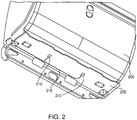
- each passenger luggage storage bin 200 may include one or more bin weight sensors 210 mounted on a bottom panel 205 of the passenger luggage storage bin 200.
- Each bin weight sensor 210 may be, for example, a load cell such as a piezoelectric pressure sensor.
- Each bin weight sensor 210 is coupled to processor 105 (not shown in FIG. 2 ) via wiring 215.
- bin weight sensors 210 may be mounted either on support rods or attachment fittings for passenger luggage storage bin 200 (instead of on bottom panel 205).
- Each of the bin weight sensors 210 provides an output signal which enable processor 105 to determine, in real time, the weight of any luggage currently placed in passenger luggage storage bin 200.
- one or more bin volume sensors 310 are mounted on a top panel 305 of passenger luggage storage bin 200 that are used in system 100 to determine the available internal volume (i.e., the available space) within each passenger luggage storage bin 200.
- Each of the bin volume sensors 310 provides a volume signal to processor 105 (not shown in FIG. 3 ) via wiring 315 to allow processor 105 to determine whether there is any space remaining within each respective passenger luggage storage bin 200.
- processor 105 not shown in FIG. 3
- FIG. 3 six bin volume sensors 310 are shown in FIG. 3 , the precise number of such bin volume sensors 310 required depends upon the size of passenger luggage storage bin 200 and the type of such bin volume sensor 310 selected for use in system 100.
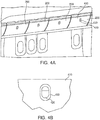
- each passenger luggage storage bin 200 has a front panel 410 with a latch mechanism 420.
- a display device 430 may be provided surrounding latch mechanism 420 which is, in the preferred embodiment, capable of being activated in two different colors, e.g., red and green.
- processor 105 determines whether or not the each passenger luggage storage bin 200 has space available for additional luggage, and provides a storage status indication signal by, for example, causing display device 430 to be activated as a red light when passenger luggage storage bin 200 is filled and to be activated as a green light when passenger luggage storage bin 200 is not filled.
- Crew display 500 may be provided on a specialized tablet or other portable device (smart phone) for use by the crew or on a display mounted within an area of the aircraft reserved for the crew.
- Crew display 500 may be provided on a touchscreen device or may have another input device associated therewith (e.g., a keypad or mouse) for entering commands.
- the crew display 500 provides a visual indication of each passenger luggage storage bin on the aircraft and by shading (or alternatively color) identifies both storage status information (empty shading 510) and load balancing information.
- the load balancing information may be granular, only identifying whether each passenger luggage storage bin is within a nominal value (nominal shading 520) or is overweight (overweight shading 530) or may be more fine.
- the load balancing information is fine, also displaying information indicating whether each passenger luggage storage bin is below nominal weight (nominal - light shading 550) or above nominal weight (nominal - heavy shading 540).
- information may also be provided indicating whether a particular passenger luggage storage bin is out of service (out of service shading 560).
- Crew display 500 also includes a link 570 to a second page 580 (shown in FIG. 5B ) that provides load balancing information. Link 570 may be activate via the touch-screen or an alternative input device.
- the passenger display 150 ( FIG. 1 ) provides the same information as the crew display 500, but does not include link 570.
- the passenger display 150 may be provided via the aircraft's on-board entertainment system.
- the crew display 140 may also provide a selectable link used to remotely lock and unlock the door of all of the passenger luggage storage bins.
- instructions 590, 591 are provided via second page 580 on moving some of the luggage stored in one passenger luggage storage bin to another.
- instructions 590 state "Merge 34K with 33D and move part of 32K to 34K” (34K, 33D, and 32K are identifiers for particular passenger luggage storage bins) and instructions 591 state "Move part of 1K to 3D" (1K and 3D are identifiers for particular passenger luggage storage bins).
- a flight attendant can quickly fulfill these instructions once the passengers are seated to ensure that the weight distribution among the various passenger luggage storage bins is balanced.
- a flowchart 600 is shown of a method of balancing the passenger luggage storage bin load weight in an aircraft.
- the weight of items within each passenger luggage storage bin is determined.
- the distribution of passenger luggage storage bin weights across the aircraft is determined.
- a determination is made based upon the weight of items within all of the passenger luggage storage bins distribution of passenger luggage storage bin weights across the aircraft.
- the crew is provided with instructions on adjusting the contents of the passenger luggage storage bins to correct the imbalance.
Landscapes
- Physics & Mathematics (AREA)
- Engineering & Computer Science (AREA)
- General Physics & Mathematics (AREA)
- Mathematical Physics (AREA)
- Theoretical Computer Science (AREA)
- Aviation & Aerospace Engineering (AREA)
- Warehouses Or Storage Devices (AREA)
- Vehicle Step Arrangements And Article Storage (AREA)
- Testing Of Balance (AREA)
- Time Recorders, Dirve Recorders, Access Control (AREA)
- Devices For Checking Fares Or Tickets At Control Points (AREA)
Claims (15)
- Ladungsgewichts- und Ausgleichssystem (100) für Passagiergepäckaufbewahrungsfächer (200) in einem Flugzeug, das aufweist:wenigstens einen Sensor (100), der dazu konfiguriert ist, mit jedem der Passagiergepäckaufbewahrungsfächer in dem Flugzeug verbunden zu werden, um ein Ausgangssignal bereitzustellen, das proportional zu einem Gewicht eines beliebigen Gepäcks in einem zugehörigen Passagiergepäckaufbewahrungsfach ist;eine Hauptanzeige (140, 150) zum Bereitstellen einer optischen Anzeige eines Aufbewahrungsstatus allerPassagiergepäckaufbewahrungsfächer; undeinen Prozessor (105), der dazu verbunden ist, die Ausgangssignale von jedem des wenigstens einen Sensors zu empfangen, und der dazu konfiguriert ist, auf der Grundlage der Ausgangssignale von dem wenigstens einen Sensor zu berechnen, ob jedes der zugehörigen Passagiergepäckaufbewahrungsfächer innerhalb eines vorgegebenen Gewichtswerts oder Gewichtsbereichs liegt oder nicht, und der dazu konfiguriert ist, an die Hauptanzeige ein Signal zu liefern, das veranlasst, dass die Hauptanzeige anzeigt, ob jedes der Passagiergepäckaufbewahrungsfächer innerhalb eines vorgegebenen Gewichtswerts oder Gewichtsbereichs liegt oder nicht, wobeider Prozessor dazu konfiguriert ist, Befehle festzulegen, wie der Inhalt wenigstens einiger der Passagiergepäckaufbewahrungsfächer in dem Flugzeug anzupassen ist, um einen Ausgleich zu erzielen, wenn der Prozessor ermittelt, dass die Gewichtsverteilung aller Passagiergepäckaufbewahrungsfächer in dem Flugzeug nicht ausgeglichen ist.
- Ladungsgewichts- und Ausgleichssystem nach Anspruch 1, wobei jeder des wenigstens einen Sensors eine Lastmessdose ist, die dazu konfiguriert ist, ein Ausgangssignal bereitzustellen, das proportional zu einem Gewicht von Gegenständen in dem zugehörigen Passagiergepäckaufbewahrungsfach ist.
- Ladungsgewichts- und Ausgleichssystem nach Anspruch 1 oder 2, wobei der Prozessor dazu konfiguriert ist, eine Gewichtsverteilung aller Passagiergepäckaufbewahrungsfächer in dem Flugzeug zu berechnen.
- Ladungsgewichts- und Ausgleichssystem nach Anspruch 3, wobei der Prozessor dazu konfiguriert ist zu ermitteln, ob die Gewichtsverteilung aller Passagiergepäckaufbewahrungsfächer in dem Flugzeug ausgeglichen ist.
- Ladungsgewichts- und Ausgleichssystem nach einem der vorhergehenden Ansprüche, wobei die Hauptanzeige eine Besatzungsanzeige (140) ist.
- Ladungsgewichts- und Ausgleichssystem nach Anspruch 5, wobei der Prozessor dazu konfiguriert ist, für die Besatzungsanzeige selektiv Signale bereitzustellen, die veranlassen, dass die Besatzungsanzeige die Befehle anzeigt.
- Ladungsgewichts- und Ausgleichssystem nach einem der vorhergehenden Ansprüche, wobei die Hauptanzeige eine Passagieranzeige (150) ist.
- Ladungsgewichts- und Ausgleichssystem nach einem der vorhergehenden Ansprüche, das des Weiteren aufweist:wenigstens einen weiteren Sensor (115), der mit jedem der Passagiergepäckaufbewahrungsfächer in dem Flugzeug verbunden ist, zum Bereitstellen eines ersten Ausgangssignals, das proportional zu einem verfügbaren Innenvolumen eines zugehörigen Passagiergepäckaufbewahrungsfachs ist; undein Anzeigegerät (125) für jedes der Passagiergepäckaufbewahrungsfächer zum Bereitstellen einer optischen Anzeige, ob das zugehörige Passagiergepäckaufbewahrungsfach bis zur Auslastung gefüllt ist oder nicht;wobei der Prozessor (105) dazu konfiguriert ist, die Ausgangssignale von jedem des wenigstens einen Sensors (110) und des wenigstens einen weiteren Sensors (115) zu empfangen, und dazu konfiguriert ist, auf der Grundlage der Ausgangssignale von dem wenigstens einen Sensor (115) zu berechnen, ob jedes der zugehörigen Passagiergepäckaufbewahrungsfächer bis zur Auslastung gefüllt ist oder nicht, und dazu konfiguriert ist, für jedes der Anzeigegeräte ein Ausgangssignal bereitzustellen, das veranlasst, dass das Anzeigegerät anzeigt, ob das zugehörige Passagiergepäckaufbewahrungsfach bis zur Auslastung gefüllt ist oder nicht.
- Verfahren zum Ausgleichen eines Ladungsgewichts von Passagiergepäckaufbewahrungsfächern (200) in einem Flugzeug, das die folgenden Schritte aufweist:Ermitteln, für jedes Passagiergepäckaufbewahrungsfach, des Gewichts von Gegenständen in diesem Passagiergepäckaufbewahrungsfach;Ermitteln einer Verteilung von Passagiergepäckaufbewahrungsfach-Gewichten über das Flugzeug hinweg;Ermitteln, ob die Verteilung von Passagiergepäckaufbewahrungsfach-Gewichten über das Flugzeug hinweg ausgeglichen ist; undFestlegen von Befehlen, wie der Inhalt von wenigstens einigen der Passagiergepäckaufbewahrungsfächer in dem Flugzeug anzupassen ist, um einen Ausgleich zu erzielen, wenn der Prozessor ermittelt, dass die Gewichtsverteilung aller Passagiergepäckaufbewahrungsfächer in dem Flugzeug nicht ausgeglichen ist.
- Verfahren nach Anspruch 9, das des Weiteren den Schritt des Anzeigens von Informationen auf einem Anzeigegerät aufweist, die Befehle zum Anpassen des Inhalts der Passagiergepäckaufbewahrungsfächer bereitstellen, um Unausgeglichenheit zu korrigieren.
- Verfahren nach Anspruch 9 oder 10, das des Weiteren die Schritte des Empfangens eines Sensorausgangssignals aufweist, das proportional zu einem Gewicht eines beliebigen Gepäcks in einem zugehörigen Passagiergepäckaufbewahrungsfach ist, und des Anzeigens einer optischen Anzeige eines Aufbewahrungsstatus aller Passagiergepäckaufbewahrungsfächer auf einem Haupt-Anzeigegerät.
- Verfahren nach Anspruch 11, wobei die Hauptanzeige eine Besatzungsanzeige (140) ist.
- Verfahren nach Anspruch 11, wobei die Hauptanzeige eine Passagieranzeige (150) ist.
- Verfahren nach Anspruch 13, wobei die Passagieranzeige zahlreiche Anzeigebildschirme aufweist, die über das Flugzeug verteilt sind.
- Verfahren nach einem der Ansprüche 9 bis 14, das des Weiteren die Schritte des Empfangens eines weiteren Sensorausgangssignals aufweist, das proportional zu einem verfügbaren Innenvolumen eines zugehörigen Passagiergepäckaufbewahrungsfachs ist, und des Anzeigens einer Angabe, ob das zugehörige Passagiergepäckaufbewahrungsfach bis zur Auslastung gefüllt ist oder nicht, auf einem Anzeigegerät an jedem Passagieraufbewahrungsfach.
Applications Claiming Priority (1)
| Application Number | Priority Date | Filing Date | Title |
|---|---|---|---|
| US15/864,036 US11047728B2 (en) | 2018-01-08 | 2018-01-08 | Aircraft passenger luggage bin load weight and balance system |
Publications (2)
| Publication Number | Publication Date |
|---|---|
| EP3508423A1 EP3508423A1 (de) | 2019-07-10 |
| EP3508423B1 true EP3508423B1 (de) | 2021-09-08 |
Family
ID=65010547
Family Applications (1)
| Application Number | Title | Priority Date | Filing Date |
|---|---|---|---|
| EP19150626.0A Active EP3508423B1 (de) | 2018-01-08 | 2019-01-07 | Flugzeugpassagiergepäckfachladungsgewichts- und -ausgleichssystem |
Country Status (3)
| Country | Link |
|---|---|
| US (1) | US11047728B2 (de) |
| EP (1) | EP3508423B1 (de) |
| CN (1) | CN110015427B (de) |
Cited By (1)
| Publication number | Priority date | Publication date | Assignee | Title |
|---|---|---|---|---|
| EP4685054A1 (de) * | 2024-07-22 | 2026-01-28 | Airbus Operations, S.L.U. | Computerimplementiertes verfahren zur verhinderung eines nicht-lebensfähigen beladungszustands in einem flugzeug |
Families Citing this family (11)
| Publication number | Priority date | Publication date | Assignee | Title |
|---|---|---|---|---|
| US10669028B1 (en) * | 2019-01-28 | 2020-06-02 | Rockwell Collins, Inc. | System and method for detecting items in aircraft stowage areas |
| CN110781006B (zh) * | 2019-10-28 | 2022-06-03 | 重庆紫光华山智安科技有限公司 | 负载均衡方法、装置、节点及计算机可读存储介质 |
| US12423851B2 (en) | 2019-11-18 | 2025-09-23 | Airbus (China) Enterprise Management And Services Company Limited | Storage area loading status measurement systems and methods |
| US11649055B2 (en) * | 2019-12-16 | 2023-05-16 | Airbus Operations Gmbh | Process for determining that luggage has been left behind in an overhead bin |
| DE102020000373A1 (de) * | 2020-01-23 | 2021-07-29 | Diehl Aerospace Gmbh | Innenraumverwaltungssystem für ein Luftfahrzeug mit dem Innenraumverwaltungssystem sowie Verfahren zur Steuerung des Innenraumverwaltungssystems |
| US12077298B2 (en) * | 2020-03-05 | 2024-09-03 | B/E Aerospace, Inc. | Overhead stowage bin with electronic control system |
| EP3875370B1 (de) | 2020-03-05 | 2025-12-17 | B/E Aerospace, Inc. | Überkopfgepäckablage mit elektronischem steuerungssystem |
| JP7276290B2 (ja) * | 2020-09-03 | 2023-05-18 | トヨタ自動車株式会社 | 車両及び車両制御システム |
| US11392815B1 (en) * | 2020-12-28 | 2022-07-19 | B/E Aerospace, Inc. | Integrated RFID tags in passenger aircraft |
| CN114812728A (zh) * | 2021-01-19 | 2022-07-29 | 波音公司 | 确定储存箱的容量的系统和方法 |
| CN115214892B (zh) * | 2022-07-25 | 2025-08-01 | 中国商用飞机有限责任公司 | 行李架以及行李架的空间占用通知方法和系统 |
Family Cites Families (24)
| Publication number | Priority date | Publication date | Assignee | Title |
|---|---|---|---|---|
| DE4209037C2 (de) | 1992-03-20 | 1994-06-23 | Deutsche Aerospace Airbus | Vorrichtung zur Aufnahme von Gepäck in Flugzeugen |
| US6452487B1 (en) * | 2000-02-14 | 2002-09-17 | Stanley Krupinski | System and method for warning of a tip over condition in a tractor trailer or tanker |
| US6923375B2 (en) * | 2003-05-15 | 2005-08-02 | Arinc, Inc. | Aircraft weight and balance system |
| US20070050271A1 (en) * | 2003-07-11 | 2007-03-01 | Rf Code, Inc. | Presence, pattern and weight sensor surface |
| WO2005008437A2 (en) * | 2003-07-11 | 2005-01-27 | Rf Code, Inc. | System, method and computer program product for monitoring inventory |
| FR2871904B1 (fr) | 2004-06-22 | 2006-09-22 | Airbus Groupement D Interet Ec | Dispostif de commande de fermeture d'un coffre a bagages |
| US20070265890A1 (en) | 2006-05-12 | 2007-11-15 | Curtis Vicki A | Interactive electronic boarding display |
| US20080055836A1 (en) * | 2006-08-25 | 2008-03-06 | The Boeing Company | System and method for compartment control |
| US7723935B2 (en) | 2006-08-25 | 2010-05-25 | The Boeing Company | System and method for compartment control |
| US8038098B2 (en) | 2007-04-12 | 2011-10-18 | Be Aerospace, Inc. | Overhead luggage bin for aircraft interior |
| US8060283B2 (en) * | 2007-10-15 | 2011-11-15 | Deere & Company | Method and system for controlling the loading of a container associated with a vehicle |
| EP2065688B1 (de) * | 2007-11-27 | 2012-04-18 | Elektrobit Automotive GmbH | Technik zur Detektion von verschobenem Frachtgut |
| US20140000969A1 (en) * | 2009-05-29 | 2014-01-02 | David Carruthers | Vehicle load sensing system |
| US20130290221A1 (en) | 2012-04-25 | 2013-10-31 | Satish Jindel | Passenger aircraft overhead bin system and method |
| US8952813B2 (en) | 2012-09-14 | 2015-02-10 | International Business Machines Corporation | Optimization of luggage placement in storage compartments |
| US20150241209A1 (en) | 2014-02-25 | 2015-08-27 | Astronics Advanced Electronic Systems Corp. | Apparatus and method to monitor the occupied volume within a fixed or variable volume |
| US20160109280A1 (en) * | 2014-10-15 | 2016-04-21 | The Boeing Company | Smart aircraft overhead luggage bin system |
| US9764842B2 (en) * | 2015-05-11 | 2017-09-19 | The Boeing Company | Storage capacity status indicator and associated systems and methods |
| US9745064B2 (en) * | 2015-11-26 | 2017-08-29 | Goodrich Corporation | Aircraft overhead bin monitoring and alert system |
| EP3439959B1 (de) * | 2016-04-04 | 2021-08-04 | B/E Aerospace, Inc. | Fluggastaktivitätsüberwachung |
| DE102016218307B4 (de) * | 2016-09-23 | 2024-12-12 | Airbus Operations Gmbh | Elektronisches Gepäckverstauungssystem und Verfahren |
| RU2020103735A (ru) * | 2017-06-30 | 2021-07-30 | Си Энд Ди ЗОДИАК, ИНК. | Система управления багажом |
| US10759537B2 (en) * | 2017-11-03 | 2020-09-01 | Uber Technologies, Inc. | Safe vertical take-off and landing aircraft payload assignment |
| US10364052B2 (en) * | 2017-12-07 | 2019-07-30 | Polymer Logistics (Israel) Ltd. | Inventory management system |
-
2018
- 2018-01-08 US US15/864,036 patent/US11047728B2/en active Active
- 2018-12-24 CN CN201811582127.3A patent/CN110015427B/zh active Active
-
2019
- 2019-01-07 EP EP19150626.0A patent/EP3508423B1/de active Active
Cited By (1)
| Publication number | Priority date | Publication date | Assignee | Title |
|---|---|---|---|---|
| EP4685054A1 (de) * | 2024-07-22 | 2026-01-28 | Airbus Operations, S.L.U. | Computerimplementiertes verfahren zur verhinderung eines nicht-lebensfähigen beladungszustands in einem flugzeug |
Also Published As
| Publication number | Publication date |
|---|---|
| US11047728B2 (en) | 2021-06-29 |
| CN110015427A (zh) | 2019-07-16 |
| EP3508423A1 (de) | 2019-07-10 |
| US20190212183A1 (en) | 2019-07-11 |
| CN110015427B (zh) | 2024-11-12 |
| BR102019000202A2 (pt) | 2019-08-27 |
Similar Documents
| Publication | Publication Date | Title |
|---|---|---|
| US11047728B2 (en) | Aircraft passenger luggage bin load weight and balance system | |
| CN104864931B (zh) | 监视固定或可变容积中被占据的容积的装置和方法 | |
| US8185234B2 (en) | Device and method for controlling the loading and/or unloading process of an airplane | |
| JP7595366B2 (ja) | 有料荷重モニタリングシステム、航空機および方法 | |
| US20160109280A1 (en) | Smart aircraft overhead luggage bin system | |
| CN109071025B (zh) | 飞机乘客活动监测 | |
| EP3372503B1 (de) | Berührungslos bedienbare gepäckfachanordnungen | |
| EP3372505B1 (de) | Fahrzeuggepäckfachanordnungen mit gewichtssensoren | |
| CA2935382C (en) | Vehicle occupant sensor system and method | |
| US8515656B2 (en) | Integrated aircraft cargo loading and monitoring system | |
| EP1904564B1 (de) | System und verfahren für verbesserte drehflüglerleistung mit innen-/aussenlasten | |
| KR20180045841A (ko) | 지능형 수하물 처리 | |
| EP3372502A1 (de) | Fahrzeuge mit elektronischen gepäckfachsteuerungssystemen | |
| EP4029788B1 (de) | Systeme und verfahren zur bestimmung der kapazität von lagerbehältern | |
| JP2022109883A (ja) | 航空機の収納棚内の機内持ち込み荷物の収納を監視するためのシステム及び方法 | |
| WO2020160471A1 (en) | Aircraft weight and balance measurement system and method | |
| US20170313425A1 (en) | Avionics system for assisting implementation of security measures onboard an aircraft, aircraft comprising such a system, and associated method | |
| EP4112466A1 (de) | Automatisierte wagensysteme und -verfahren für eine innenkabine eines fahrzeugs | |
| CN114379813B (zh) | 飞机客舱布置方法、飞机客舱、飞机及飞机重心调节方法 | |
| WO2020263528A1 (en) | Information display system | |
| EP4628407A1 (de) | System zur flugstatusbasierten steuerung einer in einer kabine eines flugzeugs angeordneten vorrichtung und flugzeug mit solch einem system | |
| BR102019000202B1 (pt) | Sistema de pesagem e balanceamento de carga, e, método para balanceamento de um peso de carga em compartimentos de armazenamento de bagagem de passageiro em uma aeronave | |
| WO2020263529A1 (en) | Display system with projector |
Legal Events
| Date | Code | Title | Description |
|---|---|---|---|
| PUAI | Public reference made under article 153(3) epc to a published international application that has entered the european phase |
Free format text: ORIGINAL CODE: 0009012 |
|
| STAA | Information on the status of an ep patent application or granted ep patent |
Free format text: STATUS: REQUEST FOR EXAMINATION WAS MADE |
|
| 17P | Request for examination filed |
Effective date: 20190107 |
|
| AK | Designated contracting states |
Kind code of ref document: A1 Designated state(s): AL AT BE BG CH CY CZ DE DK EE ES FI FR GB GR HR HU IE IS IT LI LT LU LV MC MK MT NL NO PL PT RO RS SE SI SK SM TR |
|
| AX | Request for extension of the european patent |
Extension state: BA ME |
|
| RIC1 | Information provided on ipc code assigned before grant |
Ipc: B64D 11/00 20060101AFI20201027BHEP Ipc: G01G 19/52 20060101ALN20201027BHEP Ipc: G06F 17/40 20060101ALN20201027BHEP |
|
| GRAP | Despatch of communication of intention to grant a patent |
Free format text: ORIGINAL CODE: EPIDOSNIGR1 |
|
| STAA | Information on the status of an ep patent application or granted ep patent |
Free format text: STATUS: GRANT OF PATENT IS INTENDED |
|
| RIC1 | Information provided on ipc code assigned before grant |
Ipc: G06F 17/40 20060101ALN20201109BHEP Ipc: B64D 11/00 20060101AFI20201109BHEP Ipc: G01G 19/52 20060101ALN20201109BHEP |
|
| INTG | Intention to grant announced |
Effective date: 20201210 |
|
| GRAJ | Information related to disapproval of communication of intention to grant by the applicant or resumption of examination proceedings by the epo deleted |
Free format text: ORIGINAL CODE: EPIDOSDIGR1 |
|
| STAA | Information on the status of an ep patent application or granted ep patent |
Free format text: STATUS: REQUEST FOR EXAMINATION WAS MADE |
|
| GRAP | Despatch of communication of intention to grant a patent |
Free format text: ORIGINAL CODE: EPIDOSNIGR1 |
|
| STAA | Information on the status of an ep patent application or granted ep patent |
Free format text: STATUS: GRANT OF PATENT IS INTENDED |
|
| INTC | Intention to grant announced (deleted) | ||
| RIC1 | Information provided on ipc code assigned before grant |
Ipc: B64D 11/00 20060101AFI20210303BHEP Ipc: G06F 17/40 20060101ALN20210303BHEP Ipc: G01G 19/52 20060101ALN20210303BHEP |
|
| RIC1 | Information provided on ipc code assigned before grant |
Ipc: G06F 17/40 20060101ALN20210308BHEP Ipc: G01G 19/52 20060101ALN20210308BHEP Ipc: B64D 11/00 20060101AFI20210308BHEP |
|
| INTG | Intention to grant announced |
Effective date: 20210407 |
|
| GRAS | Grant fee paid |
Free format text: ORIGINAL CODE: EPIDOSNIGR3 |
|
| GRAA | (expected) grant |
Free format text: ORIGINAL CODE: 0009210 |
|
| STAA | Information on the status of an ep patent application or granted ep patent |
Free format text: STATUS: THE PATENT HAS BEEN GRANTED |
|
| AK | Designated contracting states |
Kind code of ref document: B1 Designated state(s): AL AT BE BG CH CY CZ DE DK EE ES FI FR GB GR HR HU IE IS IT LI LT LU LV MC MK MT NL NO PL PT RO RS SE SI SK SM TR |
|
| REG | Reference to a national code |
Ref country code: GB Ref legal event code: FG4D |
|
| REG | Reference to a national code |
Ref country code: CH Ref legal event code: EP Ref country code: AT Ref legal event code: REF Ref document number: 1428381 Country of ref document: AT Kind code of ref document: T Effective date: 20210915 |
|
| REG | Reference to a national code |
Ref country code: IE Ref legal event code: FG4D |
|
| REG | Reference to a national code |
Ref country code: DE Ref legal event code: R096 Ref document number: 602019007403 Country of ref document: DE |
|
| REG | Reference to a national code |
Ref country code: LT Ref legal event code: MG9D |
|
| REG | Reference to a national code |
Ref country code: NL Ref legal event code: MP Effective date: 20210908 |
|
| PG25 | Lapsed in a contracting state [announced via postgrant information from national office to epo] |
Ref country code: LT Free format text: LAPSE BECAUSE OF FAILURE TO SUBMIT A TRANSLATION OF THE DESCRIPTION OR TO PAY THE FEE WITHIN THE PRESCRIBED TIME-LIMIT Effective date: 20210908 Ref country code: BG Free format text: LAPSE BECAUSE OF FAILURE TO SUBMIT A TRANSLATION OF THE DESCRIPTION OR TO PAY THE FEE WITHIN THE PRESCRIBED TIME-LIMIT Effective date: 20211208 Ref country code: HR Free format text: LAPSE BECAUSE OF FAILURE TO SUBMIT A TRANSLATION OF THE DESCRIPTION OR TO PAY THE FEE WITHIN THE PRESCRIBED TIME-LIMIT Effective date: 20210908 Ref country code: NO Free format text: LAPSE BECAUSE OF FAILURE TO SUBMIT A TRANSLATION OF THE DESCRIPTION OR TO PAY THE FEE WITHIN THE PRESCRIBED TIME-LIMIT Effective date: 20211208 Ref country code: ES Free format text: LAPSE BECAUSE OF FAILURE TO SUBMIT A TRANSLATION OF THE DESCRIPTION OR TO PAY THE FEE WITHIN THE PRESCRIBED TIME-LIMIT Effective date: 20210908 Ref country code: FI Free format text: LAPSE BECAUSE OF FAILURE TO SUBMIT A TRANSLATION OF THE DESCRIPTION OR TO PAY THE FEE WITHIN THE PRESCRIBED TIME-LIMIT Effective date: 20210908 Ref country code: RS Free format text: LAPSE BECAUSE OF FAILURE TO SUBMIT A TRANSLATION OF THE DESCRIPTION OR TO PAY THE FEE WITHIN THE PRESCRIBED TIME-LIMIT Effective date: 20210908 Ref country code: SE Free format text: LAPSE BECAUSE OF FAILURE TO SUBMIT A TRANSLATION OF THE DESCRIPTION OR TO PAY THE FEE WITHIN THE PRESCRIBED TIME-LIMIT Effective date: 20210908 |
|
| REG | Reference to a national code |
Ref country code: AT Ref legal event code: MK05 Ref document number: 1428381 Country of ref document: AT Kind code of ref document: T Effective date: 20210908 |
|
| PG25 | Lapsed in a contracting state [announced via postgrant information from national office to epo] |
Ref country code: LV Free format text: LAPSE BECAUSE OF FAILURE TO SUBMIT A TRANSLATION OF THE DESCRIPTION OR TO PAY THE FEE WITHIN THE PRESCRIBED TIME-LIMIT Effective date: 20210908 Ref country code: GR Free format text: LAPSE BECAUSE OF FAILURE TO SUBMIT A TRANSLATION OF THE DESCRIPTION OR TO PAY THE FEE WITHIN THE PRESCRIBED TIME-LIMIT Effective date: 20211209 |
|
| PG25 | Lapsed in a contracting state [announced via postgrant information from national office to epo] |
Ref country code: AT Free format text: LAPSE BECAUSE OF FAILURE TO SUBMIT A TRANSLATION OF THE DESCRIPTION OR TO PAY THE FEE WITHIN THE PRESCRIBED TIME-LIMIT Effective date: 20210908 |
|
| PG25 | Lapsed in a contracting state [announced via postgrant information from national office to epo] |
Ref country code: IS Free format text: LAPSE BECAUSE OF FAILURE TO SUBMIT A TRANSLATION OF THE DESCRIPTION OR TO PAY THE FEE WITHIN THE PRESCRIBED TIME-LIMIT Effective date: 20220108 Ref country code: SM Free format text: LAPSE BECAUSE OF FAILURE TO SUBMIT A TRANSLATION OF THE DESCRIPTION OR TO PAY THE FEE WITHIN THE PRESCRIBED TIME-LIMIT Effective date: 20210908 Ref country code: SK Free format text: LAPSE BECAUSE OF FAILURE TO SUBMIT A TRANSLATION OF THE DESCRIPTION OR TO PAY THE FEE WITHIN THE PRESCRIBED TIME-LIMIT Effective date: 20210908 Ref country code: RO Free format text: LAPSE BECAUSE OF FAILURE TO SUBMIT A TRANSLATION OF THE DESCRIPTION OR TO PAY THE FEE WITHIN THE PRESCRIBED TIME-LIMIT Effective date: 20210908 Ref country code: PT Free format text: LAPSE BECAUSE OF FAILURE TO SUBMIT A TRANSLATION OF THE DESCRIPTION OR TO PAY THE FEE WITHIN THE PRESCRIBED TIME-LIMIT Effective date: 20220110 Ref country code: PL Free format text: LAPSE BECAUSE OF FAILURE TO SUBMIT A TRANSLATION OF THE DESCRIPTION OR TO PAY THE FEE WITHIN THE PRESCRIBED TIME-LIMIT Effective date: 20210908 Ref country code: NL Free format text: LAPSE BECAUSE OF FAILURE TO SUBMIT A TRANSLATION OF THE DESCRIPTION OR TO PAY THE FEE WITHIN THE PRESCRIBED TIME-LIMIT Effective date: 20210908 Ref country code: EE Free format text: LAPSE BECAUSE OF FAILURE TO SUBMIT A TRANSLATION OF THE DESCRIPTION OR TO PAY THE FEE WITHIN THE PRESCRIBED TIME-LIMIT Effective date: 20210908 Ref country code: CZ Free format text: LAPSE BECAUSE OF FAILURE TO SUBMIT A TRANSLATION OF THE DESCRIPTION OR TO PAY THE FEE WITHIN THE PRESCRIBED TIME-LIMIT Effective date: 20210908 Ref country code: AL Free format text: LAPSE BECAUSE OF FAILURE TO SUBMIT A TRANSLATION OF THE DESCRIPTION OR TO PAY THE FEE WITHIN THE PRESCRIBED TIME-LIMIT Effective date: 20210908 |
|
| REG | Reference to a national code |
Ref country code: DE Ref legal event code: R097 Ref document number: 602019007403 Country of ref document: DE |
|
| PLBE | No opposition filed within time limit |
Free format text: ORIGINAL CODE: 0009261 |
|
| STAA | Information on the status of an ep patent application or granted ep patent |
Free format text: STATUS: NO OPPOSITION FILED WITHIN TIME LIMIT |
|
| PG25 | Lapsed in a contracting state [announced via postgrant information from national office to epo] |
Ref country code: DK Free format text: LAPSE BECAUSE OF FAILURE TO SUBMIT A TRANSLATION OF THE DESCRIPTION OR TO PAY THE FEE WITHIN THE PRESCRIBED TIME-LIMIT Effective date: 20210908 |
|
| 26N | No opposition filed |
Effective date: 20220609 |
|
| PG25 | Lapsed in a contracting state [announced via postgrant information from national office to epo] |
Ref country code: SI Free format text: LAPSE BECAUSE OF FAILURE TO SUBMIT A TRANSLATION OF THE DESCRIPTION OR TO PAY THE FEE WITHIN THE PRESCRIBED TIME-LIMIT Effective date: 20210908 Ref country code: MC Free format text: LAPSE BECAUSE OF FAILURE TO SUBMIT A TRANSLATION OF THE DESCRIPTION OR TO PAY THE FEE WITHIN THE PRESCRIBED TIME-LIMIT Effective date: 20210908 |
|
| REG | Reference to a national code |
Ref country code: CH Ref legal event code: PL |
|
| REG | Reference to a national code |
Ref country code: BE Ref legal event code: MM Effective date: 20220131 |
|
| PG25 | Lapsed in a contracting state [announced via postgrant information from national office to epo] |
Ref country code: LU Free format text: LAPSE BECAUSE OF NON-PAYMENT OF DUE FEES Effective date: 20220107 |
|
| PG25 | Lapsed in a contracting state [announced via postgrant information from national office to epo] |
Ref country code: BE Free format text: LAPSE BECAUSE OF NON-PAYMENT OF DUE FEES Effective date: 20220131 |
|
| PG25 | Lapsed in a contracting state [announced via postgrant information from national office to epo] |
Ref country code: LI Free format text: LAPSE BECAUSE OF NON-PAYMENT OF DUE FEES Effective date: 20220131 Ref country code: CH Free format text: LAPSE BECAUSE OF NON-PAYMENT OF DUE FEES Effective date: 20220131 |
|
| PG25 | Lapsed in a contracting state [announced via postgrant information from national office to epo] |
Ref country code: IT Free format text: LAPSE BECAUSE OF FAILURE TO SUBMIT A TRANSLATION OF THE DESCRIPTION OR TO PAY THE FEE WITHIN THE PRESCRIBED TIME-LIMIT Effective date: 20210908 Ref country code: IE Free format text: LAPSE BECAUSE OF NON-PAYMENT OF DUE FEES Effective date: 20220107 |
|
| P01 | Opt-out of the competence of the unified patent court (upc) registered |
Effective date: 20230516 |
|
| PG25 | Lapsed in a contracting state [announced via postgrant information from national office to epo] |
Ref country code: HU Free format text: LAPSE BECAUSE OF FAILURE TO SUBMIT A TRANSLATION OF THE DESCRIPTION OR TO PAY THE FEE WITHIN THE PRESCRIBED TIME-LIMIT; INVALID AB INITIO Effective date: 20190107 |
|
| PG25 | Lapsed in a contracting state [announced via postgrant information from national office to epo] |
Ref country code: MK Free format text: LAPSE BECAUSE OF FAILURE TO SUBMIT A TRANSLATION OF THE DESCRIPTION OR TO PAY THE FEE WITHIN THE PRESCRIBED TIME-LIMIT Effective date: 20210908 Ref country code: CY Free format text: LAPSE BECAUSE OF FAILURE TO SUBMIT A TRANSLATION OF THE DESCRIPTION OR TO PAY THE FEE WITHIN THE PRESCRIBED TIME-LIMIT Effective date: 20210908 |
|
| PG25 | Lapsed in a contracting state [announced via postgrant information from national office to epo] |
Ref country code: TR Free format text: LAPSE BECAUSE OF FAILURE TO SUBMIT A TRANSLATION OF THE DESCRIPTION OR TO PAY THE FEE WITHIN THE PRESCRIBED TIME-LIMIT Effective date: 20210908 |
|
| PG25 | Lapsed in a contracting state [announced via postgrant information from national office to epo] |
Ref country code: MT Free format text: LAPSE BECAUSE OF FAILURE TO SUBMIT A TRANSLATION OF THE DESCRIPTION OR TO PAY THE FEE WITHIN THE PRESCRIBED TIME-LIMIT Effective date: 20210908 |
|
| PGFP | Annual fee paid to national office [announced via postgrant information from national office to epo] |
Ref country code: GB Payment date: 20260127 Year of fee payment: 8 |
|
| PGFP | Annual fee paid to national office [announced via postgrant information from national office to epo] |
Ref country code: DE Payment date: 20260128 Year of fee payment: 8 |
|
| PGFP | Annual fee paid to national office [announced via postgrant information from national office to epo] |
Ref country code: FR Payment date: 20260126 Year of fee payment: 8 |