EP3510345B1 - Hohlraumbasierte metamaterialien - Google Patents
Hohlraumbasierte metamaterialien Download PDFInfo
- Publication number
- EP3510345B1 EP3510345B1 EP17848282.4A EP17848282A EP3510345B1 EP 3510345 B1 EP3510345 B1 EP 3510345B1 EP 17848282 A EP17848282 A EP 17848282A EP 3510345 B1 EP3510345 B1 EP 3510345B1
- Authority
- EP
- European Patent Office
- Prior art keywords
- interest
- void
- content
- metamaterial
- matrix
- Prior art date
- Legal status (The legal status is an assumption and is not a legal conclusion. Google has not performed a legal analysis and makes no representation as to the accuracy of the status listed.)
- Active
Links
Images




Classifications
-
- B—PERFORMING OPERATIONS; TRANSPORTING
- B32—LAYERED PRODUCTS
- B32B—LAYERED PRODUCTS, i.e. PRODUCTS BUILT-UP OF STRATA OF FLAT OR NON-FLAT, e.g. CELLULAR OR HONEYCOMB, FORM
- B32B5/00—Layered products characterised by the non- homogeneity or physical structure, i.e. comprising a fibrous, filamentary, particulate or foam layer; Layered products characterised by having a layer differing constitutionally or physically in different parts
-
- B—PERFORMING OPERATIONS; TRANSPORTING
- B32—LAYERED PRODUCTS
- B32B—LAYERED PRODUCTS, i.e. PRODUCTS BUILT-UP OF STRATA OF FLAT OR NON-FLAT, e.g. CELLULAR OR HONEYCOMB, FORM
- B32B3/00—Layered products comprising a layer with external or internal discontinuities or unevennesses, or a layer of non-planar shape; Layered products comprising a layer having particular features of form
- B32B3/02—Layered products comprising a layer with external or internal discontinuities or unevennesses, or a layer of non-planar shape; Layered products comprising a layer having particular features of form characterised by features of form at particular places, e.g. in edge regions
- B32B3/04—Layered products comprising a layer with external or internal discontinuities or unevennesses, or a layer of non-planar shape; Layered products comprising a layer having particular features of form characterised by features of form at particular places, e.g. in edge regions characterised by at least one layer folded at the edge, e.g. over another layer ; characterised by at least one layer enveloping or enclosing a material
-
- B—PERFORMING OPERATIONS; TRANSPORTING
- B32—LAYERED PRODUCTS
- B32B—LAYERED PRODUCTS, i.e. PRODUCTS BUILT-UP OF STRATA OF FLAT OR NON-FLAT, e.g. CELLULAR OR HONEYCOMB, FORM
- B32B3/00—Layered products comprising a layer with external or internal discontinuities or unevennesses, or a layer of non-planar shape; Layered products comprising a layer having particular features of form
- B32B3/26—Layered products comprising a layer with external or internal discontinuities or unevennesses, or a layer of non-planar shape; Layered products comprising a layer having particular features of form characterised by a particular shape of the outline of the cross-section of a continuous layer; characterised by a layer with cavities or internal voids ; characterised by an apertured layer
-
- B—PERFORMING OPERATIONS; TRANSPORTING
- B32—LAYERED PRODUCTS
- B32B—LAYERED PRODUCTS, i.e. PRODUCTS BUILT-UP OF STRATA OF FLAT OR NON-FLAT, e.g. CELLULAR OR HONEYCOMB, FORM
- B32B3/00—Layered products comprising a layer with external or internal discontinuities or unevennesses, or a layer of non-planar shape; Layered products comprising a layer having particular features of form
- B32B3/26—Layered products comprising a layer with external or internal discontinuities or unevennesses, or a layer of non-planar shape; Layered products comprising a layer having particular features of form characterised by a particular shape of the outline of the cross-section of a continuous layer; characterised by a layer with cavities or internal voids ; characterised by an apertured layer
- B32B3/30—Layered products comprising a layer with external or internal discontinuities or unevennesses, or a layer of non-planar shape; Layered products comprising a layer having particular features of form characterised by a particular shape of the outline of the cross-section of a continuous layer; characterised by a layer with cavities or internal voids ; characterised by an apertured layer characterised by a layer formed with recesses or projections, e.g. hollows, grooves, protuberances, ribs
-
- B—PERFORMING OPERATIONS; TRANSPORTING
- B33—ADDITIVE MANUFACTURING TECHNOLOGY
- B33Y—ADDITIVE MANUFACTURING, i.e. MANUFACTURING OF THREE-DIMENSIONAL [3D] OBJECTS BY ADDITIVE DEPOSITION, ADDITIVE AGGLOMERATION OR ADDITIVE LAYERING, e.g. BY 3D PRINTING, STEREOLITHOGRAPHY OR SELECTIVE LASER SINTERING
- B33Y70/00—Materials specially adapted for additive manufacturing
- B33Y70/10—Composites of different types of material, e.g. mixtures of ceramics and polymers or mixtures of metals and biomaterials
-
- B—PERFORMING OPERATIONS; TRANSPORTING
- B82—NANOTECHNOLOGY
- B82Y—SPECIFIC USES OR APPLICATIONS OF NANOSTRUCTURES; MEASUREMENT OR ANALYSIS OF NANOSTRUCTURES; MANUFACTURE OR TREATMENT OF NANOSTRUCTURES
- B82Y25/00—Nanomagnetism, e.g. magnetoimpedance, anisotropic magnetoresistance, giant magnetoresistance or tunneling magnetoresistance
-
- F—MECHANICAL ENGINEERING; LIGHTING; HEATING; WEAPONS; BLASTING
- F16—ENGINEERING ELEMENTS AND UNITS; GENERAL MEASURES FOR PRODUCING AND MAINTAINING EFFECTIVE FUNCTIONING OF MACHINES OR INSTALLATIONS; THERMAL INSULATION IN GENERAL
- F16F—SPRINGS; SHOCK-ABSORBERS; MEANS FOR DAMPING VIBRATION
- F16F9/00—Springs, vibration-dampers, shock-absorbers, or similarly-constructed movement-dampers using a fluid or the equivalent as damping medium
- F16F9/30—Springs, vibration-dampers, shock-absorbers, or similarly-constructed movement-dampers using a fluid or the equivalent as damping medium with solid or semi-solid material, e.g. pasty masses, as damping medium
-
- F—MECHANICAL ENGINEERING; LIGHTING; HEATING; WEAPONS; BLASTING
- F41—WEAPONS
- F41H—ARMOUR; ARMOURED TURRETS; ARMOURED OR ARMED VEHICLES; MEANS OF ATTACK OR DEFENCE, e.g. CAMOUFLAGE, IN GENERAL
- F41H1/00—Personal protection gear
-
- F—MECHANICAL ENGINEERING; LIGHTING; HEATING; WEAPONS; BLASTING
- F41—WEAPONS
- F41H—ARMOUR; ARMOURED TURRETS; ARMOURED OR ARMED VEHICLES; MEANS OF ATTACK OR DEFENCE, e.g. CAMOUFLAGE, IN GENERAL
- F41H13/00—Means of attack or defence not otherwise provided for
-
- F—MECHANICAL ENGINEERING; LIGHTING; HEATING; WEAPONS; BLASTING
- F41—WEAPONS
- F41H—ARMOUR; ARMOURED TURRETS; ARMOURED OR ARMED VEHICLES; MEANS OF ATTACK OR DEFENCE, e.g. CAMOUFLAGE, IN GENERAL
- F41H5/00—Armour; Armour plates
-
- F—MECHANICAL ENGINEERING; LIGHTING; HEATING; WEAPONS; BLASTING
- F41—WEAPONS
- F41H—ARMOUR; ARMOURED TURRETS; ARMOURED OR ARMED VEHICLES; MEANS OF ATTACK OR DEFENCE, e.g. CAMOUFLAGE, IN GENERAL
- F41H5/00—Armour; Armour plates
- F41H5/007—Reactive armour; Dynamic armour
-
- F—MECHANICAL ENGINEERING; LIGHTING; HEATING; WEAPONS; BLASTING
- F41—WEAPONS
- F41H—ARMOUR; ARMOURED TURRETS; ARMOURED OR ARMED VEHICLES; MEANS OF ATTACK OR DEFENCE, e.g. CAMOUFLAGE, IN GENERAL
- F41H5/00—Armour; Armour plates
- F41H5/02—Plate construction
- F41H5/04—Plate construction composed of more than one layer
- F41H5/0492—Layered armour containing hard elements, e.g. plates, spheres, rods, separated from each other, the elements being connected to a further flexible layer or being embedded in a plastics or an elastomer matrix
-
- F—MECHANICAL ENGINEERING; LIGHTING; HEATING; WEAPONS; BLASTING
- F41—WEAPONS
- F41H—ARMOUR; ARMOURED TURRETS; ARMOURED OR ARMED VEHICLES; MEANS OF ATTACK OR DEFENCE, e.g. CAMOUFLAGE, IN GENERAL
- F41H5/00—Armour; Armour plates
- F41H5/06—Shields
-
- B—PERFORMING OPERATIONS; TRANSPORTING
- B32—LAYERED PRODUCTS
- B32B—LAYERED PRODUCTS, i.e. PRODUCTS BUILT-UP OF STRATA OF FLAT OR NON-FLAT, e.g. CELLULAR OR HONEYCOMB, FORM
- B32B2571/00—Protective equipment
- B32B2571/02—Protective equipment defensive, e.g. armour plates or anti-ballistic clothing
-
- B—PERFORMING OPERATIONS; TRANSPORTING
- B33—ADDITIVE MANUFACTURING TECHNOLOGY
- B33Y—ADDITIVE MANUFACTURING, i.e. MANUFACTURING OF THREE-DIMENSIONAL [3D] OBJECTS BY ADDITIVE DEPOSITION, ADDITIVE AGGLOMERATION OR ADDITIVE LAYERING, e.g. BY 3D PRINTING, STEREOLITHOGRAPHY OR SELECTIVE LASER SINTERING
- B33Y10/00—Processes of additive manufacturing
-
- B—PERFORMING OPERATIONS; TRANSPORTING
- B33—ADDITIVE MANUFACTURING TECHNOLOGY
- B33Y—ADDITIVE MANUFACTURING, i.e. MANUFACTURING OF THREE-DIMENSIONAL [3D] OBJECTS BY ADDITIVE DEPOSITION, ADDITIVE AGGLOMERATION OR ADDITIVE LAYERING, e.g. BY 3D PRINTING, STEREOLITHOGRAPHY OR SELECTIVE LASER SINTERING
- B33Y30/00—Apparatus for additive manufacturing; Details thereof or accessories therefor
-
- B—PERFORMING OPERATIONS; TRANSPORTING
- B33—ADDITIVE MANUFACTURING TECHNOLOGY
- B33Y—ADDITIVE MANUFACTURING, i.e. MANUFACTURING OF THREE-DIMENSIONAL [3D] OBJECTS BY ADDITIVE DEPOSITION, ADDITIVE AGGLOMERATION OR ADDITIVE LAYERING, e.g. BY 3D PRINTING, STEREOLITHOGRAPHY OR SELECTIVE LASER SINTERING
- B33Y40/00—Auxiliary operations or equipment, e.g. for material handling
-
- B—PERFORMING OPERATIONS; TRANSPORTING
- B33—ADDITIVE MANUFACTURING TECHNOLOGY
- B33Y—ADDITIVE MANUFACTURING, i.e. MANUFACTURING OF THREE-DIMENSIONAL [3D] OBJECTS BY ADDITIVE DEPOSITION, ADDITIVE AGGLOMERATION OR ADDITIVE LAYERING, e.g. BY 3D PRINTING, STEREOLITHOGRAPHY OR SELECTIVE LASER SINTERING
- B33Y80/00—Products made by additive manufacturing
-
- Y—GENERAL TAGGING OF NEW TECHNOLOGICAL DEVELOPMENTS; GENERAL TAGGING OF CROSS-SECTIONAL TECHNOLOGIES SPANNING OVER SEVERAL SECTIONS OF THE IPC; TECHNICAL SUBJECTS COVERED BY FORMER USPC CROSS-REFERENCE ART COLLECTIONS [XRACs] AND DIGESTS
- Y10—TECHNICAL SUBJECTS COVERED BY FORMER USPC
- Y10T—TECHNICAL SUBJECTS COVERED BY FORMER US CLASSIFICATION
- Y10T428/00—Stock material or miscellaneous articles
- Y10T428/249921—Web or sheet containing structurally defined element or component
- Y10T428/249994—Composite having a component wherein a constituent is liquid or is contained within preformed walls [e.g., impregnant-filled, previously void containing component, etc.]
-
- Y—GENERAL TAGGING OF NEW TECHNOLOGICAL DEVELOPMENTS; GENERAL TAGGING OF CROSS-SECTIONAL TECHNOLOGIES SPANNING OVER SEVERAL SECTIONS OF THE IPC; TECHNICAL SUBJECTS COVERED BY FORMER USPC CROSS-REFERENCE ART COLLECTIONS [XRACs] AND DIGESTS
- Y10—TECHNICAL SUBJECTS COVERED BY FORMER USPC
- Y10T—TECHNICAL SUBJECTS COVERED BY FORMER US CLASSIFICATION
- Y10T428/00—Stock material or miscellaneous articles
- Y10T428/249921—Web or sheet containing structurally defined element or component
- Y10T428/249994—Composite having a component wherein a constituent is liquid or is contained within preformed walls [e.g., impregnant-filled, previously void containing component, etc.]
- Y10T428/249995—Constituent is in liquid form
Definitions
- the present disclosure relates to the field of metamaterials.
- Metamaterials and their mechanical and electromagnetic properties are of great interest both in research and industry.
- the development and use of new fabrication methods and designs has resulted in metamaterials with properties that are used in a variety of different fields and applications.
- the current development resulted in advanced properties for metamaterials in terms of the skeletal structure of the metamaterial, based on the methods, chemicals and compositions from which it is formed.
- CN104553143 discloses an explosion-proof structure which includes a metal-non-metal microstructure sphere system, embedded in the matrix of a base material.
- Fig. 4 of this cited document illustrates how a metal ball '4' of the metal-non-metal sphere system is wrapped by an elastic material '5', which occupies the gap between a base material '6' and the metal ball '4'.
- WO2011099936 discloses a composite material intended to dissipate the kinetic energy of a moving object.
- the composite material includes a porous matrix material impregnated with a shear thickening fluid.
- the porous matrix material allows the fluid to pass through the pores.
- Stacks of the composite material are encapsulated within a latex for sealing.
- the invention is a metamaterial unit according to claim 1 of the appended claims.
- the term 'metamaterial' refers to a piece of matter engineered to have a desired property.
- the metamaterial is made of a predetermined molecular composition and/or mixtures constituting a bounding structure and having a skeletal design (hereinafter referred to as 'matrix') of predetermined repetitive characteristics.
- the matrix is configured to provide the metamaterial with predetermined desired property, such as a physical property, a mechanical property, an electromagnetic property, or the like
- the desired property may distinguish the metamaterial (at least theoretically) from the physical properties of a piece of material similar in mass and having the same molecular composition but lacking the same skeletal design.
- matrix refers to the substance of the metamaterial in its actual (prepared to use) skeletal structure. In case the metamaterial substance is a composite, the term matrix includes any embedded reinforcing phases and related interphases.
- the term 'repetitive characteristics' refers to characteristics of the matrix, which make metamaterial samples sampled from separate locations in a piece of matter, respond to given testing protocols substantially indifferently to the sampling location.
- metamaterial refers to metamaterial having voids in the matrix, sufficiently spacious for accommodating a content of interest free of bonding to the matrix. In some cases, voids are isolated one from another by the matrix. Additionally, or alternatively, a plurality of voids may be networked by void channels prefabricated through the matrix.
- 'void channel' refers to a void which connects between two remote voids which are partly separated by the matrix (but would have been completely separated by the matrix material should the void channel not existed there between).
- 'networked voids' refers to all voids that are in communication through one or more void channels.
- the term 'content of interest' refers to any substance introduced into at least one void of a porous metamaterial during or after the production process of the porous metamaterial, and which provides the porous metamaterial with advantageous properties for an intended use, that the same porous metamaterial will lack without such introduction. It is to be noted that the number of types of content of interest within the same piece of metamaterial is not limited One or more types of substances may be introduced into the voids of the same piece, either one type per a void or a mixture of types within a void, in any desired distribution pattern throughout the piece.
- reaction phase' refers to a part of the matrix that encapsulates a void and interacts with the content of interest confined thereby.
- 'unit-cell' also referred to as 'Representative Volume Element' (RVE in abbreviation)
- RVE representsative Volume Element'
- the RVE of a metamaterial retains the desired property of the metamaterial and may be indifferent to the sampling location in the metamaterial from which the RVE is obtained.
- unformed configuration and the term “reference configuration” mean the same and refer to a configuration that a body and/or material under consideration takes under predetermined external conditions which a considerer refers to as normal.
- current configuration refers to the configuration that a body and/or material under consideration takes under predetermined external conditions which a considerer refers to as abnormal, such as, application of load above a predetermined threshold.
- rigid structure and the term “particle” mean the same and refer to a stand-alone unit of matter which does not constitute part of a liquid nor does it liquidize when present in a plurality.
- magnetic refers to an object either being a magnet or being capable of being magnetized through the provision of an external magnetic field.
- 'matrix fraction' refers to a fraction of the matrix, devoid of content of interest. In some cases, the matrix fraction may be too small in size for the repetitive characteristics to be expressed on it.
- One technical problem dealt by the disclosed subject matter is to provide metamaterials with a selection of advantageous properties to be applied to metamaterials with minimal intervention in the matrix materials and structural pattern.
- One technical solution discloses a new class of porous metamaterials, characterized in that a content of interest is accommodated within at least one void within at least one unit-cell of the porous metamaterial.
- Introduction of a content of interest into one or more voids of a porous metamaterial may serve one or more of several goals, such as but not limited to:
- At least a portion of the content of interest confined in at least one void of a metamaterial is fluidic at least in a reference configuration of the metamaterial.
- At least a portion of the content of interest accommodated in at least one void of a metamaterial is of a substance of a given none fluidic structure.
- At least a portion of the content of interest accommodated in at least one void of a metamaterial comprises a plurality of none fluidic structures.
- At least a portion of the content of interest accommodated in at least one void of a metamaterial is undiffused or unmixed with the metamaterial.
- the disclosed subject matter may provide for one or more technical improvements over any pre-existing technique and any technique that has previously become routine or conventional in the art.
- Fig. 1 illustrates, in a semitransparent perspective, a schematic view of a unit-cell 100 from a plurality of which a metamaterial in accordance with the disclosed subject matter is comprised.
- the unit-cell is composed of a substance forming matrix fractions, such as 101.
- Matrix fraction 101 encompasses a void 103 in the substance.
- the void 103 is surrounded by an interaction phase 102.
- the interaction phase 102 may be a matrix fraction layer formed of the substance that faces the void. Additionally, or alternatively, the interaction phase 102 may be a coating layer especially applied in accordance with the disclosed subject matter for partitioning between the void and the substance, as a matter of design which can vary from one embodiment to another.
- the matrix fraction 101 comprises content of interest 104 confined within the void 103.
- Content of interest 104 may be a substance.
- content of interest may be a rigid or non-rigid structure.
- content of interest 104 may be a matter provided in any state, such as solid, liquid, gas, plasma, or the like.
- Figs 2A & 2B illustrate, respectively, schematic three dimensional and two dimensional cross-sectional views of a unit-cell 200 in accordance with the disclosed subject matter.
- Unit-cell 200 comprises a substance 201, a void 203 in the substance, and a structure 204 inside the void 203, constituting a content of interest.
- the structure 204 is detached from the matrix, and is smaller in size than the void, thus can freely move within the void 203.
- structure 204 may freely move in any direction within the void 203, as hinted by the orthogonal arrows e1, e2 and e3.
- the gravitational force (indicated by the arrow g) brings the structure 204 to a rest, on a bottom of the substance 201, also referred to as interaction phase 202.
- the interaction phase may face and encompass the void 203. Additionally, or alternatively, the interaction phase may constitute an interaction layer with which the structure 204 can interact.
- structure 204 may move within void 203 to a different position. Due to the movement, or due to the new position, the properties of the metamaterial may change. In some exemplary embodiments, the metamaterial may thus exhibit one set of properties in a first state (e.g., rest state), and another set of properties in a second state (e.g., active state).
- a first state e.g., rest state
- a second state e.g., active state
- a metamaterial comprised from a plurality of unit-cells accommodating structure/s 204 that is/are free to move in its nondeformed configuration has an overall statistical behavior resulting from the plurality of individual motions of the accommodated structure/s 204. Such statistical behavior may result in different mechanical properties being function of the orientation of the piece of metamaterial with respect to the direction of the gravitational force represented by the arrow g.
- the structures inside the voids may be configured to lay in predefined locations and orientations with respect to the interaction phase 202, according to the orientation of the piece of metamaterial with respect to the vector of the gravitational force, and accordingly, the properties of the unit-cell may change as the nature of the contact and of the interaction between the structure/s and the interaction phase of the void/s may differ from one orientation to another with respect to the vector of the gravitational force g.
- Providing the unit-cell with an appropriate content may provide for advantageous properties in a variety of applications, and as an example in defensive armors. Being free to move inside the voids, the structure/s can absorb a considerable amount of kinetic energy and thus slow down objects that hit the armor, thereby, in certain cases, prevent their penetration or reduce their adverse effect.
- the structure 204 is magnetic.
- the magnetic structure may provide for controllable properties of the metamaterial.
- An external electromagnetic field may be applied in a desired direction, and the magnetic structure 204 may change its orientation accordingly. Properties of the unit-cell 200, which depend on the orientation of the structure 204, may thus controllably vary, by controlling the direction of the electromagnetic field for achieving an intended property in the time such property is required.
- the electromagnetic field may affect a plurality of magnetic structures similar to structure 204, and yield the desired alteration of state. Additionally, or alternatively, some magnetic structures within the same metamaterial may have different magnetic properties (e.g. magnetized along a different axis), and may hence be affected differently by the same electromagnetic field.
- the structure 204 can be brought to a rotation or spin inside the void 203.
- Such rotation or spin provides the metamaterial with a micro angular momentum in every unit-cell that contains the magnetic structure 204.
- Such a micro angular momentum can be used in many applications, for example defensive armor. Producing micro angular momentums inside the metamaterial using as a metamaterial from which the armor is made, will increase the internal energy and thus the armor resistance against penetration. This allows the armor to provide two different modes of protection: a passive protection mode without the use of an electromagnetic field, and a dynamic protection mode using an electromagnetic field.
- passive protection may be utilized when no threat is expected. Additionally, or alternatively, dynamic protection may be activated once a threat is recognized, either manually or automatically. In some exemplary embodiments, a user may manually change the protection mode. Additionally, or alternatively, dynamic protection may be activated once a threat is automatically recognized, for example by electronic equipment such as a radar, a camera, or the like.
- Figs 3A & 3B depict, respectively, three dimensional and two-dimensional cross-section views of a unit-cell according to the presently disclosed subject matter.
- the unit-cell 300 comprises a matrix fraction 301, a void 303 encompassed by the matrix fraction 301, and content of interest 304 inside the void 303.
- Content of interest 304 may be a fluid, a rigid structure, an elastic structure, a plurality or a mixture or a suspension or a combination of these, or any other form of matter that a designer may design for having in the void 303 for achieving a desired property.
- the shapes, materials, and sizes of the matrix 301, the void 303, and content of interest 304 may change as a matter of design, and can be prepared to provide for advantageous properties for an intended use.
- the interaction between the content of interest 304 and the void's interaction phase 302 may change accordingly in a manner affecting the behavior of individual unit-cells (301), and hence of the metamaterial unit as a whole.
- the content of interest 304 located within the unit-cell 301 is free to move inside the void 303 in its normal (nondeformed) configuration, and are therefore not stressed nor deformed themselves.
- the free move of content of interest 304 becomes more and more restricted inside the void 303.
- the pressure inside the void 303 may increase, and therefore affect the behavior, the deformation, and the stresses in the unit-cell 301.
- the content of interest 304 may also be deformed and stressed in view of such modification. The effect of such operation may influence the properties of the metamaterial and provide for a desired property to become expressed.
- a matrix fraction 301 comprising a matrix fraction 301, a void 303, and content of interest 304 inside the void 303.
- the content of interest 304 may be fluid, granular substance, or the like.
- the interaction between the content of interest 304 and the interaction phase 302 of the void 303 provides the metamaterial with a set of one or more properties having a first respective set of values in a reference configuration (e.g., rest configuration), and having a different respective value at least for one property from said set of one or more properties, in a current configuration.
- the content of interest 304 provides the metamaterial with responsivity to external conditions.
- a load bearing property of the metamaterial may be responsive to the application of external loads. Additionally, or alternatively, the properties may be responsive to modification of other external conditions.
- content of interest 304 may be a fluid having thermal expansion characteristics differing from those of the substance of the matrix fraction 301. Such a configuration may create thermal expansion characteristics for the metamaterial as a whole, which differ from the expansion characteristics of a similar metamaterial that was not provided with the content of interest within its voids.
- Another implementation, still referring to the embodiment illustrated by Fig. 3A & 3B is to use a metamaterial comprised from a plurality of such unit-cells, as armor.
- the content of interest 304 inside the void 303 can have characteristics that will resist penetration of objects through the armor in a different manner than that of the matrix fraction 301 alone. This combination of characteristics of the content of interest 304 and the matrix fraction 301, may provide for an improved armor, which can potentially resist penetration better than conventional armors.
- content of interest 304 in the form of liquid may be responsive to a shift in the direction of the gravitational force. The liquid may be repositioned in void 303 by the gravitational force, causing a change in the physical properties of the metamaterial such as weight distribution, center of gravity, or the like.
- Fig. 4A illustrates a unit-cell 400 of a metamaterial in accordance with the disclosed subject matter.
- Unit-cell 400 comprises matrix fraction 401 with a fluid 404 constituting a content of interest accommodated in the void 403 in a liquid state.
- the volume of the liquid 404 is smaller than that of the void 403, leaving room for the liquid to evaporate at a predetermined temperature according to the thermodynamic properties of the fluid being used.
- Application of heat will cause the fluid to evaporate within the void, as illustrated by Fig. 4B .
- gas 406 may expand within void 403, thereby increasing the pressure within the void 403 on the interaction phase 402 and in turn making the metamaterial stiffer when the ambient temperature increases beyond the evaporation temperature of the fluid being used.
- Metamaterial having advantageous responses to changes in its temperature, may thus be designed and prepared.
- fluids differing in their thermodynamic properties may be accommodated in different voids within the same piece of metamaterial, with patterns of distribution that can be adapted to the intended application, for providing the piece of metamaterial with different stiffness degrees at different ranges of temperatures at different portions thereof.
- one or more fluids to be used may be selected to engineer the metamaterial to fit an intended application.
- the metamaterial may be used for producing a mechanical part having increasing stiffness as the temperature rises, thereby compensating (or over compensating) against a decrease in the stiffness of the matrix material itself at high temperatures.
- Fig. 5 illustrates a unit-cell 500 of a metamaterial according to the presently disclosed subject matter.
- Void 503 is confined by matrix fraction 501, and is faced by interaction phase 502.
- the unit-cell 500 comprises a content of interest 504 that is accommodated within the void 503.
- the content of interest 504 may be fluid, gas, particles, rigid structures, or combinations thereof, or the like.
- the advantageous property with which the present embodiment is concerned is the potential release of the content of interest 504 from the void 503 in case the matrix becomes damaged due to an external stress or hit which makes the walls of the void 503 crush.
- the void 503 acts as a capsule keeping the content of interest 504 inside. As the unit-cell 500 is damaged the substance is exposed and reacts with the environment.
- oil is confined inside void 503 of a matrix constituting a mechanical part.
- the mechanical part undergoes wear and tear during its operation (e.g. as a part in a mechanism).
- the oil becomes released from the void 503 as illustrated by Fig. 5B and lubricates the environment, decreasing the friction between the part and a counterpart which caused the damage, thereby extending the life of the part.
- identification color or a dye configured to cause coloring indicative of damage caused to the metamaterial unit is confined inside the void 503 of a matrix.
- the metamaterial unit may constitute a mechanical part which undergoes wear and tear during its operation (e.g. as a part in a mechanism). Once the matrix fraction 501 becomes damaged in a manner that exposes the void 503 to the environment, the color or dye will spill out and consequently provide a sign of wear, as a real time alert that a maintenance operation is required.
- a chemical reagent capable of reaction with one or more ingredients of atmospheric air is contained in the void 503 of the unit-cell 500 within a matrix.
- the matrix may be part of a mechanical part which undergoes wear and tear during its operation (e.g. as a part in a mechanism).
- a non-Newtonian fluid such as pseudoplastic fluid
- the matrix absorbs energy at high strain rates as a first degree of defense, while the non-Newtonian fluid absorbs energy as a second level of defense.
- two chemical reagents are contained separately in neighboring metamaterial voids as respective contents of interest.
- one void may contain oxygen and the other hydrogen.
- the void is designed with a geometrical shape configured to control pace of flow, or passage, of content of interest from one region in the void to another.
- the void may be contoured with a narrowing in a mid-portion thereof such that a passage or flow of a trapped contend of interest from a first void region into a second void region through said narrowing under the influence of a given force, is delayed due to the narrowing.
- Fig. 6A illustrates an exemplary embodiment of the disclosed subject matter, in which a unit-cell 600 comprises a void 603 within a matrix fraction 601.
- the void 603 has a narrowing 608 in a mid-portion thereof, constituting an hourglass-like contour and accommodating a content of interest comprised of a fluid 604 and/or of particles 605 (and alternatively any other desired substance or desired combination forms of more than one substance).
- the advantageous property with which the present embodiment is concerned is the time dependency of the distribution of the content of interest 604 and/or 605 inside the void 603 when the orientation of the matrix changes, e.g. the object which contains the unit-cell 600 is turned upside down from the depicted orientation.
- the unit-cell 600 As the unit-cell is turned upside down the contained content of interest 604 and/or 605, will flow by the influence of the gravitational force from a void part 607 to a void part 606 through an hourglass neck narrowing region 608.
- the metamaterial will thus change its properties with time, and according to the specific type and properties of the content of interest 604 and/or 605.
- the unit-cell 600 For example, suppose the fluid is magnetic (or mixed with magnetic particles) and a magnetic field is applied, the unit-cell 600, and therefore the object containing it, will respond to external stresses by becoming deformed in different deformation degrees as the fluid flows from one void region to another.
- the rate of flow can be predetermined by designing the particular contours and dimensions of the hourglass shaped void parts 606, 608 and 607 to achieve the desired flow rate.
- Fig. 6B exemplifies the unit-cell 600 in a non-rest mode, after a change of position of the content of interest 604 has began but the rest mode has not yet been reached.
- the narrowing 608 is sufficiently narrow with comparison to at least one content of interest particle 605, for completely blocking the at least one content of interest 605 placed either in the void region 607 or in the void region 606, from passing to the other void region (606 and 607, respectively).
- the flow rate of a liquid substance 604 from a first void region 606 to another void region 607 may be smaller from its flow rate from the void region 607 back to the void region 606 (under the same force, e.g. under the gravitational force and upon turning the metamaterial unit upside down), in case the number of particles 605 confined in the first void region 606 is greater than their number in the other void region 607.
- the difference between said two flow rates may depend on (and hence be controlled in advance by configuring) the size and contour of the narrowing 608, the adhesion level between the liquid 604 and the particles 605, the difference between the quantity of particles in the first void region 606 and their quantity in the other void region 607, or the like.
- Metamaterials comprising hourglass shaped voids can serve in mechanisms which require delayed responses to an actuation.
- triggers, detonators, actuators For example, triggers, detonators, actuators.
- other geometrical shapes may be used instead of or in addition to that of an hourglass, to achieve the desired result of controlling the pace of flow of content of interest from one void region to another.
- Fig. 7A illustrates an exemplary embodiment in accordance with the disclosed subject matter, in which a unit-cell 700 has a void 703 within a matrix fraction 701.
- Two or more substances, e.g. 704 and 714, constituting a content of interest reside inside the void 703.
- One of the substances may be, for example, a fluid, and the other may be, for example, a solid substance (e.g. particles in a powder or pulverized form).
- the fluid and the solid substance may have a rest state.
- the particles are made of a composition denser than that of the fluid, in the rest state in which the particles of the solid substance are gathered at a bottom of the void 703, due to gravity.
- the metamaterial may have one physical property when the fluid and the other substance are in the rest state.
- the fluid and the solid substance may have a non-rest state, as is exemplified in Fig. 7B .
- the non-rest state may be a state where the particles of the solid substance are distributed through the fluid in a suspension form.
- the metamaterial may have a second physical property when the fluid and the substance are in the non-rest state.
- the advantageous property with which the present embodiment is concerned is the response of the object containing the unit-cell 700 to shakes or vibrations. Shaking or vibrating the multi-phased content of interest, will cause the different substances (704, 714) to mix and interact, creating a temporary change in the properties of the metamaterial, e.g. in terms of conductivity, in terms of transparency, in terms of chirality (for example when the particles of the solid substance include chiral molecules), in terms of reflectivity and/or in any other terms as a matter of design and of intended use.
- Such a multiphase content of interest may include, for example, conductive microparticles such as microspheres 714 and a fluid 704, may be contained in the void 703 with a substantially fixed ratio between the amount of microparticles 714 and the weight of the fluid 704.
- conductive microparticles such as microspheres 714 and a fluid 704
- a piece of metamaterial having the above disclosed design may serve as a vibration level sensor.
- a designer can design a matrix having a series of unit-cells each having a different size void, and filled with a particular amounts and types of fluids and of particles.
- the size of particles as well as the material from which they are made, may vary within the same void, hence when referring to a "type" of particles, the distribution and average property values of the different materials are to be considered a part of the type definition.
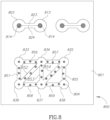
- Fig. 8 illustrates an exemplary embodiment in accordance with the disclosed subject matter, in which a unit-cell 800 comprises a pair of voids 803 and 813 interconnected through a void channel 823. Each of the voids 803 and 813 accommodates a particle content of interest (814), which is interconnected to its counterpart at the other void through a connective element 824.
- the unit-cell 800 may further comprise a plurality of networked voids 833-838 interconnected by void channels 851-859.
- the voids 833-838 and the void channels 851-859 accommodate a fluid 804 as a content of interest.
- a first example of advantageous property with which the present embodiment is concerned is the communication which the networked voids provide between remote locations in the matrix 801, which may be useful for the distribution of stresses and other external influences (e.g. heat) between remote parts of the matrix, through the flow of the contained fluid 804.
- Matrices of metamaterials having networked voids filled with substances of interest may be useful in applications that require to transfer information on deformation or strains from some parts to other parts of the material, e.g. for triggering an operation, detonating explosives and the like
- Metamaterials that distribute stresses over large internal volumes may be designed based on the disclosed networking principles
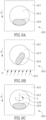
- Fig. 9A illustrates an exemplary embodiment in accordance with the disclosed subject matter, in which an embodiment of a unit-cell 900 having a magnetic particle 904 accommodated inside its void 903 as a content of interest.
- the magnetic particle 904 may be a magnet, or a ferromagnetic object capable of being magnetized through the provision of an external magnetic field.
- the metamaterial unit is produced by first introducing an unmagnetized magnetic element (e.g. sintered NdFeB based preparation) within each of at least part of its voids (903), and then introducing the metamaterial unit to a magnetic field for magnetizing the unmagnetized magnetic elements which are already accommodated in its voids (904), thereby converting them to constant magnets. Additionally, or alternatively, the magnetic particle 904 is introduced into the void 903 already having its magnetic property.
- an unmagnetized magnetic element e.g. sintered NdFeB based preparation
- the magnetic particle 904 rests on a bottom of the interaction phase of the void 903, under the influence of the gravitational force which pulls it in the direction indicated by the arrow g .
- the magnet may have, per each of its three dimensions different length and width, face area and shape.
- the magnet can be shaped as a rectangular cuboid, having 3 pairs of parallel faces. Its length width and height may differ one from another, as a matter of design, such that when laying with its height in a first predetermined orientation with respect to the metamaterial unit, it will span across the void with both its top and bottom ends in contact or nearly in contact with the matrix, thereby improving the resistance of the matrix against squashing in a direction parallel to the magnet's height.
- the magnet can be shaped, for example, as a rectangular cuboid, having 3 pairs of parallel faces. Its length width and height may differ as a matter of design, such that the area of a face from a first pair of faces may be significantly greater in comparison with the area of a face from a second pair. Metamaterials having such magnets in their voids, may serve in controlling the passage of light or other electromagnetic waves. By subjecting the metamaterial unit to a static magnetic field in a desired direction, the orientation of the magnets can be controlled to face the direction of incidence in a desired angle, e.g. with their maximal face area across the direction of propagation of the electromagnetic wave, or e.g.
- the wavelengths that their passage through the metamaterial is blocked (or attenuated) change with the change in angle of the magnetic particles within the metamaterial voids.
- the transparency of the metamaterial may be changed by applying a magnetic field thereby controlling the orientation of the magnetic particles and thus controlling what wavelengths will pass through.
- a magnetic field may be applied to the magnetic particles confined in the voids of the metamaterial for affecting passage of photons depending on their polarization direction.
- the magnetic field may be constant and no angular momentum may be creatred.
- a metamaterial unit according to these embodiments can be utilized e.g. as a polarizer for cameras.
- the particle By appropriately applying an alternating magnetic field, the particle will spin about its axis A as illustrated by Fig. 9C with an angular velocity ⁇ indicated by the curved arrow 934, thereby creating a metamaterial with internal micro angular momentum. This may improve the resistance of the piece of metamaterial against penetration due to impact, and against deformations due to temporal external stresses.
- Metamaterials provided with the above disclosed micro angular momentum may advantageously serve in armoring applications such as armor for vehicles or buildings.
- Activation of the micro angular momentum by applying the alternating magnetic field is a matter of choice. In some cases, the activation may be performed upon recognition of a potential threat.
- the activation of the alternating magnetic field can be automatic by an electronic system such as radar or camera specializing in recognition of threats, or manual, based on information that a projectile is approaching.
- Metamaterials provided with the above disclosed micro angular momentum arrangement may serve also in applications that require stabilized objects, and may serve as built-in micro gyros stabilizing the spatial orientation of the metamaterial unit in use by increasing its resistance against deflection. Furthermore, a metamaterial unit equipped with such built-in micro gyros, may serve in control systems as a substitution of conventional (macro) gyroscope, e.g. for signaling deviation from a base orientation.
- conventional (macro) gyroscope e.g. for signaling deviation from a base orientation.
- Fig. 10 illustrates an exemplary embodiment in accordance with the disclosed subject matter, in which a unit-cell 1000 comprises a magnetic particle 1004 accommodated inside a void 1003.
- the void 1003 is of a cylindrical shape
- the particle 1004 is also of a cylindrical shape, slightly smaller in diameter than the diameter of the void 1003, and significantly smaller in height than the height of the void 1004, thus can freely move up and down along the void.
- the matrix of the unit-cell 1000 comprises a micro metal wire embedded in the matrix 1001 to form a matrix coil 1009 around or near the void.
- the matrix itself may be a metal matrix, and as such certain portions thereof may function, and hence be considered, as the matrix coil 1009.
- the magnet 1004 By shaking the material in a direction parallel to the height of the void 1003, the magnet 1004 moves up and down through the void 1003, making the magnetic field of the magnet 1004 induce electrical signal in the coil (or Eddy currents in metal regions of the matrix which lack conventional coil characteristics).
- the electrical signal may be used e.g. for heating the metamaterial, for charging a battery, or for sensing the intensity of the shaking.
- the ends of the wire that constitutes the coil are electrically circuited by connective microwires, exemplified by dotted lines 1019 and 1029 which extend, respectively, from two opposite ends of the coil 1009, for delivering the generated signal to its location of utilization according to the intended use.
- the electrical signal may be used to power a heating element used for heating the matrix or portion thereof, or for heating a portion of the matrix that functions as heating element. Additionally, or alternatively, the electrical signal may be fed to a battery or a charging circuit. Additionally, or alternatively, the electrical signal may be provided to a meter for determining the average level of electrical signal induced by the magnetic particle during vibrations.
- a unit-cell 1000 comprises a magnetic particle 1004 accommodated inside its void 1003, and further comprises a micro metal wire embedded in the matrix 1001 to form a matrix coil 1009 around or near the void 1003
- the orientation of a plurality of unit-cells with respect to others may be such that the voids 1003 (unless they are spherically symmetric) and the coils 1009 are distributed throughout the metamaterial unit in three orthogonal orientations, respectively, such that a first portion of the unit-cells share a first spatial orientation, a second portion of the unit-cells share a second spatial orientation orthogonal to the first, and a third portion of the unit-cells share a third spatial orientation orthogonal to both others.
- Such distribution will provide for electrical signal in at least a portion of the coils of the metamaterial unit regardless of its direction of vibration.
- the direction of the vibration can be calculated and revealed.
- Fig. 11A illustrates an exemplary embodiment in accordance with the disclosed subject matter, in which a unit-cell 1100 accommodates at least one brittle particle 1104 inside a void 1103 as a content of interest.
- the brittle particle and the interaction phase of the void 1103 may have a predetermined mutual degree of elasticity that provides for maintaining the brittle particle 1104 intact when the metamaterial is exposed to external pressure or stress levels smaller than a predetermined threshold value. Once the level of the applied stress or pressure exceeds the threshold value, the bristle particle may break to pieces 1114, as illustrated by Fig. 11B , without damaging the matrix fraction 1101.
- the breaking of the brittle particles may result with a metamaterial that in the macroscopic scale level may demonstrate completely different mechanical properties once the applied pressure or stress levels have exceeded the threshold.
- the above disclosed embodiment of metamaterial is useful in various applications. As a non-limiting examples, the embodiment may be utilized as an irreversible stress, strain or acceleration threshold level sensor.
- Fig. 12A illustrates an exemplary embodiment in accordance with the disclosed subject matter, in which a unit-cell 1200 has a microstructure especially configured for self-interaction between different regions of the interaction phase of the void 1203.
- the microstructure itself may be a mechanism that can inter-lock due to deformations. This can be used to absorb energy (e.g. in applications such as car bumpers).
- the content of interest is an interlocking element 1204 that in various embodiments of the disclosed subject matter is diffused to the matrix fraction 1201 or otherwise attached thereto.
- the void 1203 comprises one or more mating elements 1202 having a contour configured in size and shape to mate with the interlocking element 1204 upon movement between said interlocking element 1204 and said one or more mating elements 1202.
- Application of a pressure beyond a predetermined threshold value on the matrix fraction 1201 may be configured to cause said relative movement to occur and thus interlock said interlocking element 1204 with said one or more mating elements 1202, thereby maintaining the matrix fraction 1201 in a deformed state as illustrated by Fig. 12B , which is configured to remain even upon removal of said pressure.
- the metamaterial can be configured to provide for a selective release of the interlocking upon exhibition of a property.
- the interlocking upon heating, the interlocking may be released thereby allowing the material to be returned to its original state.
- the interlocking element 1204 may be formed from a material having heat expansion at least one factor smaller than that of the one or more mating elements 1202 to provide for such heat-based release.
- the one or more mating elements 1202 may be provided in a bimetal form, and as a result they may bend upon heating and release the interlocked interlocking element 1204.
- a second broad aim of the present specification is to disclose a system for introducing content of interest into the voids of porous metamaterials, thereby providing for the production of metamaterials having a content of interest accommodated within at least one void within at least one unit-cell.
- a third broad aim of the present specification is to disclose a method for constructing a piece of porous metamaterial with content of interest accommodated within one or more of its voids.
- the method for manufacturing a metamaterial comprises: producing a matrix comprising a plurality of unit-cells, each of which comprising a void.
- the matrix is produced by performing, for each unit-cell:
- each unit-cell may be processed individually, such that a first cell is produced by performing all the above-mentioned steps, and then a next cell is produced by performing all the above-mentioned steps. Additionally, or alternatively, several unit-cells may be produced concurrently. For example, initial portions of a set of unit-cells may be produced, followed by the dispensing of content of interest into their respective voids, and followed by the closing of the external access to the respective voids and the completion of all the unit-cells in the set of unit-cells.
- the system comprises an automated machine configured to produce a matrix comprising a plurality of unit-cells, wherein each of the plurality of unit-cells comprises at least one void; and an automated dispenser configured to dispense content of interest into a respective void of at least a portion of the plurality of unit-cells, wherein said automated dispenser is configured to dispense the content of interest into the respective void after said automated machine creates at least a portion of the void, and before said automated machine closes the respective void.
- Fig. 13 illustrates an exemplary embodiment of an apparatus for manufacturing the new class of metamaterials.
- the apparatus constitutes a part in various embodiments of a system for producing metamaterials, the system comprises a 3D printer having a 3D printing head controllably movable by a shifting mechanism for constructing a matrix comprising a plurality of unit-cells, each of which comprising at least one void; the system being characterized by an automated dispenser mounted on said shifting mechanism, for controllably discharging predetermined doses of at least one type of a content of interest into voids under construction during build-up of the matrix by the printing head.
- the at least one type of the content of interest may be different than a material extruded by said 3D printing head. Additionally, or alternatively, the at least one type of the content of interest is configured not to diffuse (i.e. undiffuse) with the material, thereby producing solid matrix material using the 3D printing head, comprising in a void therein a detached content of interest.
- the apparatus may comprise an axis 1308 for controllably driving a 3D printer 1309 head throughout an orthogonal axes system, such as XYZ, XY, or the like.
- the apparatus may comprise the 3D printer head 1309 movable by the 3D printing mechanism.
- the apparatus may comprise a dispenser 1310, also movable by the 3D printing mechanism.
- the dispenser 1310 is located next to or behind the printer head 1309 and may be controlled by a computerized dispensing module of the printer to release predetermined doses of a content of interest into voids in the matrix under construction by the printer head 1309.
- the method comprises
- the printer head 1309 prints the matrix with the desired voids left open, the dispenser 1310 adds the content of interest, such as one or more structures, one or more substances, or the like, into the intended voids, and the printer head 1309 continues to print the matrix until the voids with the content of interest become closed.
- the voids may be closed and prevent external access thereto for material objects similar in size to (or greater from) that of the minimal material objects included in the content of interest.
- the void may not be hermetically sealed, such that air may enter and exit the closed void.
- the closed void may retain the magnetic particle and prevent it from being removed as long as the matrix fragment surrounding the void is intact.
- the matrix fraction surrounding the void may also isolate the void against insertion or intrusion of additional material similar in size to that of the content of interest, or larger.
- the closed void may be hermetically sealed.
- Hermetically sealed void may be a requirement when the content of interest is a fluid or when intrusion of external gaseous or liquid substance is undesired.
- one or more voids are sealed regardless of the matter state either of the content of interest or of potentially intruding ambient materials
- the system comprises a casting apparatus, a mold configured to produce one or more layers of matrix 1400 with partial voids 1413 on one side of the layer 1401 (as illustrated by Fig. 14B ) or voids 1413, 1416 on both sides of the layer, respectively, (as illustrated by Fig.
- an automatic dispenser 1310 for discharging into the partial voids 1413 a content of interest such as the structure/s 204 and/or the substance/s 304, and preferably also a welding or gluing unit configured for uniting a plurality of layers 1400, one on top of another such that the voids presented with the content of interest on a first layer become closed, or sealed, by a matching bottom of a next layer welded or glued from above.
- the welding or gluing together of layers may be achieved by an external welding or gluing machine and/or by manual welding or gluing process.
- This new class of metamaterials can be used to produce armors with advantageous penetration resistance per weight properties when compared to armors that lack the disclosed structures.
- This new class of metamaterial may be used to produce car bumpers, sensors embedded within products, embedded chargers, products having components, triggers, detonators, actuators, machines with improved-durability, products with embedded damage indicators, or the like.
- Gaseous content of interest may be introduced into the voids either in an environment cooled to below the liquidizing temperature of the gas, or in a pressure chamber filled with the intended gas.
- the content of interest introduced into the voids under construction is a non-magnetized composition intended to be magnetized between the structural completion of the metamaterial unit, and its actual use.
- the production method will include a step of magnetizing the content of interest within the voids by exposing the metamaterial chunk, piece or unit, to an external magnetic field according to an acceptable magnetization protocol.
Landscapes
- Engineering & Computer Science (AREA)
- General Engineering & Computer Science (AREA)
- Chemical & Material Sciences (AREA)
- Materials Engineering (AREA)
- Manufacturing & Machinery (AREA)
- Nanotechnology (AREA)
- Radar, Positioning & Navigation (AREA)
- Remote Sensing (AREA)
- Ceramic Engineering (AREA)
- Civil Engineering (AREA)
- Composite Materials (AREA)
- Structural Engineering (AREA)
- Crystallography & Structural Chemistry (AREA)
- Mechanical Engineering (AREA)
Claims (28)
- Metamaterialeinheit, umfassend:eine Matrix (101), die eine Vielzahl von Einheitszellen (100) umfasst;zumindest einen Hohlraum (103) innerhalb zumindest einer Einheitszelle aus der Vielzahl von Einheitszellen;einen Inhalt von Interesse (104), der innerhalb des zumindest einen Hohlraums eingeschlossen ist, wodurch eine jeweilige Einheitszelle mit einer beabsichtigten vorbestimmten Eigenschaft bereitgestellt wird, die mit dem Vorhandensein des Inhalts von Interesse innerhalb des zumindest einen Hohlraums verbunden ist;dadurch gekennzeichnet, dass der eingeschlossene Inhalt von Interesse (104) innerhalb des zumindest einen Hohlraums (103) frei bewegbar ist.
- Metamaterialeinheit nach Anspruch 1, wobei der Inhalt von Interesse ein Fluid (304) ist oder umfasst.
- Metamaterialeinheit nach Anspruch 2, wobei das Fluid nicht newtonisch ist.
- Panzerung, umfassend zumindest eine Metamaterialeinheit nach Anspruch 3.
- Metamaterialeinheit nach Anspruch 1, wobei der Inhalt von Interesse zumindest eine starre Struktur ist oder umfasst.
- Metamaterialeinheit nach Anspruch 5, wobei die zumindest eine starre Struktur magnetisch ist.
- Panzerung, umfassend zumindest eine Metamaterialeinheit nach Anspruch 6.
- Metamaterialeinheit nach Anspruch 5, wobei eine Sprödigkeit der zumindest einen starren Struktur größer als diejenige der zumindest einen Einheitszelle ist, sodass die starre Struktur bei Verformung der Matrix unter dem Einfluss von äußeren Kräften zerbrechlich ist, während die Matrix intakt bleibt.
- Metamaterialeinheit nach Anspruch 1, wobei der Inhalt von Interesse zumindest eine Art von Fluid und zumindest eine starre Struktur ist oder umfasst.
- Metamaterialeinheit nach Anspruch 1, wobei sich ein Inhalt von Interesse, der in zumindest einem Hohlraum eingeschlossen ist, in der Art von zumindest einem anderen Inhalt von Interesse unterscheidet, der in zumindest einem anderen Hohlraum eingeschlossen ist.
- Metamaterialeinheit nach Anspruch 1, wobei zumindest ein Hohlraum mit einer Verengung in einem Mittelabschnitt davon konturiert ist, sodass ein Durchgang oder Fluss eines eingeschlossenen Inhalds von Interesse von einer ersten Hohlraumregion in eine zweite Hohlraumregion durch die Verengung unter dem Einfluss einer gegebenen Kraft aufgrund der Verengung verzögert wird.
- Metamaterialeinheit nach Anspruch 1, wobei die Matrix einen eingebetteten Metalldraht umfasst, der gewickelt zumindest einen Abschnitt des zumindest einen Hohlraums umgibt.
- Metamaterialeinheit nach Anspruch 11, wobei der Inhalt von Interesse ein magnetisches Partikel ist, wodurch, wenn sich das magnetische Partikel in dem zumindest einen Hohlraum bewegt, ein elektromagnetisches Signal in dem eingebetteten Metalldraht erzeugt wird.
- Metamaterialeinheit nach Anspruch 1, wobei zumindest Teil der Matrixhohlräume durch eine Vielzahl von Hohlraumkanälen vernetzt sind, die in der Matrix gebildet ist, wodurch Durchgang des Inhalts von Interesse von einem Hohlraum zu einem anderen durch die Hohlraumkanäle ermöglicht wird.
- Metamaterialeinheit nach Anspruch 1, wobei sich ein Verbindungselement, das sich in seiner Struktur von derjenigen der Matrix unterscheidet, zwischen einem Paar benachbarter Hohlräume erstreckt und an jedem seiner entfernten Enden mit einem nichtfluidischen Inhalt von Interesse verbunden ist, der jeweils innerhalb jeden der Hohlräume eingeschlossen ist, sodass die zwei starren Inhalte von Interesse durch das Verbindungselement miteinander verbunden sind.
- Metamaterialeinheit nach Anspruch 1, wobei der Inhalt von Interesse ein Fluid und eine Substanz umfasst, wobei das Fluid und die Substanz einen Ruhezustand aufweisen, wobei das Metamaterial eine physikalische Eigenschaft aufweist, wenn das Fluid und die Substanz in dem Ruhezustand sind, wobei das Fluid und die Substanz einen Nicht-Ruhezustand aufweisen, wobei das Metamaterial eine zweite physikalische Eigenschaft aufweist, wenn das Fluid und die Substanz in dem Nicht-Ruhezustand sind.
- Metamaterialeinheit nach Anspruch 1, wobei der Inhalt von Interesse konfiguriert ist, um als Reaktion darauf, dass die zumindest eine Einheitszelle beschädigt wird, aus dem zumindest einen Hohlraum auszutreten.
- Metamaterialeinheit nach Anspruch 17, wobei der Inhalt von Interesse ein Farbstoff ist, der konfiguriert ist, um Färbung zu verursachen, die Schaden angibt, der an der Metamaterialeinheit verursacht wird.
- Metamaterialeinheit nach Anspruch 17, wobei der Inhalt von Interesse ein Schmiermittel ist, das konfiguriert ist, um auf die Metamaterialeinheit als Reaktion darauf aufgebracht zu werden, dass die Metamaterialeinheit beschädigt wird.
- Metamaterialeinheit nach Anspruch 1, wobei der Inhalt von Interesse einen flüssigen Zustand bei einem vorbestimmten Temperaturbereich aufweist, wobei der Inhalt von Interesse einen Gaszustand bei Temperaturen über dem vorbestimmten Temperaturbereich aufweist, wobei der Inhalt von Interesse konfiguriert ist, um Druck auf eine Oberfläche aufzubringen, die den zumindest einen Hohlraum umhüllt, wenn er in dem Gaszustand ist, wodurch die Metamaterialeinheit konfiguriert ist, um eine physikalische Eigenschaft davon zu ändern, wenn sie einer Temperatur über dem vorbestimmten Temperaturbereich ausgesetzt wird, wobei die Änderung der physikalischen Eigenschaft durch den Druck verursacht wird, der durch den Inhalt von Interesse auf die Oberfläche aufgebracht wird, die den zumindest einen Hohlraum umhüllt.
- System zum Produzieren des Metamaterials nach Anspruch 1, wobei das System Folgendes umfasst: eine automatisierte Maschine, die konfiguriert ist, um eine Matrix zu produzieren, die eine Vielzahl von Einheitszellen umfasst, wobei jede aus der Vielzahl von Einheitszellen zumindest einen Hohlraum umfasst; und
einen automatisierten Spender, der konfiguriert ist, um Inhalt von Interesse in einen jeweiligen Hohlraum von zumindest einem Abschnitt aus der Vielzahl von Einheitszellen abzugeben, wobei der automatisierte Spender konfiguriert ist, um den Inhalt von Interesse in den jeweiligen Hohlraum abzugeben, nachdem die automatisierte Maschine zumindest einen Abschnitt des jeweiligen Hohlraums erstellt, und bevor die automatisierte Maschine den jeweiligen Hohlraum schließt. - Verfahren zum Herstellen des Metamaterials nach Anspruch 1, wobei das Verfahren Folgendes umfasst:
Produzieren einer Matrix, die eine Vielzahl von Einheitszellen umfasst, wobei jede aus der Vielzahl von Einheitszellen zumindest einen Hohlraum umfasst, wobei das Herstellen für jede Einheitszelle aus der Vielzahl von Einheitszellen Folgendes umfasst: Produzieren eines Anfangsabschnittes der Einheitszelle, wobei der Anfangsabschnitt einen Anfangsabschnitt eines jeweiligen Hohlraums der Einheitszelle umfasst, wobei es in dem Anfangsabschnitt einen externen Zugriff auf den jeweiligen Hohlraum gibt; Abgeben eines Inhalts von Interesse in den Anfangsabschnitt des jeweiligen Hohlraums; und Abschließen der Einheitszelle, wobei das Abschließen das Schließen des jeweiligen Hohlraums und das Verhindern des externen Zugriffs darauf umfasst. - System zum Produzieren des Metamaterials nach Anspruch 1,
umfassend einen 3D-Drucker, der einen 3D-Druckkopf aufweist, der durch einen Verschiebemechanismus steuerbar bewegbar ist, um eine Matrix zu konstruieren, die eine Vielzahl von Einheitszellen umfasst, von denen jede zumindest einen Hohlraum umfasst; wobei das System durch einen automatisierten Spender gekennzeichnet ist, der an dem Verschiebemechanismus montiert ist, um während des Aufbaus der Matrix durch den Druckkopf vorbestimmte Dosen von zumindest einer Art eines Inhalts von Interesse in sich in Konstruktion befindliche Hohlräume steuerbar auszugeben. - System nach Anspruch 23, wobei sich die zumindest eine Art des Inhalts von Interesse von einem Material unterscheidet, das durch den 3D-Druckkopf extrudiert wird, wobei die zumindest eine Art des Inhalts von Interesse konfiguriert ist, um nicht mit dem Material zu diffundieren, wodurch festes Material unter Verwendung des 3D-Druckkopfs produziert wird, das darin abgelösten Inhalt von Interesse umfasst.
- Verfahren zum Herstellen des Metamaterials nach Anspruch 1, umfassend (i) Drucken einer Matrixschicht durch einen 3D-Drucker und Bereitstellen von Vertiefungen, die in Konstruktion befindliche Hohlräume darstellen, auf einer Oberfläche davon; (ii) Bewegen eines automatisierten Spenders neben die Vertiefungen und Ausgeben von zumindest einer Art eines Inhalts von Interesse in ausgewählte Vertiefungen; (iii) Fortsetzen des Druckens der Matrix, bis die Vertiefungen geschlossene Hohlräume werden; (iv) Wiederholen der Schritte (i) bis (iii), bis die Matrix eine beabsichtigte vorbestimmte Gestaltung erreicht.
- System zum Produzieren des Metamaterials nach Anspruch 1, umfassend eine Gießeinrichtung, eine Form, die konfiguriert ist, um eine oder mehrere Matrixschichten mit Vertiefungen zu produzieren, die in Konstruktion befindliche Hohlräume auf zumindest einer Oberfläche davon darstellen, einen automatisierten Spender, der neben den Vertiefungen bewegbar ist, um in die Vertiefungen zumindest eine Art von Inhalt von Interesse auszugeben.
- System nach Anspruch 26, ferner umfassend eine Schweiß- oder Klebeeinheit, die konfiguriert ist, um eine Vielzahl von Matrixschichten übereinander zu vereinen, sodass die Vertiefungen, die mit dem Inhalt von Interesse präsentiert werden, der durch den Spender auf einer ersten Schicht ausgegeben wird, durch einen passenden Boden einer nächsten Matrixschicht, die von oben geschweißt oder geklebt ist, geschlossen werden.
- Verfahren zum Herstellen des Metamaterials nach Anspruch 1, umfassend; (i) Bereitstellen einer Form zum gleichzeitigen Gießen von einer oder mehreren Matrixschichten; (ii) Gießen einer Vielzahl von Matrixschichten, die Vertiefungen aufweisen, die in Konstruktion befindliche Hohlräume darstellen, entweder auf beiden Seiten einer Schicht oder auf einer Seite davon; (iii) Bereitstellen eines automatisierten Spenders zum Einführen von zumindest einer Art eines Inhalts von Interesse in die Vertiefungen; (iv) Vereinen einer Vielzahl von Schichten übereinander, sodass die Vertiefungen, die mit dem Inhalt von Interesse auf einer ersten Schicht präsentiert werden, durch einen passenden Boden einer nächsten Schicht, die von oben geschweißt oder geklebt ist, geschlossen werden.
Applications Claiming Priority (2)
| Application Number | Priority Date | Filing Date | Title |
|---|---|---|---|
| US201662385037P | 2016-09-08 | 2016-09-08 | |
| PCT/IL2017/051000 WO2018047169A1 (en) | 2016-09-08 | 2017-09-06 | Void-based metamaterials |
Publications (4)
| Publication Number | Publication Date |
|---|---|
| EP3510345A1 EP3510345A1 (de) | 2019-07-17 |
| EP3510345A4 EP3510345A4 (de) | 2020-07-29 |
| EP3510345B1 true EP3510345B1 (de) | 2023-06-07 |
| EP3510345C0 EP3510345C0 (de) | 2023-06-07 |
Family
ID=61561383
Family Applications (1)
| Application Number | Title | Priority Date | Filing Date |
|---|---|---|---|
| EP17848282.4A Active EP3510345B1 (de) | 2016-09-08 | 2017-09-06 | Hohlraumbasierte metamaterialien |
Country Status (5)
| Country | Link |
|---|---|
| US (1) | US11506470B2 (de) |
| EP (1) | EP3510345B1 (de) |
| CN (1) | CN109844444A (de) |
| IL (1) | IL261183B (de) |
| WO (1) | WO2018047169A1 (de) |
Families Citing this family (6)
| Publication number | Priority date | Publication date | Assignee | Title |
|---|---|---|---|---|
| WO2020210395A1 (en) * | 2019-04-09 | 2020-10-15 | Hyperdamping Inc. | Materials having tunable properties, and related systems and method |
| CN110145029A (zh) * | 2019-06-18 | 2019-08-20 | 国网河北省电力有限公司经济技术研究院 | 非牛顿液体填充的抗冲击节点、抗冲击建筑物及构筑方法 |
| GR1010011B (el) * | 2020-06-05 | 2021-05-25 | Ανδρεας Παντελεημωνος Ζηνας | Προσθετο συστημα τριων επιπεδων για την ενισχυση της δυναμικης θωρακισης αρματων μαχης με χρηση συμπιεσμενης σιδηρομαγνητικης σκονης και ηλεκτρομαγνητικης ενισχυσης |
| CN113335209B (zh) * | 2021-06-25 | 2022-09-06 | 中国人民解放军63653部队 | 一种用于警用车辆的防护装甲及警用车辆 |
| CN114420078B (zh) * | 2022-01-17 | 2024-06-18 | 中国人民解放军国防科技大学 | 一种开关式超材料元胞及其声学超结构 |
| IT202400000597A1 (it) * | 2024-01-15 | 2025-07-15 | Salvatore COGONI | Barriera di protezione |
Family Cites Families (13)
| Publication number | Priority date | Publication date | Assignee | Title |
|---|---|---|---|---|
| CA2157458A1 (en) * | 1994-09-02 | 1996-03-03 | Hector J. Massariol | Structure useful to improve the antiballistic capacity of packets and the resistance to impact in installations and vehicles in general |
| DE102006053047B4 (de) | 2006-11-10 | 2008-12-18 | Krauss-Maffei Wegmann Gmbh & Co. Kg | Verbundpanzerplatte |
| US8490213B2 (en) * | 2008-09-26 | 2013-07-23 | Murray Lane Neal | Impact and sharp implement resistant protective armor |
| DE112010005258T5 (de) | 2010-02-11 | 2013-05-02 | National University Of Singapore | Energieableitender Verbundstoff |
| US8534417B2 (en) * | 2010-05-14 | 2013-09-17 | The Boeing Company | Apparatus and method for providing protective gear employing shock penetration resistant material |
| DE102010034257B4 (de) * | 2010-08-13 | 2013-09-12 | Geke Schutztechnik Gmbh | Reaktive Schutzanordnung |
| WO2013036890A2 (en) | 2011-09-09 | 2013-03-14 | Purdue Research Foundation | Dynamic load-absorbing materials and articles |
| US9464001B2 (en) * | 2013-06-18 | 2016-10-11 | California Institute Of Technology | Engineered aggregates for metamaterials |
| WO2015109359A1 (en) * | 2014-01-24 | 2015-07-30 | Rmit University | Structured porous metamaterial |
| EP2961157A1 (de) | 2014-06-23 | 2015-12-30 | Thomson Licensing | Nachrichteneinführungsverfahren bei der Wiedergabe von Videoinhalt über eine Anzeigevorrichtung, Leseverfahren sowie zugehörige Vorrichtungen und Programme |
| GB2531815B (en) * | 2014-11-03 | 2019-07-17 | Inclusive Designs Ltd | Radiation absorbing/emitting materials |
| CN104553143B (zh) * | 2015-01-22 | 2016-11-09 | 中国人民解放军装甲兵工程学院 | 一种基于超材料的防爆复合结构 |
| CN205058637U (zh) * | 2015-10-30 | 2016-03-02 | 兰红波 | 一种单喷头多材料多尺度3d打印装置 |
-
2017
- 2017-09-06 EP EP17848282.4A patent/EP3510345B1/de active Active
- 2017-09-06 WO PCT/IL2017/051000 patent/WO2018047169A1/en not_active Ceased
- 2017-09-06 US US15/999,742 patent/US11506470B2/en active Active
- 2017-09-06 CN CN201780061984.6A patent/CN109844444A/zh active Pending
-
2018
- 2018-08-15 IL IL261183A patent/IL261183B/en active IP Right Grant
Also Published As
| Publication number | Publication date |
|---|---|
| EP3510345A1 (de) | 2019-07-17 |
| EP3510345A4 (de) | 2020-07-29 |
| WO2018047169A1 (en) | 2018-03-15 |
| EP3510345C0 (de) | 2023-06-07 |
| US20190368841A1 (en) | 2019-12-05 |
| US11506470B2 (en) | 2022-11-22 |
| IL261183B (en) | 2021-06-30 |
| CN109844444A (zh) | 2019-06-04 |
Similar Documents
| Publication | Publication Date | Title |
|---|---|---|
| EP3510345B1 (de) | Hohlraumbasierte metamaterialien | |
| Nicollet et al. | Fast circuit breaker based on integration of Al/CuO nanothermites | |
| Pandey et al. | Self‐Destructing Secured Microchips by On‐Chip Triggered Energetic and Corrosive Attacks for Transient Electronics | |
| US20150155534A1 (en) | Impact resistant battery enclosure systems | |
| Zhou et al. | Investigation on Impact Initiation Characteristics of Fluoropolymer‐matrix Reactive Materials | |
| US20110139060A1 (en) | Method and apparatus for a drop indicator | |
| Shan et al. | Shock-induced hotspot formation and chemical reaction initiation in PETN containing a spherical void | |
| WO2009145827A1 (en) | Reactive armor system and method | |
| Yang et al. | Fabrication and characterization of a multidirectional-sensitive contact-enhanced inertial microswitch with a electrophoretic flexible composite fixed electrode | |
| Bishop et al. | Elasticity-driven nanoscale texturing in complex electronic materials | |
| Xu et al. | Micromachined threshold inertial switches: a review | |
| Feng et al. | Design, test and analysis of a threshold-value judging mechanism in silicon-based MEMS safety and arming device | |
| Wittel et al. | Breakup of shells under explosion and impact | |
| Chou et al. | DEM simulation of oblique shocks in gravity-driven granular flows with wedge obstacles | |
| Asphaug | Signatures of hit and run collisions | |
| O'Neil | Plasmas with a single sign of charge (an overview) | |
| Rothstein et al. | Mother moose: Generating extra dimensions from simple groups at large N | |
| O’Mahony et al. | Reliability assessment of MEMS switches for space applications: laboratory and launch testing | |
| WO2013159124A1 (en) | Impact energy management system | |
| Tweeddale | The nature of materials: Materials technology | |
| Morales et al. | Effects of growth-direction electric and magnetic fields on excitons in Ga As-Ga 1− x Al x As coupled double quantum wells | |
| Zhang et al. | Investigation of the Rayleigh–Taylor instability in charged fluids | |
| Mittaz et al. | Warm-hot intergalactic medium emission and the cluster soft excess: a model comparison | |
| Shen et al. | Fabrication of micro-ignition sequence based on electronics safety and arming unit | |
| Li et al. | Dual-environment-driven MEMS pyrotechnic actuators |
Legal Events
| Date | Code | Title | Description |
|---|---|---|---|
| STAA | Information on the status of an ep patent application or granted ep patent |
Free format text: STATUS: THE INTERNATIONAL PUBLICATION HAS BEEN MADE |
|
| PUAI | Public reference made under article 153(3) epc to a published international application that has entered the european phase |
Free format text: ORIGINAL CODE: 0009012 |
|
| STAA | Information on the status of an ep patent application or granted ep patent |
Free format text: STATUS: REQUEST FOR EXAMINATION WAS MADE |
|
| 17P | Request for examination filed |
Effective date: 20190408 |
|
| AK | Designated contracting states |
Kind code of ref document: A1 Designated state(s): AL AT BE BG CH CY CZ DE DK EE ES FI FR GB GR HR HU IE IS IT LI LT LU LV MC MK MT NL NO PL PT RO RS SE SI SK SM TR |
|
| AX | Request for extension of the european patent |
Extension state: BA ME |
|
| RIN1 | Information on inventor provided before grant (corrected) |
Inventor name: KLEPACH, JACOB Inventor name: KLEPACH, DORON |
|
| DAV | Request for validation of the european patent (deleted) | ||
| DAX | Request for extension of the european patent (deleted) | ||
| RIC1 | Information provided on ipc code assigned before grant |
Ipc: B33Y 30/00 20150101ALI20200225BHEP Ipc: B32B 5/00 20060101ALI20200225BHEP Ipc: F41H 5/06 20060101ALI20200225BHEP Ipc: F41H 13/00 20060101AFI20200225BHEP |
|
| A4 | Supplementary search report drawn up and despatched |
Effective date: 20200625 |
|
| RIC1 | Information provided on ipc code assigned before grant |
Ipc: F41H 5/06 20060101ALI20200619BHEP Ipc: B33Y 30/00 20150101ALI20200619BHEP Ipc: F41H 13/00 20060101AFI20200619BHEP Ipc: B32B 5/00 20060101ALI20200619BHEP |
|
| GRAP | Despatch of communication of intention to grant a patent |
Free format text: ORIGINAL CODE: EPIDOSNIGR1 |
|
| STAA | Information on the status of an ep patent application or granted ep patent |
Free format text: STATUS: GRANT OF PATENT IS INTENDED |
|
| INTG | Intention to grant announced |
Effective date: 20220920 |
|
| GRAS | Grant fee paid |
Free format text: ORIGINAL CODE: EPIDOSNIGR3 |
|
| GRAA | (expected) grant |
Free format text: ORIGINAL CODE: 0009210 |
|
| STAA | Information on the status of an ep patent application or granted ep patent |
Free format text: STATUS: THE PATENT HAS BEEN GRANTED |
|
| AK | Designated contracting states |
Kind code of ref document: B1 Designated state(s): AL AT BE BG CH CY CZ DE DK EE ES FI FR GB GR HR HU IE IS IT LI LT LU LV MC MK MT NL NO PL PT RO RS SE SI SK SM TR |
|
| REG | Reference to a national code |
Ref country code: GB Ref legal event code: FG4D |
|
| REG | Reference to a national code |
Ref country code: CH Ref legal event code: EP Ref country code: AT Ref legal event code: REF Ref document number: 1576309 Country of ref document: AT Kind code of ref document: T Effective date: 20230615 |
|
| REG | Reference to a national code |
Ref country code: DE Ref legal event code: R096 Ref document number: 602017069918 Country of ref document: DE |
|
| U01 | Request for unitary effect filed |
Effective date: 20230707 |
|
| U07 | Unitary effect registered |
Designated state(s): AT BE BG DE DK EE FI FR IT LT LU LV MT NL PT SE SI Effective date: 20230718 |
|
| REG | Reference to a national code |
Ref country code: LT Ref legal event code: MG9D |
|
| U20 | Renewal fee for the european patent with unitary effect paid |
Year of fee payment: 7 Effective date: 20230830 |
|
| PG25 | Lapsed in a contracting state [announced via postgrant information from national office to epo] |
Ref country code: NO Free format text: LAPSE BECAUSE OF FAILURE TO SUBMIT A TRANSLATION OF THE DESCRIPTION OR TO PAY THE FEE WITHIN THE PRESCRIBED TIME-LIMIT Effective date: 20230907 Ref country code: ES Free format text: LAPSE BECAUSE OF FAILURE TO SUBMIT A TRANSLATION OF THE DESCRIPTION OR TO PAY THE FEE WITHIN THE PRESCRIBED TIME-LIMIT Effective date: 20230607 |
|
| PG25 | Lapsed in a contracting state [announced via postgrant information from national office to epo] |
Ref country code: RS Free format text: LAPSE BECAUSE OF FAILURE TO SUBMIT A TRANSLATION OF THE DESCRIPTION OR TO PAY THE FEE WITHIN THE PRESCRIBED TIME-LIMIT Effective date: 20230607 Ref country code: HR Free format text: LAPSE BECAUSE OF FAILURE TO SUBMIT A TRANSLATION OF THE DESCRIPTION OR TO PAY THE FEE WITHIN THE PRESCRIBED TIME-LIMIT Effective date: 20230607 Ref country code: GR Free format text: LAPSE BECAUSE OF FAILURE TO SUBMIT A TRANSLATION OF THE DESCRIPTION OR TO PAY THE FEE WITHIN THE PRESCRIBED TIME-LIMIT Effective date: 20230908 |
|
| PG25 | Lapsed in a contracting state [announced via postgrant information from national office to epo] |
Ref country code: SK Free format text: LAPSE BECAUSE OF FAILURE TO SUBMIT A TRANSLATION OF THE DESCRIPTION OR TO PAY THE FEE WITHIN THE PRESCRIBED TIME-LIMIT Effective date: 20230607 |
|
| PG25 | Lapsed in a contracting state [announced via postgrant information from national office to epo] |
Ref country code: IS Free format text: LAPSE BECAUSE OF FAILURE TO SUBMIT A TRANSLATION OF THE DESCRIPTION OR TO PAY THE FEE WITHIN THE PRESCRIBED TIME-LIMIT Effective date: 20231007 |
|
| PG25 | Lapsed in a contracting state [announced via postgrant information from national office to epo] |
Ref country code: SM Free format text: LAPSE BECAUSE OF FAILURE TO SUBMIT A TRANSLATION OF THE DESCRIPTION OR TO PAY THE FEE WITHIN THE PRESCRIBED TIME-LIMIT Effective date: 20230607 Ref country code: SK Free format text: LAPSE BECAUSE OF FAILURE TO SUBMIT A TRANSLATION OF THE DESCRIPTION OR TO PAY THE FEE WITHIN THE PRESCRIBED TIME-LIMIT Effective date: 20230607 Ref country code: RO Free format text: LAPSE BECAUSE OF FAILURE TO SUBMIT A TRANSLATION OF THE DESCRIPTION OR TO PAY THE FEE WITHIN THE PRESCRIBED TIME-LIMIT Effective date: 20230607 Ref country code: IS Free format text: LAPSE BECAUSE OF FAILURE TO SUBMIT A TRANSLATION OF THE DESCRIPTION OR TO PAY THE FEE WITHIN THE PRESCRIBED TIME-LIMIT Effective date: 20231007 Ref country code: CZ Free format text: LAPSE BECAUSE OF FAILURE TO SUBMIT A TRANSLATION OF THE DESCRIPTION OR TO PAY THE FEE WITHIN THE PRESCRIBED TIME-LIMIT Effective date: 20230607 |
|
| PG25 | Lapsed in a contracting state [announced via postgrant information from national office to epo] |
Ref country code: PL Free format text: LAPSE BECAUSE OF FAILURE TO SUBMIT A TRANSLATION OF THE DESCRIPTION OR TO PAY THE FEE WITHIN THE PRESCRIBED TIME-LIMIT Effective date: 20230607 |
|
| REG | Reference to a national code |
Ref country code: DE Ref legal event code: R097 Ref document number: 602017069918 Country of ref document: DE |
|
| PLBE | No opposition filed within time limit |
Free format text: ORIGINAL CODE: 0009261 |
|
| STAA | Information on the status of an ep patent application or granted ep patent |
Free format text: STATUS: NO OPPOSITION FILED WITHIN TIME LIMIT |
|
| REG | Reference to a national code |
Ref country code: CH Ref legal event code: PL |
|
| 26N | No opposition filed |
Effective date: 20240308 |
|
| PG25 | Lapsed in a contracting state [announced via postgrant information from national office to epo] |
Ref country code: MC Free format text: LAPSE BECAUSE OF FAILURE TO SUBMIT A TRANSLATION OF THE DESCRIPTION OR TO PAY THE FEE WITHIN THE PRESCRIBED TIME-LIMIT Effective date: 20230607 |
|
| REG | Reference to a national code |
Ref country code: IE Ref legal event code: MM4A |
|
| PG25 | Lapsed in a contracting state [announced via postgrant information from national office to epo] |
Ref country code: IE Free format text: LAPSE BECAUSE OF NON-PAYMENT OF DUE FEES Effective date: 20230906 |
|
| PG25 | Lapsed in a contracting state [announced via postgrant information from national office to epo] |
Ref country code: CH Free format text: LAPSE BECAUSE OF NON-PAYMENT OF DUE FEES Effective date: 20230930 |
|
| PG25 | Lapsed in a contracting state [announced via postgrant information from national office to epo] |
Ref country code: IE Free format text: LAPSE BECAUSE OF NON-PAYMENT OF DUE FEES Effective date: 20230906 Ref country code: CH Free format text: LAPSE BECAUSE OF NON-PAYMENT OF DUE FEES Effective date: 20230930 |
|
| PGFP | Annual fee paid to national office [announced via postgrant information from national office to epo] |
Ref country code: GB Payment date: 20240919 Year of fee payment: 8 |
|
| U20 | Renewal fee for the european patent with unitary effect paid |
Year of fee payment: 8 Effective date: 20240925 |
|
| PG25 | Lapsed in a contracting state [announced via postgrant information from national office to epo] |
Ref country code: CY Free format text: LAPSE BECAUSE OF FAILURE TO SUBMIT A TRANSLATION OF THE DESCRIPTION OR TO PAY THE FEE WITHIN THE PRESCRIBED TIME-LIMIT; INVALID AB INITIO Effective date: 20170906 |
|
| PG25 | Lapsed in a contracting state [announced via postgrant information from national office to epo] |
Ref country code: HU Free format text: LAPSE BECAUSE OF FAILURE TO SUBMIT A TRANSLATION OF THE DESCRIPTION OR TO PAY THE FEE WITHIN THE PRESCRIBED TIME-LIMIT; INVALID AB INITIO Effective date: 20170906 |
|
| PG25 | Lapsed in a contracting state [announced via postgrant information from national office to epo] |
Ref country code: TR Free format text: LAPSE BECAUSE OF FAILURE TO SUBMIT A TRANSLATION OF THE DESCRIPTION OR TO PAY THE FEE WITHIN THE PRESCRIBED TIME-LIMIT Effective date: 20230607 |