EP3510865A2 - Cryoconservation de cellules et de tissus biologiques - Google Patents
Cryoconservation de cellules et de tissus biologiques Download PDFInfo
- Publication number
- EP3510865A2 EP3510865A2 EP18207157.1A EP18207157A EP3510865A2 EP 3510865 A2 EP3510865 A2 EP 3510865A2 EP 18207157 A EP18207157 A EP 18207157A EP 3510865 A2 EP3510865 A2 EP 3510865A2
- Authority
- EP
- European Patent Office
- Prior art keywords
- cell
- holder
- cell holder
- cryopreservation
- securing
- Prior art date
- Legal status (The legal status is an assumption and is not a legal conclusion. Google has not performed a legal analysis and makes no representation as to the accuracy of the status listed.)
- Withdrawn
Links
Images


Classifications
-
- A—HUMAN NECESSITIES
- A01—AGRICULTURE; FORESTRY; ANIMAL HUSBANDRY; HUNTING; TRAPPING; FISHING
- A01N—PRESERVATION OF BODIES OF HUMANS OR ANIMALS OR PLANTS OR PARTS THEREOF; BIOCIDES, e.g. AS DISINFECTANTS, AS PESTICIDES OR AS HERBICIDES; PEST REPELLANTS OR ATTRACTANTS; PLANT GROWTH REGULATORS
- A01N1/00—Preservation of bodies of humans or animals, or parts thereof
- A01N1/10—Preservation of living parts
-
- A—HUMAN NECESSITIES
- A01—AGRICULTURE; FORESTRY; ANIMAL HUSBANDRY; HUNTING; TRAPPING; FISHING
- A01N—PRESERVATION OF BODIES OF HUMANS OR ANIMALS OR PLANTS OR PARTS THEREOF; BIOCIDES, e.g. AS DISINFECTANTS, AS PESTICIDES OR AS HERBICIDES; PEST REPELLANTS OR ATTRACTANTS; PLANT GROWTH REGULATORS
- A01N1/00—Preservation of bodies of humans or animals, or parts thereof
- A01N1/10—Preservation of living parts
- A01N1/14—Mechanical aspects of preservation; Apparatus or containers therefor
-
- A—HUMAN NECESSITIES
- A01—AGRICULTURE; FORESTRY; ANIMAL HUSBANDRY; HUNTING; TRAPPING; FISHING
- A01N—PRESERVATION OF BODIES OF HUMANS OR ANIMALS OR PLANTS OR PARTS THEREOF; BIOCIDES, e.g. AS DISINFECTANTS, AS PESTICIDES OR AS HERBICIDES; PEST REPELLANTS OR ATTRACTANTS; PLANT GROWTH REGULATORS
- A01N1/00—Preservation of bodies of humans or animals, or parts thereof
- A01N1/10—Preservation of living parts
- A01N1/14—Mechanical aspects of preservation; Apparatus or containers therefor
- A01N1/146—Non-refrigerated containers specially adapted for transporting or storing living parts whilst preserving
- A01N1/147—Carriers for immersion in cryogenic fluid for slow freezing or vitrification
-
- B—PERFORMING OPERATIONS; TRANSPORTING
- B01—PHYSICAL OR CHEMICAL PROCESSES OR APPARATUS IN GENERAL
- B01L—CHEMICAL OR PHYSICAL LABORATORY APPARATUS FOR GENERAL USE
- B01L3/00—Containers or dishes for laboratory use, e.g. laboratory glassware; Droppers
- B01L3/50—Containers for the purpose of retaining a material to be analysed, e.g. test tubes
- B01L3/508—Rigid containers without fluid transport within
-
- B—PERFORMING OPERATIONS; TRANSPORTING
- B01—PHYSICAL OR CHEMICAL PROCESSES OR APPARATUS IN GENERAL
- B01L—CHEMICAL OR PHYSICAL LABORATORY APPARATUS FOR GENERAL USE
- B01L7/00—Heating or cooling apparatus; Heat insulating devices
- B01L7/50—Cryostats
-
- B—PERFORMING OPERATIONS; TRANSPORTING
- B01—PHYSICAL OR CHEMICAL PROCESSES OR APPARATUS IN GENERAL
- B01L—CHEMICAL OR PHYSICAL LABORATORY APPARATUS FOR GENERAL USE
- B01L2300/00—Additional constructional details
- B01L2300/06—Auxiliary integrated devices, integrated components
- B01L2300/0681—Filter
-
- B—PERFORMING OPERATIONS; TRANSPORTING
- B01—PHYSICAL OR CHEMICAL PROCESSES OR APPARATUS IN GENERAL
- B01L—CHEMICAL OR PHYSICAL LABORATORY APPARATUS FOR GENERAL USE
- B01L2300/00—Additional constructional details
- B01L2300/18—Means for temperature control
- B01L2300/1805—Conductive heating, heat from thermostatted solids is conducted to receptacles, e.g. heating plates, blocks
-
- B—PERFORMING OPERATIONS; TRANSPORTING
- B01—PHYSICAL OR CHEMICAL PROCESSES OR APPARATUS IN GENERAL
- B01L—CHEMICAL OR PHYSICAL LABORATORY APPARATUS FOR GENERAL USE
- B01L2300/00—Additional constructional details
- B01L2300/18—Means for temperature control
- B01L2300/1838—Means for temperature control using fluid heat transfer medium
- B01L2300/1844—Means for temperature control using fluid heat transfer medium using fans
-
- G—PHYSICS
- G01—MEASURING; TESTING
- G01N—INVESTIGATING OR ANALYSING MATERIALS BY DETERMINING THEIR CHEMICAL OR PHYSICAL PROPERTIES
- G01N1/00—Sampling; Preparing specimens for investigation
- G01N1/28—Preparing specimens for investigation including physical details of (bio-)chemical methods covered elsewhere, e.g. G01N33/50, C12Q
- G01N1/42—Low-temperature sample treatment, e.g. cryofixation
Definitions
- the present invention relates generally to a method and apparatus for the cryopreservation of biological cells and tissues.
- the invention has been developed primarily for use in the cryopreservation of human oocytes, embryos and stem cells by vitrification as applied during In-Vitro Fertilisation (IVF) procedures. It will be appreciated, however, that the invention is not limited to this particular method of cryopreservation, and may also be used in connection with cryopreservation of human and non-human oocytes, embryos and stem cells or other biological tissues and cells.
- IVF In-Vitro Fertilisation
- embryo cryopreservation involves the extraction, fertilization, freezing and storing of embryos. As required, the embryos can be thawed and transferred to the uterus for normal development.
- Oocyte cryopreservation involves the extraction, freezing and storing of the female eggs, or oocytes in an unfertilized state. As required, the eggs can be thawed, fertilized, and transferred to the uterus as embryos. The technique of freezing oocytes rather than embryos is considered desirable for medical, personal and ethical reasons.
- cryopreserving biological cells and tissues there are two known methods for cryopreserving biological cells and tissues. In order to succeed, all cryopreservation strategies, must avoid ice crystal formation, solution effects, and osmotic shock.
- the traditional method is to slowly cool the cell/s and its surrounding solution to the storage temperature and purposely initiate the formation of ice crystals remote from the cell/s.
- a more recent method known as vitrification transforms the solution into a glass-like amorphous solid that is free from any crystalline structure, following extremely rapid cooling.
- cryoprotectants In both methods, it is known to use additional chemicals to avoid cell damage. These chemicals are known as cryoprotectants and may be divided into two categories, permeating and nonpermeating.
- Permeating cryoprotectants are small molecules that readily permeate the membranes of cells. They form hydrogen bonds with water molecules and prevent ice crystallization. Some examples are ethylene glycol (EG), dimethyl sulphoxide (DMSO) and glycerol. At low concentrations in water, they lower the freezing temperature of the resulting mixture. However, at high enough concentrations, they inhibit the formation of the characteristic ice crystal and lead to the development of a solid, glasslike, or vitrified state in which water is solidified, but not crystalline or expanded. The toxicity at this concentration is quite high and therefore the cell can be exposed to this solution either for a very short period of time (as with vitrification techniques) or at very low temperatures, at which the metabolic rate of the cell is very low.
- nonpermeating cryoprotectants In contrast to the permeating cryoprotectants, nonpermeating cryoprotectants remain extracellular. Some examples are the disaccharides trehalose and sucrose. They act by drawing free water from within the cell, thus dehydrating the intracellular space. As a result, when they are used in combination with a permeating cryoprotectant, the net concentration of the permeating cryoprotectant can be increased in the intracellular space. This further assists the permeating cryoprotectant in preventing ice-crystal formation.
- permeating cryoprotectants may be added at a high concentration while the cell's temperature is controlled at a predetermined level above freezing.
- the toxicity of this high concentration of permeating cryoprotectant is substantial, the cell/s cannot be kept at these temperatures for long. Instead, a very short time is allowed for equilibration, after which the embryos/oocytes are plunged directly into liquid nitrogen. This extremely rapid rate of cooling not only minimizes the negative effects of the cryoprotectant on the cell, but also further protects against ice-crystal formation by encouraging vitrification.
- a typical vitrification process involves exposing the cell to three or more vitrification solutions.
- the vitrification solutions are added to respective wells in a multi-well culture dish.
- the dish and solutions are warmed to predetermined temperature selected depending on the type of cell or tissue.
- the cell is transferred to a first solution in a first well and washed by carefully moving the cell through the solution with a cell pipetting device.
- the washing process is repeated in the second, third and fourth wells for various predetermined periods of time, until the cell is ready for cryopreservation.
- the cell is then drawn up with a predetermined measure of vitrification solution with a pipettor.
- a droplet containing the cell to be vitrified is wiped onto the hook of a fiber plug.
- the fiber plug may be transferred directly into liquid nitrogen or on to the surface of a vitrification block that has been pre-cooled with liquid nitrogen.
- the fiber plug is placed onto the surface of the block for a minimum period during which time the cell and fluid become vitrified.
- the fiber plug is then inserted into a pre-chilled straw or other device located in a slot in the vitrification block before being transferred to long-term cold storage in either liquid nitrogen or liquid nitrogen vapour.
- the invention provides a method for the cryopreservation of an organic cell, said method including the steps of:
- biological cell is intended to apply to any small biological cell or groups of cells whether bound or unbound. It is intended to include single cells such as oocytes and stem cells, small multi-cell structures such as embryos and small tissue samples.
- said cell is cooled at a cooling rate sufficient to promote vitrification of the cell and surrounding treatment solution.
- said step of applying a treatment solution includes retaining said cell in said cell holder and allowing said solution to flow over said cell.
- the cell holder includes filtration means allowing fluid to pass through the filtration means whilst retaining the cell.
- the cell holder includes sidewalls thereby forming a cup-shaped holding vessel and defining an open inlet.
- said step of washing said cell includes retaining said cell in said cell holder and allowing said solution to flow over said cell.
- the retaining means includes a filter.
- the cell holder includes sidewalls thereby forming a cup-shaped holding vessel defining an open top inlet.
- the step of washing said cell includes sequentially showering said cell with first and second treatment solutions.
- said step of washing said cell includes sequentially showering said cell with a plurality of treatment solutions.
- the method includes the step of transferring the cell holder to a cooling station prior to cooling said cell.
- a plurality of said cell holders are secured in an array and washed simultaneously at the treatment station.
- said cell holder is secured in a cell holder frame in the form of a tray.
- said tray is secured to said treatment station.
- said tray includes a plurality of engagement formations for engaging said cell holder thereby securing a plurality of corresponding cell holders to the frame in an array.
- the invention provides a cell holder for use in the cryopreservation of an organic cell said holder including retaining means to retain the cell whilst allowing fluid to pass from the holder.
- said retaining means includes a filter.
- the cell holder includes sidewalls thereby forming a cup-shaped a holding vessel defining an open top inlet.
- said sidewalls include filtration means.
- said filter includes a mesh, membrane, fibrous material or a perforated section.
- the cell holder includes an elongate handle for manipulating the cell holder.
- the invention provides an organic cell cryopreservation frame for securing a cell holder, said cell holder according to the second aspect, said frame having: a cell holder receiving portion for receiving said cell holder:
- the frame includes an array of cell holder receiving portions and corresponding engagement formations for receiving a plurality of cell holders.
- the invention provides an organic cell cryopreservation treatment station for treating an organic cell secured in an organic cell holder, said cell holder according to the second aspect, said treatment station including:
- said securing means includes a frame for securing said cell holder in a predetermined orientation, said frame having:
- the invention provides an organic cell cryopreservation treatment station according to the fourth aspect, wherein said treatment station is a washing station for washing said cell, said washing station including:
- the invention provides an organic cell cryopreservation treatment station according to the fourth aspect, wherein said treatment station is a cooling station for cooling said cell, said cooling station including cooling means for cooling said cells to a cryopreservation temperature for cryopreservation.
- the invention provides an organic cell cryopreservation apparatus for use in the cryopreservation of an organic cell said apparatus including:
- said apparatus further including a cooling station for cooling of said cells to a cryopreservation temperature.
- said cooling station includes liquid nitrogen cooled block.
- the invention provides for a method and apparatus for the cryopreservation of oocyte, embryos and other cell types.
- oocyte cells For the sake of simplicity, the preferred embodiment will be described with reference to oocyte cells however; the invention is not limited to the cryopreservation of oocytes and is intended to be equally applicable to other biological cells and tissues including individual cells such as stem cells, groups of cells such as embryos and tissue samples.
- the method involves placing an oocyte cell in a cell holder, securing the cell holder in a treatment station, applying a treatment solution to said cell by washing the cell with the solution, and rapidly cooling the cell holder and cell to a predetermined cryopreservation temperature for cryopreservation of the cell.
- the cell is cooled at a high rate sufficient to permit solidification of the cell and any surrounding treatment solution to occur. More preferably, solidification includes the substantial vitrification of the cell and surrounding fluid.
- the cell is then maintained at or below a predetermined storage temperature for storage.
- the invention includes multiple components designed to function together, enabling simple, safe and hygienic handling of the delicate cell.
- the method and apparatus also lends itself to multiplexing so that an individual technician may process more than one cell holder and oocyte cell simultaneously.
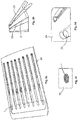
- the cell holder 1 includes retaining means to retain the organic cell whilst allowing for fluid to pass over the cell and through the cell holder.
- the retaining means includes a filter 2 to provide a physical barrier to the cell whilst allowing passage of a treatment solution.
- the filter can be seen in Fig. 1c which provides a close up view of the holder.
- the holder also includes sidewalls 3, defining a 'cup-shaped' holding vessel 4 having an open top inlet 5.
- the filter 2 forms the bottom surface of the vessel.
- the filter may form any portion of the vessel including the bottom and/or sidewalls.
- the filter 2 may be a mesh, membrane, fibrous material, perforated material or otherwise porous material which allows passage of liquids but which retains the oocyte within the vessel.
- a further embodiment of vessel having converging sidewalls 6 is shown in detailed view Fig 1d .
- the converging sidewalls reduce the likelihood of the cell being washed out of the vessel through the open top.
- an embryo 7 is also shown.
- a further embodiment of the vessel holder is shown in Fig. 1e .
- the sidewalls include cut outs.
- the vessel may include a removable cover.
- the cover may include a further filter material over a fluid inlet to allow passage of fluid into the cell holder whilst preventing the cell from escaping.
- the filter on the cover may be of any filter material as previously described.
- All of the embodiments shown in the Figures include an elongate handle 8 attached to the cell holder 1 to enable it and oocyte cell to be manually moved without direct contact from the operator.
- the handle also provides a convenient labelling area 9 for labelling and identification.
- the vessel is designed to fit into an elongate tubular sheath or straw 10 as shown in Fig. If.
- the straw 10 is open at one end 11 and sealed at the other 12.
- a circumferential ridge 13 on the handle of the cell holder 1 engages and seals with the inner bore 14 of the tubular straw 10 thereby sealing the oocyte within the straw once the freezing process is complete.
- the handle is selectively detachable.
- the handle is a separate tool designed to selectively engage and grip the cell holder so it can be moved as required.
- the tool may be in the form of a pincer type tool or include a simple fixed yoke or engagement formation to generally encircle and engage the cell holder.
- the cell holder may include an engagement portion, formation or tab designed to releasably engage with the handle or tool.
- the cell holder includes multiple holding vessels 4 joined together to provide for treatment and cryopreservation of multiple cells.
- the vessels otherwise similar to any one or more of those described above, may be positioned at a predetermined spacing from one another in order to engage with other components, as will be appreciated from the description below.
- each the cell holder may include linking formations to allow for multiple cell holders to be linked together, in effect forming a multiple vessel cell holder. This way cell holders can be quickly and easily joined together in the lab to provide for as many holding vessels as required.
- the linking formations are configured to position the cell holders in a predetermined spacing.
- the invention further includes a securing frame, for securing the cell holder.
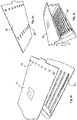
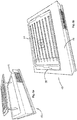
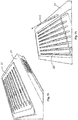
- the frame is shown in Fig. 2a and in this embodiment is in the form of a tray 20.
- the tray includes an engagement formation 21 and a cell holder-receiving portion 22, each shown in detail Figs. 2b and 2d , respectively.
- the engagement formation 21 includes a shallow elongate locating groove for receiving and positively locating the handle 8 of the cell holder 1. In this way, the complementary shape and configuration of the cell holder handle 8 and the corresponding groove on the frame, bias the cell holder into a particular orientation and position with respect to the frame 20.
- the cell holder In position, as shown in the detailed upper view Fig 2b and 2d and lower view Fig. 2c , the cell holder is positioned within or over the receiving portion 22 of the frame 20.
- the receiving portion 22 includes an aperture in the tray so that the cell holder is accessible from above and the bottom of the cell holder is clear or protruding from the tray bottom.
- the tray 20 may include a plurality of grooves for receiving a plurality of cell holders in an array.
- the tray illustrated in the figures has grooves for eight cell holders. However, it will be appreciated that a tray may accommodate more or fewer than eight cell holders.
- the engagement formation 21 on the tray 20 may include projections which engage the outer sidewall of the cell holder.
- the cell holder includes corresponding engagement formations to engage the engagement formations on the tray.
- the invention also includes securing means for locking the cell holders into the tray.
- the cell holder and tray may include snap locking securing formations 23 to individually lock each cell holder directly to the tray. Such securing formation can be seen with reference to Fig. 2b and engage the cell holder handle 3.
- the securing means also includes a tray cover 24 to jointly hold the cell holders within the locating grooves 21 on the tray 20 thereby preventing their extraction and any relative movement within the tray.
- the cover 24 includes releasable locking means for locking to corresponding releasable locking means on the tray thereby securing the cover to the tray.
- the cover also includes a funnel formation and aperture 25. The funnel formation and aperture are configured such that when the cover is locked to the tray, the funnel and aperture are aligned with the open top of the cell holder. The function of the funnel will be detailed later.
- the cover may also include location formations 26 to engage and secure the cell holder handle. These location formations can be seen in the underside view of the cover in Fig. 3a .
- a plurality of cell holders may be safely and easily moved by an individual technician or by a mechanical manipulating device, automated robot or the like.
- the tray can be used as a guide for aligning the array of cell holders for treatment at a treatment station.
- the invention includes at least one treatment station to which the tray can be selectively docked and various operations performed.
- the station is configured for receiving the tray and includes docking formations for docking with corresponding docking formations on the tray.
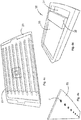
- a first treatment station is a washing station 30 shown in Fig. 4c .
- the washing station includes a drain 31 for capturing waste fluid and temperature control means 32. At this station the cells are held at a predetermined temperature by the temperature control means and washed with treatment solution.
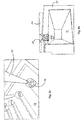
- a second treatment station is a cooling station 40, shown in Fig. 6a and 6b where the cells and cell holders are cooled to below a cryopreservation temperature. Specific cooling properties of the cooling station will depend on the intended method of cryopreservation whether by slower rate freezing or rapid vitrification.
- the cooling station 41 includes a cooling block or similar device held at a very low temperature by liquid nitrogen.
- the treatment and cooling stations are and distinct locations and the tray transferred between.
- the tray is held at a fixed point and the stations are moved to align with the tray as required.
- an oocyte to be cryopreserved is placed into the holding vessel 4 of a cell holder 1 as shown in Fig 1a .
- the cell holder 1 itself is generally pre-labelled with identification details regarding the cell and/or donor/s.
- the holder 1 is then placed into securing tray 20 so that the cell holder handle lies in the corresponding groove and the holder vessel is located in or above the receiving aperture 22.
- Fig 2c shows the base of the cell holder protrudes below the bottom surface of the tray.
- Fig 2b shows the cell holder handle engaged in the locating groove and secured with snap locking securing formations 23.
- eight such cell holders are placed in the tray in an array of respective locating grooves.
- the tray cover With the cell holders in place, the tray cover is aligned with and locked onto the tray. In position, the funnel formations and apertures on the tray cover align with the open top of the cell holding vessels.
- the tray is then transferred to the first treatment station, the washing station 30.
- Corresponding docking formations on the tray and washing station position the tray so that the vessel holders located are above the drain, adjacent the heating block 32. This can be seen in Fig. 5b where the cover 24 and funnel are positioned above the open top of the holding vessel, which is over the drain 31 of the washing station.
- fluid dispensing pipette 50 is positioned above the funnel formation to dispense a predetermined measure of treatment solution into each funnel aperture.
- the fluid flows down through the funnel, out the funnel aperture and into the holder vessel passing over and washing the oocyte cell. Excess fluid drains from the vessel through the filter 2 and passes into the drain.
- an additional filtration membrane may be placed over the open top inlet 5 to retain the cell within the vessel.
- the drain 31 is held at a negative pressure.
- the treatment station also include vacuum means to apply a gentle negative pressure to the drain.
- a vacuum pump and corresponding control electronics are positioned within a cavity 33 of the washing station.
- the treatment fluid is held at a predetermined temperature in the pipette and the heating block 32 maintains the temperature of the cells at a predetermined level.
- the cell may be treated with a sequence of different treatment solutions as required.
- the same pipette may be used for each solution or if the solutions are incompatible, a different pipette may be used for each solution.
- the last treatment solution to be applied is a vitrification fluid, which is vitrified along with the cell during the cooling and solidification.
- a multi-headed pipette 50 as shown in Fig 5a is used to dispense the treatment solution to each cell holder at the same time.
- the system also lends itself to automation or semi-automation. Since the position of the cell holders is dictated by the position of the tray, the entire washing procedure can be multiplexed and automated.
- the tray is removed from the washing station and transferred without delay to the cooling station 40.
- the cooling station includes docking formations that engage corresponding docking formation on the tray 20.
- the cell holder vessels are aligned with the cooling station vitrification block 41.
- the vitrification block is cooled with liquid nitrogen such that cooling occurs within moments of contact at a rate sufficient to transform the cell and any surrounding vitrification fluid into a vitrified state.
- the block may be immersed in or contain the liquid nitrogen so that it is at a similar temperature to the liquid nitrogen.
- the cell holders While vitrification of the oocytes or cells occurs very quickly, the cell holders are kept in position in the cooling station for a predetermined period to ensure the cells are cooled to a suitably low temperature.
- the tray cover With the tray mounted to the cooling station, Fig. 7a , the tray cover is removed and each cell holder containing a vitrified oocyte is removed from the tray, Fig. 7b , and inserted into a pre-cooled straw 10, Fig. 8b , or other suitable holding device.
- the oocyte is securely contained, Fig. 8c , and can be placed into long-term cold storage.
- the system allows the preparation of the embryo/oocyte for cryopreservation to be carefully controlled.
- the proposed system allows for the preparation and vitrification of multiple embryos/oocytes simultaneously.
- the process allows for the treatment process to be uniformly controlled removing variances of the washing and vitrification process.
- the invention provides for less manipulation of the cells because they remain generally stationary in the cell holder through out the treatment and vitrification process. In these and other respects, the invention represents a practical and commercially significant improvement over the prior art.
Landscapes
- Health & Medical Sciences (AREA)
- Life Sciences & Earth Sciences (AREA)
- General Health & Medical Sciences (AREA)
- Chemical & Material Sciences (AREA)
- Environmental Sciences (AREA)
- Engineering & Computer Science (AREA)
- Dentistry (AREA)
- Wood Science & Technology (AREA)
- Zoology (AREA)
- Chemical Kinetics & Catalysis (AREA)
- Clinical Laboratory Science (AREA)
- Analytical Chemistry (AREA)
- Hematology (AREA)
- Micro-Organisms Or Cultivation Processes Thereof (AREA)
- Apparatus Associated With Microorganisms And Enzymes (AREA)
- Agricultural Chemicals And Associated Chemicals (AREA)
Applications Claiming Priority (3)
| Application Number | Priority Date | Filing Date | Title |
|---|---|---|---|
| AU2008900890A AU2008900890A0 (en) | 2008-02-25 | Cryopreservation of biological cells and tissues | |
| EP09714696.3A EP2257155B1 (fr) | 2008-02-25 | 2009-02-25 | Cryoconservation de cellules et de tissus biologiques |
| PCT/AU2009/000212 WO2009105813A1 (fr) | 2008-02-25 | 2009-02-25 | Cryoconservation de cellules et de tissus biologiques |
Related Parent Applications (1)
| Application Number | Title | Priority Date | Filing Date |
|---|---|---|---|
| EP09714696.3A Division EP2257155B1 (fr) | 2008-02-25 | 2009-02-25 | Cryoconservation de cellules et de tissus biologiques |
Publications (2)
| Publication Number | Publication Date |
|---|---|
| EP3510865A2 true EP3510865A2 (fr) | 2019-07-17 |
| EP3510865A3 EP3510865A3 (fr) | 2020-01-15 |
Family
ID=41015431
Family Applications (2)
| Application Number | Title | Priority Date | Filing Date |
|---|---|---|---|
| EP09714696.3A Active EP2257155B1 (fr) | 2008-02-25 | 2009-02-25 | Cryoconservation de cellules et de tissus biologiques |
| EP18207157.1A Withdrawn EP3510865A3 (fr) | 2008-02-25 | 2009-02-25 | Cryoconservation de cellules et de tissus biologiques |
Family Applications Before (1)
| Application Number | Title | Priority Date | Filing Date |
|---|---|---|---|
| EP09714696.3A Active EP2257155B1 (fr) | 2008-02-25 | 2009-02-25 | Cryoconservation de cellules et de tissus biologiques |
Country Status (10)
| Country | Link |
|---|---|
| US (1) | US8859283B2 (fr) |
| EP (2) | EP2257155B1 (fr) |
| AU (1) | AU2009219096A1 (fr) |
| DK (1) | DK2257155T3 (fr) |
| ES (1) | ES2706623T3 (fr) |
| HU (1) | HUE041510T2 (fr) |
| PL (1) | PL2257155T3 (fr) |
| PT (1) | PT2257155T (fr) |
| TR (1) | TR201820845T4 (fr) |
| WO (1) | WO2009105813A1 (fr) |
Families Citing this family (28)
| Publication number | Priority date | Publication date | Assignee | Title |
|---|---|---|---|---|
| US9700038B2 (en) | 2009-02-25 | 2017-07-11 | Genea Limited | Cryopreservation of biological cells and tissues |
| CN103179852B (zh) | 2010-05-28 | 2015-04-08 | 格尼亚有限公司 | 改良的显微操作和储存装置以及方法 |
| US9228925B2 (en) | 2011-08-04 | 2016-01-05 | University Of Kansas | Automated vitrification device |
| KR101934031B1 (ko) | 2011-10-03 | 2019-01-07 | 가부시키가이샤 기타자토 코포레이숀 | 생체세포 동결 보존 도구 |
| JP5798633B2 (ja) | 2011-10-04 | 2015-10-21 | 株式会社北里バイオファルマ | 細胞凍結保存用具 |
| JP5798634B2 (ja) | 2011-10-05 | 2015-10-21 | 株式会社北里バイオファルマ | 生体細胞凍結保存用具 |
| WO2013098825A1 (fr) * | 2012-01-01 | 2013-07-04 | A.A. Cash Technology Ltd | Dispositif de cryoconservation pour la vitrification et son procédé d'utilisation |
| US20150313211A1 (en) * | 2012-12-05 | 2015-11-05 | Neobios Pte. Ltd. | A Method of Vitrification |
| AU2014204411B2 (en) | 2013-01-07 | 2017-11-02 | Genea Ip Holdings Pty Limited | Method, system and apparatus for improved micromanipulation and storage |
| US20160015025A1 (en) | 2013-03-15 | 2016-01-21 | Regents Of The University Of Minnesota | Cryopreservative compostions and methods |
| CN103190393B (zh) | 2013-04-09 | 2015-05-13 | 上海安久生物科技有限公司 | 一种生物样本玻璃化冷冻载体及其用途 |
| JP6022602B2 (ja) * | 2013-10-29 | 2016-11-09 | 学校法人北里研究所 | 細胞または組織のガラス化凍結保存用治具 |
| WO2016001933A1 (fr) * | 2014-07-03 | 2016-01-07 | Fertilesafe Ltd | Dispositif pour la préparation d'un échantillon biologique pour vitrification, et procédé d'utilisation de celui-ci |
| US10531657B2 (en) | 2015-12-07 | 2020-01-14 | Coopersurgical, Inc. | Low temperature specimen carriers and related methods |
| US11122796B1 (en) | 2016-02-19 | 2021-09-21 | Regents Of The University Of Minnesota | Cryoprotection compositions and methods |
| US11311008B2 (en) | 2016-04-19 | 2022-04-26 | Regents Of The University Of Minnesota. | Cryopreservation compositions and methods involving nanowarming |
| US9858424B1 (en) | 2017-01-05 | 2018-01-02 | Votiro Cybersec Ltd. | System and method for protecting systems from active content |
| CN106489915A (zh) * | 2016-12-28 | 2017-03-15 | 中信湘雅生殖与遗传专科医院有限公司 | 冷冻载体机构及包括该冷冻载体机构的冷冻载体单元 |
| EP4233542A3 (fr) * | 2017-04-21 | 2023-11-22 | FUJIFILM Irvine Scientific, Inc. | Dispositif de vitrification et procédé de préparation d'échantillon |
| US11116206B2 (en) | 2018-10-01 | 2021-09-14 | Cook Medical Technologies Llc | Cryocontainer |
| JP7082039B2 (ja) * | 2018-12-18 | 2022-06-07 | 三菱製紙株式会社 | 細胞又は組織の凍結保存用治具 |
| WO2020176498A1 (fr) * | 2019-02-28 | 2020-09-03 | Regents Of The University Of Minnesota | Système à haut débit pour la production et la vitrification de biomatériaux dans des gouttelettes de cryoprotecteur |
| CN113016776A (zh) * | 2019-12-24 | 2021-06-25 | 上海明悦医疗科技有限公司 | 载体、抽真空装置与组织冻存系统 |
| USD917715S1 (en) | 2020-01-13 | 2021-04-27 | Lee L. Nemeth | Basket end tip for vitrification stick |
| US10827745B1 (en) | 2020-01-13 | 2020-11-10 | Lee L. Nemeth | Dual stage vitrification stick |
| US10834920B1 (en) * | 2020-01-13 | 2020-11-17 | Lee L. Nemeth | Vitrification stick with basket end tip |
| KR102487654B1 (ko) * | 2020-12-02 | 2023-01-12 | 대한민국 | 돼지 난자의 유리화 동결 보존용 도구 및 이를 이용한 돼지 난자의 유리화 동결 보존방법 |
| JP2023111282A (ja) * | 2022-01-31 | 2023-08-10 | 株式会社島津製作所 | 自動凍結処理装置、自動凍結処理方法、および、凍結用容器 |
Family Cites Families (10)
| Publication number | Priority date | Publication date | Assignee | Title |
|---|---|---|---|---|
| US5261870A (en) * | 1988-10-26 | 1993-11-16 | Biopore, Inc. | Separation barrier with plugged pores |
| US5026342A (en) * | 1988-10-26 | 1991-06-25 | Biopore, Inc. | Noningestible separation barrier with plugged pores |
| EP1018867B1 (fr) | 1997-08-20 | 2003-05-21 | Biopore, Inc. | Procede et appareil d'extraction d'un cryoprotecteur |
| US5894733A (en) | 1998-01-07 | 1999-04-20 | Brodner; John R. | Cryogenic specimen container and labeled sleeve combination and method of using same |
| DE69913186T3 (de) * | 1998-10-14 | 2012-08-09 | Katrina T. Forest | Verfahren zur verglasung einer biologischen probe |
| US6176089B1 (en) * | 1998-10-27 | 2001-01-23 | Modex Th{acute over (e)}rapeutics | Methods and compositions for cryopreservation of cells and tissues |
| US6893613B2 (en) * | 2002-01-25 | 2005-05-17 | Bristol-Myers Squibb Company | Parallel chemistry reactor with interchangeable vessel carrying inserts |
| JP4355186B2 (ja) | 2003-04-15 | 2009-10-28 | 株式会社北里サプライ | 卵凍結保存用具 |
| DE10328869A1 (de) | 2003-06-26 | 2005-01-20 | Fraunhofer-Gesellschaft zur Förderung der angewandten Forschung e.V. | Probenaufnahmeeinrichtung und Verfahren zu deren Herstellung |
| US7910067B2 (en) * | 2005-04-19 | 2011-03-22 | Gen-Probe Incorporated | Sample tube holder |
-
2009
- 2009-02-25 ES ES09714696T patent/ES2706623T3/es active Active
- 2009-02-25 AU AU2009219096A patent/AU2009219096A1/en not_active Abandoned
- 2009-02-25 PL PL09714696T patent/PL2257155T3/pl unknown
- 2009-02-25 HU HUE09714696A patent/HUE041510T2/hu unknown
- 2009-02-25 TR TR2018/20845T patent/TR201820845T4/tr unknown
- 2009-02-25 US US12/919,071 patent/US8859283B2/en active Active
- 2009-02-25 EP EP09714696.3A patent/EP2257155B1/fr active Active
- 2009-02-25 DK DK09714696.3T patent/DK2257155T3/en active
- 2009-02-25 WO PCT/AU2009/000212 patent/WO2009105813A1/fr not_active Ceased
- 2009-02-25 PT PT09714696T patent/PT2257155T/pt unknown
- 2009-02-25 EP EP18207157.1A patent/EP3510865A3/fr not_active Withdrawn
Non-Patent Citations (1)
| Title |
|---|
| None |
Also Published As
| Publication number | Publication date |
|---|---|
| US8859283B2 (en) | 2014-10-14 |
| HUE041510T2 (hu) | 2019-05-28 |
| PT2257155T (pt) | 2019-02-08 |
| DK2257155T3 (en) | 2019-01-21 |
| TR201820845T4 (tr) | 2019-01-21 |
| PL2257155T3 (pl) | 2019-05-31 |
| WO2009105813A1 (fr) | 2009-09-03 |
| EP2257155A4 (fr) | 2015-11-11 |
| ES2706623T3 (es) | 2019-03-29 |
| EP3510865A3 (fr) | 2020-01-15 |
| EP2257155A1 (fr) | 2010-12-08 |
| AU2009219096A1 (en) | 2009-09-03 |
| US20100317108A1 (en) | 2010-12-16 |
| EP2257155B1 (fr) | 2018-11-21 |
Similar Documents
| Publication | Publication Date | Title |
|---|---|---|
| US8859283B2 (en) | Cryopreservation of biological cells and tissues | |
| US9700038B2 (en) | Cryopreservation of biological cells and tissues | |
| US11033022B2 (en) | Micromanipulation and storage apparatus and methods | |
| JP2023123549A (ja) | サンプルを調製するためのガラス化デバイス及び方法 | |
| US20100297600A1 (en) | Flooding dish and method for changing media in the dish in the preparation of mammalian specimen culture and for cryo-preservation, freezing, vitrification and the thawing and warming of such specimens | |
| US12185717B2 (en) | System for rapid cooling and warming of cells and other biological material | |
| US20150313211A1 (en) | A Method of Vitrification | |
| CA2799823A1 (fr) | Dispositif de manipulation de materiaux biologiques dans un procede de cryoconservation et utilisation d'un tel dispositif | |
| WO2014106286A1 (fr) | Procédé, système et appareil destinés à une micromanipulation et à un stockage améliorés | |
| EP2739135A2 (fr) | Dispositif automatisé de vitrification | |
| JP4242227B2 (ja) | 哺乳動物の胚または卵子の凍結保存容器 | |
| US20220151223A1 (en) | Cell cryopreservation pretreatment operation plate | |
| HK40010880A (en) | Cryopreservation of biological cells and tissues | |
| CN113439739A (zh) | 冷冻保存作业辅助治具 | |
| Nagy et al. | The human embryo: Vitrification Vitrification | |
| HK1186627B (en) | Improved micromanipulation and storage apparatus and methods | |
| Gosden | Techniques for slow cryopreservation of embryos | |
| Talwar | Intracytoplasm Sperm 11 Injection and Troubleshooting | |
| JP2007312745A (ja) | マイクロマニピュレーション方法 |
Legal Events
| Date | Code | Title | Description |
|---|---|---|---|
| PUAI | Public reference made under article 153(3) epc to a published international application that has entered the european phase |
Free format text: ORIGINAL CODE: 0009012 |
|
| STAA | Information on the status of an ep patent application or granted ep patent |
Free format text: STATUS: THE APPLICATION HAS BEEN PUBLISHED |
|
| AC | Divisional application: reference to earlier application |
Ref document number: 2257155 Country of ref document: EP Kind code of ref document: P |
|
| AK | Designated contracting states |
Kind code of ref document: A2 Designated state(s): AT BE BG CH CY CZ DE DK EE ES FI FR GB GR HR HU IE IS IT LI LT LU LV MC MK MT NL NO PL PT RO SE SI SK TR |
|
| PUAL | Search report despatched |
Free format text: ORIGINAL CODE: 0009013 |
|
| AK | Designated contracting states |
Kind code of ref document: A3 Designated state(s): AT BE BG CH CY CZ DE DK EE ES FI FR GB GR HR HU IE IS IT LI LT LU LV MC MK MT NL NO PL PT RO SE SI SK TR |
|
| RIC1 | Information provided on ipc code assigned before grant |
Ipc: B01L 7/00 20060101ALI20191206BHEP Ipc: A01N 3/00 20060101ALI20191206BHEP Ipc: A01N 1/00 20060101AFI20191206BHEP Ipc: B01L 3/00 20060101ALI20191206BHEP Ipc: A01N 1/02 20060101ALI20191206BHEP Ipc: G01N 1/42 20060101ALI20191206BHEP |
|
| REG | Reference to a national code |
Ref country code: HK Ref legal event code: DE Ref document number: 40010880 Country of ref document: HK |
|
| STAA | Information on the status of an ep patent application or granted ep patent |
Free format text: STATUS: REQUEST FOR EXAMINATION WAS MADE |
|
| 17P | Request for examination filed |
Effective date: 20200713 |
|
| RBV | Designated contracting states (corrected) |
Designated state(s): AT BE BG CH CY CZ DE DK EE ES FI FR GB GR HR HU IE IS IT LI LT LU LV MC MK MT NL NO PL PT RO SE SI SK TR |
|
| RIC1 | Information provided on ipc code assigned before grant |
Ipc: B01L 3/00 20060101ALI20220929BHEP Ipc: B01L 7/00 20060101ALI20220929BHEP Ipc: G01N 1/42 20060101ALI20220929BHEP Ipc: A01N 1/02 20060101ALI20220929BHEP Ipc: A01N 3/00 20060101ALI20220929BHEP Ipc: A01N 1/00 20060101AFI20220929BHEP |
|
| GRAP | Despatch of communication of intention to grant a patent |
Free format text: ORIGINAL CODE: EPIDOSNIGR1 |
|
| STAA | Information on the status of an ep patent application or granted ep patent |
Free format text: STATUS: GRANT OF PATENT IS INTENDED |
|
| INTG | Intention to grant announced |
Effective date: 20221117 |
|
| STAA | Information on the status of an ep patent application or granted ep patent |
Free format text: STATUS: THE APPLICATION IS DEEMED TO BE WITHDRAWN |
|
| 18D | Application deemed to be withdrawn |
Effective date: 20230328 |