EP3510872A1 - Procédé de transfert d'une denrée alimentaire coulable et dispositif de mise en oeuvre dudit procédé - Google Patents
Procédé de transfert d'une denrée alimentaire coulable et dispositif de mise en oeuvre dudit procédé Download PDFInfo
- Publication number
- EP3510872A1 EP3510872A1 EP19000012.5A EP19000012A EP3510872A1 EP 3510872 A1 EP3510872 A1 EP 3510872A1 EP 19000012 A EP19000012 A EP 19000012A EP 3510872 A1 EP3510872 A1 EP 3510872A1
- Authority
- EP
- European Patent Office
- Prior art keywords
- food
- foodstuff
- printing
- printing forme
- chocolate
- Prior art date
- Legal status (The legal status is an assumption and is not a legal conclusion. Google has not performed a legal analysis and makes no representation as to the accuracy of the status listed.)
- Withdrawn
Links
- 235000013305 food Nutrition 0.000 title claims abstract description 98
- 238000000034 method Methods 0.000 title claims abstract description 39
- 238000007639 printing Methods 0.000 claims abstract description 80
- 244000299461 Theobroma cacao Species 0.000 claims description 53
- 235000019219 chocolate Nutrition 0.000 claims description 44
- 229920001296 polysiloxane Polymers 0.000 claims description 32
- 238000001816 cooling Methods 0.000 claims description 15
- 235000009470 Theobroma cacao Nutrition 0.000 claims description 9
- 238000000465 moulding Methods 0.000 claims description 9
- 238000010438 heat treatment Methods 0.000 claims description 8
- 239000000203 mixture Substances 0.000 claims description 8
- 235000013311 vegetables Nutrition 0.000 claims description 7
- 238000007493 shaping process Methods 0.000 claims description 6
- 239000002131 composite material Substances 0.000 claims description 5
- 102000002322 Egg Proteins Human genes 0.000 claims description 4
- 108010000912 Egg Proteins Proteins 0.000 claims description 4
- QCVGEOXPDFCNHA-UHFFFAOYSA-N 5,5-dimethyl-2,4-dioxo-1,3-oxazolidine-3-carboxamide Chemical compound CC1(C)OC(=O)N(C(N)=O)C1=O QCVGEOXPDFCNHA-UHFFFAOYSA-N 0.000 claims description 2
- 235000014103 egg white Nutrition 0.000 claims description 2
- 210000000969 egg white Anatomy 0.000 claims description 2
- 210000002969 egg yolk Anatomy 0.000 claims description 2
- 235000013345 egg yolk Nutrition 0.000 claims description 2
- 235000013601 eggs Nutrition 0.000 claims description 2
- 238000005266 casting Methods 0.000 description 13
- 230000008569 process Effects 0.000 description 13
- 239000013078 crystal Substances 0.000 description 10
- 238000002844 melting Methods 0.000 description 10
- 230000008018 melting Effects 0.000 description 9
- 238000005496 tempering Methods 0.000 description 9
- 238000002425 crystallisation Methods 0.000 description 8
- 230000008025 crystallization Effects 0.000 description 8
- 235000019197 fats Nutrition 0.000 description 8
- 102100040428 Chitobiosyldiphosphodolichol beta-mannosyltransferase Human genes 0.000 description 7
- 239000000463 material Substances 0.000 description 7
- 239000000758 substrate Substances 0.000 description 6
- 230000033001 locomotion Effects 0.000 description 5
- 240000004713 Pisum sativum Species 0.000 description 4
- 235000010582 Pisum sativum Nutrition 0.000 description 4
- 229940110456 cocoa butter Drugs 0.000 description 4
- 235000019868 cocoa butter Nutrition 0.000 description 4
- 238000012545 processing Methods 0.000 description 4
- 235000019222 white chocolate Nutrition 0.000 description 4
- 244000061456 Solanum tuberosum Species 0.000 description 3
- 235000002595 Solanum tuberosum Nutrition 0.000 description 3
- 235000015243 ice cream Nutrition 0.000 description 3
- 239000007788 liquid Substances 0.000 description 3
- 235000012015 potatoes Nutrition 0.000 description 3
- 230000005855 radiation Effects 0.000 description 3
- 239000007787 solid Substances 0.000 description 3
- 235000013162 Cocos nucifera Nutrition 0.000 description 2
- 244000060011 Cocos nucifera Species 0.000 description 2
- 230000008901 benefit Effects 0.000 description 2
- 235000014121 butter Nutrition 0.000 description 2
- 235000019221 dark chocolate Nutrition 0.000 description 2
- 238000004090 dissolution Methods 0.000 description 2
- 230000000694 effects Effects 0.000 description 2
- 238000004519 manufacturing process Methods 0.000 description 2
- 239000002184 metal Substances 0.000 description 2
- 238000012986 modification Methods 0.000 description 2
- 230000004048 modification Effects 0.000 description 2
- 238000003825 pressing Methods 0.000 description 2
- 238000003756 stirring Methods 0.000 description 2
- 238000012546 transfer Methods 0.000 description 2
- 230000001052 transient effect Effects 0.000 description 2
- 235000019220 whole milk chocolate Nutrition 0.000 description 2
- MIDXCONKKJTLDX-UHFFFAOYSA-N 3,5-dimethylcyclopentane-1,2-dione Chemical compound CC1CC(C)C(=O)C1=O MIDXCONKKJTLDX-UHFFFAOYSA-N 0.000 description 1
- 238000010146 3D printing Methods 0.000 description 1
- 244000144725 Amygdalus communis Species 0.000 description 1
- 235000011437 Amygdalus communis Nutrition 0.000 description 1
- 244000000626 Daucus carota Species 0.000 description 1
- 235000002767 Daucus carota Nutrition 0.000 description 1
- 241001295925 Gegenes Species 0.000 description 1
- 102000014171 Milk Proteins Human genes 0.000 description 1
- 108010011756 Milk Proteins Proteins 0.000 description 1
- 235000003447 Pistacia vera Nutrition 0.000 description 1
- 240000006711 Pistacia vera Species 0.000 description 1
- 230000009471 action Effects 0.000 description 1
- 239000000654 additive Substances 0.000 description 1
- 238000004220 aggregation Methods 0.000 description 1
- 230000002776 aggregation Effects 0.000 description 1
- 235000020224 almond Nutrition 0.000 description 1
- 238000005452 bending Methods 0.000 description 1
- 230000005540 biological transmission Effects 0.000 description 1
- 235000013736 caramel Nutrition 0.000 description 1
- 239000000969 carrier Substances 0.000 description 1
- 238000006243 chemical reaction Methods 0.000 description 1
- 238000004140 cleaning Methods 0.000 description 1
- 239000011248 coating agent Substances 0.000 description 1
- 239000008199 coating composition Substances 0.000 description 1
- 238000000576 coating method Methods 0.000 description 1
- 230000001427 coherent effect Effects 0.000 description 1
- 239000003086 colorant Substances 0.000 description 1
- 238000004891 communication Methods 0.000 description 1
- 150000001875 compounds Chemical class 0.000 description 1
- 230000006835 compression Effects 0.000 description 1
- 238000007906 compression Methods 0.000 description 1
- 235000009508 confectionery Nutrition 0.000 description 1
- 238000010411 cooking Methods 0.000 description 1
- 230000006735 deficit Effects 0.000 description 1
- 230000001419 dependent effect Effects 0.000 description 1
- 238000011161 development Methods 0.000 description 1
- 230000018109 developmental process Effects 0.000 description 1
- 239000008157 edible vegetable oil Substances 0.000 description 1
- 235000021149 fatty food Nutrition 0.000 description 1
- 239000012530 fluid Substances 0.000 description 1
- 230000008014 freezing Effects 0.000 description 1
- 238000007710 freezing Methods 0.000 description 1
- 238000007646 gravure printing Methods 0.000 description 1
- 235000020278 hot chocolate Nutrition 0.000 description 1
- 235000013575 mashed potatoes Nutrition 0.000 description 1
- 235000013336 milk Nutrition 0.000 description 1
- 239000008267 milk Substances 0.000 description 1
- 210000004080 milk Anatomy 0.000 description 1
- 235000021239 milk protein Nutrition 0.000 description 1
- 235000014571 nuts Nutrition 0.000 description 1
- 235000011837 pasties Nutrition 0.000 description 1
- 235000014594 pastries Nutrition 0.000 description 1
- 235000020233 pistachio Nutrition 0.000 description 1
- 239000004033 plastic Substances 0.000 description 1
- 238000003672 processing method Methods 0.000 description 1
- 238000005057 refrigeration Methods 0.000 description 1
- 230000000717 retained effect Effects 0.000 description 1
- 238000007790 scraping Methods 0.000 description 1
- 238000010008 shearing Methods 0.000 description 1
- 235000021055 solid food Nutrition 0.000 description 1
- 238000007711 solidification Methods 0.000 description 1
- 230000008023 solidification Effects 0.000 description 1
- 239000000126 substance Substances 0.000 description 1
- 150000003626 triacylglycerols Chemical class 0.000 description 1
- 238000002255 vaccination Methods 0.000 description 1
- XLYOFNOQVPJJNP-UHFFFAOYSA-N water Substances O XLYOFNOQVPJJNP-UHFFFAOYSA-N 0.000 description 1
Images

Classifications
-
- A—HUMAN NECESSITIES
- A23—FOODS OR FOODSTUFFS; TREATMENT THEREOF, NOT COVERED BY OTHER CLASSES
- A23G—COCOA; COCOA PRODUCTS, e.g. CHOCOLATE; SUBSTITUTES FOR COCOA OR COCOA PRODUCTS; CONFECTIONERY; CHEWING GUM; ICE-CREAM; PREPARATION THEREOF
- A23G1/00—Cocoa; Cocoa products, e.g. chocolate; Substitutes therefor
- A23G1/04—Apparatus specially adapted for manufacture or treatment of cocoa or cocoa products
- A23G1/20—Apparatus for moulding, cutting or dispensing chocolate
- A23G1/201—Apparatus not covered by groups A23G1/21 - A23G1/28
- A23G1/205—Apparatus in which the material is shaped at least partially in a mould, in the hollows of a surface, a drum or an endless band, or by drop-by-drop casting or dispensing of the material on a surface, e.g. injection moulding or transfer moulding
-
- A—HUMAN NECESSITIES
- A23—FOODS OR FOODSTUFFS; TREATMENT THEREOF, NOT COVERED BY OTHER CLASSES
- A23G—COCOA; COCOA PRODUCTS, e.g. CHOCOLATE; SUBSTITUTES FOR COCOA OR COCOA PRODUCTS; CONFECTIONERY; CHEWING GUM; ICE-CREAM; PREPARATION THEREOF
- A23G1/00—Cocoa; Cocoa products, e.g. chocolate; Substitutes therefor
- A23G1/0003—Processes of manufacture not relating to composition or compounding ingredients
- A23G1/005—Moulding, shaping, cutting or dispensing chocolate
- A23G1/0053—Processes of shaping not covered elsewhere
- A23G1/0063—Processes in which the material is shaped at least partially in a mould, in the hollows of a surface, a drum or an endless band, or by drop-by-drop casting or dispensing of the material on a surface, e.g. injection moulding or transfer moulding
-
- A—HUMAN NECESSITIES
- A23—FOODS OR FOODSTUFFS; TREATMENT THEREOF, NOT COVERED BY OTHER CLASSES
- A23G—COCOA; COCOA PRODUCTS, e.g. CHOCOLATE; SUBSTITUTES FOR COCOA OR COCOA PRODUCTS; CONFECTIONERY; CHEWING GUM; ICE-CREAM; PREPARATION THEREOF
- A23G1/00—Cocoa; Cocoa products, e.g. chocolate; Substitutes therefor
- A23G1/0003—Processes of manufacture not relating to composition or compounding ingredients
- A23G1/0079—Chocolate moulds processing
- A23G1/0083—Chocolate moulds processing characterised by the material of the moulds
- A23G1/0086—Moulding in plastic or elastomeric material, or plastic or elastomer coated material
-
- A—HUMAN NECESSITIES
- A23—FOODS OR FOODSTUFFS; TREATMENT THEREOF, NOT COVERED BY OTHER CLASSES
- A23G—COCOA; COCOA PRODUCTS, e.g. CHOCOLATE; SUBSTITUTES FOR COCOA OR COCOA PRODUCTS; CONFECTIONERY; CHEWING GUM; ICE-CREAM; PREPARATION THEREOF
- A23G1/00—Cocoa; Cocoa products, e.g. chocolate; Substitutes therefor
- A23G1/04—Apparatus specially adapted for manufacture or treatment of cocoa or cocoa products
- A23G1/20—Apparatus for moulding, cutting or dispensing chocolate
- A23G1/22—Chocolate moulds
- A23G1/223—Mould materials
- A23G1/226—Moulds of plastic or elastomeric material, or plastic or elastomer coated moulds
-
- A—HUMAN NECESSITIES
- A23—FOODS OR FOODSTUFFS; TREATMENT THEREOF, NOT COVERED BY OTHER CLASSES
- A23G—COCOA; COCOA PRODUCTS, e.g. CHOCOLATE; SUBSTITUTES FOR COCOA OR COCOA PRODUCTS; CONFECTIONERY; CHEWING GUM; ICE-CREAM; PREPARATION THEREOF
- A23G3/00—Sweetmeats; Confectionery; Marzipan; Coated or filled products
- A23G3/0002—Processes of manufacture not relating to composition and compounding ingredients
- A23G3/0004—Processes specially adapted for manufacture or treatment of sweetmeats or confectionery
- A23G3/0019—Shaping of liquid, paste, powder; Manufacture of moulded articles, e.g. modelling, moulding, calendering
- A23G3/0025—Processes in which the material is shaped at least partially in a mould in the hollows of a surface, a drum, an endless band, or by a drop-by-drop casting or dispensing of the material on a surface, e.g. injection moulding, transfer moulding
-
- A—HUMAN NECESSITIES
- A23—FOODS OR FOODSTUFFS; TREATMENT THEREOF, NOT COVERED BY OTHER CLASSES
- A23G—COCOA; COCOA PRODUCTS, e.g. CHOCOLATE; SUBSTITUTES FOR COCOA OR COCOA PRODUCTS; CONFECTIONERY; CHEWING GUM; ICE-CREAM; PREPARATION THEREOF
- A23G3/00—Sweetmeats; Confectionery; Marzipan; Coated or filled products
- A23G3/0002—Processes of manufacture not relating to composition and compounding ingredients
- A23G3/0004—Processes specially adapted for manufacture or treatment of sweetmeats or confectionery
- A23G3/0019—Shaping of liquid, paste, powder; Manufacture of moulded articles, e.g. modelling, moulding, calendering
- A23G3/0025—Processes in which the material is shaped at least partially in a mould in the hollows of a surface, a drum, an endless band, or by a drop-by-drop casting or dispensing of the material on a surface, e.g. injection moulding, transfer moulding
- A23G3/0031—Moulds processing
- A23G3/0034—Moulding in plastic or elastomeric material, or plastic or elastomer coated material
-
- A—HUMAN NECESSITIES
- A23—FOODS OR FOODSTUFFS; TREATMENT THEREOF, NOT COVERED BY OTHER CLASSES
- A23G—COCOA; COCOA PRODUCTS, e.g. CHOCOLATE; SUBSTITUTES FOR COCOA OR COCOA PRODUCTS; CONFECTIONERY; CHEWING GUM; ICE-CREAM; PREPARATION THEREOF
- A23G3/00—Sweetmeats; Confectionery; Marzipan; Coated or filled products
- A23G3/02—Apparatus specially adapted for manufacture or treatment of sweetmeats or confectionery; Accessories therefor
- A23G3/0236—Shaping of liquid, paste, powder; Manufacture of moulded articles, e.g. modelling, moulding, calendering
- A23G3/0252—Apparatus in which the material is shaped at least partially in a mould, in the hollows of a surface, a drum, an endless band, or by a drop-by-drop casting or dispensing of the material on a surface, e.g. injection moulding, transfer moulding
-
- A—HUMAN NECESSITIES
- A23—FOODS OR FOODSTUFFS; TREATMENT THEREOF, NOT COVERED BY OTHER CLASSES
- A23G—COCOA; COCOA PRODUCTS, e.g. CHOCOLATE; SUBSTITUTES FOR COCOA OR COCOA PRODUCTS; CONFECTIONERY; CHEWING GUM; ICE-CREAM; PREPARATION THEREOF
- A23G3/00—Sweetmeats; Confectionery; Marzipan; Coated or filled products
- A23G3/02—Apparatus specially adapted for manufacture or treatment of sweetmeats or confectionery; Accessories therefor
- A23G3/0236—Shaping of liquid, paste, powder; Manufacture of moulded articles, e.g. modelling, moulding, calendering
- A23G3/0252—Apparatus in which the material is shaped at least partially in a mould, in the hollows of a surface, a drum, an endless band, or by a drop-by-drop casting or dispensing of the material on a surface, e.g. injection moulding, transfer moulding
- A23G3/0268—Moulds
- A23G3/0273—Moulds of plastic or elastomeric material, or plastic or elastomer coated moulds
Definitions
- the invention relates to a method for transferring a present as a pourable mass first food on a contact surface.
- a 3D food printer comprising a hopper in a printhead having a refrigeration system for storing a food material and delivering it via a nozzle to a substrate. Further, a conveyor system is disclosed which removes the substrate after application of the food material.
- Out DE 10 2007 024 028 A1 is a device for pouring a consumption product of a pourable mass, in particular from a fat mass such as chocolate, known.
- DE 698 24 560 T2 relates to a method for molding chocolate products and chocolate-like compositions.
- the term "molding” is understood to mean a process in which chocolate is deposited in molds, allowed to cool and hardened to form solid pieces.
- Such casting machines include a mass container for receiving the pourable mass and a metering unit with nozzles, which are in fluid communication with the mass container interior.
- the components of such casting machines consist of rigid metal parts.
- the mass container serves to receive the pourable mass. From its bottom leads away, each leading into one of a plurality of chambers, in each of which a piston is movable.
- Each of the chambers is on the other hand connected to a respective nozzle.
- a valve function is provided for each chamber / piston / nozzle unit.
- the respective valve opens the respective connection line between the mass container and the respective chamber, while the respective Connecting line between the respective chamber and the respective nozzle is blocked.
- the respective piston then moves in the chamber such that the free chamber volume is increased and mass is sucked into the respective chamber.
- the respective valve closes the respective connecting line between the mass container and the respective chamber, while the respective connecting line between the respective chamber and the respective nozzle is opened.
- the respective piston then moves in the chamber such that the free chamber volume is reduced and mass is pumped out of the respective chamber and to the respective nozzle.
- the mass emerging from the nozzle is then pressed or poured onto a base or into a hollow mold.
- the valve function is coupled to the piston function.
- the piston is e.g. designed as a substantially cylindrical hub / rotary piston, which perform in a cylinder chamber on the one hand a lifting movement along the axis of the chamber or the piston and on the other hand, a rotational movement about the axis of the chamber or the piston.
- the invention is therefore an object of the invention to provide a method for transferring a pourable food, which can be easily implemented and which avoids the difficulties encountered in a casting apparatus.
- a first foodstuff is introduced into a printing form, which reproduces a pictorial representation, and that the first foodstuff is then transferred from the printing form to a second foodstuff forming the contact surface.
- the method provided according to the invention thus corresponds to a printing method in which a printing ink is applied to a substrate as a substrate.
- this method is carried out either by transferring from a flat carrier of the first foodstuff to a flat or curved support of the second foodstuff or by transferring the first foodstuff from a cylindrical support to a flat or curved support of the second foodstuff.
- the invention avoids the use of a complex nozzle system in the context of a casting apparatus, as is required in a known 3D printing. Also clogging of nozzles and supply lines for a brought into a low-viscosity state food does not occur. In addition, according to the invention a much lower temperature load of the food is required, whereby the natural properties of the food to be processed are better preserved.
- the invention can be achieved by the invention by the choice of temperature and by the deformation of the printing form, a dissolution of the first food from the printing plate. By compression and simultaneous cooling, the first food is applied to the contact surface forming surface of the second food.
- the first food is tempered and introduced into the printing form that excess amounts of the first food are removed by means of a doctor, that the first, located in the printing form food applied to the second, also tempered food and education a composite is applied to this and cooled together with the second food and that the printing form is removed from the composite of the two refrigerated food.
- the application of the first food is done for example by pressing or squeezing the two foods.
- the method of application depends on the extent to which the first food is liquid or viscous, as well as whether the second food is completely solid or viscous.
- the printing form is formed by a silicone mat, wherein the second, located in a mold food is brought on the contact surface with the surface of the first food in combination, and the silicone mat, in particular in conjunction with a carrier plate, after the Filling and scraping the excess first Food is fixed relative to the mold.
- the first food in the printing form is at least as far as set in motion, that air bubbles that have formed on the bottom of the printing form, especially in the area of bumps on the bottom of the printing form, rise and in this way during doctoring together with excess Mass of the first food to be removed.
- the silicone mat can be easily removed from the resulting substrate by bending from the first food due to their elasticity after the common cooling of the two foods and the achieved achieved bonding on their common surface, so they usually without an interim cleaning process again with the first food is filled to repeat the printing process in the same way.
- the hollow mold for receiving the second food is formed by a frame plate, in which the second food is introduced after fixing the silicone mat.
- the frame plate can be easily peel off after using the second food after it is connected to the first food, and reuse.
- the first foodstuff is introduced into a printing forme arranged on the lateral surface of a rotating cylinder. Then, after removing excess amounts of the first food, which is achieved in particular by means of a doctor blade, excess quantities of the first food are applied to the second food, which is transported on a flat belt at a speed which substantially corresponds to the mantle speed of the cylinder. The application is carried out by pressing, so that the first food is pressed against the second food to form a composite out of the printing forme, wherein the free surface of the second food forms the contact surface.
- the dissolution of the first food from the printing plate can be promoted when its temperature is lowered or increased.
- the printing plate is heated before taking the first food and after the Recording is cooled or when the first food is cooled, as long as it is absorbed by the printing plate, it is easier to transfer from the printing plate to the substrate of the second food. In other cases, the procedure must be the reverse.
- the food is heated in the printing form to facilitate its transfer to the second food.
- the invention is used when at least one of the foodstuffs used consists of a cocoa-containing mixture, in particular a chocolate or a fat glaze.
- the invention may be used in conjunction with any chocolate or cocoa containing compositions, as well as in compositions containing a sugar, a sugar compound, a nut mass, an almond paste, a pistachio mass or the like, as well as any mixtures of these substances.
- fatty foods such as butter or coconut fat, or foods containing a large proportion of butter or coconut fat or other fat can be associated with each other.
- the invention is used to associate foods produced by pureeing vegetables.
- peas, carrots or potatoes can be pureed.
- a first, for example, pureed peas containing food can be applied to a second, for example, mashed potatoes containing food.
- the process of transferring and releasing the first food from the printing form can be assisted by cooling or heating.
- the second food has a lighter color than the first food.
- the second food has a lower cocoa content than the first.
- the second food only has cocoa butter and other additives but no cocoa content.
- the invention also relates to a food product made by any of the methods listed above.
- the invention also relates to a molding apparatus for use in one of the methods described above.
- the molding device comprises a printing forme, in particular made of silicone or rubber, a carrier, in particular a frame plate, and a means for compressing the printing plate with the frame plate.
- means for heating and cooling of the printing plate and / or the frame plate are provided.
- a molding apparatus comprising a rotating cylinder carrying at least one printing plate for transferring a first foodstuff to be filled into the at least one printing forme onto a second foodstuff applied to a flat carrier.
- a molding device operates on the principle of a gravure printing process, such as for example DD 263 501 A1 is known.
- the cylinder has a device for heating or cooling the printing forme and / or the first foodstuff received by the latter.
- an excess of the first food can be removed from the surface of the cylinder by means of a stripping device, in particular by means of a doctor blade.
- the invention when used in conjunction with a chocolate, the invention is based on a process of tempering and precrystallization.
- Tempering or precuring is the thermal and mechanical treatment of molten chocolate prior to casting, molding or coating with the The goal is to give the finished product a beautiful, glossy surface and a crisp break, and to be easily released from the mold.
- Chocolate which solidifies untempered, quickly becomes dull, breaks peaty and tends to form fat.
- the need for tempering results from the particular crystallization behavior of the cocoa butter contained in the chocolate, which would form an unstable crystal form during solidification without this treatment; the subsequent conversion to a more stable form then leads to the unwanted effects described.
- the tempering process therefore aims at various ways to cause the cocoa butter to crystallize as much as possible in a stable form.
- a cocoa-based glaze does not usually have to be tempered, which is one of its advantages over real chocolate.
- All tempering processes aim to produce a high proportion of Form V nuclei in the molten chocolate and a lesser proportion of crystals of the more unstable forms. Since the melting point of the form V is higher than the other forms, it is generally sufficient to cool liquid chocolate to a temperature of, for example, 34 ° C and stir until enough crystallization nuclei have formed to the whole mass in the case of rapid cooling to solidify in the desired modification. However, this takes far too long - more days than hours - so that you resort to means to accelerate the crystallization.
- the second possibility makes use of the knowledge that the crystallization can be accelerated not only by cooling, but also by mechanical action, in particular by exerting shear forces on the chocolate mass. This is because, with the same degree of crystallization, many small, well distributed crystals perform better than a few large nuclei. The shearing forces break up the crystals and distribute them evenly throughout the mass; The effect is so pronounced that one can crystallize cocoa butter instead of hours or days in a matter of 30 seconds in the case of very heavy processing. In practice, the heating by stirring poses a problem because it threatens to melt the resulting crystals again. Therefore, one works with moderate shear forces and cools down the chocolate mass even further. Typical of these processes is that the crystals formed on the cold surfaces of containers and tools are repeatedly mixed with the warmer mass parts. According to this principle, the manual "tabling" of chocolate works, but it also underlies most industrial tempering machines.
- the usual temperature profile during tempering varies depending on the composition of the chocolate and the processing method used: first, the chocolate is heated to about 50 ° C in order to completely melt it, by which it is meant that it should contain as possible no more crystalline fat. In practice, the temperatures are typically somewhat lower, partly to save energy, partly because milk chocolate in particular should be stored at a maximum of 45 ° C in order to avoid the aggregation of milk proteins.
- the chocolate mass After melting, the chocolate mass is cooled to just below the melting point of the crystal form V, and it is followed by the phase in which the crystallization is promoted. As this happens, the temperature continues to drop. This leads, on the one hand, to crystallization nuclei of low-melting, unstable forms, on the other hand, the viscosity of the mass increases, that is, it becomes viscous. For further processing, be it for molding, be it as a coating composition, however, a low-viscosity composition is normally better suited. Because of this, the chocolate is going back to one Processing temperature of about 30 ° C or a little more heated. It is crucial that this temperature is above the melting point of the form IV and other, more unstable forms, but below the melting point of the stable form V. As a result, the unwanted unstable crystals melt, while the mass becomes thinner.
- a silicone mat 1 ( Fig. 1 ) in front. This is processed in a second step on the basis of a print template with a laser ( Fig. 2 ), so that in the silicone mat 1, a gravure mold 2 is formed according to the artwork.
- a first food such as tempered dark chocolate, colored chocolate or milk chocolate is placed on the printing plate 2 to fill this; With the aid of a squeegee, excess chocolate is removed. This distributes the chocolate in the lasered wells.
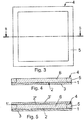
- the silicone mat 1 on a bottom plate 3 (in the sectional view of Fig. 4 represented), wherein the printing forme 2 and the chocolate filled therein a frame plate 4 ( Fig. 3, 4 ) are facing with a frame 5, which is above the silicone mat 1 together with the bottom plate 3 temporarily fixed by (not shown here) brackets.
- a second food for example tempered white chocolate
- a cavity 6 formed by the frame 5 is distributed and slightly shaken to escape any air bubbles.
- the bottom plate 3 After complete curing, which is promoted in particular by additional cooling, the bottom plate 3 is dissolved, the chocolate product consisting of the piece of chocolate that fills the cavity 6, (second food) and the chocolate product that fills the printing form 2, (first food ) carefully out of the frame 5 and finally carefully pulled off the silicone mat 1.
- the finished, coherent chocolate object is obtained, the first foodstuff being applied on the surface of the second foodstuff in accordance with the printing form 2 and forming a pictorial representation corresponding to the original of the printing. It is understood that first the silicone mat 1 can be removed and then only the chocolate object from the frame 5 can be pressed.
- both sides of the frame plate 4 is one each with a printing plate 2, 2 '( Fig. 5 ) provided silicone mat 1, 1 'applied.
- two bottom plates 3, 3 ' are used accordingly. It is both on the front and on the back of the second food, such as a white chocolate, an impression from the printing form 2, 2 'applied.
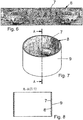
- a printing form 7 (FIG. Fig. 6 ) applied to a silicone mat 8, in the depressions chocolate is given and scraped off and then to a hollow cylinder ( Fig. 7 ) is bent and inside is pushed into a corresponding hollow cylinder 9, which consists for example of plastic or metal.
- a printing plate 7 which can be bent elastically, for example, from a rubber material.
- the silicone mat 8 deformed into a hollow cylinder, placed on the inner circumferential surface of a hollow cylinder 9, which previously brushed with edible oil, so that they can easily dissolve out of the hollow cylinder 9 after completion of the printing process.
- a layer of tempered white chocolate applied (not shown), which forms the second food in this case. It should be noted that the applied layer is not too thin-walled, so that it does not break during later forming. Alternatively, the entire hollow cylinder 9 can be filled with chocolate.
- the silicone mat 8 is pulled out of the hollow cylinder 9 together with the chocolate layer applied on its inside.
- the silicone mat 8 is removed from the chocolate layer on which the introduced into the printing form 7 dark chocolate is left.
- the printing forms 2, 2 ', 7 either contain only picture elements, such as Fig. 6 represented, or in addition also text elements, as in Fig. 1 represented, or only text elements.
- a foodstuff for forming the material filling the printing plate 2, 2 ', 7 is a viscous, viscous or pasty mass which hardens such as chocolate, a cocoa-based fat glaze, a Nougatctionnis or the like; Likewise, any food that can be made into a paste-like form, as is the case with a vegetable, is suitable.
- the hardening of the vegetables is then carried out by a baking, roasting or cooking process, wherein the two vegetables containing vegetables, which fill the printing form 2, 2 ', 7 and which form the layer with the food in the printing form 2, 2 ', 7 are connected.
- the printing plate 2, 2 ', 7 can also be filled with a first ice cream mass having a first color, and the hollow body 6 with a second ice cream mass having a second color.
- a hardening of the layers and thereby possible shaping can also be effected or supported by freezing. It is also possible to bake both layers even if one of the foods is hip paste.
- confectionery material such as fondant, fudge or soft caramel is suitable for filling in the printing form 2, 2 ', 7 or, in order to fill the cavity 6 or to form a layer on the inside of the silicone mat 8 and into the printing form 7 introduced material is painted on.
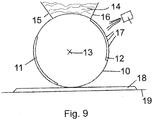
- a rotating cylinder 10 (FIG. Fig. 9 ) equipped with printing plates 11, 12, which are formed like gravure forms and are replaceably applied to the cylinder 10.
- the cylinder 10 rotates about an axis 13.
- a liquid, viscous food from a container 14 formed as a chamber doctor blade is introduced.
- Side walls 15, 16 form squeegees and thereby limit the amount of food flowing out of the container 14 to the amount required to fill recesses 17 formed in the printing plates 11, 12 corresponding to the images to be displayed by the printing plates 11, 12.
- the food material in the recesses 17 is tempered so that it is transferred to a flat piece 18 of at least substantially solid food, which moves on a belt 19 below the cylinder 10, wherein the cylinder 10 and / or its printing plates 11, 12 exert on the piece 18 a certain contact pressure.
- the belt 19 moves at a speed that at least substantially coincides with the shell speed of the cylinder 10.
- a heat radiation source 20 which according to the desired viscosity of the food introduced in the printing plates 11, 12 irradiates the food to increase the temperature.
- a (not shown here) cooling device can provide for, in particular in the field of transmission of the first food from the printing plates 11, 12 on the piece 18 whose temperature lowers again.
- the heat radiation source 20 is preferably equipped with a sensor, in particular in the infrared range, which detects the surface temperature of the cylinder 10 and the printing plates 11, 12 applied thereto.
- a cooling device is alternatively provided, if required according to the consistency of the introduced in the printing plates food.
- the cylinder 10 is preferably equipped with a rotary feedthrough through which a temperature control, cold or hot water, is supplied and discharged.
Landscapes
- Engineering & Computer Science (AREA)
- Life Sciences & Earth Sciences (AREA)
- Chemical & Material Sciences (AREA)
- Food Science & Technology (AREA)
- Polymers & Plastics (AREA)
- Manufacturing & Machinery (AREA)
- Confectionery (AREA)
Applications Claiming Priority (1)
| Application Number | Priority Date | Filing Date | Title |
|---|---|---|---|
| DE102018000190.4A DE102018000190A1 (de) | 2018-01-13 | 2018-01-13 | Verfahren zur Übertragung eines gießbaren Lebensmittels und Vorrichtung zur Durchführung des Verfahrens |
Related Parent Applications (1)
| Application Number | Title | Priority Date | Filing Date |
|---|---|---|---|
| DE102018000190 Previously-Filed-Application | 2018-01-13 |
Publications (1)
| Publication Number | Publication Date |
|---|---|
| EP3510872A1 true EP3510872A1 (fr) | 2019-07-17 |
Family
ID=65199284
Family Applications (1)
| Application Number | Title | Priority Date | Filing Date |
|---|---|---|---|
| EP19000012.5A Withdrawn EP3510872A1 (fr) | 2018-01-13 | 2019-01-10 | Procédé de transfert d'une denrée alimentaire coulable et dispositif de mise en oeuvre dudit procédé |
Country Status (2)
| Country | Link |
|---|---|
| EP (1) | EP3510872A1 (fr) |
| DE (1) | DE102018000190A1 (fr) |
Cited By (1)
| Publication number | Priority date | Publication date | Assignee | Title |
|---|---|---|---|---|
| WO2022053618A1 (fr) * | 2020-09-10 | 2022-03-17 | Agathon Gmbh & Co. Kg | Procédé pour produire un article à base de chocolat et article à base de chocolat |
Citations (4)
| Publication number | Priority date | Publication date | Assignee | Title |
|---|---|---|---|---|
| US4382968A (en) * | 1981-05-05 | 1983-05-10 | Akutagawa Confectionery Co., Ltd. | Process for molding chocolate to make chocolate block having ornamental pattern |
| EP0498357A2 (fr) * | 1991-02-07 | 1992-08-12 | Akutagawa Confectionary Co., Ltd. | Procédé de fabrication de gâteaux au chocolat à décor en relief avec motif imprimé |
| US5407691A (en) * | 1992-09-16 | 1995-04-18 | The Planning Factory, Inc. | Chocolate candy imprinting process |
| WO2006086781A2 (fr) * | 2005-02-11 | 2006-08-17 | Mars, Incorporated | Procedes et appareil de formation de pieces comestibles moulees |
Family Cites Families (8)
| Publication number | Priority date | Publication date | Assignee | Title |
|---|---|---|---|---|
| CH269789A (de) * | 1948-05-01 | 1950-07-31 | Guenthart Ernst | Verfahren zum Verzieren von Lebensmitteln. |
| DD263501A1 (de) | 1987-09-02 | 1989-01-04 | Polygraph Leipzig | Rakelvorrichtung fuer tiefdruckmaschinen |
| BE1003568A5 (nl) * | 1990-05-23 | 1992-04-21 | Met Beperkte Aansprakelijkheid | Werkwijze voor het vervaardigen van met eetbare inkt bedrukt suikerwerk en daarbij te gebruiken inkt. |
| EP0838157A1 (fr) * | 1996-09-26 | 1998-04-29 | Griesson GmbH & Co. KG | Procédé, appareil et plaque de coulée pour la fabrication de tablettes de chocolat ou de biscuits au chocolat |
| ATE268996T1 (de) | 1997-01-11 | 2004-07-15 | Mars Inc | Verbessertes formverfahren für konfektprodukte |
| DE102007024028A1 (de) | 2007-05-22 | 2008-11-27 | Bühler AG | Vorrichtung zum Giessen von Verzehrprodukten |
| DE102007031369A1 (de) * | 2007-07-05 | 2009-01-08 | Mederer Gmbh | Süßwaren-Produkt |
| US20170295816A1 (en) | 2016-04-14 | 2017-10-19 | Shanghai Fochif Electromechanical Technology Co., Ltd. | 3d food printer |
-
2018
- 2018-01-13 DE DE102018000190.4A patent/DE102018000190A1/de not_active Withdrawn
-
2019
- 2019-01-10 EP EP19000012.5A patent/EP3510872A1/fr not_active Withdrawn
Patent Citations (4)
| Publication number | Priority date | Publication date | Assignee | Title |
|---|---|---|---|---|
| US4382968A (en) * | 1981-05-05 | 1983-05-10 | Akutagawa Confectionery Co., Ltd. | Process for molding chocolate to make chocolate block having ornamental pattern |
| EP0498357A2 (fr) * | 1991-02-07 | 1992-08-12 | Akutagawa Confectionary Co., Ltd. | Procédé de fabrication de gâteaux au chocolat à décor en relief avec motif imprimé |
| US5407691A (en) * | 1992-09-16 | 1995-04-18 | The Planning Factory, Inc. | Chocolate candy imprinting process |
| WO2006086781A2 (fr) * | 2005-02-11 | 2006-08-17 | Mars, Incorporated | Procedes et appareil de formation de pieces comestibles moulees |
Cited By (1)
| Publication number | Priority date | Publication date | Assignee | Title |
|---|---|---|---|---|
| WO2022053618A1 (fr) * | 2020-09-10 | 2022-03-17 | Agathon Gmbh & Co. Kg | Procédé pour produire un article à base de chocolat et article à base de chocolat |
Also Published As
| Publication number | Publication date |
|---|---|
| DE102018000190A1 (de) | 2019-07-18 |
Similar Documents
| Publication | Publication Date | Title |
|---|---|---|
| DE69311865T2 (de) | Verfahren und Einrichtung zum Formen von Schokoladen-Erzeugnissen | |
| EP1306012B1 (fr) | Pocédé et appareil de moulage de corps en sucre cuit dans un moule | |
| DE69834484T2 (de) | Verfahren zur formgebung von schokoladeprodukten | |
| DE60025617T2 (de) | Verfahren zur herstellung eines gebackenen, becherförmigen nahrungsmittels | |
| DE69825379T2 (de) | Gefülltes lebensmittel und verfahren zur herstellung | |
| DE69411196T2 (de) | Verfahren und system zur herstellung von schalen aus fetthaltigen, schokolade-ähnlichen massen | |
| DE60119977T2 (de) | Schalenartig geformtes fett-enthaltendes konfektprodukt mit viskoser füllung | |
| EP2148574A1 (fr) | Dispositif pour couler des produits de consommation | |
| DE3331228A1 (de) | Verfahren zur herstellung von klaren, amorphen, zuckerfreien hartbonbons aus einer waessrigen sorbitloesung | |
| DE3743650A1 (de) | Verfahren und vorrichtung zum herstellen eines mehrschichten konfektproduktes sowie konfektprodukt | |
| DE3918051C2 (fr) | ||
| DE60201091T2 (de) | Vorrichtung zum Pressen von essbaren Artikeln | |
| EP3510872A1 (fr) | Procédé de transfert d'une denrée alimentaire coulable et dispositif de mise en oeuvre dudit procédé | |
| DE69921626T2 (de) | Verfahren zur Herstellung geformter Süsswaren | |
| DE60000148T2 (de) | Vorrichtung zur Herstellung von Konfektschalen | |
| DE69907165T2 (de) | Vorrichtung zur Herstellung von geformtem Konfekt | |
| DE19819216A1 (de) | Massivsüßware sowie Verfahren und Vorrichtung zur Herstellung einer solchen Süßware | |
| DE60210922T2 (de) | Vorrichtung zur Herstellung von Deckschichten aus Schokolade | |
| DE60210921T2 (de) | Verfahren zur Herstellung von Schokoladenhülsen | |
| DE60211115T2 (de) | Verfahren zur Herstellung von Schokoladenhülsen | |
| DE60201604T2 (de) | Vorrichtung zum Formen essbarer Gegenstände | |
| DE60211645T2 (de) | Verfahren zur Herstellung von Deckschichten aus Schokolade | |
| DE10305301B3 (de) | Verfahren und Vorrichtung zur Herstellung schalenartiger Hohlkörper aus Süßwarenmasse | |
| EP1295531A2 (fr) | Procédé et appareil de moulage d'une coque de matière grasse et/ou d' une masse de sucre dans un moule | |
| EP3082441B2 (fr) | Procédé de fabrication d'un produit de pâtisserie combiné, de longue conservation |
Legal Events
| Date | Code | Title | Description |
|---|---|---|---|
| PUAI | Public reference made under article 153(3) epc to a published international application that has entered the european phase |
Free format text: ORIGINAL CODE: 0009012 |
|
| AK | Designated contracting states |
Kind code of ref document: A1 Designated state(s): AL AT BE BG CH CY CZ DE DK EE ES FI FR GB GR HR HU IE IS IT LI LT LU LV MC MK MT NL NO PL PT RO RS SE SI SK SM TR |
|
| AX | Request for extension of the european patent |
Extension state: BA ME |
|
| STAA | Information on the status of an ep patent application or granted ep patent |
Free format text: STATUS: THE APPLICATION IS DEEMED TO BE WITHDRAWN |
|
| 18D | Application deemed to be withdrawn |
Effective date: 20200118 |