EP3512231B1 - Procédé pour fournir un niveau d'authentification amélioré lié à la distribution d'une application de client logiciel sécurisé; ainsi que systeme correspondant et produit de programme informatique. - Google Patents
Procédé pour fournir un niveau d'authentification amélioré lié à la distribution d'une application de client logiciel sécurisé; ainsi que systeme correspondant et produit de programme informatique. Download PDFInfo
- Publication number
- EP3512231B1 EP3512231B1 EP18151456.3A EP18151456A EP3512231B1 EP 3512231 B1 EP3512231 B1 EP 3512231B1 EP 18151456 A EP18151456 A EP 18151456A EP 3512231 B1 EP3512231 B1 EP 3512231B1
- Authority
- EP
- European Patent Office
- Prior art keywords
- communication channel
- secure communication
- computing device
- client computing
- client application
- Prior art date
- Legal status (The legal status is an assumption and is not a legal conclusion. Google has not performed a legal analysis and makes no representation as to the accuracy of the status listed.)
- Active
Links
Images
Classifications
-
- H—ELECTRICITY
- H04—ELECTRIC COMMUNICATION TECHNIQUE
- H04W—WIRELESS COMMUNICATION NETWORKS
- H04W12/00—Security arrangements; Authentication; Protecting privacy or anonymity
- H04W12/06—Authentication
-
- G—PHYSICS
- G06—COMPUTING OR CALCULATING; COUNTING
- G06F—ELECTRIC DIGITAL DATA PROCESSING
- G06F21/00—Security arrangements for protecting computers, components thereof, programs or data against unauthorised activity
- G06F21/50—Monitoring users, programs or devices to maintain the integrity of platforms, e.g. of processors, firmware or operating systems
- G06F21/51—Monitoring users, programs or devices to maintain the integrity of platforms, e.g. of processors, firmware or operating systems at application loading time, e.g. accepting, rejecting, starting or inhibiting executable software based on integrity or source reliability
-
- H—ELECTRICITY
- H04—ELECTRIC COMMUNICATION TECHNIQUE
- H04L—TRANSMISSION OF DIGITAL INFORMATION, e.g. TELEGRAPHIC COMMUNICATION
- H04L63/00—Network architectures or network communication protocols for network security
- H04L63/08—Network architectures or network communication protocols for network security for authentication of entities
-
- H—ELECTRICITY
- H04—ELECTRIC COMMUNICATION TECHNIQUE
- H04L—TRANSMISSION OF DIGITAL INFORMATION, e.g. TELEGRAPHIC COMMUNICATION
- H04L67/00—Network arrangements or protocols for supporting network services or applications
- H04L67/34—Network arrangements or protocols for supporting network services or applications involving the movement of software or configuration parameters
-
- G—PHYSICS
- G06—COMPUTING OR CALCULATING; COUNTING
- G06F—ELECTRIC DIGITAL DATA PROCESSING
- G06F8/00—Arrangements for software engineering
- G06F8/60—Software deployment
- G06F8/61—Installation
Definitions
- the present invention relates to a method for providing an enhanced level of authentication related to a secure software client application that is provided, by an application distribution entity, in order to be transmitted, using a telecommunications network, to a client computing device in view of software code of the software client application being executed by the client computing device.
- the present invention further relates to a system for providing an enhanced level of authentication related to a secure software client application that is provided, by an application distribution entity, in order to be transmitted, using a telecommunications network, to a client computing device in view of software code of the software client application being executed by the client computing device, the system comprising the client computing device, the application distribution entity, and a third party server entity.
- the invention relates to a program comprising a computer readable program code and to a storage medium storing a computer program for providing an enhanced level of authentication related to a secure software client application provided by an application distribution entity.
- WO 0133867 A2 relates to a method for validating an application for use in a mobile communication device.
- client devices such as desktop computers, or mobile computers such as tablets, mobile phones or the like
- download stores or application stores It is known to provide application stores such that the downloaded software is at least adapted to the client device class, i.e. a different version of the software could be downloaded dependent on whether the requesting client device is, e.g., a phone device or a tablet device.
- An object of the present invention is to provide a cost effective and comparatively fast solution, especially an automated solution, for providing an enhanced level of authentication related to a secure software client application that is provided by an application distribution entity and transmitted to a client computing device, and/or for providing an enhanced level of authentication related to data generated or provided by such a secure software client application.
- the object of the present invention is achieved by a method according to claim 1.
- a software client application can be authenticated - i.e. provided with an enhanced level of authentication related to the software client application - (and thereby rendered more secure compared to a non-authenticated software client application) in an automated manner by means of the client computing device comprising an instance of an authentication provider functionality.
- the authentication provider functionality is configured such that it relates and/or corresponds - and is connected by means of a second secure communication channel - to an authentication provider server entity that is accessible using a telecommunications network.
- a software client application instance on the client computing device can be authenticated independenty of the specific application distribution entity used to download the software client application instance to the client computing device.
- the authentication provider functionality eventually provides the authentication elements or the pieces of authentication information to the software client application instance.
- the authentication provider functionality is located directly on the client computing device and cooperates with other applications (or apps) installed (or otherwise present or located) on the client computing device. These apps (i.e. especially the authentication provider functionality and the software client application instance considered) typically and especially exchange information using inter-process communication within the client computing device, using an internal secure communication channel (within the client computing device, i.e. internal to the client computing device).
- the software client application instance receives the authentication elements or the pieces of authentication information from the authentication provider functionality in a secure and/or protected manner.
- the pieces of authentication information or the protected information; typically (part of) an asymmetric pair of cryptographic keys and/or (part of) a security token information) is not (or does not necessarily be) disclosed or known to the application distribution entity.
- a client certificate or client secret is present, on the client computing device and/or within the software client application instance, by means of which a mutual authentication of the communication channel between the software client application instance (and/or the respective client computing device), on the one hand, and the third party server entity (especially my means of conventionally used server certificates), on the other hand, is possible.
- a mutual authentication of the communication channel between the software client application instance (and/or the respective client computing device), on the one hand, and the third party server entity (especially my means of conventionally used server certificates), on the other hand is possible.
- the data exchanged or transmitted) between the software client application instances of the client computing device and the third party server entity especially relating to data generated or provided by such a secure software client application, such as, e.g., medical data, bank relating data or the like, and this with the possibility of excluding the application distribution entity from having access to (the content of) such data.
- the present invention it is advantageously possible to provide secure software client applications, i.e. software client applications that can be trusted, by means of requiring an authentication step to be performed. Furthermore, data exchanged between especially the software client application instance and the third party server entity should preferably be transmitted in a protected manner, especially regarding confidentiality and/or integrity and/or originality and/or non-repudiation - and especially in a manner such that the application distribution entity is denied having access to (the content of) such data, or that the application distribution entity is at least does not have access to all such data (or the content thereof).
- the third party server entity corresponds, e.g., to an application server, i.e. providing the server component of the software client application (instance) on the client computing device.
- the software client applications do not have a certificate typically used with a version of the TLS protocol family and, thus, the respective servers are typically not able to authenticate the software client applications in an easy and intuitive (for a user of the software client application) manner, in a comparatively cheap and/or comparatively fast manner, without requiring user interaction (or, at least, without requiring extensive user interaction) and especially automatically.
- An alternative consists in transmitting a secret as part of the software client application.
- the communication (especially inter-process communication) between different applications (or apps) within the client computing device is standardized, the communication or the standardization thereof especially being determined by the authentication provider functionality, and the other applications (or apps) (i.e. especially the software client application instance considered) are required to comply (or to accept) such standardization or such guideline.
- the operating system of the client computing device is not necessarily required to support such a standardized communication between the authentication provider functionality, and the other applications (or apps) (i.e.
- the operating system does support such a standardized communication between the authentication provider functionality, and the other applications (or apps) (i.e. especially the software client application instance considered), either using a protcol handler or not.
- a third secure communication channel is addditionally established between the authentication provider server entity and a third party server entity, providing the possibility that the third party server entity - that might, typically, be a developer of the software client application - initiates the distribution or the transmission of the authentication elements or the pieces of authentication information to the software client application instance in a manner independent of the specific application distribution entity used to download the software client application instance to the client computing device.
- the authentication provider functionality is initialized or installed within the client computing device and the second secure communication channel as well as the third secure communication channel is initialized or established. This is done in view of subsequently allowing for an authenticated transmission of data - provided by the software client application instance upon it being executed by the client computing device - to the third party server entity.
- the software client application instance is transmitted, using the first secure communication channel, to the client computing device.
- the software client application instance might be downloaded and installed (and also operatively used) prior to the authentication provider functionality being loaded and/or installed and/or activated or initialized on or within the client computing device.
- an authentication of the software client application instance (especially with respect to the third party server entity) and any communication or data transmitted or exchange especially with the third party server entity requires the authentication provider functionality to be initialized or installed within the client computing device (and the second secure communication channel as well as the third secure communication channel being initialized or established).
- the software client application instance is likely to be downloaded and/or installed during to or after the authentication provider functionality being loaded and/or installed and/or activated or initialized on or within the client computing device.
- a fourth secure communication channel is established, between the software client application instance and the third party server entity, by means of exchanging at least parts of cryptographic key information and/or security token information using - besides the second secure communication channel and the third secure communication channel - the internal secure communication channel, the internal secure communication channel being internal to the client computing device, between the software client application instance and the authentication provider functionality.
- the first secure communication channel (between the application distribution entity and the software client application instance, i.e. the client computing device) used in the second step, is a secure communication channel typically provided by the application distribution entity, i.e. typically by the application store or app store, in order to transmit (or download) the software client application instance.
- the authentication provider functionality is initialized or installed within the client computing device and the second secure communication channel as well as the third secure communication channel is initialized or established, thereby providing the possibility to securely transmit (and in a protected manner) any pieces of information (i.e. at least parts of cryptographic key information and/or of security token information) enabling the authentication of the authentication provider functionality and/or of the software client application instance.
- This provides the possibility to at least implicitly bind the at least parts of cryptographic key information and/or of security token information to the software client application instance.
- This binding of the at least parts of cryptographic key information and/or of security token information to the software client application instance also ensures that multiple requests to provide or to issue the at least parts of cryptographic key information and/or of security token information do not result in providing a plurality of such at least parts of cryptographic key information and/or of security token information.
- the application distribution entity ensures that each client computing device is able to download each software client application only once (of course, the download of updates is normally allowed).
- the client i.e. the software client application instance within the client computing device
- the client is equipped with the protected information providing the possibility of a cryptographically strong authentication of the client with regard to the third party server entity (and vice versa using the server certificate), e.g. by means of using TLS with mutual authentication.
- the method according to the present invention is independent from which specific protocol is used and which secure communication channel is used; other protocols than TLS, and also the use of a VPN (Virtual Private Network) channel is possible.
- the cryptographically strong authentication of the client i.e. the software client application instance and/or the client computing device
- the cryptographically strong authentication of the client i.e. the software client application instance and/or the client computing device
- a request (or transmitted data) received at the third party server entity is able to be unequivocally assigned to a specific software client application instance (and hence typically a person), or - especially in case of anonymous usage - that at least no fabricated data are received.
- An example of the latter situation might refer to a software client application that anonymously collects medical data, e.g. for a medical survey: Without an authentication of the data provided by the different software client application instances (of the different client computing devices of the participants of the survey), the reception of fabricated or manipulated data at the third party server entity (potentially leading to false results) cannot be excluded.
- the use of a protected information that is individual to the software client application instance limits the motivation of an attacker and also the potential damage:
- an attacker is able to successfully retrieve the protected information
- the use, according to the present invention, of an instance-specific protected information also means that the attacker is only able use this specific protected information, i.e. with respect to this specific software client application instance; in order to use another software client application instance, the corresponding other proctected information would need to be retrieved.
- the authentication provider functionality is initialized or installed within the client computing device and the second secure communication channel as well as the third secure communication channel is initialized or established, thereby providing the possibility to securely transmit (and in a protected manner) any pieces of information (i.e. at least parts of cryptographic key information and/or of security token information) enabling the authentication of the authentication provider functionality and/or of the software client application instance.
- the establishment of the fourth secure communication channel, between the software client application instane and the third party server entity is based on exchanging at least parts of cryptographic key information and/or security token information, i.e. it is based on exchangeing protected information.
- the at least parts of cryptographic key information and/or of security token information is generated - either by the authentication provider functionality and/or by the software client application instance - on the client computing device; the at least parts of cryptographic key information and/or security token information, i.e. the protected information, might be generated at the third party server entity and/or at the authentication provider server entity. If this is the case (i.e. in case that the at least parts of cryptographic key information and/or security token information, i.e. the protected information, is generated on a backend side), it is advantageously possible according to the present invention, that the developer of the software client application is able to use a comparatively high cryptographic quality of the generated protected information (i.e.
- the protected information i.e. the at least parts of cryptographic key information and/or security token information
- the protected information is generated - either by the authentication provider functionality and/or by the software client application instance - on the client computing device.
- the internal secure communication channel corresponds to an inter process communication channel within the client computing device, especially using a protocol handler, and especially as part of the operating system of the client computing device.
- the authentication provider functionality is initialized (or at least partly initialized or downloaded in a first step) by installing the authentication provider functionality - especially from the application distribution entity - as an application on the client computing device and thereby initializing and/or establishing the second secure communication channel with the authentication provider server entity, the third secure communication channel between the authentication provider server entity and the third party server entity especially being initialized or established prior to, during or subsequent to the installation of the authentication provider functionality.
- the authentication provider functionality is able to be a "normal" application (or app) installable on the client computing device; in this case requiring to have the second secure communication channel (towards the authentication provider server entity) established.
- the authentication provider functionality might be a special application or part of the operating system of the client computing device (either being initially installed on the client computing device or downloaded or otherwise installed or initialized later on).
- an asymmetric pair of cryptographic keys is used, comprising a specific private cryptographic key and a specific public cryptographic key
- the asymmetric pair of cryptographic keys is generated by the authentication provider functionality or by the software client application instance, and in order to the authentication provider functionality or the software client application instance being authenticated, a further protected information (such as a (further) cryptographic key information and/or a (further) security token information) needs to be transmitted using at least the second secure communication channel.
- This exchange of authenication information (or further protected information) towards the client computing device might be performed independently from the generation of the asymmetric pair of cryptographic keys by the authentication provider functionality or by the software client application instance.
- the asymmetric pair of cryptographic keys is generated by the authentication provider server entity or by the third party server entity, and is transmitted to the client computing device (i.e. to the authentication provider functionality and/or the software client application instance) using the second secure communication channel.
- security token information is generated by the authentication provider functionality or by the software client application instance, and in order to the authentication provider functionality or the software client application instance being authenticated, a further protected information (such as a (further) cryptographic key information and/or a (further) security token information) needs to be transmitted using at least the second secure communication channel.
- This exchange of authenication information (or further protected information) towards the client computing device might be performed independently from the generation of security token information by the authentication provider functionality or by the software client application instance.
- security token information is generated by the authentication provider server entity or by the third party server entity, and is transmitted to the client computing device (i.e. to the authentication provider functionality and/or the software client application instance) using the second secure communication channel.
- a fifth secure communication channel directly between the authentication provider functionality and the third party server, is established,
- the present invention and by means of establishing the fifth secure communication channel, it is advantageously possible that - once a component on the client computing device, such as the authentication provider functionality and/or the software client application instance, is sufficiently authenticated, i.e. protected information (or further protected information) transmitted (from the authentication provider server entity and/or the third party server entity) to the component on the client computing device - a direct communication between the third party server entity and the authentication provider functionality is possible using the fifth secure communication channel; this fifth secure communication channel being established prior to the fourth secure communication channel being established.
- Using the fifth secure communication channel means that the authentication provider server entity is bypassed.
- the authentication provider functionality will initiate the fifth secure communication channel to be established (as it is typically unusual to allow an internet-based access to services on client devices, due, typically, to no available public IP addresses on client devices and/or the use of network address and port translation (NAPT) mechanisms).
- NAPT network address and port translation
- the fifth secure communication channel might also be used - likewise once a component on the client computing device, such as the authentication provider functionality and/or the software client application instance, is sufficiently authenticated - for other purposes, especially in view of transmitting - besides the software client application instance - an instance of a further software client application to the client computing device.
- a further fourth secure communication channel is typically established, between the further software client application instance and the third party server entity, by means of exchanging at least parts of further cryptographic key information and/or further security token information.
- the authentication provider functionality acts to provide authentication using an internal secure communication channel.
- the further software client application instance can also be authenticated using the software client application instance (acting as authentication provider functionality to the further software client application instance) and the fourth secure communication channel (acting as fifth secure communication channel with regard to the further software client application instance).
- the fourth secure communication channel and/or the fifth secure communication channel is initialized or established using a decentralized authentication protocol and/or an identity provider, especially based on a standard like OpenID, OpenID Connect, SAML, or Shibboleth.
- the communication between the software client application instance, on the one hand, and the third party server entity, on the other hand is safeguarded or secured using a decentralized authentication protocol and/or an identity provider, especially based on a standard like OpenID, OpenID Connect, SAML, or Shibboleth.
- the software client application instance provides, to the authentication provider functionality, an address information of the third party server entity (such as a link information) as well as the associated certificate of the third party server entity (the third party entity, especially corresponding to the developer of the software client application, typically provides its public certificate as part of the software client application instance; and the software client application instances provides this public certificate to the authentication provider functionality), and the authentication provider functionality requests the provisioning of authentication information from the third party server entity.
- the third party server entity in turn requests authentication from the authentication provider server entity; this request is authenticated by the authentication provider functionality.
- the authentication provider server entity transmits the corresponding data (i.e.
- the advantage of using a decentralized authentication protocol and/or an identity provider, especially based on a standard like OpenID, OpenID Connect, SAML, or Shibboleth, is that the authentication provider server entity and the third party server entity do not need to be coupled prior to the authentication provider functionality requesting the provisioning of authentication information from the third party server entity; the third party server entity just needs to support the use of the decentralized authentication protocol and/or an identity provider, especially based on a standard like OpenID, OpenID Connect, SAML, or Shibboleth.
- the authentication provider functionality and the authentication provider server entity are part of a mobile device management system and/or part of the application distribution entity.
- a first partial information and at least a second partial information are derived, wherein both the first and (at least) second partial information are transmitted to the client computing device, but using different secure communication channels, such as the first and the second secure communication channel, or the second and the fifth secure communication channel, wherein at least the first partial information and the second partial information are necessary to obtain the protected information.
- a unique identity information is assigned to the software client application instance, the identity information being specific to the software client application instance or to the combination of the software client application instance and the client computing device, wherein during the second step, the identity information is transmitted to the client computing device, wherein especially the identity information is transmitted by the client computing device to the third party server entity.
- the identity information is additionally transmitted to the client computing device using the first secure communication channel (i.e. the identity information is transmitted additionally to the software client application instance).
- the unique identity information is an anonymous information or a pseudonymous information or an information identifying the user of the software client application instance, and wherein - in case of the unique identity information being anonymous information - especially the unique identity information is independent from an identification of either the software client application instance and/or the software client application and/or the client computing device and/or the user of the client computing device (as in this case otherwise that data might be misused to break the intended anonymity).
- the application distribution entity is an application store, wherein especially the authentication provider server entity is identical to the third party server entity.
- the present invention relates to a system according to claim 11.
- a software client application instance or client computing device for providing an enhanced level of authentication related to a secure software client application that is provided, by an application distribution entity, in order to be transmitted, using a telecommunications network, to a client computing device in view of software code of the software client application being executed by the client computing device,
- a third party server entity for providing an enhanced level of authentication related to a secure software client application that is provided, by an application distribution entity, in order to be transmitted, using a telecommunications network, to a client computing device in view of software code of the software client application being executed by the client computing device,
- the present invention relates to a program comprising a computer readable program code which, when executed on a computer or on a client computing device or as part of a software client application instance or on an application distribution entity or on a trusted entity, or in part on a client computing device and/or in part as part of a software client application instance and/or in part on an application distribution entity and/or in part on a trusted entity, causes the computer and/or the client computing device and/or the software client application instance and/or the application distribution entity and/or the trusted entity to perform an inventive method.
- the present invention relates to a storage medium storing a computer program for providing an enhanced level of authentication related to a secure software client application provided by an application distribution entity, the computer program comprising program code which, when executed on a computer or on a client computing device or as part of a software client application instance or on an application distribution entity or on a trusted entity, or in part on a client computing device and/or in part as part of a software client application instance and/or in part on an application distribution entity and/or in part on a trusted entity, causes the computer and/or the client computing device and/or the software client application instance and/or the application distribution entity and/or the trusted entity to perform an inventive method.
- the present invention relates to a computer-readable medium comprising instructions which when executed on a computer or on a client computing device or as part of a software client application instance or on an application distribution entity or on a trusted entity, or in part on a client computing device and/or in part as part of a software client application instance and/or in part on an application distribution entity and/or in part on a trusted entity, causes the computer or the client computing device or the software client application instance or the application distribution entity or the trusted entity to perform an inventive method.
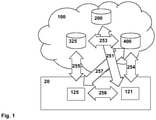
- Figure 1 schematically illustrates an exemplary system and situation according to the present invention where a mobile communication network - with a user equipment connected to the mobile communication network as a client computing device - is connected to an application distribution entity, and the client computing device is able to exchange information with a authentication provider server entity and/or with a third party server entity.
- a system for realizing the present invention comprising a telecommunications network 100, especially a mobile communication network 100, and especially a public land mobile network 100.
- the telecommunications network 100 is connected to a user equipment 20 that is also referred to as a client computing device 20.
- the system furthermore also comprises an application distribution entity 200, and a third party server entity 400.
- the present invention is based on using an authentication provider functionality 125 as part of the client computing device 20 that communicates with a software client application instance 121 installed on the client computing device 20 using an internal secure communication channel 256.
- the software client application instance 121 is transmitted to the client computing device 20, i.e. after this transmission, the client computing device 20 comprises the software client application instance 121. Furthermore according to the present invention, a protected information needs to be transmitted to the client computing device 20.
- a first secure communication channel 251 is established - in view of transmitting an instance 121 of the software client application to the client computing device 20 - between the client computing device 20 and the application distribution entity 200.
- the client computing device 20 comprises an instance of an authentication provider functionality 125, wherein a second secure communication channel 255 is established between the authentication provider functionality 125 and an authentication provider server entity 325, and wherein a third secure communication channel 253 is established between the authentication provider server entity 325 and a third party server entity 400.
- the authentication provider functionality 125 is initialized or installed within the client computing device 20 and the second secure communication channel 255 as well as the third secure communication channel 253 is initialized or established.
- a fourth secure communication channel 254 is established, between the software client application instance 121 and the third party server entity 400, by means of exchanging at least (part of) a cryptographic key information and/or (part of) a security token information using - besides the second secure communication channel 255 and the third secure communication channel 253 - the internal secure communication channel 256, the internal secure communication channel 256 being internal to the client computing device 20, between the software client application instance 121 and the authentication provider functionality 125.
- the protected information (i.e. the asymmetric pair of cryptographic keys and/or to the security token information) is generated by the third party server entity 400 (and transmitted using the third secure communication channel 253, the second secure communication channel 255, and the internal secure communication channel 256 to the software client application 121).
- the protected information is generated by the authentication provider server entity 325 (and transmitted using the second secure communication channel 255, and the internal secure communication channel 256 to the software client application 121), based on the authentication provider server entity 325 and the third party server entity 400 having the third secure communication channel 253 established in a protected manner.
- the protected information is generated by the authentication provider functionality 125 (and transmitted using the internal secure communication channel 256 to the software client application 121), based on the authentication provider server entity 325 and the third party server entity 400 having the third secure communication channel 253 established in a protected manner, and the authentication provider server entity 325 and the authentication provider functionality having the second secure communication channel 255 established in a protected manner.
- the authentication provider functionality 125 typically needs to be individualized once, espeically by means of using mechanisms such as a public app store or a mobile device management or the like.
- An important conditions that needs to be verified is that the second secure communication channel 255 between the authentication provider functionality 125 and the authentication provider server entity 325 (i.e. the backend component of the authentication provider functionality 125) is a secure communication link.
- This authentication provider server entity 325 serves to communicate with the third party server entity 400, typically a developer of the software client application instance 125, in order to provision protected information to the software client application instance 125.
- the authentication provider server entity 325 and the authentication provider functionality 125 are acting as software distribution point or app store.
- the authentication provider functionality 125 communicates with the authentication provider server entity 325 using the second secure communication channel 255 as a secure channel; upon installing or initializing the authentication provider functionality 125, corresponding protected information, such as cryptographic keys are transmitted securely, typically using protected communication channels.
- the authentication provider server entity 325 communicates with the third party server entity 400 in a protected manner.
- the basis for such communication might be a contractual relationship between both, leading to securing the third secure communication channel 253.
- this communication can be protected by means of technologies such as OpenID or OpenID Connect; this is typically based on both the third party server entity 400 as well as the authentication provider server entity 325 having, respectively, a relationship with trusted entity (not depicted in Figure 1 ).
- it is also possible to exchanging encrypted and signed emails using, e.g., S/MIME or PGP and comparing the fingerprints of the public keys or certificates), or to use a internet application or web application protected via TLS (Top Level Security), e.g. a web application provided by the authentication provider server entity 325; in this case, the third party server entity would register at that web application.
- TLS Topic Level Security
- the software client application instance 121 authenticates itself with respect to the third party server entity 400.
- the authentication provider functionality 125 generates pairs of cryptographic keys (or at least one pair of cryptographic keys) to be used by the software client application instance 121.
- the thus generated private key (or, more generally, the protected information generated by the client computing device 20 or a (software) component thereof (i.e. the authentication provider functionality 125 and/or the software client application 121)) does not need to leave the client computing device 20.
- the generated private key or, more generally, the protected information can, e.g., be transferred from the authentication provider functionality 125 to the software client application instance 121, and be stored at a protected location, such as in a keychain.
- a given protected information to be transmitted between different nodes or entities is not transmitted using one and the same transmission channel but using at least two transmission channels.
- the protected information is deviced into different parts (the first partial information and at least the second partial information) and transmitted using different transmission channels.
- an enhanced level of authentication is able to be provided related to a secure software client application instance 121 and/or related to the client computing device 20.
- the protected information e.g. comprising or corresponding to the asymmetric pair of cryptographic keys and/or to the security token information, is generated in view of subsequently allowing for an authenticated transmission of data - provided by the software client application instance 121 upon it being executed by the client computing device 20 - to the third party server entity 400.
- the protected information is either generated by the third party server entity 400 and/or by a trusted entity (not depicted in Figure 1 ), and the first partial information and at least a second partial information is derived from the protected information. Subsequently, the first partial information is transmitted to the client computing device 20 using different secure communication channels.
- the communication between the client computing device 20 and the third party server entity 400 is to be secured by means of not only relying on the use of a (comparatively high level) server certificate but also using a kind of (comparatively high level) client certificate.
- the third party server entity 400 corresponds, e.g., to an application server, i.e. providing the server component of the software client application (instance) on the client computing device 20.
Landscapes
- Engineering & Computer Science (AREA)
- Computer Security & Cryptography (AREA)
- Computer Networks & Wireless Communication (AREA)
- Signal Processing (AREA)
- Software Systems (AREA)
- Computer Hardware Design (AREA)
- General Engineering & Computer Science (AREA)
- Theoretical Computer Science (AREA)
- Physics & Mathematics (AREA)
- General Physics & Mathematics (AREA)
- Computing Systems (AREA)
- Information Transfer Between Computers (AREA)
Claims (13)
- Procédé permettant de procurer un niveau accru d'authentification associé à une application logicielle client sécurisée qui est fournie, par une entité de distribution d'applications (200), afin d'être transmise, à l'aide d'un réseau de télécommunications (100), à un dispositif informatique client (20), en vue de l'exécution d'un code logiciel de l'application logicielle client par le dispositif informatique client (20),dans lequel un premier canal de communication sécurisé (251) est établi - en vue de transmettre une instance (121) de l'application logicielle client au dispositif informatique client (20) - entre le dispositif informatique client (20) et l'entité de distribution d'applications (200),dans lequel le dispositif informatique client (20) comprend une instance de fonctionnalité de fournisseur d'authentification (125), dans lequel un deuxième canal de communication sécurisé (255) est établi entre la fonctionnalité de fournisseur d'authentification (125) et une entité serveur de fournisseur d'authentification (325), et dans lequel un troisième canal de communication sécurisé (253) est établi entre l'entité serveur de fournisseur d'authentification (325) et une entité serveur tiers (400), dans lequel le procédé comprend les étapes suivantes :- dans une première étape, en vue de permettre par la suite une transmission authentifiée de données - fournies par l'instance d'application logicielle client (121) lors de son exécution par le dispositif informatique client (20) - à l'entité serveur tiers (400), la fonctionnalité de fournisseur d'authentification (125) est initialisée ou installée dans le dispositif informatique client (20) et le deuxième canal de communication sécurisé (255) ainsi que le troisième canal de communication sécurisé (253) sont initialisés ou établis,- dans une deuxième étape, avant, pendant ou après la première étape, l'instance d'application logicielle client (121) est transmise, à l'aide du premier canal de communication sécurisé (251), au dispositif informatique client (20),- dans une troisième étape postérieure à la deuxième étape, un quatrième canal de communication sécurisé (254) est établi entre l'instance d'application logicielle client (121) et l'entité serveur tiers (400), moyennant l'échange au moins de parties d'informations de clés cryptographiques et/ou d'informations de jeton de sécurité à l'aide - outre le deuxième canal de communication sécurisé (255) et le troisième canal de communication sécurisé (253) - d'un canal de communication sécurisé interne (256), le canal de communication sécurisé interne (256) étant interne au dispositif informatique client (20), entre l'instance d'application logicielle client (121) et la fonctionnalité de fournisseur d'authentification (125).
- Procédé selon la revendication 1, dans lequel le canal de communication sécurisé interne (256) correspond à un canal de communication interprocessus au sein du dispositif informatique client (20), en particulier utilisant un gestionnaire de protocoles, et notamment en tant que partie du système d'exploitation du dispositif informatique client (20).
- Procédé selon l'une des revendications précédentes, dans lequel la fonctionnalité de fournisseur d'authentification (125) est initialisée par installation de la fonctionnalité de fournisseur d'authentification (125) - en particulier à partir de l'entité de distribution d'applications (200) - en tant qu'application sur le dispositif informatique client (20), ce qui permet d'initialiser et/ou d'établir le deuxième canal de communication sécurisé (255) avec l'entité serveur de fournisseur d'authentification (325),
le troisième canal de communication sécurisé (253) entre l'entité serveur de fournisseur d'authentification (325) et l'entité serveur tiers (400) étant en particulier initialisé ou établi avant, pendant ou après l'installation de la fonctionnalité de fournisseur d'authentification (125). - Procédé selon l'une des revendications précédentes, dans lequel - afin de permettre une transmission authentifiée de données entre l'instance d'application logicielle client (121) et l'entité serveur tiers (400) - il est fait appel à une paire asymétrique de clés cryptographiques comprenant une clé cryptographique privée spécifique (222) et une clé cryptographique publique spécifique (223),- dans lequel la paire asymétrique de clés cryptographiques est générée par la fonctionnalité de fournisseur d'authentification (125) ou par l'instance d'application logicielle client (121) et au moins d'autres informations protégées sont transmises à l'aide au moins du deuxième canal de communication sécurisé (255), ou- dans lequel la paire asymétrique de clés cryptographiques est générée par l'entité serveur de fournisseur d'authentification (325) ou par l'entité serveur tiers (400) et au moins la clé cryptographique privée spécifique (222) est transmise à l'aide au moins du deuxième canal de communication sécurisé (255).
- Procédé selon l'une des revendications précédentes, dans lequel - afin de permettre une transmission authentifiée de données entre l'instance d'application logicielle client (121) et l'entité serveur tiers (400) - il est fait appel à des informations de jeton de sécurité,- dans lequel les informations de jeton de sécurité sont générées par la fonctionnalité de fournisseur d'authentification (125) ou par l'instance d'application logicielle client (121) et au moins d'autres informations protégées sont transmises à l'aide au moins du deuxième canal de communication sécurisé (255), ou- dans lequel les informations de jeton de sécurité sont générées par l'entité serveur de fournisseur d'authentification (325) ou par l'entité serveur tiers (400) et transmises à l'aide au moins du deuxième canal de communication sécurisé (255).
- Procédé selon l'une des revendications précédentes, dans lequel est établi un cinquième canal de communication sécurisé (257), directement entre la fonctionnalité de fournisseur d'authentification (125) et le serveur tiers (400),dans lequel, le cinquième canal de communication sécurisé est établi avant que le quatrième canal de communication sécurisé (254) ne soit établi, entre l'instance d'application logicielle client (121) et l'entité serveur tiers (400), oudans lequel, le cinquième canal de communication sécurisé (257) est établi une fois que le quatrième canal de communication sécurisé (254) a été établi, entre l'instance d'application logicielle client (121) et l'entité serveur tiers (400), en particulier, en vue de transmettre - outre l'instance d'application logicielle client (121) - une instance d'une autre application logicielle client au dispositif informatique client (20).
- Procédé selon l'une des revendications précédentes, dans lequel le quatrième canal de communication sécurisé (254) et/ou le cinquième canal de communication sécurisé (257) est ou sont initialisé(s) ou établi(s) à l'aide d'un protocole d'authentification et/ou d'un fournisseur d'identité décentralisé(s), en particulier sur la base d'une norme telle que OpenID, OpenID Connect, SAML ou Shibboleth.
- Procédé selon l'une des revendications précédentes, dans lequel la fonctionnalité de fournisseur d'authentification (125) et l'entité serveur de fournisseur d'authentification (325) font partie d'un système de gestion de dispositifs mobiles et/ou font partie de l'entité de distribution d'applications (200).
- Procédé selon l'une des revendications précédentes, dans lequel la transmission de :- tout ou partie des informations de clés cryptographiques et/ou- tout ou partie des informations de jeton de sécurité est réalisée par partage de secret.
- Procédé selon l'une des revendications précédentes, dans lequel l'entité de distribution d'applications (200) est un magasin d'applications, dans lequel, en particulier, l'entité serveur de fournisseur d'authentification (325) est identique à l'entité serveur tiers (400).
- Système permettant de procurer un niveau accru d'authentification associé à une application logicielle client sécurisée qui est fournie, par une entité de distribution d'applications (200), afin d'être transmise, à l'aide d'un réseau de télécommunications (100), à un dispositif informatique client (20), en vue de l'exécution d'un code logiciel de l'application logicielle client par le dispositif informatique client (20), le système comprenant le dispositif informatique client (20), l'entité de distribution d'applications (200) et une entité serveur tiers (400),dans lequel un premier canal de communication sécurisé (251) est établi - en vue de transmettre une instance (121) de l'application logicielle client au dispositif informatique client (20) - entre le dispositif informatique client (20) et l'entité de distribution d'applications (200),dans lequel le dispositif informatique client (20) comprend une instance de fonctionnalité de fournisseur d'authentification (125), dans lequel un deuxième canal de communication sécurisé (255) est établi entre la fonctionnalité de fournisseur d'authentification (125) et une entité serveur de fournisseur d'authentification (325), et dans lequel un troisième canal de communication sécurisé (253) est établi entre l'entité serveur de fournisseur d'authentification (325) et une entité serveur tiers (400),le système étant configuré de telle sorte que :- en vue de permettre par la suite une transmission authentifiée de données - fournies par l'instance d'application logicielle client (121) lors de son exécution par le dispositif informatique client (20)- à l'entité serveur tiers (400), la fonctionnalité de fournisseur d'authentification (125) soit initialisée ou installée dans le dispositif informatique client (20) et le deuxième canal de communication sécurisé (255) ainsi que le troisième canal de communication sécurisé (253) soient initialisés ou établis,- l'instance d'application logicielle client (121) soit transmise, à l'aide du premier canal de communication sécurisé (251), au dispositif informatique client (20), avant d'être exécutée par le dispositif informatique client (20) ;- un quatrième canal de communication sécurisé (254) soit établi entre l'instance d'application logicielle client (121) et l'entité serveur tiers (400), moyennant l'échange au moins de parties d'informations de clés cryptographiques et/ou d'informations de jeton de sécurité à l'aide - outre le deuxième canal de communication sécurisé (255) et le troisième canal de communication sécurisé (253) - d'un canal de communication sécurisé interne (256), le canal de communication sécurisé interne (256) étant interne au dispositif informatique client (20), entre l'instance d'application logicielle client (121) et la fonctionnalité de fournisseur d'authentification (125).
- Produit-programme informatique comprenant un code de programme lisible par ordinateur, qui, lorsqu'il est exécuté sur un dispositif informatique client (20), une instance d'application logicielle client (121), une entité de distribution d'applications (200), une fonctionnalité de fournisseur d'authentification (125) comprise dans le dispositif informatique client, une entité serveur de fournisseur d'authentification (325) et une entité serveur tiers (400), fait mettre en œuvre au dispositif informatique client (20), à l'instance d'application logicielle client (121), à l'entité de distribution d'applications (200), à la fonctionnalité de fournisseur d'authentification (125) comprise dans le dispositif informatique client, à l'entité serveur de fournisseur d'authentification (325) et à l'entité serveur tiers (400) un procédé selon l'une des revendications 1 à 9.
- Support de stockage de programme informatique, sur lequel est stocké le produit-programme informatique selon la revendication 12.
Priority Applications (1)
| Application Number | Priority Date | Filing Date | Title |
|---|---|---|---|
| EP18151456.3A EP3512231B1 (fr) | 2018-01-12 | 2018-01-12 | Procédé pour fournir un niveau d'authentification amélioré lié à la distribution d'une application de client logiciel sécurisé; ainsi que systeme correspondant et produit de programme informatique. |
Applications Claiming Priority (1)
| Application Number | Priority Date | Filing Date | Title |
|---|---|---|---|
| EP18151456.3A EP3512231B1 (fr) | 2018-01-12 | 2018-01-12 | Procédé pour fournir un niveau d'authentification amélioré lié à la distribution d'une application de client logiciel sécurisé; ainsi que systeme correspondant et produit de programme informatique. |
Publications (2)
| Publication Number | Publication Date |
|---|---|
| EP3512231A1 EP3512231A1 (fr) | 2019-07-17 |
| EP3512231B1 true EP3512231B1 (fr) | 2022-03-16 |
Family
ID=60990676
Family Applications (1)
| Application Number | Title | Priority Date | Filing Date |
|---|---|---|---|
| EP18151456.3A Active EP3512231B1 (fr) | 2018-01-12 | 2018-01-12 | Procédé pour fournir un niveau d'authentification amélioré lié à la distribution d'une application de client logiciel sécurisé; ainsi que systeme correspondant et produit de programme informatique. |
Country Status (1)
| Country | Link |
|---|---|
| EP (1) | EP3512231B1 (fr) |
Families Citing this family (1)
| Publication number | Priority date | Publication date | Assignee | Title |
|---|---|---|---|---|
| CN114282190A (zh) * | 2021-12-30 | 2022-04-05 | 赛尔网络有限公司 | 一种双重认证方法及其电子设备 |
Family Cites Families (3)
| Publication number | Priority date | Publication date | Assignee | Title |
|---|---|---|---|---|
| WO2001033867A2 (fr) * | 1999-11-03 | 2001-05-10 | Motorola Inc. | Procede permettant de valider une application, pour utilisation dans un dispositif de communication mobile |
| US7603703B2 (en) * | 2001-04-12 | 2009-10-13 | International Business Machines Corporation | Method and system for controlled distribution of application code and content data within a computer network |
| EP3104635B1 (fr) * | 2015-06-09 | 2020-02-12 | Deutsche Telekom AG | Procédé pour une installation améliorée d'une application de service associée à un élément sécurisé situé dans un dispositif de communication, système et réseau de télécommunications destinés à une telle installation améliorée, programme comprenant un code de programme lisible par ordinateur et produit de programme informatique |
-
2018
- 2018-01-12 EP EP18151456.3A patent/EP3512231B1/fr active Active
Also Published As
| Publication number | Publication date |
|---|---|
| EP3512231A1 (fr) | 2019-07-17 |
Similar Documents
| Publication | Publication Date | Title |
|---|---|---|
| JP7457173B2 (ja) | モノのインターネット(iot)デバイスの管理 | |
| US8484713B1 (en) | Transport-level web application security on a resource-constrained device | |
| KR101459802B1 (ko) | 암호화 증명의 재검증에 기반을 둔 인증 위임 | |
| KR101434769B1 (ko) | 신뢰적인 연합 아이덴티티 관리 및 데이터 액세스 인가를 위한 방법 및 장치 | |
| CA2786975C (fr) | Systeme et procede pour mettre en uvre une politique informatique | |
| EP2682892A1 (fr) | Système et procédé d'authentification d'application hors bande | |
| Alnahari et al. | Authentication of IoT device and IoT server using security key | |
| EP4246892A2 (fr) | Procédé et système pour commander l'échange d'informations confidentielles | |
| US20100132017A1 (en) | Process for authenticating a user by certificate using an out-of band message exchange | |
| CN121099313A (zh) | 通信加密方法、系统、装置、设备及存储介质 | |
| EP3512231B1 (fr) | Procédé pour fournir un niveau d'authentification amélioré lié à la distribution d'une application de client logiciel sécurisé; ainsi que systeme correspondant et produit de programme informatique. | |
| US20170295142A1 (en) | Three-Tiered Security and Computational Architecture | |
| EP2530618A1 (fr) | Système d'ouverture de session avec accès distribué | |
| EP4507245A1 (fr) | Système et procédé de gestion d'identités numériques décentralisées | |
| KR101619928B1 (ko) | 이동단말기의 원격제어시스템 | |
| Binu et al. | A mobile based remote user authentication scheme without verifier table for cloud based services | |
| WO2018011775A1 (fr) | Procédé pour fournir un niveau amélioré d'authentification relatif à une application logicielle sécurisée de client fournie par une entité de distribution d'applications pour être transmise à un dispositif informatique client; système, entité de distribution d'applications, application logicielle de client et dispositif de calcul client pour fournir un niveau amélioré d'authentification associé à une application logicielle sécurisée de client, programme et produit de programme informatique | |
| EP3511852B1 (fr) | Procédé permettant de fournir un niveau amélioré d'authentification associée à une application client de logiciel sécurisée fournie par une entité de distribution d'application afin d'être transmise à un dispositif informatique client, système, instance d'application client de logiciel ou dispositif informatique client, entité serveur tiers et programme et produit-programme d'ordinateur | |
| Kim et al. | Secure user authentication based on the trusted platform for mobile devices | |
| Oniga et al. | Iot infrastructure secured by tls level authentication and pki identity system | |
| Aiemworawutikul et al. | Vulnerability Assessment in National Identity Services | |
| WO2018010957A1 (fr) | Procédé pour fournir un niveau amélioré d'authentification relatif à une application logicielle sécurisée de client fournie par une entité de distribution d'application afin d'être transmis à un dispositif informatique client; système, une entité de distribution d'application de logiciel, une application de client de logiciel et un dispositif de calcul client pour fournir un niveau amélioré d'authentification associé à une application de client de logiciel sécurisé, un programme et un produit de programme d'ordinateur | |
| Azizul et al. | Authentication and authorization design in honeybee computing | |
| Díaz García et al. | Multiprotocol Authentication Device for HPC and Cloud Environments Based on Elliptic Curve Cryptography | |
| Regateiro et al. | SPDC: Secure Proxied Database Connectivity. |
Legal Events
| Date | Code | Title | Description |
|---|---|---|---|
| PUAI | Public reference made under article 153(3) epc to a published international application that has entered the european phase |
Free format text: ORIGINAL CODE: 0009012 |
|
| STAA | Information on the status of an ep patent application or granted ep patent |
Free format text: STATUS: THE APPLICATION HAS BEEN PUBLISHED |
|
| AK | Designated contracting states |
Kind code of ref document: A1 Designated state(s): AL AT BE BG CH CY CZ DE DK EE ES FI FR GB GR HR HU IE IS IT LI LT LU LV MC MK MT NL NO PL PT RO RS SE SI SK SM TR |
|
| AX | Request for extension of the european patent |
Extension state: BA ME |
|
| STAA | Information on the status of an ep patent application or granted ep patent |
Free format text: STATUS: REQUEST FOR EXAMINATION WAS MADE |
|
| 17P | Request for examination filed |
Effective date: 20200117 |
|
| RBV | Designated contracting states (corrected) |
Designated state(s): AL AT BE BG CH CY CZ DE DK EE ES FI FR GB GR HR HU IE IS IT LI LT LU LV MC MK MT NL NO PL PT RO RS SE SI SK SM TR |
|
| STAA | Information on the status of an ep patent application or granted ep patent |
Free format text: STATUS: EXAMINATION IS IN PROGRESS |
|
| 17Q | First examination report despatched |
Effective date: 20201104 |
|
| RIN1 | Information on inventor provided before grant (corrected) |
Inventor name: TIETJEN, JAN Inventor name: SCHENK, VOLKER Inventor name: FRIELINGSDORF, MATTHIAS |
|
| REG | Reference to a national code |
Ref country code: DE Ref legal event code: R079 Ref document number: 602018032192 Country of ref document: DE Free format text: PREVIOUS MAIN CLASS: H04W0012060000 Ipc: G06F0008610000 |
|
| GRAP | Despatch of communication of intention to grant a patent |
Free format text: ORIGINAL CODE: EPIDOSNIGR1 |
|
| STAA | Information on the status of an ep patent application or granted ep patent |
Free format text: STATUS: GRANT OF PATENT IS INTENDED |
|
| RIC1 | Information provided on ipc code assigned before grant |
Ipc: G06F 21/51 20130101ALI20211013BHEP Ipc: H04L 29/08 20060101ALI20211013BHEP Ipc: H04L 29/06 20060101ALI20211013BHEP Ipc: H04W 12/06 20210101ALI20211013BHEP Ipc: G06F 8/61 20180101AFI20211013BHEP |
|
| GRAJ | Information related to disapproval of communication of intention to grant by the applicant or resumption of examination proceedings by the epo deleted |
Free format text: ORIGINAL CODE: EPIDOSDIGR1 |
|
| STAA | Information on the status of an ep patent application or granted ep patent |
Free format text: STATUS: EXAMINATION IS IN PROGRESS |
|
| INTG | Intention to grant announced |
Effective date: 20211115 |
|
| GRAP | Despatch of communication of intention to grant a patent |
Free format text: ORIGINAL CODE: EPIDOSNIGR1 |
|
| STAA | Information on the status of an ep patent application or granted ep patent |
Free format text: STATUS: GRANT OF PATENT IS INTENDED |
|
| INTC | Intention to grant announced (deleted) | ||
| INTG | Intention to grant announced |
Effective date: 20220110 |
|
| GRAS | Grant fee paid |
Free format text: ORIGINAL CODE: EPIDOSNIGR3 |
|
| GRAA | (expected) grant |
Free format text: ORIGINAL CODE: 0009210 |
|
| STAA | Information on the status of an ep patent application or granted ep patent |
Free format text: STATUS: THE PATENT HAS BEEN GRANTED |
|
| AK | Designated contracting states |
Kind code of ref document: B1 Designated state(s): AL AT BE BG CH CY CZ DE DK EE ES FI FR GB GR HR HU IE IS IT LI LT LU LV MC MK MT NL NO PL PT RO RS SE SI SK SM TR |
|
| REG | Reference to a national code |
Ref country code: GB Ref legal event code: FG4D |
|
| REG | Reference to a national code |
Ref country code: CH Ref legal event code: EP |
|
| REG | Reference to a national code |
Ref country code: DE Ref legal event code: R096 Ref document number: 602018032192 Country of ref document: DE |
|
| REG | Reference to a national code |
Ref country code: IE Ref legal event code: FG4D |
|
| REG | Reference to a national code |
Ref country code: AT Ref legal event code: REF Ref document number: 1476372 Country of ref document: AT Kind code of ref document: T Effective date: 20220415 |
|
| REG | Reference to a national code |
Ref country code: LT Ref legal event code: MG9D |
|
| REG | Reference to a national code |
Ref country code: NL Ref legal event code: MP Effective date: 20220316 |
|
| PG25 | Lapsed in a contracting state [announced via postgrant information from national office to epo] |
Ref country code: SE Free format text: LAPSE BECAUSE OF FAILURE TO SUBMIT A TRANSLATION OF THE DESCRIPTION OR TO PAY THE FEE WITHIN THE PRESCRIBED TIME-LIMIT Effective date: 20220316 Ref country code: RS Free format text: LAPSE BECAUSE OF FAILURE TO SUBMIT A TRANSLATION OF THE DESCRIPTION OR TO PAY THE FEE WITHIN THE PRESCRIBED TIME-LIMIT Effective date: 20220316 Ref country code: NO Free format text: LAPSE BECAUSE OF FAILURE TO SUBMIT A TRANSLATION OF THE DESCRIPTION OR TO PAY THE FEE WITHIN THE PRESCRIBED TIME-LIMIT Effective date: 20220616 Ref country code: LT Free format text: LAPSE BECAUSE OF FAILURE TO SUBMIT A TRANSLATION OF THE DESCRIPTION OR TO PAY THE FEE WITHIN THE PRESCRIBED TIME-LIMIT Effective date: 20220316 Ref country code: HR Free format text: LAPSE BECAUSE OF FAILURE TO SUBMIT A TRANSLATION OF THE DESCRIPTION OR TO PAY THE FEE WITHIN THE PRESCRIBED TIME-LIMIT Effective date: 20220316 Ref country code: BG Free format text: LAPSE BECAUSE OF FAILURE TO SUBMIT A TRANSLATION OF THE DESCRIPTION OR TO PAY THE FEE WITHIN THE PRESCRIBED TIME-LIMIT Effective date: 20220616 |
|
| REG | Reference to a national code |
Ref country code: AT Ref legal event code: MK05 Ref document number: 1476372 Country of ref document: AT Kind code of ref document: T Effective date: 20220316 |
|
| PG25 | Lapsed in a contracting state [announced via postgrant information from national office to epo] |
Ref country code: LV Free format text: LAPSE BECAUSE OF FAILURE TO SUBMIT A TRANSLATION OF THE DESCRIPTION OR TO PAY THE FEE WITHIN THE PRESCRIBED TIME-LIMIT Effective date: 20220316 Ref country code: GR Free format text: LAPSE BECAUSE OF FAILURE TO SUBMIT A TRANSLATION OF THE DESCRIPTION OR TO PAY THE FEE WITHIN THE PRESCRIBED TIME-LIMIT Effective date: 20220617 Ref country code: FI Free format text: LAPSE BECAUSE OF FAILURE TO SUBMIT A TRANSLATION OF THE DESCRIPTION OR TO PAY THE FEE WITHIN THE PRESCRIBED TIME-LIMIT Effective date: 20220316 |
|
| PG25 | Lapsed in a contracting state [announced via postgrant information from national office to epo] |
Ref country code: NL Free format text: LAPSE BECAUSE OF FAILURE TO SUBMIT A TRANSLATION OF THE DESCRIPTION OR TO PAY THE FEE WITHIN THE PRESCRIBED TIME-LIMIT Effective date: 20220316 |
|
| PG25 | Lapsed in a contracting state [announced via postgrant information from national office to epo] |
Ref country code: SM Free format text: LAPSE BECAUSE OF FAILURE TO SUBMIT A TRANSLATION OF THE DESCRIPTION OR TO PAY THE FEE WITHIN THE PRESCRIBED TIME-LIMIT Effective date: 20220316 Ref country code: SK Free format text: LAPSE BECAUSE OF FAILURE TO SUBMIT A TRANSLATION OF THE DESCRIPTION OR TO PAY THE FEE WITHIN THE PRESCRIBED TIME-LIMIT Effective date: 20220316 Ref country code: RO Free format text: LAPSE BECAUSE OF FAILURE TO SUBMIT A TRANSLATION OF THE DESCRIPTION OR TO PAY THE FEE WITHIN THE PRESCRIBED TIME-LIMIT Effective date: 20220316 Ref country code: PT Free format text: LAPSE BECAUSE OF FAILURE TO SUBMIT A TRANSLATION OF THE DESCRIPTION OR TO PAY THE FEE WITHIN THE PRESCRIBED TIME-LIMIT Effective date: 20220718 Ref country code: ES Free format text: LAPSE BECAUSE OF FAILURE TO SUBMIT A TRANSLATION OF THE DESCRIPTION OR TO PAY THE FEE WITHIN THE PRESCRIBED TIME-LIMIT Effective date: 20220316 Ref country code: EE Free format text: LAPSE BECAUSE OF FAILURE TO SUBMIT A TRANSLATION OF THE DESCRIPTION OR TO PAY THE FEE WITHIN THE PRESCRIBED TIME-LIMIT Effective date: 20220316 Ref country code: CZ Free format text: LAPSE BECAUSE OF FAILURE TO SUBMIT A TRANSLATION OF THE DESCRIPTION OR TO PAY THE FEE WITHIN THE PRESCRIBED TIME-LIMIT Effective date: 20220316 Ref country code: AT Free format text: LAPSE BECAUSE OF FAILURE TO SUBMIT A TRANSLATION OF THE DESCRIPTION OR TO PAY THE FEE WITHIN THE PRESCRIBED TIME-LIMIT Effective date: 20220316 |
|
| PG25 | Lapsed in a contracting state [announced via postgrant information from national office to epo] |
Ref country code: PL Free format text: LAPSE BECAUSE OF FAILURE TO SUBMIT A TRANSLATION OF THE DESCRIPTION OR TO PAY THE FEE WITHIN THE PRESCRIBED TIME-LIMIT Effective date: 20220316 Ref country code: IS Free format text: LAPSE BECAUSE OF FAILURE TO SUBMIT A TRANSLATION OF THE DESCRIPTION OR TO PAY THE FEE WITHIN THE PRESCRIBED TIME-LIMIT Effective date: 20220716 Ref country code: AL Free format text: LAPSE BECAUSE OF FAILURE TO SUBMIT A TRANSLATION OF THE DESCRIPTION OR TO PAY THE FEE WITHIN THE PRESCRIBED TIME-LIMIT Effective date: 20220316 |
|
| REG | Reference to a national code |
Ref country code: DE Ref legal event code: R097 Ref document number: 602018032192 Country of ref document: DE |
|
| PLBE | No opposition filed within time limit |
Free format text: ORIGINAL CODE: 0009261 |
|
| STAA | Information on the status of an ep patent application or granted ep patent |
Free format text: STATUS: NO OPPOSITION FILED WITHIN TIME LIMIT |
|
| PG25 | Lapsed in a contracting state [announced via postgrant information from national office to epo] |
Ref country code: DK Free format text: LAPSE BECAUSE OF FAILURE TO SUBMIT A TRANSLATION OF THE DESCRIPTION OR TO PAY THE FEE WITHIN THE PRESCRIBED TIME-LIMIT Effective date: 20220316 |
|
| 26N | No opposition filed |
Effective date: 20221219 |
|
| PG25 | Lapsed in a contracting state [announced via postgrant information from national office to epo] |
Ref country code: SI Free format text: LAPSE BECAUSE OF FAILURE TO SUBMIT A TRANSLATION OF THE DESCRIPTION OR TO PAY THE FEE WITHIN THE PRESCRIBED TIME-LIMIT Effective date: 20220316 |
|
| PG25 | Lapsed in a contracting state [announced via postgrant information from national office to epo] |
Ref country code: IT Free format text: LAPSE BECAUSE OF FAILURE TO SUBMIT A TRANSLATION OF THE DESCRIPTION OR TO PAY THE FEE WITHIN THE PRESCRIBED TIME-LIMIT Effective date: 20220316 |
|
| REG | Reference to a national code |
Ref country code: CH Ref legal event code: PL |
|
| PG25 | Lapsed in a contracting state [announced via postgrant information from national office to epo] |
Ref country code: LU Free format text: LAPSE BECAUSE OF NON-PAYMENT OF DUE FEES Effective date: 20230112 |
|
| REG | Reference to a national code |
Ref country code: BE Ref legal event code: MM Effective date: 20230131 |
|
| PG25 | Lapsed in a contracting state [announced via postgrant information from national office to epo] |
Ref country code: LI Free format text: LAPSE BECAUSE OF NON-PAYMENT OF DUE FEES Effective date: 20230131 Ref country code: CH Free format text: LAPSE BECAUSE OF NON-PAYMENT OF DUE FEES Effective date: 20230131 |
|
| PG25 | Lapsed in a contracting state [announced via postgrant information from national office to epo] |
Ref country code: BE Free format text: LAPSE BECAUSE OF NON-PAYMENT OF DUE FEES Effective date: 20230131 |
|
| PG25 | Lapsed in a contracting state [announced via postgrant information from national office to epo] |
Ref country code: IE Free format text: LAPSE BECAUSE OF NON-PAYMENT OF DUE FEES Effective date: 20230112 |
|
| PG25 | Lapsed in a contracting state [announced via postgrant information from national office to epo] |
Ref country code: MC Free format text: LAPSE BECAUSE OF FAILURE TO SUBMIT A TRANSLATION OF THE DESCRIPTION OR TO PAY THE FEE WITHIN THE PRESCRIBED TIME-LIMIT Effective date: 20220316 |
|
| PG25 | Lapsed in a contracting state [announced via postgrant information from national office to epo] |
Ref country code: MC Free format text: LAPSE BECAUSE OF FAILURE TO SUBMIT A TRANSLATION OF THE DESCRIPTION OR TO PAY THE FEE WITHIN THE PRESCRIBED TIME-LIMIT Effective date: 20220316 |
|
| PG25 | Lapsed in a contracting state [announced via postgrant information from national office to epo] |
Ref country code: CY Free format text: LAPSE BECAUSE OF FAILURE TO SUBMIT A TRANSLATION OF THE DESCRIPTION OR TO PAY THE FEE WITHIN THE PRESCRIBED TIME-LIMIT; INVALID AB INITIO Effective date: 20180112 |
|
| PG25 | Lapsed in a contracting state [announced via postgrant information from national office to epo] |
Ref country code: HU Free format text: LAPSE BECAUSE OF FAILURE TO SUBMIT A TRANSLATION OF THE DESCRIPTION OR TO PAY THE FEE WITHIN THE PRESCRIBED TIME-LIMIT; INVALID AB INITIO Effective date: 20180112 |
|
| PG25 | Lapsed in a contracting state [announced via postgrant information from national office to epo] |
Ref country code: TR Free format text: LAPSE BECAUSE OF FAILURE TO SUBMIT A TRANSLATION OF THE DESCRIPTION OR TO PAY THE FEE WITHIN THE PRESCRIBED TIME-LIMIT Effective date: 20220316 |
|
| PGFP | Annual fee paid to national office [announced via postgrant information from national office to epo] |
Ref country code: GB Payment date: 20260122 Year of fee payment: 9 |
|
| PGFP | Annual fee paid to national office [announced via postgrant information from national office to epo] |
Ref country code: DE Payment date: 20260120 Year of fee payment: 9 |
|
| PGFP | Annual fee paid to national office [announced via postgrant information from national office to epo] |
Ref country code: FR Payment date: 20260128 Year of fee payment: 9 |