EP3512837B1 - Composés de pyridine et de pyrazine en tant qu'inhibiteurs de ripk2 - Google Patents
Composés de pyridine et de pyrazine en tant qu'inhibiteurs de ripk2 Download PDFInfo
- Publication number
- EP3512837B1 EP3512837B1 EP17768582.3A EP17768582A EP3512837B1 EP 3512837 B1 EP3512837 B1 EP 3512837B1 EP 17768582 A EP17768582 A EP 17768582A EP 3512837 B1 EP3512837 B1 EP 3512837B1
- Authority
- EP
- European Patent Office
- Prior art keywords
- alkyl
- cycloalkyl
- heterocyclyl
- optionally substituted
- methyl
- Prior art date
- Legal status (The legal status is an assumption and is not a legal conclusion. Google has not performed a legal analysis and makes no representation as to the accuracy of the status listed.)
- Active
Links
- 0 CC(C)(C)c1cncc(*)n1 Chemical compound CC(C)(C)c1cncc(*)n1 0.000 description 11
- PDKGUUKQQJFULZ-UHFFFAOYSA-N CC(C)NC(Nc1cncc(-[n]2ncc(-c3c(C)ccc(C(NC4CC4)=O)c3)c2)c1)=O Chemical compound CC(C)NC(Nc1cncc(-[n]2ncc(-c3c(C)ccc(C(NC4CC4)=O)c3)c2)c1)=O PDKGUUKQQJFULZ-UHFFFAOYSA-N 0.000 description 2
- DSNVCMJHRQBEOZ-UHFFFAOYSA-N CC(N(CC1)CCC1Oc1cc(-[n]2ncc(-c3c(C)ccc(C(NC4CC4)=O)c3)c2)cnc1)=O Chemical compound CC(N(CC1)CCC1Oc1cc(-[n]2ncc(-c3c(C)ccc(C(NC4CC4)=O)c3)c2)cnc1)=O DSNVCMJHRQBEOZ-UHFFFAOYSA-N 0.000 description 2
- QRPKJMVCSDJIQA-UHFFFAOYSA-N Cc(cc(c(C(NC1CC1)=O)c1)F)c1-c1c[n](-c2cc(OC)cnc2)nc1 Chemical compound Cc(cc(c(C(NC1CC1)=O)c1)F)c1-c1c[n](-c2cc(OC)cnc2)nc1 QRPKJMVCSDJIQA-UHFFFAOYSA-N 0.000 description 2
- QAVFMFLCFQLJTB-JYOAFUTRSA-N C/C=N\N(C)c1cc(N)cnc1 Chemical compound C/C=N\N(C)c1cc(N)cnc1 QAVFMFLCFQLJTB-JYOAFUTRSA-N 0.000 description 1
- MZVAWVUAUYGILJ-UHFFFAOYSA-N CC(C)(C)C(Nc1cc(N(C2)N=CC2c2c(C)ccc(C(NC3CC3)=O)c2)cnc1)=O Chemical compound CC(C)(C)C(Nc1cc(N(C2)N=CC2c2c(C)ccc(C(NC3CC3)=O)c2)cnc1)=O MZVAWVUAUYGILJ-UHFFFAOYSA-N 0.000 description 1
- FYPHQPVKSFOEAT-UHFFFAOYSA-N CC(C)(C)OC(N(CC1)CCC1Nc1cc(-[n]2ncc(-c3c(C)ccc(C(NC4CC4)=O)c3)c2)cnc1)=O Chemical compound CC(C)(C)OC(N(CC1)CCC1Nc1cc(-[n]2ncc(-c3c(C)ccc(C(NC4CC4)=O)c3)c2)cnc1)=O FYPHQPVKSFOEAT-UHFFFAOYSA-N 0.000 description 1
- DYVYLTYKQGKWJI-UHFFFAOYSA-N CC(C)C(Nc1cncc(-[n]2ncc(-c3c(C)ccc(C(NC4CC4)=O)c3)c2)c1)=O Chemical compound CC(C)C(Nc1cncc(-[n]2ncc(-c3c(C)ccc(C(NC4CC4)=O)c3)c2)c1)=O DYVYLTYKQGKWJI-UHFFFAOYSA-N 0.000 description 1
- AJYMAIWRVUIADO-UHFFFAOYSA-N CC(C)CC(Nc1cncc(-[n]2ncc(-c3c(C)ccc(C(NC4CC4)=O)c3)c2)c1)=O Chemical compound CC(C)CC(Nc1cncc(-[n]2ncc(-c3c(C)ccc(C(NC4CC4)=O)c3)c2)c1)=O AJYMAIWRVUIADO-UHFFFAOYSA-N 0.000 description 1
- WDQBOBXPHQWIGM-UHFFFAOYSA-N CC(CO)N(CC1)CCC1Nc1cc(-[n]2ncc(-c3c(C)ccc(C(NC4CC4)=O)c3)c2)cnc1 Chemical compound CC(CO)N(CC1)CCC1Nc1cc(-[n]2ncc(-c3c(C)ccc(C(NC4CC4)=O)c3)c2)cnc1 WDQBOBXPHQWIGM-UHFFFAOYSA-N 0.000 description 1
- RLJKWSDUDCQFDB-UHFFFAOYSA-N CC(COCC1)C1N(CC1)CCC1Nc1cc(-[n]2ncc(-c3c(C)ccc(C(NC4CC4)=O)c3)c2)cnc1 Chemical compound CC(COCC1)C1N(CC1)CCC1Nc1cc(-[n]2ncc(-c3c(C)ccc(C(NC4CC4)=O)c3)c2)cnc1 RLJKWSDUDCQFDB-UHFFFAOYSA-N 0.000 description 1
- YNVKYUIQOZOTGZ-UHFFFAOYSA-N CC(N(C1)CC1Oc1cncc(-[n]2ncc(-c3c(C)ccc(C(NC4CC4)=O)c3)c2)c1)=O Chemical compound CC(N(C1)CC1Oc1cncc(-[n]2ncc(-c3c(C)ccc(C(NC4CC4)=O)c3)c2)c1)=O YNVKYUIQOZOTGZ-UHFFFAOYSA-N 0.000 description 1
- YSTGIACUBASSOV-UHFFFAOYSA-N CC(N(CC1)CC1Oc1cc(-[n]2ncc(-c3c(C)ccc(C(NC4CC4)=O)c3)c2)c[n]c1)=O Chemical compound CC(N(CC1)CC1Oc1cc(-[n]2ncc(-c3c(C)ccc(C(NC4CC4)=O)c3)c2)c[n]c1)=O YSTGIACUBASSOV-UHFFFAOYSA-N 0.000 description 1
- YGHBAWMLBPTDFK-UHFFFAOYSA-N CC(N(CC1)CCC1Nc1cc(-[n]2ncc(-c3c(C)ccc(C(NC4CC4)=O)c3)c2)cnc1)=O Chemical compound CC(N(CC1)CCC1Nc1cc(-[n]2ncc(-c3c(C)ccc(C(NC4CC4)=O)c3)c2)cnc1)=O YGHBAWMLBPTDFK-UHFFFAOYSA-N 0.000 description 1
- CDHKLKQXJFNTII-UHFFFAOYSA-N CC(Nc1cc(-[n]2ncc(-c3c(C)ccc(C(NC4CC4)=O)c3)c2)cnc1)=O Chemical compound CC(Nc1cc(-[n]2ncc(-c3c(C)ccc(C(NC4CC4)=O)c3)c2)cnc1)=O CDHKLKQXJFNTII-UHFFFAOYSA-N 0.000 description 1
- AHWOCLPGCYHBIC-UHFFFAOYSA-N CCC(Nc1cncc(-[n]2ncc(-c3c(C)ccc(C(NC4CC4)=O)c3)c2)c1)=O Chemical compound CCC(Nc1cncc(-[n]2ncc(-c3c(C)ccc(C(NC4CC4)=O)c3)c2)c1)=O AHWOCLPGCYHBIC-UHFFFAOYSA-N 0.000 description 1
- SGOJOSNKKOPBHM-ZEQRLZLVSA-N CCO[C@@H](COC1)[C@H]1Nc1cc(-[n]2ncc(-c3c(C)ccc(C(NC4CC4)=O)c3)c2)cnc1 Chemical compound CCO[C@@H](COC1)[C@H]1Nc1cc(-[n]2ncc(-c3c(C)ccc(C(NC4CC4)=O)c3)c2)cnc1 SGOJOSNKKOPBHM-ZEQRLZLVSA-N 0.000 description 1
- YCHGENZUSBIDSP-UHFFFAOYSA-N CCOc1cc(-[n]2ncc(-c3c(C)ccc(C(NC4CC4)=O)c3)c2)cnc1 Chemical compound CCOc1cc(-[n]2ncc(-c3c(C)ccc(C(NC4CC4)=O)c3)c2)cnc1 YCHGENZUSBIDSP-UHFFFAOYSA-N 0.000 description 1
- FVJWACZMGUBWTM-UHFFFAOYSA-N CN(C)c1nc(-[n]2ncc(-c(cc(C(NC3CC3)=O)c(F)c3)c3Cl)c2)cnc1 Chemical compound CN(C)c1nc(-[n]2ncc(-c(cc(C(NC3CC3)=O)c(F)c3)c3Cl)c2)cnc1 FVJWACZMGUBWTM-UHFFFAOYSA-N 0.000 description 1
- DUCKBLQRHHLBQD-UHFFFAOYSA-N COc1cc(-[n]2ncc(-c(cc(C(NC3CC3)=O)c(F)c3)c3Cl)c2)cnc1 Chemical compound COc1cc(-[n]2ncc(-c(cc(C(NC3CC3)=O)c(F)c3)c3Cl)c2)cnc1 DUCKBLQRHHLBQD-UHFFFAOYSA-N 0.000 description 1
- PACCCGLYPFVBMM-UHFFFAOYSA-N Cc(cc(c(C(NC1CC1)=O)c1)F)c1-c1c[n](-c2cncc(NC3CC(CC4)N(C5COC5)C4C3)c2)nc1 Chemical compound Cc(cc(c(C(NC1CC1)=O)c1)F)c1-c1c[n](-c2cncc(NC3CC(CC4)N(C5COC5)C4C3)c2)nc1 PACCCGLYPFVBMM-UHFFFAOYSA-N 0.000 description 1
- QVMAGXJSLZYNNV-UHFFFAOYSA-N Cc(ccc(C(N(C)C1CC1)=O)c1)c1-c1c[n](-c2cncc(OC)n2)nc1 Chemical compound Cc(ccc(C(N(C)C1CC1)=O)c1)c1-c1c[n](-c2cncc(OC)n2)nc1 QVMAGXJSLZYNNV-UHFFFAOYSA-N 0.000 description 1
- YYBCPBJZMVZELA-UHFFFAOYSA-N Cc(ccc(C(NC1CC1)=O)c1)c1-c1c[n](-c2cc(NC(CF)=O)cnc2)nc1 Chemical compound Cc(ccc(C(NC1CC1)=O)c1)c1-c1c[n](-c2cc(NC(CF)=O)cnc2)nc1 YYBCPBJZMVZELA-UHFFFAOYSA-N 0.000 description 1
- YCUWVJGFSWOADZ-UHFFFAOYSA-N Cc(ccc(C(NC1CC1)=O)c1)c1-c1c[n](-c2cc(NC3CCN(CC4OCCOC4)CC3)cnc2)nc1 Chemical compound Cc(ccc(C(NC1CC1)=O)c1)c1-c1c[n](-c2cc(NC3CCN(CC4OCCOC4)CC3)cnc2)nc1 YCUWVJGFSWOADZ-UHFFFAOYSA-N 0.000 description 1
- ICHCXOLQAZVLNU-UHFFFAOYSA-N Cc(ccc(C(NC1CC1)=O)c1)c1-c1c[n](-c2cc(NCC3OCCC3)cnc2)nc1 Chemical compound Cc(ccc(C(NC1CC1)=O)c1)c1-c1c[n](-c2cc(NCC3OCCC3)cnc2)nc1 ICHCXOLQAZVLNU-UHFFFAOYSA-N 0.000 description 1
- FKOXWRGUPSJTBR-UHFFFAOYSA-N Cc(ccc(C(NC1CC1)=O)c1)c1-c1c[n](-c2cncc(C(F)(F)F)c2)nc1 Chemical compound Cc(ccc(C(NC1CC1)=O)c1)c1-c1c[n](-c2cncc(C(F)(F)F)c2)nc1 FKOXWRGUPSJTBR-UHFFFAOYSA-N 0.000 description 1
- XEDCVBUWBXPIFI-UHFFFAOYSA-N Cc(ccc(C(NC1CC1)=O)c1)c1-c1c[n](-c2cncc(C3CCOCC3)n2)nc1 Chemical compound Cc(ccc(C(NC1CC1)=O)c1)c1-c1c[n](-c2cncc(C3CCOCC3)n2)nc1 XEDCVBUWBXPIFI-UHFFFAOYSA-N 0.000 description 1
- FGYFKQDCKNGKRZ-UHFFFAOYSA-N Cc(ccc(C(NC1CC1)=O)c1)c1-c1c[n](-c2cncc(CC(O)=O)c2)nc1 Chemical compound Cc(ccc(C(NC1CC1)=O)c1)c1-c1c[n](-c2cncc(CC(O)=O)c2)nc1 FGYFKQDCKNGKRZ-UHFFFAOYSA-N 0.000 description 1
- BSJKGDUWYLHRKX-UHFFFAOYSA-N Cc(ccc(C(NC1CC1)=O)c1)c1-c1c[n](-c2cncc(CN(CCOC3)C3=O)c2)nc1 Chemical compound Cc(ccc(C(NC1CC1)=O)c1)c1-c1c[n](-c2cncc(CN(CCOC3)C3=O)c2)nc1 BSJKGDUWYLHRKX-UHFFFAOYSA-N 0.000 description 1
- LSBGFEMVJHXDOL-UHFFFAOYSA-N Cc(ccc(C(NC1CC1)=O)c1)c1-c1c[n](-c2cncc(CNC)c2)nc1 Chemical compound Cc(ccc(C(NC1CC1)=O)c1)c1-c1c[n](-c2cncc(CNC)c2)nc1 LSBGFEMVJHXDOL-UHFFFAOYSA-N 0.000 description 1
- JZAJQJFKYSNNNE-UHFFFAOYSA-N Cc(ccc(C(NC1CC1)=O)c1)c1-c1c[n](-c2cncc(N(C)C)n2)nc1 Chemical compound Cc(ccc(C(NC1CC1)=O)c1)c1-c1c[n](-c2cncc(N(C)C)n2)nc1 JZAJQJFKYSNNNE-UHFFFAOYSA-N 0.000 description 1
- VHRCEOKXMGKWDL-UHFFFAOYSA-N Cc(ccc(C(NC1CC1)=O)c1)c1-c1c[n](-c2cncc(N)c2)nc1 Chemical compound Cc(ccc(C(NC1CC1)=O)c1)c1-c1c[n](-c2cncc(N)c2)nc1 VHRCEOKXMGKWDL-UHFFFAOYSA-N 0.000 description 1
- LFXATRRHWUAOAL-UHFFFAOYSA-N Cc(ccc(C(NC1CC1)=O)c1)c1-c1c[n](-c2cncc(NC(CC3)CC3OC)c2)nc1 Chemical compound Cc(ccc(C(NC1CC1)=O)c1)c1-c1c[n](-c2cncc(NC(CC3)CC3OC)c2)nc1 LFXATRRHWUAOAL-UHFFFAOYSA-N 0.000 description 1
- GASXLKNCNCHERH-UHFFFAOYSA-N Cc(ccc(C(NC1CC1)=O)c1)c1-c1c[n](-c2cncc(NC(CC3)CCN3C(CCOC3)C3OC)c2)nc1 Chemical compound Cc(ccc(C(NC1CC1)=O)c1)c1-c1c[n](-c2cncc(NC(CC3)CCN3C(CCOC3)C3OC)c2)nc1 GASXLKNCNCHERH-UHFFFAOYSA-N 0.000 description 1
- FPBIUXHVIKKBAM-UHFFFAOYSA-N Cc(ccc(C(NC1CC1)=O)c1)c1-c1c[n](-c2cncc(NC(CC3)CCN3C3CCC3)c2)nc1 Chemical compound Cc(ccc(C(NC1CC1)=O)c1)c1-c1c[n](-c2cncc(NC(CC3)CCN3C3CCC3)c2)nc1 FPBIUXHVIKKBAM-UHFFFAOYSA-N 0.000 description 1
- UWBPHFIITCXWIL-UHFFFAOYSA-N Cc(ccc(C(NC1CC1)=O)c1)c1-c1c[n](-c2cncc(NC(COC)=O)c2)nc1 Chemical compound Cc(ccc(C(NC1CC1)=O)c1)c1-c1c[n](-c2cncc(NC(COC)=O)c2)nc1 UWBPHFIITCXWIL-UHFFFAOYSA-N 0.000 description 1
- DSTXZVUEFGRHSH-UHFFFAOYSA-N Cc(ccc(C(NC1CC1)=O)c1)c1-c1c[n](-c2cncc(NC(NC3CCC3)=O)c2)nc1 Chemical compound Cc(ccc(C(NC1CC1)=O)c1)c1-c1c[n](-c2cncc(NC(NC3CCC3)=O)c2)nc1 DSTXZVUEFGRHSH-UHFFFAOYSA-N 0.000 description 1
- PKFKHVQZDYIXHW-UHFFFAOYSA-N Cc(ccc(C(NC1CC1)=O)c1)c1-c1c[n](-c2cncc(NC3CCN(C)CC3)c2)nc1 Chemical compound Cc(ccc(C(NC1CC1)=O)c1)c1-c1c[n](-c2cncc(NC3CCN(C)CC3)c2)nc1 PKFKHVQZDYIXHW-UHFFFAOYSA-N 0.000 description 1
- PWNFJDAYEGNHCU-UHFFFAOYSA-N Cc(ccc(C(NC1CC1)=O)c1)c1-c1c[n](-c2cncc(OCC3CC3)c2)nc1 Chemical compound Cc(ccc(C(NC1CC1)=O)c1)c1-c1c[n](-c2cncc(OCC3CC3)c2)nc1 PWNFJDAYEGNHCU-UHFFFAOYSA-N 0.000 description 1
- ZNHZVNKWOVDPNJ-UHFFFAOYSA-N Cc(ccc(C(NC1CC1)=O)c1)c1-c1c[n](C2=CC(NC(NC3CC3)=O)=CN(C)C2)nc1 Chemical compound Cc(ccc(C(NC1CC1)=O)c1)c1-c1c[n](C2=CC(NC(NC3CC3)=O)=CN(C)C2)nc1 ZNHZVNKWOVDPNJ-UHFFFAOYSA-N 0.000 description 1
- QWPCFTUNHABFKF-UHFFFAOYSA-N Cc1cncc(NCC2OCCOC2)c1 Chemical compound Cc1cncc(NCC2OCCOC2)c1 QWPCFTUNHABFKF-UHFFFAOYSA-N 0.000 description 1
- QDJBSFSRHVOTAY-UHFFFAOYSA-N Cc1cncc(NCCN(CCO2)C2=O)c1 Chemical compound Cc1cncc(NCCN(CCO2)C2=O)c1 QDJBSFSRHVOTAY-UHFFFAOYSA-N 0.000 description 1
- MDQXGHBCDCOOSM-UHFFFAOYSA-N Nc1cncc(Br)c1 Chemical compound Nc1cncc(Br)c1 MDQXGHBCDCOOSM-UHFFFAOYSA-N 0.000 description 1
Images


Classifications
-
- C—CHEMISTRY; METALLURGY
- C07—ORGANIC CHEMISTRY
- C07D—HETEROCYCLIC COMPOUNDS
- C07D401/00—Heterocyclic compounds containing two or more hetero rings, having nitrogen atoms as the only ring hetero atoms, at least one ring being a six-membered ring with only one nitrogen atom
- C07D401/14—Heterocyclic compounds containing two or more hetero rings, having nitrogen atoms as the only ring hetero atoms, at least one ring being a six-membered ring with only one nitrogen atom containing three or more hetero rings
-
- A—HUMAN NECESSITIES
- A61—MEDICAL OR VETERINARY SCIENCE; HYGIENE
- A61P—SPECIFIC THERAPEUTIC ACTIVITY OF CHEMICAL COMPOUNDS OR MEDICINAL PREPARATIONS
- A61P1/00—Drugs for disorders of the alimentary tract or the digestive system
- A61P1/04—Drugs for disorders of the alimentary tract or the digestive system for ulcers, gastritis or reflux esophagitis, e.g. antacids, inhibitors of acid secretion, mucosal protectants
-
- A—HUMAN NECESSITIES
- A61—MEDICAL OR VETERINARY SCIENCE; HYGIENE
- A61P—SPECIFIC THERAPEUTIC ACTIVITY OF CHEMICAL COMPOUNDS OR MEDICINAL PREPARATIONS
- A61P11/00—Drugs for disorders of the respiratory system
-
- A—HUMAN NECESSITIES
- A61—MEDICAL OR VETERINARY SCIENCE; HYGIENE
- A61P—SPECIFIC THERAPEUTIC ACTIVITY OF CHEMICAL COMPOUNDS OR MEDICINAL PREPARATIONS
- A61P11/00—Drugs for disorders of the respiratory system
- A61P11/02—Nasal agents, e.g. decongestants
-
- A—HUMAN NECESSITIES
- A61—MEDICAL OR VETERINARY SCIENCE; HYGIENE
- A61P—SPECIFIC THERAPEUTIC ACTIVITY OF CHEMICAL COMPOUNDS OR MEDICINAL PREPARATIONS
- A61P11/00—Drugs for disorders of the respiratory system
- A61P11/06—Antiasthmatics
-
- A—HUMAN NECESSITIES
- A61—MEDICAL OR VETERINARY SCIENCE; HYGIENE
- A61P—SPECIFIC THERAPEUTIC ACTIVITY OF CHEMICAL COMPOUNDS OR MEDICINAL PREPARATIONS
- A61P13/00—Drugs for disorders of the urinary system
- A61P13/12—Drugs for disorders of the urinary system of the kidneys
-
- A—HUMAN NECESSITIES
- A61—MEDICAL OR VETERINARY SCIENCE; HYGIENE
- A61P—SPECIFIC THERAPEUTIC ACTIVITY OF CHEMICAL COMPOUNDS OR MEDICINAL PREPARATIONS
- A61P17/00—Drugs for dermatological disorders
-
- A—HUMAN NECESSITIES
- A61—MEDICAL OR VETERINARY SCIENCE; HYGIENE
- A61P—SPECIFIC THERAPEUTIC ACTIVITY OF CHEMICAL COMPOUNDS OR MEDICINAL PREPARATIONS
- A61P17/00—Drugs for dermatological disorders
- A61P17/04—Antipruritics
-
- A—HUMAN NECESSITIES
- A61—MEDICAL OR VETERINARY SCIENCE; HYGIENE
- A61P—SPECIFIC THERAPEUTIC ACTIVITY OF CHEMICAL COMPOUNDS OR MEDICINAL PREPARATIONS
- A61P17/00—Drugs for dermatological disorders
- A61P17/06—Antipsoriatics
-
- A—HUMAN NECESSITIES
- A61—MEDICAL OR VETERINARY SCIENCE; HYGIENE
- A61P—SPECIFIC THERAPEUTIC ACTIVITY OF CHEMICAL COMPOUNDS OR MEDICINAL PREPARATIONS
- A61P19/00—Drugs for skeletal disorders
-
- A—HUMAN NECESSITIES
- A61—MEDICAL OR VETERINARY SCIENCE; HYGIENE
- A61P—SPECIFIC THERAPEUTIC ACTIVITY OF CHEMICAL COMPOUNDS OR MEDICINAL PREPARATIONS
- A61P19/00—Drugs for skeletal disorders
- A61P19/02—Drugs for skeletal disorders for joint disorders, e.g. arthritis, arthrosis
-
- A—HUMAN NECESSITIES
- A61—MEDICAL OR VETERINARY SCIENCE; HYGIENE
- A61P—SPECIFIC THERAPEUTIC ACTIVITY OF CHEMICAL COMPOUNDS OR MEDICINAL PREPARATIONS
- A61P25/00—Drugs for disorders of the nervous system
-
- A—HUMAN NECESSITIES
- A61—MEDICAL OR VETERINARY SCIENCE; HYGIENE
- A61P—SPECIFIC THERAPEUTIC ACTIVITY OF CHEMICAL COMPOUNDS OR MEDICINAL PREPARATIONS
- A61P27/00—Drugs for disorders of the senses
- A61P27/02—Ophthalmic agents
-
- A—HUMAN NECESSITIES
- A61—MEDICAL OR VETERINARY SCIENCE; HYGIENE
- A61P—SPECIFIC THERAPEUTIC ACTIVITY OF CHEMICAL COMPOUNDS OR MEDICINAL PREPARATIONS
- A61P29/00—Non-central analgesic, antipyretic or antiinflammatory agents, e.g. antirheumatic agents; Non-steroidal antiinflammatory drugs [NSAID]
-
- A—HUMAN NECESSITIES
- A61—MEDICAL OR VETERINARY SCIENCE; HYGIENE
- A61P—SPECIFIC THERAPEUTIC ACTIVITY OF CHEMICAL COMPOUNDS OR MEDICINAL PREPARATIONS
- A61P3/00—Drugs for disorders of the metabolism
- A61P3/08—Drugs for disorders of the metabolism for glucose homeostasis
- A61P3/10—Drugs for disorders of the metabolism for glucose homeostasis for hyperglycaemia, e.g. antidiabetics
-
- A—HUMAN NECESSITIES
- A61—MEDICAL OR VETERINARY SCIENCE; HYGIENE
- A61P—SPECIFIC THERAPEUTIC ACTIVITY OF CHEMICAL COMPOUNDS OR MEDICINAL PREPARATIONS
- A61P35/00—Antineoplastic agents
-
- A—HUMAN NECESSITIES
- A61—MEDICAL OR VETERINARY SCIENCE; HYGIENE
- A61P—SPECIFIC THERAPEUTIC ACTIVITY OF CHEMICAL COMPOUNDS OR MEDICINAL PREPARATIONS
- A61P37/00—Drugs for immunological or allergic disorders
- A61P37/02—Immunomodulators
-
- A—HUMAN NECESSITIES
- A61—MEDICAL OR VETERINARY SCIENCE; HYGIENE
- A61P—SPECIFIC THERAPEUTIC ACTIVITY OF CHEMICAL COMPOUNDS OR MEDICINAL PREPARATIONS
- A61P37/00—Drugs for immunological or allergic disorders
- A61P37/02—Immunomodulators
- A61P37/06—Immunosuppressants, e.g. drugs for graft rejection
-
- A—HUMAN NECESSITIES
- A61—MEDICAL OR VETERINARY SCIENCE; HYGIENE
- A61P—SPECIFIC THERAPEUTIC ACTIVITY OF CHEMICAL COMPOUNDS OR MEDICINAL PREPARATIONS
- A61P37/00—Drugs for immunological or allergic disorders
- A61P37/08—Antiallergic agents
-
- C—CHEMISTRY; METALLURGY
- C07—ORGANIC CHEMISTRY
- C07D—HETEROCYCLIC COMPOUNDS
- C07D401/00—Heterocyclic compounds containing two or more hetero rings, having nitrogen atoms as the only ring hetero atoms, at least one ring being a six-membered ring with only one nitrogen atom
- C07D401/02—Heterocyclic compounds containing two or more hetero rings, having nitrogen atoms as the only ring hetero atoms, at least one ring being a six-membered ring with only one nitrogen atom containing two hetero rings
- C07D401/04—Heterocyclic compounds containing two or more hetero rings, having nitrogen atoms as the only ring hetero atoms, at least one ring being a six-membered ring with only one nitrogen atom containing two hetero rings directly linked by a ring-member-to-ring-member bond
-
- C—CHEMISTRY; METALLURGY
- C07—ORGANIC CHEMISTRY
- C07D—HETEROCYCLIC COMPOUNDS
- C07D403/00—Heterocyclic compounds containing two or more hetero rings, having nitrogen atoms as the only ring hetero atoms, not provided for by group C07D401/00
- C07D403/02—Heterocyclic compounds containing two or more hetero rings, having nitrogen atoms as the only ring hetero atoms, not provided for by group C07D401/00 containing two hetero rings
- C07D403/04—Heterocyclic compounds containing two or more hetero rings, having nitrogen atoms as the only ring hetero atoms, not provided for by group C07D401/00 containing two hetero rings directly linked by a ring-member-to-ring-member bond
-
- C—CHEMISTRY; METALLURGY
- C07—ORGANIC CHEMISTRY
- C07D—HETEROCYCLIC COMPOUNDS
- C07D405/00—Heterocyclic compounds containing both one or more hetero rings having oxygen atoms as the only ring hetero atoms, and one or more rings having nitrogen as the only ring hetero atom
- C07D405/14—Heterocyclic compounds containing both one or more hetero rings having oxygen atoms as the only ring hetero atoms, and one or more rings having nitrogen as the only ring hetero atom containing three or more hetero rings
-
- C—CHEMISTRY; METALLURGY
- C07—ORGANIC CHEMISTRY
- C07D—HETEROCYCLIC COMPOUNDS
- C07D413/00—Heterocyclic compounds containing two or more hetero rings, at least one ring having nitrogen and oxygen atoms as the only ring hetero atoms
- C07D413/14—Heterocyclic compounds containing two or more hetero rings, at least one ring having nitrogen and oxygen atoms as the only ring hetero atoms containing three or more hetero rings
-
- C—CHEMISTRY; METALLURGY
- C07—ORGANIC CHEMISTRY
- C07D—HETEROCYCLIC COMPOUNDS
- C07D451/00—Heterocyclic compounds containing 8-azabicyclo [3.2.1] octane, 9-azabicyclo [3.3.1] nonane, or 3-oxa-9-azatricyclo [3.3.1.0<2,4>] nonane ring systems, e.g. tropane or granatane alkaloids, scopolamine; Cyclic acetals thereof
- C07D451/02—Heterocyclic compounds containing 8-azabicyclo [3.2.1] octane, 9-azabicyclo [3.3.1] nonane, or 3-oxa-9-azatricyclo [3.3.1.0<2,4>] nonane ring systems, e.g. tropane or granatane alkaloids, scopolamine; Cyclic acetals thereof containing not further condensed 8-azabicyclo [3.2.1] octane or 3-oxa-9-azatricyclo [3.3.1.0<2,4>] nonane ring systems, e.g. tropane; Cyclic acetals thereof
-
- C—CHEMISTRY; METALLURGY
- C07—ORGANIC CHEMISTRY
- C07D—HETEROCYCLIC COMPOUNDS
- C07D493/00—Heterocyclic compounds containing oxygen atoms as the only ring hetero atoms in the condensed system
- C07D493/02—Heterocyclic compounds containing oxygen atoms as the only ring hetero atoms in the condensed system in which the condensed system contains two hetero rings
- C07D493/08—Bridged systems
Definitions
- the present invention relates to a series of novel N-cyclopropyl benzamide compounds, the synthesis of these compounds their use in the treatment of inflammatory disease and pharmaceutical compositions comprising these compounds
- RIPK2 (also known as RICK, CARDIAK, CARD3, or RIP2) is a dual specific serine/threonine and tyrosine kinase which is a key component of pro-inflammatory signaling through the NOD1 and NOD2 signaling pathways (Inohara et al. 1998; McCarthy et al. 1998; Thome et al. 1998; Tigno-Aranjuez et al. 2010).
- the NOD receptors are one of the mechanisms for surveillance for intracellular bacterial pathogens.
- Bacterial cell wall components initiate signals through the NOD1 and NOD2 pathway by the binding of NOD1 bacteria ligands, D-glutamyl-meso-diaminopimelic acid, and the NOD2 ligand, muramyl dipeptide, to the appropriate intracellular NOD receptors (Girardin et al. 2003a; Girardin et al. 2003b; Girardin et al. 2003c; Chamaillard et al. 2003; Inohara et al. 2003). This binding induces oligomerization of the NOD protein through homotypic CARD/CARD domain interactions (Inohara et al. 2000; Ogura et al. 2001).
- This activation of NOD receptors leads to Lys63-linked polyubiquitination of RIPK2 through activation of ubiquitin E3 ligases such as XIAP, cIAP1, cIAP2, TRAF2, TRAF5, and TRAF6 (Krieg et al. 2009; Bertrand et al. 2009; Yang et al. 2007; Hasegawa et al. 2008) and recruits the linear ubiquitin system (LUBAC) (Damgaard et al. 2012; Ver Heul et al. 2013). Additionally, RIPK2 undergoes autophosphorylation of Tyrosine474 as part of its activation and assembly into the NOD signaling complex (Tigno-Aranjuez et al. 2010).
- ubiquitin E3 ligases such as XIAP, cIAP1, cIAP2, TRAF2, TRAF5, and TRAF6
- LUBAC linear ubiquitin system
- RIPK2 undergoes autophosphorylation
- NOD2 has been linked to multiple diseases. Activating mutations have been linked to Early Onset Sarcoidosis (Kanazawa et al., 2005) and Blau syndrome (Miceli-Richard et al., 2001) which affect skin, joints, and eyes. These activating mutations result in increased basal NF- ⁇ B activity (Kanazawa et al., 2005). Loss-of-function mutations in the NOD2 LRR are linked to Crohn's Disease (Ogura et al. 2001; Hugot et al. 2001; Hampe et al. 2001; Hampe 2002; Lesange 2002). In addition, polymorphisms in NOD1 have been linked to atopy (Weidinger et al.
- the present invention provides novel 6-membered heteroaryl based phenyl azole series of compounds which inhibit the receptor-interacting serine/threonine protein kinase 2 (RIPK2) and are thus useful for treating a variety of diseases and disorders that are mediated or sustained through the activity of RIPK2 including inflammatory, cardiometabolic and cardiovascular diseases and cancer.
- This invention also relates to pharmaceutical compositions comprising these compounds, methods of using these compounds in the treatment of various diseases and disorders, processes for preparing these compounds and intermediates useful in these processes.
- a compound of this invention has good binding potency.
- a compound this invention exhibits good cellular potency.
- a compound of this invention exhibits good stability.
- a compound of this invention exhibits good cell permeability.
- HET is selected from:
- the present invention relates to a compound as described in the broadest embodiment above, or a pharmaceutically acceptable salt thereof, wherein: HET is:
- the present invention relates to a compound as described in the broadest embodiment above, or a pharmaceutically acceptable salt thereof, wherein: HET is: X is N and Y is CH.
- the present invention relates to a compound as described in the broadest embodiment above, or a pharmaceutically acceptable salt thereof, wherein: HET is: X is CH and Y is N.
- the present invention relates to a compound as described in the broadest embodiment above, or a pharmaceutically acceptable salt thereof, wherein: HET is: X is CH and Y is N.
- the present invention relates to a compound as described in the broadest embodiment above, or a pharmaceutically acceptable salt thereof, wherein: HET is:
- the present invention relates to a compound as described in the sixth embodiment above, or a pharmaceutically acceptable salt thereof, wherein: HET is:
- the present invention relates to a compound as described in the sixth embodiment above, or a pharmaceutically acceptable salt thereof, wherein: HET is selected from:
- the present invention relates to a compound as described in the broadest embodiment above, or a pharmaceutically acceptable salt thereof, wherein: HET is:
- the present invention relates to a compound as described in the ninth embodiment above, or a pharmaceutically acceptable salt thereof, wherein: HET is:
- the present invention relates to a compound of formula (I) according to the broadest embodiment, or a pharmaceutically acceptable salt thereof, wherein: HET is selected from:
- the present invention relates to a compound as described in the broadest embodiment above, or a pharmaceutically acceptable salt thereof, wherein: HET is:
- the present invention relates to a compound as described in embodiment twelve above, or a pharmaceutically acceptable salt thereof, wherein: HET is:
- the present invention relates to a compound as described in the broadest embodiment above, or a pharmaceutically acceptable salt thereof, wherein: HET is:
- the present invention relates to a compound as described in embodiment fourteen above, or a pharmaceutically acceptable salt thereof, wherein: HET is:
- the present invention relates to a compound of formula (I) according to the eleventh embodiment, or a pharmaceutically acceptable salt thereof, wherein: HET is selected from:
- the present invention relates to a compound of formula (I) according to the sixteenth embodiment, or a pharmaceutically acceptable salt thereof, wherein: HET is: TABLE 1:
- HET is: TABLE 1: The following are representative compounds of the invention which can be made by the general synthetic schemes, the examples, and known methods in the art.
- the invention relates to any of the compounds depicted in Table 1 above and the pharmaceutically acceptable salts thereof.
- the invention also relates to pharmaceutical preparations, containing as active substance one or more compounds of the invention, or the pharmaceutically acceptable derivatives thereof, optionally combined with conventional excipients and/or carriers.
- Compounds of the invention also include their isotopically-labelled forms.
- An isotopically-labelled form of an active agent of a combination of the present invention is identical to said active agent but for the fact that one or more atoms of said active agent have been replaced by an atom or atoms having an atomic mass or mass number different from the atomic mass or mass number of said atom which is usually found in nature.
- isotopes which are readily available commercially and which can be incorporated into an active agent of a combination of the present invention in accordance with well established procedures, include isotopes of hydrogen, carbon, nitrogen, oxygen, phosphorous, fluorine and chlorine, e.g., 2 H, 3 H, 13 C, 14 C, 15 N, 18 O, 17 O, 31 P, 32 P, 35 S, 18 F, and 36 Cl, respectively.
- An active agent of a combination of the present invention or a pharmaceutically acceptable salt of either which contains one or more of the above-mentioned isotopes and/or other isotopes of other atoms is contemplated to be within the scope of the present invention.
- the invention includes the use of any compounds of described above containing one or more asymmetric carbon atoms may occur as racemates and racemic mixtures, single enantiomers, diastereomeric mixtures and individual diastereomers. Isomers shall be defined as being enantiomers and diastereomers. All such isomeric forms of these compounds are expressly included in the present invention.
- Each stereogenic carbon may be in the R or S configuration, or a combination of configurations.
- Some of the compounds of the invention can exist in more than one tautomeric form.
- the invention includes methods using all such tautomers.
- C 1-6 alkoxy is a C 1-6 alkyl with a terminal oxygen, such as methoxy, ethoxy, propoxy, butoxy.
- All alkyl, alkenyl, and alkynyl groups shall be understood as being branched or unbranched where structurally possible and unless otherwise specified.
- Other more specific definitions are as follows: The term “alkyl” refers to both branched and unbranched alkyl groups. It should be understood that any combination term using an "alk” or “alkyl” prefix refers to analogs according to the above definition of "alkyl”.
- alkoxy alkyl groups linked to a second group via an oxygen or sulfur atom.
- N is not substituted then it is NH.
- nitrogen and sulfur include any oxidized form of nitrogen and sulfur and the quaternized form of any basic nitrogen.
- a -S-C 1-6 alkyl radical unless otherwise specified, shall be understood to include -S(O)-C 1-6 alkyl and -S(O) 2 -C 1-6 alkyl.
- C 3-10 carbocycle or "C 3-10 cycloalkyl” refers to a nonaromatic 3 to 10-membered (but preferably, 3 to 6-membered) monocyclic carbocyclic/cycloalkyl radical or a nonaromatic 6 to 10-membered fused bicyclic, bridged bicyclic, or spirocyclic carbocyclic radical.
- the C 3-10 carbocycle/cycloalkyl ring may be either saturated or partially unsaturated, and the carbocycle/cycloalkyl ring may be attached by any atom of the cycle which results in the creation of a stable structure.
- Non-limiting examples of 3 to 10-membered monocyclic carbocycles/cycloalkyl rings include cyclopropyl, cyclobutyl, cyclopentyl, cyclopentenyl, cyclohexyl, cyclohexenyl, cycloheptanyl, cycloheptenyl, and cyclohexanone.
- Non-limiting examples of 6 to 10-membered fused bicyclic carbocyclic/cycloalkyl radicals include bicyclo[3.3.0]octane, bicyclo[4.3.0]nonane, and bicyclo[4.4.0]decanyl (decahydronaphthalenyl).
- Non-limiting examples of 6 to 10-membered bridged bicyclic carbocyclic radicals include bicyclo [2.2.2]heptanyl, bicyclo[2.2.2]octanyl, and bicyclo[3.2.1]octanyl.
- Non-limiting examples of 6 to 10-membered spirocyclic carbocyclic radicals include but are not limited to spiro[3,3]heptanyl, spiro[3,4]octanyl and spiro[4,4]heptanyl.
- aryl refers to aromatic hydrocarbon rings containing from six to ten carbon ring atoms.
- the term aryl includes monocyclic rings and bicyclic rings where at least one of the rings is aromatic.
- Non-limiting examples of C 6-10 aryls include phenyl, indanyl, indenyl, benzocyclobutanyl, dihydronaphthyl, tetrahydronaphthyl, naphthyl, benzocycloheptanyl and benzocycloheptenyl.
- heterocycle refers to a stable nonaromatic 4-8 membered monocyclic heterocyclic radical or a stable nonaromatic 6 to 11-membered fused bicyclic, bridged bicyclic or spirocyclic heterocyclic radical.
- the 5 to 11-membered heterocycle consists of carbon atoms and one or more, preferably from one to four heteroatoms chosen from nitrogen, oxygen and sulfur.
- the heterocycle may be either saturated or partially unsaturated.
- Non-limiting examples of nonaromatic 4-8 membered monocyclic heterocyclic radicals include tetrahydrofuranyl, azetidinyl, pyrrolidinyl, pyranyl, tetrahydropyranyl, dioxanyl, thiomorpholinyl, 1,1-dioxo-1 ⁇ 6 -thiomorpholinyl, morpholinyl, piperidinyl, piperazinyl, and azepinyl.
- Non-limiting examples of nonaromatic 6 to 11-membered fused bicyclic radicals include octahydroindolyl, octahydrobenzofuranyl, and octahydrobenzothiophenyl.
- Non-limiting examples of nonaromatic 6 to 11-membered bridged bicyclic radicals include 2-azabicyclo[2.2.1]heptanyl, 3-azabicyclo[3.1.0]hexanyl, and 3-azabicyclo[3.2.1]octanyl.
- Non-limiting examples of nonaromatic 6 to 11-membered spirocyclic heterocyclic radicals include 7-azaspiro[3,3]heptanyl, 7-spiro[3,4]octanyl, and 7-aza-spiro[3,4]octanyl.
- heteroaryl shall be understood to mean an aromatic 5 to 6-membered monocyclic heteroaryl or an aromatic 7 to 11-membered heteroaryl bicyclic ring where at least one of the rings is aromatic, wherein the heteroaryl ring contains 1-4 heteroatoms such as N, O and S.
- Non-limiting examples of 5 to 6-membered monocyclic heteroaryl rings include furanyl, oxazolyl, isoxazolyl, oxadiazolyl, thiazolyl, pyrazolyl, pyrrolyl, imidazolyl, tetrazolyl, triazolyl, thienyl, thiadiazolyl, pyridinyl, pyrimidinyl, pyridazinyl, pyrazinyl, triazinyl, and purinyl.
- Non-limiting examples of 7 to 11-membered heteroaryl bicyclic heteroaryl rings include benzimidazolyl, quinolinyl, dihydro-2 H -quinolinyl, isoquinolinyl, quinazolinyl, indazolyl, thieno[2,3-d]pyrimidinyl, indolyl, isoindolyl, benzofuranyl, benzopyranyl, benzodioxolyl, benzoxazolyl, benzothiazolyl, dihydroindolyl, azaindolyl, benzothiazolyl, benzpyrrolyl, benzpyrazolyl, pyridopyrazolyl, dihydrobenzofuranyl, benzothienyl, benzodioxanyl, dihydrobenzo[1,4]dioxanyl and benzo[1,3]dioxolyl.
- heteroatom as used herein shall be understood to mean atoms other than carbon such as O, N, and S.
- halogen as used in the present specification shall be understood to mean bromine, chlorine, fluorine or iodine.
- alkyl a non-limiting example would be -CH 2 CHF 2 , -CF 3 etc.
- alkyl, aryl, cycloalkyl/carbocycle, heterocycle or heteroaryl, or the analogs thereof, described herein shall be understood to be optionally partially or fully halogenated.
- the compounds of the invention are only those which are contemplated to be 'chemically stable' as will be appreciated by those skilled in the art.
- a compound which would have a 'dangling valency', or a 'carbanion' are not compounds contemplated by the inventive methods disclosed herein.
- Pharmaceutically acceptable salts include those derived from pharmaceutically acceptable inorganic and organic acids and bases.
- suitable acids include hydrochloric, hydrobromic, sulfuric, nitric, perchloric, fumaric, maleic, phosphoric, glycolic, lactic, salicylic, succinic, toluene-p-sulfuric, tartaric, acetic, citric, methanesulfonic, formic, benzoic, malonic, naphthalene-2-sulfuric and benzenesulfonic acids.
- Other acids such as oxalic acid, while not themselves pharmaceutically acceptable, may be employed in the preparation of salts useful as intermediates in obtaining the compounds and their pharmaceutically acceptable acid addition salts.
- Salts derived from appropriate bases include alkali metal (e.g., sodium), alkaline earth metal (e.g., magnesium), ammonium and N-(C 1 -C 4 alkyl) 4 + salts.
- the compounds of formula I may be made using the general synthetic methods described below, which also constitute part of the invention.
- the compounds of the invention may be prepared by the methods and examples presented below and methods known to those of ordinary skill in the art.
- the groups HET, X, Y, R 1 and R 2 are as defined above for general formula I unless noted.
- Optimum reaction conditions and reaction times may vary depending on the particular reactants used. Unless otherwise specified, solvents, temperatures, pressures, and other reaction conditions may be readily selected by one of ordinary skill in the art. Specific procedures are provided below.
- Intermediates used in the syntheses below are either commercially available or easily prepared by methods known to those skilled in the art. Reaction progress may be monitored by conventional methods such as thin layer chromatography (TLC) or high pressure liquid chromatography-mass spec (HPLC-MS). Intermediates and products may be purified by methods known in the art, including column chromatography, HPLC, preparative TLC or Preparatory HPLC.
- the resulting residue was purified by silica gel chromatography (0-100% EtOAc in hexanes).
- the resulting racemic mixture was separated by chiral HPLC (ES Chromega chiral CCA 3 x 25 cm column with 4% MeOH (4mM NH3) in supercritical CO2 for 7 min at 130g/min. Column at 40 ⁇ C and ABPR at 140 bar) to give I-25 (1.4 g, 4.5mmol) and I-26 (1.4 g, 4.5 mmol).
- a microwave reaction vessel In a microwave reaction vessel was added tert-butyl ( 3R , 4S )-4-amino-3-fluoropiperidine-1-carboxylate (0.5 g, 2.3 mmol), 3,5-dibromopyridine (0.81 g , 3.4 mmol), sodium tert-butoxide (0.53 g, 5.5 mmol), Pd 2 (dpa) 3 (0.1 g, 0.11 mmol) and BINAP (0.2 g, 0.33 mmol) and the flask was purged with N 2 for 5 min. Pre-degassed toluene (10 mL) was added and the reaction vial was sealed.
- I-28 was prepared in an analogous fashion as I-27 starting from I-25 .
- 3-Bromo-5-(1H-pyrazol-1-yl)pyridine (0.50g, 2.2mmol) is placed in a microwave vial with 1-26-2 (0.54g, 2.5 mmol), sodium phenoxide (0.27g, 2.3 mmol), 5-[Di(1-adamantyl)phosphino]1',3',5'-triphenyl-1'H[1,4']bipyrazole (0.030g, 0.022 mmol) and allyl palladium (II) chloride dimer (0.008g, 0.022 mmol) and dioxane (2.5 mL). The mixture is capped and heated at 110°C for 2h.
- N-[(3R,4S)-3-fluoropiperidin-4-yl]-5-(1H-pyrazol-1-yl)pyridine-3-amine hydrochloride (0.18g, 0.55 mmol) is dissolved in MeOH (6.0 mL) and to this is added formaldehyde (37% wt in water, 0.31 mL, 4.2 mmol) and sodium acetate (0.23g, 2.7 mmol). The reaction is stirred at RT for 90 min. Sodium cyanoborohyride (0.26 g, 4.3 mmol) is added. The mixture is stirred for 2h at RT. The mixture is concentrated and water added. The resulting crude product was dissolved in DMF and purified directly by prep-HPLC to give I-29 (0.35g, 0.13 mmol).
- I-29 was recrystallized from methanol with slow evaporation. Suitable single crystals of I-29 were selected and placed on a Bruker APEX-II CCD diffractometer. The crystal was kept at 100.02 K during data collection. Using Olex2, the structure was solved with the olex2.solve structure solution program using charge flipping and refined with the olex2 refinement package using Gauss-Newton minimization which confirmed the assignment of the absolute stereochemistry as described.
- I-30 was prepared in an analogous fashion as I-29 starting with I-25-2.
- I-30 was recrystallized from methanol with slow evaporation. Suitable single crystals of I-30 were selected and placed on a Bruker APEX-II CCD diffractometer. The crystal was kept at 100.02 K during data collection. Using Olex2, the structure was solved with the olex2.solve structure solution program using charge flipping and refined with the olex2 refinement package using Gauss-Newton minimization which confirmed the assignment of the absolute stereochemistry as described.
- Pyrazole 80 (0.20 g, 0.47 mmol) is added to 10 mL of a 2:1 MeOH:EtOAc solution. The heterogeneous solution is warmed to dissolve the solid. The reaction is cooled to room temperature and flushed with Ar. 10% Pd/C (0.030 g) is then added and the reaction vessel is evacuated and flushed with H 2 (3x). After 2h, the reaction is flushed with Ar. The solution is warmed to dissolve all of the white precipitate and more Pd/C (30mg) is then added. The reaction vessel is evacuated and flushed with H 2 (3x). After another 22h, the reaction is flushed with Ar. The solution is warmed, hot filtered and concentrated to yield 0.155 g of solid. The solid is re-dissolved in hot MeOH, cooled to room temperature, filtered (PTFE filter 0.45 ⁇ M) and concentrated to yield 0.147 g of the title compound ( 95 ).
- Phenol 95 (0.080 g, 0.24 mmol) is dissolved in DMF (1 mL) and tetrahydropyran-4-ol is added, followed by PPh 3 (0.14 g, 0.53 mmol) and di-isopropyl-azodicarboxylate (0.10 mL, 0.53 mmol). The solution is stirred at room temperature. After 18h, more triphenylphosphine (0.31 g, 0.12 mmol) and di-isopropyl-azodicarboxylate (0.020 mL, 0.12 mmol) is added.
- reaction is diluted with 3 drops of water, filtered, concentrated in vacuo, and purified by reversed phase prepratory HPLC (ACN, H 2 O with formic acid modifier) to afford 0.022 g of the title compound ( 96 ).
- Nitrile I-101-2 (0.075 g, 0.20 mmol) and hydrido(dimethylphosphinous acid kP) [hydrogen bis(dimethylphosphinito-kP)] platinum (II) (0.010 g, 0.02 mmol) are combined in a mixture of water (0.5 ml, 1.25 mmol) and ethanol (1 ml, 1.25 mmol). The reaction mixture is stirred at 80 °C for 16 hours. The mixture is purifiied by reversed phase HPLC (mobile phase: ACN, H 2 O with TFA as acid modifier) to afford 0.35 g of the title compound ( 101 ).
- a pressure tube is charged with I-24b (0.100 g, 0.321 mmol), bromide I-4-1e (0.103 g; 0.353 mmol), bis(di-tert-butyl(4-dimethylaminophenyl)phosphine)dichloropalladium (II) (0.007 g, 0.01 mmol), and K 2 CO 3 (0.089 g, 0.64 mmol).
- Dioxane (2 mL) and water (0.2 mL) are added and the mixture is sparged with Argon for 15 min. The tube is capped and the mixture is heated at 100 °C.
- Aminopyridine 106 (0.050 g, 0.15 mmol) is dissolved in DMA (1 mL). To the solution is added methyl isocyanate (0.010 g, 0.18 mmol) and diisopropylethylamine (40.5uL, 0.23 mmol). The reaction is shaken at 60 °C overnight.
- the mixture is purified by reversed phase HPLC (mobile phase: ACN, H 2 O with ammonium carbonate as base modifier) to afford 0.033 g of the title compound ( 107 ).
- Aminopyridine 106 (0.050 g, 0.15 mmol) is dissolved in DMA (1 mL). To the solution is added acetyl chloride (0.014 mg, 0.18 mmol) and diisopropylethylamine (40.5uL, 0.23 mmol). The reaction is shaken at room temperature overnight, then purified by reversed phase HPLC (mobile phase: ACN, H 2 O with ammonium carbonate as base modifier) to afford 0.046 g of the title compound ( 111 ).
- Potassium phosphate tribasic (0.38 g, 1.8 mmol) was dissolved in DMF (5.0 mL) and to this was added I-27 (0.33 g, 0.89 mmol), I-5 (0.25 g, 0.99 mmol) and CuI (0.068 g, 0.36 mmol).
- the reaction was mixture was purged with N 2 and then trans-dimethylcyclohexyldiamine (112 ⁇ L, 0.72 mmol) was added and Ar bubbled over the mixture for 10 min.
- the reaction vessel was capped and heated at 100°C for 14h. The mixture was cooled to RT and filtered through a plug of celite with EtOAc washing.
- N-cyclopropyl-2-fluoro-5-[1(5- ⁇ (3R,4S)-3-fluoropiperidin-4-yl]amino ⁇ pyridine-3-yl)-1H-pyrazol-4-yl]-4-methylbenzamide dihyrdrochloride (0.34 g, 0.64 mmol) was dissolved in MeOH (6.0 mL) and to this was added formaldehyde (37%wt in water, 0.21 mL, 2.9 mmol) and anhydrous sodium acetate (0.16 g, 1.9 mmol) with bubbling observed. The reaction was allowed to stir for 90 min at RT.
- Dimethyl-piperidin-4-yl-amine (2.0g, 16.0 mmol) is dissolved in toluene (20 mL) and to this is added 2,5-dibromopyridine (4.6g, 19.5 mmol) sodium tert -butoxide (3.0g, 31.2 mmol) Pd 2 (dba) 3 (0.57g, 0.62 mmol) and BINAP (1.2g, 1.9 mmol) and the mixture purged with Argon. The reaction is heated at 100°C for 16h. The mixture is cooled to RT, filtered through celite and washed with MeOH. The filtrated is concentrated and redissolved in DCM (100 mL).
- 3-Bromo-5-fluoropyridine (0.5g, 2.8 mmol) is dissolved in DMA (0.5 mL) and to this is added 1-(2-fluoro-ehtyl)-piperidin-4yl-amine dihyrdochloride (0.93 g, 4.3 mmol) and potassium carbonate (1.2g, 8.5 mmol) and heated at 130°C for 65h.
- the mixture is cooled to RT and purified by prep-HPLC to give (5-Bromo-pyridin-3-yl)-[1-(2-fluoro-ethyl)-piperidin-4-yl]-amine (0.074g, 0.25 mmol).
- I-20b (0.30g, 0.72 mmol) is dissolved in dioxane (2.0 mL) and to this is added 4-amino-3,3-difluoro-piperidine-1-carboxyic acid tert-butyl ester (0.19g, 0.80 mmol), sodium phenoxide (0.18g, 1.6 mmol) 5-[Di(1-adamantyl)phosphinel-1'.3',5'-triphenyl-1'H-[1,4']bipyrazole (0.019g, 0.029 mmol) and allyl palladium chloride dimer (0.005g, 0.014 mmol) and the mixture heated at 110°C for 2h.
- Table 3 HPLC and MS Data for compounds in Table 1 are shown in Table 3, which are measured using the methods set forth in the following Table 2.
- Table 2 HPLC Method Method Mobile Phase A Mobile Phase B Gradient Flow (mL/min. ) Column A 0.1% Formic Acid in Water 0.1% Formic Acid in ACN Time (min) %A %B 0.8 BEH 2.5x50mm C18, 1.7 ⁇ m particle diameter 0 95.0 5.0 1.0 5.0 95.0 1.3 5.0 95.0 1.4 95.0 5.0 1.7 95.0 5.0
- RIPK2 inhibition for compounds in Table 1 are shown in Table 3 and measured using the following method: Materials: White, 384-well optiplates (cat.no. 6007290) were purchased from PerkinElmer. The V9103X ADP-Glo Kinase Assay Custom (including ultra-pure ATP) was purchased from Promega. 8His-RIPK2 FL was prepared in- house. All other materials were of highest grade commercially available.
- test compound diluted in assay buffer 1%DMSO final
- 8His-RIPK2 FL enzyme final concentration of 8 nM
- ATP dissolved in assay buffer is added (final concentration 5 ⁇ M).
- the mixture is incubated for 60 minutes at 37°C in a humidified incubator.
- ADP Glo Reagent is added, followed by a 40 minute incubation at rt.
- Kinase Detection Reagent is added and the entire mixture is incubated for 40 min at RT.
- the luminescence signal is measured with an Envision reader to determine the amount of ADP produced.
- Assay buffer 25mM HEPES (4-(2-hydroxyethyl)-1-piperazinethanesulfonic acid), 0.1% BSA (bovine serum albumin), 10mM MgCl2, 5mM MnCl2, 50mM KCl, 0.01% CHAPS (3-[(3-cholamidopropyl)dimethylammonio]-1-propanesulfonate), 10 ⁇ M Na3VO4, 1mM DTT (dithiothreitol), pH 7.5 All plates contain wells with vehicle controls instead of compound (1% DMSO) as reference for the high signal (100% CTL(100% of control), high signal), and wells without enzyme as reference for low signal (0% CTL, low signal).
- the luminescent signal generated is proportional to the ADP produced and is correlated with enzyme activity.
- the compounds of the invention are effective inhibitors of RIPK2. Therefore, in one embodiment of the invention, there is provided methods of treating RIPK2 mediated disorders using compounds of the invention. In another embodiment, there is provided methods of treating cardiovascular, inflammatory, allergic, pulmonary and fibrotic diseases, renal diseases and cancer using compounds of the invention.
- RIPK2 pharmacological inhibition of RIPK2 will attenuate pro-inflammatory signaling through the bacterial sensing pathways initiated by NOD1 and NOD2 stimulation. This reduction in inflammatory signaling will provide therapeutic benefit in a variety of autoinflammatory diseases.
- liver disease such as Non-alcoholic fatty liver disease or non-alcoholic steato-hepatitis (NASH) or cirrhosis of the liver.
- NASH non-alcoholic steato-hepatitis
- a therapeutically effective dose will generally be in the range from about 0.01 mg to about 100 mg/kg of body weight per dosage of a compound of the invention; preferably, from about 0.1 mg to about 20 mg/kg of body weight per dosage.
- the dosage range would be from about 0.7 mg to about 7000 mg per dosage of a compound of the invention, preferably from about 7.0 mg to about 1400 mg per dosage.
- Some degree of routine dose optimization may be required to determine an optimal dosing level and pattern.
- the active ingredient may be administered from 1 to 6 times a day.
- the compounds of the invention are typically administered in the form of a pharmaceutical composition.
- Such compositions can be prepared using procedures well known in the pharmaceutical art and comprise at least one compound of the invention.
- the compounds of the invention may also be administered alone or in combination with adjuvants that enhance stability of the compounds of the invention, facilitate administration of pharmaceutical compositions containing them in certain embodiments, provide increased dissolution or dispersion, increased antagonist activity, provide adjunct therapy, and the like.
- the compounds according to the invention may be used on their own or in conjunction with other active substances according to the invention, optionally also in conjunction with other pharmacologically active substances.
- the compounds of this invention are administered in a therapeutically or pharmaceutically effective amount, but may be administered in lower amounts for diagnostic or other purposes.
- Administration of the compounds of the invention, in pure form or in an appropriate pharmaceutical composition can be carried out using any of the accepted modes of administration of pharmaceutical compositions.
- administration can be, for example, orally, buccally (e.g., sublingually), nasally, parenterally, topically, transdermally, vaginally, or rectally, in the form of solid, semi-solid, lyophilized powder, or liquid dosage forms, such as, for example, tablets, suppositories, pills, soft elastic and hard gelatin capsules, powders, solutions, suspensions, or aerosols, or the like, preferably in unit dosage forms suitable for simple administration of precise dosages.
- the pharmaceutical compositions will generally include a conventional pharmaceutical carrier or excipient and a compound of the invention as the/an active agent, and, in addition, may include other medicinal agents, pharmaceutical agents, carriers, adjuvants, diluents, vehicles, or combinations thereof.
- Such pharmaceutically acceptable excipients, carriers, or additives as well as methods of making pharmaceutical compositions for various modes or administration are well-known to those of skill in the art. The state of the art is evidenced, e.g., by Remington: The Science and Practice of Pharmacy, 20th Edition, A.
Landscapes
- Chemical & Material Sciences (AREA)
- Organic Chemistry (AREA)
- Health & Medical Sciences (AREA)
- Pharmacology & Pharmacy (AREA)
- Animal Behavior & Ethology (AREA)
- Chemical Kinetics & Catalysis (AREA)
- General Chemical & Material Sciences (AREA)
- Medicinal Chemistry (AREA)
- Nuclear Medicine, Radiotherapy & Molecular Imaging (AREA)
- Veterinary Medicine (AREA)
- Public Health (AREA)
- Life Sciences & Earth Sciences (AREA)
- General Health & Medical Sciences (AREA)
- Bioinformatics & Cheminformatics (AREA)
- Engineering & Computer Science (AREA)
- Immunology (AREA)
- Pulmonology (AREA)
- Diabetes (AREA)
- Dermatology (AREA)
- Physical Education & Sports Medicine (AREA)
- Rheumatology (AREA)
- Endocrinology (AREA)
- Transplantation (AREA)
- Ophthalmology & Optometry (AREA)
- Pain & Pain Management (AREA)
- Obesity (AREA)
- Urology & Nephrology (AREA)
- Biomedical Technology (AREA)
- Neurology (AREA)
- Neurosurgery (AREA)
- Orthopedic Medicine & Surgery (AREA)
- Hematology (AREA)
- Otolaryngology (AREA)
- Emergency Medicine (AREA)
- Pharmaceuticals Containing Other Organic And Inorganic Compounds (AREA)
- Plural Heterocyclic Compounds (AREA)
- Nitrogen Condensed Heterocyclic Rings (AREA)
- Heterocyclic Carbon Compounds Containing A Hetero Ring Having Oxygen Or Sulfur (AREA)
Claims (19)
- Composé de formule (I),

HET est sélectionné parmi :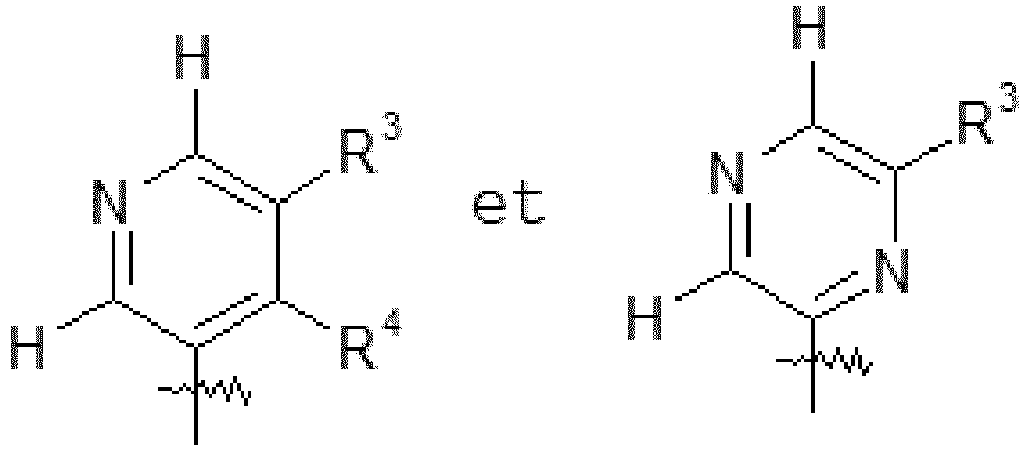 X est N et Y est CH ; ouX est CH et Y est N ;R1 est un hydrogène ou F ;R2 un C1-3alkyle, Cl ou F ;R3 et R4 sont sélectionnés chacun indépendamment parmi :(a) -H,(b) -OR5,(c) un -O-C1-6alkyle-O-C1-3alkyle(d) un -O-C3-6cycloalkyle,(e) -C (O) R5,(f) un C1-6alkyle facultativement substitué avec un à trois -OH, fluor, hétérocyclyle facultativement substitué avec oxo, C3-6cycloalkyle, -CO2R5, -O-C1-6alkyle, aryle, -N(R5) (R6) , CN ou -C(O)N(R5) (R6) ,(g) un C3-6cycloalkyle facultativement substitué avec un à trois -OH, un à trois fluors, C1-6alkyle, -OC1-6alkyle, C1-6alkyle-OC1-6alkyle, C1-6alkyle-OH, CF3, CN, -OC3-6cycloalkyle, -CO2H,-CO2R5, C3-6cycloalkyle, hétéroaryle à 5 ou 6 chaînons, C3-6hétérocyclyle, N(R5) (R6) ,
ou -C(O)N(R5) (R6) ,(h) -CO2R5,(i) -C(O)N(R5) (R6) ,(j) -S(O)2N(R5) (R6) ,(k) -S(O)n-R5(l) un groupe hétérocyclyle monocyclique, bicyclique ou spirocyclique de 4 à 10 chaînons contenant N, S ou O facultativement substitué avec 1 à 3 groupes sélectionnés parmi -N(R5) (R6), un halogène, un -C1-6alkyle, un -O-C1-6alkyle et un -C1-6alkyle-halogène,(m) un aryle,(n) -N(R5) (R6) ,(o) un halogène ;R5 et R6 sont sélectionnés chacun indépendamment parmi -H, un -(C1-C6)alkyle-hétérocyclyle, un hétérocyclyle de 4 à 6 chaînons dans lequel le cycle hétérocyclique est facultativement substitué avec 1 à 3 substituants sélectionnés parmi un -(C1-C6) alkyle, un -O-C1-6alkyle, un -C1-6alkyle-halogène, un -(C1-C6) cycloalkyle, un halogène, un acyle, un hétérocyclyle, un hétérocyclyle-(C1-C6) alkyle, un hétérocyclyle-O- (C1-C6) alkyle, un hétérocyclyle-OH, un hétérocyclyle-C(O)-Me, un hétérocyclyle-C(O) -O(C1-C3) alkyle, un - (C1-C6) alkyle-hétérocyclyle, un - (C1-C6) alkyle-hétérocyclyle- (C1-C6) alkyle, un -(C1-C6) alkyle-O-H, un -(C1-C6) alkyle-O- (C1-C6)alkyle-, un C3-6cycloalkyle, un -(C1-C6) alkyle-cycloalkyle, un C3-6cycloalkyle- (C1-C6) alkyle, un C3-6cycloalkyle-O- (C1-C6) alkyle, et un C3-6cycloalkyle-O-(C1-C6) alkyle-OH ;un acyle, un C3-6cycloalkyle-C(O) -C1-3alkyle, un -C(O)-C1-3alkyle-O-Me, un -C(O) -C1-3alkyle, un -C(O) -C3-6cycloalkyle ; un -C(O)-NH-C1-C3alkyle, un -C(O)-NH-C1-C3alkyle, un -C(O)-NH-C3-C6cycloalkyle facultativement mono ou di substitué avec -(C1-C3)-OH, un -C(O)-NH-C3-C6 hétérocyclyle, un -C(O)-aryle, un -C(O)-hétéroaryle - S(O)n-C1-C3-alkyle et un -(C1-C6) alkyle facultativement substitué avec -OH, un O- (C1-C3)-alkyle, un C3-6cycloalkyle, un hétérocyclyle, un aryle, un -NH-C1-3alkyle ou un -N-(C1-3-alkyle)2 ; ouR5 et R6 conjointement avec l'atome d'azote auquel ils sont liés forment un cycle hétérocyclique à 5 ou 6 chaînons facultativement substitué avec un méthyle ; et n est 0, 1, ou 2. - Composé selon la revendication 1, ou un sel pharmaceutiquement acceptable de celui-ci, dans lequel :
HET est : X est N et Y est CH ;R1 est un hydrogène ou F ;R2 est un Ci-salkyle, Cl ou F ;R3 et R4 sont sélectionnés chacun indépendamment parmi :(a) -H,(b) -OR5,(c) un -O-C1-6alkyle-O-C1-3alkyle(d) un -O-C3-6cycloalkyle,(e) -C(O)R5,(f) un C1-6alkyle facultativement substitué avec un à trois -OH, fluor, hétérocyclyle facultativement substitué avec oxo, C3-6cycloalkyle, -CO2R5, -O-C1-6alkyle, aryle, -N(R5) (R6) , CN ou -C(O)N(R5) (R6) ,(g) un C3-6cycloalkyle facultativement substitué avec un à trois -OH, un à trois fluors, C1-6alkyle, -OC1-6alkyle, C1-6alkyle-OC1-6alkyle, C1-6alkyle-OH, CF3, CN, -OC3-6cycloalkyle, -CO2H, -CO2R5, C3-6cycloalkyle, hétéroaryle à 5 ou 6 chaînons, C3-6hétérocyclyle, N(R5)(R6), ou -C(O)N(R5)(R6),(h) -CO2R5,(i) -C(O)N(R5)(R6),(j) -S(O)2N(R5)(R6),(k) -S(O)n-R5(l) un groupe hétérocyclyle monocyclique, bicyclique ou spirocyclique de 4 à 10 chaînons contenant N, S ou O,(m) un aryle,(n) -N(R5) (R6) ,(o) un halogène ;R5 et R6 sont sélectionnés chacun indépendamment parmi -H, un hétérocyclyle de 4 à 6 chaînons dans lequel le cycle hétérocyclique est facultativement substitué avec 1 à 3 substituants sélectionnés parmi un -(C1-C6)alkyle, un - (C1-C6) cycloalkyle, un halogène, un acyle, un hétérocyclyle, un hétérocyclyle-(C1-C6)alkyle, un hétérocyclyle-O- (C1-C6) alkyle, un hétérocyclyle-OH, un hétérocyclyle-C(O)-Me, un hétérocyclyle-C (O) -O(C1-C3) alkyle, un - (C1-C6) alkyle-hétérocyclyle, un -(C1-C6)alkyle-hétérocyclyle-(C1-C6)alkyle, un - (C1-C6) alkyle-O-H, un - (C1-C6) alkyle-O-(C1-C6)alkyle-, un C3-6cycloalkyle, un -(C1-C6)alkyle-cycloalkyle, un C3-6cycloalkyle- (C1-C6) alkyle, un C3-6cycloalkyle-O- (C1-C6) alkyle, et un C3-6cycloalkyle-O-(C1-C6) alkyle-OH ;un acyle, un C3-6cycloalkyle-C(O) -C1-3alkyle, un -C(O)-C1-3alkyle-O-Me, un -C (O) -C1-3alkyle, un -C (O) -C3-6cycloalkyle ; un -C (O)-NH-C1-C3alkyle, un -C (O) -NH-C1-C3 alkyle, un -C(O)-NH-C3-C6cycloalkyle facultativement mono ou di substitué avec - (C1-C3) -OH, un -C(O)-NH-C3-C6 hétérocyclyle, un -C(O)-aryle, un -C(O)-hétéroaryle - S(O)n-C1-C3-alkyle et un -(C1-C6) alkyle facultativement substitué avec -OH, un O- (C1-C3)-alkyle, un C3-6cycloalkyle, un hétérocyclyle, un aryle, un -NH-C1-3alkyle ou un -N-(C1-3-alkyle)2 ; ouR5 et R6 conjointement avec l'atome d'azote auquel ils sont liés forment un cycle hétérocyclique à 5 ou 6 chaînons facultativement substitué avec un méthyle ; et n est 1, ou 2.
 - Composé selon la revendication 1, ou un sel pharmaceutiquement acceptable de celui-ci, dans lequel :
HET est : X est N et Y est CH ;R1 est sélectionné parmi H ou F ;R2 est sélectionné parmi un méthyle et Cl ;R3 est sélectionné parmi :(a) -H,(b) -OR5,(c) un -O-C1-6alkyle-O-C1-3alkyle(d) un -O-C3-6cycloalkyle,(e) -C(O)R5,(f) un C1-6alkyle facultativement substitué avec un à trois -OH, fluor, hétérocyclyle facultativement substitué avec oxo, C3-6cycloalkyle, -CO2R5, -O-C1-6alkyle, aryle, -N(R5) (R6) , CN ou -C(O)N(R5) (R6) ,(g) un C3-6cycloalkyle facultativement substitué avec un à trois -OH, un à trois fluors, C1-6alkyle, -OC1-6alkyle, C1-6alkyle-OC1-6alkyle, C1-6alkyle-OH, CF3, CN, -OC3-6cycloalkyle, -CO2H, -CO2R5, C3-6cycloalkyle, hétéroaryle à 5 ou 6 chaînons, C3-6hétérocyclyle, N(R5)(R6), ou -C(O)N(R5)(R6),(h) -CO2R5,(i) -C(O)N(R5)(R6),(j)-S(O)2N(R5)(R6),(k) -S(O)n-R5(l) un groupe hétérocyclyle monocyclique, bicyclique ou spirocyclique de 4 à 10 chaînons contenant N, S ou O,(m) un aryle,(n) -N(R5) (R6) ,(o) un halogène ;R4 est H ;R5 et R6 sont sélectionnés chacun indépendamment parmi -H, un hétérocyclyle de 4 à 6 chaînons dans lequel le cycle hétérocyclique est facultativement substitué avec 1 à 3 substituants sélectionnés parmi un -(C1-C6)alkyle, un -(C1-C6) cycloalkyle, un halogène, un acyle, un hétérocyclyle, un hétérocyclyle-(C1-C6)alkyle, un hétérocyclyle-O-(C1-C6) alkyle, un hétérocyclyle-OH, un hétérocyclyle-C(O)-Me, un hétérocyclyle-C(O)-O(C1-C3) alkyle, un -(C1-C6) alkyle-hétérocyclyle, un -(C1-C6) alkyle-hétérocyclyle- (C1-C6)alkyle, un -(C1-C6)alkyle-O-H, un -(C1-C6) alkyle-O-(C1-C6)alkyle-, un C3-6cycloalkyle, un -(C1-C6) alkyle-cycloalkyle, un C3-6cycloalkyle-(C1-C6) alkyle, un C3-6cycloalkyle-O-(C1-C6) alkyle, et un C3-6cycloalkyle-O-(C1-C6) alkyle-OH ;un acyle, un C3-6cycloalkyle-C(O)-C1-3alkyle, un -C(O)-C1-3alkyle-O-Me, un -C(O)-C1-3alkyle, un -C(O)-C3-6cycloalkyle ; un -C(O)-NH-C1-C3alkyle, un -C(O)-NH-C1-C3 alkyle, un -C(O)-NH-C3-C6cycloalkyle facultativement mono ou di substitué avec -(C1-C3)-OH, un -C(O)-NH-C3-C6 hétérocyclyle, un -C(O)-aryle, un -C(O)-hétéroaryle-S(O)n-C1-C3-alkyle et un -(C1-C6) alkyle facultativement substitué avec -OH, un O-(C1-C3)-alkyle, un C3-6cycloalkyle, un hétérocyclyle, un aryle, un -NH-C1-3alkyle ou un -N- (C1-3-alkyle) 2 ; ouR5 et R6 conjointement avec l'atome d'azote auquel ils sont liés forment un cycle hétérocyclique à 5 ou 6 chaînons facultativement substitué avec un méthyle ; et n est 2.
 - Composé selon la revendication 3, ou un sel pharmaceutiquement acceptable de celui-ci, dans lequel :
HET est : R5 et R6 sont sélectionnés chacun indépendamment parmi -H, un hétérocyclyle de 4 à 6 chaînons dans lequel le cycle hétérocyclique est facultativement substitué avec 1 à 3 substituants sélectionnés parmi un -(C1-C6)alkyle, un -(C1-C6)cycloalkyle, un halogène, un acyle, un hétérocyclyle, un hétérocyclyle-(C1-C6)alkyle, un hétérocyclyle-O-(C1-C6) alkyle, un hétérocyclyle-OH, un hétérocyclyle-C(O)-Me, un hétérocyclyle-C (O)-O (C1-C3) alkyle, un -(C1-C6) alkyle-hétérocyclyle, un -(C1-C6) alkyle-hétérocyclyle-(C1-C6)alkyle, un -(C1-C6)alkyle-O-H, un -(C1-C6)alkyle-O-(C1-C6) alkyle-, un C3-6cycloalkyle, un -(C1-C6) alkyle-cycloalkyle, un C3-6cycloalkyle-(C1-C6) alkyle, un C3-6cycloalkyle-O- (C1-C6) alkyle, et un C3-6cycloalkyle-O-(C1-C6) alkyle-OH ;un acyle, un C3-6cycloalkyle-C(O)-C1-3alkyle, un -C(O)-C1-3alkyle-O-Me, un -C(O)-C1-3alkyle, un -C(O)-C3-6cycloalkyle ; un -C(O)-NH-C1-C3alkyle, un -C(O)-NH-C1-C3 alkyle, un -C(O)-NH-C3-C6cycloalkyle facultativement mono ou di substitué avec -(C1-C3)-OH, un -C(O)-NH-C3-C6 hétérocyclyle, un -C(O)-aryle, un -C(O)-hétéroaryle-S(O)2-C1-C3-alkyle et un -(C1-C6) alkyle facultativement substitué avec -OH, un O-(C1-C3)-alkyle, un C3-6cycloalkyle, un hétérocyclyle, un aryle, -NH-C1-3alkyle ou-N-(C1-3-alkyle)2 ; ouR5 et R6 conjointement avec l'atome d'azote auquel ils sont liés forment un cycle hétérocyclique à 5 ou 6 chaînons facultativement substitué avec un méthyle.
 - Composé selon la revendication 3, ou un sel pharmaceutiquement acceptable de celui-ci, dans lequel :
HET est sélectionné parmi :


 X est N et Y est CH ;R1 est sélectionné parmi H ou F ; etR2 est sélectionné parmi un méthyle et Cl.
 - Composé selon la revendication 1, ou un sel pharmaceutiquement acceptable de celui-ci, dans lequel :
HET est : X est CH ;Y est N ;R1 est sélectionné parmi H ou F ;R2 est sélectionné parmi un méthyle et Cl ;R3 est sélectionné parmi :(a) -H,(b) -OR5,(c) un -O-C1-6alkyle-O-C1-3alkyle(d) un -O-C3-6cycloalkyle,(e) -C(O)R5,(f) un C1-6alkyle facultativement substitué avec un à trois -OH, fluor, hétérocyclyle facultativement substitué avec oxo, C3-6cycloalkyle, -CO2R5, -O-C1-6alkyle, aryle, -N(R5)(R6), CN ou -C(O)N(R5)(R6),(g) un C3-6cycloalkyle facultativement substitué avec un à trois -OH, un à trois fluors, C1-6alkyle, -OC1-6alkyle, C1-6alkyle-OC1-6alkyle, C1-6alkyle-OH, CF3, CN, -OC3-6cycloalkyle, -CO2H, -CO2R5, C3-6cycloalkyle, hétéroaryle à 5 ou 6 chaînons, C3-6hétérocyclyle, N(R5)(R6), ou -C(O)N(R5)(R6),(h) -CO2R5,(i) -C(O)N(R5)(R6),(j) -S(O)2N(R5)(R6),(k) -S(O)n-R5(l) un groupe hétérocyclyle monocyclique, bicyclique ou spirocyclique de 4 à 10 chaînons contenant N, S ou O,(m) un aryle,(n) -N(R5) (R6),(o) un halogène ;R4 est H ;R5 et R6 sont sélectionnés chacun indépendamment parmi -H, un hétérocyclyle de 4 à 6 chaînons dans lequel le cycle hétérocyclique est facultativement substitué avec 1 à 3 substituants sélectionnés parmi un -(C1-C6)alkyle, un -(C1-C6)cycloalkyle, un halogène, un acyle, un hétérocyclyle, un hétérocyclyle-(C1-C6)alkyle, un hétérocyclyle-O-(C1-C6) alkyle, un hétérocyclyle-OH, un hétérocyclyle-C(O)-Me, un hétérocyclyle-C (O)-O(C1-C3) alkyle, un -(C1-C6) alkyle-hétérocyclyle, un -(C1-C6)alkyle-hétérocyclyle-(C1-C6)alkyle, un -(C1-C6) alkyle-O-H, un -(C1-C6) alkyle-O-(C1-C6) alkyle-, un C3-6cycloalkyle, un -(C1-C6) alkyle-cycloalkyle, un C3-6cycloalkyle-(C1-C6) alkyle, un C3-6cycloalkyle-O-(C1-C6) alkyle, et un C3-6cycloalkyle-O-(C1-C6) alkyle-OH ;un acyle, un C3-6cycloalkyle-C(O)-C1-3alkyle, un -C(O)-C1-3alkyle-O-Me, un -C(O)-C1-3alkyle, un -C(O)-C3-6cycloalkyle ; un -C(O)-NH-C1-C3alkyle, un -C(O)-NH-C1-C3 alkyle, un -C(O)-NH-C3-C6cycloalkyle facultativement mono ou di substitué avec -(C1-C3)-OH, un -C(O)-NH-C3-C6 hétérocyclyle, un -C(O)-aryle, un -C(O)-hétéroaryle - S(O)n-C1-C3-alkyle et un -(C1-C6) alkyle facultativement substitué avec -OH, un O-(C1-C3) -alkyle, un C3-6cycloalkyle, un hétérocyclyle, un aryle, un -NH-C1-3alkyle ou un -N-(C1-3-alkyle)2 ; ouR5 et R6 conjointement avec l'atome d'azote auquel ils sont liés forment un cycle hétérocyclique à 5 ou 6 chaînons facultativement substitué avec un méthyle ; et n est 2.
 - Composé selon la revendication 6, ou un sel pharmaceutiquement acceptable de celui-ci, dans lequel :
HET est : R5 et R6 sont sélectionnés chacun indépendamment parmi -H, un hétérocyclyle de 4 à 6 chaînons dans lequel le cycle hétérocyclique est facultativement substitué avec 1 à 3 substituants sélectionnés parmi un -(C1-C6)alkyle, un -(C1-C6)cycloalkyle, un halogène, un acyle, un hétérocyclyle, un hétérocyclyle-(C1-C6)alkyle, un hétérocyclyle-O-(C1-C6) alkyle, un hétérocyclyle-OH, un hétérocyclyle-C(O)-Me, un hétérocyclyle-C (O)-O(C1-C3) alkyle, un -(C1-C6) alkyle-hétérocyclyle, un -(C1-C6)alkyle-hétérocyclyle-(C1-C6)alkyle, un -(C1-C6) alkyle-O-H, un -(C1-C6) alkyle-O-(C1-C6) alkyle-, un C3-6cycloalkyle, un -(C1-C6) alkyle-cycloalkyle, un C3-6cycloalkyle-(C1-C6) alkyle, un C3-6cycloalkyle-O- (C1-C6) alkyle, et un C3-6cycloalkyle-O-(C1-C6) alkyle-OH ;un acyle, un C3-6cycloalkyle-C(O)-C1-3alkyle, un -C(O)-C1-3alkyle-O-Me, un -C(O)-C1-3alkyle, un -C(O)-C3-6cycloalkyle ; un -C(O)-NH-C1-C3alkyle, un -C(O)-NH-C1-C3 alkyle, un -C(O)-NH-C3-C6cycloalkyle facultativement mono ou di substitué avec -(C1-C3)-OH, un -C(O)-NH-C3-C6 hétérocyclyle, un -C(O)-aryle, un -C(O)-hétéroaryle - S(O)2-C1-C3-alkyle et un -(C1-C6) alkyle facultativement substitué avec -OH, un O-(C1-C3)-alkyle, un C3-6cycloalkyle, un hétérocyclyle, un aryle, un -NH-C1-3alkyle ou un -N-(C1-3-alkyle)2 ; ouR5 et R6 conjointement avec l'atome d'azote auquel ils sont liés forment un cycle hétérocyclique à 5 ou 6 chaînons facultativement substitué avec un méthyle.
 - Composé selon la revendication 1, ou un sel pharmaceutiquement acceptable de celui-ci, dans lequel :
HET est sélectionné parmi :


 X est N et Y est CH ;R1 est F ; etR2 est un méthyle.
 - Composé selon la revendication 1, ou un sel pharmaceutiquement acceptable de celui-ci, dans lequel :
HET est : X est N ;Y est CH ;R1 est sélectionné parmi H ou F ;R2 est sélectionné parmi un méthyle et Cl ;R3 est sélectionné parmi :(a) -H,(b) -OR5,(c) un -O-C1-6alkyle-O-C1-3alkyle(d) un -O-C3-6cycloalkyle,(e) -C(O)R5,(f) un C1-6alkyle facultativement substitué avec un à trois -OH, fluor, u hétérocyclyle facultativement substitué avec oxo, C3-6cycloalkyle, -CO2R5, -O-C1-6alkyle, aryle, -N(R5)(R6), CN ou -C(O)N(R5)(R6),(g) un C3-6cycloalkyle facultativement substitué avec un à trois -OH, un à trois fluors, C1-6alkyle, -OC1-6alkyle, C1-6alkyle-OC1-6alkyle, C1-6alkyle-OH, CF3, CN, -OC3-6cycloalkyle, -CO2H, -CO2R5, C3-6cycloalkyle, hétéroaryle à 5 ou 6 chaînons, C3-6hétérocyclyle, N(R5)(R6), ou -C(O)N(R5)(R6),(h) -CO2R5,(i) -C(O)N(R5)(R6),(j) -S(O)2N(R5)(R6),(k) -S(O)n-R5(l) un groupe hétérocyclyle monocyclique, bicyclique ou spirocyclique de 4 à 10 chaînons contenant N, S ou O,(m) un aryle,(n) -N(R5)(R6),(o) un halogène ;R5 et R6 sont sélectionnés chacun indépendamment parmi -H, un hétérocyclyle de 4 à 6 chaînons dans lequel le cycle hétérocyclique est facultativement substitué avec 1 à 3 substituants sélectionnés parmi un -(C1-C6)alkyle, un -(C1-C6)cycloalkyle, un halogène, un acyle, un hétérocyclyle, un hétérocyclyle-(C1-C6)alkyle, un hétérocyclyle-O-(C1-C6) alkyle, un hétérocyclyle-OH, un hétérocyclyle-C(O)-Me, un hétérocyclyle-C (O)-O(C1-C3) alkyle, un -(C1-C6) alkyle-hétérocyclyle, un -(C1-C6)alkyle-hétérocyclyle-(C1-C6)alkyle, un -(C1-C6) alkyle-0-H, un -(C1-C6) alkyle-O-(C1-C6) alkyle-, un C3-6cycloalkyle, un -(C1-C6) alkyle-cycloalkyle, un C3-6cycloalkyle-(C1-C6) alkyle, un C3-6cycloalkyle-O-(C1-C6) alkyle, et un C3-6cycloalkyle-O-(C1-C6) alkyle-OH ;un acyle, un C3-6cycloalkyle-C(O)-C1-3alkyle, un -C(O)-C1-3alkyle-O-Me, un -C(O)-C1-3alkyle, un -C(O)-C3-6cycloalkyle ; un -C(O)-NH-C1-C3alkyle, un -C(O)-NH-C1-C3 alkyle, un -C(O)-NH-C3-C6cycloalkyle facultativement mono ou di substitué avec -(C1-C3)-OH, un -C(O)-NH-C3-C6 hétérocyclyle, un -C(O)-aryle, un -C(O)-hétéroaryle - S(O)n-C1-C3-alkyle et un -(C1-C6) alkyle facultativement substitué avec -OH, un O-(C1-C3)-alkyle, un C3-6cycloalkyle, un hétérocyclyle, un aryle, un -NH-C1-3alkyle ou un -N-(C1-3-alkyle)2 ; ouR5 et R6 conjointement avec l'atome d'azote auquel ils sont liés forment un cycle hétérocyclique à 5 ou 6 chaînons facultativement substitué avec un méthyle ; et n est 2.
 - Composé selon la revendication 9, ou un sel pharmaceutiquement acceptable de celui-ci, dans lequel :
HET est : R5 et R6 sont sélectionnés chacun indépendamment parmi -H, un hétérocyclyle de 4 à 6 chaînons dans lequel le cycle hétérocyclique est facultativement substitué avec 1 à 3 substituants sélectionnés parmi un -(C1-C6)alkyle, un -(C1-C6)cycloalkyle, un halogène, un acyle, un hétérocyclyle, un hétérocyclyle-(C1-C6)alkyle, un hétérocyclyle-O-(C1-C6)alkyle, un hétérocyclyle-OH, un hétérocyclyle-C(O)-Me, un hétérocyclyle-C(O)-O(C1-C3)alkyle, un -(C1-C6)alkyle-hétérocyclyle, un -(C1-C6)alkyle-hétérocyclyle-(C1-C6)alkyle, un -(C1-C6)alkyle-O-H, un -(C1-C6)alkyle-O-(C1-C6) alkyle-, un C3-6cycloalkyle, un -(C1-C6)alkyle-cycloalkyle, un C3-6cycloalkyle-(C1-C6)alkyle, un C3-6cycloalkyle-O-(C1-C6)alkyle, et un C3-6cycloalkyle-O-(C1-C6) alkyle-OH ;un acyle, un C3-6cycloalkyle-C(O)-C1-3alkyle, un -C(O)-C1-3alkyle-O-Me, un -C(O)-C1-3alkyle, un -C(O)-C3-6cyclo-alkyle ; un -C(O)-NH-C1-C3alkyle, un -C(O)-NH-C1-C3 alkyle, un -C(O)-NH-C3-C6cycloalkyle facultativement mono ou di substitué avec -(C1-C3)-OH, un -C(O)-NH-C3-C6 hétérocyclyle, un -C(O)-aryle, un -C(O)-hétéroaryle-S(O)2-C1-C3-alkyle et un -(C1-C6)alkyle facultativement substitué avec -OH, un O-(C1-C3)-alkyle, un C3-6cyclo-alkyle, un hétérocyclyle, un aryle, un -NH-C1-3alkyle ou un -N-(C1-3-alkyle)2 ; ouR5 et R6 conjointement avec l'atome d'azote auquel ils sont liés forment un cycle hétérocyclique à 5 ou 6 chaînons facultativement substitué avec un méthyle.
 - Composé selon la revendication 1, ou un sel pharmaceutiquement acceptable de celui-ci, dans lequel :
HET est :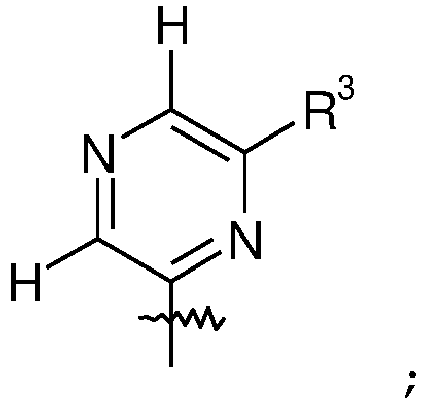 X est CH ;Y est N ;R1 est sélectionné parmi H ou F ;R2 est sélectionné parmi un méthyle et Cl ;R3 est sélectionné parmi :(a) -H,(b) -OR5,(c) un -O-C1-6alkyle-O-C1-3alkyle(d) un -O-C3-6cycloalkyle,(e) -C(O)R5,(f) un C1-6alkyle facultativement substitué avec un à trois -OH, fluor, hétérocyclyle facultativement substitué avec oxo, C3-6cycloalkyle, -CO2R5, -O-C1-6alkyle, aryle, -N(R5)(R6), CN ou -C(O)N(R5)(R6),(g) un C3-6cycloalkyle facultativement substitué avec un à trois -OH, un à trois fluors, C1-6alkyle, -OC1-6alkyle, C1-6alkyle-OC1-6alkyle, C1-6alkyle-OH, CF3, CN, -OC3-6cycloalkyle, -CO2H, -CO2R5, C3-6cycloalkyle, hétéroaryle à 5 ou 6 chaînons, C3-6hétérocyclyle, N(R5)(R6), ou -C(O)N(R5)(R6),(h) -CO2R5,(i) -C(O)N(R5)(R6),(j) -S(O)2N(R5)(R6),(k) -S(O)n-R5(l) un groupe hétérocyclyle monocyclique, bicyclique ou spirocyclique de 4 à 10 chaînons contenant N, S ou O,(m) un aryle,(n) -N(R5)(R6),(o) un halogène ;R5 et R6 sont sélectionnés chacun indépendamment parmi -H, un hétérocyclyle de 4 à 6 chaînons dans lequel le cycle hétérocyclique est facultativement substitué avec 1 à 3 substituants sélectionnés parmi un -(C1-C6)alkyle, un -(C1-C6)cycloalkyle, un halogène, un acyle, un hétérocyclyle, un hétérocyclyle-(C1-C6)alkyle, un hétérocyclyle-O- (C1-C6) alkyle, un hétérocyclyle-OH, un hétérocyclyle-C(O)-Me, un hétérocyclyle-C(O)-O(C1-C3)alkyle, un -(C1-C6)alkyle-hétérocyclyle, un -(C1-C6)alkyle-hétérocyclyle-(C1-C6)alkyle, un -(C1-C6)alkyle-O-H, un -(C1-C6)alkyle-O-(C1-C6)alkyle-, un C3-6cycloalkyle, un -(C1-C6)alkyle-cycloalkyle, un C3-6cycloalkyle-(C1-C6)alkyle, un C3-6cycloalkyle-O-(C1-C6)alkyle, et un C3-6cycloalkyle-O-(C1-C6) alkyle-OH ;un acyle, un C3-6cycloalkyle-C(O)-C1-3alkyle, un -C(O)-C1-3alkyle-O-Me, un -C(O)-C1-3alkyle, un -C(O)-C3-6cyclo-alkyle ; un -C(O)-NH-C1-C3alkyle, un -C(O)-NH-C1-C3 alkyle, un -C(O)-NH-C3-C6cycloalkyle facultativement mono ou di substitué avec -(C1-C3)-OH, un -C(O)-NH-C3-C6 hétérocyclyle, un -C(O)-aryle, un -C(O)-hétéroaryle-S(O)n-C1-C3-alkyle et un -(C1-C6)alkyle facultativement substitué avec -OH, un O-(C1-C3)-alkyle, un C3-6cyclo-alkyle, un hétérocyclyle, un aryle, un -NH-C1-3alkyle ou un -N-(C1-3-alkyle)2 ; ouR5 et R6 conjointement avec l'atome d'azote auquel ils sont liés forment un cycle hétérocyclique à 5 ou 6 chaînons facultativement substitué avec un méthyle ; et n est 2.
 - Composé selon la revendication 11, ou un sel pharmaceutiquement acceptable de celui-ci, dans lequel :
HET est :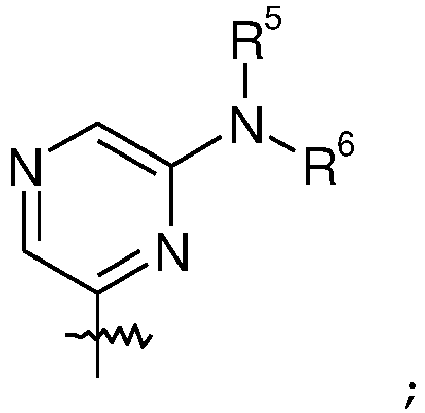 R5 et R6 sont sélectionnés chacun indépendamment parmi -H, un hétérocyclyle de 4 à 6 chaînons dans lequel le cycle hétérocyclique est facultativement substitué avec 1 à 3 substituants sélectionnés parmi un -(C1-C6)alkyle, un -(C1-C6)cycloalkyle, un halogène, un acyle, un hétérocyclyle, un hétérocyclyle-(C1-C6)alkyle, un hétérocyclyle-O-(C1-C6)alkyle, un hétérocyclyle-OH, un hétérocyclyle-C(O)-Me, un hétérocyclyle-C (O)-O(C1-C3) alkyle, un -(C1-C6)alkyle-hétérocyclyle, un -(C1-C6)alkyle-hétérocyclyle-(C1-C6)alkyle, un -(C1-C6)alkyle-O-H, un -(C1-C6)alkyle-O-(C1-C6) alkyle-, un C3-6cycloalkyle, un -(C1-C6)alkyle-cycloalkyle, un C3-6cycloalkyle-(C1-C6)alkyle, un C3-6cycloalkyle-O-(C1-C6)alkyle, et un C3-6cycloalkyle-O-(C1-C6) alkyle-OH ;un acyle, un C3-6cycloalkyle-C(O)-C1-3alkyle, un -C(O)-C1-3alkyle-O-Me, un -C(O)-C1-3alkyle, un -C(O)-C3-6cyclo-alkyle ; un -C(O)-NH-C1-C3alkyle, un -C(O)-NH-C1-C3 alkyle, un -C(O)-NH-C3-C6cycloalkyle facultativement mono ou di substitué avec -(C1-C3)-OH, un -C(O)-NH-C3-C6 hétérocyclyle, un -C(O)-aryle, un -C(O)-hétéroaryle-S(O)2-C1-C3-alkyle et un -(C1-C6)alkyle facultativement substitué avec -OH, un O-(C1-C3)-alkyle, un C3-6cyclo-alkyle, un hétérocyclyle, un aryle, un -NH-C1-3alkyle ou un -N-(C1-3-alkyle)2 ; ouR5 et R6 conjointement avec l'atome d'azote auquel ils sont liés forment un cycle hétérocyclique à 5 ou 6 chaînons facultativement substitué avec un méthyle.
 - Composé selon la revendication 8, ou un sel pharmaceutiquement acceptable de celui-ci, dans lequel :
HET est sélectionné parmi :

 X est N et Y est CH ;R1 est F ; etR2 est un méthyle.
 - Composé selon la revendication 13, ou un sel pharmaceutiquement acceptable de celui-ci, dans lequel :
HET est :
- Composé selon la revendication 1, à savoir un composé sélectionné dans le groupe constitué par :
Exemple Structure Exemple Structure 25 
112 
26 
113 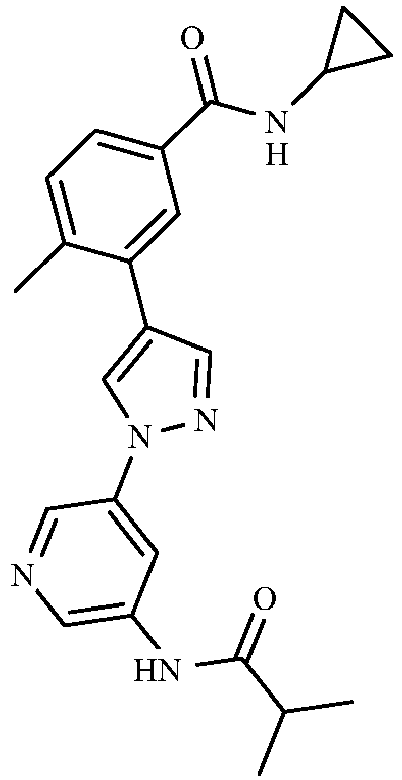
27 
114 
28 
115 
31 
116 
32 
117 
33 
118 
34 
119 
35 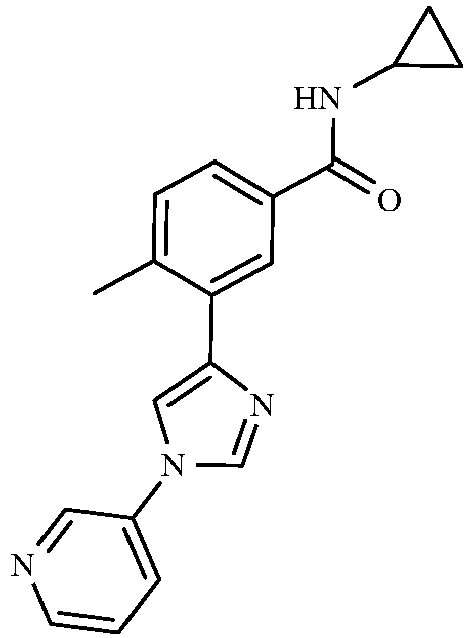
121 
36 
122 
39 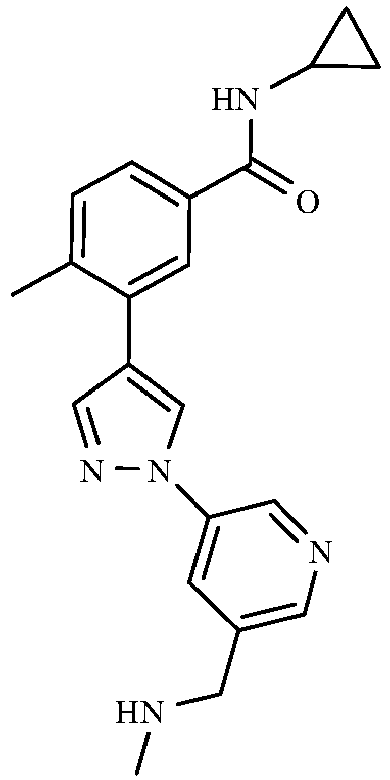
123 
43 
124 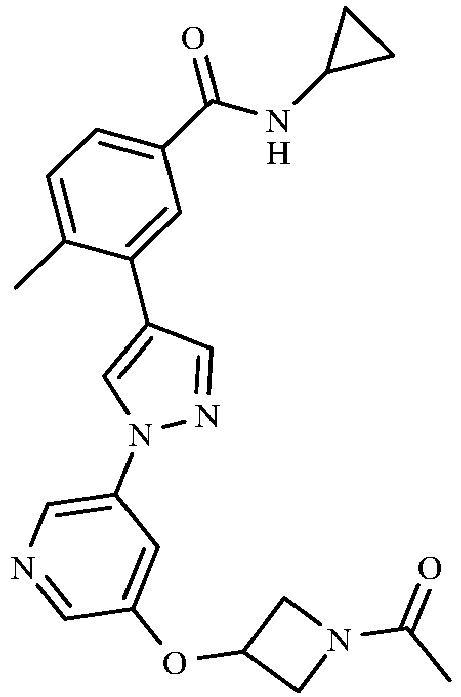
44 
125 
45 
126 
46 
127 
47 
128 
48 
129 
49 
131 
50 
135 
51 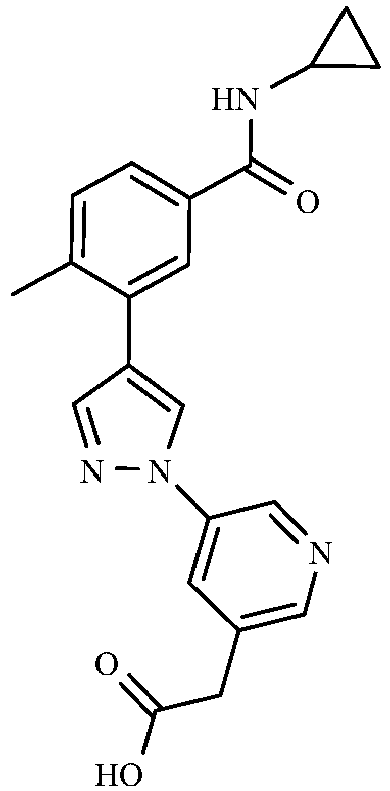
136 
52 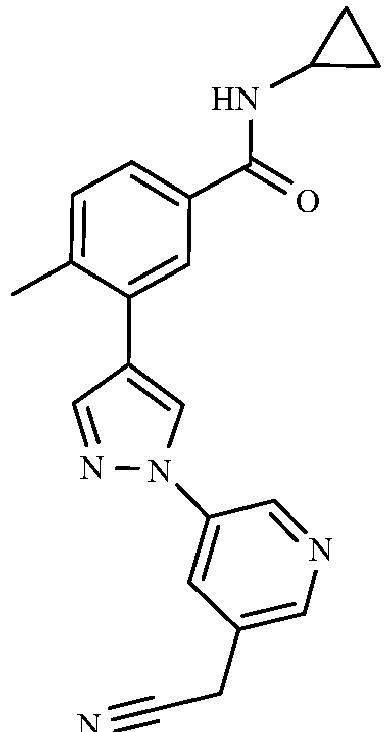
137 
53 
138 
54 
140 
55 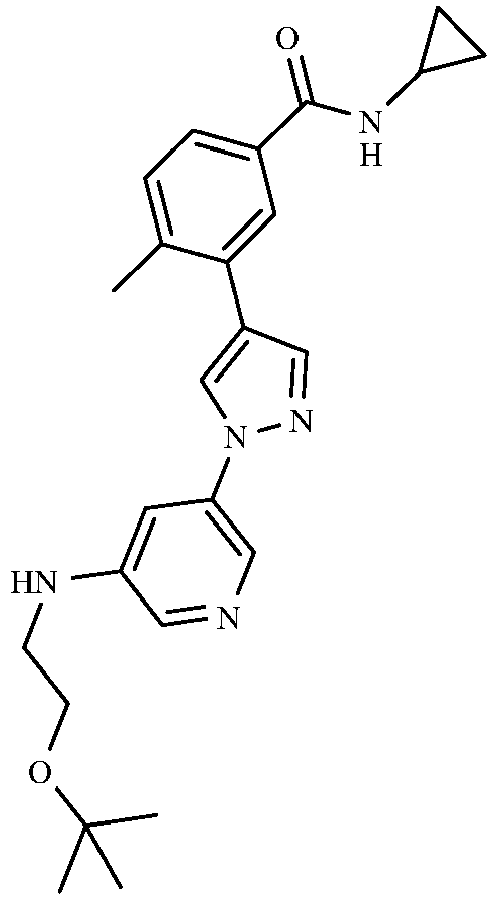
141 
56 
142 
57 
143 
58 
144 
59 
145 
60 
146 
63 
147 
65 
148 
66 
149 
67 
150 
68 
151 
71 
152 
72 
153 
73 
154 
74 
155 
75 
156 
76 
157 
77 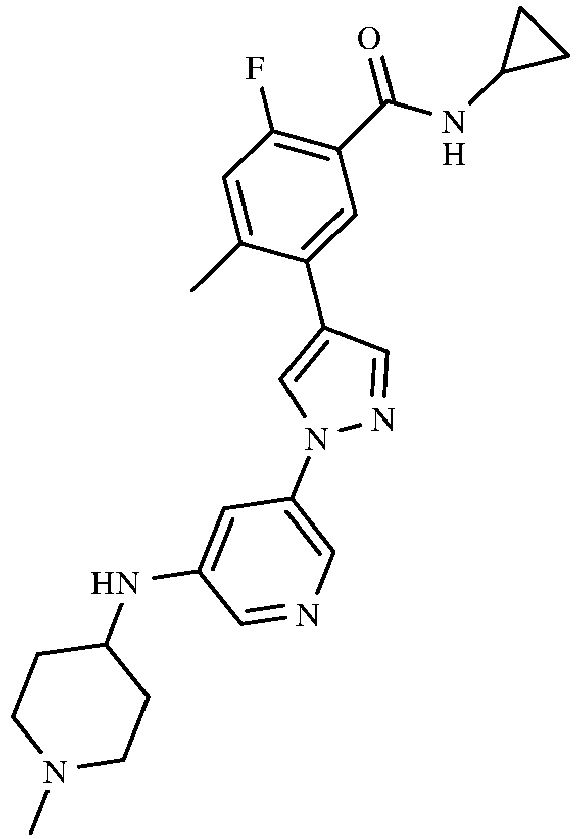
158 
78 
159 
79 
160 
80 
161 
81 
162 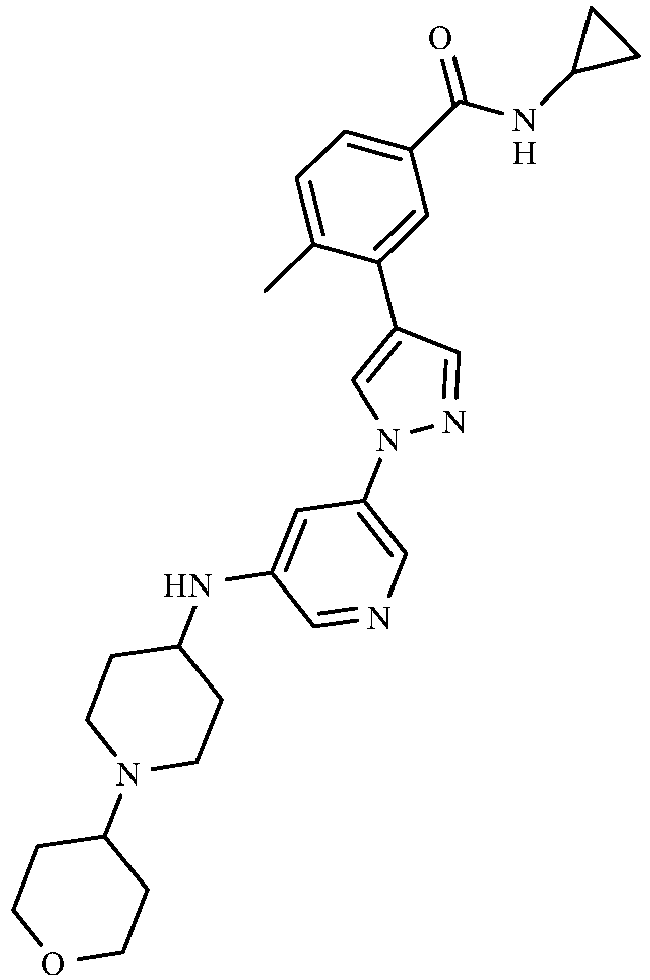
92 
163 
93 
164 
94 
165 
95 
166 
96 
167 
97 
168 
98 
169 
99 
170 
100 
171 
101 
172 
104 
173 
105 
174 
106 
175 
107 
176 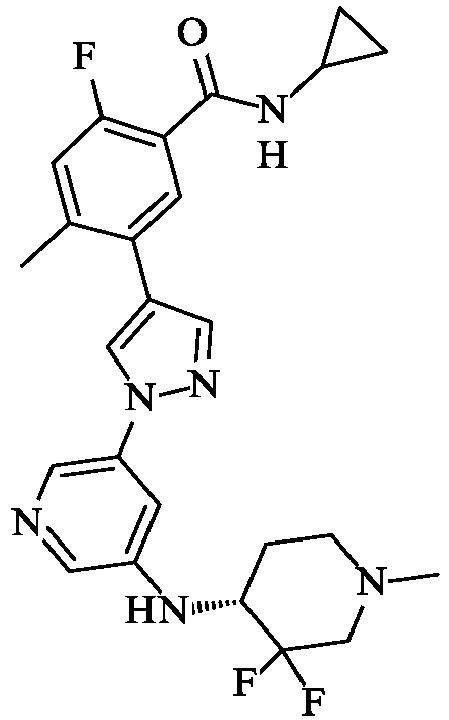
108 
109 
110 
111 
- Sel pharmaceutiquement acceptable d'un composé selon la revendication 15.
- Composition pharmaceutique comprenant le composé selon la revendication 1, ou un sel pharmaceutiquement acceptable de celui-ci, et au moins un support pharmaceutiquement acceptable.
- Composé selon l'une quelconque des revendications 1 à 16 pour son utilisation dans le traitement d'une maladie auto-immune ou d'un trouble allergique.
- Composé pour son utilisation selon la revendication 18, dans lequel la maladie auto-immune ou le trouble allergique est sélectionné parmi la polyarthrite rhumatoïde, le psoriasis, le lupus érythémateux disséminé, la lupus néphrétique, la sclérodermie, l'asthme, la maladie pulmonaire obstructive chronique (MPOC), la rhinite allergique, l'eczéma allergique, la sclérose en plaques, la polyarthrite rhumatoïde juvénile, l'arthrite juvénile idiopathique, le diabète de type I, une maladie inflammatoire intestinale, la réaction du greffon contre l'hôte, l'arthrite psoriasique, l'arthrite réactive, la spondylarthrite ankylosante, la maladie de Crohn, la rectocolite hémorragique, l'uvéite et la spondylarthropathie non radiographique.
Applications Claiming Priority (2)
| Application Number | Priority Date | Filing Date | Title |
|---|---|---|---|
| US201662394780P | 2016-09-15 | 2016-09-15 | |
| PCT/US2017/050200 WO2018052773A1 (fr) | 2016-09-15 | 2017-09-06 | Composés de pyridine et de pyrazine en tant qu'inhibiteurs de ripk2 |
Publications (2)
| Publication Number | Publication Date |
|---|---|
| EP3512837A1 EP3512837A1 (fr) | 2019-07-24 |
| EP3512837B1 true EP3512837B1 (fr) | 2020-07-22 |
Family
ID=59895400
Family Applications (1)
| Application Number | Title | Priority Date | Filing Date |
|---|---|---|---|
| EP17768582.3A Active EP3512837B1 (fr) | 2016-09-15 | 2017-09-06 | Composés de pyridine et de pyrazine en tant qu'inhibiteurs de ripk2 |
Country Status (6)
| Country | Link |
|---|---|
| US (1) | US10138222B2 (fr) |
| EP (1) | EP3512837B1 (fr) |
| JP (1) | JP6932771B2 (fr) |
| AR (1) | AR109651A1 (fr) |
| TW (1) | TW201823228A (fr) |
| WO (1) | WO2018052773A1 (fr) |
Families Citing this family (6)
| Publication number | Priority date | Publication date | Assignee | Title |
|---|---|---|---|---|
| SI3512833T1 (sl) | 2016-09-15 | 2020-11-30 | Boehringer Ingelheim International Gmbh | Heteroarilne karboksamidne spojine kot inhibitorji RIPK2 |
| ES2974634T3 (es) * | 2018-12-21 | 2024-06-28 | Celgene Corp | Inhibidores de tienopiridinas de RIPK2 |
| TW202229239A (zh) * | 2020-09-23 | 2022-08-01 | 日商武田藥品工業股份有限公司 | 作為ripk2抑制劑之3-(6-胺基吡啶-3-基)苯甲醯胺衍生物 |
| WO2023225601A2 (fr) * | 2022-05-18 | 2023-11-23 | Trustees Of Tufts College | Ripk2 et inhibiteurs de nod |
| WO2024259328A1 (fr) * | 2023-06-16 | 2024-12-19 | Odyssey Therapeutics, Inc. | Inhibiteurs de ripk2 et leurs utilisations |
| AU2024362918A1 (en) | 2023-10-20 | 2026-04-30 | Odyssey Therapeutics, Inc. | Methods of treating a patient with an inflammatory bowel disease |
Family Cites Families (11)
| Publication number | Priority date | Publication date | Assignee | Title |
|---|---|---|---|---|
| WO2009003998A2 (fr) * | 2007-07-02 | 2009-01-08 | Boehringer Ingelheim International Gmbh | Nouveaux composés chimiques |
| WO2011009484A1 (fr) * | 2009-07-22 | 2011-01-27 | Novartis Ag | Arylpyrazoles et arylisoxazoles et leur utilisation en tant que modulateurs de la protéine kinase c (pkd) |
| CA2783258A1 (fr) * | 2009-12-23 | 2011-06-30 | Elan Pharmaceuticals, Inc. | Pteridinones en tant qu'inhibiteurs de polo-like kinase |
| BR112012023021A2 (pt) * | 2010-03-16 | 2016-05-31 | Dana Farber Cancer Inst Inc | compostos de indazol e seus usos |
| US20130023532A1 (en) | 2010-03-26 | 2013-01-24 | Casillas Linda N | Indazolyl-pyrimidines as kinase inhibitors |
| EP2552208A4 (fr) * | 2010-03-31 | 2014-07-09 | Glaxo Group Ltd | Imidazolyl-imidazoles en tant qu'inhibiteurs de kinase |
| JP6321042B2 (ja) | 2013-02-06 | 2018-05-09 | バイエル・クロップサイエンス・アクチェンゲゼルシャフト | 新規なハロゲン置換された化合物 |
| WO2014179186A1 (fr) | 2013-04-30 | 2014-11-06 | Boehringer Ingelheim International Gmbh | Inhibiteurs de l'aldostérone synthase |
| RU2712092C2 (ru) * | 2013-11-05 | 2020-01-24 | Байер Кропсайенс Акциенгезельшафт | Замещенные бензамиды для борьбы с членистоногими |
| US10239881B2 (en) * | 2014-10-27 | 2019-03-26 | University Health Network | RIPK2 inhibitors and method of treating cancer with same |
| SI3512833T1 (sl) * | 2016-09-15 | 2020-11-30 | Boehringer Ingelheim International Gmbh | Heteroarilne karboksamidne spojine kot inhibitorji RIPK2 |
-
2017
- 2017-09-06 EP EP17768582.3A patent/EP3512837B1/fr active Active
- 2017-09-06 US US15/696,547 patent/US10138222B2/en active Active
- 2017-09-06 WO PCT/US2017/050200 patent/WO2018052773A1/fr not_active Ceased
- 2017-09-06 JP JP2019514289A patent/JP6932771B2/ja active Active
- 2017-09-14 TW TW106131571A patent/TW201823228A/zh unknown
- 2017-09-14 AR ARP170102540A patent/AR109651A1/es not_active Application Discontinuation
Non-Patent Citations (1)
| Title |
|---|
| None * |
Also Published As
| Publication number | Publication date |
|---|---|
| JP2019529413A (ja) | 2019-10-17 |
| TW201823228A (zh) | 2018-07-01 |
| AR109651A1 (es) | 2019-01-09 |
| JP6932771B2 (ja) | 2021-09-08 |
| US10138222B2 (en) | 2018-11-27 |
| US20180072703A1 (en) | 2018-03-15 |
| EP3512837A1 (fr) | 2019-07-24 |
| WO2018052773A1 (fr) | 2018-03-22 |
Similar Documents
| Publication | Publication Date | Title |
|---|---|---|
| US10138222B2 (en) | Substituted benzamides as RIPK2 inhibitors | |
| AU2024204902A1 (en) | Cot modulators and methods of use thereof | |
| AU2016352813B2 (en) | Novel pyrazolo pyrimidine derivatives | |
| JP6422438B2 (ja) | RORγT阻害剤としての4−ヘテロアリール置換安息香酸化合物およびその使用 | |
| EP2884977B1 (fr) | Composés indazole et indole n-alkylés utilisés en tant qu'inhibiteurs de rorgammat et utilisations de ceux-ci | |
| JP6232429B2 (ja) | RORγT阻害剤としての3−シクロヘキセニルおよびシクロヘキシル置換インドールおよびインダゾール化合物およびそれらの使用 | |
| EP2920149B1 (fr) | Composés 3-aminocycloalkyl comme inhibiteurs de ror-gamma-t et leurs utilisations | |
| KR102376354B1 (ko) | 6-(5-히드록시-1h-피라졸-1-일)니코틴아미드 유도체 및 phd의 저해제로서의 그의 용도 | |
| EP3512833B1 (fr) | Composés d'hétéroaryle carboxamide en tant qu'inhibiteurs de ripk2 | |
| HUE033177T2 (en) | Pyrazine carboxamide compound | |
| KR102292433B1 (ko) | Gsk-3 억제제로서 유용한 치환된 피리딘 유도체 | |
| KR20160115934A (ko) | Irak4 억제제로서의 바이시클릭 헤테로시클릴 유도체 | |
| AU2013282953A1 (en) | 2-aminopyrazine derivatives as CSF-1 R kinase inhibitors | |
| KR20180118752A (ko) | 섬유증의 치료를 위한 신규 화합물 및 그의 약학 조성물 | |
| WO2018175512A1 (fr) | Inhibiteurs de tyrosine kinase de bruton | |
| EP2619196B1 (fr) | Inhibiteurs oxadiazole de production de leucotriènes | |
| IL271808B (en) | New substituted azaindoline derivatives as nik inhibitors | |
| TW202220972A (zh) | Btk抑制劑 | |
| CA2919297C (fr) | Derives piperidine et azepine servant de modulateurs du recepteur de la prokineticine | |
| JP2014504620A (ja) | Nk1アンタゴニスト活性を有するスピロアミン系化合物 | |
| WO2024026430A1 (fr) | Composés de pyrimidine substitués en tant qu'inhibiteurs de tyk2 | |
| CN121712766A (zh) | 吗啉促食欲素受体拮抗剂 | |
| HK40004680B (en) | Heteroaryl carboxamide compounds as inhibitors of ripk2 | |
| HK40004680A (en) | Heteroaryl carboxamide compounds as inhibitors of ripk2 |
Legal Events
| Date | Code | Title | Description |
|---|---|---|---|
| STAA | Information on the status of an ep patent application or granted ep patent |
Free format text: STATUS: UNKNOWN |
|
| STAA | Information on the status of an ep patent application or granted ep patent |
Free format text: STATUS: THE INTERNATIONAL PUBLICATION HAS BEEN MADE |
|
| PUAI | Public reference made under article 153(3) epc to a published international application that has entered the european phase |
Free format text: ORIGINAL CODE: 0009012 |
|
| STAA | Information on the status of an ep patent application or granted ep patent |
Free format text: STATUS: REQUEST FOR EXAMINATION WAS MADE |
|
| 17P | Request for examination filed |
Effective date: 20190415 |
|
| AK | Designated contracting states |
Kind code of ref document: A1 Designated state(s): AL AT BE BG CH CY CZ DE DK EE ES FI FR GB GR HR HU IE IS IT LI LT LU LV MC MK MT NL NO PL PT RO RS SE SI SK SM TR |
|
| AX | Request for extension of the european patent |
Extension state: BA ME |
|
| DAV | Request for validation of the european patent (deleted) | ||
| DAX | Request for extension of the european patent (deleted) | ||
| GRAP | Despatch of communication of intention to grant a patent |
Free format text: ORIGINAL CODE: EPIDOSNIGR1 |
|
| STAA | Information on the status of an ep patent application or granted ep patent |
Free format text: STATUS: GRANT OF PATENT IS INTENDED |
|
| INTG | Intention to grant announced |
Effective date: 20200403 |
|
| GRAS | Grant fee paid |
Free format text: ORIGINAL CODE: EPIDOSNIGR3 |
|
| GRAA | (expected) grant |
Free format text: ORIGINAL CODE: 0009210 |
|
| STAA | Information on the status of an ep patent application or granted ep patent |
Free format text: STATUS: THE PATENT HAS BEEN GRANTED |
|
| RAP1 | Party data changed (applicant data changed or rights of an application transferred) |
Owner name: BOEHRINGER INGELHEIM INTERNATIONAL GMBH |
|
| AK | Designated contracting states |
Kind code of ref document: B1 Designated state(s): AL AT BE BG CH CY CZ DE DK EE ES FI FR GB GR HR HU IE IS IT LI LT LU LV MC MK MT NL NO PL PT RO RS SE SI SK SM TR |
|
| REG | Reference to a national code |
Ref country code: GB Ref legal event code: FG4D |
|
| REG | Reference to a national code |
Ref country code: CH Ref legal event code: EP |
|
| REG | Reference to a national code |
Ref country code: DE Ref legal event code: R096 Ref document number: 602017020259 Country of ref document: DE |
|
| REG | Reference to a national code |
Ref country code: AT Ref legal event code: REF Ref document number: 1293260 Country of ref document: AT Kind code of ref document: T Effective date: 20200815 |
|
| REG | Reference to a national code |
Ref country code: IE Ref legal event code: FG4D |
|
| REG | Reference to a national code |
Ref country code: LT Ref legal event code: MG4D |
|
| REG | Reference to a national code |
Ref country code: AT Ref legal event code: MK05 Ref document number: 1293260 Country of ref document: AT Kind code of ref document: T Effective date: 20200722 |
|
| PG25 | Lapsed in a contracting state [announced via postgrant information from national office to epo] |
Ref country code: SE Free format text: LAPSE BECAUSE OF FAILURE TO SUBMIT A TRANSLATION OF THE DESCRIPTION OR TO PAY THE FEE WITHIN THE PRESCRIBED TIME-LIMIT Effective date: 20200722 Ref country code: BG Free format text: LAPSE BECAUSE OF FAILURE TO SUBMIT A TRANSLATION OF THE DESCRIPTION OR TO PAY THE FEE WITHIN THE PRESCRIBED TIME-LIMIT Effective date: 20201022 Ref country code: AT Free format text: LAPSE BECAUSE OF FAILURE TO SUBMIT A TRANSLATION OF THE DESCRIPTION OR TO PAY THE FEE WITHIN THE PRESCRIBED TIME-LIMIT Effective date: 20200722 Ref country code: PT Free format text: LAPSE BECAUSE OF FAILURE TO SUBMIT A TRANSLATION OF THE DESCRIPTION OR TO PAY THE FEE WITHIN THE PRESCRIBED TIME-LIMIT Effective date: 20201123 Ref country code: ES Free format text: LAPSE BECAUSE OF FAILURE TO SUBMIT A TRANSLATION OF THE DESCRIPTION OR TO PAY THE FEE WITHIN THE PRESCRIBED TIME-LIMIT Effective date: 20200722 Ref country code: LT Free format text: LAPSE BECAUSE OF FAILURE TO SUBMIT A TRANSLATION OF THE DESCRIPTION OR TO PAY THE FEE WITHIN THE PRESCRIBED TIME-LIMIT Effective date: 20200722 Ref country code: NO Free format text: LAPSE BECAUSE OF FAILURE TO SUBMIT A TRANSLATION OF THE DESCRIPTION OR TO PAY THE FEE WITHIN THE PRESCRIBED TIME-LIMIT Effective date: 20201022 Ref country code: GR Free format text: LAPSE BECAUSE OF FAILURE TO SUBMIT A TRANSLATION OF THE DESCRIPTION OR TO PAY THE FEE WITHIN THE PRESCRIBED TIME-LIMIT Effective date: 20201023 Ref country code: HR Free format text: LAPSE BECAUSE OF FAILURE TO SUBMIT A TRANSLATION OF THE DESCRIPTION OR TO PAY THE FEE WITHIN THE PRESCRIBED TIME-LIMIT Effective date: 20200722 Ref country code: FI Free format text: LAPSE BECAUSE OF FAILURE TO SUBMIT A TRANSLATION OF THE DESCRIPTION OR TO PAY THE FEE WITHIN THE PRESCRIBED TIME-LIMIT Effective date: 20200722 |
|
| PG25 | Lapsed in a contracting state [announced via postgrant information from national office to epo] |
Ref country code: LV Free format text: LAPSE BECAUSE OF FAILURE TO SUBMIT A TRANSLATION OF THE DESCRIPTION OR TO PAY THE FEE WITHIN THE PRESCRIBED TIME-LIMIT Effective date: 20200722 Ref country code: PL Free format text: LAPSE BECAUSE OF FAILURE TO SUBMIT A TRANSLATION OF THE DESCRIPTION OR TO PAY THE FEE WITHIN THE PRESCRIBED TIME-LIMIT Effective date: 20200722 Ref country code: RS Free format text: LAPSE BECAUSE OF FAILURE TO SUBMIT A TRANSLATION OF THE DESCRIPTION OR TO PAY THE FEE WITHIN THE PRESCRIBED TIME-LIMIT Effective date: 20200722 Ref country code: IS Free format text: LAPSE BECAUSE OF FAILURE TO SUBMIT A TRANSLATION OF THE DESCRIPTION OR TO PAY THE FEE WITHIN THE PRESCRIBED TIME-LIMIT Effective date: 20201122 |
|
| PG25 | Lapsed in a contracting state [announced via postgrant information from national office to epo] |
Ref country code: NL Free format text: LAPSE BECAUSE OF FAILURE TO SUBMIT A TRANSLATION OF THE DESCRIPTION OR TO PAY THE FEE WITHIN THE PRESCRIBED TIME-LIMIT Effective date: 20200722 |
|
| REG | Reference to a national code |
Ref country code: DE Ref legal event code: R097 Ref document number: 602017020259 Country of ref document: DE |
|
| PG25 | Lapsed in a contracting state [announced via postgrant information from national office to epo] |
Ref country code: DK Free format text: LAPSE BECAUSE OF FAILURE TO SUBMIT A TRANSLATION OF THE DESCRIPTION OR TO PAY THE FEE WITHIN THE PRESCRIBED TIME-LIMIT Effective date: 20200722 Ref country code: CZ Free format text: LAPSE BECAUSE OF FAILURE TO SUBMIT A TRANSLATION OF THE DESCRIPTION OR TO PAY THE FEE WITHIN THE PRESCRIBED TIME-LIMIT Effective date: 20200722 Ref country code: RO Free format text: LAPSE BECAUSE OF FAILURE TO SUBMIT A TRANSLATION OF THE DESCRIPTION OR TO PAY THE FEE WITHIN THE PRESCRIBED TIME-LIMIT Effective date: 20200722 Ref country code: EE Free format text: LAPSE BECAUSE OF FAILURE TO SUBMIT A TRANSLATION OF THE DESCRIPTION OR TO PAY THE FEE WITHIN THE PRESCRIBED TIME-LIMIT Effective date: 20200722 Ref country code: SM Free format text: LAPSE BECAUSE OF FAILURE TO SUBMIT A TRANSLATION OF THE DESCRIPTION OR TO PAY THE FEE WITHIN THE PRESCRIBED TIME-LIMIT Effective date: 20200722 Ref country code: IT Free format text: LAPSE BECAUSE OF FAILURE TO SUBMIT A TRANSLATION OF THE DESCRIPTION OR TO PAY THE FEE WITHIN THE PRESCRIBED TIME-LIMIT Effective date: 20200722 |
|
| REG | Reference to a national code |
Ref country code: CH Ref legal event code: PL |
|
| PLBE | No opposition filed within time limit |
Free format text: ORIGINAL CODE: 0009261 |
|
| STAA | Information on the status of an ep patent application or granted ep patent |
Free format text: STATUS: NO OPPOSITION FILED WITHIN TIME LIMIT |
|
| PG25 | Lapsed in a contracting state [announced via postgrant information from national office to epo] |
Ref country code: AL Free format text: LAPSE BECAUSE OF FAILURE TO SUBMIT A TRANSLATION OF THE DESCRIPTION OR TO PAY THE FEE WITHIN THE PRESCRIBED TIME-LIMIT Effective date: 20200722 |
|
| REG | Reference to a national code |
Ref country code: BE Ref legal event code: MM Effective date: 20200930 |
|
| 26N | No opposition filed |
Effective date: 20210423 |
|
| PG25 | Lapsed in a contracting state [announced via postgrant information from national office to epo] |
Ref country code: SK Free format text: LAPSE BECAUSE OF FAILURE TO SUBMIT A TRANSLATION OF THE DESCRIPTION OR TO PAY THE FEE WITHIN THE PRESCRIBED TIME-LIMIT Effective date: 20200722 Ref country code: LU Free format text: LAPSE BECAUSE OF NON-PAYMENT OF DUE FEES Effective date: 20200906 |
|
| PG25 | Lapsed in a contracting state [announced via postgrant information from national office to epo] |
Ref country code: SI Free format text: LAPSE BECAUSE OF FAILURE TO SUBMIT A TRANSLATION OF THE DESCRIPTION OR TO PAY THE FEE WITHIN THE PRESCRIBED TIME-LIMIT Effective date: 20200722 Ref country code: LI Free format text: LAPSE BECAUSE OF NON-PAYMENT OF DUE FEES Effective date: 20200930 Ref country code: IE Free format text: LAPSE BECAUSE OF NON-PAYMENT OF DUE FEES Effective date: 20200906 Ref country code: BE Free format text: LAPSE BECAUSE OF NON-PAYMENT OF DUE FEES Effective date: 20200930 Ref country code: CH Free format text: LAPSE BECAUSE OF NON-PAYMENT OF DUE FEES Effective date: 20200930 |
|
| REG | Reference to a national code |
Ref country code: NL Ref legal event code: MP Effective date: 20200722 |
|
| PG25 | Lapsed in a contracting state [announced via postgrant information from national office to epo] |
Ref country code: TR Free format text: LAPSE BECAUSE OF FAILURE TO SUBMIT A TRANSLATION OF THE DESCRIPTION OR TO PAY THE FEE WITHIN THE PRESCRIBED TIME-LIMIT Effective date: 20200722 Ref country code: MT Free format text: LAPSE BECAUSE OF FAILURE TO SUBMIT A TRANSLATION OF THE DESCRIPTION OR TO PAY THE FEE WITHIN THE PRESCRIBED TIME-LIMIT Effective date: 20200722 Ref country code: CY Free format text: LAPSE BECAUSE OF FAILURE TO SUBMIT A TRANSLATION OF THE DESCRIPTION OR TO PAY THE FEE WITHIN THE PRESCRIBED TIME-LIMIT Effective date: 20200722 |
|
| PG25 | Lapsed in a contracting state [announced via postgrant information from national office to epo] |
Ref country code: MK Free format text: LAPSE BECAUSE OF FAILURE TO SUBMIT A TRANSLATION OF THE DESCRIPTION OR TO PAY THE FEE WITHIN THE PRESCRIBED TIME-LIMIT Effective date: 20200722 Ref country code: MC Free format text: LAPSE BECAUSE OF FAILURE TO SUBMIT A TRANSLATION OF THE DESCRIPTION OR TO PAY THE FEE WITHIN THE PRESCRIBED TIME-LIMIT Effective date: 20200722 |
|
| P01 | Opt-out of the competence of the unified patent court (upc) registered |
Effective date: 20230508 |
|
| PGFP | Annual fee paid to national office [announced via postgrant information from national office to epo] |
Ref country code: DE Payment date: 20250919 Year of fee payment: 9 |
|
| PGFP | Annual fee paid to national office [announced via postgrant information from national office to epo] |
Ref country code: GB Payment date: 20250919 Year of fee payment: 9 |
|
| PGFP | Annual fee paid to national office [announced via postgrant information from national office to epo] |
Ref country code: FR Payment date: 20250922 Year of fee payment: 9 |