EP3514199A1 - Materiaux composites isolants comprenant un aerogel inorganique et une mousse de melamine - Google Patents
Materiaux composites isolants comprenant un aerogel inorganique et une mousse de melamine Download PDFInfo
- Publication number
- EP3514199A1 EP3514199A1 EP19161373.6A EP19161373A EP3514199A1 EP 3514199 A1 EP3514199 A1 EP 3514199A1 EP 19161373 A EP19161373 A EP 19161373A EP 3514199 A1 EP3514199 A1 EP 3514199A1
- Authority
- EP
- European Patent Office
- Prior art keywords
- composite material
- material according
- airgel
- inorganic
- composite
- Prior art date
- Legal status (The legal status is an assumption and is not a legal conclusion. Google has not performed a legal analysis and makes no representation as to the accuracy of the status listed.)
- Pending
Links
Images


Classifications
-
- B—PERFORMING OPERATIONS; TRANSPORTING
- B01—PHYSICAL OR CHEMICAL PROCESSES OR APPARATUS IN GENERAL
- B01J—CHEMICAL OR PHYSICAL PROCESSES, e.g. CATALYSIS OR COLLOID CHEMISTRY; THEIR RELEVANT APPARATUS
- B01J13/00—Colloid chemistry, e.g. the production of colloidal materials or their solutions, not otherwise provided for; Making microcapsules or microballoons
- B01J13/0091—Preparation of aerogels, e.g. xerogels
-
- C—CHEMISTRY; METALLURGY
- C04—CEMENTS; CONCRETE; ARTIFICIAL STONE; CERAMICS; REFRACTORIES
- C04B—LIME, MAGNESIA; SLAG; CEMENTS; COMPOSITIONS THEREOF, e.g. MORTARS, CONCRETE OR LIKE BUILDING MATERIALS; ARTIFICIAL STONE; CERAMICS; REFRACTORIES; TREATMENT OF NATURAL STONE
- C04B26/00—Compositions of mortars, concrete or artificial stone, containing only organic binders, e.g. polymer or resin concrete
- C04B26/02—Macromolecular compounds
- C04B26/10—Macromolecular compounds obtained otherwise than by reactions only involving carbon-to-carbon unsaturated bonds
- C04B26/12—Condensation polymers of aldehydes or ketones
- C04B26/125—Melamine-formaldehyde condensation polymers
-
- C—CHEMISTRY; METALLURGY
- C04—CEMENTS; CONCRETE; ARTIFICIAL STONE; CERAMICS; REFRACTORIES
- C04B—LIME, MAGNESIA; SLAG; CEMENTS; COMPOSITIONS THEREOF, e.g. MORTARS, CONCRETE OR LIKE BUILDING MATERIALS; ARTIFICIAL STONE; CERAMICS; REFRACTORIES; TREATMENT OF NATURAL STONE
- C04B28/00—Compositions of mortars, concrete or artificial stone, containing inorganic binders or the reaction product of an inorganic and an organic binder, e.g. polycarboxylate cements
- C04B28/005—Compositions of mortars, concrete or artificial stone, containing inorganic binders or the reaction product of an inorganic and an organic binder, e.g. polycarboxylate cements containing gelatineous or gel forming binders, e.g. gelatineous Al(OH)3, sol-gel binders
-
- C—CHEMISTRY; METALLURGY
- C04—CEMENTS; CONCRETE; ARTIFICIAL STONE; CERAMICS; REFRACTORIES
- C04B—LIME, MAGNESIA; SLAG; CEMENTS; COMPOSITIONS THEREOF, e.g. MORTARS, CONCRETE OR LIKE BUILDING MATERIALS; ARTIFICIAL STONE; CERAMICS; REFRACTORIES; TREATMENT OF NATURAL STONE
- C04B38/00—Porous mortars, concrete, artificial stone or ceramic ware; Preparation thereof
- C04B38/0045—Porous mortars, concrete, artificial stone or ceramic ware; Preparation thereof by a process involving the formation of a sol or a gel, e.g. sol-gel or precipitation processes
-
- C—CHEMISTRY; METALLURGY
- C08—ORGANIC MACROMOLECULAR COMPOUNDS; THEIR PREPARATION OR CHEMICAL WORKING-UP; COMPOSITIONS BASED THEREON
- C08J—WORKING-UP; GENERAL PROCESSES OF COMPOUNDING; AFTER-TREATMENT NOT COVERED BY SUBCLASSES C08B, C08C, C08F, C08G or C08H
- C08J9/00—Working-up of macromolecular substances to porous or cellular articles or materials; After-treatment thereof
- C08J9/0066—Use of inorganic compounding ingredients
-
- C—CHEMISTRY; METALLURGY
- C08—ORGANIC MACROMOLECULAR COMPOUNDS; THEIR PREPARATION OR CHEMICAL WORKING-UP; COMPOSITIONS BASED THEREON
- C08J—WORKING-UP; GENERAL PROCESSES OF COMPOUNDING; AFTER-TREATMENT NOT COVERED BY SUBCLASSES C08B, C08C, C08F, C08G or C08H
- C08J9/00—Working-up of macromolecular substances to porous or cellular articles or materials; After-treatment thereof
- C08J9/36—After-treatment
- C08J9/40—Impregnation
-
- E—FIXED CONSTRUCTIONS
- E04—BUILDING
- E04B—GENERAL BUILDING CONSTRUCTIONS; WALLS, e.g. PARTITIONS; ROOFS; FLOORS; CEILINGS; INSULATION OR OTHER PROTECTION OF BUILDINGS
- E04B1/00—Constructions in general; Structures which are not restricted either to walls, e.g. partitions, or floors or ceilings or roofs
- E04B1/62—Insulation or other protection; Elements or use of specified material therefor
- E04B1/74—Heat, sound or noise insulation, absorption, or reflection; Other building methods affording favourable thermal or acoustical conditions, e.g. accumulating of heat within walls
- E04B1/76—Heat, sound or noise insulation, absorption, or reflection; Other building methods affording favourable thermal or acoustical conditions, e.g. accumulating of heat within walls specifically with respect to heat only
- E04B1/78—Heat insulating elements
-
- E—FIXED CONSTRUCTIONS
- E04—BUILDING
- E04B—GENERAL BUILDING CONSTRUCTIONS; WALLS, e.g. PARTITIONS; ROOFS; FLOORS; CEILINGS; INSULATION OR OTHER PROTECTION OF BUILDINGS
- E04B1/00—Constructions in general; Structures which are not restricted either to walls, e.g. partitions, or floors or ceilings or roofs
- E04B1/62—Insulation or other protection; Elements or use of specified material therefor
- E04B1/74—Heat, sound or noise insulation, absorption, or reflection; Other building methods affording favourable thermal or acoustical conditions, e.g. accumulating of heat within walls
- E04B1/76—Heat, sound or noise insulation, absorption, or reflection; Other building methods affording favourable thermal or acoustical conditions, e.g. accumulating of heat within walls specifically with respect to heat only
- E04B1/78—Heat insulating elements
- E04B1/80—Heat insulating elements slab-shaped
-
- E—FIXED CONSTRUCTIONS
- E04—BUILDING
- E04B—GENERAL BUILDING CONSTRUCTIONS; WALLS, e.g. PARTITIONS; ROOFS; FLOORS; CEILINGS; INSULATION OR OTHER PROTECTION OF BUILDINGS
- E04B1/00—Constructions in general; Structures which are not restricted either to walls, e.g. partitions, or floors or ceilings or roofs
- E04B1/62—Insulation or other protection; Elements or use of specified material therefor
- E04B1/74—Heat, sound or noise insulation, absorption, or reflection; Other building methods affording favourable thermal or acoustical conditions, e.g. accumulating of heat within walls
- E04B1/82—Heat, sound or noise insulation, absorption, or reflection; Other building methods affording favourable thermal or acoustical conditions, e.g. accumulating of heat within walls specifically with respect to sound only
- E04B1/84—Sound-absorbing elements
-
- E—FIXED CONSTRUCTIONS
- E04—BUILDING
- E04B—GENERAL BUILDING CONSTRUCTIONS; WALLS, e.g. PARTITIONS; ROOFS; FLOORS; CEILINGS; INSULATION OR OTHER PROTECTION OF BUILDINGS
- E04B1/00—Constructions in general; Structures which are not restricted either to walls, e.g. partitions, or floors or ceilings or roofs
- E04B1/62—Insulation or other protection; Elements or use of specified material therefor
- E04B1/74—Heat, sound or noise insulation, absorption, or reflection; Other building methods affording favourable thermal or acoustical conditions, e.g. accumulating of heat within walls
- E04B1/82—Heat, sound or noise insulation, absorption, or reflection; Other building methods affording favourable thermal or acoustical conditions, e.g. accumulating of heat within walls specifically with respect to sound only
- E04B1/84—Sound-absorbing elements
- E04B1/86—Sound-absorbing elements slab-shaped
-
- C—CHEMISTRY; METALLURGY
- C04—CEMENTS; CONCRETE; ARTIFICIAL STONE; CERAMICS; REFRACTORIES
- C04B—LIME, MAGNESIA; SLAG; CEMENTS; COMPOSITIONS THEREOF, e.g. MORTARS, CONCRETE OR LIKE BUILDING MATERIALS; ARTIFICIAL STONE; CERAMICS; REFRACTORIES; TREATMENT OF NATURAL STONE
- C04B2201/00—Mortars, concrete or artificial stone characterised by specific physical values
- C04B2201/30—Mortars, concrete or artificial stone characterised by specific physical values for heat transfer properties such as thermal insulation values, e.g. R-values
- C04B2201/32—Mortars, concrete or artificial stone characterised by specific physical values for heat transfer properties such as thermal insulation values, e.g. R-values for the thermal conductivity, e.g. K-factors
-
- C—CHEMISTRY; METALLURGY
- C08—ORGANIC MACROMOLECULAR COMPOUNDS; THEIR PREPARATION OR CHEMICAL WORKING-UP; COMPOSITIONS BASED THEREON
- C08J—WORKING-UP; GENERAL PROCESSES OF COMPOUNDING; AFTER-TREATMENT NOT COVERED BY SUBCLASSES C08B, C08C, C08F, C08G or C08H
- C08J2201/00—Foams characterised by the foaming process
- C08J2201/02—Foams characterised by the foaming process characterised by mechanical pre- or post-treatments
- C08J2201/038—Use of an inorganic compound to impregnate, bind or coat a foam, e.g. waterglass
-
- C—CHEMISTRY; METALLURGY
- C08—ORGANIC MACROMOLECULAR COMPOUNDS; THEIR PREPARATION OR CHEMICAL WORKING-UP; COMPOSITIONS BASED THEREON
- C08J—WORKING-UP; GENERAL PROCESSES OF COMPOUNDING; AFTER-TREATMENT NOT COVERED BY SUBCLASSES C08B, C08C, C08F, C08G or C08H
- C08J2361/00—Characterised by the use of condensation polymers of aldehydes or ketones; Derivatives of such polymers
- C08J2361/20—Condensation polymers of aldehydes or ketones with only compounds containing hydrogen attached to nitrogen
- C08J2361/26—Condensation polymers of aldehydes or ketones with only compounds containing hydrogen attached to nitrogen of aldehydes with heterocyclic compounds
- C08J2361/28—Condensation polymers of aldehydes or ketones with only compounds containing hydrogen attached to nitrogen of aldehydes with heterocyclic compounds with melamine
-
- E—FIXED CONSTRUCTIONS
- E04—BUILDING
- E04B—GENERAL BUILDING CONSTRUCTIONS; WALLS, e.g. PARTITIONS; ROOFS; FLOORS; CEILINGS; INSULATION OR OTHER PROTECTION OF BUILDINGS
- E04B1/00—Constructions in general; Structures which are not restricted either to walls, e.g. partitions, or floors or ceilings or roofs
- E04B1/62—Insulation or other protection; Elements or use of specified material therefor
- E04B1/74—Heat, sound or noise insulation, absorption, or reflection; Other building methods affording favourable thermal or acoustical conditions, e.g. accumulating of heat within walls
- E04B2001/742—Use of special materials; Materials having special structures or shape
-
- Y—GENERAL TAGGING OF NEW TECHNOLOGICAL DEVELOPMENTS; GENERAL TAGGING OF CROSS-SECTIONAL TECHNOLOGIES SPANNING OVER SEVERAL SECTIONS OF THE IPC; TECHNICAL SUBJECTS COVERED BY FORMER USPC CROSS-REFERENCE ART COLLECTIONS [XRACs] AND DIGESTS
- Y02—TECHNOLOGIES OR APPLICATIONS FOR MITIGATION OR ADAPTATION AGAINST CLIMATE CHANGE
- Y02A—TECHNOLOGIES FOR ADAPTATION TO CLIMATE CHANGE
- Y02A30/00—Adapting or protecting infrastructure or their operation
- Y02A30/24—Structural elements or technologies for improving thermal insulation
-
- Y—GENERAL TAGGING OF NEW TECHNOLOGICAL DEVELOPMENTS; GENERAL TAGGING OF CROSS-SECTIONAL TECHNOLOGIES SPANNING OVER SEVERAL SECTIONS OF THE IPC; TECHNICAL SUBJECTS COVERED BY FORMER USPC CROSS-REFERENCE ART COLLECTIONS [XRACs] AND DIGESTS
- Y02—TECHNOLOGIES OR APPLICATIONS FOR MITIGATION OR ADAPTATION AGAINST CLIMATE CHANGE
- Y02B—CLIMATE CHANGE MITIGATION TECHNOLOGIES RELATED TO BUILDINGS, e.g. HOUSING, HOUSE APPLIANCES OR RELATED END-USER APPLICATIONS
- Y02B80/00—Architectural or constructional elements improving the thermal performance of buildings
- Y02B80/10—Insulation, e.g. vacuum or aerogel insulation
Definitions
- the present invention relates to insulating composite materials comprising an inorganic airgel and a melamine foam, their method of manufacture and their uses.
- Thermal insulation is traditionally obtained by the use of glass wool, rock, expanded polystyrene or extruded polystyrene, often combined in industrial insulation systems on the one hand, and for the building on the other hand. In building insulation these insulators can be glued to a plasterboard.
- thermal insulation performance of materials is measured by their thermal conductivity.
- the thermal conductivity is measured according to the method of the hot plate kept from the standard NF EN 12667 at 20 ° C and at atmospheric pressure dated July 2001.
- a gel has a porous three-dimensional continuous structure.
- the preparation of a gel involves a sol-gel transition step, i.e. the passage of a suspension of solid particles, the sol, to a gelatinous material of solid appearance, the gel.
- aerogels and xerogels air
- hydrogels water
- organogels organic solvent
- alkogels alcohol
- airgel generally refers to a dried gel under supercritical conditions, i.e. the majority solvent is in the supercritical fluid state under these conditions
- xerogel refers to a dried gel under subcritical conditions, that is to say that the majority solvent is not in the state of supercritical fluid under these conditions.
- aerogels and xerogels are very interesting not only for their quality as thermal and acoustic insulators, but also for their low density.
- airgel includes both aerogels and xerogels for simplification purposes.
- the aerogels are obtained in granular form, which poses problems of transport and handling.
- Several solutions have emerged to obtain monolithic aerogels.
- aerogels and in particular granular aerogels, are their powderiness, that is to say that they release dust, silica in the case of silica aerogels, for example.
- a first category of monolithic materials to overcome some of these problems is obtained by adding a binder to a particulate airgel.
- the aerogels particles are thus "glued" together.
- the binder used is a foam. This is particularly described in the documents US 2012/0142802 , EP 1 808 454 , EP 0 340 707 and DE 195 33 564 , for which the binder is a melamine foam.
- the process for preparing this type of monolithic composite material consists in mixing preformed aerogel particles in a mixture of precursors of the melamine foam, then in carrying out a polymerization and foam formation reaction.
- the materials obtained according to such a method have average thermal insulation performance (thermal conductivity in general of between 25 and 40 mW / mK).
- thermal insulation performance thermal conductivity in general of between 25 and 40 mW / mK.
- US 2012/0142802 teaches the use of a foam having a pore size between 10 and 1000 ⁇ m and an airgel with a pore size of less than 50 nm and a porosity of between 50 and 99% as starting materials.
- the document US 2012/0142802 indicates that the composite materials obtained have a thermal conductivity of between 10 and 100 mK / mK, preferably between 15 and 40 mK / mK (see [00139]), which only teaches composite materials with thermal conductivity greater than 22 mK / mK (see Examples 1 and 5), independently of the content of the airgel material (respectively 62% for Example 1 and 94% for Example 5).
- the document US 2012/0142802 does not specify the macroporosity of the composite materials obtained.
- the documents EP 1 808 454 , EP 0 340 707 and DE 195 33 564 do not specify these characteristics either.
- the patent application US 2012/0064287 teaches monolithic composite materials comprising a support comprising a melamine-formaldehyde copolymer with a plurality of micro-openings, and an airgel matrix disposed within the micro-openings (see abstract and [0010]).
- the airgel matrix may consist of an organic airgel such as an airgel of acrylamide, benzoxazine, bismaleimide, aryl alcohol, cellulose, hydroxy-substituted benzaldehyde, or an inorganic airgel, for example silica, or a combination thereof (see [0011] and [0156]).
- the documents US 2007/0259979 , US 2009/0029147 and US 6,040,375 disclose composite materials comprising an open cell foam, especially a polyurethane foam, combined with a silica airgel, obtained by casting a silica sol onto a preformed polyurethane foam board, followed by gelation, and drying.
- the materials obtained have a thermal conductivity of between 18 and 22 mW / mK.
- US 2009/0029147 seems to teach that the airgel obtained has a porosity of at least 95%.
- the other documents do not seem to characterize the pore diameter or the porosity of the materials.
- thermal conductivity of melamine foams in particular the BASOTECT® foams marketed by BASF, is about 35 mW / mK, whereas the thermal conductivity of open-cell polyurethane foams is generally between 20 and 25 mW / mK
- the applicant has manufactured insulating composite materials comprising an inorganic airgel and an open-cell melamine foam having good thermal insulation performance, while being easy to handle, and greatly decreasing or even eliminating, their powdery character.
- the foam does not act as a binder.
- airgel includes both aerogels and xerogels.
- composite material means a material comprising at least two immiscible compounds intimately bound together.
- the composite material then has properties, including physical properties (eg thermal conductivity, rigidity etc %) that each of the materials taken separately does not necessarily have.
- monolithic in the sense of the present invention that the material or airgel is solid and is in the form of a block in one piece, in particular in the form of a panel.
- a monolithic material or airgel can be both rigid and flexible.
- rigid is meant that the material can not be deformed significantly without observing the formation of cracks, or even the rupture of the monolithic material. In particular, this means that the monolithic material can not be rolled.
- flexible is meant on the contrary that the material can be deformed, and in particular wound.
- self-supporting may also be used to qualify the monolithic material, which will be understood to mean that the stability of the product is not due to an external support.
- a self-supporting monolithic material can be both flexible and rigid.
- the term “foam” means a substance, in particular a polymer, trapping gas bubbles therein. Foams are distinguished in “Closed cell foams”, i.e. the gas pockets are fully coated with solid material, as opposed to “open cell foams", in which the gas pockets communicate with each other.
- the foams marketed under the name BASOTECT® are open cell foams.
- melamine foam means a foam comprising a polymer of which one of the monomers is melamine.
- An example of melamine foam is a melamine-formaldehyde foam, resulting from a polymerization reaction between melamine and formaldehyde.
- micropore means pores with a diameter greater than 10 ⁇ m.
- total number of macropore is meant in the sense of the present invention the total number of pores with a diameter greater than 10 microns.
- macroporosity of a porous material is meant in the sense of the present invention the ratio of the volume occupied by the macropores on the volume occupied by the material in its entirety.
- the macroporosity is expressed as a percentage (%) and is measured by x-ray and three-dimensional tomography.
- the acquisitions are made with the DeskTom machine model equipped with a 130 kV generator.
- the focus / sample distance is approximately 12 cm.
- the software used for data acquisition and reconstruction is the X-Act software developed by RX Solutions.
- the software VG Studio Max version 2.2 was used. The skilled person performs the setting of treatments according to his general knowledge.
- An example of determination of the pore diameter of a material according to the invention is presented in Example 1.
- the properties of the composite material according to the invention are intrinsically related to the macroporosity of the material.
- the remarkable thermal performance of the materials according to the invention are the result of the control of the macroporosity of the material, and / or the diameter of the macropores.
- the presence of macropores generates a contribution in conductivity by non-negligible gas convection on the overall thermal conductivity. Minimizing the volume proportion of the macropores relative to the volume of the sample makes it possible to obtain remarkable thermal performance.
- An object of the present invention therefore relates to a monolithic composite material comprising an inorganic airgel and an open-cell melamine foam, said material having a thermal conductivity ⁇ of between 5 and 20 mW / mK measured according to the method of the hot plate kept from the standard NF EN 12667 at 20 ° C and at atmospheric pressure, and having a macroporosity of less than 5%, preferably less than 2%.
- hydrogels are grouped under the more general denomination of lyogels.
- Another subject of the invention concerns a monolithic composite material comprising an inorganic airgel and a melamine foam, said material having a thermal conductivity ⁇ of between 5 and 20 mW / mK measured according to the method of the hot plate kept from the NF EN standard. 12667 at 20 ° C and at atmospheric pressure, and obtainable by the process according to the invention.
- Another object of the invention relates to a multilayer panel comprising at least one layer consisting essentially of a composite material according to the invention.
- Another object of the invention relates to the use of the monolithic composite material comprising an inorganic airgel and an open-cell melamine foam or a multilayer panel according to the invention, as thermal or acoustic insulation.
- the present invention relates to a monolithic composite material comprising or consisting essentially of an inorganic airgel reinforced by a preformed open cell melamine foam, said material having a thermal conductivity ⁇ of between 5 and 20 mW / mK, preferably between 10 and and 20 mW / mK, advantageously between 10 and 15 mW / mK, measured according to the method of the hot plate kept from the standard NF EN 12667 at 20 ° C and at atmospheric pressure, and having a macroporosity less than 5%, of preferably less than 2%.
- the material may comprise other elements than those mentioned, but in amounts sufficiently small so that they do not alter the essential characteristics of the material.
- the material may comprise impurities, especially in the form of traces.
- the monolithic composite material according to the invention is monolayer. It is also observed that it is homogeneous, especially in terms of structure, thermal conductivity, macroporosity and flexibility.
- the melamine foam makes it possible to improve certain mechanical properties of the airgel, while maintaining a thermal conductivity of less than 20 mW / mK measured according to the method of the hot plate kept from the standard NF EN 12667 at 20 ° C. and under pressure atmospheric.
- a thermal conductivity less than 20 mW / mK measured according to the method of the hot plate kept from the standard NF EN 12667 at 20 ° C. and under pressure atmospheric.
- the typical values are respectively 3.5 MPa (for the composite material) and 1.10 -4 MPa (for the corresponding unreinforced airgel).
- the term "preformed foam” means that the open-cell melamine foam is no longer subjected to a chemical reaction modifying the structure of the polymer comprising melamine, in particular of the chemical polymerization or crosslinking reaction.
- the macroporosity of the foam is not modified by a physical reaction. The only transformation that the foam undergoes is the formation of the gel inside its open cells. The shape of the composite material obtained will therefore be essentially identical to that of the preformed foam starting.
- the thermal conductivity measured according to the method of the hot plate kept from the standard NF EN 12667 at 20 ° C and at atmospheric pressure is between 5 and 20 mW / m.K, more advantageously between 8 and 15 mW / m.K.
- the material according to the invention has pores whose diameter is between 50 and 250 microns.
- the macropores whose diameter is between 50 and 250 microns represent more than 80% (in number) of the total number of macropores (pores whose diameter is greater than or equal to 10 microns) of the material according to the invention.
- the open-cell melamine foam is a melamine-formaldehyde foam.
- the melamine formaldehyde foam has a thickness of between 2 and 50 mm, a porosity of between 95% and 99.5%, a density of between 8.5 and 11.5 kg.m -3 and a thermal conductivity between 35 and 40 mW / mK measured according to the method of the hot plate kept from the standard NF EN 12667 at 20 ° C and at atmospheric pressure.
- the melamine foam is used to structure the airgel to improve its strength and strength properties while maintaining its thermal insulation properties.
- the composite material according to the invention has a density of between 70 kg.m -3 and 150 kg.m -3 , preferably between 100 and 120 kg.m -3 .
- the composite material according to the invention comprises between 85% and 98% by weight of airgel with respect to the weight of the composite material, preferably between 90% and 95%, between 92% and 98% or between 92 and 95% by weight. % by weight of airgel relative to the total weight of the composite material.
- the inorganic airgel is chosen from aerogels of silica, titanium oxide, manganese oxide, calcium oxide, calcium carbonate, zirconium oxide, or mixtures thereof, preferably silica aerogels.
- the composite material according to the invention has a thickness of between 2 and 50 mm, preferably between 5 and 30 mm, for example between 10 and 20 mm. It is observed that the thickness of the monolithic composite material is correlated with the thickness of the melamine foam used.
- the melamine foam advantageously has a thickness of between 2 and 50 mm, preferably between 5 and 30 mm, for example between 10 and 20 mm.
- the airgel may further include an additive.
- the additive aims to improve the mechanical properties, cohesion or thermal conductivity of the monolithic composite materials according to the invention.
- this additive comprises an opacifier.
- the material according to the invention further comprises an opacifier.
- the use of an opacifier makes it possible to reduce the value of the thermal conductivity by decreasing its radiative component.
- the opacifier is selected from SiC, TiO 2 , carbon black, graphite, ZrO 2 , ZnO, SnO 2 , MnO, NiO, TiC, WC, ZrSiO 4 , Fe 2 O 3 , Fe 3 O 4 , FeTiO 3 .
- the opacifier is selected from the group consisting of SiC and TiO 2 .
- the composite material according to the invention does not comprise a binder.
- inorganic binder include cements, plaster, gypsum, lime, and as an example of organic binder thermoplastics such as polyolefin waxes, styrene polymers, polyamides.
- binder also includes adhesives, such as epoxy resins and cyanoacrylates, for example.
- the composite material according to the invention does not comprise fibrous reinforcing material.
- a "fibrous reinforcing material” comprises fibers or a nonwoven fibrous web, or a mixture thereof.
- the various types of fibers suitable for the manufacture of thermal insulation are known to those skilled in the art. For example, glass fibers, mineral fibers, polyester fibers, aramid fibers, nylon fibers and vegetable fibers, or a mixture thereof, as described in US Pat. US 6,887,563 .
- the composite material according to the invention is hydrophobic, permeable to steam and has a temperature of up to 250.degree. It is easy to cut and hardly powdered compared to other composite materials based on silica airgel.
- the composite materials according to the invention are light and flexible. They also have good sound insulation properties.
- the materials according to the invention have good fire resistance properties, they are preferably classified at least B1 according to the German standard DIN 4102-1, M1 in France according to standard NF P-92507, or V0 in the United States according to the UL94 standard.
- the combustion energy or higher heating value of the composite material according to the invention measured according to the NF EN ISO 1716 standard is advantageously lower than most performance insulating materials, such as polyurethane.
- the residual amount of solvent by weight of the monolithic composite material is calculated according to the EN / ISO 3251 standard.
- the protocol used consists in taking 1 g of airgel according to the invention, weighing it, then drying it for 3 hours. in an oven at 105 ° C, and then weigh the airgel thus dried.
- the composite material according to the invention typically has a residual amount of solvent by weight of the composite material less than or equal to 3%, preferably less than 1%, according to the EN / ISO 3251 standard.
- the present invention also relates to multilayer panels, more particularly in the form of multilayer laminated or sandwich panels, comprising at least one layer consisting essentially of a monolithic composite material according to the invention, optionally in combination with layers of different types.
- each layer is made of a monolithic material or a panel bonded to one or more other layers.
- one or more plasterboards may be glued to one or each side of a monolithic composite material according to the invention to form a doubling complex.
- Mixed multilayer panels comprising a combination of one or more composite materials according to the invention and a composite material as described for example in the international application are also contemplated. WO 2013/053951 .
- the composite material according to the present invention gives the multilayer panel thus obtained characteristics improved or adapted to a particular application case.
- a monolithic composite material according to the invention laminated to a rigid insulating panel according to the application WO 2013/053951 provides elasticity in compression or acoustic damping of which the latter are often relatively less well provided.
- the layer made of the monolithic composite material according to the invention can also act as a firewall or fire retardant or high temperature insulation layer relative to the material with which it is associated.
- Laminating a layer of composite material between two thermoformable layers can give the multilayer panel an ability to be itself thermoformed.
- step c) is preferably carried out in such a way that the airgel obtained has a residual amount of solvent by weight of the composite material less than or equal to 3%, preferably 1%, according to the EN / ISO 3251 standard.
- the drying of step c) takes place under subcritical conditions.
- no binder especially as defined above, is used or added to any stage of the process according to the invention.
- no fibrous reinforcement material as defined above is preferably employed in the process according to the invention.
- the sol used in step a) is chosen from the group consisting of silica, titanium oxide, manganese oxide, calcium oxide, calcium carbonate and zirconium oxide sols. , or their mixtures.
- the sol is a silica sol.
- step a) preferably comprises pouring a silica sol into a reactor, in which a preformed open cell melamine foam has been previously placed, said sol preferably comprising more than 5% by weight, more preferably between 6 and 15% by weight of silica relative to the total weight of the soil. More preferably, the silica sol comprises between 6 and 10% by weight of silica relative to the total weight of the soil.
- An additive may be added to the sol in step a), preferably an additive comprising an opacifier.
- the additive and the opacifier are as defined above.
- the sol used in step a) is for example obtained by acid or basic catalysis of a silica precursor in the presence of a catalyst.
- the transformation of the silica sol into lyogel (gelation, step b) is preferably carried out in the presence of a gelling catalyst, especially ammonia.
- the catalyst is used at a concentration of between 1 and 3%, preferably between 2 and 2.5% by weight relative to the total weight of the starting constituents of the soil, ie in particular the solvent, the silica precursor and any additives. .
- the lyogel obtained in step b) preferably comprises from 70 to 90% of solvent by weight, preferably from 75% to 85% of solvent by weight, relative to the weight of starting sol. More preferably, the lyogel obtained in step b) preferably comprises from 85 to 94% of solvent by weight, preferably from 90% to 94% of solvent by weight, relative to the weight of starting sol.
- the lyogel is an alcogel.
- the solvent is preferably ethanol.
- step b) is advantageously followed by a step b2) of aging of the alcogel followed by a step b3) of hydrophobization treatment of the alcogel, at the end of which is obtained a hydrophobed alcogel.
- Step b2) comprises, for example, bringing the alkogel obtained in step b1) into contact with a hydrophobic agent in an acidic medium with a pH of between 1 and 3.
- the hydrophobing agent used is chosen from the group organosiloxanes, organochlorosilanes or organoalkoxysilanes, more advantageously, the hydrophobing agent used is chosen from the group consisting of hexamethyldisiloxane (HMDSO), trimethylchlorosilane and trimethylethoxysilane, even more advantageously hexamethyldisiloxane (HMDSO) .
- the silica sol according to the invention is preferably obtained by controlled hydrolysis of tetraethoxysilane in ethanol.
- the ethanol generated during the hydrolysis is recycled and then reused as a solvent for this same step.
- step b3) comprises contacting the alkogel obtained in step c) with a hydrophobic agent in an acid medium having a pH of between 1 and 3.
- the alkogel is acidified during step b3) by adding a mineral or organic acid.
- the mineral acid is hydrochloric acid and the organic acid is trifluoroacetic acid.
- the acid is trifluoroacetic acid or hydrochloric acid and the hydrophobic agent is hexamethyldisiloxane (HMDSO).
- step b3) is conducted at a temperature between 50 ° C and 150 ° C. Even more preferably, step b3) is conducted at the boiling temperature of the alcohol (alkogel solvent). In the case where the solvent is ethanol, step b3) is carried out under reflux of the ethanol.
- the lyogel obtained at the end of step a) is a hydrogel.
- step b) is advantageously followed by a step b2) of exchanging the solvent (water) with an organic solvent such as acetone, hexane or heptane leading to the formation of a lyogel, optionally preceded by a step of aging of the hydrogel, and followed by a step b3) hydrophobization treatment of the lyogel, at the end of which is obtained a hydrophobic lyogel.
- the conditions for implementing step b3) of hydrophobization treatment of the lyogel are similar to those described above in the case where the lyogel is a hydrogel (including temperature, reagents, etc.) to the solvent.
- the aging step makes it possible to improve the mechanical properties of the lyogel under the effect of the syneresis mechanisms (separation of the liquid and the gel).
- This aging step advantageously has a duration less than 24 hours.
- the conditions of temperature and duration of aging will be chosen adequately according to criteria well known to those skilled in the art such as the composition of the gel for example.
- the aging step is carried out at a temperature of between 40 ° C. and 80 ° C., more advantageously at a temperature of between 45 ° C. and 60 ° C.
- the aging step has a duration of less than 20 hours.
- the hydrophobic treatment in step b3) of the process makes it possible in particular to reduce the water recovery of the composite material.
- the composite material according to the invention preferably has a water recovery rate at ambient temperature and at 75% relative humidity less than 5%, more preferably less than 3%, and preferably a water recovery rate at room temperature and at room temperature. 95% less than 10%, even more preferably less than 5%.
- step c) is subdivided into a pre-drying step c1) under subcritical conditions at a temperature below 80 ° C, and a drying step c2) under subcritical conditions, said drying c2) being of dielectric or convective type, at a temperature above 100 ° C when said drying c2) is convective type.
- step c2) is a convective type drying, carried out at a temperature of between 120 ° C. and 180 ° C., preferably between 140 ° C. and 160 ° C., and even more preferably equal to 150 ° C. ° C. Convective drying may be conducted in natural mode, but is preferably conducted in forced mode.
- step c2) is a microwave dielectric drying step.
- the pre-drying c1) is continued until a condensed lyogel having lost between 10 and 80% alcohol by weight, advantageously between 20% and 60% alcohol by weight, even more advantageously between 40% and 50% alcohol by weight relative to the weight of the starting materials.
- the temperature of the pre-drying step c1) is between 40 ° C and 80 ° C, more preferably between 60 ° C and 80 ° C, more preferably is equal to 80 ° C.
- step c1) is carried out by circulating a hot gas stream in the reactor.
- the gas stream is typically a flow of inert gas such as nitrogen, air, or a rare gas.
- the hot gas stream flows vertically, even more advantageously from top to bottom.
- the pre-drying in step c1) is carried out under reduced pressure.
- Such an embodiment is advantageous because it allows, at equal temperature, to obtain shorter pre-drying times.
- step c2) is carried out by convective drying by circulating a flow of hot air into the dryer.
- convective drying is preferably carried out in an oven at a temperature of 150 ° C.
- step c2) is carried out by dielectric drying by microwaves.
- the power supplied during this microwave drying step of between 0.3 kW and 3 kW per kg of condensed starting gel, preferably between 0.5 kW and 2 kW per kg of condensed starting gel, still preferably equal to at 1 kW per kg of condensed starting gel.
- Said power is adjusted during the drying so that the surface temperature of the material is between 40 ° C and 400 ° C, more preferably between 40 ° C and 200 ° C, even more preferably between 50 ° C and 150 ° C .
- step c) or c1 The mass of solvent lost during step c) or c1) is measured differently according to the scale of the process. At the laboratory scale, this quantity is measured by weighing the lyogel obtained after step b) before and after drying under the conditions of step c) or c1). On an industrial scale, the solvent evaporated during the drying step c) or cl) is condensed in another reactor and then weighed.
- At least steps a), b) and c1) are carried out in at least one reactor, a characteristic distance from said reactor between at least two internal walls being between 2 mm and 50 mm, preferably between 5 and 30 mm. .
- This characteristic of the reactor makes it possible to improve the diffusion of the reactants in the core of the composite material, so that the composition of the composite material is homogeneous.
- the term "internal wall of the reactor” is intended to mean the wall which is in direct contact with the reagents.
- the wall of the inner envelope directly in contact with the reagents.
- characteristic distance between two internal walls is meant in the sense of the present invention the maximum distance between two parallel internal walls between them or between the surface tangent to one of these walls and a wall parallel to it or between two surfaces. tangents to the wall.
- the characteristic distances between two internal walls of the reactor are the internal diameter and the internal height of the reactor.
- the characteristic distance between two internal walls of the reactor is the inner side of the cube.
- the characteristic distances between two internal walls of the reactor are the internal height, the internal length and the internal width.
- the characteristic distance between two inner walls is chosen from the height, the width, the length, the thickness and the internal diameter.
- the distance from any point inside the reactor to the inner wall of said reactor is such that the diffusion of the reagents in the lyogel is optimal.
- such a reactor also makes it possible to optimize the pre-drying conditions of the lyogel during step c1), if this is carried out in such a reactor.
- steps a), b) and c1) are advantageously carried out in a first reactor, then the condensed lyogel is demolded and transferred to a convective or dielectric dryer where step c2) is carried out.
- drying is meant in the sense of the present invention a reactor for carrying out a drying step.
- the present invention also relates to the use of a composite material or a multilayer panel according to the invention, as a thermal insulator, in particular for applications in the construction of buildings or in the insulation of industrial systems or processes.
- the composite materials or multilayer panels according to the invention are advantageously used for the manufacture of building materials, including walls and partitions, but also floors or ceilings or for the insulation of industrial pipes.
- Multilayer panels and composite materials according to the present invention can also be used as acoustic insulators.
- a silica sol obtained by hydrolysis of alkoxysilane in the presence of hydrochloric acid and then addition of ammonia, was poured before gelation on a sheet of melamine foam of size 250x290x10 mm 3 (BASOTECT® foam marketed by BASF) in a closed chamber of dimensions 300x300x70 mm 3 .
- the reinforced alkogel was aged for 24 hours at 50 ° C. in ethanol.
- Hydrochloric acid and hexamethyldisiloxane hydrophobing agent
- the reaction medium was heated and kept at 50 ° C. for 48 hours.
- the reaction medium was separated from the hydrophobic composite silica alcogel by percolation.
- the condensed alkogel reinforced by the melamine foam layer was dried in a ventilated oven at 160 ° C. for 2 hours.
- the airgel panel obtained is 10 mm thick and has a thermal conductivity of 12.6 mW / m.K, measured according to the hot plate method of the standard NF EN 12667 at 20 ° C and atmospheric pressure.
- the composite material obtained after drying is then analyzed by 3D X-ray tomography.
- the acquisitions were made with the DeskTom machine model equipped with a 130 kV generator.
- the resolution obtained on the sample is 24.5 ⁇ m, ie a focus / sample distance of approximately 12 cm.
- the software used for data acquisition and reconstruction is software developed by RX Solutions: X-Act.
- the VG Studio Max version software 2.2 was used for post-processing (visualization and porosity analysis). The analysis shows that the pore volume ( average V) is in the vast majority between 1.10 -4 mm 3 and 5.10 -3 mm 3 (see figure 1 ).
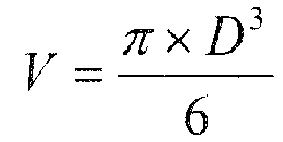
- d way 6 ⁇ V way ⁇ 3 .
- the pore diameter thus calculated is between 57 and 212 ⁇ m.
- the macroporosity of the sample is calculated as the ratio of the integral of the identified pore volumes to the volume of the sample. According to this calculation method, the composite material therefore has a macroporosity of 1.44%.
- a silica sol obtained by hydrolysis of alkoxysilane in the presence of hydrochloric acid and addition of ammonia, was poured before gelation on a sheet of melamine foam of size 250x290x30 mm 3 in a closed chamber of dimensions 300x300x70 mm 3 .
- the solvent is ethanol here.
- the reinforced alkogel was aged for 24 hours at reflux of the ethanol.
- Hydrochloric acid and hexamethyldisiloxane (hydrophobing agent) were then introduced into the chamber so as to completely cover the composite alkogel.
- the reaction medium was heated and maintained at reflux of ethanol for 48 hours.
- the reaction medium was separated from the hydrophobic silica alkogel by percolation.
- the airgel panel obtained was 30 mm thick and had a thermal conductivity of 14.2 mW / mK, measured according to the hot plate method of the standard NF EN 12667 at 20 ° C and atmospheric pressure.
- Example 3 Flexibility Measurement of the Composite Material According to Example 1
- a 3-point bending test was performed as indicated on the figure 2 on a sample of dimension 25x10x250 mm manufactured according to the protocol shown in Example 1.
- the composite material is based on two supports, separated by 100 mm.
- Example 4 Measurement of Maximum Stress in Compression of a Composite Material According to Example 1
- the uniaxial compression test was carried out on an electromechanical Zwick test machine 100 kN, equipped with an external force sensor with a capacity of 5kN.
- the dimensions of the samples are 30x30x10 mm 3 .
- the traverse speed of the crosshead is 0.3 mm / min during the load and 1 mm / min during the discharge.
- a silica sol obtained by mixing an aqueous solution of sodium silicate and a solution of hydrochloric acid, is poured before gelation on a sheet of melamine foam of size 250x290x10 mm 3 in a closed chamber of dimensions 300x300x70 mm 3 .
- the reinforced hydrogel is aged for 24 hours at 50 ° C. in water.
- a solvent exchange is carried out with acetone (for 48 hours at 50 ° C by renewing the acetone twice).
- Hydrochloric acid and hexamethyldisiloxane (agent hydrophobant) are then introduced into the chamber so as to completely cover the composite lyogel.
- the reaction medium is heated and maintained at 50 ° C. for 48 hours.
- the reaction medium is separated from the hydrophobic silica lyogel by percolation.
- the condensed lyogel reinforced by the sheet of melamine foam is dried in a ventilated oven at 160 ° C. for 2 hours.
- the xerogel panel obtained was 9 mm thick and had a thermal conductivity of 14.5 mW / m.K, measured according to the method of the hot plate kept from standard NF EN 12667 at 20 ° C and atmospheric pressure.
- the panels according to examples 1, 2, 3 and 6 all comprise between 92% and 98% by weight of airgel with respect to the weight of the composite material.
- ammonia is used as a gelling catalyst (step b), in an amount of between 2 and 2.5% by weight relative to the total weight of the starting constituents of the soil.
Landscapes
- Chemical & Material Sciences (AREA)
- Engineering & Computer Science (AREA)
- Ceramic Engineering (AREA)
- Organic Chemistry (AREA)
- Physics & Mathematics (AREA)
- Structural Engineering (AREA)
- Materials Engineering (AREA)
- Chemical Kinetics & Catalysis (AREA)
- Architecture (AREA)
- Acoustics & Sound (AREA)
- Dispersion Chemistry (AREA)
- Civil Engineering (AREA)
- Electromagnetism (AREA)
- Inorganic Chemistry (AREA)
- Medicinal Chemistry (AREA)
- Polymers & Plastics (AREA)
- Health & Medical Sciences (AREA)
- Manufacture Of Porous Articles, And Recovery And Treatment Of Waste Products (AREA)
- Laminated Bodies (AREA)
- Thermal Insulation (AREA)
- Porous Artificial Stone Or Porous Ceramic Products (AREA)
- Nanotechnology (AREA)
- Panels For Use In Building Construction (AREA)
Abstract
Description
- La présente invention concerne des matériaux composites isolants comprenant un aérogel inorganique et une mousse de mélamine, leur procédé de fabrication et leurs utilisations.
- L'économie d'énergie, et plus particulièrement l'isolation thermique, se trouvent aujourd'hui au coeur des problématiques des industriels et dans le bâtiment.
- L'isolation thermique est obtenue traditionnellement par l'usage de laine de verre, de roche, de polystyrène expansé ou polystyrène extrudé, souvent combinés dans des systèmes d'isolation industrielle d'une part, et pour le bâtiment d'autre part. Dans l'isolation du bâtiment ces isolants peuvent être collés sur une plaque de plâtre.
- La performance en isolation thermique des matériaux est mesurée par leur conductivité thermique. Plus la valeur de la conductivité thermique est basse, moins le matériau conduit la chaleur et plus l'isolation thermique est bonne. Dans la présente invention, la conductivité thermique est mesurée selon la méthode de la plaque chaude gardée de la norme NF EN 12667 à 20°C et à pression atmosphérique en date de juillet 2001.
- Cependant, les industriels sont à la recherche de matériaux isolants toujours plus performants et plus économiques.
- C'est dans ce cadre qu'ont été développés les isolants à base d'aérogels et de xérogels.
- Un gel comporte une structure continue tridimensionnelle poreuse. La préparation d'un gel implique une étape de transition sol-gel, c'est-à-dire le passage d'une suspension de particules solides, le sol, à un matériau gélatineux d'apparence solide, le gel.
- On distingue, selon la nature du fluide présent dans les pores du gel, les aérogels et xérogels (air), les hydrogels (eau), les organogels (solvant organique), en particulier les alcogels (alcool). L'ensemble des termes hydrogels, alcogels et organogels sont rassemblés sous la dénomination plus générale de lyogels.
- Traditionnellement, le terme aérogel se réfère de manière générale à un gel séché dans des conditions supercritiques, c'est-à-dire que le solvant majoritaire est à l'état de fluide supercritique dans ces conditions, tandis que le terme xérogel se réfère à un gel séché dans des conditions subcritiques, c'est-à-dire que le solvant majoritaire n'est pas à l'état de fluide supercritique dans ces conditions. Aussi bien les aérogels et que les xérogels sont très intéressants non seulement pour leur qualité d'isolants thermiques et acoustiques, mais aussi pour leur faible densité.
- Toutefois, on englobe sous le terme « aérogel » à la fois les aérogels et les xérogels, à fins de simplification.
- Typiquement, les aérogels sont obtenus sous forme granulaire, ce qui pose des problèmes de transport et de manipulation. Plusieurs solutions ont donc émergé afin d'obtenir des aérogels monolithiques.
- Il est en outre avantageux, notamment pour les applications dans le domaine du bâtiment, d'obtenir une épaisseur de matériau isolant par exemple supérieure à 2 cm, voire de l'ordre de 5 cm. En effet, les nouvelles normes pour l'isolation par l'intérieur des bâtiments (Réglementation Thermique 2012 Française) préconisent l'utilisation de panneaux dont la résistance thermique est de R = 3 m2.K/W.
- Un autre problème lié à l'utilisation des aérogels, et en particulier des aérogels granulaires, réside dans leur caractère poudrant, c'est-à-dire qu'ils libèrent des poussières, de silice dans le cas des aérogels de silice par exemple.
- Une première catégorie de matériaux monolithiques permettant de surmonter une partie de ces problèmes est obtenue par ajout d'un liant à un aérogel particulaire. Les particules d'aérogels sont ainsi « collées » entre elles. En général, pour augmenter les performances thermiques du matériau utilisé, le liant utilisé est une mousse. C'est ce qui est notamment décrit dans les documents
US 2012/0142802 ,EP 1 808 454 ,EP 0 340 707 etDE 195 33 564 , pour lesquels le liant est une mousse de mélamine. - Le procédé de préparation de ce type de matériau composite monolithique consiste à mélanger des particules d'aérogels préformées dans un mélange de précurseurs de la mousse de mélamine, puis à procéder à une réaction de polymérisation et de formation de la mousse. Les matériaux obtenus selon un tel procédé possèdent cependant des performances d'isolation thermiques moyennes (conductivité thermique en général comprises entre 25 et 40 mW/m.K). En particulier, le document
US 2012/0142802 enseigne l'emploi d'une mousse présentant une taille de pore comprise entre 10 et 1000 µm et d'un aérogel avec une taille de pore inférieure à 50 nm et une porosité comprise entre 50 et 99% comme matériaux de départ. Or, bien que le documentUS 2012/0142802 indique que les matériaux composites obtenus ont une conductivité thermique comprise entre 10 et 100 mK/m.K, de préférence entre 15 et 40 mK/m.K (voir [00139]), celui-ci enseigne uniquement des matériaux composites de conductivité thermique supérieure à 22 mK/m.K (voir exemples 1 et 5), et ce indépendamment de la teneur du matériau en aérogel (respectivement 62% pour l'exemple 1 et 94% pour l'exemple 5). En outre, le documentUS 2012/0142802 ne précise pas la macroporosité des matériaux composites obtenus. Les documentsEP 1 808 454 ,EP 0 340 707 etDE 195 33 564 ne précisent pas non plus ces caractéristiques. - La demande de brevet
US 2012/0064287 enseigne des matériaux composites monolithiques comprenant un support comprenant un copolymère mélamine-formaldéhyde avec une pluralité de micro-ouvertures, et une matrice d'aérogel disposée dans les micro-ouvertures (voir abrégé et [0010]). La matrice d'aérogel peut être constituée d'un aérogel organique tel qu'un aérogel d'acrylamide, de benzoxazine, de bismaléimide, d'alcool arylique, de cellulose, de benzaldéhyde substitué par un hydroxy, ou un aérogel inorganique, par exemple de silice, ou une combinaison de ceux-ci (voir [0011] et [0156]). La demandeUS 2012/0064287 s'étend longuement sur les matrices d'aérogels organiques, envisageant plusieurs formules générales pour les précurseurs d'aérogels organiques cités. Cependant, elle ne fournit aucune précision sur leur structure, en particulier concernant leur macroporosité. En outre, aucun exemple n'a trait à un matériau composite comprenant un aérogel inorganique. - Parallèlement, les documents
US 2007/0259979 ,US 2009/0029147 etUS 6,040,375 décrivent des matériaux composites comprenant une mousse à cellules ouvertes, notamment une mousse de polyuréthane, combinée à un aérogel de silice, obtenus par coulage d'un sol de silice sur un panneau de mousse de polyuréthane préformé, suivi d'une gélification, et d'un séchage. Les matériaux obtenus présentent une conductivité thermique comprise entre 18 et 22 mW/m.K. Le documentUS 2009/0029147 semble enseigner que l'aérogel obtenu présente une porosité d'au moins 95%. Les autres documents ne semblent pas caractériser le diamètre de pores ni la porosité des matériaux. - Ainsi, l'homme du métier n'est pas enclin à concevoir un matériau composite à base d'aérogel et de mousse de mélamine, puisque ceux-ci, d'après les divulgations de l'art antérieur, semblent peu efficaces en termes d'isolation thermique, notamment comparés à d'autres matériaux à base de mousse de polyuréthane. Il en est d'autant plus dissuadé que la conductivité thermique des mousses de mélamine, notamment les mousses BASOTECT® commercialisées par BASF, est d'environ 35 mW/m.K, tandis que la conductivité thermique des mousses de polyuréthane à cellules ouvertes est en général comprise entre 20 et 25 mW/m.K.
- De manière surprenante, le demandeur a fabriqué des matériaux composites isolants comprenant un aérogel inorganique et une mousse de mélamine à cellules ouvertes présentant de bonnes performances d'isolation thermique, tout en étant facile à manipuler, et en diminuant très fortement, voire en éliminant, leur caractère poudrant. Dans ces matériaux composites, la mousse ne joue pas le rôle de liant.
- Au sens de la présente invention, on englobe sous le terme « aérogel » à la fois les aérogels et les xérogels.
- Par « matériau composite », on entend au sens de la présente invention un matériau comprenant au moins deux composés non miscibles intimement liés entre eux. Le matériau composite possède alors des propriétés, notamment physiques (par exemple conductivité thermique, rigidité etc...) que chacun des matériaux pris séparément ne possède pas nécessairement.
- Par « monolithique », on entend au sens de la présente invention que le matériau ou l'aérogel est solide et se présente sous forme d'un bloc d'un seul tenant, notamment sous forme d'un panneau. Un le matériau ou aérogel monolithique peut être aussi bien rigide que flexible. Par « rigide » on entend que le matériau ne peut être déformé de manière significative sans observer la formation de fissures, voire la rupture du matériau monolithique. Notamment, cela signifie que le matériau monolithique ne peut être roulé. Par « flexible », on entend au contraire que le matériau peut être déformé, et notamment enroulé. On pourra employer également, pour qualifier le matériau monolithique, le terme « autoportant », qui sera entendu comme signifiant que la stabilité du produit n'est pas due à un support extérieur. Un matériau monolithique autoportant peut être aussi bien flexible que rigide.
- Par « mousse », on entend au sens de la présente invention une substance, notamment un polymère, emprisonnant des bulles de gaz en son sein. Les mousses se distinguent en « mousses à cellules fermées », c'est-à-dire que les poches de gaz sont totalement enrobées de matériau solide, par opposition aux « mousses à cellules ouvertes », dans lesquelles les poches de gaz communiquent entre elles. Par exemple, les mousses commercialisées sous le nom de BASOTECT® sont des mousses à cellules ouvertes.
- Par « mousse de mélamine », on entend au sens de la présente invention une mousse comprenant un polymère dont un des monomères est la mélamine. Un exemple de mousse de mélamine est un mousse mélamine-formaldéhyde, issue d'une réaction de polymérisation entre la mélamine et le formaldéhyde.
- Par « macropore », on entend au sens de la présente invention les pores présentant un diamètre supérieur à 10 µm.
- Par « nombre total de macropore », on entend donc au sens de la présente invention le nombre total de pores présentant un diamètre supérieur à 10 µm.
- Par « macroporosité » d'un matériau poreux, on entend au sens de la présente invention le rapport du volume occupé par les macropores sur le volume occupé par le matériau dans sa totalité. La macroporosité est exprimée en pourcentage (%) et est mesurée par tomographie aux rayons X et en trois dimensions. De préférence, les acquisitions sont réalisées avec le modèle de machine DeskTom muni d'un générateur de 130 kV. La distance foyer/échantillon est d'environ 12 cm. Le logiciel utilisé pour l'acquisition et la reconstruction des données est le logiciel X-Act développé par RX Solutions. Pour les post-traitements (visualisation et analyse de porosité), le logiciel VG Studio Max version 2.2 a été utilisé. L'homme du métier effectue le paramétrage des traitements selon ses connaissances générales.
- Dans le cadre de la présente invention, on définit également le « diamètre» des pores d'un matériau poreux, qui est déterminé par une extrapolation statistique à partir de la répartition des volumes des macropores du matériau poreux, mesurée par exemple par tomographie aux rayons X et en trois dimensions. Il est considéré qu'un pore a une forme de sphère. La relation liant le diamètre des macropores et le volume de ce dernier est donc la suivante :
- Sans vouloir se limiter à cette interprétation, il semble que les propriétés du matériau composite selon l'invention, et notamment la faible conductivité thermique, sont intrinsèquement liées à la macroporosité du matériau. Ainsi, les performances thermiques remarquables des matériaux selon l'invention sont le résultat du contrôle de la macroporosité du matériau, et/ou du diamètre des macropores.
- La présence de macropores génère une contribution en conductivité par convection gazeuse non négligeable sur la conductivité thermique globale. La minimisation de la proportion volumique des macropores par rapport au volume de l'échantillon permet d'obtenir des performances thermiques remarquables.
- En effet, comme le quantifie le formalisme de Knüdsen, la conductivité thermique de l'air en fonction de la dimension caractéristique de confinement (i.e. taille de pore), λgδ, augmente selon la loi suivante :

- Ainsi, au-dessus d'une taille de macropore de 10 µm, l'air n'est plus confiné, ce qui influence négativement les propriétés de conductivité thermique.
- Un objet de la présente invention concerne donc un matériau composite monolithique comprenant un aérogel inorganique et une mousse de mélamine à cellules ouvertes, ledit matériau présentant une conductivité thermique λ comprise entre 5 et 20 mW/m.K mesurée selon la méthode de la plaque chaude gardée de la norme NF EN 12667 à 20°C et à pression atmosphérique, et possédant une macroporosité inférieure à 5%, de préférence inférieure à 2%.
- Un autre objet de l'invention concerne un procédé de fabrication du matériau composite monolithique comprenant un aérogel inorganique et une mousse de mélamine à cellules ouvertes selon l'invention, comprenant les étapes successives suivantes :
- a) coulage d'un sol inorganique dans un réacteur, dans lequel a été placé au préalable une mousse de mélamine à cellules ouvertes préformée,
- b) gélification du sol en un lyogel,
- c) séchage du lyogel.
- Au sens de la présente invention, l'ensemble des termes hydrogels, alcogels et organogels sont rassemblés sous la dénomination plus générale de lyogels.
- Un autre objet de l'invention concerne un matériau composite monolithique comprenant un aérogel inorganique et une mousse mélamine, ledit matériau présentant une conductivité thermique λ comprise entre 5 et 20 mW/m.K mesurée selon la méthode de la plaque chaude gardée de la norme NF EN 12667 à 20°C et à pression atmosphérique, et susceptible d'être obtenu par le procédé selon l'invention.
- Un autre objet de l'invention concerne un panneau multicouche comprenant au moins une couche essentiellement constituée d'un matériau composite selon l'invention.
- Un autre objet de l'invention concerne l'utilisation du matériau composite monolithique comprenant un aérogel inorganique et une mousse de mélamine à cellules ouvertes ou un panneau multicouche selon l'invention, en tant qu'isolant thermique ou acoustique.
- La présente invention a trait à un matériau composite monolithique comprenant ou essentiellement constitué d'un aérogel inorganique renforcé par une mousse de mélamine à cellules ouvertes préformée, ledit matériau présentant une conductivité thermique λ comprise entre 5 et 20 mW/m.K, de préférence entre 10 et 20 mW/m.K, avantageusement comprise entre 10 et 15 mW/m.K, mesurée selon la méthode de la plaque chaude gardée de la norme NF EN 12667 à 20°C et à pression atmosphérique, et possédant une macroporosité inférieure à 5%, de préférence inférieure à 2%.
- Par « essentiellement constitué de », on entend au sens de la présente invention que le matériau peut comprendre d'autres éléments que ceux cités, mais en quantités suffisamment faibles pour qu'ils ne modifient pas les caractéristiques essentielles du matériau. Ainsi, le matériau peut comprendre des impuretés, notamment à l'état de traces.
- Le matériau composite monolithique selon l'invention est monocouche. On observe également qu'il est homogène, notamment en termes de structure, de conductivité thermique, de macroporosité et de flexibilité.
- La mousse de mélamine permet d'améliorer certaines propriétés mécaniques de l'aérogel, tout en conservant une conductivité thermique inférieure à 20 mW/m.K mesurée selon la méthode de la plaque chaude gardée de la norme NF EN 12667 à 20°C et à pression atmosphérique. Par exemple, la contrainte maximale en phase élastique des matériaux composites et beaucoup plus importante de celle de l'aérogel correspondant non renforcé. Les valeurs typiques sont respectivement de 3.5 MPa (pour le matériau composite) et 1.10-4 MPa (pour l'aérogel non renforcé correspondant).
- Par « mousse préformée », on entend au sens de la présente invention que la mousse de mélamine à cellules ouvertes ne subit plus de réaction chimique modifiant la structure du polymère comprenant la mélamine, notamment de réaction chimique de polymérisation ou de réticulation. En outre, la macroporosité de la mousse n'est pas modifiée par une réaction physique. La seule transformation que subit la mousse consiste en la formation du gel à l'intérieur de ses cellules ouvertes. La forme du matériau composite obtenu sera donc essentiellement identique à celle de la mousse préformée de départ.
- Avantageusement, la conductivité thermique mesurée selon la méthode de la plaque chaude gardée de la norme NF EN 12667 à 20°C et à pression atmosphérique est comprise entre 5 et 20 mW/m.K, encore plus avantageusement comprise entre 8 et 15 mW/m.K.
- On constate expérimentalement que le matériau selon l'invention possède des pores dont le diamètre est compris entre 50 et 250 µm. De préférence, les macropores dont le diamètre est compris entre 50 et 250 microns représentent plus de 80 % (en nombre) du nombre total de macropores (pores dont le diamètre est supérieur ou égal à 10 µm) du matériau selon l'invention.
- De préférence, la mousse de mélamine à cellules ouvertes est une mousse de mélamine-formaldéhyde. A titre d'exemple, on peut citer les mousses BASOTECT® commercialisées par BASF. Dans un mode de réalisation particulier, la mousse de mélamine formaldéhyde possède une épaisseur comprise entre 2 et 50 mm, une porosité comprise entre 95% et 99.5%, une densité comprise entre 8.5 et 11.5 kg.m-3 et une conductivité thermique comprise entre 35 et 40 mW/m.K mesurée selon la méthode de la plaque chaude gardée de la norme NF EN 12667 à 20°C et à pression atmosphérique.
- La mousse de mélamine permet de structurer l'aérogel pour améliorer ses propriétés de résistance mécanique et de tenue tout en conservant ses propriétés d'isolation thermique.
- Avantageusement, le matériau composite selon l'invention possède une densité comprise entre 70 kg.m-3 et 150 kg.m-3, de préférence entre 100 et 120 kg.m-3.
- De préférence, le matériau composite selon l'invention comprend entre 85% et 98% en poids d'aérogel par rapport au poids du matériau composite, de préférence entre 90% et 95%, entre 92% et 98% ou entre 92 et 95% en poids d'aérogel par rapport au poids total du matériau composite.
- Avantageusement, l'aérogel inorganique est choisi parmi les aérogels de silice, d'oxyde de titane, d'oxyde de manganèse, d'oxyde de calcium, de carbonate de calcium, d'oxyde de zirconium, ou leurs mélanges, de préférence parmi les aérogels de silice.
- Dans un mode de réalisation avantageux, le matériau composite selon l'invention présente une épaisseur comprise entre 2 et 50 mm, de préférence entre 5 et 30 mm, par exemple entre 10 et 20 mm. On observe que l'épaisseur du matériau composite monolithique est corrélée à l'épaisseur de la mousse de mélamine utilisée. Ainsi, la mousse de mélamine présente avantageusement une épaisseur comprise entre 2 et 50 mm, de préférence entre 5 et 30 mm, par exemple entre 10 et 20 mm.
- L'aérogel peut en outre comprendre un additif. Avantageusement, l'additif vise à améliorer les propriétés mécaniques, de cohésion ou de conductivité thermique des matériaux composites monolithiques selon l'invention. De préférence, cet additif comprend un opacifiant. Ainsi, avantageusement, le matériau selon l'invention comprend en outre un opacifiant. L'utilisation d'un opacifiant permet en effet de diminuer la valeur de la conductivité thermique en diminuant sa composante radiative. Typiquement, l'opacifiant est choisi parmi SiC, TiO2, noir de carbone, graphite, ZrO2, ZnO, SnO2, MnO, NiO, TiC, WC, ZrSiO4, Fe2O3, Fe3O4, FeTiO3. En particulier, l'opacifiant est choisi parmi le groupe constitué de SiC et TiO2.
- Dans un mode de réalisation préféré, le matériau composite selon l'invention ne comprend pas de liant. On peut citer comme exemple de liant inorganique les ciments, les plâtres, le gypse, la chaux, et comme exemple de liant organique des thermoplastiques tels que les cires polyoléfines, les polymères de styrène, les polyamides. Le terme liant comprend également les adhésifs, tels que les résines époxy et les cyanoacrylates par exemple.
- Dans un mode de réalisation préféré, le matériau composite selon l'invention ne comprend pas de matériau de renforcement fibreux. Au sens de la présente invention, un « matériau de renforcement fibreux » comprend des fibres ou une nappe fibreuse non tissée, ou un mélange de celles-ci. Les divers types de fibres adaptées à la fabrication d'isolants thermiques sont connus de l'homme du métier. On citera par exemple les fibres de verre, les fibres minérales, les fibres de polyester, les fibres d'aramide, les fibres de nylon et les fibres végétales, ou un mélange de celles-ci, comme décrit dans le brevet
US 6,887,563 . - Avantageusement, le matériau composite selon l'invention est hydrophobe, perméable à la vapeur et tient en température jusqu'à 250°C. Il se découpe facilement et ne poudre quasiment pas par rapport aux autres matériaux composites à base d'aérogel de silice. En outre, les matériaux composites selon l'invention sont légers et flexibles. Ils présentent aussi de bonnes propriétés d'isolation acoustique. Les matériaux selon l'invention présentent de bonnes propriétés de résistance au feu, ils sont de préférence classés au moins B1 selon la norme allemande DIN 4102-1, M1 en France selon la norme NF P-92507, ou V0 aux Etats-Unis selon la norme UL94. L'énergie de combustion ou pouvoir calorifique supérieur du matériau composite selon l'invention mesuré selon la norme NF EN ISO 1716 est avantageusement plus faible que la plupart des matériaux isolants de performance, tels que le polyuréthane.
- Le matériau selon l'invention est susceptible d'être obtenu par le procédé comprenant les étapes successives suivantes :
- a) coulage d'un sol inorganique dans un réacteur, dans lequel a été placé au préalable une mousse de mélamine à cellules ouvertes préformée, ledit sol comprenant de préférence plus de 5% en poids, de manière encore préférée entre 6 et 15% en poids, de matériau inorganique par rapport au poids total du sol,
- b) gélification du sol en un lyogel,
- c) un séchage dans des conditions subcritiques du lyogel.
- Le procédé d'obtention du matériau selon l'invention est décrit plus précisément dans la suite.
- Dans la présente invention, la quantité résiduelle de solvant en poids du matériau composite monolithique est calculée selon la norme EN/ISO 3251. Le protocole utilisé consiste à prélever 1 g de aérogel selon l'invention, le peser, puis de le sécher pendant 3h dans une étuve à 105°C, puis de peser l'aérogel ainsi séché.
- Le matériau composite selon l'invention possède typiquement une quantité résiduelle de solvant en poids du matériau composite inférieure ou égale à 3%, de préférence inférieure à 1%, selon la norme EN/ISO 3251.
- La présente invention concerne également des panneaux multicouches, plus particulièrement sous forme de panneaux multicouches laminés ou sandwichs, comprenant au moins une couche essentiellement constituée d'un matériau composite monolithique selon l'invention, éventuellement en association avec des couches de nature différente. Dans le panneau multicouche selon l'invention, chaque couche est constituée d'un matériau monolithique ou d'un panneau collé à une ou plusieurs autres couches.
- A titre d'exemple, une ou plusieurs plaques de plâtre (éventuellement de type BA13) peuvent être collées d'un ou de chaque côté d'un matériau composite monolithique selon l'invention pour former un complexe de doublage. On envisage également des panneaux multicouches mixtes comprenant une association d'un ou plusieurs matériaux composites selon l'invention et d'un matériau composite tel que décrit par exemple dans la demande internationale
WO 2013/053951 . - Le matériau composite selon la présente invention confère au panneau multicouche ainsi obtenu des caractéristiques améliorées ou adaptées à un cas d'application particulière. Par exemple, un matériau composite monolithique selon l'invention contrecollé à un panneau isolant rigide selon la demande
WO 2013/053951 apporte une élasticité en compression ou un amortissement acoustique dont ces derniers sont souvent relativement moins bien pourvus. La couche constituée du matériau composite monolithique selon l'invention peut aussi jouer le rôle de pare-feu ou de retardant de flamme ou de couche d'isolation haute température par rapport au matériau auquel elle est associée. - Le contrecollage d'une couche de matériau composite entre deux couches thermoformables peut conférer au panneau multicouche une capacité à être lui-même thermoformé.
- La présente invention concerne également un procédé d'obtention d'un matériau composite monolithique comprenant ou essentiellement constitué d'un aérogel inorganique renforcé par une mousse de mélamine à cellules ouvertes préformée, présentant une conductivité thermique λ comprise entre 5 et 20 mW/m.K mesurée selon la méthode de la plaque chaude gardée de la norme NF EN 12667 à 20°C et à pression atmosphérique, et possédant une macroporosité inférieure à 5%, de préférence inférieure à 2%, comprenant les étapes successives suivantes :
- a) coulage d'un sol inorganique dans un réacteur, dans lequel a été placé au préalable une mousse de mélamine à cellules ouvertes préformée, ledit sol comprenant de préférence plus de 5% en poids, de manière encore préférée entre 6 et 15% en poids, de matériau inorganique par rapport au poids total du sol,
- b) gélification du sol en un lyogel,
- c) séchage du lyogel.
- Le séchage à l'étape c) est de préférence réalisé de manière que l'aérogel obtenu présente une quantité résiduelle de solvant en poids du matériau composite inférieure ou égale à 3%, de préférence 1%, selon la norme EN/ISO 3251. Avantageusement, le séchage de l'étape c) a lieu dans des conditions subcritiques.
- Avantageusement, aucun liant, notamment tel que défini précédemment, n'est utilisé ou ajouté à aucune étape du procédé selon l'invention. En outre, aucun matériau de renforcement fibreux tel que défini précédemment n'est de préférence employé dans le procédé selon l'invention.
- De préférence, le sol utilisé à l'étape a) est choisi parmi le groupe des sols de silice, d'oxyde de titane, d'oxyde de manganèse, d'oxyde de calcium, de carbonate de calcium, d'oxyde de zirconium, ou leurs mélanges. De préférence, le sol est un sol de silice. Ainsi, l'étape a) comprend de préférence le coulage d'un sol de silice dans un réacteur, dans lequel a été placée au préalable une mousse de mélamine à cellules ouvertes préformée, ledit sol comprenant de préférence plus de 5% en poids, de manière encore préférée entre 6 et 15% en poids, de silice par rapport au poids total du sol. De manière encore préférée, le sol de silice comprend entre 6 et 10% en poids de silice par rapport au poids total du sol.
- Un additif peut être ajouté au sol à l'étape a), de préférence un additif comprenant un opacifiant. L'additif et l'opacifiant sont tels que définis précédemment.
- Le sol utilisé à l'étape a) est par exemple obtenu par catalyse acide ou basique d'un précurseur de silice en présence d'un catalyseur. La transformation du sol de silice en lyogel (gélification, étape b) est mise en oeuvre de préférence en présence d'un catalyseur de gélification, notamment l'ammoniaque. Avantageusement, le catalyseur est utilisé à une concentration comprise entre 1 et 3%, de préférence entre 2 et 2.5% en poids par rapport au poids total des constituants de départ du sol, i.e. notamment le solvant, le précurseur de silice et les éventuels additifs.
- Le lyogel obtenu à l'étape b) comprend de préférence de 70 à 90% de solvant en poids, préférentiellement de 75% à 85% de solvant en poids, par rapport au poids de sol de départ. De manière encore préférée, le lyogel obtenu à l'étape b) comprend de préférence de 85 à 94% de solvant en poids, préférentiellement de 90% à 94% de solvant en poids, par rapport au poids de sol de départ. L'homme du métier saura adapter les conditions réactionnelles de l'étape b) de gélification, et en particulier le temps de gélification, de manière à obtenir une imprégnation uniforme de la mousse préformée par le gel de silice, garantissant l'obtention d'une macroporosité inférieure à 5% permettant l'obtention d'une conductivité thermique λ comprise entre 5 et 20 mW/m.K mesurée selon la méthode de la plaque chaude gardée de la norme NF EN 12667 à 20°C et à pression atmosphérique.
- Dans un mode de réalisation, le lyogel est un alcogel. Dans ce cas, le solvant est de préférence l'éthanol. Dans ce mode de réalisation, l'étape b) est avantageusement suivie d'une étape b2) de vieillissement de l'alcogel suivie d'une étape b3) de traitement d'hydrophobisation de l'alcogel, à l'issue duquel est obtenu un alcogel hydrophobé. L'étape b2) comprend par exemple la mise en contact de l'alcogel obtenu à l'étape b1) avec un agent hydrophobant en milieu acide de pH compris entre 1 et 3. Avantageusement, l'agent hydrophobant utilisé est choisi parmi le groupe des organosiloxanes, des organochlorosilanes ou des organoalkoxysilanes, de manière plus avantageuse, l'agent hydrophobant utilisé est choisi parmi le groupe constitué de l'hexaméthyldisiloxane (HMDSO), le triméthylchlorosilane et le triméthyléthoxysilane, de manière encore plus avantageuse l'hexaméthyldisiloxane (HMDSO). En outre, dans ce mode de réalisation, le sol de silice selon l'invention est de préférence obtenu par hydrolyse contrôlée de tétraéthoxysilane dans l'éthanol. Avantageusement, l'éthanol généré lors de l'hydrolyse est recyclé puis réutilisé comme solvant de cette même étape. De préférence, l'étape b3) comprend la mise en contact de l'alcogel obtenu à l'étape c) avec un agent hydrophobant en milieu acide de pH compris entre 1 et 3.
- Avantageusement, l'alcogel est acidifié lors de l'étape b3) par addition d'un acide minéral ou organique. De manière plus avantageuse, l'acide minéral est l'acide chlorhydrique et l'acide organique est l'acide trifluoroacétique. De manière encore plus avantageuse, l'acide est l'acide trifluoroacétique ou l'acide chlorhydrique et l'agent hydrophobant l'hexaméthyldisiloxane (HMDSO). Avantageusement, l'étape b3) est conduite à une température comprise entre 50°C et 150°C. Encore plus avantageusement, l'étape b3) est conduite à la température d'ébullition de l'alcool (solvant de l'alcogel). Dans le cas où le solvant est l'éthanol, l'étape b3) est conduite au reflux de l'éthanol.
- Dans un autre mode de réalisation, le lyogel obtenu à l'issue de l'étape a) est un hydrogel. Dans ce cas, l'étape b) est avantageusement suivie d'une étape b2) d'échange du solvant (l'eau) par un solvant organique tel l'acétone, l'hexane ou l'heptane menant à la formation d'un lyogel, étape optionnellement précédée d'une étape de vieillissement de l'hydrogel, et suivie d'une étape b3) de traitement d'hydrophobisation du lyogel, à l'issue duquel est obtenu un lyogel hydrophobé. Les conditions de mise en oeuvre de l'étape b3) de traitement d'hydrophobisation du lyogel sont similaires à celles décrites précédemment dans la cas où le lyogel est un hydrogel (notamment température, réactifs, etc) au solvant près.
- Dans ces deux modes de réalisation, l'étape de vieillissement permet d'améliorer les propriétés mécaniques du lyogel sous l'effet des mécanismes de synérèse (séparation du liquide et du gel). Cette étape de vieillissement a avantageusement une durée inférieure à 24h. Les conditions de température et de durée du vieillissement seront choisies de manière adéquate selon des critères bien connus de l'homme du métier tels que la composition du gel par exemple. Avantageusement, l'étape de vieillissement est conduite à une température comprise entre 40°C et 80°C, encore plus avantageusement à une température comprise entre 45°C et 60°C. Avantageusement, l'étape de vieillissement a une durée inférieure à 20h.
- Dans ces deux modes de réalisation, le traitement hydrophobant à l'étape b3) du procédé permet notamment de diminuer la reprise hydrique du matériau composite. Le matériau composite selon l'invention présente préférentiellement un taux de reprise hydrique à température ambiante et à 75% d'humidité relative inférieur à 5%, encore plus préférentiellement inférieur à 3%, et préférentiellement un taux de reprise hydrique à température ambiante et à 95% inférieur à 10%, encore plus préférentiellement inférieur à 5%.
- Dans un mode de réalisation, l'étape c) se subdivise en une étape c1) de préséchage dans des conditions subcritiques à une température inférieure à 80°C, et une étape c2) de séchage dans des conditions subcritiques, ledit séchage c2) étant de type diélectrique ou convectif, à une température supérieure à 100°C lorsque ledit séchage c2) est de type convectif.
- Dans un mode de réalisation, l'étape c2) est un séchage de type convectif, réalisé à une température comprise entre 120°C et 180°C, de préférence comprise entre 140°C et 160°C, encore plus préférentiellement égale à 150°C. Le séchage convectif peut être conduit en mode naturel, mais est de préférence conduit en mode forcé.
- Dans un autre mode de réalisation, l'étape c2) est une étape de séchage diélectrique par micro-ondes.
- De préférence, le pré-séchage c1) est poursuivi jusqu'à l'obtention d'un lyogel condensé ayant perdu entre 10 et 80% d'alcool en poids, avantageusement entre 20% et 60% d'alcool en poids, encore plus avantageusement entre 40% et 50% d'alcool en poids par rapport au poids des produits de départ.
- Avantageusement, la température du pré-séchage de l'étape c1) est comprise entre 40°C et 80°C, encore plus avantageusement comprise entre 60°C et 80°C, encore plus avantageusement est égale à 80°C.
- Dans un mode de réalisation préféré de l'invention, l'étape c1) est réalisée par circulation d'un flux gazeux chaud dans le réacteur. Le flux gazeux est typiquement un flux de gaz inerte tel que l'azote, l'air, ou un gaz rare. Avantageusement, le flux gazeux chaud circule verticalement, encore plus avantageusement du haut vers le bas.
- Dans un autre mode de réalisation, le pré-séchage à l'étape c1) est conduit sous pression réduite. Un tel mode de réalisation est avantageux car il permet, à température égale, d'obtenir des temps de pré-séchage plus courts.
- Avantageusement, l'étape c2) est réalisée par séchage convectif par circulation d'un flux d'air chaud dans le sécheur. A l'échelle du laboratoire, le séchage convectif est réalisé de préférence en étuve à une température de 150°C.
- Dans un autre mode de réalisation, l'étape c2) est réalisée par séchage diélectrique par micro-ondes. De préférence, la puissance fournie lors de cette étape de séchage par microondes comprise entre 0.3 kW et 3 kW par kg de de lyogel condensé de départ, de préférence comprise entre 0.5 kW et 2 kW par kg de lyogel condensé de départ, encore préférentiellement égale à 1 kW par kg de lyogel condensé de départ. Ladite puissance est ajustée au cours du séchage de manière que la température de surface du matériau soit comprise entre 40°C et 400°C, plus préférentiellement entre 40°C et 200°C, encore plus préférentiellement entre 50°C et 150°C.
- La masse de solvant perdue lors de l'étape c) ou c1) est mesurée différemment selon l'échelle du procédé. A l'échelle du laboratoire, on mesure cette quantité par pesée du lyogel obtenu après l'étape b) avant et après séchage dans les conditions de l'étape c) ou c1). A l'échelle industrielle, le solvant évaporé lors de l'étape de séchage c) ou cl) est condensé dans un autre réacteur, puis pesé.
- Avantageusement, au moins les étapes a), b) et c1) sont mises en oeuvre dans au moins un réacteur, une distance caractéristique dudit réacteur entre deux parois internes au moins étant comprise entre 2 mm et 50 mm, préférablement entre 5 à 30 mm. Cette caractéristique du réacteur permet d'améliorer la diffusion des réactifs au coeur du matériau composite, de manière que la composition du matériau composite soit homogène.
- Par « paroi interne du réacteur» on entend au sens de la présente invention la paroi qui est directement en contact avec les réactifs. Par exemple, dans le cas d'un réacteur double enveloppe, il s'agit de la paroi de l'enveloppe interne directement en contact avec les réactifs. Par « distance caractéristique entre deux parois internes», on entend au sens de la présente invention la distance maximale entre deux parois internes parallèles entre elles ou entre la surface tangente à une de ces parois et une paroi parallèle à celle-ci ou entre deux surfaces tangentes à la paroi. Par exemple, dans le cas d'un réacteur cylindrique, les distances caractéristiques entre deux parois internes du réacteur sont le diamètre interne et la hauteur interne du réacteur. Dans le cas d'un réacteur cubique, la distance caractéristique entre deux parois internes du réacteur est le côté interne du cube. Dans le cas d'un réacteur parallélépipédique, les distances caractéristiques entre deux parois internes du réacteur sont la hauteur interne, la longueur interne et la largeur interne. De préférence, la distance caractéristique entre deux parois internes est choisie parmi la hauteur, la largeur, la longueur, l'épaisseur et le diamètre internes.
- Du fait de la géométrie particulière du réacteur, la distance de tout point à l'intérieur du réacteur à la paroi interne dudit réacteur est telle que la diffusion des réactifs dans le lyogel est optimale. De plus, un tel réacteur permet également d'optimiser les conditions de pré-séchage du lyogel lors de l'étape c1), si celle-ci est conduite dans un tel réacteur.
- Ainsi, les étapes a), b) et c1) sont avantageusement réalisées dans un premier réacteur, puis le lyogel condensé est démoulé et transféré dans un sécheur convectif ou diélectrique où est effectuée l'étape c2).
- Par « sécheur », on entend au sens de la présente invention un réacteur destiné à la mise en oeuvre d'une étape de séchage.
- La présente invention concerne également l'utilisation d'un matériau composite ou d'un panneau multicouche selon l'invention, en tant qu'isolant thermique, notamment pour des applications dans la construction de bâtiments ou dans l'isolation de systèmes ou procédés industriels. Ainsi, Les matériaux composites ou panneaux multicouches selon l'invention sont avantageusement utilisés pour la fabrication de matériaux de construction, notamment des murs et cloisons, mais également des parquets ou plafonds ou pour l'isolation des tuyauteries industrielles.
- Les panneaux multicouches et les matériaux composites selon la présente invention peuvent également être utilisés en tant qu'isolants acoustiques.
- Ainsi, l'invention a les aspects suivants :
- 1. Matériau composite monolithique comprenant un aérogel inorganique renforcé par une mousse de mélamine à cellules ouvertes préformée, ledit matériau présentant une conductivité thermique λ comprise entre 5 et 20 mW/m.K, mesurée selon la méthode de la plaque chaude gardée de la norme NF EN 12667 à 20°C et à pression atmosphérique, et possédant une macroporosité inférieure à 5%, et comprenant entre 90% et 98%, de préférence de 92% à 98%, en poids d'aérogel par rapport au poids total du matériau composite.
- 2. Matériau selon l'article 1, caractérisé en ce qu'il est susceptible d'être obtenu par le procédé comprenant les étapes successives suivantes :
- a) coulage d'un sol inorganique dans un réacteur, dans lequel a été placé au préalable une mousse de mélamine à cellules ouvertes préformée,
- b) gélification du sol en un lyogel,
- c) séchage du lyogel.
- 3. Matériau selon l'article 2, caractérisé en ce que ledit sol utilisé à l'étape a) comprend plus de 5% en poids, de manière préférée entre 6 et 15% en poids, de matériau inorganique par rapport au poids total du sol inorganique.
- 4. Matériau selon l'un quelconque des articles 1 à 3, caractérisé en ce que les macropores dont le diamètre est compris entre 50 et 250 microns représentent plus de 80 % du nombre total de macropores dudit matériau.
- 5. Matériau selon l'un quelconque des articles 1 à 4, caractérisé en ce qu'il présente une épaisseur comprise entre 2 et 50 mm.
- 6. Matériau selon l'un quelconque des articles 1 à 5, caractérisé en ce qu'il présente une densité comprise entre 70 kg. m-3 et 150 kg. m-3.
- 7. Matériau selon l'un quelconque des articles 1 à 6, caractérisé en ce que la mousse de mélamine est une mousse de mélamine formaldéhyde possédant une épaisseur comprise entre 2 et 50 mm, une porosité comprise entre 95% et 99.5%, une densité comprise entre 8.5 et 11.5 kg.m-3 et une conductivité thermique comprise entre 35 et 40 mW/m.K mesurée selon la méthode de la plaque chaude gardée de la norme NF EN 12667 à 20°C et à pression atmosphérique.
- 8. Matériau selon l'un quelconque des articles 1 à 7, caractérisé en ce que l'aérogel inorganique est choisi parmi les aérogels de silice, d'oxyde de titane, d'oxyde de manganèse, d'oxyde de calcium, de carbonate de calcium, d'oxyde de zirconium, ou leurs mélanges.
- 9. Matériau selon l'un quelconque des articles 1 à 8, caractérisé en ce qu'il ne comprend pas de liant.
- 10. Matériau selon l'un quelconque des articles 1 à 9, caractérisé en ce qu'il ne comprend pas de matériau de renforcement fibreux.
- 11. Matériau selon l'un quelconque des articles 1 à 10, caractérisé en ce qu'il possède une quantité résiduelle de solvant en poids du matériau composite inférieure ou égale à 3% selon la norme EN/ISO 3251.
- 12. Matériau selon l'un quelconque des articles 1 à 11, caractérisé en ce que l'aérogel comprend en outre un opacifiant.
- 13. Panneau multicouche comprenant au moins une couche essentiellement constituée d'un matériau composite monolithique selon l'un quelconque des articles 1 à 12.
- 14. Utilisation d'un matériau composite selon l'un quelconque des articles 1 à 12 ou d'un panneau multicouche selon l'article 13 en tant qu'isolant thermique.
- 15. Utilisation d'un matériau composite selon l'un quelconque des articles 1 à 12 ou d'un panneau multicouche selon l'article 13 en tant qu'isolant acoustique.
-
-
Fig. 1 : Répartition du volume des macropores mesurée par tomographie par rayons X en 3 dimensions sur le matériau composite obtenu dans l'exemple 1. L'axe des abscisses représente le volume en mm3 (sur une échelle de 0 à 0,01 mm3) et l'axe des ordonnées représente le nombre de macropores (sur une échelle graduée de 0 à 250). On constate que le volume moyen des pores (Vmoyen) est dans la plus grande majorité compris entre 1.10-4 mm3 et 5.10-3 mm3. -
Fig. 2 : schéma représentant le dispositif de l'expérience de flexion en trois points, permettant de mesurer le module de flexibilité d'un matériau. Le panneau est posé sur deux appuis (représentés par des triangles) situés à 7,5 cm du bord, et distants de 100 cm, et un effort vertical de haut en bas est appliqué en positionnant différentes masses (représentées par une sphère sur le schéma) posées au centre du matériau. On mesure la distance de déformation du centre du matériau. -
Fig. 3 : Courbe représentant la force (mesurée en Newton (N), axe des ordonnées) en fonction de la flèche (mesurée en mm, axe des abscisses). Cette courbe représente les résultats du test de l'exemple 3. Une régression linéaire permet de déterminer une pente de 0.0385 N/mm, et une ordonnée à l'origine de 0. -
Fig. 4 : Représentation des résultats de l'essai de l'exemple 4. La courbe obtenue représente la contrainte conventionnelle (exprimée en MPa) en fonction de la déformation relative
- Les exemples qui suivent sont destinés à illustrer plus en détails la présente invention, mais ne sont en aucun cas limitatifs.
- Un sol de silice, obtenu par hydrolyse d'alkoxysilane en présence d'acide chlorhydrique puis ajout d'ammoniaque, a été versé avant gélification sur une nappe de mousse de mélamine de dimension 250x290x10 mm3 (mousse BASOTECT® commercialisée par BASF) dans une chambre fermée de dimensions 300x300x70 mm3. Après gélification, l'alcogel renforcé a été vieilli pendant 24h à 50°C dans l'éthanol. L'acide chlorhydrique et l'hexaméthyldisiloxane (agent hydrophobant) ont ensuite été introduits dans la chambre de manière à recouvrir totalement l'alcogel composite. Le milieu réactionnel a été chauffé et maintenu à 50°C pendant 48h. Le milieu réactionnel a été séparé de l'alcogel de silice hydrophobe composite par percolation.
- L'alcogel condensé renforcé par la nappe de mousse mélamine a été séché en étuve ventilée à 160°C pendant 2 heures. Le panneau d'aérogel obtenu mesure 10 mm d'épaisseur et présente une conductivité thermique de 12.6 mW/m.K, mesurée selon la méthode de la plaque chaude gardée de la norme NF EN 12667 à 20°C et pression atmosphérique.
- Le matériau composite obtenu après séchage est ensuite analysé par tomographie X 3D. Les acquisitions ont été réalisées avec le modèle de machine DeskTom muni d'un générateur de 130 kV. La résolution obtenue sur l'échantillon est de 24,5µm, soit une distance foyer/échantillon d'environ 12cm. Le logiciel utilisé pour l'acquisition et la reconstruction des données est un logiciel développé par RX Solutions: X-Act. Pour les post-traitements (visualisation et analyse de porosité), le logiciel VG Studio Max version 2.2 a été utilisé. L'analyse montre que le volume des pores (Vmoyen) est dans la plus grande majorité compris entre 1.10-4 mm3 et 5.10-3 mm3 (voir
figure 1 ). - En considérant que la forme des pores est assimilable à une sphère parfaite, on applique la formule mathématique suivant :

- La macroporosité de l'échantillon est calculée comme étant le rapport de l'intégrale des volumes de pores identifiés sur le volume de l'échantillon. Selon cette méthode de calcul, le matériau composite possède donc une macroporosité de 1,44%.
- Un sol de silice, obtenu par hydrolyse d'alkoxysilane en présence d'acide chlorhydrique puis ajout d'ammoniaque, a été versé avant gélification sur une nappe de mousse de mélamine de dimension 250x290x30 mm3 dans une chambre fermée de dimensions 300x300x70 mm3. Le solvant est ici l'éthanol. Après gélification, l'alcogel renforcé a été vieilli pendant 24h au reflux de l'éthanol. L'acide chlorhydrique et l'hexaméthyldisiloxane (agent hydrophobant) ont ensuite été introduits dans la chambre de manière à recouvrir totalement l'alcogel composite. Le milieu réactionnel a été chauffé et maintenu au reflux de l'éthanol pendant 48h. Le milieu réactionnel a été séparé de l'alcogel de silice hydrophobe par percolation.
- L'alcogel de silice hydrophobe renforcé a été placé dans un sécheur micro-onde et séché pendant 50 min à 50°C.
- Le panneau de aérogel obtenu mesurait 30 mm d'épaisseur et présentait une conductivité thermique de 14,2 mW/m.K, mesurée selon la méthode de la plaque chaude gardée de la norme NF EN 12667 à 20°C et pression atmosphérique.
- Un essai de flexion en 3 points a été réalisé comme indiqué sur la
figure 2 sur un échantillon de dimension 25x10x250 mm fabriqué selon le protocole présenté à l'exemple 1. Le matériau composite repose sur deux appuis, séparés de 100 mm. - Différentes forces sont appliquées sur l'échantillon en son centre. Le déplacement (flèche) de celui-ci a été mesuré.
- Les résultats obtenus sont représentés sur la
figure 3 . On calcule une raideur ou rigidité à la flexion K= 0.0385 N/mm, qui correspond à la pente de la courbe Force-Flèche. - L'essai de compression uniaxiale a été réalisé sur une machine d'essai Zwick électromécanique 100 kN, munie d'un capteur d'effort externe de capacité 5kN. Les dimensions des échantillons sont de 30x30x10 mm3. La vitesse de déplacement de la traverse est de 0,3 mm/min lors de la charge et de 1 mm/min lors de la décharge.
- Les résultats de cet essai sont représentés sur la
figure 4 . Un module de compression a été mesuré à 0.43 MPa et la contrainte maximale est de 3.3 MPa pour une déformation relative de 80%. - Un sol de silice, obtenu par mélange d'une solution aqueuse de silicate de soude et d'une solution d'acide chlorhydrique, est versé avant gélification sur une nappe de mousse de mélamine de dimension 250x290x10 mm3 dans une chambre fermée de dimensions 300x300x70 mm3. Après gélification, l'hydrogel renforcé est vieilli pendant 24h à 50°C dans l'eau. Un échange de solvant est réalisé avec de l'acétone (pendant 48h à 50°C en renouvelant l'acétone 2 fois). L'acide chlorhydrique et l'hexaméthyldisiloxane (agent hydrophobant) sont ensuite introduits dans la chambre de manière à recouvrir totalement le lyogel composite. Le milieu réactionnel est chauffé et maintenu à 50°C pendant 48h. Le milieu réactionnel est séparé du lyogel de silice hydrophobe par percolation.
- Le lyogel condensé renforcé par la nappe de mousse mélamine est séché en étuve ventilée à 160°C pendant 2 heures. Le panneau de xérogel obtenu mesurait 9 mm d'épaisseur et présente une conductivité thermique de 14.5 mW/m.K, mesurée selon la méthode de la plaque chaude gardée de la norme NF EN 12667 à 20°C et pression atmosphérique.
- On notera que les panneaux selon les exemples 1, 2, 3 et 6 comprennent tous entre 92% et 98% en poids d'aérogel par rapport au poids du matériau composite.
- Dans tous les exemples qui précèdent, l'ammoniaque est utilisé comme catalyseur de gélification (étape b), en une quantité comprise entre 2 et 2.5% en poids par rapport au poids total des constituants de départ du sol.
Claims (15)
- Matériau composite hydrophobe comprenant un aérogel inorganique renforcé par une mousse de mélamine à cellules ouvertes préformée, caractérisé en ce que
ledit matériau présente une conductivité thermique λ comprise entre 5 et 20 mW/m.K, mesurée selon la méthode de la plaque chaude gardée de la norme NF EN 12667 à 20°C et à pression atmosphérique, et
le pourcentage du volume occupé par des macropores, les macropores étant des pores présentant un diamètre supérieur à 10 µm, par rapport au volume occupé par le matériau dans sa totalité est inférieure à 5%, mesuré par tomographie aux rayons X et en trois dimensions. - Matériau composite selon la revendication 1, caractérisé en ce que l'aérogel inorganique est monolithique.
- Matériau composite selon les revendications 1 ou 2, caractérisé en ce que l'aérogel est formé d'un sol inorganique comprenant entre 5% et 15% en poids de matériau inorganique par rapport au poids total du sol inorganique.
- Matériau composite selon l'une quelconque des revendications 1 à 3, caractérisé en ce que les macropores dont le diamètre est compris entre 50 et 250 microns représentent plus de 80 % du nombre total de macropores dudit matériau.
- Matériau composite selon l'une quelconque des revendications 1 à 4, caractérisé en ce que le matériau présente une épaisseur comprise entre 2 et 50 mm.
- Matériau composite selon l'une quelconque des revendications 1 à 5, caractérisé en ce que le matériau présente une densité comprise entre 70 kg.m-3 et 150 kg.m-3.
- Matériau composite selon l'une quelconque des revendications 1 à 6, caractérisé en ce que la mousse de mélamine est une mousse de mélamine formaldéhyde possédant une épaisseur comprise entre 2 et 50 mm, une porosité comprise entre 95% et 99.5%, une densité comprise entre 8.5 et 11.5 kg.m-3 et une conductivité thermique comprise entre 35 et 40 mW/m.K mesurée selon la méthode de la plaque chaude gardée de la norme NF EN 12667 à 20°C et à pression atmosphérique.
- Matériau composite selon l'une quelconque des revendications 1 à 7, caractérisé en ce que l'aérogel inorganique comprend de la silice, de l'oxyde de titane, de l'oxyde de manganèse, de l'oxyde de calcium, du carbonate de calcium, de l'oxyde de zirconium, ou leurs mélanges.
- Matériau composite selon l'une quelconque des revendications 1 à 8, caractérisé en ce que le matériau ne comprend pas de liant.
- Matériau composite selon l'une quelconque des revendications 1 à 9, caractérisé en ce que le matériau ne comprend pas de matériau de renforcement fibreux.
- Matériau composite selon l'une quelconque des revendications 1 à 10, caractérisé en ce que le matériau possède une quantité résiduelle de solvant en poids du matériau composite inférieure ou égale à 3% selon la norme EN/ISO 3251.
- Matériau composite selon l'une quelconque des revendications 1 à 11, caractérisé en ce que l'aérogel comprend en outre un opacifiant.
- Panneau multicouche comprenant au moins une couche essentiellement constituée d'un matériau composite selon l'une quelconque des revendications 1 à 12.
- Utilisation d'un matériau composite selon l'une quelconque des revendications 1 à 12 ou d'un panneau multicouche selon la revendication 13 en tant qu'isolant thermique.
- Utilisation d'un matériau composite selon l'une quelconque des revendications 1 à 12 ou d'un panneau multicouche selon la revendication 13 en tant qu'isolant acoustique.
Applications Claiming Priority (3)
| Application Number | Priority Date | Filing Date | Title |
|---|---|---|---|
| FR1355558A FR3007025B1 (fr) | 2013-06-14 | 2013-06-14 | Materiaux composites isolants comprenant un aerogel inorganique et une mousse de melamine |
| PCT/EP2014/062437 WO2014198931A1 (fr) | 2013-06-14 | 2014-06-13 | Materiaux composites isolants comprenant un aerogel inorganique et une mousse de melamine |
| EP14729691.7A EP3008123B1 (fr) | 2013-06-14 | 2014-06-13 | Materiaux composites isolants comprenant un aerogel inorganique et une mousse de melamine |
Related Parent Applications (1)
| Application Number | Title | Priority Date | Filing Date |
|---|---|---|---|
| EP14729691.7A Division EP3008123B1 (fr) | 2013-06-14 | 2014-06-13 | Materiaux composites isolants comprenant un aerogel inorganique et une mousse de melamine |
Publications (1)
| Publication Number | Publication Date |
|---|---|
| EP3514199A1 true EP3514199A1 (fr) | 2019-07-24 |
Family
ID=49151146
Family Applications (2)
| Application Number | Title | Priority Date | Filing Date |
|---|---|---|---|
| EP14729691.7A Active EP3008123B1 (fr) | 2013-06-14 | 2014-06-13 | Materiaux composites isolants comprenant un aerogel inorganique et une mousse de melamine |
| EP19161373.6A Pending EP3514199A1 (fr) | 2013-06-14 | 2014-06-13 | Materiaux composites isolants comprenant un aerogel inorganique et une mousse de melamine |
Family Applications Before (1)
| Application Number | Title | Priority Date | Filing Date |
|---|---|---|---|
| EP14729691.7A Active EP3008123B1 (fr) | 2013-06-14 | 2014-06-13 | Materiaux composites isolants comprenant un aerogel inorganique et une mousse de melamine |
Country Status (22)
| Country | Link |
|---|---|
| US (2) | US11767671B2 (fr) |
| EP (2) | EP3008123B1 (fr) |
| JP (2) | JP6224825B2 (fr) |
| KR (6) | KR102366030B1 (fr) |
| CN (3) | CN105283495B (fr) |
| AU (1) | AU2014280035C1 (fr) |
| BR (1) | BR112015031140B1 (fr) |
| CA (1) | CA2915221C (fr) |
| DK (1) | DK3008123T3 (fr) |
| ES (1) | ES2729972T3 (fr) |
| FR (1) | FR3007025B1 (fr) |
| HU (1) | HUE043590T2 (fr) |
| IL (1) | IL243089B (fr) |
| MX (2) | MX382139B (fr) |
| MY (1) | MY172211A (fr) |
| PL (1) | PL3008123T3 (fr) |
| PT (1) | PT3008123T (fr) |
| RU (1) | RU2653154C2 (fr) |
| SG (2) | SG10202002574QA (fr) |
| SI (1) | SI3008123T1 (fr) |
| TR (1) | TR201907748T4 (fr) |
| WO (1) | WO2014198931A1 (fr) |
Families Citing this family (24)
| Publication number | Priority date | Publication date | Assignee | Title |
|---|---|---|---|---|
| FR3007025B1 (fr) | 2013-06-14 | 2015-06-19 | Enersens | Materiaux composites isolants comprenant un aerogel inorganique et une mousse de melamine |
| FR3018207B1 (fr) * | 2014-03-07 | 2016-03-18 | Enersens | Procede de fabrication d'aerogels par chauffage dielectrique |
| EP4234619A3 (fr) * | 2014-10-03 | 2023-12-06 | Aspen Aerogels, Inc. | Matériaux d'aérogel hydrophobes améliorés |
| KR101789371B1 (ko) * | 2015-02-13 | 2017-10-23 | 주식회사 엘지화학 | 실리카 에어로겔 함유 블랑켓의 제조방법 및 이에 따라 제조된 실리카 에어로겔 함유 블랑켓 |
| FR3033732B1 (fr) * | 2015-03-17 | 2017-04-14 | Enersens | Materiaux composites multicouches |
| PL413932A1 (pl) | 2015-09-11 | 2017-03-13 | Politechnika Rzeszowska im. Ignacego Łukasiewicza | Sposób wytwarzania kompozytu o budowie panelu sandwichowego na bazie maty aerożelowej i modyfikowanej żywicy poliuretanowej i/lub żywicy epoksydowej |
| KR101931569B1 (ko) | 2015-11-03 | 2018-12-21 | 주식회사 엘지화학 | 소수성의 산화금속-실리카 복합 에어로겔의 제조방법 및 이로부터 제조된 소수성의 산화금속-실리카 복합 에어로겔 |
| CN108883597B (zh) * | 2016-01-27 | 2022-03-01 | W.L.戈尔及同仁股份有限公司 | 包含增强的气凝胶复合物的层叠体 |
| CN105859320A (zh) * | 2016-03-16 | 2016-08-17 | 南京航空航天大学 | 一种轻质三聚氰胺气凝胶毡及其制备方法 |
| KR20170110993A (ko) | 2016-03-24 | 2017-10-12 | 주식회사 엘지화학 | 실리카 에어로겔 제조시스템 |
| CN106003877A (zh) * | 2016-04-22 | 2016-10-12 | 苏州派欧技术咨询服务有限公司 | 一种蜜胺泡沫-玻纤布气凝胶毡及其制备方法 |
| CN108602681B (zh) | 2016-09-12 | 2021-12-17 | 株式会社Lg化学 | 二氧化硅气凝胶的制备方法以及由其制备的二氧化硅气凝胶 |
| US11547977B2 (en) * | 2018-05-31 | 2023-01-10 | Aspen Aerogels, Inc. | Fire-class reinforced aerogel compositions |
| JP7352769B2 (ja) * | 2018-10-05 | 2023-09-29 | パナソニックIpマネジメント株式会社 | 断熱材とその製造方法とそれを用いた電子機器と自動車 |
| KR20200112223A (ko) | 2019-03-21 | 2020-10-05 | 한국전자기술연구원 | 회전체에 전력을 공급하는 무선 전력 공급 장치 |
| MX2022006158A (es) * | 2019-11-22 | 2022-08-08 | Aspen Aerogels Inc | Una placa de aislamiento termico que comprende al menos un material compuesto de aerogel para el aislamiento termico de edificios. |
| CN110918008A (zh) * | 2019-11-28 | 2020-03-27 | 航天海鹰(镇江)特种材料有限公司 | 一种泡棉增强SiO2-TiO2复合气凝胶的制备方法 |
| CN111135771B (zh) * | 2020-02-24 | 2022-05-27 | 浙江工业大学之江学院 | 一种高效吸油纳米纤维气凝胶的制备方法 |
| CN111848114B (zh) * | 2020-07-31 | 2022-04-29 | 航天海鹰(镇江)特种材料有限公司 | 一种超级隔热气凝胶复合材料及其制备工艺 |
| CN113117613B (zh) * | 2021-04-17 | 2022-09-27 | 西安科技大学 | 功能性超分子气凝胶、其制备方法和应用 |
| CN114057477B (zh) * | 2021-11-19 | 2022-09-09 | 广州世陶新材料有限公司 | 一种干法制备得到的多孔硅酸锆及其制备方法 |
| EP4335895A1 (fr) * | 2022-09-07 | 2024-03-13 | Armacell Enterprise GmbH & Co. KG | Article composite comprenant des particules d'aérogel et une mousse |
| CN115784765B (zh) * | 2022-12-13 | 2023-11-10 | 中化学华陆新材料有限公司 | 一种柔性气凝胶/碳泡沫多孔复合材料 |
| CN116535732B (zh) * | 2023-05-23 | 2024-04-05 | 西南石油大学 | 一种阻燃型双网络苯并噁嗪气凝胶及其制备方法 |
Citations (13)
| Publication number | Priority date | Publication date | Assignee | Title |
|---|---|---|---|---|
| EP0340707A2 (fr) | 1988-05-03 | 1989-11-08 | BASF Aktiengesellschaft | Matériaux d'isolation de densité 0,1 à 0,4g/cm3 |
| DE19533564A1 (de) | 1995-09-11 | 1997-03-13 | Hoechst Ag | Faserhaltiges Aerogel-Verbundmaterial |
| US6040375A (en) | 1994-02-15 | 2000-03-21 | Hoechst Ag | Composite foams, processes for their preparation and their use |
| US6887563B2 (en) | 1995-09-11 | 2005-05-03 | Cabot Corporation | Composite aerogel material that contains fibres |
| EP1808454A2 (fr) | 2006-01-13 | 2007-07-18 | Fraunhofer-Gesellschaft zur Förderung der angewandten Forschung e.V. | Mousse de résine aminoplaste dépourvue d'agent d'expansion, son procédé de fabrication et son utilisation |
| US20070259979A1 (en) | 2006-05-03 | 2007-11-08 | Aspen Aerogels, Inc. | Organic aerogels reinforced with inorganic aerogel fillers |
| US20090029147A1 (en) | 2006-06-12 | 2009-01-29 | Aspen Aerogels, Inc. | Aerogel-foam composites |
| JP2010047710A (ja) | 2008-08-22 | 2010-03-04 | National Institute Of Advanced Industrial Science & Technology | 柔軟性、成形性を有する発泡ポリマー−シリカ複合体およびそれを用いた断熱材料 |
| EP2397513A2 (fr) * | 2010-06-21 | 2011-12-21 | Samsung Electronics Co., Ltd. | Composites aerogel-mousse |
| US20120064287A1 (en) | 2010-09-09 | 2012-03-15 | Samsung Electronics Co., Ltd. | Aerogel composite and method of manufacturing the same |
| US20120142802A1 (en) | 2010-12-07 | 2012-06-07 | Basf Se | Melamine resin foams with nanoporous fillers |
| WO2012113740A2 (fr) * | 2011-02-24 | 2012-08-30 | Basf Se | Mousse à base de résine mélamine contenant une charge particulaire |
| WO2013053951A1 (fr) | 2011-10-14 | 2013-04-18 | Enersens | Procédé de fabrication de xérogels |
Family Cites Families (69)
| Publication number | Priority date | Publication date | Assignee | Title |
|---|---|---|---|---|
| US2188007A (en) | 1937-07-03 | 1940-01-23 | Samuel S Kistler | Inorganic aerogel compositions |
| DE2942180C2 (de) | 1979-10-18 | 1985-02-21 | Grünzweig + Hartmann und Glasfaser AG, 6700 Ludwigshafen | Verfahren zur Herstellung eines Wärmeisolierkörpers |
| DE3108816A1 (de) | 1981-03-09 | 1982-09-30 | Grünzweig + Hartmann und Glasfaser AG, 6700 Ludwigshafen | Waermedaemmender pressstoff auf der basis von aus der flammenhydrolyse gewonnenem mikroporoesem oxidaerogel, sowie verfahren zu seiner herstellung, eine daraus hergestellte folie und ein damit hergestelltes kaschiertes waermedaemmelement |
| US4717708A (en) | 1983-12-27 | 1988-01-05 | Stauffer Chemical Company | Inorganic oxide aerogels and their preparation |
| DE3429671A1 (de) | 1984-08-11 | 1986-02-20 | Basf Ag, 6700 Ludwigshafen | Verfahren zur herstellung von aerogelen |
| US4619908A (en) | 1984-12-24 | 1986-10-28 | Stauffer Chemical Company | Non-aged inorganic oxide-containing aerogels and their preparation |
| WO1988007503A1 (fr) | 1987-03-26 | 1988-10-06 | Matsushita Electric Works, Ltd. | Procede de production d'un element finement poreux |
| US4904328A (en) | 1987-09-08 | 1990-02-27 | Gencorp Inc. | Bonding of FRP parts |
| US4966919A (en) | 1989-06-20 | 1990-10-30 | The United States Of America As Represented By The United States Department Of Energy | Composite foams |
| US5037859A (en) | 1989-06-20 | 1991-08-06 | The United States Of America As Represented By The United States Department Of Energy | Composite foams |
| DE69128073T2 (de) | 1990-08-23 | 1998-02-26 | Univ California As Represented | Verfahren zur herstellung von metalloxidaerogelen mit dichte weniger als 0,02 g/cm3 |
| DE4038784A1 (de) | 1990-12-05 | 1992-06-11 | Basf Ag | Verbundschaumstoffe mit niedriger waermeleitfaehigkeit |
| US5306555A (en) | 1991-09-18 | 1994-04-26 | Battelle Memorial Institute | Aerogel matrix composites |
| WO1993016125A1 (fr) | 1992-02-18 | 1993-08-19 | Matsushita Electric Works, Ltd. | Procede de production concernant un aerogel hydrophobe |
| US5565142A (en) | 1992-04-01 | 1996-10-15 | Deshpande; Ravindra | Preparation of high porosity xerogels by chemical surface modification. |
| US6121336A (en) | 1994-06-28 | 2000-09-19 | Basf Corporation | Surfactants for incorporating silica aerogel in polyurethane foams |
| US5569513A (en) | 1994-08-10 | 1996-10-29 | Armstrong World Industries, Inc. | Aerogel-in-foam thermal insulation and its preparation |
| DE4430642A1 (de) | 1994-08-29 | 1996-03-07 | Hoechst Ag | Aerogel- und Xerogelverbundstoffe, Verfahren zu ihrer Herstellung sowie ihre Verwendung |
| DE4430669A1 (de) | 1994-08-29 | 1996-03-07 | Hoechst Ag | Verfahren zur Herstellung von faserverstärkten Xerogelen, sowie ihre Verwendung |
| DE4441567A1 (de) | 1994-11-23 | 1996-05-30 | Hoechst Ag | Aerogelhaltiges Verbundmaterial, Verfahren zu seiner Herstellung sowie seine Verwendung |
| CN1060749C (zh) | 1994-11-23 | 2001-01-17 | 卡伯特公司 | 一种含有气凝胶的复合材料、其制备方法和用途 |
| ATE191021T1 (de) | 1994-12-21 | 2000-04-15 | Cabot Corp | Faservlies- aerogel- verbundmaterial enthaltend bikomponentenfasern, verfahren zu seiner herstellung, sowie seine verwendung |
| DE19541279A1 (de) | 1995-11-06 | 1997-05-07 | Hoechst Ag | Verfahren zur Herstellung von organisch modifizierten Aerogelen unter Verwendung von Alkoholen |
| WO1997017308A1 (fr) | 1995-11-09 | 1997-05-15 | Aspen Systems, Inc. | Materiau souple super-isolant a base d'aerogel et procede de fabrication |
| DE19548128A1 (de) | 1995-12-21 | 1997-06-26 | Hoechst Ag | Faservlies-Aerogel-Verbundmaterial enthaltend mindestens ein thermoplastisches Fasermaterial, Verfahren zu seiner Herstellung, sowie seine Verwendung |
| US5972254A (en) | 1996-12-06 | 1999-10-26 | Sander; Matthew T. | Ultra-thin prestressed fiber reinforced aerogel honeycomb catalyst monoliths |
| US6197270B1 (en) | 1996-12-20 | 2001-03-06 | Matsushita Electric Works, Ltd. | Process for producing aerogel |
| US5691392A (en) | 1997-02-05 | 1997-11-25 | Ppg Industries, Inc. | Stable particulate dispersions |
| DE19718741A1 (de) | 1997-05-02 | 1998-11-05 | Hoechst Ag | Verfahren zur Kompaktierung von Aerogelen |
| US5962539A (en) | 1997-05-09 | 1999-10-05 | Separex S.A. | Process and equipment for drying a polymeric aerogel in the presence of a supercritical fluid |
| US5973015A (en) | 1998-02-02 | 1999-10-26 | The Regents Of The University Of California | Flexible aerogel composite for mechanical stability and process of fabrication |
| US6080219A (en) | 1998-05-08 | 2000-06-27 | Mott Metallurgical Corporation | Composite porous media |
| DE19834265A1 (de) | 1998-07-30 | 2000-02-17 | Thomas Gesner | Verfahren zur Herstellung von Aerogelen und Anlage zur Herstellung von Aerogelschichten auf Substraten oder aus Aerogelen bestehenden Produkten |
| US6187250B1 (en) | 1998-08-19 | 2001-02-13 | James Champagne | Continuous gel casting method and apparatus |
| TR200201096T2 (tr) | 1999-10-21 | 2002-09-23 | Aspen Systems, Inc. | Hızlı aerojel üretim prosesi. |
| JP4727053B2 (ja) * | 2000-06-06 | 2011-07-20 | 株式会社イノアックコーポレーション | メラミンフォーム成形体及びその製造方法並びに洗浄用具 |
| DE10027770A1 (de) * | 2000-06-07 | 2001-12-13 | Basf Ag | Verfahren zur Herstellung von Schaumstoffen aus Melamin/Formaldehyd-Kondensaten |
| RU2310702C2 (ru) | 2000-12-22 | 2007-11-20 | Эспен Аэроджелз, Инк. | Аэрогелевый композит с волокнистым ватином |
| JP2002275305A (ja) * | 2001-03-16 | 2002-09-25 | Matsushita Electric Ind Co Ltd | 複合多孔体およびその製造方法 |
| US6770584B2 (en) | 2002-08-16 | 2004-08-03 | The Boeing Company | Hybrid aerogel rigid ceramic fiber insulation and method of producing same |
| WO2004018919A2 (fr) | 2002-08-21 | 2004-03-04 | The Research Foundation Of State University Of New York | Procede permettant d'ameliorer les proprietes de materiaux et materiaux ainsi ameliores |
| JP2004306571A (ja) | 2003-04-02 | 2004-11-04 | Nikku Ind Co Ltd | シート状多孔質材料への真空含浸装置 |
| PT2422950E (pt) | 2003-06-24 | 2014-12-09 | Aspen Aerogels Inc | Métodos para produzir folhas de gel |
| US7118801B2 (en) * | 2003-11-10 | 2006-10-10 | Gore Enterprise Holdings, Inc. | Aerogel/PTFE composite insulating material |
| CA2595826C (fr) | 2005-01-26 | 2013-04-09 | Southern Research Institute | Composites et procedes de fabrication et d'utilisation correspondants |
| WO2007011750A2 (fr) | 2005-07-15 | 2007-01-25 | Aspen Aerogels, Inc. | Composites aerogel renforces et procedes de fabrication |
| KR20140022440A (ko) | 2005-10-21 | 2014-02-24 | 캐보트 코포레이션 | 에어로겔 기재 복합체 |
| CA2631624A1 (fr) | 2005-11-30 | 2007-06-07 | University Of Washington | Materiau de stockage d'hydrogene nanocomposite en mousse a base de carbone |
| WO2007079244A2 (fr) | 2005-12-29 | 2007-07-12 | Aspen Aerogels, Inc. | Production de gel amelioree par melange a flux multiple |
| US8883354B2 (en) * | 2006-02-15 | 2014-11-11 | Optodot Corporation | Separators for electrochemical cells |
| US7781492B2 (en) | 2006-06-08 | 2010-08-24 | The United States Of America As Represented By The Administrator Of The National Aeronautics And Space Administration | Foam/aerogel composite materials for thermal and acoustic insulation and cryogen storage |
| KR101105436B1 (ko) | 2006-10-25 | 2012-01-17 | 한국생산기술연구원 | 에어로겔 시트 및 그 제조방법 |
| US20100089551A1 (en) * | 2007-02-08 | 2010-04-15 | Quadbeck-Seeger Hans-Juergen | Aminoplastic-based, liquid-impregnated foamed plastic part and uses thereof |
| EP2142718B1 (fr) | 2007-03-23 | 2018-04-18 | Birdair, Inc. | Structures de membranes architecturales tensionnées, enveloppe avec une telle structure et procédé pour leur production |
| WO2009135678A2 (fr) | 2008-05-08 | 2009-11-12 | Detrey Gmbh Dentsply | Inhibiteurs de polymérisation de radicaux pour matériaux dentaires durcissables à la lumière |
| US8105512B1 (en) | 2008-07-21 | 2012-01-31 | Touchstone Research Laboratory, Ltd. | Infiltrated carbon foam composites |
| US8691883B2 (en) | 2009-02-11 | 2014-04-08 | Samsung Electronics Co., Ltd. | Aerogel-foam composites |
| RU2011148097A (ru) | 2009-04-27 | 2013-06-10 | Роквул Интернэшнл А/С | Аэрогелевые композиции и способы их изготовления и использования |
| CA2768554A1 (fr) | 2009-07-29 | 2011-02-10 | Dow Global Technologies Llc | Mousse de polymere thermo-isolante et article en composite aerogel |
| DE102010033379B4 (de) | 2010-08-04 | 2020-06-10 | Bayerisches Zentrum für Angewandte Energieforschung e.V. | Mechanisch stabile, nanoporöse Formkörper, Verfahren zu ihrer Herstellung sowie deren Verwendung |
| KR20120039398A (ko) | 2010-10-15 | 2012-04-25 | 삼성전자주식회사 | 에어로젤, 에어로젤용 조성물, 에어로젤 복합체 및 이들의 제조방법 |
| US20120142240A1 (en) | 2010-12-07 | 2012-06-07 | Basf Se | Polyurethane composite material |
| KR101903203B1 (ko) * | 2010-12-07 | 2018-10-01 | 바스프 에스이 | 나노다공성 충전제를 포함하는 멜라민 수지 발포체 |
| EP2726544B1 (fr) | 2011-06-29 | 2016-04-06 | Dow Global Technologies LLC | Procédé pour la fabrication de composites de mousse organique contenant des particules d'aérogel |
| CN102583407B (zh) * | 2012-03-22 | 2013-09-04 | 陕西盟创纳米新型材料股份有限公司 | 一种二氧化硅气凝胶的制备方法 |
| US11053369B2 (en) | 2012-08-10 | 2021-07-06 | Aspen Aerogels, Inc. | Segmented flexible gel composites and rigid panels manufactured therefrom |
| CN104411285B (zh) * | 2012-12-26 | 2017-07-18 | 三好化成株式会社 | 表面处理粉体以及掺合了该粉体的化妆品 |
| FR3007025B1 (fr) | 2013-06-14 | 2015-06-19 | Enersens | Materiaux composites isolants comprenant un aerogel inorganique et une mousse de melamine |
| CN107406519B (zh) * | 2015-02-26 | 2019-08-16 | 株式会社大赛璐 | 乙酸纤维素粉体及乙酸纤维素粉体的制造方法 |
-
2013
- 2013-06-14 FR FR1355558A patent/FR3007025B1/fr not_active Expired - Fee Related
-
2014
- 2014-06-13 KR KR1020207032543A patent/KR102366030B1/ko active Active
- 2014-06-13 CN CN201480033894.2A patent/CN105283495B/zh active Active
- 2014-06-13 AU AU2014280035A patent/AU2014280035C1/en active Active
- 2014-06-13 RU RU2016100769A patent/RU2653154C2/ru active
- 2014-06-13 BR BR112015031140-7A patent/BR112015031140B1/pt active IP Right Grant
- 2014-06-13 EP EP14729691.7A patent/EP3008123B1/fr active Active
- 2014-06-13 PL PL14729691T patent/PL3008123T3/pl unknown
- 2014-06-13 TR TR2019/07748T patent/TR201907748T4/tr unknown
- 2014-06-13 MY MYPI2015704488A patent/MY172211A/en unknown
- 2014-06-13 SG SG10202002574QA patent/SG10202002574QA/en unknown
- 2014-06-13 MX MX2015017098A patent/MX382139B/es unknown
- 2014-06-13 CN CN201911000886.9A patent/CN110684235B/zh active Active
- 2014-06-13 KR KR1020197024174A patent/KR102179780B1/ko active Active
- 2014-06-13 KR KR1020167000269A patent/KR20160017067A/ko not_active Ceased
- 2014-06-13 EP EP19161373.6A patent/EP3514199A1/fr active Pending
- 2014-06-13 KR KR1020187019878A patent/KR102014207B1/ko active Active
- 2014-06-13 WO PCT/EP2014/062437 patent/WO2014198931A1/fr not_active Ceased
- 2014-06-13 DK DK14729691.7T patent/DK3008123T3/da active
- 2014-06-13 CN CN201911000699.0A patent/CN110669251B/zh active Active
- 2014-06-13 SG SG11201510218QA patent/SG11201510218QA/en unknown
- 2014-06-13 US US14/897,982 patent/US11767671B2/en active Active
- 2014-06-13 HU HUE14729691A patent/HUE043590T2/hu unknown
- 2014-06-13 SI SI201431196T patent/SI3008123T1/sl unknown
- 2014-06-13 PT PT14729691T patent/PT3008123T/pt unknown
- 2014-06-13 CA CA2915221A patent/CA2915221C/fr active Active
- 2014-06-13 ES ES14729691T patent/ES2729972T3/es active Active
- 2014-06-13 KR KR1020237005224A patent/KR102715882B1/ko active Active
- 2014-06-13 KR KR1020227005379A patent/KR102501567B1/ko active Active
- 2014-06-13 JP JP2016518516A patent/JP6224825B2/ja active Active
-
2015
- 2015-12-11 MX MX2021004952A patent/MX2021004952A/es unknown
- 2015-12-13 IL IL243089A patent/IL243089B/en active IP Right Grant
-
2017
- 2017-09-28 JP JP2017187895A patent/JP6417015B2/ja active Active
-
2022
- 2022-05-03 US US17/735,159 patent/US11808032B2/en active Active
Patent Citations (13)
| Publication number | Priority date | Publication date | Assignee | Title |
|---|---|---|---|---|
| EP0340707A2 (fr) | 1988-05-03 | 1989-11-08 | BASF Aktiengesellschaft | Matériaux d'isolation de densité 0,1 à 0,4g/cm3 |
| US6040375A (en) | 1994-02-15 | 2000-03-21 | Hoechst Ag | Composite foams, processes for their preparation and their use |
| DE19533564A1 (de) | 1995-09-11 | 1997-03-13 | Hoechst Ag | Faserhaltiges Aerogel-Verbundmaterial |
| US6887563B2 (en) | 1995-09-11 | 2005-05-03 | Cabot Corporation | Composite aerogel material that contains fibres |
| EP1808454A2 (fr) | 2006-01-13 | 2007-07-18 | Fraunhofer-Gesellschaft zur Förderung der angewandten Forschung e.V. | Mousse de résine aminoplaste dépourvue d'agent d'expansion, son procédé de fabrication et son utilisation |
| US20070259979A1 (en) | 2006-05-03 | 2007-11-08 | Aspen Aerogels, Inc. | Organic aerogels reinforced with inorganic aerogel fillers |
| US20090029147A1 (en) | 2006-06-12 | 2009-01-29 | Aspen Aerogels, Inc. | Aerogel-foam composites |
| JP2010047710A (ja) | 2008-08-22 | 2010-03-04 | National Institute Of Advanced Industrial Science & Technology | 柔軟性、成形性を有する発泡ポリマー−シリカ複合体およびそれを用いた断熱材料 |
| EP2397513A2 (fr) * | 2010-06-21 | 2011-12-21 | Samsung Electronics Co., Ltd. | Composites aerogel-mousse |
| US20120064287A1 (en) | 2010-09-09 | 2012-03-15 | Samsung Electronics Co., Ltd. | Aerogel composite and method of manufacturing the same |
| US20120142802A1 (en) | 2010-12-07 | 2012-06-07 | Basf Se | Melamine resin foams with nanoporous fillers |
| WO2012113740A2 (fr) * | 2011-02-24 | 2012-08-30 | Basf Se | Mousse à base de résine mélamine contenant une charge particulaire |
| WO2013053951A1 (fr) | 2011-10-14 | 2013-04-18 | Enersens | Procédé de fabrication de xérogels |
Also Published As
Similar Documents
| Publication | Publication Date | Title |
|---|---|---|
| EP3008123B1 (fr) | Materiaux composites isolants comprenant un aerogel inorganique et une mousse de melamine | |
| FR2981341A1 (fr) | Procede de fabrication de xerogels | |
| EP3113875B1 (fr) | Procede de fabrication d'aerogels par chauffage dielectrique | |
| KR20140015596A (ko) | 상압에서 초절연성인 에어로겔계 재료 | |
| FR3039539A1 (fr) | Aerogel monolithique renforce par des fibres dispersees | |
| HK40020948A (en) | Insulating composite materials comprising an inorganic aerogel and a melamine foam | |
| HK40020949A (en) | Insulating composite materials comprising an inorganic aerogel and a melamine foam | |
| HK40020948B (zh) | 包含无机气凝胶及三聚氰胺泡绵的绝缘复合材料 | |
| HK40020949B (zh) | 包含无机气凝胶及三聚氰胺泡绵的绝缘复合材料 |
Legal Events
| Date | Code | Title | Description |
|---|---|---|---|
| PUAI | Public reference made under article 153(3) epc to a published international application that has entered the european phase |
Free format text: ORIGINAL CODE: 0009012 |
|
| STAA | Information on the status of an ep patent application or granted ep patent |
Free format text: STATUS: THE APPLICATION HAS BEEN PUBLISHED |
|
| AC | Divisional application: reference to earlier application |
Ref document number: 3008123 Country of ref document: EP Kind code of ref document: P |
|
| AK | Designated contracting states |
Kind code of ref document: A1 Designated state(s): AL AT BE BG CH CY CZ DE DK EE ES FI FR GB GR HR HU IE IS IT LI LT LU LV MC MK MT NL NO PL PT RO RS SE SI SK SM TR |
|
| STAA | Information on the status of an ep patent application or granted ep patent |
Free format text: STATUS: REQUEST FOR EXAMINATION WAS MADE |
|
| 17P | Request for examination filed |
Effective date: 20200123 |
|
| RBV | Designated contracting states (corrected) |
Designated state(s): AL AT BE BG CH CY CZ DE DK EE ES FI FR GB GR HR HU IE IS IT LI LT LU LV MC MK MT NL NO PL PT RO RS SE SI SK SM TR |
|
| TPAC | Observations filed by third parties |
Free format text: ORIGINAL CODE: EPIDOSNTIPA |
|
| STAA | Information on the status of an ep patent application or granted ep patent |
Free format text: STATUS: EXAMINATION IS IN PROGRESS |
|
| 17Q | First examination report despatched |
Effective date: 20220119 |