EP3515096A1 - Traitement de messages sms - Google Patents
Traitement de messages sms Download PDFInfo
- Publication number
- EP3515096A1 EP3515096A1 EP19152240.8A EP19152240A EP3515096A1 EP 3515096 A1 EP3515096 A1 EP 3515096A1 EP 19152240 A EP19152240 A EP 19152240A EP 3515096 A1 EP3515096 A1 EP 3515096A1
- Authority
- EP
- European Patent Office
- Prior art keywords
- user
- telephony
- sms message
- sms
- message
- Prior art date
- Legal status (The legal status is an assumption and is not a legal conclusion. Google has not performed a legal analysis and makes no representation as to the accuracy of the status listed.)
- Granted
Links
Images

Classifications
-
- H—ELECTRICITY
- H04—ELECTRIC COMMUNICATION TECHNIQUE
- H04M—TELEPHONIC COMMUNICATION
- H04M3/00—Automatic or semi-automatic exchanges
- H04M3/42—Systems providing special services or facilities to subscribers
- H04M3/42229—Personal communication services, i.e. services related to one subscriber independent of his terminal and/or location
- H04M3/42246—Personal communication services, i.e. services related to one subscriber independent of his terminal and/or location where the subscriber uses a multi-mode terminal which moves and accesses different networks with at least one network having a wireline access including cordless PBX
-
- H—ELECTRICITY
- H04—ELECTRIC COMMUNICATION TECHNIQUE
- H04W—WIRELESS COMMUNICATION NETWORKS
- H04W4/00—Services specially adapted for wireless communication networks; Facilities therefor
- H04W4/12—Messaging; Mailboxes; Announcements
- H04W4/14—Short messaging services, e.g. short message services [SMS] or unstructured supplementary service data [USSD]
-
- H—ELECTRICITY
- H04—ELECTRIC COMMUNICATION TECHNIQUE
- H04L—TRANSMISSION OF DIGITAL INFORMATION, e.g. TELEGRAPHIC COMMUNICATION
- H04L51/00—User-to-user messaging in packet-switching networks, transmitted according to store-and-forward or real-time protocols, e.g. e-mail
- H04L51/42—Mailbox-related aspects, e.g. synchronisation of mailboxes
-
- H—ELECTRICITY
- H04—ELECTRIC COMMUNICATION TECHNIQUE
- H04L—TRANSMISSION OF DIGITAL INFORMATION, e.g. TELEGRAPHIC COMMUNICATION
- H04L51/00—User-to-user messaging in packet-switching networks, transmitted according to store-and-forward or real-time protocols, e.g. e-mail
- H04L51/48—Message addressing, e.g. address format or anonymous messages, aliases
-
- H—ELECTRICITY
- H04—ELECTRIC COMMUNICATION TECHNIQUE
- H04L—TRANSMISSION OF DIGITAL INFORMATION, e.g. TELEGRAPHIC COMMUNICATION
- H04L51/00—User-to-user messaging in packet-switching networks, transmitted according to store-and-forward or real-time protocols, e.g. e-mail
- H04L51/56—Unified messaging, e.g. interactions between e-mail, instant messaging or converged IP messaging [CPM]
-
- H—ELECTRICITY
- H04—ELECTRIC COMMUNICATION TECHNIQUE
- H04M—TELEPHONIC COMMUNICATION
- H04M7/00—Arrangements for interconnection between switching centres
- H04M7/006—Networks other than PSTN/ISDN providing telephone service, e.g. Voice over Internet Protocol (VoIP), including next generation networks with a packet-switched transport layer
- H04M7/0081—Network operation, administration, maintenance, or provisioning
-
- H—ELECTRICITY
- H04—ELECTRIC COMMUNICATION TECHNIQUE
- H04W—WIRELESS COMMUNICATION NETWORKS
- H04W4/00—Services specially adapted for wireless communication networks; Facilities therefor
- H04W4/16—Communication-related supplementary services, e.g. call-transfer or call-hold
-
- H—ELECTRICITY
- H04—ELECTRIC COMMUNICATION TECHNIQUE
- H04W—WIRELESS COMMUNICATION NETWORKS
- H04W4/00—Services specially adapted for wireless communication networks; Facilities therefor
- H04W4/20—Services signaling; Auxiliary data signalling, i.e. transmitting data via a non-traffic channel
-
- H—ELECTRICITY
- H04—ELECTRIC COMMUNICATION TECHNIQUE
- H04W—WIRELESS COMMUNICATION NETWORKS
- H04W88/00—Devices specially adapted for wireless communication networks, e.g. terminals, base stations or access point devices
- H04W88/18—Service support devices; Network management devices
- H04W88/184—Messaging devices, e.g. message centre
-
- H—ELECTRICITY
- H04—ELECTRIC COMMUNICATION TECHNIQUE
- H04W—WIRELESS COMMUNICATION NETWORKS
- H04W88/00—Devices specially adapted for wireless communication networks, e.g. terminals, base stations or access point devices
- H04W88/16—Gateway arrangements
Definitions
- the present disclosure relates to processing Short Message Service (SMS) messages in a telephony network.
- SMS Short Message Service
- the present disclosure relates to methods, apparatuses and computer programs for use in processing SMS messages.
- Users of a telephony network may wish to conduct messaging as a group.
- a user may have an identity for group messaging use. There may be scenarios in which the user wishes to conduct messaging in relation to both personal matters and group matters using a single user device, for example so that the user need not carry both a personal messaging user device and a group messaging user device.
- GSMA Rich Communication Services RCS
- CMS Common Message Store
- SIP Session Initial Protocol
- LTE Long Term Evolution
- Users of messaging apps can access group messaging services, with messages to a group delivered to the same app used for personal messaging on a user device, and allowing selection of a group to use when sending messages.
- apps use various proprietary protocols which are not well integrated with the protocols and functionality of a cellular telephone network.
- apps also operate as "walled gardens" and thus only those that use the app can message others, and in turn this requires use of a smartphone in order to access the service.
- Users of feature phones do not get access to such messaging services.
- users require mobile data or WiFiTM connections to be active to send and receive messages.
- a method for processing communications in a telephony network comprising:
- a telephony network (also referred to as a 'telephone network') is a type of telecommunications network in which telephony services including voice calls (also referred to as 'telephone calls' or 'calls'), video calls and messaging services can be provided and such telephony services can be conducted between two or more users of the telephony network.
- telephony services including voice calls (also referred to as 'telephone calls' or 'calls'), video calls and messaging services can be provided and such telephony services can be conducted between two or more users of the telephony network.
- voice calls also referred to as 'telephone calls' or 'calls'
- video calls and messaging services can be provided and such telephony services can be conducted between two or more users of the telephony network.
- Such users may be known as 'entities', 'parties', 'subscribers' or 'end users'.
- the telephony network 2 is a cellular telephony network which comprises a Circuit-Switched (CS) core network 4, a Packet-Switched (PS) core network 6, a Universal Mobile Telecommunications System (UMTS) Radio Access Network (RAN) 8 and a Long-Term Evolution (LTE) RAN 10.
- CS Circuit-Switched
- PS Packet-Switched
- UMTS Universal Mobile Telecommunications System
- RAN Universal Mobile Telecommunications System
- LTE Long-Term Evolution
- Users can communicate by means of apparatus in the form of user equipment connected via any of the radio access networks to the CS core network 4 and/or the PS core network 6.
- Figure 1 shows first user equipment 12, second user equipment 13, and third user equipment 14, which may for example be smartphone devices and/or feature phone devices, and network-based telephony equipment.
- the network-based telephony equipment may be implemented on a given physical computing device or devices, and/or may be virtualised across a platform of computing devices.
- the CS core network 4 includes telephony equipment including a Mobile Switching Center (MSC) 16, a Multimedia Messaging Switch Center (MMSC) 18 and a Short Message Switching Centre (SMSC) 20, connected via signalling links, not shown in Figure 1 , in the CS core network 4.
- the PS core network 6 includes telephony equipment in the form of a Serving-Call Session Control Function (S-CSCF) 22, and one or more Application Servers (AS) 24.
- S-CSCF Serving-Call Session Control Function
- AS Application Servers
- the telephony network 2 further comprises gateway equipment in the form of an Internet Protocol Short Message Gateway (IP-SM-GW) 26, which is communicatively connected to telephony equipment within the CS-core network 4 and the PS-core network 6.
- IP-SM-GW Internet Protocol Short Message Gateway
- the telephony network 2 in this example transmits messages between two or more users of the telephony network, including SMS messages and other message types such as Multimedia service (MMS) messages.
- MMS Multimedia service
- the SMSC 20 and the IP-SM-GW 26 are examples of SMS processing equipment.
- a telephony network may comprise more user equipment and/or more telephony network equipment than in the example telephony network 2.
- the telephony network may be connected to other cellular telephony networks, in which the user terminals may also access the messaging services described herein, and the public switched telephone network (PSTN).
- PSTN public switched telephone network
- the IP-SM-GW 26 may be SMS processing equipment which operates according to the 3GPP standards, inter alia 3GPP TS 24.341.
- the IP-SM-GW may implement transport-layer interworking for SMS messages transmitted between the CS core 4 and the PS core 6, for example according to the GSMA IR.92 version 9.0 specification.
- the IP-SM-GW 26 is a Metaswitch® Sentinel IP-SM-GW.
- the PS core network 6 is an Internet Protocol Multimedia Subsystem (IMS) core network.
- IMS Internet Protocol Multimedia Subsystem
- the first, second, and third user equipment 12, 13, 14 and/or the SMS processing equipment may comprise one or more processors and one or more memories.
- One or more computer programs comprising computer-readable instructions may be stored in the one or more memories.
- the one or more processors may be configured to execute the computer-readable instructions and perform at least some of the methods and techniques described herein as result.
- the first and second user equipment 12, 13 are both user equipment (also referred to as 'endpoints', 'endpoint devices' and 'subscriber devices'), it being understood that some or all of the first, second or third user equipment 12, 13, 14 may not be user devices.
- An example of a user equipment that is not a user device is a voicemail server.
- User equipment are used by users of the telephony network and may take various different forms. Examples of user equipment include, but are not limited to, mobile (also referred to as 'cellular') telephones, including smartphones and feature phones, tablet computing devices, laptop computing devices, desktop computing devices, in-vehicle entertainment systems and smart watches.
- the first user equipment 12 is associated with a first user
- the second user equipment 13 is associated with a second, different user
- the third user equipment 14 is associated with a third, further different user.
- at least two of the first, second and third user equipment 12, 13, 14 are associated with the same user.
- the user of the first user equipment 12 and the user of the second user equipment 13 are associated with a shared identity. There may be further user equipment associated with the shared identity.
- the shared identity is associated with a telephony service provider.
- a telephony service provider provides a telephony service to the first, second and third user. Examples of telephony service providers include, but are not limited to, mobile network operators (MNOs) and virtual mobile network operators (VMNOs).
- MNOs mobile network operators
- VMNOs virtual mobile network operators
- telephony identifiers include, but are not limited to, telephone numbers, telephony service usernames and Session Initiation Protocol (SIP) Uniform Resource Indicators (URIs).
- SIP Session Initiation Protocol
- URIs Uniform Resource Indicators
- the first and second accounts may be associated with the same type of telephony service, or may be associated with different types of telephony services.
- Examples of such telephony services include, but are not limited to, landline telephony services, mobile telephony services, mobile Voice over Internet Protocol (VoIP) telephony services and non-mobile VoIP telephony services.
- VoIP Voice over Internet Protocol
- the first user equipment 12 is associated with a first telephony identifier ID A .
- the second user equipment 13 is associated with the first telephony identifier ID A and a second telephony identifier ID B .
- the third user equipment 14 is associated with a third telephony identifier IDc.
- the first, second and third telephony identifiers ID A, ID B and ID C are Mobile Station International Subscriber Directory Numbers (MSISDNs).
- MSISDNs Mobile Station International Subscriber Directory Numbers
- other forms of telephony identifier may be used. Whilst two of the devices are shown connected via the CS core network 4 and another is shown connected via the PS core network 6, any of them may be connected via either network and may dynamically change the radio access they use depending on coverage in a current location of each respective user.
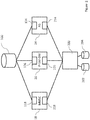
- FIG. 2 shows an example of how telephony equipment in the telephony network 2 may be configured to implement methods in accordance with the present invention.
- the MMSC 18 includes an MMS identity management module 118 and an MMS-related out-of-band messaging module 218.
- the AS 24 includes a call identity management module 124 and a call-related out-of-band messaging module 224.
- the IP-SM-GW 26 includes an SMS identity management module 126 and an SMS-related out-of-band messaging module 226.
- each of the MMSC 18, the AS 24, and the IP-SM-GW 26 is connected to an identity management database 100.
- the identity management database 100 may be replaced with separate databases included as part of each of the MMSC 18, the AS 24 and the IP-SM-GW 26, which in such cases may be communicatively coupled such that the IP-SM-GW 26 is able to access data stored in the separate databases.
- Each of the MMSC 118, the AS 24, and the IP-SM-GW 26 is also connected to an out-of-band messaging server 200, which is further connected to a message content and metadata database 202 and a message status database 204.
- references herein to data being communicated via an "out-of-band" data connection with respect to given data are intended to cover the given data being transmitted over a link (for example a TCP/IP connection or a UDP link), which is different than an associated messaging service link, such as an SMS messaging link and an MMS messaging link, or an associated voice or video call link.
- An out-of-band data connection may be established during session setup and/or after a session is established over a messaging service link, or a voice call link.
- the data communicated over the out-of-band data connection may be correlated with data communicated in-band, with reference to for example a message ID or a call ID used to reference the respective message or call on the in-band link.
- the user equipment 12, 13 may establish an out-of-band data connection with the out-of-band messaging server 200 using an app installed on the user equipment.
- the first telephony identifier ID A and the second telephony identifier ID B are configured for use as different destination addresses in different SMS messages sent to the second user equipment 13.
- identity management is performed in relation to the first telephony identifier ID A and the second telephony identifier ID B .
- identity management is performed at the identity management module 126 of the IP-SM-GW 26, but in other examples, identity management may be performed by other SMS processing equipment, for example SMSC 20.
- performing identity management includes accessing group messaging indicator data indicative of an association between user of the first user equipment 12 and the user of second user equipment 13, and selecting the first telephony identifier ID A on the basis of the group messaging indicator data.
- the stored data is stored in the identity management database 100.
- the group messaging indicator data are configurable by users, for example by the user of first user equipment 12 or second user equipment 13.
- such data are configurable by a user, for example by the user of the first user equipment 12.
- a user may configure such data via, for example a secure configuration web interface or a secure configuration app on a smartphone or tablet device.
- processing at least one SMS message at the SMS processing equipment includes receiving an SMS message from the second user equipment 13, selecting the first telephony identifier ID A on the basis of the group messaging indicator data, and transmitting an outgoing SMS message to the third user equipment 14 including an originating address comprising the first telephony identifier ID A .
- the group messaging indicator data includes the third telephony identifier ID C
- selecting the first telephony identifier ID A includes deriving the third telephony identifier ID C from a destination address of the SMS message, and in response to the group messaging indicator data being indicative of an association between the first telephony identifier ID A and the third telephony identifier ID C , selecting the first telephony identifier ID A .
- the users of the first and second user equipment 12, 13 are each associated with a shared identity associated with a small business, and the shared identity is associated with the first telephony identifier ID A .
- the user of the third user equipment 14 is a client of the small business, and accordingly when an SMS message arrives at the IP-SM-GW 26 from the second user equipment 13 with a destination address associated with third user equipment 14, the group messaging indicator data stored in the identity management database 100 indicates that there is an association between the telephony identifier ID A and the third telephony identifier ID C , and the IP-SM-GW 26 selects the first telephony identifier ID A , and the user equipment 14 perceives that the message was sent from the shared identity associated with the small business.
- selecting the first telephony identifier ID A includes receiving selection data from the user of the second user equipment 13 on an out-of-band data connection, in association with the SMS message from the second user equipment 13.
- the IP-SM-GW 26 selects the first telephony identifier.
- group messaging indicator data includes communication data relating to one or more previous communications involving use of the first telephony identifier ID A and the third telephony identifier ID C .
- Previous communications may include one or more previous voice and/or video calls involving use of the first telephony identifier ID A and the third telephony identifier ID C as telephony party identifiers.
- the communication data is sent from the call identity management module 124 of the AS 24 to the identity management database 100, where the communication data is stored.
- Previous communications may also include one or more previous SMS messages including the second telephony identifier ID B and the third telephony identifier ID C as one of a destination address and an originating address, respectively.
- the communication data is sent from the SMS identity management module 126 of the IP-SM-GW 26 to the identity management database 100, where the communication data is stored.
- Previous communications may also include MMS messages including the first telephony identifier ID A and the third telephony identifier ID C as one of a destination address and an originating address, respectively.
- the communication data is sent from the MMS identity management module 118 of the MMSC 18 to the identity management database 100, where the communication data is stored.
- message content and/or message metadata is derived from an SMS message sent from the second user equipment 13, and is transmitted to the first user equipment 12 using an out-of-band data connection.
- the out-of-band messaging server 200 transmits the message content and/or metadata to the first user equipment 12, such that the user of the first user equipment 12 receives the messages and/or associated metadata for which the first identifier ID A is selected.
- first identity ID A being associated with an identity shared by members of a small business
- business-related SMS messages sent by the user of the second user device 13 will be received by the user of the first user device 12, and the associated metadata will cause first user device 12 to order the messages correctly amongst any other received or sent messages which are associated with the same telephony identifier.
- the SMS processing equipment receives an indication of the SMS message having been subject to a status change from the third user equipment 14.
- the status change is indicated by a delivery receipt sent by the third user equipment 14 via SMS.
- a status change is indicated by a message sent by the third user equipment 14 using an out-of-band data connection. In either case, a status change indicator is transmitted to the first user equipment 12 using an out-of-band data connection.
- processing at least one SMS message at the SMS processing equipment includes receiving an incoming SMS message including the first telephony identifier ID A as a destination address, and performing identity management includes delivering a copy of the incoming SMS message to the first user equipment 12 as a first outgoing SMS message, and further includes delivering a copy of the incoming SMS message to the second user equipment 13 as a second outgoing SMS message.
- identity management includes delivering a copy of the incoming SMS message to the first user equipment 12 as a first outgoing SMS message, and further includes delivering a copy of the incoming SMS message to the second user equipment 13 as a second outgoing SMS message.
- Some of the examples described further include receiving an indication of the second outgoing SMS message having been subject to a status change from the second user equipment 13, and transmitting a status change indicator relating to the first outgoing SMS message to the first user equipment 12 using an out-of-band data connection.
- a status change from the second user equipment 13 is indicated by a read receipt sent by the second user equipment 13 using an out-of-band data connection. In this way, the user of the first user equipment 12 is made aware if the user of the second user equipment 13 has read the corresponding SMS.
- some of the examples include receiving an indication of the first outgoing SMS message having been subject to a status change from the first user device 12, and transmitting a status change indicator relating to the second outgoing SMS message to the second user equipment 13 using an out-of-band data connection.
- the SMS processing equipment receives an SMS message from the second user equipment 13, selects to use the second telephony identifier ID B instead of the first telephony identifier ID A , and transmits an outgoing SMS message including an originating address comprising the second telephony identifier ID B .
- the second user equipment 13 may be used to send SMS messages independently of the shared identity. This may be useful, for example, if the user equipment 12 is associated with a business identity and also a personal identity, each identity being associated with a different telephony identifier, and only the business identity being a shared identity.
- a fourth telephony identifier ID D is configured for communication with the first user equipment 12, and identity management is performed in relation to the use of the first and fourth telephony identifiers ID A and ID D , during processing of an SMS message at the SMS processing equipment.
- users of the first and second user equipment 12 and 13 are in a predefined group including one or more additional users, wherein the users of the first and second user equipment 12 and 13 are selected from the predefined group for receipt of a group message in preference to at least one of the one or more additional users based on preference criteria.
- preference criteria include time-of-day, geolocation of user equipment with which users are associated, and an identity of a sender of a message addressed to the predefined group.
- a user may have more identities and accordingly have one or more telephony identifiers, other than the first telephony identifier and the second telephony identifier, managed by one or more identity management systems as described above.
Landscapes
- Engineering & Computer Science (AREA)
- Signal Processing (AREA)
- Computer Networks & Wireless Communication (AREA)
- Telephonic Communication Services (AREA)
- Mobile Radio Communication Systems (AREA)
Applications Claiming Priority (1)
| Application Number | Priority Date | Filing Date | Title |
|---|---|---|---|
| GB1801120.5A GB2570353B (en) | 2018-01-23 | 2018-01-23 | Processing SMS messages |
Publications (2)
| Publication Number | Publication Date |
|---|---|
| EP3515096A1 true EP3515096A1 (fr) | 2019-07-24 |
| EP3515096B1 EP3515096B1 (fr) | 2021-04-28 |
Family
ID=61283507
Family Applications (1)
| Application Number | Title | Priority Date | Filing Date |
|---|---|---|---|
| EP19152240.8A Active EP3515096B1 (fr) | 2018-01-23 | 2019-01-17 | Traitement de messages sms |
Country Status (3)
| Country | Link |
|---|---|
| US (1) | US10506099B2 (fr) |
| EP (1) | EP3515096B1 (fr) |
| GB (1) | GB2570353B (fr) |
Families Citing this family (4)
| Publication number | Priority date | Publication date | Assignee | Title |
|---|---|---|---|---|
| US11464069B2 (en) * | 2019-07-08 | 2022-10-04 | Apple Inc. | Communications network |
| US11425540B2 (en) * | 2019-10-22 | 2022-08-23 | Jim Heffernan | Private vertical communication platform |
| US11496423B2 (en) * | 2019-11-20 | 2022-11-08 | Centurylink Intellectual Property Llc | Platform-agnostic message relay service for outbound messages |
| US20250113167A1 (en) * | 2023-09-29 | 2025-04-03 | T-Mobile Usa, Inc. | Modification of transmission of user-indicated messages and systems and methods of the same |
Citations (3)
| Publication number | Priority date | Publication date | Assignee | Title |
|---|---|---|---|---|
| US20090061825A1 (en) * | 2007-08-31 | 2009-03-05 | Palm, Inc. | Techniques for group messaging on a mobile computing device |
| US20110317684A1 (en) * | 2010-06-24 | 2011-12-29 | Lazzaro Nicholas P | Systems and methods for terminating communication requests |
| US20150172884A1 (en) * | 2013-12-12 | 2015-06-18 | Vonage Network Llc | Method and system for off-net message communications |
Family Cites Families (8)
| Publication number | Priority date | Publication date | Assignee | Title |
|---|---|---|---|---|
| US8126960B2 (en) * | 2000-07-28 | 2012-02-28 | Silver State Intellectual Technologies, Inc. | Technique for effective organization and communication of information |
| WO2004086784A1 (fr) * | 2003-03-24 | 2004-10-07 | Research In Motion Limited | Procedes et appareil d'acheminement d'un message a deux ou plusieurs dispositifs de communication sans fil associes |
| WO2008008889A2 (fr) * | 2006-07-12 | 2008-01-17 | Tigran Khalapyan | Système d'annuloplastie et procédé chirurgical |
| WO2008088890A1 (fr) | 2007-01-18 | 2008-07-24 | Tekelec | Acheminemen d'un appel d'un réseau 2g à un dispositif bimode 2g/sip (protocole d'initiation de session) |
| US9172799B2 (en) * | 2010-06-28 | 2015-10-27 | Cisco Technology, Inc. | Method and apparatus for displaying a social networking status message on a dialing phone |
| US8699413B2 (en) * | 2010-08-03 | 2014-04-15 | At&T Intellectual Property I, L.P. | Network servers, systems, and methods for multiple personas on a mobile device |
| EP2637429B1 (fr) * | 2012-03-06 | 2017-11-29 | Telefónica Germany GmbH & Co. OHG | Établissement d'appel à un identifiant active de la carte SIM dans un réseau de communication mobile |
| US10200831B2 (en) * | 2016-05-19 | 2019-02-05 | T-Mobile Usa, Inc. | Managing communications in heterogeneous communication networks |
-
2018
- 2018-01-23 GB GB1801120.5A patent/GB2570353B/en active Active
-
2019
- 2019-01-04 US US16/240,611 patent/US10506099B2/en active Active
- 2019-01-17 EP EP19152240.8A patent/EP3515096B1/fr active Active
Patent Citations (3)
| Publication number | Priority date | Publication date | Assignee | Title |
|---|---|---|---|---|
| US20090061825A1 (en) * | 2007-08-31 | 2009-03-05 | Palm, Inc. | Techniques for group messaging on a mobile computing device |
| US20110317684A1 (en) * | 2010-06-24 | 2011-12-29 | Lazzaro Nicholas P | Systems and methods for terminating communication requests |
| US20150172884A1 (en) * | 2013-12-12 | 2015-06-18 | Vonage Network Llc | Method and system for off-net message communications |
Also Published As
| Publication number | Publication date |
|---|---|
| US20190230221A1 (en) | 2019-07-25 |
| GB201801120D0 (en) | 2018-03-07 |
| EP3515096B1 (fr) | 2021-04-28 |
| GB2570353B (en) | 2020-10-07 |
| US10506099B2 (en) | 2019-12-10 |
| GB2570353A (en) | 2019-07-24 |
Similar Documents
| Publication | Publication Date | Title |
|---|---|---|
| US9247401B2 (en) | Signature control for SMS | |
| US10506099B2 (en) | Processing SMS messages | |
| US20110202661A1 (en) | Session-based telecommunications | |
| US11729607B2 (en) | Multi-line mobile service with dynamic MSISDN association | |
| US20170019774A1 (en) | Method and system for off-net message communications | |
| US10200831B2 (en) | Managing communications in heterogeneous communication networks | |
| US11343863B2 (en) | System and method for communicating across multiple network types | |
| US20110299458A1 (en) | VoIP CALL OVER WIRELESS SYSTEMS USING ANY PREFERRED DIALING NUMBER | |
| US11843713B2 (en) | Smart caller-ID | |
| US10477015B2 (en) | Processing SMS messages | |
| US11683668B2 (en) | System for sending short message over a second number | |
| US11070678B2 (en) | Establishing a telephony session | |
| US20200382562A1 (en) | Changing origination and termination calling modes | |
| US12574321B2 (en) | System and method for facilitating routing of level 1 numbers | |
| KR102899056B1 (ko) | 기계 간 통신을 용이하게 하는 시스템 및 방법 | |
| WO2020139286A2 (fr) | Système d'initiation et de réception d'appel sur un second numéro | |
| RU2808170C2 (ru) | Система совершения и приёма звонков по второму номеру | |
| KR101584901B1 (ko) | 개인용 이동통신 단말기를 이용한 유무선 통합 서비스 제공 방법 및 시스템 | |
| HK40002165A (zh) | 用於跨多种网络类型进行通信的系统和方法 | |
| GB2577186A (en) | Establishing a telephony session | |
| RS20140372A1 (sr) | Postupak i sistem za pružanje usluge dodatnih brojeva telefona iz više različitih mreža sa mogućnošću ostvarivanja govornih poziva i razmene poruka |
Legal Events
| Date | Code | Title | Description |
|---|---|---|---|
| PUAI | Public reference made under article 153(3) epc to a published international application that has entered the european phase |
Free format text: ORIGINAL CODE: 0009012 |
|
| STAA | Information on the status of an ep patent application or granted ep patent |
Free format text: STATUS: THE APPLICATION HAS BEEN PUBLISHED |
|
| AK | Designated contracting states |
Kind code of ref document: A1 Designated state(s): AL AT BE BG CH CY CZ DE DK EE ES FI FR GB GR HR HU IE IS IT LI LT LU LV MC MK MT NL NO PL PT RO RS SE SI SK SM TR |
|
| AX | Request for extension of the european patent |
Extension state: BA ME |
|
| STAA | Information on the status of an ep patent application or granted ep patent |
Free format text: STATUS: REQUEST FOR EXAMINATION WAS MADE |
|
| 17P | Request for examination filed |
Effective date: 20190911 |
|
| RBV | Designated contracting states (corrected) |
Designated state(s): AL AT BE BG CH CY CZ DE DK EE ES FI FR GB GR HR HU IE IS IT LI LT LU LV MC MK MT NL NO PL PT RO RS SE SI SK SM TR |
|
| STAA | Information on the status of an ep patent application or granted ep patent |
Free format text: STATUS: EXAMINATION IS IN PROGRESS |
|
| 17Q | First examination report despatched |
Effective date: 20200608 |
|
| GRAP | Despatch of communication of intention to grant a patent |
Free format text: ORIGINAL CODE: EPIDOSNIGR1 |
|
| STAA | Information on the status of an ep patent application or granted ep patent |
Free format text: STATUS: GRANT OF PATENT IS INTENDED |
|
| INTG | Intention to grant announced |
Effective date: 20201116 |
|
| GRAS | Grant fee paid |
Free format text: ORIGINAL CODE: EPIDOSNIGR3 |
|
| GRAA | (expected) grant |
Free format text: ORIGINAL CODE: 0009210 |
|
| STAA | Information on the status of an ep patent application or granted ep patent |
Free format text: STATUS: THE PATENT HAS BEEN GRANTED |
|
| RBV | Designated contracting states (corrected) |
Designated state(s): AL AT BE BG CH CY CZ DE DK EE ES FI FR GR HR HU IE IS IT LI LT LU LV MC MK MT NL NO PL PT RO RS SE SI SK SM TR |
|
| AK | Designated contracting states |
Kind code of ref document: B1 Designated state(s): AL AT BE BG CH CY CZ DE DK EE ES FI FR GR HR HU IE IS IT LI LT LU LV MC MK MT NL NO PL PT RO RS SE SI SK SM TR |
|
| REG | Reference to a national code |
Ref country code: CH Ref legal event code: EP |
|
| REG | Reference to a national code |
Ref country code: DE Ref legal event code: R096 Ref document number: 602019004106 Country of ref document: DE |
|
| REG | Reference to a national code |
Ref country code: AT Ref legal event code: REF Ref document number: 1388502 Country of ref document: AT Kind code of ref document: T Effective date: 20210515 |
|
| REG | Reference to a national code |
Ref country code: IE Ref legal event code: FG4D |
|
| REG | Reference to a national code |
Ref country code: LT Ref legal event code: MG9D |
|
| REG | Reference to a national code |
Ref country code: AT Ref legal event code: MK05 Ref document number: 1388502 Country of ref document: AT Kind code of ref document: T Effective date: 20210428 |
|
| PG25 | Lapsed in a contracting state [announced via postgrant information from national office to epo] |
Ref country code: NL Free format text: LAPSE BECAUSE OF FAILURE TO SUBMIT A TRANSLATION OF THE DESCRIPTION OR TO PAY THE FEE WITHIN THE PRESCRIBED TIME-LIMIT Effective date: 20210428 Ref country code: BG Free format text: LAPSE BECAUSE OF FAILURE TO SUBMIT A TRANSLATION OF THE DESCRIPTION OR TO PAY THE FEE WITHIN THE PRESCRIBED TIME-LIMIT Effective date: 20210728 Ref country code: AT Free format text: LAPSE BECAUSE OF FAILURE TO SUBMIT A TRANSLATION OF THE DESCRIPTION OR TO PAY THE FEE WITHIN THE PRESCRIBED TIME-LIMIT Effective date: 20210428 Ref country code: FI Free format text: LAPSE BECAUSE OF FAILURE TO SUBMIT A TRANSLATION OF THE DESCRIPTION OR TO PAY THE FEE WITHIN THE PRESCRIBED TIME-LIMIT Effective date: 20210428 Ref country code: HR Free format text: LAPSE BECAUSE OF FAILURE TO SUBMIT A TRANSLATION OF THE DESCRIPTION OR TO PAY THE FEE WITHIN THE PRESCRIBED TIME-LIMIT Effective date: 20210428 Ref country code: LT Free format text: LAPSE BECAUSE OF FAILURE TO SUBMIT A TRANSLATION OF THE DESCRIPTION OR TO PAY THE FEE WITHIN THE PRESCRIBED TIME-LIMIT Effective date: 20210428 |
|
| PG25 | Lapsed in a contracting state [announced via postgrant information from national office to epo] |
Ref country code: GR Free format text: LAPSE BECAUSE OF FAILURE TO SUBMIT A TRANSLATION OF THE DESCRIPTION OR TO PAY THE FEE WITHIN THE PRESCRIBED TIME-LIMIT Effective date: 20210729 Ref country code: IS Free format text: LAPSE BECAUSE OF FAILURE TO SUBMIT A TRANSLATION OF THE DESCRIPTION OR TO PAY THE FEE WITHIN THE PRESCRIBED TIME-LIMIT Effective date: 20210828 Ref country code: PT Free format text: LAPSE BECAUSE OF FAILURE TO SUBMIT A TRANSLATION OF THE DESCRIPTION OR TO PAY THE FEE WITHIN THE PRESCRIBED TIME-LIMIT Effective date: 20210830 Ref country code: RS Free format text: LAPSE BECAUSE OF FAILURE TO SUBMIT A TRANSLATION OF THE DESCRIPTION OR TO PAY THE FEE WITHIN THE PRESCRIBED TIME-LIMIT Effective date: 20210428 Ref country code: SE Free format text: LAPSE BECAUSE OF FAILURE TO SUBMIT A TRANSLATION OF THE DESCRIPTION OR TO PAY THE FEE WITHIN THE PRESCRIBED TIME-LIMIT Effective date: 20210428 Ref country code: LV Free format text: LAPSE BECAUSE OF FAILURE TO SUBMIT A TRANSLATION OF THE DESCRIPTION OR TO PAY THE FEE WITHIN THE PRESCRIBED TIME-LIMIT Effective date: 20210428 Ref country code: NO Free format text: LAPSE BECAUSE OF FAILURE TO SUBMIT A TRANSLATION OF THE DESCRIPTION OR TO PAY THE FEE WITHIN THE PRESCRIBED TIME-LIMIT Effective date: 20210728 Ref country code: PL Free format text: LAPSE BECAUSE OF FAILURE TO SUBMIT A TRANSLATION OF THE DESCRIPTION OR TO PAY THE FEE WITHIN THE PRESCRIBED TIME-LIMIT Effective date: 20210428 |
|
| REG | Reference to a national code |
Ref country code: NL Ref legal event code: MP Effective date: 20210428 |
|
| PG25 | Lapsed in a contracting state [announced via postgrant information from national office to epo] |
Ref country code: ES Free format text: LAPSE BECAUSE OF FAILURE TO SUBMIT A TRANSLATION OF THE DESCRIPTION OR TO PAY THE FEE WITHIN THE PRESCRIBED TIME-LIMIT Effective date: 20210428 Ref country code: EE Free format text: LAPSE BECAUSE OF FAILURE TO SUBMIT A TRANSLATION OF THE DESCRIPTION OR TO PAY THE FEE WITHIN THE PRESCRIBED TIME-LIMIT Effective date: 20210428 Ref country code: SK Free format text: LAPSE BECAUSE OF FAILURE TO SUBMIT A TRANSLATION OF THE DESCRIPTION OR TO PAY THE FEE WITHIN THE PRESCRIBED TIME-LIMIT Effective date: 20210428 Ref country code: SM Free format text: LAPSE BECAUSE OF FAILURE TO SUBMIT A TRANSLATION OF THE DESCRIPTION OR TO PAY THE FEE WITHIN THE PRESCRIBED TIME-LIMIT Effective date: 20210428 Ref country code: RO Free format text: LAPSE BECAUSE OF FAILURE TO SUBMIT A TRANSLATION OF THE DESCRIPTION OR TO PAY THE FEE WITHIN THE PRESCRIBED TIME-LIMIT Effective date: 20210428 Ref country code: CZ Free format text: LAPSE BECAUSE OF FAILURE TO SUBMIT A TRANSLATION OF THE DESCRIPTION OR TO PAY THE FEE WITHIN THE PRESCRIBED TIME-LIMIT Effective date: 20210428 Ref country code: DK Free format text: LAPSE BECAUSE OF FAILURE TO SUBMIT A TRANSLATION OF THE DESCRIPTION OR TO PAY THE FEE WITHIN THE PRESCRIBED TIME-LIMIT Effective date: 20210428 |
|
| REG | Reference to a national code |
Ref country code: DE Ref legal event code: R097 Ref document number: 602019004106 Country of ref document: DE |
|
| PLBE | No opposition filed within time limit |
Free format text: ORIGINAL CODE: 0009261 |
|
| STAA | Information on the status of an ep patent application or granted ep patent |
Free format text: STATUS: NO OPPOSITION FILED WITHIN TIME LIMIT |
|
| 26N | No opposition filed |
Effective date: 20220131 |
|
| PG25 | Lapsed in a contracting state [announced via postgrant information from national office to epo] |
Ref country code: IS Free format text: LAPSE BECAUSE OF FAILURE TO SUBMIT A TRANSLATION OF THE DESCRIPTION OR TO PAY THE FEE WITHIN THE PRESCRIBED TIME-LIMIT Effective date: 20210828 Ref country code: AL Free format text: LAPSE BECAUSE OF FAILURE TO SUBMIT A TRANSLATION OF THE DESCRIPTION OR TO PAY THE FEE WITHIN THE PRESCRIBED TIME-LIMIT Effective date: 20210428 |
|
| PG25 | Lapsed in a contracting state [announced via postgrant information from national office to epo] |
Ref country code: IT Free format text: LAPSE BECAUSE OF FAILURE TO SUBMIT A TRANSLATION OF THE DESCRIPTION OR TO PAY THE FEE WITHIN THE PRESCRIBED TIME-LIMIT Effective date: 20210428 |
|
| PG25 | Lapsed in a contracting state [announced via postgrant information from national office to epo] |
Ref country code: MC Free format text: LAPSE BECAUSE OF FAILURE TO SUBMIT A TRANSLATION OF THE DESCRIPTION OR TO PAY THE FEE WITHIN THE PRESCRIBED TIME-LIMIT Effective date: 20210428 |
|
| REG | Reference to a national code |
Ref country code: CH Ref legal event code: PL |
|
| REG | Reference to a national code |
Ref country code: BE Ref legal event code: MM Effective date: 20220131 |
|
| PG25 | Lapsed in a contracting state [announced via postgrant information from national office to epo] |
Ref country code: LU Free format text: LAPSE BECAUSE OF NON-PAYMENT OF DUE FEES Effective date: 20220117 |
|
| PG25 | Lapsed in a contracting state [announced via postgrant information from national office to epo] |
Ref country code: BE Free format text: LAPSE BECAUSE OF NON-PAYMENT OF DUE FEES Effective date: 20220131 |
|
| PG25 | Lapsed in a contracting state [announced via postgrant information from national office to epo] |
Ref country code: LI Free format text: LAPSE BECAUSE OF NON-PAYMENT OF DUE FEES Effective date: 20220131 Ref country code: CH Free format text: LAPSE BECAUSE OF NON-PAYMENT OF DUE FEES Effective date: 20220131 |
|
| PG25 | Lapsed in a contracting state [announced via postgrant information from national office to epo] |
Ref country code: IE Free format text: LAPSE BECAUSE OF NON-PAYMENT OF DUE FEES Effective date: 20220117 |
|
| P01 | Opt-out of the competence of the unified patent court (upc) registered |
Effective date: 20230506 |
|
| PG25 | Lapsed in a contracting state [announced via postgrant information from national office to epo] |
Ref country code: MK Free format text: LAPSE BECAUSE OF FAILURE TO SUBMIT A TRANSLATION OF THE DESCRIPTION OR TO PAY THE FEE WITHIN THE PRESCRIBED TIME-LIMIT Effective date: 20210428 Ref country code: CY Free format text: LAPSE BECAUSE OF FAILURE TO SUBMIT A TRANSLATION OF THE DESCRIPTION OR TO PAY THE FEE WITHIN THE PRESCRIBED TIME-LIMIT Effective date: 20210428 |
|
| PG25 | Lapsed in a contracting state [announced via postgrant information from national office to epo] |
Ref country code: HU Free format text: LAPSE BECAUSE OF FAILURE TO SUBMIT A TRANSLATION OF THE DESCRIPTION OR TO PAY THE FEE WITHIN THE PRESCRIBED TIME-LIMIT; INVALID AB INITIO Effective date: 20190117 |
|
| PG25 | Lapsed in a contracting state [announced via postgrant information from national office to epo] |
Ref country code: TR Free format text: LAPSE BECAUSE OF FAILURE TO SUBMIT A TRANSLATION OF THE DESCRIPTION OR TO PAY THE FEE WITHIN THE PRESCRIBED TIME-LIMIT Effective date: 20210428 |
|
| PG25 | Lapsed in a contracting state [announced via postgrant information from national office to epo] |
Ref country code: MT Free format text: LAPSE BECAUSE OF FAILURE TO SUBMIT A TRANSLATION OF THE DESCRIPTION OR TO PAY THE FEE WITHIN THE PRESCRIBED TIME-LIMIT Effective date: 20210428 |
|
| PGFP | Annual fee paid to national office [announced via postgrant information from national office to epo] |
Ref country code: DE Payment date: 20260128 Year of fee payment: 8 |
|
| PGFP | Annual fee paid to national office [announced via postgrant information from national office to epo] |
Ref country code: FR Payment date: 20260126 Year of fee payment: 8 |