EP3521416B1 - Procédé d'évaluation d'un milieu de culture - Google Patents
Procédé d'évaluation d'un milieu de culture Download PDFInfo
- Publication number
- EP3521416B1 EP3521416B1 EP17855802.9A EP17855802A EP3521416B1 EP 3521416 B1 EP3521416 B1 EP 3521416B1 EP 17855802 A EP17855802 A EP 17855802A EP 3521416 B1 EP3521416 B1 EP 3521416B1
- Authority
- EP
- European Patent Office
- Prior art keywords
- medium
- particles
- cell aggregates
- evaluation
- magnetic
- Prior art date
- Legal status (The legal status is an assumption and is not a legal conclusion. Google has not performed a legal analysis and makes no representation as to the accuracy of the status listed.)
- Active
Links
- 238000000034 method Methods 0.000 title claims description 17
- 239000001963 growth medium Substances 0.000 title 1
- 238000011156 evaluation Methods 0.000 claims description 110
- 239000002245 particle Substances 0.000 claims description 109
- 238000011084 recovery Methods 0.000 claims description 57
- 230000014759 maintenance of location Effects 0.000 claims description 55
- 239000006249 magnetic particle Substances 0.000 claims description 49
- 230000004907 flux Effects 0.000 claims description 8
- SZVJSHCCFOBDDC-UHFFFAOYSA-N iron(II,III) oxide Inorganic materials O=[Fe]O[Fe]O[Fe]=O SZVJSHCCFOBDDC-UHFFFAOYSA-N 0.000 claims description 6
- 229920000747 poly(lactic acid) Polymers 0.000 claims description 4
- 239000004626 polylactic acid Substances 0.000 claims description 4
- 210000004027 cell Anatomy 0.000 description 139
- 238000004062 sedimentation Methods 0.000 description 54
- 238000012258 culturing Methods 0.000 description 22
- 238000005516 engineering process Methods 0.000 description 15
- 238000005259 measurement Methods 0.000 description 14
- 230000004927 fusion Effects 0.000 description 12
- 238000003756 stirring Methods 0.000 description 10
- 239000011324 bead Substances 0.000 description 8
- 238000001556 precipitation Methods 0.000 description 8
- XEEYBQQBJWHFJM-UHFFFAOYSA-N Iron Chemical compound [Fe] XEEYBQQBJWHFJM-UHFFFAOYSA-N 0.000 description 6
- 230000000052 comparative effect Effects 0.000 description 6
- 238000010586 diagram Methods 0.000 description 6
- 230000001747 exhibiting effect Effects 0.000 description 6
- 229920000642 polymer Polymers 0.000 description 6
- 239000001913 cellulose Substances 0.000 description 5
- 229920002678 cellulose Polymers 0.000 description 5
- 239000000203 mixture Substances 0.000 description 5
- 239000002121 nanofiber Substances 0.000 description 5
- 229920002148 Gellan gum Polymers 0.000 description 4
- 239000000969 carrier Substances 0.000 description 4
- 238000007865 diluting Methods 0.000 description 4
- 238000010790 dilution Methods 0.000 description 4
- 239000012895 dilution Substances 0.000 description 4
- 239000000216 gellan gum Substances 0.000 description 4
- 235000010492 gellan gum Nutrition 0.000 description 4
- 238000003384 imaging method Methods 0.000 description 4
- 239000013028 medium composition Substances 0.000 description 4
- 229920000609 methyl cellulose Polymers 0.000 description 4
- 239000001923 methylcellulose Substances 0.000 description 4
- 235000010981 methylcellulose Nutrition 0.000 description 4
- 239000002244 precipitate Substances 0.000 description 4
- 210000000130 stem cell Anatomy 0.000 description 4
- 239000006228 supernatant Substances 0.000 description 4
- 238000010191 image analysis Methods 0.000 description 3
- 229910052742 iron Inorganic materials 0.000 description 3
- 238000012423 maintenance Methods 0.000 description 3
- 230000000717 retained effect Effects 0.000 description 3
- MCMNRKCIXSYSNV-UHFFFAOYSA-N Zirconium dioxide Chemical compound O=[Zr]=O MCMNRKCIXSYSNV-UHFFFAOYSA-N 0.000 description 2
- 230000003247 decreasing effect Effects 0.000 description 2
- 238000009795 derivation Methods 0.000 description 2
- 230000005484 gravity Effects 0.000 description 2
- 238000004519 manufacturing process Methods 0.000 description 2
- 239000000463 material Substances 0.000 description 2
- 239000000047 product Substances 0.000 description 2
- 230000001953 sensory effect Effects 0.000 description 2
- 210000001082 somatic cell Anatomy 0.000 description 2
- 239000002562 thickening agent Substances 0.000 description 2
- 230000000007 visual effect Effects 0.000 description 2
- 239000004925 Acrylic resin Substances 0.000 description 1
- 229920000178 Acrylic resin Polymers 0.000 description 1
- 238000004113 cell culture Methods 0.000 description 1
- 230000030833 cell death Effects 0.000 description 1
- 239000000470 constituent Substances 0.000 description 1
- 238000012136 culture method Methods 0.000 description 1
- 239000006185 dispersion Substances 0.000 description 1
- 238000011835 investigation Methods 0.000 description 1
- 230000017074 necrotic cell death Effects 0.000 description 1
- 229910001172 neodymium magnet Inorganic materials 0.000 description 1
- 239000013049 sediment Substances 0.000 description 1
- 230000035945 sensitivity Effects 0.000 description 1
- 238000000926 separation method Methods 0.000 description 1
- 238000005549 size reduction Methods 0.000 description 1
- HUAUNKAZQWMVFY-UHFFFAOYSA-M sodium;oxocalcium;hydroxide Chemical compound [OH-].[Na+].[Ca]=O HUAUNKAZQWMVFY-UHFFFAOYSA-M 0.000 description 1
- 230000000087 stabilizing effect Effects 0.000 description 1
- 239000000725 suspension Substances 0.000 description 1
- 238000011179 visual inspection Methods 0.000 description 1
Images



Classifications
-
- G—PHYSICS
- G01—MEASURING; TESTING
- G01N—INVESTIGATING OR ANALYSING MATERIALS BY DETERMINING THEIR CHEMICAL OR PHYSICAL PROPERTIES
- G01N15/00—Investigating characteristics of particles; Investigating permeability, pore-volume or surface-area of porous materials
- G01N15/04—Investigating sedimentation of particle suspensions
-
- G—PHYSICS
- G01—MEASURING; TESTING
- G01N—INVESTIGATING OR ANALYSING MATERIALS BY DETERMINING THEIR CHEMICAL OR PHYSICAL PROPERTIES
- G01N33/00—Investigating or analysing materials by specific methods not covered by groups G01N1/00 - G01N31/00
- G01N33/48—Biological material, e.g. blood, urine; Haemocytometers
- G01N33/50—Chemical analysis of biological material, e.g. blood, urine; Testing involving biospecific ligand binding methods; Immunological testing
- G01N33/5005—Chemical analysis of biological material, e.g. blood, urine; Testing involving biospecific ligand binding methods; Immunological testing involving human or animal cells
-
- G—PHYSICS
- G01—MEASURING; TESTING
- G01N—INVESTIGATING OR ANALYSING MATERIALS BY DETERMINING THEIR CHEMICAL OR PHYSICAL PROPERTIES
- G01N27/00—Investigating or analysing materials by the use of electric, electrochemical, or magnetic means
- G01N27/72—Investigating or analysing materials by the use of electric, electrochemical, or magnetic means by investigating magnetic variables
-
- G—PHYSICS
- G01—MEASURING; TESTING
- G01N—INVESTIGATING OR ANALYSING MATERIALS BY DETERMINING THEIR CHEMICAL OR PHYSICAL PROPERTIES
- G01N15/00—Investigating characteristics of particles; Investigating permeability, pore-volume or surface-area of porous materials
- G01N2015/0042—Investigating dispersion of solids
Definitions
- the disclosed technology relates to a medium evaluation method.
- culture methods referred to as so-called three-dimensional culture, by which cell aggregates (cells) are cultured in a suspended state, are known.
- the medium used for the three-dimensional culture is such that even in a case in which a medium is produced using similar processes, a variation in the cell aggregates retention performance or the recovery efficiency for cell aggregates occurs as a result of a slight variation in the conditions. Therefore, for a medium, it is desirable to evaluate the cell aggregates retention performance or the recovery efficiency for cell aggregates.
- the variation in the retention performance or recovery efficiency is very small, and it may be difficult to directly measure the retention performance or the recovery efficiency.
- WO2004/078961A a technology for evaluating a medium based on the sedimentation velocity of iron spheres introduced into a medium is described in WO2004/078961A .
- WO2004/078961A it is described that in a case in which the sedimentation velocity of the iron spheres is fast, cells are likely to sediment in the medium during culture, that is, the retention performance is enhanced; whereas in a case in which the sedimentation velocity of the iron spheres is slow, the operation for recovering cells becomes difficult, that is, there is a possibility that the recovery efficiency may decrease.
- the medium should have appropriate specific gravity and viscosity.
- the retention performance or recovery efficiency for cell aggregates in a medium is evaluated from a viewpoint based on the viscosity of the medium.
- the retention performance or recovery efficiency for cells aggregates in a medium cannot be adequately evaluated. For example, there were media that had identical viscosity but exhibited different retention performance or recovery efficiencies (see Table 1).
- the disclosed technology provides a medium evaluation method that enables an evaluation on whether a medium is appropriate for both the cell retention performance and the cell recovery efficiency.
- a medium evaluation method of the present disclosure is a medium evaluation method having the features of claim 1.
- the technology of the present disclosure is a technology related to an evaluation method for evaluating the suitability of a medium used for three-dimensional culture of cell aggregates.
- Three-dimensional culture is a technology for culturing cells in a medium in a suspended state, and has a feature that high quality cells can be stably supplied in large quantities compared to conventional two-dimensional culture (adhesion culture).
- the "retention performance” is a performance of retaining cell aggregates in a medium, and superior retention performance implies that even in a case in which cells grow and proliferate in the course of cell culture, the cells do not precipitate or fuse with one another. Therefore, it is preferable that the retention performance is superior.
- the "recovery efficiency" is the cell recovery efficiency (number of separated cells / number of cells included in the medium) at the time of separating only the cells in the medium, and as the recovery efficiency is higher, the cells can be easily recovered. Therefore, it is preferable that the recovery efficiency is higher. Meanwhile, as the retention performance is superior, it is more difficult for cells to be separated from the medium, and therefore, the recovery efficiency may decrease.
- examples of the "cell aggregates” are aggregates of common cells; aggregates of stem cells or aggregates of differentiated somatic cells, or aggregates of those stem cells and differentiated somatic cells existing as a mixture; and aggregates of induced pluripotent stem (iPS) cells.
- iPS induced pluripotent stem
- cell aggregates may be simply referred to as “cells”.
- evaluation methods based on viscosity are known as methods for evaluating a medium; however, there have been occasions in which media used for three-dimensional culture have identical viscosity but different retention performance.
- the retention performance of Medium I is denoted as "A", and in a case in which the retention performance is equal or superior to that of Medium I, the medium is rated as "A", while in a case in which the retention performance is inferior to that of Medium I, the medium is rated as "B".
- A Medium I
- B Viscosity (viscometer) 1.2 Pa ⁇ s 1.2 Pa ⁇ s 10 Pa ⁇ s Cell retainability (sensory evaluation)
- a B A Sedimentation velocity small beads (200 ⁇ m, 2.5 g/cm 3 ) 6 mm/s 25 mm/s 0.1 mm/s Sedimentation velocity large beads (1 mm, 6 g/cm 3 ) 100 mm/s 100 mm/s 10 mm/s
- Medium III has higher viscosity compared to Medium I and Medium II, and the sedimentation velocity of the small beads (particles) and large beads (particles) is also slow.
- the retention performance of Medium III is "A", that is, appropriate.
- the sedimentation velocity of particles may be different, and the cell aggregates retention performance may also be different.
- the present inventors found, as a result of investigation, that cells suspended in a medium do not settle only due to the viscosity resistance of the medium, but also because the cells are retained in a network formed by the polymers added to the medium.
- the retention power of the network formed by polymers is very small, and it is considered that the retention power is of the extent that holds objects having a size and a density equivalent to those of cells or the like.
- the sedimentation velocity of particles dispersed in a medium was measured, and the sedimentation velocity thus measured was used as an index value indicating the suitability of the medium.
- Fig. 1 shows a flowchart describing an example of the process flow of the medium evaluation method of the present example.
- Step S100 5 mg of particles were introduced into a transparent container having a size of 10 mm ⁇ 10 mm ⁇ 50 mm (length ⁇ width ⁇ height) and containing 3 ml of a medium, the particles were dispersed by stirring, and then the system was left to stand for one hour at a temperature of 22°C.
- the height of the container is not particularly limited; however, the height is preferably 50 mm.
- particles made of soda lime and having a density of 2.5 g/cm 3 and a particle size of 200 ⁇ m (accuracy: 200 ⁇ 10 ⁇ m, standard deviation: 6 or less) (SPL200 manufactured by Unitika, Ltd.) were used.
- the particle size of the particles used for the evaluation is equal to the size of cell aggregates, in order to evaluate the retention performance concerning cell aggregates (for example, stem cells) cultured in the medium as an object of evaluation.
- the size of cell aggregates is about 70 ⁇ m to 500 ⁇ m, and in a case in which the cell aggregates are smaller than this, the cells undergo cell death, while in a case in which the cell aggregates are larger, the interior of the cell aggregates undergoes necrosis. Therefore, similarly to the present example, the particle size of the particles is preferably from 70 ⁇ m to 500 ⁇ m, and more preferably 200 ⁇ m.
- the density of the particles used for the evaluation is preferably a density corresponding to cell aggregates cultured by means of the medium as an object of evaluation, and due to the reasons described in detail below, the density of the particles is preferably about two or more times the density of the cell aggregates.
- the density of the cell aggregates is preferably 2 g/cm 3 or greater, and more preferably 2.5 g/cm 3 or greater.
- the particles used for the evaluation have a uniform density and a uniform particle size as far as possible.
- particles having a standard deviation of 6 or less were used. Since the sedimentation velocity is directly proportional to the square of the particle size, in order to maintain the weight variation accuracy, it is preferable that the variation of the particle size as a range that does not affect the measurement accuracy is ⁇ 10%.
- the quantity of the particles to be introduced into the medium is small; however, in a case in which the number of the particles is small, the N number is small (the number of samples is small). Meanwhile, in a case in which the quantity of the particles is large, the particles affect one another during sedimentation, and thereby the sedimentation velocity thus measured may become inaccurate. Therefore, it is preferable that the number of particles is 5 mg (in the case of a density of 2.5 g/cm 3 and a particle size of 200 ⁇ m), as is the case of the present embodiment.
- Step S102 the sedimentation velocity of the particles is measured.
- 1 ml of the medium in a state of having particles dispersed therein is suctioned and returned using a pipette, and thereby the medium is stirred (about 1 ml/mm 2 ⁇ s).
- a container 10 containing a medium 12 having the particles 14 dispersed therein is irradiated with parallel light 22 coming from a light source 20, and imaging is performed using a camera 24 under the conditions of 30 fps as a moving image.
- the operation of combining stirring of the medium and imaging of the state of the particles settling in the medium is carried out repeatedly for 5 or more times (about 20 times at the most).
- the portion in which the particles gently settle is defined, and the quantity of movement and the time of movement of the particles are derived by an image analysis.
- the average sedimentation velocity of individual particles is derived.
- the average value of the sedimentation velocities of 50 to 100 particles is derived for stirring of one time, and the average value is used as the sedimentation velocity of that round.
- the average value of the sedimentation velocities of several times (at least five or more times are needed) was derived, and the average value derived therefrom was used as the sedimentation velocity of the particles settling in the medium.
- Step S104 the sedimentation velocity is used as an index value, and thereby, the evaluation according to the medium evaluation method of the present example is completed.
- a medium prepared by adding gel-forming suspended carriers (Mebiol, cellulose nanofibers, gellan gum, methyl cellulose, and the like) and a thickening agent to a water-degradable maintenance medium was used. Furthermore, an evaluation was carried out for three kinds of media (media 1, 2, and 3) that included the same components and had no significant differences in viscosity or the like, but were produced by different production processes or the like. The concentrations of the components of the media were varied according to the size of the cell aggregates used for the evaluation.
- composition called Medium 2 media (media 1, 2, and 3) having high concentrations (composition called Medium 2) were used, and in a case in which the size of the cell aggregates was smaller than the above-described value (80 ⁇ m or larger and smaller than 120 ⁇ m), media (media 1#, 2#, and 3#) having low concentrations (composition called Medium 1) were used.
- Cellulose nanofibers as a gel-forming material were added to mTesR1, which is a general maintenance medium, at a proportion of 0.025% (weight ratio) for Medium 1, and at a proportion of 0.05% (weight ratio) for Medium 2.
- precipitation means a state in which dispersed cell aggregates have settled at a position of 1 mm or less from the bottom of the container.
- fusion is a state in which adjacent cell aggregates unite with one another, and whether fusion has occurred was determined by making a microscopic observation. In a case in which five or more fusion products were confirmed in 3 ml of the medium, the medium was rated as "B".
- recovery ratio On the occasion of evaluating the recovery ratio, in a case in which the size of the cell aggregates was 80 ⁇ m to 120 ⁇ m, recovery was carried out by diluting the cell-including medium five times, centrifuging the dilution at 180 g for 3 minutes, and discarding the supernatant. In a case in which the size of the cell aggregates was 120 ⁇ m or larger, recovery was carried out by diluting the cell-including medium five times, centrifuging the dilution at 100 g for 3 minutes, and discarding the supernatant.
- the medium was rated as "A"; and in a case in which the recovery efficiency was less than 80%, the medium was rated as "B".
- a medium having a sedimentation velocity of from 1.0 mm/s to 4.0 mm/s, and more preferably having a sedimentation velocity of from 2.5 mm/s to 4.0 mm/s can be considered as an adequate medium.
- the medium evaluation method of the present example it is possible to evaluate the suitability of the medium by utilizing the sedimentation velocity as an index value.
- the upper limit of the sedimentation velocity may be determined in advance based on the retention performance of the medium capable of retaining cell aggregates during culture, and the lower limit of the sedimentation velocity may be determined in advance based on the recovery efficiency for recovering cell aggregates.
- the density of the particles used for the evaluation is preferably 2 g/cm 3 or greater as described above, and when the evaluation system of the present example is considered, the density of the particles is more preferably 2 g/cm 3 to 6 g/cm 3 .
- the density is higher than 6 g/cm 3 , the evaluation of a medium is possible in principle.
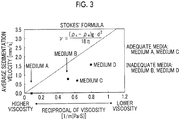
- Fig. 3 an example of the correspondence relation between viscosity and the sedimentation velocity that serves as an index value of the evaluation is shown in Fig. 3 .
- Fig. 3 an example of the correspondence relation between viscosity and the sedimentation velocity is shown for four kinds of dilute media A to D, which have been considered adequate and have gel-forming suspended carriers (Mebiol, cellulose nanofibers, gellan gum, methyl cellulose, and the like) added thereto at a proportion of 0.5% or less.
- gel-forming suspended carriers Mebiol, cellulose nanofibers, gellan gum, methyl cellulose, and the like
- medium A and medium C that have been considered to be adequate have slower sedimentation velocities (2/3 or less) than the terminal velocity obtainable by substituting the viscosity (measured value obtained using a viscometer) and density of the medium as well as the particle size and density of the particles into Stokes' Formula (theorem).
- the sedimentation velocity is 2/3 or less of the terminal velocity derived by Stokes' theorem.
- the medium evaluation method of the present example is a medium evaluation method of evaluating the suitability of a medium for culturing cell aggregates in a suspended state, and the method includes dispersing a plurality of particles in the medium, measuring the sedimentation velocity at which the particles settle in the medium, and using the sedimentation velocity thus measured as an index value indicating the suitability of the medium.
- culture of the cell aggregates can be carried out appropriately.
- a medium having appropriate retention performance particles settle slowly; however, in a case in which the retention performance is weak, particles settle rapidly. Furthermore, in a case in which the retention performance is too strong, particles do not settle but stand still.
- the slight difference in the cell retainability of a medium can be detected with higher sensitivity by selecting the particle size and density of particles.
- an evaluation of the suitability of a medium was carried out using the quantity of movement in a case in which a magnetic field was applied to magnetic particles dispersed in the medium.
- Fig. 4 presents a flowchart showing an example of the process flow of the medium evaluation method of the present embodiment.
- Step S200 100 ⁇ l of magnetic particles (the density of the particles at the time of measurement was adjusted to 200 to 500 particles/ml) were introduced into a transparent container having a size of 10 mm ⁇ 10 mm ⁇ 50 mm (length ⁇ width ⁇ height) and containing 5 ml of a medium, and the medium was dispersed by stirring.
- magnetic polylactic acid particles particles manufactured by MicroMod Automation, Inc., PLA-M12-00-105 having a particle size of 100 ⁇ m and a density of 1.4 g/cm 3 and containing magnetite (Fe 3 O 4 ) as a magnetic body at a percentage content of 40% (w/w), were used as an example of the magnetic particles.
- the particles were introduced and stirred, the particles were left to stand for one hour at a temperature of 22°C. As is the case of the standing state schematically illustrated in Fig.
- the temperature during standing and during performing the measurement of the distance x is preferably 22°C.
- the size of the container 40 used herein is such that in a case in which the width of the container 40 is wider than the diameter of the magnet 50 serving as a source of magnetic field generation, the magnetic force does not work well. Therefore, it is preferable that the width is narrower than the diameter of the magnet 50.
- the distance x (equilibrium distance x half that will be described below) at which the ratio of the particle numbers obtained before and after the application of a magnetic field of the magnetic particles 44 included in the range of a predetermined region from a position, the distance from the magnet 50 to the position being a predetermined distance, became 0.5 was derived.
- a magnetic field using the magnet 50 from the bottom face 41 of the container 40 gravity and magnetic force are applied to the magnetic particles 44 in the direction toward the bottom face 41, and a drag force against this is generated.
- the container 40 in a standing state is imaged with a camera from sideways, and the dispersed state of the magnetic particles 44 is recorded into an image.
- the visual field of the image recording the dispersed state is preferably such that the width is greater than or equal to the width of the container (10 mm), and the length is from 20 mm to 50 mm (distance from the bottom face to the top face of the medium 42).
- the magnet 50 is disposed on the bottom face 41 of the container 40, and thereby a magnetic field is applied in the container 40.
- the magnetic particles 44 are attracted to the direction of the magnet 50 for one minute, and then the dispersed state of the magnetic particles 44 is recorded into an image using a camera in the same manner as before the application of the magnetic field.
- the visual field of the image recording the dispersed state and the dispersed and the scope of imaging in this case are the same as those before the application of a magnetic field.
- the bottom face 41 of the present embodiment is an example of the predetermined unidirectional surface of the technology of the present disclosure.
- the magnet 50 used for the evaluation a circular-shaped neodymium magnet having a diameter of 15 mm to 20 mm and a thickness of 2 mm to 3 mm and having a surface magnetic flux density of 200 ⁇ 50 mT was used.
- the material of the magnet 50 is not particularly limited; however, the surface magnetic flux density is preferably from 150 mT to 250 mT. In a case in which the surface magnetic flux density is 250 mT or less, even though the attractive force caused by a magnetic force becomes strong, the scope of dispersion of the magnetic particles 44 attracted by the magnetic force of the magnet 50 is appropriately suppressed. Therefore, since the viewing angle of the camera used for recording the dispersed state of the magnetic particles 44 can be suppressed from being widened, the suppressed viewing angle can contribute to the size reduction of measuring apparatuses including the above-mentioned camera.
- the surface magnetic flux density is lower than 150 T, since the quantity of movement of the magnetic particles 44 being attracted by the magnetic force and moving becomes small, errors of measurement are likely to be produced. Therefore, in a case in which the surface magnetic flux density is 150 T or higher, an appropriate quantity of movement of the magnetic particles 44 being attracted by the magnetic force and moving can be secured, and therefore, a decrease in the measurement accuracy can be suppressed.
- the medium 42 was stirred as explained above, and the magnetic particles 44 were dispersed. Subsequently, a treatment of recording the dispersed states of the magnetic particles 44 before the application of a magnetic field and after the application of a magnetic field into images was carried out. In the present embodiment, the aforementioned treatment was carried out five times.
- the quantity of movement of the magnetic particles is derived by analyzing the images taken before the application of a magnetic field and after the application of a magnetic field.
- the method of deriving the quantity of movement of the magnetic particles is not particularly limited; however, for example, the following two kinds of methods may be mentioned.
- a first method first, an image analysis is performed for a pair of two images obtained before and after the application of a magnetic field, and the distances x of various magnetic particles 44 from the bottom face 41 of the container 40 are derived.
- the ratio of the particle numbers obtained before and after the application of a magnetic field of the number of magnetic particles 44 existing in that range is derived for each of the various ranges.
- the range of the predetermined region is not particularly limited; however, in order to secure the measurement accuracy, a range of 3 or more times and 100 or fewer times the particle size of the magnetic particles is preferred.
- the range of the predetermined region In a case in which the range of the predetermined region is less than 3 times, the number of times of measurement increases, and also, the range of the predetermined region is narrowed. Thereby, the number of magnetic particles 44 included in the range is decreased, and therefore, the variation tends to increase. On the other hand, in a case in which the range of the predetermined region is more than 100 times, as the range of the predetermined region is widened, the number of the magnetic particles 44 included in the range increases. Therefore, it is difficult to measure the number, and also, the number of plots that will be described below with reference to Fig. 7 is decreased.
- the ratio of the particle numbers is 0.2.
- the ratio of the particle numbers is 0.4.
- the distance x from the bottom face 41 (magnet 50 as a source of magnetic field generation) of the container 40 is plotted on the axis of abscissa, and the ratio of the particle numbers obtained before and after the application of a magnetic field is plotted on the axis of coordinate.
- a case in which an evaluation of three kinds of media having different concentrations of the gel-forming suspended carriers added thereto (Mebiol, cellulose nanofibers, gellan gum, methyl cellulose, and the like) was performed is shown.
- Fig. 7 shows an example of the state of the magnetic particles 44 being dispersed before and after the application of a magnetic field.
- X half at which the ratio of the particle numbers derived by Formula (1) is 0.5 represents the distance x at which a balance is achieved between the magnetic force and the retention power acting on the magnetic particles 44 in the medium 42 (hereinafter, "equilibrium distance x half ").
- the equilibrium distance x half derived by Formula (1) described above is 3.20 (mm).
- the equilibrium distances x half for the measurement of five times are derived and averaged, and the average equilibrium distance x half is used as an index value representing the retention performance of the medium 42.
- the equilibrium distance x half that serves as an index value representing the retention performance can be simply derived compared to the first method.
- an image analysis is performed for a pair of two images obtained before and after the application of a magnetic field, and the particle number of the magnetic particles 44 retained in the medium 42 excluding the magnetic particles 44 that have settled on the bottom face 41, is counted for each of the images.
- the particle number thus counted after the application of a magnetic field is divided by the particle number before the application of a magnetic field, and thereby, the ratio of the particle numbers is derived. Furthermore, a value obtained by multiplying the ratio of the particle numbers thus derived, by the length from the bottom face 41 of the container 40 to the upper limit of the image, is designated as the equilibrium distance x half of the magnetic particles 44.
- the equilibrium distances x half for the measurement of five times are derived and averaged, and the average equilibrium distance x half is used as an index value indicating the retention performance of the medium 42.
- a medium prepared by adding gel-forming suspended carriers (Mebiol, cellulose nanofibers, gellan gum, methyl cellulose, and the like) and a thickening agent to a water-degradable maintenance medium was used. Furthermore, an evaluation was carried out for three kinds of media (media 1, 2, and 3) that included the same components and had no significant differences in viscosity or the like but were produced by different production processes or the like. The concentrations of the components of the media were varied according to the size of the cell aggregates used for the evaluation.
- composition called Medium 2 media (media 1, 2, and 3) having high concentrations (composition called Medium 2) were used, and in a case in which the size of the cell aggregates was smaller than the above-described value (80 ⁇ m or larger and smaller than 120 ⁇ m), media (media 1#, 2#, and 3#) having low concentrations (composition called Medium 1) were used.
- precipitation means a state in which dispersed cell aggregates have settled at a position of 1 mm or less from the bottom of the container.
- the "fusion" is a state in which adjacent cell aggregates unite with one another, and whether fusion has occurred was determined by making a microscopic observation. In a case in which five or more fusion products were confirmed in 3 ml of the medium, the medium was rated as "B".
- recovery ratio On the occasion of evaluating the recovery ratio, in a case in which the size of the cell aggregates was 80 ⁇ m to 120 ⁇ m, recovery was carried out by diluting the cell-including medium five times, centrifuging the dilution at 180 g for 3 minutes, and discarding the supernatant. In a case in which the size of the cell aggregates was 120 ⁇ m or larger, recovery was carried out by diluting the cell-including medium five times, centrifuging the dilution at 100 g for 3 minutes, and discarding the supernatant.
- the medium was rated as "A"; and in a case in which the recovery efficiency was less than 80%, the medium was rated as "B".
- the magnetic particles 44 in this case are magnetic particles that use magnetic polylactic acid particles having a particle size of 100 ⁇ m, a density of 1.4 g/cm 3 , and a magnetite percentage content of 40%, and the surface magnetic flux density of the magnet 50 is 200 mT.
- the suitability of a medium can be evaluated by using the distance of travel x (X half ) as an index value. Furthermore, the upper limit of the distance of travel x (X half ) may be determined in advance based on the retention performance by which the medium retains cell aggregates during culture, and the lower limit of the distance of travel x (X half ) may be determined in advance based on the recovery efficiency for recovering cell aggregates.
- the medium evaluation method of the present embodiment is a medium evaluation method of evaluating the suitability of a medium for culturing cell aggregates in a suspended state, and the method includes dispersing a plurality of magnetic particles 44 in a medium 42 contained in a container 40, applying a magnetic field thereto, subsequently measuring the distance of travel x (X half ) in which the ratio of the numbers of magnetic particles 44 existing in the range from a position at which the distance of travel from the magnet 50 as a source of magnetic field generation is the distance of travel x, to the magnet 50, exceeds a predetermined value (0.5) for the first time, and using the distance of travel x (X half ) thus measured as an index value indicating the suitability of the medium 42.
- culture of cell aggregates can be carried out appropriately.
- a medium exhibiting a sedimentation velocity of 1 mm/s or higher as derived in the medium evaluation method of the first embodiment and exhibiting a distance of travel x (X half ) of 10 mm or less as derived in the medium evaluation method of the second embodiment is evaluated to be adequate.
- a medium exhibiting a sedimentation velocity of from 4 mm/s to 12 mm/s as derived in the medium evaluation method of the first embodiment and exhibiting a distance of travel x (X half ) of 5 mm or less as derived in the medium evaluation method of the second embodiment is evaluated to be adequate.
- the evaluation results of the media may vary depending on the size of the cell aggregates. Therefore, the evaluation criteria for the suitability of the medium may be varied depending on the size of the cell aggregates to be cultured. For example, in the case of the first embodiment, in a case in which the cell aggregates in the early stage of culture are small (80 ⁇ m or larger and smaller than 120 ⁇ m), medium A exhibiting a sedimentation velocity of from 2.5 mm/s to 4.0 mm/s is evaluated as an adequate medium, and culture and recovery of cell aggregates are carried out using medium A.
- medium B exhibiting a sedimentation velocity of from 1.0 mm/s to 4.0 mm/s is evaluated as an adequate medium, and culture and recovery of cell aggregates are carried out using medium B.
- the sedimentation velocity itself was used as an index value indicating the suitability of a medium; however, other values based on the sedimentation velocity may also be used as the index values. For example, a value obtained by multiplying the sedimentation velocity by a predetermined coefficient may be used as an index value, or the sedimentation velocity may be classified by ranking according to predetermined criteria, and this rank may be used as an index value.
- the distance of travel x (X half ) itself is used as an index value indicating the suitability of a medium; however, other values based on x (X half ) may also be used as index values. For example, a value obtained by multiplying x (X half ) by a predetermined coefficient may be used as an index value, or the x (X half ) may be classified by ranking according to predetermined criteria, and this rank may be used as an index value.
Landscapes
- Health & Medical Sciences (AREA)
- Chemical & Material Sciences (AREA)
- Life Sciences & Earth Sciences (AREA)
- Immunology (AREA)
- Physics & Mathematics (AREA)
- Analytical Chemistry (AREA)
- Biochemistry (AREA)
- General Health & Medical Sciences (AREA)
- General Physics & Mathematics (AREA)
- Pathology (AREA)
- Engineering & Computer Science (AREA)
- Hematology (AREA)
- Urology & Nephrology (AREA)
- Molecular Biology (AREA)
- Biomedical Technology (AREA)
- Dispersion Chemistry (AREA)
- Biotechnology (AREA)
- Cell Biology (AREA)
- Microbiology (AREA)
- Tropical Medicine & Parasitology (AREA)
- Food Science & Technology (AREA)
- Medicinal Chemistry (AREA)
- Chemical Kinetics & Catalysis (AREA)
- Electrochemistry (AREA)
- Apparatus Associated With Microorganisms And Enzymes (AREA)
- Measuring Or Testing Involving Enzymes Or Micro-Organisms (AREA)
- Micro-Organisms Or Cultivation Processes Thereof (AREA)
Claims (7)
- Procédé d'évaluation de milieu destiné à évaluer l'adéquation d'un milieu quant à des agrégats de cellules de culture dans un état en suspension, le procédé comprenant les étapes consistant à :disperser une pluralité de particules magnétiques dans un milieu contenu dans un récipient ;mesurer une distance prédéfinie x, où le rapport de nombres entre les nombres de particules obtenus avant et après application d'un champ magnétique des particules magnétiques incluses dans la plage d'une région prédéterminée commençant à partir d'une distance prédéterminée à partir de la source de génération de champ magnétique, est une valeur prédéterminée, etutiliser la distance x ainsi mesurée comme valeur d'indice indiquant l'adéquation du milieu.
- Procédé d'évaluation de milieu selon la revendication 1, dans lequel la plage de la région prédéterminée est la plage allant de 3 fois à 100 fois la dimension des particules des particules magnétiques.
- Procédé d'évaluation de milieu selon la revendication 1 ou 2, dans lequel des particules magnétiques d'acide polylactique présentant une dimension de particules de 100 µm, une densité de 1,4 g/cm3, et une teneur en pourcentage de magnétite de 40 % sont utilisées comme particules magnétiques.
- Procédé d'évaluation de milieu selon l'une quelconque des revendications 1 à 3, dans lequel l'application d'un champ magnétique est réalisée en disposant un aimant présentant une induction magnétique de surface allant de 150 mT à 250 mT sur une surface unidirectionnelle prédéterminée du récipient.
- Procédé d'évaluation de milieu selon la revendication 1 ou 2,
dans lequel des particules magnétiques d'acide polylactique présentant une dimension de particules de 100 µm, une densité de 1,4 g/cm3, et une teneur en pourcentage de magnétite de 40 % sont utilisées comme particules magnétiques ;
l'application d'un champ magnétique est réalisée en disposant un aimant présentant une induction magnétique de surface de 200 mT sur une surface unidirectionnelle prédéterminée du récipient, et
le milieu présentant une valeur d'indice ainsi mesurée dans une plage prédéterminée est déterminé comme étant un milieu adéquat. - Procédé d'évaluation de milieu selon la revendication 5, dans lequel une limite supérieure de la plage prédéterminée est une valeur qui a été prédéterminée sur la base d'une performance de rétention suivant laquelle un milieu retient les agrégats de cellules.
- Procédé d'évaluation de milieu selon la revendication 5 ou 6, dans lequel une limite inférieure de la plage prédéterminée est une valeur qui a été prédéterminée sur la base d'une efficacité de récupération pour la récupération d'agrégats de cellules à partir d'un milieu.
Applications Claiming Priority (2)
| Application Number | Priority Date | Filing Date | Title |
|---|---|---|---|
| JP2016195053 | 2016-09-30 | ||
| PCT/JP2017/033606 WO2018061847A1 (fr) | 2016-09-30 | 2017-09-15 | Procédé d'évaluation d'un milieu, milieu et procédé de culture |
Publications (3)
| Publication Number | Publication Date |
|---|---|
| EP3521416A1 EP3521416A1 (fr) | 2019-08-07 |
| EP3521416A4 EP3521416A4 (fr) | 2019-08-28 |
| EP3521416B1 true EP3521416B1 (fr) | 2020-07-01 |
Family
ID=61759635
Family Applications (1)
| Application Number | Title | Priority Date | Filing Date |
|---|---|---|---|
| EP17855802.9A Active EP3521416B1 (fr) | 2016-09-30 | 2017-09-15 | Procédé d'évaluation d'un milieu de culture |
Country Status (6)
| Country | Link |
|---|---|
| US (1) | US11435276B2 (fr) |
| EP (1) | EP3521416B1 (fr) |
| JP (1) | JP6732033B2 (fr) |
| KR (1) | KR20190040334A (fr) |
| CN (1) | CN109844096A (fr) |
| WO (1) | WO2018061847A1 (fr) |
Families Citing this family (2)
| Publication number | Priority date | Publication date | Assignee | Title |
|---|---|---|---|---|
| JP2022127334A (ja) * | 2021-02-19 | 2022-08-31 | 株式会社エビデント | 細胞回収装置、細胞回収方法、プログラム |
| CN119552798A (zh) * | 2024-11-26 | 2025-03-04 | 上海多宁生物科技股份有限公司 | 一种含纳米颗粒的成分限定昆虫培养基 |
Family Cites Families (6)
| Publication number | Priority date | Publication date | Assignee | Title |
|---|---|---|---|---|
| JPWO2004078961A1 (ja) * | 2003-03-07 | 2006-06-08 | メビオール株式会社 | 浮遊担体および浮遊・回収方法 |
| CA2532754A1 (fr) * | 2003-07-17 | 2005-02-03 | Global Cell Solutions, Llc | Systeme et procede de culture cellulaire automatique |
| WO2007081161A1 (fr) * | 2006-01-11 | 2007-07-19 | Korea Institute Of Science And Technology | Appareil et procédé destinés à séparer des particules biologiques au moyen d'une différence entre la force de gravité et la force magnétique |
| KR102539240B1 (ko) | 2014-01-23 | 2023-06-01 | 닛산 가가쿠 가부시키가이샤 | 배양 배지 조성물 |
| JP2016099238A (ja) * | 2014-11-21 | 2016-05-30 | 株式会社東芝 | 磁性体粒子の濃度測定装置および濃度測定方法 |
| JP2016195053A (ja) | 2015-04-01 | 2016-11-17 | トヨタ自動車株式会社 | 膜電極接合体の製造方法 |
-
2017
- 2017-09-15 EP EP17855802.9A patent/EP3521416B1/fr active Active
- 2017-09-15 JP JP2018542410A patent/JP6732033B2/ja not_active Expired - Fee Related
- 2017-09-15 WO PCT/JP2017/033606 patent/WO2018061847A1/fr not_active Ceased
- 2017-09-15 CN CN201780060847.0A patent/CN109844096A/zh active Pending
- 2017-09-15 KR KR1020197008912A patent/KR20190040334A/ko not_active Ceased
-
2019
- 2019-03-26 US US16/364,186 patent/US11435276B2/en active Active
Non-Patent Citations (1)
| Title |
|---|
| None * |
Also Published As
| Publication number | Publication date |
|---|---|
| CN109844096A (zh) | 2019-06-04 |
| KR20190040334A (ko) | 2019-04-17 |
| WO2018061847A1 (fr) | 2018-04-05 |
| US20190219492A1 (en) | 2019-07-18 |
| US11435276B2 (en) | 2022-09-06 |
| EP3521416A1 (fr) | 2019-08-07 |
| JP6732033B2 (ja) | 2020-07-29 |
| JPWO2018061847A1 (ja) | 2019-08-29 |
| EP3521416A4 (fr) | 2019-08-28 |
Similar Documents
| Publication | Publication Date | Title |
|---|---|---|
| Gollwitzer et al. | A comparison of techniques for size measurement of nanoparticles in cell culture medium | |
| JP6775498B2 (ja) | 液滴の内容物を分析する方法及び関連装置 | |
| Rodriguez et al. | Separation and analysis of colloidal/nano-particles including microorganisms by capillary electrophoresis: a fundamental review | |
| Schoo et al. | Coating defects of lithium-ion battery electrodes and their inline detection and tracking | |
| EP2229591B1 (fr) | Kit et procédé d'analyse de cellules | |
| KR20150086297A (ko) | 이미지 분석으로 입자를 특징화하는 방법 | |
| EP3521416B1 (fr) | Procédé d'évaluation d'un milieu de culture | |
| EP3304037B1 (fr) | Procédé pour repiquer une colonie de cellules | |
| JP2019534463A (ja) | Huモーメントを用いるホログラフィック特性評価 | |
| Lee et al. | Characterization of colloidal nanoparticles in mixtures with polydisperse and multimodal size distributions using a particle tracking analysis and electrospray-scanning mobility particle sizer | |
| US20060040291A1 (en) | Method for enumerating mammalian cell micronuclei with an emphasis on differentially staining micronuclei and the chromatin of dead and dying cells | |
| JP5277906B2 (ja) | 微粒子の粒径分布測定方法 | |
| Bernsmann et al. | On the Use of Metal Sinter Powder in Laser Powder Bed Fusion Processing (PBF-LB/M) | |
| Atieh et al. | Evaluation of surface roughness by image processing of a shot-peened, TIG-welded aluminum 6061-T6 alloy: An experimental case study | |
| Poggemann et al. | Morphology of particulate structures on a fiber array before and at clogging point of an aerosol filtration process | |
| JP4946047B2 (ja) | 有形成分分類装置用粒子標準試薬 | |
| Pathak et al. | A Comparative Study Of Platelet Counts By Automated And Manual Method In Patients With Thrombocytopenia And Thrombocytosis | |
| CN112326516B (zh) | 一种基于曲线拆解的粒度次总体识别方法 | |
| CN114281283A (zh) | 散点图像的显示方法及样本分析设备、相关装置 | |
| KR101568903B1 (ko) | 미세입자 계측 장치 및 그 방법 | |
| JP6421297B2 (ja) | 悪性形質転換細胞の検出方法 | |
| Daramy et al. | Characterization of polymeric nanoparticle-protein interactions | |
| Burgum et al. | Tungsten carbide–cobalt can function as a particle positive control for genotoxicity in vitro in specific cell lines | |
| Jordan et al. | Prebiotic membrane structures mimic the morphology of purported early traces of life on Earth | |
| Dey et al. | Supporting Information: Multiple gold nanoparticle cores within a single SiO2 shell for preservable solid-state surface-enhanced Raman scattering and catalytic sensing |
Legal Events
| Date | Code | Title | Description |
|---|---|---|---|
| STAA | Information on the status of an ep patent application or granted ep patent |
Free format text: STATUS: THE INTERNATIONAL PUBLICATION HAS BEEN MADE |
|
| PUAI | Public reference made under article 153(3) epc to a published international application that has entered the european phase |
Free format text: ORIGINAL CODE: 0009012 |
|
| STAA | Information on the status of an ep patent application or granted ep patent |
Free format text: STATUS: REQUEST FOR EXAMINATION WAS MADE |
|
| 17P | Request for examination filed |
Effective date: 20190329 |
|
| AK | Designated contracting states |
Kind code of ref document: A1 Designated state(s): AL AT BE BG CH CY CZ DE DK EE ES FI FR GB GR HR HU IE IS IT LI LT LU LV MC MK MT NL NO PL PT RO RS SE SI SK SM TR |
|
| AX | Request for extension of the european patent |
Extension state: BA ME |
|
| A4 | Supplementary search report drawn up and despatched |
Effective date: 20190725 |
|
| RIC1 | Information provided on ipc code assigned before grant |
Ipc: G01N 33/50 20060101ALI20190719BHEP Ipc: C12N 5/07 20100101ALI20190719BHEP Ipc: G01N 15/04 20060101ALI20190719BHEP Ipc: C12N 5/02 20060101AFI20190719BHEP |
|
| DAV | Request for validation of the european patent (deleted) | ||
| DAX | Request for extension of the european patent (deleted) | ||
| GRAP | Despatch of communication of intention to grant a patent |
Free format text: ORIGINAL CODE: EPIDOSNIGR1 |
|
| STAA | Information on the status of an ep patent application or granted ep patent |
Free format text: STATUS: GRANT OF PATENT IS INTENDED |
|
| INTG | Intention to grant announced |
Effective date: 20200320 |
|
| GRAS | Grant fee paid |
Free format text: ORIGINAL CODE: EPIDOSNIGR3 |
|
| GRAA | (expected) grant |
Free format text: ORIGINAL CODE: 0009210 |
|
| STAA | Information on the status of an ep patent application or granted ep patent |
Free format text: STATUS: THE PATENT HAS BEEN GRANTED |
|
| AK | Designated contracting states |
Kind code of ref document: B1 Designated state(s): AL AT BE BG CH CY CZ DE DK EE ES FI FR GB GR HR HU IE IS IT LI LT LU LV MC MK MT NL NO PL PT RO RS SE SI SK SM TR |
|
| REG | Reference to a national code |
Ref country code: CH Ref legal event code: EP Ref country code: AT Ref legal event code: REF Ref document number: 1286206 Country of ref document: AT Kind code of ref document: T Effective date: 20200715 |
|
| REG | Reference to a national code |
Ref country code: IE Ref legal event code: FG4D |
|
| REG | Reference to a national code |
Ref country code: DE Ref legal event code: R096 Ref document number: 602017019178 Country of ref document: DE |
|
| REG | Reference to a national code |
Ref country code: LT Ref legal event code: MG4D |
|
| PG25 | Lapsed in a contracting state [announced via postgrant information from national office to epo] |
Ref country code: BG Free format text: LAPSE BECAUSE OF FAILURE TO SUBMIT A TRANSLATION OF THE DESCRIPTION OR TO PAY THE FEE WITHIN THE PRESCRIBED TIME-LIMIT Effective date: 20201001 |
|
| REG | Reference to a national code |
Ref country code: NL Ref legal event code: MP Effective date: 20200701 |
|
| REG | Reference to a national code |
Ref country code: AT Ref legal event code: MK05 Ref document number: 1286206 Country of ref document: AT Kind code of ref document: T Effective date: 20200701 |
|
| PG25 | Lapsed in a contracting state [announced via postgrant information from national office to epo] |
Ref country code: CZ Free format text: LAPSE BECAUSE OF FAILURE TO SUBMIT A TRANSLATION OF THE DESCRIPTION OR TO PAY THE FEE WITHIN THE PRESCRIBED TIME-LIMIT Effective date: 20200701 Ref country code: ES Free format text: LAPSE BECAUSE OF FAILURE TO SUBMIT A TRANSLATION OF THE DESCRIPTION OR TO PAY THE FEE WITHIN THE PRESCRIBED TIME-LIMIT Effective date: 20200701 Ref country code: LT Free format text: LAPSE BECAUSE OF FAILURE TO SUBMIT A TRANSLATION OF THE DESCRIPTION OR TO PAY THE FEE WITHIN THE PRESCRIBED TIME-LIMIT Effective date: 20200701 Ref country code: HR Free format text: LAPSE BECAUSE OF FAILURE TO SUBMIT A TRANSLATION OF THE DESCRIPTION OR TO PAY THE FEE WITHIN THE PRESCRIBED TIME-LIMIT Effective date: 20200701 Ref country code: PT Free format text: LAPSE BECAUSE OF FAILURE TO SUBMIT A TRANSLATION OF THE DESCRIPTION OR TO PAY THE FEE WITHIN THE PRESCRIBED TIME-LIMIT Effective date: 20201102 Ref country code: SE Free format text: LAPSE BECAUSE OF FAILURE TO SUBMIT A TRANSLATION OF THE DESCRIPTION OR TO PAY THE FEE WITHIN THE PRESCRIBED TIME-LIMIT Effective date: 20200701 Ref country code: AT Free format text: LAPSE BECAUSE OF FAILURE TO SUBMIT A TRANSLATION OF THE DESCRIPTION OR TO PAY THE FEE WITHIN THE PRESCRIBED TIME-LIMIT Effective date: 20200701 Ref country code: FI Free format text: LAPSE BECAUSE OF FAILURE TO SUBMIT A TRANSLATION OF THE DESCRIPTION OR TO PAY THE FEE WITHIN THE PRESCRIBED TIME-LIMIT Effective date: 20200701 Ref country code: NO Free format text: LAPSE BECAUSE OF FAILURE TO SUBMIT A TRANSLATION OF THE DESCRIPTION OR TO PAY THE FEE WITHIN THE PRESCRIBED TIME-LIMIT Effective date: 20201001 Ref country code: GR Free format text: LAPSE BECAUSE OF FAILURE TO SUBMIT A TRANSLATION OF THE DESCRIPTION OR TO PAY THE FEE WITHIN THE PRESCRIBED TIME-LIMIT Effective date: 20201002 |
|
| PG25 | Lapsed in a contracting state [announced via postgrant information from national office to epo] |
Ref country code: PL Free format text: LAPSE BECAUSE OF FAILURE TO SUBMIT A TRANSLATION OF THE DESCRIPTION OR TO PAY THE FEE WITHIN THE PRESCRIBED TIME-LIMIT Effective date: 20200701 Ref country code: RS Free format text: LAPSE BECAUSE OF FAILURE TO SUBMIT A TRANSLATION OF THE DESCRIPTION OR TO PAY THE FEE WITHIN THE PRESCRIBED TIME-LIMIT Effective date: 20200701 Ref country code: LV Free format text: LAPSE BECAUSE OF FAILURE TO SUBMIT A TRANSLATION OF THE DESCRIPTION OR TO PAY THE FEE WITHIN THE PRESCRIBED TIME-LIMIT Effective date: 20200701 Ref country code: IS Free format text: LAPSE BECAUSE OF FAILURE TO SUBMIT A TRANSLATION OF THE DESCRIPTION OR TO PAY THE FEE WITHIN THE PRESCRIBED TIME-LIMIT Effective date: 20201101 |
|
| PG25 | Lapsed in a contracting state [announced via postgrant information from national office to epo] |
Ref country code: NL Free format text: LAPSE BECAUSE OF FAILURE TO SUBMIT A TRANSLATION OF THE DESCRIPTION OR TO PAY THE FEE WITHIN THE PRESCRIBED TIME-LIMIT Effective date: 20200701 |
|
| REG | Reference to a national code |
Ref country code: DE Ref legal event code: R097 Ref document number: 602017019178 Country of ref document: DE |
|
| RAP4 | Party data changed (patent owner data changed or rights of a patent transferred) |
Owner name: FUJIFILM CORPORATION |
|
| PG25 | Lapsed in a contracting state [announced via postgrant information from national office to epo] |
Ref country code: IT Free format text: LAPSE BECAUSE OF FAILURE TO SUBMIT A TRANSLATION OF THE DESCRIPTION OR TO PAY THE FEE WITHIN THE PRESCRIBED TIME-LIMIT Effective date: 20200701 Ref country code: SM Free format text: LAPSE BECAUSE OF FAILURE TO SUBMIT A TRANSLATION OF THE DESCRIPTION OR TO PAY THE FEE WITHIN THE PRESCRIBED TIME-LIMIT Effective date: 20200701 Ref country code: DK Free format text: LAPSE BECAUSE OF FAILURE TO SUBMIT A TRANSLATION OF THE DESCRIPTION OR TO PAY THE FEE WITHIN THE PRESCRIBED TIME-LIMIT Effective date: 20200701 Ref country code: RO Free format text: LAPSE BECAUSE OF FAILURE TO SUBMIT A TRANSLATION OF THE DESCRIPTION OR TO PAY THE FEE WITHIN THE PRESCRIBED TIME-LIMIT Effective date: 20200701 Ref country code: EE Free format text: LAPSE BECAUSE OF FAILURE TO SUBMIT A TRANSLATION OF THE DESCRIPTION OR TO PAY THE FEE WITHIN THE PRESCRIBED TIME-LIMIT Effective date: 20200701 |
|
| REG | Reference to a national code |
Ref country code: CH Ref legal event code: PL |
|
| PLBE | No opposition filed within time limit |
Free format text: ORIGINAL CODE: 0009261 |
|
| STAA | Information on the status of an ep patent application or granted ep patent |
Free format text: STATUS: NO OPPOSITION FILED WITHIN TIME LIMIT |
|
| PG25 | Lapsed in a contracting state [announced via postgrant information from national office to epo] |
Ref country code: AL Free format text: LAPSE BECAUSE OF FAILURE TO SUBMIT A TRANSLATION OF THE DESCRIPTION OR TO PAY THE FEE WITHIN THE PRESCRIBED TIME-LIMIT Effective date: 20200701 |
|
| 26N | No opposition filed |
Effective date: 20210406 |
|
| REG | Reference to a national code |
Ref country code: BE Ref legal event code: MM Effective date: 20200930 |
|
| PG25 | Lapsed in a contracting state [announced via postgrant information from national office to epo] |
Ref country code: SK Free format text: LAPSE BECAUSE OF FAILURE TO SUBMIT A TRANSLATION OF THE DESCRIPTION OR TO PAY THE FEE WITHIN THE PRESCRIBED TIME-LIMIT Effective date: 20200701 Ref country code: LU Free format text: LAPSE BECAUSE OF NON-PAYMENT OF DUE FEES Effective date: 20200915 |
|
| PG25 | Lapsed in a contracting state [announced via postgrant information from national office to epo] |
Ref country code: SI Free format text: LAPSE BECAUSE OF FAILURE TO SUBMIT A TRANSLATION OF THE DESCRIPTION OR TO PAY THE FEE WITHIN THE PRESCRIBED TIME-LIMIT Effective date: 20200701 Ref country code: LI Free format text: LAPSE BECAUSE OF NON-PAYMENT OF DUE FEES Effective date: 20200930 Ref country code: IE Free format text: LAPSE BECAUSE OF NON-PAYMENT OF DUE FEES Effective date: 20200915 Ref country code: CH Free format text: LAPSE BECAUSE OF NON-PAYMENT OF DUE FEES Effective date: 20200930 Ref country code: BE Free format text: LAPSE BECAUSE OF NON-PAYMENT OF DUE FEES Effective date: 20200930 |
|
| PG25 | Lapsed in a contracting state [announced via postgrant information from national office to epo] |
Ref country code: TR Free format text: LAPSE BECAUSE OF FAILURE TO SUBMIT A TRANSLATION OF THE DESCRIPTION OR TO PAY THE FEE WITHIN THE PRESCRIBED TIME-LIMIT Effective date: 20200701 Ref country code: MT Free format text: LAPSE BECAUSE OF FAILURE TO SUBMIT A TRANSLATION OF THE DESCRIPTION OR TO PAY THE FEE WITHIN THE PRESCRIBED TIME-LIMIT Effective date: 20200701 Ref country code: CY Free format text: LAPSE BECAUSE OF FAILURE TO SUBMIT A TRANSLATION OF THE DESCRIPTION OR TO PAY THE FEE WITHIN THE PRESCRIBED TIME-LIMIT Effective date: 20200701 |
|
| PG25 | Lapsed in a contracting state [announced via postgrant information from national office to epo] |
Ref country code: MK Free format text: LAPSE BECAUSE OF FAILURE TO SUBMIT A TRANSLATION OF THE DESCRIPTION OR TO PAY THE FEE WITHIN THE PRESCRIBED TIME-LIMIT Effective date: 20200701 Ref country code: MC Free format text: LAPSE BECAUSE OF FAILURE TO SUBMIT A TRANSLATION OF THE DESCRIPTION OR TO PAY THE FEE WITHIN THE PRESCRIBED TIME-LIMIT Effective date: 20200701 |
|
| P01 | Opt-out of the competence of the unified patent court (upc) registered |
Effective date: 20230515 |
|
| PGFP | Annual fee paid to national office [announced via postgrant information from national office to epo] |
Ref country code: DE Payment date: 20240730 Year of fee payment: 8 |
|
| PGFP | Annual fee paid to national office [announced via postgrant information from national office to epo] |
Ref country code: GB Payment date: 20240801 Year of fee payment: 8 |
|
| PGFP | Annual fee paid to national office [announced via postgrant information from national office to epo] |
Ref country code: FR Payment date: 20240808 Year of fee payment: 8 |