EP3522079B1 - Codage et classification de données - Google Patents
Codage et classification de données Download PDFInfo
- Publication number
- EP3522079B1 EP3522079B1 EP19154865.0A EP19154865A EP3522079B1 EP 3522079 B1 EP3522079 B1 EP 3522079B1 EP 19154865 A EP19154865 A EP 19154865A EP 3522079 B1 EP3522079 B1 EP 3522079B1
- Authority
- EP
- European Patent Office
- Prior art keywords
- encoder
- image
- neural network
- image data
- quantum
- Prior art date
- Legal status (The legal status is an assumption and is not a legal conclusion. Google has not performed a legal analysis and makes no representation as to the accuracy of the status listed.)
- Active
Links
Images







Classifications
-
- G—PHYSICS
- G06—COMPUTING OR CALCULATING; COUNTING
- G06N—COMPUTING ARRANGEMENTS BASED ON SPECIFIC COMPUTATIONAL MODELS
- G06N10/00—Quantum computing, i.e. information processing based on quantum-mechanical phenomena
- G06N10/60—Quantum algorithms, e.g. based on quantum optimisation, quantum Fourier or Hadamard transforms
-
- G—PHYSICS
- G06—COMPUTING OR CALCULATING; COUNTING
- G06N—COMPUTING ARRANGEMENTS BASED ON SPECIFIC COMPUTATIONAL MODELS
- G06N20/00—Machine learning
- G06N20/10—Machine learning using kernel methods, e.g. support vector machines [SVM]
-
- G—PHYSICS
- G06—COMPUTING OR CALCULATING; COUNTING
- G06N—COMPUTING ARRANGEMENTS BASED ON SPECIFIC COMPUTATIONAL MODELS
- G06N20/00—Machine learning
- G06N20/20—Ensemble learning
-
- G—PHYSICS
- G06—COMPUTING OR CALCULATING; COUNTING
- G06N—COMPUTING ARRANGEMENTS BASED ON SPECIFIC COMPUTATIONAL MODELS
- G06N3/00—Computing arrangements based on biological models
- G06N3/02—Neural networks
- G06N3/04—Architecture, e.g. interconnection topology
- G06N3/045—Combinations of networks
- G06N3/0455—Auto-encoder networks; Encoder-decoder networks
-
- G—PHYSICS
- G06—COMPUTING OR CALCULATING; COUNTING
- G06N—COMPUTING ARRANGEMENTS BASED ON SPECIFIC COMPUTATIONAL MODELS
- G06N3/00—Computing arrangements based on biological models
- G06N3/02—Neural networks
- G06N3/04—Architecture, e.g. interconnection topology
- G06N3/0464—Convolutional networks [CNN, ConvNet]
-
- G—PHYSICS
- G06—COMPUTING OR CALCULATING; COUNTING
- G06N—COMPUTING ARRANGEMENTS BASED ON SPECIFIC COMPUTATIONAL MODELS
- G06N3/00—Computing arrangements based on biological models
- G06N3/02—Neural networks
- G06N3/04—Architecture, e.g. interconnection topology
- G06N3/047—Probabilistic or stochastic networks
-
- G—PHYSICS
- G06—COMPUTING OR CALCULATING; COUNTING
- G06N—COMPUTING ARRANGEMENTS BASED ON SPECIFIC COMPUTATIONAL MODELS
- G06N3/00—Computing arrangements based on biological models
- G06N3/02—Neural networks
- G06N3/04—Architecture, e.g. interconnection topology
- G06N3/0495—Quantised networks; Sparse networks; Compressed networks
-
- G—PHYSICS
- G06—COMPUTING OR CALCULATING; COUNTING
- G06N—COMPUTING ARRANGEMENTS BASED ON SPECIFIC COMPUTATIONAL MODELS
- G06N3/00—Computing arrangements based on biological models
- G06N3/02—Neural networks
- G06N3/08—Learning methods
- G06N3/088—Non-supervised learning, e.g. competitive learning
-
- G—PHYSICS
- G06—COMPUTING OR CALCULATING; COUNTING
- G06N—COMPUTING ARRANGEMENTS BASED ON SPECIFIC COMPUTATIONAL MODELS
- G06N3/00—Computing arrangements based on biological models
- G06N3/02—Neural networks
- G06N3/08—Learning methods
- G06N3/09—Supervised learning
-
- G—PHYSICS
- G06—COMPUTING OR CALCULATING; COUNTING
- G06N—COMPUTING ARRANGEMENTS BASED ON SPECIFIC COMPUTATIONAL MODELS
- G06N7/00—Computing arrangements based on specific mathematical models
- G06N7/08—Computing arrangements based on specific mathematical models using chaos models or non-linear system models
-
- G—PHYSICS
- G06—COMPUTING OR CALCULATING; COUNTING
- G06T—IMAGE DATA PROCESSING OR GENERATION, IN GENERAL
- G06T3/00—Geometric image transformations in the plane of the image
- G06T3/40—Scaling of whole images or parts thereof, e.g. expanding or contracting
- G06T3/4046—Scaling of whole images or parts thereof, e.g. expanding or contracting using neural networks
-
- G—PHYSICS
- G06—COMPUTING OR CALCULATING; COUNTING
- G06T—IMAGE DATA PROCESSING OR GENERATION, IN GENERAL
- G06T9/00—Image coding
- G06T9/002—Image coding using neural networks
Definitions
- the present disclosure relates to a method and apparatus for data encoding and classification, such as image encoding and classification, by processing of data, such as image data.
- the present disclosure relates to a computer program product.
- the disclosure is concerned with a method of training a computer system, according to a machine learning algorithm, using a programmable quantum annealing device, for encoding data and determining a classification of that data, such as image data.
- Computer vision has a wide range of application from medical image analysis to robotics.
- the field has been transformed by machine learning and stands to benefit from advances in quantum machine learning.
- the main challenge for processing images on current and near term quantum devices, is the amount of data such devices can process. Images are large, multi dimensional and multiple colour channel datasets.
- Current quantum machine learning approaches to computer vision use hand crafted image features or manually downsized and binarized images to fit them onto the device.
- quantum computers have been driven by the emergence of several quantum algorithms that can be theoretically proven to outperform the best known classical algorithm.
- the practical exploitation of these algorithms for real world problems has been limited by the size, connectivity, coherence and noise of quantum hardware.
- quantum hardware is becoming more robust with several commercially available systems approaching the point of demonstrable quantum advantage.
- Machine-learning algorithms can act directly at a pixel level or apply filters to extract image features (e.g. edges, lines, blobs etc.).
- image features e.g. edges, lines, blobs etc.
- convolutional neural networks in which convolutional layers are used to extract image features which are pooled and fed into neural network layers.
- Near term quantum computers have the ability to process a limited amount of information. As such they are not well suited to processing large images, which impose a high computational load.
- “ Application of Quantum Annealing to Training of Deep Neural Networks” by Adachi and Henderson, 21 Oct 2015 describes the comparison between using classical and quantum training on neural networks for image classification.
- An Autoencoder-Based Image Descriptor for Image Matching and Retrieval PhD thesis of Chenyang Zhao of Wright University, 2016 , describes the use of neural networks in image descriptors
- the present invention accordingly provides a quantum-classical image classification framework that addresses the important issue of processing with large scale data on small quantum devices.
- An artificial intelligence, or learning machine, trainable to perform image classification using a programmable quantum annealing device is provided.
- a 'learning machine' (or intelligent agent) may be e.g. computer in which a programme is changed according to experience gained by the machine itself during a complete run.
- the present invention provides a generic quantum machine learning approach for training image classifiers. It does not require manual interaction for downsizing, binarization or feature selection. It works on large greyscale and RGB images.
- a classical compression of the image data e.g. an auto-encoder trained to compress the image data
- a programmable quantum annealing device may comprise a quantum annealer such as those produced by D-Wave, Inc. These are able to solve Quadratic Unconstrained Binary Optimization (QUBO) problems or can be used as samplers to draw samples from Boltzmann distributions.
- QUBO Quadratic Unconstrained Binary Optimization
- RBM Restricted Boltzmann Machine
- the present invention provides a hybrid quantum/classical framework for image classification that is capable of processing large, non binary, multi channel images.
- the framework is designed to be generic and scalable. It can process a variety of sizes and types of images (e.g. size, RGB, greyscale) and it is capable of scaling to larger quantum hardware as they becomes available.
- the present invention provides a method that does not require manual image downsampling or binarization.
- the artificial neural network may comprise one or more convolutional neural networks.
- an auto-encoder employing e.g. a Convolutional Neural Network (CNN) structure, and a Restricted Boltzmann Machines (RBM) employing quantum sampling from a quantum annealing machine is also described.
- CNN Convolutional Neural Network
- RBM Restricted Boltzmann Machines
- quantum sampling overcomes computational barriers that quickly prevent the effective use of wholly classical computational techniques, and the use of an auto-encoder permits real-world data sets/problems to be adjustably compressed to adjustably suit the changing (ever-improving) capabilities of quantum computing technology. In this way, a system is provided which may dynamically respond to the improving capabilities of quantum computing technology.
- An RBM comprises stochastic binary variables which are arranged in the manner of a neural network. It comprises a 'visible layer' and a subsequent 'hidden layer'.
- An RBM is 'restricted' in the sense that only nodal connections between layers are allowed, and connections between nodes within a layer are forbidden.
- the integer n defines the number of visible nodes in the RBM
- the integer m defines the number of hidden nodes in the RBM.
- v ) given above. Subsequently, the method may reconstruct the vector for the visible layer V 1 sampling from P ( v i 1
- h ) given above, and then subsequently calculate the hidden layer H 1 by again sampling from P ( h j 1
- ⁇ is a real-valued coefficient selected as desired, and may be set to a value of 1.0, for example.
- ⁇ is the learning rate.
- Quantum Sampling may be employed to implement this update process efficiently and avoid difficulties faces by classical methods.
- the RBM may be implemented in a quantum annealing machine, which may be used to generate samples to estimate the model expectations.
- a quantum annealing machine such as those produced by D-Wave Systems, Inc., may be used.
- the real-valued numbers ⁇ and ⁇ are the learning rate and the momentum, respectively.
- the model expectations ⁇ v i ⁇ model , and ⁇ h j ⁇ model and ⁇ v i h j ⁇ model may be estimated using quantum sampling. That is to say, the quantum annealing machine may be used as the source of quantum samples.
- the energy functional (defined above) of an RBM corresponds very closely to the form of a Hamiltonian usable in quantum annealing.
- the coefficient ( t ) is made, by the quantum annealing machine, to smoothly increase over time, from an initial value of 0 to a final value of 1.
- a system of qubits described by the Hamiltonian that starts in a ground state of the initial Hamiltonian would finish in a ground state of the final Hamiltonian .
- the qubits of a quantum annealing machine always have some interaction with the local environment.
- Quantum sampling takes advantage of this situation, by using a quantum annealing machine as a source of samples.
- Quantum annealing may be run one or multiple times to allow a sample (or multiple samples) of h j and of v i , to be taken from the distribution of states of the quantum annealing machine. If run multiple times, (e.g.
- the sample (single, or an average) may then be used as an estimate of ⁇ v i ⁇ model , ⁇ h j ⁇ model , and ⁇ v i h j ⁇ model , respectively.
- quantum sampling may make a task tractable which would otherwise have been intractable using classical computing.
- FIG. 2 schematically illustrates a CNN-based auto-encoder employing two successive, connected convolutional neural networks (CNN) as a machine learning algorithm used for deep learning.
- the first CNN (left-hand side of Fig. 2 ) is arranged to receive input image data, and to generate a feature vector as its output.
- a second CNN (right-hand side) is arranged to receive as its input the feature vector output by the first CNN.
- Each layer of the second CNN shares the same structure as a corresponding layer of the first CNN, but the relative positions of layers of second CNN are arranged in 'reverse' order/succession to the relative positions of the layers of the first CNN.
- Each CNN is specifically arranged for image data processing.
- CNNs differ from other types of neural networks in that the neurons in a network layer of a CNN are connected to sub-regions of the network layers before that layer instead of being fully-connected as in other types of neural network.
- the neurons in question are unresponsive to the areas outside of these sub-regions in the image.
- a CNN may typically include multiple layers, such as convolutional layers, rectified linear units/layers (ReLU), and pooling layers.
- the neurons (not shown) in each layer of each CNN are arranged in a 3-D manner, transforming a 3-D input to a 3-D output.
- the first layer (input layer) holds the images as 3-D inputs, with the dimensions being image height, image width, and the colour channels of the image.
- the neurons in the first convolutional layer connect to the regions of these images and transform them into a 3-D output.
- the hidden units (neurons) in each layer learn nonlinear combinations of the original inputs. This learning process is known as 'feature extraction'.
- These learned features, also known as activations, from one layer become the inputs for the next layer. This is described in more detail below.
- the learned features become the inputs to a classifier or a regression function at the end of the network.
- ReLU rectified linear units/layers
- pooling layers in a CNN serves the following function.
- the ReLU process takes as its input the activations from a convolutional layer of the CNN, and changes (rectifies) those inputs by changing any negative-values input/activation value to zero. All positive-valued inputs/activations are left unchanged.
- the pooling process takes as its input the activations from a convolutional layer of the CNN, typically after a ReLU process has been applied to them, and down-samples those inputs/activations as follows. To achieve down-sampling, the full area of the layer of input activations in question is divided into subareas of equal size and the highest-valued activation from within each sub-area is selected for output.
- Fig.2 schematically illustrates the process of generating activations for each convolutional layer of a CNN, using a series of filters adapted to identify different features (levels of abstraction) within an input image.
- Each filter of a first series of filters is convolved (symbol " * " ) with the input image.
- These first filters may be arranged to identify e.g. shapes, but less so detail. This produces a first set of activations which are input to the first hidden layer of the CNN.
- Each filter of a second series of filters is convolved (symbol " * " ) with the activations of the first hidden layer.
- These second filters may be arranged to identify e.g. more detail. This produces a second set of activations which are input to the second hidden layer of the CNN. Each filter of a third series of filters is convolved (symbol " * " ) with the activations of the second hidden layer. These third filters may be arranged to identify e.g. even more detail. This produces a third set of activations which are input to the third hidden layer of the CNN. The process continues through as many successive hidden layers as desired until the activations generated by a final hidden layer are output as a feature vector.
- This feature vector is input to a the first hidden layer of a second CNN of the auto-encoder architecture.
- the second CNN of the auto-encoder then reconstructs the input image (i.e. the image originally input to the first CNN) usinig only the feature vector input to it by the first CNN.
- the reconstructed image output by the second CNN of the auto-encoder is thus a compressed reconstruction of the original input image. This is schematically shown in Fig.4 .
- the simplest architecture of an auto-encoder is a feed-forward, non-recurrent neural network having an input layer (at the left-hand CNN), an output layer (at the right-hand CNN) and one or more hidden layers therebetween connecting them, as shown in Fig.4 .
- the output layer has the same number of nodes as the input layer.
- the purpose of the auto-encoder is to reconstruct its own inputs (instead of classifying it).
- Auto-encoders are unsupervised learning models.
- the feature vector produced by the first (left-hand) CNN can be regarded as a compressed representation of the input image. Accordingly, the auto-encoder learns to compress the input image data into a short code (the feature vector), and to de-compress that code into a close match of the original data.
- Figure 1 schematically illustrates the components in an apparatus (e.g. components of a computer system) and in a method (e.g. process flow, or logical steps) according to an embodiment of the invention.
- This comprises a computer system (1) for classifying image data comprising an auto-encoder (2) and a classifier (3).
- the auto-encoder (2) is also schematically illustrated in Fig.4
- the classifier is schematically illustrated in Fig.6 .
- the auto-encoder includes an encoder part (5) arranged in communication with a decoder part (6).
- the structure of the encoder part is schematically illustrated in the left-hand section of the auto-encoder illustrated schematically in Fig.4
- the structure of the decoder part is schematically illustrated in the right-hand section of the auto-encoder illustrated in Fig.4
- the encoder part is arranged to receive input image data (4) at its input layer and to compress the input image data into a feature vector containing an abstract representation of the most relevant extracted features of the input image. This feature vector is then input to the input layer of the decoder (6) and subsequently passed through the layers of the decoder so as to de-compress the feature vector and reproduce a close approximation of the input image.
- Both the encoder part (5) and the decoder part (6) are provided in the form of a convolutional neural network (CNN) which is discussed in more detail above with reference to Fig.2 .
- CNN convolutional neural network
- the architecture of the input layer of the encoder part matches the architecture of the output layer of the decoder part in the sense of having the same number of nodes.
- the first hidden layer immediately following the input layer of the encoder part has an architecture matching that of the first hidden layer immediately preceding the output layer of the decoder part.
- the second hidden layer of the encoder which immediately follows the first hidden layer of the encoder, has an architecture which matches that of the second hidden layer of the decoder which immediately precedes the first hidden layer of the decoder.
- this reciprocal correspondence between hidden layers of the encoder part and hidden layers of the decoder part, as a given depth measured from the input layer of the encoder part or the output layer of the decoder part, respectively, applies to all hidden layers of the encoder/decoder structure of the auto-encoder.
- the encoder part (5) is arranged to output the feature vector generated by it as an input to the input layer of the decoder part (6) via a first switching unit (7).
- the first switching unit is switchable between a first state (A1) which places the encoder part and the decoder part in communication in this way.
- the decoder part is arranged to calculate an appropriate loss of function (6B) which measures a difference between the decompressed image generated at the output layer of the decoder and the original uncompressed image input to the input layer of the encoder, and to input the value of that loss function into the encoder for use by the encoder in adjusting the biases and weights applied to the notes of the encoder in such a way as to minimise the value of the loss function thereby optimising the accuracy of the compressed representation of the input image produced by the decoder.
- 6B an appropriate loss of function
- a method for calculating a loss function may be used such as would be readily apparent and available to the person skilled in the art.
- the encoder part (5) is arranged to respond to this condition by issuing a switch control signal (8) to which the switch unit (7) is responsive to switch from its initial switch state A1 to a subsequent switch state B1 which disconnects the output layer of the encoder part from the input layer of the decoder part, and places the encoder part (5) of the auto-encoder in communication with an input port of the classifier unit (3).
- the input port of the classifier unit comprises a second switching unit operable to switch between a first state A2 which places the input port of the classifier unit in communication with a quantum pre-training unit (11) arranged to implement quantum annealing, and a second state B2 which places the input port of the classifier unit in communication with a classical classifier unit (10).
- the second switching unit When the first switching unit (7) is switched from its first state A1 to its second state B1, the second switching unit is arranged to adopt its first switch state B1.
- the quantum pre-training unit contains a restricted Boltzmann machine (RBM) arranged by the suitable and appropriate interconnection of quantum bits (qubits) within a quantum annealer.
- the quantum pre-training unit (11) is arranged to receive the feature vector from the encoder unit as an input to an input layer of the RBM and to output an abstract representation of the received feature vector from an output layer of the RBM.
- the quantum pre-training unit is arranged to subsequently draw samples from a Boltzmann distribution generated by the quantum annealer and to use those samples to update the abstract representation output by the RBM.
- the quantum pre-training unit is arranged to subsequently input the updated abstract representation into the output layer of the RBM for backward propagation from the output layer to the input layer of the RBM for subsequent output by the RBM acting in reverse.
- the resulting output represents an approximation of the input feature vector initially input to the RBM by the encoder unit (5).
- the quantum pre-training is arranged to calculate an appropriate loss of function which measures a difference between the updated feature vector generated by the RBM and the original feature vector input to the input layer of the RBM by the encoder. It is arranged to use the value of that loss function in adjusting the biases and weights applied to the nodes of the RBM in such a way as to minimise the value of the loss function thereby optimising the accuracy of the updated feature vector generated by the RBM.
- this iterative process of repeatedly updating and optimising the feature vector input to the RBM, by repeated sampling from the Boltzmann distribution generated by the quantum annealer and subsequent back-propagation through the RBM for comparison with the original feature vector is analogous to the operation of an auto-encoder in which the RBM serves as both the encoder and decoder parts.
- the quantum pre-training unit (11) is deemed to be optimised, such as if the loss function in question falls below a predetermined threshold value, then the quantum pre-training unit is arranged to transfer the weights and biases of the nodes of the RBM to the classical classifier unit (10).
- the classical classifier unit is arranged to initialise the nodes of the layers of the neural network within it, using the received weights and biases.
- the classical classifier unit is arranged to issue a switch control signal (9) to the second such unit to cause the second switch unit to switch from its first state A2 to its second state B2 thereby to disconnect the encoder unit (5) from the quantum pre-training unit (11), and to connect the encoder unit (5) to the pre-trained classical classifier unit (10).
- a trained classical encoder is placed in connection with a pre-trained classical classifier.
- Figure 6 schematically illustrates the resulting arrangement.
- an input image may be received by the trained encoder and compressed into a feature vector of suitably small size to be received by the pre-trained classical classifier unit (10) containing a neural network weighted with weights generated efficiently using a quantum annealer.
- a Restricted Boltzmann Machine (RBM) is pre-trained using a quantum annealing machine produced by D-Wave Systems, Inc.
- the compressed data and the weights from the RBM are used to initialize a neural network for image classification. Results are demonstrated on two MNIST datasets and medical imaging data.
- the proposed image processing pipeline comprises three steps, for example as schematically illustrated in Fig.3 : data compression, quantum pre-training of a Restricted Boltzmann Machine (RBM) and classical training of a deep neural network.
- RBM Restricted Boltzmann Machine
- Fig. 3 illustrates an example of a pipeline of the framework: the input image is compressed using an encoder, and then inputted into a deep neural network that is initialised by training an RBM on a Quantum Computer.
- a feature is the inclusion of a data compression step.
- the inventors have found that raw data is not necessarily well suited for processing on quantum computers.
- the data may be too large or not structured in a way that takes advantage of quantum algorithms.
- the first step in the proposed approach is to pre-process the image data by compressing it and reducing its size.
- the data compression should preferably meet the following criteria:
- a convolutional auto-encoder was employed for compression as it provides an unsupervised method (using the difference with the input image itself as loss) and a meaningful and potentially very small encoding of the input images.
- Fig. 4 schematically represents an example architecture of an auto-encoder which may be used to train the encoder part on compressing the data meaningfully.
- Such example architecture is designed to recreate the input images after reducing the amount of data representing it. It is composed of two different parts: the encoder and the decoder.
- the encoder reduces the size of the data through multiple down-sampling layers, hence focusing on the important parts of the images extracted by the convolution layers.
- the decoding part then tries to recreate the original image using only the extracted features of the encoder.
- the encoder part of this network will learn the data representation through the features extracted by convolutional layers. The accuracy of this representation is determined by the decoder loss function. Hence, the output of the encoder can be used as an accurate representation of the input image data.
- the auto-encoder is trained on the input image data.
- the decoder not used further (e.g. is discarded) after completion of training the encoder to compress data for the quantum pre-training and the first part of the classical
- Quantum pre-training may be performed to compute a set of parameters/weight on small networks that can be used to initialize a larger network. This may employ a standard approach to make training faster and less computationally intensive.
- the pre-training phase is well suited to quantum computing as it is possible to construct smaller networks that use sampling.
- Fig. 5 schematically represents a training method of the RBM using quantum sampling.
- the RBM outputs an abstract representation of the input data.
- the sampler uses this representation to output a sample that will be used to reconstruct the original input data.
- Quantum computers such as the quantum annealer produced by D-Wave Systems, Inc., can be use to generate and draw samples from a Boltzmann distribution. It has been shown that these samples can be used to train Boltzmann Machines where the sampling from the quantum machine replaces the classical Gibbs sampling step. Replacing this step is well motivated as slow mixing of the Gibbs sampling is time consuming.
- the RBM may be trained using the compressed images output by the auto-encoder described above.
- the RBM is composed of one visible layer that represents the input of the model (compressed data), and one hidden layer that represents the abstract representation of the input data.
- the RBM will output an abstract representation of the input data, this abstract representation will be used as a distribution to sample from. The created sample will then be used as input to the RBM that will then recreate the original input of the training step.
- the loss is preferably computed using a contrastive divergence algorithm (CD-1).
- CD-1 contrastive divergence algorithm
- a series of RBM may be stacked to construct a Deep Belief Network (DBN).
- DBN Deep Belief Network
- This model matches the architecture of the deep neural network herein. This enables the pre-trained parameters to be used to initialize the deep neural network.
- the final component of the training system is the classifier.
- the classifier is a neural network that takes the encoded/compressed image data as input and outputs a label corresponding to the class.
- the neural network is a classifier composed of preferably exactly the same layer architecture as the DBN with an additional final layer that learns the mapping from the DBN's hidden representation of the data to the actual expected output of the network (i.e. the classes).
- the DBN is initialized with the weights from the quantum pre-training step and trained with binary cross entropy loss and an Adadelta optimizer.
- Fig. 6 illustrates an image classifier which employs a full testing pipeline after training.
- An input image is compressed by the encoder and then classified by the deep neural network initialized with the RBM's weights to output the expected value of classification (here 0).
- the final result of the training framework described above is an image classifier, such as that shown in Fig. 6 .
- the image classifier is implemented classically and consists of two stages, as follows.
- An input image is first compressed, using the trained encoder. This produces a small compressed vector of data that is input to the classifier.
- the classifier outputs a label corresponding to the class that has been assigned to the image.
- the present invention accordingly provides a quantum-classical image classification framework that addresses the important issue of processing with large scale data on small quantum devices.
- MNIST is a dataset composed of 60000 greyscale images of hand-written digits of size 28x28.
- Fashion-MNIST has 10 different categories of clothes (shoes, jackets, etc%) with of 60000 greyscale images of size 28x28. This dataset is more challenging than MNIST digits.
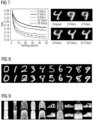
- Fig.7 illustrates a training curve for different number of filters. Such a training curve allows one to determine the impact of the encoding size on the decoding accuracy.
- Fig.7 represents an impact of the number of filters on the quality of auto-encoded images.
- the image compression is evaluated to ensure the input data of the classification step is meaningful enough for the classification to give acceptable results.
- the auto-encoder is trained with categorical cross-entropy loss and RMSProp optimizer.
- Fig.7 compares the different learning curves with increasing number of filters to illustrate the impact of the encoding layer's size on the auto-encoding process. The quality difference of the output can be observed on Fig.7 (right-hand side).
- the encoding layer outputs data in the shape 2 * 2 * layer size. Indeed, the maximum number of filters that can be used to be able to input the data on the quantum computer is 16, as the RBM can have at most 64 input values.
- Fig.8 and Fig.9 show some examples of images generated by the auto-encoder, along with the original image.
- Fig.8 illustrates auto-encoder outputs along with their corresponding inputs on MNIST dataset with 16 filters (64 encoding values).
- Fig.9 schematically illustrates auto-encoder outputs along with their corresponding inputs on the Fashion MNIST dataset with 16 filters (64 encoding values).
- Image classification may be performed with a classifier trained with binary cross-entropy loss and Adadelta optimizer for 10 epochs for MNIST and Fashion-MNIST and for 200 epochs for the medical dataset.
- Fig.10 schematically illustrates an accuracy curve of the classification on MNIST
- Fig.11 schematically illustrates an accuracy curve of the classification on Fashion MNIST.
- Image classification is evaluated on the MNIST and MNIST-Fashion dataset, with different settings and the training speed observed through the accuracy of the network on the validation data throughout the 10 training epochs.
- Fig.10 and Fig.11 show that training a network initialized with weights from a DBN provides better convergence and faster convergence speed than using constant initialization and that adding a Quantum sampling component does not affect the quality of the results. As expected, Glorot's initialization is the better solution.
- the term “rbm” refers to the results of calculations performed using purely classical computational methods (e.g. Markov chain Monte Carlo) and no no quantum annealing machine was used for initiating the weights of the RBM.
- the term “constant” refers to to the results of calculations performed using purely classical computational methods in which the weights of the RBM were initialised to zero (0) without any effort used to estimate better starting values for them.
- the term “state-of-the-art” refers to the results of calculations performed using purely classical computational methods in which random values were selected in a neural network, using the so-called "He” initialisation method well-known in the art, but an RBM was not used in the network.
- the term “qrbm” refers to the results obtained by applying the invention.
- the methods of the invention would long remain computationally tractable after some purely classical computational methods, such as pre-training a big network using a classically trained RBM, may hit the "intractability" barrier.
- the amount of compression done by the auto-encoder of the invention may be reduced in proportion. This allows the invention to dynamically adjust the compression to improving performance/capabilities of quantum computers, such as quantum annealing machines.
- the present invention accordingly provides a novel method for quantum machine learning enhanced image classification.
- the approach deals with the fundamental problem of processing large datasets on small quantum devices.
- Large greyscale and RGB images are compressed using an auto-encoder to generate a compact description of the image that can be processed on the quantum computer.
- An RBM is pre-trained on a quantum annealing machine (e.g. from D-Wave Systems, Inc.) and these weights are used to initialize a classical image classification neural network. This removes the need for data specific network architecture or manual down-sampling and image binarization.
- the results demonstrate a practical application of image classification.
- the system is scalable and will benefit from future improvements in hardware.
- At least some of the example embodiments described herein may be constructed, partially or wholly, using dedicated special-purpose hardware.
- Terms such as 'component', 'module' or 'unit' used herein may include, but are not limited to, a hardware device, such as circuitry in the form of discrete or integrated components, a Field Programmable Gate Array (FPGA) or Application Specific Integrated Circuit (ASIC), which performs certain tasks or provides the associated functionality.
- FPGA Field Programmable Gate Array
- ASIC Application Specific Integrated Circuit
- the described elements may be configured to reside on a tangible, persistent, addressable storage medium and may be configured to execute on one or more processors.
- These functional elements may in some embodiments include, by way of example, components, such as software components, object-oriented software components, class components and task components, processes, functions, attributes, procedures, subroutines, segments of program code, drivers, firmware, microcode, circuitry, data, databases, data structures, tables, arrays, and variables.
- components such as software components, object-oriented software components, class components and task components, processes, functions, attributes, procedures, subroutines, segments of program code, drivers, firmware, microcode, circuitry, data, databases, data structures, tables, arrays, and variables.
Landscapes
- Engineering & Computer Science (AREA)
- Theoretical Computer Science (AREA)
- Physics & Mathematics (AREA)
- General Physics & Mathematics (AREA)
- Software Systems (AREA)
- Artificial Intelligence (AREA)
- Evolutionary Computation (AREA)
- Computing Systems (AREA)
- Mathematical Physics (AREA)
- General Engineering & Computer Science (AREA)
- Data Mining & Analysis (AREA)
- Biophysics (AREA)
- Molecular Biology (AREA)
- General Health & Medical Sciences (AREA)
- Computational Linguistics (AREA)
- Biomedical Technology (AREA)
- Life Sciences & Earth Sciences (AREA)
- Health & Medical Sciences (AREA)
- Computational Mathematics (AREA)
- Mathematical Analysis (AREA)
- Mathematical Optimization (AREA)
- Pure & Applied Mathematics (AREA)
- Computer Vision & Pattern Recognition (AREA)
- Medical Informatics (AREA)
- Condensed Matter Physics & Semiconductors (AREA)
- Multimedia (AREA)
- Nonlinear Science (AREA)
- Algebra (AREA)
- Probability & Statistics with Applications (AREA)
- Image Analysis (AREA)
Claims (8)
- Procédé mis en œuvre par ordinateur d'apprentissage d'un système (1) d'ordinateur à utiliser dans la classification d'une image en traitant des données d'image représentant l'image, comprenant les stades de :compression des données d'image en utilisant un premier réseau neuronal artificiel, dans lequel le premier réseau neuronal artificiel est un codeur (5) d'un réseau (2) neuronal autocodeur, qui a subi un apprentissage d'une manière non supervisée sur des données d'image ;chargement des données d'image compressées sur un dispositif programmable de recuit quantique comprenant une machine (11) de Boltzmann restreinte ;apprentissage de la machine (11) de Boltzmann restreinte sur le dispositif programmable de recuit quantique pour qu'elle serve de classificateur de données d'image, en obtenant ainsi une machine (11) de Boltzmann restreinte ayant subi un apprentissage ; et,utilisation de la machine (11) de Boltzmann restreinte ayant subi un apprentissage pour initialiser un deuxième réseau (10) neuronal de classification d'image sur le système d'ordinateur, en obtenant ainsi un système (1) d'ordinateur ayant subi un apprentissage à utiliser dans la classification d'une image.
- Procédé suivant la revendication 1, dans lequel
ledit réseau (2) neuronal autocodeur comprend le codeur (5) ayant une couche d'entrée, et un décodeur (6) ayant une couche de sortie et une ou plusieurs couches cachées reliant le codeur (5) au décodeur (6), la couche de sortie ayant le même nombre de noeuds que la couche d'entrée. - Procédé suivant la revendication 2, dans lequel le codeur (5) créé un vecteur de caractéristique, qui est une représentation compressée des données d'image.
- Procédé suivant la revendication 3, dans lequel ledit chargement des données d'image compressées sur le dispositif programmable de recuit quantique comprend charger ledit vecteur de caractéristique sur le dispositif programmable de recuit quantique.
- Système d'ordinateur pour la classification d'une image en traitant des données d'image représentant l'image, comprenant :un dispositif programmable de recuit quantique comprenant une machine (11) de Boltzmann restreinte ;un deuxième réseau neuronal de classification (10) d'image ;un processeur agencé pour :comprimer des données d'image en utilisant un premier réseau neuronal artificiel, dans lequel le premier réseau neuronal artificiel est un codeur (5) d'un réseau (2) neuronal autocodeur, qui a subi un apprentissage d'une manière non supervisée sur des données d'image, et pour charger les données d'image compressées sur ledit dispositif programmable de recuit quantique ;faire l'apprentissage de la machine (11) de Boltzmann restreinte sur le dispositif programmable de recuit quantique pour qu'elle serve de classificateur de données d'image en obtenant ainsi une machine (11) de Boltzmann restreinte ayant subi un apprentissage ; etutiliser la machine (11) de Boltzmann restreinte ayant subi un apprentissage pour initialiser le deuxième réseau (10) neuronal sur le système d'ordinateur, en faisant ainsi subir un apprentissage au système d'ordinateur en vue de l'utiliser dans la classification d'une image.
- Système d'ordinateur suivant la revendication 5, dans lequel ledit réseau (2) neuronal autocodeur comprend le codeur (5) ayant une couche d'entrée, et un décodeur (6) ayant une couche de sortie et une ou plusieurs couches cachées reliant le codeur (5) au décodeur (6), la couche de sortie ayant le même nombre de noeuds que la couche d'entrée.
- Système d'ordinateur suivant la revendication 6, dans lequel le codeur (5) est agencé pour créer un vecteur de caractéristique qui est une représentation compressée des données d'image.
- Produit de programme d'ordinateur comprenant des instructions, qui, lorsque le programme est exécuté par un système informatique suivant la revendication 5, font que l'ordinateur effectue le procédé suivant l'une quelconque des revendications 1 à 4.
Applications Claiming Priority (1)
| Application Number | Priority Date | Filing Date | Title |
|---|---|---|---|
| GBGB1801627.9A GB201801627D0 (en) | 2018-02-01 | 2018-02-01 | Image autoencoding for quantum machine learning |
Publications (3)
| Publication Number | Publication Date |
|---|---|
| EP3522079A1 EP3522079A1 (fr) | 2019-08-07 |
| EP3522079B1 true EP3522079B1 (fr) | 2024-07-31 |
| EP3522079C0 EP3522079C0 (fr) | 2024-07-31 |
Family
ID=61730936
Family Applications (1)
| Application Number | Title | Priority Date | Filing Date |
|---|---|---|---|
| EP19154865.0A Active EP3522079B1 (fr) | 2018-02-01 | 2019-01-31 | Codage et classification de données |
Country Status (3)
| Country | Link |
|---|---|
| US (1) | US10977558B2 (fr) |
| EP (1) | EP3522079B1 (fr) |
| GB (1) | GB201801627D0 (fr) |
Families Citing this family (42)
| Publication number | Priority date | Publication date | Assignee | Title |
|---|---|---|---|---|
| WO2014121019A1 (fr) | 2013-01-31 | 2014-08-07 | Zestfinance, Inc. | Procédés et systèmes pour générer automatiquement des notifications d'action négative de haute qualité |
| US10127240B2 (en) | 2014-10-17 | 2018-11-13 | Zestfinance, Inc. | API for implementing scoring functions |
| US11106705B2 (en) | 2016-04-20 | 2021-08-31 | Zestfinance, Inc. | Systems and methods for parsing opaque data |
| WO2019028179A1 (fr) | 2017-08-02 | 2019-02-07 | Zestfinance, Inc. | Systèmes et procédés permettant de fournir des informations d'impact disparate de modèle d'apprentissage automatique |
| US11960981B2 (en) | 2018-03-09 | 2024-04-16 | Zestfinance, Inc. | Systems and methods for providing machine learning model evaluation by using decomposition |
| EP4195112A1 (fr) | 2018-05-04 | 2023-06-14 | Zestfinance, Inc. | Systèmes et procédés d'enrichissement d'outils et d'infrastructure de modélisation en sémantique |
| CN110633725B (zh) * | 2018-06-25 | 2023-08-04 | 富士通株式会社 | 训练分类模型的方法和装置以及分类方法和装置 |
| US12468949B2 (en) * | 2018-10-29 | 2025-11-11 | Hrl Laboratories, Llc | Systems and methods for few-shot transfer learning |
| US11625557B2 (en) | 2018-10-29 | 2023-04-11 | Hrl Laboratories, Llc | Process to learn new image classes without labels |
| US11816541B2 (en) | 2019-02-15 | 2023-11-14 | Zestfinance, Inc. | Systems and methods for decomposition of differentiable and non-differentiable models |
| CA3134043C (fr) | 2019-03-18 | 2024-10-29 | Zestfinance, Inc. | Systemes et procedes d'equite de modele |
| JP7171520B2 (ja) * | 2019-07-09 | 2022-11-15 | 株式会社日立製作所 | 機械学習システム |
| US11366989B2 (en) * | 2019-08-20 | 2022-06-21 | Microsoft Technology Licensing, Llc | Negative sampling algorithm for enhanced image classification |
| US11270121B2 (en) | 2019-08-20 | 2022-03-08 | Microsoft Technology Licensing, Llc | Semi supervised animated character recognition in video |
| JP7226568B2 (ja) * | 2019-09-02 | 2023-02-21 | 日本電信電話株式会社 | ニューラルネットワーク学習装置、ニューラルネットワーク学習方法、プログラム |
| WO2021063118A1 (fr) | 2019-10-02 | 2021-04-08 | Guangdong Oppo Mobile Telecommunications Corp., Ltd. | Procédé et appareil de traitement d'image |
| CN111199193B (zh) * | 2019-12-23 | 2022-03-18 | 平安国际智慧城市科技股份有限公司 | 基于数字切片的图片分类方法、装置和计算机设备 |
| WO2021138857A1 (fr) * | 2020-01-08 | 2021-07-15 | 华为技术有限公司 | Procédé, dispositif et système de marquage d'étiquettes de données |
| CN111259785B (zh) * | 2020-01-14 | 2022-09-20 | 电子科技大学 | 基于时间偏移残差网络的唇语识别方法 |
| US11495038B2 (en) | 2020-03-06 | 2022-11-08 | International Business Machines Corporation | Digital image processing |
| US11556852B2 (en) | 2020-03-06 | 2023-01-17 | International Business Machines Corporation | Efficient ground truth annotation |
| US11494588B2 (en) | 2020-03-06 | 2022-11-08 | International Business Machines Corporation | Ground truth generation for image segmentation |
| US11361146B2 (en) | 2020-03-06 | 2022-06-14 | International Business Machines Corporation | Memory-efficient document processing |
| WO2021181676A1 (fr) * | 2020-03-13 | 2021-09-16 | 日本電気株式会社 | Dispositif de traitement d'informations, procédé de commande et support de stockage |
| CN111598246B (zh) * | 2020-04-22 | 2021-10-22 | 北京百度网讯科技有限公司 | 量子吉布斯态生成方法、装置及电子设备 |
| CN111612832B (zh) * | 2020-04-29 | 2023-04-18 | 杭州电子科技大学 | 一种利用多任务互补提高深度估计准确性的方法 |
| CN112651418B (zh) * | 2020-05-25 | 2022-03-08 | 腾讯科技(深圳)有限公司 | 数据分类方法、分类器训练方法及系统 |
| CN111738351B (zh) * | 2020-06-30 | 2023-12-19 | 创新奇智(重庆)科技有限公司 | 模型训练方法、装置、存储介质及电子设备 |
| US11687817B2 (en) * | 2020-09-28 | 2023-06-27 | Cognizant Technology Solutions India Pvt. Ltd. | System and method for providing data computation via quantum computers |
| US11720962B2 (en) | 2020-11-24 | 2023-08-08 | Zestfinance, Inc. | Systems and methods for generating gradient-boosted models with improved fairness |
| CN112652214B (zh) * | 2020-12-31 | 2023-04-28 | 重庆工程职业技术学院 | 一种基于组合多辐射源的量子退相干实验箱 |
| CN112699222B (zh) * | 2021-01-07 | 2022-05-06 | 中南大学 | 基于量子启发式神经网络的文本分类方法及邮件分类方法 |
| CN112749807A (zh) * | 2021-01-11 | 2021-05-04 | 同济大学 | 一种基于生成模型的量子态层析方法 |
| CA3210297A1 (fr) * | 2021-03-10 | 2022-09-15 | Frederic Sauvage | Initialiseur flexible pour circuits quantiques parametres de taille arbitraire |
| US11450107B1 (en) | 2021-03-10 | 2022-09-20 | Microsoft Technology Licensing, Llc | Dynamic detection and recognition of media subjects |
| CN113470033A (zh) * | 2021-06-04 | 2021-10-01 | 浙江科技学院 | 一种基于双侧边动态交叉融合的道路场景图像处理方法 |
| DE102021210538A1 (de) * | 2021-09-22 | 2023-03-23 | Robert Bosch Gesellschaft mit beschränkter Haftung | Verfahren und Vorrichtung zum Verarbeiten von mit einem neuronalen Netz assoziierten Daten |
| CN114970497B (zh) * | 2022-06-02 | 2023-05-16 | 中南大学 | 基于预训练特征嵌入的文本分类方法及词义消歧方法 |
| EP4310793A1 (fr) | 2022-07-22 | 2024-01-24 | Multiverse Computing S.L. | Procédé quantique et système de classification d'images |
| CN116797913A (zh) * | 2022-10-13 | 2023-09-22 | 中移(苏州)软件技术有限公司 | 一种图像质量评价方法、装置、电子设备及存储介质 |
| US12586367B2 (en) * | 2022-12-05 | 2026-03-24 | IonQ, Inc. | Quantum convolutional neural network circuit |
| CN117217225A (zh) * | 2023-01-31 | 2023-12-12 | 腾讯科技(深圳)有限公司 | 模型优化方法、装置、计算机设备及计算机存储介质 |
Family Cites Families (3)
| Publication number | Priority date | Publication date | Assignee | Title |
|---|---|---|---|---|
| US20180307912A1 (en) * | 2017-04-20 | 2018-10-25 | David Lee Selinger | United states utility patent application system and method for monitoring virtual perimeter breaches |
| CN107506695A (zh) * | 2017-07-28 | 2017-12-22 | 武汉理工大学 | 视频监控设备故障自动检测方法 |
| DE102017127592A1 (de) * | 2017-11-22 | 2019-05-23 | Connaught Electronics Ltd. | Verfahren zum Klassifizieren von Bildszenen in einem Fahrunterstützungssystem |
-
2018
- 2018-02-01 GB GBGB1801627.9A patent/GB201801627D0/en not_active Ceased
-
2019
- 2019-01-31 EP EP19154865.0A patent/EP3522079B1/fr active Active
- 2019-02-01 US US16/265,375 patent/US10977558B2/en active Active
Non-Patent Citations (1)
| Title |
|---|
| ALEJANDRO PERDOMO-ORTIZ ET AL: "Opportunities and challenges for quantum-assisted machine learning in near-term quantum computers", ARXIV.ORG, CORNELL UNIVERSITY LIBRARY, 201 OLIN LIBRARY CORNELL UNIVERSITY ITHACA, NY 14853, 31 August 2017 (2017-08-31), XP081309788, DOI: 10.1088/2058-9565/AAB859 * |
Also Published As
| Publication number | Publication date |
|---|---|
| US20200005154A1 (en) | 2020-01-02 |
| US10977558B2 (en) | 2021-04-13 |
| EP3522079A1 (fr) | 2019-08-07 |
| GB201801627D0 (en) | 2018-03-21 |
| EP3522079C0 (fr) | 2024-07-31 |
Similar Documents
| Publication | Publication Date | Title |
|---|---|---|
| EP3522079B1 (fr) | Codage et classification de données | |
| CN112561027B (zh) | 神经网络架构搜索方法、图像处理方法、装置和存储介质 | |
| KR102796191B1 (ko) | 신경망의 최적화 방법 | |
| Ghosh et al. | Structured variational learning of Bayesian neural networks with horseshoe priors | |
| Shridhar et al. | A comprehensive guide to bayesian convolutional neural network with variational inference | |
| Fernando et al. | Convolution by evolution: Differentiable pattern producing networks | |
| JP7794483B2 (ja) | 画像を分類するためのハイブリッド量子古典分類システムおよび訓練方法 | |
| CN108776807A (zh) | 一种基于可跳层双支神经网络的图像粗细粒度分类方法 | |
| US20180336469A1 (en) | Sigma-delta position derivative networks | |
| CN116168197B (zh) | 一种基于Transformer分割网络和正则化训练的图像分割方法 | |
| CN115022637A (zh) | 一种图像编码方法、图像解压方法以及装置 | |
| US10643092B2 (en) | Segmenting irregular shapes in images using deep region growing with an image pyramid | |
| KR20250127055A (ko) | 양자 합성 신경망 회로 | |
| Piat et al. | Image classification with quantum pre-training and auto-encoders | |
| CN116630816A (zh) | 基于原型对比学习的sar目标识别方法、装置、设备及介质 | |
| Haider et al. | Comprehensive online network pruning via learnable scaling factors | |
| Dai et al. | Random sharing parameters in the global region of convolutional neural network | |
| Wijaya et al. | Operator-N Layer Construction for Optimizing Capsule Network Methods in Image Classification Problems. | |
| US10776923B2 (en) | Segmenting irregular shapes in images using deep region growing | |
| Shanthamallu et al. | Neural networks and deep learning | |
| CN114925802A (zh) | 一种基于深度特征映射的集成迁移学习方法和系统 | |
| Kim et al. | Deep Coupling of Random Ferns. | |
| KR102242112B1 (ko) | 오류 역전파가 필요 없는 심층 랜덤 펀 분류기 및 이를 이용한 분류 방법 | |
| Adamczewski et al. | Dirichlet pruning for convolutional neural networks | |
| US20260051148A1 (en) | Graph cuts for explainability |
Legal Events
| Date | Code | Title | Description |
|---|---|---|---|
| PUAI | Public reference made under article 153(3) epc to a published international application that has entered the european phase |
Free format text: ORIGINAL CODE: 0009012 |
|
| STAA | Information on the status of an ep patent application or granted ep patent |
Free format text: STATUS: THE APPLICATION HAS BEEN PUBLISHED |
|
| AK | Designated contracting states |
Kind code of ref document: A1 Designated state(s): AL AT BE BG CH CY CZ DE DK EE ES FI FR GB GR HR HU IE IS IT LI LT LU LV MC MK MT NL NO PL PT RO RS SE SI SK SM TR |
|
| AX | Request for extension of the european patent |
Extension state: BA ME |
|
| STAA | Information on the status of an ep patent application or granted ep patent |
Free format text: STATUS: REQUEST FOR EXAMINATION WAS MADE |
|
| 17P | Request for examination filed |
Effective date: 20200206 |
|
| RBV | Designated contracting states (corrected) |
Designated state(s): AL AT BE BG CH CY CZ DE DK EE ES FI FR GB GR HR HU IE IS IT LI LT LU LV MC MK MT NL NO PL PT RO RS SE SI SK SM TR |
|
| STAA | Information on the status of an ep patent application or granted ep patent |
Free format text: STATUS: EXAMINATION IS IN PROGRESS |
|
| 17Q | First examination report despatched |
Effective date: 20201005 |
|
| RAP1 | Party data changed (applicant data changed or rights of an application transferred) |
Owner name: SIEMENS HEALTHCARE GMBH |
|
| REG | Reference to a national code |
Ref country code: DE Ref legal event code: R079 Free format text: PREVIOUS MAIN CLASS: G06N0010000000 Ipc: G06N0003047000 Ref document number: 602019055976 Country of ref document: DE |
|
| RIC1 | Information provided on ipc code assigned before grant |
Ipc: G06N 3/0455 20230101ALI20231114BHEP Ipc: G06N 3/088 20230101ALI20231114BHEP Ipc: G06N 10/60 20220101ALI20231114BHEP Ipc: G06N 3/047 20230101AFI20231114BHEP |
|
| RAP1 | Party data changed (applicant data changed or rights of an application transferred) |
Owner name: SIEMENS HEALTHINEERS AG |
|
| GRAP | Despatch of communication of intention to grant a patent |
Free format text: ORIGINAL CODE: EPIDOSNIGR1 |
|
| STAA | Information on the status of an ep patent application or granted ep patent |
Free format text: STATUS: GRANT OF PATENT IS INTENDED |
|
| INTG | Intention to grant announced |
Effective date: 20240311 |
|
| GRAS | Grant fee paid |
Free format text: ORIGINAL CODE: EPIDOSNIGR3 |
|
| GRAA | (expected) grant |
Free format text: ORIGINAL CODE: 0009210 |
|
| STAA | Information on the status of an ep patent application or granted ep patent |
Free format text: STATUS: THE PATENT HAS BEEN GRANTED |
|
| AK | Designated contracting states |
Kind code of ref document: B1 Designated state(s): AL AT BE BG CH CY CZ DE DK EE ES FI FR GB GR HR HU IE IS IT LI LT LU LV MC MK MT NL NO PL PT RO RS SE SI SK SM TR |
|
| REG | Reference to a national code |
Ref country code: CH Ref legal event code: EP Ref country code: GB Ref legal event code: FG4D |
|
| REG | Reference to a national code |
Ref country code: DE Ref legal event code: R096 Ref document number: 602019055976 Country of ref document: DE |
|
| REG | Reference to a national code |
Ref country code: IE Ref legal event code: FG4D |
|
| U01 | Request for unitary effect filed |
Effective date: 20240731 |
|
| U07 | Unitary effect registered |
Designated state(s): AT BE BG DE DK EE FI FR IT LT LU LV MT NL PT RO SE SI Effective date: 20240902 |
|
| PG25 | Lapsed in a contracting state [announced via postgrant information from national office to epo] |
Ref country code: NO Free format text: LAPSE BECAUSE OF FAILURE TO SUBMIT A TRANSLATION OF THE DESCRIPTION OR TO PAY THE FEE WITHIN THE PRESCRIBED TIME-LIMIT Effective date: 20241031 |
|
| PG25 | Lapsed in a contracting state [announced via postgrant information from national office to epo] |
Ref country code: GR Free format text: LAPSE BECAUSE OF FAILURE TO SUBMIT A TRANSLATION OF THE DESCRIPTION OR TO PAY THE FEE WITHIN THE PRESCRIBED TIME-LIMIT Effective date: 20241101 Ref country code: PL Free format text: LAPSE BECAUSE OF FAILURE TO SUBMIT A TRANSLATION OF THE DESCRIPTION OR TO PAY THE FEE WITHIN THE PRESCRIBED TIME-LIMIT Effective date: 20240731 |
|
| PG25 | Lapsed in a contracting state [announced via postgrant information from national office to epo] |
Ref country code: IS Free format text: LAPSE BECAUSE OF FAILURE TO SUBMIT A TRANSLATION OF THE DESCRIPTION OR TO PAY THE FEE WITHIN THE PRESCRIBED TIME-LIMIT Effective date: 20241130 |
|
| PG25 | Lapsed in a contracting state [announced via postgrant information from national office to epo] |
Ref country code: HR Free format text: LAPSE BECAUSE OF FAILURE TO SUBMIT A TRANSLATION OF THE DESCRIPTION OR TO PAY THE FEE WITHIN THE PRESCRIBED TIME-LIMIT Effective date: 20240731 |
|
| PG25 | Lapsed in a contracting state [announced via postgrant information from national office to epo] |
Ref country code: ES Free format text: LAPSE BECAUSE OF FAILURE TO SUBMIT A TRANSLATION OF THE DESCRIPTION OR TO PAY THE FEE WITHIN THE PRESCRIBED TIME-LIMIT Effective date: 20240731 Ref country code: RS Free format text: LAPSE BECAUSE OF FAILURE TO SUBMIT A TRANSLATION OF THE DESCRIPTION OR TO PAY THE FEE WITHIN THE PRESCRIBED TIME-LIMIT Effective date: 20241031 |
|
| PG25 | Lapsed in a contracting state [announced via postgrant information from national office to epo] |
Ref country code: RS Free format text: LAPSE BECAUSE OF FAILURE TO SUBMIT A TRANSLATION OF THE DESCRIPTION OR TO PAY THE FEE WITHIN THE PRESCRIBED TIME-LIMIT Effective date: 20241031 Ref country code: PL Free format text: LAPSE BECAUSE OF FAILURE TO SUBMIT A TRANSLATION OF THE DESCRIPTION OR TO PAY THE FEE WITHIN THE PRESCRIBED TIME-LIMIT Effective date: 20240731 Ref country code: NO Free format text: LAPSE BECAUSE OF FAILURE TO SUBMIT A TRANSLATION OF THE DESCRIPTION OR TO PAY THE FEE WITHIN THE PRESCRIBED TIME-LIMIT Effective date: 20241031 Ref country code: IS Free format text: LAPSE BECAUSE OF FAILURE TO SUBMIT A TRANSLATION OF THE DESCRIPTION OR TO PAY THE FEE WITHIN THE PRESCRIBED TIME-LIMIT Effective date: 20241130 Ref country code: HR Free format text: LAPSE BECAUSE OF FAILURE TO SUBMIT A TRANSLATION OF THE DESCRIPTION OR TO PAY THE FEE WITHIN THE PRESCRIBED TIME-LIMIT Effective date: 20240731 Ref country code: GR Free format text: LAPSE BECAUSE OF FAILURE TO SUBMIT A TRANSLATION OF THE DESCRIPTION OR TO PAY THE FEE WITHIN THE PRESCRIBED TIME-LIMIT Effective date: 20241101 Ref country code: ES Free format text: LAPSE BECAUSE OF FAILURE TO SUBMIT A TRANSLATION OF THE DESCRIPTION OR TO PAY THE FEE WITHIN THE PRESCRIBED TIME-LIMIT Effective date: 20240731 |
|
| U20 | Renewal fee for the european patent with unitary effect paid |
Year of fee payment: 7 Effective date: 20250120 |
|
| PG25 | Lapsed in a contracting state [announced via postgrant information from national office to epo] |
Ref country code: SM Free format text: LAPSE BECAUSE OF FAILURE TO SUBMIT A TRANSLATION OF THE DESCRIPTION OR TO PAY THE FEE WITHIN THE PRESCRIBED TIME-LIMIT Effective date: 20240731 |
|
| PG25 | Lapsed in a contracting state [announced via postgrant information from national office to epo] |
Ref country code: CZ Free format text: LAPSE BECAUSE OF FAILURE TO SUBMIT A TRANSLATION OF THE DESCRIPTION OR TO PAY THE FEE WITHIN THE PRESCRIBED TIME-LIMIT Effective date: 20240731 |
|
| PG25 | Lapsed in a contracting state [announced via postgrant information from national office to epo] |
Ref country code: SK Free format text: LAPSE BECAUSE OF FAILURE TO SUBMIT A TRANSLATION OF THE DESCRIPTION OR TO PAY THE FEE WITHIN THE PRESCRIBED TIME-LIMIT Effective date: 20240731 |
|
| PLBE | No opposition filed within time limit |
Free format text: ORIGINAL CODE: 0009261 |
|
| STAA | Information on the status of an ep patent application or granted ep patent |
Free format text: STATUS: NO OPPOSITION FILED WITHIN TIME LIMIT |
|
| 26N | No opposition filed |
Effective date: 20250501 |
|
| REG | Reference to a national code |
Ref country code: CH Ref legal event code: PL |
|
| PG25 | Lapsed in a contracting state [announced via postgrant information from national office to epo] |
Ref country code: MC Free format text: LAPSE BECAUSE OF FAILURE TO SUBMIT A TRANSLATION OF THE DESCRIPTION OR TO PAY THE FEE WITHIN THE PRESCRIBED TIME-LIMIT Effective date: 20240731 |
|
| GBPC | Gb: european patent ceased through non-payment of renewal fee |
Effective date: 20250131 |
|
| PG25 | Lapsed in a contracting state [announced via postgrant information from national office to epo] |
Ref country code: GB Free format text: LAPSE BECAUSE OF NON-PAYMENT OF DUE FEES Effective date: 20250131 |
|
| PG25 | Lapsed in a contracting state [announced via postgrant information from national office to epo] |
Ref country code: CH Free format text: LAPSE BECAUSE OF NON-PAYMENT OF DUE FEES Effective date: 20250131 |
|
| PG25 | Lapsed in a contracting state [announced via postgrant information from national office to epo] |
Ref country code: IE Free format text: LAPSE BECAUSE OF NON-PAYMENT OF DUE FEES Effective date: 20250131 |
|
| U20 | Renewal fee for the european patent with unitary effect paid |
Year of fee payment: 8 Effective date: 20260119 |