EP3523335B2 - Fluorure de vinylidène et trifluoroéthylène contenant des latex polymères - Google Patents
Fluorure de vinylidène et trifluoroéthylène contenant des latex polymères Download PDFInfo
- Publication number
- EP3523335B2 EP3523335B2 EP17777050.0A EP17777050A EP3523335B2 EP 3523335 B2 EP3523335 B2 EP 3523335B2 EP 17777050 A EP17777050 A EP 17777050A EP 3523335 B2 EP3523335 B2 EP 3523335B2
- Authority
- EP
- European Patent Office
- Prior art keywords
- moles
- vdf
- group
- trfe
- recurring units
- Prior art date
- Legal status (The legal status is an assumption and is not a legal conclusion. Google has not performed a legal analysis and makes no representation as to the accuracy of the status listed.)
- Active
Links
Images

Classifications
-
- C—CHEMISTRY; METALLURGY
- C08—ORGANIC MACROMOLECULAR COMPOUNDS; THEIR PREPARATION OR CHEMICAL WORKING-UP; COMPOSITIONS BASED THEREON
- C08L—COMPOSITIONS OF MACROMOLECULAR COMPOUNDS
- C08L27/00—Compositions of homopolymers or copolymers of compounds having one or more unsaturated aliphatic radicals, each having only one carbon-to-carbon double bond, and at least one being terminated by a halogen; Compositions of derivatives of such polymers
- C08L27/02—Compositions of homopolymers or copolymers of compounds having one or more unsaturated aliphatic radicals, each having only one carbon-to-carbon double bond, and at least one being terminated by a halogen; Compositions of derivatives of such polymers not modified by chemical after-treatment
- C08L27/12—Compositions of homopolymers or copolymers of compounds having one or more unsaturated aliphatic radicals, each having only one carbon-to-carbon double bond, and at least one being terminated by a halogen; Compositions of derivatives of such polymers not modified by chemical after-treatment containing fluorine atoms
- C08L27/16—Homopolymers or copolymers or vinylidene fluoride
-
- C—CHEMISTRY; METALLURGY
- C08—ORGANIC MACROMOLECULAR COMPOUNDS; THEIR PREPARATION OR CHEMICAL WORKING-UP; COMPOSITIONS BASED THEREON
- C08F—MACROMOLECULAR COMPOUNDS OBTAINED BY REACTIONS ONLY INVOLVING CARBON-TO-CARBON UNSATURATED BONDS
- C08F214/00—Copolymers of compounds having one or more unsaturated aliphatic radicals, each having only one carbon-to-carbon double bond, and at least one being terminated by a halogen
- C08F214/18—Monomers containing fluorine
- C08F214/22—Vinylidene fluoride
-
- C—CHEMISTRY; METALLURGY
- C08—ORGANIC MACROMOLECULAR COMPOUNDS; THEIR PREPARATION OR CHEMICAL WORKING-UP; COMPOSITIONS BASED THEREON
- C08F—MACROMOLECULAR COMPOUNDS OBTAINED BY REACTIONS ONLY INVOLVING CARBON-TO-CARBON UNSATURATED BONDS
- C08F2/00—Processes of polymerisation
- C08F2/12—Polymerisation in non-solvents
- C08F2/16—Aqueous medium
- C08F2/22—Emulsion polymerisation
- C08F2/24—Emulsion polymerisation with the aid of emulsifying agents
- C08F2/26—Emulsion polymerisation with the aid of emulsifying agents anionic
-
- C—CHEMISTRY; METALLURGY
- C08—ORGANIC MACROMOLECULAR COMPOUNDS; THEIR PREPARATION OR CHEMICAL WORKING-UP; COMPOSITIONS BASED THEREON
- C08F—MACROMOLECULAR COMPOUNDS OBTAINED BY REACTIONS ONLY INVOLVING CARBON-TO-CARBON UNSATURATED BONDS
- C08F214/00—Copolymers of compounds having one or more unsaturated aliphatic radicals, each having only one carbon-to-carbon double bond, and at least one being terminated by a halogen
- C08F214/18—Monomers containing fluorine
- C08F214/22—Vinylidene fluoride
- C08F214/225—Vinylidene fluoride with non-fluorinated comonomers
-
- H—ELECTRICITY
- H10—SEMICONDUCTOR DEVICES; ELECTRIC SOLID-STATE DEVICES NOT OTHERWISE PROVIDED FOR
- H10N—ELECTRIC SOLID-STATE DEVICES NOT OTHERWISE PROVIDED FOR
- H10N15/00—Thermoelectric devices without a junction of dissimilar materials; Thermomagnetic devices, e.g. using the Nernst-Ettingshausen effect
- H10N15/10—Thermoelectric devices using thermal change of the dielectric constant, e.g. working above and below the Curie point
- H10N15/15—Thermoelectric active materials
-
- H—ELECTRICITY
- H10—SEMICONDUCTOR DEVICES; ELECTRIC SOLID-STATE DEVICES NOT OTHERWISE PROVIDED FOR
- H10N—ELECTRIC SOLID-STATE DEVICES NOT OTHERWISE PROVIDED FOR
- H10N30/00—Piezoelectric or electrostrictive devices
- H10N30/80—Constructional details
- H10N30/85—Piezoelectric or electrostrictive active materials
- H10N30/857—Macromolecular compositions
-
- C—CHEMISTRY; METALLURGY
- C08—ORGANIC MACROMOLECULAR COMPOUNDS; THEIR PREPARATION OR CHEMICAL WORKING-UP; COMPOSITIONS BASED THEREON
- C08F—MACROMOLECULAR COMPOUNDS OBTAINED BY REACTIONS ONLY INVOLVING CARBON-TO-CARBON UNSATURATED BONDS
- C08F214/00—Copolymers of compounds having one or more unsaturated aliphatic radicals, each having only one carbon-to-carbon double bond, and at least one being terminated by a halogen
- C08F214/18—Monomers containing fluorine
- C08F214/182—Monomers containing fluorine not covered by the groups C08F214/20 - C08F214/28
-
- C—CHEMISTRY; METALLURGY
- C08—ORGANIC MACROMOLECULAR COMPOUNDS; THEIR PREPARATION OR CHEMICAL WORKING-UP; COMPOSITIONS BASED THEREON
- C08F—MACROMOLECULAR COMPOUNDS OBTAINED BY REACTIONS ONLY INVOLVING CARBON-TO-CARBON UNSATURATED BONDS
- C08F2500/00—Characteristics or properties of obtained polyolefins; Use thereof
- C08F2500/12—Melt flow index or melt flow ratio
-
- C—CHEMISTRY; METALLURGY
- C08—ORGANIC MACROMOLECULAR COMPOUNDS; THEIR PREPARATION OR CHEMICAL WORKING-UP; COMPOSITIONS BASED THEREON
- C08F—MACROMOLECULAR COMPOUNDS OBTAINED BY REACTIONS ONLY INVOLVING CARBON-TO-CARBON UNSATURATED BONDS
- C08F2800/00—Copolymer characterised by the proportions of the comonomers expressed
- C08F2800/10—Copolymer characterised by the proportions of the comonomers expressed as molar percentages
-
- C—CHEMISTRY; METALLURGY
- C08—ORGANIC MACROMOLECULAR COMPOUNDS; THEIR PREPARATION OR CHEMICAL WORKING-UP; COMPOSITIONS BASED THEREON
- C08L—COMPOSITIONS OF MACROMOLECULAR COMPOUNDS
- C08L2201/00—Properties
- C08L2201/52—Aqueous emulsion or latex, e.g. containing polymers of a glass transition temperature (Tg) below 20°C
-
- H—ELECTRICITY
- H01—ELECTRIC ELEMENTS
- H01B—CABLES; CONDUCTORS; INSULATORS; SELECTION OF MATERIALS FOR THEIR CONDUCTIVE, INSULATING OR DIELECTRIC PROPERTIES
- H01B3/00—Insulators or insulating bodies characterised by the insulating materials; Selection of materials for their insulating or dielectric properties
- H01B3/18—Insulators or insulating bodies characterised by the insulating materials; Selection of materials for their insulating or dielectric properties mainly consisting of organic substances
- H01B3/30—Insulators or insulating bodies characterised by the insulating materials; Selection of materials for their insulating or dielectric properties mainly consisting of organic substances plastics; resins; waxes
- H01B3/44—Insulators or insulating bodies characterised by the insulating materials; Selection of materials for their insulating or dielectric properties mainly consisting of organic substances plastics; resins; waxes vinyl resins; acrylic resins
- H01B3/443—Insulators or insulating bodies characterised by the insulating materials; Selection of materials for their insulating or dielectric properties mainly consisting of organic substances plastics; resins; waxes vinyl resins; acrylic resins from vinylhalogenides or other halogenoethylenic compounds
- H01B3/445—Insulators or insulating bodies characterised by the insulating materials; Selection of materials for their insulating or dielectric properties mainly consisting of organic substances plastics; resins; waxes vinyl resins; acrylic resins from vinylhalogenides or other halogenoethylenic compounds from vinylfluorides or other fluoroethylenic compounds
-
- H—ELECTRICITY
- H01—ELECTRIC ELEMENTS
- H01G—CAPACITORS; CAPACITORS, RECTIFIERS, DETECTORS, SWITCHING DEVICES, LIGHT-SENSITIVE OR TEMPERATURE-SENSITIVE DEVICES OF THE ELECTROLYTIC TYPE
- H01G7/00—Capacitors in which the capacitance is varied by non-mechanical means; Processes of their manufacture
- H01G7/06—Capacitors in which the capacitance is varied by non-mechanical means; Processes of their manufacture having a dielectric selected for the variation of its permittivity with applied voltage, i.e. ferroelectric capacitors
-
- H—ELECTRICITY
- H10—SEMICONDUCTOR DEVICES; ELECTRIC SOLID-STATE DEVICES NOT OTHERWISE PROVIDED FOR
- H10D—INORGANIC ELECTRIC SEMICONDUCTOR DEVICES
- H10D1/00—Resistors, capacitors or inductors
- H10D1/60—Capacitors
- H10D1/68—Capacitors having no potential barriers
-
- Y—GENERAL TAGGING OF NEW TECHNOLOGICAL DEVELOPMENTS; GENERAL TAGGING OF CROSS-SECTIONAL TECHNOLOGIES SPANNING OVER SEVERAL SECTIONS OF THE IPC; TECHNICAL SUBJECTS COVERED BY FORMER USPC CROSS-REFERENCE ART COLLECTIONS [XRACs] AND DIGESTS
- Y02—TECHNOLOGIES OR APPLICATIONS FOR MITIGATION OR ADAPTATION AGAINST CLIMATE CHANGE
- Y02P—CLIMATE CHANGE MITIGATION TECHNOLOGIES IN THE PRODUCTION OR PROCESSING OF GOODS
- Y02P20/00—Technologies relating to chemical industry
- Y02P20/50—Improvements relating to the production of bulk chemicals
- Y02P20/54—Improvements relating to the production of bulk chemicals using solvents, e.g. supercritical solvents or ionic liquids
Definitions
- the invention pertains to novel latexes of copolymers of vinylidene fluoride and trifluoroethylene having improved ferroelectric properties, to a process for their manufacture in aqueous emulsion in the presence of a specific fluorinated emulsifier, and to their use as piezoelectric, ferroelectric, dielectric or pyroelectric materials in electric/electronic devices.
- copolymers of vinylidene fluoride and trifluoroethylene are employed and are being developed for use in electric/electronic devices (e.g. transducers, sensors, actuators, ferroelectric memories, capacitors) because of their ferroelectric, piezoelectric, pyroelectric and dielectric behaviour/properties, piezoelectric behaviour being particularly used.
- piezoelectric means the ability of a material to exchange electrical for mechanical energy and vice versa and the electromechanical response is believed to be essentially associated with dimensional changes during deformation or pressure oscillation.
- the piezoelectric effect is reversible in that materials exhibiting the direct piezoelectric effect (the production of electricity when stress is applied) also exhibit the converse piezoelectric effect (the production of stress and/or strain when an electric field is applied).
- Ferroelectricity is the property of a material whereby this latter exhibits a spontaneous electric polarization, the direction of which can be switched between equivalent states by the application of an external electric field
- Pyroelectricity is the ability of certain materials to generate an electrical potential upon heating or cooling. Actually, as a result of this change in temperature, positive and negative charges move to opposite ends through migration (i.e. the material becomes polarized) and hence, an electrical potential is established.
- piezo-, pyro-, ferro-electricity in copolymers of vinylidene fluoride and trifluoroethylene is related to a particular crystalline habit, so called ferroelectric-phase or beta-phase, wherein hydrogen and fluorine atoms are arranged to give maximum dipole moment per unit cell.
- VDF-TrFE copolymers are well known in the art and are notably described in US 4778867 (PRIES SEYMOUR (US)) 18/10/1988, US 4708989 (THOMSON CSF (FR)) 24/11/1987, US 4784915 (KUREHA CHEMICAL IND CO LTD (JP)) 15/11/1988, US 4173033 (DAIKIN IND LTD (JP)) 30/10/1979.
- VDF-TrFE copolymers may be based on suspension polymerization, i.e. in conditions of temperature and pressure such that VDF is present in supercritical phase, using organic initiators in aqueous phase, and producing a slurry of coarse particles which precipitate from aqueous polymerization medium as soon as produced.
- suspension polymerization technologies are quite burdensome to handle at industrial level, because of the high pressures employed, and because of the safety concerns hence associated to the handling in such harsh conditions of TrFE, possibly undergoing explosive behaviour
- TrFE has been recognized to be endowed with deflagration/explosion behaviour similar to tetrafluoroethylene (TFE)
- opportunity of limiting polymerization pressure represents a significant advantage in safety management.
- VDF-TrFE polymer access to latexes of VDF-TrFE polymer enables opening processing/transformation opportunities to coating/casting techniques based on solvent-free approaches, which are attracting more and more attention in this area.
- VDF-TrFE copolymers obtained from latexes produced by aqueous emulsion polymerization processes of the prior art suffer from certain drawbacks, including notably less valuable piezo-, pyro-, ferro-electric performances, when compared to e.g. suspension-polymerized VDF-TrFE copolymers.
- US 2011160415 (SOLVAY SOLEXIS SPA) 30/06/2011 pertains to a method for making a fluoropolymer comprising an aqueous emulsion polymerization of one or more fluorinated monomers wherein said aqueous emulsion polymerization is carried out in the presence of at least one cyclic fluorocompound of the following formula (I): wherein X 1 , X 2 , X 3 , equal to or different from each other are independently selected from the group consisting of H, F, and C 1-6 (per)fluoroalkyl groups, optionally comprising one or more catenary or non-catenary oxygen atoms; L represents a bond or a divalent group; R F is a divalent fluorinated C 1-3 bridging group; Y is a hydrophilic function selected from the group consisting of anionic functionalities, cationic functionalities, and non-ionic functionalities.
- formula (I) wherein X 1 ,
- fluorinated olefins such as tetrafluoroethylene (TFE), chlorotrifluoroethylene (CTFE), hexafluoropropylene (HFP), vinyl fluoride (VF), vinylidene fluoride (VDF), partially or fully fluorinated allyl ethers and partially or fully fluorinated alkyl or alkoxy-vinyl
- US 2012283382 (SOLVAY SPECIALTY POLYMERS ITALY S.P.A.) 8/11/2012 pertains to a process for manufacturing a dispersions of a vinylidene fluoride (VDF) thermoplastic polymer, said process comprising polymerizing VDF in an aqueous phase comprising: at least one surfactant selected from the group consisting of non-fluorinated surfactants and fluorinated surfactants having a molecular weight of less than 400; and at least one functional (per)fluoropolyether comprising at least one (per)fluoropolyoxyalkylene chain and at least one functional group.
- VDF vinylidene fluoride
- the vinylidene fluoride polymer is generally a polymer consisting of (a') at least 60 percent by moles, preferably at least 75 percent by moles, more preferably 85 percent by moles of vinylidene fluoride (VDF); (b') optionally from 0.1 to 15 percent, preferably from 0.1 to 12 percent, more preferably from 0.1 to 10 percent by moles of a fluorinated monomer different from VDF; said fluorinate monomer being preferably selected in the group consisting of vinylfluoride (VF), chlorotrifluoroethylene (CTFE), hexafluoropropene (HFP), tetrafluoroethylene (TFE), perfluoromethylvinylether (MVE), trifluoroethylene (TrFE) and mixtures therefrom, including notably homopolymers of VDF, VDF/TFE copolymer, VDF/TFE/HFP copolymers, VDF/TFE/CTFE copolymers, VDF/TFE/TrFE
- the fluorinated surfactant with low molecular weight may be a surfactant complying with formula: wherein: X 1 , X 2 and X 3 , equal to or different from each other, are independently selected from the group consisting of H, F and C 1 -C 6 (per)fluoroalkyl groups, optionally comprising one or more catenary or non-catenary oxygen atoms, R F represents a divalent perfluorinated C 1 -C 3 bridging group, L represents a bond or a divalent group and Y represents an anionic functionality.
- VDF-TrFE materials manufactured by emulsion polymerization in smooth conditions, and which yet possess improved piezo-, pyro-, ferro-electric performances.
- the invention thus provides an aqueous latex comprising particles of a polymer [polymer (F)] comprising:
- the invention further pertains to a method for making a latex as above detailed, said method comprising polymerizing vinylidene fluoride (VDF), trifluoroethylene (TrFE), and optionally at least one additional monomer different from VDF and TrFE in an aqueous emulsion in the presence of a radical initiator and of a fluorinated surfactant [surfactant (C)] complying with formula (I): wherein X 1 , X 2 , X 3 , equal or different from each other are independently selected among H, F, and C 1-6 (per)fluoroalkyl groups, optionally comprising one or more catenary or non-catenary oxygen atoms; L represents a bond or a divalent group; R F is a divalent fluorinated C 1-3 bridging group; Y is an anionic functionality.
- the Applicant has surprisingly found that the method as above detailed enables accessing in smooth conditions and high throughput, in particular at relatively lower TrFE partial pressure and total pressure, latexes of VDF-TrFE possessing improved piezo-, pyro-, ferro-electric performances, as a consequence of their improved structural/conformational order in their ferro-electric phase, as measured using the Xc (%) parameter, as defined above.
- Figure 1 is a plot of the parameter Xc (%), hereunder referred also as crystallinity order parameter, as a function of the comonomer content (in % moles) for lattices of polymer (F);
- ⁇ are representative of embodiment's according to the invention, obtained from emulsion polymerization in the presence of the cyclic surfactant (I) and an radical initiator;
- ⁇ and * are representative of non-working embodiment's and more precisely ⁇ refer to latexes obtained from emulsion polymerization in the presence of a different fluorosurfactant and an organic initiator, while * refers to a latex obtained from emulsion polymerization in the presence of a different fluorosurfactant and an inorganic initiator.
- Polymer (F) of the invention comprises 18 to 39% by moles preferably from 20 to 35 % moles of recurring units derived from TrFE.
- Polymer (F) of the invention may further comprise, in an amount of 0 to 5% moles, recurring units derived from one or more than one fluoromonomers other than VDF and TrFE, such as notably hexafluoropropylene, tetrafluoroethylene, chlorotrifluoroethylene, or recurring units derived from one or more than one non-fluorinated monomers, such as notably (meth)acrylic monomers, and more specifically, recurring units derived from at least one hydrophilic (meth)acrylic monomer (MA) of formula: wherein each of R1, R2, R3, equal or different from each other, is independently an hydrogen atom or a C 1 -C 3 hydrocarbon group, and R OH is a hydroxyl group or a C 1 -C 5 hydrocarbon moiety comprising at least one hydroxyl group.
- fluoromonomers other than VDF and TrFE such as notably hexafluoropropylene, tetrafluoroethylene,
- hydrophilic (meth)acrylic monomers are notably acrylic acid, methacrylic acid, hydroxyethyl (meth)acrylate, hydroxypropyl(meth)acrylate; hydroxyethylhexyl(meth)acrylates.
- the monomer (MA) is more preferably selected among:
- polymer consisting essentially of recurring units derived from VDF and TrFE are generally preferred.
- Such polymers typically consists essentially of:
- Melt flow index (MFI) of the polymer (F) will be selected by the skilled in the art in relation to the processing technology chosen for obtaining final parts (e.g. films or sheets).
- polymer (F) will have a MFI determined according to ASTM D 1238 (230°C/ 5 kg) of advantageously 0.5 to 500 g/10 min, preferably of 1 to 200 g/10 min, more preferably of 2 to 10 g/10 min.
- the latex of the invention comprises particles of polymer (F) possessing a parameter Xc (%), i.e. crystallinity order parameter, such to satisfy the aforementioned inequalities.
- this crystallinity order parameter is a measure of the structural and conformational order of the ferroelectric phase, the higher the Xc parameter, the more structured and ordered being the ferroelectric crystalline phase.
- polymer (F) from the latexes of the invention are such to possess improved ferroelectric performances, as derived from the ferroelectric crystalline phase, the higher the structural order, the better the ferroelectric performances, over polymers from latexes which may be manufactured using the techniques of the prior art.
- the method for making a latex as above detailed comprises polymerizing vinylidene fluoride (VDF), trifluoroethylene (TrFE), and optionally at least one additional monomer different from VDF and TrFE in an aqueous emulsion in the presence of a radical initiator and of a fluorinated surfactant [surfactant (C)] complying with formula (I): as above detailed.
- VDF vinylidene fluoride
- TrFE trifluoroethylene
- surfactant (C) fluorinated surfactant
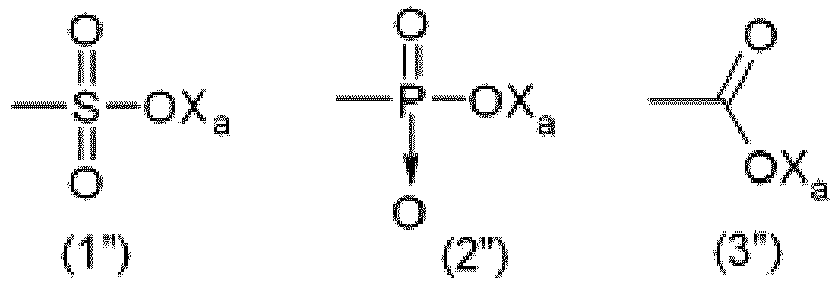
- the anionic function Y is preferably selected from the group consisting of those of formulae: wherein X a is H, a monovalent metal (preferably an alkaline metal) or an ammonium group of formula -N(R' n ) 4 , wherein R' n , equal or different at each occurrence, represents a hydrogen atom or a C 1-6 hydrocarbon group (preferably an alkyl group).
- hydrophilic function Y is a carboxylate of formula (3"), as above detailed.
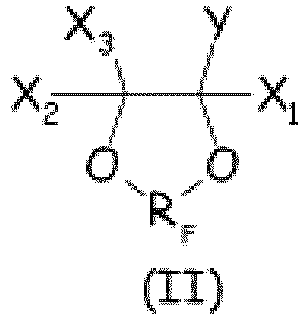
- the cyclic fluorocompound complies with formula (II) here below: wherein X 1 , X 2 , X 3 , Y and R F have the same meaning as above defined.
- the cyclic fluorocompound complies with formula (III) here below: wherein R F , X 1 , X 2 , X 3 , and X a have the same meaning as above defined.
- the cyclic fluorocompound complies with formula (IV) here below: wherein R F and X a have the same meanings as above detailed; X* 1 , X* 2 equal or different each other are independently a fluorine atom, -R' f or -OR ' f , wherein R' f is a C 1-3 perfluoroalkyl group; R F 1 is F or CF 3 , k is an integer from 1 to 3.
- Polymerization pressure is thus generally comprised between 10 and 40 bars, preferably between 15 and 35 bars, more preferably between 20 and 35 bars.
- Polymerization temperature is generally selected in the range 60 to 120°C, preferably 75 to 120°C.
- radical initiator is not particularly limited, it is understood that those suitable for the process according to the invention are selected among compounds capable of initiating and/or accelerating the polymerization.
- Organic radical initiators can be used and include, but are not limited to, the following : acetylcyclohexanesulfonyl peroxide; diacetylperoxydicarbonate; dialkylperoxydicarbonates such as diethylperoxydicarbonate, dicyclohexylperoxydicarbonate, di-2-ethylhexylperoxydicarbonate; tert-butylperneodecanoate; 2,2'-azobis(4-methoxy-2,4dimethylvaleronitrile; tert-butylperpivalate; dioctanoylperoxide; dilauroyl-peroxide; 2,2'-azobis (2,4-dimethylvaleronitrile); tert-butylazo-2-cyanobutane; dibenzoylperoxide; tert-butyl-per-2ethylhexanoate; tert-butylpermaleate
- Redox systems comprising at least two components forming a redox couple, such as dimethylaniline-benzoyl peroxide, diethylaniline-benzoyl peroxide and diphenylamine-benzoyl peroxide can also be used to initiate the polymerization.
- a redox couple such as dimethylaniline-benzoyl peroxide, diethylaniline-benzoyl peroxide and diphenylamine-benzoyl peroxide can also be used to initiate the polymerization.
- inorganic radical initiators can be used and include, but are not limited to, the followings: persulfates, like sodium, potassium or ammonium persulfates, permanganates, like potassium permanganate.
- Inorganic radical initiators as those above detailed, are preferred.
- the radical initiator is included in a concentration ranging advantageously from 0.001 to 20 percent by weight of the polymerization medium.
- Polymerization can be carried out in the presence of a chain transfer agent.
- the chain transfer agent is selected from those known in the polymerization of fluorinated monomers, such as for instance: ketones, esters, ethers or aliphatic alcohols having from 3 to 10 carbon atoms, such as acetone, ethylacetate, diethylether, methyl-ter-butyl ether, isopropyl alcohol, etc.; chloro(fluoro)carbons, optionally containing hydrogen, having from 1 to 6 carbon atoms, such as chloroform, trichlorofluoromethane; bis(alkyl)carbonates wherein the alkyl has from 1 to 5 carbon atoms, such as bis(ethyl)carbonate, bis(isobutyl)carbonate.
- the chain transfer agent can be fed to the polymerization medium at the beginning, continuously or in discrete amounts (step-wise) during the polymerization, continuous or stepwise feeding being preferred.
- the invention also pertains to the use of polymer (F) as above described as ferroelectric, piezoelectric, dielectric or pyroelectric material in electric/electronic devices.
- Non limitative examples of said devices are notably transducers, sensors, actuators, ferroelectric memories, capacitors.
- the polymer (F) is generally comprised in said devices under the form of substantially bidimensional parts (e.g. films or sheets).
- Said films or sheets can be manufactured according to standard techniques, as extrusion, injection moulding, compression moulding and solvent casting.
- Said bidimensional articles can be further submitted to post-processing treatment, in particular for enhancing ferroelectric, piezoelectric, dielectric or pyroelectric behaviour, e.g. annealing, stretching, bi-orientation and the like.
- Bidimensional articles can be notably submitted to an high poling electric field obtained by polarization cycles for adjusting, in real time via high voltage and data acquisition computer controlled system, polarization, residual polarization and maximum displacement current measured at the coercive field.
- An embodiment of this process is described in ISNER-BROM, P., et al. Intrinsic Piezoelectric Characterization of PVDF copolymers: determination of elastic constants. Ferroelectrics. 1995, vol.171, p.271-279 . , in BAUER, F., et al. Very high pressure behaviour of precisely-poled PVDF. Ferroelectrics. 1995, vol.171, p.95-102 .
- Emulsion polymerization examples in the presence of cyclic surfactant of formula (V) (X a NH 4 ) and radical initiator (according to the invention) - method I1
- the composition of the gaseous mixture present in the autoclave head was analyzed by G.C. At polymerization inception, the gaseous phase was found to be composed of: 75.9% moles VDF, 24.1% moles TrFE. Then, 50ml of solution of sodium persulphate (NaPS) in demineralized water at a concentration of 3% in volume were fed. The polymerization pressure was maintained constant by feeding the above mentioned VDF-TrFE mixture; when 500g of the mixture were fed, the feeding mixture was interrupted and while keeping constant the reaction temperature, the pressure was left to fall down up to 15 abs bars. Then the reactor was cooled at room temperature, the latex was discharged, freezed for 48 hours and once unfreezed, the coagulated polymer was washed with demineralized water and dried at 80°C for 48 hours.
- NaPS sodium persulphate
- Example 2C Copolymer VDF-TrFE 70/30 (molar ratio)
- the gaseous phase was found by GC analysis to be composed of: 77.7% moles VDF, 22.3% moles TrFE. Then by a metering, 22 cc of pure di-tertbutyl peroxide (DTBP) were introduced, and set-point pressure was maintained constant by feeding the above mentioned VDF-TrFE mixture; when 2% of the mixture (on targeted 288 g) were fed, temperature was lowered to 105°C. Monomers' feeding was interrupted once 288 g were fed, and while maintaining temperature, pressure was left to fall down to 15 abs bars. The reactor was cooled at room temperature, the latex was discharged, freezed for 48 hours and once unfreezed, the coagulated polymer was washed with demineralized water and dried at 80°C for 48 hours.
- DTBP di-tertbutyl peroxide
- Example 3C Copolymer VDF-TrFE-AA 69.5/30/0.5 (molar ratio)
- Example 9c Copolymer VDF-TrFE-AA 74.55/25/0.5 (molar ratio)
- Example 10c Copolymer VDF-TrFE 75/25 (molar ratio)
- Example 4C Copolymer VDF-TrFE 70/30 (molar ratio)
- Example 12C Copolymer VDF-TrFE 75/25 (molar ratio)
- T c , ⁇ H c , T m and ⁇ H m are, respectively, the Curie transition temperature, the enthalpy associated to the Curie transition, the melting temperature and the enthalpy of melting, as determined by differential scanning calorimetry according to ASTM D3418 and ASTM D3418.
- Mw is the weight averaged molecular weight, as determined by GPC against polystyrene standards, using dimethylacetamide as solvent.
- the T c or Curie transition temperature represents the temperature at which the transition between ferroelectric and paraelectric phase occurs in a ferroelectric material. It is determined as the first endothermic peak appearing in the DSC thermogram during the second heating cycle, otherwise realised pursuant to the ASTM D 3418 standard.
- the ⁇ H c is the enthalpy associated to this first order transition (Curie transition), as determined in the second heating cycle of the DSC thermogram, as above detailed, applying, mutatis mutandis, indications contained in ASTM D 3418 standard to the first endothermic peak appearing in said second heating cycle.
- the DSC analyses were performed using a Perkin Elmer Diamond DSC instrument, adopting a ramp rate of 10°C/min in second heating cycle, as prescribed in ASTM D 1238.
- the enthalpy of melting ( ⁇ H m ) and melting temperature (T m ) are determined by differential scanning calorimetry (DSC), pursuant to ASTM D 3418, using a Perkin Elmer Diamond DSC instrument.
- Solutions in methylethylketone having concentration of 20 % w/w of the polymers were prepared, and films casted by doctor blade technique, using an Elcometer automatic film applicator, model 4380, onto a glass substrate.
- the polymer layers so casted were dried at 100°C for 2 hours under vacuum.
- 12 patterns of 1 cm x 1 cm were printed as electrodes on both sides of the polymeric film using as conductive material a poly(3,4-ethylenedioxythiophene) polystyrene sulfonate (PEDOT:PSS) purchased by Agfa-Gevaert under the trademark name ORGACON ® .
- the thickness of the samples was measured using a Mitutoyo micrometer.
- the films obtained as above detailed were placed in a vented oven set at an inner temperature 135°C. After one hour the oven was switched off and cooled for 5 hours, until reaching room temperature.
- a LC Precision poling equipment combined with a High Volate Interface with 10KV maximum field generated, by RADIANT was used for poling the films.
- the annealed films were placed in the polarization cell where field of 150 V/microns or 200 V/microns was applied trough the annealed film specimens.
- the value of the piezoelectric coefficient (d33) was measured using a PIEZOMETER PM300 instrument, placing the poled sample obtained as described above in the instrument strain gouge where the film was stimulated under a vibration at 110 Hz at room temperature.
- the d33 is reported as ⁇ C/N.
- Leakage refers to a gradual loss of energy from a charged capacitor. Determination of leakage is performed in the polarization cell applying 100 V/microns on the electrodes of the capacitor and determining the said loss in energy after 5 seconds.
- dielectric permittivity [k] The value of dielectric permittivity [k] was derived from the direct measurement of dielectric capacitance by a piezo meter system provided by Piezotest. The capacitance values were all measured at 110 Hz.
- Dielectric permittivity k Capacitance F ⁇ Thickness m ⁇ 0 F / m ⁇ Area m 2
- the hysteresis determination was performed by submitting the annealed film to poling in a field from 80 V/microns to 250 V/microns, obtaining an hysteresis curve were the maximum polarization, and residual polarization were measured.
- the P max is the maximum polarization achievable with the maximum field applied
- the P r is the residual polarization (also referred to as remnant polarization) in the samples after the removal of the applied field.
- the remnant polarization (P r ) is the parameter that identifies the capability of the material to keep oriented its crystals after poling and is one of the most significant measurable properties for measuring piezoelectric performances.
Landscapes
- Chemical & Material Sciences (AREA)
- Health & Medical Sciences (AREA)
- Chemical Kinetics & Catalysis (AREA)
- Medicinal Chemistry (AREA)
- Polymers & Plastics (AREA)
- Organic Chemistry (AREA)
- Physics & Mathematics (AREA)
- Spectroscopy & Molecular Physics (AREA)
- Addition Polymer Or Copolymer, Post-Treatments, Or Chemical Modifications (AREA)
- Polymerisation Methods In General (AREA)
- Compositions Of Macromolecular Compounds (AREA)
Claims (14)
- Latex aqueux comprenant des particules d'un polymère [polymère (F)] comprenant :- des motifs répétitifs issus du fluorure de vinylidène (VDF) en une quantité allant de 60 % à 81 % en moles, par rapport au nombre total de moles de motifs répétitifs ;- des motifs répétitifs de trifluoroéthylène (TrFE) en une quantité allant de 18 % à 39 % en moles, par rapport au nombre total de moles de motifs répétitifs, et- éventuellement des motifs répétitifs issus d'au moins un monomère supplémentaire différent du VDF et du TrFE, en une quantité de 0 à 5 % en moles,ledit polymère (F) possédant une structure thermodynamique ordonnée dans la phase ferroélectrique, de sorte que la relation entre :(i) le paramètre Xc (%) défini comme suit :
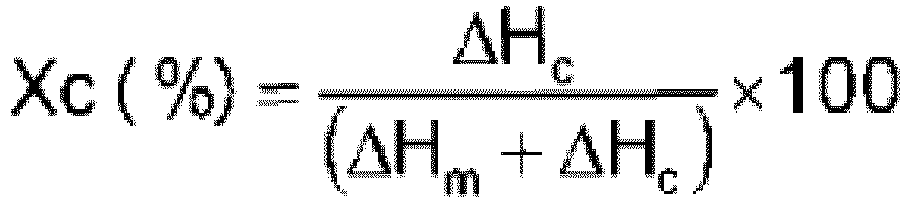 (ii) la teneur en motifs répétitifs différents du VDF exprimée en % en moles, par rapport au nombre total de moles de motifs répétitifs, désignée comme CM (% en moles), satisfait à l'inégalité suivante : Xc (%) ≥ a.CM (% en moles) + b, dans laquelle a = -1,10 et b = 75,00, préférablement satisfait à l'inégalité :
- Latex aqueux selon la revendication 1, le polymère (F) comprenant des motifs répétitifs issus d'un ou plus d'un fluoromonomère(s) différent(s) du VDF et du TrFE, comme notamment l'hexafluoropropylène, le tétrafluoroéthylène, le chlorotrifluoroéthylène, ou des motifs répétitifs issus d'un ou plus d'un monomère(s) non fluoré(s), comme notamment des monomères (méth)acryliques, et plus spécifiquement, des motifs répétitifs issus d'au moins un monomère (méth)acrylique hydrophile (MA) de formule :

- Latex aqueux selon les revendications 1 à 2, le polymère (F) étant essentiellement constitué de motifs répétitifs issus du VDF et du TrFE, et spécifiquement, étant essentiellement constitué de :- de 18 à 35 % en moles, préférablement de 20 à 32 % en moles de motifs répétitifs issus du TrFE ; et- de 65 à 82 % en moles, préférablement de 68 à 80 % en moles de motifs répétitifs issus du VDF.
- Latex aqueux selon les revendications 1 à 3, l'indice de fluidité à chaud (MFI) du polymère (F), tel que déterminé selon la norme ASTM D1238 (230 °C/5 kg), étant de 0,5 à 500 g/10 min, préférablement de 1 à 200 g/10 min, plus préférablement de 2 à 10 g/10 min.
- Procédé pour la fabrication d'un latex selon les revendications 1 à 4, ledit procédé comprenant la polymérisation du fluorure de vinylidène (VDF), du trifluoroéthylène (TrFE), et éventuellement d'au moins un monomère supplémentaire différent du VDF et du TrFE dans une émulsion aqueuse en présence d'un initiateur de radicaux et d'un tensioactif fluoré [tensioactif (C)] satisfaisant à la formule (I) :

- Procédé pour la fabrication d'un latex selon la revendication 5, dans ladite formule (I), la fonction anionique Y étant choisie dans le groupe constitué par celles des formules :
- Procédé pour la fabrication d'un latex selon la revendication 6, la fonction hydrophile Y étant un carboxylate de formule (3''), tel que défini dans la revendication 6.
- Procédé pour la fabrication d'un latex selon la revendication 7, le composé fluoro cyclique satisfaisant à la formule (II) ci-dessous :

- Procédé pour la fabrication d'un latex selon la revendication 7, le composé fluoro cyclique satisfaisant à la formule (IV) ci-dessous :

- Procédé pour la fabrication d'un latex selon la revendication 9, le composé fluoro cyclique satisfaisant à la formule (V) :

- Procédé pour la fabrication d'un latex selon les revendications 6 à 10, la pression de polymérisation étant comprise entre 10 et 40 bars, préférablement entre 15 et 35 bars, plus préférablement entre 20 et 35 bars et/ou la température de polymérisation étant choisie dans la plage de 60 à 120 °C, préférablement 75 à 120 °C.
- Procédé pour la fabrication d'un latex selon les revendications 6 à 10, l'initiateur de radicaux étant choisi dans le groupe constitué par les initiateurs de radicaux organiques et étant préférablement choisi dans le groupe constitué par : le peroxyde d'acétylcyclohexanesulfonyle ; le peroxydicarbonate de diacétyle ; les peroxydicarbonates de dialkyle tels que le peroxydicarbonate de diéthyle, le peroxydicarbonate de dicyclohexyle, le peroxydicarbonate de di-2-éthylhexyle ; le pernéodécanoate de tert-butyle ; le 2,2'-azobis(4-méthoxy-2,4-diméthylvaléronitrile) ; le perpivalate de tert-butyle ; le peroxyde de dioctanoyle ; le peroxyde de dilauroyle ; le 2,2'-azobis(2,4-diméthylvaléronitrile) ; le tert-butylazo-2-cyanobutane ; le peroxyde de dibenzoyle ; le per-2-éthylhexanoate de tert-butyle ; le permaléate de tert-butyle ; le 2,2'-azobis(isobutyronitrile) ; le bis(tert-butylperoxy)cyclohexane ; le peroxyisopropylcarbonate de tert-butyle ; le peracétate de tert-butyle ; le 2,2'-bis(tert-butylperoxy)butane ; le peroxyde de dicumyle ; le peroxyde de di-tert-amyle ; le peroxyde de di-tert-butyle ; l'hydroperoxyde de p-menthane ; l'hydroperoxyde de pinane ; l'hydroperoxyde de cumène ; l'hydroperoxyde de tert-butyle ; les peroxydes d'acyle à base de chlorocarbure et de fluorocarbure tels que le peroxyde de trichloroacétyle, le peroxyde de bis(perfluoro-2-propoxypropionyle), [CF3CF2CF2OCF(CF3)COO]2, les peroxydes de perfluoropropionyle, (CF3CF2CF2COO)2, (CF3CF2COO)2, {(CF3CF2CF2)-[CF(CF3)CF2C]m-CF(CF3)-COO}2, où m = 0 à 8, [ClCF2(CF2)NCOO]2, et [HCF2(CF2)nCOO]2, où n = 0 à 8, les composés perfluoroalkylazo comme le perfluoroazoisopropane, [(CF3)2CFN=]2, RαN=NRα, où Rα est un groupe perfluorocarbone linéaire ou ramifié possédant 1 à 8 carbones ; les radicaux de perfluoroalcane stables ou encombrés.
- Procédé pour la fabrication d'un latex selon les revendications 6 à 11, l'initiateur de radicaux inorganique étant choisi dans le groupe constitué par les initiateurs de radicaux, et préférablement dans le groupe constitué par les persulfates, comme les persulfates de sodium, de potassium ou d'ammonium ; et les permanganates, comme le permanganate de potassium.
- Procédé pour la fabrication de dispositifs électriques/électroniques, le procédé comprenant l'utilisation du latex polymère (F) selon les revendications 1 à 4 en tant que matériau ferroélectrique, piézoélectrique, diélectrique ou pyroélectrique dans lesdits dispositifs électriques/électroniques.
Applications Claiming Priority (2)
| Application Number | Priority Date | Filing Date | Title |
|---|---|---|---|
| EP16192408 | 2016-10-05 | ||
| PCT/EP2017/074767 WO2018065306A1 (fr) | 2016-10-05 | 2017-09-29 | Latex polymères contenant du fluorure de vinylidène et du trifluoroéthylène |
Publications (3)
| Publication Number | Publication Date |
|---|---|
| EP3523335A1 EP3523335A1 (fr) | 2019-08-14 |
| EP3523335B1 EP3523335B1 (fr) | 2020-07-08 |
| EP3523335B2 true EP3523335B2 (fr) | 2024-05-15 |
Family
ID=57144801
Family Applications (1)
| Application Number | Title | Priority Date | Filing Date |
|---|---|---|---|
| EP17777050.0A Active EP3523335B2 (fr) | 2016-10-05 | 2017-09-29 | Fluorure de vinylidène et trifluoroéthylène contenant des latex polymères |
Country Status (6)
| Country | Link |
|---|---|
| US (1) | US11629249B2 (fr) |
| EP (1) | EP3523335B2 (fr) |
| JP (2) | JP7612328B2 (fr) |
| KR (1) | KR102446216B1 (fr) |
| CN (1) | CN110036039B (fr) |
| WO (1) | WO2018065306A1 (fr) |
Families Citing this family (10)
| Publication number | Priority date | Publication date | Assignee | Title |
|---|---|---|---|---|
| WO2021213868A1 (fr) | 2020-04-21 | 2021-10-28 | Solvay Specialty Polymers Italy S.P.A. | Dispersion aqueuse de fluorure de vinylidène et polymères contenant du trifluoroéthylène |
| EP4567054B1 (fr) | 2020-06-30 | 2025-12-17 | Novocure GmbH | Réseaux de transducteurs flexibles avec couche isolante polymère pour appliquer des champs de traitement de tumeur (champs tt) |
| FR3117678B1 (fr) * | 2020-12-16 | 2024-02-23 | Arkema France | Article composite à base d’une matrice thermoplastique intégrant au moins un transducteur comprenant un polymère piézoélectrique |
| US11987677B2 (en) * | 2021-04-30 | 2024-05-21 | Meta Platforms Technologies, Llc | PVDF thin film having a bimodal molecular weight and high piezoelectric response |
| FR3125957A1 (fr) | 2021-08-04 | 2023-02-10 | Piezomedic | Dispositif et système de localisation d’un implant ou d’un organe dans un corps humain ou animal, par émission-réception de signaux ultrasons via des transducteurs piézoélectriques et/ou capacitifs |
| CN115703861B (zh) * | 2021-08-05 | 2024-04-02 | 中昊晨光化工研究院有限公司 | 一种三氟氯乙烯改性过氧化物硫化氟橡胶及其制备方法 |
| CN116410557B (zh) * | 2021-12-31 | 2025-11-28 | 浙江省化工研究院有限公司 | 一种含氟树脂、其制备方法及应用 |
| FR3144620B1 (fr) * | 2022-12-29 | 2026-06-05 | Arkema France | Polymère ferroélectrique |
| WO2026131994A1 (fr) * | 2024-12-18 | 2026-06-25 | Arkema France | Fluoropolymère pour batteries secondaires |
| WO2026131993A1 (fr) * | 2024-12-18 | 2026-06-25 | Arkema France | Fluoropolymère pour batteries secondaires |
Citations (6)
| Publication number | Priority date | Publication date | Assignee | Title |
|---|---|---|---|---|
| US4784915A (en) † | 1983-08-16 | 1988-11-15 | Kureha Kagaku Kogyo Kabushiki Kaisha | Polymer piezoelectric film |
| US20110082271A1 (en) † | 2008-06-02 | 2011-04-07 | Solvay Solexis S.P.A. | Vinylidene fluoride and trifluoroethylene containing polymers |
| US20110160415A1 (en) † | 2008-07-08 | 2011-06-30 | Solvay Solexis S.P.A. | Method for manufacturing fluoropolymers |
| US20120283382A1 (en) † | 2009-12-18 | 2012-11-08 | Solvay Specialty Polymers Italy S.P.A. | Process for Manufacturing a Dispersion of a Vinylidene Fluoride Polymer |
| US20150030906A1 (en) † | 2012-02-21 | 2015-01-29 | Arkema Inc. | Aqueous polyvinylidene fluoride composition |
| WO2016042914A1 (fr) † | 2014-09-19 | 2016-03-24 | 株式会社クレハ | Latex aqueux, stratifié de séparateur/couche intermédiaire, et structure pour batteries rechargeables à électrolyte non aqueux |
Family Cites Families (12)
| Publication number | Priority date | Publication date | Assignee | Title |
|---|---|---|---|---|
| US4173033A (en) | 1975-12-04 | 1979-10-30 | Daikin Kogyo Co., Ltd. | Polymeric dielectric for capacitors and the like consisting essentially of a vinylidene fluoride-trifluoroethylene copolymer |
| FR2538157A1 (fr) | 1982-12-15 | 1984-06-22 | Saint Louis Inst | Procede et dispositif pour polariser des materiaux ferroelectriques |
| JPS61223007A (ja) * | 1985-03-28 | 1986-10-03 | Daikin Ind Ltd | フルオロエラストマ−の乳化重合法 |
| FR2583914B1 (fr) | 1985-06-21 | 1989-04-07 | Thomson Csf | Materiaux dielectriques a base de polymeres et a permittivite dielectrique elevee |
| US4778867A (en) | 1987-07-21 | 1988-10-18 | Seymour Pries | Ferroelectric copolymers of vinylidene fluoride and trifluoroethylene with increased Curie temperature and their methods of production |
| JPH04311711A (ja) | 1991-04-11 | 1992-11-04 | Central Glass Co Ltd | 強誘電性共重合体およびこれからなる薄膜の製造方法 |
| FR2720750B1 (fr) * | 1994-06-01 | 1996-07-19 | Atochem Elf Sa | Dispersion stable aqueuse de copolymères fluorés hydroxyles et de copolymères acryliques, son procédé de préparation et son utilisation comme peinture en phase aqueuse. |
| IT1295535B1 (it) | 1996-07-01 | 1999-05-12 | Ausimont Spa | Processo di polimerizzazione di vinilidenfluoruro (vdf) |
| BE1011294A3 (fr) | 1997-07-22 | 1999-07-06 | Solvay | Solution organique de peroxydicarbonate de dialkyle, procede pour l'obtenir, preparation de polymeres halogenes a l'intervention de celle-ci et polymeres halogenes obtenus. |
| US20060281845A1 (en) * | 2005-06-10 | 2006-12-14 | Ramin Amin-Sanayei | Aqueous process for making fluoropolymers |
| CN101735374B (zh) * | 2009-12-15 | 2011-11-09 | 上海三爱富新材料股份有限公司 | 一种偏氟乙烯基共聚树脂的制备方法 |
| CN102770468B (zh) | 2009-12-18 | 2016-08-10 | 索尔维特殊聚合物意大利有限公司 | 用于生产氟弹性体的方法 |
-
2017
- 2017-09-29 EP EP17777050.0A patent/EP3523335B2/fr active Active
- 2017-09-29 WO PCT/EP2017/074767 patent/WO2018065306A1/fr not_active Ceased
- 2017-09-29 JP JP2019517887A patent/JP7612328B2/ja active Active
- 2017-09-29 KR KR1020197012514A patent/KR102446216B1/ko active Active
- 2017-09-29 US US16/340,050 patent/US11629249B2/en active Active
- 2017-09-29 CN CN201780075428.4A patent/CN110036039B/zh active Active
-
2023
- 2023-02-02 JP JP2023014658A patent/JP2023071659A/ja active Pending
Patent Citations (6)
| Publication number | Priority date | Publication date | Assignee | Title |
|---|---|---|---|---|
| US4784915A (en) † | 1983-08-16 | 1988-11-15 | Kureha Kagaku Kogyo Kabushiki Kaisha | Polymer piezoelectric film |
| US20110082271A1 (en) † | 2008-06-02 | 2011-04-07 | Solvay Solexis S.P.A. | Vinylidene fluoride and trifluoroethylene containing polymers |
| US20110160415A1 (en) † | 2008-07-08 | 2011-06-30 | Solvay Solexis S.P.A. | Method for manufacturing fluoropolymers |
| US20120283382A1 (en) † | 2009-12-18 | 2012-11-08 | Solvay Specialty Polymers Italy S.P.A. | Process for Manufacturing a Dispersion of a Vinylidene Fluoride Polymer |
| US20150030906A1 (en) † | 2012-02-21 | 2015-01-29 | Arkema Inc. | Aqueous polyvinylidene fluoride composition |
| WO2016042914A1 (fr) † | 2014-09-19 | 2016-03-24 | 株式会社クレハ | Latex aqueux, stratifié de séparateur/couche intermédiaire, et structure pour batteries rechargeables à électrolyte non aqueux |
Non-Patent Citations (13)
| Title |
|---|
| ANONYMOUS: "Standard Test Method for Transition Temperatures and Enthalpies of Fusion and Crystallization of Polymers by Differential Scanning Calorimetry", ASTM D3418-15, 2015, West Conshohocken, PA † |
| Brochure Calisto Software † |
| CHUNG, T. M. ET AL.: "Ferroelectric VDF/TrFE/CTFE terpolymers: synthesis and electric properties", SMART STRUCTURES AND MATERIALS 2001: ELECTROACTIVE POLYMER ACTUATORS AND DEVICES, vol. 4329, July 2001 (2001-07-01), pages 117 - 124 † |
| Déclaration additionnelle de M. David ANDRE † |
| Déclaration de M. David ANDRE † |
| Joseph M. Hornback, Organic Chemistry, Physical Sciences 2006, 2e ed„ 1219 p. (ISBN 0-534-49317-3 [extrait, pages 1-3] † |
| MACCHI, Florence. Étude des effets de l'irradiation électronique sur les propriétés des copolymères ferroélectnques P (VDF-TrFE). 1990. Thèse de doctorat.Université Joseph Fourier (Grenoble) † |
| Product Specification Solvene® 200P400, Sigma-Aldrich † |
| Rapport expérimental: essais de répétabilité de mesure sur ∆Hm et ∆Hc d'un P(VDF-TrFE) (80,5 % mol:19,5% mol)(Solvene® 200P400) † |
| Research Report: D20-1249, Committee D20 on Plastics,Subcommittee D20 30 on Thermal Properties, 1 November2008 † |
| SHEHZAD, Mudassar et MALIK, Tayyaba. Antiferroelectric behavior of P (VDF-TrFE) and P (VDF-TrFE-CTFE) ferroelectric domains for energy harvesting. ACS Applied Energy Materials, 2018, vol. 1, no 6, p. 2832-2840 † |
| Technical Data Sheet « Solvene® 200 EAP », Solvay (©2017) † |
| Traduction de la description et des revendications extraite du registre européen des brevets pour l’entrée en phase européenne de la demande PCT † |
Also Published As
| Publication number | Publication date |
|---|---|
| WO2018065306A1 (fr) | 2018-04-12 |
| JP7612328B2 (ja) | 2025-01-14 |
| CN110036039B (zh) | 2021-11-05 |
| JP2023071659A (ja) | 2023-05-23 |
| US11629249B2 (en) | 2023-04-18 |
| KR102446216B1 (ko) | 2022-09-22 |
| KR20190055235A (ko) | 2019-05-22 |
| EP3523335B1 (fr) | 2020-07-08 |
| JP2019532149A (ja) | 2019-11-07 |
| CN110036039A (zh) | 2019-07-19 |
| US20200040174A1 (en) | 2020-02-06 |
| EP3523335A1 (fr) | 2019-08-14 |
Similar Documents
| Publication | Publication Date | Title |
|---|---|---|
| EP3523335B1 (fr) | Fluorure de vinylidène et trifluoroéthylène contenant des latex polymères | |
| US8575286B2 (en) | Vinylidene fluoride and trifluoroethylene containing polymers | |
| CN103270060B (zh) | 偏二氟乙烯以及三氟乙烯聚合物 | |
| EP3638704B1 (fr) | Fluoropolymère ferroélectrique | |
| EP4139370B1 (fr) | Dispersion aqueuse de polymères contenant du fluorure de vinylidène et du trifluoroéthylène | |
| EP4190827A1 (fr) | Procédé de production de dispersion aqueuse d'élastomère contenant du fluor, élastomère contenant du fluor ainsi que dispersion aqueuse | |
| WO2018228872A1 (fr) | Fluoropolymère piézoélectrique |
Legal Events
| Date | Code | Title | Description |
|---|---|---|---|
| STAA | Information on the status of an ep patent application or granted ep patent |
Free format text: STATUS: UNKNOWN |
|
| STAA | Information on the status of an ep patent application or granted ep patent |
Free format text: STATUS: THE INTERNATIONAL PUBLICATION HAS BEEN MADE |
|
| PUAI | Public reference made under article 153(3) epc to a published international application that has entered the european phase |
Free format text: ORIGINAL CODE: 0009012 |
|
| STAA | Information on the status of an ep patent application or granted ep patent |
Free format text: STATUS: REQUEST FOR EXAMINATION WAS MADE |
|
| 17P | Request for examination filed |
Effective date: 20190506 |
|
| AK | Designated contracting states |
Kind code of ref document: A1 Designated state(s): AL AT BE BG CH CY CZ DE DK EE ES FI FR GB GR HR HU IE IS IT LI LT LU LV MC MK MT NL NO PL PT RO RS SE SI SK SM TR |
|
| AX | Request for extension of the european patent |
Extension state: BA ME |
|
| DAV | Request for validation of the european patent (deleted) | ||
| DAX | Request for extension of the european patent (deleted) | ||
| GRAP | Despatch of communication of intention to grant a patent |
Free format text: ORIGINAL CODE: EPIDOSNIGR1 |
|
| STAA | Information on the status of an ep patent application or granted ep patent |
Free format text: STATUS: GRANT OF PATENT IS INTENDED |
|
| INTG | Intention to grant announced |
Effective date: 20200210 |
|
| GRAS | Grant fee paid |
Free format text: ORIGINAL CODE: EPIDOSNIGR3 |
|
| GRAA | (expected) grant |
Free format text: ORIGINAL CODE: 0009210 |
|
| STAA | Information on the status of an ep patent application or granted ep patent |
Free format text: STATUS: THE PATENT HAS BEEN GRANTED |
|
| AK | Designated contracting states |
Kind code of ref document: B1 Designated state(s): AL AT BE BG CH CY CZ DE DK EE ES FI FR GB GR HR HU IE IS IT LI LT LU LV MC MK MT NL NO PL PT RO RS SE SI SK SM TR |
|
| REG | Reference to a national code |
Ref country code: AT Ref legal event code: REF Ref document number: 1288364 Country of ref document: AT Kind code of ref document: T Effective date: 20200715 Ref country code: CH Ref legal event code: EP |
|
| REG | Reference to a national code |
Ref country code: DE Ref legal event code: R096 Ref document number: 602017019539 Country of ref document: DE |
|
| REG | Reference to a national code |
Ref country code: IE Ref legal event code: FG4D |
|
| REG | Reference to a national code |
Ref country code: NL Ref legal event code: FP |
|
| REG | Reference to a national code |
Ref country code: LT Ref legal event code: MG4D |
|
| REG | Reference to a national code |
Ref country code: AT Ref legal event code: MK05 Ref document number: 1288364 Country of ref document: AT Kind code of ref document: T Effective date: 20200708 |
|
| PG25 | Lapsed in a contracting state [announced via postgrant information from national office to epo] |
Ref country code: SE Free format text: LAPSE BECAUSE OF FAILURE TO SUBMIT A TRANSLATION OF THE DESCRIPTION OR TO PAY THE FEE WITHIN THE PRESCRIBED TIME-LIMIT Effective date: 20200708 Ref country code: GR Free format text: LAPSE BECAUSE OF FAILURE TO SUBMIT A TRANSLATION OF THE DESCRIPTION OR TO PAY THE FEE WITHIN THE PRESCRIBED TIME-LIMIT Effective date: 20201009 Ref country code: ES Free format text: LAPSE BECAUSE OF FAILURE TO SUBMIT A TRANSLATION OF THE DESCRIPTION OR TO PAY THE FEE WITHIN THE PRESCRIBED TIME-LIMIT Effective date: 20200708 Ref country code: BG Free format text: LAPSE BECAUSE OF FAILURE TO SUBMIT A TRANSLATION OF THE DESCRIPTION OR TO PAY THE FEE WITHIN THE PRESCRIBED TIME-LIMIT Effective date: 20201008 Ref country code: AT Free format text: LAPSE BECAUSE OF FAILURE TO SUBMIT A TRANSLATION OF THE DESCRIPTION OR TO PAY THE FEE WITHIN THE PRESCRIBED TIME-LIMIT Effective date: 20200708 Ref country code: NO Free format text: LAPSE BECAUSE OF FAILURE TO SUBMIT A TRANSLATION OF THE DESCRIPTION OR TO PAY THE FEE WITHIN THE PRESCRIBED TIME-LIMIT Effective date: 20201008 Ref country code: LT Free format text: LAPSE BECAUSE OF FAILURE TO SUBMIT A TRANSLATION OF THE DESCRIPTION OR TO PAY THE FEE WITHIN THE PRESCRIBED TIME-LIMIT Effective date: 20200708 Ref country code: FI Free format text: LAPSE BECAUSE OF FAILURE TO SUBMIT A TRANSLATION OF THE DESCRIPTION OR TO PAY THE FEE WITHIN THE PRESCRIBED TIME-LIMIT Effective date: 20200708 Ref country code: PT Free format text: LAPSE BECAUSE OF FAILURE TO SUBMIT A TRANSLATION OF THE DESCRIPTION OR TO PAY THE FEE WITHIN THE PRESCRIBED TIME-LIMIT Effective date: 20201109 Ref country code: HR Free format text: LAPSE BECAUSE OF FAILURE TO SUBMIT A TRANSLATION OF THE DESCRIPTION OR TO PAY THE FEE WITHIN THE PRESCRIBED TIME-LIMIT Effective date: 20200708 |
|
| PG25 | Lapsed in a contracting state [announced via postgrant information from national office to epo] |
Ref country code: IS Free format text: LAPSE BECAUSE OF FAILURE TO SUBMIT A TRANSLATION OF THE DESCRIPTION OR TO PAY THE FEE WITHIN THE PRESCRIBED TIME-LIMIT Effective date: 20201108 Ref country code: LV Free format text: LAPSE BECAUSE OF FAILURE TO SUBMIT A TRANSLATION OF THE DESCRIPTION OR TO PAY THE FEE WITHIN THE PRESCRIBED TIME-LIMIT Effective date: 20200708 Ref country code: PL Free format text: LAPSE BECAUSE OF FAILURE TO SUBMIT A TRANSLATION OF THE DESCRIPTION OR TO PAY THE FEE WITHIN THE PRESCRIBED TIME-LIMIT Effective date: 20200708 Ref country code: RS Free format text: LAPSE BECAUSE OF FAILURE TO SUBMIT A TRANSLATION OF THE DESCRIPTION OR TO PAY THE FEE WITHIN THE PRESCRIBED TIME-LIMIT Effective date: 20200708 |
|
| REG | Reference to a national code |
Ref country code: DE Ref legal event code: R026 Ref document number: 602017019539 Country of ref document: DE |
|
| PLBI | Opposition filed |
Free format text: ORIGINAL CODE: 0009260 |
|
| PLAX | Notice of opposition and request to file observation + time limit sent |
Free format text: ORIGINAL CODE: EPIDOSNOBS2 |
|
| PG25 | Lapsed in a contracting state [announced via postgrant information from national office to epo] |
Ref country code: DK Free format text: LAPSE BECAUSE OF FAILURE TO SUBMIT A TRANSLATION OF THE DESCRIPTION OR TO PAY THE FEE WITHIN THE PRESCRIBED TIME-LIMIT Effective date: 20200708 Ref country code: CZ Free format text: LAPSE BECAUSE OF FAILURE TO SUBMIT A TRANSLATION OF THE DESCRIPTION OR TO PAY THE FEE WITHIN THE PRESCRIBED TIME-LIMIT Effective date: 20200708 Ref country code: RO Free format text: LAPSE BECAUSE OF FAILURE TO SUBMIT A TRANSLATION OF THE DESCRIPTION OR TO PAY THE FEE WITHIN THE PRESCRIBED TIME-LIMIT Effective date: 20200708 Ref country code: EE Free format text: LAPSE BECAUSE OF FAILURE TO SUBMIT A TRANSLATION OF THE DESCRIPTION OR TO PAY THE FEE WITHIN THE PRESCRIBED TIME-LIMIT Effective date: 20200708 Ref country code: SM Free format text: LAPSE BECAUSE OF FAILURE TO SUBMIT A TRANSLATION OF THE DESCRIPTION OR TO PAY THE FEE WITHIN THE PRESCRIBED TIME-LIMIT Effective date: 20200708 Ref country code: IT Free format text: LAPSE BECAUSE OF FAILURE TO SUBMIT A TRANSLATION OF THE DESCRIPTION OR TO PAY THE FEE WITHIN THE PRESCRIBED TIME-LIMIT Effective date: 20200708 |
|
| REG | Reference to a national code |
Ref country code: CH Ref legal event code: PL |
|
| 26 | Opposition filed |
Opponent name: ARKEMA FRANCE Effective date: 20210408 |
|
| PG25 | Lapsed in a contracting state [announced via postgrant information from national office to epo] |
Ref country code: AL Free format text: LAPSE BECAUSE OF FAILURE TO SUBMIT A TRANSLATION OF THE DESCRIPTION OR TO PAY THE FEE WITHIN THE PRESCRIBED TIME-LIMIT Effective date: 20200708 |
|
| REG | Reference to a national code |
Ref country code: BE Ref legal event code: MM Effective date: 20200930 |
|
| PG25 | Lapsed in a contracting state [announced via postgrant information from national office to epo] |
Ref country code: LU Free format text: LAPSE BECAUSE OF NON-PAYMENT OF DUE FEES Effective date: 20200929 Ref country code: SK Free format text: LAPSE BECAUSE OF FAILURE TO SUBMIT A TRANSLATION OF THE DESCRIPTION OR TO PAY THE FEE WITHIN THE PRESCRIBED TIME-LIMIT Effective date: 20200708 |
|
| PG25 | Lapsed in a contracting state [announced via postgrant information from national office to epo] |
Ref country code: SI Free format text: LAPSE BECAUSE OF FAILURE TO SUBMIT A TRANSLATION OF THE DESCRIPTION OR TO PAY THE FEE WITHIN THE PRESCRIBED TIME-LIMIT Effective date: 20200708 Ref country code: LI Free format text: LAPSE BECAUSE OF NON-PAYMENT OF DUE FEES Effective date: 20200930 Ref country code: IE Free format text: LAPSE BECAUSE OF NON-PAYMENT OF DUE FEES Effective date: 20200929 Ref country code: BE Free format text: LAPSE BECAUSE OF NON-PAYMENT OF DUE FEES Effective date: 20200930 Ref country code: CH Free format text: LAPSE BECAUSE OF NON-PAYMENT OF DUE FEES Effective date: 20200930 |
|
| PLBB | Reply of patent proprietor to notice(s) of opposition received |
Free format text: ORIGINAL CODE: EPIDOSNOBS3 |
|
| PG25 | Lapsed in a contracting state [announced via postgrant information from national office to epo] |
Ref country code: TR Free format text: LAPSE BECAUSE OF FAILURE TO SUBMIT A TRANSLATION OF THE DESCRIPTION OR TO PAY THE FEE WITHIN THE PRESCRIBED TIME-LIMIT Effective date: 20200708 Ref country code: MT Free format text: LAPSE BECAUSE OF FAILURE TO SUBMIT A TRANSLATION OF THE DESCRIPTION OR TO PAY THE FEE WITHIN THE PRESCRIBED TIME-LIMIT Effective date: 20200708 Ref country code: CY Free format text: LAPSE BECAUSE OF FAILURE TO SUBMIT A TRANSLATION OF THE DESCRIPTION OR TO PAY THE FEE WITHIN THE PRESCRIBED TIME-LIMIT Effective date: 20200708 |
|
| PG25 | Lapsed in a contracting state [announced via postgrant information from national office to epo] |
Ref country code: MK Free format text: LAPSE BECAUSE OF FAILURE TO SUBMIT A TRANSLATION OF THE DESCRIPTION OR TO PAY THE FEE WITHIN THE PRESCRIBED TIME-LIMIT Effective date: 20200708 Ref country code: MC Free format text: LAPSE BECAUSE OF FAILURE TO SUBMIT A TRANSLATION OF THE DESCRIPTION OR TO PAY THE FEE WITHIN THE PRESCRIBED TIME-LIMIT Effective date: 20200708 |
|
| P01 | Opt-out of the competence of the unified patent court (upc) registered |
Effective date: 20230307 |
|
| PUAH | Patent maintained in amended form |
Free format text: ORIGINAL CODE: 0009272 |
|
| STAA | Information on the status of an ep patent application or granted ep patent |
Free format text: STATUS: PATENT MAINTAINED AS AMENDED |
|
| REG | Reference to a national code |
Ref country code: CH Ref legal event code: PK Free format text: DIE PUBLIKATION VOM 17.04.2024 WURDE AM 24.04.2024 IRRTUEMLICHERWEISE ERNEUT PUBLIZIERT. LA PUBLICATION DU 17.04.2024 A ETE REPUBLIEE PAR ERREUR LE 24.04.2024. LA PUBBLICAZIONE DEL 17.04.2024 E STATA ERRONEAMENTE RIPUBBLICATA IL 24.04.2024. |
|
| 27A | Patent maintained in amended form |
Effective date: 20240515 |
|
| AK | Designated contracting states |
Kind code of ref document: B2 Designated state(s): AL AT BE BG CH CY CZ DE DK EE ES FI FR GB GR HR HU IE IS IT LI LT LU LV MC MK MT NL NO PL PT RO RS SE SI SK SM TR |
|
| REG | Reference to a national code |
Ref country code: DE Ref legal event code: R102 Ref document number: 602017019539 Country of ref document: DE |
|
| REG | Reference to a national code |
Ref country code: NL Ref legal event code: FP |
|
| PGFP | Annual fee paid to national office [announced via postgrant information from national office to epo] |
Ref country code: NL Payment date: 20250814 Year of fee payment: 9 |
|
| PGFP | Annual fee paid to national office [announced via postgrant information from national office to epo] |
Ref country code: DE Payment date: 20250805 Year of fee payment: 9 |
|
| PGFP | Annual fee paid to national office [announced via postgrant information from national office to epo] |
Ref country code: GB Payment date: 20250807 Year of fee payment: 9 |
|
| PGFP | Annual fee paid to national office [announced via postgrant information from national office to epo] |
Ref country code: FR Payment date: 20250808 Year of fee payment: 9 |