EP3523897B1 - Commutation d'un mode ofdm à un autre - Google Patents
Commutation d'un mode ofdm à un autre Download PDFInfo
- Publication number
- EP3523897B1 EP3523897B1 EP16790940.7A EP16790940A EP3523897B1 EP 3523897 B1 EP3523897 B1 EP 3523897B1 EP 16790940 A EP16790940 A EP 16790940A EP 3523897 B1 EP3523897 B1 EP 3523897B1
- Authority
- EP
- European Patent Office
- Prior art keywords
- numerology
- base device
- terminal
- primary
- type
- Prior art date
- Legal status (The legal status is an assumption and is not a legal conclusion. Google has not performed a legal analysis and makes no representation as to the accuracy of the status listed.)
- Active
Links
Images




Classifications
-
- H—ELECTRICITY
- H04—ELECTRIC COMMUNICATION TECHNIQUE
- H04L—TRANSMISSION OF DIGITAL INFORMATION, e.g. TELEGRAPHIC COMMUNICATION
- H04L5/00—Arrangements affording multiple use of the transmission path
- H04L5/003—Arrangements for allocating sub-channels of the transmission path
- H04L5/0053—Allocation of signalling, i.e. of overhead other than pilot signals
-
- H—ELECTRICITY
- H04—ELECTRIC COMMUNICATION TECHNIQUE
- H04L—TRANSMISSION OF DIGITAL INFORMATION, e.g. TELEGRAPHIC COMMUNICATION
- H04L27/00—Modulated-carrier systems
- H04L27/26—Systems using multi-frequency codes
- H04L27/2601—Multicarrier modulation systems
- H04L27/2602—Signal structure
- H04L27/26025—Numerology, i.e. varying one or more of symbol duration, subcarrier spacing, Fourier transform size, sampling rate or down-clocking
-
- H—ELECTRICITY
- H04—ELECTRIC COMMUNICATION TECHNIQUE
- H04J—MULTIPLEX COMMUNICATION
- H04J4/00—Combined time-division and frequency-division multiplex systems
-
- H—ELECTRICITY
- H04—ELECTRIC COMMUNICATION TECHNIQUE
- H04L—TRANSMISSION OF DIGITAL INFORMATION, e.g. TELEGRAPHIC COMMUNICATION
- H04L1/00—Arrangements for detecting or preventing errors in the information received
- H04L1/0001—Systems modifying transmission characteristics according to link quality, e.g. power backoff
- H04L1/0006—Systems modifying transmission characteristics according to link quality, e.g. power backoff by adapting the transmission format
-
- H—ELECTRICITY
- H04—ELECTRIC COMMUNICATION TECHNIQUE
- H04L—TRANSMISSION OF DIGITAL INFORMATION, e.g. TELEGRAPHIC COMMUNICATION
- H04L1/00—Arrangements for detecting or preventing errors in the information received
- H04L1/0001—Systems modifying transmission characteristics according to link quality, e.g. power backoff
- H04L1/0015—Systems modifying transmission characteristics according to link quality, e.g. power backoff characterised by the adaptation strategy
-
- H—ELECTRICITY
- H04—ELECTRIC COMMUNICATION TECHNIQUE
- H04L—TRANSMISSION OF DIGITAL INFORMATION, e.g. TELEGRAPHIC COMMUNICATION
- H04L1/00—Arrangements for detecting or preventing errors in the information received
- H04L1/0001—Systems modifying transmission characteristics according to link quality, e.g. power backoff
- H04L1/0023—Systems modifying transmission characteristics according to link quality, e.g. power backoff characterised by the signalling
-
- H—ELECTRICITY
- H04—ELECTRIC COMMUNICATION TECHNIQUE
- H04L—TRANSMISSION OF DIGITAL INFORMATION, e.g. TELEGRAPHIC COMMUNICATION
- H04L1/00—Arrangements for detecting or preventing errors in the information received
- H04L1/0001—Systems modifying transmission characteristics according to link quality, e.g. power backoff
- H04L1/0023—Systems modifying transmission characteristics according to link quality, e.g. power backoff characterised by the signalling
- H04L1/0025—Transmission of mode-switching indication
-
- H—ELECTRICITY
- H04—ELECTRIC COMMUNICATION TECHNIQUE
- H04L—TRANSMISSION OF DIGITAL INFORMATION, e.g. TELEGRAPHIC COMMUNICATION
- H04L5/00—Arrangements affording multiple use of the transmission path
- H04L5/0001—Arrangements for dividing the transmission path
- H04L5/0003—Two-dimensional division
- H04L5/0005—Time-frequency
- H04L5/0007—Time-frequency the frequencies being orthogonal, e.g. OFDM(A) or DMT
-
- H—ELECTRICITY
- H04—ELECTRIC COMMUNICATION TECHNIQUE
- H04L—TRANSMISSION OF DIGITAL INFORMATION, e.g. TELEGRAPHIC COMMUNICATION
- H04L5/00—Arrangements affording multiple use of the transmission path
- H04L5/003—Arrangements for allocating sub-channels of the transmission path
- H04L5/0037—Inter-user or inter-terminal allocation
-
- H—ELECTRICITY
- H04—ELECTRIC COMMUNICATION TECHNIQUE
- H04L—TRANSMISSION OF DIGITAL INFORMATION, e.g. TELEGRAPHIC COMMUNICATION
- H04L5/00—Arrangements affording multiple use of the transmission path
- H04L5/0091—Signalling for the administration of the divided path, e.g. signalling of configuration information
- H04L5/0096—Indication of changes in allocation
-
- H—ELECTRICITY
- H04—ELECTRIC COMMUNICATION TECHNIQUE
- H04W—WIRELESS COMMUNICATION NETWORKS
- H04W72/00—Local resource management
- H04W72/50—Allocation or scheduling criteria for wireless resources
- H04W72/51—Allocation or scheduling criteria for wireless resources based on terminal or device properties
-
- H—ELECTRICITY
- H04—ELECTRIC COMMUNICATION TECHNIQUE
- H04L—TRANSMISSION OF DIGITAL INFORMATION, e.g. TELEGRAPHIC COMMUNICATION
- H04L27/00—Modulated-carrier systems
- H04L27/26—Systems using multi-frequency codes
- H04L27/2601—Multicarrier modulation systems
Definitions
- This disclosure relates to switching the numerology that is in use for communications between devices in a communication system.
- the numerology of the link is the set of parameters that define the OFDM structure.
- parameters that may be encompassed by the numerology are subcarrier spacing, cyclic prefix size, constellation size, modulation scheme and fast fourier transformation (FFT) size.
- FFT fast fourier transformation
- these parameters might be held constant for all devices operating in the system.
- the parameters might be varied to provide greater resistance to interference or greater data rates for specific devices, or to reduce the amount of spectral bandwidth used by one device so as to make room for another device to communicate.
- numerologies define similar parameters.
- LTE/LTE-A Long Term Evolution/ LTE-Advanced
- CP normal cyclic prefix
- 7.5 kHz with extended CP The latter two types with extended CP are mainly specified for multimedia broadcast multicast service (MBMS), and the case with 7.5 kHz is rarely used.
- MBMS multimedia broadcast multicast service
- the numerology configuration in LTE/LTE-A is mainly performed in two ways:
- numerology is expected to be a feature of future mobile systems such as 3 rd Generation Partnership Project (3GPP) 5 th Generation (5G) New Radio (NR). These systems are expected to support a large operational frequency spectrum, ranging from sub GHz (e.g. 700MHz) to millimetre wave bands (e.g. 100 GHz).
- 3GPP 3 rd Generation Partnership Project
- 5G 5 th Generation
- NR New Radio
- OFDM waveform numerologies might be available. It is conceivable that more than one numerology might be available in a single carrier band.
- the possible OFDM waveform numerologies could include the following: OFDM subcarrier spacing OFDM CP length 3.75KHz Normal, Extended 7.5 KHz Normal, Extended 15 KHz Normal, Extended 30 KHz Normal, Extended 60 KHz Normal, Extended 120 KHz Normal, Extended 240 KHz Normal, Extended
- US 2013/0022090 relates to dynamic cyclic prefix mode for uplink radio resource management.
- HUAWEI ET AL "Discussion on UE behavior on mixed numerology carrier", 3GPP DRAFT; R1-1609425, 3RD GENERATION PARTNERSHIP PROJECT (3GPP), MOBILE COMPETENCE CENTRE ; 650, ROUTE DES LUCIOLES ; F-06921 SOPHIA-ANTIPOLIS CEDEX ; FRANCE, vol. RAN WG1, no. Portugal; 20161010- 20161014 9 October 2016 relates to UE behavior on mixed numerology carrier.
- ZTE ET AL "About Slot structure and Scheduling Units for NR", 3GPP DRAFT; R1-1608964 ABOUT SLOT STRUCTURE AND SCHEDULING UNITS FOR NR, 3RD GENERATION PARTNERSHIP PROJECT (3GPP), MOBILE COMPETENCE CENTRE ; 650, ROUTE DES LUCIOLES ; F-06921 SOPHIAANTIPOLIS CEDEX, vol. RAN WG1, no. Lisbon, Portugal; 20161010- 20161014 9 October 2016 relates to about slot structure and scheduling units for NR.
- the numerology type may be defined with reference to features that include any one or more of subcarrier spacing, cyclic prefix length and/or other features of the numerology as applied when it is being used.
- a numerology location may define the time(s) and/or frequency band(s) where the numerology is to be active.
- Figure 1 shows part of a wireless communication system comprising a base device 1, such as a base station, and a terminal 2 such as a mobile phone or other endpoint.
- the base device comprises a wireless transceiver 3, a processor 4, a memory 5 and a communication interface 6 to a further network.
- the transceiver is coupled to an antenna 7.
- the transceiver operates as a radio front end to transmit and receive signals via the antenna.
- the processor 4 executes code stored in a non-transient way in memory 5. The code is such that the processor is configured to perform the functions described of it below.
- the processor can communicate with the further network via the interface 6.
- the network may be the remainder of a communication network of which the components in figure 1 form part, for example a cellular network.
- the terminal comprises a transceiver 10, a processor 11, a memory 12 and a user interface 13.
- the transceiver 10 is coupled to an antenna 14.
- the transceiver operates as a radio front end to transmit and receive signals via the antenna.
- the processor 11 executes code stored in a non-transient way in memory 12. The code is such that the processor 11 is configured to perform the functions described of it below.
- base device or base station and the terminal or user equipment are described as performing various functions. These can be performed by the processors 4, 11 operating in accordance with the code stored in memories 5, 12 to process data, cause their respective transceivers 3, 10 to transmit data, configure their respective transceivers to receive data, process the received data, store state and perform other functions.
- a primary numerology may be defined. Then the UE knows how to try and detect communications from the base device. If no primary numerology is defined the UE could perform blind detection on received signals to detect a numerology initially in use by the base device. However, this may consume power and may take a considerable time.
- the primary numerology may be stored in memories 5, 12. There may be different primary numerologies stored, at least in memory 12 of the UE, for different carriers or frequency bands in which the UE may operate.
- the UE When the UE is in a communication session with the base device it can initially operate to receive and/or transmit data using the primary numerology type. Subsequently, the devices may switch to using a secondary numerology which is different from the primary numerology. Different primary and/or secondary numerologies may be used at the same time on the downlink and the uplink.
- the base device In order for the base device to signal to the UE a specific secondary numerology that is to be used, the following context information can be defined in the signalling:
- Further information may be signalled, for example hybrid automatic repeat quest (HARQ) process information, and TPC information.
- HARQ hybrid automatic repeat quest
- TPC TPC information.
- HARQ hybrid automatic repeat quest
- the base device sends the appropriate context information to the UE.
- the processor of the UE interprets that information and then adopts the signalled numerology, either generally or only in the specified resource location(s).
- initial access by a UE to a base device may be performed as follows.
- a UE can be configured to adopt a secondary numerology type in multiples ways. Some examples are as follows:
- the dynamic mode may be advantageous in that it may permit the UE to use multiple numerologies flexibly to help meet diverse requirements of multiple services.
- the primary numerology is informed by default (e.g. standardization) or informed by system information (e.g. by MIB).
- the secondary numerology/ies to be used is/are configured according to a dynamic schedule. In order to operate dynamically with a secondary numerology, the following steps can be taken.
- An alternative to dynamic allocation of secondary numerology is to use semi-static scheduling of secondary numerology. This may reduce the burden on downlink control channel capacity compared to dynamic allocation.
- semi-static scheduling UEs use secondary numerology following a periodic pattern.
- the primary numerology is informed by default (e.g. by standardization) or informed by system information (e.g. by MIB).
- MIB system information
- the PDCCH is transmitted at the beginning of semi-persistent scheduling resources (e.g. not in each subframe).
- system-level numerology configuration can be applied statically. This can further reduce signalling overhead.
- any UEs that are associated with the base unit that are to use this configuration are informed by the base unit of the static configuration. This may be done at the initial access step, at handover to the base unit, or later if it is then determined that this configuration is to be used.
- the primary numerology type can be defined by default (e.g. by standardisation) or can be informed to a UE by the base device.
- the secondary numerology type is conveniently configured by information transmitted from the base device to the UE.
- a group of UEs that are associated with a base device may all be using or intended to use a common secondary numerology type.
- signalling overhead can be reduced by adopting the following approach.
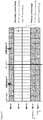
- FIG. 7 One option for such a schema is illustrated in figure 7 .
- different numerologies are aligned at the subframe boundary by adjusting their CP length. This subframe alignment allows for a continuous numbering of subframes.
- continuous numbering of resource blocks (RBs) is applied: i.e. the RBs are counted in the order of their appearance irrespective of their underlying numerology.
- Guard tones are counted as resource blocks with zero utilization; the dimensioning of guard tones is controlled by the scheduler to avoid interference.
- all UEs active in the system should know the current numerology settings. Therefore, this numbering scheme is suitable for static or semi-persistent mixed-numerology modes.
- FIG 8 A second option for such a schema is illustrated in figure 8 .
- the same numbering scheme is used as in the schema of figure 7 .
- the RB numbering refers to the RB size defined by the primary numerology.
- the numbering of the secondary numerology RB is equal to the numbering of the last RB plus the result of dividing the subcarrier spacing of the secondary numerology by the subcarrier spacing of the primary numerology.
- the RB numbering can be discontinuous if the secondary numerology's subcarrier spacing is a power of 2 of that in the primary numerology; and the RB numbering can be fractional if the secondary numerology subcarrier spacing is a negative power of 2 of that in primary numerology.
- guard tones are treated as resource blocks with zero utilization.
- secondary numerology resources can conveniently be allocated with the granularity of subframes.
- secondary numerology resources can conveniently be allocated with the granularity of RBs defined by the primary numerology. If the system control information (e.g. the common-search-space in LTE) occupies certain resources having the primary numerology, secondary numerology resources can be prohibited to be allocated in that subframe and RB. This is illustrated in figure 9 , where the resources indicated by a thick line are the PDCCH.
- the present signalling scheme has been defined above with reference to LTE, but it could be applied to other wired and wireless communication systems using OFDM or other frequency or time division multiplexing schemes that can use multiple numerologies.
- PUSCH PUSCH transmission.
- That format can include an SN-TypeConfig (an indication of a numerology type, which may be a few bits long); an SN-RBIdxConfig and a SN-SubframeldxConfig (indicators of the RB and the subframe index defining the resource to which the new numerology is to be applied). Further control information may be provided, for example any of HARQ process information, transmit power control (TPC) information and precoding information.
- TPC transmit power control
- the DCI for dynamic numerology usage may be similar to the current DCI format in LTE but with the addition of an indication of numerology type and resource assignment (i.e. SN-TypeConfig and SN-RBIdxConfig and SN-SubframeldxConfig as discussed above).
- An alternative to dynamic allocation of secondary numerology is to use semi-static scheduling of secondary numerology. This may reduce the burden on downlink control channel capacity compared to dynamic allocation.
- semi-static scheduling UEs use secondary numerology following a periodic pattern.
- the primary numerology is informed by default (e.g. by standardization) or informed by system information (e.g. by MIB).
- MIB system information
- the PDCCH is transmitted at the beginning of semi-persistent scheduling resources (e.g. not in each subframe).
- system-level numerology configuration can be applied statically. This can further reduce signalling overhead.
- any UEs that are associated with the base unit that are to use this configuration are informed by the base unit of the static configuration. This may be done at the initial access step, at handover to the base unit, or later if it is then determined that this configuration is to be used.
- the primary numerology type can be defined by default (e.g. by standardisation) or can be informed to a UE by the base device.
- the secondary numerology type is conveniently configured by information transmitted from the base device to the UE.
- a group of UEs that are associated with a base device may all be using or intended to use a common secondary numerology type.
- signalling overhead can be reduced by adopting the following approach.
- FIG. 7 One option for such a schema is illustrated in figure 7 .
- different numerologies are aligned at the subframe boundary by adjusting their CP length. This subframe alignment allows for a continuous numbering of subframes.
- continuous numbering of resource blocks (RBs) is applied: i.e. the RBs are counted in the order of their appearance irrespective of their underlying numerology.
- Guard tones are counted as resource blocks with zero utilization; the dimensioning of guard tones is controlled by the scheduler to avoid interference.
- all UEs active in the system should know the current numerology settings. Therefore, this numbering scheme is suitable for static or semi-persistent mixed-numerology modes.
- FIG 8 A second option for such a schema is illustrated in figure 8 .
- the same numbering scheme is used as in the schema of figure 7 .
- the RB numbering refers to the RB size defined by the primary numerology.
- the numbering of the secondary numerology RB is equal to the numbering of the last RB plus the result of dividing the subcarrier spacing of the secondary numerology by the subcarrier spacing of the primary numerology.
- the RB numbering can be discontinuous if the secondary numerology's subcarrier spacing is a power of 2 of that in the primary numerology; and the RB numbering can be fractional if the secondary numerology subcarrier spacing is a negative power of 2 of that in primary numerology.
- guard tones are treated as resource blocks with zero utilization.
- secondary numerology resources can conveniently be allocated with the granularity of subframes.
- secondary numerology resources can conveniently be allocated with the granularity of RBs defined by the primary numerology. If the system control information (e.g. the common-search-space in LTE) occupies certain resources having the primary numerology, secondary numerology resources can be prohibited to be allocated in that subframe and RB. This is illustrated in figure 9 , where the resources indicated by a thick line are the PDCCH.
- the present signalling scheme has been defined above with reference to LTE, but it could be applied to other wired and wireless communication systems using OFDM or other frequency or time division multiplexing schemes that can use multiple numerologies.
Landscapes
- Engineering & Computer Science (AREA)
- Signal Processing (AREA)
- Computer Networks & Wireless Communication (AREA)
- Quality & Reliability (AREA)
- Physics & Mathematics (AREA)
- Mathematical Physics (AREA)
- Mobile Radio Communication Systems (AREA)
Claims (14)
- Terminal de communication (2) permettant de communiquer avec un dispositif de base (1) par multiplexage par répartition en fréquence et/ou dans le temps, le terminal étant conçu pour transmettre et/ou recevoir des signaux vers et/ou à partir du dispositif de base au moyen d'un quelconque parmi une pluralité de types de numérologie, le terminal de communication étant conçu pour :communiquer avec le dispositif de base au moyen d'un type de numérologie primaire et recevoir ainsi un mot de configuration provenant du dispositif de base ;déterminer, en fonction du type de numérologie primaire et du mot de configuration, un type de numérologie secondaire ; et par la suitecommuniquer avec le dispositif de base au moyen du type de numérologie secondaire lorsque le type de numérologie secondaire est activé ;dans lequel chaque type de numérologie spécifie un espacement de sous-porteuse correspondant et une longueur de préfixe cyclique correspondante, et la pluralité de types de numérologie sont alignés à des limites de sous-trame respectives en réglant leur longueur de préfixe cyclique ;le terminal étant conçu pour stocker, pour chacun parmi au moins certains des types de numérologie, un mappage définissant quels types parmi la pluralité de types de numérologie sont indiqués par des valeurs spécifiques du mot de configuration, le terminal étant conçu pour exécuter l'étape de détermination du type de numérologie secondaire en sélectionnant le mappage correspondant au type de numérologie primaire et en sélectionnant comme type de numérologie secondaire le type de numérologie indiqué pour le mot de configuration reçu dans le mappage correspondant au type de numérologie primaire ;dans lequel le nombre de bits dans le mot de configuration est inférieur au nombre de bits dans une représentation binaire du nombre de la pluralité de types de numérologie.
- Terminal de communication selon la revendication 1, le terminal étant conçu pour :déterminer une région d'un spectre de fréquences dans laquelle opérer ; eten fonction de cette détermination, sélectionner le type de numérologie primaire.
- Terminal de communication selon l'une quelconque des revendications précédentes, le terminal de communication étant conçu pour recevoir, à partir du dispositif de base, une indication d'une ressource d'intervalle de temps et/ou de fréquence associée au mot de configuration ; et, en fonction de cette indication, utiliser le type de numérologie secondaire pour la transmission et/ou la réception de signaux dans cette ressource.
- Terminal de communication selon la revendication 3, dans lequel l'indication d'une ressource comprend une indication d'un ensemble de sous-porteuses et une longueur d'un groupe de symboles définissant cette ressource.
- Terminal de communication selon la revendication 4, dans lequel l'indication d'une ressource indique un moment où le groupe de symboles se produira et/ou un programme de répétition pour le groupe de symboles.
- Terminal de communication selon l'une quelconque des revendications précédentes, le terminal de communication étant conçu pour :stocker une définition d'un ou de plusieurs identifiants relatifs au terminal ;recevoir un identifiant de ressource associé au mot de configuration ; etdéterminer si l'identifiant de ressource reçu correspond ou non à la définition d'un ou de plusieurs identifiants ; etle terminal étant conçu de sorte que l'étape de communication avec le dispositif de base au moyen du type de numérologie secondaire dépend du fait que l'identifiant de ressource reçu corresponde à la définition d'un ou de plusieurs identifiants ; dans lequel l'identifiant de ressource indique un terminal unique associé au dispositif de base ou dans lequel l'identifiant de ressource indique plusieurs terminaux associés au dispositif de base.
- Terminal de communication selon l'une quelconque des revendications précédentes, le terminal de communication étant conçu pour récupérer des informations de canal de commande transmises par le dispositif de base au moyen d'un ou des deux types de numérologie primaire et secondaire.
- Dispositif de base de communication (1) permettant de communiquer avec un terminal (2) par multiplexage par répartition en fréquence et/ou dans le temps, le dispositif de base étant conçu pour transmettre et/ou recevoir des signaux vers et/ou à partir du terminal au moyen d'un quelconque parmi une pluralité de types de numérologie, le dispositif de base étant conçu pour :communiquer avec le dispositif terminal au moyen d'un type de numérologie primaire et transmettre ainsi un mot de configuration au terminal, le mot de configuration indiquant un type de numérologie secondaire ; et par la suite communiquer avec le terminal au moyen du type de numérologie secondaire lorsque le type de numérologie secondaire est activé ;dans lequel chaque type de numérologie spécifie un espacement de sous-porteuse correspondant et une longueur de préfixe cyclique correspondante, et la pluralité de types de numérologie sont alignés à des limites de sous-trame respectives en réglant leur longueur de préfixe cyclique ;dans lequel la station de base est conçue pour stocker, pour chacun parmi au moins certains des types de numérologie, un mappage définissant quels types parmi la pluralité de types de numérologie sont indiqués par des valeurs spécifiques du mot de configuration, la station de base étant conçue pour exécuter l'étape de transmission d'un mot de configuration au terminal, en sélectionnant le type de numérologie secondaire, en sélectionnant le mappage correspondant à la numérologie primaire et en sélectionnant, comme mot de configuration à transmettre au terminal, le mot de configuration indiqué pour le type de numérologie secondaire sélectionné dans le mappage correspondant à la numérologie primaire ;dans lequel le nombre de bits dans le mot de configuration est inférieur au nombre de bits dans la représentation binaire du nombre de la pluralité de types de numérologie.
- Dispositif de base de communication selon la revendication 8, le dispositif de base étant conçu pour fonctionner dans une région du spectre de fréquences ; et pour sélectionner, en fonction de cette région, le type de numérologie primaire.
- Dispositif de base de communication selon l'une quelconque des revendications précédentes, le dispositif de base étant conçu pour transmettre au terminal une indication d'une ressource d'intervalle de temps et/ou de fréquence associée au mot de configuration.
- Dispositif de base de communication selon l'une quelconque des revendications précédentes, dans lequel l'indication d'une ressource comprend une indication d'un ensemble de sous-porteuses et une longueur d'un groupe de symboles définissant cette ressource.
- Dispositif de base de communication selon la revendication 11, dans lequel l'indication d'une ressource indique un moment où le groupe de symboles se produira et/ou un programme de répétition pour le groupe de symboles.
- Dispositif de base de communication selon l'une quelconque des revendications précédentes, le dispositif de base de communication étant conçu pour : stocker une définition d'un ou de plusieurs identifiants relatifs aux terminaux qui lui sont associés ; et transmettre, en association avec le mot de configuration, un identifiant de ressource correspondant audit terminal ;
dans lequel l'identifiant de ressource indique un terminal unique associé au dispositif de base ; ou dans lequel l'identifiant de ressource indique plusieurs terminaux associés au dispositif de base. - Dispositif de base de communication selon l'une quelconque des revendications précédentes, le dispositif de base de communication étant conçu pour transmettre des informations de canal de commande au terminal au moyen d'un ou des deux types de numérologie primaire et secondaire.
Priority Applications (1)
| Application Number | Priority Date | Filing Date | Title |
|---|---|---|---|
| EP21184462.6A EP3965327A1 (fr) | 2016-10-28 | 2016-10-28 | Commutation d'un mode ofdm ayant une certaine numérologie à un autre |
Applications Claiming Priority (1)
| Application Number | Priority Date | Filing Date | Title |
|---|---|---|---|
| PCT/EP2016/076141 WO2018077432A1 (fr) | 2016-10-28 | 2016-10-28 | Commutation d'un mode ofdm à un autre |
Related Child Applications (1)
| Application Number | Title | Priority Date | Filing Date |
|---|---|---|---|
| EP21184462.6A Division EP3965327A1 (fr) | 2016-10-28 | 2016-10-28 | Commutation d'un mode ofdm ayant une certaine numérologie à un autre |
Publications (2)
| Publication Number | Publication Date |
|---|---|
| EP3523897A1 EP3523897A1 (fr) | 2019-08-14 |
| EP3523897B1 true EP3523897B1 (fr) | 2021-07-14 |
Family
ID=57233420
Family Applications (2)
| Application Number | Title | Priority Date | Filing Date |
|---|---|---|---|
| EP16790940.7A Active EP3523897B1 (fr) | 2016-10-28 | 2016-10-28 | Commutation d'un mode ofdm à un autre |
| EP21184462.6A Withdrawn EP3965327A1 (fr) | 2016-10-28 | 2016-10-28 | Commutation d'un mode ofdm ayant une certaine numérologie à un autre |
Family Applications After (1)
| Application Number | Title | Priority Date | Filing Date |
|---|---|---|---|
| EP21184462.6A Withdrawn EP3965327A1 (fr) | 2016-10-28 | 2016-10-28 | Commutation d'un mode ofdm ayant une certaine numérologie à un autre |
Country Status (4)
| Country | Link |
|---|---|
| US (1) | US20190253223A1 (fr) |
| EP (2) | EP3523897B1 (fr) |
| CN (2) | CN109792307B (fr) |
| WO (1) | WO2018077432A1 (fr) |
Families Citing this family (3)
| Publication number | Priority date | Publication date | Assignee | Title |
|---|---|---|---|---|
| ES2927069T3 (es) * | 2016-12-27 | 2022-11-02 | 5G Ip Holdings Llc | Método para señalizar indicadores de parte de ancho de banda (BWP) y equipo de comunicación por radio que utiliza el mismo |
| US10985964B2 (en) * | 2017-09-11 | 2021-04-20 | Qualcomm Incorporated | Techniques for selecting subcarrier spacing for signal detection |
| JP2021045117A (ja) * | 2019-09-11 | 2021-03-25 | 東洋インキScホールディングス株式会社 | 細胞培養用部材およびその製造方法 |
Family Cites Families (16)
| Publication number | Priority date | Publication date | Assignee | Title |
|---|---|---|---|---|
| US7181218B2 (en) * | 2001-04-10 | 2007-02-20 | Telefonaktiebolaget Lm Ericsson (Publ) | Commanding handover between differing radio access technologies |
| CN101208887B (zh) * | 2005-03-30 | 2011-07-06 | 北电网络有限公司 | 正交频分多路复用符号的传输方法和系统 |
| KR101783289B1 (ko) * | 2010-05-11 | 2017-09-29 | 삼성전자 주식회사 | 캐리어 결합을 가지는 핸드오버 |
| CN102143534B (zh) * | 2010-12-31 | 2014-03-12 | 华为技术有限公司 | 带宽控制的处理方法、设备及系统 |
| EP2735204A1 (fr) * | 2011-07-21 | 2014-05-28 | BlackBerry Limited | Mode de préfixe cyclique dynamique pour permettre une gestion de ressources radio sur la liaison montante |
| CN104885391B (zh) * | 2012-12-17 | 2018-01-16 | Lg电子株式会社 | 接收下行链路信号的方法、用户设备、发送下行链路信号的方法及基站 |
| CN104717709B (zh) * | 2013-12-16 | 2018-08-17 | 华为技术有限公司 | 一种网络切换方法及装置 |
| JP6034849B2 (ja) * | 2014-12-05 | 2016-11-30 | アンリツ株式会社 | 移動端末試験装置とそのパラメータ入替方法 |
| US10285169B2 (en) * | 2015-07-10 | 2019-05-07 | Qualcomm Incorporated | Downlink control information (DCI) enhancements for non-orthogonal multiple access |
| CN105163355A (zh) * | 2015-09-29 | 2015-12-16 | 努比亚技术有限公司 | 一种移动终端切换网络的方法及装置 |
| WO2018030908A1 (fr) * | 2016-08-10 | 2018-02-15 | Ringcentral, Ink., (A Delaware Corporation) | Procédé et système destinés à gérer des fils de message électronique |
| CN107770869B (zh) * | 2016-08-20 | 2023-07-14 | 中兴通讯股份有限公司 | 无线资源分配信息的配置方法及装置 |
| CN107872303B (zh) * | 2016-09-26 | 2020-07-28 | 华为技术有限公司 | 传输反馈信息的方法和装置 |
| GB201721028D0 (en) * | 2017-12-15 | 2018-01-31 | Semafone Ltd | Authentication and authorisation |
| US12062104B2 (en) * | 2019-07-01 | 2024-08-13 | Visa International Service Association | Systems and methods for security alerts |
| US11409439B2 (en) * | 2020-11-10 | 2022-08-09 | Samsung Electronics Co., Ltd. | Binding application to namespace (NS) to set to submission queue (SQ) and assigning performance service level agreement (SLA) and passing it to a storage device |
-
2016
- 2016-10-28 EP EP16790940.7A patent/EP3523897B1/fr active Active
- 2016-10-28 CN CN201680089751.2A patent/CN109792307B/zh active Active
- 2016-10-28 CN CN202110241704.8A patent/CN112929132A/zh active Pending
- 2016-10-28 EP EP21184462.6A patent/EP3965327A1/fr not_active Withdrawn
- 2016-10-28 WO PCT/EP2016/076141 patent/WO2018077432A1/fr not_active Ceased
-
2019
- 2019-04-26 US US16/395,926 patent/US20190253223A1/en not_active Abandoned
Non-Patent Citations (3)
| Title |
|---|
| HUAWEI ET AL: "Discussion on UE behavior on mixed numerology carrier", vol. RAN WG1, no. Lisbon, Portugal; 20161010 - 20161014, 9 October 2016 (2016-10-09), XP051149468, Retrieved from the Internet <URL:http://www.3gpp.org/ftp/Meetings_3GPP_SYNC/RAN1/Docs/> [retrieved on 20161009] * |
| INTEL CORPORATION: "Capability to support multiple numerologies", vol. RAN WG1, no. Gothenburg, Sweden; 20160822 - 20160826, 21 August 2016 (2016-08-21), XP051125446, Retrieved from the Internet <URL:http://www.3gpp.org/ftp/Meetings_3GPP_SYNC/RAN1/Docs/> [retrieved on 20160821] * |
| ZTE ET AL: "About Slot structure and Scheduling Units for NR", vol. RAN WG1, no. Lisbon, Portugal; 20161010 - 20161014, 9 October 2016 (2016-10-09), XP051149017, Retrieved from the Internet <URL:http://www.3gpp.org/ftp/Meetings_3GPP_SYNC/RAN1/Docs/> [retrieved on 20161009] * |
Also Published As
| Publication number | Publication date |
|---|---|
| EP3523897A1 (fr) | 2019-08-14 |
| CN109792307A (zh) | 2019-05-21 |
| EP3965327A1 (fr) | 2022-03-09 |
| CN112929132A (zh) | 2021-06-08 |
| WO2018077432A1 (fr) | 2018-05-03 |
| US20190253223A1 (en) | 2019-08-15 |
| CN109792307B (zh) | 2021-02-26 |
Similar Documents
| Publication | Publication Date | Title |
|---|---|---|
| US20240015056A1 (en) | Communications device, infrastructure equipment, wireless communications network and methods | |
| US10454657B2 (en) | Narrowband time-division duplex frame structure for narrowband communications | |
| CA2981897C (fr) | Procedure d'evaluation de canal libre au niveau de dispositifs maitre et esclave | |
| JP6318198B2 (ja) | キャリア集約 | |
| EP3200555B1 (fr) | Dispositif terminal et procédé de communication | |
| CN108353395B (zh) | 终端装置、基站装置以及方法 | |
| US9055515B2 (en) | System and method for signaling a location of a control channel | |
| JP2022106864A (ja) | 無線通信システムにおいて制御情報をマッピングするための方法及び装置 | |
| WO2018074068A1 (fr) | Dispositif station de base, dispositif terminal et procédé de communication | |
| US20190253223A1 (en) | Switching from one ofdm mode to another |
Legal Events
| Date | Code | Title | Description |
|---|---|---|---|
| STAA | Information on the status of an ep patent application or granted ep patent |
Free format text: STATUS: UNKNOWN |
|
| STAA | Information on the status of an ep patent application or granted ep patent |
Free format text: STATUS: THE INTERNATIONAL PUBLICATION HAS BEEN MADE |
|
| PUAI | Public reference made under article 153(3) epc to a published international application that has entered the european phase |
Free format text: ORIGINAL CODE: 0009012 |
|
| STAA | Information on the status of an ep patent application or granted ep patent |
Free format text: STATUS: REQUEST FOR EXAMINATION WAS MADE |
|
| 17P | Request for examination filed |
Effective date: 20190510 |
|
| AK | Designated contracting states |
Kind code of ref document: A1 Designated state(s): AL AT BE BG CH CY CZ DE DK EE ES FI FR GB GR HR HU IE IS IT LI LT LU LV MC MK MT NL NO PL PT RO RS SE SI SK SM TR |
|
| AX | Request for extension of the european patent |
Extension state: BA ME |
|
| DAV | Request for validation of the european patent (deleted) | ||
| DAX | Request for extension of the european patent (deleted) | ||
| STAA | Information on the status of an ep patent application or granted ep patent |
Free format text: STATUS: EXAMINATION IS IN PROGRESS |
|
| REG | Reference to a national code |
Ref country code: DE Ref legal event code: R079 Ref document number: 602016060653 Country of ref document: DE Free format text: PREVIOUS MAIN CLASS: H04L0001000000 Ipc: H04L0027260000 |
|
| GRAP | Despatch of communication of intention to grant a patent |
Free format text: ORIGINAL CODE: EPIDOSNIGR1 |
|
| STAA | Information on the status of an ep patent application or granted ep patent |
Free format text: STATUS: GRANT OF PATENT IS INTENDED |
|
| INTG | Intention to grant announced |
Effective date: 20210204 |
|
| RIC1 | Information provided on ipc code assigned before grant |
Ipc: H04L 1/00 20060101ALI20210125BHEP Ipc: H04L 5/00 20060101ALI20210125BHEP Ipc: H04L 27/26 20060101AFI20210125BHEP |
|
| GRAS | Grant fee paid |
Free format text: ORIGINAL CODE: EPIDOSNIGR3 |
|
| GRAA | (expected) grant |
Free format text: ORIGINAL CODE: 0009210 |
|
| STAA | Information on the status of an ep patent application or granted ep patent |
Free format text: STATUS: THE PATENT HAS BEEN GRANTED |
|
| AK | Designated contracting states |
Kind code of ref document: B1 Designated state(s): AL AT BE BG CH CY CZ DE DK EE ES FI FR GB GR HR HU IE IS IT LI LT LU LV MC MK MT NL NO PL PT RO RS SE SI SK SM TR |
|
| REG | Reference to a national code |
Ref country code: GB Ref legal event code: FG4D |
|
| REG | Reference to a national code |
Ref country code: IE Ref legal event code: FG4D |
|
| REG | Reference to a national code |
Ref country code: DE Ref legal event code: R096 Ref document number: 602016060653 Country of ref document: DE |
|
| REG | Reference to a national code |
Ref country code: AT Ref legal event code: REF Ref document number: 1411532 Country of ref document: AT Kind code of ref document: T Effective date: 20210815 |
|
| REG | Reference to a national code |
Ref country code: LT Ref legal event code: MG9D |
|
| REG | Reference to a national code |
Ref country code: NL Ref legal event code: MP Effective date: 20210714 |
|
| REG | Reference to a national code |
Ref country code: AT Ref legal event code: MK05 Ref document number: 1411532 Country of ref document: AT Kind code of ref document: T Effective date: 20210714 |
|
| PG25 | Lapsed in a contracting state [announced via postgrant information from national office to epo] |
Ref country code: RS Free format text: LAPSE BECAUSE OF FAILURE TO SUBMIT A TRANSLATION OF THE DESCRIPTION OR TO PAY THE FEE WITHIN THE PRESCRIBED TIME-LIMIT Effective date: 20210714 Ref country code: SE Free format text: LAPSE BECAUSE OF FAILURE TO SUBMIT A TRANSLATION OF THE DESCRIPTION OR TO PAY THE FEE WITHIN THE PRESCRIBED TIME-LIMIT Effective date: 20210714 Ref country code: HR Free format text: LAPSE BECAUSE OF FAILURE TO SUBMIT A TRANSLATION OF THE DESCRIPTION OR TO PAY THE FEE WITHIN THE PRESCRIBED TIME-LIMIT Effective date: 20210714 Ref country code: ES Free format text: LAPSE BECAUSE OF FAILURE TO SUBMIT A TRANSLATION OF THE DESCRIPTION OR TO PAY THE FEE WITHIN THE PRESCRIBED TIME-LIMIT Effective date: 20210714 Ref country code: FI Free format text: LAPSE BECAUSE OF FAILURE TO SUBMIT A TRANSLATION OF THE DESCRIPTION OR TO PAY THE FEE WITHIN THE PRESCRIBED TIME-LIMIT Effective date: 20210714 Ref country code: NL Free format text: LAPSE BECAUSE OF FAILURE TO SUBMIT A TRANSLATION OF THE DESCRIPTION OR TO PAY THE FEE WITHIN THE PRESCRIBED TIME-LIMIT Effective date: 20210714 Ref country code: PT Free format text: LAPSE BECAUSE OF FAILURE TO SUBMIT A TRANSLATION OF THE DESCRIPTION OR TO PAY THE FEE WITHIN THE PRESCRIBED TIME-LIMIT Effective date: 20211115 Ref country code: NO Free format text: LAPSE BECAUSE OF FAILURE TO SUBMIT A TRANSLATION OF THE DESCRIPTION OR TO PAY THE FEE WITHIN THE PRESCRIBED TIME-LIMIT Effective date: 20211014 Ref country code: LT Free format text: LAPSE BECAUSE OF FAILURE TO SUBMIT A TRANSLATION OF THE DESCRIPTION OR TO PAY THE FEE WITHIN THE PRESCRIBED TIME-LIMIT Effective date: 20210714 Ref country code: BG Free format text: LAPSE BECAUSE OF FAILURE TO SUBMIT A TRANSLATION OF THE DESCRIPTION OR TO PAY THE FEE WITHIN THE PRESCRIBED TIME-LIMIT Effective date: 20211014 Ref country code: AT Free format text: LAPSE BECAUSE OF FAILURE TO SUBMIT A TRANSLATION OF THE DESCRIPTION OR TO PAY THE FEE WITHIN THE PRESCRIBED TIME-LIMIT Effective date: 20210714 |
|
| PG25 | Lapsed in a contracting state [announced via postgrant information from national office to epo] |
Ref country code: PL Free format text: LAPSE BECAUSE OF FAILURE TO SUBMIT A TRANSLATION OF THE DESCRIPTION OR TO PAY THE FEE WITHIN THE PRESCRIBED TIME-LIMIT Effective date: 20210714 Ref country code: LV Free format text: LAPSE BECAUSE OF FAILURE TO SUBMIT A TRANSLATION OF THE DESCRIPTION OR TO PAY THE FEE WITHIN THE PRESCRIBED TIME-LIMIT Effective date: 20210714 Ref country code: GR Free format text: LAPSE BECAUSE OF FAILURE TO SUBMIT A TRANSLATION OF THE DESCRIPTION OR TO PAY THE FEE WITHIN THE PRESCRIBED TIME-LIMIT Effective date: 20211015 |
|
| REG | Reference to a national code |
Ref country code: DE Ref legal event code: R097 Ref document number: 602016060653 Country of ref document: DE |
|
| PG25 | Lapsed in a contracting state [announced via postgrant information from national office to epo] |
Ref country code: DK Free format text: LAPSE BECAUSE OF FAILURE TO SUBMIT A TRANSLATION OF THE DESCRIPTION OR TO PAY THE FEE WITHIN THE PRESCRIBED TIME-LIMIT Effective date: 20210714 |
|
| REG | Reference to a national code |
Ref country code: DE Ref legal event code: R119 Ref document number: 602016060653 Country of ref document: DE |
|
| PLBE | No opposition filed within time limit |
Free format text: ORIGINAL CODE: 0009261 |
|
| STAA | Information on the status of an ep patent application or granted ep patent |
Free format text: STATUS: NO OPPOSITION FILED WITHIN TIME LIMIT |
|
| REG | Reference to a national code |
Ref country code: CH Ref legal event code: PL |
|
| PG25 | Lapsed in a contracting state [announced via postgrant information from national office to epo] |
Ref country code: SM Free format text: LAPSE BECAUSE OF FAILURE TO SUBMIT A TRANSLATION OF THE DESCRIPTION OR TO PAY THE FEE WITHIN THE PRESCRIBED TIME-LIMIT Effective date: 20210714 Ref country code: SK Free format text: LAPSE BECAUSE OF FAILURE TO SUBMIT A TRANSLATION OF THE DESCRIPTION OR TO PAY THE FEE WITHIN THE PRESCRIBED TIME-LIMIT Effective date: 20210714 Ref country code: RO Free format text: LAPSE BECAUSE OF FAILURE TO SUBMIT A TRANSLATION OF THE DESCRIPTION OR TO PAY THE FEE WITHIN THE PRESCRIBED TIME-LIMIT Effective date: 20210714 Ref country code: EE Free format text: LAPSE BECAUSE OF FAILURE TO SUBMIT A TRANSLATION OF THE DESCRIPTION OR TO PAY THE FEE WITHIN THE PRESCRIBED TIME-LIMIT Effective date: 20210714 Ref country code: CZ Free format text: LAPSE BECAUSE OF FAILURE TO SUBMIT A TRANSLATION OF THE DESCRIPTION OR TO PAY THE FEE WITHIN THE PRESCRIBED TIME-LIMIT Effective date: 20210714 Ref country code: AL Free format text: LAPSE BECAUSE OF FAILURE TO SUBMIT A TRANSLATION OF THE DESCRIPTION OR TO PAY THE FEE WITHIN THE PRESCRIBED TIME-LIMIT Effective date: 20210714 |
|
| 26N | No opposition filed |
Effective date: 20220419 |
|
| REG | Reference to a national code |
Ref country code: BE Ref legal event code: MM Effective date: 20211031 |
|
| PG25 | Lapsed in a contracting state [announced via postgrant information from national office to epo] |
Ref country code: MC Free format text: LAPSE BECAUSE OF FAILURE TO SUBMIT A TRANSLATION OF THE DESCRIPTION OR TO PAY THE FEE WITHIN THE PRESCRIBED TIME-LIMIT Effective date: 20210714 |
|
| PG25 | Lapsed in a contracting state [announced via postgrant information from national office to epo] |
Ref country code: LU Free format text: LAPSE BECAUSE OF NON-PAYMENT OF DUE FEES Effective date: 20211028 Ref country code: IT Free format text: LAPSE BECAUSE OF FAILURE TO SUBMIT A TRANSLATION OF THE DESCRIPTION OR TO PAY THE FEE WITHIN THE PRESCRIBED TIME-LIMIT Effective date: 20210714 Ref country code: DE Free format text: LAPSE BECAUSE OF NON-PAYMENT OF DUE FEES Effective date: 20220503 Ref country code: BE Free format text: LAPSE BECAUSE OF NON-PAYMENT OF DUE FEES Effective date: 20211031 |
|
| PG25 | Lapsed in a contracting state [announced via postgrant information from national office to epo] |
Ref country code: LI Free format text: LAPSE BECAUSE OF NON-PAYMENT OF DUE FEES Effective date: 20211031 Ref country code: CH Free format text: LAPSE BECAUSE OF NON-PAYMENT OF DUE FEES Effective date: 20211031 |
|
| PG25 | Lapsed in a contracting state [announced via postgrant information from national office to epo] |
Ref country code: FR Free format text: LAPSE BECAUSE OF NON-PAYMENT OF DUE FEES Effective date: 20211031 |
|
| PG25 | Lapsed in a contracting state [announced via postgrant information from national office to epo] |
Ref country code: IE Free format text: LAPSE BECAUSE OF NON-PAYMENT OF DUE FEES Effective date: 20211028 |
|
| PG25 | Lapsed in a contracting state [announced via postgrant information from national office to epo] |
Ref country code: CY Free format text: LAPSE BECAUSE OF FAILURE TO SUBMIT A TRANSLATION OF THE DESCRIPTION OR TO PAY THE FEE WITHIN THE PRESCRIBED TIME-LIMIT Effective date: 20210714 |
|
| PG25 | Lapsed in a contracting state [announced via postgrant information from national office to epo] |
Ref country code: HU Free format text: LAPSE BECAUSE OF FAILURE TO SUBMIT A TRANSLATION OF THE DESCRIPTION OR TO PAY THE FEE WITHIN THE PRESCRIBED TIME-LIMIT; INVALID AB INITIO Effective date: 20161028 |
|
| PG25 | Lapsed in a contracting state [announced via postgrant information from national office to epo] |
Ref country code: MK Free format text: LAPSE BECAUSE OF FAILURE TO SUBMIT A TRANSLATION OF THE DESCRIPTION OR TO PAY THE FEE WITHIN THE PRESCRIBED TIME-LIMIT Effective date: 20210714 |
|
| PG25 | Lapsed in a contracting state [announced via postgrant information from national office to epo] |
Ref country code: TR Free format text: LAPSE BECAUSE OF FAILURE TO SUBMIT A TRANSLATION OF THE DESCRIPTION OR TO PAY THE FEE WITHIN THE PRESCRIBED TIME-LIMIT Effective date: 20210714 |
|
| PG25 | Lapsed in a contracting state [announced via postgrant information from national office to epo] |
Ref country code: MT Free format text: LAPSE BECAUSE OF FAILURE TO SUBMIT A TRANSLATION OF THE DESCRIPTION OR TO PAY THE FEE WITHIN THE PRESCRIBED TIME-LIMIT Effective date: 20210714 |
|
| PGFP | Annual fee paid to national office [announced via postgrant information from national office to epo] |
Ref country code: GB Payment date: 20250904 Year of fee payment: 10 |