EP3524701A1 - Korrosionsbeständige cu-zn-legierung - Google Patents
Korrosionsbeständige cu-zn-legierung Download PDFInfo
- Publication number
- EP3524701A1 EP3524701A1 EP18863803.5A EP18863803A EP3524701A1 EP 3524701 A1 EP3524701 A1 EP 3524701A1 EP 18863803 A EP18863803 A EP 18863803A EP 3524701 A1 EP3524701 A1 EP 3524701A1
- Authority
- EP
- European Patent Office
- Prior art keywords
- content
- less
- ppm
- cuzn alloy
- alloy
- Prior art date
- Legal status (The legal status is an assumption and is not a legal conclusion. Google has not performed a legal analysis and makes no representation as to the accuracy of the status listed.)
- Granted
Links
Images



Classifications
-
- C—CHEMISTRY; METALLURGY
- C22—METALLURGY; FERROUS OR NON-FERROUS ALLOYS; TREATMENT OF ALLOYS OR NON-FERROUS METALS
- C22C—ALLOYS
- C22C9/00—Alloys based on copper
- C22C9/04—Alloys based on copper with zinc as the next major constituent
-
- C—CHEMISTRY; METALLURGY
- C21—METALLURGY OF IRON
- C21D—MODIFYING THE PHYSICAL STRUCTURE OF FERROUS METALS; GENERAL DEVICES FOR HEAT TREATMENT OF FERROUS OR NON-FERROUS METALS OR ALLOYS; MAKING METAL MALLEABLE, e.g. BY DECARBURISATION OR TEMPERING
- C21D8/00—Modifying the physical properties of ferrous metals or ferrous alloys by deformation combined with, or followed by, heat treatment
- C21D8/06—Modifying the physical properties of ferrous metals or ferrous alloys by deformation combined with, or followed by, heat treatment during manufacturing of rods or wires
-
- C—CHEMISTRY; METALLURGY
- C22—METALLURGY; FERROUS OR NON-FERROUS ALLOYS; TREATMENT OF ALLOYS OR NON-FERROUS METALS
- C22C—ALLOYS
- C22C1/00—Making non-ferrous alloys
- C22C1/02—Making non-ferrous alloys by melting
-
- C—CHEMISTRY; METALLURGY
- C22—METALLURGY; FERROUS OR NON-FERROUS ALLOYS; TREATMENT OF ALLOYS OR NON-FERROUS METALS
- C22C—ALLOYS
- C22C18/00—Alloys based on zinc
- C22C18/02—Alloys based on zinc with copper as the next major constituent
-
- C—CHEMISTRY; METALLURGY
- C22—METALLURGY; FERROUS OR NON-FERROUS ALLOYS; TREATMENT OF ALLOYS OR NON-FERROUS METALS
- C22F—CHANGING THE PHYSICAL STRUCTURE OF NON-FERROUS METALS AND NON-FERROUS ALLOYS
- C22F1/00—Changing the physical structure of non-ferrous metals or alloys by heat treatment or by hot or cold working
-
- C—CHEMISTRY; METALLURGY
- C22—METALLURGY; FERROUS OR NON-FERROUS ALLOYS; TREATMENT OF ALLOYS OR NON-FERROUS METALS
- C22F—CHANGING THE PHYSICAL STRUCTURE OF NON-FERROUS METALS AND NON-FERROUS ALLOYS
- C22F1/00—Changing the physical structure of non-ferrous metals or alloys by heat treatment or by hot or cold working
- C22F1/02—Changing the physical structure of non-ferrous metals or alloys by heat treatment or by hot or cold working in inert or controlled atmosphere or vacuum
-
- C—CHEMISTRY; METALLURGY
- C22—METALLURGY; FERROUS OR NON-FERROUS ALLOYS; TREATMENT OF ALLOYS OR NON-FERROUS METALS
- C22F—CHANGING THE PHYSICAL STRUCTURE OF NON-FERROUS METALS AND NON-FERROUS ALLOYS
- C22F1/00—Changing the physical structure of non-ferrous metals or alloys by heat treatment or by hot or cold working
- C22F1/08—Changing the physical structure of non-ferrous metals or alloys by heat treatment or by hot or cold working of copper or alloys based thereon
-
- C—CHEMISTRY; METALLURGY
- C22—METALLURGY; FERROUS OR NON-FERROUS ALLOYS; TREATMENT OF ALLOYS OR NON-FERROUS METALS
- C22F—CHANGING THE PHYSICAL STRUCTURE OF NON-FERROUS METALS AND NON-FERROUS ALLOYS
- C22F1/00—Changing the physical structure of non-ferrous metals or alloys by heat treatment or by hot or cold working
- C22F1/16—Changing the physical structure of non-ferrous metals or alloys by heat treatment or by hot or cold working of other metals or alloys based thereon
- C22F1/165—Changing the physical structure of non-ferrous metals or alloys by heat treatment or by hot or cold working of other metals or alloys based thereon of zinc or cadmium or alloys based thereon
-
- H—ELECTRICITY
- H01—ELECTRIC ELEMENTS
- H01M—PROCESSES OR MEANS, e.g. BATTERIES, FOR THE DIRECT CONVERSION OF CHEMICAL ENERGY INTO ELECTRICAL ENERGY
- H01M4/00—Electrodes
- H01M4/02—Electrodes composed of, or comprising, active material
- H01M4/24—Electrodes for alkaline accumulators
- H01M4/244—Zinc electrodes
-
- H—ELECTRICITY
- H01—ELECTRIC ELEMENTS
- H01S—DEVICES USING THE PROCESS OF LIGHT AMPLIFICATION BY STIMULATED EMISSION OF RADIATION [LASER] TO AMPLIFY OR GENERATE LIGHT; DEVICES USING STIMULATED EMISSION OF ELECTROMAGNETIC RADIATION IN WAVE RANGES OTHER THAN OPTICAL
- H01S3/00—Lasers, i.e. devices using stimulated emission of electromagnetic radiation in the infrared, visible or ultraviolet wave range
- H01S3/02—Constructional details
- H01S3/03—Constructional details of gas laser discharge tubes
- H01S3/038—Electrodes, e.g. special shape, configuration or composition
- H01S3/0388—Compositions, materials or coatings
-
- H—ELECTRICITY
- H01—ELECTRIC ELEMENTS
- H01S—DEVICES USING THE PROCESS OF LIGHT AMPLIFICATION BY STIMULATED EMISSION OF RADIATION [LASER] TO AMPLIFY OR GENERATE LIGHT; DEVICES USING STIMULATED EMISSION OF ELECTROMAGNETIC RADIATION IN WAVE RANGES OTHER THAN OPTICAL
- H01S3/00—Lasers, i.e. devices using stimulated emission of electromagnetic radiation in the infrared, visible or ultraviolet wave range
- H01S3/14—Lasers, i.e. devices using stimulated emission of electromagnetic radiation in the infrared, visible or ultraviolet wave range characterised by the material used as the active medium
- H01S3/22—Gases
- H01S3/223—Gases the active gas being polyatomic, i.e. containing two or more atoms
- H01S3/225—Gases the active gas being polyatomic, i.e. containing two or more atoms comprising an excimer or exciplex
- H01S3/2251—ArF, i.e. argon fluoride is comprised for lasing around 193 nm
-
- H—ELECTRICITY
- H01—ELECTRIC ELEMENTS
- H01S—DEVICES USING THE PROCESS OF LIGHT AMPLIFICATION BY STIMULATED EMISSION OF RADIATION [LASER] TO AMPLIFY OR GENERATE LIGHT; DEVICES USING STIMULATED EMISSION OF ELECTROMAGNETIC RADIATION IN WAVE RANGES OTHER THAN OPTICAL
- H01S3/00—Lasers, i.e. devices using stimulated emission of electromagnetic radiation in the infrared, visible or ultraviolet wave range
- H01S3/14—Lasers, i.e. devices using stimulated emission of electromagnetic radiation in the infrared, visible or ultraviolet wave range characterised by the material used as the active medium
- H01S3/22—Gases
- H01S3/223—Gases the active gas being polyatomic, i.e. containing two or more atoms
- H01S3/225—Gases the active gas being polyatomic, i.e. containing two or more atoms comprising an excimer or exciplex
- H01S3/2256—KrF, i.e. krypton fluoride is comprised for lasing around 248 nm
-
- Y—GENERAL TAGGING OF NEW TECHNOLOGICAL DEVELOPMENTS; GENERAL TAGGING OF CROSS-SECTIONAL TECHNOLOGIES SPANNING OVER SEVERAL SECTIONS OF THE IPC; TECHNICAL SUBJECTS COVERED BY FORMER USPC CROSS-REFERENCE ART COLLECTIONS [XRACs] AND DIGESTS
- Y02—TECHNOLOGIES OR APPLICATIONS FOR MITIGATION OR ADAPTATION AGAINST CLIMATE CHANGE
- Y02E—REDUCTION OF GREENHOUSE GAS [GHG] EMISSIONS, RELATED TO ENERGY GENERATION, TRANSMISSION OR DISTRIBUTION
- Y02E60/00—Enabling technologies; Technologies with a potential or indirect contribution to GHG emissions mitigation
- Y02E60/10—Energy storage using batteries
Definitions
- the present invention relates to a corrosion-resistant CuZn alloy that can be suitably used for electrodes employed in an acidic atmosphere.
- pulsed laser light has been used for integrated circuit photolithography.
- the pulsed laser light can be generated by applying gas discharge between a pair of electrodes at very short electric discharge and very high voltage in a gas discharge medium.
- fluorine-containing plasma is generated between the pair of electrodes during operation.
- the fluorine-containing plasma is highly corrosive to metals.
- the electrodes corrode over time during operation of a pulsed laser generator.
- the corrosion of the electrodes forms a corrosion spot, which causes arcing in the plasma, thereby further accelerating shortening of an electrode lifetime.
- a CuZn alloy is used for the electrodes.
- Patent Documents 1 and 2 As a technique for prolonging the electrode lifetime, a technique for stably using an electrode for a long period of time have been developed (Patent Documents 1 and 2), in which a body portion of a discharging electrode made of a CuZn alloy is partially exposed (a discharge receiving area) for discharge and other portions are covered with other alloy.
- Patent Document 3 discloses a technique for prolonging the electrode lifetime by using phosphorus-doped brass as a copper alloy used for the electrode to reduce generation of micro pores in the brass.
- the electrode lifetime can be further prolonged if corrosion resistance of the CuZn alloy is improved. Further, in the technique for prolonging the lifetime by using phosphorus-doped brass, a burden of an increase in the number of steps is caused due to a step of doping the CuZn alloy with phosphorus to a target concentration, but it is preferable that such a burden can be avoided.
- an object of the present invention is to provide a CuZn alloy having improved corrosion resistance without adding other elements.
- the present invention includes the following aspects (1) to (6):
- the present invention includes the following aspects (11) to (20):
- a corrosion-resistant CuZn alloy is obtained.
- the corrosion-resistant CuZn alloy according to the present invention can be suitably used for electrodes employed in an acidic atmosphere, and is particularly suitable for electrodes of ArF laser systems and KrF laser systems.
- the corrosion-resistant CuZn alloy according to the present invention does not require the addition of other elements during the production and can be produced while avoiding the burden of an increase in the number of steps by those addition steps.
- a corrosion-resistant CuZn alloy according to the present invention is a CuZn alloy having a Zn content of from 15 to 55% by mass, the balance being Cu and inevitable impurities, wherein a total content of Zn and Cu is 99.995% by mass or more, and wherein a number of pores is 1/cm 2 or less based on optical microscopic observation.
- the CuZn alloy can be suitably used as an alloy for corrosion-resistant electrodes.
- the Zn content can be from 15 to 55% by mass, and preferably from 25 to 45% by mass, and more preferably from 35 to 40% by mass.
- the total content of the Zn content and the Cu content can be 99.995% by mass or more, and preferably 99.999% by mass or more.
- the content of P as an inevitable impurity of the CuZn alloy may be 0.01 ppm or less.
- the P content may be 0.05 ppm or less, or less than 0.05 ppm, and preferably 0.01 ppm or less, and preferably 0.005 ppm or less, or less than 0.005 ppm.
- the content of each of the following elements can be as follows.
- the S content may be 0.05 ppm or less, and preferably less than 0.05 ppm; the Fe content may be 5 ppm or less, and preferably less than 5 ppm; the Co content may be 0.05 ppm or less, and preferably less than 0.05 ppm; the Ni content may be 0.1 ppm or less, and preferably less than 0.1 ppm; the As content may be 0.005 ppm or less, and preferably less than 0.005 ppm; the Rh content may be 1 ppm or less, and preferably less than 1 ppm; the Ag content may be 1 ppm or less, and preferably less than 1 ppm; the Sn content may be 0.5 ppm or less, and preferably less than 0.5 ppm; the Sb content may be 0.005 ppm or less; the Te content may be 0.05 ppm or less, and preferably less than 0.05 ppm; the Tl content may be 3 ppm or less, and preferably less than 3 ppm; the Pb
- the number of pores can be 1/cm 2 or less, and preferably 0.1/cm 2 or less, based on optical microscopic observation.
- An area ratio of the pores at this time is 0.00004%.
- the number of pores is determined by observing a surface of a sample with an optical microscope, counting the number of pores per a surface of 0.5 mm x 0.5 mm at arbitrary 10 positions, and calculating an average value thereof.
- an observable object as a pore is a pore having a pore diameter of about 10 ⁇ m or more as a size of the pore.
- the number of pores having a pore diameter of 10 ⁇ m or more may be 1/cm 2 or less, and preferably 0.1/cm 2 or less based on optical microscopic observation.
- the area ratio of the pores is 0.0004% or less, and preferably 0.00004% or less.
- a circumscribed circle was observed as the pore diameter of the pore, regardless of the shape of the pore.
- the corrosion-resistant CuZn alloy according to the present invention has improved corrosion resistance in a fluorine-containing environment.
- the corrosion resistance in the present invention can be tested by a fluoronitric acid test described in Examples as severe conditions.
- the corrosion-resistant CuZn alloy according to the present invention can be produced by a production method comprising the steps of: subjecting a CuZn alloy to hot forging, the alloy having a Zn content of from 15 to 55% by mass, the balance being Cu and inevitable impurities, the alloy having a total content of Zn and Cu of 99.995% by mass or more; and subjecting the hot forged CuZn alloy to hot isotropic pressing.
- an alloy having the same composition as the above corrosion-resistant CuZn alloy can be used as the CuZn alloy to be subjected to the hot forging.
- a CuZn alloy obtained by vacuum melting can be used as the CuZn alloy to be subjected to the hot forging.
- the vacuum melting can be carried out, for example, by maintaining a raw material metal at a temperature in a range of from 900 to 1200 °C, and preferably from 1000 to 1100 °C, under a pressure of from 100 to 600 torr including an inert gas, and preferably from 300 to 500 torr, for 15 to 90 minutes, and preferably for 20 to 60 minutes.
- the hot forging can be carried out, for example, at a temperature in a range of from 600 to 900 °C, and preferably from 700 to 900 °C, such that that a reduction ratio of a cross sectional area of an ingot is from 50 to 80%, and preferably from 60 to 80%.
- preheating may be carried out as desired, for example, by heating to the temperature in the above range for 1 to 15 hours.
- the hot isotropic pressing is carried out in an inert gas, for example in an argon gas, at a temperature in a range of from 450 to 650 °C, and preferably from 500 to 600 °C, for 1 to 8 hours, and preferably 2 to 6 hours, while applying a pressure of from 100 to 200 MPa, and preferably from 120 to 180 MPa.
- an inert gas for example in an argon gas
- the CuZn alloy subjected to the hot isotropic pressing may be annealed.
- the annealing can be carried out, for example, at a temperature in a range of from 500 to 700 °C, and preferably from 550 to 650 °C, for 0.5 to 4 hours, and preferably 1 to 3 hours, by means of air cooling or furnace cooling, or water cooling.
- the CuZn alloy subjected to the hot isotropic pressing or the annealed CuZn alloy can be subjected to finishing.
- the finishing can be performed, for example, by lathe processing.
- the corrosion-resistant CuZn alloy according to the present invention has improved corrosion resistance in a fluorine-containing environment, so that it can be suitably used as an alloy for corrosion-resistant electrodes.
- the corrosion-resistant CuZn alloy according to the present invention exerts improved corrosion resistance while avoiding secondary impurity contamination caused by doping treatments for adding other elements, so that it can be used as a highly purity electrode material.
- the corrosion-resistant CuZn alloy according to the present invention can form an electrode having improved corrosion resistance by using a technique for improving corrosion resistance by improvement of the electrode structure of the prior art.
- a CuZn alloy was produced as follows.
- Cu raw material high purity metallic copper (6N) (purity 99.9999%); and Zn raw material: high purity metal zinc (4N5) (purity 99.995%).
- Forging was carried out by preheating the ingot at a temperature of 850 °C for 3 hours, and carrying out reheating in four steps of: firstly from ⁇ 135 to ⁇ 130 and then ⁇ 130 ⁇ 80 mm square ⁇ 50 mm square ⁇ ⁇ 41 mm at 850 °C for 10 minutes or more in each step. That is, the hot forging process was conducted by carrying out the reheating at 800 °C for 10 minutes or more every time the forging was performed to draw the ingot in the longitudinal direction so as to reduce the cross sectional area of the ingot to 60 to 80% of the original cross sectional area. After carrying out the forging up to ⁇ 41, the ingot was cut every a length of 650 mm to obtain four forged rods.
- the high purity CuZn alloy thus subjected to the hot forging was subjected to hot isotropic pressing (HIP processing) at 525 °C for 4 hours under Ar of 150 MPa.
- HIP processing hot isotropic pressing
- An annealing treatment was then performed by air cooling at 600 °C for 2 hours.
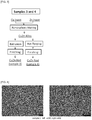
- FIG. 1 An explanatory view of the procedure of Production Example 1 is shown in FIG. 1 .
- a CuZn alloy was produced as follows.
- Cu raw material metallic copper ingot (4N) (purity 99.99%);
- Zn raw material metallic zinc ingot (3N) (purity 99.9%).
- the extrusion was carried out using a die having ⁇ 40 such that a finished diameter would be about ⁇ 41, while heating the ingot at 700 °C.
- An extrusion pressure at this time was from 150 to 170 kg/cm 2 .
- the extruded ingot was cut on the extruder outlet side every 650 mm to obtain four alloy rods (sample 3).
- Forging was carried out by preheating the ingot at a temperature of 850 °C for 3 hours, and carrying out reheating in four steps of: firstly from ⁇ 135 to ⁇ 130 and then ⁇ 130 ⁇ 80 mm square ⁇ 50 mm square ⁇ ⁇ 41 mm at 850 °C for 10 minutes or more in each step. That is, the hot forging process was conducted by carrying out the reheating at 800 °C for 10 minutes or more every time the forging was performed to draw the ingot in the longitudinal direction so as to reduce the cross sectional area of the ingot to 60 to 80% of the original cross sectional area. After carrying out the forging up to ⁇ 41, the ingot was cut every a length of 650 mm to obtain four forged rods (sample 4).
- FIG. 3 An explanatory view of the procedures of Production Examples 3 and 4 is shown in FIG. 3 .
- Samples 1 to 4 were observed under an optical microscope (observation conditions: polished up to # 2000 with abrasive paper, then subjected to buffing, and observed using equipment: Nikon ECLIPSEMA 200; magnifications of 100 and 400). The resulting photographs are shown in FIGS. 4 to 7 .
- the number of pores per a surface of 0.5 mm x 0.5 mm was counted at 10 positions, and an average value thereof was calculated.
- the counting was carried out by counting the number of pores with visual observation for the two positions for each sample, and counting the number of pores to determine a binarization threshold (80 in 256 steps) so as to match the counts with the visual observation from those results, and for the remaining eight positions, counting the number of pores by image processing based on the binarization threshold.
- the number of pores per a surface 0.5 mm x 0.5 mm was about zero.
- the area ratio of the pores was 0.0000%.
- the number of pores per a surface of 0.5 mm x 0.5 mm was 5 or less.
- the area ratio of the pores was 0.0024%.
- the number of pores per a surface of 0.5 mm x 0.5 mm was 1000 or more.
- the area ratio of the pores was 0.7884%.
- the number of pores per a surface of 0.5 mm x 0.5 mm was 100 or more, and the presence of large pores having a pore diameter of 10 ⁇ m or more was observed.
- the area ratio of the pores was 0.1649%.
- sample 1 obtained by subjecting the high purity CuZn to the hot forging and HIP processing
- sample 2 obtained by subjecting the high purity CuZn to the hot forging
- sample 3 obtained by subjecting the CuZn alloy having a degree of purity of a commercially available product to the hot rolling/hot extruding and cold drawing had a very large number of pores.
- Sample 4 obtained by subjecting the CuZn alloy having a degree of purity of a commercial product to the hot forging had a smaller number of pores than that of sample 3, but it had a very larger number of pores than that of sample 2, and the presence of large pores were observed.
- the corrosion resistance test using nitric acid was carried out in the following procedure: 8.4 g of each of samples 1 to 4 (each size: 10 mm x 10 mm x 10 mm) was prepared.
- An aqueous nitric acid solution was prepared by mixing 80 ml of nitric acid (65%) with 420 ml of pure water.
- Each of samples 1 to 4 was added to 500 ml of the aqueous nitric acid solution, and measured for weight loss after 10 minutes, 30 minutes and 60 minutes of the addition, with stirring at 25 °C, to calculate a dissolved amount (mg/cm 2 ) for each of the above times.
- the results of the corrosion resistance test using nitric acid are shown in FIG. 8 .
- the corrosion resistance test using fluonitric acid was carried out in the following procedure: 8.4 g of each of samples 1 to 4 (each size: 10 mm x 10 mm x 10 mm) was prepared.
- An aqueous fluonitric acid solution was prepared by mixing 20 ml of hydrofluoric acid (46%), 60 ml of nitric acid (65%) and 420 ml of pure water.
- Each of samples 1 to 4 was added to 500 ml of the aqueous fluonitric acid solution, and measured for weight loss after 10 minutes, 30 minutes and 60 minutes of the addition, with stirring at 25 °C, to calculate a dissolved amount (mg/cm 2 ) for each of the above times.
- the results of the corrosion resistance test using the aqueous fluonitric acid solution are shown in FIG. 9 .
- sample 3 Comparative Example
- sample 4 Comparative Example
- the dissolution rapidly progressed in both the nitric acid test and the fluonitric acid test in the same manner.
- sample 2 Comparative Example
- the dissolution was reduced in both the nitric acid test and the fluonitric acid test.
- a ratio of the dissolved amount of sample 2 to that of sample 3 was 1/2.85.
- the ratio of the dissolved amount of sample 2 to that of sample 3 was 1/2.46.
- sample 1 (Example) in which substantially no pore was observed
- the dissolution was extremely reduced in both the nitric acid test and the fluonitric acid test.
- the ratio of the dissolved amount of sample 1 to that of sample 3 was 1/4.83.
- the ratio of the dissolved amount of sample 1 to that of sample 3 was 1/8.92.
- the ratio of the dissolved amount of sample 1 to that of sample 2 was 1/1.69.
- the ratio of the dissolved amount of sample 1 to that of sample 2 was 1/3.63.
- the present invention provides a corrosion-resistant CuZn alloy.
- the present invention is an industrially useful invention.
Landscapes
- Chemical & Material Sciences (AREA)
- Engineering & Computer Science (AREA)
- Materials Engineering (AREA)
- Mechanical Engineering (AREA)
- Metallurgy (AREA)
- Organic Chemistry (AREA)
- Physics & Mathematics (AREA)
- Thermal Sciences (AREA)
- Crystallography & Structural Chemistry (AREA)
- Chemical Kinetics & Catalysis (AREA)
- Manufacturing & Machinery (AREA)
- Electrochemistry (AREA)
- General Chemical & Material Sciences (AREA)
- Manufacture And Refinement Of Metals (AREA)
- Forging (AREA)
- Powder Metallurgy (AREA)
- Lasers (AREA)
- Battery Electrode And Active Subsutance (AREA)
- Conductive Materials (AREA)
- Investigating And Analyzing Materials By Characteristic Methods (AREA)
Applications Claiming Priority (2)
| Application Number | Priority Date | Filing Date | Title |
|---|---|---|---|
| JP2017220473A JP6829179B2 (ja) | 2017-11-15 | 2017-11-15 | 耐食性CuZn合金 |
| PCT/JP2018/035491 WO2019097846A1 (ja) | 2017-11-15 | 2018-09-25 | 耐食性CuZn合金 |
Publications (3)
| Publication Number | Publication Date |
|---|---|
| EP3524701A1 true EP3524701A1 (de) | 2019-08-14 |
| EP3524701A4 EP3524701A4 (de) | 2020-04-01 |
| EP3524701B1 EP3524701B1 (de) | 2022-09-07 |
Family
ID=66539616
Family Applications (1)
| Application Number | Title | Priority Date | Filing Date |
|---|---|---|---|
| EP18863803.5A Active EP3524701B1 (de) | 2017-11-15 | 2018-09-25 | Korrosionsbeständige cu-zn-legierung |
Country Status (7)
| Country | Link |
|---|---|
| US (1) | US12006563B2 (de) |
| EP (1) | EP3524701B1 (de) |
| JP (1) | JP6829179B2 (de) |
| KR (1) | KR102218815B1 (de) |
| CN (1) | CN110050079B (de) |
| TW (1) | TWI683014B (de) |
| WO (1) | WO2019097846A1 (de) |
Cited By (1)
| Publication number | Priority date | Publication date | Assignee | Title |
|---|---|---|---|---|
| US11643707B2 (en) | 2018-12-03 | 2023-05-09 | Jx Nippon Mining & Metals Corporation | Corrosion-resistant CuZn alloy |
Families Citing this family (3)
| Publication number | Priority date | Publication date | Assignee | Title |
|---|---|---|---|---|
| JP7370197B2 (ja) * | 2019-09-05 | 2023-10-27 | Jx金属株式会社 | 易加工性耐食電極合金 |
| CN111403731B (zh) * | 2020-03-30 | 2020-11-03 | 贵州梅岭电源有限公司 | 一种3d轨道合金硫化物材料及其制备方法与应用 |
| CN114525422B (zh) * | 2022-02-20 | 2022-09-23 | 中国矿业大学 | 一种高强耐腐蚀Zn-Cu-Ti-Ce合金的制备方法 |
Family Cites Families (21)
| Publication number | Priority date | Publication date | Assignee | Title |
|---|---|---|---|---|
| JPS59173251A (ja) | 1983-03-18 | 1984-10-01 | Matsushita Electric Works Ltd | 黄銅材の製法 |
| US4769087A (en) | 1986-06-02 | 1988-09-06 | United Technologies Corporation | Nickel base superalloy articles and method for making |
| JP2862727B2 (ja) * | 1992-05-12 | 1999-03-03 | 同和鉱業株式会社 | 金属薄膜形成用スパッタリング・ターゲット並びにその製造方法 |
| JP3408929B2 (ja) * | 1996-07-11 | 2003-05-19 | 同和鉱業株式会社 | 銅基合金およびその製造方法 |
| DE19913694A1 (de) | 1999-03-25 | 2000-11-02 | Berkenhoff Gmbh | Drahtelektrode |
| US7339973B2 (en) * | 2001-09-13 | 2008-03-04 | Cymer, Inc. | Electrodes for fluorine gas discharge lasers |
| US7301980B2 (en) | 2002-03-22 | 2007-11-27 | Cymer, Inc. | Halogen gas discharge laser electrodes |
| JP4390581B2 (ja) * | 2004-02-16 | 2009-12-24 | サンエツ金属株式会社 | ワイヤ放電加工用電極線 |
| JP4118832B2 (ja) * | 2004-04-14 | 2008-07-16 | 三菱伸銅株式会社 | 銅合金及びその製造方法 |
| JP2007314859A (ja) * | 2006-05-29 | 2007-12-06 | Nikko Kinzoku Kk | Snめっきの耐熱剥離性に優れるCu−Zn系合金条及びそのSnめっき条 |
| JP5247010B2 (ja) * | 2006-06-30 | 2013-07-24 | Jx日鉱日石金属株式会社 | 高強度で曲げ加工性に優れたCu−Zn系合金 |
| JP5109073B2 (ja) * | 2008-02-07 | 2012-12-26 | Dowaメタルテック株式会社 | 銅合金板材およびその製造方法 |
| JP5490594B2 (ja) * | 2010-03-31 | 2014-05-14 | Jx日鉱日石金属株式会社 | 電池接続タブ材料用Cu−Zn系合金条 |
| US9023272B2 (en) * | 2010-07-05 | 2015-05-05 | Ykk Corporation | Copper-zinc alloy product and process for producing copper-zinc alloy product |
| US20120155501A1 (en) * | 2010-12-16 | 2012-06-21 | Honeywell International Inc. | Angular extrusion of copper alloy anodes |
| US9246298B2 (en) | 2012-06-07 | 2016-01-26 | Cymer, Llc | Corrosion resistant electrodes for laser chambers |
| CN103627930B (zh) * | 2013-11-25 | 2015-11-25 | 宁波博威合金材料股份有限公司 | 一种高塑性易切削锌合金 |
| CN103602842A (zh) * | 2013-12-02 | 2014-02-26 | 泉州市安顺铜业有限责任公司 | 一种除铅铜的制备方法 |
| JP2016132816A (ja) * | 2015-01-21 | 2016-07-25 | 三菱マテリアル株式会社 | 電子・電気機器用銅合金、電子・電気機器用銅合金薄板、電子・電気機器用導電部品及び端子 |
| CN106467942B (zh) * | 2015-08-19 | 2018-04-17 | 上海交通大学 | 生物可降解的医用锌铜合金及其制备方法和用途 |
| CN105603225A (zh) * | 2016-01-22 | 2016-05-25 | 浙江海亮股份有限公司 | 一种黄铜合金熔炼装置及黄铜合金熔炼方法 |
-
2017
- 2017-11-15 JP JP2017220473A patent/JP6829179B2/ja active Active
-
2018
- 2018-09-25 US US16/346,349 patent/US12006563B2/en active Active
- 2018-09-25 KR KR1020197015884A patent/KR102218815B1/ko active Active
- 2018-09-25 CN CN201880004144.0A patent/CN110050079B/zh active Active
- 2018-09-25 EP EP18863803.5A patent/EP3524701B1/de active Active
- 2018-09-25 WO PCT/JP2018/035491 patent/WO2019097846A1/ja not_active Ceased
- 2018-09-27 TW TW107134074A patent/TWI683014B/zh active
Cited By (1)
| Publication number | Priority date | Publication date | Assignee | Title |
|---|---|---|---|---|
| US11643707B2 (en) | 2018-12-03 | 2023-05-09 | Jx Nippon Mining & Metals Corporation | Corrosion-resistant CuZn alloy |
Also Published As
| Publication number | Publication date |
|---|---|
| WO2019097846A1 (ja) | 2019-05-23 |
| TW201923101A (zh) | 2019-06-16 |
| EP3524701A4 (de) | 2020-04-01 |
| TWI683014B (zh) | 2020-01-21 |
| CN110050079B (zh) | 2021-09-10 |
| JP2020152928A (ja) | 2020-09-24 |
| US20210317550A1 (en) | 2021-10-14 |
| EP3524701B1 (de) | 2022-09-07 |
| US12006563B2 (en) | 2024-06-11 |
| JP6829179B2 (ja) | 2021-02-10 |
| CN110050079A (zh) | 2019-07-23 |
| KR20190082267A (ko) | 2019-07-09 |
| KR102218815B1 (ko) | 2021-02-22 |
Similar Documents
| Publication | Publication Date | Title |
|---|---|---|
| EP3524701B1 (de) | Korrosionsbeständige cu-zn-legierung | |
| EP2554693B1 (de) | Ni-si-co-kupferlegierung für ein elektronisches material und herstellungsverfahren dafür | |
| JP5758204B2 (ja) | チタン合金部材およびその製造方法 | |
| US11643707B2 (en) | Corrosion-resistant CuZn alloy | |
| EP3910090A1 (de) | Sputtertargetmaterial | |
| EP2738285B1 (de) | Titan-sputtertarget | |
| US12606890B2 (en) | Tungsten wire, tungsten wire processing method using the same, and electrolyzed wire | |
| CZ20004331A3 (cs) | Slitiny tantal-křemík, výrobky tyto slitiny obsahující a způsoby jejich výroby | |
| JP2019157261A (ja) | 耐食性CuCo合金 | |
| EP3854895B1 (de) | Kupferelektrodenmaterial | |
| JP7370197B2 (ja) | 易加工性耐食電極合金 | |
| KR102904325B1 (ko) | 내산화성 금속 주석 |
Legal Events
| Date | Code | Title | Description |
|---|---|---|---|
| STAA | Information on the status of an ep patent application or granted ep patent |
Free format text: STATUS: UNKNOWN |
|
| STAA | Information on the status of an ep patent application or granted ep patent |
Free format text: STATUS: THE INTERNATIONAL PUBLICATION HAS BEEN MADE |
|
| PUAI | Public reference made under article 153(3) epc to a published international application that has entered the european phase |
Free format text: ORIGINAL CODE: 0009012 |
|
| STAA | Information on the status of an ep patent application or granted ep patent |
Free format text: STATUS: REQUEST FOR EXAMINATION WAS MADE |
|
| 17P | Request for examination filed |
Effective date: 20190410 |
|
| AK | Designated contracting states |
Kind code of ref document: A1 Designated state(s): AL AT BE BG CH CY CZ DE DK EE ES FI FR GB GR HR HU IE IS IT LI LT LU LV MC MK MT NL NO PL PT RO RS SE SI SK SM TR |
|
| AX | Request for extension of the european patent |
Extension state: BA ME |
|
| A4 | Supplementary search report drawn up and despatched |
Effective date: 20200303 |
|
| RIC1 | Information provided on ipc code assigned before grant |
Ipc: H01S 3/038 20060101ALI20200226BHEP Ipc: C22C 18/02 20060101ALI20200226BHEP Ipc: C22F 1/08 20060101ALI20200226BHEP Ipc: C22F 1/00 20060101ALI20200226BHEP Ipc: C22F 1/02 20060101ALI20200226BHEP Ipc: C22C 9/04 20060101AFI20200226BHEP Ipc: C22F 1/16 20060101ALI20200226BHEP |
|
| RAP1 | Party data changed (applicant data changed or rights of an application transferred) |
Owner name: JX NIPPON MINING & METALS CORPORATION |
|
| STAA | Information on the status of an ep patent application or granted ep patent |
Free format text: STATUS: EXAMINATION IS IN PROGRESS |
|
| 17Q | First examination report despatched |
Effective date: 20210111 |
|
| DAV | Request for validation of the european patent (deleted) | ||
| DAX | Request for extension of the european patent (deleted) | ||
| GRAP | Despatch of communication of intention to grant a patent |
Free format text: ORIGINAL CODE: EPIDOSNIGR1 |
|
| STAA | Information on the status of an ep patent application or granted ep patent |
Free format text: STATUS: GRANT OF PATENT IS INTENDED |
|
| INTG | Intention to grant announced |
Effective date: 20220513 |
|
| RIN1 | Information on inventor provided before grant (corrected) |
Inventor name: TAKAHATA, MASAHIRO |
|
| GRAS | Grant fee paid |
Free format text: ORIGINAL CODE: EPIDOSNIGR3 |
|
| GRAA | (expected) grant |
Free format text: ORIGINAL CODE: 0009210 |
|
| STAA | Information on the status of an ep patent application or granted ep patent |
Free format text: STATUS: THE PATENT HAS BEEN GRANTED |
|
| AK | Designated contracting states |
Kind code of ref document: B1 Designated state(s): AL AT BE BG CH CY CZ DE DK EE ES FI FR GB GR HR HU IE IS IT LI LT LU LV MC MK MT NL NO PL PT RO RS SE SI SK SM TR |
|
| REG | Reference to a national code |
Ref country code: GB Ref legal event code: FG4D |
|
| REG | Reference to a national code |
Ref country code: CH Ref legal event code: EP Ref country code: AT Ref legal event code: REF Ref document number: 1517088 Country of ref document: AT Kind code of ref document: T Effective date: 20220915 |
|
| REG | Reference to a national code |
Ref country code: DE Ref legal event code: R096 Ref document number: 602018040487 Country of ref document: DE |
|
| REG | Reference to a national code |
Ref country code: IE Ref legal event code: FG4D |
|
| REG | Reference to a national code |
Ref country code: NL Ref legal event code: FP |
|
| REG | Reference to a national code |
Ref country code: LT Ref legal event code: MG9D |
|
| PG25 | Lapsed in a contracting state [announced via postgrant information from national office to epo] |
Ref country code: SE Free format text: LAPSE BECAUSE OF FAILURE TO SUBMIT A TRANSLATION OF THE DESCRIPTION OR TO PAY THE FEE WITHIN THE PRESCRIBED TIME-LIMIT Effective date: 20220907 Ref country code: RS Free format text: LAPSE BECAUSE OF FAILURE TO SUBMIT A TRANSLATION OF THE DESCRIPTION OR TO PAY THE FEE WITHIN THE PRESCRIBED TIME-LIMIT Effective date: 20220907 Ref country code: NO Free format text: LAPSE BECAUSE OF FAILURE TO SUBMIT A TRANSLATION OF THE DESCRIPTION OR TO PAY THE FEE WITHIN THE PRESCRIBED TIME-LIMIT Effective date: 20221207 Ref country code: LV Free format text: LAPSE BECAUSE OF FAILURE TO SUBMIT A TRANSLATION OF THE DESCRIPTION OR TO PAY THE FEE WITHIN THE PRESCRIBED TIME-LIMIT Effective date: 20220907 Ref country code: LT Free format text: LAPSE BECAUSE OF FAILURE TO SUBMIT A TRANSLATION OF THE DESCRIPTION OR TO PAY THE FEE WITHIN THE PRESCRIBED TIME-LIMIT Effective date: 20220907 Ref country code: FI Free format text: LAPSE BECAUSE OF FAILURE TO SUBMIT A TRANSLATION OF THE DESCRIPTION OR TO PAY THE FEE WITHIN THE PRESCRIBED TIME-LIMIT Effective date: 20220907 |
|
| REG | Reference to a national code |
Ref country code: AT Ref legal event code: MK05 Ref document number: 1517088 Country of ref document: AT Kind code of ref document: T Effective date: 20220907 |
|
| PG25 | Lapsed in a contracting state [announced via postgrant information from national office to epo] |
Ref country code: HR Free format text: LAPSE BECAUSE OF FAILURE TO SUBMIT A TRANSLATION OF THE DESCRIPTION OR TO PAY THE FEE WITHIN THE PRESCRIBED TIME-LIMIT Effective date: 20220907 Ref country code: GR Free format text: LAPSE BECAUSE OF FAILURE TO SUBMIT A TRANSLATION OF THE DESCRIPTION OR TO PAY THE FEE WITHIN THE PRESCRIBED TIME-LIMIT Effective date: 20221208 |
|
| PG25 | Lapsed in a contracting state [announced via postgrant information from national office to epo] |
Ref country code: SM Free format text: LAPSE BECAUSE OF FAILURE TO SUBMIT A TRANSLATION OF THE DESCRIPTION OR TO PAY THE FEE WITHIN THE PRESCRIBED TIME-LIMIT Effective date: 20220907 Ref country code: RO Free format text: LAPSE BECAUSE OF FAILURE TO SUBMIT A TRANSLATION OF THE DESCRIPTION OR TO PAY THE FEE WITHIN THE PRESCRIBED TIME-LIMIT Effective date: 20220907 Ref country code: PT Free format text: LAPSE BECAUSE OF FAILURE TO SUBMIT A TRANSLATION OF THE DESCRIPTION OR TO PAY THE FEE WITHIN THE PRESCRIBED TIME-LIMIT Effective date: 20230109 Ref country code: ES Free format text: LAPSE BECAUSE OF FAILURE TO SUBMIT A TRANSLATION OF THE DESCRIPTION OR TO PAY THE FEE WITHIN THE PRESCRIBED TIME-LIMIT Effective date: 20220907 Ref country code: CZ Free format text: LAPSE BECAUSE OF FAILURE TO SUBMIT A TRANSLATION OF THE DESCRIPTION OR TO PAY THE FEE WITHIN THE PRESCRIBED TIME-LIMIT Effective date: 20220907 Ref country code: AT Free format text: LAPSE BECAUSE OF FAILURE TO SUBMIT A TRANSLATION OF THE DESCRIPTION OR TO PAY THE FEE WITHIN THE PRESCRIBED TIME-LIMIT Effective date: 20220907 |
|
| REG | Reference to a national code |
Ref country code: CH Ref legal event code: PL |
|
| PG25 | Lapsed in a contracting state [announced via postgrant information from national office to epo] |
Ref country code: SK Free format text: LAPSE BECAUSE OF FAILURE TO SUBMIT A TRANSLATION OF THE DESCRIPTION OR TO PAY THE FEE WITHIN THE PRESCRIBED TIME-LIMIT Effective date: 20220907 Ref country code: PL Free format text: LAPSE BECAUSE OF FAILURE TO SUBMIT A TRANSLATION OF THE DESCRIPTION OR TO PAY THE FEE WITHIN THE PRESCRIBED TIME-LIMIT Effective date: 20220907 Ref country code: IS Free format text: LAPSE BECAUSE OF FAILURE TO SUBMIT A TRANSLATION OF THE DESCRIPTION OR TO PAY THE FEE WITHIN THE PRESCRIBED TIME-LIMIT Effective date: 20230107 Ref country code: EE Free format text: LAPSE BECAUSE OF FAILURE TO SUBMIT A TRANSLATION OF THE DESCRIPTION OR TO PAY THE FEE WITHIN THE PRESCRIBED TIME-LIMIT Effective date: 20220907 |
|
| REG | Reference to a national code |
Ref country code: DE Ref legal event code: R097 Ref document number: 602018040487 Country of ref document: DE |
|
| P01 | Opt-out of the competence of the unified patent court (upc) registered |
Effective date: 20230428 |
|
| PG25 | Lapsed in a contracting state [announced via postgrant information from national office to epo] |
Ref country code: MC Free format text: LAPSE BECAUSE OF FAILURE TO SUBMIT A TRANSLATION OF THE DESCRIPTION OR TO PAY THE FEE WITHIN THE PRESCRIBED TIME-LIMIT Effective date: 20220907 Ref country code: LU Free format text: LAPSE BECAUSE OF NON-PAYMENT OF DUE FEES Effective date: 20220925 Ref country code: AL Free format text: LAPSE BECAUSE OF FAILURE TO SUBMIT A TRANSLATION OF THE DESCRIPTION OR TO PAY THE FEE WITHIN THE PRESCRIBED TIME-LIMIT Effective date: 20220907 |
|
| PLBE | No opposition filed within time limit |
Free format text: ORIGINAL CODE: 0009261 |
|
| STAA | Information on the status of an ep patent application or granted ep patent |
Free format text: STATUS: NO OPPOSITION FILED WITHIN TIME LIMIT |
|
| PG25 | Lapsed in a contracting state [announced via postgrant information from national office to epo] |
Ref country code: LI Free format text: LAPSE BECAUSE OF NON-PAYMENT OF DUE FEES Effective date: 20220930 Ref country code: IE Free format text: LAPSE BECAUSE OF NON-PAYMENT OF DUE FEES Effective date: 20220925 Ref country code: DK Free format text: LAPSE BECAUSE OF FAILURE TO SUBMIT A TRANSLATION OF THE DESCRIPTION OR TO PAY THE FEE WITHIN THE PRESCRIBED TIME-LIMIT Effective date: 20220907 Ref country code: CH Free format text: LAPSE BECAUSE OF NON-PAYMENT OF DUE FEES Effective date: 20220930 |
|
| 26N | No opposition filed |
Effective date: 20230608 |
|
| PG25 | Lapsed in a contracting state [announced via postgrant information from national office to epo] |
Ref country code: SI Free format text: LAPSE BECAUSE OF FAILURE TO SUBMIT A TRANSLATION OF THE DESCRIPTION OR TO PAY THE FEE WITHIN THE PRESCRIBED TIME-LIMIT Effective date: 20220907 |
|
| PG25 | Lapsed in a contracting state [announced via postgrant information from national office to epo] |
Ref country code: HU Free format text: LAPSE BECAUSE OF FAILURE TO SUBMIT A TRANSLATION OF THE DESCRIPTION OR TO PAY THE FEE WITHIN THE PRESCRIBED TIME-LIMIT; INVALID AB INITIO Effective date: 20180925 |
|
| PG25 | Lapsed in a contracting state [announced via postgrant information from national office to epo] |
Ref country code: CY Free format text: LAPSE BECAUSE OF FAILURE TO SUBMIT A TRANSLATION OF THE DESCRIPTION OR TO PAY THE FEE WITHIN THE PRESCRIBED TIME-LIMIT Effective date: 20220907 |
|
| PG25 | Lapsed in a contracting state [announced via postgrant information from national office to epo] |
Ref country code: MK Free format text: LAPSE BECAUSE OF FAILURE TO SUBMIT A TRANSLATION OF THE DESCRIPTION OR TO PAY THE FEE WITHIN THE PRESCRIBED TIME-LIMIT Effective date: 20220907 Ref country code: IT Free format text: LAPSE BECAUSE OF FAILURE TO SUBMIT A TRANSLATION OF THE DESCRIPTION OR TO PAY THE FEE WITHIN THE PRESCRIBED TIME-LIMIT Effective date: 20220907 |
|
| PG25 | Lapsed in a contracting state [announced via postgrant information from national office to epo] |
Ref country code: BG Free format text: LAPSE BECAUSE OF FAILURE TO SUBMIT A TRANSLATION OF THE DESCRIPTION OR TO PAY THE FEE WITHIN THE PRESCRIBED TIME-LIMIT Effective date: 20220907 |
|
| PG25 | Lapsed in a contracting state [announced via postgrant information from national office to epo] |
Ref country code: MT Free format text: LAPSE BECAUSE OF FAILURE TO SUBMIT A TRANSLATION OF THE DESCRIPTION OR TO PAY THE FEE WITHIN THE PRESCRIBED TIME-LIMIT Effective date: 20220907 |
|
| PGFP | Annual fee paid to national office [announced via postgrant information from national office to epo] |
Ref country code: NL Payment date: 20250814 Year of fee payment: 8 |
|
| PGFP | Annual fee paid to national office [announced via postgrant information from national office to epo] |
Ref country code: DE Payment date: 20250730 Year of fee payment: 8 |
|
| PGFP | Annual fee paid to national office [announced via postgrant information from national office to epo] |
Ref country code: BE Payment date: 20250818 Year of fee payment: 8 Ref country code: GB Payment date: 20250807 Year of fee payment: 8 |
|
| PGFP | Annual fee paid to national office [announced via postgrant information from national office to epo] |
Ref country code: FR Payment date: 20250808 Year of fee payment: 8 |
|
| PG25 | Lapsed in a contracting state [announced via postgrant information from national office to epo] |
Ref country code: TR Free format text: LAPSE BECAUSE OF FAILURE TO SUBMIT A TRANSLATION OF THE DESCRIPTION OR TO PAY THE FEE WITHIN THE PRESCRIBED TIME-LIMIT Effective date: 20220907 |