EP3527965A1 - Sonde sans fil pour aliments et système et procédé de surveillance sans fil en temps réel de température d'aliments - Google Patents
Sonde sans fil pour aliments et système et procédé de surveillance sans fil en temps réel de température d'aliments Download PDFInfo
- Publication number
- EP3527965A1 EP3527965A1 EP19154108.5A EP19154108A EP3527965A1 EP 3527965 A1 EP3527965 A1 EP 3527965A1 EP 19154108 A EP19154108 A EP 19154108A EP 3527965 A1 EP3527965 A1 EP 3527965A1
- Authority
- EP
- European Patent Office
- Prior art keywords
- wireless
- food
- temperature
- probe
- time monitoring
- Prior art date
- Legal status (The legal status is an assumption and is not a legal conclusion. Google has not performed a legal analysis and makes no representation as to the accuracy of the status listed.)
- Withdrawn
Links
Images



Classifications
-
- G—PHYSICS
- G01—MEASURING; TESTING
- G01K—MEASURING TEMPERATURE; MEASURING QUANTITY OF HEAT; THERMALLY-SENSITIVE ELEMENTS NOT OTHERWISE PROVIDED FOR
- G01K1/00—Details of thermometers not specially adapted for particular types of thermometer
- G01K1/02—Means for indicating or recording specially adapted for thermometers
- G01K1/024—Means for indicating or recording specially adapted for thermometers for remote indication
-
- G—PHYSICS
- G01—MEASURING; TESTING
- G01K—MEASURING TEMPERATURE; MEASURING QUANTITY OF HEAT; THERMALLY-SENSITIVE ELEMENTS NOT OTHERWISE PROVIDED FOR
- G01K1/00—Details of thermometers not specially adapted for particular types of thermometer
- G01K1/02—Means for indicating or recording specially adapted for thermometers
- G01K1/026—Means for indicating or recording specially adapted for thermometers arrangements for monitoring a plurality of temperatures, e.g. by multiplexing
-
- G—PHYSICS
- G01—MEASURING; TESTING
- G01K—MEASURING TEMPERATURE; MEASURING QUANTITY OF HEAT; THERMALLY-SENSITIVE ELEMENTS NOT OTHERWISE PROVIDED FOR
- G01K13/00—Thermometers specially adapted for specific purposes
- G01K13/12—Thermometers specially adapted for specific purposes combined with sampling devices for measuring temperatures of samples of materials
-
- H—ELECTRICITY
- H04—ELECTRIC COMMUNICATION TECHNIQUE
- H04W—WIRELESS COMMUNICATION NETWORKS
- H04W4/00—Services specially adapted for wireless communication networks; Facilities therefor
- H04W4/30—Services specially adapted for particular environments, situations or purposes
- H04W4/38—Services specially adapted for particular environments, situations or purposes for collecting sensor information
-
- G—PHYSICS
- G01—MEASURING; TESTING
- G01K—MEASURING TEMPERATURE; MEASURING QUANTITY OF HEAT; THERMALLY-SENSITIVE ELEMENTS NOT OTHERWISE PROVIDED FOR
- G01K1/00—Details of thermometers not specially adapted for particular types of thermometer
- G01K1/08—Protective devices, e.g. casings
-
- G—PHYSICS
- G01—MEASURING; TESTING
- G01K—MEASURING TEMPERATURE; MEASURING QUANTITY OF HEAT; THERMALLY-SENSITIVE ELEMENTS NOT OTHERWISE PROVIDED FOR
- G01K2207/00—Application of thermometers in household appliances
- G01K2207/02—Application of thermometers in household appliances for measuring food temperature
-
- G—PHYSICS
- G01—MEASURING; TESTING
- G01K—MEASURING TEMPERATURE; MEASURING QUANTITY OF HEAT; THERMALLY-SENSITIVE ELEMENTS NOT OTHERWISE PROVIDED FOR
- G01K2207/00—Application of thermometers in household appliances
- G01K2207/02—Application of thermometers in household appliances for measuring food temperature
- G01K2207/06—Application of thermometers in household appliances for measuring food temperature for preparation purposes
-
- G—PHYSICS
- G01—MEASURING; TESTING
- G01K—MEASURING TEMPERATURE; MEASURING QUANTITY OF HEAT; THERMALLY-SENSITIVE ELEMENTS NOT OTHERWISE PROVIDED FOR
- G01K2215/00—Details concerning sensor power supply
-
- H—ELECTRICITY
- H04—ELECTRIC COMMUNICATION TECHNIQUE
- H04Q—SELECTING
- H04Q2209/00—Arrangements in telecontrol or telemetry systems
- H04Q2209/40—Arrangements in telecontrol or telemetry systems using a wireless architecture
- H04Q2209/43—Arrangements in telecontrol or telemetry systems using a wireless architecture using wireless personal area networks [WPAN], e.g. 802.15, 802.15.1, 802.15.4, Bluetooth® or Zigbee®
Definitions
- the present disclosure relates to a temperature sensor for food, and more particularly to a wireless probe for food, and a system and method for wireless food temperature real-time monitoring.
- thermometers have been widely used to help people in cooking. People plug a food thermometer into food after cooking to determine whether the food has reached the desired cooking condition. However, this cannot give a real-time status of the food. Therefore, a so-call wireless food thermometer has been developed.
- Such kind of wireless food thermometer consists of three parts, namely a metal temperature sensor probe, a transmitter unit and a receiver/controller unit. Throughout cooking process, the metal temperature sensor probe is plugged into the food/meat which in turn is put inside, e.g. an oven, for cooking. The probe is then connected through a metal wire to the transmitter outside the oven to keep the electronic parts of the unit away from the heat.
- the communications between the transmitter and the receiver/controller unit are via a radio frequency link (RF link).
- RF link radio frequency link
- a wireless probe for food including a circuit board; a temperature sensor connected to electrical signals of the circuit board; a super capacitor; and a wireless transmitter, wherein the temperature sensor is used for measuring a temperature of the food, the super capacitor is used for supplying power to the circuit board, and the wireless transmitter is used for broadcasting temperature signals measured by the temperature sensor in the form of wireless signals.
- the wireless probe for food further includes a metal case, wherein the circuit board, the temperature sensor and the super capacitor are disposed within the metal case.
- the wireless probe for food further includes a ceramic cap, wherein the ceramic cap is covering a rear portion of the metal case, and the wireless transmitter is located inside the ceramic cap.
- the circuit board is provided with a first main processing unit and a first power management circuit, the wireless transmitter including a radio frequency circuit connected to the circuit board and an antenna connected to the radio frequency circuit.
- a wireless food temperature real-time monitoring system including the above-mentioned wireless probe for food; a mobile device and/or a wireless range extender for receiving the temperature signals transmitted from the wireless probe.
- the wireless range extender includes a second main processing unit; a wireless receiver connected to the second main processing unit; and a wireless transceiver, wherein the wireless receiver is used for receiving the temperature signals transmitted from the wireless probe, and the wireless transceiver is used for communicating with the mobile device.
- the wireless range extender further includes a second power management circuit; and a wireless probe charging circuit connected to the second power management circuit, wherein the second power management circuit is connected to the second main processing unit, and the wireless probe charging circuit is configured to charge the wireless probe.
- the wireless range extender further includes an alert system connected to the second main processing unit, the alert system includes an indicating light and a sound-emitting device.
- the number of the wireless probe is one or more
- the number of the wireless range extender is one or more
- the number of the mobile device is one or more.
- a wireless food temperature real-time monitoring method including:
- the receiving step includes receiving the temperature signals transmitted from the wireless probe by a wireless receiver connected to a second main processing unit provided on the wireless range extender.
- the wireless food temperature real-time monitoring method further includes the step of communicating between the wireless range extender and the mobile device by a wireless transceiver provided on the wireless range extender.
- the wireless food temperature real-time monitoring method further includes the step of charging the wireless probe by a wireless probe charging circuit connected to a second power management circuit, which is in turn connected to the second main processing unit provided on the wireless range extender.
- the wireless food temperature real-time monitoring method further includes the steps of providing an alert system connected to the second main processing unit of the wireless range extender; and alerting a user by alert signals generated by the alert system.
- the alert system includes an indicating light and a sound-emitting device.
- the wireless food temperature real-time monitoring method further includes the step of disposing the circuit board, the temperature sensor and the super capacitor within a metal case.
- the wireless food temperature real-time monitoring method further includes the step of covering a rear portion of the metal case with a ceramic cap such that the wireless transmitter is located inside the ceramic cap.
- the number of the wireless probe is one or more
- the number of the wireless range extender is one or more
- the number of the mobile device is one or more.
- a wireless probe for food has the following advantages: the wireless probe, and the system and method for wireless food temperature real-time monitoring can avoid the trouble of wiring. It can monitor the temperature of food being cooked in real-time in order to better assist users in cooking.
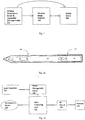
- FIG. 1 shows an embodiment of a wireless food temperature real-time monitoring system of the present disclosure.
- the wireless food temperature real-time monitoring system of the embodiment may include a wireless probe 100, a mobile device 300, and a wireless range extender 200.
- the wireless probe 100 may include a circuit board 130, a temperature sensor 110 connected to the circuit board 130 via electrical signals, and a wireless transmitter.
- the wireless transmitter may include a radio frequency (RF) circuit 132 and an antenna 150.
- the wireless probe 100 may further include a super capacitor 120 for supplying electricity.
- the supper capacitor 120 can provide electricity to the temperature sensor 110 and the wireless transmitter.
- the temperature signals generated by the radio frequency circuit 132 can be broadcast by the antenna 150.
- the radio frequency signals broadcast by the antenna 150 may be received by the mobile device 300.
- the mobile device 300 can display food temperature information by a software application (APP) running in the mobile device 300, and can provide alert signals set in accordance with the software application.
- the alert signal may include: alert to notify a user of overcook or overheat, the radio frequency signals from the wireless probe 100 are out of range, the power of the wireless probe 100 is too low, and notify the user to finish cooking immediately, the cooking time is too long, no temperature change for a long period of time, etc.
- the mobile device 300 may be a mobile phone, a tablet or any portable electronic device.
- the mobile device 300 may have the capability of receiving the radio frequency signals broadcast by the wireless probe 100 and the wireless range extender 200, and the ability to run the software application.
- the wireless probe 100 can be used to monitor the internal temperature of the food being cooked, and wirelessly broadcast the measured food temperature and related data to the wireless range extender 200 and the mobile device 300.
- the wireless range extender 200 can receive the radio frequency data broadcast by the wireless probe 100, process the data and then send it to a paired mobile device 300, such as a mobile phone, a tablet or any portable electronic device.
- a paired mobile device 300 such as a mobile phone, a tablet or any portable electronic device.
- the wireless range extender 200 can support the charging of the wireless probe 100 with a built-in battery.
- the wireless range extender 200 can be powered by an external USB power adapter. It should be understood that the wireless range extender 200 can also be powered by its own battery.
- the battery can be a rechargeable battery.
- the mobile device 300 can be used to display temperature of the food.
- the mobile device 300 can be a mobile phone, a tablet or any portable electronic device that has the ability to receive radio frequency signals broadcast by the wireless probe 100 and the wireless range extender 200, and the ability to run the software application.
- the mobile device 300 can wirelessly receive data from the wireless probe 100 or the wireless range extender 200.
- the software application can be installed in the mobile device 300, and the software application can decrypt the signals from the wireless probe 100 or the wireless range extender 200, and then display temperature of the food accordingly.
- the user can use the wireless range extender 200 to extend the monitoring range.
- the wireless receiver 210 in the wireless range extender 200 can pick up the radio frequency signals and re-transmit them to another wireless range extender 200 or a nearby paired mobile device 300.
- the mobile device 300 with the software application can receive radio frequency signals from the wireless probe 100 and the wireless range extender 220. Through the wireless range extender 200, the mobile device 300 not only can obtain food temperature information from the wireless probe 100, but can also send control signals to the wireless range extender 200 to perform temperature monitoring activities.
- the wireless probe 100 can broadcast the food temperature information to the wireless range extender 200 and the mobile device 300, which can include the following components: Temperature sensor 110:
- the temperature sensor 110 can be used for measuring temperature of the food.
- the temperature sensor 110 may include one, two or more thermal sensors to detect temperatures at different locations of the food.
- the super capacitor 120 can be used for storing electrical power and supplying the power to the electronic circuits of the circuit board 130.
- the super capacitor 120 needs to be charged through the circuit board 130 before starting the temperature measurement.
- Capacitors are commonly used in different industries for filtering, resonant circuit and backup power but not commonly used as the main power source because of its limited power/energy.
- the circuit design has been optimized in order to minimize the operating power consumption as well as the leakage current.
- the duty cycle and the instruction sets for sending digital signal via Bluetooth BLE broadcasting mode have also been optimized.
- the circuit board 130 can be a controller board that may include a wireless controller chip for processing temperature measurement from the temperature sensor 110, wireless transmission, and super capacitor charging power management.
- the circuit board 130 may have connection pins connected to the metal case 160 as grounding, which can be used as one of the signals for charging.
- the charging pole 140 can be used for charging the super capacitor 120.
- the antenna 150 can be used for converting electrical signals into wireless signals.
- Metal case 160 As a heat conductor, can transfer heat from outside to the temperature sensor 110. In use, the metal case 160 can be inserted into the food.
- Ceramic cap 170 The ceramic cap 170 can be a ceramic component for thermal protection. The ceramic cap 170 may protrude outside the food and work in a high temperature environment.
- the circuit board 130 can be a controller board that can handle temperature monitoring, power management, and radio frequency transmission.
- the circuit board 130 may include a main processing unit 131, a radio frequency circuit 132, and a power management circuit 133.
- the main processing unit 131 may be used to control the power management circuit 133.
- the power management circuit 133 can manage the charging of the super capacitor 120 and the power consumption of the circuit board 130. The idle of the system, the sensing of temperature, and the timing control of transmission can be controlled by the power management circuit 133.
- the main processing unit 131 can receive temperature data from the temperature sensor 110.
- the temperature data can be encrypted by the main processing unit 131, and then sent to the radio frequency circuit 132 for data transmission.
- the radio frequency circuit 132 can transmit the data via the antenna 150.
- the wireless range extender 200 can be used to re-transmit the data transmitted from the wireless probe 100 in order to extend the wireless coverage range. It may also include a charger for charging the wireless probe 100.
- the wireless range extender 200 may include the following components: Wireless receiver 210 and antenna 211: The antenna 211 and the wireless receiver 210 can be used to receive signals transmitted from the wireless probe 100.
- the data can be decrypted by a main processing unit 260.
- the main processing unit 260 can support the receiving of data from one or more wireless probes 100.
- Wireless transceiver 220 and antenna 221 The wireless transceiver 220 and the antenna 221 can be used for transmitting and receiving data to/from the mobile device 300. Data collected from the wireless probe 100 can be processed in the main processing unit 260. The data can be transmitted to the wireless transceiver 220 and the antenna 221, and then transmitted to the mobile device 300. The wireless transceiver 220 and the antenna 221 can also receive control command data from mobile device 300. In addition, the main processing unit 260 can also work as a master device to control a power management circuit 230 and an alert system 240.
- Power management circuit 230 can be used for charging the wireless probe 100. It can be connected to a wireless probe charging circuit 233.
- the power management circuit 230 can receive power from a USB 231 or a battery 232. It may include switches for switching the power on and off for probe detection purposes.
- the power management circuit 230 can determine whether the wireless probe 100 is placed in a proper position. Once the wireless probe 100 is in a proper position, the charging process begins. When the charging is completed, the power management circuit 230 stops charging.
- the alert system 240 may include an LED 241 and a sound-emitting device 242 to indicate the status of charge and wireless connection.
- the wireless probe 100 can transmit data by broadcasting to extend the operation period of the wireless probe 100 in order to cover the cooking time.
- the power management scheme can ensure the operation of the wireless probe throughout the cooking process.
- the power management scheme can be implemented to reduce power consumption of the wireless probe 100 powered by the charged super capacitor.
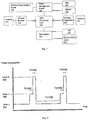
- FIG. 4 shows a power management scheme implemented by the wireless probe 100.
- T1 (410) represents the idle period of the wireless probe 100. Power consumption is kept at the lowest level 1 (400).
- T2 (420) is the temperature detection time when the power consumption is at level 2 (450). This is the detection period.
- the main processing unit 131 can turn off the temperature sensor 110 and turn on the radio frequency circuit 132.
- the data can be sent via the antenna 150.
- the sending period is T3 (430) and the power consumption is at level 3 (460). This is the transmission period.
- the wireless probe 100 can return to the sleep mode. After a period of time T1 (410), it can be activated again. The wireless probe 100 consumes power during the transmission period and consumes less power during the idle period.
- FIG. 1 The simplest topology is shown in FIG. 1 , which is one-to-one communication.
- the mobile device 300 can directly receive broadcast signals from the wireless probe 100.
- the food temperature data can be broadcast by the wireless probe 100 via radio frequency signals.
- the wireless range extender 200 can receive the radio frequency signals and re-transmit the food temperature data to the mobile device 300.
- the broadcast signal of one wireless probe 100 can be received by many mobile devices 300 and wireless range extenders 200 paired with the mobile devices 300.
- FIG. 5 shows one wireless probe 100 broadcasting data, and eleven mobile devices 300 receiving signals.
- the wireless range extender 200 paired with the mobile device 300 can also receive the data. It should be understood that FIG. 5 is only an example, and the number of the mobile devices 300 and wireless range extenders 200 that receive the data may be unlimited.
- FIG. 6 shows five wireless probes 100 broadcasting data and one mobile device 300 receiving all of the signals. It is to be understood that FIG. 6 is only an example, and the number of the wireless probes 100 broadcasting data to be received by the mobile device 300 may be unlimited.
- the broadcast signals from the wireless probe 100 can also be received by the wireless range extender 200 that is paired with the mobile device 300.
- FIG. 7 shows five wireless probes 100 broadcasting data and one wireless range extender 200 paired with one mobile device 300 which receives all the signals. It is to be understood that FIG. 7 is only an example, and the number of the wireless probes 100 broadcasting data to be received by the wireless range extender 200 paired with the mobile device 300 may be unlimited.
- Broadcast signals from many wireless probes 100 may also be received by many mobile devices 300 and many wireless range extenders 200 paired with the mobile devices 300.
- FIG. 8 shows five wireless probes 100, five mobile devices 300, and one wireless range extender 200 paired with one mobile device 300 which receives all the signals. It is to be understood that FIG. 8 is only an example, the number of the wireless probes 100, the number of the mobile devices 300, and the number of the wireless range extenders 200 paired with the mobile device 300 may be unlimited.
- thermometers are analogue devices that require a user to stand close to the thermometer to read the temperature reading.
- the temperature reading cannot be captured, transmitted and stored for further process.
- the temperature reading can be captured in real time, sent out via wireless link and stored in mobile phone or mobile device for further process and manipulation. This can help the user during cooking or for future reference (i.e. learning). Therefore, with the present disclosure, the user is not required to stay very close to an oven during the whole cooking process.
- the temperature data received in the mobile phone/mobile device can help the user to automatically monitor the food status, provide notification to the user when the temperature is close to the target temperature, and ask the user to attend to the cooking in the oven.
- a lot of additional features can be implemented such as time reminder, temperature reminder, cooking curve recording, preset target temperature according to the type of meat, cut of meat and target doneness can be implemented in the mobile App. Alerts and notifications can be used to remind the user. Moreover, the cook setting and cooking results can be shared on social media.
Landscapes
- Physics & Mathematics (AREA)
- General Physics & Mathematics (AREA)
- Engineering & Computer Science (AREA)
- Computer Networks & Wireless Communication (AREA)
- Signal Processing (AREA)
- Measuring Temperature Or Quantity Of Heat (AREA)
- Arrangements For Transmission Of Measured Signals (AREA)
Applications Claiming Priority (2)
| Application Number | Priority Date | Filing Date | Title |
|---|---|---|---|
| US201862630213P | 2018-02-13 | 2018-02-13 | |
| CN201810327693.3A CN110146183A (zh) | 2018-02-13 | 2018-04-12 | 用于食物的无线探头以及无线温度实时监测系统 |
Publications (1)
| Publication Number | Publication Date |
|---|---|
| EP3527965A1 true EP3527965A1 (fr) | 2019-08-21 |
Family
ID=65243356
Family Applications (1)
| Application Number | Title | Priority Date | Filing Date |
|---|---|---|---|
| EP19154108.5A Withdrawn EP3527965A1 (fr) | 2018-02-13 | 2019-01-29 | Sonde sans fil pour aliments et système et procédé de surveillance sans fil en temps réel de température d'aliments |
Country Status (2)
| Country | Link |
|---|---|
| US (1) | US10883883B2 (fr) |
| EP (1) | EP3527965A1 (fr) |
Families Citing this family (16)
| Publication number | Priority date | Publication date | Assignee | Title |
|---|---|---|---|---|
| US10883883B2 (en) | 2018-02-13 | 2021-01-05 | Manford Development Limited | Wireless probe for food, and system and method for wireless food temperature real-time monitoring |
| CA3106395C (fr) * | 2018-11-09 | 2025-04-01 | Abb Schweiz Ag | Embout isolant de base et système électrique |
| EP4073767A4 (fr) * | 2019-12-10 | 2024-01-31 | Barnes Group Inc. | Capteur sans fil à technologie de balise |
| US20210270678A1 (en) * | 2020-02-28 | 2021-09-02 | ThermoWorks Inc. | Paired base unit and receiver for long-range, wireless monitoring of thermometer temperatures |
| US12239256B2 (en) * | 2021-04-07 | 2025-03-04 | Wh Products, Llc | Outdoor cooking appliance control system |
| CN113358242A (zh) * | 2021-06-07 | 2021-09-07 | 哈尔滨纽微电机控制技术有限公司 | 一种无线温度传感器 |
| US20230262128A1 (en) * | 2022-02-15 | 2023-08-17 | Saudi Arabian Oil Company | Intelligent environmental health device |
| WO2023172412A1 (fr) | 2022-03-09 | 2023-09-14 | Matrix Product Development, Inc. | Sonde de température avec contacts de charge noyés dans des aliments |
| CN114858295A (zh) * | 2022-04-29 | 2022-08-05 | 广东美的厨房电器制造有限公司 | 温度检测装置及其控制方法、装置、可读存储介质和设备 |
| CN218683844U (zh) * | 2022-08-12 | 2023-03-24 | 宁波吉盛电器有限公司 | 具备温度控制的烹饪装置 |
| USD1101580S1 (en) | 2024-01-31 | 2025-11-11 | Sharkninja Operating Llc | Temperature probe holder |
| CN222652383U (zh) * | 2024-03-18 | 2025-03-21 | 上海馨祁电子科技有限公司 | 一种食物温度计及食物温度检测系统 |
| USD1046643S1 (en) * | 2024-03-27 | 2024-10-15 | Yaobing Deng | Meat thermometer |
| USD1046642S1 (en) * | 2024-03-27 | 2024-10-15 | Finemold Technologies Co., Ltd | Meat thermometer |
| WO2025231110A1 (fr) * | 2024-05-01 | 2025-11-06 | Weber-Stephen Products Llc | Sonde de température sans fil |
| CN119833798A (zh) * | 2024-12-27 | 2025-04-15 | 国家电网有限公司 | 用于电池内部测温的无源无线温度传感器系统及方法 |
Citations (4)
| Publication number | Priority date | Publication date | Assignee | Title |
|---|---|---|---|---|
| EP1624724A1 (fr) * | 2004-07-23 | 2006-02-08 | ANGELO PO GRANDI CUCINE S.p.A. | Système et sonde pour la détection d' au moins un parametre |
| US20150300887A1 (en) * | 2014-04-21 | 2015-10-22 | Inteligistics, Inc. | System, Method, and Apparatus for Temperature Monitoring and Visibility |
| WO2016210356A1 (fr) | 2015-06-25 | 2016-12-29 | Apption Labs Ltd. | Thermomètre pour aliments et procédé pour l'utiliser |
| US20190250044A1 (en) | 2018-02-13 | 2019-08-15 | Manford Development Limited | Wireless probe for food, and system and method for wireless food temperature real-time monitoring |
Family Cites Families (10)
| Publication number | Priority date | Publication date | Assignee | Title |
|---|---|---|---|---|
| US7075442B2 (en) * | 2003-07-07 | 2006-07-11 | Mastrad Sa | Food temperature monitoring device |
| US8931400B1 (en) * | 2009-05-28 | 2015-01-13 | iDevices. LLC | Remote cooking systems and methods |
| DK178659B1 (en) * | 2014-10-14 | 2016-10-17 | Nels Nielsen | Wireless cooking thermometer |
| US10067004B1 (en) * | 2014-11-04 | 2018-09-04 | Weber-Stephen Products Llc | Wireless temperature monitoring systems and methods of food |
| US11920984B2 (en) * | 2016-07-14 | 2024-03-05 | Mastrad | Wireless temperature probe |
| US10598549B2 (en) * | 2016-08-04 | 2020-03-24 | The Vollrath Company, L.L.C. | Wireless temperature probe |
| JP6820188B2 (ja) * | 2016-12-01 | 2021-01-27 | 川崎重工業株式会社 | 鉄道車両の状態監視装置 |
| US20180353003A1 (en) * | 2017-06-08 | 2018-12-13 | Ashok Sabata | Novel Sensor Probe to Monitor Temperature during Cooking |
| US10928253B2 (en) * | 2017-07-18 | 2021-02-23 | Ewig Industries Macao Commercial Offshore Limited | Dual-sensor waterproof temperature monitoring probe and associated systems and methods |
| US20190041271A1 (en) * | 2017-08-07 | 2019-02-07 | Philip Preston | Method And Assembly For A Wireless Probe And Interrogator |
-
2019
- 2019-01-28 US US16/258,701 patent/US10883883B2/en active Active
- 2019-01-29 EP EP19154108.5A patent/EP3527965A1/fr not_active Withdrawn
Patent Citations (4)
| Publication number | Priority date | Publication date | Assignee | Title |
|---|---|---|---|---|
| EP1624724A1 (fr) * | 2004-07-23 | 2006-02-08 | ANGELO PO GRANDI CUCINE S.p.A. | Système et sonde pour la détection d' au moins un parametre |
| US20150300887A1 (en) * | 2014-04-21 | 2015-10-22 | Inteligistics, Inc. | System, Method, and Apparatus for Temperature Monitoring and Visibility |
| WO2016210356A1 (fr) | 2015-06-25 | 2016-12-29 | Apption Labs Ltd. | Thermomètre pour aliments et procédé pour l'utiliser |
| US20190250044A1 (en) | 2018-02-13 | 2019-08-15 | Manford Development Limited | Wireless probe for food, and system and method for wireless food temperature real-time monitoring |
Non-Patent Citations (1)
| Title |
|---|
| MEATER: "Introduction to MEATER - The First Wireless Smart Meat Thermometer", YOUTUBE, 26 May 2017 (2017-05-26), XP054981270, Retrieved from the Internet <URL:https://www.youtube.com/watch?v=wlhfY8OriwU> |
Also Published As
| Publication number | Publication date |
|---|---|
| US10883883B2 (en) | 2021-01-05 |
| US20190250044A1 (en) | 2019-08-15 |
Similar Documents
| Publication | Publication Date | Title |
|---|---|---|
| US10883883B2 (en) | Wireless probe for food, and system and method for wireless food temperature real-time monitoring | |
| US12571688B2 (en) | Wireless multi-point food thermometer | |
| US10801897B2 (en) | Thermometer and temperature monitoring system | |
| EP1646851B1 (fr) | Dispositif de surveillance de la temperature d'un aliment | |
| CN110146183A (zh) | 用于食物的无线探头以及无线温度实时监测系统 | |
| US20180353003A1 (en) | Novel Sensor Probe to Monitor Temperature during Cooking | |
| US9706267B2 (en) | iCelsius wireless: wireless monitoring with smart phones and tablets | |
| US20140039650A1 (en) | Device for monitoring and/or controlling the operation of at least one household appliance by means of at least one portable communication terminal | |
| KR20210127748A (ko) | 무선 충전 수신기 회로를 가지는 안경, 안경용 안경 케이스, 및 시스템 | |
| CN105125182A (zh) | 一种智能体温监控报警方法及系统 | |
| WO2014175433A1 (fr) | Dispositif de commande, système de gestion d'énergie, procédé de commande à distance, et programme | |
| CN114302661A (zh) | 烹饪器具的温度感测设备和无线通信改进 | |
| CN110870701A (zh) | 一种温度检测装置及方法、烤箱、计算机设备、存储介质 | |
| CN105125058A (zh) | 一种具有自发电功能的智能测温炊具 | |
| CN104916073A (zh) | 基于定位功能的监护装置及其工作方法 | |
| CN106254193B (zh) | 用于检测自动化设备运行状态的现场总线装置 | |
| CN208939600U (zh) | 用于信标和/或传感器设备的无线充电的系统 | |
| CN207637098U (zh) | 一种手势控制开关 | |
| CN213543813U (zh) | 一种具有温湿度传感器的便携式热像仪系统 | |
| CN110392351A (zh) | 一键式数据传输模块及其方法 | |
| CN212755334U (zh) | 可携式瓦斯烤肉炉 | |
| CN209778322U (zh) | 烹饪器具和烹饪系统 | |
| CN213579793U (zh) | 一种具有远程温度监控功能的温度计 | |
| CN221356461U (zh) | 一种可监测体温的枕头 | |
| EP3816761B1 (fr) | Procédés et appareils de commande du chauffage basés sur la surveillance de la rétroaction de capteurs de température |
Legal Events
| Date | Code | Title | Description |
|---|---|---|---|
| PUAI | Public reference made under article 153(3) epc to a published international application that has entered the european phase |
Free format text: ORIGINAL CODE: 0009012 |
|
| STAA | Information on the status of an ep patent application or granted ep patent |
Free format text: STATUS: REQUEST FOR EXAMINATION WAS MADE |
|
| 17P | Request for examination filed |
Effective date: 20190129 |
|
| AK | Designated contracting states |
Kind code of ref document: A1 Designated state(s): AL AT BE BG CH CY CZ DE DK EE ES FI FR GB GR HR HU IE IS IT LI LT LU LV MC MK MT NL NO PL PT RO RS SE SI SK SM TR |
|
| AX | Request for extension of the european patent |
Extension state: BA ME |
|
| STAA | Information on the status of an ep patent application or granted ep patent |
Free format text: STATUS: EXAMINATION IS IN PROGRESS |
|
| 17Q | First examination report despatched |
Effective date: 20200515 |
|
| STAA | Information on the status of an ep patent application or granted ep patent |
Free format text: STATUS: THE APPLICATION IS DEEMED TO BE WITHDRAWN |
|
| 18D | Application deemed to be withdrawn |
Effective date: 20201126 |