EP3528400B1 - Procédé pour éviter des congestions dans un réseau de données avec des dispositifs de transmission tels que des modems communiquant avec des satellites par des modifications statiques et spécifiques des intervalles temporels de transmission des dispositifs. - Google Patents
Procédé pour éviter des congestions dans un réseau de données avec des dispositifs de transmission tels que des modems communiquant avec des satellites par des modifications statiques et spécifiques des intervalles temporels de transmission des dispositifs. Download PDFInfo
- Publication number
- EP3528400B1 EP3528400B1 EP18208420.2A EP18208420A EP3528400B1 EP 3528400 B1 EP3528400 B1 EP 3528400B1 EP 18208420 A EP18208420 A EP 18208420A EP 3528400 B1 EP3528400 B1 EP 3528400B1
- Authority
- EP
- European Patent Office
- Prior art keywords
- data
- devices
- relay station
- transmission
- population
- Prior art date
- Legal status (The legal status is an assumption and is not a legal conclusion. Google has not performed a legal analysis and makes no representation as to the accuracy of the status listed.)
- Active
Links
Images



Classifications
-
- H—ELECTRICITY
- H04—ELECTRIC COMMUNICATION TECHNIQUE
- H04B—TRANSMISSION
- H04B7/00—Radio transmission systems, i.e. using radiation field
- H04B7/14—Relay systems
- H04B7/15—Active relay systems
- H04B7/185—Space-based or airborne stations; Stations for satellite systems
- H04B7/1851—Systems using a satellite or space-based relay
- H04B7/18513—Transmission in a satellite or space-based system
-
- H—ELECTRICITY
- H04—ELECTRIC COMMUNICATION TECHNIQUE
- H04B—TRANSMISSION
- H04B7/00—Radio transmission systems, i.e. using radiation field
- H04B7/14—Relay systems
- H04B7/15—Active relay systems
- H04B7/185—Space-based or airborne stations; Stations for satellite systems
- H04B7/1853—Satellite systems for providing telephony service to a mobile station, i.e. mobile satellite service
- H04B7/18539—Arrangements for managing radio, resources, i.e. for establishing or releasing a connection
- H04B7/18543—Arrangements for managing radio, resources, i.e. for establishing or releasing a connection for adaptation of transmission parameters, e.g. power control
-
- H—ELECTRICITY
- H04—ELECTRIC COMMUNICATION TECHNIQUE
- H04B—TRANSMISSION
- H04B7/00—Radio transmission systems, i.e. using radiation field
- H04B7/14—Relay systems
- H04B7/15—Active relay systems
- H04B7/185—Space-based or airborne stations; Stations for satellite systems
- H04B7/18578—Satellite systems for providing broadband data service to individual earth stations
- H04B7/18584—Arrangements for data networking, i.e. for data packet routing, for congestion control
-
- H—ELECTRICITY
- H04—ELECTRIC COMMUNICATION TECHNIQUE
- H04B—TRANSMISSION
- H04B7/00—Radio transmission systems, i.e. using radiation field
- H04B7/14—Relay systems
- H04B7/15—Active relay systems
- H04B7/204—Multiple access
- H04B7/212—Time-division multiple access [TDMA]
- H04B7/2125—Synchronisation
-
- H—ELECTRICITY
- H04—ELECTRIC COMMUNICATION TECHNIQUE
- H04W—WIRELESS COMMUNICATION NETWORKS
- H04W28/00—Network traffic management; Network resource management
- H04W28/02—Traffic management, e.g. flow control or congestion control
- H04W28/0268—Traffic management, e.g. flow control or congestion control using specific QoS parameters for wireless networks, e.g. QoS class identifier [QCI] or guaranteed bit rate [GBR]
-
- H—ELECTRICITY
- H04—ELECTRIC COMMUNICATION TECHNIQUE
- H04W—WIRELESS COMMUNICATION NETWORKS
- H04W28/00—Network traffic management; Network resource management
- H04W28/02—Traffic management, e.g. flow control or congestion control
- H04W28/10—Flow control between communication endpoints
- H04W28/12—Flow control between communication endpoints using signalling between network elements
-
- H—ELECTRICITY
- H04—ELECTRIC COMMUNICATION TECHNIQUE
- H04W—WIRELESS COMMUNICATION NETWORKS
- H04W74/00—Wireless channel access
- H04W74/08—Non-scheduled access, e.g. ALOHA
-
- H—ELECTRICITY
- H04—ELECTRIC COMMUNICATION TECHNIQUE
- H04B—TRANSMISSION
- H04B7/00—Radio transmission systems, i.e. using radiation field
- H04B7/14—Relay systems
- H04B7/15—Active relay systems
- H04B7/185—Space-based or airborne stations; Stations for satellite systems
- H04B7/18578—Satellite systems for providing broadband data service to individual earth stations
- H04B7/18586—Arrangements for data transporting, e.g. for an end to end data transport or check
-
- H—ELECTRICITY
- H04—ELECTRIC COMMUNICATION TECHNIQUE
- H04W—WIRELESS COMMUNICATION NETWORKS
- H04W28/00—Network traffic management; Network resource management
- H04W28/02—Traffic management, e.g. flow control or congestion control
- H04W28/0289—Congestion control
Definitions
- the invention relates to a method for managing a population of devices transmitting data to a relay station in order to optimize the network occupation and data transmission.
- Satellites are orbiting around the world gathering data, via data connections, from a growing number of devices (such as modems) on earth. Every satellite is limited in regard the number of data connections it can handle concurrently. Therefore when a satellite passes an area with a lot of devices in its footprint, and each of these devices tries to setup a data connection to the satellite, congestion problems occur when the number of data connections exceeds the number of data connections the satellite can handle. More in general congestion problems occur when too many devices in a network try to connect to a relay station at more or less the same time.
- US9763253 according to its abstract describes "Methods and systems are described which provide solutions for determining how to allocate terminals to slots in order to maximize communication system performance in the case where there is no feedback channel between a multiuser satellite receiver and terminals within the field of view.
- Terminals operate independently of each other and choose transmission slots based upon the geographic position of the terminal.
- Terminals can be programmed with a slot selector to choose slots according to some deterministic or nondeterministic function of the current position.
- a slot plan database may be used to assist in efficient slot selection.
- Regular and irregular grid based allocation methods are described, that reduce the likelihood that too many terminals transmit using the same slot within the field of view.
- Satellite induced Doppler effects can be utilized be further increase slot re-use and to improve allocation of slots so that the receiver sees an approximately uniform distribution of frequencies over the frequency band to improve system throughput.
- the approaches described herein greatly reduce or eliminate the probability of failure at the receiver, which has numerous implementation advantages such as reduced cost, complexity, and power consumption.”
- US7650379 according to its abstract describes "A method for managing data traffic in a multi-user multiple-simultaneous-access (MUMSA) environment, for example in a code reuse multiple access (CRMA) environment or other physical environment having true random access with more than one transmission present at the same time, the method including estimating channel load for multiple users, then using the estimate of channel load to calculate a congestion threshold on an ongoing basis, at each terminal performing an experiment using that congestion threshold value and a random number generator to determine if a packet is eligible to be transmitted, transferring downstream virtual channel traffic and redistributing user terminals to affiliate with the proper downstream virtual channel.”
- MUMSA multi-user multiple-simultaneous-access
- CRMA code reuse multiple access
- Satellite communications are carried out using the Data Over Cable Interface Specification (DOCSIS). Satellite modems are notified of upstream channel congestion by inserting a congestion notification message in a medium access protocol (MAP) message for the upstream channel. Specifically, the congestion notification message is inserted in an unused field of the MAP message, such as the explicit congestion notification (ECN) field.
- MAP medium access protocol
- ECN explicit congestion notification
- the MAP message can also carry other characteristics of the upstream channel, including priority threshold, multicast access burst availability, and available bandwidth.”
- US6625118 according to its abstract describes "In a packet network, on receiving a packet a receiving host determines if the packet has been marked by any of the nodes through which it passed, to indicate congestion at that node, e.g. by checking the CE bit in an IP header.
- a packet flow control parameter is generated at the receiving side, and sent to the source using an Internet Protocol, as part of the packet acknowledgment, to control the flow of packets from the source, according to the packet flow control parameter. This can reduce control loop delays caused by waiting at the source for a number of acknowledgments to arrive before the congestion level can be calculated. Conditions at the receiver which may be different to those at the source can now be taken into account in the flow control.”
- US5659545 according to its abstract describes "To obtain service from a satellite communication system, a mobile subscriber unit must acquire a TDMA communication channel. Because the satellites move with respect to the surface of the earth, propagation delays and Doppler shift affect the timing and frequency of received signals. A mobile subscriber unit synchronizes to the frequency and timing windows of a satellite communication station by receiving frequency and timing corrections during channel acquisition. The satellite initially estimates correction factors during initial acquisition requests and further estimates correction factors from synchronization bursts from the subscriber unit.”
- WO02/05457 In a mobile satellite telecommunications system, divers telecommunications paths are established between a user terminal UT 1 and a satellite access node SAN 1 via two earth orbiting satellites (3a, 3b). Link control is performed in order to compensate for Doppler shift and timing variations which occur due to orbital movement of the satellites. Data concerning the differential timing errors for TDMA bursts transmitted over the two paths from SAN 1 to UT 1 are determined at UT1 together with the differential Doppler shift between signals received over the two paths. THe differential timing information and the differential Doppler shift information is encoded in to a slow access control channel associated with the traffic channel which passes back from UT1 to SAN1.
- This data is used at SAN 1 in order to produce control parameter data which is transmitted back to the UT in order to control the offsets used by the UT to correct timing errors and Doppler shifts.
- the signal formats are usable in full, partial and switched diversity modes in which both or only one of the up and downlink paths are used.”
- a subscriber unit (30) operates in a synchronous communication system having dynamic nodes such as satellites (12). Satellites (12) employ a strict transmit and receive time window and all transmissions directed to satellites (12) must fall within the receive window to be recognized.
- propagation timing between a satellite (12) and a subscriber unit (30) vary rapidly over a wide range. Subscriber unit (30) must approximate a transmit timing advance for use in activating a transmission to satellite (12). Subscriber unit (30) utilizes a valid geolocation position when available but when a position is unavailable or stale, relies on configuration characteristics of the constellation for generating an initial approximation of propagation delay.”
- the invention provides the management of a network with a population of devices transmitting data to a relay station in order to optimize the network occupation and data transmission. Congestion problems in the network are being avoided or when they occur, they are being solved. As a result power consumption of the devices is reduced. Therefore the invention provides a better Quality of Service (QoS) within the network.
- QoS Quality of Service
- the invention provides a method according to claim 1. Further, the invention is defined by a system according to claim 11, a device according to claim 12, and a computer program product according to claim 14.
- CDMA Code Division Multiple Access
- FDMA Frequency Division Multiple Access
- TDMA Time Division Multiple Access
- CDMA uses both time and frequency and 'stacks' signals on top of each other where every signal is recognizable with a certain scrambling and/or spreading code. For random access systems this is the most useful channel access method. Though, when time splitting between broadcasts is done this could get an improved performance. For example when the first time window X has time divided slots and the second window Y has full random access, the two methods can be combined to create a more efficient use of spectrum.
- the first window X does not need to use CDMA with fixed time slots, so when starting to time split transmission windows changing channel access methods and protocols can be either more efficient for fixed slots (of any kind) or random access to maximize channel throughput when modems have shown to be predictable users of the network.
- Other well-known channel access methods include OFDMA (Orthogonal Frequency Division Multiple Access), SDMA (Spatial Division Multiple Access) and PDMA (Polarization Division Multiple Access). Further channel access methods do exist. The invention use any channel access method.
- a transmission window of a device is a window of time wherein a transmission of a device can be received by a relay station.
- travelling relates to going from a first position to a second position.
- This is also referred to as displacing, i.e., going from one place or location to another.
- the device, the relay station, or both follow a trajectory.
- Such a trajectory may be periodic.
- the relay station is in an orbit around for instance the earth, the moon, or another celestial body.
- the device, population of devices, and/or the relay station may go along, or follow, a track or path.
- the modified transmission slot can for instance result in that one or more of the devices will not transmit their data to the relay station at the current opportunity, but will wait for a next opportunity in case the relay station passes frequently or at regular time intervals. It may also mean that devices will wait for a next of another, similar relay station to pass the transmission window or when they receive a broadcast from such other, similar relay station.
- the devices are also referred to as modems or other communication devices.
- the relay station is referred to as a satellite, a drone or any other vehicle.
- a broadcast footprint and transmission window may sweep over the surface of the earth of another celestial body very fast, making such a transmission window short, which may cause congestion.
- devices or modems in a population do not need a control channel through which a satellite as relay station can inform the population of modems when to send in order to avoid overlapping signals.
- the modems can randomize their transmission over a time window during the pass of a satellite. They will prefer sending when the satellite is in an optimal distance and elevation angle to the modem. When the density of modems in an area goes up, it could be that there are too many signals at the same time to allow for reception of all these signals. The satellite will inform the ground systems that it was not able to receive messages during a certain time because of congestion.
- the transmission slot of the modems can be optimized to be within a time in seconds of a required service level of a modem.
- the device (or modem) service level can comprises the time interval for sending updates, from gathered data, to a satellite or relay station; for example once a day, or 3 times a week or once a month.
- the modems can be reconfigured to randomize transmission over a longer/shorter slot to get a statistically optimal network occupation and data transmission.
- the specific modem can be reconfigured to transmit over a longer/shorter slot to get a specific network occupation and data transmission.
- Gathered data can include information for such as tracking of powered and unpowered assets, such as the position of fishing vessels, railcars, trailers, machines or assets that cannot move by themselves but of which the location is often lost or unknown, such as large equipment, mobile toilets, etc. Also, monitoring of external conditions such as in smart agriculture, where soil status is measured for yield optimization, or climate stations.
- Terrestrial networks are often not available and can take a long time to create. Due to the introduction of low cost satellites and especially low earth orbit (LEO) satellites, satellite networks become more and more popular to distribute data over the earth. A trend not only for rural areas, where terrestrial networks are unavailable, but also for other areas where there is a need for a quick and easy way to provide data distribution.
- LEO low earth orbit
- sensor data is suited for distribution by low cost satellite networks with limited bandwidth, since, in general, this kind of data comprises relatively small data packages.
- sensor data updates often don't need to be sent every minute, and can be sent every few hours, for example to track a vehicle or even once per year, for example to track the position of a coastline.
- sensors that have a notification function and only need to transmit data when an event occurs, for example when the content of a tank drops below a threshold.
- Satellites are objects orbiting celestial bodies, such as the earth.
- the channel access method is selected from the group of FDMA, TDMA, CDMA, OFDMA, SDMA, PDMA or a combination thereof.
- the instruction causes a division of said population of devices into at least two groups of devices.
- at least one group has a modified transmission slot for transmitting said data to said relay station.
- the broadcast comprises a broadcast transmission window defining a footprint of said relay station.
- the population of devices is positioned within said footprint during said broadcast.
- At least a number of said devices of said population of devices each initiate a data connection to said relay station resulting in a congestion that causes failing of at least part of said data connections to said relay station.
- the relay station has a data receiving capacity and said failing comprises said data receiving capacity being not enough to receive said data transmission from said population of devices.
- the setting of said modified transmission slot comprises interrupting a transmission slot.
- the channel access method is TDMA and the setting of said modified transmission slot comprises at least one selected from replacing an actual device position for a virtual device position, modifying a transmission slot length, modifying a transmission slot start, modifying a transmission slot end, interrupting a transmission slot and a combination thereof.
- An actual device position corresponds with the position, or the coordinates (latitude/longitude), where a device is actually located on earth or on a celestial body.
- a virtual device position corresponds with the position, or the coordinates (latitude/longitude), where a device is virtually located on earth or a celestial body in order to set its modified transmission slot.
- the coordinates of a virtual device position do not have to correspond with that of an actual device position.
- the relay station has a data receiving capacity
- said modified transmission slot is set for statistically distributing said data transmission of said population of devices for matching said data receiving capacity
- the setting of said modified transmission slot is derived from simulating transmission scenarios using a density model of said population of devices.
- a model and calculation may be done remotely from said relay station and/or said population of devices.
- remote server or server system runs said model and provide results to a relay station.
- At least part of said devices of said population of devices each comprises a device service level defining a time interval for transmitting data.
- a device service level may for instance define at which intervals in time a device can send data. For instance, a device may send daily, weekly, or monthly, based upon this service level. Within such a time interval, a device may thus look for an opportunity to transmit its data to relay station.
- the relay station broadcasts a further instruction or modified transmission slot to said population of devices before said data transmission, wherein upon receiving said instruction at least one device of said population of devices sets a further modified transmission slot.
- the relay station is a satellite orbiting a celestial body.
- the devices comprise at least one sensor providing measurement data, and a data transmitter for transmitting said data to said relay station remote from said device, wherein said data comprises said measurement data.
- the invention further relates to a system comprising a relay station and a population of devices for transmitting data to said at least one relay station, said relay station and said population of devices travelling with respect to one another, wherein each device of said population of devices has a transmission window and at least one transmission slot resulting from a channel access method for transmitting said data to said relay station, wherein said relay station is adapted for broadcasting an instruction to said population of devices when it travels within said transmission windows and before said data transmission, wherein said devices of said population of devices are adapted for setting a modified transmission slot in response to said instruction.
- the invention further relates to a device for transmitting data to a remote relay station, said device comprising a data processor and software which, when running on said data processor, comprises a transmission window and a transmission slot setting, receives a broadcast instruction from said relay station, modifies said transmission slot for providing a modified transmission slot, and transmits said data to said relay station in said modified transmission slot.
- the invention further relates to a data acquisition system comprising a relay station, a server and at least one device as described above.
- the at least one device and said relay station travel with respect to one another and said relay station transmits data received from said at least one device to said server.
- the relay station travels with respect to said server.
- the data acquisition system comprises a population of said devices, wherein said devices in said population of devices are functionally stationary with respect to one another.
- the device can comprise a sensor or can for instance comprise a camera, sensors for climate conditions like humidity, temperature, light level, carbon dioxide, other gasses, air pressure, but also for physical parameters like conductivity, for organic entities like bacteria and viruses, for composition of liquid chemical compounds.
- the invention further pertains to a computer program product for controlling a device that forms part of a population of devices for transmitting data to a relay station, said device and said relay station travelling with respect to one another, said computer program product:
- the invention further pertains to a computer program product for controlling a relay station for receiving data transmitted by a population of devices, said population of device and said relay station travelling with respect to one another, and said computer program product:
- the invention further pertains to a method for transmitting data from a population of devices to a relay station travelling with respect to one another, wherein each device comprises a transmission window and at least one transmission slot, for transmitting said data to said relay station, wherein said relay station is travelling within said transmission windows, and wherein said relay station broadcasts an instruction to said population of devices before said data transmission, wherein upon receiving said instruction at least part of said population of devices sets a modified transmission slot.
- statically when used herein, relates to dealing with the collection, analysis, interpretation, presentation, and organization of data. In particular, it comprises modeling behavior of a population. Using probability distributions, a probability of optimizing transmission reliability is calculated and predicted.
- substantially when used herein, such as in “substantially all emission” or in “substantially consists”, will be understood by the person skilled in the art.
- the term “substantially” may also include embodiments with “entirely”, “completely”, “all”, etc. Hence, in embodiments the adjective substantially may also be removed.
- the term “substantially” may also relate to 90% or higher, such as 95% or higher, especially 99% or higher, even more especially 99.5% or higher, including 100%.
- the term “comprise” includes also embodiments wherein the term “comprises” means “consists of”.
- the term “functionally” is intended to cover variations in the feature to which it refers, and which variations are such that in the functional use of the feature, possibly in combination with other features it relates to in the invention, that combination of features is able to operate or function. For instance, if an antenna is functionally coupled or functionally connected to a communication device, received electromagnetic signals that are receives by the antenna can be used by the communication device.
- the word “functionally” as for instance used in “functionally parallel” is used to cover exactly parallel, but also the embodiments that are covered by the word “substantially” explained above.
- “functionally parallel” relates to embodiments that in operation function as if the parts are for instance parallel. This covers embodiments for which it is clear to a skilled person that it operates within its intended field of use as if it were parallel.
- the invention further applies to an apparatus or device comprising one or more of the characterizing features described in the description and/or shown in the attached drawings.
- the invention further pertains to a method or process comprising one or more of the characterizing features described in the description and/or shown in the attached drawings.
- the current drawings relate to an embodiment where devices are positioned on the earth and one or more relay stations circling the earth. Other similar embodiments can be thought of A device does not need to be stationary. Many devices can be deployed in an area.
- the relay station can for instance comprise any vehicle, including a drone. These relay stations can have a trajectory that pass the device frequently, for instance with regular time intervals.
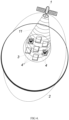
- FIG 1 In FIG 1 . is shown a satellite 1 in an orbit 2 and with a footprint 3. Within said footprint 3 there are seven modems 4 trying to initiate a connection 5. Since the receiving capacity of satellite 1 is not enough to handle all connections 5, the modems 4 fail to connect to satellite 1 depicted by cross 6.
- Satellite 1 in an orbit 2 and with a footprint 3. Satellite 1 broadcasts an instruction 10 to all modems 4 within its footprint 3. The instruction 10 is received and processed by all modems 4.
- FIG 3 is shown a situation after satellite 1 has broadcast an instruction 10 ( FIG 2 .) to all modems 4 and 4' within its footprint 3 in order to limit the number of concurrent connections (see FIG 1 . connections 5) and to prevent these connections to fail. Now, due to the instruction, not all modems 4 and 4' try to connect to satellite 1.
- First modems 4 set up a connection 5 to satellite 1; depicted by a solid connection line.
- modems 4' set up a connection 5' for data transmission; depicted by an outlined connection line.
- FIG 4 is shown a satellite 1 in an orbit 2 and with a footprint 3. Satellite 1 broadcasts another instruction 11 to all modems 4 and 4" within its footprint 3. The instruction 11 can be received by all modems 4 and 4" but only the two modems 4 process the instruction since the instruction 11 has been labeled to be processed only by these modems 4. The instruction 11 can be a further instruction after instruction 10 ( FIG 1 .) Instruction 11 further optimizes the network occupation through fine-tuning the two modems 4, depicted with a head of a bear.
- FIG 5 is shown a satellite 1 in an orbit 2 and with a footprint 3 and a satellite 21 in an orbit 22 and with a footprint 23.
- the modems 4 and 4′′′ are within footprint 3.
- the modems 4′′′ are also within footprint 23. Due to the broadcast by satellite 1 of a further instruction 12, the modems 4′′′ set a modified transmission slot based upon a virtual device position which virtually displace and a TDMA channel access method, depicted by arrow 25, the modems 4′′′ towards the center of footprint 23 of satellite 21, and outside the footprint 3 of satellite 1.
- the modems 4′′′ will setup a connection 5" with satellite 21 and not with satellite 1, since the modem 4′′′ are virtually not within footprint 3 of satellite 1 anymore.
- satellite 1 has two modems less to serve and satellite 21 has to serve two modems.
Landscapes
- Engineering & Computer Science (AREA)
- Computer Networks & Wireless Communication (AREA)
- Signal Processing (AREA)
- Physics & Mathematics (AREA)
- Astronomy & Astrophysics (AREA)
- Aviation & Aerospace Engineering (AREA)
- General Physics & Mathematics (AREA)
- Computing Systems (AREA)
- Mobile Radio Communication Systems (AREA)
- Radio Relay Systems (AREA)
Claims (14)
- Procédé pour transmettre des données d'une population de dispositifs à une station relais dans lequel la station relais se déplaçant par rapport aux population de dispositifs, dans lequel pour transmettre lesdites données à ladite station relais chaque dispositif comprend une fenêtre de transmission, la fenêtre de transmission étant une fenêtre temporelle dans laquelle une transmission de la population de dispositifs peut être reçu, et au moins un créneau de transmission résultant d'un procédé d'accès au canal (« channel access method »), dans lequel ladite station relais se déplace dans lesdites fenêtres de transmission de ladite population de dispositifs, et dans lequel ladite station relais diffuse une instruction à ladite population de dispositifs avant ladite transmission de données, dans lequel lors de la réception de ladite instruction, au moins une partie de ladite population de dispositifs règle un créneau de transmission modifiée avant ladite transmission de données,dans lequel ledit procédé d'accès au canal est TDMA ;caractériser en ce que ledit régler dudit créneau de transmission modifié comprend au moins un choisit parmi: le remplacement d'une position de dispositif réelle par une position de dispositif virtuel, la modification d'une longueur du créneau de transmission, la modification d'un début de créneau de transmission, modification d'une fin de créneau de transmission, interruption d'un créneau de transmission, et une combinaison de ceux-ci, dans lequel ladite station relais a une capacité de réception de données, et ledit créneau de transmission modifié est réglé pour distribuer statistiquement ladite transmission de données de ladite population de dispositifs pour faire correspondre ladite capacité de réception de données, dans lequel plus particulièrement ledit régler dudit créneau de transmission modifié est dérivé de la simulation de scénarios de transmission en utilisant un modèle de densité de ladite population de dispositifs.
- Procédé selon la revendication 1, dans lequel un procédé d'accès au canal additionnel est sélectionné dans le groupe FDMA, CDMA, OFDMA, SDMA, PDMA ou une combinaison de ceux-ci.
- Procédé selon la revendication 1 ou 2, dans lequel ladite instruction provoquant une division de ladite population de dispositifs en au moins deux groupes de dispositifs, dans lequel au moins un groupe a un créneau de transmission modifié pour transmettre lesdites données à ladite station relais, et/ou dans lequel dans un mode de réalisation ladite diffusion comprend une fenêtre de transmission de diffusion définissant une empreinte de ladite station relais, en particulier dans lequel ladite population de dispositifs est positionnée à l'intérieur de ladite empreinte pendant ladite diffusion.
- Procédé selon l'une quelconque des revendications précédentes, dans lequel au moins un nombre de dispositifs de ladite population de dispositifs initient chacun une connexion de données à ladite station relais résultant en un encombrement qui provoque l'échec d'au moins une partie desdites connexions de données à ladite station relais, dans lequel en particulier ladite station relais a une capacité de réception de données et ledit échec comprend ladite capacité de réception de données n'étant pas suffisante pour recevoir ladite transmission de données de ladite population de dispositifs.
- Procédé selon l'une quelconque des revendications précédentes, dans lequel ledit établissement dudit créneau de transmission modifié comprend l'interruption d'un créneau de transmission.
- Procédé selon l'une quelconque des revendications précédentes, dans lequel au moins une partie desdits dispositifs de ladite population de dispositifs comprend chacun un niveau de service de dispositif définissant un intervalle temporel pour transmettre des données.
- Procédé selon l'une quelconque des revendications précédentes, dans lequel ladite station relais diffuse une instruction supplémentaire ou un créneau de transmission modifié vers ladite population de dispositifs avant ladite transmission de données, dans lequel lors de la réception de ladite instruction, au moins un dispositif de ladite population de dispositifs définit une autre créneau de transmission modifiée.
- Procédé selon l'une quelconque des revendications précédentes, dans lequel ladite station relais est un satellite en orbite autour d'un corps céleste.
- Procédé selon l'une quelconque des revendications précédentes, dans lequel lesdits dispositifs comprennent au moins un capteur fournissant des données de mesure, et un émetteur de données pour transmettre lesdites données à ladite station relais distante dudit dispositif, dans lequel lesdites données comprennent lesdites données de mesure.
- Procédé selon l'une quelconque des revendications précédentes, dans lequel ladite population de dispositifs attend qu'une autre ou suivante station relais similaire passe la fenêtre de transmission ou lorsqu'ils reçoivent une diffusion de cette autre station relais similaire.
- Système comprenant au moins une station relais (1) et une population de dispositifs (4) pour transmettre des données à ladite au moins une station relais (1), ladite station relais (1) se déplaçant par rapport ladite population de dispositifs (4), dans lequel chaque dispositif (4) de ladite population de dispositifs (4) a une fenêtre de transmission, la fenêtre de transmission étant une fenêtre temporelle dans laquelle une transmission de la population de dispositifs peut être reçu, et au moins un créneau de transmission résultant d'un procédé d'accès à un canal pour transmettre lesdites données à ladite station relais (1), dans lequel ladite station relais (1) est adapté pour diffuser une instruction à ladite population de dispositifs (4) lorsqu'il se déplace dans lesdites fenêtres de transmission de ladite population de dispositifs et avant ladite transmission de données, dans lequel lesdits dispositifs (4) de ladite population de dispositifs (4) sont adapté pour régler un intervalle de transmission modifié en réponse à ladite instruction,dans lequel ledit procédé d'accès au canal est TDMA;caractériser en ce que ledit régler dudit créneau de transmission modifié comprend au moins un choisit parmi: le remplacement d'une position de dispositif réelle par une position de dispositif virtuel, la modification d'une longueur de créneau de transmission, la modification d'un début de créneau de transmission, modification d'une fin de créneau de transmission, interruption d'un créneau de transmission, et une combinaison de ceux-ci, dans lequel ladite station relais a une capacité de réception de données, et ledit créneau de transmission modifié est réglé pour distribuer statistiquement ladite transmission de données de ladite population de dispositifs pour faire correspondre ladite capacité de réception de données, dans lequel plus particulièrement ledit réglage dudit créneau de transmission modifié est dérivé de la simulation de scénarios de transmission en utilisant un modèle de densité de ladite population de dispositifs.
- Dispositif (4) pour transmettre des données à une station relais distante (1), ledit dispositif (4) comprenant un processeur de données et un logiciel qui, lorsqu'il s'exécute sur ledit processeur de données :- comprend un réglage de fenêtre de transmission, dans lequel ledit fenêtre de transmission est une fenêtre temporelle dans lequel un transmission d'un dispositif peut être reçut par ledit station relais, et un réglage de créneau de transmission résultant d'un procède d'accès au canal pour transmettre de données;- reçoit une instruction de diffusion de ladite station relais ;- modifie ledit créneau de transmission pour fournir un créneau de transmission modifié, et- transmet lesdites données à ladite station relais dans ledit créneau de transmission modifié, dans lequel ledit procédé d'accès au canal est TDMA ;caractériser en ce que ledit réglage dudit intervalle de transmission modifié comprend au moins un choisit parmi : le remplacement d'une position de dispositif réelle par une position de dispositif virtuel, la modification d'une longueur de créneau de transmission, la modification d'un début de créneau de transmission, modification d'une fin de créneau de transmission, interruption d'un créneau de transmission, et une combinaison de ceux-ci, dans lequel ladite station relais a une capacité de réception de données, et ledit créneau de transmission modifié est réglé pour distribuer statistiquement ladite transmission de données de ladite population de dispositifs pour faire correspondre ladite capacité de réception de données, dans lequel plus particulièrement ledit réglage dudit créneau de transmission modifié est dérivé de la simulation de scénarios de transmission en utilisant un modèle de densité de ladite population de dispositifs.
- Système d'acquisition de données comprenant une station relais, un serveur et au moins un dispositif selon la revendication 12, dans lequel ladite station relais se déplace par rapport ledit au moins un dispositif et ladite station relais transmet des données reçues dudit au moins un dispositif audit serveur et dans lequel le système d'acquisition de données comprenant une population desdits dispositifs, dans lequel lesdits dispositifs dans ladite population de dispositifs sont fonctionnellement stationnaires l'un par rapport à l'autres.
- Produit programme d'ordinateur pour la commande d'un dispositif faisant partie d'une population de dispositifs de transmission de données vers une station relais, ladite station relais se déplace par rapport ledit dispositif, ledit produit programme d'ordinateur :- récupérer des données de déplacement concernant ledit déplacement dudit dispositif et de ladite station relais l'un par rapport à l'autre ;- déterminer une fenêtre de transmission à partir desdites données de déplacement, la fenêtre de transmission étant une fenêtre temporelle dans laquelle une transmission de la population de dispositifs peut être reçu par ladite station relais;- comprenant au moins un créneau de transmission résultant d'un procédé d'accès au canal pour transmettre lesdites données ;- récupérer une instruction de diffusé de ladite station relais vers lesdits dispositifs avant ladite transmission de données ;- lors de la réception de ladite instruction régie un créneau de transmission modifié, et- transmettre lesdites données à ladite station relais ou à une autre station relais similaire dans ledit créneau de transmission modifié,dans lequel ledit procédé d'accès au canal est TDMA ;caractériser en ce que ledit réglage dudit intervalle de transmission modifié comprend au moins un choisit parmi : le remplacement d'une position de dispositif réelle par une position de dispositif virtuel, la modification d'une longueur de créneau de transmission, la modification d'un début de créneau de transmission, modification d'une fin de créneau de transmission, interruption d'un créneau de transmission, et une combinaison de ceux-ci, dans lequel ladite station relais a une capacité de réception de données, et ledit créneau de transmission modifié est réglé pour distribuer statistiquement ladite transmission de données de ladite population de dispositifs pour faire correspondre ladite capacité de réception de données, dans lequel plus particulièrement ledit réglage dudit créneau de transmission modifié est dérivé de la simulation de scénarios de transmission en utilisant un modèle de densité de ladite population de dispositifs.
Applications Claiming Priority (1)
| Application Number | Priority Date | Filing Date | Title |
|---|---|---|---|
| NL2020452A NL2020452B1 (en) | 2018-02-18 | 2018-02-18 | Method for avoiding congestion in a data network with transmitting devices such as modems communicating with satellites by statically and specifically modifying the transmission slot of the devices |
Publications (2)
| Publication Number | Publication Date |
|---|---|
| EP3528400A1 EP3528400A1 (fr) | 2019-08-21 |
| EP3528400B1 true EP3528400B1 (fr) | 2023-04-19 |
Family
ID=62528800
Family Applications (1)
| Application Number | Title | Priority Date | Filing Date |
|---|---|---|---|
| EP18208420.2A Active EP3528400B1 (fr) | 2018-02-18 | 2018-11-26 | Procédé pour éviter des congestions dans un réseau de données avec des dispositifs de transmission tels que des modems communiquant avec des satellites par des modifications statiques et spécifiques des intervalles temporels de transmission des dispositifs. |
Country Status (3)
| Country | Link |
|---|---|
| US (2) | US10701584B2 (fr) |
| EP (1) | EP3528400B1 (fr) |
| NL (1) | NL2020452B1 (fr) |
Families Citing this family (6)
| Publication number | Priority date | Publication date | Assignee | Title |
|---|---|---|---|---|
| NL2020452B1 (en) * | 2018-02-18 | 2019-08-27 | Magnitude Space B V | Method for avoiding congestion in a data network with transmitting devices such as modems communicating with satellites by statically and specifically modifying the transmission slot of the devices |
| US11451360B2 (en) * | 2019-01-10 | 2022-09-20 | Qualcomm Incorporated | Priority-based feedback triggering |
| US10855389B1 (en) * | 2019-07-31 | 2020-12-01 | Rockwell Collins, Inc. | Modified time division multiple access (TDMA) network |
| WO2021240583A1 (fr) * | 2020-05-25 | 2021-12-02 | 日本電信電話株式会社 | Système de communication sans fil, dispositif de communication, procédé de communication sans fil et programme de communication |
| JP7572640B2 (ja) | 2020-12-23 | 2024-10-24 | 日本電信電話株式会社 | 無線通信システム、通信装置、中継装置及び無線通信方法 |
| CN115330281B (zh) | 2022-10-14 | 2023-01-24 | 成都秦川物联网科技股份有限公司 | 智慧城市新能源汽车充电服务方法、系统、装置和介质 |
Citations (2)
| Publication number | Priority date | Publication date | Assignee | Title |
|---|---|---|---|---|
| US20030032391A1 (en) * | 2001-08-09 | 2003-02-13 | Craig Schweinhart | Low latency handling of transmission control protocol messages in a broadband satellite communications system |
| EP2104983A2 (fr) * | 2006-10-03 | 2009-09-30 | ViaSat, Inc. | Attribution de ressources à liaison ascendante pour communications satellites |
Family Cites Families (12)
| Publication number | Priority date | Publication date | Assignee | Title |
|---|---|---|---|---|
| US5659545A (en) * | 1994-11-15 | 1997-08-19 | Motorola, Inc. | Apparatus for mobile unit acquisition in a satellite communication system and method therefor |
| US5644572A (en) * | 1995-10-03 | 1997-07-01 | Motorola, Inc. | Method and apparatus for approximating propagation delay for use in transmission compensation to orbiting satellites |
| CA2237264A1 (fr) | 1998-05-08 | 1999-11-08 | Northern Telecom Limited | Controle de l'encombrement au niveau du recepteur |
| WO2002005457A1 (fr) * | 2000-07-12 | 2002-01-17 | Ico Services Ltd | Controle de liaison pour fonctionnement en diversite |
| US7151757B2 (en) * | 2001-05-02 | 2006-12-19 | Strix Systems, Inc. | Wireless base station to base station synchronization in a communication system, such as a system employing a short-range frequency hopping or time division duplex scheme |
| US7194010B2 (en) * | 2001-05-02 | 2007-03-20 | Strix Systems, Inc. | Wireless base station to base station synchronization in a communication system, such as a system employing a short range frequency hopping or time division duplex scheme |
| WO2003092202A2 (fr) | 2002-04-23 | 2003-11-06 | Broadcom Corporation | Notification d'encombrement explicite pour des systemes de communications a large bande sur la base docsis |
| US7650379B2 (en) | 2003-12-09 | 2010-01-19 | Viasat, Inc. | Method for channel congestion management |
| US8792517B2 (en) * | 2010-04-26 | 2014-07-29 | Collision Communications, Inc. | Distributed scheduler design for multiuser detection enabled wireless mobile ad-hoc networks |
| JP6254591B2 (ja) | 2012-08-14 | 2017-12-27 | ユニバーシティー オブ サウス オーストラリアUniversity Of South Australia | 通信システムにおけるチャネル割り当て |
| MX357494B (es) * | 2014-03-19 | 2018-07-11 | Hughes Network Systems Llc | Aparato y metodo para sincronizacion a nivel de red en multiples sistemas de comunicaciones satelitales de orbita baja terrestre (leo). |
| NL2020452B1 (en) * | 2018-02-18 | 2019-08-27 | Magnitude Space B V | Method for avoiding congestion in a data network with transmitting devices such as modems communicating with satellites by statically and specifically modifying the transmission slot of the devices |
-
2018
- 2018-02-18 NL NL2020452A patent/NL2020452B1/en not_active IP Right Cessation
- 2018-05-17 US US15/982,231 patent/US10701584B2/en not_active Expired - Fee Related
- 2018-11-26 EP EP18208420.2A patent/EP3528400B1/fr active Active
-
2020
- 2020-06-03 US US16/891,357 patent/US11678219B2/en active Active
Patent Citations (2)
| Publication number | Priority date | Publication date | Assignee | Title |
|---|---|---|---|---|
| US20030032391A1 (en) * | 2001-08-09 | 2003-02-13 | Craig Schweinhart | Low latency handling of transmission control protocol messages in a broadband satellite communications system |
| EP2104983A2 (fr) * | 2006-10-03 | 2009-09-30 | ViaSat, Inc. | Attribution de ressources à liaison ascendante pour communications satellites |
Also Published As
| Publication number | Publication date |
|---|---|
| EP3528400A1 (fr) | 2019-08-21 |
| US20190261215A1 (en) | 2019-08-22 |
| US11678219B2 (en) | 2023-06-13 |
| US20200296621A1 (en) | 2020-09-17 |
| NL2020452B1 (en) | 2019-08-27 |
| US10701584B2 (en) | 2020-06-30 |
Similar Documents
| Publication | Publication Date | Title |
|---|---|---|
| EP3528400B1 (fr) | Procédé pour éviter des congestions dans un réseau de données avec des dispositifs de transmission tels que des modems communiquant avec des satellites par des modifications statiques et spécifiques des intervalles temporels de transmission des dispositifs. | |
| Sciddurlo et al. | Looking at NB-IoT over LEO satellite systems: Design and evaluation of a service-oriented solution | |
| Liberg et al. | Narrowband Internet of Things for non-terrestrial networks | |
| CA3146897C (fr) | Communications a bande etroite de l'internet des objets sur un systeme de communication par satellite | |
| CN114586292A (zh) | 用于非地面网络的介质访问控制-控制元素延迟 | |
| US6088571A (en) | Method and apparatus for multi-constellation satellite broadcast with error correction | |
| CN110121845A (zh) | 一种用于卫星通信的方法和系统 | |
| CN106664135B (zh) | 卫星和与其相关联的终端之间的交换通信的方法 | |
| Mazzenga et al. | 5G-based synchronous network for air traffic monitoring in urban air mobility | |
| CN101808414B (zh) | 一种成对载波复用多用户接入方法 | |
| Bader et al. | Mobile ad hoc networks in bandwidth-demanding mission-critical applications: Practical implementation insights | |
| Amatetti et al. | A novel twofold approach to enhance NB-IoT MAC procedure in NTN | |
| Zhao et al. | Measuring the oneweb satellite network | |
| Wong et al. | Integration of non-terrestrial network for 5g iot and future 6g | |
| US20210359750A1 (en) | Satellite-based data collection method | |
| Niemelä | Narrowband LTE in Machine to Machine Satellite Communication | |
| Vasudha et al. | Coverage analysis of cooperative satellite-UAV-terrestrial communication system with receiver mobility | |
| US11303354B2 (en) | Satellite-modem transmission with doppler correction and E-SSA demodulation | |
| Rossato | Simulation study, design and implementation of 5g nr layer-2 protocols for non-terrestrial networks | |
| Speidel | What the tropical pacific wants from starlink for Christmas: Will LEO networks finally bridge the digital divide to remote islands? | |
| Gremont | Fade countermeasure modelling for Ka band digital satellite links | |
| US20260089532A1 (en) | Method and device for transmitting data in non-terrestrial network | |
| Kogler et al. | Timing Synchronization in MF-TDMA Systems for Geostationary Satellites [Topics in Radio Communications] | |
| EP3579457A1 (fr) | Transmission de modem-satellite à correction doppler et démodulation e-ssa | |
| Bader et al. | An ultra-low-latency geo-routing scheme for team-based unmanned vehicular applications |
Legal Events
| Date | Code | Title | Description |
|---|---|---|---|
| STAA | Information on the status of an ep patent application or granted ep patent |
Free format text: STATUS: EXAMINATION IS IN PROGRESS |
|
| PUAI | Public reference made under article 153(3) epc to a published international application that has entered the european phase |
Free format text: ORIGINAL CODE: 0009012 |
|
| 17P | Request for examination filed |
Effective date: 20190506 |
|
| AK | Designated contracting states |
Kind code of ref document: A1 Designated state(s): AL AT BE BG CH CY CZ DE DK EE ES FI FR GB GR HR HU IE IS IT LI LT LU LV MC MK MT NL NO PL PT RO RS SE SI SK SM TR |
|
| AX | Request for extension of the european patent |
Extension state: BA ME |
|
| GRAP | Despatch of communication of intention to grant a patent |
Free format text: ORIGINAL CODE: EPIDOSNIGR1 |
|
| STAA | Information on the status of an ep patent application or granted ep patent |
Free format text: STATUS: GRANT OF PATENT IS INTENDED |
|
| INTG | Intention to grant announced |
Effective date: 20220216 |
|
| GRAJ | Information related to disapproval of communication of intention to grant by the applicant or resumption of examination proceedings by the epo deleted |
Free format text: ORIGINAL CODE: EPIDOSDIGR1 |
|
| STAA | Information on the status of an ep patent application or granted ep patent |
Free format text: STATUS: EXAMINATION IS IN PROGRESS |
|
| RAP3 | Party data changed (applicant data changed or rights of an application transferred) |
Owner name: HIBER B.V. |
|
| GRAS | Grant fee paid |
Free format text: ORIGINAL CODE: EPIDOSNIGR3 |
|
| STAA | Information on the status of an ep patent application or granted ep patent |
Free format text: STATUS: GRANT OF PATENT IS INTENDED |
|
| INTC | Intention to grant announced (deleted) | ||
| GRAP | Despatch of communication of intention to grant a patent |
Free format text: ORIGINAL CODE: EPIDOSNIGR1 |
|
| INTG | Intention to grant announced |
Effective date: 20221108 |
|
| GRAA | (expected) grant |
Free format text: ORIGINAL CODE: 0009210 |
|
| STAA | Information on the status of an ep patent application or granted ep patent |
Free format text: STATUS: THE PATENT HAS BEEN GRANTED |
|
| AK | Designated contracting states |
Kind code of ref document: B1 Designated state(s): AL AT BE BG CH CY CZ DE DK EE ES FI FR GB GR HR HU IE IS IT LI LT LU LV MC MK MT NL NO PL PT RO RS SE SI SK SM TR |
|
| REG | Reference to a national code |
Ref country code: GB Ref legal event code: FG4D |
|
| REG | Reference to a national code |
Ref country code: CH Ref legal event code: EP |
|
| REG | Reference to a national code |
Ref country code: DE Ref legal event code: R096 Ref document number: 602018048524 Country of ref document: DE |
|
| REG | Reference to a national code |
Ref country code: IE Ref legal event code: FG4D |
|
| REG | Reference to a national code |
Ref country code: AT Ref legal event code: REF Ref document number: 1561971 Country of ref document: AT Kind code of ref document: T Effective date: 20230515 |
|
| REG | Reference to a national code |
Ref country code: LT Ref legal event code: MG9D |
|
| REG | Reference to a national code |
Ref country code: NL Ref legal event code: MP Effective date: 20230419 |
|
| REG | Reference to a national code |
Ref country code: AT Ref legal event code: MK05 Ref document number: 1561971 Country of ref document: AT Kind code of ref document: T Effective date: 20230419 |
|
| PG25 | Lapsed in a contracting state [announced via postgrant information from national office to epo] |
Ref country code: NL Free format text: LAPSE BECAUSE OF FAILURE TO SUBMIT A TRANSLATION OF THE DESCRIPTION OR TO PAY THE FEE WITHIN THE PRESCRIBED TIME-LIMIT Effective date: 20230419 |
|
| PG25 | Lapsed in a contracting state [announced via postgrant information from national office to epo] |
Ref country code: SE Free format text: LAPSE BECAUSE OF FAILURE TO SUBMIT A TRANSLATION OF THE DESCRIPTION OR TO PAY THE FEE WITHIN THE PRESCRIBED TIME-LIMIT Effective date: 20230419 Ref country code: PT Free format text: LAPSE BECAUSE OF FAILURE TO SUBMIT A TRANSLATION OF THE DESCRIPTION OR TO PAY THE FEE WITHIN THE PRESCRIBED TIME-LIMIT Effective date: 20230821 Ref country code: NO Free format text: LAPSE BECAUSE OF FAILURE TO SUBMIT A TRANSLATION OF THE DESCRIPTION OR TO PAY THE FEE WITHIN THE PRESCRIBED TIME-LIMIT Effective date: 20230719 Ref country code: ES Free format text: LAPSE BECAUSE OF FAILURE TO SUBMIT A TRANSLATION OF THE DESCRIPTION OR TO PAY THE FEE WITHIN THE PRESCRIBED TIME-LIMIT Effective date: 20230419 Ref country code: AT Free format text: LAPSE BECAUSE OF FAILURE TO SUBMIT A TRANSLATION OF THE DESCRIPTION OR TO PAY THE FEE WITHIN THE PRESCRIBED TIME-LIMIT Effective date: 20230419 |
|
| PG25 | Lapsed in a contracting state [announced via postgrant information from national office to epo] |
Ref country code: RS Free format text: LAPSE BECAUSE OF FAILURE TO SUBMIT A TRANSLATION OF THE DESCRIPTION OR TO PAY THE FEE WITHIN THE PRESCRIBED TIME-LIMIT Effective date: 20230419 Ref country code: PL Free format text: LAPSE BECAUSE OF FAILURE TO SUBMIT A TRANSLATION OF THE DESCRIPTION OR TO PAY THE FEE WITHIN THE PRESCRIBED TIME-LIMIT Effective date: 20230419 Ref country code: LV Free format text: LAPSE BECAUSE OF FAILURE TO SUBMIT A TRANSLATION OF THE DESCRIPTION OR TO PAY THE FEE WITHIN THE PRESCRIBED TIME-LIMIT Effective date: 20230419 Ref country code: LT Free format text: LAPSE BECAUSE OF FAILURE TO SUBMIT A TRANSLATION OF THE DESCRIPTION OR TO PAY THE FEE WITHIN THE PRESCRIBED TIME-LIMIT Effective date: 20230419 Ref country code: IS Free format text: LAPSE BECAUSE OF FAILURE TO SUBMIT A TRANSLATION OF THE DESCRIPTION OR TO PAY THE FEE WITHIN THE PRESCRIBED TIME-LIMIT Effective date: 20230819 Ref country code: HR Free format text: LAPSE BECAUSE OF FAILURE TO SUBMIT A TRANSLATION OF THE DESCRIPTION OR TO PAY THE FEE WITHIN THE PRESCRIBED TIME-LIMIT Effective date: 20230419 Ref country code: GR Free format text: LAPSE BECAUSE OF FAILURE TO SUBMIT A TRANSLATION OF THE DESCRIPTION OR TO PAY THE FEE WITHIN THE PRESCRIBED TIME-LIMIT Effective date: 20230720 Ref country code: AL Free format text: LAPSE BECAUSE OF FAILURE TO SUBMIT A TRANSLATION OF THE DESCRIPTION OR TO PAY THE FEE WITHIN THE PRESCRIBED TIME-LIMIT Effective date: 20230419 |
|
| PG25 | Lapsed in a contracting state [announced via postgrant information from national office to epo] |
Ref country code: FI Free format text: LAPSE BECAUSE OF FAILURE TO SUBMIT A TRANSLATION OF THE DESCRIPTION OR TO PAY THE FEE WITHIN THE PRESCRIBED TIME-LIMIT Effective date: 20230419 |
|
| PG25 | Lapsed in a contracting state [announced via postgrant information from national office to epo] |
Ref country code: SK Free format text: LAPSE BECAUSE OF FAILURE TO SUBMIT A TRANSLATION OF THE DESCRIPTION OR TO PAY THE FEE WITHIN THE PRESCRIBED TIME-LIMIT Effective date: 20230419 |
|
| REG | Reference to a national code |
Ref country code: DE Ref legal event code: R097 Ref document number: 602018048524 Country of ref document: DE |
|
| PG25 | Lapsed in a contracting state [announced via postgrant information from national office to epo] |
Ref country code: SM Free format text: LAPSE BECAUSE OF FAILURE TO SUBMIT A TRANSLATION OF THE DESCRIPTION OR TO PAY THE FEE WITHIN THE PRESCRIBED TIME-LIMIT Effective date: 20230419 Ref country code: SK Free format text: LAPSE BECAUSE OF FAILURE TO SUBMIT A TRANSLATION OF THE DESCRIPTION OR TO PAY THE FEE WITHIN THE PRESCRIBED TIME-LIMIT Effective date: 20230419 Ref country code: RO Free format text: LAPSE BECAUSE OF FAILURE TO SUBMIT A TRANSLATION OF THE DESCRIPTION OR TO PAY THE FEE WITHIN THE PRESCRIBED TIME-LIMIT Effective date: 20230419 Ref country code: EE Free format text: LAPSE BECAUSE OF FAILURE TO SUBMIT A TRANSLATION OF THE DESCRIPTION OR TO PAY THE FEE WITHIN THE PRESCRIBED TIME-LIMIT Effective date: 20230419 Ref country code: DK Free format text: LAPSE BECAUSE OF FAILURE TO SUBMIT A TRANSLATION OF THE DESCRIPTION OR TO PAY THE FEE WITHIN THE PRESCRIBED TIME-LIMIT Effective date: 20230419 Ref country code: CZ Free format text: LAPSE BECAUSE OF FAILURE TO SUBMIT A TRANSLATION OF THE DESCRIPTION OR TO PAY THE FEE WITHIN THE PRESCRIBED TIME-LIMIT Effective date: 20230419 |
|
| PLBE | No opposition filed within time limit |
Free format text: ORIGINAL CODE: 0009261 |
|
| STAA | Information on the status of an ep patent application or granted ep patent |
Free format text: STATUS: NO OPPOSITION FILED WITHIN TIME LIMIT |
|
| 26N | No opposition filed |
Effective date: 20240122 |
|
| PG25 | Lapsed in a contracting state [announced via postgrant information from national office to epo] |
Ref country code: SI Free format text: LAPSE BECAUSE OF FAILURE TO SUBMIT A TRANSLATION OF THE DESCRIPTION OR TO PAY THE FEE WITHIN THE PRESCRIBED TIME-LIMIT Effective date: 20230419 |
|
| PG25 | Lapsed in a contracting state [announced via postgrant information from national office to epo] |
Ref country code: SI Free format text: LAPSE BECAUSE OF FAILURE TO SUBMIT A TRANSLATION OF THE DESCRIPTION OR TO PAY THE FEE WITHIN THE PRESCRIBED TIME-LIMIT Effective date: 20230419 Ref country code: IT Free format text: LAPSE BECAUSE OF FAILURE TO SUBMIT A TRANSLATION OF THE DESCRIPTION OR TO PAY THE FEE WITHIN THE PRESCRIBED TIME-LIMIT Effective date: 20230419 |
|
| REG | Reference to a national code |
Ref country code: DE Ref legal event code: R119 Ref document number: 602018048524 Country of ref document: DE |
|
| REG | Reference to a national code |
Ref country code: CH Ref legal event code: PL |
|
| PG25 | Lapsed in a contracting state [announced via postgrant information from national office to epo] |
Ref country code: MC Free format text: LAPSE BECAUSE OF FAILURE TO SUBMIT A TRANSLATION OF THE DESCRIPTION OR TO PAY THE FEE WITHIN THE PRESCRIBED TIME-LIMIT Effective date: 20230419 |
|
| PG25 | Lapsed in a contracting state [announced via postgrant information from national office to epo] |
Ref country code: LU Free format text: LAPSE BECAUSE OF NON-PAYMENT OF DUE FEES Effective date: 20231126 |
|
| PG25 | Lapsed in a contracting state [announced via postgrant information from national office to epo] |
Ref country code: CH Free format text: LAPSE BECAUSE OF NON-PAYMENT OF DUE FEES Effective date: 20231130 |
|
| GBPC | Gb: european patent ceased through non-payment of renewal fee |
Effective date: 20231126 |
|
| PG25 | Lapsed in a contracting state [announced via postgrant information from national office to epo] |
Ref country code: MC Free format text: LAPSE BECAUSE OF FAILURE TO SUBMIT A TRANSLATION OF THE DESCRIPTION OR TO PAY THE FEE WITHIN THE PRESCRIBED TIME-LIMIT Effective date: 20230419 Ref country code: LU Free format text: LAPSE BECAUSE OF NON-PAYMENT OF DUE FEES Effective date: 20231126 Ref country code: CH Free format text: LAPSE BECAUSE OF NON-PAYMENT OF DUE FEES Effective date: 20231130 |
|
| REG | Reference to a national code |
Ref country code: BE Ref legal event code: MM Effective date: 20231130 |
|
| REG | Reference to a national code |
Ref country code: IE Ref legal event code: MM4A |
|
| PG25 | Lapsed in a contracting state [announced via postgrant information from national office to epo] |
Ref country code: IE Free format text: LAPSE BECAUSE OF NON-PAYMENT OF DUE FEES Effective date: 20231126 Ref country code: DE Free format text: LAPSE BECAUSE OF NON-PAYMENT OF DUE FEES Effective date: 20240601 |
|
| PG25 | Lapsed in a contracting state [announced via postgrant information from national office to epo] |
Ref country code: GB Free format text: LAPSE BECAUSE OF NON-PAYMENT OF DUE FEES Effective date: 20231126 |
|
| PG25 | Lapsed in a contracting state [announced via postgrant information from national office to epo] |
Ref country code: BE Free format text: LAPSE BECAUSE OF NON-PAYMENT OF DUE FEES Effective date: 20231130 |
|
| PG25 | Lapsed in a contracting state [announced via postgrant information from national office to epo] |
Ref country code: FR Free format text: LAPSE BECAUSE OF NON-PAYMENT OF DUE FEES Effective date: 20231130 |
|
| PG25 | Lapsed in a contracting state [announced via postgrant information from national office to epo] |
Ref country code: IE Free format text: LAPSE BECAUSE OF NON-PAYMENT OF DUE FEES Effective date: 20231126 Ref country code: GB Free format text: LAPSE BECAUSE OF NON-PAYMENT OF DUE FEES Effective date: 20231126 Ref country code: FR Free format text: LAPSE BECAUSE OF NON-PAYMENT OF DUE FEES Effective date: 20231130 Ref country code: DE Free format text: LAPSE BECAUSE OF NON-PAYMENT OF DUE FEES Effective date: 20240601 Ref country code: BE Free format text: LAPSE BECAUSE OF NON-PAYMENT OF DUE FEES Effective date: 20231130 |
|
| PG25 | Lapsed in a contracting state [announced via postgrant information from national office to epo] |
Ref country code: BG Free format text: LAPSE BECAUSE OF FAILURE TO SUBMIT A TRANSLATION OF THE DESCRIPTION OR TO PAY THE FEE WITHIN THE PRESCRIBED TIME-LIMIT Effective date: 20230419 |
|
| PG25 | Lapsed in a contracting state [announced via postgrant information from national office to epo] |
Ref country code: BG Free format text: LAPSE BECAUSE OF FAILURE TO SUBMIT A TRANSLATION OF THE DESCRIPTION OR TO PAY THE FEE WITHIN THE PRESCRIBED TIME-LIMIT Effective date: 20230419 |
|
| PG25 | Lapsed in a contracting state [announced via postgrant information from national office to epo] |
Ref country code: CY Free format text: LAPSE BECAUSE OF FAILURE TO SUBMIT A TRANSLATION OF THE DESCRIPTION OR TO PAY THE FEE WITHIN THE PRESCRIBED TIME-LIMIT; INVALID AB INITIO Effective date: 20181126 |
|
| PG25 | Lapsed in a contracting state [announced via postgrant information from national office to epo] |
Ref country code: HU Free format text: LAPSE BECAUSE OF FAILURE TO SUBMIT A TRANSLATION OF THE DESCRIPTION OR TO PAY THE FEE WITHIN THE PRESCRIBED TIME-LIMIT; INVALID AB INITIO Effective date: 20181126 |
|
| PG25 | Lapsed in a contracting state [announced via postgrant information from national office to epo] |
Ref country code: TR Free format text: LAPSE BECAUSE OF FAILURE TO SUBMIT A TRANSLATION OF THE DESCRIPTION OR TO PAY THE FEE WITHIN THE PRESCRIBED TIME-LIMIT Effective date: 20230419 |