EP3528468B1 - Partage d'informations de profil - Google Patents
Partage d'informations de profil Download PDFInfo
- Publication number
- EP3528468B1 EP3528468B1 EP18157638.0A EP18157638A EP3528468B1 EP 3528468 B1 EP3528468 B1 EP 3528468B1 EP 18157638 A EP18157638 A EP 18157638A EP 3528468 B1 EP3528468 B1 EP 3528468B1
- Authority
- EP
- European Patent Office
- Prior art keywords
- user
- profile information
- profile
- distributed ledger
- transaction
- Prior art date
- Legal status (The legal status is an assumption and is not a legal conclusion. Google has not performed a legal analysis and makes no representation as to the accuracy of the status listed.)
- Active
Links
Images




Classifications
-
- H—ELECTRICITY
- H04—ELECTRIC COMMUNICATION TECHNIQUE
- H04L—TRANSMISSION OF DIGITAL INFORMATION, e.g. TELEGRAPHIC COMMUNICATION
- H04L67/00—Network arrangements or protocols for supporting network services or applications
- H04L67/2866—Architectures; Arrangements
- H04L67/30—Profiles
- H04L67/306—User profiles
-
- H—ELECTRICITY
- H04—ELECTRIC COMMUNICATION TECHNIQUE
- H04L—TRANSMISSION OF DIGITAL INFORMATION, e.g. TELEGRAPHIC COMMUNICATION
- H04L63/00—Network architectures or network communication protocols for network security
- H04L63/08—Network architectures or network communication protocols for network security for authentication of entities
-
- H—ELECTRICITY
- H04—ELECTRIC COMMUNICATION TECHNIQUE
- H04L—TRANSMISSION OF DIGITAL INFORMATION, e.g. TELEGRAPHIC COMMUNICATION
- H04L63/00—Network architectures or network communication protocols for network security
- H04L63/10—Network architectures or network communication protocols for network security for controlling access to devices or network resources
- H04L63/102—Entity profiles
-
- H—ELECTRICITY
- H04—ELECTRIC COMMUNICATION TECHNIQUE
- H04L—TRANSMISSION OF DIGITAL INFORMATION, e.g. TELEGRAPHIC COMMUNICATION
- H04L67/00—Network arrangements or protocols for supporting network services or applications
- H04L67/34—Network arrangements or protocols for supporting network services or applications involving the movement of software or configuration parameters
-
- H—ELECTRICITY
- H04—ELECTRIC COMMUNICATION TECHNIQUE
- H04W—WIRELESS COMMUNICATION NETWORKS
- H04W8/00—Network data management
- H04W8/18—Processing of user or subscriber data, e.g. subscribed services, user preferences or user profiles; Transfer of user or subscriber data
- H04W8/20—Transfer of user or subscriber data
Definitions
- Various example embodiments relate to sharing of profile information, and further to facilitate sharing of profile information between local networks of devices.
- Each device, service or application typically has its own access control mechanism.
- various personal access and usage preference related data such as credentials for device access, service access and different accounts, personal favourites, etc.
- Such information may be considered as profile information that is personal and may be shared by a group, such as the family.
- personal profiles typically need to be manually set for each device when used for the first time, and profiles are thus strongly bound to physical devices and the local environment.
- US2013/276072 discloses a mobile communications system comprising a home network (H-NW) and a visited network (V-NW).
- a visited gateway server (V-GW) is used to exchange mobile user profiles between a visited user profile server (V-UPS) and a home user profile server (H-UPS).
- US2017/331896 discloses a system with a first distributed ledger maintained by nodes within a first distributed consensus network and a second distributed ledger maintained by nodes within a second distributed consensus network.
- An asset may be exchanged between a private blockchain to a public blockchain.
- Profile information may generally refer to information for configuring and/or accessing a device and/or a service or application, the profile information being directly or indirectly associated with, and specific to, a user (which may in some cases refer to a set of users).
- a distributed ledger may be applied for automatically controlling access to and delivery of the user's profile information.
- the purpose of the distributed ledger is to record and enforce a verifiable order of events.
- a distributed ledger can be considered a general database synchronized between many parties, which, at successive time instances, comprises successive states of consensus about a particular matter, here profile information associated with a user. Such states may be reached by the many parties, typically nodes in a peer-to-peer (P2P) network, following a decentralized consensus algorithm. In general, this provides an agreement between the nodes without assuming trust between them.
- P2P peer-to-peer
- Different service providers may oversee in the distributed ledger that every participant handling the profile information is playing by the rules set by the user.
- the profile information may be shared by applying a combination of private and public distributed networks and ledgers to a new environment visited by the user.
- a public distributed ledger may be applied as a 'bulletin board', such that availability of profile information stored in a private distributed ledger can be advertised without disclosing sensitive information of the owner of the profile information.
- the public distributed ledger may be applied for access control and validating requests to the profile information stored in the private distributed ledger.
- a global chain based on a multitude of distributed networks may be applied to securely provide personal profile information for a user travelling or otherwise visiting a new local network of devices capable of applying the profile information.
- FIGURE 1 illustrates an example system in accordance with at least some embodiments of the present invention.
- the system comprises a first local private network 20 comprising a plurality of nodes 24.
- the first local private network 20 may be a private distributed network formed by nodes within a certain local area, such as a home, office premises, workplace premises, factory premises, a hotel, a car, a plane, train or other transportation mean, for example.
- the nodes may be physical devices connected locally by at least one local wireless network 26, such as a Wi-Fi network or other wireless networking technology type facilitating local connectivity.
- a Wi-Fi network such as a Wi-Fi network or other wireless networking technology type facilitating local connectivity.
- multiple underlying networks and/or different connections may be applied to connect the nodes forming the functional first local private network 20.
- the system further comprises a public distributed network 40 formed by nodes storing a public distributed ledger, such as a public blockchain-based network of nodes connected over the internet.
- the public distributed network 40 may be a global network run by basically any interested parties, and could be built on currently available blockchain system, for example.
- the system comprises at least one node 22, which is herein referred to as a providing node.
- the providing node 22 may be connected to both the first local private network 20 and the public distributed network 40, i.e. may operate as a node in both networks 20, 40.
- At least some of the nodes 22, 24 of the first private network 20 store a first private distributed ledger.
- Profile information associated with at least one user is stored in the first private distributed ledger.
- the providing node 22 may be configured to provide profile information outside the first private network 20 by applying the public distributed network 40.
- the system may be configured such that during daily usage, nodes belonging to the first private network 20 can see only each other, and access profile and other information stored on the first private distributed ledger according to assigned right.
- Multiple personal profiles can be setup if necessary, for example if there are multiple users in one household or if the user simply wants a different sets of settings. There may thus be a plurality of profiles associated with a single user identifier, and different profiles may be identified by specific profile identifiers.
- the system further comprises a second private local network 30, which may be similar to the first private local network 20 and comprise a plurality of nodes, which may maintain a second private distributed ledger.
- a node 32 which is herein referred to as requesting node, is connectable to both the second local private network 30 and the public distributed network 40.
- the requesting node 32 may be any device having interest to obtain profile information for a user.
- the requesting node 32 may request profile information associated with the user upon detecting the user, which may refer to detecting a user device, or a specific request of the user for the profile information.
- Nodes of the distributed network 20, 30, 40 may share network state information storing all the transactions and history carried out in the network.
- Network state information stored in the private network 20, 30 may comprise device identifiers and information on allowed connections between at least some of the nodes.
- the node 22, 32 may be an internet router, a computer/server or a mobile device, for example. As a node on both networks, the node 22, 32 is thus capable of exchanging data between the private distributed network and the public distributed network.
- the node 22, 32 may be configured to upload/download a personal profile in the private blockchain to/from the public blockchain upon request.
- the profile information may comprise configuration parameters for configuring operation of one or more devices of the private network 20, 30 and/or access data for accessing one or more devices of the private network 20, 30 and/or services or applications by or via the one or more devices of the private network 20, 30.
- these devices may be nodes 24, 34 of the private network and/or devices connected to and/or controlled by the node.
- a building automation control device may operate as a node of the private network and send control signals on the basis of the profile information to actuator devices, such thermostats, air condition devices, etc.
- the profile information may comprise personal identification information on the basis of which a smart lock of a rented apartment or hotel room is configurable such that the user may open the lock with his or her UE 10.
- the profile information comprises user's personal credentials to video streaming service, which are automatically provided to a local entertainment system or application when the visiting user or the UE 10 is identified.
- a still further example is a car or other type of means of transport for the user, the user environment and user interface of which may be automatically configured on the basis of the imported profile via the distributed networks.
- a user device 10 which may also be referred to as equipment (UE), may be a device of the user associated with the profile information and may at least in some embodiments represent the user in the system.
- the user device 10 may be applied for adding, controlling, and/or using profile information which is stored in the private ledger.
- the user device 10 is capable of operating as a node of at least one of the first private network 20, the second private network 30, and the public distributed network 40.
- the user device 10 may be configured to access and in some embodiments cause modification of at least one of the first private distributed ledger, the second private distributed ledger, and the public distributed ledger.
- the user device may be applied as a means to authenticate the user and request the profile information via the requesting node 32 and the public distributed network 40 when the user device is visiting the second local private network 30 or a node 32, 34 or a network 36 associated to the second local private network 30.
- the networks 26, 36 may comprise one or more IoT devices configurable on the basis of at least a portion of the profile information. At least some of these IoT devices may operate as nodes of the respective private network 20, 30.
- the private distributed network 20 blockchain may be applied to ensure that personal IoT devices and information on the chain are secure and private.
- the nodes in the private networks 20, 30 may comprise corporate, authority, and/or user devices, such as a server, a desktop/tablet/laptop computer, a smartphone, a domestic appliance, building automation device, entertainment system device, a vehicle unit, a wearable, or any other suitable electronic device.
- the system may comprise an administrator or management node, a hub, relay or other kind of intermediate device, in some embodiments the node 22, 32, for connecting a node to further networks or services, such as another distributed or centralized computing system or a cloud service.
- the nodes are mutually addressable in a suitable way, for example, they may be connected to an internet protocol, IP, network. Messages released into the IP network with a recipient address are routed by the network to the recipient node identified by the recipient address. IP is not the only suitable networking technology used, for example, other peer-to-peer networking models are also suitable.
- FIGURE 2 illustrates a method according to some embodiments.
- the method may be applied for device profile information sharing by a node of a distributed network.
- the method may be implemented in an apparatus or device capable of providing or mediating user profile information, such as a router device e.g. set as a home edge router, a wireless access network device, a network management device, a network operator device, or a set of devices co-operatively providing the profile information.
- the method may be implemented by the providing node 22.
- Profile information associated with a user and at least one device connected to a first local private network is received 200.
- Block 200 may be entered upon detecting a new device, new profile information and/or user in the first private network, and may be based on a specific profile information addition request from the device.
- a profile information transaction comprising the profile information associated with the user and the device is provided 210 to a first private distributed ledger in response to successful authentication of the device.
- the profile information may become available in the first local private network nodes after validation of the transaction and updating of the first private distributed ledger.
- the user may be authenticated in connection with block 210, before the profile information can be provided to the distributed ledger.
- a profile availability transaction is provided 220 to a public distributed ledger.
- the profile availability transaction comprises an availability indication of the profile information.
- the profile availability transaction may identify properties/characteristics of the profile information and/or indicate the associated user.
- the profile availability transaction may comprise information on the devices and/or profile data type, and a public key of the user.
- the profile availability transaction may comprise identification information for obtaining the profile information, such as an identifier of the providing node 22.
- Provision of a transaction may refer generally to generating the transaction and sending it for further node(s) of the distributed network, such as for validation by validating nodes and subsequent publication in the respective distributed ledger.
- Validation of a transaction may comprise authentication of associated entities, in some embodiment verifying the cryptographic signature in the transaction, and may comprise checking entitlement of a requesting entity to the requested transaction.
- transactions are validated by blockchain miner nodes on the basis of applied blockchain validation mechanism.
- a profile request transaction may be received 230 later for profile information associated with the user via a public distributed network of nodes storing the public distributed ledger.
- the request may be received directly or indirectly from a requesting node of the public distributed network, such as the node 32.
- the transaction is validated, in some embodiments by a set of validating nodes of the public distributed network.
- at least some of the profile information in the first private distributed ledger may be transmitted 240 to the requesting node of the public distributed network.
- the profile information may be transmitted via an encrypted link and/or the profile information may be encrypted, by public key of the user, for example.
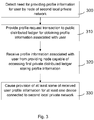
- FIGURE 3 illustrates a method according to some embodiments.
- the method may be applied for obtaining device profile information by a node of a distributed network.
- the method may be implemented in an apparatus or device capable of requesting user profile information, such as a router device e.g. set as home edge router, a wireless access network device, a network management device, a network operator device, or a set of devices co-operatively providing the profile information.
- the method may be implemented by the requesting node 32.
- a need for providing profile information for a user a second local private network is detected 300.
- the user may be visiting the second local private network and a user device may connect the network.
- User information may be entered into a device connected to the second local private network or operating as a node of the network directly by the user, automatically from the user device, or via a service person or a further device.
- the need may be detected upon detecting a user device associated with the user by a node of the second local private network, on the basis of detecting a specific request of the user (which may be received from the user device), or on the basis of receiving user's identification information, for example.
- a profile request transaction is provided 310 to a public distributed ledger for obtaining profile information associated with the user.
- the profile request transaction may be received in block 230 and comprises an indication of the requested profile information.
- the profile request transaction may identify the profile availability transaction that indicates or points to the user profile information of interest.
- Profile information associated with the user is received 320 from a providing node capable of accessing a first private distributed ledger storing the profile information.
- Block 320 may be entered after block 240 and validation of the profile request transaction in the public distributed network.
- the profile information may be received via an encrypted link and/or the profile information may be encrypted, by public key of the user, for example.
- At least some of the received user profile information is (caused to be) provided 330 for at least one device connected to the second local private network.
- the profile request transaction 230, 310 indicates a request for profile transfer for the user device visiting the second local private network.
- the requesting node may be a configured to provide at least some of the received user profile information for the user device connected to the second local private network.
- the profile information may then be applied in the user device on the basis of user input and/or instructions in the user profile information and/or the user device, for example.
- the profile information may be sent from the user device to one or more devices of the second local private network (directly or via further device(s)) to configure operation of the device(s) to meet user preferences.
- FIGURES 2 and 3 illustrate main features of the procedure for offering and providing the profile information and a number of further steps and embodiments may be applied, some of which are illustrated further below. For example, there may be subsequent block(s) involving a response to the request transaction indicating the validation of the request transaction (provided in connection with block 240).
- Access to the profile information may be authorized for the requesting device directly upon the response/validation or after further intermediate action(s).
- Means for accessing the profile information in some embodiments an encryption key for decrypting the profile information received and stored in encrypted form, may be provided to the requesting node, in some embodiments as additional blocks of FIGURES 2 and 3 .
- a smart contract may be applied in the public distributed network 40 for controlling sharing of the user profile information.
- the smart contract may comprise code for verifying user profile transmission to the requesting node 32. For example, a multi-signature verification may be required, in which the profile request transaction need to be appropriately signed by the user or at least one of the first local private network and the requesting node 32, and the signatures are verified in order to validate the request transaction.
- a further transaction which may be referred to as profile information release transaction, may be generated for issuing the profile information by the providing node 22 to the requesting node 32.
- the transmission of the profile information in block 240 may be triggered upon validation of such profile information release transaction (that has been generated in response to the validation of the profile request transaction).
- the profile information release transaction may be generated by the smart contract in the public distributed network 40.
- a profile availability transaction associated with the user may be identified amongst transactions stored in the public distributed ledger before or after block 310.
- the profile request transaction may be provided 310 to the distributed ledger on the basis of and identifying the profile availability transaction.
- the requesting node 32 may thus after block 300 search through the public ledger to identify transaction(s) associated with the user, such as the user's public key, transaction ID, or other identification (stored in the ledger on the basis of the profile availability transaction 220) as search input.
- other identification information may be associated with the profile information, such as identification information of the first local private network, and used as search key.
- identification information for obtaining the profile may be obtained from the user device 10 visiting the second network, in connection with block 300.
- the user device 10 may provide a transaction ID of the profile availability transaction which is included in the profile request transaction.
- the user device provides identification information of the providing node 22 or the first local private network 20, on the basis of which the profile request transaction is generated 310.
- Anonymization may be applied for identification information associated with the profile information and available in the public distributed network 40.
- new IDs are assigned periodically for the nodes associated with the profile information in the public distributed network, such as the providing node 22 and/or the user device 10. This facilitates to avoid potential information leak from the public network, for instance a criminal could wait on the public network for a profile transfer request to a specific ID representing the digital identity of user's route on the public network as an indication that someone's house has become empty.
- a specific access control or join procedure is applied for the first and/or second private distributed ledger and/or the network 20, 30.
- the join procedure may comprise: receiving 400 a join request of a requesting device to join the first private distributed ledger.
- the device is authenticated 410, and after successful authentication and possible other access control functions, the device may be added as part of the private distributed ledger.
- a join transaction may be provided 420 to the first private distributed ledger to add the device into the first private distributed ledger.
- the requesting device is a new device, such as an IoT device, newly connected to the local private network 20.
- profile information associated with the device and the user may be added in the first distributed ledger.
- the device may then become a node 24 of the first local private network 20.
- the method of Figure 4 is applied for adding the user device 10 to the second private distributed ledger maintained by the nodes 32, 34 of the second private network 30.
- the joining procedure may be temporary, e.g. for the duration of the visit of the user in the local environment.
- a shared accession control procedure is carried out among at least some of the nodes of the private network 20, 30 in response to the join request 400 of the requesting device being a candidate node.
- the nodes share private network state information, which is updated with information on the candidate node in response to the accession control procedure allowing the candidate node to join the network.
- the group of nodes may comprise one or more administrator nodes.
- the administrator node(s) carry out the accession control procedure and determine if the candidate node may join the network. This may involve prompting a user of an administrator device and/or checking an accession control parameter.
- One of the administrator nodes may be selected e.g. by a random selection procedure to decide if the candidate node may be added to join the network, for example by using a Proof-of-Work (PoW) protocol or a Proof-of-Stake (PoS) protocol.
- the accession control procedure may be a distributed consensus procedure.
- the accession control procedure comprises carrying out a vote procedure amongst the administrator nodes. Reference is also made to patent application no. PCT/FI2016/050732 disclosing embodiments of such shared accession control, at least some of which may be applied herewith.
- the profile information is added to the second private distributed ledger maintained by the nodes of the second local private network.
- Block 500 may be entered after block 320, and the received user profile information is provided 500 to the second distributed ledger.
- the user profile information in the second distributed ledger may be (caused to be) removed 510 in response a trigger condition.
- the trigger condition may comprise detection of the user's device 10 to exit the second private network, change in user's status information associated with the second private network 30, or some other profile removal trigger condition.
- a user input indicating profile information to be requested is received by the user device.
- An indication of the requested profile information may be included in the profile request transaction 230, 310 on the basis of the received user input.
- the first private distributed ledger and/or the second private distributed ledger is updated on the basis of the transmission of the profile information after block 240 and/or 320.
- the public distributed ledger may, in addition to or instead of updating the first and/or second private distributed ledger, be updated to indicate the transmission of the profile information to the requesting entity.
- the distributed ledger update may be carried out by at least one transaction indicative of the profile information transmission to the second private distributed ledger and/or the public distributed ledger. Thus, all profile information exchanges may be recorded and tracked later.
- the public distributed ledger enables a decentralized, auditable, and tamper-proof registry of privacy permissions for sharing profile information.
- a protocol for providing user profile information or exchanging the user profile information for a reward is thus enabled without intermediation of a centralized third party.
- the profile information can be used for variety of purposes. For example, interested parties may thus exchange a monetary reward for profile information.
- Example applications of such a protocol are, for instance: selling personal profile information for research purposes, participating in research that requires data exchange, exchanging the profile information to a benefit from a device developer, etc.
- FIGURE 6 illustrates a further application of the multitude of distributed networks, in which the system may be used for profile data trading or exchanging the profile information for an asset, such as cryptocurrency value.
- a smart contract is set up 600 in the public distributed ledger for exchange of the profile information, in the present example IoT data.
- Block 600 may be entered by the providing node 22 after causing storage of the IoT data in the private distributed ledger by block 210, for example.
- the smart contract is executed 610.
- Transaction(s) associated with the smart contract are carried out and validated. The transactions are cryptographically signed and represent respective issuer's commitment in the exchange.
- the public distributed ledger is updated with the transaction(s).
- the providing node 22 may send the requested IoT data to the requesting entity, such as the requesting node 32 or another entity, such as a node of the public distributed network or a device outside the public distributed network 40.
- the profile request transaction comprises information of an asset, such as cryptocurrency value, offered in exchange of providing the profile information associated with the profile availability transaction.
- a response to the profile request transaction 230, 310 may indicate the user's willingness to participate in the exchange of the user information and the asset.
- the request transaction may comprise a signed authorization to issue the asset in response to validation of the exchange.
- the validation of the exchange may thus be triggered in response to the validation of the profile request transaction, i.e. after block 240. After the validation of the exchange, the authorization is executed and the exchange may be carried out.
- the profile request transaction or a further transfer transaction validation based on the profile request, comprises multi-party computation, which may comprise: verifying an account indicated in the transaction and verifying that an encryption key provided by the user equipment decrypts the profile information provided by the user equipment in encrypted form.
- a transaction is issued for releasing the asset for the user and the encryption key is provided for the requesting node in response to successful validation of the exchange.
- a transfer transaction may be issued by the requesting node to the account for releasing the asset for the user in response to successful validation of the exchange.
- the encryption key may be provided for the requesting device in response to successful validation of the exchange.
- the distributed networks 20, 30, 40 are blockchain based networks
- the distributed ledgers are blockchain ledgers
- the transactions are blockchain transactions.
- the nodes 22, 24, 32, 34 may be light or full blockchain nodes.
- Information provided in a blockchain transaction such as the above illustrated profile information related transactions, may be stored in the blockchain ledger in response to validation of the respective blockchain transaction.
- the blockchain is an ordered sequence of blocks.
- a block comprises a time-stamped batch of transactions representing the state of the block at the time.
- a block may further comprise a hash pointer H with location indicator 'loc' and hash value 'hash' to a prior block, which immediately precedes the block in the blockchain, linking thus the blocks together.
- Blockchain state information shared by the nodes may store all the transactions and history carried out in the respective network 20, 30, 40. For example, after deciding on allowing the candidate node to join the network 420, a new block comprising updated blockchain network state information may be added.
- Each node may comprise the ledger whose content is in sync with other ledgers.
- the nodes may validate and commit transactions in order to reach consensus.
- Each node may have their own copy of the ledger which is in some embodiments permission-controlled, so participants see only appropriate transactions.
- Changes in resource ownership in the blockchain take the form of blockchain transactions secured by strong cryptography.
- a blockchain transaction may comprise an identifier of a new owner, that is the recipient, of the resource, together with a cryptographic signature of the previous owner, that is the sender, such that malicious attackers cannot re-assign resources they do not own.
- the transaction is provided (e.g. by or in response to block 210, 220, 310, 420, 500, 510) into the blockchain network 40, 60, which generally refers to a dissemination method suitable for the context, which will cause the transaction to be communicated to at least some of the nodes of the network in general. Reaching each and every node with each and every transaction is not strictly necessary.
- a node establishing the next block may be known as a miner node.
- a miner node may compile a set of transactions, which it receives from the broadcasts, for the next block, and search for a proof-of-work code that covers all the transactions in the set of transactions for the next block.
- the proof-of-work code may be a numerical value, with which the contents of the next block, that is, the set of transactions, hashes to a value that is less than a threshold.
- miner node discovers a proof-of-work based on an incomplete set of transactions, for example if some transactions did not reach the miner node, other nodes in the network will not accept the block into the blockchain, and it will be excluded from a consensus version of the blockchain in the system.
- a proof-of-stake may be used instead of, or additionally to, a proof-of-work.
- a proof-of-stake based system a new block is accepted once a sufficient fraction of resources are proven as owned by nodes ready to accept the new block version.
- a transaction is considered the more reliable, the larger the number of blocks established since the block where the transaction is comprised. This is since transactions are hashed into the chain of blocks, and discrepancies in the block chain are resolved as the block chain gets longer.
- a hash of the previous block hash N-1 may be included along with the transactions, attaching the blocks to each other to form the chain. Hashes linking the blocks together to form a chain may be referred to as Merkle hashes.
- Maliciously modifying a transaction in a block far down the chain would involve re-doing the work of finding proofs for all subsequent blocks, since the input to the hash function for the block comprising the transaction would be changed, causing the resulting hash value, with the proof in that block, to no longer be disposed in the desired area in the output space of the hash function.
- FIGURE 8 illustrates an example of a simplified system comprising two private local networks 1, 2 of IoT devices and a public blockchain network in which IoT data as the profile information may be shared by applying at least some of the above illustrated embodiments.
- Routers operate on the edges of the home and hotel private local network and the global public network, which may be a global network, and may be configured to function as the providing node 22 and the requesting node 32, respectively.
- IoT data of lock and thermostat devices of the home network 1 may be provided via the global network to the hotel network 2 visited by the user.
- the user device may be configured to operate as a node of the public distributed network via which IoT profile information may be shared via the public distributed network.
- a user device may operate as the providing node 22 and/or the requesting node 32.
- the user when the user arrives at a hotel or other rented space/room comprising at least some IoT device(s) configurable similar as at IoT device(s) home with profile profile configuration feature like his own, he can use the global blockchain to request his home blockchain to send a specific personal profile to target hotel router. All authentications of related devices (mobile phone, home router, hotel router) and profile transferring process is controlled by the global blockchain. The user can also specify the details of the profile to be transferred as to what part of profile is needed, e.g thermostat setting, TV subscription and lock security level etc. for a hotel room, and for how long. Then at the end of his stay, the hotel's local blockchain will remove the temporary profile and related information. So the user needs not to worry about the leakage of his personal information.
- All authentications of related devices mobile phone, home router, hotel router
- profile transferring process is controlled by the global blockchain.
- the user can also specify the details of the profile to be transferred as to what part of profile is needed, e.g thermostat setting, TV subscription and
- the user of the IoT devices owns the data on his private blockchain and can opt to share the data with or sell the data to third parties over the global public chain.
- the trading process can be completely automatic with smart contracts.
- Data generated by rented IoT devices can also be exchanged on global blockchain. For instance, on hotel check-in, the user will decide if hotel's IoT system can track and store his activities or not. If permission is granted, IoT data collected can be sold back to hotel, for instance in exchange for cheaper rate. The data bought back by hotel will be anonymous and may only contain non-personal information.
- the user will also have options to retain himself and/or delete all the IoT generated data from hotel IoT system. The options can be setup using smart contract in hotel IoT blockchain and pushed to user on joining the ledge on check-in. Afterword, IoT data can be processed automatically according details specified in the smart contract.
- An electronic device comprising electronic circuitries may be an apparatus for realizing at least some embodiments of the present invention.
- the apparatus may be or may be comprised in a computer, a laptop, a tablet computer, a cellular phone, a machine to machine (M2M) device, a wearable device, a base station, access point device, a network management or control device, a server, or any other apparatus provided with communication capability.
- M2M machine to machine
- the apparatus carrying out the above-described functionalities is comprised in such a device, e.g. the apparatus may comprise a circuitry, such as a chip, a chipset, a microcontroller, or a combination of such circuitries in any one of the above-described devices.
- FIGURE 9 illustrates an example apparatus capable of supporting at least some embodiments of the present invention.
- a device 900 which may comprise a communications device in some embodiments arranged to operate as a node in a blockchain-based system.
- the device may be arranged to operate as the UE 10, the profile information requesting node (e.g. the node 32 of FIGURE 1 ), or the profile information providing node (e.g. the node 22), and carry out at least some of the embodiments illustrated in connection with FIGURES 1 to 6 .
- the device may include one or more controllers configured to carry out operations in accordance with at least some of the embodiments illustrated above, such as at least some of the features illustrated above in connection with Figures 1 to 8 .
- a processor 902 which may comprise, for example, a single- or multi-core processor wherein a single-core processor comprises one processing core and a multi-core processor comprises more than one processing core.
- the processor 902 may comprise more than one processor.
- the processor may comprise at least one application-specific integrated circuit, ASIC.
- the processor may comprise at least one field-programmable gate array, FPGA.
- the processor may be means for performing method steps in the device.
- the processor may be configured, at least in part by computer instructions, to perform action to carry out at least some of the presently disclosed features.
- the device 900 may comprise memory 904.
- the memory may comprise random-access memory and/or permanent memory.
- the memory may comprise at least one RAM chip.
- the memory may comprise solid-state, magnetic, optical and/or holographic memory, for example.
- the memory may be at least in part accessible to the processor 902.
- the memory may be at least in part comprised in the processor 902.
- the memory 904 may be means for storing information.
- the memory may comprise computer instructions that the processor is configured to execute. When computer instructions configured to cause the processor to perform certain actions are stored in the memory, and the device in overall is configured to run under the direction of the processor using computer instructions from the memory, the processor and/or its at least one processing core may be considered to be configured to perform said certain actions.
- the memory may be at least in part comprised in the processor.
- the memory may be at least in part external to the device 900 but accessible to the device. For example, control parameters affecting operations related to causing the above-illustrated transactions and related information may be stored in one or more
- the memory may comprise device-specific cryptographic information, such as secret and public key of the device 900.
- the transactions may be signed with a private key associated with the respective device or user.
- the apparatus may be provided with a public-private key pair at manufacture.
- the private key may be stored on the certifying device's secured memory portion, such that it cannot be tampered with and the private key cannot be stolen.
- the secured portion may also hold the hashing and signing logic.
- the device 900 may comprise a transmitter 906.
- the device may comprise a receiver 908.
- the transmitter and the receiver may be configured to transmit and receive, respectively, information in accordance with at least one wired or wireless, cellular or non-cellular standard.
- the transmitter may comprise more than one transmitter.
- the receiver may comprise more than one receiver.
- the transmitter and/or receiver may be configured to operate in accordance with global system for mobile communication, GSM, wideband code division multiple access, WCDMA, long term evolution, LTE, 5G or other cellular communications systems, wireless local area network, WLAN, and/or Ethernet standards, for example.
- the device 900 may comprise a near-field communication, NFC, transceiver 910.
- the NFC transceiver may support at least one NFC technology, such as NFC, Bluetooth, Wibree or similar technologies.
- the device 900 may comprise user interface, UI, 912.
- the UI may comprise at least one of a display, a keyboard, a touchscreen, a vibrator arranged to signal to a user by causing the device to vibrate, a speaker and a microphone.
- a user may be able to operate the device via the UI, for example to accept incoming telephone calls, to originate telephone calls or video calls, to browse the Internet, to manage digital files stored in the memory 904 or on a cloud accessible via the transmitter 906 and the receiver 908, or via the NFC transceiver 910, and/or to play games.
- the device 900 may comprise or be arranged to accept a user identity module or other type of memory module 914.
- the user identity module may comprise, for example, a subscriber identity module, SIM, and/or a personal identification IC card installable in the device 900.
- the user identity module 914 may comprise information identifying a subscription of a user of device 900.
- the user identity module 914 may comprise cryptographic information usable to verify the identity of a user of device 900 and/or to facilitate encryption and decryption of communication effected via the device 900, such as the private and/or public keys as illustrated above.
- the processor 902 may be furnished with a transmitter arranged to output information from the processor, via electrical leads internal to the device 900, to other devices comprised in the device.
- a transmitter may comprise a serial bus transmitter arranged to, for example, output information via at least one electrical lead to memory 904 for storage therein.
- the transmitter may comprise a parallel bus transmitter.
- the processor may comprise a receiver arranged to receive information in the processor, via electrical leads internal to the device 900, from other devices comprised in the device 900.
- Such a receiver may comprise a serial bus receiver arranged to, for example, receive information via at least one electrical lead from the receiver 908 for processing in the processor.
- the receiver may comprise a parallel bus receiver.
- the device 900 may comprise further devices not illustrated in Figure 9 .
- the device may comprise at least one digital camera or other user media recording device.
- Some devices may comprise a back-facing camera and a front-facing camera.
- the device may comprise a fingerprint sensor arranged to authenticate, at least in part, a user of the device.
- the device lacks at least one device described above.
- some devices may lack the NFC transceiver 910 and/or the user identity module 914.
- the processor 902, the memory 904, the transmitter 906, the receiver 908, the NFC transceiver 910, the UI 912 and/or the user identity module 914 may be interconnected by electrical leads internal to the device 900 in a multitude of different ways.
- each of the aforementioned devices may be separately connected to a master bus internal to the device, to allow for the devices to exchange information.
- this is only one example and depending on the embodiment various ways of interconnecting at least two of the aforementioned devices may be selected without departing from the scope of the present invention.
- At least some embodiments of the present invention find industrial application in communications.
Landscapes
- Engineering & Computer Science (AREA)
- Computer Networks & Wireless Communication (AREA)
- Signal Processing (AREA)
- Computer Hardware Design (AREA)
- Computer Security & Cryptography (AREA)
- Computing Systems (AREA)
- General Engineering & Computer Science (AREA)
- Databases & Information Systems (AREA)
- Information Transfer Between Computers (AREA)
- Mobile Radio Communication Systems (AREA)
- Computer And Data Communications (AREA)
Claims (16)
- Procédé pour un nœud fournisseur (22), comprenant :- la réception (200) d'informations de profil associées à un utilisateur et à au moins un dispositif (10) connecté à un premier réseau privé local,- la fourniture (210) d'une transaction d'informations de profil comprenant les informations de profil associées à l'utilisateur et à l'au moins un dispositif à un premier registre distribué privé en réponse à une authentification réussie de l'au moins un dispositif,- la fourniture (220) d'une transaction de disponibilité de profil à un registre distribué public, la transaction de disponibilité de profil comprenant une indication de disponibilité des informations de profil,- la réception (230) d'une transaction de demande de profil pour des informations de profil associées à l'utilisateur via un réseau distribué public de nœuds stockant le registre distribué public, et- en réponse à la validation de la transaction de demande de profil, le fait de provoquer (240) la transmission d'au moins certaines des informations de profil dans le premier registre distribué privé à un nœud demandeur (32) du réseau distribué public.
- Procédé selon une quelconque revendication précédente, comprenant en outre :- la réception (400) d'une demande de jonction de l'au moins un dispositif connecté au premier réseau privé local pour rejoindre le premier registre distribué privé,- l'authentification (410) de l'au moins un dispositif, et- la fourniture (420) d'une transaction de jonction au premier registre distribué privé pour ajouter l'au moins un dispositif dans le premier registre distribué privé.
- Procédé selon une quelconque revendication précédente, dans lequel la demande de profil indique une demande pour un transfert de profil pour l'utilisateur visitant un second réseau privé local, et le nœud demandeur est configuré pour fournir (500) au moins certaines des informations de profil pour au moins un dispositif connecté au second réseau privé local pour configurer le fonctionnement de l'au moins un dispositif connecté au second réseau privé local selon les informations de profil.
- Procédé pour un nœud demandeur (32) d'un second réseau privé local (30), comprenant :- la détection (300) d'un besoin de fournir des informations de profil pour un utilisateur,- la fourniture (310), sur la base d'une transaction de disponibilité de profil associée à l'utilisateur et stockée dans un registre distribué public, d'une transaction de demande de profil au registre distribué public pour obtenir des informations de profil associées à l'utilisateur, la transaction de disponibilité de profil comprenant une indication de disponibilité des informations de profil,- la réception (320) d'informations de profil associées à l'utilisateur en provenance d'un nœud fournisseur capable d'accéder à un premier registre distribué privé stockant les informations de profil, et- le fait de provoquer (330) la fourniture d'au moins certaines des informations de profil d'utilisateur reçues pour au moins un dispositif connecté au second réseau privé local.
- Procédé selon la revendication 4, dans lequel un second registre distribué privé est maintenu par des nœuds du second réseau privé local, le procédé comprenant en outre :- la fourniture (500) des informations de profil d'utilisateur reçues au second registre distribué, et- le fait de provoquer (510) la suppression des informations de profil d'utilisateur dans le second registre distribué en réponse à une condition de déclenchement.
- Procédé selon la revendication 5, comprenant en outre :- la réception (400) d'une demande en provenance d'un dispositif d'utilisateur associé à l'utilisateur pour rejoindre le second registre distribué privé,- l'authentification (410) du dispositif d'utilisateur, et- la fourniture (420) d'une transaction de jonction au premier registre distribué privé pour ajouter le dispositif d'utilisateur dans le second registre distribué privé.
- Procédé selon l'une quelconque des revendications 4 à 6 précédentes, comprenant en outre :- l'identification de la transaction de disponibilité de profil parmi des transactions stockées dans le registre distribué public, et la transaction de demande de profil identifie la transaction de disponibilité de profil.
- Procédé selon l'une quelconque des revendications 4 à 7 précédentes, dans lequel une entrée d'utilisateur indiquant des informations de profil à demander est reçue, et
une indication des informations de profil demandées est incluse dans la transaction de demande de profil sur la base de l'entrée reçue. - Procédé selon une quelconque revendication précédente, comprenant en outre :- la fourniture d'au moins une transaction indicative de la transmission d'informations de profil au registre distribué privé et/ou au registre distribué public.
- Procédé selon une quelconque revendication précédente, dans lequel les informations de profil comprennent un ou plusieurs parmi des paramètres de configuration pour configurer le fonctionnement d'un ou plusieurs dispositifs IoT du réseau privé pour l'utilisateur, des données d'accès pour accéder à un ou plusieurs dispositifs du réseau privé, et des données d'accès pour accéder à des services ou applications par les un ou plusieurs dispositifs du réseau privé.
- Procédé selon une quelconque revendication précédente, dans lequel les réseaux distribués sont des réseaux basés sur des chaînes de blocs et les registres distribués sont des registres de chaînes de blocs.
- Appareil configuré pour fonctionner comme un nœud fournisseur (22), comprenant :- des moyens pour recevoir (200) des informations de profil associées à un utilisateur et à au moins un dispositif (10) connecté à un premier réseau privé local,- des moyens pour fournir (210) une transaction d'informations de profil comprenant les informations de profil associées à l'utilisateur et à l'au moins un dispositif à un premier registre distribué privé en réponse à une authentification réussie de l'au moins un dispositif,- des moyens pour fournir (220) une transaction de disponibilité de profil à un registre distribué public, la transaction de disponibilité de profil comprenant une indication de disponibilité des informations de profil,- des moyens pour recevoir (230) une transaction de demande de profil pour des informations de profil associées à l'utilisateur via un réseau distribué public de nœuds stockant le registre distribué public, et- des moyens pour, en réponse à la validation de la transaction de demande de profil, provoquer (240) la transmission d'au moins certaines des informations de profil dans le premier registre distribué privé à un nœud demandeur du réseau distribué public.
- Appareil selon la revendication 12, dans lequel l'appareil comprend des moyens pour effectuer le procédé selon la revendication 2, 3, ou l'une quelconque des revendications 9 à 11.
- Appareil configuré pour fonctionner comme un nœud demandeur (32) d'un second réseau privé local (30), comprenant :- des moyens pour détecter (300) un besoin de fournir des informations de profil pour un utilisateur,- des moyens pour fournir (310), sur la base d'une transaction de disponibilité de profil associée à l'utilisateur et stockée dans un registre distribué public, une transaction de demande de profil à un registre distribué public pour obtenir des informations de profil associées à l'utilisateur, la transaction de disponibilité de profil comprenant une indication de disponibilité des informations de profil,- des moyens pour recevoir (320) des informations de profil associées à l'utilisateur en provenance d'un nœud fournisseur capable d'accéder à un premier registre distribué privé stockant les informations de profil ; et- des moyens pour provoquer (330) la fourniture d'au moins certaines des informations de profil d'utilisateur reçues pour au moins un dispositif connecté au second réseau privé local.
- Appareil selon la revendication 14, dans lequel l'appareil comprend des moyens pour effectuer le procédé selon l'une quelconque des revendications 5 à 8.
- Programme informatique comprenant un ensemble d'instructions lisibles par ordinateur qui, lorsqu'elles sont exécutées par au moins un processeur, amènent un appareil à réaliser le procédé selon l'une quelconque des revendications 1 à 11.
Priority Applications (4)
| Application Number | Priority Date | Filing Date | Title |
|---|---|---|---|
| EP18157638.0A EP3528468B1 (fr) | 2018-02-20 | 2018-02-20 | Partage d'informations de profil |
| PCT/FI2019/050110 WO2019162563A1 (fr) | 2018-02-20 | 2019-02-12 | Partage d'informations de profil |
| CN201980014134.XA CN111742531B (zh) | 2018-02-20 | 2019-02-12 | 简档信息共享 |
| US16/971,218 US11399076B2 (en) | 2018-02-20 | 2019-02-12 | Profile information sharing |
Applications Claiming Priority (1)
| Application Number | Priority Date | Filing Date | Title |
|---|---|---|---|
| EP18157638.0A EP3528468B1 (fr) | 2018-02-20 | 2018-02-20 | Partage d'informations de profil |
Publications (2)
| Publication Number | Publication Date |
|---|---|
| EP3528468A1 EP3528468A1 (fr) | 2019-08-21 |
| EP3528468B1 true EP3528468B1 (fr) | 2021-04-07 |
Family
ID=61526540
Family Applications (1)
| Application Number | Title | Priority Date | Filing Date |
|---|---|---|---|
| EP18157638.0A Active EP3528468B1 (fr) | 2018-02-20 | 2018-02-20 | Partage d'informations de profil |
Country Status (4)
| Country | Link |
|---|---|
| US (1) | US11399076B2 (fr) |
| EP (1) | EP3528468B1 (fr) |
| CN (1) | CN111742531B (fr) |
| WO (1) | WO2019162563A1 (fr) |
Families Citing this family (13)
| Publication number | Priority date | Publication date | Assignee | Title |
|---|---|---|---|---|
| EP4375874A3 (fr) * | 2018-01-22 | 2024-08-07 | Assa Abloy Ab | Stockage d'événements d'un dispositif capteur |
| US20210099312A1 (en) * | 2019-09-27 | 2021-04-01 | Cypherium Blockchain Inc. | Systems and methods for selecting and utilizing a committee of validator nodes in a distributed system |
| WO2021096400A1 (fr) * | 2019-11-13 | 2021-05-20 | Telefonaktiebolaget Lm Ericsson (Publ) | Procédé de séparation d'un état privé et de transactions privées d'un état agrégé et de transactions agrégées dans un réseau de registre distribué |
| US11819460B2 (en) * | 2019-11-22 | 2023-11-21 | Baxter Medical Systems Gmbh + Co. Kg | Collision prevention system for overhead assembly |
| WO2021190726A1 (fr) * | 2020-03-23 | 2021-09-30 | Telefonaktiebolaget Lm Ericsson (Publ) | Stockage d'informations d'abonné pour de multiples réseaux de communication |
| EP4002786B1 (fr) * | 2020-11-11 | 2023-06-21 | Deutsche Post AG | Système de registre distribué |
| EP4022872B1 (fr) * | 2020-11-11 | 2023-06-07 | Deutsche Post AG | Système de registre distribué |
| US20220191027A1 (en) * | 2020-12-16 | 2022-06-16 | Kyndryl, Inc. | Mutual multi-factor authentication technology |
| CN114928617B (zh) * | 2022-06-15 | 2023-07-21 | 中国电信股份有限公司 | 专网签约数据管理方法、装置、设备及介质 |
| KR20240105072A (ko) * | 2022-12-28 | 2024-07-05 | 한국전자기술연구원 | 어플리케이션과 IoT 디바이스 간 데이터 연동 방법 및 그 방법을 수행하는 미들웨어 장치 |
| CN116017438A (zh) * | 2023-02-14 | 2023-04-25 | 广州爱浦路网络技术有限公司 | 确保pin安全的方法、装置、电子设备和存储介质 |
| WO2024250156A1 (fr) * | 2023-06-05 | 2024-12-12 | Huawei Technologies Co., Ltd. | Procédé décentralisé de sélection d'un opérateur de réseau mobile |
| CN121284534A (zh) * | 2024-07-04 | 2026-01-06 | 中兴通讯股份有限公司 | 信息传输方法及系统 |
Family Cites Families (54)
| Publication number | Priority date | Publication date | Assignee | Title |
|---|---|---|---|---|
| US7194554B1 (en) * | 1998-12-08 | 2007-03-20 | Nomadix, Inc. | Systems and methods for providing dynamic network authorization authentication and accounting |
| US7630986B1 (en) | 1999-10-27 | 2009-12-08 | Pinpoint, Incorporated | Secure data interchange |
| US8266438B2 (en) * | 2004-10-25 | 2012-09-11 | Security First Corp. | Secure data parser method and system |
| US20060123081A1 (en) | 2004-12-03 | 2006-06-08 | Motorola, Inc. | Method and system for seamless portability by profile sharing |
| WO2007087109A2 (fr) * | 2005-12-21 | 2007-08-02 | Transip, Inc. | Système et procédé destinés à reproduire de manière efficace des environnements et des données spécifiques à une application et à accéder à ces environnements et ces données |
| CN101438256B (zh) * | 2006-03-07 | 2011-12-21 | 索尼株式会社 | 信息处理设备、信息通信系统、信息处理方法 |
| US9009109B2 (en) * | 2007-01-22 | 2015-04-14 | Jook, Inc. | Profile exchange method and system |
| US8775391B2 (en) * | 2008-03-26 | 2014-07-08 | Zettics, Inc. | System and method for sharing anonymous user profiles with a third party |
| US8108666B2 (en) * | 2008-04-28 | 2012-01-31 | International Business Machines Corporation | System and method for transferring user preferences |
| US9552478B2 (en) * | 2010-05-18 | 2017-01-24 | AO Kaspersky Lab | Team security for portable information devices |
| CA2882602A1 (fr) * | 2010-09-20 | 2012-03-29 | Rick L. Orsini | Systemes et procedes pour un partage securise de donnees |
| US20130276072A1 (en) * | 2010-12-21 | 2013-10-17 | Telefonaktiebolaget L M Ericsson (Publ) | Method for Enabling Exchange of User Profiles Between a Visited Network and a Home Network |
| US9229905B1 (en) | 2011-04-22 | 2016-01-05 | Angel A. Penilla | Methods and systems for defining vehicle user profiles and managing user profiles via cloud systems and applying learned settings to user profiles |
| US10984913B2 (en) * | 2012-04-27 | 2021-04-20 | Netspective Communications Llc | Blockchain system for natural language processing |
| US9742857B2 (en) * | 2012-08-24 | 2017-08-22 | Citrix Systems, Inc. | Systems and methods for supporting a network profile |
| US10963585B2 (en) * | 2012-09-10 | 2021-03-30 | Netspective Communications Llc | Self-controlled digital authorization over communication networks |
| US9305162B2 (en) | 2013-07-31 | 2016-04-05 | Good Technology Corporation | Centralized selective application approval for mobile devices |
| US10872077B2 (en) * | 2013-09-23 | 2020-12-22 | David D. Wright, SR. | Management of entitlements using blockchain |
| CA2926811C (fr) * | 2013-10-07 | 2023-03-21 | Google Inc. | Detecteur de risque pour maison intelligente, permettant d'obtenir des caracteristiques specifiques a un contexte et/ou des configurations de pre-alarme |
| US20150363777A1 (en) | 2014-06-16 | 2015-12-17 | Bank Of America Corporation | Cryptocurrency suspicious user alert system |
| US9507775B1 (en) | 2014-10-17 | 2016-11-29 | James E. Niles | System for automatically changing language of a traveler's temporary habitation by referencing a personal electronic device of the traveler |
| WO2016063092A1 (fr) * | 2014-10-23 | 2016-04-28 | Dele Atanda | Système intelligent de gestion d'informations personnelles |
| US20160173930A1 (en) | 2014-12-16 | 2016-06-16 | Hisense Usa Corp. | Devices and methods for automatic configuration |
| EP3125489B1 (fr) * | 2015-07-31 | 2017-08-09 | BRITISH TELECOMMUNICATIONS public limited company | Atténuation d'attaques de chaînes de blocs |
| US20170075510A1 (en) | 2015-09-11 | 2017-03-16 | Johnson Controls Technology Company | Thermostat with occupant identity determination features |
| US11042878B2 (en) * | 2016-01-19 | 2021-06-22 | Priv8Pay, Inc. | Network node authentication |
| US10715531B2 (en) * | 2016-02-12 | 2020-07-14 | Visa International Service Association | Network topology |
| EP3424179B1 (fr) * | 2016-03-04 | 2022-02-16 | Ping Identity Corporation | Procédé et système de connexion authentifiée utilisant des codes statiques ou dynamiques |
| US10252145B2 (en) * | 2016-05-02 | 2019-04-09 | Bao Tran | Smart device |
| US20170331896A1 (en) * | 2016-05-13 | 2017-11-16 | De La Rue International Limited | Methods and systems for processing assets |
| EP3253020A1 (fr) * | 2016-06-03 | 2017-12-06 | Gemalto Sa | Procédé et appareil de publication d'assertions dans une base de données répartie d'un réseau de télécommunication mobile |
| WO2017218694A1 (fr) * | 2016-06-14 | 2017-12-21 | Aerohive Networks, Inc. | Incorporation en continu de dispositif sans fil |
| US10079881B2 (en) * | 2016-06-30 | 2018-09-18 | International Business Machines Corporation | Device self-servicing in an autonomous decentralized peer-to-peer environment |
| US10055926B2 (en) * | 2016-09-09 | 2018-08-21 | Tyco Integrated Security, LLC | Architecture for access management |
| WO2018069566A1 (fr) | 2016-10-14 | 2018-04-19 | Nokia Technologies Oy | Procédé, dispositif et système de validation de transactions de données d'utilisateurs sensibles dans un cercle de confiance |
| WO2018073482A1 (fr) * | 2016-10-18 | 2018-04-26 | Nokia Technologies Oy | Contrôle d'affiliation pour nœuds de réseau |
| US10749681B2 (en) * | 2016-10-26 | 2020-08-18 | Black Gold Coin, Inc. | Systems and methods for providing a universal decentralized solution for verification of users with cross-verification features |
| FR3058292B1 (fr) * | 2016-10-31 | 2019-01-25 | Idemia Identity And Security | Procede de fourniture d'un service a un utilisateur |
| US10621510B2 (en) * | 2016-11-09 | 2020-04-14 | Cognitive Scale, Inc. | Hybrid blockchain data architecture for use within a cognitive environment |
| US20180146061A1 (en) * | 2016-11-23 | 2018-05-24 | Frost Newco25, Inc. | Mediation of Data Exchange Among Trusted Devices |
| US11128528B2 (en) * | 2016-12-30 | 2021-09-21 | Intel Corporation | Decentralized data storage and processing for IoT devices |
| CA3049684A1 (fr) * | 2017-01-27 | 2018-08-02 | Walmart Apollo, Llc | Gestion d'appareils intelligents a l'aide d'une technologie de chaine de blocs |
| US10601800B2 (en) * | 2017-02-24 | 2020-03-24 | Fmr Llc | Systems and methods for user authentication using pattern-based risk assessment and adjustment |
| US11337070B2 (en) * | 2017-06-19 | 2022-05-17 | Intel Corporation | User-authorized onboarding using a public authorization service |
| US10970638B2 (en) * | 2017-07-26 | 2021-04-06 | American Express Travel Related Services Company, Inc. | Personally identifiable information identification |
| US11025626B1 (en) * | 2017-07-26 | 2021-06-01 | EMC IP Holding Company LLC | Decentralized identities for access to multiple computing resource systems |
| US11042934B2 (en) * | 2017-11-13 | 2021-06-22 | Bank Of America Corporation | Crypto-machine learning enabled blockchain based profile pricer |
| US20190147417A1 (en) * | 2017-11-14 | 2019-05-16 | American Express Travel Related Services Company, Inc. | Item Information Retrieval System |
| US10831764B2 (en) * | 2017-12-02 | 2020-11-10 | International Business Machines Corporation | Query processing and access control in a blockchain network |
| US10803186B2 (en) * | 2017-12-12 | 2020-10-13 | Fmr Llc | Systems and methods for dynamic application management |
| US10735346B2 (en) * | 2017-12-30 | 2020-08-04 | Intel Corporation | Data block prioritization for internet of things payloads |
| US10756883B2 (en) * | 2018-01-19 | 2020-08-25 | Trist Technologies, Inc. | Systems and methods for data collection with blockchain recording |
| US20190238316A1 (en) * | 2018-01-31 | 2019-08-01 | Salesforce.Com, Inc. | Systems, methods, and apparatuses for implementing intelligent consensus, smart consensus, and weighted consensus models for distributed ledger technologies in a cloud based computing environment |
| US10701054B2 (en) * | 2018-01-31 | 2020-06-30 | Salesforce.Com, Inc. | Systems, methods, and apparatuses for implementing super community and community sidechains with consent management for distributed ledger technologies in a cloud based computing environment |
-
2018
- 2018-02-20 EP EP18157638.0A patent/EP3528468B1/fr active Active
-
2019
- 2019-02-12 US US16/971,218 patent/US11399076B2/en active Active
- 2019-02-12 CN CN201980014134.XA patent/CN111742531B/zh active Active
- 2019-02-12 WO PCT/FI2019/050110 patent/WO2019162563A1/fr not_active Ceased
Non-Patent Citations (1)
| Title |
|---|
| None * |
Also Published As
| Publication number | Publication date |
|---|---|
| CN111742531B (zh) | 2022-08-12 |
| US20210105337A1 (en) | 2021-04-08 |
| WO2019162563A1 (fr) | 2019-08-29 |
| US11399076B2 (en) | 2022-07-26 |
| EP3528468A1 (fr) | 2019-08-21 |
| CN111742531A (zh) | 2020-10-02 |
Similar Documents
| Publication | Publication Date | Title |
|---|---|---|
| US11399076B2 (en) | Profile information sharing | |
| US12184753B2 (en) | Systems and methods for securing access rights to resources using cryptography and the blockchain | |
| US11411963B2 (en) | Network access sharing | |
| US12245040B2 (en) | Provision of location-specific user information | |
| Dorri et al. | Blockchain in internet of things: challenges and solutions | |
| EP3455996B1 (fr) | Gestion de ressources à base de chaînes de blocs | |
| CN104145445B (zh) | 用于安全地访问社交网络数据的方法、设备和计算机可读存储介质 | |
| EP3530034B9 (fr) | Contrôle d'affiliation pour noeuds de réseau | |
| EP2487863B1 (fr) | Activation d'accès sécurisé à une infrastructure de réseau de capteur à l'aide de plusieurs interfaces et sélection clé de groupe basée sur l'application | |
| KR20180002803A (ko) | 보안 동기화 시스템에서의 유효하지 않은 참가자들의 자동 식별 | |
| EP3477561A1 (fr) | Système de livraison de marchandises | |
| CN107580766A (zh) | 用于网络的群组密钥分发的系统、装置和方法 | |
| EP3474247B1 (fr) | Commande de confidentialité de contenu multimédia | |
| US20240380611A1 (en) | Data transmission method, related apparatus, device, and storage medium | |
| US11231920B2 (en) | Electronic device management | |
| CN115118427A (zh) | 区块链系统的数据传输方法、装置、设备以及存储介质 | |
| CN113316150A (zh) | 无线网络接入方法、终端及无线接入设备 |
Legal Events
| Date | Code | Title | Description |
|---|---|---|---|
| PUAI | Public reference made under article 153(3) epc to a published international application that has entered the european phase |
Free format text: ORIGINAL CODE: 0009012 |
|
| STAA | Information on the status of an ep patent application or granted ep patent |
Free format text: STATUS: THE APPLICATION HAS BEEN PUBLISHED |
|
| AK | Designated contracting states |
Kind code of ref document: A1 Designated state(s): AL AT BE BG CH CY CZ DE DK EE ES FI FR GB GR HR HU IE IS IT LI LT LU LV MC MK MT NL NO PL PT RO RS SE SI SK SM TR |
|
| AX | Request for extension of the european patent |
Extension state: BA ME |
|
| RAP1 | Party data changed (applicant data changed or rights of an application transferred) |
Owner name: NOKIA TECHNOLOGIES OY |
|
| STAA | Information on the status of an ep patent application or granted ep patent |
Free format text: STATUS: REQUEST FOR EXAMINATION WAS MADE |
|
| 17P | Request for examination filed |
Effective date: 20200210 |
|
| RBV | Designated contracting states (corrected) |
Designated state(s): AL AT BE BG CH CY CZ DE DK EE ES FI FR GB GR HR HU IE IS IT LI LT LU LV MC MK MT NL NO PL PT RO RS SE SI SK SM TR |
|
| GRAP | Despatch of communication of intention to grant a patent |
Free format text: ORIGINAL CODE: EPIDOSNIGR1 |
|
| STAA | Information on the status of an ep patent application or granted ep patent |
Free format text: STATUS: GRANT OF PATENT IS INTENDED |
|
| INTG | Intention to grant announced |
Effective date: 20201207 |
|
| GRAS | Grant fee paid |
Free format text: ORIGINAL CODE: EPIDOSNIGR3 |
|
| GRAA | (expected) grant |
Free format text: ORIGINAL CODE: 0009210 |
|
| STAA | Information on the status of an ep patent application or granted ep patent |
Free format text: STATUS: THE PATENT HAS BEEN GRANTED |
|
| AK | Designated contracting states |
Kind code of ref document: B1 Designated state(s): AL AT BE BG CH CY CZ DE DK EE ES FI FR GB GR HR HU IE IS IT LI LT LU LV MC MK MT NL NO PL PT RO RS SE SI SK SM TR |
|
| REG | Reference to a national code |
Ref country code: GB Ref legal event code: FG4D |
|
| REG | Reference to a national code |
Ref country code: AT Ref legal event code: REF Ref document number: 1381163 Country of ref document: AT Kind code of ref document: T Effective date: 20210415 Ref country code: CH Ref legal event code: EP |
|
| REG | Reference to a national code |
Ref country code: DE Ref legal event code: R096 Ref document number: 602018014977 Country of ref document: DE |
|
| REG | Reference to a national code |
Ref country code: IE Ref legal event code: FG4D |
|
| REG | Reference to a national code |
Ref country code: LT Ref legal event code: MG9D |
|
| REG | Reference to a national code |
Ref country code: NL Ref legal event code: MP Effective date: 20210407 Ref country code: AT Ref legal event code: MK05 Ref document number: 1381163 Country of ref document: AT Kind code of ref document: T Effective date: 20210407 |
|
| PG25 | Lapsed in a contracting state [announced via postgrant information from national office to epo] |
Ref country code: NL Free format text: LAPSE BECAUSE OF FAILURE TO SUBMIT A TRANSLATION OF THE DESCRIPTION OR TO PAY THE FEE WITHIN THE PRESCRIBED TIME-LIMIT Effective date: 20210407 Ref country code: AT Free format text: LAPSE BECAUSE OF FAILURE TO SUBMIT A TRANSLATION OF THE DESCRIPTION OR TO PAY THE FEE WITHIN THE PRESCRIBED TIME-LIMIT Effective date: 20210407 Ref country code: BG Free format text: LAPSE BECAUSE OF FAILURE TO SUBMIT A TRANSLATION OF THE DESCRIPTION OR TO PAY THE FEE WITHIN THE PRESCRIBED TIME-LIMIT Effective date: 20210707 Ref country code: HR Free format text: LAPSE BECAUSE OF FAILURE TO SUBMIT A TRANSLATION OF THE DESCRIPTION OR TO PAY THE FEE WITHIN THE PRESCRIBED TIME-LIMIT Effective date: 20210407 Ref country code: LT Free format text: LAPSE BECAUSE OF FAILURE TO SUBMIT A TRANSLATION OF THE DESCRIPTION OR TO PAY THE FEE WITHIN THE PRESCRIBED TIME-LIMIT Effective date: 20210407 Ref country code: FI Free format text: LAPSE BECAUSE OF FAILURE TO SUBMIT A TRANSLATION OF THE DESCRIPTION OR TO PAY THE FEE WITHIN THE PRESCRIBED TIME-LIMIT Effective date: 20210407 |
|
| REG | Reference to a national code |
Ref country code: DE Ref legal event code: R079 Ref document number: 602018014977 Country of ref document: DE Free format text: PREVIOUS MAIN CLASS: H04L0029080000 Ipc: H04L0065000000 |
|
| PG25 | Lapsed in a contracting state [announced via postgrant information from national office to epo] |
Ref country code: SE Free format text: LAPSE BECAUSE OF FAILURE TO SUBMIT A TRANSLATION OF THE DESCRIPTION OR TO PAY THE FEE WITHIN THE PRESCRIBED TIME-LIMIT Effective date: 20210407 Ref country code: RS Free format text: LAPSE BECAUSE OF FAILURE TO SUBMIT A TRANSLATION OF THE DESCRIPTION OR TO PAY THE FEE WITHIN THE PRESCRIBED TIME-LIMIT Effective date: 20210407 Ref country code: PL Free format text: LAPSE BECAUSE OF FAILURE TO SUBMIT A TRANSLATION OF THE DESCRIPTION OR TO PAY THE FEE WITHIN THE PRESCRIBED TIME-LIMIT Effective date: 20210407 Ref country code: NO Free format text: LAPSE BECAUSE OF FAILURE TO SUBMIT A TRANSLATION OF THE DESCRIPTION OR TO PAY THE FEE WITHIN THE PRESCRIBED TIME-LIMIT Effective date: 20210707 Ref country code: LV Free format text: LAPSE BECAUSE OF FAILURE TO SUBMIT A TRANSLATION OF THE DESCRIPTION OR TO PAY THE FEE WITHIN THE PRESCRIBED TIME-LIMIT Effective date: 20210407 Ref country code: PT Free format text: LAPSE BECAUSE OF FAILURE TO SUBMIT A TRANSLATION OF THE DESCRIPTION OR TO PAY THE FEE WITHIN THE PRESCRIBED TIME-LIMIT Effective date: 20210809 Ref country code: GR Free format text: LAPSE BECAUSE OF FAILURE TO SUBMIT A TRANSLATION OF THE DESCRIPTION OR TO PAY THE FEE WITHIN THE PRESCRIBED TIME-LIMIT Effective date: 20210708 Ref country code: IS Free format text: LAPSE BECAUSE OF FAILURE TO SUBMIT A TRANSLATION OF THE DESCRIPTION OR TO PAY THE FEE WITHIN THE PRESCRIBED TIME-LIMIT Effective date: 20210807 |
|
| REG | Reference to a national code |
Ref country code: DE Ref legal event code: R097 Ref document number: 602018014977 Country of ref document: DE |
|
| PG25 | Lapsed in a contracting state [announced via postgrant information from national office to epo] |
Ref country code: EE Free format text: LAPSE BECAUSE OF FAILURE TO SUBMIT A TRANSLATION OF THE DESCRIPTION OR TO PAY THE FEE WITHIN THE PRESCRIBED TIME-LIMIT Effective date: 20210407 Ref country code: ES Free format text: LAPSE BECAUSE OF FAILURE TO SUBMIT A TRANSLATION OF THE DESCRIPTION OR TO PAY THE FEE WITHIN THE PRESCRIBED TIME-LIMIT Effective date: 20210407 Ref country code: SK Free format text: LAPSE BECAUSE OF FAILURE TO SUBMIT A TRANSLATION OF THE DESCRIPTION OR TO PAY THE FEE WITHIN THE PRESCRIBED TIME-LIMIT Effective date: 20210407 Ref country code: SM Free format text: LAPSE BECAUSE OF FAILURE TO SUBMIT A TRANSLATION OF THE DESCRIPTION OR TO PAY THE FEE WITHIN THE PRESCRIBED TIME-LIMIT Effective date: 20210407 Ref country code: CZ Free format text: LAPSE BECAUSE OF FAILURE TO SUBMIT A TRANSLATION OF THE DESCRIPTION OR TO PAY THE FEE WITHIN THE PRESCRIBED TIME-LIMIT Effective date: 20210407 Ref country code: DK Free format text: LAPSE BECAUSE OF FAILURE TO SUBMIT A TRANSLATION OF THE DESCRIPTION OR TO PAY THE FEE WITHIN THE PRESCRIBED TIME-LIMIT Effective date: 20210407 Ref country code: RO Free format text: LAPSE BECAUSE OF FAILURE TO SUBMIT A TRANSLATION OF THE DESCRIPTION OR TO PAY THE FEE WITHIN THE PRESCRIBED TIME-LIMIT Effective date: 20210407 |
|
| PLBE | No opposition filed within time limit |
Free format text: ORIGINAL CODE: 0009261 |
|
| STAA | Information on the status of an ep patent application or granted ep patent |
Free format text: STATUS: NO OPPOSITION FILED WITHIN TIME LIMIT |
|
| 26N | No opposition filed |
Effective date: 20220110 |
|
| PG25 | Lapsed in a contracting state [announced via postgrant information from national office to epo] |
Ref country code: IS Free format text: LAPSE BECAUSE OF FAILURE TO SUBMIT A TRANSLATION OF THE DESCRIPTION OR TO PAY THE FEE WITHIN THE PRESCRIBED TIME-LIMIT Effective date: 20210807 Ref country code: AL Free format text: LAPSE BECAUSE OF FAILURE TO SUBMIT A TRANSLATION OF THE DESCRIPTION OR TO PAY THE FEE WITHIN THE PRESCRIBED TIME-LIMIT Effective date: 20210407 |
|
| PG25 | Lapsed in a contracting state [announced via postgrant information from national office to epo] |
Ref country code: IT Free format text: LAPSE BECAUSE OF FAILURE TO SUBMIT A TRANSLATION OF THE DESCRIPTION OR TO PAY THE FEE WITHIN THE PRESCRIBED TIME-LIMIT Effective date: 20210407 |
|
| PG25 | Lapsed in a contracting state [announced via postgrant information from national office to epo] |
Ref country code: MC Free format text: LAPSE BECAUSE OF FAILURE TO SUBMIT A TRANSLATION OF THE DESCRIPTION OR TO PAY THE FEE WITHIN THE PRESCRIBED TIME-LIMIT Effective date: 20210407 |
|
| REG | Reference to a national code |
Ref country code: CH Ref legal event code: PL |
|
| REG | Reference to a national code |
Ref country code: BE Ref legal event code: MM Effective date: 20220228 |
|
| PG25 | Lapsed in a contracting state [announced via postgrant information from national office to epo] |
Ref country code: LU Free format text: LAPSE BECAUSE OF NON-PAYMENT OF DUE FEES Effective date: 20220220 |
|
| PG25 | Lapsed in a contracting state [announced via postgrant information from national office to epo] |
Ref country code: FR Free format text: LAPSE BECAUSE OF NON-PAYMENT OF DUE FEES Effective date: 20220228 |
|
| PG25 | Lapsed in a contracting state [announced via postgrant information from national office to epo] |
Ref country code: LI Free format text: LAPSE BECAUSE OF NON-PAYMENT OF DUE FEES Effective date: 20220228 Ref country code: IE Free format text: LAPSE BECAUSE OF NON-PAYMENT OF DUE FEES Effective date: 20220220 Ref country code: CH Free format text: LAPSE BECAUSE OF NON-PAYMENT OF DUE FEES Effective date: 20220228 |
|
| PG25 | Lapsed in a contracting state [announced via postgrant information from national office to epo] |
Ref country code: BE Free format text: LAPSE BECAUSE OF NON-PAYMENT OF DUE FEES Effective date: 20220228 |
|
| P01 | Opt-out of the competence of the unified patent court (upc) registered |
Effective date: 20230527 |
|
| PG25 | Lapsed in a contracting state [announced via postgrant information from national office to epo] |
Ref country code: MK Free format text: LAPSE BECAUSE OF FAILURE TO SUBMIT A TRANSLATION OF THE DESCRIPTION OR TO PAY THE FEE WITHIN THE PRESCRIBED TIME-LIMIT Effective date: 20210407 Ref country code: CY Free format text: LAPSE BECAUSE OF FAILURE TO SUBMIT A TRANSLATION OF THE DESCRIPTION OR TO PAY THE FEE WITHIN THE PRESCRIBED TIME-LIMIT Effective date: 20210407 |
|
| PG25 | Lapsed in a contracting state [announced via postgrant information from national office to epo] |
Ref country code: HU Free format text: LAPSE BECAUSE OF FAILURE TO SUBMIT A TRANSLATION OF THE DESCRIPTION OR TO PAY THE FEE WITHIN THE PRESCRIBED TIME-LIMIT; INVALID AB INITIO Effective date: 20180220 |
|
| PG25 | Lapsed in a contracting state [announced via postgrant information from national office to epo] |
Ref country code: MT Free format text: LAPSE BECAUSE OF FAILURE TO SUBMIT A TRANSLATION OF THE DESCRIPTION OR TO PAY THE FEE WITHIN THE PRESCRIBED TIME-LIMIT Effective date: 20210407 |
|
| PG25 | Lapsed in a contracting state [announced via postgrant information from national office to epo] |
Ref country code: TR Free format text: LAPSE BECAUSE OF FAILURE TO SUBMIT A TRANSLATION OF THE DESCRIPTION OR TO PAY THE FEE WITHIN THE PRESCRIBED TIME-LIMIT Effective date: 20210407 |
|
| PGFP | Annual fee paid to national office [announced via postgrant information from national office to epo] |
Ref country code: GB Payment date: 20260106 Year of fee payment: 9 |
|
| PGFP | Annual fee paid to national office [announced via postgrant information from national office to epo] |
Ref country code: DE Payment date: 20251230 Year of fee payment: 9 |