EP3528902B1 - Ringing gel composition - Google Patents
Ringing gel composition Download PDFInfo
- Publication number
- EP3528902B1 EP3528902B1 EP17784299.4A EP17784299A EP3528902B1 EP 3528902 B1 EP3528902 B1 EP 3528902B1 EP 17784299 A EP17784299 A EP 17784299A EP 3528902 B1 EP3528902 B1 EP 3528902B1
- Authority
- EP
- European Patent Office
- Prior art keywords
- ringing gel
- linker
- surfactant
- surfactant system
- gel composition
- Prior art date
- Legal status (The legal status is an assumption and is not a legal conclusion. Google has not performed a legal analysis and makes no representation as to the accuracy of the status listed.)
- Active
Links
Images

Classifications
-
- A—HUMAN NECESSITIES
- A61—MEDICAL OR VETERINARY SCIENCE; HYGIENE
- A61Q—SPECIFIC USE OF COSMETICS OR SIMILAR TOILETRY PREPARATIONS
- A61Q13/00—Formulations or additives for perfume preparations
-
- C—CHEMISTRY; METALLURGY
- C11—ANIMAL OR VEGETABLE OILS, FATS, FATTY SUBSTANCES OR WAXES; FATTY ACIDS THEREFROM; DETERGENTS; CANDLES
- C11D—DETERGENT COMPOSITIONS; USE OF SINGLE SUBSTANCES AS DETERGENTS; SOAP OR SOAP-MAKING; RESIN SOAPS; RECOVERY OF GLYCEROL
- C11D3/00—Other compounding ingredients of detergent compositions covered in group C11D1/00
- C11D3/50—Perfumes
- C11D3/502—Protected perfumes
- C11D3/505—Protected perfumes encapsulated or adsorbed on a carrier, e.g. zeolite or clay
-
- A—HUMAN NECESSITIES
- A61—MEDICAL OR VETERINARY SCIENCE; HYGIENE
- A61K—PREPARATIONS FOR MEDICAL, DENTAL OR TOILETRY PURPOSES
- A61K8/00—Cosmetics or similar toiletry preparations
- A61K8/02—Cosmetics or similar toiletry preparations characterised by special physical form
- A61K8/04—Dispersions; Emulsions
- A61K8/042—Gels
-
- A—HUMAN NECESSITIES
- A61—MEDICAL OR VETERINARY SCIENCE; HYGIENE
- A61K—PREPARATIONS FOR MEDICAL, DENTAL OR TOILETRY PURPOSES
- A61K8/00—Cosmetics or similar toiletry preparations
- A61K8/18—Cosmetics or similar toiletry preparations characterised by the composition
- A61K8/30—Cosmetics or similar toiletry preparations characterised by the composition containing organic compounds
- A61K8/33—Cosmetics or similar toiletry preparations characterised by the composition containing organic compounds containing oxygen
- A61K8/36—Carboxylic acids; Salts or anhydrides thereof
- A61K8/361—Carboxylic acids having more than seven carbon atoms in an unbroken chain; Salts or anhydrides thereof
-
- A—HUMAN NECESSITIES
- A61—MEDICAL OR VETERINARY SCIENCE; HYGIENE
- A61K—PREPARATIONS FOR MEDICAL, DENTAL OR TOILETRY PURPOSES
- A61K8/00—Cosmetics or similar toiletry preparations
- A61K8/18—Cosmetics or similar toiletry preparations characterised by the composition
- A61K8/30—Cosmetics or similar toiletry preparations characterised by the composition containing organic compounds
- A61K8/33—Cosmetics or similar toiletry preparations characterised by the composition containing organic compounds containing oxygen
- A61K8/37—Esters of carboxylic acids
-
- A—HUMAN NECESSITIES
- A61—MEDICAL OR VETERINARY SCIENCE; HYGIENE
- A61K—PREPARATIONS FOR MEDICAL, DENTAL OR TOILETRY PURPOSES
- A61K8/00—Cosmetics or similar toiletry preparations
- A61K8/18—Cosmetics or similar toiletry preparations characterised by the composition
- A61K8/30—Cosmetics or similar toiletry preparations characterised by the composition containing organic compounds
- A61K8/33—Cosmetics or similar toiletry preparations characterised by the composition containing organic compounds containing oxygen
- A61K8/37—Esters of carboxylic acids
- A61K8/375—Esters of carboxylic acids the alcohol moiety containing more than one hydroxy group
-
- A—HUMAN NECESSITIES
- A61—MEDICAL OR VETERINARY SCIENCE; HYGIENE
- A61K—PREPARATIONS FOR MEDICAL, DENTAL OR TOILETRY PURPOSES
- A61K8/00—Cosmetics or similar toiletry preparations
- A61K8/18—Cosmetics or similar toiletry preparations characterised by the composition
- A61K8/30—Cosmetics or similar toiletry preparations characterised by the composition containing organic compounds
- A61K8/33—Cosmetics or similar toiletry preparations characterised by the composition containing organic compounds containing oxygen
- A61K8/39—Derivatives containing from 2 to 10 oxyalkylene groups
-
- A—HUMAN NECESSITIES
- A61—MEDICAL OR VETERINARY SCIENCE; HYGIENE
- A61K—PREPARATIONS FOR MEDICAL, DENTAL OR TOILETRY PURPOSES
- A61K8/00—Cosmetics or similar toiletry preparations
- A61K8/18—Cosmetics or similar toiletry preparations characterised by the composition
- A61K8/30—Cosmetics or similar toiletry preparations characterised by the composition containing organic compounds
- A61K8/60—Sugars; Derivatives thereof
- A61K8/604—Alkylpolyglycosides; Derivatives thereof, e.g. esters
-
- C—CHEMISTRY; METALLURGY
- C11—ANIMAL OR VEGETABLE OILS, FATS, FATTY SUBSTANCES OR WAXES; FATTY ACIDS THEREFROM; DETERGENTS; CANDLES
- C11D—DETERGENT COMPOSITIONS; USE OF SINGLE SUBSTANCES AS DETERGENTS; SOAP OR SOAP-MAKING; RESIN SOAPS; RECOVERY OF GLYCEROL
- C11D1/00—Detergent compositions based essentially on surface-active compounds; Use of these compounds as a detergent
- C11D1/66—Non-ionic compounds
- C11D1/72—Ethers of polyoxyalkylene glycols
-
- C—CHEMISTRY; METALLURGY
- C11—ANIMAL OR VEGETABLE OILS, FATS, FATTY SUBSTANCES OR WAXES; FATTY ACIDS THEREFROM; DETERGENTS; CANDLES
- C11D—DETERGENT COMPOSITIONS; USE OF SINGLE SUBSTANCES AS DETERGENTS; SOAP OR SOAP-MAKING; RESIN SOAPS; RECOVERY OF GLYCEROL
- C11D17/00—Detergent materials or soaps characterised by their shape or physical properties
- C11D17/0008—Detergent materials or soaps characterised by their shape or physical properties aqueous liquid non soap compositions
- C11D17/003—Colloidal solutions, e.g. gels; Thixotropic solutions or pastes
-
- C—CHEMISTRY; METALLURGY
- C11—ANIMAL OR VEGETABLE OILS, FATS, FATTY SUBSTANCES OR WAXES; FATTY ACIDS THEREFROM; DETERGENTS; CANDLES
- C11D—DETERGENT COMPOSITIONS; USE OF SINGLE SUBSTANCES AS DETERGENTS; SOAP OR SOAP-MAKING; RESIN SOAPS; RECOVERY OF GLYCEROL
- C11D17/00—Detergent materials or soaps characterised by their shape or physical properties
- C11D17/0039—Coated compositions or coated components in the compositions, (micro)capsules
-
- C—CHEMISTRY; METALLURGY
- C11—ANIMAL OR VEGETABLE OILS, FATS, FATTY SUBSTANCES OR WAXES; FATTY ACIDS THEREFROM; DETERGENTS; CANDLES
- C11D—DETERGENT COMPOSITIONS; USE OF SINGLE SUBSTANCES AS DETERGENTS; SOAP OR SOAP-MAKING; RESIN SOAPS; RECOVERY OF GLYCEROL
- C11D3/00—Other compounding ingredients of detergent compositions covered in group C11D1/00
- C11D3/16—Organic compounds
- C11D3/20—Organic compounds containing oxygen
- C11D3/2003—Alcohols; Phenols
-
- C—CHEMISTRY; METALLURGY
- C11—ANIMAL OR VEGETABLE OILS, FATS, FATTY SUBSTANCES OR WAXES; FATTY ACIDS THEREFROM; DETERGENTS; CANDLES
- C11D—DETERGENT COMPOSITIONS; USE OF SINGLE SUBSTANCES AS DETERGENTS; SOAP OR SOAP-MAKING; RESIN SOAPS; RECOVERY OF GLYCEROL
- C11D3/00—Other compounding ingredients of detergent compositions covered in group C11D1/00
- C11D3/16—Organic compounds
- C11D3/20—Organic compounds containing oxygen
- C11D3/2075—Carboxylic acids-salts thereof
-
- C—CHEMISTRY; METALLURGY
- C11—ANIMAL OR VEGETABLE OILS, FATS, FATTY SUBSTANCES OR WAXES; FATTY ACIDS THEREFROM; DETERGENTS; CANDLES
- C11D—DETERGENT COMPOSITIONS; USE OF SINGLE SUBSTANCES AS DETERGENTS; SOAP OR SOAP-MAKING; RESIN SOAPS; RECOVERY OF GLYCEROL
- C11D3/00—Other compounding ingredients of detergent compositions covered in group C11D1/00
- C11D3/16—Organic compounds
- C11D3/20—Organic compounds containing oxygen
- C11D3/2075—Carboxylic acids-salts thereof
- C11D3/2079—Monocarboxylic acids-salts thereof
-
- C—CHEMISTRY; METALLURGY
- C11—ANIMAL OR VEGETABLE OILS, FATS, FATTY SUBSTANCES OR WAXES; FATTY ACIDS THEREFROM; DETERGENTS; CANDLES
- C11D—DETERGENT COMPOSITIONS; USE OF SINGLE SUBSTANCES AS DETERGENTS; SOAP OR SOAP-MAKING; RESIN SOAPS; RECOVERY OF GLYCEROL
- C11D3/00—Other compounding ingredients of detergent compositions covered in group C11D1/00
- C11D3/16—Organic compounds
- C11D3/20—Organic compounds containing oxygen
- C11D3/2093—Esters; Carbonates
-
- D—TEXTILES; PAPER
- D06—TREATMENT OF TEXTILES OR THE LIKE; LAUNDERING; FLEXIBLE MATERIALS NOT OTHERWISE PROVIDED FOR
- D06M—TREATMENT, NOT PROVIDED FOR ELSEWHERE IN CLASS D06, OF FIBRES, THREADS, YARNS, FABRICS, FEATHERS OR FIBROUS GOODS MADE FROM SUCH MATERIALS
- D06M13/00—Treating fibres, threads, yarns, fabrics or fibrous goods made from such materials, with non-macromolecular organic compounds; Such treatment combined with mechanical treatment
- D06M13/005—Compositions containing perfumes; Compositions containing deodorants
-
- D—TEXTILES; PAPER
- D06—TREATMENT OF TEXTILES OR THE LIKE; LAUNDERING; FLEXIBLE MATERIALS NOT OTHERWISE PROVIDED FOR
- D06M—TREATMENT, NOT PROVIDED FOR ELSEWHERE IN CLASS D06, OF FIBRES, THREADS, YARNS, FABRICS, FEATHERS OR FIBROUS GOODS MADE FROM SUCH MATERIALS
- D06M23/00—Treatment of fibres, threads, yarns, fabrics or fibrous goods made from such materials, characterised by the process
- D06M23/02—Processes in which the treating agent is releasably affixed or incorporated into a dispensing means
-
- D—TEXTILES; PAPER
- D06—TREATMENT OF TEXTILES OR THE LIKE; LAUNDERING; FLEXIBLE MATERIALS NOT OTHERWISE PROVIDED FOR
- D06M—TREATMENT, NOT PROVIDED FOR ELSEWHERE IN CLASS D06, OF FIBRES, THREADS, YARNS, FABRICS, FEATHERS OR FIBROUS GOODS MADE FROM SUCH MATERIALS
- D06M23/00—Treatment of fibres, threads, yarns, fabrics or fibrous goods made from such materials, characterised by the process
- D06M23/12—Processes in which the treating agent is incorporated in microcapsules
Definitions
- the present invention relates to the field of liquid solubilizing systems. More specifically, the present invention relates to a ringing gel composition i.e. a self-thickened composition having a viscoelastic behavior and a viscosity comprised between 0.1 and 1000 Pa.s at 20°C at 0.01 s -1 shear rate, said ringing gel comprising an aqueous phase, a surfactant system essentially consisting of non-ionic surfactant(s), a linker and an oil phase comprising an hydrophobic active ingredient, preferably a perfume.
- a ringing gel composition i.e. a self-thickened composition having a viscoelastic behavior and a viscosity comprised between 0.1 and 1000 Pa.s at 20°C at 0.01 s -1 shear rate
- said ringing gel comprising an aqueous phase, a surfactant system essentially consisting of non-ionic surfactant(s), a linker and an oil phase comprising an
- Consumer products comprising or consisting of said ringing gel composition, such as a self-thickened liquid laundry scent booster are also part of the present invention.
- the fragrances are incorporated as a free oil and/or encapsulated in microcapsules in order to deliver a pleasant odor to the skin or to the fabrics.
- the main challenges are the enhanced fragrance performance and the long-lasting of the olfactive perception during and after use, e.g. after rinsing and drying of the skin or the fabrics.
- microcapsules When microcapsules are used, providing a stable dispersion of those microcapsules in the consumer product is one of the key parameters for the product quality.
- Combinations of a free fragranced oil and fragrance-containing microcapsules into a given consumer product can deliver benefits such as solubilisation of higher fragrance quantity, highly enhanced fragrance performance or controlled release of the fragrance under stimuli such as temperature, friction, oxidation and others.
- benefits such as solubilisation of higher fragrance quantity, highly enhanced fragrance performance or controlled release of the fragrance under stimuli such as temperature, friction, oxidation and others.
- difficulties related to successful homogenous solubilisation of the free oil and stable dispersion of the microcapsules are cumulated.
- a microemulsion containing non-ionic surfactants, alkyl pyrrolidone and block copolymer is used for enhancing deposition of fragrance on fabric from laundry or fabric softener consumer product.
- the increased contact surface of the fragranced droplets in the microemulsion as well as the good wetting assured by the wetting agent alkyl pyrrolidone are claimed to be the reason for the enhanced fragranced deposition and thus performance.
- EP0813862 discloses a microemulsion formulation containing high quantity of non-encapsulated fragrance for fabric softener application.
- microemulsion approach does not allow the successful stable suspension of microcapsules due to the low Newtonian viscosity of the formulation.
- the appropriate viscosity necessary for a stable suspension of microcapsules is achieved by using external structuring systems such as acrylate polymer, structuring gums (xanthan gum), starch, agar, hydroxyl allyl cellulose. Examples of such approaches are disclosed respectively in US2014/0017307 and WO2010/048154 .
- Self-thickening formulations composed mainly of lyotropic liquid-crystalline phases are also disclosed in the literature.
- WO 2014/085286 discloses enhanced fragrance performance of fragrance containing capsules dispersed into lyotropic liquid crystalline surfactant phases before being dispersed into a consumer product.
- the surfactant lyotropic liquid crystalline phases are oil-continuous liquid crystalline phase comprising both anionic and cationic surfactants, which is a limiting factor for the compatibility of the composition in a consumer product.
- another disadvantage of the lyotropic liquid-crystalline phases is that they exhibit a high viscosity, requiring relatively high cost shearing.
- US 9,328,319 relates to a fabric care microemulsion having perfume microcapsules.
- said composition requires the use of a thickener to suspend microcapsules within the composition.
- Attractive alternative solubilizing systems are the so-called “ringing gels", which are self-thickened formulations with viscosity lower than that of liquid crystalline phases.
- US2011/0268683 discloses a pourable ringing gel surfactant composition
- a pourable ringing gel surfactant composition comprising a mixture of at least one anionic surfactant having a C 8 -C 18 carbon chain and at least one zwitterionic or amphoteric surfactant having a C 8 -C 18 carbon chain.
- ringing gel is disclosed in US2002/034489 which describes a ringing gel composition comprising (a) a surfactant phase; (b) an oil phase; and (c) a benefit agent.
- the surfactant phase in this document contains at least one anionic surfactant, at least one amphoteric, at least one non-ionic surfactant.
- the publication US 2003/0012759 discloses a method of making a ringing nanogel with low levels of emulsifiers.
- the oil-in-water nanogel is thickened by an oil phase and a silicone component that self-structure to increase the complex viscosity of the composition and form the nanogel.
- the pre-emulsion, containing the silicone component, the oil phase and a water phase is subjected to a high shear and high pressure treatment.
- the compositions exemplified in this document comprise an anionic surfactant.
- one drawback of the method is that the high shear/pressure method of gel formation is requiring high energy and is therefore cost ineffective.
- the ringing gel composition of the invention solves this problem as it enhances the fragrance performance compared to a microemulsion system and demonstrates suspending properties for solid particles while showing a low viscosity at zero shear with an uncharged system.
- a first aspect of the present invention is therefore a ringing gel composition having a viscosity comprised between 0.1 and 1000 Pa.s at 0.01 s -1 shear rate at 20°C and a viscoelastic dynamic behavior, said composition comprising:
- a second aspect of the present invention is a microcapsule dispersing system comprising a ringing gel as defined in the invention.
- a third object of the present invention is a consumer product comprising the ringing gel composition or the microcapsule dispersing system as defined above.
- a last object of the present invention is the use of a ringing gel composition having a viscosity comprised between 0.1 and 1000 Pa.s at 0.01 s -1 shear rate at 20°C and a viscoelastic dynamic behavior, said composition comprising:
- the present invention has now determined a way to improve the deposition of fragrance on a wet substrate or a dry substrate. It has been surprisingly found that a self-thickened composition comprising an essentially non-ionic surfactant system could in fact significantly improve the performance of the active ingredient contained therein while being suitable to be used in all kind of consumer products.
- the ringing gel according to the invention has also proven to be particularly suitable to suspend encapsulated materials.
- a first aspect of the present invention is a ringing gel composition having a viscosity comprised between 0.1 and 1000 Pa.s at 0.01 s -1 shear rate at 20°C and a viscoelastic dynamic behavior, said composition comprising:
- ringing gel should be understood as a specific type of gel having a firm jelly-like consistency that vibrates and returns to its original configuration when lightly tapped.
- the ringing gel of the present invention is a physical gel characterized by several rheological parameters, defined notably by its low viscosity (when compared to liquid crystalline phases for example) and its viscoelastic behavior under dynamic rheological conditions.
- the flow behavior of the ringing gel is non-Newtonian, shear thinning with an apparent yield stress.
- the viscosity values at 20°C at 0.01 s -1 shear rate are comprised between 0.1 and 1000Pa.s, preferably between 1 and 100 and more preferably between 10 and 100 Pa.s.
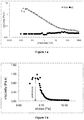
- a typical curve of the viscosity as function of the shear rate is represented on figure 1a .
- the ringing gel according to the invention can also be defined as having a Bingham plastic flow behavior that is well-known by the person skilled in the art. It means that the ringing gel according to the invention does not flow unless subjected to sufficient shear stress. A typical curve of the viscosity as function of the stress is represented on figure 1b .
- Dynamical viscosity storage modulus G', loss modulus G", quality factor Q, and relaxation times ⁇
- the ringing gel has a viscoelastic behavior, studied by applying sinusoidal deformations (strain) at different angular frequencies ⁇ .
- the shear stress developed by the system in response to the deformations is also a sinusoidal, which is out of phase with the strain.
- the elasticity (G') and the viscosity (G") of the material are expressed by these two moduli.
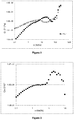
- the typical viscoelastic behavior of a ringing gel as defined in the present invention under oscillatory deformations at different frequencies is presented on figure 2 .
- the frequency sweep was performed at a fixed stress equal to 1Pa and at angular frequencies in the range from 0.1 to 500 rad/s.
- the temperature is kept constant at 20 °C.
- the gel behaves as a viscous fluid with G">G'.
- the elastic modulus G' overcomes the viscous modulus G" and reaches a plateau or a maximum. Further, at high oscillation frequencies, a next crossing between G' and G" appears.
- the first crossing point between G' and G" corresponds to the longest relaxation time ( ⁇ 1 ) of the internal structure indicating the so called “transition to flow”.
- the second cross point corresponds to the shortest relaxation time and indicates the so-called “leathery transition” of the material.
- Ringing is a term used in the present invention to mention the ability of the gel to vibrate in a specific range of frequencies and thus to keep the internal structure intact.
- the gel of the invention is characterized with a quality factor, which increases as function of the angular frequency and reaches a maximum above 0.5, preferably above 1 (typically in frequency between 5-500 rad/s (1 - 80 Hz), preferably between 5-300rad/s and even more preferably between 5-150 rad/s) where the gel is highly elastic leading to the observed vibrations.
- the ringing gel of the present invention is a structured liquid between a discontinuous microemulsion or nanoemulsion and a liquid-crystalline phase (lamellar, hexagonal and cubic).
- the ringing gel of the invention is neither an emulsion nor liquid crystalline phases.
- the discontinuous microemulsions are Newtonian fluids with viscosity independent on the shear rate of the deformation applied.
- the value of the zero shear viscosity is very low (typically 0.001-1Pa.s) and the elastic modulus G' is negative.
- a microemulsion does not have a viscoelastic behavior.
- liquid crystalline phases (lamellar, hexagonal, cubic), they are highly viscous (typically with a viscosity at 0.01 s -1 shear rate (20°C) greater than 1000Pa.s).
- the mixture (surfactant + linker) must have a suitable Packing parameter in order to form a suitable branched structure as defined above.
- the packing parameter satisfies the following equation: 1 / 3 ⁇ P linker + surfactant ⁇ 1 / 2 .
- the weight ratio surfactant system/(oil phase+linker) is comprised between 0.5 and 4, preferably between 0.8 and 2.
- the ringing gel composition according to the invention can comprise a solvent, preferably in an amount up to 40% by weight based on the total weight of the composition.
- the solvent is present in an amount up to 30% by weight based on the total weight of the composition.
- the solvent is present in an amount between 10 and 25% by weight based on the total weight of the composition.
- Suitable solvents used in the present invention include for example propylene glycol, glycerol, and a mixture thereof.
- the ringing gel composition comprises:
- the ringing gel is free from a thickener.
- a thickener can be defined as any substance suitable to increase the viscosity of a fluid (for example acrylate polymer, structuring gums (xanthan gum), starch, agar, hydroxyl allyl cellulose).
- the ringing gel composition is free from a silicone component.
- the surfactant system according to the invention essentially consists of one or more than one non-ionic surfactants having a mean HLB between 10 and 14.
- One or a combination of non-ionic surfactants having a HLB between 10 and 14 can be used.
- mean HLB corresponds to the HLB of the non-ionic surfactant.
- mean HLB is the mean of the HLB values of the surfactants.
- HLBmean ⁇ i n X i HLB i where X i are the weight concentrations of the surfactants in the surfactant system.
- non-ionic surfactants one may cite those belonging to the classes of:
- the linker is chosen in the group consisting of alcohols, salts and esters of carboxylic acids, salts and esters of hydroxyl carboxylic acids, fatty acids, fatty acid salts, glycerol fatty acids, surfactant having an HLB less than 10 and mixtures thereof.
- Fatty acids that can be used in the present invention include but are not limited to lauric acid, myristic acid, palmitic acid esters, and mixtures thereof.
- the linker is an alcohol with a long alkyl chain.
- alcohols with long alkyl chains it means that the number of carbon of the alcohol is greater than 9.
- the esters of carboxylic acids are long esters of carboxylic acids (number of carbon greater than 6).
- the final composition of the ringing gel has a composition in the range: (0.33-P L )/(P S -P L ) ⁇ a ⁇ (0.5- P L )/(P S -P L ), where a is the mol fraction of the non-ionic surfactant, P S is the packing parameter of the non-ionic surfactant and P L is the packing parameter of linker.
- the mol fractions of the linker are equal to (1-a).
- the ringing gel composition can comprise additional components.
- Hydrophobic active ingredients are preferably chosen from the group consisting of flavor, flavor ingredients, perfume, perfume ingredients, essential oils, nutraceuticals, cosmetics, insect control agents, biocide actives and mixtures thereof.
- insect control agents present in the hydrophobic internal phase do not warrant a more detailed description here, which in any case would not be exhaustive, the skilled person being able to select them on the basis of its general knowledge and according to intended use or application.
- insect control agents are birch, DEET (N,N-diethyl-m-toluamide), essential oil of the lemon eucalyptus (Corymbia citriodora) and its active compound p-menthane-3,8-diol(PMD), icaridin (hydroxyethyl isobutyl piperidine carboxylate) ,Nepelactone, Citronella oil, Neem oil, Bog Myrtle (Myrica Gale), Dimethyl carbate, Tricyclodecenyl allyl ether, IR3535 (3-[N-Butyl-N-acetyl]-aminopropionic acid, ethyl ester, Ethylhexanediol, Dimethyl phthalate, Metofluthrin, Indalone, SS220, anthranilate-based insect repellents, and mixtures thereof.
- DEET N,N-diethyl-m-toluamide
- the hydrophobic-active ingredient comprises a mixture of a perfume with another ingredient selected from the group consisting of nutraceuticals, cosmetics, insect control agents and biocide actives.
- the hydrophobic active ingredient comprises a perfume.
- the hydrophobic active ingredient consists of a perfume.
- perfume oil (or also “perfume”) what is meant here is an ingredient or composition that is a liquid at about 20°C.
- said perfume oil can be a perfuming ingredient alone or a mixture of ingredients in the form of a perfuming composition.
- a perfuming ingredient it is meant here a compound, which is used for the primary purpose of conferring or modulating an odour.
- such an ingredient, to be considered as being a perfuming one must be recognized by a person skilled in the art as being able to at least impart or modify in a positive or pleasant way the odor of a composition, and not just as having an odor.
- perfume oil also includes combination of perfuming ingredients with substances which together improve, enhance or modify the delivery of the perfuming ingredients, such as perfume precursors, emulsions or dispersions, as well as combinations which impart an additional benefit beyond that of modifying or imparting an odor, such as long-lasting, blooming, malodour counteraction, antimicrobial effect, microbial stability, insect control.
- perfuming ingredients such as perfume precursors, emulsions or dispersions, as well as combinations which impart an additional benefit beyond that of modifying or imparting an odor, such as long-lasting, blooming, malodour counteraction, antimicrobial effect, microbial stability, insect control.
- perfuming ingredients present in the oil phase do not warrant a more detailed description here, which in any case would not be exhaustive, the skilled person being able to select them on the basis of its general knowledge and according to intended use or application and the desired organoleptic effect.
- these perfuming ingredients belong to chemical classes as varied as alcohols, aldehydes, ketones, esters, ethers, acetates, nitriles, terpenoids, nitrogenous or sulphurous heterocyclic compounds and essential oils, and said perfuming co-ingredients can be of natural or synthetic origin. Many of these co-ingredients are in any case listed in reference texts such as the book by S.
- the perfuming ingredients may be dissolved in a solvent of current use in the perfume industry.
- the solvent is preferably not an alcohol.
- examples of such solvents are diethyl phthalate, isopropyl myristate, Abalyn® (rosin resins, available from Eastman), benzyl benzoate, ethyl citrate, limonene or other terpenes, or isoparaffins.
- the solvent is very hydrophobic and highly sterically hindered, like for example Abalyn® or benzyl benzoate.
- a ringing gel composition comprising a non-ionic surfactant system consisting essentially of non-ionic surfactant(s) could improve the performance of the active ingredient contained therein.
- the ringing gel of the present invention has advantageous properties such as suspending properties for solid particles in particular for microcapsules without showing signs of instability, even in the absence of a thickcncr.
- the ringing gel is able to retain microcapsules in stable suspension without the need of a thickener.
- any system free of charge such as microemulsion requires the use of thickener to retain particles.
- the ringing gel composition comprises one part of the oil phase freely dispersed in the water phase and another part of the oil phase dispersed in an encapsulated form in the water phase.
- the ringing gel comprises a perfume freely dispersed and an encapsulated perfume in the form of microcapsules.
- the encapsulated form can be microcapsules which have been widely described in the prior art.
- the shell can be aminoplast-based, polyurea-based or polyurethane-based.
- the shell can also be hybrid, namely organic-inorganic such as a hybrid shell composed of at least two types of inorganic particles that are cross-linked, or yet a shell resulting from the hydrolysis and condensation reaction of a polyalkoxysilane macro-monomeric composition.
- the shell comprises an aminoplast copolymer, such as melamine-formaldehyde or urea-formaldehyde or cross-linked melamine formaldehyde or melamine glyoxal.
- aminoplast copolymer such as melamine-formaldehyde or urea-formaldehyde or cross-linked melamine formaldehyde or melamine glyoxal.
- the shell is polyurea-based made from, for example but not limited to isocyanate-based monomers and amine-containing crosslinkers such as guanidine carbonate and/or guanazole.
- Preferred polyurea microcapsules comprise a polyurea wall which is the reaction product of the polymerisation between at least one polyisocyanate comprising at least two isocyanate functional groups and at least one reactant selected from the group consisting of an amine (for example a water soluble guanidine salt and guanidine); a colloidal stabilizer or emulsifier; and an encapsulated perfume.
- an amine for example a water soluble guanidine salt and guanidine
- colloidal stabilizer or emulsifier for example a colloidal stabilizer or emulsifier
- an encapsulated perfume for example a water soluble guanidine salt and guanidine
- an amine for example a water soluble guanidine salt and guanidine
- the colloidal stabilizer includes an aqueous solution of between 0.1% and 0.4% of polyvinyl alcohol, between 0.6% and 1% of a cationic copolymer of vinylpyrrolidone and of a quaternized vinylimidazol (all percentages being defined by weight relative to the total weight of the colloidal stabilizer).
- the emulsifier is an anionic or amphiphilic biopolymer preferably chosen from the group consisting of gum Arabic, soy protein, gelatin, sodium caseinate and mixtures thereof.
- the shell is polyurethane-based made from, for example but not limited to polyisocyanate and polyols, polyamide, polyester, etc.
- said microcapsule wall material may comprise any suitable resin and especially including melamine, glyoxal, polyurea, polyurethane, polyamide, polyester, etc.
- suitable resins include the reaction product of an aldehyde and an amine
- suitable aldehydes include, formaldehyde and glyoxal.
- suitable amines include melamine, urea, benzoguanamine, glycoluril, and mixtures thereof.
- Suitable melamines include, methylol melamine, methylated methylol melamine, imino melamine and mixtures thereof.
- Suitable ureas include, dimethylol urea, methylated dimethylol urea, urea-resorcinol, and mixtures thereof.
- Suitable materials for making may be obtained from one or more of the following companies Solutia Inc. (St Louis, Missouri U.S.A.), Cytec Industries (West Paterson, New Jersey U.S.A.), Sigma-Aldrich (St. Louis, Missouri U.S.A.).
- the core-shell microcapsule is a formaldehyde-free capsule.
- a typical process for the preparation of aminoplast formaldehyde-free microcapsules slurry comprises the steps of
- the shell of the microcapsule is polyurea-or polyurethane-based.
- processes for the preparation of polyurea and polyureathane-based microcapsule slurry are for instance described in WO2007/004166 , EP 2300146 , EP2579976 .
- a process for the preparation of polyurea or polyurethane-based microcapsule slurry include the following steps:
- the ringing gel of the present invention can be used in many fields of application.
- Another object of the present invention is a ringing gel composition as defined above in the form of a laundry scent booster.
- Another object of the invention is a microcapsule dispersing system comprising a ringing gel according to the invention and at least one microcapsule as defined previously.
- Another object of the present invention is a process for preparing a ringing gel composition according to the present invention, said process comprising the step of mixing an aqueous phase, a surfactant system, a linker, an oil phase comprising a hydrophobic active ingredient, and optionally a solvent, wherein:
- the linker is separately dissolved in the oil phase comprising the hydrophobic active ingredient due to its higher solubility in the oil phase.
- the process does not require any shear and/or pressure treatment to induce the formation of the gel.
- the invention's ringing gel composition can advantageously be used in many application fields and used in various consumer products.
- Another object of the invention is a consumer product comprising or consisting of the ringing gel composition as defined above or prepared according to the process defined above.
- the consumer product is in the form of a home care or personal care product selected from the group consisting of a skin cleansing product, a shampoo, a rinse-off conditioner, a deodorant, an antiperspirant, a body lotion, a leave-on conditioner, a fabric conditioner, a liquid detergent, a laundry scent booster and an all-purpose cleaner.
- a home care or personal care product selected from the group consisting of a skin cleansing product, a shampoo, a rinse-off conditioner, a deodorant, an antiperspirant, a body lotion, a leave-on conditioner, a fabric conditioner, a liquid detergent, a laundry scent booster and an all-purpose cleaner.
- the consumer product is a laundry scent booster.
- the ringing gel composition of the present invention has shown its capability to suspend, for instance microcapsules, without sedimentation over a long period of time.
- Another object of the invention is a method for suspending microcapsules without sedimentation in a liquid comprising the step consisting of:
- a last object of the present invention is the use of a ringing gel composition having a viscosity comprised between 0.1 and 1000 Pa.s at 0.01 s -1 shear rate at 20°C and a viscoelastic dynamic behavior, said composition comprising:
- compositions 1-5 - see table 2 Different ringing gel compositions were prepared (compositions 1-5 - see table 2) according to the following protocol.
- aqueous phase water
- solvent propylene glycol
- surfactants were mixed together at room temperature under agitation with magnetic stirrer at 300 rpm for 5 min.
- the linker was dissolved in the hydrophobic active ingredient (fragrance) at room temperature under agitation with magnetic stirrer at 300 rpm. The resulting mixture was mixed for 5 min.
- Ringing gel compositions Fragrance A Fragrance B Fragrance C %wt %wt %wt Aqueous phase (Water) 70.64 70.78 71.07 solvent (Propylene glycol) 20.18 20.22 20.30 Non-ionic surfactant (Deceth-8) 4.04 4.04 4.06 Linker (Deceth-3) 1.51 1.52 1.52 Hydrophobic active ingredient (Fragrance) 3.63 3.44 3.05
- the obtained ringing gels were slightly opalescent.
- Ringing gel (according to the invention) and microemulsion compositions Ringing gel (RGG) Microemulsion (mE) Aqueous phase (Water) 70% 45% solvent (Propylene glycol) 20% 45% Non-ionic surfactant (Deceth-8) 6% 6% Hydrophobic active ingredient (Fragrance 4) ) 2.7% 2.7% Linker (Lauric acid) 1.3% 1.3% 4) Fragrance A or Fragrance B or Fragrance C
- the microemulsion is a transparent solution, containing discontiniuosly dispersed nanometric droplets of oil compound.
- the ringing gel is an opalescent solution, composed of a network of branched micelles.
- the olfactive performance was evaluated on wet clothes and after 1 day of drying.
- Cotton terry towels (10 pieces, 18 cm * 18 cm, about 30 g each) were washed with 30 g of unperfumed detergent in a washing machine (Miele Novotronic W300-33CH) at 40°C using the short cycle program. The wash was followed by a rinse at 900 rpm with 10 g of the ringing gel or the microemulsion (see table 4).
- the terry towels were evaluated wet or they were then line dried for 24 hours before being evaluated.
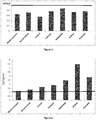
- the use of the ringing gel according to the invention exhibits a better perfume intensity (both for dry and wet conditions) when compared to a microemulsion underlying a better long-lasting performance for the ringing gel.
- Figure 1a shows the steady shear rate viscosity curve for the ringing gel and the microemulsion having the compositions detailed in table 4. These curves underline that the ringing gel of the invention has a non-Newtonian behavior whereas the microemulsion exhibits a Newtonian behavior.
- Figure 1b shows the viscosity as a function of the shear stress. The peak of the viscosity corresponds to the value of the yield stress indicating a Bingham-type of fluid.
- Figure 2 shows the dynamic shear modulii for the ringing gel having the compositions detailed in table 4.
- a ringing gel comprising microcapsules versus a microemulsion comprising microcapsules
- Microcapsules having the following composition were prepared according to the process described below.
- Table 6 Composition of capsule slurry A Capsule A Ingredient Amount [%] Oil Phase 30.9 Perfume oil 1) 30.28 Polyisocyanate 2) 0.62 Water phase Acrylamide and acrylic acid copolymer 3) 4.7 Melamine-formaldehyde resins 4) 4.7 Water 59 Sodium hydroxide 0.5 Acetic acid 0.2 Total 100 1) see Table 7 2) Takenate® D-110N ; origin: Mitsui Chemicals 3) Alcapsol from Ciba, 20% solution in water 4) 90/10 blend of Cymel 385 & Cymel 9370 from Cytec, both 70% solution in water
- Table 7 Perfume oil composition Ingredients Wt % Ethyl 2-methylbutyrate 5.2% Amyl acetate 2.5% Aldehyde C 8 3.1% Hexyl acetate 9.7% Methylparacresol 1.0% Limonene 3.7% Amyl butyrate 1.0% Aldehyde C 9
- the oil phase was prepared by admixing a polyisocyanate (trimethylol propane adduct of xylylene diisocyanate, Takenate® D-110N, origin: Mitsui Chemicals) with a perfume oil comprising the ingredients listed in Table 7.
- the oil phase consists of 2% Takenate® D-110N and 98% of the perfume oil.
- at least one polyisocyanate like Takenate D-110N is added in an amount comprised between 0.1% and 10%, preferably between 0.5% and 5%.
- the acrylamide and acrylic acid copolymer and the melamine-formaldehyde resin were dissolved in water to form the water phase.
- the perfume premix oil was added into this solution and the pH was regulated to 5 with acetic acid.
- the temperature was raised to 90°C for 2 hours to allow the curing of the capsules.
- capsules are formed, cross-linked and stable.
- a solution of ethylene urea (containing about 3% w/w of ethylene urea relative to the weight of the slurry) was added as usually done with aminoplast capsules as an agent to scavenge residual free formaldehyde and the mixture was left to cool down to room temperature.
- the final pH was adjusted to 7 with sodium hydroxide.
- microcapsule slurry A 2% by weight were added into the composition of the ringing gel as detailed in table 4.
- Figures 4a (left) and 4b (right) show respectively the microemulsion and the ringing gel comprising the microcapusles after 1 month of storage at 25°C.
- the ringing gel according to the invention is able to suspend microcapsules in a stable manner without sedimentation or flocculation whereas the microcapsules contained in the microemulsion remain at the interface between the air and the microemulsion.
- the ringing gel of the present invention is entirely suitable for suspending microcapsules without thickener and without sedimentation over a long period of time.
- the fragrance release performance of the ringing gel defined in the present invention was determined and compared with fragrance release when the fragrance is solubilized in a microemulsion comprising a thickener (see table 8).
- Table 8 Sample composition Function Ringing Gel Sample A Microemulsion Sample B % % Water Water phase 61.90 63.68 Propylene glycol Solvent 21.10 21.69 Alcohol 6-12 Ethoxylate 1) Nonionic surfactant 9.50 9.50 Dodecanoic acid 2) Linker 2.50 0 Xanthan 3) Thickener 0.00 0.13 Fragrance 4) Hydrophobic active ingredient 5.00 5.00 1) Firmenich SA 2) Firmenich SA 3) Firmenich SA 4) Fragrance B (see table 1) The following different evaluations were made.
- the gas concentration of the fragrance above sample A (ringing gel solution) (Cg) is compared to the gas concentration of the same fragrance above the comparative sample B (Cgref). If the value Cg/Cgref is lower than one, it means that there is less fragrance molecules in the headspace above sample A than above comparative sample B. In this case, we can conclude that the analysed ringing gel leads to a better retention. On the contrary, if the value is more than one, fragrance molecules preferably move to the air.
- the olfactive performance was evaluated on clothes after 3 days of drying. Cotton terry towels (10 pieces, 18 cm * 18 cm, about 30 g each) were washed in a washing machine (Miele Novotronic W300-33CH) at 40°C using the short cycle program. The wash was followed by a rinse at 900 rpm with 40 g of the ringing gel sample A or the microemulsion sample B (see table 8).
- the terry towels were line dried for 3 days and evaluated.
- the intensity of the perception of the perfume on dry towels treated with the ringing gel or the microemulsion was evaluated by a panel of 20 trained panelists. They were asked to rate the intensity of the perfume perception on a scale ranging from 0 to 7, wherein 0 means no odour and 7 means very strong odour.
- the use of the ringing gel according to the invention exhibits a better perfume intensity on dry clothes after 3 days when compared to a microemulsion underlying a better long-lasting performance for the ringing gel.
Landscapes
- Chemical & Material Sciences (AREA)
- Life Sciences & Earth Sciences (AREA)
- Health & Medical Sciences (AREA)
- Engineering & Computer Science (AREA)
- Chemical Kinetics & Catalysis (AREA)
- Oil, Petroleum & Natural Gas (AREA)
- Wood Science & Technology (AREA)
- Organic Chemistry (AREA)
- Emergency Medicine (AREA)
- Animal Behavior & Ethology (AREA)
- General Health & Medical Sciences (AREA)
- Public Health (AREA)
- Veterinary Medicine (AREA)
- Birds (AREA)
- Epidemiology (AREA)
- Dispersion Chemistry (AREA)
- Textile Engineering (AREA)
- Cosmetics (AREA)
- Fats And Perfumes (AREA)
- Detergent Compositions (AREA)
- Colloid Chemistry (AREA)
- Disinfection, Sterilisation Or Deodorisation Of Air (AREA)
- Medicinal Preparation (AREA)
- Chemical Or Physical Treatment Of Fibers (AREA)
- Treatments For Attaching Organic Compounds To Fibrous Goods (AREA)
- Manufacturing Of Micro-Capsules (AREA)
Applications Claiming Priority (2)
| Application Number | Priority Date | Filing Date | Title |
|---|---|---|---|
| EP16194399 | 2016-10-18 | ||
| PCT/EP2017/076462 WO2018073238A1 (en) | 2016-10-18 | 2017-10-17 | Ringing gel composition |
Publications (2)
| Publication Number | Publication Date |
|---|---|
| EP3528902A1 EP3528902A1 (en) | 2019-08-28 |
| EP3528902B1 true EP3528902B1 (en) | 2021-03-31 |
Family
ID=57153352
Family Applications (1)
| Application Number | Title | Priority Date | Filing Date |
|---|---|---|---|
| EP17784299.4A Active EP3528902B1 (en) | 2016-10-18 | 2017-10-17 | Ringing gel composition |
Country Status (10)
| Country | Link |
|---|---|
| US (1) | US10894934B2 (da) |
| EP (1) | EP3528902B1 (da) |
| JP (2) | JP2020506035A (da) |
| CN (1) | CN109862946B (da) |
| BR (1) | BR112019007906B1 (da) |
| DK (1) | DK3528902T3 (da) |
| ES (1) | ES2874671T3 (da) |
| MX (1) | MX376179B (da) |
| SG (1) | SG11201903417PA (da) |
| WO (1) | WO2018073238A1 (da) |
Families Citing this family (11)
| Publication number | Priority date | Publication date | Assignee | Title |
|---|---|---|---|---|
| WO2020035277A1 (en) | 2018-08-15 | 2020-02-20 | Unilever Plc | Laundry additive or ancillary composition |
| WO2020233773A1 (en) | 2019-05-17 | 2020-11-26 | Symrise Ag | Oil-in-water macroemulsion |
| CN110305741B (zh) * | 2019-06-04 | 2021-03-19 | 广州蓝月亮实业有限公司 | 一种含油性组分的自增稠组合物 |
| CN110885406B (zh) * | 2019-12-06 | 2022-03-11 | 万华化学(宁波)有限公司 | 一种丙烯酸乳液的制备方法、丙烯酸乳液及其应用 |
| MX2022007454A (es) | 2019-12-16 | 2022-08-17 | Warwick International Group Ltd | Geles elasticos de alta viscosidad y sus usos. |
| EP4083176A1 (en) * | 2021-04-29 | 2022-11-02 | The Procter & Gamble Company | Structuring premixes and liquid compositions comprising them |
| JP2023548361A (ja) * | 2021-04-29 | 2023-11-16 | ザ プロクター アンド ギャンブル カンパニー | 構造化プレミックス及びそれを含む液体組成物 |
| GB202115101D0 (en) | 2021-10-21 | 2021-12-08 | Givaudan Sa | Composition |
| JP2025524973A (ja) * | 2022-05-04 | 2025-08-01 | シムライズ アーゲー | 芳香装置用エマルジョン |
| WO2025056650A1 (en) | 2023-09-13 | 2025-03-20 | Givaudan Sa | Fragrance composition |
| EP4623057A1 (en) * | 2024-07-19 | 2025-10-01 | Symrise AG | Encapsulated fragrance compositions for providing, modulating or intensifying a scent |
Family Cites Families (24)
| Publication number | Priority date | Publication date | Assignee | Title |
|---|---|---|---|---|
| US5091111A (en) * | 1990-09-19 | 1992-02-25 | S. C. Johnson & Son, Inc. | Aqueous emulsion and aersol delivery system using same |
| ES2091591T3 (es) * | 1991-12-20 | 1996-11-01 | Procter & Gamble | Un procedimiento para preparar una composicion de capsulas de perfume. |
| EP0598335A3 (en) * | 1992-11-13 | 1996-01-10 | Albright & Wilson | New cleaning compositions. |
| US5447644A (en) * | 1994-05-12 | 1995-09-05 | International Flavors & Fragrances Inc. | Method of controlling viscosity of fabric softeners |
| DE19624051A1 (de) | 1996-06-17 | 1997-12-18 | Henkel Kgaa | Parfümölkonzentrate |
| GB9913408D0 (en) * | 1999-06-10 | 1999-08-11 | Albright & Wilson Uk Ltd | Personal care formulations |
| CA2364350A1 (en) * | 2000-12-06 | 2002-06-06 | Johnson & Johnson Consumer Companies, Inc. | Personal care formulations |
| US7153516B2 (en) | 2001-07-02 | 2006-12-26 | Color Access, Inc. | Ringing nanogel compositions |
| US6875732B2 (en) | 2003-08-08 | 2005-04-05 | Isp Investments Inc. | Fragrance delivery system |
| US20070071780A1 (en) | 2005-06-16 | 2007-03-29 | Dubois Zerlina G | Personal care composition comprising a perfume booster accord |
| WO2007004166A1 (en) | 2005-06-30 | 2007-01-11 | Firmenich Sa | Polyurethane and polyurea microcapsules |
| EP2205826A4 (en) * | 2007-10-31 | 2011-06-29 | Rhodia | ADDITION OF A ZWITTERIONIC TENSID TO A WATER-SOLUBLE POLYMER TO INCREASE THE STABILITY OF POLYMERS IN AQUEOUS SOLUTIONS WITH SALTS AND / OR TENSIDES |
| US7789160B2 (en) * | 2007-10-31 | 2010-09-07 | Rhodia Inc. | Addition of nonionic surfactants to water soluble block copolymers to increase the stability of the copolymer in aqueous solutions containing salt and/or surfactants |
| JP5713892B2 (ja) | 2008-06-16 | 2015-05-07 | フイルメニツヒ ソシエテ アノニムFirmenich Sa | ポリウレアマイクロカプセルの製造方法 |
| US20100150975A1 (en) | 2008-10-20 | 2010-06-17 | Jiten Odhavji Dihora | Structured Composition Comprising an Encapsulated Active |
| EP2179719B1 (en) * | 2008-10-27 | 2016-10-12 | Unilever PLC | Antiperspirant or deodorant compositions |
| US20110268683A1 (en) | 2010-01-29 | 2011-11-03 | Rhodia, Inc. | Structured suspending systems |
| MX339276B (es) | 2010-06-11 | 2016-05-19 | Firmenich & Cie | Proceso para preparar microcapsulas de poliurea. |
| KR101912966B1 (ko) | 2011-03-22 | 2018-10-29 | 헨켈 아게 운트 코. 카게아아 | 캡슐을 포함하는 액체 세탁 세제 |
| US9358189B2 (en) | 2011-11-10 | 2016-06-07 | Firmenich Sa | Stable formaldehyde-free microcapsules |
| EP2708589A1 (en) | 2012-09-14 | 2014-03-19 | The Procter & Gamble Company | Fabric care composition |
| CN104936573B (zh) | 2012-11-27 | 2017-11-10 | 国际香料和香精公司 | 用于增强胶囊沉积的在溶致物或溶致液晶表面活性剂相中的分散胶囊 |
| WO2014171476A1 (ja) * | 2013-04-16 | 2014-10-23 | ライオン株式会社 | 液体洗浄剤 |
| JP6171200B2 (ja) * | 2013-11-25 | 2017-08-02 | ライオン株式会社 | 繊維製品用処理剤組成物 |
-
2017
- 2017-10-17 US US16/342,520 patent/US10894934B2/en active Active
- 2017-10-17 BR BR112019007906-8A patent/BR112019007906B1/pt not_active IP Right Cessation
- 2017-10-17 WO PCT/EP2017/076462 patent/WO2018073238A1/en not_active Ceased
- 2017-10-17 DK DK17784299.4T patent/DK3528902T3/da active
- 2017-10-17 SG SG11201903417PA patent/SG11201903417PA/en unknown
- 2017-10-17 MX MX2019003985A patent/MX376179B/es active IP Right Grant
- 2017-10-17 JP JP2019520707A patent/JP2020506035A/ja active Pending
- 2017-10-17 EP EP17784299.4A patent/EP3528902B1/en active Active
- 2017-10-17 ES ES17784299T patent/ES2874671T3/es active Active
- 2017-10-17 CN CN201780064144.5A patent/CN109862946B/zh active Active
-
2022
- 2022-05-02 JP JP2022076334A patent/JP2022105163A/ja not_active Withdrawn
Non-Patent Citations (1)
| Title |
|---|
| None * |
Also Published As
| Publication number | Publication date |
|---|---|
| MX2019003985A (es) | 2019-08-12 |
| JP2022105163A (ja) | 2022-07-12 |
| US10894934B2 (en) | 2021-01-19 |
| WO2018073238A1 (en) | 2018-04-26 |
| BR112019007906B1 (pt) | 2022-06-07 |
| SG11201903417PA (en) | 2019-05-30 |
| DK3528902T3 (da) | 2021-07-05 |
| BR112019007906A2 (pt) | 2019-07-02 |
| CN109862946A (zh) | 2019-06-07 |
| JP2020506035A (ja) | 2020-02-27 |
| EP3528902A1 (en) | 2019-08-28 |
| US20190241841A1 (en) | 2019-08-08 |
| CN109862946B (zh) | 2022-02-08 |
| ES2874671T3 (es) | 2021-11-05 |
| MX376179B (es) | 2025-03-07 |
Similar Documents
| Publication | Publication Date | Title |
|---|---|---|
| US10894934B2 (en) | Ringing gel composition | |
| EP2379047B1 (en) | Microcapsules and uses thereof | |
| JP7416620B2 (ja) | マイクロカプセルの製造方法 | |
| EP2244689B1 (en) | Deposition of lipophilic active material in surfactant containing compositions | |
| EP3459622B1 (en) | Encapsulated active material | |
| JP6012598B2 (ja) | ポリ尿素マイクロカプセルの製造方法 | |
| JP6214553B2 (ja) | ポリウレアマイクロカプセルの製造方法 | |
| JP6012724B2 (ja) | ポリ尿素マイクロカプセルの製造方法 | |
| CN107835707B (zh) | 微胶囊 | |
| EP3559193A1 (en) | Density balanced high impact perfume microcapsules | |
| BR112012011580B1 (pt) | Cápsulas de alta eficiência que compreendem agente de benefício, pasta fluida, aglomerado, processo de produção do aglomerado, produto destinado ao consumidor, método de limpeza ou de tratamento de um situs e processo para produção de um encapsulado revestido | |
| EP3706897A1 (en) | Process for the preparation of microcapsules | |
| BR112020003451A2 (pt) | melhorias em ou relacionadas a compostos orgânicos | |
| EP1585486A1 (en) | Fragrance compositions | |
| CA2148675A1 (en) | Method of controlling viscosity of fabric softeners | |
| CN107666897A (zh) | 表面沉积量高的微胶囊 | |
| EP3630055B1 (en) | Aqueous microemulsion | |
| JP2018506420A (ja) | メラミンホルムアルデヒドを有さないマイクロカプセルの製造方法 |
Legal Events
| Date | Code | Title | Description |
|---|---|---|---|
| STAA | Information on the status of an ep patent application or granted ep patent |
Free format text: STATUS: UNKNOWN |
|
| STAA | Information on the status of an ep patent application or granted ep patent |
Free format text: STATUS: THE INTERNATIONAL PUBLICATION HAS BEEN MADE |
|
| PUAI | Public reference made under article 153(3) epc to a published international application that has entered the european phase |
Free format text: ORIGINAL CODE: 0009012 |
|
| STAA | Information on the status of an ep patent application or granted ep patent |
Free format text: STATUS: REQUEST FOR EXAMINATION WAS MADE |
|
| 17P | Request for examination filed |
Effective date: 20190520 |
|
| AK | Designated contracting states |
Kind code of ref document: A1 Designated state(s): AL AT BE BG CH CY CZ DE DK EE ES FI FR GB GR HR HU IE IS IT LI LT LU LV MC MK MT NL NO PL PT RO RS SE SI SK SM TR |
|
| AX | Request for extension of the european patent |
Extension state: BA ME |
|
| DAV | Request for validation of the european patent (deleted) | ||
| DAX | Request for extension of the european patent (deleted) | ||
| GRAP | Despatch of communication of intention to grant a patent |
Free format text: ORIGINAL CODE: EPIDOSNIGR1 |
|
| RIC1 | Information provided on ipc code assigned before grant |
Ipc: A61K 8/37 20060101ALI20200429BHEP Ipc: A61K 8/36 20060101ALI20200429BHEP Ipc: D06M 13/00 20060101ALI20200429BHEP Ipc: A61K 8/60 20060101ALI20200429BHEP Ipc: A61K 8/39 20060101ALI20200429BHEP Ipc: C11D 3/50 20060101ALI20200429BHEP Ipc: A61Q 13/00 20060101AFI20200429BHEP Ipc: A61K 8/04 20060101ALI20200429BHEP |
|
| STAA | Information on the status of an ep patent application or granted ep patent |
Free format text: STATUS: GRANT OF PATENT IS INTENDED |
|
| INTG | Intention to grant announced |
Effective date: 20200604 |
|
| RIN1 | Information on inventor provided before grant (corrected) |
Inventor name: BELLOUARD, CLAUDIE Inventor name: TCHAKALOVA, VERA |
|
| RAP1 | Party data changed (applicant data changed or rights of an application transferred) |
Owner name: FIRMENICH SA |
|
| GRAJ | Information related to disapproval of communication of intention to grant by the applicant or resumption of examination proceedings by the epo deleted |
Free format text: ORIGINAL CODE: EPIDOSDIGR1 |
|
| STAA | Information on the status of an ep patent application or granted ep patent |
Free format text: STATUS: REQUEST FOR EXAMINATION WAS MADE |
|
| GRAS | Grant fee paid |
Free format text: ORIGINAL CODE: EPIDOSNIGR3 |
|
| STAA | Information on the status of an ep patent application or granted ep patent |
Free format text: STATUS: GRANT OF PATENT IS INTENDED |
|
| INTC | Intention to grant announced (deleted) | ||
| GRAP | Despatch of communication of intention to grant a patent |
Free format text: ORIGINAL CODE: EPIDOSNIGR1 |
|
| INTG | Intention to grant announced |
Effective date: 20201113 |
|
| GRAA | (expected) grant |
Free format text: ORIGINAL CODE: 0009210 |
|
| STAA | Information on the status of an ep patent application or granted ep patent |
Free format text: STATUS: THE PATENT HAS BEEN GRANTED |
|
| AK | Designated contracting states |
Kind code of ref document: B1 Designated state(s): AL AT BE BG CH CY CZ DE DK EE ES FI FR GB GR HR HU IE IS IT LI LT LU LV MC MK MT NL NO PL PT RO RS SE SI SK SM TR |
|
| REG | Reference to a national code |
Ref country code: GB Ref legal event code: FG4D Ref country code: CH Ref legal event code: EP |
|
| REG | Reference to a national code |
Ref country code: AT Ref legal event code: REF Ref document number: 1376268 Country of ref document: AT Kind code of ref document: T Effective date: 20210415 |
|
| REG | Reference to a national code |
Ref country code: DE Ref legal event code: R096 Ref document number: 602017035800 Country of ref document: DE |
|
| REG | Reference to a national code |
Ref country code: IE Ref legal event code: FG4D |
|
| REG | Reference to a national code |
Ref country code: DK Ref legal event code: T3 Effective date: 20210629 |
|
| REG | Reference to a national code |
Ref country code: LT Ref legal event code: MG9D |
|
| PG25 | Lapsed in a contracting state [announced via postgrant information from national office to epo] |
Ref country code: BG Free format text: LAPSE BECAUSE OF FAILURE TO SUBMIT A TRANSLATION OF THE DESCRIPTION OR TO PAY THE FEE WITHIN THE PRESCRIBED TIME-LIMIT Effective date: 20210630 Ref country code: NO Free format text: LAPSE BECAUSE OF FAILURE TO SUBMIT A TRANSLATION OF THE DESCRIPTION OR TO PAY THE FEE WITHIN THE PRESCRIBED TIME-LIMIT Effective date: 20210630 Ref country code: FI Free format text: LAPSE BECAUSE OF FAILURE TO SUBMIT A TRANSLATION OF THE DESCRIPTION OR TO PAY THE FEE WITHIN THE PRESCRIBED TIME-LIMIT Effective date: 20210331 Ref country code: HR Free format text: LAPSE BECAUSE OF FAILURE TO SUBMIT A TRANSLATION OF THE DESCRIPTION OR TO PAY THE FEE WITHIN THE PRESCRIBED TIME-LIMIT Effective date: 20210331 |
|
| PG25 | Lapsed in a contracting state [announced via postgrant information from national office to epo] |
Ref country code: LV Free format text: LAPSE BECAUSE OF FAILURE TO SUBMIT A TRANSLATION OF THE DESCRIPTION OR TO PAY THE FEE WITHIN THE PRESCRIBED TIME-LIMIT Effective date: 20210331 Ref country code: RS Free format text: LAPSE BECAUSE OF FAILURE TO SUBMIT A TRANSLATION OF THE DESCRIPTION OR TO PAY THE FEE WITHIN THE PRESCRIBED TIME-LIMIT Effective date: 20210331 Ref country code: SE Free format text: LAPSE BECAUSE OF FAILURE TO SUBMIT A TRANSLATION OF THE DESCRIPTION OR TO PAY THE FEE WITHIN THE PRESCRIBED TIME-LIMIT Effective date: 20210331 |
|
| REG | Reference to a national code |
Ref country code: NL Ref legal event code: MP Effective date: 20210331 |
|
| REG | Reference to a national code |
Ref country code: AT Ref legal event code: MK05 Ref document number: 1376268 Country of ref document: AT Kind code of ref document: T Effective date: 20210331 |
|
| PG25 | Lapsed in a contracting state [announced via postgrant information from national office to epo] |
Ref country code: AT Free format text: LAPSE BECAUSE OF FAILURE TO SUBMIT A TRANSLATION OF THE DESCRIPTION OR TO PAY THE FEE WITHIN THE PRESCRIBED TIME-LIMIT Effective date: 20210331 Ref country code: NL Free format text: LAPSE BECAUSE OF FAILURE TO SUBMIT A TRANSLATION OF THE DESCRIPTION OR TO PAY THE FEE WITHIN THE PRESCRIBED TIME-LIMIT Effective date: 20210331 Ref country code: SM Free format text: LAPSE BECAUSE OF FAILURE TO SUBMIT A TRANSLATION OF THE DESCRIPTION OR TO PAY THE FEE WITHIN THE PRESCRIBED TIME-LIMIT Effective date: 20210331 Ref country code: EE Free format text: LAPSE BECAUSE OF FAILURE TO SUBMIT A TRANSLATION OF THE DESCRIPTION OR TO PAY THE FEE WITHIN THE PRESCRIBED TIME-LIMIT Effective date: 20210331 Ref country code: CZ Free format text: LAPSE BECAUSE OF FAILURE TO SUBMIT A TRANSLATION OF THE DESCRIPTION OR TO PAY THE FEE WITHIN THE PRESCRIBED TIME-LIMIT Effective date: 20210331 Ref country code: LT Free format text: LAPSE BECAUSE OF FAILURE TO SUBMIT A TRANSLATION OF THE DESCRIPTION OR TO PAY THE FEE WITHIN THE PRESCRIBED TIME-LIMIT Effective date: 20210331 |
|
| PGFP | Annual fee paid to national office [announced via postgrant information from national office to epo] |
Ref country code: CH Payment date: 20210901 Year of fee payment: 5 |
|
| REG | Reference to a national code |
Ref country code: ES Ref legal event code: FG2A Ref document number: 2874671 Country of ref document: ES Kind code of ref document: T3 Effective date: 20211105 |
|
| PG25 | Lapsed in a contracting state [announced via postgrant information from national office to epo] |
Ref country code: PT Free format text: LAPSE BECAUSE OF FAILURE TO SUBMIT A TRANSLATION OF THE DESCRIPTION OR TO PAY THE FEE WITHIN THE PRESCRIBED TIME-LIMIT Effective date: 20210802 Ref country code: PL Free format text: LAPSE BECAUSE OF FAILURE TO SUBMIT A TRANSLATION OF THE DESCRIPTION OR TO PAY THE FEE WITHIN THE PRESCRIBED TIME-LIMIT Effective date: 20210331 Ref country code: RO Free format text: LAPSE BECAUSE OF FAILURE TO SUBMIT A TRANSLATION OF THE DESCRIPTION OR TO PAY THE FEE WITHIN THE PRESCRIBED TIME-LIMIT Effective date: 20210331 Ref country code: SK Free format text: LAPSE BECAUSE OF FAILURE TO SUBMIT A TRANSLATION OF THE DESCRIPTION OR TO PAY THE FEE WITHIN THE PRESCRIBED TIME-LIMIT Effective date: 20210331 Ref country code: IS Free format text: LAPSE BECAUSE OF FAILURE TO SUBMIT A TRANSLATION OF THE DESCRIPTION OR TO PAY THE FEE WITHIN THE PRESCRIBED TIME-LIMIT Effective date: 20210731 |
|
| REG | Reference to a national code |
Ref country code: DE Ref legal event code: R097 Ref document number: 602017035800 Country of ref document: DE |
|
| PG25 | Lapsed in a contracting state [announced via postgrant information from national office to epo] |
Ref country code: AL Free format text: LAPSE BECAUSE OF FAILURE TO SUBMIT A TRANSLATION OF THE DESCRIPTION OR TO PAY THE FEE WITHIN THE PRESCRIBED TIME-LIMIT Effective date: 20210331 |
|
| PGFP | Annual fee paid to national office [announced via postgrant information from national office to epo] |
Ref country code: ES Payment date: 20211110 Year of fee payment: 5 Ref country code: DK Payment date: 20211012 Year of fee payment: 5 |
|
| PLBE | No opposition filed within time limit |
Free format text: ORIGINAL CODE: 0009261 |
|
| STAA | Information on the status of an ep patent application or granted ep patent |
Free format text: STATUS: NO OPPOSITION FILED WITHIN TIME LIMIT |
|
| 26N | No opposition filed |
Effective date: 20220104 |
|
| PG25 | Lapsed in a contracting state [announced via postgrant information from national office to epo] |
Ref country code: IS Free format text: LAPSE BECAUSE OF FAILURE TO SUBMIT A TRANSLATION OF THE DESCRIPTION OR TO PAY THE FEE WITHIN THE PRESCRIBED TIME-LIMIT Effective date: 20210731 |
|
| REG | Reference to a national code |
Ref country code: BE Ref legal event code: MM Effective date: 20211031 |
|
| PG25 | Lapsed in a contracting state [announced via postgrant information from national office to epo] |
Ref country code: MC Free format text: LAPSE BECAUSE OF FAILURE TO SUBMIT A TRANSLATION OF THE DESCRIPTION OR TO PAY THE FEE WITHIN THE PRESCRIBED TIME-LIMIT Effective date: 20210331 |
|
| PG25 | Lapsed in a contracting state [announced via postgrant information from national office to epo] |
Ref country code: LU Free format text: LAPSE BECAUSE OF NON-PAYMENT OF DUE FEES Effective date: 20211017 Ref country code: IT Free format text: LAPSE BECAUSE OF FAILURE TO SUBMIT A TRANSLATION OF THE DESCRIPTION OR TO PAY THE FEE WITHIN THE PRESCRIBED TIME-LIMIT Effective date: 20210331 Ref country code: BE Free format text: LAPSE BECAUSE OF NON-PAYMENT OF DUE FEES Effective date: 20211031 |
|
| PG25 | Lapsed in a contracting state [announced via postgrant information from national office to epo] |
Ref country code: IE Free format text: LAPSE BECAUSE OF NON-PAYMENT OF DUE FEES Effective date: 20211017 |
|
| REG | Reference to a national code |
Ref country code: DK Ref legal event code: EBP Effective date: 20221031 |
|
| REG | Reference to a national code |
Ref country code: CH Ref legal event code: PL |
|
| P01 | Opt-out of the competence of the unified patent court (upc) registered |
Effective date: 20230518 |
|
| PG25 | Lapsed in a contracting state [announced via postgrant information from national office to epo] |
Ref country code: CY Free format text: LAPSE BECAUSE OF FAILURE TO SUBMIT A TRANSLATION OF THE DESCRIPTION OR TO PAY THE FEE WITHIN THE PRESCRIBED TIME-LIMIT Effective date: 20210331 |
|
| PG25 | Lapsed in a contracting state [announced via postgrant information from national office to epo] |
Ref country code: LI Free format text: LAPSE BECAUSE OF NON-PAYMENT OF DUE FEES Effective date: 20221031 Ref country code: HU Free format text: LAPSE BECAUSE OF FAILURE TO SUBMIT A TRANSLATION OF THE DESCRIPTION OR TO PAY THE FEE WITHIN THE PRESCRIBED TIME-LIMIT; INVALID AB INITIO Effective date: 20171017 Ref country code: GR Free format text: LAPSE BECAUSE OF FAILURE TO SUBMIT A TRANSLATION OF THE DESCRIPTION OR TO PAY THE FEE WITHIN THE PRESCRIBED TIME-LIMIT Effective date: 20210331 Ref country code: CH Free format text: LAPSE BECAUSE OF NON-PAYMENT OF DUE FEES Effective date: 20221031 |
|
| PG25 | Lapsed in a contracting state [announced via postgrant information from national office to epo] |
Ref country code: DK Free format text: LAPSE BECAUSE OF NON-PAYMENT OF DUE FEES Effective date: 20221031 |
|
| REG | Reference to a national code |
Ref country code: ES Ref legal event code: FD2A Effective date: 20231129 |
|
| PG25 | Lapsed in a contracting state [announced via postgrant information from national office to epo] |
Ref country code: ES Free format text: LAPSE BECAUSE OF NON-PAYMENT OF DUE FEES Effective date: 20221018 |
|
| PG25 | Lapsed in a contracting state [announced via postgrant information from national office to epo] |
Ref country code: ES Free format text: LAPSE BECAUSE OF NON-PAYMENT OF DUE FEES Effective date: 20221018 |
|
| PG25 | Lapsed in a contracting state [announced via postgrant information from national office to epo] |
Ref country code: MK Free format text: LAPSE BECAUSE OF FAILURE TO SUBMIT A TRANSLATION OF THE DESCRIPTION OR TO PAY THE FEE WITHIN THE PRESCRIBED TIME-LIMIT Effective date: 20210331 |
|
| PG25 | Lapsed in a contracting state [announced via postgrant information from national office to epo] |
Ref country code: MT Free format text: LAPSE BECAUSE OF FAILURE TO SUBMIT A TRANSLATION OF THE DESCRIPTION OR TO PAY THE FEE WITHIN THE PRESCRIBED TIME-LIMIT Effective date: 20210331 |
|
| PGFP | Annual fee paid to national office [announced via postgrant information from national office to epo] |
Ref country code: GB Payment date: 20250904 Year of fee payment: 9 |
|
| PGFP | Annual fee paid to national office [announced via postgrant information from national office to epo] |
Ref country code: FR Payment date: 20250922 Year of fee payment: 9 |
|
| PG25 | Lapsed in a contracting state [announced via postgrant information from national office to epo] |
Ref country code: TR Free format text: LAPSE BECAUSE OF FAILURE TO SUBMIT A TRANSLATION OF THE DESCRIPTION OR TO PAY THE FEE WITHIN THE PRESCRIBED TIME-LIMIT Effective date: 20210331 |
|
| PGFP | Annual fee paid to national office [announced via postgrant information from national office to epo] |
Ref country code: DE Payment date: 20250902 Year of fee payment: 9 |