EP3529073B1 - Article revêtu coloré à l'argent disposant d'un revêtement à faible émissivité ayant une couche absorbante et une faible transmission visible - Google Patents
Article revêtu coloré à l'argent disposant d'un revêtement à faible émissivité ayant une couche absorbante et une faible transmission visible Download PDFInfo
- Publication number
- EP3529073B1 EP3529073B1 EP16919318.2A EP16919318A EP3529073B1 EP 3529073 B1 EP3529073 B1 EP 3529073B1 EP 16919318 A EP16919318 A EP 16919318A EP 3529073 B1 EP3529073 B1 EP 3529073B1
- Authority
- EP
- European Patent Office
- Prior art keywords
- layer
- coated article
- silicon nitride
- glass side
- value
- Prior art date
- Legal status (The legal status is an assumption and is not a legal conclusion. Google has not performed a legal analysis and makes no representation as to the accuracy of the status listed.)
- Active
Links
Images

Classifications
-
- B—PERFORMING OPERATIONS; TRANSPORTING
- B32—LAYERED PRODUCTS
- B32B—LAYERED PRODUCTS, i.e. PRODUCTS BUILT-UP OF STRATA OF FLAT OR NON-FLAT, e.g. CELLULAR OR HONEYCOMB, FORM
- B32B17/00—Layered products essentially comprising sheet glass, or glass, slag, or like fibres
- B32B17/06—Layered products essentially comprising sheet glass, or glass, slag, or like fibres comprising glass as the main or only constituent of a layer, next to another layer of a specific material
- B32B17/10—Layered products essentially comprising sheet glass, or glass, slag, or like fibres comprising glass as the main or only constituent of a layer, next to another layer of a specific material of synthetic resin
- B32B17/10005—Layered products essentially comprising sheet glass, or glass, slag, or like fibres comprising glass as the main or only constituent of a layer, next to another layer of a specific material of synthetic resin laminated safety glass or glazing
- B32B17/10165—Functional features of the laminated safety glass or glazing
- B32B17/10174—Coatings of a metallic or dielectric material on a constituent layer of glass or polymer
- B32B17/1022—Metallic coatings
- B32B17/10229—Metallic layers sandwiched by dielectric layers
-
- C—CHEMISTRY; METALLURGY
- C03—GLASS; MINERAL OR SLAG WOOL
- C03C—CHEMICAL COMPOSITION OF GLASSES, GLAZES OR VITREOUS ENAMELS; SURFACE TREATMENT OF GLASS; SURFACE TREATMENT OF FIBRES OR FILAMENTS MADE FROM GLASS, MINERALS OR SLAGS; JOINING GLASS TO GLASS OR OTHER MATERIALS
- C03C17/00—Surface treatment of glass, not in the form of fibres or filaments, by coating
- C03C17/34—Surface treatment of glass, not in the form of fibres or filaments, by coating with at least two coatings having different compositions
- C03C17/36—Surface treatment of glass, not in the form of fibres or filaments, by coating with at least two coatings having different compositions at least one coating being a metal
- C03C17/3602—Surface treatment of glass, not in the form of fibres or filaments, by coating with at least two coatings having different compositions at least one coating being a metal the metal being present as a layer
- C03C17/3642—Surface treatment of glass, not in the form of fibres or filaments, by coating with at least two coatings having different compositions at least one coating being a metal the metal being present as a layer the multilayer coating containing a metal layer
-
- B—PERFORMING OPERATIONS; TRANSPORTING
- B32—LAYERED PRODUCTS
- B32B—LAYERED PRODUCTS, i.e. PRODUCTS BUILT-UP OF STRATA OF FLAT OR NON-FLAT, e.g. CELLULAR OR HONEYCOMB, FORM
- B32B17/00—Layered products essentially comprising sheet glass, or glass, slag, or like fibres
- B32B17/06—Layered products essentially comprising sheet glass, or glass, slag, or like fibres comprising glass as the main or only constituent of a layer, next to another layer of a specific material
-
- C—CHEMISTRY; METALLURGY
- C03—GLASS; MINERAL OR SLAG WOOL
- C03C—CHEMICAL COMPOSITION OF GLASSES, GLAZES OR VITREOUS ENAMELS; SURFACE TREATMENT OF GLASS; SURFACE TREATMENT OF FIBRES OR FILAMENTS MADE FROM GLASS, MINERALS OR SLAGS; JOINING GLASS TO GLASS OR OTHER MATERIALS
- C03C17/00—Surface treatment of glass, not in the form of fibres or filaments, by coating
- C03C17/34—Surface treatment of glass, not in the form of fibres or filaments, by coating with at least two coatings having different compositions
- C03C17/36—Surface treatment of glass, not in the form of fibres or filaments, by coating with at least two coatings having different compositions at least one coating being a metal
-
- C—CHEMISTRY; METALLURGY
- C03—GLASS; MINERAL OR SLAG WOOL
- C03C—CHEMICAL COMPOSITION OF GLASSES, GLAZES OR VITREOUS ENAMELS; SURFACE TREATMENT OF GLASS; SURFACE TREATMENT OF FIBRES OR FILAMENTS MADE FROM GLASS, MINERALS OR SLAGS; JOINING GLASS TO GLASS OR OTHER MATERIALS
- C03C17/00—Surface treatment of glass, not in the form of fibres or filaments, by coating
- C03C17/34—Surface treatment of glass, not in the form of fibres or filaments, by coating with at least two coatings having different compositions
- C03C17/36—Surface treatment of glass, not in the form of fibres or filaments, by coating with at least two coatings having different compositions at least one coating being a metal
- C03C17/3602—Surface treatment of glass, not in the form of fibres or filaments, by coating with at least two coatings having different compositions at least one coating being a metal the metal being present as a layer
- C03C17/3626—Surface treatment of glass, not in the form of fibres or filaments, by coating with at least two coatings having different compositions at least one coating being a metal the metal being present as a layer one layer at least containing a nitride, oxynitride, boronitride or carbonitride
-
- C—CHEMISTRY; METALLURGY
- C03—GLASS; MINERAL OR SLAG WOOL
- C03C—CHEMICAL COMPOSITION OF GLASSES, GLAZES OR VITREOUS ENAMELS; SURFACE TREATMENT OF GLASS; SURFACE TREATMENT OF FIBRES OR FILAMENTS MADE FROM GLASS, MINERALS OR SLAGS; JOINING GLASS TO GLASS OR OTHER MATERIALS
- C03C17/00—Surface treatment of glass, not in the form of fibres or filaments, by coating
- C03C17/34—Surface treatment of glass, not in the form of fibres or filaments, by coating with at least two coatings having different compositions
- C03C17/36—Surface treatment of glass, not in the form of fibres or filaments, by coating with at least two coatings having different compositions at least one coating being a metal
- C03C17/3602—Surface treatment of glass, not in the form of fibres or filaments, by coating with at least two coatings having different compositions at least one coating being a metal the metal being present as a layer
- C03C17/3636—Surface treatment of glass, not in the form of fibres or filaments, by coating with at least two coatings having different compositions at least one coating being a metal the metal being present as a layer one layer at least containing silicon, hydrogenated silicon or a silicide
-
- C—CHEMISTRY; METALLURGY
- C03—GLASS; MINERAL OR SLAG WOOL
- C03C—CHEMICAL COMPOSITION OF GLASSES, GLAZES OR VITREOUS ENAMELS; SURFACE TREATMENT OF GLASS; SURFACE TREATMENT OF FIBRES OR FILAMENTS MADE FROM GLASS, MINERALS OR SLAGS; JOINING GLASS TO GLASS OR OTHER MATERIALS
- C03C17/00—Surface treatment of glass, not in the form of fibres or filaments, by coating
- C03C17/34—Surface treatment of glass, not in the form of fibres or filaments, by coating with at least two coatings having different compositions
- C03C17/36—Surface treatment of glass, not in the form of fibres or filaments, by coating with at least two coatings having different compositions at least one coating being a metal
- C03C17/3602—Surface treatment of glass, not in the form of fibres or filaments, by coating with at least two coatings having different compositions at least one coating being a metal the metal being present as a layer
- C03C17/3639—Multilayers containing at least two functional metal layers
-
- C—CHEMISTRY; METALLURGY
- C03—GLASS; MINERAL OR SLAG WOOL
- C03C—CHEMICAL COMPOSITION OF GLASSES, GLAZES OR VITREOUS ENAMELS; SURFACE TREATMENT OF GLASS; SURFACE TREATMENT OF FIBRES OR FILAMENTS MADE FROM GLASS, MINERALS OR SLAGS; JOINING GLASS TO GLASS OR OTHER MATERIALS
- C03C17/00—Surface treatment of glass, not in the form of fibres or filaments, by coating
- C03C17/34—Surface treatment of glass, not in the form of fibres or filaments, by coating with at least two coatings having different compositions
- C03C17/36—Surface treatment of glass, not in the form of fibres or filaments, by coating with at least two coatings having different compositions at least one coating being a metal
- C03C17/3602—Surface treatment of glass, not in the form of fibres or filaments, by coating with at least two coatings having different compositions at least one coating being a metal the metal being present as a layer
- C03C17/3644—Surface treatment of glass, not in the form of fibres or filaments, by coating with at least two coatings having different compositions at least one coating being a metal the metal being present as a layer the metal being silver
-
- C—CHEMISTRY; METALLURGY
- C03—GLASS; MINERAL OR SLAG WOOL
- C03C—CHEMICAL COMPOSITION OF GLASSES, GLAZES OR VITREOUS ENAMELS; SURFACE TREATMENT OF GLASS; SURFACE TREATMENT OF FIBRES OR FILAMENTS MADE FROM GLASS, MINERALS OR SLAGS; JOINING GLASS TO GLASS OR OTHER MATERIALS
- C03C17/00—Surface treatment of glass, not in the form of fibres or filaments, by coating
- C03C17/34—Surface treatment of glass, not in the form of fibres or filaments, by coating with at least two coatings having different compositions
- C03C17/36—Surface treatment of glass, not in the form of fibres or filaments, by coating with at least two coatings having different compositions at least one coating being a metal
- C03C17/3602—Surface treatment of glass, not in the form of fibres or filaments, by coating with at least two coatings having different compositions at least one coating being a metal the metal being present as a layer
- C03C17/3649—Surface treatment of glass, not in the form of fibres or filaments, by coating with at least two coatings having different compositions at least one coating being a metal the metal being present as a layer made of metals other than silver
-
- C—CHEMISTRY; METALLURGY
- C03—GLASS; MINERAL OR SLAG WOOL
- C03C—CHEMICAL COMPOSITION OF GLASSES, GLAZES OR VITREOUS ENAMELS; SURFACE TREATMENT OF GLASS; SURFACE TREATMENT OF FIBRES OR FILAMENTS MADE FROM GLASS, MINERALS OR SLAGS; JOINING GLASS TO GLASS OR OTHER MATERIALS
- C03C17/00—Surface treatment of glass, not in the form of fibres or filaments, by coating
- C03C17/34—Surface treatment of glass, not in the form of fibres or filaments, by coating with at least two coatings having different compositions
- C03C17/36—Surface treatment of glass, not in the form of fibres or filaments, by coating with at least two coatings having different compositions at least one coating being a metal
- C03C17/3602—Surface treatment of glass, not in the form of fibres or filaments, by coating with at least two coatings having different compositions at least one coating being a metal the metal being present as a layer
- C03C17/3652—Surface treatment of glass, not in the form of fibres or filaments, by coating with at least two coatings having different compositions at least one coating being a metal the metal being present as a layer the coating stack containing at least one sacrificial layer to protect the metal from oxidation
-
- C—CHEMISTRY; METALLURGY
- C03—GLASS; MINERAL OR SLAG WOOL
- C03C—CHEMICAL COMPOSITION OF GLASSES, GLAZES OR VITREOUS ENAMELS; SURFACE TREATMENT OF GLASS; SURFACE TREATMENT OF FIBRES OR FILAMENTS MADE FROM GLASS, MINERALS OR SLAGS; JOINING GLASS TO GLASS OR OTHER MATERIALS
- C03C17/00—Surface treatment of glass, not in the form of fibres or filaments, by coating
- C03C17/34—Surface treatment of glass, not in the form of fibres or filaments, by coating with at least two coatings having different compositions
- C03C17/36—Surface treatment of glass, not in the form of fibres or filaments, by coating with at least two coatings having different compositions at least one coating being a metal
- C03C17/3602—Surface treatment of glass, not in the form of fibres or filaments, by coating with at least two coatings having different compositions at least one coating being a metal the metal being present as a layer
- C03C17/3657—Surface treatment of glass, not in the form of fibres or filaments, by coating with at least two coatings having different compositions at least one coating being a metal the metal being present as a layer the multilayer coating having optical properties
- C03C17/366—Low-emissivity or solar control coatings
-
- C—CHEMISTRY; METALLURGY
- C03—GLASS; MINERAL OR SLAG WOOL
- C03C—CHEMICAL COMPOSITION OF GLASSES, GLAZES OR VITREOUS ENAMELS; SURFACE TREATMENT OF GLASS; SURFACE TREATMENT OF FIBRES OR FILAMENTS MADE FROM GLASS, MINERALS OR SLAGS; JOINING GLASS TO GLASS OR OTHER MATERIALS
- C03C17/00—Surface treatment of glass, not in the form of fibres or filaments, by coating
- C03C17/34—Surface treatment of glass, not in the form of fibres or filaments, by coating with at least two coatings having different compositions
- C03C17/36—Surface treatment of glass, not in the form of fibres or filaments, by coating with at least two coatings having different compositions at least one coating being a metal
- C03C17/3602—Surface treatment of glass, not in the form of fibres or filaments, by coating with at least two coatings having different compositions at least one coating being a metal the metal being present as a layer
- C03C17/3681—Surface treatment of glass, not in the form of fibres or filaments, by coating with at least two coatings having different compositions at least one coating being a metal the metal being present as a layer the multilayer coating being used in glazing, e.g. windows or windscreens
-
- C—CHEMISTRY; METALLURGY
- C03—GLASS; MINERAL OR SLAG WOOL
- C03C—CHEMICAL COMPOSITION OF GLASSES, GLAZES OR VITREOUS ENAMELS; SURFACE TREATMENT OF GLASS; SURFACE TREATMENT OF FIBRES OR FILAMENTS MADE FROM GLASS, MINERALS OR SLAGS; JOINING GLASS TO GLASS OR OTHER MATERIALS
- C03C23/00—Other surface treatment of glass not in the form of fibres or filaments
- C03C23/007—Other surface treatment of glass not in the form of fibres or filaments by thermal treatment
Definitions
- the low-E coating is provided on a substrate (e.g., glass substrate) and includes at least first and second infrared (IR) reflecting layers (e.g., silver based layers) that are spaced apart by contact layers (e.g., NiCr based layers), a layer comprising silicon nitride, and an absorber layer of or including a material such as niobium zirconium which may be oxided and/or nitrided.
- IR infrared
- the absorber layer is designed to allow the coated article to realize glass side/exterior reflective silver color.
- the coated article (monolithic form and/or in IG window unit form) has a low visible transmission (e.g., from 15-45%, more preferably from 22-39%, and most preferably from 24-35%).
- the coated article may be heat treated (e.g., thermally tempered and/or heat bent).
- Coated articles according to certain example embodiments of this invention may be used in the context of insulating glass (IG) window units, vehicle windows, other types of windows, or in any other suitable application.
- Coated articles are known in the art for use in window applications such as insulating glass (IG) window units, vehicle windows, and/or the like. It is known that in certain instances, it is desirable to heat treat (e.g., thermally temper, heat bend and/or heat strengthen) such coated articles for purposes of tempering, bending, or the like.
- Heat treatment (HT) of coated articles typically requires use of temperature(s) of at least 580 degrees C, more preferably of at least about 600 degrees C and still more preferably of at least 620 degrees C.
- Such high temperatures e.g., for 5-10 minutes or more
- it is desirable for coatings to be able to withstand such heat treatments (e.g., thermal tempering), if desired, in a predictable manner that does not significantly damage the coating.
- Desirable silver coloration (e.g., glass side reflective, or exterior), measured monolithically and/or in an IG window unit, may be characterized by: high glass side visible reflectance of from 23-43%, more preferably from 25-40%, and most preferably from 27-35%, glass side reflective a* color values of from -6.0 to +5.0, more preferably from -3.5 to +4.0, and most preferably -2.5 to +3.0; in combination with glass side reflective b* color values of from -11.0 to +3.0, more preferably from -9.0 to +1.0, and most preferably from -8.0 to -1.0; and a visible transmission (TY or T vis ) of from 15-45%, more preferably from 22-39%, and most preferably from 24-35%.
- optical values e.g., a*, b*, T vis , R GY , R FILM
- SF solar factor
- SHGC solar heat gain coefficient
- SF G-Factor; EN410-673 2011
- SHGC NFRC-2001
- U.S. Patent Document 2012/0177899 discloses several different coatings.
- the Examples 1, 4 and 5 on page four of US '899 in [0026] are glass/SiN/NiCrNx/SiN/NiCrNx/SiN.
- these examples have undesirably high sheet resistance values of from 40-75 ohms/square, and undesirable green or bronze glass side reflective coloration.
- all Examples in US '899 suffer from undesirably high sheet resistance values of from 40-75 ohms/square, and undesirably high SF and SHGC values.
- U.S. Patent No. 5,557,462 discloses a low-E coating with a layer stack of SiN/NiCr/Ag/NiCr/SiN/NiCr/Ag/NiCr/SiN.
- the coated article of the ⁇ 462 patent has an undesirably high visible transmission of at least 63%, and a low glass side/exterior reflectance (R G Y) of less than about 10% which is too low to realize desirable silver coloration.
- R G Y glass side/exterior reflectance
- the '462 patent at column 3, lines 12-15 teaches that visible transmission below 70% (monolithic coated article) and below 63% (IG window unit) are undesirable.
- the '462 patent teaches directly away from coated articles with visible transmission lower than 63%.
- coated articles of the ⁇ 462 patent are not reasonably heat treatable at least because upon heat treatment sheet resistance (R s ) goes way up such as from about 3-5 to well over 10.
- U.S. Patent Document 2016/0185660 discloses a low-E coating with a layer stack of SiN/NiCr/Ag/NiCr/SiN/NiCr/Ag/NiCr/SiN/ZrO.
- durability of this layer stack can be improved upon.
- the example coated articles described in the '660 patent namely Examples 1-3, have undesirably high visible transmissions of over 47%, and cannot realize desirable silver glass side/exterior coloration.
- the glass side/exterior visible reflectance values (R G Y) of Examples 1-3 in the '660 patent document are from 8-12% which way too low to allow the coated articles to realize desirable silver glass side/exterior coloration.
- R G Y glass side/exterior visible reflectance values
- WO 2015/023303A1 discloses a coated article including a low-emissivity (low-E) coating, which may be used in IG window unit for achieving a grey appearance.
- US 2013/088773A1 discloses a coated article having a coating supported by a glass substrate where the coating includes at least one color and/or reflectivity-adjusting absorber layer.
- Example embodiments of this invention relate to a coated article including a low-emissivity (low-E) coating.
- the low-E coating is provided on a substrate (e.g., glass substrate) and includes at least first and second infrared (IR) reflecting layers (e.g., silver based layers) that are spaced apart by contact layers (e.g., NiCr based layers) and a dielectric layer of or including a material such as silicon nitride and an absorber layer of or including a material such as niobium zirconium which may be oxided (e.g., NbZrO x ) and/or nitrided (e.g., NbZrO x N y ).
- IR infrared
- the absorber layer which if oxided is preferably sub-oxided (partially oxided) and which if nitrided is preferably sub- nitrided (partially nitrided with fairly small amounts of nitrogen), has been found to increase durability and can be utilized to provide desirable silver glass side/exterior reflective coloration including high glass side visible reflectance, low visible transmission, desirable transmissive color and more desirable film side reflective b* values, and low SF and SHGC value(s).
- the coated article (monolithic form and/or in IG window unit form) has silver glass side reflective visible coloration and a low visible transmission (e.g., from 15-45%, more preferably from 22-39%, and most preferably from 24-35%).
- the coated article may be heat treated (e.g., thermally tempered and/or heat bent). Coated articles according to certain example embodiments of this invention may be used in the context of insulating glass (IG) window units, vehicle windows, other types of windows, or in any other suitable application.
- IG insulating glass
- a coated article including a coating supported by a glass substrate and having silver glass side reflective color, the coating comprising: first and second infrared (IR) reflecting layers comprising silver, the first IR reflecting layer being located closer to the glass substrate than is the second IR reflecting layer; a first contact layer located over and directly contacting the first IR reflecting layer comprising silver; a dielectric layer comprising silicon nitride located over and directly contacting the first contact layer; wherein the dielectric layer comprising silicon nitride is split by a splitting absorber layer comprising Nb and Zr, so that the splitting absorber layer comprising Nb and Zr is located between and contacting a first portion of the dielectric layer comprising silicon nitride and a second portion of the dielectric layer comprising silicon nitride; a second contact layer located over the layer comprising silicon nitride; the second IR reflecting layer comprising silver located over and directly contacting the second contact layer; a third contact layer located over and
- Coated articles herein may be used in applications such as IG window units, laminated window units (e.g., for use in vehicle or building applications), vehicle windows, monolithic architectural windows, residential windows, and/or any other suitable application that includes single or multiple glass substrates.
- the low-E coating 30 is provided on (directly or indirectly) a substrate (e.g., glass substrate) 1 and includes at least first and second infrared (IR) reflecting layers (e.g., silver based layers) 9, 19 that are spaced apart by contact layers (e.g., NiCr based layers) 11, 17 and a dielectric layer 14 of or including a material such as silicon nitride and an absorber layer 15 of or including a material such as niobium zirconium which may be oxided (e.g., NbZrO x ) and/or nitrided (e.g., NbZrO x N y ) in a substoichiometric manner.
- IR infrared
- the absorber layer 15 which if oxided is preferably sub-oxided (partially oxided) and which if nitrided is preferably sub-nitrided (partially nitrided with fairly small amounts of nitrogen), has been found to increase durability and can be utilized to provide desirable silver glass side/exterior reflective coloration including high glass side visible reflectance, low visible transmission, desirable transmissive color and more desirable film side reflective b* values, and low SF and SHGC value(s).
- the absorber layer 15 has been found to advantageously provide acceptable thermal performance in combination with desirable indoor and outdoor transmissive and/or reflective coloration.
- the coated article (monolithic form and/or in IG window unit form) has a low visible transmission (e.g., from 15-45%, more preferably from 22-39%, and most preferably from 24-35%).
- the coated article may be heat treated (e.g., thermally tempered and/or heat bent).
- the coated article if an insulating glass (IG) window unit having two glass substrates, has an SF value of no greater than 0.27 (more preferably no greater than 0.25, and most preferably no greater than 0.21) and/or an SHGC value of no greater than 0.27 (more preferably no greater than 0.25, and most preferably no greater than 0.23 or 0.20).
- IG insulating glass
- SHGC value of no greater than 0.27 (more preferably no greater than 0.25, and most preferably no greater than 0.23 or 0.20).
- heat treatment and "heat treating” as used herein mean heating the article to a temperature sufficient to achieve thermal tempering, heat bending, and/or heat strengthening of the glass inclusive article.
- This definition includes, for example, heating a coated article in an oven or furnace at a temperature of least about 580 degrees C, more preferably at least about 600 degrees C, for a sufficient period to allow tempering, bending, and/or heat strengthening.
- the HT may be for at least about 4 or 5 minutes.
- the coated article may or may not be heat treated in different embodiments of this invention.
- the coating includes a double-silver stack.
- a coated article including a coating supported by a glass substrate, the coating comprising: first 9 and second 19 infrared (IR) reflecting layers comprising or consisting essentially of silver, the first IR reflecting layer 9 being located closer to the glass substrate 1 than is the second IR reflecting layer 19; a first contact layer comprising NiCr 7 located under and directly contacting the first IR reflecting layer comprising silver 9, a second contact layer 11 located over and directly contacting the first IR reflecting layer comprising silver 9; a dielectric layer comprising silicon nitride 14 (the layer 14 is made up of lower layer portion 14a and upper layer portion 14b) located over and directly contacting the first contact layer comprising NiCr 11; wherein the dielectric layer comprising silicon nitride 14 is split by an absorbing layer 15 of or including niobium zirconium which may be sub-oxide
- the lower IR reflecting layer 9 is at least 20 angstroms thicker, more preferably at least 40 angstroms thicker, than is the upper IR reflecting layer 19 in certain example embodiments, as this has been found to allow the glass side visible reflectance to be increased to help achieve silver glass side reflective coloration in combination with low visible transmission.
- the coating 30 may include three dielectric layers 3, 14 and 24 of or including silicon nitride, as shown in Fig. 1 .
- the coating 30 may include a layer (e.g., overcoat) 27 of or including zirconium oxide and/or zirconium oxynitride in certain example embodiments.
- this overcoat layer of or including zirconium oxide and/or zirconium oxynitride 27 is thinner than one or both of the IR reflecting layers 9, 19 comprising silver in the coating.
- each of the IR reflecting layers comprising silver 9 and 19 is at least twice as thick, and more preferably at least three times as thick, as the layer 27 or including zirconium oxide and/or zirconium oxynitride.
- the coating includes only two IR reflecting layers 9, 19 of or including silver or the like.
- coated articles according to certain example embodiments of this invention have a center dielectric layer 14 of or including silicon nitride split by the niobium zirconium inclusive absorber layer 15, and lower contact layers 7, 17 may be based on NiCr (as opposed to ZnO). It has also been found that using metallic or substantially metallic NiCr (possibly partly nitrided) for layer(s) 7, 11, 17 and/or 21 improves chemical, mechanical and environmental durability (compared to using ZnO lower contact layers below silver and/or highly oxided NiCr upper contact layers above silver).
- sputter-depositing silicon nitride inclusive layer 14 in an amorphous state helps with overall stability of the coating. For example, 5% HCl at 65 degrees C for one hour will remove the coating of U.S. Patent No. 7,521,096 , whereas the coating shown in Fig. 1 and the examples herein can survive this HCl test. And in high temperature and high humidity environment, there is less damage to the coating of Fig. 1 and the examples herein after ten days of exposure, than to the coating of the '096 patent after two days of exposure.
- heat treated or non-heat-treated coated articles having multiple IR reflecting layers are capable of realizing a sheet resistance (R s ) of less than or equal to 6.0 (more preferably less than or equal to 5.0, even more preferably less than or equal to 4.0).
- R s sheet resistance
- the terms "heat treatment” and “heat treating” as used herein mean heating the article to a temperature sufficient to achieve thermal tempering, heat bending, and/or heat strengthening of the glass inclusive article.
- This definition includes, for example, heating a coated article in an oven or furnace at a temperature of least about 580 degrees C, more preferably at least about 600 degrees C, for a sufficient period to allow tempering, bending, and/or heat strengthening. In certain instances, the HT may be for at least about 4 or 5 minutes.
- the coated article may or may not be heat treated in different embodiments of this invention.
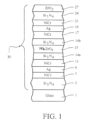
- Figure 1 is a side cross sectional view of a coated article according to an example non-limiting embodiment of this invention.
- the coated article includes substrate 1 (e.g., clear, green, bronze, or blue-green glass substrate from about 1.0 to 10.0 mm thick, more preferably from about 1.0 mm to 6.0 mm thick), and low-E coating (or layer system) 30 provided on the substrate 1 either directly or indirectly.
- substrate 1 e.g., clear, green, bronze, or blue-green glass substrate from about 1.0 to 10.0 mm thick, more preferably from about 1.0 mm to 6.0 mm thick
- low-E coating (or layer system) 30 provided on the substrate 1 either directly or indirectly.
- the coating (or layer system) 30 includes, for example: bottom dielectric silicon nitride layer 3 which may be Si 3 N 4 , or of the Si-rich type silicon nitride for haze reduction, or of any other suitable stoichiometry silicon nitride in different embodiments of this invention, lower contact layer 7 (which contacts bottom IR reflecting layer 9), first conductive and preferably metallic or substantially metallic infrared (IR) reflecting layer 9, upper contact layer 11 (which contacts IR reflecting layer 9), dielectric silicon nitride based and/or inclusive layer 14 split into two portions 14a, 14b by absorber layer 15, lower contact layer 17 (which contacts IR reflecting layer 19), second conductive and preferably metallic or substantially metallic IR reflecting layer 19, upper contact layer 21 (which contacts layer 19), dielectric silicon nitride layer 24 which may be Si 3 N 4 , of the Si-rich type for haze reduction, or of any other suitable stoichiometry silicon nitride in different embodiments of this invention, and overcoat layer
- the "contact" layers 7, 11, 17 and 21 each contact an IR reflecting layer (e.g., layer based on Ag).
- the aforesaid layers 3-27 make up low-E (i.e., low emissivity) coating 30 that is provided on glass or plastic substrate 1.
- Layers 3-27 may be sputter-deposited on the substrate 1 in certain example embodiments of this invention, with each layer being sputter-deposited in vacuum using one or more targets as needed (the sputtering targets may be ceramic or metallic).
- Metallic or substantially metallic layers may be sputtered in an atmosphere containing argon gas
- nitrided layers e.g., layers 3, 7, 11, 14, 17, 21 and/or 24
- Absorber layer 15 is preferably sputter-deposited from an NbZr target(s) in an atmosphere having a mixture of argon (Ar) and a small amount of oxygen (and possibly) nitrogen gas(es).
- the contact layers 7, 11, 17 and 21 may or may not be nitrided in different example embodiments of this invention.
- the coated article includes only one glass substrate 1 as illustrated in Fig. 1 .
- monolithic coated articles herein may be used in devices such as laminated vehicle windshields, IG window units, and the like.
- an IG window unit may include two spaced apart glass substrates.
- An example IG window unit is illustrated and described, for example, in U.S. Patent Document No. 2004/0005467 .
- Fig. 2 shows an example IG window unit including the coated glass substrate 1 shown in Fig. 1 coupled to another glass substrate 2 via spacer(s), sealant(s) 40 or the like, with a gap being defined therebetween.
- An example IG unit may comprise a pair of spaced apart clear glass substrates, which may be matte glass substrates in certain example instances, each about 3-7 mm (e.g., 6 mm) thick, one of which is coated with a coating 30 herein in certain example instances, where the gap between the substrates may be from about 5 to 30 mm, more preferably from about 10 to 20 mm, and most preferably about 16 mm.
- the low-E coating 30 may be provided on the interior surface of either substrate facing the gap (the coating is shown on the interior major surface of substrate 1 in Fig.
- substrate 1 or substrate 2 may be the outermost substrate of the IG window unit at the building exterior (e.g., in Fig. 2 the substrate 1 is the substrate closest to the building exterior, and the coating 30 is provided on surface #2 of the IG window unit). While Fig. 2 shows the coating 30 on surface #2 of the IG window unit (so that glass side reflective color is viewed from the exterior of the building), it is possible that the coating 30 may be provided on surface #3 of the IG window unit in alterative embodiments in which case glass side reflective color would be as viewed from the interior of the building.
- one, two, three, or all four of contact layers 7, 11, 17, 21 may be of or include NiCr (any suitable ratio of Ni:Cr), and may or may not be nitrided (NiCrN x ). In certain example embodiments, one, two, three or all four of these NiCr inclusive layers 7, 11, 17, 21 is substantially or entirely non-oxidized. In certain example embodiments, layers 7, 11, 17 and 21 may all be of metallic NiCr or substantially metallic NiCr (although trace amounts of other elements may be present).
- one, two, three or all four of NiCr based layers 7, 11, 17, 21 may comprise from 0-10% oxygen, more preferably from 0-5% oxygen, and most preferably from 0-2% oxygen (atomic %). In certain example embodiments, one, two, three or all four of these layers 7, 11, 17, 21 may contain from 0-20% nitrogen, more preferably from 1-15% nitrogen, and most preferably from about 1-12% nitrogen (atomic %). NiCr based layers 7, 11, 17 and/or 21 may or may not be doped with other material(s) such as stainless steel, Mo, or the like. It has been found that the use of NiCr based contact layer(s) 7 and/or 17 under the silver-based IR reflecting layer(s) 9, 19 improves durability of the coated article (compared to if layers 7 and 17 were instead of ZnO).
- Dielectric layers 3, 14 may be of or include silicon nitride in certain embodiments of this invention.
- Silicon nitride layers 3, 14 and 24 may, among other things, improve heat-treatability of the coated articles and protect the other layers during optional HT, e.g., such as thermal tempering or the like.
- One or more of the silicon nitride layers 3, 14, 24 may be of the stoichiometric type (i.e., Si 3 N 4 ), or alternatively of the Si-rich type of silicon nitride in different embodiments of this invention.
- Si-rich silicon nitride inclusive layer 3 and/or 14 may, for example, allow certain atoms such as sodium (Na) which migrate outwardly from the glass 1 during HT to be more efficiently stopped by the Si-rich silicon nitride inclusive layer(s) before they can reach silver and damage the same.
- Na sodium
- the Si-rich Si x N y can reduce the amount of damage done to the silver layer(s) during HT in certain example embodiments of this invention thereby allowing sheet resistance (R s ) to decrease or remain about the same in a satisfactory manner.
- the Si-rich Si x N y in layers 3, 14 and/or 24 can reduce the amount of damage (e.g., oxidation ) done to the silver and/or NiCr during HT in certain example optional embodiments of this invention.
- the Si-rich silicon nitride layer (3, 14 and/or 24) as deposited may be characterized by Si x N y layer(s), where x/y may be from 0.76 to 1.5, more preferably from 0.8 to 1.4, still more preferably from 0.82 to 1.2.
- any and/or all of the silicon nitride layers discussed herein may be doped with other materials such as stainless steel or aluminum in certain example embodiments of this invention.
- any and/or all silicon nitride layers 3, 14, 24 discussed herein may optionally include from about 0-15% aluminum, more preferably from about 1 to 10% aluminum, in certain example embodiments of this invention.
- the silicon nitride of layers 3, 14, 24 may be deposited by sputtering a target(s) of Si or SiAl, in an atmosphere having argon and nitrogen gas, in certain embodiments of this invention. Small amounts of oxygen may also be provided in certain instances in any or all of the silicon nitride layers 3, 14, 24.
- Absorber layer 15 is preferably of or including niobium zirconium, which may be sub-oxided and/or nitrided in certain example embodiments. It has been found that provision of the niobium zirconium based absorber layer 15 in a position to split the silicon nitride based layer 14 into two portions 14a and 14b results in improved durability, and allows desirable silver glass side/exterior coloration to be achieved in combination with other desirable optical/solar characteristics. For instance, when NbZr (or an oxide and/or nitride thereof) is used for absorber layer 15, various ratios of Nb to Zr in the layer may be used including but not limited to a 50/50 ratio, an 85/15 ratio, or a 90/10 ratio.
- the Nb/Zr ratio in absorber layer 15 may be from 1/1 to 9.5/1 (more preferably from 2/1 to 9/1) in various example embodiments of this invention, such that the layer 15 preferably contains more Nb than Zr.
- the metal content of absorber layer is from 50-95% Nb, more preferably from 60-95% Nb, even more preferably from 70-95% Nb (e.g., with the remainder of the metal content being made up of Zr in certain example embodiments). While layer 15 consists of, or consists essentially of, NbZr, NbZrO x , or NbZrO x N y in preferred embodiments of this invention, it is possible that other materials may be present in the layer.
- layer 15 may be doped with other materials in certain example instances.
- the absorber layer 15 may contain from about 0-10% nitrogen, more preferably from about 1-7% nitrogen.
- absorber layer 15 is not fully oxided, but is partially oxided (sub-oxided) in certain example embodiments of this invention.
- absorber layer 15 contains from about 0-40% oxygen, more preferably from 1-35% oxygen, even more preferably from 3-30%, even more preferably from 5-20% oxygen (atomic %).
- the oxygen content of the layer 15 may be adjusted in order to adjust visible transmission in certain example instances. In certain example embodiments, there is more oxygen than nitrogen in absorber layer 15 (regarding atomic %).
- the absorber layer 15 is of NbZr, NbZrO x , or NbZrO x N y in preferred embodiments of this invention, other materials are also possible in alternative embodiments.
- the absorber layer 15 may be of or include NiCr, NiCrO x , or NiCrO x N y in other embodiments of this invention
- Infrared (IR) reflecting layers 9 and 19 are preferably substantially or entirely metallic and/or conductive, and may comprise or consist essentially of silver (Ag), gold, or any other suitable IR reflecting material. IR reflecting layers 9 and 19 help allow the coating to have low-E and/or good solar control characteristics.
- example thicknesses and materials for the respective layers on the glass substrate 1 in the Fig. 1 embodiment are as follows, from the glass substrate outwardly (physical thicknesses recited):
- the absorber layer 15 is thinner than both the silver layers 9, 19 (e.g., by at least 20 angstroms), and is also thinner than both of the silicon nitride layers 14a, 14b in certain example embodiments of this invention.
- the absorber layer 15 is at least 20 angstroms ( ⁇ ) thinner than both the silver layers 9, 19, and/or is at least angstroms100 angstroms (more preferably at least 200 angstroms, and most preferably at least 250 angstroms) thinner than both of the silicon nitride layers 14a, 14b in certain example embodiments of this invention.
- the overcoat layer of or including zirconium oxide and/or zirconium oxynitride 27 is thinner than each of the IR reflecting layers 9, 19 comprising silver in the coating 30.
- each of the IR reflecting layers comprising silver 9 and 19 is at least twice as thick as the overcoat layer 27 or including zirconium oxide and/or zirconium oxynitride.
- the center silicon nitride based layer 14 total thickness (14a + 14b) is thicker than the silicon nitride layer 24 thickness, preferably by at least 100 angstroms, more preferably by at least 300 angstroms, and most preferably by at least 400 angstroms.
- silicon nitride layer 3 is at least 50 angstroms thicker (more preferably at least 100 angstroms thicker) than each of silicon nitride based layers 14a and 14b.
- each of the silicon nitride based layers 3, 14 and 24 is at least two times as thick as the zirconim oxide inclusive layer 27, more preferably at least three times as thick, and most preferably at least four or five times as thick.
- coated articles according to the Fig. 1 embodiment have color/optical characteristics as follows in Table 2 (measured monolithic and/or in an IG unit). It is noted that subscript “G” stands for glass side reflective, subscript “T” stands for transmissive, and subscript “F” stands for film side reflective.
- glass side (G) means when viewed from the glass side (as opposed to the layer/film side) of the coated article, i.e., same as when viewed from the exterior side of a window when viewed from a building exterior when the coating is on the inner side of the outer glass substrate 1 as shown in Fig. 2 for instance.
- Film side (F) means when viewed from the side of the coated article on which the coating is provided.
- the characteristics below in Table 2 are applicable to HT and/or non-HT coated articles herein. However, HT will cause certain parameters to change such as increasing visible transmission and lowering sheet resistance (color values will also change due to HT).
- Table 2 Color/Optical Characteristics (Fig.
- Examples 1 and 2 has the below-listed layer stack on a 5.9 mm thick, 75 mm x 75 mm, clear matte glass substrate 1 as shown in Fig. 1 .
- the examples were measured monolithically, heat treated and measured again after the HT. They were also put into IG window units after HT as shown in Fig. 2 , and measured.
- the silicon nitride layers 3, 14, 24 in each example were deposited by sputtering a silicon target (doped with about 8% Al) in an atmosphere including argon and nitrogen gas.
- the matte glass substrates 1 and 2 were clear and 5.9 mm thick, and the air gap between the substrates in the IG window unit was 13 mm thick.
- the NbZr based absorber layer in each example was deposited by sputtering approximately 90/10 Nb/Zr magnetron sputtering targets in an atmosphere including argon and a small amount of nitrogen and oxygen gas (1.2 ml/kW of oxygen gas was used).
- the absorber layer 15 was of NbZrO x N y in these examples.
- Layer thicknesses for Examples 1-2 were in angstroms ( ⁇ ) and are as follows, moving from the glass substrate 1 outwardly.
- Table 3 Layer Stacks of Examples 1-2 Layer Examples 1-2 Glass (5.9 mm thick) Si 3 N 4 (layer 3) 674 ⁇ NiCr (layer 7) 8 ⁇ Ag (layer 9) 151 ⁇ NiCr (layer 11) 14 ⁇ Si x N y (layer 14a) 430 ⁇ NbZrO x N y (layer 15) 32 ⁇ Si x N y (layer 14b) 519 ⁇ NiCr (layer 17) 15 ⁇ Ag (layer 19) 90 ⁇ NiCr (layer 21) 8 ⁇ Si 3 N 4 (layer 24) 329 ⁇ ZrO 2 (layer 27) 37 ⁇
- Examples 1-2 had the following characteristics with the measurements being taken from the center of the coated glass article (annealed and non-HT, monolithic) (Ill. C, 2 degree observer).
- Table 4 Measured Monolithic, annealed (as coated: before tempering) Parameter Ex. 1 Ex. 2 T vis (TY)(transmission): 28.6% 28.9% a* T -4.2 -4.5 b* T -0.9 -0.3 R G Y(glass side refl. %): 28.9% 29.1% a* G : 2.6 2.8 b* G : -5.9 -6.6 Glass side refl. color: silver silver silver R F Y(film side refl. %): 8.7% 9.2% a* F : -9.6 -8.7 b* F : -2.0 -2.6 Sheet Resistance ( ⁇ /sq): 3.0 3.0
- Examples 1-2 had the following characteristics (tempered, IG unit) (Ill. C, 2 degree observer).
- Table 6 IG Unit, HT (after tempering) Parameter Ex. 1 Ex. 2 T vis (TY)(transmission): 28.4% 28.5% a* T -4.8 -4.9 b* T -3.6 -3.1
- thermal tempering HT
- IG window units including Examples 1 and 2
Landscapes
- Chemical & Material Sciences (AREA)
- Materials Engineering (AREA)
- Engineering & Computer Science (AREA)
- Chemical Kinetics & Catalysis (AREA)
- General Chemical & Material Sciences (AREA)
- Geochemistry & Mineralogy (AREA)
- Life Sciences & Earth Sciences (AREA)
- Organic Chemistry (AREA)
- Physics & Mathematics (AREA)
- Thermal Sciences (AREA)
- Surface Treatment Of Glass (AREA)
- Laminated Bodies (AREA)
- Joining Of Glass To Other Materials (AREA)
Claims (21)
- Article revêtu incluant un revêtement (30) supporté par un substrat de verre (1) et présentant une couleur argent réfléchissante côté verre, le revêtement comprenant :- des première et seconde couches (9, 19) réfléchissant les infrarouges (IR) comprenant de l'argent, la première couche (9) réfléchissant les IR étant située plus près du substrat de verre que ne l'est la seconde couche (19) réfléchissant les IR ;- une première couche de contact (11) située au-dessus et venant en contact directement avec la première couche réfléchissant les IR comprenant de l'argent ;- une couche diélectrique (14a, 14b) comprenant du nitrure de silicium située au-dessus et venant en contact directement avec la première couche de contact ;- une deuxième couche de contact (17) située au-dessus de la couche comprenant du nitrure de silicium ;- la seconde couche (19) réfléchissant les IR comprenant de l'argent située au-dessus et venant en contact directement avec la deuxième couche de contact ;- une troisième couche de contact (21) située au-dessus et venant en contact directement avec la seconde couche réfléchissant les IR ; et- une autre couche diélectrique (24) comprenant du nitrure de silicium située au-dessus de la troisième couche de contact,dans lequel l'article revêtu présente une transmission visible de 15-45 %, une réflectance visible côté verre de 23-43 %, une valeur de réflexion a* côté verre de -6,0 à +5,0, et une valeur de réflexion b* côté verre de -11,0 à +3,0, caractérisé en ce que la couche diélectrique (14a, 14b) comprenant du nitrure de silicium est séparée par une couche absorbante de séparation (15) comprenant du Nb et Zr, de sorte que la couche absorbante de séparation comprenant du Nb et Zr soit située entre, et vienne en contact avec, une première partie de la couche diélectrique comprenant du nitrure de silicium et une seconde partie de la couche diélectrique comprenant du nitrure de silicium.
- Article revêtu selon la revendication 1, dans lequel la couche absorbante comprend un sous-oxyde de NbZr, et/ou, dans lequel la couche absorbante comprend en outre de l'azote, de préférence dans lequel la couche absorbante comprend du NbZrOxNy, plus préférentiellement dans lequel la couche absorbante consiste essentiellement en NbZrOxNy.
- Article revêtu selon une quelconque revendication précédente, dans lequel les première et troisième couches de contact comprennent du Ni et/ou du Cr.
- Article revêtu selon une quelconque revendication précédente, dans lequel la seconde couche de contact comprend du Ni et du Cr.
- Article revêtu selon une quelconque revendication précédente, comprenant en outre une couche de contact comprenant du NiCr située sous et venant en contact directement avec la première couche réfléchissant les IR.
- Article revêtu selon une quelconque revendication précédente, dans lequel l'article revêtu présente une réflectance visible côté verre de 25-40 %, une valeur de réflexion a* côté verre de -3,5 à +4,0, et une valeur de réflexion b* côté verre de -9,0 à +1,0, de préférence dans lequel l'article revêtu présente une valeur de réflexion a* côté verre de - 2,5 à +3,0 et une valeur de réflexion b* côté verre de -8,0 à -1,0.
- Article revêtu selon une quelconque revendication précédente, dans lequel l'article revêtu présente une réflectance visible côté verre de 27-35 %.
- Article revêtu selon une quelconque revendication précédente, dans lequel la réflectance visible côté verre de l'article revêtu est supérieure à la transmission visible de l'article revêtu.
- Article revêtu selon une quelconque revendication précédente, dans lequel l'article revêtu présente une valeur de transmission a* de -8,0 à -1,0 et une valeur de transmission b* de -8,0 à +1,0.
- Article revêtu selon une quelconque revendication précédente, dans lequel l'article revêtu présente une transmission visible de 22-39 %.
- Article revêtu selon une quelconque revendication précédente, dans lequel l'article revêtu présente une résistance de feuille de pas plus de 6,0 ohms/carré.
- Article revêtu selon une quelconque revendication précédente, dans lequel la première couche de réflexion d'IR est d'au moins 2,0 nm (20 Ângstroms) plus épaisse, de préférence d'au moins 4,0 nm (40 Ângstroms) plus épaisse que la seconde couche réfléchissant les IR.
- Article revêtu selon une quelconque revendication précédente, dans lequel la couche absorbante contient plus de Nb que de Zr, et/ou dans lequel la couche absorbante contient 3-30 % en oxygène (% atomique) et/ou dans lequel une teneur en métal de la couche absorbante est de 70-95 % de Nb.
- Article revêtu selon une quelconque revendication précédente, comprenant en outre une couche de base comprenant du nitrure de silicium située entre le substrat de verre et la première couche réfléchissant les IR.
- Article revêtu selon une quelconque revendication précédente, dans lequel la couche absorbante présente une épaisseur de 1,5-10,0 nm (15-100 Angströms), dans lequel de préférence la couche absorbante présente une épaisseur de 2,0-6,0 nm (20-60 Ångstroms).
- Article revêtu selon une quelconque revendication précédente, dans lequel la couche absorbante est plus fine que les deux couches réfléchissant les IR comprenant de l'argent.
- Article revêtu selon une quelconque revendication précédente, dans lequel l'article revêtu comprend en outre une couche de finition comprenant de l'oxyde de zirconium située au-dessus, et venant en contact directement avec, l'autre couche diélectrique comprenant du nitrure de silicium.
- Article revêtu selon une quelconque revendication précédente, dans lequel la première couche de contact comprend du NiCr et est sensiblement métallique ou est métallique et ne contient pas plus de 5 % (% atomique) d'oxygène, et/ou dans lequel les première, deuxième et troisième couches de contact ne contiennent pas plus de 5 % (% atomique) d'oxygène.
- Article revêtu selon une quelconque revendication précédente, dans lequel l'article revêtu est trempé thermiquement.
- Unité de fenêtre IG incluant l'article revêtu selon une quelconque revendication précédente, et un autre substrat de verre qui est couplé audit article revêtu, dans laquelle l'unité de fenêtre IG présente une valeur SF de pas plus de 0,27 et une valeur SHGC de pas plus de 0,27, et dans laquelle la réflectance visible côté verre est comme vue depuis un extérieur d'un bâtiment dans lequel l'unité de fenêtre IG est montée, ou est à monter.
- Unité de fenêtre IG incluant l'article revêtu selon l'une quelconque des revendications 1 à 19, et un autre substrat de verre qui est couplé audit article revêtu, dans laquelle l'unité de fenêtre IG présente une valeur SF de pas plus de 0,25 et une valeur SHGC de pas plus de 0,25, de préférence dans laquelle l'unité de fenêtre IG présente une valeur SF de pas plus de 0,21 et une valeur SHGC de pas plus de 0,20.
Applications Claiming Priority (1)
| Application Number | Priority Date | Filing Date | Title |
|---|---|---|---|
| PCT/US2016/057439 WO2018075006A1 (fr) | 2016-10-18 | 2016-10-18 | Article revêtu coloré à l'argent disposant d'un revêtement à faible émissivité ayant une couche absorbante et une faible transmission visible |
Publications (3)
| Publication Number | Publication Date |
|---|---|
| EP3529073A1 EP3529073A1 (fr) | 2019-08-28 |
| EP3529073A4 EP3529073A4 (fr) | 2020-07-01 |
| EP3529073B1 true EP3529073B1 (fr) | 2024-11-27 |
Family
ID=62018831
Family Applications (1)
| Application Number | Title | Priority Date | Filing Date |
|---|---|---|---|
| EP16919318.2A Active EP3529073B1 (fr) | 2016-10-18 | 2016-10-18 | Article revêtu coloré à l'argent disposant d'un revêtement à faible émissivité ayant une couche absorbante et une faible transmission visible |
Country Status (10)
| Country | Link |
|---|---|
| US (1) | US11027527B2 (fr) |
| EP (1) | EP3529073B1 (fr) |
| JP (1) | JP6953526B2 (fr) |
| KR (1) | KR102404161B1 (fr) |
| CN (1) | CN110382225B (fr) |
| BR (1) | BR112019007955B1 (fr) |
| ES (1) | ES3001634T3 (fr) |
| PL (1) | PL3529073T3 (fr) |
| RU (1) | RU2725386C1 (fr) |
| WO (1) | WO2018075006A1 (fr) |
Families Citing this family (5)
| Publication number | Priority date | Publication date | Assignee | Title |
|---|---|---|---|---|
| KR102369711B1 (ko) * | 2017-09-08 | 2022-03-03 | (주)엘엑스하우시스 | 창호용 기능성 건축 자재 |
| KR102509032B1 (ko) * | 2018-05-09 | 2023-03-09 | 쌩-고벵 글래스 프랑스 | 다층 코팅이 구비된 투명 기판 및 이를 포함하는 단열 유리 유닛 |
| FR3101278B1 (fr) * | 2019-09-30 | 2023-11-24 | Saint Gobain | Vitrage feuillete a basse transmission lumineuse et haute selectivite |
| KR102787509B1 (ko) * | 2019-10-25 | 2025-03-27 | 쌩-고벵 글래스 프랑스 | 박막 다층 코팅이 구비된 투명 기재 및 이를 포함하는 다중 글레이징 유닛 |
| CN114746374A (zh) * | 2019-11-29 | 2022-07-12 | Agp美洲股份公司 | 具有中性色太阳能控制涂层的汽车玻璃 |
Family Cites Families (28)
| Publication number | Priority date | Publication date | Assignee | Title |
|---|---|---|---|---|
| US5557462A (en) * | 1995-01-17 | 1996-09-17 | Guardian Industries Corp. | Dual silver layer Low-E glass coating system and insulating glass units made therefrom |
| US6576349B2 (en) | 2000-07-10 | 2003-06-10 | Guardian Industries Corp. | Heat treatable low-E coated articles and methods of making same |
| US6887575B2 (en) | 2001-10-17 | 2005-05-03 | Guardian Industries Corp. | Heat treatable coated article with zinc oxide inclusive contact layer(s) |
| FR2818272B1 (fr) * | 2000-12-15 | 2003-08-29 | Saint Gobain | Vitrage muni d'un empilement de couches minces pour la protection solaire et/ou l'isolation thermique |
| US6967060B2 (en) | 2003-05-09 | 2005-11-22 | Guardian Industries Corp. | Coated article with niobium zirconium inclusive layer(s) and method of making same |
| US6908679B2 (en) | 2003-04-25 | 2005-06-21 | Guardian Industries Corp. | Heat treatable coated article with niobium zirconium inclusive IR reflecting layer and method of making same |
| US7150916B2 (en) | 2004-03-11 | 2006-12-19 | Centre Luxembourg De Recherches Pour Le Verre Et La Ceramique S.A. (C.R.V.C.) | Coated article with low-E coating including tin oxide interlayer for high bend applications |
| US7419725B2 (en) | 2004-09-01 | 2008-09-02 | Guardian Industries Corp. | Coated article with low-E coating including IR reflecting layer(s) and corresponding method |
| US7592068B2 (en) | 2005-01-19 | 2009-09-22 | Centre Luxembourgeois De Recherches Pour Le Verre Et La Ceramique S.A. (C.R.V.C.) | Heat treatable coated article with zirconium silicon oxynitride layer(s) and methods of making same |
| AU2006247708A1 (en) * | 2005-05-12 | 2006-11-23 | Agc Flat Glass North America, Inc. | Low emissivity coating with low solar heat gain coefficient, enhanced chemical and mechanical properties and method of making the same |
| US7488538B2 (en) * | 2005-08-08 | 2009-02-10 | Guardian Industries Corp. | Coated article including soda-lime-silica glass substrate with lithium and/or potassium to reduce sodium migration and/or improve surface stability and method of making same |
| US7648769B2 (en) * | 2007-09-07 | 2010-01-19 | Guardian Industries Corp. | Coated article with low-E coating having absorbing layer designed for desirable bluish color at off-axis viewing angles |
| US8199264B2 (en) | 2007-11-26 | 2012-06-12 | Guardian Industries Corp. | Ruggedized switchable glazing comprising a liquid crystal inclusive layer and a multi-layer low-E ultraviolet blocking coating |
| US7901781B2 (en) * | 2007-11-23 | 2011-03-08 | Agc Flat Glass North America, Inc. | Low emissivity coating with low solar heat gain coefficient, enhanced chemical and mechanical properties and method of making the same |
| RU2563527C2 (ru) * | 2009-11-19 | 2015-09-20 | Сантр Люксамбуржуа Де Решерш Пур Ле Верр Э Ля Серамик С.А. (С.Р.В.С.) | Изделие с энергосберегающим покрытием бронзового цвета |
| US9028956B2 (en) * | 2010-04-22 | 2015-05-12 | Centre Luxembourgeois De Recherches Pour Le Verre Et La Ceramique S.A. (C.R.V.C.) | Coated article having low-E coating with absorber layer(s) |
| US8337988B2 (en) * | 2010-04-22 | 2012-12-25 | Centre Luxembourgeois De Recherches Pour Le Verre Et La Ceramique S.A. (C.R.V.C.) | Coated article having low-E coating with absorber layer(s) |
| US8703281B2 (en) | 2011-01-11 | 2014-04-22 | Guardian Industries Corp. | Heat treatable coated article with breaker layer |
| US9869016B2 (en) * | 2012-02-22 | 2018-01-16 | Guardian Glass, LLC | Coated article with low-E coating having multilayer overcoat and method of making same |
| US9017821B2 (en) * | 2012-02-22 | 2015-04-28 | Guardian Industries Corp. | Coated article with low-E coating having multilayer overcoat and method of making same |
| US9242895B2 (en) * | 2012-09-07 | 2016-01-26 | Guardian Industries Corp. | Coated article with low-E coating having absorbing layers for low film side reflectance and low visible transmission |
| US9150003B2 (en) * | 2012-09-07 | 2015-10-06 | Guardian Industries Corp. | Coated article with low-E coating having absorbing layers for low film side reflectance and low visible transmission |
| US8940399B2 (en) | 2012-10-04 | 2015-01-27 | Guardian Industries Corp. | Coated article with low-E coating having low visible transmission |
| US10871600B2 (en) | 2012-12-17 | 2020-12-22 | Guardian Glass, LLC | Window for reducing bird collisions |
| UA117474C2 (uk) | 2013-02-14 | 2018-08-10 | Агк Гласс Юроп | Сонцезахисне скління |
| MX2016002012A (es) * | 2013-08-16 | 2016-05-18 | Guardian Industries | Articulo revestido con recubrimiento de baja-e que tiene transmision visible baja. |
| US9873633B2 (en) | 2013-11-20 | 2018-01-23 | Guardian Europe S.A.R.L. | Heat treatable coated article with low-E coating having zinc stannate based layer between IR reflecting layers and corresponding method |
| JP7308748B2 (ja) * | 2016-10-18 | 2023-07-14 | ガーディアン・グラス・エルエルシー | 低い可視光透過率の、吸収体層を有する低e被膜を含む灰色に着色した被覆物品 |
-
2016
- 2016-10-18 EP EP16919318.2A patent/EP3529073B1/fr active Active
- 2016-10-18 US US16/343,312 patent/US11027527B2/en active Active
- 2016-10-18 WO PCT/US2016/057439 patent/WO2018075006A1/fr not_active Ceased
- 2016-10-18 BR BR112019007955-6A patent/BR112019007955B1/pt active IP Right Grant
- 2016-10-18 RU RU2019115132A patent/RU2725386C1/ru active
- 2016-10-18 KR KR1020197013938A patent/KR102404161B1/ko active Active
- 2016-10-18 CN CN201680091662.1A patent/CN110382225B/zh active Active
- 2016-10-18 ES ES16919318T patent/ES3001634T3/es active Active
- 2016-10-18 PL PL16919318.2T patent/PL3529073T3/pl unknown
- 2016-10-18 JP JP2019521813A patent/JP6953526B2/ja active Active
Also Published As
| Publication number | Publication date |
|---|---|
| ES3001634T3 (en) | 2025-03-05 |
| EP3529073A4 (fr) | 2020-07-01 |
| BR112019007955B1 (pt) | 2022-10-25 |
| US20200180277A1 (en) | 2020-06-11 |
| KR102404161B1 (ko) | 2022-06-02 |
| CN110382225B (zh) | 2022-03-25 |
| BR112019007955A2 (pt) | 2019-07-02 |
| JP6953526B2 (ja) | 2021-10-27 |
| EP3529073A1 (fr) | 2019-08-28 |
| US11027527B2 (en) | 2021-06-08 |
| CN110382225A (zh) | 2019-10-25 |
| WO2018075006A1 (fr) | 2018-04-26 |
| JP2019535617A (ja) | 2019-12-12 |
| PL3529073T3 (pl) | 2025-04-28 |
| RU2725386C1 (ru) | 2020-07-02 |
| KR20190131010A (ko) | 2019-11-25 |
Similar Documents
| Publication | Publication Date | Title |
|---|---|---|
| EP3033641B1 (fr) | Article revêtu avec un revêtement de faible émissivité ayant une faible transmission visible qui peut être utilisé dans une unité de fenêtre ig pour aspect gris | |
| US10196303B2 (en) | Coated article with low-E coating having low visible transmission | |
| EP4122898A1 (fr) | Article revêtu pouvant être traité thermiquement, présentant au moins une couche réfléchissant les infrarouges, à base de nitrure de titane | |
| KR20160048835A (ko) | Shgc 대 u값의 비를 증가시킨 이중 은 코팅을 포함하는 ig 윈도우 유닛, 및 ig 윈도우 유닛 또는 그 외의 윈도우에 사용하기 위한 상응하는 코팅 제품 | |
| US10322965B2 (en) | Bronze colored heat treatable coated article having low solar factor value | |
| EP3529221B1 (fr) | Article revêtu de couleur grise avec un revêtement à faible émissivité comprenant une couche d'absorbeur et présentant une faible transmission dans le spectre visible | |
| US11027527B2 (en) | Silver colored coated article with low-E coating having absorber layer and low visible transmission | |
| US10221092B2 (en) | Green colored heat treatable coated article having low solar factor value | |
| US10670774B2 (en) | Grey colored heat treatable coated article having low solar factor value | |
| EP3529220B1 (fr) | Article recouvert d'un revêtement à faible émissivité ayant une faible transmission de lumière visible |
Legal Events
| Date | Code | Title | Description |
|---|---|---|---|
| STAA | Information on the status of an ep patent application or granted ep patent |
Free format text: STATUS: THE INTERNATIONAL PUBLICATION HAS BEEN MADE |
|
| PUAI | Public reference made under article 153(3) epc to a published international application that has entered the european phase |
Free format text: ORIGINAL CODE: 0009012 |
|
| STAA | Information on the status of an ep patent application or granted ep patent |
Free format text: STATUS: REQUEST FOR EXAMINATION WAS MADE |
|
| 17P | Request for examination filed |
Effective date: 20190514 |
|
| AK | Designated contracting states |
Kind code of ref document: A1 Designated state(s): AL AT BE BG CH CY CZ DE DK EE ES FI FR GB GR HR HU IE IS IT LI LT LU LV MC MK MT NL NO PL PT RO RS SE SI SK SM TR |
|
| AX | Request for extension of the european patent |
Extension state: BA ME |
|
| DAV | Request for validation of the european patent (deleted) | ||
| DAX | Request for extension of the european patent (deleted) | ||
| RIN1 | Information on inventor provided before grant (corrected) |
Inventor name: BISWAS, ARITRA Inventor name: SWAMYNAIDU, KRISHNA Inventor name: CHU, ALLEN Inventor name: NADIDU, MUNISWAMI Inventor name: BOYCE, BRENT Inventor name: LINGLE, PHILIP, J. Inventor name: LORD, KENNETH |
|
| A4 | Supplementary search report drawn up and despatched |
Effective date: 20200529 |
|
| RIC1 | Information provided on ipc code assigned before grant |
Ipc: B32B 17/10 20060101ALI20200525BHEP Ipc: C03C 17/36 20060101ALI20200525BHEP Ipc: B32B 17/06 20060101AFI20200525BHEP |
|
| RAP3 | Party data changed (applicant data changed or rights of an application transferred) |
Owner name: GUARDIAN GLASS, LLC Owner name: GUARDIAN GLASS MANAGEMENT SERVICES W.L.L. |
|
| STAA | Information on the status of an ep patent application or granted ep patent |
Free format text: STATUS: EXAMINATION IS IN PROGRESS |
|
| 17Q | First examination report despatched |
Effective date: 20220812 |
|
| GRAP | Despatch of communication of intention to grant a patent |
Free format text: ORIGINAL CODE: EPIDOSNIGR1 |
|
| STAA | Information on the status of an ep patent application or granted ep patent |
Free format text: STATUS: GRANT OF PATENT IS INTENDED |
|
| INTG | Intention to grant announced |
Effective date: 20240318 |
|
| GRAJ | Information related to disapproval of communication of intention to grant by the applicant or resumption of examination proceedings by the epo deleted |
Free format text: ORIGINAL CODE: EPIDOSDIGR1 |
|
| STAA | Information on the status of an ep patent application or granted ep patent |
Free format text: STATUS: EXAMINATION IS IN PROGRESS |
|
| INTC | Intention to grant announced (deleted) | ||
| GRAP | Despatch of communication of intention to grant a patent |
Free format text: ORIGINAL CODE: EPIDOSNIGR1 |
|
| STAA | Information on the status of an ep patent application or granted ep patent |
Free format text: STATUS: GRANT OF PATENT IS INTENDED |
|
| INTG | Intention to grant announced |
Effective date: 20240716 |
|
| GRAS | Grant fee paid |
Free format text: ORIGINAL CODE: EPIDOSNIGR3 |
|
| GRAA | (expected) grant |
Free format text: ORIGINAL CODE: 0009210 |
|
| STAA | Information on the status of an ep patent application or granted ep patent |
Free format text: STATUS: THE PATENT HAS BEEN GRANTED |
|
| AK | Designated contracting states |
Kind code of ref document: B1 Designated state(s): AL AT BE BG CH CY CZ DE DK EE ES FI FR GB GR HR HU IE IS IT LI LT LU LV MC MK MT NL NO PL PT RO RS SE SI SK SM TR |
|
| REG | Reference to a national code |
Ref country code: GB Ref legal event code: FG4D |
|
| REG | Reference to a national code |
Ref country code: CH Ref legal event code: EP |
|
| REG | Reference to a national code |
Ref country code: IE Ref legal event code: FG4D |
|
| REG | Reference to a national code |
Ref country code: DE Ref legal event code: R096 Ref document number: 602016090451 Country of ref document: DE |
|
| REG | Reference to a national code |
Ref country code: LT Ref legal event code: MG9D |
|
| REG | Reference to a national code |
Ref country code: NL Ref legal event code: MP Effective date: 20241127 |
|
| PG25 | Lapsed in a contracting state [announced via postgrant information from national office to epo] |
Ref country code: PT Free format text: LAPSE BECAUSE OF FAILURE TO SUBMIT A TRANSLATION OF THE DESCRIPTION OR TO PAY THE FEE WITHIN THE PRESCRIBED TIME-LIMIT Effective date: 20250327 Ref country code: HR Free format text: LAPSE BECAUSE OF FAILURE TO SUBMIT A TRANSLATION OF THE DESCRIPTION OR TO PAY THE FEE WITHIN THE PRESCRIBED TIME-LIMIT Effective date: 20241127 Ref country code: IS Free format text: LAPSE BECAUSE OF FAILURE TO SUBMIT A TRANSLATION OF THE DESCRIPTION OR TO PAY THE FEE WITHIN THE PRESCRIBED TIME-LIMIT Effective date: 20250327 |
|
| PG25 | Lapsed in a contracting state [announced via postgrant information from national office to epo] |
Ref country code: NL Free format text: LAPSE BECAUSE OF FAILURE TO SUBMIT A TRANSLATION OF THE DESCRIPTION OR TO PAY THE FEE WITHIN THE PRESCRIBED TIME-LIMIT Effective date: 20241127 Ref country code: FI Free format text: LAPSE BECAUSE OF FAILURE TO SUBMIT A TRANSLATION OF THE DESCRIPTION OR TO PAY THE FEE WITHIN THE PRESCRIBED TIME-LIMIT Effective date: 20241127 |
|
| REG | Reference to a national code |
Ref country code: AT Ref legal event code: MK05 Ref document number: 1745355 Country of ref document: AT Kind code of ref document: T Effective date: 20241127 |
|
| PG25 | Lapsed in a contracting state [announced via postgrant information from national office to epo] |
Ref country code: BG Free format text: LAPSE BECAUSE OF FAILURE TO SUBMIT A TRANSLATION OF THE DESCRIPTION OR TO PAY THE FEE WITHIN THE PRESCRIBED TIME-LIMIT Effective date: 20241127 |
|
| PG25 | Lapsed in a contracting state [announced via postgrant information from national office to epo] |
Ref country code: NO Free format text: LAPSE BECAUSE OF FAILURE TO SUBMIT A TRANSLATION OF THE DESCRIPTION OR TO PAY THE FEE WITHIN THE PRESCRIBED TIME-LIMIT Effective date: 20250227 |
|
| PG25 | Lapsed in a contracting state [announced via postgrant information from national office to epo] |
Ref country code: LV Free format text: LAPSE BECAUSE OF FAILURE TO SUBMIT A TRANSLATION OF THE DESCRIPTION OR TO PAY THE FEE WITHIN THE PRESCRIBED TIME-LIMIT Effective date: 20241127 Ref country code: GR Free format text: LAPSE BECAUSE OF FAILURE TO SUBMIT A TRANSLATION OF THE DESCRIPTION OR TO PAY THE FEE WITHIN THE PRESCRIBED TIME-LIMIT Effective date: 20250228 Ref country code: AT Free format text: LAPSE BECAUSE OF FAILURE TO SUBMIT A TRANSLATION OF THE DESCRIPTION OR TO PAY THE FEE WITHIN THE PRESCRIBED TIME-LIMIT Effective date: 20241127 |
|
| PG25 | Lapsed in a contracting state [announced via postgrant information from national office to epo] |
Ref country code: RS Free format text: LAPSE BECAUSE OF FAILURE TO SUBMIT A TRANSLATION OF THE DESCRIPTION OR TO PAY THE FEE WITHIN THE PRESCRIBED TIME-LIMIT Effective date: 20250227 |
|
| PG25 | Lapsed in a contracting state [announced via postgrant information from national office to epo] |
Ref country code: SM Free format text: LAPSE BECAUSE OF FAILURE TO SUBMIT A TRANSLATION OF THE DESCRIPTION OR TO PAY THE FEE WITHIN THE PRESCRIBED TIME-LIMIT Effective date: 20241127 |
|
| PG25 | Lapsed in a contracting state [announced via postgrant information from national office to epo] |
Ref country code: DK Free format text: LAPSE BECAUSE OF FAILURE TO SUBMIT A TRANSLATION OF THE DESCRIPTION OR TO PAY THE FEE WITHIN THE PRESCRIBED TIME-LIMIT Effective date: 20241127 |
|
| PG25 | Lapsed in a contracting state [announced via postgrant information from national office to epo] |
Ref country code: EE Free format text: LAPSE BECAUSE OF FAILURE TO SUBMIT A TRANSLATION OF THE DESCRIPTION OR TO PAY THE FEE WITHIN THE PRESCRIBED TIME-LIMIT Effective date: 20241127 |
|
| PG25 | Lapsed in a contracting state [announced via postgrant information from national office to epo] |
Ref country code: RO Free format text: LAPSE BECAUSE OF FAILURE TO SUBMIT A TRANSLATION OF THE DESCRIPTION OR TO PAY THE FEE WITHIN THE PRESCRIBED TIME-LIMIT Effective date: 20241127 |
|
| PG25 | Lapsed in a contracting state [announced via postgrant information from national office to epo] |
Ref country code: SK Free format text: LAPSE BECAUSE OF FAILURE TO SUBMIT A TRANSLATION OF THE DESCRIPTION OR TO PAY THE FEE WITHIN THE PRESCRIBED TIME-LIMIT Effective date: 20241127 |
|
| PG25 | Lapsed in a contracting state [announced via postgrant information from national office to epo] |
Ref country code: CZ Free format text: LAPSE BECAUSE OF FAILURE TO SUBMIT A TRANSLATION OF THE DESCRIPTION OR TO PAY THE FEE WITHIN THE PRESCRIBED TIME-LIMIT Effective date: 20241127 |
|
| REG | Reference to a national code |
Ref country code: DE Ref legal event code: R097 Ref document number: 602016090451 Country of ref document: DE |
|
| PG25 | Lapsed in a contracting state [announced via postgrant information from national office to epo] |
Ref country code: SE Free format text: LAPSE BECAUSE OF FAILURE TO SUBMIT A TRANSLATION OF THE DESCRIPTION OR TO PAY THE FEE WITHIN THE PRESCRIBED TIME-LIMIT Effective date: 20241127 |
|
| PLBE | No opposition filed within time limit |
Free format text: ORIGINAL CODE: 0009261 |
|
| STAA | Information on the status of an ep patent application or granted ep patent |
Free format text: STATUS: NO OPPOSITION FILED WITHIN TIME LIMIT |
|
| PGFP | Annual fee paid to national office [announced via postgrant information from national office to epo] |
Ref country code: PL Payment date: 20250912 Year of fee payment: 10 Ref country code: IT Payment date: 20250922 Year of fee payment: 10 |
|
| PGFP | Annual fee paid to national office [announced via postgrant information from national office to epo] |
Ref country code: GB Payment date: 20250904 Year of fee payment: 10 |
|
| PGFP | Annual fee paid to national office [announced via postgrant information from national office to epo] |
Ref country code: FR Payment date: 20250908 Year of fee payment: 10 |
|
| 26N | No opposition filed |
Effective date: 20250828 |
|
| PGFP | Annual fee paid to national office [announced via postgrant information from national office to epo] |
Ref country code: DE Payment date: 20250902 Year of fee payment: 10 |
|
| PGFP | Annual fee paid to national office [announced via postgrant information from national office to epo] |
Ref country code: TR Payment date: 20251009 Year of fee payment: 10 |
|
| PGFP | Annual fee paid to national office [announced via postgrant information from national office to epo] |
Ref country code: ES Payment date: 20251105 Year of fee payment: 10 |