EP3530662B1 - Procédé de préparation d'heptazines - Google Patents
Procédé de préparation d'heptazines Download PDFInfo
- Publication number
- EP3530662B1 EP3530662B1 EP19159794.7A EP19159794A EP3530662B1 EP 3530662 B1 EP3530662 B1 EP 3530662B1 EP 19159794 A EP19159794 A EP 19159794A EP 3530662 B1 EP3530662 B1 EP 3530662B1
- Authority
- EP
- European Patent Office
- Prior art keywords
- formula
- compound
- trihydrazinoheptazine
- groups
- heptazine
- Prior art date
- Legal status (The legal status is an assumption and is not a legal conclusion. Google has not performed a legal analysis and makes no representation as to the accuracy of the status listed.)
- Active
Links
- 0 *CC1=NC(N23)=NC(*)=NC2=NC(*=C)=NC3=N1 Chemical compound *CC1=NC(N23)=NC(*)=NC2=NC(*=C)=NC3=N1 0.000 description 2
Classifications
-
- C—CHEMISTRY; METALLURGY
- C07—ORGANIC CHEMISTRY
- C07D—HETEROCYCLIC COMPOUNDS
- C07D487/00—Heterocyclic compounds containing nitrogen atoms as the only ring hetero atoms in the condensed system, not provided for by groups C07D451/00 - C07D477/00
- C07D487/12—Heterocyclic compounds containing nitrogen atoms as the only ring hetero atoms in the condensed system, not provided for by groups C07D451/00 - C07D477/00 in which the condensed system contains three hetero rings
- C07D487/16—Peri-condensed systems
Definitions
- the present invention relates to a new process for the preparation of heptazines. It also relates to the heptazines as obtained.
- trichloroheptazine ( Schwarzer et al., Coordination Chemistry Reviews, 2013, 257, 2032-2062 ; Kroke et al., New J. Chem., 2002, 26, 508-512 ).
- This molecule is very sensitive to hydrolysis and is not very soluble: indeed, it must be purified by sublimation or Soxhlet extraction with toluene.
- trichloroheptazine is prepared by heating to 120-140 ° C an intimate mixture of the potassium salt of trihydroxyheptazine and phosphorus pentachloride, an extremely aggressive electrophilic reagent, and the gaseous hydrogen chloride must be regularly evacuated. formed, which is also an aggressive and toxic compound.
- a certain quantity of aggressive gaseous chlorine is also formed by decomposition (side reaction) of phosphorus pentachloride, which must be destroyed at the same time as hydrochloric acid.
- the object of the present invention is to provide a very soluble heptazine derivative.
- Another object of the present invention is to provide a process for the preparation of heptazines and its derivatives, which is simple and exhibits a satisfactory yield.
- the present invention relates to a process for preparing a compound of formula (I) below: wherein R and R 'represent, independently of one another, an alkyl group comprising from 1 to 6 carbon atoms or an aryl group comprising from 6 to 10 carbon atoms; said process comprising the reaction of trihydrazinoheptazine of the following formula (II): with a ketone of the following formula (III): in which R and R 'are as defined above.
- the process according to the invention makes it possible to obtain satisfactory yields.
- this process requires only a single chromatography step, for an average yield of 30-35% from trihydrazinoheptazine.
- alkyl denotes saturated, linear or branched aliphatic hydrocarbon groups comprising, unless otherwise mentioned, from 1 to 6 carbon atoms.
- alkyl denotes saturated, linear or branched aliphatic hydrocarbon groups comprising, unless otherwise mentioned, from 1 to 6 carbon atoms.
- the aryl groups are cyclic aromatic groups comprising between 6 and 10 carbon atoms.
- aryl groups mention may be made of phenyl or naphthyl groups.
- the groups R and R ' are identical.
- the ketone of formula (III) is therefore a symmetrical ketone.
- the groups R and R ′ are alkyl groups comprising from 1 to 4 carbon atoms, and are preferably ethyl groups.
- the groups R and R ' are identical and are chosen from alkyl groups comprising from 1 to 4 carbon atoms, in particular are ethyl groups.
- the ketone of formula (II) is 3,5-heptanedione.
- the trihydrazinoheptazine has a moisture content of less than 10%.
- This humidity level can be controlled for example by the Karl-Fischer method well known to those skilled in the art.
- the trihydrazinoheptazine has a reduced moisture content so that this starting product is as dry as possible.
- the trihydrazinoheptazine is previously subjected to a drying step.
- This drying step makes it possible to remove as much water as possible before the reaction of the trihydrazinoheptazine with the ketone of formula (II).
- the drying step is carried out for a period of between 12 h and 120 h, preferably between 24 h and 48 h.
- This drying step can in particular be carried out in the presence of at least one drying agent.
- drying agents there may be mentioned, for example, P 2 O 5 , CaO, KOH, MgO, activated Na 2 SO 4 or activated MgSO 4 . Mention may also be made of molecular sieves activated or the streams of previously dried gas. Preferably, this step is carried out without heat treatment.
- the drying step is preceded by a step of washing the trihydrazinoheptazine.
- the trihydrazinoheptazine is washed with pure water, then with ethanol and then with ethyl ether, in particular in order to remove as much water as possible.
- the trihydrazinoheptazine is washed, in particular with pure water, then with ethanol then with ethyl ether, then dried, in particular for at least 12 hours, for example in a desiccator containing phosphorus pentoxide (P 2 O 5 ).
- the process of the invention can further comprise a step of grinding the trihydrazinoheptazine.
- the trihydrazinoheptazine is subjected to a grinding step.
- this grinding step is carried out after the aforementioned drying step, and therefore before the step of reaction with the ketone.
- the ground trihydrazinoheptazine is in the form of particles the size of which is less than 100 ⁇ m.
- the size of the particles corresponds to the average diameter of said particles.
- the aforementioned grinding step consists of a mechanical grinding step in a mill, preferably in a planetary ball mill, for a period of between 5 minutes and 30 minutes, and preferably between 5 minutes and 10 minutes.
- the process of the invention is carried out with an excess of ketone relative to the trihydrazinoheptazine.
- the ratio between the number of moles of ketone and the number of moles of trihydrazinoheptazine is greater than or equal to 1, and preferably equal to 1.5.
- reaction step between the compound of formula (II) and the compound of formula (III) can be carried out in the presence of a catalyst.
- X halogen, NO 3 , SO 4 -, HSO 4 ,
- Lewis acids of MX n type such as AlCl 3 , MgCl 2 and FeCl 3 .
- the catalyst used is toluenesulfonic acid.
- the present invention also relates to the compound of formula (I) mentioned above.
- R and R ′ are identical alkyl groups, in particular ethyl groups.
- the compounds of formula (I) are particularly advantageous because they make it possible to extend the range of exchangeable groups on the heptazine core.
- the number of nucleophiles capable of reacting is markedly greater, due to the low solubility, as well as the high reactivity of the latter.
- the compounds of formula (I) are used as intermediate compounds for the preparation of various heptazine derivatives.
- the present invention therefore also relates to the compounds of formula (IV) below: in which R and R 'are as defined above.
- R and R ′ are alkyl groups, in particular identical, and in particular ethyl groups.
- the present invention also relates to a process for preparing a compound of formula (IV) above, comprising a step of reacting the compound of formula (I) as defined above with a brominating agent, in particular with dibroma.
- N-bromosuccinimide N-bromosuccinimide
- dibromohydantoin or CBr 4 / hv etc.
- this bromination step is carried out in the presence of an excess of bromine, for example of the order of 5% to 20%.
- the bromination is preferably carried out in an inert solvent such as dichloromethane, at room temperature.
- the dibroma is added in excess in dichloromethane.
- dibroma can be removed by washing, for example with a dilute solution of sodium thiosulphate in water. It can also be removed simply by evaporation.
- the present invention also relates to the use of the compound of formula (I) as defined above, for carrying out nucleophilic substitution reactions.
- R "and R '" are groups of formula (A). According to another embodiment, in formula (V), R “is Nu and R '' 'is a group of formula (A). According to another embodiment, R" and R' "are Nu.
- the compounds of formula (V) are prepared by nucleophilic substitution from the compounds of formula (I).
- reaction conditions for this nucleophilic substitution process are well known to those skilled in the art and are identical to those for any nucleophilic substitution reaction.
- the present invention also relates to compounds of formula (VI) or (VII) below: R, R 'and Nu being as defined above.
- Nu represents an amino (-NH 2 ) or aminoalkyl (-NHAlk or -N (Alk) (Alk ')) group, or a heterocycloalkyl group comprising at least one atom nitrogen, for example of the morpholine or piperidine type.
- the present application also describes a compound of formula (VIII) below: in which Nu represents a nucleophilic group chosen from cyclic amines, preferably of the following formula (B): said ring (C) forming, with the nitrogen atom which carries it, a heterocycloalkyl, comprising from 4 to 12 atoms, and optionally comprising at least one other heteroatom.
- Nu represents a nucleophilic group chosen from cyclic amines, preferably of the following formula (B): said ring (C) forming, with the nitrogen atom which carries it, a heterocycloalkyl, comprising from 4 to 12 atoms, and optionally comprising at least one other heteroatom.
- the compounds of formula (VIII) are different from the following compounds:
- the present application also describes a compound of formula (IX) below: in which X represents O or a group -CH (R 1 ), R 1 representing H or a heterocycloalkyl group comprising at least one nitrogen atom, optionally protected.
- the trihydrazinoheptazine (1 g or 3.8.10 -3 mol) is introduced into a planetary agate mill (Fritsch mill, of the "Pulvérizette” type) equipped with an 80 ml grinding bowl, with 10 agate beads. 'a diameter of 0.5 cm (same supplier), and 4.5 eq. 3,5-heptanedione (Sigma-Aldrich) (corresponds to 1.5 times the necessary stoichiometry), as well as 0.5 g of toluenesulfonic acid (Prolabo) as catalyst.
- the grinding bowl is then introduced into the grinder, and left to run for 8 min at a speed of 500 revolutions / min.
- Example 3 The same conditions as those of Example 3 above can be applied to prepare other heptazine derivatives, replacing morpholine with piperidine, pyrrolidine or 2-ethylhexylamine.
Landscapes
- Chemical & Material Sciences (AREA)
- Organic Chemistry (AREA)
- Pharmaceuticals Containing Other Organic And Inorganic Compounds (AREA)
- Plural Heterocyclic Compounds (AREA)
Description
- La présente invention a pour objet un nouveau procédé de préparation d'heptazines. Elle a également pour objet les heptazines telles qu'obtenues.
- A ce jour, le seul précurseur d'heptazine possédant des groupements échangeables connu est la trichloroheptazine (Schwarzer et al., Coordination Chemistry Reviews, 2013, 257, 2032-2062 ; Kroke et al., New J. Chem., 2002, 26, 508-512). Cette molécule est très sensible à l'hydrolyse et est très peu soluble : en effet, elle doit être purifiée par sublimation ou extraction au Soxhlet au toluène. En outre, la trichloroheptazine se prépare par chauffage à 120-140°C d'un mélange intime du sel de potassium de la trihydroxyheptazine et de pentachlorure de phosphore, un réactif électrophile extrêmement agressif, et il faut régulièrement évacuer le chlorure d'hydrogène gazeux formé, qui est lui aussi un composé agressif et toxique. Il se forme aussi une certaine quantité de dichlore gazeux agressif, par décomposition (réaction parasite) du pentachlorure de phosphore, qu'il faut détruire en même temps que l'acide chlorhydrique.
- Ainsi, le précurseur utilisé à ce jour présente de nombreux inconvénients, à la fois concernant son caractère très peu soluble mais aussi son procédé de préparation compliqué et coûteux.
-
DE 10 2012 007529 décrit des dérivés d'heptazine trisubstitués par des hétérocycles ainsi que leurs procédés de préparation à partir de melem et du phthaloyldichorure. - Il existe donc à ce jour un besoin pour un dérivé d'heptazine présentant des propriétés de solubilité améliorées. Il existe également un besoin pour un procédé simplifié permettant la préparation d'heptazines ou de ses dérivés avec un rendement satisfaisant.
- La présente invention a pour but de fournir un dérivé d'heptazine très soluble.
- La présente invention a également pour but de fournir un procédé de préparation d'heptazines et de ses dérivés, simple, et présentant un rendement satisfaisant.
- Elle a également pour but de fournir des heptazines et des dérivés d'heptazines originaux.
- Ainsi, la présente invention concerne un procédé de préparation d'un composé de formule (I) suivante :

ledit procédé comprenant la réaction de trihydrazinoheptazine de formule (II) suivante :

- Ce procédé, simple, permet donc d'obtenir un dérivé d'heptazine, de formule (I), très soluble et possédant des groupes facilement échangeables.
- Le procédé selon l'invention permet d'obtenir des rendements satisfaisants. En particulier, ce procédé ne nécessite qu'une seule étape de chromatographie, pour un rendement moyen de 30-35% à partir de la trihydrazinoheptazine.
- Selon l'invention, le terme "alkyle" désigne des groupes aliphatiques hydrocarbonés, saturés, linéaires ou ramifiés, comprenant, sauf mention contraire, de 1 à 6 atomes de carbone. A titre d'exemples, on peut citer les groupes méthyle, éthyle, n-propyle, isopropyle, butyle, isobutyle, tertbutyle ou pentyle.
- Selon l'invention, les groupes aryles sont des groupes aromatiques cycliques comprenant entre 6 et 10 atomes de carbone. A titre d'exemples de groupes aryles, on peut citer les groupes phényle ou naphtyle.
- Selon un mode de réalisation, dans les formules (I) et (III), les groupes R et R' sont identiques. De préférence, la cétone de formule (III) est donc une cétone symétrique.
- Selon un mode de réalisation, les groupes R et R' sont des groupes alkyles comprenant de 1 à 4 atomes de carbone, et sont de préférence des groupes éthyles.
- De préférence, dans les formules (I) et (III), les groupes R et R' sont identiques et sont choisis parmi les groupes alkyles comprenant de 1 à 4 atomes de carbone, notamment sont des groupes éthyles.
- Préférentiellement, la cétone de formule (II) est la 3,5-heptanedione.
- Selon un mode de réalisation, la trihydrazinoheptazine présente un taux d'humidité inférieur à 10%. Ce taux d'humidité peut être contrôlé par exemple par la méthode Karl-Fischer bien connue de l'homme du métier.
- De préférence, la trihydrazinoheptazine présente un taux d'humidité réduit afin que ce produit de départ soit le plus sec possible.
- Selon un mode de réalisation, la trihydrazinoheptazine est préalablement soumise à une étape de séchage.
- Cette étape de séchage permet d'éliminer le plus possible d'eau avant la réaction de la trihydrazinoheptazine avec la cétone de formule (II).
- De préférence, l'étape de séchage est effectuée pendant une durée comprise entre 12 h et 120 h, de préférence entre 24 h et 48 h.
- Cette étape de séchage peut notamment être effectuée en présence d'au moins un agent desséchant.
- Parmi les agents desséchants, on peut citer par exemple P2O5, CaO, KOH, MgO, Na2SO4 activé ou MgSO4 activé. On peut citer en outre les tamis moléculaires activés ou encore les courants de gaz préalablement desséché. De préférence, cette étape est effectuée sans traitement thermique.
- Selon un mode de réalisation, l'étape de séchage est précédée d'une étape de lavage de la trihydrazinoheptazine. En particulier, la trihydrazinoheptazine est lavée avec de l'eau pure, puis avec de l'éthanol puis de l'éther éthylique, notamment afin d'éliminer le plus possible d'eau.
- Selon un mode de réalisation, avant la réaction avec la cétone de formule (III), la trihydrazinoheptazine est lavée, notamment avec de l'eau pure, puis avec de l'éthanol puis de l'éther éthylique, puis séchée, en particulier pendant au moins 12 heures, par exemple dans un dessiccateur contenant de l'anhydride phosphorique (P2O5).
- Le procédé de l'invention peut comprendre en outre une étape de broyage de la trihydrazinoheptazine.
- Selon un mode de réalisation, la trihydrazinoheptazine est soumise à une étape de broyage. De préférence, cette étape de broyage est effectuée après l'étape de séchage susmentionnée, et donc avant l'étape de réaction avec la cétone.
- Cette étape de broyage permet de façon avantageuse de réduire la taille des particules de la trihydrazinoheptazine. De préférence, la trihydrazinoheptazine broyée est sous forme de particules dont la taille est inférieure à 100 µm.
- Selon l'invention, la taille des particules correspond au diamètre moyen desdites particules.
- Selon un mode de réalisation, l'étape de broyage susmentionnée consiste en une étape de broyage mécanique dans un broyeur, de préférence dans un broyeur planétaire à billes, pendant une durée comprise entre 5 minutes et 30 minutes, et de préférence entre 5 minutes et 10 minutes.
- Selon un mode de réalisation avantageux, le procédé de préparation du composé de formule (I) susmentionnée comprend les étapes suivantes :
- une étape de séchage de la trihydrazinoheptazine, éventuellement précédée d'une étape de lavage telle que décrite plus haut, de préférence pendant au moins 12 heures, notamment dans un dessiccateur, par exemple avec de l'anhydride phosphorique ;
- une étape de broyage de la trihydrazinoheptazine séchée, de préférence dans un broyeur mécanique, comme décrit plus haut, et
- une étape de réaction de la trihydrazinoheptazine séchée et broyée avec la cétone de formule (III) susmentionnée.
- De préférence, le procédé de l'invention est mis en œuvre avec un excès de cétone par rapport à la trihydrazinoheptazine. En particulier, le ratio entre le nombre de moles de cétone et le nombre de moles de trihydrazinoheptazine est supérieur ou égal à 1, et de préférence égal à 1,5.
- Selon l'invention, l'étape de réaction entre le composé de formule (II) et le composé de formule (III) peut être effectuée en présence d'un catalyseur.
- Parmi les catalyseurs, on peut par exemple citer les acides de Bronsted tels que tout acide sulfonique de formule R-SO3H, acides carboxyliques de formule R-CO2H, acides minéraux de formule XH (eg X = halogène, NO3, SO4-, HSO4,) ainsi que les acides de Lewis de type MXn. A titre non limitatif, on peut notamment citer AlCl3, MgCl2 et FeCl3.
- De préférence, le catalyseur utilisé est l'acide toluènesulfonique.
- La présente invention concerne également le composé de formule (I) susmentionné.
- A titre de composé de formule (I) préféré, on peut citer les composés dans lesquels R et R' sont des groupes alkyles identiques, notamment des groupes éthyles.
- Les composés de formule (I) sont particulièrement avantageux car ils permettent d'étendre la palette des groupes échangeables sur le cœur heptazine. En effet, en comparaison avec le dérivé trichloré susmentionné, le nombre de nucléophiles capables de réagir est nettement plus important, du fait de la faible solubilité, ainsi que de la forte réactivité de ce dernier.
- Ainsi, les composés de formule (I) sont utilisés à titre de composés intermédiaires pour la préparation de différents dérivés d'heptazines.
- La présente invention concerne donc également les composés de formule (IV) suivante :

- De préférence, dans la formule (IV), R et R' sont des groupes alkyles, notamment identiques, et en particulier des groupes éthyles.
- La présente invention concerne également un procédé de préparation d'un composé de formule (IV) susmentionnée, comprenant une étape de réaction du composé de formule (I) telle que définie ci-dessus avec un agent de bromation, notamment avec du dibrome.
- Parmi les agents de bromation, on peut également citer le N-bromosuccinimide (NBS) et ses analogues, ou encore la dibromohydantoïne ou CBr4/hv, etc...
- Selon un mode de réalisation, cette étape de bromation est effectuée en présence d'un excès de brome, par exemple de l'ordre de 5% à 20%.
- La bromation s'effectue préférentiellement dans un solvant inerte tel que le dichlorométhane, à température ambiante.
- De préférence, le dibrome est ajouté en excès dans du dichlorométhane.
- On peut également citer comme solvant inerte l'acétonitrile, le chloroforme, ou tout solvant de propriétés analogues.
- Ensuite, l'éventuel excès de dibrome peut être éliminé par un lavage, par exemple par une solution diluée de thiosulfate de sodium dans l'eau. On peut aussi l'éliminer simplement par évaporation.
- La présente invention concerne également l'utilisation du composé de formule (I) telle que définie ci-dessus, pour la mise en œuvre de réactions de substitution nucléophile.
- La présente invention concerne également un procédé de préparation d'un composé de formule (V) suivante :

- Nu représente un groupe nucléophile,
- R" et R'", indépendamment l'un de l'autre, représentent Nu ou un groupe de formule (A) :
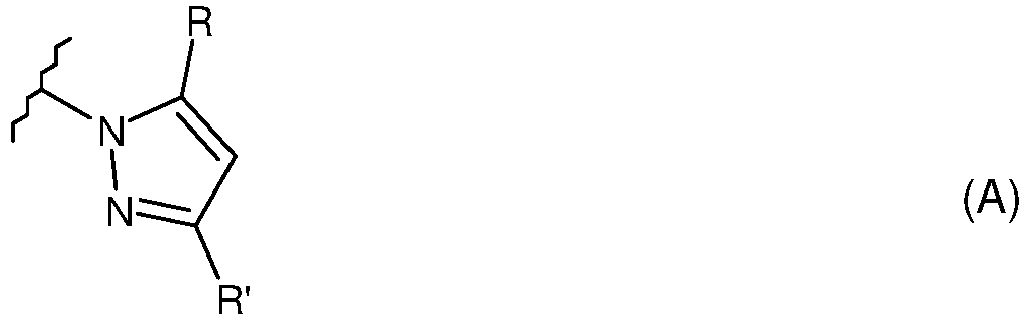
ledit procédé comprenant une étape de substitution nucléophile du composé de formule (I) telle que définie ci-dessus avec un agent nucléophile. - Selon un mode de réalisation, dans la formule (V), R" et R'" sont des groupes de formule (A). Selon un autre mode de réalisation, dans la formule (V), R" est Nu et R''' est un groupe de formule (A). Selon un autre mode de réalisation, R" et R'" sont Nu.
- Les composés de formule (V) sont préparés par substitution nucléophile à partir des composés de formule (I).
- A titre d'agent nucléophile, on peut par exemple mentionner des amines, notamment de formule RR'NH ou RNH2, des alcoolates de formule ROM (M = Li, Na, K, Cs), des thiols de formule RSH, des thiolates de formule RSM (M = Li, Na, K, Cs), des sélénates, des tellurates, des amidures, y compris aromatiques tels que des sels de pyrroles, imidazoles, indoles, des carbanions moyennement ou faiblement basiques (eg cériques, cuprates...), les groupes R et R' mentionnés dans ce paragraphe représentant des groupes alkyles.
- Les conditions de réaction de ce procédé de substitution nucléophile sont bien connues de l'homme du métier et sont identiques à celles de toute réaction de substitution nucléophile.
- Ce procédé permet d'obtenir des composés comprenant un, deux ou trois groupes Nu tels que mentionné ci-dessus.
- La présente invention concerne également des composés de formule (VI) ou (VII) suivante :

- De préférence, dans les formules (VI) et (VII), Nu représente un groupe amino (-NH2) ou aminoalkyle (-NHAlk ou -N(Alk)(Alk')), ou un groupe hétérocycloalkyle comprenant au moins un atome d'azote, par exemple de type morpholine ou pipéridine.
- La présente demande décrit également un composé de formule (VIII) suivante :


- Selon un mode de réalisation, les composés de formule (VIII) sont différents des composés suivants :


- La présente demande décrit également un composé de formule (IX) suivante :

-

- La trihydrazinoheptazine (1 g soit 3,8.10-3 mol) est introduite dans un broyeur planétaire d'agate (broyeur Fritsch, de type "Pulvérizette") équipé d'un bol de broyage de 80 ml, avec 10 billes d'agate d'un diamètre de 0,5 cm (même fournisseur), et on ajoute 4,5 eq. de 3,5-heptanedione (Sigma-Aldrich) (correspond à 1,5 fois la stœchiométrie nécessaire), ainsi que 0,5 g d'acide toluènesulfonique (Prolabo) comme catalyseur. Le bol de broyage est alors introduit dans le broyeur, et laissé tourner 8 mn à une vitesse de 500 tours/mn.
- Après le broyage, le contenu du bol est alors repris dans le minimum de dichlorométhane (trois fois 50 ml environ), avant d'être chromatographié (éluant éther de pétrole (EP) 80% - acétate d'éthyle (EtOAc) 20%, en augmentant progressivement la quantité d'acétate d'éthyle jusqu'à 100%) pour obtenir 700 mg de 2,5,8-tris(3,5-diéthylpyrazol-1-yl)-heptazine pure (rendement d'environ 35%).
-

- Pour la réaction de bromation de la 2,5,8-tris(3,5-diéthylpyrazol-1-yl)-heptazine, on utilise simplement un léger excès de dibrome dans du dichlorométhane (DCM)(voir Schéma) à température ambiante.
- A 540 mg (10-3 mol) dissous dans 20 ml de DCM, on ajoute 600 mg de dibrome dissous dans 10 ml de DCM. On laisse agiter pendant une heure à température ambiante. Après la réaction, l'excès de dibrome est éliminé par un lavage par une solution diluée de thiosulfate de sodium dans l'eau. La solution est alors séchée et évaporée sous vide. Une chromatographie dans les mêmes conditions que la molécule de départ fournit le composé tribromé (580 mg, rendement 74%).
-
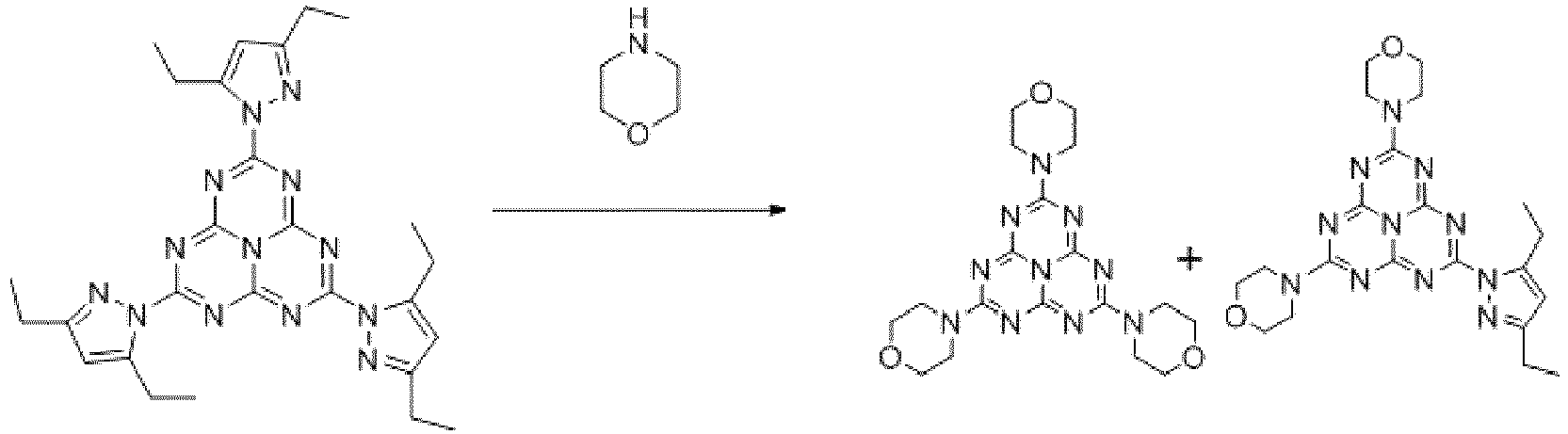
- A 0,54 g, (10-3 mol) de 2,5,8-tris(3,5-diéthylpyrazol-1-yl)-heptazine dissoute dans 50 ml d'acétonitrile, on ajoute 4 équivalents de morpholine (Sigma-Aldrich) (350 mg, préalablement en solution dans l'acétonitrile, soit un excès de l'ordre de 1,3 par rapport à la stœchiométrie), on laisse agiter pendant 1/4h puis on porte à reflux pendant une heure. Dans ces conditions uniquement le dérivé trisubstitué est formé. On rajoute 5g de silice environ dans la solution, qui est ensuite évaporée de manière à effectuer un dépôt solide, puis le produit final est purifié par chromatographie, (éluant 50% EP/EtOAc → 100% EtOAc) pour obtenir 300 mg de Tris(N-morpholino)heptazine pure (rendement 58%).
- Si l'on agite en chauffant à environ 40°C, on forme un peu de produit de di-substitution (voir Schéma) comme sous-produit. On obtient alors environ 40% de tris(morpholino)heptazine et 15% de bis(N-morpholino)-(3,5-diéthylpyrazol-1-yl)-heptazine.
- Les mêmes conditions que celles de l'exemple 3 ci-dessus peuvent être appliquées pour préparer d'autres dérivés d'heptazine, en remplaçant la morpholine par de la pipéridine, de la pyrrolidine ou de la 2-éthylhexylamine.
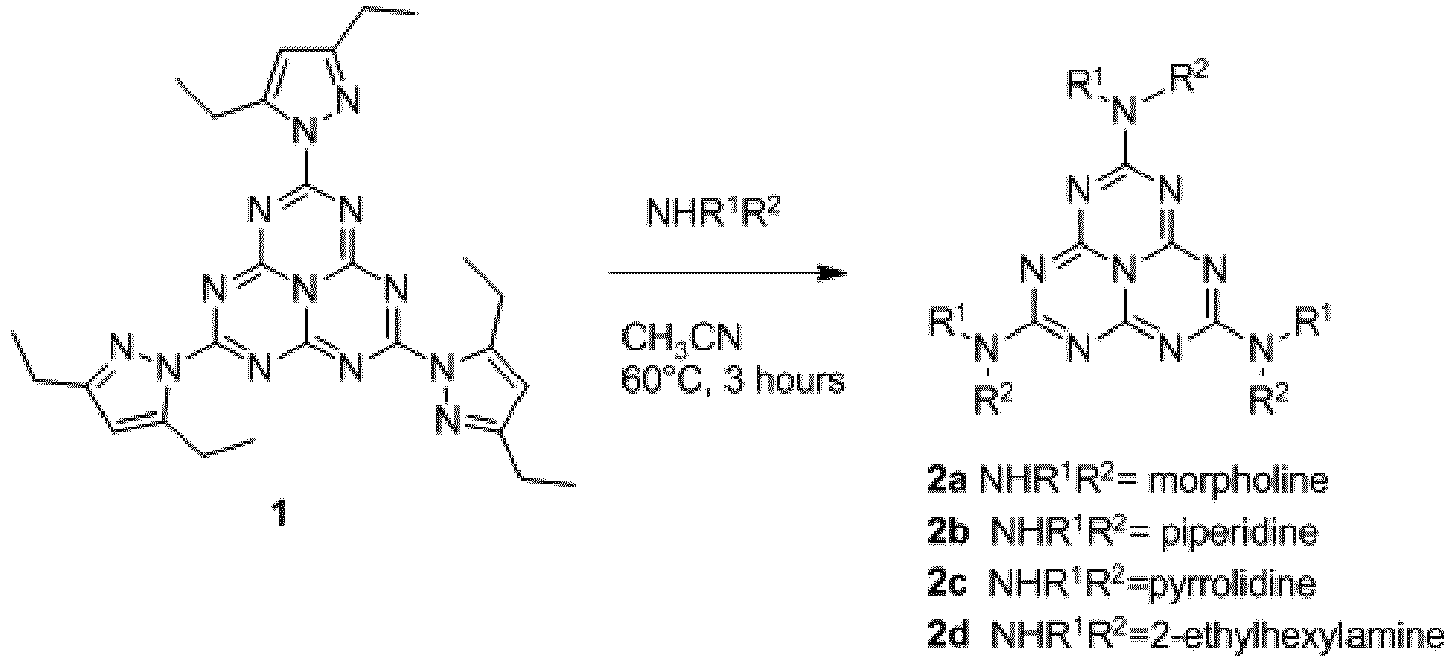
- Il est également possible, à partir de 2,5,8-tris(3,5-diéthylpyrazol-1-yl)-heptazine, de préparer d'autres dérivés d'heptazine selon le schéma réactionnel ci-dessous :

-

- A 0,54 g (10-3 mol) de 2,5,8-tris(3,5-diéthylpyrazol-1-yl)-heptazine dissoute dans 50 ml d'acétonitrile, on ajoute 4 équivalents d'amine (soit 1,072 g correspondant à un excès de l'ordre de 1,3 par rapport à la stœchiométrie), on laisse agiter pendant 1/4h puis on porte à reflux pendant une heure. La réaction est traitée exactement comme dans l'exemple 3 pour fournir environ 800 mg de produit pur (rendement 50%).
-

- A une solution de 2,5,8-tris(3,5-diéthyl-4-bromo-pyrazol-1-yl)-heptazine refroidie à 0°C dans du THF anhydre, et sous couverture de gaz inerte (azote), on ajoute à l'aide d'une seringue 3,3 équivalents de 3-bromure de 1-fluoro-3-méthylphenylmagnésium. La solution est agitée une heure, puis laissée remonter à température ambiante. On évapore ensuite le THF, on reprend avec du DCM puis on chromatographie le produit dans les mêmes conditions que décrites par C. Adachi (Jie Li, Hiroko Nomura, Hiroshi Miyazaki and Chihaya Adachi, Chem. Commun. 2014, 50, 6174 (EP 95% AcOEt 5%) pour obtenir le produit pur, de couleur vert pâle et fluorescent dans le jaune, avec un rendement de l'ordre de 30%.
Claims (11)
- Procédé de préparation d'un composé de formule (I) suivante :

ledit procédé comprenant la réaction de trihydrazinoheptazine de formule (II) suivante :

- Procédé selon la revendication 1, dans lequel les groupes R et R' sont identiques et choisis parmi les groupes alkyles comprenant de 1 à 4 atomes de carbone, et sont de préférence des groupes éthyles.
- Procédé selon la revendication 1 ou 2, dans lequel la trihydrazinoheptazine est préalablement soumise à une étape de séchage.
- Procédé selon l'une quelconque des revendications 1 à 3, dans lequel la trihydrazinoheptazine est soumise à une étape de broyage.
- Procédé selon l'une quelconque des revendications 1 à 4, dans lequel le ratio entre le nombre de moles de cétone et le nombre de moles de trihydrazinoheptazine est supérieur ou égal à 1, et de préférence égal à 1,5.
- Composé de formule (I) :

- Composé de formule (IV) suivante :

- Procédé de préparation d'un composé de formule (IV) selon la revendication 7, comprenant une étape de réaction du composé de formule (I) selon la revendication 6 avec un agent de bromation, notamment avec du dibrome.
- Utilisation du composé de formule (I) selon la revendication 6, pour la mise en œuvre de réactions de substitution nucléophile.
- Procédé de préparation d'un composé de formule (V) suivante :
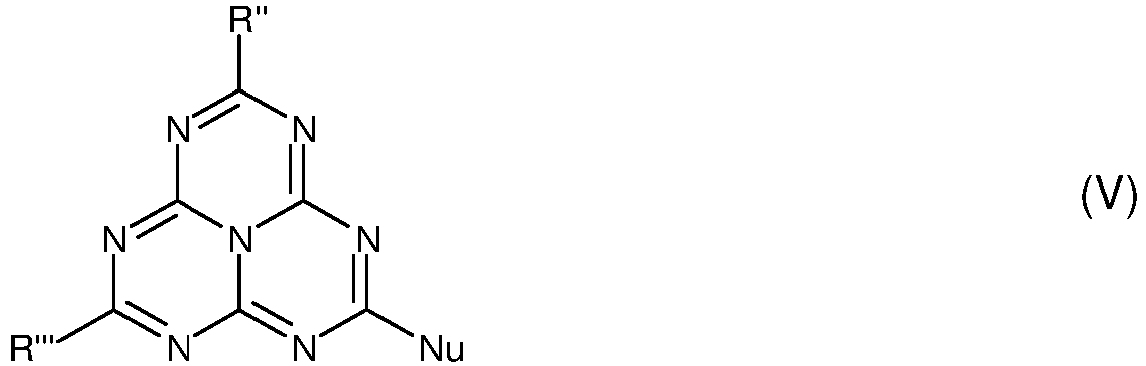 - Nu représente un groupe nucléophile,- R" et R'", indépendamment l'un de l'autre, représentent Nu ou un groupe de formule (A) :
ledit procédé comprenant une étape de substitution nucléophile du composé de formule (I) selon la revendication 6 avec un agent nucléophile. - Composé de formule (VI) ou (VII) suivante :
 - R et R' sont tels que définis dans la revendication 1 ; et- Nu représente un groupe nucléophile.
Applications Claiming Priority (1)
| Application Number | Priority Date | Filing Date | Title |
|---|---|---|---|
| FR1851715A FR3078333A1 (fr) | 2018-02-27 | 2018-02-27 | Procede de preparation d'heptazines |
Publications (2)
| Publication Number | Publication Date |
|---|---|
| EP3530662A1 EP3530662A1 (fr) | 2019-08-28 |
| EP3530662B1 true EP3530662B1 (fr) | 2021-03-17 |
Family
ID=62749099
Family Applications (1)
| Application Number | Title | Priority Date | Filing Date |
|---|---|---|---|
| EP19159794.7A Active EP3530662B1 (fr) | 2018-02-27 | 2019-02-27 | Procédé de préparation d'heptazines |
Country Status (2)
| Country | Link |
|---|---|
| EP (1) | EP3530662B1 (fr) |
| FR (1) | FR3078333A1 (fr) |
Family Cites Families (3)
| Publication number | Priority date | Publication date | Assignee | Title |
|---|---|---|---|---|
| DE102012007529B4 (de) * | 2012-04-17 | 2016-03-31 | Technische Universität Bergakademie Freiberg | Imido-s-heptazinderivate - Verfahren zu deren Herstellung und deren Verwendungen |
| CN106883240A (zh) * | 2017-01-20 | 2017-06-23 | 瑞声科技(南京)有限公司 | 三均三嗪化合物及发光器件 |
| CN108101928B (zh) * | 2017-12-13 | 2019-12-03 | 华南协同创新研究院 | 一类庚嗪-酰亚胺衍生物及其制备方法与应用 |
-
2018
- 2018-02-27 FR FR1851715A patent/FR3078333A1/fr not_active Withdrawn
-
2019
- 2019-02-27 EP EP19159794.7A patent/EP3530662B1/fr active Active
Non-Patent Citations (1)
| Title |
|---|
| None * |
Also Published As
| Publication number | Publication date |
|---|---|
| FR3078333A1 (fr) | 2019-08-30 |
| EP3530662A1 (fr) | 2019-08-28 |
Similar Documents
| Publication | Publication Date | Title |
|---|---|---|
| EP0442820A1 (fr) | Nouveaux dérivés de benzimidazole et d'azabenzimidazole, antagonistes des récepteurs au thromboxane; leurs procédés de préparation, intermédiaires de synthèse, compositions les contenant | |
| EP2042497B1 (fr) | Procédé de synthèse du ranélate de strontium et de ses hydrates | |
| EP0021927B1 (fr) | Procédé de préparation d'éthers aryliques | |
| EP3530662B1 (fr) | Procédé de préparation d'heptazines | |
| EP4132905B1 (fr) | Procédé de synthèse de composés triarylméthane sulfonés | |
| EP0000453B1 (fr) | Procédé de préparation de dérivés de la thiénopyridine | |
| EP4361127B1 (fr) | Procédé de synthèse de composés triarylméthane sulfonés | |
| EP0069001B1 (fr) | Procédé de préparation de dérivés de la tétrahydro-5,6,7,7a 4H-thiéno (3,2-C) pyridinone-2 | |
| EP0694029B1 (fr) | Nouveau procede de preparation d'acide beta-alcoxy acrylique | |
| EP0398783A1 (fr) | Procédé de synthèse de cyanures d'acyle | |
| EP0258160A2 (fr) | Dérivés de 2,3 dihydrofuranne leur procédé de préparation, leur utilisation comme intermédiaire pour la préparation de tétrahydrofuranne | |
| EP3092212A1 (fr) | Procede de fabrication du bromo methyl cyclopropane et du bromo methyl cyclobutane | |
| EP0822184B1 (fr) | Procédé de préparation de lactames N-substitués | |
| EP0876374B1 (fr) | Procede de preparation de la 4'-demethylepipodophyllotoxine a partir de la podophyllotoxine | |
| FR2682384A1 (fr) | Procede de preparation de benzo (b) naphtyridines. | |
| FR2909671A1 (fr) | Procede de preparation de composes 1,3,2-oxazaborolidines | |
| FR2522652A1 (fr) | Procede pour la fabrication d'ortho- ou de para-nitrophenetole pratiquement pur | |
| EP0135444A1 (fr) | Dérivés pyroglutamiques, procédé de préparation, intermédiaires de synthèse de préparation de ceux-ci et compositions antibactérien ou antifongiques, cosmetiques ou pharmaceutiques | |
| EP0318338B1 (fr) | Procédé de préparation de synthons peptidiques | |
| CH655722A5 (fr) | Procede de preparation de derives de l'acide 2-thiophene acetique. | |
| WO2000061523A1 (fr) | Halogenation en position meta de phenols proteges | |
| EP0292362A1 (fr) | Procédé de préparation d'imides halogènes | |
| FR2552086A1 (fr) | Procede pour la preparation de derives condenses d'as-triazine, produits resultants et compositions pharmaceutiques les contenant | |
| CA1211442A (fr) | Procede pour la preparation de p-acylaminophenol | |
| FR2489824A1 (fr) | Procede pour la preparation d'esters d'acide apovincaminique et produits ainsi obtenus |
Legal Events
| Date | Code | Title | Description |
|---|---|---|---|
| PUAI | Public reference made under article 153(3) epc to a published international application that has entered the european phase |
Free format text: ORIGINAL CODE: 0009012 |
|
| STAA | Information on the status of an ep patent application or granted ep patent |
Free format text: STATUS: THE APPLICATION HAS BEEN PUBLISHED |
|
| AK | Designated contracting states |
Kind code of ref document: A1 Designated state(s): AL AT BE BG CH CY CZ DE DK EE ES FI FR GB GR HR HU IE IS IT LI LT LU LV MC MK MT NL NO PL PT RO RS SE SI SK SM TR |
|
| AX | Request for extension of the european patent |
Extension state: BA ME |
|
| STAA | Information on the status of an ep patent application or granted ep patent |
Free format text: STATUS: REQUEST FOR EXAMINATION WAS MADE |
|
| 17P | Request for examination filed |
Effective date: 20200128 |
|
| RBV | Designated contracting states (corrected) |
Designated state(s): AL AT BE BG CH CY CZ DE DK EE ES FI FR GB GR HR HU IE IS IT LI LT LU LV MC MK MT NL NO PL PT RO RS SE SI SK SM TR |
|
| STAA | Information on the status of an ep patent application or granted ep patent |
Free format text: STATUS: EXAMINATION IS IN PROGRESS |
|
| 17Q | First examination report despatched |
Effective date: 20200401 |
|
| GRAP | Despatch of communication of intention to grant a patent |
Free format text: ORIGINAL CODE: EPIDOSNIGR1 |
|
| STAA | Information on the status of an ep patent application or granted ep patent |
Free format text: STATUS: GRANT OF PATENT IS INTENDED |
|
| INTG | Intention to grant announced |
Effective date: 20201029 |
|
| GRAS | Grant fee paid |
Free format text: ORIGINAL CODE: EPIDOSNIGR3 |
|
| GRAA | (expected) grant |
Free format text: ORIGINAL CODE: 0009210 |
|
| STAA | Information on the status of an ep patent application or granted ep patent |
Free format text: STATUS: THE PATENT HAS BEEN GRANTED |
|
| AK | Designated contracting states |
Kind code of ref document: B1 Designated state(s): AL AT BE BG CH CY CZ DE DK EE ES FI FR GB GR HR HU IE IS IT LI LT LU LV MC MK MT NL NO PL PT RO RS SE SI SK SM TR |
|
| REG | Reference to a national code |
Ref country code: GB Ref legal event code: FG4D Free format text: NOT ENGLISH |
|
| REG | Reference to a national code |
Ref country code: CH Ref legal event code: EP |
|
| REG | Reference to a national code |
Ref country code: DE Ref legal event code: R096 Ref document number: 602019003156 Country of ref document: DE |
|
| REG | Reference to a national code |
Ref country code: IE Ref legal event code: FG4D Free format text: LANGUAGE OF EP DOCUMENT: FRENCH |
|
| REG | Reference to a national code |
Ref country code: AT Ref legal event code: REF Ref document number: 1372149 Country of ref document: AT Kind code of ref document: T Effective date: 20210415 |
|
| REG | Reference to a national code |
Ref country code: LT Ref legal event code: MG9D |
|
| PG25 | Lapsed in a contracting state [announced via postgrant information from national office to epo] |
Ref country code: BG Free format text: LAPSE BECAUSE OF FAILURE TO SUBMIT A TRANSLATION OF THE DESCRIPTION OR TO PAY THE FEE WITHIN THE PRESCRIBED TIME-LIMIT Effective date: 20210617 Ref country code: HR Free format text: LAPSE BECAUSE OF FAILURE TO SUBMIT A TRANSLATION OF THE DESCRIPTION OR TO PAY THE FEE WITHIN THE PRESCRIBED TIME-LIMIT Effective date: 20210317 Ref country code: GR Free format text: LAPSE BECAUSE OF FAILURE TO SUBMIT A TRANSLATION OF THE DESCRIPTION OR TO PAY THE FEE WITHIN THE PRESCRIBED TIME-LIMIT Effective date: 20210618 Ref country code: FI Free format text: LAPSE BECAUSE OF FAILURE TO SUBMIT A TRANSLATION OF THE DESCRIPTION OR TO PAY THE FEE WITHIN THE PRESCRIBED TIME-LIMIT Effective date: 20210317 Ref country code: NO Free format text: LAPSE BECAUSE OF FAILURE TO SUBMIT A TRANSLATION OF THE DESCRIPTION OR TO PAY THE FEE WITHIN THE PRESCRIBED TIME-LIMIT Effective date: 20210617 |
|
| REG | Reference to a national code |
Ref country code: AT Ref legal event code: MK05 Ref document number: 1372149 Country of ref document: AT Kind code of ref document: T Effective date: 20210317 |
|
| REG | Reference to a national code |
Ref country code: NL Ref legal event code: MP Effective date: 20210317 |
|
| PG25 | Lapsed in a contracting state [announced via postgrant information from national office to epo] |
Ref country code: LV Free format text: LAPSE BECAUSE OF FAILURE TO SUBMIT A TRANSLATION OF THE DESCRIPTION OR TO PAY THE FEE WITHIN THE PRESCRIBED TIME-LIMIT Effective date: 20210317 Ref country code: RS Free format text: LAPSE BECAUSE OF FAILURE TO SUBMIT A TRANSLATION OF THE DESCRIPTION OR TO PAY THE FEE WITHIN THE PRESCRIBED TIME-LIMIT Effective date: 20210317 Ref country code: SE Free format text: LAPSE BECAUSE OF FAILURE TO SUBMIT A TRANSLATION OF THE DESCRIPTION OR TO PAY THE FEE WITHIN THE PRESCRIBED TIME-LIMIT Effective date: 20210317 |
|
| PG25 | Lapsed in a contracting state [announced via postgrant information from national office to epo] |
Ref country code: NL Free format text: LAPSE BECAUSE OF FAILURE TO SUBMIT A TRANSLATION OF THE DESCRIPTION OR TO PAY THE FEE WITHIN THE PRESCRIBED TIME-LIMIT Effective date: 20210317 |
|
| PG25 | Lapsed in a contracting state [announced via postgrant information from national office to epo] |
Ref country code: SM Free format text: LAPSE BECAUSE OF FAILURE TO SUBMIT A TRANSLATION OF THE DESCRIPTION OR TO PAY THE FEE WITHIN THE PRESCRIBED TIME-LIMIT Effective date: 20210317 Ref country code: AT Free format text: LAPSE BECAUSE OF FAILURE TO SUBMIT A TRANSLATION OF THE DESCRIPTION OR TO PAY THE FEE WITHIN THE PRESCRIBED TIME-LIMIT Effective date: 20210317 Ref country code: EE Free format text: LAPSE BECAUSE OF FAILURE TO SUBMIT A TRANSLATION OF THE DESCRIPTION OR TO PAY THE FEE WITHIN THE PRESCRIBED TIME-LIMIT Effective date: 20210317 Ref country code: CZ Free format text: LAPSE BECAUSE OF FAILURE TO SUBMIT A TRANSLATION OF THE DESCRIPTION OR TO PAY THE FEE WITHIN THE PRESCRIBED TIME-LIMIT Effective date: 20210317 Ref country code: LT Free format text: LAPSE BECAUSE OF FAILURE TO SUBMIT A TRANSLATION OF THE DESCRIPTION OR TO PAY THE FEE WITHIN THE PRESCRIBED TIME-LIMIT Effective date: 20210317 |
|
| PG25 | Lapsed in a contracting state [announced via postgrant information from national office to epo] |
Ref country code: IS Free format text: LAPSE BECAUSE OF FAILURE TO SUBMIT A TRANSLATION OF THE DESCRIPTION OR TO PAY THE FEE WITHIN THE PRESCRIBED TIME-LIMIT Effective date: 20210717 Ref country code: PL Free format text: LAPSE BECAUSE OF FAILURE TO SUBMIT A TRANSLATION OF THE DESCRIPTION OR TO PAY THE FEE WITHIN THE PRESCRIBED TIME-LIMIT Effective date: 20210317 Ref country code: SK Free format text: LAPSE BECAUSE OF FAILURE TO SUBMIT A TRANSLATION OF THE DESCRIPTION OR TO PAY THE FEE WITHIN THE PRESCRIBED TIME-LIMIT Effective date: 20210317 Ref country code: RO Free format text: LAPSE BECAUSE OF FAILURE TO SUBMIT A TRANSLATION OF THE DESCRIPTION OR TO PAY THE FEE WITHIN THE PRESCRIBED TIME-LIMIT Effective date: 20210317 Ref country code: PT Free format text: LAPSE BECAUSE OF FAILURE TO SUBMIT A TRANSLATION OF THE DESCRIPTION OR TO PAY THE FEE WITHIN THE PRESCRIBED TIME-LIMIT Effective date: 20210719 |
|
| REG | Reference to a national code |
Ref country code: DE Ref legal event code: R097 Ref document number: 602019003156 Country of ref document: DE |
|
| PLBE | No opposition filed within time limit |
Free format text: ORIGINAL CODE: 0009261 |
|
| STAA | Information on the status of an ep patent application or granted ep patent |
Free format text: STATUS: NO OPPOSITION FILED WITHIN TIME LIMIT |
|
| PG25 | Lapsed in a contracting state [announced via postgrant information from national office to epo] |
Ref country code: ES Free format text: LAPSE BECAUSE OF FAILURE TO SUBMIT A TRANSLATION OF THE DESCRIPTION OR TO PAY THE FEE WITHIN THE PRESCRIBED TIME-LIMIT Effective date: 20210317 Ref country code: AL Free format text: LAPSE BECAUSE OF FAILURE TO SUBMIT A TRANSLATION OF THE DESCRIPTION OR TO PAY THE FEE WITHIN THE PRESCRIBED TIME-LIMIT Effective date: 20210317 Ref country code: DK Free format text: LAPSE BECAUSE OF FAILURE TO SUBMIT A TRANSLATION OF THE DESCRIPTION OR TO PAY THE FEE WITHIN THE PRESCRIBED TIME-LIMIT Effective date: 20210317 |
|
| 26N | No opposition filed |
Effective date: 20211220 |
|
| PG25 | Lapsed in a contracting state [announced via postgrant information from national office to epo] |
Ref country code: SI Free format text: LAPSE BECAUSE OF FAILURE TO SUBMIT A TRANSLATION OF THE DESCRIPTION OR TO PAY THE FEE WITHIN THE PRESCRIBED TIME-LIMIT Effective date: 20210317 |
|
| PG25 | Lapsed in a contracting state [announced via postgrant information from national office to epo] |
Ref country code: IT Free format text: LAPSE BECAUSE OF FAILURE TO SUBMIT A TRANSLATION OF THE DESCRIPTION OR TO PAY THE FEE WITHIN THE PRESCRIBED TIME-LIMIT Effective date: 20210317 |
|
| PG25 | Lapsed in a contracting state [announced via postgrant information from national office to epo] |
Ref country code: IS Free format text: LAPSE BECAUSE OF FAILURE TO SUBMIT A TRANSLATION OF THE DESCRIPTION OR TO PAY THE FEE WITHIN THE PRESCRIBED TIME-LIMIT Effective date: 20210717 |
|
| PG25 | Lapsed in a contracting state [announced via postgrant information from national office to epo] |
Ref country code: MC Free format text: LAPSE BECAUSE OF FAILURE TO SUBMIT A TRANSLATION OF THE DESCRIPTION OR TO PAY THE FEE WITHIN THE PRESCRIBED TIME-LIMIT Effective date: 20210317 |
|
| REG | Reference to a national code |
Ref country code: CH Ref legal event code: PL |
|
| REG | Reference to a national code |
Ref country code: BE Ref legal event code: MM Effective date: 20220228 |
|
| PG25 | Lapsed in a contracting state [announced via postgrant information from national office to epo] |
Ref country code: LU Free format text: LAPSE BECAUSE OF NON-PAYMENT OF DUE FEES Effective date: 20220227 |
|
| PG25 | Lapsed in a contracting state [announced via postgrant information from national office to epo] |
Ref country code: LI Free format text: LAPSE BECAUSE OF NON-PAYMENT OF DUE FEES Effective date: 20220228 Ref country code: IE Free format text: LAPSE BECAUSE OF NON-PAYMENT OF DUE FEES Effective date: 20220227 Ref country code: CH Free format text: LAPSE BECAUSE OF NON-PAYMENT OF DUE FEES Effective date: 20220228 |
|
| PG25 | Lapsed in a contracting state [announced via postgrant information from national office to epo] |
Ref country code: BE Free format text: LAPSE BECAUSE OF NON-PAYMENT OF DUE FEES Effective date: 20220228 |
|
| PG25 | Lapsed in a contracting state [announced via postgrant information from national office to epo] |
Ref country code: MK Free format text: LAPSE BECAUSE OF FAILURE TO SUBMIT A TRANSLATION OF THE DESCRIPTION OR TO PAY THE FEE WITHIN THE PRESCRIBED TIME-LIMIT Effective date: 20210317 Ref country code: CY Free format text: LAPSE BECAUSE OF FAILURE TO SUBMIT A TRANSLATION OF THE DESCRIPTION OR TO PAY THE FEE WITHIN THE PRESCRIBED TIME-LIMIT Effective date: 20210317 |
|
| PG25 | Lapsed in a contracting state [announced via postgrant information from national office to epo] |
Ref country code: HU Free format text: LAPSE BECAUSE OF FAILURE TO SUBMIT A TRANSLATION OF THE DESCRIPTION OR TO PAY THE FEE WITHIN THE PRESCRIBED TIME-LIMIT; INVALID AB INITIO Effective date: 20190227 |
|
| PG25 | Lapsed in a contracting state [announced via postgrant information from national office to epo] |
Ref country code: TR Free format text: LAPSE BECAUSE OF FAILURE TO SUBMIT A TRANSLATION OF THE DESCRIPTION OR TO PAY THE FEE WITHIN THE PRESCRIBED TIME-LIMIT Effective date: 20210317 |
|
| PG25 | Lapsed in a contracting state [announced via postgrant information from national office to epo] |
Ref country code: MT Free format text: LAPSE BECAUSE OF FAILURE TO SUBMIT A TRANSLATION OF THE DESCRIPTION OR TO PAY THE FEE WITHIN THE PRESCRIBED TIME-LIMIT Effective date: 20210317 |
|
| PGFP | Annual fee paid to national office [announced via postgrant information from national office to epo] |
Ref country code: GB Payment date: 20260225 Year of fee payment: 8 |
|
| PGFP | Annual fee paid to national office [announced via postgrant information from national office to epo] |
Ref country code: DE Payment date: 20260324 Year of fee payment: 8 |
|
| PGFP | Annual fee paid to national office [announced via postgrant information from national office to epo] |
Ref country code: FR Payment date: 20260227 Year of fee payment: 8 |