EP3531648A1 - Medien-stream-sende- und -empfangsverfahren und -vorrichtung, system und videorelais - Google Patents
Medien-stream-sende- und -empfangsverfahren und -vorrichtung, system und videorelais Download PDFInfo
- Publication number
- EP3531648A1 EP3531648A1 EP17861397.2A EP17861397A EP3531648A1 EP 3531648 A1 EP3531648 A1 EP 3531648A1 EP 17861397 A EP17861397 A EP 17861397A EP 3531648 A1 EP3531648 A1 EP 3531648A1
- Authority
- EP
- European Patent Office
- Prior art keywords
- class
- media stream
- receiving end
- media
- video
- Prior art date
- Legal status (The legal status is an assumption and is not a legal conclusion. Google has not performed a legal analysis and makes no representation as to the accuracy of the status listed.)
- Withdrawn
Links
- 238000000034 method Methods 0.000 title claims abstract description 98
- 230000005540 biological transmission Effects 0.000 claims abstract description 79
- 230000004048 modification Effects 0.000 claims description 7
- 238000012986 modification Methods 0.000 claims description 7
- 230000008569 process Effects 0.000 description 29
- 238000010586 diagram Methods 0.000 description 12
- 238000012545 processing Methods 0.000 description 11
- 238000005516 engineering process Methods 0.000 description 8
- 230000001419 dependent effect Effects 0.000 description 7
- 230000004044 response Effects 0.000 description 7
- 230000003993 interaction Effects 0.000 description 4
- 230000003287 optical effect Effects 0.000 description 2
- 230000006870 function Effects 0.000 description 1
- 230000007246 mechanism Effects 0.000 description 1
- 238000006467 substitution reaction Methods 0.000 description 1
- 238000012546 transfer Methods 0.000 description 1
Images





Classifications
-
- H—ELECTRICITY
- H04—ELECTRIC COMMUNICATION TECHNIQUE
- H04L—TRANSMISSION OF DIGITAL INFORMATION, e.g. TELEGRAPHIC COMMUNICATION
- H04L65/00—Network arrangements, protocols or services for supporting real-time applications in data packet communication
- H04L65/80—Responding to QoS
-
- H—ELECTRICITY
- H04—ELECTRIC COMMUNICATION TECHNIQUE
- H04L—TRANSMISSION OF DIGITAL INFORMATION, e.g. TELEGRAPHIC COMMUNICATION
- H04L65/00—Network arrangements, protocols or services for supporting real-time applications in data packet communication
- H04L65/10—Architectures or entities
- H04L65/1016—IP multimedia subsystem [IMS]
-
- H—ELECTRICITY
- H04—ELECTRIC COMMUNICATION TECHNIQUE
- H04L—TRANSMISSION OF DIGITAL INFORMATION, e.g. TELEGRAPHIC COMMUNICATION
- H04L65/00—Network arrangements, protocols or services for supporting real-time applications in data packet communication
- H04L65/10—Architectures or entities
- H04L65/1063—Application servers providing network services
-
- H—ELECTRICITY
- H04—ELECTRIC COMMUNICATION TECHNIQUE
- H04L—TRANSMISSION OF DIGITAL INFORMATION, e.g. TELEGRAPHIC COMMUNICATION
- H04L65/00—Network arrangements, protocols or services for supporting real-time applications in data packet communication
- H04L65/60—Network streaming of media packets
- H04L65/61—Network streaming of media packets for supporting one-way streaming services, e.g. Internet radio
-
- H—ELECTRICITY
- H04—ELECTRIC COMMUNICATION TECHNIQUE
- H04L—TRANSMISSION OF DIGITAL INFORMATION, e.g. TELEGRAPHIC COMMUNICATION
- H04L65/00—Network arrangements, protocols or services for supporting real-time applications in data packet communication
- H04L65/60—Network streaming of media packets
- H04L65/61—Network streaming of media packets for supporting one-way streaming services, e.g. Internet radio
- H04L65/612—Network streaming of media packets for supporting one-way streaming services, e.g. Internet radio for unicast
-
- H—ELECTRICITY
- H04—ELECTRIC COMMUNICATION TECHNIQUE
- H04L—TRANSMISSION OF DIGITAL INFORMATION, e.g. TELEGRAPHIC COMMUNICATION
- H04L65/00—Network arrangements, protocols or services for supporting real-time applications in data packet communication
- H04L65/60—Network streaming of media packets
- H04L65/65—Network streaming protocols, e.g. real-time transport protocol [RTP] or real-time control protocol [RTCP]
-
- H—ELECTRICITY
- H04—ELECTRIC COMMUNICATION TECHNIQUE
- H04L—TRANSMISSION OF DIGITAL INFORMATION, e.g. TELEGRAPHIC COMMUNICATION
- H04L65/00—Network arrangements, protocols or services for supporting real-time applications in data packet communication
- H04L65/60—Network streaming of media packets
- H04L65/75—Media network packet handling
- H04L65/765—Media network packet handling intermediate
-
- H—ELECTRICITY
- H04—ELECTRIC COMMUNICATION TECHNIQUE
- H04N—PICTORIAL COMMUNICATION, e.g. TELEVISION
- H04N21/00—Selective content distribution, e.g. interactive television or video on demand [VOD]
- H04N21/20—Servers specifically adapted for the distribution of content, e.g. VOD servers; Operations thereof
- H04N21/23—Processing of content or additional data; Elementary server operations; Server middleware
- H04N21/234—Processing of video elementary streams, e.g. splicing of video streams or manipulating encoded video stream scene graphs
- H04N21/2343—Processing of video elementary streams, e.g. splicing of video streams or manipulating encoded video stream scene graphs involving reformatting operations of video signals for distribution or compliance with end-user requests or end-user device requirements
-
- H—ELECTRICITY
- H04—ELECTRIC COMMUNICATION TECHNIQUE
- H04N—PICTORIAL COMMUNICATION, e.g. TELEVISION
- H04N21/00—Selective content distribution, e.g. interactive television or video on demand [VOD]
- H04N21/20—Servers specifically adapted for the distribution of content, e.g. VOD servers; Operations thereof
- H04N21/25—Management operations performed by the server for facilitating the content distribution or administrating data related to end-users or client devices, e.g. end-user or client device authentication, learning user preferences for recommending movies
- H04N21/262—Content or additional data distribution scheduling, e.g. sending additional data at off-peak times, updating software modules, calculating the carousel transmission frequency, delaying a video stream transmission, generating play-lists
Definitions
- the present disclosure relates to the technical field of communications and, in particular, to a media stream transmission method and apparatus, a media stream reception method and apparatus, a system and a video relay.
- IP Internet Protocol
- IMS Internet Multimedia Subsystem
- the current IMS multi-stream architecture allows to dynamically adjust the class (such as resolution class, bit rate class, etc.) of a single user's uplink video stream according to the number of members in a multi-party video scenario.
- the user's uplink video stream is always provided according to the actual display requirements, which can effectively reduce the uplink bandwidth occupation of a single user.
- a limitation still exists in such a way that is, the class of a specific video stream that all users can watch is exactly the same. Colloquially speaking, if a specific video stream has a high resolution, everyone will watch the high-resolution video stream; and if a specific video stream has a low resolution, everyone will watch the low-resolution video stream.
- a media stream transmission method and apparatus, a media stream reception method and apparatus, a system and a video relay are provided in the embodiments of the present disclosure, to at least solve the problem, in the related art, of poor user experience due to the totally same class of the video stream viewed by all users in a multi-stream architecture of an IMS.
- An embodiment of the present disclosure provides a media stream transmission method.
- the method includes: receiving media streams transmitted by a transmitting end, where the media streams are media streams encoded by the transmitting end according to a class requirement received by the transmitting end; and transmitting, according to a pre-established corresponding relationship between a class of a media stream and a receiving end, to the receiving end a media stream, among the received media streams, at a class corresponding to the receiving end.
- the receiving end includes a first terminal that supports receiving and decoding a classified media stream.
- the step of transmitting, according to the pre-established corresponding relationship between the class of the media stream and the receiving end, to the receiving end the media stream, among the received media streams, at the class corresponding to the receiving end includes: making, according to the corresponding relationship, multiple copies of a media stream, among the received media streams, at a same class corresponding to a plurality of the first terminals, and respectively transmitting each of the multiple copies of the media stream at the same class and a respective media stream at another class corresponding to each of the plurality of the first terminals to the each of the plurality of the first terminals.
- the step of transmitting, according to the pre-established corresponding relationship between the class of the media stream and the receiving end, to the receiving end the media stream, among the received media streams, at the class corresponding to the receiving end further includes: copying the received media streams; modifying a network abstraction layer (NAL) header in a lowest-class media stream among the received media streams to a network abstraction layer header in an advanced video coding (AVC) format; and transmitting, according to the AVC format, the modified lowest-class media stream to the AVC terminal.
- NAL network abstraction layer
- AVC advanced video coding
- a network abstraction layer header in each of the received media streams includes a class identifier of each class of the media stream.
- the step of transmitting, according to the pre-established corresponding relationship between the class of the media stream and the receiving end, to the receiving end the media stream, among the received media streams, at the class corresponding to the receiving end includes: transmitting, according to the corresponding relationship and the class identifier, to the receiving end the media stream, among the received media streams, at the class corresponding to the receiving end.
- the method before receiving the media streams transmitted by the transmitting end, the method further includes: receiving first request information transmitted by the receiving end for requesting adjustment of a class of a media stream, where the first request information carries a class requirement of the receiving end on the class of the media stream; establishing the corresponding relationship; and transmitting to the transmitting end second request information for making a request to adjust the media stream to be in a manner of classification, where the second request information also carries the class requirement of the receiving end on the class of the media stream.
- the step of receiving the first request information transmitted by the receiving end for requesting adjustment of the class of the media stream includes one of: directly receiving the first request information transmitted by the receiving end; and receiving, through a web server and an application server, the first request information transmitted by the receiving end.
- the method after transmitting to the transmitting end the second request information for making the request to adjust the media stream to be in the manner of classification, the method further includes one of that: the transmitting end rejects the second request information; and that the transmitting end accepts the second request information.
- the present disclosure provides a media stream transmission system.
- the system includes: a transmitting end, a video relay and a receiving end.
- the transmitting end encodes a media stream according to a class requirement received by the transmitting end, and transmits encoded media streams to the video relay.
- the video relay receives the encoded media streams, and transmits according to a pre-established corresponding relationship between a class of the media stream and the receiving end, to the receiving end a media stream, among the received and encoded media streams, at a class corresponding to the receiving end.
- the receiving end includes a first terminal that supports receiving and decoding a classified media stream.
- the video relay is further configured to make, according to the corresponding relationship, multiple copies of a media stream, among the received media streams, at a same class corresponding to a plurality of the first terminals, and respectively transmit each of the multiple copies of the media stream at the same class and a respective media stream at another class corresponding to each of the plurality of the first terminals to the each of the plurality of the first terminals.
- the video relay is further configured to copy the received media streams, modify a network abstraction layer (NAL) unit header in a lowest-class media stream among the received media streams to a NAL unit header in an AVC format, and transmit, according to the AVC format, the modified lowest-class media stream to the AVC terminal.
- NAL network abstraction layer
- a network abstraction layer header in each of the received media streams includes a class identifier of each class of the media stream.
- the video relay is further configured to transmit, according to the corresponding relationship and the class identifier, to the receiving end the media stream, among the received media streams, at the class corresponding to the receiving end.
- the receiving end is further configured to: transmit to the video relay first request information for requesting adjustment of a class of the media stream, where the first request information carries a class requirement of the receiving end on the class of the media stream, and the video relay receives the first request information and then establishes the corresponding relationship; and transmit to the transmitting end second request information for making a request to adjust the media stream to be in a manner of classification, where the second request information also carries the class requirement of the receiving end on the class of the media stream.
- the system further includes a web server.
- the web server is configured to provide a web interface to the receiving end, and the web interface is configured to submit class requirement selected by a user to the web server.
- system further includes an application server, which is configured to transmit the class requirement submitted to the web server to the video relay.
- the transmitting end is further configured to perform at least one of following operations: rejecting the second request information; and accepting the second request information.
- the apparatus includes: a reception module, which is configured to receive media streams transmitted by a transmitting end, where the media streams are media streams encoded by the transmitting end according to a class requirement received by the transmitting end; and a transmission module, which is configured to transmit, according to a pre-established corresponding relationship between a class of a media stream and a receiving end, to the receiving end a media stream, among the received media streams, at a class corresponding to the receiving end.
- the receiving end includes a first terminal that supports receiving and decoding a classified media stream.
- the transmission module further includes: a copy unit, which is configured to make, according to the corresponding relationship, multiple copies of a media stream, among the received media streams, at a same class corresponding to a plurality of the first terminals; and a transmission unit, which is configured to respectively transmit each of the multiple copies of the media stream at the same class and a respective media stream at another class corresponding to each of the plurality of the first terminals to the each of the plurality of the first terminals.
- the copy unit is further configured to copy the received media streams;
- the transmission module further includes a modification unit, which is configured to modify a network abstraction layer (NAL) unit header in a lowest-class media stream among the received media streams to a NAL unit header in an AVC format; and the transmission unit is further configured to transmit, according to the AVC format, the modified lowest-class media stream to the AVC terminal.
- NAL network abstraction layer
- a network abstraction layer header in each of the received media streams includes a class identifier of each class of the media stream.
- the transmission module is further configured to transmit, according to the corresponding relationship and the class identifier, to the receiving end the media stream, among the received media streams, at the class corresponding to the receiving end.
- the reception module is further configured to receive first request information transmitted by the receiving end for requesting adjustment of a class of the media stream, where the first request information carries a class requirement of the receiving end on the class of the media stream.
- the apparatus further includes: an establishment module, which is configured to establish the corresponding relationship.
- the transmission module is further configured to transmit to the transmitting end second request information for making a request to adjust the media stream to be in a manner of classification, where the second request information also carries the class requirement of the receiving end on the class of the media stream.
- the reception module is further configured to perform one of following operations: directly receiving the first request information transmitted by the receiving end; and receiving, through a web server and an application server, the first request information transmitted by the receiving end.
- the video relay includes the media stream transmission apparatus described above.
- Another embodiment of the present disclosure provides a media stream transmission method.
- the method includes: receiving a class requirement of a receiving end on a class of a media stream through a video relay; coding, according to the class requirement, the media stream; and transmitting encoded media streams to the video relay.
- the step of receiving the class requirement of the receiving end on the class of the media stream through the video relay includes: receiving request information, transmitted by the video relay, for making a request to adjust the media stream to be in a manner of classification, where the request information carries the class requirement of the receiving end on the class of the media stream.
- the method after receiving the request information, transmitted by the video relay, for making the request to adjust the media stream to be in the manner of classification, the method further includes one of: rejecting the request information; and accepting the request information.
- the step of coding, according to the class requirement, the media stream includes: performing, according to the class requirement, scaled video coding on the media stream, where a network abstraction layer header in each of media streams after the scaled video coding is performed includes a class identifier of each class of the media stream.
- Another embodiment of the present disclosure provides a media stream transmission apparatus.
- the apparatus includes: a reception module, which is configured to receive a class requirement of a receiving end on a class of a media stream through a video relay; a coding module, which is configured to encode, according to the class requirement, the media stream; and a transmission module, which is configured to transmit encoded media streams to the video relay.
- the reception module is further configured to receive request information, transmitted by the video relay, for making a request to adjust the media stream to be in a manner of classification, where the request information carries a class requirement of the receiving end on a class of the media stream.
- the coding module is further configured to perform, according to the class requirement, SVC on the media stream, where a NAL unit header in each of media streams after the SVC is performed includes a class identifier of each class of the media stream.
- Another embodiment of the present disclosure provides a media stream reception method.
- the method includes: transmitting a class requirement to a transmitting end through a video relay, where the class requirement is used by the transmitting end for encoding a media stream; and receiving a media stream at a class corresponding to a receiving end through the video relay.
- the step of transmitting the class requirement to the transmitting end through the video relay includes: transmitting, through the video relay, to the transmitting end request information for making a request to adjust the media stream to be in a manner of classification, where the request information carries the class requirement.
- the coding is scaled video coding (SVC).
- the method before transmitting the class requirement to the transmitting end through the video relay, the method further includes: requesting a web interface from a web server, where the web interface is configured to submit class requirement selected by a user to the web server.
- the apparatus includes: a transmission module, which is configured to transmit a class requirement to a transmitting end through a video relay, where the class requirement is used by the transmitting end for encoding a media stream; and a reception module, which is configured to receive a media stream at a class corresponding to a receiving end through the video relay.
- the transmission module is further configured to transmit, through the video relay, to the transmitting end request information for making a request to adjust the media stream to be in a manner of classification, where the request information carries the class requirement.
- the coding is scaled video coding (SVC).
- the apparatus further includes: a request module, which is configured to request a web interface from a web server, where the web interface is configured to submit class requirement selected by a user to the web server.
- a request module which is configured to request a web interface from a web server, where the web interface is configured to submit class requirement selected by a user to the web server.
- the storage medium is configured to store program codes for executing following steps: receiving media streams transmitted by a transmitting end, where the media streams are media streams encoded by the transmitting end according to a class requirement received by the transmitting end; and transmitting, according to a pre-established corresponding relationship between a class of a media stream and a receiving end, to the receiving end a media stream, among the received media streams, at a class corresponding to the receiving end.
- the storage medium includes stored programs which, when executed, execute the method of any one of the embodiments described above.
- Another embodiment of the present disclosure further provides a processor.
- the processor is configured to execute programs which, when executed, execute the method of any one of the embodiments described above.
- the media stream is encoded according to the class requirement of the receiving end, so that the media stream, among the received streams, at the class corresponding to the receiving end may be transmitted to the receiving end according to the corresponding relationship between the class of the media stream and the receiving end.
- the classes of the media stream received by different receiving ends may be different, so that the classes of the video stream viewed by different users are different. Therefore, the problem, in the related art, of poor user experience due to the totally same class of the video stream viewed by all users in a multi-stream architecture of an IMS can be solved. The user experience is improved.
- the embodiment of the present application may be executed on a network architecture shown in FIG. 1 or FIG. 2 .
- the network architecture includes: an A-type terminal, a video relay, a B-type terminal, and/or a C-type terminal.
- the A-type terminal interacts with the B-type terminal and/or the C-type terminal through the video relay, or the A-type terminal interacts with the B-type terminal and/or the C-type terminal through the video relay, a web server and an application server.
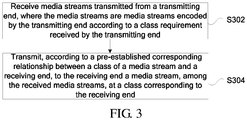
- FIG. 3 is a flowchart of the media stream transmission method according to the embodiment of the present disclosure. As shown in FIG. 3 , the process of the method includes steps described below.
- media streams transmitted by a transmitting end are received.
- the media streams are media streams encoded by the transmitting end according to a class requirement received by the transmitting end.
- a media stream, among the received media streams, at a class corresponding to the receiving end is transmitted to the receiving end according to a pre-established corresponding relationship between a class of a media stream and a receiving end.
- the media stream is encoded according to the class requirement of the receiving end, so that the media stream, among the received streams, at the class corresponding to the receiving end may be transmitted to the receiving end according to the corresponding relationship between the class of the media stream and the receiving end.
- the classes of the media stream received by different receiving ends may be different, so that the classes of the video stream viewed by different users are different. Therefore, the problem, in the related art, of poor user experience due to the totally same class of the video stream viewed by all users in a multi-stream architecture of an IMS can be solved. The user experience is improved.
- the class described above may be the class of the resolution of the media stream or the class of the code rate of the media stream, but is not limited thereto.
- the class may be divided into high definition, standard definition, smooth, etc., but is not limited thereto.
- the receiving end described above may include a first terminal that supports receiving and decoding a classified media stream.
- the transmitting end described above may be a terminal that supports classification coding negotiation, and classification video coding and transmission. It should be noted that generally, the receiving end may not have the capability of the transmitting end, while the transmitting end may have the capability of the receiving end.
- the above-mentioned coding of the media stream may be coding in an inter-class-dependent manner, for example class 1 is the lowest class, class 2 is a higher class, and a complete class 2 media stream includes two parts: a class 1 media stream and a class 2 media stream. Therefore, in the case of the class corresponding to the receiving end (the media stream class required by the receiving end is class 2), the above step S304 may be expressed as that: a media stream corresponding to class 1 and a media stream corresponding to class 2 (i.e., the complete class 2 media stream) are transmitted to the receiving end.
- the present disclosure is not limited to the above coding manner. For example, SVC coding may also be used.
- the above step S304 may be expressed as that: multiple copies of a media stream, among the received media streams, at a same class corresponding to a plurality of the first terminals are made according to the corresponding relationship, and each of the multiple copies of the media stream at the same class and a respective media stream at another class corresponding to each of the plurality of the first terminals are respectively transmitted to the each of the plurality of the first terminals.
- the class requirement of the terminal 1 on the media stream class is class 2
- the class requirement of the terminal 2 on the media stream class is class 3.
- the classes corresponding to the terminal 1 are class 1 and class 2
- the classes corresponding to the terminal 2 are class 1, class 2, and class 3, and the same classes corresponding to both the terminal 1 and the terminal 2 are class 1 and class 2.
- the media stream corresponding to class 1 and the media stream corresponding to class 2 are respectively made into two copies.
- One copied media stream corresponding to class 1 and one copied media stream corresponding to class 2 are transmitted to the terminal 1.
- the other copied media stream corresponding to class 1, the other copied media stream corresponding to class 2, and a media stream corresponding to class 3 are transmitted to the terminal 2 together.
- the above step S304 may further include: copying the received media streams; modifying a network abstraction layer (NAL) unit header in a lowest-class media stream among the received media streams to a NAL unit header in an AVC format; and transmitting, according to the AVC format, the modified lowest-class media stream to the AVC terminal.
- NAL network abstraction layer
- a data block part in the lowest-class media stream among the received media streams may be unchanged, and only the NAL unit header is modified, so that the lowest-class media stream is fully compatible with AVC. That is, only the NAL is required to be modified, and then the traditional AVC terminal may decode the media stream.
- the media stream, among the received media streams, at the class corresponding to the receiving end may be transmitted to the receiving end through a real-time transport protocol (RTP).
- RTP real-time transport protocol
- a NAL unit header in each of the received media streams includes a class identifier of each class of the media stream. Therefore, the media streams may be distributed according to the class identifiers.
- the above step S304 may be expressed as that: the media stream, among the received media streams, at the class corresponding to the receiving end is transmitted to the receiving end according to the corresponding relationship and the class identifier.
- the method may further include: receiving first request information transmitted by the receiving end for requesting adjustment of a class of a media stream, where the first request information carries a class requirement of the receiving end on the class of the media stream; establishing the corresponding relationship; and transmitting to the transmitting end second request information for making a request to adjust the media stream to be in a manner of classification, where the second request information also carries the class requirement of the receiving end on the class of the media stream.
- the step of receiving the first request information transmitted by the receiving end for requesting adjustment of the class of the media stream includes one of: directly receiving the first request information transmitted by the receiving end; and receiving, through a web server and an application server, the first request information transmitted by the receiving end.
- the receiving end may download the web interface from the web server, and the user may select the class requirement on the web interface to trigger the first request information.
- the first request information includes the selected class requirement and is reported to the web server, and then obtained through the application server.
- the method may further include one of that: the transmitting end rejects the second request information; and that the transmitting end accepts the second request information.
- the transmitting end can perform specific classification according to the needs of the receiving ends, and then a certain media stream may be presented at different classes for different receiving ends.
- the above steps may, but may not necessarily, be executed by the video relay and the like.
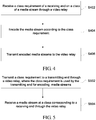
- FIG. 4 is a flowchart of the media stream transmission method according to the embodiment of the present disclosure. As shown in FIG. 4 , the method includes steps described below.
- a class requirement of a receiving end on a class of a media stream is received through a video relay.
- the media stream is encoded according to the class requirement.
- encoded media streams are transmitted to the video relay.
- the media stream is encoded according to the class requirement of the receiving end, and the encoded media streams are transmitted to the video relay, so that the receiving end may obtain the media stream at a class required by the receiving end itself through the video relay.
- different video classes presented for different receiving ends may be implemented, and the classes of the video stream viewed by different users may be different. Therefore, the problem, in the related art, of poor user experience due to the totally same class of the video stream viewed by all users in a multi-stream architecture of an IMS can be solved. The user experience is improved.
- the above step S402 may be expressed as: receiving request information, transmitted by the video relay, for making a request to adjust the media stream to be in a manner of classification.
- the request information carries a class requirement of the receiving end on a class of the media stream. That is, the class requirement of the receiving end may be received in a manner of being carried in the request information.
- step S404 may be expressed as: performing, according to the class requirement, SVC on the media stream.
- ANAL unit header in each of media streams after the SVC is performed includes a class identifier of each class of the media stream.
- the method may further include: rejecting the request information; and accepting the request information.
- step S404 may be performed, and in the case of rejecting the request information, the step S404 may not be performed, but is not limited thereto.
- step S406 may be expressed as that: encoded media streams are transmitted to the video relay through the RTP, but is not limited thereto.
- the method in the embodiment shown in FIG. 4 may be executed by a transmitting end, such as the A-type terminal described in FIG. 1 or FIG. 2 above, but is not limited thereto.
- FIG. 5 is a flowchart of the media stream reception method according to the embodiment of the present disclosure. As shown in FIG. 5 , the method includes steps described below.
- a class requirement is transmitted to a transmitting end through a video relay.
- the class requirement is used by the transmitting end for encoding a media stream.
- a media stream at a class corresponding to a receiving end is received through the video relay.
- the class requirement is transmitted to the transmitting end, where the class requirement is used by the transmitting end for encoding the media stream, so that the transmitting end may encode the media stream according to the class requirement of the receiving end and transmits encoded media streams to the video stream and then the receiving end may obtain the media stream at a class required by the receiving end itself through the video relay.
- different video classes presented for different receiving ends may be implemented, and the classes of the video stream viewed by different users may be different. Therefore, the problem, in the related art, of poor user experience due to the totally same class of the video stream viewed by all users in a multi-stream architecture of an IMS can be solved. The user experience is improved.
- step S502 may be expressed as that: request information for making a request to adjust the media stream to be in a manner of classification is transmitted to the transmitting end through the video relay.
- the request information carries the class requirement.
- SVC scaled video coding
- the method may further include: requesting a web interface from a web server.
- the web interface is configured to submit class requirement selected by a user to the web server.
- the method in the embodiment shown in FIG. 5 may be executed by a receiving end, such as the B-type terminal described in FIG. 1 or FIG. 2 above, but is not limited thereto.
- FIG. 6 is a flowchart 1 illustrating a relay processing process of media stream classification according to the preferred embodiment of the present disclosure. As shown in FIG. 6 , the method includes steps described below.
- Steps 1 and 2 are preconditions and may be interchanged in timing. The subsequent steps do not depend on the timing of steps 1 and 2, but depend on the fact that steps 1 and 2 have occurred.
- the complete class 2 video stream includes a class 1 video stream and a class 2 video stream; and similarly the complete class 3 video stream includes the class 1 video stream, the class 2 video stream and a class 3 video stream. Therefore, the classified video stream transferred to the UE_B2 should include the class 1 video stream, the class 2 video stream.
- the UE_A When the UE_A performs coding, the classification relationship of the classified video and the video content (NAL data) in the classification are independent of the sequence number of the RTP, so the video relay does not need to modify the data in the RTP packet and forwards it directly.
- the UE_B (including the UE_B1, the UE_B2 and the UE_B3) performs coding not by depending on the sequence number of the RTP, but according to the video content (NAL data) in the classification.
- FIG. 7 is a flowchart 2 illustrating a relay processing process of media stream classification according to a preferred embodiment of the present disclosure. The process is compatible with AVC- type terminal and includes steps described below.
- the video coding layer (VCL) at the lowest class (class 1) of the classified video stream is fully compatible with the AVC. Therefore, only the NAL needs to be modified, and the traditional AVC terminal can decode the RTP stream.
- FIG. 8 is a flowchart 1 illustrating a relay processing process of media stream classification based on a scaled video coding (SVC) technology according to a preferred embodiment of the present disclosure.
- SVC scaled video coding
- Typical classified video coding is the SVC technology defined by a series of numbered Request For Comments (RFC) 6190. The process includes steps described below.
- the SVC technology only defines the classification of coding, that is, versions of the source video at multiple classes may be obtained by performing coding once. In subsequent use, if versions at different classes are required, no transcoding is required.
- SVC does not define a distribution mechanism of the video relay, does not define how to perform video class negotiation between the receiving end and the video source in a complex distribution environment, and does not define how to perform accurate classification forwarding by the video relay based on the negotiation result. This is the largest distinguishing feature of the present disclosure from the SVC technology.
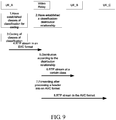
- FIG. 9 is a flowchart 2 illustrating a relay processing process of media stream classification based on a SVC technology according to a preferred embodiment of the present disclosure. The process is compatible with the AVC- type terminal and includes steps described below.
- FIG. 10 is a flowchart 1 illustrating a negotiation process of media stream classification according to a preferred embodiment of the present disclosure. The process includes steps described below.
- the current video source (UE_A) transmits a video at a fixed class, such as AVC.
- the UE_B1 requires for a different class of the video, and transmits a request for adjustment of a video class in the band through an RTP control protocol (RTCP).
- RTCP RTP control protocol
- the video relay only needs to modify the classification forwarding relationship and forward the video at the second class to the UE_B2.
- the requirement on the third class does not need to be transmitted to the UE_A.
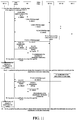
- FIG. 11 is a flowchart illustrating a negotiation process of web-controlled media stream classification according to a preferred embodiment of the present disclosure.
- the terminal is in a web-based form, a more convenient negotiation process of media stream classification may be proposed.
- the process includes steps described below.
- the video classification capability class i.e., several classes based on which the UE_A may perform video classification coding, and the video class definition (such as resolution, code rate, frame rate, video quality, etc.) of each class are carried in the registration message.
- the video class definition such as resolution, code rate, frame rate, video quality, etc.
- FIG. 12 is a flowchart illustrating a process in which a video source does not support media stream classification according to a preferred embodiment of the present disclosure.
- the video source UE_A is a C-type terminal and a terminal that does not support classification. The process includes steps described below.
- the manner in which the video relay obtains information that the UE_A does not support classification of the video may be indicated through rejection of/no response to the classification request forwarded and transmitted to the UE_A, or indicated through the AS.
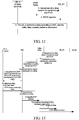
- FIG. 13 is a flowchart illustrating a process in which a session border controller (SBC) performs media stream classification and transcoding according to a preferred embodiment of the present disclosure. As shown in FIG. 13 , the process includes steps described below.
- SBC session border controller
- the UE_A or the video source may be regarded as the transmitting end, and the UE_B and/or the UE_C may be regarded as the receiving end.
- the computer software product is stored in a storage medium (such as a read-only memory (ROM)/random access memory (RAM), a magnetic disk or an optical disk) and includes several instructions for enabling a terminal device (which may be a mobile phone, a computer, a server, a network device or the like) to execute the methods according to embodiments of the present disclosure.
- a storage medium such as a read-only memory (ROM)/random access memory (RAM), a magnetic disk or an optical disk
- a terminal device which may be a mobile phone, a computer, a server, a network device or the like
- a media stream transmission apparatus is further provided.
- the apparatus is configured for implementing the above-mentioned embodiments and preferred embodiments. What has been described will not be repeated.
- the term "module” may be software, hardware or a combination thereof capable of implementing predetermined functions.
- the apparatus in the embodiment described below is preferably implemented by software, but implementation by hardware or by a combination of software and hardware is also possible and conceived.
- FIG. 14 is a structural block diagram 1 of a media stream transmission apparatus according to the embodiment of the present disclosure. As shown in FIG. 14 , the apparatus includes a reception module 1402 and a transmission module 1404.
- the reception module 1402 is configured to receive media streams transmitted by a transmitting end.
- the media streams are media streams encoded by the transmitting end according to a class requirement received by the transmitting end.
- the transmission module 1404 is connected to the reception module 1402 and is configured to transmit, according to a pre-established corresponding relationship between a class of a media stream and a receiving end, to the receiving end a media stream, among the received media streams, at a class corresponding to the receiving end.
- the media stream is encoded according to the class requirement of the receiving end, so that the media stream, among the received streams, at the class corresponding to the receiving end may be transmitted by the above apparatus to the receiving end according to the corresponding relationship between the class of the media stream and the receiving end.
- the classes of the media stream received by different receiving ends may be different, so that the classes of the video stream viewed by different users are different. Therefore, the problem, in the related art, of poor user experience due to the totally same class of the video stream viewed by all users in a multi-stream architecture of an IMS can be solved. The user experience is improved.
- the class described above may be the class of the resolution of the media stream or the class of the code rate of the media stream, but is not limited thereto.
- the class may be divided into high definition, standard definition, smooth, etc., but is not limited thereto.
- the receiving end described above may include a first terminal that supports receiving and decoding a classified media stream.
- the transmitting end described above may be a terminal that supports classification coding negotiation, and classification video coding and transmission. It should be noted that generally, the receiving end may not have the capability of the transmitting end, while the transmitting end may have the capability of the receiving end.
- the above-mentioned coding of the media stream may be coding in an inter-class-dependent manner, for example class 1 is the lowest class, class 2 is a higher class, and a complete class 2 media stream includes two parts: a class 1 media stream and a class 2 media stream. Therefore, in the case of the class corresponding to the receiving end (the media stream class required by the receiving end is class 2), the transmission module 1304 may transmit a media stream corresponding to class 1 and a media stream corresponding to class 2 (i.e., the complete class 2 media stream) to the receiving end.
- the present disclosure is not limited to the above coding manner. For example, SVC coding may also be used.
- the transmission module 1404 may further include: a copy unit, which is configured to make, according to the corresponding relationship, multiple copies of a media stream, among the received media streams, at a same class corresponding to a plurality of the first terminals; and a transmission unit, which is connected to the copy unit and is configured to respectively transmit each of the multiple copies of the media stream at the same class and a respective media stream at another class corresponding to each of the plurality of the first terminals to the each of the plurality of the first terminals.
- the class requirement of the terminal 1 on the media stream class is class 2
- the class requirement of the terminal 2 on the media stream class is class 3.
- the classes corresponding to the terminal 1 are class 1 and class 2
- the classes corresponding to the terminal 2 are class 1, class 2, and class 3, and the same classes corresponding to both the terminal 1 and the terminal 2 are class 1 and class 2.
- the media stream corresponding to class 1 and the media stream corresponding to class 2 are respectively made into two copies.
- One copied media stream corresponding to class 1 and one copied media stream corresponding to class 2 are transmitted to the terminal 1.
- the other copied media stream corresponding to class 1, the other copied media stream corresponding to class 2, and a media stream corresponding to class 3 are transmitted to the terminal 2 together.
- the copy unit is further configured to copy the received media streams;
- the transmission module 1404 further includes a modification unit, which is connected to the copy unit and is configured to modify a network abstraction layer (NAL) unit header in a lowest-class media stream among the received media streams to a NAL unit header in an AVC format; and the transmission unit may further be configured to transmit, according to the AVC format, the modified lowest-class media stream to the AVC terminal.
- NAL network abstraction layer
- a data block part in the lowest-class media stream among the received media streams may be unchanged, and only the NAL unit header is modified, so that the lowest-class media stream is fully compatible with AVC. That is, only the NAL is required to be modified, and then the traditional AVC terminal may decode the media stream.
- the transmission module 1404 may transmit to the receiving end the media stream, among the received media streams, at the class corresponding to the receiving end through a real-time transport protocol (RTP).
- RTP real-time transport protocol
- a NAL unit header in each of the received media streams includes a class identifier of each class of the media stream. Therefore, the media streams may be distributed according to the class identifiers.
- the transmission module 1404 may further be configured to transmit to the receiving end the media stream, among the received media streams, at the class corresponding to the receiving end according to the corresponding relationship and the class identifier.
- the reception module 1402 may further be configured to receive first request information transmitted by the receiving end for requesting adjustment of a class of the media stream.
- the first request information carries a class requirement of the receiving end on the class of the media stream.
- the apparatus further includes: an establishment module, which is connected to the reception module 1402 and is configured to establish the corresponding relationship.
- the transmission module 1404 may further be configured to transmit to the transmitting end second request information for making a request to adjust the media stream to be in a manner of classification.
- the second request information also carries the class requirement of the receiving end on the class of the media stream.
- reception module 1404 may further be configured to perform one of following operations: directly receiving the first request information transmitted by the receiving end; and receiving, through a web server and an application server, the first request information transmitted by the receiving end.
- the receiving end may download the web interface from the web server, and the user may select the class requirement on the web interface to trigger the first request information.
- the first request information includes the selected class requirement and is reported to the web server, and then obtained through the application server.
- the above negotiation process between the transmitting end and the receiving end is implemented through the reception module 1402 and the transmission module 1404.
- the transmitting end can perform specific classification according to the needs of the receiving ends, and then a certain media stream may be presented at different classes for different receiving ends.
- a video relay is further provided and includes the media stream transmission apparatus described in the above embodiment.
- the various modules described above may be implemented by software or hardware. Implementation by hardware may, but may not necessarily, be performed in the following manners: the various modules described above are located in a same processor, or the various modules described above are located in their respective processors in any combination form.
- FIG. 15 is a structural block diagram 2 of the media stream transmission apparatus according to the embodiment of the present disclosure. As shown in FIG. 15 , the apparatus includes a reception module 1502, a coding module 1504 and a transmission module 1506.
- the reception module 1502 is configured to receive a class requirement of a receiving end on a class of a media stream through a video relay.
- the coding module 1504 is connected to the reception module 1502 and is configured to encode the media stream according to the class requirement.
- the transmission module 1506 is connected to the coding module 1504 and is configured to transmit encoded media streams to the video relay.
- the media stream is encoded according to the class requirement of the receiving end, and the encoded media streams are transmitted to the video relay, so that the receiving end may obtain the media stream at a class required by the receiving end itself through the video relay.
- different video classes presented for different receiving ends may be implemented, and the classes of the video stream viewed by different users may be different. Therefore, the problem, in the related art, of poor user experience due to the totally same class of the video stream viewed by all users in a multi-stream architecture of an IMS can be solved. The user experience is improved.
- the reception module 1502 is further configured to receive request information, transmitted by the video relay, for making a request to adjust the media stream to be in a manner of classification.
- the request information carries a class requirement of the receiving end on a class of the media stream. That is, the class requirement of the receiving end may be received in a manner of being carried in the request information.
- the coding module 1504 may further be configured to perform, according to the class requirement, SVC on the media stream.
- a NAL unit header in each of media streams after the SVC is performed includes a class identifier of each class of the media stream.
- the above apparatus further includes: a processing module, which is connected to the reception module 1502 and is configured to reject or accept the request information.
- the transmission module 1506 may transmit encoded media streams to the video relay through the RTP, but is not limited thereto.
- the above apparatus may be located at the transmitting end, such as in the A-type terminal shown in FIG. 1 or FIG. 2 , but is not limited thereto.
- the various modules described above may be implemented by software or hardware. Implementation by hardware may, but may not necessarily, be performed in the following manners: the various modules described above are located in a same processor, or the various modules described above are located in their respective processors in any combination form.
- FIG. 16 is a structural block diagram of the media stream reception apparatus according to the embodiment of the present disclosure. As shown in FIG. 16 , the apparatus includes a transmission module 1602 and a reception module 1604.
- the transmission module 1602 is configured to transmit a class requirement to a transmitting end through a video relay.
- the class requirement is used by the transmitting end for encoding a media stream.
- the reception module 1604 is connected to the transmission module 1602 and is configured to receive a media stream at a class corresponding to a receiving end through the video relay.
- the class requirement is transmitted to the transmitting end, where the class requirement is used by the transmitting end for encoding the media stream, so that the transmitting end may encode the media stream according to the class requirement of the receiving end and transmits encoded media streams to the video stream and then the receiving end may obtain the media stream at a class required by the receiving end itself through the video relay.
- different video classes presented for different receiving ends may be implemented, and the classes of the video stream viewed by different users may be different. Therefore, the problem, in the related art, of poor user experience due to the totally same class of the video stream viewed by all users in a multi-stream architecture of an IMS can be solved. The user experience is improved.
- the transmission module 1602 may further be configured to transmit request information for making a request to adjust the media stream to be in a manner of classification to the transmitting end through the video relay.
- the request information carries the class requirement.
- SVC scaled video coding
- the apparatus may further include: a request module, which is connected to the transmission module 1602 and is configured to request a web interface from a web server.
- the web interface is configured to submit class requirement selected by a user to the web server.
- the above apparatus may be located at the receiving end, such as in the B-type terminal shown in FIG. 1 or FIG. 2 , but is not limited thereto.
- the various modules described above may be implemented by software or hardware. Implementation by hardware may, but may not necessarily, be performed in the following manners: the various modules described above are located in a same processor, or the various modules described above are located in their respective processors in any combination form.
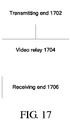
- FIG. 17 is a structural block diagram of the media stream transmission system according to the embodiment of the present disclosure. As shown in FIG. 17 , the system includes: a transmitting end 1702, a video relay 1704, and a receiving end 1706.
- the transmitting end 1702 encodes a media stream according to a class requirement received by the transmitting end 1702, and transmits encoded media streams to the video relay.
- the video relay 1704 receives the encoded media streams, and transmits to the receiving end a media stream, among the received and encoded media streams, at a class corresponding to the receiving end 1706 according to a pre-established corresponding relationship between a class of the media stream and the receiving end 1706.
- the media stream is encoded according to the class requirement of the receiving end, so that the media stream, among the received streams, at the class corresponding to the receiving end may be transmitted by the above system to the receiving end according to the corresponding relationship between the class of the media stream and the receiving end.
- the classes of the media stream received by different receiving ends may be different, so that the classes of the video stream viewed by different users are different. Therefore, the problem, in the related art, of poor user experience due to the totally same class of the video stream viewed by all users in a multi-stream architecture of an IMS can be solved. The user experience is improved.
- the class described above may be the class of the resolution of the media stream or the class of the code rate of the media stream, but is not limited thereto.
- the class may be divided into high definition, standard definition, smooth, etc., but is not limited thereto.
- the receiving end 1706 may include a first terminal that supports receiving and decoding a classified media stream.
- the transmitting end 1702 may be a terminal that supports classification coding negotiation, and classification video coding and transmission. It should be noted that generally, the receiving end 1706 may not have the capability of the transmitting end 1702, while the transmitting end 1702 may have the capability of the receiving end 1706.
- the above-mentioned coding of the media stream may be coding in an inter-class-dependent manner, for example class 1 is the lowest class, class 2 is a higher class, and a complete class 2 media stream includes two parts: a class 1 media stream and a class 2 media stream. Therefore, in the case of the class corresponding to the receiving end (the media stream class required by the receiving end is class 2), the video relay 1504 may transmit a media stream corresponding to class 1 and a media stream corresponding to class 2 (i.e., the complete class 2 media stream) to the receiving end 1506.
- the present disclosure is not limited to the above coding manner.
- SVC coding may also be used.
- the receiving end 1706 includes a first terminal that supports receiving and decoding a classified media stream.
- the video relay 1704 may further be configured to make, according to the corresponding relationship, multiple copies of a media stream, among the received media streams, at a same class corresponding to a plurality of the first terminals, and respectively transmit each of the multiple copies of the media stream at the same class and a respective media stream at another class corresponding to each of the plurality of the first terminals to the each of the plurality of the first terminals.
- the class requirement of the terminal 1 on the media stream class is class 2
- the class requirement of the terminal 2 on the media stream class is class 3.
- the classes corresponding to the terminal 1 are class 1 and class 2
- the classes corresponding to the terminal 2 are class 1, class 2, and class 3, and the same classes corresponding to both the terminal 1 and the terminal 2 are class 1 and class 2.
- the video relay is configured to make the media stream corresponding to class 1 and the media stream corresponding to class 2 respectively into two copies.
- One copied media stream corresponding to class 1 and one copied media stream corresponding to class 2 are transmitted to the terminal 1.
- the other copied media stream corresponding to class 1, the other copied media stream corresponding to class 2, and a media stream corresponding to class 3 are transmitted to the terminal 2 together.
- the video relay 1704 may further be configured to copy the received media streams; modify a network abstraction layer (NAL) unit header in a lowest-class media stream among the received media streams to a NAL unit header in an AVC format; and transmit, according to the AVC format, the modified lowest-class media stream to the AVC terminal.
- NAL network abstraction layer
- a data block part in the lowest-class media stream among the received media streams may be unchanged, and only the NAL unit header is modified, so that the lowest-class media stream is fully compatible with AVC. That is, only the NAL is required to be modified, and then the traditional AVC terminal may decode the media stream.
- the video relay 1704 may transmit to the receiving end 1706 the media stream, among the received media streams, at the class corresponding to the receiving end 1706 through a real-time transport protocol (RTP).
- RTP real-time transport protocol
- a NAL unit header in each of the received media streams includes a class identifier of each class of the media stream. Therefore, the media streams may be distributed according to the class identifiers.
- the video relay 1704 may further be configured to transmit to the receiving end 1706 the media stream, among the received media streams, at the class corresponding to the receiving end 1706 according to the corresponding relationship and the class identifier.
- the receiving end 1706 may further be configured to: transmit to the video relay first request information for requesting adjustment of a class of the media stream, where the first request information carries a class requirement of the receiving end on the class of the media stream, and the video relay receives the first request information and then establishes the corresponding relationship; and transmit to the transmitting end second request information for making a request to adjust the media stream to be in a manner of classification.
- the second request information also carries the class requirement of the receiving end on the class of the media stream.
- the above system may further include: a web server.
- the web server is configured to provide a web interface to the receiving end 1706, and the web interface is configured to submit class requirement selected by a user to the web server.
- system further includes an application server, which is configured to transmit the class requirement submitted to the web server to the video relay 1704.
- the transmitting end 1702 may further be configured to perform at least one of following operations: rejecting the second request information; and accepting the second request information.
- FIG. 1 is a structural block diagram illustrating a relay architecture of streaming media classification according to a preferred embodiment of the present disclosure.
- the structure includes a video relay, an A-type terminal, a B-type terminal, a C-type terminal, an in-band control interface A, an in-band control interface B, a video media interface A, a video media interface B, and a video media interface C.
- the video relay supports establishment of a classification-distribution relationship within a video stream, and distribution of the received and classified video streams to different receiving ends according to the classification-distribution relationship; and the video relay supports acception of multiple video streams, a part of which are classified video streams and a part of which are non-classified video streams (in the AVC format).
- the A-type terminal supports classification coding negotiation, and classification video coding and transmission.
- an A-type terminal also has the capability of a B-type terminal.
- the B-type terminal supports classification video acception and decoding.
- adjustment of a video class in the band through RTCP is supported.
- the B-type terminal also has the capability of the A-type terminal.
- a C-type terminal does not support classification video acception and decoding.
- a typical AVC-format terminal is an example.
- Network interfaces are as follows.
- the in-band control interface A (between the A-type terminal and the video relay) is used for the video relay to transmit a request to the A-type terminal by using the RTCP protocol, to request that the video source be adjusted to be in a manner of classification and to indicate specific classes of classification.
- the in-band control interface A (between the B-type terminal and the video relay) is used for the B-type terminal to transmit a request to the video relay through the RTCP protocol, to request adjustment of a video class.
- This interface is optional.
- the video media interface A (between the A-type terminal and the video relay) is used for the A-type terminal to transmit classified RTP streams to the video relay.
- the video media interface A (between the A-type terminal and the video relay) is used for the video relay to distribute an RTP stream at a certain class to the B-type terminal.
- the video media interface C (between the C-type terminal and the video relay) is used for the video relay to distribute an RTP stream in the AVC format to the C-type terminal.
- FIG. 2 is a structural block diagram illustrating a web-controlled relay architecture of media stream classification according to a preferred embodiment of the present disclosure. As shown in FIG. 2 and compared with FIG. 1 , the newly added functional entities include the following ones.
- the web server provides a web interface (the classification class capability of the video source is included in the interface) to the terminal, and submits the user's selection of the video class to the web server through the user's operation on the page.
- a web interface the classification class capability of the video source is included in the interface
- the application server is used when the classification class capability of the video source is obtained upon registration of the A-type terminal, and the web server queries about the classification class capability of the video source through the open capability interface of the AS.
- the classification class setting of a certain video source from the web server is accepted through the open capability interface of the AS, and is performed to the video relay through the media control interface.
- the video relay needs to have the ability of the video relay in FIG. 1 .
- the video relay needs to accept the classification class setting, by the AS, of the certain video source through the media control interface, and triggers transmission of the classified class of a video source set in the band through the RTCP to the A-type terminal.
- the A-type terminal is the same as the A-type terminal in FIG. 1 .
- the B-type terminal supports classification video acception and decoding. At the same time, the web interface is supported.
- the C-type terminal is the same as the C-type terminal in FIG. 1 .
- the video relay in FIG. 1 and/or FIG. 2 is equivalent to the video relay 1704
- the A-type terminal is equivalent to the transmitting end 1702 in FIG. 1 and/or FIG. 2
- the B-type terminal and/or the C-type terminal is equivalent to the receiving end 1706 in FIG. 1 and/or FIG. 2 .
- An embodiment of the present disclosure further provides a storage medium.
- the storage medium may be configured to store program codes for executing the steps in the method in the embodiment 1.
- the storage medium described above may include, but is not limited to, a USB flash disk, a read-only memory (ROM), a random access memory (RAM), a mobile hard disk, a magnetic disk, an optical disk or another medium capable of storing program codes.
- a processor executes the steps of the method in the embodiment 1 according to the program codes stored in the storage medium.
- each of the above-mentioned modules or steps of the present disclosure may be implemented by a general-purpose computing apparatus, the modules or steps may be concentrated on a single computing apparatus or distributed on a network composed of multiple computing apparatuses, and alternatively, the modules or steps may be implemented by program codes executable by the computing apparatuses, so that the modules or steps may be stored in a storage apparatus and executed by the computing apparatuses.
- the illustrated or described steps may be executed in sequences different from those described herein, or the modules or steps may be made into various integrated circuit modules separately, or multiple modules or steps therein may be made into a single integrated circuit module for implementation. In this way, the present disclosure is not limited to any specific combination of hardware and software.
- the media stream is encoded according to the class requirement of the receiving end, so that the media stream, among the received streams, at the class corresponding to the receiving end may be transmitted to the receiving end according to the corresponding relationship between the class of the media stream and the receiving end.
- the classes of the media stream received by different receiving ends may be different, so that the classes of the video stream viewed by different users are different. Therefore, the problem, in the related art, of poor user experience due to the totally same class of the video stream viewed by all users in a multi-stream architecture of an IMS can be solved. The user experience is improved.
Landscapes
- Engineering & Computer Science (AREA)
- Multimedia (AREA)
- Signal Processing (AREA)
- Computer Networks & Wireless Communication (AREA)
- Databases & Information Systems (AREA)
- Two-Way Televisions, Distribution Of Moving Picture Or The Like (AREA)
- Data Exchanges In Wide-Area Networks (AREA)
Applications Claiming Priority (2)
| Application Number | Priority Date | Filing Date | Title |
|---|---|---|---|
| CN201610912019.2A CN107968768A (zh) | 2016-10-19 | 2016-10-19 | 媒体流的发送、接收方法及装置、系统、视频中继 |
| PCT/CN2017/106854 WO2018072729A1 (zh) | 2016-10-19 | 2017-10-19 | 媒体流的发送、接收方法及装置、系统、视频中继 |
Publications (2)
| Publication Number | Publication Date |
|---|---|
| EP3531648A1 true EP3531648A1 (de) | 2019-08-28 |
| EP3531648A4 EP3531648A4 (de) | 2020-06-10 |
Family
ID=61997097
Family Applications (1)
| Application Number | Title | Priority Date | Filing Date |
|---|---|---|---|
| EP17861397.2A Withdrawn EP3531648A4 (de) | 2016-10-19 | 2017-10-19 | Medien-stream-sende- und -empfangsverfahren und -vorrichtung, system und videorelais |
Country Status (3)
| Country | Link |
|---|---|
| EP (1) | EP3531648A4 (de) |
| CN (1) | CN107968768A (de) |
| WO (1) | WO2018072729A1 (de) |
Family Cites Families (9)
| Publication number | Priority date | Publication date | Assignee | Title |
|---|---|---|---|---|
| US7224702B2 (en) * | 2000-08-30 | 2007-05-29 | The Chinese University Of Hong Kong | System and method for error-control for multicast video distribution |
| GB2384932B (en) * | 2002-01-30 | 2004-02-25 | Motorola Inc | Video conferencing system and method of operation |
| US8051287B2 (en) * | 2008-10-15 | 2011-11-01 | Adobe Systems Incorporated | Imparting real-time priority-based network communications in an encrypted communication session |
| CN101552913B (zh) * | 2009-05-12 | 2011-07-06 | 腾讯科技(深圳)有限公司 | 多路视频通讯系统及处理方法 |
| KR20120084202A (ko) * | 2011-01-19 | 2012-07-27 | 삼성전자주식회사 | 멀티미디어 데이터 패킷을 송신하는 방법 및 장치 |
| CN103051979B (zh) * | 2011-10-13 | 2017-08-08 | 南京中兴新软件有限责任公司 | 流媒体处理方法及系统 |
| CN103354618B (zh) * | 2013-06-24 | 2015-04-15 | 西安交通大学 | 一种基于hls的多场景流媒体自适应直播方法 |
| CN104796793B (zh) * | 2015-04-23 | 2017-08-29 | 常熟理工学院 | 机会式多媒体动态云平台和多中继分级协作的传输方法 |
| CN105306969A (zh) * | 2015-09-02 | 2016-02-03 | 越亮传奇科技股份有限公司 | 一种流媒体自适应处理系统及方法 |
-
2016
- 2016-10-19 CN CN201610912019.2A patent/CN107968768A/zh active Pending
-
2017
- 2017-10-19 WO PCT/CN2017/106854 patent/WO2018072729A1/zh not_active Ceased
- 2017-10-19 EP EP17861397.2A patent/EP3531648A4/de not_active Withdrawn
Also Published As
| Publication number | Publication date |
|---|---|
| EP3531648A4 (de) | 2020-06-10 |
| WO2018072729A1 (zh) | 2018-04-26 |
| CN107968768A (zh) | 2018-04-27 |
Similar Documents
| Publication | Publication Date | Title |
|---|---|---|
| CN112738644B (zh) | 一种基于WebRTC的视频流传输方法和装置 | |
| JP6487076B2 (ja) | インターネットプロトコル(ip)マルチメディア・サブシステム(ims)ベースのピアツーピア(p2p)コンテンツ配信 | |
| US20130282820A1 (en) | Method and System for an Optimized Multimedia Communications System | |
| DK2227017T3 (en) | Media Channel-handling | |
| EP2604012B1 (de) | Verfahren in einem Medienclient, Medienclient, Steuereinheit und Verfahren in einer Steuereinheit | |
| CN102857478B (zh) | 媒体数据控制方法及装置 | |
| EP2863632B1 (de) | System und Verfahren zur Echtzeitanpassung eines Konferenzsystems an die aktuellen Bedingungen einer Konferenzsitzung | |
| JP6279621B2 (ja) | インターネットプロトコル(ip)マルチメディア・サブシステム(ims)ベースのピアツーピア(p2p)コンテンツ配信 | |
| US9154822B2 (en) | Method, apparatus, and terminal device for sharing internet protocol television content | |
| CN101237340B (zh) | 用于实现多媒体业务中组播频道的系统及方法 | |
| CN111147893A (zh) | 一种视频自适应方法、相关设备以及存储介质 | |
| US20090290012A1 (en) | Methods for providing video content and associated service devices, systems thereof | |
| US11051078B2 (en) | Video distribution method and device | |
| US10079868B2 (en) | Method and apparatus for flexible broadcast service over MBMS | |
| CN105657368A (zh) | 一种ipc摄像头快速接入ip多媒体系统ims的方法 | |
| KR102902420B1 (ko) | 몰입형 미디어를 처리하기 위한 방법 및 장치 | |
| CN107222707A (zh) | 多方会议系统及其实现多方会议的方法和装置 | |
| EP4655933A1 (de) | Verfahren, vorrichtung, computerprogrammprodukt zur handhabung von pdus und pdu-sätzen | |
| US20240388611A1 (en) | Method and apparatus for multiplexing internet protocol multimedia subsystem data channels | |
| US9876841B2 (en) | Context-aware content delivery | |
| WO2022013190A1 (en) | Providing stored files for mission critical data file distribution over multicast-broadcast multimedia services | |
| US11265357B2 (en) | AV1 codec for real-time video communication | |
| EP3531648A1 (de) | Medien-stream-sende- und -empfangsverfahren und -vorrichtung, system und videorelais | |
| CN114466167B (zh) | Gb28181通讯协议下快速实时流响应的实现机制 | |
| CN112073673B (zh) | 一种视联网会议服务器及视联网终端 |
Legal Events
| Date | Code | Title | Description |
|---|---|---|---|
| STAA | Information on the status of an ep patent application or granted ep patent |
Free format text: STATUS: THE INTERNATIONAL PUBLICATION HAS BEEN MADE |
|
| PUAI | Public reference made under article 153(3) epc to a published international application that has entered the european phase |
Free format text: ORIGINAL CODE: 0009012 |
|
| STAA | Information on the status of an ep patent application or granted ep patent |
Free format text: STATUS: REQUEST FOR EXAMINATION WAS MADE |
|
| 17P | Request for examination filed |
Effective date: 20190517 |
|
| AK | Designated contracting states |
Kind code of ref document: A1 Designated state(s): AL AT BE BG CH CY CZ DE DK EE ES FI FR GB GR HR HU IE IS IT LI LT LU LV MC MK MT NL NO PL PT RO RS SE SI SK SM TR |
|
| AX | Request for extension of the european patent |
Extension state: BA ME |
|
| DAV | Request for validation of the european patent (deleted) | ||
| DAX | Request for extension of the european patent (deleted) | ||
| A4 | Supplementary search report drawn up and despatched |
Effective date: 20200511 |
|
| RIC1 | Information provided on ipc code assigned before grant |
Ipc: H04L 29/06 20060101AFI20200504BHEP Ipc: H04N 21/262 20110101ALI20200504BHEP Ipc: H04N 21/2343 20110101ALI20200504BHEP |
|
| STAA | Information on the status of an ep patent application or granted ep patent |
Free format text: STATUS: THE APPLICATION HAS BEEN WITHDRAWN |
|
| 18W | Application withdrawn |
Effective date: 20201224 |