EP3535738B1 - Cash management system, cash holding unit und verfahren zu dessen verwendung - Google Patents
Cash management system, cash holding unit und verfahren zu dessen verwendung Download PDFInfo
- Publication number
- EP3535738B1 EP3535738B1 EP17811675.2A EP17811675A EP3535738B1 EP 3535738 B1 EP3535738 B1 EP 3535738B1 EP 17811675 A EP17811675 A EP 17811675A EP 3535738 B1 EP3535738 B1 EP 3535738B1
- Authority
- EP
- European Patent Office
- Prior art keywords
- holding unit
- intelligent
- cash
- cash holding
- intelligent cash
- Prior art date
- Legal status (The legal status is an assumption and is not a legal conclusion. Google has not performed a legal analysis and makes no representation as to the accuracy of the status listed.)
- Active
Links
Images




Classifications
-
- G—PHYSICS
- G07—CHECKING-DEVICES
- G07G—REGISTERING THE RECEIPT OF CASH, VALUABLES, OR TOKENS
- G07G1/00—Cash registers
- G07G1/01—Details for indicating
-
- G—PHYSICS
- G07—CHECKING-DEVICES
- G07G—REGISTERING THE RECEIPT OF CASH, VALUABLES, OR TOKENS
- G07G1/00—Cash registers
- G07G1/0018—Constructional details, e.g. of drawer, printing means, input means
- G07G1/0027—Details of drawer or money-box
-
- G—PHYSICS
- G06—COMPUTING OR CALCULATING; COUNTING
- G06Q—INFORMATION AND COMMUNICATION TECHNOLOGY [ICT] SPECIALLY ADAPTED FOR ADMINISTRATIVE, COMMERCIAL, FINANCIAL, MANAGERIAL OR SUPERVISORY PURPOSES; SYSTEMS OR METHODS SPECIALLY ADAPTED FOR ADMINISTRATIVE, COMMERCIAL, FINANCIAL, MANAGERIAL OR SUPERVISORY PURPOSES, NOT OTHERWISE PROVIDED FOR
- G06Q10/00—Administration; Management
- G06Q10/10—Office automation; Time management
-
- G—PHYSICS
- G06—COMPUTING OR CALCULATING; COUNTING
- G06Q—INFORMATION AND COMMUNICATION TECHNOLOGY [ICT] SPECIALLY ADAPTED FOR ADMINISTRATIVE, COMMERCIAL, FINANCIAL, MANAGERIAL OR SUPERVISORY PURPOSES; SYSTEMS OR METHODS SPECIALLY ADAPTED FOR ADMINISTRATIVE, COMMERCIAL, FINANCIAL, MANAGERIAL OR SUPERVISORY PURPOSES, NOT OTHERWISE PROVIDED FOR
- G06Q20/00—Payment architectures, schemes or protocols
- G06Q20/08—Payment architectures
- G06Q20/20—Point-of-sale [POS] network systems
-
- G—PHYSICS
- G06—COMPUTING OR CALCULATING; COUNTING
- G06Q—INFORMATION AND COMMUNICATION TECHNOLOGY [ICT] SPECIALLY ADAPTED FOR ADMINISTRATIVE, COMMERCIAL, FINANCIAL, MANAGERIAL OR SUPERVISORY PURPOSES; SYSTEMS OR METHODS SPECIALLY ADAPTED FOR ADMINISTRATIVE, COMMERCIAL, FINANCIAL, MANAGERIAL OR SUPERVISORY PURPOSES, NOT OTHERWISE PROVIDED FOR
- G06Q20/00—Payment architectures, schemes or protocols
- G06Q20/08—Payment architectures
- G06Q20/20—Point-of-sale [POS] network systems
- G06Q20/202—Interconnection or interaction of plural electronic cash registers [ECR] or to host computer, e.g. network details, transfer of information from host to ECR or from ECR to ECR
-
- G—PHYSICS
- G07—CHECKING-DEVICES
- G07G—REGISTERING THE RECEIPT OF CASH, VALUABLES, OR TOKENS
- G07G1/00—Cash registers
- G07G1/12—Cash registers electronically operated
-
- G—PHYSICS
- G07—CHECKING-DEVICES
- G07G—REGISTERING THE RECEIPT OF CASH, VALUABLES, OR TOKENS
- G07G1/00—Cash registers
- G07G1/12—Cash registers electronically operated
- G07G1/14—Systems including one or more distant stations co-operating with a central processing unit
Definitions
- the present invention relates to a cash management system, the cash management system comprising a management terminal, a plurality of Electronic Point of Sale (EPOS) terminals and one or more cash holding units.
- EPOS Electronic Point of Sale
- An intelligent cash drawer unit is a cash drawer unit which contains coins and notes in compartments called cups (obviously tokens, vouchers, or the like could also be contained in the cups, but generally speaking they are used for cash, hence the expression "cash drawer unit").
- an intelligent cash drawer has cash counting apparatus as the individual cups are augmented with technology that allows them to be weighed.
- a transducer underneath each cup reads out a continuous analogue signal that represents the weight of the cup and its contents. This analogue signal is digitized and passed to a signal processor which can compute the weight of the cash contained in the cup. By dividing the weight of the contents of the cup by the known weight of a single coin or note of the appropriate denomination the quantity of notes or coins is computed.
- a specific example of such a transducer is a 'load-cell' which changes its electrical resistance in response to the amount of weight placed upon it.
- Intelligent cash drawers may be provided as separate cash drawer units with sliding cash drawers or with flip top lids which reveal the cash drawer, for use with associated EPOS devices, or can be integrated into cash registers. This invention concerns the former.
- An intelligent point of sale safe is a safe with a note acceptor which validates that currency input is genuine and rejects counterfeits.
- An intelligent point of sale safe also comprises cash counting apparatus, as a processor in the safe records the value of each note that it input into it and number of notes that are input (deducts any which are output) and stores a denominational breakdown of its contents.
- an intelligent point of sale safe may be associated with an EPOS device so that for any given transaction, the cash received and/or disbursed by the intelligent point of sale safe can be reconciled with the cash that should have been received and/or disbursed in accordance with that received from a customer in payment (as calculated by the EPOS).
- each EPOS may be locally connected to a cash drawer (and optionally also to an intelligent point of sale safe), for example by connection to USB ports in the EPOS and a local area network may be provided, by which each EPOS communicates to a local management terminal.
- This arrangement allows each EPOS to send data concerning the transactions and the contents of the cash drawer to the local management terminal which may conduct statistical analysis based on the results and bring any errors (such as missing cash) to a store manager's attention.
- cash drawers may be independently connected to the local area network and capable of transmitting their data to the local management terminal independently of the associated EPOS.
- the management terminal is programmed when the store is set up to know which EPOS is associated with which intelligent cash holding unit (e.g. identified based on the lane number in-store) and the local management terminal is therefore capable of reconciling data received from the intelligent cash drawers with data from the associated EPOS.
- the EPOS associated with a respective intelligent cash drawer unit sends a signal to the intelligent cash drawer unit to cause it to open, to allow the cashier to carry out the transaction (introducing cash and optionally taking out change or "cashback")
- Example intelligent cash holding units and EPOS systems can be found in US2012/0233006 A1 , GB 2500587 A , GB 2460490 A , EP 0856824 A2 , US 8,141,772 B1 , GB 2407194 A , EP 0724242 A2 , GB 2411035 A , US 2014/058856 A1 and GB 2407173 A None of these systems discloses at least the features related to a remote management terminal detecting gaps in the sequence numbers received from an intelligent cash drawer unit so as to identify and retrieve missing data packets for that intelligent cash drawer unit, as described in the detailed description below.
- An object of the invention is to provide an improved intelligent cash holding unit and an improved method of operating an intelligent cash holding unit.
- the cash management system comprises a management terminal, a plurality of Electronic Point of Sale (EPOS) terminals and one or more intelligent cash holding units.
- EPOS Electronic Point of Sale
- An intelligent cash holding unit can take its instruction to open not from an associated EPOS, but rather from an identifier associated with a user, in consequence, it does not need to be associated with any EPOS in particular and can only open when it receives the user's identifier, in which case the user will be nearby and ready to interact with the intelligent cash holding unit.
- a signal comprising such an identifier can be provided by any suitable identification system, such as a card reader (e.g. magnetic strip or near field communication), RFID reader, barcode reader, biometric reader or the like.
- a card reader e.g. magnetic strip or near field communication
- RFID reader e.g. RFID strip or near field communication
- barcode reader e.g. barcode reader
- biometric reader e.g. biometric reader
- the intelligent cash holding unit may integrally comprise one or more of such readers, or may be connected thereto, for example via a port, such as a USB, serial or Ethernet port. Connecting suitable readers through a port can be considered preferable, so as to integrate the reader with existing systems, such as those used with an EPOS or the like, rather than requiring any particular tag to be used to suit whichever reader is comprised in the intelligent cash holding unit.
- the intelligent cash holding unit of the invention sends a report comprising the identifier relating to the user and data relating to the contents of the cash holding unit.
- This allows an external device, such as a local or remote management terminal, or the like, to associate the transaction with the user.
- the data relating to the contents of the cash holding unit may comprise the total amount added to or removed from the intelligent cash holding unit, optionally broken down by denomination. This is particularly useful for reconciling a transaction at the intelligent cash holding unit with a transaction at an EPOS.
- the management terminal reconciles transactions carried out at by a user at an EPOS with transactions carried out by that user at a shared cash drawer and back-office reporting systems can ensure that the amount of cash introduced into and/or taken from the shared cash drawer by each user corresponds to the amount that should have been introduced or taken out, in accordance with the transactions recorded by that user at an EPOS.
- the data relating to the contents of the cash holding unit may be an indication of the number of items (e.g. coins or notes) of each denomination held in the unit, an indication of the total value of each denomination, an indication of the total value of all denominations, or (in an intelligent cash drawer unit) the weight of cash in each of a plurality of note cups and/or coin cups (from which the total number and hence value can be determined).
- the reporting module is operable to send a report in which the identifier relating to the user is the identifier associated with the user.
- the reporting module is operable to send the report as a data packet, optionally in which the identifier relating to the user and data relating to the contents of the cash holding unit are collated.
- the reporting module may additionally be operable to transmit a serial number associated with the intelligent cash holding device.
- the serial number may be stored in memory and may be collated in the data packet. This allows a management terminal to monitor several intelligent cash holding devices and distinguish between them.
- the intelligent cash holding unit may comprise a timing unit, and the reporting module may be operable to transmit and/or to store the time and optionally the date of each transaction/event (e.g. based on a signal received, allowance of access, or report sent).
- the time and/or date may be collated in the data packet.
- the timing unit may be a clock and in particular may be a real-time clock.
- the clock may be provided with an independent power source, such as a battery, in particular a rechargeable battery, so as to maintain time during power outages.
- Accordingly transmitting the time as well as the indication allows the data from the intelligent cash holding unit to be reconciled with data from an associated EPOS at the same point in time. Storing the time as well as the indication allows missing data to be checked by checking that the time stamp is correct and to be obtained by requesting indications from a certain period in time.
- the intelligent cash holding apparatus comprises a counter which increments each time access is allowed, to provide a sequence number identifying the transaction.
- the reporting module additionally transmits a sequence number identifying the transaction.
- the sequence number may be collated in the data packet.
- the intelligent cash holding unit may be an intelligent cash drawer or may be an intelligent point of sale safe.
- the intelligent cash holding unit may be an intelligent cash drawer unit and the access module may be operable to send a signal to an actuator to open the intelligent cash drawer unit, for example to open a lid to allow access to a drawer, or slide a drawer outward.
- the drawer of the intelligent cash drawer unit may comprise a plurality of note cups and coin cups supported by transducers arranged to determine the weight of the contents of the cups and hence the value of the currency in the intelligent cash drawer unit.
- each EPOS terminal and each intelligent cash holding unit may comprise a reader.
- Each reader may be integrally comprised in each intelligent cash holding unit and/or EPOS terminal, or may be connected to each intelligent cash holding unit and/or EPOS terminal.
- Each reader may be arranged to read a tag or biometric feature associated with a user comprising an identifier associated with the user.
- the readers may be operable to read magnetic strips or near field communication units, RFID tags, barcodes, biometric features or the like.
- the system may comprise tags each comprising an identifier associated with a user. The tags may be readable by the readers associated with both the EPOS terminals and the intelligent cash holding devices.
- the EPOS terminals may be operable to calculate an amount owed based on inputs (such as signals from a barcode reader, or user inputs) and optionally operable to calculate change or "cash-back" due and operable to output the amount owed to the management terminal together with an identifier relating to the user.
- inputs such as signals from a barcode reader, or user inputs
- change or "cash-back" due operable to output the amount owed to the management terminal together with an identifier relating to the user.
- the management terminal may be arranged to reconcile transactions by comparing the amount owed to a particular user with the amount introduced into the intelligent cash holding unit by that user, based on the identifier associated with the user's tag.
- the data relating to the contents of the cash holding unit may comprise the total amount added to or removed from the intelligent cash holding unit, optionally broken down by denomination.
- the data relating to the contents of the cash holding unit may be an indication of the number of items (e.g. coins or notes) of each denomination held in the unit, an indication of the total value of each denomination, an indication of the total value of all denominations, or (in an intelligent cash drawer unit) the weight of cash in each of a plurality of note cups and/or coin cups (from which the total number and hence value can be determined).
- the method comprises sending a report in which the identifier relating to the user is the identifier associated with the user.
- the method comprises sending the report as a data packet, optionally in which the identifier relating to the user and data relating to the contents of the cash holding unit are collated.
- the method may additionally comprise transmitting a serial number associated with the intelligent cash holding device.
- the method may comprise looking up the serial number from memory and collating it in the data packet.
- the method may comprise transmitting the time and optionally the date of each event (e.g. based on a signal received, allowance of access, or report sent).
- the method may comprise collating the time and/or date in the data packet.
- the method may comprise saving the time and optionally the date along with an identifier associated with a user and data relating to the contents of the intelligent cash holding unit.
- the method further comprises transmitting a sequence number, which increments each time access is allowed to identify the transaction.
- the method may also save the sequence number, together with the time and optionally the date, an identifier associated with a user and data relating to the contents of the intelligent cash holding unit.
- the method may be conducted by an intelligent cash drawer unit and the method may comprise the step of sending a signal to an actuator to open the intelligent cash drawer unit, for example to open a lid to allow access to a drawer, or slide a drawer outward.
- the method may comprise measuring the weight of currency in a plurality of note cups and coin cups to determine the value of the currency in the intelligent cash drawer unit.
- the cash management system comprises a management terminal operable to reconcile transactions carried out by a user on a separate EPOS and intelligent cash drawer unit, the management terminal operable to reconcile data by receiving from the intelligent cash holding unit data relating to the contents of the intelligent cash holding unit together with an identifier relating to the user and receiving from the EPOS terminal data indicating the amount owed together with an identifier relating to the user and comparing the data where the identifiers relating to the user match.
- the management terminal may be operable to receive data from the intelligent cash holding unit and the EPOS and compare data where the identifiers relating to the users and time stamps included in the data match.
- an intelligent cash drawer unit operable in tandem with an intelligent point of sale safe; the intelligent cash drawer unit comprising: a receiver operable to receive a signal from the intelligent point of sale safe comprising data relating to the contents of the intelligent point of sale safe; and a reporting module operable to send a report comprising an identifier relating to a user and data relating to the contents of the intelligent cash drawer unit and the contents of the intelligent point of sale safe to at least one external device.
- the drawer when connected to the drawer in this manner, the drawer can be used as a virtual cash holding unit (as set out above), with the safe also acting as a virtual intelligent cash holding unit, as an extension to that virtual cash drawer unit.
- the intelligent cash drawer unit and intelligent point of sale safe can be shared between a plurality of EPOSs and a plurality of users (which can be an even greater number than the number of EPOSs, if the users share EPOSs), while retaining all the advantages that would be achieved by each EPOS having its own intelligent point of sale safe (in particular a reduction in the number of cash-lifts required as large denomination notes are held securely in the safe, not accessible in the intelligent cash drawer unit.
- the intelligent cash drawer unit may have an openable cash drawer comprising a plurality of cups supported on a plurality of transducers operable to weigh the cups, a signal processor operable to process signals received from the transducers to determine the value of cash in the cups, and a sensor operable to detect whether the drawer is open or closed.
- the intelligent cash drawer unit may be an intelligent cash holding unit.
- the intelligent cash drawer unit may be connected to the intelligent point of sale safe. It may be directly connected to the intelligent cash drawer. It may be directly connected by a cable, for example a USB, Serial or Ethernet cable.
- the receiver may be operable to receive a signal comprising an identifier associated with a user.
- the signal comprising the identifier associated with the user may be received from the intelligent point of sale safe.
- the receiver may receive a signal comprising a data packet in which the identifier associated with the user and the data relating to the contents of the intelligent point of sale safe.
- the signal comprising the identifier associated with the user may be received from a suitable identification system integral with or connected to the intelligent cash drawer unit, such as a card reader (e.g. magnetic strip or near field communication), RFID reader, barcode reader, biometric reader or the like.
- the intelligent cash drawer unit may be directly connected to the intelligent point of sale safe. It may be directly connected by a cable, for example a USB, Serial or Ethernet cable.
- the intelligent point of sale safe may draw power from the intelligent cash drawer unit, for example through a cable. Data and power may be exchanged between the intelligent cash drawer unit and the intelligent point of sale safe through the same cable.
- Allowing power to be drawn from the intelligent cash drawer unit means that additionally to saving a connection at the EPOS (since data can flow to the intelligent cash drawer unit, rather than to an EPOS), a power connection can also be saved.
- the data relating to the contents of the intelligent cash drawer unit and the intelligent point of sale safe may be reported as a denominational breakdown of the contents of the intelligent cash drawer unit and the intelligent point of sale safe.
- serial number of the safe is also included in the report.
- the or each intelligent cash holding unit may be an intelligent cash drawer unit having an openable cash drawer comprising a plurality of cups supported on a plurality of transducers operable to weigh the cups, a signal processor operable to process signals received from the transducers to determine the value of cash in the cups, and a sensor operable to detect whether the drawer is open or closed.
- the sensor operable to detect whether the drawer is open or closed may be a micro-switch.
- the intelligent cash drawer unit may comprise a plurality of note cups and coin cups arranged on respective load cells comprising transducers.
- the load cells may be strain gauge load cells.
- the intelligent cash drawer unit may comprise a flip-lid cash drawer unit, or an intelligent cash drawer unit comprising a sliding drawer.
- an intelligent cash holding unit in the form of an intelligent cash drawer unit 1 is provided with a number of note cups 2a, 2b, 2c, 2d, 2e, 2f (together 2), and coin-cups 3a, 3b, 3c, 3d, 3e, 3f, 3g, 3h (together 3) arranged within a housing 4.
- the intelligent cash drawer unit is of the "flip-top” type and comprises a lid 5 hingedly attached to the rear of the housing 4 and arranged to close the top of the housing 4.
- the intelligent cash drawer unit 1 is intended for use in a cash management system with a plurality of separate EPOS terminals 19a-n (shown in figure 4 ), wherein there are a greater number of EPOS terminals 19a-n than intelligent cash holding units, whereby one or more intelligent cash holding unit acts as a virtual cash holding unit for more than one EPOS terminal 19a-n.
- the intelligent cash holding unit could be an intelligent cash drawer unit 1 of the "sliding drawer” type, well known to those skilled in the art, and that many of the features of the intelligent cash drawer unit 1 could equally apply to an intelligent point of sale safe 25.
- the intelligent cash drawer unit 1 of this embodiment is cuboid, with a long front and shorter sides.
- the note cups 2 are so-called "vertical" note cups. These vertical note cups 2 are intended and designed to receive notes with their plane substantially vertical, having their long axes horizontal and their short axes vertical. Consequently, the vertical note cups 2 are taller than they are wide and longer than they are tall.
- the vertical note cups 2 all have their long axes extending parallel to the front and rear of the intelligent cash drawer unit 1 and are arranged in the right hand side of the housing 4, one behind another. They are each intended to receive a specific denomination of note and may be provided with indicia indicating the note they are intended to receive.
- the coin cups 3 are intended and designed to receive coins. They are arranged to the left of the note cups 2, in two rows of four, one row behind the other.
- the coin cups are intended to each receive a specific denomination of coin and may also be provided with indicia showing the denomination they are intended to receive.
- the housing 4 and lid 5 of the cash drawer 1 of this embodiment of the invention is in metal, but of course other suitable materials are available (metal has the advantage of shielding components (e.g. load cells, ADC and other circuitry discussed below from electrical noise).
- the cups 2, 3 in this embodiment are formed from ABS plastic material, e.g. by injection moulding, but of course, other plastics materials, or even other different non-plastics materials could be used.
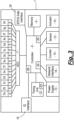
- each cup 2, 3 is supported on a load cell 6 (not visible in figures 1 and 2 ), in the form of conventional strain gauge load cells 6 which each comprise a transducer which outputs an analogue electrical signal which varies according to the weight on the load cell 6 to an analogue-digital converter (ADC) 7.
- ADC analogue-digital converter
- the ADC 7 is connected to a signal processor, or controller, 8 which in turn is connected to a memory component 9, an actuator 10 (to actuate the latch mechanism 11 shown in figure 2 and open the lid 5), a sensor 12 in the form of a micro-switch, arranged to detect opening/closing of the lid 5) a power supply 13, a network interface 14, an ID-system interface 16 and a timing unit 22, in the form of a real-time clock comprising a back-up battery 23, which is rechargeable from the power supply 13 in order that the timing unit 22 is capable of maintaining time during power outages.
- the controller is also connected to a counter 15 and to an EPOS Safe interface 24.
- the network interface 14 is a communications bus and comprises a transceiver to transmit data to and receive data via a Local Area Network (LAN) 18 (e.g. Ethernet or Wi-Fi), to a Wide Area Network (WAN) 15 or Internet Area Network (IAN) 16 as shown in figures 4 and 5 respectively.
- LAN Local Area Network
- WAN Wide Area Network
- IAN Internet Area Network
- the network interface 14 additionally allows the intelligent cash drawer unit 1 to communicate with other terminals via the LAN 18, such as a plurality of separate associated EPOS terminals 19 and a local management terminal 20 shown schematically in figure 4 .
- the ID-system interface 16 is a receiver with a port, such as a Serial port, USB port, or Ethernet port suitable for connection to an ID system 26 ( fig 4 ), in the form of a reader operable to read magnetic strips or near field communication units, RFID tags, barcodes, biometric features or the like. It is preferably capable of providing power to the ID system via a cable connected to the port.
- a port such as a Serial port, USB port, or Ethernet port suitable for connection to an ID system 26 ( fig 4 ), in the form of a reader operable to read magnetic strips or near field communication units, RFID tags, barcodes, biometric features or the like. It is preferably capable of providing power to the ID system via a cable connected to the port.
- the EPOS Safe interface 24 comprises a transceiver and a power output, having a port to which an EPOS safe 25 may be connected, such that power can be supplied to the EPOS safe 25 and data received from (and optionally supplied to) the EPOS safe 25.
- the micro-switch 12 is arranged to be closed by closure of the lid 5, such that it registers opening as soon as the lid 5 starts to open.
- the actuator 10 of this embodiment is a solenoid arranged to unlatch the latch mechanism 11. Also visible in figure 1 is the keyhole of a lock 17, to manually open the intelligent cash drawer unit 1.
- the controller 8 controls the operations of the intelligent cash drawer unit 1, based on instructions stored in software in memory 9.
- Memory 9 in addition to storing the software on the basis of which the signal processor 8 controls the intelligent cash drawer unit 1, is also operable on instruction from the signal processor 8 to store data, including data from the transducers, data received from the ID system 26 and/or EPOS Safe 25 and data including the unique ID or serial number of the intelligent cash drawer unit 1, used to identify the intelligent cash drawer unit 1 when reporting to the remote management terminal 21.
- Memory 9 comprises non-volatile memory (such as a hard disc, flash memory, EEPROM or battery backed RAM) in order to store information even in the event of loss of power.
- the intelligent cash drawer unit 1 receives an "open" signal a sent by an associated ID system 26 once it has received an ID code associated with a tag 27 carried by a user (such as an RFID tag, in the case that the ID system 26 is an RFID reader).
- the "open" signal comprises (and may consist of) the identifier associated with the user.
- the tag 27 is preferably also used with the EPOS terminals 19a-19n (as is conventional) and is used to open the intelligent cash drawer unit 1 after the EPOS terminal 19 has calculated the value of the transaction and the amount of currency required to be introduced into or removed from the intelligent cash drawer unit 1 and transmitted the amount owed to the remote terminal 19, together with an identifier associated with the user, on the basis of their tag 27.
- an access module 29 in the controller allows access to the intelligent cash drawer unit 1 by activating the actuator 10 to undo the latch mechanism 11 so that the lid 5 opens.
- the controller 8 also saves the identifier associated with the user to the memory 9. The cashier will then introduce cash that has been received and optionally take out change (or take out "cash-back" for a customer), then close the lid 5.
- the controller 8 is operable (in accordance with the operating system stored in memory 9) to process signals from the transducers of the load cells 6 each time that the sensor 12 detects that the drawer has been closed and to determine the weight of cash in the cups (2, 3), in order to calculate the value of the contents of the intelligent cash drawer unit 1, in terms of the number of items of each denomination in the intelligent cash drawer unit 1.
- the controller 8 will process signals from the load cells 6 until a stable reading is obtained, i.e. once readings have settled.
- a reporting module 30 in the controller 8 is operable to send a report comprising an identifier relating to the user and data relating to the contents of the intelligent cash holding unit 1 to at least one external device via the network interface 14.
- the reporting module 30 is operable to transmit a data packet with an indication of the contents to the local management terminal 20 and the remote management terminal 21.
- the identifier relating to the user is the identifier associated with the user, as stored on the tag 27 and read by the ID system 26.
- the indication of cash held in the unit may be an indication of the number of items (e.g. coins or notes) of each denomination held in the unit, an indication of the total value of each denomination, an indication of the total value of all denominations, or (where the intelligent cash holding unit 1 is an intelligent cash drawer unit) the weight of cash in each cup (from which the total number and hence value can be determined), or indeed, the indication could be an indication of the change in the contents after each transaction (e.g. the total value of cash introduced and/or removed optionally broken down by denomination).
- the indication is a breakdown of the number of items of each denomination held in the unit.
- the controller 8 is also operable to store each indication in memory 9 and operable to maintain a count, incrementing a counter 15 each time that the drawer is closed and the weight is determined, and storing the count as a sequence number together with the indication of the contents of the cups 2,3.
- the controller 8 is further operable to store the time and date of each indication of the contents of the drawer in a database in memory 9, together with the corresponding sequence number and indication of the contents of the intelligent cash holding unit 1.
- All of this information is also included in the data packet prepared by the reporting module 30 and sent to the remote terminal 21 (for example via a TCP/IP protocol addressing the remote terminal by its IP address, which during setup is stored to the memory 9).
- the controller 8 is thus operable, each time the drawer is closed to transmit a data packet to the remote terminal 21, each data packet including (a) an identifier relating to the user, (b) the serial number of the intelligent cash drawer unit 1, (c) the time and date (d) the sequence number and (e) the denominational breakdown of the contents of the drawer.
- the identifier, the time and date, the sequence number and the denominational breakdown of the contents of the drawer may be stored as a buffer, i.e. the earliest data may be overwritten periodically, for example as memory 9 becomes full. And being obtainable by the remote terminal in the event that a report is lost.
- the time and date of each event can be characterised as the time that a signal is received, time that access is allowed, or ceased or the time the report is sent). Great accuracy is not normally required, given that any given transaction will normally take several seconds, and there are likely to be at least tens of seconds, if not minutes between transactions.
- a remote terminal 21 which may be located in a head-office monitors an intelligent cash drawer unit 1, which is shared between a plurality of EPOSs; a first EPOS 19a, a second EPOS 19b, and further EPOSs 19n that are arranged in a retail environment (e.g. a bar or department store) and connected to a local area network 18.
- the remote terminal 21 is connected to the local area network 18 via a wide area network 15, for example over the internet.
- the remote terminal 21 is arranged to monitor a plurality of intelligent cash drawer units 1 and EPOSs 19a, 19b, 19n in a number of stores, but for simplicity, only one is shown.
- the intelligent cash drawer unit 1 is associated with the first EPOS 19a, the second EPOS 19b and EPOS terminals 19n.
- Each EPOS 19a-n is arranged to receive an identifier associated with a user from one tag 27 of a number of tags 27, each held by an individual user, generally speaking in which there are more tags 27 than EPOS terminals 19a. Having received the identifier associated with the user (e.g. via an integral RFID reader, the EPOS terminal determines the amount of money owed in each transaction, based on inputs, such as barcodes read, or user-inputs through a keypad or touchscreen. The EPOS terminal then transmits data in relation to each transaction (including the identifier associated with the user (i.e. in this case with the tag 27 used by the user)) to the local management terminal 20. The local management terminal 20 is arranged to transmit that data to the remote management terminal 21 via the WAN 15, including an indicator of which EPOS 19a-n and which user it relates to.
- the intelligent cash drawer unit 1 sends a data packet in relation to each transaction, as set out above, each data packet, sent each time the drawer is closed including (a) the identifier relating to the user, (b) the serial number of the intelligent cash drawer unit 1, (c) the time and date (d) the sequence number and (e) the denominational breakdown of the contents of the drawer.
- the remote terminal 21 stores in a database the details of transactions received by the intelligent cash drawer unit 1 the first EPOS terminals19a, 19b, 19n, based on the unique identifiers relating to each user, and reconciles the amount of currency that should have been received/dispensed as calculated by the EPOS terminal for each transaction, with that actually received/dispensed as determined by the intelligent cash drawer unit 1.
- the remote management terminal 21 receives and reconciles data from respective EPOSs 19a-n and cash drawers 1, matching up sets of transactions, using the identifiers associated with the user (obtained from tags 27, in this embodiment).
- the data from the intelligent cash drawer unit 1 is then compared with the data from the respective EPOS 19a-n for the production of reports and/or sending of alerts in the event of a data mismatch (e.g. apparently missing cash, which may have been stolen).
- the remote management terminal 21 is arranged to verify that all data packets sent from each intelligent cash drawer unit 1 have been received. To do this, the remote management terminal checks (e.g. periodically) that for each intelligent cash drawer unit 1a-1n there are no gaps in the sequence numbers received from the respective intelligent cash drawer unit 1a-n. Data from the respective intelligent cash drawer units may be stored in a database in sequence number order, and those skilled in the art will readily conceive of suitable algorithms to identify missing numbers in a list that if correct is consecutive.
- the remote management terminal 21 is operable to send a request for certain particular data, identified by sequence number to the relevant intelligent cash drawer unit 1, from which data was found to be missing.
- the controller 8 of the relevant intelligent cash drawer unit 1 operates to retrieve the missing information from memory 9, and forward it to the remote management terminal 21.
- the cash drawer 1 can be used with an optional EPOS safe 25. This method is described below, with reference to figures 3-5 .
- an exemplary EPOS safe 25 is formed of a note acceptor 31 arranged to receive high value currency, a counterfeit detector 32 arranged to receive notes from the note acceptor and, if detected as counterfeit to dispense them from a note dispenser 33, or if found to be genuine, to store them in note cassettes 34.
- This operation is controlled by a controller 35, operating in accordance with instructions stored in memory 36, and also operable to dispense notes from note dispenser 33 in response to a dispense signal.
- Such a dispense signal would normally be provided by an EPOS terminal directly connected to the EPOS Safe 25 and to which it would report, but the EPOS safe 25 of this invention is also provided with an intelligent cash drawer interface 37, through which it draws power from and communicates with, via the transceiver of the EPOS Safe interface 25, the intelligent cash drawer unit 1, directly connected to it via a cable 38, for example a USB, Serial or Ethernet cable. Data and power can be exchanged between the intelligent cash drawer unit and the intelligent point of sale safe through the same cable.
- a cable 38 for example a USB, Serial or Ethernet cable.
- the receiver of the intelligent cash drawer unit 1 is operable to receive a signal from the intelligent point of sale safe 25 comprising data relating to the contents of the intelligent point of sale safe 25. In consequence, when used with the optional EPOS Safe 25, the intelligent cash drawer unit 1 can also report on the contents of the safe.
- the intelligent point of sale safe 25 acts as an extension to the virtual cash holding unit provided by the intelligent cash drawer unit (which based on the reconciliation which occurs at the remote terminal, can record all the transactions associated with a particular user, as if it is that user's unit.
- the access module 29 when an intelligent point of sale safe 25 is used in tandem with the intelligent cash drawer 1, upon receipt of the identifier associated by the user, the access module 29 not only sends a signal to the actuator 10 to open the intelligent cash drawer, but sends a signal via the EPOS safe interface 24 to allow access to the EPOS safe 25 (e.g. allowing rollers (not shown) to nip and pull-in notes into the note acceptor 31. Similarly, when the sensor 12 detects that the intelligent cash drawer 1 is closed, or a predetermined time thereafter, the access module 29 can send a signal to the intelligent EPOS safe 25 to no longer allow access. This is useful to ensure that a transaction is complete before any report.
- the controller outputs a signal via the cash drawer interface 37 to the cash drawer, with information relating to its contents. For example, an indication of the number of notes of each denomination stored in the note cassettes 34 and hence the total value.
- the reporting module 30 of the intelligent cash drawer 1 then prepares a report in the form of a data packet comprising (a) the identifier relating to a user (obtained from their tag 27), (b) data relating to the contents of the intelligent cash drawer unit and the intelligent point of sale safe (optionally collated, but alternatively separately) and additionally (c) the serial number of the drawer; (d) the time and date, (e) a sequence number identifying the transaction and (f) in the event that a counterfeit note was tendered and rejected by the safe, a flag to that effect.
- the data relating to the contents of the intelligent cash drawer unit 1 and the intelligent point of sale safe 25 is reported as a denominational breakdown of the contents of the intelligent cash drawer unit 1and the intelligent point of sale safe 25 and the serial number of the safe 25 is also included in the report.
- the report is sent via the network interface 14 to the external devices 20, 21, which compare data received from the intelligent cash holding units 1, 25, with the data received from the EPOS terminals 19, on the basis of the identifier relating to the user, to check that the correct amount of money was received/dispensed, in accordance with the transaction recorded at the EPOS terminal 19.
- the intelligent point of sale safe 25 could send a signal comprising a data packet in which the identifier associated with the user and the data relating to the contents of the intelligent point of sale safe.
- the intelligent cash drawer could then act in response to the signal as described above, opening the drawer, calculating the contents of the cups 2a-f, 3a-h and sending on a data packet comprising (a) the identifier relating to a user (obtained from their tag 27), (b) data relating to the contents of the intelligent cash drawer unit and the intelligent point of sale safe (optionally collated, but alternatively separately) and additionally (c) the serial number of the drawer; (d) the time and date, (e) a sequence number identifying the transaction and (f) in the event that a counterfeit note was tendered and rejected by the safe, a flag to that effect.
- the EPOS safe could receive that signal and forward it on to the management terminals 20, 21. Alternatively, it could request the information required from the intelligent cash drawer unit 1 and prepare and send the report at its own end.
- the signal comprising the identifier associated with the user is received from a suitable identification system connected to the intelligent cash drawer unit, which reads an RFID tag. It could alternatively be a card reader (e.g. magnetic strip or near field communication), a barcode reader, a biometric reader or any other similar device. It could also be integral with the intelligent cash holding unit 1, 25) rather than being connected thereto.
- the details of the management terminals 20, 21 have not been described at length. They may be typical such terminals arranged to track activity and reconcile transactions.
- the management terminals 20, 21 of the invention are operable to reconcile transactions carried out by a user on a separate EPOS and intelligent cash drawer unit, by receiving from the intelligent cash holding unit 1, 25 data relating to the contents of the intelligent cash holding unit 1, 25 together with an identifier relating to the user and receiving from the EPOS terminal 19a-n data indicating the amount owed together with an identifier relating to the user and comparing the data where the identifiers relating to the user match. The comparison is done where the identifiers relating to the users and time stamps included in the data match.
Landscapes
- Business, Economics & Management (AREA)
- Physics & Mathematics (AREA)
- General Physics & Mathematics (AREA)
- Engineering & Computer Science (AREA)
- Accounting & Taxation (AREA)
- Strategic Management (AREA)
- General Business, Economics & Management (AREA)
- Theoretical Computer Science (AREA)
- Finance (AREA)
- Computer Networks & Wireless Communication (AREA)
- Entrepreneurship & Innovation (AREA)
- Human Resources & Organizations (AREA)
- Data Mining & Analysis (AREA)
- Economics (AREA)
- Marketing (AREA)
- Operations Research (AREA)
- Quality & Reliability (AREA)
- Tourism & Hospitality (AREA)
- Cash Registers Or Receiving Machines (AREA)
Claims (13)
- Cash-Managementsystem, wobei das Cash-Managementsystem ein Managementterminal (20, 21), eine Mehrzahl von Electronic-Point-of-Sale (EPOS) Terminals (19) und eine oder mehrere Cash-Holding-Units (1) umfasst; wobei die eine oder mehreren Cash-Holding-Units (1) jeweils einen Empfänger (16), der ein Signal empfangen kann, das eine Kennung umfasst, die mit einem Benutzer assoziiert ist, ein Zugriffsmodul, das als Antwort auf das empfangene Signal, Zugriff auf die Cash-Holding-Unit (1) erlauben kann, einen Zähler (15), der sich jedes Mal, wenn Zugriff erlaubt wird und die Cash-Holding-Unit (1) geschlossen wird, inkrementiert, um eine Sequenznummer bereitzustellen, die eine Transaktion an der Cash-Holding-Unit(1) kennzeichnet, und ein Berichtsmodul (30), das jedes Mal, wenn die Cash-Holding-Unit (1) geschlossen wird, einen Bericht in Form eines Datenpakets, das eine Kennung umfasst, die sich auf den Benutzer bezieht, an das Managementterminal (20, 21) senden kann, umfassenwobei jede der einen oder mehreren Cash-Holding-Units eine intelligente Cash-Holding-Unit ist, die ein Bargeldzählgerät umfasst; wobei der Bericht Daten umfasst, die sich auf die Inhalte der intelligenten Cash-Holding-Unit (1) und die Sequenznummer, die die Transaktion auf der intelligenten Cash-Holding-Unit (1) kennzeichnet, beziehen;wobei jedes EPOS Terminal (19) einen geschuldeten Betrag basierend auf Eingaben berechnen kann und den geschuldeten Betrag zusammen mit einer Kennung, die den Benutzer kennzeichnet, an das Managementterminal (20,21) ausgeben kann; wobei es eine größere Zahl an EPOS-Terminals (19) als an intelligenten Cash-Holding-Units (1) gibt, wobei eine oder mehrere intelligente Cash-Holding-Units (1) als virtuelle Cash-Holding-Unit für mehr als ein EPOS-Terminal (19) fungiert; undwobei das Managementterminal (20,21) Transaktionen, die von einem Benutzer eines EPOS-Terminals (1) ausgeführt werden, mit Transaktionen, die von diesem Benutzer an einer geteilten intelligenten Cash-Holding-Unit (1) ausgeführt werden, abgleicht und wobei das Managementterminal (20, 21) dazu eingerichtet ist, zu verifizieren, dass alle Datenpakete, die von jeder intelligenten Cash-Holding-Unit (1) gesendet wurden, empfangen wurden, durch Überprüfen, dass es für jede intelligente Cash-Holding-Unit (1) keine Lücken in den Sequenznummern, die von der jeweiligen intelligenten Cash-Holding-Unit (1) empfangen wurden, gibt, wobei wenn ein fehlendes Datenpaket erkannt wird, das Managementterminal (20, 21) eine Anfrage für bestimmte gewisse Daten, die durch Sequenznummer gekennzeichnet sind, zu der relevanten intelligenten Cash-Holding-Unit (1) senden kann, und die relevante intelligente Cash-Holding-Unit (1) als Antwort das fehlende Datenpaket von seinem Speicher (9) abrufen kann und das fehlende Datenpaket an das Remote-Managementterminal (20, 21) weiterleiten kann.
- Cash-Managementsystem nach Anspruch 1; wobei jedes der einen oder mehreren intelligenten Cash-Holding-Units (1) integral ein zugehöriges Identifikationssystem (26), das dazu eingerichtet ist, das Signal, das eine Kennung, die mit dem Benutzer assoziiert ist bereitstellt, umfasst, oder diesem angehängt ist.
- Cash-Managementsystem nach Anspruch 1 oder 2, wobei die Daten, die sich auf die Inhalte der Cash-Holding-Unit (1) beziehen, den Gesamtbetrag, der von der intelligenten Cash-Holding-Unit (1) hinzugefügt oder entfernt wurde, umfasst; und/oder wobei die Daten, die sich auf die Inhalte der Cash-Holding-Unit (1) beziehen, eine Angabe der Anzahl von Einheiten jeder Stückelung, die in der Unit gehalten werden, eine Angabe des Gesamtwerts jeder Stückelung, eine Angabe des Gesamtwerts aller Stückelungen, oder das Gewicht des Bargelds in jedem von einer Mehrzahl von Notenbehältern (2) und/oder Münzbehältern (3) ist.
- Cash-Managementsystem nach einem vorhergehenden Anspruch, wobei die Kennung, die sich auf den Benutzer bezieht und Daten, die sich auf die Inhalte der Cash-Holding-Unit (1) beziehen, in jedem Datenpaket, das von dem Berichtsmodul gesendet wurde, zusammengestellt werden.
- Cash-Managementsystem nach einem vorhergehenden Anspruch, wobei jede der einen oder mehreren intelligenten Cash-Holding-Units (1) eine Zeiteinheit (22) umfasst, wobei das Berichtsmodul (30) jeder der einen oder mehreren intelligenten Cash-Holding-Units die Zeit und optional das Datum jedes Events übermitteln und/oder speichern kann, wenn ein Signal empfangen wird, Zugriff erlaubt wird, oder ein Bericht gesendet wird; wobei die Zeiteinheit (22) der jeden einen oder mehreren intelligenten Cash-Holding-Units optional eine Echtzeituhr ist, die mit einer unabhängigen Stromquelle (23) ausgestattet ist.
- Cash-Managementsystem nach einem vorhergehenden Anspruch, wobei jede der einen oder mehreren Cash-Holding-Units (1) eine intelligente Kassenschubladeneinheit ist, und wobei das Zugriffsmodul jeder der einen oder mehreren intelligenten Cash-Holding-Units ein Signal zu einem Antrieb (10) dieser intelligenten Cash-Holding-Unit senden kann, um die intelligente Kassenschubladeneinheit zu öffnen.
- Cash-Managementsystem nach Anspruch 2, wobei ein oder mehrere EPOS-Terminals (19) jeweils einen Leser (26), entweder integral oder mit dem EPOS-Terminal (19) verbunden, umfassen.
- Cash-Managementsystem nach Anspruch 7, wobei jeder Leser (26) dazu eingerichtet ist, einen Tag (27) oder ein biometrisches Merkmal, das mit einem Benutzer assoziiert ist, umfassend eine Kennung, die dem Benutzer zugeordnet ist, zu lesen.
- Cash-Managementsystem nach Anspruch 8, umfassend Tags (27), die jeweils eine Kennung, die mit einem Benutzer assoziiert ist, umfassen und lesbar für die Leser (26), die mit den EPOS-Terminals (19) assoziiert sind, sind.
- Cash-Managementsystem nach Anspruch 9, wobei das Managementterminal Transaktionen abgleichen kann, indem der an einen bestimmten Benutzer geschuldete Betrag mit dem Betrag verglichen wird, der von diesem Benutzer in eine bestimmte von der einen oder mehreren Cash-Holding-Units (1) eingeführt wurde, basierend auf der Kennung, die mit dem Tag des Benutzers assoziiert ist.
- Verfahren zum Betreiben einer intelligenten Cash-Holding-Unit (1) eines Managementsystems nach einem vorhergehenden Anspruch, wobei das Verfahren umfasst: Empfangen, an der intelligenten Cash-Holding-Unit (1), eines Signals, das eine Kennung, die mit einem Benutzer assoziiert ist, umfasst, und als Antwort auf das empfangene Signal, Erlauben von Zugriff auf die intelligente Cash-Holding-Unit (1) und, jedes Mal, wenn die Cash-Holding-Unit (1) geschlossen wird, Senden an das Managementterminal (20,21) eines Berichts in Form eines Datenpakets, das eine Kennung, die mit dem Benutzer assoziiert ist, Daten, die sich auf die Inhalte der Cash-Holding-Unit (1) beziehen, und eine Sequenznummer, die eine Transaktion auf dieser Cash-Holding-Unit (1) kennzeichnet, umfassen, wobei die Sequenznummer jedes Mal inkrementiert wird, wenn Zugriff erlaubt wird und die Cash-Holding-Unit (1) geschlossen wird; und wobei das Managementterminal dazu (20,21) eingerichtet ist, zu verifizieren, dass alle Datenpakete, die von der intelligenten Cash-Holding-Unit (1) gesendet wurden, empfangen wurden, durch Überprüfen, das es für jede intelligente Cash-Holding-Unit (1) keine Lücken in den Sequenznummern, die von der intelligenten Cash-Holding-Unit (1) empfangen wurden, gibt, wobei wenn ein fehlendes Datenpaket erkannt wird, das Managementterminal (20, 21) eine Anfrage für bestimmte gewisse Daten, die durch Sequenznummer gekennzeichnet sind, zu der relevanten intelligenten Cash-Holding-Unit (1) sendet, und die relevante intelligente Cash-Holding-Unit (1) als Antwort, das fehlende Datenpaket von seinem Speicher (9) abruft und das fehlende Datenpaket an das Remote-Managementterminal (20, 21) weiterleitet.
- Verfahren nach Anspruch 11, wobei jedes Datenpaket die Kennung, die sich auf den Benutzer bezieht, eine Seriennummer, die mit der intelligenten Cash-Holding-Unit assoziiert ist, die Zeit und das Datum der Transaktion, die Sequenznummer, die die Transaktion identifiziert und die Daten, die sich auf den Inhalt der Cash-Holding-Unit (1) beziehen, zusammenstellt; und das Verfahren ferner Speichern der Sequenznummer, zusammen mit der Zeit, dem Datum, der Kennung, die sich auf einen Benutzer bezieht, und der Daten, die sich auf die Inhalte der intelligenten Cash-Holding-Unit (1) beziehen, auf seinen Speicher, umfasst.
- Verfahren nach einem der Ansprüche 11 oder 12, wobei die intelligente Cash-Holding-Unit (1) eine intelligente Kassenschubladeneinheit ist und die Schritte des Sendens eines Signals an einen Antrieb (10) zum Öffnen der intelligenten Kassenschubladeneinheit umfasst.
Applications Claiming Priority (2)
| Application Number | Priority Date | Filing Date | Title |
|---|---|---|---|
| GB1618437.6A GB2555489B (en) | 2016-11-01 | 2016-11-01 | Cash management system and method of use thereof |
| PCT/GB2017/053280 WO2018083459A2 (en) | 2016-11-01 | 2017-11-01 | Cash management system, intelligent cash holding unit and method of use thereof |
Publications (2)
| Publication Number | Publication Date |
|---|---|
| EP3535738A2 EP3535738A2 (de) | 2019-09-11 |
| EP3535738B1 true EP3535738B1 (de) | 2024-04-10 |
Family
ID=57963781
Family Applications (1)
| Application Number | Title | Priority Date | Filing Date |
|---|---|---|---|
| EP17811675.2A Active EP3535738B1 (de) | 2016-11-01 | 2017-11-01 | Cash management system, cash holding unit und verfahren zu dessen verwendung |
Country Status (4)
| Country | Link |
|---|---|
| US (1) | US11941956B2 (de) |
| EP (1) | EP3535738B1 (de) |
| GB (3) | GB2555489B (de) |
| WO (1) | WO2018083459A2 (de) |
Families Citing this family (3)
| Publication number | Priority date | Publication date | Assignee | Title |
|---|---|---|---|---|
| GB2557259B (en) * | 2016-12-02 | 2018-11-14 | Tellermate Ltd | An intelligent cash holding unit and method of operation thereof |
| CN113538770A (zh) * | 2021-08-10 | 2021-10-22 | 北京智联弘盛科技发展有限公司 | 一种智能款箱控制系统和方法 |
| CN117037357A (zh) * | 2023-08-11 | 2023-11-10 | 中国银行股份有限公司 | 应用于智能钞箱的控制方法、装置及系统 |
Family Cites Families (24)
| Publication number | Priority date | Publication date | Assignee | Title |
|---|---|---|---|---|
| US4522275A (en) * | 1984-01-16 | 1985-06-11 | Anderson Norman L | Cash totalizing apparatus and method |
| US5366404A (en) * | 1992-10-09 | 1994-11-22 | Telequip Corporation | Auxillary coin dispenser with transaction data recording and transfer mechanisms |
| GB9501535D0 (en) * | 1995-01-26 | 1995-03-15 | Percell Group Ltd | Improvements in or relating to cash registers |
| EP0856824B1 (de) * | 1995-03-31 | 2000-08-30 | Spinteknology Inc. | Eichen eines Spielautomaten mit Waagenbehälter |
| US5883371A (en) * | 1995-10-16 | 1999-03-16 | Phelps-Tointon, Inc. | Digital deposit and dispensing safe |
| GB2404768A (en) * | 2003-08-08 | 2005-02-09 | Tellermate Plc | Reconciling actual and expected cash holdings |
| US20050096986A1 (en) * | 2003-09-05 | 2005-05-05 | De La Rue International, Limited | Method of electronically managing payment media |
| GB2407173A (en) * | 2003-10-15 | 2005-04-20 | Tellermate Plc | Calibration of machines counting cash by weighing |
| GB2407194A (en) * | 2003-10-15 | 2005-04-20 | Tellermate Plc | Detecting fraud at a POS terminal by comparing actual and expected cash data |
| GB2411035A (en) * | 2004-02-12 | 2005-08-17 | Tellermate Group Ltd | Monotoring cash handling in a retail environment |
| GB2413679A (en) * | 2004-04-30 | 2005-11-02 | Tellermate Group Ltd | Fraud detection at a point of sale |
| US7992768B2 (en) * | 2008-03-21 | 2011-08-09 | Greg A Benigno | Cash register tray |
| GB2460490A (en) * | 2008-06-02 | 2009-12-09 | Jaotech Ltd | Transaction terminal |
| US8141772B1 (en) * | 2008-09-30 | 2012-03-27 | Bank Of America Corporation | System and method of reconciling currency and coin in a cash handling device |
| US9129493B2 (en) * | 2010-01-08 | 2015-09-08 | Apg Cash Drawer, Llc | Wireless device operable cash drawer having biometric, database, and messaging capabilities |
| US10049534B2 (en) * | 2010-01-08 | 2018-08-14 | Apg Cash Drawer | Cash drawer having a network interface |
| GB2484311A (en) * | 2010-10-05 | 2012-04-11 | Cash Bases Ltd | Cash till load cell |
| US9460589B2 (en) * | 2012-03-23 | 2016-10-04 | Smart Drawer Ltd. | Cash register drawer systems and methods for determining changes in the content of cash trays |
| GB2500587A (en) * | 2012-03-23 | 2013-10-02 | Peter Gregory Charij | A cash drawer used with a cash register having money detection means |
| US20140058856A1 (en) * | 2012-08-22 | 2014-02-27 | Burroughs, Inc. | Point-of-Sale System |
| GB2512595A (en) * | 2013-04-02 | 2014-10-08 | Mastercard International Inc | Integrated contactless mpos implementation |
| WO2015031264A1 (en) * | 2013-08-26 | 2015-03-05 | Apg Cash Drawer, Llc | Cash drawer having a bluetooth interface |
| US9338259B2 (en) * | 2014-02-05 | 2016-05-10 | Sergio Ammirata | User defined protocol for zero-added-jitter and error free transmission of layer-2 datagrams across lossy packet-switched network links |
| US9940612B1 (en) * | 2016-09-30 | 2018-04-10 | Square, Inc. | Fraud detection in portable payment readers |
-
2016
- 2016-11-01 GB GB1618437.6A patent/GB2555489B/en active Active
-
2017
- 2017-11-01 GB GB1718077.9A patent/GB2557019B/en active Active
- 2017-11-01 WO PCT/GB2017/053280 patent/WO2018083459A2/en not_active Ceased
- 2017-11-01 GB GB1718055.5A patent/GB2557018B/en active Active
- 2017-11-01 US US16/345,076 patent/US11941956B2/en active Active
- 2017-11-01 EP EP17811675.2A patent/EP3535738B1/de active Active
Non-Patent Citations (1)
| Title |
|---|
| TANENBAUM A S ED - TANENBAUM A S: "Computer Networks , Chapter 6 (The Transport Layer)", 1 January 2003, COMPUTER NETWORKS, PEARSON EDUCATION INTERNATIONAL, UPPER SADDLE RIVER, NJ, PAGE(S) 536 - 539, ISBN: 978-0-13-038488-1, XP002608609 * |
Also Published As
| Publication number | Publication date |
|---|---|
| EP3535738A2 (de) | 2019-09-11 |
| GB201618437D0 (en) | 2016-12-14 |
| GB2557019B (en) | 2019-04-17 |
| US20190251801A1 (en) | 2019-08-15 |
| GB2557018A (en) | 2018-06-13 |
| GB201718077D0 (en) | 2017-12-13 |
| US11941956B2 (en) | 2024-03-26 |
| GB2555489B (en) | 2018-12-19 |
| WO2018083459A2 (en) | 2018-05-11 |
| GB2555489A (en) | 2018-05-02 |
| GB2557019A (en) | 2018-06-13 |
| GB201718055D0 (en) | 2017-12-13 |
| WO2018083459A3 (en) | 2018-06-21 |
| GB2557018B (en) | 2020-04-08 |
Similar Documents
| Publication | Publication Date | Title |
|---|---|---|
| US6981633B2 (en) | Point of sales terminal, point of sales system, and method for managing cash-on hand information | |
| US7537153B2 (en) | Method and computer program product for electronically managing payment media | |
| CN103578029B (zh) | 一种货币跟踪方法及系统 | |
| US11941956B2 (en) | Cash management system, intelligent cash holding unit and method of use thereof | |
| WO2013140186A1 (en) | Improvements relating to cash registers and other cash holding devices | |
| US9163978B2 (en) | Purge-bin weighing scale | |
| US20050017066A1 (en) | Till control system | |
| JP2000082183A (ja) | 価値媒体の集配システム、該システムに使用のカセット、計数機、精査機および価値媒体装填機 | |
| KR100991736B1 (ko) | 현금관리장치 및 그것을 사용한 현금관리시스템 | |
| CN100594524C (zh) | 商品贩卖数据处理装置 | |
| JP2004318415A (ja) | 現金取扱システム | |
| JP2015228100A (ja) | 貨幣処理装置、貨幣処理システム及び在高表示方法 | |
| US8185404B1 (en) | System and method for tracking currency at a self-checkout station | |
| JP7522649B2 (ja) | 貨幣処理装置、貨幣処理方法、および貨幣処理システム | |
| JP2011053949A (ja) | 貨幣管理システム及び貨幣管理方法 | |
| JP6827313B2 (ja) | 貨幣処理機および貨幣処理システム | |
| EP1614073B1 (de) | Einrichtung zum handhaben von banknoten und münzen in läden mit einem überwachungssystem | |
| JP5497124B2 (ja) | 貨幣管理システム及び貨幣管理方法 | |
| GB2557459B (en) | Method of remote reconciliation of data from an intelligent cash holding unit and apparatus for use in such a method | |
| JPS589980B2 (ja) | 自動出納装置 | |
| US20260094484A1 (en) | Smart atm cassette | |
| WO2025054719A1 (en) | Digital coindrop and method for operating and configuring a digital coindrop | |
| EP4191504A1 (de) | Geldverarbeitungssystem und geldverarbeitungsverfahren | |
| EP2573740A1 (de) | Bargeldhandhabungssystem | |
| JP2012203446A (ja) | 精算システム、精算方法、及び現金精算装置 |
Legal Events
| Date | Code | Title | Description |
|---|---|---|---|
| STAA | Information on the status of an ep patent application or granted ep patent |
Free format text: STATUS: UNKNOWN |
|
| STAA | Information on the status of an ep patent application or granted ep patent |
Free format text: STATUS: THE INTERNATIONAL PUBLICATION HAS BEEN MADE |
|
| PUAI | Public reference made under article 153(3) epc to a published international application that has entered the european phase |
Free format text: ORIGINAL CODE: 0009012 |
|
| STAA | Information on the status of an ep patent application or granted ep patent |
Free format text: STATUS: REQUEST FOR EXAMINATION WAS MADE |
|
| 17P | Request for examination filed |
Effective date: 20190513 |
|
| AK | Designated contracting states |
Kind code of ref document: A2 Designated state(s): AL AT BE BG CH CY CZ DE DK EE ES FI FR GB GR HR HU IE IS IT LI LT LU LV MC MK MT NL NO PL PT RO RS SE SI SK SM TR |
|
| AX | Request for extension of the european patent |
Extension state: BA ME |
|
| DAV | Request for validation of the european patent (deleted) | ||
| DAX | Request for extension of the european patent (deleted) | ||
| STAA | Information on the status of an ep patent application or granted ep patent |
Free format text: STATUS: EXAMINATION IS IN PROGRESS |
|
| 17Q | First examination report despatched |
Effective date: 20200625 |
|
| GRAP | Despatch of communication of intention to grant a patent |
Free format text: ORIGINAL CODE: EPIDOSNIGR1 |
|
| STAA | Information on the status of an ep patent application or granted ep patent |
Free format text: STATUS: GRANT OF PATENT IS INTENDED |
|
| INTG | Intention to grant announced |
Effective date: 20231124 |
|
| RIN1 | Information on inventor provided before grant (corrected) |
Inventor name: BERNHARDT, MARK |
|
| GRAS | Grant fee paid |
Free format text: ORIGINAL CODE: EPIDOSNIGR3 |
|
| GRAA | (expected) grant |
Free format text: ORIGINAL CODE: 0009210 |
|
| STAA | Information on the status of an ep patent application or granted ep patent |
Free format text: STATUS: THE PATENT HAS BEEN GRANTED |
|
| AK | Designated contracting states |
Kind code of ref document: B1 Designated state(s): AL AT BE BG CH CY CZ DE DK EE ES FI FR GB GR HR HU IE IS IT LI LT LU LV MC MK MT NL NO PL PT RO RS SE SI SK SM TR |
|
| REG | Reference to a national code |
Ref country code: GB Ref legal event code: FG4D |
|
| REG | Reference to a national code |
Ref country code: CH Ref legal event code: EP |
|
| REG | Reference to a national code |
Ref country code: DE Ref legal event code: R096 Ref document number: 602017080902 Country of ref document: DE |
|
| REG | Reference to a national code |
Ref country code: IE Ref legal event code: FG4D |
|
| REG | Reference to a national code |
Ref country code: LT Ref legal event code: MG9D |
|
| REG | Reference to a national code |
Ref country code: NL Ref legal event code: MP Effective date: 20240410 |
|
| REG | Reference to a national code |
Ref country code: AT Ref legal event code: MK05 Ref document number: 1675705 Country of ref document: AT Kind code of ref document: T Effective date: 20240410 |
|
| PG25 | Lapsed in a contracting state [announced via postgrant information from national office to epo] |
Ref country code: NL Free format text: LAPSE BECAUSE OF FAILURE TO SUBMIT A TRANSLATION OF THE DESCRIPTION OR TO PAY THE FEE WITHIN THE PRESCRIBED TIME-LIMIT Effective date: 20240410 |
|
| PG25 | Lapsed in a contracting state [announced via postgrant information from national office to epo] |
Ref country code: NL Free format text: LAPSE BECAUSE OF FAILURE TO SUBMIT A TRANSLATION OF THE DESCRIPTION OR TO PAY THE FEE WITHIN THE PRESCRIBED TIME-LIMIT Effective date: 20240410 |
|
| PG25 | Lapsed in a contracting state [announced via postgrant information from national office to epo] |
Ref country code: IS Free format text: LAPSE BECAUSE OF FAILURE TO SUBMIT A TRANSLATION OF THE DESCRIPTION OR TO PAY THE FEE WITHIN THE PRESCRIBED TIME-LIMIT Effective date: 20240810 |
|
| PG25 | Lapsed in a contracting state [announced via postgrant information from national office to epo] |
Ref country code: BG Free format text: LAPSE BECAUSE OF FAILURE TO SUBMIT A TRANSLATION OF THE DESCRIPTION OR TO PAY THE FEE WITHIN THE PRESCRIBED TIME-LIMIT Effective date: 20240410 |
|
| PG25 | Lapsed in a contracting state [announced via postgrant information from national office to epo] |
Ref country code: FI Free format text: LAPSE BECAUSE OF FAILURE TO SUBMIT A TRANSLATION OF THE DESCRIPTION OR TO PAY THE FEE WITHIN THE PRESCRIBED TIME-LIMIT Effective date: 20240410 Ref country code: HR Free format text: LAPSE BECAUSE OF FAILURE TO SUBMIT A TRANSLATION OF THE DESCRIPTION OR TO PAY THE FEE WITHIN THE PRESCRIBED TIME-LIMIT Effective date: 20240410 |
|
| PG25 | Lapsed in a contracting state [announced via postgrant information from national office to epo] |
Ref country code: GR Free format text: LAPSE BECAUSE OF FAILURE TO SUBMIT A TRANSLATION OF THE DESCRIPTION OR TO PAY THE FEE WITHIN THE PRESCRIBED TIME-LIMIT Effective date: 20240711 |
|
| PG25 | Lapsed in a contracting state [announced via postgrant information from national office to epo] |
Ref country code: PT Free format text: LAPSE BECAUSE OF FAILURE TO SUBMIT A TRANSLATION OF THE DESCRIPTION OR TO PAY THE FEE WITHIN THE PRESCRIBED TIME-LIMIT Effective date: 20240812 |
|
| PG25 | Lapsed in a contracting state [announced via postgrant information from national office to epo] |
Ref country code: ES Free format text: LAPSE BECAUSE OF FAILURE TO SUBMIT A TRANSLATION OF THE DESCRIPTION OR TO PAY THE FEE WITHIN THE PRESCRIBED TIME-LIMIT Effective date: 20240410 |
|
| PG25 | Lapsed in a contracting state [announced via postgrant information from national office to epo] |
Ref country code: AT Free format text: LAPSE BECAUSE OF FAILURE TO SUBMIT A TRANSLATION OF THE DESCRIPTION OR TO PAY THE FEE WITHIN THE PRESCRIBED TIME-LIMIT Effective date: 20240410 |
|
| PG25 | Lapsed in a contracting state [announced via postgrant information from national office to epo] |
Ref country code: PL Free format text: LAPSE BECAUSE OF FAILURE TO SUBMIT A TRANSLATION OF THE DESCRIPTION OR TO PAY THE FEE WITHIN THE PRESCRIBED TIME-LIMIT Effective date: 20240410 |
|
| PG25 | Lapsed in a contracting state [announced via postgrant information from national office to epo] |
Ref country code: LV Free format text: LAPSE BECAUSE OF FAILURE TO SUBMIT A TRANSLATION OF THE DESCRIPTION OR TO PAY THE FEE WITHIN THE PRESCRIBED TIME-LIMIT Effective date: 20240410 |
|
| PG25 | Lapsed in a contracting state [announced via postgrant information from national office to epo] |
Ref country code: PT Free format text: LAPSE BECAUSE OF FAILURE TO SUBMIT A TRANSLATION OF THE DESCRIPTION OR TO PAY THE FEE WITHIN THE PRESCRIBED TIME-LIMIT Effective date: 20240812 Ref country code: PL Free format text: LAPSE BECAUSE OF FAILURE TO SUBMIT A TRANSLATION OF THE DESCRIPTION OR TO PAY THE FEE WITHIN THE PRESCRIBED TIME-LIMIT Effective date: 20240410 Ref country code: NO Free format text: LAPSE BECAUSE OF FAILURE TO SUBMIT A TRANSLATION OF THE DESCRIPTION OR TO PAY THE FEE WITHIN THE PRESCRIBED TIME-LIMIT Effective date: 20240710 Ref country code: LV Free format text: LAPSE BECAUSE OF FAILURE TO SUBMIT A TRANSLATION OF THE DESCRIPTION OR TO PAY THE FEE WITHIN THE PRESCRIBED TIME-LIMIT Effective date: 20240410 Ref country code: IS Free format text: LAPSE BECAUSE OF FAILURE TO SUBMIT A TRANSLATION OF THE DESCRIPTION OR TO PAY THE FEE WITHIN THE PRESCRIBED TIME-LIMIT Effective date: 20240810 Ref country code: HR Free format text: LAPSE BECAUSE OF FAILURE TO SUBMIT A TRANSLATION OF THE DESCRIPTION OR TO PAY THE FEE WITHIN THE PRESCRIBED TIME-LIMIT Effective date: 20240410 Ref country code: GR Free format text: LAPSE BECAUSE OF FAILURE TO SUBMIT A TRANSLATION OF THE DESCRIPTION OR TO PAY THE FEE WITHIN THE PRESCRIBED TIME-LIMIT Effective date: 20240711 Ref country code: FI Free format text: LAPSE BECAUSE OF FAILURE TO SUBMIT A TRANSLATION OF THE DESCRIPTION OR TO PAY THE FEE WITHIN THE PRESCRIBED TIME-LIMIT Effective date: 20240410 Ref country code: ES Free format text: LAPSE BECAUSE OF FAILURE TO SUBMIT A TRANSLATION OF THE DESCRIPTION OR TO PAY THE FEE WITHIN THE PRESCRIBED TIME-LIMIT Effective date: 20240410 Ref country code: BG Free format text: LAPSE BECAUSE OF FAILURE TO SUBMIT A TRANSLATION OF THE DESCRIPTION OR TO PAY THE FEE WITHIN THE PRESCRIBED TIME-LIMIT Effective date: 20240410 Ref country code: AT Free format text: LAPSE BECAUSE OF FAILURE TO SUBMIT A TRANSLATION OF THE DESCRIPTION OR TO PAY THE FEE WITHIN THE PRESCRIBED TIME-LIMIT Effective date: 20240410 Ref country code: RS Free format text: LAPSE BECAUSE OF FAILURE TO SUBMIT A TRANSLATION OF THE DESCRIPTION OR TO PAY THE FEE WITHIN THE PRESCRIBED TIME-LIMIT Effective date: 20240710 |
|
| REG | Reference to a national code |
Ref country code: DE Ref legal event code: R097 Ref document number: 602017080902 Country of ref document: DE |
|
| PG25 | Lapsed in a contracting state [announced via postgrant information from national office to epo] |
Ref country code: DK Free format text: LAPSE BECAUSE OF FAILURE TO SUBMIT A TRANSLATION OF THE DESCRIPTION OR TO PAY THE FEE WITHIN THE PRESCRIBED TIME-LIMIT Effective date: 20240410 |
|
| PG25 | Lapsed in a contracting state [announced via postgrant information from national office to epo] |
Ref country code: EE Free format text: LAPSE BECAUSE OF FAILURE TO SUBMIT A TRANSLATION OF THE DESCRIPTION OR TO PAY THE FEE WITHIN THE PRESCRIBED TIME-LIMIT Effective date: 20240410 |
|
| PG25 | Lapsed in a contracting state [announced via postgrant information from national office to epo] |
Ref country code: CZ Free format text: LAPSE BECAUSE OF FAILURE TO SUBMIT A TRANSLATION OF THE DESCRIPTION OR TO PAY THE FEE WITHIN THE PRESCRIBED TIME-LIMIT Effective date: 20240410 |
|
| PG25 | Lapsed in a contracting state [announced via postgrant information from national office to epo] |
Ref country code: SK Free format text: LAPSE BECAUSE OF FAILURE TO SUBMIT A TRANSLATION OF THE DESCRIPTION OR TO PAY THE FEE WITHIN THE PRESCRIBED TIME-LIMIT Effective date: 20240410 Ref country code: RO Free format text: LAPSE BECAUSE OF FAILURE TO SUBMIT A TRANSLATION OF THE DESCRIPTION OR TO PAY THE FEE WITHIN THE PRESCRIBED TIME-LIMIT Effective date: 20240410 |
|
| PG25 | Lapsed in a contracting state [announced via postgrant information from national office to epo] |
Ref country code: SM Free format text: LAPSE BECAUSE OF FAILURE TO SUBMIT A TRANSLATION OF THE DESCRIPTION OR TO PAY THE FEE WITHIN THE PRESCRIBED TIME-LIMIT Effective date: 20240410 |
|
| PG25 | Lapsed in a contracting state [announced via postgrant information from national office to epo] |
Ref country code: SM Free format text: LAPSE BECAUSE OF FAILURE TO SUBMIT A TRANSLATION OF THE DESCRIPTION OR TO PAY THE FEE WITHIN THE PRESCRIBED TIME-LIMIT Effective date: 20240410 Ref country code: SK Free format text: LAPSE BECAUSE OF FAILURE TO SUBMIT A TRANSLATION OF THE DESCRIPTION OR TO PAY THE FEE WITHIN THE PRESCRIBED TIME-LIMIT Effective date: 20240410 Ref country code: RO Free format text: LAPSE BECAUSE OF FAILURE TO SUBMIT A TRANSLATION OF THE DESCRIPTION OR TO PAY THE FEE WITHIN THE PRESCRIBED TIME-LIMIT Effective date: 20240410 Ref country code: EE Free format text: LAPSE BECAUSE OF FAILURE TO SUBMIT A TRANSLATION OF THE DESCRIPTION OR TO PAY THE FEE WITHIN THE PRESCRIBED TIME-LIMIT Effective date: 20240410 Ref country code: DK Free format text: LAPSE BECAUSE OF FAILURE TO SUBMIT A TRANSLATION OF THE DESCRIPTION OR TO PAY THE FEE WITHIN THE PRESCRIBED TIME-LIMIT Effective date: 20240410 Ref country code: CZ Free format text: LAPSE BECAUSE OF FAILURE TO SUBMIT A TRANSLATION OF THE DESCRIPTION OR TO PAY THE FEE WITHIN THE PRESCRIBED TIME-LIMIT Effective date: 20240410 |
|
| PG25 | Lapsed in a contracting state [announced via postgrant information from national office to epo] |
Ref country code: IT Free format text: LAPSE BECAUSE OF FAILURE TO SUBMIT A TRANSLATION OF THE DESCRIPTION OR TO PAY THE FEE WITHIN THE PRESCRIBED TIME-LIMIT Effective date: 20240410 |
|
| PLBE | No opposition filed within time limit |
Free format text: ORIGINAL CODE: 0009261 |
|
| STAA | Information on the status of an ep patent application or granted ep patent |
Free format text: STATUS: NO OPPOSITION FILED WITHIN TIME LIMIT |
|
| 26N | No opposition filed |
Effective date: 20250113 |
|
| PG25 | Lapsed in a contracting state [announced via postgrant information from national office to epo] |
Ref country code: SI Free format text: LAPSE BECAUSE OF FAILURE TO SUBMIT A TRANSLATION OF THE DESCRIPTION OR TO PAY THE FEE WITHIN THE PRESCRIBED TIME-LIMIT Effective date: 20240410 |
|
| REG | Reference to a national code |
Ref country code: CH Ref legal event code: PL |
|
| PG25 | Lapsed in a contracting state [announced via postgrant information from national office to epo] |
Ref country code: MC Free format text: LAPSE BECAUSE OF FAILURE TO SUBMIT A TRANSLATION OF THE DESCRIPTION OR TO PAY THE FEE WITHIN THE PRESCRIBED TIME-LIMIT Effective date: 20240410 |
|
| PG25 | Lapsed in a contracting state [announced via postgrant information from national office to epo] |
Ref country code: LU Free format text: LAPSE BECAUSE OF NON-PAYMENT OF DUE FEES Effective date: 20241101 |
|
| REG | Reference to a national code |
Ref country code: CH Ref legal event code: PL |
|
| PG25 | Lapsed in a contracting state [announced via postgrant information from national office to epo] |
Ref country code: CH Free format text: LAPSE BECAUSE OF NON-PAYMENT OF DUE FEES Effective date: 20241130 |
|
| REG | Reference to a national code |
Ref country code: BE Ref legal event code: MM Effective date: 20241130 |
|
| PG25 | Lapsed in a contracting state [announced via postgrant information from national office to epo] |
Ref country code: SE Free format text: LAPSE BECAUSE OF FAILURE TO SUBMIT A TRANSLATION OF THE DESCRIPTION OR TO PAY THE FEE WITHIN THE PRESCRIBED TIME-LIMIT Effective date: 20240410 |
|
| PG25 | Lapsed in a contracting state [announced via postgrant information from national office to epo] |
Ref country code: BE Free format text: LAPSE BECAUSE OF NON-PAYMENT OF DUE FEES Effective date: 20241130 |
|
| PG25 | Lapsed in a contracting state [announced via postgrant information from national office to epo] |
Ref country code: FR Free format text: LAPSE BECAUSE OF NON-PAYMENT OF DUE FEES Effective date: 20241130 |
|
| PG25 | Lapsed in a contracting state [announced via postgrant information from national office to epo] |
Ref country code: IE Free format text: LAPSE BECAUSE OF NON-PAYMENT OF DUE FEES Effective date: 20241101 |
|
| PGFP | Annual fee paid to national office [announced via postgrant information from national office to epo] |
Ref country code: DE Payment date: 20251128 Year of fee payment: 9 |
|
| PGFP | Annual fee paid to national office [announced via postgrant information from national office to epo] |
Ref country code: GB Payment date: 20251030 Year of fee payment: 9 |
|
| PG25 | Lapsed in a contracting state [announced via postgrant information from national office to epo] |
Ref country code: HU Free format text: LAPSE BECAUSE OF FAILURE TO SUBMIT A TRANSLATION OF THE DESCRIPTION OR TO PAY THE FEE WITHIN THE PRESCRIBED TIME-LIMIT; INVALID AB INITIO Effective date: 20171101 |
|
| PG25 | Lapsed in a contracting state [announced via postgrant information from national office to epo] |
Ref country code: CY Free format text: LAPSE BECAUSE OF FAILURE TO SUBMIT A TRANSLATION OF THE DESCRIPTION OR TO PAY THE FEE WITHIN THE PRESCRIBED TIME-LIMIT; INVALID AB INITIO Effective date: 20171101 |