EP3536678A1 - Procédé pour la production de propylène et d'alkylate - Google Patents
Procédé pour la production de propylène et d'alkylate Download PDFInfo
- Publication number
- EP3536678A1 EP3536678A1 EP19159253.4A EP19159253A EP3536678A1 EP 3536678 A1 EP3536678 A1 EP 3536678A1 EP 19159253 A EP19159253 A EP 19159253A EP 3536678 A1 EP3536678 A1 EP 3536678A1
- Authority
- EP
- European Patent Office
- Prior art keywords
- stream
- butenes
- kpa
- propylene
- olefins
- Prior art date
- Legal status (The legal status is an assumption and is not a legal conclusion. Google has not performed a legal analysis and makes no representation as to the accuracy of the status listed.)
- Granted
Links
Images

Classifications
-
- C—CHEMISTRY; METALLURGY
- C07—ORGANIC CHEMISTRY
- C07C—ACYCLIC OR CARBOCYCLIC COMPOUNDS
- C07C2/00—Preparation of hydrocarbons from hydrocarbons containing a smaller number of carbon atoms
- C07C2/02—Preparation of hydrocarbons from hydrocarbons containing a smaller number of carbon atoms by addition between unsaturated hydrocarbons
- C07C2/04—Preparation of hydrocarbons from hydrocarbons containing a smaller number of carbon atoms by addition between unsaturated hydrocarbons by oligomerisation of well-defined unsaturated hydrocarbons without ring formation
- C07C2/06—Preparation of hydrocarbons from hydrocarbons containing a smaller number of carbon atoms by addition between unsaturated hydrocarbons by oligomerisation of well-defined unsaturated hydrocarbons without ring formation of alkenes, i.e. acyclic hydrocarbons having only one carbon-to-carbon double bond
- C07C2/08—Catalytic processes
- C07C2/26—Catalytic processes with hydrides or organic compounds
- C07C2/36—Catalytic processes with hydrides or organic compounds as phosphines, arsines, stilbines or bismuthines
-
- C—CHEMISTRY; METALLURGY
- C07—ORGANIC CHEMISTRY
- C07C—ACYCLIC OR CARBOCYCLIC COMPOUNDS
- C07C6/00—Preparation of hydrocarbons from hydrocarbons containing a different number of carbon atoms by redistribution reactions
- C07C6/02—Metathesis reactions at an unsaturated carbon-to-carbon bond
- C07C6/04—Metathesis reactions at an unsaturated carbon-to-carbon bond at a carbon-to-carbon double bond
-
- B—PERFORMING OPERATIONS; TRANSPORTING
- B01—PHYSICAL OR CHEMICAL PROCESSES OR APPARATUS IN GENERAL
- B01J—CHEMICAL OR PHYSICAL PROCESSES, e.g. CATALYSIS OR COLLOID CHEMISTRY; THEIR RELEVANT APPARATUS
- B01J31/00—Catalysts comprising hydrides, coordination complexes or organic compounds
- B01J31/02—Catalysts comprising hydrides, coordination complexes or organic compounds containing organic compounds or metal hydrides
- B01J31/0234—Nitrogen-, phosphorus-, arsenic- or antimony-containing compounds
- B01J31/0271—Nitrogen-, phosphorus-, arsenic- or antimony-containing compounds also containing elements or functional groups covered by B01J31/0201 - B01J31/0231
-
- B—PERFORMING OPERATIONS; TRANSPORTING
- B01—PHYSICAL OR CHEMICAL PROCESSES OR APPARATUS IN GENERAL
- B01J—CHEMICAL OR PHYSICAL PROCESSES, e.g. CATALYSIS OR COLLOID CHEMISTRY; THEIR RELEVANT APPARATUS
- B01J31/00—Catalysts comprising hydrides, coordination complexes or organic compounds
- B01J31/02—Catalysts comprising hydrides, coordination complexes or organic compounds containing organic compounds or metal hydrides
- B01J31/12—Catalysts comprising hydrides, coordination complexes or organic compounds containing organic compounds or metal hydrides containing organo-metallic compounds or metal hydrides
- B01J31/14—Catalysts comprising hydrides, coordination complexes or organic compounds containing organic compounds or metal hydrides containing organo-metallic compounds or metal hydrides of aluminium or boron
- B01J31/143—Catalysts comprising hydrides, coordination complexes or organic compounds containing organic compounds or metal hydrides containing organo-metallic compounds or metal hydrides of aluminium or boron of aluminium
-
- C—CHEMISTRY; METALLURGY
- C07—ORGANIC CHEMISTRY
- C07C—ACYCLIC OR CARBOCYCLIC COMPOUNDS
- C07C2/00—Preparation of hydrocarbons from hydrocarbons containing a smaller number of carbon atoms
- C07C2/02—Preparation of hydrocarbons from hydrocarbons containing a smaller number of carbon atoms by addition between unsaturated hydrocarbons
- C07C2/04—Preparation of hydrocarbons from hydrocarbons containing a smaller number of carbon atoms by addition between unsaturated hydrocarbons by oligomerisation of well-defined unsaturated hydrocarbons without ring formation
- C07C2/06—Preparation of hydrocarbons from hydrocarbons containing a smaller number of carbon atoms by addition between unsaturated hydrocarbons by oligomerisation of well-defined unsaturated hydrocarbons without ring formation of alkenes, i.e. acyclic hydrocarbons having only one carbon-to-carbon double bond
- C07C2/08—Catalytic processes
- C07C2/24—Catalytic processes with metals
-
- C—CHEMISTRY; METALLURGY
- C07—ORGANIC CHEMISTRY
- C07C—ACYCLIC OR CARBOCYCLIC COMPOUNDS
- C07C2/00—Preparation of hydrocarbons from hydrocarbons containing a smaller number of carbon atoms
- C07C2/02—Preparation of hydrocarbons from hydrocarbons containing a smaller number of carbon atoms by addition between unsaturated hydrocarbons
- C07C2/04—Preparation of hydrocarbons from hydrocarbons containing a smaller number of carbon atoms by addition between unsaturated hydrocarbons by oligomerisation of well-defined unsaturated hydrocarbons without ring formation
- C07C2/06—Preparation of hydrocarbons from hydrocarbons containing a smaller number of carbon atoms by addition between unsaturated hydrocarbons by oligomerisation of well-defined unsaturated hydrocarbons without ring formation of alkenes, i.e. acyclic hydrocarbons having only one carbon-to-carbon double bond
- C07C2/08—Catalytic processes
- C07C2/26—Catalytic processes with hydrides or organic compounds
- C07C2/30—Catalytic processes with hydrides or organic compounds containing metal-to-carbon bond; Metal hydrides
-
- C—CHEMISTRY; METALLURGY
- C07—ORGANIC CHEMISTRY
- C07C—ACYCLIC OR CARBOCYCLIC COMPOUNDS
- C07C2/00—Preparation of hydrocarbons from hydrocarbons containing a smaller number of carbon atoms
- C07C2/54—Preparation of hydrocarbons from hydrocarbons containing a smaller number of carbon atoms by addition of unsaturated hydrocarbons to saturated hydrocarbons or to hydrocarbons containing a six-membered aromatic ring with no unsaturation outside the aromatic ring
- C07C2/56—Addition to acyclic hydrocarbons
- C07C2/58—Catalytic processes
-
- C—CHEMISTRY; METALLURGY
- C07—ORGANIC CHEMISTRY
- C07C—ACYCLIC OR CARBOCYCLIC COMPOUNDS
- C07C2523/00—Catalysts comprising metals or metal oxides or hydroxides, not provided for in group C07C2521/00
- C07C2523/70—Catalysts comprising metals or metal oxides or hydroxides, not provided for in group C07C2521/00 of the iron group metals or copper
- C07C2523/74—Iron group metals
- C07C2523/755—Nickel
-
- C—CHEMISTRY; METALLURGY
- C07—ORGANIC CHEMISTRY
- C07C—ACYCLIC OR CARBOCYCLIC COMPOUNDS
- C07C2531/00—Catalysts comprising hydrides, coordination complexes or organic compounds
- C07C2531/02—Catalysts comprising hydrides, coordination complexes or organic compounds containing organic compounds or metal hydrides
- C07C2531/12—Catalysts comprising hydrides, coordination complexes or organic compounds containing organic compounds or metal hydrides containing organo-metallic compounds or metal hydrides
- C07C2531/14—Catalysts comprising hydrides, coordination complexes or organic compounds containing organic compounds or metal hydrides containing organo-metallic compounds or metal hydrides of aluminium or boron
-
- C—CHEMISTRY; METALLURGY
- C07—ORGANIC CHEMISTRY
- C07C—ACYCLIC OR CARBOCYCLIC COMPOUNDS
- C07C2531/00—Catalysts comprising hydrides, coordination complexes or organic compounds
- C07C2531/16—Catalysts comprising hydrides, coordination complexes or organic compounds containing coordination complexes
- C07C2531/24—Phosphines
-
- Y—GENERAL TAGGING OF NEW TECHNOLOGICAL DEVELOPMENTS; GENERAL TAGGING OF CROSS-SECTIONAL TECHNOLOGIES SPANNING OVER SEVERAL SECTIONS OF THE IPC; TECHNICAL SUBJECTS COVERED BY FORMER USPC CROSS-REFERENCE ART COLLECTIONS [XRACs] AND DIGESTS
- Y02—TECHNOLOGIES OR APPLICATIONS FOR MITIGATION OR ADAPTATION AGAINST CLIMATE CHANGE
- Y02P—CLIMATE CHANGE MITIGATION TECHNOLOGIES IN THE PRODUCTION OR PROCESSING OF GOODS
- Y02P20/00—Technologies relating to chemical industry
- Y02P20/50—Improvements relating to the production of bulk chemicals
- Y02P20/52—Improvements relating to the production of bulk chemicals using catalysts, e.g. selective catalysts
Definitions
- ethylene dimerization typically offers higher quality butene feeds for both propylene production via ethylene/butene disproportionation (metathesis), and alkylate production with isoparaffins, usually due to increased throughputs from the substantially butane-free feed.
- a butenes product from ethylene dimerization can be fed to a propylene unit and an alkylation unit operated in parallel, but such systems typically suffer from one or more disadvantages.
- concentration of 2-butene in the recycled butenes usually is lower than the concentration of 2-butene in the butenes obtained from ethylene dimerization.
- the recycled butenes are believed to have an increased 1-butene concentration due at least in part to thermodynamic equilibrium.
- the propylene selectivity and/or the subsequent yield usually are lower than the propylene selectivity and/or the subsequent yield achieved with a fresh butenes feed from ethylene dimerization.
- a de-ethanizer typically is required to remove unconsumed ethylene in order to reduce or avoid excessive sulfuric acid catalyst consumption during alkylation.
- ⁇ may increase propylene selectivity and/or yield, increase alkylate yield, reduce acid catalyst loss in alkylation processes, or a combination thereof.
- the methods provided herein also may permit C 5 olefins to be included in an alkylation feed, thereby possibly reducing the overall C 4 splitter bottom low-value byproduct.
- the methods provided herein include providing a stream including n- butenes; contacting the stream including n -butenes with a second stream including ethylene in the presence of a disproportionation catalyst to form a stream including propylene and C 4+ olefins; removing propylene from the stream including propylene and C 4+ olefins to form a stream including C 4+ olefins; and contacting the stream including C 4+ olefins with a stream including isobutane in the presence of an alkylation catalyst to form alkylate.
- the stream including n- butenes includes 2-butenes.
- the 2-butenes may include cis -2-butenes and trans -2-butenes.
- the providing of the stream including n -butenes includes contacting a first stream including ethylene with a dimerization catalyst to form the stream including n -butenes, and the stream including n -butenes may also include unconsumed ethylene.
- the methods provided herein include contacting a first stream including ethylene with a dimerization catalyst to form a stream including n -butenes and C 6+ olefins; removing the C 6+ olefins from the stream including n -butenes and C 6+ olefins to form a stream including n -butenes; contacting the stream including n -butenes with a second stream including ethylene in the presence of a disproportionation catalyst to form a stream including ethylene, propylene, and C 4+ olefins; removing ethylene from the stream including ethylene, propylene, and C 4+ olefins to form a stream including propylene and C 4+ olefins and a third stream including ethylene, wherein the third stream including ethylene is (i) combined with the second stream including ethylene, (ii) combined with the stream including n -butenes, or (iii)
- a fresh butenes feed obtained from ethylene dimerization is fed to a disproportionation unit to increase, and possibly maximize, propylene selectivity, propylene yield, or a combination thereof.
- Unconverted ethylene and product propylene may then be removed from the resulting stream to produce a stream including the remaining butenes and a C 5 olefin byproduct from the disproportionation unit, which may be forwarded to an alkylation unit.
- the stream forwarded to the alkylation unit may increase, or possibly maximize, alkylate yield, and reduce, or possibly minimize, acid catalyst loss.
- the product effluent from a disproportionation unit generally has a greater content of 1-butene than the feed provided to the disproportionation unit. Since the product effluent from a disproportionation unit is not recycled and fed back to the disproportionation unit in embodiments of the methods provided herein, a higher ratio of 2:butene: 1-butene in the feed sent to the disproportionation unit may be maintained; therefore, an improved propylene selectivity and/or yield may be achieved.
- the unconverted butenes of the product effluent are processed in an alkylation unit, which generally has no preference, or at least a reduced preference, for one of 1-butene and 2-butene.
- the methods provided herein include providing a stream including n- butenes; contacting the stream including n -butenes with a second stream including ethylene in the presence of a disproportionation catalyst to form a stream including propylene and C 4+ olefins; removing propylene from the stream including propylene and C 4+ olefins to form a stream including C 4+ olefins; and contacting the stream including C 4+ olefins with a stream including isobutane in the presence of an alkylation catalyst to form alkylate.
- C 4+ olefins refer to olefin samples containing olefins having 4 or more carbon atoms, or 6 or more carbon atoms, respectively.
- C 4+ olefins may include butenes, pentenes, hexenes, heptenes, octenes, etc., or a combination thereof.
- C 6+ olefins may include hexenes, heptenes, octenes, etc., or a combination thereof.
- alkylate generally refers to an alkylation reaction product.
- alkylate may include a substance produced by adding one or more alkyl groups to a compound.
- the methods provided herein include contacting a first stream including ethylene with a dimerization catalyst to form a stream comprising n -butenes; contacting the stream including n -butenes with a second stream including ethylene in the presence of a disproportionation catalyst to form a stream including propylene and C 4+ olefins; removing propylene from the stream including propylene and C 4+ olefins to form a stream including C 4+ olefins; and contacting the stream including C 4+ olefins with a stream including isobutane in the presence of an alkylation catalyst to form alkylate.
- the stream including n -butenes includes 2-butenes.
- n -butenes generally refers to linear alkenes having four carbon atoms and at least one double bond.
- the stream including n -butenes includes 1-butenes and 2-butenes.
- the 2-butenes of the stream including n -butenes may include cis -2-butenes, trans -2-butenes, or a combination thereof.
- the stream including n -butenes includes 2-butenes at a weight percentage of about 50 % to about 100 %, based on the weight of the stream including n -butenes. In some embodiments, the stream including n -butenes includes 2-butenes at a weight percentage of about 60 % to about 100 %, based on the weight of the stream including n -butenes. In some embodiments, the stream including n -butenes includes 2-butenes at a weight percentage of about 70 % to about 100 %, based on the weight of the stream including n -butenes.
- the stream including n -butenes includes 2-butenes at a weight percentage of about 80 % to about 100 %, based on the weight of the stream including n -butenes. In some embodiments, the stream including n -butenes includes 2-butenes at a weight percentage of about 90 % to about 100 %, based on the weight of the stream including n -butenes.
- the methods provided herein include contacting a first stream including ethylene with a dimerization catalyst to form a stream including n -butenes, or a stream including n-butenes and unconverted ethylene.
- a dimerization catalyst includes a transition metal catalyst.
- the transition metal catalyst may include Ti, Cr, Ni, Fe, Zr, V, or a combination thereof.
- a dimerization catalyst also includes a cocatalyst.
- cocatalysts that may be used in the methods provided herein include an aluminum alkyl, an organoborane, or a combination thereof.
- aluminum alkyl cocatalysts include triethylaluminum (TEA), ethylaluminum dichloride (EADC), or a combination thereof.
- the organoborane cocatalyst includes tris (pentafluorophenyl)borane.
- the dimerization catalyst can be a homogeneous catalyst or a heterogeneous catalyst.
- suitable homogeneous catalysts are disclosed in U.S. Patent Nos. 3,321,546 , 4,242,531 , 4,476,341 , 5,260,499 and 5,414,178 , which are incorporated herein by reference.
- One such catalyst includes a nickel compound and an organo aluminum compound.
- Suitable nickel compounds include nickel salts of a mono- or dicarboxylic acid, such as an acid having 5 to 20 carbon atoms, such as nickel oleate, nickel dodecanoate, or nickel octanoate.
- Other nickel compounds include coordination complexes of organic phosphines with nickel salts.
- the dimerization catalyst includes a cocatalyst, and dimerizes ethylene to create one or more of the following products:
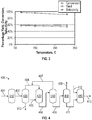
- the disproportionation reactions described herein favor 2-butenes (both cis- and trans- isomers). Therefore, a dimerization catalyst that increases or maximizes the creation of 2-butenes from the ethylene dimerization may be selected, thereby possibly allowing a higher propylene yield to be achieved. As depicted at FIG. 1 , propylene yields are generally higher, especially at lower process temperatures, when a feed includes 2-butenes instead of 1-butenes.
- FIG. 1 presents the results of an experiment conducted using a combination of isomerization catalyst magnesium oxide (MgO) and metathesis catalyst tungsten oxide (WO 3 ) supported on silicon oxide (SiO 2 ).
- a stream including ethylene and a dimerization catalyst may be contacted in any suitable reactor and under any suitable conditions to generate a stream including n -butenes.
- a stream including ethylene and a dimerization catalyst are contacted at a temperature of at least about 35 °C.
- a stream including ethylene and a dimerization catalyst may be contacted at a temperature of about 35 °C to about 100 °C, about 35 °C to about 90 °C, about 35 °C to about 80 °C, about 35 °C to about 70 °C, about 35 °C to about 60 °C, about 40 °C to about 60 °C, or about 50 °C.
- a stream including ethylene and a dimerization catalyst are contacted at a pressure of at least about 344 kPa, or at least about 1034 kPa.
- a stream including ethylene and a dimerization catalyst may be contacted at a pressure of about 344 kPa to about 10342 kPa, about 344 kPa to about 6895 kPa, about 344 kPa to about 4137 kPa, about 689 kPa to about 6895 kPa, about 1034 kPa to about 1724 kPa, about 1241 kPa to about 1379 kPa, or about 1310 kPa.
- a stream including ethylene and a dimerization catalyst are contacted in the presence of a solvent.
- the solvent may include a hydrocarbon solvent, including, but not limited to, toluene, heptane, hexane, a halogenated hydrocarbon, such as chlorobenzene or chloroform, or a combination thereof.
- a stream including ethylene and a dimerization catalyst are contacted at a temperature of about 35 °C to about 100 °C, about 35 °C to about 90 °C, about 35 °C to about 80 °C, about 35 °C to about 70 °C, about 35 °C to about 60 °C, about 40 °C to about 60 °C, or about 50 °C, a pressure of about 344 kPa to about 10342 kPa, about 344 to about 4137 kPa, about 689 kPa to about 6895 kPa, about 1034 to about 1724 kPa, about 1241 kPa to about 1379 kPa, or about 1310 kPa, and in the presence of a solvent.
- the solvent may include a hydrocarbon solvent, including, but not limited to, toluene, heptane, hexane, or a halogenated hydrocarbon, such as chlorobenzene or chlor
- streams including n -butenes also may include C 6+ olefins.
- the C 6+ olefins may be removed from the streams including n -butenes prior to performing a disproportionation reaction.
- the methods provided herein may include removing the C 6+ olefins from the stream including n -butenes prior to the contacting of the stream including n- butenes with the second stream including ethylene.
- the C 6+ olefins may be removed using any known techniques, including distillation.
- the methods provided herein include contacting a stream including n-butenes with a second stream including ethylene in the presence of a disproportionation catalyst to form a stream including propylene and C 4+ olefins.
- the stream including n -butenes and the second stream including ethylene may be combined prior to entering a disproportionation unit. Additionally or alternatively, the stream including n -butenes and the second stream including ethylene may be provided separately to a disproportionation unit, and contact each other in the disproportionation unit.
- a stream including propylene and C 4+ olefins also includes ethylene.
- the methods provided herein may include removing the ethylene from the stream including propylene and C 4+ olefins to form a third stream including ethylene.
- the ethylene may be removed prior to removing propylene from the stream including propylene and C 4+ olefins, or the ethylene may be removed prior to contacting the stream including C 4+ olefins with isobutane.
- a stream obtained from a dimerization reaction and/or a disproportionation reaction may include some unconverted ethylene, which may be detrimental if an acid catalyst is used in a downstream alkylation reaction, because the unconverted ethylene may consume the acid catalyst, especially sulfur acid catalysts.
- Any known technique or de-ethanizer may be used to remove ethylene from a stream, including distillation.
- the third stream including ethylene may be reacted with a stream including n -butenes in a disproportionation unit.
- the third stream including ethylene may be disposed in a disproportionation unit, combined with a stream including n -butenes (which may be combined with a second stream including ethylene) before the stream including n -butenes is disposed in a disproportionation unit, or combined with a second stream including ethylene before the second stream including ethylene is disposed in a disproportionation unit.
- the methods herein include combining the second stream including ethylene and the third stream including ethylene. In some embodiments, the methods herein include combining a stream including n -butenes and the third stream including ethylene. In some embodiments, the methods herein including disposing the third stream including ethylene in a disproportionation unit that contains the disproportionation catalyst.
- the disproportionation catalyst may include any catalyst capable of producing propylene when contacted with n -butenes and ethylene.
- U.S. Patent No. 8,395,005 which is incorporated herein by reference, discloses examples of disproportionation catalysts and processes for converting n -butenes and ethylene to propylene.
- a disproportionation catalyst includes a transition metal oxide.
- the transition metal oxide may include a transition metal selected from Group VIB to Group VIIIB of the periodic table.
- the transition metal oxide includes W, Mo, Re, Ru, or a combination thereof.
- the disproportionation catalyst may be a homogeneous organometallic catalyst.
- the disproportionation catalyst may be a solid supported catalyst.
- the disproportionation catalyst may be in the form of a powder or particulates. Suitable catalyst forms may include includes beads, granules, pellets, extrudates, tablets, agglomerates, honeycomb monolith, and the like, generally having a particle size of greater than 1 mm.
- a disproportionation catalyst also may be used in combination with an isomerization catalyst, a disproportionation catalyst promoter, or a combination thereof.
- the disproportionation catalyst includes tungsten oxide supported on a silica carrier.
- silica carriers include high purity silicas, i.e., those having a very low level of sodium (e.g., less than 2000 ppm Na 2 O) and aluminum ( e.g., less than 2000 ppm Al 2 O 3 ).
- the silica carrier may have a surface area of at least 10 square meters per gram. In some embodiments, the surface area is at least 50 square meters per gram.
- an aqueous solution or suspension of tungsten oxide or a tungsten oxide precursor may be used to contact a silica carrier.
- Suitable tungsten oxide precursors are compounds that are convertible to the oxide form under calcination conditions, such as, for example, halides, sulfides, sulfates, nitrates, carboxylates, and the like, and mixtures thereof.
- Exemplary tungsten compounds include tungsten pentabromide, tungsten dichloride, tungsten tetrachloride, tungsten hexafluoride, tungsten trioxide, tungsten dioxydichloride, tungsten trisulfide, metatungstic acid, orthotungstic acid, ammonium phosphotungstate, ammonium metatungstate, and mixtures thereof.
- the tungsten oxide-on-silica catalyst in some embodiments, is used in a fixed-bed reactor.
- the disproportionation reaction generally may be performed under any conditions capable of producing propylene.
- the disproportionation reaction is performed at a temperature of about 200 °C to about 500° C, or about 250 °C to about 400° C.
- the disproportionation reaction is performed at a pressure of about 344 kPa to about 3448 kPa.
- the weight hourly space velocities are about 0.2 to about 10 kg feed per kg catalyst per hour.
- the disproportionation reaction is performed at a temperature of about 200 °C to about 500° C, or about 250 °C to about 400° C, a pressure of about 344 kPa to about 3448 kPa, and the weight hourly space velocity is about 0.2 to about 10 kg feed per kg catalyst per hour.
- the stream including propylene and C 4+ olefins also includes 1-butene and 2-butene, and the amount of 1-butene in the stream including propylene and C 4+ olefins is greater than the amount of 1-butene in the stream comprising n -butenes.
- the stream including propylene and C 4+ olefins also includes 1-butene and 2-butene, and the amount of 1-butene in the stream including propylene and C 4+ olefins is greater than the amount of 2-butene in the stream including propylene and C 4+ olefins.
- the amount of 1-butene in a stream including propylene and C 4+ olefins obtained from a disproportionation reaction may be lower, in some embodiments, than [1] the amount of 1-butene in the stream comprising n -butenes, and/or [2] the amount of 2-butene in the stream including propylene and C 4+ olefins because, as depicted by the following reaction schemes, both the cis- and trans- isomers of 2-butene are preferred over 1-butene for propylene production:
- FIG. 3 depicts modeling results for the conversion of n -butenes, and the yield and selectivity of propylene as a function of temperature for an embodiment of the olefin metathesis of ethylene and n -butenes (1:1 molar ratio) incorporating equilibria of primary and secondary metathesis reactions.
- the methods provided herein include removing propylene from the stream including propylene and C 4+ olefins to form a stream including C 4+ olefins.
- the propylene may be removed using any known technique.
- the propylene may be removed by distillation.
- the propylene is removed from the stream including C 4+ olefins after ethylene has been removed from the stream.
- the methods provided herein include contacting the stream including C 4+ olefins with a stream comprising isobutane in the presence of an alkylation catalyst to form alkylate.
- an alkylation catalyst capable of forming alkylate upon contacting olefins and isoparaffins may be used in the methods provided herein.
- the alkylation catalyst may include HF, H 2 SO 4 , an ionic liquid, a zeolite, or a combination thereof.
- the alkylation reactions provided herein demonstrate less selectivity, or no selectivity, for 2-butenes versus 1-butenes. Therefore, an increased relative amount of 1-butene in a stream provided to an alkylation unit will have less, or no, negative impact on the process.
- isomerization of 1-butene and 2-butene may occur readily in-situ to provide similar alkylate quality.
- the following scheme depicts an example of butene alkylation by isobutane to octanes:
- the methods provided herein are performed in the system depicted at FIG. 4 .
- the system 400 of FIG. 4 includes a dimerization unit 410 to which a stream 401 including ethylene is provided and contacted therein with a dimerization catalyst to form a stream 402 including n -butenes and, possibly, unconsumed ethylene.
- the stream 402 including n -butenes is fed to a C 4 splitter 420, which removes at least a portion of C 6+ olefins 403 from the stream 402 including n- butenes to form a purified stream 404 including n -butenes.
- the purified stream 404 including n- butenes and an ethylene stream 405 are provided to a disproportionation unit 430 in which the streams ( 404 , 405 ) are contacted with a disproportionation catalyst to form a stream 406 including propylene and C 4+ olefins.
- the stream 406 including propylene and C 4+ olefins is then provided to a de-ethanizer unit 440 to remove at least a portion of ethylene 407 from the stream 406 including propylene and C 4+ olefins to form a purified stream 408 including propylene and C 4+ olefins.
- the separated ethylene stream 407 is combined with the stream 404 including n -butenes, or, in other embodiments, the separated ethylene stream 407 is fed directly to the disproportionation unit 430, combined with the ethylene stream 405, or a combination thereof.
- the purified stream 408 including propylene and C4+ olefins is provided to a de-propanizer unit 450 to remove propylene from the purified stream 408 including propylene and C 4+ olefins to form a stream 410 including C 4+ olefins.
- the stream 411 including C 4+ olefins is provided to an alkylation unit 460, and contacted with an alkylation catalyst and a stream 412 including isobutane to produce alkylate 413.
- the present disclosure may address one or more of the problems and deficiencies of known methods and processes. However, it is contemplated that various embodiments may prove useful in addressing other problems and deficiencies in a number of technical areas. Therefore, the present disclosure should not necessarily be construed as limited to addressing any of the particular problems or deficiencies discussed herein.
- a is intended to include plural alternatives, e.g., at least one.
- a stream is meant to encompass one, or mixtures or combinations of more than one stream, disproportionation catalyst, inert solvent, and the like, unless otherwise specified.
- This range should be interpreted as encompassing pressures of about 1034 kPa to about 1724 kPa, and further encompasses "about" each of 1041 kPa, 1048 kPa, 1054 kPa, 1061 kPa, 1069 kPa, 1076 kPa, 1082 kPa, 1089 kPa, 1096 kPa, 1103 kPa, 1110 kPa, 1117 kPa, 1124 kPa, 1131 kPa, 1138 kPa, 1145 kPa, 1151 kPa, 1158 kPa, 1165 kPa, 1172 kPa, 1179 kPa, 1186 kPa, 1193 kPa, 1200 kPa, 1207 kPa, 1213 kPa, 1220 kPa, 1227 kPa, 1234 kPa, 1241 kPa, 1248 kPa
- a 300 mL Parr reactor was used for the ethylene dimerization of this example.
- a bake-out of the reactor was conducted with a dry inert gas purge at 120 °C for 1 hour, followed by a cooldown to the desired process temperature, which for this example was about 50 °C.
- Argon was used for the dry inert gas purge of this example, but other gases, such as nitrogen, may be used.
- the reactor was then primed with ethylene.
- a solvent, cocatalyst, and catalyst were subsequently added before the reactor was pressurized to 1310 kPa for the ethylene dimerization.
- the solvent of this example was heptane, but other inert solvents, such as hexane or chlorobenzene, may be used.
- Table 1 depicts the results of the ethylene dimerization of this example using 67.9 wtppm of ( n -Bu 3 P) 2 NiCl 2 in 100 mL heptane solvent and an ethylaluminum dichloride (EADC) to Ni molar ratio of 3 at 1344 kPa and 51.3 °C for 30 minutes.
- Table 1 Ethylene Dimerization with (n-Bu 3 P) 2 NiCl 2 catalyst and EADC cocatalyst.
- the ethylene dimerization of this example achieved 91.7 % ethylene conversion (8.3 wt% ethylene remaining in the product), and 98.4 wt% selectivity toward butenes, with 84 % in the form of 2-butenes (both cis and trans ).
Landscapes
- Chemical & Material Sciences (AREA)
- Organic Chemistry (AREA)
- Chemical Kinetics & Catalysis (AREA)
- Engineering & Computer Science (AREA)
- Materials Engineering (AREA)
- Organic Low-Molecular-Weight Compounds And Preparation Thereof (AREA)
- Low-Molecular Organic Synthesis Reactions Using Catalysts (AREA)
- Oil, Petroleum & Natural Gas (AREA)
Applications Claiming Priority (1)
| Application Number | Priority Date | Filing Date | Title |
|---|---|---|---|
| US201862639226P | 2018-03-06 | 2018-03-06 |
Publications (2)
| Publication Number | Publication Date |
|---|---|
| EP3536678A1 true EP3536678A1 (fr) | 2019-09-11 |
| EP3536678B1 EP3536678B1 (fr) | 2020-10-21 |
Family
ID=65598453
Family Applications (1)
| Application Number | Title | Priority Date | Filing Date |
|---|---|---|---|
| EP19159253.4A Active EP3536678B1 (fr) | 2018-03-06 | 2019-02-26 | Procédé pour la production de propylène et d'alkylate |
Country Status (2)
| Country | Link |
|---|---|
| US (1) | US10737992B2 (fr) |
| EP (1) | EP3536678B1 (fr) |
Citations (10)
| Publication number | Priority date | Publication date | Assignee | Title |
|---|---|---|---|---|
| US3321546A (en) | 1962-11-30 | 1967-05-23 | Shell Oil Co | Olefin dimerization using aluminum alkyl halide-nickel complex catalyst |
| US4242531A (en) | 1978-08-14 | 1980-12-30 | Phillips Petroleum Company | Olefin dimerization |
| US4476341A (en) | 1982-04-06 | 1984-10-09 | Exxon Research & Engineering Co. | Butene dimerization method |
| US4868342A (en) * | 1988-03-04 | 1989-09-19 | Uop | Alkylation and dehydrogenation process for the production of propylene and high octane components |
| US5260499A (en) | 1992-01-14 | 1993-11-09 | Phillips Petroleum Company | Ethylene dimerization and catalyst therefor |
| US5414178A (en) | 1992-07-17 | 1995-05-09 | Phillips Petroleum Company | Dimerization catalyst systems and processes |
| US5649281A (en) | 1993-12-17 | 1997-07-15 | Atlantic Richfield Company | Alkylation with separate alkylation of isobutane with pentenes |
| WO2009015118A2 (fr) * | 2007-07-23 | 2009-01-29 | Uop Llc | Intégration d'un craquage d'oléfine avec une métathèse pour augmenter une production d'oléfines légère |
| WO2012051427A1 (fr) * | 2010-10-13 | 2012-04-19 | Equistar Chemicals, Lp | Obtention de 1-butène et de propylène à partir d'éthylène |
| WO2014123972A1 (fr) * | 2013-02-08 | 2014-08-14 | Lyondell Chemical Technology, L.P. | Procédé de production de propylène |
Family Cites Families (1)
| Publication number | Priority date | Publication date | Assignee | Title |
|---|---|---|---|---|
| US3321549A (en) | 1964-06-15 | 1967-05-23 | Union Carbide Corp | Thermoplastic polyhydroxyethers modified by the addition of a blend of an epoxy resin and an amine blocked polyisocyanate |
-
2019
- 2019-02-26 EP EP19159253.4A patent/EP3536678B1/fr active Active
- 2019-03-06 US US16/293,906 patent/US10737992B2/en active Active
Patent Citations (11)
| Publication number | Priority date | Publication date | Assignee | Title |
|---|---|---|---|---|
| US3321546A (en) | 1962-11-30 | 1967-05-23 | Shell Oil Co | Olefin dimerization using aluminum alkyl halide-nickel complex catalyst |
| US4242531A (en) | 1978-08-14 | 1980-12-30 | Phillips Petroleum Company | Olefin dimerization |
| US4476341A (en) | 1982-04-06 | 1984-10-09 | Exxon Research & Engineering Co. | Butene dimerization method |
| US4868342A (en) * | 1988-03-04 | 1989-09-19 | Uop | Alkylation and dehydrogenation process for the production of propylene and high octane components |
| US5260499A (en) | 1992-01-14 | 1993-11-09 | Phillips Petroleum Company | Ethylene dimerization and catalyst therefor |
| US5414178A (en) | 1992-07-17 | 1995-05-09 | Phillips Petroleum Company | Dimerization catalyst systems and processes |
| US5649281A (en) | 1993-12-17 | 1997-07-15 | Atlantic Richfield Company | Alkylation with separate alkylation of isobutane with pentenes |
| WO2009015118A2 (fr) * | 2007-07-23 | 2009-01-29 | Uop Llc | Intégration d'un craquage d'oléfine avec une métathèse pour augmenter une production d'oléfines légère |
| WO2012051427A1 (fr) * | 2010-10-13 | 2012-04-19 | Equistar Chemicals, Lp | Obtention de 1-butène et de propylène à partir d'éthylène |
| US8395005B2 (en) | 2010-10-13 | 2013-03-12 | Equistar Chemicals, Lp | Production of 1-butene and propylene from ethylene |
| WO2014123972A1 (fr) * | 2013-02-08 | 2014-08-14 | Lyondell Chemical Technology, L.P. | Procédé de production de propylène |
Also Published As
| Publication number | Publication date |
|---|---|
| EP3536678B1 (fr) | 2020-10-21 |
| US20190276378A1 (en) | 2019-09-12 |
| US10737992B2 (en) | 2020-08-11 |
Similar Documents
| Publication | Publication Date | Title |
|---|---|---|
| US8395005B2 (en) | Production of 1-butene and propylene from ethylene | |
| EP2331488B1 (fr) | Isomérisation d'oléfines et catalyse de métathèse | |
| EP2321382B1 (fr) | Fabrication intégrée de propylène | |
| JP6366587B2 (ja) | ほとんど又は全くエチレンを用いないメタセシスを介するプロピレン | |
| EP1353889B1 (fr) | Procede de production d'alpha olefines lineaires et d'ethylene | |
| US8637722B2 (en) | Ethylene oligomerization catalyst and use thereof | |
| CN105764875B (zh) | 烯烃转化方法 | |
| KR20070090886A (ko) | 프로필렌을 제조하기 위한 에틸렌과 부텐의 복분해를 위한촉매 및 방법 | |
| JP2011148720A (ja) | ブタジエンの製造方法 | |
| AU2002236885A1 (en) | Process for the production of linear alpha olefins and ethylene | |
| CA2990185C (fr) | Procede de fabrication d'ether de methyle et de tert-butyle (mtbe) et d'hydrocarbures | |
| US6515193B2 (en) | Process for production of higher linear internal olefins from butene | |
| EP3536678B1 (fr) | Procédé pour la production de propylène et d'alkylate | |
| JP2018140391A (ja) | オレフィンの選択的オリゴマー化 | |
| US8993823B2 (en) | Olefin metathesis process using a catalyst containing tungsten fluorine bonds | |
| CN105849070B (zh) | 烯烃转化方法 | |
| EP2943452B1 (fr) | Procédé de production de propylène en plusieurs temps | |
| EP1942090B1 (fr) | Procédé pour la production d'hexène-1 et d'éthylène | |
| WO2014123972A1 (fr) | Procédé de production de propylène | |
| JP2015067541A (ja) | 炭化水素化合物の製造方法 | |
| JPH04352732A (ja) | アルキル置換芳香族化合物の製造方法 |
Legal Events
| Date | Code | Title | Description |
|---|---|---|---|
| PUAI | Public reference made under article 153(3) epc to a published international application that has entered the european phase |
Free format text: ORIGINAL CODE: 0009012 |
|
| STAA | Information on the status of an ep patent application or granted ep patent |
Free format text: STATUS: REQUEST FOR EXAMINATION WAS MADE |
|
| 17P | Request for examination filed |
Effective date: 20190226 |
|
| AK | Designated contracting states |
Kind code of ref document: A1 Designated state(s): AL AT BE BG CH CY CZ DE DK EE ES FI FR GB GR HR HU IE IS IT LI LT LU LV MC MK MT NL NO PL PT RO RS SE SI SK SM TR |
|
| AX | Request for extension of the european patent |
Extension state: BA ME |
|
| GRAP | Despatch of communication of intention to grant a patent |
Free format text: ORIGINAL CODE: EPIDOSNIGR1 |
|
| STAA | Information on the status of an ep patent application or granted ep patent |
Free format text: STATUS: GRANT OF PATENT IS INTENDED |
|
| INTG | Intention to grant announced |
Effective date: 20200519 |
|
| GRAS | Grant fee paid |
Free format text: ORIGINAL CODE: EPIDOSNIGR3 |
|
| GRAA | (expected) grant |
Free format text: ORIGINAL CODE: 0009210 |
|
| STAA | Information on the status of an ep patent application or granted ep patent |
Free format text: STATUS: THE PATENT HAS BEEN GRANTED |
|
| AK | Designated contracting states |
Kind code of ref document: B1 Designated state(s): AL AT BE BG CH CY CZ DE DK EE ES FI FR GB GR HR HU IE IS IT LI LT LU LV MC MK MT NL NO PL PT RO RS SE SI SK SM TR |
|
| REG | Reference to a national code |
Ref country code: GB Ref legal event code: FG4D |
|
| REG | Reference to a national code |
Ref country code: CH Ref legal event code: EP |
|
| REG | Reference to a national code |
Ref country code: DE Ref legal event code: R096 Ref document number: 602019000987 Country of ref document: DE |
|
| REG | Reference to a national code |
Ref country code: IE Ref legal event code: FG4D |
|
| REG | Reference to a national code |
Ref country code: AT Ref legal event code: REF Ref document number: 1325712 Country of ref document: AT Kind code of ref document: T Effective date: 20201115 |
|
| REG | Reference to a national code |
Ref country code: AT Ref legal event code: MK05 Ref document number: 1325712 Country of ref document: AT Kind code of ref document: T Effective date: 20201021 |
|
| REG | Reference to a national code |
Ref country code: NL Ref legal event code: MP Effective date: 20201021 |
|
| PG25 | Lapsed in a contracting state [announced via postgrant information from national office to epo] |
Ref country code: GR Free format text: LAPSE BECAUSE OF FAILURE TO SUBMIT A TRANSLATION OF THE DESCRIPTION OR TO PAY THE FEE WITHIN THE PRESCRIBED TIME-LIMIT Effective date: 20210122 Ref country code: NO Free format text: LAPSE BECAUSE OF FAILURE TO SUBMIT A TRANSLATION OF THE DESCRIPTION OR TO PAY THE FEE WITHIN THE PRESCRIBED TIME-LIMIT Effective date: 20210121 Ref country code: FI Free format text: LAPSE BECAUSE OF FAILURE TO SUBMIT A TRANSLATION OF THE DESCRIPTION OR TO PAY THE FEE WITHIN THE PRESCRIBED TIME-LIMIT Effective date: 20201021 Ref country code: RS Free format text: LAPSE BECAUSE OF FAILURE TO SUBMIT A TRANSLATION OF THE DESCRIPTION OR TO PAY THE FEE WITHIN THE PRESCRIBED TIME-LIMIT Effective date: 20201021 Ref country code: PT Free format text: LAPSE BECAUSE OF FAILURE TO SUBMIT A TRANSLATION OF THE DESCRIPTION OR TO PAY THE FEE WITHIN THE PRESCRIBED TIME-LIMIT Effective date: 20210222 |
|
| REG | Reference to a national code |
Ref country code: LT Ref legal event code: MG4D |
|
| PG25 | Lapsed in a contracting state [announced via postgrant information from national office to epo] |
Ref country code: BG Free format text: LAPSE BECAUSE OF FAILURE TO SUBMIT A TRANSLATION OF THE DESCRIPTION OR TO PAY THE FEE WITHIN THE PRESCRIBED TIME-LIMIT Effective date: 20210121 Ref country code: LV Free format text: LAPSE BECAUSE OF FAILURE TO SUBMIT A TRANSLATION OF THE DESCRIPTION OR TO PAY THE FEE WITHIN THE PRESCRIBED TIME-LIMIT Effective date: 20201021 Ref country code: PL Free format text: LAPSE BECAUSE OF FAILURE TO SUBMIT A TRANSLATION OF THE DESCRIPTION OR TO PAY THE FEE WITHIN THE PRESCRIBED TIME-LIMIT Effective date: 20201021 Ref country code: IS Free format text: LAPSE BECAUSE OF FAILURE TO SUBMIT A TRANSLATION OF THE DESCRIPTION OR TO PAY THE FEE WITHIN THE PRESCRIBED TIME-LIMIT Effective date: 20210221 Ref country code: SE Free format text: LAPSE BECAUSE OF FAILURE TO SUBMIT A TRANSLATION OF THE DESCRIPTION OR TO PAY THE FEE WITHIN THE PRESCRIBED TIME-LIMIT Effective date: 20201021 Ref country code: ES Free format text: LAPSE BECAUSE OF FAILURE TO SUBMIT A TRANSLATION OF THE DESCRIPTION OR TO PAY THE FEE WITHIN THE PRESCRIBED TIME-LIMIT Effective date: 20201021 Ref country code: AT Free format text: LAPSE BECAUSE OF FAILURE TO SUBMIT A TRANSLATION OF THE DESCRIPTION OR TO PAY THE FEE WITHIN THE PRESCRIBED TIME-LIMIT Effective date: 20201021 |
|
| PG25 | Lapsed in a contracting state [announced via postgrant information from national office to epo] |
Ref country code: NL Free format text: LAPSE BECAUSE OF FAILURE TO SUBMIT A TRANSLATION OF THE DESCRIPTION OR TO PAY THE FEE WITHIN THE PRESCRIBED TIME-LIMIT Effective date: 20201021 Ref country code: HR Free format text: LAPSE BECAUSE OF FAILURE TO SUBMIT A TRANSLATION OF THE DESCRIPTION OR TO PAY THE FEE WITHIN THE PRESCRIBED TIME-LIMIT Effective date: 20201021 |
|
| REG | Reference to a national code |
Ref country code: DE Ref legal event code: R097 Ref document number: 602019000987 Country of ref document: DE |
|
| PG25 | Lapsed in a contracting state [announced via postgrant information from national office to epo] |
Ref country code: LT Free format text: LAPSE BECAUSE OF FAILURE TO SUBMIT A TRANSLATION OF THE DESCRIPTION OR TO PAY THE FEE WITHIN THE PRESCRIBED TIME-LIMIT Effective date: 20201021 Ref country code: RO Free format text: LAPSE BECAUSE OF FAILURE TO SUBMIT A TRANSLATION OF THE DESCRIPTION OR TO PAY THE FEE WITHIN THE PRESCRIBED TIME-LIMIT Effective date: 20201021 Ref country code: CZ Free format text: LAPSE BECAUSE OF FAILURE TO SUBMIT A TRANSLATION OF THE DESCRIPTION OR TO PAY THE FEE WITHIN THE PRESCRIBED TIME-LIMIT Effective date: 20201021 Ref country code: SM Free format text: LAPSE BECAUSE OF FAILURE TO SUBMIT A TRANSLATION OF THE DESCRIPTION OR TO PAY THE FEE WITHIN THE PRESCRIBED TIME-LIMIT Effective date: 20201021 Ref country code: SK Free format text: LAPSE BECAUSE OF FAILURE TO SUBMIT A TRANSLATION OF THE DESCRIPTION OR TO PAY THE FEE WITHIN THE PRESCRIBED TIME-LIMIT Effective date: 20201021 Ref country code: EE Free format text: LAPSE BECAUSE OF FAILURE TO SUBMIT A TRANSLATION OF THE DESCRIPTION OR TO PAY THE FEE WITHIN THE PRESCRIBED TIME-LIMIT Effective date: 20201021 |
|
| PLBE | No opposition filed within time limit |
Free format text: ORIGINAL CODE: 0009261 |
|
| STAA | Information on the status of an ep patent application or granted ep patent |
Free format text: STATUS: NO OPPOSITION FILED WITHIN TIME LIMIT |
|
| PG25 | Lapsed in a contracting state [announced via postgrant information from national office to epo] |
Ref country code: DK Free format text: LAPSE BECAUSE OF FAILURE TO SUBMIT A TRANSLATION OF THE DESCRIPTION OR TO PAY THE FEE WITHIN THE PRESCRIBED TIME-LIMIT Effective date: 20201021 |
|
| 26N | No opposition filed |
Effective date: 20210722 |
|
| PG25 | Lapsed in a contracting state [announced via postgrant information from national office to epo] |
Ref country code: MC Free format text: LAPSE BECAUSE OF FAILURE TO SUBMIT A TRANSLATION OF THE DESCRIPTION OR TO PAY THE FEE WITHIN THE PRESCRIBED TIME-LIMIT Effective date: 20201021 |
|
| REG | Reference to a national code |
Ref country code: BE Ref legal event code: MM Effective date: 20210228 |
|
| PG25 | Lapsed in a contracting state [announced via postgrant information from national office to epo] |
Ref country code: AL Free format text: LAPSE BECAUSE OF FAILURE TO SUBMIT A TRANSLATION OF THE DESCRIPTION OR TO PAY THE FEE WITHIN THE PRESCRIBED TIME-LIMIT Effective date: 20201021 Ref country code: LU Free format text: LAPSE BECAUSE OF NON-PAYMENT OF DUE FEES Effective date: 20210226 Ref country code: IT Free format text: LAPSE BECAUSE OF FAILURE TO SUBMIT A TRANSLATION OF THE DESCRIPTION OR TO PAY THE FEE WITHIN THE PRESCRIBED TIME-LIMIT Effective date: 20201021 |
|
| PG25 | Lapsed in a contracting state [announced via postgrant information from national office to epo] |
Ref country code: SI Free format text: LAPSE BECAUSE OF FAILURE TO SUBMIT A TRANSLATION OF THE DESCRIPTION OR TO PAY THE FEE WITHIN THE PRESCRIBED TIME-LIMIT Effective date: 20201021 |
|
| PG25 | Lapsed in a contracting state [announced via postgrant information from national office to epo] |
Ref country code: IE Free format text: LAPSE BECAUSE OF NON-PAYMENT OF DUE FEES Effective date: 20210226 |
|
| PG25 | Lapsed in a contracting state [announced via postgrant information from national office to epo] |
Ref country code: IS Free format text: LAPSE BECAUSE OF FAILURE TO SUBMIT A TRANSLATION OF THE DESCRIPTION OR TO PAY THE FEE WITHIN THE PRESCRIBED TIME-LIMIT Effective date: 20210221 |
|
| PG25 | Lapsed in a contracting state [announced via postgrant information from national office to epo] |
Ref country code: BE Free format text: LAPSE BECAUSE OF NON-PAYMENT OF DUE FEES Effective date: 20210228 |
|
| REG | Reference to a national code |
Ref country code: CH Ref legal event code: PL |
|
| PG25 | Lapsed in a contracting state [announced via postgrant information from national office to epo] |
Ref country code: LI Free format text: LAPSE BECAUSE OF NON-PAYMENT OF DUE FEES Effective date: 20220228 Ref country code: CH Free format text: LAPSE BECAUSE OF NON-PAYMENT OF DUE FEES Effective date: 20220228 |
|
| P01 | Opt-out of the competence of the unified patent court (upc) registered |
Effective date: 20230418 |
|
| PG25 | Lapsed in a contracting state [announced via postgrant information from national office to epo] |
Ref country code: CY Free format text: LAPSE BECAUSE OF FAILURE TO SUBMIT A TRANSLATION OF THE DESCRIPTION OR TO PAY THE FEE WITHIN THE PRESCRIBED TIME-LIMIT Effective date: 20201021 |
|
| PG25 | Lapsed in a contracting state [announced via postgrant information from national office to epo] |
Ref country code: HU Free format text: LAPSE BECAUSE OF FAILURE TO SUBMIT A TRANSLATION OF THE DESCRIPTION OR TO PAY THE FEE WITHIN THE PRESCRIBED TIME-LIMIT; INVALID AB INITIO Effective date: 20190226 |
|
| GBPC | Gb: european patent ceased through non-payment of renewal fee |
Effective date: 20230226 |
|
| PG25 | Lapsed in a contracting state [announced via postgrant information from national office to epo] |
Ref country code: GB Free format text: LAPSE BECAUSE OF NON-PAYMENT OF DUE FEES Effective date: 20230226 |
|
| PG25 | Lapsed in a contracting state [announced via postgrant information from national office to epo] |
Ref country code: GB Free format text: LAPSE BECAUSE OF NON-PAYMENT OF DUE FEES Effective date: 20230226 |
|
| PG25 | Lapsed in a contracting state [announced via postgrant information from national office to epo] |
Ref country code: MK Free format text: LAPSE BECAUSE OF FAILURE TO SUBMIT A TRANSLATION OF THE DESCRIPTION OR TO PAY THE FEE WITHIN THE PRESCRIBED TIME-LIMIT Effective date: 20201021 |
|
| PG25 | Lapsed in a contracting state [announced via postgrant information from national office to epo] |
Ref country code: TR Free format text: LAPSE BECAUSE OF FAILURE TO SUBMIT A TRANSLATION OF THE DESCRIPTION OR TO PAY THE FEE WITHIN THE PRESCRIBED TIME-LIMIT Effective date: 20201021 |
|
| PG25 | Lapsed in a contracting state [announced via postgrant information from national office to epo] |
Ref country code: MT Free format text: LAPSE BECAUSE OF FAILURE TO SUBMIT A TRANSLATION OF THE DESCRIPTION OR TO PAY THE FEE WITHIN THE PRESCRIBED TIME-LIMIT Effective date: 20201021 |
|
| PGFP | Annual fee paid to national office [announced via postgrant information from national office to epo] |
Ref country code: DE Payment date: 20260115 Year of fee payment: 8 |
|
| PGFP | Annual fee paid to national office [announced via postgrant information from national office to epo] |
Ref country code: FR Payment date: 20260109 Year of fee payment: 8 |