EP3536749A1 - Composition pigmentaire pour filtre vert et procédé pour sa production - Google Patents
Composition pigmentaire pour filtre vert et procédé pour sa production Download PDFInfo
- Publication number
- EP3536749A1 EP3536749A1 EP17866917.2A EP17866917A EP3536749A1 EP 3536749 A1 EP3536749 A1 EP 3536749A1 EP 17866917 A EP17866917 A EP 17866917A EP 3536749 A1 EP3536749 A1 EP 3536749A1
- Authority
- EP
- European Patent Office
- Prior art keywords
- pigment
- transmittance
- less
- green
- liquid
- Prior art date
- Legal status (The legal status is an assumption and is not a legal conclusion. Google has not performed a legal analysis and makes no representation as to the accuracy of the status listed.)
- Pending
Links
- 239000000049 pigment Substances 0.000 title claims abstract description 73
- 239000000203 mixture Substances 0.000 title claims abstract description 41
- 238000004519 manufacturing process Methods 0.000 title description 4
- 238000002834 transmittance Methods 0.000 claims abstract description 63
- 239000001056 green pigment Substances 0.000 claims abstract description 45
- IEQIEDJGQAUEQZ-UHFFFAOYSA-N phthalocyanine Chemical compound N1C(N=C2C3=CC=CC=C3C(N=C3C4=CC=CC=C4C(=N4)N3)=N2)=C(C=CC=C2)C2=C1N=C1C2=CC=CC=C2C4=N1 IEQIEDJGQAUEQZ-UHFFFAOYSA-N 0.000 claims abstract description 26
- 150000003751 zinc Chemical class 0.000 claims abstract description 26
- 239000006185 dispersion Substances 0.000 claims abstract description 21
- 230000005540 biological transmission Effects 0.000 claims abstract description 18
- 230000003595 spectral effect Effects 0.000 claims abstract description 16
- 239000007788 liquid Substances 0.000 claims description 89
- 239000011859 microparticle Substances 0.000 claims description 38
- 239000002994 raw material Substances 0.000 claims description 28
- 239000002904 solvent Substances 0.000 claims description 24
- QAOWNCQODCNURD-UHFFFAOYSA-N Sulfuric acid Chemical compound OS(O)(=O)=O QAOWNCQODCNURD-UHFFFAOYSA-N 0.000 claims description 15
- 238000001556 precipitation Methods 0.000 claims description 14
- KEQGZUUPPQEDPF-UHFFFAOYSA-N 1,3-dichloro-5,5-dimethylimidazolidine-2,4-dione Chemical compound CC1(C)N(Cl)C(=O)N(Cl)C1=O KEQGZUUPPQEDPF-UHFFFAOYSA-N 0.000 claims description 12
- XTHPWXDJESJLNJ-UHFFFAOYSA-N chlorosulfonic acid Substances OS(Cl)(=O)=O XTHPWXDJESJLNJ-UHFFFAOYSA-N 0.000 claims description 12
- 239000011164 primary particle Substances 0.000 claims description 12
- 239000000126 substance Substances 0.000 claims description 11
- 230000002378 acidificating effect Effects 0.000 claims description 8
- 238000000034 method Methods 0.000 claims description 8
- 230000001376 precipitating effect Effects 0.000 claims description 6
- 238000002156 mixing Methods 0.000 claims description 5
- 239000012530 fluid Substances 0.000 description 40
- 238000012545 processing Methods 0.000 description 31
- 238000003756 stirring Methods 0.000 description 25
- HEMHJVSKTPXQMS-UHFFFAOYSA-M Sodium hydroxide Chemical compound [OH-].[Na+] HEMHJVSKTPXQMS-UHFFFAOYSA-M 0.000 description 18
- 230000000052 comparative effect Effects 0.000 description 14
- 239000000243 solution Substances 0.000 description 13
- 229920000642 polymer Polymers 0.000 description 12
- XLYOFNOQVPJJNP-UHFFFAOYSA-N water Substances O XLYOFNOQVPJJNP-UHFFFAOYSA-N 0.000 description 10
- 238000000926 separation method Methods 0.000 description 9
- 239000000460 chlorine Substances 0.000 description 8
- 230000003287 optical effect Effects 0.000 description 8
- 239000002245 particle Substances 0.000 description 8
- 238000009472 formulation Methods 0.000 description 7
- 239000011701 zinc Substances 0.000 description 7
- 229910052794 bromium Inorganic materials 0.000 description 6
- 229910052736 halogen Inorganic materials 0.000 description 6
- 150000002367 halogens Chemical class 0.000 description 6
- 238000003384 imaging method Methods 0.000 description 6
- 239000000843 powder Substances 0.000 description 6
- 238000002360 preparation method Methods 0.000 description 6
- 229910052801 chlorine Inorganic materials 0.000 description 5
- 239000000463 material Substances 0.000 description 5
- 239000010409 thin film Substances 0.000 description 5
- ZAMOUSCENKQFHK-UHFFFAOYSA-N Chlorine atom Chemical compound [Cl] ZAMOUSCENKQFHK-UHFFFAOYSA-N 0.000 description 4
- 239000002270 dispersing agent Substances 0.000 description 4
- 239000000975 dye Substances 0.000 description 4
- 230000001804 emulsifying effect Effects 0.000 description 4
- 238000005259 measurement Methods 0.000 description 4
- QTBSBXVTEAMEQO-UHFFFAOYSA-N Acetic acid Chemical compound CC(O)=O QTBSBXVTEAMEQO-UHFFFAOYSA-N 0.000 description 3
- WKBOTKDWSSQWDR-UHFFFAOYSA-N Bromine atom Chemical compound [Br] WKBOTKDWSSQWDR-UHFFFAOYSA-N 0.000 description 3
- MUBZPKHOEPUJKR-UHFFFAOYSA-N Oxalic acid Chemical compound OC(=O)C(O)=O MUBZPKHOEPUJKR-UHFFFAOYSA-N 0.000 description 3
- KWYUFKZDYYNOTN-UHFFFAOYSA-M Potassium hydroxide Chemical compound [OH-].[K+] KWYUFKZDYYNOTN-UHFFFAOYSA-M 0.000 description 3
- ZMANZCXQSJIPKH-UHFFFAOYSA-N Triethylamine Chemical compound CCN(CC)CC ZMANZCXQSJIPKH-UHFFFAOYSA-N 0.000 description 3
- 239000007864 aqueous solution Substances 0.000 description 3
- GDTBXPJZTBHREO-UHFFFAOYSA-N bromine Substances BrBr GDTBXPJZTBHREO-UHFFFAOYSA-N 0.000 description 3
- -1 carboxylic acid compound Chemical class 0.000 description 3
- 230000004456 color vision Effects 0.000 description 3
- 239000003086 colorant Substances 0.000 description 3
- 238000001139 pH measurement Methods 0.000 description 3
- 150000003377 silicon compounds Chemical class 0.000 description 3
- 229910052725 zinc Inorganic materials 0.000 description 3
- RTZKZFJDLAIYFH-UHFFFAOYSA-N Diethyl ether Chemical compound CCOCC RTZKZFJDLAIYFH-UHFFFAOYSA-N 0.000 description 2
- 229920000084 Gum arabic Polymers 0.000 description 2
- VEXZGXHMUGYJMC-UHFFFAOYSA-N Hydrochloric acid Chemical compound Cl VEXZGXHMUGYJMC-UHFFFAOYSA-N 0.000 description 2
- GRYLNZFGIOXLOG-UHFFFAOYSA-N Nitric acid Chemical compound O[N+]([O-])=O GRYLNZFGIOXLOG-UHFFFAOYSA-N 0.000 description 2
- 241000978776 Senegalia senegal Species 0.000 description 2
- WQDUMFSSJAZKTM-UHFFFAOYSA-N Sodium methoxide Chemical compound [Na+].[O-]C WQDUMFSSJAZKTM-UHFFFAOYSA-N 0.000 description 2
- DTQVDTLACAAQTR-UHFFFAOYSA-N Trifluoroacetic acid Chemical compound OC(=O)C(F)(F)F DTQVDTLACAAQTR-UHFFFAOYSA-N 0.000 description 2
- 235000010489 acacia gum Nutrition 0.000 description 2
- 239000000205 acacia gum Substances 0.000 description 2
- 239000002253 acid Substances 0.000 description 2
- 229910052799 carbon Inorganic materials 0.000 description 2
- 238000006243 chemical reaction Methods 0.000 description 2
- 239000003153 chemical reaction reagent Substances 0.000 description 2
- 238000012937 correction Methods 0.000 description 2
- JXTHNDFMNIQAHM-UHFFFAOYSA-N dichloroacetic acid Chemical compound OC(=O)C(Cl)Cl JXTHNDFMNIQAHM-UHFFFAOYSA-N 0.000 description 2
- 230000000694 effects Effects 0.000 description 2
- BDAGIHXWWSANSR-UHFFFAOYSA-N methanoic acid Natural products OC=O BDAGIHXWWSANSR-UHFFFAOYSA-N 0.000 description 2
- 239000003960 organic solvent Substances 0.000 description 2
- 238000010008 shearing Methods 0.000 description 2
- VDZOOKBUILJEDG-UHFFFAOYSA-M tetrabutylammonium hydroxide Chemical compound [OH-].CCCC[N+](CCCC)(CCCC)CCCC VDZOOKBUILJEDG-UHFFFAOYSA-M 0.000 description 2
- 238000000870 ultraviolet spectroscopy Methods 0.000 description 2
- UAZLASMTBCLJKO-UHFFFAOYSA-N 2-decylbenzenesulfonic acid Chemical compound CCCCCCCCCCC1=CC=CC=C1S(O)(=O)=O UAZLASMTBCLJKO-UHFFFAOYSA-N 0.000 description 1
- BFSVOASYOCHEOV-UHFFFAOYSA-N 2-diethylaminoethanol Chemical compound CCN(CC)CCO BFSVOASYOCHEOV-UHFFFAOYSA-N 0.000 description 1
- 229940013085 2-diethylaminoethanol Drugs 0.000 description 1
- OSWFIVFLDKOXQC-UHFFFAOYSA-N 4-(3-methoxyphenyl)aniline Chemical compound COC1=CC=CC(C=2C=CC(N)=CC=2)=C1 OSWFIVFLDKOXQC-UHFFFAOYSA-N 0.000 description 1
- LFQSCWFLJHTTHZ-UHFFFAOYSA-N Ethanol Chemical compound CCO LFQSCWFLJHTTHZ-UHFFFAOYSA-N 0.000 description 1
- 241000282412 Homo Species 0.000 description 1
- 230000001133 acceleration Effects 0.000 description 1
- 229960000583 acetic acid Drugs 0.000 description 1
- 230000002411 adverse Effects 0.000 description 1
- 150000007824 aliphatic compounds Chemical class 0.000 description 1
- 150000004703 alkoxides Chemical class 0.000 description 1
- 150000001408 amides Chemical class 0.000 description 1
- 239000000908 ammonium hydroxide Substances 0.000 description 1
- QZPSXPBJTPJTSZ-UHFFFAOYSA-N aqua regia Chemical compound Cl.O[N+]([O-])=O QZPSXPBJTPJTSZ-UHFFFAOYSA-N 0.000 description 1
- 150000001491 aromatic compounds Chemical class 0.000 description 1
- NDKBVBUGCNGSJJ-UHFFFAOYSA-M benzyltrimethylammonium hydroxide Chemical compound [OH-].C[N+](C)(C)CC1=CC=CC=C1 NDKBVBUGCNGSJJ-UHFFFAOYSA-M 0.000 description 1
- 229920001400 block copolymer Polymers 0.000 description 1
- 230000031709 bromination Effects 0.000 description 1
- 238000005893 bromination reaction Methods 0.000 description 1
- QGJOPFRUJISHPQ-NJFSPNSNSA-N carbon disulfide-14c Chemical compound S=[14C]=S QGJOPFRUJISHPQ-NJFSPNSNSA-N 0.000 description 1
- 239000003795 chemical substances by application Substances 0.000 description 1
- 238000005660 chlorination reaction Methods 0.000 description 1
- FOCAUTSVDIKZOP-UHFFFAOYSA-N chloroacetic acid Chemical compound OC(=O)CCl FOCAUTSVDIKZOP-UHFFFAOYSA-N 0.000 description 1
- 229940106681 chloroacetic acid Drugs 0.000 description 1
- 239000011248 coating agent Substances 0.000 description 1
- 238000000576 coating method Methods 0.000 description 1
- 239000000571 coke Substances 0.000 description 1
- 239000000084 colloidal system Substances 0.000 description 1
- 238000007796 conventional method Methods 0.000 description 1
- 238000005520 cutting process Methods 0.000 description 1
- 238000003795 desorption Methods 0.000 description 1
- 229960005215 dichloroacetic acid Drugs 0.000 description 1
- HPNMFZURTQLUMO-UHFFFAOYSA-N diethylamine Chemical compound CCNCC HPNMFZURTQLUMO-UHFFFAOYSA-N 0.000 description 1
- 239000002612 dispersion medium Substances 0.000 description 1
- JBTWLSYIZRCDFO-UHFFFAOYSA-N ethyl methyl carbonate Chemical compound CCOC(=O)OC JBTWLSYIZRCDFO-UHFFFAOYSA-N 0.000 description 1
- 235000019253 formic acid Nutrition 0.000 description 1
- 229940013688 formic acid Drugs 0.000 description 1
- 239000011521 glass Substances 0.000 description 1
- 150000002366 halogen compounds Chemical class 0.000 description 1
- 230000026030 halogenation Effects 0.000 description 1
- 238000005658 halogenation reaction Methods 0.000 description 1
- 230000003993 interaction Effects 0.000 description 1
- 238000005342 ion exchange Methods 0.000 description 1
- 239000002608 ionic liquid Substances 0.000 description 1
- 150000002576 ketones Chemical class 0.000 description 1
- 239000012528 membrane Substances 0.000 description 1
- 229910052751 metal Inorganic materials 0.000 description 1
- 239000002184 metal Substances 0.000 description 1
- 229910000000 metal hydroxide Inorganic materials 0.000 description 1
- 150000004692 metal hydroxides Chemical class 0.000 description 1
- 150000007522 mineralic acids Chemical class 0.000 description 1
- 239000012046 mixed solvent Substances 0.000 description 1
- 229910017604 nitric acid Inorganic materials 0.000 description 1
- 150000002825 nitriles Chemical class 0.000 description 1
- 150000007524 organic acids Chemical class 0.000 description 1
- 235000006408 oxalic acid Nutrition 0.000 description 1
- 229940116315 oxalic acid Drugs 0.000 description 1
- 230000002093 peripheral effect Effects 0.000 description 1
- 239000000047 product Substances 0.000 description 1
- 125000001453 quaternary ammonium group Chemical group 0.000 description 1
- 239000011347 resin Substances 0.000 description 1
- 229920005989 resin Polymers 0.000 description 1
- 238000001223 reverse osmosis Methods 0.000 description 1
- 230000035945 sensitivity Effects 0.000 description 1
- WBQTXTBONIWRGK-UHFFFAOYSA-N sodium;propan-2-olate Chemical compound [Na+].CC(C)[O-] WBQTXTBONIWRGK-UHFFFAOYSA-N 0.000 description 1
- 239000007787 solid Substances 0.000 description 1
- 230000006641 stabilisation Effects 0.000 description 1
- 238000011105 stabilization Methods 0.000 description 1
- 150000003462 sulfoxides Chemical class 0.000 description 1
- HIFJUMGIHIZEPX-UHFFFAOYSA-N sulfuric acid;sulfur trioxide Chemical compound O=S(=O)=O.OS(O)(=O)=O HIFJUMGIHIZEPX-UHFFFAOYSA-N 0.000 description 1
- FVIRGMIYFJWRGC-UHFFFAOYSA-N sulfurobromidic acid Chemical compound OS(Br)(=O)=O FVIRGMIYFJWRGC-UHFFFAOYSA-N 0.000 description 1
- JRIOFYJRUMRUOC-UHFFFAOYSA-N sulfurochloridic acid Chemical compound OS(Cl)(=O)=O.OS(Cl)(=O)=O JRIOFYJRUMRUOC-UHFFFAOYSA-N 0.000 description 1
- 239000006228 supernatant Substances 0.000 description 1
- 239000004094 surface-active agent Substances 0.000 description 1
- 239000008399 tap water Substances 0.000 description 1
- 235000020679 tap water Nutrition 0.000 description 1
- YNJBWRMUSHSURL-UHFFFAOYSA-N trichloroacetic acid Chemical compound OC(=O)C(Cl)(Cl)Cl YNJBWRMUSHSURL-UHFFFAOYSA-N 0.000 description 1
- 229910021642 ultra pure water Inorganic materials 0.000 description 1
- 239000012498 ultrapure water Substances 0.000 description 1
- 238000005406 washing Methods 0.000 description 1
Images

Classifications
-
- C—CHEMISTRY; METALLURGY
- C09—DYES; PAINTS; POLISHES; NATURAL RESINS; ADHESIVES; COMPOSITIONS NOT OTHERWISE PROVIDED FOR; APPLICATIONS OF MATERIALS NOT OTHERWISE PROVIDED FOR
- C09B—ORGANIC DYES OR CLOSELY-RELATED COMPOUNDS FOR PRODUCING DYES, e.g. PIGMENTS; MORDANTS; LAKES
- C09B47/00—Porphines; Azaporphines
- C09B47/04—Phthalocyanines abbreviation: Pc
- C09B47/08—Preparation from other phthalocyanine compounds, e.g. cobaltphthalocyanineamine complex
- C09B47/10—Obtaining compounds having halogen atoms directly bound to the phthalocyanine skeleton
-
- C—CHEMISTRY; METALLURGY
- C09—DYES; PAINTS; POLISHES; NATURAL RESINS; ADHESIVES; COMPOSITIONS NOT OTHERWISE PROVIDED FOR; APPLICATIONS OF MATERIALS NOT OTHERWISE PROVIDED FOR
- C09B—ORGANIC DYES OR CLOSELY-RELATED COMPOUNDS FOR PRODUCING DYES, e.g. PIGMENTS; MORDANTS; LAKES
- C09B67/00—Influencing the physical, e.g. the dyeing or printing properties of dyestuffs without chemical reactions, e.g. by treating with solvents grinding or grinding assistants, coating of pigments or dyes; Process features in the making of dyestuff preparations; Dyestuff preparations of a special physical nature, e.g. tablets, films
- C09B67/0001—Post-treatment of organic pigments or dyes
- C09B67/0017—Influencing the physical properties by treatment with an acid, H2SO4
- C09B67/0019—Influencing the physical properties by treatment with an acid, H2SO4 of phthalocyanines
-
- C—CHEMISTRY; METALLURGY
- C09—DYES; PAINTS; POLISHES; NATURAL RESINS; ADHESIVES; COMPOSITIONS NOT OTHERWISE PROVIDED FOR; APPLICATIONS OF MATERIALS NOT OTHERWISE PROVIDED FOR
- C09B—ORGANIC DYES OR CLOSELY-RELATED COMPOUNDS FOR PRODUCING DYES, e.g. PIGMENTS; MORDANTS; LAKES
- C09B67/00—Influencing the physical, e.g. the dyeing or printing properties of dyestuffs without chemical reactions, e.g. by treating with solvents grinding or grinding assistants, coating of pigments or dyes; Process features in the making of dyestuff preparations; Dyestuff preparations of a special physical nature, e.g. tablets, films
- C09B67/0001—Post-treatment of organic pigments or dyes
- C09B67/0014—Influencing the physical properties by treatment with a liquid, e.g. solvents
- C09B67/0016—Influencing the physical properties by treatment with a liquid, e.g. solvents of phthalocyanines
-
- C—CHEMISTRY; METALLURGY
- C09—DYES; PAINTS; POLISHES; NATURAL RESINS; ADHESIVES; COMPOSITIONS NOT OTHERWISE PROVIDED FOR; APPLICATIONS OF MATERIALS NOT OTHERWISE PROVIDED FOR
- C09B—ORGANIC DYES OR CLOSELY-RELATED COMPOUNDS FOR PRODUCING DYES, e.g. PIGMENTS; MORDANTS; LAKES
- C09B67/00—Influencing the physical, e.g. the dyeing or printing properties of dyestuffs without chemical reactions, e.g. by treating with solvents grinding or grinding assistants, coating of pigments or dyes; Process features in the making of dyestuff preparations; Dyestuff preparations of a special physical nature, e.g. tablets, films
- C09B67/006—Preparation of organic pigments
-
- C—CHEMISTRY; METALLURGY
- C09—DYES; PAINTS; POLISHES; NATURAL RESINS; ADHESIVES; COMPOSITIONS NOT OTHERWISE PROVIDED FOR; APPLICATIONS OF MATERIALS NOT OTHERWISE PROVIDED FOR
- C09B—ORGANIC DYES OR CLOSELY-RELATED COMPOUNDS FOR PRODUCING DYES, e.g. PIGMENTS; MORDANTS; LAKES
- C09B67/00—Influencing the physical, e.g. the dyeing or printing properties of dyestuffs without chemical reactions, e.g. by treating with solvents grinding or grinding assistants, coating of pigments or dyes; Process features in the making of dyestuff preparations; Dyestuff preparations of a special physical nature, e.g. tablets, films
- C09B67/006—Preparation of organic pigments
- C09B67/0065—Preparation of organic pigments of organic pigments with only non-macromolecular compounds
-
- C—CHEMISTRY; METALLURGY
- C09—DYES; PAINTS; POLISHES; NATURAL RESINS; ADHESIVES; COMPOSITIONS NOT OTHERWISE PROVIDED FOR; APPLICATIONS OF MATERIALS NOT OTHERWISE PROVIDED FOR
- C09B—ORGANIC DYES OR CLOSELY-RELATED COMPOUNDS FOR PRODUCING DYES, e.g. PIGMENTS; MORDANTS; LAKES
- C09B67/00—Influencing the physical, e.g. the dyeing or printing properties of dyestuffs without chemical reactions, e.g. by treating with solvents grinding or grinding assistants, coating of pigments or dyes; Process features in the making of dyestuff preparations; Dyestuff preparations of a special physical nature, e.g. tablets, films
- C09B67/0096—Purification; Precipitation; Filtration
-
- G—PHYSICS
- G02—OPTICS
- G02B—OPTICAL ELEMENTS, SYSTEMS OR APPARATUS
- G02B5/00—Optical elements other than lenses
- G02B5/20—Filters
-
- G—PHYSICS
- G02—OPTICS
- G02B—OPTICAL ELEMENTS, SYSTEMS OR APPARATUS
- G02B5/00—Optical elements other than lenses
- G02B5/20—Filters
- G02B5/22—Absorbing filters
- G02B5/223—Absorbing filters containing organic substances, e.g. dyes, inks or pigments
Definitions
- the present invention relates to a pigment composition for a green filter and a production method thereof.
- a green pigment a pigment composition comprising a halogenated zinc phthalocyanine pigment
- a pigment composition comprising a halogenated zinc phthalocyanine pigment
- a pigment composition comprising a halogenated zinc phthalocyanine pigment is suitable as a material used for a green pixel for a digital color element.
- the materials disclosed in Patent Literatures 3 to 5 have a high transmittance in the blue range, and low color purity, and also a low transmittance in the green range.
- Patent Literatures 6 to 10 have a problem of a high transmittance in the near infrared range in spite of a high color purity.
- a filter for color separation is provided on a light incident surface of the color imaging element or the light sensor.
- the color imaging element and the light sensor themselves are also sensitive to the near infrared range.
- An infrared cut filter as disclosed in Patent Literature 11 is used in combination, or a combination of dyes and pigments of plural colors is used, in order to perform color separation in accordance with human color vision characteristics. Furthermore, an image processing is performed to a color image data obtained by the color imaging element or the optical sensor, in accordance with the spectral sensitivity of the imaging element or the optical sensor used and the spectral transmission characteristics of the color separation filter or the infrared cut filter, in order to perform natural color reproduction in accordance with human color vision characteristics (see, for example, Patent Literature 12).
- color filters there are various types in color filters in which dyes and pigments of a plurality of colors are combined, and various types in infrared cut filters as well.
- color filters capable of completely cutting the near infrared range do not have flat spectral transmission characteristics in the visible range, and influence color separation, and natural color reproduction is difficult.
- color filters having substantially flat spectral transmission characteristics in the visible range have low influence on color separation, but "leakage of infrared lights" is observed in the near infrared range.
- the digital color element is a color imaging element or a photosensor.
- the same problem can occur also to other digital color elements.
- the conventional green pigments have high transmittance in the near infrared range. Therefore, there was a problem that color reproduction could not be appropriately performed depending on conditions, even if color correction was performed by image processing in addition to using an infrared cut filter, or a combination of dyes and pigments of other colors.
- the present invention provides the following inventions.
- the present invention can provide a pigment composition for a green filter which has high transmittance in the green range and low transmittance in the blue range and the near infrared range with high color purity. As a result, color reproduction range in a digital color element can be enlarged by applying this composition to the digital color element.
- the pigment composition for a green filter of the present invention is a composition comprising a predetermined green pigment, such as powders of a green pigment; a dispersion in which a green pigment is dispersed in a solvent which is a dispersion medium; a dispersion in which a green pigment is dispersed in a solid such as a glass or resin, and the like.
- the green pigment is preferably microparticles having predetermined characteristics.
- microparticles refer to minute particles having a primary particle diameter of 500 nm or less, preferably 100 nm or less, or more preferably 20 nm or less.
- Form of the particles or microparticles is not particularly limited, but may be, for example, particles in a form of a substantially columnar shape, a substantially spherical shape, a substantially disk shape, a substantially triangular prism shape, a substantially quadrangular prism shape, a substantially polyhedral shape, an elliptical spherical shape, or the like, or aggregates thereof.
- an average primary particle diameter of the green pigment is preferably 17 nm or less, more preferably 15 nm or less, further preferably 11 nm or less, still more preferably 10 nm or less.
- a coefficient of variation (CV) of the average primary particle diameter of the green pigment microparticles is preferably 20% or less.
- optical characteristics of a pigment are affected by a surface state of the pigment.
- a pigment is microparticles having a primary particle diameter of 500 nm or less, preferably 100 nm or less, more preferably 20 nm or less, the surface area of the pigment becomes larger in contrast with the mass, and the pigment microparticles may sometimes exhibit unique optical characteristics.
- the inventors of the present invention have found that when a primary particle diameter of a halogenated zinc phthalocyanine described below is minute, the halogenated zinc phthalocyanine shows excellent optical characteristics which were not presented in the past (in particular, decrease of transmittance in the blue range and the near infrared range). In this respect, the pigment composition for a green filter of the present invention shows an excellent effect.
- the pigment composition for a green filter can be prepared in keeping the ratio of chlorine to bromine in the raw material as it is, or in changing the ratio.
- the pigment composition can be prepared depending on its needs.
- the green pigment in the present invention is not particularly limited as long as it is composed of a halogenated zinc phthalocyanine.
- the halogenated zinc phthalocyanine contained in the green pigment may be composed of two kinds of halogenated zinc phthalocyanines.
- the green pigment may be used alone, or one or more kinds of pigments other than the green pigment (halogenated zinc phthalocyanine) may be mixed and used with the green pigment, for adjusting optical characteristics or the like.
- spectral transmission characteristics of a dispersion containing only the green pigment as a pigment are such that the transmittance at 400 nm is 1% or less, the transmittance at 450 nm is 25% or less, the transmittance at 600 nm is 30% or less, the transmittance at 650 nm is 0.3% or less, the transmittance at the peak wavelength is 80% or more, the half value width of the peak wavelength is 120 nm or less, the transmittance at 750 nm is 1% or less, and the transmittance at 800 nm is 20% or less.
- spectral transmission characteristics of a dispersion containing only the green pigment as a pigment are preferably such that the transmittance at 450 nm is 15% or less, the transmittance at 600 nm is 10% or less, the half width of the peak wavelength is 110 nm or less, and the transmittance at 800 nm is 15% or less.
- microparticles of the green pigment are precipitated by using a poor solvent method, an acid paste method, an alkaline paste method, or the like, by mixing a pigment raw material liquid obtained by dissolving a halogenated zinc phthalocyanine (a raw material of the green pigment) which is a raw material of microparticles of the target green pigment in a solvent, and a precipitation solution for precipitating the green pigment from the pigment raw material liquid.
- a pigment raw material liquid obtained by dissolving a halogenated zinc phthalocyanine (a raw material of the green pigment) which is a raw material of microparticles of the target green pigment in a solvent
- a precipitation solution for precipitating the green pigment from the pigment raw material liquid.
- a halogenated zinc phthalocyanine in the present invention is not particularly limited, but examples thereof include brominated chlorinated zinc phthalocyanine, brominated zinc phthalocyanine and the like. Brominated chlorinated zinc phthalocyanine is preferable.
- a halogen element contained in the halogenated zinc phthalocyanine is preferably chlorine or bromine. A ratio of chlorination and bromination can also be changed for the purpose of adjusting the optical characteristics of green color.
- a solvent contained in the pigment raw material liquid is not particularly limited as long as it is a solvent capable of dissolving or molecularly dispersing a raw material of the green pigment.
- a solvent contained in the precipitation solution is not particularly limited as long as it is a solvent capable of precipitating pigment microparticles from the pigment raw material liquid by mixing with the pigment raw material liquid.
- Such solvent includes, for example, water, an organic solvent, or a mixed solvent of a plurality of these solvents.
- the water includes tap water, ion exchange water, pure water, ultrapure water, RO water (reverse osmosis water) and the like.
- the organic solvent includes, an alcohol solvent, an amide solvent, a ketone solvent, an ether solvent, an aromatic compound solvent, carbon disulfide, an aliphatic compound solvent, a nitrile solvent, a sulfoxide solvent, a halogen compound solvent, an ester solvent, an ionic liquid, a carboxylic acid compound, a sulfonic acid compound and the like.
- Each of the solvents may be used alone, or a plurality of them may be mixed and used.
- a basic substance or an acidic substance may be mixed or dissolved in at least one of the pigment raw material liquid and the precipitation solution.
- a basic substance includes a metal hydroxide such as sodium hydroxide and potassium hydroxide, a metal alkoxide such as sodium methoxide and sodium isopropoxide, quaternary ammonium hydroxide such as tetrabutyl ammonium hydroxide and benzyl trimethyl ammonium hydroxide and the like, an amine compound such as triethylamine, 2-diethylaminoethanol and diethylamine, and the like.
- An acidic substance includes an inorganic acid such as aqua regia, hydrochloric acid, nitric acid, fuming nitric acid, sulfuric acid, fuming sulfuric acid, chlorosulfonic acid (chlorosulfuric acid) and the like, and an organic acid such as formic acid, acetic acid, chloroacetic acid, dichloroacetic acid, oxalic acid, trifluoroacetic acid, trichloroacetic acid and the like.
- These basic substances or acidic substances may be mixed and used with various solvents as described above or used alone as a precipitation solution.
- a halogenosulfonic acid includes chlorosulfonic acid, bromosulfonic acid and the like.
- chlorosulfonic acid is contained in the acidic substance used in the preparation of the pigment composition for a green filter of the present invention.
- the reason is that a halogen of the halogenated zinc phthalocyanine tends to be desorbed, but the halogen is stabilized by interaction of chlorine of chlorosulfonic acid with the halogen of the phthalocyanine green by addition of chlorosulfonic acid, so that desorption of the halogen can be prevented. Stabilization of the halogen can strengthen green coloration, and can suppress transmission (leakage) in the blue range and near infrared range.
- a dispersing agent such as a block copolymer, a high molecular polymer, a surfactant, or a silicon compound as a coating material on a surface of the pigment microparticles may be contained in the pigment raw material liquid or precipitation solution of the present invention, as long as it does not substantially adversely affect the color characteristics of the microparticles of the green pigment to be precipitated.
- dispersants include a decyl benzene sulfonic acid type dispersant of Neogen RK (DKS Co., Ltd.); Solsperse 20000, Solsperse 24000, Solsperse 26000, Solsperse 27000, Solsperse 28000, Solsperse 41090 (Avecia Co., Ltd.); Disperbyk BYK 160, Disperbyk BYK 161, Disperbyk BYK 162, Disperbyk BYK 163, Disperbyk BYK 166, Disperbyk BYK 170, Disperbyk BYK 180, Disperbyk BYK 181, Disperbyk BYK 182, Disperbyk BYK 183, Disperbyk BYK 184, Disperbyk BYK 190, Disperbyk BYK 191, Disperbyk BYK 192, Disperbyk BYK 2000, Disperbyk BYK 2001, Disperbyk BYK 2163, Disperbyk
- the fluid processing apparatus as described in JP 2009-112892 by the present applicant is preferably used for the precipitation reaction of the pigment microparticles.
- Specific fluid processing according to the present invention will be described later in the examples.
- Various solutions and solvents are prepared in the fluid processing according to the present invention.
- an apparatus that realizes homogeneous mixing by applying a shearing force to the fluid such as an apparatus rotating stirring elements of various shapes such as a rod-like, plate-like, propeller-like shape in a vessel, and an apparatus equipped with screens rotating relative to stirring elements.
- a preferable example of the high speed rotary dispersion emulsifying apparatus is a stirring apparatus disclosed in JP 5147091 .
- the rotary dispersion apparatus may be a batch type one or a continuous type one.
- the apparatus may be one which continuously performs supply and discharge of a fluid to and from a stirring vessel, or one which uses a continuous mixer in spite of using a stirring vessel.
- Stirring energy can be appropriately controlled by using a known stirring apparatus or stirring means.
- a stirring method in the present invention is not particularly limited, but it may be performed by using a stirring apparatus such as various shearing type one, friction type one, high pressure jet type one, ultrasonic type one, and the like, a dissolving apparatus, an emulsifying apparatus, a dispersing apparatus, a homogenizing apparatus, etc.
- a stirring apparatus such as various shearing type one, friction type one, high pressure jet type one, ultrasonic type one, and the like
- a dissolving apparatus an emulsifying apparatus, a dispersing apparatus, a homogenizing apparatus, etc.
- these apparatuses include a continuous emulsifying apparatus such as ULTRA TURRAX (IKA Werke GmbH & Co.
- stirring processing is performed using preferably an apparatus which is equipped with stirring blades rotating at a high speed, and with screens outside the stirring blades, and discharges the fluid as an jet flow from the opening of the screens, in particular, the above CLEAMIX (M. Technique Co., Ltd.) or CLEARMIX DISOLVER (M. Technique Co., Ltd.).
- the first fluid (hereinafter also referred to as liquid A) refers to the first fluid to be processed which is introduced from the first introduction path PI of the fluid processing apparatus shown in JP 2009-112892
- the second fluid (hereinafter also referred to as liquid B) refers to the second fluid to be processed which is introduced from the second introduction path P2 of the fluid processing apparatus.
- Example 1 describes a pigment composition for a green filter, comprising microparticles consisting of brominated chlorinated zinc phthalocyanine, pigment PG 58 (Pigment Green 58) as a halogenated zinc phthalocyanine green pigment.
- the first fluid (liquid A) and the second fluid (liquid B) were prepared using CLEAMIX (product name: CLM-2.2 S, M. Technique Co., Ltd.). Specifically, based on the formulation of liquid A shown in Example 1 in Table 1, the respective raw materials were weighed and mixed homogeneously by stirring using CLEARMIX at preparation temperature of 20°C to 30°C and at the rotor rotational speed of 15,000 rpm for 15 min to prepare liquid A. Similarly, based on the formulations of liquid B shown in Example 1 in Table 1, the respective raw materials were weighed and mixed homogeneously by stirring using CLEARMIX at preparation temperature of 20°C to 30°C and at the rotor rotational speed of 15,000 rpm for 15 min to prepare liquid B.
- CLEAMIX product name: CLM-2.2 S, M. Technique Co., Ltd.
- the prepared first fluid and second fluid were mixed by the fluid processing apparatus described in FIG. 4 of JP 2009-112892 (the inner diameter of the stirring vessel was 80 mm, and the gap between the peripheral end of the stirring elements and the inner surface of the stirring vessel was 0.5 mm).
- liquid A as the first fluid L1 was introduced from the first introduction path PI into the stirring vessel
- liquid B as the second fluid L2 was introduced from the second introduction path P2 into the thin film consisting of liquid A pressed against the inner surface of the stirring vessel at the rotational speed of the stirring blade of 7,200 rpm, and was mixed to precipitate microparticles of PG 58.
- These processing was performed under the liquid sending conditions (introduction flow rate, introduction temperature) of liquid A and liquid B described in Table 1.
- the fluid containing PG 58 microparticles precipitated in the thin film fluid was discharged from the discharge pipe of the fluid processing apparatus, and the discharged fluid (hereinafter referred to as PG 58 microparticle dispersion) was collected in a beaker.
- Example 2 In the same manner as in Example 1, based on the formulations of liquid A and liquid B shown in Example 2 in Table 1, the respective raw materials were weighed, and liquid A and liquid B were mixed homogeneously by stirring using CLEARMIX to prepare liquid A and liquid B. Thereafter, the prepared liquid A and liquid B were mixed under the liquid sending condition described in Example 2 in Table 1 by the fluid processing apparatus, and the discharged fluid was collected in a beaker.
- the introduction temperatures of liquid A and liquid B shown in Table 1 were measured using a thermometer provided in the first introduction path p1 and the second introduction path p2.
- the introduction temperature of liquid A shown in Table 1 is the actual temperature of liquid A in the first introduction path p1.
- the introduction temperature of liquid B shown in Table 1 is the actual temperature of liquid B in the second introduction path p2.
- the pH meter, model number D-51 manufactured by Horiba Ltd. was used, and the pH of the PG 58 microparticle dispersion collected from the discharge pipe of the processing apparatus in the beaker, was measured.
- the prepared liquid A and liquid B were mixed in the thin film fluid formed by introducing the pigment raw material liquid and the precipitation solution between two processing surfaces being capable of approaching to and separating from each other and rotating relative to each other, by using the fluid processing apparatus described in FIG. 1(A) in WO 2009/008393 .
- liquid A refers to the first fluid to be processed, which is introduced from the first introduction path d1 of the fluid processing apparatus shown in WO 2009/008393
- liquid B refers to the second fluid to be processed, which is introduced from the second introduction path d2 of the fluid processing apparatus.
- liquid A as the first fluid was introduced in the space between the processing surfaces 1 and 2 using the second processing member 20 having the annular opening
- liquid B as the second fluid was introduced in the space between the processing surfaces 1 and 2 at the rotational speed of the first processing member 10 of 1,700 rpm.
- Liquid A and liquid B were mixed in the thin film fluid to precipitate PG 58 microparticles in the space between the processing surfaces 1 and 2.
- These processing was performed under the liquid sending conditions (introduction flow rate, introduction temperature) of liquid A and liquid B described in Table 1.
- the fluid containing PG 58 microparticles precipitated in the thin film fluid was discharged from the space between the processing surfaces 1 and 2.
- the discharged fluid (hereinafter referred to as PG 58 microparticle dispersion) was collected in a beaker.
- the introduction temperatures of liquid A and liquid B shown in Table 1 were measured using a thermometer provided in a sealed inlet path leading to the space between the processing surfaces 1 and 2 (the first introduction part d1 and the second introduction part d2).
- the introduction temperature of liquid A shown in Table 1 is the actual temperature of liquid A in the first introduction path p1.
- the introduction temperature of liquid B shown in Table 1 is the actual temperature of liquid B in the second introduction path p2.
- the pH meter, model number D-51 manufactured by Horiba Ltd. was used, and the pH of the PG 58 microparticle dispersion collected in the beaker after discharge, was measured.
- the introduction temperatures of liquid A and liquid B shown in Table 1 were measured using a thermometer provided in the first introduction path p1 and the second introduction path p2.
- the introduction temperature of liquid A shown in Table 1 is the actual temperature of liquid A in the first introduction path p1.
- the introduction temperature of liquid B shown in Table 1 is the actual temperature of liquid B in the second introduction path p2.
- the pH meter, model number D-51 manufactured by Horiba Ltd. was used, and the pH of the PG 58 microparticle dispersion collected from the discharge pipe of the processing apparatus in the beaker, was measured.
- Example 1 to 3 dry powders and wet cake samples were produced from the PG 58 microparticle dispersion which was discharged from the fluid processing apparatus, and collected in a vessel.
- the manufacturing method was conducted according to a conventional method of this type of processing.
- the discharged PG 58 microparticle dispersion was collected, and precipitated, and the supernatant was removed. Thereafter, the PG 58 microparticles were washed and settled three times repetitively. A part of the finally obtained wet cake of the PG 58 microparticles was dried at room temperature for 12 hours to obtain the dry powders. The rest was the wet cake sample.
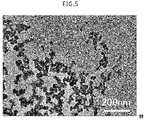
- the observation condition was the acceleration voltage of 80 kV, and the observation magnification of 25,000 times or more.
- the particle diameters (D) described in Table 2 are the primary particle diameters, and were calculated from the maximum distance between two points on the outer periphery of the microparticles, and the average value of the measured particle diameters of 100 particles was shown.
- the coefficient of variation (CV value) was calculated using the measured values of each particle.
- TEM-EDS 10 fields of view were measured, and Cl for Zn and Br for Zn were calculated from the atomic weight % of Zn, Cl and Br, and the average values were shown.
- the values of average primary particle diameters and coefficients of variation, ratios of Cl / Zn and Br / Zn in respective examples are as listed in Table 2.
- a wet cake of the obtained PG 58 was added to a 0.1 wt% aqueous solution of gum arabic to become a concentration of 1 wt%, and was subjected to the dispersion treatment for 30 minutes using an ultrasonic dispersing apparatus, for a sample for an ultraviolet visible spectrophotometer measurement. Thereafter, the obtained dispersion was diluted with 1 wt% aqueous solution of gum arabic to become a concentration of 0.005 wt% to prepare a measurement sample.
- An ultraviolet-visible spectrophotometer UV-2450 (Shimadzu Corporation) was used for the measurement.
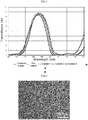
- FIG. 1 shows graphs of the spectral transmission characteristics of Examples according to the present invention and Comparative Example.
- Table 3 also shows the peak wavelengths (nm), the half value widths (nm) of the peak wavelengths, and the transmittances at each wavelength described in Table 3, in the spectral transmission characteristics of Examples and Comparative Example.
- Peak wavelength (nm) Half value width of peak wavelength (nm) Transmittance at each wavelength (%) 400 nm 450 nm Peak wavelength 600 nm 650 nm 750 nm 800 nm
- Example 1 533 117.0 0.606 20.909 86.269 20.535 0.101 0.499 12.448
- Example 2 533 119.6 0.940 22.443 87.381 20.057 0.189 0.813 14.397
- Example 3 528 103.6 0.276 13.173 84.721 9.618 0.108 0.473 13.969 Comparative Example 539 128.0 2.843 22.299 85.059 33.704 1.540 4.431 37.833 Bulk powders (Reference) 534 128.8 3.183 26.680 88.536 32.635 1.321 5.254 43.709
- narrowness of the half value widths of the peak wavelength indicates that color purity is high.
- Low transmittance at 400 nm and 450 nm in the blue range indicates good color separation from blue color.
- low transmittance at 600 nm and 650 nm indicates good color separation from red color.
- Low transmittance at 750 nm and 800 nm indicates low transmittance in the near infrared range, that is, small leakage of near infrared lights.
- height of the transmittance of the peak wavelength indicates high transmittance in the green range.
- a pigment composition for a green filter having high color purity can be provided in Examples 1 to 3, which have low transmittance in the blue range, low transmittance in the near infrared range, compared with the bulk powders of PG 58 (described as bulk powders in Table 3) and PG 58 of Comparative Example. Among them, it is understood that microparticles of a green pigment having particularly high color purity were obtained in Example 3.
Landscapes
- Chemical & Material Sciences (AREA)
- Organic Chemistry (AREA)
- Physics & Mathematics (AREA)
- Chemical Kinetics & Catalysis (AREA)
- General Physics & Mathematics (AREA)
- Optics & Photonics (AREA)
- Optical Filters (AREA)
Applications Claiming Priority (2)
| Application Number | Priority Date | Filing Date | Title |
|---|---|---|---|
| JP2016216754 | 2016-11-04 | ||
| PCT/JP2017/039381 WO2018084153A1 (fr) | 2016-11-04 | 2017-10-31 | Composition pigmentaire pour filtre vert et procédé pour sa production |
Publications (2)
| Publication Number | Publication Date |
|---|---|
| EP3536749A1 true EP3536749A1 (fr) | 2019-09-11 |
| EP3536749A4 EP3536749A4 (fr) | 2020-07-15 |
Family
ID=62076242
Family Applications (1)
| Application Number | Title | Priority Date | Filing Date |
|---|---|---|---|
| EP17866917.2A Pending EP3536749A4 (fr) | 2016-11-04 | 2017-10-31 | Composition pigmentaire pour filtre vert et procédé pour sa production |
Country Status (6)
| Country | Link |
|---|---|
| US (1) | US11180658B2 (fr) |
| EP (1) | EP3536749A4 (fr) |
| JP (1) | JP6931166B2 (fr) |
| KR (1) | KR102566682B1 (fr) |
| CN (2) | CN114525041A (fr) |
| WO (1) | WO2018084153A1 (fr) |
Families Citing this family (6)
| Publication number | Priority date | Publication date | Assignee | Title |
|---|---|---|---|---|
| TWI738310B (zh) * | 2019-12-09 | 2021-09-01 | 日商Dic股份有限公司 | 濾色器用鹵化鋅酞青素顏料、及濾色器用鹵化鋅酞青素顏料之製造方法 |
| US11976199B2 (en) | 2019-12-09 | 2024-05-07 | Dic Corporation | Halogenated zinc phthalocyanine pigment for color filter and method for producing halogenated zinc phthalocyanine pigment for color filter |
| US12221546B2 (en) | 2020-04-30 | 2025-02-11 | Dic Corporation | Method for producing halogenated zinc phthalocyanine pigment |
| US12139615B2 (en) | 2020-04-30 | 2024-11-12 | Dic Corporation | Method for producing halogenated zinc phthalocyanine pigment |
| JP6819823B1 (ja) | 2020-04-30 | 2021-01-27 | Dic株式会社 | ハロゲン化亜鉛フタロシアニン顔料の製造方法 |
| WO2021220498A1 (fr) * | 2020-04-30 | 2021-11-04 | Dic株式会社 | Pigment de phtalocyanine de zinc halogéné, et procédé de fabrication de celui-ci |
Family Cites Families (27)
| Publication number | Priority date | Publication date | Assignee | Title |
|---|---|---|---|---|
| JPS5147091B2 (fr) | 1971-09-30 | 1976-12-13 | ||
| JP2813674B2 (ja) | 1990-09-01 | 1998-10-22 | エム・テクニック株式会社 | 撹拌機及び流体の撹拌方法 |
| JP4208146B2 (ja) | 1996-02-02 | 2009-01-14 | 東京応化工業株式会社 | 緑色カラーフィルタ用感光性組成物、これを用いた緑色カラーフィルタの製造方法、得られた緑色カラーフィルタ及び該緑色カラーフィルタを備えたカラーフィルタ |
| JP3641093B2 (ja) | 1996-02-02 | 2005-04-20 | 東京応化工業株式会社 | 緑色カラーフィルタ用感光性組成物及びこれを用いた緑色カラーフィルタの製造方法 |
| JP2002194244A (ja) | 2000-12-25 | 2002-07-10 | Fuji Photo Film Co Ltd | 顔料分散組成物、それを用いた着色感光性組成物及びカラーフィルタ |
| DE60212345T2 (de) * | 2001-02-23 | 2007-05-24 | Dainippon Ink And Chemicals, Inc. | Farbfilter |
| JP4407097B2 (ja) | 2001-02-23 | 2010-02-03 | Dic株式会社 | カラーフィルター |
| JP4797432B2 (ja) | 2005-05-06 | 2011-10-19 | 凸版印刷株式会社 | 受光素子 |
| JP5233161B2 (ja) * | 2007-05-16 | 2013-07-10 | 東洋インキScホールディングス株式会社 | 微細ポリハロゲン化フタロシアニン顔料、その製造方法及びそれを用いた着色組成物 |
| JP4817154B2 (ja) | 2007-07-06 | 2011-11-16 | エム・テクニック株式会社 | 強制超薄膜回転式処理法を用いたナノ粒子の製造方法 |
| CN101795772B (zh) * | 2007-07-06 | 2013-09-18 | M技术株式会社 | 使用强制超薄膜旋转式处理法的纳米粒子的制造方法 |
| JP5648986B2 (ja) | 2007-11-02 | 2015-01-07 | エム・テクニック株式会社 | 流体処理装置及び流体処理方法 |
| US8277697B2 (en) * | 2008-10-29 | 2012-10-02 | Global Oled Technology Llc | Color filter element with improved colorant dispersion |
| US8087942B2 (en) * | 2008-10-30 | 2012-01-03 | Cheng Uei Precision Industry Co., Ltd. | Board-to-board connector assembly |
| EP2428536B1 (fr) * | 2009-03-03 | 2019-04-03 | M. Technique Co., Ltd. | Procédé de traitement de surface de fines particules de pigment |
| JP5834379B2 (ja) | 2009-06-25 | 2015-12-24 | Jsr株式会社 | 着色組成物、カラーフィルタ及びカラー液晶表示素子 |
| JP5561985B2 (ja) | 2009-09-30 | 2014-07-30 | 東洋インキScホールディングス株式会社 | カラーフィルタ用緑色着色組成物およびカラーフィルタ |
| KR20110123668A (ko) * | 2010-05-07 | 2011-11-15 | 후지필름 가부시키가이샤 | 착색 감광성 조성물, 컬러 필터의 제조 방법, 컬러 필터 및 액정 표시 장치 |
| KR101892948B1 (ko) * | 2010-11-24 | 2018-08-29 | 엠. 테크닉 가부시키가이샤 | 고용체 안료 나노 입자 및 고용비가 제어된 고용체 안료 나노 입자의 제조 방법 |
| KR101305988B1 (ko) * | 2011-09-28 | 2013-09-12 | 한국생산기술연구원 | 분무방식을 이용한 유기안료 재결정화 방법 |
| JP2013092684A (ja) | 2011-10-26 | 2013-05-16 | Dainippon Printing Co Ltd | カラーフィルタ用緑色組成物およびカラーフィルタ |
| JP5915205B2 (ja) | 2012-01-30 | 2016-05-11 | 凸版印刷株式会社 | 液晶表示基板及び液晶表示装置 |
| KR101954110B1 (ko) | 2012-07-13 | 2019-03-05 | 엠. 테크닉 가부시키가이샤 | 교반기 |
| JP5445643B2 (ja) | 2012-09-04 | 2014-03-19 | 凸版印刷株式会社 | 撮像素子 |
| JP2014191000A (ja) * | 2013-03-26 | 2014-10-06 | Toyo Ink Sc Holdings Co Ltd | カラーフィルタ用顔料組成物とその製造方法およびそれを用いた着色組成物、カラーフィルタ |
| KR101616774B1 (ko) * | 2013-09-24 | 2016-04-29 | 디아이씨 가부시끼가이샤 | 액정 표시 장치 |
| JP6488575B2 (ja) | 2014-07-10 | 2019-03-27 | Agc株式会社 | 近赤外線吸収構造体 |
-
2017
- 2017-10-31 WO PCT/JP2017/039381 patent/WO2018084153A1/fr not_active Ceased
- 2017-10-31 CN CN202210170139.5A patent/CN114525041A/zh active Pending
- 2017-10-31 JP JP2018549020A patent/JP6931166B2/ja active Active
- 2017-10-31 CN CN201780065466.1A patent/CN109863208B/zh active Active
- 2017-10-31 US US16/347,500 patent/US11180658B2/en active Active
- 2017-10-31 EP EP17866917.2A patent/EP3536749A4/fr active Pending
- 2017-10-31 KR KR1020197014800A patent/KR102566682B1/ko active Active
Also Published As
| Publication number | Publication date |
|---|---|
| EP3536749A4 (fr) | 2020-07-15 |
| CN109863208B (zh) | 2022-02-08 |
| KR20190082244A (ko) | 2019-07-09 |
| US20190256711A1 (en) | 2019-08-22 |
| CN114525041A (zh) | 2022-05-24 |
| KR102566682B1 (ko) | 2023-08-14 |
| US11180658B2 (en) | 2021-11-23 |
| WO2018084153A1 (fr) | 2018-05-11 |
| CN109863208A (zh) | 2019-06-07 |
| JP6931166B2 (ja) | 2021-09-01 |
| JPWO2018084153A1 (ja) | 2019-09-19 |
Similar Documents
| Publication | Publication Date | Title |
|---|---|---|
| US11180658B2 (en) | Pigment composition for green filter and production method thereof | |
| KR101954112B1 (ko) | 고내열성 프탈로시아닌 | |
| TW201704363A (zh) | 有機顏料微粒子分散體及其製造方法,使用該有機顏料微粒子分散體之彩色濾光片之製造方法及藉由該方法所得之彩色濾光片 | |
| JP6698989B2 (ja) | 複合フタロシアニン微粒子およびその製造方法 | |
| JP2022105598A (ja) | 有機顔料組成物の製造方法、塗膜の製造方法及び塗膜の輝度の評価方法 | |
| US20230287218A1 (en) | Halogenated zinc phthalocyanine pigment and production method for same | |
| US10611915B2 (en) | Method for producing organic pigment microparticles | |
| JP2012203083A (ja) | 可視近赤外光遮蔽黒色膜、可視近赤外光遮蔽黒色膜付き基材、及び固体撮像素子 | |
| JP5205703B2 (ja) | カラーフィルター用顔料分散液の製造方法、カラーフィルター用ペーストおよびカラーフィルター | |
| WO2023013657A1 (fr) | Particules de couleur structurelle, et pigment de couleur structurelle contenant celles-ci | |
| EP0965865A1 (fr) | Nanoparticules dans réseaux de filtres couleurs | |
| JP2008107530A (ja) | 感光性着色組成物およびこれを用いた光学部材 | |
| JP2022131235A (ja) | トナー及び画像の読み取り方法 |
Legal Events
| Date | Code | Title | Description |
|---|---|---|---|
| STAA | Information on the status of an ep patent application or granted ep patent |
Free format text: STATUS: THE INTERNATIONAL PUBLICATION HAS BEEN MADE |
|
| PUAI | Public reference made under article 153(3) epc to a published international application that has entered the european phase |
Free format text: ORIGINAL CODE: 0009012 |
|
| STAA | Information on the status of an ep patent application or granted ep patent |
Free format text: STATUS: REQUEST FOR EXAMINATION WAS MADE |
|
| 17P | Request for examination filed |
Effective date: 20190517 |
|
| AK | Designated contracting states |
Kind code of ref document: A1 Designated state(s): AL AT BE BG CH CY CZ DE DK EE ES FI FR GB GR HR HU IE IS IT LI LT LU LV MC MK MT NL NO PL PT RO RS SE SI SK SM TR |
|
| AX | Request for extension of the european patent |
Extension state: BA ME |
|
| DAV | Request for validation of the european patent (deleted) | ||
| DAX | Request for extension of the european patent (deleted) | ||
| A4 | Supplementary search report drawn up and despatched |
Effective date: 20200616 |
|
| RIC1 | Information provided on ipc code assigned before grant |
Ipc: G02B 5/20 20060101AFI20200609BHEP |
|
| STAA | Information on the status of an ep patent application or granted ep patent |
Free format text: STATUS: EXAMINATION IS IN PROGRESS |
|
| 17Q | First examination report despatched |
Effective date: 20220629 |