EP3536802A1 - Marker zur wirksamkeitsbestimmung bei der behandlung von erkrankungen durch pd-1-signalhemmer - Google Patents
Marker zur wirksamkeitsbestimmung bei der behandlung von erkrankungen durch pd-1-signalhemmer Download PDFInfo
- Publication number
- EP3536802A1 EP3536802A1 EP17867434.7A EP17867434A EP3536802A1 EP 3536802 A1 EP3536802 A1 EP 3536802A1 EP 17867434 A EP17867434 A EP 17867434A EP 3536802 A1 EP3536802 A1 EP 3536802A1
- Authority
- EP
- European Patent Office
- Prior art keywords
- cells
- signal inhibitor
- subject
- therapy
- antibody
- Prior art date
- Legal status (The legal status is an assumption and is not a legal conclusion. Google has not performed a legal analysis and makes no representation as to the accuracy of the status listed.)
- Granted
Links
Images






Classifications
-
- G—PHYSICS
- G01—MEASURING; TESTING
- G01N—INVESTIGATING OR ANALYSING MATERIALS BY DETERMINING THEIR CHEMICAL OR PHYSICAL PROPERTIES
- G01N33/00—Investigating or analysing materials by specific methods not covered by groups G01N1/00 - G01N31/00
- G01N33/48—Biological material, e.g. blood, urine; Haemocytometers
- G01N33/483—Physical analysis of biological material
- G01N33/487—Physical analysis of biological material of liquid biological material
- G01N33/49—Blood
- G01N33/492—Determining multiple analytes
-
- C—CHEMISTRY; METALLURGY
- C12—BIOCHEMISTRY; BEER; SPIRITS; WINE; VINEGAR; MICROBIOLOGY; ENZYMOLOGY; MUTATION OR GENETIC ENGINEERING
- C12Q—MEASURING OR TESTING PROCESSES INVOLVING ENZYMES, NUCLEIC ACIDS OR MICROORGANISMS; COMPOSITIONS OR TEST PAPERS THEREFOR; PROCESSES OF PREPARING SUCH COMPOSITIONS; CONDITION-RESPONSIVE CONTROL IN MICROBIOLOGICAL OR ENZYMOLOGICAL PROCESSES
- C12Q1/00—Measuring or testing processes involving enzymes, nucleic acids or microorganisms; Compositions therefor; Processes of preparing such compositions
- C12Q1/008—Measuring or testing processes involving enzymes, nucleic acids or microorganisms; Compositions therefor; Processes of preparing such compositions for determining co-enzymes or co-factors, e.g. NAD, ATP
-
- A—HUMAN NECESSITIES
- A61—MEDICAL OR VETERINARY SCIENCE; HYGIENE
- A61K—PREPARATIONS FOR MEDICAL, DENTAL OR TOILETRY PURPOSES
- A61K39/00—Medicinal preparations containing antigens or antibodies
- A61K39/395—Antibodies; Immunoglobulins; Immune serum, e.g. antilymphocytic serum
-
- A—HUMAN NECESSITIES
- A61—MEDICAL OR VETERINARY SCIENCE; HYGIENE
- A61K—PREPARATIONS FOR MEDICAL, DENTAL OR TOILETRY PURPOSES
- A61K45/00—Medicinal preparations containing active ingredients not provided for in groups A61K31/00 - A61K41/00
-
- A—HUMAN NECESSITIES
- A61—MEDICAL OR VETERINARY SCIENCE; HYGIENE
- A61P—SPECIFIC THERAPEUTIC ACTIVITY OF CHEMICAL COMPOUNDS OR MEDICINAL PREPARATIONS
- A61P31/00—Antiinfectives, i.e. antibiotics, antiseptics, chemotherapeutics
-
- A—HUMAN NECESSITIES
- A61—MEDICAL OR VETERINARY SCIENCE; HYGIENE
- A61P—SPECIFIC THERAPEUTIC ACTIVITY OF CHEMICAL COMPOUNDS OR MEDICINAL PREPARATIONS
- A61P35/00—Antineoplastic agents
-
- A—HUMAN NECESSITIES
- A61—MEDICAL OR VETERINARY SCIENCE; HYGIENE
- A61P—SPECIFIC THERAPEUTIC ACTIVITY OF CHEMICAL COMPOUNDS OR MEDICINAL PREPARATIONS
- A61P37/00—Drugs for immunological or allergic disorders
- A61P37/02—Immunomodulators
- A61P37/04—Immunostimulants
-
- A—HUMAN NECESSITIES
- A61—MEDICAL OR VETERINARY SCIENCE; HYGIENE
- A61P—SPECIFIC THERAPEUTIC ACTIVITY OF CHEMICAL COMPOUNDS OR MEDICINAL PREPARATIONS
- A61P43/00—Drugs for specific purposes, not provided for in groups A61P1/00-A61P41/00
-
- C—CHEMISTRY; METALLURGY
- C07—ORGANIC CHEMISTRY
- C07K—PEPTIDES
- C07K16/00—Immunoglobulins [IG], e.g. monoclonal or polyclonal antibodies
- C07K16/18—Immunoglobulins [IG], e.g. monoclonal or polyclonal antibodies against material from animals or humans
- C07K16/28—Immunoglobulins [IG], e.g. monoclonal or polyclonal antibodies against material from animals or humans against receptors, cell surface antigens or cell surface determinants
- C07K16/2803—Immunoglobulins [IG], e.g. monoclonal or polyclonal antibodies against material from animals or humans against receptors, cell surface antigens or cell surface determinants against the immunoglobulin superfamily
- C07K16/2818—Immunoglobulins [IG], e.g. monoclonal or polyclonal antibodies against material from animals or humans against receptors, cell surface antigens or cell surface determinants against the immunoglobulin superfamily against CD28 or CD152
-
- C—CHEMISTRY; METALLURGY
- C07—ORGANIC CHEMISTRY
- C07K—PEPTIDES
- C07K16/00—Immunoglobulins [IG], e.g. monoclonal or polyclonal antibodies
- C07K16/18—Immunoglobulins [IG], e.g. monoclonal or polyclonal antibodies against material from animals or humans
- C07K16/28—Immunoglobulins [IG], e.g. monoclonal or polyclonal antibodies against material from animals or humans against receptors, cell surface antigens or cell surface determinants
- C07K16/2803—Immunoglobulins [IG], e.g. monoclonal or polyclonal antibodies against material from animals or humans against receptors, cell surface antigens or cell surface determinants against the immunoglobulin superfamily
- C07K16/2827—Immunoglobulins [IG], e.g. monoclonal or polyclonal antibodies against material from animals or humans against receptors, cell surface antigens or cell surface determinants against the immunoglobulin superfamily against B7 molecules, e.g. CD80, CD86
-
- C—CHEMISTRY; METALLURGY
- C12—BIOCHEMISTRY; BEER; SPIRITS; WINE; VINEGAR; MICROBIOLOGY; ENZYMOLOGY; MUTATION OR GENETIC ENGINEERING
- C12Q—MEASURING OR TESTING PROCESSES INVOLVING ENZYMES, NUCLEIC ACIDS OR MICROORGANISMS; COMPOSITIONS OR TEST PAPERS THEREFOR; PROCESSES OF PREPARING SUCH COMPOSITIONS; CONDITION-RESPONSIVE CONTROL IN MICROBIOLOGICAL OR ENZYMOLOGICAL PROCESSES
- C12Q1/00—Measuring or testing processes involving enzymes, nucleic acids or microorganisms; Compositions therefor; Processes of preparing such compositions
- C12Q1/02—Measuring or testing processes involving enzymes, nucleic acids or microorganisms; Compositions therefor; Processes of preparing such compositions involving viable microorganisms
-
- G—PHYSICS
- G01—MEASURING; TESTING
- G01N—INVESTIGATING OR ANALYSING MATERIALS BY DETERMINING THEIR CHEMICAL OR PHYSICAL PROPERTIES
- G01N33/00—Investigating or analysing materials by specific methods not covered by groups G01N1/00 - G01N31/00
- G01N33/48—Biological material, e.g. blood, urine; Haemocytometers
- G01N33/50—Chemical analysis of biological material, e.g. blood, urine; Testing involving biospecific ligand binding methods; Immunological testing
- G01N33/5005—Chemical analysis of biological material, e.g. blood, urine; Testing involving biospecific ligand binding methods; Immunological testing involving human or animal cells
- G01N33/5008—Chemical analysis of biological material, e.g. blood, urine; Testing involving biospecific ligand binding methods; Immunological testing involving human or animal cells for testing or evaluating the effect of chemical or biological compounds, e.g. drugs, cosmetics
- G01N33/5011—Chemical analysis of biological material, e.g. blood, urine; Testing involving biospecific ligand binding methods; Immunological testing involving human or animal cells for testing or evaluating the effect of chemical or biological compounds, e.g. drugs, cosmetics for testing antineoplastic activity
-
- G—PHYSICS
- G01—MEASURING; TESTING
- G01N—INVESTIGATING OR ANALYSING MATERIALS BY DETERMINING THEIR CHEMICAL OR PHYSICAL PROPERTIES
- G01N33/00—Investigating or analysing materials by specific methods not covered by groups G01N1/00 - G01N31/00
- G01N33/48—Biological material, e.g. blood, urine; Haemocytometers
- G01N33/50—Chemical analysis of biological material, e.g. blood, urine; Testing involving biospecific ligand binding methods; Immunological testing
- G01N33/53—Immunoassay; Biospecific binding assay; Materials therefor
- G01N33/575—Immunoassay; Biospecific binding assay; Materials therefor for cancer
-
- G—PHYSICS
- G01—MEASURING; TESTING
- G01N—INVESTIGATING OR ANALYSING MATERIALS BY DETERMINING THEIR CHEMICAL OR PHYSICAL PROPERTIES
- G01N33/00—Investigating or analysing materials by specific methods not covered by groups G01N1/00 - G01N31/00
- G01N33/48—Biological material, e.g. blood, urine; Haemocytometers
- G01N33/50—Chemical analysis of biological material, e.g. blood, urine; Testing involving biospecific ligand binding methods; Immunological testing
- G01N33/68—Chemical analysis of biological material, e.g. blood, urine; Testing involving biospecific ligand binding methods; Immunological testing involving proteins, peptides or amino acids
-
- G—PHYSICS
- G01—MEASURING; TESTING
- G01N—INVESTIGATING OR ANALYSING MATERIALS BY DETERMINING THEIR CHEMICAL OR PHYSICAL PROPERTIES
- G01N33/00—Investigating or analysing materials by specific methods not covered by groups G01N1/00 - G01N31/00
- G01N33/48—Biological material, e.g. blood, urine; Haemocytometers
- G01N33/50—Chemical analysis of biological material, e.g. blood, urine; Testing involving biospecific ligand binding methods; Immunological testing
- G01N33/68—Chemical analysis of biological material, e.g. blood, urine; Testing involving biospecific ligand binding methods; Immunological testing involving proteins, peptides or amino acids
- G01N33/6803—General methods of protein analysis not limited to specific proteins or families of proteins
- G01N33/6806—Determination of free amino acids
- G01N33/6812—Assays for specific amino acids
-
- G—PHYSICS
- G01—MEASURING; TESTING
- G01N—INVESTIGATING OR ANALYSING MATERIALS BY DETERMINING THEIR CHEMICAL OR PHYSICAL PROPERTIES
- G01N33/00—Investigating or analysing materials by specific methods not covered by groups G01N1/00 - G01N31/00
- G01N33/48—Biological material, e.g. blood, urine; Haemocytometers
- G01N33/50—Chemical analysis of biological material, e.g. blood, urine; Testing involving biospecific ligand binding methods; Immunological testing
- G01N33/68—Chemical analysis of biological material, e.g. blood, urine; Testing involving biospecific ligand binding methods; Immunological testing involving proteins, peptides or amino acids
- G01N33/6872—Intracellular protein regulatory factors and their receptors, e.g. including ion channels
-
- G—PHYSICS
- G01—MEASURING; TESTING
- G01N—INVESTIGATING OR ANALYSING MATERIALS BY DETERMINING THEIR CHEMICAL OR PHYSICAL PROPERTIES
- G01N2333/00—Assays involving biological materials from specific organisms or of a specific nature
- G01N2333/435—Assays involving biological materials from specific organisms or of a specific nature from animals; from humans
- G01N2333/705—Assays involving receptors, cell surface antigens or cell surface determinants
- G01N2333/70503—Immunoglobulin superfamily, e.g. VCAMs, PECAM, LFA-3
- G01N2333/70532—B7 molecules, e.g. CD80, CD86
-
- G—PHYSICS
- G01—MEASURING; TESTING
- G01N—INVESTIGATING OR ANALYSING MATERIALS BY DETERMINING THEIR CHEMICAL OR PHYSICAL PROPERTIES
- G01N2570/00—Omics, e.g. proteomics, glycomics or lipidomics; Methods of analysis focusing on the entire complement of classes of biological molecules or subsets thereof, i.e. focusing on proteomes, glycomes or lipidomes
-
- G—PHYSICS
- G01—MEASURING; TESTING
- G01N—INVESTIGATING OR ANALYSING MATERIALS BY DETERMINING THEIR CHEMICAL OR PHYSICAL PROPERTIES
- G01N2800/00—Detection or diagnosis of diseases
- G01N2800/52—Predicting or monitoring the response to treatment, e.g. for selection of therapy based on assay results in personalised medicine; Prognosis
-
- G—PHYSICS
- G01—MEASURING; TESTING
- G01N—INVESTIGATING OR ANALYSING MATERIALS BY DETERMINING THEIR CHEMICAL OR PHYSICAL PROPERTIES
- G01N2800/00—Detection or diagnosis of diseases
- G01N2800/70—Mechanisms involved in disease identification
- G01N2800/7023—(Hyper)proliferation
- G01N2800/7028—Cancer
Definitions
- the present invention relates to markers for judging the efficacy of disease therapies with PD-1 signal inhibitors.
- Non-Patent Documents Nos. 1-3 The response rate of PD-1 antibody therapy was 20-30% when used alone and 60-70% when combined with other therapies, showing a dramatic improvement compared to conventional immunotherapies. However, about one half of the patients were non-responsive. Little is known about why those patients are non-responsive to the PD-1 antibody therapy.
- the present inventors have measured blood metabolites in mice treated with PD-1 blockade antibody and found that tricarboxylic acid (TCA) cycle-related metabolites in the serum were significantly reduced in treated mouse group compared to non-treated mouse group. This is consistent with the finding that TCA cycle-related metabolites are reduced in PD-1 knockout (PD-1 -/- ) mice. Therefore, it is believed that the efficacy of PD-1 antibody therapy (i.e., whether the administration of PD-1 antibody inhibits the tumor growth or not) can be judged by measuring the absolute levels of these TCA cycle-related metabolites and compared the changes in these metabolites before and after administration of PD-1 antibody.
- TCA tricarboxylic acid
- OCR oxygen consumption rate
- ATP ATP turnover calculated therefrom in killer T cells are higher in PD-1 blockade treated group than untreated group for cancers sensitive to the PD-1 inhibitory antibody therapy, but this not the case for non-sensitive cancers. This suggests that OCR and ATP turnover could serve as biomarkers for predicting the efficacy of the PD-1 blockade therapy.
- T-bet in killer T cells increases after administration of anti-PD-Ll antibody in the treated mice with cancer sensitive to the PD-1 inhibitory antibody therapy. This suggests that increase in T-bet expression could also be one of the biomarkers.
- the present inventors have confirmed that the concentrations of amino acid metabolism-related metabolites and derivatives thereof in the serum or plasma and uptake of amino acids into T cells could also serve as indicators of T cell activation during the PD-1 blockade therapy.
- T cell activation is necessary, and what have been described above can be indicators of T cell activation. Further, using plasma samples from cancer patients, the present inventors have confirmed that levels of metabolites relating to intestinal flora that regulates T cell activation capacity and energy metabolism-related metabolites as an indicator of T cell activation could also be served as markers for judging the efficacy of PD-1 inhibitory antibody therapy.
- Intestinal flora is already known to be responsible for regulating T cell activation capacity and, from the above-described finding, the present inventors have noted that the T cell-mediated anti-tumor immunological competence through the PD-1 blockade therapy can be predicted by examining intestinal flora-related metabolism. While therapeutic effect is believed to be high in those patients whose T cells have been activated as a result of inhibition of PD-1 signal, it is believed that oxygen consumption and ATP turnover in mitochondria, T-bet, intestinal flora-related metabolites, amino acids, amino acid metabolism-related metabolites and derivatives thereof, as well as energy metabolism (including TCA cycle)-related metabolites can be indicators of T cell activation.
- the present invention provides a test method comprising predicting or judging the efficacy of therapy with a PD-1 signal inhibitor based on metabolic changes relating to mitochondrial activity in T cells and/or T cell activation in a subject.
- a surrogate indicator of metabolic changes relating to mitochondrial activity in T cells and/or T cell activation may be used as a biomarker for predicting or judging the efficacy of therapy with a PD-1 signal inhibitor.
- the PD-1 signal inhibitor may be administered to the subject in a therapeutically effective amount.
- Surrogate indicators of metabolic changes relating to mitochondrial activity in T cells and/or T cell activation in a subject include, but are not limited to, oxygen consumption rate and/or ATP turnover (especially in peripheral blood CD8 + cells), T-bet (especially in peripheral blood CD8 + cells), intestinal flora-related metabolites (especially in the serum or plasma), energy metabolism-related metabolites (especially in the serum or plasma), amino acid metabolism-related metabolites and derivatives thereof (especially in the serum or plasma), as well as amino acids (especially in T cells).
- Energy metabolism-related metabolites include, but are not limited to, TCA cycle-related metabolites, glycolytic pathway-related metabolites, oxidative phosphorylation-related metabolites, lipid metabolism-related metabolites, and the pentose phosphate cycle. Amino acids are also included in the amino acid metabolism-related metabolites.
- a surrogate indicator of metabolic changes relating to mitochondrial activity in T cells and/or T cell activation in a subject may be measured before administration of a PD-1 signal inhibitor to predict the effect thereof.
- such a surrogate indicator may be measured before and after administration of a PD-1 signal inhibitor to judge the effect thereof.
- OCR and/or ATP turnover in the peripheral blood CD8 + cells of a subject is measured before administration of a PD-1 signal inhibitor; and if the level is high, it is predicted that therapy with the PD-1 inhibitor would be effective.
- OCR and/or ATP turnover in peripheral blood CD8 + cells of a subject before and after administration of a PD-1 inhibitor is measured; and if the OCR and/or ATP turnover after administration of the PD-1 inhibitor is higher than that before administration, therapy with the PD-1 inhibitor is judged to be effective.
- the thier levels may be defined as "high”. If a cut-off value can be set, a greater value than that may be regarded as "high” level.
- Peripheral blood CD8 + cells may be collected as described below. Briefly, a blood sample collected from a patient is overlayerd on Ficoll and centrifuged at 2000 rpm. The resultant buffy coat between an erythrocyte layer and a plasma layer is recovered and washed in a cell culture medium. CD8 + T cells are isolated from the resultant lymphocytes using a magnetic cell separator (Miltenyi Biotec).
- Oxygen consumption rate may be measured with XF96 Extracellular Flux analyzer (Seahorse Biosciences). Isolated CD8 + T cells are seeded in a dedicated cell culture plate, which is then covered with a sensor cartridge. Oligomycin, FCCP, antimycin A and rotenone were injected into the injection ports of the sensor cartridge. The plate and the cartridge are mounted in the analyzer. Oxygen concentration and hydrogen ion concentration in the semi-closed microenvironment between cells and the sensor are measured.
- ATP turnover OCR immediately before administration of oligomycin ⁇ OCR immediately after administration of oligomycin
- OCR and/or ATP turnover in peripheral blood CD8 + cells may be used as a biomarker for predicting or judging the efficacy of therapy with a PD-1 signal inhibitor.
- OCR and/or ATP turnover in peripheral blood CD8 + cells of a subject before administration of a PD-1 inhibitor may be measured; and if the level is high, the PD-1 signal inhibitor may be administered to the subject in a therapeutically effective amount.
- OCR and/or ATP turnover in peripheral blood CD8 + cells of a subject before and after administration of a PD-1 inhibitor may be measured; and if the OCR and/or ATP turnover after administration is higher than that before administration, the PD-1 inhibitor may be further administered to the subject in a therapeutically effective amount.
- expression of T-bet in peripheral blood CD8 + cells in a subject before administration of the PD-1 signal inhibitor is measured; and if the level is high, it is assumed that therapy with the PD-1 signal inhibitor would be effective.
- expression of T-bet in peripheral blood CD8 + cells in a subject before and after administration of the PD-1 signal inhibitor is measured; and if the expression of T-bet after administration is higher than that of before administration, it suggets that therapy with the PD-1 signal inhibitor would be effective.
- the expression level of T-bet in peripheral blood CD8 + cells in a subject may be considered to be "high” if the levels of the responders are higher than the non-responders to the PD-1 signal inhibitor. If a cut-off value can be set, a greater value than that may be regarded as "high" level.
- T-bet is a transcription factor which is required for increasing the cytotoxic activity or IFN- ⁇ production of killer T (CD8 + T) cells.
- T-bet may be measured as described below. After staining a cell surface marker such as CD8, CD44 or CD62L, cells are fixed and permeabilized. Then, the inside of cell nuclei was stained with an anti-T-bet antibody. After the staining, flow cytometry analysis is performed.
- a cell surface marker such as CD8, CD44 or CD62L
- T-bet in peripheral blood CD8 + cells may be used as a biomarker for predicting or judging the efficacy of therapy with a PD-1 signal inhibitor.
- T-bet in peripheral blood CD8 + cells derived from a subject before administration of a PD-1 signal inhibitor may be measured; and if the expression level is high, the PD-1 signal inhibitor may be administered to the subject in a therapeutically effective amount.
- expression of T-bet in peripheral blood CD8 + cells from a subject before and after administration of a PD-1 signal inhibitor may be measured; and if expression of T-bet in peripheral blood CD8 + cells after administration of the PD-1 inhibitor is higher than the level before administration, the PD-1 inhibitor may be further administered to the subject in a therapeutically effective amount.
- the level (concentration) of an intestinal flora-related metabolite in the serum or plasma derived from a subject before the administration of a PD-1 signal inhibitor may be measured; and if the level (concentration) is high or low (depending on the items), it is assumed that the therapy with the PD-1 signal inhibitor would be effective.
- the level (concentration) of an intestinal flora-related metabolite in the serum or plasma derived from a subject before and after administration of a PD-1 signal inhibitor is measured; and if the level (concentration) of the metabolite after administration has altered from the level before administration, it is judged that therapy with the PD-1 signal inhibitor is effective.
- the level (concentration) of an intestinal flora-related metabolite in the serum or plasma derived from a subject may be considered to be “high” or “low” if the level of responders is higher or lower than the non-responders. If a cut-off value can be set, a value above or below it may be regarded as “high” or "low”.
- intestinal flora is an important factor which regulates T cell-mediated immunoreactions. Therefore, intestinal flora is one of those factors which affect the therapeutic effect after PD-1 inhibitory antibody therapy.
- intestinal flora is one of those factors which affect the therapeutic effect after PD-1 inhibitory antibody therapy.
- Several bacterial species in the intestinal flora are known to be involved in T cell activation and metabolites produced by these bacterial species can be detected by examining related metabolites in the blood.
- either one metabolite or a combination of two or more metabolites may be measured.
- Intestinal flora-related metabolites may be measured by mass spectrometry (e.g., GC-MS or LCMS).
- mass spectrometry e.g., GC-MS or LCMS.
- an intestinal flora-related metabolite in the serum or plasma may be used as a biomarker for predicting or judging the efficacy of therapy with a PD-1 signal inhibitor.
- the level (concentration) of an intestinal flora-related metabolite in the serum or plasma derived from a subject before administration of a PD-1 signal inhibitor may be measured; and if the level is high or low, the PD-1 signal inhibitor may be administered to the subject in a therapeutically effective amount.
- the level (concentration) of an intestinal flora-related metabolite in the serum or plasma in a subject before and after administration of a PD-1 signal inhibitor may be measured; and if the level (concentration) of the intestinal flora-related metabolite in the serum or plasma after administration of the PD-1 signal inhibitor has altered from the level before administration, the PD-1 signal inhibitor may be further administered to the subject in a therapeutically effective amount.
- the level (concentration) of an energy metabolism-related metabolite (such as TCA cycle-related metabolites, glycolytic pathway-related metabolites, oxidative phosphorylation-related metabolites, lipid metabolism-related metabolites, or pentose phosphate cycle-related metabolites) in the serum or plasma derived from a subject before administration of a PD-1 signal inhibitor is measured; and if the level (concentration) is high or low, it is predicted that therapy with the PD-1 signal inhibitor would be effective.
- an energy metabolism-related metabolite such as TCA cycle-related metabolites, glycolytic pathway-related metabolites, oxidative phosphorylation-related metabolites, lipid metabolism-related metabolites, or pentose phosphate cycle-related metabolites
- the level (concentration) of an energy metabolism-related metabolite (such as TCA cycle-related metabolites, glycolytic pathway-related metabolites, oxidative phosphorylation-related metabolites, lipid metabolism-related metabolites, or pentose phosphate cycle-related metabolites) in the serum or plasma derived from a subject before and after administration of a PD-1 signal inhibitor is measured; and if the level (concentration) of the energy metabolism-related metabolite (such as TCA cycle-related metabolites, glycolytic pathway-related metabolites, oxidative phosphorylation-related metabolites, lipid metabolism-related metabolites, or pentose phosphate cycle-related metabolites) after administration of the PD-1 signal inhibitor has altered from the level before administration, it is judged that the therapy with the PD-1 signal inhibitor is effective.
- an energy metabolism-related metabolite such as TCA cycle-related metabolites, glycolytic pathway-related metabolites, oxidative phosphorylation-related metabolites
- the level (concentration) of an energy metabolism-related metabolite may be defined as “high” or “low” if the level of responders is higher or lower than non-responders to the PD-1 signal inhibitor. If a cut-off value can be set, a value above or below it may be regarded as “high” or “low”.
- the TCA cycle is a metabolic pathway in which the acetyl group in acetyl-CoA is completely oxidized into CO 2 and H 2 O.
- TCA cycle-related metabolites include, but are not limited to, oxaloacetic acid, citric acid, cis-aconitic acid, isocitric acid, oxalosuccinic acid, 2-oxoglutaric acid, succinyl-CoA, succinic acid, fumaric acid, L-malic acid and oxaloacetic acid.
- the glycolytic pathway governs the production of those metabolites which are fed into the TCA cycle. Since part of the glycolytic pathway is also incorporated in the pentose phosphate cycle necessary for nucleic acid synthesis, the glycolytic pathway is critical for cell division and activation.
- Oxidative phosphorylation is an essential pathway for energy production and is the substantial part of the electron transport chain.
- Fatty acid oxidation is a pathway through which fats and lipids are degraded.
- the degraded fats and lipids are fed into the TCA cycle as acetyl CoA and used as energy sources.
- the pentose phosphate cycle is a pathway which produces not only components necessary for nucleic acid synthesis but also reducing agents.
- either one metabolite or a combination of two or more metabolites may be measured.
- Energy metabolism-related metabolites may be measured by mass spectrometry (e.g., GC-MS or LCMS).
- energy metabolism-related metabolites such as TCA cycle-related metabolites, glycolytic pathway-related metabolites, oxidative phosphorylation-related metabolites, lipid metabolism-related metabolites, or pentose phosphate cycle-related metabolites
- serum or plasma may be used as biomarkers for predicting or judging the efficacy of therapy with a PD-1 signal inhibitor.
- the level (concentration) of an energy metabolism-related metabolite (such as TCA cycle-related metabolites, glycolytic pathway-related metabolites, oxidative phosphorylation-related metabolites, lipid metabolism-related metabolites, or pentose phosphate cycle-related metabolites) in the serum or plasma derived from a subject before administration of a PD-1 signal inhibitor may be measured; and if the level is low or high, the PD-1 signal inhibitor may be administered to the subject in a therapeutically effective amount.
- an energy metabolism-related metabolite such as TCA cycle-related metabolites, glycolytic pathway-related metabolites, oxidative phosphorylation-related metabolites, lipid metabolism-related metabolites, or pentose phosphate cycle-related metabolites
- the level (concentration) of an energy metabolism-related metabolite (such as TCA cycle-related metabolites, glycolytic pathway-related metabolites, oxidative phosphorylation-related metabolites, lipid metabolism-related metabolites, or pentose phosphate cycle-related metabolites) in the serum or plasma derived from a subject before and after administration of a PD-1 signal inhibitor may be measured; and if the level (concentration) of the energy metabolism-related metabolite (such as TCA cycle-related metabolites, glycolytic pathway-related metabolites, oxidative phosphorylation-related metabolites, lipid metabolism-related metabolites, or pentose phosphate cycle-related metabolites) in the serum or plasma after administration of the PD-1 signal inhibitor has altered from the level before administration, the PD-1 signal inhibitor may be further administered to the subject in a therapeutically effective amount.
- an energy metabolism-related metabolite such as TCA cycle-related metabolites, glycolytic pathway-related metabolites, oxid
- the level (concentration) of an amino acid metabolism-related metabolite and/or a derivative thereof in the serum or plasma derived from a subject before administration of a PD-1 signal inhibitor is measured; and if the level is low or high, it is predicted that therapy with the PD-1 signal inhibitor will be effective.
- the level (concentration) of an amino acid metabolism-related metabolite and/or a derivative thereof in the serum or plasma derived from a subject before and after administration of a PD-1 signal inhibitor is measured; and if the level (concentration) of the amino acid metabolism-related metabolite and/or a derivative thereof in the serum or plasma after administration of the PD-1 signal inhibitor has altered from the level before administration, it is judged that therapy with the PD-1 signal inhibitor is effective.
- the level (concentration) of an amino acid metabolism-related metabolite and/or a derivative thereof in the serum or plasma derived from a subject may be considered to be “low” or "high” if the level is different from the corresponding level for non-responders to the PD-1 signal inhibitor. If a cut-off value can be set, a value above and below may be regarded as "high” or "low”.
- amino acid examples include, but are not limited to, tryptophan, phenylalanine, leucine, isoleucine, tyrosine, histidine, lysine, methionine, threonine, valine, alanine, arginine, asparagine, aspartic acid, cysteine, glutamic acid, glutamine, glycine, proline, serine, ornithine, citrulline and analogues thereof.
- the amino acid may be either one amino acid or a combination of two or more amino acids.
- the amino acid may be L-amino acid.
- Amino acids are components that constitute cytoskeletons when T cells are activated, and are essential for T cell activation. Amino acids are also produced from intestinal bacteria. Amino acid metabolism not only enters the TCA cycle and produces energy ultimately, but changes into neurotransmitters and plays an important role in controlling biorhythms in the human body.
- a derivative of amino acid metabolism-related metabolite means a substance generated from an amino acid metabolism-related metabolite in vivo.
- amino acid metabolism-related metabolites and/or derivatives thereof either one or a combination of two or more may be measured.
- Amino acid metabolism-related metabolites and/or derivatives thereof may be measured by mass spectrometry (e.g., GC-MS or LC-MS).
- an amino acid metabolism-related metabolite and/or a derivative thereof in the serum or plasma may be used as a biomarker for predicting or judging the efficacy of therapy with a PD-1 signal inhibitor.
- the level (concentration) of an amino acid metabolism-related metabolite and/or a derivative thereof in the serum or plasma derived from a subject before administration of a PD-1 signal inhibitor may be measured; and if the level is low or high, the PD-1 signal inhibitor may be administered to the subject in a therapeutically effective amount.
- the level (concentration) of an amino acid metabolism-related metabolite and/or a derivative thereof in the serum or plasma derived from a subject before and after administration of a PD-1 signal inhibitor may be measured; and if the level (concentration) after administration of the PD-1 signal inhibitor has altered from the level before administration, the PD-1 signal inhibitor may be further administered to the subject in a therapeutically effective amount.
- the level (concentration) of an amino acid in T cells derived from a subject before administration of a PD-1 signal inhibitor is measured; and if the level is high, it is predicted that therapy with the PD-1 signal inhibitor will be effective.
- the level (concentration) of an amino acid in T cells derived from a subject before and after administration of a PD-1 signal inhibitor is measured; and if the level (concentration) of the amino acid after administration of the PD-1 signal inhibitor has risen compared to the level before administration, it is judged that therapy with the PD-1 signal inhibitor is effective.
- the level (concentration) of an amino acid in T cells derived from a subject may be considered to be "high” if the level is higher than the corresponding level for non-responders to the PD-1 signal inhibitor. If a cut-off value can be set, a value higher than that may be regarded as "high".
- T cells may be collected as described below. Briefly, a blood sample collected from a patient is overlayerd on Ficoll and centrifuged at 2000 rpm. The resultant buffy coat between an erythrocyte layer and a plasma layer is recovered and washed in a cell culture medium. T cells are isolated from the resultant lymphocytes using a magnetic cell separator (Miltenyi Biotec) system.
- amino acid examples include, but are not limited to, tryptophan, phenylalanine, leucine, isoleucine, tyrosine, histidine, lysine, methionine, threonine, valine, alanine, arginine, asparagine, aspartic acid, cysteine, glutamic acid, glutamine, glycine, proline, serine, ornithine, citrulline and analogues thereof.
- amino acids either one amino acid or a combination of two or more amino acids may be measured.
- Amino acids may be L-amino acids.
- Amino acids may be measured by imaging mass spectrometry (such as MALDI-MS) or mass spectrometry (e.g., GC-MS or LC-MS).
- imaging mass spectrometry such as MALDI-MS
- mass spectrometry e.g., GC-MS or LC-MS.
- an amino acid in T cells may be used as a biomarker for predicting or judging the efficacy of therapy with a PD-1 signal inhibitor.
- the level (concentration) of an amino acid in T cells derived from a subject before administration of a PD-1 signal inhibitor may be measured; and if the level is high, the PD-1 signal inhibitor may be administered to the subject in a therapeutically effective amount.
- the level (concentration) of an amino acid in T cells derived from a subject before and after administration of a PD-1 signal inhibitor may be measured; and if the level after administration of PD-1 signal inhibitor has risen compared to the level before administration, the PD-1 signal inhibitor may be further administered to the subject in a therapeutically effective amount.
- the following substances were measured as intestinal flora-related metabolites, energy metabolism-related metabolites, and amino acid metabolism-related metabolites and derivatives thereof: phenol, lactic acid, 2-hydroxyisobutyric acid, caproic acid, glycolic acid, oxalic acid, 2-hydroxybutyric acid, 4-cresol, 3-hydroxybutyric acid, 3-hydroxyisobutyric acid, 2-hydroxyisovaleric acid, 2-aminobutyric acid, 3-hydroxyisovaleric acid, valine, octanoic acid, glycerol, phosphoric acid, proline, succinic acid, glyceric acid, fumaric acid, serine, threonine, decanoic acid, aspartic acid, methionine, lauric acid, citric acid, myristic acid, palmitoleic acid, palmitic acid, margaric acid, stearic acid, pyruvic acid, 2-oxoisocaproic acid, 2-aminoethanol
- PD-1 signal refers to the signal transduction mechanism which PD-1 bears.
- PD-1 inhibits T cell activation in collaboration with its ligands PD-L1 and PD-L2.
- PD-1 (Programmed cell death-1) is a membrane protein expressed in activated T cells and B cells. Its ligands PD-L1 and PD-L2 are expressed in various cells such as antigen-presenting cells (monocytes, dendritic cells, etc.) and cancer cells.
- PD-1, PD-L1 and PD-L2 work as inhibitory factors which inhibit T cell activation. Certain types of cancer cells and virus-infected cells escape from host immune surveillance by expressing the ligands of PD-1 to thereby inhibit T cell activation.
- PD-1 signal inhibitors substances which specifically bind to PD-1, PD-L1 or PD-L2 may be given. Such substances include, but are not limited to, proteins, polypeptides, oligopeptides, nucleic acids (including natural-type and artificial nucleic acids), low molecular weight organic compounds, inorganic compounds, cell extracts, and extracts from animals, plants, soils or the like. These substances may be either natural or synthetic products.
- Preferable PD-1 signal inhibitors are antibodies. More preferably, antibodies such as anti-PD-1 antibody, anti-PD-Ll antibody and anti-PD-L2 antibody may be given. Any type of antibody may be used as long as it is capable of inhibiting PD-1 signal.
- the antibody may be any of polyclonal antibody, monoclonal antibody, chimeric antibody, single chain antibody, humanized antibody or human-type antibody. Methods for preparing such antibodies are known.
- the antibody may be derived from any organisms such as human, mouse, rat, rabbit, goat or guinea pig.
- the term "antibody” is a concept encompassing antibodies of smaller molecular sizes such as Fab, F(ab)' 2 , ScFv, Diabody, V H , V L , Sc(Fv) 2 , Bispecific sc(Fv) 2 , Minibody, scFv-Fc monomer or scFv-Fc dimer.
- PD-1 signal inhibitors may be used as active ingredients in anticancer agents, anti-infective agents or combinations thereof.
- the present invention also provides a pharmaceutical composition
- a pharmaceutical composition comprising a PD-1 signal inhibitor as an active ingredient, which is used for a method of diagnosis and therapy for a disease, comprising predicting or judging the therapeutic efficacy of a PD-1 signal inhibitor based on metabolic changes relating to mitochondrial activity in T cells and/or T cell activation in a subject, and administering the PD-1 signal inhibitor to the subject in a therapeutically effective amount when the metabolic markers indicate the PD-1 blockade therapy would be effective.
- One embodiment of the present invention provides a pharmaceutical composition comprising a PD-1 signal inhibitor as an active ingredient, which is for use in a method of therapy for a disease, comprising measuring OCR and/or ATP turnover in peripheral blood CD8+ cells derived from a subject before administration of a PD-1 signal inhibitor and, if the level is high, administering the PD-1 signal inhibitor to the subject in a therapeutically effective amount.
- the present invention provides a pharmaceutical composition comprising a PD-1 signal inhibitor as an active ingredient, which is for use in a method of therapy for a disease, comprising measuring OCR and/or ATP turnover in peripheral blood CD8+ cells derived from a subject before and after administration of a PD-1 signal inhibitor and further administering to the subject the PD-1 signal inhibitor in a therapeutically effective amount if the OCR and/or ATP turnover in peripheral blood CD8+ cells after administration has risen compared to the level before administration.
- another embodiment of the present invention provides a pharmaceutical composition comprising a PD-1 signal inhibitor as an active ingredient, which is for use in a method of therapy for a disease, comprising measuring expression of T-bet in peripheral blood CD8+ cells in a subject before administration of PD-1 signal inhibitor and, if the level is high, administering the PD-1 signal inhibitor to the subject in a therapeutically effective amount.
- the present invention provides a pharmaceutical composition comprising a PD-1 signal inhibitor as an active ingredient, which is for use in a method of therapy for a disease, comprising measuring expression of T-bet in peripheral blood CD8+ cells derived from a subject before and after administration of PD-1 signal inhibitor and further administering the PD-1 signal inhibitor to the subject in a therapeutically effective amount if the expression of T-bet in peripheral blood CD8+ cells after administration of the PD-1 signal inhibitor has risen compared to the expression before administration.
- Still another embodiment of the present invention provides a pharmaceutical composition comprising a PD-1 signal inhibitor as an active ingredient, which is for use in a method of therapy for a disease, comprising measuring an intestinal flora-related metabolite in the serum or plasma derived from a subject before administration of a PD-1 signal inhibitor and, if the value is high or low, administering the PD-1 signal inhibitor to the subject in a therapeutically effective amount.
- the present invention provides a pharmaceutical composition comprising a PD-1 signal inhibitor as an active ingredient, which is for use in a method of therapy for a disease, comprising measuring an intestinal flora-related metabolite in the serum or plasma derived from a subject before and after administration of a PD-1 signal inhibitor and further administering the PD-1 signal inhibitor to the subject in a therapeutically effective amount if the intestinal flora-related metabolite in the serum or plasma after administration of the PD-1 signal inhibitor has altered compared to the value before administration.
- Still another embodiment of the present invention provides a pharmaceutical composition comprising a PD-1 signal inhibitor as an active ingredient, which is for use in a method of therapy for a disease, comprising measuring an energy metabolism-related metabolite in the serum or plasma derived from a subject before administration of a PD-1 signal inhibitor and, if the value is high or low, administering the PD-1 signal inhibitor to the subject in a therapeutically effective amount.
- the present invention provides a pharmaceutical composition comprising a PD-1 signal inhibitor as an active ingredient, which is for use in a method of therapy for a disease, comprising measuring an energy metabolism-related metabolite in the serum or plasma derived from a subject before and after administration of a PD-1 signal inhibitor and further administering the PD-1 signal inhibitor to the subject in a therapeutically effective amount if the energy metabolism-related metabolite in the serum or plasma after administration of the PD-1 signal inhibitor has altered compared to the value before administration.
- Another embodiment of the present invention provides a pharmaceutical composition comprising a PD-1 signal inhibitor as an active ingredient, which is for use in a method of therapy for a disease, comprising measuring the level (concentration) of an amino acid metabolism-related metabolite and/or a derivative thereof in the serum or plasma derived from a subject before administration of a PD-1 signal inhibitor and, if the level is high or low, administering the PD-1 signal inhibitor to the subject in a therapeutically effective amount.
- the present invention provides a pharmaceutical composition comprising a PD-1 signal inhibitor as an active ingredient, which is for use in a method of therapy for a disease, comprising measuring the level (concentration) of an amino acid metabolism-related metabolite and/or a derivative thereof in the serum or plasma derived from a subject before and after administration of a PD-1 signal inhibitor and further administering the PD-1 signal inhibitor to the subject in a therapeutically effective amount if the level (concentration) of the amino acid metabolism-related metabolite after administration of the PD-1 signal inhibitor has altered compared to the level before administration.
- another embodiment of the present invention provides a pharmaceutical composition comprising a PD-1 signal inhibitor as an active ingredient, which is for use in a method of therapy for a disease, comprising measuring the level (concentration) of an amino acid in T cells derived from a subject before administration of a PD-1 signal inhibitor and, if the level is high, administering the PD-1 signal inhibitor to the subject in a therapeutically effective amount.
- the present invention provides a pharmaceutical composition comprising a PD-1 signal inhibitor as an active ingredient, which is for use in a method of therapy for a disease, comprising measuring the level (concentration) of an amino acid in T cells derived from a subject before and after administration of a PD-1 signal inhibitor and further administering the PD-1 signal inhibitor to the subject in a therapeutically effective amount if the level (concentration) of the amino acid after administration of the PD-1 signal inhibitor has risen compared to the level before administration.
- the pharmaceutical composition of the present invention may be used as an anticancer agent, an anti-infective agent or a combination thereof.
- target cancers or tumors includes, but are not limited to, leukemia, lymphoma (e.g., Hodgkin's disease, non-Hodgkin's lymphoma), multiple myeloma, brain tumors, breast cancer, endometrial cancer, cervical cancer, ovarian cancer, esophageal cancer, stomach cancer, appendix cancer, colon cancer, liver cancer, gallbladder cancer, bile duct cancer, pancreatic cancer, adrenal cancer, gastrointestinal stromal tumor, mesothelioma, head and neck cancer (such as laryngeal cancer), oral cancer (such as floor of mouth cancer), gingival cancer, tongue cancer, buccal mucosa cancer, salivary gland cancer, nasal sinus cancer (e.g., maxillary sinus cancer, frontal sinus cancer, ethmoid sinus cancer, sphenoid sinus cancer), thyroid cancer, renal cancer, lung cancer, osteosarcoma, prostate cancer, test
- lymphoma e.g., Hodgkin
- target infections include, but are not limited to, bacterial infections [various infections caused by Streptococcus (e.g., group A ⁇ hemolytic streptococcus, pneumococcus), Staphylococcus aureus (e.g., MSSA, MRSA), Staphylococcus epidermidis, Enterococcus, Listeria, Neisseria meningitis aureus, Neisseria gonorrhoeae, pathogenic Escherichia coli (e.g., 0157:H7), Klebsiella (Klebsiella pneumoniae), Proteus, Bordetella pertussis, Pseudomonas aeruginosa, Serratia, Citrobacter, Acinetobacter, Enterobacter, mycoplasma, Clostridium or the like; tuberculosis, cholera, plague, diphtheria, dysentery,
- the pharmaceutical composition of the present invention is administered to human or animal subjects systemically or locally by an oral or parenteral route.
- PD-1 signal inhibitors e.g., anti-PD-1 antibody, anti-PD-Ll antibody or anti-PD-L2 antibody
- buffers such as PBS, physiological saline or sterile water
- additives such as coloring agents, emulsifiers, suspending agents, surfactants, solubilizers, stabilizers, preservatives, antioxidants, buffers, isotonizing agents and the like may be added.
- routes of administration intravenous, intramuscular, intraperitoneal, subcutaneous or intradermal administration and the like may be selected.
- the content of the PD-1 signal inhibitor e.g., anti-PD-1 antibody, anti-PD-Ll antibody or anti-PD-L2 antibody
- a preparation varies with the type of the preparation and is usually 1-100% by weight, preferably 50-100% by weight.
- Such a preparation may be formulated into a unit dosage form.
- the dose, frequency and number of administration of PD-1 signal inhibitor may vary with the symptoms, age and body weight of the human or animal subject, the method of administration, dosage form and more.
- PD-1 signal inhibitor e.g., anti-PD-1 antibody, anti-PD-Ll antibody or anti-PD-L2 antibody
- the amount of the active ingredient usually ranges from 0.1 to 100 mg/kg body weight, preferably 1-10 mg/kg body weight, and may be administered once per adult at a frequency that enables confirmation of efficacy.
- the efficacy of therapy with a PD-1 signal inhibitor is predicted or judged based on metabolic changes relating to mitochondrial activity in T cells and/or T cell activation in the subject and when the therapy with a PD-1 signal inhibitor is predicted or judged effective, it may be administered to the subject in a therapeutically effective amount.
- metabolic changes relating to mitochondrial activity in T cells and/or T cell activation in a subject reference should be had to the foregoing description.
- mice were inoculated into BALB/c mice (Charles River Laboratories Japan): Meth A (Cell Resource Center for Biomedical Research) and RENCA (American Type Culture Collection), both of which are sensitive to PD-1 inhibitory antibody therapy, and CT26 (American Type Culture Collection) and WEHI (American Type Culture Collection), both of which are non-sensitive to PD-1 inhibitory antibody therapy.
- Meth A Cell Resource Center for Biomedical Research
- RENCA American Type Culture Collection
- CT26 American Type Culture Collection
- WEHI American Type Culture Collection
- MC38 (Dr. Jim Allison), sensitive to PD-1 inhibitory antibody therapy, and LLC (American Type Culture Collection), non-sensitive to PD-1 inhibitory antibody therapy, were inoculated into C57BL/6N mice (Charles River Laboratories Japan).
- a PD-L1 antibody (1-111A; prepared in the present inventors' laboratory; 150 ⁇ g/ml) was administered to the mice, followed by the 2 nd administration after 5 days.
- CD8 + T cells in draining lymph nodes were isolated, and mitochondrial oxygen consumption rate was measured with XF96 Extracellular Flux analyzer (Seahorse Biosciences). Based on the results obtained, ATP turnover was calculated. The results are shown in Fig. 2 .
- Figs. 1 and 2 revealed that the percent increase in OCR following administration of PD-L1 antibody was greater when highly sensitive tumors were treated. This suggests that the percent increase in mitochondrial oxygen consumption rate in the peripheral blood of a patient before and immediately after treatment could serve as a biomarker for predicting efficacy.
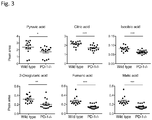
- PD-L1 antibody (1-111A; prepared in the present inventors' laboratory; 200 ⁇ g) or control IgG (Bio X Cell) was administered to C57BL/6N mice three times at 1-day intervals. Then, concentrations of TCA cycle-related metabolites in the serum were measured by GC-MS. The results are shown in Fig. 4 .
- TCA cycle-related metabolites in the serum showed a tendency to decrease. This is likely caused by the mitochondrial activation of CD8+ T cells (killer T cells) and subsequent consumption of blood metabolites.
- CD8 + T cells are activated above a cancer rejecting threshold by administration of PD-1 inhibitory antibody to a cancer-bearing subject, mitochondria of the CD8 + T cells are activated and the cells consumes blood metabolites, reducing their levels.
- CD8 + T cells cannot be activated and there is no decrease in blood metabolites. Therefore, blood metabolites serve as an indicator of mitochondrial activation (i.e., activation of killer T cells) and may probably be used as biomarkers for predicting the efficacy of PD-1 blockade.
- Mitochondrial activation is correlated with cellular activation.
- mTOR signal plays an important role in cellular activation. It is known that the mTOR pathway also activates mitochondria and simultaneously activates T-bet, a transcription factor important for Th1 immunity. The present inventors therefore compared T-bet activity before and after treatment, using CD8 + T cells obtained in Example 1.
- the draining lymph node cells used in Example 1 were stained with anti-CD8 antibody (BioLegend), anti-T-bet antibody (BioLegend) and anti-EOMES antibody (eBioscience). After gating on CD8 + T cells, expressions of T-bet and EOMES were compared before and after administration of PD-L1 antibody. The results are shown in Fig. 5 .
- T-bet increased after administration of the antibody in the treatment of highly sensitive cancers.
- expression of EOMES increased regardless of whether the cancer being treated was sensitive or non-sensitive.
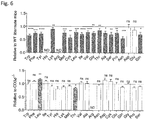
- the preceding Examples showed that it is possible to predict the antitumor effect of PD-1 inhibitory antibody by measuring mitochondrial activity. Mitochondrial activity is brought about by T cell activation upon stimulation with a tumor antigen. As T cells are activated and proliferate, the TCA cycle is induced to meet increased energy demands. A preceding Example showed that concentrations of TCA cycle-related metabolites in plasma decreased. At the same time, levels of blood amino acids were measured, revealing that they decreased, like those of TCA cycle-related metabolites ( Fig. 6 ). This is because the growing cells consume TCA cycle-related metabolites and amino acids for energy production and constituting cytoskeletons.
- TCA cycle-related metabolites and amino acids are necessary for activation and growth of T cells, and such activation and growth would likely consume blood metabolites.
- T cells were activated in PD-1 -/- mice and antigen-stimulated mice, and a large number of amino acids were taken up into T cells ( Fig. 7 ).
- Trp tryptophan
- Trp an amino acid essential for T cell activation, was metabolized (mainly into kynurenine) and consumed during T cell activation ( Fig. 8 ).
- T cell activation during PD-1 blockade i.e., indicators capable of judging the efficacy of PD-1 inhibitory antibody therapy
- decreased levels of amino acids may compliment TCA cycle-related metabolites as biomarkers of the PD-1 blockade efficacy.
- CFA complete Freund's adjuvant
- OVA ovalbumin
- mice were euthanized using carbon dioxide, and popliteal lymph nodes (LNs), brachial LNs, axillary LNs and inguinal LNs were isolated.
- LNs popliteal lymph nodes
- brachial LNs brachial LNs
- axillary LNs axillary LNs
- inguinal LNs were isolated.
- Isolated popliteal LNs were homogenized on slide glass and counted.
- Popliteal LN cells were stained with anti-CD3 ⁇ antibody, anti-TCR ⁇ antibody, anti-CD4 antibody, anti-CD8 antibody, anti-CD44 antibody and anti-CD62L antibody for 10 min on ice. Then, cell populations were analyzed with FACS-Aria cell sorter.
- lymph nodes from 6 mice were collected into a tube as one sample and frozen quickly in liquid nitrogen.
- lymph nodes from 6 mice were collected into a tube as one sample and frozen quickly in liquid nitrogen.
- the frozen lymph nodes were homogenized together with internal standard substances, methionine sulfone and trimesic acid, in 500 ⁇ l of ice-cooled methanol. After addition of an equivalent volume of chloroform and 400 ⁇ l of ultrapure water, the homogenate was centrifuged at 4°C x 15000 g for 15 min to recover the aqueous layer. The supernatant was ultrafiltered, concentrated in a vacuum condenser, dissolved in 50 ⁇ l of ultrapure water and subjected to analysis by LC-MS/MS.
- lymph nodes were embedded in SCEM and frozen quickly in liquid nitrogen. Then, sections were prepared in a cryostat (MC050, Leica Microsystems).
- MALDI-MS imaging was analyzed with Nd:YAG laser-mounting 7T FT-ICR-MS (Solarix Bruker Daltonik). Laser output was optimized for a smaller in-source decay of tryptophan. Data were obtained in positive mode of laser scanning with pitch distance 80 ⁇ m. For construction of images from the data, Fleximaging 4.0 software (Bruker Daltonics) was used.
- T cell activation by PD-1 blockade is necessary.
- Indicators of such T cell activation include the activation of mitochondria and the resulting enhancement of energy metabolism.
- energy metabolism-related metabolites including blood amino acids were found to decrease as a result of consumption of metabolites by T cells. In the present study, the same tendency was observed in human.
- mice have identical genetic background and rearing environment, making it impossible to evaluate the effect of genetic background and/or environment on T cells, and to identify corresponding differences in metabolites.
- genetic background and living environment vary from one patient to another, so it is possible to identify factors that may affect activation and potential of T cells. This is where analysis of human specimens has great merit.
- intestinal flora may be preferable. It has already been known that intestinal flora is an important causative factor regulating human immunocompetence and T cell activation capacity 1 , and it has also been reported that intestinal flora regulates the therapeutic effect of T cell-mediated antitumor immunity 2,3,4 . Further, a relationship between the metabolism of intestinal bacteria and metabolites detected in the blood has also been reported 5,6 . Therefore, the activation capacity of T cells responsible for antitumor immunity and the reactivity to PD-1 antibody therapy could be predicted by examining intestinal bacteria-related blood metabolites in cancer patients.
- intestinal flora-related metabolites e.g., hippurate, indoxyl sulfate, uric acid, 4-cresol
- intestinal flora-related metabolites also increased in "responders" to PD-1 antibody therapy.
- intestinal flora affected by genetic background and living environment could regulate T cell activation capacity, as well as the activation of killer T cells by PD-1 blockade.
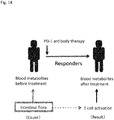
- energy metabolism-related metabolites show the "result” in which T cells were activated by PD-1 blockade whereas intestinal flora-related metabolites reflect the "cause" which determines the activation capacity of T cells.
- intestinal flora-related metabolites reflecting the "cause” are higher in responders than non-responders before treatment, whereas energy metabolism-related metabolites reflecting the "result” show greater differences after treatment.
- pretreatment metabolites are affected by the balance of intestinal flora which regulates T cell activation capacity and that posttreatment metabolites are more affected by energy metabolism triggered by T cell activation ( Fig. 14 ).
- This is consistent with the following observation: although a high predictive effect is obtainable even from pretreatment metabolites ( Fig. 10 ), a still higher predictive effect is obtainable when the pretreatment metabolites and the metabolites immediately after treatment (after the 1 st administration) are combined ( Fig. 12 ).
- PD at 3 months from the start of treatment was used. Briefly, “1” was assigned to patients who were not judged PD within 3 months, and “0” was assigned to patients who were judged PD within 3 months. Out of the 22 patients, 12 were responders and 10 were non-responders.
- each item for metabolome analysis was used. The same measurement at 3 times of blood collection were treated as different items. The total number of these items amounted to 435.
- Data sets are randomly divided into 4:1. The larger portion is used as training data and the smaller portion is used as test data. Learning is performed only with training data. With a constructed model, test data are predicted; ROC curve is plotted; and area under the curve (AUC) is calculated. In order to prevent any bias resulting from the dividing of training data and test data, the same trial was repeated 50 times while solely changing the random data division. Evaluation for all the trials was performed using the average AUC for prediction accuracy.
- Support vector machine is a technique for discrimination which learns high-dimensional hyperplane that maximally separates input samples into individual independent variables using kernel transformation.
- the present inventors also performed classifications by logistic regression, stochastic gradient descent, discriminant analysis, decision tree, k-nearest neighbor algorithm, naive Bayes classifier, adaptive boosting, gradient boosting and random forest, and confirmed that support vector machine achieves a comparable or higher accuracy.
- support vector machine When performing kernel transformation, support vector machine requires the definition of kernel function.
- Gaussian kernel was used as the kernel function.
- Support vector machine with Gaussian kernel has two hyper-parameters: cost parameter C defining a function that minimizes misclassification and coefficient ⁇ defining distribution of decision boundary (high-dimensional hyperplane). Against these two hyper-parameters, C was varied from 1 to 100,000 and ⁇ from 0.00001 to 0.1, respectively, according to a logarithmic scale. Learning and evaluation were performed using combinations of individual hyper-parameters, followed by calculation of the mean AUC which would give the highest prediction accuracy.
- the efficacy of therapy with a PD-1 signal inhibitor can be judged before or at an early stage of the therapy. As a result, the efficiency of therapy can be improved while reducing its cost.
Landscapes
- Health & Medical Sciences (AREA)
- Life Sciences & Earth Sciences (AREA)
- Chemical & Material Sciences (AREA)
- Immunology (AREA)
- Engineering & Computer Science (AREA)
- General Health & Medical Sciences (AREA)
- Molecular Biology (AREA)
- Medicinal Chemistry (AREA)
- Organic Chemistry (AREA)
- Biomedical Technology (AREA)
- Hematology (AREA)
- Urology & Nephrology (AREA)
- Biochemistry (AREA)
- Physics & Mathematics (AREA)
- Proteomics, Peptides & Aminoacids (AREA)
- Pharmacology & Pharmacy (AREA)
- Veterinary Medicine (AREA)
- Analytical Chemistry (AREA)
- Public Health (AREA)
- Animal Behavior & Ethology (AREA)
- Microbiology (AREA)
- Bioinformatics & Cheminformatics (AREA)
- Biotechnology (AREA)
- Biophysics (AREA)
- Pathology (AREA)
- General Physics & Mathematics (AREA)
- Nuclear Medicine, Radiotherapy & Molecular Imaging (AREA)
- Cell Biology (AREA)
- Food Science & Technology (AREA)
- Chemical Kinetics & Catalysis (AREA)
- General Chemical & Material Sciences (AREA)
- Genetics & Genomics (AREA)
- Wood Science & Technology (AREA)
- Zoology (AREA)
- Epidemiology (AREA)
- General Engineering & Computer Science (AREA)
- Ecology (AREA)
- Toxicology (AREA)
- Tropical Medicine & Parasitology (AREA)
- Communicable Diseases (AREA)
Applications Claiming Priority (3)
| Application Number | Priority Date | Filing Date | Title |
|---|---|---|---|
| JP2016214785 | 2016-11-02 | ||
| JP2017151547 | 2017-08-04 | ||
| PCT/JP2017/039619 WO2018084204A1 (ja) | 2016-11-02 | 2017-11-01 | Pd-1シグナル阻害剤による疾患治療における有効性判定マーカー |
Publications (3)
| Publication Number | Publication Date |
|---|---|
| EP3536802A1 true EP3536802A1 (de) | 2019-09-11 |
| EP3536802A4 EP3536802A4 (de) | 2020-07-29 |
| EP3536802B1 EP3536802B1 (de) | 2021-10-13 |
Family
ID=62076785
Family Applications (1)
| Application Number | Title | Priority Date | Filing Date |
|---|---|---|---|
| EP17867434.7A Active EP3536802B1 (de) | 2016-11-02 | 2017-11-01 | Marker zur wirksamkeitsbestimmung bei der behandlung von erkrankungen durch pd-1-signalhemmer |
Country Status (6)
| Country | Link |
|---|---|
| US (1) | US11662339B1 (de) |
| EP (1) | EP3536802B1 (de) |
| JP (1) | JP7374415B2 (de) |
| CN (1) | CN109996886B (de) |
| TW (1) | TW201819919A (de) |
| WO (1) | WO2018084204A1 (de) |
Cited By (2)
| Publication number | Priority date | Publication date | Assignee | Title |
|---|---|---|---|---|
| EP3605085A4 (de) * | 2017-03-31 | 2020-04-15 | Sony Corporation | Informationsverarbeitungsvorrichtung, informationsverarbeitungsverfahren und zellanalysesystem |
| EP3906942A4 (de) * | 2019-01-04 | 2023-02-22 | Kyoto University | Vorhersage- und/oder bestimmungsmarker für die wirksamkeit einer behandlung mit einem arzneimittel mit pd-1-signalhemmer |
Families Citing this family (8)
| Publication number | Priority date | Publication date | Assignee | Title |
|---|---|---|---|---|
| EP3778856A4 (de) * | 2018-03-29 | 2021-05-12 | Sony Corporation | Informationsverarbeitungsvorrichtung, informationsverarbeitungsverfahren und programm |
| WO2020123806A1 (en) * | 2018-12-14 | 2020-06-18 | Beth Israel Deaconess Medical Center. Inc. | Modulation of pd-1 |
| WO2020168541A1 (zh) * | 2019-02-22 | 2020-08-27 | 深圳华大生命科学研究院 | 肠道宏基因组在筛选pd-1抗体阻断剂疗效方面的用途 |
| JP2021136934A (ja) * | 2020-03-05 | 2021-09-16 | 学校法人慶應義塾 | 癌患者への免疫チェックポイント阻害薬の投与の有効性を予測するためのデータを収集する方法 |
| CN111537594B (zh) * | 2020-05-12 | 2023-03-28 | 南通大学 | 李斯特菌在筛选细胞呼吸链抑制药物上的应用 |
| JP2023090556A (ja) * | 2021-12-17 | 2023-06-29 | シスメックス株式会社 | 抗原特異的に活性化したt細胞を検出する方法、抗原に対する特異的免疫応答性の判定を補助する方法、被検者の免疫寛容の判定を補助する方法、試薬キット、解析装置及びコンピュータプログラム |
| CN118243826B (zh) * | 2024-05-23 | 2024-08-02 | 深圳市绘云生物科技有限公司 | 一种用于评估新生儿胆道闭锁风险的代谢物组合及其应用 |
| CN120550330B (zh) * | 2025-07-29 | 2025-10-24 | 四川省肿瘤医院 | 经皮穴位电刺激调控免疫检查点系统及其方法 |
Family Cites Families (7)
| Publication number | Priority date | Publication date | Assignee | Title |
|---|---|---|---|---|
| KR101523391B1 (ko) * | 2006-12-27 | 2015-05-27 | 에모리 유니버시티 | 감염 및 종양 치료를 위한 조성물 및 방법 |
| WO2015069888A2 (en) * | 2013-11-06 | 2015-05-14 | Raptor Pharmaceuticals Inc. | Use of cysteamine and derivatives thereof to treat mitochondrial diseases |
| CN121243402A (zh) * | 2014-07-09 | 2026-01-02 | 博笛生物科技有限公司 | 用于治疗肿瘤的抗-pd-l1组合 |
| GB201413162D0 (en) * | 2014-07-24 | 2014-09-10 | Immusmol Sas | Prediction of cancer treatment based on determination of enzymes or metabolites of the kynurenine pathway |
| JP2016064989A (ja) * | 2014-09-22 | 2016-04-28 | 国立研究開発法人国立がん研究センター | 癌を治療するための医薬組成物、およびpd−1阻害剤による治療に対する感受性を評価する方法 |
| JP6087983B2 (ja) | 2015-05-26 | 2017-03-01 | 合資会社三和歯ブラシ工業所 | 舌ブラシの製造方法 |
| JP2017151547A (ja) | 2016-02-22 | 2017-08-31 | 株式会社デンソー | 運転支援制御報知システムおよび報知装置 |
-
2017
- 2017-11-01 WO PCT/JP2017/039619 patent/WO2018084204A1/ja not_active Ceased
- 2017-11-01 EP EP17867434.7A patent/EP3536802B1/de active Active
- 2017-11-01 JP JP2018549058A patent/JP7374415B2/ja active Active
- 2017-11-01 US US16/346,566 patent/US11662339B1/en active Active
- 2017-11-01 CN CN201780066425.4A patent/CN109996886B/zh active Active
- 2017-11-02 TW TW106137915A patent/TW201819919A/zh unknown
Cited By (3)
| Publication number | Priority date | Publication date | Assignee | Title |
|---|---|---|---|---|
| EP3605085A4 (de) * | 2017-03-31 | 2020-04-15 | Sony Corporation | Informationsverarbeitungsvorrichtung, informationsverarbeitungsverfahren und zellanalysesystem |
| EP3906942A4 (de) * | 2019-01-04 | 2023-02-22 | Kyoto University | Vorhersage- und/oder bestimmungsmarker für die wirksamkeit einer behandlung mit einem arzneimittel mit pd-1-signalhemmer |
| JP2024045362A (ja) * | 2019-01-04 | 2024-04-02 | 国立大学法人京都大学 | Pd-1シグナル阻害剤含有薬剤による治療有効性の予測及び/又は判定マーカー |
Also Published As
| Publication number | Publication date |
|---|---|
| US11662339B1 (en) | 2023-05-30 |
| EP3536802B1 (de) | 2021-10-13 |
| JPWO2018084204A1 (ja) | 2019-09-26 |
| TW201819919A (zh) | 2018-06-01 |
| EP3536802A4 (de) | 2020-07-29 |
| CN109996886B (zh) | 2024-09-17 |
| JP7374415B2 (ja) | 2023-11-09 |
| WO2018084204A1 (ja) | 2018-05-11 |
| CN109996886A (zh) | 2019-07-09 |
Similar Documents
| Publication | Publication Date | Title |
|---|---|---|
| EP3536802B1 (de) | Marker zur wirksamkeitsbestimmung bei der behandlung von erkrankungen durch pd-1-signalhemmer | |
| EP3906942A1 (de) | Vorhersage- und/oder bestimmungsmarker für die wirksamkeit einer behandlung mit einem arzneimittel mit pd-1-signalhemmer | |
| Yang et al. | Dynamic profiling of immune microenvironment during pancreatic cancer development suggests early intervention and combination strategy of immunotherapy | |
| Lloyd et al. | Three-colour fluorescence immunohistochemistry reveals the diversity of cells staining for macrophage markers in murine spleen and liver | |
| Ren | Immunosuppressive checkpoint Siglec-15: a vital new piece of the cancer immunotherapy jigsaw puzzle | |
| EP2942629A1 (de) | Prädiktive Marker für eine erfolgreiche Krebsimmuntherapie | |
| JP6574179B2 (ja) | エフェクターtレグ細胞を同定するための方法及びキット | |
| US20240181049A1 (en) | Harnessing the power of microbiota and metabolites for the treatment of cancer | |
| US20180318386A1 (en) | Peptides and methods of treating endometriosis using the same | |
| Wishart et al. | Neutralizing GM-CSF autoantibodies impair neutrophil antifungal effector function in a patient with aspergillosis | |
| Milner et al. | The immune response to disialoganglioside GD3 vaccination in normal dogs: a melanoma surface antigen vaccine | |
| US20100105072A1 (en) | Methods of identifying respondents to hypoxia inducible factor 1-alpha inhibitors | |
| US20200158733A1 (en) | Predicting Responders to Cyclophosphamide Therapy | |
| Frick et al. | Immune cell-based screening assay for response to anticancer agents: applications in pharmacogenomics | |
| Kannegieter et al. | Pharmacodynamic monitoring of tacrolimus-based immunosuppression in CD14+ monocytes after kidney transplantation | |
| JPWO2009034961A1 (ja) | ヒト樹状細胞の評価方法およびヒト細胞免疫療法剤 | |
| WO2020171138A1 (ja) | 放射線治療による抗腫瘍免疫効果を評価する末梢血バイオマーカー | |
| Dieterlen et al. | Flow cytometry-based pharmacodynamic monitoring after organ transplantation | |
| JP7812070B2 (ja) | Pd-1シグナル阻害剤の併用療法 | |
| Salamero-Boix et al. | Modulation of the ATP-adenosine signaling axis combined with radiotherapy facilitates anti-cancer immunity in brain metastasis | |
| US20250020650A1 (en) | Method of predicting a patient's benefit from therapy with an immune checkpoint inhibitor | |
| Imhof et al. | The phenotype and functionality of spike-specific CD4+ T cells after COVID-19 vaccination associates with time after transplantation in transplant recipients | |
| Khachatryan | Significantly Increase Overall | |
| Zirnbauer et al. | Autologous tumor-immune effusion co-cultures enable ex vivo functional profiling of radiotherapy-immunotherapy combinations | |
| Abuga | Severe Anaemia and Bacteraemia in Kenyan Children: Epidemiology and Mechanisms |
Legal Events
| Date | Code | Title | Description |
|---|---|---|---|
| STAA | Information on the status of an ep patent application or granted ep patent |
Free format text: STATUS: THE INTERNATIONAL PUBLICATION HAS BEEN MADE |
|
| PUAI | Public reference made under article 153(3) epc to a published international application that has entered the european phase |
Free format text: ORIGINAL CODE: 0009012 |
|
| STAA | Information on the status of an ep patent application or granted ep patent |
Free format text: STATUS: REQUEST FOR EXAMINATION WAS MADE |
|
| 17P | Request for examination filed |
Effective date: 20190516 |
|
| AK | Designated contracting states |
Kind code of ref document: A1 Designated state(s): AL AT BE BG CH CY CZ DE DK EE ES FI FR GB GR HR HU IE IS IT LI LT LU LV MC MK MT NL NO PL PT RO RS SE SI SK SM TR |
|
| AX | Request for extension of the european patent |
Extension state: BA ME |
|
| DAV | Request for validation of the european patent (deleted) | ||
| DAX | Request for extension of the european patent (deleted) | ||
| RIC1 | Information provided on ipc code assigned before grant |
Ipc: A61P 35/00 20060101ALI20200305BHEP Ipc: A61P 43/00 20060101ALI20200305BHEP Ipc: A61K 39/395 20060101ALI20200305BHEP Ipc: G01N 33/574 20060101ALI20200305BHEP Ipc: C12Q 1/02 20060101AFI20200305BHEP Ipc: A61P 37/04 20060101ALI20200305BHEP Ipc: C12Q 1/00 20060101ALI20200305BHEP Ipc: A61K 45/00 20060101ALI20200305BHEP Ipc: G01N 33/68 20060101ALI20200305BHEP |
|
| A4 | Supplementary search report drawn up and despatched |
Effective date: 20200626 |
|
| RIC1 | Information provided on ipc code assigned before grant |
Ipc: A61K 45/00 20060101ALI20200622BHEP Ipc: A61K 39/395 20060101ALI20200622BHEP Ipc: G01N 33/574 20060101ALI20200622BHEP Ipc: C12Q 1/02 20060101AFI20200622BHEP Ipc: A61P 37/04 20060101ALI20200622BHEP Ipc: A61P 43/00 20060101ALI20200622BHEP Ipc: A61P 35/00 20060101ALI20200622BHEP Ipc: C12Q 1/00 20060101ALI20200622BHEP Ipc: G01N 33/68 20060101ALI20200622BHEP |
|
| STAA | Information on the status of an ep patent application or granted ep patent |
Free format text: STATUS: EXAMINATION IS IN PROGRESS |
|
| 17Q | First examination report despatched |
Effective date: 20210111 |
|
| GRAP | Despatch of communication of intention to grant a patent |
Free format text: ORIGINAL CODE: EPIDOSNIGR1 |
|
| STAA | Information on the status of an ep patent application or granted ep patent |
Free format text: STATUS: GRANT OF PATENT IS INTENDED |
|
| INTG | Intention to grant announced |
Effective date: 20210629 |
|
| GRAS | Grant fee paid |
Free format text: ORIGINAL CODE: EPIDOSNIGR3 |
|
| GRAA | (expected) grant |
Free format text: ORIGINAL CODE: 0009210 |
|
| STAA | Information on the status of an ep patent application or granted ep patent |
Free format text: STATUS: THE PATENT HAS BEEN GRANTED |
|
| AK | Designated contracting states |
Kind code of ref document: B1 Designated state(s): AL AT BE BG CH CY CZ DE DK EE ES FI FR GB GR HR HU IE IS IT LI LT LU LV MC MK MT NL NO PL PT RO RS SE SI SK SM TR |
|
| REG | Reference to a national code |
Ref country code: GB Ref legal event code: FG4D |
|
| REG | Reference to a national code |
Ref country code: CH Ref legal event code: EP |
|
| REG | Reference to a national code |
Ref country code: DE Ref legal event code: R096 Ref document number: 602017047713 Country of ref document: DE |
|
| REG | Reference to a national code |
Ref country code: IE Ref legal event code: FG4D |
|
| REG | Reference to a national code |
Ref country code: AT Ref legal event code: REF Ref document number: 1438221 Country of ref document: AT Kind code of ref document: T Effective date: 20211115 |
|
| REG | Reference to a national code |
Ref country code: LT Ref legal event code: MG9D |
|
| REG | Reference to a national code |
Ref country code: NL Ref legal event code: MP Effective date: 20211013 |
|
| REG | Reference to a national code |
Ref country code: AT Ref legal event code: MK05 Ref document number: 1438221 Country of ref document: AT Kind code of ref document: T Effective date: 20211013 |
|
| PG25 | Lapsed in a contracting state [announced via postgrant information from national office to epo] |
Ref country code: RS Free format text: LAPSE BECAUSE OF FAILURE TO SUBMIT A TRANSLATION OF THE DESCRIPTION OR TO PAY THE FEE WITHIN THE PRESCRIBED TIME-LIMIT Effective date: 20211013 Ref country code: LT Free format text: LAPSE BECAUSE OF FAILURE TO SUBMIT A TRANSLATION OF THE DESCRIPTION OR TO PAY THE FEE WITHIN THE PRESCRIBED TIME-LIMIT Effective date: 20211013 Ref country code: FI Free format text: LAPSE BECAUSE OF FAILURE TO SUBMIT A TRANSLATION OF THE DESCRIPTION OR TO PAY THE FEE WITHIN THE PRESCRIBED TIME-LIMIT Effective date: 20211013 Ref country code: BG Free format text: LAPSE BECAUSE OF FAILURE TO SUBMIT A TRANSLATION OF THE DESCRIPTION OR TO PAY THE FEE WITHIN THE PRESCRIBED TIME-LIMIT Effective date: 20220113 Ref country code: AT Free format text: LAPSE BECAUSE OF FAILURE TO SUBMIT A TRANSLATION OF THE DESCRIPTION OR TO PAY THE FEE WITHIN THE PRESCRIBED TIME-LIMIT Effective date: 20211013 |
|
| PG25 | Lapsed in a contracting state [announced via postgrant information from national office to epo] |
Ref country code: IS Free format text: LAPSE BECAUSE OF FAILURE TO SUBMIT A TRANSLATION OF THE DESCRIPTION OR TO PAY THE FEE WITHIN THE PRESCRIBED TIME-LIMIT Effective date: 20220213 Ref country code: SE Free format text: LAPSE BECAUSE OF FAILURE TO SUBMIT A TRANSLATION OF THE DESCRIPTION OR TO PAY THE FEE WITHIN THE PRESCRIBED TIME-LIMIT Effective date: 20211013 Ref country code: PT Free format text: LAPSE BECAUSE OF FAILURE TO SUBMIT A TRANSLATION OF THE DESCRIPTION OR TO PAY THE FEE WITHIN THE PRESCRIBED TIME-LIMIT Effective date: 20220214 Ref country code: PL Free format text: LAPSE BECAUSE OF FAILURE TO SUBMIT A TRANSLATION OF THE DESCRIPTION OR TO PAY THE FEE WITHIN THE PRESCRIBED TIME-LIMIT Effective date: 20211013 Ref country code: NO Free format text: LAPSE BECAUSE OF FAILURE TO SUBMIT A TRANSLATION OF THE DESCRIPTION OR TO PAY THE FEE WITHIN THE PRESCRIBED TIME-LIMIT Effective date: 20220113 Ref country code: NL Free format text: LAPSE BECAUSE OF FAILURE TO SUBMIT A TRANSLATION OF THE DESCRIPTION OR TO PAY THE FEE WITHIN THE PRESCRIBED TIME-LIMIT Effective date: 20211013 Ref country code: LV Free format text: LAPSE BECAUSE OF FAILURE TO SUBMIT A TRANSLATION OF THE DESCRIPTION OR TO PAY THE FEE WITHIN THE PRESCRIBED TIME-LIMIT Effective date: 20211013 Ref country code: HR Free format text: LAPSE BECAUSE OF FAILURE TO SUBMIT A TRANSLATION OF THE DESCRIPTION OR TO PAY THE FEE WITHIN THE PRESCRIBED TIME-LIMIT Effective date: 20211013 Ref country code: GR Free format text: LAPSE BECAUSE OF FAILURE TO SUBMIT A TRANSLATION OF THE DESCRIPTION OR TO PAY THE FEE WITHIN THE PRESCRIBED TIME-LIMIT Effective date: 20220114 Ref country code: ES Free format text: LAPSE BECAUSE OF FAILURE TO SUBMIT A TRANSLATION OF THE DESCRIPTION OR TO PAY THE FEE WITHIN THE PRESCRIBED TIME-LIMIT Effective date: 20211013 |
|
| REG | Reference to a national code |
Ref country code: CH Ref legal event code: PL |
|
| REG | Reference to a national code |
Ref country code: DE Ref legal event code: R097 Ref document number: 602017047713 Country of ref document: DE |
|
| PG25 | Lapsed in a contracting state [announced via postgrant information from national office to epo] |
Ref country code: SM Free format text: LAPSE BECAUSE OF FAILURE TO SUBMIT A TRANSLATION OF THE DESCRIPTION OR TO PAY THE FEE WITHIN THE PRESCRIBED TIME-LIMIT Effective date: 20211013 Ref country code: SK Free format text: LAPSE BECAUSE OF FAILURE TO SUBMIT A TRANSLATION OF THE DESCRIPTION OR TO PAY THE FEE WITHIN THE PRESCRIBED TIME-LIMIT Effective date: 20211013 Ref country code: RO Free format text: LAPSE BECAUSE OF FAILURE TO SUBMIT A TRANSLATION OF THE DESCRIPTION OR TO PAY THE FEE WITHIN THE PRESCRIBED TIME-LIMIT Effective date: 20211013 Ref country code: MC Free format text: LAPSE BECAUSE OF FAILURE TO SUBMIT A TRANSLATION OF THE DESCRIPTION OR TO PAY THE FEE WITHIN THE PRESCRIBED TIME-LIMIT Effective date: 20211013 Ref country code: LU Free format text: LAPSE BECAUSE OF NON-PAYMENT OF DUE FEES Effective date: 20211101 Ref country code: EE Free format text: LAPSE BECAUSE OF FAILURE TO SUBMIT A TRANSLATION OF THE DESCRIPTION OR TO PAY THE FEE WITHIN THE PRESCRIBED TIME-LIMIT Effective date: 20211013 Ref country code: DK Free format text: LAPSE BECAUSE OF FAILURE TO SUBMIT A TRANSLATION OF THE DESCRIPTION OR TO PAY THE FEE WITHIN THE PRESCRIBED TIME-LIMIT Effective date: 20211013 Ref country code: CZ Free format text: LAPSE BECAUSE OF FAILURE TO SUBMIT A TRANSLATION OF THE DESCRIPTION OR TO PAY THE FEE WITHIN THE PRESCRIBED TIME-LIMIT Effective date: 20211013 Ref country code: BE Free format text: LAPSE BECAUSE OF NON-PAYMENT OF DUE FEES Effective date: 20211130 |
|
| REG | Reference to a national code |
Ref country code: BE Ref legal event code: MM Effective date: 20211130 |
|
| PLBE | No opposition filed within time limit |
Free format text: ORIGINAL CODE: 0009261 |
|
| STAA | Information on the status of an ep patent application or granted ep patent |
Free format text: STATUS: NO OPPOSITION FILED WITHIN TIME LIMIT |
|
| 26N | No opposition filed |
Effective date: 20220714 |
|
| PG25 | Lapsed in a contracting state [announced via postgrant information from national office to epo] |
Ref country code: IE Free format text: LAPSE BECAUSE OF NON-PAYMENT OF DUE FEES Effective date: 20211101 Ref country code: AL Free format text: LAPSE BECAUSE OF FAILURE TO SUBMIT A TRANSLATION OF THE DESCRIPTION OR TO PAY THE FEE WITHIN THE PRESCRIBED TIME-LIMIT Effective date: 20211013 |
|
| PG25 | Lapsed in a contracting state [announced via postgrant information from national office to epo] |
Ref country code: SI Free format text: LAPSE BECAUSE OF FAILURE TO SUBMIT A TRANSLATION OF THE DESCRIPTION OR TO PAY THE FEE WITHIN THE PRESCRIBED TIME-LIMIT Effective date: 20211013 |
|
| PG25 | Lapsed in a contracting state [announced via postgrant information from national office to epo] |
Ref country code: IT Free format text: LAPSE BECAUSE OF FAILURE TO SUBMIT A TRANSLATION OF THE DESCRIPTION OR TO PAY THE FEE WITHIN THE PRESCRIBED TIME-LIMIT Effective date: 20211013 |
|
| PG25 | Lapsed in a contracting state [announced via postgrant information from national office to epo] |
Ref country code: CY Free format text: LAPSE BECAUSE OF FAILURE TO SUBMIT A TRANSLATION OF THE DESCRIPTION OR TO PAY THE FEE WITHIN THE PRESCRIBED TIME-LIMIT Effective date: 20211013 |
|
| PG25 | Lapsed in a contracting state [announced via postgrant information from national office to epo] |
Ref country code: LI Free format text: LAPSE BECAUSE OF NON-PAYMENT OF DUE FEES Effective date: 20220630 Ref country code: HU Free format text: LAPSE BECAUSE OF FAILURE TO SUBMIT A TRANSLATION OF THE DESCRIPTION OR TO PAY THE FEE WITHIN THE PRESCRIBED TIME-LIMIT; INVALID AB INITIO Effective date: 20171101 Ref country code: CH Free format text: LAPSE BECAUSE OF NON-PAYMENT OF DUE FEES Effective date: 20220630 |
|
| PG25 | Lapsed in a contracting state [announced via postgrant information from national office to epo] |
Ref country code: MK Free format text: LAPSE BECAUSE OF FAILURE TO SUBMIT A TRANSLATION OF THE DESCRIPTION OR TO PAY THE FEE WITHIN THE PRESCRIBED TIME-LIMIT Effective date: 20211013 |
|
| PG25 | Lapsed in a contracting state [announced via postgrant information from national office to epo] |
Ref country code: MT Free format text: LAPSE BECAUSE OF FAILURE TO SUBMIT A TRANSLATION OF THE DESCRIPTION OR TO PAY THE FEE WITHIN THE PRESCRIBED TIME-LIMIT Effective date: 20211013 |
|
| PG25 | Lapsed in a contracting state [announced via postgrant information from national office to epo] |
Ref country code: TR Free format text: LAPSE BECAUSE OF FAILURE TO SUBMIT A TRANSLATION OF THE DESCRIPTION OR TO PAY THE FEE WITHIN THE PRESCRIBED TIME-LIMIT Effective date: 20211013 |
|
| PGFP | Annual fee paid to national office [announced via postgrant information from national office to epo] |
Ref country code: DE Payment date: 20251014 Year of fee payment: 9 |
|
| PGFP | Annual fee paid to national office [announced via postgrant information from national office to epo] |
Ref country code: GB Payment date: 20251016 Year of fee payment: 9 |
|
| PGFP | Annual fee paid to national office [announced via postgrant information from national office to epo] |
Ref country code: FR Payment date: 20251023 Year of fee payment: 9 |