EP3537461A1 - Weichmagnetisches legierungspulver, massekern und magnetische komponente - Google Patents
Weichmagnetisches legierungspulver, massekern und magnetische komponente Download PDFInfo
- Publication number
- EP3537461A1 EP3537461A1 EP19161533.5A EP19161533A EP3537461A1 EP 3537461 A1 EP3537461 A1 EP 3537461A1 EP 19161533 A EP19161533 A EP 19161533A EP 3537461 A1 EP3537461 A1 EP 3537461A1
- Authority
- EP
- European Patent Office
- Prior art keywords
- soft magnetic
- magnetic alloy
- powder
- dust core
- amorphous phase
- Prior art date
- Legal status (The legal status is an assumption and is not a legal conclusion. Google has not performed a legal analysis and makes no representation as to the accuracy of the status listed.)
- Withdrawn
Links
- 229910001004 magnetic alloy Inorganic materials 0.000 title claims abstract description 178
- 239000000843 powder Substances 0.000 title claims abstract description 127
- 239000000428 dust Substances 0.000 title claims description 68
- 238000000576 coating method Methods 0.000 claims abstract description 65
- 239000011248 coating agent Substances 0.000 claims abstract description 62
- 239000002245 particle Substances 0.000 claims abstract description 59
- 239000013078 crystal Substances 0.000 claims abstract description 51
- 239000000203 mixture Substances 0.000 claims abstract description 49
- 229910052725 zinc Inorganic materials 0.000 claims abstract description 16
- 229910052698 phosphorus Inorganic materials 0.000 claims abstract description 13
- 239000000126 substance Substances 0.000 claims abstract description 11
- 150000001875 compounds Chemical class 0.000 claims abstract description 10
- 229910052735 hafnium Inorganic materials 0.000 claims abstract description 7
- 229910052750 molybdenum Inorganic materials 0.000 claims abstract description 7
- 229910052758 niobium Inorganic materials 0.000 claims abstract description 7
- 229910052715 tantalum Inorganic materials 0.000 claims abstract description 7
- 229910052721 tungsten Inorganic materials 0.000 claims abstract description 7
- 229910052720 vanadium Inorganic materials 0.000 claims abstract description 7
- 229910052726 zirconium Inorganic materials 0.000 claims abstract description 7
- 229910052782 aluminium Inorganic materials 0.000 claims abstract description 6
- 229910052787 antimony Inorganic materials 0.000 claims abstract description 6
- 229910052785 arsenic Inorganic materials 0.000 claims abstract description 6
- 229910052804 chromium Inorganic materials 0.000 claims abstract description 6
- 229910052802 copper Inorganic materials 0.000 claims abstract description 6
- 229910052748 manganese Inorganic materials 0.000 claims abstract description 6
- 229910052761 rare earth metal Inorganic materials 0.000 claims abstract description 6
- 229910052709 silver Inorganic materials 0.000 claims abstract description 6
- 229910052718 tin Inorganic materials 0.000 claims abstract description 6
- 239000002159 nanocrystal Substances 0.000 claims description 31
- 229910052759 nickel Inorganic materials 0.000 claims description 5
- XEEYBQQBJWHFJM-UHFFFAOYSA-N Iron Chemical compound [Fe] XEEYBQQBJWHFJM-UHFFFAOYSA-N 0.000 description 50
- 238000010438 heat treatment Methods 0.000 description 27
- 230000000052 comparative effect Effects 0.000 description 23
- 239000011521 glass Substances 0.000 description 22
- 229910052751 metal Inorganic materials 0.000 description 22
- PNEYBMLMFCGWSK-UHFFFAOYSA-N aluminium oxide Inorganic materials [O-2].[O-2].[O-2].[Al+3].[Al+3] PNEYBMLMFCGWSK-UHFFFAOYSA-N 0.000 description 21
- 229910052593 corundum Inorganic materials 0.000 description 21
- 239000002184 metal Substances 0.000 description 21
- 238000000034 method Methods 0.000 description 21
- 229910001845 yogo sapphire Inorganic materials 0.000 description 21
- 239000010936 titanium Substances 0.000 description 18
- 239000000463 material Substances 0.000 description 15
- 229910045601 alloy Inorganic materials 0.000 description 11
- 239000000956 alloy Substances 0.000 description 11
- 230000005415 magnetization Effects 0.000 description 11
- 230000007423 decrease Effects 0.000 description 10
- 238000004519 manufacturing process Methods 0.000 description 10
- 229920005989 resin Polymers 0.000 description 10
- 239000011347 resin Substances 0.000 description 10
- 229910007472 ZnO—B2O3—SiO2 Inorganic materials 0.000 description 9
- WMWLMWRWZQELOS-UHFFFAOYSA-N bismuth(iii) oxide Chemical compound O=[Bi]O[Bi]=O WMWLMWRWZQELOS-UHFFFAOYSA-N 0.000 description 8
- 238000002474 experimental method Methods 0.000 description 8
- VYPSYNLAJGMNEJ-UHFFFAOYSA-N silicon dioxide Inorganic materials O=[Si]=O VYPSYNLAJGMNEJ-UHFFFAOYSA-N 0.000 description 8
- 229910019142 PO4 Inorganic materials 0.000 description 7
- 229910000808 amorphous metal alloy Inorganic materials 0.000 description 7
- 238000005259 measurement Methods 0.000 description 7
- NBIIXXVUZAFLBC-UHFFFAOYSA-K phosphate Chemical compound [O-]P([O-])([O-])=O NBIIXXVUZAFLBC-UHFFFAOYSA-K 0.000 description 7
- 239000010452 phosphate Substances 0.000 description 7
- 239000002994 raw material Substances 0.000 description 7
- 238000000748 compression moulding Methods 0.000 description 6
- 229910052681 coesite Inorganic materials 0.000 description 5
- 229910052906 cristobalite Inorganic materials 0.000 description 5
- 239000007789 gas Substances 0.000 description 5
- 239000000377 silicon dioxide Substances 0.000 description 5
- 229910052682 stishovite Inorganic materials 0.000 description 5
- 229910052719 titanium Inorganic materials 0.000 description 5
- 229910052905 tridymite Inorganic materials 0.000 description 5
- CSCPPACGZOOCGX-UHFFFAOYSA-N Acetone Chemical compound CC(C)=O CSCPPACGZOOCGX-UHFFFAOYSA-N 0.000 description 4
- 238000000889 atomisation Methods 0.000 description 4
- 239000011247 coating layer Substances 0.000 description 4
- 230000000694 effects Effects 0.000 description 4
- 238000002844 melting Methods 0.000 description 4
- 230000008018 melting Effects 0.000 description 4
- 150000002739 metals Chemical class 0.000 description 4
- 238000002441 X-ray diffraction Methods 0.000 description 3
- 230000005540 biological transmission Effects 0.000 description 3
- 238000007664 blowing Methods 0.000 description 3
- 238000009689 gas atomisation Methods 0.000 description 3
- 239000004615 ingredient Substances 0.000 description 3
- 238000009413 insulation Methods 0.000 description 3
- 229910052717 sulfur Inorganic materials 0.000 description 3
- 238000004804 winding Methods 0.000 description 3
- OAICVXFJPJFONN-UHFFFAOYSA-N Phosphorus Chemical compound [P] OAICVXFJPJFONN-UHFFFAOYSA-N 0.000 description 2
- 239000011230 binding agent Substances 0.000 description 2
- 239000005388 borosilicate glass Substances 0.000 description 2
- 238000000921 elemental analysis Methods 0.000 description 2
- 239000003822 epoxy resin Substances 0.000 description 2
- 239000008187 granular material Substances 0.000 description 2
- 150000003949 imides Chemical class 0.000 description 2
- 229910052742 iron Inorganic materials 0.000 description 2
- 239000000075 oxide glass Substances 0.000 description 2
- 239000012188 paraffin wax Substances 0.000 description 2
- 239000011574 phosphorus Substances 0.000 description 2
- 229920000647 polyepoxide Polymers 0.000 description 2
- 241000252073 Anguilliformes Species 0.000 description 1
- ZOXJGFHDIHLPTG-UHFFFAOYSA-N Boron Chemical compound [B] ZOXJGFHDIHLPTG-UHFFFAOYSA-N 0.000 description 1
- OKTJSMMVPCPJKN-UHFFFAOYSA-N Carbon Chemical compound [C] OKTJSMMVPCPJKN-UHFFFAOYSA-N 0.000 description 1
- 229910018540 Si C Inorganic materials 0.000 description 1
- 229910000831 Steel Inorganic materials 0.000 description 1
- NINIDFKCEFEMDL-UHFFFAOYSA-N Sulfur Chemical compound [S] NINIDFKCEFEMDL-UHFFFAOYSA-N 0.000 description 1
- 238000003917 TEM image Methods 0.000 description 1
- RTAQQCXQSZGOHL-UHFFFAOYSA-N Titanium Chemical compound [Ti] RTAQQCXQSZGOHL-UHFFFAOYSA-N 0.000 description 1
- 229910052783 alkali metal Inorganic materials 0.000 description 1
- 150000001340 alkali metals Chemical class 0.000 description 1
- 238000004458 analytical method Methods 0.000 description 1
- QVGXLLKOCUKJST-UHFFFAOYSA-N atomic oxygen Chemical compound [O] QVGXLLKOCUKJST-UHFFFAOYSA-N 0.000 description 1
- 229910052796 boron Inorganic materials 0.000 description 1
- 229910052799 carbon Inorganic materials 0.000 description 1
- 239000003795 chemical substances by application Substances 0.000 description 1
- 239000011362 coarse particle Substances 0.000 description 1
- 230000006835 compression Effects 0.000 description 1
- 238000007906 compression Methods 0.000 description 1
- 239000004020 conductor Substances 0.000 description 1
- 238000009792 diffusion process Methods 0.000 description 1
- 238000001035 drying Methods 0.000 description 1
- 238000005430 electron energy loss spectroscopy Methods 0.000 description 1
- 238000011049 filling Methods 0.000 description 1
- 230000004907 flux Effects 0.000 description 1
- 239000012634 fragment Substances 0.000 description 1
- 230000020169 heat generation Effects 0.000 description 1
- 239000012535 impurity Substances 0.000 description 1
- 230000006698 induction Effects 0.000 description 1
- 238000007561 laser diffraction method Methods 0.000 description 1
- 239000000696 magnetic material Substances 0.000 description 1
- 239000006247 magnetic powder Substances 0.000 description 1
- 239000002923 metal particle Substances 0.000 description 1
- 238000002156 mixing Methods 0.000 description 1
- 238000000465 moulding Methods 0.000 description 1
- 229910052760 oxygen Inorganic materials 0.000 description 1
- 239000001301 oxygen Substances 0.000 description 1
- 238000012856 packing Methods 0.000 description 1
- 239000005365 phosphate glass Substances 0.000 description 1
- 239000004033 plastic Substances 0.000 description 1
- 238000003672 processing method Methods 0.000 description 1
- 238000010791 quenching Methods 0.000 description 1
- 230000000171 quenching effect Effects 0.000 description 1
- 238000000790 scattering method Methods 0.000 description 1
- 238000010334 sieve classification Methods 0.000 description 1
- 229910052710 silicon Inorganic materials 0.000 description 1
- 239000010703 silicon Substances 0.000 description 1
- 238000003980 solgel method Methods 0.000 description 1
- 238000000992 sputter etching Methods 0.000 description 1
- 239000011593 sulfur Substances 0.000 description 1
- 229920001187 thermosetting polymer Polymers 0.000 description 1
- 230000000007 visual effect Effects 0.000 description 1
- 238000009692 water atomization Methods 0.000 description 1
Images
Classifications
-
- H—ELECTRICITY
- H01—ELECTRIC ELEMENTS
- H01F—MAGNETS; INDUCTANCES; TRANSFORMERS; SELECTION OF MATERIALS FOR THEIR MAGNETIC PROPERTIES
- H01F1/00—Magnets or magnetic bodies characterised by the magnetic materials therefor; Selection of materials for their magnetic properties
- H01F1/01—Magnets or magnetic bodies characterised by the magnetic materials therefor; Selection of materials for their magnetic properties of inorganic materials
- H01F1/03—Magnets or magnetic bodies characterised by the magnetic materials therefor; Selection of materials for their magnetic properties of inorganic materials characterised by their coercivity
- H01F1/12—Magnets or magnetic bodies characterised by the magnetic materials therefor; Selection of materials for their magnetic properties of inorganic materials characterised by their coercivity of soft-magnetic materials
- H01F1/14—Magnets or magnetic bodies characterised by the magnetic materials therefor; Selection of materials for their magnetic properties of inorganic materials characterised by their coercivity of soft-magnetic materials metals or alloys
- H01F1/147—Alloys characterised by their composition
- H01F1/153—Amorphous metallic alloys, e.g. glassy metals
-
- H—ELECTRICITY
- H01—ELECTRIC ELEMENTS
- H01F—MAGNETS; INDUCTANCES; TRANSFORMERS; SELECTION OF MATERIALS FOR THEIR MAGNETIC PROPERTIES
- H01F1/00—Magnets or magnetic bodies characterised by the magnetic materials therefor; Selection of materials for their magnetic properties
- H01F1/01—Magnets or magnetic bodies characterised by the magnetic materials therefor; Selection of materials for their magnetic properties of inorganic materials
- H01F1/03—Magnets or magnetic bodies characterised by the magnetic materials therefor; Selection of materials for their magnetic properties of inorganic materials characterised by their coercivity
- H01F1/12—Magnets or magnetic bodies characterised by the magnetic materials therefor; Selection of materials for their magnetic properties of inorganic materials characterised by their coercivity of soft-magnetic materials
- H01F1/14—Magnets or magnetic bodies characterised by the magnetic materials therefor; Selection of materials for their magnetic properties of inorganic materials characterised by their coercivity of soft-magnetic materials metals or alloys
- H01F1/147—Alloys characterised by their composition
- H01F1/153—Amorphous metallic alloys, e.g. glassy metals
- H01F1/15333—Amorphous metallic alloys, e.g. glassy metals containing nanocrystallites, e.g. obtained by annealing
-
- B—PERFORMING OPERATIONS; TRANSPORTING
- B22—CASTING; POWDER METALLURGY
- B22F—WORKING METALLIC POWDER; MANUFACTURE OF ARTICLES FROM METALLIC POWDER; MAKING METALLIC POWDER; APPARATUS OR DEVICES SPECIALLY ADAPTED FOR METALLIC POWDER
- B22F1/00—Metallic powder; Treatment of metallic powder, e.g. to facilitate working or to improve properties
- B22F1/16—Metallic particles coated with a non-metal
-
- C—CHEMISTRY; METALLURGY
- C22—METALLURGY; FERROUS OR NON-FERROUS ALLOYS; TREATMENT OF ALLOYS OR NON-FERROUS METALS
- C22C—ALLOYS
- C22C38/00—Ferrous alloys, e.g. steel alloys
- C22C38/001—Ferrous alloys, e.g. steel alloys containing N
-
- C—CHEMISTRY; METALLURGY
- C22—METALLURGY; FERROUS OR NON-FERROUS ALLOYS; TREATMENT OF ALLOYS OR NON-FERROUS METALS
- C22C—ALLOYS
- C22C38/00—Ferrous alloys, e.g. steel alloys
- C22C38/002—Ferrous alloys, e.g. steel alloys containing In, Mg, or other elements not provided for in one single group C22C38/001 - C22C38/60
-
- C—CHEMISTRY; METALLURGY
- C22—METALLURGY; FERROUS OR NON-FERROUS ALLOYS; TREATMENT OF ALLOYS OR NON-FERROUS METALS
- C22C—ALLOYS
- C22C38/00—Ferrous alloys, e.g. steel alloys
- C22C38/005—Ferrous alloys, e.g. steel alloys containing rare earths, i.e. Sc, Y, Lanthanides
-
- C—CHEMISTRY; METALLURGY
- C22—METALLURGY; FERROUS OR NON-FERROUS ALLOYS; TREATMENT OF ALLOYS OR NON-FERROUS METALS
- C22C—ALLOYS
- C22C38/00—Ferrous alloys, e.g. steel alloys
- C22C38/007—Ferrous alloys, e.g. steel alloys containing silver
-
- C—CHEMISTRY; METALLURGY
- C22—METALLURGY; FERROUS OR NON-FERROUS ALLOYS; TREATMENT OF ALLOYS OR NON-FERROUS METALS
- C22C—ALLOYS
- C22C38/00—Ferrous alloys, e.g. steel alloys
- C22C38/008—Ferrous alloys, e.g. steel alloys containing tin
-
- C—CHEMISTRY; METALLURGY
- C22—METALLURGY; FERROUS OR NON-FERROUS ALLOYS; TREATMENT OF ALLOYS OR NON-FERROUS METALS
- C22C—ALLOYS
- C22C38/00—Ferrous alloys, e.g. steel alloys
- C22C38/02—Ferrous alloys, e.g. steel alloys containing silicon
-
- C—CHEMISTRY; METALLURGY
- C22—METALLURGY; FERROUS OR NON-FERROUS ALLOYS; TREATMENT OF ALLOYS OR NON-FERROUS METALS
- C22C—ALLOYS
- C22C38/00—Ferrous alloys, e.g. steel alloys
- C22C38/04—Ferrous alloys, e.g. steel alloys containing manganese
-
- C—CHEMISTRY; METALLURGY
- C22—METALLURGY; FERROUS OR NON-FERROUS ALLOYS; TREATMENT OF ALLOYS OR NON-FERROUS METALS
- C22C—ALLOYS
- C22C38/00—Ferrous alloys, e.g. steel alloys
- C22C38/06—Ferrous alloys, e.g. steel alloys containing aluminium
-
- C—CHEMISTRY; METALLURGY
- C22—METALLURGY; FERROUS OR NON-FERROUS ALLOYS; TREATMENT OF ALLOYS OR NON-FERROUS METALS
- C22C—ALLOYS
- C22C38/00—Ferrous alloys, e.g. steel alloys
- C22C38/08—Ferrous alloys, e.g. steel alloys containing nickel
-
- C—CHEMISTRY; METALLURGY
- C22—METALLURGY; FERROUS OR NON-FERROUS ALLOYS; TREATMENT OF ALLOYS OR NON-FERROUS METALS
- C22C—ALLOYS
- C22C38/00—Ferrous alloys, e.g. steel alloys
- C22C38/10—Ferrous alloys, e.g. steel alloys containing cobalt
-
- C—CHEMISTRY; METALLURGY
- C22—METALLURGY; FERROUS OR NON-FERROUS ALLOYS; TREATMENT OF ALLOYS OR NON-FERROUS METALS
- C22C—ALLOYS
- C22C38/00—Ferrous alloys, e.g. steel alloys
- C22C38/12—Ferrous alloys, e.g. steel alloys containing tungsten, tantalum, molybdenum, vanadium, or niobium
-
- C—CHEMISTRY; METALLURGY
- C22—METALLURGY; FERROUS OR NON-FERROUS ALLOYS; TREATMENT OF ALLOYS OR NON-FERROUS METALS
- C22C—ALLOYS
- C22C38/00—Ferrous alloys, e.g. steel alloys
- C22C38/14—Ferrous alloys, e.g. steel alloys containing titanium or zirconium
-
- C—CHEMISTRY; METALLURGY
- C22—METALLURGY; FERROUS OR NON-FERROUS ALLOYS; TREATMENT OF ALLOYS OR NON-FERROUS METALS
- C22C—ALLOYS
- C22C38/00—Ferrous alloys, e.g. steel alloys
- C22C38/16—Ferrous alloys, e.g. steel alloys containing copper
-
- C—CHEMISTRY; METALLURGY
- C22—METALLURGY; FERROUS OR NON-FERROUS ALLOYS; TREATMENT OF ALLOYS OR NON-FERROUS METALS
- C22C—ALLOYS
- C22C38/00—Ferrous alloys, e.g. steel alloys
- C22C38/18—Ferrous alloys, e.g. steel alloys containing chromium
-
- H—ELECTRICITY
- H01—ELECTRIC ELEMENTS
- H01F—MAGNETS; INDUCTANCES; TRANSFORMERS; SELECTION OF MATERIALS FOR THEIR MAGNETIC PROPERTIES
- H01F1/00—Magnets or magnetic bodies characterised by the magnetic materials therefor; Selection of materials for their magnetic properties
- H01F1/01—Magnets or magnetic bodies characterised by the magnetic materials therefor; Selection of materials for their magnetic properties of inorganic materials
- H01F1/03—Magnets or magnetic bodies characterised by the magnetic materials therefor; Selection of materials for their magnetic properties of inorganic materials characterised by their coercivity
- H01F1/12—Magnets or magnetic bodies characterised by the magnetic materials therefor; Selection of materials for their magnetic properties of inorganic materials characterised by their coercivity of soft-magnetic materials
- H01F1/14—Magnets or magnetic bodies characterised by the magnetic materials therefor; Selection of materials for their magnetic properties of inorganic materials characterised by their coercivity of soft-magnetic materials metals or alloys
- H01F1/147—Alloys characterised by their composition
-
- H—ELECTRICITY
- H01—ELECTRIC ELEMENTS
- H01F—MAGNETS; INDUCTANCES; TRANSFORMERS; SELECTION OF MATERIALS FOR THEIR MAGNETIC PROPERTIES
- H01F1/00—Magnets or magnetic bodies characterised by the magnetic materials therefor; Selection of materials for their magnetic properties
- H01F1/01—Magnets or magnetic bodies characterised by the magnetic materials therefor; Selection of materials for their magnetic properties of inorganic materials
- H01F1/03—Magnets or magnetic bodies characterised by the magnetic materials therefor; Selection of materials for their magnetic properties of inorganic materials characterised by their coercivity
- H01F1/12—Magnets or magnetic bodies characterised by the magnetic materials therefor; Selection of materials for their magnetic properties of inorganic materials characterised by their coercivity of soft-magnetic materials
- H01F1/14—Magnets or magnetic bodies characterised by the magnetic materials therefor; Selection of materials for their magnetic properties of inorganic materials characterised by their coercivity of soft-magnetic materials metals or alloys
- H01F1/147—Alloys characterised by their composition
- H01F1/14708—Fe-Ni based alloys
- H01F1/14733—Fe-Ni based alloys in the form of particles
- H01F1/14741—Fe-Ni based alloys in the form of particles pressed, sintered or bonded together
- H01F1/1475—Fe-Ni based alloys in the form of particles pressed, sintered or bonded together the particles being insulated
-
- H—ELECTRICITY
- H01—ELECTRIC ELEMENTS
- H01F—MAGNETS; INDUCTANCES; TRANSFORMERS; SELECTION OF MATERIALS FOR THEIR MAGNETIC PROPERTIES
- H01F1/00—Magnets or magnetic bodies characterised by the magnetic materials therefor; Selection of materials for their magnetic properties
- H01F1/01—Magnets or magnetic bodies characterised by the magnetic materials therefor; Selection of materials for their magnetic properties of inorganic materials
- H01F1/03—Magnets or magnetic bodies characterised by the magnetic materials therefor; Selection of materials for their magnetic properties of inorganic materials characterised by their coercivity
- H01F1/12—Magnets or magnetic bodies characterised by the magnetic materials therefor; Selection of materials for their magnetic properties of inorganic materials characterised by their coercivity of soft-magnetic materials
- H01F1/14—Magnets or magnetic bodies characterised by the magnetic materials therefor; Selection of materials for their magnetic properties of inorganic materials characterised by their coercivity of soft-magnetic materials metals or alloys
- H01F1/147—Alloys characterised by their composition
- H01F1/14766—Fe-Si based alloys
-
- H—ELECTRICITY
- H01—ELECTRIC ELEMENTS
- H01F—MAGNETS; INDUCTANCES; TRANSFORMERS; SELECTION OF MATERIALS FOR THEIR MAGNETIC PROPERTIES
- H01F1/00—Magnets or magnetic bodies characterised by the magnetic materials therefor; Selection of materials for their magnetic properties
- H01F1/01—Magnets or magnetic bodies characterised by the magnetic materials therefor; Selection of materials for their magnetic properties of inorganic materials
- H01F1/03—Magnets or magnetic bodies characterised by the magnetic materials therefor; Selection of materials for their magnetic properties of inorganic materials characterised by their coercivity
- H01F1/12—Magnets or magnetic bodies characterised by the magnetic materials therefor; Selection of materials for their magnetic properties of inorganic materials characterised by their coercivity of soft-magnetic materials
- H01F1/14—Magnets or magnetic bodies characterised by the magnetic materials therefor; Selection of materials for their magnetic properties of inorganic materials characterised by their coercivity of soft-magnetic materials metals or alloys
- H01F1/147—Alloys characterised by their composition
- H01F1/153—Amorphous metallic alloys, e.g. glassy metals
- H01F1/15308—Amorphous metallic alloys, e.g. glassy metals based on Fe/Ni
-
- H—ELECTRICITY
- H01—ELECTRIC ELEMENTS
- H01F—MAGNETS; INDUCTANCES; TRANSFORMERS; SELECTION OF MATERIALS FOR THEIR MAGNETIC PROPERTIES
- H01F1/00—Magnets or magnetic bodies characterised by the magnetic materials therefor; Selection of materials for their magnetic properties
- H01F1/01—Magnets or magnetic bodies characterised by the magnetic materials therefor; Selection of materials for their magnetic properties of inorganic materials
- H01F1/03—Magnets or magnetic bodies characterised by the magnetic materials therefor; Selection of materials for their magnetic properties of inorganic materials characterised by their coercivity
- H01F1/12—Magnets or magnetic bodies characterised by the magnetic materials therefor; Selection of materials for their magnetic properties of inorganic materials characterised by their coercivity of soft-magnetic materials
- H01F1/14—Magnets or magnetic bodies characterised by the magnetic materials therefor; Selection of materials for their magnetic properties of inorganic materials characterised by their coercivity of soft-magnetic materials metals or alloys
- H01F1/147—Alloys characterised by their composition
- H01F1/153—Amorphous metallic alloys, e.g. glassy metals
- H01F1/15383—Applying coatings thereon
-
- H—ELECTRICITY
- H01—ELECTRIC ELEMENTS
- H01F—MAGNETS; INDUCTANCES; TRANSFORMERS; SELECTION OF MATERIALS FOR THEIR MAGNETIC PROPERTIES
- H01F1/00—Magnets or magnetic bodies characterised by the magnetic materials therefor; Selection of materials for their magnetic properties
- H01F1/01—Magnets or magnetic bodies characterised by the magnetic materials therefor; Selection of materials for their magnetic properties of inorganic materials
- H01F1/03—Magnets or magnetic bodies characterised by the magnetic materials therefor; Selection of materials for their magnetic properties of inorganic materials characterised by their coercivity
- H01F1/12—Magnets or magnetic bodies characterised by the magnetic materials therefor; Selection of materials for their magnetic properties of inorganic materials characterised by their coercivity of soft-magnetic materials
- H01F1/33—Magnets or magnetic bodies characterised by the magnetic materials therefor; Selection of materials for their magnetic properties of inorganic materials characterised by their coercivity of soft-magnetic materials mixtures of metallic and non-metallic particles; metallic particles having oxide skin
-
- H—ELECTRICITY
- H01—ELECTRIC ELEMENTS
- H01F—MAGNETS; INDUCTANCES; TRANSFORMERS; SELECTION OF MATERIALS FOR THEIR MAGNETIC PROPERTIES
- H01F17/00—Fixed inductances of the signal type
- H01F17/04—Fixed inductances of the signal type with magnetic core
-
- H—ELECTRICITY
- H01—ELECTRIC ELEMENTS
- H01F—MAGNETS; INDUCTANCES; TRANSFORMERS; SELECTION OF MATERIALS FOR THEIR MAGNETIC PROPERTIES
- H01F27/00—Details of transformers or inductances, in general
- H01F27/24—Magnetic cores
-
- H—ELECTRICITY
- H01—ELECTRIC ELEMENTS
- H01F—MAGNETS; INDUCTANCES; TRANSFORMERS; SELECTION OF MATERIALS FOR THEIR MAGNETIC PROPERTIES
- H01F27/00—Details of transformers or inductances, in general
- H01F27/24—Magnetic cores
- H01F27/255—Magnetic cores made from particles
-
- H—ELECTRICITY
- H01—ELECTRIC ELEMENTS
- H01F—MAGNETS; INDUCTANCES; TRANSFORMERS; SELECTION OF MATERIALS FOR THEIR MAGNETIC PROPERTIES
- H01F3/00—Cores, Yokes, or armatures
- H01F3/08—Cores, Yokes, or armatures made from powder
-
- C—CHEMISTRY; METALLURGY
- C22—METALLURGY; FERROUS OR NON-FERROUS ALLOYS; TREATMENT OF ALLOYS OR NON-FERROUS METALS
- C22C—ALLOYS
- C22C2200/00—Crystalline structure
- C22C2200/02—Amorphous
-
- C—CHEMISTRY; METALLURGY
- C22—METALLURGY; FERROUS OR NON-FERROUS ALLOYS; TREATMENT OF ALLOYS OR NON-FERROUS METALS
- C22C—ALLOYS
- C22C2200/00—Crystalline structure
- C22C2200/04—Nanocrystalline
-
- H—ELECTRICITY
- H01—ELECTRIC ELEMENTS
- H01F—MAGNETS; INDUCTANCES; TRANSFORMERS; SELECTION OF MATERIALS FOR THEIR MAGNETIC PROPERTIES
- H01F1/00—Magnets or magnetic bodies characterised by the magnetic materials therefor; Selection of materials for their magnetic properties
- H01F1/01—Magnets or magnetic bodies characterised by the magnetic materials therefor; Selection of materials for their magnetic properties of inorganic materials
- H01F1/03—Magnets or magnetic bodies characterised by the magnetic materials therefor; Selection of materials for their magnetic properties of inorganic materials characterised by their coercivity
- H01F1/12—Magnets or magnetic bodies characterised by the magnetic materials therefor; Selection of materials for their magnetic properties of inorganic materials characterised by their coercivity of soft-magnetic materials
- H01F1/14—Magnets or magnetic bodies characterised by the magnetic materials therefor; Selection of materials for their magnetic properties of inorganic materials characterised by their coercivity of soft-magnetic materials metals or alloys
- H01F1/20—Magnets or magnetic bodies characterised by the magnetic materials therefor; Selection of materials for their magnetic properties of inorganic materials characterised by their coercivity of soft-magnetic materials metals or alloys in the form of particles, e.g. powder
- H01F1/22—Magnets or magnetic bodies characterised by the magnetic materials therefor; Selection of materials for their magnetic properties of inorganic materials characterised by their coercivity of soft-magnetic materials metals or alloys in the form of particles, e.g. powder pressed, sintered, or bound together
- H01F1/24—Magnets or magnetic bodies characterised by the magnetic materials therefor; Selection of materials for their magnetic properties of inorganic materials characterised by their coercivity of soft-magnetic materials metals or alloys in the form of particles, e.g. powder pressed, sintered, or bound together the particles being insulated
-
- H—ELECTRICITY
- H01—ELECTRIC ELEMENTS
- H01F—MAGNETS; INDUCTANCES; TRANSFORMERS; SELECTION OF MATERIALS FOR THEIR MAGNETIC PROPERTIES
- H01F1/00—Magnets or magnetic bodies characterised by the magnetic materials therefor; Selection of materials for their magnetic properties
- H01F1/01—Magnets or magnetic bodies characterised by the magnetic materials therefor; Selection of materials for their magnetic properties of inorganic materials
- H01F1/03—Magnets or magnetic bodies characterised by the magnetic materials therefor; Selection of materials for their magnetic properties of inorganic materials characterised by their coercivity
- H01F1/12—Magnets or magnetic bodies characterised by the magnetic materials therefor; Selection of materials for their magnetic properties of inorganic materials characterised by their coercivity of soft-magnetic materials
- H01F1/14—Magnets or magnetic bodies characterised by the magnetic materials therefor; Selection of materials for their magnetic properties of inorganic materials characterised by their coercivity of soft-magnetic materials metals or alloys
- H01F1/20—Magnets or magnetic bodies characterised by the magnetic materials therefor; Selection of materials for their magnetic properties of inorganic materials characterised by their coercivity of soft-magnetic materials metals or alloys in the form of particles, e.g. powder
- H01F1/22—Magnets or magnetic bodies characterised by the magnetic materials therefor; Selection of materials for their magnetic properties of inorganic materials characterised by their coercivity of soft-magnetic materials metals or alloys in the form of particles, e.g. powder pressed, sintered, or bound together
- H01F1/24—Magnets or magnetic bodies characterised by the magnetic materials therefor; Selection of materials for their magnetic properties of inorganic materials characterised by their coercivity of soft-magnetic materials metals or alloys in the form of particles, e.g. powder pressed, sintered, or bound together the particles being insulated
- H01F1/26—Magnets or magnetic bodies characterised by the magnetic materials therefor; Selection of materials for their magnetic properties of inorganic materials characterised by their coercivity of soft-magnetic materials metals or alloys in the form of particles, e.g. powder pressed, sintered, or bound together the particles being insulated by macromolecular organic substances
-
- H—ELECTRICITY
- H01—ELECTRIC ELEMENTS
- H01F—MAGNETS; INDUCTANCES; TRANSFORMERS; SELECTION OF MATERIALS FOR THEIR MAGNETIC PROPERTIES
- H01F41/00—Apparatus or processes specially adapted for manufacturing or assembling magnets, inductances or transformers; Apparatus or processes specially adapted for manufacturing materials characterised by their magnetic properties
- H01F41/02—Apparatus or processes specially adapted for manufacturing or assembling magnets, inductances or transformers; Apparatus or processes specially adapted for manufacturing materials characterised by their magnetic properties for manufacturing cores, coils, or magnets
- H01F41/0206—Manufacturing of magnetic cores by mechanical means
- H01F41/0246—Manufacturing of magnetic circuits by moulding or by pressing powder
Definitions
- the present invention relates to a soft magnetic alloy powder, a dust core, and a magnetic component.
- a transformer As magnetic ingredients for use in a power circuit of various types of electronic equipment, a transformer, a choke coil, an inductor, and the like are known.
- Such a magnetic component has a structure including a coil (winding) of electrical conductor disposed around or inside a magnetic core having predetermined magnetic properties.
- the magnetic core of a magnetic component such as inductor It is required for the magnetic core of a magnetic component such as inductor to achieve high performance and miniaturization.
- the soft magnetic material excellent in magnetic properties for use as the magnetic core include an iron(Fe)-based nanocrystalline alloy.
- the nanocrystalline alloy is an alloy produced by heat-treating an amorphous alloy, such that nano-meter order fine crystals are deposited in an amorphous substance.
- the soft magnetic amorphous alloy has a higher saturation magnetic flux density compared with commercially available Fe amorphous alloys.
- Japanese Patent Laid-Open No. 2015-132010 discloses a method for forming an insulating coating layer, in which a powder glass containing oxides of phosphorus (P) softened by mechanical friction is adhered to the surface of an Fe-based amorphous alloy powder.
- an Fe-based amorphous alloy powder having an insulating coating layer is mixed with a resin to make a dust core through compression molding.
- the withstand voltage of a dust core improves with increase of the thickness of the insulating coating layer, the packing ratio of magnetic ingredients decreases, so that magnetic properties deteriorate.
- the withstand voltage of the dust core therefore, needs to be improved through enhancement of the insulating properties of the soft magnetic alloy powder having an insulating coating layer as a whole.
- an object of the present invention is to provide a dust core having excellent withstand voltage, a magnetic component having the same, and a soft magnetic alloy powder suitable for use in the dust core.
- the present inventors have found that providing soft magnetic alloy particles of a soft magnetic alloy having a specific composition with a coating portion improves the insulation of the entire powder containing the soft magnetic alloy particles, so that the withstand voltage of a dust core improves. Based on the founding, the present invention has been accomplished.
- the present invention in an aspect relates to the following:
- a dust core having excellent withstand voltage, a magnetic component having the same, and a soft magnetic alloy powder suitable for use in the dust core can be provided.
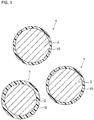
- the soft magnetic alloy powder in the present embodiment includes a plurality of coated particles 1 having a coating portion 10 on the surface of soft magnetic alloy particles 2, as shown in FIG. 1 .
- the proportion of the number of particles contained in the soft magnetic alloy powder is set as 100%, the proportion of the number of coated particles is preferably 90% or more, more preferably 95% or more.
- the shape of the soft magnetic alloy particles 2 is not particularly limited, and usually in a spherical form.
- the average particle size (D50) of the soft magnetic alloy powder in the present embodiment may be selected depending on the use and material.
- the average particle size (D50) is preferably in the range of 0.3 to 100 ⁇ m. With an average particle size of the soft magnetic alloy powder in the above-described range, sufficient formability or predetermined magnetic properties can be easily maintained.
- the method for measuring the average particle size is not particularly limited, and use of laser diffraction/scattering method is preferred.
- the soft magnetic alloy powder may contain soft magnetic alloy particles of the same material only, or may be a mixture of soft magnetic alloy particles of different materials.
- the difference in materials includes an occasion that the elements constituting the metal or the alloy are different, an occasion that even if the elements constituting the metal or the alloy are the same, the compositions are different, or the like.
- Soft magnetic alloy particles include a soft magnetic alloy having a specific structure and a composition.
- the types of soft magnetic alloy are divided into a soft magnetic alloy in a first aspect and a soft magnetic alloy in a second aspect.
- the soft magnetic alloy in the first aspect and the soft magnetic alloy in the second aspect have difference in the structure, with the composition in common.
- the soft magnetic alloy in the first aspect has a nano-heterostructure with initial fine crystals present in an amorphous substance.
- the structure includes a number of fine crystals deposited and dispersed in an amorphous alloy obtained by quenching a molten metal made of melted raw materials of the soft magnetic alloy.
- the average grain size of the initial fine crystals is, therefore, very small.
- the average grain size of the initial fine crystals is preferably 0.3 nm or more and 10 nm or less.
- the soft magnetic alloy having such a nano-heterostructure is heat-treated under predetermined conditions to grow the initial fine crystals, so that a soft magnetic alloy in a second aspect described below (a soft magnetic alloy having Fe-based nanocrystals) can be easily obtained.
- composition of the soft magnetic alloy in the first aspect is described in detail as follows.
- the soft magnetic alloy in the first aspect is a soft magnetic alloy represented by a composition formula (Fe (1-( ⁇ + ⁇ )) X1 ⁇ X2 ⁇ ) (1-(a+b+c+d+e+f+g)) M a B b P c Si d C e S f Ti g , in which a relatively high content of Fe is present.
- M represents at least one element selected from the group consisting of Nb, Hf, Zr, Ta, Mo, W and V.
- a represents the amount of M, satisfying a relation 0.020 ⁇ a ⁇ 0.14.
- the amount of M ("a") is preferably 0.040 or more, more preferably 0.050 or more.
- the amount of M ("a") is preferably 0.10 or less, more preferably 0.080 or less.
- "b” represents the amount of B (boron), satisfying a relation 0.020 ⁇ b ⁇ 0.20.
- the amount of B ("b") is preferably 0.025 or more, more preferably 0.060 or more, further preferably 0.080 or more. Also, the amount of B ("b") is preferably 0.15 or less, more preferably 0.12 or less.
- "c” represents the amount of P (phosphorus), satisfying a relation 0 ⁇ c ⁇ 0.15.
- the amount of P ("c") is preferably 0.005 or more, more preferably 0.010 or more. Also, the amount of P ("c") is preferably 0.100 or less.
- the soft magnetic alloy may contain no Si.
- the amount of Si ("d") is preferably 0.001 or more, more preferably 0.005 or more. Also, the amount of Si ("d") is preferably 0.040 or less.
- e represents the amount of C (carbon), satisfying a relation 0 ⁇ e ⁇ 0.040.
- the soft magnetic alloy may contain no C.
- the amount of C ("e") is preferably 0.001 or more.
- the amount of C ("e") is preferably 0.035 or less, more preferably 0.030 or less.
- f' represents the amount of S (sulfur), satisfying a relation 0 ⁇ f ⁇ 0.010.
- the amount of S ("f') is preferably 0.002 or more. Also, the amount of S ("f') is preferably 0.010 or less.
- "g” represents the amount of Ti (titanium), satisfying a relation 0 ⁇ g ⁇ 0.0010.
- the amount of Ti ("g") is preferably 0.0002 or more. Also, the amount of Ti ("g") is preferably 0.0010 or less.
- the soft magnetic alloy it is important for the soft magnetic alloy to contain S and/or Ti, in particular.
- "f' and "g” are in the above ranges, and any one of “f” and “g”, or both of “f” and “g”, need to be more than 0.
- the sphericity of the soft magnetic alloy particles tends to improve.
- the density of a dust core produced by compression molding of the powder including the soft magnetic alloy particles can be further improved.
- Containing S means that "f' is not 0. More specifically, it means a relation f ⁇ 0.001.
- Containing Ti means that "g” is not 0. More specifically, it means a relation g ⁇ 0.0001.
- the sphericity of the soft magnetic alloy particles tend to reduce, so that the density of a dust core produced from the powder containing the soft magnetic alloy particles tends to decrease.
- 1-(a+b+c+d+e+f+g) represents an amount of Fe (iron).
- the amount of Fe i.e., 1-(a+b+c+d+e+f+g)
- the crystal phase including crystals having a grain size more than 30 nm tends to be further hardly formed.
- a part of Fe in the soft magnetic alloy in the first aspect may be replaced with X1 and/or X2 in the composition as shown in the above composition formula.
- X1 represents at least one element selected from the group consisting of Co and Ni.
- ⁇ represents the amount of X1, and is 0 or more in the present embodiment.
- the soft magnetic alloy may contain no X1.
- the number of atoms in the whole composition is set as 100 at%
- the number of atoms of X1 is preferably 40 at% or less. In other words, the following expression is preferably satisfied: 0 ⁇ 1-(a+b+c+d+e+f+g) ⁇ 0.40.
- X2 represents at least one element selected from the group consisting of Al, Mn, Ag, Zn, Sn, As, Sb, Cu, Cr, Bi, N, O and rare earth elements.
- ⁇ represents the amount of X2, and is 0 or more in the present embodiment. In other words, the soft magnetic alloy may contain no X2.
- the number of atoms in the whole composition is set as 100 at%
- the number of atoms of X2 is preferably 3.0 at% or less. In other words, the following expression is preferably satisfied: 0 ⁇ 1-(a+b+c+d+e+f+g) ⁇ 0.030.
- the range of Fe amount replaced with X1 and/or X2 expressed in the number of atoms (amount replaced) is set to less than half the total number of Fe atoms. In other words, an expression 0 ⁇ + ⁇ 0.50 is satisfied. When ⁇ + ⁇ is too large, it tends to be difficult to produce a soft magnetic alloy having Fe-based nanocrystals deposited by heat treatment.
- the soft magnetic alloy in a first aspect may contain elements other than described above as inevitable impurities.
- the total amount of the elements other than the above may be 0.1 wt% or less with respect to 100 wt% of a soft magnetic alloy.
- the soft magnetic alloy in the second aspect is composed in the same manner as the soft magnetic alloy in the first aspect, except that the structure is different. Accordingly, redundant description is omitted in the following. In other words, the description on the composition of the soft magnetic alloy in the first aspect is also applied to the soft magnetic alloy in the second aspect.
- the soft magnetic alloy in the second aspect includes an Fe-based nanocrystal.
- the Fe-based nanocrystal is a crystal of Fe having a bcc crystal structure (body-centered cubic lattice structure).
- a number of Fe-based nanocrystals are deposited and dispersed in an amorphous substance.
- the Fe-based nanocrystals can be suitably obtained by heat-treating powder including the soft magnetic alloy in the first aspect to grow initial fine crystals.
- the average grain size of the Fe-based nanocrystals therefore, tends to be slightly more than the average grain size of the initial fine crystals.
- the average grain size of the Fe-based nanocrystals is preferably 5 nm or more and 30 nm or less.
- a soft magnetic alloy in which Fe-based nanocrystals are present in a dispersed state in an amorphous substance tends to have high saturation magnetization and low coercivity.
- a coating portion 10 is formed to cover the surface of a soft magnetic metal particle 2 as shown in FIG. 1 .
- the surface covered with a material means a form of the material in contact with the surface, being fixed to cover the contacted parts.
- the coating portion to cover the soft magnetic alloy particle may cover at least a part of the surface of the particle, preferably the whole surface. Further, the coating portion may continuously cover the surface of a particle, or may cover the surface in fragments.
- the configuration of the coating portion 10 is not particularly limited, so long as the soft magnetic alloy particles constituting the soft magnetic alloy powder can be insulated from each other.
- the coating portion 10 contains a compound of at least one element selected from the group consisting of P, Si, Bi and Zn, particularly preferably a compound containing P. More preferably the compound is an oxide, particularly preferably an oxide glass.
- the resistivity of the soft magnetic alloy powder improves, so that the withstand voltage of a dust core obtained by using the soft magnetic alloy powder can be enhanced.
- a soft magnetic alloy contains Si in addition to P contained in the soft magnetic alloy, the effect can be also suitably obtained.
- the compound of at least one element selected from the group consisting of P, Si, Bi and Zn is preferably contained as a main component in the coating portion 10.
- Constaining oxides of at least one element selected from the group consisting of P, Si, Bi and Zn as a main component means that when the total amount of elements except for oxygen among elements contained in the coating portion 10 is set as 100 mass%, the total amount of at least one element selected from the group consisting of P, Si, Bi and Zn is the largest. In the present embodiment, the total amount of these elements is preferably 50 mass% or more, more preferably 60 mass% or more.
- oxide glass examples include a phosphate (P 2 O 5 ) glass, a bismuthate (Bi 2 O 3 ) glass, and a borosilicate (B 2 O 3 -SiO 2 ) glass, though not particularly limited thereto.
- P 2 O 5 glass a glass including 50 wt% or more of P 2 O 5 is preferred, and examples thereof include P 2 O 5 -ZnO-R 2 O-Al 2 O 3 glass, wherein "R" represents an alkali metal.
- Bi 2 O 3 glass a glass including 50 wt% or more of Bi 2 O 3 is preferred, and examples thereof include a Bi 2 O 3 -ZnO-B 2 O 3 -SiO 2 glass.
- B 2 O 3 -SiO 2 glass a glass including 10 wt% or more of B 2 O 3 and 10 wt% or more of SiO 2 is preferred, and examples thereof include a BaO-ZnO-B 2 O 3 -SiO 2 -Al 2 O 3 glass.
- the particle Due to having such an insulating coating portion, the particle has further enhanced insulating properties, so that the withstand voltage of a dust core including soft magnetic alloy powder containing the coated particles is improved.
- the components contained in the coating portion can be identified by EDS elemental analysis using TEM such as STEM, EELS elemental analysis, lattice constant data obtained by FFT analysis of a TEM image, and the like.
- the thickness of the coating portion 10 is not particularly limited, so long as the above effect is obtained.
- the thickness is preferably 5 nm or more and 200 nm or less.
- the thickness is preferably 150 nm or less, more preferably 50 nm or less.
- the dust core in the present embodiment is not particularly limited, so long as the dust core including the soft magnetic alloy powder described above is formed into a predetermined shape.
- the dust core includes the soft magnetic alloy powder and a resin as binder, such that the soft magnetic alloy particles to constitute the soft magnetic alloy powder are bonded to each other through the resin to be fixed into a predetermined shape.
- the dust core may include a powder mixture of the soft magnetic alloy powder described above and another magnetic powder to be formed into a predetermined shape.
- the magnetic component in the present embodiment is not particularly limited, so long as the dust core described above is included therein.
- the magnetic component may include a wire-winding air-core coil embedded in a dust core in a predetermined shape, or may include a wire with a predetermined winding number wound on the surface of a dust core with a predetermined shape.
- the magnetic component in the present embodiment is suitable as a power inductor for use in a power circuit, due to excellent withstand voltage.
- a method for producing a dust core for use in the magnetic component is described as follows. First, a method for producing a soft magnetic alloy powder to constitute the dust core is described.
- the soft magnetic alloy powder in the present invention can be obtained by using the same method as a known method for producing a soft magnetic alloy powder.
- the powder can be produced by using a gas atomization method, a water atomization method, a rotating disc method, etc.
- a ribbon produced by a single roll process or the like may be mechanically pulverized to produce the powder.
- use of gas atomization method is preferred from the perspective that a soft magnetic alloy powder having desired magnetic properties is easily obtained.
- the raw materials of a soft magnetic alloy to constitute the soft magnetic alloy powder are melted to make a molten metal.
- the raw materials (pure metals or the like) of each metal element contained in the soft magnetic alloy are prepared, weighed so as to achieve the composition of the finally obtained soft magnetic alloy, and melted.
- the method for melting the raw material of metal elements is not particularly limited, and examples thereof include a melting method by high frequency heating in the chamber of an atomization apparatus after vacuum drawing. The temperature during melting may be determined in consideration of the melting points of each metal element, and, for example, may be 1200 to 1500°C.
- the obtained molten metal is supplied to the chamber through a nozzle disposed at the bottom of a crucible, in a linear continuous form.
- a high-pressure gas is blown into the supplied molten metal, such that the molten metal is formed into droplets and quenched to make fine powder.
- the gas blowing temperature, the pressure in the chamber and the like may be determined according to conditions allowing Fe-based nanocrystals to be easily deposited in an amorphous substance by the heat treatment described below. Since the soft magnetic alloy contains S and/or Ti, the molten metal is easily divided by gas blowing on this occasion, so that the sphericity of the particles to constitute the obtained power can be improved.
- the particle size can be controlled by sieve classification, stream classification or the like.
- the obtained powder be made of soft magnetic alloy having a nano-heterostructure with initial fine crystals in an amorphous substance, i.e., the soft magnetic alloy in the first aspect, so that Fe-based nanocrystals are easily deposited by the heat treatment described below.
- the obtained powder may be made of amorphous alloy with each metal element uniformly dispersed in an amorphous substance, so long as Fe-based nanocrystals are deposited by the heat treatment described below.
- crystal phases are determined to be present, while with absence of crystals having a grain size more than 30 nm, the alloy is determined to be amorphous.
- the presence or absence of crystals having a grain size more than 30 nm in a soft magnetic alloy may be determined by a known method. Examples of the method include X-ray diffraction measurement and observation with a transmission electron microscope. In the case of using a transmission electron microscope (TEM), the determination can be made based on a selected-area diffraction image or a nanobeam diffraction image obtained therefrom.
- TEM transmission electron microscope
- a ring-shaped diffraction pattern is formed when the alloy is amorphous, while diffraction spots resulting from a crystal structure are formed when the alloy is non-amorphous.
- the observation method for determining the presence of initial fine crystals and the average grain size is not particularly limited, and the determination may be made by a known method.
- the bright field image or the high-resolution image of a specimen flaked by ion milling is obtained by using a transmission electron microscope (TEM) for the determination.
- TEM transmission electron microscope
- the presence or absence of initial fine crystals and the average grain size can be determined based on visual observation of a bright field image or a high-resolution image obtained with a magnification of 1.00 ⁇ 10 5 to 3.00 ⁇ 10 5 .
- the obtained powder is heat treated.
- the heat treatment prevents individual particles from being sintered to each other to be coarse particle, and accelerates the diffusion of elements to constitute the soft magnetic alloy, so that a thermodynamic equilibrium state can be achieved in a short time.
- the strain and the stress present in the soft magnetic alloy can be, therefore, removed.
- a powder including the soft magnetic alloy with Fe-based nanocrystals deposited, i.e., the soft magnetic alloy in the second aspect can be easily obtained.
- the heat treatment conditions are not particularly limited, so long as the conditions allow Fe-based nanocrystals to be easily deposited.
- the heat treatment temperature may be set at 400 to 700°C, and the holding time may be set to 0.5 to 10 hours.
- a coating portion is formed on the soft magnetic alloy particles contained in the heat-treated powder.
- the method for forming the coating portion is not particularly limited, and a known method can be employed.
- the soft magnet alloy particles may be subjected to a wet process or a dry process to form a coating portion.
- a coating portion may be formed for the soft magnetic alloy powder before heat treatment.
- a coating portion may be formed on the soft magnetic alloy particles made of the soft magnetic alloy in the first aspect.
- the coating portion can be formed by a mechanochemical coating method, a phosphate processing method, a sol gel method, etc.
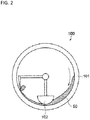
- a powder coating device 100 shown in FIG. 2 is used.
- a powder mixture of a soft magnetic alloy powder and a powder-like coating material to constitute the coating portion (a compound of P, Si, Bi, Zn, etc.) is fed into a container 101 of the powder coating device.
- the container 101 is rotated, so that a mixture 50 of the soft magnetic alloy powder and the powder-like coating material is compressed between a grinder 102 and the inner wall of the container 101 to cause friction, resulting in heat generation. Due to the generated friction heat, the powder-like coating material is softened and adhered to the surface of the soft magnetic alloy particles due to compression effect, so that a coating portion can be formed.
- the generated friction heat is controlled, so that the temperature of the mixture of the soft magnetic alloy powder and the powder-like coating material can be controlled.
- the temperature it is preferable that the temperature be 50°C or more and 150°C or less. Within the temperature range, the coating portion is easily formed to cover the surface of the soft magnetic alloy particles.
- the dust core is produced by using the above soft magnetic alloy powder.
- the specific producing method is not particularly limited, and a known method may be employed.
- a soft magnetic alloy powder including the soft magnetic alloy particles with the coating portion and a known resin as a binder are mixed to obtain a mixture.
- the obtained mixture may be formed into a granulated powder as necessary.
- a mold is filled with the mixture or the granulated powder, which is then subjected to compression molding to produce a green compact having the shape of a dust core to be made. Due to the high sphericity of the soft magnetic alloy particles described above, the compression molding of the powder including the soft magnetic alloy particles allows the press mold to be densely filled with the soft magnetic alloy particles, so that a dust core having a high density can be obtained.
- the obtained green compact is heat treated, for example, at 50 to 200°C, so that the resin is hardened and a dust core having a predetermined shape, with the soft magnetic alloy particles fixed through the resin, can be obtained.
- a wire is wound with a predetermined number of turns, so that a magnetic component such as an inductor can be obtained.
- a press mold may be filled with the mixture or the granulated powder described above and an air-core coil formed of a wire wound with a predetermined number of turns, which is then subjected to compression molding to obtain a green compact with the coil embedded inside.
- the obtained green compact is heat-treated to make a dust core in a predetermined shape with the coil embedded. Having a coil embedded inside, the dust core functions as a magnetic component such as an inductor.
- raw material metals of the soft magnetic alloy were prepared.
- the raw material metals prepared were weighed so as to achieve each of the compositions shown in Table 1, and accommodated in a crucible disposed in an atomization apparatus.
- the crucible was heated by high-frequency induction using a work coil provided outside the crucible, so that the raw material metals in the crucible were melted and mixed to obtain a molten metal (melted metal) at 1250°C.
- the obtained molten metal was supplied into the chamber through a nozzle disposed at the bottom of a crucible, in a linear continuous form.
- a gas was sprayed to produce a powder.
- the temperature of the gas blowing was controlled at 1250°C, and the pressure inside the chamber was controlled at 1 hPa.
- the average particle size (D50) of the obtained powder was 20 ⁇ m.
- the obtained powder was subjected to X-ray diffraction measurement to determine the presence or absence of crystals having a grain size more than 30 nm. With absence of crystals having a grain size more than 30 nm, it was determined that the soft magnetic alloy to constitute the powder is composed of an amorphous phase, while with the presence of crystals having a grain size more than 30 nm, it was determined that the soft magnetic alloy is composed of a crystal phase. The results are shown in Table 1.
- the obtained powder was heat-treated.
- the heat treatment temperature was controlled at 600°C, for a holding time of 1 hour.
- the powder was subjected to X-ray diffraction measurement and observation with TEM, so that the presence or absence of Fe-based nanocrystals was determined.
- the results are shown in Table 1. It was confirmed that in all the samples in Examples with presence of Fe-based nanocrystals, the Fe-based nanocrystals have a bcc crystal structure, and an average grain size of 5 to 30 nm.
- the powder after the heat treatment was subjected to the measurement of coercivity (Hc) and saturation magnetization ( ⁇ s).
- Hc coercivity
- ⁇ s saturation magnetization
- 20 mg of the powder and paraffin were placed in a plastic case with a diameter of 6 mm and a height of 5 mm, and the paraffin was melted and solidified to fix the powder.
- the measurement was performed by using a coercivity meter (K-HC1000) produced by Tohoku Steel Co., Ltd.
- the magnetic field intensity for the measurement was set to 150 kA/m.
- samples having a coercivity of 350 A/m or less were evaluated as good. The results are shown in Table 1.
- the saturation magnetization was measured with a vibrating-sample magnetometer (VSM) produced by Tamakawa Co., Ltd.
- VSM vibrating-sample magnetometer
- the samples having a saturation magnetization of 150 A ⁇ m 2 /kg or more are evaluated as good.
- the results are shown in Table 1.
- the powder after the heat treatment and a powder glass (coating material) were fed into the container of a powder coating device, so that the surface of the particles was coated with the powdery glass to form a coating portion.
- a soft magnetic alloy powder was produced.
- the amount of the powder glass added is set to 0.5 wt% relative to 100 wt% of the powder after the heat treatment.
- the thickness of the coating portion was 50 nm.
- the powder glass was a phosphate glass having a composition of P 2 O 5 -ZnO-R 2 O-Al 2 O 3 .
- the composition consists of 50 wt% of P 2 O 5 , 12 wt% of ZnO, 20 wt% of R 2 O, 6 wt% of Al 2 O 3 , and the remaining part being accessory components.
- the present inventors made similar experiments using a glass having a composition consisting of 60 wt% of P 2 O 5 , 20 wt% of ZnO, 10 wt% of R 2 O, 5 wt% of Al 2 O 3 , and the remaining part being accessory components, and confirmed that the same results described below were obtained.
- the soft magnetic alloy powder with a coating portion formed was solidified to evaluate the resistivity of the powder.
- a pressure of 0.6 t/cm 2 was applied to the powder using a powder resistivity measurement system.
- samples having a resistivity of 10 6 ⁇ cm or more were evaluated as "excellent”, samples having a resistivity of 10 5 ⁇ cm or more were evaluated as "good”, samples having a resistivity of 10 4 ⁇ cm or more were evaluated as "fair”, samples having a resistivity less than 10 4 ⁇ cm were evaluated as "bad”.
- Table 1 The results are shown in Table 1.
- a dust core was made.
- a total amount of an epoxy resin which is a thermosetting resin and an imide resin which is a hardening agent is weighed so as to be 3wt% with respect to 100 wt% of the obtained soft magnetic alloy powder, the epoxy resin and the imide resin are added to acetone to be made into a solution, and the solution is mixed with the soft magnetic alloy powder. After the mixing, granules obtained by volatilizing the acetone are sized with a mesh of 355 ⁇ m.
- the granules are filled into a press mold with a toroidal shape having an outer diameter of 11 mm and an inner diameter of 6.5 mm and are pressurized under a molding pressure of 3.0 t/cm 2 to obtain the molded body of the dust core.
- the resins in the obtained molded body of the dust core are hardened under the condition of 180°C and 1 hour, and the dust core is obtained.
- the density of the obtained dust core was measured by the following method. The density calculated from the measurement of the outer diameter, the inner diameter, the height and the weight of the dust core was divided by the theoretical density calculated from the composition ratio of the soft magnetic alloy to obtain the relative density. The results are shown in Table 1.
- a source meter is used to apply voltage on the top and the bottom of the samples of the dust core, and a voltage value when an electric current of 1 mA flows divided by the distance between the electrodes was defined as the withstand voltage.
- samples having a withstand voltage of 100 V/mm or more were evaluated as good. The results are shown in Table 1. [Table 1] Experiment No.
- a soft magnetic alloy powder was made in the same manner as in Experimental Samples 1, 4 and 8, except that "M” in the composition formula of the sample in Experimental Samples 1, 4 and 8 was changed to the elements shown in Table 2, and evaluated in the same manner as in Experimental Samples 1, 4 and 8. Further, Using the obtained powder, a dust core was made in the same manner as in Experimental Samples 1, 4 and 8, and evaluated in the same manner as in Experimental Samples 1, 4 and 8. The results are shown in Table 2. [Table 2] Experiment No.
- a soft magnetic alloy powder was made in the same manner as in Experimental Sample 1, except that the elements "X1" and “X2" and the amounts of "X1” and “X2” in the composition formula in Experimental Sample 1 were changed to the elements and the amount shown in Table 3, and evaluated in the same manner as in Experimental Sample 1.
- a dust core was made as in Experimental Sample 1, and evaluated in the same manner as in Experimental Sample 1. The results are shown in Table 3. [Table 3] v Experiment No.
- a soft magnetic alloy powder was made in the same manner as in Experimental Sample 1, except that the composition of the coating material was changed to that shown in Table 4 and the thickness of the coating portion formed from coating material was changed to that shown in Table 4, and evaluated in the same manner as in Experimental Sample 1.
- a dust core was made in the same manner as in Experimental Sample 1 and evaluated in the same manner as in Experimental Sample 1. The results are shown in Table 4. Note that, no coating portion was formed on the sample in Experimental Sample 151.
- a soft magnetic alloy powder was made in the same manner as in Experimental Sample 1, except that the molten metal temperature during atomization and the heat treatment conditions of the obtained powder by atomization of the sample in Experimental Sample 1 were changed to the conditions shown in Table 5, and evaluated in the same manner as in Experimental Sample 1.
- a dust core was made in the same manner as in Experimental Sample 1 and evaluated in the same manner as in Experimental Sample 1. The results are shown in Table 5. [Table 5] Experiment No.
- the powder having a nano-heterostructure with an initial fine crystals, or the powder having Fe-based nanocrystals after heat treatment achieves high resistivity of the powder, good withstand voltage of a dust core, and high density of the dust core, regardless of the average grain size of initial fine crystals or the average gran size of Fe-based nanocrystals.
- COATED PARTICLE 10: COATING PORTION
- 2 SOFT MAGNETIC ALLOY PARTICLE
Landscapes
- Chemical & Material Sciences (AREA)
- Engineering & Computer Science (AREA)
- Power Engineering (AREA)
- Materials Engineering (AREA)
- Dispersion Chemistry (AREA)
- Mechanical Engineering (AREA)
- Organic Chemistry (AREA)
- Metallurgy (AREA)
- Physics & Mathematics (AREA)
- Electromagnetism (AREA)
- Crystallography & Structural Chemistry (AREA)
- Inorganic Chemistry (AREA)
- Microelectronics & Electronic Packaging (AREA)
- Soft Magnetic Materials (AREA)
- Powder Metallurgy (AREA)
Priority Applications (1)
| Application Number | Priority Date | Filing Date | Title |
|---|---|---|---|
| EP20204301.4A EP3792940A1 (de) | 2018-03-09 | 2019-03-08 | Weichmagnetisches legierungspulver, massekern und magnetische komponente |
Applications Claiming Priority (1)
| Application Number | Priority Date | Filing Date | Title |
|---|---|---|---|
| JP2018043652A JP6867966B2 (ja) | 2018-03-09 | 2018-03-09 | 軟磁性合金粉末、圧粉磁心および磁性部品 |
Related Child Applications (1)
| Application Number | Title | Priority Date | Filing Date |
|---|---|---|---|
| EP20204301.4A Division EP3792940A1 (de) | 2018-03-09 | 2019-03-08 | Weichmagnetisches legierungspulver, massekern und magnetische komponente |
Publications (1)
| Publication Number | Publication Date |
|---|---|
| EP3537461A1 true EP3537461A1 (de) | 2019-09-11 |
Family
ID=65763268
Family Applications (2)
| Application Number | Title | Priority Date | Filing Date |
|---|---|---|---|
| EP20204301.4A Withdrawn EP3792940A1 (de) | 2018-03-09 | 2019-03-08 | Weichmagnetisches legierungspulver, massekern und magnetische komponente |
| EP19161533.5A Withdrawn EP3537461A1 (de) | 2018-03-09 | 2019-03-08 | Weichmagnetisches legierungspulver, massekern und magnetische komponente |
Family Applications Before (1)
| Application Number | Title | Priority Date | Filing Date |
|---|---|---|---|
| EP20204301.4A Withdrawn EP3792940A1 (de) | 2018-03-09 | 2019-03-08 | Weichmagnetisches legierungspulver, massekern und magnetische komponente |
Country Status (6)
| Country | Link |
|---|---|
| US (1) | US11081266B2 (de) |
| EP (2) | EP3792940A1 (de) |
| JP (1) | JP6867966B2 (de) |
| KR (1) | KR102165131B1 (de) |
| CN (1) | CN110246652B (de) |
| TW (1) | TWI669724B (de) |
Cited By (1)
| Publication number | Priority date | Publication date | Assignee | Title |
|---|---|---|---|---|
| CN111621701A (zh) * | 2020-05-15 | 2020-09-04 | 广东合一纳米材料科技有限公司 | 一种新型纳米低碳结构钢 |
Families Citing this family (18)
| Publication number | Priority date | Publication date | Assignee | Title |
|---|---|---|---|---|
| JP6338001B1 (ja) * | 2017-09-15 | 2018-06-06 | Tdk株式会社 | 軟磁性合金および磁性部品 |
| JP6981200B2 (ja) * | 2017-11-21 | 2021-12-15 | Tdk株式会社 | 軟磁性合金および磁性部品 |
| JP7201417B2 (ja) * | 2018-01-17 | 2023-01-10 | Dowaエレクトロニクス株式会社 | シリコン酸化物被覆鉄粉およびその製造方法並びにそれを用いたインダクタ用成形体およびインダクタ |
| JP6867966B2 (ja) * | 2018-03-09 | 2021-05-12 | Tdk株式会社 | 軟磁性合金粉末、圧粉磁心および磁性部品 |
| KR102146801B1 (ko) * | 2018-12-20 | 2020-08-21 | 삼성전기주식회사 | 코일 전자 부품 |
| CN112582125B (zh) * | 2019-09-27 | 2024-03-19 | Tdk株式会社 | 软磁性合金和电子部件 |
| CN112582126A (zh) | 2019-09-30 | 2021-03-30 | Tdk株式会社 | 软磁性金属粉末、压粉磁芯和磁性零件 |
| JP7588478B2 (ja) * | 2019-09-30 | 2024-11-22 | Tdk株式会社 | 軟磁性金属粉末、圧粉磁心および磁性部品 |
| CN113053610B (zh) * | 2019-12-27 | 2025-01-03 | Tdk株式会社 | 软磁性合金粉末、磁芯、磁性部件和电子设备 |
| KR102335425B1 (ko) * | 2020-01-09 | 2021-12-06 | 삼성전기주식회사 | 자성 분말 및 자성 분말을 포함하는 코일 부품 |
| JP7424164B2 (ja) * | 2020-03-30 | 2024-01-30 | Tdk株式会社 | 軟磁性合金、磁気コア、磁性部品および電子機器 |
| JP7416212B2 (ja) * | 2020-03-31 | 2024-01-17 | 株式会社村田製作所 | 軟磁性合金粉末、磁心、磁気応用部品およびノイズ抑制シート |
| CN111745155B (zh) * | 2020-07-10 | 2022-07-12 | 郑州机械研究所有限公司 | 低熔包覆合金粉末及其制备方法和铁基金刚石胎体 |
| CN114574784B (zh) * | 2020-11-30 | 2023-04-07 | 松山湖材料实验室 | 高Fe含量的铁基非晶合金及其制备方法 |
| JP7683421B2 (ja) * | 2021-08-26 | 2025-05-27 | 株式会社村田製作所 | 合金粒子 |
| CN114496444B (zh) * | 2022-03-04 | 2024-10-18 | Oppo广东移动通信有限公司 | 软磁性复合材料及其制备方法 |
| JP2024130764A (ja) * | 2023-03-15 | 2024-09-30 | 株式会社トーキン | 複合軟磁性粉末、複合軟磁性粉末の製造方法及び磁性部品 |
| CN119495507B (zh) * | 2025-01-16 | 2025-04-22 | 杭州新川新材料有限公司 | 一种软磁芯及其制备方法与应用 |
Citations (5)
| Publication number | Priority date | Publication date | Assignee | Title |
|---|---|---|---|---|
| JP3342767B2 (ja) | 1994-03-28 | 2002-11-11 | アルプス電気株式会社 | Fe基軟磁性合金 |
| US20110085931A1 (en) * | 2005-09-16 | 2011-04-14 | Hitachi Metals, Ltd. | Nano-crystalline, magnetic alloy, its production method, alloy ribbon and magnetic part |
| JP2012012699A (ja) * | 2010-03-23 | 2012-01-19 | Nec Tokin Corp | 合金組成物、Fe基ナノ結晶合金及びその製造方法、並びに磁性部品 |
| JP2015132010A (ja) | 2014-01-09 | 2015-07-23 | サムソン エレクトロ−メカニックス カンパニーリミテッド. | 絶縁コーティング層を有するパワーインダクタ用非晶質合金粉末及びその製造方法 |
| JP2018070966A (ja) * | 2016-10-31 | 2018-05-10 | Tdk株式会社 | 軟磁性合金および磁性部品 |
Family Cites Families (18)
| Publication number | Priority date | Publication date | Assignee | Title |
|---|---|---|---|---|
| CN100442403C (zh) * | 2004-09-30 | 2008-12-10 | 住友电气工业株式会社 | 软磁材料,粉末磁芯和制备软磁材料的方法 |
| US8287665B2 (en) * | 2007-03-20 | 2012-10-16 | Nec Tokin Corporation | Soft magnetic alloy, magnetic part using soft magnetic alloy, and method of manufacturing same |
| US20100193726A1 (en) * | 2007-08-30 | 2010-08-05 | Sumitomo Electric Industries, Ltd. | Soft magnetic material, dust core, method for producing soft magnetic material, and method for producing dust core |
| EP3131100A4 (de) * | 2014-03-25 | 2018-04-18 | NTN Corporation | Magnetkernkomponenten, magnetelement und herstellungsverfahren für magnetkernkomponente |
| KR102118493B1 (ko) * | 2015-03-19 | 2020-06-03 | 삼성전기주식회사 | 자성 분말, 그 제조방법 및 이를 포함하는 코일 전자부품 |
| US10122801B2 (en) | 2015-07-02 | 2018-11-06 | Qualcomm Incorporated | Service discovery and topology management |
| JP6443269B2 (ja) * | 2015-09-01 | 2018-12-26 | 株式会社村田製作所 | 磁心及びその製造方法 |
| JP6707845B2 (ja) * | 2015-11-25 | 2020-06-10 | セイコーエプソン株式会社 | 軟磁性粉末、圧粉磁心、磁性素子および電子機器 |
| JP6593146B2 (ja) * | 2015-12-16 | 2019-10-23 | セイコーエプソン株式会社 | 軟磁性粉末、圧粉磁心、磁性素子および電子機器 |
| JP6790531B2 (ja) * | 2016-07-12 | 2020-11-25 | Tdk株式会社 | 軟磁性金属粉末および圧粉磁心 |
| JP6245391B1 (ja) * | 2017-01-30 | 2017-12-13 | Tdk株式会社 | 軟磁性合金および磁性部品 |
| JP6245390B1 (ja) | 2017-01-30 | 2017-12-13 | Tdk株式会社 | 軟磁性合金および磁性部品 |
| US11972884B2 (en) * | 2018-01-12 | 2024-04-30 | Tdk Corporation | Soft magnetic alloy and magnetic device |
| KR102281002B1 (ko) * | 2018-01-12 | 2021-07-23 | 티디케이 가부시기가이샤 | 연자성 합금 및 자성 부품 |
| JP6501005B1 (ja) * | 2018-01-30 | 2019-04-17 | Tdk株式会社 | 軟磁性合金および磁性部品 |
| JP6867966B2 (ja) * | 2018-03-09 | 2021-05-12 | Tdk株式会社 | 軟磁性合金粉末、圧粉磁心および磁性部品 |
| JP6867965B2 (ja) * | 2018-03-09 | 2021-05-12 | Tdk株式会社 | 軟磁性合金粉末、圧粉磁心および磁性部品 |
| JP6680309B2 (ja) * | 2018-05-21 | 2020-04-15 | Tdk株式会社 | 軟磁性粉末、圧粉体および磁性部品 |
-
2018
- 2018-03-09 JP JP2018043652A patent/JP6867966B2/ja active Active
-
2019
- 2019-03-07 KR KR1020190026347A patent/KR102165131B1/ko active Active
- 2019-03-08 EP EP20204301.4A patent/EP3792940A1/de not_active Withdrawn
- 2019-03-08 US US16/296,559 patent/US11081266B2/en active Active
- 2019-03-08 EP EP19161533.5A patent/EP3537461A1/de not_active Withdrawn
- 2019-03-08 TW TW108107786A patent/TWI669724B/zh active
- 2019-03-08 CN CN201910178172.0A patent/CN110246652B/zh active Active
Patent Citations (5)
| Publication number | Priority date | Publication date | Assignee | Title |
|---|---|---|---|---|
| JP3342767B2 (ja) | 1994-03-28 | 2002-11-11 | アルプス電気株式会社 | Fe基軟磁性合金 |
| US20110085931A1 (en) * | 2005-09-16 | 2011-04-14 | Hitachi Metals, Ltd. | Nano-crystalline, magnetic alloy, its production method, alloy ribbon and magnetic part |
| JP2012012699A (ja) * | 2010-03-23 | 2012-01-19 | Nec Tokin Corp | 合金組成物、Fe基ナノ結晶合金及びその製造方法、並びに磁性部品 |
| JP2015132010A (ja) | 2014-01-09 | 2015-07-23 | サムソン エレクトロ−メカニックス カンパニーリミテッド. | 絶縁コーティング層を有するパワーインダクタ用非晶質合金粉末及びその製造方法 |
| JP2018070966A (ja) * | 2016-10-31 | 2018-05-10 | Tdk株式会社 | 軟磁性合金および磁性部品 |
Cited By (1)
| Publication number | Priority date | Publication date | Assignee | Title |
|---|---|---|---|---|
| CN111621701A (zh) * | 2020-05-15 | 2020-09-04 | 广东合一纳米材料科技有限公司 | 一种新型纳米低碳结构钢 |
Also Published As
| Publication number | Publication date |
|---|---|
| EP3792940A1 (de) | 2021-03-17 |
| KR102165131B1 (ko) | 2020-10-13 |
| JP6867966B2 (ja) | 2021-05-12 |
| TWI669724B (zh) | 2019-08-21 |
| CN110246652A (zh) | 2019-09-17 |
| JP2019157187A (ja) | 2019-09-19 |
| TW201939529A (zh) | 2019-10-01 |
| US11081266B2 (en) | 2021-08-03 |
| KR20190106788A (ko) | 2019-09-18 |
| CN110246652B (zh) | 2021-01-05 |
| US20190279796A1 (en) | 2019-09-12 |
Similar Documents
| Publication | Publication Date | Title |
|---|---|---|
| EP3537461A1 (de) | Weichmagnetisches legierungspulver, massekern und magnetische komponente | |
| US11145448B2 (en) | Soft magnetic alloy powder, dust core, and magnetic component | |
| EP3537460B1 (de) | Weichmagnetisches metallpulver, staubkern und magnetische komponente | |
| EP3537457B1 (de) | Weichmagnetisches metallpulver, staubkern und magnetische komponente | |
| WO2016204008A1 (ja) | 磁性体粉末とその製造方法、磁心コアとその製造方法、及びコイル部品 | |
| EP3666419A1 (de) | Kristallines fe-basiertes legierungspulver und verfahren zur herstellung davon | |
| JP6504289B1 (ja) | 軟磁性金属粉末、圧粉磁心および磁性部品 | |
| JP6536860B1 (ja) | 軟磁性金属粉末、圧粉磁心および磁性部品 | |
| US11705259B2 (en) | Soft magnetic metal powder, dust core, and magnetic component | |
| CN110246648B (zh) | 软磁性金属粉末、压粉磁芯及磁性部件 | |
| EP3355321A1 (de) | Weichmagnetische legierung und magnetvorrichtung | |
| JP7588478B2 (ja) | 軟磁性金属粉末、圧粉磁心および磁性部品 | |
| JP6773193B2 (ja) | 軟磁性合金粉末、圧粉磁心および磁性部品 | |
| JP2020136647A (ja) | 磁性体コアおよび磁性部品 | |
| JP2025074937A (ja) | 軟磁性粉末、磁気コアおよび磁気デバイス | |
| JP6773194B2 (ja) | 軟磁性合金粉末、圧粉磁心および磁性部品 | |
| US20230178275A1 (en) | Soft magnetic metal powder, dust core, magnetic component, and electronic component | |
| JP2025074936A (ja) | 軟磁性粉末、磁気コアおよび磁気デバイス |
Legal Events
| Date | Code | Title | Description |
|---|---|---|---|
| PUAI | Public reference made under article 153(3) epc to a published international application that has entered the european phase |
Free format text: ORIGINAL CODE: 0009012 |
|
| 17P | Request for examination filed |
Effective date: 20190308 |
|
| AK | Designated contracting states |
Kind code of ref document: A1 Designated state(s): AL AT BE BG CH CY CZ DE DK EE ES FI FR GB GR HR HU IE IS IT LI LT LU LV MC MK MT NL NO PL PT RO RS SE SI SK SM TR |
|
| AX | Request for extension of the european patent |
Extension state: BA ME |
|
| RBV | Designated contracting states (corrected) |
Designated state(s): AL AT BE BG CH CY CZ DE DK EE ES FI FR GB GR HR HU IE IS IT LI LT LU LV MC MK MT NL NO PL PT RO RS SE SI SK SM TR |
|
| R17P | Request for examination filed (corrected) |
Effective date: 20190308 |
|
| RIC1 | Information provided on ipc code assigned before grant |
Ipc: H01F 41/02 20060101ALN20200519BHEP Ipc: H01F 1/24 20060101ALN20200519BHEP Ipc: H01F 1/33 20060101AFI20200519BHEP Ipc: H01F 3/08 20060101ALI20200519BHEP Ipc: H01F 1/153 20060101ALI20200519BHEP Ipc: H01F 1/26 20060101ALN20200519BHEP |
|
| GRAP | Despatch of communication of intention to grant a patent |
Free format text: ORIGINAL CODE: EPIDOSNIGR1 |
|
| STAA | Information on the status of an ep patent application or granted ep patent |
Free format text: STATUS: GRANT OF PATENT IS INTENDED |
|
| RIC1 | Information provided on ipc code assigned before grant |
Ipc: H01F 1/26 20060101ALN20200605BHEP Ipc: H01F 3/08 20060101ALI20200605BHEP Ipc: H01F 1/153 20060101ALI20200605BHEP Ipc: H01F 1/24 20060101ALN20200605BHEP Ipc: H01F 41/02 20060101ALN20200605BHEP Ipc: H01F 1/33 20060101AFI20200605BHEP |
|
| INTG | Intention to grant announced |
Effective date: 20200703 |
|
| 18D | Application deemed to be withdrawn |
Effective date: 20201114 |