EP3538438B1 - Fahrgastsitzunterhaltungssystem - Google Patents
Fahrgastsitzunterhaltungssystem Download PDFInfo
- Publication number
- EP3538438B1 EP3538438B1 EP17754984.7A EP17754984A EP3538438B1 EP 3538438 B1 EP3538438 B1 EP 3538438B1 EP 17754984 A EP17754984 A EP 17754984A EP 3538438 B1 EP3538438 B1 EP 3538438B1
- Authority
- EP
- European Patent Office
- Prior art keywords
- sensor
- entertainment system
- base
- side edge
- passenger
- Prior art date
- Legal status (The legal status is an assumption and is not a legal conclusion. Google has not performed a legal analysis and makes no representation as to the accuracy of the status listed.)
- Active
Links
Images




Classifications
-
- B—PERFORMING OPERATIONS; TRANSPORTING
- B64—AIRCRAFT; AVIATION; COSMONAUTICS
- B64D—EQUIPMENT FOR FITTING IN OR TO AIRCRAFT; FLIGHT SUITS; PARACHUTES; ARRANGEMENT OR MOUNTING OF POWER PLANTS OR PROPULSION TRANSMISSIONS IN AIRCRAFT
- B64D11/00—Passenger or crew accommodation; Flight-deck installations not otherwise provided for
- B64D11/0015—Arrangements for entertainment or communications, e.g. radio, television
-
- A—HUMAN NECESSITIES
- A47—FURNITURE; DOMESTIC ARTICLES OR APPLIANCES; COFFEE MILLS; SPICE MILLS; SUCTION CLEANERS IN GENERAL
- A47C—CHAIRS; SOFAS; BEDS
- A47C7/00—Parts, details, or accessories of chairs or stools
- A47C7/62—Accessories for chairs
- A47C7/72—Adaptations for incorporating lamps, radio sets, bars, telephones, ventilation, heating or cooling arrangements or the like
Definitions
- This application relates to passenger seats, and more particularly to an entertainment system for a passenger seat.
- Passenger vehicles such as aircraft, buses, trains, ships, and automobiles, include passenger seats for passengers to sit in during travel. While passenger seats are designed to provide comfort the passenger, many passengers become fatigued and stiff when forced to remain seated for long durations (such as on long-haul flights) because their movement is relatively limited. Moreover, passengers may be less motivated to move about a cabin of the passenger vehicle at the risk of inconveniencing other passengers or drawing attention to themselves. The stiffness and fatigue from limited movement may cause discomfort during travel and continue to affect the passenger even after they have exited the passenger vehicle and are no longer travelling. The limited movement may further potentially cause health issues or other problems with the passengers. Such discomfort detracts from the passenger travel experience, and may discourage the passenger from travelling often or opting for other means of transport. Therefore, there is a need for a passenger seat that improves the passenger travel experience.
- Document entitled " Integrating Gesture Recognition in Airplane Seats for In-FlightEntertainment” from Rick Van De Wastelaken et al. describes sensors integrated in airplane seats to detect the gestures as input for in-flight entertainment systems.
- Document JP2016-144988 describes a vehicular seat comprising a seal frame and a cushion member, which comprises an occupant detection sensor which is arranged below the cushion member and detects presence or absence of an occupant.
- Document EP2093101 describes a flexible seat sensor product comprising a flexible seat sensor and a flexible envelope sheathing said flexible seal sensor.
- a passenger seat includes a seat base and an entertainment system.
- the seat base includes a cushioning member and a cover that covers the cushioning member.
- the entertainment system is positioned between the cushioning member and the cover, and includes a first sensor at a first location and a second sensor at a second location.
- the entertainment system is positioned such that the first sensor and the second sensor are aligned with a passenger's legs when used.
- the first sensor and the second sensor are configured to detect a force applied by the passenger's legs on the entertainment system when used.
- the cushioning member includes a forward edge and an aft edge.
- a distance between the first sensor and the second sensor is a spacing distance, and the first sensor and the second sensor are positioned at an edge distance from the forward edge. In some examples, the edge distance is less than the spacing distance.
- the first sensor and the second sensor each include at least one of a piezoelectric textile sensor, a force sensor resistor, a strain gauge sensor, an accelerometer, or a foam sensor.
- the entertainment system further includes a base having a first side edge, a second side edge, an upper surface, and a lower surface.
- the first sensor and the second sensor are secured on the upper surface of the base between the first side edge and the second side edge.
- the base further includes a center section between the first side edge and the second side edge, a first flexible section between the center section and the first side edge, and a second flexible section between the center section and the second side edge.
- the first flexible section and the second flexible section include a first fabric material and the center section includes a second fabric material different from the first fabric material. The first fabric material is more elastic than the second fabric material, and the first sensor and the second sensor are secured on the center section.
- the entertainment system further includes a controller secured to the base and configured to communicate with the first sensor and the second sensor to receive sensed force data and communicate the sensed force data with an In-Flight Entertainment (IFE) device such that the IFE device runs an application based on the sensed force data.
- IFE In-Flight Entertainment
- the cover includes an inner surface and an outer surface, and the outer surface includes a first indicator corresponding with the first sensor and a second indicator corresponding with the second sensor.
- an entertainment system for a passenger seat includes a base, a first sensor, and a second sensor.
- the base includes a first side edge, a second side edge, an upper surface, and a lower surface.
- the first sensor is secured to the upper surface of the base between the first side edge and the second side edge, and the second sensor is secured to the upper surface of the base between the first sensor and the second side edge.
- the first sensor and the second sensor are each configured to detect a force applied to the entertainment system, and the base is configured to be positioned between a cushioning member and a cover of a base of a passenger seat.
- the entertainment system includes a controller secured to the base and configured to communicate with the first sensor and the second sensor to receive sensed force data and communicate the sensed force data with an IFE device.
- the base further includes a center section between the first side edge and the second side edge, a first flexible section between the center section and the first side edge, and a second flexible section between the center section and the second side edge.
- the first flexible section and the second flexible section include a first fabric material
- the center section includes a second fabric material different from the first fabric material.
- the first fabric material is more elastic than the second fabric material, and the first sensor and the second sensor are secured on the center section.
- the first fabric material includes knitted nylon
- the second fabric material includes woven nylon.
- the entertainment system further includes a sleeve slidably positioned around at least the center section.
- the entertainment system includes a base cushion fastener on the lower surface of the base and a cover fastener on the upper surface of the base.
- the spacing distance is from about 170 mm to about 210 mm.
- the entertainment system further includes a first connector on the lower surface of the base and adjacent to the first side edge and a second connector on the lower surface of the base and adjacent to the second side edge.
- the first connector and the second connector are configured to removably connect the entertainment system to the cushioning member.
- a passenger seat includes a seat base and an entertainment system.
- the seat base includes a cushioning member and a cover covering the cushioning member.
- the entertainment system is positioned between the cushioning member and the cover and is removably connected to the cushioning member.
- the entertainment system is configured to determine a force caused by a passenger's legs in at least two locations on an upper surface of the seat base when used.
- the entertainment system includes a first sensor at a first location and a second sensor at a second location. According to some examples not covered by the claimed invention, the entertainment system is positioned such that the first sensor and the second sensor are aligned with a passenger's legs when used, and the first sensor and the second sensor are configured to detect the force caused by the passenger's legs when used.
- the entertainment system further includes a base having a first side edge, a second side edge, an upper surface, and a lower surface.
- the first sensor and the second sensor are secured on the upper surface of the base between the first side edge and the second side edge.
- the base further includes a center section between the first side edge and the second side edge, a first flexible section between the center section and the first side edge, and a second flexible section between the center section and the second side edge.
- the first flexible section and the second flexible section include a first fabric material
- the center section includes a second fabric material different from the first fabric material.
- the first fabric material is more elastic than the second fabric material, and the first sensor and the second sensor are secured on the center section.
- the entertainment system includes at least one force sensor, and the at least one force sensor includes at least one of a piezoelectric textile sensor, a force sensor resistor, a strain gauge sensor, an accelerometer, or a foam sensor.
- the entertainment system further includes a controller configured to communicate with the at least one force sensor to receive sensed force data and communicate the sensed force data with an IFE device such that the IFE device runs an application based on the sensed force data.
- an entertainment system for a passenger seat such as an aircraft passenger seat, and associated methods, systems, devices, and various apparatus.
- the entertainment system is positioned between the cushioning member and the cover and is removably connected to the cushioning member.
- the entertainment system is configured to determine a force caused by a passenger's legs in at least two locations on an upper surface of the seat base when used. It would be understood by one of skill in the art that the disclosed entertainment system is described in but a few exemplary aspects among many.
- the entertainment system is configured to engage passengers in unobtrusive exercises in their passenger seat by playing a game while seated.
- the entertainment system detects and monitors movements of the legs of the seat occupant such that the movements act as a controller for a game on an IFE system.
- the entertainment system allows passengers to play a game using movements of their body as a controller to promote movement of the passenger and stimulate the passenger such that the passenger feels refreshed and energized during and after travel, such as during and after a flight.
- the entertainment system includes sensors within a passenger seat that detect movement and are triggered by the movement of the passenger. In some cases, these sensed movements are directed to the IFE system and presented to the user as a game to provide feedback to the user.
- the cover of a passenger seat with the entertainment system includes indicators to alert passengers that the particular passenger seat includes the entertainment system.
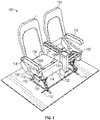
- FIGs. 1-7 illustrate an example of a passenger seat assembly 100.
- the passenger seat assembly 100 includes a base 102 and a backrest 104.
- the passenger seat assembly 100 is capable of carrying a quantity of two passengers, and accordingly has two backrests 104.
- the passenger seat assembly 100 can be capable of carrying any desired number of passengers, such as one passenger, two passengers, three passengers, four passengers, or any other desired number of passengers.
- the passenger seat assembly 100 can likewise have any desired number of corresponding backrests 104.
- the base 102 and the backrest 104 each include various frame members.
- a base cushioning member 114 covers the frame members of the base 102.
- an entertainment system 116 is provided on the base cushioning member 114, and is optionally removably connected to the base cushioning member 114 such that the entertainment system 116 may be replaced as needed or desired.
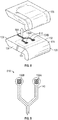
- the passenger seat assembly 100 may also include a cover layer 106 (see FIG. 5 ) that covers the base 102 and backrest 104, including the base cushioning member 114 and the entertainment system 116 when installed. Armrests 118, headrests 166 (see FIG. 6 ), tray tables 122 (see FIGs. 5 and 6 ), and/or legs 110 may also be included. Depending on the type of passenger seat assembly 100, a middle console 124 may be included to house the tray table 122 when stowed (see FIG. 1 ). In other examples, the tray tables 122 may be at various other locations, including, but not limited to, an aft side of the backrest 104. In some cases, the passenger seat assembly 100 optionally includes a luggage bar 112, although it need not. In various cases, the passenger seat assembly 100 may also optionally include an In-Flight Entertainment (IFE) monitor 128 (see FIG. 6 ), although it need not.
- IFE In-Flight Entertainment
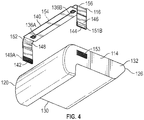
- the cushioning member 114 includes a forward edge 120, an aft edge 126, a first side 130, a second side 132, and an upper surface 134 extending from the forward edge 120 to the aft edge 126.
- the cushioning member 114 may be constructed from various materials suitable for providing cushioning and support to the passenger when used, including, but not limited to, various foams such as polyurethane foam, gels, fluids, or various other suitable cushioning materials.
- the entertainment system 116 includes a first sensor 136A at a first location on the cushioning member 114 and a second sensor 136B at a second location on the cushioning member 114. Although two sensors are shown, it will be appreciated that any number of sensors may be provided with the entertainment system 116, such as one sensor or more than two sensors.
- the sensors 136A-B are force sensors that are configured to detect a force applied by the passengers legs on the seat base 102 at the respective first and second locations.
- the sensors 136A-B may be various suitable sensors including, but not limited to, strain gauge sensors, accelerometers, foam sensors, textile sensors, or various other suitable sensors.
- the sensors 136A-B are piezoelectric textile sensors.
- textile sensors optionally may have a three-layered architecture of a semi-resistive core 138 with outer layers 150A-B of conductive metal-coated fabric, although various other combinations of layers and/or materials may be used.
- the sensors 136A-B are configured to be flexible to reduce abrasion or other wear when passengers move in their seats, In certain examples, the sensors 136A-B are configured to operate for a minimum number of cycles or uses. As one non-limiting examples, in some cases, the sensors 136A-B are configured to operate for about 10 years, although various other time periods may be used. In other examples, various other types of sensors may be provided to detect force and movement of the passenger.
- a distance between the first location and the second location is a spacing distance.
- the spacing distance corresponds to a distance such that the sensors 136A-B are positioned beneath corresponding legs of the passenger when used.
- the spacing distance between the sensors 136A-B is from about 170 mm to about 210 mm, such as about 190 mm.
- the sensors 136A-B may also be positioned at an edge distance from the forward edge 120 of the cushioning member 114. In some examples, the edge distance is from about 100 mm to about 140 mm, such as about 125 mm. In various examples, positioning the sensors 136A-B at the spacing distance and the edge distance may center the sensors 136A-B such that the sensors 136A-B align with pressure points created by the passenger's legs when seated.
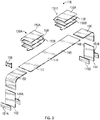
- the entertainment system 116 includes a base 140. As illustrated in FIGs. 2 and 3 , the base 140 includes a first side edge 142, a second side edge 144, an upper surface 146, and a lower surface 148. In some examples, the sensors 136A-B are secured on the upper surface 146 of the base 140. The sensors 136A-B may be secured through various securing mechanisms including, but not limited to, various adhesives, glues, tapes, bonding agents, sewing, stitching, hook and loop fasteners, and various other mechanisms suitable for securing the sensors 136A-B relative to the base 140.
- the entertainment system 116 also includes a controller 158 in communication with the sensors 136A-B such that the controller 158 receives and processes the sensed force data from the sensors 136A-B.
- the controller 158 is secured to the base 140, although it need not be.
- the controller 158 includes a processor, which may be a general purpose computer, special purpose computer, and/or other programmable data processing apparatus, and a memory, which stores various instructions that may be executed by the processor.
- the memory is a computer-usable or computer-readable medium that may be any non-transitory medium that is not a transitory signal and can contain or store the program or instructions for use by or in connection with the instruction or execution of a system, apparatus, or device.
- the controller 158 may also include various other components such as a communication module, which includes the components necessary for the entertainment system 116 to establish wired or wireless communication (e.g., cellular communication, Wi-Fi, Bluetooth, etc.) with an entertainment device, which may be the IFE monitor 128 or other IFE device, a passenger's personal electronic device such as a phone, tablet, laptop, computer, etc., or various other devices.
- a communication module which includes the components necessary for the entertainment system 116 to establish wired or wireless communication (e.g., cellular communication, Wi-Fi, Bluetooth, etc.) with an entertainment device, which may be the IFE monitor 128 or other IFE device, a passenger's personal electronic device such as a phone, tablet, laptop, computer, etc., or various other devices.
- the controller 158 or the device receiving the sensed force data from the controller 158 is configured to run an application based on the sensed force data such that entertainment data 160 (see FIG. 6 ), such as a game, based on the sensed force data is
- the controller 158 is configured to translate the sensed force data into joystick movements for the entertainment data 160 such that the passenger's movements serve as a game controller.
- FIG. 7 illustrates examples of some movements of a passenger 700 that may change the force sensed by the sensors 136A-B.
- base 140 includes a center section 154 between the first side edge 142 and the second side edge 144.
- a first flexible section 152 is between the first side edge 142 and center section 154
- a second flexible section 156 is between the center section 154 and the second side edge 144.
- the first flexible section 152 and the second flexible section 156 are constructed from a first material and the center section 154 is constructed from a second material.
- the first material is a first fabric material and the second material is a second fabric material that is less elastic or flexible than the first fabric material.
- the first fabric material is stretchable and/or extendable relative to the second fabric material.
- the first material is knitted nylon and the second material is woven nylon.
- Various other materials may be used as the first and second material.
- a single material may be used to construct the base 140.
- the sensors 136A-B are optionally secured on the center section 154.
- the base 140 optionally includes fasteners 149 for removably connecting the entertainment system 116 to the cushioning member 114.
- a first fastener 149A is provided on the lower surface 148 of the base 140 adjacent to the first side edge 142 and a second fastener 149B is provided on the lower surface 148 of the base 140 adjacent to the second side edge 144.
- the fasteners 149A-B are configured to engage with corresponding cushion fasteners 153 (see FIG. 4 ).
- the fasteners 149 may be various suitable fastening mechanisms including, but not limited to, hook and loop fasteners, snaps, clips, stitching, clasps, hooks, pins, bolts, screws, tapes, or various other mechanisms suitable for removably connecting the entertainment system 116 to the cushioning member 114.
- the entertainment system 116 may be removed from the cushioning member 114 as needed, such as during installation, repair, replacement, etc.
- the fasteners 149 are minimally invasive into the cushioning member 114 such that the fasteners 149 do not damage the cushioning member 114 or otherwise disrupt how the cushioning member 114 is designed to function.
- the base 140 may further include cover fasteners 151A-B on the upper surface 146 of the base 140.
- the cover fasteners 151A-B may be substantially similar to the fasteners 149 except that the cover fasteners 151A-B are configured to removably connect the entertainment system 116 to the portion of the cover layer 106 of the passenger seat assembly 100 that covers the cushioning member 114.
- a power source may be provided with the entertainment system 116.
- the power source may be various power sources suitable for the entertainment system such as replaceable batteries, existing power sources of the passenger vehicle, etc.
- the entertainment system 116 is provided on at least one base cushioning member 114 between the cover layer 106 and the base cushioning member 114.
- the cover layer 106 covering the entertainment system 116 may include a first indicator 162A corresponding to the first sensor 136A and a second indicator 162B corresponding to the second sensor 136B.
- the number and location of the indicators 162 corresponds with the number and location of the sensors 136.
- the indicators 162A-B are provided to alert the passenger that the particular passenger seat includes the entertainment system 116.
- the indicators 162A-B may be various suitable indicators such as lights, decals, stamps, various stitching patterns such as arrows, diamonds, circles, ovals, or various other patterns, or various other suitable indicators.
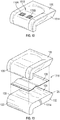
- FIGs. 8 and 9 illustrate another example not covered by the claimed invention of a base cushioning member 814 and an entertainment system 816.
- the base cushioning member 814 includes an entertainment cavity 864 that is configured to receive the entertainment system 816.
- the shape of the base 102 of the entertainment system 816 is modified such that the entertainment system 816 may be housed within the entertainment cavity 864.
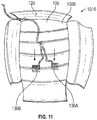
- FIGs. 10-12 illustrate another example not covered by the claimed invention of a passenger seat assembly 1000 with a base cushioning member 1014 and an entertainment system 1016.
- the sensors 136A-B of the entertainment system 1016 are secured to a portion of the inner surface 1066 of the cover layer 106 covering the base cushioning member 1014.
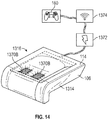
- FiGs. 13 and 14 illustrate another example not covered by the claimed invention of a base cushioning member 1314 and an entertainment system 1316.
- the entertainment system 1316 includes a single sensor 136 that covers a majority of the upper surface 134 of the base cushioning member 1314.
- the single sensor 136 is configured to detect localized forces at various locations on the upper surface 134.
- the single sensor 136 is configured to detect forces at a first location 1370A and a second location 1370B.
- the entertainment system 1316 includes a power source 1372 and a communications module 1374 of the controller such that the entertainment data 160 may be provided to the passenger.
- the connections between the various components of the entertainment system 1316 may be wired or wireless connections.
Landscapes
- Engineering & Computer Science (AREA)
- Aviation & Aerospace Engineering (AREA)
- Seats For Vehicles (AREA)
Claims (7)
- Unterhaltungssystem (116) für einen Passagiersitz, umfassend:eine Basis (140) mit:einer ersten Seitenkante (142);einer zweiten Seitenkante (144);einer oberen Fläche (146); undeiner unteren Fläche (148);einen ersten Sensor (136A), der an der oberen Fläche (146) der Basis (140) zwischen der ersten Seitenkante (142) und der zweiten Seitenkante befestigt ist; undeinen zweiten Sensor (136B), der an der oberen Fläche (146) der Basis (140) zwischen dem ersten Sensor (136A) und der zweiten Seitenkante (144) befestigt ist,wobei der erste Sensor (136A) und der zweite Sensor (136B) jeweils dazu ausgebildet sind, eine auf das Unterhaltungssystem (116) ausgeübte Kraft zu detektieren, undwobei die Basis (140) dazu ausgebildet ist, zwischen einem Polsterelement (114) und einer Abdeckung (106) einer Basis eines Passagiersitzes positioniert zu werden,dadurch gekennzeichnet, dass die Basis ferner umfasst:einen Mittelabschnitt (154) zwischen der ersten Seitenkante (142) und der zweiten Seitenkante (144);einen ersten flexiblen Abschnitt (152) zwischen dem Mittelabschnitt (154) und der ersten Seitenkante (142); undeinen zweiten flexiblen Abschnitt (156) zwischen dem Mittelabschnitt (154) und der zweiten Seitenkante (144),wobei der erste flexible Abschnitt (152) und der zweite flexible Abschnitt (156) ein erstes Gewebematerial umfassen,wobei der Mittelabschnitt (154) ein zweites, von dem ersten Gewebematerial verschiedenes Gewebematerial umfasst,wobei das erste Gewebematerial elastischer als das zweite Gewebematerial ist, undwobei der erste Sensor (136A) und der zweite Sensor (136B) an dem Mittelabschnitt (154) befestigt sind.
- Unterhaltungssystem nach Anspruch 1, dadurch gekennzeichnet, dass es ferner umfasst:
eine Steuerung (158), die an der Basis (140) befestigt ist, wobei die Steuerung (158) dazu ausgebildet ist:mit dem ersten Sensor (136A) und dem zweiten Sensor (136B) zum Empfangen erfasster Kraftdaten zu kommunizieren; unddie erfasste Kraftdaten an eine In-Flight-Entertainment-(IFE)-Vorrichtung (128) zu übermitteln. - Unterhaltungssystem nach Anspruch 1, dadurch gekennzeichnet, dass das erste Gewebematerial gestricktes Nylon und das zweite Gewebematerial gewebtes Nylon umfasst.
- Unterhaltungssystem nach Anspruch 1, dadurch gekennzeichnet, dass es ferner eine Basispolsterbefestigung an der unteren Fläche (148) der Basis (140) und eine Abdeckungsbefestigung (151A-B) an der oberen Fläche (146) des Basis (140) umfasst.
- Unterhaltungssystem nach Anspruch 1, dadurch gekennzeichnet, dass ein Abstand zwischen dem ersten Sensor (136A) und dem zweiten Sensor (136B) von ungefähr 170 mm bis ungefähr 210 mm beträgt.
- Unterhaltungssystem nach Anspruch 1, dadurch gekennzeichnet, dass es ferner umfasst:einen ersten Verbinder an der unteren Fläche (148) der Basis (140) und angrenzend an die erste Seitenkante (142); und einen zweiten Verbinder an der unteren Fläche (148) der Basis (140) und angrenzend an die zweite Seitenkante (144),wobei der erste Verbinder und der zweite Verbinder dazu ausgebildet sind, das Unterhaltungssystem (116) lösbar mit dem Polsterelement (114) zu verbinden.
- Passagiersitz mit einem Unterhaltungssystem (116) nach einem der vorhergehenden Ansprüche.
Applications Claiming Priority (2)
| Application Number | Priority Date | Filing Date | Title |
|---|---|---|---|
| US201662420325P | 2016-11-10 | 2016-11-10 | |
| PCT/US2017/046413 WO2018089069A1 (en) | 2016-11-10 | 2017-08-11 | Passenger seat entertainment system |
Publications (2)
| Publication Number | Publication Date |
|---|---|
| EP3538438A1 EP3538438A1 (de) | 2019-09-18 |
| EP3538438B1 true EP3538438B1 (de) | 2021-12-29 |
Family
ID=59677409
Family Applications (1)
| Application Number | Title | Priority Date | Filing Date |
|---|---|---|---|
| EP17754984.7A Active EP3538438B1 (de) | 2016-11-10 | 2017-08-11 | Fahrgastsitzunterhaltungssystem |
Country Status (4)
| Country | Link |
|---|---|
| US (1) | US10974833B2 (de) |
| EP (1) | EP3538438B1 (de) |
| CN (1) | CN109923039B (de) |
| WO (1) | WO2018089069A1 (de) |
Families Citing this family (7)
| Publication number | Priority date | Publication date | Assignee | Title |
|---|---|---|---|---|
| USD916000S1 (en) * | 2018-04-06 | 2021-04-13 | Rockwell Collins, Inc. | Passenger seating apparatus |
| US10937298B2 (en) * | 2018-04-11 | 2021-03-02 | Shawn NEVIN | Occupant monitoring system and method |
| EP3626617B1 (de) * | 2018-09-21 | 2022-05-18 | Aircraft Cabin Modification GmbH | Sitzsystem für ein passagierflugzeug und verfahren |
| EP3722209B1 (de) * | 2019-04-11 | 2022-06-22 | Airbus Operations GmbH | Passagierunterhaltungsvorrichtung, passagiersitzanordnung und fahrzeug |
| WO2021020335A1 (ja) * | 2019-07-30 | 2021-02-04 | テイ・エス テック株式会社 | シート体験システム、シートユニットおよび車両 |
| US12570403B2 (en) | 2023-08-22 | 2026-03-10 | B/E Aerospace, Inc. | Intelligent deployment control of break over seat pan using textile pressure mapping technique |
| EP4512719A1 (de) | 2023-08-22 | 2025-02-26 | Dehns | Ausziehbare sitzfläche |
Family Cites Families (16)
| Publication number | Priority date | Publication date | Assignee | Title |
|---|---|---|---|---|
| FR2781293B1 (fr) * | 1998-07-16 | 2000-10-06 | Labinal | Installation de pilotage d'au moins un module de siege |
| US7163263B1 (en) * | 2002-07-25 | 2007-01-16 | Herman Miller, Inc. | Office components, seating structures, methods of using seating structures, and systems of seating structures |
| US7132953B2 (en) * | 2003-06-26 | 2006-11-07 | Lear Corporation | Spring sensor assembly for a vehicle seat cushion |
| DE102007055088B4 (de) * | 2007-11-16 | 2013-03-07 | Airbus Operations Gmbh | Sitz mit einem Sitzelement, Sitzanordnung und Verfahren zur Überwachung eines Sitzes |
| EP2093101A1 (de) | 2008-02-20 | 2009-08-26 | IEE INTERNATIONAL ELECTRONICS & ENGINEERING S.A. | Flexibles Sitzsensorprodukt |
| US8094041B2 (en) * | 2008-03-31 | 2012-01-10 | The Boeing Company | Seat cushion retention and monitoring in an aircraft |
| US20110080288A1 (en) * | 2009-10-07 | 2011-04-07 | Younse Jack M | Portable occupant detection and notification system with smart seat cushion for use with standard child carseats |
| US9196175B2 (en) * | 2010-03-30 | 2015-11-24 | Michael C. Walsh | Ergonomic sensor pad with feedback to user and method of use |
| EP2374652B1 (de) * | 2010-04-09 | 2016-06-08 | Fico Cables, Lda. | Sitzkissenmatte mit Drucksensor |
| JP2013542114A (ja) * | 2010-09-10 | 2013-11-21 | パナソニック・アビオニクス・コーポレイション | 統合ユーザインターフェースシステムおよび方法 |
| US8903311B1 (en) * | 2011-08-16 | 2014-12-02 | 5Me Ip, Llc | Method of signal transmission using fiber composite sandwich panel |
| WO2015127193A1 (en) * | 2014-02-20 | 2015-08-27 | Faurecia Automotive Seating, Llc. | Vehicle seat with integrated sensors |
| JP6517525B2 (ja) | 2015-02-06 | 2019-05-22 | 本田技研工業株式会社 | 乗物用シート |
| US20170283086A1 (en) * | 2016-04-04 | 2017-10-05 | B/E Aerospace, Inc. | Aircraft Passenger Activity Monitoring |
| US9851267B1 (en) * | 2016-06-01 | 2017-12-26 | Microsoft Technology Licensing, Llc | Force-sensing element |
| US20180056814A1 (en) * | 2016-08-31 | 2018-03-01 | Paul Tanyi | Pressures Sensor Device for a Car Seat with Wireless Communication |
-
2017
- 2017-08-11 EP EP17754984.7A patent/EP3538438B1/de active Active
- 2017-08-11 WO PCT/US2017/046413 patent/WO2018089069A1/en not_active Ceased
- 2017-08-11 US US16/348,479 patent/US10974833B2/en active Active
- 2017-08-11 CN CN201780069514.4A patent/CN109923039B/zh active Active
Also Published As
| Publication number | Publication date |
|---|---|
| WO2018089069A1 (en) | 2018-05-17 |
| US20190359334A1 (en) | 2019-11-28 |
| EP3538438A1 (de) | 2019-09-18 |
| CN109923039B (zh) | 2023-02-03 |
| CN109923039A (zh) | 2019-06-21 |
| US10974833B2 (en) | 2021-04-13 |
Similar Documents
| Publication | Publication Date | Title |
|---|---|---|
| EP3538438B1 (de) | Fahrgastsitzunterhaltungssystem | |
| US10953987B2 (en) | Aircraft interior configuration with flexible use space | |
| JP7851367B2 (ja) | 通知システム | |
| US11130577B2 (en) | Universal rest seats | |
| CN110316380B (zh) | 用于控制交通工具中的一个或多个智能织物的系统及方法 | |
| US10688894B2 (en) | Recliner sofa system for economy class seat | |
| RU2657141C2 (ru) | Посадочный узел транспортного средства (варианты) | |
| CN105722730B (zh) | 具有滑行、起飞和着陆平躺位置性能的飞机座椅 | |
| US20220048629A1 (en) | Seating System for a Passenger Aircraft, Method and Computer-Implementable Program Product | |
| EP3838759B1 (de) | Sitzanordnung | |
| EP3608161B1 (de) | Struktur für sitzeinheit, sitzeinheit und befestigungsverfahren dafür | |
| US20210107657A1 (en) | Seat unit and lower structure thereof | |
| US20160001886A1 (en) | Aircraft seat cover and aircraft divan equipped with same | |
| US8973993B2 (en) | Configurable cushion set for a seat | |
| US20240389946A1 (en) | System for In-Flight Detection of Physiological Data and Kit for In-Flight Monitoring of Physiological Parameters | |
| US11130431B2 (en) | Band supported headrest | |
| US20180339777A1 (en) | High backrest passenger seat | |
| US12459651B2 (en) | Seat covers and methods for using seat covers | |
| CA2855449A1 (en) | Aircraft seat cover and aircraft divan equipped with same | |
| CN207653893U (zh) | 一种固定式护颈托枕 | |
| JP2014230590A (ja) | 乗物用シート |
Legal Events
| Date | Code | Title | Description |
|---|---|---|---|
| STAA | Information on the status of an ep patent application or granted ep patent |
Free format text: STATUS: UNKNOWN |
|
| STAA | Information on the status of an ep patent application or granted ep patent |
Free format text: STATUS: THE INTERNATIONAL PUBLICATION HAS BEEN MADE |
|
| PUAI | Public reference made under article 153(3) epc to a published international application that has entered the european phase |
Free format text: ORIGINAL CODE: 0009012 |
|
| STAA | Information on the status of an ep patent application or granted ep patent |
Free format text: STATUS: REQUEST FOR EXAMINATION WAS MADE |
|
| 17P | Request for examination filed |
Effective date: 20190517 |
|
| AK | Designated contracting states |
Kind code of ref document: A1 Designated state(s): AL AT BE BG CH CY CZ DE DK EE ES FI FR GB GR HR HU IE IS IT LI LT LU LV MC MK MT NL NO PL PT RO RS SE SI SK SM TR |
|
| AX | Request for extension of the european patent |
Extension state: BA ME |
|
| DAV | Request for validation of the european patent (deleted) | ||
| DAX | Request for extension of the european patent (deleted) | ||
| GRAP | Despatch of communication of intention to grant a patent |
Free format text: ORIGINAL CODE: EPIDOSNIGR1 |
|
| STAA | Information on the status of an ep patent application or granted ep patent |
Free format text: STATUS: GRANT OF PATENT IS INTENDED |
|
| INTG | Intention to grant announced |
Effective date: 20210722 |
|
| GRAS | Grant fee paid |
Free format text: ORIGINAL CODE: EPIDOSNIGR3 |
|
| GRAA | (expected) grant |
Free format text: ORIGINAL CODE: 0009210 |
|
| STAA | Information on the status of an ep patent application or granted ep patent |
Free format text: STATUS: THE PATENT HAS BEEN GRANTED |
|
| AK | Designated contracting states |
Kind code of ref document: B1 Designated state(s): AL AT BE BG CH CY CZ DE DK EE ES FI FR GB GR HR HU IE IS IT LI LT LU LV MC MK MT NL NO PL PT RO RS SE SI SK SM TR |
|
| REG | Reference to a national code |
Ref country code: GB Ref legal event code: FG4D |
|
| REG | Reference to a national code |
Ref country code: CH Ref legal event code: EP |
|
| REG | Reference to a national code |
Ref country code: AT Ref legal event code: REF Ref document number: 1458513 Country of ref document: AT Kind code of ref document: T Effective date: 20220115 |
|
| REG | Reference to a national code |
Ref country code: IE Ref legal event code: FG4D |
|
| REG | Reference to a national code |
Ref country code: DE Ref legal event code: R096 Ref document number: 602017051570 Country of ref document: DE |
|
| REG | Reference to a national code |
Ref country code: LT Ref legal event code: MG9D |
|
| PG25 | Lapsed in a contracting state [announced via postgrant information from national office to epo] |
Ref country code: RS Free format text: LAPSE BECAUSE OF FAILURE TO SUBMIT A TRANSLATION OF THE DESCRIPTION OR TO PAY THE FEE WITHIN THE PRESCRIBED TIME-LIMIT Effective date: 20211229 Ref country code: LT Free format text: LAPSE BECAUSE OF FAILURE TO SUBMIT A TRANSLATION OF THE DESCRIPTION OR TO PAY THE FEE WITHIN THE PRESCRIBED TIME-LIMIT Effective date: 20211229 Ref country code: FI Free format text: LAPSE BECAUSE OF FAILURE TO SUBMIT A TRANSLATION OF THE DESCRIPTION OR TO PAY THE FEE WITHIN THE PRESCRIBED TIME-LIMIT Effective date: 20211229 Ref country code: BG Free format text: LAPSE BECAUSE OF FAILURE TO SUBMIT A TRANSLATION OF THE DESCRIPTION OR TO PAY THE FEE WITHIN THE PRESCRIBED TIME-LIMIT Effective date: 20220329 |
|
| REG | Reference to a national code |
Ref country code: NL Ref legal event code: MP Effective date: 20211229 |
|
| REG | Reference to a national code |
Ref country code: AT Ref legal event code: MK05 Ref document number: 1458513 Country of ref document: AT Kind code of ref document: T Effective date: 20211229 |
|
| PG25 | Lapsed in a contracting state [announced via postgrant information from national office to epo] |
Ref country code: SE Free format text: LAPSE BECAUSE OF FAILURE TO SUBMIT A TRANSLATION OF THE DESCRIPTION OR TO PAY THE FEE WITHIN THE PRESCRIBED TIME-LIMIT Effective date: 20211229 Ref country code: NO Free format text: LAPSE BECAUSE OF FAILURE TO SUBMIT A TRANSLATION OF THE DESCRIPTION OR TO PAY THE FEE WITHIN THE PRESCRIBED TIME-LIMIT Effective date: 20220329 Ref country code: LV Free format text: LAPSE BECAUSE OF FAILURE TO SUBMIT A TRANSLATION OF THE DESCRIPTION OR TO PAY THE FEE WITHIN THE PRESCRIBED TIME-LIMIT Effective date: 20211229 Ref country code: HR Free format text: LAPSE BECAUSE OF FAILURE TO SUBMIT A TRANSLATION OF THE DESCRIPTION OR TO PAY THE FEE WITHIN THE PRESCRIBED TIME-LIMIT Effective date: 20211229 Ref country code: GR Free format text: LAPSE BECAUSE OF FAILURE TO SUBMIT A TRANSLATION OF THE DESCRIPTION OR TO PAY THE FEE WITHIN THE PRESCRIBED TIME-LIMIT Effective date: 20220330 |
|
| PG25 | Lapsed in a contracting state [announced via postgrant information from national office to epo] |
Ref country code: NL Free format text: LAPSE BECAUSE OF FAILURE TO SUBMIT A TRANSLATION OF THE DESCRIPTION OR TO PAY THE FEE WITHIN THE PRESCRIBED TIME-LIMIT Effective date: 20211229 |
|
| PG25 | Lapsed in a contracting state [announced via postgrant information from national office to epo] |
Ref country code: SM Free format text: LAPSE BECAUSE OF FAILURE TO SUBMIT A TRANSLATION OF THE DESCRIPTION OR TO PAY THE FEE WITHIN THE PRESCRIBED TIME-LIMIT Effective date: 20211229 Ref country code: SK Free format text: LAPSE BECAUSE OF FAILURE TO SUBMIT A TRANSLATION OF THE DESCRIPTION OR TO PAY THE FEE WITHIN THE PRESCRIBED TIME-LIMIT Effective date: 20211229 Ref country code: RO Free format text: LAPSE BECAUSE OF FAILURE TO SUBMIT A TRANSLATION OF THE DESCRIPTION OR TO PAY THE FEE WITHIN THE PRESCRIBED TIME-LIMIT Effective date: 20211229 Ref country code: PT Free format text: LAPSE BECAUSE OF FAILURE TO SUBMIT A TRANSLATION OF THE DESCRIPTION OR TO PAY THE FEE WITHIN THE PRESCRIBED TIME-LIMIT Effective date: 20220429 Ref country code: ES Free format text: LAPSE BECAUSE OF FAILURE TO SUBMIT A TRANSLATION OF THE DESCRIPTION OR TO PAY THE FEE WITHIN THE PRESCRIBED TIME-LIMIT Effective date: 20211229 Ref country code: EE Free format text: LAPSE BECAUSE OF FAILURE TO SUBMIT A TRANSLATION OF THE DESCRIPTION OR TO PAY THE FEE WITHIN THE PRESCRIBED TIME-LIMIT Effective date: 20211229 Ref country code: CZ Free format text: LAPSE BECAUSE OF FAILURE TO SUBMIT A TRANSLATION OF THE DESCRIPTION OR TO PAY THE FEE WITHIN THE PRESCRIBED TIME-LIMIT Effective date: 20211229 |
|
| PG25 | Lapsed in a contracting state [announced via postgrant information from national office to epo] |
Ref country code: PL Free format text: LAPSE BECAUSE OF FAILURE TO SUBMIT A TRANSLATION OF THE DESCRIPTION OR TO PAY THE FEE WITHIN THE PRESCRIBED TIME-LIMIT Effective date: 20211229 Ref country code: AT Free format text: LAPSE BECAUSE OF FAILURE TO SUBMIT A TRANSLATION OF THE DESCRIPTION OR TO PAY THE FEE WITHIN THE PRESCRIBED TIME-LIMIT Effective date: 20211229 |
|
| PG25 | Lapsed in a contracting state [announced via postgrant information from national office to epo] |
Ref country code: IS Free format text: LAPSE BECAUSE OF FAILURE TO SUBMIT A TRANSLATION OF THE DESCRIPTION OR TO PAY THE FEE WITHIN THE PRESCRIBED TIME-LIMIT Effective date: 20220429 |
|
| REG | Reference to a national code |
Ref country code: DE Ref legal event code: R097 Ref document number: 602017051570 Country of ref document: DE |
|
| PG25 | Lapsed in a contracting state [announced via postgrant information from national office to epo] |
Ref country code: DK Free format text: LAPSE BECAUSE OF FAILURE TO SUBMIT A TRANSLATION OF THE DESCRIPTION OR TO PAY THE FEE WITHIN THE PRESCRIBED TIME-LIMIT Effective date: 20211229 Ref country code: AL Free format text: LAPSE BECAUSE OF FAILURE TO SUBMIT A TRANSLATION OF THE DESCRIPTION OR TO PAY THE FEE WITHIN THE PRESCRIBED TIME-LIMIT Effective date: 20211229 |
|
| PLBE | No opposition filed within time limit |
Free format text: ORIGINAL CODE: 0009261 |
|
| STAA | Information on the status of an ep patent application or granted ep patent |
Free format text: STATUS: NO OPPOSITION FILED WITHIN TIME LIMIT |
|
| 26N | No opposition filed |
Effective date: 20220930 |
|
| PG25 | Lapsed in a contracting state [announced via postgrant information from national office to epo] |
Ref country code: SI Free format text: LAPSE BECAUSE OF FAILURE TO SUBMIT A TRANSLATION OF THE DESCRIPTION OR TO PAY THE FEE WITHIN THE PRESCRIBED TIME-LIMIT Effective date: 20211229 |
|
| PG25 | Lapsed in a contracting state [announced via postgrant information from national office to epo] |
Ref country code: MC Free format text: LAPSE BECAUSE OF FAILURE TO SUBMIT A TRANSLATION OF THE DESCRIPTION OR TO PAY THE FEE WITHIN THE PRESCRIBED TIME-LIMIT Effective date: 20211229 |
|
| REG | Reference to a national code |
Ref country code: CH Ref legal event code: PL |
|
| PG25 | Lapsed in a contracting state [announced via postgrant information from national office to epo] |
Ref country code: LU Free format text: LAPSE BECAUSE OF NON-PAYMENT OF DUE FEES Effective date: 20220811 Ref country code: LI Free format text: LAPSE BECAUSE OF NON-PAYMENT OF DUE FEES Effective date: 20220831 Ref country code: CH Free format text: LAPSE BECAUSE OF NON-PAYMENT OF DUE FEES Effective date: 20220831 |
|
| REG | Reference to a national code |
Ref country code: BE Ref legal event code: MM Effective date: 20220831 |
|
| PG25 | Lapsed in a contracting state [announced via postgrant information from national office to epo] |
Ref country code: IT Free format text: LAPSE BECAUSE OF FAILURE TO SUBMIT A TRANSLATION OF THE DESCRIPTION OR TO PAY THE FEE WITHIN THE PRESCRIBED TIME-LIMIT Effective date: 20211229 |
|
| PG25 | Lapsed in a contracting state [announced via postgrant information from national office to epo] |
Ref country code: IE Free format text: LAPSE BECAUSE OF NON-PAYMENT OF DUE FEES Effective date: 20220811 |
|
| PG25 | Lapsed in a contracting state [announced via postgrant information from national office to epo] |
Ref country code: BE Free format text: LAPSE BECAUSE OF NON-PAYMENT OF DUE FEES Effective date: 20220831 |
|
| PG25 | Lapsed in a contracting state [announced via postgrant information from national office to epo] |
Ref country code: HU Free format text: LAPSE BECAUSE OF FAILURE TO SUBMIT A TRANSLATION OF THE DESCRIPTION OR TO PAY THE FEE WITHIN THE PRESCRIBED TIME-LIMIT; INVALID AB INITIO Effective date: 20170811 |
|
| PG25 | Lapsed in a contracting state [announced via postgrant information from national office to epo] |
Ref country code: CY Free format text: LAPSE BECAUSE OF FAILURE TO SUBMIT A TRANSLATION OF THE DESCRIPTION OR TO PAY THE FEE WITHIN THE PRESCRIBED TIME-LIMIT Effective date: 20211229 |
|
| PG25 | Lapsed in a contracting state [announced via postgrant information from national office to epo] |
Ref country code: MK Free format text: LAPSE BECAUSE OF FAILURE TO SUBMIT A TRANSLATION OF THE DESCRIPTION OR TO PAY THE FEE WITHIN THE PRESCRIBED TIME-LIMIT Effective date: 20211229 |
|
| PG25 | Lapsed in a contracting state [announced via postgrant information from national office to epo] |
Ref country code: TR Free format text: LAPSE BECAUSE OF FAILURE TO SUBMIT A TRANSLATION OF THE DESCRIPTION OR TO PAY THE FEE WITHIN THE PRESCRIBED TIME-LIMIT Effective date: 20211229 |
|
| PG25 | Lapsed in a contracting state [announced via postgrant information from national office to epo] |
Ref country code: MT Free format text: LAPSE BECAUSE OF FAILURE TO SUBMIT A TRANSLATION OF THE DESCRIPTION OR TO PAY THE FEE WITHIN THE PRESCRIBED TIME-LIMIT Effective date: 20211229 |
|
| PGFP | Annual fee paid to national office [announced via postgrant information from national office to epo] |
Ref country code: DE Payment date: 20250819 Year of fee payment: 9 |
|
| PGFP | Annual fee paid to national office [announced via postgrant information from national office to epo] |
Ref country code: GB Payment date: 20250825 Year of fee payment: 9 |
|
| PGFP | Annual fee paid to national office [announced via postgrant information from national office to epo] |
Ref country code: FR Payment date: 20250827 Year of fee payment: 9 |