EP3538571B2 - Bimodales polyethylen - Google Patents
Bimodales polyethylen Download PDFInfo
- Publication number
- EP3538571B2 EP3538571B2 EP17804682.7A EP17804682A EP3538571B2 EP 3538571 B2 EP3538571 B2 EP 3538571B2 EP 17804682 A EP17804682 A EP 17804682A EP 3538571 B2 EP3538571 B2 EP 3538571B2
- Authority
- EP
- European Patent Office
- Prior art keywords
- polyethylene
- bimodal
- molecular weight
- catalyst
- component
- Prior art date
- Legal status (The legal status is an assumption and is not a legal conclusion. Google has not performed a legal analysis and makes no representation as to the accuracy of the status listed.)
- Active
Links
Images
Classifications
-
- C—CHEMISTRY; METALLURGY
- C08—ORGANIC MACROMOLECULAR COMPOUNDS; THEIR PREPARATION OR CHEMICAL WORKING-UP; COMPOSITIONS BASED THEREON
- C08L—COMPOSITIONS OF MACROMOLECULAR COMPOUNDS
- C08L23/00—Compositions of homopolymers or copolymers of unsaturated aliphatic hydrocarbons having only one carbon-to-carbon double bond; Compositions of derivatives of such polymers
- C08L23/02—Compositions of homopolymers or copolymers of unsaturated aliphatic hydrocarbons having only one carbon-to-carbon double bond; Compositions of derivatives of such polymers not modified by chemical after-treatment
- C08L23/04—Homopolymers or copolymers of ethene
- C08L23/08—Copolymers of ethene
- C08L23/0807—Copolymers of ethene with unsaturated hydrocarbons only containing four or more carbon atoms
- C08L23/0815—Copolymers of ethene with unsaturated hydrocarbons only containing four or more carbon atoms with aliphatic 1-olefins containing one carbon-to-carbon double bond
-
- C—CHEMISTRY; METALLURGY
- C08—ORGANIC MACROMOLECULAR COMPOUNDS; THEIR PREPARATION OR CHEMICAL WORKING-UP; COMPOSITIONS BASED THEREON
- C08F—MACROMOLECULAR COMPOUNDS OBTAINED BY REACTIONS ONLY INVOLVING CARBON-TO-CARBON UNSATURATED BONDS
- C08F10/00—Homopolymers and copolymers of unsaturated aliphatic hydrocarbons having only one carbon-to-carbon double bond
- C08F10/02—Ethene
-
- C—CHEMISTRY; METALLURGY
- C08—ORGANIC MACROMOLECULAR COMPOUNDS; THEIR PREPARATION OR CHEMICAL WORKING-UP; COMPOSITIONS BASED THEREON
- C08F—MACROMOLECULAR COMPOUNDS OBTAINED BY REACTIONS ONLY INVOLVING CARBON-TO-CARBON UNSATURATED BONDS
- C08F210/00—Copolymers of unsaturated aliphatic hydrocarbons having only one carbon-to-carbon double bond
- C08F210/16—Copolymers of ethene with alpha-alkenes, e.g. EP rubbers
-
- C—CHEMISTRY; METALLURGY
- C08—ORGANIC MACROMOLECULAR COMPOUNDS; THEIR PREPARATION OR CHEMICAL WORKING-UP; COMPOSITIONS BASED THEREON
- C08L—COMPOSITIONS OF MACROMOLECULAR COMPOUNDS
- C08L2201/00—Properties
- C08L2201/08—Stabilised against heat, light or radiation or oxydation
-
- C—CHEMISTRY; METALLURGY
- C08—ORGANIC MACROMOLECULAR COMPOUNDS; THEIR PREPARATION OR CHEMICAL WORKING-UP; COMPOSITIONS BASED THEREON
- C08L—COMPOSITIONS OF MACROMOLECULAR COMPOUNDS
- C08L2205/00—Polymer mixtures characterised by other features
- C08L2205/02—Polymer mixtures characterised by other features containing two or more polymers of the same C08L -group
- C08L2205/025—Polymer mixtures characterised by other features containing two or more polymers of the same C08L -group containing two or more polymers of the same hierarchy C08L, and differing only in parameters such as density, comonomer content, molecular weight, structure
-
- C—CHEMISTRY; METALLURGY
- C08—ORGANIC MACROMOLECULAR COMPOUNDS; THEIR PREPARATION OR CHEMICAL WORKING-UP; COMPOSITIONS BASED THEREON
- C08L—COMPOSITIONS OF MACROMOLECULAR COMPOUNDS
- C08L2308/00—Chemical blending or stepwise polymerisation process with the same catalyst
-
- C—CHEMISTRY; METALLURGY
- C08—ORGANIC MACROMOLECULAR COMPOUNDS; THEIR PREPARATION OR CHEMICAL WORKING-UP; COMPOSITIONS BASED THEREON
- C08L—COMPOSITIONS OF MACROMOLECULAR COMPOUNDS
- C08L2314/00—Polymer mixtures characterised by way of preparation
- C08L2314/06—Metallocene or single site catalysts
Definitions
- Embodiments of the present disclosure are directed towards a method of forming a bimodal polyethylene.
- polyethylene means a polymer made of at least 50% ethylene-derived units, preferably at least 70% ethylene-derived units, more preferably at least 80% ethylene-derived units, or 90% ethylene-derived units, or 95% ethylene-derived units, or even 100% ethylene-derived units.
- the polyethylene can thus be a homopolymer or a copolymer, including a terpolymer, having other monomeric units.
- a polyethylene described herein may, for example, include units derived from a co-monomer that is preferably an ⁇ -olefin, e.g., propylene, 1-butene, 1-pentene, 1-hexene or mixtures thereof. Other embodiments may include dienes, ethacrylate, or methacrylate.
- a material with more than two different molecular weight distribution peaks will be considered “bimodal” as that term is used herein although the material may also be referred to as "multimodal", e.g., a trimodal or even tetramodal, etc.
- multimodal e.g., a trimodal or even tetramodal, etc.
- various different types of processes, and reactor configurations can be used to produce the bimodal polyethylene formed from the method of the present disclosure, including melt blending, series reactors (i.e., sequentially-configured reactors) and single reactors using a bimodal catalyst system.
- Any polyethylene regarded as a "multi-modal" composition in U.S. Pat. No. 6,579,922 is considered to fall within the broad meaning of the term "bimodal polyethylene " herein, although important differences exist between the bimodal polyethylene formed from the method claimed herein and the bimodal compositions disclosed in that patent.
- the bimodal polyethylene formed from the method of the present disclosure is characterized by raised temperature resistance measured on a compression molded plaque formed from the bimodal polyethylene, where the measurement is done in accordance with the requirements of ASTM F 1473 PENT test at a stress of 2.4 MPa and a temperature of 90 °C as per ASTM F2769-14.
- the bimodal polyethylene of the present disclosure can be further characterized by raised temperature resistance as a PE-RT Type II material that when evaluated in accordance with ISO 9080 or equivalent, with internal pressure tests being carried out in accordance with ISO 1167-1 and ISO 1167-2, the bimodal polyethylene conforms to the 4-parameter model given in ISO 24033 for PE-RT Type II material over a range of temperature and internal pressure as provided in ISO 22391.
- the bimodal polyethylene formed from the method of the present disclosure can also be referred to herein as a bimodal polyethylene of raised temperature resistance.
- compositions, polymers, pipes, or catalyst systems are expressed in terms of lower limits (e.g., X or greater) or upper limits (e.g., Y or less). It is understood that any of the lower limits can be combined with any of the upper limits, so as to provide a variety of alternative ranges.
- the bimodal polyethylene formed from the method of the present disclosure includes a high weight average molecular weight (HMW) polyethylene component and a low weight average molecular weight (LMW) polyethylene component.
- HMW polyethylene component as used herein means the polyethylene component in the bimodal polyethylene that has a higher weight average molecular weight than the weight average molecular weight of at least one other polyethylene component in the same composition.
- the HMW polyethylene component has an identifiable peak, e.g., as shown in FIG. 1 .
- the HMW polyethylene component is a component forming a part of the bimodal polyethylene that has a weight average molecular weight (Mw) of 10,000 to 1,000,000.
- the weight average molecular weight of the HMW polyethylene component may range from a low of 20,000, or 50,000, or 100,000, or 150,000, or 200,000, or 250,000, or 300,000, to a high of 1,000,000, or 900,000, or 800,000, or 700,000, or 600,000, or any combination of the foregoing upper and lower limits.
- the LMW polyethylene component as used herein means the polyethylene component in the bimodal polyethylene that has a lower weight average molecular weight than the weight average molecular weight of at least one other polyethylene component in the same bimodal polyethylene.
- the LMW polyethylene component has an identifiable peak, e.g., as shown in FIG. 1 .
- the LMW polyethylene component is a component forming a part of the bimodal polyethylene that has a weight average molecular weight (Mw) of from 1,000 to 100,000.
- the weight average molecular weight of the LMW polyethylene component may range from a low of 3,000, or 5,000, or 8,000, or 10,000, or 12,000, or 15,000, or 20,000, to a high of 100,000, or 50,000, or 40,000, or 35,000, or 30,000, or any combination of the foregoing upper and lower limits.
- weight average molecular weight is a term used to describe a bimodal polyethylene described herein, or to describe a high molecular weight polyethylene component, and a low molecular weight polyethylene component.
- average molecular weight broadly refers to any weight average molecular weight (Mw) as measured or calculated according to any published method, which incorporates procedures, equipment and conditions in ASTM D 3536-91 (1991) and ASTM D 5296-92 (1992).
- the weight average molecular weight of a particular polyethylene component recited in the claims can also be determined any published method, including those mentioned in the paragraphs above; however, a preferred method is using any published deconvolution procedure, e.g., any published technique for elucidating each individual component polymer's molecular information in a bimodal polymer.
- a particularly preferred technique is one that uses a Flory deconvolution, including but not limited to the Flory procedures set forth in U.S. Pat. No. 6,534,604 .
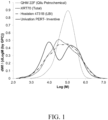
- FIG. 1 provides a chromatogram of a gel permeation chromatography (GPC) of an example of the bimodal polyethylene formed from the method according to the present disclosure.
- GPC gel permeation chromatography
- FIG. 1 displays a resolved bimodal molecular weight distribution with a local minimum in a range of log (molecular weight) 3.5 to 5.5 between the peak representing the HMW polyethylene component and the peak representing the LMW polyethylene component.
- the chromatogram seen in FIG. 1 also illustrates the bimodal polyethylene having a ratio of a height of the peak representing the HMW polyethylene component on the chromatogram of the bimodal polyethylene to the local minimum being from 1.2 to 3.0 (height of peak for HMW polyethylene component/local minimum).
- a ratio of a height of the peak representing the LMW polyethylene component on the chromatogram seen in FIG. 1 of the bimodal polyethylene to the local minimum is from 1.2 to 3.0 (height of peak for LMW polyethylene component/local minimum).
- a ratio of the height of the peak representing the LMW polyethylene component on the chromatogram of the bimodal polyethylene to the height of the peak representing the HMW polyethylene component on the chromatogram of the bimodal polyethylene is from 0.5 to 2.5 (height of LMW polyethylene component/(height of HMW polyethylene component).
- split is defined herein as the weight percent of a high molecular weight component in a bimodal composition. Thus, it describes the relative amount of the high molecular weight component against the low molecular weight component in a bimodal polyethylene, including any of the bimodal polyethylenes described herein.
- the weight percent of each component can also be represented by the area of each molecular weight distribution curve that is seen after deconvolution of the overall molecular weight distribution curve.
- the term “spread” as used herein means the ratio of the weight average molecular weight of the high molecular weight polyethylene component, sometimes referred to as Mw HMW , to the weight average molecular weight of the low molecular weight polyethylene component, sometimes referred to as Mw LMW .
- the “spread” can therefore be also expressed as the ratio of Mw HMW :Mw LMW .
- PDI polydispersity index
- Mw weight-average molecular weight
- Mn numberaverage molecular weight
- the density has a lower limit of 0.930 gram/cubic centimeter (g/ccm), or 0.935 g/ccm, with an upper limit of 0.950 g/ccm, or 0.945 g/ccm, or 0.940 g/ccm, or any combination of the foregoing upper and lower limits.
- the density of the bimodal polyethylene is from 0.930 g/ccm to 0.950 g/ccm.
- the weight average molecular weight (Mw) of the low molecular weight polyethylene component can be, for example, from 1,000 to 100,000, or any of the ranges spanning between other lower and upper limits disclosed elsewhere herein.
- the weight average molecular weight (Mw) of the high molecular weight polyethylene component can be, for example, from 10,000 to 1,000,000, or any of the ranges spanning between other lower and upper limits disclosed elsewhere herein.
- the high molecular weight polyethylene component can include a polyethylene that includes a co-monomer being butene, hexene and mixtures thereof, wherein the co-monomer is present in the amount of 1.0 weight percent(wt.%), or preferably more than 2.0 wt.%, or more preferably, more than 3.0 wt.% of the polyethylene.
- the low molecular weight polyethylene component can include a polyethylene that includes a comonomer being butene, hexene and mixtures thereof, wherein the co-monomer is present in the amount of 3.0 wt.%, or preferably less than 2.0 wt.%, or more preferably, less than 1.0 wt.% of the polyethylene.
- the high weight average molecular weight polyethylene component is present in an amount of with a lower limit of 40 wt.%, 45 wt.% or 50 wt.% based on a total weight of the bimodal polyethylene, and an upper limit of 75 wt.%, 70 wt.% or 65 wt.% based on a total weight of the bimodal polyethylene, or any combination of the foregoing upper and lower limits. These weight percents are also termed the "split" as discussed above. In one embodiment, the high weight average molecular weight polyethylene component is present in an amount of 40 to 75 weight percent based on a total weight of the bimodal polyethylene.
- the ratio of Mw HMW :Mw LMW as defined previously can be have a lower limit of 20:1, 25:1, 30:1 or 35:1, and an upper limit of 100:1, 90:1, 80:1 or 70:1, or any combination of the foregoing upper and lower limits.
- the bimodal polyethylene can have a ratio of the high weight average molecular weight component (Mw HMW ) to the low weight average molecular weight component (Mw LMW ) of the bimodal polyethylene that is from 20:1 to 100:1.
- each of R 7 and R 4 can independently be a C 1 to C 20 alkyl.
- R 8 is a C 1 to C 20 alkyl and/or a C 1 to C 3 alkyl, among other possibilities.
- each of R 1 , R 2 , R 3 , of Formula III is a hydrogen.
- each of R 5 and R 6 of Formula III is a hydrogen.
- "M" of the metallocene catalyst of Formula I can, in some embodiments be titanium, zirconium or hafnium.
- the polymerization catalyst of Formula I is included in a bimodal polymerization catalyst system further including a non-metallocene catalyst.
- the non-metallocene olefin polymerization catalyst may be a Group 15 metal-containing catalyst compound. That is, the bimodal polymerization catalyst system can include one or more Group 15 metal-containing catalyst compounds. As used herein, these are termed non-metallocene olefin polymerization catalyst compounds.
- the Group 15 metal-containing compound generally includes a Group 3 to 14 metal atom, a Group 3 to 7, or a Group 4 to 6 metal atom. In many embodiments, the Group 15 metal-containing compound includes a Group 4 metal atom bound to at least one leaving group and also bound to at least two Group 15 atoms, at least one of which is also bound to a Group 15 or 16 atom through another group.
- At least one of the Group 15 atoms is also bound to a Group 15 or 16 atom through another group which may be a C1 to C20 hydrocarbon group, a heteroatom containing group, silicon, germanium, tin, lead, or phosphorus, where the Group 15 or 16 atom may also be bound to nothing or a hydrogen, a Group 14 atom containing group, a halogen, or a heteroatom containing group, and where each of the two Group 15 atoms are also bound to a cyclic group and can optionally be bound to hydrogen, a halogen, a heteroatom or a hydrocarbyl group, or a heteroatom containing group.
- the Group 15-containing metal compounds can be described more particularly with structures (X) or (XI): where M is a Group 3 to 12 transition metal or a Group 13 or 14 main group metal, a Group 4, 5, or 6 metal.
- M is a Group 4 metal, such as zirconium, titanium, or hafnium.
- Each X is independently a leaving group, such as an anionic leaving group.
- the leaving group may include a hydrogen, a hydrocarbyl group, a heteroatom, a halogen, or an alkyl; y is 0 or 1 (when y is 0 group L' is absent).
- the term 'n' is the oxidation state of M. In various embodiments, n is +3, +4, or +5.
- n is +4.
- the term 'm' represents the formal charge of the YZL or the YZL' ligand, and is 0, -1, -2 or-3 in various embodiments.
- m is -2.
- L is a Group 15 or 16 element, such as nitrogen or oxygen; L' is a Group 15 or 16 element or Group 14 containing group, such as carbon, silicon or germanium.
- Y is a Group 15 element, such as nitrogen or phosphorus. In many embodiments, Y is nitrogen.
- Z is a Group 15 element, such as nitrogen or phosphorus. In many embodiments, Z is nitrogen.
- the terms "support” and “carrier” are used interchangeably and refer to any support material, including a porous support material, such as talc, inorganic oxides, and inorganic chlorides.
- the one or more single site catalyst compounds of the slurry can be supported on the same or separate supports together with the activator, or the activator can be used in an unsupported form, or can be deposited on a support different from the single site catalyst compounds, or any combination thereof. This may be accomplished by any technique commonly used in the art. There are various other methods in the art for supporting a single site catalyst compound.
- the single site catalyst compounds of the slurry can be spray dried.
- the support used with the single site catalyst compound can be functionalized, or at least one substituent or leaving group is selected.
- the support material may be any of the conventional support materials.
- Preferred support materials are inorganic oxides that include those Group 2, 3, 4, 5, 13 or 14 metal oxides.
- the preferred supports include silica, fumed silica, alumina ( WO 99/60033 ), silicaalumina and mixtures thereof.
- Other useful supports include magnesia, titania, zirconia, magnesium chloride ( U.S. Patent No.5,965,477 ), montmorillonite (European Patent EP-B1 0 5 11 665 ), phyllosilicate, zeolites, talc, clays ( U.S. Patent No. 6,034,187 ) and the like.
- the support material preferably an inorganic oxide, has a surface area in the range of from 10 to 700 meter/gram (m/g), pore volume in the range of from 0.1 to 4.0 cm 3 /g and average particle size in the range of from 5 to 500 ⁇ m. More preferably, the surface area of the support material is in the range of from 50 to 500 m/g, pore volume of from 0.5 to 3.5 cm 3 /g and average particle size of from 10 to 200 ⁇ m. Most preferably the surface area of the support material is in the range is from 100 to 400 m/g, pore volume from 0.8 to 3.0 cm 3 /g and average particle size is from 5 to 100 ⁇ m.
- the activator can include a Lewis acid or a non-coordinating ionic activator or ionizing activator, or any other compound including Lewis bases, aluminum alkyls, and/or conventional-type co-catalysts.
- illustrative activators can include, but are not limited to, aluminoxane or modified aluminoxane, and/or ionizing compounds, neutral or ionic, such as tri (n-butyl)ammonium tetrakis(pentafluorophenyl)boron, a trisperfluorophenyl boron metalloid precursor, a trisperfluoronaphthyl boron metalloid precursor, or any combinations thereof.
- one or more organo-aluminum compounds such as one or more alkylaluminum compounds can be used in conjunction with the aluminoxanes.
- alkylaluminum species that may be used are diethylaluminum ethoxide, diethylaluminum chloride, and/or diisobutylaluminum hydride.
- trialkylaluminum compounds include, but are not limited to, trimethylaluminum, triethylaluminum (“TEAL”), triisobutylaluminum (“TiBAI”), tri-n-hexylaluminum, tri-n-octylaluminum, tripropylaluminum, tributylaluminum, and the like.
- the bimodal catalyst system may include only a catalyst compound, such as a zirconocene, or may include an activator in addition to the catalyst compound.
- the bimodal catalyst system used in the trim process can be prepared by dissolving the catalyst compound and optional activators in a liquid solvent.
- the liquid solvent may be an alkane, such as a C5 to C30 alkane, or a C5 to C10 alkane. Cyclic alkanes such as cyclohexane and aromatic compounds such as toluene may also be used.
- mineral oil may be used as a solvent.
- the solution employed should be liquid under the feed conditions to the polymerization reactor, and relatively inert.
- the liquid utilized in the catalyst compound solution is different from the diluent used in the catalyst component slurry.
- the liquid utilized in the catalyst compound solution is the same as the diluent used in the bimodal catalyst system.
- the catalyst component solution can comprise any one of the soluble catalyst compounds described in the catalyst section herein. As the catalyst is dissolved in the solution, a higher solubility is desirable. Accordingly, the catalyst compound in the catalyst component solution may often include a metallocene, which may have higher solubility than other catalysts.
- a static control agent is a chemical composition which, when introduced into a fluidized bed reactor, may influence or drive the static charge (negatively, positively, or to zero) in the fluidized bed.
- the specific static control agent used may depend upon the nature of the static charge, and the choice of static control agent may vary dependent upon the polymer being produced and the single site catalyst compounds being used.
- ethyleneimine additives useful in embodiments disclosed herein may include polyethyleneimines having the following general formula: - (CH 2 - CH 2 - NH) n - , in which n may be from 10 to 10,000.
- the polyethyleneimines may be linear, branched, or hyperbranched (e.g., forming dendritic or arborescent polymer structures). They can be a homopolymer or copolymer of ethyleneimine or mixtures thereof (referred to as polyethyleneimine(s) hereafter).
- linear polymers represented by the chemical formula-[CH2-CH2-NH]-- may be used as the polyethyleneimine, materials having primary, secondary, and tertiary branches can also be used.
- Commercial polyethyleneimine can be a compound having branches of the ethyleneimine polymer.
- Suitable polyethyleneimines are commercially available from BASF Corporation under the trade name Lupasol. These compounds can be prepared as a wide range of molecular weights and product activities. Examples of commercial polyethyleneimines sold by BASF suitable for use in the present invention include, but are not limited to, Lupasol FG and Lupasol WF.
- Another useful continuity additive can include a mixture of aluminum distearate and an ethoxylated amine-type compound, e.g., IRGASTAT AS-990, available from Huntsman (formerly Ciba Specialty Chemicals).
- the mixture of aluminum distearate and ethoxylated amine type compound can be slurried in mineral oil e.g., Hydrobrite 380.
- the mixture of aluminum distearate and an ethoxylated amine type compound can be slurried in mineral oil to have total slurry concentration of ranging from 5 wt. % to 50 wt. % or 10 wt. % to 40 wt. %, or 15 wt. % to 30 wt. %.
- Other static control agents and additives are applicable.
- the continuity additive(s) or static control agent(s) may be added to the reactor in an amount ranging from 0.05 to 200 ppm, based on the weight of all feeds to the reactor, excluding recycle. In some embodiments, the continuity additive may be added in an amount ranging from 2 to 100 ppm, or in an amount ranging from 4 to 50 ppm.
- One or more of the bimodal polyethylene formed from the method disclosed herein can be made from polymerization conducted in the presence of a bimodal catalyst system that includes bis(2-(2,4,6-trimethylphenylamido)ethyl)amine zirconium dibenzyl.
- the high and low molecular weight polyethylene components can be formed from polymerization conducted in the presence of a bimodal catalyst system that includes bis(2-(pentamethylphenylamido)ethyl)amine zirconium dibenzyl.
- the high and low molecular weight polyethylene components can be formed from polymerization conducted in the presence of a bimodal catalyst system that includes (pentamethylcyclopentadienyl)(n-propylcyclopentadienyl)zirconium dichloride or (pentamethylcyclopentadienyl)(n-propylcyclopentadienyl)zirconium dimethyl.
- the high and low molecular weight polyethylene components can be formed from polymerization conducted in the presence of a bimodal catalyst system that includes bis(n-butylcyclopentadienyl)zirconium dichloride or bis(n-butylcyclopentadienyl)zirconium dimethyl.
- the trim catalyst of (tetramethylcyclopentadienyl)(n-propylcyclopentadienyl)zirconium dimethyl can be present in an alkane solvent, which is added to adjust the melt flow ratio of the bimodal polyethylene.
- the bimodal polyethylene formed using this combination of catalysts can be formed using a single reactor, as provided herein.
- the alkane solvent has from 3 to 7 carbon atoms and can be branched or linear. Examples of the alkane solvent include hexane, isopentane and isobutane.
- the polymerization process used to form any of the bimodal polyethylene described herein may be carried out using any suitable process, for example, high pressure, solution, slurry and gas phase process using known equipment and reaction conditions, and are not limited to any specific type of polymerization system.
- the polymerization temperatures may range from 0 to 300 °C at atmospheric, sub-atmospheric, or super-atmospheric pressures.
- slurry or solution polymerization systems may employ subatmospheric, or alternatively, super-atmospheric pressures, and temperatures in the range of 40 to 300 °C.
- the present disclosure is not limited to any specific type of fluidized or gas phase polymerization reaction and can be carried out in a single reactor or multiple reactors such as two or more reactors in series.
- the present invention may be carried out in fluidized bed polymerizations (that may be mechanically stirred and/or gas fluidized), or with those utilizing a gas phase, similar to that as described herein.
- fluidized bed polymerizations that may be mechanically stirred and/or gas fluidized
- gas phase similar to that as described herein.
- condensing mode including the "induced condensing mode” and "liquid monomer” operation of a gas phase polymerization may be used.
- Embodiments may employ a condensing mode polymerization, such as those disclosed in U.S. Patent Nos. 4,543 ,399 ; 4,588,790 ; 4,994,534 ; 5,3 52,749 ; 5,462,999 ; and 6,489,408 .
- Condensing mode processes may be used to achieve higher cooling capacities and, hence, higher reactor productivity.
- other condensable fluids inert to the polymerization may be introduced to induce a condensing mode operation, such as by the processes described in U. S. Patent No. 5,43 6,304 .
- Liquid phase polymerization systems such as those described in U.S. Patent No. 3,324,095 , may be used in some embodiments.
- Liquid phase polymerization systems generally comprise a reactor to which olefin monomers and catalyst compositions are added.
- the reactor contains a liquid reaction medium which may dissolve or suspend the polyolefin product.
- This liquid reaction medium may comprise an inert liquid hydrocarbon which is non-reactive under the polymerization conditions employed, the bulk liquid monomer, or a mixture thereof.
- an inert liquid hydrocarbon may not function as a solvent for the catalyst composition or the polymer obtained by the process, it usually serves as solvent for the monomers used in the polymerization.
- Inert liquid hydrocarbons suitable for this purpose may include isobutane, isopentane, hexane, cyclohexane, isohexane, heptane, octane, benzene, toluene, and mixtures and isomers thereof.
- Reactive contact between the olefin monomer and the catalyst composition may be maintained by constant stirring or agitation.
- the liquid reaction medium which contains the olefin polymer product and unreacted olefin monomer is withdrawn from the reactor continuously.
- the olefin polymer product is separated, and the unreacted olefin monomer and liquid reaction medium are typically recycled and fed back into the reactor.
- Some embodiments of this disclosure may be especially useful with gas phase polymerization systems, at superatmospheric pressures in the range from 0.07 to 68.9 bar (1 to 1000 psig), from 3.45 to 27.6 bar (50 to 400 psig) in some embodiments, from 6.89 to 24.1 bar (100 to 350 psig) in other embodiments, and temperatures in the range from 30 to 130 °C, or from 65 to 110 °C, from 75 to 120 °C in other embodiments, or from 80 to 120 °C in other embodiments. In some embodiments, operating temperatures may be less than 112 °C. Stirred or fluidized bed gas phase polymerization systems may be of use in embodiments.
- the bimodal polyethylene can be made using a gas phase polymerization process, e.g., utilizing a fluidized bed reactor.
- This type reactor and means for operating the reactor are well known and completely described in, for example, U.S. Pat. Nos. 3,709,853 ; 4,003,712 ; 4,011,382 ; 4,302,566 ; 4,543,399 ; 4,882,400 ; 5,352,749 ; 5,541,270 ; EP-A-0 802 202 and Belgian Patent No. 839,380 .
- These patents disclose gas phase polymerization processes wherein the polymerization medium is either mechanically agitated or fluidized by the continuous flow of the gaseous monomer and diluent.
- gas phase processes contemplated include series or multistage polymerization processes. Examples include U.S. Patent Nos. 5,627,242 , 5,665,818 and 5,677,375 , and European publications EP-A-0 794 200 EP-B1 -0 649 992 , EP-A-0 802 202 and EP-B-634421 .
- a polymerization process may be performed as a continuous gas phase process such as a fluid bed process.
- a fluid bed reactor may comprise a reaction zone and a so-called velocity reduction zone.
- the reaction zone may comprise a bed of growing polymer particles, formed polymer particles and a minor amount of catalyst particles fluidized by the continuous flow of the gaseous monomer and diluent to remove heat of polymerization through the reaction zone.
- some of the re-circulated gases may be cooled and compressed to form liquids that increase the heat removal capacity of the circulating gas stream when readmitted to the reaction zone.
- a suitable rate of gas flow may be readily determined by simple experiment.
- the reactor temperature of the fluid bed process herein preferably ranges from 30 °C or 40 °C or 50 °C to 90 °C or 100 °C or 110 °C or 120 °C.
- the reactor temperature is operated at the highest temperature that is feasible taking into account the sintering temperature of the bimodal polyethylene product within the reactor.
- the polymerization temperature, or reaction temperature should be below the melting or "sintering" temperature of the bimodal polyethylene to be formed.
- the upper temperature limit in one embodiment is the melting temperature of the bimodal polyethylene produced in the reactor.
- a slurry polymerization process can also be used.
- a slurry polymerization process generally uses pressures in the range of from 1 to 50 atmospheres and even greater and temperatures in the range of 0 °C to 120 °C, and more particularly from 30 °C to 100 °C.
- a suspension of solid, particulate polymer is a reaction product formed in a liquid polymerization diluent medium to which ethylene and co-monomers and often hydrogen along with catalyst are added.
- the suspension including diluent is intermittently or continuously removed from the reactor where the volatile components are separated from the polymer and recycled, optionally after a distillation, to the reactor.
- the liquid diluent employed in the polymerization medium is typically an alkane having from 3 to 7 carbon atoms, a branched alkane in one embodiment.
- the medium employed should be liquid under the conditions of polymerization and relatively inert. When a propane medium is used the process must be operated above the reaction diluent critical temperature and pressure. In one embodiment, a hexane, isopentane or isobutane medium is employed.
- particle form polymerization a process where the temperature is kept below the temperature at which the bimodal polyethylene goes into solution.
- Other slurry processes include those employing a loop reactor and those utilizing a plurality of stirred reactors in series, parallel, or combinations thereof
- Non-limiting examples of slurry processes include continuous loop or stirred tank processes.
- other examples of slurry processes are described in U.S. Pat. No. 4,613,484 and 2 Metallocene-Based Polyolefins 322-332 (2000 ).
- the olefins are ethylene and, optionally, a co-monomer comprising from 3 to 7 carbon atoms.
- Particularly preferred are polyethylenes.
- Such polyethylenes are preferably homopolymers of ethylene and interpolymers of ethylene and at least one ⁇ -olefin where the ethylene content is at least about 50 percent by weight of the total monomers involved.
- Exemplary olefins that may be utilized herein are ethylene, propylene, 1-butene, 1-pentene, 1-hexene, 1-heptene and the like.
- polyenes such as 1,3-hexadiene, 1,4-hexadiene, cyclopentadiene, and olefins formed in situ in the polymerization medium.
- polyenes such as 1,3-hexadiene, 1,4-hexadiene, cyclopentadiene, and olefins formed in situ in the polymerization medium.
- olefins are formed in situ in the polymerization medium, the formation of polyolefins containing long chain branching may occur.
- co-monomers may be present in the polymerization reactor.
- the co-monomer may be present at any level with the ethylene monomer that will achieve the desired weight percent incorporation of the co-monomer into the bimodal polyethylene.
- the co-monomer is present with ethylene in a mole ratio range of from 0.0001 (co-monomer:ethylene) to 50, and from 0.0001 to 5 in another embodiment, and from 0.0005 to 1.0 in yet another embodiment, and from 0.001 to 0.5 in yet another embodiment.
- the amount of ethylene present in the polymerization reactor may range to up to 1000 atmospheres pressure in one embodiment, and up to 500 atmospheres pressure in another embodiment, and up to 200 atmospheres pressure in yet another embodiment, and up to 100 atmospheres in yet another embodiment, and up to 50 atmospheres in yet another embodiment.
- Hydrogen gas is often used in olefin polymerization to control the final properties of the polyolefin, such as described in Polypropylene Handbook 76-78 (Hanser Publishers, 1996 ).
- MFR melt flow rate
- MI melt index
- the MFR or MI can thus be influenced by the hydrogen concentration.
- the amount of hydrogen in the polymerization can be expressed as a mole ratio relative to the total polymerizable monomer, for example, ethylene, or a blend of ethylene and hexene, propene, pentene and mixtures thereof.
- the amount of hydrogen used in the polymerization process of the present disclosure is an amount necessary to achieve the desired MFR or MI of the final polyolefin resin.
- the mole ratio of hydrogen to total monomer (H 2 monomer) is in a range of from greater than 0.0001 in one embodiment, and from greater than 0.0005 in another embodiment, and from greater than 0.001 in yet another embodiment, and less than 10 in yet another embodiment, and less than 5 in yet another embodiment, and less than 3 in yet another embodiment, and less than 0.10 in yet another embodiment, wherein a desirable range may comprise any combination of any upper mole ratio limit with any lower mole ratio limit described herein.
- the amount of hydrogen in the reactor at any time may range to up to 5000 ppm, and up to 4000 ppm in another embodiment, and up to 3000 ppm in yet another embodiment, and between 50 ppm and 5000 ppm in yet another embodiment, and between 500 ppm and 2000 ppm in another embodiment.
- the one or more reactor pressures in a gas phase process may vary from 100 psig (690 kPa) to 500 psig (3448 kPa), and in the range of from 200 psig (1379 kPa) to 400 psig (2759 kPa) in another embodiment, and in the range of from 250 psig (1724 kPa) to 350 psig (2414 kPa) in yet another embodiment.
- the gas phase reactor employing the catalyst system described herein is capable of producing from 500 lbs of polymer per hour (227 Kg/hr) to 200,000 lbs/hr (90,900 Kg/hr), and greater than 1000 lbs/hr (455 Kg/hr) in another embodiment, and greater than 10,000 lbs/hr (4540 Kg/hr) in yet another embodiment, and greater than 25,000 lbs/hr (11,300 Kg/hr) in yet another embodiment, and greater than 35,000 lbs/hr (15,900 Kg/hr) in yet another embodiment, and greater than 50,000 lbs/hr (22,700 Kg/hr) in yet another embodiment, and from 65,000 lbs/hr (29,000 Kg/hr) to 100,000 lbs/hr (45,500 Kg/hr) in yet another embodiment.
- Processes disclosed herein may optionally use inert particulate materials as fluidization aids.
- These inert particulate materials can include carbon black, silica, talc, and clays, as well as inert polymeric materials.
- Carbon black for example, has a primary particle size of 10 to 100 nanometers, an average size of aggregate of 0. 1 to 30 microns, and a specific surface area from 30 to 1 500 m 2 /g.
- Silica has a primary particle size of 5 to 50 nanometers, an average size of aggregate of 0. 1 to 30 microns, and a specific surface area from 5 0 to 500 m 2 /g.
- Clay, talc, and polymeric materials have an average particle size of 0.01 to 10 microns and a specific surface area of 3 to 30 m 2 /g. These inert particulate materials may be used in amounts ranging from 0.3 to 80%, or from 5 to 50%, based on the weight of the final product.
- Chain transfer agents may be, and often are, used in the polymerization processes disclosed herein. Chain transfer agents are often used to control polymer molecular weight. Examples of these compounds are hydrogen and metal alkyls of the general formula MxRy, where M is a Group 3 - 12 metal, x is the oxidation state of the metal, typically 1 , 2, 3, 4, 5 or 6, each R is independently an alkyl or aryl, and y is 0, 1 , 2, 3, 4, 5, or 6. In some embodiments, a zinc alkyl is used, such as diethyl zinc.
- Typical promoters may include halogenated hydrocarbons such as CHCl 3 , CFCl 3 , CH 3 -CCl 3 , CF 2 ClCCl 3 , and ethyl trichloroacetate. Such promoters are well known to those skilled in the art and are disclosed in, for example, U.S. Patent No. 4,988,783 .
- Other organometallic compounds such as scavenging agents for poisons may also be used to increase catalyst activity. Examples of these compounds include metal alkyls, such as aluminum alkyls, for example, triisobutylaluminum.
- Some compounds may be used to neutralize static in the fluidized-bed reactor, others known as drivers rather than antistatic agents, may consistently force the static from positive to negative or from negative to positive.
- the use of these additives is well within the skill of those skilled in the art. These additives may be added to the circulation loops, riser, and/or downer separately or independently from the liquid catalyst if they are solids, or as part of the catalyst provided they do not interfere with the desired atomization.
- the additives should be liquids or capable of being dissolved in the bimodal catalyst system.
- the relative amounts of the catalysts can be adjusted by adding one of the components to a polymerization catalyst and/or a catalyst mixture such as a bimodal polymerization catalyst system en-route to the reactor in a process termed "trim.” Feedback of polymer property data can be used to control the amount of catalyst addition.
- Other process parameters that can be adjusted include changing the relative ratio of the catalysts for the bimodal catalyst systems in the polymerization process (and optionally adjusting their individual feed rates to maintain a steady or constant polymer production rate).
- concentrations of reactants in the reactor can be adjusted by changing the amount of liquid or gas that is withdrawn or purged from the process, changing the amount and/or composition of a recovered liquid and/or recovered gas returned to the polymerization process, where the recovered liquid or recovered gas can be recovered from polymer discharged from the polymerization process.
- Further concentration parameters that can be adjusted include changing the polymerization temperature, changing the ethylene partial pressure in the polymerization process, changing the ethylene to co-monomer ratio in the polymerization process, changing the activator to transition metal ratio in the activation sequence.
- a bimodal polyethylene product property is measured in-line and in response the ratio of the catalysts being combined is altered.
- the product property measured can include the dynamic shear viscosity, flow index, melt index, density, molecular weight distribution, co-monomer content, and combinations thereof.
- the ratio of the catalyst compounds is altered, the introduction rate of the catalyst composition to the reactor, or other process parameters, is altered to maintain a desired production rate.
- the mass recovery is calculated from the ratio of the integrated area of the concentration chromatography over elution volume and the injection mass which is equal to the pre-determined concentration multiplied by injection loop volume.
- the bimodal polyethylene can be suitable for such articles as films, fibers, nonwoven and/or woven fabrics, extruded articles, and/or molded articles.
- films include blown or cast films formed in single layer extrusion, coextrusion, or lamination useful as shrink film, cling film, stretch film, sealing films, oriented films, snack packaging, heavy duty bags, grocery sacks, baked and frozen food packaging, medical packaging, industrial liners, membranes, etc. in food-contact and non-food contact applications, agricultural films and sheets.
- fibers include melt spinning, solution spinning and melt blown fiber operations for use in woven or non-woven form to make filters, diaper fabrics, hygiene products, medical garments, geotextiles, etc.
- extruded articles examples include tubing, medical tubing, wire and cable coatings, pipe, geomembranes, and pond liners.
- molded articles include single and multi-layered constructions by injection molding or rotation molding or blow molding processes in the form of bottles, tanks, large hollow articles, rigid food containers and toys, etc.
- Example 1 was produced using gas phase polymerization in a single-reactor system with a spray-dried catalyst system that included bis(2-pentamethylphenylamido)ethyl)amine zirconium dibenzyl together with (tetramethylcyclopentadienyl)(n-propylcyclopentadienyl)zirconium dichloride in a 3.0:1 molar ratio.
- a spray-dried catalyst system that included bis(2-pentamethylphenylamido)ethyl)amine zirconium dibenzyl together with (tetramethylcyclopentadienyl)(n-propylcyclopentadienyl)zirconium dichloride in a 3.0:1 molar ratio.
- Such catalyst systems are commercially available from Univation Technologies, LLC (Houston, Tex.) and sold under PRODIGY TM Bimodal Catalysts.
- a second catalyst that was prepared by mixing 69 g of (tetramethylcyclopentadienyl)(n-propylcyclopentadienyl)Zirconium dimethyl in 99.8 ml of isopentane.
- the second catalyst was added during the polymerization process as a catalyst trim feed to adjust the flow index properties of the bimodal polyethylene.
- a "dry mode" was utilized, meaning that the material was introduced in the form of dry powder (granules).
- the bimodal polyethylene of Example 1 was produced in a single gas phase polymerization reactor.
- the gas phase reactor employed was a pilot scale continuous fluidized bed reactor with a capacity of producing 10-50 lbs per hour resin.
- the reactor was preloaded with a seedbed of granular resin inside before startup.
- the reactor with the seedbed was dried down below 5 ppm moisture with high purity nitrogen.
- the reaction gases were introduced to the reactor to build the gas phase condition.
- the reactor was heated up to the desired temperature.
- the reactor was charged with hydrogen sufficient to produce a ratio of hydrogen to ethylene of 0.006 mole ratio at the reaction conditions, and hexene to produce a ratio of hexene to ethylene of 0.011 mole ratio at reaction conditions.
- Tables 1 and 2 provide properties of Example 1 of the bimodal polyethylene and three commercially available polymer compositions.
- QHM 22F is a PERT Type I single reactor product available from Qilu Petrochemicals (Shandong, China).
- XRT-70 is a high density PERT Type II polyethylene made using Total's double loop technology and available from Total Petrochemicals & Refining S.A.
- Hostalen 4731B is a PERT Type II polyethylene available from LyondellBasell Industries, Rotterdam, The Netherlands.
- Table 1 - Properties of Example 1 and Comparative Examples Sample Density Melt Index MFR Tensile Yield Flex Modulus OIT @ 210°C PENT PENT g/cm 3 I 2 I 21 /I 2 MPa 2% Sec MPa min.
- Example 1 displays excellent slow crack growth resistance as indicated by PENT in spite produced in a single reactor.
- Example 1 shows higher Mw/Mn ratio, which indicates broader molecular weight distribution resulting into better processability and higher throughput while processing into pipes.
- PENT Pennsylvania notch test
- PENT is a lab-scale screening test with small specimens to predict the resistance of slow crack growth of pipes.
- PENT is a general method for predicting the life time of a polyethylene structure that fails by slow crack growth.
- FIG. 1 shows a molecular weight distribution (MWD) curve taken of the bimodal polyethylene (Example 1) and Comparative Examples A-C using the SEC technique described herein (GPC method).
- MWD molecular weight distribution
- Example 1 reveals two peaks, one of which corresponds to a relatively low molecular weight component, the other corresponding to a high molecular weight component.
- each curve for Comparative Examples A-C illustrates one generally broad peak having a width approximately equal to the overall width of defining the two peaks of Example 1.
- Example 1 underwent deconvolution using nine Schulz-Flory distributions and assigning the lowest four to the LMW portion and the five highest to the HMW fraction.
- the results were as follows: Wt.% of the HMW component was equal to 59%, number average molecular weight (Mw n ) for the LMW component was 3,499, Mw n for the HMW component was 69,214, weight average molecular weight (Mw w ) for the LMW component was 9,214, and the Mw w for the HMW component was 333,144.
- Standardized internal pressure tests for plastic pipe are set forth in ISO 1167 entitled "Thermoplastic pipes for the conveyance of fluids--Resistance to internal pressure--Test method.”
- the test specifies a method for determination of the resistance to constant internal pressure at constant temperature.
- the test requires that samples be kept in an environment at a specific temperature, which can be water ("water-in-water” test), another liquid (“water-in-liquid”) or air (“water-in-air” test).
- Pipe specimens were formed from the bimodal polyethylene of raised temperature resistance of Example 1.
- the pipe specimens were subjected to the three internal pressure conditions at two temperatures.
- Table 3 reveals the test results for short-term hydrostatic strength tests for pipe specimens made from the bimodal polyethylene of raised temperature resistance of Example 1.
- the bimodal polyethylene of raised temperature resistance of Example 1 far exceeded the failure-time criteria for PE-RT that is specified in ISO 22391-2 and ISO 24033.
- Table 3 - Hydrostatic pipe testing Temp
Landscapes
- Chemical & Material Sciences (AREA)
- Health & Medical Sciences (AREA)
- Chemical Kinetics & Catalysis (AREA)
- Medicinal Chemistry (AREA)
- Polymers & Plastics (AREA)
- Organic Chemistry (AREA)
- Addition Polymer Or Copolymer, Post-Treatments, Or Chemical Modifications (AREA)
- Transition And Organic Metals Composition Catalysts For Addition Polymerization (AREA)
- Organic Insulating Materials (AREA)
Claims (10)
- Ein Verfahren zum Bilden eines bimodalen Polyethylens, beinhaltend:eine Dichte von 0,930 bis 0,950 Gramm/Kubikzentimeter (g/cm3);einen Schmelzindex (I2) von 0,2 bis 1,0 Gramm/10 Minuten;ein Schmelzfließverhältnis (I21/I2) von 20 bis 90;einen PDI von 12 bis 30;wobei das bimodale Polyethylen eine Polyethylenkomponente mit hohem gewichtsmittlerem Molekulargewicht (HMW) und eine Polyethylenkomponente mit niedrigem gewichtsmittlerem Molekulargewicht (LMW) umfasst, dadurch gekennzeichnet, dass ein Chromatogramm einer Gelpermeationschromatographie (GPC) des bimodalen Polyethylens eine aufgelöste bimodale Verteilung des gewichtsmittleren Molekulargewichts mit einem lokalen Minimum in einem Bereich von log (Molekulargewicht) 3,5 bis 5,5 zwischen einem Peak, der die HMW-Polyethylenkomponente darstellt, und einem Peak, der die LMW-Polyethylenkomponente darstellt, anzeigt;wobei das bimodale Polyethylen mit einem Zirkonocen-Katalysator und einem Nicht-Metallocen-Katalysator gebildet wird;wobei der Zirkonocen-Katalysator von der Formel I ist:
 wobei jedes von R1 bis R10 unabhängig eine C1- bis C20-Alkyl-, Aryl- oder Aralkylgruppe oder ein Wasserstoff ist, wobei benachbarte R-Gruppen miteinander kombinieren können, um einen Ring zu bilden, wobei M ein Metall der Gruppe 4 ist und wobei jedes X unabhängig ein Halogenid, C1- bis C20-Alkyl, Aralkyl oder Wasserstoff ist.
 - Verfahren gemäß Anspruch 1, wobei ein Verhältnis einer Höhe des Peaks, der auf dem Chromatogramm des bimodalen Polyethylens die HMW-Polyethylenkomponente darstellt, zu dem lokalen Minimum 1,2 bis 3,0 (Höhe des Peaks für die HMW-Polyethylenkomponente/lokales Minimum) beträgt.
- Verfahren gemäß Anspruch 2, wobei ein Verhältnis einer Höhe des Peaks, der auf dem Chromatogramm des bimodalen Polyethylens die LMW-Polyethylenkomponente darstellt, zu dem lokalen Minimum 1,2 bis 3,0 (Höhe des Peaks für die LMW-Polyethylenkomponente/lokales Minimum) beträgt.
- Verfahren gemäß Anspruch 3, wobei ein Verhältnis der Höhe des Peaks, der auf dem Chromatogramm des bimodalen Polyethylens die LMW-Polyethylenkomponente darstellt, zu der Höhe des Peaks, der auf dem Chromatogramm des bimodalen Polyethylens die HMW-Polyethylenkomponente darstellt, 0,5 bis 2,5 (Höhe der LMW-Polyethylenkomponente)/(Höhe der HMW-Polyethylenkomponente) beträgt.
- Verfahren gemäß Anspruch 1, wobei das bimodale Polyethylen ein Reaktionsprodukt eines Polymerisationsprozesses ist, der in einem einzigen Reaktor durchgeführt wird und ein bimodales Polymerisationskatalysatorsystem nutzt, das Folgendes beinhaltet:ein bimodales Katalysatorsystem von Bis(2-pentamethylphenylamido)ethyl)aminzirconiumdibenzyl und entweder (Tetramethylcyclopentadienyl)(n-propylcyclopentadienyl)zirconiumdichlorid oder (Tetramethylcyclopentadienyl)(n-propylcyclopentadienyl)zirconiumdimethyl in einem Molverhältnis von 3,0 : 1; undeinen Trimmkatalysator von (Tetramethylcyclopentadienyl)(n-propylcyclopentadienyl)zirconiumdimethyl in einem Alkanlösemittel, der hinzugefügt wird, um das Schmelzfließverhältnis des bimodalen Polyethylens einzustellen.
- Verfahren gemäß Anspruch 5, wobei der Polymerisationsprozess ein Gasphasenpolymerisationsprozess ist.
- Verfahren gemäß Anspruch 1, gekennzeichnet durch erhöhte Temperaturbeständigkeit, gemessen an einer aus dem bimodalen Polyethylen gebildeten formgepressten Platte, wobei die Messung gemäß den Anforderungen der Prüfung ASTM F 1473 PENT bei einer Spannung von 2,4 MPa und einer Temperatur von 90 °C gemäß ASTM F2769-14 erfolgt.
- Verfahren gemäß Anspruch 1, gekennzeichnet durch eine erhöhte Temperaturbeständigkeit als ein Material des Typs PE-RT II, sodass das bimodale Polyethylen bei Bewertung gemäß ISO 9080 oder gleichwertig mit Innendruckprüfungen, die gemäß ISO 1167-1 und ISO 1167-2 ausgeführt werden, über einen Temperatur- und Innendruckbereich wie in ISO 22391 bereitgestellt dem 4-Parametermodell in ISO 24033 für Material des Typs PE-RT II entspricht.
- Verfahren gemäß Anspruch 1, wobei das bimodale Polyethylen ein Verhältnis der Komponente mit hohem gewichtsmittlerem Molekulargewicht (MwHMW) zu der Komponente mit niedrigem gewichtsmittlerem Molekulargewicht (MwLMW) des bimodalen Polyethylens aufweist, das von 20 : 1 bis 100 : 1 beträgt.
- Verfahren gemäß Anspruch 1, wobei die Polyethylenkomponente mit hohem gewichtsmittlerem Molekulargewicht in einer Menge von 40 bis 75 Gewichtsprozent, bezogen auf ein Gesamtgewicht des bimodalen Polyethylens, vorhanden ist; oder wobei die Polyethylenkomponente mit niedrigem gewichtsmittlerem Molekulargewicht in einer Menge von 25 bis 60 Gewichtsprozent, bezogen auf ein Gesamtgewicht des bimodalen Polyethylens, vorhanden ist; oderwobei die Polyethylenkomponente mit niedrigem gewichtsmittlerem Molekulargewicht des bimodalen Polyethylens ein gewichtsmittleres Molekulargewicht (Mw) von 1000 bis 100 000 aufweist; oderwobei die Polyethylenkomponente mit hohem gewichtsmittlerem Molekulargewicht des bimodalen Polyethylens ein gewichtsmittleres Molekulargewicht (Mw) von 10 000 bis 1 000 000 aufweist; oderwobei die Polyethylenkomponente einen Fließindex (I21) von 10 bis 20 g/10 Minuten aufweist.
Applications Claiming Priority (2)
| Application Number | Priority Date | Filing Date | Title |
|---|---|---|---|
| US201662418913P | 2016-11-08 | 2016-11-08 | |
| PCT/US2017/058282 WO2018089195A1 (en) | 2016-11-08 | 2017-10-25 | Bimodal polyethylene |
Publications (3)
| Publication Number | Publication Date |
|---|---|
| EP3538571A1 EP3538571A1 (de) | 2019-09-18 |
| EP3538571B1 EP3538571B1 (de) | 2022-06-01 |
| EP3538571B2 true EP3538571B2 (de) | 2025-06-25 |
Family
ID=60473589
Family Applications (1)
| Application Number | Title | Priority Date | Filing Date |
|---|---|---|---|
| EP17804682.7A Active EP3538571B2 (de) | 2016-11-08 | 2017-10-25 | Bimodales polyethylen |
Country Status (8)
| Country | Link |
|---|---|
| US (1) | US11149136B2 (de) |
| EP (1) | EP3538571B2 (de) |
| CN (1) | CN110012669A (de) |
| BR (1) | BR112019008131B1 (de) |
| CA (1) | CA3043017A1 (de) |
| ES (1) | ES2919777T5 (de) |
| SG (1) | SG11201903393RA (de) |
| WO (1) | WO2018089195A1 (de) |
Families Citing this family (17)
| Publication number | Priority date | Publication date | Assignee | Title |
|---|---|---|---|---|
| CA3043015A1 (en) * | 2016-11-08 | 2018-05-17 | Univation Technologies, Llc | Polyethylene composition |
| BR112019008131B1 (pt) | 2016-11-08 | 2022-12-20 | Univation Technologies, Llc | Polietileno bimodal |
| US11867600B2 (en) | 2017-08-22 | 2024-01-09 | Lg Chem, Ltd. | Assessment method for injection molding property of plastic form |
| CN111051353B (zh) * | 2017-08-28 | 2022-09-09 | 尤尼威蒂恩技术有限责任公司 | 双峰聚乙烯 |
| WO2019241045A1 (en) * | 2018-06-13 | 2019-12-19 | Univation Technologies, Llc | Bimodal polyethylene copolymer and film thereof |
| EP4098670A1 (de) * | 2019-04-30 | 2022-12-07 | Dow Global Technologies LLC | Bimodales poly(ethylen-co-1-alken)-copolymer |
| US11920721B2 (en) * | 2019-08-13 | 2024-03-05 | Andrew J. Mayer | Apparatus and method for in-situ fabrication of bi-layer composite pipe by deformation manufacture of compression-fit, shape memory polymer pipe (SMPP) mechanically united with host pipe |
| AR119631A1 (es) * | 2019-08-26 | 2021-12-29 | Dow Global Technologies Llc | Composición a base de polietileno bimodal |
| BR112022004186A2 (pt) * | 2019-09-26 | 2022-05-31 | Univation Tech Llc | Composição de homopolímero de polietileno bimodal, métodos para fazer a composição de homopolímero de polietileno bimodal, para fabricar um artigo fabricado, para fazer um filme extrudado e para proteger um material sensível à umidade e/ou sensível ao oxigênio, formulação, artigo fabricado, filme extrudado, e, embalagem vedada |
| WO2021060907A1 (ko) * | 2019-09-27 | 2021-04-01 | 주식회사 엘지화학 | 폴리에틸렌 및 이의 염소화 폴리에틸렌 |
| US12006378B2 (en) | 2019-09-27 | 2024-06-11 | Lg Chem, Ltd. | Polyethylene and its chlorinated polyethylene |
| CN110862598B (zh) * | 2019-11-26 | 2022-06-14 | 江苏上上电缆集团新材料有限公司 | 一种90℃低收缩防紫外线中密度聚乙烯护套料及其制备方法 |
| US12319759B2 (en) | 2020-04-01 | 2025-06-03 | Dow Global Technologies Llc | Bimodal linear low density polyethylene copolymer |
| WO2022066550A1 (en) | 2020-09-22 | 2022-03-31 | Dow Global Technologies Llc | Bimodal polyethylene copolymer and film thereof |
| EP4587514A1 (de) | 2022-10-11 | 2025-07-23 | Dow Global Technologies LLC | Bimodale hdpe- und polyethylenmischung enthaltend native und recycelte hdpe-materialien |
| WO2024081271A1 (en) | 2022-10-11 | 2024-04-18 | Dow Global Technologies Llc | Polyethylene blends containing virgin and recycled hdpe materials |
| CN121548592A (zh) | 2023-06-23 | 2026-02-17 | 尤尼威蒂恩技术有限责任公司 | 单反应器制备的双峰高密度聚乙烯共聚物及方法和制品 |
Citations (4)
| Publication number | Priority date | Publication date | Assignee | Title |
|---|---|---|---|---|
| WO2007024773A1 (en) † | 2005-08-22 | 2007-03-01 | Chevron Phillips Chemical Co Lp | Polymerization catalysts and process for producing bimodal polymers in a single reactor |
| WO2009082451A2 (en) † | 2007-12-18 | 2009-07-02 | Univation Technologies, Llc | Method for controlling bimodal catalyst activity during polymerization |
| EP2832753A1 (de) † | 2012-03-30 | 2015-02-04 | Daelim Industrial Co., Ltd. | Multimodales polyolefinharz und daraus hergestelltes formprodukt |
| EP2927245B1 (de) † | 2012-12-03 | 2018-04-25 | Daelim Industrial Co., Ltd. | Katalysatorzusammensetzung zur herstellung eines multimodalen polyolefinharzes mit bemerkenswerter formbarkeit und mechanischen eigenschaften sowie polymerisationsverfahren damit |
Family Cites Families (57)
| Publication number | Priority date | Publication date | Assignee | Title |
|---|---|---|---|---|
| NL135065C (de) | 1965-05-14 | |||
| US4003712A (en) | 1970-07-29 | 1977-01-18 | Union Carbide Corporation | Fluidized bed reactor |
| US3709853A (en) | 1971-04-29 | 1973-01-09 | Union Carbide Corp | Polymerization of ethylene using supported bis-(cyclopentadienyl)chromium(ii)catalysts |
| US4011382A (en) | 1975-03-10 | 1977-03-08 | Union Carbide Corporation | Preparation of low and medium density ethylene polymer in fluid bed reactor |
| US4302566A (en) | 1978-03-31 | 1981-11-24 | Union Carbide Corporation | Preparation of ethylene copolymers in fluid bed reactor |
| US4543399A (en) | 1982-03-24 | 1985-09-24 | Union Carbide Corporation | Fluidized bed reaction systems |
| US4588790A (en) | 1982-03-24 | 1986-05-13 | Union Carbide Corporation | Method for fluidized bed polymerization |
| US4988783A (en) | 1983-03-29 | 1991-01-29 | Union Carbide Chemicals And Plastics Company Inc. | Ethylene polymerization using supported vanadium catalyst |
| US4613484A (en) | 1984-11-30 | 1986-09-23 | Phillips Petroleum Company | Loop reactor settling leg system for separation of solid polymers and liquid diluent |
| FR2618786B1 (fr) | 1987-07-31 | 1989-12-01 | Bp Chimie Sa | Procede de polymerisation d'olefines en phase gazeuse dans un reacteur a lit fluidise |
| US4994534A (en) | 1989-09-28 | 1991-02-19 | Union Carbide Chemicals And Plastics Company Inc. | Process for producing sticky polymers |
| TW218884B (de) | 1991-05-01 | 1994-01-11 | Mitsubishi Kakoki Kk | |
| US5436304A (en) | 1992-03-19 | 1995-07-25 | Exxon Chemical Patents Inc. | Process for polymerizing monomers in fluidized beds |
| US5352749A (en) | 1992-03-19 | 1994-10-04 | Exxon Chemical Patents, Inc. | Process for polymerizing monomers in fluidized beds |
| US5462999A (en) | 1993-04-26 | 1995-10-31 | Exxon Chemical Patents Inc. | Process for polymerizing monomers in fluidized beds |
| ZA943399B (en) | 1993-05-20 | 1995-11-17 | Bp Chem Int Ltd | Polymerisation process |
| US5804678A (en) | 1993-07-13 | 1998-09-08 | Mitsui Petrochemical Industries, Ltd. | Process for gas phase polymerization of olefin |
| EP0649992B1 (de) | 1993-10-23 | 1997-07-30 | WABCO GmbH | Betätigungseinrichtung für eine Scheibenbremse |
| US5677375A (en) | 1995-07-21 | 1997-10-14 | Union Carbide Chemicals & Plastics Technology Corporation | Process for producing an in situ polyethylene blend |
| US5795941A (en) * | 1995-10-03 | 1998-08-18 | The Dow Chemical Company | Crosslinkable bimodal polyolefin compositions |
| JP3582181B2 (ja) | 1995-10-04 | 2004-10-27 | 住友化学工業株式会社 | オレフィン重合触媒用担体、オレフィン重合触媒及びオレフィン重合体の製造方法 |
| US5665818A (en) | 1996-03-05 | 1997-09-09 | Union Carbide Chemicals & Plastics Technology Corporation | High activity staged reactor process |
| US5627242A (en) | 1996-03-28 | 1997-05-06 | Union Carbide Chemicals & Plastics Technology Corporation | Process for controlling gas phase fluidized bed polymerization reactor |
| US5965477A (en) | 1997-02-21 | 1999-10-12 | Council Of Scientific & Industrial Research | Process for the preparation of supported metallocene catalyst |
| JP3458656B2 (ja) | 1997-05-27 | 2003-10-20 | 東ソー株式会社 | オレフィン重合用触媒およびオレフィン重合体の製造方法 |
| US5972510A (en) | 1997-06-05 | 1999-10-26 | Isis Innovation Limited | Spherulite particles of isotactic polypropylene |
| KR20010041881A (ko) | 1998-03-16 | 2001-05-25 | 그래햄 이. 테일러 | 폴리올레핀 나노복합체 |
| CN1295496A (zh) | 1998-03-26 | 2001-05-16 | 陶氏化学公司 | 离子交换过的硅酸铝-镁或氟化硅酸镁气凝胶及由其制备的催化剂载体 |
| WO1999050311A1 (en) | 1998-03-27 | 1999-10-07 | Exxon Chemical Patents Inc. | Polymeric supported catalysts for olefin polymerization |
| BR9917674B1 (pt) | 1998-05-18 | 2012-06-12 | processo para produzir uma composiÇço de catalisador para polimerizar monâmeros. | |
| US6368999B1 (en) | 1998-08-26 | 2002-04-09 | Exxon Mobil Chemical Patents Inc. | Highly active supported catalyst compositions |
| GB9819456D0 (en) | 1998-09-07 | 1998-10-28 | Univ York | Synthesis of a new supported bf-complex solid acid catalyst |
| EP1041113A1 (de) | 1999-03-30 | 2000-10-04 | Fina Research S.A. | Polyolefine und ihre Verwendung |
| US6274684B1 (en) | 1999-10-22 | 2001-08-14 | Univation Technologies, Llc | Catalyst composition, method of polymerization, and polymer therefrom |
| EP1290085B1 (de) | 2000-06-01 | 2009-05-13 | Ineos Europe Limited | Neue polyethenfilme |
| US6489408B2 (en) | 2000-11-30 | 2002-12-03 | Univation Technologies, Llc | Polymerization process |
| PL203162B1 (pl) | 2001-08-31 | 2009-08-31 | Dow Global Technologies Inc | Żywica polietylenowa o wielomodalnym rozkładzie ciężaru cząsteczkowego, kompozycja polimeryczna zawierająca tę żywicę i zastosowanie wielomodalnej żywicy polietylenowej |
| US7795366B2 (en) | 2002-08-12 | 2010-09-14 | Exxonmobil Chemical Patents Inc. | Modified polyethylene compositions |
| US7193017B2 (en) * | 2004-08-13 | 2007-03-20 | Univation Technologies, Llc | High strength biomodal polyethylene compositions |
| US7432328B2 (en) * | 2005-06-14 | 2008-10-07 | Univation Technologies, Llc | Enhanced ESCR bimodal HDPE for blow molding applications |
| EP2010603B1 (de) * | 2006-04-07 | 2010-01-13 | Dow Global Technologies Inc. | Polyolefinverbindungen, daraus hergestellte artikel und herstellungsverfahren dafür |
| ES2339963T3 (es) | 2006-12-01 | 2010-05-27 | Borealis Technology Oy | Tubo que tiene una resistencia a alta temperatura mejorada. |
| WO2009037103A1 (en) | 2007-09-21 | 2009-03-26 | Total Petrochemicals Research Feluy | Pipes for transporting water containing chloramine |
| EP2130863A1 (de) | 2008-06-02 | 2009-12-09 | Borealis AG | Hochdichte Polymerzusammensetzungen, Verfahren für ihre Herstellung und daraus hergestellte druckfeste Rohre |
| EP2133367A1 (de) | 2008-06-09 | 2009-12-16 | INEOS Manufacturing Belgium NV | Neuartige Copolymere |
| TWI445751B (zh) * | 2008-07-16 | 2014-07-21 | Univation Tech Llc | 聚乙烯組成物 |
| US9249286B2 (en) | 2008-10-09 | 2016-02-02 | Equistar Chemicals, Lp | Multimodal polyethylene pipe resins and process |
| EP2410011A1 (de) | 2010-07-23 | 2012-01-25 | INEOS Manufacturing Belgium NV | Polyethylenzusammensetzung |
| CA2887044C (en) | 2012-10-22 | 2017-05-02 | Basell Polyolefine Gmbh | Polyethylene composition having high mechanical properties |
| US8815357B1 (en) | 2013-02-27 | 2014-08-26 | Chevron Phillips Chemical Company Lp | Polymer resins with improved processability and melt fracture characteristics |
| EP3058002B1 (de) | 2013-10-14 | 2019-08-21 | Basell Polyolefine GmbH | Polyethylen mit erhöhter temperaturbeständigkeit |
| CA2834068C (en) | 2013-11-18 | 2020-07-28 | Nova Chemicals Corporation | Enhanced escr bimodal rotomolding resin |
| RU2734065C9 (ru) * | 2014-02-11 | 2020-11-26 | ЮНИВЕЙШН ТЕКНОЛОДЖИЗ, ЭлЭлСи | Получение полиолефиновых продуктов |
| US9079993B1 (en) * | 2014-05-22 | 2015-07-14 | Chevron Phillips Chemical Company Lp | High clarity low haze compositions |
| US9284389B2 (en) | 2014-07-29 | 2016-03-15 | Chevron Phillips Chemical Company Lp | Bimodal resins having good film processability |
| CN107660215B (zh) | 2015-04-17 | 2020-10-09 | 尤尼威蒂恩技术有限责任公司 | 制造聚烯烃产物 |
| BR112019008131B1 (pt) | 2016-11-08 | 2022-12-20 | Univation Technologies, Llc | Polietileno bimodal |
-
2017
- 2017-10-25 BR BR112019008131-3A patent/BR112019008131B1/pt active IP Right Grant
- 2017-10-25 EP EP17804682.7A patent/EP3538571B2/de active Active
- 2017-10-25 US US16/348,311 patent/US11149136B2/en active Active
- 2017-10-25 CA CA3043017A patent/CA3043017A1/en active Pending
- 2017-10-25 ES ES17804682T patent/ES2919777T5/es active Active
- 2017-10-25 WO PCT/US2017/058282 patent/WO2018089195A1/en not_active Ceased
- 2017-10-25 SG SG11201903393RA patent/SG11201903393RA/en unknown
- 2017-10-25 CN CN201780067241.XA patent/CN110012669A/zh active Pending
Patent Citations (4)
| Publication number | Priority date | Publication date | Assignee | Title |
|---|---|---|---|---|
| WO2007024773A1 (en) † | 2005-08-22 | 2007-03-01 | Chevron Phillips Chemical Co Lp | Polymerization catalysts and process for producing bimodal polymers in a single reactor |
| WO2009082451A2 (en) † | 2007-12-18 | 2009-07-02 | Univation Technologies, Llc | Method for controlling bimodal catalyst activity during polymerization |
| EP2832753A1 (de) † | 2012-03-30 | 2015-02-04 | Daelim Industrial Co., Ltd. | Multimodales polyolefinharz und daraus hergestelltes formprodukt |
| EP2927245B1 (de) † | 2012-12-03 | 2018-04-25 | Daelim Industrial Co., Ltd. | Katalysatorzusammensetzung zur herstellung eines multimodalen polyolefinharzes mit bemerkenswerter formbarkeit und mechanischen eigenschaften sowie polymerisationsverfahren damit |
Also Published As
| Publication number | Publication date |
|---|---|
| CA3043017A1 (en) | 2018-05-17 |
| ES2919777T5 (en) | 2025-09-25 |
| BR112019008131B1 (pt) | 2022-12-20 |
| US20200071509A1 (en) | 2020-03-05 |
| WO2018089195A1 (en) | 2018-05-17 |
| SG11201903393RA (en) | 2019-05-30 |
| ES2919777T3 (es) | 2022-07-28 |
| EP3538571B1 (de) | 2022-06-01 |
| BR112019008131A2 (pt) | 2019-07-30 |
| CN110012669A (zh) | 2019-07-12 |
| US11149136B2 (en) | 2021-10-19 |
| EP3538571A1 (de) | 2019-09-18 |
Similar Documents
| Publication | Publication Date | Title |
|---|---|---|
| EP3538571B2 (de) | Bimodales polyethylen | |
| US20230174694A1 (en) | Method to prepare ethylene copolymers | |
| EP3838929B1 (de) | Bimodale polymerisationskatalysatoren | |
| EP3580245B2 (de) | Bimodale polyethylenharze | |
| RU2690371C2 (ru) | Полиэтиленовые смолы | |
| EP3155026B1 (de) | Verfahren zur modifizierung der schmelzrate und/oder des schwellvermögens von polyäthylen harze | |
| EP3519465B1 (de) | Polymerisationskatalysatoren | |
| EP3792292B1 (de) | Polymerisationskatalysatoren mit verbesserter ethylenverkettung | |
| EP3532509B1 (de) | Steuerung einer reaktorspaltung und eines produktparameters |
Legal Events
| Date | Code | Title | Description |
|---|---|---|---|
| STAA | Information on the status of an ep patent application or granted ep patent |
Free format text: STATUS: UNKNOWN |
|
| STAA | Information on the status of an ep patent application or granted ep patent |
Free format text: STATUS: THE INTERNATIONAL PUBLICATION HAS BEEN MADE |
|
| PUAI | Public reference made under article 153(3) epc to a published international application that has entered the european phase |
Free format text: ORIGINAL CODE: 0009012 |
|
| STAA | Information on the status of an ep patent application or granted ep patent |
Free format text: STATUS: REQUEST FOR EXAMINATION WAS MADE |
|
| 17P | Request for examination filed |
Effective date: 20190531 |
|
| AK | Designated contracting states |
Kind code of ref document: A1 Designated state(s): AL AT BE BG CH CY CZ DE DK EE ES FI FR GB GR HR HU IE IS IT LI LT LU LV MC MK MT NL NO PL PT RO RS SE SI SK SM TR |
|
| AX | Request for extension of the european patent |
Extension state: BA ME |
|
| DAV | Request for validation of the european patent (deleted) | ||
| DAX | Request for extension of the european patent (deleted) | ||
| STAA | Information on the status of an ep patent application or granted ep patent |
Free format text: STATUS: EXAMINATION IS IN PROGRESS |
|
| 17Q | First examination report despatched |
Effective date: 20200720 |
|
| GRAP | Despatch of communication of intention to grant a patent |
Free format text: ORIGINAL CODE: EPIDOSNIGR1 |
|
| STAA | Information on the status of an ep patent application or granted ep patent |
Free format text: STATUS: GRANT OF PATENT IS INTENDED |
|
| INTG | Intention to grant announced |
Effective date: 20210617 |
|
| GRAJ | Information related to disapproval of communication of intention to grant by the applicant or resumption of examination proceedings by the epo deleted |
Free format text: ORIGINAL CODE: EPIDOSDIGR1 |
|
| STAA | Information on the status of an ep patent application or granted ep patent |
Free format text: STATUS: EXAMINATION IS IN PROGRESS |
|
| INTC | Intention to grant announced (deleted) | ||
| GRAP | Despatch of communication of intention to grant a patent |
Free format text: ORIGINAL CODE: EPIDOSNIGR1 |
|
| STAA | Information on the status of an ep patent application or granted ep patent |
Free format text: STATUS: GRANT OF PATENT IS INTENDED |
|
| INTG | Intention to grant announced |
Effective date: 20211220 |
|
| GRAS | Grant fee paid |
Free format text: ORIGINAL CODE: EPIDOSNIGR3 |
|
| GRAA | (expected) grant |
Free format text: ORIGINAL CODE: 0009210 |
|
| STAA | Information on the status of an ep patent application or granted ep patent |
Free format text: STATUS: THE PATENT HAS BEEN GRANTED |
|
| AK | Designated contracting states |
Kind code of ref document: B1 Designated state(s): AL AT BE BG CH CY CZ DE DK EE ES FI FR GB GR HR HU IE IS IT LI LT LU LV MC MK MT NL NO PL PT RO RS SE SI SK SM TR |
|
| REG | Reference to a national code |
Ref country code: GB Ref legal event code: FG4D |
|
| REG | Reference to a national code |
Ref country code: AT Ref legal event code: REF Ref document number: 1495341 Country of ref document: AT Kind code of ref document: T Effective date: 20220615 Ref country code: CH Ref legal event code: EP |
|
| REG | Reference to a national code |
Ref country code: IE Ref legal event code: FG4D |
|
| REG | Reference to a national code |
Ref country code: DE Ref legal event code: R096 Ref document number: 602017058078 Country of ref document: DE |
|
| REG | Reference to a national code |
Ref country code: ES Ref legal event code: FG2A Ref document number: 2919777 Country of ref document: ES Kind code of ref document: T3 Effective date: 20220728 |
|
| REG | Reference to a national code |
Ref country code: LT Ref legal event code: MG9D |
|
| REG | Reference to a national code |
Ref country code: NL Ref legal event code: MP Effective date: 20220601 |
|
| PG25 | Lapsed in a contracting state [announced via postgrant information from national office to epo] |
Ref country code: SE Free format text: LAPSE BECAUSE OF FAILURE TO SUBMIT A TRANSLATION OF THE DESCRIPTION OR TO PAY THE FEE WITHIN THE PRESCRIBED TIME-LIMIT Effective date: 20220601 Ref country code: NO Free format text: LAPSE BECAUSE OF FAILURE TO SUBMIT A TRANSLATION OF THE DESCRIPTION OR TO PAY THE FEE WITHIN THE PRESCRIBED TIME-LIMIT Effective date: 20220901 Ref country code: LT Free format text: LAPSE BECAUSE OF FAILURE TO SUBMIT A TRANSLATION OF THE DESCRIPTION OR TO PAY THE FEE WITHIN THE PRESCRIBED TIME-LIMIT Effective date: 20220601 Ref country code: HR Free format text: LAPSE BECAUSE OF FAILURE TO SUBMIT A TRANSLATION OF THE DESCRIPTION OR TO PAY THE FEE WITHIN THE PRESCRIBED TIME-LIMIT Effective date: 20220601 Ref country code: GR Free format text: LAPSE BECAUSE OF FAILURE TO SUBMIT A TRANSLATION OF THE DESCRIPTION OR TO PAY THE FEE WITHIN THE PRESCRIBED TIME-LIMIT Effective date: 20220902 Ref country code: FI Free format text: LAPSE BECAUSE OF FAILURE TO SUBMIT A TRANSLATION OF THE DESCRIPTION OR TO PAY THE FEE WITHIN THE PRESCRIBED TIME-LIMIT Effective date: 20220601 Ref country code: BG Free format text: LAPSE BECAUSE OF FAILURE TO SUBMIT A TRANSLATION OF THE DESCRIPTION OR TO PAY THE FEE WITHIN THE PRESCRIBED TIME-LIMIT Effective date: 20220901 |
|
| REG | Reference to a national code |
Ref country code: AT Ref legal event code: MK05 Ref document number: 1495341 Country of ref document: AT Kind code of ref document: T Effective date: 20220601 |
|
| PG25 | Lapsed in a contracting state [announced via postgrant information from national office to epo] |
Ref country code: RS Free format text: LAPSE BECAUSE OF FAILURE TO SUBMIT A TRANSLATION OF THE DESCRIPTION OR TO PAY THE FEE WITHIN THE PRESCRIBED TIME-LIMIT Effective date: 20220601 Ref country code: PL Free format text: LAPSE BECAUSE OF FAILURE TO SUBMIT A TRANSLATION OF THE DESCRIPTION OR TO PAY THE FEE WITHIN THE PRESCRIBED TIME-LIMIT Effective date: 20220601 Ref country code: LV Free format text: LAPSE BECAUSE OF FAILURE TO SUBMIT A TRANSLATION OF THE DESCRIPTION OR TO PAY THE FEE WITHIN THE PRESCRIBED TIME-LIMIT Effective date: 20220601 |
|
| PG25 | Lapsed in a contracting state [announced via postgrant information from national office to epo] |
Ref country code: NL Free format text: LAPSE BECAUSE OF FAILURE TO SUBMIT A TRANSLATION OF THE DESCRIPTION OR TO PAY THE FEE WITHIN THE PRESCRIBED TIME-LIMIT Effective date: 20220601 |
|
| PG25 | Lapsed in a contracting state [announced via postgrant information from national office to epo] |
Ref country code: SM Free format text: LAPSE BECAUSE OF FAILURE TO SUBMIT A TRANSLATION OF THE DESCRIPTION OR TO PAY THE FEE WITHIN THE PRESCRIBED TIME-LIMIT Effective date: 20220601 Ref country code: SK Free format text: LAPSE BECAUSE OF FAILURE TO SUBMIT A TRANSLATION OF THE DESCRIPTION OR TO PAY THE FEE WITHIN THE PRESCRIBED TIME-LIMIT Effective date: 20220601 Ref country code: RO Free format text: LAPSE BECAUSE OF FAILURE TO SUBMIT A TRANSLATION OF THE DESCRIPTION OR TO PAY THE FEE WITHIN THE PRESCRIBED TIME-LIMIT Effective date: 20220601 Ref country code: PT Free format text: LAPSE BECAUSE OF FAILURE TO SUBMIT A TRANSLATION OF THE DESCRIPTION OR TO PAY THE FEE WITHIN THE PRESCRIBED TIME-LIMIT Effective date: 20221003 Ref country code: EE Free format text: LAPSE BECAUSE OF FAILURE TO SUBMIT A TRANSLATION OF THE DESCRIPTION OR TO PAY THE FEE WITHIN THE PRESCRIBED TIME-LIMIT Effective date: 20220601 Ref country code: CZ Free format text: LAPSE BECAUSE OF FAILURE TO SUBMIT A TRANSLATION OF THE DESCRIPTION OR TO PAY THE FEE WITHIN THE PRESCRIBED TIME-LIMIT Effective date: 20220601 Ref country code: AT Free format text: LAPSE BECAUSE OF FAILURE TO SUBMIT A TRANSLATION OF THE DESCRIPTION OR TO PAY THE FEE WITHIN THE PRESCRIBED TIME-LIMIT Effective date: 20220601 |
|
| PG25 | Lapsed in a contracting state [announced via postgrant information from national office to epo] |
Ref country code: IS Free format text: LAPSE BECAUSE OF FAILURE TO SUBMIT A TRANSLATION OF THE DESCRIPTION OR TO PAY THE FEE WITHIN THE PRESCRIBED TIME-LIMIT Effective date: 20221001 |
|
| REG | Reference to a national code |
Ref country code: DE Ref legal event code: R026 Ref document number: 602017058078 Country of ref document: DE |
|
| PLBI | Opposition filed |
Free format text: ORIGINAL CODE: 0009260 |
|
| PLAB | Opposition data, opponent's data or that of the opponent's representative modified |
Free format text: ORIGINAL CODE: 0009299OPPO |
|
| PLAX | Notice of opposition and request to file observation + time limit sent |
Free format text: ORIGINAL CODE: EPIDOSNOBS2 |
|
| PG25 | Lapsed in a contracting state [announced via postgrant information from national office to epo] |
Ref country code: AL Free format text: LAPSE BECAUSE OF FAILURE TO SUBMIT A TRANSLATION OF THE DESCRIPTION OR TO PAY THE FEE WITHIN THE PRESCRIBED TIME-LIMIT Effective date: 20220601 |
|
| 26 | Opposition filed |
Opponent name: TOTALENERGIES ONETECH Effective date: 20230301 |
|
| R26 | Opposition filed (corrected) |
Opponent name: TOTALENERGIES ONETECH Effective date: 20230301 |
|
| PG25 | Lapsed in a contracting state [announced via postgrant information from national office to epo] |
Ref country code: DK Free format text: LAPSE BECAUSE OF FAILURE TO SUBMIT A TRANSLATION OF THE DESCRIPTION OR TO PAY THE FEE WITHIN THE PRESCRIBED TIME-LIMIT Effective date: 20220601 |
|
| PG25 | Lapsed in a contracting state [announced via postgrant information from national office to epo] |
Ref country code: SI Free format text: LAPSE BECAUSE OF FAILURE TO SUBMIT A TRANSLATION OF THE DESCRIPTION OR TO PAY THE FEE WITHIN THE PRESCRIBED TIME-LIMIT Effective date: 20220601 Ref country code: MC Free format text: LAPSE BECAUSE OF FAILURE TO SUBMIT A TRANSLATION OF THE DESCRIPTION OR TO PAY THE FEE WITHIN THE PRESCRIBED TIME-LIMIT Effective date: 20220601 |
|
| REG | Reference to a national code |
Ref country code: CH Ref legal event code: PL |
|
| PG25 | Lapsed in a contracting state [announced via postgrant information from national office to epo] |
Ref country code: LU Free format text: LAPSE BECAUSE OF NON-PAYMENT OF DUE FEES Effective date: 20221025 |
|
| P01 | Opt-out of the competence of the unified patent court (upc) registered |
Effective date: 20230526 |
|
| PLBB | Reply of patent proprietor to notice(s) of opposition received |
Free format text: ORIGINAL CODE: EPIDOSNOBS3 |
|
| PG25 | Lapsed in a contracting state [announced via postgrant information from national office to epo] |
Ref country code: LI Free format text: LAPSE BECAUSE OF NON-PAYMENT OF DUE FEES Effective date: 20221031 Ref country code: CH Free format text: LAPSE BECAUSE OF NON-PAYMENT OF DUE FEES Effective date: 20221031 |
|
| PG25 | Lapsed in a contracting state [announced via postgrant information from national office to epo] |
Ref country code: IE Free format text: LAPSE BECAUSE OF NON-PAYMENT OF DUE FEES Effective date: 20221025 |
|
| PG25 | Lapsed in a contracting state [announced via postgrant information from national office to epo] |
Ref country code: IT Free format text: LAPSE BECAUSE OF FAILURE TO SUBMIT A TRANSLATION OF THE DESCRIPTION OR TO PAY THE FEE WITHIN THE PRESCRIBED TIME-LIMIT Effective date: 20220601 |
|
| PG25 | Lapsed in a contracting state [announced via postgrant information from national office to epo] |
Ref country code: HU Free format text: LAPSE BECAUSE OF FAILURE TO SUBMIT A TRANSLATION OF THE DESCRIPTION OR TO PAY THE FEE WITHIN THE PRESCRIBED TIME-LIMIT; INVALID AB INITIO Effective date: 20171025 |
|
| PG25 | Lapsed in a contracting state [announced via postgrant information from national office to epo] |
Ref country code: CY Free format text: LAPSE BECAUSE OF FAILURE TO SUBMIT A TRANSLATION OF THE DESCRIPTION OR TO PAY THE FEE WITHIN THE PRESCRIBED TIME-LIMIT Effective date: 20220601 |
|
| PG25 | Lapsed in a contracting state [announced via postgrant information from national office to epo] |
Ref country code: MK Free format text: LAPSE BECAUSE OF FAILURE TO SUBMIT A TRANSLATION OF THE DESCRIPTION OR TO PAY THE FEE WITHIN THE PRESCRIBED TIME-LIMIT Effective date: 20220601 |
|
| PG25 | Lapsed in a contracting state [announced via postgrant information from national office to epo] |
Ref country code: TR Free format text: LAPSE BECAUSE OF FAILURE TO SUBMIT A TRANSLATION OF THE DESCRIPTION OR TO PAY THE FEE WITHIN THE PRESCRIBED TIME-LIMIT Effective date: 20220601 |
|
| PG25 | Lapsed in a contracting state [announced via postgrant information from national office to epo] |
Ref country code: MT Free format text: LAPSE BECAUSE OF FAILURE TO SUBMIT A TRANSLATION OF THE DESCRIPTION OR TO PAY THE FEE WITHIN THE PRESCRIBED TIME-LIMIT Effective date: 20220601 |
|
| PG25 | Lapsed in a contracting state [announced via postgrant information from national office to epo] |
Ref country code: BG Free format text: LAPSE BECAUSE OF FAILURE TO SUBMIT A TRANSLATION OF THE DESCRIPTION OR TO PAY THE FEE WITHIN THE PRESCRIBED TIME-LIMIT Effective date: 20220601 |
|
| PG25 | Lapsed in a contracting state [announced via postgrant information from national office to epo] |
Ref country code: BG Free format text: LAPSE BECAUSE OF FAILURE TO SUBMIT A TRANSLATION OF THE DESCRIPTION OR TO PAY THE FEE WITHIN THE PRESCRIBED TIME-LIMIT Effective date: 20220601 |
|
| PUAH | Patent maintained in amended form |
Free format text: ORIGINAL CODE: 0009272 |
|
| STAA | Information on the status of an ep patent application or granted ep patent |
Free format text: STATUS: PATENT MAINTAINED AS AMENDED |
|
| 27A | Patent maintained in amended form |
Effective date: 20250625 |
|
| AK | Designated contracting states |
Kind code of ref document: B2 Designated state(s): AL AT BE BG CH CY CZ DE DK EE ES FI FR GB GR HR HU IE IS IT LI LT LU LV MC MK MT NL NO PL PT RO RS SE SI SK SM TR |
|
| REG | Reference to a national code |
Ref country code: DE Ref legal event code: R102 Ref document number: 602017058078 Country of ref document: DE |
|
| REG | Reference to a national code |
Ref country code: ES Ref legal event code: DC2A Ref document number: 2919777 Country of ref document: ES Kind code of ref document: T5 Effective date: 20250925 |
|
| PGFP | Annual fee paid to national office [announced via postgrant information from national office to epo] |
Ref country code: BE Payment date: 20250917 Year of fee payment: 9 Ref country code: GB Payment date: 20250904 Year of fee payment: 9 |
|
| PGFP | Annual fee paid to national office [announced via postgrant information from national office to epo] |
Ref country code: FR Payment date: 20250908 Year of fee payment: 9 |
|
| PGFP | Annual fee paid to national office [announced via postgrant information from national office to epo] |
Ref country code: DE Payment date: 20250902 Year of fee payment: 9 |
|
| PGFP | Annual fee paid to national office [announced via postgrant information from national office to epo] |
Ref country code: ES Payment date: 20251107 Year of fee payment: 9 |