EP3543242B1 - Composé 8,9-dihydroimidazole [1,2-a]pyrimido [5,4-e]pyrimidine -5 (6h)-cétone - Google Patents
Composé 8,9-dihydroimidazole [1,2-a]pyrimido [5,4-e]pyrimidine -5 (6h)-cétone Download PDFInfo
- Publication number
- EP3543242B1 EP3543242B1 EP17872807.7A EP17872807A EP3543242B1 EP 3543242 B1 EP3543242 B1 EP 3543242B1 EP 17872807 A EP17872807 A EP 17872807A EP 3543242 B1 EP3543242 B1 EP 3543242B1
- Authority
- EP
- European Patent Office
- Prior art keywords
- amino
- pyrimidin
- dihydroimidazo
- pyrimido
- phenyl
- Prior art date
- Legal status (The legal status is an assumption and is not a legal conclusion. Google has not performed a legal analysis and makes no representation as to the accuracy of the status listed.)
- Active
Links
Classifications
-
- C—CHEMISTRY; METALLURGY
- C07—ORGANIC CHEMISTRY
- C07D—HETEROCYCLIC COMPOUNDS
- C07D487/00—Heterocyclic compounds containing nitrogen atoms as the only ring hetero atoms in the condensed system, not provided for by groups C07D451/00 - C07D477/00
- C07D487/12—Heterocyclic compounds containing nitrogen atoms as the only ring hetero atoms in the condensed system, not provided for by groups C07D451/00 - C07D477/00 in which the condensed system contains three hetero rings
- C07D487/14—Ortho-condensed systems
-
- A—HUMAN NECESSITIES
- A61—MEDICAL OR VETERINARY SCIENCE; HYGIENE
- A61K—PREPARATIONS FOR MEDICAL, DENTAL OR TOILETRY PURPOSES
- A61K31/00—Medicinal preparations containing organic active ingredients
- A61K31/33—Heterocyclic compounds
- A61K31/395—Heterocyclic compounds having nitrogen as a ring hetero atom, e.g. guanethidine or rifamycins
- A61K31/495—Heterocyclic compounds having nitrogen as a ring hetero atom, e.g. guanethidine or rifamycins having six-membered rings with two or more nitrogen atoms as the only ring heteroatoms, e.g. piperazine or tetrazines
- A61K31/505—Pyrimidines; Hydrogenated pyrimidines, e.g. trimethoprim
- A61K31/519—Pyrimidines; Hydrogenated pyrimidines, e.g. trimethoprim ortho- or peri-condensed with heterocyclic rings
-
- A—HUMAN NECESSITIES
- A61—MEDICAL OR VETERINARY SCIENCE; HYGIENE
- A61K—PREPARATIONS FOR MEDICAL, DENTAL OR TOILETRY PURPOSES
- A61K45/00—Medicinal preparations containing active ingredients not provided for in groups A61K31/00 - A61K41/00
- A61K45/06—Mixtures of active ingredients without chemical characterisation, e.g. antiphlogistics and cardiaca
-
- A—HUMAN NECESSITIES
- A61—MEDICAL OR VETERINARY SCIENCE; HYGIENE
- A61P—SPECIFIC THERAPEUTIC ACTIVITY OF CHEMICAL COMPOUNDS OR MEDICINAL PREPARATIONS
- A61P35/00—Antineoplastic agents
-
- A—HUMAN NECESSITIES
- A61—MEDICAL OR VETERINARY SCIENCE; HYGIENE
- A61P—SPECIFIC THERAPEUTIC ACTIVITY OF CHEMICAL COMPOUNDS OR MEDICINAL PREPARATIONS
- A61P35/00—Antineoplastic agents
- A61P35/02—Antineoplastic agents specific for leukemia
-
- C—CHEMISTRY; METALLURGY
- C07—ORGANIC CHEMISTRY
- C07D—HETEROCYCLIC COMPOUNDS
- C07D471/00—Heterocyclic compounds containing nitrogen atoms as the only ring hetero atoms in the condensed system, at least one ring being a six-membered ring with one nitrogen atom, not provided for by groups C07D451/00 - C07D463/00
- C07D471/12—Heterocyclic compounds containing nitrogen atoms as the only ring hetero atoms in the condensed system, at least one ring being a six-membered ring with one nitrogen atom, not provided for by groups C07D451/00 - C07D463/00 in which the condensed system contains three hetero rings
- C07D471/14—Ortho-condensed systems
-
- C—CHEMISTRY; METALLURGY
- C07—ORGANIC CHEMISTRY
- C07D—HETEROCYCLIC COMPOUNDS
- C07D519/00—Heterocyclic compounds containing more than one system of two or more relevant hetero rings condensed among themselves or condensed with a common carbocyclic ring system not provided for in groups C07D453/00 or C07D455/00
Definitions
- This disclosure is in the field of medicinal chemistry.
- the disclosure relates to 8,9-dihydroimidazo[1,2-a]pyrimido[5,4-e]pyrimidin-5(6H)-ones and the use of these compounds as Wee1 kinase inhibitors and anti-cancer drugs in accordance with the claims.
- the process of growth and proliferation of eukaryotic cell includes that the parent cell produces two identical daughter cells through the mitosis of the cell chromosome by accurately replicating its genome containing genetic information.
- This process of cell proliferation and division is called the cell cycle, and it involves the process of a cell going from one division to the next.
- the cell cycle consists of four growth stages: the G1 phase of massive synthesis of proteins and RNA after mitosis, the S phase of DNA synthesis and replication, the G2 phase of preparation before mitosis, and the M phase of mitosis.
- Cells divide and proliferate through the cell cycle, or stop, depending on the state and needs of the cell. It is necessary to keep genetic information complete and correct during cell proliferation and division. Whether or not to enter the next phase of cell cycle until the completion of the whole cell cycle is ensured and completed through the checkpoints in the cell cycle process.
- Each cell cycle checkpoint consists of a very complex system and is composed of multiple factors.
- the checkpoint determines whether to enter the cell cycle by examining the state inside and outside the cell, so as to determine whether the cell enters the S phase of DNA synthesis.
- the G1 checkpoint is a complex system that includes the famous CDK4/CDK6.
- Another important checkpoint is the so-called G2-M checkpoint, where the cell completes DNA replication (S phase) and enters the cell growth phase (G2 phase).
- This checkpoint examines whether there is any DNA damage or defect after the cells have synthesized DNA, which determines whether the cells undergo mitosis (M-phase) with the separation of the following chromosomes.
- Cell cycle checkpoints at this stage include complex kinase Cdk1 complexes including Cyclin-B-cdc2 ( Nurse, P., 1990, Nature 344, 503-508 ). Activation of Cdk1 leads to initiation of mitosis, and subsequent inactivation is accompanied by the completion of mitosis.
- the activity of Cdk1 is regulated by cdc2 binding to Cyclin-A or Cyclin-B and its phosphorylation.
- Cdc2 is kept inactive by phosphorylation before mitosis. Its phosphorylation state is achieved by tyrosine kinase Wee1, etc.
- M-phase cell cycle checkpoints there are M-phase cell cycle checkpoints.
- Tyrosine 15 (Y15) on Cdk1 is phosphorylated by Wee1, thus inhibiting the activity of Cdk1 ( McGowan, C.H., et al, 1993, The EMBO journal 12, 75-85 ; Parker, L.L., et al, 1992, Science 257, 1955-1957 ). Therefore, Wee1 is a key inhibitory regulator of Cdk1 activity and plays an important role in G2-M phase checkpoints to ensure the entry into mitosis without DNA damage after DNA replication ( O'Connell, et al, 1997, The EMBO journal 16, 545-554 ).
- Wee1 inhibitors may be used as targeted drugs for the treatment of cancer and other cell proliferation disorders.
- Wee1 inhibitors can be used in combination with anticancer drugs that cause DNA damage or inhibit DNA repair mechanism, including PARP inhibitors, e.g. Olaparib, Niraparib, Rucaparib and Talazoparib; HDAC inhibitors, e.g. vorinotat, lomidacin, pabista, and belistatin; and the like, for treating cancer or other cell proliferation disorders.
- Wee1 inhibitors may also be used in combination with other anticancer drugs related to cell cycle checkpoints of cell division, including Chk1/2 inhibitors, CDK4/6 inhibitors such as Paboxini, ATM/ATR inhibitors etc. for the treatment of cancer and other diseases.
- AZD1775 is the first Wee1 kinase inhibitor with single antitumor activity in a preclinical model. Phase I clinical studies showed the single drug efficacy of AZD1775 in patients with solid tumors with BRCA mutations, and the inhibition mechanism of Wee1 kinase was confirmed by paired tumor biopsy finding changes related to targeting and DNA damage response ( J Clin Oncol, 2015, 33: 3409-3415 ).
- AZD1775 In a clinical phase I trial of AZD1775, which enrolled in more than 200 patients, the efficacy of AZD1775 alone or in combination with gemcitabine, cisplatin or carboplatin in the treatment of patients with advanced solid tumors was studied, showing that AZD1775 alone or in combination with chemotherapy was safe and tolerable at a certain dose. Of 176 evaluable patients, 94 (53%) had stable disease as the best response, and 17 (10%) had partial response.
- WO2012161812 disclosed the following tricyclic compounds as Wee1 kinase inhibitors, wherein, X is N or CR 1 ; Y is N or CR 2 ; Z is O, S or NH; R 1 and R 2 are H or C 1-6 alkyl; R 3 is C 1-8 alkyl, C 2-8 alkenyl, C 3-8 cycloalkyl, aryl, or heteroaryl etc; R 4 is phenyl, naphthyl, tetrahydronaphthyl, indenyl or indanyl, or 5-16 member monocyclic, bicyclic or tricyclic heterocyclic groups, etc.
- WO2005021551 disclosed the following tetracyclic pyrimidine or pyridine compounds as protein kinase inhibitors, wherein, X is N or CH; Y is NH, N(CN), O or S; L is a 4-atom chain made up of C and N atoms; R a is H, C 1-8 alkyl, CN, phenyl or benzyl; R 1 and R 2 are independently substituted saturated or unsaturated 5-, 6-, or 7-member monocyclic group, or 6-, 7-, 8-, 9-, 10- or 11-member bicyclic group (including 0, 1, 2, 3 or 4 atoms selected from N, O and S, of which O and S atoms do not exist at the same time, and the C atoms in the ring are substituted by 0, 1 or 2 oxygen groups) etc.
- WO2015092431 A1 discloses pyrimidopyrimidinones useful as wee-1 kinase inhibitors.
- the disclosure provides novel 8,9-dihydroimidazo[1,2-a]pyrimido[5,4-e]pyrimidin-5(6H)-ones in accordance with claim 1, as represented in Formulae I, II and III as kinase inhibitors, especially Wee1 kinase inhibitors.
- compositions in accordance with claim 14 comprising a compound of Formula I, II or III in an effective amount for the treatment of cancer.
- the pharmaceutical composition useful for the treatment of cancer may also contain one or more pharmaceutically acceptable carriers or diluents.
- the pharmaceutical composition useful for the treatment of cancer may also contain at least one known anticancer drugs or its pharmaceutically acceptable salts.
- the disclosure finds novel 8,9-dihydroimidazo[1,2-a]pyrimido[5,4-e]pyrimidin-5(6H)-ones as kinase inhibitors in accordance with claim 1, especially Wee1 kinase inhibitors, as represented in Formulae I, II and III.
- A is N.
- R 1 and R 2 are optionally substituted aryl.
- R 3 -R 7 are each independently H, halo, or C 1 -C 6 alkyl.
- R 15 is H or C 1 -C 6 alkyl.
- the substituted groups on R 1 are selected from any one, two or three of the following groups: halo, C 1 -C 6 alkyl, C 1 -C 6 alkoxy, and halo C 1- C 6 alkyl.
- R 1 is selected from: H, Ci-Cs alkyl, C 2 -C 8 alkenyl, C 3- C 8 cycloalkyl, heteroaryl, and aryl which is optionally substituted by 1-3 groups selected from C 1- C 6 alkyl, C 1 -C 6 alkoxy, and halo C 1- C 6 alkyl.
- R 1 is selected from phenyl which is optionally substituted by 1-3 groups selected from halo, C 1 -C 6 alkyl, C 1 -C 6 alkoxy, and halo C 1- C 6 alkyl; in some embodiments, the number of substituents is 2; in some embodiments, at least one substituent is in the ortho position; in some embodiments, at least one substituent is halo; in some embodiments, the number of substituents on the phenyl is 2, both are located adjacent to each other, and wherein at least one is halo.
- R 1 is selected from optionally substituted pyridyl, pyrimidyl, thiophenyl, furanyl, pyrrolyl and imidazolyl.
- R 1 is selected from H, optionally substituted C 1 -C 8 alkyl, C 3- C 8 cycloalkyl, and C 2 -C 8 alkenyl.
- the substituted groups on R 2 are selected from any one, two, three or four of the following groups: optionally substituted C 1 -C 6 alkyl, optionally substituted C 1- C 6 acyl, optionally substituted heterocyclic group, halo, optionally substituted oxy group, nitro, and optionally substituted C 1 -C 6 alkylamino;
- the substituents on these substituted group may be 1-4 groups selected from the following groups: C 1 -C 6 alkyl, C 1 -C 6 acyl, a heterocyclic group optionally substituted by 1-4 of C 1 -C 6 alkyl, halo,-NR a R b and hydroxy, wherein R a and R b are independently H and C 1 -C 6 alkyl;
- the heterocyclic group is selected from piperazinyl, piperidinyl, morpholinyl, and 1,4-diazepanyl.
- the substituted groups on R 2 are selected from any one, two, three or four of the following groups: optionally substituted piperazinyl, optionally substituted piperazinyl-C 1 -C 4 alkyl, optionally substituted piperidinyl, imidazolyl, optionally substituted 1,4-diazepanyl, C 1 -C 6 alkyl, C 1- C 6 acyl, optionally substituted morpholinyl, morpholinyl-C 1 -C 4 alkyl, halo, halo C 1 -C 6 alkyl, optionally substituted C 1 -C 6 alkoxy, optionally substituted hydroxy C 1 -C 6 alkyl, optionally substituted amino C 1 -C 6 alkyl, optionally substituted piperidinylamino, optionally substituted C 1 -C 6 alkyl amino, optionally substituted heterocyclic alkyl-O- and nitro;
- the optionally substituted piperazinyl is the piperazinyl which can be substituted by 1, 2 or 3 groups selected from: C 1 -C 6 alkyl, hydroxy C 1 -C 6 alkyl, and C 1 -C 6 acyl.
- the piperazine group has at least one substituent at the para-position, and optionally, one or two substituents at the meta-position.
- the optionally substituted piperidinyl is the piperidinyl which can be substituted by 1 group selected from C 1 -C 6 alkyl and C 1 -C 6 alkyl amino.
- the optionally substituted morpholinyl is the morpholinyl which can be substituted by 1 or 2 groups selected from C 1 -C 6 alkyl.
- R 2 is selected from optionally substituted phenyl, pyridyl, piperazinyl, tetrahydroisoquinolinyl, 2',3'-dihydro-1'H-spiro[cyclopropane-1,4'-isoquinolin]-7'-yl and 4,5,6,7-tetrahydropyrazolo[1,5-a]pyrazin-2-yl.
- R 2 is selected from phenyl substituted by piperazinyl which can be optionally substituted, phenyl substituted by pyridinyl which can be optionally substituted, and tetrahydroisoquinolinyl optionally substituted by 1-3 C 1 -C 6 alkyl or halo.
- the piperazinyl is optionally substituted by 1-3 groups selected from C 1 -C 6 alkyl, hydroxy C 1- C 6 alkyl and C 1- C 6 acyl.
- the piperidinyl is optionally substituted by 1 group selected from C 1 -C 6 alkyl and C 1 -C 6 alkyl amino.
- R 4 and R 5 are independently H, C 1 -C 6 alkyl and halo, preferably, both H.
- R 6 and R 7 are independently H, C 1 -C 6 alkyl and halo, preferably, both H.
- R 3 -R 7 are H.
- An and Ar 2 are optionally substituted aryl, more preferably optionally substituted phenyl.
- the substituents on An is selected from any one, two or three groups from the following groups: halo, C 1 -C 6 alkyl, C 1 -C 6 alkoxy and halo C 1 -C 6 alkyl; in some embodiments, the number of substituents is 2; in some embodiments, at least one substituent is in the ortho-position; in some embodiments, at least one substituent is halo; in some embodiments, the number of substituents on the phenyl is 2, both are located adjacent to each other, and wherein at least one is halo.
- An is selected from optionally substituted heteraryl, and aryl optionally substituted by 1-3 substituents selected from halo, C 1 -C 6 alkyl, C 1 -C 6 alkoxy and halo C 1 -C 6 alkyl.
- An is selected from phenyl that is optionally substituted by 1-3 substituents selected from halo, C 1 -C 6 alkyl, C 1 -C 6 alkoxy and halo C 1 -C 6 alkyl.
- substituents selected from halo, C 1 -C 6 alkyl, C 1 -C 6 alkoxy and halo C 1 -C 6 alkyl.
- the number of substituents is 2; more preferably, at least one substituent is in the ortho-position; more preferably, at least one substituent is halo.
- An is selected from optionally substituted pyridyl, pyrimidyl, thiophenyl, furanyl, pyrrolyl and imidazolyl.
- the substituents on Ar 2 is selected from any one, two or three groups from the following groups: optionally substituted C 1- C 6 alkyl, optionally substituted C 1- C 6 acyl, optionally substituted heterocyclic group, halo, optionally substituted oxy group, nitro and optionally substituted C 1 -C 6 alkyl amino; preferably, the substituents on the groups which can be optionally substituted may be 1-4 groups selected from the following groups: C 1 -C 6 alkyl, C 1 -C 6 acyl, a heterocyclic group optionally substituted by 1-4 C 1 -C 6 alkyl, halo, -NR a R b and hydroxy, wherein R a and R b are each independently H and C 1 -C 6 alkyl; preferably, the heterocyclic group is selected from piperazinyl, piperidinyl, morpholinyl, and 1,4-diazepanyl.
- the substituents on Ar 2 is selected from any one, two, three or four groups from the following groups: optionally substituted piperazinyl, optionally substituted piperazinyl-C 1 -C 4 alkyl, optionally substituted piperidinyl, imidazolyl, optionally substituted 1,4-diazepanyl, C 1 -C 6 alkyl, C 1- C 6 acyl, optionally substituted morpholinyl, morpholinyl-C 1 -C 4 alkyl, halo, halo C 1 -C 6 alkyl, optionally substituted C 1 -C 6 alkoxy, optionally substituted hydroxy C 1- C 6 alkyl, optionally substituted amino C 1 -C 6 alkyl, optionally substituted piperidinylamino, optionally substituted C 1 -C 6 alkyl amino, optionally substituted heterocyclic alkyl-O- and nitro; preferably, the substituents on the optionally substituted piperazinyl, optionally
- the optionally substituted piperazinyl is the piperazinlyl which can be substituted by 1, 2 or 3 groups selected from: C 1 -C 6 alkyl, hydroxy C 1- C 6 alkyl, and C 1 -C 6 acyl.
- the piperazinyl has at least one substituent at the para-position, and optionally, one or two substituents at the meta-position.
- the optionally substituted piperidinyl is the piperidinyl which can be substituted by 1 group selected from C 1 -C 6 alkyl and C 1 -C 6 alkyl amino.
- the optionally substituted morpholinyl is the morpholinyl which can be substituted by 1 or 2 groups selected from C 1 -C 6 alkyl.
- Ar 2 is selected from optionally substituted phenyl, pyridyl, piperazinyl, tetrahydroisoquinolinyl, 2',3'-dihydro-1'H-spiro[cyclopropane-1,4'-isoquinolin]-7'-yl and 4,5,6,7-tetrahydropyrazolo[1,5-a]pyrazin-2-yl.
- Ar 2 is selected from phenyl substituted by piperazinyl which can be optionally substituted, phenyl substituted by pyridinyl which can be optionally substituted, and tetrahydroisoquinolinyl optionally substituted by 1-3 C 1 -C 6 alkyl or halo.
- the piperazinyl is optionally substituted by 1-3 groups selected from C 1 -C 6 alkyl, hydroxy C 1 -C 6 alkyl and C 1 -C 6 acyl.
- the piperidinyl is optionally substituted by 1 group selected from C 1 -C 6 alkyl and C 1 -C 6 alkyl amino.
- R 4 and R 5 are each independently H, C 1 -C 6 alkyl and halo, preferably, both H.
- R 6 and R 7 are each independently H, C 1 -C 6 alkyl and halo, preferably, both H.
- R 1 or An is selected from H, C 1 -C 6 alkyl, C 2 -C 6 alkenyl, C 3- C 8 cycloalkyl, thiazolyl, furyl, pyrrolyl, imidazolyl, pyrimidyl, pyridyl; and phenyl optionally substituted by 1 or 2 groups selected from halo, C 1 -C 4 alkyl, halo C 1 -C 4 alkyl, and C 1 -C 4 alkoxy.
- R 1 or An is selected from H
- R 2 or Ar 2 is selected from wherein R 8 is independently H, halo, C 1 -C 4 alkyl and halo C 1 -C 4 alkyl, preferably H, fluoro, chloro, bromo, methyl and trifluoromethyl; R 9 is independently halo, C 1 -C 4 alkyl and halo C 1 -C 4 alkyl, preferably fluoro, chloro, methyl and trifluoromethyl; R 10 is independently H, halo, C 1 -C 4 alkyl and C 1 -C 4 alkxoy, preferably H, fluoro, chloro, methyl and methoxy; R 11 is independently H, halo, and C 1 -C 4 alkyl, preferably H, fluoro, chloro, bromo, and methyl; R 12 is independently halo and C 1 -C 4 alkoxy, preferably chloro and methoxy; R 13 is independently H, halo,
- An is disubstituted phenyl substituted by substituents selected from halo, C 1 -C 3 alkyl, halo C 1 -C 3 alkyl and C 1 -C 3 alkoxy at two meta-positions, preferably, at least one of the two substituents is halo;
- Ar 2 is phenyl substituted by 1, 2 or 3 substituents, and the substituents are selected from halo, halo C 1 -C 6 alkyl, C 1 -C 6 alkyl, C 1- C 6 alkoxy, hydroxy C 1- C 6 alkyl, NR a R b -C 1 -C 6 alkyl, C 1 -C 4 alkyl substituted by piperazinyl optionally substituted by 1-3 C 1 -C 4 alkyl, piperidinyl -O- optionally substituted by 1-3 C 1 -C 4 alkyl, NR a R b -
- the compounds do not include the compound of Example 83; in some embodiments, the compounds of Formula I do not include compounds of which R 1 is phenyl substituted by two methyl or two alkyl at ortho-position, R 2 is phenyl monosubstituted by piperazinyl that is substituted by methyl or alkyl, R 3 -R 7 are H.
- preferred compounds of Formula I include, without limitation:
- alkyl refers to both straight and branched chain radicals of up to ten carbons.
- Useful alkyl groups include straight-chained and branched C 1-10 alkyl groups, more preferably C 1-6 alkyl groups. In some embodiments, alkyl is C 1-4 alkyl.
- Typical C 1-10 alkyl groups include methyl, ethyl, propyl, isopropyl, butyl, sec-butyl, tert-butyl, 3-pentyl, hexyl and octyl groups, which may be optionally substituted.
- alkenyl as employed herein means a straight or branched chain radical of 2-10 carbon atoms, unless the chain length is limited thereto, including at least one double bond between two of the carbon atoms in the chain; preferred C 2 -C 6 alkenyl.
- Typical alkenyl groups include ethenyl, 1-propenyl, 2-propenyl, 2-methyl-1-propenyl, 1-butenyl and 2-butenyl.
- alkynyl is used herein to mean a straight or branched chain radical of 2-10 carbon atoms, unless the chain length is limited thereto, wherein there is at least one triple bond between two of the carbon atoms in the chain; preferred C 2 -C 6 alkynyl.
- Typical alkynyl groups include ethynyl, 1-propynyl, 1-methyl-2-propynyl, 2-propynyl, 1-butynyl and 2-butynyl.
- Useful alkoxy groups include oxygen substituted by C 1-10 alkyl groups, preferred C 1 -C 6 alkyl or C 1 -C 4 alkyl, mentioned above, for example, methoxy, ethoxy, etc.
- the alkyl in the alkoxy group may be optionally substituted.
- Alkoxy substituents include, without limitation, halo, morpholino, amino including alkylamino and dialkylamino, and carboxy including esters thereof.
- Useful alkylthio groups include sulfur substituted by C 1-10 alkyl groups, preferred C 1 -C 6 alkyl, mentioned above.
- the alkyl in the alkylthio group may be optionally substituted.
- Also included are the sulfoxides and sulfones of such alkylthio groups.
- Useful amino and optionally substituted amino groups include -NH 2 , -NHR' and-NR'R", wherein R' and R" are optionally substituted C 1-10 alkyl, cycloalkyl, aryl, heteroaryl, or amino; or R' and R" are combined with the N to form a 5-8 membered heterocyclic ring structure, such as a piperidine; or R' and R" are combined with the N and an additional N or O atom to form a 5-8 membered heterocyclic ring, such as a piperazine.
- the alkyl and heterocyclic ring are optionally substituted.
- the groups as described herein such as alkyl, alkoxy, alkylthio, alkenyl, alkynyl, cycloalkyl, carbonyl, carbocyclic and heterocyclic groups, aryl, arylalkyl, arylalkenyl, arylalkynyl and heteroaryl and heteroarylalkyl groups, may be optionally substituted by one or more (such as 1, 2, 3, or 4) substituents selected from the group consisting of halo, hydroxy, carboxyl, amino, nitro, cyano, C 1 -C 6 acylamino, C 1 -C 6 acyloxy, C 1 -C 6 alkoxy, aryloxy, alkylthio, C 1 -C 6 alkyl, C 1 -C 6 acyl, C 6 -C 10 aryl, C 3- C 8 cycloalkyl, C 2 -C 6 alkenyl, C 2 -C 6 alkyny
- substituents on the alkyl, alkoxy, alkylthio, alkenyl, alkynyl, cycloalkyl, carbonyl, carbocyclic and heterocyclic groups may be one or more (such as 1, 2, 3, or 4) groups selected from the group consisting of halo, hydroxy, carboxyl, amino, nitro, cyano, C 1 -C 6 acylamino, C 1 -C 6 acyl, C 1 -C 6 acyloxy, C 1 -C 6 alkoxy, aryloxy, alkylthio, C 6 -C 10 aryl, C 3- C 8 cycloalkyl, C 2 -C 6 alkenyl, C 2 -C 6 alkynyl, C 6 -C 10 aryl(C 2 -C 6 )alkenyl, C 6 -C 10 aryl(C 2 -C 6 )alkynyl, saturated and unsaturated hetero
- substituents on the aryl, arylalkyl, arylalkenyl, arylalkynyl, heteroaryl and heteroarylalkyl groups may be one or more (such as 1, 2, 3, or 4) groups selected from the group consisting of halo, methylenedioxy, C 1- C 6 haloalkyl, C 6 -C 10 aryl, C 3 -C 8 cycloalkyl, C 1 -C 6 alkyl, C 2 -C 6 alkenyl, C 2 -C 6 alkynyl, C 6 -C 10 aryl(C 1 -C 6 )alkyl, C 6 -C 10 aryl(C 2 -C 6 )alkenyl, C 6 -C 10 aryl(C 2 -C 6 )alkynyl, C 1 -C 6 hydroxyalkyl, nitro, amino, ureido, cyano, C 1 -C 6 —
- aryl as employed herein by itself or as part of another group refers to monocyclic, bicyclic or tricyclic aromatic groups containing from 6 to 14 carbons in the ring portion.
- Aryl groups are C 6 -C 14 aryl, preferably C 6 -C 10 aryl.
- Typical C 6 -C 14 aryl groups include phenyl, naphthyl, phenanthrenyl, anthracenyl, indenyl, azulenyl, biphenyl, biphenylenyl and fluorenyl groups.
- Carbocycle as employed herein include cycloalkyl and partially saturated carbocyclic groups.
- Useful cycloalkyl groups are C 3- C 8 cycloalkyl.
- Typical cycloalkyl groups include cyclopropyl, cyclobutyl, cyclopentyl, cyclohexyl and cycloheptyl.
- Useful saturated or partially saturated carbocyclic groups are cycloalkyl groups as described above, as well as cycloalkenyl groups, such as cyclopentenyl, cycloheptenyl and cyclooctenyl.
- Useful halo or halogen groups include fluoro, chloro, bromo and iodo.
- arylalkyl is used herein to mean any of the above-mentioned C 1 -C 10 alkyl groups substituted by any of the above-mentioned C 6 -C 14 aryl groups.
- the arylalkyl group is benzyl, phenethyl or naphthylmethyl.
- arylalkenyl is used herein to mean any of the above-mentioned C 2 -C 10 alkenyl groups substituted by any of the above-mentioned C 6 -C 14 aryl groups.
- arylalkynyl is used herein to mean any of the above-mentioned C 2 -C 10 alkynyl groups substituted by any of the above-mentioned C 6 -C 14 aryl groups.
- aryloxy is used herein to mean oxygen substituted by one of the above-mentioned C 6 -C 14 aryl groups, which may be optionally substituted.
- Useful aryloxy groups include phenoxy and 4-methylphenoxy.
- arylalkoxy is used herein to mean any of the above mentioned C 1 -C 10 alkoxy groups substituted by any of the above-mentioned aryl groups, which may be optionally substituted.
- Useful arylalkoxy groups include benzyloxy and phenethyloxy.
- Useful haloalkyl groups include C 1 -C 10 alkyl, or preferably C 1 -C 6 alkyl substituted by one or more fluorine, chlorine, bromine or iodine atoms, e.g., fluoromethyl, difluoromethyl, trifluoromethyl, pentafluoroethyl, 1,1-difluoroethyl, chloromethyl, chlorofluoromethyl and trichloromethyl groups.
- Useful acylamino (acylamido) groups are any C 1 -C 6 acyl (alkanoyl) attached to an amino nitrogen, e.g., acetamido, chloroacetamido, propionamido, butanoylamido, pentanoylamido and hexanoylamido, as well as aryl-substituted C 1 -C 6 acylamino groups, e.g., benzoylamido, and pentafluorobenzoylamido.
- Usefule acyl includes C 1 -C 6 acyl, such as acetyl.
- acyloxy groups are any C 1 -C 6 acyl (alkanoyl) attached to an oxy (-O-) group, e.g., formyloxy, acetoxy, propionoyloxy, butanoyloxy, pentanoyloxy and hexanoyloxy.
- heterocycle is used herein to mean a saturated or partially saturated 3-7 membered monocyclic, or 7-10 membered bicyclic ring system, which consists of carbon atoms and one to four heteroatoms independently selected from the group consisting of O, N, and S, wherein the nitrogen and sulfur heteroatoms can be optionally oxidized, the nitrogen can be optionally quaternized.
- the term also includes any bicyclic group in which any of the above-defined heterocyclic rings is fused to a benzene ring.
- the heterocyclic ring of heterocycle can be substituted on carbon or on a nitrogen atom if the resulting compound is stable.
- Useful saturated or partially saturated heterocyclic groups include tetrahydrofuranyl, pyranyl, piperidinyl, piperazinyl, 1,4-diazepanyl, pyrrolidinyl, imidazolidinyl, imidazolinyl, indolinyl, isoindolinyl, quinuclidinyl, morpholinyl, isochromanyl, chromanyl, pyrazolidinyl, pyrazolinyl, tetrahydroisoquinolinyl, 2',3'-dihydro-1'H-spiro[cyclopropane-1,4'-isoquinolin]-7'-yl and 4,5,6,7-tetrahydropyrazolo[1,5-a]pyrazin-2-yl, tetronoyl and tetramoyl groups, which are optionally substituted.
- heteroaryl refers to groups having 5 to 14 ring atoms; 6, 10 or 14 ⁇ electrons shared in a cyclic array; and containing, as ring atom, carbon atoms and 1-3 heteroatoms selected from oxygen, nitrogen and sulfur.
- Useful heteroaryl groups include thienyl (thiophenyl), benzo[ d ]isothiazol-3-yl, benzo[ b ]thienyl, naphtho[2,3- b ]thienyl, thianthrenyl, furyl (furanyl), pyranyl, isobenzofuranyl, chromenyl, xanthenyl, phenoxanthiinyl, pyrrolyl, imidazolyl, pyrazolyl, pyridyl (pyridinyl, including without limitation 2-pyridyl, 3-pyridyl, and 4-pyridyl), pyrazinyl, pyrimidinyl, pyridazinyl, indolizinyl, isoindolyl, 3 H -indolyl, indolyl, indazolyl, purinyl, 4 H -quinolizinyl, isoquinolyl, quinoly
- heteroaryl group contains a nitrogen atom in a ring
- nitrogen atom may be in the form of an N -oxide, e.g., a pyridyl N -oxide, pyrazinyl N -oxide and pyrimidinyl N -oxide.
- heteroaryloxy is used herein to mean oxygen substituted by one of the above-mentioned heteroaryl groups, which may be optionally substituted.
- Useful heteroaryloxy groups include pyridyloxy, pyrazinyloxy, pyrrolyloxy, pyrazolyloxy, imidazolyloxy and thiophenyloxy.
- heteroarylalkoxy is used herein to mean any of the above-mentioned C 1 -C 10 alkoxy groups substituted by any of the above-mentioned heteroaryl groups, which may be optionally substituted.
- stereoisomers including optical isomers.
- the disclosure includes all stereoisomers and both the racemic mixtures of such stereoisomers as well as the individual enantiomers that may be separated according to methods that are well known to those of ordinary skill in the art.
- Examples of pharmaceutically acceptable salts include inorganic and organic acid salts, such as hydrochloride, hydrobromide, phosphate, sulphate, citrate, lactate, tartrate, maleate, fumarate, mandelate and oxalate; and inorganic and organic base salts with bases, such as sodium hydroxy, tris(hydroxymethyl)aminomethane (TRIS, tromethane) and N-methyl-glucamine.
- inorganic and organic acid salts such as hydrochloride, hydrobromide, phosphate, sulphate, citrate, lactate, tartrate, maleate, fumarate, mandelate and oxalate
- inorganic and organic base salts with bases such as sodium hydroxy, tris(hydroxymethyl)aminomethane (TRIS, tromethane) and N-methyl-glucamine.
- prodrugs of the compounds of the disclosure include the simple esters of carboxylic acid containing compounds (e.g., those obtained by condensation with a C 1-4 alcohol according to methods known in the art); esters of hydroxy containing compounds (e.g., those obtained by condensation with a C 1-4 carboxylic acid, C 3-6 dioic acid or anhydride thereof, such as succinic and fumaric anhydrides according to methods known in the art); imines of amino containing compounds (e.g., those obtained by condensation with a C 1-4 aldehyde or ketone according to methods known in the art); carbamate of amino containing compounds, such as those described by Leu, et. al., (J. Med. Chem.
- the compounds of this disclosure may be prepared using methods known to those skilled in the art, or the novel methods of this disclosure. Specifically, the compounds of this disclosure with Formula I can be prepared as illustrated by the exemplary reaction in Scheme 1. Reaction of N-tert-butoxycarbonyl-1,2-ethylenediamine and substituted isocyanatobenzene, such as 1-chloro-2-isocyanatobenzene in diethyl ether at r.t. produced tert-butyl (2-(3-(2-chlorophenyl)ureido)ethyl)carbamate.
- Heating treatment of the urea hydrochloride, ethyl 4-chloro-2-(methylthio)pyrimidine-5-carboxylate, and diisopropylethylamine (DIPEA) in acetonitrile (MeCN) produced ethyl 4-((2-(3-(2-chlorophenyl)ureido)ethyl)amino)-2-(methylthio)pyrimidine-5-carboxylate.
- Treatment may include a therapeutic method comprising administering to a mammal an effective amount of a compound of Formula I, II or III, or a pharmaceutically acceptable salt thereof, wherein said therapeutic method is useful for the treatment of diseases related with kinase, especially Wee1 kinase, such as cancer.
- Such diseases that can be treated or prevented by the method or pharmaceutical composition of the present disclosure include, but are not limited to, liver cancer, melanoma, Hodgkin's disease, non-Hodgkin's lymphoma, acute lymphocytic leukemia, chronic lymphocytic leukemia, multiple myeloma, neuroblastoma, breast carcinoma, ovarian carcinoma, lung carcinoma, Wilms' tumor, cervical carcinoma, testicular carcinoma, soft-tissue sarcoma, primary macroglobulinemia, bladder carcinoma, chronic granulocytic leukemia, primary brain carcinoma, malignant melanoma, small-cell lung carcinoma, stomach carcinoma, colon carcinoma, malignant pancreatic insulinoma, malignant carcinoid carcinoma, choriocarcinoma, mycosis fungoides, head and neck carcinoma, osteogenic sarcoma, pancreatic carcinoma, acute granulocytic leukemia, hairy cell leukemia, rhabdomyosarcoma, Kaposi
- Compounds of the present disclosure also are useful for the treatment or prevention of other diseases due to abnormal kinase activity, especially Wee1, such as neurology or neuropsychiatric diseases or conditions, such as depression.
- compositions containing therapeutically effective concentrations of the compounds of Formula I, II or III formulated for oral, intravenous, local or topical application, for the treatment of cancer and other diseases are administered to an individual exhibiting the symptoms of one or more of these disorders.
- the amounts are effective to ameliorate or eliminate one or more symptoms of the disorders.
- An effective amount of a compound for treating a particular disease is an amount that is sufficient to ameliorate, or in some manner reduce, the symptoms associated with the disease.
- Such amount may be administered as a single dosage or may be administered according to an effective regimen.
- the amount may cure the disease but, typically, is administered in order to ameliorate the symptoms of the disease. Typically, repeated administration is required to achieve the desired amelioration of symptom.
- a pharmaceutical composition comprising a compound of Formula I, II or III or a pharmaceutically acceptable salt thereof, which functions as kinase inhibitor, in combination with a pharmaceutically acceptable vehicle, is provided.
- compositions effective to treat cancer comprising a compound of Formula I, II or III, or a pharmaceutically acceptable salt thereof, which functions as a kinase inhibitor, in combination with at least one known anticancer agent or a pharmaceutically acceptable salt thereof.
- the compound herein can be combined with other anticancer drugs related to the mechanism of DNA damage and repair, including PARP inhibitors Olaparib, Niraprib, Rucaparib and Talazoparib; HDAC inhibitors Volinota, Romididesin, Papiseta and Bailesta; and so on.
- anticancer drugs related to cell division detection sites, including Chk1/2 inhibitors, CDK4/6 inhibitors such as Paposinib, ATM/ATR inhibitors, and so on.
- Other examples of known anticancer agents which may be used for combination therapy include, but not are limited to alkylating agents, such as busulfan, melphalan, chlorambucil, cyclophosphamide, ifosfamide, temozolomide, bendamustine, cis-platin, mitomycin C, bleomycin, and carboplatin; topoisomerase I inhibitors, such as camptothecin, irinotecan, and topotecan; topoisomerase II inhibitors, such as doxorubicin, epirubicin, aclarubicin, mitoxantrone, elliptinium and etoposide; RNA/DNA antimetabolites, such as 5-azacytidine, gemcitabine, 5-fluorouracil
- the compound of the disclosure may be administered together with at least one known anticancer agent as part of a unitary pharmaceutical composition.
- the compound of the disclosure may be administered apart from at least one known anticancer agent.
- the compound of the disclosure and at least one known anticancer agent are administered substantially simultaneously, i.e. the compounds are administered at the same time or one after the other, so long as the compounds reach therapeutic levels in the blood at the same time.
- the compound of the disclosure and at least one known anticancer agent are administered according to their individual dose schedule, so long as the compounds reach therapeutic levels in the blood.
- Another embodiment of the present disclosure is directed to a composition effective to inhibit neoplasia comprising a bioconjugate of a compound described herein, which functions as a kinase inhibitor, in bioconjugation with at least one known therapeutically useful antibody, such as trastuzumab or rituximab, growth factors, such as DGF, NGF; cytokines, such as IL-2, IL-4, or any molecule that binds to the cell surface.
- the antibodies and other molecules will deliver a compound described herein to its targets and make it an effective anticancer agent.
- the bioconjugates could also enhance the anticancer effect of the therapeutically useful antibodies, such as trastuzumab or rituximab.
- another embodiment of the present disclosure is directed to a composition effective to inhibit neoplasia comprising a compound of Formula I, II or III, or its pharmaceutically acceptable salt, which functions as a kinase inhibitor, in combination with radiation therapy.
- the compound of the disclosure may be administered at the same time as the radiation therapy is administered or at a different time.
- Yet another embodiment of the present disclosure is directed to a composition effective for post-surgical treatment of cancer, comprising a compound of Formula I, II or III, or its pharmaceutically acceptable salt, which functions as a kinase inhibitor.
- the disclosure also relates to a method of treating cancer by surgically removing the tumor and then treating the mammal with one of the pharmaceutical compositions described herein.
- compositions within the scope of this disclosure include all compositions wherein the compounds of the present disclosure are contained in an amount that is effective to achieve its intended purpose. While individual needs vary, determination of optimal ranges of effective amounts of each component is within the skill of the art.
- the compounds may be administered to mammals, orally at a dose of from about 0.0025 to 50 mg/kg of body weight, per day, or an equivalent amount of the pharmaceutically acceptable salt thereof, to a mammal being treated. Preferably, from approximately 0.01 to approximately 10 mg/kg of body weight is orally administered.
- a known anticancer agent is also administered, it is administered in an amount that is effective to achieve its intended purpose. The optimal amounts of such known anticancer agents effective for cancer are well known to those skilled in the art.
- the unit oral dose may comprise from approximately 0.01 to approximately 50 mg, preferably approximately 0.1 to approximately 10 mg of the compound of the disclosure.
- the unit dose may be administered one or more times daily, as one or more tablets, each containing from approximately 0.1 to approximately 50 mg, conveniently approximately 0.25 to 10 mg of the compound or its solvates.
- the compound may be present at a concentration of approximately 0.01 to 100 mg per gram of carrier.
- the compounds of the disclosure may be administered as part of a pharmaceutical preparation containing suitable pharmaceutically acceptable carriers comprising excipients and auxiliaries, which facilitate processing of the compounds into preparations that may be used pharmaceutically.
- suitable pharmaceutically acceptable carriers comprising excipients and auxiliaries, which facilitate processing of the compounds into preparations that may be used pharmaceutically.
- the preparations particularly those preparations which may be administered orally and that may be used for the preferred type of administration, such as tablets, dragees, and capsules, as well as suitable solutions for administration by injection or orally, contain from approximately 0.01 to 99 percent, preferably from approximately 0.25 to 75 percent of active compound(s), together with the excipient.
- non-toxic pharmaceutically acceptable salts of the compounds of the present disclosure are also included within the scope of the present disclosure.
- Acid addition salts are formed by mixing a solution of the compounds of the present disclosure with a solution of a pharmaceutically acceptable non-toxic acid, such as hydrochloric acid, fumaric acid, maleic acid, succinic acid, acetic acid, citric acid, tartaric acid, carbonic acid, phosphoric acid, oxalic acid, and the like.
- Base addition salts are formed by mixing a solution of the compounds of the present disclosure with a solution of a pharmaceutically acceptable non-toxic base, such as sodium hydroxide, potassium hydroxide, choline hydroxide, sodium carbonate, tris(hydroxymethyl)aminomethane(TRIS), N -methyl-glucamine and the like.
- a pharmaceutically acceptable non-toxic base such as sodium hydroxide, potassium hydroxide, choline hydroxide, sodium carbonate, tris(hydroxymethyl)aminomethane(TRIS), N -methyl-glucamine and the like.
- compositions of the disclosure may be administered to any mammal, so long as they may experience the therapeutic effects of the compounds of the disclosure.
- mammals are humans and veterinary animals, although the disclosure is not intended to be so limited.
- compositions of the present disclosure may be administered by any means that achieve their intended purpose.
- administration may be by parenteral, subcutaneous, intravenous, intramuscular, intraperitoneal, transdermal, buccal, intrathecal, intracranial, intranasal or topical routes.
- administration may be by the oral route.
- the dosage administered will be dependent upon the age, health, and weight of the recipient, kind of concurrent treatment, if any, frequency of treatment, and the nature of the effect desired.
- compositions of the present disclosure are manufactured in a manner, which is itself known, e.g., by means of conventional mixing, granulating, dragee-making, dissolving, or lyophilizing processes.
- pharmaceutical preparations for oral use may be obtained by combining the active compounds with solid excipients, optionally grinding the resulting mixture and processing the mixture of granules, after adding suitable auxiliaries, if desired or necessary, to obtain tablets or dragee cores.
- Suitable excipients are, in particular: fillers, such as saccharides, e.g. lactose or sucrose, mannitol or sorbitol; cellulose preparations and/or calcium phosphates, e.g. tricalcium phosphate or calcium hydrogen phosphate; as well as binders, such as starch paste, using, e.g., maize starch, wheat starch, rice starch, potato starch, gelatin, tragacanth, methyl cellulose, hydroxypropylmethylcellulose, sodium carboxymethylcellulose, and/or polyvinyl pyrrolidone.
- fillers such as saccharides, e.g. lactose or sucrose, mannitol or sorbitol
- cellulose preparations and/or calcium phosphates e.g. tricalcium phosphate or calcium hydrogen phosphate
- binders such as starch paste, using, e.g., maize starch, wheat starch, rice starch, potato
- disintegrating agents may be added, such as the above-mentioned starches and also carboxymethyl-starch, cross-linked polyvinyl pyrrolidone, agar, or alginic acid or a salt thereof, such as sodium alginate.
- Auxiliaries are, above all, flow-regulating agents and lubricants, e.g., silica, talc, stearic acid or salts thereof, such as magnesium stearate or calcium stearate, and/or polyethylene glycol.
- Dragee cores are provided with suitable coatings which, if desired, are resistant to gastric juices.
- concentrated saccharide solutions may be used, which may optionally contain gum arabic, talc, polyvinyl pyrrolidone, polyethylene glycol and/or titanium dioxide, lacquer solutions and suitable organic solvents or solvent mixtures.
- suitable cellulose preparations such as acetylcellulose phthalate or hydroxypropylmethyl-cellulose phthalate, are used.
- Dye stuffs or pigments may be added to the tablets or dragee coatings, e.g., for identification or in order to characterize combinations of active compound doses.
- compositions which may be used orally, include push-fit capsules made of gelatin, as well as soft, sealed capsules made of gelatin and a plasticizer, such as glycerol or sorbitol.
- the push-fit capsules may contain the active compounds in the form of:
- Suitable formulations for parenteral administration include aqueous solutions of the active compounds, e.g., aqueous solutions and alkaline solutions of water-soluble salts.
- suspensions of the active compounds as appropriate oily injection suspensions may be administered.
- Suitable lipophilic solvents or vehicles include fatty oils, e.g., sesame oil, or synthetic fatty acid esters, e.g., ethyl oleate or triglycerides or polyethylene glycol-400, or cremophor, or cyclodextrins.
- Aqueous injection suspensions may contain substances which increase the viscosity of the suspension, e.g., sodium carboxymethyl cellulose, sorbitol, and/or dextran.
- the suspension may also contain stabilizers.
- compounds of the disclosure are employed in topical and parenteral formulations and are used for the treatment of skin cancer.
- the topical compositions of this disclosure are formulated preferably as oils, creams, lotions, ointments and the like by choice of appropriate carriers.
- Suitable carriers include vegetable or mineral oils, white petrolatum (white soft paraffin), branched chain fats or oils, animal fats and high molecular weight alcohol (greater than C 12 ).
- the preferred carriers are those in which the active ingredient is soluble.
- Emulsifiers, stabilizers, humectants and antioxidants may also be included, as well as agents imparting color or fragrance, if desired.
- transdermal penetration enhancers may be employed in these topical formulations. Examples of such enhancers are found in U.S. Patent Nos. 3,989,816 and 4,444,762 .
- Creams are preferably formulated from a mixture of mineral oil, self-emulsifying beeswax and water in which mixture of the active ingredient, dissolved in a small amount of an oil, such as almond oil, is admixed.
- An oil such as almond oil
- a typical example of such a cream is one which includes approximately 40 parts water, approximately 20 parts beeswax, approximately 40 parts mineral oil and approximately 1 part almond oil.
- Ointments may be formulated by mixing a solution of the active ingredient in a vegetable oil, such as almond oil, with warm soft paraffin and allowing the mixture to cool.
- a vegetable oil such as almond oil
- a typical example of such an ointment is one which includes approximately 30 % almond oil and approximately 70 % white soft paraffin by weight.
- the present disclosure also includes the use of the compounds of the subject disclosure in the manufacture of a medicament for treating a clinical condition responsive to the inhibition of kinase (especially Wee1) activity.
- the medicament may include the pharmaceutical compositions as described above.
- the target compound 6-(2-chloro-6-fluorophenyl)-2-((4-(4-methylpiperazin-1-yl)phenyl)amino)-8,9-dihydroimidazo[1,2-a]pyrimido[5,4-e]pyrimidin-5(6H)-one (58 mg, 38% yield, white solid) was prepared from 1-chloro-3-fluoro-2-isocyanatobenzene, N-tert-butoxycarbonyl-1,2-ethylenediamine, ethyl 4-chloro-2-(methylthio)pyrimidine-5-carboxylate and 4-(4-methylpiperazin-1-yl)aniline using a procedure similar to those described for the synthesis of compound of Example 1.
- the compounds of Examples 6-8 were prepared from 2-(methylsulfonyl)-6-(2-chloro-6-fluorophenyl)-8,9-dihydroimidazo[1,2-a]pyrimido[5,4-e]pyrimidin-5(6H)-one (the compound was prepared from N-tert-butoxycarbonyl-1,2-ethylenediamine, ethyl 4-chloro-2-(methylthio)pyrimidine-5-carboxylate and 1-chloro-3-fluoro-2-isocyanatobenzene using procedures similar to those described for the syntheses of compounds of Examples 1a-1e.) and the corresponding substituted aniline or substituted tetrahydroisoquinoline amine using procedure similar to those described for the synthesis of compound of Example 1.
- the compounds of Examples 5 and 9-26 were prepared from 2-(methylsulfonyl/methylsulfinyl)-6-substituent-8,9-dihydroimidazo[1,2-a]pyrimido[5,4-e]pyrimidin-5(6H)-one (the compounds were prepared from N-tert-butoxycarbonyl-1,2-ethylenediamine, ethyl 4-chloro-2-(methylthio)pyrimidine-5-carboxylate and the corresponding substituted isocyanatobenzene) and the corresponding substituted amine using procedure similar to those described for the synthesis of compound of Example 4b.
- the compounds of Examples 27 and 28 were prepared from 1-chloro-3-fluoro-2-isocyanatobenzene, tert-butyl (1-amino-2-methylpropan-2-yl)carbamate or tert-butyl (2-amino-2-methylpropyl)carbamate, ethyl 4-chloro-2-(methylthio)pyrimidine-5-carboxylate and 4-(4-methylpiperazin-1-yl)aniline using procedures similar to those described for the syntheses of compounds of Example 1a-e and 4b.
- the compounds of Examples 32-33, 36, 54-56 and 85-87 were prepared from 2-(methylsulfonyl)-6-substituent-8,9-dihydroimidazo[1,2-a]pyrimido[5,4-e]pyrimidin-5(6H)-one (the compound was prepared from N-tert-butoxycarbonyl-1,2-ethylenediamine, ethyl 4-chloro-2-(methylthio)pyrimidine-5-carboxylate and the corresponding substituted isocyanatobenzene using procedures similar to those described for the syntheses of compounds of Examples 1a-1e) and the corresponding substituted aniline using a procedure similar to those described for the synthesis of compound of Example 1.
- the compounds of Examples 34-35, 37-53, 57-84 and 88-92 were prepared from 2-(methylsulfonyl/methylsulfinyl)-6-substituent-8,9-dihydroimidazo[1,2-a]pyrimido[5,4-e]pyrimidin-5(6H)-one (the compound was prepared from N-tert-butoxycarbonyl-1,2-ethylenediamine, ethyl 4-chloro-2-(methylthio)pyrimidine-5-carboxylate and the corresponding substituted isocyanatobenzene using procedures similar to those described for the syntheses of compounds of Examples 1a-1e; Example 29) and the corresponding substituted amine using a procedure similar to those described for the synthesis of compound of Example 4b.
- the compounds of Examples 102, 103 and 105-115 were prepared from 2-(methylsulfonyl/methylsulfinyl)-6-substituent-8,9-dihydroimidazo[1,2-a]pyrimido[5,4-e]pyrimidin-5(6H)-one (the compound was prepared from N-tert-butoxycarbonyl-1,2-ethylenediamine, ethyl 4-chloro-2-(methylthio)pyrimidine-5-carboxylate and the corresponding substituted isocyanatobenzene using procedures similar to those described for the syntheses of compounds of Examples 1a-1e) and the corresponding substituted aniline using a procedure similar to those described for the synthesis of compound of Example 1.
- the compounds of Examples 93-101, 104and 116-184 were prepared from 2-(methylsulfonyl/methylsulfinyl)-6-substituent-8,9-dihydroimidazo[1,2-a]pyrimido[5,4-e]pyrimidin-5(6H)-one (the compound was prepared from N-tert-butoxycarbonyl-1,2-ethylenediamine, ethyl 4-chloro-2-(methylthio)pyrimidine-5-carboxylate and the corresponding substituted isocyanatobenzene using procedures similar to those described for the syntheses of compounds of Examples 1a-1e) and the corresponding substituted amine using a procedure similar to those described for the synthesis of compound of Example 4b.
- N-Methyl diazepane (414 mg, 3.63 mmol), 4-fluoronitrobenzene (454 mg, 3.22 mmol), potassium carbonate (529 mg, 3.83mmol) and DMSO (4 mL) were added into a stand-up bottle with 50 mL volume. The mixture was heated to 100°C and reacted for 4 hrs, and then the reaction was stopped. 50 mL of Water was added and the mixture was stirred, then stewing, and filtered to give 1-methyl-4-(4-nitrophenyl)-1,4-diazepane (yellow solid, 500 mg, 66% yield).
- Example 10 11 12 C ( ⁇ m) 1 0.1 0.01 1 0.1 0.01 1 0.1 0.01 Inh. (%) 98 93 46 97 85 23 98 83 32
- Example 13 14 15 C ( ⁇ m) 1 0.1 0.01 1 0.1 0.01 1 Inh. (%) 100 87 29 92 86 12 89
- Example 16 17 18 C ( ⁇ m) 1 0.1 0.01 1 1 Inh. (%) 98 59 15 87 14
- Example 19 20 21 C ( ⁇ m) 1 1 1 Inh. (%) 7 9 9
- Example 22 23 27 C 1 1 1 Inh. (%) 8 22 37
- Example 34 35 36 C ( ⁇ m) 1 0.1 0.01 1 0.1 0.01 1 Inh. (%) 97 93 38 100 82 27 0 Example 37 38 39 C ( ⁇ m) 1 1 1 Inh. (%) 1 34 28 Example 40 41 42 C ( ⁇ m) 1 1 1 Inh. (%) 4 2 19 Example 43 44 45 C ( ⁇ m) 1 1 0.1 0.01 1 0.1 0.01 Inh. (%) 27 93 75 23 95 80 28 Example 46 47 48 C ( ⁇ m) 1 0.1 0.01 1 0.1 0.01 1 0.1 0.01 Inh. (%) 97 85 36 98 89 45 91 75 29 Example 49 50 51 C ( ⁇ m) 1 0.1 0.01 1 0.1 0.01 1 0.1 0.01 Inh.
- Example 82 83 84 C ( ⁇ m) 1 1 0.1 0.01 1 0.1 0.01 Inh. (%) 83 94 59 15 93 49 18
- Example 85 86 87 C ( ⁇ m) 1 1 1 Inh. (%) 17 13
- Example 88 89 90 C ( ⁇ m) 1 1 1 Inh. (%) 75 89 29
- Example 91 92 93 C ( ⁇ m) 1 1 1 Inh. (%) 75 1 0
- Example 94 95 96 C ( ⁇ m) 1 1 1 Inh. (%) 19 8 29
- Example 100 101 102 C ( ⁇ m) 1 1 0.1 0.01 1 Inh.
- Example 103 104 105 C ( ⁇ m) 1 0.1 0.01 1 1 0.1 0.01 Inh. (%) 92 70 30 93 97 85 40
- Example 106 107 108 C ( ⁇ m) 1 0.1 0.01 1 1 Inh. (%) 94 83 38 95 96
- Example 109 110 111 C ( ⁇ m) 1 1 1 Inh. (%) 96 96 96
- Example 112 113 114 C ( ⁇ m) 1 1 1 Inh. (%) 97 96 98
- Example 121 122 123 C ( ⁇ m) 1 1 0.1 0.01 1 0.1 0.01 Inh. (%) 15 91 58 20 97 87 43
- Example 130 131 133 C ( ⁇ m) 1 1 0.1 0.01 1 Inh. (%) 93 100 89 27 95
- Example 136 137 138 C ( ⁇ m) 1 0.1 0.01 1 0.1 0.01 1 0.1 0.01 Inh. (%) 94 75 36 96 78 20 96 77 22
- Example 139 140 142 C ( ⁇ m) 1 0.1 0.01 1 0.1 0.01 1 0.1 0.01 Inh. (%) 95 81 31 98 82 32 95 75 22
- Example 146 147 148 C ( ⁇ m) 1 0.1 0.01 1 0.1 0.01 1 0.1 0.01 Inh. (%) 95 85 9 96 86 42 94 90 40
- Example 149 150 151 C ( ⁇ m) 1 0.1 0.01 1 0.1 0.01 1 0.1 0.01 Inh. (%) 94 72 22 93 81 20 97 98 42
- Example 152 153 154 C ( ⁇ m) 1 1 0.1 0.01 1 0.1 0.01 Inh. (%) 88 94 84 30 96 72 25
- K d The Weel dissociation constants (K d ) which measures the affinity of tested compound to Wee 1 have been determined in the KINOME scan TM KdELECT Service at DiscoveRx. KINOME scan TM assay is based on competitive binding test. The affinity index K d for Weel is calculated by qPCR measurement of the compounds that compete with the immobilized ligand and bind to the enzyme activity center.
- Wee1 kinase-tagged T7 phage strains were prepared in an E. coli BL21 strain. E. coli was grown to log-phase and infected with T7 phage and incubated with shaking at 32°C until lysis. The lysates were centrifuged and filtered to remove cell debris. A partial length construct of human Weel (amino acids M291 to K575 based on reference sequence NP_003381.1) was expressed on the T7 phage coat. A short DNA sequence, embedded within the T7 phage genome, was used as amplicon for detection via qPCR.
- Streptavidin-coated magnetic beads (Dynal M280) were treated with a biotinylated small molecule ligand for 30 minutes at room temperature to generate affinity resins for the binding assays.
- the liganded resins were blocked with excess biotin and fully washed with blocking buffer (SeaBlock (Pierce), 1% BSA, 0.05% Tween 20, 1 mM DTT) to remove unbound ligand and to reduce nonspecific binding.
- the binding reaction was assembled by combining 16 ⁇ l of phage lysate, 3.8 ⁇ l liganded affinity resins, and 0.18 ⁇ l test compound (PBS/0.05% Tween 20/10 mM DTT/0.1% BSA/2 ⁇ g/ml sonicated salmon sperm DNA).
- Test compounds were prepared as 111x stocks in 100% DMSO.
- K dS were determined using an 11-point 3-fold compound dilution series with three DMSO control points. The highest concentration of the test compound is 100,000 nM and the final concentration of DMSO was 0.9%. All reactions performed in polypropylene 384-well plates. Each was a final volume of 0.02 mL. Assays were incubated with shaking for 1 hour at room temperature.
- K d The values of K d by calculation show the inhibitory effect of 6-(2-chlorophenyl)-2-((4-(4-methylpiperazin-1-yl)phenyl)amino)-8,9-dihydroimidazo[1,2-a]pyrimido[5,4-e]pyrimidin-5(6H)-one and analogs on the enzyme activity of Wee 1 kinase, summarized in Table 2.
- Table 2 The values of K d by calculation show the inhibitory effect of 6-(2-chlorophenyl)-2-((4-(4-methylpiperazin-1-yl)phenyl)amino)-8,9-dihydroimidazo[1,2-a]pyrimido[5,4-e]pyrimidin-5(6H)-one and analogs on the enzyme activity of Wee 1 kinase, summarized in Table 2. Table 2.
- LoVo cells were cultured and passaged to the third generation, and the growth state was good and the confluence was about 90%, which began to be used in the experiment.
- the LoVo cells were digested with trypsin, centrifuged at 800 rpm for 5 min, the supernatant was discarded, resuspended with fresh culture medium, and counted.
- 6000 Cells are seeded to each well of a 96-well plate. The cells are incubated at 37°C in a 5% CO 2 cell culture incubator overnight.
- the tested sample (including the tested compound and the reference compound AZD1775) was diluted continuously to 8 concentrations (the last concentration was negative control of DMSO ) with a 1:3 and 1:10 dilution in DMSO respectively: 10 ⁇ M, 3.3 ⁇ M, 1 ⁇ M, 0.33 ⁇ M, 0.1 ⁇ M, 0.033 ⁇ M, 0.01 ⁇ M, 0 ⁇ M (the final concentration of DMSO was 1 ⁇ ). 5 ⁇ L of each concentration was added to 120 ⁇ L of culture medium (25 times diluted), and the mixture was shaken well.
- the overnight cells were taken and the culture medium was removed, 195 ⁇ L of fresh culture medium was added to each well, and 5 ⁇ L of diluted culture medium containing the corresponding concentration of the tested sample was added respectively, and the culture plate was then placed in the 5% CO 2 cell culture incubator at 37 °C for 3 d.
- the culture was continued.
- the original solution was removed after 4 hrs and 100 ⁇ l DMSO was added to each well.
- the 96-well cell culture plates were shaken away from light for 10 min and readed in a multifunctional reader at 552/630/690 nm to give absorption values (OD values).
- the data were analyzed using a commercial graphic software (Graph Pad Prism 5.0) and the inhibitory activity of the compound on cell proliferation was plotted in terms of cell survival and compound concentration.
- the thawed NCI-H1299 cells were cultured and passaged to the third generation, and the growth state was good and the confluence was about 90%, which began to be used in the experiment.
- the NCI-H1299 cells were digested with trypsin, centrifuged at 800 rpm for 5 min, the supernatant was discarded, resuspended with fresh culture group, and counted. 1000 Cells are seeded to each well of a 96-well plate. The cells are incubated at 37°C in a 5%CO 2 cell culture incubator overnight.
- the tested sample (including the tested compound and the reference compound AZD1775) was diluted continuously to 8 concentrations (the last concentration was negative control of DMSO ) with a 1:3 and 1:10 dilution in DMSO respectively: 10 ⁇ M, 3.3 ⁇ M, 1 ⁇ M, 0.33 ⁇ M, 0.1 ⁇ M, 0.033 ⁇ M, 0.01 ⁇ M, 0 ⁇ M (the final concentration of DMSO was 1 ⁇ ). 5 ⁇ L of each concentration was added to 120 ⁇ L of culture medium (25 times diluted), and the mixture was shaken well.
- the overnight cells were taken and the culture medium was removed, 195 ⁇ L of fresh culture medium was added to each well, and 5 ⁇ L of diluted culture medium containing the corresponding concentration of the tested sample was added respectively, and the culture plate was then placed in the 5% CO 2 cell culture incubator at 37 °C for 3 d.
- the culture was continued.
- the original solution was removed after 4 hrs and 100 ⁇ l DMSO was added to each well.
- the 96-well cell culture plates were shaken away from light for 10 min and readed in a multifunctional reader at 552/630/690 nm to give absorption values (OD values).
- the data were analyzed using a commercial graphic software (Graph Pad Prism 5.0) and the inhibitory activity of the compound on cell proliferation was plotted in terms of cell survival and compound concentration.
Landscapes
- Chemical & Material Sciences (AREA)
- Organic Chemistry (AREA)
- Health & Medical Sciences (AREA)
- Life Sciences & Earth Sciences (AREA)
- Pharmacology & Pharmacy (AREA)
- Animal Behavior & Ethology (AREA)
- General Health & Medical Sciences (AREA)
- Public Health (AREA)
- Veterinary Medicine (AREA)
- Medicinal Chemistry (AREA)
- General Chemical & Material Sciences (AREA)
- Nuclear Medicine, Radiotherapy & Molecular Imaging (AREA)
- Chemical Kinetics & Catalysis (AREA)
- Epidemiology (AREA)
- Oncology (AREA)
- Hematology (AREA)
- Nitrogen Condensed Heterocyclic Rings (AREA)
- Pharmaceuticals Containing Other Organic And Inorganic Compounds (AREA)
- Medicines That Contain Protein Lipid Enzymes And Other Medicines (AREA)
- Nitrogen And Oxygen Or Sulfur-Condensed Heterocyclic Ring Systems (AREA)
Claims (15)
- Composé ayant la Formule I :
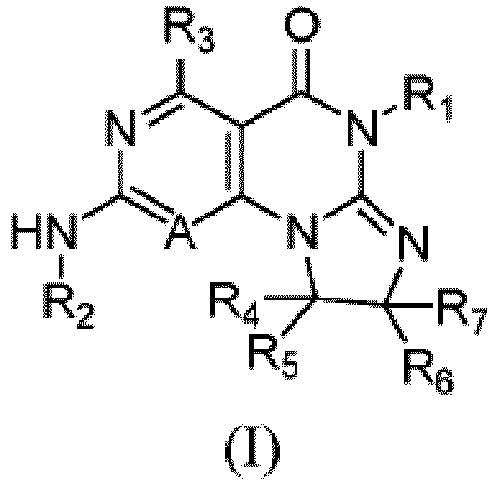 A est un N ou un CR15 ;R1 est un H ; ou un alkyle en C1-8, un alcényle en C2-8, un cycloalkyle en C3-8, un aryle ou un hétéroaryle facultativement substitué par un, deux ou trois quelconques des groupes suivants : un halogéno, un alkyle en C1 à C6, un alcoxy en C1 à C6, et un halogéno alkyle en C1 à C6 ;R2 est un groupe hétérocyclique, un aryle ou un hétéroaryle facultativement substitué par un, deux, trois ou quatre quelconques des groupes suivants : un alkyle en C1 à C6, un acyle en C1 à Ce, un groupe hétérocyclique, un halogéno, un groupe oxy, un nitro et un alkylamino en C1 à Ce, dans lequel l'alkyle en C1 à Ce, l'acyle en C1 à Ce, le groupe hétérocyclique, le groupe oxy et l'alkylamino en C1 à C6 sont facultativement substitués par 1 à 4 groupes choisis parmi les groupes suivants : un alkyle en C1 à C6, un acyle en C1 à Ce, un groupe hétérocyclique facultativement substitué par 1 à 4 d'un alkyle en C1 à C6, d'un halogéno, d'un -NRaRb et d'un hydroxy, dans lequel Ra et Rb sont indépendamment un H et un alkyle en C1 à C6 ;R3 à R7 et R15 sont indépendamment un H, un halogéno, un amino, un alcoxy, un alkyle en C1-10, un halogénoalkyle, un alcényle, un alcynyle, un hydroxyalkyle, un aminoalkyle, un carboxyalkyle, un nitro, un cyano, un acylamido, un hydroxy, un thiol, un acyloxy, un azido, un carboxy, un éthylènedioxo, un hydroxyacylamino ou un alkylthiol ;dans lequel l'aryle est un aryle en C6 à C14 ; l'hétéroaryle est un groupe ayant 5 à 14 atomes de noyau, 6, 10 ou 14 électrons π partagés dans un réseau cyclique, et contenant, en tant qu'atome de noyau, des atomes de carbone et 1 à 3 hétéroatomes choisis parmi l'oxygène, l'azote et le soufre ; et le groupe hétérocyclique est un système de noyau saturé ou partiellement saturé monocyclique de 3 à 7 chaînons, ou bicyclique de 7 à 10 chaînons, qui est constitué d'atomes de carbone et de un à quatre hétéroatomes indépendamment choisis dans le groupe constitué de O, N et S ;à condition que le composé ne soit pas une 6-(2,6-diméthylphényl)-2-((4-(4-méthylpipérazin-1-yl)phényl)amino)-8,9-dihydroimidazo[1,2-a]pyrimido[5,4-e]pyrimidin-5(6H)-one.
 - Composé selon la revendication 1, dans lequel A est un N ; R1 et R2 sont chacun indépendamment l'aryle facultativement substitué ; R3 à R7 sont chacun indépendamment un H, un halogéno ou un alkyle en C1-6.
- Composé selon la revendication 1, dans lequel ledit composé a la Formule II :
 R3 à R7 sont indépendamment un H, un halogéno, un amino, un alcoxy, un alkyle en C1-10, un halogénoalkyle, un alcényle, un alcynyle, un hydroxyalkyle, un aminoalkyle, un carboxyalkyle, un nitro, un cyano, un acylamido, un hydroxy, un thiol, un acyloxy, un azido, un carboxy, un éthylènedioxo, un hydroxyacylamino ou un alkylthiol ;Ar1 est un aryle ou un hétéroaryle facultativement substitué par un, deux ou trois groupes quelconques parmi les groupes suivants : un halogéno, un alkyle en C1 à C6, un alcoxy en C1 à C6 et un halogéno alkyle en C1 à C6 ;Ar2 est un aryle ou un hétéroaryle facultativement substitué par un, deux ou trois groupes quelconques parmi les groupes suivants : un alkyle en C1 à C6, un acyle en C1 à Ce, un groupe hétérocyclique, un halogéno, un groupe oxy, un nitro et un (alkyl en C1 à C6)amino, dans lequel l'alkyle en C1 à Ce, l'acyle en C1 à Ce, le groupe hétérocyclique, le groupe oxy et l'alkylamino en C1 à C6 sont facultativement substitués par 1 à 4 groupes choisis parmi les groupes suivants : un alkyle en C1 à C6, un acyle en C1 à Ce, un groupe hétérocyclique facultativement substitué par 1 à 4 d'un alkyle en C1 à C6, d'un halogéno, d'un -NRaRb et d'un hydroxy, dans lequel Ra et Rb sont indépendamment un H et un alkyle en C1 à C6 ;dans lequel l'aryle est un aryle en C6 à C14 ; l'hétéroaryle est un groupe ayant 5 à 14 atomes de noyau, 6, 10 ou 14 électrons π partagés dans un réseau cyclique, et contenant, en tant qu'atome de noyau, des atomes de carbone et 1 à 3 hétéroatomes choisis parmi l'oxygène, l'azote et le soufre ; et le groupe hétérocyclique est un système de noyau saturé ou partiellement saturé monocyclique de 3 à 7 chaînons, ou bicyclique de 7 à 10 chaînons, qui est constitué d'atomes de carbone et de un à quatre hétéroatomes indépendamment choisis dans le groupe constitué de O, N et S.
 - Composé selon la revendication 3, dans lequel R3 à R7 sont un H, Ar1 et Ar2 sont chacun un phényle facultativement substitué.
- Composé selon la revendication 3, dans lequel Ar2 est un phényle facultativement substitué par un, deux, trois ou quatre groupes choisis dans le groupe constitué de : un pipérazinyle facultativement substitué, un pipérazinyl-alkyle en C1 à C4 facultativement substitué, un pipéridinyle facultativement substitué, un imidazolyle, un 1,4-diazépanyle facultativement substitué, un alkyle en C1 à C6, un acyle en C1 à C6, un morpholinyle facultativement substitué, un morpholinyl-alkyle en C1 à C4, un halogéno, un halogéno alkyle en C1 à C6, un alcoxy en C1 à C6 facultativement substitué, un hydroxy alkyle en C1 à C6 facultativement substitué, un amino alkyle en C1 à C6 facultativement substitué, un pipéridinylamino facultativement substitué, un (alkyl en C1 à C6)amino facultativement substitué, un alkyl-O- hétérocyclique facultativement substitué et un nitro ; dans lequel les substituants sur le groupe facultativement substitué peuvent être 1 à 4 groupes choisis parmi les groupes suivants : un alkyle en C1 à C6, un acyle en C1 à C6, un halogéno, un -NRaRb et un alkyle en C1 à C6 substitué par un hydroxy, dans lequel Ra et Rb sont chacun indépendamment un H et un alkyle en C1 à C6.
- Composé selon la revendication 3, dans lequel Ar1 est choisi parmi :






 dans lequel R8 est indépendamment un H, un halogène, un alkyle en C1 à C4 et un halogène alkyle en C1 à C4 ;R9 est indépendamment un halogéno, un alkyle en C1 à C4 et un halogéno alkyle en C1 à C4 ;R10 est indépendamment un H, un halogéno, un alkyle en C1 à C4 et un alcoxy en C1 à C4 ;R11 est indépendamment un H, un halogéno, et un alkyle en C1 à C4 ;R12 est indépendamment un halogéno et un alcoxy en C1 à C4 ;R13 est indépendamment un H, un halogéno, un alkyle en C1 à C4, un alcoxy en C1 à C4, et un alkyle en C1 à C4 substitué par un hydroxy ; etR14 est indépendamment un H, un halogéno, et un alkyle en C1 à C4.
 - Composé selon la revendication 1, dans lequel le composé a une structure représentée par la Formule III :
 dans lequel,Ar1 est choisi parmi un phényle substitué par 1 ou 2 substituants choisis parmi un halogéno, un halogéno alkyle en C1 à C6, un alcoxy en C1 à C6 et un alkyle en C1 à C6 ; etAr2 est choisi parmi :un phényle substitué, dont les substituants sont choisis parmi : un halogéno ; un nitro ; un alkyle en C1 à C6, qui est facultativement substitué par un pipérazinyle ou un morpholinyle, 1 à 3 hydroxy, 1 à 5 halogéno, ou un - NRaRb, et le pipérazinyle est facultativement substitué par 1 à 3 substituants choisis parmi un alkyle en C1 à C4 ; un groupe oxy, qui est facultativement substitué par un alkyle en C1 à Cε ou un pipéridinyle, et le pipéridinyle est facultativement substitué par 1 à 3 substituants choisis parmi un alkyle en C1 à C4 ; un amino, dont un hydrogène est remplacé par un pipéridinyle, et l'autre hydrogène n'est pas remplacé ou substitué par un alkyle en C1 à C4, ou 1 ou 2 hydrogènes sont substitués par un alkyle en C1 à C6, et le pipéridinyle est facultativement substitué par 1 à 3 substituants choisis parmi un alkyle en C1 à C4, l'alkyle en C1 à C6 est facultativement substitué par un - NRaRb ; un pipérazinyle facultativement substitué par 1 à 3 substituants choisis parmi un alkyle en C1 à Ce, un hydroxy alkyle en C1 à C6 et un acyle en C1 à C6 ; un pipéridinyle facultativement substitué par un substituant choisi parmi un -NRaRb ; un 1,4-diazépanyle facultativement substitué par 1 à 3 substituants choisis parmi un alkyle en C1 à C6 ; un imidazolyle ; et un morpholinyle facultativement substitué par 1 à 3 alkyle en C1 à C6 ;un tétrahydroisoquinolinyle facultativement substitué par 1 à 3 substituants choisis parmi un alkyle en C1 à C6 et un halogéno ;un 2',3'-dihydro-1'H-spiro[cyclopropane-1,4'-isoquinolin]-7'-yle facultativement substitué par 1 à 3 substituants choisis parmi un alkyle en C1 à C6, un acyle en C1 à C6 et un halogéno ;un pyridyle facultativement substitué par un pipérazinyle qui est facultativement substitué par 1 à 3 alkyle en C1 à C6 ;un pyrazinyle facultativement substitué par un pipérazinyle qui est facultativement substitué par 1 à 3 alkyle en C1 à Cε ; etun 4,5,6,7-tétrahydropyrazolo[1,5-a]pyrazin-2-yle facultativement substitué par 1 à 3 alkyle en C1 à Cε ;dans lequel Ra et Rb sont chacun indépendamment un H et un alkyle en C1 à Cε.
 - Composé selon la revendication 7, dans lequel :Ar1 est choisi parmi un phényle substitué par 2 substituants choisis parmi un halogéno, et un alkyle en C1 à Cε ; etAr2 est choisi parmi : un phényle substitué, dont les substituants sont choisis parmi : un halogéno, un halogéno alkyle en C1 à C6, un alkyle en C1 à C6, un alcoxy en C1 à C6, un hydroxyl alkyle en C1 à C6, un NRaRb-alkyle en C1 à C6, un alkyle en C1 à C4 substitué par un pipérazinyle qui est facultativement substitué par 1 à 3 alkyle en C1 à C4, un pipéridinyl -O- facultativement substitué par 1 à 3 alkyle en C1 à C4, un NRaRb-alcoxy en C1 à C6, un NRaRb-alkyl en C1 à Cε -NRa-, un pipérazinyle substitué par 1 à 3 substituants choisis parmi un alkyle en C1 à C6, un hydroxy alkyle en C1 à C6 et un acyle en C1 à C6, un pipéridinyle substitué par 1 substituant choisi parmi un alkyle en C1 à C6 et un -NRaRb, un 1,4-diazépan-1-yle facultativement substitué par 1 à 3 alkyle en C1 à C6 et un morpholinyle facultativement substitué par 1 à 3 alkyle en C1 à C6; un tétrahydroisoquinolinyle substitué par 1 à 3 substituants choisis parmi un alkyle en C1 à C6 et un halogéno ; un 2',3'-dihydro-1'H-spiro[cyclopropane-1,4'-isoquinolin]-7'-yle substitué par 1 à 3 substituants choisis parmi un alkyle en C1 à C6, un acyle en C1 à C4 et un halogéno ; et un 4,5,6,7-tétrahydropyrazolo[1,5-a]pyrazin-2-yle substitué par 1 à 3 alkyle en C1 à Cε ; dans lequel Ra et Rb sont indépendamment un H et un alkyle en C1 à C4.
- Composé selon la revendication 7, dans lequel :Ar1 est un phényle disubstitué substitué par des substituants choisis parmi un halogéno, un alkyle en C1 à C3, un halogéno alkyle en C1 à C3 et un alcoxy en C1 à C3 au niveau de deux méta-positions ;Ar2 est un phényle substitué par 1, 2 ou 3 substituants, et les substituants sont choisis parmi un halogéno, un halogéno alkyle en C1 à C6, un alkyle en C1 à C6, un alcoxy en C1 à C6, un hydroxy alkyle en C1 à C6, un NRaRb-alkyle en C1 à C6, un alkyle en C1 à C4 substitué par un pipérazinyle facultativement substitué par 1 à 3 alkyle en C1 à C4, un pipéridinyl -O- facultativement substitué par 1 à 3 alkyle en C1 à C4, un NRaRb-alcoxy en C1 à C6, un NRaRb-alkyl en C1 à Cε -NRa-, un pipérazinyle facultativement substitué par 1 à 3 substituants choisis parmi un alkyle en C1 à C6 et un hydroxy alkyle en C1 à C6, un pipéridinyle substitué par 1 substituant choisi parmi un alkyle en C1 à C6 et un -NRaRb, un 1,4-diazépan-1-yle facultativement substitué par 1 à 3 alkyle en C1 à C6 et un morpholinyle facultativement substitué par 1 à 3 alkyle en C1 à Cε ; un tétrahydroisoquinolinyle substitué par 1 à 3 substituants choisis parmi un alkyle en C1 à C6 et un halogéno ; et un 2',3'-dihydro-1'H-spiro[cyclopropane-1,4'-isoquinolin]-7'-yle substitué par 1 à 3 substituants choisis parmi un alkyle en C1 à C6, un acyle en C1 à C4 et un halogéno ; dans lequel Ra et Rb sont indépendamment un H et un alkyle en C1 à C4.
- Composé selon la revendication 7, dans lequel Ar1 est





- Composé selon la revendication 7, dans lequel Ar1 est


- Composé selon la revendication 1, dans lequel ledit composé est choisi dans le groupe constitué de :6-(2-Chlorophényl)-2-((4-(4-méthylpipérazin-1-yl)phényl)amino)-8,9-dihydroimidazo[1,2-a]pyrimido[5,4-e]pyrimidin-5(6H)-one ;6-(2-Chloro-6-fluorophényl)-2-((4-(4-méthylpipérazin-1-yl)phényl)amino)-8,9-dihydroimidazo[1,2-a]pyrimido[5,4-e]pyrimidin-5(6H)-one ;4-(2-Chlorophényl)-8-((4-(4-méthylpipérazin-1-yl)phényl)amino)-2,4-dihydroimidazo[1,2-a]pyrido[3,4-e]pyrimidin-5(1H)-one ;6-(2,6-Dichlorophényl)-2-((4-(4-méthylpipérazin-1-yl)phényl)amino)-8,9-dihydroimidazo[1,2-a]pyrimido[5,4-e]pyrimidin-5(6H)-one ;6-(2-Chloro-6-méthylphényl)-2-((4-(4-méthylpipérazin-1-yl)phényl)amino)-8,9-dihydroimidazo[1,2-a]pyrimido[5,4-e]pyrimidin-5(6H)-one ;6-(2-Chloro-6-fluorophényl)-2-((4-(4-isopropylpipérazin-1-yl)phényl)amino)-8,9-dihydroimidazo[1,2-a]pyrimido[5,4-e]pyrimidin-5(6H)-one ;2-((4-(4-Acétylpipérazin-1-yl)phényl)amino)-6-(2-chloro-6-fluorophényl)-8,9-dihydroimidazo[1,2-a]pyrimido[5,4-e]pyrimidin-5(6H)-one ;6-(2-Chloro-6-fluorophényl)-2-((2-méthyl-1,2,3,4-tétrahydroisoquinolin-7-yl)amino)-8,9-dihydroimidazo[1,2-a]pyrimido[5,4-e]pyrimidin-5(6H)-one ;6-(2-Chloro-6-fluorophényl)-2-((2,4,4-triméthyl-1,2,3,4-tétrahydroisoquinolin-7-yl)amino)-8,9-dihydroimidazo[1,2-a]pyrimido[5,4-e]pyrimidin-5(6H)-one ;6-(2-Chloro-6-fluorophényl)-2-((2'-méthyl-2',3'-dihydro-1'H-spiro(cyclopropane-1,4'-isoquinolin)-7'-yl)amino)-8,9-dihydroimidazo[1,2-a]pyrimido[5,4-e]pyrimidin-5(6H)-one ;6-(2-Chloro-6-fluorophényl)-2-((2'-acétyl-2',3'-dihydro-1'H-spiro[cyclopropane-1,4'-isoquinolin]-7'-yl)amino)-8,9-dihydroimidazo[1,2-a]pyrimido[5,4-e]pyrimidin-5(6H)-one ;6-(2,6-Dichlorophényl)-2-((2-méthyl-1,2,3,4-tétrahydroisoquinolin-7-yl)amino)-8,9-dihydroimidazo[1,2-a]pyrimido[5,4-e]pyrimidin-5(6H)-one ;6-(2,6-Dichlorophényl)-2-((2,4,4-triméthyl-1,2,3,4-tétrahydroisoquinolin-7-yl)amino)-8,9-dihydroimidazo[1,2-a]pyrimido[5,4-e]pyrimidin-5(6H)-one ;6-(2,6-Dichlorophényl)-2-((2'-méthyl-2',3'-dihydro-1'H-spiro(cyclopropane-1,4'-isoquinolin)-7'-yl)amino)-8,9-dihydroimidazo[1,2-a]pyrimido[5,4-e]pyrimidin-5(6H)-one ;6-(2,6-Diméthylphényl)-2-((2-méthyl-1,2,3,4-tétrahydroisoquinolin-7-yl)amino)-8,9-dihydroimidazo[1,2-a]pyrimido[5,4-e]pyrimidin-5(6H)-one ;6-(2,6-Diméthylphényl)-2-((2,4,4-triméthyl-1,2,3,4-tétrahydroisoquinolin-7-yl)amino)-8,9-dihydroimidazo[1,2-a]pyrimido[5,4-e]pyrimidin-5(6H)-one ;6-(2,6-Diméthylphényl)-2-((2'-méthyl-2',3'-dihydro-1'H-spiro[cyclopropane-1,4'-isoquinolin]-7'-yl)amino)-8,9-dihydroimidazo[1,2-a]pyrimido[5,4-e]pyrimidin-5(6H)-one ;6-Isopropyl-2-((4-(4-méthylpipérazin-1-yl)phényl)amino)-8,9-dihydroimidazo[1,2-a]pyrimido[5,4-e]pyrimidin-5(6H)-one ;6-(Tert-butyl)-2-((4-(4-méthylpipérazin-1-yl)phényl)amino)-8,9-dihydroimidazo[1,2-a]pyrimido[5,4-e]pyrimidin-5(6H)-one ;6-Cyclopropyl-2-((4-(4-méthylpipérazin-1-yl)phényl)amino)-8,9-dihydroimidazo[1,2-a]pyrimido[5,4-e]pyrimidin-5(6H)-one ;6-Cyclohexyl-2-((4-(4-méthylpipérazin-1-yl)phényl)amino)-8,9-dihydroimidazo[1,2-a]pyrimido[5,4-e]pyrimidin-5(6H)-one ;6-Allyl-2-((4-(4-méthylpipérazin-1-yl)phényl)amino)-8,9-dihydroimidazo[1,2-a]pyrimido[5,4-e]pyrimidin-5(6H)-one ;2-((4-(4-Méthylpipérazin-1-yl)phényl)amino)-6-(thiophén-2-yl)-8,9-dihydroimidazo[1,2-a]pyrimido[5,4-e]pyrimidin-5(6H)-one ;6-(Furan-2-yl)-2-((4-(4-méthylpipérazin-1-yl)phényl)amino)-8,9-dihydroimidazo[1,2-a]pyrimido[5,4-e]pyrimidin-5(6H)-one ;2-((4-(4-Méthylpipérazin-1-yl)phényl)amino)-6-(1H-pyrrol-2-yl)-8,9-dihydroimidazo[1,2-a]pyrimido[5,4-e]pyrimidin-5(6H)-one ;6-(1H-Imidazol-5-yl)-2-((4-(4-méthylpipérazin-1-yl)phényl)amino)-8,9-dihydroimidazo[1,2-a]pyrimido[5,4-e]pyrimidin-5(6H)-one ;6-(2-Chloro-6-fluorophényl)-8,8-diméthyl-2-((4-(4-méthylpipérazin-1-yl)phényl)amino)-8,9-dihydroimidazo[1,2-a]pyrimido[5,4-e]pyrimidin-5(6H)-one ;6-(2-Chloro-6-fluorophényl)-9,9-diméthyl-2-((4-(4-méthylpipérazin-1-yl)phényl)amino)-8,9-dihydroimidazo[1,2-a]pyrimido[5,4-e]pyrimidin-5(6H)-one ;6-(2-Chloro-6-fluorophényl)-2-((4-((2S,6R)-2,6-diméthylmorpholino)phényl)amino)-8,9-dihydroimidazo[1,2-a]pyrimido[5,4-e]pyrimidin-5(6H)-one ;6-(2-Chloro-6-fluorophényl)-2-((4-(morpholinométhyl)phényl)amino)-8,9-dihydroimidazo[1,2-a]pyrimido[5,4-e]pyrimidin-5(6H)-one ;6-(2-Chloro-6-fluorophényl)-2-((4-((3S,5R)-3,4,5-triméthylpipérazin-1-yl)phényl)amino)-8,9-dihydroimidazo[1,2-a]pyrimido[5,4-e]pyrimidin-5(6H)-one ;6-(2-Chloro-6-fluorophényl)-2-((4-((3S,5R)-4-isopropyl-3,5-diméthylpipérazin-1-yl)phényl)amino)-8,9-dihydroimidazo[1,2-a]pyrimido[5,4-e]pyrimidin-5(6H)-one ;6-(2-Chloro-6-fluorophényl)-2-((2-fluoro-4-(4-méthylpipérazin-1-yl)phényl)amino)-8,9-dihydroimidazo[1,2-a]pyrimido[5,4-e]pyrimidin-5(6H)-one ;6-(2-Chloro-6-fluorophényl)-2-((2-fluoro-4-((3S,5R)-3,4,5-triméthylpipérazin-1-yl)phényl)amino)-8,9-dihydroimidazo[1,2-a]pyrimido[5,4-e]pyrimidin-5(6H)-one ;6-(2-Chloro-6-fluorophényl)-2-((2-chloro-4-(4-méthylpipérazin-1-yl)phényl)amino)-8,9-dihydroimidazo[1,2-a]pyrimido[5,4-e]pyrimidin-5(6H)-one ;6-(2-Chloro-6-fluorophényl)-2-((2-chloro-4-((3S,5R)-3,4,5-triméthylpipérazin-1-yl)phényl)amino)-8,9-dihydroimidazo[1,2-a]pyrimido[5,4-e]pyrimidin-5(6H)-one ;6-(2-Chloro-6-fluorophényl)-2-((4-(4-méthylpipérazin-1-yl)-2-(trifluorométhyl)phényl)amino)-8,9-dihydroimidazo[1,2-a]pyrimido[5,4-e]pyrimidin-5(6H)-one ;6-(2-Chloro-6-fluorophényl)-2-((2-trifluorométhyl-4-((3S,5R)-3,4,5-triméthylpipérazin-1-yl)phényl)amino)-8,9-dihydroimidazo[1,2-a]pyrimido[5,4-e]pyrimidin-5(6H)-one ;6-(2-Chloro-6-fluorophényl)-2-((2-méthyl-4-(4-méthylpipérazin-1-yl)phényl)amino)-8,9-dihydroimidazo[1,2-a]pyrimido[5,4-e]pyrimidin-5(6H)-one ;6-(2-Chloro-6-fluorophényl)-2-((2-méthyl-4-((3S,5R)-3,4,5-triméthylpipérazin-1-yl)phényl)amino)-8,9-dihydroimidazo[1,2-a]pyrimido[5,4-e]pyrimidin-5(6H)-one ;6-(2-Chloro-6-fluorophényl)-2-((3-fluoro-4-(4-méthylpipérazin-1-yl)phényl)amino)-8,9-dihydroimidazo[1,2-a]pyrimido[5,4-e]pyrimidin-5(6H)-one ;6-(2-Chloro-6-fluorophényl)-2-((3-fluoro-4-((3S,5R)-3,4,5-triméthylpipérazin-1-yl)phényl)amino)-8,9-dihydroimidazo[1,2-a]pyrimido[5,4-e]pyrimidin-5(6H)-one ;6-(2-Chloro-6-fluorophényl)-2-((3-chloro-4-(4-méthylpipérazin-1-yl)phényl)amino)-8,9-dihydroimidazo[1,2-a]pyrimido[5,4-e]pyrimidin-5(6H)-one ;2-((3-Chloro-4-((3S,5R)-3,4,5-triméthylpipérazin-1-yl)phényl)amino)-6-(2-chloro-6-fluorophényl)-8,9-dihydroimidazo[1,2-a]pyrimido[5,4-e]pyrimidin-5(6H)-one ;6-(2-Chloro-6-fluorophényl)-2-((4-(4-méthylpipérazin-1-yl)-3-(trifluorométhyl)phényl)amino)-8,9-dihydroimidazo[1,2-a]pyrimido[5,4-e]pyrimidin-5(6H)-one ;6-(2-Chloro-6-fluorophényl)-2-((3-trifluorométhyl-4-((3S,5R)-3,4,5-triméthylpipérazin-1-yl)phényl)amino)-8,9-dihydroimidazo[1,2-a]pyrimido[5,4-e]pyrimidin-5(6H)-one ;6-(2-Chloro-6-fluorophényl)-2-((3-méthyl-4-(4-méthylpipérazin-1-yl)phényl)amino)-8,9-dihydroimidazo[1,2-a]pyrimido[5,4-e]pyrimidin-5(6H)-one ;6-(2-Chloro-6-fluorophényl)-2-((3-méthyl-4-((3S,5R)-3,4,5-triméthylpipérazin-1-yl)phényl)amino)-8,9-dihydroimidazo[1,2-a]pyrimido[5,4-e]pyrimidin-5(6H)-one ;6-(2-Chloro-6-fluorophényl)-2-((4-(4-isopropylpipérazin-1-yl)-3-méthylphényl)amino)-8,9-dihydroimidazo[1,2-a]pyrimido[5,4-e]pyrimidin-5(6H)-one ;6-(2-Chloro-6-fluorophényl)-2-((4-((3S,5R)-4-isopropyl-3,5-diméthylpipérazin-1-yl)-3-méthylphényl)amino)-8,9-dihydroimidazo[1,2-a]pyrimido[5,4-e]pyrimidin-5(6H)-one ;6-(2-Chloro-6-fluorophényl)-2-((3-méthoxy-4-(4-méthylpipérazin-1-yl)phényl)amino)-8,9-dihydroimidazo[1,2-a]pyrimido[5,4-e]pyrimidin-5(6H)-one ;6-(2-Chloro-6-fluorophényl)-2-((4-(4-méthylpipérazin-1-yl)-3-nitrophényl)amino)-8,9-dihydroimidazo[1,2-a]pyrimido[5,4-e]pyrimidin-5(6H)-one ;6-(2-Chloro-6-fluorophényl)-2-((3,5-diméthyl-4-(4-méthylpipérazin-1-yl)phényl)amino)-8,9-dihydroimidazo[1,2-a]pyrimido[5,4-e]pyrimidin-5(6H)-one ;6-(2-Chloro-6-fluorophényl)-2-((6-4-(4-méthylpipérazin-1-yl)pyridin-3-yl)amino)-8,9-dihydroimidazo[1,2-a]pyrimido[5,4-e]pyrimidin-5(6H)-one ;6-(2-Chloro-6-fluorophényl)-2-((2'-isopropyl-2',3'-dihydro-1'H-spiro[cyclopropane-1,4'-isoquinolin]-7'-yl)amino)-8,9-dihydroimidazo[1,2-a]pyrimido[5,4-e]pyrimidin-5(6H)-one ;6-(2-Chloro-6-fluorophényl)-2-((5-méthyl-4,5,6,7-tétrahydropyrazolo[1,5-a]pyrazin-2-yl)amino)-8,9-dihydroimidazo[1,2-a]pyrimido[5,4-e]pyrimidin-5(6H)-one ;6-(2,6-Difluorophényl)-2-((3-méthyl-4-(4-méthylpipérazin-1-yl)phényl)amino)-8,9-dihydroimidazo[1,2-a]pyrimido[5,4-e]pyrimidin-5(6H)-one ;6-(2-Fluoro-6-(trifluorométhyl)phényl)-2-((3-méthyl-4-(4-méthylpipérazin-1-yl)phényl)amino)-8,9-dihydroimidazo[1,2-a]pyrimido[5,4-e]pyrimidin-5(6H)-one ;6-(2-Fluoro-6-méthylphényl)-2-((3-méthyl-4-(4-méthylpipérazin-1-yl)phényl)amino)-8,9-dihydroimidazo[1,2-a]pyrimido[5,4-e]pyrimidin-5(6H)-one ;6-(2,6-Dichlorophényl)-2-((4-(4-isopropylpipérazin-1-yl)phényl)amino)-8,9-dihydroimidazo[1,2-a]pyrimido[5,4-e]pyrimidin-5(6H)-one ;6-(2,6-Dichlorophényl)-2-((4-((3S,5R)-3,4,5-triméthylpipérazin-1-yl)phényl)amino)-8,9-dihydroimidazo[1,2-a]pyrimido[5,4-e]pyrimidin-5(6H)-one ;6-(2,6-Dichlorophényl)-2-((4-((3S,5R)-4-isopropyl-3,5-diméthylpipérazin-1-yl)phényl)amino)-8,9-dihydroimidazo[1,2-a]pyrimido[5,4-e]pyrimidin-5(6H)-one ;6-(2,6-Dichlorophényl)-2-((2-fluoro-4-((3S,5R)-3,4,5-triméthylpipérazin-1-yl)phényl)amino)-8,9-dihydroimidazo[1,2-a]pyrimido[5,4-e]pyrimidin-5(6H)-one ;6-(2,6-Dichlorophényl)-2-((2-chloro-4-((3S,5R)-3,4,5-triméthylpipérazin-1-yl)phényl)amino)-8,9-dihydroimidazo[1,2-a]pyrimido[5,4-e]pyrimidin-5(6H)-one ;6-(2,6-Dichlorophényl)-2-((2-trifluorométhyl-4-((3S,5R)-3,4,5-triméthylpipérazin-1-yl)phényl)amino)-8,9-dihydroimidazo[1,2-a]pyrimido[5,4-e]pyrimidin-5(6H)-one ;6-(2,6-Dichlorophényl)-2-((3-fluoro-4-(4-méthylpipérazin-1-yl)phényl)amino)-8,9-dihydroimidazo[1,2-a]pyrimido[5,4-e]pyrimidin-5(6H)-one ;6-(2,6-Dichlorophényl)-2-((3-fluoro-4-((3S,5R)-3,4,5-triméthylpipérazin-1-yl)phényl)amino)-8,9-dihydroimidazo[1,2-a]pyrimido[5,4-e]pyrimidin-5(6H)-one ;6-(2,6-Dichlorophényl)-2-((3-chloro-4-(4-méthylpipérazin-1-yl)phényl)amino)-8,9-dihydroimidazo[1,2-a]pyrimido[5,4-e]pyrimidin-5(6H)-one ;6-(2,6-Dichlorophényl)-2-((3-chloro-4-((3S,5R)-3,4,5-triméthylpipérazin-1-yl)phényl)amino)-8,9-dihydroimidazo[1,2-a]pyrimido[5,4-e]pyrimidin-5(6H)-one ;6-(2,6-Dichlorophényl)-2-((4-(4-méthylpipérazin-1-yl)-3-(trifluorométhyl)phényl)amino)-8,9-dihydroimidazo[1,2-a]pyrimido[5,4-e]pyrimidin-5(6H)-one ;6-(2,6-Dichlorophényl)-2-((3-trifluorométhyl-4-((3S,5R)-3,4,5-triméthylpipérazin-1-yl)phényl)amino)-8,9-dihydroimidazo[1,2-a]pyrimido[5,4-e]pyrimidin-5(6H)-one ;6-(2,6-Dichlorophényl)-2-((3-méthyl-4-(4-méthylpipérazin-1-yl)phényl)amino)-8,9-dihydroimidazo[1,2-a]pyrimido[5,4-e]pyrimidin-5(6H)-one ;6-(2,6-Dichlorophényl)-2-((4-(4-isopropylpipérazin-1-yl)-3-méthylphényl)amino)-8,9-dihydroimidazo[1,2-a]pyrimido[5,4-e]pyrimidin-5(6H)-one ;6-(2,6-Dichlorophényl)-2-((3-méthyl-4-((3S,5R)-3,4,5-triméthylpipérazin-1-yl)phényl)amino)-8,9-dihydroimidazo[1,2-a]pyrimido[5,4-e]pyrimidin-5(6H)-one ;6-(2,6-Dichlorophényl)-2-((4-((3S,5R)-4-isopropyl-3,5-diméthylpipérazin-1-yl)-3-méthylphényl)amino)-8,9-dihydroimidazo[1,2-a]pyrimido[5,4-e]pyrimidin-5(6H)-one ;6-(2,6-Dichlorophényl)-2-((5-méthyl-4,5,6,7-tétrahydropyrazolo[1,5-a]pyrazin-2-yl)amino)-8,9-dihydroimidazo[1,2-a]pyrimido[5,4-e]pyrimidin-5(6H)-one ;6-(2-Chloro-6-(trifluorométhyl)phényl)-2-((3-méthyl-4-(4-méthylpipérazin-1-yl)phényl)amino)-8,9-dihydroimidazo[1,2-a]pyrimido[5,4-e]pyrimidin-5(6H)-one ;6-(2-Chloro-6-méthylphényl)-2-((3-méthyl-4-(4-méthylpipérazin-1-yl)phényl)amino)-8,9-dihydroimidazo[1,2-a]pyrimido[5,4-e]pyrimidin-5(6H)-one ;6-(2-Chloro-6-méthoxyphényl)-2-((3-méthyl-4-(4-méthylpipérazin-1-yl)phényl)amino)-8,9-dihydroimidazo[1,2-a]pyrimido[5,4-e]pyrimidin-5(6H)-one ;6-(2,6-Diméthylphényl)-2-((4-((3S,5R)-3,4,5-triméthylpipérazin-1-yl)phényl)amino)-8,9-dihydroimidazo[1,2-a]pyrimido[5,4-e]pyrimidin-5(6H)-one ;6-(4-Chlorophényl)-2-((4-(4-méthylpipérazin-1-yl)phényl)amino)-8,9-dihydroimidazo[1,2-a]pyrimido[5,4-e]pyrimidin-5(6H)-one ;6-(3-Chlorophényl)-2-((4-(4-méthylpipérazin-1-yl)phényl)amino)-8,9-dihydroimidazo[1,2-a]pyrimido[5,4-e]pyrimidin-5(6H)-one ;6-(2,4-Dichlorophényl)-2-((4-(4-méthylpipérazin-1-yl)phényl)amino)-8,9-dihydroimidazo[1,2-a]pyrimido[5,4-e]pyrimidin-5(6H)-one ;6-(2-Chloro-4-fluorophényl)-2-((4-(4-méthylpipérazin-1-yl)phényl)amino)-8,9-dihydroimidazo[1,2-a]pyrimido[5,4-e]pyrimidin-5(6H)-one ;6-(2-Chloro-3-fluorophényl)-2-((4-(4-méthylpipérazin-1-yl)phényl)amino)-8,9-dihydroimidazo[1,2-a]pyrimido[5,4-e]pyrimidin-5(6H)-one ;6-(2,5-Dichlorophényl)-2-((4-(4-méthylpipérazin-1-yl)phényl)amino)-8,9-dihydroimidazo[1,2-a]pyrimido[5,4-e]pyrimidin-5(6H)-one ;6-(2,3-Dichlorophényl)-2-((4-(4-méthylpipérazin-1-yl)phényl)amino)-8,9-dihydroimidazo[1,2-a]pyrimido[5,4-e]pyrimidin-5(6H)-one ;6-(Pyrimidin-2-yl)-2-((4-(4-méthylpipérazin-1-yl)phényl)amino)-8,9-dihydroimidazo[1,2-a]pyrimido[5,4-e]pyrimidin-5(6H)-one ;2-((4-(4-Méthylpipérazin-1-yl)phényl)amino)-8,9-dihydroimidazo[1,2-a]pyrimido[5,4-e]pyrimidin-5(6H)-one ;6-Cyclobutyl-2-((4-(4-méthylpipérazin-1-yl)phényl)amino)-8,9-dihydroimidazo[1,2-a]pyrimido[5,4-e]pyrimidin-5(6H)-one ;6-Cyclopentyl-2-((4-(4-méthylpipérazin-1-yl)phényl)amino)-8,9-dihydroimidazo[1,2-a]pyrimido[5,4-e]pyrimidin-5(6H)-one) ;6-Phényl-2-((4-(4-méthylpipérazin-1-yl)phényl)amino)-8,9-dihydroimidazo[1,2-a]pyrimido[5,4-e]pyrimidin-5(6H)-one ;6-(Pyridin-2-yl)-2-((4-(4-méthylpipérazin-1-yl)phényl)amino)-8,9-dihydroimidazo[1,2-a]pyrimido[5,4-e]pyrimidin-5(6H)-one ;6-(Pyridin-3-yl)-2-((4-(4-méthylpipérazin-1-yl)phényl)amino)-8,9-dihydroimidazo[1,2-a]pyrimido[5,4-e]pyrimidin-5(6H)-one ;6-(Pyridin-4-yl)-2-((4-(4-méthylpipérazin-1-yl)phényl)amino)-8,9-dihydroimidazo[1,2-a]pyrimido[5,4-e]pyrimidin-5(6H)-one ;6-(2,6-Difluorophényl)-2-((3-chloro-4-(4-méthylpipérazin-1-yl)phényl)amino)-8,9-dihydroimidazo[1,2-a]pyrimido[5,4-e]pyrimidin-5(6H)-one ;6-(2,6-Difluorophényl)-2-((3,5-diméthyl-4-(4-méthylpipérazin-1-yl)phényl)amino)-8,9-dihydroimidazo[1,2-a]pyrimido[5,4-e]pyrimidin-5(6H)-one ;6-(2-Chloro-6-fluorophényl)-2-((4-(1H-imidazol-1-yl)phényl)amino)-8,9-dihydroimidazo[1,2-a]pyrimido[5,4-e]pyrimidin-5(6H)-one ;6-(2-Chloro-6-fluorophényl)-2-((4-(4-méthyl-1,4-diazépan-1-yl)phényl)amino)-8,9-dihydroimidazo[1,2-a]pyrimido[5,4-e]pyrimidin-5(6H)-one ;6-(2-Chloro-6-fluorophényl)-2-((4-((4-méthylpipérazin-1-yl)méthyl)phényl)amino)-8,9-dihydroimidazo[1,2-a]pyrimido[5,4-e]pyrimidin-5(6H)-one ;6-(2-Chloro-6-fluorophényl)-2-((4-(2-(diméthylamino)éthoxy)phényl)amino)-8,9-dihydroimidazo[1,2-a]pyrimido[5,4-e]pyrimidin-5(6H)-one ;6-(2-Chloro-6-fluorophényl)-2-((4-(3-(diméthylamino)propoxy)phényl)amino)-8,9-dihydroimidazo[1,2-a]pyrimido[5,4-e]pyrimidin-5(6H)-one ;6-(2-Chloro-6-fluorophényl)-2-((4-((1-méthylpipéridin-4-yl)oxy)phényl)amino)-8,9-dihydroimidazo[1,2-a]pyrimido[5,4-e]pyrimidin-5(6H)-one ;6-(2-Chloro-6-fluorophényl)-2-((4-((2-(diméthylamino)éthyl)amino)phényl)amino)-8,9-dihydroimidazo[1,2-a]pyrimido[5,4-e]pyrimidin-5(6H)-one ;6-(2-Chloro-6-fluorophényl)-2-((4-((2-(diméthylamino)éthyl)(méthyl)amino)phényl)amino)-8,9-dihydroimidazo[1,2-a]pyrimido[5,4-e]pyrimidin-5(6H)-one ;6-(2-Chloro-6-fluorophényl)-2-((4-((3-(diméthylamino)propyl)amino)phényl)amino)-8,9-dihydroimidazo[1,2-a]pyrimido[5,4-e]pyrimidin-5(6H)-one ;6-(2-Chloro-6-fluorophényl)-2-((4-((3-(diméthylamino)propyl)(méthyl)amino)phényl)amino)-8,9-dihydroimidazo[1,2-a]pyrimido[5,4-e]pyrimidin-5(6H)-one ;6-(2-Chloro-6-fluorophényl)-2-((4-((1-méthylpipéridin-4-yl)amino)phényl)amino)-8,9-dihydroimidazo[1,2-a]pyrimido[5,4-e]pyrimidin-5(6H)-one ;6-(2-Chloro-6-fluorophényl)-2-((4-(méthyl(1-méthylpipéridin-4-yl)amino)phényl)amino)-8,9-dihydroimidazo[1,2-a]pyrimido[5,4-e]pyrimidin-5(6H)-one ;6-(2-Chloro-6-fluorophényl)-2-((4-(1-méthylpipéridin-4-yl)phényl)amino)-8,9-dihydroimidazo[1,2-a]pyrimido[5,4-e]pyrimidin-5(6H)-one ;6-(2-Chloro-6-fluorophényl)-2-((4-(4-(diméthylamino)pipéridin-1-yl)phényl)amino)-8,9-dihydroimidazo[1,2-a]pyrimido[5,4-e]pyrimidin-5(6H)-one ;6-(2-Chloro-6-fluorophényl)-2-((4-(4-(diméthylamino)pipéridin-1-yl)-3-fluorophényl)amino)-8,9-dihydroimidazo[1,2-a]pyrimido[5,4-e]pyrimidin-5(6H)-one ;6-(2-Chloro-6-fluorophényl)-2-((3-chloro-4-(4-(diméthylamino)pipéridin-1-yl)phényl)amino)-8,9-dihydroimidazo[1,2-a]pyrimido[5,4-e]pyrimidin-5(6H)-one ;6-(2-Chloro-6-fluorophényl)-2-((3-bromo-4-(4-(diméthylamino)pipéridin-1-yl)phényl)amino)-8,9-dihydroimidazo[1,2-a]pyrimido[5,4-e]pyrimidin-5(6H)-one ;6-(2-Chloro-6-fluorophényl)-2-((4-(4-(diméthylamino)pipéridin-1-yl)-3-méthylphényl)amino)-8,9-dihydroimidazo[1,2-a]pyrimido[5,4-e]pyrimidin-5(6H)-one ;6-(2-Chloro-6-fluorophényl)-2-((3-fluoro-5-méthyl-4-(4-(diméthylamino)pipéridin-1-yl)phényl)amino)-8,9-dihydroimidazo[1,2-a]pyrimido[5,4-e]pyrimidin-5(6H)-one ;6-(2-Chloro-6-fluorophényl)-2-((5-(4-méthylpipérazin-1-yl)pyrazin-2-yl)amino)-8,9-dihydroimidazo[1,2-a]pyrimido[5,4-e]pyrimidin-5(6H)-one ;6-(2-Chloro-6-fluorophényl)-2-((3,5-dichloro-4-(4-méthylpipérazin-1-yl)phényl)amino)-8,9-dihydroimidazo[1,2-a]pyrimido[5,4-e]pyrimidin-5(6H)-one ;6-(2-Chloro-6-fluorophényl)-2-((3-fluoro-5-méthyl-4-(4-méthylpipérazin-1-yl)phényl)amino)-8,9-dihydroimidazo[1,2-a]pyrimido[5,4-e]pyrimidin-5(6H)-one ;6-(2-Chloro-6-fluorophényl)-2-((3-fluoro-5-méthoxy-4-(4-méthylpipérazin-1-yl)phényl)amino)-8,9-dihydroimidazo[1,2-a]pyrimido[5,4-e]pyrimidin-5(6H)-one ;6-(2-Chloro-6-fluorophényl)-2-((3-chloro-5-méthyl-4-(4-méthylpipérazin-1-yl)phényl)amino)-8,9-dihydroimidazo[1,2-a]pyrimido[5,4-e]pyrimidin-5(6H)-one ;6-(2-Chloro-6-fluorophényl)-2-((3-chloro-5-méthoxy-4-(4-méthylpipérazin-1-yl)phényl)amino)-8,9-dihydroimidazo[1,2-a]pyrimido[5,4-e]pyrimidin-5(6H)-one ;6-(2-Chloro-6-fluorophényl)-2-((3-bromo-5-méthoxy-4-(4-méthylpipérazin-1-yl)phényl)amino)-8,9-dihydroimidazo[1,2-a]pyrimido[5,4-e]pyrimidin-5(6H)-one ;6-(2-Chloro-6-fluorophényl)-2-((3-méthyl-4-(4-méthylpipérazin-1-yl)-5-(trifluorométhyl)phényl)amino)-8,9-dihydroimidazo[1,2-a]pyrimido[5,4-e]pyrimidin-5(6H)-one ;6-(2-Chloro-6-fluorophényl)-2-((3-méthoxy-5-méthyl-4-(4-méthylpipérazin-1-yl)phényl)amino)-8,9-dihydroimidazo[1,2-a]pyrimido[5,4-e]pyrimidin-5(6H)-one ;6-(2,6-Dichlorophényl)-2-((5-chloro-2-méthyl-1,2,3,4-tétrahydroisoquinolin-7-yl)amino)-8,9-dihydroimidazo[1,2-a]pyrimido[5,4-e]pyrimidin-5(6H)-one ;6-(2,6-Dichlorophényl)-2-((2,5-diméthyl-1,2,3,4-tétrahydroisoquinolin-7-yl)amino)-8,9-dihydroimidazo[1,2-a]pyrimido[5,4-e]pyrimidin-5(6H)-one ;6-(2,6-Dichlorophényl)-2-((5-chloro-2,4,4-triméthyl-1,2,3,4-tétrahydroisoquinolin-7-yl)amino)-8,9-dihydroimidazo[1,2-a]pyrimido[5,4-e]pyrimidin-5(6H)-one ;6-(2,6-Dichlorophényl)-2-((2,4,4,5-tétraméthyl-1,2,3,4-tétrahydroisoquinolin-7-yl)amino)-8,9-dihydroimidazo[1,2-a]pyrimido[5,4-e]pyrimidin-5(6H)-one ;6-(2,6-Dichlorophényl)-2-((5'-chloro-2'-méthyl-2',3'-dihydro-1'H-spiro(cyclopropane-1,4'-isoquinolin)-7'-yl)amino)-8,9-dihydroimidazo[1,2-a]pyrimido[5,4-e]pyrimidin-5(6H)-one ;6-(2,6-Dichlorophényl)-2-((2',5'-diméthyl-2',3'-dihydro-1'H-spiro[cyclopropane-1,4'-isoquinolin]-7'-yl)amino)-8,9-dihydroimidazo[1,2-a]pyrimido[5,4-e]pyrimidin-5(6H)-one ;6-(2,6-Dichlorophényl)-2-((3,5-dichloro-4-((3S,5R)-3,4,5-triméthylpipérazin-1-yl)phényl)amino)-8,9-dihydroimidazo[1,2-a]pyrimido[5,4-e]pyrimidin-5(6H)-one ;6-(2,6-Dichlorophényl)-2-((3-chloro-5-méthyl-4-((3S,5R)-3,4,5-triméthylpipérazin-1-yl)phényl)amino)-8,9-dihydroimidazo[1,2-a]pyrimido[5,4-e]pyrimidin-5(6H)-one ;6-(2,6-Dichlorophényl)-2-((4-(4-(diméthylamino)pipéridin-1-yl)phényl)amino)-8,9-dihydroimidazo[1,2-a]pyrimido[5,4-e]pyrimidin-5(6H)-one ;6-(2,6-Dichlorophényl)-2-((3-chloro-4-(4-(diméthylamino)pipéridin-1-yl)phényl)amino)-8,9-dihydroimidazo[1,2-a]pyrimido[5,4-e]pyrimidin-5(6H)-one ;6-(2,6-Dichlorophényl)-2-((3-bromo-4-(4-(diméthylamino)pipéridin-1-yl)phényl)amino)-8,9-dihydroimidazo[1,2-a]pyrimido[5,4-e]pyrimidin-5(6H)-one ;6-(2,6-Dichlorophényl)-2-((4-(4-(diméthylamino)pipéridin-1-yl)-3-méthylphényl)amino)-8,9-dihydroimidazo[1,2-a]pyrimido[5,4-e]pyrimidin-5(6H)-one ;6-(2,6-Dichlorophényl)-2-((3,5-dichloro-4-(4-(diméthylamino)pipéridin-1-yl)phényl)amino)-8,9-dihydroimidazo[1,2-a]pyrimido[5,4-e]pyrimidin-5(6H)-one ;6-(2,6-Dichlorophényl)-2-((4-(4-(diméthylamino)pipéridin-1-yl)-3-fluoro-5-méthylphényl)amino)-8,9-dihydroimidazo[1,2-a]pyrimido[5,4-e]pyrimidin-5(6H)-one ;6-(2,6-Dichlorophényl)-2-((3-chloro-4-(4-(diméthylamino)pipéridin-1-yl)-5-méthoxyphényl)amino)-8,9-dihydroimidazo[1,2-a]pyrimido[5,4-e]pyrimidin-5(6H)-one ;6-(2,6-Dichlorophényl)-2-((3-bromo-4-(4-méthylpipérazin-1-yl)phényl)amino)-8,9-dihydroimidazo[1,2-a]pyrimido[5,4-e]pyrimidin-5(6H)-one ;6-(2,6-Dichlorophényl)-2-((3-méthoxy-4-(4-méthylpipérazin-1-yl)phényl)amino)-8,9-dihydroimidazo[1,2-a]pyrimido[5,4-e]pyrimidin-5(6H)-one ;6-(2,6-Dichlorophényl)-2-((3-chloro-5-fluoro-4-(4-méthylpipérazin-1-yl)phényl)amino)-8,9-dihydroimidazo[1,2-a]pyrimido[5,4-e]pyrimidin-5(6H)-one ;6-(2,6-Dichlorophényl)-2-((3-fluoro-5-méthyl-4-(4-méthylpipérazin-1-yl)phényl)amino)-8,9-dihydroimidazo[1,2-a]pyrimido[5,4-e]pyrimidin-5(6H)-one ;6-(2,6-Dichlorophényl)-2-((3-fluoro-5-méthoxy-4-(4-méthylpipérazin-1-yl)phényl)amino)-8,9-dihydroimidazo[1,2-a]pyrimido[5,4-e]pyrimidin-5(6H)-one ;6-(2,6-Dichlorophényl)-2-((3,5-dichloro-4-(4-méthylpipérazin-1-yl)phényl)amino)-8,9-dihydroimidazo[1,2-a]pyrimido[5,4-e]pyrimidin-5(6H)-one ;6-(2,6-Dichlorophényl)-2-((3-chloro-5-méthyl-4-(4-méthylpipérazin-1-yl)phényl)amino)-8,9-dihydroimidazo[1,2-a]pyrimido[5,4-e]pyrimidin-5(6H)-one ;6-(2,6-Dichlorophényl)-2-((3-chloro-4-(4-méthylpipérazin-1-yl)-5-(trifluorométhyl)phényl)amino)-8,9-dihydroimidazo[1,2-a]pyrimido[5,4-e]pyrimidin-5(6H)-one ;6-(2,6-Dichlorophényl)-2-((3-chloro-5-méthoxy-4-(4-méthylpipérazin-1-yl)phényl)amino)-8,9-dihydroimidazo[1,2-a]pyrimido[5,4-e]pyrimidin-5(6H)-one ;6-(2,6-Dichlorophényl)-2-((3-bromo-5-fluoro-4-(4-méthylpipérazin-1-yl)phényl)amino)-8,9-dihydroimidazo[1,2-a]pyrimido[5,4-e]pyrimidin-5(6H)-one ;6-(2,6-Dichlorophényl)-2-((3-bromo-5-chloro-4-(4-méthylpipérazin-1-yl)phényl)amino)-8,9-dihydroimidazo[1,2-a]pyrimido[5,4-e]pyrimidin-5(6H)-one ;6-(2,6-Dichlorophényl)-2-((3-bromo-5-méthyl-4-(4-méthylpipérazin-1-yl)phényl)amino)-8,9-dihydroimidazo[1,2-a]pyrimido[5,4-e]pyrimidin-5(6H)-one ;6-(2,6-Dichlorophényl)-2-((3-bromo-5-méthoxy-4-(4-méthylpipérazin-1-yl)phényl)amino)-8,9-dihydroimidazo[1,2-a]pyrimido[5,4-e]pyrimidin-5(6H)-one ;6-(2,6-Dichlorophényl)-2-((3,5-diméthyl-4-(4-méthylpipérazin-1-yl)phényl)amino)-8,9-dihydroimidazo[1,2-a]pyrimido[5,4-e]pyrimidin-5(6H)-one ;6-(2,6-Dichlorophényl)-2-((3-méthoxy-5-méthyl-4-(4-méthylpipérazin-1-yl)phényl)amino)-8,9-dihydroimidazo[1,2-a]pyrimido[5,4-e]pyrimidin-5(6H)-one ;6-(2-Bromo-6-chlorophényl)-2-((4-(4-(diméthylamino)pipéridin-1-yl)-3-fluoro-5-méthylphényl)amino)-8,9-dihydroimidazo[1,2-a]pyrimido[5,4-e]pyrimidin-5(6H)-one ;6-(2-Bromo-6-chlorophényl)-2-((3-chloro-4-(4-méthylpipérazin-1-yl)phényl)amino)-8,9-dihydroimidazo[1,2-a]pyrimido[5,4-e]pyrimidin-5(6H)-one ;6-(2-Bromo-6-chlorophényl)-2-((3-bromo-4-(4-méthylpipérazin-1-yl)phényl)amino)-8,9-dihydroimidazo[1,2-a]pyrimido[5,4-e]pyrimidin-5(6H)-one ;6-(2-Bromo-6-chlorophényl)-2-((3-méthyl-4-(4-méthylpipérazin-1-yl)phényl)amino)-8,9-dihydroimidazo[1,2-a]pyrimido[5,4-e]pyrimidin-5(6H)-one ;6-(2-Bromo-6-chlorophényl)-2-((3,5-dichloro-4-(4-méthylpipérazin-1-yl)phényl)amino)-8,9-dihydroimidazo[1,2-a]pyrimido[5,4-e]pyrimidin-5(6H)-one ;6-(2-Bromo-6-chlorophényl)-2-((3-fluoro-5-méthyl-4-(4-méthylpipérazin-1-yl)phényl)amino)-8,9-dihydroimidazo[1,2-a]pyrimido[5,4-e]pyrimidin-5(6H)-one ;6-(2-Bromo-6-chlorophényl)-2-((3-chloro-5-méthyl-4-(4-méthylpipérazin-1-yl)phényl)amino)-8,9-dihydroimidazo[1,2-a]pyrimido[5,4-e]pyrimidin-5(6H)-one ;6-(2-Bromo-6-chlorophényl)-2-((3-bromo-5-méthyl-4-(4-méthylpipérazin-1-yl)phényl)amino)-8,9-dihydroimidazo[1,2-a]pyrimido[5,4-e]pyrimidin-5(6H)-one ;6-(2-Fluoro-6-méthylphényl)-2-((3-chloro-4-(4-méthylpipérazin-1-yl)phényl)amino)-8,9-dihydroimidazo[1,2-a]pyrimido[5,4-e]pyrimidin-5(6H)-one ;6-(2-Fluoro-6-méthylphényl)-2-((3,5-diméthyl-4-(4-méthylpipérazin-1-yl)phényl)amino)-8,9-dihydroimidazo[1,2-a]pyrimido[5,4-e]pyrimidin-5(6H)-one ;6-(2-Chloro-6-méthylphényl)-2-((4-(4-(diméthylamino)pipéridin-1-yl)-3-fluoro-5-méthylphényl)amino)-8,9-dihydroimidazo[1,2-a]pyrimido[5,4-e]pyrimidin-5(6H)-one ;6-(2-Chloro-6-méthylphényl)-2-((3-chloro-4-(4-méthylpipérazin-1-yl)phényl)amino)-8,9-dihydroimidazo[1,2-a]pyrimido[5,4-e]pyrimidin-5(6H)-one ;6-(2-Chloro-6-méthylphényl)-2-((3,5-dichloro-4-(4-méthylpipérazin-1-yl)phényl)amino)-8,9-dihydroimidazo[1,2-a]pyrimido[5,4-e]pyrimidin-5(6H)-one ;6-(2-Chloro-6-méthylphényl)-2-((3-chloro-5-méthyl-4-(4-méthylpipérazin-1-yl)phényl)amino)-8,9-dihydroimidazo[1,2-a]pyrimido[5,4-e]pyrimidin-5(6H)-one ;6-(2-Chloro-6-méthylphényl)-2-((3,5-diméthyl-4-(4-méthylpipérazin-1-yl)phényl)amino)-8,9-dihydroimidazo[1,2-a]pyrimido[5,4-e]pyrimidin-5(6H)-one ;6-(2,6-Dichlorophényl)-2-((4-(pipérazin-1-yl)phényl)amino)-8,9-dihydroimidazo[1,2-a]pyrimido[5,4-e]pyrimidin-5(6H)-one ;6-(2,6-Dichlorophényl)-2-((3-chloro-4-(pipérazin-1-yl)phényl)amino)-8,9-dihydroimidazo[1,2-a]pyrimido[5,4-e]pyrimidin-5(6H)-one ;6-(2,6-Dichlorophényl)-2-((3-méthyl-4-(pipérazin-1-yl)phényl)amino)-8,9-dihydroimidazo[1,2-a]pyrimido[5,4-e]pyrimidin-5(6H)-one ;6-(2,6-Dichlorophényl)-2-((3-méthoxy-4-(pipérazin-1-yl)phényl)amino)-8,9-dihydroimidazo[1,2-a]pyrimido[5,4-e]pyrimidin-5(6H)-one ;6-(2-Chloro-6-fluorophényl)-2-((3-(hydroxyméthyl)-4-(pipérazin-1-yl)phényl)amino)-8,9-dihydroimidazo[1,2-a]pyrimido[5,4-e]pyrimidin-5(6H)-one ;6-(2,6-Dichlorophényl)-2-((3-(hydroxyméthyl)-4-(pipérazin-1-yl)phényl)amino)-8,9-dihydroimidazo[1,2-a]pyrimido[5,4-e]pyrimidin-5(6H)-one ;6-(2,6-Dichlorophényl)-2-((3-(hydroxyméthyl)-4-(4-méthylpipérazin-1-yl)phényl)amino)-8,9-dihydroimidazo[1,2-a]pyrimido[5,4-e]pyrimidin-5(6H)-one ;6-(2,6-Dichlorophényl)-2-((4-(4-(2-hydroxyéthyl)pipérazin-1-yl)phényl)amino)-8,9-dihydroimidazo[1,2-a]pyrimido[5,4-e]pyrimidin-5(6H)-one ;6-(2,6-Dichlorophényl)-2-((4-morpholinophényl)amino)-8,9-dihydroimidazo[1,2-a]pyrimido[5,4-e]pyrimidin-5(6H)-one ;6-(2,6-Dichlorophényl)-2-((3-((méthylamino)méthyl)-4-morpholinophényl)amino)-8,9-dihydroimidazo[1,2-a]pyrimido[5,4-e]pyrimidin-5(6H)-one ;6-(2-Bromo-6-chlorophényl)-2-((3-chloro-4-(4-(diméthylamino)pipéridin-1-yl)phényl)amino)-8,9-dihydroimidazo[1,2-a]pyrimido[5,4-e]pyrimidin-5(6H)-one ;Dichlorhydrate de 6-(2,6-dichlorophényl)-2-((3-chloro-4-(4-méthylpipérazin-1-yl)phényl)amino)-8,9-dihydroimidazo[1,2-a]pyrimido[5,4-e]pyrimidin-5(6H)-one ;ou un sel pharmaceutiquement acceptable de celui-ci.
- Composé ayant la Formule I suivante pour une utilisation en tant que médicament pour une utilisation dans le traitement ou la prévention de maladies véhiculées par Wee1 :
 A est un N ou un CR15 ;R1 est un H ; ou un alkyle en C1-8, un alcényle en C2-8, un cycloalkyle en C3-8, un aryle ou un hétéroaryle facultativement substitué par un, deux ou trois quelconques des groupes suivants : un halogéno, un alkyle en C1 à C6, un alcoxy en C1 à C6, et un halogéno alkyle en C1 à Cε ;R2 est un groupe hétérocyclique, un aryle ou un hétéroaryle facultativement substitué par un, deux, trois ou quatre quelconques des groupes suivants : un alkyle en C1 à C6, un acyle en C1 à C6, un groupe hétérocyclique, un halogéno, un groupe oxy, un nitro et un alkylamino en C1 à C6, dans lequel l'alkyle en C1 à C6, l'acyle en C1 à C6, le groupe hétérocyclique, le groupe oxy et l'alkylamino en C1 à Cε sont facultativement substitués par 1 à 4 groupes choisis parmi les groupes suivants : un alkyle en C1 à C6, un acyle en C1 à C6, un groupe hétérocyclique facultativement substitué par 1 à 4 d'un alkyle en C1 à C6, d'un halogéno, d'un -NRaRb et d'un hydroxy, dans lequel Ra et Rb sont indépendamment un H et un alkyle en C1 à Cε ;R3 à R7 et R15 sont indépendamment un H, un halogéno, un amino, un alcoxy, un alkyle en C1-10, un halogénoalkyle, un alcényle, un alcynyle, un hydroxyalkyle, un aminoalkyle, un carboxyalkyle, un nitro, un cyano, un acylamido, un hydroxy, un thiol, un acyloxy, un azido, un carboxy, un éthylènedioxo, un hydroxyacylamino ou un alkylthiol ;dans lequel l'aryle est un aryle en Cε à C14 ; l'hétéroaryle est un groupe ayant 5 à 14 atomes de noyau, 6, 10 ou 14 électrons π partagés dans un réseau cyclique, et contenant, en tant qu'atome de noyau, des atomes de carbone et 1 à 3 hétéroatomes choisis parmi l'oxygène, l'azote et le soufre ; et le groupe hétérocyclique est un système de noyau saturé ou partiellement saturé monocyclique de 3 à 7 chaînons, ou bicyclique de 7 à 10 chaînons, qui est constitué d'atomes de carbone et de un à quatre hétéroatomes indépendamment choisis dans le groupe constitué de O, N et S ;de préférence, le composé est tel que défini dans l'une quelconque des revendications 2 à 12 ;dans lequel ladite maladie véhiculée par Wee1 est un cancer choisi parmi le cancer du foie, le mélanome, la maladie de Hodgkin, les lymphomes non hodgkiniens, la leucémie lymphocytaire aiguë, la leucémie lymphocytaire chronique, le myélome multiple, le neuroblastome, le carcinome du sein, le carcinome ovarien, le carcinome du poumon, la tumeur de Wilms, le carcinome du col de l'utérus, le carcinome testiculaire, le sarcome des tissus mous, la leucémie lymphocytaire chronique, la macroglobulinémie primaire, le carcinome de la vessie, la leucémie granulocytaire chronique, le carcinome du cerveau primaire, le mélanome malin, le carcinome du poumon à petites cellules, le carcinome de l'estomac, le carcinome du côlon, l'insulinome pancréatique malin, le carcinome carcinoïde malin, le mélanome malin, le choriocarcinome, le mycosis fongoïde, le carcinome de la tête et du cou, le sarcome ostéogénique, le carcinome pancréatique, la leucémie granulocytaire aiguë, la leucémie à cellules capillaires, le rhabdomyosarcome, le sarcome de Kaposi, le carcinome génito-urinaire, le carcinome de la thyroïde, le carcinome de l'œsophage, l'hypercalcémie maligne, l'hyperplasie cervicale, le carcinome à cellules rénales, le carcinome de l'endomètre, la polycythémie vera, la thrombocytose essentielle, le carcinome du cortex surrénal, le cancer de la peau ou le carcinome prostatique.
 - Composition pharmaceutique comprenant un composé ayant la Formule I suivante et un vecteur pharmaceutiquement acceptable :
 A est un N ou un CR15 ;R1 est un H ; ou un alkyle en C1-8, un alcényle en C2-8, un cycloalkyle en C3-8, un aryle ou un hétéroaryle facultativement substitué par un, deux ou trois quelconques des groupes suivants : un halogéno, un alkyle en C1 à C6, un alcoxy en C1 à C6, et un halogéno alkyle en C1 à Cε ;R2 est un groupe hétérocyclique, un aryle ou un hétéroaryle facultativement substitué par un, deux, trois ou quatre quelconques des groupes suivants : un alkyle en C1 à C6, un acyle en C1 à C6, un groupe hétérocyclique, un halogéno, un groupe oxy, un nitro et un alkylamino en C1 à C6, dans laquelle l'alkyle en C1 à C6, l'acyle en C1 à C6, le groupe hétérocyclique, le groupe oxy et l'alkylamino en C1 à Cε sont facultativement substitués par 1 à 4 groupes choisis parmi les groupes suivants : un alkyle en C1 à C6, un acyle en C1 à C6, un groupe hétérocyclique facultativement substitué par 1 à 4 d'un alkyle en C1 à C6, d'un halogéno, d'un -NRaRb et d'un hydroxy, dans laquelle Ra et Rb sont indépendamment un H et un alkyle en C1 à Cε ;R3 à R7 et R15 sont indépendamment un H, un halogéno, un amino, un alcoxy, un alkyle en C1-10, un halogénoalkyle, un alcényle, un alcynyle, un hydroxyalkyle, un aminoalkyle, un carboxyalkyle, un nitro, un cyano, un acylamido, un hydroxy, un thiol, un acyloxy, un azido, un carboxy, un éthylènedioxo, un hydroxyacylamino ou un alkylthiol ;dans laquelle l'aryle est un aryle en Cε à C14 ; l'hétéroaryle est un groupe ayant 5 à 14 atomes de noyau, 6, 10 ou 14 électrons π partagés dans un réseau cyclique, et contenant, en tant qu'atome de noyau, des atomes de carbone et 1 à 3 hétéroatomes choisis parmi l'oxygène, l'azote et le soufre ; et le groupe hétérocyclique est un système de noyau saturé ou partiellement saturé monocyclique de 3 à 7 chaînons, ou bicyclique de 7 à 10 chaînons, qui est constitué d'atomes de carbone et de un à quatre hétéroatomes indépendamment choisis dans le groupe constitué de O, N et S ;et de préférence, la composition pharmaceutique comprend en outre au moins un agent anticancéreux connu, ou un sel pharmaceutiquement acceptable dudit agent anticancéreux ; de préférence, ladite composition comporte au moins l'un des médicaments anticancéreux suivants : busulfan, melphalan, chlorambucil, cyclophosphamide, ifosfamide, témozolomide, bendamustine, cis-platine, mitomycine C, bléomycine, carboplatine, camptothécine, irinotécan, topotécan, doxorubicine, épirubicine, aclarubicine, mitoxantrone, elliptinium, étoposide, 5-azacytidine, gemcitabine, 5-fluorouracile, méthotrexate, 5-fluoro-2'-désoxy-uridine, fludarabine, nélarabine, ara-C, pralatrexate, pemetrexed, hydroxyurée, thioguanine, colchicine, vinblastine, vincristine, vinorelbine, paclitaxel, ixabépilone, cabazitaxel, docétaxel, campath, panitumumab, métazotuzumab, navuzumab, pymzumab, remoluzumab, bévacizumab, partuzumab, trastuzumab, cétuximab, obinutuzumab, olfamzumab, rituximab, alemtuzumab, tiemuzumab, toximab, bentuximab, daremuzumab, errotuzumab, T-DM1, ofatumumab, dinutuximab, blinatumomab, ipilimma, avastine, trastuzumab, rituximab, imatinib, géfitinib, erlotinib, osimertinib, afatinib, céritinib, aletinib, crizotinib, erlotinib, lapatinib, sorafénib, sunitinib, nilotinib, dasatinib, pazopanib, temsirolimus, évérolimus, vorinostat, romidepsine, panobinostat, belinostat, tamoxifène, létrozole, fulvestrant, mitoguazone, octréotide, acide rétinoïque, trioxyde d'arsenic, acide zolédronique, bortézomib, carfilzomib, ixazomib, vismodegib, sonidegib, denosumab, thalidomide, lénalidomide, vénétoclax, aldesleukine (interleukine-2 humaine recombinante), sipuleucel-T (vaccin thérapeutique contre le cancer de la prostate), palbociclib, olaparib, niraparib, rucaparib et talazoparib.
 - Composition pharmaceutique selon la revendication 14, dans laquelle le composé est tel que défini dans l'une quelconque des revendications 2 à 12.
Applications Claiming Priority (3)
| Application Number | Priority Date | Filing Date | Title |
|---|---|---|---|
| CN201611009827 | 2016-11-16 | ||
| CN201710440456.3A CN109020981A (zh) | 2017-06-12 | 2017-06-12 | 8,9-二氢咪唑[1,2-a]嘧啶并[5,4-e]嘧啶-5(6H)-酮类化合物 |
| PCT/CN2017/111230 WO2018090939A1 (fr) | 2016-11-16 | 2017-11-16 | Composé 8,9-dihydroimidazole [1,2-a] pyrimido [5,4-e] pyrimidine -5 (6h)-cétone |
Publications (4)
| Publication Number | Publication Date |
|---|---|
| EP3543242A1 EP3543242A1 (fr) | 2019-09-25 |
| EP3543242A4 EP3543242A4 (fr) | 2020-04-15 |
| EP3543242B1 true EP3543242B1 (fr) | 2024-01-03 |
| EP3543242C0 EP3543242C0 (fr) | 2024-01-03 |
Family
ID=62145906
Family Applications (1)
| Application Number | Title | Priority Date | Filing Date |
|---|---|---|---|
| EP17872807.7A Active EP3543242B1 (fr) | 2016-11-16 | 2017-11-16 | Composé 8,9-dihydroimidazole [1,2-a]pyrimido [5,4-e]pyrimidine -5 (6h)-cétone |
Country Status (9)
| Country | Link |
|---|---|
| US (2) | US10703759B2 (fr) |
| EP (1) | EP3543242B1 (fr) |
| JP (1) | JP7240784B2 (fr) |
| KR (1) | KR102534962B1 (fr) |
| CN (1) | CN109906227B (fr) |
| AU (1) | AU2017359844B2 (fr) |
| CA (1) | CA3043945A1 (fr) |
| ES (1) | ES2968252T3 (fr) |
| WO (1) | WO2018090939A1 (fr) |
Cited By (1)
| Publication number | Priority date | Publication date | Assignee | Title |
|---|---|---|---|---|
| WO2025186213A1 (fr) * | 2024-03-04 | 2025-09-12 | Debiopharm International S.A. | Combinaison d'un inhibiteur de wee1 et d'un inhibiteur de topoisomérase 1 |
Families Citing this family (24)
| Publication number | Priority date | Publication date | Assignee | Title |
|---|---|---|---|---|
| AU2018347307A1 (en) | 2017-10-09 | 2020-04-23 | Nuvation Bio Inc. | Heterocyclic compounds and uses thereof |
| EP3694861A4 (fr) | 2017-10-09 | 2021-05-19 | Nuvation Bio Inc. | Composés hétérocycliques et leurs utilisations |
| KR20210066839A (ko) * | 2018-09-27 | 2021-06-07 | 베타 파머수티컬 컴퍼니 리미티드 | Fgfr4 저해제 및 그것의 용도 |
| KR102697799B1 (ko) | 2019-03-22 | 2024-08-23 | 쇼우야오 홀딩스 (베이징) 코., 엘티디. | Wee1 억제제 및 이의 제조 및 용도 |
| WO2020210377A1 (fr) * | 2019-04-09 | 2020-10-15 | Nuvation Bio Inc. | Composés hétérocycliques et leurs utilisations |
| EP3952878A4 (fr) * | 2019-04-09 | 2023-01-04 | Nuvation Bio Inc. | Composés hétérocycliques et leurs utilisations |
| JP2022526831A (ja) | 2019-04-09 | 2022-05-26 | ニューベイション・バイオ・インコーポレイテッド | ヘテロ環式化合物およびその使用 |
| US20240010655A1 (en) * | 2019-10-16 | 2024-01-11 | Impact Therapeutics (Shanghai), Inc | Dihydroimidazo pyrimido pyrimidinone compound |
| MX2022014131A (es) * | 2020-05-15 | 2023-01-05 | Recurium Ip Holdings Llc | Monoterapias y terapias de combinacion. |
| WO2022188802A1 (fr) * | 2021-03-10 | 2022-09-15 | Impact Therapeutics (Shanghai) , Inc | Utilisation d'inhibiteurs de la kinase wee1 dans le traitement du cancer |
| CN115448921B (zh) * | 2021-06-08 | 2023-08-01 | 四川大学 | 一类咪唑烷并嘧啶酮化合物及在治疗HsClpP介导的疾病中的用途 |
| EP4431511A4 (fr) * | 2021-11-09 | 2025-10-15 | Hangzhou Glubio Pharmaceutical Co Ltd | Agent de dégradation de protéine kinase wee1 et son utilisation |
| WO2023093840A1 (fr) * | 2021-11-26 | 2023-06-01 | Impact Therapeutics (Shanghai) , Inc | Utilisation d'inhibiteurs de kinase wee1 dans le traitement du cancer |
| CN116462687B (zh) | 2022-01-18 | 2025-01-07 | 江苏天士力帝益药业有限公司 | Wee1抑制剂及其制备和用途 |
| CA3253688A1 (fr) * | 2022-03-07 | 2023-09-14 | Debiopharm International S.A. | Méthodes de traitement du cancer du poumon à petites cellules |
| CN117402162A (zh) | 2022-07-13 | 2024-01-16 | 江苏天士力帝益药业有限公司 | Wee1抑制剂及其制备和用途 |
| CN115073460B (zh) * | 2022-07-13 | 2023-07-25 | 苏州施安鼎泰生物医药技术有限公司 | 一种嘧啶并[5,4-c][2,6]萘啶衍生物及其制备方法以及药物组合物和应用 |
| WO2025056747A1 (fr) | 2023-09-14 | 2025-03-20 | Debiopharm International S.A. | Combinaison d'un inhibiteur de wee1 et d'un inhibiteur de pkmyt1 |
| WO2025092957A1 (fr) * | 2023-11-02 | 2025-05-08 | Impact Therapeutics (Shanghai) , Inc. | Composés de dihydroimidazopyrimidopyrimidinone et leur utilisation |
| TW202519226A (zh) | 2023-11-08 | 2025-05-16 | 美商艾克塞里克斯公司 | 使用抑制pkmyt1之化合物治療癌症之方法 |
| CN117886824A (zh) * | 2023-12-14 | 2024-04-16 | 四川大学华西医院 | 2,3-二氢嘧啶并[4,5-d]嘧啶-4(1H)-酮衍生物及其制备方法和用途 |
| TW202541810A (zh) | 2023-12-22 | 2025-11-01 | 瑞士商德彪製藥國際公司 | 治療實體腫瘤之方法 |
| WO2025152919A1 (fr) * | 2024-01-15 | 2025-07-24 | Impact Therapeutics (Shanghai) , Inc. | Formes cristallines d'un inhibiteur de weel et leur procédé de préparation |
| WO2026082160A1 (fr) * | 2024-10-18 | 2026-04-23 | 上海瑛派药业有限公司 | Agent de dégradation de la protéine wee1 et son utilisation |
Family Cites Families (7)
| Publication number | Priority date | Publication date | Assignee | Title |
|---|---|---|---|---|
| US3989816A (en) | 1975-06-19 | 1976-11-02 | Nelson Research & Development Company | Vehicle composition containing 1-substituted azacycloheptan-2-ones |
| US4444762A (en) | 1980-04-04 | 1984-04-24 | Nelson Research & Development Company | Vehicle composition containing 1-substituted azacyclopentan-2-ones |
| JP2006503802A (ja) * | 2002-04-03 | 2006-02-02 | エフ.ホフマン−ラ ロシュ アーゲー | イミダゾ縮合化合物 |
| US20050070554A1 (en) | 2003-08-27 | 2005-03-31 | Amgen Inc. | Substituted heterocyclic compounds and methods of use |
| TWI532742B (zh) * | 2011-02-28 | 2016-05-11 | 艾伯維有限公司 | 激酶之三環抑制劑 |
| CN103570731B (zh) * | 2012-07-30 | 2016-05-18 | 中国科学院广州生物医药与健康研究院 | 嘧啶并三环或嘧啶并四环类化合物及其药用组合物和应用 |
| GB201322602D0 (en) * | 2013-12-19 | 2014-02-05 | Almac Discovery Ltd | Pharmaceutical compounds |
-
2017
- 2017-11-16 US US16/461,512 patent/US10703759B2/en active Active
- 2017-11-16 ES ES17872807T patent/ES2968252T3/es active Active
- 2017-11-16 KR KR1020197017242A patent/KR102534962B1/ko active Active
- 2017-11-16 AU AU2017359844A patent/AU2017359844B2/en active Active
- 2017-11-16 CA CA3043945A patent/CA3043945A1/fr active Pending
- 2017-11-16 CN CN201780068490.0A patent/CN109906227B/zh active Active
- 2017-11-16 JP JP2019527384A patent/JP7240784B2/ja active Active
- 2017-11-16 WO PCT/CN2017/111230 patent/WO2018090939A1/fr not_active Ceased
- 2017-11-16 EP EP17872807.7A patent/EP3543242B1/fr active Active
-
2020
- 2020-05-26 US US16/883,397 patent/US11345711B2/en active Active
Cited By (1)
| Publication number | Priority date | Publication date | Assignee | Title |
|---|---|---|---|---|
| WO2025186213A1 (fr) * | 2024-03-04 | 2025-09-12 | Debiopharm International S.A. | Combinaison d'un inhibiteur de wee1 et d'un inhibiteur de topoisomérase 1 |
Also Published As
| Publication number | Publication date |
|---|---|
| AU2017359844B2 (en) | 2021-09-30 |
| US20190308984A1 (en) | 2019-10-10 |
| ES2968252T3 (es) | 2024-05-08 |
| US10703759B2 (en) | 2020-07-07 |
| EP3543242A1 (fr) | 2019-09-25 |
| JP2020502065A (ja) | 2020-01-23 |
| JP7240784B2 (ja) | 2023-03-16 |
| CN109906227A (zh) | 2019-06-18 |
| US11345711B2 (en) | 2022-05-31 |
| KR102534962B1 (ko) | 2023-05-22 |
| US20200385394A1 (en) | 2020-12-10 |
| EP3543242A4 (fr) | 2020-04-15 |
| EP3543242C0 (fr) | 2024-01-03 |
| CN109906227B (zh) | 2022-03-11 |
| AU2017359844A1 (en) | 2019-06-27 |
| CA3043945A1 (fr) | 2018-05-24 |
| WO2018090939A1 (fr) | 2018-05-24 |
| KR20190099209A (ko) | 2019-08-26 |
Similar Documents
| Publication | Publication Date | Title |
|---|---|---|
| US11345711B2 (en) | 8,9-dihydroimidazo[1,2-a]pyrimido[5,4-e]pyrimidin-5(6H)-ones | |
| US11358955B2 (en) | 1-(arylmethyl)quinazoline-2,4(1H,3H)-diones as PARP inhibitors and the use thereof | |
| US12479848B2 (en) | Substituted fused heteroaromatic bicyclic compounds as kinase inhibitors and the use thereof | |
| US11345710B2 (en) | Imidazo[1,2-b]pyrimido[4,5-d]pyridazin-5(6H)-ones and the use thereof | |
| EP2875005B1 (fr) | N-(3-hétéroarylaryl)-4-arylarylcarboxamides et analogues comme inhibiteurs de la voie hedgehog et leur utilisation | |
| EP2773623B1 (fr) | 1-(arylméthyl)-5,6,7,8-tétrahydroquinazoline-2,4-diones et leurs analogues et leur utilisation | |
| EP3567041B1 (fr) | Composé hétéroaryle fusionné substitué servant comme inhibiteur de kinase et ses applications | |
| US11547703B2 (en) | Substituted fused heteroaromatic tricyclic compounds as kinase inhibitors and the use thereof | |
| US20240059695A1 (en) | SUBSTITUTED IMIDAZO[1,5-b]PYRIDAZINE COMPOUNDS AS KINASE INHIBITORS AND USE THEREOF | |
| CN109020981A (zh) | 8,9-二氢咪唑[1,2-a]嘧啶并[5,4-e]嘧啶-5(6H)-酮类化合物 | |
| EP4667467A1 (fr) | Agents de dégradation de mllt1 et/ou mllt3 à base de protac | |
| JP2022548055A (ja) | 置換イミダゾキノキサリン化合物およびその応用 | |
| EA049140B1 (ru) | Замещенные конденсированные гетероароматические бициклические соединения в качестве ингибиторов киназ и их применение |
Legal Events
| Date | Code | Title | Description |
|---|---|---|---|
| STAA | Information on the status of an ep patent application or granted ep patent |
Free format text: STATUS: THE INTERNATIONAL PUBLICATION HAS BEEN MADE |
|
| PUAI | Public reference made under article 153(3) epc to a published international application that has entered the european phase |
Free format text: ORIGINAL CODE: 0009012 |
|
| STAA | Information on the status of an ep patent application or granted ep patent |
Free format text: STATUS: REQUEST FOR EXAMINATION WAS MADE |
|
| 17P | Request for examination filed |
Effective date: 20190607 |
|
| AK | Designated contracting states |
Kind code of ref document: A1 Designated state(s): AL AT BE BG CH CY CZ DE DK EE ES FI FR GB GR HR HU IE IS IT LI LT LU LV MC MK MT NL NO PL PT RO RS SE SI SK SM TR |
|
| AX | Request for extension of the european patent |
Extension state: BA ME |
|
| DAV | Request for validation of the european patent (deleted) | ||
| DAX | Request for extension of the european patent (deleted) | ||
| A4 | Supplementary search report drawn up and despatched |
Effective date: 20200317 |
|
| RIC1 | Information provided on ipc code assigned before grant |
Ipc: A61P 35/02 20060101ALI20200311BHEP Ipc: C07D 471/14 20060101ALI20200311BHEP Ipc: C07D 487/14 20060101AFI20200311BHEP Ipc: A61P 35/00 20060101ALI20200311BHEP Ipc: A61K 31/519 20060101ALI20200311BHEP |
|
| STAA | Information on the status of an ep patent application or granted ep patent |
Free format text: STATUS: EXAMINATION IS IN PROGRESS |
|
| 17Q | First examination report despatched |
Effective date: 20210128 |
|
| RAP3 | Party data changed (applicant data changed or rights of an application transferred) |
Owner name: IMPACT THERAPEUTICS, INC. |
|
| RAP3 | Party data changed (applicant data changed or rights of an application transferred) |
Owner name: IMPACT THERAPEUTICS (SHANGHAI), INC |
|
| RAP3 | Party data changed (applicant data changed or rights of an application transferred) |
Owner name: IMPACT THERAPEUTICS (SHANGHAI), INC |
|
| GRAP | Despatch of communication of intention to grant a patent |
Free format text: ORIGINAL CODE: EPIDOSNIGR1 |
|
| STAA | Information on the status of an ep patent application or granted ep patent |
Free format text: STATUS: GRANT OF PATENT IS INTENDED |
|
| INTG | Intention to grant announced |
Effective date: 20230725 |
|
| GRAS | Grant fee paid |
Free format text: ORIGINAL CODE: EPIDOSNIGR3 |
|
| GRAA | (expected) grant |
Free format text: ORIGINAL CODE: 0009210 |
|
| STAA | Information on the status of an ep patent application or granted ep patent |
Free format text: STATUS: THE PATENT HAS BEEN GRANTED |
|
| AK | Designated contracting states |
Kind code of ref document: B1 Designated state(s): AL AT BE BG CH CY CZ DE DK EE ES FI FR GB GR HR HU IE IS IT LI LT LU LV MC MK MT NL NO PL PT RO RS SE SI SK SM TR |
|
| REG | Reference to a national code |
Ref country code: GB Ref legal event code: FG4D |
|
| REG | Reference to a national code |
Ref country code: CH Ref legal event code: EP |
|
| REG | Reference to a national code |
Ref country code: DE Ref legal event code: R096 Ref document number: 602017078210 Country of ref document: DE |
|
| REG | Reference to a national code |
Ref country code: IE Ref legal event code: FG4D |
|
| U01 | Request for unitary effect filed |
Effective date: 20240116 |
|
| U07 | Unitary effect registered |
Designated state(s): AT BE BG DE DK EE FI FR IT LT LU LV MT NL PT SE SI Effective date: 20240125 |
|
| REG | Reference to a national code |
Ref country code: ES Ref legal event code: FG2A Ref document number: 2968252 Country of ref document: ES Kind code of ref document: T3 Effective date: 20240508 |
|
| PG25 | Lapsed in a contracting state [announced via postgrant information from national office to epo] |
Ref country code: IS Free format text: LAPSE BECAUSE OF FAILURE TO SUBMIT A TRANSLATION OF THE DESCRIPTION OR TO PAY THE FEE WITHIN THE PRESCRIBED TIME-LIMIT Effective date: 20240503 |
|
| PG25 | Lapsed in a contracting state [announced via postgrant information from national office to epo] |
Ref country code: GR Free format text: LAPSE BECAUSE OF FAILURE TO SUBMIT A TRANSLATION OF THE DESCRIPTION OR TO PAY THE FEE WITHIN THE PRESCRIBED TIME-LIMIT Effective date: 20240404 |
|
| PG25 | Lapsed in a contracting state [announced via postgrant information from national office to epo] |
Ref country code: RS Free format text: LAPSE BECAUSE OF FAILURE TO SUBMIT A TRANSLATION OF THE DESCRIPTION OR TO PAY THE FEE WITHIN THE PRESCRIBED TIME-LIMIT Effective date: 20240403 Ref country code: HR Free format text: LAPSE BECAUSE OF FAILURE TO SUBMIT A TRANSLATION OF THE DESCRIPTION OR TO PAY THE FEE WITHIN THE PRESCRIBED TIME-LIMIT Effective date: 20240103 |
|
| PG25 | Lapsed in a contracting state [announced via postgrant information from national office to epo] |
Ref country code: CZ Free format text: LAPSE BECAUSE OF FAILURE TO SUBMIT A TRANSLATION OF THE DESCRIPTION OR TO PAY THE FEE WITHIN THE PRESCRIBED TIME-LIMIT Effective date: 20240103 |
|
| PG25 | Lapsed in a contracting state [announced via postgrant information from national office to epo] |
Ref country code: RS Free format text: LAPSE BECAUSE OF FAILURE TO SUBMIT A TRANSLATION OF THE DESCRIPTION OR TO PAY THE FEE WITHIN THE PRESCRIBED TIME-LIMIT Effective date: 20240403 Ref country code: NO Free format text: LAPSE BECAUSE OF FAILURE TO SUBMIT A TRANSLATION OF THE DESCRIPTION OR TO PAY THE FEE WITHIN THE PRESCRIBED TIME-LIMIT Effective date: 20240403 Ref country code: IS Free format text: LAPSE BECAUSE OF FAILURE TO SUBMIT A TRANSLATION OF THE DESCRIPTION OR TO PAY THE FEE WITHIN THE PRESCRIBED TIME-LIMIT Effective date: 20240503 Ref country code: HR Free format text: LAPSE BECAUSE OF FAILURE TO SUBMIT A TRANSLATION OF THE DESCRIPTION OR TO PAY THE FEE WITHIN THE PRESCRIBED TIME-LIMIT Effective date: 20240103 Ref country code: GR Free format text: LAPSE BECAUSE OF FAILURE TO SUBMIT A TRANSLATION OF THE DESCRIPTION OR TO PAY THE FEE WITHIN THE PRESCRIBED TIME-LIMIT Effective date: 20240404 Ref country code: CZ Free format text: LAPSE BECAUSE OF FAILURE TO SUBMIT A TRANSLATION OF THE DESCRIPTION OR TO PAY THE FEE WITHIN THE PRESCRIBED TIME-LIMIT Effective date: 20240103 |
|
| PG25 | Lapsed in a contracting state [announced via postgrant information from national office to epo] |
Ref country code: PL Free format text: LAPSE BECAUSE OF FAILURE TO SUBMIT A TRANSLATION OF THE DESCRIPTION OR TO PAY THE FEE WITHIN THE PRESCRIBED TIME-LIMIT Effective date: 20240103 |
|
| PG25 | Lapsed in a contracting state [announced via postgrant information from national office to epo] |
Ref country code: PL Free format text: LAPSE BECAUSE OF FAILURE TO SUBMIT A TRANSLATION OF THE DESCRIPTION OR TO PAY THE FEE WITHIN THE PRESCRIBED TIME-LIMIT Effective date: 20240103 |
|
| REG | Reference to a national code |
Ref country code: DE Ref legal event code: R097 Ref document number: 602017078210 Country of ref document: DE |
|
| PG25 | Lapsed in a contracting state [announced via postgrant information from national office to epo] |
Ref country code: SM Free format text: LAPSE BECAUSE OF FAILURE TO SUBMIT A TRANSLATION OF THE DESCRIPTION OR TO PAY THE FEE WITHIN THE PRESCRIBED TIME-LIMIT Effective date: 20240103 |
|
| PG25 | Lapsed in a contracting state [announced via postgrant information from national office to epo] |
Ref country code: SK Free format text: LAPSE BECAUSE OF FAILURE TO SUBMIT A TRANSLATION OF THE DESCRIPTION OR TO PAY THE FEE WITHIN THE PRESCRIBED TIME-LIMIT Effective date: 20240103 |
|
| PG25 | Lapsed in a contracting state [announced via postgrant information from national office to epo] |
Ref country code: SM Free format text: LAPSE BECAUSE OF FAILURE TO SUBMIT A TRANSLATION OF THE DESCRIPTION OR TO PAY THE FEE WITHIN THE PRESCRIBED TIME-LIMIT Effective date: 20240103 Ref country code: SK Free format text: LAPSE BECAUSE OF FAILURE TO SUBMIT A TRANSLATION OF THE DESCRIPTION OR TO PAY THE FEE WITHIN THE PRESCRIBED TIME-LIMIT Effective date: 20240103 Ref country code: RO Free format text: LAPSE BECAUSE OF FAILURE TO SUBMIT A TRANSLATION OF THE DESCRIPTION OR TO PAY THE FEE WITHIN THE PRESCRIBED TIME-LIMIT Effective date: 20240103 |
|
| PLBE | No opposition filed within time limit |
Free format text: ORIGINAL CODE: 0009261 |
|
| STAA | Information on the status of an ep patent application or granted ep patent |
Free format text: STATUS: NO OPPOSITION FILED WITHIN TIME LIMIT |
|
| U20 | Renewal fee for the european patent with unitary effect paid |
Year of fee payment: 8 Effective date: 20241018 |
|
| 26N | No opposition filed |
Effective date: 20241007 |
|
| PG25 | Lapsed in a contracting state [announced via postgrant information from national office to epo] |
Ref country code: MC Free format text: LAPSE BECAUSE OF FAILURE TO SUBMIT A TRANSLATION OF THE DESCRIPTION OR TO PAY THE FEE WITHIN THE PRESCRIBED TIME-LIMIT Effective date: 20240103 |
|
| PGFP | Annual fee paid to national office [announced via postgrant information from national office to epo] |
Ref country code: GB Payment date: 20250925 Year of fee payment: 9 |
|
| PGFP | Annual fee paid to national office [announced via postgrant information from national office to epo] |
Ref country code: IE Payment date: 20250909 Year of fee payment: 9 |
|
| U20 | Renewal fee for the european patent with unitary effect paid |
Year of fee payment: 9 Effective date: 20251008 |
|
| REG | Reference to a national code |
Ref country code: CH Ref legal event code: U11 Free format text: ST27 STATUS EVENT CODE: U-0-0-U10-U11 (AS PROVIDED BY THE NATIONAL OFFICE) Effective date: 20251201 |
|
| PGFP | Annual fee paid to national office [announced via postgrant information from national office to epo] |
Ref country code: CH Payment date: 20251201 Year of fee payment: 9 |
|
| PGFP | Annual fee paid to national office [announced via postgrant information from national office to epo] |
Ref country code: ES Payment date: 20251212 Year of fee payment: 9 |
|
| PG25 | Lapsed in a contracting state [announced via postgrant information from national office to epo] |
Ref country code: HU Free format text: LAPSE BECAUSE OF FAILURE TO SUBMIT A TRANSLATION OF THE DESCRIPTION OR TO PAY THE FEE WITHIN THE PRESCRIBED TIME-LIMIT; INVALID AB INITIO Effective date: 20171116 |
|
| PG25 | Lapsed in a contracting state [announced via postgrant information from national office to epo] |
Ref country code: CY Free format text: LAPSE BECAUSE OF FAILURE TO SUBMIT A TRANSLATION OF THE DESCRIPTION OR TO PAY THE FEE WITHIN THE PRESCRIBED TIME-LIMIT; INVALID AB INITIO Effective date: 20171116 |