EP3543932A2 - Benutzerendgerät, verfahren und computerprogramm - Google Patents
Benutzerendgerät, verfahren und computerprogramm Download PDFInfo
- Publication number
- EP3543932A2 EP3543932A2 EP17871677.5A EP17871677A EP3543932A2 EP 3543932 A2 EP3543932 A2 EP 3543932A2 EP 17871677 A EP17871677 A EP 17871677A EP 3543932 A2 EP3543932 A2 EP 3543932A2
- Authority
- EP
- European Patent Office
- Prior art keywords
- information
- display
- money
- image
- user
- Prior art date
- Legal status (The legal status is an assumption and is not a legal conclusion. Google has not performed a legal analysis and makes no representation as to the accuracy of the status listed.)
- Withdrawn
Links
Images
















Classifications
-
- G—PHYSICS
- G06—COMPUTING OR CALCULATING; COUNTING
- G06Q—INFORMATION AND COMMUNICATION TECHNOLOGY [ICT] SPECIALLY ADAPTED FOR ADMINISTRATIVE, COMMERCIAL, FINANCIAL, MANAGERIAL OR SUPERVISORY PURPOSES; SYSTEMS OR METHODS SPECIALLY ADAPTED FOR ADMINISTRATIVE, COMMERCIAL, FINANCIAL, MANAGERIAL OR SUPERVISORY PURPOSES, NOT OTHERWISE PROVIDED FOR
- G06Q20/00—Payment architectures, schemes or protocols
- G06Q20/30—Payment architectures, schemes or protocols characterised by the use of specific devices or networks
-
- G—PHYSICS
- G06—COMPUTING OR CALCULATING; COUNTING
- G06Q—INFORMATION AND COMMUNICATION TECHNOLOGY [ICT] SPECIALLY ADAPTED FOR ADMINISTRATIVE, COMMERCIAL, FINANCIAL, MANAGERIAL OR SUPERVISORY PURPOSES; SYSTEMS OR METHODS SPECIALLY ADAPTED FOR ADMINISTRATIVE, COMMERCIAL, FINANCIAL, MANAGERIAL OR SUPERVISORY PURPOSES, NOT OTHERWISE PROVIDED FOR
- G06Q20/00—Payment architectures, schemes or protocols
- G06Q20/30—Payment architectures, schemes or protocols characterised by the use of specific devices or networks
- G06Q20/36—Payment architectures, schemes or protocols characterised by the use of specific devices or networks using electronic wallets or electronic money safes
- G06Q20/363—Payment architectures, schemes or protocols characterised by the use of specific devices or networks using electronic wallets or electronic money safes with the personal data of a user
-
- G—PHYSICS
- G06—COMPUTING OR CALCULATING; COUNTING
- G06F—ELECTRIC DIGITAL DATA PROCESSING
- G06F21/00—Security arrangements for protecting computers, components thereof, programs or data against unauthorised activity
- G06F21/60—Protecting data
-
- G—PHYSICS
- G06—COMPUTING OR CALCULATING; COUNTING
- G06F—ELECTRIC DIGITAL DATA PROCESSING
- G06F3/00—Input arrangements for transferring data to be processed into a form capable of being handled by the computer; Output arrangements for transferring data from processing unit to output unit, e.g. interface arrangements
- G06F3/01—Input arrangements or combined input and output arrangements for interaction between user and computer
- G06F3/048—Interaction techniques based on graphical user interfaces [GUI]
- G06F3/0484—Interaction techniques based on graphical user interfaces [GUI] for the control of specific functions or operations, e.g. selecting or manipulating an object, an image or a displayed text element, setting a parameter value or selecting a range
- G06F3/0485—Scrolling or panning
-
- G—PHYSICS
- G06—COMPUTING OR CALCULATING; COUNTING
- G06F—ELECTRIC DIGITAL DATA PROCESSING
- G06F3/00—Input arrangements for transferring data to be processed into a form capable of being handled by the computer; Output arrangements for transferring data from processing unit to output unit, e.g. interface arrangements
- G06F3/14—Digital output to display device ; Cooperation and interconnection of the display device with other functional units
-
- G—PHYSICS
- G06—COMPUTING OR CALCULATING; COUNTING
- G06Q—INFORMATION AND COMMUNICATION TECHNOLOGY [ICT] SPECIALLY ADAPTED FOR ADMINISTRATIVE, COMMERCIAL, FINANCIAL, MANAGERIAL OR SUPERVISORY PURPOSES; SYSTEMS OR METHODS SPECIALLY ADAPTED FOR ADMINISTRATIVE, COMMERCIAL, FINANCIAL, MANAGERIAL OR SUPERVISORY PURPOSES, NOT OTHERWISE PROVIDED FOR
- G06Q20/00—Payment architectures, schemes or protocols
- G06Q20/30—Payment architectures, schemes or protocols characterised by the use of specific devices or networks
- G06Q20/32—Payment architectures, schemes or protocols characterised by the use of specific devices or networks using wireless devices
- G06Q20/327—Short range or proximity payments by means of M-devices
- G06Q20/3274—Short range or proximity payments by means of M-devices using a pictured code, e.g. barcode or QR-code, being displayed on the M-device
-
- G—PHYSICS
- G06—COMPUTING OR CALCULATING; COUNTING
- G06Q—INFORMATION AND COMMUNICATION TECHNOLOGY [ICT] SPECIALLY ADAPTED FOR ADMINISTRATIVE, COMMERCIAL, FINANCIAL, MANAGERIAL OR SUPERVISORY PURPOSES; SYSTEMS OR METHODS SPECIALLY ADAPTED FOR ADMINISTRATIVE, COMMERCIAL, FINANCIAL, MANAGERIAL OR SUPERVISORY PURPOSES, NOT OTHERWISE PROVIDED FOR
- G06Q20/00—Payment architectures, schemes or protocols
- G06Q20/38—Payment protocols; Details thereof
- G06Q20/385—Payment protocols; Details thereof using an alias or single-use codes
-
- G—PHYSICS
- G06—COMPUTING OR CALCULATING; COUNTING
- G06Q—INFORMATION AND COMMUNICATION TECHNOLOGY [ICT] SPECIALLY ADAPTED FOR ADMINISTRATIVE, COMMERCIAL, FINANCIAL, MANAGERIAL OR SUPERVISORY PURPOSES; SYSTEMS OR METHODS SPECIALLY ADAPTED FOR ADMINISTRATIVE, COMMERCIAL, FINANCIAL, MANAGERIAL OR SUPERVISORY PURPOSES, NOT OTHERWISE PROVIDED FOR
- G06Q20/00—Payment architectures, schemes or protocols
- G06Q20/38—Payment protocols; Details thereof
- G06Q20/40—Authorisation, e.g. identification of payer or payee, verification of customer or shop credentials; Review and approval of payers, e.g. check credit lines or negative lists
- G06Q20/401—Transaction verification
- G06Q20/4014—Identity check for transactions
- G06Q20/40145—Biometric identity checks
-
- H—ELECTRICITY
- H04—ELECTRIC COMMUNICATION TECHNIQUE
- H04M—TELEPHONIC COMMUNICATION
- H04M1/00—Substation equipment, e.g. for use by subscribers
-
- G—PHYSICS
- G06—COMPUTING OR CALCULATING; COUNTING
- G06Q—INFORMATION AND COMMUNICATION TECHNOLOGY [ICT] SPECIALLY ADAPTED FOR ADMINISTRATIVE, COMMERCIAL, FINANCIAL, MANAGERIAL OR SUPERVISORY PURPOSES; SYSTEMS OR METHODS SPECIALLY ADAPTED FOR ADMINISTRATIVE, COMMERCIAL, FINANCIAL, MANAGERIAL OR SUPERVISORY PURPOSES, NOT OTHERWISE PROVIDED FOR
- G06Q2220/00—Business processing using cryptography
-
- H—ELECTRICITY
- H04—ELECTRIC COMMUNICATION TECHNIQUE
- H04L—TRANSMISSION OF DIGITAL INFORMATION, e.g. TELEGRAPHIC COMMUNICATION
- H04L9/00—Cryptographic mechanisms or cryptographic arrangements for secret or secure communications; Network security protocols
- H04L9/50—Cryptographic mechanisms or cryptographic arrangements for secret or secure communications; Network security protocols using hash chains, e.g. blockchains or hash trees
Definitions
- the present invention relates to a technique for allowing a person who makes payment to securely present money information which is information having monetary value to a person who is to receive the payment in a new settlement system which is a substitute for a credit card.
- the present inventor proposes a new settlement system which is a substitute for a credit card.
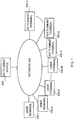
- This is a settlement system including user terminals, settlement terminals, and a settlement device which can perform communication with the user terminals and the settlement terminals via the Internet and other networks.
- the user terminal which is possessed by a user who makes payment, includes a computer, and is typically a smartphone or a tablet.
- the settlement terminal which is managed by a person who is to receive the payment, such as, for example, a clerk (manager, or the like,) of a store and a restaurant, corresponds to a credit card reader and a computer connected to the credit card reader if the settlement system is compared to a conventional system using a credit card.
- the settlement device is a device which determines whether or not to make settlement, and, in the conventional system using a credit card, corresponds to a computer which is managed by a credit card company.
- a user transmits amount information which is information regarding an amount that the user desires to pay to a manager, or the like, and user information which is information for specifying the user or the user terminal of the user, from the user terminal to the settlement device via the Internet.
- the settlement device which receives the information, for example, authenticates the user using the user information and performs credit determination as to whether the user can pay the amount specified by the amount information transmitted from the user.
- the user terminal If the user terminal receives the tentative allowance information, the user terminal generates a one-time password.
- the one-time password is numbers, characters, symbols, or the like, or enumeration of the numbers, characters, symbols, or the like, and has, for example, the number of digits from approximately 10 digits to 100 digits or more digits.
- a technique of causing a one-time password to be generated using a token is publicly known.
- a technique for causing the user terminal to generate a one-time password it is possible to use such a publicly-known or well-known technique.
- the one-time password is generated every time the user desires to make payment using this settlement system, and is generated a number of times.
- the user terminal incorporates a function for generating such a one-time password as, for example, a software token.
- enumeration itself such as numbers which constitute the one-time password, that is, information itself has monetary value.
- value has characteristics that the value can be immaterial (does not have a physical object).
- Handing over of such value from a person who makes payment to a person who is to receive the payment in a case where payment is made is typically performed by presentation of the one-time password in a similar manner to settlement using a credit card in which the credit card number is presented from a person who makes payment to a person who is to receive the payment.
- the person who makes payment showing the one-time password displayed on a display of the user terminal to the person who is to receive the payment it is possible to realize presentation of the one-time password.
- the person who is to receive the payment can see the one-time password with the naked eyes or can recognize the one-time password using appropriate equipment such as a camera and a barcode reader.
- Examples of the weak point assumed in such a technique can include the following.
- the one-time password having monetary value is just information, and is immaterial. Therefore, also in a case where the one-time password is stolen, unlike with a case where the conventional currency which is material is stolen, it can be considered that the person who makes payment does not notice a fact itself that the one-time password is stolen.
- the one-time password is assumed to be presented to the person who is to receive the payment in a state where, for example, the one-time password is displayed on a display of the user terminal possessed by the person who makes payment, there is a possibility that the one-time password displayed on the display of the user terminal may be known by a third party before the payment is actually made.
- a malicious third party can know the one-time password by sneaking a peek at or secretly photographing using a camera the one-time password displayed on the display.
- a malicious third party knows the one-time password and makes payment using the one-time password prior to a valid user, the valid user cannot make payment using the one-time password possessed by the user.
- a problem to be solved by the present invention is to provide a technique for further generalizing virtual currency in which information itself has monetary value, and, in more detail, a technique of preventing information having monetary value displayed on the display of the user terminal which is the terminal device used by the user from being stolen by a malicious third party.
- the user can display all the money information which is information having monetary value, for example, a one-time password described in Background Art, on the display of the user terminal, because all the money information is not displayed on the display at the same time, the money information is less likely to be stolen by a malicious third party sneaking a peek at or secretly photographing all the money information.
- a possibility that the money information is stolen is relatively extremely lower than that in the case where all the money information is displayed on the display at the same time.
- payment conditions for example, a deadline for payment
- payment conditions for example, a deadline for payment
- money information keeps a distance from typical currency.
- the display control means may be configured to automatically change the image displayed on the display as time passes, so that all the money information may be displayed on the display as predetermined time passes. In this manner, it is also possible not to reflect user's intention in determination of a timing for displaying all the money information on the display.
- the user terminal in the first invention includes the input means.
- the money image can be displayed, for example, as follows.
- both the sub-money information in the first 5 digits and the sub-money information in the last 5 digits cannot be displayed on the display, and both the sub-money information can be browsed by the user scrolling the money image in a longitudinal direction, as a result, the user can browse all the money information on the display.
- a plurality of sub-money images in which the respective pieces of sub-money information are indicated are overlapped with each other in a hierarchical manner as in a layer structure in image processing.
- the user can browse all the money information on the display by browsing the respective sub-money images on the display.
- the display control means may be configured to allow all the sub-money information to be browsed on the display by generating the money image as an image including in part sub-money information which is at least part of the money information and changing the sub-money information every time there is input from the input means, and by causing the money information to be displayed on the display until all pieces of the sub-money information displayed so far are combined to be the money information.
- a button which encourages the user to perform clicking is provided on the money image, and the sub-money information is sequentially displayed every time the user clicks the button. The whole money image may be updated every time the button is clicked, and the sub-money information embedded in the money image may be sequentially displayed.
- the button is an example.
- a person who is to receive the payment can authenticate an owner of the user terminal using a face image (a face photo) when the person browses the money image displayed on the display of the user terminal, the money information is less likely to be abused.
- the present inventor also proposes a method to be executed at the user terminal as one aspect of the first invention. An effect by such a method is the same as the user terminal by the first invention.
- An example of such a method is a method to be executed at a computer of a portable user terminal including a display on which an image can be displayed and the computer which controls an image to be displayed on the display.
- This method includes a step of displaying on the display a money image which is an image including money information which is comprised of numbers, characters, symbols or enumeration of two or more types of the numbers, the characters and the symbols, and which is information having monetary value, to be executed by the computer, and in the step of displaying the money image on the display, the money image is displayed on the display so that all the money information is not displayed on the display at the same time.
- a computer program for causing a portable computer including a display on which an image can be displayed and the computer which controls an image to be displayed on the display to execute a step of displaying on the display a money image which is an image including money information which is comprised of numbers, characters, symbols, or enumeration of two or more types of the numbers, the characters and the symbols, and which is information having monetary value, and in the step of displaying the money image on the display, the computer displays the money image on the display so that all the money information is not displayed on the display at the same time.
- the second invention of the present invention is as follows.
- the second invention is a portable user terminal including a display on which an image can be displayed and display control means which controls an image to be displayed on the display, and the display control means is configured to be able to display a money specifying information image which is an image including money specifying information which is comprised of numbers, characters, symbols or enumeration of two or more types of the numbers, the characters and the symbols, and which is information specifying money information which is information having monetary value, and is configured to controls an image to be displayed on the display so that all the money specifying information is not displayed on the display at the same time.
- a money specifying information image which is an image including money specifying information which is comprised of numbers, characters, symbols or enumeration of two or more types of the numbers, the characters and the symbols, and which is information specifying money information which is information having monetary value
- the display control means in the second invention controls an image to be displayed on the display so that, when the money specifying information image which is an image including the money specifying information is displayed on the display, all the money specifying information is not displayed on the display at the same time. That is, in a similar manner to the first invention in which all the money information is not displayed on the display of the user terminal at the same time, in the second invention, all the money specifying information is not displayed on the display at the same time.
- money specifying information is a one-dimensional or two-dimensional barcode.
- a person to whom the money specifying information displayed on the display of the user terminal in the second invention is presented and who is to receive the payment can read the money specifying information with a reader, for example, with a barcode reader in a case where the specifying information is a barcode, and can input the money information to the settlement terminal which is a device transmitting the money information to the settlement device via the Internet from the barcode reader as described in Background Art.
- a reader for example, with a barcode reader in a case where the specifying information is a barcode
- all the money specifying information is not displayed on the display at the user terminal in the second invention of the present invention at the same time. Inversely, all the money specifying information is displayed on the display by spending a certain period.
- the user terminal may include input means which allows the user to perform input, and the display control means may be configured to change the image displayed on the display on condition that there is input from the input means, so that all the money specifying information is displayed on the display as the predetermined time passes. In this way, it is possible to reflect the user's intention in determination of a timing for displaying all the money specifying information on the display.
- the display control means may be configured to make the money specifying information image larger than the display range of the display and may allow all the money specifying information to be browsed on the display only in a case where the user scrolls the money specifying information image by performing input from the input means.
- this case corresponds to a case where the money specifying information image is an image in which the money specifying information which is a one-dimensional barcode in which a number of lateral-direction bars with various widths are arranged in a longitudinal direction is drawn in a range vertically exceeding the display, and all the money specifying information is displayed by the user longitudinally scrolling the money specifying information image displayed on the display.
- the display control means may be configured to display the money specifying information image on the display in a state where a plurality of sub-money specifying information images are overlapped with each other, a plurality of the sub-money specifying information images respectively including sub-money specifying information which is information specifying the money specifying information by being combined, and the sub-money specifying information in the sub-money specifying information image disposed in a lower layer is invisible through the sub-money specifying information image disposed in an upper layer of the sub-money specifying information image, and be configured to allow all the sub-money specifying information to be browsed on the display by causing all the sub-money specifying information images to be displayed on the display by the user respectively scrolling the sub-money specifying information images.
- a plurality of sub-money specifying information images in which the respective pieces of sub-money specifying information are indicated are overlapped with each other in a hierarchical manner.
- the user can browse all the money specifying information on the display by browsing the respective sub-money specifying information images on the display.
- the display control means may be configured to display the face of a person who is to make payment using the money information in the money specifying information image.
- the present inventor also proposes a method to be executed at the user terminal as one aspect of the second invention. An effect by such a method is the same as that by the user terminal by the second invention.
- the present inventor also proposes a computer program for causing, for example, a general-purpose portable computer to function as a user terminal by the second invention as one aspect of the second invention of the present invention.
- Configurations of the respective user terminals 100-1 to 100-N are basically the same.
- the CPU 111 is an arithmetic device which performs operation.
- the CPU 111 for example, executes processing which will be described later by executing a computer program recorded in the ROM 112.
- the computer program described here includes at least a computer program for causing the user terminal 100 to function as the user terminal of the present invention.
- This computer program may be pre-installed in the user terminal 100 or may be installed after shipping.
- This computer program may be installed in the user terminal 100 via a predetermined recording medium such as a memory card or may be installed via a network such as a LAN and the Internet.
- the interface 114 exchanges data between the CPU 111, the RAM 113, or the like, connected with the bus 116 and outside.
- the above-described display 101 and the input device 102 are connected to the interface 114.
- Operation content input from the input device 102 is input from the interface 114 to the bus 116, and image data which will be described later is output from the interface 114 to the display 101.
- the interface 114 is further connected to a GPS mechanism and a transmitting/receiving unit, both of which are not illustrated.
- the GPS mechanism detects a location where the user terminal 100 is located on the globe.
- the GPS mechanism generates location information which specifies the detected location of the user terminal 100.
- the GPS mechanism is publicly known or well-known and detects the location of the user terminal 100 by receiving a radio wave from, for example, a still satellite.
- the location information is received by the interface 114.
- the transmitting/receiving unit transmits/receives data via the network 400 which is the Internet. While there is a case where such communication is performed in a wired manner, in the case where the user terminal 100 is a smartphone, such communication is performed in a wireless manner. If possible, the transmitting/receiving unit can employ a publicly-known or well-known configuration.
- the data received by the transmitting/receiving unit from the network 400 is received by the interface 114, and the data handed over to the transmitting/receiving unit from the interface 114 is transmitted to outside, for example, to the settlement device 200 by the transmitting/receiving unit via the network 400.
- the control unit 120 executes information processing as will be described below.
- the main control unit 121 performs overall control within the control unit 120.
- the main control unit 121 controls the display control unit 122 on the basis of the data received from the data input/output unit 123 which will be described in detail later.
- the main control unit 121 In a case where the main control unit 121 receives tentative allowance information which will be described later, from the data input/output unit 123 which will be also described later, the main control unit 121 notifies the OTP generating unit 124 of this reception.
- the main control unit 121 further receives a user ID, a password and amount information which will be described later from the data input/output unit 123.
- the main control unit 121 receives user terminal cancellation information which will be described later, from the data input/output unit 123.
- the main control unit 121 incorporates recording means which is formed with a memory, or the like, which is not illustrated, and records terminal information in the recording means.
- Examples of the terminal information can include, in the case where the user terminal 100 is a smartphone, ID number recorded in a subscriber identity module card (SIM card) built in the smartphone, and individual identification number such as serial number of the smartphone.
- the main control unit 121 acquires at least one piece of the terminal information from the user terminal 100 in advance. Note that the main control unit 121 may acquire the terminal information from the user terminal 100 every time the user performs payment processing. In either case, the main control unit 121 transmits the user ID, the password, the amount information and the terminal information to the data input/output unit 123 at a timing which will be described later.
- the main control unit 121 also receives a one-time password from the OTP generating unit 124.
- the main control unit 121 transmits the received one-time password to the display control unit 122.
- the main control unit 121 also receives change information which will be described later from the data input/output unit 123.
- the main control unit 121 transmits the information to the display control unit 122.
- the display control unit 122 controls an image to be displayed on the display 101 while being controlled by the main control unit 121. An image based on the data transmitted from the display control unit 122 is displayed on the display 101.
- the main control unit 121 transmits an instruction as to what kind of image should be displayed on the display 101 to the display control unit 122.
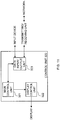
- a recording unit 122A and an image data generating unit 122B exist ( FIG. 20 ).
- data of the one-time password transmitted from the main control unit 121 is recorded.
- data of a face photo of a person who is to make payment using the one-time password generated as will be described later is recorded in the recording unit 122A.
- Such data of the face photo may be photographed with a camera provided at the user terminal 100 or may be recorded in the user terminal 100 in a wired manner, in a wireless manner or by a portable recording medium which is detachable to the user terminal 100. In either case, the data of the face photo may be recorded in the recording unit 122A using a publicly-known or well-known technique.
- the image data generating unit 122B generates image data for an image to be displayed on the display 101.
- the image data generating unit 122B generates image data under control by the main control unit 121, utilizes the data of the one-time password and the data of the face photo recorded in the recording unit 122A to generate the image data, and changes the image on the basis of the change information transmitted from the main control unit 121.
- a specific method for generating image data to be executed by the image data generating unit 122B and the generated image data will be described later.
- the data input/output unit 123 inputs/outputs data to/from the control unit 120. Specifically, the data input/output unit 123 receives input from the input device 102. For example, an instruction of start of settlement, the user ID, the password, the amount information, an instruction of transmission of the user ID, the password and the amount information, and the user terminal cancellation information are input from the input device 102 to the data input/output unit 123. Further, change information which is information for changing an image to be displayed on the display 102 as will be described later is also included in the information input from the input device 102 to the data input/output unit 123. The information including the change information is transmitted to the main control unit 121.
- the data input/output unit 123 receives tentative allowance information which will be described later, transmitted from the settlement device 200 via the network 400, from the transmitting/receiving unit.
- the data input/output unit 123 transmits the received tentative allowance information to the main control unit 121.
- the data input/output unit 123 receives the location information from the GPS mechanism.
- the data input/output unit 123 transmits the received location information to the main control unit 121.
- the data input/output unit 123 receives the user ID, the password, the terminal information and the amount information from the main control unit 121.
- the user ID is information unique to each user for specifying the user, and is enumeration of alphanumeric characters of a predetermined number of characters as will be described later in this embodiment, while the user ID is not limited to this.
- the password is information for more reliably authenticating the user, and is enumeration of alphanumeric characters of a predetermined number of characters as will be described later in this embodiment, while the password is not limited to this.
- the terminal information is information for specifying the user terminal 100, and is also directed to making user authentication more reliably.
- the terminal information in this embodiment is set as enumeration of numbers of a predetermined number of characters as will be described later.
- the amount information is information for specifying an amount which is to be paid by the user to a manager of the settlement terminal 300, and is numbers expressing an amount in a predetermined unit (such as yen, dollar and Euro). Further, the location information and the one-time password are transmitted to the data input/output unit 123 from the main control unit 121.
- the location information may be held at the data input/output unit 123 in a state where the location information is input to the data input/output unit 123 from the GPS mechanism instead of being returned to the data input/output unit 123 from the data input/output unit 123 by way of the main control unit 121.
- the one-time password may be directly transmitted to the data input/output unit 123 from the OTP generating unit 124 without going through the main control unit 121.
- the user terminal cancellation information is information expressing user's intention for cancelling one item of past settlement which has already been finished as will be described later, and is input by the user using the input device 102. At least information specifying one item of the past settlement which the user desires to cancel is included in the user terminal cancellation information.
- the user ID, the password, the terminal information, the amount information, the location information, the one-time password, the user terminal cancellation information, or the like, are respectively transmitted to the transmitting/receiving unit from the data input/output unit 123 at respective appropriate timings which will be described later, and the information except for the one-time password among these is transmitted to the settlement device 200 from the transmitting/receiving unit via the network 400.
- the OTP generating unit 124 is notified of the reception by the main control unit 121.
- the OTP generating unit 124 receives the notification, the OTP generating unit 124 generates the one-time password.
- the way of generating the one-time password is possible to follow a conventional way of generating the one-time password. A specific example of the way of generating the one-time password will be described later.
- the one-time password is formed with numbers, characters, symbols or enumeration of two or more types of the numbers, the characters and the symbols, and is an example of the money information in the present invention.
- the number of digits or the number of characters is two or more digits at lowest, and, in some cases, may be approximately four digits.
- the settlement device 200 will be described next.
- the settlement device 200 is a general computer. A hardware configuration equivalent to that of the settlement device in the conventional settlement system may be employed.
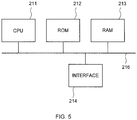
- FIG. 5 An example of the hardware configuration of the settlement device 200 will be illustrated in FIG. 5 .
- the hardware includes a CPU 211, ROM 212, RAM 213 and an interface 214, and these are connected to each other with a bus 216.
- the CPU 211 is an arithmetic device which performs operation.
- the CPU 211 executes processing which will be described later, for example, by executing a computer program recorded in the ROM 212.
- the computer program described here includes at least a computer program for causing the settlement device 200 to function as a settlement device which executes the following processing.
- This computer program may be pre-installed in the settlement device 200, or may be installed later.
- This computer program may be installed in the settlement device 200 via a predetermined recording medium such as a memory card or may be installed via a network such as a LAN and the Internet.
- ROM 212 a computer program and data which are necessary for the CPU 211 to execute processing which will be described later are recorded.
- the computer program recorded in the ROM 212 is not limited to this, and other necessary computer programs may be recorded.
- the RAM 213 provides a work area necessary for the CPU 211 to perform processing.
- HDD hard disk drive
- SSD solid state drive
- the interface 214 exchanges data between the CPU 211, the RAM 213, or the like, connected with the bus 216 and outside.
- the interface 214 is connected to at least the transmitting/receiving unit. Data received by the transmitting/receiving unit from the network 400 is received by the interface 214, and data handed over to the transmitting/receiving unit from the interface 214 is transmitted to outside, for example, to the user terminal 100 via the network 400 by the transmitting/receiving unit.
- a control unit 220 as will be described below is generated inside the settlement device 200.
- a data input/output unit 221, a main control unit 222, a credit determining unit 223, a credit information recording unit 224, a final determining unit 225, a location information recording unit 226, an OTP generating unit 227 and an OTP information recording unit 228 are generated within the control unit 220.
- the data input/output unit 221 inputs/outputs data to/from the control unit 220. Specifically, the data input/output unit 221 accepts various kinds of data which will be described later from the main control unit 222. The data input/output unit 221 hands over the various kinds of data accepted from the main control unit 222 to the transmitting/receiving unit, and the transmitting/receiving unit transmits these kinds of data to the user terminal 100 or the settlement terminal 300 via the network 400.
- the data input/output unit 221 further receives various kinds of data which will be described later received by the transmitting/receiving unit from the user terminal 100 or the settlement terminal 300 via the network 400 and transmits the received these kinds of data to the main control unit 222.
- the main control unit 222 performs overall control within the control unit 220.
- main control unit 222 receives a user ID, a password, terminal information and account information from the data input/output unit 221. In the case where the main control unit 222 receives these kinds of data, the main control unit 222 transmits these to the credit determining unit 223.
- the main control unit 222 receives from the data input/output unit 221, the location information transmitted from the user terminal 100. In the case where the main control unit 222 receives this location information, the main control unit 222 transmits the location information to the final determining unit 225.
- the main control unit 222 receives tentative allowance information which will be described later from the credit determining unit 223. In the case where the main control unit 222 receives the tentative allowance information, the main control unit 222 transmits the tentative allowance information to the data input/output unit 221. There is also a case where the main control unit 222 receives from the data input/output unit 221, settlement application information, a one-time password and a user ID all of which are transmitted from the settlement terminal 300 and all of which will be described later. In the case where the main control unit 222 receives these, the main control unit 222 transmits these to the final determining unit 225 and transmits an instruction to generate a one-time password to the OTP generating unit 227.
- the main control unit 222 receives the one-time password from the OTP generating unit 227.
- the main control unit 222 transmits the one-time password to the final determining unit 225.
- the one-time password does not necessarily have to be transmitted to the final determining unit 225 via the main control unit 222, and, for example, may be directly transmitted from the OTP generating unit 227 to the final determining unit 225.
- the main control unit 222 receives final determination data which will be described later from the final determining unit 225.
- the main control unit 222 performs settlement processing.
- the settlement processing is processing for allowing settlement from one user to a manager of the settlement terminal 300 which has transmitted the tentative allowance information for requesting payment to the user.
- the main control unit 222 holds data as to what kind of settlement has been made.
- the main control unit 222 records information as to from whom to whom how much payment is finally allowed in a recording medium which is not illustrated for each user. Further, while the main control unit 222 rewrites a content of the credit information recording unit 224 as part of the settlement processing, this will be described later.
- the main control unit 222 receives user terminal cancellation information and settlement terminal cancellation information which will be described later, from the data input/output unit 221.
- the main control unit 222 performs processing for cancelling the past settlement.
- processing of cancelling the settlement is not necessarily essential, and if the processing of cancelling the settlement is not necessary, it is also possible to delete functions required only for such processing from the user terminal 100, the settlement device 200 and the settlement terminal 300.
- the main control unit 222 may cancel the past settlement specified by the user terminal cancellation information or the past settlement specified by the settlement terminal cancellation information when the main control unit 222 accepts only one of the user terminal cancellation information and the settlement terminal cancellation information. Further, the main control unit 222 may cancel only settlement which is relatively new among the past settlement. For example, the main control unit 222 may allow cancellation of only settlement within 10 minutes after the above-described settlement processing has been finished.
- the credit determining unit 223 receives the user ID, the password and the terminal information from the main control unit 222. In the case where the credit determining unit 223 receives these, the credit determining unit 223 performs credit determination.
- the credit determination is determination as to whether or not it is possible to make settlement of payment of the amount specified by the above-described amount information for the user specified by the user ID, the password and the terminal information.
- Such credit determination includes so-called authentication processing as to whether or not the user is valid.
- the credit determining unit 223 utilizes the data recorded in the credit information recording unit 224 for credit determination including the authentication processing.
- the data as illustrated in FIG. 7 is recorded in the credit information recording unit 224.
- the user ID, the password, the terminal information and balance in an account are recorded in the credit information recording unit 224. These are associated for each user. Note that, in addition to these, real name, phone number, e-mail address, or the like, of the respective users may be naturally recorded.
- the user ID is information for specifying each user. While not limited to this, the user ID in this embodiment is enumeration of alphanumeric characters of a predetermined number of characters.
- the user ID is determined by each user or determined by the manager of the settlement device 200. In the case where the user ID is determined by the user, the manager of the settlement device 200 is notified of the user ID from the user using a publicly-known or well-known method, and the notified user ID is recorded in the credit information recording unit 224.
- the password is information for confirming validity of each user. While not limited to this, the password in this embodiment is enumeration of alphanumeric characters of a predetermined number of characters.
- the password is determined by each user.
- the manager of the settlement device 200 is notified of the password from the user using a publicly-known or well-known method, and the notified password is recorded in the credit information recording unit 224.
- the terminal information is information for confirming validity of each user further firmly.
- specific examples of the terminal information can include ID number recorded in a SIM card, serial number of a smartphone, or the like.
- the terminal information is uniquely determined for each user terminal 100.
- the manager of the settlement device 200 is notified of the terminal information from, for example, the user using a publicly-known or well-known method, and the notified terminal information is recorded in the credit information recording unit 224.
- the balance in an account is an amount of a deposit of each user and indicates an amount of money deposited in an account of each user.
- the balance in the account is recorded in the credit information recording unit 224 as deposit balance information which specifies the balance in the account.
- the balance in the account is an amount of money deposited in an account of the user managed by the manager of the settlement device 200 in a case where the user has paid some money in advance to the manager of the settlement device 200. In such a case, this settlement system becomes a so-called prepaid type settlement system.
- the balance in the account is an amount of money deposited in an account of the user in the bank in a case where the manager of the settlement device 200 is a bank, or the like, which manages deposits as business, or in a case where the manager of the settlement device 200 is affiliated with a bank, or the like. In this embodiment, either case can apply.
- the credit determining unit 223 When the credit determining unit 223 receives the user ID, the password, the terminal information and the amount information from the main control unit 222, the credit determining unit 223 reads out the password, the terminal information and the balance in the account associated with the user ID which is the same as the received user ID from the credit information recording unit 224. In a case where the user ID which is the same as the user ID received by the credit determining unit 223 does not exist in the credit information recording unit 224, the credit determining unit 223 does not read out information such as the password from the credit information recording unit 224. In this case, the credit determining unit 223 cancels processing of credit determination.
- the credit determining unit 223 determines whether or not the password and the terminal information received from the main control unit 222 are the same as the password and the terminal information read out from the credit information recording unit 224.
- the credit determining unit 223 authenticates the user who has transmitted the user ID, or the like, as a valid user, and, if at least one of the password and the terminal information does not match each other, determines the user who has transmitted the user ID, or the like, as an invalid user, and cancels the processing of credit determination.
- the processing up to this processing is authentication processing. That is, as a condition, it is necessary that all the user ID, the password and the terminal information transmitted from the user completely match those recorded in the credit information recording unit 224 in order that the user may be acknowledged as valid in the authentication processing in the credit determination in this embodiment.
- the credit determining unit 223 performs credit determination as to whether or not the settlement requested by the user may be allowed.
- the credit determination is performed by comparing the amount information transmitted from the user terminal 100 with the balance in the account read out from the credit information recording unit 224 associated with the user ID associated with the amount information. While not limited to this, in this embodiment, in a case where the balance in the account is equal to or greater than the amount specified by the amount information, the settlement requested by the user is allowed. In this case, the credit determining unit 223 generates the tentative allowance information. Meanwhile, in a case where the balance in the account is less than the amount specified by the amount information, the settlement requested by the user is not allowed. In this case, the credit determining unit 223 does not generate the tentative allowance information. In the case where the credit determining unit 223 generates the tentative allowance information, the tentative allowance information is transmitted to the main control unit 222.
- the credit determining unit 223 has a function of specifying time (it is also possible to utilize a function of a clock provided at a normal computer), and the main control unit 222 is notified of time information for specifying time at which the credit determination is performed. Such time information is transmitted from the main control unit 222 to the final determining unit 225.
- the final determining unit 225 receives from the main control unit 222, the location information transmitted from the user terminal 100. There is also a case where the main control unit 222 receives from the data input/output unit 221, the settlement application information, the user ID and the one-time password, all of which are transmitted from the settlement terminal 300. While not limited to this, in this embodiment, the settlement application information, the user ID and the one-time password are collectively transmitted from the settlement terminal 300 to the settlement device 200, and these three pieces of information are collectively received by the final determining unit 225.
- the final determining unit 225 has a function of performing final determination processing in the case where the final determining unit 225 receives the settlement application information, the user ID and the one-time password. The final determination is determination as to whether or not payment to the manager of the settlement terminal 300 requested by the user is finally allowed.
- the final determining unit 225 utilizes the information recorded in the location information recording unit 226 for performing final determination. Further, the one-time password provided from the OTP generating unit 227 via the main control unit 222 is also utilized in the final determination.
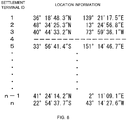
- a settlement terminal ID and location information are recorded in the location information recording unit 226 in association with each other.
- the settlement terminal ID is provided for distinguishing and specifying each settlement terminal 300. Because there are n settlement terminals 300 in this embodiment, while, of course, not limited to this, in this embodiment, sequential numbers of 1 to n which are natural numbers are used as the settlement terminal IDs for specifying the respective settlement terminals 300.
- the location information is information for specifying a location where the settlement terminal 300 associated with the location information is located.
- the location information in this embodiment specifies the location of the settlement terminal 300 with latitude and longitude.
- a number to which a character of "N" is assigned and which is located on a left side specifies north latitude
- a number to which the character of "S” is assigned and which is located on the left side specifies south latitude
- a number to which a character of "E” is assigned and which is located on a right side specifies east longitude
- a number to which the character of "W” is assigned and which is located on the right side specifies west longitude.
- a form of the location information is not limited to combination of latitude and longitude. Note that location information generated at the GPS mechanism of the user terminal 100 has also a similar form in this embodiment.
- location information is not set for the settlement terminal whose settlement terminal ID is 4.
- the settlement terminal 300 is used for settlement at a virtual store on the Internet
- specification of the location of the settlement terminal 300 does not have much meaning on the grounds which will be described later.
- location information is not set for such a settlement terminal 300.
- the manager of the settlement device 200 can be notified of the location information, for example, by the manager of the settlement terminal 300 notifying the manager of the settlement device 200 using appropriate means such as an e-mail and a letter when the settlement terminal 300 is provided.
- the manager of the settlement device 200 only has to record the notified location information in the location information recording unit 226 in association with the settlement terminal ID of each settlement terminal 300.
- the settlement terminal ID of the settlement terminal 300 which transmits the settlement application information is assigned to the above-described settlement application information.
- the final determining unit 225 receives the settlement application information and the one-time password, the final determining unit 225 reads out the location information associated with the settlement terminal ID which matches the settlement terminal ID assigned to the settlement application information from the location information recording unit 226.
- the OTP generating unit 227 has a function of generating a one-time password.
- the main control unit 222 transmits an instruction to generate a one-time password to the OTP generating unit 227 when the main control unit 222 receives the settlement application information and the one-time password from the data input/output unit 221.
- the OTP generating unit 227 receives this instruction, the OTP generating unit 227 generates the one-time password.
- a timing at which a one-time password is generated at the settlement device 200 is after the settlement device 200 receives the settlement application information and the one-time password generated at the user terminal 100, the timing is not limited to this.
- the settlement device 200 may, for example, cause the OTP generating unit 227 to create a one-time password at an appropriate timing, for example, at the same time or after the tentative allowance information is generated and before the final determining unit 225 performs final determination.
- Examples of the function to be used for creating the above-described "value” can include the following (a) to (c). All of the following (a) to (c) are equations for creating X N which is the N-th "value". Further, P, Q, R and S are natural numbers.
- X N X N ⁇ 1 P + X N ⁇ 2 Q
- X N X N ⁇ 1 P
- X N X N ⁇ 1 P X N ⁇ 2 Q X N ⁇ 3 R X N ⁇ 4 S
- a new "value” is generated using two past “values” by adding values obtained by respectively raising the values to the power of P and to the power of Q. Note that, to be exact, if the two past "values" are used, and values obtained by raising the values to the power of P and to the power of Q are added, because the number of digits increases, actually, the new "value” is generated by extracting an appropriate number of digits from the beginning of the obtained value, by extracting an appropriate number of digits from the end, by extracting an appropriate number of digits from an appropriate portion in the value, or the like.
- the above-described (a) to (c) are an example of algorithm for generating the one-time password, and it is also possible to add change to the algorithm, for example, add change such as sequentially using the above-described (a) to (c) when the one-time password is generated.
- the OTP generating unit 227 utilizes data recorded in the OTP information recording unit 228 to generate the one-time password.
- the data recorded in the OTP information recording unit 228 is a user ID, an initial value, and the number of times of generation. Among these, only the initial value is essential.
- the user ID recorded in the OTP information recording unit 228 is the same as the user ID recorded in the credit information recording unit 224, and is information for specifying each user.
- the initial value is an value to be used in the case where the one-time password is generated.
- the initial value is different for each user terminal 100.
- the initial value which is the same as the initial value provided at each user terminal 100 is recorded in the OTP information recording unit 228.
- the one-time password is a pseudo random number which depends on the initial value. In other words, a one-time password for one user terminal 100 is always the same when the one-time passwords in the same order are compared. Therefore, if the initial value which is the same as the initial value provided at each user terminal 100 is prepared at the settlement device 200, the settlement device 200 can reproduce the one-time password at any user terminal 100.
- the one-time password is generated using the above-described equation (a) in which the new "value” is generated by utilizing the past two "values”. It is sufficient to record past values required for generating the new "value", that is, the one-time password in the OTP information recording unit 228.
- the number of times of generation is a numerical value indicating how many times the one-time password for the user terminal 100 is generated.
- the one-time password is a random number, more accurately the one-time password is a pseudo random number.
- the one-time password generated first using the initial value is used for final determination which will be described later, when the number of times of generation is one, the one-time password generated next using the above-described initial value is used for final determination, and, when the number of times of generation is N, the one-time password generated at N-1-th using the above-described initial value is used for final determination.
- the OTP generating unit 227 When the OTP generating unit 227 receives an instruction to generate the one-time password from the main control unit 222, the OTP generating unit 227 reads out the initial value associated with the user ID received along with the one-time password, and the number of times of generation from the OTP information recording unit 228. The OTP generating unit 227 assigns the initial value to the above-described equation (a) to generate values up to the N-1-th value when the read number of times of generation is N. The values become the one-time password to be used for final determination.
- the one-time password is generated using a similar method also at the OTP generating unit 124 of the user terminal 100.
- the OTP generating unit 124 of the user terminal 100 holds the same initial value as the initial value recorded in the OTP information recording unit 228 of the settlement device 200, can use the same equation (in a case of this embodiment, equation (a)) as the equation used at the OTP generating unit 227 of the settlement device 200, and can record the number of times of generation for specifying how many times the "value" has been generated in the past in the same way as recorded in the OTP information recording unit 228.
- equation (a) the equation used at the OTP generating unit 227 of the settlement device 200
- a method using the one-time passwords generated in the same order at two devices to generate the same one-time password at the two devices which generate the one-time passwords, or to make the one-time passwords in synchronization with each other is typically referred to as event synchronization.
- the above-described method employs a method of a one-time password using event synchronization.
- Such a method for making the one-time passwords in synchronization with each other is typically referred to as time synchronization.
- Both the event synchronization and the time synchronization are publicly known techniques, and it is possible to make the one-time passwords in synchronization with each other by using one of the methods.
- the OTP generating unit 227 transmits the generated one-time password to the final determining unit 225 via the main control unit 222. Further, the OTP generating unit 227 rewrites the number of times of generation which is recorded in the OTP information recording unit 228 and which is associated with the user ID of the user terminal 100 for which the one-time password for the user terminal 100 is created, to increment the number by one.
- the one-time password generated at the user terminal 100 and the one-time password generated at the settlement device 200 are made in synchronization with each other as follows.
- the OTP generating unit 227 of the settlement device 200 repeats processing of deleting the "value” from oldest and rewriting the value with a new "value” every time the new "value” is generated.
- the OTP generating unit 227 of the settlement device 200 repeats processing of deleting the "value” from oldest and rewriting the value with a new "value” every time the new "value” is generated.
- the user is specified with the information for specifying the user, which becomes a substitute for the user ID.
- the information for specifying the user is required in principle.
- the user giving a signature on a touch panel display provided at the settlement terminal 300 which will be described later instead of inputting the user ID, it is possible to transmit the signature from the settlement terminal 300 to the settlement device 200 as electronic data.
- a reading device which captures biological information such as fingerprint of the user and characteristics of a vein at the settlement terminal 300, it is possible to transmit the fingerprint, characteristics of the vein, or the like, read with the reading device to the settlement device 200 as electronic data.
- the signature, the fingerprint, the characteristics of the vein, or the like are recorded in the OTP information recording unit 228.
- the final determining unit 225 receives the settlement application information and the one-time password from the main control unit 222. Further, before the reception, the final determining unit 225 receives the location information transmitted from the user terminal 100 and the time information generated at the credit determining unit 223 from the main control unit 222.
- the final determining unit 225 receives the location information indicating the location of the settlement terminal 300 which has transmitted the settlement application information to the settlement device 200, from the location information recording unit 226, and receives the one-time password from the OTP generating unit 227.
- the final determining unit 225 compares the one-time password from the settlement terminal 300, received via the main control unit 222 with the one-time password from the OTP generating unit 227, also received via the main control unit 222, and compares the location information indicating the location of the user terminal 100, received via the main control unit 222 with the location information received from the location information recording unit 226.
- the final determining unit 225 finally makes determination to allow payment to the manager of the settlement terminal 300 from the user of the user terminal 100.
- the final determining unit 225 finally makes determination not to allow the above-described payment in a case where one of the three conditions is not satisfied. The both determination will be referred to as final determination.
- the final determining unit 225 transmits final determination data which is data indicating a result of the final determination to the main control unit 222.
- the main control unit 222 which has received this final determination data performs processing for allowing payment of money of the amount specified by the amount information which is a trigger of generation of the one-time password to the manager of the settlement terminal 300 which has transmitted the one-time password used for the final determination, from the user of the user terminal 100 which has generated the one-time password used for the final determination in the case where payment is allowed in the final determination.
- a result of this processing is recorded in, for example, a recording medium which is not illustrated, and which is built in the main control unit 222, and, if the result is necessary to implement processing of the payment, related finance institution, or the like, are notified of the result. Further, in the case where payment is not allowed in the final determination, the main control unit 222 does not perform the above-described processing. Meanwhile, the main control unit 222 transmits a content based on the final determination data to the data input/output unit 221 and transmits the content to the settlement terminal 300 which has transmitted the settlement application information which becomes a basis of the final determination via the transmitting/receiving unit and the network 400.
- the settlement terminal 300 will be described next.
- the settlement terminal 300 is a general computer which is substantially the same as the settlement terminal used in the settlement system using a credit card.
- a hardware configuration of the settlement terminal 300 may be equivalent to that of a settlement terminal in a conventional settlement system, and, in this embodiment, is equivalent to that of the user terminal 100.
- the settlement terminal 300 includes a touch panel display which is not illustrated.
- the settlement terminal 300 includes a display and an input device.
- the settlement terminal 300 may include a display which is not a touch panel display, and an input device which is selected as necessary from publicly known or well-known input devices such as a numeric keypad, a keyboard, a mouse and a trackball, separately from each other, description will be provided below assuming that the settlement system in this embodiment includes a touch panel keyboard.
- the one-time password is input to the settlement terminal 300 as will be described later, there is a case where the one-time password is presented from the user to the manager, or the like, of the settlement terminal 300 as a one-time password itself, and there is a case where the one-time password is presented via information for specifying the one-time password (for example, one-dimensional barcode or two-dimensional barcode).
- the settlement terminal 300 includes a device for reading the information for specifying the one-time password (for example, a barcode reader).
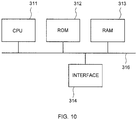
- a hardware configuration of the settlement terminal 300 is illustrated in FIG. 10 .
- the hardware includes a CPU 311, ROM 312, RAM 313 and an interface 314, and these are connected to each other with a bus 316.
- the CPU 311 is an arithmetic device which performs operation.
- the CPU 311 executes processing which will be described later by, for example, executing a computer program recorded in the ROM 312.
- This computer program may be pre-installed at the settlement terminal 300 or may be installed after shipping.
- This computer program may be installed to the settlement terminal 300 via a predetermined recording medium such as a memory card or may be installed via a network such as a LAN and the Internet.
- ROM 312 a computer program and data required for the CPU 311 to execute processing which will be described later are recorded.
- the computer program recorded in the ROM 312 is not limited to this, and other necessary computer programs may be recorded.
- the RAM 313 provides a work area necessary for the CPU 311 to perform processing.
- the interface 314 exchanges data between the CPU 311, the RAM 313, or the like, connected with the bus 316 and outside.
- the interface 314 is connected to at least the transmitting/receiving unit which is not illustrated. Data received by the transmitting/receiving unit from the network 400 is received by the interface 314, and data handed over to the transmitting/receiving unit from the interface 314 is transmitted to outside, for example, the settlement device 200 by the transmitting/receiving unit via the network 400.
- the interface 314 is further connected to the input device provided at the touch panel display, and accepts input from the input device.
- the interface 314 is connected to the touch panel display, and transmits data for displaying an image which will be described later on the touch panel display.
- a control unit 320 as will be described below is generated within the settlement terminal 300, and a main control unit 321, a display control unit 322 and a data input/output unit 323 are generated within the control unit 320.
- the control unit 320 executes information processing as will be described below.
- the main control unit 321 performs overall control within the control unit 320.
- the main control unit 321 controls the display control unit 322 on the basis of the data received from the data input/output unit 323 which will be described in detail later.
- the main control unit 321 receives the user ID, the one-time password generated at the user terminal 100, and the settlement application information from the data input/output unit 323 which will be described later. Then, when the main control unit 321 receives all of them, the main control unit 321 transmits them to the data input/output unit 323. There is a case where the main control unit 321 receives settlement terminal cancellation information which will be described later from the data input/output unit 323. When the main control unit 321 receives the settlement terminal cancellation information, the main control unit 321 transmits the settlement terminal cancellation information to the data input/output unit 323 at an appropriate timing. Further, the main control unit 321 holds a settlement terminal ID which is unique to each settlement terminal 300 to distinguish each settlement terminal 300. The settlement terminal ID is included in the settlement application information by the main control unit 321.
- the display control unit 322 controls an image to be displayed on the touch panel display while being controlled by the main control unit 321. On the display, an image based on the data transmitted from the display control unit 322 is displayed.
- the main control unit 321 transmits an instruction as to what kind of image should be displayed on the display, to the display control unit 322.
- the data input/output unit 323 inputs/outputs data to/from the control unit 320. Specifically, the data input/output unit 323 receives input from the input device. Examples of the data input from the input device to the data input/output unit 323 are as described above, and include the user ID, the one-time password and the settlement application information. These are transmitted to the main control unit 321. Further, there is a case where the settlement terminal cancellation information is input from the input device.
- the data input/output unit 323 outputs data to the transmitting/receiving unit which is not illustrated.
- the data output to the transmitting/receiving unit is, for example, the user ID, the one-time password, the settlement application information, and the settlement terminal cancellation information, and these are transmitted from the transmitting/receiving unit to the settlement device 200 via the network 400.
- the settlement application information is information for requesting final determination of the settlement to the settlement device 200.
- the settlement terminal cancellation information is information indicating display of intention of the manager of the settlement terminal 300 for cancelling one item of past settlement which has already finished, and is input by the manager of the settlement terminal 300 using the input device.
- the settlement terminal cancellation information includes at least information specifying one item of the past settlement which the manager desires to cancel.
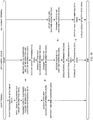
- the user himself/herself manipulates the user terminal 100 to start processing of the settlement (S911).
- the user inputs information indicating start of the processing of the settlement.
- information can be input by an icon which is not illustrated, and which is displayed on the display 101 of the user terminal 100 being touched.
- the information is transmitted from the data input/output unit 123 to the main control unit 121.
- the main control unit 121 accepts the information
- the main control unit 121 transmits to the display control unit 122, an instruction to display an image which encourages the user to input the user ID, or the like, on the display 101.
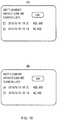
- the display control unit 122 which accepts this instruction displays on the display 101, the image which encourages the user to input the user ID, the password, an amount to be paid by the user, for example, as illustrated in FIG. 12(A) .
- the user inputs the user ID on the right side of a portion indicated as the user ID, inputs the password on the right side of a portion indicated as the password, and inputs an amount to be paid by the user on the right side of a portion indicated as the amount (yen) (S912).
- Data of the user ID and the password input by the user is input from the input device 102 to the data input/output unit 123, and transmitted to the main control unit 121. While the information specifying the amount is the amount information, this amount information is also transmitted to the main control unit 121 in a similar manner.
- the user ID, the password and the amount input by the user are displayed on the display 101 through control by the display control unit 122 which is controlled by the main control unit 121 also during a period while the information is being input, the user can input the user ID, the password and the amount while confirming the display 101. According to the example illustrated in FIG. 12(B) , the user tries to pay 25,000 yen using this settlement system.
- the GPS mechanism If the user clicks the button on which "OK" is written, the GPS mechanism generates location information of the user terminal which is information specifying a location where the user terminal 100 exists.
- the location information is transmitted from the data input/output unit 123 to the main control unit 121.
- the main control unit 121 transmits all the location information and the terminal information recorded in recording means of the main control unit 121, which is not illustrated, in addition to the user ID, the password and the amount information in a lump, to the data input/output unit 123.
- the data input/output unit 123 transmits these pieces of data in a lump to the transmitting/receiving unit, and the transmitting/receiving unit transmits these pieces of data in a lump to the settlement device 200 via the network 400 (S913).
- the above-described five pieces of data are transmitted to the settlement device 200 in substantially real time, at least, for example, within several seconds after the user has clicked the button on which "OK" is written.
- the settlement device 200 accepts these pieces of data at the transmitting/receiving unit (S921).
- the transmitting/receiving unit transmits all these pieces of data to the data input/output unit 221, and the data input/output unit 221 transmits all these pieces of data to the main control unit 222.
- the main control unit 222 transmits the user ID, the password, the terminal information and the amount information to the credit determining unit 223, and transmits the location information of the user terminal 100 to the final determining unit 225.
- the credit determining unit 223 executes credit determination (S922).
- the credit determination is specifically executed as follows.
- the credit determining unit 223 When the credit determining unit 223 receives the user ID, the password and the terminal information from the main control unit 222, the credit determining unit 223 reads out the password, the terminal information and the balance in the account associated with the user ID which is the same as the received user ID, from the credit information recording unit 224. In the case where the user ID which is the same as the user ID received by the credit determining unit 223 does not exist in the credit information recording unit 224, the credit determining unit 223 does not read out information such as the password from the credit information recording unit 224. In this case, the credit determining unit 223 cancels the processing of credit determination.
- the credit determining unit 223 reads out the password (aofau554), the terminal information (012457854) and the balance in the account (2,956,002 yen) associated with the user ID from the credit information recording unit 224.
- the credit determining unit 223 determines whether or not the password and the terminal information received from the main control unit 222 are the same as the password and the terminal information read out from the credit information recording unit 224. If they match each other, the credit determining unit 223 authenticates the user who has transmitted the user ID, or the like, as a valid user. Meanwhile, if at least one of the password and the terminal information does not match each other, the credit determining unit 223 determines the user who has transmitted the user ID, or the like, as an invalid user, and cancels the processing of the credit determination.
- the credit determining unit 223 compares the amount information transmitted from the user with the balance in the account read out from the credit information recording unit 224, which is associated with the user ID of the user. In this embodiment, in the case where the balance in the account is equal to or greater than the amount specified by the amount information, the settlement requested by the user is, although temporarily, allowed. Meanwhile, in the case where the balance in the account is less than the amount specified by the amount information, the settlement requested by the user is not allowed. In this example, because the balance in the account (2,956,002 yen) is greater than the amount (25,000 yen) specified by the amount information, the settlement requested by the user is allowed. If such settlement is allowed, the credit determining unit 223 generates the tentative allowance information (S923). In the case where the credit determining unit 223 generates the tentative allowance information, the tentative allowance information is transmitted to the main control unit 222.
- the credit determining unit 223 notifies the main control unit 222 of time information for specifying time at which the credit determination is performed. Such time information is transmitted from the main control unit 222 to the final determining unit 225 along with the user ID to specify the user for whom the settlement has been temporarily allowed with the tentative allowance information.
- the transmitting/receiving unit of the user terminal 100 receives the tentative allowance information transmitted from the settlement device 200 (S914).
- the received tentative allowance information is transmitted from the data input/output unit 123 to the main control unit 121.
- the main control unit 121 which has received the tentative allowance information notifies the OTP generating unit 124 of reception of the tentative allowance information.
- the OTP generating unit 124 which has received this notification generates the one-time password (S915).
- the OTP generating unit 124 has an initial value for generating the one-time password, and records the number of times of generation indicating how many times the one-time password has been generated in the past. Further, the OTP generating unit 124 can use an equation (that is, algorithm) for generating a one-time password.
- the OTP generating unit 124 sequentially generates values by repeating processing of assigning a value obtained by assigning an initial value to the above-described equation to the equation again to obtain the next value.
- the OTP generating unit 124 sets the value created in the order which is greater by one than the number indicated by the number of times of generation as the one-time password to be used at that time.
- the generated one-time password is transmitted to the main control unit 121.
- the main control unit 121 transmits data of the one-time password and an instruction to display the one-time password on the display 101, to the display control unit 122.
- the display control unit 122 generates image data for displaying an image which will be described later on the display 101.
- the image by the image data does not have to be displayed on the display 101 immediately after the data of the one-time password is generated at the OTP generating unit 124, and the image can be displayed on the display 101 at a timing desired by the user after the data of the one-time password is generated.
- Such a timing can be determined so as to be a user desired timing through input from the input device 102.
- the one-time password is utilized like credit card number in the conventional settlement system using a credit card, and is presented to the manager, or the like, of the settlement terminal 300 from the user, the one-time password is significantly different from the credit card number in that it is possible to provide limit in a period during which the one-time password is effective (can be used for settlement) as will be described later (note that such limit in a period does not have to be provided).
- the credit determining unit 223 of the settlement device 200 does not generate the tentative allowance information such as in the case where the credit determination is cancelled and in the case where the balance in the account for the user is insufficient.
- the tentative allowance information is naturally not transmitted to the user terminal 100.
- the image as illustrated in FIG. 13 is displayed on the display 101 of the user terminal 100.
- the display control unit 122 also displays this image on the display 101 in accordance with an instruction from the main control unit 121.
- a fact that the procedure of the settlement cannot be continued because the password is incorrect is presented to the user.
- the one-time password generated at the OTP generating unit 124 is transmitted to the main control unit 121, and the main control unit 121 which has received the one-time password transmits data of the one-time password and an instruction to display the one-time password on the display 101 to the display control unit 122.
- the data of the one-time password is recorded in the recording unit 122A, and the instruction to display the one-time password on the display 101 is transmitted to the image data generating unit 122B.
- the image data generating unit 122B generates image data for displaying the image on the display 101 as will be described below in accordance with the instruction from the main control unit 121. In all cases of examples which will be described below, in the case where the image data is generated, the image data generating unit 122B reads out at least the data of the one-time password from the recording unit 122A. In the case where the image data generating unit 122B generates image data for the image including a face photo of a person who tries to make payment using the one-time password (typically, an owner of the user terminal 100) among the images to be displayed on the display 101 which will be described below, the image data generating unit 122B also reads out data of the face photo from the recording unit 122A.
- Example 1 to Example 8 are examples of an image in the case where the one-time password is directly displayed on the display 101.
- Example 9 to Example 14 are examples of an image in the case where the one-time password is indirectly displayed on the display 101 by information for specifying the one-time password being displayed on the display 101.
- FIG. 21 An image in this example is as illustrated in FIG. 21 .
- Reference numeral 101 in FIG. 21 denotes the display 101.
- Reference character I1 denotes an image. Among the image I1, only a portion overlapping with the display 101 is displayed on the display 101.
- Reference numeral 101 denotes the display 101, and reference characters in which numbers are added to I denotes images. Among each image, only a portion overlapping with the display 101 is displayed on the display 101 in a similar manner to Example 1.
- the image I1 in Example 1 has the same width as that of the display 101 as illustrated in FIG. 21 , and is longer in a vertical direction than the display 101.
- the one-time password is displayed as is in the image I1. In this embodiment, it is assumed as an example that the one-time password of "01563894451" is generated. In the image I1, the one-time password is vertically displayed fully in the vertical direction.
- the whole of the one-time password can be browsed by, for example, the image I1 being vertically scrolled in a downward direction from a state in FIG. 21(A) to a state in FIG. 21(B) , and then, to a state illustrated in FIG. 21(C) . Meanwhile, even if the user performs such scrolling, there is no moment at which all the one-time password is displayed on the display 101 at the same time.
- the image data generating unit 122B generates image data for displaying such an image I1 on the display 101. Note that scrolling of the image is executed by the image data generating unit 122B in accordance with input from the input device 102 and in accordance with a publicly-known or well-known technique, which is similar in the following examples.
- the image I1 may automatically change from the state illustrated in FIG. 21(A) to the state illustrated in FIG. 21(C) over a predetermined period, for example, for several seconds.
- the image data generating unit 122B generates data of such a moving image.
- An image 12 in this example is as illustrated in FIG. 22 .
- the image 12 in this example has the same size as that of the display 101. Therefore, the image 12 is not scrolled with respect to the display 101.
- a cylindrical-shaped cylindrical member I2A is displayed in the image 12.
- the one-time password is attached on an outer surface of the cylindrical member I2A so as to surround the circumference.
- a dot on 0 in the drawing indicates a starting point of the one-time password.
- the cylindrical member I2A in this example can rotate around the axis in the image 12, and the user can freely rotate the cylindrical member I2A in the image 12 by manipulating the input device 102.
- the cylindrical member I2A By causing the cylindrical member I2A to make one turn, the whole of the one-time password displayed on a side surface of the cylindrical member I2A can be displayed on the display 101.
- the user does not rotate the cylindrical member I2A, because the one-time password displayed on the display 101 is only substantially half of the digits, the whole of the one-time password is not displayed on the display 101 at one time.
- a target on which the one-time password is written is not necessarily required to be the cylindrical-shaped cylindrical member I2A.
- a face photo F of the user who is the owner of the user terminal 100 is displayed in the image 12.
- the face photo F is continued to be displayed in the image 12 while the image 12 is displayed.
- a person who is to receive payment can authenticate whether a user who tries to make payment is an authentic user by seeing the face photo, through so-called face authentication.
- face authentication Such a function of the face photo F is similarly fulfilled in the following examples. Further, in the example where the face photo F exists including this example, it is possible to omit display of the face photo F on the display 101.
- the image data generating unit 122B generates image data for displaying such an image 12 on the display 101. Note that the cylindrical member I2A within the image 12 may automatically make one turn for example, for several seconds. In this case, the image data generating unit 122B generates data of such a moving image.
- An image in this example is as illustrated in FIG. 23 .
- An image 13 in Example 3 has the same width as that of the display 101 as illustrated in FIG. 23 , and is longer in a vertical direction than the display 101.
- the one-time password is separately displayed.
- Numbers in "OTP 1: 015638” are the first half six digits of the one-time password
- numbers in "OTP 2: 94451” are the last half five digits of the one-time password.
- the OTP 1 and the OTP 2 correspond to the sub-money information in the present invention.
- the OTP 1 and the OTP 2 are respectively displayed at the top and at the bottom of the image. Further, the face photo F is displayed immediately below the OTP 1 as indicated in Example 2.
- the image data generating unit 122B generates image data for displaying such an image 13 on the display 101. Note that scrolling of the image is executed in accordance with input from the input device 102.
- the image 13 may automatically change from the state illustrated in FIG. 23(A) to the state illustrated in FIG. 23(C) over a predetermined period, for example, for several seconds.
- While the one-time password is separated into two parts of the OTP 1 and the OTP 2 in this example, it is also possible to further separate the one-time password into three or more parts, and dispose them in the image 13 so that, for example, when one of them is displayed, the other two parts are not displayed on the display 101.
- An image in this example is as illustrated in FIG. 24 .
- An image 14 in Example 4 has a larger width than that of the display 101 as illustrated in FIG. 24 , and is longer in a vertical direction than the display 101.
- the one-time password is separately displayed in the image 14.
- Numbers in "OTP 1: 0156” are the first four digits of the one-time password
- numbers in "OTP 2: 3894” are four digits following the OTP 1 of the one-time password
- numbers in "OTP 3: 451” are the last three digits of the one-time password following the OTP 2.
- the OTP 1, the OTP 2 and the OTP 3 correspond to the sub-money information in the present invention.
- the OTP 1 is displayed in an upper right portion of the image 14, the OTP 2 is displayed in a lower left portion of the image 14, and the OTP 3 is displayed in a lower right portion of the image 14. Further, the face photo F is displayed in an upper left portion of the image 14. An arrow for providing an instruction to the user, as to a direction in which the image 14 should be scrolled is indicated below the face photo F.
- the image data generating unit 122B generates image data for displaying such an image 14 on the display 101. Scrolling of the image is executed in accordance with input from the input device 102.
- the image 14 may automatically change from the state illustrated in FIG. 24(A) to the state illustrated in FIG. 24(D) over a predetermined period, for example, for several seconds.
- While the one-time password is separated into three parts of the OTP 1 to the OTP 3 in this example, it is also possible to separate the one-time password into two parts or four or more parts, and dispose the parts in the image 14 so that, when one of them is displayed, the others are not displayed on the display 101.
- An image in this example is as illustrated in FIG. 25 .
- Two images of an image I5A and an image I5B are displayed on the display 101 in Example 5.
- the image I5A and the image I5B have the same size as that of the display 101.
- "OTP 1: 015638” which is the first half six digits of the one-time password is displayed in an upper part of the image I5A
- the face photo F is displayed below "OTP 1: 015638”
- "OTP 2: 94451” which is the last half five digits of the one-time password is displayed in an upper part of the image I5B
- the face photo F is displayed below "OTP 2: 94451”.
- the image I5A and the image I5B are displayed on the display 101 in an overlapped manner so that the image I5A is displayed on the image I5B.
- the image I5A is opaque, so that at least the OTP 2 displayed in the image I5B under the image I5A cannot be browsed through the image I5A.
- the image I5A can be moved outside the display 101 by the image I5A being scrolled upward with respect to the display 101 from a state illustrated in FIG. 25(A) . Then, by putting the image into a state in FIG. 25(B) , the image I5B is displayed on the display 101. In the state in FIG. 25(A) , the OTP 1 can be browsed, and in the state in FIG. 25(B) , the OTP 2 can be browsed. As a result, it is possible to browse the whole of the one-time password. Meanwhile, even if the user performs such scrolling, there is no moment at which all the one-time password is displayed on the display 101 at the same time.
- the image data generating unit 122B generates image data for displaying such an image I5A and an image I5B on the display 101. Scrolling of the image is executed in accordance with input from the input device 102.
- the image I5A may automatically change from the state illustrated in FIG. 25(A) to the state illustrated in FIG. 25(B) over a predetermined period, for example, for several seconds.
- the one-time password is separated into two parts of the OTP 1 and the OTP 2 and they are respectively displayed in the two images I5A and I5B in this example
- the separated part of the OTP displayed in the image under the other image is made invisible through the other image which is located over the image.
- An image in this example is as illustrated in FIG. 26 .
- An image to be displayed on the display 101 in Example 6 is an image 16, and the image 16 has the same size as that of the display 101.
- virtual buttons I6A on which the OTP 1, the OTP 2 and the OTP 3 are respectively described are indicated, and, beside these buttons I6A, rectangular frames I6B, while not limited to these, are indicated.
- the face photo F is displayed below the buttons I6A and the frames I6B.
- buttons I6A can be respectively clicked by the user manipulating the input device 102.
- the image data generating unit 122B generates image data for displaying such an image 16 on the display 101. Clicking of the button I6A is executed in accordance with input from the input device 102.
- the image I6A may automatically change from the state illustrated in FIG. 26(A) to the state illustrated in FIG. 26(D) over a predetermined period, for example, for several seconds.
- the number can be changed as described above.
- An image in this example is as illustrated in FIG. 27 .
- Example 7 is substantially the same as Example 6.
- an image to be displayed on the display 101 is an image 17, and the image 17 has the same size as that of the display 101.
- virtual buttons I7A on which the OTP 1, the OTP 2 and the OTP 3 are respectively described are indicated. Further, below these buttons I7A, only one rectangular frame I7B, while not limited to this, is indicated. Below the frame I7B, the face photo F is displayed.
- buttons I7A can be respectively clicked by the user manipulating the input device 102.
- the user By the user clicking all the virtual buttons I7A on which the OTP 1, the OTP 2 and the OTP 3 are respectively described, the user can browse the whole of the one-time password. Meanwhile, even if the user performs such manipulation, there is no moment at which all parts of the one-time password are displayed on the display 101 at the same time.
- the image data generating unit 122B generates image data for displaying such an image 17 on the display 101. Clicking of the button I7A is executed in accordance with input from the input device 102.
- buttons I7A are clicked may be automatically displayed within the frame I7B, over a predetermined period, for example, for several seconds.
- the number can be changed as described above.
- An image in this example is as illustrated in FIG. 28 .
- Images to be displayed on the display 101 in Example 8 are three images of an image I8A ( FIG. 28(A) ), an image I8B ( FIG. 28(B) ) and an image I8C ( FIG. 28(C) ).
- the image I8A, the image I8B and the image I8C have the same size as that of the display 101 as illustrated in FIG. 28 .
- OTP 1: 0156 which is the first third part of the one-time password is indicated in an upper part of the image I8A, and a button I8A1 on which the OTP 2 is written and which can be clicked is displayed below the first part of the one-time password, and the face photo F is displayed below the button I8A1.
- OTP 2: 3894 which is the middle third part of the one-time password is indicated in an upper part of the image I8B
- a button I8B1 on which the OTP 3 is written and which can be clicked is displayed below the middle part of the one-time password
- the face photo F is displayed below the button I8B1
- "OTP 3: 451" which is the last third part of the one-time password is indicated in an upper part of the image I8C
- a button I8C1 on which the OTP 1 is written and which can be clicked is displayed below the last part of the one-time password
- the face photo F is displayed below the button I8C1.
- the image I8A is switched to the image I8B illustrated in FIG. 28(B) .
- the image I8B is switched to the image I8C illustrated in FIG. 28(C) .
- the image I8C is switched to the image I8A illustrated in FIG. 28(A) . That is, the images in this example are displayed in a loop manner by the button I8A1, the button I8B1 and the button I8C1 being depressed.
- the image data generating unit 122B generates image data for displaying such an image I8A, an image I8B and an image I8C on the display 101. Change of the images is executed in accordance with input from the input device 102.
- image I8A, the image I8B and the image I8C may automatically change from the state illustrated in FIG. 28(A) to the state illustrated in FIG. 28(C) over a predetermined period, for example, for several seconds.
- the one-time password is separated into three parts of the OTP 1 to the OTP 3 in this example, the number can be changed in a similar manner to the examples described above.
- An image in this example is as illustrated in FIG. 29 .
- the image in this example is an image in which the one-time password which is an example of the money information in the present invention in Example 1 is replaced with a barcode, more specifically, a one-dimensional barcode which is an example of the money specifying information in the present invention.
- An image 19 in Example 9 has the same width as that of the display 101 as illustrated in FIG. 29 , and is longer in a vertical direction than the display 101.
- a one-dimensional barcode from which it is possible to specify the one-time password of "01563894451" is displayed in the image 19 fully in a vertical direction of the image 19.
- the image 19 is displayed on the display 101, for example, by the image 19 being vertically scrolled in a downward direction from a state in FIG. 29(A) to a state in FIG. 29(B) , and then to a state illustrated in FIG. 29(C) , it is possible to browse the whole of the one-dimensional barcode. Meanwhile, even if the user performs such scrolling, there is no moment at which all parts of the one-dimensional barcode as the money specifying information necessary for specifying the one-time password are displayed on the display 101 at the same time.
- the image data generating unit 122B generates image data for displaying such an image 19 on the display 101. Note that scrolling of the image is executed in accordance with input from the input device 102.
- the image 19 may automatically change from the state illustrated in FIG. 29(A) to the state illustrated in FIG. 29(C) over a predetermined period, for example, for several seconds.
- the image data generating unit 122B generates data of such a moving image.
- the face photo at a predetermined location, for example, in a lower part of the image 19.
- An image in this example is as illustrated in FIG. 30 .
- An image I10 in Example 10 is an image in which the OTP 1 and the OTP 2 which are an example of the sub-money information in the present invention in Example 3 is replaced with a barcode, more specifically, a two-dimensional barcode which is an example of the sub-money specifying information in the present invention.
- the sub-money specifying information is information such that the money information can be specified by combination of a plurality of pieces of sub-money specifying information.
- two two-dimensional barcodes are included in the image I10.
- the two two-dimensional barcodes may be, for example, barcodes which respectively specify one part and the other part of the one-time password, for example, the OTP 1 and the OTP 2 in Example 3.
- one of the two-dimensional barcodes specifies enumeration of numbers of, for example, 100 digits which are larger than the number of digits of "01563894451" which is the one-time password, and the other specifies which part of the enumeration of the long numbers is the one-time password.
- the number of two-dimensional barcodes used as the sub-money specifying information in this example is two, the number is not limited to this. Further, it is not necessary to use the two-dimensional barcodes as the sub-money specifying information. These similarly apply to other examples.
- the image I10 has the same width as that of the display 101, and is longer in a vertical direction than the display 101.
- the two-dimensional barcodes are indicated at the top and at the bottom of the image I10. Further, the face photo F is displayed immediately below the upper two-dimensional barcode.
- the image data generating unit 122B generates image data for displaying such an image I10 on the display 101. Note that scrolling of the image is executed in accordance with input from the input device 102.
- the image I10 may automatically change from the state illustrated in FIG. 30(A) to the state illustrated in FIG. 30(C) over a predetermined period, for example, for several seconds.
- An image in this example is as illustrated in FIG. 31 .
- Example 11 is an image in which the OTP 1, the OTP 2 and the OTP 3 which are an example of the sub-money information in the present invention in Example 4 is replaced with the two two-dimensional barcodes which are an example of the sub-money specifying information in the present invention.
- the image 111 has a width larger than that of the display 101, and is longer in a vertical direction than the display 101.
- the two barcodes are disposed in an upper right part and in a lower right part of the image 111, and the face photo F is displayed in an upper left part of the image 111.
- An arrow which instructs the user in which direction the image 111 should be scrolled is indicated below the face photo F.
- both of the two barcodes are displayed on the display 101.
- part of the lower barcode is not displayed
- part of the upper barcode is not displayed.
- the sub-money specifying information is dealt as the information which is not displayed on the display 101. This will similarly apply to the sub-money information.
- the image data generating unit 122B generates image data for displaying such an image 111 on the display 101. Scrolling of the image is executed in accordance with input from the input device 102.
- the image 111 may automatically change from the state illustrated in FIG. 31(A) to the state illustrated in FIG. 31(C) over a predetermined period, for example, for several seconds.
- An image in this example is as illustrated in FIG. 32 .
- Example 12 is an image in which the OTP 1 and the OTP 2 which are an example of the sub-money information in the present invention in Example 5 is replaced with the two two-dimensional barcodes which are an example of the sub-money specifying information in the present invention.
- the images to be displayed on the display 101 in Example 12 are two images of an image I12A and an image I12B. As illustrated in FIG. 32 , the image I12A and the image I12B have the same size as that of the display 101. A first barcode is displayed in an upper part of the image I12A, the face photo F is displayed below the first barcode, and the image I12B is configured in a similar manner.
- the image I12A and the image I12B are displayed on the display 101 in an overlapped manner so that the image I12A is displayed on the image I12B.
- the image I12A is opaque, so that at least the barcode displayed in the image I12B under the image I12A cannot be browsed through the image I12A.
- a state of the image I12A can be changed from a state illustrated in FIG. 32(A) to a state in FIG. 32(B) in a similar manner to the case in Example 5.
- the first barcode can be browsed
- a second barcode can be browsed.
- the image data generating unit 122B generates image data for displaying such an image I12A and an image I12B on the display 101. Scrolling of the image is executed in accordance with input from the input device 102.
- the image I12A may automatically change from the state illustrated in FIG. 32(A) to the state illustrated in FIG. 32(B) over a predetermined period, for example, for several seconds.
- An image in this example is as illustrated in FIG. 33 .
- Example 13 is an image in which the OTP 1, the OTP 2 and the OTP 3 which are an example of the sub-money information in the present invention in Example 7 are replaced with the two two-dimensional barcodes which are an example of the sub-money specifying information in the present invention.
- the image to be displayed on the display 101 in Example 13 is an image 113, and the image 113 has the same size as that of the display 101.
- virtual buttons I13A on which the OTP 1 and the OTP 2 are respectively described are indicated. Further, on the right side of these buttons I13A, one rectangular frame 113, while not limited to this, is indicated.
- the face photo F is displayed below the frame I13B.
- buttons I13A can be respectively clicked by the user manipulating the input device 102.
- the image data generating unit 122B generates image data for displaying such an image 113 on the display 101. Clicking of the button I13A is executed in accordance with input from the input device 102.
- buttons I13A are clicked may be automatically displayed within the frame I13B, over a predetermined period, for example, for several seconds.
- An image in this example is as illustrated in FIG. 34 .
- Example 14 is an image in which the OTP 1, the OTP 2 and the OTP 3 which are an example of the sub-money information in the present invention in Example 8 is replaced with two two-dimensional barcodes which are an example of the sub-money specifying information in the present invention.
- Images to be displayed on the display 101 in Example 14 are two images of an image I14A ( FIG. 34(A) ) and an image I14B ( FIG. 34(B) ). Both the image I14A and the image I14B have the same size as that of the display 101 as illustrated in FIG. 34 .
- a first two-dimensional barcode is indicated in an upper part of the image I14A, and a button I14A1 on which the OTP 2 is written and which can be clicked is displayed below the first two-dimensional barcode, and the face photo F is displayed below the button I14A1.
- a second two-dimensional barcode is indicated in an upper part of the image I14B, a button I14B1 on which the OTP 1 is written and which can be clicked is displayed below the second two-dimensional barcode, and the face photo F is displayed below the button I14B1.
- the image I14A is switched to the image I14B illustrated in FIG. 34(B) .
- the image I14B is switched to the image I14A illustrated in FIG. 34(A) . That is, the images in this example are displayed in a loop manner by the button I14A1 and the button I14B1 being depressed. As a result, it is possible to browse both the two two-dimensional barcodes. Meanwhile, even if the user causes the images in FIG. 34(A) and FIG. 34(B) to be displayed in a loop manner, there is no moment at which all the two two-dimensional barcodes are displayed on the display 101 at the same time.
- image I14A and the image I14B may automatically change from the state illustrated in FIG. 34(A) to the state illustrated in FIG. 34(B) over a predetermined period, for example, for several seconds.
- the one-time password itself or the one-dimensional or two-dimensional barcode is displayed on the display 101 of the user terminal.
- the settlement terminal 300 includes a touch panel display which is not illustrated.
- display for example, as illustrated in FIG. 14(A) , which encourages the user, or the like, to input the user ID and the one-time password, is performed.
- Such display is performed by the display control unit 322 under control of the main control unit 321 of the settlement terminal 300.
- the user, or the like input the user ID on the right side of a portion indicated as the user ID, and input the one-time password on the right side of a portion indicated as the OTP by manually manipulating the touch panel display. It is assumed in this embodiment that the user inputs the user ID, and the manager, or the like, of the settlement terminal 300 to whom the one-time password, or the like, is presented by the user inputs the one-time password to the settlement terminal 300.
- the user presents the one-time password or the barcode to the manager of the settlement terminal 300.
- the manager of the settlement terminal 300 inputs the one-time password itself to the settlement terminal 300 in the case where the one-time password is presented, and inputs the barcode to the settlement terminal 300 in the case where the barcode is presented.
- the manager of the settlement terminal 300 can input the one-time password to the settlement terminal 300 or hand over the one-time password to the settlement terminal 300 from the user terminal 100 (S931). If the user generates the one-time password in advance, the user will not have trouble handing over the one-time password to the settlement terminal 300.
- the manager of the settlement terminal 300 to whom the one-time password is presented can manually input the one-time password to the settlement terminal 300 using the input device such as the above-described touch panel provided at the settlement terminal 300.
- the manager of the settlement terminal 300 can manually type the displayed one-time password in the settlement terminal 300.
- the number of digits (the number of characters) of the one-time password is large, and, for example, if the number of digits becomes equal to or larger than 100 digits, there is a possibility that manual input is virtually impossible.
- the image processing is, for example, processing of optical character recognition (OCR) on the image specified by the image data.
- OCR optical character recognition
- the camera can capture all images of the one-time passwords by capturing a moving image or capturing still images of the number corresponding to all the one-time passwords. Further, in cases of Example 3 to Example 8, it is possible to capture all images of the one-time passwords by capturing still images of both the OTP 1 and the OTP 2 or capturing still images of all of the OTP 1 to the OTP 3 or capturing all of them as a moving image. In the case where the image captured with the camera is a moving image, by performing the processing of OCR on necessary frames in the moving image and extracting the one-time password, it is possible to input the one-time password to the settlement terminal 300.
- the manager of the settlement terminal 300 to whom the one-time password is presented needs to input the one-time password to the settlement terminal 300 using a reading device for reading the money specifying information provided at the settlement terminal 300 instead of manually inputting the one-time password.
- Example 9 by a barcode reader for one-dimensional barcode which is a publicly-known or well-known reading device being attached to the display 101 of the user terminal 100, and by the image 19 displayed on the display 101 being scrolled downward, it becomes possible to cause the barcode reader to read the one-dimensional barcode and, thereby, input the one-time password to the settlement terminal 300.
- the manager of the settlement terminal 300 can input the one-time password to the settlement terminal 300 by causing a two-dimensional barcode reader as the reading device to read all of the barcodes this time.
- the sub-money specifying information is information from which the money information can be specified by combining a plurality of pieces of the sub-money specifying information.
- the two two-dimensional barcodes may be ones from which one part and the other part of the one-time password, for example, the OTP 1 and the OTP 2 in Example 3, are respectively specified, or can be ones in which, from one of the two-dimensional barcodes, enumeration of the number of digits, for example, 100 digits larger than the number of digits of "01563894451" which is the one-time password, is specified, and from the other of the two-dimensional barcodes, which part of the enumeration of the long numbers is the one-time password is specified.
- the settlement terminal 300 shares such a rule with the user terminal 100, and is configured to be able to specify the one-time password from a plurality of pieces of the sub-money specifying information at the settlement terminal 300.
- This can be, for example, easily achieved by a computer program required for this being installed to the settlement terminal 300 and functional blocks required for this being generated within the computer.
- the manager of the settlement terminal 300 can perform face authentication as described above when inputting the one-time password or the user ID to the settlement terminal 300.
- the user ID and the one-time password are input to the settlement terminal 300 ( FIG. 14(B) ).
- the user or the manager of the settlement terminal 300 clicks the button on which "OK" is written, displayed on the display.
- the settlement application information is information which requests final determination of the settlement to the settlement device 200 by the manager of the settlement terminal 300.
- the settlement application information further includes the settlement terminal ID for specifying the settlement terminal 300.
- the main control unit 321 transmits the settlement application information, the user ID and the one-time password in a lump to the transmitting/receiving unit of the settlement terminal 300 via the data input/output unit 323 and transmits them to the settlement device 200 from the transmitting/receiving unit via the network 400 (S932).
- the settlement device 200 receives these three pieces of data transmitted from the settlement terminal 300 at the transmitting/receiving unit (S925).
- the settlement application information, the user ID and the one-time password transmitted from the settlement terminal 300 are transmitted to the main control unit 222 via the data input/output unit 221.
- the main control unit 222 transmits data of the settlement application information, the user ID and the one-time password transmitted from the settlement terminal 300 to the final determining unit 225.
- the final determining unit 225 which receives these pieces of data reads out the location information associated with the settlement terminal ID included in the settlement application information, from the location information recording unit 226.
- the main control unit 222 transmits an instruction to generate the one-time password to the OTP generating unit 227.
- the user ID received by the main control unit 222 is attached to the instruction to generate the one-time password.
- the OTP generating unit 227 reads out the initial value associated with the user ID corresponding to the user ID and the number of times of generation from the OTP information recording unit 228.
- Processing of generating the one-time password to be performed by the OTP generating unit 227 using information of the initial value and the number of times of generation, recorded in the OTP information recording unit 228 is completely the same as processing executed at the OTP generating unit 124 of the user terminal 100 specified by the user ID transmitted along with the settlement application information which has become a trigger of providing the instruction to generate the one-time password. Therefore, unless there is abuse by a third party somewhere in generation of the one-time password performed at the user terminal 100, transmission of the one-time password from the settlement terminal 300 to the settlement device 200, or the like, processing of generating the one-time password performed at the user terminal 100 is in complete synchronization with processing of generating the one-time password performed at the settlement device 200.
- the OTP generating unit 227 After the OTP generating unit 227 generates the one-time password, the OTP generating unit 227 transmits the one-time password to the final determining unit 225 via the main control unit 222.
- the final determining unit 225 reads out the location information from the location information recording unit 226 and receives the one-time password generated by the OTP generating unit 227, from the OTP generating unit 227, there has already existed the one-time password which is generated at the user terminal 100 and transmitted from the settlement terminal 300 via the main control unit 222, the location information also generated at the user terminal 100 and transmitted from the user terminal 100 via the main control unit 222, and time information generated at the credit determining unit 223 and transmitted via the main control unit 222 in the final determining unit 225.
- the final determining unit 225 performs final determination using these kinds of information (S926).
- the final determination is performed as follows.
- the final determining unit 225 compares the one-time password generated by the user terminal 100 and transmitted from the settlement terminal 300 with the one-time password generated by the OTP generating unit 227, and determines whether or not the one-time passwords match each other. It is necessary that the both one-time passwords match each other as one of conditions for determining in final determination that the settlement is possible.
- the final determining unit 225 compares the location information generated by the user terminal 100 and transmitted from the user terminal 100 with the location information read out from the location information recording unit 226 to determine whether or not a distance between the locations specified by the both pieces of the location information is closer than a predetermined distance.
- a distance between the locations specified by the both pieces of the location information be closer than the predetermined distance, for example, 20 meters, while not necessarily limited to this, as one of conditions for determining in the final determination that the settlement is possible. The reason why it is effective to such conditions is as described below.
- the location information transmitted from the user terminal 100 indicates, in short, where the user terminal 100 is located.
- the location information read out from the location information recording unit 226 indicates, in short, where the settlement terminal 300 is located. Then, when a distance between the locations specified by the both pieces of the location information is close, the user who manipulates the user terminal 100 and the manager of the settlement terminal 300 are located close to each other. In most cases, the user and the manager of the settlement terminal 300 who is to receive payment from the user are located close to each other when payment is made. For example, in a case of payment at a restaurant, other eating places, a shop of a physical store, or the like, such circumstances occur necessarily rather than commonly.
- this distance to be used as the basis only has to be appropriately determined in accordance with performance (such as accuracy of the location of the user terminal 100 specified by the location information), or the like, of the GPS mechanism included in the user terminal 100.
- the settlement terminal 300 does not exist at a physical store.
- on-line settlement is performed as is widely known.
- setting a distance between the user and the settlement terminal 300 as conditions for allowing the settlement is not so meaningful.
- the location information of the settlement terminal 300 is not recorded in the location information recording unit 226.
- the settlement device 200 can refrain from (or omit) comparing the two pieces of location information as described above to make final determination. It is also possible to prevent use of the location information in the whole of this settlement system.
- the final determining unit 225 compares time specified by the time information generated by the credit determining unit 223 with time at which the final determination is made and determines whether or not a time interval is within a predetermined time interval. While not necessarily limited to this, it is necessary that the time interval be within the predetermined time interval as one of conditions for determining in the final determination that the settlement is possible. The reason why it is effective to set such conditions is because, by shortening the time interval, it is possible to shorten a period during which a third party can steal and abuse the one-time password generated at the user terminal 100, so that it is possible to further increase security of the settlement.
- the time at which the credit determination is performed at the credit determining unit 223 is used as a starting point for measuring the above-described time interval
- the time at which the final determination is made at the final determining unit 225 is used as an end point for measuring the above-described time interval.
- the starting point for measuring the above-described time interval is not limited to the above-described timing.
- the starting point for measuring the above-described time interval can be made an appropriate timing after the user performs initial input necessary for processing for this settlement by manipulating the input device 102 of the user terminal 100 and before the final determining unit 225 makes the final determination.
- the final determining unit 225 of the settlement device 200 makes final determination to allow payment from the user possessing the user terminal 100 to the manager of the settlement terminal 300. In the case where any of the three conditions is not satisfied, the final determining unit 225 makes final determination not to allow the payment. These both types of determination are referred to as final determination.
- the final determining unit 225 makes final determination
- the final determining unit 225 generates final determination data which is data indicating a result of the final determination (S927), and transmits the final determination data to the main control unit 222 along with the user ID.
- the main control unit 222 which has received the final determination data performs processing for allowing payment of money of the amount specified by the amount information which has become a trigger for generation of the one-time password from the user who possesses the user terminal 100 which has generated the one-time password used for making the final determination, to the manager of the settlement terminal 300 which has transmitted the one-time password used for making the final determination.
- the result of this processing is recorded in a recording medium which is not illustrated, and which is built in the main control unit 222 or is located inside or outside of the settlement device 200, and if the result is required for implementing processing of the payment, a relating financial institution, or the like, is notified of the result.
- a content to be recorded in the recording medium is at least information for specifying the user who has made payment, information for specifying a person who is to receive the payment and the one-time password used for the payment.
- the one-time password is recorded to prevent payment from being allowed twice with the same one-time password.
- the main control unit 222 which has received the final determination data subtracts an amount corresponding to the money which is allowed to be paid from the user to the manager of the settlement terminal 300 as part of the processing of payment.
- the money corresponding to the subtracted amount may be sent to the manager of the settlement terminal 300 which has received the payment instantaneously or the settlement device 200 or the manager of the settlement device 200 may hold the money once. If the user written on the second field from the top in the credit information recording unit 224 pays 25,000 yen, the main control unit 222 subtracts 25,000 yen from the 2,956,002 yen which is the balance in the account and rewrites the balance in the account to 2,931,002 yen.
- main control unit 222 does not perform the above-described processing in the case where payment is not allowed in the final determination.
- the main control unit 222 transmits the content of the final determination data to the data input/output unit 221 and transmits the content of the final determination data to the settlement terminal 300 which has transmitted the settlement application information to be used as the basis of the final determination via the transmitting/receiving unit and the network 400 (S928).
- the settlement terminal 300 receives the final determination data from the settlement device 200 (S933).
- the settlement terminal 300 receives this data at the transmitting/receiving unit.
- the data received by the transmitting/receiving unit is transmitted from the transmitting/receiving unit to the data input/output unit 323 and transmitted from the data input/output unit 323 to the main control unit 321.
- the main control unit 321 controls the display control unit 322 so as to display a content based on the final determination data on the display. Appropriate display is performed on the display of the settlement terminal 300 by control by the display control unit 322 (S934). If the content of the final determination data indicates allowance of payment, the display indicates the allowance of the payment, and if the content of the final determination data indicates denial of payment, the display indicates the denial of the payment.
- the settlement device 200 may transmit the content of the final determination data also to the user terminal 100 as well as the settlement terminal 300. In this case, on the display 101 of the user terminal 100, the content based on the final determination data which is similar to that displayed on the display of the settlement terminal 300 is displayed.
- the user and the manager of the settlement terminal 300 desire to cancel the settlement which has been made in the past for any reason.
- the user manipulates the input device 102 of the user terminal 100 to call a screen for cancelling the settlement on the display 101.
- An example of display on the display 101 at that time is illustrated in FIG. 16 . Note that, in this example, it is assumed that the above-described settlement of 25,000 yen which has been made by the user whose user ID is d2aflapfa is to be cancelled.
- a list of items of the past settlement which can be cancelled is displayed on the display 101. Because, in this embodiment, items of settlement which can be cancelled among the items of the past settlement are limited to items of the settlement within, for example, 10 minutes after the settlement has been finished at the settlement device 200, there will be not many items of past settlement displayed here.
- FIG. 16(A) two pieces of payment of the payment of 25,000 yen made at 19:21 on September 15, 2015, and the payment of 2,600 yen made at 19:18 on September 15, 2015 are displayed on the display 101 as targets which can be cancelled. The user selects one of them using the input device 102.
- FIG. 16(A) two pieces of payment of the payment of 25,000 yen made at 19:21 on September 15, 2015, and the payment of 2,600 yen made at 19:18 on September 15, 2015 are displayed on the display 101 as targets which can be cancelled. The user selects one of them using the input device 102.
- 16(B) illustrates a state where the former out of the two pieces of payment which are targets to be cancelled is selected. If the user clicks the button on which OK is written, user terminal cancellation information including information specifying the payment of 25,000 yen made at 19:21 on September 15, 2015 as a target for cancellation is generated.
- the user terminal cancellation information is generated by the main control unit 121 which has accepted input from the input device 102 via the data input/output unit 123.
- the user terminal cancellation information is transmitted from the main control unit 121 to the transmitting/receiving unit via the data input/output unit 123 and transmitted from the transmitting/receiving unit to the settlement device 200 via the network 400.
- the manager of the settlement terminal 300 also performs similar processing to generate settlement terminal cancellation information.
- the manager of the settlement terminal 300 manipulates the input device of the settlement terminal 300 to cause a screen similar to that illustrated in FIG. 16 to be displayed on the display of the settlement terminal 300.
- a list of the items of the past settlement which can be cancelled is displayed on the display. While, in this embodiment, the items of settlement which can be cancelled among the items of the past settlement are limited to the settlement within, for example 10 minutes after the settlement has been finished at the settlement device 200, because, typically, the number of items of settlement made using one settlement terminal 300 is larger than the number of items of settlement made using one user terminal 100, more items of settlement than those illustrated in FIG. 16 will be displayed on the display of the settlement terminal 300.
- the manager of the settlement terminal 300 manipulates the input device of the settlement terminal 300 to select one of the items of settlement. To prevent the manager of the settlement terminal 300 from erroneously selecting the settlement, it may be convenient if, as information for specifying the past settlement, information for specifying the user who has made the settlement, for example, the user ID is also displayed on the display in addition to date and the amount of the settlement displayed in the example illustrated in FIG. 16 .
- the settlement terminal cancellation information including information specifying the payment of 25,000 yen made at 19:21 on September 15, 2015 by the user whose user ID is d2aflapfa is generated.
- the settlement terminal cancellation information is generated by the main control unit 321 which has accepted input from the input device via the data input/output unit 323.
- the settlement terminal cancellation information is transmitted to the transmitting/receiving unit from the main control unit 321 via the data input/output unit 323 and transmitted from the transmitting/receiving unit to the settlement device 200 via the network 400.
- the settlement device 200 receives the user terminal cancellation information and the settlement terminal cancellation information at the transmitting/receiving unit. These are transmitted to the main control unit 222 via the data input/output unit 221. In the case where the main control unit 222 receives these two pieces of the information, the main control unit 222 determines whether or not the past settlement specified by the user terminal cancellation information is the same as the past settlement specified by the settlement terminal cancellation information. As a result, in the case where the past settlement specified by the user terminal cancellation information is the same as the past settlement specified by the settlement terminal cancellation information, the main control unit 222 performs processing for cancelling the past settlement.
- the main control unit 222 does not perform processing for cancelling the past settlement.
- the main control unit 222 records a result of cancellation of the settlement in, for example, a recording medium which is built in the main control unit 222, and which is not illustrated and, if the result is required for implementing the processing of the cancellation, notifies a relating financial institution, or the like, of the result. Further, the main control unit 222 cancels the above-described rewriting of the balance in the account performed at the credit information recording unit 224 and returns the balance in the account to the balance in the account before the payment.
- the one-time password in this embodiment which is used as the credit card number in the conventional credit card is basically used only once, that is, a so-called single-use password, a possibility of plagiarism is extremely low, and can be hardly assumed.
- a possibility that the one-time password generated at the user terminal 100 is stolen by a third party until the user transmits the one-time password to the settlement device 200 via the settlement terminal 300 and is used by the third party cannot be denied although the possibility is extremely low.
- the user ID, or signature or information such as a fingerprint and characteristics of a vein which are another information for specifying the user is transmitted from the settlement terminal 300 to the settlement device 200.
- biological information such as a fingerprint and characteristics of a vein is used as a material for specifying the user who tries to make payment using the one-time password transmitted from the settlement terminal 300, it may be extremely difficult for the third party who has stolen the one-time password to impersonate a legitimate user.
- the material to be transmitted from the settlement terminal 300 to the settlement device 200 for specifying the user along with the one-time password is only the user ID
- the user ID is normally fixed and is not changed
- the user ID as well as the one-time password are stolen, there can occur a situation where it is not possible to prevent impersonation by the third party.
- the one-time password is transmitted from the settlement terminal 300 to the settlement device 200, it is possible not to attach any information for specifying the user who has generated the one-time password at the user terminal 100 of the user, such as the user ID.
- the one-time password when the one-time password is used, the one-time password has characteristics of cash, check, or the like, which allows anyone as well as the user who has generated the one-time password using the user terminal 100 of the user to make payment by handing over the one-time password to the other person.
- the settlement system handles such a one-time password
- the third party who has stolen the one-time password can use the one-time password by impersonating the user who has generated the one-time password at the user terminal 100 of the user.
- the final determination data is transmitted from the settlement device 200 to the settlement terminal 300, and the content indicated in the final determination data is displayed on the display provided at the settlement terminal 300.
- the one-time password is abused by a third party.
- the one-time password which has been stolen from the settlement terminal 300 managed by a person other than the counterpart to whom the user is to hand over the one-time password which is generated by the user at the user terminal 100 of the user to make payment is transmitted to the settlement device 200.
- the payment with the one-time password is allowed by the final determining unit 225 of the settlement device 200.
- the final determining unit 225 does not allow the settlement.
- the final determining unit 225 of the settlement device 200 allows payment with the one-time password.
- the final determination data is transmitted from the settlement device 200 to the settlement terminal 300.
- Such final determination data indicates that the settlement is allowed.
- a problem here lies in that the manager of the settlement terminal 300 which is to receive the payment is different from the counterpart to whom the user originally intends to make payment.
- the final determination data does not arrive at the settlement terminal 300 for which the counterpart to whom the user originally tries to make payment is set as the manager.
- the final determination data is also transmitted to the user terminal 100.
- the final determination data has content indicating that the settlement device 200 allows payment to the counterpart to whom the user does not originally intend to make payment.
- it depends on an extent of information to be displayed on the display 101 of the user terminal 100 there is a possibility that the user may not notice that the one-time password generated at the user terminal 100 of the user is abused by a third party from the content.
- the user hands over the one-time password to the counterpart to whom the user originally intends to make payment.
- the one-time password is transmitted from the settlement terminal 300 for which the counterpart is set as the manager, to the settlement device 200.
- the final determining unit 225 of the settlement device 200 does not allow the payment with the one-time password again.
- the final determining unit 225 performing search as to whether or not there is a one-time password which is the same as the one-time password which is now a target of final determination among the one-time passwords recorded in the above-described recording medium, and, if there exists the same one-time password, it is possible to determine that the one-time password has been utilized in the past.
- the final determination data transmitted from the settlement device 200 to the settlement terminal 300 indicates that the settlement cannot be allowed.
- the manager of the settlement terminal 300 who should originally receive the payment tells the user who has handed over the one-time password, that the settlement is not allowed at the settlement device 200.
- the user who has been told this recognizes that the one-time password has been abused in the past, and may execute the above-described processing of cancellation. By this means, it is possible to prevent abuse of the one-time password.
- the settlement device 200 can grasp that the one-time password is tried to be used the second time as described above. The settlement device 200 may notify the user terminal 100 that the one-time password is tried to be used the second time or there is a person who tries to abuse the one-time password.
- a settlement system in a Modified Example will be described.
- the settlement system in this Modified Example is configured in a similar manner to the settlement system in the first embodiment, and flow of settlement to be executed by the settlement system is similar to that in the case of the settlement system in the first embodiment.
- the settlement system in the Modified Example is different from the settlement system in the first embodiment in a timing of generation of the one-time password, a method for generating the one-time password, and a way to perform the final determination at the final determining unit 225 of the settlement device 200, and, in accordance with this, there is change in data to be transmitted from the settlement terminal 300 to the settlement device 200.
- the user ID is also transmitted along with them.
- the one-time password which is generated at the user terminal 100 and transmitted from the settlement terminal 300 is compared with the one-time password generated at the OTP generating unit 227 of the settlement device 200 at the final determining unit 225, the one-time password generated at the user terminal 100 requires to be transmitted from the settlement terminal 300 to the settlement device 200 along with the settlement application information.
- the reason why transmission of the user ID is required for transmitting the settlement application information and the one-time password from the settlement terminal 300 to the settlement device 200 is described such that "because conditions for the settlement device 200 to generate the one-time password are different for each user (for example, in this embodiment, while the initial values allocated to the respective users are different, it is also possible to change an equation, that is, algorithm to be used for each user), to determine which conditions among conditions different for each user are used to generate the one-time password at the settlement device 200, the information for specifying the user is required".
- the following logic is employed that: while the one-time password which is generated at the user terminal 100 and transmitted from the settlement terminal 300 is compared with the one-time password generated at the OTP generating unit 227 of the settlement device 200 at the final determining unit 225, to make the both one-time passwords match each other during processing of the settlement, it is necessary to generate the one-time password for the user who requests the settlement; However, because it is impossible to generate a correct one-time password unless the user who requests the settlement can be specified, in the first embodiment, the user ID for specifying the user is also transmitted from the settlement terminal 300 to the settlement device 200 along with the settlement application information and the one-time password. Therefore, in the first embodiment, the user ID or information such as signature, a fingerprint and characteristics of a vein which is another information for specifying the user is transmitted from the settlement terminal 300 to the settlement device 200 along with the settlement application information and the one-time password.
- This Modified Example relates to such a settlement system.
- a timing at which the OTP generating unit 227 generates the one-time password is different from that in the first embodiment.
- the one-time password is generated when the instruction to generate the one-time password is received from the main control unit 222, such an instruction is issued after the main control unit 222 receives the settlement application information and the one-time password transmitted from the settlement terminal 300, from the data input/output unit 221.
- the OTP generating unit 227 generates the one-time password at the same time as the credit determining unit 223 generates the tentative allowance information or later without delay, at least before the settlement application information and the one-time password are transmitted from the settlement terminal 300. While not limited to this, in this Modified Example, if the tentative allowance information generated by the credit determining unit 223 is transmitted from the credit determining unit 223 to the main control unit 222, the main control unit 222 transmits the instruction to generate the one-time password to the OTP generating unit 227 along with the user ID which is a target of the tentative allowance information.
- the OTP generating unit 227 which has received this instruction generates the one-time password for the user having the user ID using the user ID received from the main control unit 222, more accurately, using the initial value associated with the user ID.
- a method for generating the one-time password itself may be the same as that in the case of the first embodiment.
- the OTP generating unit 227 transmits the generated one-time password to the final determining unit 225 without delay. In this Modified Example, the processing so far is finished at the same time as the credit determining unit 223 generates the tentative allowance information or later without delay, at least before the settlement application information and the one-time password are transmitted from the settlement terminal 300.
- the final determining unit 225 holds the one-time password transmitted from the OTP generating unit 227. In this case, the final determining unit 225 holds a number of one-time passwords for a number of users generated by the OTP generating unit 227 by users who hold the respective user terminals 100 trying to make payment.
- one user transmits the one-time password generated at the user terminal 100 of the user to the settlement device 200 along with the settlement application information through the settlement terminal 300.
- a method for the user to hand over or presenting the one-time password to the manager of the settlement terminal 300 can be made the same as that in the case of the first embodiment.
- the settlement application information and the one-time password transmitted from the settlement terminal 300 via the network 400 are received at the transmitting/receiving unit of the settlement device 200, and transmitted to the main control unit 222 via the data input/output unit 221.
- the main control unit 222 transmits the received settlement application information and one-time password to the final determining unit 225.
- the final determining unit 225 holds the one-time password received from the main control unit 222 and a number of one-time passwords which are generated by the OTP generating unit 227 and which have already been received from the OTP generating unit 227.
- the final determining unit 225 compares the one-time password received from the main control unit 222 with the number of one-time passwords which are generated by the OTP generating unit 227 and which have already been received from the OTP generating unit 227.
- the final determining unit 225 allows payment from the user to the manager of the settlement terminal 300 which has transmitted the settlement application information and the one-time password, and, in a case where the one-time password received from the main control unit 222 matches none of the number of the one-time passwords which are generated by the OTP generating unit 227 and which have already been received from the OTP generating unit 227, the final determining unit 225 does not allow the payment.
- the final determining unit 225 compares the one-time password generated at the user terminal 100 with the number of the one-time passwords generated by the OTP generating unit 227, particularly, in the case where expiration date is provided at the one-time password generated at the user terminal 100, the number of one-time passwords generated at the OTP generating unit 227 of the settlement device 200 during a period after processing of settlement using one user terminal 100 is started and the tentative allowance information is generated until the settlement application information for payment of the same user is transmitted from the settlement terminal 300 to the settlement device 200 does not become enormous while it becomes numerous, and there is little possibility that the same one-time passwords are generated among the one-time passwords for a plurality of users created at the OTP generating unit 227 during this period.
- the final determining unit 225 can generate the final determination data correctly in a similar manner to the case in the first embodiment also using the method of this Modified Example.
- the location information can be utilized, and the time information can be utilized.
- the one-time password generated at the user terminal 100 and transmitted via the settlement terminal 300 is compared with the number of the one-time passwords generated at the OTP generating unit 227 of the settlement device 200, and in the case where there exists the one-time password which matches the one-time password transmitted from the settlement terminal 300 among the number of the one-time passwords generated at the OTP generating unit 227, it is only necessary to specify location information of the user terminal 100 associated with the user ID used upon generation of the one-time password which matches the one-time password transmitted from the settlement terminal 300 among the number of the one-time passwords generated at the OTP generating unit 227, as location information of the user terminal 100 side, which is to be used for final determination, in distinction from location information transmitted from other user terminals 100.
- the settlement system in the second embodiment is substantially the same as the settlement system in the first embodiment, and flow of processing of settlement is substantially the same as that in the case of the first embodiment.
- the settlement system in the second embodiment is configured to include a number of user terminals 100, one settlement device 200 and a number of settlement terminals 300, all of which can be connected to a network 400.
- the settlement system in the second embodiment is different from the settlement system in the first embodiment in that, while, in the settlement system in the first embodiment, the user does not express his/her intention concerning to whom the user makes payment, to the settlement device 200, in the settlement system in the second embodiment, the user expresses his/her intention concerning to whom the user makes payment, to the settlement device 200.
- the settlement system in the second embodiment is configured as follows. A configuration of the settlement system in the second embodiment will be described while flow of processing to be performed in the second embodiment is described.
- the user terminal 100 includes a control unit 120 which performs information processing similar to that in the case of the first embodiment. While it is assumed that the control unit 120 is similar to the control unit 120 at the user terminal 100 in the first embodiment, the control unit 120 in the second embodiment includes a settlement terminal data recording unit 125 which does not exist in the case of the first embodiment ( FIG. 18 ).
- the settlement terminal data recording unit 125 records data concerning the settlement terminal 300. Specifically, data as illustrated in FIG. 8 , which is recorded in the location information recording unit 226 of the settlement device 200 in the first embodiment, is recorded in the settlement terminal data recording unit 125. That is, in the settlement terminal data recording unit 125, the settlement terminal IDs and the location information of the respective settlement terminals 200 are recorded in association with each other. Meaning of the settlement terminal ID and the location information of the settlement device 200 is the same as that in the first embodiment. Further, the settlement terminal IDs and the location information recorded in the settlement terminal data recording unit 125 completely match those recorded in the location information recording unit 226 of the settlement device 200.
- the settlement terminal data recording unit 125 in addition to the settlement terminal IDs and the location information of the respective settlement terminals 200, name, phone number and address of restaurants or stores in which the respective settlement terminals 200 are placed, logos, or the like, which are useful for the user to recognize the restaurants or the stores may be recorded in association with the respective settlement terminal IDs.
- the user in the case where the user starts processing of the settlement in S911, the user continuously inputs the user ID, the password and the settlement amount to the user terminal 100 of the user.
- the user inputs information specifying a payee to whom payment is to be made in addition to the user ID, the password and the settlement amount to the user terminal 100 of the user.
- the information specifying the payee is practically information specifying the settlement terminal 300 placed at a store, or the like, which becomes the payee.
- the image as illustrated in FIG. 17(A) is displayed on the display 101 of the user terminal 100.
- an image in the case of the second embodiment encourages the user to input the information specifying the payee in addition to the user ID, the password and the settlement amount.
- Such an image is generated by the display control unit 122 under control by the main control unit 121 and displayed on the display 101 by the display control unit 122 in a similar manner to the case in the first embodiment.
- the user inputs the user ID, the password and the settlement amount using the input device 102 in a similar manner to the case of the first embodiment. Further, the user inputs the information for specifying the payee. While the information of the payee can be input by the user typing name, or the like, of the store which is the payee, if emphasis is placed on reduction in burden on the user and reduction in input errors by the user, it is preferable that the user selects a store, or the like, of the payee from predetermined candidates. In this embodiment, the user selects a store, or the like, of the payee from predetermined candidates although an input method is not limited to this.
- a window as illustrated in FIG. 19 pops up.
- candidates of stores, or the like, which exist near a current location of the user indicated with an asterisk, and in which the settlement terminals 300 are placed are displayed on a map indicating a location near a current place of the user, for example, as circled numbers of 9, 19 and 22.
- the circled numbers of 9, 19, and 22 are, while not limited to this, equal to the settlement terminal IDs in this embodiment.
- map on the right side of the map, name and phone number of the respective stores, or the like, are displayed in association with the above-described reference numerals of 9, 19 and 22 indicated on the map so as to help the user correctly select a store, or the like.
- Selection of a range of a map to be displayed, specification of a current location of the user displayed on the map, and selection of a store, or the like, which become candidates for a payee are determined by the main control unit 121 using the location information indicating the current location of the user terminal 100, transmitted from the GPS mechanism of the user terminal 100 to the main control unit 121 via the data input/output unit 123.
- the GPS mechanism generates location information for the location where the user terminal 100 is located.
- creation of information regarding a store, or the like, to be displayed outside the map is also performed by the main control unit 121.
- the main control unit 121 may perform part of such processing by utilizing software recorded in external cloud connected via the network 400.
- the settlement terminal data recording unit 125 can exist outside the user terminal 100.
- the main control unit 121 selects a range of the map to be displayed on the display 101 using a publicly-known or well-known method which is used in, for example, Google Map (trademark) provided by Google Inc. on the basis of the location information indicating the current location of the user terminal 100 to perform the above-described display on the display 101. Further, the main control unit 121 can specify the current location of the user terminal 100 by the location information and displays a mark of an asterisk at the current location on the map.
- Google Map trademark
- the main control unit 121 reads out data such as name and phone number of these store, or the like, associated with the location information, in addition to the settlement terminal ID of the settlement terminal 300 having location information specifying a location near the location specified by the location information indicating the current location of the user terminal 100, from the settlement terminal data recording unit 125.
- the settlement terminal IDs enclosed with circles at locations on the map indicated by the location information of the store, or the like, being displayed at the respective pieces of location information it is possible to display a store, or the like, which are located near the location of the user and which can be candidates for a store to which the user is to make payment, on the map.
- the main control unit 121 transmits these kinds of information to the display control unit 122 and causes the display control unit 122 to display the image as illustrated in FIG. 19 on the display 101.
- the user manipulates the input device 102 to select one of candidates of 9, 19 and 22 and clicks a button on which OK is written.
- the window illustrated in FIG. 19 which has popped up is closed, and, as illustrated in FIG. 17(B) , the settlement terminal ID and name of the store, or the like, selected by the user are automatically written within a frame on the right side of a portion indicated as the payee.
- "CAFE AA” in which the settlement terminal 300 whose settlement terminal ID is 19 is placed at the store, or the like, is selected as a counterpart to whom the user is to make payment.
- Display on the display 101 is also controlled by the display control unit 122 under control by the main control unit 121.
- the user ID, the password, the settlement amount and the information specifying the payee are input to the user terminal 100.
- the main control unit 121 transmits the location information, and the terminal information recorded in the recording means of the main control unit 121, which is not illustrated, in addition to the user ID, the password, the amount information and the information specifying the payee all in a lump to the data input/output unit 123.
- the data input/output unit 123 transmits these kinds of data to the transmitting/receiving unit in a lump, and the transmitting/receiving unit transmits these kinds of data to the settlement device 200 via the network 400 in a lump. This corresponds to processing in S913 in the first embodiment.
- the settlement device 200 receives these kinds of data in a similar manner to the processing in S921 in the first embodiment and executes credit determination in a similar manner to the processing in S922 in the first embodiment.
- a way of handling each kind of information transmitted from the user terminal 100 to the settlement device 200 other than the information for specifying the payee in the second embodiment is the same as that in the case of the first embodiment. Further, because the information for specifying the payee transmitted from the user terminal 100 to the settlement device 200 is not used in the processing of the credit determination in the second embodiment, the processing of the credit determination in the second embodiment is the same as the processing of the credit determination in the first embodiment.
- the information for specifying the payee is transmitted from the data input/output unit 221 to the final determining unit 255 via the main control unit 222 in the second embodiment. It is only necessary that the final determining unit 255 receive the information for specifying the payee when the final determining unit 255 makes final determination.
- the same method as that in the case of the first embodiment can be used as a method for the user to hand over or present the one-time password to the manager of the settlement terminal 300.
- the one-time password generated by the user terminal 100 and transmitted from the settlement terminal 300 is compared with the one-time password generated by the OTP generating unit 227, and it is necessary that the one-time passwords match each other as the first condition for the settlement to be allowed in the final determination.
- the location information generated by the user terminal 100 and transmitted from the user terminal 100 is compared with the location information read out from the location information recording unit 226, and it is necessary that a distance between the locations specified by the both pieces of the location information is closer than a predetermined distance as the second condition for the settlement to be allowed in the final determination.
- the time specified by the time information generated by the credit determining unit 223 is compared with the time at which the final determination is performed, and it is necessary that the time interval is within a predetermined time interval as the third condition for the settlement to be allowed in the final determination. Then, only in the case where all of the three conditions are satisfied, the final determining unit 225 generates the positive final determination data which allows the settlement.
- the settlement terminal ID generated by the user terminal 100 and transmitted from the user terminal 100 is compared with the settlement terminal ID of the settlement terminal 300 which becomes a transmission source of the settlement application information, or the like, and it is necessary that they match each other as the fourth condition for the settlement to be allowed in the final determination. That is, in this embodiment, only in the case where all of the four conditions described above are satisfied, the final determining unit 225 allows the settlement. Note that, among the above-described conditions, the second and the third conditions can be omitted in a similar manner to the first embodiment.
- Processing after the final determination data is generated, to be executed in the settlement system of the second embodiment is similar to that in the case of the first embodiment.
Landscapes
- Engineering & Computer Science (AREA)
- Business, Economics & Management (AREA)
- Theoretical Computer Science (AREA)
- Accounting & Taxation (AREA)
- Physics & Mathematics (AREA)
- General Physics & Mathematics (AREA)
- Strategic Management (AREA)
- General Business, Economics & Management (AREA)
- General Engineering & Computer Science (AREA)
- Computer Networks & Wireless Communication (AREA)
- Finance (AREA)
- Human Computer Interaction (AREA)
- Computer Security & Cryptography (AREA)
- Signal Processing (AREA)
- Health & Medical Sciences (AREA)
- Bioethics (AREA)
- General Health & Medical Sciences (AREA)
- Computer Hardware Design (AREA)
- Software Systems (AREA)
- Financial Or Insurance-Related Operations Such As Payment And Settlement (AREA)
- User Interface Of Digital Computer (AREA)
- Telephone Function (AREA)
Applications Claiming Priority (2)
| Application Number | Priority Date | Filing Date | Title |
|---|---|---|---|
| JP2016222193A JP2018081407A (ja) | 2016-11-15 | 2016-11-15 | ユーザ端末、方法、コンピュータプログラム |
| PCT/JP2017/041101 WO2018092809A2 (ja) | 2016-11-15 | 2017-11-15 | ユーザ端末、方法、コンピュータプログラム |
Publications (2)
| Publication Number | Publication Date |
|---|---|
| EP3543932A2 true EP3543932A2 (de) | 2019-09-25 |
| EP3543932A4 EP3543932A4 (de) | 2020-05-20 |
Family
ID=62145501
Family Applications (1)
| Application Number | Title | Priority Date | Filing Date |
|---|---|---|---|
| EP17871677.5A Withdrawn EP3543932A4 (de) | 2016-11-15 | 2017-11-15 | Benutzerendgerät, verfahren und computerprogramm |
Country Status (4)
| Country | Link |
|---|---|
| US (1) | US20200074451A1 (de) |
| EP (1) | EP3543932A4 (de) |
| JP (1) | JP2018081407A (de) |
| WO (1) | WO2018092809A2 (de) |
Families Citing this family (9)
| Publication number | Priority date | Publication date | Assignee | Title |
|---|---|---|---|---|
| US9218476B1 (en) * | 2012-11-07 | 2015-12-22 | Amazon Technologies, Inc. | Token based one-time password security |
| CN109544148A (zh) * | 2017-09-21 | 2019-03-29 | 腾讯科技(深圳)有限公司 | 信息的显示方法和装置、存储介质、电子装置 |
| JP2020140387A (ja) * | 2019-02-27 | 2020-09-03 | 沖電気工業株式会社 | 振込制御システム、振込制御方法、表示制御システム、表示制御方法およびプログラム |
| JP7388017B2 (ja) * | 2019-07-09 | 2023-11-29 | 日本電気株式会社 | 処理方法、携帯端末及びプログラム |
| JP2021012621A (ja) * | 2019-07-09 | 2021-02-04 | 日本電気株式会社 | 処理方法、携帯端末及びプログラム |
| US20230230676A1 (en) * | 2022-01-18 | 2023-07-20 | Steven Jenkins | Contingency Management Systems and Methods with Gamification |
| JP7550815B2 (ja) * | 2022-06-01 | 2024-09-13 | 株式会社エヌケービー | 特典付与方法、特典付与プログラム、及び特典付与装置 |
| JP7388588B1 (ja) | 2023-04-12 | 2023-11-29 | 富士電機株式会社 | 認証システム |
| JP7756982B1 (ja) * | 2025-03-11 | 2025-10-21 | 株式会社コアジェニック | 情報処理システム、情報処理方法及びサーバ |
Family Cites Families (14)
| Publication number | Priority date | Publication date | Assignee | Title |
|---|---|---|---|---|
| US5939699A (en) * | 1997-05-28 | 1999-08-17 | Motorola, Inc. | Bar code display apparatus |
| JP4511404B2 (ja) * | 2005-03-31 | 2010-07-28 | 株式会社日本総合研究所 | 画像印刷方法、画像印刷プログラムおよび画像印刷装置 |
| JP4615552B2 (ja) * | 2007-07-19 | 2011-01-19 | 株式会社新興製作所 | 表示カード |
| JP2009259297A (ja) * | 2009-08-12 | 2009-11-05 | Jcb:Kk | ネット決済補助装置 |
| JP2011170729A (ja) * | 2010-02-22 | 2011-09-01 | Denso Wave Inc | 交通機関における決済システム |
| US9665868B2 (en) * | 2010-05-10 | 2017-05-30 | Ca, Inc. | One-time use password systems and methods |
| WO2011147433A1 (de) * | 2010-05-28 | 2011-12-01 | Swiss Technical Electronics (Ste) Holding Ag | Verfahren uns vorrichtungen zur erstellung und verwendung eines auf einem mobilen gerät darstellbaren ausweisdokuments |
| US20130139222A1 (en) * | 2011-11-29 | 2013-05-30 | Rawllin International Inc. | Authentication of mobile device |
| EP2831822A4 (de) * | 2012-03-30 | 2015-09-30 | Ip Payovation Pty Ltd | Zahlungsvorrichtung und -verfahren |
| JP5910654B2 (ja) * | 2013-04-30 | 2016-04-27 | キヤノンマーケティングジャパン株式会社 | 情報処理装置、情報処理装置の制御方法、およびプログラム。 |
| JP6191406B2 (ja) * | 2013-11-08 | 2017-09-06 | 沖電気工業株式会社 | 情報処理装置、及びプログラム |
| US9189722B2 (en) * | 2014-03-24 | 2015-11-17 | Cellum Innovacios Es Szolgal Tato Zrt | Systems and methods for motion two dimensional codes |
| KR102257304B1 (ko) * | 2014-10-20 | 2021-05-27 | 삼성전자주식회사 | 디스플레이 보안 방법 및 장치 |
| JP5986334B1 (ja) * | 2016-05-28 | 2016-09-06 | 後藤 誠 | 取扱注意情報閲覧管理プログラム |
-
2016
- 2016-11-15 JP JP2016222193A patent/JP2018081407A/ja active Pending
-
2017
- 2017-11-15 WO PCT/JP2017/041101 patent/WO2018092809A2/ja not_active Ceased
- 2017-11-15 EP EP17871677.5A patent/EP3543932A4/de not_active Withdrawn
- 2017-11-15 US US16/349,421 patent/US20200074451A1/en not_active Abandoned
Also Published As
| Publication number | Publication date |
|---|---|
| WO2018092809A3 (ja) | 2018-07-12 |
| JP2018081407A (ja) | 2018-05-24 |
| WO2018092809A2 (ja) | 2018-05-24 |
| EP3543932A4 (de) | 2020-05-20 |
| US20200074451A1 (en) | 2020-03-05 |
Similar Documents
| Publication | Publication Date | Title |
|---|---|---|
| EP3543932A2 (de) | Benutzerendgerät, verfahren und computerprogramm | |
| US11182842B2 (en) | No authentication payment and seamless authentication | |
| AU2013269368B2 (en) | Method and system for secure user identification | |
| JP6904571B2 (ja) | 決済システム、ユーザ端末及びそれで実行される方法、決済装置及びそれで実行される方法、並びにプログラム | |
| EP2713328B1 (de) | Validierung einer Transaktion mit einer sicheren Eingabe ohne Notwendigkeit der Eingabe eines Pin-Codes | |
| US20130106916A1 (en) | Drag and drop human authentication | |
| JP6989118B2 (ja) | 決済システム、ユーザ端末及びそれで実行される方法、決済装置及びそれで実行される方法、並びにプログラム | |
| JP6904572B2 (ja) | 決済システム、ユーザ端末及びそれで実行される方法、決済装置及びそれで実行される方法、並びにプログラム | |
| US12106354B2 (en) | No authentication payment and seamless authentication | |
| HK40015283A (en) | User terminal, method, and computer program | |
| EP3536515A1 (de) | Geldgutschein | |
| HK40014115A (en) | Money voucher | |
| HK1262783A1 (en) | User terminal and method executed by a settlement system, settlement device and method executed by same, and program | |
| HK1262783B (en) | User terminal and method executed by a settlement system, settlement device and method executed by same, and program | |
| SANI | GRAPHICAL BASED AUTHENTICATION MODEL FOR AN ELECTRONIC PAYMENT (E-PAYMENT) SYSTEMS | |
| HK1262782A1 (en) | Settlement system, user terminal and method executed therein, settlement device and method executed therein, and program | |
| HK1262778A1 (en) | Settlement system, user terminal and method executed thereby, settlement device and method executed thereby, and program |
Legal Events
| Date | Code | Title | Description |
|---|---|---|---|
| PUAI | Public reference made under article 153(3) epc to a published international application that has entered the european phase |
Free format text: ORIGINAL CODE: 0009012 |
|
| STAA | Information on the status of an ep patent application or granted ep patent |
Free format text: STATUS: REQUEST FOR EXAMINATION WAS MADE |
|
| 17P | Request for examination filed |
Effective date: 20190617 |
|
| AK | Designated contracting states |
Kind code of ref document: A2 Designated state(s): AL AT BE BG CH CY CZ DE DK EE ES FI FR GB GR HR HU IE IS IT LI LT LU LV MC MK MT NL NO PL PT RO RS SE SI SK SM TR |
|
| AX | Request for extension of the european patent |
Extension state: BA ME |
|
| DAV | Request for validation of the european patent (deleted) | ||
| DAX | Request for extension of the european patent (deleted) | ||
| A4 | Supplementary search report drawn up and despatched |
Effective date: 20200422 |
|
| RIC1 | Information provided on ipc code assigned before grant |
Ipc: H04M 1/00 20060101ALI20200416BHEP Ipc: G06Q 20/30 20120101AFI20200416BHEP Ipc: G06F 21/60 20130101ALI20200416BHEP Ipc: G06Q 20/32 20120101ALI20200416BHEP Ipc: G06F 3/0485 20130101ALI20200416BHEP Ipc: G06Q 20/38 20120101ALI20200416BHEP |
|
| REG | Reference to a national code |
Ref country code: HK Ref legal event code: DE Ref document number: 40015283 Country of ref document: HK |
|
| STAA | Information on the status of an ep patent application or granted ep patent |
Free format text: STATUS: THE APPLICATION IS DEEMED TO BE WITHDRAWN |
|
| 18D | Application deemed to be withdrawn |
Effective date: 20201124 |