EP3544320A1 - Information processing device, method and program - Google Patents
Information processing device, method and program Download PDFInfo
- Publication number
- EP3544320A1 EP3544320A1 EP17871788.0A EP17871788A EP3544320A1 EP 3544320 A1 EP3544320 A1 EP 3544320A1 EP 17871788 A EP17871788 A EP 17871788A EP 3544320 A1 EP3544320 A1 EP 3544320A1
- Authority
- EP
- European Patent Office
- Prior art keywords
- audio data
- user
- information
- audio
- unit
- Prior art date
- Legal status (The legal status is an assumption and is not a legal conclusion. Google has not performed a legal analysis and makes no representation as to the accuracy of the status listed.)
- Ceased
Links
Images




Classifications
-
- H—ELECTRICITY
- H04—ELECTRIC COMMUNICATION TECHNIQUE
- H04S—STEREOPHONIC SYSTEMS
- H04S7/00—Indicating arrangements; Control arrangements, e.g. balance control
- H04S7/30—Control circuits for electronic adaptation of the sound field
- H04S7/302—Electronic adaptation of stereophonic sound system to listener position or orientation
- H04S7/303—Tracking of listener position or orientation
-
- G—PHYSICS
- G10—MUSICAL INSTRUMENTS; ACOUSTICS
- G10L—SPEECH ANALYSIS TECHNIQUES OR SPEECH SYNTHESIS; SPEECH RECOGNITION; SPEECH OR VOICE PROCESSING TECHNIQUES; SPEECH OR AUDIO CODING OR DECODING
- G10L19/00—Speech or audio signals analysis-synthesis techniques for redundancy reduction, e.g. in vocoders; Coding or decoding of speech or audio signals, using source filter models or psychoacoustic analysis
- G10L19/008—Multichannel audio signal coding or decoding using interchannel correlation to reduce redundancy, e.g. joint-stereo, intensity-coding or matrixing
-
- H—ELECTRICITY
- H04—ELECTRIC COMMUNICATION TECHNIQUE
- H04R—LOUDSPEAKERS, MICROPHONES, GRAMOPHONE PICK-UPS OR LIKE ACOUSTIC ELECTROMECHANICAL TRANSDUCERS; ELECTRIC HEARING AIDS; PUBLIC ADDRESS SYSTEMS
- H04R5/00—Stereophonic arrangements
- H04R5/02—Spatial or constructional arrangements of loudspeakers
-
- H—ELECTRICITY
- H04—ELECTRIC COMMUNICATION TECHNIQUE
- H04R—LOUDSPEAKERS, MICROPHONES, GRAMOPHONE PICK-UPS OR LIKE ACOUSTIC ELECTROMECHANICAL TRANSDUCERS; ELECTRIC HEARING AIDS; PUBLIC ADDRESS SYSTEMS
- H04R5/00—Stereophonic arrangements
- H04R5/04—Circuit arrangements, e.g. for selective connection of amplifier inputs/outputs to loudspeakers, for loudspeaker detection, or for adaptation of settings to personal preferences or hearing impairments
-
- H—ELECTRICITY
- H04—ELECTRIC COMMUNICATION TECHNIQUE
- H04S—STEREOPHONIC SYSTEMS
- H04S3/00—Systems employing more than two channels, e.g. quadraphonic
- H04S3/008—Systems employing more than two channels, e.g. quadraphonic in which the audio signals are in digital form, i.e. employing more than two discrete digital channels
-
- H—ELECTRICITY
- H04—ELECTRIC COMMUNICATION TECHNIQUE
- H04S—STEREOPHONIC SYSTEMS
- H04S7/00—Indicating arrangements; Control arrangements, e.g. balance control
-
- A—HUMAN NECESSITIES
- A61—MEDICAL OR VETERINARY SCIENCE; HYGIENE
- A61B—DIAGNOSIS; SURGERY; IDENTIFICATION
- A61B5/00—Measuring for diagnostic purposes; Identification of persons
- A61B5/02—Detecting, measuring or recording for evaluating the cardiovascular system, e.g. pulse, heart rate, blood pressure or blood flow
- A61B5/024—Measuring pulse rate or heart rate
-
- G—PHYSICS
- G06—COMPUTING OR CALCULATING; COUNTING
- G06F—ELECTRIC DIGITAL DATA PROCESSING
- G06F3/00—Input arrangements for transferring data to be processed into a form capable of being handled by the computer; Output arrangements for transferring data from processing unit to output unit, e.g. interface arrangements
- G06F3/01—Input arrangements or combined input and output arrangements for interaction between user and computer
- G06F3/011—Arrangements for interaction with the human body, e.g. for user immersion in virtual reality
-
- G—PHYSICS
- G06—COMPUTING OR CALCULATING; COUNTING
- G06F—ELECTRIC DIGITAL DATA PROCESSING
- G06F3/00—Input arrangements for transferring data to be processed into a form capable of being handled by the computer; Output arrangements for transferring data from processing unit to output unit, e.g. interface arrangements
- G06F3/01—Input arrangements or combined input and output arrangements for interaction between user and computer
- G06F3/011—Arrangements for interaction with the human body, e.g. for user immersion in virtual reality
- G06F3/012—Head tracking input arrangements
-
- G—PHYSICS
- G06—COMPUTING OR CALCULATING; COUNTING
- G06T—IMAGE DATA PROCESSING OR GENERATION, IN GENERAL
- G06T19/00—Manipulating three-dimensional [3D] models or images for computer graphics
- G06T19/006—Mixed reality
-
- G—PHYSICS
- G10—MUSICAL INSTRUMENTS; ACOUSTICS
- G10H—ELECTROPHONIC MUSICAL INSTRUMENTS; INSTRUMENTS IN WHICH THE TONES ARE GENERATED BY ELECTROMECHANICAL MEANS OR ELECTRONIC GENERATORS, OR IN WHICH THE TONES ARE SYNTHESISED FROM A DATA STORE
- G10H1/00—Details of electrophonic musical instruments
- G10H1/36—Accompaniment arrangements
- G10H1/40—Rhythm
-
- H—ELECTRICITY
- H04—ELECTRIC COMMUNICATION TECHNIQUE
- H04S—STEREOPHONIC SYSTEMS
- H04S2400/00—Details of stereophonic systems covered by H04S but not provided for in its groups
- H04S2400/01—Multi-channel, i.e. more than two input channels, sound reproduction with two speakers wherein the multi-channel information is substantially preserved
-
- H—ELECTRICITY
- H04—ELECTRIC COMMUNICATION TECHNIQUE
- H04S—STEREOPHONIC SYSTEMS
- H04S2400/00—Details of stereophonic systems covered by H04S but not provided for in its groups
- H04S2400/11—Positioning of individual sound objects, e.g. moving airplane, within a sound field
-
- H—ELECTRICITY
- H04—ELECTRIC COMMUNICATION TECHNIQUE
- H04S—STEREOPHONIC SYSTEMS
- H04S2420/00—Techniques used stereophonic systems covered by H04S but not provided for in its groups
- H04S2420/01—Enhancing the perception of the sound image or of the spatial distribution using head related transfer functions [HRTF's] or equivalents thereof, e.g. interaural time difference [ITD] or interaural level difference [ILD]
Definitions
- the present technology relates to improvement of quality of augmented reality.
- Patent Literature 1 discloses also a technology regarding generation of multichannel audio information.
- the technology described in Patent Literature 1 is to synthesize audio so that the sound can be perceived as if it were emitted from a spatial position, and particularly to synthesize audio so that the sound can be perceived as if the spatial position from which the sound was emitted did not change even when a user changes the position or orientation.
- Patent Literature 2 discloses a technology for displaying, when a person acts, a virtual object relating to information regarding a past action of a different person by using information regarding an actual past action of the different person.
- the application example disclosed in Patent Literature 2 shows an example in which a running image of another person who has run the same course is displayed on an eyeglass-type display apparatus during running.
- an information processing apparatus includes an action recognition unit; an audio data selection unit; and an audio information generation unit.
- the action recognition unit is configured to recognize an action pattern of a user on the basis of sensor information.
- the audio data selection unit is configured to select audio data corresponding to the action pattern of the user recognized by the action recognition unit.
- the audio information generation unit generates, on the basis of the audio data selected by the audio data selection unit, multichannel audio information for localizing a sound image of a sound source in real space around the user.
- the audio data selection unit may be configured to select the audio data as audio emitted from a virtual object to be placed in the real space.
- the audio information generation unit may be configured to perform sound image localization by generating the multichannel audio information, the virtual object being placed at a position of the sound source by the sound image localization.
- the audio data selection unit may be configured to select, when audio data to be selected is changed as a result of recognition by the action recognition unit, both audio data corresponding to a switching pattern of audio data from that before the change to that after the change, and the audio data after the change.
- the audio data selection unit may be configured to select, when audio data to be selected is changed as a result of recognition by the action recognition unit, audio data that matches with information associated with the virtual object where there is a plurality of pieces of audio data corresponding to an action pattern of the user.
- the information processing apparatus may further include a displacement calculation unit that outputs, on the basis of the sensor information, user displacement including a relative change in a position of the user.
- the audio information generation unit may be configured to modulate, on the basis of the user displacement output by the displacement calculation unit, the audio data selected by the audio data selection unit, thereby to generate the multichannel audio information.
- the audio information generation unit may be configured to modulate the audio data selected by the audio data selection unit so that the sound source whose sound image is localized by the multichannel audio information is placed at a position following the user displacement output by the displacement calculation unit, thereby to generate the multichannel audio information.
- the audio information generation unit may be configured to generate the multichannel audio information so that the sound source whose sound image is localized by the multichannel audio information follows a position in space with a time delay, the position starting from a position of the user identified by the user displacement.
- the audio information generation unit may be configured to generate, on the basis of the user displacement output by the displacement calculation unit and map information including position coordinates of a building acquired from outside, the multichannel audio information so that the virtual object is not placed in a range of the position coordinates of the building included in the map information.
- the audio information generation unit may be configured to generate, where the range of the position coordinates of the building included in the map information overlaps with a position where the virtual object is placed, the multichannel audio information including a collision sound.
- the information processing apparatus may further include a state analysis unit configured to analyze a changeable state of the user in accordance with one of the action pattern of the user recognized by the action recognition unit and the sensor information.
- a state analysis unit configured to analyze a changeable state of the user in accordance with one of the action pattern of the user recognized by the action recognition unit and the sensor information.
- the audio data selection unit may be configured to select audio data corresponding to the action pattern of the user and audio data corresponding to the state of the user analyzed by the state analysis unit.
- the audio information generation unit may be configured to synthesize the audio data corresponding to the action pattern of the user selected by the audio data selection unit and the audio data corresponding to the state of the user, thereby to generate the multichannel audio information on the basis of the synthesized audio data.
- the state analysis unit may be configured to assign a degree of fatigue per unit time in accordance with one of the action pattern of the user recognized by the action recognition unit and the sensor information, and accumulate the assigned degree of fatigue per unit time, thereby to calculate the degree of fatigue as the state of the user.
- the audio data selection unit may be configured to select, where the action pattern of the user recognized by the action recognition unit continues exceeding a predetermined threshold value, audio data different from the audio data corresponding to the action pattern of the user recognized by the action recognition unit.
- An information processing method includes an action recognition step; an audio data selection step; and an audio information generation step.
- an action pattern of a user is recognized on the basis of sensor information.
- audio data selection step audio data corresponding to the action pattern of the user recognized by the action recognition step is selected.
- the audio information generation step on the basis of the audio data selected by the audio data selection step, multichannel audio information for localizing a sound image of a sound source is generated in real space around the user.
- a program causes a computer to execute an action recognition step; an audio data selection step; and an audio information generation step.
- an action pattern of a user is recognized on the basis of sensor information.
- audio data selection step audio data corresponding to the action pattern of the user recognized by the action recognition step is selected.
- the audio information generation step on the basis of the audio data selected by the audio data selection step, multichannel audio information for localizing a sound image of a sound source is generated in real space around the user.
- Fig. 1 and Fig. 2 are each a diagram showing an example of augmented reality provided to a user as a result of output by an information processing apparatus 1 according to this embodiment.
- the information processing apparatus 1 outputs multichannel audio information in which a sound image is localized so that a sound can be heard from a particular direction around a user.
- the sound image localization is performed by, for example, adjusting the volume of sounds entering each of right and left ears.
- Part (a) of Fig. 1 shows the state where a virtual dog as an example of a virtual object is walking 50 cm in front of a user. Footsteps and breath sounds of the dog are multi-channeled, and the volume of the sounds entering the right and left ears or the effect are adjusted, thereby providing the augmented reality as shown in the figure to the user.
- the balance between the right and left volumes in the multichannel audio information is changed, which gives a feeling as if the virtual object were walking at the position 100 cm left behind as shown in Part (b) of Fig. 1 .
- Such a sound image localization technology allows a user to feel the presence of the virtual object to a certain degree. Meanwhile, it is unnatural if there is no change in the audio emitted from the virtual object when a qualitative change in an action of the user occurs or a change in the state of the user occurs. For example, in the case where the state of the user changes from the walking state (Part (a) of Fig. 2 ) to the running state (Part (b) of Fig.2 ), it is unnatural if the virtual object simulated as a dog follows the user with the same breath sound as that when walking. Similarly, it is unnatural if the virtual object seems to be not tired at all even after running for a long time with the user.
- augmented reality follows a qualitative change in the action of the user.
- the qualitative change includes a change in the type ("running” and "walking”, etc.) of the action of the user.
- the system has been capable of grasping that the action of the user is “moving”, by a method such as absolute position measurement.
- the follow-up to the qualitative change has been insufficient. For that reason, there has been a possibility that augmented reality that makes the user feel uncomfortable is provided.
- the augmented reality to be provided to the user needs to change depending on the type of the action of the character. For example, there is a possibility that the user feels uncomfortable if the footsteps when the character is running and the footsteps when the character is walking differ although both of them are "footsteps".
- augmented reality that follows a qualitative change in the action of a user by recognizing an action pattern of the user on the basis of sensor information input from a sensor 101, selecting audio data corresponding to the recognized action pattern, and then displacing the selected audio data is provided to the user.
- a virtual dog is used as an example of the virtual object. Further, an application that allows the user to walk with the virtual dog by wearing the information processing apparatus 1 as the entire application will be described as an example.
- Fig. 3 is a diagram showing an example of an external configuration of the information processing apparatus according to this embodiment.
- the information processing apparatus 1 is, for example, a neckband-type wearable computer.
- the neckband-type information processing apparatus 1 has a horseshoe shape as a whole, and a user wears it by hanging from the back side of the neck.
- the information processing apparatus 1 includes an audio output unit 109 and various sensors 101.
- the audio output unit 109 reproduces audio data.
- a speaker 15 according to this embodiment reproduces an audio signal of a virtual object on which sound image localization processing has been performed, which causes the user to perceive the virtual object as if it were actually present in real space.
- Fig. 4 is a diagram showing an example of an internal configuration of the information processing apparatus according to this embodiment.
- the information processing apparatus 1 includes, as hardware, a central processing unit (hereinafter, referred to as CPU) 100, the sensor 101, a storage unit 107, and the audio output unit 109.
- the CPU 100 is configured to have respective functional blocks as shown in Fig. 4 by information processing by a software program using this.
- the sensor 101 is shown as an abstraction layer of various sensor device groups of the information processing apparatus 1.
- the sensor device include an acceleration sensor that detects acceleration in three directions of longitudinal, horizontal, and vertical directions, a gyro sensor that detects velocity around the axes in the three directions, a barometric pressure sensor that measures the atmospheric pressure, and an orientation sensor that detects geomagnetism.
- a mechanism for receiving a signal in a GPS (Global Positioning System), a mobile communication system, or a wireless local area network, and detecting position information (hereinafter, referred to as "absolute position information") of the information processing apparatus 1 may be regarded as one type of the sensor device group constituting the sensor 101.
- the specific examples of the sensor 101 include a sensor device that detects the pulse and body temperature of the user and an increase in the body temperature, and a microphone for inputting voice. Note that information input from the sensor 101 to the CPU 100 will be referred to as sensor information.
- the storage unit 107 includes a non-volatile storage device such as an EEPROM (Electrically Erasable Programmable Read-Only Memory).
- the storage unit 107 stores a plurality of types of audio data.
- the audio output unit 109 is a device having a function of outputting, as sound waves, multichannel audio information for localizing a sound image of a sound source in real space around the user, which is generated by an audio information generation unit 108. Specific examples thereof may include a speaker in the form as shown in Fig. 3 .
- the CPU 100 is an arithmetic processing device of the information processing apparatus 1.
- the CPU 100 does not necessarily need to be the main arithmetic processing device of the information processing apparatus 1.
- the CPU 100 may include an auxiliary device for the information processing apparatus 1.
- the CPU 100 executes a software program stored in the storage unit 107 or a software program downloaded from the outside. Accordingly, the CPU 100 is configured to include an action recognition unit 102, a degree-of-fatigue calculation unit 103, an audio data selection unit 104, a displacement calculation unit 105, a sound-image-position calculation unit 106, and the audio information generation unit 108 having the following functions.
- the action recognition unit 102 recognizes the type of the action of the user as an example of an action pattern of the user.
- the degree-of-fatigue calculation unit 103 is an example of a state analysis unit that analyzes the state of the user, and calculates the degree of fatigue of the user.
- the audio data selection unit 104 selects appropriate audio data based on the type of the action of the user recognized by the action recognition unit 102 and the degree of fatigue calculated by the degree-of-fatigue calculation unit 103.
- the displacement calculation unit 105 calculates, on the basis of the information input from the sensor 101, spatial displacement of the user, which occurs between a time T0 to a later time Tn.
- the sound-image-position calculation unit 106 calculates, on the basis of the user displacement calculated by the displacement calculation unit 105, a position where a virtual object to be superimposed in real space should be localized in real space.
- the audio information generation unit 108 generates multichannel audio information for localizing a sound image of a sound source in real space around the user by modulating the audio data selected by the audio data selection unit 104. At the time of modulation, the sound image position set by the sound-image-position calculation unit 106 is used as a parameter.
- Fig. 5 shows a flow of processing executed by the information processing apparatus according to this embodiment.
- the CPU 100 is the main body of the operation. First, the CPU 100 acquires sensor information and inputs it to the respective units (S101).
- the action recognition unit 102 recognizes, on the basis of the information input from the sensor 101, the type of the action of an user (example of the action pattern of the user) (S102).
- the information processing of recognizing the type of the action include a method of using a learned determination device obtained by causing a determination device, which uses sensor information as input and the type of the action as output, to perform machine learning.
- a method of determining stationary/walking/running on the basis of a change in acceleration included in the sensor information may be used.
- the degree-of-fatigue calculation unit 103 calculates the degree of fatigue of the user (S103).
- the degree of fatigue of the user can be a parameter to accumulate.
- the parameter regarding the degree of fatigue is calculated by, for example, multiplying the degree of fatigue per unit time determined on the basis of the type of the action recognized by the action recognition unit 102 by the duration of the action.
- the degree of fatigue may be a parameter to gradually decrease over time.
- a value e.g., - ⁇ for stationary, + ⁇ for walking, and + ⁇ for running ( ⁇ , ⁇ , and ⁇ are positive values, ⁇ ) assigned for each type of the action by using the result of recognizing the action by the action recognition unit 102 may be used.
- the degree of fatigue per unit time may be updated accordingly.
- the degree of fatigue may be calculated by integrating the degree of fatigue per unit time assigned in this way.
- the degree-of-fatigue calculation unit 103 may calculate the degree of fatigue by a simpler method instead of the calculation of the degree of fatigue using the recognition result by the action recognition unit 102. For example, a value directly calculated from accumulation of the number of steps of the user, which is grasped by the sensor 101, or displacement detected by the acceleration sensor or gyro sensor may be output as the degree of fatigue. Alternatively, the activity amount based on the output of the sensor device that detects the pulse and body temperature of the user and an increase in the body temperature (example of sensor information) may be output as the degree of fatigue.
- the audio data selection unit 104 selects audio data in accordance with the type of the action of the user recognized by the action recognition unit 102 (S104).
- the storage unit 107 stores a plurality of patterns of audio data corresponding to the presumed types of the action in advance.
- a plurality of patterns of audio data may correspond to the type of one action.
- the audio data selection unit 104 randomly selects one of the plurality of patterns of audio data. Note that it does not necessarily need to select audio data, depending on the type of the action, e.g., in the case where outputting audio may cause the user to feel uncomfortable.
- the audio data selection unit 104 randomly selects one of pieces of audio data associated with "walking" among motion sounds of the virtual object stored in the storage unit 107 in advance.
- the virtual object is a virtual dog as described above, audio that causes, if the user is walking, the user to feel as if the virtual dog were walking at the same pace as his/her pace is selected.
- the action recognition unit 102 has recognized that the action of the user is "running", the audio data selection unit 104 randomly selects one of pieces of audio data associated with "running” among motion sounds of the virtual object stored in the storage unit 107 in advance. Further, in the case where the action recognition unit 102 has recognized that the action of the user is “stationary”, the audio data selection unit 104 randomly selects one of pieces of audio data associated with "stationary” among motion sounds of the virtual object stored in the storage unit 107 in advance. In the case of "stationary”, it may be configured so as not to select audio data.
- audio data of footsteps or motion sounds when walking is associated with "walking”.
- Audio data of footsteps when running or motion sounds that represent rougher breath than those when walking is associated with "running”.
- the audio data selection unit 104 selects audio data in accordance with also the degree of fatigue calculated by the degree-of-fatigue calculation unit 103 (S104).
- the audio data selection unit 104 divides the degree of fatigue into “large degree of fatigue” and "small degree of fatigue” by a predetermined threshold value. In the case where it is determined that the degree of fatigue is "large degree of fatigue”, the audio data selection unit 104 randomly selects one of pieces of audio data associated with "large degree of fatigue” among motion sounds of the virtual object stored in the storage unit 108 in advance. Meanwhile, in the case where it is determined that the degree of fatigue is "small degree of fatigue”, the audio data selection unit 104 randomly selects one of pieces of audio data associated with "small degree of fatigue” among motion sounds of the virtual object stored in the storage unit 108 in advance.
- a sound of shortness of breath may be associated with "large degree of fatigue".
- the degree of fatigue may be divided into three or more levels such as large, medium, and small levels and grasped.
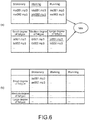
- Fig. 6 is an explanatory diagram for understanding information processing by the audio data selection unit 104.
- Two tables in Part (a) of Fig. 6 are a table showing the association between audio data of motion sounds or the like of the virtual object and the type of the action of the user and a table showing the association between audio data and the degree of fatigue, which are stored in the storage unit 107 in advance.
- the audio data selection unit 104 selects audio data corresponding to the type of the action of the user recognized by the action recognition unit 102, selects audio data in accordance with the degree of fatigue calculated by the degree-of-fatigue calculation unit 103, and outputs the selected two pieces of audio data to the subsequent stage.
- a file mb002.mp3 corresponding to "walking” and a file tc001.mp3 corresponding to "large degree of fatigue” are selected.
- the pieces of selected audio data are synthesized by the audio information generation unit 108.
- a table as shown in Part (b) of Fig. 6 in which types of the action that can be recognized by the action recognition unit 102 and the degree of fatigue calculated by the degree-of-fatigue calculation unit 103 are combined may be prepared in advance, and processing of selecting the synthesized audio data may be performed.
- processing of selecting the synthesized audio data may be performed.
- audio data corresponding to "walking” and “large degree of fatigue” "sound of walking while wheezing" or the like is placed.
- the audio data selection unit 104 dynamically generates an audio data pattern and the dynamically-generated audio data is selected.
- the action of the user recognized by the action recognition unit 102 is a parameter having continuous values
- the degree of fatigue calculated by the degree-of-fatigue calculation unit 103 is a parameter having continuous values.
- the audio data selection unit 104 may dynamically generate audio data on the basis of a parameter group including parameters of the degree of movement velocity from when "walking" to when "running” and the degree of fatigue.
- the audio data selection unit 104 stores the pair of time and the selection result in the storage unit 107 (S105).
- the pair of time and the selection result is used by the sound-image-position calculation unit 106 and the like.
- the displacement calculation unit 105 calculates displacement starting from an arbitrary point in time (S106).
- the displacement calculated here represents spatial displacement of the information processing apparatus 1. Since it is premised that the user wears the information processing apparatus 1, hereinafter, the displacement calculated by the displacement calculation unit 105 will be referred to as "user displacement".
- the user displacement includes a relative change in the spatial position of the user, and also includes orientation, a horizontal position, a position in the vertical direction, and displacement thereof.
- the displacement of the orientation can be calculated by, for example, integrating the output of the gyro sensor among pieces of sensor information input from the sensor 101.
- the output of the gyro sensor may be integrated.
- the displacement calculation unit 105 calculates the orientation (orientation of the user, front direction) among the user displacement.
- the displacement calculation unit 105 calculates also the displacement of the horizontal position as one of the user displacement.
- the displacement of the horizontal position may be calculated by absolute position measurement that receives radio waves of a GPS satellite, or may be calculated by a method of performing wireless communication with a plurality of base stations to determine the absolute position.
- the displacement calculation unit 105 calculates the displacement of the relative position starting from a point in time on the basis of the travelling distance and the travelling direction (displacement of the orientation described above).
- the travelling distance may be obtained by detecting the walking step from the change in acceleration and multiplying the step length corresponding to the walking step by the number of steps.
- the step length an average step length is fixedly used, or a step length is set by, for example, calculating the average step length of the user from the relationship between the horizontal moving distance and the number of steps.
- the displacement calculation unit 105 calculates also the displacement of the height as one of the user displacement.
- the displacement in the height direction can be calculated by a method of using the measurement value of the barometric pressure sensor or a method of calculating the displacement of the height corresponding to the case where it is recognized that the type of the action of the user recognized as "stand” and the type of the action of the user recognized as "sit" by the action recognition unit 102 are alternately repeated. Note that "stand"/"sit" can be recognized from the variation pattern of the measurement value of the acceleration sensor.
- the user displacement calculated by the displacement calculation unit 105 is used by the sound-image-position calculation unit 106.
- the sound-image-position calculation unit 106 calculates the relative position of the virtual object viewed from the user (S107). This position is a sound source (position in real space) on the sense felt by the user due to the finally-synthesized audio in the case where the audio is output from the audio output unit 109.
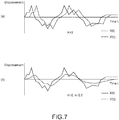
- Fig. 7 is a schematic diagram describing the information processing by the sound-image-position calculation unit 106, and illustrates the user displacement and displacement of the virtual object in respective patterns.
- Part (a) of Fig. 7 shows a sound-image-position calculation pattern in which the movement of the virtual object traces the same position as that of the user displacement with a certain time delay.
- the vertical axis is one-dimensional representation of six-dimensional information including three-axis positions and three-axis directions as an example of displacement.
- the horizontal axis represents a time t.
- the sound-image-position calculation pattern in which user displacement can be tracked as shown in Part (a) of Fig. 7 can be achieved by, for example, the following formula.
- X(t) represents the user displacement
- X'(t) represents the displacement of the virtual object
- K represents a time delay until the virtual object starts moving. The larger the value of K, the greater the time (delay) until it starts moving.
- X ′ t X t ⁇ K
- the tracking of the user displacement by the virtual object as shown in Part (a) of Fig. 7 is effective in the case of presenting the existence that moves along the movement of the user.
- a sound-image-position calculation pattern may be adopted.
- Part (b) of Fig. 7 shows a sound-image-position calculation pattern in which the virtual object moves so as to directly go to the position where the user is present with a certain time delay with respect to the user displacement.
- a represents the velocity of the movement of the virtual object. The closer the value of a, the longer it takes to catch up with the user. That is, the movement is slow.
- X ′ t aX t ⁇ K + 1 ⁇ a X ′ t ⁇ 1
- the tracking of the user displacement by the virtual object as shown in Part (b) of Fig. 7 is effective, for example, in the case of presenting the existence that follows the user through the wall. For example, it is suitable for expressing a ghost character as the virtual object.
- the sound-image-position calculation unit 106 uses, as the position of the virtual object at the time t, the displacement X'(t) calculated by the above-mentioned information processing or the point at the time t that can be calculated thereby.
- this point may be used as a base point, and a point obtained by adding a predetermined positional change to the base point may be used as the position of the virtual object.
- a point obtained by shifting the base point calculated by the calculation to a lower position closer to the ground is output.
- the virtual object is a ghost character
- calculations are made to add up and down positional changes at regular intervals. In accordance with this configuration, it is possible to reproduce more realistic movement of the character.
- the sound-image-position calculation unit 106 calculates the relative position of the character viewed from the user, taking into account the orientation displacement of the user for the position (X'(t)-X(t)) of the character with the user position as the starting point.
- the sound image localization method the method described in Patent Literature 1 can be used.
- the audio information generation unit 108 performs information processing for spatially arranging audio information (S108).
- the information processing localizes a sound image at a relative position from the user such as a distance or direction from the user centering on the user, and the method as described in Patent Literature 1 can be used, for example.
- the audio information generation unit 108 extracts and uses the audio data that is stored in association with the time information in the storage unit 107 by the audio data selection unit 104.
- the audio information generation unit 108 specifies, as the position (position where the sound image is localized) of the sound source on the sense felt by the user due to the output audio information, the position calculated by the sound-image-position calculation unit 106 on the basis of the user displacement output by the displacement calculation unit 105.
- the audio information generation unit 108 modulates the audio data so that it is heard from the specified position. In this embodiment, it is generated as 2-ch audio information. However, depending on the specific embodiment of the audio output unit 109, it may be generates as 5.1-ch audio information.
- the audio information generation unit 108 may adjust the reproduction speed of the modulated audio data in accordance with the moving velocity of the user calculated on the basis of the user displacement calculated by the displacement calculation unit 105. For example, even in the case where the audio data selected by the audio data selection unit 104 is the audio data corresponding to "walking" similarly, it is reproduced at the different reproduction speed depending on the difference of the moving velocity.
- the audio output unit 109 physically outputs, as sound waves, the audio data generated by the audio information generation unit 108 (S109).
- a neckband-type speaker hanging from the neck is shown as an appearance configuration example in Fig. 3
- the technology disclosed in the above-mentioned embodiment is applicable also to other embodiments, e.g., a head mounted display including eyeglass-type one.
- it is also favorable to render the image at the position of the virtual object output through the information processing by the displacement calculation unit 105 and the sound-image-position calculation unit 106.
- a synergistic effect can be achieved by adding a visual stimulus to the auditory stimulus according to the present technology, and it is possible to provide augmented reality having higher quality to a user.
- FIG. 8 The configuration of another embodiment 1 according to the present technology will be described with reference to Fig. 8 .
- this embodiment assumption is made that there are a plurality of users of the information processing apparatus 1.
- One or more sensors that output sensor information to be used in the information processing regarding the calculation of the user displacement by the displacement calculation unit 105 are set as the sensor 101, and one or more sensors that output sensor information to be used in the action recognition and the calculation of the degree of fatigue are set as an other-person sensor 110.
- the displacement calculation unit 105 calculates the user displacement of the user who perceives the audio output by the audio output unit 109.
- the action recognition unit 102 and the degree-of-fatigue calculation unit 103 recognize, on the basis of sensor information of a different person who is not the user, the action pattern and degree of fatigue of the different person. Other information processing is similar to that in the above-mentioned embodiment.
- the action of the different user is recognized, the audio data according to the action pattern is selected, and the position in real space where the sound image is localized follows the spatial displacement of the user who listens to the audio.
- the sound-image-position calculation unit 106 may set the sound image localization position in the air to produce a feeling as if the avatar of the different person floated.
- This embodiment can be applied, but not limited, to a running application in which a user is capable of competing with another person running at a remote place.
- it may be applied to an application in which a user experiences the experience of another person.
- a head mounted display in which a user experiences another person's field of view, it is possible to provide, to the user, augmented reality in which he/she traces the movement of a remote athlete.
- this embodiment is an embodiment in which the information processing apparatus 1 is configured as a server client system in which a server 2 including the CPU 100 and the storage unit 107, and a wearable device 3 communicate with each other via a network 4.
- the wearable device 3 the neckband-type speaker as shown in Fig. 3 can be adopted.
- a smartphone can be used as an example of the wearable device 3.
- the server 2 is placed on the cloud, and the information processing according to the present technology is executed on the side of the server 2.
- the present technology can also be implemented in such a form.
- the action recognition unit 102 recognizes the type of the action of the user in S102 in Fig. 5 .
- the audio data selection unit 104 selects both audio data corresponding to the switching pattern of audio data from that before change to that after change, and the audio data after the change.
- the timing of switching the audio data is the timing of starting or finishing of the action. For example, in the case where a character to be given to a virtual object is a "bell-attached character" and the type of the action changes from "running" to "stationary", the audio data selection unit 104 selects a jingle sound that sounds like jingling. The audio data selection unit 104 selects both the audio data corresponding to "stationary” and audio data regarding the jingle sound.
- the audio data selection unit 104 may select, when the type of the action changes from "running" to "stationary", a dialogue indicating that the character is surprised. In this case, it is possible to produce an effect that the character regarding the virtual object is surprised when the running user suddenly stops. It is possible to make the character more lively, and provide augmented reality richer in entertainment to a user.
- the action recognition unit 102 recognizes the type of the action of the user in S102 in Fig. 5 .
- the CPU 100 performs predetermined condition determination relating to the type of the action after the change. In this condition determination, whether or not the type of the action after the change matches with the information associated with the virtual object is determined.
- augmented reality as if a virtual object followed a user is provided to the user.
- AR augmented reality
- the information processing apparatus 1 gives personality, features, possessions, and the like as a non-existent character to the virtual object. In the case where such information associated with the virtual object does not match with the type of the action after the change, augmented reality is reduced.
- the audio data selection unit 104 may select predetermined audio data.
- condition determination of whether or not the possessions of the character regarding the virtual object include “bicycle” is performed.
- condition determination of whether or not the possessions include “bicycle” corresponds to determination of whether or not the type of the action after the change matches with the information associated with the virtual object.
- the audio data selection unit 104 does not select the audio data corresponding to the bicycle. Instead, a voice of the character murmuring "I also want to ride a bicycle" may be selected.
- the fatigue or the degree of fatigue of the user has been calculated as an example of the state of the user, and used for selecting audio data.
- an emotion e.g., delight, anger, romance, and pleasure emotions
- the sensor 101 is not particularly limited. As long as the emotion of the user can be acquired from blood pressure or body temperature by a biometric sensing device, audio data may be selected on the basis of the emotion.
- environmental information around the user may be acquired instead of or in addition to the state or emotion of the user, and audio data may be selected on the basis of the environmental information.
- the audio data selection unit 104 selects a sound walking on the water pool in accordance with this. In accordance with this configuration, it is possible to provide, to a user, augmented reality richer in entertainment or realistic augmented realty.
- the sound-image-position calculation unit 106 may determine the position where the virtual object is placed on the basis of one or more of the following combinations.
- the sound-image-position calculation unit 106 places the virtual object so that it is not at the position facing the user across the wall.
- the virtual object is a character such as a dog
- the sound-image-position calculation unit 106 places the virtual object so that it turns around to the side of the user if detailed map data can be acquired.
- the map data that can be acquired from the outside includes not only the rough latitude and longitude of the building but also the position coordinates of the wall that demarcates the boundary between the building and the road or the like.
- the sound-image-position calculation unit 106 arranges the sound image localization position of the virtual object to be determined on the basis of the user displacement output by the displacement calculation unit 105 in the range excluding the coordinate positions of the building.
- the virtual object is placed on the side of the road.
- the sound-image-position calculation unit 106 places the virtual object in the direction in which space is opened (e.g., direction in which there is a road).
- audio data such as a collision sound may be reproduced.
- the audio information generation unit 108 reproduces the audio data such as a collision sound.
- a character given to the virtual object is a character that can pass through a wall such as a ghost
- the sound-image-position calculation unit 106 may place the character on the other side of the wall. Further, a particular jingle sound may be played at the moment when it passes through the wall.
- the audio information generation unit 108 has a configuration in which different audio information is generated depending on the state of the action of the character regarding the virtual object. For example, when the action recognition unit 102 grasps that the action pattern of the user is running for a long time exceeding a predetermined threshold, the audio data selection unit 104 may select different audio data, and audio information to be finally generated by the audio information generation unit 108 may differ. In this case, the audio information generation unit 108 may switch the audio data to be selected by the audio data selection unit 104 from the normal audio data when running to, for example, the audio data indicating that the character is tired, which includes, for example, a sound of shortness of breath or a voice "tired".
Landscapes
- Engineering & Computer Science (AREA)
- Physics & Mathematics (AREA)
- Acoustics & Sound (AREA)
- Signal Processing (AREA)
- Multimedia (AREA)
- Mathematical Physics (AREA)
- Computational Linguistics (AREA)
- Health & Medical Sciences (AREA)
- Audiology, Speech & Language Pathology (AREA)
- Human Computer Interaction (AREA)
- Stereophonic System (AREA)
- User Interface Of Digital Computer (AREA)
Applications Claiming Priority (2)
| Application Number | Priority Date | Filing Date | Title |
|---|---|---|---|
| JP2016223275A JP2018082308A (ja) | 2016-11-16 | 2016-11-16 | 情報処理装置、方法及びプログラム |
| PCT/JP2017/037505 WO2018092486A1 (ja) | 2016-11-16 | 2017-10-17 | 情報処理装置、方法及びプログラム |
Publications (2)
| Publication Number | Publication Date |
|---|---|
| EP3544320A4 EP3544320A4 (en) | 2019-09-25 |
| EP3544320A1 true EP3544320A1 (en) | 2019-09-25 |
Family
ID=62145612
Family Applications (1)
| Application Number | Title | Priority Date | Filing Date |
|---|---|---|---|
| EP17871788.0A Ceased EP3544320A1 (en) | 2016-11-16 | 2017-10-17 | Information processing device, method and program |
Country Status (5)
| Country | Link |
|---|---|
| US (1) | US10986458B2 (ja) |
| EP (1) | EP3544320A1 (ja) |
| JP (1) | JP2018082308A (ja) |
| CN (1) | CN109983784B (ja) |
| WO (1) | WO2018092486A1 (ja) |
Families Citing this family (5)
| Publication number | Priority date | Publication date | Assignee | Title |
|---|---|---|---|---|
| US10973440B1 (en) * | 2014-10-26 | 2021-04-13 | David Martin | Mobile control using gait velocity |
| US10692289B2 (en) * | 2017-11-22 | 2020-06-23 | Google Llc | Positional recognition for augmented reality environment |
| JP7635249B2 (ja) * | 2020-02-14 | 2025-02-25 | マジック リープ, インコーポレイテッド | 遅延オーディオ追従 |
| JP7615726B2 (ja) * | 2021-02-09 | 2025-01-17 | ヤマハ株式会社 | 肩乗せ型スピーカ、音像定位方法及び音像定位プログラム |
| JP7011364B1 (ja) | 2021-10-15 | 2022-01-26 | シンメトリー・ディメンションズ・インク | 体験装置、体験システム、及び、表示方法 |
Family Cites Families (30)
| Publication number | Priority date | Publication date | Assignee | Title |
|---|---|---|---|---|
| US3712292A (en) * | 1971-07-20 | 1973-01-23 | Karen Lafley V | Method and apparatus for producing swept frequency-modulated audio signal patterns for inducing sleep |
| WO2002037471A2 (en) * | 2000-11-03 | 2002-05-10 | Zoesis, Inc. | Interactive character system |
| WO2005113099A2 (en) * | 2003-05-30 | 2005-12-01 | America Online, Inc. | Personalizing content |
| JP2008533504A (ja) * | 2005-01-31 | 2008-08-21 | コーニンクレッカ フィリップス エレクトロニクス エヌ ヴィ | 生理学的効果に関する歌曲の分類 |
| US10741218B2 (en) * | 2005-02-14 | 2020-08-11 | Koninklijke Philips N.V. | Electronic device and method for reproducing a human perceptual signal |
| JP5225548B2 (ja) * | 2005-03-25 | 2013-07-03 | ソニー株式会社 | コンテンツ検索方法、コンテンツリスト検索方法、コンテンツ検索装置、コンテンツリスト検索装置および検索サーバ |
| DE602007001281D1 (de) * | 2006-01-20 | 2009-07-30 | Yamaha Corp | Vorrichtung zur Steuerung der Wiedergabe von Musik und Vorrichtung zur Wiedergabe von Musik |
| JP2007226935A (ja) * | 2006-01-24 | 2007-09-06 | Sony Corp | 音響再生装置、音響再生方法および音響再生プログラム |
| US7643895B2 (en) * | 2006-05-22 | 2010-01-05 | Apple Inc. | Portable media device with workout support |
| JP2007328568A (ja) * | 2006-06-08 | 2007-12-20 | Seiko Epson Corp | 歩数計、携帯情報端末、歩数計の制御方法およびそのプログラム |
| JP2008226400A (ja) * | 2007-03-15 | 2008-09-25 | Sony Computer Entertainment Inc | オーディオ再生装置およびオーディオ再生方法 |
| JP5406880B2 (ja) * | 2011-04-28 | 2014-02-05 | シャープ株式会社 | 運動インストラクション装置 |
| JP5821307B2 (ja) * | 2011-06-13 | 2015-11-24 | ソニー株式会社 | 情報処理装置、情報処理方法及びプログラム |
| US9380978B2 (en) * | 2011-06-29 | 2016-07-05 | Bruce Reiner | Method and apparatus for real-time measurement and analysis of occupational stress and fatigue and performance outcome predictions |
| JP5927966B2 (ja) | 2012-02-14 | 2016-06-01 | ソニー株式会社 | 表示制御装置、表示制御方法、及びプログラム |
| US9179232B2 (en) * | 2012-09-17 | 2015-11-03 | Nokia Technologies Oy | Method and apparatus for associating audio objects with content and geo-location |
| KR20230044041A (ko) * | 2013-03-11 | 2023-03-31 | 매직 립, 인코포레이티드 | 증강 및 가상 현실을 위한 시스템 및 방법 |
| US20140281971A1 (en) * | 2013-03-13 | 2014-09-18 | United Video Properties, Inc. | Methods and systems for generating objective specific playlists |
| US10269180B2 (en) * | 2013-04-16 | 2019-04-23 | Sony Corporation | Information processing apparatus and information processing method, display apparatus and display method, and information processing system |
| US20140347368A1 (en) * | 2013-05-21 | 2014-11-27 | Telenav, Inc. | Navigation system with interface modification mechanism and method of operation thereof |
| JP6201615B2 (ja) * | 2013-10-15 | 2017-09-27 | 富士通株式会社 | 音響装置、音響システム、音響処理方法及び音響処理プログラム |
| US20160030809A1 (en) * | 2013-10-24 | 2016-02-04 | JayBird LLC | System and method for identifying fitness cycles using earphones with biometric sensors |
| US10078734B2 (en) * | 2013-10-24 | 2018-09-18 | Logitech Europe, S.A. | System and method for identifying performance days using earphones with biometric sensors |
| EP2866217A1 (en) * | 2013-10-25 | 2015-04-29 | GN Store Nord A/S | An audio information system based on zones and contexts |
| JP6610258B2 (ja) * | 2013-11-05 | 2019-11-27 | ソニー株式会社 | 情報処理装置、情報処理方法、及び、プログラム |
| KR102420313B1 (ko) * | 2014-06-30 | 2022-07-13 | 소니그룹주식회사 | 정보 처리 장치 및 정보 처리 방법, 컴퓨터 프로그램, 그리고 화상 처리 시스템 |
| WO2016029039A1 (en) * | 2014-08-20 | 2016-02-25 | Puretech Management, Inc. | Systems and techniques for identifying and exploiting relationships between media consumption and health |
| KR102351060B1 (ko) * | 2015-09-16 | 2022-01-12 | 매직 립, 인코포레이티드 | 오디오 파일들의 헤드 포즈 혼합 |
| CN105578355B (zh) * | 2015-12-23 | 2019-02-26 | 惠州Tcl移动通信有限公司 | 一种增强虚拟现实眼镜音效的方法及系统 |
| US9749766B2 (en) * | 2015-12-27 | 2017-08-29 | Philip Scott Lyren | Switching binaural sound |
-
2016
- 2016-11-16 JP JP2016223275A patent/JP2018082308A/ja active Pending
-
2017
- 2017-10-17 US US16/341,721 patent/US10986458B2/en not_active Expired - Fee Related
- 2017-10-17 EP EP17871788.0A patent/EP3544320A1/en not_active Ceased
- 2017-10-17 WO PCT/JP2017/037505 patent/WO2018092486A1/ja not_active Ceased
- 2017-10-17 CN CN201780069477.7A patent/CN109983784B/zh not_active Expired - Fee Related
Also Published As
| Publication number | Publication date |
|---|---|
| US20200053501A1 (en) | 2020-02-13 |
| EP3544320A4 (en) | 2019-09-25 |
| CN109983784A (zh) | 2019-07-05 |
| CN109983784B (zh) | 2022-02-01 |
| US10986458B2 (en) | 2021-04-20 |
| WO2018092486A1 (ja) | 2018-05-24 |
| JP2018082308A (ja) | 2018-05-24 |
Similar Documents
| Publication | Publication Date | Title |
|---|---|---|
| US10986458B2 (en) | Information processing apparatus and information processing method | |
| US10585471B2 (en) | Systems and methods to provide an interactive space based on predicted events | |
| US12315055B2 (en) | Information processing apparatus and information processing method for processing sound of real environment for displaying virtual experience | |
| JP2021082310A (ja) | 拡張現実および仮想現実のためのシステムおよび方法 | |
| JP6673346B2 (ja) | 情報処理装置、情報処理方法、およびプログラム | |
| JP2020527432A (ja) | レーシングシミュレーション | |
| CN102855116A (zh) | 信息处理设备、信息处理方法及程序 | |
| WO1998051385A1 (en) | Game machine for moving body | |
| JP2025126234A (ja) | 方向づけ援助システム | |
| JP4848648B2 (ja) | 車載情報提供装置 | |
| JP6884854B2 (ja) | 音声提供装置、音声提供方法及びプログラム | |
| JP2003134510A (ja) | 画像情報配信システム | |
| JPWO2019167214A1 (ja) | 推定装置、推定方法及びプログラム | |
| JP2021156600A (ja) | 移動体位置推定装置および移動体位置推定方法 | |
| CN114765726B (zh) | 输出控制装置、输出控制系统、及控制方法 | |
| CN115214703A (zh) | 一种车辆控制的方法及装置 | |
| KR100697442B1 (ko) | 음향 재생 장치를 이용한 이동 시뮬레이팅 방법 및 상기방법을 수행하기 위한 사운드 재생 장치 | |
| Guerrón Paredes et al. | Methodology for Building Virtual Reality Mobile Applications for Blind People on Advanced Visits to Unknown Interior Spaces. | |
| Zwinderman et al. | Oh music, where art thou? | |
| JP2023181567A (ja) | 情報処理装置、情報処理方法、情報処理システム、及びデータ生成方法 | |
| JP7617694B2 (ja) | 誘導システム、誘導方法および誘導プログラム | |
| US12217343B2 (en) | Information processing device, information processing method, and program for causing a virtual object to perform movement according to a sound reproduced from a real sound source | |
| JP2018151347A (ja) | 装置及びユーザの移動補助方法 | |
| Sato et al. | Development of a Customizable and Easy-to-use Driving VR Simulator Based on 3D City Model | |
| WO2022153792A1 (ja) | 接近回避システム及び前庭電気刺激装置 |
Legal Events
| Date | Code | Title | Description |
|---|---|---|---|
| STAA | Information on the status of an ep patent application or granted ep patent |
Free format text: STATUS: THE INTERNATIONAL PUBLICATION HAS BEEN MADE |
|
| PUAI | Public reference made under article 153(3) epc to a published international application that has entered the european phase |
Free format text: ORIGINAL CODE: 0009012 |
|
| STAA | Information on the status of an ep patent application or granted ep patent |
Free format text: STATUS: REQUEST FOR EXAMINATION WAS MADE |
|
| 17P | Request for examination filed |
Effective date: 20190606 |
|
| A4 | Supplementary search report drawn up and despatched |
Effective date: 20190805 |
|
| AK | Designated contracting states |
Kind code of ref document: A1 Designated state(s): AL AT BE BG CH CY CZ DE DK EE ES FI FR GB GR HR HU IE IS IT LI LT LU LV MC MK MT NL NO PL PT RO RS SE SI SK SM TR |
|
| AX | Request for extension of the european patent |
Extension state: BA ME |
|
| DAV | Request for validation of the european patent (deleted) | ||
| DAX | Request for extension of the european patent (deleted) | ||
| STAA | Information on the status of an ep patent application or granted ep patent |
Free format text: STATUS: EXAMINATION IS IN PROGRESS |
|
| RAP3 | Party data changed (applicant data changed or rights of an application transferred) |
Owner name: SONY GROUP CORPORATION |
|
| 17Q | First examination report despatched |
Effective date: 20210712 |
|
| REG | Reference to a national code |
Ref country code: DE Ref legal event code: R003 |
|
| STAA | Information on the status of an ep patent application or granted ep patent |
Free format text: STATUS: THE APPLICATION HAS BEEN REFUSED |
|
| 18R | Application refused |
Effective date: 20230601 |