EP3545247B1 - Profilanordnung, insbesondere für ein kühl- und/oder gefriergerät - Google Patents
Profilanordnung, insbesondere für ein kühl- und/oder gefriergerät Download PDFInfo
- Publication number
- EP3545247B1 EP3545247B1 EP17800705.0A EP17800705A EP3545247B1 EP 3545247 B1 EP3545247 B1 EP 3545247B1 EP 17800705 A EP17800705 A EP 17800705A EP 3545247 B1 EP3545247 B1 EP 3545247B1
- Authority
- EP
- European Patent Office
- Prior art keywords
- arrangement
- profile arrangement
- profile
- coating element
- sealing
- Prior art date
- Legal status (The legal status is an assumption and is not a legal conclusion. Google has not performed a legal analysis and makes no representation as to the accuracy of the status listed.)
- Active
Links
Images




Classifications
-
- F—MECHANICAL ENGINEERING; LIGHTING; HEATING; WEAPONS; BLASTING
- F25—REFRIGERATION OR COOLING; COMBINED HEATING AND REFRIGERATION SYSTEMS; HEAT PUMP SYSTEMS; MANUFACTURE OR STORAGE OF ICE; LIQUEFACTION SOLIDIFICATION OF GASES
- F25D—REFRIGERATORS; COLD ROOMS; ICE-BOXES; COOLING OR FREEZING APPARATUS NOT OTHERWISE PROVIDED FOR
- F25D23/00—General constructional features
- F25D23/08—Parts formed wholly or mainly of plastics materials
- F25D23/082—Strips
- F25D23/087—Sealing strips
-
- F—MECHANICAL ENGINEERING; LIGHTING; HEATING; WEAPONS; BLASTING
- F16—ENGINEERING ELEMENTS AND UNITS; GENERAL MEASURES FOR PRODUCING AND MAINTAINING EFFECTIVE FUNCTIONING OF MACHINES OR INSTALLATIONS; THERMAL INSULATION IN GENERAL
- F16J—PISTONS; CYLINDERS; SEALINGS
- F16J15/00—Sealings
- F16J15/02—Sealings between relatively-stationary surfaces
- F16J15/06—Sealings between relatively-stationary surfaces with solid packing compressed between sealing surfaces
- F16J15/10—Sealings between relatively-stationary surfaces with solid packing compressed between sealing surfaces with non-metallic packing
-
- F—MECHANICAL ENGINEERING; LIGHTING; HEATING; WEAPONS; BLASTING
- F25—REFRIGERATION OR COOLING; COMBINED HEATING AND REFRIGERATION SYSTEMS; HEAT PUMP SYSTEMS; MANUFACTURE OR STORAGE OF ICE; LIQUEFACTION SOLIDIFICATION OF GASES
- F25D—REFRIGERATORS; COLD ROOMS; ICE-BOXES; COOLING OR FREEZING APPARATUS NOT OTHERWISE PROVIDED FOR
- F25D23/00—General constructional features
- F25D23/02—Doors; Covers
Definitions
- the invention relates to a profile arrangement, in particular for a refrigerator and/or freezer, comprising at least one base, at least one fastening arrangement, at least one coating element and at least one sealing arrangement, which has at least one hollow chamber and is made of a flexible, polymeric material a Shore A hardness according to DIN EN ISO 868 of about 60 to 90; a closure element and a refrigerator and/or freezer with such a profile arrangement.
- the profile arrangement is designed as a sealing arrangement for the door of a refrigerator or freezer, with a heat-insulating housing, the opening of which can be closed with a door Magnetic seal, which is equipped with a sealing head and a sealing base, which are connected to each other with flexible walls designed as expansion folds, the sealing base being anchored in a receiving groove on the interior paneling that tapers on the opening side and is directed towards the door opening, while the sealing head equipped with magnetic strips when the door is closed, it rests on the opening edge of the housing and holds the door firmly on the opening edge, with the sealing head facing the sealing foot is arranged laterally offset, which is equipped with a bulge on one side, which interacts with an undercut in the receiving groove and which is arranged opposite to the lateral offset closer to the sealing head, with the side of the sealing foot opposite the bulging being supported in the receiving groove, with the sealing foot is provided with an insertion wedge and has on its side opposite the bulge a projection which is arranged essentially at the same height as the maximum of the bulge and which is
- This generic profile assembly is designed as an improved sealing assembly for refrigerators and the like having a profile made of plastic material, the assembly consisting of a cabinet, a door and an inner door panel member which can be coupled to the cabinet and a portion of a bellows seal which provides a sealed closure between the door and the cabinet, envisaging that a profile and the sealing portion are mated or form a single integral part, made by co-extrusion of two materials having different degrees of strength, so as to, if necessary, a convenient to allow detachment of the sealing portion from the profile along the area of their connection, the profile having a groove adapted to receive a replacement portion of a bellows seal and at least one resiliently yielding side portion acting to provide a snap connection between the extrusion and the inner panel member, the portion terminating in a grooved receptacle having a substantially C-shaped cross-section and configured to receive an edge of the inner panel member, it being further envisioned that the
- area of curvature in the right angle of the inner door panel element has a radius of about 3 to 6 mm, so as to ensure an optimal contrast effect with one of the sealing strips of the base of the profile.
- the sealing portion is further configured to define an expandable chamber that acts as a bellows and has an upper chamber that is configured to receive a rod of magnetic material.
- a gap is formed between the upper or expandable chamber and that of the seal assembly.
- a further disadvantage of the profile arrangements from the prior art is that the optics in the gap between the door and the body of the refrigerator and/or freezer, which the observer sees when the refrigerator and/or freezer is closed, are not visually appealing due to this profile arrangement , which is also due to the fact that a profile arrangement, the door and the body are made of different materials and thus have a different look or feel.
- a further disadvantage is that there are only very limited design options for the profile arrangement in the prior art, which, however, optically or haptically are inferior to the sometimes very high-quality refrigerators and/or freezers.
- a sealing profile strip with a holding part that can be placed on a housing flange and a sealing part that acts against a housing cover, the sealing profile strip being equipped with a bridging element made of electrically conductive material that is in continuous contact with both the housing flange and the housing cover.
- the bridging element is made of metal threads or thin metal wires or a stranded wire and is intimately connected to the sealing profile strip by gluing, welding, lining, laminating or coextrusion
- the DE 202007017302 U1 discloses a sliding seal for windows, doors, roller shutters and the like, with at least one sealing base, by means of which the sliding seal can be fastened to a component, with at least one closed hollow profile body which has at least one sealing zone with at least one sliding layer and two side walls which extend from of the sealing zone in the direction of the sealing foot, the at least one closed hollow profile body having on each of its two side walls at least one indentation directed towards the interior of the hollow profile body.
- the hollow profile body is made of an elastomeric material with a Shore A hardness of 40 to 60 and is connected to the sealing foot made of hard material by coextrusion.
- a sliding layer made of hard material is co-extruded on the outside facing away from the sealing foot.
- a profile arrangement in particular for refrigerators and/or freezers, comprising at least one base, at least one fastening arrangement, at least one coating element, and at least one sealing arrangement, which has at least one hollow chamber and is made from a flexible, polymeric material is, with a Shore A hardness according to DIN EN ISO 868 of about 60 to 90, is characterized in that the coating element is arranged in a materially bonded manner on the sealing arrangement.
- the profile arrangement according to the invention is designed in such a way that for the intended use at least the visible surface of the sealing arrangement, which is visible in the construction-related gap between the closure element and the body of a refrigerator and/or freezer, is sealed diffusion-proof by a coating element.
- a further advantage of the profile arrangement according to the invention is that when it is used as intended, at least the surface of the sealing arrangement which is arranged opposite the body of the refrigerator and/or freezer is likewise sealed against diffusion.
- the profile arrangement according to the invention is also designed in such a way that the coating element is arranged in a materially bonded manner on at least one wall of the sealing arrangement surrounding the hollow chamber.
- this ensures that the coating element closes the wall of the sealing arrangement in a diffusion-resistant manner
- the coating element arranged in a materially bonded manner on the profile arrangement closes the gap caused by the design between the closure element and the body of the refrigerator and/or freezer in a visually appealing, covering manner.
- at least the one arranged opposite the body of the refrigerator and/or freezer Surface of the sealing arrangement is sealed against diffusion.
- a further advantage of the profile arrangement according to the invention is that the arrangement, the material and the design of the coating element arranged in a materially bonded manner on the sealing arrangement mean that the gap between the closure element and the body of the refrigerator and/or freezer is designed not only to be visually appealing , but that the profile arrangement according to the invention is also very easy to clean, for example due to a smooth surface of the coating element.
- the coating element is applied to the sealing arrangement by means of pressure and/or temperature, preferably in an inline process.
- the coating element it is also within the scope of the invention for the coating element to be applied to a profile arrangement by means of pressure and/or temperature in an online process or in an offline process.
- the surface of the sealing arrangement and/or the coating element is treated prior to the application of the coating element by a chemical and/or physical treatment, preferably by a heat, flame, plasma, microwave , infrared or corona treatment is activated.
- a chemical and/or physical treatment preferably by a heat, flame, plasma, microwave , infrared or corona treatment is activated.
- the coating element has at least one top layer and at least one bottom layer connected thereto.
- This advantageous configuration of the coating element of the profile arrangement according to the invention makes it possible for the first time to realize a permanent, materially bonded connection between the coating element via the underlayer of the sealing arrangement of the profile arrangement according to the invention and on the other hand to achieve through the design, the materials and the geometry of the top layer that on the one hand no diffusion or migration of additives from the sealing arrangement of the profile arrangement according to the invention takes place and on the other hand the profile arrangement according to the invention has extensive and permanent protection, in particular against UV rays.
- a further advantage of the profile arrangement according to the invention is that the coating element also provides permanent protection against possible microbial growth, in particular when the refrigerator and/or freezer is used as intended, for example in kitchens.
- the coating element of the profile arrangement according to the invention also has a top layer and a bottom layer which is materially bonded to it.
- the underlayer of the coating element is made of the polymeric material polyvinyl chloride (PVC).
- PVC polyvinyl chloride
- the undercoat of the coating element has a Shore D hardness according to DIN 53505 of about 70 to 90, preferably 75 to 85.
- the coating element can, for example, also serve as a support element or compensate for unevenness in the profile arrangement according to the invention.
- the top layer of the coating element is designed as a multi-layer film, in particular as a plastic film, for example based on a polyester, with a metallic coating arranged thereon or underneath, and has a thickness of about 0.01 mm.
- the bottom layer and/or the top layer of the coating element at least partially has a reactive, activatable adhesive.
- thermoplastic or reactive hot-melt adhesives are used as the adhesive.
- the hot-melt adhesives can be thermoplastic, in particular non-reactive hot-melt adhesives, or reactive hot-melt adhesives.
- hot-melt adhesives that can be used are thermoplastic hot-melt adhesives, in particular hot-melt adhesives based on ethylene/vinyl acetates (EVA); Polyolefins, such as amorphous poly-a-olefins or polyolefins produced by metallocene catalysis; polyacrylates; copolyamides; copolyesters; and/or thermoplastic polyurethanes or their corresponding copolymers and/or terpolymers.
- EVA ethylene/vinyl acetates
- reactive hot-melt adhesives in particular moisture-crosslinking and/or radiation-crosslinking, in particular UV-crosslinking, hot-melt adhesives, preferably hot-melt adhesives based on silane-grafted amorphous poly-a-olefins and/or isocyanate-terminated polyurethanes, particularly preferably hot-melt adhesives based on isocyanate-terminated polyurethanes, and/or reactive hot-melt adhesives being used as hot-melt adhesives based on radiation-crosslinking reactive adhesives, in particular hot-melt adhesives that crosslink under UV irradiation.
- a further advantage is that the coating element of the profile arrangement according to the invention formed in this way can advantageously be produced economically and inexpensively at the same time as the profile arrangement according to the invention, for example in the extrusion process, in the co-extrusion process and in the post-coextrusion process.
- the profile arrangement according to the invention and the underlayer of the coating element at least partially have a polymeric material selected from the group such as polyvinyl chloride (PVC); polyolefin such as polypropylene (PP) or polyethylene (PE); styrene-based polymer, such as polystyrene (PS) or styrene-butadiene copolymer with a predominant styrene content (SB) or acrylonitrile-styrene-acrylic ester copolymers (ASA) or acrylonitrile-butadiene-styrene copolymers (ABS) or styrene-acrylonitrile (SAN); polybutylene terephthalate (PBT); polyethylene terephthalate (PET); polyoxymethylene (POM); polyamide (PA); polymethyl methacrylate (PMMA); polyphenylene oxide (PPO); polyetheretherketone (PEEK); polyphenylene
- PVC polyviny
- the sealing arrangement also at least partially has a polymeric material selected from the group of thermoplastic elastomers, e.g. based on olefins and/or based on urethane, crosslinked thermoplastic elastomers based on olefins, thermoplastic copolyesters, Styrene block copolymers (SBS, SEBS, SEPS, SEEPS and MBS) and thermoplastic copolyamides.
- a polymeric material selected from the group of thermoplastic elastomers, e.g. based on olefins and/or based on urethane, crosslinked thermoplastic elastomers based on olefins, thermoplastic copolyesters, Styrene block copolymers (SBS, SEBS, SEPS, SEEPS and MBS) and thermoplastic copolyamides.
- weihmacher Materials preferably polypropylene, acrylonitrile-butadiene-styrene copolymer, polycarbonate, polyvinyl chloride, polymethyl methacrylate, polyethylene terephthalate, polyurethane and the like, and mixtures of these materials.
- the profile arrangement according to the invention can thus be produced economically and cost-effectively and a durable, visually appealing, materially bonded connection can be realized, particularly if the material of the underlayer of the coating element is similar or the same as the material of the sealing arrangement of the profile arrangement according to the invention.
- the thickness of the coating element is between 0.01 and 0.5 mm, preferably between 0.01 and 0.25 mm.
- the profile arrangement according to the invention is designed in such a way that the top layer of the coating element is designed as a decorative element and/or at least partially has a decorative element.
- the profile arrangement according to the invention can be made available in such a way that in particular the design-related gap between the closure element and the body of a refrigerator and/or freezer can be closed in a visually appealing, sealing manner.
- the top layer of the coating element and/or the decorative element at least partially has a metallic material or is designed as a metal foil.
- the coating element has a special coating on at least one side.
- This coating can be designed, for example, as a reflective mirror coating, which leads to optimal reflection of the heat in the vicinity of the refrigerator and/or freezer.
- the energy transmission can be reduced by up to 15 % will be realized.
- Coatings made of metallic materials such as aluminum, gold, silver and the like have proven to be advantageous here.
- the coating it is also within the scope of the invention for the coating to consist of thermoplastic, duromer or ceramic materials.
- the thickness of the coating element is between 0.01 and 0.5 mm, preferably between 0.01 and 0.25 mm.
- This advantageous configuration of the coating element makes it possible to provide a profile arrangement according to the invention in which, when used as intended, the part of the sealing arrangement that has a refrigerator and/or freezer is sealed in a diffusion-tight manner in the design-related gap between the closure element and the body and is designed to be visually appealing and on the other hand, the part of the sealing arrangement of the profile arrangement according to the invention which is in operative connection with the body or the closure element even when used as intended, whose surface is not optically impaired by additives that may escape.
- the profile arrangement according to the invention is also advantageously designed in such a way that the walls of the sealing arrangement surrounding the hollow chamber have a wall thickness of approximately 0.1 to 2 mm, preferably 0.2 to 1.5 mm.
- the profile arrangement according to the invention can therefore be produced economically and inexpensively and thus fulfills its basic function, namely the sealing between the closure element and the body of a refrigerator and / or freezer when used as intended over a long period of time and, on the other hand, is surprisingly designed in such a way that a coating element is only can be cohesively and visually attractively fixed on at least part of the wall of this sealing arrangement of the profile arrangement according to the invention.
- the sealing arrangement has at least one cover element.
- This configuration of the profile arrangement according to the invention makes it possible, when used as intended on a closure element and/or on a body of a refrigerator and/or freezer, to close a gap on the closure element that may have arisen due to manufacturing-related and/or assembly-related tolerances, e.g. when the closure element sags , cover directly and visually appealing.
- the covering element is also designed in such a way that it covers transitions between the inner lining and the outer lining of a closure element that are caused by the design.
- the invention further relates to a closure element for a refrigerator and/or freezer with a profile arrangement according to the previous statements.
- the invention relates to a refrigerator and/or freezer with a profile arrangement according to the previous statements.
- the 1 shows a perspective view of an opened refrigerator and/or freezer 10 with a closure element 20 and a profile arrangement 1 according to the invention.
- the refrigerator and/or freezer 10 has a cabinet-like body 11 whose walls 13 delimit the interior space 14 of the refrigerator and/or freezer 10 .
- the front opening 12 of the body 11 can be closed in a sealing manner by the closure element 20 and the profile arrangement 1 according to the invention arranged on it.
- the closure element 20 is arranged on the body 11 of the refrigerator and/or freezer 10 such that it can be pivoted about a vertical axis via hinge arrangements 21 .
- the profile arrangement 1 is arranged on the side of the closure element 20 opposite the body 11 of the refrigerator and/or freezer 10 such that, when the closure element 20 is in the closed position, the profile arrangement 1 wraps around the opening 12 of the refrigerator and/or freezer Freezer 10 rests on the coating element 5 on the body 11 and the gap between the closure element 20 and the body 11 of the refrigerator and / or freezer 10 seals.
- FIG. 2 shows a perspective view of a closed refrigerator and/or freezer 10 with a closure element 20 and a profile arrangement 1 according to the invention.
- the refrigerator and/or freezer 10 comprises a body 11 and at least one closure element 20 that closes an opening in the body 11.
- a gap 19 can be seen between the closure element 20 and the body 11, in which a profile arrangement 1 according to the invention is arranged, which is designed such that the invisible sealing arrangement has a coating element 5 which closes the gap 19 in a visually appealing and sealing manner.
- the profile arrangement 1 according to the invention can be arranged both on the closure element 20 and on the body 11 of the refrigerator and/or freezer 10 .
- FIG. 3 is a sectional view of a profile arrangement 1 according to the invention in its installed state in a section of a refrigerator and / or freezer 10 shown only in detail.
- the refrigerator and/or freezer 10 has a body 11 which is formed by the wall 13 in this exemplary embodiment.
- the wall 13 of the body 11 of the refrigerator and/or freezer 10 has a first wall element 130 which is made of metal and coated with a layer of paint or lacquer and a second wall element 131 arranged thereon, which consists of a polymeric material.
- the first wall element 130 is non-positively connected to the second wall element 131 .
- a closure element 20 shown partially in section, which in this exemplary embodiment has a first closure part 21, which is made of a coated metallic material and has a second closure part 22 arranged thereon. which is made of a polymer material.
- a groove 23 is arranged in the second closure part 22 of the closure element 20, in which the fastening arrangement 2 of the profile arrangement 1 according to the invention is arranged.
- the profile arrangement 1 comprises a base 8, a fastening arrangement 2, a coating element 5 and at least one sealing arrangement 3.
- the profile arrangement 1 according to the invention is designed in such a way that the sealing arrangement 3 has the hollow chambers 30, 31, 32, 33, the sealing arrangement 3 being arranged on the base 8 in a cohesive manner or in one piece.
- the coating element 5 is arranged on the wall of the sealing arrangement 3 surrounding the hollow chambers 30, 31, 32, 33, which is arranged in a materially bonded manner thereon.
- the profile arrangement 1 according to the invention is arranged on the refrigerator and/or freezer 10 in such a way that the part of the coating element 5 arranged on the wall of the hollow chamber 30, 31, 32, 33 closes the gap 19 between the body 11 of the refrigerator and/or freezer 10 and the closure element 20 closes in a visually appealing and sealing manner.
- the profile arrangement 1 according to the invention is still designed in such a way that the coating element 5, which is also arranged in a materially bonded manner on the wall of the hollow chamber 30, 31 of the sealing arrangement 3, the first wall element 130 and, in part, the second wall element 131 of the wall 13 of the body 11 of the cooling and/or Freezer 10 covers so that the seal assembly 3 can not come into direct operative connection with this. It is thus possible to effectively prevent additives from the material of the sealing arrangement 3 from diffusing into the coated, first wall element 130 and the second wall element 131 .
- the profile arrangement 1 according to the invention is thus advantageously arranged on the refrigerator and/or freezer 10 in such a way that the basic function, namely the sealing of the body 11 of the refrigerator and/or freezer 10 from the closure element 20, can be implemented without any problems, both when the closure element is opened 20 as well as during closing and it is furthermore ensured according to the invention that a material-related diffusion, in particular from the material of the sealing arrangement 3, into, for example, the wall 13, which comprises the coated, first wall element 130 and the second wall element 131, of the body 11 of the cooling and / or Freezer 10 is successfully prevented by the interposed coating element 5.
- a further advantage of the profile arrangement 1 according to the invention is that when used as intended in a refrigerator and/or freezer 10, in particular the UV Radiation as well as other external influences cannot impair the function of the sealing arrangement 3 of the profile arrangement 1 according to the invention, since this is optically attractive and effectively protected by the coating element 5 which is materially connected to it.
- the coating element 5 is applied to the sealing arrangement 3 by means of pressure and temperature in an extrusion or coextrusion process.
- the sealing arrangement 3 of the profile arrangement 1 according to the invention consists of a polymer material, namely polyvinyl chloride (PVC) and has a Shore A hardness in accordance with DIN EN ISO 868 of around 80 and can therefore also be produced economically and cost-effectively, as well as optically to the cooling -and/or freezer customizable.
- PVC polyvinyl chloride
- the coating element 5 of the profile arrangement 1 according to the invention is a no longer visible sub-layer 52, which as a reactive adhesive based on the material polyvinyl chloride (PVC) is cohesively connected to the sealing arrangement 3 and a gap 19 between the body 11 and the closure element 20 of the cooling - And / or freezer 10 covering top layer 51 has.
- the coating element 5 has a thickness of approximately 0.15 mm, with the top layer 51 being a known foil made of a metallic material such as aluminum, which can optionally also have a further intermediate layer and/or a top layer .
- the wall of the sealing arrangement 3 surrounding the hollow chambers 30, 31, 32, 33 has a wall thickness of approximately 0.01 to 2 mm, preferably 0.2 to 1.5 mm.
- the profile arrangement 1 in particular for a refrigerator and/or freezer, comprises a base 8, a fastening arrangement 2, a coating element 5 and a sealing arrangement 3.
- the sealing arrangement 3 of the profile arrangement 1 according to the invention has the hollow chambers 30, 31, 32, 33 and is made of a flexible polymeric material with a Shore A hardness according to DIN EN ISO 868 of about 78.
- the profile arrangement 1 has a cover element 7 at its free end opposite the base 2 , which is arranged in one piece on the sealing arrangement 3 approximately at an acute angle.
- this makes it possible for the first time, when used as intended on a closure element and/or on a body of a refrigerator and/or freezer, to directly cover a gap on the closure element that may arise due to production-related and/or assembly-related tolerances, e.g. when the closure element sags.
- the wall of the hollow chamber 30 , 32 , 33 has a coating element 5 .
- the coating element 5 is arranged in a materially bonded manner on the sealing arrangement 3 .
- the sealing arrangement 3 and the coating element 5 were activated by a heat treatment before the coating element 5 was applied.
- the coating element 5 of the profile arrangement 1 according to the invention has a top layer 51 and a bottom layer 52 connected thereto.
- the underlayer 52 of the coating element 5 is made from the polymeric material polyvinyl chloride (PVC) and has a thickness of approximately 0.15 mm.
- the underlayer 52 of the coating element 5 is also designed in such a way that the polymeric material PVC has a K value of about 60 according to DIN 53726 and a Shore D hardness of about 78 according to DIN 53505.
- the upper layer 51 of the coating element 5 is in the form of a multi-layer film, in particular a plastic film based on a polyester with a metallic coating arranged thereon and has a thickness of approximately 0.02 mm.
- the coating element 5 of the profile arrangement according to the invention is made available in a separate manufacturing process and then made available in an inline method, in this exemplary embodiment by extrusion in a tool together with the profile arrangement 1 according to the invention in a manufacturing process.
- the upper layer 51 of the coating element 5 is connected to the sealing arrangement 3 of the profile arrangement 1 according to the invention via the lower layer 52 in a cohesive manner.
- the profile arrangement 1 according to the invention is designed in such a way that when it is used as intended in a refrigerator and/or freezer, not shown, in particular external influences such as UV rays or chemical influences, for example by cleaning the surface of the profile arrangement 1 according to the invention, effectively remove of the sealing arrangement 3 realizing the basic function.
- Another aspect of the profile arrangement 1 according to the invention is that by choosing the top layer 51 of the coating element 5, it is also possible to change the color - the design or the surface - the feel of the profile arrangement 1 according to the invention of the refrigerator and / or freezer, not shown easily adapted to requirements and wishes at any time.
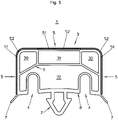
- the profile arrangement 1 comprises a base 8, at least one fastening element 2, at least one sealing arrangement 3 and at least one coating element 5.
- the sealing arrangement 3 of the profile arrangement 1 according to the invention has the hollow chamber 30, 31, 32 and consists of a flexible polymeric material with a Shore A hardness according to DIN EN ISO 868 of about 75, the material being a thermoplastic elastomer based on polyolefin.
- the profile arrangement 1 has a cover element 7 on each of its free ends opposite the base 2 , which is arranged in one piece on the sealing arrangement 3 approximately at an acute angle.
- the profile arrangement 1 according to the invention is designed in such a way that a movement arrangement 4 arranged in the base 8 is arranged between the fastening arrangement 2 and the cover elements arranged at the free ends of the sealing arrangement 3 .
- the movement arrangement 4 serves to ensure the basic function of the profile arrangement 1 according to the invention, namely sealing, in terms of movement.
- the profile arrangement 1 according to the invention also has a coating element 5 which is arranged in a materially bonded manner on the sealing arrangement 3 .
- the coating element 5 is arranged over the entire surface of the walls of the sealing arrangement 3 surrounding the hollow chambers 30 , 31 , 32 .
- the coating element 5 has a top layer 51 and a bottom layer 52 connected thereto.
- the lower layer 52 of the coating element 5 is a reactively activatable adhesive selected from the group of polyolefins.
- the profile arrangement according to the invention is designed such that a coating element 5 is arranged on the hollow chamber 31 of the sealing arrangement 3 of the profile arrangement 1 according to the invention, which has an underlayer with a thickness of about 0.01 mm.
- the coating element 5 is formed in this embodiment such that the top layer 51 has a thickness of about 0.015 and is in this embodiment applied to the profile arrangement 1 in a hot stamping process.
- the top layer 51 of the coating element 5 is also designed such that it consists of a polymer material to which a metallic coating, for example aluminum, is applied, so that the top layer 51 of the coating element 5 is designed on the one hand as a decorative element and on the other hand both as a diffusion the material of the sealing arrangement 3 is effectively prevented, as well as the function of the magnetic element, not shown, arranged in the hollow chamber 31 for closing the refrigerator and/or freezer.
- the profile arrangement 1 according to the invention is also designed in such a way that a further coating element 5 is arranged on the outer walls of the hollow chamber 30 , 32 of the sealing arrangement 3 .
- the coating element 5 has an upper layer 51 and a lower layer 52 connected thereto and is in each case bonded to the wall of the hollow chamber 30, 32 of the sealing arrangement 3 of the profile arrangement 1 according to the invention.
- the coating element 5 has a total thickness of approximately 0.162 mm, with the thickness of the lower layer 52 being approximately 0.012 mm and the thickness of the upper layer 51 being approximately 0.15 mm, and in this exemplary embodiment it is applied to the profile arrangement 1 in an extrusion process.
- the lower layer 52 of the coating element 5 is made of a polymer material, namely a polyolefin, in particular polyethylene (PE), while the upper layer 51 of the coating element 5 is made of aluminum as a metallic foil.
- PE polyethylene
- the profile arrangement 1 according to the invention can thus be provided with a wide variety of new functionalities in this exemplary embodiment through the choice of geometry, the material and the arrangement of the coating element 5, which on the one hand enable an economical and cost-effective production of the profile arrangement 1 according to the invention, and on the other hand a material-related diffusion of additives in particular from the sealing arrangement 3 of the profile arrangement 1 according to the invention and when the profile arrangement 1 according to the invention is used as intended in the construction-related gap between the body, not shown, and the closure element the refrigerator and / or freezer 10 ensures a visually appealing appearance and an optimal sealing function.
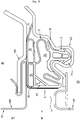
- the profile arrangement 1 according to the invention in particular for a refrigerator and/or freezer, is analogous to that in 4 constructed and comprises a base 8, a fastening arrangement 2, a coating element 5 and a sealing arrangement 3.
- the sealing arrangement 3 of the profile arrangement 1 according to the invention has the hollow chambers 30, 31, 32, 33 and is made of a flexible polymeric material with a Shore A hardness according to DIN EN ISO 868 of about 80.
- the profile arrangement 1 has a cover element 7 at its free end opposite the base 2 , which is arranged in one piece on the sealing arrangement 3 approximately at an acute angle.
- a cover element 7 is also designed in such a way that it covers the transitions between the inner lining and the outer lining of a closure element that are due to the design.
- the wall of the hollow chamber 30 , 32 , 33 and the cover element 7 have a coating element 5 .
- the coating element 5 is arranged in a materially bonded manner on the sealing arrangement 3 and the cover element 7 .
- the entire gap between the closure element and the body of the refrigerator and/or freezer can also be given a real metal look that exactly matches the look of the closure element and/or the body of the Fridge and / or freezer corresponds represent.
- the coating element 5 of the profile arrangement 1 according to the invention has a top layer 51 and a bottom layer 52 connected thereto.
- the underlayer 52 of the coating element 5 is made of the polymeric material polyvinyl chloride (PVC).
- the underlayer 52 of the coating element 5 has a thickness of about 0.15 mm.
- the lower layer 52 of the coating element 5 has a Shore D hardness according to DIN 53505 of about 70 to 90, preferably 75 to 85.
- the flexibility of the coating element 5 can thus also serve as a support element, for example, or compensate for unevenness in the profile arrangement 1.
- the upper layer 51 of the coating element 5 is in the form of a multi-layer film, in particular a plastic film, for example based on a polyester with a metallic coating arranged thereon or underneath, and has a thickness of approximately 0.01 mm. Furthermore, the upper layer 51 of the coating element 5 is arranged in a materially bonded manner on the lower layer 52 of the coating element 5 by means of a hot-melt adhesive.
- the coating element 5 of the profile arrangement 1 according to the invention is made available in a separate manufacturing process and then made available in an inline method, in this exemplary embodiment by extrusion in a tool together with the profile arrangement 1 according to the invention in a manufacturing process.
- the upper layer 51 of the coating element 5 is connected to the sealing arrangement 3 and the cover element 7 of the profile arrangement 1 according to the invention via the lower layer 52 in a materially bonded manner.
- the profile arrangement 1 according to the invention is designed in such a way that, when it is used as intended in a refrigerator and/or freezer (not shown), in particular external influences such as UV rays or chemical influences, for example by cleaning the surface of the profile arrangement 1 according to the invention, effectively remove of the sealing arrangement 3 realizing the basic function can be shielded.
- a further advantage of the profile arrangement 1 according to the invention is that when used as intended on a closure element and/or on a body of a refrigerator and/or freezer, the production-related and / or assembly-related tolerances resulting gap can be covered directly, completely and visually appealing.
Landscapes
- Engineering & Computer Science (AREA)
- General Engineering & Computer Science (AREA)
- Mechanical Engineering (AREA)
- Chemical & Material Sciences (AREA)
- Combustion & Propulsion (AREA)
- Physics & Mathematics (AREA)
- Thermal Sciences (AREA)
- Refrigerator Housings (AREA)
Description
- Die Erfindung betrifft eine Profilanordnung, insbesondere für ein Kühl- und / oder Gefriergerät, umfassend wenigstens eine Basis, wenigstens eine Befestigungsanordnung, wenigstens ein Beschichtungselement, sowie wenigstens eine Dichtungsanordnung, welche wenigstens eine Hohlkammer aufweist und aus einem weichelastischen, polymeren Werkstoff hergestellt ist, mit einer Härte Shore A gemäß DIN EN ISO 868 von etwa 60 bis 90; ein Verschlusselement sowie ein Kühl- und / oder Gefriergerät mit einer solchen Profilanordnung.
- Derartige Profilanordnungen sind im Stand der Technik bereits beschrieben. Diese Profilanordnungen haben insbesondere im Einsatz bei Kühl-und / oder Gefriergeräten die wichtige Funktion, den konstruktiv bedingten Spalt zwischen dem Verschlusselement und einem Korpus abzudichten, Toleranzen auszugleichen und im Falle des Einsatzes von Magnetprofilanordnungen das Verschließen der Kühlgerätetür am Korpus mittels Magnethaftkraft zu gewährleisten. Dabei erfolgt bei den Profilanordnungen gemäß des Standes der Technik der Toleranzausgleich sowie der Hub der Profilanordnung mittels unterschiedlicher Balgkonstruktionen, welche im Sichtbereich dieser Profilanordnungen deutlich erkennbar sind. So offenbart die
EP 0 599 161 B1 eine derartig gattungsgemäße Profilanordnung. - Die Profilanordnung ist hierbei als Dichtungsanordnung ausgebildet für die Tür eines Kühl- oder Gefriergerätes, mit einem wärmeisolierenden Gehäuse, dessen Öffnung mit einer Tür verschließbar ist, die an ihrer der Öffnung zugewandten, mit einer Innenverkleidung ausgestatteten Seite eine am Rand der Tür umlaufend angeordnete, balgartige Magnetdichtung aufweist, die mit einem Dichtungskopf und einem Dichtungsfuß ausgestattet ist, die miteinander mit flexiblen, als Dehnfalten ausgebildeten Wandungen verbunden sind, wobei der Dichtungsfuß in einer öffnungsseitig sich verjüngenden, zur Türöffnung gerichteten Aufnahmenut an der Innenverkleidung verankert ist, während der mit Magnetleisten ausgestattete Dichtungskopf im geschlossenen Zustand der Tür am Öffnungsrand des Gehäuses aufliegt und die Tür am Öffnungsrand festhält, wobei der Dichtungskopf zum Dichtungsfuß seitlich versetzt angeordnet ist, welcher mit einer einseitigen Ausbauchung ausgestattet ist, welche mit einem Hinterschnitt in der Aufnahmenut zusammenwirkt und welche entgegengesetzt zum seitlichen Versatz näher am Dichtungskopf angeordnet ist, wobei sich die der Ausbauchung gegenüberliegende Seite des Dichtungsfußes in der Aufnahmenut abstützt, wobei der Dichtungsfuß mit einem Einführkeil versehen ist und auf seiner der Ausbauchung gegenüberliegenden Seite einen Vorsprung aufweist, welchem in Wesentlichen höhengleich zum Maximum der Ausbauchung angeordnet ist und welcher in der Aufnahmenut sich unter einer geringen Vorspannung am Wandabschnitt der Aufnahmenut abstützt. Dabei sind die als Dehnfalten ausgebildeten Wandungen von der die Magnetleiste aufnehmenden Hohlkammer des Dichtungskopfes beabstandet angeordnet.
- Eine weitere gattungsgemäße Profilanordnung ist in der
DE 601 15 098 T2 offenbart. Diese gattungsgemäße Profilanordnung ist als verbesserte Dichtungsanordnung für Kühlschränke und ähnliches mit einem aus Kunststoffmaterial hergestellten Profil ausgebildet, wobei die Anordnung aus einem Schrank, einer Tür und einem Innentürfeldelement, welches mit dem Schrank gekoppelt werden kann und einem Abschnitt einer Balgdichtung besteht, welche einen abgedichteten Verschluss zwischen der Tür und dem Schrank bereitstellt, wobei vorgesehen ist, dass ein Profil und der Dichtungsabschnitt zusammengepasst sind oder ein einzelnes integrales Teil ausbilden, welches durch Koextrusion von zwei Materialien, welche verschiedene Festigkeitsgrade aufweisen, hergestellt ist, um so, falls nötig, ein bequemes Ablösen des Dichtungsabschnitts vom Profil entlang des Bereichs ihrer Verbindung zu ermöglichen, wobei das Profil eine Rille, die dazu ausgestattet ist, einen Ersatzabschnitt einer Balgdichtung aufzunehmen und wenigstens einen elastisch nachgiebigen Seitenabschnitt aufweist, welcher wirkt, um eine Schnappverbindung zwischen dem Profil und dem Innentürfeldelement bereitzustellen, wobei der Abschnitt mit einer gerillten Aufnahme endet, welche einen im Wesentlichen C-förmigen Querschnitt aufweist und so ausgestaltet ist, um eine Kante des Innentürfeldelements aufzunehmen, wobei man sich weiter vorstellt, dass das Profil eine Basis aufweist, welche an gegenüberliegenden Enden mit Dichtungsstreifen versehen ist, die mit der Tür und dem Innentürfeldelement zusammenwirken, wobei an der gerillten Aufnahme, welche einen im Wesentlichen C-förmigen Querschnitt aufweist, wenigstens ein Dichtstreifen vorgesehen ist, welcher aus einem weichen Material hergestellt ist und gegenüberliegend der Kante des Innentürfeldelements eingerichtet ist, sodass, wenn das Innentürfeldelement wirksam mit dem Profil gekoppelt ist, der Dichtungsstreifen unter der Wirkung einer elastischen Rückstellung des Abschnitts gegen die Kante des Innentürfeldelements zusammengedrückt wird, wobei man sich weiter vorstellt, dass ein - Krümmungsbereich im rechten Winkel des Innentürfeldelements einen Radius von etwa 3 bis 6 mm aufweist, um so eine optimale Kontrastwirkung mit einem der Dichtungsstreifen der Basis des Profils sicherzustellen.
- Der Dichtungsabschnitt ist weiter so ausgebildet, dass er eine dehnbare Kammer festlegt, die als ein Balg wirkt und eine obere Kammer aufweist, die ausgestaltet ist um einen Stab aus magnetischem Material aufzunehmen. Zwischen der oberen Kammer bzw. der dehnbaren Kammer und dem der Dichtungsanordnung ist ein Spalt ausgebildet.
- Nachteilig bei diesem Stand der Technik ist es, dass sich in den verschiedenen Geometrien der Balgdichtungen bzw. der Dichtungsanordnungen sehr leicht Verschmutzungen im Bereich der Dehnfalten absetzen, die sich dann nur sehr schwierig entfernen lassen.
- Weiterhin nachteilig ist, dass bei bestimmungsgemäßer Verwendung dieser Dichtungsanordnungen es Material bedingt zu einer, wenn auch geringfügigen, Diffusion von Additiven bspw. des Weichmachers kommen kann, welche einerseits die elastischen Eigenschaften der Dichtungsanordnungen negativ beeinflusst und andererseits dazu führen kann, dass auch die sichtbaren Bauteile wie der Korpus sowie die Tür des Kühl- und/oder Gefriergeräten an ihrer Oberfläche optische Beeinträchtigungen aufweisen können.
- Ein weiterer Nachteil der Profilanordnungen aus dem Stand der Technik besteht darin, dass insbesondere die bei geschlossenen Kühl- und / oder Gefriergeräten dem Betrachter entgegentretende Optik im Spalt zwischen der Tür und dem Korpus des Kühl- und/oder Gefriergerätes durch diese Profilanordnung optisch nicht ansprechend wirken, was auch dadurch bedingt ist, dass eine Profilanordnung, die Tür sowie der Korpus aus unterschiedlichen Werkstoffen hergestellt sind und so eine andere Optik bzw. eine andere Haptik aufweisen. Weiterhin nachteilig ist, dass es im Stand der Technik nur sehr begrenzte Gestaltungsmöglichkeiten der Profilanordnung bestehen, welche aber optisch bzw. haptisch zu den teils sehr hochwertigen Kühl-und/oder Gefriergeräten optisch abfallen.
- Hier setzt die Erfindung ein, die sich die Aufgabe gestellt hat, eine gattungsgemäße Profilanordnung zur Verfügung zu stellen, die die Nachteile des bekannten Standes der Technik überwindet, die wirtschaftlich und kostengünstig herstellbar ist, die den konstruktiv bedingten Spalt zwischen Verschlusselement und Korpus eines Kühl- und / oder Gefriergerätes optisch ansprechend abdeckt, die reinigungsfreundlich ist und bei der nahezu keine Diffusion aus dem verwendeten Werkstoff auftritt; einem derartigen Verschlusselement sowie ein Kühl- und/oder Gefriergerät mit jeweils einer solchen Profilanordnung.
- In der
DE 19711175 A1 ist offenbart eine Dichtprofilleiste mit einem auf einen Gehäuseflansch aufsetzbaren Halteteil und einem gegen eine Gehäuseabdeckung wirkenden Dichtteil, wobei die Dichtprofilleiste mit einem sowohl mit dem Gehäuseflansch als auch mit der Gehäuseabdeckung durchlaufend in Anlageberührung stehenden Überbrückungselement aus elektrisch leitfähigen Material ausgestattet ist. Das Überbrückungselement ist dabei aus Metallfäden oder dünnen Metalldrähten oder einer Litze ausgebildet und durch kleben, schweißen, kaschieren, laminieren oder Koextrusion innig mit der Dichtprofilleiste verbunden - Die
DE 202007017302 U1 offenbart eine Gleitdichtung für Fenster, Türen, Rollläden und dergleichen, mit mindestens einem Dichtungsfuß, mittels dessen die Gleitdichtung an einem Bauteil befestigbar ist, mit mindestens einem geschlossenen Hohlprofilkörper, der mindestens eine Dichtzone mit mindestens einer Gleitschicht sowie zwei Seitenwände aufweist, die sich ausgehend von der Dichtzone in Richtung auf den Dichtfuß erstrecken, wobei der mindestens eine geschlossene Hohlprofilkörper an seinen beiden Seitenwänden jeweils mindestens eine in das Innere des Hohlprofilkörpers gerichtete Einwölbung aufweist. Der Hohlprofilkörper ist aus einem elastomeren Material mit einer Shore A- Härte von 40 bis 60 und durch Koextrusion mit dem Dichtungsfuß aus Hartmaterial verbunden. An der dem Dichtungsfuß abgewandten Außenseite ist eine Gleitschicht aus hartem Material durch Koextrusion eingeformt. -
DE 10 2007 008707 A1 undDE 20 2014 103892 U1 offenbaren eine ähnliche Profilanordnung für ein Kühl- und oder Gefriergerät. - Erfindungsgemäß wird die Aufgabe durch die Merkmale des Anspruches 1 gelöst. Weitere vorteilhafte Ausgestaltungen sind in den Unteransprüchen beschrieben.
- Es hat sich überraschend herausgestellt, dass eine Profilanordnung, insbesondere für Kühl-und / oder Gefriergerät, umfassend wenigstens eine Basis, wenigstens eine Befestigungsanordnung, wenigstens ein Beschichtungselement, sowie wenigstens eine Dichtungsanordnung, welche wenigstens eine Hohlkammer aufweist und aus einem weichelastischen, polymeren Werkstoff hergestellt ist, mit einer Härte Shore A gemäß DIN EN ISO 868 von etwa 60 bis 90, sich dadurch auszeichnet, dass das Beschichtungselement stoffschlüssig an der Dichtungsanordnung angeordnet ist. Die erfindungsgemäße Profilanordnung ist dabei so ausgebildet, dass für die bestimmungsgemäße Verwendung wenigstens die sichtbare Oberfläche der Dichtungsanordnung, welche in dem konstruktiv bedingten Spalt zwischen dem Verschlusselement und dem Korpus eines Kühl- und / oder Gefriergerätes sichtbar ist, durch ein Beschichtungselement diffusionsfest verschlossen ist. Ein weiterer Vorteil der erfindungsgemäßen Profilanordnung besteht darin, dass bei deren bestimmungsgemäßer Verwendung auch wenigstens die, dem Korpus des Kühl-und/oder Gefriergerätes gegenüberliegend angeordnete, Oberfläche der Dichtungsanordnung ebenfalls diffusionsfest verschlossen ist.
- Die erfindungsgemäße Profilanordnung ist auch so ausgebildet, dass das Beschichtungselement stoffschlüssig an wenigstens einer, die Hohlkammer umgebenden, Wand der Dichtungsanordnung angeordnet ist. Hierdurch ist einerseits sichergestellt, dass das Beschichtungselement die Wand der Dichtungsanordnung diffusionsfest verschließt während es andererseits dadurch auch möglich ist, das bei bestimmungsgemäßer Verwendung an einem Verschlusselement und / oder einem Kühl- und / oder Gefriergerät das stoffschlüssig an der Profilanordnung angeordnete Beschichtungselement den konstruktiv bedingten Spalt zwischen dem Verschlusselement und dem Korpus des Kühl- und / oder Gefriergerätes optisch ansprechend, abdeckend verschließt. Ebenfalls vorteilhaft ist, dass bei bestimmungsgemäßer Verwendung der erfindunggemäßen Profilanordnung auch wenigstens die, dem Korpus des Kühl-und/oder Gefriergerätes gegenüberliegend angeordnete, Oberfläche der Dichtungsanordnung diffusionssicher verschlossen ist.
- Ein weiterer Vorteil der erfindungsgemäßen Profilanordnung besteht auch darin, dass durch die Anordnung, den Werkstoff sowie die Ausgestaltung des stoffschlüssig an der Dichtungsanordnung angeordneten Beschichtungselementes der konstruktiv bedingte Spalt zwischen dem Verschlusselement und dem Korpus des Kühl- und / oder Gefriergerätes nicht nur optisch ansprechend gestaltet ist, sondern das die erfindungsgemäße Profilanordnung auch sehr reinigungsfreundlich ist, beispielsweise durch eine glatte Oberfläche des Beschichtungselementes.
- Weiterhin vorteilhaft bei der erfindungsgemäßen Profilanordnung ist, dass das Beschichtungselement mittels Druck und / oder Temperatur, vorzugsweise in einem Inline-Verfahren, auf die Dichtungsanordnung aufgebracht ist. Hierdurch ist es erstmals überraschenderweise gelungen, eine aus einem weichelastischen, polymeren Werkstoff hergestellte Dichtungsanordnung überhaupt mit einem Beschichtungselement stoffschlüssig zu verbinden, ohne das die Haupteigenschaften der erfindungsgemäßen Profilanordnung, insbesondere der Dichtungsanordnung, negativ beeinträchtigt sind. Hierdurch ist es ebenfalls überraschenderweise möglich, das Beschichtungselement insbesondere auf eine dünnwandige Hohlkammer einer Dichtungsanordnung der Profilanordnung stoffschlüssig und optisch ansprechend aufzubringen. Es liegt jedoch auch im Rahmen der Erfindung, dass das Beschichtungselement mittels Druck und/oder Temperatur in einem online-Verfahren bzw. in einem Off line-Verfahren auf eine Profilanordnung aufgebracht ist.
- Es hat sich weiterhin als vorteilhaft bei der erfindungsgemäßen Profilanordnung herausgestellt, dass die Oberfläche der Dichtungsanordnung und / oder des Beschichtungselementes vor dem Aufbringen des Beschichtungselementes durch eine chemische und/oder physikalische Behandlung, vorzugsweise durch eine Wärme-, Flamm-, Plasma-, Mikrowellen-, Infrarot- oder Korona-Behandlung aktiviert ist. Hierdurch ist es überraschenderweise möglich, eine dauerhafte, stoffschlüssige Verbindung zwischen dem Beschichtungselement und der Dichtungsanordnung der erfindungsgemäßen Profilanordnung zu realisieren.
- Erfindungsgemäss weist das Beschichtungselement wenigstens eine Oberschicht sowie wenigstens eine damit verbundene Unterschicht auf. Durch diese vorteilhafte Ausgestaltung des Beschichtungselementes der erfindungsgemäßen Profilanordnung ist es erstmals möglich, eine dauerhafte, stoffschlüssige Verbindung zwischen dem Beschichtungselement über die Unterschicht der Dichtungsanordnung der erfindungsgemäßen Profilanordnung zu realisieren und andererseits durch die Ausgestaltung, die Werkstoffe, sowie die Geometrie der Oberschicht zu erreichen, dass einerseits keine Diffusion bzw. Migration von Additiven aus der Dichtungsanordnung der erfindungsgemäßen Profilanordnung stattfindet und das andererseits die erfindungsgemäße Profilanordnung einen umfangreichen und dauerhaften Schutz insbesondere gegenüber UV-Strahlen aufweist. Ein weiterer Vorteil der erfindungsgemäßen Profilanordnung besteht darin, dass diese durch das Beschichtungselement auch einen dauerhaften Schutz gegen einen möglichen mikrobiellen Bewuchs, insbesondere bei einer bestimmungsgemäßen Verwendung des Kühl-und/oder Gefriergerätes beispielsweise in Küchen, aufweist.
- Das Beschichtungselement der erfindungsgemäßen Profilanordnung weist weiterhin eine Oberschicht sowie eine damit stoffschlüssig verbundene Unterschicht auf. Die Unterschicht des Beschichtungselementes ist aus dem polymeren Werkstoff Polyvinylchlorid (PVC) hergestellt. Weiterhin weist die Unterschicht des Beschichtungselementes eine Härte Shore D gemäß DIN 53505 von etwa 70 bis 90, bevorzugt 75 bis 85 auf.
- Durch die Variation der Dicke und/oder der Shore-Härte der Unterschicht des Beschichtungselementes ist es erstmals möglich, dass die Flexibilität des Beschichtungselements individuell einstellbar ist. Damit kann das Beschichtungselement z.B. auch als Stützelement dienen oder Unebenheiten der erfindungsgemäßen Profilanordnung ausgleichen.
- Die Oberschicht des Beschichtungselements ist als mehrschichtige Folie, insbesondere als Kunststofffolie bspw. auf Basis eines Polyesters, mit einer darauf oder darunter angeordneten, metallischen Beschichtung ausgebildet und weist eine Dicke von etwa 0,01 mm auf.
- Es hat sich weiterhin als vorteilhaft herausgestellt bei der erfindungsgemäßen Profilanordnung, dass die Unterschicht und/oder die Oberschicht des Beschichtungselementes wenigstens teilweise einen reaktiven, aktivierbaren Klebstoff aufweist. In diesem Zusammenhang kann es erfindungsgemäß vorgesehen sein, dass als Klebstoff thermoplastische oder reaktive Schmelzklebstoffe zum Einsatz kommen. Bei den Schmelzklebstoffen kann es sich um thermoplastische, insbesondere nichtreaktive Schmelzklebstoffe oder um reaktive Schmelzklebstoffe handeln. Diesbezüglich können als Schmelzklebstoffe thermoplastische Schmelzklebstoffe, insbesondere Schmelzklebstoffe auf Basis von Ethylen/Vinylacetaten (EVA); Polyolefinen, wie amorphen Poly-a-olefinen oder metallocenkatalytisch hergestellten Polyolefinen; Polyacrylaten; Copolyamiden; Copolyestern; und/oder thermoplastischen Polyurethanen oder ihren entsprechenden Co-und/oder Terpolymeren, eingesetzt werden. Zudem ist es erfindungsgemäß möglich, dass als Schmelzklebstoffe reaktive SchmelzklebStoffe, insbesondere feuchtigkeitsvernetzende und/oder strahlenvernetzende, insbesondere UV-vernetzende Schmelzklebstoffe, vorzugsweise Schmelzklebstoffe auf Basis von silangepfropften amorphen Poly-a-olefinen und/oder isocyanatterminierten Polyurethanen, besonders bevorzugt Schmelzklebstoffe auf Basis von isocyanatterminierten Polyurethanen, eingesetzt werden und/oder wobei als Schmelzklebstoffe reaktive Schmelzklebstoffe auf Basis strahlenvernetzender reaktiver Klebstoffe, insbesondere unter UV-Bestrahlung vernetzender Schmelzklebstoffe, eingesetzt werden können.
- Ein weiterer Vorteil besteht darin, dass das so ausgebildete Beschichtungselement der erfindungsgemäßen Profilanordnung vorteilhafterweise gleichzeitig mit der erfindungsgemäßen Profilanordnung beispielsweise im Extrusionsverfahren, im Koextrusionsverfahren sowie im Postcoextrusionsverfahren wirtschaftlich und kostengünstig herstellbar ist.
- In einer weiteren vorteilhaften Ausgestaltung weist die erfindungsgemäßen Profilanordnung als auch die Unterschicht des Beschichtungselementes wenigstens teilweise einen polymeren Werkstoff auf, ausgewählt aus der Gruppe wie Polyvinylchlorid (PVC); Polyolefin, wie Polypropylen (PP) oder Polyethylen (PE); styrolbasiertes Polymer, wie Polystyrol (PS) oder Styrol-Butadien-Copolymer mit überwiegendem Styrolanteil (SB) oder Acrylnitril-Styrol-Acrylester-Copolymere (ASA) oder Acrylnitril-Butadien-Styrol-Copolymere (ABS) oder Styrolacrylnitril (SAN); Polybutylentherephthalat (PBT); Polyethylentherephthalat (PET); Polyoxymethylen (POM); Polyamid (PA); Polymethylmethacrylat (PMMA); Polyphenylenoxid (PPO); Polyetheretherketon (PEEK); Polyphenylensulfid (PPS); Liquid Crystal Polymer (LCP); Polyamidimide (PAI); Polyvinylidenfluorid (PVDF); Polyphenylsulfon (PPSU); Polyaryletherketon (PAEK); Polyacrylnitril (PAN); Polychlortrifluorethylen (PCTFE); Polyetherketon (PEK); Polyimid (PI); Polyisobuten (PIB); Polyphthalamid (PPA); Polypyrrol PPY);Polytetrafluorethylen (PTFE); Polyurethan (PUR); Polyvinylalkohol (PVA); Polyvinylacetat (PVAC); Polyvinylidenchlorid (PVDC); sowie Mischungen aus wenigstens zwei dieser Materialien.
- Es konnte weiterhin festgestellt werden, dass bei der erfindungsgemäßen Profilanordnung auch die Dichtungsanordnung wenigstens teilweise einen polymeren Werkstoff aufweist, ausgewählt aus der Gruppe der Thermoplastischen Elastomere bspw. auf Olefinbasis und/oder auf Urethanbasis, der vernetzten thermoplastischen Elastomere auf Olefinbasis, der Thermoplastischen Copolyester, der Styrol-Blockcopolymere (SBS, SEBS, SEPS, SEEPS und MBS) sowie der Thermoplastischen Copolyamide. Weiterhin der weihmacherhaltigen Werkstoffe, bevorzugt Polypropylen, Acrylnitril-Butadien-Styrol-Copolymerisat, Polycarbonat, Polyvinylchlorid, Polymethylmethacrylat, Polyethylenterephthalat, Polyurethan und dgl., sowie aus Mischungen dieser Werkstoffe.
- Somit lässt sich die erfindungsgemäße Profilanordnung wirtschaftlich und kostengünstig herstellen und insbesondere wenn der Werkstoff der Unterschicht des Beschichtungselementes mit dem Werkstoff der Dichtungsanordnung der erfindungsgemäßen Profilanordnung ähnlich oder gleich ist eine dauerhafte, optisch ansprechende, stoffschlüssige Verbindung realisieren.
- Es hat sich weiterhin als vorteilhaft bei der erfindungsgemäßen Profilanordnung herausgestellt, dass die Dicke des Beschichtungselementes zwischen 0,01 bis 0,5 mm, vorzugsweise zwischen 0,01 bis 0,25 mm liegt. Hierdurch ist das Beschichtungselement der erfindungsgemäßen Profilanordnung an sich wirtschaftlich und kostengünstig herstellbar und lässt sich je nach Anforderungen insbesondere der die Dichtungsfunktion der erfindungsgemäßen Profilanordnung realisierenden Dichtungsanordnung eine optimale, stoffschlüssige Verbindung zwischen diesen realisieren.
- In einer ebenfalls vorteilhaften Ausgestaltung ist die erfindungsgemäße Profilanordnung so ausgebildet, dass die Oberschicht des Beschichtungselementes als Dekorelement ausgebildet und / oder wenigstens teilweise ein Dekorelement aufweist. Somit kann neben der wichtigen diffusionshemmenden Funktion des Beschichtungselementes die erfindungsgemäße Profilanordnung so zur Verfügung gestellt werden, dass insbesondere der konstruktiv bedingte Spalt zwischen dem Verschlusselement und dem Korpus eines Kühl- und / oder Gefriergerätes optisch ansprechend, abdichtend verschließbar ist. Es liegt dabei auch im Rahmen der Erfindung, dass die Oberschicht des Beschichtungselementes und/oder das Dekorelement wenigstens teilweise einen metallischen Werkstoff aufweist bzw. als Metallfolie ausgebildet ist.
- In einer weiteren ebenfalls vorteilhaften Ausgestaltung der erfindungsgemäßen Profilanordnung weist das Beschichtungselement an wenigstens einer Seite eine spezielle Beschichtung auf. Diese Beschichtung kann beispielsweise als reflektierende Verspiegelung ausgebildet sein, welche zu optimaler Reflektion der in der Umgebung des Kühl- und/oder Gefriergerätes befindlichen Wärme führt. Je nach der Dicke und Art des verwendeten Werkstoffes der Beschichtung kann eine Reduzierung des Energiedurchtritts um etwa bis zu 15 % realisiert werden. Vorteilhafterweise haben sich hier Beschichtungen aus einem metallischen Werkstoffen wie bspw. Aluminium, Gold, Silber und dgl. erwiesen. Es liegt jedoch auch im Rahmen der Erfindung, dass die Beschichtung aus thermoplastischen, duromeren bzw. keramischen Werkstoffen besteht.
- Dabei hat es sich weiterhin als vorteilhaft herausgestellt bei der erfindungsgemäßen Profilanordnung, dass die Dicke des Beschichtungselementes zwischen 0,01 bis 0,5 mm, vorzugsweise zwischen 0,01 bis 0,25 mm liegt. Durch diese vorteilhafte Ausgestaltung des Beschichtungselementes ist eine erfindungsgemäße Profilanordnung zur Verfügung stellbar, bei der einerseits bei bestimmungsgemäßer Verwendung im konstruktiv bedingten Spalt zwischen dem Verschlusselement und dem Korpus der eines Kühl- und / oder Gefriergerätes aufweisende Teil der Dichtungsanordnung diffusionsdicht verschlossen und optisch ansprechbar ausgestaltet ist und andererseits auch der Teil der Dichtungsanordnung der erfindungsgemäßen Profilanordnung der mit dem Korpus bzw. dem Verschlusselement selbst bei bestimmungsgemäßer Verwendung in Wirkverbindung steht, dessen Oberfläche durch möglicherweise austretende Additive optisch nicht beeinträchtigen.
- Ebenfalls vorteilhaft ist die erfindungsgemäße Profilanordnung so ausgebildet, dass die die Hohlkammer umgebenden Wände der Dichtungsanordnung eine Wandstärke von etwa 0,1 bis 2 mm, vorzugsweise 0,2 bis 1,5 mm aufweisen. Die erfindungsgemäße Profilanordnung ist somit wirtschaftlich und kostengünstig herstellbar und erfüllt somit ihre Grundfunktion, nämlich das Abdichten zwischen dem Verschlusselement und dem Korpus eines Kühl- und / oder Gefriergerätes bei bestimmungsgemäßer Verwendung über einen langen Zeitraum und ist andererseits überraschenderweise so ausgebildet, dass ein Beschichtungselement überhaupt erst stoffschlüssig auf wenigstens einem Teil der Wand dieser Dichtungsanordnung der erfindungsgemäßen Profilanordnung stoffschlüssig und optisch ansprechend fixierbar ist.
- Es hat sich ebenfalls als vorteilhaft bei der erfindungsgemäßen Profilanordnung herausgestellt, dass die Dichtungsanordnung wenigstens ein Abdeckelement aufweist. Durch diese Ausgestaltung der erfindungsgemäßen Profilanordnung ist es also möglich, bei bestimmungsgemäßem Einsatz an einem Verschlusselement und/oder an einem Korpus eines Kühl- und / oder Gefriergerätes einen möglicherweise durch fertigungsbedingte und/oder montagebedingte Toleranzen entstehenden Spalt am Verschlusselement, bspw. bei Durchbiegungen des Verschlusselementes, unmittelbar sowie optisch ansprechend abzudecken.
- Das Abdeckelement ist weiter so ausgebildet, dass es konstruktivbedingte Übergänge der Innenverkleidung zur Außenverkleidung eines Verschlusselements überdeckt.
- Die Erfindung betrifft weiterhin ein Verschlusselement für ein Kühl- und / oder Gefriergerät mit einer Profilanordnung gemäß den vorherigen Ausführungen.
- Weiterhin betrifft die Erfindung ein Kühl- und / oder Gefriergerät mit einer Profilanordnung gemäß den vorherigen Ausführungen.
- Die erfindungsgemäße Profilanordnung soll nun an Ausführungsbeispielen, die diese nicht einschränken, beschrieben werden.
- Es zeigen:
- Fig. 1:
- perspektivische Darstellung eines geöffneten Kühl- und / oder Gefriergerätes mit einem Verschlusselement und einer Profilanordnung;
- Fig. 2:
- perspektivische Darstellung eines verschlossenen Kühl- und / oder Gefriergerätes mit einem Verschlusselement und einer Profilanordnung;
- Fig. 3:
- Schnittdarstellung einer erfindungsgemäßen Profilanordnung im Einbauzustand;
- Fig. 4:
- Schnittdarstellung einer weiteren erfindungsgemäßen Profilanordnung;
- Fig. 5:
- Schnittdarstellung einer weiteren erfindungsgemäßen Profilanordnung.
- Fig. 6:
- Schnittdarstellung einer weiteren erfindungsgemäßen Profilanordnung.
- Die
Fig. 1 zeigt eine perspektivische Darstellung eines geöffneten Kühl- und / oder Gefriergerätes 10 mit einem Verschlusselement 20 und einer erfindungsgemäßen Profilanordnung 1. - Das Kühl- und / oder Gefriergerät 10 weist einen schrankförmigen Korpus 11 auf, dessen Wände 13 den Innenraum 14 des Kühl- und / oder des Gefriergerätes 10 begrenzen. Die frontseitige Öffnung 12 des Korpus 11 ist durch das Verschlusselementes 20 und der an dieser angeordneten erfindungsgemäßen Profilanordnung 1 abdichtend verschließbar. Das Verschlusselement 20 ist über Scharnieranordnungen 21 in diesem Ausführungsbeispiel um eine vertikale Achse schwenkbar am Korpus 11 des Kühl- und / oder Gefriergerätes 10 angeordnet.
- Die erfindungsgemäße Profilanordnung 1 ist in diesem Ausführungsbeispiel so an der dem Korpus 11 des Kühl- und / oder Gefriergerätes 10 gegenüberliegend angeordneten Seite des Verschlusselementes 20 angeordnet, dass die Profilanordnung 1 bei geschlossener Position des Verschlusselementes 20 um die Öffnung 12 des Kühl- und / oder Gefriergerätes 10 über das Beschichtungselement 5 am Korpus 11 anliegt und den Spalt zwischen dem Verschlusselement 20 und dem Korpus 11 des Kühl- und / oder Gefriergerätes 10 abdichtet.
- In der
Fig. 2 zeigt eine perspektivische Darstellung eines verschlossenen Kühl- und / oder Gefriergerätes 10 mit einem Verschlusselement 20 und einer erfindungsgemäßen Profilanordnung 1. - Das Kühl- und / oder Gefriergerät 10 umfasst einen Korpus 11 und wenigstens ein, eine Öffnung des Korpus 11 verschließendes, Verschlusselement 20.
- Zwischen dem Verschlusselement 20 sowie dem Korpus 11 ist ein Spalt 19 erkennbar, in dem eine erfindungsgemäße Profilanordnung 1 angeordnet ist, welche so ausgebildet ist, dass die nicht sichtbare Dichtungsanordnung ein Beschichtungselement 5 aufweist, welches den Spalt 19 optisch ansprechend und abdichtend verschließt.
- Die erfindungsgemäße Profilanordnung 1 kann dabei sowohl am Verschlusselement 20 als auch am Korpus 11 des Kühl- und / oder Gefriergerätes 10 angeordnet sein.
- In der
Fig. 3 ist eine Schnittdarstellung einer erfindungsgemäßen Profilanordnung 1 in ihrem Einbauzustand in einem nur im Detail dargestellten Ausschnitt eines Kühl- und / oder Gefriergerät 10 dargestellt. - Das Kühl- und / oder Gefriergerät 10 weist einen Korpus 11 auf, der in diesem Ausführungsbeispiel durch die Wand 13 gebildet ist.
- Die Wand 13 des Korpus 11 des Kühl- und / oder Gefriergerätes 10 weist ein erstes Wandelement 130 auf, welches aus Metall hergestellt und mit einer Farb- bzw. Lackschicht beschichtet ist sowie ein daran angeordnetes zweites Wandelement 131, welches aus einem polymeren Werkstoff besteht. Das erste Wandelement 130 ist mit dem zweiten Wandelement 131 kraftschlüssig verbunden.
- Gegenüber dem Korpus 11 des Kühl- und / oder Gefriergerätes 10 ist ein teilweise im Schnitt dargestelltes Verschlusselement 20 angeordnet, welches in diesem Ausführungsbeispiel ein erstes Verschlussteil 21, welches aus einem beschichteten, metallischen Werkstoff hergestellt ist und ein daran angeordnetes, zweites Verschlussteil 22 aufweist, welches aus einem polymeren Werkstoff hergestellt ist.
- Im zweiten Verschlussteil 22 des Verschlusselements 20 ist eine Nut 23 angeordnet, in der die Befestigungsanordnung 2 der erfindungsgemäßen Profilanordnung 1 angeordnet ist.
- Die erfindungsgemäße Profilanordnung 1 umfasst eine Basis 8, eine Befestigungsanordnung 2, ein Beschichtungselement 5 sowie wenigstens eine Dichtungsanordnung 3.
- Die erfindungsgemäße Profilanordnung 1 ist in diesem Ausführungsbeispiel so ausgebildet, dass die Dichtungsanordnung 3 die Hohlkammern 30, 31, 32, 33 aufweist, wobei die Dichtungsanordnung 3 an der Basis 8 stoffschlüssig bzw. einstückig angeordnet ist.
- An den die Hohlkammern 30, 31, 32, 33 umgebenden Wand der Dichtungsanordnung 3 ist das Beschichtungselement 5 angeordnet, welches stoffschlüssig an diesen angeordnet ist.
- Die erfindungsgemäße Profilanordnung 1 ist so am Kühl- und / oder Gefriergerät 10 angeordnet, dass das an der Wand der Hohlkammer 30, 31, 32, 33 angeordnete Teil des Beschichtungselementes 5 den Spalt 19 zwischen dem Korpus 11 des Kühl- und / oder Gefriergerät 10 und dem Verschlusselement 20 optisch ansprechend und abdichtend verschließt.
- Die erfindungsgemäße Profilanordnung 1 ist jedoch weiterhin so ausgebildet, dass das an der Wand der Hohlkammer 30, 31 der Dichtungsanordnung 3 ebenfalls stoffschlüssig angeordnete Beschichtungselement 5 das erste Wandelement 130 sowie teilweise das zweite Wandelement 131 der Wand 13 des Korpus 11 des Kühl- und / oder Gefriergerätes 10 so abdeckt, dass die Dichtungsanordnung 3 mit diesem nicht in direkte Wirkverbindung treten kann. So kann wirksam verhindert werden, dass aus dem Werkstoff der Dichtungsanordnung 3 möglicherweise Additive in das beschichtete, erste Wandelement 130 sowie das zweite Wandelement 131 diffundieren.
- Die erfindungsgemäße Profilanordnung 1 ist somit vorteilhafterweise so an dem Kühl- und / oder Gefriergerät 10 angeordnet, dass die Grundfunktion, nämlich das Abdichten des Korpus 11 des Kühl- und / oder Gefriergerätes 10 von dem Verschlusselement 20 problemlos realisierbar ist, sowohl beim Öffnen des Verschlusselements 20 als auch beim Verschließen und es weiterhin erfindungsgemäß sichergestellt ist, dass eine materialbedingte Diffusion insbesondere aus dem Werkstoff der Dichtungsanordnung 3 in beispielsweise die Wand 13, welche das beschichtete, erste Wandelement 130 sowie das zweite Wandelement 131 umfasst, des Korpus 11 des Kühl- und / oder Gefriergerätes 10 durch das dazwischen angeordnete Beschichtungselement 5 erfolgreich verhindert ist.
- Ein weiterer Vorteil der erfindungsgemäßen Profilanordnung 1 ist, dass bei bestimmungsgemäßem Einsatz in einem Kühl- und / oder Gefriergerät 10 insbesondere die durch den konstruktiv bedingten Spalt 19 zwischen dem Korpus 11 und dem Verschlusselement 20 des Kühl- und / oder Gefriergerätes 10 auftretenden beispielsweise UV-Strahlen sowie auch anderer äußerer Einflüsse nicht die Funktion der Dichtungsanordnung 3 der erfindungsgemäßen Profilanordnung 1 beeinträchtigen können, da diese optisch ansprechend und wirksam durch das stoffschlüssig mit dieser verbundene Beschichtungselement 5 geschützt ist. In diesem Ausführungsbeispiel der erfindungsgemäßen Profilanordnung 1 ist das Beschichtungselement 5 mittels Druck und Temperatur in einem Extrusions- bzw. Koextrusionsverfahren auf die Dichtungsanordnung 3 aufgebracht.
- Die Dichtungsanordnung 3 der erfindungsgemäßen Profilanordnung 1 besteht in diesem Ausführungsbeispiel aus einem polymeren Werkstoff, nämlich aus Polyvinylchlorid (PVC) und weist eine Härte Shore A gemäß DIN EN ISO 868 von etwa 80 auf und ist somit auch wirtschaftlich und kostengünstig herstellbar sowie optisch an das Kühl-und/oder Gefriergerät anpassbar.
- Das Beschichtungselement 5 der erfindungsgemäßen Profilanordnung 1 ist über eine nicht mehr sichtbare Unterschicht 52, welche als reaktiver Klebstoff auf Basis des Werkstoffes Polyvinylchlorid (PVC) stoffschlüssig mit der Dichtungsanordnung 3 verbunden ist und eine den Spalt 19 zwischen dem Korpus 11 und dem Verschlusselement 20 des Kühl- und / oder Gefriergerätes 10 abdeckende Oberschicht 51 aufweist. In diesem Ausführungsbeispiel weist das Beschichtungselement 5 eine Dicke von etwa 0,15 mm auf, wobei die Oberschicht 51 als an sich bekannte Folie aus einem metallischen Werkstoff wie beispielsweise Aluminium ausgebildet ist, die gegebenenfalls auch noch eine weitere Zwischenschicht und/oder eine Deckschicht aufweisen kann.
- Die Wand der die Hohlkammern 30, 31, 32, 33 umgebenden Dichtungsanordnung 3 weist in diesem Ausführungsbeispiel eine Wandstärke von etwa 0,01 bis 2 mm, vorzugsweise 0,2 bis 1,5 mm auf.
- In der
Fig. 4 ist eine Schnittdarstellung einer weiteren erfindungsgemäßen Profilanordnung 1 dargestellt. - Die erfindungsgemäße Profilanordnung 1, insbesondere für ein Kühl- und / oder Gefriergerät, umfasst eine Basis 8, eine Befestigungsanordnung 2, ein Beschichtungselement 5 sowie eine Dichtungsanordnung 3.
- Die Dichtungsanordnung 3 der erfindungsgemäßen Profilanordnung 1 weist die Hohlkammern 30, 31, 32, 33 auf und ist aus einem weichelastischen polymeren Werkstoff hergestellt mit einer Härte Shore A gemäß DIN EN ISO 868 von etwa 78.
- Die erfindungsgemäße Profilanordnung 1 weist in diesem Ausführungsbeispiel an ihrem der Basis 2 gegenüberliegenden freien Enden ein Abdeckelement 7 auf, welches etwa in einem spitzen Winkel einstückig an der Dichtungsanordnung 3 angeordnet ist. Vorteilhafterweise ist es dadurch erstmals möglich, bei bestimmungsgemäßem Einsatz an einem Verschlusselement und/oder an einem Korpus eines Kühl- und / oder Gefriergerätes einen möglicherweise durch fertigungsbedingte und/oder montagebedingte Toleranzen entstehenden Spalt am Verschlusselement, bspw. bei Durchbiegungen des Verschlusselementes, direkt abzudecken.
- An dem der Basis 8 der erfindungsgemäßen Profilanordnung 1 gegenüberliegenden freien Ende der Dichtungsanordnung 3 weist die Wand der Hohlkammer 30, 32, 33 ein Beschichtungselement 5 auf.
- Das Beschichtungselement 5 ist stoffschlüssig an der Dichtungsanordnung 3 angeordnet. In diesem Ausführungsbeispiel wurde die Dichtungsanordnung 3 sowie das Beschichtungselement 5 vor dem Aufbringen des Beschichtungselementes 5 durch eine WärmeBehandlung aktiviert.
- Das Beschichtungselement 5 der erfindungsgemäßen Profilanordnung 1 weist in diesem Ausführungsbeispiel eine Oberschicht 51 sowie eine damit verbundene Unterschicht 52 auf. Die Unterschicht 52 des Beschichtungselementes 5 ist in diesem Ausführungsbeispiel aus dem polymeren Werkstoff Polyvinylchlorid (PVC) hergestellt und weist eine Dicke von etwa 0,15 mm auf. Die Unterschicht 52 des Beschichtungselements 5 ist weiterhin so ausgebildet, dass der polymere Werkstoff PVC einen K-Wert von etwa 60 nach DIN 53726 aufweist und eine Härte Shore D gemäß DIN 53505 von etwa 78.
- Die Oberschicht 51 des Beschichtungselements 5 ist in diesem Ausführungsbeispiel als mehrschichtige Folie, insbesondere als Kunststofffolie auf Basis eines Polyesters mit einer darauf angeordneten, metallischen Beschichtung ausgebildet und weist eine Dicke von etwa 0,02 mm auf.
- Das Beschichtungselement 5 der erfindungsgemäßen Profilanordnung wird in einem separaten Herstellungsprozess zur Verfügung gestellt und dann in einem Inline-Verfahren, in diesem Ausführungsbeispiel durch Extrusion in einem Werkzeug gemeinsam mit der erfindungsgemäßen Profilanordnung 1 in einem Herstellungsprozess zur Verfügung gestellt. Dabei ist die Oberschicht 51 des Beschichtungselementes 5 über die Unterschicht 52 stoffschlüssig mit der Dichtungsanordnung 3 der erfindungsgemäßen Profilanordnung 1 verbunden.
- In diesem Ausführungsbeispiel ist die erfindungsgemäße Profilanordnung 1 so ausgebildet, dass bei deren bestimmungsgemäßer Verwendung in einem nicht dargestellten Kühl- und / oder Gefriergerät insbesondere äußere Einflüsse wie beispielsweise UV-Strahlen oder auch chemische Einflüsse beispielsweise durch die Reinigung der Oberfläche der erfindungsgemäßen Profilanordnung 1 wirksam von der die Grundfunktion realisierenden Dichtungsanordnung 3 abgeschirmt werden.
- Ein weiterer Aspekt der erfindungsgemäßen Profilanordnung 1 besteht darin, dass durch die Wahl der Oberschicht 51 des Beschichtungselementes 5 es auch möglich ist, die Farbe - das Design bzw. die Oberfläche - die Haptik der erfindungsgemäßen Profilanordnung 1 des nicht dargestellten Kühl- und / oder Gefriergerätes jederzeit den Anforderungen und Wünschen problemlos anzupassen.
- Mit der erfindungsgemäßen Profilanordnung 1 ist es erstmals überraschenderweise möglich, das Design bzw. die Haptik insbesondere von Kühl- und/oder Gefriergeräten in einer Echtmetall- Optik bzw. Echtmetall- Haptik zu realisieren.
- In der
Fig. 5 ist die Schnittdarstellung einer weiteren erfindungsgemäßen Profilanordnung 1 dargestellt. - Die erfindungsgemäße Profilanordnung 1 umfasst eine Basis 8, wenigstens ein Befestigungselement 2, wenigstens eine Dichtungsanordnung 3 sowie wenigstens ein Beschichtungselement 5.
- Die Dichtungsanordnung 3 der erfindungsgemäßen Profilanordnung 1 weist die Hohlkammer 30, 31, 32 auf und besteht aus einem weichelastischen polymeren Werkstoff mit einer Härte Shore A gemäß DIN EN ISO 868 von etwa 75, wobei der Werkstoff ein thermoplastisches Elastomer auf Basis von Polyolefin ist.
- Die erfindungsgemäße Profilanordnung 1 weist in diesem Ausführungsbeispiel an ihren der Basis 2 gegenüberliegenden freien Enden jeweils ein Abdeckelement 7 auf, welches etwa in einem spitzen Winkel einstückig an der Dichtungsanordnung 3 angeordnet ist.
- Weiterhin ist die erfindungsgemäße Profilanordnung 1 so ausgebildet, dass zwischen der Befestigungsanordnung 2 und den an den freien Enden der Dichtungsanordnung 3 angeordneten Abdeckelementen jeweils eine in der Basis 8 angeordnete Bewegungsanordnung 4 angeordnet ist. Bei bestimmungsgemäßer Verwendung der erfindungsgemäßen Profilanordnung 1 in einem nicht dargestellten Kühl- und / oder Gefriergerät dient die Bewegungsanordnung 4 dazu, die Grundfunktion der erfindungsgemäßen Profilanordnung 1, nämlich das Abdichten, bewegungstechnisch sicherzustellen.
- Die erfindungsgemäße Profilanordnung 1 weist weiterhin ein stoffschlüssig an der Dichtungsanordnung 3 angeordnetes Beschichtungselement 5 auf.
- Das Beschichtungselement 5 ist in diesem Ausführungsbeispiel über die gesamte Oberfläche der Hohlkammern 30, 31, 32 umgebenden Wände der Dichtungsanordnung 3 angeordnet. Das Beschichtungselement 5 weist eine Oberschicht 51 sowie eine damit verbundene Unterschicht 52 auf. Die Unterschicht 52 des Beschichtungselementes 5 ist ein reaktiv aktivierbarer Klebstoff ausgewählt aus der Gruppe der Polyolefine.
- Weiterhin ist die erfindungsgemäße Profilanordnung so ausgebildet, dass an der Hohlkammer 31 der Dichtungsanordnung 3 der erfindungsgemäßen Profilanordnung 1 ein Beschichtungselement 5 angeordnet ist, welches eine Unterschicht mit einer Dicke von etwa 0,01 mm aufweist.
- Weiterhin ist das Beschichtungselement 5 in diesem Ausführungsbeispiel so ausgebildet, dass die Oberschicht 51 eine Dicke von etwa 0,015 aufweist und ist in diesem Ausführungsbeispiel in einem Heißprägeverfahren (Hot stamping) auf die Profilanordnung 1 aufgebracht.
- Die Oberschicht 51 des Beschichtungselementes 5 ist in diesem Ausführungsbeispiel weiterhin so ausgebildet, dass diese aus einem polymeren Werkstoff besteht, auf den eine metallische Beschichtung beispielsweise Aluminium aufgebracht ist, sodass die Oberschicht 51 des Beschichtungselementes 5 einerseits als Dekorelement ausgebildet ist und andererseits sowohl eine Diffusion aus dem Werkstoff der Dichtungsanordnung 3 wirksam verhindert wird, als auch die Funktion des in der Hohlkammer 31 angeordneten, nicht dargestellten Magnetelementes zum Verschließen des Kühl-und/oder Gefriergerät ermöglicht. Die erfindungsgemäße Profilanordnung 1 ist in diesem Ausführungsbeispiel weiterhin so ausgebildet, dass an den Außenwänden der Hohlkammer 30, 32 der Dichtungsanordnung 3 jeweils ein weiteres Beschichtungselement 5 angeordnet ist.
- Das Beschichtungselement 5 weist eine Oberschicht 51 sowie eine damit verbundene Unterschicht 52 auf und ist jeweils stoffschlüssig mit der Wand der Hohlkammer 30, 32 der Dichtungsanordnung 3 der erfindungsgemäßen Profilanordnung 1 verbunden.
- Das Beschichtungselement 5 weist in diesem Ausführungsbeispiel eine Gesamtdicke von etwa 0,162 mm auf, wobei die Dicke der Unterschicht 52 etwa 0,012 mm und die Dicke der Oberschicht 51 etwa 0,15 mm beträgt und ist in diesem Ausführungsbeispiel im Extrusionsverfahren auf die Profilanordnung 1 aufgebracht.
- Die Unterschicht 52 des Beschichtungselements 5 ist in diesem Ausführungsbeispiel aus einem polymeren Werkstoff hergestellt, nämlich aus einem Polyolefin, insbesondere aus Polyethylen (PE), während die Oberschicht 51 des Beschichtungselementes 5 als metallische Folie aus Aluminium hergestellt ist.
- Die erfindungsgemäße Profilanordnung 1 kann somit in diesem Ausführungsbeispiel durch die Wahl der Geometrie, des Werkstoffes sowie der Anordnung des Beschichtungselementes 5 mit verschiedensten neuen Funktionalitäten versehen werden, die einerseits eine wirtschaftliche und kostengünstige Herstellung der erfindungsgemäßen Profilanordnung 1 ermöglichen, die andererseits eine materialbedingte Diffusion von Additiven insbesondere aus der Dichtungsanordnung 3 der erfindungsgemäßen Profilanordnung 1 verhindern und die bei bestimmungsgemäßer Verwendung der erfindungsgemäßen Profilanordnung 1 im konstruktiv bedingten Spalt zwischen dem nicht dargestellten Korpus und dem Verschlusselement des Kühl- und / oder Gefriergerätes 10 ein optisch ansprechendes Ansehen sowie eine optimale Dichtfunktion gewährleistet.
- In der
Fig. 6 ist eine Schnittdarstellung einer weiteren erfindungsgemäßen Profilanordnung 1 dargestellt. - Die erfindungsgemäße Profilanordnung 1 insbesondere für ein Kühl- und / oder Gefriergerät, ist analog zu der in
Fig. 4 aufgebaut und umfasst eine Basis 8, eine Befestigungsanordnung 2, ein Beschichtungselement 5 sowie eine Dichtungsanordnung 3. - Die Dichtungsanordnung 3 der erfindungsgemäßen Profilanordnung 1 weist die Hohlkammern 30, 31, 32, 33 auf und ist aus einem weichelastischen polymeren Werkstoff hergestellt mit einer Härte Shore A gemäß DIN EN ISO 868 von etwa 80.
- Die erfindungsgemäße Profilanordnung 1 weist in diesem Ausführungsbeispiel an ihrem der Basis 2 gegenüberliegenden freien Enden ein Abdeckelement 7 auf, welches etwa in einem spitzen Winkel einstückig an der Dichtungsanordnung 3 angeordnet ist. Vorteilhafterweise ist es dadurch erstmals möglich, bei bestimmungsgemäßem Einsatz an einem Verschlusselement und/oder an einem Korpus eines Kühl- und / oder Gefriergerätes einen möglicherweise durch fertigungsbedingte und/oder montagebedingte Toleranzen entstehenden Spalt am Verschlusselement, bspw. bei Durchbiegungen des Verschlusselementes, unmittelbar sowie optisch ansprechend abzudecken ist. Das Abdeckelement 7 ist weiter so ausgebildet, dass es konstruktivbedingte Übergänge der Innenverkleidung zur Außenverkleidung eines Verschlusselements überdeckt.
- An dem der Basis 8 der erfindungsgemäßen Profilanordnung 1 gegenüberliegenden freien Ende der Dichtungsanordnung 3 weist die Wand der Hohlkammer 30, 32, 33 und das Abdeckelement 7 ein Beschichtungselement 5 auf.
- Das Beschichtungselement 5 ist stoffschlüssig an der Dichtungsanordnung 3 und dem Abdeckelement 7 angeordnet.
- Durch die Verwendung eines Beschichtungselements 5 mit bspw. einer metallischen Beschichtung lässt sich somit auch der komplette Spalt zwischen dem Verschlusselement und dem Korpus des Kühl- und/oder Gefriergerätes in einer Echtmetall- Optik, die genau der Optik des Verschlusselements und/oder des Korpus des Kühl- und/oder Gefriergerätes entspricht, darstellen.
- Das Beschichtungselement 5 der erfindungsgemäßen Profilanordnung 1 weist in diesem Ausführungsbeispiel eine Oberschicht 51 sowie eine damit verbundene Unterschicht 52 auf. Die Unterschicht 52 des Beschichtungselementes 5 ist in diesem Ausführungsbeispiel aus dem polymeren Werkstoff Polyvinylchlorid (PVC) hergestellt. Die Unterschicht 52 des Beschichtungselementes 5, weist eine Dicke von etwa 0,15 mm auf. Weiterhin weist die Unterschicht 52 des Beschichtungselementes 5 eine Härte Shore D gemäß DIN 53505 von etwa 70 bis 90, bevorzugt 75 bis 85 auf.
- Durch die Variation der Dicke und/oder der Shore-Härte der Unterschicht 52 des Beschichtungselementes 5 ist es erstmals möglich, dass die Flexibilität des Beschichtungselements 5 individuell einstellbar ist. Damit kann das Beschichtungselement 5 z.B. auch als Stützelement dienen oder Unebenheiten der Profilanordnung 1 ausgleichen.
- Die Oberschicht 51 des Beschichtungselements 5 ist in diesem Ausführungsbeispiel als mehrschichtige Folie, insbesondere als Kunststofffolie, bspw. auf Basis eines Polyesters mit einer darauf oder darunter angeordneten, metallischen Beschichtung ausgebildet und weist eine Dicke von etwa 0,01 mm auf. Weiterhin ist die Oberschicht 51 des Beschichtungselements 5 mittels eine Heißklebers stoffschlüssig an der Unterschicht 52 des Beschichtungselements 5 angeordnet.
- Das Beschichtungselement 5 der erfindungsgemäßen Profilanordnung 1 wird in einem separaten Herstellungsprozess zur Verfügung gestellt und dann in einem Inline-Verfahren, in diesem Ausführungsbeispiel durch Extrusion in einem Werkzeug gemeinsam mit der erfindungsgemäßen Profilanordnung 1 in einem Herstellungsprozess zur Verfügung gestellt. Dabei ist die Oberschicht 51 des Beschichtungselementes 5 über die Unterschicht 52 stoffschlüssig mit der Dichtungsanordnung 3 sowie dem Abdeckelement 7 der erfindungsgemäßen Profilanordnung 1 verbunden.
- In diesem Ausführungsbeispiel ist die erfindungsgemäße Profilanordnung 1 so ausgebildet, dass bei deren bestimmungsgemäßer Verwendung in einem nicht dargestellten Kühl- und / oder Gefriergerät insbesondere äußere Einflüsse wie beispielsweise UV-Strahlen oder auch chemische Einflüsse beispielsweise durch die Reinigung der Oberfläche der erfindungsgemäßen Profilanordnung 1 wirksam von der die Grundfunktion realisierenden Dichtungsanordnung 3 abschirmbar sind. Ein weiterer Vorteil der erfindungsgemäßen Profilanordnung1 besteht darin, dass bei bestimmungsgemäßem Einsatz an einem Verschlusselement und/oder an einem Korpus eines Kühl- und / oder Gefriergerätes der durch fertigungsbedingte und/oder montagebedingte Toleranzen entstehende Spalt unmittelbar, vollständig sowie optisch ansprechend abdeckbar ist.
- Mit der erfindungsgemäßen Profilanordnung 1 ist es somit überraschenderweise erstmals und überhaupt möglich, das Design bzw. die Haptik insbesondere von Kühl- und/oder Gefriergeräten in einer Echtmetall- Optik bzw. Echtmetall- Haptik zu realisieren.
Claims (8)
- Profilanordnung (1) für ein Kühl- und / oder Gefriergerät (10), umfassend
wenigstens eine Basis (8), wenigstens eine Befestigungsanordnung (2), wenigstens ein Beschichtungselement (5), sowie wenigstens eine Dichtungsanordnung (3), welche wenigstens eine Hohlkammer (30, 31, 32, 33) aufweist und aus einem weichelastischem, polymeren Werkstoff hergestellt ist, mit einer Härte Shore A gemäß DIN EN ISO 868 von etwa 60 bis 90, wobei das Beschichtungselement (5) stoffschlüssig an der Dichtungsanordnung (3) angeordnet ist, wobei das Beschichtungselement (5) stoffschlüssig an wenigstens einer, die Hohlkammer (30, 31, 32, 33) umgehenden, Wand der Dichtungsanordnung (3) angeordnet ist, dadurch gekennzeichnet, dass das Beschichtungselement (5) wenigstens eine Oberschicht (51) sowie wenigstens eine damit verbundene Unterschicht (52) aufweist, dass die Unterschicht (52) des Beschichtungselementes (5) auf dem Werkstoff basiert, aus welchem die Dichtungsanordnung (3) gefertigt ist. - Profilanordnung (1) nach Anspruch 1, dadurch gekennzeichnet, dass die Profilanordnung (1) als auch die Unterschicht (52) des Beschichtungselementes (5) wenigstens teilweise einen polymeren Werkstoff aufweist, ausgewählt aus der Gruppe wie Polyvinylchlorid (PVC); Polyolefin, wie Polypropylen (PP) oder Polyethylen (PE); styrolbasiertes Polymer, wie Polystyrol (PS) oder Styrol-Butadien-Copolymer mit überwiegendem Styrolanteil (SB) oder Acrylnitril-Styrol-Acrylester-Copolymere (ASA) oder Acrylnitril-Butadien-Styrol-Copolymere (ABS) oder Styrolacrylnitril (SAN); Polybutylentherephthalat (PBT); Polyethylentherephthalat (PET); Polyoxymethylen (POM); Polyamid (PA); Polymethylmethacrylat (PMMA); Polyphenylenoxid (PPO); Polyetheretherketon (PEEK); Polyphenylensulfid (PPS); Liquid Crystal Polymer (LCP); Polyamidimide (PAI); Polyvinylidenfluorid (PVDF); Polyphenylsulfon (PPSU); Polyaryletherketon (PAEK); Polyacrylnitril (PAN); Polychlortrifluorethylen (PCTFE); Polyetherketon (PEK); Polyimid (PI); Polyisobuten (PIB); Polyphthalamid (PPA); Polypyrrol PPY);Polytetrafluorethylen (PTFE); Polyurethan (PUR); Polyvinylalkohol (PVA); Polyvinylacetat (PVAC); Polyvinylidenchlorid (PVDC); sowie Mischungen aus wenigstens zwei dieser Materialien.
- Profilanordnung (1) nach einem der vorhergehenden Ansprüche, dadurch gekennzeichnet, dass die Unterschicht (52) des Beschichtungselementes (5) wenigstens teilweise einen reaktiven, aktivierbaren Klebstoff aufweist.
- Profilanordnung (1) nach einem der vorhergehenden Ansprüche, dadurch gekennzeichnet, dass die Oberschicht (51) des Beschichtungselementes (5) wenigstens teilweise als Dekorelement ausgebildet und/oder wenigstens ein Dekorelement aufweist.
- Profilanordnung (1) nach einem der vorhergehenden Ansprüche, dadurch gekennzeichnet, dass die Dicke des Beschichtungselementes (5) zwischen 0,01 bis 0,5 mm, vorzugsweise zwischen 0,01 bis 0,25 mm liegt.
- Profilanordnung (1) nach einem der vorhergehenden Ansprüche, dadurch gekennzeichnet, dass die die Hohlkammer (30, 31, 32, 33) umgehenden Wände der Dichtungsanordnung (3) eine Wandstärke von etwa 0,1 bis 2 mm, vorzugsweise etwa 0,2 bis 1,5 mm aufweisen
- Verschlusselement (20) für ein Kühl- und / oder Gefriergerät (10) mit einer Profilanordnung (1) nach wenigstens einem der Ansprüche 1 bis 6.
- Kühl- und / oder Gefriergerät (10) mit einer Profilanordnung (1) nach wenigstens einem der Ansprüche 1 bis 6.
Applications Claiming Priority (2)
| Application Number | Priority Date | Filing Date | Title |
|---|---|---|---|
| DE202016106531.3U DE202016106531U1 (de) | 2016-11-22 | 2016-11-22 | Profilanordnung, insbesondere für ein Kühl- und / oder Gefriergerät |
| PCT/EP2017/001356 WO2018095565A1 (de) | 2016-11-22 | 2017-11-17 | Profilanordnung, insbesondere für ein kühl- und/oder gefriergerät |
Publications (2)
| Publication Number | Publication Date |
|---|---|
| EP3545247A1 EP3545247A1 (de) | 2019-10-02 |
| EP3545247B1 true EP3545247B1 (de) | 2022-04-13 |
Family
ID=61695431
Family Applications (1)
| Application Number | Title | Priority Date | Filing Date |
|---|---|---|---|
| EP17800705.0A Active EP3545247B1 (de) | 2016-11-22 | 2017-11-17 | Profilanordnung, insbesondere für ein kühl- und/oder gefriergerät |
Country Status (3)
| Country | Link |
|---|---|
| EP (1) | EP3545247B1 (de) |
| DE (1) | DE202016106531U1 (de) |
| WO (1) | WO2018095565A1 (de) |
Families Citing this family (3)
| Publication number | Priority date | Publication date | Assignee | Title |
|---|---|---|---|---|
| CN108955057A (zh) * | 2018-07-10 | 2018-12-07 | 安徽省星年华电器有限公司 | 一种冰箱封条的安装结构 |
| DE202018105686U1 (de) * | 2018-10-04 | 2020-01-09 | Rehau Ag + Co | Profilanordnung für ein Kühl- und / oder Gefriergerät |
| EP3875559A1 (de) * | 2020-03-06 | 2021-09-08 | Henkel AG & Co. KGaA | Mehrschichtmaterial mit mindestens einer heissschmelzschicht und kühlschranktür damit |
Citations (3)
| Publication number | Priority date | Publication date | Assignee | Title |
|---|---|---|---|---|
| US5147121A (en) * | 1989-11-13 | 1992-09-15 | Gichner Systems Group, Inc. | Gasket for providing EMI/RFI shielding |
| DE19711175A1 (de) * | 1997-03-18 | 1998-09-24 | Happich Fahrzeug & Ind Teile | Dichtprofilleiste |
| DE202007017302U1 (de) * | 2007-12-12 | 2008-02-28 | Trelleborg Dipro Gmbh | Gleitdichtung für Fenster-, Türen, Rolläden u.dgl. |
Family Cites Families (10)
| Publication number | Priority date | Publication date | Assignee | Title |
|---|---|---|---|---|
| GB555566A (en) * | 1941-09-20 | 1943-08-27 | British Thomson Houston Co Ltd | Improvements in and relating to sealing or packing means particularly for refrigerators |
| DE1601098A1 (de) * | 1967-01-21 | 1970-05-06 | Giovanni Borghi | Dichtung zur Abdichtung des Zwischenraumes zwischen Tuerzarge und Tuerrahmen bei Kuehlschraenken,Tiefkuehlgeraeten u.dgl. |
| US3461610A (en) * | 1967-09-28 | 1969-08-19 | Whirlpool Co | Gasket brace |
| DE59308866D1 (de) | 1992-11-27 | 1998-09-17 | Bosch Siemens Hausgeraete | Dichtungsanordnung, insbesondere für die Tür eines Kühl- oder Gefriergerätes |
| ITMI20010472A1 (it) | 2001-03-07 | 2002-09-07 | Ilpea Ind Spa | Insieme di tenuta migliorato per mobili frigoriferi e simili con profilo di materia plastica |
| DE102007008707A1 (de) * | 2007-02-19 | 2008-08-21 | Rehau Ag + Co | Kühlgerät |
| DE202011101306U1 (de) * | 2011-05-24 | 2012-08-29 | Rehau Ag + Co | Verschlussanordnung |
| DE202011051763U1 (de) * | 2011-10-26 | 2013-01-28 | Rehau Ag + Co. | Kühl- und/oder Gefriergerät |
| DE202014103892U1 (de) * | 2014-08-21 | 2015-11-25 | Rehau Ag + Co. | Verschlussanordnung |
| DE102015114217B3 (de) * | 2015-08-27 | 2017-01-26 | Semperit Ag Holding | Dichtelement, Anordnung aus einem Element und einem Dichtelement sowie Verfahren zur Herstellung eines Dichtelements |
-
2016
- 2016-11-22 DE DE202016106531.3U patent/DE202016106531U1/de not_active Expired - Lifetime
-
2017
- 2017-11-17 EP EP17800705.0A patent/EP3545247B1/de active Active
- 2017-11-17 WO PCT/EP2017/001356 patent/WO2018095565A1/de not_active Ceased
Patent Citations (3)
| Publication number | Priority date | Publication date | Assignee | Title |
|---|---|---|---|---|
| US5147121A (en) * | 1989-11-13 | 1992-09-15 | Gichner Systems Group, Inc. | Gasket for providing EMI/RFI shielding |
| DE19711175A1 (de) * | 1997-03-18 | 1998-09-24 | Happich Fahrzeug & Ind Teile | Dichtprofilleiste |
| DE202007017302U1 (de) * | 2007-12-12 | 2008-02-28 | Trelleborg Dipro Gmbh | Gleitdichtung für Fenster-, Türen, Rolläden u.dgl. |
Also Published As
| Publication number | Publication date |
|---|---|
| EP3545247A1 (de) | 2019-10-02 |
| WO2018095565A1 (de) | 2018-05-31 |
| DE202016106531U1 (de) | 2018-03-01 |
Similar Documents
| Publication | Publication Date | Title |
|---|---|---|
| EP1957903B1 (de) | Gefrierschranktürbaugruppe sowie gefrierschrank mit einer derartigen gefrierschranktürbaugruppe | |
| EP2770882B1 (de) | Kühl- und/oder gefriergerät | |
| EP2872837B1 (de) | Kühlschrank | |
| EP2191214B1 (de) | Türkörper mit glasflächenplatte sowie elektrisches haushaltsgerät mit verwendung des betreffenden türkörpers | |
| EP3545247B1 (de) | Profilanordnung, insbesondere für ein kühl- und/oder gefriergerät | |
| WO2017108870A1 (de) | Isolierglaselement für ein kühlmöbel | |
| EP3055473B1 (de) | Verschlussanordnung | |
| EP3394533A1 (de) | Profilanordnung, insbesondere für ein kühl- und/oder gefriergerät | |
| EP3394534B1 (de) | Kühl- und/oder gefriergerät | |
| EP1633224B1 (de) | Tür mit isolierverglasung und damit ausgestattetes haushaltsgerät | |
| EP3324141B1 (de) | Kühl- und/oder gefriergerät | |
| AT9452U1 (de) | Dichtungsprofil für einen kühlgeräteschiebedeckel | |
| DE102020127102A1 (de) | Verschlussanordnung | |
| EP3633295B1 (de) | Kühl- und/oder gefriergerät | |
| DE102007008707A1 (de) | Kühlgerät | |
| EP3502602A1 (de) | Kühl- und/oder gefriergerät | |
| DE202014104378U1 (de) | Rahmen, insbesondere Türrahmen für ein Sicherheitskraftfahrzeug | |
| EP2072722B1 (de) | Schließkraftunterstützte Verriegelungsvorrichtung | |
| DE202014102105U1 (de) | Abdeckungsanordnung | |
| DE102011005892A1 (de) | Haushaltsgerät, insbesondere Kältegerät | |
| EP4048967B1 (de) | Profilanordnung, insbesondere für ein kühl- und/oder gefriergerät | |
| DE202018107077U1 (de) | Profilanordnung, insbesondere für ein Kühl- und/oder Gefriergerät | |
| EP2936017B1 (de) | Kühl- und/oder gefriergerät | |
| DE102020127109A1 (de) | Verschlussanordnung | |
| DE202012104664U1 (de) | Profilanordnung für eine Tür oder ein Fenster und Dichtungsanordnung |
Legal Events
| Date | Code | Title | Description |
|---|---|---|---|
| STAA | Information on the status of an ep patent application or granted ep patent |
Free format text: STATUS: UNKNOWN |
|
| STAA | Information on the status of an ep patent application or granted ep patent |
Free format text: STATUS: THE INTERNATIONAL PUBLICATION HAS BEEN MADE |
|
| PUAI | Public reference made under article 153(3) epc to a published international application that has entered the european phase |
Free format text: ORIGINAL CODE: 0009012 |
|
| STAA | Information on the status of an ep patent application or granted ep patent |
Free format text: STATUS: REQUEST FOR EXAMINATION WAS MADE |
|
| 17P | Request for examination filed |
Effective date: 20190510 |
|
| AK | Designated contracting states |
Kind code of ref document: A1 Designated state(s): AL AT BE BG CH CY CZ DE DK EE ES FI FR GB GR HR HU IE IS IT LI LT LU LV MC MK MT NL NO PL PT RO RS SE SI SK SM TR |
|
| AX | Request for extension of the european patent |
Extension state: BA ME |
|
| DAV | Request for validation of the european patent (deleted) | ||
| DAX | Request for extension of the european patent (deleted) | ||
| RAP1 | Party data changed (applicant data changed or rights of an application transferred) |
Owner name: REHAU AG + CO |
|
| STAA | Information on the status of an ep patent application or granted ep patent |
Free format text: STATUS: EXAMINATION IS IN PROGRESS |
|
| 17Q | First examination report despatched |
Effective date: 20210223 |
|
| GRAP | Despatch of communication of intention to grant a patent |
Free format text: ORIGINAL CODE: EPIDOSNIGR1 |
|
| STAA | Information on the status of an ep patent application or granted ep patent |
Free format text: STATUS: GRANT OF PATENT IS INTENDED |
|
| INTG | Intention to grant announced |
Effective date: 20220120 |
|
| GRAS | Grant fee paid |
Free format text: ORIGINAL CODE: EPIDOSNIGR3 |
|
| GRAA | (expected) grant |
Free format text: ORIGINAL CODE: 0009210 |
|
| STAA | Information on the status of an ep patent application or granted ep patent |
Free format text: STATUS: THE PATENT HAS BEEN GRANTED |
|
| RAP1 | Party data changed (applicant data changed or rights of an application transferred) |
Owner name: REHAU INDUSTRIES SE & CO. KG |
|
| AK | Designated contracting states |
Kind code of ref document: B1 Designated state(s): AL AT BE BG CH CY CZ DE DK EE ES FI FR GB GR HR HU IE IS IT LI LT LU LV MC MK MT NL NO PL PT RO RS SE SI SK SM TR |
|
| REG | Reference to a national code |
Ref country code: GB Ref legal event code: FG4D Free format text: NOT ENGLISH |
|
| REG | Reference to a national code |
Ref country code: CH Ref legal event code: EP |
|
| REG | Reference to a national code |
Ref country code: DE Ref legal event code: R096 Ref document number: 502017012991 Country of ref document: DE |
|
| REG | Reference to a national code |
Ref country code: IE Ref legal event code: FG4D Free format text: LANGUAGE OF EP DOCUMENT: GERMAN |
|
| REG | Reference to a national code |
Ref country code: AT Ref legal event code: REF Ref document number: 1483702 Country of ref document: AT Kind code of ref document: T Effective date: 20220515 |
|
| REG | Reference to a national code |
Ref country code: LT Ref legal event code: MG9D |
|
| REG | Reference to a national code |
Ref country code: NL Ref legal event code: MP Effective date: 20220413 |
|
| RAP4 | Party data changed (patent owner data changed or rights of a patent transferred) |
Owner name: REHAU INDUSTRIES SE & CO. KG |
|
| PG25 | Lapsed in a contracting state [announced via postgrant information from national office to epo] |
Ref country code: NL Free format text: LAPSE BECAUSE OF FAILURE TO SUBMIT A TRANSLATION OF THE DESCRIPTION OR TO PAY THE FEE WITHIN THE PRESCRIBED TIME-LIMIT Effective date: 20220413 |
|
| PG25 | Lapsed in a contracting state [announced via postgrant information from national office to epo] |
Ref country code: SE Free format text: LAPSE BECAUSE OF FAILURE TO SUBMIT A TRANSLATION OF THE DESCRIPTION OR TO PAY THE FEE WITHIN THE PRESCRIBED TIME-LIMIT Effective date: 20220413 Ref country code: PT Free format text: LAPSE BECAUSE OF FAILURE TO SUBMIT A TRANSLATION OF THE DESCRIPTION OR TO PAY THE FEE WITHIN THE PRESCRIBED TIME-LIMIT Effective date: 20220816 Ref country code: NO Free format text: LAPSE BECAUSE OF FAILURE TO SUBMIT A TRANSLATION OF THE DESCRIPTION OR TO PAY THE FEE WITHIN THE PRESCRIBED TIME-LIMIT Effective date: 20220713 Ref country code: LT Free format text: LAPSE BECAUSE OF FAILURE TO SUBMIT A TRANSLATION OF THE DESCRIPTION OR TO PAY THE FEE WITHIN THE PRESCRIBED TIME-LIMIT Effective date: 20220413 Ref country code: HR Free format text: LAPSE BECAUSE OF FAILURE TO SUBMIT A TRANSLATION OF THE DESCRIPTION OR TO PAY THE FEE WITHIN THE PRESCRIBED TIME-LIMIT Effective date: 20220413 Ref country code: GR Free format text: LAPSE BECAUSE OF FAILURE TO SUBMIT A TRANSLATION OF THE DESCRIPTION OR TO PAY THE FEE WITHIN THE PRESCRIBED TIME-LIMIT Effective date: 20220714 Ref country code: FI Free format text: LAPSE BECAUSE OF FAILURE TO SUBMIT A TRANSLATION OF THE DESCRIPTION OR TO PAY THE FEE WITHIN THE PRESCRIBED TIME-LIMIT Effective date: 20220413 Ref country code: ES Free format text: LAPSE BECAUSE OF FAILURE TO SUBMIT A TRANSLATION OF THE DESCRIPTION OR TO PAY THE FEE WITHIN THE PRESCRIBED TIME-LIMIT Effective date: 20220413 Ref country code: BG Free format text: LAPSE BECAUSE OF FAILURE TO SUBMIT A TRANSLATION OF THE DESCRIPTION OR TO PAY THE FEE WITHIN THE PRESCRIBED TIME-LIMIT Effective date: 20220713 |
|
| PG25 | Lapsed in a contracting state [announced via postgrant information from national office to epo] |
Ref country code: RS Free format text: LAPSE BECAUSE OF FAILURE TO SUBMIT A TRANSLATION OF THE DESCRIPTION OR TO PAY THE FEE WITHIN THE PRESCRIBED TIME-LIMIT Effective date: 20220413 Ref country code: PL Free format text: LAPSE BECAUSE OF FAILURE TO SUBMIT A TRANSLATION OF THE DESCRIPTION OR TO PAY THE FEE WITHIN THE PRESCRIBED TIME-LIMIT Effective date: 20220413 Ref country code: LV Free format text: LAPSE BECAUSE OF FAILURE TO SUBMIT A TRANSLATION OF THE DESCRIPTION OR TO PAY THE FEE WITHIN THE PRESCRIBED TIME-LIMIT Effective date: 20220413 Ref country code: IS Free format text: LAPSE BECAUSE OF FAILURE TO SUBMIT A TRANSLATION OF THE DESCRIPTION OR TO PAY THE FEE WITHIN THE PRESCRIBED TIME-LIMIT Effective date: 20220813 |
|
| REG | Reference to a national code |
Ref country code: DE Ref legal event code: R097 Ref document number: 502017012991 Country of ref document: DE |
|
| PG25 | Lapsed in a contracting state [announced via postgrant information from national office to epo] |
Ref country code: SM Free format text: LAPSE BECAUSE OF FAILURE TO SUBMIT A TRANSLATION OF THE DESCRIPTION OR TO PAY THE FEE WITHIN THE PRESCRIBED TIME-LIMIT Effective date: 20220413 Ref country code: SK Free format text: LAPSE BECAUSE OF FAILURE TO SUBMIT A TRANSLATION OF THE DESCRIPTION OR TO PAY THE FEE WITHIN THE PRESCRIBED TIME-LIMIT Effective date: 20220413 Ref country code: RO Free format text: LAPSE BECAUSE OF FAILURE TO SUBMIT A TRANSLATION OF THE DESCRIPTION OR TO PAY THE FEE WITHIN THE PRESCRIBED TIME-LIMIT Effective date: 20220413 Ref country code: EE Free format text: LAPSE BECAUSE OF FAILURE TO SUBMIT A TRANSLATION OF THE DESCRIPTION OR TO PAY THE FEE WITHIN THE PRESCRIBED TIME-LIMIT Effective date: 20220413 Ref country code: DK Free format text: LAPSE BECAUSE OF FAILURE TO SUBMIT A TRANSLATION OF THE DESCRIPTION OR TO PAY THE FEE WITHIN THE PRESCRIBED TIME-LIMIT Effective date: 20220413 Ref country code: CZ Free format text: LAPSE BECAUSE OF FAILURE TO SUBMIT A TRANSLATION OF THE DESCRIPTION OR TO PAY THE FEE WITHIN THE PRESCRIBED TIME-LIMIT Effective date: 20220413 |
|
| PLBE | No opposition filed within time limit |
Free format text: ORIGINAL CODE: 0009261 |
|
| STAA | Information on the status of an ep patent application or granted ep patent |
Free format text: STATUS: NO OPPOSITION FILED WITHIN TIME LIMIT |
|
| 26N | No opposition filed |
Effective date: 20230116 |
|
| PG25 | Lapsed in a contracting state [announced via postgrant information from national office to epo] |
Ref country code: AL Free format text: LAPSE BECAUSE OF FAILURE TO SUBMIT A TRANSLATION OF THE DESCRIPTION OR TO PAY THE FEE WITHIN THE PRESCRIBED TIME-LIMIT Effective date: 20220413 |
|
| PG25 | Lapsed in a contracting state [announced via postgrant information from national office to epo] |
Ref country code: SI Free format text: LAPSE BECAUSE OF FAILURE TO SUBMIT A TRANSLATION OF THE DESCRIPTION OR TO PAY THE FEE WITHIN THE PRESCRIBED TIME-LIMIT Effective date: 20220413 |
|
| PG25 | Lapsed in a contracting state [announced via postgrant information from national office to epo] |
Ref country code: MC Free format text: LAPSE BECAUSE OF FAILURE TO SUBMIT A TRANSLATION OF THE DESCRIPTION OR TO PAY THE FEE WITHIN THE PRESCRIBED TIME-LIMIT Effective date: 20220413 |
|
| REG | Reference to a national code |
Ref country code: CH Ref legal event code: PL |
|
| GBPC | Gb: european patent ceased through non-payment of renewal fee |
Effective date: 20221117 |
|
| REG | Reference to a national code |
Ref country code: BE Ref legal event code: MM Effective date: 20221130 |
|
| PG25 | Lapsed in a contracting state [announced via postgrant information from national office to epo] |
Ref country code: LI Free format text: LAPSE BECAUSE OF NON-PAYMENT OF DUE FEES Effective date: 20221130 Ref country code: CH Free format text: LAPSE BECAUSE OF NON-PAYMENT OF DUE FEES Effective date: 20221130 |
|
| PG25 | Lapsed in a contracting state [announced via postgrant information from national office to epo] |
Ref country code: LU Free format text: LAPSE BECAUSE OF NON-PAYMENT OF DUE FEES Effective date: 20221117 |
|
| PG25 | Lapsed in a contracting state [announced via postgrant information from national office to epo] |
Ref country code: IE Free format text: LAPSE BECAUSE OF NON-PAYMENT OF DUE FEES Effective date: 20221117 Ref country code: GB Free format text: LAPSE BECAUSE OF NON-PAYMENT OF DUE FEES Effective date: 20221117 |
|
| PG25 | Lapsed in a contracting state [announced via postgrant information from national office to epo] |
Ref country code: FR Free format text: LAPSE BECAUSE OF NON-PAYMENT OF DUE FEES Effective date: 20221130 Ref country code: BE Free format text: LAPSE BECAUSE OF NON-PAYMENT OF DUE FEES Effective date: 20221130 |
|
| PG25 | Lapsed in a contracting state [announced via postgrant information from national office to epo] |
Ref country code: IT Free format text: LAPSE BECAUSE OF FAILURE TO SUBMIT A TRANSLATION OF THE DESCRIPTION OR TO PAY THE FEE WITHIN THE PRESCRIBED TIME-LIMIT Effective date: 20220413 |
|
| PG25 | Lapsed in a contracting state [announced via postgrant information from national office to epo] |
Ref country code: HU Free format text: LAPSE BECAUSE OF FAILURE TO SUBMIT A TRANSLATION OF THE DESCRIPTION OR TO PAY THE FEE WITHIN THE PRESCRIBED TIME-LIMIT; INVALID AB INITIO Effective date: 20171117 |
|
| PG25 | Lapsed in a contracting state [announced via postgrant information from national office to epo] |
Ref country code: CY Free format text: LAPSE BECAUSE OF FAILURE TO SUBMIT A TRANSLATION OF THE DESCRIPTION OR TO PAY THE FEE WITHIN THE PRESCRIBED TIME-LIMIT Effective date: 20220413 |
|
| PG25 | Lapsed in a contracting state [announced via postgrant information from national office to epo] |
Ref country code: MK Free format text: LAPSE BECAUSE OF FAILURE TO SUBMIT A TRANSLATION OF THE DESCRIPTION OR TO PAY THE FEE WITHIN THE PRESCRIBED TIME-LIMIT Effective date: 20220413 |
|
| PG25 | Lapsed in a contracting state [announced via postgrant information from national office to epo] |
Ref country code: TR Free format text: LAPSE BECAUSE OF FAILURE TO SUBMIT A TRANSLATION OF THE DESCRIPTION OR TO PAY THE FEE WITHIN THE PRESCRIBED TIME-LIMIT Effective date: 20220413 |
|
| PG25 | Lapsed in a contracting state [announced via postgrant information from national office to epo] |
Ref country code: MT Free format text: LAPSE BECAUSE OF FAILURE TO SUBMIT A TRANSLATION OF THE DESCRIPTION OR TO PAY THE FEE WITHIN THE PRESCRIBED TIME-LIMIT Effective date: 20220413 |
|
| PG25 | Lapsed in a contracting state [announced via postgrant information from national office to epo] |
Ref country code: BG Free format text: LAPSE BECAUSE OF FAILURE TO SUBMIT A TRANSLATION OF THE DESCRIPTION OR TO PAY THE FEE WITHIN THE PRESCRIBED TIME-LIMIT Effective date: 20220413 |
|
| PG25 | Lapsed in a contracting state [announced via postgrant information from national office to epo] |
Ref country code: BG Free format text: LAPSE BECAUSE OF FAILURE TO SUBMIT A TRANSLATION OF THE DESCRIPTION OR TO PAY THE FEE WITHIN THE PRESCRIBED TIME-LIMIT Effective date: 20220413 |
|
| PGFP | Annual fee paid to national office [announced via postgrant information from national office to epo] |
Ref country code: DE Payment date: 20251130 Year of fee payment: 9 |
|
| PGFP | Annual fee paid to national office [announced via postgrant information from national office to epo] |
Ref country code: AT Payment date: 20251016 Year of fee payment: 9 |