EP3545571B1 - Dehnbare elektrode und verfahren zur herstellung derselben - Google Patents
Dehnbare elektrode und verfahren zur herstellung derselben Download PDFInfo
- Publication number
- EP3545571B1 EP3545571B1 EP17873627.8A EP17873627A EP3545571B1 EP 3545571 B1 EP3545571 B1 EP 3545571B1 EP 17873627 A EP17873627 A EP 17873627A EP 3545571 B1 EP3545571 B1 EP 3545571B1
- Authority
- EP
- European Patent Office
- Prior art keywords
- various embodiments
- stretchable
- layer
- gold
- film
- Prior art date
- Legal status (The legal status is an assumption and is not a legal conclusion. Google has not performed a legal analysis and makes no representation as to the accuracy of the status listed.)
- Active
Links
Images

























Classifications
-
- C—CHEMISTRY; METALLURGY
- C23—COATING METALLIC MATERIAL; COATING MATERIAL WITH METALLIC MATERIAL; CHEMICAL SURFACE TREATMENT; DIFFUSION TREATMENT OF METALLIC MATERIAL; COATING BY VACUUM EVAPORATION, BY SPUTTERING, BY ION IMPLANTATION OR BY CHEMICAL VAPOUR DEPOSITION, IN GENERAL; INHIBITING CORROSION OF METALLIC MATERIAL OR INCRUSTATION IN GENERAL
- C23C—COATING METALLIC MATERIAL; COATING MATERIAL WITH METALLIC MATERIAL; SURFACE TREATMENT OF METALLIC MATERIAL BY DIFFUSION INTO THE SURFACE, BY CHEMICAL CONVERSION OR SUBSTITUTION; COATING BY VACUUM EVAPORATION, BY SPUTTERING, BY ION IMPLANTATION OR BY CHEMICAL VAPOUR DEPOSITION, IN GENERAL
- C23C14/00—Coating by vacuum evaporation, by sputtering or by ion implantation of the coating forming material
- C23C14/06—Coating by vacuum evaporation, by sputtering or by ion implantation of the coating forming material characterised by the coating material
- C23C14/14—Metallic material, boron or silicon
- C23C14/20—Metallic material, boron or silicon on organic substrates
-
- A—HUMAN NECESSITIES
- A61—MEDICAL OR VETERINARY SCIENCE; HYGIENE
- A61B—DIAGNOSIS; SURGERY; IDENTIFICATION
- A61B5/00—Measuring for diagnostic purposes; Identification of persons
- A61B5/24—Detecting, measuring or recording bioelectric or biomagnetic signals of the body or parts thereof
- A61B5/25—Bioelectric electrodes therefor
- A61B5/279—Bioelectric electrodes therefor specially adapted for particular uses
- A61B5/296—Bioelectric electrodes therefor specially adapted for particular uses for electromyography [EMG]
-
- C—CHEMISTRY; METALLURGY
- C08—ORGANIC MACROMOLECULAR COMPOUNDS; THEIR PREPARATION OR CHEMICAL WORKING-UP; COMPOSITIONS BASED THEREON
- C08J—WORKING-UP; GENERAL PROCESSES OF COMPOUNDING; AFTER-TREATMENT NOT COVERED BY SUBCLASSES C08B, C08C, C08F, C08G or C08H
- C08J5/00—Manufacture of articles or shaped materials containing macromolecular substances
- C08J5/12—Bonding of a preformed macromolecular material to the same or other solid material such as metal, glass, leather, e.g. using adhesives
- C08J5/124—Bonding of a preformed macromolecular material to the same or other solid material such as metal, glass, leather, e.g. using adhesives using adhesives based on a macromolecular component
-
- H—ELECTRICITY
- H01—ELECTRIC ELEMENTS
- H01B—CABLES; CONDUCTORS; INSULATORS; SELECTION OF MATERIALS FOR THEIR CONDUCTIVE, INSULATING OR DIELECTRIC PROPERTIES
- H01B1/00—Conductors or conductive bodies characterised by the conductive materials; Selection of materials as conductors
- H01B1/20—Conductive material dispersed in non-conductive organic material
- H01B1/22—Conductive material dispersed in non-conductive organic material the conductive material comprising metals or alloys
-
- H—ELECTRICITY
- H01—ELECTRIC ELEMENTS
- H01B—CABLES; CONDUCTORS; INSULATORS; SELECTION OF MATERIALS FOR THEIR CONDUCTIVE, INSULATING OR DIELECTRIC PROPERTIES
- H01B5/00—Non-insulated conductors or conductive bodies characterised by their form
- H01B5/14—Non-insulated conductors or conductive bodies characterised by their form comprising conductive layers or films on insulating-supports
-
- A—HUMAN NECESSITIES
- A61—MEDICAL OR VETERINARY SCIENCE; HYGIENE
- A61B—DIAGNOSIS; SURGERY; IDENTIFICATION
- A61B2562/00—Details of sensors; Constructional details of sensor housings or probes; Accessories for sensors
- A61B2562/12—Manufacturing methods specially adapted for producing sensors for in-vivo measurements
- A61B2562/125—Manufacturing methods specially adapted for producing sensors for in-vivo measurements characterised by the manufacture of electrodes
Definitions
- Various aspects of this disclosure relate to a stretchable electrode. Various aspects of this disclosure relate to a method of forming a stretchable electrode.
- stretchable conductors i.e. conductors that are able to exhibit conductivity even under large mechanical deformation (> 30% strain) are required in order to achieve the desired functions.
- Adhesion is vital both for the subsequent conductor encapsulation process (which typically involves multi-mask photolithography or a peel-off process demanding good adhesion of the metal film on elastic substrate) as well as for practical use, such as in interface signal monitoring which inevitably involves severe interface friction. If the metal film is not able to adhere well to the elastic substrate, the stretchable conductor may be unable to go through the encapsulation process or may fail in the short term in practical applications. As such, achieving high adhesion and high stretchability simultaneously for stretchable electronics is a big challenge.
- Various embodiments provide a method of forming a stretchable electrode.
- the method includes providing a non-fully cured sample on a substrate.
- the method also includes depositing a metal on the non-fully cured sample via thermal evaporation to form the stretchable electrode.
- the non-fully cured sample is uncured or is partially cured for a duration of less than 30 minutes.
- the partially cured sample is formed by heating at a temperature of less than 70 °C.
- the stretchable electrode includes a base layer, a wrinkled layer, a plurality of pillars extending from the base layer to the wrinkled layer, and a metal film on the wrinkled layer, the metal film including the metal.
- the base layer, the wrinkled layer, and the plurality of pillars include polydimethylsiloxane.
- Various embodiments may provide a stretchable electrode.
- the stretchable electrode includes a base layer.
- the stretchable electrode also includes a wrinkled layer.
- the stretchable electrode further includes a plurality of pillars extending from the base layer to the wrinkled layer.
- the stretchable electrode additionally includes a metal film on the wrinkled layer, the metal film including a metal.
- the base layer, the wrinkled layer, and the plurality of pillars include polydimethylsiloxane.
- Embodiments described in the context of one of the methods or stretchable electrodes are analogously valid for the other methods or stretchable electrodes. Similarly, embodiments described in the context of a method are analogously valid for a stretchable electrode, and vice versa.
- a deposited material formed “over” a side or surface may be used herein to mean that the deposited material may be formed “directly on”, e.g. in direct contact with, the implied side or surface.
- the word “over” used with regards to a deposited material formed “over” a side or surface may also be used herein to mean that the deposited material may be formed "indirectly on” the implied side or surface with one or more additional layers being arranged between the implied side or surface and the deposited material.
- a first layer "over" a second layer may refer to the first layer directly on the second layer, or that the first layer and the second layer are separated by one or more intervening layers.
- stretchable electrode as described herein may be operable in various orientations, and thus it should be understood that the terms “top”, “bottom”, etc., when used in the following description are used for convenience and to aid understanding of relative positions or directions, and not intended to limit the orientation of the stretchable electrode.
- the articles "a”, “an” and “the” as used with regard to a feature or element include a reference to one or more of the features or elements.
- the term "about” or “approximately” as applied to a numeric value encompasses the exact value and a reasonable variance.
- FIG. 1 is a schematic illustrating a method of forming a stretchable electrode according to various embodiments.
- the method may include, in 102, providing a non-fully cured sample on a substrate.
- the method may also include, in 104, depositing a metal on or over the non-fully cured sample via thermal evaporation to form the stretchable electrode.
- the non-fully cured sample may be uncured or is partially cured for a duration of less than 30 minutes.
- the method may include introducing a suitable metal to any one selected from a group consisting of an uncured sample and a partially cured sample.
- the metal may be introduced using thermal evaporation.
- the uncured sample may include a monomer and a cross-linker.
- the mixture of the monomer and a cross-linker may be provided onto the substrate. There may not yet be any polymerization and/or cross-linking occurring in the mixture at the time in which to mixture is provided onto the substrate.
- the uncured sample may additionally include an oligomer.
- the uncured sample may include an oligomer and a cross-linker.
- the partially cured sample may include a plurality of polymeric chains joined to another via one or more cross-links. There may be some polymerization in the partially cured sample with some cross-links. However, the partially cured sample may not yet be fully polymerized. The cross-linking in the polymeric chains may be incomplete. In other words, not all the cross-links in the partially cured sample have been formed.
- the partially cured sample is formed (from a mixture of a monomer and a cross-linker) by heating.
- the heating (during the pre-curing stage) is carried out at a temperature of less than 70 °C, e.g. at about 60 °C.
- the non-fully cured sample may be partially cured for a duration of less than 26 minutes, less than 25 minutes, less than 20 minutes, less than 15 minutes, or about 15 minutes.
- the pre-curing and the deposition may be carried out in different apparatuses.
- the pre-curing may be carried out in an oven, while the evaporation may be carried out in a thermal evaporation machine.
- the conditions for pre-curing may also be different from the conditions for deposition.
- the partially cured sample may also include a portion of the monomer and a portion of the cross-linker which have not yet undergone reaction.
- the substrate may be a rigid substrate or backing such as a glass slide.
- the method may further include providing a metal source comprising the metal.
- the metal source may face the non-fully cured sample.
- the non-fully cured sample may face downwards, while the metal source may face upwards.
- Evaporation may generally involve applying heat to vaporise a source material, such as the metal source.
- the source material may be arranged within a chamber.
- Evaporation may include thermal evaporation or electron-beam evaporation.
- Thermal evaporation may include heating the metal source or metal via a current applied. The current may be applied to a heating element such as an electric filament, which may then be heated up. The heat generated may then be transferred to the metal source or metal.
- Electron-beam evaporation may involve heating the metal source or metal using an electron beam.
- the deposition of the metal on the non-fully cured sample may be carried out in a vacuum.
- the chamber may include a vacuum.
- the vacuum may allow vapor particles to travel directly to the target object, i.e., the sample, where they condense back to a solid state.
- the vacuum may be less than 10 -5 Torr, less than 5.0 ⁇ 10 -6 Torr, less than 2.0 ⁇ 10 -6 Torr, e.g. at about 1.0 ⁇ 10 -6 Torr.
- the metal may be any one selected from a group consisting of gold, palladium, aluminium and copper.
- the method may also include depositing one or more further metals on or over the non-fully cured sample via thermal evaporation to form the stretchable electrode. For instance, chromium may first be deposited over the non-fully cured sample, followed by gold. The method may further include providing one or more further metal sources.
- the non-fully cured sample may be fully cured during deposition of the metal.
- the non-fully cured sample may be fully cured due to the thermal energy provided to the non-fully cured sample during the deposition process.
- the non-fully cured sample may receive thermal radiation from the metal source(s), and may also receive thermal energy by conduction when the hot metal particles are deposited onto the non-fully cured sample.
- the fully cured sample may be a sample with complete cross-links. In other words, all the cross-links in the fully cured sample may be formed.
- the polymer chains are held together by the cross-links and may not slide easily pass one another.
- the polymer chains may slide pass one another easily due to the relatively fewer cross-linking sites.
- the polymer layer and the metal film formed on the polymer layer may protrude or enter into each other.
- the non-fully cured sample may have an interface region in which the polymer layer, i.e. the wrinkled layer, and the metal film intersperse with each other.
- the wrinkled morphology may form due to the mechanical mismatching of the gold film and polymer.
- the sample may include a stripped hollowed layer formed by the pulling down of parts of the polymer layer under gravity.
- the stretchable electrode includes a base layer.
- the stretchable electrode also includes the wrinkled layer.
- the stretchable electrode further includes a plurality of pillars, e.g. micropillars, extending from the base layer to the wrinkled layer.
- the base layer, the wrinkled layer, and the plurality of pillars include or are made of a polymer.
- the stretchable electrode additionally includes a metal film on the wrinkled layer.
- the metal film includes the metal.
- the wrinkled layer may be spaced apart from the base layer via a spacing or cavity, and may be supported by the plurality of pillars extending through the spacing or cavity from the base layer.
- the wrinkled layer may have an irregular and rough surface.
- the stretchable electrode may be described as having a karst caves-like structure.
- the base layer may be on or in contact with the substrate.
- the polymer is polydimethylsiloxane (PDMS).
- Various embodiments may relate to a stretchable electrode formed by any method as described herein.
- FIG. 2 is a general illustration of a stretchable electrode 200 according to various embodiments.
- the stretchable electrode 200 includes a base layer 202.
- the stretchable electrode 200 also includes a wrinkled layer 204.
- the stretchable electrode 200 further includes a plurality of pillars 206 extending from the base layer 202 to the wrinkled layer 204.
- the stretchable electrode 200 additionally includes a metal film 208 on the wrinkled layer 204.
- the base layer 202, the wrinkled layer 204, and the plurality of pillars 206 include a polymer.
- the electrode 200 includes a base layer 202 and a wrinkled layer 204 held above the base layer 202 by a plurality of pillars.
- the electrode 202 further includes a metal film 208 in contact with the wrinkled layer 204.
- the wrinkled layer 204 may be spaced apart from the base layer 202 via a spacing or cavity, and may be supported by the plurality of pillars 206 extending through the spacing or cavity from the base layer 202.
- the wrinkled layer 204 may have an irregular and rough surface.
- the stretchable electrode 200 may be described as having a karst caves-like structure.
- An adhesion strength of the metal film 208 to the wrinkled layer may be higher than 1 MPa.
- the stretchable electrode 200 may have a stretchability exceeding 130%.
- Various embodiments may relate to a method of utilizing dynamic interface mingling to fabricate high performance stretchable electrodes, which may also be referred to as stretchable conductors.
- uncured or partially cured PDMS is used to accept metal nanoparticles, e.g. gold nanoparticles, generated by thermal evaporation.
- the evaporated metal may mingle with the polymer dynamically at the interface.
- the three physical-chemical processes including (1) mingling effect, (2) polymerization due to the heat radiation emitted by the metal source used in thermal evaporation and due to the energy carried by the evaporated gold, and (3) the stripping of a metal-polymer (e.g. gold-PDMS) ultrathin layer under gravity may happen at the same time.
- a metal-polymer e.g. gold-PDMS
- a large area self-stripped karst caves-like structure with wrinkled surface may be fabricated.
- the structure may redistribute the strain from concentration mode present in flat films to random mode, hence achieving high stretchability.
- the mingling effect may enhance the adhesion significantly.
- the wrinkled structure may increase the surface area of the electrode.
- the stretchable electrode or conductor may be used to monitor mechanical deformation and electrophysiology signals.
- the stretchable electrode or conductor may also act as an implantable nerve stimulator to facilitate neural regeneration/rehabilitation.
- stretchable electrodes which may be a composite film including a metal and a polymer.
- Various embodiments may also relate to a stretchable composite film involving other materials.
- the stretchable electrode formed may include a polymer (i.e. PDMS) wrinkled layer held above a polymer (i.e. PDMS) base layer by a plurality of polymer (i.e. PDMS) pillars.
- the stretchable electrode may further include a chromium layer on the wrinkled layer, and a gold layer on the wrinkled chromium layer.
- the stretchable electrode formed includes a PDMS wrinkled layer held above a PDMS base layer by a plurality of polymer (i.e. PDMS) pillars.
- the stretchable electrode may further include a gold layer on the wrinkled layer.
- Conventional stretchable films and flat non-stretchable gold films were also prepared as control samples.
- Conventional stretchable gold films were fabricated by controlling the growth mode of gold films on fully cured PDMS via forming islands of gold. The final gold films had randomly-distributed nanodefects when the gold islands coalesced or connected with one another. These nanodefects would induce randomly-distributed micro cracks when under tensile strain, resulting in the gold film having a network structure.
- flat non-stretchable films did not possess initial nanodefects and were flat dense films. Under tensile strain, the non-stretchable films would develop large throughout cracks without stretchability.
- the conventional stretchable films were fabricated by depositing gold onto fully cured PDMS without any pre-treatment.
- the evaporation rate was 0.3 angstrom per second.
- the vacuum used was 3 X 10 -6 Torr.
- the flat non-stretchable gold films were fabricated by using the same deposition condition on oxygen plasma treated fully cured PDMS.
- the conventional crack-based stretchable gold film had an appearance of brown color due to the thin film thickness imparted by the special morphology of initial nano cracks.
- the thickness of the non-stretchable film was around 80 nm.
- the upper limit of the thickness for the stretchable film was around 100 nm.
- the tensile adhesion strength was obtained following a conventional test process.
- the cylindrical wood sticks were adhered to samples by epoxy resin.
- a MTS C42 with 50 N load cell was employed to test the adhesion force when the stick was pulled up by the Bionix vice grips.
- the synchronous measurements of resistance and tensile strain were also performed.
- PDMS is used after being fully cured.
- a typical process may involve a fully cured PDMS undergoing a certain pre-treatment, such as oxygen plasma cleaning, followed by deposition of a metal film or a semiconductor film to form a conductive film or electrode.
- various embodiments may involve deposition of metal on an uncured or a partially cured sample.
- the evaporated metal may mingle with the monomer, oligomer or partially cured polymer in a series of dynamic physical-chemical processes.
- the metal and monomer, oligomer/polymer may protrude or enter into each other along the interface, resulting in high adhesion of the metal film to the fully cured polymer formed after the deposition process.
- FIG. 3A shows (top) a plurality of gold clusters/nanoparticles being evaporated onto non-fully cured polydimethylsiloxane (PDMS) on a rigid backing, and (bottom) evaporated gold clusters/nanoparticles being received by the non-fully cured polydimethylsiloxane (PDMS) according to various embodiments.
- PDMS non-fully cured polydimethylsiloxane
- the PDMS and gold may mingle together and protrude or enter into each other along the gold-PDMS interface, after the hot, fast speed gold nanoparticles strike onto the soft uncured or partially cured PDMS.
- the uncured or partially cured PDMS process may undergo polymerization and cross-linking.
- the polymerization and cross-linking may be enhanced due to the thermal radiation of the gold source (which may have a temperature of up to 1800 K), and due to heat transfer from the hot, newly deposited gold.
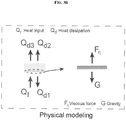
- FIG. 3B is a schematic illustrating physical models of heat transfer and viscous flow occurring during the dynamic process of gold deposition onto non-fully cured polydimethylsiloxane (PDMS) according to various embodiments.
- PDMS polydimethylsiloxane
- FIG. 3C is a schematic showing simulation results of corresponding temperature distribution and pressure distribution during viscous flow (low viscous flow on the left and high viscous flow on the right) when gold is deposited onto non-fully cured polydimethylsiloxane (PDMS) according to various embodiments.
- PDMS polydimethylsiloxane
- the quasi-steady-state heat transfer model may include the processes of heat input from the thermal radiation and the hot deposited gold, Q I , heat dissipation from the thermal radiation at both sides of the film, Q d1 and Q d2 , and conduction at the backing, Q d3 (heat convection can be omitted).
- Q I heat input from the thermal radiation and the hot deposited gold
- Q d1 and Q d2 heat dissipation from the thermal radiation at both sides of the film
- Q d3 conduction at the backing
- a temperature gradient may exist within the structure. As shown in FIG. 3C , the temperature at the backing side of the PDMS structure may be about 330 °C, while the temperature at the gold film side may be about 443 °C. The maximum temperature difference may be ⁇ 120 °C.
- the high temperature at the gold film side may significantly speed up the polymerization at the gold film side. Based on theoretical simulation, when the thermal diffusion is not in steady state, the temperature of the gold film side near to the gold source may even reach a temperature such that the temperature difference between the temperature at the gold film side and the temperature at the backing side exceeds 120 °C.
- a mechanical process may also occur simultaneously during the gold deposition process, which is illustrated in FIG. 3B .
- the density of gold (19,300 kg m -3 ) is much higher than that of PDMS (0.97 kg m -3 ). Accordingly, with the increase in deposited gold at the interface, the gold may pull down a thin layer of PDMS. At the same time, the partially cured PDMS may become highly-viscous rapidly as the temperature goes up.
- the self-weight G of the gold-PDMS interface layers may balance the viscosity force of PDMS, F ⁇ , and the viscous PDMS interface layer may not move further downwards once the viscosity is large enough.
- the pressure distributions in PDMS layers of different viscosities are illustrated in FIG. 3C .
- the shape of the structure may be rapidly frozen as a result of the increase in temperature.
- the whole elastic PDMS sample may be fully polymerized and cured during the process.
- the resultant structure formed may include a suspended layered composite including a wrinkled PDMS layer and a wrinkled gold layer in contact with the wrinkled PDMS layer.
- the wrinkled PDMS layer and the wrinkled gold layer may be due to the mingling effect at the interface, and may be supported by pulled-out micro pillars during above described dynamic processes.
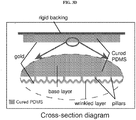
- FIG. 3D is a schematic showing a resulting structure of the stretchable electrode according to various embodiments.
- the structure may include a stripped hollowed layer formed by the pulling down of the wrinkled polymer layer by the metal film.
- the structure shown in FIG. 3D may have high stretchability, good stability, high adhesion and large surface area. The method described herein may thus offer an approach to form a stretchable electrode with the abovementioned advantages.
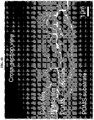
- FIG. 4A shows a cross-sectional scanning electron microscopy (SEM) image of the self-stripping double-layer structure according to various embodiments, with the insets showing optical images of the front view and back view of the sample according to various embodiments.
- the insets indicate that samples with large area may be formed.
- the back of the sample may be black resulting from the absorption effect of the gold nanoparticles mingled with PDMS.
- various embodiments may be one of the best candidates for stretchable and flexible electrodes.
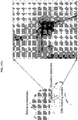
- FIG. 4B shows a magnified cross-sectional scanning electron microscopy (SEM) image of the self-stripping double-layer structure according to various embodiments shown in FIG. 4A .
- FIG. 4B corresponds to the section in FIG. 4A indicated by the rectangular box.
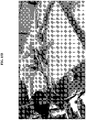
- FIG. 4C shows another magnified cross-sectional scanning electron microscopy (SEM) image of the self-stripping double-layer structure according to various embodiments shown in FIG. 4A .
- FIG. 4D shows yet another magnified cross-sectional scanning electron microscopy (SEM) image of the self-stripping double-layer structure according to various embodiments shown in FIG. 4A .
- the structure may include a suspended PDMS layer with a gold layer in contact with the PDMS layer.
- the interface region between the PDMS layer and the gold layer may be a transition region clearly showing the mingling effect.
- the suspended layers may be linked to the PDMS base layer (also referred to as PDMS substrate layer) by micro pillars.
- FIG. 4E shows a scanning electron microscopy (SEM) image of the gold film having the wrinkled structure according to various embodiments.
- the wrinkled structure may include upheavals and depressions.
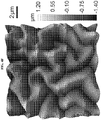
- FIG. 4F shows an atomic force microscopy (AFM) image of the gold film having the wrinkled structure according to various embodiments.
- the surface morphology of the gold film shown in FIG. 4E and FIG. 4F and underlying wrinkled PDMS layer may be induced by the modulus mismatch between gold and PDMS during dynamic polymerization.
- FIG. 4G is an image showing the detailed morphology of the gold film according to various embodiments.
- FIG. 4H is another image showing the detailed morphology of the gold film according to various embodiments.
- FIGS. 4G and 4H show that the wrinkled gold film may include gold nanoparticles having a grain size of about 20 nm.
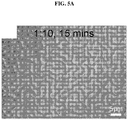
- FIG. 5A shows a planar surface electron microscopy (SEM) image formed from a sample pre-cured for a duration of 15 minutes and having a ratio of cross linker to monomer of 1 : 10 according to various embodiments.
- SEM surface electron microscopy
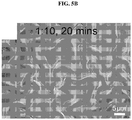
- FIG. 5B shows a planar surface electron microscopy (SEM) image formed from a sample pre-cured for a duration of 20 minutes and having a ratio of cross linker to monomer of 1 : 10 according to various embodiments.
- SEM surface electron microscopy
- FIG. 5C shows a planar surface electron microscopy (SEM) image formed from a sample pre-cured for a duration of 25 minutes and having a ratio of cross linker to monomer of 1 : 10 according to various embodiments.
- SEM surface electron microscopy
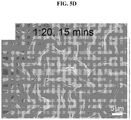
- FIG. 5D shows a planar surface electron microscopy (SEM) image formed from a sample pre-cured for a duration of 15 minutes and having a ratio of cross linker to monomer of 1 : 20 according to various embodiments.
- SEM surface electron microscopy
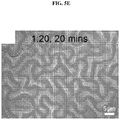
- FIG. 5E shows a planar surface electron microscopy (SEM) image formed from a sample pre-cured for a duration of 20 minutes and having a ratio of cross linker to monomer of 1 : 20 according to various embodiments.
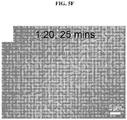
- FIG. 5F shows a planar surface electron microscopy (SEM) image formed from a sample pre-cured for a duration of 25 minutes and having a ratio of cross linker to monomer of 1 : 20 according to various embodiments.
- SEM surface electron microscopy
- FIGS. 6A-F compare the wrinkles present at a surface of a wrinkled composite film including a gold layer and a suspended PDMS layer.
- FIG. 6A shows an atomic force microscopy (AFM) image of a wrinkled film according to various embodiments.
- FIG. 6B shows another atomic force microscopy (AFM) image of the wrinkled film shown in FIG. 6A according to various embodiments.
- FIG. 6C is a plot of amplitude of the wrinkles in nanometers or nm) as a function of distance along the surface (in micrometers or ⁇ m) of the film shown in FIGS. 6A-B according to various embodiments.
- the thickness of the film illustrated in FIGS. 6A-C is about 300 nm, and may be formed with a ratio of cross linker to monomer of 1 : 10 and pre-cured for a duration of 25 minutes before deposition.
- FIG. 6D shows an atomic force microscopy (AFM) image of another wrinkled film according to various embodiments.
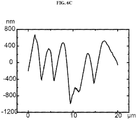
- FIG. 6E is a plot of amplitude of the wrinkles in nanometers or nm) as a function of distance along the surface (in micrometers or ⁇ m) of the film shown in FIG. 6D according to various embodiments.
- the thickness of the film illustrated in FIGS. 6D-E is about 300 nm, and is formed with a ratio of cross linker to monomer of 1 : 20 and pre-cured for a duration of 25 minutes before deposition.
- FIG. 6F is a plot of maximum amplitude (in micrometers or ⁇ m) comparing a first film formed with a ratio of cross linker to monomer of 1 : 10 and pre-cured for a duration of 25 minutes before deposition, and a second film formed with a ratio of cross linker to monomer of 1 : 20 and pre-cured for a duration of 25 minutes before deposition according to various embodiments.
- FIGS. 6A-F show that the wrinkles may become denser and the amplitude of the wrinkles may decrease as the monomer increases relative to the cross-linker, when the pre-cured time remains the same.
- the wrinkles formed on the structures according to various embodiments may be different from that fabricated by the normal pre-stretch or pre-biaxial strain method.
- the normal pre-stretch or pre-biaxial strain method may be able to support a relatively thinner wrinkled metal film on top.
- FIG. 7A shows a schematic illustrating the pre-biaxial strain method.
- FIG. 7B shows a scanning electron microscopy (SEM) image of the film prepared by the pre-biaxial strain method.
- a two dimensional (2D) slightly wrinkled pattern may appear due to the mismatch of the modulus when the strain is released.
- the amplitude of these wrinkles may be highly dependent on the adhesion and the thickness of the metal layer. If the thickness is too large (like ⁇ 300 nm), it is hard to form a regular dense wrinkled structure according to the buckling theory.
- FIG. 7C shows a scanning electron microscopy (SEM) image of the film prepared by the method according to various embodiments.
- the thickness of the film shown in FIG. 7C is substantially equal to the thickness of the film shown in FIG. 7B .
- FIG. 8A shows a scanning electron microscopy (SEM) image of the stretchable electrode according to various embodiments under tensile strain of 50%, while the inset shows a magnified image of the upheaval blocks remain connected.
- SEM scanning electron microscopy
- initial cracks may appear at the depression positions and may be then propagated.
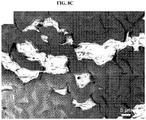
- Some upheaval blocks may be twisted and may still be connected, thus contributing to the stretchability of the film.
- FIG. 8B shows a further scanning electron microscopy (SEM) image of the stretchable electrode according to various embodiments illustrating the connecting effect by twisting of the upheavals.
- FIG. 8C shows another scanning electron microscopy (SEM) image of the stretchable electrode according to various embodiments illustrating the connecting effect by twisting of the upheavals.
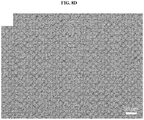
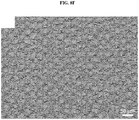
- FIG. 8D shows a scanning electron microscopy (SEM) image of the stretchable electrode according to various embodiments under tensile strain of 30%.
- the electrode shown in FIG. 8D may be prepared with a ratio of cross linker to monomer of 1 : 5 and pre-cured for a duration of 25 minutes before deposition.
- FIG. 8E shows a magnified image of the stretchable electrode shown in FIG. 8D according to various embodiments.
- FIG. 8F shows a scanning electron microscopy (SEM) image of the stretchable electrode according to various embodiments under tensile strain of 30%.
- the electrode shown in FIG. 8F may be prepared with a ratio of cross linker to monomer of 1 : 10 and pre-cured for a duration of 25 minutes before deposition.
- FIG. 8G shows a magnified image of the stretchable electrode shown in FIG. 8F according to various embodiments.
- FIG. 8H is a plot of resistance (in ohms or ⁇ ) as a function of strain (in percent or %) showing the resistance change of the stretchable electrode according to various embodiments under varying strain, with the inset showing an optical image of the test setup. The resistance is out of the measurement range at around 135%.
- FIG. 8H points to another dominating mechanism that may contribute to the stretchability achieved by films. Close observations of FIGS. 8A , D-G show numerous randomly distributed micro cracks. The strain energy may be released by these micro cracks which form a connecting network in the PDMS layer. The strain regulation effect induced by the underlying micro pillars may be crucial.
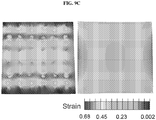
- FIG. 9A is a schematic showing a finite element method (FEM) investigating the strain redistribution mechanism behind the stretchability of the stretchable electrode according to various embodiments.
- FIG. 9B is a schematic showing the finite element method (FEM) includes randomly oriented micro pillars in the simulation of the stretchable electrode according to various embodiments. As shown in FIGS. 9A-B , a model is built based on a suspended film supported by micro pillars placed randomly under the suspended film.
- FIG. 9C shows the simulation results of the finite element method (FEM) investigating the strain redistribution mechanism behind the stretchability of the stretchable electrode according to various embodiments.
- FIG. 9D shows the simulation of strain regulation effect induced by the micro pillars according to various embodiments.
- the simulation results indicate that the strain distribution may indeed be regulated by the pillars under the suspended film.
- the strain distribution may determine the crack formation during stretching and the random distribution may significantly benefit the stretchability.
- the randomly distributed micro cracks may increase the resistance of the film, thus allowing the stretchable conductor to be used as a stretchable strain sensor for detecting or measuring the mechanical deformation is applied in the film.
- the gauge factor achieved may be as large as 20.
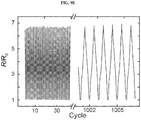
- FIG. 9E is a plot of fractional change of resistance as a function of the number of cycles illustrating the resistance change of the stretchable electrode according to various embodiments under cyclic tensile strain.
- FIG. 9E shows that the resistance change may be repeatable at least for 1,000 strain cycles.
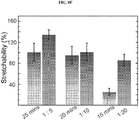
- FIG. 9F is a plot of stretchability (in percent or %) as a function of pre-curing time / ratio of cross linker to monomer used according to various embodiments.
- the ratio of cross-linker to monomer used for the pre-curing time experiment is 1 : 10.
- the pre-curing time for the ratio experiment is 25 minutes.
- the stretchability decreases with the decrease of the ratio of cross linker to monomer used, and/or the decrease of the pre-curing time. This indicates that initially less cured PDMS that is less viscous, i.e. films formed with a smaller ratio of cross-linker to monomer or shorter pre-curing time, may possess poor stretchability.
- the liquid with less viscosity may tend to be discontinuous during the stretching.
- a pre-cured sample having a particular range or value of viscosity, which is determined by a certain range or value of pre-curing time, may form a suspended composite film having maximum stretchability. Pre-curing times longer or shorter than this range or value may result in a composite film having less stretchability. For example, maximum stretchability may be obtained by samples pre-cured with 25 minutes of pre-curing time.
- the number of the pulled-out micro pillars may be decreased dramatically, which lose the ability of strain regulation, resulting in the concentration of strain and causing poor stretchability.
- the stretchability may also decrease with thinner gold film formed.
- the heat transfer decreases when forming a thinner gold film, which may be equivalent to less pre-curing.
- the wrinkled structure may become relatively filled up.
- the larger thickness may increase the defects inside the film and may also lower the ductility of the film.
- the stretchability may increase with gold film thickness up to a point, and may decrease with a further increase in gold film thickness after the point.
- sensitivity since sensitivity behaves in a reverse manner to stretchability, sensitivity shows a reverse change trend, i.e. sensitivity may decrease and may then increase with increasing gold film thickness.
- FIG. 9G is a plot of stretchability (in percent or %) /gauge factor as a function of film thickness (in nanometers or nm) according to various embodiments.
- FIG. 9H is a plot of adhesion strength (in megaPascals or MPa) as a function of pre-curing time / ratio of cross linker to monomer used according to various embodiments.
- FIG. 9H shows that the adhesion strength achieved may be as large as about 2 MPa, which may be much greater than the adhesion strength of a normal crack-based stretchable gold film (NCSG) ( ⁇ 0.2 MPa) or the adhesion strength of a flat non-stretchable gold film (FNSG) ( ⁇ 0.5 MPa).
- NCSG normal crack-based stretchable gold film
- FNSG flat non-stretchable gold film
- the ratio of cross-linker to monomer used for the pre-curing time experiment is 1 : 10.
- the pre-curing time for the ratio experiment is 25 minutes.
- Both the NCSG film and the FNSG film are formed with 10 nm chromium as the adhesion layer.
- FIGS. 9F and 9H show that the 1 : 10 sample demonstrates the highest stretchability and adhesion strength when pre-cured for 25 minutes. It may be expected that the optimized pre-curing time would be different for other ratios. The optimized pre-curing time may be affected by factors such as the ratio, the precursors used, or the curing temperature.
- FIG. 10 shows (a) an image showing adhering a Kapton tape to a flat non-stretchable gold film, (b) an image showing peeling the Kapton tape from the flat non-stretchable gold film, (c) an image showing a portion of the flat non-stretchable gold film being peeled off, (d) an image showing adhering a Kapton tape to a normal crack-based stretchable gold film, (e) an image showing peeling the Kapton tape from the normal crack-based stretchable gold film, (f) an image showing a portion of the normal crack-based stretchable gold film being peeled off, (g) an image of adhering a Kapton tape to a stretchable electrode according to various embodiments, (h) an image showing peeling of the Kapton tape from the stretchable electrode according to various embodiments, (i) an image showing a smaller portion of the stretchable electrode
- the high-adhesion Kapton tape may effect little damage to the stretchable electrode according to various embodiments, but may peel a large area of the normal stretchable gold film and non-stretchable gold film.
- the good adhesion achieved may be due to the dynamic mingling process as discussed before.
- the hot high-speed gold nanoparticles may strike the non-fullycured polymer and may thus be fully inter-connected with the polymer.
- FIG. 11 shows (a) a scanning electron microscopy image (SEM) showing the mingling effect of the evaporated gold and the polydimethylsiloxane (PDMS) according to various embodiments, and (b) a magnified image of the boxed region indicated in (a).
- SEM scanning electron microscopy image
- PDMS polydimethylsiloxane
- the force may be increased until the suspended layers are separated from the PDMS base layer.
- the bottom of the gold film may be exposed, which may indicate that the fracture is induced by interface failure, even though the mingling effects have already significantly enhanced the adhesion.
- the fracture strength of a PDMS film under tensile strength is around 2.24 MPa, while the adhesion strength of the stretchable electrode may be around 2 MPa, which is comparable to the fracture strength of the PDMS film. This indicates the adhesion strength has greatly improved and may be almost reaching the limit.
- FIG. 12A is a scanning electron microscopy (SEM) image showing the surface morphology of the bottom of the suspended layers according to various embodiments.
- FIG. 12B is a magnified scanning electron microscopy (SEM) image of a region shown in FIG. 12A according to various embodiments.
- FIG. 12C is a scanning electron microscopy (SEM) image showing the surface morphology of the polydimethylsiloxane (PDMS) base layer according to various embodiments.
- FIG. 12D is a magnified scanning electron microscopy (SEM) image of a region shown in FIG. 12C according to various embodiments.
- each micro pillar may be fractured or broken at a junction between the pillar and the suspended PDMS film.
- FIG. 13A is an image showing a large stretchable electrode according to various embodiments.
- FIG. 13B is another image of a stretchable electrode according to various embodiments. Electrodes having an area of about 10 cm by 20 cm have been fabricated. The fabricated electrodes may be ultra-thin, with a thickness as low as 15 ⁇ m.
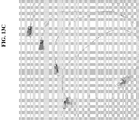
- FIG. 13C is an image of fully encapsulated stretchable electrodes according to various embodiments.
- FIG. 13D is an image showing the stretchability of encapsulated stretchable electrodes according to various embodiments.
- the electrodes may be used for wirebonding and the stretchability of the electrodes may be advantageous for such applications.
- the stretchable conductors have also been demonstrated as neural stimulators on rats. Stimulation voltages have been applied to drive the movement of thigh muscles of rats, indicating that the stretchable conductors may be used as the neural stimulation electrodes for neural regeneration and rehabilitation.
- Various embodiments may have a larger equivalent surface area and a lower impedance as a result of the wrinkled structure.
- the impedance of the stretchable electrode may be monitored.
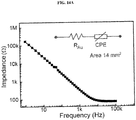
- the fitting model may be formed by employing the typical constant phase element (CPE) to obtain the equivalent capacitance per area.
- FIG. 14A shows a plot of impedance (in ohms or ⁇ ) as a function of frequency (in hertz or Hz) of a stretchable electrode according to various embodiments while the inset shows the fitting model.
- FIG. 14B is a plot of normalized capacitance comparing the capacitances of a flat gold film (normalized as 1), a first stretchable electrode (formed with a ratio of cross linker to monomer of 1 : 10) according to various embodiments, and a second stretchable electrode (formed with a ratio of cross linker to monomer of 1 : 20) according to various embodiments.
- the interface capacitance may at least be 4 times larger than that of the flat gold film.
- the capacitance may also be easily tunable by adjusting the ratio of cross linker to monomer.
- the ratio of cross linker to monomer may have an effect on capacitance as different ratios result in films with different densities of the wrinkles as discussed earlier.
- Stretchable electrodes may be implanted and entwined around the tracts of sciatic nerve in thigh muscles of rats as nerve stimulators.
- the induced electromyography (EMG) signal may be monitored simultaneously.
- FIG. 15A shows (left) a schematic showing the implantation of the stretchable electrode according to various embodiments in a rat to stimulate the sciatic nerve, and (right) an image showing the implantation of the electrode according to various embodiments.
- FIG. 15B is an image showing the recording of the electromyography (EMG) signal and the providing of the stimulation signal using the stretchable electrodes according to various embodiments.
- FIG. 15C is another image showing the rat implanted with the stretchable electrodes according to various embodiments, with the inset showing an X-ray image of the implanted electrode within the rat.
- FIG. 15D is a plot of voltage (in millivolts or mV) as a function of time (in milliseconds or ms) showing the electromyography (EMG) signal detected and the stimulation signal applied to the electrode according to various embodiments.
- FIG. 15E shows a magnification of the electromyography (EMG) signal shown in FIG. 15D .
- FIGS. 15D-E show clear inputs and outputs.
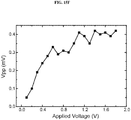
- FIG. 15F is a plot of peak-to-peak value of the induced electromyography (EMG) signal as a function of the simulation voltage applied to the stretchable electrode according to various embodiments. As shown in FIG. 15F , the EMG response is more sensitive at the early stage of the stimulation and becomes less sensitive with the increase in applied stimulation voltage (measured in terms of the peak-peak value of the response).
- the stretchable electrodes may be used as long-term implants to monitor/stimulate the target nerve, due to the superior stretchability, stability, biocompatibility, large surface area and/or high adhesion.
- Various embodiments may have huge potential in implantable stretchable electrodes and/or other bio-signal detection electrodes, due to the simple fabrication process and good performance of the obtained stretchable electrodes.
- Various embodiments may be easily fabricated in large scale.
- Various embodiments may include gold as the conductive material, and PDMS as the polymer. Gold is biocompatible and PDMS is cheap and commonly found, which may result in a relatively low price per area of the electrode.
Landscapes
- Chemical & Material Sciences (AREA)
- Health & Medical Sciences (AREA)
- Life Sciences & Earth Sciences (AREA)
- Engineering & Computer Science (AREA)
- Physics & Mathematics (AREA)
- Chemical Kinetics & Catalysis (AREA)
- Organic Chemistry (AREA)
- Materials Engineering (AREA)
- Heart & Thoracic Surgery (AREA)
- Surgery (AREA)
- Veterinary Medicine (AREA)
- Public Health (AREA)
- General Health & Medical Sciences (AREA)
- Animal Behavior & Ethology (AREA)
- Molecular Biology (AREA)
- Biophysics (AREA)
- Pathology (AREA)
- Biomedical Technology (AREA)
- Medical Informatics (AREA)
- Dispersion Chemistry (AREA)
- Spectroscopy & Molecular Physics (AREA)
- Medicinal Chemistry (AREA)
- Manufacturing & Machinery (AREA)
- Polymers & Plastics (AREA)
- Metallurgy (AREA)
- Mechanical Engineering (AREA)
- Laminated Bodies (AREA)
Claims (11)
- Verfahren zum Ausbilden einer dehnbaren Elektrode (200), wobei das Verfahren aufweist:Bereitstellen einer nicht vollständig gehärteten Probe auf einem Substrat undAbscheiden eines Metalls auf der nicht vollständig gehärteten Probe durch thermische Verdampfung, um die dehnbare Elektrode (200) auszubilden,wobei die nicht vollständig gehärtete Probe ungehärtet ist oder für eine Dauer von weniger als 30 Minuten teilweise gehärtet wird,wobei die teilweise gehärtete Probe durch Erwärmen bei einer Temperatur von weniger als 70 °C ausgebildet wird,wobei die dehnbare Elektrode (200) aufweist:eine Basisschicht (202),eine Faltenschicht (204),eine Mehrzahl von Säulen (206), die sich von der Basisschicht (202) zu der Faltenschicht (204) erstrecken, undeinen Metallfilm (208) auf der Faltenschicht (204), wobei der Metallfilm (208) das Metall aufweist, undwobei die Basisschicht (202), die Faltenschicht (204) und die Mehrzahl von Säulen (206) Polydimethylsiloxan aufweisen.
- Verfahren gemäß Anspruch 1,
wobei die ungehärtete Probe ein Monomer und einen Vernetzer aufweist. - Verfahren gemäß Anspruch 1 oder Anspruch 2,
wobei die teilweise gehärtete Probe eine Mehrzahl von Polymerketten aufweist, die über eine oder mehrere Vernetzungen miteinander verbunden sind. - Verfahren gemäß irgendeinem der Ansprüche 1 bis 3,
wobei die nicht vollständig gehärtete Probe für eine Dauer von weniger als 26 Minuten teilweise gehärtet wird. - Verfahren gemäß irgendeinem der Ansprüche 1 bis 4,
wobei die nicht vollständig gehärtete Probe für eine Dauer von weniger als 15 Minuten teilweise gehärtet wird. - Verfahren gemäß irgendeinem der Ansprüche 1 bis 5, wobei das Verfahren ferner aufweist:
Bereitstellen einer Metallquelle, die das Metall aufweist. - Verfahren gemäß irgendeinem der Ansprüche 1 bis 6,
wobei das Abscheiden des Metalls auf die nicht vollständig gehärtete Probe in einem Vakuum durchgeführt wird. - Verfahren gemäß Anspruch 7,
wobei das Vakuum bei 1,0 × 10⁻⁶ Torr liegt. - Verfahren gemäß irgendeinem der Ansprüche 1 bis 8,
wobei das Metall irgendeines ist, das aus einer Gruppe bestehend aus Gold, Palladium, Aluminium und Kupfer ausgewählt wird. - Verfahren gemäß irgendeinem der Ansprüche 1 bis 9,
wobei die nicht vollständig gehärtete Probe während des Abscheidens des Metalls vollständig gehärtet wird. - Dehnbare Elektrode (200), aufweisend:eine Basisschicht (202),eine Faltenschicht (204) undeine Mehrzahl von Säulen (206), die sich von der Basisschicht (202) zu der Faltenschicht (204) erstrecken, undeinen Metallfilm (208) auf der Faltenschicht (204), wobei der Metallfilm (208) ein Metall aufweist,wobei die Basisschicht (202), die Faltenschicht (204) und die Mehrzahl von Säulen (206) Polydimethylsiloxan aufweisen.
Applications Claiming Priority (2)
| Application Number | Priority Date | Filing Date | Title |
|---|---|---|---|
| SG10201609888R | 2016-11-24 | ||
| PCT/SG2017/050582 WO2018097801A1 (en) | 2016-11-24 | 2017-11-24 | Stretchable electrode and method of forming the same |
Publications (3)
| Publication Number | Publication Date |
|---|---|
| EP3545571A1 EP3545571A1 (de) | 2019-10-02 |
| EP3545571A4 EP3545571A4 (de) | 2020-07-15 |
| EP3545571B1 true EP3545571B1 (de) | 2022-01-05 |
Family
ID=62196188
Family Applications (1)
| Application Number | Title | Priority Date | Filing Date |
|---|---|---|---|
| EP17873627.8A Active EP3545571B1 (de) | 2016-11-24 | 2017-11-24 | Dehnbare elektrode und verfahren zur herstellung derselben |
Country Status (3)
| Country | Link |
|---|---|
| US (1) | US20190320933A1 (de) |
| EP (1) | EP3545571B1 (de) |
| WO (1) | WO2018097801A1 (de) |
Families Citing this family (3)
| Publication number | Priority date | Publication date | Assignee | Title |
|---|---|---|---|---|
| WO2023027640A2 (en) * | 2021-08-26 | 2023-03-02 | Nanyang Technological University | Binder-free stretchable interconnect |
| CN114360809A (zh) * | 2021-12-01 | 2022-04-15 | 中国科学院深圳先进技术研究院 | 一种超薄可拉伸薄膜电极的制备方法 |
| CN114496398B (zh) * | 2021-12-31 | 2023-05-30 | 重庆文理学院 | 一种褶皱结构可拉伸电极的制备方法 |
Family Cites Families (3)
| Publication number | Priority date | Publication date | Assignee | Title |
|---|---|---|---|---|
| US10895013B2 (en) * | 2012-11-09 | 2021-01-19 | Ben Gurion University Of The Negev Research And Development Authority | Gold nanostructures and processes for their preparation |
| KR20160084171A (ko) * | 2015-01-05 | 2016-07-13 | 고려대학교 산학협력단 | 신축성 고분자 젤 전해질을 포함하는 신축성 슈퍼커패시터와 이의 제조방법 |
| US10039466B2 (en) * | 2015-01-28 | 2018-08-07 | City University Of Hong Kong | Apparatus for detection of electrical signals of a biological subject and electrode thereof, and method of manufacture thereof |
-
2017
- 2017-11-24 WO PCT/SG2017/050582 patent/WO2018097801A1/en not_active Ceased
- 2017-11-24 EP EP17873627.8A patent/EP3545571B1/de active Active
- 2017-11-24 US US16/462,476 patent/US20190320933A1/en not_active Abandoned
Also Published As
| Publication number | Publication date |
|---|---|
| EP3545571A1 (de) | 2019-10-02 |
| US20190320933A1 (en) | 2019-10-24 |
| WO2018097801A1 (en) | 2018-05-31 |
| EP3545571A4 (de) | 2020-07-15 |
Similar Documents
| Publication | Publication Date | Title |
|---|---|---|
| Meena et al. | Highly stretchable and robust textile-based capacitive mechanical sensor for human motion detection | |
| Busolo et al. | Surface potential tailoring of PMMA fibers by electrospinning for enhanced triboelectric performance | |
| Liu et al. | Highly stable and stretchable conductive films through thermal‐radiation‐assisted metal encapsulation | |
| Cho et al. | Micropatterned pyramidal ionic gels for sensing broad-range pressures with high sensitivity | |
| EP2851342A1 (de) | Graphen-Polymer-Verbundstoff | |
| Gheith et al. | Stimulation of neural cells by lateral currents in conductive layer‐by‐layer films of single‐walled carbon nanotubes | |
| US11840798B2 (en) | Carbon nanocomposite sensors | |
| EP3545571B1 (de) | Dehnbare elektrode und verfahren zur herstellung derselben | |
| US10670655B2 (en) | Crack sensor including polymer for healing cracks and electronic device including the same | |
| Tan et al. | Breathing-effect assisted transferring large-area PEDOT: PSS to PDMS substrate with robust adhesion for stable flexible pressure sensor | |
| US11203675B2 (en) | Machines and processes for producing polymer films and films produced thereby | |
| Zhang et al. | Ultrathin superhydrophobic flexible tactile sensors for normal and shear force discrimination | |
| Yang et al. | Poly (5‐nitroindole) Thin Film as Conductive and Adhesive Interfacial Layer for Robust Neural Interface | |
| Ling et al. | Design of stretchable holey gold biosensing electrode for real-time cell monitoring | |
| US20240196749A1 (en) | Process for the Fabrication of Zn-O Graphene Based Flexible Strain and Pressure Sensor | |
| Gao et al. | Improving the dielectric properties of acrylic resin elastomer with reduced graphene oxide decorated with polystyrene | |
| Rocha‐Flores et al. | Softening, conformable, and stretchable conductors for implantable bioelectronics interfaces | |
| Sharma et al. | Multifunctional transparent conductive flexible sensor based on graphene/polyaniline/graphene sandwich composite on PDMS substrate | |
| CN117387481A (zh) | 高灵敏、超柔软的硅胶弹性体应变传感器及其制备方法 | |
| Tao et al. | Elastic (acrylate/polydimethylsiloxane) substrate-to-coating interlayers for improving the mechanical resilience of thermoelectric films on poly (ethylene terephthalate) during roll-to-roll manufacture and in service operation | |
| Xie et al. | Improving adhesion strength between layers of an implantable parylene-C electrode | |
| Passlack et al. | Flexible ultrathin chip-film patch for electronic component integration and encapsulation using atomic layer-deposited Al2O3–TiO2 nanolaminates | |
| Doshi et al. | Carbon nanotube coated fabric-based thin and flexible pressure sensors with ultra-wide sensing range | |
| Oyewole et al. | Effects of adhesion and stretching on failure mechanisms and optical properties of organic solar cells | |
| Shang et al. | Porous polyvinylidene fluoride thin-film sensors from colloidal crystal templates |
Legal Events
| Date | Code | Title | Description |
|---|---|---|---|
| STAA | Information on the status of an ep patent application or granted ep patent |
Free format text: STATUS: THE INTERNATIONAL PUBLICATION HAS BEEN MADE |
|
| PUAI | Public reference made under article 153(3) epc to a published international application that has entered the european phase |
Free format text: ORIGINAL CODE: 0009012 |
|
| STAA | Information on the status of an ep patent application or granted ep patent |
Free format text: STATUS: REQUEST FOR EXAMINATION WAS MADE |
|
| 17P | Request for examination filed |
Effective date: 20190523 |
|
| AK | Designated contracting states |
Kind code of ref document: A1 Designated state(s): AL AT BE BG CH CY CZ DE DK EE ES FI FR GB GR HR HU IE IS IT LI LT LU LV MC MK MT NL NO PL PT RO RS SE SI SK SM TR |
|
| AX | Request for extension of the european patent |
Extension state: BA ME |
|
| DAV | Request for validation of the european patent (deleted) | ||
| DAX | Request for extension of the european patent (deleted) | ||
| A4 | Supplementary search report drawn up and despatched |
Effective date: 20200612 |
|
| RIC1 | Information provided on ipc code assigned before grant |
Ipc: C23C 14/20 20060101AFI20200606BHEP Ipc: A61B 5/04 20060101ALI20200606BHEP Ipc: A61B 5/0492 20060101ALI20200606BHEP |
|
| REG | Reference to a national code |
Ref country code: DE Ref legal event code: R079 Ref document number: 602017052075 Country of ref document: DE Free format text: PREVIOUS MAIN CLASS: H01M0004040000 Ipc: C23C0014200000 |
|
| RIC1 | Information provided on ipc code assigned before grant |
Ipc: C23C 14/20 20060101AFI20210614BHEP Ipc: A61B 5/296 20210101ALI20210614BHEP Ipc: A61B 5/24 20210101ALN20210614BHEP |
|
| GRAP | Despatch of communication of intention to grant a patent |
Free format text: ORIGINAL CODE: EPIDOSNIGR1 |
|
| STAA | Information on the status of an ep patent application or granted ep patent |
Free format text: STATUS: GRANT OF PATENT IS INTENDED |
|
| INTG | Intention to grant announced |
Effective date: 20210723 |
|
| GRAS | Grant fee paid |
Free format text: ORIGINAL CODE: EPIDOSNIGR3 |
|
| GRAA | (expected) grant |
Free format text: ORIGINAL CODE: 0009210 |
|
| STAA | Information on the status of an ep patent application or granted ep patent |
Free format text: STATUS: THE PATENT HAS BEEN GRANTED |
|
| AK | Designated contracting states |
Kind code of ref document: B1 Designated state(s): AL AT BE BG CH CY CZ DE DK EE ES FI FR GB GR HR HU IE IS IT LI LT LU LV MC MK MT NL NO PL PT RO RS SE SI SK SM TR |
|
| REG | Reference to a national code |
Ref country code: GB Ref legal event code: FG4D |
|
| REG | Reference to a national code |
Ref country code: CH Ref legal event code: EP |
|
| REG | Reference to a national code |
Ref country code: AT Ref legal event code: REF Ref document number: 1460668 Country of ref document: AT Kind code of ref document: T Effective date: 20220115 |
|
| REG | Reference to a national code |
Ref country code: DE Ref legal event code: R096 Ref document number: 602017052075 Country of ref document: DE |
|
| REG | Reference to a national code |
Ref country code: IE Ref legal event code: FG4D |
|
| REG | Reference to a national code |
Ref country code: LT Ref legal event code: MG9D |
|
| REG | Reference to a national code |
Ref country code: NL Ref legal event code: MP Effective date: 20220105 |
|
| REG | Reference to a national code |
Ref country code: AT Ref legal event code: MK05 Ref document number: 1460668 Country of ref document: AT Kind code of ref document: T Effective date: 20220105 |
|
| PG25 | Lapsed in a contracting state [announced via postgrant information from national office to epo] |
Ref country code: NL Free format text: LAPSE BECAUSE OF FAILURE TO SUBMIT A TRANSLATION OF THE DESCRIPTION OR TO PAY THE FEE WITHIN THE PRESCRIBED TIME-LIMIT Effective date: 20220105 |
|
| PG25 | Lapsed in a contracting state [announced via postgrant information from national office to epo] |
Ref country code: SE Free format text: LAPSE BECAUSE OF FAILURE TO SUBMIT A TRANSLATION OF THE DESCRIPTION OR TO PAY THE FEE WITHIN THE PRESCRIBED TIME-LIMIT Effective date: 20220105 Ref country code: RS Free format text: LAPSE BECAUSE OF FAILURE TO SUBMIT A TRANSLATION OF THE DESCRIPTION OR TO PAY THE FEE WITHIN THE PRESCRIBED TIME-LIMIT Effective date: 20220105 Ref country code: PT Free format text: LAPSE BECAUSE OF FAILURE TO SUBMIT A TRANSLATION OF THE DESCRIPTION OR TO PAY THE FEE WITHIN THE PRESCRIBED TIME-LIMIT Effective date: 20220505 Ref country code: NO Free format text: LAPSE BECAUSE OF FAILURE TO SUBMIT A TRANSLATION OF THE DESCRIPTION OR TO PAY THE FEE WITHIN THE PRESCRIBED TIME-LIMIT Effective date: 20220405 Ref country code: LT Free format text: LAPSE BECAUSE OF FAILURE TO SUBMIT A TRANSLATION OF THE DESCRIPTION OR TO PAY THE FEE WITHIN THE PRESCRIBED TIME-LIMIT Effective date: 20220105 Ref country code: HR Free format text: LAPSE BECAUSE OF FAILURE TO SUBMIT A TRANSLATION OF THE DESCRIPTION OR TO PAY THE FEE WITHIN THE PRESCRIBED TIME-LIMIT Effective date: 20220105 Ref country code: ES Free format text: LAPSE BECAUSE OF FAILURE TO SUBMIT A TRANSLATION OF THE DESCRIPTION OR TO PAY THE FEE WITHIN THE PRESCRIBED TIME-LIMIT Effective date: 20220105 Ref country code: BG Free format text: LAPSE BECAUSE OF FAILURE TO SUBMIT A TRANSLATION OF THE DESCRIPTION OR TO PAY THE FEE WITHIN THE PRESCRIBED TIME-LIMIT Effective date: 20220405 |
|
| PG25 | Lapsed in a contracting state [announced via postgrant information from national office to epo] |
Ref country code: PL Free format text: LAPSE BECAUSE OF FAILURE TO SUBMIT A TRANSLATION OF THE DESCRIPTION OR TO PAY THE FEE WITHIN THE PRESCRIBED TIME-LIMIT Effective date: 20220105 Ref country code: LV Free format text: LAPSE BECAUSE OF FAILURE TO SUBMIT A TRANSLATION OF THE DESCRIPTION OR TO PAY THE FEE WITHIN THE PRESCRIBED TIME-LIMIT Effective date: 20220105 Ref country code: GR Free format text: LAPSE BECAUSE OF FAILURE TO SUBMIT A TRANSLATION OF THE DESCRIPTION OR TO PAY THE FEE WITHIN THE PRESCRIBED TIME-LIMIT Effective date: 20220406 Ref country code: FI Free format text: LAPSE BECAUSE OF FAILURE TO SUBMIT A TRANSLATION OF THE DESCRIPTION OR TO PAY THE FEE WITHIN THE PRESCRIBED TIME-LIMIT Effective date: 20220105 Ref country code: AT Free format text: LAPSE BECAUSE OF FAILURE TO SUBMIT A TRANSLATION OF THE DESCRIPTION OR TO PAY THE FEE WITHIN THE PRESCRIBED TIME-LIMIT Effective date: 20220105 |
|
| PG25 | Lapsed in a contracting state [announced via postgrant information from national office to epo] |
Ref country code: IS Free format text: LAPSE BECAUSE OF FAILURE TO SUBMIT A TRANSLATION OF THE DESCRIPTION OR TO PAY THE FEE WITHIN THE PRESCRIBED TIME-LIMIT Effective date: 20220505 |
|
| REG | Reference to a national code |
Ref country code: DE Ref legal event code: R097 Ref document number: 602017052075 Country of ref document: DE |
|
| PG25 | Lapsed in a contracting state [announced via postgrant information from national office to epo] |
Ref country code: SM Free format text: LAPSE BECAUSE OF FAILURE TO SUBMIT A TRANSLATION OF THE DESCRIPTION OR TO PAY THE FEE WITHIN THE PRESCRIBED TIME-LIMIT Effective date: 20220105 Ref country code: SK Free format text: LAPSE BECAUSE OF FAILURE TO SUBMIT A TRANSLATION OF THE DESCRIPTION OR TO PAY THE FEE WITHIN THE PRESCRIBED TIME-LIMIT Effective date: 20220105 Ref country code: RO Free format text: LAPSE BECAUSE OF FAILURE TO SUBMIT A TRANSLATION OF THE DESCRIPTION OR TO PAY THE FEE WITHIN THE PRESCRIBED TIME-LIMIT Effective date: 20220105 Ref country code: EE Free format text: LAPSE BECAUSE OF FAILURE TO SUBMIT A TRANSLATION OF THE DESCRIPTION OR TO PAY THE FEE WITHIN THE PRESCRIBED TIME-LIMIT Effective date: 20220105 Ref country code: DK Free format text: LAPSE BECAUSE OF FAILURE TO SUBMIT A TRANSLATION OF THE DESCRIPTION OR TO PAY THE FEE WITHIN THE PRESCRIBED TIME-LIMIT Effective date: 20220105 Ref country code: CZ Free format text: LAPSE BECAUSE OF FAILURE TO SUBMIT A TRANSLATION OF THE DESCRIPTION OR TO PAY THE FEE WITHIN THE PRESCRIBED TIME-LIMIT Effective date: 20220105 |
|
| PLBE | No opposition filed within time limit |
Free format text: ORIGINAL CODE: 0009261 |
|
| STAA | Information on the status of an ep patent application or granted ep patent |
Free format text: STATUS: NO OPPOSITION FILED WITHIN TIME LIMIT |
|
| PG25 | Lapsed in a contracting state [announced via postgrant information from national office to epo] |
Ref country code: AL Free format text: LAPSE BECAUSE OF FAILURE TO SUBMIT A TRANSLATION OF THE DESCRIPTION OR TO PAY THE FEE WITHIN THE PRESCRIBED TIME-LIMIT Effective date: 20220105 |
|
| 26N | No opposition filed |
Effective date: 20221006 |
|
| PG25 | Lapsed in a contracting state [announced via postgrant information from national office to epo] |
Ref country code: SI Free format text: LAPSE BECAUSE OF FAILURE TO SUBMIT A TRANSLATION OF THE DESCRIPTION OR TO PAY THE FEE WITHIN THE PRESCRIBED TIME-LIMIT Effective date: 20220105 |
|
| PG25 | Lapsed in a contracting state [announced via postgrant information from national office to epo] |
Ref country code: MC Free format text: LAPSE BECAUSE OF FAILURE TO SUBMIT A TRANSLATION OF THE DESCRIPTION OR TO PAY THE FEE WITHIN THE PRESCRIBED TIME-LIMIT Effective date: 20220105 |
|
| REG | Reference to a national code |
Ref country code: CH Ref legal event code: PL |
|
| P01 | Opt-out of the competence of the unified patent court (upc) registered |
Effective date: 20230601 |
|
| REG | Reference to a national code |
Ref country code: BE Ref legal event code: MM Effective date: 20221130 |
|
| PG25 | Lapsed in a contracting state [announced via postgrant information from national office to epo] |
Ref country code: LI Free format text: LAPSE BECAUSE OF NON-PAYMENT OF DUE FEES Effective date: 20221130 Ref country code: IT Free format text: LAPSE BECAUSE OF FAILURE TO SUBMIT A TRANSLATION OF THE DESCRIPTION OR TO PAY THE FEE WITHIN THE PRESCRIBED TIME-LIMIT Effective date: 20220105 Ref country code: CH Free format text: LAPSE BECAUSE OF NON-PAYMENT OF DUE FEES Effective date: 20221130 |
|
| PG25 | Lapsed in a contracting state [announced via postgrant information from national office to epo] |
Ref country code: LU Free format text: LAPSE BECAUSE OF NON-PAYMENT OF DUE FEES Effective date: 20221124 |
|
| PG25 | Lapsed in a contracting state [announced via postgrant information from national office to epo] |
Ref country code: IE Free format text: LAPSE BECAUSE OF NON-PAYMENT OF DUE FEES Effective date: 20221124 |
|
| PG25 | Lapsed in a contracting state [announced via postgrant information from national office to epo] |
Ref country code: FR Free format text: LAPSE BECAUSE OF NON-PAYMENT OF DUE FEES Effective date: 20221130 Ref country code: BE Free format text: LAPSE BECAUSE OF NON-PAYMENT OF DUE FEES Effective date: 20221130 |
|
| PG25 | Lapsed in a contracting state [announced via postgrant information from national office to epo] |
Ref country code: HU Free format text: LAPSE BECAUSE OF FAILURE TO SUBMIT A TRANSLATION OF THE DESCRIPTION OR TO PAY THE FEE WITHIN THE PRESCRIBED TIME-LIMIT; INVALID AB INITIO Effective date: 20171124 |
|
| PG25 | Lapsed in a contracting state [announced via postgrant information from national office to epo] |
Ref country code: CY Free format text: LAPSE BECAUSE OF FAILURE TO SUBMIT A TRANSLATION OF THE DESCRIPTION OR TO PAY THE FEE WITHIN THE PRESCRIBED TIME-LIMIT Effective date: 20220105 |
|
| PG25 | Lapsed in a contracting state [announced via postgrant information from national office to epo] |
Ref country code: MK Free format text: LAPSE BECAUSE OF FAILURE TO SUBMIT A TRANSLATION OF THE DESCRIPTION OR TO PAY THE FEE WITHIN THE PRESCRIBED TIME-LIMIT Effective date: 20220105 |
|
| PG25 | Lapsed in a contracting state [announced via postgrant information from national office to epo] |
Ref country code: MT Free format text: LAPSE BECAUSE OF FAILURE TO SUBMIT A TRANSLATION OF THE DESCRIPTION OR TO PAY THE FEE WITHIN THE PRESCRIBED TIME-LIMIT Effective date: 20220105 |
|
| PG25 | Lapsed in a contracting state [announced via postgrant information from national office to epo] |
Ref country code: TR Free format text: LAPSE BECAUSE OF FAILURE TO SUBMIT A TRANSLATION OF THE DESCRIPTION OR TO PAY THE FEE WITHIN THE PRESCRIBED TIME-LIMIT Effective date: 20220105 |
|
| PGFP | Annual fee paid to national office [announced via postgrant information from national office to epo] |
Ref country code: DE Payment date: 20251110 Year of fee payment: 9 |
|
| PGFP | Annual fee paid to national office [announced via postgrant information from national office to epo] |
Ref country code: GB Payment date: 20251120 Year of fee payment: 9 |