EP3546531A1 - Verfahren zur herstellung eines wismutvanadatpigments mit verbesserter alkalischer beständigkeit - Google Patents
Verfahren zur herstellung eines wismutvanadatpigments mit verbesserter alkalischer beständigkeit Download PDFInfo
- Publication number
- EP3546531A1 EP3546531A1 EP18164365.1A EP18164365A EP3546531A1 EP 3546531 A1 EP3546531 A1 EP 3546531A1 EP 18164365 A EP18164365 A EP 18164365A EP 3546531 A1 EP3546531 A1 EP 3546531A1
- Authority
- EP
- European Patent Office
- Prior art keywords
- pigment
- bismuth vanadate
- alkyl group
- functionalized silane
- aminoethyl
- Prior art date
- Legal status (The legal status is an assumption and is not a legal conclusion. Google has not performed a legal analysis and makes no representation as to the accuracy of the status listed.)
- Withdrawn
Links
Images


Classifications
-
- C—CHEMISTRY; METALLURGY
- C09—DYES; PAINTS; POLISHES; NATURAL RESINS; ADHESIVES; COMPOSITIONS NOT OTHERWISE PROVIDED FOR; APPLICATIONS OF MATERIALS NOT OTHERWISE PROVIDED FOR
- C09D—COATING COMPOSITIONS, e.g. PAINTS, VARNISHES OR LACQUERS; FILLING PASTES; CHEMICAL PAINT OR INK REMOVERS; INKS; CORRECTING FLUIDS; WOODSTAINS; PASTES OR SOLIDS FOR COLOURING OR PRINTING; USE OF MATERIALS THEREFOR
- C09D7/00—Features of coating compositions, not provided for in group C09D5/00; Processes for incorporating ingredients in coating compositions
- C09D7/40—Additives
- C09D7/60—Additives non-macromolecular
- C09D7/61—Additives non-macromolecular inorganic
- C09D7/62—Additives non-macromolecular inorganic modified by treatment with other compounds
-
- C—CHEMISTRY; METALLURGY
- C04—CEMENTS; CONCRETE; ARTIFICIAL STONE; CERAMICS; REFRACTORIES
- C04B—LIME, MAGNESIA; SLAG; CEMENTS; COMPOSITIONS THEREOF, e.g. MORTARS, CONCRETE OR LIKE BUILDING MATERIALS; ARTIFICIAL STONE; CERAMICS; REFRACTORIES; TREATMENT OF NATURAL STONE
- C04B14/00—Use of inorganic materials as fillers, e.g. pigments, for mortars, concrete or artificial stone; Treatment of inorganic materials specially adapted to enhance their filling properties in mortars, concrete or artificial stone
- C04B14/02—Granular materials, e.g. microballoons
- C04B14/36—Inorganic materials not provided for in groups C04B14/022 and C04B14/04 - C04B14/34
-
- C—CHEMISTRY; METALLURGY
- C04—CEMENTS; CONCRETE; ARTIFICIAL STONE; CERAMICS; REFRACTORIES
- C04B—LIME, MAGNESIA; SLAG; CEMENTS; COMPOSITIONS THEREOF, e.g. MORTARS, CONCRETE OR LIKE BUILDING MATERIALS; ARTIFICIAL STONE; CERAMICS; REFRACTORIES; TREATMENT OF NATURAL STONE
- C04B20/00—Use of materials as fillers for mortars, concrete or artificial stone according to more than one of groups C04B14/00 - C04B18/00 and characterised by shape or grain distribution; Treatment of materials according to more than one of the groups C04B14/00 - C04B18/00 specially adapted to enhance their filling properties in mortars, concrete or artificial stone; Expanding or defibrillating materials
- C04B20/10—Coating or impregnating
- C04B20/1051—Organo-metallic compounds; Organo-silicon compounds, e.g. bentone
-
- C—CHEMISTRY; METALLURGY
- C09—DYES; PAINTS; POLISHES; NATURAL RESINS; ADHESIVES; COMPOSITIONS NOT OTHERWISE PROVIDED FOR; APPLICATIONS OF MATERIALS NOT OTHERWISE PROVIDED FOR
- C09C—TREATMENT OF INORGANIC MATERIALS, OTHER THAN FIBROUS FILLERS, TO ENHANCE THEIR PIGMENTING OR FILLING PROPERTIES ; PREPARATION OF CARBON BLACK ; PREPARATION OF INORGANIC MATERIALS WHICH ARE NO SINGLE CHEMICAL COMPOUNDS AND WHICH ARE MAINLY USED AS PIGMENTS OR FILLERS
- C09C1/00—Treatment of specific inorganic materials other than fibrous fillers; Preparation of carbon black
- C09C1/0006—Treatment of specific inorganic materials other than fibrous fillers; Preparation of carbon black containing bismuth and vanadium
-
- C—CHEMISTRY; METALLURGY
- C09—DYES; PAINTS; POLISHES; NATURAL RESINS; ADHESIVES; COMPOSITIONS NOT OTHERWISE PROVIDED FOR; APPLICATIONS OF MATERIALS NOT OTHERWISE PROVIDED FOR
- C09C—TREATMENT OF INORGANIC MATERIALS, OTHER THAN FIBROUS FILLERS, TO ENHANCE THEIR PIGMENTING OR FILLING PROPERTIES ; PREPARATION OF CARBON BLACK ; PREPARATION OF INORGANIC MATERIALS WHICH ARE NO SINGLE CHEMICAL COMPOUNDS AND WHICH ARE MAINLY USED AS PIGMENTS OR FILLERS
- C09C3/00—Treatment in general of inorganic materials, other than fibrous fillers, to enhance their pigmenting or filling properties
- C09C3/06—Treatment with inorganic compounds
- C09C3/063—Coating
-
- C—CHEMISTRY; METALLURGY
- C01—INORGANIC CHEMISTRY
- C01P—INDEXING SCHEME RELATING TO STRUCTURAL AND PHYSICAL ASPECTS OF SOLID INORGANIC COMPOUNDS
- C01P2006/00—Physical properties of inorganic compounds
- C01P2006/60—Optical properties, e.g. expressed in CIELAB-values
-
- C—CHEMISTRY; METALLURGY
- C04—CEMENTS; CONCRETE; ARTIFICIAL STONE; CERAMICS; REFRACTORIES
- C04B—LIME, MAGNESIA; SLAG; CEMENTS; COMPOSITIONS THEREOF, e.g. MORTARS, CONCRETE OR LIKE BUILDING MATERIALS; ARTIFICIAL STONE; CERAMICS; REFRACTORIES; TREATMENT OF NATURAL STONE
- C04B2103/00—Function or property of ingredients for mortars, concrete or artificial stone
- C04B2103/54—Pigments; Dyes
-
- C—CHEMISTRY; METALLURGY
- C08—ORGANIC MACROMOLECULAR COMPOUNDS; THEIR PREPARATION OR CHEMICAL WORKING-UP; COMPOSITIONS BASED THEREON
- C08K—Use of inorganic or non-macromolecular organic substances as compounding ingredients
- C08K3/00—Use of inorganic substances as compounding ingredients
- C08K3/18—Oxygen-containing compounds, e.g. metal carbonyls
- C08K3/24—Acids; Salts thereof
-
- C—CHEMISTRY; METALLURGY
- C08—ORGANIC MACROMOLECULAR COMPOUNDS; THEIR PREPARATION OR CHEMICAL WORKING-UP; COMPOSITIONS BASED THEREON
- C08K—Use of inorganic or non-macromolecular organic substances as compounding ingredients
- C08K9/00—Use of pretreated ingredients
- C08K9/10—Encapsulated ingredients
Definitions
- the present invention relates to a method for manufacturing bismuth vanadate pigments, and more particularly to a method for manufacturing bismuth vanadate pigments having an improved alkaline resistance.
- invention relates to a bismuth vanadate pigment having improved alkaline resistance.
- Paint is any liquid, liquefiable, or mastic composition that, on application to a substrate in the form of a thin layer, converts to a solid film. It is most commonly used to protect, color, and / or to provide texture to objects. It mainly comprises of pigments, binder and liquid. Pigments are finely ground particles or powders, dispersed in paints, which provide coloristic properties to the paint.
- the paints generally comprises high Pigment Volume Concentration, when applied to a chemically active substrates, such as a concrete, results in a porous paint film over the surface of the substrate.
- a chemically active substrates such as a concrete
- Such porous nature of the paint film allows oxygen and other gases from air or soluble salts from concrete to penetrate there through, which along with the UV radiation and moisture, cause degradation of the pigments causing premature breakdown of the pigment.
- the substrates over a period hardens and produces hydrates like calcium hydroxide which makes the environment alkaline having a general pH value of 12 to 13.
- Inorganic pigments are nevertheless advisable to be used for façade applications due to their good weather and light performance.
- pigments containing cadmium, lead and chromium have been increasingly regarded as harmful on ecological and toxicological grounds.
- alternative pigments generally free from toxicological concerns, such as bismuth based pigments in particular, have been tested for their coloristic properties.
- These bismuth based pigments while being non-toxic, not only offer the desired coloristic properties, but also inherit good resistance to weather parameters such as light & heat, along with resistance to most of the chemicals.
- these bismuth based pigments are particularly unstable in alkaline media having a pH range from around 8 to 13. Such poor resistance of the pigments may lead to partial or even complete discoloration of the pigment and thus, the coating.
- This poor resistance of the bismuth based pigments to the alkaline media limits the scope of their use in water-based paints or surface coatings like silicate coatings and plasters. Accordingly, there is a need to improve the alkaline resistance of bismuth based pigment so that it can be used in the paint industry.
- US5123965 relates to a process for stabilizing BiVa pigment by treating said pigment with a metallic phosphate selected from the group consisting of calcium, magnesium, aluminum, zirconium and titanium orthophosphates.
- a metallic phosphate selected from the group consisting of calcium, magnesium, aluminum, zirconium and titanium orthophosphates.
- the method results in an alteration of the coloristic properties as well the rheological properties in water based system due to the phosphate derivatives, which is not generally preferred.
- US5858080 discloses a method of improving properties such as tinctorial strength, chroma as well as gloss of coloration obtained within a bismuth vanadate pigment by coating it with polyvinyl alcohol.
- the method doesn't offer the alkaline resistance required for the high pH coatings system applied for the architectural coatings.
- US6423131 describes a coating for the bismuth vanadate on calcium fluoride, bismuth oxyfluroide or lanthanide fluoride. Such a coating is targeted to improve chemical resistance properties of the bismuth vanadate. However, it does not increase its resistance properties in alkali media to a desired level.
- US4063956 discloses coating a bismuth vanadate pigment with a layer of metal oxide hydrate followed by a second dense layer of amorphous silicon dioxide.
- US4115141 discloses a method of stabilizing Bismuth vanadate by coating it with silicon dioxide or aluminum phosphate.
- US4455174 describes coating of a Bismuth vanadate pigment first with zirconium dioxide and then with silicon dioxide.
- EP271813 describes fluoride metal oxide coatings based on silicon dioxide, magnesium silicate and magnesium fluoride mixed with a wax layer.
- WO2014055555 discloses a colorant comprising a mixture of pigments.
- the pigments have a similar coloration but different resistance to corrosion.
- the mixing ratio is selected to optimize the corrosion resistance against color brightness, and/or acidic corrosion resistance against alkali corrosion resistance of the colorant. This method however, is also not preferred as it drastically decreases the coloristic properties of the bismuth vanadate pigment.
- the present invention has been made in the view of the above problems, and discloses a method for manufacturing bismuth vanadate pigment having an improved alkaline resistance by blocking the action of cations present in a coating formulation, keeping a very good level of color strength.
- a functionalized silane of the general formula R-Si(OR')3 wherein R is an alkyl group; and R' is an alkyl is introduced just before spray drying of the pigment.
- the spray drying of the pigment is necessary to obtain homogeneity of the encapsulation to ensure the distribution of the functionalized silane around the pigment.
- the method includes reslurrying the pigment introducing using a functionalized silane of the general formula R-Si(OR')3 wherein R is an alkyl group; and R' is an alkyl group within the slurry of the pigment thereby encapsulating the bismuth vanadate pigment. Thereafter, the pigment is dried and processed to obtain the bismuth vanadate pigment having desired alkaline resistance properties.
- the functionalized silane is of the general formula R-Si(OR')3 wherein R is an alkyl group having more than 10 carbon atom(s); and R' is a methyl or ethyl group.
- R is an alkyl group having more than 10 carbon atom(s) and having one or more ramifications comprising an aryl group and optionally one or more Fluor atoms.
- the functionalized silane may be a mixture comprising (i) a silane from the general formula R-Si(OR')3 wherein R is an alkyl group ; and R' is an alkyl group, and (ii) a functional silane of the group comprising amino-3-propyltriethoxysilane, N-(2-aminoethyl-3-aminopropyl)-trimethoxysilane, phenyltriethoxysilane, hexadecyltrimethoxysilane, propyltrimethoxysilane, methyltriethoxysilane, N-benzyl-N-aminoethyl-3-aminopropyltrimethoxysilane,N-vinylbenzyl-N'-aminoethyl-3-aminopropylpolysiloxane, N-(n-butyl)-3-aminopropyltrimethoxysilane, or any combination
- the dried pigment is reslurried by adding an amount of solvent to the dried pigment at a predetermined temperature range and stirring the dispersion for a predetermined period of time.
- the reslurry is prepared by adding RO water and stirring in a temperature range between 30°C to 40°C for a time period ranging from 80 minutes to 110 minutes.
- the method further comprises addition of an antifoaming additive and a silica derivative to improve the powder properties of the dried pigment, such as its free flowing ability, non-dusting behavior and non-tackiness during the drying process.
- a method for manufacturing bismuth vanadate pigment having an improved alkaline resistance may further comprise adding a chelating agent.
- the pigment may be slurried using a chelating agent based solution in which the functionalized silane(s) is (are) added.
- Preferred chelating agents may be polyacrylate, polyglycosides, or modified organsilane with polyacrylate chain.
- the present invention discloses a bismuth vanadate encapsulated with a functionalized silane of the general formula R-Si(OR')3 wherein R is an alkyl group having more than 10 carbon atom(s),; and R' is a methyl or ethyl group. More preferably, R is an alkyl group having more than 10 carbon atoms and may have one or more ramifications comprising an aryl group and may contain one or more Fluor atoms This pigment has an improved alkaline resistance which offers vivid color and high color strength against complex inorganic colored pigments at the level never reached with alkaline stable Bismuth vanadate pigments.
- Another aspect of the pigment of the present invention is its dispersability. Most of the time the Bismuth vanadate with improved alkaline resistance are lower in color strength or are very difficult to disperse which limit the field of applications. On the contrary the pigment of the present invention are easy to disperse, have similar level of color strength than the benchmarking and have almost equal alkaline resistance than the organic pigments.
- Bismuth vanadatepigments are widely used in the coating industry and offer good resistance and coloristic properties.
- one major disadvantage of using Bismuth vanadate pigments is its low alkaline resistance, a feature necessary in certain water based coating formulations like silicate coatings. This limited alkaline resistance of these pigments leads to partial or even complete discoloration of the pigment and thus the coatings. This occurs because the chemical structure of Bi (Bismuth) based pigments are altered when they are exposed to high alkaline environment, due to the presence of high concentration of ions like Na+, K+, Ca+2, Zn2+, Ba2+ etc., which causes the replacement of bismuth ions to form other vanadate salts, leading to the discoloration.
- the present invention provides a method for manufacturing bismuth vanadate pigment having an improved alkaline resistance by treating in-situ obtained bismuth vanadate pigments with functionalized silane of the general formula R-Si(OR')3 wherein R is an alkyl group preferably having more than 10 carbon atom(s); and R' is an alkyl group, preferably a methyl or ethyl group.
- R is an alkyl group having more than 10 carbon atom(s),; and R' is a methyl or ethyl group.
- R is an alkyl group having more than 10 carbon atoms and may have one or more ramifications comprising an aryl group and may contain one or more Fluor atoms.
- the pigment to be encapsulated may be initially pre-encapsulated by a silica and addition a functionalized silane of the group comprising amino-3-propyltriethoxysilane, N-(2-aminoethyl-3-aminopropyl)-trimethoxysilane, phenyltriethoxysilane, hexadecyltrimethoxysilane, propyltrimethoxysilane, methyltriethoxysilane, N-benzyl-N-aminoethyl-3-aminopropyltrimethoxysilane, N-vinylbenzyl-N'-aminoethyl-3-aminopropylpolysiloxane, N-(n-butyl)-3-aminopropyltrimethoxysilane, or any combination of two or more thereof.
- This pre-encapsulation may optionally take place just before the treatment with the alkyl silane described in the
- this functionalized silane blocks the action of the ions present in the coating formulation thereby improving the alkaline stability while avoiding discoloration of Bi based pigments.
- adding chelating agents may even more enhance alkaline resistance.
- these chelating agents may be prepared in situ via a polymerization.
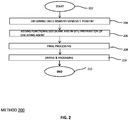
- a method 100 as illustrated in Fig. 1 for coating of the bismuth vanadate pigments with functionalized silane of the general formula R-Si(OR')3 wherein R is an alkyl group preferably having more than 10 carbon atom(s); and R' is an alkyl group, preferably a methyl or ethyl group.
- the method 100 starts at step 102 and proceeds to step 104 , where a dried and optionally calcined bismuth vanadate pigment is obtained from an in-situ pigment preparation process.
- the dried pigment obtained is reslurried.
- the reslurry of the pigment is prepared by adding an amount of solvent to the dried pigment at a predetermined temperature range and then stirring it to form a homogeneous aqueous dispersion.
- the reslurry is prepared by adding water, preferably RO water followed by stirring in a temperature range between 10°C and 100°C, preferably between 70°C to 95°C for a time period ranging between 30 minutes to 140 minutes which is preferably 80 minutes to 110 minutes.
- the pigment may be reslurried in any solvent including, but not limited to municipal water, river water, RO water, glycol based esters, and so on.
- a pre-encapulation step can also takes place at the end of the step 106 with addition of small amounts of silica or other metal oxides.
- a person skilled in the art will be able to define the composition of the inner coating, which may be built of a plurality of layers.
- It may comprise a first layer comprising one or more salts, or one or more oxides, heteropolyacids, organic acids, sulphites, sulfides, sulfates, phosphates, pyrophosphates, polyphosphates, or a combination thereof, selected from the group of alkali-earth metals, metals, non-metals, transition metals or lanthanides, preferably one or more calcium salts or oxides, one or more aluminum salts or oxides, or a combination thereof, and a second layer of silicon dioxide and functionalized or organo modified silane.
- the inner coating may comprise a third layer comprising a functionalized silane or an organo modified siloxane or a combination thereof.
- the method 100 then proceeds to step 108 , where the bismuth vanadate pigment is encapsulated by adding the functionalized silane within the slurry obtained at step 106 .
- the step of encapsulation is generally responsible for improving the alkaline resistance of the pigment.
- the method 100 proceeds to step 110 where the encapsulated pigment is again separated and purified for its final processing which is followed by drying and packaging of the pigment at step 112 .
- a chelating agents may be added at step 106 such as:
- Preferred chelating agents may be polyglycosides, polyacrylate, or modifyied organsilane with polyacrylate chain.
- Fig. 2 illustrates an alternative method 200 for coating of the bismuth vanadate pigments with functionalized silane of the general formula R-Si(OR')3 wherein R is an alkyl group preferably having more than 10 carbon atom(s); and R' is an alkyl group, preferably a methyl or ethyl group, and in addition coating with chelating agents in which the chelating agent is prepared via an in situ polymerization.
- the method 200 starts at step 204 where a dried bismuth vanadate pigment is obtained and proceeds to step 206 where the functionalized silane is added and the chelating agent is polymerized.
- the step of polymerization involves adding an amount of a reactive ionic monomer followed by a polymerization initiator to the pigment slurry and stirring the dispersion in a temperature range between 20°C to 180°C, for a time period ranging between 30 minutes to 240 minutes, and preferably between 90 minutes to 120 minutes.
- the step of polymerization process may optionally comprise adding a reactive non-ionic monomer to the dispersion, stirring it in a temperature range between 20°C to 180°C and acidifying the pigment slurry to a pH ranging between 0.5 to 4.0, and preferably between 1.5 to 2.5.
- the monomer may be selected from one or more from the set of monomers comprising [A] one or more functional polymerizable groups selected from an acrylate group or an unsaturated sulfonic group (such as the sodium vinlysulphonate or sodium styrylsulphonate), and [B] one or more nonionic monomers such as, but not limiting to, an alcohol monomer, an epoxide monomer, an organosilane monomer, an organomodified siloxane monomer, a thiol monomer, an amine monomer, an unsaturated carboxylic acid derivatives monomer (such as methacrylate, acrylamide, anhydride monomers), a vinyl monomer, a vinylamine monomer, or any combination thereof
- Preferred chelating agent may be polyglycosides polyacrylate, or modifyied organsilane with polyacrylate chain.
- step 208 the final processing of the encapsulated pigment is performed proceeded by drying at step 210 to obtain a desired encapsulated pigment.
- Final processing is generally dependent upon the type of method used for the synthesis of the pigment.
- the final processing includes dispersing and milling of the encapsulated pigment.
- the step of final processing simply includes separation and purification of the encapsulated pigments.
- the encapsulated pigment with improved alkaline resistance thus obtained is dried and packaged at step 210 .
- a solution of functionalized silane of the general formula R-Si(OR')3 wherein R is an alkyl group; and R' is an alkyl group is first prepared at step 304 .
- a dried bismuth vanadate pigment obtained is added to the functionalized silane based solution which results in an encapsulation of bismuth vanadate pigments at step 306 .
- final processing of the encapsulated pigment is performed at step 308 proceeded by drying and packaging at step 310 as disclosed in methods 100 and 200.
- chelating agents may be added at step 304.
- the functionalized silane may be introduced just before the spray drying of the pigment.
- the spray drying of the pigment is necessary to obtain homogeneity of the encapsulation to ensure the distribution of the chelating agent around the pigment.
- the pigment may be slurried in an aqueous solution of the functionalized silane.
- the present disclosure relates to a bismuth vanadate pigment which is encapsulated using a functionalized silane of the general formula R-Si(OR')3 wherein R is an alkyl group preferably having more than 10 carbon atom(s); and R' is a alkyl group, preferably a methyl or ethyl group.
- pigments inherit improved alkaline resistance, and in particular in cement and lime coatings, in addition to properties such as high resistance against extreme weather conditions. Further, the pigments offers high heat resistance, weather resistance, acid resistance and SO2 resistance and are outstandingly stable under various light conditions.
- these pigments While being lead- and chromate-free, these pigments meet to a high degree demand for optimum outdoor performance while being suitable for most industrial applications. Accordingly, these pigments are advantageous to be used in various industries such as Paint & Coatings Industry, Automotive & Transportation industries, cosmetic industries, or the like. These pigments are particularly recommended for coatings as well for various plastic applications. Further, pigments are ideal for applications such as automotive finishes (OEM and refinish), high-grade industrial paints, manufacture of colored plastic products.
- OEM and refinish automotive finishes
- manufacture of colored plastic products manufacture of colored plastic products.
- the bismuth vanadate pigments of the present invention may be used almost everywhere.
- logistics and as well in companies in the chemical, painting, cosmetic, packaging, films, cartons and automotive industry as well as aircraft industry requiring highly stable pigment while having excellent resistance to adverse situation.
- bismuth vanadate pigments are first choice pigments for uses in coatings field due to their opacity and the brightness of their shade.
- the pigments of the present invention may be used in particular in cement or lime coatings with good resistance properties without observed discoloration with the benefit of its color strength and bright shade.
- the pigment is also usable in all the other coatings due to its non-modified color strength level. It makes the pigment of the present invention a very universal pigment with very broad applicability.
- the present disclosure further provides a method, generally referred by the numeral 100, for manufacturing bismuth vanadate pigment having improved alkali resistance.
- the method is generally a simple, cost efficient, time-saving, method for forming a high quality bismuth pigments.
- Sample preparation Blend of cement, sand and pigment is prepared in an automatic L mortar mixer (EN-196-1) with a ratio cement 25/sand 75. Sand and pigment (3% versus the cement amount) are dispersed first and mixed for 20 sec. Then water is added and mixed during 20 sec.Cement is finally added with a continue mixing for a further 30 to 60 sec.
Landscapes
- Chemical & Material Sciences (AREA)
- Organic Chemistry (AREA)
- Engineering & Computer Science (AREA)
- Ceramic Engineering (AREA)
- Materials Engineering (AREA)
- Inorganic Chemistry (AREA)
- Structural Engineering (AREA)
- Wood Science & Technology (AREA)
- Life Sciences & Earth Sciences (AREA)
- Health & Medical Sciences (AREA)
- Chemical Kinetics & Catalysis (AREA)
- Medicinal Chemistry (AREA)
- Polymers & Plastics (AREA)
- Civil Engineering (AREA)
- Pigments, Carbon Blacks, Or Wood Stains (AREA)
- Inorganic Compounds Of Heavy Metals (AREA)
Priority Applications (6)
| Application Number | Priority Date | Filing Date | Title |
|---|---|---|---|
| EP18164365.1A EP3546531A1 (de) | 2018-03-27 | 2018-03-27 | Verfahren zur herstellung eines wismutvanadatpigments mit verbesserter alkalischer beständigkeit |
| EP19712229.4A EP3775062B1 (de) | 2018-03-27 | 2019-03-27 | Verfahren zur herstellung eines bismutvanadatpigments mit verbesserter alkalischer beständigkeit |
| CN201980022591.3A CN112119130A (zh) | 2018-03-27 | 2019-03-27 | 制备具有改进的耐碱性的钒酸铋颜料的方法 |
| PCT/EP2019/057676 WO2019185684A1 (en) | 2018-03-27 | 2019-03-27 | Method for manufacturing bismuth vanadate pigment having an improved alkaline resistance |
| ES19712229T ES2951808T3 (es) | 2018-03-27 | 2019-03-27 | Método para la fabricación de pigmento de vanadato de bismuto que tiene una resistencia alcalina mejorada |
| US16/982,394 US20210002489A1 (en) | 2018-03-27 | 2020-03-27 | Method for manufacturing bismuth vanadate pigment having an improved alkaline resistance |
Applications Claiming Priority (1)
| Application Number | Priority Date | Filing Date | Title |
|---|---|---|---|
| EP18164365.1A EP3546531A1 (de) | 2018-03-27 | 2018-03-27 | Verfahren zur herstellung eines wismutvanadatpigments mit verbesserter alkalischer beständigkeit |
Publications (1)
| Publication Number | Publication Date |
|---|---|
| EP3546531A1 true EP3546531A1 (de) | 2019-10-02 |
Family
ID=61832292
Family Applications (2)
| Application Number | Title | Priority Date | Filing Date |
|---|---|---|---|
| EP18164365.1A Withdrawn EP3546531A1 (de) | 2018-03-27 | 2018-03-27 | Verfahren zur herstellung eines wismutvanadatpigments mit verbesserter alkalischer beständigkeit |
| EP19712229.4A Active EP3775062B1 (de) | 2018-03-27 | 2019-03-27 | Verfahren zur herstellung eines bismutvanadatpigments mit verbesserter alkalischer beständigkeit |
Family Applications After (1)
| Application Number | Title | Priority Date | Filing Date |
|---|---|---|---|
| EP19712229.4A Active EP3775062B1 (de) | 2018-03-27 | 2019-03-27 | Verfahren zur herstellung eines bismutvanadatpigments mit verbesserter alkalischer beständigkeit |
Country Status (5)
| Country | Link |
|---|---|
| US (1) | US20210002489A1 (de) |
| EP (2) | EP3546531A1 (de) |
| CN (1) | CN112119130A (de) |
| ES (1) | ES2951808T3 (de) |
| WO (1) | WO2019185684A1 (de) |
Citations (10)
| Publication number | Priority date | Publication date | Assignee | Title |
|---|---|---|---|---|
| US4063956A (en) | 1976-09-16 | 1977-12-20 | E. I. Du Pont De Nemours And Company | Heat stable monoclinic bismuth vanadate pigment |
| US4115141A (en) | 1976-06-22 | 1978-09-19 | E. I. Du Pont De Nemours And Company | Process for the preparation of pigmentary bright primrose yellow bismuth vanadate |
| US4455174A (en) | 1981-09-05 | 1984-06-19 | Basf Aktiengesellschaft | Yellow pigment containing bismuth vanadate and having the composition BiVO4.xBi2 MoO6.yBi2 WO6 |
| EP0271813A2 (de) | 1986-12-18 | 1988-06-22 | BASF Aktiengesellschaft | Temperaturstabile Bismutvanadat/molybdat-Pigmente |
| US5123965A (en) | 1989-11-30 | 1992-06-23 | Ciba-Geigy Corporation | Process for stabilizing bismuth vanadate pigments against attack by hydrochloric acid |
| US5858080A (en) | 1996-05-31 | 1999-01-12 | Ciba Specialty Chemicals Corporation | Bismuth vanadate pigments |
| US6423131B1 (en) | 1998-09-03 | 2002-07-23 | Basf Aktiengesellschaft | Bismuth vanadate pigments comprising at least one metal fluoride coating |
| JP2004307529A (ja) * | 2003-04-02 | 2004-11-04 | C I Kasei Co Ltd | 黄色透明塗料、その製造方法、及びそれを用いたランプ |
| WO2014055555A1 (en) | 2012-10-01 | 2014-04-10 | Jds Uniphase Corporation | A colorant including a mixture of pigments |
| EP3299424A1 (de) * | 2016-09-22 | 2018-03-28 | Cappelle Pigments nv | Verfahren zur herstellung von wismutbasiertem pigment mit einer verbesserten alkalischen beständigkeit durch einkapselung mittels eines chelates |
Family Cites Families (4)
| Publication number | Priority date | Publication date | Assignee | Title |
|---|---|---|---|---|
| DE4040849A1 (de) * | 1990-12-20 | 1992-06-25 | Bayer Ag | Bismutvanadatpigmente, verfahren zu ihrer herstellung sowie deren verwendung |
| EP2283081B8 (de) * | 2008-04-25 | 2019-10-30 | 3M Innovative Properties Company | Verfahren zur oberflächenmodifizierung von partikeln |
| EP2584009A1 (de) * | 2011-10-17 | 2013-04-24 | Cappelle Pigments N.V. | Pigment auf Wismut-Basis und Herstellungsverfahren dafür |
| EP3181643A1 (de) * | 2015-12-14 | 2017-06-21 | Cappelle Pigments nv | Beschichtetes, auf wismut-oxy-halid-basierendes pigment |
-
2018
- 2018-03-27 EP EP18164365.1A patent/EP3546531A1/de not_active Withdrawn
-
2019
- 2019-03-27 WO PCT/EP2019/057676 patent/WO2019185684A1/en not_active Ceased
- 2019-03-27 ES ES19712229T patent/ES2951808T3/es active Active
- 2019-03-27 EP EP19712229.4A patent/EP3775062B1/de active Active
- 2019-03-27 CN CN201980022591.3A patent/CN112119130A/zh active Pending
-
2020
- 2020-03-27 US US16/982,394 patent/US20210002489A1/en not_active Abandoned
Patent Citations (11)
| Publication number | Priority date | Publication date | Assignee | Title |
|---|---|---|---|---|
| US4115141A (en) | 1976-06-22 | 1978-09-19 | E. I. Du Pont De Nemours And Company | Process for the preparation of pigmentary bright primrose yellow bismuth vanadate |
| US4063956A (en) | 1976-09-16 | 1977-12-20 | E. I. Du Pont De Nemours And Company | Heat stable monoclinic bismuth vanadate pigment |
| US4455174A (en) | 1981-09-05 | 1984-06-19 | Basf Aktiengesellschaft | Yellow pigment containing bismuth vanadate and having the composition BiVO4.xBi2 MoO6.yBi2 WO6 |
| EP0271813A2 (de) | 1986-12-18 | 1988-06-22 | BASF Aktiengesellschaft | Temperaturstabile Bismutvanadat/molybdat-Pigmente |
| US4851049A (en) * | 1986-12-18 | 1989-07-25 | Basf Aktiengesellschaft | Thermostable bismuth vanadate/molybdate pigments |
| US5123965A (en) | 1989-11-30 | 1992-06-23 | Ciba-Geigy Corporation | Process for stabilizing bismuth vanadate pigments against attack by hydrochloric acid |
| US5858080A (en) | 1996-05-31 | 1999-01-12 | Ciba Specialty Chemicals Corporation | Bismuth vanadate pigments |
| US6423131B1 (en) | 1998-09-03 | 2002-07-23 | Basf Aktiengesellschaft | Bismuth vanadate pigments comprising at least one metal fluoride coating |
| JP2004307529A (ja) * | 2003-04-02 | 2004-11-04 | C I Kasei Co Ltd | 黄色透明塗料、その製造方法、及びそれを用いたランプ |
| WO2014055555A1 (en) | 2012-10-01 | 2014-04-10 | Jds Uniphase Corporation | A colorant including a mixture of pigments |
| EP3299424A1 (de) * | 2016-09-22 | 2018-03-28 | Cappelle Pigments nv | Verfahren zur herstellung von wismutbasiertem pigment mit einer verbesserten alkalischen beständigkeit durch einkapselung mittels eines chelates |
Also Published As
| Publication number | Publication date |
|---|---|
| ES2951808T3 (es) | 2023-10-25 |
| CN112119130A (zh) | 2020-12-22 |
| US20210002489A1 (en) | 2021-01-07 |
| EP3775062A1 (de) | 2021-02-17 |
| EP3775062B1 (de) | 2023-07-12 |
| WO2019185684A1 (en) | 2019-10-03 |
Similar Documents
| Publication | Publication Date | Title |
|---|---|---|
| US20070106008A1 (en) | Aqueos coating composition | |
| KR101896011B1 (ko) | 방청 도료 조성물 및 이를 이용한 방청 코팅층 형성방법 | |
| AU2517401A (en) | Silicatic coating mass with improved stability | |
| JP2020109136A (ja) | アルミナセメント系塗料 | |
| JP6675030B1 (ja) | 高炉スラグ系塗料 | |
| CN108129967A (zh) | 一种水性聚氨酯防腐涂料 | |
| FI3712216T3 (fi) | Stabilointiaineet dispersiosilikaattimaaleja varten | |
| US20190284398A1 (en) | Silicate coatings | |
| CN112341849A (zh) | 一种耐磨水性无机地坪漆的研制及制备方法 | |
| KR101174372B1 (ko) | 경화 시 고분자비드의 미세한 조직구조를 갖는 내수성 규산염계 무기질 바인더 및 그 제조방법 | |
| CN100436551C (zh) | 水性涂料组合物 | |
| US11098199B2 (en) | Method for manufacturing bismuth based pigment having an improved alkaline resistance by encapsulating said pigment with a chelating agent | |
| JPS6147178B2 (de) | ||
| EP3775062B1 (de) | Verfahren zur herstellung eines bismutvanadatpigments mit verbesserter alkalischer beständigkeit | |
| KR101563291B1 (ko) | 에폭시수지에 고무를 혼합한 방수방식용 도료조성물 | |
| CN107043560A (zh) | 一种无机干粉防腐蚀涂料及其应用 | |
| CN111019465B (zh) | 有机无机复合水性丙烯酸防腐涂料的制备工艺 | |
| KR101578636B1 (ko) | 수성 세라믹 방수도료 조성물의 제조방법 | |
| KR20170049816A (ko) | 방수 세라믹 수성도료의 제조방법 및 이에 제조된 방수 세라믹 수성도료 | |
| CN111434735B (zh) | 水性防酸雨建筑涂料 | |
| Daunoravičius et al. | Optimization of External Render Formulations Based on Liquid Glass | |
| CN120349718A (zh) | 一种改性防水涂料及其制备方法 | |
| JP2006143934A (ja) | 無機質系塗料用組成物及び無機質塗膜の形成方法 | |
| CN110713768A (zh) | 自清洁建筑涂料的制备方法 | |
| AU2001243960B2 (en) | Polymer modified inorganic coatings |
Legal Events
| Date | Code | Title | Description |
|---|---|---|---|
| PUAI | Public reference made under article 153(3) epc to a published international application that has entered the european phase |
Free format text: ORIGINAL CODE: 0009012 |
|
| STAA | Information on the status of an ep patent application or granted ep patent |
Free format text: STATUS: THE APPLICATION HAS BEEN PUBLISHED |
|
| AK | Designated contracting states |
Kind code of ref document: A1 Designated state(s): AL AT BE BG CH CY CZ DE DK EE ES FI FR GB GR HR HU IE IS IT LI LT LU LV MC MK MT NL NO PL PT RO RS SE SI SK SM TR |
|
| AX | Request for extension of the european patent |
Extension state: BA ME |
|
| STAA | Information on the status of an ep patent application or granted ep patent |
Free format text: STATUS: THE APPLICATION IS DEEMED TO BE WITHDRAWN |
|
| 18D | Application deemed to be withdrawn |
Effective date: 20200603 |