EP3547166A1 - Datenplatzierung in hybriden datenlayouts für abgestufte htap-datenbanken - Google Patents
Datenplatzierung in hybriden datenlayouts für abgestufte htap-datenbanken Download PDFInfo
- Publication number
- EP3547166A1 EP3547166A1 EP18164052.5A EP18164052A EP3547166A1 EP 3547166 A1 EP3547166 A1 EP 3547166A1 EP 18164052 A EP18164052 A EP 18164052A EP 3547166 A1 EP3547166 A1 EP 3547166A1
- Authority
- EP
- European Patent Office
- Prior art keywords
- columns
- performance
- data
- column
- primary storage
- Prior art date
- Legal status (The legal status is an assumption and is not a legal conclusion. Google has not performed a legal analysis and makes no representation as to the accuracy of the status listed.)
- Granted
Links
Images




Classifications
-
- G—PHYSICS
- G06—COMPUTING OR CALCULATING; COUNTING
- G06F—ELECTRIC DIGITAL DATA PROCESSING
- G06F16/00—Information retrieval; Database structures therefor; File system structures therefor
- G06F16/20—Information retrieval; Database structures therefor; File system structures therefor of structured data, e.g. relational data
- G06F16/27—Replication, distribution or synchronisation of data between databases or within a distributed database system; Distributed database system architectures therefor
- G06F16/278—Data partitioning, e.g. horizontal or vertical partitioning
-
- G—PHYSICS
- G06—COMPUTING OR CALCULATING; COUNTING
- G06F—ELECTRIC DIGITAL DATA PROCESSING
- G06F16/00—Information retrieval; Database structures therefor; File system structures therefor
- G06F16/20—Information retrieval; Database structures therefor; File system structures therefor of structured data, e.g. relational data
- G06F16/21—Design, administration or maintenance of databases
-
- G—PHYSICS
- G06—COMPUTING OR CALCULATING; COUNTING
- G06F—ELECTRIC DIGITAL DATA PROCESSING
- G06F16/00—Information retrieval; Database structures therefor; File system structures therefor
- G06F16/20—Information retrieval; Database structures therefor; File system structures therefor of structured data, e.g. relational data
- G06F16/21—Design, administration or maintenance of databases
- G06F16/211—Schema design and management
-
- G—PHYSICS
- G06—COMPUTING OR CALCULATING; COUNTING
- G06F—ELECTRIC DIGITAL DATA PROCESSING
- G06F16/00—Information retrieval; Database structures therefor; File system structures therefor
- G06F16/20—Information retrieval; Database structures therefor; File system structures therefor of structured data, e.g. relational data
- G06F16/21—Design, administration or maintenance of databases
- G06F16/211—Schema design and management
- G06F16/212—Schema design and management with details for data modelling support
-
- G—PHYSICS
- G06—COMPUTING OR CALCULATING; COUNTING
- G06F—ELECTRIC DIGITAL DATA PROCESSING
- G06F16/00—Information retrieval; Database structures therefor; File system structures therefor
- G06F16/20—Information retrieval; Database structures therefor; File system structures therefor of structured data, e.g. relational data
- G06F16/21—Design, administration or maintenance of databases
- G06F16/211—Schema design and management
- G06F16/213—Schema design and management with details for schema evolution support
-
- G—PHYSICS
- G06—COMPUTING OR CALCULATING; COUNTING
- G06F—ELECTRIC DIGITAL DATA PROCESSING
- G06F16/00—Information retrieval; Database structures therefor; File system structures therefor
- G06F16/20—Information retrieval; Database structures therefor; File system structures therefor of structured data, e.g. relational data
- G06F16/21—Design, administration or maintenance of databases
- G06F16/217—Database tuning
-
- G—PHYSICS
- G06—COMPUTING OR CALCULATING; COUNTING
- G06F—ELECTRIC DIGITAL DATA PROCESSING
- G06F16/00—Information retrieval; Database structures therefor; File system structures therefor
- G06F16/20—Information retrieval; Database structures therefor; File system structures therefor of structured data, e.g. relational data
- G06F16/22—Indexing; Data structures therefor; Storage structures
-
- G—PHYSICS
- G06—COMPUTING OR CALCULATING; COUNTING
- G06F—ELECTRIC DIGITAL DATA PROCESSING
- G06F16/00—Information retrieval; Database structures therefor; File system structures therefor
- G06F16/20—Information retrieval; Database structures therefor; File system structures therefor of structured data, e.g. relational data
- G06F16/22—Indexing; Data structures therefor; Storage structures
- G06F16/221—Column-oriented storage; Management thereof
-
- G—PHYSICS
- G06—COMPUTING OR CALCULATING; COUNTING
- G06F—ELECTRIC DIGITAL DATA PROCESSING
- G06F16/00—Information retrieval; Database structures therefor; File system structures therefor
- G06F16/20—Information retrieval; Database structures therefor; File system structures therefor of structured data, e.g. relational data
- G06F16/22—Indexing; Data structures therefor; Storage structures
- G06F16/2282—Tablespace storage structures; Management thereof
-
- G—PHYSICS
- G06—COMPUTING OR CALCULATING; COUNTING
- G06F—ELECTRIC DIGITAL DATA PROCESSING
- G06F16/00—Information retrieval; Database structures therefor; File system structures therefor
- G06F16/20—Information retrieval; Database structures therefor; File system structures therefor of structured data, e.g. relational data
- G06F16/23—Updating
- G06F16/2379—Updates performed during online database operations; commit processing
- G06F16/2386—Bulk updating operations
-
- G—PHYSICS
- G06—COMPUTING OR CALCULATING; COUNTING
- G06F—ELECTRIC DIGITAL DATA PROCESSING
- G06F16/00—Information retrieval; Database structures therefor; File system structures therefor
- G06F16/20—Information retrieval; Database structures therefor; File system structures therefor of structured data, e.g. relational data
- G06F16/28—Databases characterised by their database models, e.g. relational or object models
-
- G—PHYSICS
- G06—COMPUTING OR CALCULATING; COUNTING
- G06F—ELECTRIC DIGITAL DATA PROCESSING
- G06F16/00—Information retrieval; Database structures therefor; File system structures therefor
- G06F16/20—Information retrieval; Database structures therefor; File system structures therefor of structured data, e.g. relational data
- G06F16/28—Databases characterised by their database models, e.g. relational or object models
- G06F16/283—Multi-dimensional databases or data warehouses, e.g. MOLAP or ROLAP
Definitions
- the present invention relates to a method for allocating columns of a table stored in a database into at least two sets of columns, a first set and a second set, the data of the columns allocated to the first set being stored on a primary storage medium using a column-oriented data layout and the data of columns allocated to the second set being stored on a secondary storage medium using a row-oriented data layout.
- the present invention further relates to a database system configured to carry out such a method.
- hybrid systems have been proposed that combine both row- and column orientation in a single storage engine and adjusting a table's layout depending on the workload. Many of these hybrid systems show improvements over pure row or column-oriented variants. But there are problems with these results for at least two reasons.
- well-known optimizations for homogeneous layouts e.g., SIMD for sequential operations
- the benefits associated with such a hybrid database include a reduced primary storage footprint that can lower the costs for hardware, allow larger systems on a single server, improve elasticity, reduce recovery times, and allow for more memory-intensive algorithms to be executed.
- a first aspect of the present invention relates to a computer-implemented method in accordance with claim 1.
- Such a computer implemented method can be used, for example, in a hybrid main memory-optimized database for mixed workloads in order to evict infrequently accessed data to a less expensive storage medium. It allows for adapting the overall storage layout to mitigate the negative performance impact of secondary storage.
- One of the key technical problems is to determine which data to place on which storage medium, which is solved by using a performance-cost model, which preferably is workload driven and which preferably takes reallocation costs into account.
- a second aspect of the present invention relates to a database system in accordance with claim 13.
- the present invention relates a computer-implemented method for allocating columns of a table stored in a database into at least two sets of columns, a first set and a second set, the data of the columns allocated to the first set being stored on a primary storage medium (also referred to as primary storage) using a column-oriented data structure and the data of columns allocated to the second set being stored on a secondary storage medium (also referred to as secondary storage) using a row-oriented data structure, wherein the method comprises the step of allocating the columns of the table to the first and the second set autonomously on the basis of a performance-cost model. It further relates to a database system that is configured to carry out said method.
- the utility i.e., the expected performance
- this column allocation problem is related to the binary Knapsack problem: utility (i.e., the expected performance) is maximized for a given space constraint (i.e., the primary storage budget).
- Knapsack approaches cannot be used to solve the column allocation problem at hand because the utility of having a column in primary storage typically depends on other column decisions (i.e., there is selection interaction). Therefore, the problem belongs to the class of resource allocation problems, which in general, must be solved using suitable solvers.
- the column-oriented data structure uses order-preserving dictionary encoding.
- optimization techniques on PSRCs may be employed such as vectorization, SIMD, and processing compressed data with late materialization.
- row-oriented column groups it is to be noted that one of the most expensive operations for secondary-storage-resident column stores may be wide tuple reconstructions. For a table with 100 attributes, e.g., a full tuple reconstruction from a disk-resident and dictionary-encoded column store may typically require a read of at least 800 KB from disk (i.e., 100 accesses to both value vector and dictionary with 4 KB reads each).
- row-oriented column groups (which may be referred to as a Secondary Storage Column Group, SSCG) are optimized for tuple-centred accesses, e.g., tuple reconstruction or probing.
- SSCGs are stored uncompressed. This is a trade off between space consumption (assuming secondary storage layers are cheaper than the primary storage layer) and performance due to improved data locality for tuple accesses. But page-wise compression can alternatively be employed. Using the proposed SSCGs, full-width tuple reconstructions require only single 4 KB page accesses to secondary storage.
- tuple inserts, deletions, and updates are handled via a delta partition, which preferably resides on the primary storage medium. Consequently, attributes stored in an SSCG resemble disk resident row stores. This way, one can exploit both major advantages of row-oriented data structures: (1) comparatively easy eviction since a tuple's attributes are stored consecutively in one place; and (2) advantages for tuple reconstruction with perfect cache locality for point accesses.
- PSRC-attributes resemble in-memory databases, such as SAP HANA or HyPer, which execute analytical/sequential operations on columnar dictionary-encoded attributes.
- queries against the table are executed using indices if existing.
- query filters are sorted by increasing selectivity (attribute selectivity may be defined for equality predicates as 1/n for an attribute with n distinct values).
- attribute selectivity may be defined for equality predicates as 1/n for an attribute with n distinct values.
- a query executor switches from scanning to probing as soon as the fraction of remaining qualifying tuples falls below a certain threshold (usually set to 0.01% of the table's tuple count). Probing a primary-storage-resident cell is still faster than accessing a 4 KB page from secondary storage, but the further the tuple probing is delayed, the higher the probability that the currently evaluated tuple is part of the result set. This way, piggyback probing during filtering is applied in order to load the remaining attributes in primary storage in case several projected attributes of the tuple are part of the result.
- a certain threshold usually set to 0.01% of the table's tuple count
- the method further comprises a preprocessing step of allocating all columns which have not been filtered at all to the second set.
- the step of allocating the columns is carried out repeatedly and autonomously during operation of the database. But in case the database administrator has additional performance requirements, attributes can be manually pinned either to the first or the second set. For instance, the columns containing primary key attributes can be manually pinned to the first set in order to ensure sufficient transactional performance or to fulfil service-level agreements (SLAs) for particularly important processes (see Figure 2 ).
- SLAs service-level agreements
- the performance-cost model takes into account at least one of the following parameters: an execution time of a workload that the database has experienced during operation; and a total available space on the primary storage medium.
- both parameters are taken into account.
- columns are allocated to the primary storage medium such that (i) the overall performance is maximized, i.e., a workload's execution time is minimized, and (ii) the total primary storage medium used does not exceed a given budget.
- a workload dependent performance-cost model is advantageous because, in real-life data tables, only a fraction of the attributes is accessed for filtering (i.e., selection). And many of the filtered columns are either (i) filtered very seldom or (ii) usually filtered in combination with other highly restrictive attributes. The negative impact of these columns not residing on primary storage can be negligible with an execution model that is aware of the interaction between attribute selectivity and placement.
- attributes can often be separated into two sets: (i) columns that are accessed for table searches, aggregations, joins, and other sequential operations that favour columnar layouts; and (ii) remaining columns that are either never accessed or point-accessed, e.g., for tuple reconstruction or probing.
- the workload of the database system is preferably characterized by N columns and Q queries.
- all accesses are modelled as scans with a particular selectivity (e.g., OLAP joins and aggregations are large sequential accesses).
- the access costs of a query preferably depend on whether occurring columns are in primary storage.
- the size of a i column i in bytes may be denoted by a i .
- the performance-cost model depends on total scan costs F.
- the performance-cost model takes column interactions into account.
- this may significantly improve the solution quality over various simple heuristics.
- vertical partitioning is usually approached by heuristics that count filtering frequencies and determine partitions accordingly.
- This is a feasible approach for tuple-based query evaluation in row-oriented databases as the execution of the first predicate automatically loads the tuple's remaining attributes.
- most HTAP databases are column stores, which execute predicates in a fundamentally different way.
- predicates are (usually) ordered by their selectivity (with the most restrictive predicate executed first) and executed successively where each operator passes a list of qualifying positions.
- the database system executes attribute filters sequentially in ascending order of the attribute's selectivity. Consequently, the expected selectivity of each predicate depends on the other attributes in the query.
- a preferred performance-cost model (herein also referred to as the "model")
- the model also accounts for the selectivity of columns that have been already scanned.
- the database system preferably estimates selectivities (using distinct counts and histograms when available) which are straightforward to implement in the model.
- c mm > 0 is a scan cost parameter for main memory
- c ss > 0 denotes the cost parameter for secondary storage.
- Both parameters can preferably be calibrated; they describe the time it takes to read data (e.g., seconds to read a gigabyte of data) and are used to calculate estimated runtimes.
- the solution to the performance-cost model preferably provides pareto-optimal solutions in view of performance-cost on the one side and consumption of the primary storage medium on the other side.
- the model can be solved in various ways. For instance, it can be solved using a solver, which is described in the following:
- the penalty parameter ⁇ is assumed to be non-negative.
- the new problem (5) has the following fundamental property.
- the isoquants of objective (5) form a hyperplane. Minimizing the linear objective (5) corresponds to the point in which the best hyperplane touches the feasible region (for x ). Hence, a corner of the feasible region (an N-dimensional cube) is always part of an optimal solution. Since all corners have integer coordinates (total unimodularity of the constraint matrix) an optimal solution of integer type is guaranteed.
- the optimal (integer) solution of (5) depends on the penalty parameter ⁇ .
- the inventors have applied the integer and continuous solution approaches to the workload and data of the BSEG table of a production SAP ERP system (overall 20,000 plans, 60 for BSEG).
- relative performance is defined as the minimal scan costs (where all columns reside on the primary storage) divided by the scan costs F ( x ) of a specific solution x as defined in (1)-(2).
- Figure 3 illustrates solutions of the integer and the continuous model for different memory budgets w.
- An initial eviction rate of over 78% is achieved solely by allocating columns that, according to the historic workload, have not been used to the second set. The remaining 22% are allocated on the basis of the continuous and the integer solution.
- the workload of the BSEG heavily relies on one of the largest columns called BELNR.
- BELNR the largest columns
- the sudden drop of performance for eviction rates over 95% is caused by the fact that BELNR no longer fits into the memory budget.
- sequential accesses are slowed down by less than 25% for eviction rates of up 95%.
- the integer formulation, cf. problem (2) - (3) allows identifying optimal combinations of performance and primary storage budgets. These combinations cannot be dominated by others and hence, form a "Pareto-efficient frontier" (cf. Figure 3 ).
- the continuous problem formulation (5) allows for identifying feasible combinations of performance and primary storage budgets used, which are also efficient.
- allocating columns in accordance with the invention is superior to simple heuristics.
- the considered heuristics are greedy approaches, which resemble the status quo for vertical partitioning models.
- Three heuristics are considered, which assess attributes by (i) the selection frequency, (ii) by selectivity, and by weighing selectivity and size of each attribute.
- the assessment of attributes is motivated by LRU approaches and the used metric to build the eviction order.
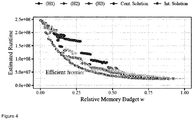
- the solutions of the integer problem form the efficient frontier.
- the solutions of the continuous problem are again part of the efficient frontier.
- both our approaches outperform all three heuristics (H1)-(H3).
- performance is up to 3x better.
- the heuristics (H1)-(H3) are reasonable heuristics.
- some columns are more often included in queries.
- the corresponding g i values are higher.
- g i and selectivity s i are slightly negatively correlated. This explains why pure heuristics like (H1) and (H2) are suboptimal.
- Heuristic (H3) achieves better performance results as both effects are taken into account.
- Example 1 can be used to study the performance of heuristics for various workload characteristics. For special cases, rule-based heuristics may perform well. As soon as selection interaction becomes a factor, however, only advanced approaches can lead to good results. Note, that in real-life settings, workloads are typically of that complex type.
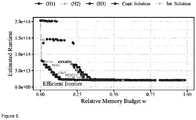
- Figure 5 shows the performance results for the BSEG table (see Section III-B).
- the performance-cost model further takes into account costs for reallocating columns. This is advantageous because an import aspect for real-life settings are reallocation costs. As workloads typically change over time, current data placements have to be recalculated regularly. However, reorganizations of data allocations are costly and time-consuming. The challenge is to identify reallocations that have a significant impact on performance compared to their costs.
- a current column allocation y i ⁇ ⁇ 0,1 ⁇ , i 1,..., N, and a cost parameter ß for changing the memory location of a column (from secondary storage to primary storage or vice versa).
- a cost parameter ß for changing the memory location of a column (from secondary storage to primary storage or vice versa).
- the step of allocating the columns comprises the step of: iteratively adding columns to the first set so that, in each iteration, a column is added to the first set that
- the step of assigning the columns further comprises the step of: if the column that
- FIG. 6 shows optimal allocations obtained by solving the performance-cost model using a solver.
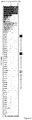
- Figure 6(a) shows the column allocation according to the integer solution for different w values.
- Figure 6(b) shows the column allocation according to the continuous solution. While the column allocations according to the integer problem are quite complex and irregular, the column allocations according to the continuous allocation has a regular, recursive structure.
- FIG. 6(c) depicts the case, in which for a given budget A(w) the remaining space on the primary storage medium for a solution according to the continuous model is filled with at least one column, preferably according to the performance order described above. This recursive allocation strategy with filling closely resembles the optimal integer solution (cf. Figure 6(a) ).
- I 1, ..., N
- the column with the smallest value S i - 2 ⁇ ß ⁇ y i is the first column to be put in primary storage.
- the order o i allows computing Pareto-optimal solutions of (6) that are admissible for a given budget A.
- the result of Theorem 2 (i) can be combined with a filling heuristic: Include columns in primary storage that are of highest importance, cf. o i . If a column does not fit into the primary storage budget A anymore, it is checked if columns of higher order do so, cf. Figure 6(c) .
- Remark 3's heuristic allows to approximate Pareto-optimal combinations of performance and primary storage budget.
- This approach is effective as the efficient frontier is naturally characterized by a convex shape, see Figures 4 and 5 , since the value of an additional unit of primary storage is decreasing with the memory budget (diminishing marginal utility).
- This principle can be adapted to compute optimized allocations for more general column allocation problems with highly complex (for instance, non-linear) scan cost functions.
- the approach can also be applied if a query optimizers' what-if component is used as it similarly allows to estimate and to compare the relative performance improvements of specific column selections.
- the database being a combined OLTP and OLAP database.
- the primary storage medium is a DRAM medium.
- the secondary storage medium not being a DRAM medium
- the secondary storage medium being a SSD, HDD, or any non-volatile storage.
- At least one of the columns of the table is manually pinned to the first set and therefore excluded from the step of allocating the columns of the table to the first and the second set automatically on the basis of a performance-cost model.
- the workload that the database has experienced during operation is determined based on historic workload data, in particular, using time series analysis.
- the workload is determined based on historic workload data, i.e. the number of occurrences of different queries against the database system.
- the workload only with a certain period in time is considered.
- time series analysis is used. This is advantageous because the workload may change over time. It may even show a cyclical behaviour that could be taken into account.
- the data of the columns allocated to the first set is dictionary compressed along columns.
- the data of the columns allocated to the second set is uncompressed.
- the primary-storage-resident columns remain dictionary-encoded while the remaining attributes are stored in a row-oriented and latency-optimized format on secondary storage.
- each column of a tiered table is completely and solely stored in one single format without any replication or additional data structures.
- the data of the columns allocated to the second set is page-wise compressed.
- additional formats such as disk-optimized column formats for secondary storage that allow scans for rarely filtered attributes, are provided in the database system.
- no additional formats are provided in the database system. The latter may be superior in an end-to-end consideration as it is better maintainable and does not add complexity to higher-level functionalities such as query optimization.
- the database system is the Hyrise system.
- Hyrise is a hybrid main memory-optimized database for HTAP workloads.
- each table in Hyrise consists of two partitions, a write-optimized delta partition (cf. C-Store's writable store) and a read-optimized main partition.
- a write-optimized delta partition cf. C-Store's writable store
- a read-optimized main partition Using an insert-only approach, data modifications are written to the delta partition, which is periodically merged into the main partition.
- Attributes in the main partition are dictionary-encoded with a bit-packed order-preserving dictionary.
- Attributes in the delta partition use an unsorted dictionary with an additional B+-tree for fast value retrievals.
- ACID compliance in Hyrise is implemented using multi-version concurrency control.
- Hyrise is able to combine row- and column-oriented data layouts as well as horizontal and vertical partitioning in a free manner. While Hyrise's initial objective was to improve cache hit rates in the case of full DRAM residence, the objective of the present invention is to mitigate the negative performance impact of secondary storage.
- a simplified hybrid format is used, which comprises column groups of variable lengths.
- 3D XPoint 3D XPoint-based Intel Optane P4800X.
- Both solid-state drives are NAND devices which are widely used in modern data centers, whereas the ESSD is a bandwidth optimized device that reaches its top performance with large IO queues.
- the 3D XPoint device is the first generation of solid-state drives that does not use a NAND architecture. This device is particularly interesting as it has 10 times lower random access latencies than NAND devices even for short IO queues.
- the HDD device serves as a reference device. Due to its poor random access performance, the device is not included in the materialization measurements.
- Benchmark Data Sets The inventors evaluated the performance on three different data sets: (i) The SAP ERP data set which reflects characteristics (distinct counts, data types, etc.) of the BSEG table of the analyzed production SAP ERP system.
- the BSEG table is the central table of the financial module and has the highest analytical load in an SAP ERP system (20 M tuples with 345 attributes).
- the TPC-C data consists of the ORDERLINE table of the TPC-C benchmark with a scale factor of 3 000 (300 M tuples).
- the Synthetic data set is a table with 10 M tuples and 200 attributes which are filled with random integer values.
- Hyrise uses MVCC to ensure concurrent and transactionally safe accesses the data. MVCC-related columns are kept unchanged and DRAM-allocated. Thus, transaction performance is not impacted.
- Hyrise has several index structures such as single column B+-trees and multi-column composite keys.
- indices are not evicted and kept completely DRAM-allocated.
- ORDERLINE 4 out of 10 columns are selected/aggregated leaving at least 6 columns to be evicted to disk.
- the present data allocation model separates ORDERLINE into the four primary key attributes as primary-storage-resident columns (PSRCs) and the remaining attributes into a secondary storage column group (SSCG). Table III shows the relative performance impact of TPC-C's delivery transaction and CH-query #19.
- TPC-C's workload and data model are simple and no performance-critical path accesses tiered data.
- the join predicate on ol_i_id and the predicate on ol_w_id are not impacted, but the range predicate on ol_quantity is executed on a tiered column.
- the probing alone is slowed down by a factor of 40 which leads to an overall query slowdown of factor 6.7.
- the inventors' main focus with respect to tiering performance is the latency of wide tuple reconstructions. Especially for column stores, wide tuples reconstructions are expensive as each attribute materialization potentially leads to two L3 cache misses (access to value vector and dictionary).
- the inventors measured reconstruction performance by accessing randomly chosen tuples using a uniform random distribution. The inventors set the page cache to 2% of the evicted data size and disable page pinning. The uniform distribution of accesses reflects the worst case scenario for our implementation with almost no cache hits during tuple reconstruction. The inventors measure the mean latency as well as the 99th percentile latency of full-width tuple reconstructions on the synthetic data set.
- the inventors vary the number of attributes stored in the SSCG from 20 to 200. For each benchmark, the inventors execute 10 M tuple reconstructions. The results are shown in Figure 7 . For the uniformly distributed accesses, the inventors observe that the latency-optimized 3D XPoint device outperforms the NAND devices. This trend is even more nuanced when comparing the 99th percentile latencies. Most notably, SSCG-placed tuples on 3D XPoint outperform fully DRAM-resident dictionary-encoded tuples when 50% of the attributes are stored in the SSCG.
- IMDB PSRC
- PSRC denotes a columnar, dictionary-encoded, and fully DRAMresident data schema.
- the BSEG table consists of 20 PSRC attributes and 325 attributes in an SSCG (ORDERLINE: 4 PSRC and 6 attributes in SSCG).
- the results show that runtimes are dominated by the width of the SSCG with an increasingly lower latency the higher the share of SSCG-placed attributes gets.
- the tiered uncompressed column group (SSCG) is able to compensate the negative performance impact of accessing secondary storage.
- a column group access of 1/1 means that one attribute in an SSCG that contains a single attribute was scanned. 1/100 means that one attribute out of 100 in an SSCG was scanned.
- the costs scale linearly with the width of SSCG. The reason is the effective data that is read with each single 4 KB page access. With 100 integer columns, each 4 KB page contains 10 values to scan while each page for an SSCG of 10 attributes contains 100 values to scan.
- HDDs perform well for pure sequential requests but significantly slow down with concurrent requests by multiple threads while modern SSDs require concurrent access/larger IO queues for full performance.
- Figure 9(b) shows the probing performance. Due to our data placement model, one expects probing to happen infrequently on tiered attributes, but more frequently than scanning.
- Table IV lists the relative slowdown comparing the measurements discussed before (cf. Figures 9(a) and 9(b) ) with a full DRAM-resident and dictionary-encoded columnar system.
- tuple reconstructions can be sped up, depending on the number of columns accessed and their storage tier. Sequential accesses slow down linearly with the number of attributes stored in the SSCG. Due to non-sequential access pattern, HDDs perform clearly worse probing than scanning.
- the present invention allows for scalability. Enterprise systems often have thousands of tables. For those systems, it is unrealistic to expect that the database administrator will set memory budgets for each table manually. Our presented solution is able to determine the optimal data placement for thousands of attributes.
- the inventors measured the solution runtime for a large synthetic data set with a varying number of queries and attributes using the MOSEK solver4.
- Table II compares the computation time of the integer model and the explicit solution in the setting of Example 1 for different numbers of columns N and queries Q. Table II shows that optimized data placements can be efficiently calculated, even for large systems.
- the linear problem is manageable for state-of-art integer solvers. However, runtimes can become large when the size of the system is large. 4MOSEK Solver: https://www.mosek.com
- the explicit solutions (cf. Theorem 2) have been computed locally using a simple single-threaded C++ implementation. As expected, the computation of the explicit solution is orders of magnitudes faster and allows for immediate response. Hence, it becomes easy for a database administrator to (i) dynamically update optimized allocations and (ii) decide whether it is worth to allow for a slightly larger budget compared to the expected additional performance.
- DRAM-RESIDENT MRC 32 THREADS. SHOWING RELATIVE SLOWDOWN ( latency SSCG / latency MRC ) 1 Thread 8 Threads 32 Threads Uni. Tuple Rec. (100/200) 1.02 0.92 0.86 Uni. Tuple Rec. (180/200) 0.81 0.72 0.64 Zipf. Tuple Rec. (100/200) 0.92 0.83 0.77 Zipf. Tuple Rec. (180/200) 0.75 0.67 0.60 Scanning (1/100) 335.69 644.44 548.85 Probing (1/100, 0.1%) 5447.11 301.89 78.95 Probing (1/100, 10%) 4446.25 1 195.00 987.50
Landscapes
- Engineering & Computer Science (AREA)
- Theoretical Computer Science (AREA)
- Databases & Information Systems (AREA)
- Data Mining & Analysis (AREA)
- Physics & Mathematics (AREA)
- General Engineering & Computer Science (AREA)
- General Physics & Mathematics (AREA)
- Software Systems (AREA)
- Computing Systems (AREA)
- Information Retrieval, Db Structures And Fs Structures Therefor (AREA)
Priority Applications (3)
| Application Number | Priority Date | Filing Date | Title |
|---|---|---|---|
| EP18164052.5A EP3547166B1 (de) | 2018-03-26 | 2018-03-26 | Datenplatzierung in hybriden datenlayouts für abgestufte htap-datenbanken |
| US16/364,869 US11256718B2 (en) | 2018-03-26 | 2019-03-26 | Data placement in hybrid data layouts for tiered HTAP databases |
| CN201910232077.4A CN110362566B (zh) | 2018-03-26 | 2019-03-26 | 分层htap数据库的混合数据布局中的数据布置 |
Applications Claiming Priority (1)
| Application Number | Priority Date | Filing Date | Title |
|---|---|---|---|
| EP18164052.5A EP3547166B1 (de) | 2018-03-26 | 2018-03-26 | Datenplatzierung in hybriden datenlayouts für abgestufte htap-datenbanken |
Publications (2)
| Publication Number | Publication Date |
|---|---|
| EP3547166A1 true EP3547166A1 (de) | 2019-10-02 |
| EP3547166B1 EP3547166B1 (de) | 2020-12-02 |
Family
ID=61800420
Family Applications (1)
| Application Number | Title | Priority Date | Filing Date |
|---|---|---|---|
| EP18164052.5A Active EP3547166B1 (de) | 2018-03-26 | 2018-03-26 | Datenplatzierung in hybriden datenlayouts für abgestufte htap-datenbanken |
Country Status (3)
| Country | Link |
|---|---|
| US (1) | US11256718B2 (de) |
| EP (1) | EP3547166B1 (de) |
| CN (1) | CN110362566B (de) |
Families Citing this family (9)
| Publication number | Priority date | Publication date | Assignee | Title |
|---|---|---|---|---|
| US11068454B2 (en) | 2019-09-23 | 2021-07-20 | Singlestore, Inc. | Method of performing transactional and analytical data processing using a data structure |
| US11567939B2 (en) | 2019-12-26 | 2023-01-31 | Snowflake Inc. | Lazy reassembling of semi-structured data |
| US10769150B1 (en) | 2019-12-26 | 2020-09-08 | Snowflake Inc. | Pruning indexes to enhance database query processing |
| US11308090B2 (en) | 2019-12-26 | 2022-04-19 | Snowflake Inc. | Pruning index to support semi-structured data types |
| US11372860B2 (en) * | 2019-12-26 | 2022-06-28 | Snowflake Inc. | Processing techniques for queries where predicate values are unknown until runtime |
| US12050605B2 (en) | 2019-12-26 | 2024-07-30 | Snowflake Inc. | Indexed geospatial predicate search |
| US11907250B2 (en) * | 2022-07-22 | 2024-02-20 | Oracle International Corporation | Workload-aware data encoding |
| US11880369B1 (en) | 2022-11-21 | 2024-01-23 | Snowflake Inc. | Pruning data based on state of top K operator |
| CN117349288A (zh) * | 2023-10-24 | 2024-01-05 | 北京火山引擎科技有限公司 | 基于联机分析处理的数据查询方法、装置和电子设备 |
Citations (3)
| Publication number | Priority date | Publication date | Assignee | Title |
|---|---|---|---|---|
| US20140012881A1 (en) * | 2012-07-09 | 2014-01-09 | Sap Ag | Storage Advisor for Hybrid-Store Databases |
| US20140214793A1 (en) * | 2013-01-29 | 2014-07-31 | Nec Laboratories America, Inc. | Cost-Effective Data Layout Optimization Over Heterogeneous Storage Classes |
| US20150363167A1 (en) * | 2014-06-16 | 2015-12-17 | International Business Machines Corporation | Flash optimized columnar data layout and data access algorithms for big data query engines |
Family Cites Families (18)
| Publication number | Priority date | Publication date | Assignee | Title |
|---|---|---|---|---|
| US8326669B2 (en) * | 2007-04-19 | 2012-12-04 | International Business Machines Corporation | System and method for selecting and scheduling corrective actions for automated storage management |
| US9626421B2 (en) | 2007-09-21 | 2017-04-18 | Hasso-Plattner-Institut Fur Softwaresystemtechnik Gmbh | ETL-less zero-redundancy system and method for reporting OLTP data |
| EP2251823A1 (de) | 2009-05-11 | 2010-11-17 | Hasso-Plattner-Institut für Softwaresystemtechnik GmbH | Geschäftsobjektbasierte Navigation |
| EP2270692A1 (de) | 2009-06-30 | 2011-01-05 | Hasso-Plattner-Institut für Softwaresystemtechnik GmbH | Computerimplementiertes Verfahren zum Betrieb einer Datenbank und zugehöriges Computersystem |
| EP2270691B1 (de) | 2009-06-30 | 2019-01-16 | Hasso-Plattner-Institut für Digital Engineering gGmbH | Computerimplementiertes Verfahren zum Betrieb einer Datenbank und zugehöriges Computersystem |
| US8601038B2 (en) | 2010-10-08 | 2013-12-03 | Hasso-Plattner-Institut Fur Softwaresystemtechnik Gmbh | Available-to-promise on an in-memory column store |
| EP2472450A1 (de) | 2010-12-28 | 2012-07-04 | Hasso-Plattner-Institut für Softwaresystemtechnik GmbH | Suchverfahren für einen sicherheitsbewussten Auffindungsdienst |
| EP2472448A1 (de) | 2010-12-28 | 2012-07-04 | Hasso-Plattner-Institut für Softwaresystemtechnik GmbH | Kommunikationsprotokoll für eine kommunikationsbewusste Auffindung von Diensten |
| EP2472449A1 (de) | 2010-12-28 | 2012-07-04 | Hasso-Plattner-Institut für Softwaresystemtechnik GmbH | Filterverfahren für einen sicherheitsbewussten Auffindungsdienst |
| FI20115932A0 (fi) * | 2011-09-22 | 2011-09-22 | Relex Oy | Mekanismi päivityksiä varten tietokantamoottorissa |
| EP2637112B1 (de) | 2012-03-05 | 2020-07-22 | Hasso-Plattner-Institut für Softwaresystemtechnik GmbH | Online-neuordnung von hybriden in-memory-vorrichtungen |
| US9015812B2 (en) | 2012-05-22 | 2015-04-21 | Hasso-Plattner-Institut Fur Softwaresystemtechnik Gmbh | Transparent control of access invoking real-time analysis of the query history |
| US9740741B2 (en) | 2013-04-11 | 2017-08-22 | Hasso-Plattner-Institut Fur Softwaresystemtechnik Gmbh | Aggregate query-caching in databases architectures with a differential buffer and a main store |
| US10089142B2 (en) | 2013-08-21 | 2018-10-02 | Hasso-Plattner-Institut Fur Softwaresystemtechnik Gmbh | Dynamic task prioritization for in-memory databases |
| US9542445B2 (en) | 2013-10-31 | 2017-01-10 | Hasso-Plattner-Institut Fur Softwaresystemtechnik Gmbh | Using object awareness for a join pruning mechanism |
| US10235377B2 (en) * | 2013-12-23 | 2019-03-19 | Sap Se | Adaptive dictionary compression/decompression for column-store databases |
| US10936595B2 (en) * | 2014-04-03 | 2021-03-02 | Sybase, Inc. | Deferring and/or eliminating decompressing database data |
| US10810198B2 (en) * | 2017-09-26 | 2020-10-20 | Oracle International Corporation | Group determination based on multi-table dictionary codes |
-
2018
- 2018-03-26 EP EP18164052.5A patent/EP3547166B1/de active Active
-
2019
- 2019-03-26 CN CN201910232077.4A patent/CN110362566B/zh active Active
- 2019-03-26 US US16/364,869 patent/US11256718B2/en active Active
Patent Citations (3)
| Publication number | Priority date | Publication date | Assignee | Title |
|---|---|---|---|---|
| US20140012881A1 (en) * | 2012-07-09 | 2014-01-09 | Sap Ag | Storage Advisor for Hybrid-Store Databases |
| US20140214793A1 (en) * | 2013-01-29 | 2014-07-31 | Nec Laboratories America, Inc. | Cost-Effective Data Layout Optimization Over Heterogeneous Storage Classes |
| US20150363167A1 (en) * | 2014-06-16 | 2015-12-17 | International Business Machines Corporation | Flash optimized columnar data layout and data access algorithms for big data query engines |
Also Published As
| Publication number | Publication date |
|---|---|
| CN110362566B (zh) | 2024-03-12 |
| CN110362566A (zh) | 2019-10-22 |
| EP3547166B1 (de) | 2020-12-02 |
| US20190294615A1 (en) | 2019-09-26 |
| US11256718B2 (en) | 2022-02-22 |
Similar Documents
| Publication | Publication Date | Title |
|---|---|---|
| US11256718B2 (en) | Data placement in hybrid data layouts for tiered HTAP databases | |
| Boissier et al. | Hybrid data layouts for tiered HTAP databases with pareto-optimal data placements | |
| US11238039B2 (en) | Materializing internal computations in-memory to improve query performance | |
| Wu et al. | Updatable learned index with precise positions | |
| CN107851123B (zh) | 在存储器中虚拟列单元内具体化表达式以加速分析查询 | |
| Grund et al. | HYRISE-A Main Memory Hybrid Storage Engine. | |
| US9892150B2 (en) | Unified data management for database systems | |
| US8285709B2 (en) | High-concurrency query operator and method | |
| CN103942342B (zh) | 一种内存数据库oltp&olap并发查询优化方法 | |
| Zhang et al. | CARMI: a cache-aware learned index with a cost-based construction algorithm | |
| Zhang et al. | Htap databases: A survey | |
| Saxena et al. | Real-time LSM-trees for HTAP workloads | |
| Kim et al. | Accelerating string-key learned index structures via memoization-based incremental training | |
| US8700822B2 (en) | Parallel aggregation system | |
| Müller et al. | An in-depth analysis of data aggregation cost factors in a columnar in-memory database | |
| Thallam | Columnar Storage vs. Row-Based Storage: Performance Considerations for Data Warehousing | |
| Krueger et al. | Enterprise application-specific data management | |
| He | Cache-oblivious query processing | |
| CN114841806B (zh) | 一种实时转账链路下的模式匹配系统 | |
| Graefe et al. | Designing Database Operators for Flash-enabled Memory Hierarchies. | |
| Li et al. | Optimizing nonindexed join processing in flash storage-based systems | |
| Raman et al. | OSM-tree: A Sortedness-Aware Index | |
| Nalla | Performance Engineering in Cloud Data Warehouses: A Systematic Approach to Optimization | |
| Rahman et al. | ECOS: evolutionary column-oriented storage | |
| Götze et al. | Query planning for transactional stream processing on heterogeneous hardware: Opportunities and limitations |
Legal Events
| Date | Code | Title | Description |
|---|---|---|---|
| PUAI | Public reference made under article 153(3) epc to a published international application that has entered the european phase |
Free format text: ORIGINAL CODE: 0009012 |
|
| STAA | Information on the status of an ep patent application or granted ep patent |
Free format text: STATUS: THE APPLICATION HAS BEEN PUBLISHED |
|
| AK | Designated contracting states |
Kind code of ref document: A1 Designated state(s): AL AT BE BG CH CY CZ DE DK EE ES FI FR GB GR HR HU IE IS IT LI LT LU LV MC MK MT NL NO PL PT RO RS SE SI SK SM TR |
|
| AX | Request for extension of the european patent |
Extension state: BA ME |
|
| STAA | Information on the status of an ep patent application or granted ep patent |
Free format text: STATUS: REQUEST FOR EXAMINATION WAS MADE |
|
| 17P | Request for examination filed |
Effective date: 20200402 |
|
| RBV | Designated contracting states (corrected) |
Designated state(s): AL AT BE BG CH CY CZ DE DK EE ES FI FR GB GR HR HU IE IS IT LI LT LU LV MC MK MT NL NO PL PT RO RS SE SI SK SM TR |
|
| REG | Reference to a national code |
Ref country code: DE Ref legal event code: R079 Ref document number: 602018010243 Country of ref document: DE Free format text: PREVIOUS MAIN CLASS: G06F0017300000 Ipc: G06F0016220000 |
|
| GRAP | Despatch of communication of intention to grant a patent |
Free format text: ORIGINAL CODE: EPIDOSNIGR1 |
|
| STAA | Information on the status of an ep patent application or granted ep patent |
Free format text: STATUS: GRANT OF PATENT IS INTENDED |
|
| RIC1 | Information provided on ipc code assigned before grant |
Ipc: G06F 16/22 20190101AFI20200608BHEP Ipc: G06F 16/21 20190101ALI20200608BHEP Ipc: G06F 16/28 20190101ALI20200608BHEP |
|
| INTG | Intention to grant announced |
Effective date: 20200622 |
|
| RIN1 | Information on inventor provided before grant (corrected) |
Inventor name: SCHLOSSER, RAINER Inventor name: BOISSIER, MARTIN Inventor name: UFLACKER, MATTHIAS Inventor name: PLATTNER, HASSO |
|
| GRAS | Grant fee paid |
Free format text: ORIGINAL CODE: EPIDOSNIGR3 |
|
| GRAA | (expected) grant |
Free format text: ORIGINAL CODE: 0009210 |
|
| STAA | Information on the status of an ep patent application or granted ep patent |
Free format text: STATUS: THE PATENT HAS BEEN GRANTED |
|
| AK | Designated contracting states |
Kind code of ref document: B1 Designated state(s): AL AT BE BG CH CY CZ DE DK EE ES FI FR GB GR HR HU IE IS IT LI LT LU LV MC MK MT NL NO PL PT RO RS SE SI SK SM TR |
|
| REG | Reference to a national code |
Ref country code: GB Ref legal event code: FG4D |
|
| REG | Reference to a national code |
Ref country code: AT Ref legal event code: REF Ref document number: 1341701 Country of ref document: AT Kind code of ref document: T Effective date: 20201215 Ref country code: CH Ref legal event code: EP |
|
| REG | Reference to a national code |
Ref country code: IE Ref legal event code: FG4D |
|
| REG | Reference to a national code |
Ref country code: DE Ref legal event code: R096 Ref document number: 602018010243 Country of ref document: DE |
|
| PG25 | Lapsed in a contracting state [announced via postgrant information from national office to epo] |
Ref country code: RS Free format text: LAPSE BECAUSE OF FAILURE TO SUBMIT A TRANSLATION OF THE DESCRIPTION OR TO PAY THE FEE WITHIN THE PRESCRIBED TIME-LIMIT Effective date: 20201202 Ref country code: FI Free format text: LAPSE BECAUSE OF FAILURE TO SUBMIT A TRANSLATION OF THE DESCRIPTION OR TO PAY THE FEE WITHIN THE PRESCRIBED TIME-LIMIT Effective date: 20201202 Ref country code: NO Free format text: LAPSE BECAUSE OF FAILURE TO SUBMIT A TRANSLATION OF THE DESCRIPTION OR TO PAY THE FEE WITHIN THE PRESCRIBED TIME-LIMIT Effective date: 20210302 Ref country code: GR Free format text: LAPSE BECAUSE OF FAILURE TO SUBMIT A TRANSLATION OF THE DESCRIPTION OR TO PAY THE FEE WITHIN THE PRESCRIBED TIME-LIMIT Effective date: 20210303 |
|
| REG | Reference to a national code |
Ref country code: NL Ref legal event code: MP Effective date: 20201202 |
|
| REG | Reference to a national code |
Ref country code: AT Ref legal event code: MK05 Ref document number: 1341701 Country of ref document: AT Kind code of ref document: T Effective date: 20201202 |
|
| PG25 | Lapsed in a contracting state [announced via postgrant information from national office to epo] |
Ref country code: BG Free format text: LAPSE BECAUSE OF FAILURE TO SUBMIT A TRANSLATION OF THE DESCRIPTION OR TO PAY THE FEE WITHIN THE PRESCRIBED TIME-LIMIT Effective date: 20210302 Ref country code: LV Free format text: LAPSE BECAUSE OF FAILURE TO SUBMIT A TRANSLATION OF THE DESCRIPTION OR TO PAY THE FEE WITHIN THE PRESCRIBED TIME-LIMIT Effective date: 20201202 Ref country code: PL Free format text: LAPSE BECAUSE OF FAILURE TO SUBMIT A TRANSLATION OF THE DESCRIPTION OR TO PAY THE FEE WITHIN THE PRESCRIBED TIME-LIMIT Effective date: 20201202 Ref country code: SE Free format text: LAPSE BECAUSE OF FAILURE TO SUBMIT A TRANSLATION OF THE DESCRIPTION OR TO PAY THE FEE WITHIN THE PRESCRIBED TIME-LIMIT Effective date: 20201202 |
|
| PG25 | Lapsed in a contracting state [announced via postgrant information from national office to epo] |
Ref country code: NL Free format text: LAPSE BECAUSE OF FAILURE TO SUBMIT A TRANSLATION OF THE DESCRIPTION OR TO PAY THE FEE WITHIN THE PRESCRIBED TIME-LIMIT Effective date: 20201202 Ref country code: HR Free format text: LAPSE BECAUSE OF FAILURE TO SUBMIT A TRANSLATION OF THE DESCRIPTION OR TO PAY THE FEE WITHIN THE PRESCRIBED TIME-LIMIT Effective date: 20201202 |
|
| REG | Reference to a national code |
Ref country code: LT Ref legal event code: MG9D |
|
| PG25 | Lapsed in a contracting state [announced via postgrant information from national office to epo] |
Ref country code: SM Free format text: LAPSE BECAUSE OF FAILURE TO SUBMIT A TRANSLATION OF THE DESCRIPTION OR TO PAY THE FEE WITHIN THE PRESCRIBED TIME-LIMIT Effective date: 20201202 Ref country code: CZ Free format text: LAPSE BECAUSE OF FAILURE TO SUBMIT A TRANSLATION OF THE DESCRIPTION OR TO PAY THE FEE WITHIN THE PRESCRIBED TIME-LIMIT Effective date: 20201202 Ref country code: EE Free format text: LAPSE BECAUSE OF FAILURE TO SUBMIT A TRANSLATION OF THE DESCRIPTION OR TO PAY THE FEE WITHIN THE PRESCRIBED TIME-LIMIT Effective date: 20201202 Ref country code: LT Free format text: LAPSE BECAUSE OF FAILURE TO SUBMIT A TRANSLATION OF THE DESCRIPTION OR TO PAY THE FEE WITHIN THE PRESCRIBED TIME-LIMIT Effective date: 20201202 Ref country code: SK Free format text: LAPSE BECAUSE OF FAILURE TO SUBMIT A TRANSLATION OF THE DESCRIPTION OR TO PAY THE FEE WITHIN THE PRESCRIBED TIME-LIMIT Effective date: 20201202 Ref country code: RO Free format text: LAPSE BECAUSE OF FAILURE TO SUBMIT A TRANSLATION OF THE DESCRIPTION OR TO PAY THE FEE WITHIN THE PRESCRIBED TIME-LIMIT Effective date: 20201202 Ref country code: PT Free format text: LAPSE BECAUSE OF FAILURE TO SUBMIT A TRANSLATION OF THE DESCRIPTION OR TO PAY THE FEE WITHIN THE PRESCRIBED TIME-LIMIT Effective date: 20210405 |
|
| PG25 | Lapsed in a contracting state [announced via postgrant information from national office to epo] |
Ref country code: AT Free format text: LAPSE BECAUSE OF FAILURE TO SUBMIT A TRANSLATION OF THE DESCRIPTION OR TO PAY THE FEE WITHIN THE PRESCRIBED TIME-LIMIT Effective date: 20201202 |
|
| REG | Reference to a national code |
Ref country code: DE Ref legal event code: R097 Ref document number: 602018010243 Country of ref document: DE |
|
| PG25 | Lapsed in a contracting state [announced via postgrant information from national office to epo] |
Ref country code: IS Free format text: LAPSE BECAUSE OF FAILURE TO SUBMIT A TRANSLATION OF THE DESCRIPTION OR TO PAY THE FEE WITHIN THE PRESCRIBED TIME-LIMIT Effective date: 20210402 |
|
| PLBE | No opposition filed within time limit |
Free format text: ORIGINAL CODE: 0009261 |
|
| STAA | Information on the status of an ep patent application or granted ep patent |
Free format text: STATUS: NO OPPOSITION FILED WITHIN TIME LIMIT |
|
| PG25 | Lapsed in a contracting state [announced via postgrant information from national office to epo] |
Ref country code: IT Free format text: LAPSE BECAUSE OF FAILURE TO SUBMIT A TRANSLATION OF THE DESCRIPTION OR TO PAY THE FEE WITHIN THE PRESCRIBED TIME-LIMIT Effective date: 20201202 Ref country code: MC Free format text: LAPSE BECAUSE OF FAILURE TO SUBMIT A TRANSLATION OF THE DESCRIPTION OR TO PAY THE FEE WITHIN THE PRESCRIBED TIME-LIMIT Effective date: 20201202 Ref country code: AL Free format text: LAPSE BECAUSE OF FAILURE TO SUBMIT A TRANSLATION OF THE DESCRIPTION OR TO PAY THE FEE WITHIN THE PRESCRIBED TIME-LIMIT Effective date: 20201202 |
|
| REG | Reference to a national code |
Ref country code: CH Ref legal event code: PL |
|
| 26N | No opposition filed |
Effective date: 20210903 |
|
| PG25 | Lapsed in a contracting state [announced via postgrant information from national office to epo] |
Ref country code: DK Free format text: LAPSE BECAUSE OF FAILURE TO SUBMIT A TRANSLATION OF THE DESCRIPTION OR TO PAY THE FEE WITHIN THE PRESCRIBED TIME-LIMIT Effective date: 20201202 Ref country code: SI Free format text: LAPSE BECAUSE OF FAILURE TO SUBMIT A TRANSLATION OF THE DESCRIPTION OR TO PAY THE FEE WITHIN THE PRESCRIBED TIME-LIMIT Effective date: 20201202 |
|
| REG | Reference to a national code |
Ref country code: BE Ref legal event code: MM Effective date: 20210331 |
|
| PG25 | Lapsed in a contracting state [announced via postgrant information from national office to epo] |
Ref country code: ES Free format text: LAPSE BECAUSE OF FAILURE TO SUBMIT A TRANSLATION OF THE DESCRIPTION OR TO PAY THE FEE WITHIN THE PRESCRIBED TIME-LIMIT Effective date: 20201202 Ref country code: IE Free format text: LAPSE BECAUSE OF NON-PAYMENT OF DUE FEES Effective date: 20210326 Ref country code: LU Free format text: LAPSE BECAUSE OF NON-PAYMENT OF DUE FEES Effective date: 20210326 Ref country code: LI Free format text: LAPSE BECAUSE OF NON-PAYMENT OF DUE FEES Effective date: 20210331 Ref country code: CH Free format text: LAPSE BECAUSE OF NON-PAYMENT OF DUE FEES Effective date: 20210331 |
|
| PG25 | Lapsed in a contracting state [announced via postgrant information from national office to epo] |
Ref country code: IS Free format text: LAPSE BECAUSE OF FAILURE TO SUBMIT A TRANSLATION OF THE DESCRIPTION OR TO PAY THE FEE WITHIN THE PRESCRIBED TIME-LIMIT Effective date: 20210402 |
|
| PG25 | Lapsed in a contracting state [announced via postgrant information from national office to epo] |
Ref country code: BE Free format text: LAPSE BECAUSE OF NON-PAYMENT OF DUE FEES Effective date: 20210331 |
|
| PG25 | Lapsed in a contracting state [announced via postgrant information from national office to epo] |
Ref country code: CY Free format text: LAPSE BECAUSE OF FAILURE TO SUBMIT A TRANSLATION OF THE DESCRIPTION OR TO PAY THE FEE WITHIN THE PRESCRIBED TIME-LIMIT Effective date: 20201202 |
|
| PG25 | Lapsed in a contracting state [announced via postgrant information from national office to epo] |
Ref country code: HU Free format text: LAPSE BECAUSE OF FAILURE TO SUBMIT A TRANSLATION OF THE DESCRIPTION OR TO PAY THE FEE WITHIN THE PRESCRIBED TIME-LIMIT; INVALID AB INITIO Effective date: 20180326 |
|
| PG25 | Lapsed in a contracting state [announced via postgrant information from national office to epo] |
Ref country code: MK Free format text: LAPSE BECAUSE OF FAILURE TO SUBMIT A TRANSLATION OF THE DESCRIPTION OR TO PAY THE FEE WITHIN THE PRESCRIBED TIME-LIMIT Effective date: 20201202 |
|
| PG25 | Lapsed in a contracting state [announced via postgrant information from national office to epo] |
Ref country code: TR Free format text: LAPSE BECAUSE OF FAILURE TO SUBMIT A TRANSLATION OF THE DESCRIPTION OR TO PAY THE FEE WITHIN THE PRESCRIBED TIME-LIMIT Effective date: 20201202 |
|
| PG25 | Lapsed in a contracting state [announced via postgrant information from national office to epo] |
Ref country code: MT Free format text: LAPSE BECAUSE OF FAILURE TO SUBMIT A TRANSLATION OF THE DESCRIPTION OR TO PAY THE FEE WITHIN THE PRESCRIBED TIME-LIMIT Effective date: 20201202 |
|
| PGFP | Annual fee paid to national office [announced via postgrant information from national office to epo] |
Ref country code: GB Payment date: 20260324 Year of fee payment: 9 |
|
| PGFP | Annual fee paid to national office [announced via postgrant information from national office to epo] |
Ref country code: DE Payment date: 20260320 Year of fee payment: 9 |
|
| PGFP | Annual fee paid to national office [announced via postgrant information from national office to epo] |
Ref country code: FR Payment date: 20260325 Year of fee payment: 9 |