EP3547346A2 - Dispositif d'alignement axial d'un faisceau de particules chargées, dispositif d'irradiation à faisceau de particules chargées et procédé d'alignement axial d'un faisceau de particules chargées - Google Patents
Dispositif d'alignement axial d'un faisceau de particules chargées, dispositif d'irradiation à faisceau de particules chargées et procédé d'alignement axial d'un faisceau de particules chargées Download PDFInfo
- Publication number
- EP3547346A2 EP3547346A2 EP19164468.1A EP19164468A EP3547346A2 EP 3547346 A2 EP3547346 A2 EP 3547346A2 EP 19164468 A EP19164468 A EP 19164468A EP 3547346 A2 EP3547346 A2 EP 3547346A2
- Authority
- EP
- European Patent Office
- Prior art keywords
- strength
- charged particle
- particle beam
- magnetic field
- scanned image
- Prior art date
- Legal status (The legal status is an assumption and is not a legal conclusion. Google has not performed a legal analysis and makes no representation as to the accuracy of the status listed.)
- Pending
Links
- 239000002245 particle Substances 0.000 title claims abstract description 165
- 238000000034 method Methods 0.000 title claims description 27
- 230000003287 optical effect Effects 0.000 claims description 18
- 230000001678 irradiating effect Effects 0.000 claims description 2
- 238000010894 electron beam technology Methods 0.000 description 62
- 239000000523 sample Substances 0.000 description 41
- 238000010586 diagram Methods 0.000 description 8
- 238000004364 calculation method Methods 0.000 description 4
- 239000000470 constituent Substances 0.000 description 2
- 239000013078 crystal Substances 0.000 description 1
- 230000000694 effects Effects 0.000 description 1
- 230000005684 electric field Effects 0.000 description 1
- 230000006870 function Effects 0.000 description 1
- 238000010884 ion-beam technique Methods 0.000 description 1
- 239000007788 liquid Substances 0.000 description 1
- 239000004065 semiconductor Substances 0.000 description 1
Images


Classifications
-
- H—ELECTRICITY
- H01—ELECTRIC ELEMENTS
- H01J—ELECTRIC DISCHARGE TUBES OR DISCHARGE LAMPS
- H01J37/00—Discharge tubes with provision for introducing objects or material to be exposed to the discharge, e.g. for the purpose of examination or processing thereof
- H01J37/26—Electron or ion microscopes; Electron or ion diffraction tubes
- H01J37/28—Electron or ion microscopes; Electron or ion diffraction tubes with scanning beams
-
- H—ELECTRICITY
- H01—ELECTRIC ELEMENTS
- H01J—ELECTRIC DISCHARGE TUBES OR DISCHARGE LAMPS
- H01J37/00—Discharge tubes with provision for introducing objects or material to be exposed to the discharge, e.g. for the purpose of examination or processing thereof
- H01J37/02—Details
- H01J37/04—Arrangements of electrodes and associated parts for generating or controlling the discharge, e.g. electron-optical arrangement or ion-optical arrangement
- H01J37/10—Lenses
- H01J37/14—Lenses magnetic
-
- H—ELECTRICITY
- H01—ELECTRIC ELEMENTS
- H01J—ELECTRIC DISCHARGE TUBES OR DISCHARGE LAMPS
- H01J37/00—Discharge tubes with provision for introducing objects or material to be exposed to the discharge, e.g. for the purpose of examination or processing thereof
- H01J37/02—Details
- H01J37/04—Arrangements of electrodes and associated parts for generating or controlling the discharge, e.g. electron-optical arrangement or ion-optical arrangement
- H01J37/10—Lenses
- H01J37/14—Lenses magnetic
- H01J37/141—Electromagnetic lenses
-
- H—ELECTRICITY
- H01—ELECTRIC ELEMENTS
- H01J—ELECTRIC DISCHARGE TUBES OR DISCHARGE LAMPS
- H01J37/00—Discharge tubes with provision for introducing objects or material to be exposed to the discharge, e.g. for the purpose of examination or processing thereof
- H01J37/02—Details
- H01J37/04—Arrangements of electrodes and associated parts for generating or controlling the discharge, e.g. electron-optical arrangement or ion-optical arrangement
- H01J37/147—Arrangements for directing or deflecting the discharge along a desired path
-
- H—ELECTRICITY
- H01—ELECTRIC ELEMENTS
- H01J—ELECTRIC DISCHARGE TUBES OR DISCHARGE LAMPS
- H01J37/00—Discharge tubes with provision for introducing objects or material to be exposed to the discharge, e.g. for the purpose of examination or processing thereof
- H01J37/02—Details
- H01J37/04—Arrangements of electrodes and associated parts for generating or controlling the discharge, e.g. electron-optical arrangement or ion-optical arrangement
- H01J37/147—Arrangements for directing or deflecting the discharge along a desired path
- H01J37/1472—Deflecting along given lines
- H01J37/1474—Scanning means
-
- H—ELECTRICITY
- H01—ELECTRIC ELEMENTS
- H01J—ELECTRIC DISCHARGE TUBES OR DISCHARGE LAMPS
- H01J37/00—Discharge tubes with provision for introducing objects or material to be exposed to the discharge, e.g. for the purpose of examination or processing thereof
- H01J37/02—Details
- H01J37/04—Arrangements of electrodes and associated parts for generating or controlling the discharge, e.g. electron-optical arrangement or ion-optical arrangement
- H01J37/147—Arrangements for directing or deflecting the discharge along a desired path
- H01J37/1472—Deflecting along given lines
- H01J37/1474—Scanning means
- H01J37/1475—Scanning means magnetic
-
- H—ELECTRICITY
- H01—ELECTRIC ELEMENTS
- H01J—ELECTRIC DISCHARGE TUBES OR DISCHARGE LAMPS
- H01J37/00—Discharge tubes with provision for introducing objects or material to be exposed to the discharge, e.g. for the purpose of examination or processing thereof
- H01J37/02—Details
- H01J37/22—Optical, image processing or photographic arrangements associated with the tube
- H01J37/222—Image processing arrangements associated with the tube
-
- H—ELECTRICITY
- H01—ELECTRIC ELEMENTS
- H01J—ELECTRIC DISCHARGE TUBES OR DISCHARGE LAMPS
- H01J37/00—Discharge tubes with provision for introducing objects or material to be exposed to the discharge, e.g. for the purpose of examination or processing thereof
- H01J37/26—Electron or ion microscopes; Electron or ion diffraction tubes
- H01J37/261—Details
- H01J37/265—Controlling the tube; circuit arrangements adapted to a particular application not otherwise provided, e.g. bright-field-dark-field illumination
-
- H—ELECTRICITY
- H01—ELECTRIC ELEMENTS
- H01J—ELECTRIC DISCHARGE TUBES OR DISCHARGE LAMPS
- H01J2237/00—Discharge tubes exposing object to beam, e.g. for analysis treatment, etching, imaging
- H01J2237/10—Lenses
- H01J2237/14—Lenses magnetic
- H01J2237/1405—Constructional details
- H01J2237/141—Coils
-
- H—ELECTRICITY
- H01—ELECTRIC ELEMENTS
- H01J—ELECTRIC DISCHARGE TUBES OR DISCHARGE LAMPS
- H01J2237/00—Discharge tubes exposing object to beam, e.g. for analysis treatment, etching, imaging
- H01J2237/15—Means for deflecting or directing discharge
- H01J2237/1501—Beam alignment means or procedures
-
- H—ELECTRICITY
- H01—ELECTRIC ELEMENTS
- H01J—ELECTRIC DISCHARGE TUBES OR DISCHARGE LAMPS
- H01J2237/00—Discharge tubes exposing object to beam, e.g. for analysis treatment, etching, imaging
- H01J2237/15—Means for deflecting or directing discharge
- H01J2237/1504—Associated circuits
-
- H—ELECTRICITY
- H01—ELECTRIC ELEMENTS
- H01J—ELECTRIC DISCHARGE TUBES OR DISCHARGE LAMPS
- H01J2237/00—Discharge tubes exposing object to beam, e.g. for analysis treatment, etching, imaging
- H01J2237/245—Detection characterised by the variable being measured
- H01J2237/24571—Measurements of non-electric or non-magnetic variables
- H01J2237/24578—Spatial variables, e.g. position, distance
Definitions
- the present invention relates to a charged particle beam axial alignment device, a charged particle beam irradiation device and a charged particle beam axial alignment method for aligning an axis of a charged particle beam.
- a charged particle beam irradiation device has been known as a device for analysis or observation of a sample with high resolution.
- JP 2011-54426 A an electron beam irradiation device that includes an electron gun, an inlet beam deflector, a converging lens system having two condenser lenses, an outlet beam deflector, an objective aperture plate, a scanning coil and an objective lens is described.
- an electron beam emitted from the electron gun passes through the converging lens system to be converged. Then, the electron beam passes through the objective aperture plate, so that a beam diameter is restricted. Thereafter, the electron beam passes through scanning coils and is scanned in a plane, and the diameter of the electron beam is reduced to a small diameter when the electron beam passes through the objective lens. Then, a sample is irradiated with the electron beam. Secondary electrons, characteristic X-rays or the like are released from the sample irradiated with the electron beam and detected, whereby the sample is observed or analyzed.
- the inlet beam deflector is used to align an axis of the electron beam such that the electron beam passes through the center of each condenser lens of the converging lens system.
- the outlet beam deflector is used to align the axis of the electron beam such that the electron beam passes through the center of the objective lens.
- the strength of the objective lens is changed while the electron beam is scanned by the scanning coils.
- the position irradiated with the electron beam on the sample is changed while rotating.
- a user observes an objective wobbling image indicating the position irradiated with the electron beam, and adjusts the outlet beam deflector such that the change of a rotational center of the objective wobbling image is minimum.
- An object of the present invention is to provide a charged particle beam axial alignment device, a charged particle beam irradiation device and a charged particle beam axial alignment method for enabling high-accuracy and high-efficiency alignment of an axis of a charged particle beam.
- the axis of the charged particle beam can be aligned with high accuracy and high efficiency.
- a charged particle beam axial alignment device (hereinafter abbreviated as an axial alignment device), a charged particle beam irradiation device including the axial alignment device and a charged particle beam axial alignment method according to an embodiment of the present invention will be described below in detail with reference to drawings.
- the charged particle beam irradiation device is an electron beam irradiation device for an EPMA (Electron Probe Micro Analyzer).
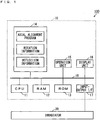
- Fig. 1 is a diagram showing a configuration of the charged particle beam irradiation device according to one embodiment of the present invention.
- the configuration of hardware of the charged particle beam irradiation device 100 is mainly shown.
- the charged particle beam irradiation device 100 includes a processer 10 and an irradiator 20.
- the processor 10 is constituted by a CPU (Central Processing Unit) 11, a RAM (Random Access Memory) 12, a ROM (Read On Memory) 13, a storage 14, an operation unit 15, a display unit 16, an input-output I/F (interface) 17.
- the CPU 11, the RAM 12, the ROM 13, the storage 14, the operation unit 15, the display unit 16 and the input-output I/F 17 are connected to a bus 18.
- the RAM 12 is used as a work area for the CPU 11.
- a system program is stored in the ROM 13.
- the storage 14 includes a storage medium such as a hard disc or a semiconductor memory and stores an axial alignment program.
- the CPU 11 executes the axial alignment program stored in the storage 14 on the RAM 12, whereby an axial alignment process, described below, is performed.
- the operation unit 15 is an input device such as a keyboard, a mouse or a touch panel.
- the display unit 16 is a display device such as a crystal liquid display device. A user can give various instructions to the below-mentioned axial alignment device using the operation unit 15.
- the display unit 16 can display a scanned image of a sample produced by the axial alignment device.
- the input-output I/F 17 is connected to an irradiator 20.
- Fig. 2 is a diagram showing a schematic configuration of the irradiator 20 of Fig. 1 .
- the irradiator 20 includes a charged particle source 21, a converging lens 22, deflectors 23, 24, an objective aperture plate 25, a scanner 26, an objective lens 27, a sample stage 28 and a detector 29.
- the irradiator 20 further includes a power source (not shown) for driving each of the charged particle source 21, the converging lens 22, the deflectors 23, 24, the scanner 26, the objective lens 27 and the detector 29.
- the operation of the power source is controlled by the processor 10.
- the charged particle source 21 is an electron gun, for example, and emits an electron beam to the sample stage 28 as a charged particle beam.
- the deflector 23, the converging lens 22, the deflector 24, the objective aperture plate 25, the scanner 26 and the objective lens 27 are arranged in this order in an emission direction of the electron beam on an axis Ax connecting the charged particle source 21 to the sample stage 28.
- the deflector 23 is constituted by alignment coils, for example, and deflects the electron beam in a plane perpendicular to the optical axis of the deflector 23.
- the deflector 23 may be constituted by two alignment coils that are arranged in a direction parallel to the axis Ax to be spaced apart from each other. The deflector 23 is adjusted such that the electron beam emitted from the charged particle source 21 passes through the center of each of condenser lenses 22A, 22B, described below.
- the converging lens 22 is constituted by the condenser lenses 22A, 22B having a fixed relative positional relationship with each other. Each of the condenser lens 22A, 22B is adjusted such that the electron beam deflected by the deflector 23 converges at a focal point in front of the objective aperture plate 25.
- the deflector 24 has the configuration similar to that of the deflector 23, and is adjusted such that the electron beam converged by the converging lens 22 passes through the center of the objective lens 27.
- the objective aperture plate 25 transmits the electron beam deflected by the deflector 24, thereby restricting an electric current of the electron beam.
- the scanner 26 is constituted by scanning coils, for example, and two-dimensionally scans the electron beam that has passed through the objective aperture plate 25 in a plane perpendicular to the optical axis of the scanner 26. Further, the scanner 26 can rotate a scanning direction.
- the objective lens 27 is adjusted such that the electron beam scanned by the scanner 26 converges at a predetermined position.
- a sample S that is to be analyzed or observed is placed on the sample stage 28.
- the electron beam that is two-dimensionally scanned by the scanner 26 and converged by the objective lens 27 is emitted to each portion of a surface of the sample S.
- the detector 29 is constituted by a reflective electron detector or a secondary electron detector, and detects electrons reflected from each portion of the surface of the sample S due to the irradiation with the electron beam or electrons (secondary electrons) released from each portion of the surface of the sample S due to the irradiation with the electron beam.
- the scanned image of the sample S is produced by the processor 10 of Fig. 1 based on the electrons detected by the detector 29.
- the magnetic field strength (hereinafter simply referred to as strength) of the objective lens 27 is adjusted such that the electron beam is converged on the sample S placed on the sample stage 28.
- strength when the strength is changed, the electron beam is rotated about the optical axis of the objective lens 27 by the angle corresponding to the change in strength. Therefore, when the electron beam does not pass through the center of the objective lens 27, the position irradiated with the electron beam on the sample S is changed while rotating.
- the axial alignment device that adjusts the deflector 24 such that the electron beam passes through the center of the objective lens 27 is provided in the charged particle beam irradiation device 100.
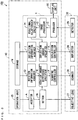
- Fig. 3 is a diagram showing a configuration of the axial alignment device 1 included in the charged particle beam irradiation device 100.
- the axial alignment device 1 includes an acceptor A, a setter B, a producer C, a rotation information acquirer D, a rotation amount difference specifier E, a scanning controller F, an image processor G, a positional relationship specifier H, a deflection information acquirer I, a deflection amount specifier J and a deflection controller K.
- the CPU 11 of Fig. 1 executes the axial alignment program stored in the storage 14, whereby the functions of the constituent elements (A to K) of the axial alignment device 1 are implemented.
- Part or all of the constituent elements (A to K) of the axial alignment device 1 may be implemented by hardware such as an electronic circuit.
- the acceptor A accepts designation of the strength of the objective lens 27 from the user.
- the user can designate desired strength by operating the operation unit 15.
- the setter B controls a driving source of the objective lens 27 such that the strength of the objective lens 27 is set to the strength accepted by the acceptor A.
- the producer C produces a scanned image of the sample S based on the electrons detected by the detector 29 and allows the display unit 16 to display the produced scanned image.
- the rotation information indicating the correspondence relationship between the strength of the objective lens 27 and the rotation amount of the electron beam is stored in the storage 14 in advance.
- the rotation information may be produced by theoretical calculation based on the structure of the electron optical system, or may be produced based on an experiment.
- the rotation information acquirer D acquires the rotation information from the storage 14.
- the rotation amount difference specifier E specifies the difference between the rotation amounts of the electron beam respectively corresponding to the strength before the change and the strength after the change as a rotation amount difference based on the change amount of strength and the rotation information acquired by the rotation information acquirer D.
- the scanning controller F controls the scanner 26 based on the rotation amount difference of the electron beam specified by the rotation amount difference specifier E such that the rotation of the electron beam caused by the change in strength of the objective lens 27 is canceled.
- the scanning controller F controls the driving source of the scanner 26 such that the scanning direction is rotated by the rotation amount difference specified by the rotation amount difference specifier E in the direction opposite to the direction of the rotation caused by the change in strength of the objective lens 27.
- the image processor G performs an image process such as normalized cross-correlation on the scanned images before and after the change in strength.
- the positional relationship specifier H specifies the relative positional relationship between the scanned images before and after the change in strength based on a result of the image process performed by the image processor G. Specifically, the rotation of the electron beam is canceled by the scanner 26, so that the relative positional relationship between the scanned images before and after the change in strength indicates the parallel transport.
- the positional relationship specifier H specifies a parallel transport amount between the scanned images before and after the change in strength. Because the image process is performed on the scanned images before and after the change, the positional relationship specifier H can specify the parallel transport amount with high accuracy using the whole of the scanned images before and after the change.
- the parallel transport amount includes the parallel transport amount in two directions that are perpendicular to each other in a planar scanned image.
- the deflection information indicating the correspondence relationship between the parallel transport amount of the scanned images and the deflection amount of the electron beam deflected by the deflector 24 is stored in the storage 14 in advance.
- the deflection information may be produced by theoretical calculation based on the structure of the electron optical system, or may be produced based on an experiment.
- the deflection information acquirer I acquires the deflection information from the storage 14.
- the deflection amount specifier J specifies a deflection amount of the electron beam based on the parallel transport amount specified by the positional relationship specifier H and the deflection information acquired by the deflection information acquirer I.
- the deflection amount includes deflection amounts in the two directions that are perpendicular to each other in the plane perpendicular to the deflector 24.
- the deflection amounts in these two directions respectively correspond to the parallel transport amounts in the two directions that are perpendicular to each other in the above-mentioned scanned image.
- the deflection controller K controls the driving source of the deflector 24 based on the electron beam deflection amount specified by the deflection amount specifier J such that the parallel transport of the scanned images is canceled.
- the electron beam passing through the deflector 24 passes through the center of the objective lens 27.
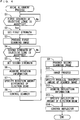
- Fig. 4 is a flow chart showing the algorithm of the axial alignment process executed by the axial alignment program.
- Figs. 5A to 5D are diagrams showing one example of the change of the scanned image in the axial alignment process. It is assumed that the electron beam passing through the deflector 24 does not pass through the center of the objective lens 27 before execution of the axial alignment process.
- the acceptor A determines whether first strength is accepted as the strength of the objective lens 27 (step S1). When the first strength is not accepted, the acceptor A waits until the first strength is accepted. When the first strength is accepted, the setter B sets the strength of the objective lens 27 to the first strength (step S2).
- the producer C produces the scanned image at the first strength of the objective lens 27 as a first scanned image (step S3).
- the example of the first scanned image is shown in Fig. 5A .
- a feature portion P in the shape of an equilateral triangle appears in the first scanned image.
- the acceptor A determines whether second strength is accepted as the strength of the objective lens 27 (step S4). When the second strength is not accepted, the acceptor A waits until the second strength is accepted. When the second strength is accepted, the setter B sets the strength of the objective lens 27 to the second strength (step S5).
- Fig. 5B As indicated by a thick arrow in Fig. 5B , if the scanned image is produced in this state, a position of each portion is changed while each position is rotated.
- the example of Fig. 5B indicates the feature portion P before the change of the position (the feature portion P in the first scanned image) by a dotted line and the feature portion P after the change of the position by a solid line.
- the rotation information acquirer D acquires the rotation information from the storage 14 (step S6).
- the rotation amount difference specifier E specifies a rotation amount difference of the electron beam based on the change amount of strength of the objective lens 27 and the rotation information acquired in the step S6 (step S7).
- the change amount of strength is the difference between the second strength set in the step S5 and the first strength set in the step S2 (or the preset first strength).
- the scanning controller F controls the scanner 26 based on the rotation amount difference of the electron beam specified in the step S7 such that the rotation of the electron beam is canceled (step S8).
- the producer C produces a scanned image at the second strength of the objective lens 27 as the second scanned image (step S9). Because the rotation of the electron beam is canceled, each portion of the second scanned image of Fig. 5C is not rotated as shown in Fig. 5B . Therefore, each portion of the second scanned image is parallel transported from each portion in the first scanned image.
- the image processor G performs an image process on the first and second scanned images produced in each of the steps S3 and S9 (step S10).
- the positional relationship specifier H specifies a parallel transport amount of the second scanned image with respect to the first scanned image based on a result of the image process in the step S10 (step S11).
- the dotted line indicates the first scanned image overlapping with the second scanned image.
- Fig. 5D shows the parallel transport amounts ⁇ x, ⁇ y in the two directions that are perpendicular to each other in the second scanned image.
- the deflection information acquirer I acquires deflection information from the storage 14 (step S12).
- the deflection amount specifier J specifies a deflection amount of the electron beam based on the parallel transport amount specified in the step S11 and the deflection information acquired in the step S12 (step S13).
- the deflection controller K controls the deflector 24 based on the deflection amount of the electron beam specified in the step S13 such that the parallel transport of the second scanned image with respect to the first scanned image is canceled (step S14), and ends the axial alignment process.
- the strength of the objective lens 27 in the case where the focal point of the objective lens 27 coincides with the sample S is defined as third strength.
- the user preferably designates one of the strength that is lower than the third strength by a predetermined value and the strength that is higher than the third strength by the predetermined value as the first strength.
- the user preferably designates the other one of the strength that is lower than the third strength by the predetermined value and the strength that is higher than the third strength by the predetermined value as the second strength.
- the degree of blurriness of the first scanned image produced in the step S3 and the degree of blurriness of the second scanned image produced in the step S9 are equal to each other.
- the relative positional relationship between the first scanned image and the second scanned image can be specified more easily.
- the first scanned image is produced by the producer C based on the electrons detected by the detector 29. Thereafter, the strength of the objective lens 27 is set to the second strength by the setter B. Based on a difference in strength between the first strength and the second strength, the rotation amount difference of the electron beam between the case where the strength is set to the first strength and the case where the strength is set to the second strength is specified by the rotation amount difference specifier E.
- the scanner 26 is controlled by the scanning controller F such that the rotation for canceling the specified rotation amount difference is supplied to the electron beam.
- the second scanned image is produced by the producer C based on the electrons detected by the detector 29.
- the relative positional relationship between the produced first scanned image and the produced second scanned image is specified by the positional relationship specifier H.
- the relative positional relationship between the first scanned image and the second scanned image indicates the parallel transport.
- the relative positional relationship between the first scanned image and the second scanned image can be specified as the parallel transport amount with high accuracy and in a short period of time regardless of the skill of the user.
- the deflector 24 is controlled by the deflection controller K such that the position of the first scanned image and the position of the second scanned image coincide with each other.
- the axis of the electron beam can be aligned with high accuracy and high efficiency.
Landscapes
- Chemical & Material Sciences (AREA)
- Analytical Chemistry (AREA)
- Physics & Mathematics (AREA)
- Electromagnetism (AREA)
- Engineering & Computer Science (AREA)
- Computer Vision & Pattern Recognition (AREA)
- Electron Sources, Ion Sources (AREA)
Applications Claiming Priority (1)
| Application Number | Priority Date | Filing Date | Title |
|---|---|---|---|
| JP2018058281A JP7047523B2 (ja) | 2018-03-26 | 2018-03-26 | 荷電粒子ビーム軸合わせ装置、荷電粒子ビーム照射装置および荷電粒子ビーム軸合わせ方法 |
Publications (2)
| Publication Number | Publication Date |
|---|---|
| EP3547346A2 true EP3547346A2 (fr) | 2019-10-02 |
| EP3547346A3 EP3547346A3 (fr) | 2020-02-12 |
Family
ID=65904247
Family Applications (1)
| Application Number | Title | Priority Date | Filing Date |
|---|---|---|---|
| EP19164468.1A Pending EP3547346A3 (fr) | 2018-03-26 | 2019-03-21 | Dispositif d'alignement axial d'un faisceau de particules chargées, dispositif d'irradiation à faisceau de particules chargées et procédé d'alignement axial d'un faisceau de particules chargées |
Country Status (4)
| Country | Link |
|---|---|
| US (1) | US10903038B2 (fr) |
| EP (1) | EP3547346A3 (fr) |
| JP (1) | JP7047523B2 (fr) |
| CN (1) | CN110364406B (fr) |
Families Citing this family (3)
| Publication number | Priority date | Publication date | Assignee | Title |
|---|---|---|---|---|
| IL259602B (en) * | 2015-11-30 | 2022-07-01 | Hermes Microvision Inc | Apparatus of plural charged-particle beams |
| CN111971774B (zh) * | 2018-03-29 | 2023-09-29 | 株式会社日立高新技术 | 带电粒子束装置 |
| CN116246924A (zh) * | 2023-03-27 | 2023-06-09 | 聚束科技(北京)有限公司 | 电子束控制装置及方法 |
Citations (1)
| Publication number | Priority date | Publication date | Assignee | Title |
|---|---|---|---|---|
| JP2011054426A (ja) | 2009-09-02 | 2011-03-17 | Shimadzu Corp | 荷電粒子ビーム照射装置及び該装置の軸合わせ調整方法 |
Family Cites Families (10)
| Publication number | Priority date | Publication date | Assignee | Title |
|---|---|---|---|---|
| JP3400608B2 (ja) * | 1995-06-01 | 2003-04-28 | 株式会社日立製作所 | 走査電子顕微鏡 |
| JPH103876A (ja) * | 1996-06-14 | 1998-01-06 | Nikon Corp | 走査型電子顕微鏡の走査角度自動調整方法および走査角度 自動調整可能な走査型電子顕微鏡 |
| US5708274A (en) * | 1996-12-18 | 1998-01-13 | International Business Machines Corporation | Curvilinear variable axis lens correction with crossed coils |
| JP3951590B2 (ja) * | 2000-10-27 | 2007-08-01 | 株式会社日立製作所 | 荷電粒子線装置 |
| US6723997B2 (en) * | 2001-10-26 | 2004-04-20 | Jeol Ltd. | Aberration corrector for instrument utilizing charged-particle beam |
| JP2003151484A (ja) | 2001-11-15 | 2003-05-23 | Jeol Ltd | 走査型荷電粒子ビーム装置 |
| JP2005063678A (ja) * | 2003-08-11 | 2005-03-10 | Jeol Ltd | 荷電粒子ビーム装置における自動焦点補正方法および自動非点補正方法 |
| JP4706552B2 (ja) | 2006-05-10 | 2011-06-22 | 株式会社島津製作所 | 表面分析装置 |
| JP5364112B2 (ja) * | 2011-01-25 | 2013-12-11 | 株式会社日立ハイテクノロジーズ | 荷電粒子線装置 |
| US8803102B2 (en) * | 2012-10-25 | 2014-08-12 | Fei Company | Retarding field analyzer integral with particle beam column |
-
2018
- 2018-03-26 JP JP2018058281A patent/JP7047523B2/ja active Active
-
2019
- 2019-01-09 US US16/243,163 patent/US10903038B2/en active Active
- 2019-03-21 EP EP19164468.1A patent/EP3547346A3/fr active Pending
- 2019-03-26 CN CN201910234570.XA patent/CN110364406B/zh active Active
Patent Citations (1)
| Publication number | Priority date | Publication date | Assignee | Title |
|---|---|---|---|---|
| JP2011054426A (ja) | 2009-09-02 | 2011-03-17 | Shimadzu Corp | 荷電粒子ビーム照射装置及び該装置の軸合わせ調整方法 |
Also Published As
| Publication number | Publication date |
|---|---|
| CN110364406B (zh) | 2021-11-19 |
| JP7047523B2 (ja) | 2022-04-05 |
| CN110364406A (zh) | 2019-10-22 |
| EP3547346A3 (fr) | 2020-02-12 |
| US20190295806A1 (en) | 2019-09-26 |
| JP2019169433A (ja) | 2019-10-03 |
| US10903038B2 (en) | 2021-01-26 |
Similar Documents
| Publication | Publication Date | Title |
|---|---|---|
| JP5819054B2 (ja) | Sacp法およびsacp法を行うための粒子光学系 | |
| US10910194B2 (en) | Charged particle beam device and optical-axis adjusting method thereof | |
| US9941095B2 (en) | Charged particle beam apparatus | |
| JP4708854B2 (ja) | 荷電粒子線装置 | |
| JPH11250850A (ja) | 走査電子顕微鏡及び顕微方法並びに対話型入力装置 | |
| US10903038B2 (en) | Charged particle beam axial alignment device, charged particle beam irradiation device and charged particle beam axial alignment method | |
| EP2672503A2 (fr) | Procédé d'alignement axial de faisceau de particules chargées et système de faisceau de particules chargées | |
| JP5531515B2 (ja) | 荷電粒子ビーム照射装置及び該装置の軸合わせ調整方法 | |
| EP2590205A2 (fr) | Microscope électronique à transmission et procédé d'observation d'images TEM | |
| JP2016039118A (ja) | 電子顕微鏡、およびモノクロメーターの調整方法 | |
| US10504685B2 (en) | Charged particle beam axial alignment device, charged particle beam irradiation device and charged particle beam axial alignment method | |
| US20230078510A1 (en) | Method for focusing and operating a particle beam microscope | |
| EP4167267B1 (fr) | Système à faisceau de particules chargées et son procédé de commande | |
| US11742177B2 (en) | Charged particle beam apparatus and control method thereof | |
| CN112309813B (zh) | 用于光束位置可视化的系统和方法 | |
| JP6959969B2 (ja) | 荷電粒子線装置 | |
| US10662059B2 (en) | Micro-electro-mechanical-systems processing method, and micro-electro-mechanical-systems processing apparatus | |
| US12542252B1 (en) | Method of operating a particle beam system, particle beam system, non-transitory storage medium and program | |
| JP6876519B2 (ja) | 荷電粒子線装置 | |
| JPH07296757A (ja) | 走査電子顕微鏡およびその類似装置 |
Legal Events
| Date | Code | Title | Description |
|---|---|---|---|
| PUAI | Public reference made under article 153(3) epc to a published international application that has entered the european phase |
Free format text: ORIGINAL CODE: 0009012 |
|
| STAA | Information on the status of an ep patent application or granted ep patent |
Free format text: STATUS: REQUEST FOR EXAMINATION WAS MADE |
|
| 17P | Request for examination filed |
Effective date: 20190321 |
|
| AK | Designated contracting states |
Kind code of ref document: A2 Designated state(s): AL AT BE BG CH CY CZ DE DK EE ES FI FR GB GR HR HU IE IS IT LI LT LU LV MC MK MT NL NO PL PT RO RS SE SI SK SM TR |
|
| AX | Request for extension of the european patent |
Extension state: BA ME |
|
| PUAL | Search report despatched |
Free format text: ORIGINAL CODE: 0009013 |
|
| AK | Designated contracting states |
Kind code of ref document: A3 Designated state(s): AL AT BE BG CH CY CZ DE DK EE ES FI FR GB GR HR HU IE IS IT LI LT LU LV MC MK MT NL NO PL PT RO RS SE SI SK SM TR |
|
| AX | Request for extension of the european patent |
Extension state: BA ME |
|
| RIC1 | Information provided on ipc code assigned before grant |
Ipc: H01J 37/26 20060101ALI20200103BHEP Ipc: H01J 37/28 20060101ALI20200103BHEP Ipc: H01J 37/141 20060101AFI20200103BHEP Ipc: H01J 37/147 20060101ALI20200103BHEP |