EP3549302B1 - Procédé et appareil de partage de spectre entre lte 3gpp et nr dans un système de communication sans fil - Google Patents
Procédé et appareil de partage de spectre entre lte 3gpp et nr dans un système de communication sans fil Download PDFInfo
- Publication number
- EP3549302B1 EP3549302B1 EP18736523.4A EP18736523A EP3549302B1 EP 3549302 B1 EP3549302 B1 EP 3549302B1 EP 18736523 A EP18736523 A EP 18736523A EP 3549302 B1 EP3549302 B1 EP 3549302B1
- Authority
- EP
- European Patent Office
- Prior art keywords
- carrier
- lte
- frequency
- sul
- transmission
- Prior art date
- Legal status (The legal status is an assumption and is not a legal conclusion. Google has not performed a legal analysis and makes no representation as to the accuracy of the status listed.)
- Active
Links
Images









Classifications
-
- H—ELECTRICITY
- H04—ELECTRIC COMMUNICATION TECHNIQUE
- H04W—WIRELESS COMMUNICATION NETWORKS
- H04W74/00—Wireless channel access
- H04W74/002—Transmission of channel access control information
-
- H—ELECTRICITY
- H04—ELECTRIC COMMUNICATION TECHNIQUE
- H04L—TRANSMISSION OF DIGITAL INFORMATION, e.g. TELEGRAPHIC COMMUNICATION
- H04L1/00—Arrangements for detecting or preventing errors in the information received
- H04L1/12—Arrangements for detecting or preventing errors in the information received by using return channel
- H04L1/16—Arrangements for detecting or preventing errors in the information received by using return channel in which the return channel carries supervisory signals, e.g. repetition request signals
- H04L1/18—Automatic repetition systems, e.g. Van Duuren systems
- H04L1/1812—Hybrid protocols; Hybrid automatic repeat request [HARQ]
- H04L1/1819—Hybrid protocols; Hybrid automatic repeat request [HARQ] with retransmission of additional or different redundancy
-
- H—ELECTRICITY
- H04—ELECTRIC COMMUNICATION TECHNIQUE
- H04L—TRANSMISSION OF DIGITAL INFORMATION, e.g. TELEGRAPHIC COMMUNICATION
- H04L27/00—Modulated-carrier systems
- H04L27/26—Systems using multi-frequency codes
- H04L27/2601—Multicarrier modulation systems
- H04L27/2602—Signal structure
-
- H—ELECTRICITY
- H04—ELECTRIC COMMUNICATION TECHNIQUE
- H04L—TRANSMISSION OF DIGITAL INFORMATION, e.g. TELEGRAPHIC COMMUNICATION
- H04L5/00—Arrangements affording multiple use of the transmission path
- H04L5/0001—Arrangements for dividing the transmission path
- H04L5/0003—Two-dimensional division
- H04L5/0005—Time-frequency
- H04L5/0007—Time-frequency the frequencies being orthogonal, e.g. OFDM(A) or DMT
- H04L5/001—Time-frequency the frequencies being orthogonal, e.g. OFDM(A) or DMT the frequencies being arranged in component carriers
-
- H—ELECTRICITY
- H04—ELECTRIC COMMUNICATION TECHNIQUE
- H04L—TRANSMISSION OF DIGITAL INFORMATION, e.g. TELEGRAPHIC COMMUNICATION
- H04L5/00—Arrangements affording multiple use of the transmission path
- H04L5/0001—Arrangements for dividing the transmission path
- H04L5/0014—Three-dimensional division
- H04L5/0023—Time-frequency-space
-
- H—ELECTRICITY
- H04—ELECTRIC COMMUNICATION TECHNIQUE
- H04L—TRANSMISSION OF DIGITAL INFORMATION, e.g. TELEGRAPHIC COMMUNICATION
- H04L5/00—Arrangements affording multiple use of the transmission path
- H04L5/003—Arrangements for allocating sub-channels of the transmission path
- H04L5/0048—Allocation of pilot signals, i.e. of signals known to the receiver
-
- H—ELECTRICITY
- H04—ELECTRIC COMMUNICATION TECHNIQUE
- H04L—TRANSMISSION OF DIGITAL INFORMATION, e.g. TELEGRAPHIC COMMUNICATION
- H04L5/00—Arrangements affording multiple use of the transmission path
- H04L5/0091—Signalling for the administration of the divided path, e.g. signalling of configuration information
-
- H—ELECTRICITY
- H04—ELECTRIC COMMUNICATION TECHNIQUE
- H04L—TRANSMISSION OF DIGITAL INFORMATION, e.g. TELEGRAPHIC COMMUNICATION
- H04L5/00—Arrangements affording multiple use of the transmission path
- H04L5/14—Two-way operation using the same type of signal, i.e. duplex
-
- H—ELECTRICITY
- H04—ELECTRIC COMMUNICATION TECHNIQUE
- H04W—WIRELESS COMMUNICATION NETWORKS
- H04W16/00—Network planning, e.g. coverage or traffic planning tools; Network deployment, e.g. resource partitioning or cells structures
- H04W16/14—Spectrum sharing arrangements between different networks
-
- H—ELECTRICITY
- H04—ELECTRIC COMMUNICATION TECHNIQUE
- H04W—WIRELESS COMMUNICATION NETWORKS
- H04W24/00—Supervisory, monitoring or testing arrangements
- H04W24/10—Scheduling measurement reports ; Arrangements for measurement reports
-
- H—ELECTRICITY
- H04—ELECTRIC COMMUNICATION TECHNIQUE
- H04W—WIRELESS COMMUNICATION NETWORKS
- H04W72/00—Local resource management
- H04W72/04—Wireless resource allocation
- H04W72/044—Wireless resource allocation based on the type of the allocated resource
- H04W72/0453—Resources in frequency domain, e.g. a carrier in FDMA
-
- H—ELECTRICITY
- H04—ELECTRIC COMMUNICATION TECHNIQUE
- H04W—WIRELESS COMMUNICATION NETWORKS
- H04W72/00—Local resource management
- H04W72/04—Wireless resource allocation
- H04W72/044—Wireless resource allocation based on the type of the allocated resource
- H04W72/046—Wireless resource allocation based on the type of the allocated resource the resource being in the space domain, e.g. beams
-
- H—ELECTRICITY
- H04—ELECTRIC COMMUNICATION TECHNIQUE
- H04W—WIRELESS COMMUNICATION NETWORKS
- H04W74/00—Wireless channel access
- H04W74/08—Non-scheduled access, e.g. ALOHA
-
- H—ELECTRICITY
- H04—ELECTRIC COMMUNICATION TECHNIQUE
- H04W—WIRELESS COMMUNICATION NETWORKS
- H04W74/00—Wireless channel access
- H04W74/08—Non-scheduled access, e.g. ALOHA
- H04W74/0833—Random access procedures, e.g. with 4-step access
-
- H—ELECTRICITY
- H04—ELECTRIC COMMUNICATION TECHNIQUE
- H04L—TRANSMISSION OF DIGITAL INFORMATION, e.g. TELEGRAPHIC COMMUNICATION
- H04L27/00—Modulated-carrier systems
- H04L27/26—Systems using multi-frequency codes
- H04L27/2601—Multicarrier modulation systems
- H04L27/2602—Signal structure
- H04L27/26025—Numerology, i.e. varying one or more of symbol duration, subcarrier spacing, Fourier transform size, sampling rate or down-clocking
-
- H—ELECTRICITY
- H04—ELECTRIC COMMUNICATION TECHNIQUE
- H04L—TRANSMISSION OF DIGITAL INFORMATION, e.g. TELEGRAPHIC COMMUNICATION
- H04L5/00—Arrangements affording multiple use of the transmission path
- H04L5/003—Arrangements for allocating sub-channels of the transmission path
- H04L5/0032—Distributed allocation, i.e. involving a plurality of allocating devices, each making partial allocation
- H04L5/0035—Resource allocation in a cooperative multipoint environment
-
- H—ELECTRICITY
- H04—ELECTRIC COMMUNICATION TECHNIQUE
- H04W—WIRELESS COMMUNICATION NETWORKS
- H04W52/00—Power management, e.g. Transmission Power Control [TPC] or power classes
- H04W52/04—Transmission power control [TPC]
- H04W52/18—TPC being performed according to specific parameters
- H04W52/24—TPC being performed according to specific parameters using SIR [Signal to Interference Ratio] or other wireless path parameters
- H04W52/242—TPC being performed according to specific parameters using SIR [Signal to Interference Ratio] or other wireless path parameters taking into account path loss
-
- Y—GENERAL TAGGING OF NEW TECHNOLOGICAL DEVELOPMENTS; GENERAL TAGGING OF CROSS-SECTIONAL TECHNOLOGIES SPANNING OVER SEVERAL SECTIONS OF THE IPC; TECHNICAL SUBJECTS COVERED BY FORMER USPC CROSS-REFERENCE ART COLLECTIONS [XRACs] AND DIGESTS
- Y02—TECHNOLOGIES OR APPLICATIONS FOR MITIGATION OR ADAPTATION AGAINST CLIMATE CHANGE
- Y02D—CLIMATE CHANGE MITIGATION TECHNOLOGIES IN INFORMATION AND COMMUNICATION TECHNOLOGIES [ICT], I.E. INFORMATION AND COMMUNICATION TECHNOLOGIES AIMING AT THE REDUCTION OF THEIR OWN ENERGY USE
- Y02D30/00—Reducing energy consumption in communication networks
- Y02D30/70—Reducing energy consumption in communication networks in wireless communication networks
Definitions
- the present invention relates to wireless communications, and more particularly, to a method and apparatus for sharing a spectrum between 3rd generation partnership project (3GPP) long-term evolution (LTE) and a new radio access technology (NR) in a wireless communication system.
- 3GPP 3rd generation partnership project
- LTE long-term evolution
- NR new radio access technology
- 3rd generation partnership project (3GPP) long-term evolution (LTE) is a technology for enabling high-speed packet communications.
- 3GPP 3rd generation partnership project
- LTE long-term evolution
- Many schemes have been proposed for the LTE objective including those that aim to reduce user and provider costs, improve service quality, and expand and improve coverage and system capacity.
- the 3GPP LTE requires reduced cost per bit, increased service availability, flexible use of a frequency band, a simple structure, an open interface, and adequate power consumption of a terminal as an upper-level requirement.
- next generation radio access technology considering enhanced mobile broadband communication (eMBB), massive MTC (mMTC), ultra-reliable and low latency communication (URLLC) is discussed.
- eMBB enhanced mobile broadband communication
- mMTC massive MTC
- URLLC ultra-reliable and low latency communication
- This new technology may be called new radio access technology (new RAT or NR) for convenience.
- analog beamforming may be introduced.
- mmW millimeter wave
- the wavelength is shortened so that a plurality of antennas can be installed in the same area.
- a total of 100 antenna elements can be installed in a 2-dimension array of 0.5 lambda (wavelength) intervals on a panel of 5 by 5 cm with a wavelength of 1 cm. Therefore, in mmW, multiple antenna elements can be used to increase the beamforming gain to increase the coverage or increase the throughput.
- TXRU transceiver unit
- independent beamforming is possible for each frequency resource.
- installing a TXRU on all 100 antenna elements has a problem in terms of cost effectiveness. Therefore, a method of mapping a plurality of antenna elements to one TXRU and adjusting the direction of a beam using an analog phase shifter is considered.
- This analog beamforming method has a disadvantage that it cannot perform frequency selective beaming because it can make only one beam direction in all bands.
- a hybrid beamforming with B TXRUs which is an intermediate form of digital beamforming and analog beamforming, and fewer than Q antenna elements, can be considered.
- B TXRUs which is an intermediate form of digital beamforming and analog beamforming, and fewer than Q antenna elements
- the direction of the beam that can be simultaneously transmitted is limited to B or less.
- the 3GPP Draft No. R1-1704199 entitled “Considerations of NR UL operation for LTE-NR coexistence ", discusses a scheme of co-existence of LTE UL and NR UL within the bandwidth of an LTE component carrier.
- the 3GPP Draft No. R1-1701668, entitled “Considerations of NR UL operation " discusses UL sharing scenarios for LTE-NR co-existence.
- the 3GPP Draft No. R1-1709979 entitled “Overview of NR UL for LTE-NR coexistence ", discusses the scenario of LTE-NR UL coexistence and that of LTE-NR UL only sharing.
- the present invention provides a method and apparatus for sharing a spectrum between 3rd generation partnership project (3GPP) long-term evolution (LTE) and a new radio access technology (NR) in a wireless communication system.
- 3GPP 3rd generation partnership project
- LTE long-term evolution
- NR new radio access technology
- the present invention discusses spectrum sharing mechanisms between LTE and NR in the same frequency, at least for initial deployment of NR.
- a method performed by a user equipment (UE) in a wireless communication system is provided as set forth in the appended claims.
- a user equipment (UE) in a wireless communication system is provided as set forth in the appended claims.
- 3GPP LTE and NR can share a spectrum in the same frequency effectively.
- FIG. 1 shows a 3GPP LTE system.
- the 3rd generation partnership project (3GPP) long-term evolution (LTE) system 10 includes at least one eNodeB (eNB) 11.
- Respective eNBs 11 provide a communication service to particular geographical areas 15a, 15b, and 15c (which are generally called cells). Each cell may be divided into a plurality of areas (which are called sectors).
- a user equipment (UE) 12 may be fixed or mobile and may be referred to by other names such as mobile station (MS), mobile terminal (MT), user terminal (UT), subscriber station (SS), wireless device, personal digital assistant (PDA), wireless modem, handheld device.
- the eNB 11 generally refers to a fixed station that communicates with the UE 12 and may be called by other names such as base station (BS), base transceiver system (BTS), access point (AP), etc.
- BS base station
- BTS base transceiver system
- AP access point
- a UE belongs to one cell, and the cell to which a UE belongs is called a serving cell.
- An eNB providing a communication service to the serving cell is called a serving eNB.
- the wireless communication system is a cellular system, so a different cell adjacent to the serving cell exists.
- the different cell adjacent to the serving cell is called a neighbor cell.
- An eNB providing a communication service to the neighbor cell is called a neighbor eNB.
- the serving cell and the neighbor cell are relatively determined based on a UE.
- DL refers to communication from the eNB 11 to the UE 12
- UL refers to communication from the UE 12 to the eNB 11.
- a transmitter may be part of the eNB 11 and a receiver may be part of the UE 12.
- a transmitter may be part of the UE 12 and a receiver may be part of the eNB 11.
- the wireless communication system may be any one of a multiple-input multiple-output (MIMO) system, a multiple-input single-output (MISO) system, a single-input single-output (SISO) system, and a single-input multiple-output (SIMO) system.
- MIMO multiple-input multiple-output
- MISO multiple-input single-output
- SISO single-input single-output
- SIMO single-input multiple-output
- the MIMO system uses a plurality of transmission antennas and a plurality of reception antennas.
- the MISO system uses a plurality of transmission antennas and a single reception antenna.
- the SISO system uses a single transmission antenna and a single reception antenna.
- the SIMO system uses a single transmission antenna and a plurality of reception antennas.
- a transmission antenna refers to a physical or logical antenna used for transmitting a signal or a stream
- a reception antenna refers to a physical or logical antenna used
- FIG. 2 shows structure of a radio frame of 3GPP LTE.
- a radio frame includes 10 subframes.
- a subframe includes two slots in time domain.
- a time for transmitting one transport block by higher layer to physical layer is defined as a transmission time interval (TTI).
- TTI transmission time interval
- one subframe may have a length of 1ms, and one slot may have a length of 0.5ms.
- One slot includes a plurality of orthogonal frequency division multiplexing (OFDM) symbols in time domain. Since the 3GPP LTE uses the OFDMA in the DL, the OFDM symbol is for representing one symbol period.
- the OFDM symbols may be called by other names depending on a multiple-access scheme.
- a resource block is a resource allocation unit, and includes a plurality of contiguous subcarriers in one slot.
- the structure of the radio frame is shown for exemplary purposes only. Thus, the number of subframes included in the radio frame or the number of slots included in the subframe or the number of OFDM symbols included in the slot may be modified in various manners.
- the wireless communication system may be divided into a frequency division duplex (FDD) scheme and a time division duplex (TDD) scheme.
- FDD frequency division duplex
- TDD time division duplex
- UL transmission and DL transmission are made at different frequency bands.
- UL transmission and DL transmission are made during different periods of time at the same frequency band.
- a channel response of the TDD scheme is substantially reciprocal. This means that a DL channel response and a UL channel response are almost the same in a given frequency band.
- the TDD-based wireless communication system is advantageous in that the DL channel response can be obtained from the UL channel response.
- the entire frequency band is time-divided for UL and DL transmissions, so a DL transmission by the eNB and a UL transmission by the UE cannot be simultaneously performed.
- the UL transmission and the DL transmission are performed in different subframes.
- UL and DL transmission may be performed within a same subframe/slot in time division multiplexing (TDM)/frequency division multiplexing (FDM) manner.
- FIG. 3 shows a resource grid for one downlink slot.
- a DL slot includes a plurality of OFDM symbols in time domain. It is described herein that one DL slot includes 7 OFDM symbols, and one RB includes 12 subcarriers in frequency domain as an example. However, the present invention is not limited thereto.
- Each element on the resource grid is referred to as a resource element (RE).
- One RB includes 12 ⁇ 7 or 12 ⁇ 14 resource elements.
- the number N DL of RBs included in the DL slot depends on a DL transmit bandwidth.
- the structure of a UL slot may be same as that of the DL slot.
- the number of OFDM symbols and the number of subcarriers may vary depending on the length of a CP, frequency spacing, etc.
- the number of OFDM symbols is 7 or 14, and in case of an extended CP, the number of OFDM symbols is 6 or 12.
- One of 128, 256, 512, 1024, 1536, 2048, 4096 and 8192 may be selectively used as the number of subcarriers in one OFDM symbol.
- 5th generation mobile networks or 5th generation wireless systems are the proposed next telecommunications standards beyond the current 4G LTE/international mobile telecommunications (IMT)-dvanced standards.
- 5G includes both new radio access technology (new RAT or NR) and LTE evolution.
- new RAT new RAT
- LTE evolution new radio access technology
- 5G planning aims at higher capacity than current 4G LTE, allowing a higher density of mobile broadband users, and supporting device-to-device, ultra-reliable, and massive machine communications.
- 5G research and development also aims at lower latency than 4G equipment and lower battery consumption, for better implementation of the Internet of things.
- NR may use the OFDM transmission scheme or a similar transmission scheme.
- NR may follow the existing LTE/LTE-A numerology, or may follow the different numerology from the existing LTE/LTE-A numerology.
- NR may have a larger system bandwidth (e.g. 100 MHz).
- one cell may support multiple numerologies in NR. That is, UEs operating in different numerologies may coexist within one cell in NR.
- different frame structure may be necessary for NR.
- different frame structure in which UL and DL may be present in every subframe or may change very frequently in the same carrier may be necessary for NR.
- Different application may require different minimum size of DL or UL portions to support different latency and coverage requirements.
- massive machine-type communication (mMTC) for high coverage case may require relatively long DL and UL portion so that one transmission can be successfully transmitted.
- mMTC massive machine-type communication
- different subcarrier spacing and/or different CP length may be considered. In this sense, it is necessary to consider mechanisms to allow different frame structures coexisting in the same carrier and be operated by the same cell/eNB.
- the paired spectrum means that one carrier consists of two carriers.
- the one carrier may include a DL carrier and an UL carrier, which are paired with each other.
- communication such as DL, UL, device-to-device communication, and/or relay communication, may be performed by utilizing the paired spectrum.
- the unpaired spectrum means that that one carrier consists of only one carrier, like the current 4G LTE.
- communication such as DL, UL, device-to-device communication, and/or relay communication, may be performed in the unpaired spectrum.
- the following subframe types may be considered to support the paired spectrum and the unpaired spectrum mentioned above.
- subframe types listed above are only exemplary, and other subframe types may also be considered.
- FIG. 4 shows an example of subframe type for NR.
- the subframe shown in FIG. 4 may be used in TDD system of NR, in order to minimize latency of data transmission.
- the subframe contains 14 symbols in one TTI, like the current subframe.
- the subframe includes DL control channel in the first symbol, and UL control channel in the last symbol.
- a region for DL control channel indicates a transmission area of a physical downlink control channel (PDCCH) for Downlink control information (DCI) transmission
- a region for UL control channel indicates a transmission area of a physical uplink control channel (PUCCH) for uplink control information (UCI) transmission.
- PDCCH physical downlink control channel
- UCI uplink control information
- control information transmitted by the eNB to the UE through the DCI may include information on the cell configuration that the UE should know, DL specific information such as DL scheduling, and UL specific information such as UL grant.
- control information transmitted by the UE to the eNB through the UCI may include a hybrid automatic repeat request (HARQ) acknowledgement/non-acknowledgement (ACK/NACK) report for the DL data, a channel state information (CSI) report on the DL channel status, and a scheduling request (SR).
- HARQ hybrid automatic repeat request
- ACK/NACK acknowledgement/non-acknowledgement
- CSI channel state information
- SR scheduling request
- the remaining symbols may be used for DL data transmission (e.g. physical downlink shared channel (PDSCH)) or for UL data transmission (e.g. physical uplink shared channel (PUSCH)).
- PDSCH physical downlink shared channel
- PUSCH physical uplink shared channel
- DL transmission and UL transmission may sequentially proceed in one subframe.
- DL data may be transmitted in the subframe, and UL acknowledgement/non-acknowledgement (ACK/NACK) may also be received in the subframe.
- ACK/NACK UL acknowledgement/non-acknowledgement
- the subframe shown in FIG. 4 may be referred to as self-contained subframe.
- a time gap may be required for the transition process from the transmission mode to the reception mode or from the reception mode to the transmission mode.
- some OFDM symbols at the time of switching from DL to UL in the subframe structure may be set to the guard period (GP).
- LTE and NR While changing from 4G to 5G (or 3GPP LTE from NR), UEs supporting only LTE and UEs supporting both RATs may coexist. In such cases, depending on advanced UE percentage, it may be beneficial to dynamically change the portion of NR frequency/time usage or LTE frequency/time usage in the same frequency band.
- a network may perform secondary cell (SCell)-off in LTE if the network wants to reduce the LTE frequency usage portion.
- LTE eNB and NR gNB may collocate or non-collocate.
- the present invention may be applied to different deployment scenarios including non-ideal backhaul conditions between LTE and NR cells.
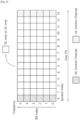
- FIG. 5 shows an example of changing portions of LTE/NR frequency in a system bandwidth.
- LTE frequency usage portion may increase in a total system bandwidth.
- NR frequency usage portion may increase in a total system bandwidth.
- intra-frequency carrier aggregation (CA) of LTE spectrum may be used. For example, if total system bandwidth is M MHz, it may be divided to K * M/K MHz frequency chunks, and UEs may be associated with M MHz via intra-CA capability. In this case, to disable one or a few frequency chunks, the network may simply deactivate SCell and perform SCell-off.
- NR may not use some resources used by discovery signals to minimize the interference. In terms of reserving some resources for discovery signal transmission, discovery signals may puncture transmitted NR signals.
- signals based on 15 kHz subcarrier spacing may be used in NR, and resources used for legacy discovery signals may puncture transmitted NR signals. Due to discovery signal, the performance of NR signals may be degraded. For example, control signals and data signals may rather be deteriorated. The handling of this may be done by proper code rate adaption and resource allocation by scheduling.
- NR supporting UE hereinafter, NR UE
- the system bandwidth of NR may change depending on the usage of LTE spectrum or other usage (for example, acquiring or utilizing more spectrum in case of licensed shared access or utilizing unlicensed spectrum - dynamic allocation of unlicensed spectrum). Accordingly, it may be necessary to signal minimum and maximum system bandwidth that the cell intends to support. Also, the center frequency of synchronization signal or predetermined signal which is generally used for center frequency may not be in the center of maximum system bandwidth. In that sense, it may also be desirable to indicate center frequency of minimum system bandwidth and maximum system bandwidth. Or, offset between center frequency of minimum system bandwidth and center frequency of the reference signal such as primary synchronization signal (PSS) or offset between reference signal and center frequency of maximum system bandwidth may be indicated.
- PSS primary synchronization signal
- UE may be able to adjust its receiving bandwidth (both radio frequency (RF) and baseband) potentially to reduce power consumption or for other purposes.
- RF radio frequency
- start and end of the maximum system bandwidth would not exceed RF bandwidth of a UE assuming center frequency of the reference signal or assuming that UE may retune to center frequency of maximum system bandwidth.
- DC subcarrier may be placed in the center of reference signals or minimum system bandwidth.
- min_SBW minimum system bandwidth
- max_SBW minimum system bandwidth
- any cell-common signals such as synchronization signals, physical broadcast channel (PBCH), and potentially SIB
- PBCH physical broadcast channel
- SIB SIB
- PBCH physical broadcast channel
- SIB SIB
- MBMS multimedia broadcast multicast services
- min_SBW system bandwidth applied for each operation may be separately configured depending on the deployment scenarios of neighbor cells. If it is supported beyond min_SBW, dynamic signaling may be necessary to change the bandwidth. If semi-statically min_SBW is changed, it is also possible that min_SBW is equal to max_SBW.
- the signaling of max_SBW may be UE-specific or group-specific. For example, certain frequency may be available only to a group of UEs depending on the locations and/or channel conditions and/or UE capabilities.
- the bandwidth may also be differently configured per different radio resource control (RRC) connection or a connection which may be differentiated from the physical layer depending on e.g. application or use cases. For example, for ultra-reliable and low latency communication (URLLC) or enhanced vehicle-to-everything (eV2X) use cases, the bandwidth may be smaller or larger than enhanced mobile broadband (eMBB) use case.
- URLLC ultra-reliable and low latency communication
- eV2X enhanced vehicle-to-everything
- eMBB enhanced mobile broadband
- Each connection may have different blank resources and/or different system bandwidth and/or different numerology and/or different TTI length. This may also be applied to other cases.
- NR UEs support rate matching around cell-specific signals of LTE
- spectrum allocated to LTE may be dynamically used for NR UEs if numerologies are compatible.
- NR UEs may be signaled with frequency range where LTE cell may transmit legacy LTE PDCCH and/or LTE cell-specific reference signal (CRS), then NR UEs may perform rate matching if data and/or control is scheduled on the overlapped portion with LTE.
- Necessary information such as the length of PDCCH, CRS antenna port number, cell identifier (ID) and/or vshift value may also be signaled.
- a UE may assume that LTE RS may not be transmitted in the resources signaled for NR. Even though a UE supports both RATs, the approaches mentioned above in (1) may be still applied.
- Major difference between (1) and (2) is to utilize the known information of legacy signals for rate matching or data reception.
- a UE may have different capabilities in terms of understanding LTE signals, different rate matching patterns or behaviors may be assigned to different UEs in terms of dynamic resource sharing between NR and LTE. For example, if the UE supports LTE signal interpretation, the network may configure rate matching around CRS at RE level, whereas if the UE does not support LTE, the network may configure rate matching around CRS symbols.
- a UE may perform both LTE and NR cell search algorithms. As there may be LTE and NR synchronization signals in the same frequency, the UE may attempt to start initial access towards either LTE or NR. When a UE is associated with either LTE or NR, after capability signaled, it may be reconfigured or handed over to the NR or LTE (i.e. different RAT). For this, the physical random access channel (PRACH) resource configuration may also signal PRACH resources which may also be used for NR UEs. In other words, one or more PRACH resources may be signaled which may be used for UEs supporting both NR and LTE. When those resources are used, the network may perform NR operation on UEs supporting both NR and LTE as follows.
- PRACH physical random access channel
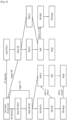
- FIG. 6 shows an example of initial access procedure according to an embodiment of the present invention.
- the procedure of cell association may be as follows.
- PRACH resources for LTE may be configured. If the UE selects LTE PRACH resources, the corresponding cell association may be done based on LTE procedure.
- PBCH/SIB for LTE may be UE-specifically signaled, instead that a UE needs to read broadcasted PBCH/SIB transmissions.
- the cell may broadcast either LTE or NR related common signals for PBCH/SIB. In terms of switching UEs from different RATs, those information may be given via UE-specific signaling.
- each PRACH resource may include optional field of RAT indication and overloading indication so that UEs supporting both RATs may utilize those information for better selection of RAT and PRACH resource.
- the network may be able to dynamically change the frequency portion of each RAT, dynamic loading may also be used to balance between different RATs.
- This information may also be indicated in PDCCH order or PRACH trigger which can be used for handover operation or change the RAT behavior of a UE.
- PRACH trigger may be applied to all connections or partially to subset of connections. This implies that all or partial subset of connections may be switched to different RAT type or cell.
- a UE may select different RAT based on its application characteristics or requirements.
- RACH procedure Based on PRACH resource selection, different RAR and RACH procedure may be expected.
- additional PRACH resource for LTE may be configured which are then responded with either NR-Msg3 or legacy Msg3.
- the UE may initiate with legacy RACH procedure, which may be detoured when Msg 4 is received or via RAR.
- RRC configuration Based on each RAT type, appropriate resource configuration may be given.
- a UE may be associated with the cell either via NR or LTE procedure depending on the searched synchronization signals and/or PBCH signals.
- the cell may indicate additional resources of different RAT. From a UE perspective, it is single carrier and different RAT coexists in the same carrier.
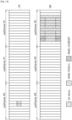
- FIG. 7 shows an example of coexistence of different RATs in a same frequency according to an embodiment of the present invention.
- FIG. 7-(a) shows Type 0 case
- FIG. 7-(b) shows Type 1 case.
- LTE bandwidth may be treated as blank resources.
- two types of blank resources configuration may be considered as follows.
- semi-statically configured blank subframe set(s) may be dynamically enabled or disabled.
- semi-static set(s) of blank resources may be configured, which may be dynamically enabled or disabled via the one of the following approaches.
- the UE When the UE is configured with LTE and NR, depending on the anchor RAT (based on initial cell association procedure), the following approaches may be considered.
- either (1) or (2) may be selected and used.
- Another approach is to assume CA or dual connectivity between two RATs to allow separate MAC entity in different MAC.
- intra-contiguous CA may be assumed for NR and LTE.
- intra CA may be assumed, and handling of segmented NR carrier may be different per UE implementation.
- One example is to configure three intra-contiguous CA carriers in Type 1.
- CA approach is used between NR and LTE, the following procedures may be clarified.
- LTE synchronization signals/RS LTE synchronization signals/RS and NR synchronization signal/RS.
- LTE synchronization signals/RS LTE synchronization signals/RS and NR synchronization signal/RS.
- Simple assumption may be to assume quasi-collocation (QCL) between LTE and NR synchronization signals/RS transmissions.
- QCL quasi-collocation
- Another approach is to support LTE and NR together via dual connectivity like framework and separate MAC and handling may be used. In this case, any relationship between two RAT's synchronization signals/RS may not be necessary. Similar to dual connectivity, the synchronization assumptions may be indicated by higher layer signaling.
- RAT configuration may be configured similar to transmission mode.
- different RAT type may be configured.
- Different RAT type may indicate or define the UE behavior of at least one of the followings.
- cell common transmission may be performed using one RAT. Furthermore, this may also be indicated with SCell addition and different RAT may be used per different carrier. Also, if NR and LTE cell performs CoMP operation, in terms of data rate matching, RAT type may be also indicated dynamically or rate matching factor may be dynamically indicated.
- QCL relationship between RS types transmitted in NR may not be present, QCL relationship between LTE-CRS and NR-RS (e.g. UE demodulation RS (DM-RS) or beam RS) may be present which may be signaled.
- DM-RS UE demodulation RS
- Beam RS beam RS
- a UE may be able to perform coarse synchronization which may not be doable by NR RS transmissions except for NR-PSS/NR-SSS.
- This cell may be configured as reference carrier. By this way, a network may be able to deploy one LTE cell with many neighbor NR cells without compromising UE synchronization performance considerably.
- a UE supporting both LTE and NR may be configured with two cells in the same frequency with NR and LTE.
- a UE may be configured for receiving control from either cell and data from either cell.
- the data and/or control may be transmitted from one or two cells dynamically.
- the benefit of this approach is to allow low latency so that UEs may be served regardless of invalid subframe or invalid resources.
- one approach is to use different subframe location of two RAT types for "always-on" signals such as synchronization signals so that a UE can be still scheduled with data in those resources at least from one cell. This may be partially supported by allowing CoMP operation between LTE and NR cells. Different from legacy LTE CoMP, legacy CRS assumption may be changed depending on the RAT type of each participating CoMP cell. To enhance the performance of legacy CRS reception, optionally zero-power CRS may be used for neighbor NR cells.
- LTE carrier may be utilized to indicate such signals.
- LTE carrier may be utilized to indicate such signals.
- One example is to utilize the same numerology with two different antenna transmission mechanisms in different frequency (which may be operated by different cell or eNB), and omni-directional transmission may indicate necessary information for beam-formed transmission including broadcast information, beam-scheduling information, etc.
- Another example is to perform initial access via LTE cell and aggregate NR which may be used after RACH procedure. This is similar to anchor carrier and handover to additional carrier where anchor carrier may or may not be operated in parallel with handover carrier or additional carrier. If this is applied, NR cell may not transmit any cell common signals or optionally turn off such signals.
- Handling UEs supporting only NR according to an embodiment of the present invention. So far, mechanisms to handle UEs supporting LTE were discussed. However, UEs may not aware of LTE or may not support LTE and NR simultaneously at the same frequency. In this case, for efficient usage of spectrum, the following operations may be considered.
- FIG. 8 shows an example of timing advance issue. If a UE uses different UL frequency compared to DL frequency and a UE does not have any connection to the DL frequency as in Case 1 or 2 described above (e.g. DL at low frequency and UL at high frequency), timing advance (TA) computation may become a bit challenging.
- TA timing advance
- FIG. 8 if a UE receives DL from micro and transmits UL to macro, propagation delay between two may be different. If timing advance computed by macro is forwarded by micro, it may include 2 times of propagation delay between macro and UE, whereas UE's DL timing is based on propagation delay between micro and UE.
- FIG. 9 shows an example of timing misalignment between micro and macro.
- the actual arrival time may be faster than the expected.
- the UE also transmits some reference signal such as PRACH/sounding reference signal (SRS).
- SRS PRACH/sounding reference signal
- Frequency/timing offset according to an embodiment of the present invention. Another issue of coexistence of LTE and NR in the same frequency is to handle frequency/timing offset. Frequency/timing offset measured by UE at DL frequency may not be sufficient for UL frequency. Also, different pathloss between DL and UL may be an issue when DL and UL frequency are different from each other.
- frequency offset may impact UL transmission.
- DL frequency is 28 GHz and the requirement of frequency offset is 0.1ppm
- a UE may have about 2.8 kHz carrier offset.
- subcarrier spacing is large, this frequency offset may not be a big issue.
- UL transmission in low frequency uses smaller subcarrier spacing, the overall frequency offset corrected by DL frequency may not be sufficient.
- 2.8 kHz frequency error becomes about 1.5 ppm. This may affect sampling offset so that overall demodulation/detection performance at gNB can be degraded.
- the network may determine reference DL carrier which may be same or different from corresponding DL carrier for a UL carrier.
- the serving DL carrier or DL carrier where SS block has been detected may be configured as reference DL carrier as well, if the network can ensure the tracking performance.
- One example is to configure DL and UL separately where the gap is not significant (e.g. DL at 3.5 GHz and UL at 1.8 GHz).
- the network may indicate whether DL carrier utilizes LTE or NR for tracking purpose.
- a UE supporting LTE may acquire time/frequency tracking from LTE carrier as well.
- a UE may acquire time/frequency tracking from a DL carrier which may result in sufficiently accurate time/frequency tracking. For example, if a UE supports LTE in the paired DL spectrum/carrier corresponding to the configured UL spectrum, instead of relying on NR DL for time/frequency tracking for UL carrier, a UE may utilize tracking RS (such as PSS/SSS/CRS) from LTE carrier.
- tracking RS such as PSS/SSS/CRS
- the network may also configure DL carrier for pathloss estimation for a given UL spectrum if the current DL spectrum is not desirable for UL spectrum pathloss measurement.
- the reference DL carrier may not have to be configured to the UE or activated to the UE. In other words, a UE may only acquire time/frequency tracking and/or pathloss estimation from the reference DL carrier. This may be regarded as additional measurement and a UE may also measure pathloss and/or time/frequency tracking based on the current DL carrier regardless of this configuration. If this is configured for a given UL, time/ frequency tracking from the reference DL carrier (and also pathloss estimation) may be used for UL transmission.
- the reference DL carrier may be configured by UE-specific higher layer signaling or cell-specific signaling such as via PBCH or SI.
- Pathloss compensation according to an embodiment of the present invention is described.
- pathloss may also be very different which may lead difficulty in power control, particularly for open-loop power control.
- the following approaches may be considered.
- a UE may support either Band X or Band Y or support both bands.
- the supported band may be indicated to the network. If there is possibility that a UE may support only Band X, either the network may support initial access on both Band X and Band Y simultaneously, or the UE may access Band X only via SCell attachment or secondary cell group (SCG) attachment (so that PCell or master cell group (MCG) can configure necessary resources for pathloss/frequency offset estimation).
- SCG secondary cell group
- MCG master cell group
- a UE may perform initial access at f1 and f2.
- a UE may be reconfigured to different UL frequency via PDCCH order or other procedure such as RRC reconfiguration of UL spectrum.
- the bandwidth configuration, and UL center frequency, etc. may be configured.
- the benefit of maintaining f2 is to support channel reciprocity via SRS/DM-RS transmission.
- a UE may transmit control and/or data via f2 and/or f3.
- configuration of DL carrier and UL carrier may be separately performed, and activation/deactivation may also be performed independently between DL and UL carrier. Even for unpaired spectrum, independent activation/deactivation of DL/UL carrier may be considered.
- a UE may switch to f2 when it becomes IDLE or inactive states.
- a UE may keep UL spectrum information in inactive state. If a UE is configured with more than one UL spectrum (e.g. f2 and f3), the UE may keep f2 instead of f3 if it goes to inactive state. For UEs supporting only one UL (e.g. f3), initial access procedure via f1 and f3 may be necessary.
- PRACH configuration may include resources. Assuming there are UEs supporting only Band X or Band Y, PRACH resource on both f2 and f3 may be necessary. In other words, multiple PRACH configurations in different uplink frequency may be needed.
- PRACH configuration includes at least one of the followings.
- Another approach for delivering best beam information is to transmit PRACH to both UL carriers simultaneously.
- the number of transmission beam may not be so large so that either beam-based resource may be configured or RAR may be transmitted via multiple beams.
- SUL may be configured only when DL carrier does not use multiple beams.
- PRACH When PRACH are transmitted simultaneously, the relationship between two may be predefined (i.e. the resources between f1 (or f2 in FDD) UL and SUL PRACH resources) or configured explicitly, so that the network can determine whether two transmissions are from the same UE. From the UE perspective, it is possible that UE is in power limited case, thus, transmission may be done in sequential manner instead of simultaneous transmission.
- a UE when multiple PRACH resources at different UL frequency are configured, a UE selects its PRACH resource based on UE reference signal received power (RSRP) measurement: If RSRP is low (compared to a threshold), the UE selects f3 for better coverage. Otherwise, the UE selects f2 for less complexity.
- RSRP UE reference signal received power
- a UE may select its PRACH resource based on at least one of the followings.
- the UE may transmit beam failure recovery request via f3 instead of f2 to enhance the reliability.
- f3 when a UE needs to perform beam sweeping for UL transmission, a UE may switch to f3 for fast transmission, low overhead, and better reliability.
- beam correspondence between DL and UL may not be assumed.
- the following approaches may be considered.
- FIG. 10 shows an example of a case that PRACH does not carry best beam information according to an embodiment of the present invention.
- beam recovery may need to be performed for DL and UL (by UE and network respectively) due to different frequencies.
- a UE may transmit beam-sweeping RS (e.g. SRS or DM-RS) periodically by network configuration.
- RS e.g. SRS or DM-RS
- a UE may perform beam tracking/management based on DL RS (e.g. SS block, CSI-RS, etc.).
- a UE may be configured with additional UL at f3 for coverage purpose.
- UL at f3 may be configured to UEs with coverage issue only.
- UL at f3 may be configured only at RRC-connected states.
- a band combination of DL carrier on f1 and UL carrier on f2 may be called as UL- sharing-band.
- initial access procedure may be designed assuming that a UE initially access NR carrier via NR DL/UL combination in NR spectrum. This may allow mechanisms for a UE to handle time/frequency offset, and pathloss differences. In other words, if the first approach is used, mechanisms to alleviate time/frequency offset and pathloss difference may be initiated for RRC_CONNECTED UEs, and f2 UL may be configured to a UE after initial access.
- initial access procedure may need to support different UEs which may require multiple PRACH configurations in different frequency range, and also need to handle time/frequency offset and pathloss differences from the beginning. If this is supported, supporting time/frequency offset tracking and pathloss estimation from different DL carrier from NR DL carrier may be preferred. This implies that a UE needs to support at least time/frequency tracking and pathloss estimation on the paired DL (or same f2) carrier corresponding to UL carrier.
- FIG. 11 shows an example of scenarios for SUL according to one or more embodiments.
- LTE band uses relatively lower frequency
- NR band uses relatively higher frequency (e.g. 3.5 GHz).
- FIG. 11-(a) shows a case of stand-alone SUL.
- a UL carrier in the LTE band is used as a supplemental UL carrier for NR.
- the supplemental UL carrier for NR corresponds to NR DL/UL carrier in the NR band.
- FIG. 11-(b) shows a case of dual connectivity SUL.
- a UL carrier in the LTE band is divided into LTE UL carrier and supplemental UL carrier for NR, and the supplemental UL carrier for NR corresponds to NR DL/UL carrier in the NR band.
- the LTE UL carrier and the supplemental UL carrier for NR in the LTE band may be divided by TDM or FDM.
- a UE may select PRACH resource based on UE capability (e.g. whether a UE supports SUL or not). In some embodiments, a UE selects PRACH resource based on RSRP like radio resource management (RRM) measurement.
- RRM radio resource management
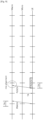
- FIG. 12 shows an example of PDSCH-HARQ-ACK and/or PDCCH-PUSCH timing according to an embodiment of the present invention.
- Dual connectivity scenarios when a UE is configured with dual connectivity where LTE UL and NR UL are shared via TDM, same handling to single active UL may be necessary.
- LTE and NR shares the spectrum via FDM UE hardware requirement needs to be clarified.
- further constraints such as UL timing difference and waveform may exist.
- PUCCH may be transmitted in one of them.
- the following approaches may be considered.
- half-carrier shift it has been discussed whether to allow half-carrier shift in NR UL when it shares with LTE UL spectrum. If half-carrier shift is adopted either by indicating UL center with 7.5 kHz shift or by baseband processing, in addition to BWP configuration, UL center frequency may need to be indicated. This information may be either configured with PRACH configuration or indicated in RAR.
- the simplest approach to support single active UL is to divide resources between LTE and NR. Given LTE requires subframe-based transmission, a subset of subframes may be assigned to NR and other subframes may be assigned to LTE. If there is scheduled LTE UL transmission such as PUCCH or PUSCH in a subframe assigned to NR, a UE may drop the channel regardless whether there is NR UL transmission. To minimize the dropping, one approach is to configure reference HARQ timing. For example, for FDD, HARQ timing from FDD-TDD CA with primary cell frame structure type is 2 may be used and TDD DL/UL configuration with the same set of UL may be selected.
- DL/UL configuration 0 may be used for HARQ-ACK timing with FDD-TDD CA.
- regular timing may be used and scheduling may avoid collision.
- FDD-TDD CA framework may be used for HARQ-ACK timing for LTE FDD to minimize HARQ-ACK dropping when semi-static partitioning is used.
- NR UL carrier may be restricted to non-LTE UL subframes. If LTE TDD carrier and NR TDD carrier are dual connected, by shifting frame boundary of NR, the overlapping of NR and LTE UL may be minimized.
- TA of LTE is larger than TA of NR, one or a few OFDM symbols of NR subframe may need to be yielded to LTE for TA handling.
- dynamic resource partitioning may be considered. That is, dynamic UL resource sharing may be used where each subframe may be assigned to each RAT as a primary CG. If there is no transmission on the assigned primary CG, the resource may be used for the secondary CG.
- dynamic UL resource sharing different processing time due to numerology and TTI lengths should be taken into account. For example, if LTE is configured with short TTI such as 2 symbols sTTI operation, UL transmission may be triggered within a subframe. Unless processing time and TTI are equal between two RATs, it is difficult to fully anticipate UL transmission in a given resource by the other CG.
- the CG with faster processing time and/or shorter TTI may be allowed to steal UL resource if there is no scheduled UL transmission by primary CG.
- NR with faster processing may use unused resources by LTE.
- resource sharing may be used between two RATs and collisions may be handled based on priority rule. For example, short UL transmission may have higher priority than long UL transmission. Or, transmission including UCI may have higher priority than transmission without UCI. When collision occurs, the lower priority channel may be dropped either partially or fully. Similar techniques used in UL channel collisions for short TTI operation may be considered.
- NR SS block transmission when LTE/NR share DL carrier according to an embodiment of the present invention is described.
- LTE/NR share DL carrier In terms of DL carrier sharing between LTE and NR, the following approaches may be considered.
- NR SS block may be transmitted in two different manner as follows.
- the specification may define relative location of SS block in a slot (and/or across slots) based on SS block numerology, instead of absolute slot index or subframe index, so that SS block may also be placed in MBSFN subframes or placed in OFDM symbols without LTE CRS.
- SS block transmission may not be punctured by MBMS services.
- reserved resource may include MBMS subframes where MBMS is actually transmitted, and SS block may not be transmitted in such MBMS subframes or reserved resources. This reserved resource may be separately configured for reserved resource for data and for SS block (this may also include RMSI and related initial access procedure transmission).
- the possible scenarios of DL sharing between LTE and NR may include FDM, TDM, and FDM + TDM in different subframe.
- FDM Frequency Division Multiple Access
- NR carrier and LTE carrier may not share the frequency.
- transmission of SS block may be performed equally to other NR carrier as long as the bandwidth of NR carrier exceeds the required minimum bandwidth for SS block transmission.
- TDM to avoid CRS OFDM symbols by NR signals, it is challenging to transmit SS block in LTE normal subframes.
- One approach is to transmit SS block in MBSFN subframes. If SS blocks are transmitted in a defined set of subframes/slots, LTE and NR frame boundary may be shifted so that SS block may be transmitted in LTE MBSFN subframes.
- eNB and gNB may exchange information about MBSFN subframes via backhaul signaling. In this case, offset between two may also be needed. For that, system frame number (SFN) or subframe index may be further indicated.
- SFN
- FIG. 13 shows an example of SS block transmission in NR carrier according to an embodiment of the present invention.
- MBSFN subframe uses 2 OFDM symbols for LTE PDCCH
- SS block is placed OFDM symbols 3 to 6
- RMSI control resource set CORESET
- it may be considered to utilize 7 OFDM symbols slot for RMSI transmission or mini-slot transmission for RMSI transmission.
- RMSI CORESET As there are reserved resources for RMSI CORESET, it may need to be indicated in PBCH whether there is any reserved resource in each subframe or whether LTE-NR TDM sharing is used.
- the slot size of RMSI transmission may be indicated as 7 OFDM symbols and some slots may not carry any CORESET.
- wideband RS may not be transmitted in frequency location where CORESET is not present.
- reserved resource may be explicitly indicated in PBCH so that a UE may assume that RMSI CORESET and wideband RS may be omitted in the reserved resource.
- joint indication may be possible as follows.
- slot length of each SS block and RMSI may be indicated separately.
- the mapping pattern of SS block may be indicted, and RMSI CORESET configuration may also be indicated separately which may include time location as well.
- FIG. 14 shows another example of SS block transmission in NR carrier according to an embodiment of the present invention.
- LTE-NR TDM is triggered in PBCH
- a UE may assume that 14 OFDM symbol slot is used for SS block and 7 OFDM symbol slot is used for RMSI transmission.
- 2 OFDM symbols in each subframe may be reserved, and CORESET may be placed in the second slot only.
- This information may be indicated in PBCH or indicated by assistance information (e.g. via PCell or UE-specific signaling).
- assistance information e.g. via PCell or UE-specific signaling.
- a UE may assume that CORESET may start at 3rd OFDM symbol instead of 1st OFDM symbol of a slot even though the slot size is 14 OFDM symbols.
- reserved resource for LTE PDCCH in MBSFN subframe may be indicated for RMSI transmission or RMSI may be transmitted in second slot of LTE MBSFN subframe.
- one bit may be indicated in PBCH which indicates LTE-NR TDM. If this flag is indicated, a UE may assume that at least 2 symbols in each subframe are reserved for LTE signals. Based on the information, different SS block mapping may be used. Or, different SS block mapping pattern may be used in such a case. If there is no explicit signaling, LTE-NR coexistence may be assumed that NR is deployed in LTE bands regardless of whether there is legacy LTE operating or not. In that case, even without explicit indication of LTE-NR coexistence, a UE may assume that LTE-NR coexistence cases are applied.
- different SS block mapping may be used. For example, 3 OFDM symbols may be reserved in each subframe for SS block mapping. In addition to LTE-NR TDM, the number of LTE PDCCH symbol may be indicated or the number of reserved symbol (either 1 or 2) may be indicated separately as well. If reserved symbol is 1 OFDM symbol, the same SS block mapping may be used. In the reserved resource, any resource element group (REG) mapping is not used. In other words, the entire duration of control region may become smaller.
- REG resource element group
- LTE-NR-Hybrid field may be indicated or LTE-NR-TDM may be indicated even for this case.
- a UE may assume the same behavior to LTE-NR TDM for SS block mapping and RMSI transmission. More detailed information about reserved resource may be indicated in RMSI or in other SI or UE-specific signaling.
- the CORESET duration and/or CORESET starting OFDM symbol may be constructed based on the best case (i.e. 1 LTE PDCCH region) and depending on the reserved resource, CORESET duration and/or CORESET starting OFDM symbol may be dynamically changed.
- center frequency of the NR carrier which may or may not be same as center of actual NR carrier, may be configured.
- the center of LTE carrier may be indicated.
- the center frequency may be indicated with 7.5 kHz shift as well.
- Normal CP/extended CP multiplexing according to an embodiment of the present invention is described.
- frame structure or slot structure between DL and UL may be different.
- the following multiple options may be considered.
- (1) Slot structure may be defined by numerology of DL.
- FIG. 15 shows an example of slot type formation based on DL numerology.
- Extended CP symbols may be placed within UL portion aligned with the end of slot.
- Extended CP UL symbols are placed at the end of normal CP DL slot.
- slot size is 7
- the Extended CP symbols to be aligned with Normal CP DL may not be aligned with Extended CP only UL slot due to the first OFDM symbol of Normal CP with larger CP. This approach also may complicate timing between DL and UL.
- (2) Slot structure may be defined by each numerology for DL and UL.
- FIG. 16 shows an example of slot type formation based on DL and UL numerology.
- This approach is to maintain separate slot structure between UL and DL, and utilize CA framework for handling of timing such as PDSCH to HARQ-ACK and PDCCH to PUSCH.
- PDSCH to HARQ-ACK or PDCCH to PUSCH timing may have multiple options which requires further investigation to be finalized.
- One drawback of this approach is that when slot format is indicated by group common PDCCH, either separate format may be indicated in DL and UL, or slot format structure may be indicated based on the first approach. Referring to FIG. 16 , individual slot structure is configured for DL and UL. When mini-slot is applied, mini-slot may be applied per DL and UL respectively with this approach.
- FIG. 17 shows a method for transmitting a PRACH by a UE according to an embodiment of the present invention.
- the present invention described above may be applied to this embodiment.
- the UE receives multiple PRACH configurations which include a first PRACH configuration for NR DL/UL carrier in a NR band and a second PRACH configuration for a supplemental UL carrier in a LTE band.
- the UE transmits at least one of a first PRACH for accessing the NR DL/UL carrier in the NL band by using a first PRACH power based on the first PRACH configuration, or a second PRACH for accessing the supplemental UL carrier in the LTE band by using a second PRACH power based on the second PRACH configuration.
- the first PRACH configuration and the second PRACH configuration include different PRACH power configurations.
- the UE may be configured only with the supplemental UL carrier in the LTE band.
- a UL PCC may be changed to a cell of the supplemental UL carrier on which the second PRACH is transmitted.
- a DL PCC may be in the NR DL/UL carrier.
- the supplemental UL carrier may include LTE UL resources and NR UL resources.
- the LTE resources and the NR resources are multiplexed by TDM or FDM.
- a reference HARQ timing based on FDD-TDD CA may be configured for the LTE UL resources.
- a cell carrying a PUCCH may be configured to one of a UL PCC in the NL DL/UL carrier or the supplemental UL carrier.
- a PUSCH transmission may be performed in the cell carrying the PUCCH.
- a PUSCH transmission may be configured to another carrier other than the NR DL/UL carrier or the supplemental UL carrier.
- the UE may receive a DL tracking reference signal (RS) in a DL carrier corresponding to the NR DL/UL carrier or the supplemental UL carrier.
- RS DL tracking reference signal
- At least one of the first PRACH or the second PRACH may carry data indicating a best beam.
- a preamble sequence or a PRACH resource may be selected to indicate a best beam.
- FIG. 18 shows a wireless communication system to implement an embodiment of the present invention.
- a network node 800 includes a processor 810, a memory 820 and a transceiver 830.
- the processor 810 may be configured to implement proposed functions, procedures and/or methods described in this description. Layers of the radio interface protocol may be implemented in the processor 810.
- the memory 820 is operatively coupled with the processor 810 and stores a variety of information to operate the processor 810.
- the transceiver 830 is operatively coupled with the processor 810, and transmits and/or receives a radio signal.
- a UE 900 includes a processor 910, a memory 920 and a transceiver 930.
- the processor 910 is configured to implement proposed functions, procedures and/or methods described in this description. Layers of the radio interface protocol may be implemented in the processor 910.
- the memory 920 is operatively coupled with the processor 910 and stores a variety of information to operate the processor 910.
- the transceiver 930 is operatively coupled with the processor 910, and transmits and/or receives a radio signal.
- the processors 810, 910 may include application-specific integrated circuit (ASIC), other chipset, logic circuit and/or data processing device.
- the memories 820, 920 may include read-only memory (ROM), random access memory (RAM), flash memory, memory card, storage medium and/or other storage device.
- the transceivers 830, 930 may include baseband circuitry to process radio frequency signals.
- the techniques described herein can be implemented with modules (e.g., procedures, functions, and so on) that perform the functions described herein.
- the modules can be stored in memories 820, 920 and executed by processors 810, 910.
- the memories 820, 920 can be implemented within the processors 810, 910 or external to the processors 810, 910 in which case those can be communicatively coupled to the processors 810, 910 via various means as is known in the art.
Landscapes
- Engineering & Computer Science (AREA)
- Signal Processing (AREA)
- Computer Networks & Wireless Communication (AREA)
- Mobile Radio Communication Systems (AREA)
Claims (13)
- Procédé mis en oeuvre par un dispositif sans fil (900) dans un système de communication sans fil, le procédé comprenant :la réception d'une première configuration de canal d'accès aléatoire physique, PRACH, pour une porteuse de liaison montante de nouvelle radio, NR UL, et d'une deuxième configuration de PRACH pour une porteuse de liaison montante supplémentaire, SUL, dans lequel la porteuse UL NR et une porteuse DL liée à la porteuse UL NR appartiennent à une première bande de fréquences, et dans lequel la porteuse SUL pour NR appartient à une deuxième bande de fréquences ;la sélection d'une porteuse UL pour une procédure d'accès aléatoire parmi la porteuse UL NR et la porteuse SUL sur la base d'un résultat d'une mesure de puissance reçue de signal de référence, RSRP, sur la porteuse DL ; etla mise en oeuvre de la procédure d'accès aléatoire sur la porteuse UL sélectionnée sur la base d'une configuration de PRACH pour la porteuse UL sélectionnée,dans lequel, sur la base du résultat de la mesure RSRP sur la porteuse DL qui est inférieur à un seuil, la porteuse SUL est sélectionnée comme la porteuse UL pour la procédure d'accès aléatoire,dans lequel, sur la base du résultat de la mesure RSRP sur la porteuse DL qui n'est pas inférieur au seuil, la porteuse UL NR est sélectionnée comme la porteuse UL pour la procédure d'accès aléatoire,dans lequel le procédé comprend en outre la réception d'une autorisation d'UL notifiant une porteuse UL pour une émission de canal physique partagé de liaison montante, PUSCH, parmi la porteuse UL NR et la porteuse SUL, caractérisé en ce que : sur la base i) de la porteuse SUL qui est sélectionnée comme la porteuse UL pour la procédure d'accès aléatoire et ii) de l'autorisation d'UL notifiant la porteuse UL NR, le dispositif sans fil reste sur la porteuse SUL sans commutation de porteuse de la porteuse SUL à la porteuse UL NR jusqu'à ce que la porteuse UL soit changée par une autre procédure d'accès aléatoire.
- Procédé selon la revendication 1, dans lequel la première bande de fréquences a une fréquence supérieure à la deuxième bande de fréquences.
- Procédé selon la revendication 1, dans lequel la première bande de fréquences est une bande de fréquences dédiée pour une NR 5G, et
dans lequel la deuxième bande de fréquences est une bande de fréquences partagée entre la NR 5G et une technologie d'accès radio d'évolution à long terme, LTE, 4G. - Procédé selon la revendication 1, dans lequel des ressources UL NL pour la porteuse SUL partagent la deuxième bande de fréquences avec des ressources UL LTE pour une porteuse UL LTE.
- Procédé selon la revendication 4, dans lequel les ressources UL LTE et les ressources UL NR sont multiplexées par multiplexage par répartition dans le temps, TDM, ou par multiplexage par répartition en fréquence, FDM.
- Procédé selon la revendication 1, comprenant en outre la réception d'un signal de référence, RS, de suivi de DL dans la porteuse DL.
- Procédé selon la revendication 1, dans lequel la procédure d'accès aléatoire transporte des données indiquant un meilleur faisceau.
- Procédé selon la revendication 1, comprenant en outre :la sélection d'une ressource PRACH sur la base de la configuration de PRACH pour la porteuse UL sélectionnée,dans lequel la ressource PRACH est sélectionnée pour indiquer un meilleur faisceau.
- Procédé selon la revendication 1, dans lequel le dispositif sans fil (900) est en communication avec un réseau et avec des véhicules autonomes autres que le dispositif sans fil.
- Dispositif sans fil (900) dans un système de communication sans fil, le dispositif sans fil (900) comprenant :une mémoire (920) ;un émetteur-récepteur (930) ; etau moins un processeur (910), couplé de manière utilisable à la mémoire (920) et à l'émetteur-récepteur (930), configuré pour :recevoir via l'émetteur-récepteur (930) une première configuration de canal d'accès aléatoire physique, PRACH, pour une porteuse de liaison montante de nouvelle radio, NR UL, et d'une deuxième configuration de PRACH pour une porteuse de liaison montante supplémentaire, SUL, dans lequel la porteuse UL NR et une porteuse DL liée à la porteuse UL NR appartiennent à une première bande de fréquences, et dans lequel la porteuse SUL pour NR appartient à une deuxième bande de fréquences,sélectionner une porteuse UL pour une procédure d'accès aléatoire parmi la porteuse UL NR et la porteuse SUL sur la base d'un résultat d'une mesure de puissance reçue de signal de référence, RSRP, sur la porteuse DL, etmettre en oeuvre la procédure d'accès aléatoire sur la porteuse UL sélectionnée sur la base d'une configuration de PRACH pour la porteuse UL sélectionnée,dans lequel, sur la base du résultat de la mesure RSRP sur la porteuse DL qui est inférieur à un seuil, l'au moins un processeur (910) est configuré en outre pour sélectionner la porteuse SUL comme la porteuse UL pour la procédure d'accès aléatoire,dans lequel, sur la base du résultat de la mesure RSRP sur la porteuse DL qui n'est pas inférieur au seuil, l'au moins un processeur (910) est configuré en outre pour sélectionner la porteuse UL NR comme la porteuse UL pour la procédure d'accès aléatoire,dans lequel l'au moins un processeur (910) est configuré en outre pour recevoir via l'émetteur-récepteur (930) une autorisation d'UL notifiant une porteuse UL pour une émission de canal physique partagé de liaison montante, PUSCH, parmi la porteuse UL NR et la porteuse SUL, caractérisé en ce que :
sur la base i) de la porteuse SUL qui est sélectionnée comme la porteuse UL pour la procédure d'accès aléatoire et ii) de l'autorisation d'UL notifiant la porteuse UL NR, le dispositif sans fil reste sur la porteuse SUL sans commutation de porteuse de la porteuse SUL à la porteuse UL NR jusqu'à ce que la porteuse UL soit changée par une autre procédure d'accès aléatoire. - Dispositif sans fil (900) selon la revendication 10, dans lequel la première bande de fréquences a une fréquence supérieure à la deuxième bande de fréquences.
- Dispositif sans fil (900) selon la revendication 10, dans lequel la première bande de fréquences est une bande de fréquences dédiée pour une NR 5G, et
dans lequel la deuxième bande de fréquences est une bande de fréquences partagée entre la NR 5G et une technologie d'accès radio d'évolution à long terme, LTE, 4G. - Dispositif sans fil (900) selon la revendication 10, dans lequel des ressources UL NL pour la porteuse SUL partagent la deuxième bande de fréquences avec des ressources UL LTE pour une porteuse UL LTE.
Applications Claiming Priority (8)
| Application Number | Priority Date | Filing Date | Title |
|---|---|---|---|
| US201762442396P | 2017-01-04 | 2017-01-04 | |
| US201762491387P | 2017-04-28 | 2017-04-28 | |
| US201762492932P | 2017-05-01 | 2017-05-01 | |
| US201762519817P | 2017-06-14 | 2017-06-14 | |
| US201762521343P | 2017-06-16 | 2017-06-16 | |
| US201762520676P | 2017-06-16 | 2017-06-16 | |
| US201762534225P | 2017-07-19 | 2017-07-19 | |
| PCT/KR2018/000198 WO2018128426A1 (fr) | 2017-01-04 | 2018-01-04 | Procédé et appareil de partage de spectre entre lte 3gpp et nr dans un système de communication sans fil |
Publications (3)
| Publication Number | Publication Date |
|---|---|
| EP3549302A1 EP3549302A1 (fr) | 2019-10-09 |
| EP3549302A4 EP3549302A4 (fr) | 2019-12-11 |
| EP3549302B1 true EP3549302B1 (fr) | 2024-10-30 |
Family
ID=62791006
Family Applications (1)
| Application Number | Title | Priority Date | Filing Date |
|---|---|---|---|
| EP18736523.4A Active EP3549302B1 (fr) | 2017-01-04 | 2018-01-04 | Procédé et appareil de partage de spectre entre lte 3gpp et nr dans un système de communication sans fil |
Country Status (6)
| Country | Link |
|---|---|
| US (2) | US11284439B2 (fr) |
| EP (1) | EP3549302B1 (fr) |
| JP (1) | JP7060603B2 (fr) |
| KR (1) | KR102354502B1 (fr) |
| CN (1) | CN110199497B (fr) |
| WO (1) | WO2018128426A1 (fr) |
Families Citing this family (131)
| Publication number | Priority date | Publication date | Assignee | Title |
|---|---|---|---|---|
| US10904940B2 (en) | 2018-03-30 | 2021-01-26 | Comcast Cable Communications, Llc | Configuration for beam failure recovery |
| US10334515B2 (en) | 2017-01-13 | 2019-06-25 | ENK Wireless, Inc. | Conveying information via auxiliary device selection |
| CN108633019B (zh) * | 2017-03-23 | 2022-02-08 | 华为技术有限公司 | 信息收发方法和设备 |
| US10326576B2 (en) | 2017-04-28 | 2019-06-18 | Qualcomm Incorporated | Reusing long-term evolution (LTE) reference signals for nested system operations |
| US12096292B2 (en) * | 2017-05-05 | 2024-09-17 | Samsung Electronics Co., Ltd. | System, data transmission method and network equipment supporting PDCP duplication function method and device for transferring supplementary uplink carrier configuration information and method and device for performing connection mobility adjustment |
| WO2018203736A1 (fr) | 2017-05-05 | 2018-11-08 | Samsung Electronics Co., Ltd. | Système, procédé de transmission de données et équipement de réseau prenant en charge un procédé de fonction de duplication pdcp et dispositif de transfert d'informations de configuration de porteuse de liaison montante supplémentaire et procédé et dispositif de réalisation d'ajustement de mobilité de connexion |
| US11291066B2 (en) * | 2017-06-13 | 2022-03-29 | Ntt Docomo, Inc. | User terminal, radio base station and radio communication method |
| JP7242161B2 (ja) * | 2017-06-14 | 2023-03-20 | ソニーグループ株式会社 | 通信装置、通信制御方法及びコンピュータプログラム |
| GB2563453A (en) * | 2017-06-16 | 2018-12-19 | Nec Corp | Communication system |
| JPWO2018235248A1 (ja) * | 2017-06-22 | 2020-04-23 | 株式会社Nttドコモ | ユーザ端末及び無線通信方法 |
| US10708955B2 (en) | 2017-06-23 | 2020-07-07 | Qualcomm Incorporated | Techniques and apparatuses for supplementary uplink random access configuration |
| RU2751218C1 (ru) * | 2017-08-09 | 2021-07-12 | Нтт Докомо, Инк. | Пользовательский терминал и способ радиосвязи |
| US11950287B2 (en) | 2017-08-10 | 2024-04-02 | Comcast Cable Communications, Llc | Resource configuration of beam failure recovery request transmission |
| US10887939B2 (en) | 2017-08-10 | 2021-01-05 | Comcast Cable Communications, Llc | Transmission power control for beam failure recovery requests |
| US11337265B2 (en) | 2017-08-10 | 2022-05-17 | Comcast Cable Communications, Llc | Beam failure recovery request transmission |
| US10855359B2 (en) | 2017-08-10 | 2020-12-01 | Comcast Cable Communications, Llc | Priority of beam failure recovery request and uplink channels |
| WO2019031946A1 (fr) * | 2017-08-11 | 2019-02-14 | 엘지전자 주식회사 | Procédé permettant de transmettre/recevoir un signal sur la base de la technologie lte et d'une nouvelle radio dans un système de communication sans fil et dispositif s'y rapportant |
| CN109392142B (zh) * | 2017-08-11 | 2022-09-02 | 华为技术有限公司 | 载波切换和信息发送方法,以及装置 |
| EP3665968A1 (fr) * | 2017-08-11 | 2020-06-17 | Telefonaktiebolaget LM Ericsson (Publ) | Utilisation de signaux de référence spécifiques à une cellule pour une commande de puissance de liaison montante en boucle ouverte nr |
| CN109391578B (zh) * | 2017-08-11 | 2022-07-22 | 华为技术有限公司 | 信号发送方法、信号接收方法、终端设备及网络设备 |
| US11546941B2 (en) * | 2017-08-18 | 2023-01-03 | Qualcomm Incorporated | Random access procedure with cross band downlink/uplink pairing |
| US10779331B2 (en) * | 2017-08-21 | 2020-09-15 | Qualcomm Incorporated | Random access channel (RACH) transmission with cross-band downlink/uplink (DL/UL) pairing |
| US11316619B2 (en) | 2017-09-05 | 2022-04-26 | Ofinno, Llc | HARQ feedback transmission |
| US11277301B2 (en) | 2017-09-07 | 2022-03-15 | Comcast Cable Communications, Llc | Unified downlink control information for beam management |
| AU2017430537A1 (en) * | 2017-09-08 | 2020-04-02 | Guangdong Oppo Mobile Telecommunications Corp., Ltd. | Wireless communication method, network device, and terminal device |
| US11611468B2 (en) | 2017-09-28 | 2023-03-21 | Comcast Cable Communications, Llc | Beam management with DRX configuration |
| US11647493B2 (en) * | 2017-10-06 | 2023-05-09 | Qualcomm Incorporated | Techniques and apparatuses for using a second link for beam failure recovery of a first link |
| US11044756B2 (en) * | 2017-10-09 | 2021-06-22 | Qualcomm Incorporated | Supplementary uplink random access channel procedures |
| US10917226B2 (en) * | 2017-10-11 | 2021-02-09 | Qualcomm Incorporated | Techniques and apparatuses for time division multiplexing for dual-rat communication |
| US10694394B2 (en) | 2017-11-06 | 2020-06-23 | T-Mobile Usa, Inc. | Spectrum sharing system for telecommunications network traffic |
| JP7077403B2 (ja) * | 2017-11-10 | 2022-05-30 | テレフオンアクチーボラゲット エルエム エリクソン(パブル) | 新無線におけるアップリンク-ダウンリンクスイッチングのためのタイミングアドバンスオフセット |
| US10660063B2 (en) | 2017-11-16 | 2020-05-19 | Comcast Cable Communications, Llc | Beam paging assistance |
| CN109803371B (zh) * | 2017-11-17 | 2023-06-09 | 华为技术有限公司 | 一种通信处理方法和装置 |
| EP3509373B1 (fr) | 2018-01-09 | 2023-03-08 | Comcast Cable Communications LLC | Sélection de faisceau dans une retransmission de demande de reprise après défaillance de faisceau |
| CN110099459B (zh) * | 2018-01-31 | 2021-07-20 | 华为技术有限公司 | 一种随机接入方法及装置 |
| US10798622B2 (en) | 2018-02-09 | 2020-10-06 | Comcast Cable Communications, Llc | Beam failure recovery in carrier aggregation |
| CN110167155B (zh) * | 2018-02-13 | 2021-10-29 | 中国移动通信有限公司研究院 | 上下行传输配置的确定方法、上下行传输配置方法及设备 |
| EP3528398A1 (fr) | 2018-02-15 | 2019-08-21 | Comcast Cable Communications LLC | Rapport de défaillance de faisceau |
| US10931430B2 (en) * | 2018-02-25 | 2021-02-23 | Qualcomm Incorporated | Uplink preemption in carrier aggregation/multi-connectivity mode |
| US11864031B2 (en) * | 2018-03-22 | 2024-01-02 | Asustek Computer Inc. | Method and apparatus for beam failure handling in a wireless communication system |
| EP3744140B1 (fr) | 2018-03-30 | 2024-02-14 | Ofinno, LLC | Passage de la bande passante pendant la récupération après une panne |
| KR102658244B1 (ko) | 2018-03-30 | 2024-04-16 | 레즈메드 아이엔씨. | 스케줄링 요청 기반 빔 장애 복구 |
| CA3038779A1 (fr) | 2018-04-02 | 2019-10-02 | Comcast Cable Communications, Llc | Recuperation de defaut de faisceau |
| EP3783950A4 (fr) * | 2018-04-17 | 2022-01-05 | Ntt Docomo, Inc. | Terminal utilisateur |
| EP3567776B1 (fr) | 2018-05-10 | 2021-08-18 | Comcast Cable Communications, LLC | Priorisation dans des procédures de reprise après défaillance de faisceau |
| US11558163B2 (en) * | 2018-06-02 | 2023-01-17 | Telefonaktiebolaget Lm Ericsson (Publ) | Demodulation reference signaling in LTE/NR coexistence |
| WO2019237329A1 (fr) * | 2018-06-15 | 2019-12-19 | Qualcomm Incorporated | Techniques et appareils de fonctionnement etmc dans une largeur de bande autre que lte |
| CN110719633B (zh) * | 2018-07-13 | 2022-08-09 | 大唐移动通信设备有限公司 | 一种上行资源分配方法、装置、基站及终端 |
| CN112385275B (zh) * | 2018-07-27 | 2022-06-28 | 华为技术有限公司 | 用于节电状态下的波束管理的客户端设备、网络接入节点、以及方法 |
| CN110798864B (zh) | 2018-08-01 | 2021-03-02 | 维沃移动通信有限公司 | 用于波束失败恢复的方法和终端设备 |
| CN109076620B (zh) * | 2018-08-03 | 2021-12-21 | 北京小米移动软件有限公司 | 随机接入控制方法和随机接入控制装置 |
| JP7105132B2 (ja) * | 2018-08-06 | 2022-07-22 | Kddi株式会社 | レガシーシステムとの共存を実行するための通信装置、通信方法、及びプログラム |
| US11012137B2 (en) | 2018-08-09 | 2021-05-18 | Comcast Cable Communications, Llc | Resource management for beam failure recovery procedures |
| US11051327B2 (en) * | 2018-08-10 | 2021-06-29 | Qualcomm Incorporated | Rate-matching around CRS for NR-TDD |
| CN110876130B (zh) * | 2018-09-04 | 2022-02-08 | 展讯通信(上海)有限公司 | V2x传输指示方法、装置、存储介质、基站、设备 |
| CN110912657B (zh) * | 2018-09-14 | 2022-08-30 | 联发博动科技(北京)有限公司 | 基于共存通信系统的rs的rrm测量和信道估计方法及设备 |
| EP3837918B1 (fr) * | 2018-09-18 | 2023-07-19 | Sony Group Corporation | Dispositif de communications, équipement d'infrastructure et procédés |
| CA3056500A1 (fr) | 2018-09-24 | 2020-03-24 | Comcast Cable Communications, Llc | Procedures de reprise apres une defaillance de faisceau |
| CA3056608A1 (fr) | 2018-09-25 | 2020-03-25 | Comcast Cable Communications, Llc | Configuration de faisceau d`echos secondaires |
| US10743211B2 (en) * | 2018-09-25 | 2020-08-11 | Verizon Patent And Licensing, Inc. | Diversified ran architecture with congestion control based on spectrum re-allocation |
| US11510227B2 (en) * | 2018-10-05 | 2022-11-22 | Qualcomm Incorporated | Uplink transmission in discovery reference signal measurement timing configuration window |
| US11201661B2 (en) * | 2018-10-24 | 2021-12-14 | Qualcomm Incorporated | Beam failure recovery with supplementary uplink |
| CN116996951A (zh) * | 2018-11-19 | 2023-11-03 | 华为技术有限公司 | 一种上行链路切换的方法、通信装置和通信系统 |
| CN111225410B (zh) | 2018-11-24 | 2022-05-10 | 华为技术有限公司 | 一种确定上行链路的方法及装置 |
| US11057907B2 (en) * | 2018-11-26 | 2021-07-06 | T-Mobile Usa, Inc. | Spectrum sharing optimization within a base station node |
| US11895507B2 (en) | 2018-11-26 | 2024-02-06 | T-Mobile Usa, Inc. | Spectrum sharing optimization within a base station node |
| WO2020115908A1 (fr) * | 2018-12-07 | 2020-06-11 | 株式会社Nttドコモ | Terminal et procédé de communication |
| JP7109354B2 (ja) * | 2018-12-13 | 2022-07-29 | Kddi株式会社 | レガシーシステムとの共存を実行するための通信装置、通信方法、及びプログラム |
| CN113016160B (zh) | 2019-01-07 | 2022-05-17 | 华为技术有限公司 | 一种通信方法及装置 |
| CN111436132B (zh) * | 2019-01-11 | 2024-04-30 | 成都华为技术有限公司 | 随机接入资源配置方法和装置 |
| US10873953B2 (en) * | 2019-02-08 | 2020-12-22 | At&T Intellectual Property I, L.P. | Computing channel state information in a 5G wireless communication system in 4G spectrum frequencies |
| US20220021500A1 (en) * | 2019-02-14 | 2022-01-20 | Ntt Docomo, Inc. | User terminal and radio communication method |
| US11265130B2 (en) * | 2019-02-15 | 2022-03-01 | Qualcomm Incorporated | Techniques for shared radio frequency spectrum channel configuration |
| EP3925355B1 (fr) | 2019-02-15 | 2024-01-24 | Telefonaktiebolaget LM Ericsson (publ) | Signalisation de données en coexistence lte/nr |
| US12375934B2 (en) * | 2019-03-15 | 2025-07-29 | Telefonaktiebolaget Lm Ericsson (Publ) | Network node and method for dynamic spectrum sharing between radio access technologies |
| EP3966982A1 (fr) * | 2019-05-08 | 2022-03-16 | Nokia Solutions and Networks Oy | Équilibrage de charge de technologie d'accès inter-radio dans un partage de spectre dynamique multi-porteuse |
| WO2020230862A1 (fr) * | 2019-05-16 | 2020-11-19 | 株式会社Nttドコモ | Terminal utilisateur et procédé de communication sans fil |
| US20200366440A1 (en) * | 2019-05-17 | 2020-11-19 | Qualcomm Incorporated | Long term evolution common reference signal-assisted new radio tracking |
| CN110278610B (zh) | 2019-05-28 | 2022-07-22 | 华为技术有限公司 | 一种资源配置方法及通信装置 |
| CN112087810B (zh) * | 2019-06-14 | 2023-01-06 | 华为技术有限公司 | 一种随机接入方法及装置 |
| KR102230422B1 (ko) * | 2019-06-14 | 2021-03-19 | 주식회사 엘지유플러스 | 부하 분산을 위한 기지국, 단말, 기지국 및 단말의 동작 방법 |
| CN110248420A (zh) * | 2019-06-19 | 2019-09-17 | 广州维德科技有限公司 | 一种基于无线通信协议的基站集群系统及实现方法 |
| US12133208B2 (en) | 2019-07-08 | 2024-10-29 | Telefonaktiebolaget Lm Ericsson (Publ) | Method and devices for wireless communication |
| EP4026361A4 (fr) | 2019-09-04 | 2023-06-07 | Telefonaktiebolaget Lm Ericsson (Publ) | Procédés et dispositifs de communication sans fil |
| CN114402694B (zh) * | 2019-09-30 | 2024-05-03 | 华为技术有限公司 | 信道冲突处理方法及装置 |
| EP4040883A4 (fr) * | 2019-09-30 | 2022-10-05 | Fujitsu Limited | Procédé et appareil d'accès aléatoire, et système de communication |
| WO2021064683A1 (fr) * | 2019-10-03 | 2021-04-08 | Telefonaktiebolaget Lm Ericsson (Publ) | Partage de ressources de canal d'accès aléatoire physique entre différentes technologies d'accès radio |
| US11206547B1 (en) * | 2019-10-11 | 2021-12-21 | Sprint Spectrum L.P. | Contiguously clustering of resource allocation in response to near-frequency communication with different subcarrier spacing |
| WO2021096142A1 (fr) * | 2019-11-13 | 2021-05-20 | Samsung Electronics Co., Ltd. | Systèmes et procédés permettant à un ue d'éviter des problèmes dans un partage de spectre dynamique |
| CN114342496B (zh) * | 2019-11-20 | 2024-10-25 | Oppo广东移动通信有限公司 | 一种上行接入方法、电子设备及存储介质 |
| EP4091262A1 (fr) * | 2020-01-14 | 2022-11-23 | Sony Group Corporation | Gestion de faisceaux pour un fonctionnement par duplexage par répartition en fréquences |
| CN115004573B (zh) * | 2020-01-14 | 2025-08-22 | 索尼集团公司 | 初始接入期间的波束管理 |
| US11832111B2 (en) * | 2020-01-30 | 2023-11-28 | Qualcomm Incorporated | Dynamic spectrum sharing between 4G and 5G wireless networks |
| EP4097896A4 (fr) * | 2020-01-30 | 2023-07-05 | Telefonaktiebolaget Lm Ericsson (Publ) | Noeud de réseau et procédé de sélection d'une stratégie d'attribution dans un partage de spectre |
| US11888610B2 (en) * | 2020-02-26 | 2024-01-30 | Qualcomm Incorporated | Method and apparatus for positioning with LTE-NR dynamic spectrum sharing (DSS) |
| EP3882810B1 (fr) | 2020-03-16 | 2023-06-07 | Carl Zeiss Vision International GmbH | Procédés mis en oeuvre par ordinateur et dispositifs permettant de déterminer des dimensions et des distances de caractéristiques de tête |
| KR102925132B1 (ko) * | 2020-04-08 | 2026-02-10 | 애플 인크. | 구성된 승인 송신 규칙들 |
| WO2021212321A1 (fr) * | 2020-04-21 | 2021-10-28 | Telefonaktiebolaget Lm Ericsson (Publ) | Procédé et appareil permettant de configurer une ressource de canal |
| CN113766513B (zh) * | 2020-06-01 | 2024-03-15 | 中国电信股份有限公司 | 上行资源协调方法、系统、基站以及存储介质 |
| KR102874769B1 (ko) | 2020-06-18 | 2025-10-23 | 삼성전자주식회사 | 무선 통신 시스템에서 스펙트럼 공유를 위한 장치 및 방법 |
| US20230232400A1 (en) * | 2020-06-26 | 2023-07-20 | Qualcomm Incorporated | Techniques for configuring supplementary downlink support for half-duplex ue |
| CN113891332A (zh) | 2020-07-01 | 2022-01-04 | 华为技术有限公司 | 一种资源配置方法和装置 |
| US20230209479A1 (en) * | 2020-07-06 | 2023-06-29 | Qualcomm Incorporated | Power headroom report triggering by dormant bandwidth part switching |
| CN111787482B (zh) * | 2020-07-13 | 2021-10-15 | 深圳大学 | 基于聚类算法的毫米波频谱共享方法及系统 |
| EP4192159B1 (fr) * | 2020-08-06 | 2025-12-17 | Guangdong Oppo Mobile Telecommunications Corp., Ltd. | Procédé de communication de données, dispositif terminal et dispositif réseau |
| US20230292371A1 (en) * | 2020-08-06 | 2023-09-14 | Telefonaktiebolaget Lm Ericsson (Publ) | Rar window definition in ntn |
| US12160881B2 (en) | 2020-08-28 | 2024-12-03 | Google Llc | Uplink power-sharing in wireless communication devices employing multiple radio access technologies |
| CN114339774A (zh) * | 2020-09-30 | 2022-04-12 | 北京三星通信技术研究有限公司 | 频谱资源共享方法、装置、电子设备及存储介质 |
| EP4229806B1 (fr) * | 2020-10-14 | 2025-09-24 | Telefonaktiebolaget LM Ericsson (publ) | Calcul d'utilisation de blocs de ressources pour partage de spectre |
| CN114375044B (zh) * | 2020-10-15 | 2025-02-28 | 北京紫光展锐通信技术有限公司 | 终端资源解析及其识别方法、基站、电子设备和存储介质 |
| CN116530148B (zh) * | 2020-10-22 | 2025-02-18 | 苹果公司 | 用于处理动态频谱共享以及上行链路子载波移位的方法、系统和装置 |
| US12069484B2 (en) | 2020-12-03 | 2024-08-20 | Samsung Electronics Co., Ltd. | Base station supporting dynamic spectrum sharing between heterogeneous networks and wireless communication system including the same |
| US11588600B2 (en) * | 2021-01-25 | 2023-02-21 | Qualcomm Incorporated | Antenna selection for sounding reference signal antenna switching |
| EP4268530A4 (fr) * | 2021-01-28 | 2024-11-20 | MediaTek Singapore Pte. Ltd. | Procédé et appareil de planification inter-porteuses dans des communications mobiles |
| CN114885338B (zh) * | 2021-02-05 | 2025-03-07 | 中国电信股份有限公司 | 频谱共享装置、频谱共享方法及计算机可读存储介质 |
| CN115002785B (zh) * | 2021-03-02 | 2024-06-04 | 中国联合网络通信集团有限公司 | 天线端口数据的处理方法及通信装置 |
| US12627334B2 (en) | 2021-03-15 | 2026-05-12 | Qualcomm Incorporated | Supplemental reconfigurable intelligent surfaces for downlink communication |
| US20240121830A1 (en) * | 2021-03-22 | 2024-04-11 | Qualcomm Incorporated | Rach occasion repetition and prach format selection based on device type in ntn |
| US12101214B2 (en) * | 2021-06-09 | 2024-09-24 | Qualcomm Incorporated | Compressed channel aware tone reservation signaling for peak-to-average power ratio reduction |
| US12212519B2 (en) * | 2021-11-11 | 2025-01-28 | Qualcomm Incorporated | Cell-specific reference signal for tracking loop update |
| WO2023129128A1 (fr) * | 2021-12-28 | 2023-07-06 | Rakuten Mobile, Inc. | Système, procédé et programme informatique pour gestion intelligente d'un flux de trafic non autonome |
| EP4213405A1 (fr) | 2022-01-13 | 2023-07-19 | Nokia Technologies Oy | Agencements d'antennes multiples |
| US12470942B2 (en) * | 2022-02-17 | 2025-11-11 | Qualcomm Incorporated | Techniques for dynamic spectrum sharing between radio access technologies |
| WO2023174519A1 (fr) * | 2022-03-15 | 2023-09-21 | Nokia Technologies Oy | Recherche de cellule |
| WO2023193876A1 (fr) * | 2022-04-04 | 2023-10-12 | Telefonaktiebolaget Lm Ericsson (Publ) | Nœud de réseau et procédé dans un réseau de communications sans fil |
| US12200629B2 (en) | 2022-04-27 | 2025-01-14 | At&T Intellectual Property I, L.P. | Sub-band selection at cellular base station for non-overlapped or partially overlapped full duplex operation |
| US12108379B2 (en) | 2022-04-28 | 2024-10-01 | Nokia Technologies Oy | PDCCH and CRS overlaying in telecommunication systems |
| GB2619289B (en) * | 2022-05-27 | 2025-06-11 | Vodafone Group Services Ltd | A resource management platform and a method of managing network load |
| CN118075845A (zh) * | 2022-11-22 | 2024-05-24 | 华为技术有限公司 | 一种通信方法和通信装置 |
| CN119449211A (zh) * | 2023-08-04 | 2025-02-14 | 上海玄戒技术有限公司 | 一种定时控制方法、装置、电子设备、芯片及存储介质 |
| WO2025230458A1 (fr) * | 2024-05-02 | 2025-11-06 | Telefonaktiebolaget Lm Ericsson (Publ) | Nœud de réseau radio, équipement utilisateur et procédés mis en œuvre dans celui-ci pour configurer des préambules prach pour une première rat et une seconde rat |
Family Cites Families (17)
| Publication number | Priority date | Publication date | Assignee | Title |
|---|---|---|---|---|
| CN104968054A (zh) * | 2009-04-23 | 2015-10-07 | 交互数字专利控股公司 | 在eNB中实施的方法及eNB |
| EP2481182B1 (fr) * | 2009-09-25 | 2016-01-13 | BlackBerry Limited | Système et procédé de fonctionnement d'un réseau à porteuses multiples |
| US8917605B2 (en) * | 2009-11-19 | 2014-12-23 | Interdigital Patent Holdings, Inc. | Component carrier activation/deactivation in multi-carrier systems |
| JP5331161B2 (ja) * | 2011-05-19 | 2013-10-30 | シャープ株式会社 | 無線通信システム、基地局装置、移動局装置、無線通信方法および集積回路 |
| US9419759B2 (en) | 2011-08-15 | 2016-08-16 | Lg Electronics Inc. | Method and apparatus for transreceiving synchronization signal in wireless communication system |
| ES2663837T3 (es) * | 2011-09-21 | 2018-04-17 | Lg Electronics Inc. | Dispositivo terminal de control de potencia de transmisión de señal de enlace ascendente, y procedimiento para el mismo |
| US9461794B2 (en) * | 2012-04-03 | 2016-10-04 | Lg Electronics Inc. | Method and apparatus for transmitting sounding reference signals in wireless communication systems |
| KR102082971B1 (ko) * | 2012-10-05 | 2020-02-28 | 인터디지탈 패튼 홀딩스, 인크 | Mtc(machine type communication) 디바이스의 커버리지를 향상시키는 방법 및 장치 |
| CN105191190B (zh) | 2013-03-08 | 2018-02-13 | Lg电子株式会社 | 在无线通信系统中利用多个载波发送/接收信号的方法及其装置 |
| CN104812084A (zh) * | 2014-01-28 | 2015-07-29 | 中兴通讯股份有限公司 | 配置信息的发送、获取方法、接入方法、通信节点及系统 |
| SG10202009141VA (en) * | 2014-01-29 | 2020-11-27 | Interdigital Patent Holdings Inc | Uplink transmissions in wireless communications |
| KR102166255B1 (ko) * | 2014-05-09 | 2020-10-15 | 팬텍 주식회사 | 무선통신 시스템에서 상향링크 전송 전력의 제어장치 및 방법 |
| CN107211015A (zh) * | 2015-01-16 | 2017-09-26 | 三星电子株式会社 | 无线通信系统中的控制信息传输方法和装置 |
| ES2914649T3 (es) * | 2016-04-01 | 2022-06-15 | Huawei Tech Co Ltd | Sistema y método de conmutación, transmisión y mejoras SRS |
| US10630410B2 (en) * | 2016-05-13 | 2020-04-21 | Telefonaktiebolaget Lm Ericsson (Publ) | Network architecture, methods, and devices for a wireless communications network |
| US10477457B2 (en) * | 2016-11-03 | 2019-11-12 | Samsung Electronics Co., Ltd. | Apparatus and method to support ultra-wide bandwidth in fifth generation (5G) new radio |
| US10419197B2 (en) * | 2017-04-27 | 2019-09-17 | Qualcomm Incorporated | Sharing of long-term evolution (LTE) uplink spectrum |
-
2018
- 2018-01-04 CN CN201880007644.XA patent/CN110199497B/zh active Active
- 2018-01-04 WO PCT/KR2018/000198 patent/WO2018128426A1/fr not_active Ceased
- 2018-01-04 KR KR1020197022425A patent/KR102354502B1/ko active Active
- 2018-01-04 US US16/475,989 patent/US11284439B2/en active Active
- 2018-01-04 EP EP18736523.4A patent/EP3549302B1/fr active Active
- 2018-01-04 JP JP2019536548A patent/JP7060603B2/ja active Active
-
2021
- 2021-12-06 US US17/543,138 patent/US12177889B2/en active Active
Non-Patent Citations (2)
| Title |
|---|
| HUAWEI ET AL: "Overview of NR UL for LTE-NR coexistence", vol. RAN WG1, no. Hangzhou, China; 20170515 - 20170519, 6 May 2017 (2017-05-06), XP051261563, Retrieved from the Internet <URL:http://www.3gpp.org/ftp/tsg_ran/WG1_RL1/TSGR1_89/Docs/> [retrieved on 20170506] * |
| HUAWEI ET AL: "Overview of NR UL for LTE-NR coexistence", vol. RAN WG1, no. Qingdao, China; 20170627 - 20170630, 26 June 2017 (2017-06-26), XP051299204, Retrieved from the Internet <URL:http://www.3gpp.org/ftp/Meetings_3GPP_SYNC/RAN1/Docs/> [retrieved on 20170626] * |
Also Published As
| Publication number | Publication date |
|---|---|
| WO2018128426A1 (fr) | 2018-07-12 |
| US20190357264A1 (en) | 2019-11-21 |
| EP3549302A1 (fr) | 2019-10-09 |
| CN110199497B (zh) | 2022-11-29 |
| KR20190092619A (ko) | 2019-08-07 |
| EP3549302A4 (fr) | 2019-12-11 |
| KR102354502B1 (ko) | 2022-01-21 |
| US11284439B2 (en) | 2022-03-22 |
| CN110199497A (zh) | 2019-09-03 |
| US20220095385A1 (en) | 2022-03-24 |
| US12177889B2 (en) | 2024-12-24 |
| JP2020504532A (ja) | 2020-02-06 |
| JP7060603B2 (ja) | 2022-04-26 |
Similar Documents
| Publication | Publication Date | Title |
|---|---|---|
| US12177889B2 (en) | Method and apparatus for sharing spectrum between 3GPP LTE and NR in wireless communication system | |
| US11876658B2 (en) | Method for connecting to a base station with flexible bandwidth | |
| JP7212729B2 (ja) | 無線通信システムにおけるnrのための放送チャネルを設計するための方法及び装置 | |
| EP3535940B1 (fr) | Procédé et appareil de configuration d'un canal de commande pour une nouvelle radio (nr) dans un système de communication sans fil | |
| US11063703B2 (en) | Method and apparatus for supporting mixed numerologies for URLLC usage scenarios in wireless communication system | |
| CN109565390B (zh) | 在无线通信系统中发送或者接收下行链路控制信息的方法及其设备 | |
| US20210058914A1 (en) | Method for transmitting/receiving synchronous beam discovery signal for device-to-device communication in wireless communication system | |
| US20180035416A1 (en) | Method and apparatus for handling dc subcarrier in nr carrier in wireless communication system | |
| US20160043843A1 (en) | Device, Network, and Method for Communications with Fast Adaptive Transmission and Reception | |
| JP2019531034A (ja) | 無線通信システムにおけるnrのためのエネルギーセービングメカニズムをサポートするための方法及び装置 | |
| EP3178245B1 (fr) | Procédé de prise en charge de cellule amorphe dans un système de communication sans fil | |
| KR20140090958A (ko) | 소형 셀 향상 방법 | |
| KR20120084243A (ko) | 다중 노드 시스템에서 신호 수신 방법 및 장치 | |
| US9264918B2 (en) | Resource allocation method and device in multi-node system | |
| WO2025213197A2 (fr) | Système et procédé d'utilisation efficace de ressources de porteuse sans fil |
Legal Events
| Date | Code | Title | Description |
|---|---|---|---|
| STAA | Information on the status of an ep patent application or granted ep patent |
Free format text: STATUS: THE INTERNATIONAL PUBLICATION HAS BEEN MADE |
|
| PUAI | Public reference made under article 153(3) epc to a published international application that has entered the european phase |
Free format text: ORIGINAL CODE: 0009012 |
|
| STAA | Information on the status of an ep patent application or granted ep patent |
Free format text: STATUS: REQUEST FOR EXAMINATION WAS MADE |
|
| 17P | Request for examination filed |
Effective date: 20190705 |
|
| AK | Designated contracting states |
Kind code of ref document: A1 Designated state(s): AL AT BE BG CH CY CZ DE DK EE ES FI FR GB GR HR HU IE IS IT LI LT LU LV MC MK MT NL NO PL PT RO RS SE SI SK SM TR |
|
| AX | Request for extension of the european patent |
Extension state: BA ME |
|
| A4 | Supplementary search report drawn up and despatched |
Effective date: 20191108 |
|
| RIC1 | Information provided on ipc code assigned before grant |
Ipc: H04L 5/14 20060101ALI20191104BHEP Ipc: H04W 52/24 20090101ALN20191104BHEP Ipc: H04W 74/08 20090101ALN20191104BHEP Ipc: H04L 27/26 20060101ALI20191104BHEP Ipc: H04W 74/00 20090101ALI20191104BHEP Ipc: H04W 16/14 20090101ALN20191104BHEP Ipc: H04L 5/00 20060101AFI20191104BHEP |
|
| DAV | Request for validation of the european patent (deleted) | ||
| DAX | Request for extension of the european patent (deleted) | ||
| STAA | Information on the status of an ep patent application or granted ep patent |
Free format text: STATUS: EXAMINATION IS IN PROGRESS |
|
| 17Q | First examination report despatched |
Effective date: 20200721 |
|
| REG | Reference to a national code |
Ref country code: DE Ref legal event code: R079 Free format text: PREVIOUS MAIN CLASS: H04L0005000000 Ipc: H04W0074000000 Ref document number: 602018075971 Country of ref document: DE |
|
| RIC1 | Information provided on ipc code assigned before grant |
Ipc: H04W 52/24 20090101ALN20230710BHEP Ipc: H04W 16/14 20090101ALN20230710BHEP Ipc: H04W 74/08 20090101ALN20230710BHEP Ipc: H04L 27/26 20060101ALI20230710BHEP Ipc: H04L 5/14 20060101ALI20230710BHEP Ipc: H04L 5/00 20060101ALI20230710BHEP Ipc: H04W 74/00 20090101AFI20230710BHEP |
|
| GRAP | Despatch of communication of intention to grant a patent |
Free format text: ORIGINAL CODE: EPIDOSNIGR1 |
|
| STAA | Information on the status of an ep patent application or granted ep patent |
Free format text: STATUS: GRANT OF PATENT IS INTENDED |
|
| INTG | Intention to grant announced |
Effective date: 20230831 |
|
| GRAJ | Information related to disapproval of communication of intention to grant by the applicant or resumption of examination proceedings by the epo deleted |
Free format text: ORIGINAL CODE: EPIDOSDIGR1 |
|
| GRAL | Information related to payment of fee for publishing/printing deleted |
Free format text: ORIGINAL CODE: EPIDOSDIGR3 |
|
| GRAS | Grant fee paid |
Free format text: ORIGINAL CODE: EPIDOSNIGR3 |
|
| STAA | Information on the status of an ep patent application or granted ep patent |
Free format text: STATUS: EXAMINATION IS IN PROGRESS |
|
| INTC | Intention to grant announced (deleted) | ||
| GRAP | Despatch of communication of intention to grant a patent |
Free format text: ORIGINAL CODE: EPIDOSNIGR1 |
|
| STAA | Information on the status of an ep patent application or granted ep patent |
Free format text: STATUS: GRANT OF PATENT IS INTENDED |
|
| RIC1 | Information provided on ipc code assigned before grant |
Ipc: H04W 52/24 20090101ALN20240617BHEP Ipc: H04W 16/14 20090101ALN20240617BHEP Ipc: H04W 74/0833 20240101ALN20240617BHEP Ipc: H04L 27/26 20060101ALI20240617BHEP Ipc: H04L 5/14 20060101ALI20240617BHEP Ipc: H04L 5/00 20060101ALI20240617BHEP Ipc: H04W 74/00 20090101AFI20240617BHEP |
|
| INTG | Intention to grant announced |
Effective date: 20240704 |
|
| GRAS | Grant fee paid |
Free format text: ORIGINAL CODE: EPIDOSNIGR3 |
|
| GRAA | (expected) grant |
Free format text: ORIGINAL CODE: 0009210 |
|
| STAA | Information on the status of an ep patent application or granted ep patent |
Free format text: STATUS: THE PATENT HAS BEEN GRANTED |
|
| AK | Designated contracting states |
Kind code of ref document: B1 Designated state(s): AL AT BE BG CH CY CZ DE DK EE ES FI FR GB GR HR HU IE IS IT LI LT LU LV MC MK MT NL NO PL PT RO RS SE SI SK SM TR |
|
| REG | Reference to a national code |
Ref country code: GB Ref legal event code: FG4D |
|
| REG | Reference to a national code |
Ref country code: CH Ref legal event code: EP |
|
| REG | Reference to a national code |
Ref country code: IE Ref legal event code: FG4D |
|
| REG | Reference to a national code |
Ref country code: DE Ref legal event code: R096 Ref document number: 602018075971 Country of ref document: DE |
|
| REG | Reference to a national code |
Ref country code: LT Ref legal event code: MG9D |
|
| REG | Reference to a national code |
Ref country code: NL Ref legal event code: MP Effective date: 20241030 |
|
| PG25 | Lapsed in a contracting state [announced via postgrant information from national office to epo] |
Ref country code: IS Free format text: LAPSE BECAUSE OF FAILURE TO SUBMIT A TRANSLATION OF THE DESCRIPTION OR TO PAY THE FEE WITHIN THE PRESCRIBED TIME-LIMIT Effective date: 20250228 Ref country code: HR Free format text: LAPSE BECAUSE OF FAILURE TO SUBMIT A TRANSLATION OF THE DESCRIPTION OR TO PAY THE FEE WITHIN THE PRESCRIBED TIME-LIMIT Effective date: 20241030 Ref country code: PT Free format text: LAPSE BECAUSE OF FAILURE TO SUBMIT A TRANSLATION OF THE DESCRIPTION OR TO PAY THE FEE WITHIN THE PRESCRIBED TIME-LIMIT Effective date: 20250228 |
|
| PG25 | Lapsed in a contracting state [announced via postgrant information from national office to epo] |
Ref country code: NL Free format text: LAPSE BECAUSE OF FAILURE TO SUBMIT A TRANSLATION OF THE DESCRIPTION OR TO PAY THE FEE WITHIN THE PRESCRIBED TIME-LIMIT Effective date: 20241030 Ref country code: FI Free format text: LAPSE BECAUSE OF FAILURE TO SUBMIT A TRANSLATION OF THE DESCRIPTION OR TO PAY THE FEE WITHIN THE PRESCRIBED TIME-LIMIT Effective date: 20241030 |
|
| REG | Reference to a national code |
Ref country code: AT Ref legal event code: MK05 Ref document number: 1738193 Country of ref document: AT Kind code of ref document: T Effective date: 20241030 |
|
| PG25 | Lapsed in a contracting state [announced via postgrant information from national office to epo] |
Ref country code: BG Free format text: LAPSE BECAUSE OF FAILURE TO SUBMIT A TRANSLATION OF THE DESCRIPTION OR TO PAY THE FEE WITHIN THE PRESCRIBED TIME-LIMIT Effective date: 20241030 |
|
| PG25 | Lapsed in a contracting state [announced via postgrant information from national office to epo] |
Ref country code: ES Free format text: LAPSE BECAUSE OF FAILURE TO SUBMIT A TRANSLATION OF THE DESCRIPTION OR TO PAY THE FEE WITHIN THE PRESCRIBED TIME-LIMIT Effective date: 20241030 |
|
| PG25 | Lapsed in a contracting state [announced via postgrant information from national office to epo] |
Ref country code: NO Free format text: LAPSE BECAUSE OF FAILURE TO SUBMIT A TRANSLATION OF THE DESCRIPTION OR TO PAY THE FEE WITHIN THE PRESCRIBED TIME-LIMIT Effective date: 20250130 |
|
| PG25 | Lapsed in a contracting state [announced via postgrant information from national office to epo] |
Ref country code: LV Free format text: LAPSE BECAUSE OF FAILURE TO SUBMIT A TRANSLATION OF THE DESCRIPTION OR TO PAY THE FEE WITHIN THE PRESCRIBED TIME-LIMIT Effective date: 20241030 Ref country code: GR Free format text: LAPSE BECAUSE OF FAILURE TO SUBMIT A TRANSLATION OF THE DESCRIPTION OR TO PAY THE FEE WITHIN THE PRESCRIBED TIME-LIMIT Effective date: 20250131 Ref country code: AT Free format text: LAPSE BECAUSE OF FAILURE TO SUBMIT A TRANSLATION OF THE DESCRIPTION OR TO PAY THE FEE WITHIN THE PRESCRIBED TIME-LIMIT Effective date: 20241030 |
|
| PG25 | Lapsed in a contracting state [announced via postgrant information from national office to epo] |
Ref country code: PL Free format text: LAPSE BECAUSE OF FAILURE TO SUBMIT A TRANSLATION OF THE DESCRIPTION OR TO PAY THE FEE WITHIN THE PRESCRIBED TIME-LIMIT Effective date: 20241030 |
|
| PG25 | Lapsed in a contracting state [announced via postgrant information from national office to epo] |
Ref country code: RS Free format text: LAPSE BECAUSE OF FAILURE TO SUBMIT A TRANSLATION OF THE DESCRIPTION OR TO PAY THE FEE WITHIN THE PRESCRIBED TIME-LIMIT Effective date: 20250130 |
|
| PG25 | Lapsed in a contracting state [announced via postgrant information from national office to epo] |
Ref country code: SM Free format text: LAPSE BECAUSE OF FAILURE TO SUBMIT A TRANSLATION OF THE DESCRIPTION OR TO PAY THE FEE WITHIN THE PRESCRIBED TIME-LIMIT Effective date: 20241030 |
|
| PG25 | Lapsed in a contracting state [announced via postgrant information from national office to epo] |
Ref country code: DK Free format text: LAPSE BECAUSE OF FAILURE TO SUBMIT A TRANSLATION OF THE DESCRIPTION OR TO PAY THE FEE WITHIN THE PRESCRIBED TIME-LIMIT Effective date: 20241030 |
|
| PG25 | Lapsed in a contracting state [announced via postgrant information from national office to epo] |
Ref country code: EE Free format text: LAPSE BECAUSE OF FAILURE TO SUBMIT A TRANSLATION OF THE DESCRIPTION OR TO PAY THE FEE WITHIN THE PRESCRIBED TIME-LIMIT Effective date: 20241030 |
|
| PG25 | Lapsed in a contracting state [announced via postgrant information from national office to epo] |
Ref country code: RO Free format text: LAPSE BECAUSE OF FAILURE TO SUBMIT A TRANSLATION OF THE DESCRIPTION OR TO PAY THE FEE WITHIN THE PRESCRIBED TIME-LIMIT Effective date: 20241030 |
|
| PG25 | Lapsed in a contracting state [announced via postgrant information from national office to epo] |
Ref country code: SK Free format text: LAPSE BECAUSE OF FAILURE TO SUBMIT A TRANSLATION OF THE DESCRIPTION OR TO PAY THE FEE WITHIN THE PRESCRIBED TIME-LIMIT Effective date: 20241030 |
|
| PG25 | Lapsed in a contracting state [announced via postgrant information from national office to epo] |
Ref country code: CZ Free format text: LAPSE BECAUSE OF FAILURE TO SUBMIT A TRANSLATION OF THE DESCRIPTION OR TO PAY THE FEE WITHIN THE PRESCRIBED TIME-LIMIT Effective date: 20241030 |
|
| PG25 | Lapsed in a contracting state [announced via postgrant information from national office to epo] |
Ref country code: IT Free format text: LAPSE BECAUSE OF FAILURE TO SUBMIT A TRANSLATION OF THE DESCRIPTION OR TO PAY THE FEE WITHIN THE PRESCRIBED TIME-LIMIT Effective date: 20241030 |
|
| REG | Reference to a national code |
Ref country code: DE Ref legal event code: R097 Ref document number: 602018075971 Country of ref document: DE |
|
| REG | Reference to a national code |
Ref country code: CH Ref legal event code: PL |
|
| PLBE | No opposition filed within time limit |
Free format text: ORIGINAL CODE: 0009261 |
|
| STAA | Information on the status of an ep patent application or granted ep patent |
Free format text: STATUS: NO OPPOSITION FILED WITHIN TIME LIMIT |
|
| PG25 | Lapsed in a contracting state [announced via postgrant information from national office to epo] |
Ref country code: SE Free format text: LAPSE BECAUSE OF FAILURE TO SUBMIT A TRANSLATION OF THE DESCRIPTION OR TO PAY THE FEE WITHIN THE PRESCRIBED TIME-LIMIT Effective date: 20241030 |
|
| PG25 | Lapsed in a contracting state [announced via postgrant information from national office to epo] |
Ref country code: LU Free format text: LAPSE BECAUSE OF NON-PAYMENT OF DUE FEES Effective date: 20250104 Ref country code: MC Free format text: LAPSE BECAUSE OF FAILURE TO SUBMIT A TRANSLATION OF THE DESCRIPTION OR TO PAY THE FEE WITHIN THE PRESCRIBED TIME-LIMIT Effective date: 20241030 |
|
| 26N | No opposition filed |
Effective date: 20250731 |
|
| PG25 | Lapsed in a contracting state [announced via postgrant information from national office to epo] |
Ref country code: BE Free format text: LAPSE BECAUSE OF NON-PAYMENT OF DUE FEES Effective date: 20250131 |
|
| PG25 | Lapsed in a contracting state [announced via postgrant information from national office to epo] |
Ref country code: FR Free format text: LAPSE BECAUSE OF NON-PAYMENT OF DUE FEES Effective date: 20250131 |
|
| PG25 | Lapsed in a contracting state [announced via postgrant information from national office to epo] |
Ref country code: CH Free format text: LAPSE BECAUSE OF NON-PAYMENT OF DUE FEES Effective date: 20250131 |
|
| REG | Reference to a national code |
Ref country code: BE Ref legal event code: MM Effective date: 20250131 |
|
| PGFP | Annual fee paid to national office [announced via postgrant information from national office to epo] |
Ref country code: GB Payment date: 20251208 Year of fee payment: 9 |
|
| PG25 | Lapsed in a contracting state [announced via postgrant information from national office to epo] |
Ref country code: IE Free format text: LAPSE BECAUSE OF NON-PAYMENT OF DUE FEES Effective date: 20250104 |
|
| PGFP | Annual fee paid to national office [announced via postgrant information from national office to epo] |
Ref country code: DE Payment date: 20251208 Year of fee payment: 9 |